
From Inventor Spot (Myra Per-Lee):
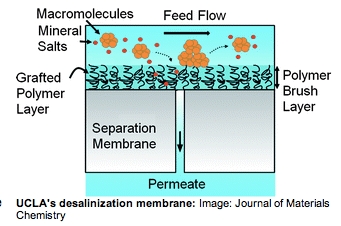
… the UCLA membrane is made of a polyamide thin film composite that is activated by atmospheric-pressure plasma, rather than high pressure. The plasma creates active sites on the new membrane where reactions are initiated that create a ‘brush layer’ on the polyamide surface. Because the brush layer is constantly moving, it makes it nearly impossible for impurities to stick to it.
Another aspect of the membrane is that the chemistry of the brush layer can be chosen to repel molecules of an opposite charge, making the membrane extremely adaptable to different water environments. Nancy H. Lin, a UCLA Engineering senior researcher and the study’s lead author, indicated that “The cost of desalination will therefore decrease when we reduce the cost of chemicals [used for membrane cleaning], as well as process operation [for membrane replacement]. Desalination can become more economical and used as a viable alternate water resource.”
More water treatment coverage here.