Energy policy — nuclear: Governor Ritter inks the deal on HB 10-1348 (Increase Oversight Radioactive Materials)

A picture named cottercontamination

Update: Here’s a report from Rachel Alexander writing for The Cañon City Daily Record. From the article:

[Governor Ritter] signed the bill at the Whitewater & Kayak Recreation Park as the river roared behind him. “You’re going to be impacted by how we approach uranium milling and how we approach uranium permitting,” he said. The bill was sponsored by Sens. Ken Kester, Bob Bacon and Rep. Buffie McFadyen.

The law requires uranium processors to comply with clean-up orders before new applications are processed, strengthen public oversight of bonding requirements; require processors to inform residents about threats to their water if they have registered wells in close proximity to known groundwater contamination; and require processors to amend their operating license before accepting new sources of “alternate feeds.”

“Nobody thinks uranium is an inherently evil thing, it’s just evil if you lose stewardship of it,” Ritter said. “We believed it was the right thing to move this forward.”

Governor Ritter signed the bill that Cotter Corp claims will prevent them from generating the revenue to fund the cleanup of the Lincoln Park/Cotter Mill superfund site near Cañon City. Here’s a report from Bruce Finley writing for The Denver Post. From the article:

“This just gives us a better hold on the milling process,” Ritter said before signing the bill, a bipartisan measure sponsored by Rep. Buffie McFadyen, and Sens. Ken Kester and Bob Bacon.

Greenwood Village based Cotter Corp. operates the mill that became a Superfund cleanup site in 1984. During the statehouse battle over the law, Cotter vice president John Hamrick said the legislation would kill Cotter’s proposed project to refurbish the mill and haul 12.5 million tons of uranium ore from New Mexico for processing. Hamrick on Tuesday declined to comment on the status on any future project. But Hamrick said Cotter is now planning to do research at the mill if the Colorado Department of Public Health and Environment approves.

More coverage from Patrick Malone writing for The Pueblo Chieftain. From the article:

“We should think not about ourselves, but about the generations to come” when it comes to protecting the environment, Ritter said. “It’s incumbent on us to turn this state over to the generation after us and the one that follows in a better way than we found it.”

Under HB1348, Cotter can’t gain permits to expand its operation without first mitigating contamination that already exists. It also must notify residents where groundwater contamination exists of its progress in addressing the problem. The bill also requires Cotter to carry a higher bond that would be sufficient to conduct cleanup efforts. If the mill were to close, the cleanup would be the state’s responsibility, like so many other decommissioned uranium-processing sites throughout the state…

During the past decade, Cotter has been cited about 100 times for environmental violations, but they have been markedly less frequent during the past five years, when a wholesale change of its management team took place. Cotter officials have said the bill hamstrings their intention to take on new materials from Mount Taylor in New Mexico, which would provide the revenue necessary to construct and update an environmentally sound mill.

But residents of Canon City have been fighting for years to get Cotter to clean up the contaminated plumes of groundwater that have been identified. To date, Cotter has chosen to let it dissipate naturally, which could take decades, stretching into centuries.

For the past eight years, Colorado Citizens Against Toxic Waste has pushed for more aggressive measures from Cotter to address the pollution. Tuesday, they saw the fruit of their work. “It’s a culmination of years of paying attention to this site, seeing the problems and looking for solutions,” said Sharyn Cunningham, president of Colorado Citizens Against Toxic Waste. “This bill is the solution to the contamination problems here.”

Here’s the video of the signing from Governor Ritter’s office. Here’s the release (Evan Dreyer/Megan Castle):

Gov. Bill Ritter concluded a two-day, five-city tour of southern Colorado this afternoon, visiting the banks of the Arkansas River near the Royal Gorge to sign legislation that will protect waterways and communities by increasing oversight of uranium mills.

“We all want a safe environment for our families, our children and our communities,” Gov. Ritter said before signing House Bill 1348, a bipartisan measure sponsored by Rep. Buffie McFadyen and Sens. Ken Kester and Bob Bacon. “Future Coloradans will want to raft, kayak and fish this river, just as we’re able to do today. It’s up to us to make sure they get that opportunity. This bill will help make that happen.”

HB 1348 requires operators of uranium mills to comply with all clean-up orders before new state permits for expansion or restructuring of operations are processed. The bill also requires operators to inform residents about threats to their water if residents have wells in close proximity to known groundwater contamination.

“We heard Canon City residents testify that the poison from the uranium processing plant has been tainting groundwater for decades,” Rep. McFadyen said. “This bill simply requires uranium processors to clean up the old mess they’ve already made before accepting new materials that will create new waste. Having polluted groundwater harms the health and the economic development of the area. This bill sets the tone for the nation on what to do with uranium groundwater contamination.”

More 2010 Colorado legislation coverage here.

More nuclear coverage here and here.

Colorado-Big Thompson Project update

A picture named greenmountainreservoir

From email from Reclamation (Kara Lamb):

With the bypass of snowmelt run-off coming down from Dillon Reservoir and the high run-off rates to the tributaries contributing to the Blue River, we are rapidly filling Green Mountain Reservoir. We continue to balance inflow and outflow at Green Mountain. As a result, today, we have bumped up releases twice: at 9 a.m. we bumped up from 1400 cfs to 1750 cfs. At noon, we bumped up to 2100 cfs.

More Colorado-Big Thompson Project coverage here.

Runoff news: Forecast calls for rain Friday or Saturday

A picture named ruedidam

From The Denver Post (Joey Bunch):

Today’s break in the fast, heavy flows is probably a result of Tuesday’s cooler weather, “but it may be short-lived,” said Trest Huse, a hydrologist with the National Weather Service Office in Boulder. Recent temperatures that have been 10 to 15 degrees higher than usual are expected to drop, but an inch of rain is expected east of the Continental Divide, including the Front Range, Friday afternoon to early Saturday.

From the Summit County Citizen’s Voice:

“The inflow to Dillon Reservoir has risen dramatically over the last few days. The average inflow on June 3 was 1,157 cfs, but by June 6 it was up to 2,086 cfs. The current inflow is considerably higher than the forecasted peak, and the flows seem to be rising,” said Bob Steger, manager of raw water supply for Denver Water.

“Dillon Reservoir is currently spilling, and we are concurrently releasing about 300 cfs through the outlet works. The total outflow is currently 1700 cfs and rising. Although we are trying to moderate the outflow by gradually reducing the discharge through the outlet works as the spillage increases, it seems likely that the total outflow will exceed 1,800 cfs, which is the number we attempt to stay below,” Steger added.

Click through and check out the cool photos.

From the Summit County Citizen’s Voice:

“We were able to open the Roberts Tunnel Sunday night because we had a need for water,” said Denver Water’s Bob Steger. As of Tuesday morning, about 350 cfs were flowing through the tunnel, helping to reduce the outflow into the Lower Blue. Steger said he’s not sure how long Denver Water will continue to divert through the Roberts Tunnel. “We only take water when we need it,” he said.

All the major tributaries feeding the Blue surged to near-record levels recently as the snowpack melted all at once. Steger said he suspects a combination of dust on the snow, dead lodgepoles and the first extended warm spell of the spring combined to send the flows spiking to levels far above what was forecast.

From Steamboat Today (Tom Ross):

Joe Sullivan, a supervisory hydrologic technician with the U.S. Geological Survey office in Grand Junction, confirmed Wednesday that the Yampa River likely peaked in Steamboat Springs at 2,920 cubic feet per second at 11:30 p.m. May 30. However, Sullivan held out the possibility that lingering snowpack and a forecast of temperatures in the high 70s and low 80s Friday through Sunday still could push the Yampa to a new 2010 peak.

From Steamboat Today (Zach Fridell):

Hydrologist Bryon Lawrence of the National Weather Service’s Grand Junction forecast office, said the Elk River crested at 7.95 feet at about 2:30 a.m. Tuesday, with a flow of 6,340 cubic feet per second. The river is measured where it crosses Routt County Road 42. The flood stage for the Elk River is 7.5 feet, and water is spilling over the banks onto ranchland in several areas…

The Yampa River, measured at the Fifth Street Bridge, crested at about midnight and surpassed the high water mark measured Sunday, Lawrence said, with an observed peak of 6.72 feet and a flow of 4,317 cfs. The bankfull stage on the Yampa is 6.5 feet, and flood stage is 7.5 feet. Tuesday’s reading is the second time in the past three days the Yampa River has reached a seven-year high.

From the Vail Daily (Lauren Glendenning) via Steamboat Today:

The [Eagle River] crested at 9.3 feet, and had been flowing at 7,240 cubic feet per second, according to a U.S. Geological Survey gauge there. Typical peak flow this time of year is about half that — 3,600 cubic feet per second, Lawrence said. Flood stage is 9 feet. “Unofficially, this is the second highest flow on the Eagle River in Gypsum on record since we’ve had that gauge site there,” he said. Records date back to 1947. The highest the river ever reached was 9.46 feet May 25, 1984, Lawrence said. During that flood, the river’s pace was actually a bit slower than this past flood stage. The river was down to 9.1 feet by Tuesday morning in Gypsum. The Eagle River will be high during the next several days, but it should stay within its banks except in some agricultural areas, Lawrence said.

From the Snowmass Sun

The Roaring Fork River below Aspen was big on Monday. Just how big was anyone’s guess, but it didn’t really matter to those willing to paddle the swollen torrent of chocolate water thundering over Slaughterhouse Falls. The Slaughterhouse gauge indicated that section of the Roaring Fork topped 6,000 cubic feet per second sometime in the wee hours of Monday and was running at 5,700 cfs at about 9:30 a.m. However, the gauge at Emma, below the Roaring Fork’s confluence with the Fryingpan, showed a lower flow, suggesting a malfunction with the Slaughterhouse gauge. Nonetheless, the river wasn’t for the meek. “It’s just crazy raging,” said Jim Ingram, owner of Aspen Whitewater Rafting.

From The Aspen Times (Scott Condon) via the Sky-Hi Daily News:

The National Weather Service issued a flood advisory for the Crystal River above Redstone on Sunday. “Flows on the Crystal River are expected to remain high through Tuesday as warmer-than-normal temperatures result in rapid snow melt,” the weather service statement said. Flood stage on that stretch of river is 5 feet, the advisory said. The river was at 4.3 feet on Sunday evening and was supposed to rise to about 4.9 feet after midnight this morning. The Crystal near Redstone was flowing at 1,680 cubic feet per second (cfs) Sunday evening, according to the U.S. Geological Survey. That was well below the high for the date of 2,550 cfs recorded in 1958, according to the USGS.

The Roaring Fork River was also flowing at a high level Sunday. It was at 3,210 cfs at Emma, a high over the past 12 years, according to the geological survey. The previous high for the date was 2,530 in 2008.

From The Denver Post (Christina Dickinson and Becky Ditchfield):

Flood advisories remain in effect for portions of the Cache La Poudre River in Larimer and Weld Counties, and for the South Platte River in Weld County. Portions of the Big Thompson and Saint Vrain Rivers are also under advisories in Boulder and Larimer Counties.

Arkansas Basin and Gunnison Basin roundtables joint meeting recap

A picture named coloradotransmountaindiversions

From The Pueblo Chieftain (Chris Woodka):

“The Front Range has growing pains, but those who give up water have the pain of amputation,” said George Sibley, a Gunnison writer who for years ran the Western Water Forum at Western State College.
The American West has to change from saying it will provide water for all who come, to making those who move into it realize it is an arid environment, Sibley said.

Colorado is considering contracting with the Bureau of Reclamation for up to 200,000 acre-feet in the Aspinall Unit — Blue Mesa, Crystal and Morrow Point reservoirs west of Gunnison. The state could claim the water under the Colorado River Compact and still meet endangered species fish flows, said Alexandra Davis, director of the Interbasin Compact Committee. But how the Aspinall Unit could be used by Colorado occupied much of the discussion Monday.

“The bottom line is that we don’t want expectations that the water will be there,” said Ken Spann, a director of the Upper Gunnison Water Conservancy District. Spann said there already is a deficit of 100,000 acre-feet for irrigators in the Gunnison River basin, and it cannot afford to give up water to meet Front Range needs…

The groups ultimately wanted to ask the state to investigate whether a “marketable pool” exists in the Aspinall Unit, and other reservoirs, as a first step. Future meetings were scheduled to address the issues broached Monday. “We need to talk about the marketable supply of water sooner rather than later,” said Jay Winner, general manager of the Lower Arkansas Valley Water Conservancy District. “We cannot keep looking at the dry-up of agriculture as the way to supply future water.”

More IBCC — basin roundtables coverage here.

Fryingpan-Arkansas Project update

A picture named ruedidam

Update: From email from Reclamation (Kara Lamb):

I am writing you just before midnight on Wednesday night, June 9. Despite our best efforts to balance inflow and outflow at Ruedi Reservoir, snowmelt inflow to the reservoir has continued very steadily all day and has now been increasing into the night. As a result, Ruedi is almost full. Our numbers indicate that the reservoir will most likely hit its full capacity at mid-morning, sometime between 9 a.m. and noon. When Ruedi hits full, we will begin bypassing the native inflow. We will be using the power plant, the outlet works at the dam, and the spillway. We have continued to work closely with downstream entities, in particular Pitkin County Emergency Management and they are aware of this situation.

I will be sending a follow-up e-mail first thing in the morning. In that notice, I will provide the release amount in cfs. At this point, we are still assessing the situation at the reservoir as inflows continue to increase.

From email from Reclamation (Kara Lamb):

Although inflow to Ruedi has dropped over the course of the night, it is still running above 1000 cfs. As part of our continuing balance of the inflow and outflow at the reservoir, we will be increasing our releases from the dam to the lower Fryingpan this afternoon. Releases will be made in three steps an hour apart, each increasing by 50 cfs.

The gage below the dam includes Rocky Fork Creek–which is running right around 50 cfs, currently. With Rocky Fork, the increases will read as follows at the Ruedi Dam gage:

1:00: 50 cfs increase from 607 to 657.
2:00: 50 cfs increase from 657 to 707.
3:00: 50 cfs increase from 707 to 757.

More Fryingpan-Arkansas Project coverage here.

Colorado-Big Thompson Project update

A picture named olympusdam

From email from Reclamation (Kara Lamb):

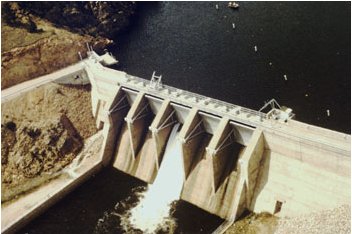
As inflows to Lake Estes continue to decline and the reservoir elevation behind Olympus Dam drops slightly, we will curtail releases from Olympus Dam to the lower Big Thompson River. Earlier this morning, we closed four of the five gates at the dam. Our releases to the lower Big Thompson are now about 580 cfs and could drop further.

More Colorado-Big Thompson coverage here.

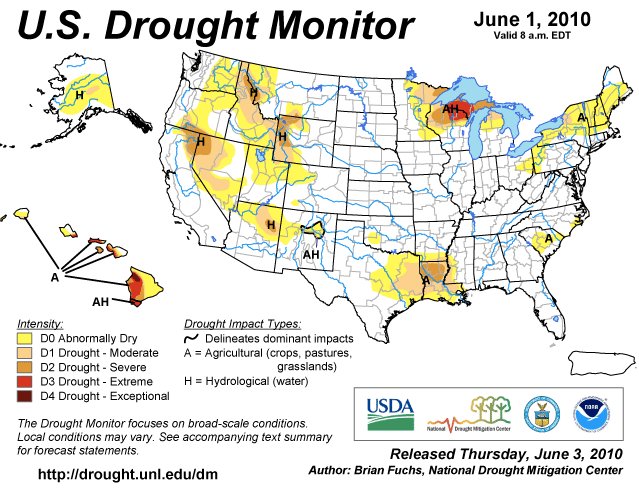
Colorado Climate Center: Weekly Precip and Water Supply Assessment for June 8

A picture named usdroughtmonitorjune12010

Here are Henry Reges’ notes from yesterday’s webinar (pdf). He has included screen shots of some of the slides.

Runoff news: Arkansas River closure below Pueblo Reservoir

A picture named puebloreservoir

From The Pueblo Chieftain (Chris Woodka):

Colorado State Parks Tuesday closed the Arkansas River below Pueblo Dam to boating and tubing, with the exception of whitewater kayaks or canoes. The ban only affects the river within state park boundaries, roughly the first mile of river below Pueblo Dam. It does not include the Arkansas Headwaters Recreation Area, upstream of Lake Pueblo, which remains open to all rafting or kayaking. There are area advisories, however, to avoid the Royal Gorge, Pine Creek and the Numbers, three areas known to be dangerous at high water…

Flows were running at 5,100 cubic feet per second just below the dam Tuesday, more than twice the normal flow for this time of year. At Moffat Street, midway through Pueblo, flows were 5,900 cfs. There was no indication about at what levels the restriction would be lifted.

From The Pueblo Chieftain (Chris Woodka):

Farmers and rafting operators are mostly smiles with the heavy runoff in the Arkansas River that began this week. Conditions are just about perfect on the Bessemer Ditch, said Joe Mauro, a produce farmer. “Warm weather, lots of water in the ditch and no hail,” Mauro said, when asked what makes for perfection as crops mature…

Further down the valley, at Lamar, farmers have been happy, as warm days have allowed for the first cutting of hay to be put up. But with 90-degree weather over the last 10 days, some other crops are taking a beating. “We need rain in my area,” said Dale Mauch, who farms on the Fort Lyon Canal. “With irrigating water, you can’t hardly keep up. Some of the corn is getting dry. But it’s been great for haying.” Rainfall has been above average for nearly all of the Arkansas River basin, but has slacked off for the past two weeks in the Lamar area…

Meanwhile, in the Upper Arkansas, rafting has become more exciting during the past few days, said Bob Hamel, owner of Arkansas River Tours and chairman of the Colorado River Outfitters Association. “What we have the ability to do is to move along the river as conditions change,” Hamel said. “The most awesome thing about the Arkansas River is that you can have trips at every level.” News reports of flooding are misleading, he said. “It means the river is full,” Hamel said. While the Royal Gorge is under an advisory, which rafting companies observe, there are still plenty of exciting areas of the river, which are safe for guided tours, he said. “The rapids have more definition,” Hamel said. “These are conditions that we have only once in 15 years.”[…]

The river at Parkdale, west of Canon City, continued to run at record levels, above 5,000 cubic feet per second, for the third consecutive day on Tuesday. Near Buena Vista, the river was running at 4,500 cfs. At Avondale, east of Pueblo, the peak flow was measured at 5,610 cfs Tuesday morning. Water was flowing heavily into Turquoise and Twin lakes Tuesday as runoff continued to peak. Space was made in the mountain lakes over the winter to accommodate water imported through tunnels, which are running at full capacity this week. Storage in the Arkansas River basin was at 105 percent of average at the beginning of the month, while snowpack was only 32 percent of average, according to the Natural Resources Conservation Service. The Fryingpan-Arkansas Project has imported 26,700 acre-feet of water so far, and is on course to meet the forecast of 54,200 acre-feet, said Roy Vaughan, project manager.

From The Denver Post (Sarah Horn):

Throughout Tuesday, flood watches or warnings were issued in Boulder, Eagle, Fremont, Pueblo and Weld counties. Just outside Greeley, 71st Avenue between O and Sixth streets was closed because of 3 to 6 inches of standing water from the Cache La Poudre River. Traffic will be detoured around the flooding until the water recedes, said Margie Martinez, an undersheriff for Weld County. The Jefferson County Sheriff’s Office will enforce a ban on belly boats, inner tubes and rafts on areas of Clear Creek starting today at 8 a.m. An area of the Eagle River below Gypsum reached flood stage Tuesday but retreated to just below the 9-foot flood stage by the afternoon. The Elk River near Milner has stayed slightly above its 7 1/2-foot flood stage.

From The Greeley Tribune (Mike Peters):

The Poudre River Trail was underwater Tuesday in some areas of west Greeley, while 71st Avenue was closed just east of the Poudre River Ranch subdivision. Road barricades were set up by Weld County workers early Tuesday, as water from the Poudre River flooded over 71st Avenue. A nearby parking lot for Poudre Trail walkers was closed, under about 3 feet of water…

Further west, high flows on the Poudre River caused some basement flooding at the Poudre Heights subdivision, south of Windsor, where a crew was busy placing sandbags. The intersection of 7th Street and Riverplace Drive was closed because water from the pond that irrigates the subdivision was flowing over the street.

From the Glenwood Springs Post Independent (Janet Urquhart and Scott Condon):

The U.S. Bureau of Reclamation announced it would make additional releases into the lower Fryingpan River from Ruedi Reservoir, east of Basalt, on Tuesday, after bumping up flows by 100 cubic feet per second on Monday. Flows in the river were expected to hit 650 cfs Tuesday, but the bureau re-evaluated its need to move water and said it would hold the release from the reservoir to 600 cfs. That is “great news” because it keeps the Roaring Fork River more manageable as well, [Pat Bingham, a public information officer with an emergency response team comprising officials from Pitkin County, Basalt, Aspen and the Basalt Fire Department] said. With the contribution of flows out of the Rocky Fork, a tributary to the Fryingpan below the dam, the bureau estimated flows of about 640 cfs coming down the Fryingpan. Flows coming into the reservoir were topping 1,060 cfs, the bureau reported, prompting the need to increase its release out of the lake.

The Post Independent has a photo of the Roaring Fork River at Cascade Falls yesterday.

Attorney General Suthers proposes $1.6 million settlement for Lowry Landfill

Lowry Landfill 2008

From the Aurora Sentinel (Brandon Johannson):

According to a statement from Colorado Attorney General John Suthers, the state reached a settlement with the property owner, operator and groups that sent waste to the landfill. Suthers said the settlement means the state and those involved can avoid lengthy and expensive litigation to determine to what extent each group was involved. “This settlement provides an equitable and appropriate solution to address the injuries at the Lowry Landfill Superfund Site,” Suthers said in the statement. “The agreement will allow Colorado to move forward on resource restoration instead of spending years locked in costly litigation.”

The 508-acre site is in unincorporated Arapahoe County near East Hampden Avenue and South Gun Club Road, less than a mile east of E-470. According to Suthers’ office, it was the principal landfill for the Front Range as well as the industrial landfill for many Colorado companies, taking solid and liquid waste from 1965 through 1980 and solid waste from 1980 until 1990.

The settlement, filed in U.S. District Court in Denver, is now open for public comment for the next 30 days.

Under the first settlement, the companies and entities that contributed waste materials to the site will pay the state more than $1.1 million, money that will assist the state in restoring natural resources and compensate for damage to the groundwater at the site, according to Suthers’ statement.

A second settlement, between the state and the City and County of Denver, Waste Management of Colorado and Chemical Waste Management, Inc., will require the parties to pay the state $500,000, the statement said. That money will be used for a loan for low- to middle-income households needing sewer repairs, something the statement said will help improve groundwater quality in the South Platte River watershed.

More Lowry Landfill coverage here.