Estes Park: Grand Ditch Restoration Project public meetings June 1 and June 3

A picture named grandditch

From the Estes Park News:

Rocky Mountain National Park will conduct two public meetings on the Grand Ditch Breach Restoration Project the first week of June, 2010. The first meeting will be held in Grand Lake at the Grand Arts Center, 913 Park Avenue on Tuesday, June 1, from 7:00 p.m. to 9:00 p.m. The second meeting will be held in Fort Collins at the Harmony Library, 4616 South Shields Street on Thursday, June 3, from 7:00 p.m. to 9:00 p.m…

Rocky Mountain National Park is beginning a multi-year process to complete an Environmental Impact Statement (EIS) to guide the restoration of the breach-impacted area. We will be gathering input from park staff, other agencies and the public to develop a set of alternatives for restoration of the breach-impacted area. The purpose of the restoration project will be to restore the hydrological processes, ecological services and wilderness character impacted by the 2003 Grand Ditch Breach.

Alternatives to be considered will likely include a combination of the following: Allowing natural (passive) restoration to occur where appropriate; stabilizing steep, unstable slopes with an engineered solution; removing deposited sediment and redistributing it through the impacted area or elsewhere; removing dead timber from the impacted area and/or using it in the restoration process; regrading and recontouring areas to restore appropriate hydrologic processes; native plant restoration with appropriate, locally gathered plant materials; may require the use of motorized equipment such as chainsaws, heavy lift helicopters, and earthmoving equipment; may require temporary fencing to protect native plant restoration areas.

Major issues to be considered in this restoration planning process include short-and-long-term potential impacts to: wilderness character; geological resources; geological hazards; soundscapes; surface and groundwater hydrology; stream channel, floodplain and wetland morphology and function; water quality; riparian and wetland communities; species of special concern (plants and animals); wildlife habitat; aquatic habitat; visitor experience; long-term resource productivity; archeological and historical sites.

A newsletter has been prepared that details the issues identified to date. Copies of that information may be obtained from Rocky Mountain National Park’s Information Office, 1000 US Highway 36, Estes Park, Colorado 80517-8397, (970) 586-1206. Information will be available for public review online at http://parkplanning.nps.gov/romo.

If you wish to comment on the newsletter or on any other issues associated with the plan, you may submit your comments by any one of several methods. You may mail comments to: Grand Ditch Breach Restoration Plan, Rocky Mountain National Park, 1000 US Highway 36, Estes Park, Colorado 80517-8397. You may also comment via the Internet at http://parkplanning.nps.gov/romo [1]. Finally, you may hand-deliver comments to: Superintendent, Rocky Mountain National Park, 1000 US Highway 36, Estes Park, Colorado 80517-8397.

Comments submitted to the website or by mail are welcome at any time; however, they would be particularly helpful if received by June 16, 2010.

More Grand Ditch coverage here and here.

Energy policy — nuclear: Federal money train for uranium tailings cleanup near Moab is slowing down

A picture named moabcoloradoriverspanishval

From The Grand Junction Daily Sentinel (Gary Harmon):

The U.S. Department of Energy cleanup that is hauling the pile north to Crescent Junction was helped significantly by stimulus money, Don Metzler, director of the project, said at the Grand Junction Area Chamber of Commerce last month. Funding for the project “is not secure at all,” Metzler said. Budget forecasting suggests that 2012 will be a “tough time” for the Energy Department, Metzler said, but spending $90 million a year would make it possible to complete the cleanup by 2019, saving hundreds of millions in life-cycle costs of the $1 billion project. Two trains a day, five days a week, haul tailings from the pile along the Colorado River next to Arches National Park to the 500-acre disposal cell at Crescent Junction. By dint of several breaks, including stimulus funding, the project is operating with about $90 million a year now, but is to fall to the base amount of $30 million a year after 2011. That amount would allow for only one train a day bound for Crescent Junction, which would make the cleanup too slow, Metzler said.

More nuclear coverage here and here.

Vail: Teva Games this weekend

A picture named standuppaddling

From The Denver Post (Scott Willoughby):

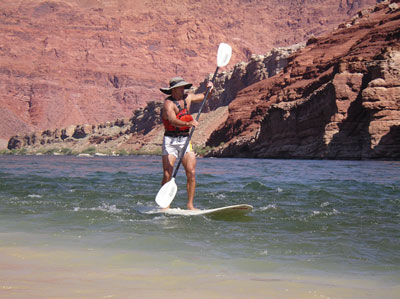
Nine years later, the Teva Mountain Games taking place Friday through Sunday are very much on the map as the nation’s premier celebration of adventure sports and lifestyle. Yet, in many ways, they’re still Vail’s river games — and they’re still brand new. “We always want to be cutting edge from the perspective of trying new things, but we’re also one of the biggest events of its kind. So we sort of have a reputation to uphold as being on the forefront of the adventure sports lifestyle,” said Paul Abling of the Vail Valley Foundation, which took ownership of the former grassroots event late in 2008. “If we’re going to do something new at the Teva Mountain Games, we’re going to go big with it.” The latest addition to the crowded TMG program offers an evolutionary twist to the down-river racing of yore, as whitewater stand-up paddle surfing (SUP) makes its competitive debut on snowmelt-swollen Gore Creek on Saturday and Sunday. Two events dubbed “SUP Surf Sprint” and “SUP Surf Cross” will have paddlers racing downriver on surfboards designed to run rapids, even battling head-to-head in the “cross” format. “It’s going to steal the show, for sure,” said local competitor Ken Hoeve of Gypsum.

More whitewater coverage here.

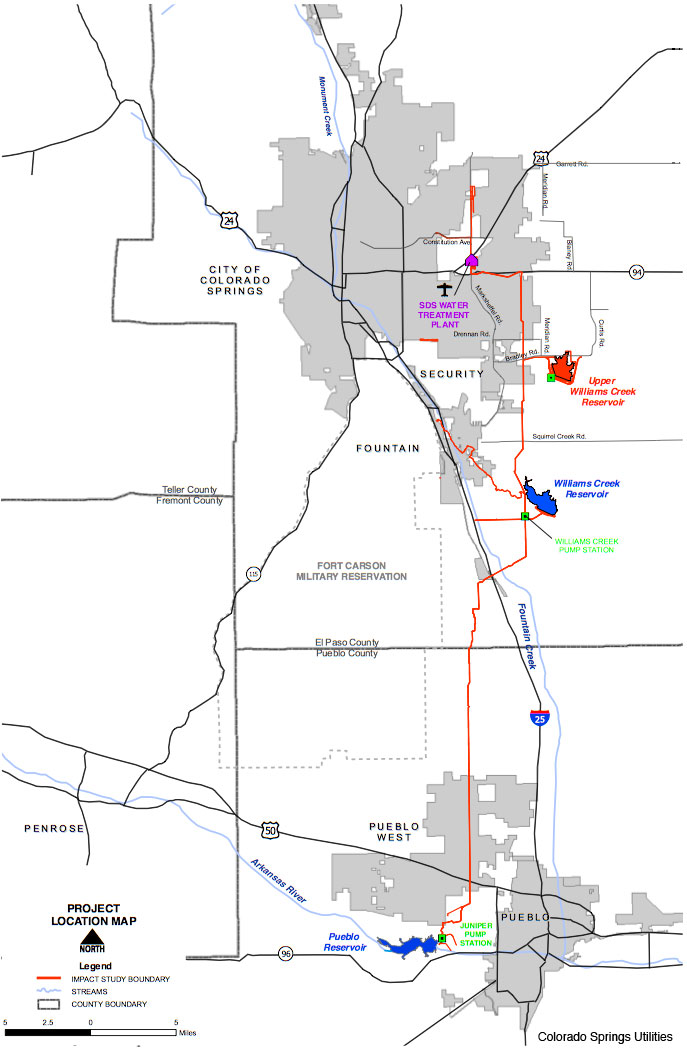
Southern Delivery System: What are the impacts from sharing project facilities with providers that were not included in the Reclamation evaluation?

A picture named sdspreferredalternative

From The Pueblo Chieftain (Chris Woodka):

…at contract negotiations last week, Colorado Springs worked very hard to insert provisions that would allow the use of excess capacity of SDS, partly to help pay for the expense. “We need to be clear that there are plans on the part of several SDS participants to serve others through the project,” Colorado Springs water attorney David Robbins told the Bureau of Reclamation at the negotiations in Pueblo. While Colorado Springs and its SDS partners intend to stay within the limit of taking a maximum of 78 million gallons of water a day from Lake Pueblo into El Paso County, more water could be wheeled through the pipeline than was envisioned in Reclamation’s environmental impact study. Colorado Springs wants to build in the ability to use the project for neighboring communities in El Paso County, asking for changes in Reclamation’s proposed contract to allow for “excess-capacity” users.

That point was raised two years ago by Pueblo County water attorney Ray Petros during the EIS comment period.

Petros pointed out environmental impacts were modeled on moving an average of 52,900 acre-feet of water delivered annually through the pipeline, with a firm yield of 42,400 acre-feet. That is only about 60 percent of the capacity of the pipeline and pumping stations to move 87,000 acre-feet per year. “Any approval should condition the use of the project on the use of only existing water rights without further environmental study and review,” Petros told Reclamation in June 2008. At the time, he also advised against allowing additional users on the pipeline. “The draft EIS does not consider the impacts associated with Colorado Springs supplying raw water or substantial amounts of treated water outside its city boundaries. Such water contracts could increase the amount of water projected to be delivered through the pipeline,” Petros said. “Additional taps to the pipeline could mean unplanned growth and impacts along the pipeline.”

Reclamation responded to Petros’ comments by saying the final EIS would have commitments that require Colorado Springs to stay within the limits modeled. “A commitment not to contract or operate the preferred alternative in a manner that differs substantively from that evaluated in the final EIS, except under emergency conditions, has been included,” Reclamation replied. “Because of this commitment only the water supplies analyzed in this final EIS could be delivered through SDS facilities without NEPA analysis.” Petros brought up the concerns again when Pueblo County’s hearings began for a 1041 permit in December 2008. Throughout the hearings, the concern never went away, and it led to a procedure to deal with new water rights added to SDS or third-party users. Under one condition, Pueblo County can reopen 1041 hearings if new water rights are added. Third-party contracts would require support for the Fountain Creek Watershed Flood Control and Greenway District, a commitment not to serve customers outside the Arkansas River basin, adoption of stormwater controls similar to the now-defunct stormwater enterprise in Colorado Springs, cooperation in the Pueblo flow program, participation in water-quality monitoring and support of studies for a flood control dams on Fountain Creek…

During last week’s negotiations, Reclamation asked Colorado Springs to provide an inventory of the water rights that were used to develop the EIS during discussions about excess capacity. In its statement of purpose and need for SDS, Colorado Springs said it was needed to meet future needs of participants, provide redundant systems and develop existing water rights. Nothing was mentioned about supplying the water needs of neighboring communities in the statement…

“If Colorado Springs Utilities doesn’t become the regional water supplier, someone else will step in and do it,” Tony Elia, chairman of the Utilities Policy Advisory Council, told Colorado Springs City Council last July, on the day it decided to delay SDS completion until 2016. The council pushed back SDS to provide breathing room for ratepayers, who nevertheless will be looking at a doubling in water rates by the time SDS is projected to go online.

More Southern Delivery System coverage here and here.

Runoff news

A picture named gorecreekwinter

From The Denver Post (Scott Willoughby):

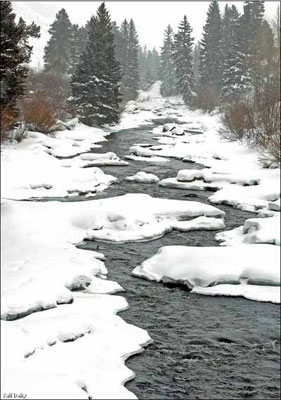
The typically tranquil Gore Creek, for example, shot up from a mere 450 cubic feet per second at its primary USGS measuring station Thursday to a whopping 1,300 cfs by midnight the next day. That’s nearly triple the flow coming down a creek that begins and ends above 8,000 feet…

“I’m afraid we may not have reached the high-flow period yet,” USGS Colorado spokeswoman Heidi Koontz told The Denver Post on Sunday. “Typically, the high-flow period comes in the middle of June.”[…]

Kayakers converged along the Arkansas over the weekend as Buena Vista christened a pair of new man-made whitewater waves during the annual CKS Paddlefest. The show then moved to Steamboat Springs for the Paddling Life Pro Invitational on Fish Creek and the Yampa River on Monday. Boaters in both places were greeted by a spike of about 1,000 cfs over the course of just a few days, enough to put most paddlers on red alert. Meanwhile, the reputation of the 3-year-old wave park on the Colorado River at Glenwood Springs continued to swell among river surfers, with as many as 15 board surfers lining up among the throng of kayakers waiting to ride the wave on a sunny Saturday afternoon. Roughly 25 more showed up to compete in the second annual Whitewater Stand Up Paddle Surfing Championships held there Monday. As the calendar reaches river season statewide, organizers of the Teva Mountain Games in Vail, Salida’s annual FIBArk Festival, the Lyons Outdoor Games on the St. Vrain, Animas River Days in Durango and the Gunnison River Festival in between are excited to showcase their local treasures and share them with the world.

From Fox21.com (Rachel Welte):

The National Weather Service in Pueblo said Monday sections of the [Arkansas River] are less than a foot away from flood stage, sitting at 8.6 feet…

“If you can imagine 3,000 basketballs going by any given point in the river at any time, that is about the volume of flow we are running, so that is a lot of water,” Tony Keenan said.

More whitewater coverage here.