
Windy Gap Firming and the Moffat Collection System Project: What are the potential long-term environmental effects?

A picture named grandlake

From The Denver Post (Bruce Finley):

“I know (Front Range residents) want to take showers, but we have to co-exist. They can’t destroy the beauty here — which is probably part of why they came to Colorado in the first place,” said Pat Raney, 66, one of a dozen or so volunteers who test water quality. Lying on her belly on the deck of a rocking pontoon boat on the lake, Raney lowered a disc used to measure underwater visibility: “7 feet 4 inches,” she reported to fellow volunteers. “Color is brown.” That’s less one third of the 30-feet visibility documented in 1941 before diversions here began…

While Grand Lake residents opposed to diversions tested water last week, Northern Colorado water district officials (who conduct their own water-clarity tests) were leading two busloads of Front Range residents on a moving seminar aimed at highlighting the need for new water.

Front Range water authorities contend that rearranging nature’s plumbing is not the only factor making Grand Lake water murkier. Residential and commercial development around Grand Lake may lead to septic system, lawn fertilizer and other contamination of water, Denver Water project manager Travis Bray said. The Front Range authorities now are trying to sweeten their proposals. They’re offering to improve the town of Fraser’s water-treatment plant — easing stress on that river. A cleaner Fraser flow into the Colorado would mean “no net change in the nutrient levels” in Grand Lake, Northern project manager Jeff Drager said. Northern would team with Denver Water to improve the facility, he said. “We’re talking maybe $4 million.”

The water providers also have offered to manage river flows in a way that ensures additional water to sustain fish.

More Colorado River Basin coverage here.
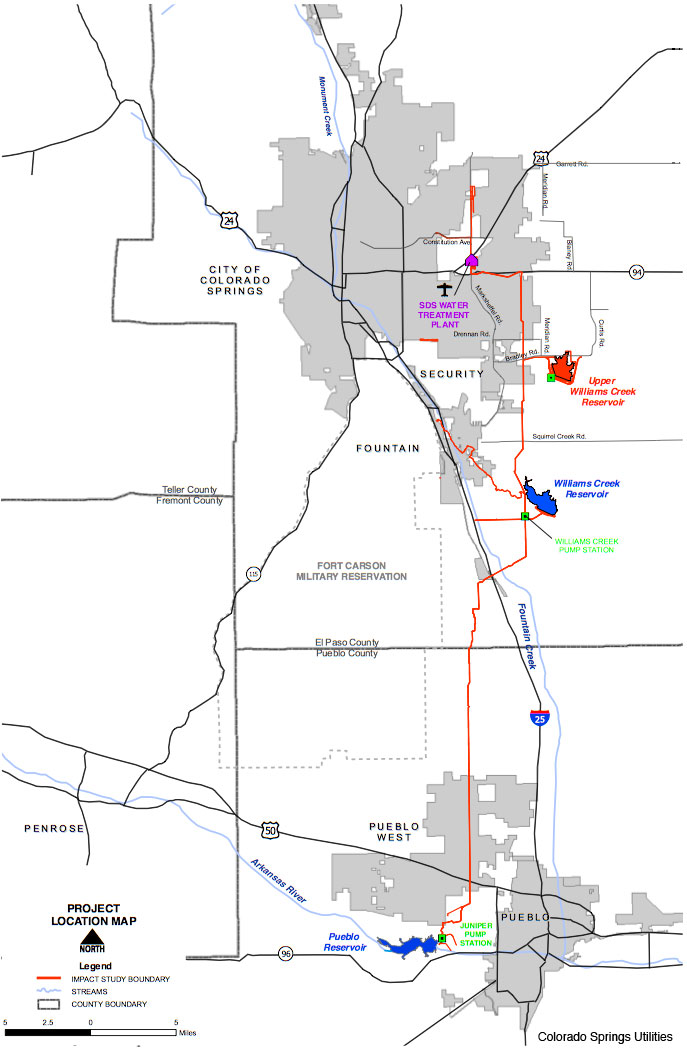
Southern Delivery System: Reclamation raises the stakes $200 million

A picture named sdspreferredalternative

From The Colorado Springs Gazette (Eileen Welsome):

At issue are $200 million in potential additional costs that the federal government wants to impose on Utilities and its partners for storage and conveyance of water through Pueblo Reservoir. Utilities contends the costs are unfair and much higher than what other water providers, such as Pueblo, are charged. “We should be treated fairly and equitably,” said Utilities’ John Fredell, SDS project director.

Colorado Springs City Councilman and Utilities board member Sean Paige said the fees are outrageous. “The whole thing is appalling,” Paige said. “The Bureau of Reclamation isn’t there to squeeze every dollar that it can from the city through these negotiations. They’re supposed to be helping us to come to an equitable arrangement to manage this water project.”[…]

Fredell and his team will face off against Bureau of Reclamation officials in a two-day session scheduled to begin 9 a.m. Thursday at Fountain Valley School of Colorado. The negotiations are scheduled to resume 8 a.m. Friday at the same location. Like the previous two sessions, May 25 in Pueblo and June 15 in Colorado Springs, the public is invited. Although public negotiations are a little like showing your cards to opponents in a high-stakes poker game, it’s the policy of the bureau to conduct negotiations in public, said spokeswoman Kara Lamb.

More coverage from Chris Woodka writing for The Pueblo Chieftain. From the article:

The next round of negotiations will begin at 9 a.m. Thursday and continue at 8 a.m. Friday at the Fountain Valley School, 6155 Fountain Valley School Road, Colorado Springs. It will be held in the Bancroft Room of the campus library. The two sides ended far apart at the end of the last session in June. Reclamation’s offer calls for storage and conveyance for $75 an acre-foot and $50 per acre-foot for an annual exchange. An annual inflation factor of 3.08 percent is included.

The terms were called “unacceptable” by SDS Project Director John Fredell at the conclusion of the last session. Colorado Springs is asking for a storage and exchange fee of $17.35 per acre-foot, with no conveyance fee for the structure it wants to build, a North Outlet Works on the face of Pueblo Dam. Its inflation factor is 1.79 percent annually. Colorado Springs is negotiating on behalf of its SDS partners, Security, Fountain and Pueblo West.

More Southern Delivery System coverage here and here.

Water vs. Energy

A picture named tarsandstrucks

Here’s the website for the IEEE Spectrum Special Report: Water vs. Energy. From the “Water-Energy Nexus” section:

Without water, we’d have practically no energy. Without energy—and therefore cars, planes, laptops, smartphones, and lighting—we wouldn’t be doing much. In almost every type of power plant, water is a major hidden cost. Water cools the blistering steam of thermal plants and allows hydroelectric turbines to churn. It brings biofuel crops from the ground and geothermal energy from the depths of the Earth. Our power sources would be impotent without water.