Vote Slated on Water Mitigation Plans

A picture named fraservalleycollection.jpg

Here’s the release from the Colorado Division of Wildlife (Theo Stein):

The Colorado Wildlife Commission plans to vote on the adequacy of plans to mitigate impacts to fish and wildlife resources from two proposed transmountain water development projects during its meeting in Grand Junction.

The vote will complete the Commission’s 60-day review of the Fish and Wildlife Mitigation Plans submitted by Denver Water and the Northern Colorado Water Conservancy District at the Commission’s April meeting in Meeker.

The Moffat Collection System Project proposes to firm up the yield from Denver Water’s existing water rights on the West Slope, primarily by diverting additional water from the Fraser, Williams Fork and Blue rivers to an enlarged Gross Reservoir in Boulder County. The Windy Gap Firming Project would firm up Northern’s yield from existing water rights in the Upper Colorado River by diverting additional water to the proposed new Chimney Hollow Reservoir west of Loveland. The mitigation plan review by the Wildlife Commission is part of each project’s federal permitting process.

Last month, Ken Kehmeier, a senior aquatic biologist with the Division, presented staff’s analysis of the plans during the Commission’s May meeting in Salida. Following Kehmeier’s analysis, Commissioners questioned whether additional protections might be needed to guard against high water temperatures and whether flushing flows contemplated by the plans would be enough to maintain channel health. They also asked for more consideration of mitigation and enhancement funding, and for a clarification of the role that the Division would play in developing and managing restoration projects.

As part of its mitigation package for the Fraser River and upper Williams Fork River, Denver has proposed to fund a Colorado River cutthroat restoration project and fund other aquatic habitat restoration work. On the Colorado River, Denver and Northern Water would monitor water temperatures and agree to release water in August if high temperatures threatened fish. East of the Divide, Denver would replace wetlands inundated by the enlarged Gross Reservoir and monitor stream channel stability in South Boulder Creek. Denver would also allow Boulder and Lafayette to store water in Gross Reservoir to boost minimum flows in the Boulder Creek drainage during winter.

Northern, for its part, has offered [to] manage their diversions to maintain water levels in Lake Granby and keep water temperatures cool in the Upper Colorado River below Windy Gap Reservoir. Northern also said it would contribute to water-quality projects designed to reduce nutrient loading in Grand Lake, Lake Granby and Shadow Mountain Reservoir. On the other side of the Divide, Northern would replace wetlands submerged by the new Chimney Hollow Reservoir and enhance nearby wildlife habitat.

Denver and Northern are also voluntarily proposing enhancement plans to improve conditions for fish and wildlife on a roughly 14-mile stretch of river between Windy Gap Reservoir and the Kemp-Breeze State Wildlife Area. The enhancement plans are not required by the Commission’s review process.

Once the Wildlife Commission adopts its final recommendation, the Colorado Water Conservation Board will have 60 days to affirm or modify the state’s position. Governor John Hickenlooper will also have 60 days to affirm or further modify it before it’s submitted to federal permitting agencies.

Recently, Denver Water announced it had reached a complex legal settlement with Grand County and 33 other groups regarding longstanding concerns about the health of the Colorado River. The settlement includes funding for aquatic habitat and for an adaptive management process designed to help maintain river health.

Additional information regarding the Wildlife Commission’s review, including links to the mitigation and enhancement plans being offered by Denver Water and Northern, can be found on the Division’s web site at: http://wildlife.state.co.us/LandWater/Water/MoffatWindyGapMitigationProjects/.

More Moffat Collection System Project coverage here and here.

More Windy Gap coverage here and here.

American Rivers’ 10 most endangered rivers list for 2011: The Green River is #7

A picture named lowergreenriverlake.jpg

Here’s the link to the website. Here’s a preview:

America’s Most Endangered Rivers is more than a list. It is a call to action to engage concerned citizens in the fight to protect rivers. With public support, we can directly impact the fate of these rivers and save them for generations to come.

Milwaukee: ‘2011 Urban Water Sustainability Leadership Conference’ Oct 3-5

A picture named 2011urbanwatersustainabilityleadershipconference.jpg

From the Clean Water America Alliance:

Join us in exploring models for sustainability that feature cross-agency collaboration for green infrastructure and resource recovery. Building on the discoveries of the 2010 Leadership Conference in Philadelphia, the Clean Water America Alliance will host urban water leaders on October 3-5, 2011 in the World Water Hub – Milwaukee, Wisconsin, for the 2011 Urban Water Sustainability Leadership Conference.

Given shrinking budgets, communities around the country are turning towards sustainable approaches to help save money, become more resilient, and prepare for the future. Green infrastructure can help prevent overflows and stormwater runoff problems, reduce energy costs, adapt to climate change, and beautify neighborhoods. Resource recovery, such as energy, nutrients, and other valuable materials, can reduce demand on stressed water supplies, improve watershed health, and boost economic productivity. Responsive to the needs of today and responsible for meeting the needs of tomorrow, communities around the country are leading the way with bold, sustainable decision-making and innovation that enhances how we meet our core missions.

Colorado-Big Thompson Project update: 450 cfs in the Big Thompson below Lake Estes

A picture named coloradobigthompsonmap.jpg

From email from Reclamation (Kara Lamb):

With the warm weather today, we are expecting to see some snow melt run-off tonight coming into Lake Estes. Right now, we are planning on bumping up releases from Olympus Dam to the lower Big T to about 450 cfs. We are expecting to make that change around midnight. Typically, snow melt run-off reaches Estes Park and Lake Estes late at night.It is possible releases might be higher than 450 cfs, or even lower. It all depends on how the snow pack responded to today’s temperatures. But, at this time, we are projecting the release will be 450 cfs.

From email from Reclamation (Kara Lamb):

Several of you have noticed and given me a call: the release from Green Mountain Dam/Power Plant dropped [June 1] by about 300 cfs. This is because one of our hydro-electric generating units tripped off-line. We are currently releasing about 900 cfs to the Lower Blue. At this time, we estimate that the 900 cfs release rate will continue through the weekend and into the top of next week. Once the unit is back on-line, releases will likely resume the 1200 cfs release rate, depending on where we are in run-off, if the snow is melting by then.

More Colorado-Big Thompson Project coverage here.

Runoff/snowpack news: June 1 snowpack numbers are at record levels

A picture named floodthreat06032011

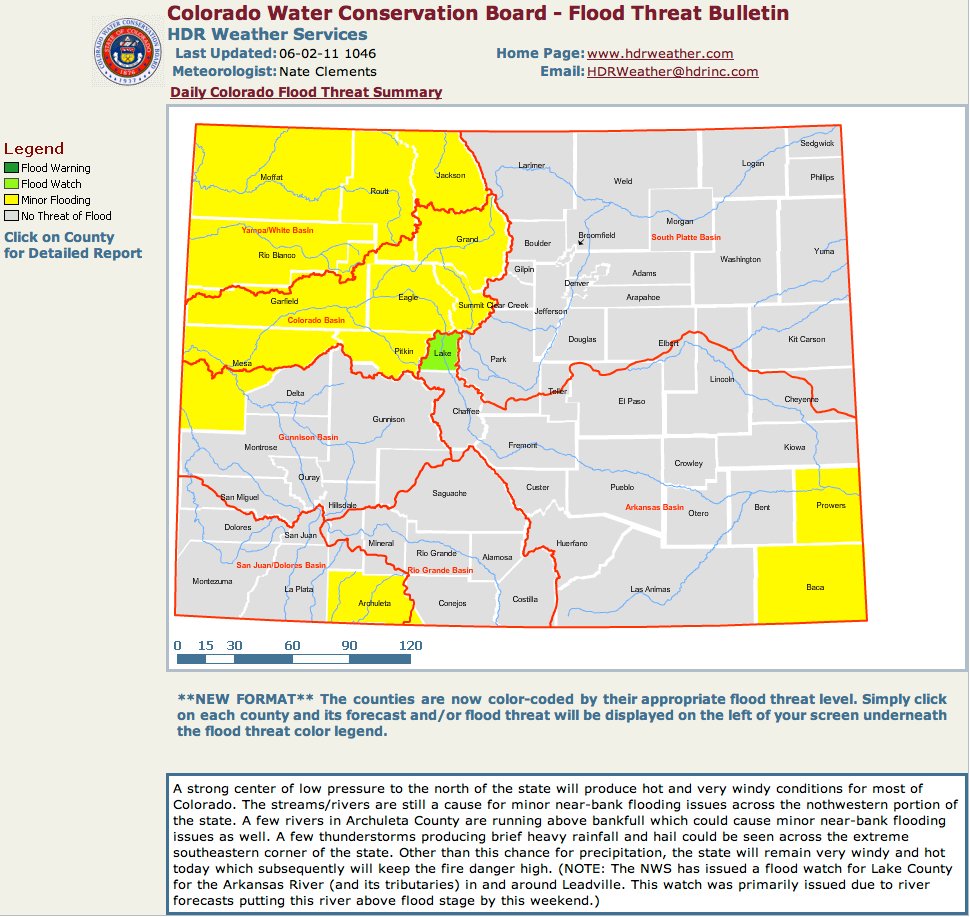
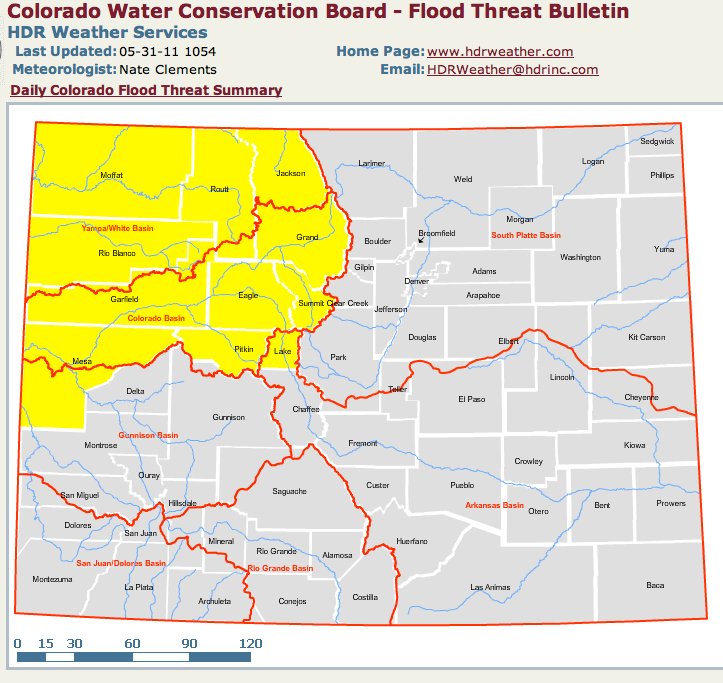
Click on the thumbnail graphic to the right for a look at this morning’s flooding picture from the CWCB. Here’s the link. Here’s the link to the Colorado Water Conservation Board’s online applications Flood DSS. Here’s the link to the USGS’ Water Watch website where you can get a graphical view of all their gages across the state. Here’s the link to the Colorado Division of Water Resources Surface Water page where you can track your favorite gages.

I think we can finally say that runoff is starting on the Front Range. Clear Creek, just now, was running at 667 cfs at the Golden gage while the median value for this date is 646 cfs. The Cache la Poudre at Fort Collins is a different story altogether. The median value for this day is 452 cfs but, just now, the river was running at 1,910 cfs.

Here’s a report from around the western U.S. from the Associated Press via The Pueblo Chieftain. Click through for the great photo of Grand Coulee (Columbia River) outlet works running full throttle. From the article:

States across the West are bracing for major flooding in the coming weeks once a record mountain snowpack starts melting and sending water gushing into rivers, streams and low-lying communities. The catalyst will be warmer temperatures forecast for the next week that could set off a rapid thaw. Randy Julander, a supervisor with the U.S. Department of Agriculture’s Natural Resources Conservation Service, says flooding this year could be worse than anyone has ever seen. Julander said in a typical year the weather warms gradually, allowing snow in the mountains to melt slowly and ease into rivers and streams over time. That’s not the case this year after a cool, rainy spring.

“It’s all just sitting there, sitting there, sitting there. Everyone knows it’s going to come down, it’s just when and how quick that we’re all waiting for,” he said. “The bull is basically sitting in the chute and the gates are already open. He’s just not coming out to play yet, but when he does I anticipate he’s really going to be ticked off and bucking hard.”

The [Grand Coulee] dam is releasing so much water that millions of fish have been put in jeopardy. The heavy flows through dam spillways capture dangerous levels of nitrogen from the air, and the gas bubbles give fish the equivalent of the bends. A fish farm near the Grand Coulee Dam says an estimated 100,000 fish are dying every day, and has gone to court to slow down the flows.The massive amounts of water coursing through the dams have also created a surplus of hydroelectric power. It’s such a huge glut that the main provider of electricity in the Northwest ordered a shutdown of wind farms in the region because the grid can’t handle all the extra power.

From The Pueblo Chieftain (Chris Woodka):

The Arkansas River remained below average in its flows on Thursday, and no warnings have been issued for boaters in any reaches of the river through the Arkansas Headwaters Recreation Area…

A state flood task force said there could be potential flood danger in Lake County on the Upper Arkansas River. Areas below 7,500 feet elevation are unlikely to experience flooding unless there is heavy rainfall…

Colorado River flows are predicted to peak at about 50,000 cubic feet per second, about 50 percent higher than last year.

From the Summit County Citizens Voice (Bob Berwyn):

Colorado’s latest snowpack data, compiled by the Natural Resources Conservation Service, shows the profound impact that a cool and wet May can have on water supplies, in terms of both timing and quantity.

From the Summit Daily News (Kathryn Corazzelli):

Essentially, if you don’t already have it, it’s too late to get flood insurance, said Maggie Lifland, owner of Arrow Insurance in Frisco. Flood insurance — which is administered by the Federal Emergency Management Agency through private insurance companies — is not active for 30 days, unless you’re in the process of buying a property right now, she said…

Steve Gunderson, director of water quality control division for the Colorado Department of Public Health and Environment, said he isn’t very worried about toxic flooding in High Country homes since most of the snow melt is coming ā€œfrom fairly high elevation and through narrow canyons.ā€ More harmful flooding usually occurs in flat areas like Mississippi or Tennessee, he said. But damage is site specific, meaning home-owners with shallow wells could experience more contamination.

From the Associated Press via NorthernColorado5.com:

National Weather Service office Aldis Strautins says the Yampa already has caused some lowland flooding though it hasn’t reached flood stage.Forecasters say flood projections for other rivers don’t include rapid rises that were expected earlier. The runoff could still cause a second peak later in the month, as the snow continues to melt.

From the Fort Collins Coloradoan (Kevin Duggan):

More than 200 people crowded into a room at Cache la Poudre Elementary School [Wednesday] to learn about the potential for flooding and how to protect themselves and their property from damage.

With water content in the snowpack in the upper Poudre River drainage nearly triple of average for this time of year, a lot of water is going to come down the river in the coming weeks, said George Varra, the Poudre River commissioner…

Scott Hummer, manager of the Cache la Poudre irrigation companies, told the crowd the water content in snow measured at Joe Wright Reservoir is 50 inches, when normally it’s 17 inches. Irrigation ditches can handle only so much of the runoff, he said. ā€œFor the next four weeks, you have to pray for no rain,ā€ Hummer said.

From the Colorado Independent (David O. Williams):

Meanwhile, the snowpack in the Colorado River Basin and many other drainages around the state stands at more than 200 percent of the annual average for this time of year, prompting state officials to sound a collective cautionary alarm on Thursday. Colorado Water Conservation Board (CWCB) and Colorado Division of Wildlife officials are warning anglers, boaters, property owners and anyone else who will listen to exercise extreme caution as the temperatures rise and all that snow starts to melt.

From The Aspen Times (Scott Condon):

The Colorado Basin River Forecast Center’s latest report shows the Roaring Fork’s instantaneous flow is likely to reach 12,000 cubic feet per second (cfs) at Glenwood Springs this year. That’s the highest the flow is likely to reach, even if only a short time. That level is higher than the top historic peak of 11,800 cfs but well below the flood level of 16,800 cfs, the agency’s website showed. Last year the river peaked at 8,710 cfs on June 11 at Glenwood Springs.

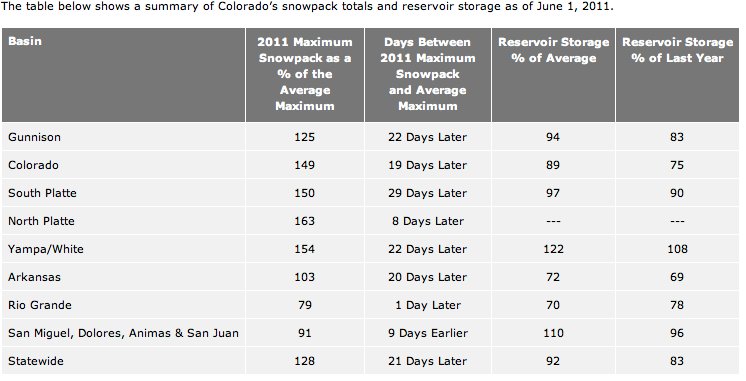
NRCS Colorado Snow Survey and Water Supply News Release

A picture named nrcssnowpackasapercentofaveragemaximumandstorage06021011

From the Natural Resources Conservation Service (Mike Gillespie):

Colorado’s latest snowpack data, compiled by the USDA- Natural Resources Conservation Service (NRCS), shows the profound impact that a cool and wet May can have on water supplies, in terms of both timing and quantity. While the state’s mountain snowpack typically reaches its seasonal maximum in mid-April, this year’s snowpack finally reached its peak in late May across northern Colorado, about three weeks later than normal. Not only has the cool weather delayed any significant melting across the higher elevations, but the continued wet weather pattern has contributed to additional snowpack accumulations across the high country. This year’s June 1 snowpack readings show record high snowpack levels for this date across most of the northern and central mountains, according to Allen Green, State Conservationist with the NRCS.

The forecasted runoff throughout the Yampa, White, Colorado, North and South Platte river basins this year is well above average, and in some cases will be two to three times higher than the average for the April through July forecast period. Meanwhile, across southern Colorado, snow melt is well underway after reaching below average seasonal totals. Runoff forecasts in the Rio Grande, San Juan, Animas, Dolores and San Miguel basins are generally below average, with the lowest anticipated runoff occurring along those streams flowing from the Sange de Cristo Mountains in southern Colorado.

Additional snow accumulations in late April and into May have considerably improved the water supply outlook across most of the state. Runoff volumes in the Gunnison basin and the Arkansas headwaters have increased this month as well, and are now above average.

At this late stage in the melt season, temperatures will play an important role in how rapidly snowmelt will occur. “There remains a tremendous amount of snow across northern Colorado. A gradual and even meltout would help minimize impacts”, said Green. Water managers will be monitoring temperatures at automated SNOTEL sites, including the daily high and low temperatures as the melt progresses through June. Periodic breaks in June temperatures might help keep melt rates in check. On the positive side, this year’s water supplies will be the best in more than a decade allowing for full reservoirs and abundant water supplies for irrigation well into the summer growing season.

Pueblo: Sixth annual Xeriscape Garden Tours June 4

A picture named xeriscapelandscape.jpg

From The Pueblo Chieftain (Mary Jean Porter):

The sixth annual Xeriscape Garden Tours will take place from 9 a.m. to 3 p.m. Saturday in Pueblo and from 9 a.m. to 3 p.m. Sunday in Pueblo West. Four private gardens and one public garden will be shown on each free, self-guided tour.

The tours are intended to educate and inspire, says Liz Catt, garden coordinator for the Southeastern Colorado Water Conservancy District and assistant horticulture coordinator for the local Colorado State University Extension office.

More conservation coverage here.

Colorado-Big Thompson Project update: 370cfs in the Big Thompson below Olympus Dam

A picture named olympusdam.jpg

From email from Reclamation (Kara Lamb):

Just a quick note: earlier today (June 1) we cut releases from Olympus Dam to the Big Thompson River back by 30 cfs. We didn’t see the run-off inflows last night that we were expecting. It is likely the 370 cfs release will be maintained through tonight.

More Colorado-Big Thompson Project coverage here.

Runoff news: Summit County officials bracing for flooding

A picture named flooddsswarnings06022011

Click on the thumbnail graphic to the right for a look at this morning’s flooding picture from the CWCB. Here’s the link. Here’s the link to the Colorado Water Conservation Board’s online applications Flood DSS. Here’s the link to the USGS’ Water Watch website where you can get a graphical view of all their gages across the state. Here’s the link to the Colorado Division of Water Resources Surface Water page where you can track your favorite gages.

From the Summit Daily News (Caddie Nath):

Stream flows are still at or below average for this time of year, meaning the snow pack — which exceeded averages by up to 500 percent this year in some areas — is still up on the mountains with the heaviest runoff is yet to come. ā€œIt’s not coming off,ā€ assistant county manager Thad Noll said. ā€œIf you look at Breck, you could still ski top to bottom. The window of melting is getting smaller. Normally we’re starting the peak runoff now (but this year) we’re not even close to getting there yet. We’re in this waiting game of, ā€˜we’ll see what happens.’ā€[…]

In Silverthorne water levels are already on the rise. A section of the Blue River trail was shut down at Bald Eagle Road underpass due to high water and will likely remain closed for the next several weeks, according to a town statement. Town officials continue to monitor the Blue River and other waterways for high water or flooding, the statement said. Breckenridge is also keeping a close eye on sections of the Blue River, assigning police patrol and even closing roads as the water rises to levels classified in three stages of ascending danger…

Frisco’s primary concern as flood season begins in force will be Tenmile Creek, though Meadow Creek on the north side of town might also be problematic.

From KJCT8.com (Don Coleman):

If you looked at the river on Wednesday afternoon, you noticed that the level had actually dropped. But, deputies warn you to stay aware. They are now predicting flood stage in Grand Junction sometime next week. “Eight hours ago, this was all snow,” Lieutenant Jim Fogg with the sheriff’s office explained as he pointed to the river. Sitting at about 11 feet, the level has dropped close to two feet over the past few days. Fogg says it is because of cold front that slowed snow melt in the mountains. “By mid-week next week, it’s going to pick up and be at flood stage.”

From 9News.com (Jeffrey Wolf/Kevin Torres):

A good chunk of Colorado could experience record levels of flooding in the next 24 to 48 hours. Areas east of the divide along the Yampa, Colorado and Poudre Rivers are at the greatest risk…

In Laporte Wednesday evening, more than 100 people gathered to discuss the issue with emergency management officials from Larimer County. “We may be looking at a minor peak here in the next few days,” Emergency Management Director Erick Nelson said. “We’re still looking at a major peak maybe on towards Father’s Day on June 20, or maybe further.”

From The Denver Post:

The weather will determine when, where or how bad flooding will be if it occurs, experts said today at a meeting of the Colorado Flood Task Force. “That is the piece of the puzzle we’re still waiting on,” said state climatologist Nolan Doesken. Hope, however, might be fleeting with a snowpack at two to three times its normal depth after weeks of storms and cooler-than-normal temperatures. “I’m really concerned if there’s a way to get rid of this much snow in a well-behaved way,” Doesken added.

A snowpack measuring site northeast of Steamboat Springs, for example, has more than 200 inches of snow containing the equivalent of 72.6 inches of water, a record for the state, according to the Natural Resources Conservation Service. The previous record at that site was 71.1 inches of water, set in 1978. The Colorado River in Garfield County already has been recorded at 1.4 feet higher than at any point last year, when the river peaked at 10.2 feet, the deepest measurement since 1984…

The Colorado River, Troublesome Creek, Muddy Creek and Willow Creek were running at or above their banks today. and low-lying areas near Kremmling are expected to flood over the next few days. The Colorado River near Kremmling was at 14 feet today, according to the U.S. Geological Survey. Flood stage is 15 feet. A flood advisory has been in effect since Tuesday for northwest Colorado. Today it was extended to 9:30 p.m. Friday. Minor flooding began Monday along the Yampa River in Steamboat Springs, inundating business parking lots along U.S. Highway 40.

From Steamboat Today (Matt Stensland):

Temperatures are getting higher and so is the water in the Yampa River, which overflowed its banks and flooded areas near the city limits on the southeastern edge of [Steamboat Springs]…

Routt County Office of Emergency Management Di r ector Bob Struble said with the forecasted high temperatures — today’s high is expected to reach 77 degrees — it’s safe to say the much anticipated melting of record amounts of snow from upper elevations finally has begun. The Tower measuring site at 10,500 feet on Buffalo Pass measured another state record Sunday with 80.1 inches of water contained in 178 inches of snow. By Tuesday, the snow water equivalent had dropped to 78.8 inches…

The Yampa was measuring 6 feet Tuesday afternoon at the Fifth Street Bridge measuring station. By early Friday morning it’s expected to reach 7.2 feet, which is above the 7-foot stage at which the Weather Service will send out flood advisories. By Sunday morning the Yampa is expected to reach 7.3 feet. The Yampa’s flood stage is 7.5 feet at the Fifth Street bridge location. The Elk River already has reached the action flood stage near its confluence with the Yampa and is expected to rise to 8.1 feet by 6 a.m. Friday. The moderate flood stage at the measuring site near Milner is 8.5 feet.

From the Summit Daily News:

The Town of Dillon is holding an informational meeting for residents on Thursday, June 2, at 5:30 p.m. at Dillon Town Hall to discuss the potential impacts of the high water spring runoff in and around Dillon and Dillon Valley, advise residents and business owners when and where sand bags will be available, discuss potential impacts regarding the planned closure of Little Beaver Trail for construction starting in summer 2011 and to sign up for email and website updates and notifications from the town regarding these issues. Town staff will be on hand to provide an update on the current situation and answer questions. For more info, contact the Town of Dillon at (970) 468-2403.

From the Delta County Independent (Hank Lohmeyer):

Streams throughout Northeast Utah and Northwest and West Central Colorado “will quickly increase to bank-full and flood levels starting the middle of this week (Wednesday),” predicted NOAA. “Flows will continue to increase through the first week of June with the potential of some rivers reaching well above flood stage,” said the NOAA forecast…

In the North Fork of the Gunnison drainage, Overland Reservoir logged 94 percent of average water content, and McClure Pass 41 percent. Snowpack water content was extremely high at some Uncompahgre River drainage gauging stations. At the Idarado station near Red Mountain, water content levels 563 percent of average were recorded Tuesday. The Red Mountain Pass station logged 206 percent of average water content, and 40 times more water content than last year during the 2010 runoff season. The Schofield Pass station and Slumgullion stations recorded 268 and 242 percent of average respectively. Ridgway Reservoir stood at 68 percent full last weekend.

From the Colorado Department of Wildlife (Randy Hampton):

The Colorado Division of Wildlife is urging anglers to take extra precautions on the water as rising temperatures and deep snowpack make for dangerous runoff conditions in the state.

State flood engineers are predicting that streams and rivers in northern Colorado could experience the highest water levels in 30 years, with the runoff season extending into early July. Flood warnings have already been posted for numerous streams and rivers in the northwest region and forecasters are warning that seasonably high temperatures this week will cause flows to ramp up quickly on both sides of the Continental Divide.

“This weekend, we expect the highest water so far this year,” said Kevin Houck, a flood engineer with the Colorado Water Conservation Board. “There may be a cooler period next week, but then it’s very likely the water will go back up and we may see a second peak that’s higher than the first.”

Area Wildlife Manager Jim Haskins of Steamboat said while stream and river angling won’t be optimal, many anglers will tempt their luck fishing streams that have spilled over their banks. With the high water, the contours of even familiar streams and rivers may not be recognizable, setting up the unwary anglers for an unexpected dunking.

“I’ve seen guys wading into shallow water step right off the bank of the stream not knowing it was there and be totally submerged,” Haskins said. “In a year like this, it pays to be extra, extra careful.”

Once in the water, even fit anglers can be quickly overmatched by the supercharged currents, cold water temperatures and submerged debris like tree trunks and shifting boulders – all of which can create life-threatening conditions.

Houck said that hydrologists predict Colorado River flows will peak at about 50,000 cubic feet per second, about 50 percent higher than last year.

Conditions are not likely to be as extreme in the southern part of the state, where snowpack is near or slightly above average in the Arkansas, San Juan and Dolores basins and right at average in the Rio Grande drainage.

However to the north, snowpack in the South Platte basin, which waters the Denver-metro area and northeastern Colorado, is at a remarkable 323 percent of average for the date. Snowpack in the Gunnison, Yampa and Colorado River basins – all popular with anglers – ranges between 230 percent and 284 percent of average. Statewide, Colorado’s snowpack sits at 247 percent of average for the date.

Ken Kehmeier, the Northeast Region senior aquatic biologist said that the long duration of the runoff may frustrate fly-fishermen waiting for low, clear water, but flows like these are important to the long-term health of trout streams.

“These sorts of years have the ability to reinvigorate the stream channel by moving sediment, cleansing substrates, putting water and sediment into riparian areas,” Kehmeier said. “From that standpoint, these are great years to have. They’ll do good things for fish in years to come.”

From the Colorado Water Conservation Board (Kevin Houck/Tom Browning/Todd Hartman):

The Colorado Water Conservation Board encourages property owners, recreationalists, businesses and communities to pay close attention to local waterways in coming days as stream flows in many rivers within the northern portion of Colorado are quickly increasing as warmer weather enters the state.

Forecasted temperatures are on the order of ten to fifteen degrees above the seasonal average for today (June 2nd) following warm temperatures overnight. While a short cool front is anticipated to enter the state tomorrow, temperatures are expected to quickly rebound, with a sustained warm period lasting through the middle of next week. It is expected that major rivers in northern Colorado will experience their higher flows between now and June 10th.

Currently, watersheds of greatest concern west of the Continental Divide are the Yampa River, Elk River, Colorado River, and the North Platte River along with their major tributaries. Flood advisories have already been posted for Mesa, Moffat, Routt, Grand and Jackson Counties, with more expected shortly. Lake County appeared on the watch list as well. Many of these rivers are already running well above the average flows for today’s date, and many are at, or close to, bank full. East of the Continental Divide, areas of largest concern are the Cache La Poudre River, the Big Thompson River and Clear Creek. These rivers are running much lower, but may quickly climb to higher peaks when warmer temperatures melt the abundant snowpack.

A ā€œdouble peakā€ is certainly possible this year. This would involve peak flows happening in the near future during a warm spell, then dropping off due to cooler weather, and then increasing again later in June. Although it is possible that some peak flows in rivers and streams may be on the order of levels seen in 1984 or 1995, it is important to note that the melting process is driven by the weather. Snowmelt flows are acutely affected by both high and low temperatures as well as precipitation (or the lack thereof) that falls in affected watersheds. While high water in streams that originate in Colorado’s high country is inevitable, severe damage from floods is not guaranteed.

Areas of greatest risk involve low lying lands and infrastructure adjacent to major rivers in Western Colorado and in the mountains and high foothills east of the Continental Divide. It is important to note that below about 7,500 feet east of the Divide, major floods are traditionally caused by heavy rain events, and the elevated snowmelt is unlikely to cause flooding. The primary impact to most Front Range metropolitan areas will be trail closures along streams and rivers, such as Clear Creek and Boulder Creek. The exception to this is the Cache La Poudre River in Larimer and Weld Counties, where snowmelt runoff can cause minor to moderate flooding on the plains depending on peak flows. Colorado Water Conservation Board

Residents and businesses with interests near rivers should continue to monitor water levels and contact their local emergency manager or floodplain administrator for updates. All recreationists should be aware of the dangers of high water including the potential for floating debris, unfamiliar stream banks as waters rise above known features, cold currents, and faster velocities.

The Colorado Water Conservation Board issues a Daily Flood Threat Bulletin and twice weekly 15-day Flood Outlook, which can be found at http://www.cwcb.state.co.us. A list of local emergency managers is provided by the Colorado Division of Emergency Management at http://www.coemergency.com/p/sources.html. A flood Decision Support System is also available to the public at http://flooddss.state.co.us/Default.aspx

Public Comment Period for CWCB Guidelines to Review and Evaluate Drought Mitigation Plans

A picture named spainsunflower.jpg

From email from the Colorado Water Conservation Board (Ben Wade):

Proposed revisions to the CWCB’s Guidelines to Review and Evaluate Drought Mitigation Plans were presented to the CWCB Board at the May 2011Board meeting, and are now available for public comment beginning June 1, 2011. The public comment period will close at 5pm on June 30, 2011. The Guidelines are available for review on the CWCB website.

The Guidelines for the Office of Water Conservation & Drought Planning (OWCDP) to Review and Evaluate Drought Mitigation Plans were last adopted in May 2005. Since that time, the OWCDP has developed extensive resources to assist in the development of local drought mitigation and response plans. These resources reflect the latest knowledge on drought planning and have been vetted with numerous entities and stakeholders representing geographically diverse water users throughout Colorado. The Municipal Drought Planning Guidance document, developed as part of the 2010 Colorado Drought Mitigation and Response Plan, creates a clear and concise how-to-guide for drought planning that previously did not exist in Colorado.

The proposed changes to the Guidelines ensure that the tools and resources available for the entities to develop drought mitigation & response plans coincide with the Guidelines that will be used to review the plans once submitted to the CWCB for approval.

The revised Guidelines will be presented for approval at the July 12-13,2011 CWCB Board Meeting in Walden, CO.

More CWCB coverage here.

NIDIS Weekly Climate, Water and Drought Assessment Summary of the Upper Colorado River Basin

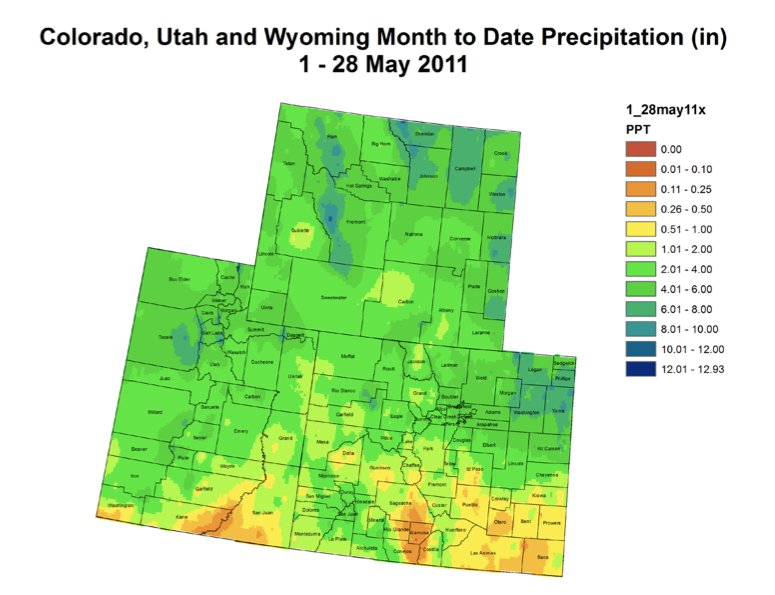
A picture named utwycoprecipitationmay1thrumay282011

Here are the notes from this week’s webinar from the Colorado Climate Center.

Here’s an excerpt:

For
 the
 month 
of 
May, 
most 
of 
the 
Upper 
Colorado 
River
Basin
(UCRB) 
has 
received 
an 
inch 
or 
more 
of
 precipitation. The
 higher
elevations 
received 
around 
2 
to 
6 
inches 
of 
moisture 
while 
the 
valleys received 
lower 
amounts. 

Northeast 
CO 
has
 
received 
between 
4 
and 
8
inches 
of 
precipitation since
 the
 beginning 
of 
the 
month. 

Southern
 UT,
southeastern 
CO 
and
 the 
San 
Luis 
Valley 
have 
been 
much 
drier,
 receiving 
less 
than 
an 
inch 
of 
moisture 
for 
the 
month.


More Colorado River basin coverage here.

Montrose: ‘Gunnison State of the River’ meeting June 6

A picture named gunnisonriverbasin.jpg

From the Montrose Daily Press:

Streamflow conditions, reservoir operations and an exploration of the critical decisions facing the Gunnison River Basin and its tributaries will be discussed at the annual Gunnison State of the River meeting set for 7 p.m., Monday at the Holiday Inn Express, 1391 Townsend Ave. in Montrose.

The public meeting is an annual event of the Colorado River District and is presented as an opportunity for the public to learn about this year’s snow melt season and critical water supply issues for the long-term.

The keynote presentation will be a Gunnison Basin Roundtable discussion of ā€œLooking Ahead Water-Wise: the Statewide Water Supply Investigation as It Relates to the Gunnison Basin.ā€ The investigation looms large as the Gunnison Basin comes to terms with its own water supply needs and the fact that some in the state believe the basin has a role in solving statewide water challenges.

Additionally, Eric Kuhn, general manager of the Colorado River District, will detail a historic proposed agreement in the Colorado Basin that balances the water supply and environmental needs of the West Slope against Denver Water’s quest for new water supply.

More Gunnison River basin coverage here.

Runoff news: The monster snowpack is starting to come off, flood warnings issued around the state

A picture named floodwarningscolorado06012011

From Associated Press via the Columbus Republic:

The Colorado Flood Task Force meets Wednesday morning in Denver to exchange data and discuss ideas. Later in the day, the Larimer County Sheriff’s Department and other agencies will talk to northern Colorado residents in LaPorte about flooding.

Here’s the link to the Colorado Water Conservation Board’s online applications Flood DSS. Here’s the link to the USGS’ Water Watch website where you can get a graphical view of all their gages across the state. Here’s the link to the Colorado Division of Water Resources Surface Water page where you can track your favorite gages.

From the Summit County Citizens Voice (Bob Berwyn):

ā€œEffects of the runoff are already being reported around [Summit County],ā€ said Sheriff John Minor. ā€œWe’re seeing rising waters in those low-lying areas that typically experience springtime flooding, like the Lakeview Meadows and South Forty subdivisions.ā€[…]

ā€œWe haven’t seen these conditions since 1984, 1995 or 1996, all years where we saw significant flooding issues throughout the county,ā€ said county emergency manager Joel Cochran. Just because your property hasn’t experienced flooding before, don’t automatically assume you’ll stay dry this year, Cochran said. As of Tuesday afternoon, some streams just north of Summit County were already at near-flood levels, with the Colorado River, Troublesome Creek, Muddy Creek and Willow Creek all flowing at, or just above, bank-full levels. ā€œConsiderable inundation of low-lying areas can be expected in and around Kremmling … and also along Troublsome, Muddy and Willow creeks,ā€ the National Weather Service wrote in its May 31 flood advisory.

From The Denver Post (Joey Bunch):

A flood advisory is in effect until 9:30 tonight for much of the state northwest of Georgetown, as a snowpack two to three times its normal depth for this time of year faces its first sustained dose of spring weather…

Numerous waterways could flood by the weekend, including the Colorado, Yampa, Gunnison, Crystal, Elk, Little Snake and Illinois rivers, as well as Fortification, Troublesome, Muddy and Willow creeks. Several were already at or above their banks Tuesday, with more snowmelt on its way, the Weather Service said. The Colorado River near Kremmling was at 348 percent of its seasonal flow Tuesday, with a depth of more than 14 feet, according to the U.S. Geological Survey. Flood stage is 15 feet. Front Range and foothills rivers and streams were still running at or below normal Tuesday, including Clear Creek, which was at 76 percent of normal flow at just over 5 feet deep near Golden. Flood stage is 10 feet. In Steamboat Springs, homes and businesses along the Yampa River were seeing troublesome evidence Tuesday, as several driveways off U.S. 40 were already under a foot of water.

From The Greeley Tribune (Sharon Dunn):

The slow rush could begin today, with a high-mountain sun glaring down like a magnifying glass on a record snowpack that is more than 260 percent above normal; 80- and 90-degree temperatures are expected the rest of the week. Already this week, Poudre River flows are 50 percent higher than they were last week, topping out Monday at 1,220 cubic feet per second at the mouth of the Poudre Canyon. By Tuesday morning, flows were at 1,150 cfs, which had dipped further to 1,000 by 5:30 p.m. From the canyon mouth in west Fort Collins, the water typically takes 12 hours to reach Greeley…

Last year, water escaped the banks of the Poudre — which traverses Greeley on its north side before a southward switchback moves it through east Greeley along 8th Street — at a high point of 4,770 cubic feet per second. Several areas along the Poudre flooded, from residences out west to businesses due east. The city closed streets and bridges throughout town. The county monitors flooding further east at the confluence of the Poudre and South Platte rivers…

But several factors could slow the tide. City and water officials throughout northern Colorado stand ready to divert water into Horsetooth Reservoir west of Fort Collins or irrigation ditches. The city of Greeley recently drained Poudre Ponds to make room for extra water.

From NBC11News.com (Kelly Asmuth):

“…by the end of this week we’ll see the Colorado River at flood stage,” according to Mesa County Emergency Manager Andrew Martsolf. Currently, a flood advisory is out for the Colorado River near the Utah border…

The main areas of concern are Cameo and other Plateau Valley communities, Rosevale Road and parts of I-70 like near Skipper’s Island by mile marker 17…

There’s a wet ride ahead, as the Colorado River rushes into summer.

From TheDenverChannel.com (Ryan Budnick):

Lake Estes acts as a collection point for much of the snow pack melting in neighboring Rocky Mountain National Park. Also part of the Colorado River is also drawn into the lake as part of the Big Thompson project. Kara Lamb with the Bureau of Reclamation said 98 percent of the water in Lake Estes is collected from the Colorado River and sent to the east side of the Continental Divide via the Alva B. Adams Tunnel. Lamb said if runoff gets to be too much, they can close the tunnel to partially regulate how much water Lake Estes collects…

“Everybody was projecting an easy runoff last year,” Lamb said. “Every year is different. There is a ton of snow up there, and we don’t know how it is going to come down.” The Big Thompson River runs from Lake Estes downhill toward Loveland and Larimer County and eventually meets up with the South Platte River.

From NorthernColorado5.com (Tom Livingston):

There has been a lot of concern around flooding lately. The Bureau of Reclamation does not have the authority for flood control which means they’ll have to pass that water down the canyon, and with the anticipation of a record, or near record run off, that means a lot of water. “So we could see releases this year from the Olympus Dam to the Big Thompson Canyon upwards of 1100 cubic feet per second,” said Lamb…

From The Pueblo Chieftain (Chris Woodka):

ā€œWe’re thinking it’s about ready to pop, everywhere at once,ā€ said Roy Vaughan, manager of the Fryingpan-Arkansas Project for the Bureau of Reclamation. ā€œIt’s going to really start rolling, especially toward the end of the week.ā€[…]

The flow of the Arkansas River at Parkdale, west of Canon City, climbed to 1,800 cubic feet per second on Tuesday and is at the seasonal average for the first time this year…

Ironically, the Southeastern corner of the state remains in severe to extreme drought, which has already prompted several counties to be listed as agricultural disaster areas and created an early, intense fire season.

From The Mountain Mail (Joe Stone):

The National Weather Service Weather Forecast Office in Pueblo reports expected warm temperatures over the next several days will produce high stream flows along the Arkansas River near Leadville because of above-average snowpack in the area. The latest forecasts from the River Forecast Center indicate the Arkansas River near Leadville may reach minor flood stage of seven feet by Saturday or Sunday. If the river reaches minor flood stage, considerable lowland flooding would occur…

The Colorado Water Conservation Board “Flood Threat Bulletin” also warns of an “appreciable uptick” in snowmelt and accelerating increases in streamflow during the next seven to 15 days.

The U.S. Natural Resources Center lists average snow depth in the Arkansas River basin at 95 percent of average but snow-water equivalent at 138 percent of average. At the Fremont Pass snow-telemetry weather station, snow depth remains at 66 inches with a snow-water equivalent of 25.5 inches…

For the latest forecasts and flood warnings, visit the National Weather Service in Pueblo at www.weather.gov/pueblo.

Colorado Supremes uphold the Water Court Division One ruling in the FRICO case

A picture named barrlake.jpg

From The Denver Post (Bruce Finley):

In a 77-page decision, Justice Gregory J. Hobbs emphasized that “in order to prevent an unlawful enlargement” of agricultural water rights the suburban provider had purchased, those water rights had to be limited to the 200 cubic feet per second historically diverted from the South Platte River and used for irrigation above Barr Lake…

In this case, the high court backed up a water-court decree that “contains appropriate conditions to prevent injury to other water rights resulting from the change of water rights,” Hobbs wrote.

The case arose from a 2003 deal between the East Cherry Creek Valley Water and Sanitation District (ECCV), the Farmers Reservoir and Irrigation Co. (Frico), Burlington Ditch Land and Reservoir Co., Henrylyn Irrigation District, and the United Water and Sanitation District. Under the deal, United was to acquire agricultural water from Burlington and Frico and then petition the water court to convert it for municipal use by ECCV’s suburban clients…

The case consolidated several disputes and resolved an appeal that followed a 16-day trial in 2008. The state water court had sharply reduced the historical “consumptive use” — used to calculate the amount of previously agricultural water that municipalities can use.

“Old decrees were imprecise. Measurement was imprecise. As the value of water increases, the challenge of finding just how much a person’s or district’s water right might have been in the past is very difficult,” said [University of Colorado Law School dean David Getches], a water-law expert and former director of natural resources for the state. “So the court has to take its doctrine of historical use and apply it with this kind of modern scrutiny that peels back the imprecision of old decrees and understandings and measurement facilities,” he said.

More coverage from The Associated Press via TheDenverChannel.com (Wayne Harrison):

On Tuesday, the Colorado Supreme Court agreed with a water court ruling that limited what could be considered the irrigation companies’ historical consumptive use of their water, which helps determine how much water can be converted to municipal use. The water court had said it was trying to protect against harm to other water rights…

The cities of Denver, Thornton, Brighton, Aurora and Englewood were among those with interests in the case.

Here’s the opinion from Leagle.

More water law coverage here.

Colorado-Big Thompson update: 400 cfs in the Big Thompson below Lake Estes

A picture named coloradobigthompsonmap.jpg

From email from Reclamation (Kara Lamb):

With the weather warming up, it looks like we might see more melting snow pack. However, we don’t have any major changes at Olympus Dam at this time. [Monday] afternoon, we scaled releases from the dam to the canyon back by 50 cfs and are currently only sending 400 cfs downstream. Maintaining that release actually dropped Lake Estes about a foot today. That gives a little space for regulating whatever inflow comes in later tonight.

From email from Reclamation (Kara Lamb):

The warm weather over the weekend bumped up activity on the west slope of the Colorado-Big Thompson Project. Inflows to Willow Creek picked up. As we continue to match outflow with inflow, releases from the dam were increased to around 1200 cfs. If the warm weather sticks around, we could see releases in that range for a while. We will do our best to keep releases from going over 1200 cfs through run-off by starting to store some water behind the dam, raising the water level elevation. In fact, the water level elevation at Willow Creek rose about a foot today, already. Currently, it’s at an elevation of 8099 feet.

Granby continues to release around 430 cfs. There was not much change in water level elevation at Granby. So far today it has only picked up about a tenth of a foot and is around 8253 feet.

The primary change was at Shadow Mountain, which releases to the Colorado River before it flows into Granby. With run-off starting to come down, there will be increased releases from Shadow Mountain Dam, both through the dam and over the spillway. In fact, I think we went over the spillway yesterday (Memorial Day). We got up to about a 1200 cfs release yesterday. We’ve since scaled back to about 500 cfs. But, if the warm weather continues, it could go up again as early as tonight.

More Colorado-Big Thompson coverage here.