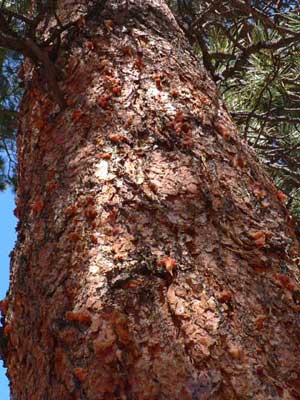
Scientists at the University of Colorado say that beetle-kill could lead to deeper snowpacks

A picture named mountainpinebeetles.jpg

From the Boulder Daily Camera (Laura Snider):

The researchers compared the amount of snow that piled up on the ground under live trees to the snow depth under two kinds of dead trees: those that still had red pine needles on their branches and those that had lost all their needles. The tree stands, which were located in the same valley near Grand Lake, had comparable elevations, slopes and aspects.

The scientists found that the snow accumulation under the dead, needle-less trees was 15 percent more than the snow under both live trees and dead trees in the “red phase,” when the needles are still attached.

Evan Pugh, a CU doctoral student who led the study, said trees with needles — red or green — are able to intercept the snow before it hits the ground. The snow that sticks to the needles is often returned to the atmosphere as water vapor via the process of sublimation, when a solid turns directly into a gas without becoming a liquid first.

“That water doesn’t stick around until snowmelt,” Pugh said.

Pugh and Eric Small, co-author of the study published in the journal Ecohydrology, also found that the snow under trees in the “red phase” melted up to a week earlier than the snow under healthy trees. The researchers believe the difference is caused by needles and branches falling onto the snow under red-phase trees. Those needles and branches absorb heat from the sun and reduce the snow’s reflectivity, causing the snow to melt more quickly.

The amount of runoff that comes from the snowpack in stands of dead trees is also higher than the amount of runoff from a similar snowpack under stands of live trees.

USGS Study Finds Recent Snowpack Declines in the Rocky Mountains Unusual Compared to Past Few Centuries

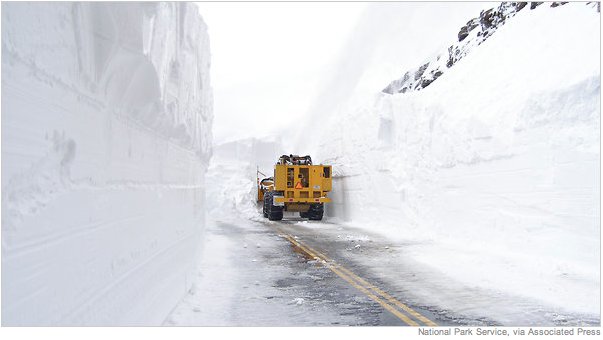
A picture named plowingsnowtrailridge.jpg

From the Loveland Connection (Bobby Magill):

Using tree ring samples to reconstruct the size of mountain snowpack over the past millennium, USGS researchers were able to show that reductions in the size of the mountain snowpack across the West during the past 30 years is unusual when considering the size of the mountain snowpack each year during the past three centuries…

There was an “inflection point” in the 1980s when the size of a given year’s snowpack was more influenced by temperature than by amount of precipitation, said USGS research scientist Gregory Pederson, lead author of the study, “The Unusual Nature of Recent Snowpack Declines in the North American Cordillera.”[…]

“The region you are sitting in is a particularly dynamic one,” he said. “These basins haven’t shown the substantial temperature-driven declines since the 1980s. (Colorado’s northern mountains) seem fairly resistant to fairly extensive snowpack decline like you see across the Northern Rockies.”

Upper Arkansas River Water Conservancy District board meeting recap: Glenn Everett, the last remaining original member of the district, makes way for new board

A picture named upperarkansasvalley.jpg

Salida City Councilman Jay Moore was appointed to fill the Division 2 (School District R-32-J) directorship vacated by Everett. Moore and three re-appointed directors were sworn in at the meeting.

The re-appointed directors are:

• Tim Canterbury, Division 1 – area encompassed by School District RE-3.

• Bob Senderhauf, Division 4 – Custer County.

• John Sandefur, Division 6, Seat B – area encompassed by School District RE-2, excluding the part of RE-2 within Custer County.

After the swearing in, Bob Senderhauf was elected chairman, Tim Canterbury was elected vice chairman, Greg Felt was re-elected secretary, and Jim McCormick was re-elected treasurer. The new officers all expressed appreciation for Everett’s service to the conservancy district…

District Manager Terry Scanga discussed preliminary efforts to form a coalition in the Upper Arkansas Valley to construct new water storage vessels or enlarge existing ones. “It’s time to formalize that coalition and move forward,” Scanga said, based on the need for augmentation plans in the upper Arkansas basin.

More Upper Arkansas River Water Conservancy District coverage here.

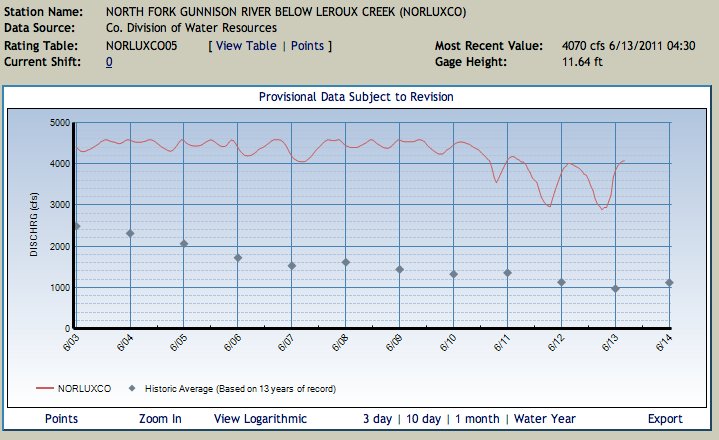
Runoff news: The North Fork of the Gunnison River is at 4,070 cfs

A picture named northforkgunnisonbelowlerouxcreek06132011

From the Delta County Independent (Hank Lohmeyer):

Other local streams are being affected also. Late last week, there was deep snowpack holding over two feet of water content at Park Reservoir, which flows into the Surface Creek drainage. On Monday, Bob Hurford, Division 4 water engineer, said, “Surface Creek has been flowing about 300 cfs, and a lot more is coming. That could go to 700 or 800 cfs very quickly.” The North Fork of the Gunnison River has had flows of 4,500 cfs already this year, Hurford said. Average flows this time of year are less than 2,000 cfs, he added.

The Uncompahgre River drainage is like others in the basin. “We expect well above 2,000 cfs flowing into Ridgway Reservoir this year,” Hurford said. Ridgway reservoir was standing at almost three-fourths full beginning this week. “All of the reservoirs in the Gunnison Basin (Taylor Park, Ridgway, Silverjack, Paonia, and Crawford) will fill this year,” said BuRec’s Crabtree. Gunnison Basin snowpack levels have averaged 125 percent of average with moisture content readings over 200 percent of average.

From The Greeley Tribune (Mike Peters):

The Larimer County Sheriff’s Office placed a ban on all inflatable boats and tubes on the [Cache la Poudre River] until the waters recede. While kayakers and commercial rafting businesses are not affected by the ban, use of tubes and inflatable rafts could result in a $100 fine.

From the Aspen Daily News (Dorothy M. Atkins):

On Friday, the U.S. Department of Agriculture released $600,000 in emergency funds to mitigate the flooding risk in Colorado. “The release of these emergency funds is a proactive way to be prepared to protect lives, property, and land and water resources as rivers across the state threaten to spill over their banks,” said U.S. Sen. Mark Udall (D-Colo.) in a press release.

Trout Unlimited: Upper Colorado River Mitigation Package ‘Not Enough’

A picture named cutthroat.jpg

Here’s the release from Colorado Trout Unlimited (Randy Schofield):

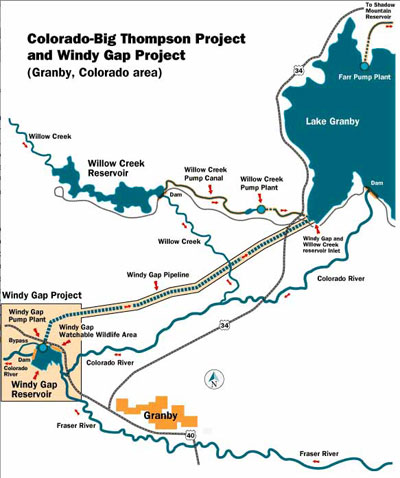
Trout Unlimited today expressed disappointment in a June 9 Colorado Wildlife Commission decision to approve without changes mitigation plans offered by Denver Water and the Northern Colorado Water Conservancy District for two new water diversion projects, saying the plans fall short of what’s needed to protect the fish and wildlife resources of the upper Colorado River basin.

“We appreciate the hard work the commission and its staff have put into reviewing the proposed Moffat Tunnel and Windy Gap expansion projects,” said Drew Peternell, director of Trout Unlimited’s Colorado Water Project. “While the mitigation package the commission approved yesterday is an improvement over the plans Denver and Northern offered originally, it is not enough to protect the rivers and streams of the upper Colorado River basin from the impacts of the new projects.”

For decades, large-scale water diversions to the Front Range have severely depleted and damaged the upper Colorado River and its major tributaries, including the Fraser River. Already, transbasin water diversion projects, including Denver Water’s Moffat Tunnel pipeline and the Northern Colorado Water Conservancy District’s Windy Gap project, take about 60 percent of the native flows of the upper Colorado River basin. The proposed expansions of the Moffat Tunnel and Windy Gap projects would take an additional 15 percent of flows and further stress an ecosystem that is on the tipping point of survival.

Trout Unlimited vowed to seek additional mitigation conditions in the next phases of project permitting and urged Denver Water and Northern to do more to offset the impacts of the proposed projects on the Colorado River and its tributaries.

At the Wildlife Commission meeting in Grand Junction Thursday, several wildlife commissioners expressed concerns that the final mitigation plans submitted by Denver Water and Northern were inadequate, but the commission voted unanimously to approve the plans anyway, without changes.

“We’re disappointed that commissioners apparently believed they didn’t have the statutory authority to recommend additional protections,” said Mely Whiting, counsel for TU’s Colorado Water Project. “We don’t believe that’s an accurate reading of the statute.”

Last week, TU, West Slope landowners and other stakeholder groups urged the Wildlife Commission to include several provisions in the final mitigation package to ensure the health of the rivers:

– Reconnecting the Colorado River by creating a “bypass” around Windy Gap Reservoir.
– A halt to diversions when water temperatures are on the verge of state “impaired” standards – water warm enough to kill trout.
– Adequate spring flushing flows to keep the rivers healthy and sustain riparian areas that are critical to wildlife.
– An ongoing plan to monitor stream conditions and identify needed habitat restoration projects.
– An endowment fund to pay for those restoration projects as an “insurance policy” for river health.

TU leaders stressed that these were reasonable requests. “We weren’t asking for perfection,” said Whiting. “We were simply asking for adequate mitigation, an ‘insurance policy’ that provides the minimal level of protection needed to keep the rivers and streams of the upper Colorado basin healthy into the future. Yesterday’s decision puts these irreplaceable resources at risk.”

The Fraser River was a big loser in the decision, said TU. Under the plan approved by the commission, Denver Water can divert through the Moffat Tunnel even when those diversions violate stream temperature standards designed to prevent lethal effects on fish. And the project could take so much water that flushing flows critical to clean the stream of harmful sediment would no longer be available. The mitigation plans had several other deficiencies, including:

– Funding for stream projects to protect the Colorado River fell significantly short—between $3 and $5 million short, according to TU’s calculations, based on estimates by independent restoration contractors.
– Funding for a potential bypass of Windy Gap Reservoir, which could significantly improve downstream Colorado River conditions, was not included in the package.
– Northern’s plan allows chronic stream temperature problems and provides insufficient flushing flows in the Upper Colorado River.

TU thanked the commissioners for their efforts and acknowledged the complex, difficult nature of these mitigation decisions. But the sportsmen’s group said that the overriding goal of ensuring the future of the river’s wildlife habitat and fisheries was not achieved.

“The bottom line is that under this mitigation package, the health of the upper Colorado River and its tributaries will continue to decline,” said Peternell.

To learn more about diversion impacts on the river and watch TU’s short video “Tapped Out,” go to www.defendthecolorado.org

More coverage from Scott Willoughby writing for The Denver Post. From the article:

Several wildlife commissioners echoed the sentiment that the final mitigation plans submitted by Denver Water and Northern were not ideal, but the commission voted unanimously to approve the plans anyway. The projects’ Fish and Wildlife Mitigation Plans now move to the Colorado Water Conservation Board, which has 60 days to affirm or modify the state’s position. Gov. John Hickenlooper will also have 60 days to affirm or further modify it before it’s submitted to federal permitting agencies…

Prompted by a coalition of stakeholders led by Trout Unlimited, both water utilities made concessions to plans previously submitted. Among the additional measures are improved safeguards for maintaining cool water temperatures and minimum flow protections, creation of contingency funds for unanticipated impacts and enhanced funding for river restoration plans. The restoration plans were not required by the permitting process but were offered by Denver and Northern to help address impacts from past water development. The agreements hinge on final federal approval of the water projects.

The additional measures are a step in the right direction, watchdogs say, but don’t go far enough. Trout Unlimited vowed to seek additional mitigation conditions in the next phases of project permitting and urged Denver Water and Northern to do more to offset the impacts of the proposed projects on the Colorado River and its tributaries…

Most significant among the stakeholders’ requests is a “reconnection” of the Colorado River by creating a yet-to-be- designed bypass around the 445-acre-foot Windy Gap collection pond that the group has pinpointed as a major problem area near the confluence of the Fraser and Colorado rivers. Most agree that the proposal has merit, although further study is required. “We feel that the reconstruction of the channel downstream is just as important,” DOW aquatic biologist Ken Kehmeier told the commission. “We feel that we can’t determine the necessity for a bypass until a study is done.”

More coverage from Janice Kurbjin writing for the Summit Daily News. From the article:

Trout Unlimited representatives say the plans fall short of what’s needed to protect the fish and wildlife resources of the Upper Colorado River Basin. They vowed in early June to fight the projects on several fronts, including at the federal permitting level, if the plan didn’t include strong protections for the Upper Colorado River. They are now focused on other permitting levels. “We want more,” said Drew Peternell, director of Trout Unlimited’s Colorado Water Project.

Groups such as the Fraser River Basin Landowners and the Upper Colorado River Alliance are on board with the fight…

According to the Division of Wildlife, restoration plans aren’t required by the permitting process but were offered voluntarily by the utilities. A DOW statement said the commission’s authority is limited to mitigating impacts from the proposed projects and restoring the river to a past condition is beyond the scope of commission authority…

Trout Unlimited and other West Slope landowners and stakeholders asked the wildlife commission earlier this month to include several provisions, they called it an “insurance policy,” to protect the health of the rivers. What’s been offered isn’t enough, they say. Despite flow and temperature monitoring proposed by Denver Water, Trout Unlimited claimed the utility is still allowed to divert through the Moffat Tunnel even when those diversions violate stream temperature standards designed to prevent lethal effects on fish. The diversions could also negatively affect flushing flows that clean the stream of sediment, they said. Both utilities agreed to a $600,000 “mitigation insurance policy” that falls between $3 and $5 million short, Trout Unlimited representatives said. In particular, there’s no funding for a Windy Gap Reservoir bypass, meant to improve downstream Colorado River conditions, nor was an endowment fund established to pay for future restoration projects that would be planned and monitored.

More Moffat Collection System Project coverage here and here.

More Windy Gap coverage here and here.

Runoff news: The Cache la Poudre, Colorado and Yampa are closed to tubing

A picture named innertubingnz.jpg

From The Denver Post (Caitlin Gibbons):

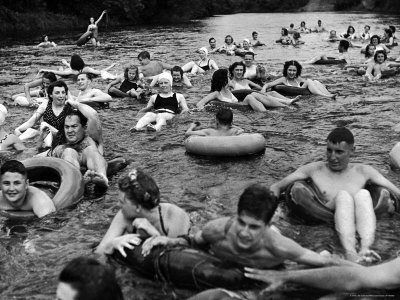
Officials issued partial-use restrictions for the three rivers, which means kayaks and larger rafts can run the Poudre, Colorado and Yampa, but the water was too high and too fast for inner tubes and air mattresses…

Earlier in the week, access points to the Poudre from city- and state-managed or owned property were closed. Kayakers and commercial rafting companies were not affected by the restriction and could still enter the river from their privately owned access points. The closure was enacted after a trained rescue swimmer was trapped by hidden debris while searching for a stranded person…

On Friday, the Arkansas River was under a high-water advisory, but there were no restrictions on use…

Officials in Golden and Boulder were closely watching Clear Creek and Boulder Creek, but no restrictions had been issued. In Clear Creek, Golden police were recommending that tubers and people without safety equipment stay out of the water, police spokeswoman Karlyn Tilley said.

From the Glenwood Springs Post Independent (John Stroud):

While the Colorado River just below Glenwood Springs peaked at more 24,500 cubic feet per second and reached a gage height of about 10.5 feet last Tuesday, the river level has gone down since then. On Friday, the Colorado below Glenwood Springs was running at about 23,000 cfs, with a gage height still around 10.3 feet, according to the U.S. Geological Survey (USGS) water data website. “It’s been going down for the last two days,” Anselmo said, adding that it’s hard to predict if the actual runoff peak has occurred yet or not. Given the amount of snowpack still in the high country, most weather observers believe the highest peak is yet to come.

From the Summit Daily News (Janice Kurbjin):

Denver Water’s Bob Steger said inflow forecasts from the Colorado Basin River Forecast Center have dropped since last week from between 185,000 and 219,000 acre-feet during the June 1-July 15 period to between 180,000 and 198,000 acre-feet. Still, tributary creeks and streams are swollen with water. “Because of the reduced inflow forecasts, we need to reduce the outflow to assure that the reservoir fills,” Steger said. “We are currently in the process of reducing the outflow from 1,300 cubic feet per second to 1,100 cfs.”[…]

Despite the security the dam provides to riverbank Silverthorne residents, Denver Water officials announced Friday that it might not be able to prevent flooding on the Blue River below Dillon Reservoir as record-high mountain snowpack continues to melt. Using forecasted inflows and draws through the Roberts Tunnel, “we can do some arithmetic and feel pretty confident that we’re going to fill and spill,” Steger said. He added that he anticipates inflows will keep rising. Water has been flowing into the reservoir at a rate normal for early June at about 1,700 cfs, but forecasters say it could grow dramatically in coming days — possibly exceeding the record of 3,408 cfs set in 1995, the Denver Post reported.

From The Greeley Tribune:

The Poudre River remained high Friday, but water flow levels continued to ease slightly with cooler temperatures. A flow between 3,500 and 4,500 cubic feet per second in Greeley could cause flooding in some areas. Last year’s flooding topped out at 4,770 cfs.

From the Boulder Daily Camera (Erica Meltzer):

City and county officials now expect water levels in Boulder Creek to remain relatively stable until late Saturday or early Sunday.

From Steamboat Today (Matt Stensland):

Forecasters are calling for the high water on the Yampa and Elk rivers to continue for another three to four weeks, creating the opportunity for multiple streamflow peaks. Jim Pringle, a meteorologist with the National Weather Service in Grand Junction, said that prediction was stated during a weekly conference call this week with forecasters and emergency managers.

The Yampa is expected to remain steady through the week, but the Elk River was expected to possibly break another record this morning. The U.S. Geological Survey revised its preliminary numbers to show the Elk actually broke the record at 5 a.m. Tuesday with water flowing at 8,250 cubic feet per second, or cfs, and a gauge height of 8.14 feet at the Routt County Road 42 bridge. The forecast Wednesday evening estimated the Elk would reach a depth of 8.2 feet this morning…

The Yampa’s high flow so far this season was 4,820 cfs, set at 8:45 p.m. Tuesday. The record for the Yampa, according the USGS, is 6,820 cfs…

The Tower measuring site located at 10,500 feet on Buffalo Pass was reporting 150 inches of snow containing 74.4 inches of water Wednesday. That’s down from the May 29 statewide record high of 80.1 inches of snow water equivalent. The site at 9,400 feet on Rabbit Ears Pass was reporting 47 inches of snow containing 27.9 inches of water. The Dry Lake campground site at 8,400 feet was reporting 20 inches of snow containing 11.1 inches of water.

A picture named ohbejoyfulslatecreek.jpg

From the Bureau of Land Management (Shannon Borders):

Effective Wednesday, June 8, the Oh Be Joyful Campground west of the Slate River and BLM Road 3220 (including the Slate River crossing) is temporarily closed to all uses. Undercut banks along the Slate River within the campground are unsafe due to high run-off. Additionally, the flooding caused the Slate River water crossing for vehicles to become unstable and unsafe for public use. The closure is in effect until the area is safe for public use.

From the Northern Colorado Water Conservancy District:

The past several days have brought three peak events on Willow Creek: 1,748 cfs on May 30 and again on June 3, and 1,761 cfs on June 8.

But it’s not over yet. The snowpack at the top of Willow Creek Pass normally peaks in late April, but it’s the beginning of June and we still have more snow up there than the average peak, despite the fact it’s been melting. The forecast calls for cooler weather, which means snowpack will continue to melt – but at a slower, much more manageable rate. Flows are retreating today and will likely hold steady or decline slightly in the next few days. But keep an eye on the skies and thermometers: We are still vulnerable to additional peaking events if there’s a rainstorm or stretch of hot weather.

Our records show that the maximum observed inflow to Willow Creek Reservoir was a daily average of 1,857 cfs on May 24, 1984. In comparison, this year’s three peak flow rates occurred for just a few minutes each; our maximum daily average for 2011 so far was yesterday at 1,652 cfs.

So while we don’t have a flow rate that’s going into the record books, we’re still on track to smash the previous record for the total volume of runoff: 85,300 acre feet from April 1 to July 31 in 1957. This year’s inflows are already 64,600 acre feet, and we still have seven weeks to go!

As the elevation in Willow Creek Reservoir continues to rise, we will pump water into Lake Granby if necessary to help keep Willow Creek Reservoir outflows at or below 1,300 cfs.

From the Northern Colorado Water Conservancy District:

When we expect gigantic runoff, we prefer to keep the Adams Tunnel running full blast, because every acre foot diverted to the East Slope creates room for another acre foot of runoff. With that, we lower the possibility of having to make higher releases out of Lake Granby.

But we have two things working against us. First, East Slope reservoirs are nearly full, and soon we won’t have empty space available for Adams Tunnel diversions.

Second, the water rights system limits our options. Northern Water holds decrees for Big Thompson River water, and when those rights come into priority, we are obligated to use that water, not West Slope water, to fill our East Slope reservoirs and make water deliveries.

Yesterday our East Slope decree came into priority and operators reduced tunnel diversions by 40 cfs. Today, even more East Slope water became available and tunnel diversions went down an additional 125 cfs.

The amount of East Slope water available to our decree varies from day to day and depends on streamflow and other water users’ demands. To keep up to date, you can monitor Adams Tunnel diversions as we move through the warm season.

Colorado-Big Thompson Project update: Lake Granby rising about one-half foot per day

A picture named coloradobigthompsonmap.jpg

From email from Reclamation (Kara Lamb):

We’ve seen pretty steady run-off inflow and outflow at Shadow Mountain, Willow Creek and Lake Granby reservoirs the last week or two.

Shadow Mountain has seen snow melt run-off inflow pick up. As a result, we are releasing through the dam and over the spillway at times in excess of 2000 cubic feet per second. At the same time, we have also been diverting to the Adams Tunnel. But, as east slope water rights have come into priority, we have had to scale back the diversions. Meanwhile, Shadow Mountain maintains basically a full water level elevation and additional run-off inflow is passed on downstream to Granby.

Granby has seen its water level rise pretty steadily as the snow pack has come down. Right now, it’s rising at a rate of about a half a foot a day.

In a year when we don’t have as much snow pack, we would typically keep the gates to the spillway on Granby Dam closed and let the reservoir fill as close to its full elevation of 8280 as it can. With the exceptional snow pack we’ve maintained this spring, however, we’re operating a little differently. The bottom of Granby’s spillway gates are at an elevation of 8260. Northern Water already has those gates open a little bit so that as more run-off inflow comes into the reservoir this weekend, filling the last two vertical feet below the gates, it will start to push onto the spillway. We anticipate that will happen sometime Sunday.

How much water comes into the reservoir depends on how much more snow melt run-off we see this weekend.

Willow Creek Reservoir, which started the run-off season drawn to almost dead storage, has risen pretty quickly, as well. We continue to pass on through the reservoir about 1300 cfs which is flowing through the dam and down the creek. Once the reservoir fills to an elevation of 8118 (it’s just over 8116 right now), we can pump water out and up to Granby. That could happen as early as next week.

From email from Reclamation (Kara Lamb):

I’ve gotten some questions about why Pinewood Reservoir is low while snow melt run-off is under way. The reason it is lower is because we need to maintain some operational flexibility as we prepare to finish filling Carter Lake, then switch operations over to finish filling Horsetooth Reservoir.

Because Pinewood sits in the middle of the Colorado-Big Thompson Project’s southern power system, it sometimes bears the burden of providing the flexibility we need as we move water around. With one unit at the Flatiron Power Plant down below still undergoing maintenance, this flexibility is even more important.

As more of the upper mountain snow pack starts to melt and come down, however, we will see Pinewood start to rise again–that could be as soon as this weekend.

From email from Reclamation (Kara Lamb):

Just a quick note to let everyone know we’ve reached a full reservoir elevation at Carter Lake. The pump will go off tomorrow, Saturday June 11, in the morning. That means a little more water will go into Horsetooth and it will see its water level elevation continue to rise.

From email from Reclamation (Kara Lamb):

In anticipation of more incoming snow melt run-off, we will increase releases from Green Mountain Reservoir to the Lower Blue river late tonight, June 10. By tomorrow morning, June 11, flows in the Lower Blue should be around 1400 cfs.

From email from Reclamation (Kara Lamb):

Inflow to Lake Estes last night [June 9] peaked around 950 cfs. This morning, it is down to about 879 cfs. We are taking some of that water out via the Olympus Tunnel, generating hydro-electric power and sending it on its way to Horsetooth, via the Colorado-Big Thompson Project. We have curtailed project imports from the west slope accordingly. As we continue to balance inflow, storage, and priority water, releases from Olympus Dam to the Big Thompson Canyon were reduced last night around 2 a.m. by about 90 cfs. As a result, we are currently releasing about 692 cfs.

Fryingpan-Arkansas Project update: Reclamation releasing 700 cfs from Twin Lakes

A picture named fryingpanarkansasproject.jpg

From email from Reclamation (Kara Lamb):

As the weather continues to change, forecasts for snow melt run-off across the state change as well. We continue adjusting our operations on the Fryingpan-Arkansas Project reservoirs accordingly.

Since Tuesday, we’ve seen some of the native inflow to the upper Arkansas portion of the Fry-Ark Project (Turquoise and Twin Lakes reservoirs and the Half Moon diversion) drop off slightly. As a result, we have curtailed the native inflow we were sending down the Mt. Elbert Conduit for hydro-power generation at Mt. Elbert power plant.

When native flows diverted via the Conduit declined, the release of native east slope water from Twin Lakes Dam to Lake Creek cuts back as well. As a result, the Twin Lakes release is now around 700 cfs.

With less native flow moving through the Fry-Ark pipe system (the Conduit), we have more room to pipe project water. With both the Fry-Ark project and Busk Ivanhoe pulling imports from the upper Fryingpan River Basin (which is still showing snow pack daily averages well above 200%), we are filling the Conduit with the imported project water. That water pipes to the Mt. Elbert Forebay, generates hydro-electric power at the Mt. Elbert Power Plant and then is deposited into Twin Lakes. The project imports are helping speed up the rise of the water level elevation at Twin Lakes.

Meanwhile, the native east slope run-off we were piping from Turquoise Reservoir to the power plant has to go somewhere as it is no longer going through the conduit and we do not have the right to store it. Native water is owed to the Arkansas River. Consequently, we will deliver that water via Sugarloaf Dam to Lake Fork Creek. Our release from the dam to Lake Fork Creek will go up by 50 cfs today.

By this afternoon, Lake Fork Creek below Sugarloaf Dam should be running at about 250 cfs.

More Fryingpan-Arkanasas Project coverage here.

Navigating the Future of the Colorado River conference recap: Pat Mulroy — ‘We do not want this resolved in the halls of Congress’

A picture named coloradoriverbasinusgs.jpg

From the High Country News blog The Range (Heather Hansen):

In their keynote talks, both Michael Connor, Commissioner of the U.S. Bureau of Reclamation, and Pat Mulroy, General Manager of the Southern Nevada Water Authority stressed the importance of having people who rely on the Colorado work together to ensure our mutual survival and prosperity. “The solutions are among the people in this room,” said Mulroy.

Mulroy added that the decisions about how the river should be allocated and managed should come from various local stakeholders. “It’s imperative to work from the ground up,” she said. Without agreement among the seven basin states, Mulroy warned of possible federal intervention. “We do not want this resolved in the halls of Congress,” she said.

In that vein, Connor pointed to H.R. 1837, a radical bill pending in Congress, involving California’s San Joaquin River. The bill would turn state water rights upside down by eliminating a century-old requirement that, when possible, the federal government should defer to state water law. The bill also threatens hard-one Endangered Species Act protections, established restoration settlements and collaborative processes. “Trampling on states’ sovereignty is not good public policy,” said Connor.

More Colorado River basin coverage here.

USGS Study Finds Recent Snowpack Declines in the Rocky Mountains Unusual Compared to Past Few Centuries

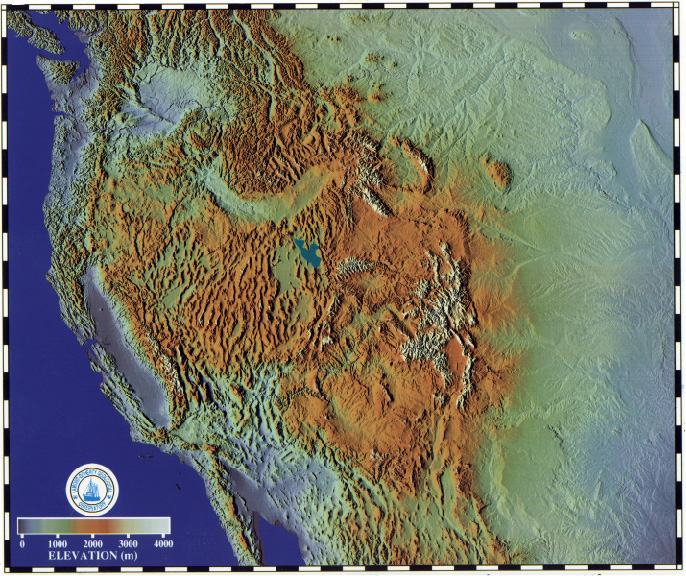
A picture named topographywesternus.jpg

From The Colorado Springs Gazette (R. Scott Rappold):

Researchers examined tree rings to look at moisture trends going back 500 to 1,000 years, in the first study to examine historic snowpack in this manner. While the northern Rockies have seen the most dramatic loss – less snow, earlier melt-offs – the southern Rockies, including Colorado, have experienced similar trends since the 1980s. That bucks the historical trend, that when the northern Rockies have more snow, the south has less, and vice versa. The recent drops are across the board, 30 to 60 percent of the snowpack.

The study comes at a time of heavy lingering snowpack in Colorado, 248 percent of the average for mid-June. But, said lead author Gregory Pederson, the average is based on recent years; the long view shows this winter may not be as out-of-whack as it seems. “There’s nothing unusual per se about this year, just that it comes in the midst of a lot of low-snowpack years,” he said.

He said the study, along with other research that has shown Western snowpack declines, should be a warning for water suppliers. The only similar periods occurred in the 1350s and 1400s, he said, and these were followed by colder, snowier eras. But, because of the impact of greenhouse gasses, Pederson does not believe that will occur again. “With increased warming, we may now be seeing this temperature impact on the snowpack, more of the precipitation falling as rain rather than snow,” he said…

[Colorado Springs Utilities Water supply planning supervisor Abby Ortega] said the fact the city’s water comes from three different basins insulates it from some of the problems of erratic snowpack. This year, for example, the Arkansas basin has less than half the snowpack of the other side of the Continental Divide, and Pikes Peak has been exceptionally dry.

More coverage from Dan Vergano Sci-Tech Today. From the article:

The historical snowpack reconstruction results, dating to the year 1200 and released by the journal Science, suggest that global warming has broken the normal seesaw pattern of snowpack in the region, in which a down year in the northern Rockies will be offset by a higher snow year in the southern Rockies. Overall, the average yearly snowpack across the northern Rockies directly known from snow records to have dropped 30% to 60% in the past 50 years has fallen more sharply in that time than for any period in the past 800 years, the study shows. “Temperature is the driver here,” says study lead author Greg Pederson of the U.S. Geological Survey’s Northern Rocky Mountain Science Center in Bozeman, Mont. “It doesn’t take a rocket scientist to know that if temperatures get warmer, snow and ice melt sooner.”[…]

The Northern Rockies stretch from Washington state to Montana. The study records show two-decade-long drops in snowpack across the northern Rockies in the 1300s and 1500s that resemble the decline seen in the 20th century, but those declines lasted for shorter periods of time and came when far fewer people were dependent on the snowpack. “Water demand, as much as supply, is the problem,” Pederson says. “We have a lot of fisheries and hydropower relying on this water as well.”

More Colorado River basin coverage here.

Moffat Collection System Project and Windy Gap Firming Project: The Colorado Division of Wildlife commissioners approve both mitigation plans

A picture named fraservalleycollection.jpg

From The Denver Post (Mitchell Byars):

Now the plan must clear the U.S. Army Corps of Engineers, which is expected to release its final environmental impact study later this year. If the Army Corps gives the project the green light, construction on the expansion of Gross Reservoir in southwest Boulder County could start as early as 2015. The project is expected to take four years. The wildlife commission voted unanimously to accept Denver Water’s environmental mitigation plan. “We take this unanimous vote as an endorsement of our cooperative approach with local stakeholders,” said Denver Water’s planning director Dave Little. “Now we want to move aggressively towards implementing these measures.”[…]

In the mitigation plan, Denver Water agreed to stop diverting water from July 15 through the end of August if temperatures in the river reached levels that could possibly threaten local fish populations. The utility also pledged money to enhance stream habitats in cooperation with local counties and the Northern Colorado Water Conservancy District. “Make the river better, that’s sort of our mantra,” Little said. “We’ve addressed all of the impacts in the scientific study the Army Corps of Engineers did, which was an exhaustive effort. But we know the Corps did not capture the impacts that some others have brought up and that’s why we went above and beyond in our mitigation plan.”

More coverage from Tonya Bina writing for the Sky-Hi Daily News. From the article:

In a series of unanimous votes, the commissioners approved mitigation plans for Denver’s Moffat Collection System project and Northern’s Windy Gap Firming Project and also authorized the Colorado Division of Wildlife to enter into an intergovernmental agreement with Denver and Northern to help manage a significant restoration project for the upper Colorado River…

The votes came after Denver and Northern described to Commissioners several new or modified plan elements, which include enhanced temperature and flow protections, creation of contingency funds for unanticipated impacts and enhanced funding for river restoration plans. The restoration plans were not required by the permitting process but were offered voluntarily by Denver and Northern to help address impacts from past water development. The agreements hinge on the water providers obtaining final federal approval for their projects…

Prior to the vote, Wildlife Commission chairman Tim Glenn summarized concerns expressed by several commissioners regarding the complex package of plans and the potential that development of the projects may have unintended consequences for the Upper Colorado, Fraser and Williams Fork rivers. “Is it perfect?” Glenn asked “No. But staff has evaluated it inside and out and I’m confident that it’s better than where we are.” The Commission’s recommendation will now be transmitted to the federal permitting agency for each project…

To further address impacts from its Moffat Collection System project, Denver has agreed to new elements including increased safeguards for maintaining cool water temperatures and minimum flows in the Fraser during high summer and additional funds for aquatic habitat improvements in that river. Denver also agreed to reserve $600,000 for a “mitigation insurance policy” to address any new impacts identified by the Final Environmental Impact Statement being developed by the U.S. Army Corps of Engineers. This is in addition to Denver’s previous proposal to fund a Colorado River cutthroat restoration project and other aquatic habitat restoration work on the Fraser. On the Colorado River, Denver would maintain two water temperature gauges and agree to release water in August if high temperatures threatened fish…

East of the Divide, Denver would allow Boulder and Lafayette to store water in the enlarged Gross Reservoir for release during winter months, replace wetlands inundated by the larger reservoir and monitor stream channel stability.

In its final proposal, Northern agreed to increase minimum peak flows during drought conditions to maintain fish spawning habitat, to further restrict or curtail pumping during extreme conditions to protect cool water temperatures and to reserve $600,000 for a “mitigation insurance policy” to address any new impacts identified by the Final Environmental Impact Statement for Windy Gap being developed by the Bureau of Reclamation. Northern’s proposal included mitigating impacts on the Upper Colorado River system by managing their pumping to maintain water levels in Lake Granby and keep water temperatures cool, looking for ways to improve flushing flows in the Upper Colorado River below Windy Gap Reservoir and contributing to water quality projects that reduce nutrient loading in Lake Granby, Grand Lake and Shadow Mountain Reservoir.

East of the Divide, Northern proposed to replace lost wetlands and improve enhance wildlife habitat near the new Chimney Hollow reservoir…

In their final plans, Denver and Northern agreed to add $1 million in funding to the Upper Colorado River Habitat Project to $4.5 million and increase money set aside to address future contingencies or operating and maintenance costs on that project to $1.5 million. Denver and Northern also pledged to enter into an intergovernmental agreement with the DOW to manage the habitat project, and urged that the DOW be given a more direct role in developing and managing stream restoration projects contemplated under the Learn By Doing adaptive management process created by Denver’s global settlement with Grand County and other stakeholders…

Senior Northeast Region aquatic biologist Ken Kehmeier said Division staff believes that in total, the agreements, including those made with mountain communities, would not only address impacts from the new projects but also help repair impacts to the Colorado and Fraser rivers caused by previous projects.

More coverage from David O. Williams writing for the Colorado Independent. From the article:

Commissioners were generally still worried about the “unintended consequences for the Upper Colorado, Fraser and Williams Fork rivers” but felt the revised mitigation plans – including greater temperature and flow protections for aquatic life, more funding for river restoration and a contingency fund for unanticipated impacts – were a lot better than previous plans. “It has always been Denver Water’s goal to go beyond mitigating the project impacts to make the river better than it is today,” Denver Water’s director of planning Dave Little said: “We look forward to working with stakeholders on mitigation for the project and the significant enhancement plan also accepted by the Commission that will improve aquatic habitat in the Upper Colorado River Basin.”

The fish and wildlife mitigation plans still must be approved by federal regulators. Also on Thursday, Denver Water provided a statement on the U.S. Bureau of Reclamation report that includes one scenario in which water levels in the Colorado River decrease by 10 to 20 percent by the middle of this century as a result of global climate change.

More Moffat Collection System Project coverage here and here.

More Windy Gap coverage here and here.

Rio Grande River basin: Valley water managers are considering applying for Conservation Reserve Enhancement Program funds to jumpstart the groundwater sub-district #1 process for retiring acreage

A picture named slvdischargerecharge.jpg

From The Pueblo Chieftain (Matt Hildner):

The Conservation Reserve Enhancement Program funds are being looked at by valley water managers to help retire up to 40,000 acres of irrigated land in the north-central part of the valley. “I think it’s something that would be in that priority class for us,” [U.S. Rep. Scott Tipton, R-Colo] said after a meeting with potato farmers Thursday. The first-term congressman had campaigned on cutting the federal budget, but he told the farmers that his spending preferences would be prioritized around energy, self-sufficiency and boosting America’s ability to feed itself…

Tim Davis, a Sterling-based consultant who has shepherded farmers in Nebraska and northeastern Colorado through applications to the program, said that so far there have been no rumblings on Capitol Hill about cutting the program…

Davis is helping Subdistrict No. 1 apply to the federal program, which pays a rental rate to farmers to retire ground…

The district’s assessments of its members would go to compensate for injury caused by pumping and it also would be coupled with the federal dollars to retire ground. But the local dollars likely would be used to sweeten the federal payments and increase the incentive for farmers to retire ground that would more helpful in reducing the pumping of groundwater, said Steve Vandiver, director of the Rio Grande Water Conservation District. Vandiver said the subdistrict had yet to decide how much money it would add, and it has not chosen the targeted acreage…

An appeal of a local court’s approval of the subdistrict’s management plan is before the Colorado Supreme Court. Vandiver said oral arguments in the case likely would come in the fall, with a decision possibly by next year. Two other pending subdistricts — one along the Rio Grande between Monte Vista and Alamosa and another that would take in the Carmel and Waverly areas — are also considering applying for the federal funds but have yet to write management plans while the court ruling is pending.

More San Luis Valley groundwater coverage here and here.

Runoff news: The Eagle River is expected to remain near flood stage

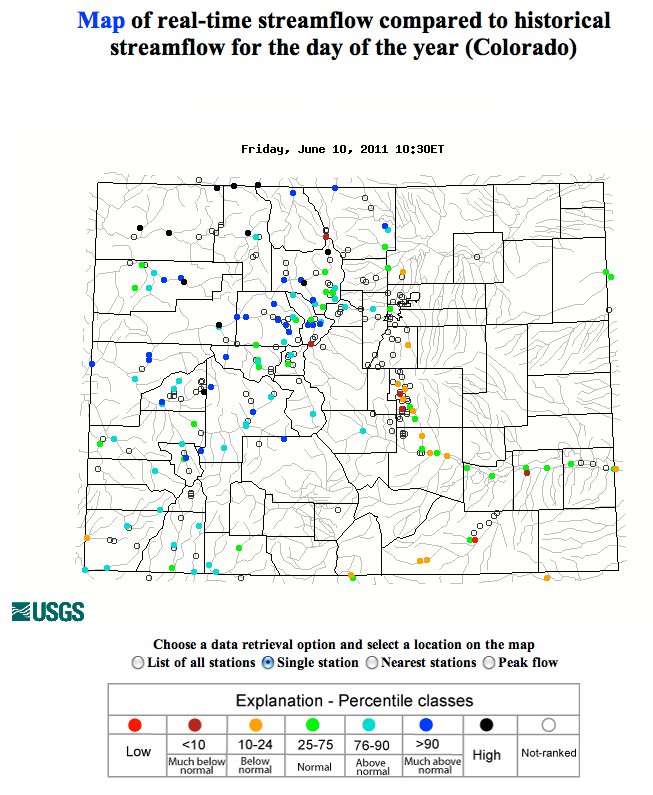
A picture named streamflowusgs06102011

From the Associated Press from the The Columbus Republic:

The National Weather Service says the Eagle River in western Colorado is expected to stay near flood stage. Record snowpack in Colorado’s mountains, particularly the central and northern mountains, is causing flooding as it melts into rivers and streams.

From 9News.com (Jeffrey Wolf):

The Poudre River has already flowed over its banks in some spots in northeastern Colorado and many homeowners are using sandbags and digging ditches to divert the water…

The Colorado River in Glenwood Springs rose to 10.8 feet on Thursday, according to the Garfield County Sheriff’s Department. That caused some flooding to lower areas, but the river did not reach the peak that was predicted. There was flooding along Interstate 70 east of Rifle and in the Parachute area. Three homes near the river in Rifle had some minor flooding in and around the homes…

Amtrak has temporarily suspended service between Denver and Chicago because of conditions in the Omaha, Neb. area.

From the Loveland Connection:

A link to a Colorado Division of Water Resources graph shows the Big Thompson River flow level at 596 cubic feet per second, or cfs, at 11:30 a.m. today at the mouth of the Big Thompson Canyon near Drake. The river peaked at about 660 cfs around midday Tuesday, according to the graph, and again around 630 cfs last night.

Moffat Collection System Project and Windy Gap Firming Project: The Colorado Division of Wildlife commissioners approve both mitigation plans

A picture named eisenhowerfishing.jpg

Here’s the release from the Colorado Division of Wildlife:

The Colorado Wildlife Commission Thursday endorsed Fish and Wildlife Mitigation Plans submitted by Denver Water and the Northern Colorado Water Conservancy District to mitigate impacts that would be caused by two proposed transmountain water development projects.

In a series of unanimous votes, Commissioners approved mitigation plans for Denver’s Moffat Collection System project and Northern’s Windy Gap Firming Project and also authorized the Division of Wildlife to enter into an intergovernmental agreement with Denver and Northern to help manage a significant restoration project for the upper Colorado River. Three members of the Colorado State Parks Board joined the Commission at the workshop, which was held at the Doubletree Inn on Horizon Drive.

The votes came after Denver and Northern described to Commissioners several new or modified plan elements, which include enhanced temperature and flow protections, creation of contingency funds for unanticipated impacts and enhanced funding for river restoration plans. The restoration plans were not required by the permitting process but were offered voluntarily by Denver and Northern to help address impacts from past water development. The agreements hinge on the water providers obtaining final federal approval for their projects.

Prior to the vote, Wildlife Commission chairman Tim Glenn summarized concerns expressed by several commissioners regarding the complex package of plans and the potential that development of the projects may have unintended consequences for the upper Colorado, Fraser and Williams Fork rivers.

“Is it perfect?” Glenn asked “No. But staff has evaluated it inside and out and I’m confident that it’s better than where we are.”

The Commission’s recommendation will now be transmitted to the federal permitting agency for each project. Denver Water’s Moffat Collection System project would firm up the yield from Denver’s existing water rights on the West Slope, primarily by enlarging Boulder’s Gross Reservoir and diverting additional water from the Fraser, Williams Fork and Blue rivers. Northern’s Windy Gap Firming Project proposes to firm up the yield from its existing water rights in the Upper Colorado River by diverting additional water to the proposed new Chimney Hollow Reservoir west of Loveland.

Since last fall, Denver and Northern have been in discussions with Division of Wildlife staff to address concerns voiced by the public and by Wildlife Commissioners. The two utilities have simultaneously been negotiating a complimentary set of agreements with a diverse group of stakeholders, including affected local governments like Grand County.

To further address impacts from its Moffat Collection System project, Denver has agreed to new elements including increased safeguards for maintaining cool water temperatures and minimum flows in the Fraser during high summer and additional funds for aquatic habitat improvements in that river. Denver also agreed to reserve $600,000 for a “mitigation insurance policy” to address any new impacts identified by the Final Environmental Impact Statement being developed by the Army Corps of Engineers.

This is in addition to Denver’s previous proposal to fund a Colorado River cutthroat restoration project and other aquatic habitat restoration work on the Fraser. On the Colorado River, Denver would maintain two water temperature gauges and agree to release water in August if high temperatures threatened fish. East of the Divide, Denver would allow Boulder and Lafayette to store water in the enlarged Gross Reservoir for release during winter months, replace wetlands inundated by the larger reservoir and monitor stream channel stability.

In its final proposal, Northern agreed to increase minimum peak flows during drought conditions to maintain fish spawning habitat, to further restrict or curtail pumping during extreme conditions to protect cool water temperatures and to reserve $600,000 for a “mitigation insurance policy” to address any new impacts identified by the Final Environmental Impact Statement for Windy Gap being developed by the Bureau of Reclamation.

Northern’s proposal included mitigating impacts on the Upper Colorado River system by managing their pumping to maintain water levels in Lake Granby and keep water temperatures cool, looking for ways to improve flushing flows in the Upper Colorado River below Windy Gap Reservoir and contributing to water quality projects that reduce nutrient loading in Lake Granby, Grand Lake and Shadow Mountain Reservoir. East of the Divide, Northern proposed to replace lost wetlands and improve enhance wildlife habitat near the new Chimney Hollow reservoir.

Under state statute, the Wildlife Commission’s authority was limited to mitigating impacts from proposed projects. Restoring the river to a past condition was beyond the scope of Commission authority. However, Denver and Northern voluntarily proposed to help enhance conditions for fish and wildlife resources on both sides of the Continental Divide.

The enhancement plans would support the Upper Colorado River Habitat Project, a collaborative plan designed to re-establish a functional channel system and improve habitat for trout and other important aquatic species on a roughly 14-mile stretch of river between Windy Gap Reservoir and the Kemp-Breeze State Wildlife Area.

In their final plans, Denver and Northern agreed to add $1 million in funding to the Upper Colorado River Habitat Project to $4.5 million and increase money set aside to address future contingencies or operating and maintenance costs on that project to $1.5 million. Denver and Northern also pledged to enter into an intergovernmental agreement with the DOW to manage the habitat project, and urged that the DOW be given a more direct role in developing and managing stream restoration projects contemplated under the Learn By Doing adaptive management process created by Denver’s global settlement with Grand County and other stakeholders.

That global settlement, announced recently by Denver Water, would address longstanding concerns about the health of the Colorado River. The settlement includes funding for aquatic habitat and for an adaptive management process designed to help maintain river health.

Northern is also working on similar agreement with communities on the Upper Colorado River.

Senior Northeast Region aquatic biologist Ken Kehmeier said Division staff believes that in total, the agreements, including those made with mountain communities, would not only address impacts from the new projects but also help repair impacts to the Colorado and Fraser rivers caused by previous projects.

Commissioner David Brougham credited the Division, Denver and Northern for negotiating agreements which went beyond the Commission’s limited jurisdiction under the statute.

“I think in looking at this the Division has gone beyond and done more than that statute gives us the power to do,” Brougham said. “Denver and Northern could have said no, but they didn’t and I think that’s telling.”

Additional information regarding the Wildlife Commission’s review, including links to the mitigation and enhancement plans being offered by Denver Water and Northern, can be found on the Division’s web site at: http://wildlife.state.co.us/LandWater/Water/MoffatWindyGapMitigationProjects/.

During the morning session, North Park District Wildlife Manager Josh Dilley was presented with the 2010 Shikar-Safari Club International Officer of the Year Award. Dilley, who for the past three years has had responsibility for two wildlife management districts in the high mountain basin, was presented with the award by Bob Boswell of Shikar Safari Club International.

Dilley, who was surrounded by his family, said he was honored by the award. “I don’t have to go to work every morning, I get to go to work every morning,” Dilley told the Commissioners. “Wildlife officers in Colorado have a passion like no other. I work with my heroes every day.”

Grand Junction’s Lynn Ensley, who founded the nonprofit Pathways for Fishing, was recognized for his outstanding service in recruiting young anglers in Colorado. “I can’t say enough about Lynn’s continued dedication, his passion and his enthusiasm,” said Northwest Regional Manager Ron Velarde. “Since 1995, Lynn has introduced almost 15,000 kids to the sport of fishing.”

Ensley expressed to the Commissioners his appreciation for the Division’s support over the years, adding that he is looking to develop a new program to recruit young deer hunters.

Commissioners also received an update on draft black bear management plans for the northern Front Range, the Sangre de Cristos, the Uncompahgre and the Bears’ Ears area of northwestern Colorado, as well as an update on the impending July 1 merger of the Division of Wildlife with Colorado State Parks.

In other action, the Commission adopted final regulations removing bag and possession limits at Bonny Reservoir State Park and allow the use of trotlines and jugs. This action permanently implements an emergency regulation passed by the Commission at its last meeting in May 2011. Bonny Reservoir is scheduled to be drained in the fall of 2011, and this change is intended to allow the public to use all game fish prior to the draining of the reservoir.

The Wildlife Commission meets monthly and travels to communities around the state to facilitate public participation in its processes. The complete agenda for the June Wildlife Commission meeting can be found on the Wildlife Commission web page at:
http://wildlife.state.co.us/WildlifeCommission/Archives/2011/June92011.htm.

The Colorado Wildlife Commission is an 11-member board appointed by the governor. The Wildlife Commission sets Division of Wildlife regulations and policies for hunting, fishing, watchable wildlife, nongame, threatened and endangered species. The Commission also oversees Division of Wildlife land purchases and property regulations.

More coverage from Wayne Harrison writing for TheDenverChannel.com. From the article:

Plans for minimizing the effects on wildlife include ways to maintain cool water temperatures and minimum water flows, restoring fish habitat and increasing flows during drought to maintain fish spawning areas. Denver Water planning director Dave Little says the goal is to improve the rivers.

More coverage from the Boulder Daily Camera. From the article:

Members of the Colorado Wildlife Commission voted unanimously Thursday to accept a plan by Denver Water to mitigate the impacts of a proposed expansion to Gross Reservoir in southwest Boulder County. The mitigation plan addresses impacts in Boulder County as well as impacts to the headwaters of the Colorado River, where more water will be drawn to fill the enlarged Gross Reservoir.

More coverage from the Longmont Times-Call. From the article:

The Northern Colorado Water Conservancy District, which has its headquarters in Berthoud, provides water for agricultural, municipal, domestic and industrial uses in portionis of Boulder, Larimer, Weld, Broomfield, Morgan, Logan, Washington and Sedgwick counties. According to the Colorado Division of Wildlife, Northern has agreed: to increase minimum peak flows during droughts to maintain fish spawning habitat; to further restrict or curtail pumping during extreme conditions to protect cool water temperatures, and to reserve a $600,000 “mitigation insurance policy” to address any new impacts identified in a final Windy Gap environmental impact statement being developed by the U.S. Bureau of Reclamation.

More Moffat Collection System Project coverage here and here.

More Windy Gap coverage here and here.

USGS Study Finds Recent Snowpack Declines in the Rocky Mountains Unusual Compared to Past Few Centuries

A picture named trailridgesnow052011

Here’s the release from the United States Geological Survey:

A USGS study released today suggests that snowpack declines in the Rocky Mountains over the last 30 years are unusual compared to the past few centuries. Prior studies by the USGS and other institutions attribute the decline to unusual springtime warming, more precipitation falling now as rain rather than snow and earlier snowmelt.

The warming and snowpack decline are projected to worsen through the 21st century, foreshadowing a strain on water supplies. Runoff from winter snowpack – layers of snow that accumulate at high altitude – accounts for 60 to 80 percent of the annual water supply for more than 70 million people living in the western United States.

“This scientific work is critical to understanding how climate change is affecting western water supplies,” Secretary of the Interior Ken Salazar said. “It helps land managers adapt to changing conditions on the ground, assists water managers with planning for the future, and gives all of us a better understanding of the real impacts that carbon pollution is having on our resources and our way of life.”

USGS scientists, with partners at the Universities of Arizona, Washington, Wyoming, and Western Ontario, led the study that evaluated the recent declines using snowpack reconstructions from 66 tree-ring chronologies, looking back 500 to more than 1,000 years. The network of sites was chosen strategically to characterize the range of natural snowpack variability over the long term, and from north to south in the Rocky Mountains.

With a few exceptions (the mid-14th and early 15th centuries), the snowpack reconstructions show that the northern Rocky Mountains experience large snowpacks when the southern Rockies experience meager ones, and vice versa. Since the 1980s, however, there were simultaneous declines along the entire length of the Rocky Mountains, and unusually severe declines in the north.

“Over most of the 20th century, and especially since the 1980s, the northern Rockies have borne the brunt of the snowpack losses,” said USGS scientist Gregory Pederson, the lead author of the study. “Most of the land and snow in the northern Rockies sits at lower and warmer elevations than the southern Rockies, making the snowpack more sensitive to seemingly small increases in temperature. Also, winter storm tracks were displaced to the south in the early 20th century and post-1980s. Forest fires were larger, more frequent and harder to fight, while Glacier National Park lost 125 of its 150 glaciers.”

USGS scientist and co-author Julio Betancourt explains that “The difference in snowpack along the north and south changed in the 1980s, as the unprecedented warming in the springtime began to overwhelm the precipitation effect, causing snowpack to decline simultaneously in the north and south. Throughout the West, springtime tends to be warmer during El Niño than La Niña years, but the warming prior to the 1980s was usually not enough to offset the strong influence of precipitation on snowpack.”
The La Niña episode this year is an example with lots of snow in the north while severe drought afflicts the south. But, in the north, this year’s gains are only a small blip on a century-long snowpack decline.

In the West, the average position of the winter storm tracks tend to fluctuate north and south around a latitudinal line connecting Denver, Salt Lake City and Sacramento. In El Niño years, winter storms track south of that line, while in La Niña years, they track to the north.

This study supports research by others estimating that between 30-60 percent of the declines in the late 20th century are likely due to greenhouse gas emissions. The remaining part of the trend can be attributed to natural decadal variability in the ocean and atmosphere, which is making springtime temperatures that much warmer.

“What we have seen in the last few decades may signal a fundamental shift from precipitation to temperature as the dominant influence on western snowpack.” Pederson said.

The study, The unusual nature of recent snowpack declines in the North American Cordillera, is online at Science magazine http://www.sciencemag.org/lookup/doi/10.1126/science.1201570.

More coverage from Chris Woodka writing for The Pueblo Chieftain. From the article:

USGS scientists, with partners at the universities of Arizona, Washington, Wyoming, and Western Ontario, led the study that evaluated the recent declines using snowpack reconstructions from 66 tree-ring chronologies, looking back 500-1,000 years. With a few exceptions (the mid-14th and early 15th centuries), snowpack reconstructions show that the northern Rocky Mountains experience large snowpacks when the southern Rockies experience meager ones, and vice versa. Since the 1980s, however, there were simultaneous declines along the entire length of the Rocky Mountains, and unusually severe declines in the north.

More coverage from Felicity Barringer writing for The New York Times weblog Green. From the post:

On the one hand, the underlying narrative was depressingly familiar, synchronizing with other studies or predictions involving California’s Sierra, the Himalayas and other spots around the world. What drew my attention is the reminder that snowmelt in the Rockies feeds three huge river systems — the Colorado, the Columbia and the Missouri — on which 70 million Americans depend for water.

Not that everyone living along — or flooded out of the communities along — the Missouri River or its swollen tributaries would consider these findings intuitive. But the U.S.G.S. scientists who led the study point out that climate in the Rocky Mountains has for centuries been an either-or proposition.

It works like this. Draw a hypothetical line in your mind from Denver to Salt Lake City to Sacramento. If there is heavy snow to the north of this line, chances are there will be a drought to the south of it. And vice versa. Or, as an Interior Department press release said, “With a few exceptions (the mid-14th and early 15th centuries), the snowpack reconstructions show that the northern Rocky Mountains experience large snowpacks when the southern Rockies experience meager ones, and vice versa.”

More coverage from United Press International. From the article:

The study backs research that the USGS said estimates that as much as 60 percent of the snowpack declines in the late 20th century are because of greenhouse gas emissions, which are linked to higher global temperature averages…Runoff from winter snowpack makes up nearly 60 percent of the annual water supply for people in the western United States.

More coverage from Craig Welch writing for The Seattle Times via the Bend Bulletin. From the article:

Pederson and his colleagues say the findings are important because they suggest the mountain snows that produce the runoff that powers the Columbia, the Missouri and the Colorado river systems will continue to decline as global temperatures rise, even if precipitation increases.

More coverage from Margaret Munro writing for The Vancouver Sun. From the article:

The study, published Thursday in the journal Science, says the changes are affecting the Colorado, Columbia and Missouri Rivers, which together supply water to 70 million Americans. And they are also altering river flows in the Canadian prairies and central British Columbia, said co-author Brian Luckman, at the University of Western Ontario.

“Snowpack is essential for water supply to many of these areas,” Luckman said, noting that the Rockies feed rivers flowing through central B.C. and the Bow, Athabasca and Oldman rivers in Alberta. “Between 60 to 80 per cent of the water in those rivers is snowmelt from the mountains.”

Mountain snow records don’t go back far beyond 1950, so the team, led by Gregory Pederson at the U.S. Geological Survey, looked at tree rings at 66 sites from B.C. to Colorado to get a read on snowpack levels over the past 800 years.

They found that the snowpack shrank more during the late 20th century than during any other period since 1200 AD, with more severe declines at the northern end of the range studied.

Luckman says the tree rings track the depth of the snowpack because some species such as the alpine larch tend not to grow well in heavy snowpack years because it takes so long for water to start flowing on mountaintops. Trees like Ponderosa Pines at lower elevations thrive in years of heavy snowpack, resulting in thicker tree rings.

More coverage from Joey Bunch writing for The Denver Post. From the article:

The dire long-term forecast cites warmer springs, earlier snowmelts and shifting winter storm patterns, all possible byproducts of global warming caused by greenhouse-gas emissions, according to the USGS. While that could prove disastrous for Colorado’s ski and rafting industries, it’s too early to say if it means less water overall, said Marc Waage, the manager of water-resources planning for Denver Water, which supplies 1.3 million people in the metro region. “I don’t think from this study you can conclude that the overall amount of water is going to decline,” he said, “because we could be compensating snowpack with rain.”

More USGS coverage here.

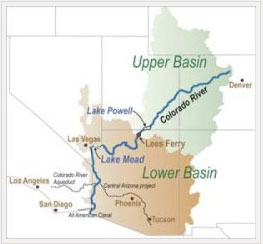
Colorado River Basin Water Supply & Demand Study Interim Report #1 is hot off the press

A picture named coloradoriverbasin.jpg

From The Pueblo Chieftain (Chris Woodka):

“The report is important because you’re trying to balance higher demand against the available supply,” said Alan Hamel, executive director of the Pueblo Board of Water Works and a member of the Colorado Water Conservation Board. “Colorado is ahead of the other states that receive some of their supply from the Colorado River, but we can still garner important information out of the study.”

The Arkansas Basin Roundtable on Wednesday heard an update on the CWCB’s study of availability of water from the Colorado River. It is important to most of the state, because about 500,000 acre-feet of supplemental water is imported each year to the Front Range communities in the Arkansas and South Platte basins.

There is still frustration because so much information is available, while the changes in climate are uncertain. “The more uncertainty we have, the wider the range of results,” said Matt Brown, a consultant with AECOM engineering…

Hamel and other water leaders have been involved in a water banking plan involving Blue Mesa Reservoir on the Gunnison River as a way to protect the junior rights in Colorado. Negotiations with Reclamation are still a few years away, he said. In the meantime, more storage is needed on both sides of the mountains within Colorado, Hamel said. “Storage becomes even more important when you talk about climate change,” Hamel said. “We will need more reservoirs to collect rain as well as snow melt, and to balance the cycles between wet and dry years.”[…]

Denver and Aurora have joined Colorado River Municipal Utilities, which includes the largest water utilities in Arizona, California and Nevada. Collectively, they use 15 percent of the river’s water, but have issued a statement that says joint use of the river is required to fill environmental, recreational and agricultural needs.

More Colorado River basin coverage here.

Green Mountain Reservoir operations: Second power plant back online, 1200 cfs in the Blue River below the dam

A picture named greenmountainreservoir.jpg

From email from Reclamation (Kara Lamb):

Late this afternoon [June 8], the crew at Green Mountain power plant returned the second generating unit back to service. We are now ramping up to generate hydro-electric power at full capacity. As a result, releases through the plant from the reservoir are going up in 100 cfs increments. At 4 p.m. today we bumped up to about 900 cfs. At 6 p.m. we bumped up to around 1000 cfs. We will bump up again at 8 p.m. to 1100 cfs. And we will increase one more time around 10 p.m. tonight to 1200 cfs. We will maintain the 1200 cfs from Green Mountain Reservoir and Power Plant to the Lower Blue River until further notice.

More Blue River watershed coverage here.

Runoff news: The Colorado River is still running high — 48,700 cfs at the state line

A picture named coloradorivergjwik.jpg

From NBC11News.com (Cecile Juliette):

An early morning check of the Cameo gauge on Thursday revealed that the Colorado River had receded slightly. On Wednesday it was recorded at 13.4 feet, and on Thursday it measured 13.1 feet. A check of the Colorado/Utah border gauge revealed that the water levels have remained the same for nearly 24 hours. It registered at 15.2 feet on Wednesday and Thursday morning.

From the Telluride Daily Planet (Brittany Lane):

According to local Thom Carnevale, who keeps weather records, the San Juan Mountains saw only 41.75 inches of snow in February and March combined, lower than average levels. Then, April alone received 55 inches, compared to the average monthly total of 22.8. May collected 25.25 inches this year, much higher than the average of 7.2 inches. At the end of April, Carnevale observed snow levels of 147-160 percent of normal, while other parts of the state currently in the flood advisory stage saw more than 200 percent of normal. Coupled with a cool spring, the late snow has led to a longer -lasting snowpack on higher peaks, at least until recently.

From the Fort Collins Coloradoan (Ashley Keesis-Wood):

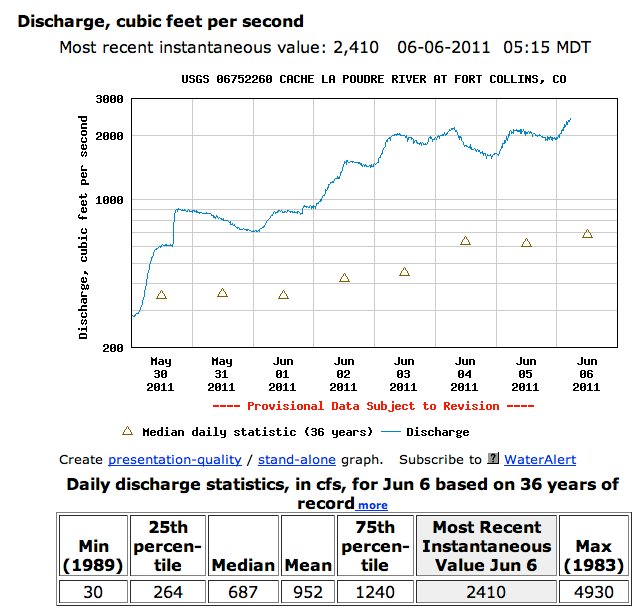
The Poudre River officially overflowed its banks on Monday and rising waters were continuing to spread across portions of south-central Windsor late Tuesday…The river’s flow was 2,790 cfs (cubic feet per second) at 10:45 a.m. Tuesday.

From The Rifle Citizen Telegram (John Gardner):

City crews along with Colorado Department of Transportation crews were busy building a levee on the bank along Lions Park Circle, Tuesday, in hopes of containing the raging Colorado River…

High water in Rifle Creek, north of Rifle, also caused the city of Rifle to close Rifle Mountain Park to public access on June 3…

According to Rifle Mayor Keith Lambert this is the highest water he can remember since 1984 when Garfield County saw historic water levels of 30,000 cubic feet per second (cfs). The Colorado River was running at around 24,400 cfs Wednesday morning, according to the US Geological Survey. That was down slightly from Tuesday levels.

From The Greeley Tribune (Sharon Dunn):

“Now, nobody’s taking much water,” said Brian Werner, spokesman for the Northern Colorado Water Conservancy District. “Farmers don’t need it, they want warm days to start the growing process. We’d like to store some of it. We just need some buckets somewhere.” Excess water is floating downstream to Nebraska, about 500 cubic feet per second more than the law requires. It’s water that could have been diverted for future storage, water officials say…

[Poudre] River flows hit highs again Wednesday of more than 3,350 cfs at the canyon mouth; in the river gauge near Greeley, the flow was at 2,100 cfs, with water depth of more than 8 feet, one foot below flood stage.

From the Glenwood Springs Post Independent (John Stroud/Jury Jerome):

Up Main Elk Creek north of New Castle, a private bridge leading to a home washed away overnight Tuesday, stranding the owner on the other side of the creek from the county road, Garfield County Road and Bridge foreman Wyatt Keesbery reported on the county’s website.

From the Craig Daily Press (Ben McCanna):

On Wednesday, a USGS monitoring station west of Craig measured the highest flows since the station was installed in 1984. “It’s a relatively short period of record we have at that gauge,” [Michael Lewis, associate director of hydrologic data at the U.S. Geological Survey’s Colorado Water Science Center in Lakewood] said. “It was started in ’84. But, it is a new record for that gauge.” The gauge recorded flows of 16,200 cubic feet per second Wednesday afternoon, and the water level was just shy of a benchmark, Lewis said. “We’re just a tenth of a foot short of flood stage, which is 11 ½ feet,” he said.

Downstream from Craig, flows are the second highest in recorded history. The highest flows were recorded in 1984, Lewis said. In Maybell on Wednesday, the flow was measured at 19,000 cfs. The next highest reading was 25,1000 cfs in 1984.

From KJCT8.com (Jeremy Alm):

Mesa County officials say the high waters of the Colorado river are starting to recede.

From the Vail Daily (Scott N. Miller):

Gage stations on the Eagle and Colorado rivers at Wolcott reported “high” streamflows Tuesday, and the Eagle River station was actually above flood stage. Both those stations backed down to “much above normal” Wednesday.

From the Sky-Hi Daily News (Tonya Bina):

Denver Water diverters are vowing to do what the utility can in its power to have the [Moffat water tunnel] running when runoff peaks, according to Bob Steger, manager of raw water supply at Denver Water. Water operations involving the Fraser River, Gross Reservoir and South Boulder Creek on the Eastern Slope are operating at status quo. Each year, Denver Water takes native water on South Boulder Creek, but how much depends on senior rights downstream of Gross Reservoir, Steger said. “We don’t know how much it’s going to last or how much we get each day,” he said. Although flows on South Boulder Creek are going up, the manager said, so far this year’s calls are “nothing out of the ordinary.”[…]

At present, water is being taken from the Fraser River at a rate of about 705 cubic feet per second, or a volume of about 1,400 acre feet a day. As of Tuesday, June 7, Gross Reservoir was at 58 feet from full, or about 20,000 acre feet. Once the reservoir gets closer to full, Steger said, the utility plans on slowing filling to “top (the reservoir) off slowly.” “We’re just focused on getting the reservoir full and having the tunnel on when the snowpack peaks,” he said. “Nobody knows when it’s going to peak.”

Colorado River Basin Water Supply & Demand Study Interim Report #1 is hot off the press

A picture named coriverupperlowerbasins.jpg

From the Colorado Independent (David O. Williams):

Some will no doubt say such a report is a waste of federal and state funding and that scenarios suggesting global climate change will be a factor are politically motivated. But the climate change model is one of just four possible scenarios contemplated in the report, and an ongoing drought that has depleted Lake Powell and other major reservoirs along the Colorado is factually impossible to deny.

“We are fortunate here in that the State of Colorado has recognized the importance of understanding the future water supply and demand challenges, and we have made great steps forward in identifying issues and strategies,” Jennifer Gimbel, director of the Colorado Water Conservation Board (CWCB), said in a recent release.

From The Durango Herald (Joe Hanel):

Although several academic studies have been done on the Colorado River and climate change, this is the first major effort by the federal government…

The study predicted the San Juan Mountains will sustain some of the steepest declines in runoff from spring snowmelt in the whole seven-state area.

More Colorado River Basin coverage here.

Florence: City council passes 5% water fee increase

A picture named fountainpavementdrawing.jpg

From the Cañon City Daily Record (Charlotte Burrous):

The Florence City Council narrowly passed the resolution Monday when Mayor Paul Villagrana, Councilmen Larry Baker, Ron Hinkle and Bruce Schneider voted in favor while Councilmen Charles Giebler, Joe Caruso and Councilwoman Nichole Prickett voted against it.

The new base for inside water users will increase to $34.28 per 3,000 gallons for single family dwellings, while outside water users rates will increase to $43.47 for 5,000 gallons.

Then in January, the rates will increase to $34.94 for inside users and $44.59 for outside water users.

The rates for inside users will then tier up 5.5 percent between 3,001 and 25,000 gallons and 7.5 percent between 25,001 to 50,000 gallons and 15 percent for 50,001 to 75,000 and an additional 15 percent for excess use in increments of 25,000 gallons. In January, the rates will increase by the same percentages.

For outside water users consuming more than 5,000 gallons, the rates will cost an additional 15 percent between 5,001 and 25,000 then increase 15 percent in increments of 25,000 gallons.

The top priorities for the Arkansas Basin roundtable are storage and the protection of agricultural water

A picture named arkansasbasinalluvialaquifersubregions.jpg

From The Pueblo Chieftain (Chris Woodka):

The roundtable met Wednesday to finalize its report to the state on the progress made since 2005 and the things it would like to accomplish in the future — basically fine-tuning ideas from last month’s meeting. Some members of the roundtable argued that agricultural water needs are as important as urban water supplies and should be given more weight in statewide planning efforts. “I would like to see agriculture and M&I (municipal and industrial) on equal footing,” said Reeves Brown, a Beulah rancher and member of the Lower Arkansas Valley Water Conservancy District board…

“Enlargement of Pueblo Reservoir is needed,” said Tom Young, a former board member of the Upper Arkansas Water Conservancy District. “If we don’t do it, we won’t have storage for any of the other projects.”[…]

The roundtable also wants to look at sustaining or replenishing water tables in designated groundwater basins — which are slowly recharged but not tributary to the larger river system.

Max Smith, a roundtable member from Baca County, pointed to a report from Western Kansas that pumping had drawn down the Ogallala Aquifer down 17 feet in one year. “We are mining it, but not to that extent,” Smith said. “It needs to be addressed.”

More IBCC — Basin roundtables coverage here.

Colorado-Big Thompson update: 780 cfs in the Big Thompson below Olympus Dam

A picture named coloradobigthompsonmap.jpg

From email from Reclamation (Kara Lamb):

As more run-off comes down from the mountains above Estes, more of the east slope water rights come into play for the Colorado-Big Thompson Project. We call the east slope water rights “priority” water. As we continue to curtail our imports from the west slope accordingly, we are pulling more priority water into the C-BT system.

Changes to the system will be made late tonight [June 7 or] Wednesday morning around 2 a.m. We will cut back some additional C-BT water imported through the Adams Tunnel and collect a matching amount of priority water here on the east slope. As a result, the Olympus Dam release to the lower Big Thompson River will be cut back from around 905 cfs to about 780 cfs.

More Colorado-Big Thompson Project coverage here.

Aspinall Unit update: Reclamation is ramping down the high-flow regime for Black Canyon, the target is to reduce to 3,100 cfs by next week

A picture named aspinallunit.jpg

From email from Reclamation (Dan Crabtree):

Releases from the Aspinall Unit have begun to decrease this afternoon. Provisional data from the USGS shows the Black Canyon 24 hour peak target flow of 6,793 cfs is expected to be completed by about 7:00 p.m. this evening. Current Black Canyon flow is 7,040 cfs. The Unit will continue to be ramped down over the next several days until reaching a flow of about 3,100 cfs next week. The instantaneous flows at Delta, Colorado reached a maximum of 13,700 cfs this morning inundating small lower portions of agricultural fields west of Delta. The instantaneous flow at Whitewater reached a maximum of 14,900 cfs this afternoon.

More Aspinall Unit coverage here.

Runoff news: The Elk River sets a new all-time record for streamflow

A picture named elkriver.jpg

From the Associated Press via NorthernColorado5.com:

U.S. Geological Survey official Michael Lewis said Wednesday that the Elk River near Steamboat Springs surpassed an all-time record with a preliminary flow rate of 8,250 cubic feet per second on Tuesday. At that rate, Lewis said the river could fill an Olympic-sized pool in about 11 seconds. Lewis said water levels like that are only seen every 400 or 500 years. The previous record was set exactly one year before when the river peaked at 6,970 cubic feet per second.

From the Fort Collins Coloradoan:

The county reported flows of 1070 cubic feet per second on the Big Thompson River in Loveland on Tuesday, and flows were in the mid-700s in Estes Park, with no flooding to report. Additional releases from the dam boosted the canyon flow to around 900 cfs, according to an email from Erik Nilsson, emergency manager with the county. Kevin Gingery, senior civil engineer for the city of Loveland, last week said minor flooding in Loveland won’t be a concern until water levels reach closer to 1,400 cfs…

The level of the Poudre River continues to rise as high temperatures melt the region’s unusually heavy snowpack. By Tuesday afternoon, the river was running at about 2,500 cubic feet per second, or cfs, through Fort Collins…

Near the mouth of Poudre Canyon, the river was running at or above 3,000 cfs much of Tuesday.

From NBC11News.com (Cecile Juliette):

According to the National Weather Service, as of 9:00am Wednesday, the Colorado River at Cameo is at 13.2 feet, flood stage is at 12.5. Meteorologists say the level is approaching moderate flood stage. As of 8:45am Wednesday, the Colorado River near the Colorado/Utah border measures 15.05 feet, which is just above flood stage.

From the Pagosa Sun:

At 10 a.m. Monday the stage was 7.8 feet. Bankfull stage is 7 feet and flood stage is 9 feet. The forecast is that the river level will rise to near 8.1 feet around midnight today, Tuesday. Impact is experienced at 8 feet and water is expected to approach the low-lying areas at the River Center complex on the east end of the town of Pagosa Springs.

The [National Weather Service] indicates that snowmelt runoff will increase today along the San Juan River in Pagosa Springs and that the river will remain high and fast. Minor lowland flooding is to be expected.

From the Summit County Citizens Voice (Bob Berwyn):

The water level in Dillon Reservoir reached its lowest level of the runoff season June 1, dropping to an elevation of 8,992.45 feet — about 25 feet below full pool. At that level, the reservoir holds 187,916 acre feet of water. Since then, the water has started to rise again.

From Steamboat Today (Tom Ross):

The Yampa was flowing at 21,900 cubic feet per second at Deer Lodge Park in Moffat County at 7:15 a.m. Monday compared to 4,260 cfs in downtown Steamboat. At 5:15 p.m., it was holding at 21,800 cfs. A significant contributor to the Yampa’s significant volume in far Northwest Colorado is the Little Snake, which was carrying 7,350 cfs at 7:15 a.m., a flow that dwarfed its median for the date of 2,420 cfs. By 5:15 p.m. the Little Snake had slipped to 6,480, presumable before gathering steam overnight as melting snow made its way to western Moffat County.

The Little Snake River measuring site at Lilly Park, just before its confluence with the Yampa, was among five such sites in Northwest Colorado reflecting records for the date Monday morning. The list included the Elk River near Milner, which was flowing at 6,670 cfs late Monday morning after hitting its peak at 6,860 cfs at 2:30 a.m. The flow in the Elk stood at 6,210 cfs by late afternoon…

Other river sites establishing daily flow records today include the Yampa at Maybell, west of Craig, at 15,500 cfs; Slater Fork in extreme northeastern Moffat County, flowing 1,690 cfs (the median for the date is 318 cfs); and the Little Snake River near Slater, flowing at 3,750 cfs.

From Steamboat Today:

A measuring station at the Routt County Road 42 bridge measured the peak at 7,520 cubic feet per second at 4:45 a.m. “Preliminarily, that is a new peak of record,” said Michael Lewis, associate director of the USGS Colorado Water Science Center…

The record is based on about 40 years’ worth of data. The data are from 1904 to 1927 and 1990 to 2010. The gap represents a period when the measuring station was not operated, Lewis said. The record breaks the record that was set last year, when the Elk peaked at 6,970 cfs on June 8…

The Yampa River in downtown Steamboat is expected to remain close to its current Fifth Street Bridge height of 7 feet through Sunday. The river was flowing at about 4,500 cfs Tuesday afternoon, shy of its peak so far this spring of 4,780 cfs at 11:15 p.m. Monday. The record for the Yampa, according the USGS, is 6,820 cfs.

Energy policy — oil shale: Pitkin County wants federal lands to be off limits to oil shale and tar sands development

A picture named oilshaledepositsutwyco.jpg

From the Aspen Daily News (Andrew Travers):

The county commissioners have drafted a letter calling for closing public lands to leasing for oil shale and tar sands development, citing the possible impacts on the quantity and quality of water in the Colorado River and the unknown environmental impact of the technology used to turn oil shale into fuel…

Listing possibly dangerous changes to stream and river flows along with increasing toxin levels in the Colorado River basin, the commissioners’ letter calls for a halt to oil shale leasing. “[W]e believe it is premature to lease lands for such development before the impacts to water are determined,” reads the letter signed by commission chairwoman Rachel Richards.

In its call for public comment, the BLM acknowledged the “nascent character” of technology for oil shale and tar sands extraction. The county letter, as drafted, says the feds can’t responsibly allow the use of that burgeoning technology on public lands…

Along with direct impacts to water and the unknowns surrounding untested shale technology, the county letter notes impacts that drill rigs and infrastructure could have on wildlife in public lands OK’d for shale development…

“Consider whether the amount of energy spent in oil shale production, as it compares to the amount of energy it produces, is worth the potential impact to public health and public lands in the form of air and water quality, the overall health of ecosystems and wildlife populations, and tourism-dependent economies of rural Western Colorado,” the letter says.

From the Colorado Independent (David O. Williams):

James T. Bartis of the RAND Corporation testified on Friday (pdf) before the House Energy and Commerce Committee’s Subcommittee on Energy and Power. He was asked to speak to the alternative fuel provisions in HR 909, the “Roadmap for America’s Energy Future” bill sponsored by Devin Nunes, R-Calif. “Most of the high value resources lie within in a very small area (roughly 30 by 35 miles) within Colorado’s Piceance Basin and within a small portion of the nearby Uinta Basin within Utah,” Bartis said. “Large-scale development of oil shale will cause federal lands to be diverted from their current uses.

“In the absence environmental and economic mitigation measures unprecedented in scope and scale, such development would almost certainly have adverse ecological impacts, and would likely be accompanied by socioeconomic impacts that could be particularly severe, especially in the northwest quarter of Colorado.”[…]

“Section 141(a)(5) makes the claim that ‘Oil shale is one of the best resources available for advancing American technology and creating American jobs,’” Bartis testified. “I have no knowledge of any research that supports this claim. Oil shale has a potentially important role in advancing our energy security and furthering economic progress. I see no reason to promote oil shale as above other promising areas for advancing technology and creating jobs.”

More oil shale coverage here and here.

Runoff news: High water advisories issued for the Pine Creek and the Numbers rapids near Buena Vista, 46,700 cfs in the Colorado River at the state line

A picture named realtimestreamflowusgscolorado06082011

Here’s the link to the Colorado Water Conservation Board’s online applications Flood DSS. Here’s the link to the USGS’ Water Watch website where you can get a graphical view of all their gages across the state. Here’s the link to the Colorado Division of Water Resources Surface Water page where you can track your favorite gages.

From The Pueblo Chieftain (Chris Woodka):

In the Upper Arkansas River, flows were 3,600 cubic feet per second and climbing Tuesday, making some sections of the river treacherous for boating. High-water advisories were issued for Pine Creek and the Numbers rapids near Buena Vista and through the Royal Gorge. “We don’t close the river, but strongly recommend boating on other sections of the river during the high-water advisory,” said Rob White, manager of the Arkansas Headwaters Recreation Area. “The river keeps going up. I don’t think we’ve seen the peak of it yet.”[…]

No flooding of populated areas in the Arkansas River basin is in the forecast, according to estimates Tuesday by the National Weather Service. Minor encroachment of water into low-lying areas is seen from Lake County to Canon City over the next few days.

Conditions are great for bringing water in from the Colorado River, as Fry-Ark storage in Turquoise and Twin Lakes was drawn down in anticipation of heavy flows. So far, about 16,000 acre-feet of Fry-Ark water has been brought through the Boustead Tunnel, which continues to run at full bore. To put that in context, the entire Fry-Ark Project collection over the past six weeks amounts to about six hours of the flows going past Glenwood Springs in the Colorado River on Tuesday. Reclamation estimates more than 94,000 acre-feet of water will be brought over this year, and flows through the Boustead Tunnel could continue into early August. Reservoir managers are hard-pressed to keep up with the native flows. Reclamation is releasing almost 1,200 cfs from Turquoise into the Lake Fork of the Arkansas River to reflect native flows…

The Pueblo Board of Water Works also drew down its Clear Creek Reservoir in northern Chaffee County in anticipation of a heavy runoff. It will not be able to release the water quickly enough through its headgates and water will come over the dam when the reservoir fills.

From The Denver Post (Analisa Romano):

Officials closed access to two Colorado rivers Tuesday, citing high water flow dangerous to swimmers and riverbank visitors. The Cache la Poudre River near Fort Collins and the Yampa River near Hayden will reopen when water flow drops to a level more typical of this time of year, said Jon Haukaas, a water engineer for Fort Collins…

Near Milner, the Elk River hit a record flow Monday, Lewis said, reaching a level not recorded there since 1904…

Colorado Department of Transportation spokeswoman Mindy Crane said the Glenwood Canyon bike path along the Colorado River and a vehicle bridge on U.S. 6 near Dotsero and the right lane of Interstate 70 headed westbound will remain closed until water levels subside. Amtrack is suspending its service between Chicago and Denver from Thursday through Tuesday in anticipation of flooding in Omaha. Boulder officials are expecting Barker Reservoir to overflow the dam as soon as this afternoon, causing Boulder Creek to rise.

From KJCT8.com:

The Colorado Water Conservation board said Tuesday that people in Moffat, Routt, Jackson, Eagle and Mesa counties should all be wary of rivers reaching bank-full or cresting their banks as the warm temperatures create runoff. Flood warnings were put in place for the Elk and Yampa Rivers and along their tributaries.

From the Glenwood Springs Post Independent (John Stroud):

Elsewhere around Garfield County, CDOT temporarily closed the Bair Ranch rest area in Glenwood Canyon. The Rifle rest area near the main Rifle interchange on Interstate 70 was also closed due to flood waters. Crews were busy there Tuesday building a clay-soil berm to help protect nearby homes against the rising water, CDOT spokesperson Nancy Shanks said. Other flood-related closures in the county included County Road 311 (the Rifle-Rulison Road), Rifle Mountain Park, and Silt’s island park along the Colorado River south of town…

The Colorado River through the canyon, as of Tuesday afternoon, was running more than 4,000 cubic feet per second (cfs) above its average springtime peak, according to CDOT estimates based on readings taken at the Shoshone Power Plant, just west of Hanging Lake Tunnel along Interstate 70. By Tuesday afternoon, the Colorado River was running at 18,100 cfs through Glenwood Canyon. The average springtime peak in that section is around 14,000 cfs, according to CDOT data…

Elsewhere along the Colorado River, below Glenwood Springs, the flow at 4 p.m. Tuesday was 24,900 cfs, according to the U.S. Geological Survey real-time water data website. That level surpassed the previous maximum flow for June 7 of 22,400 cfs established in 1997. At the Colorado-Utah state line, the river was running at 44,700 cfs [ed. 46,700 cfs this morning]. The Roaring Fork River at Glenwood Springs was also on the rise, topping 8,100 cfs early in the day Tuesday, before dropping to about 6,500 cfs later in the day, according to the USGS data.

From the Loveland Reporter Herald (Madeline Novey):

Though a National Weather Service flood advisory for several Colorado rivers and high flow waters prompted officials to close access Tuesday to the Cache la Poudre, those in Loveland said the Big Thompson River is not experiencing levels that would warrant the same concern or restrict public access…

As of Tuesday afternoon, [Lt. Pat Mialy, with Loveland’s Office of Emergency Management] said the Big Thompson’s waters flowed at 400 cubic feet per second…

At Estes Park’s Olympus Dam, which sits on Lake Estes and feeds into the Big Thompson, the water flow level was at 900 cfs, according to the Bureau of Reclamation. On Monday night, near Glade Road, the river’s levels were at 550 cfs, Mialy said…

Though they were higher Tuesday morning, water flow levels through the Poudre measured in at 2,800 cfs by afternoon, said Rick Bachand, manager of Fort Collins’ Natural Areas Environmental Program. Levels peaked at 4,600 cfs when the Poudre flooded this time last year, he said.

From 9News.com (Kevin Torres):

Portions of Northern Coloradoremained under a flood advisory Tuesday night as the Poudre River continued to rise by the hour. Emergency management teams have closed down several trails along the swollen river with hopes of preventing anyone from slipping in.

From The Greeley Tribune (Sharon Dunn):

The [Cache la Pourdre] river hit its season high Tuesday morning and jumped its banks in a handful of areas in west Greeley and Windsor…

While river flows reached a season high of 3,290 at the mouth of the Poudre Canyon on Tuesday morning, Greeley residents didn’t feel that right away, as it takes 12 hours to get here from the mouth of the canyon. Duran-Blietz was experiencing flows of 3,070 cfs registered Monday…

“It’s all a matter of what’s going on higher up, because all the low snow has melted,” said Brian Werner, spokesman for the Northern Colorado Water Conservancy District. “It’s what’s happening at 10,000 feet, because we know there’s a lot of snow up there still, and it’s dense. We just don’t know how fast it will come down.” Werner said there is enough snowpack to create up to 8,000 cfs. That is just shy of what officials consider a 100-year flood event…

Werner, however, said a true peak of water is not expected until Father’s Day — almost two weeks away. “I probably wouldn’t go out on a crystal ball just yet and say 7,000 to 8,000, but we know the water is there if it heats up real quick,” Werner said.

From the Boulder Daily Camera (Amy Bounds):

Boulder officials warned Tuesday that, over the next few days, water levels in Boulder Creek are expected to rise and possibly spill over onto underpasses. As high temperatures increase the snowpack runoff, Barker Reservoir is expected to fill and spill as early as Wednesday, officials said. While Boulder County, unlike some other areas of the state, doesn’t have a record snowpack this year, it’s still above average…

The water in the snowpack of the South Platte River Basin was more than three times the amount that’s normally there on May 31 and four times the amount that was there last year, according to the Natural Resources Conservation Service. Since Oct. 1, the South Platte River Basin — which includes the mountains in western Boulder County — has received one-third more precipitation compared with an average year…

By the end of the day Tuesday, the flow in Boulder Creek at Broadway was expected to reach 500 cubic feet per second. After the reservoir spill, the flow is expected to increase to 600 to 800 cfs. Scattered thunderstorms, in the forecast for Wednesday night, Thursday and Friday, could bump that up higher.

From the Vail Daily (Scott N. Miller):

The U.S. Geological Survey’s online stream tracker showed the Eagle River at Dotsero had passed its flood stage by about 3 inches Tuesday. Elsewhere, water was spreading across the Eaton property across the river from the Eagle River Preserve, which usually is at least partly flooded in the spring. Firefighters from the Greater Eagle Fire Protection District helped put sandbags around Mike Crabtree’s home hard against the river’s banks just east of the roundabout at the intersection of U.S. Highway 6 and Eby Creek Road…

486: Eagle River flow, in cubic feet per second, at Red Cliff.
5,040: Eagle River flow just west of Wolcott.
5,880: Eagle River flow at Dotsero.
18,400: Colorado River flow at Dotsero.

From the Loveland Reporter-Herald (Madeline Novey):

Out of concern for public safety after the National Weather Service issued a flooding advisory in Colorado today, access to the Cache La Poudre River from various points is now closed.

From the Longmont Times-Call:

By the end of today, water flow in Boulder Creek at Broadway could reach 500 cubic feet per second, up from current flow of 200 cfs, according to the city. After the reservoir spills, the flow could reach from 600 to 800 cfs at Broadway.

From the Fort Collins Coloradoan (Ashley Keesis-Wood):

The [Cache la Poudre] river’s flow was 2,790 cfs (cubic feet per second) at 10:45 a.m. today, and in addition to River Place Drive, the Poudre River Trail at 7th Street, Oxbow Disc Golf Course and other portions of the Poudre River Trail going between Colorado Highway 257 and 83 Avenue were also shut down due to high floodwaters…

Last year, the Poudre River, which overflowed its banks in many parts of the Windsor area, peaked at 4,700 cubic feet per second (cfs) on June 12 and was still running at about 3,300 cfs on June 15. This year is anticipated to be worse, with the peak flows expected between 6,000-8,000 cfs, officials say.

Summit County: The first of three events in the series ‘All About Water’ is Thursday night

A picture named blueriver.jpg

From the Summit Daily News (Janice Kurbjin):

“The Science of Watershed Protection” is slated for 7-9 p.m. Thursday at the Summit County Community and Senior Center at County Commons in Frisco. A panel consisting of experts in the field will address how (and if) the limited U.S. Forest Service can allocate its budget to protect both water supplies and homes. The panel aims to address questions of what watershed protection means and looks like, how to achieve a more resilient forest, how best to protect against catastrophic wildfire — and priorities for how to spend limited resources.

More coverage from the Summit County Citizens Voice. From the article:

A week later (June 16, 7 p.m. to 9 p.m.), local experts will discuss stream restoration. Brian Lorch will highlight some local success storied, including a project in the Upper Blue near Four Mile Bridge that has helped boost trout populations. Lane Wyatt will give an update on the Snake River Basin, where heavy metals taint the water from Upper Peru Creek all the way to Keystone, and Forest Service hydrologist Cory Lewellen will describe some potential projects on National Forest lands. Clima Mine restoration will also be on the agenda.
The series wraps up with a luncht-time panel on June 23 at CMC in Breckenridge with input from author and water investor Steve Maxwell (The Future of Water) followed by Eric Kuhn, director of the Colorado River Water Conservation District on the looming problems with the Colorado River. Closing with water attorney Barney White on the tools available to solve the problems and are they adequate for the task.

More Blue River watershed coverage here.

Colorado River Basin Water Supply & Demand Study Interim Report #1 is hot off the press

A picture named coloradoriverbasinusgs.jpg

From The Pueblo Chieftain (Chris Woodka):

An interim report was issued this week by the Bureau of Reclamation in conjunction with states in the Colorado River Compact. The interim report is a step leading to the final report next year. The report says the supply of water in the Colorado River basin could decrease by 10 percent as climate changes continue to alter the hydrology of the river…

Climate change models vary widely in the amount of precipitation, but are consistent in predicting higher temperatures for the region and a shift that will mean less snowpack and more rain…

The Colorado River is important to the Arkansas and South Platte basins because nearly 500,000 acre-feet of water is imported across the Continental Divide each year. A reduction in water availability could mean curtailment of diversions.

More coverage from Brett Walton writing for Circle of Blue. From the article:

Studies using different climate models have shown larger decreases in the mean annual runoff, but the results of this latest study are consistent with a Department of the Interior report that was released in March and quantified climate change effects for eight major river basins in the West. Three of the supply models for this report used combinations of observed hydrological data and historical reconstructions. They showed future conditions hewing relatively close to past conditions in terms of runoff, but with longer dry periods. The fourth model used a down-scaled global projection that takes climate change into account. This made the water supply situation more complex: river runoff would peak earlier in the year, prolonged wet periods would almost disappear, and the occurrence of droughts that last longer than five years would happen 40 percent of the time, resulting in larger water deficits…

But the supply situation is a familiar tale, told by many scientists and policy wonks. The more interesting piece of the Reclamation’s study will come with the demand assessments section and the evaluations for how to close the gap. The latter will address efficiency and conservation, agriculture-to-urban water transfers, and augmentation options that range from respected (desalination) to controversial (pipelines from northern Nevada, or even the Mississippi River) to fanciful (icebergs).

From The Grand Junction Daily Sentinel (Dennis Webb):

Drought frequency and duration are expected to increase under a climate-change model, one of four different water supply scenarios used by the agency in an ongoing study of supply and demand in the Colorado River Basin. The report says projected changes in the basin include continued warming in the basin, along with snowpack decreases as more precipitation falls as rain. “Droughts lasting five or more years are projected to occur 40 percent of the time over the next 50 years” under the climate change assumption, the report says.

More Colorado River basin coverage here.

NIDIS Weekly Climate, Water and Drought Assessment Summary of the Upper Colorado River Basin

A picture named usdroughtmonitor05312011

Here are the notes from yesterday’s webinar from the Colorado Climate Center. Here’s an excerpt:

For the
month of May, most
of
the
Upper Colorado
River
Basin (UCRB)
received near
or
above
average
precipitation. Some areas of eastern
UT
and
southwestern
WY
saw over 300%
of
their average
May
precipitation. Some
of the
lower elevations
in
western CO and
southern UT
were a
bit
drier,
receiving around
50
to
70%
of their average
precipitation
for
May. Precipitation was well above average
for
northeast
CO,
bringing
their
water year
totals
to
near
or
above
average. Southeast CO and the San Luis Valley saw less than 50% of their average moisture for the month.

Animas River Days — Annual Celebration of Durango’s River June 10-12

A picture named animasriver.jpg

Here’s the link to the website.

From email from the San Juan Citizens Alliance:

Animas River Days is a community celebration on and around The Animas River, which reflects and honors our connection to this vital resource flowing through the heart of our town.

More Animas River watershed coverage here.

The operators of Wellington Lake say $100,000 tax bill from Jefferson County is akin to a 2,700% increase

A picture named wellingtonlake.jpg

From The Fairplay Flume (Mike Potter):

In a May 25 press release, the company said that “the Jefferson County Assessor advised Wellington that due to the recreation and camping uses that Wellington permitted at the Lake, the tax assessment would be increased by 2,700%.” The tax bill went from about $3,7000 per year to $100,000 per year.

However, Jefferson County Assessor Jim Everson told The Flume on May 31 that the tax increase is not related to the use of the lake for recreational or camping purposes…

“The Wellington Company is evaluating the effects of the County’s denial of public access as a pre-existing lawful use and the very substantial new concern with the unprecedented tax increase,” said the May 25 press release. “Until these matters are resolved, Wellington intends to continue to allow limited access for youth groups; but will not be able to re-open the Lake to general public access without the approval of the Jefferson County Planning and Zoning authority and resolution of the tax assessment.”[…]

“The big change, I think that you’re experiencing there, is that a lot of the property in there had been inappropriately classified as exempt property,” he said. Colorado law allows for reservoirs and surrounding property that supports the operation of the reservoir to be tax-exempt if the water is used for agricultural purposes. According to the May 25 press release, the water in Wellington Lake is used for irrigation of lands and for municipal use in the northern Denver metropolitan area. “Really, there’s a lot of land there that’s far removed from the reservoir itself, and it never really was appropriate for exemption because it simply wasn’t used as part of the reservoir operation,” Everson said.

More South Platte River basin coverage here.

Energy policy — nuclear: Speakers at EPA hearing at the Nunn Community Center are mostly against Powertech’s proposed pump test

A picture named denveraquifer.jpg

From The Greeley Tribune (Chris Casey):

About 60 people attended the public hearing at the Nunn Community Center. It was the second time around for the test permit application, which the EPA, after hearing public comment and reviewing Powertech Uranium Corp.’s previous pump tests, approved late last year. But the agency withdrew the permit in February when it received a couple of petitions for the final permit to go before the EPA’s Environmental Appeals Board. The withdrawal allowed the agency to rewrite the permit as draft language, thereby addressing some petitioner concerns, such as the lack of language about zero pressure requirements — in other words, water will flow back into the well by gravity alone — in the previous permit. Those are pertinent because it makes clear that there’s no chance of the pump test breaching the confined area of the test, said Richard Mylott, EPA spokesman. Valois Shea, an EPA geologist, emphasized this permit would not allow any uranium to be extracted. Powertech, a Canadian company, would need to apply for a class III permit for in-situ leaching and go through a similar process of EPA review and public comment, she said…

Nearly every speaker — more than 15 spoke — expressed worries that the groundwater would be permanently tainted should uranium mining occur. Most also said in-situ leaching has a poor track record of safety worldwide, to the point it has been banned in some areas, including a couple of Canadian provinces.

Randy King said he is the manager of a drinking water treatment plant in a major northern Colorado community. “All of us understand the relevance and importance of source protection,” he said. “Don’t let it get polluted in the first place. Once it’s been polluted, people will never touch it again.”

Howard Williams of Carr said contamination is a certainty. “It’s like removing a brain tumor with a meat cleaver. The operation will be successful, but the host will die.” He said 30,000 people get water from the Fox Hill aquifer…

Williams said there are many unplugged wells from the 1970s and 1980s in the Centennial area that were not properly sealed. That allows for the possible migration of contaminants through vertical pathways. The EPA should require Powertech to ensure the integrity of the historic wells before issuance of any permit, he said, and the results of an investigation into the wells should be made public.

More nuclear coverage here and here.

Water pollution: A new report suggests the best strategy for eliminating endocrine disruptors in the water supply may be at the source

A picture named genderbendingpollution.jpg

Here’s the release from Texas Tech University (Tina Dechausay):

Researchers have known for more than 40 years that pharmaceuticals and personal care products (PPCPs) such as hormones, prescription drugs and insecticides, can end up in drinking water systems. A report prepared by the Texas Tech University’s Center for Water & Law Policy leaves aside the question of what, if anything, should be done, and asks instead, what can be done?

The report, “Alternative Strategies for Managing Pharmaceutical and Personal Care Products in Water Resources,” is the third phase of a long-term project funded by a $450,000 grant from the Environmental Protection Agency.

The report acknowledges the difficulty of addressing PPCPs through the legal system and legislation/ government action. Authors Gabriel Eckstein and George William Sherk propose that a more effective way of responding to PPCPs in drinking water supplies may be to focus on alternative strategies that stress removing PPCPs from the source. For example, pharmaceutical and personal care product manufacturers could create take-back programs, potentially reducing the amount of PPCPs that are thrown away.

In addition to the alternative strategies, the report also includes a summary of current research, a review of short- and long-term impacts on human and environmental health, and current legal and governmental mechanisms by which water supplies are protected. Furthermore, the research discusses a case study – phase two of the EPA funded project – in which studies were conducted in West Texas on the presence of PPCPs in treated water returned to the environment.

A website, http://www.micropollutants.org, was created in phase one of this project, and houses the complete report (available for download in PDF format). The website is also a clearinghouse for data and reports about PPCPs in drinking water systems across the country.

Eckstein, a professor of law at Texas Wesleyan University School of Law, is a senior fellow with the Texas Tech Center for Water Law & Policy. Prior to joining the law faculty of Texas Wesleyan, Eckstein held the George W. McCleskey Chair in Water Law at the Texas Tech School of Law where he also served as the first director of the Center for Water Law & Policy. An internationally recognized expert in water law, Eckstein has worked directly with the United Nations and other world bodies on water-related issues and laws.

Sherk is chief operating officer of the International Performance Assessment Centre for Geologic Storage of Carbon Dioxide (IPAC-CO2) in Regina, Saskatchewan. Prior to joining IPAC-CO2, Sherk was Managing Director of the Colorado Energy Research Institute at the Colorado School of Mines in Golden, Colo. and an adjunct professor at the University of Denver Sturm College of Law. He is also of counsel to the law firm of Sullivan & Worcester in Washington, D.C., and an honorary associate at the UNESCO Centre for Water Law, Policy and Science at the University of Dundee in Scotland.

The Center for Water Law & Policy at Texas Tech University was created in 2005 in response to the growing need for research into and information about global water issues. It was designed to create and nurture opportunities for interdisciplinary collaboration on legal and policy issues related to the use, allocation, management, regulation, and conservation of fresh water resources at all levels of civil society – from the purely local to the decisively global. The center is part of the Texas Tech interdisciplinary water initiative, which involves faculty and students representing the disciplines of law, public policy, economics, agriculture, geosciences, engineering, biological sciences and health sciences.

More water pollution coverage here.

Runoff news: 3,080 cfs in the Arkansas River near Buena Vista

A picture named arkansasriveratparkdale06072011

From the Associated Press (John Jaques) via The Pueblo Chieftain (Chris Woodka):

Flows [in the Arkansas River] near Buena Vista and at Parkdale reached 3,000 cubic feet per second on Monday, the highest levels this year, and minor flooding is expected in sparsely populated parts of Lake County and could affect some roads over the next few days. Canon City will reach the action stage, but is not expected to see any flooding, according to projections by the National Weather Service.

High-water advisories have been issued for Pine Creek and the Numbers near Buena Vista in the Arkansas Headwaters Recreation area, meaning only the most experienced kayakers should attempt running those rapids. As of Monday, there was no high-water advisory for the Royal Gorge, although the level of water is steadily rising toward that point…

Authorities also said the Eagle River west of the Continental Divide is forecast to cause some nuisance flooding onto its flood plain. Stacey Stegman, a Colorado Department of Transportation spokeswoman, said one lane of westbound Interstate 70 has been closed due to flooding on the Colorado River near Fruita. Officials also expect to close the eastbound lane…

The weekend’s high temperatures had officials issuing flood warnings in Moffat and Routt counties, but Fredin said the flood plains might be able to avoid flash floods because of cooler weather forecast for the rest of the week.

From KJCT8.com (Jeremy Alm):

On Friday, CDOT closed one lane heading westbound. Tonight they say they’ll be closing one lane eastbound. If the water continues to rise another foot, they’ll be forced to shut down a section of the interstate for crews to watch for debris. “If the water rises and we should get larger debris, rocks, logs and things like that… crews from both sides will be able to pull any larger debris that we feel could be causing damage to the girders,” says Nancy Shanks with CDOT.

From The Grand Junction Daily Sentinel (Mike Wiggins):

The Colorado River near Cameo in De Beque Canyon is under a flood warning until Friday afternoon, as a spate of hot weather pushes snowmelt into an already swollen river. The forecast calls for rising water today possibly reaching moderate flood stage by Tuesday evening, according to the National Weather Service in Grand Junction. A flood warning means flooding is imminent or occurring. Officials say the river at Cameo was at 12.2 feet Sunday evening, which is a few inches above flood stage. At 14.5 feet, major flooding is occurring, according to the Weather Service.

From NorthernColorado5.com (Erin Fry):

The National Weather Service says low lying areas in north central Colorado — including Larimer and Weld counties — will see rising water levels early this week. In the High County, the Arkansas River around Leadville is expected to see high stream flows. The weather service said Monday that the Arkansas will be around the minor flood stage for several days.

From EMailWire.com:

Through the month of June and early July the Colorado River in Canyonlands National Park is expected to peak between 83,000 and 115,000 CFS, a staggering flow rate compared to the river’s average peak flow of 52,000 CFS. This potentially record-breaking year is the result of a snowpack in the Rockies that currently exceeds 200% of average. The previous record on the Colorado was set in 1984 when the flow in Cataract Canyon peaked at 114,000 CFS. This year, the late approach of warm summer temperatures is expected to open the flood gates as the snow melt commences.

From the Glenwood Springs Post Independent (Janet Urquhart):

A weekend spate of hot weather that extended into Monday boosted flows on the Roaring Fork. Aspen’s signature Slaughterhouse section was running at 1,380 cubic feet per second at about 3 a.m. Monday, according to Jim Ingram, owner of Aspen Whitewater Rafting. High flows typically come in the middle of the night, as the prior day’s high-country melt hits the gauge. The stretch, which Ingram said only reached levels high enough to navigate on a raft about a week ago, was giving some paddlers a run for their money Monday. Several went for a swim in the aptly named Entrance Exam, a rapid just below Aspen’s Stein Park put-in…

Local lore has it that the river peaks at Slaughterhouse when the snow disappears from Bell Mountain on Aspen Mountain, as viewed from town. Bell, the center peak that carries the gondola to the summit, was covered in snow Monday from its highest reaches down to the spot where it disappears from view, from the vantage point of Main Street.

From The Denver Post (Joey Bunch):

Flooding appears imminent in parts of Routt, Moffat and Lake counties, forecasters said. “Significant rises and flooding” were reported today along the Elk river near Routt County Road 42, the confluence of the Elk and Yampa rivers near Milner, including flooding near U.S. Highway 40…

The flood warning for the Elk River is in effect until Friday. Other areas that could flood include the Yampa River near Craig, Deerlodge Park, Oak Creek, Maybell and Elkhead Creek near Hayden, and other areas close to the Yampa River, forecasters said. The Arkansas River near Leadville is under a flooding warning until further notice, as the Lake County waterway met its 7-foot flood stage this afternoon…

Numerous areas under the advisory could flood. In Larimer County minor flooding is expected along the Laramie, Cache La Poudre and Big Thompson rivers. Estes Park is under the threat of flooding by early Tuesday as the snowmelt engorges the Big Thompson, the National Weather Service said.

Colorado-Big Thompson update: Increased flows into Horsetooth Reservoir

A picture named coloradobigthompsonmap.jpg

From email from Reclamation (Kara Lamb):

This evening [June 6], with the snow melt run-off picking up some more, the Colorado-Big Thompson Project’s junior water rights for east slope water have come into priority. This means we can cut back on project imports from Granby Reservoir via the Adams Tunnel and pull some of the native, i.e. east slope, inflow coming into Estes into the southern power arm of the project. It also means we can pull some water from the mouth of the Big Thompson canyon and send it over to Horsetooth Reservoir. As a result, tonight (early Tuesday morning) at 2 a.m., we will reduce the release from Olympus Dam to the lower Big Thompson River by 40 cfs. That means the release will be around 905 cfs.

Also, at 7 tomorrow [June 7] morning, we will increase the inflow to Horstooth Reservoir from 381 cfs to around 515 cfs. Horsetooth has been rising steadily, but slowly. This will speed the rate of fill just a little bit.

More Colorado-Big Thompson coverage here.

NRCS: June 2011 Colorado Basin Outlook Report

A picture named snotelsite.jpg

Here’s the June 2011 Basin Outlook Report from the Natural Resources Conservation Service. Here’s an excerpt:

Weather patterns during May continued those established in late April, with intense storm activity across most of western and northern Colorado’s river basins. Coupled with the moisture was much cooler than normal temperatures which reduced snowmelt even at lower elevations in most basins. While the added moisture will continue to improve water supplies, now into late summer, temperatures in June will determine runoff rates. With the strong end to the snow accumulation season, 2011 will be one of the most productive runoff years in several decades. Just to remind us all that Colorado’s climate offers profuse variety, portions of the state are still expected to see runoff shortages from an extremely dry winter.

Colorado River Basin Water Supply & Demand Study Interim Report #1 is hot off the press

A picture named coloradoriverbasin.jpg

Here’s the link to the webpage where you can download the report. Here’s a preview:

Spanning parts of the seven states of Arizona, California, Colorado, New Mexico, Nevada, Utah, and Wyoming (Basin States), the Colorado River Basin (Basin) is one of the most critical sources of water in the western United States (West). The Colorado River and its tributaries provide water to over 30 million people for municipal use, supply water used to irrigate nearly 4 million acres of land, and are also the lifeblood for at least 15 Native American tribes, 7 National Wildlife Refuges, 4 National Recreation Areas, and 11 National Parks. Hydropower facilities along the Colorado River provide more than 4,200 megawatts of generating capacity, helping meet the power needs of the West and offset use of fossil fuels. The Colorado River is vital to Mexico to meet both agricultural and municipal water needs. It is essential to understand that the natural water supply of the Basin is highly variable year to year. The ability to capture water Basin-wide during years in which supply is greater than demand has resulted in meeting most of the resource needs throughout the 20th- century, although localized shortages routinely occur, particularly in the headwaters areas during times of drought.

Throughout the 20th-century, the challenges and complexities of ensuring a sustainable water supply and meeting future demand in the over-allocated Colorado River system have been recognized. These challenges have been systematically documented in studies conducted by the Bureau of Reclamation and the Basin States over the past 60 years. Concerns regarding the reliability of the Colorado River system to meet the future needs of Basin resources1 in the 21st-century are heightened, given the likelihood of increasing demand for water throughout the Basin, coupled with projections of reduced supply due to climate change.

Funded through the Basin Study Program under the Department of the Interior’s WaterSMART Program, the Colorado River Basin Water Supply and Demand Study (Study) is being conducted by the Bureau of Reclamation’s Upper Colorado and Lower Colorado Regions and agencies representing the Basin States. The purpose of the Study is to define current and future imbalances in water supply and demand in the Basin and the adjacent areas of the Basin States that receive Colorado River water over the next 50 years (through 2060), and to develop and evaluate adaptation and mitigation strategies to resolve those imbalances. The Study contains four major phases to accomplish this goal: Water Supply Assessment, Water Demand Assessment, System Reliability Analysis, and Development and Evaluation of Opportunities for Balancing Supply and Demand.

The Study is being conducted in collaboration with stakeholders throughout the Basin whose participation and input are critical to the Study’s success. Interests are broad and include Native American tribes and communities, agricultural users, purveyors of municipal and industrial water, power users, and environmental groups. Through the Study’s outreach efforts, many interested parties have been involved and others are encouraged to do so. A variety of options for involvement exist and range from attending public meetings and informational webinars to participating directly in the development of work products through the Study’s technical sub-teams. Additional information is provided on the Study website at: http://www.usbr.gov/lc/region/programs/crbstudy.html.

More coverage from The Grand Junction Daily Sentinel (Dennis Webb):

Drought frequency and duration are expected to increase under a climate-change model, one of four different water supply scenarios used by the agency in an ongoing study of supply and demand in the Colorado River Basin. The report says projected changes in the basin include continued warming in the basin, along with snowpack decreases as more precipitation falls as rain. “Droughts lasting five or more years are projected to occur 40 percent of the time over the next 50 years” under the climate change assumption, the report says.

More coverage from Gretchen Weber writing for KQEDNews.com. From the article:

In a statement Monday, the Environmental Defense Fund (EDF) applauded the study’s focus on potential climate change impacts, but urged the agency to find ways to address the supply/demand imbalance while still maintaining “healthy” river flows.

“The economic well-being of rural communities and major cities in the basin are inextricably linked to the environmental health of the Colorado River itself,” said EDF’s Rocky Mountain regional director, Dan Grossman. “And just as human health depends on healthy blood flow, the Colorado River’s health depends upon healthy water flows that are being compromised by current management practices and policies, as well as a warming climate.”

The next interim report is expected in the Fall of 2011, and a final report is due in July of 2012.

More Colorado River basin coverage here.

Aspinall Unit update: 11,000 cfs in the Gunnison at Delta

A picture named gunnisonriver.jpg

From email from Reclamation (Dan Crabtree):

Gunnison River flows in the Black Canyon and Gunnison Gorge are currently at 5,100 cfs and continuing to climb. We are still anticipating a peak flow of around 6,900 cfs in this reach tomorrow, June 7th or the following day. Flows at Delta are nearly 11,000 cfs and should peak at about 13,000 cfs late June 7th or early June 8th. We still anticipate slowly ramping down releases from the Aspinall Unit beginning June 9th and stabilizing at around 3,100 cfs in the Canyon and Gorge around June 14th.

More Aspinall Unit coverage here.

Fryingpan-Arkansas Project update: 1200 cfs in Lake Creek below Twin Lakes

A picture named twinlakesdiversionsystem.jpg

From email from Reclamation (Kara Lamb):

We are starting to see run-off pick up. As a result, we’re adjusting our releases from Turquoise and Twin Lakes to the Arkansas River.

Earlier today, we bumped releases from Twin Lakes to Lake Creek to about 1080 cfs. This evening, we will bump up about another 100 cfs. That will put just under 1200 cfs into Lake Creek to the Arkansas River.

The water released from Twin Lakes Dam is native inflow. East slope snow melt run-off that flows into Turquoise and Twin Lakes reservoirs, and a little bit of what comes down Half Moon Creek, is diverted via the Fryingpan-Arkansas Project. Those diversions are then released to Lake Creek.

However, additional native run-off is now flowing into Turquoise Reservoir. As a result, we will increase releases from Sugarloaf Dam to Lake Fork Creek by 50 cfs early this evening. We will increase our release another 50 cfs from Sugarloaf tomorrow. By tomorrow evening, about 100 cfs should be flowing from Sugarloaf to Lake Fork Creek.

More Fryingpan-Arkansas Project coverage here.

Colorado-Big Thompson Project update: 945 cfs in the Big Thompson below the Olympus dam

A picture named bigthompson.jpg

From email from Reclamation (Kara Lamb):

As the warm weather continues, we went ahead and increased releases again from Olympus Dam on Lake Estes to the lower Big Thompson River. At 2 p.m. today, we added another 145 cfs to the release for a total flow at the top of the canyon of around 945 cfs.

If you are interested in tracking stream flow around the region and the state, I’ve posted some of those links at the bottom of our main webpage.

More coverage from the Loveland Reporter-Herald. From the article:

Monday afternoon, the amount of water released from two gates along Lake Estes’ Olympus Dam was increased to give those watching flow more “operational flexibility” as water levels rise, said Kara Lamb, spokeswoman for the Eastern Colorado Bureau of Reclamation office…

Last year, the rate climbed as high as 1,100 cfs, a rate Lamb thinks the dam will hit, if not exceed, this year. At that point, all five dam gates would open.

More Colorado-Big Thompson coverage here.

Runoff news: The National Weather Service has issued a flood advisory for parts of the Front Range

A picture named floodthreatcwcb06062011

From The Denver Post (Joey Bunch):

The runoff started to affect rivers in Larimer and Weld counties Sunday, prompting a flood advisory there until 3 p.m. Wednesday. Minor flooding was forecast for Larimer County, including the Laramie, Cache La Poudre and Big Thompson rivers. Flows are expected to increase through Tuesday. The Big Thompson River could spill over into parking lots and trails in Estes Park late today into early Tuesday, forecasters said. The Cache La Poudre could rise enough to close streets in Fort Collins and Greeley.

A flood advisory is in effect until at least 11:45 a.m. Wednesday for much of western Colorado, including Summit County. Among the areas of concern are Tenmile Creek near Frisco, the Blue River upstream and downstream of Dillon Reservoir and Hamilton Creek on the north side of Silverthorne. In Grand County, authorities are watching the Colorado River, Muddy Creek, Troublesome Creek and Willow Creek, which all were at or above their banks Sunday…

The Elk River at Milner was just short of its 7.5-foot flood stage Sunday afternoon, and the Yampa River has held steady at 6.5 feet since Thursday, about a foot below flood stage, according to U.S. Geological Survey river gauges.

From Denver Water (Stacy Chesney):

Recent Snotel measurements show record or near-record snowpack upstream of Dillon Reservoir. Forecasts call for peak inflows later this month to be in the range of 2,800–4,100 cubic feet per second, or cfs (average this time of year is about 1,700 cfs, and the record peak, set in 1995, is 3,408 cfs).

As in years past, Denver Water’s goal is to operate the reservoir so the peak outflow does not exceed 1,800 cfs, which is approximately the “bank full” condition for the Blue River downstream of the dam. Because of this year’s exceptionally high snowpack and the uncertainty of the amount, timing and rate of the melt, it may not be possible to keep the peak outflow below 1,800 cfs.

Denver Water is continually monitoring conditions and took a number of precautions — including lowering Dillon Reservoir levels — earlier this spring in anticipation of the coming snowmelt. The utility can only lower the reservoir so much, but intends to operate its system consistent with the outflow goal, while also fulfilling its legal and service-related obligations.

Denver Water will continue to monitor conditions and provide updates as they become available; however, residents and businesses along the Blue River downstream of Dillon Dam should be prepared for flows in excess of 1,800 cfs in the upcoming months. Currently, the outflow is 1,300 cfs and Denver Water likely will increase outflow to 1,400 cfs this afternoon and through the weekend. The current inflow to Dillon Reservoir is about 1,600 cfs.

From the Fort Collins Coloradoan (Trevor Hughes):

The “hydrologic advisory” applies to Larimer County and west-central Weld County, and warns that low-lying areas along rivers and streams will experience rising water levels in the early part of the week. The advisory runs to 3 p.m. Wednesday.

“Minor flooding of low-lying areas can be expected along the Laramie and Cache la Poudre rivers as snowmelt and stream flows increase through Tuesday,” the weather service said. “The Big Thompson River through Estes Park is also forecast to rise. By late Monday night into early Tuesday morning, flows may become high enough to produce minor flooding into parking lots and walkways along the Big Thompson River in Estes Park.”

The service says Weld County may see the Poudre River rise 6 to 12 inches, which would be high enough to close 71st Avenue over the Poudre on the northwest side of Greeley. The Poudre River Trail in Greeley has been closed between 47th Avenue and 83rd Avenue, due to high water…

Since June 1, the Poudre River in Fort Collins has risen from 900 cubic feet per second, or cfs, to about 2,500 cfs this morning.

Eagle River Valley ‘State of the River’ meeting tonight

A picture named eagleriverbasin.jpg

From email from the Eagle River Water and Sanitation District (Diane Johnson):

Please join us at Berry Creek Middle School in Edwards at 5:30 p.m. on Monday, June 6.

The Colorado River Cooperative Agreement is on the agenda.

More Eagle River watershed coverage here.

Colorado-Big Thompson Project update: 800 cfs in the Big Thompson below Olympus dam

A picture named coloradobigthompsonin2007

From email from Reclamation (Kara Lamb):

The warm (hot!) weather today [June 5] has melted some of that higher elevation snow. As a result, we are anticipating that inflows down the Big Thompson River into Lake Estes will bump up tonight, possibly higher than last night. We are adjusting the gates at Olympus Dam accordingly. Late tonight/early tomorrow morning (around 2 a.m.) we will bump releases from the dam to the river by about 150 cfs. The resulting flow from the dam will be about 800 cfs. On Friday, we cracked open two additional gates at Olympus, giving us a little more operational flexibility. The 800 cfs will be released through three of the five gates.

More Colorado-Big Thompson Project coverage here.

Runoff news: 2,410 cfs at the Cache la Poudre at Fort Collins gage, 38,200 cfs in the Colorado River near the state line

A picture named cachelapoudreatfortcollins06062011

Thing are really picking up all across the state. Here’s the link to the Colorado River near the state line gage. Here’s the Cache la Poudre at Fort Collins gage and here’s the Clear Creek at Golden gage. Runoff on the South Platte through Denver has not really started yet.

Researchers determine the mechanism for Didymo algae growth in relatively pristine streams

A picture named didymo.jpg

From the Boulder Daily Camera (Laura Snider):

“Diatoms pretty much grow everywhere, whether it’s really clean water or waters that are relatively impacted,” said Sarah Spaulding, a researcher at the University of Colorado’s Institute of Arctic and Alpine Research. “Generally, the more nutrients you get in the water, the more biomass you get. “What’s different about this diatom is that we found it would make a large amount of biomass where there weren’t many nutrients in the water.”

This has allowed rock snot, an invasive species in North America, to explode in streams that have not historically supported large algae blooms. In a study published in the journal Geophysical Research Letters, the scientists explain how Didymo does it. The key is Didymo’s stalks, which keep the algae attached to the rocks. The stalks are able to collect the limited phosphorous nutrients available in the stream on their surfaces along with iron. Then, bacteria that live in the rock snot mats interact with the accumulated iron to make the phosphorous easier for the algae to use.

Runoff news: Clear Creek has finally jumped way above the median value for the date — 733 cfs at the Golden gage

A picture named goldengage06052011

Click on the thumbnail graphic to the right for a screenshot of the Clear Creek at Golden gage.

From Wikipedia:

Surface runoff is the water flow that occurs when soil is infiltrated to full capacity and excess water from rain, meltwater, or other sources flows over the land. This is a major component of the water cycle.

From 9News.com (Lori Obert):

The low water [level at Green Mountain Reservoir] can in part be blamed on the high snowpack. Water levels were dropped at one point more than 60 feet to make room for all the runoff that’s expected to fill the reservoir in hopes that areas downstream would not be flooded.”

From the Fort Collins Coloradoan (Trevor Hughes):

As of late Saturday afternoon, the following underpasses along the Poudre Trail were closed due to flooding: Overland Trail Underpass, College Avenue Underpass and Prospect Avenue Underpass. Water is rising at the underpasses at Mulberry Street and Timberline Avenue. The city of Fort Collins said on its website, http://www.fcgov.com, on Saturday afternoon that it expected to close those locations within 24 hours. City officials also said they anticipate more closures of the Poudre Trail next week when flood waters may overtop the trails in low-lying areas next to the Poudre River.

Flows on the Poudre River can be tracked using various websites, including:

» http://www.dwr.state.co.us: Click on the map for the South Platte Basin and a list of gauge stations will appear. Scroll to Cache la Poudre River stations, and click on those that are of interest, such as “canyon mouth near Fort Collins” to get real-time data on river activity.

» http://water.weather.gov: Click on the map of the United States and Colorado to pull up specific gauges, such as the Cache la Poudre River in Fort Collins.

» http://www.fcgov.com/flood warningsystem: Provides access to the city’s flood warning system and real-time measurements on local stream gauges.

From The Denver Post (Scott Willoughby):

Gore Creek, the Eagle River, the Colorado and the Roaring Fork are all beyond bank-full and blown out. At 1,400 cubic feet per second (cfs), even the dam-controlled Blue River on the other side of Vail Pass is flowing well above average and is expected to rise…

“This weekend, we expect the highest water so far this year,” Kevin Houck, a flood engineer with the Colorado Water Conservation Board, said Friday. “There may be a cooler period (this) week, but then it’s very likely the water will go back up and we may see a second peak that’s higher than the first.” State flood engineers are predicting that streams and rivers in northern Colorado could see the highest water levels in 30 years, with the runoff season extending into early July. Flood warnings have already been posted for several streams and rivers in the northwest region, and forecasters are warning that seasonably high temperatures this week will cause flows to ramp up on both sides of the Continental Divide. Houck said that hydrologists predict Colorado River flows will peak at about 50,000 cubic feet per second, about 50 percent higher than last year. Conditions are not likely to be as extreme in the southern part of the state, where snowpack is near or slightly above average in the Arkansas, San Juan and Dolores basins and right at average in the Rio Grande drainage.

To the north, though, snowpack in the South Platte basin was at a remarkable 323 percent of average going into the weekend. Snowpack in the Gunnison, Yampa and Colorado River basins ranged between 230 percent and 284 percent of average. Statewide, the snowpack was pushing 250 percent of what’s typical for this weekend.

Here’s something cool, the high water update from Steamboat Today. Here’s a excerpt:

The National Weather Service in Grand Junction issued a flood warning for the Elk River at Routt County Road 42 on Friday. “Significant rises have occurred along the Elk River near Routt County Road 42 as a result of recent warm weather increasing snow melt over the higher mountains,” the warning states. “This river will continue to rise through this weekend and into early next week as warm temperatures continue to melt off the higher snowpack.” The river peaked early Friday at 7.88 feet at a measuring station near Milner…

The Yampa River reached nearly 4,000 cubic feet per second Thursday night, and the water level continues to rise. The river where it crosses under the Fifth Street Bridge in downtown Steamboat reached a maximum depth of 6.42 feet Thursday night. Flood stage at that location is 7.5 feet. The National Weather Service in Grand Junction had lowered its forecast for how high the river will rise early next week. Hydrologists now expect the river to rise to crest at 8 feet early Tuesday and begin to recede thereafter.

And here’s the river watch from Windsor Now. Here’s an excerpt:

Warm weather and a deep snowpack have more than doubled the flow on the Poudre River in the past week. Water is already covering parts of the Poudre River trail west of 59th Avenue, and officials urged trail users to be cautious. A river flow of between 3,500-4,500 cubic feet per second in Greeley could cause flooding in some areas. Last year’s flooding topped out at 4,770 cfs.

From the Associated Press via the Grand Junction Daily Sentinel:

High waters have prompted the closure of parts of Blue River in Summit County. Silverthorne authorities closed part of the river indefinitely for recreational watercraft near Silverthorne. The closure does not affect kayakers, but police strongly urged them to avoid bridges because of possible low clearance.

From the Associated Press via The Denver Post:

State water managers say flooding in Denver from the state’s record snowmelt is unlikely. The Colorado Water Conservation Board says floods in the metro area historically are triggered by rainstorms and flash flood events, but not snowmelt. The conservation board is warning communities at risk to begin preparing for high water that’s expected as the snowpack melts with warmer temperatures returning this weekend.

From the Grand Forks Herald (Kevin Bonham):

Record amounts of water already are flowing down the Missouri River, forcing people in cities along its banks to build dikes and evacuate homes and businesses for the first time in more than a half century, as the U.S. Army Corps of Engineers last week opened floodgates on the six dams for an extended period that could last for weeks or even months.

The Corps has been releasing water throughout the winter in order to deal with a snowpack in the upper basin that was 140 percent of normal, according to Kevin Wingert, public affairs specialist with the Corps’ Omaha District.

“We were passing water from the previous flood season, from the last summer. We managed to move through most of those flood waters,” he said. “What became an aberration was the amount of rain that fell in the month of May. Starting May 1, we were still in a good position to do what we normally do to move water through the normal system.”

May was the second wettest May for northern Wyoming, Montana and North Dakota since 1889, when record-keeping began.

Inflows into the Missouri in the Garrison Dam section totaled 4.4 million acre feet in May, topping the previous record of 2.8 million, set in 1978.

In Sioux City, Iowa, the inflow hit 10.5 million acre feet, compared with the previous May record of 7.2 million.

Colorado-Big Thompson Project update: Carter Lake and Horsetooth Reservoir are on the rise

A picture named horsetoothreservoir.jpg

From email from Reclamation (Kara Lamb):

We’re seeing water levels at Horsetooth and Carter reservoirs continue to rise.

Currently, Carter Lake is at an elevation of about 5757 which I think qualifies as “pretty darn near full.” It is two vertical feet from capacity and still rising. With this rate of fill, we are planning on running the pump to Carter through the weekend, but it will likely go off sometime next week. Once the pump to Carter goes off, more water will flow into Horsetooth. Right now, Horsetooth is at an elevation of 5410–that’s 20 feet from full, but only 4 feet from its average start of season water elevation of 5414. As the reservoir is still rising, it will likely pass the 5414 marker. We will see what the weather brings![…]

For more information, there is a Carter and Horsetooth webpage with a general update on both reservoirs. I also have a general webpage for the Eastern Colorado Area Office where I’m tracking run-off on both our water diversion and delivery projects.

From email from Reclamation (Kara Lamb):

The warm weather seems to be sticking around, but maybe not quite as hot as was predicted. Still, last night [June 2] we saw inflows from run-off pick up into Lake Estes and the water level bumped up accordingly.

It is likely we’ll see higher inflows coming into Lake Estes again late tonight [June 3]. As a result, we are planning to bump up releases from Olympus Dam on Lake Estes to the Lower Big Thompson River by about 200 cfs. So, some time after midnight, there should be about 650 cfs in the river through the canyon.

For those who live below the confluence of the North Fork with the Big T at Drake, flows over night could bump up higher than the 650 we are putting into the river. I do not know what the North Fork might contribute, but if you are watching the river by your property and you live downstream of Drake, please remember to include the North Fork’s contributions into your calculations.

More Colorado-Big Thompson coverage here.

Aspinall Unit update: 2730 cfs in the Black Canyon and the Gunnison Gorge

A picture named blackcanyoninnercanyonnps.jpg

From email from Reclamation (Dan Crabtree):

Reclamation has begun ramping up releases for the peak flow operation at the Aspinall Unit and Black Canyon. This morning flows increased from Crystal Reservoir by 200 cfs bringing the flow in the Black Canyon and Gunnison Gorge to 2,730 cfs. A 300 cfs increase will be made this afternoon bringing flows in the Black Canyon and Gunnison Gorge to about 3,000 cfs. Flows will continue to increase over the weekend as Crystal Reservoir reaches its spillway crest and begins to spill, probably Saturday afternoon or evening. While spilling, natural fluctuations will be seen in the river system making downstream flows difficult to predict and control. However, below is a table showing estimated flows in the Black Canyon and Gunnison Gorge below the Gunnison Tunnel. These flows should reach a peak of about 6,900 cfs on June 7th and 8th and return to about 3,100 cfs around June 13th. During this operation, combined flows of the mainstem Gunnison, North Fork and other tributaries may result in flows of around 13,000 cfs in the Delta area.

More Aspinall Unit coverage here and here.

Runoff news: Some of the Arkansas basin snowpack is coming off, other streams are getting wild

A picture named realtimestreamflowusgs06042011

From The Pueblo Chieftain (Chris Woodka):

The heavy snowpack in the mountains is beginning to melt throughout the state, raising fears of flooding through mid-July in parts of the Colorado River basin. For the Arkansas River, flows are slightly below average for this time of year, but the bulk of the water is still to come…

Flows on the [Arkansas] river Friday were 1,570 cubic feet per second above Pine Creek, which is above the level considered safe for casual boaters. “Usually, in the first two weeks of June, it’s pretty darn sticky at Pine Creek,” [Stew Pappenfort, senior ranger at the Arkansas Headwaters Recreation Area] said…

The Arkansas River in Lake County is expected to reach flood stage in the next few days, according to the National Weather Service, but the floodwater is not expected to affect any populated areas or campsites…

Water diversions from the Western slope also have begun to pick up. The Boustead Tunnel is running at about 90 percent capacity and has brought over 7,500 acre-feet so far, said Roy Vaughan, manager of the Fryingpan-Arkansas Project for the Bureau of Reclamation. The imports are expected to be 94,000 acre-feet or more this year, but got off to a slow start because of cold temperatures in the high country this spring.

Meanwhile, state and federal water managers have decided against filling San Luis Lake this season due to the drought on the east side of the San Luis Valley. Here’s a report from Matt Hildner writing for The Pueblo Chieftain. From the article:

The decision means boating and water skiing will not be possible at San Luis State Park, just west of the Great Sand Dunes National Park and Preserve…

This year’s runoff will be diverted to Head Lake and wetlands at the San Luis Lakes State Wildlife Area to benefit waterfowl and other bird species. Officials also anticipate the low water levels at San Luis Lake will reduce salt buildup and the carp population.

From the Sky-Hi Daily News (Reid Armstrong):

The ranch, which is 99 years old this year, has thus far survived every flood to come down the Upper Colorado. “But I’ve been told that this might be a 500-year flood,” [Jerry Helmicki at the Bar Lazy J] said. “Even in ‘84 the water didn’t get into the cabins.”[…]

Along Willow Creek, which is running at an all-time high, residents are preparing for the possibility of the bridge that crosses U.S. Highway 125 flooding or washing out, which would cut them off from Granby…And, the snow on Willow Creek Pass has hardly begun to melt. Of the 29 inches of water estimated to be in the snowpack prior to the start of runoff, about 23 inches of water remains…

On the Willow Creek drainage, Jensen said, 1500 cfs is considered a 500-year flood event. [C Lazy U Ranch Foreman Bruce Jensen] estimates that 2,000 cfs is flowing past the ranch now, and it could get to 2,800 cfs.

From the Fort Collins Coloradoan (Kevin Duggan):

George Varra, the Poudre River commissioner, said his best source for information is the website maintained by the Colorado Division of Water Resources. The site tracks river activity across the state. For the Poudre, it provides real-time information about flows as measured at several gauging stations from the canyon mouth to Greeley as well as air temperatures at high-country sites that measure snowpack. “I’m as interested in the night temperatures in the mountains as I am in anything else,” he said. “When we get lows of 35 to 40 degrees up there, I know we are going to have a good flow the next day.”

Water from snowmelt at Joe Wright Reservoir near the top of Poudre Canyon takes about 12 hours to reach the mouth of the canyon, he said. By calculating how much water is being diverted by irrigation ditches between the canyon and LaPorte, he can get a good idea of how low-lying areas such as the McConnell subdivision may be affected, Varra said.

Here’s the link to the Colorado Water Conservation Board’s online applications Flood DSS. Here’s the link to the USGS’ Water Watch website where you can get a graphical view of all their gages across the state. Here’s the link to the Colorado Division of Water Resources Surface Water page where you can track your favorite gages.

A picture named morninggloryspillwaydillonreservoir.jpg

From the Summit County Citizens Voice (Bob Berwyn):

The latest snowpack measurements and weather forecasts have prompted Denver Water to warn residents of the Lower Blue Valley, below Dillon Reservoir, to be prepared for flooding flows in the Blue River. Combined inflows into the reservoir from the Upper Blue, the Snake River, Tenmile Creek and various smaller tributaries are forecast to peak in the range of 2,800 to 4,100 cubic feet per second. the average this time of year is about 1,700 cfs, and the record peak, set in 1995, is 3,408 cfs.

From The Denver Post (Kyle Glazier):

If the flow reaches projections, [Denver Water spokeswoman Stacy Chesney] said, it might be impossible to keep the flow out of the reservoir at or below 1,800 cfs, which is the maximum the Blue River downstream of Lake Dillon can take before it overflows its banks, Chesney said. If the reservoir fills to the top, the water will spill into the river, no matter what dam workers do, she said.

Tom Browning, chief of watershed and flood protection at the Colorado Water Conservation Board, said the Elk River west of Steamboat Springs is also poised to meet or exceed record levels as record temperatures melt record snowpack in the Yampa River basin, which this week was still at more than 200 percent of average. On Thursday, snowpack statewide was about 247 percent of average for the date. “There is strong likelihood that the Elk River could reach a 100-year peak flow over the next five days or so and could even experience levels approaching a 500-year event this month, depending on weather conditions,” Browning said.

From the Glenwood Springs Post Independent (Heidi Rice):

“In Garfield County, things are OK right now,” [Aldis Strautins, service hydrologist for the National Weather Service in Grand Junction] said. “But the rivers are running pretty high and fast and people need to be careful around the rivers.”[…]

Both the Colorado River and the Roaring Fork River are being monitored, but the biggest concern right now is the Colorado River. “We’re watching both rivers and we realize there is more water waiting to come down,” Strautins said. “We’re still going to see some rises this weekend and probably into next week.” Areas currently being watched include the Colorado River, Roaring Fork River, Elk Creek in New Castle and Rifle Creek…

Reports showed that as of Friday, the Colorado River was flowing at 25,000 CFS (cubic feet per second), which is higher at this time of year then in 2010, according to Chris Bornholdt, emergency manager for Garfield County. “It’s supposed to peak by June 9 and next week,” Bornholdt said. “But it depends on the weather and how hot it gets. People who are in affected areas might want to do some preparation. If [the water] was high last year, it will probably be higher this year.”

Colorado River Cooperative Agreement: Trout Unlimited and other groups are going to push for more protection for the upper Colorado River

A picture named windygap.jpg

From The Pueblo Chieftain (Chris Woodka):

“The state’s namesake river is dying,” said Bud Isaacs of the Upper Colorado River Alliance, a local landowners’ group. “We’re asking the governor, state wildlife commissioners and the Department of Natural Resources to uphold their responsibility to protect our rivers.”[…]

Trout Unlimited officials said Thursday that the Denver agreement, lauded by Gov. John Hickenlooper as a “new way of doing business,” does not go far enough to protect the environment. “The present mitigation plan doesn’t get the job done,” said Mely Whiting, lawyer for Trout Unlimited’s Colorado Water Project. “And unfortunately, Denver Water and Northern are not offering adequate protections.”

Specifically, Trout Unlimited and the landowners’ groups want:

A bypass around Windy Gap.
-A halt to diversions when water temperatures are on the verge of state “impaired” standards — warm enough to kill trout.
-Adequate spring flushing flows to keep the river clean and healthy.
-A plan to monitor stream conditions.
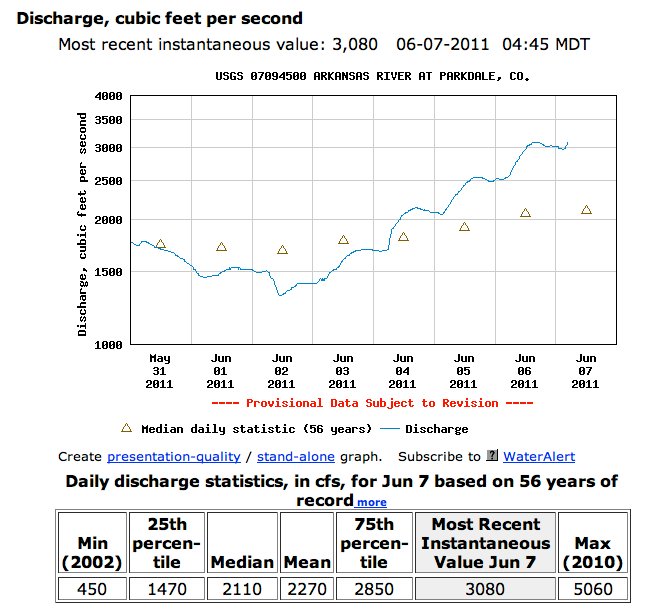
– An endowment fund to pay for restoration projects.

“How much will it cost the state not to protect these rivers?” asked Drew Peternell, director of TU’s Colorado Water Project. “We can pay a little now — or a lot later. This is a smart investment in one of the state’s irreplaceable resources and in our quality of life.”
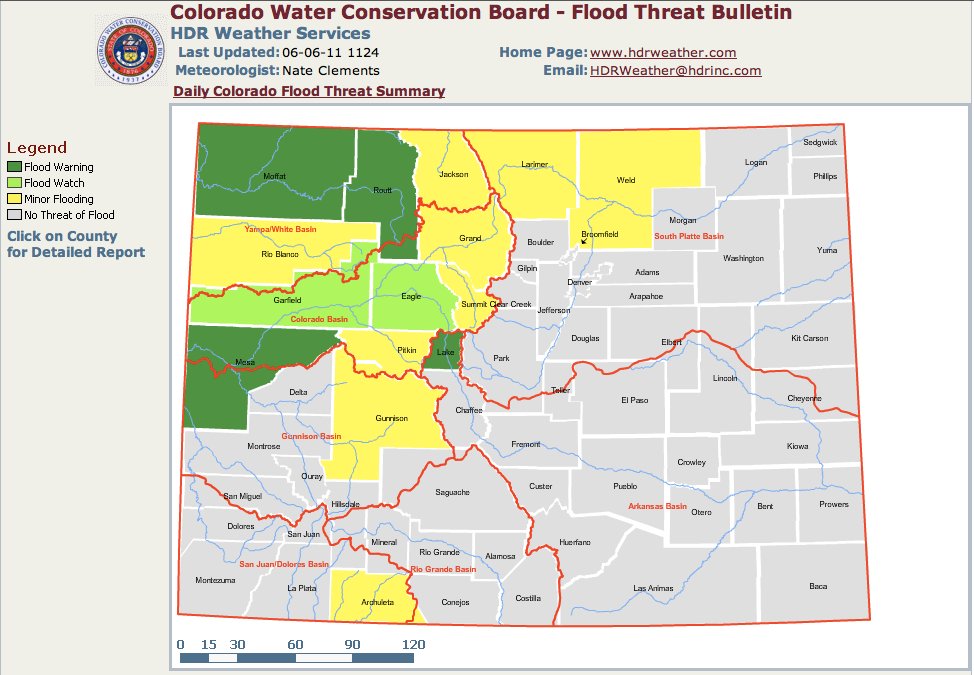
More Moffat Collection System Project coverage here and here.

More Windy Gap coverage here and here.