
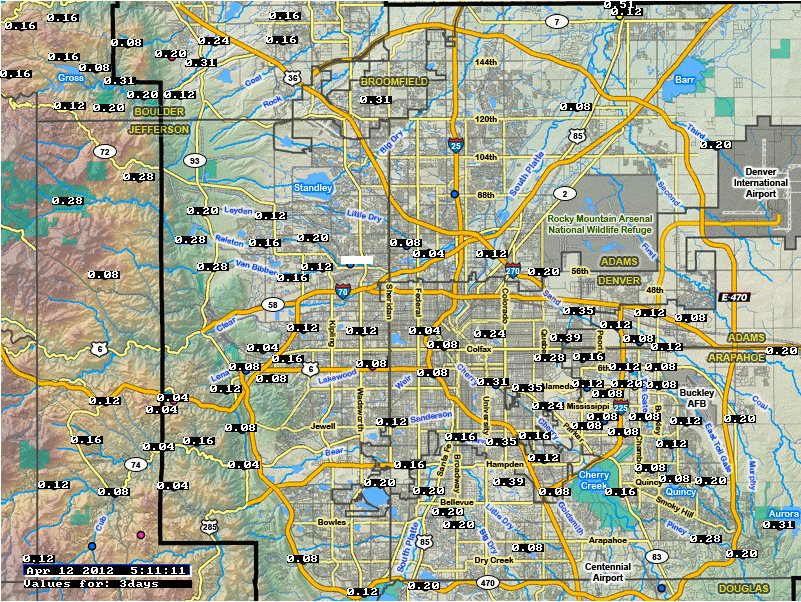
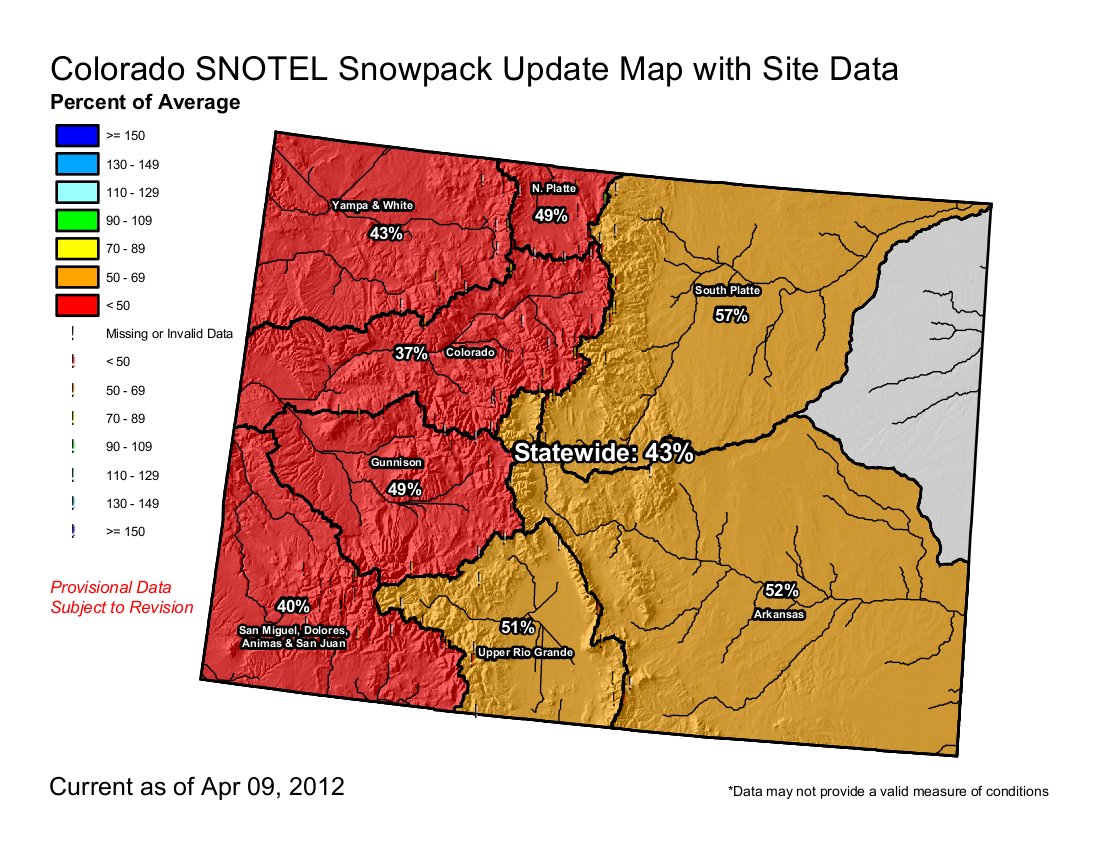
Click on the thumbnail graphic to the right for the April 9 snowpack map. The NRCS hasn’t updated since then (as of this morning at 5:00 a.m.). The other graphic is from the Urban Drainage and Flood Control District. Most of the Denver Metro area received some rain yesterday and overnight. The two stations closest to Gulch Manor are showing eight hundredths and four hundredths. One station near Henderson shows 51 hundredths.
From The Pueblo Chieftain (Chris Woodka):
The April forecast by the Natural Resources Conservation Service shows the Arkansas River at about 50 percent of average at Salida, which matches the snowpack in the basin. That triggers a dry-year exception in the Pueblo flow program, meaning no additional water will be supplied for recreation at the Downtown Whitewater Park…
In the Upper Colorado River basin, which supplies supplemental water through the Fryingpan-Arkansas Project, snowpack was just 37 percent of average. “It’s very concerning,” said Roy Vaughan, manager of the Fry-Ark Project for the Bureau of Reclamation. “We had a sprinkle in the collection area today, and that was it.” The April 1 projection for Fry-Ark imports — they begin when snow starts melting — is 23,000 acre-feet, but that assumes normal precipitation during the remainder of the spring snowfall accumulation…
“We’ve talked about running the winter water on the hay and wheat, so you could get two cuttings of hay and finish the wheat,” said Dan Henrichs, superintendent of the High Line Canal. “But you’ve got guys talking about planting corn. I don’t see how they’re going to finish the crop.”
Garry Clark, who farms near Rocky Ford, was philosophical about the situation. “You can’t tell. There’s been years like this before,” Clark said…
Aurora is planning on taking as much water as it can this year, but that likely will be just 50 percent to 60 percent of the average yield, said Tom Simpson, water resources manager for the Arkansas Valley. Aurora will leave some water in the valley, due to other circumstances. It will sell about 2,500 acre-feet to the Lower Arkansas Valley Water Conservancy District to help farmers meet augmentation requirements under Rule 10 of the state engineer’s surface irrigation rules…
Aurora’s reservoirs are 76 percent full, well above the 60 percent level that could trigger additional water purchases through leases from the Arkansas Valley. The city also has permanent water restrictions imposed after the 2002 drought, and has completed the Prairie Waters Project that allows it to recapture some wastewater and reuse it…
Colorado Springs Utilities has about two years of demand in storage, and is expecting a yield of about 77 percent of average. “The bottom line for us is that we’re not concerned about the snowpack this year, but that it might be the leading year for a multiyear drought,” said Brett Gracely, water resources planning manager for Colorado Springs Utilities.