Colorado Water 2012: ‘The Rio Grande starts as a small spring’ — Steve Vandiver

Map of the Rio Grande watershed. Graphic credit: WikiMedia

Here’s the latest installment of the Valley Courier’s Colorado Water 2012 series. Here’s an excerpt:

The Rio Grande starts as a small spring and as it proceeds downstream it picks up a number of small tributaries and soon is a large stream and then a small river as it flows into the only main stem reservoir on the river in Colorado, Rio Grande Reservoir. This is a private reservoir which is used for irrigation and other uses.

The river then runs downstream and joins the South Fork of the Rio Grande and then towards to the San Luis Valley. On its way through the Valley, there are a number of diversions into irrigation ditches which divert the allocation of the Compact dedicated to Colorado. There are limits to how much Colorado can use and the remainder has to go on downstream to New Mexico which creates a portion of their water supply under their allocation from the Compact.

After running through the Rio Grande Gorge for a number of miles and joining a number of small tributaries in northern New Mexico, it runs into a large flood control reservoir above Cochiti Dam. The largest tributary to the river in New Mexico is the Chama River which enters the river just below that dam, delivers about one-third of the supplies for New Mexico. New Mexico then uses their allocation of Compact water for agriculture and municipal supplies through the central portion of the state. The cities of Santa Fe, Albuquerque, Socorro and others rely on the river as a source of supply.

The river then enters the largest reservoir on the Rio Grande in the Upper Rio Grande reach, the Elephant Butte dam and Reservoir. This reservoir is critical to the entire Rio Grande Basin as it holds and regulates southern New Mexico and West Texas allocation under of the Compact, generates hydroelectric power and provides protection for all three states’ water supplies.

Immediately below the Elephant Butte dam is Cabello Reservoir which serves as a regulating reservoir from the water running through the power generation station in Elephant Butte Dam. There are three large diversions from the River between Cabello Dam and El Paso that provide irrigation water to several tens of thousands of acres of highly productive land. El Paso uses a portion of Texas’s water allocation for municipal supplies. The American Dam diversion just upstream of El Paso serves many thousands of irrigated acres downstream of El Paso before the river gets to Ft. Quitman. The water allocated from the river to the Juarez, Mexico area by treaty with the US, is diverted at the International Dam just below the American Dam. The river is effectively dry below this point except for the water produced by several drains from both the US and Mexico sides of the river.

Drought news: Horses are suffering and dying across the West

usdroughtmonitor08142012.jpg

From The Bend Bulletin (Mark Holm):

While precise figures are hard to come by, rough estimates from the Unwanted Horse Coalition, an alliance of equine organizations based in Washington, puts the number of unwanted horses — those given up on by their owners for whatever reasons — at 170,000 to 180,000 nationwide, said Ericka Caslin, the group’s director.

Many more could be out there, though. The Navajos, for instance, have no tally on the number of feral horses on their land; a $2 million effort to count and round them up was vetoed by the tribe’s president because of the cost.

Here, in this speck of a city in northern New Mexico, just outside Navajo territory, Debbie Coburn has been scrambling to enlist volunteers and raise money to feed, clean and care for three times as many abandoned horses as she had in her rescue farm, Four Corners Equine Rescue, through all of last year.

She gets up almost every day to find messages in her computer from people whose horses are in desperate need of help. One recent morning, a woman writing on behalf of her elderly parents who live just east of Albuquerque said, “They have scraped by every week to purchase a bale of hay for their horse, but they just can’t do it anymore.”

At $8 to $12 for a bale of roughly 60 pounds, enough to feed a riding horse for maybe three days, hay costs five times what it did 10 years ago, Coburn said. This summer’s anemic harvest has spurred competition for a limited supply among ranchers big and small, from nearby cities and also from out of state. And as a rule, the price of hay goes up in the cold months; it doubled last winter, when the drought’s devastating effects first began to sprout.

“This winter, to be quite blunt, scares the hell out of me,” Coburn said as she walked across the corrals where the horses are kept, some of them in improvised pens enclosed not by steel barriers, but by electric fence. (The horses have arrived faster than she has been able to make room for them.)

“At this point,” she added, “it’s just too late for rain alone to solve our problems.”

Drought Response Information Project (DRIP) recognizes the City of Grand Junction for conservation

historicdowntowngrandjunction.jpg

From The Grand Junction Daily Sentinel (Richie Ann Ashcraft):

The Drought Response Information Project (DRIP) noted that the city had used 30 percent less water in the past six years. In appreciation, the city was awarded a 2012 Drought Recognition plaque at Hawthorne Park from representatives from the Clifton Water District, Ute Water Conservancy District and other DRIP committee members.

Rob Schoeber, director of Parks and Recreation for the city, attributed the low water usage to the Maxicom centralized computer control system which measures the amount of water each field needs to remain lush.

If it rains at midnight and there is enough water, then the sprinklers won’t come on in the morning, explained Schoeber. The system also monitors the evapo-transpiration rate, adjusting the watering schedule accordingly, he said.

The high tech system was installed at most of the city operated parks and fields in 2006. Other components have been added through the years as the budget allows. “The cost really comes out in savings of water over the long term,” Schoeber said.

More conservation coverage here.

Northern Integrated Supply Project: Supplemental Draft EIS due Fall 2013

gladereservoirsitenorthernwater.jpg

Here’s an excerpt from a recent Northern Colorado Water Conservancy District eNews email:

Colorado Governor John Hickenlooper wrote a letter to the U.S. Army Corps of Engineers in May requesting an expeditious conclusion to the National Environmental Policy Act study being conducted by the Army Corps for the Northern Integrated Supply Project.

In a response to the governor, Corps of Engineers Colonel Robert Ruch, responded that his agency anticipates the Supplemental Draft EIS for NISP will be released to the public in the Fall of 2013. “The size of the proposals, types of analyses, and the amount of interest they have generated has resulted in substantial reviews,” Colonel Ruch wrote. “Please be assured that I have made the review of all ongoing water supply actions in the Omaha District’s purview a high priority for my Regulatory staff.”

This was positive news on many fronts. First, is that a definite date for the release of the SDEIS has been given. The SDEIS process began in February 2009. Second, having Gov. Hickenlooper weigh in on the project is enormous. While not an endorsement, his insistence that the studies be brought to conclusion and his affirmation that wise water development, including projects like NISP, are a necessity in Colorado, was welcome indeed.

The Governor also referenced the ongoing drought in Colorado and the pressing need for water for NISP water providers. He also committed the State to moving through their approval process in a timely manner.

Governor Hickenlooper also wrote a letter to President Obama where he addressed Denver Water’s Moffat Enlargement Project and its ongoing permitting process.

In the letter he states, “Colorado is at a critical juncture in forging a more secure future for the development and management of water supplies critical to both our economy and the natural environment that makes our state so great.” Governor Hickenlooper added, “Therefore, we urge you to exercise your authority to coordinate your agencies and bring an expeditious conclusion to the federal permitting processes for this essential project, in order that we can have certainty moving forward as a state.”

More Northern Integrated Supply Project coverage here and here

‘We wanted to understand what had driven past extinctions of sea life’ — John Pandolfi

bootprintearth.jpg

Here’s a look at a recent study by scientists from Australia, the US, Canada, Germany, Panama, Norway and the UK, from Bob Berwyn writing for the Summit County Citizens Voice. Click through and read the whole thing. Here’s an excerpt:

Three of the five largest extinctions of the past 500 million years were associated with global warming and acidification of the oceans — trends which also apply today, the scientists wrote in the journal Trends in Ecology and Evolution.

Other extinctions were driven by loss of oxygen from seawaters, pollution, habitat loss and pressure from human hunting and fishing – or a combination of these factors. “Currently, the Earth is again in a period of increased extinctions and extinction risks, this time mainly caused by human factors,” the scientists wrote. While the data is harder to collect at sea than on land, the evidence points strongly to similar pressures now being felt by sea life as for land animals and plants.”

An extensive search of historical fossil records has established the main causes of previous marine extinctions — and gives some clues as to the risk of a recurrence. “We wanted to understand what had driven past extinctions of sea life and see how much of those conditions prevailed today,” said co-author John Pandolfi, of the ARC Centre of Excellence for Coral Reef Studies and The University of Queensland.

“It is very useful to look back in time – because if you forget your history, you’re liable to repeat it,” said Pandolfi, an authority on the fate of coral reefs in previous mass extinction events.

Marine extinction events vary greatly. In the ‘Great Death’ of the Permian 250 million years ago, for example, an estimated 95 per cent of marine species died out due to a combination of warming, acidification, loss of oxygen and habitat. Scientists have traced the tragedy in the chemistry of ocean sediments laid down at the time, and abrupt loss of many sea animals from the fossil record.

More Climate Change coverage here and here.

Alan Hamel ends his run with the Pueblo Board of Water Works

alanhamelpuebloboardofwaterworksadminbuildingchieftain.jpg

From The Pueblo Chieftain (Chris Woodka):

The Pueblo Board of Water Works Tuesday voted to rename its headquarters the Alan C. Hamel Administration Building at 319 W. Fourth St. Hamel, the executive director since 1982, officially ended his 52-year career the same day at the water board…

Far from speechless, Hamel then proceeded to talk about his career at the water board, giving credit to the employees who worked for him and the board. He also praised present and past boards for allowing him to serve outside roles in state government and professional groups. “The board has been farsighted in letting us look on the outside to form partnerships,” Hamel said.

A reception recognizing Hamel’s career is scheduled from 1 to 4 p.m. Aug. 29 at the Olde Towne Carriage House at the Riverwalk, 102 S. Victoria Ave.

More Pueblo Board of Water Works coverage here and here.

It turns out that Colorado Springs did need a stormwater enterprise after all: The search for $millions continues

floodingcoloradospringsjune62012.jpg

From The Pueblo Chieftain (Chris Woodka):

Chris Melcher, city attorney for Colorado Springs, reiterated Tuesday that he believes the city needs to fund $13 million-$15 million annually in stormwater maintenance or improvements to meet the conditions of 2009 SDS agreements with Pueblo County and the federal Bureau of Reclamation. Those agreements are embodied in the 2010 SDS contract. Since March, when Melcher first gave that opinion, the Pueblo County commissioners have asked for at least $15 million in next year’s budget, and the Lower Arkansas Valley Water Conservancy District suggested $18 million$20 million is needed…

Mayor Steve Bach has asked Utilities to find $15 million in its budget for stormwater next year. Utilities, which answers to City Council, not the mayor, does not operate a stormwater utility, but maintains that some of its budget goes to stormwater projects.

More stormwater coverage here and here.

USGS: Nutrients pollution

John Hamrick (Cotter Corp) to Florence City Council ‘We do take our environmental responsibilities pretty seriously’

cottermillcontaminationconcerndenverpost10232011.jpg

From the Cañon City Daily Record (Charlotte Burrous):

“We’ve made a lot of progress on the environmental cleanup that we’re doing out there,” he said. “We still have a ways to go. We do take our environmental responsibilities pretty seriously.

One of the things Cotter has provided is a hook up to the Cañon City water system to anyone in Lincoln Park, who was qualified and had a well out here, he said.

“The historic operation did release radioactive materials and other metals into the environment,” Hamrick said. “The ground water in Lincoln Park does not meet standards yet, but we do meet standards for release of contaminated materials.”

“One of the things that’s been suggested is off-site disposal of the tailings or otherwise picking up all the tailings and material and taking it elsewhere,” Hamrick said. “Right now, we’ve got more than 90 percent of our contaminants already stabilized. Excavating those materials, whether by truck or by train results in exposure to workers, the environment and the public. That doesn’t have to happen under the plans. Cotter owes the state another look at what off-site disposal would mean. We will be submitting that to the Department of Health for their review and approval. All told, we have about 10 million cubic yards or 15 million tons that will be contained in the impoundments.”

More nuclear coverage here and here.

EPA to host free webinar on on public health and environmental issues related to septic systems on Thursday

septictankbasics.jpg

From the EPA via Twitter:

We’re hosting a free webinar on Thursday, 1 to 3:30 pm ET, on public health & enviro issues related to septic systems. https://www2.gotomeeting.com/register/957149114

More wastewater coverage here and here.

Chatfield Reallocation Project comment period ends September 6

chatfieldreservoirreallocationprojectalternatives.jpg

From CBS4Denver:

The reservoir was created for flood control along the South Platte River, but the expansion would allow the area to be used to hold excess water supply. The Audubon Society says that would only happen in three years out of 10 and would not make the expansion worthwhile.

Comments about the project are still being accepted. Visit the Chatfield Reservoir Reallocation Study website for more information.

More Chatfield Reservoir coverage here and here.

Drought news: Horsetooth Reservoir dropping a foot a day

usdroughtmonitor08142012.jpg

From 9News.com (Nick McGurk):

On Monday, Boyd Lake closed to swimming after its level dropped to 35 feet, down from its capacity of 57 feet. Normally it stays open through Labor Day. Meantime, at Horsetooth Reservoir the water level is dropping roughly one foot per day. Currently, the level is around 45 percent full, according to Brian Werner with Northern Colorado Water Conservancy District. “The primary use of these reservoirs is to deliver water for irrigation and municipal use,” said Dave Rieves, who manages visitor services for Larimer County Department of Natural Resources…

The boating season for trailer-launched water craft at Horsetooth Reservoir will likely end this weekend. Rieves said the reservoir will still be open for recreation and will be a haven for kayaking and canoening, as well as fishing.

South Platte River Basin: Barr-Milton Watershed Association annual meeting (and BBQ) August 28

barrlake.jpg

Click here for the announcement. Thanks to Amy Conklin for sending it along via email.

National Ground Water Association: New York Times bestselling author Charles Fishman to speak at the 2013 NGWA Summit

thebigthirstcharlesfishman.jpg

From the National Ground Water Association:

Charles Fishman has been named the keynote speaker for the 2013 NGWA Summit — The National and International Conference on Groundwater taking place April 28-May 2, 2013 in San Antonio, Texas.

Fishman, an award-winning reporter who has spent the last several years trying to understand water issues around the world, is the New York Times bestselling author of the book, The Big Thirst: The Secret Life and Turbulent Future of Water. Focusing on society’s relationship with water, his message is cautionary, but optimistic — there is still no reason for a global water crisis as there is more than enough water…it just has to be used smartly.

Since The Big Thirst was published, Fishman has spoken about water issues at Wharton School of the University of Pennsylvania, the University of Michigan, the Massachusetts Institute of Technology, and the U.S. State Department. He also recently penned a thought-provoking op-ed article on the current drought encompassing much of the United States.

To learn more about the 2013 NGWA Summit — The National and International Conference on Groundwater, visit www.GroundwaterSummit.org or call 800 551.7379 (614 898.7791).

Alamosa: Rio Grande Headwaters Land Trust ‘2nd Annual Headwaters Hoedown’ September 16

artesianwellduttonranchalamosa1909.jpg

Here’s the webpage with all the inside skinny:

2nd Annual Headwaters Hoedown!

Sunday, September 16th, 2012
1:00pm to 6:00pm
Gilmore Ranch, Alamosa (Directions)

For tickets, sign up to support RiGHT as an annual Conservation Partner – click here. Your donation includes a ticket to this year’s Headwaters Hoedown!
Kids 12 & under free with adults

Join RiGHT for the biggest conservation celebration of the year! Come enjoy delicious local food, fine wine & beer, ranch tours, a fabulous silent auction, and dance to live music by local favorites Don Richmond & The Rifters and Sweet Radish.

We will also gather to honor the landowners who protected their land with RiGHT last year and recognize Paul Robertson of The Nature Conservancy for his outstanding contributions to conservation in the San Luis Valley.

More Rio Grande River Basin coverage here and here.

Drought news: ‘The 90 by 20 campaign believes it is time to focus on affordable solutions’ — Drew Beckwith

watersprinkler.jpg

From the Summit Daily News (Paige Blankenbuehler):

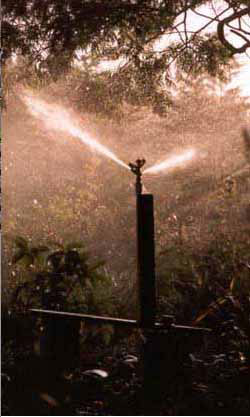
The 90 by 20 campaign, which launched in early August, is asking communities in Colorado to commit to achieving residential water usage rates of 90 gallons per capita per day by 2020. Focused on limiting residential use of water by asking utility customers to work with their residential customers, campaign organizers are striving over the next eight years to achieve average usage rates of 90 gallons per person per day. The usage includes the water to wash, cook and clean and irrigating landscapes. If utility companies across Colorado meet the benchmark, the region would save over 1 million acre-feet of water per year — enough to supply Denver for three years…

“The 90 by 20 campaign believes it is time to focus on affordable solutions that everyone can achieve,” said Drew Beckwith of Water Resource Advocates. “If we’re going to restore balance in the region’s water resources, everyone needs to work together and reach for a common goal.”

Fryingpan-Arkansas Project 50th anniversary: Ruedi Reservoir created for compensatory water storage for the Western Slope

bousteadtunnelconstructionaspentimes.jpg

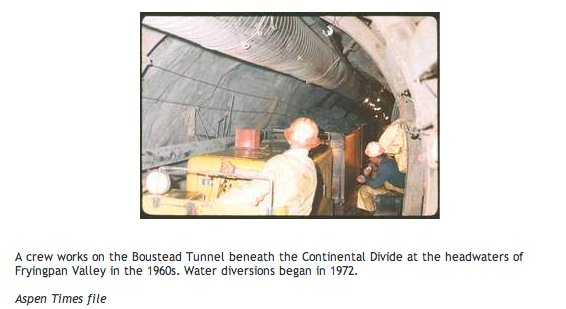
Here’s an in-depth look at the Fryingpan-Arkansas Project from Scott Condon writing for The Aspen Times. Click through and read the whole article. Here’s an excerpt:

The Fry-Ark water diversion plan was hatched shortly after World War II ended, when the cities and counties of Colorado’s Arkansas River Valley started looking for water to fuel growth aspirations. The initial plan was to divert 357,000 acre-feet of water annually from the Gunnison River and other tributaries of the Colorado River to the Arkansas Valley, according to the website of the Southeastern Colorado Water Conservancy District.

The proposal sparked a political battle in the 1950s between Western Slope residents who didn’t want “their” water taken and Arkansas Valley resident who saw the water as the key to their future. [Mark Fuller, executive director of the Ruedi Water and Power Authority] said residents of the West Slope of Colorado had an ingrained “mistrust” of the Front Range, which had more people, more money and more power…

The Roaring Fork River basin’s loss is the Arkansas Valley’s gain. Reclamation bureau spokeswoman Kara Lamb said Fry-Ark water irrigates 265,000 acres of some of the most productive farm land in Colorado. “This is Rocky Ford cantaloupes and the onions that the Arkansas Valley is so famous for,” she said.

In addition, 720,000 residents of the southeastern part of the state receive supplementary water from the project. They live from Salida in the west to Lamar in the east, and from Colorado Springs down to Pueblo…

The Fry-Ark system diverts an annual average of 54,000 acre feet. To put that amount in perspective, it’s a little more than half the total held by Ruedi Reservoir when full. Last year, when the snow kept piling up late into the spring, the system diverted its second highest amount of water ever at about 98,000 acre feet. This year, during the drought, it diverted only 14,000 acre feet…

Ruedi Reservoir — which now dominates the Fryingpan Valley’s identity — wasn’t in the initial plans for the diversion system. “It was a political solution,” Lamb said. The reservoir was created for compensatory water storage for the Western Slope. To a layman, the legal purpose of Ruedi is essentially a way for water attorneys to make the books balance. In a practical sense, the reservoir has created one of the biggest recreational draws in the Aspen area…

Aspen residents get a direct benefit from the Ruedi dam. The hydro-electric plant owned and operated by the city of Aspen produces 20 to 25 million kilowatt hours of power per year. That is the equivalent of 35 to 40 percent of Aspen’s annual demand, according to Fuller.

More Fryingpan-Arkansas Project coverage here and here.

Chatfield Reallocation Project: Reservoir expansion = Smart bottom-up, community-wide public policy?

chatfieldreservoirace.jpg

Here’s a guest column in support of the Chatfield Reallocation Project written by Randy Knutson and Rick McLoud running in The Denver Post. Here’s an excerpt:

Chatfield is a common-sense solution that will help bring locally grown produce to Colorado citizens, provide greater sustainability for domestic water supplies, and stabilize South Platte stream flows through the metro area.

Expanding the reservoir is an example of smart bottom-up, community-wide public policy. It is indeed rare that the suburbs, agricultural interests and the environmental community agree on anything, let alone a water project. Chatfield is that model. For over six years, stakeholders from all of these groups and more have been talking with the state and the U.S. Army Corps of Engineers in a transparent and open process. Supporters and opponents have been involved in these meetings since the beginning. And in June 2012, the corps conducted three packed public hearings, from Gilcrest to the Dakota Hogback, where citizens shared their views of the project.

That’s why groups as diverse as Trout Unlimited, The Sierra Club, The Greenway Foundation and Western Resource Advocates have joined the members of our bipartisan Colorado congressional delegation to back this project in support of farmers, families and the environment.

Click here to view a letter of support from the Gunnison Basin Roundtable.

The Greeley Tribune editorial board has come out in favor of the project as well. They write:

Water storage projects are never easy. Public support can be splintered; permitting can take years; environmental concerns frequently surface; they are expensive. You’ll never hear anyone say that a water storage proposal is a slam dunk. But from where we sit, the proposed expansion of Chatfield Reservoir southwest of Littleton is at least an uncontested lay-up, and we’re hoping the project wins quick approval of the U.S. Army Corps of Engineers.

More Chatfield Reservoir coverage here and here.

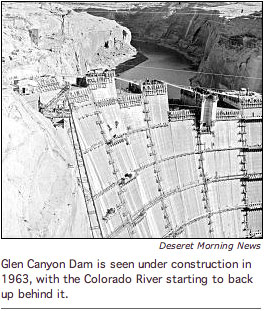
CWC Summer Conference: ‘The money available for infrastructure projects, especially for water, is going to be very challenging’ — Carl Steidtmann

glencanyonconst.jpg

From Steamboat Today (Frank Ameduri):

“The real issue here with water is, ‘What are we going to do about it?’” Carl Steidtmann said. “The problem is our government entities are deeply in debt.”

Steidtmann, a Steamboat Springs resident who is chief economist for Deloitte, was the lunchtime speaker during the 2012 Summer Water and Energy Conference at the Sheraton Steamboat Resort on Wednesday. The three-day conference goes through Friday and is put on by the Colorado Water Congress. There are 240 people registered for the conference, and attendees include local politicians, state legislators and representatives from water conservancy districts, water departments and municipalities across the state.

Steidtmann’s keynote Wednesday was titled “The Regional Impact of the National Economy: Letting Go of the Status Quo for Water and Energy.”[…]

Steidtmann, who consults with Fortune 500 companies, said water is becoming an increasingly important issue for energy companies because of its increasing scarcity. To illustrate this point, he showed a map forecasting water availability in 2025. “The western part of the U.S. becomes one of those areas of critical water shortages,” Steidtmann said.

In an era of a contracting government where more money is being spent to pay off debt, Steidtmann said infrastructure projects are the ones that are easy to delay. “The money available for infrastructure projects, especially for water, is going to be very challenging,” he said.

From The Pueblo Chieftain (Chris Woodka):

“Environmentalism is a luxury good,” said Carl Steidtmann, chief economist for Deloitte Services. “Richer countries are more environmentally conscious.” In his view, poorer nations are more focused on the need to survive, and have a greater impact on the environment as populations grow. It takes money to protect the environment, he said. Energy development has been the greatest factor in the divide between rich and poor nations, but in the future, the availability of food and water will also have economic consequences, he said.

From The Pueblo Chieftain (Chris Woodka):

“We need to make sure the most water goes to the hottest fires,” said Reeves Brown, executive director of the Colorado Department of Local Affairs. He was among state officials who discussed water project funding last week at the summer convention of the Colorado Water Congress. There is an estimated $5 billion backlog in about 1,000 community water projects across the state.

Mineral severance or federal lease fund revenues are a major source of funds for Colorado water projects to provide drinking water or treat wastewater. Since 2008, the state has looked toward those cash funds to make up shortfalls in other budget areas, particularly health care, education and prisons.

About $250 million over four years in funds that would have gone to local impact grants through DOLA have been diverted. That money would have leveraged three times as much in other grants or loans, Brown said. The Colorado Water Conservation Board has seen $163 million of construction funds diverted during the same period, while making about $80 million in loans to water projects.

More infrastructure coverage here.

Gypsum: LEDE Reservoir enlargement costs are up to just over $5 million

ledereservoirgypsum.jpg

From the Eagle Valley Enterprise (Derek Franz):

LEDE has a current capacity of 473 acre feet of water. The latest plans are to expand it to 947 acre feet. The expansion will submerge some small wetland areas that are around the reservoir at its present size and the town has plans to compensate for that loss by replacing the wetland areas with new ones. Those plans are mainly what need approval from the Corps of Engineers and it’s unclear if that will happen.

“We might want to get some other plans in the works if it looks like they’re going to fight us on these,” said water attorney Ramsey Kropf. “Then again, they might fight us on anything we propose.”

Costs were also bumped up in 2010 when the latest plans for the expansion were approved by Gypsum Town Council. Council members opted to expand the reservoir to 947 acre feet instead of 680 acre feet as originally planned. That budget presented the town with a $680,000 funding shortfall. However, the larger option was a much better value per acre foot.

At that point, the project was estimated to cost about $4.5 million. Now that number is just over $5 million, leaving a difference of $536,000 to scratch up.

More infrastructure coverage here.

Ceratium and gomphosphaeria are blooming in Arvada Reservoir

arvadareservoir.jpg

From the Arvada Press (Sara Van Cleve):

Because of the extreme heat this summer, several kinds of algae, specifically ceratium and gomphosphaeria, have sprouted in Arvada Reservoir. “It’s the extended period of it that’s causing it to grow,” said Wendy Forbes, communications manager for the city of Arvada. “There is not enough fluctuation in temperatures.”

As the algae dies, it releases into the water a harmless chemical that causes the change in smell and taste, Forbes said. Though some residents have tasted and smelled the algae’s effects in their water, Forbes said, it is completely harmless.

“Arvada Water is adding carbons to the system to help with some of that,” she said. “It should stop once the algae is gone.” It takes about four days for water to pass through the purification system completely, so it takes about that long to collect enough data to see if the extra carbon is helping.

More water treatment coverage here.

Cherokee Metropolitan District ousts absentee director

waterfromtap.jpg

From The Colorado Springs Gazette (Bob Stephens):

A May recall failed to oust three members of the district board of directors, leaving the panel split 3-2. That split was on display Tuesday as board member Steve Hasbrouck was voted off for missing three consecutive meetings. So, once again, applications are being accepted for the vacancy and a special meeting is scheduled Aug. 29 to appoint a new board member.

This is typical for 8,000 homeowners in the district. They’ve endured astronomical rate hikes, reaching 87 percent, and water rationing since the board took bad legal advice and used water from the Upper Black Squirrel Basin without proper water rights. Cherokee lost a court battle and was ordered by a water court judge to abandon four of its 17 wells. Those wells provided more than 20 percent of Cherokee’s water supply. To replace the lost wells, Cherokee has been forced to buy expensive water from Colorado Springs Utilities, causing rates to soar.

More Cherokee Metropolitan District coverage here and here.

Forecast news: El Niño building in the Eastern Pacific Ocean

elninolanina.jpg

From the Aspen Business Journal (Bob Berwyn):

At this point, the weather gurus are confidently predicting that a full-fledged El Niño will develop by autumn, perhaps reaching peak strength during the winter, when its effects are most often felt.

And that could be good news for at least the first part of the ski season, according to Klaus Wolter, a meteorologist with the University of Colorado’s CIRES Climate Diagnostics Center and NOAA’s Earth Systems Research Laboratory.

From the Summit Daily News (Paige Blankenbuehler):

In Colorado, the eastern plains have the best chances of moisture from October 2012 to June 2013, according to Klaus Wolter, a climatologist who makes long-range forecasts for the National Oceanic and Atmospheric Administration in Boulder. But things still may bode well for the mountains.

“In fact, one could argue that the northern Front Range and Rocky Mountains may end up with the wettest outcome,” Wolter said.

The last two years have been La Niña seasons and “long-lived La Niña events have a more pronounced tendency to flip to El Niño, 60 percent of two-year events end up in El Niño in the third year,” Wolter said.

Drought news: July inflows to Lake Powell = 14% of average

johnwesleypowell.jpg

From the Summit County Citizens Voice (Bob Berwyn):

Water managers are now forecasting a total inflow for water year 2012 of about 5.15 million acre feet, which is less than half (48 percent) of average. That would make it the third-driest year on record, but still much wetter than 2002, when total inflow was only 2.64 million acre feet (24 percent of average).

The water level in the key reservoir — which helps balance competing demands from the upper basin and lower basin states — has dropped fast, to 24 feet below the maximum 2011 level.

The U.S. Bureau of Reclamation is reporting that July inflow was about 154,000 acre feet, with almost 900,000 acre feet released downstream. At the end of July, Lake Powell was at 60.4 percent of capacity, storing about 14.7 million acre feet. Read the full report on the Bureau’s Upper Colorado/Lake Powell web page.

From the Summit County Citizens Voice (Bob Berwyn):

…thanks to a deal brokered by the Colorado Water Trust and sanctioned by the State Engineer’s Office, the [Colorado River] will get a measure of relief. Some “extra” water historically used for irrigation will help boost flows in some critical reaches of the Colorado.

In addition to the Colorado Water Trust and the State Engineer’s Office, the complex deal involves the Colorado Water Conservation Board; CLP Granby, LLC; and Aspen Shorefox LLC, a financial partnership on the Western Slope that were lenders in a proposed development and own 40 cfs of water on Willow Creek, a Grand County tributary to the Colorado River.

The water trust, privately funded primarily through donations, will pay to for the short-term lease. No public money is being spent on the lease. “Instead of that water being used for irrigation it will be used for instream flows just downstream of where it would have been diverted,” said Colorado Water Trust attorney Zac Smith.

‘How I Became a Westerner’ — 2012 Annual High Country News Student Essay Contest

johnnellcg.jpg

I was born and raised in Denver, which might qualify you as a “Westerner” automatically. I became a Westerner while wearing out my hiking boots in the back country with friends and family. The drives to the trailhead helped as well. I can’t name them all but I have favorite restaurants in many mountain and desert towns.

I remember one time back in the Seventies in Escalante. A local policeman asked me what the “bunch” of us were doing.

I said, “We’ve been in the canyons for a week. We’re going over to the Golden Corral for burgers and fries and then up to the state park for a shower. After that we’ll be heading up to Boulder, down into Hanksville and over to Colorado from there.”

“Good,” he said.

From email from the High Country News:

Send essays to studentwriters@hcn.org.
Visit hcn.org/edu for more information.

In 600 words, describe why your heart is at home in the American West. Is being a Westerner a physical state, a frame of mind, an emotional experience? Is it something you earned? Something you were born into? A title conferred on you, or one you adopted on your own?

The contest is open to all currently enrolled high school students and undergraduates at American schools, colleges and universities as well as 2012 graduates. Submissions must be original, unpublished work (the writing can have been published in a student publication). One entry per person, please.

Include your name, contact information, school name, and area of study with your submission.

The winning essay will appear in the upcoming HCN Books and Essays special issue and the writer will receive these backpacking essentials from MountainSmith:

– Lookout Backpack
– Poncha 35 Degree Sleeping Bag
– Rhyolite Trekking Poles

More education coverage here.

Aurora: Anadarko scores 1,500 acre-feet of fully reusable effluent for oil and gas operations

metropolitanwastewaterreclamationdistricthiteplantoutfall.jpg

From the Aurora Sentinel (Sara Castellanos):

“We’ve always looked at where our supplies are, where our projected demand is going to be, and where we have windows of opportunity. Where we think we have additional supply, we’ll go ahead and lease it,” Stibrich said.

The Anadarko leasing deal was especially high profile because the city agreed to lease water to the company for hydraulic fracturing purposes — a contentious issue that some Aurora residents have vehemently opposed.

But leasing deals have existed long before then, Stibrich said. Those include a 7,000 acre-foot lease to the Central Colorado Water Conservancy District, a 4,340 acre-foot lease to Rocky Mountain Energy Company, now owned by Xcel Energy, and leases that are currently being negotiated for the WISE project that will eventually grant water to 11 water providers in Douglas and Arapahoe counties in times when Aurora has additional water…

As of now, Aurora’s water supply is in good shape. The city stores water in 16 reservoirs — of which they own five: Quincy, Aurora, Rampart, Spinney Mountain and Jefferson Lake. The rest of the reservoirs are shared with other cities, for example, Homestake Reservoir stores water for Aurora and Colorado Springs. The reservoirs have a total water storage capacity of 156,000 acre feet of water. An acre foot is 326,000 gallons, or enough water to serve two typical households per year. The amount of storage capacity the city has is three times more than the city’s actual need.

The city uses about 50,000 acre feet annually, and the reservoirs were about 85 percent full in May.

The city is continually looking at more opportunities for water storage. Between 2012 and 2014 the city will be working on land easements and begin pre-permitting activities for the development of the Box Creek Reservoir, which they hope will be online and storing water by 2030…

Under the Anadarko water lease, Anadarko is planning to pay Aurora Water to use 1,500 acre feet of “effluent” water per year over five years. The company will be paying four times the market rate for the city’s effluent water, or water that has already been used and treated that would otherwise flow downstream and out of the state. That equals to about $1,200 per acre foot, whereas the market rate is about $350 per acre foot. Anadarko will pay Aurora about $9.5 million over five years for the water.

Back on August 15 an Aurora City Council committee made sure that the city didn’t lease potable water to Anadarko. Here’s a report from Sara Castellanos writing for the Aurora Sentinel. Here’s an excerpt:

City council members had the discussion after the city received two requests from parties interested in the possibility of acquiring drinkable, or potable, water for oil and gas drilling purposes.

The people interested were not named in city documents or at the Infrastructure and Operations Policy Committee meeting, but committee members said potable water shouldn’t be sold to any entity.

The requests involved using water from city fire hydrants to fill water tankers for use at oil drilling sites, potentially both inside and outside Aurora city limits. The city’s water officials recommended to members of the policy committee that they deny their requests and any future requests for potable water and keep with the city’s current policy against using fire hydrants for any purpose other than fire suppression and system maintenance.

Councilman Brad Pierce said he didn’t think that was an appropriate use of the city’s water…

The discussion comes about a month after council members agreed to lease 1,500 acre feet of “effluent” or used water to Anadarko Petroleum Corp. for $9.5 million over five years. Effluent water is water that has already been used and treated that would otherwise flow downstream and out of the state. The water is sanitary but not potable or made available for public use.

More Aurora coveage here and here.

Roaring Fork River: ‘Hot Spots for Trout’ stream temperature monitoring program nets 440 readings from 21 locations

monitoringroaringforktemperature2012rfc.jpg

Here’s the release from the Roaring Fork Conservancy:

Roaring Fork Conservancy’s Hot Spots for Trout program has engaged 50 volunteers to collect over 440 temperature readings at 21 locations throughout the Roaring Fork Watershed in only 6 weeks. The Hot Spots for Trout program was launched on June 28, 2012 in response to the severe 2012 drought, which continues to diminish flows and increase temperatures in local rivers. Collecting temperature data has assisted local wildlife managers in decisions to abate fishing in areas where fish and other aquatic life were already stressed.

Volunteer Greg Bovee of Carbondale explained that the “2012 has been an especially challenging year for the Roaring Fork watershed. Hopefully, the work of the volunteer hotspotters will shed some light on the affects of a very low snow-pack, drought conditions and excessive water diversions on our natural rivers and their ecosystems. Temperature data is but one element of effective river monitoring.”

During the week of August 5, 2012, four monitoring locations exceeded the state temperature standard of 68 degress Fahrenheit. These include the Crystal River near CRMS in Carbondale, the Roaring Fork River near the Carbondale boat ramp, Brush Creek near the Snowmass Village Rodeo Round About, and the Roaring Fork River in Aspen at the Hopkins Street footbridge. Afternoon rains have helped to keep rivers cool, however the low flows are still permitting river temperatures to rise.

The state standard for temperature in the Roaring Fork Valley is a maximum of 68 degrees Fahrenheit. Colorado Division of Parks and Wildlife is authorized to close sections of the river if daily maximum temperature exceeds 74 degrees Fahrenheit, or if average daily temperature exceeds 72 degrees Fahrenheit.

How hot or cold the water is determines what can survive in it. Aquatic species have evolved to live at certain temperatures ranges. For example, Brown Trout adults thrive at temperatures from 54-66 degrees Fahrenheit. In the upper and lower limits of that range, an organism becomes stressed, meaning it could be at a competitive disadvantage for food and more susceptible to disease or in extreme cases death. In addition, temperature influences both water biology and chemistry. For example, temperature affects how much oxygen is in the water. Elevated temperatures lead to decreased oxygen levels, which in turn negatively impact aquatic plants and fish. Increasing temperatures also promote growth of bacteria and algae which can increase pH and use even more of an already depleted oxygen supply.

Thanks to the Glenwood Springs Post Independent for the heads up.

More Roaring Fork River watershed coverage here and here.

Tri-State starts release of 400-500 acre-feet of water from Stagecoach Reservoir to help keep a senior call off the Yampa River

yampariverbasin.jpg

From Steamboat Today (Michael Schrantz):

The release started at about 1 p.m. Friday and should boost the Yampa River’s flows by about 50 cubic feet per second, McBride said. Low steamflows at the Craig plant triggered the release of water, which is used in the power plant’s cooling operations.

Division 6 State Water Engineer Erin Light said the Stagecoach release is the result of an agreement reached with Tri-State that stipulates a flow that must be met to satisfy senior rights holders downstream of the Craig power plant. She said her agency gathered data on what diversions are occurring and what ones are senior to Tri-State to reach a number of 50 cfs natural flow that would avoid a call on the river.

Tri-State “can pump the river dry, but that would force a call downstream,” Light said. “Rather than force a call on the river and its tributaries, we’d rather make this decision.”

More Yampa River Basin coverage here.

Forecast news: Looking ahead to winter and El Niño

elninolanina.jpg

From the Vail Daily (Lauren Glendenning):

Long-term weather prediction is fairly simple, Gratz said. Forecasters look at about 50 years or so worth of data and look at winters with similar patterns, such as El Nino or La Nina, and determine that whatever happened during those winters is what generally happens every winter under similar conditions.

“That’s it,” Gratz said. “What I really trust is that if it’s a really strong La Nina, the Pacific Northwest gets a lot of snow. If it’s a really strong El Nino, the southern states get a lot of precipitation. But, if it’s anything in between, it’s really just a crap shoot.”

The 2012-13 winter is certainly something in between, with El Nino appearing to be very weak or possibly moderate, Gratz said.

The National Weather Service’s long-term forecast shows Colorado in the region where above average temperatures are possible November through January. There are equal chances probability for above average or below average precipitation during that time.

Then, the December through February forecast shows equal chances for above average or below average temperatures and precipitation…

Klaus Wolter, a climate scientist at the University of Colorado Cooperative Institute for Research in Environmental Sciences Climate Diagnostics Center, won’t comment on the upcoming ski season weather before the end of September at the earliest, he said.

Optimism and dreams aside, the fact remains that August is simply too early to tell whether this winter will deliver the goods in large quantities. The fact that meteorologists even make these long range forecasts annoys Gratz — he said it just perpetuates this idea that meteorologists are just blowing smoke. That’s why he likes to stick to forecasting actual storms when they’re seven days, five days or three days out — those are the forecasts that are going to be most accurate.

“The accuracy of long-range forecasts is so low,” Gratz said. “Basically, you could just throw a couple of darts at a dart board.”

From The Aspen Times (Scott Condon):

Harris’ Farmer’s Almanac — not to be confused with the Old Farmer’s Almanac — has forecast “near normal” or slightly above-normal precipitation for the Rocky Mountain region in November, December, January and February. The publication forecast slightly below-normal precipitation at the end of ski season, in March and April. November will start and conclude with snow, the almanac said, with only the middle part of the month dry. And if the publication’s meteorologists are correct, Aspen-Snowmass won’t be sweating a lack of snow for the holidays. Harris’ Farmer’s Almanac is calling for locally heavy snow in the mountains for most of December starting in the second week of the month. The weather will ease up from Dec. 23 until Dec. 28, which always helps to lure tourists out to the slopes. January will bring “mountain snow showers at any time,” the publication said. February will be the snowiest month of the season, according to its forecast. “Frequent snow showers in the mountains at two- to three- month intervals,” it said…

This winter, Harris’ Farmer’s Almanac is forecasting temperatures “near normal” in December, January, February and April and slightly above normal in November. October and March will be “slightly above normal,” the publication forecast.

The Sterling Ranch development signs up for WISE Project infrastructure and water supplies

waterfromtap.jpg

From the Castle Rock News (Rhonda Moore):

Sterling Ranch managing director Harold Smethills announced a deal with Aurora Water that will deliver 88 million gallons of water already owned by the development’s provider, Dominion Water. The deal paves the way for Sterling Ranch to begin the plat process with Douglas County as the development moves forward, Smethills said.

At the same time, Sterling Ranch signed a second deal with Aurora Water in a 15-year lease for 186 million gallons of water as a sub-agreement of the Water Infrastructure and Supply Efficiency agreement, said Greg Baker, manager of Aurora Water public relations…

Sterling Ranch aims to begin its development process before year’s end and hopes to enter the market as quickly as possible, Smethills said. He hopes to debut Sterling Ranch, a planned development approved for more than 12,000 homes over its 20-year planned build-out, with as many as 2,000 homes in its early phases. “This gets us in the market years before we could have built our infrastructure because the demand is here now,” Smethills said.

More Sterling Ranch coverage here.

Lake Pueblo: Fryingpan-Arkansas Project 50th anniversary celebration tomorrow

fryingpanarkansasprojectdistrictboundariesmapsecwd.jpg

From The Pueblo Chieftain:

U.S. Sen. Michael Bennet, U.S. Rep. Scott Tipton and others are scheduled to attend a 50th anniversary celebration at 9 a.m. Saturday at the Lake Pueblo State Park Visitors Center, 640 Pueblo Reservoir Road.
The Fryingpan-Arkansas project is a water diversion and storage project constructed to deliver water to families, producers and municipalities throughout the lower Arkansas Valley, as well as to provide supplemental irrigation water.

Slated to join Bennet and Tipton at the event are John Stulp, special policy adviser to the governor for water; Mike Collins, Bureau of Reclamation area manager for Eastern Colorado; Jennifer Gimbel, executive director, Colorado Water Conservation Board; John Singletary, chairman of the board, Parks and Wildlife Commission; and Angela Giron, state senator from Pueblo.

More Fryingpan-Arkansas Project coverage here and here.

CWC Summer Conference: ‘Public Trust’ initiatives and Colorado Water law

justianifirstdodifierofriparianrights.jpg

From the Grand Junction Free Press (Hannah Holm):

In the 19th century, when Colorado water law was getting established, environmental values simply didn’t figure into the picture — “beneficial use” of water meant taking it out of a stream to do something with it! And whoever got there first had priority.

A pair of proposed ballot initiatives that sought to prioritize stream health and give boaters more access had Colorado’s water community very stirred up earlier this year. There was much concern that the initiatives could throw long-established water rights into question and provide full employment for many, many lawyers.

These initiatives have since been abandoned by their sponsors, due to a lack of success in gathering sufficient signatures, but the water community is well aware that the fundamental questions they raised are not going away. As I write this column, speakers are preparing for a panel discussion on this very topic at the Colorado Water Congress annual conference in Steamboat Springs (Aug. 15-17)…

Water attorney Aaron Clay noted that the greatest strength of Colorado water law is the same as its greatest weakness: The security of the property rights it provides for has led to rigidity. It’s a challenge to accommodate environmental values without running afoul of property rights issues. A challenge, but not impossible — he pointed out that water law and use practices have already adapted to changing values: The law now provides for water rights that can be appropriated for environmental and recreational purposes without taking water out of a stream.

He also pointed out that the Endangered Species Act and the National Environmental Policy Act (NEPA) provide examples of how environmental considerations can be brought into decision-making without changing our system of property rights. Furthermore, many water providers are public entities, and their practices can be influenced by the public to whom they are accountable.

CWC Summer Meeting: U.S. Reps. Tipton and Gardner are on board with additional storage projects

glencanyondamconst.jpg

From The Pueblo Chieftain (Chris Woodka):

“We have to increase the ability to store water in the Western United States,” Tipton told the Colorado Water Congress at its summer convention this week. In Colorado, it’s an issue that crosses party lines. This week Gov. John Hickenlooper sent a letter to President Barack Obama to tell him that more timely federal decisions are needed on storage projects such as Denver Water’s Gross Reservoir Expansion and the Northern Integrated Supply Project…

Tipton advocates timely, “common sense” decisions by federal agencies. Gardner said the federal government needs to be a partner in state decisions, but should not try to control the process.

More infrastructure coverage here.

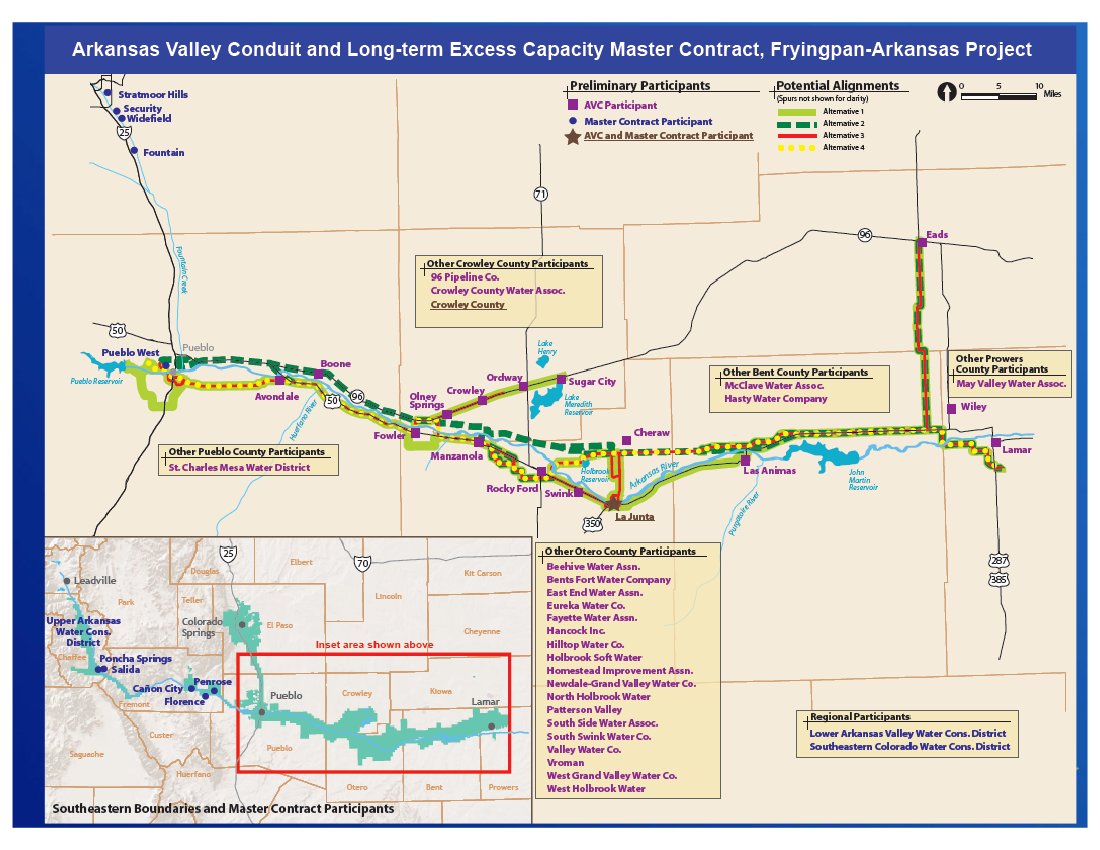
Arkansas Valley Conduit: The one last big piece of the Fryingpan-Arkansas project yet to be constructed

arkansasvalleyconduitproposed.jpg

From The Pueblo Chieftain (Chris Woodka):

As water is used and reused along the Arkansas River, it picks up and releases salt. By the time the Arkansas River reaches the state line, it can be up to 10 times more saline than at Pueblo. In addition, many of the wells used to supply water to the cities and towns of the Arkansas Valley have radionuclide (a class of atom that exhibits radioactivity) contamination. As state restrictions tighten, they will be forced to either clean the water or turn to a new supply through the conduit. Building the conduit always has been a chicken-or-egg proposition. The population of the valley has never been large enough to afford the conduit, but it is vital for its future growth…

The Bureau of Reclamation is doing an environmental impact study for the conduit — along with associated long-term storage contracts — that should be completed next year.

From The Pueblo Chieftain (Chris Woodka):

“It is still a struggle to provide good water to newcomers,” said Bill Long, the conduit’s most tireless advocate…

Long is a Las Animas businessman, Bent County commissioner and president of the Southeastern Colorado Water Conservancy District. His view of the Fry-Ark Project is one in which future generations will enjoy the work going on today.

More Arkansas Valley Conduit coverage here and here.

South Platte River Basin: R.I.P. Joe Shoemaker

joeshoemaker.jpg

From Westword (Patricia Calhoun):

Joe Shoemaker passed away yesterday, but he left an incredible legacy.

Just take a walk over to Confluence Park — or any of the parks along the Platte — on any morning, and you’ll see the trickle-down effect of his work, as residents of Denver enjoy a true urban oasis.

From The Denver Post (Joanne Davidson):

“My dad finished his life in the way he lived it,” recalled his son, William Jeffrey “Jeff” Shoemaker of Denver. “He had been in declining health for the past several months, and when it became clear that the end was near he willed himself to hold on until every member of our family, including his newest great-granddaughter, could be there.”[…]

A celebration of life will be at 10 a.m. Aug. 28 at Confluence Park. In addition, Shoemaker will be remembered at the Greenway Foundation’s signature fundraiser, the Sept. 20 Gala on the Bridge…

Joe Shoemaker was born Aug. 13, 1924, in Hawarden, Iowa. He attended Iowa State University for two years, completing his education at the U.S. Naval Academy. Penny Dykstra Shoemaker, his wife of 60 years, died in 2008. In 2009 he married Karen Ozias.

In addition to his wife and son, Jeff, Shoemaker is survived by daughter Jean Watson-Weidner of Lakewood; sons Joseph J. Shoemaker of Denver and James Dykstra Shoemaker of Highlands Ranch; nine grandchildren and two great-granddaughters.

Joe and Penny Shoemaker moved to Denver in 1956 when he was the 18th attorney to be hired at the Holland & Hart law firm. He was chief of staff for then-Mayor Dick Batterton, who later appointed him manager of public works and deputy mayor.

From The Colorado Statesman (Morgan Smith):

The other memory that the photos bring back is the laughter. When David Gaon from Denver and I were appointed as the House Democrats to the Joint Budget Committee right after the 1974 elections, no one was talking about laughter. Joe was considered to be this iron-fisted conservative who was squeezing the life out of the human services programs that we Democrats believed in so strongly. Confronting him as JBC committee members was going to be a struggle.

Well, there were struggles but, as a committee, we soon began to function as a team more so than any other legislative committee I ever served on. We enjoyed being together, trusted each other and had a lot of laughs. Why? Because of the tone of respect that Joe immediately created as Chairman and because he understood the importance of compromising and working things out. To many in politics today, “compromise” is the ultimate dirty word but compromising is how you get things done and keep your state or country moving forward.

Drought news: ‘The monsoons have taken the edge off the drought in Western Colorado’ — Nolan Doesken

usdroughtmonitor08072012.jpg

From The Pueblo Chieftain (Chris Woodka):

“The monsoons have taken the edge off the drought in Western Colorado. . . . The Eastern Plains have been baking,” said Nolan Doesken, state climatologist, during a workshop on drought and its impacts Wednesday at the Colorado Water Congress summer convention. Statewide impacts have been severe. Plants have been stressed, requiring more water when less is available. Higher water temperatures and debris flows from burn areas are killing fish. Farmers are losing crops. Cities have increased water-treatment challenges because of fire damage in watersheds.

Monsoon rains in the mountains have provided more water, but the water supply is far behind average in every basin in the state, even those that received record precipitation last year, Doesken said. “We usually don’t look at July as the month that’s going to save our water, but it has helped,” Doesken said…

The state is on the highest level of alert for agricultural drought, said Taryn Hutchins-Cabibi of the Colorado Water Conservation Board.

From the Fort Collins Coloradoan (Bobby Magill):

Horsetooth Reservoir’s pool elevation sat at 5,381.4 feet on Wednesday, a level the lake normally doesn’t dip to until October.

The last time the reservoir reached this level by the middle of August because of weather and water use was on Aug. 11, 1989. It reached such low levels later in August three other times: Aug. 20, 1981; Aug. 25, 1994; and Aug. 28, 2006, said Bureau of Reclamation spokeswoman Kara Lamb…

Carter Lake west of Loveland has dropped to 57 percent full.

Werner said plenty of water is available in the Colorado-Big Thompson Project system — the source of much of Fort Collins’ drinking water. Water can be piped over the Continental Divide from Lake Granby if Horsetooth Reservoir continues to be drawn down, Werner said. Lake Granby was 70 percent full Wednesday. Lake Estes in Estes Park is 82 percent full.

The Lower Ark Board asks Reclamation to cancel SDS contract until Colorado Springs finds adequate stormwater funding

fountaincreekmonsoonjuly2012.jpg

From The Pueblo Chieftain (Chris Woodka):

The Lower Arkansas Valley Water Conservancy District board voted Wednesday to send a letter to the Bureau of Reclamation that asks it to immediately revoke the contract.

“We are asking Reclamation to revoke the contract immediately until Colorado Springs provides evidence that institutional mechanisms, rather than empty political promises, will be used to implement stormwater improvements and maintenance,” the letter states.

The letter says Colorado Springs should be spending $18 million-$20 million annually on stormwater projects…

The Lower Ark district insisted on a stormwater enterprise for SDS to reduce impacts on Fountain Creek during earlier rounds of negotiations over water issues with Colorado Springs. The letter also points out how Colorado Springs leaders gave assurances in 2009 that stormwater projects would be funded, despite a decision by City Council to abolish the stormwater enterprise.

More Fountain Creek coverage here and here.

Pueblo Dam: Key infrastructure for the Fryingpan-Arkansas Project

puebloreservoir.jpg

From The Pueblo Chieftain (Chris Woodka):

…despite the prominent presence of fun at Lake Pueblo, its primary purpose is to store water for the farms and cities of the Arkansas River basin, as well as provide flood protection.

Built as terminal storage for the Fryingpan-Arkansas Project, Lake Pueblo has taken on other uses over the years. Because it is not always full, excess-capacity contracts with the Bureau of Reclamation allow others to use it. The most controversial contracts have been awarded to Aurora, which uses the Fry-Ark Project to take water out of the Arkansas River basin — a purpose not included in the 1962 Fryingpan-Arkansas Act. The Southeastern Colorado and Lower Arkansas Valley water conservancy districts waged protests against that practice, but settled differences through additional payments and conditions placed on Aurora.

From The Pueblo Chieftain (Chris Woodka):

The winter water storage program began voluntarily in 1975, after the completion of Pueblo Dam, but had been a part of project planning since the 1930s.

“We had dirt ditches and deep canals that would fill with weeds and snow. You would spend days cleaning them out, and they’d fill again when you got your next run,” [John Schweizer] said, recalling freezing winter days.

“As far as I’m concerned, the Pueblo Reservoir was the greatest improvement to the valley. It has been a real boon to agriculture.”

More Fryingpan-Arkansas Project coverage here and here.

Blue River Watershed: Upper Blue Sanitation District wastewater treatment plant employs sealed-pipe system to control odors

wastewatertreatmentprocess.jpg

From the Summit Daily News (Caddie Nath):

The $32-million plant, which opened its pipes in March, is bringing expanded capacity and cutting-edge technology to the operation…

Equipped with the first water-treatment technology of its kind in the U.S. and a sealed-pipe system to control odors, the clean, spacious facility is the last big capacity-increase project the district ever plans to undertake…

The plant, which processes 2 million gallons per day on its own, is designed to target the key challenges in the business — smell and sanitation standards. Sealed pipes prevent wastewater from ever being exposed inside the plant, while a ventilation mechanism keeps air flowing into, rather than out of, the building, trapping any smell from the facility inside…

Chemical water-treatment technology imported from Europe, and never before used in the U.S., allows the plant to meet Summit County’s rigorous standards for nitrogen and phosphorous.

More wastewater coverage here.

Michigan State University professor helps devise method of removing phosphorous from wastewater

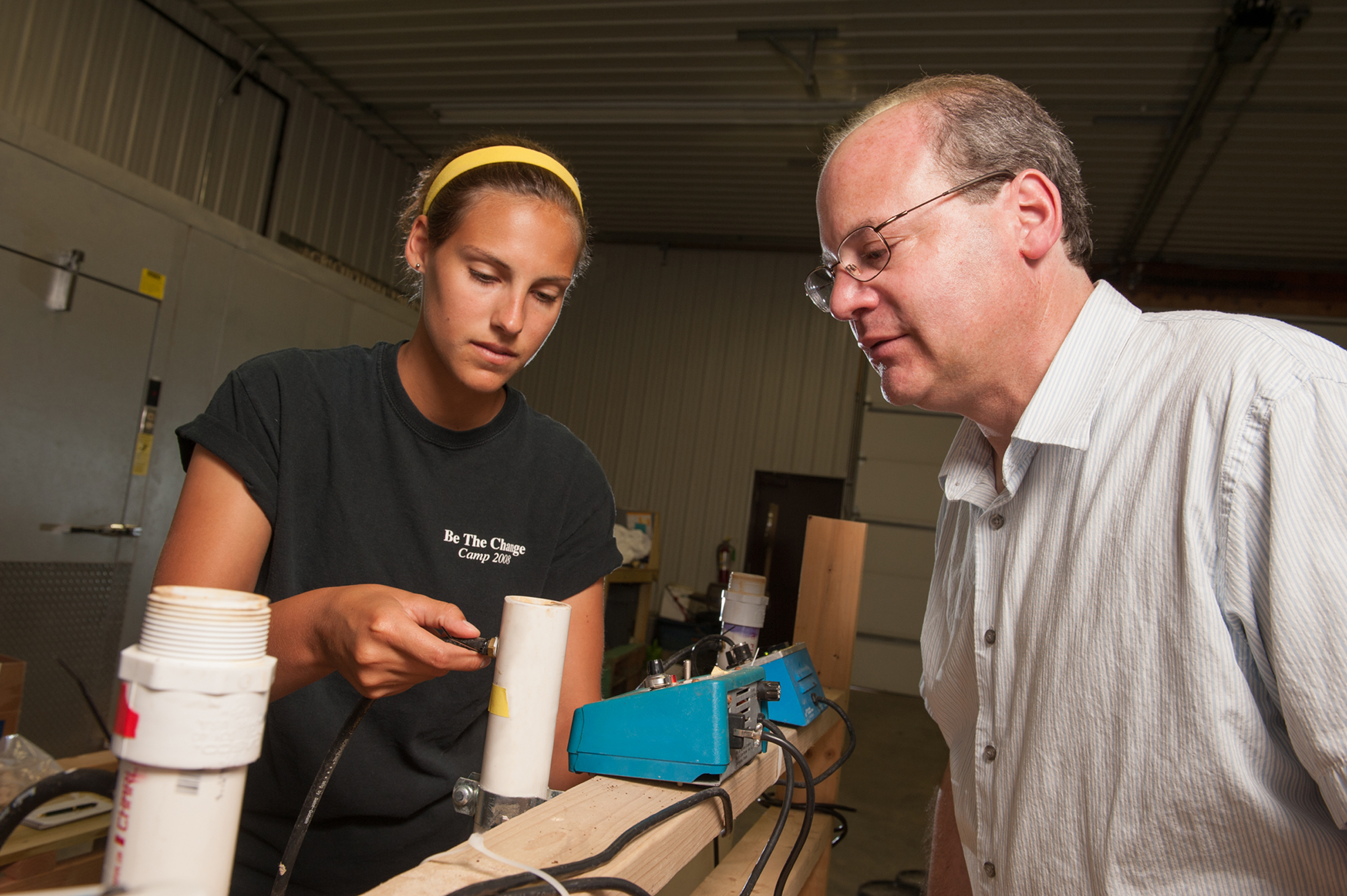
stevesaffermanhayleybetkerphosphorusremoval2012michiganstate.jpg

Here’s the release from Michigan State University:

A professor at Michigan State University is part of a team developing a new method of removing phosphorous from our wastewater – a problem seriously affecting lakes and streams across the country.

In addition, Steven Safferman, an associate professor of biosystems and agricultural engineering, and colleagues at Columbus, Ohio, based-MetaMateria Technologies, are devising a cost-effective way of recovering the phosphorous, which then can be reused for fertilizer products.

Although its use is regulated in many states, including Michigan, in items such as detergents and fertilizer, phosphorous is part of all food and remains a critical problem as it is always present in human and animal wastes.

Discharge from human and industrial wastewater and runoff into lakes and streams can cause what is known as eutrophication – making the water unsuitable for recreational purposes and reducing fish populations – as well as causing the growth of toxic algae.

What MetaMateria Technologies and Safferman have figured out and tested over the past 10 years is how to produce a media, enhanced with nanoparticles composed of iron, that can more efficiently remove larger amounts of phosphorous from water.

“Phosphorous that is dissolved in wastewater, like sugar in water, is hard to remove,” Safferman said. “We found that a nano-media made with waste iron can efficiently absorb it, making it a solid that can be easily and efficiently removed and recovered for beneficial reuse.”

Safferman added there are indications that their method of phosphorous retrieval is much more cost effective than processing phosphate rock.

“Research suggests that it is significantly cheaper to recover phosphorous this way. So why would you mine phosphorous?” he asked. “And, at the same time, you’re helping to solve a serious environmental problem.”

The material should be commercially available for use within two years, said J. Richard Schorr, MetaMateria CEO.

“Phosphorous is a finite material,” Schorr said “Analyses show that the supply of phosphorous may become limited within the next 25 to 50 years. This is an economical way to harvest and recycle phosphorous.”

More water treatment coverage here.

South Platte River Basin: R.I.P. Joe Shoemaker

joeshoemaker.jpg

What sad news. I bike along the South Platte, Cherry Creek and Clear Creek often, so Mr. Shoemaker’s contributions are omnipresent in my life. Sorry to see you go Joe. Thanks for the vision and energy that turned dumps into a great trail system and urban environment.

Here’s an obituary from Jolon Clark via email from the Greenway Foundation:

As the Associate Director of The Greenway Foundation, it is with a heavy heart that I tell you that Joe Shoemaker, the founder of The Greenway Foundation, passed away last night. Joe was a visionary who stood on the banks of the South Platte River (when there was not a single park or trail, when the river was so polluted that it was toxic to touch, when raw sewage was being pumped into the river, and when no one else thought the river had a chance of survival) and said, “we can do better.” Everything The Greenway Foundation is able to do today is possible because of his passion, vision, and dedication to a “lost cause” of a river. It is impossible for me today to even imagine Denver without the vibrancy of Confluence Park, the quiet tranquility of Grant Frontier Park, and the organized chaos of summer camp at Johnson Habitat Park. All of this was made possible by a one-of-a-kind man in Joe Shoemaker.

If you would like to reach out to the Shoemaker family, you can email Jeff at jeff@greenwayfoundation.org. I will let you know when information about the services for Joe are available. Thank you for the outpouring of support that many of you have already shown. Many of you have asked about the possibility of remembering Joe through a donation to either The Greenway Foundation or The Foundation for Colorado State Parks. If you wish to do so, you may make a donation in Joe’s memory to either The Greenway Foundation here or the Foundation for Colorado State Parks here.

I would also encourage you to take a few minutes of your time to read the except from the very beginning of Joe’s book, Returning the Platte to the People, that I have pasted below. I thought this was a fitting way to remember the greatest hero of the South Platte River today, and I hope you will take a few moments to read it, marvel at how far Joe’s dream has come, and, for those of you who knew Joe, to revel in picturing him chasing down the truck, and for those of you who did not know Joe, to experience the unbridled passion that he had for our river as expressed in the final line of this excerpt.
_________________________

Early one lovely Monday morning in June, I left home in southeast Denver to join several colleagues on an all day river trip in a ten-man inflatable raft. We were certain to get wet because we were headed for a great deal of white water, so I wore a pair of old sneakers, blue jean shorts and a tennis shirt. The Colorado Rockies, dominated by Long’s Peak, were beautiful in the morning sun as I drove to my destination. The mountains were brilliantly white, for their snowpack was deep this year. The rising temperatures of late spring were causing a heavy snow­melt, which increased the white water we would navigate during the day. It was to be an exciting, exhilarating trip. I was anxious to get onto the river.

The drive to our launching site took less than fifteen minutes, and I never left the city of Denver. Indeed, during the entire day’s boat ride we would remain in the city Limits. We would be floating down the South Platte River, embarking where it enters Denver from the south and following it through the city to where it flows off to the north at Franklin Street. Our voyage would cover some ten miles.

I stopped at Frontier Park, near the city line, and crossed the street to the river where several of my fellow sailors had already inflated our raft. One of them, Joan Mason, came forward to greet me.

“Have you seen this?” she asked, holding out a page clipped from the Rocky Mountain News. The piece titled, “The Greening of the Platte,” had been pub­lished while I was out of town, So I hadn’t read it. The author was Peter Warren, a professor at the University of Denver and member of Mayor William McNichol’s Commission on the Arts.

“Much has been said about what cannot be done about Denver,” the long article began. “Yet we have in our backyard one of the most remarkable examples of urban revitalization in the United States. In a brief space of five years, the Platte Greenway Project has transformed a blighted, degraded river-little more than an open sewer-into a major amenity for Denver.”

Joan and I were delighted with the piece. Both of us had worked hard at the transformation of the Platte, she as a member of the project’s three-person staff, I as Chairman of a nine-member citizens’ Committee appointed by Mayor McNichols in 1974 to bring about the river’s improvement. Also, knowledge of our experience could be valuable to dozens of communities where disreputable, repulsive rivers could be restored and returned to the people.

Now, I only had time to scan Warren’s piece, but I noticed that he had caught onto how our unusual Committee had worked: “…a fascinating prototype… operating outside the creaky city bureaucracy, without mandated powers or limits, the Committee has been able to act quickly and effectively.”

At the raft I was greeted by Kenneth R. Wright whose “water-oriented” engineer­ing firm, Wright-McLaughlin, was responsible for designing and supervising construc­tion of a great many of the projects that were turning the blighted Platte into an amenity. Ken was wearing a fabulous straw hat he had brought back from a busi­ness trip to southeast Asia. Behind him, on his knees fitting out the raft, was William C. Taggart, a young Wright-McLaughlin engineer. He had been the firm’s man most directly responsible for its work on the river.

“Three thousand c.f.s., ten times the normal flow,” said Ken, referring in engi­neering parlance to the cubic feet of water per second rushing down the Platte. I stepped out to the bank and saw a churning torrent of water.

“Hope you’re ready for a good ride, Joe,” said Bill, who would serve as our helmsman while the rest of us paddled to his commands. “I’ve checked a number of the roughest spots. We’ll have a few portages, but I think we’ll do okay.”

As I greeted the other passengers who were assembling, I was suddenly dis­tracted by a great white truck lumbering toward us. “Hey, hey, what do we have here?” I asked Ken, well aware that both of us knew the answer.

The vehicle was a large tank truck from Denver’s Waste Water Management Di­vision, and I assumed it was full of some potent liquid. Moreover, I guessed that the driver was hoping to discharge his load into the South Platte, probably at our launching site. The truck, as white as it was, made me see pure red. For a half decade we’d enjoyed a lot of success shutting off discharges of pollutants into our river, but still there were those who kept on seeing the Platte as Denver’s receptacle for anything they wanted out of sight, out of mind. Most disturbing, this philosophy was still prevalent where it should be found least of all, in certain city agencies. It was lodged there like the instincts of an animal: “If you have something to dump, down to the river it goes!”

The truck driver sensed my perturbation as I hailed him to stop. “What’s in there?” I asked.

“Water and ‘stuff’, vacuum pumped from the city’s storm sewers,” he explained. The man’s discomfort became most evident when I asked where the load was going, but instead of answering he drove on down the street. He stopped in about fifty yards and studied us in his rearview mirror.

“He’s waiting for our departure,” said Ken.

“Sure and then into the river it’ll go,” I added. “Let’s talk to him.”

The driver made a U-turn and crept back toward the city. I stopped him again and asked where his load was going. He admitted the river was in his mind.

“It’s just water,” he said. “Won’t hurt anything.”

“Then why don’t you dump it right there in Frontier Park?” I said. “The grass can always use water.”

“Well, no, it would smell,” the driver replied, then demanded to know who I was.

“You’ll find out when you hear about this from your boss,” I replied. The driver shoved his truck into gear, and it soon disappeared, as I memorized the number stenciled on its side.

Shaking my head I returned to our group of boaters. Our last three passengers had arrived. One was Pat McClearn, a new member of our Committee who is with the University of Colorado at Denver and well known for her work with “Trees for Today and Tomorrow,” an organization that distributes and plants trees throughout Denver. Finally, there were the other two of our three-member staff, Rick Lamoreaux and Robert Searns. Both young men are intensely committed to the improvement of the Platte.

As we were about to board the raft, I looked around to see Denver’s Manager of Safety, Elvin Caldwell, arrive in his car. He had officially closed the river through the city to boating because of the high water, but had issued a special per­mit for our trip, which was organized to check the impact of the currents on our various projects. Caldwell’s visit pleased me, for it seemed symbolic of an ongoing change in the feelings of politicians for the river. Not long ago many had treated the Platte virtually as abandoned territory.

In a few minutes the seven of us had bid Caldwell goodbye and were bobbing on the turbulent water in the large, bulbous raft. Everything that could suffer from getting wet, from wallets to cameras, had been stowed in waterproof pouches lashed to the raft’s inflated crossmembers. Bill Taggart was on the stern giving instructions to the rest of us sitting sidesaddle on the gunwales. He quickly defined the orders he would be calling out-to paddle, backpaddle or hold-and immedi­ately began issuing the commands that kept our craft on the course Bill was plotting from his intimate knowledge of the river.

“I can’t think of anything I’d rather be doing,” I told Ken Wright sitting in front of me. “I really and truly love this!”

Governor Hickenlooper requests speedier reviews for Moffat Collection System and NISP

nisppreferredalternative.jpg

windygapmoffatfirmingboulderviewpoint.jpg

From The Denver Post (Bruce Finley):

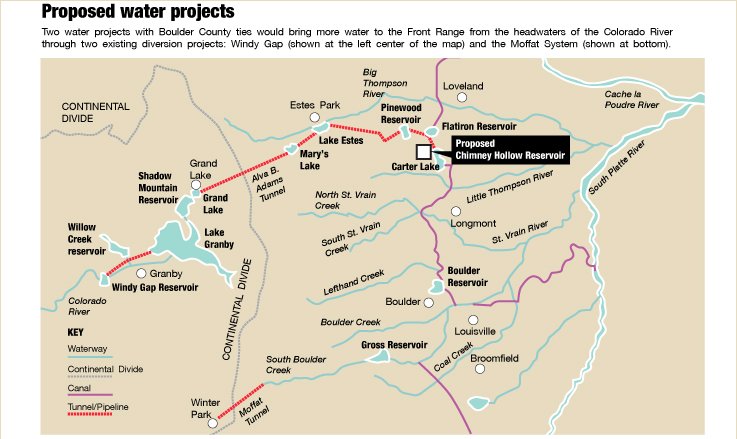
A letter to Obama seeks help spurring decisions on Denver Water’s diversion of 18,000 acre-feet of Colorado River Basin water from the west side of the Continental Divide to an expanded Gross Reservoir west of Boulder. A separate letter to the U.S. Army Corps of Engineers asks that the Northern Integrated Supply Project — which would siphon the Cache la Poudre River into new reservoirs storing 215,000 acre-feet of water — be given a high priority.

Colorado faces “a significant gap in our supplies to provide water for future growth — a gap that cannot be met by conservation and efficiencies alone,” Hickenlooper began in a June 5 letter sent to the White House and copied to cabinet secretaries and agency chiefs. “We urge you to exercise your authority to coordinate your agencies and bring an expeditious conclusion to the federal permitting processes for this essential project, in order that we can have certainty moving forward as a state,” he wrote.
Click here to read the letter to President Obama. Click here to read the Governor’s letter to the U.S. Army Corps of Engineers.

More Moffat Collection System Project coverage here. More Windy Gap Firming Project coverage here.

Fryingpan-Arkansas Project: Twin Lakes and the Boustead Tunnel are key components

twinlakeswikipedia.jpg

fryingpanarkansasproject.jpg

From The Pueblo Chieftain (Chris Woodka):

As water use shifted from farms to cities, so did its use. As Colorado River water entered the Arkansas River basin, Twin Lakes was the key transfer point.

Farmers from Crowley County recognized the value of the lakes — formed by glacial advances and retreats — in the late 1800s, and built a dam to store water high in the mountains until it was needed in the fields. Initially, the lake was filled by exchange, diverting water into one reservoir, while releasing flows from another.

But by the 1930s, it was clear more water was needed to satisfy needs on the Colorado Canal, a ditch with relatively junior water rights in Crowley County. A tunnel was completed during the Great Depression to bring more water from the Colorado River near Independence Pass.

From The Pueblo Chieftain (Chris Woodka):

The tunnel is named for Charles H. Boustead, the first general manager of the Southeastern Colorado Water Conservancy District, who died in 1966, shortly after work on the tunnel began. The tunnel is 10.5 feet high and 5.4 miles long, and is capable of bringing over 945 cubic feet (about 166 bathtubs full) per second of water through the mountains. Water from the north and south side collection systems flows into the tunnel on the west side of the mountains and travels by gravity into Turquoise Reservoir. There is rarely enough water to fill the tunnel’s capacity. Water comes in a rush as snowpack melts, usually from late May until July. The amount varies widely. There were record imports in 2011, followed by one of the lowest years ever in 2012.

From The Pueblo Chieftain (Chris Woodka):

“It was great for people other than in Lake County. We’re left with an economy devoid of any of the benefits promised by President Kennedy,” [Former Lake County Commissioner Ken Olsen] said. The Fry-Ark Project projected large increases in visitor days to Turquoise and Twin Lakes as a result of enlargement. But Forest Service policies have restricted visitor use and eroded the local tax base, Olsen said. The Bureau of Reclamation’s operation fills and lowers reservoirs in a way that’s out-of-sync for tourism benefits, he said.

From The Pueblo Chieftain (Chris Woodka):

The Mount Elbert Power Plant generates peak power through two giant turbines that act as pumps, drawing down and refilling the Mount Elbert Forebay. During peak hours, summer days when air conditioners are running, the water flows by gravity from the forebay through the turbines. At night, when the lights go out, water is pumped back uphill through those same turbines…

The turbines can generate up to 200 megawatts of power, and since it began operating in 1981 has generated more than 350 million kilowatt hours of electricity — enough to power 44,000 homes, according to Reclamation.

More Fryingpan-Arkansas Project coverage here and here.

Drought news: Dry lightning is sparking wildfires across the West

lightningcj.jpg

From the National Weather Service:

The Heat Wave and drought in the West have dried vegetation to the point where fires can rapidly spread out of control. A number of wildfires have been started this week in several states from the Desert Southwest to the Pacific Northwest. The main culprit is lightning strikes associated with thunderstorms that produce little rainfall.

Click here for today’s Red Flag Warnings from the NWS.

From The Denver Post (Scott Willoughby):

Because of rapidly dropping water levels, Williams Fork Reservoir near Parshall is closing its boat ramp Thursday for the remainder of 2012. Beginning Friday, only hand-launched craft (canoes, kayaks and similarly small vessels) will have access to the reservoir. Boat ramps will no longer reach the water and no motorized craft will be allowed.

“This has been a challenging year for reservoir operators all across Colorado,” said Neil Sperandeo, manager of recreation for Denver Water. “We wish we were able to keep the boat ramp open longer, but unfortunately, the drought conditions have prevented that from happening.”
The Williams Fork River below the dam was flowing at about 275 cfs as of Tuesday, down from about 365 cfs the previous week.

The closure is the latest in a long string of ramp closures at reservoirs throughout the state, along with emergency fish salvages at Barr Lake State Park, Jumbo Reservoir in Julesburg and Crystal Lake near Ouray, where all bag and possession limits have been temporarily removed for licensed anglers because of receding water levels.

Chemical widely used in antibacterial hand soaps may impair muscle function

howtohandwash.jpg

Here’s the release from the University of California Davis:

Triclosan, an antibacterial chemical widely used in hand soaps and other personal-care products, hinders muscle contractions at a cellular level, slows swimming in fish and reduces muscular strength in mice, according to researchers at the University of California, Davis, and the University of Colorado. The findings appear online in the Proceedings of the National Academy of Sciences of the United States of America.

“Triclosan is found in virtually everyone’s home and is pervasive in the environment,” said Isaac Pessah, professor and chair of the Department of Molecular Biosciences in the UC Davis School of Veterinary Medicine and principal investigator of the study. “These findings provide strong evidence that the chemical is of concern to both human and environmental health.”

Triclosan is commonly found in antibacterial personal-care products such as hand soaps as well as deodorants, mouthwashes, toothpaste, bedding, clothes, carpets, toys and trash bags. The U.S. Environmental Protection Agency in 1998 estimated that more than 1 million pounds of triclosan are produced annually in the United States, and that the chemical is detectable in waterways and aquatic organisms ranging from algae to fish to dolphins, as well as in human urine, blood and breast milk.

The investigators performed several experiments to evaluate the effects of triclosan on muscle activity, using doses similar to those that people and animals may be exposed to during everyday life.

In “test tube” experiments, triclosan impaired the ability of isolated heart muscle cells and skeletal muscle fibers to contract. Specifically, the team evaluated the effects of triclosan on molecular channels in muscle cells that control the flow of calcium ions, creating muscle contractions. Normally, electrical stimulation (“excitation”) of isolated muscle fibers under experimental conditions evokes a muscle contraction, a phenomenon known as “excitation-contraction coupling,” the fundamental basis of any muscle movement, including heartbeats. But in the presence of triclosan, the normal communication between two proteins that function as calcium channels was impaired, causing skeletal and cardiac muscle failure.

The team also found that triclosan impairs heart and skeletal muscle contractility in living animals. Anesthetized mice had up to a 25-percent reduction in heart function measures within 20 minutes of exposure to the chemical.

“The effects of triclosan on cardiac function were really dramatic,” said Nipavan Chiamvimonvat, professor of cardiovascular medicine at UC Davis and a study co-author. “Although triclosan is not regulated as a drug, this compound acts like a potent cardiac depressant in our models.”

In addition, the mice had an 18-percent reduction in grip strength for up to 60 minutes after being given a single dose of triclosan. Grip strength is a widely used measure of mouse limb strength, employed to investigate the effects of drugs and neuromuscular disorders.

Finally, the investigators looked at the effects of triclosan exposure on fathead minnows, a small fish commonly used as a model organism for studying the potential impacts of aquatic pollutants. Those exposed to triclosan in the water for seven days had significantly reduced swimming activity compared to controls during both normal swimming and swim tests designed to imitate fish being threatened by a predator.

“We were surprised by the large degree to which muscle activity was impaired in very different organisms and in both cardiac and skeletal muscle,” said Bruce Hammock, a study co-author and professor in the UC Davis Department of Entomology. “You can imagine in animals that depend so totally on muscle activity that even a 10-percent reduction in ability can make a real difference in their survival.”

The UC Davis research team has previously linked triclosan to other potentially harmful health effects, including disruption of reproductive hormone activity and of cell signaling in the brain.

Chiamvimonvat cautioned that translating results from animal models to humans is a large step and would require further study. However, the fact that the effects were so striking in several animal models under different experimental conditions provides strong evidence that triclosan could have effects on animal and human health at current levels of exposure.

“In patients with underlying heart failure, triclosan could have significant effects because it is so widely used,” Chiamvimonvat said. “However, without additional studies, it would be difficult for a physician to distinguish between natural disease progression and an environmental factor such as triclosan.”

Pessah questioned arguments that triclosan — introduced more than 40 years ago — is safe partly because it binds to blood proteins, making it not biologically available. Although triclosan may bind to proteins in the blood, that may not necessarily make the chemical inactive, he said, and actually may facilitate its transport to critical organs. In addition, some of the current experiments were carried out in the presence of blood proteins, and disrupted muscle activity still occurred.

Although triclosan was first developed to prevent bacterial infections in hospitals, its use has become widespread in antibacterial products used in the home. However, according to the U.S. Food and Drug Administration, other than its use in some toothpastes to prevent gingivitis, there is no evidence that triclosan provides other health benefits or that antibacterial soaps and body washes are more effective than regular soap and water. Experts also express concern about the possibility of resistant bacterial strains developing with the overuse of antibacterial products.

Because the chemical structure of triclosan resembles other toxic chemicals that persist in the environment, the FDA and the U.S. Environmental Protection Agency are conducting new risk assessments of the chemical. Based on their study outcomes, the researchers argue that the potential health risks call for greater restrictions.

“We have shown that triclosan potently impairs muscle functions by interfering with signaling between two proteins that are of fundamental importance to life,” said Pessah. “Regulatory agencies should definitely be reconsidering whether it should be allowed in consumer products.”

Said Hammock: “Triclosan can be useful in some instances, however it has become a ubiquitous ‘value added’ marketing factor that actually could be more harmful than helpful. At the very least, our findings call for a dramatic reduction in its use.”

A copy of the study, titled “Triclosan impairs excitation-contraction coupling and Ca2+ dynamics in striated muscle,” can be requested by e-mailing PNASNews@nas.edu.

Other authors of the study were Gennady Cherednichenko, Rui Zhang, Erika Fritsch, Wei Feng and Genaro Barrientos of the UC Davis School of Veterinary Medicine; Roger Bannister and Kurt Beam of the University of Colorado Denver-Anschutz Medical Campus; Valeriy Timofeyev and Ning Li of the UC Davis Division of Cardiovascular Medicine; and Nils Schebb of the UC Davis Department of Entomology.

Cache la Poudre River: Drought and wildfire have big impact on the rafting season #CODrought

cachelapoudreriver.jpg

From NPR (Kirk Siegler):

The rafting and guiding company Rocky Mountain Adventures is based two hours north of Colorado Springs. Owner Ryan Barwick had to suspend rafting trips on the nearby Poudre River during the peak season in June, when the High Park Fire blackened more than 135 square miles in the region.

“A lot of us do live paycheck to paycheck,” Barwick says. “And you know, when you’re shut down for three weeks, you’re a small business — we don’t have that cushion to fall back on.”

Even before the fire, Barwick says it was hard enough to sell whitewater trips, given the ongoing drought. But it’s even harder now, he says, with the river a trickle of black sediment running off the canyons above.

“We’ve had rock slides, we’ve had mudslides, we’ve had black water — I mean, you name it, we’ve encountered it this year,” he says. “It’s pretty much every headwind that you fear at the beginning of each season, compiled all into one season.”

From the Vail Business Journal (Bob Berwyn):

Colorado’s drought delivered a costly punch to July’s bottom line, according to the monthly Goss Report released on Tuesday. July’s overall index for the state slumped nine points from June. The drop from 58.6 to 49.6 puts Colorado’s Business Conditions Index (the same as the overall index) slightly below the 50-point growth neutral. Components of Colorado’s index for July were new orders at 51.0, production or sales at 53.5, delivery lead time at 43.3, inventories at 55.4, and employment at 59.0.

Colorado River District Annual Seminar ‘Past, Present and Future’ September 13

marcellushydraulicfracturing.jpg

From email from the Colorado River District (Jim Pokrandt):

“Past, Present and Future” is the theme of the Colorado River District’s Annual Water Seminar set for 9 a.m.-3:30 p.m. Thursday, Sept. 13, 2012, at the Two Rivers Convention Center in Grand Junction, Colo. The cost to attend is $25 and includes morning coffee, pastries and a lunch.

Anne Castle, Assistant Secretary for Water and Science, Department of the Interior, is the keynote speaker. Seminar topics start with the 75-year history of the Colorado River District and a new book on the organization by author George Sibley, “Water Wranglers.” Other topics to be covered during the day are the drought, the Bureau of Reclamation/7 States Colorado River Basin Study results and a look at the November elections. A full agenda, press release and registration form is attached.

After the seminar, starting at 4 p.m., the Colorado River District is holding an Ice Cream Social and Open House at the Two Rivers Convention Center to celebrate its 75th Anniversary.

Here’s the link to the registration form.

‘…you cannot do that [develop oil and gas resources] without fracking’ — Matt Lepore (COGCC)

marcellushydraulicfracturing.jpg

Here’s an interview with the new head of the Colorado Oil and Gas Conservation Commission, Matt Lepore, from KUNC (Bente Birkeland). Here’s an excerpt:

The agency that regulates oil and gas development in the state has hired a new director. Matt Lepore is the Colorado Oil and Gas Conservation Commission’s former attorney and takes the helm today, during what many see as a tumultuous time for the industry.

“I think the state should develop its oil and gas resources including its shale gas and shale oil resources and you cannot do that without fracking”

Here’s a link to a brochure from the National Groundwater Association that details precautions that water well owners can take if oil and gas operations crop up nearby.

Household water well owners near oil and gas development and completion activities, including hydraulic fracturing, can get guidance about water testing from a new brochure produced by the National Ground Water Association and the Ground Water Protection Council.

The brochure can be downloaded from the “Water Quality” section of NGWA’s WellOwner.org Web site or GWPC’s Web site.

“This brochure provides simple, clear guidance to well owners. That’s what many well owners say they want,” said NGWA Public Awareness Director Cliff Treyens. “By also making the brochure available to state agencies and other groups, NGWA and GWPC can get this information to a wide audience of private well owners in oil- and gas-producing states.”

More oil and gas coverage here and here.

New public hearing for the proposed Piñon Ridge uranium mill

conventionaluraniummill.jpg

From the Telluride Watch (Gus Jarvis):

In a ruling issued June 13, Judge John McMullen ruled the Colorado Department of Public Health and Environment’s initial issuance of the radioactive materials license was unlawful because a formal, adjudicatory hearing was not properly provided. McMullen ordered a new hearing, which will begin on Oct. 15. At that time exhibits will be offered for admission and written testimony will be filed in order to provide an opportunity for parties to cross-examine expert witnesses.

Public comment will not be received at the Oct. 15 hearing, but the hearing officer will determine when public comment will be received when the hearing is reconvened on Nov. 7, in Nucla.

Energy Fuels spokesman Curtis Moore said the upcoming public hearing will be different from the public-comment setting of the previous hearing in that it will be more like a trial.

More nuclear coverage here and here.

50th anniversary celebration of the Fryingpan-Arkansas Project Saturday at Lake Pueblo

johnfkennedypuebloaugust171962chieftain.jpg

The project got its start with a visit to Pueblo from President Kennedy back in 1962. Here’s the first installment from Chris Woodka writing for The Pueblo Chieftain. Click through and read the whole article, Woodka is a terrific writer. Here’s an excerpt:

But on that day [August 17, 1962], work began to address the problem. Kennedy came to Pueblo to celebrate the signing of the Fryingpan-Arkansas Act the previous day. Local water leaders will celebrate the 50th anniversary of the Fry-Ark Project Saturday at Lake Pueblo…

The Twin Lakes Tunnel was constructed by the Colorado Canal Co. during the Great Depression, while the old Carlton railroad tunnel was used by the High Line Canal Co. to bring in water. In addition, Colorado Springs and Aurora were already building the Homestake Project, which would be intertwined with the Fry-Ark Project as both were built.

But the government project, a scaled-down version of an earlier, larger plan to bring water from the Gunnison River basin, represented a larger cooperative effort between farmers and municipal leaders in nine counties.

Since the first water was brought over in 1972, about 2.1 million acre-feet of water has been brought into the Arkansas River basin for irrigation and municipal use. The project also generates electric power at the Mount Elbert Power Plant.

fryingpanarkansasprojectdistrictboundariesmapsecwd.jpg

Woodka details some of the early water history along the Arkansas River mainstem in this report running in today’s Chieftain. Here’s an excerpt:

The Water Development Association of Southeastern Colorado was incorporated in 1946. Pueblo business leaders worked with valley water interests to investigate a Gunnison-Arkansas Project. By 1953, the project was scaled back to the Fryingpan-Arkansas Project, and the first hearings began in Congress.

During the congressional hearings in subsequent years, the project evolved from one primarily serving agriculture to one that included municipal, hydroelectric power, flood control and recreation as well.

The Southeastern Colorado Water Conservancy District formed in 1958.

The U.S. House passed the Fry-Ark Act on June 13, 1962; the U.S. Senate, Aug. 6, 1962. President John F. Kennedy signed it into law on Aug. 16, 1962.

Here’s a short look at Jay Winner, current general manager of the Lower Arkansas Water Conservancy District, from Chris Woodka Writing for The Pueblo Chieftain. From the article:

Back in the 1960s, his father Ralph Winner was the construction superintendent for Ruedi Reservoir, the first part of the Fry-Ark Project to be constructed and his family lived on the job site. His father came back in the late 1970s to supervise construction of one of the last parts of the collection system to be built, the Carter-Norman siphon. The siphon draws water across a steep canyon.

For three summers, Winner, then a college student, worked on the latter project. “It was the most fun I ever had,” he laughed. “I got to play with dynamite.”

From The Pueblo Chieftain (Chris Woodka):

A retired outfitter, [Reed Dils] is now a Southeastern Colorado Water Conservancy District board member and a former representative from the Arkansas River basin on the Colorado Water Conservation Board. “Initially, the flows got worse,” Dils said. “They (the Southeastern district and the Bureau of Reclamation) had chosen to run water in the winter…

“It became apparent to everyone there was another way to run the river,” Dils said. “Why the Fry-Ark act was passed, recreation mainly meant flatwater recreation. Over time, they learned there are other types of recreation.”

Here’s the release from Reclamation (Kara Lamb):

Reclamation and the Southeastern Colorado Water Conservancy District invite the public to celebrate the Fryingpan-Arkansas Project’s 50th Anniversary at Lake Pueblo State Park on Sat., Aug. 18. The event is located at Lake Pueblo State Park Visitor’s Center from 9 a.m.to 2 p.m.

Reclamation, the District and Colorado State Parks and Wildlife are offering free pontoon boat tours around Pueblo Reservoir and free tours of the fish hatchery located below Pueblo Dam. There will also be historical displays and several guest speakers.

Signed into law by President John F. Kennedy in 1962, the Fryingpan-Arkansas Project is a multipurpose trans-basin water diversion and delivery project serving southeastern Colorado.

The Fryingpan-Arkansas Project provides:

– Water for more than 720,000 people
– Irrigation for 265,000 acres
– The largest hydro-electric power plant in the state
– World renowned recreation opportunities from the Fryingpan River to the Arkansas River.

For more information the 50th Anniversary Celebration – and to see a teaser of the upcoming film! – visit our website at www.usbr.gov/gp/ecao.

More Fryingpan-Arkansas Project coverage here and here.

alanhamelcsu.jpg

Meanwhile, Alan Hamel is retiring from the Pueblo Board of Water Works this month:

From The Pueblo Chieftain (Chris Woodka):

“Little did I know how important the Fryingpan-Arkansas Project would be as I was watching the president’s car traveling down Abriendo Avenue that day,” Hamel said. “Look at all that it has done for our basin and what it will do in the future.”

Hamel became executive director of the water board in 1982, and was president of the Southeastern Colorado Water Conservancy District, the local agency that oversees the Fry-Ark Project, from 2002-04. He is currently serving on the Colorado Water Conservation Board.

More Pueblo Board of Water Works coverage here.