CU-Boulder team wins the 2012 WEF Student Design Competition

wastewatertreatmentprocess.jpg

Here’s the release from the Water Environment Federation:

The Water Environment Federation (WEF) proudly announces students from the University of Colorado Boulder and the University of South Florida as winners of the 2012 Student Design Competition. The eleventh annual competition took place this month in New Orleans, La. as part of WEFTEC® 2012, WEF’s 85th Annual Technical Exhibition and Conference.

The University of Colorado Boulder team’s project “Broadmoor Park Properties Wastewater Treatment Plant Upgrade” won in the wastewater design category, and the University of South Florida team’s project “Ragan Park” won in the environmental design category. This was the second win for the University of Colorado Boulder (a student chapter of the Rocky Mountain Water Environment Association) and the second win for the University of South Florida (a student chapter of the Florida Water Environment Association) in eleven years.

A program of the WEF Students & Young Professionals Committee (SYPC), the Student Design Competition promotes real world design experience for students interested in pursuing an education and/or career in water/wastewater engineering and sciences. It tasks individuals or teams of students within a WEF student chapter to prepare a design to help solve a local water quality issue. Teams evaluate alternatives, perform calculations and recommend the most feasible solution based on experience, economics and feasibility.

Members of the University of Colorado Boulder team included Kristin Johansen, Maria Cabeza, Matthew Huntze, Bailey Leppek, Alexandra Murray and faculty advisor Angela Bielefeldt. Members of the University of South Florida team included Micah Blate, Danielle Bertini, Emily Patrick, Lyudmila Haralampieva, Gabriele Dionne and faculty advisor Sarina Ergas. Both teams received certificates and a $2,500 award as announced by WEF Past President Paul Freedman during a ceremony on September 30.

Sponsored by Black & Veatch, CDM Smith, Greeley and Hansen, and HDR Engineers, this year’s competition was organized by SYPC Design Competition Program Chair Lauren Zuravnsky and Vice Chair Allison Reinert with assistance from Design Competition Program Past Chair Michelle Hatcher and WEF Staff Liaison Dianne Crilley.

For more details, see “College Students” at www.wef.org/PublicInformation.

Here’s the release from the University of Colorado at Boulder:

A team of students from CU-Boulder joined students from the University of South Florida as winners of the Water Environment Federation’s 2012 Student Design Competition. The eleventh annual competition took place this month in New Orleans.

CU’s project “Broadmoor Park Properties Wastewater Treatment Plant Upgrade” won in the wastewater design category. This was the second win for CU-Boulder (a student chapter of the Rocky Mountain Water Environment Association) in eleven years.

A program of the WEF Students & Young Professionals Committee (SYPC), the Student Design Competition promotes real world design experience for students interested in pursuing an education and/or career in water/wastewater engineering and sciences. It tasks individuals or teams of students within a WEF student chapter to prepare a design to help solve a local water quality issue. Teams evaluate alternatives, perform calculations and recommend the most feasible solution based on experience, economics and feasibility.

Members of the CU-Boulder team included Kristin Johansen, Maria Cabeza, Matthew Huntze, Bailey Leppek, Alexandra Murray and faculty advisor Angela Bielefeldt. Both teams received certificates and a $2,500 award as announced by WEF Past President Paul Freedman during a ceremony on Sept. 30.

More education coverage here.
Weekly Climate, Water and Drought Assessment of the Upper Colorado River Basin #CODrought #coriver

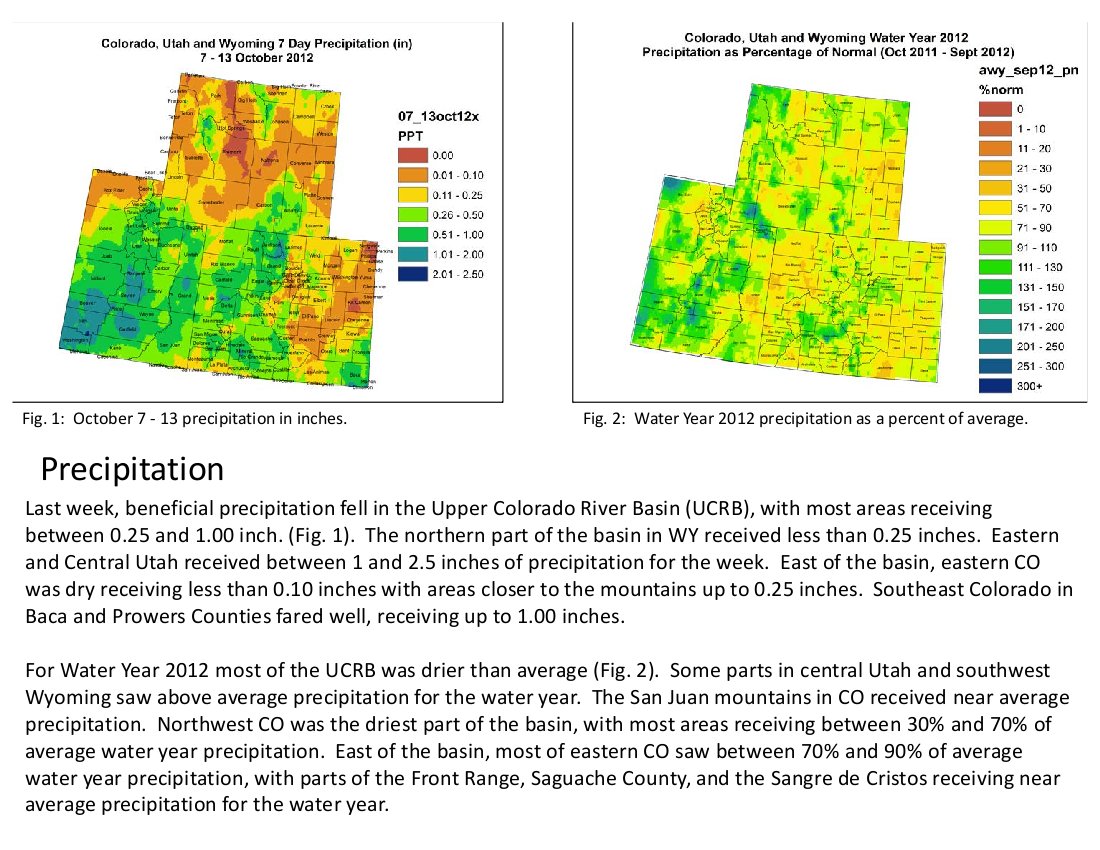
wyutcoprecipitation107thru10132012.jpg

Here’s the link to the summaries from last week’s webinar from the Colorado Climate Center. Click on the thumbnail graphic for the precipitation summary of October 7 – 13 and the water year precipitation summary.

Yampa River: ‘A water lease to the rescue’ — Sandra Postel #CODrought

yampariver.jpg

From National Geographic (Sandra Postel):

That summer of 2002, the river “smelled like rotting seaweed,” Van De Carr recalled. “It was a nightmare.”[…]

But 2012 would turn out differently. On Friday, June 29, as if by a miracle, the river started to rise. By 9:30 that night, it was flowing at 71 cfs.

Something had happened that had never happened before in Colorado: an intervention to spare a river – and its dependents – from decimation during a drought.

Back in the spring, when the skimpy mountain snowpack spelled disaster for so many of Colorado’s rivers and streams, the non-profit Colorado Water Trust (CWT) issued a statewide request for water. Anyone willing to sell or temporarily lease water was encouraged to contact the CWT. If the water could help a river weather the drought, the CWT would consider buying it.

One answer to the call came from Kevin McBride, director of the Upper Yampa Water Conservancy District in Steamboat Springs. McBride had just had a contract with a customer fall through, leaving 4,000 acre-feet (1.3 billion gallons) of Yampa River water unclaimed in Stagecoach Reservoir. For the right price, McBride was willing to lease that water to the Colorado Water Trust.

“We rocketed that (project) to the top of our priorities,” said Amy Beatie, Executive Director of the water trust, based in Denver.

“It looked like a system that was ecologically going to crash,” Beatie said. “The river was starting to crater.”

So for a total of $140,000, or $35 per acre-foot, CWT leased the water district’s spare water. McBride had set the price, based on what he knew his board would approve. In that part of the West, the cost was very reasonable.

On June 28, the leased water began flowing out of Stagecoach Reservoir into the Yampa. The extra flow would directly benefit seven crucial miles downstream of the reservoir, as well as the river’s course through Steamboat and beyond. The idea was to keep the river as healthy as possible through the summer, by releasing about 26 cfs a day into September.

Along the way, the leased water provided multiple benefits. It generated extra hydropower at the Stagecoach Reservoir. It provided aesthetic and recreation benefits in Steamboat, helping businesses like Backdoor Sports avoid tens of thousands of dollars in lost revenues. Further downstream of the reach targeted for the lease, some irrigators even got more water for their crops, a welcome boost during a drought and dire economic times.

“The purpose of the lease is to maximize the beneficial use of water in Colorado,” Beatie explained. “These incidental benefits make this a win-win-win-win. “

Besides rescuing a river and its dependents, the Yampa drought-lease set a precedent in Colorado. It was the first use of a 2003 state law, passed in part in response to the devastating 2002 drought, that allows farmers, ranchers, water districts or other entities to temporarily loan water to rivers and streams in times of need.

More Yampa River Basin coverage here and here.

Drought news: The drought in some areas of the country is abating a bit

usdroughtmonitor10162012.jpg

From Reuters (Carey Gillam):

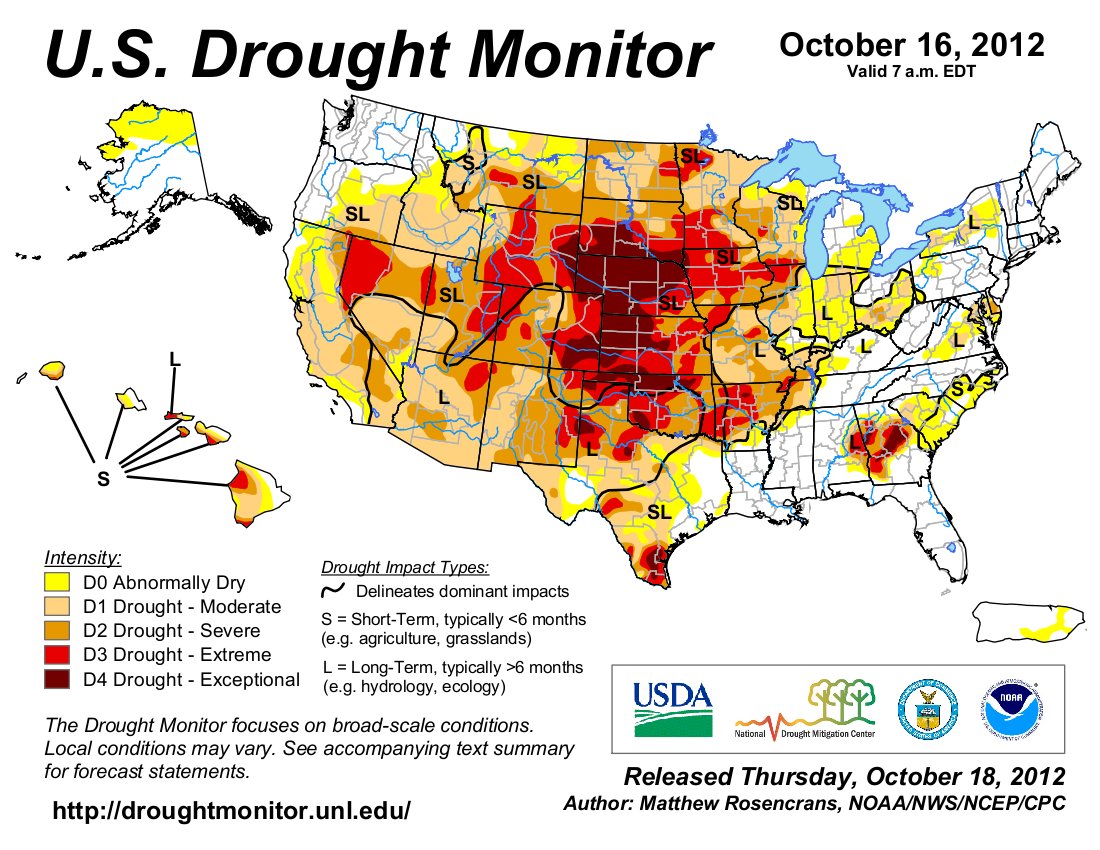
Roughly 62.39 percent of the contiguous United States was experiencing at least “moderate” drought as of October 16, down from 63.55 percent a week earlier, according to Thursday’s Drought Monitor, a weekly compilation of data gathered by federal and academic scientists.

The portion of the United States under “exceptional” drought – the direst classification – fell to 5.84 percent, from 6.18 percent a week earlier.

In the High Plains, which include Kansas, Nebraska and the Dakotas, severe or worse drought levels covered 87.42 percent of the region, down from 87.58 percent the prior week. An estimated 27.44 percent of the region was in the worst level of drought, down from 28.24 percent a week earlier.

In Kansas, a top wheat-growing state where farmers are planting a new crop, drought levels improved dramatically. “Extreme” drought, the second-worst level, shrank to 77.80 percent from 95.70 percent of the state, while the worst level fell to 39.69 percent, from 44.63 percent.

In Oklahoma, also key to wheat production, several inches of rain helped reduce extreme drought areas to 66.75 percent of the state, from 80.57 percent.

Hard-hit Nebraska, which suffered its third-driest September on record, saw extreme drought decline to 95.31 percent of the state from 97.94 percent. All other levels held steady, with 77.58 percent of that state still locked in exceptional drought.

South Dakota missed out, as extreme drought expanded to 57.21 percent of the state from 52.65 percent the prior week.

From Reuters (Ayesha Rascoe/Gerald E. McCormick):

The drought that ravaged the United States this year does not appear to be abating and may spread through the winter, government forecasters said on Thursday. “The large majority of that drought we expect to persist,” said Mike Halpert, deputy director of the National Oceanic and Atmospheric Administration. “We even see drought expanding westward … into Montana, Idaho and part of Oregon and Washington.”

CCLT webinar on the findings of the state audit of the conservation easement program to be held Wed. 24th

saguachecreek.jpg

From email from the Colorado Coalition of Land Trusts:

CCLT will be hosting a webinar at 10:00 on Wed. 24th of Oct. with Jordan Beezley on the state audit results, which were made public a few days ago. Jordan will spend about 1 1/2 hrs. explaining the implications of the results and taking questions. To sign up for the free webinar, please email info@cclt.org. There are only a few spaces remaining, so please let us know as soon as possible if you want to attend.

In other conservation easement news Colorado Parks and Wildlife has added a new conservation easement near Maybell. Here’s the release:

The Colorado Parks and Wildlife Commission has approved the acquisition of a 15,000-acre Perpetual Conservation Easement on the Tuttle Ranch in Moffat County. The purchase will help preserve critical habitat and winter range for wildlife while allowing ranching operations to continue.

Consisting of sagebrush steppe, foothills grassland and pinyon-juniper woodlands, the property is home to greater sage-grouse and provides critical winter range for elk, mule deer and pronghorn.

The conservation easement was purchased from the RSH Land Company LLC, with a combination of funds from Colorado Parks and Wildlife, the U.S. Fish and Wildlife Service and lottery-funded Great Outdoors Colorado.

“When habitat is preserved, wildlife benefits, and all of us benefit, too,” said Bill de Vergie, Area Wildlife Manager in Meeker. “There are plenty of challenges out there to wildlife habitat – all kinds of development that can raise issues – but the cooperative approach of conservation easements is a way we can work with landowners to protect habitat.”

Because habitat loss is considered a primary cause for the decline of many wildlife species in Colorado, its preservation is critical, especially during winter months when big game animals are in search of any available forage at lower elevations.

“Preserving wildlife habitat is just one of our management challenges, but is among our most important,” said Ron Velarde, Regional Manager for Colorado Parks and Wildlife. “With acquisitions like this one, we ensure that we will continue to have viable wildlife populations for our future generations.”

For more information, please visit: http://wildlife.state.co.us/LandWater/Pages/LandWater.aspx

Colorado Parks and Wildlife manages 42 state parks, more than 300 state wildlife areas, all of Colorado’s wildlife, and a variety of outdoor recreation. For more information go to cpw.state.co.us

GOCO is the result of a citizens’ initiative passed by the voters in 1992. As the recipient of approximately half of Colorado Lottery proceeds – $57 million in Fiscal Year 2012 – GOCO awards grants to local governments and land trusts, and makes investments through the Colorado Division of Parks and Wildlife. Since 1994, nearly 3,500 projects in all 64 counties have received GOCO funding. Visit http://www.goco.org for more information.

More Yampa River Basin coverage here and here.

Animas River: Wetlands project helps offset wetlands reduction in the Animas River Valley

edzinkanimasriverwetlandsdurangoherald.jpg

From The Durango Herald (Dale Rodebaugh):

The Colorado Riparian Association has awarded Patti and Ed Zink its Excellence in Riparian Management award for 2012…

The Zinks in 2006 enrolled 80 acres of their land in a permanent open space conservation easement and created a 50-acre wetlands at their Waterfall Ranch in the Animas Valley north of Durango. The project improves water quality, provides a corridor for bird migration and conserves the aesthetics of wetland open space. The Animas River Wetlands will provide habitat for wildlife and serve as a local educational facility.

Projects elsewhere in the county that invade sensitive areas can use the Zink wetlands to offset their impact. One recent example occurred when La Plata County used ¾ acres to improve the intersection of County Road 311 and Colorado Highway 172.

More Animas River Watershed coverage here and here.

Pueblo Board of Water Works staff water rate increase request totals 2.75%

bessemerditch1890waterarchives.jpg

From The Pueblo Chieftain (Chris Woodka):

A relatively modest 2.75 percent increase in water rates is envisioned in the 2013 budget for the Pueblo Board of Water Works. The increase would be the lowest since 2004, and would keep Pueblo’s rates the lowest among large Front Range water providers.

It would mean an increase of less than $1 per month for the average residential customer.

A $32.3 million budget is being proposed by staff. The water board will hear details about the budget at a workshop on Nov. 6. A public hearing on the budget is scheduled at 2 p.m. Nov. 20 at the water board offices, 319 W. Fourth St.

The budget continues last year’s timeout for revenues into the water development fund — which uses one-time revenue sources such as long-term leases to fund water planning activities — until 2015.

Spending increases in 2013 are expected in legal costs, maintenance and chemicals. Utility costs are expected to remain relatively flat.

Among the largest costs for specific projects are $1.15 million for main expansion and improvement and $940,000 for continued conversion to automatic meter reading.

More Pueblo Board of Water Works coverage here and here.

Forecast news: Rain and snow possible towards the end of the week #COwx

Drought news: Pueblo’s water reserve levels drop to lowest point since 2005, above 2002

clearcreekdamcoguy.jpg

From The Pueblo Chieftain (Chris Woodka):

Pueblo water storage levels have dipped to the lowest point since 2005, but remain well above the low point in 2002.

Pueblo stores both native and imported water, and in most years can accrue a surplus. But the prolonged drought has cut into the supply, and Pueblo has been pumping water from storage to meet needs.

“We’re no longer pulling water out of storage,” Executive Director Terry Book told the Pueblo Board of Water Works Tuesday.

In 2002, Pueblo kept about 16,000 acre-feet in storage, and drew that supply down by a third during the height of the drought. Pueblo keeps water in Pueblo Reservoir, Twin Lakes, Turquoise Lake and Clear Creek Reservoir, which it owns.

After 2002, Pueblo increased its storage target, and reached a high point of 50,000 acre-feet last year. The levels vary throughout the year, because some water is leased out of storage. Normal levels of precipitation or water imported from the Colorado River basin replenish the supplies.

At the end of September, 28,788 acre-feet were in storage — about one year’s supply of potable water for Pueblo — compared with more than 43,000 acre-feet at the same time in 2011. Pueblo’s maximum storage would be 69,300 acre-feet.

One of the consequences of drawing down the storage will be the likelihood that the water board will have less water to lease on the spot market next year, which affects farmers who are looking for augmentation water for wells or surface-fed sprinklers.

Rio Grande Water Conservation District board meeting recap: The impending water court trial and conservation issues dominated

riogranderiverstateengineersoffice.jpg

From the Valley Courier (Ruth Heide):

Now that the culmination is in sight for the Habitat Conservation Plan (HCP) the water district has spearheaded for about eight years, it looks like some of the San Luis Valley counties may not sign off on it, Robbins told the board on Tuesday. If they do not, the residents in their counties will not be covered by it.

The first of its kind in the U.S., the HCP was designed to permit the routine maintenance by farmers, ranchers, city and county crews in areas that might otherwise be up for critical habitat designation for endangered species such as the Southwestern Willow Flycatcher. Under the plan, farmers could still clear ditches and ranchers could still graze their cattle.

Without an HCP to provide mitigating habitat to allow the counties incidental take permits for those routine activities, individuals, cities and counties would have to apply for individual permits or stay out of the willows.

Robbins said this plan has been the subject of dozens of public meetings, but now some of the county officials or their legal counsel are raising questions that might mean some deal breakers with them signing off on the plan.

“It’s entirely possible one or more counties may decide they don’t want to take advantage of the benefits afforded by the habitat plan, which is unfortunate,” Robbins said.

He added, “We can’t make cities and counties participate if they do not want to. We will tell the Fish and Wildlife Service they are not covered by the HCP and Fish and Wildlife can determine critical habitat and take whatever actions it wishes.”

One of the issues being raised now, he said, was concern over federal jurisdiction, which is what the plan is attempting to avoid.

“It is absolutely beyond my comprehension why anyone would not want to take a very low cost way to avoid interactions with the Fish and Wildlife Service and why governments within the Valley would not want to avoid having to deal with that,” Robbins said.

Another issue is the multi-year clause in the HCP, Robbins explained. Some counties argue they cannot enter a contract encumbering county funds for more than one year at a time. The HCP is a 30-year agreement.

Robbins said all of the counties and their attorneys have had questions about the HCP. The county attorney for Conejos County wants to reserve the right to litigation. Robbins said governmental entities regularly enter into agreements in which they state they will not sue each other.

Robbins said the water district staff, board and legal counsel will do everything they can to get the HCP approved and implemented, especially given the time, effort and money involved in developing it, “but if it doesn’t work, there’s not much we can do about it.”

The HCP should be final in November or December.

More Rio Grande River Basin coverage here.

The Sangre de Cristo Acequia Association scores a $100,000 grant from the Rio Grande Basin Roundtable

vallejos_ditch_headgate_construction.jpg

From the Valley Courier (Ruth Heide):

If the Colorado Water Conservation Board concurs, $90,000 will come from statewide funds and $10,000 from the local basin roundtable funds. Coupled with matching funds, the project is estimated to cost about $116,100.

Joe Gallegos, who presented the request to the roundtable group on Tuesday, said the actual costs might be less than the current estimate. For example, he said the $2,000 estimate for dewatering may not be necessary.

The biggest portion of the project cost, budgeted at $66,000, is the concrete work.

Gallegos and Nicole Langley, project coordinator, explained why the project is necessary and how it fits into funding criteria. Langley said this structural project meets criteria for funding from the local and statewide water accounts.

“It cures a very serious flooding problem,” she added.

Gallegos said when the ditch headgate is replaced, the ditch will be able to handle a greater volume of water, so flooding risks will be reduced.

Gallegos said the Culebra Creek Watershed, of which the Vallejos Creek Ditch is a part, irrigates 23,000 acres over 36 square miles. It serves 83 acequia organizations and 228 families.

The Vallejos Ditch is very old, Gallegos explained. It was named after Antonio Vallejos in 1848.

The current diversion structure was built in 1965, he added, and it has deteriorated over the years. Concrete is falling apart and the gates are almost inoperable. The result is sediment build up and flooding. A great deal of debris has clogged the ditch so that its carrying capacity is only 70 percent, Gallegos explained.

More IBCC — basin roundtables coverage here.

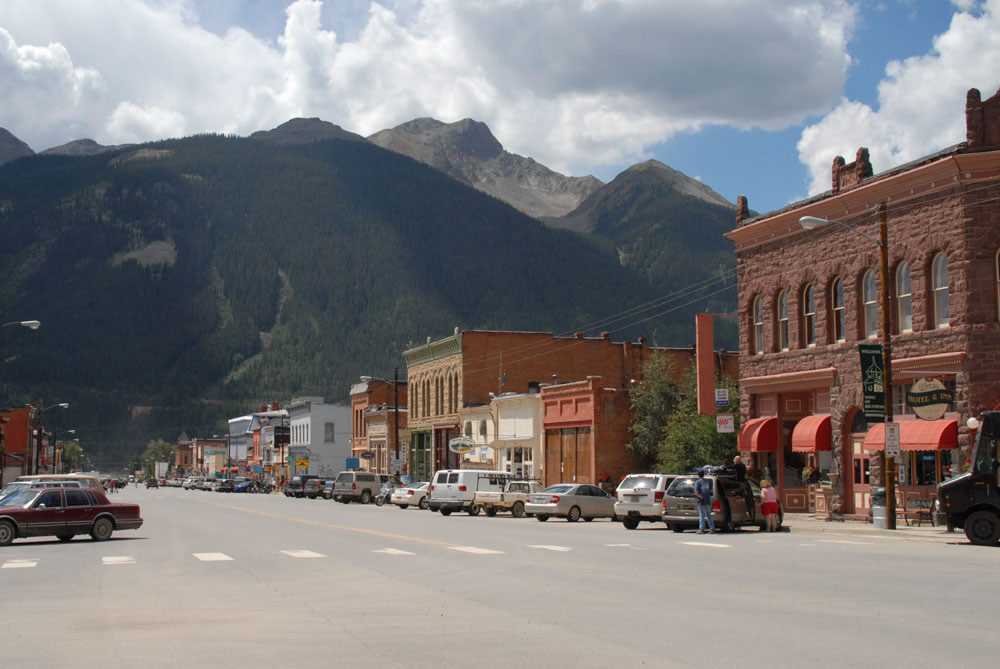
The Animas River Stakeholders Group is bringing on Boston-based InnoCentive to help solve the acid mine drainage problem around Silverton

silverton.jpg

From The Durango Herald (Dale Rodebaugh):

The problem will be turned over to InnoCentive, a Boston firm that has 260,000 individual “solvers” eager to tackle challenges in chemistry, food production, business, engineering, information technology and physical and life sciences.

Members of the stakeholder steering committee Wednesday devised a tentative agenda outlining problems they want to solve. The group will meet again within a month to refine its proposal.

“InnoCentive has all these problem-solvers who think out of the box and check in looking for a challenge,” committee member Bill Simon said. “In the end, the solution is ours to use.”

The problem-solver and InnoCentive get paid, and it isn’t cheap, Simon said. But acidic drainage from mines is a worldwide problem, which could win financial support from mining interests, environmental groups and government agencies…

Today, four mines – Sunnyside, Mogul, Gold King No. 7 and Red & Bonita – send up to 800 gallons a minute of iron, zinc, cadmium, copper, lead, mercury, manganese and aluminum into Cement Creek, a tributary to the Animas River at Silverton.

The stream is so toxic that biologists think the water never sustained aquatic life.

More Animas River Watershed coverage here.

Restoration: Cutthroats were recently seen doing backflips from joy in their restored habitat at Woods Lake

woodslakecdow.jpg

From The Telluride Watch (Gus Jarvis):

Once the population is established at Woods Lake, the habitat will provide the broodstock, which will eventually assist in cutthroat conservation efforts throughout the Dolores and Gunnison river basins. To make sure a healthy population of cutthroats survive at Woods Lake, Kowalski said, biologists will go back to the lake in the summer of 2013 and release several thousand fry, which, along with the spawning adults released in 2012, will make for a healthy and diverse population.

“We’ll do that to give us multiple age classes of fish and to provide good genetic diversity,” Kowalski said. “The biggest thing for us now is getting the population built up, so there’s plenty of fish for anglers to catch. The cutthroat should do great in this habitat. The lake has been fishless for two years and the aquatic invertebrates have exploded, so the lake is full of food for them. Essentially we have taken these fish confined to a tiny little stream and placed them into a wide, open habitat with no competitors.

“They should have excellent growth up there.”

Kowalski said anglers can expect to start catching cutthroat trout in the summer of 2013 from Woods Lake, but it will be a couple of years before there are large numbers of older-age fish to catch. Anglers are encouraged to release all fish they catch for the next couple of years to allow the population to grow. Fishing in the lake and streams above is restricted to artificial flies and lures only.

More restoration/reclamation coverage here.
Antibacterial soaps: ‘We’re phasing it out, I told my husband’ — Angie Hong

triclosanmolecule.jpg

From East Metro Water (Angie Hong):

Triclosan-derived compounds can disrupt thyroid and endocrine functions and threaten aquatic life in the Mississippi River. Worst of all, it turns out that antibacterial soaps aren’t even good for us. In fact, the Minnesota Department of Health and American Medical Association warn against using antibacterial products because they may contribute to the emergence of new resistant strains of diseases, and the U.S. Food and Drug Administration has determined that good old soap and water are just as effective at getting our hands and other parts clean. Even so, triclosan is present in 75% of all Americans over the age of five, according to a recent study.

So what is a mother like me to do with the 64 fluid ounces of antibacterial liquid hand soap just waiting in my cupboard? “We’re phasing it out!” I announced to my husband, after reading the State of the River Report last week. The report’s authors advise consumers to look for triclosan in the ingredients list of soaps, lotions and other personal care products and to avoid things labeled as antibacterial. After my husband and I use up our existing stockpile of hand soap, we’re switching to just plain soap. One thing is certain. The baby will continue to lick shoes, shopping carts and cat beds, and no amount of antibacterial soap can keep his world germ-free.

Learn more about the health of the Mississippi River in the Twin Cities metro area at www.stateoftheriver.com.

Thanks to Loretta Lohman for the link.

More water pollution coverage here.
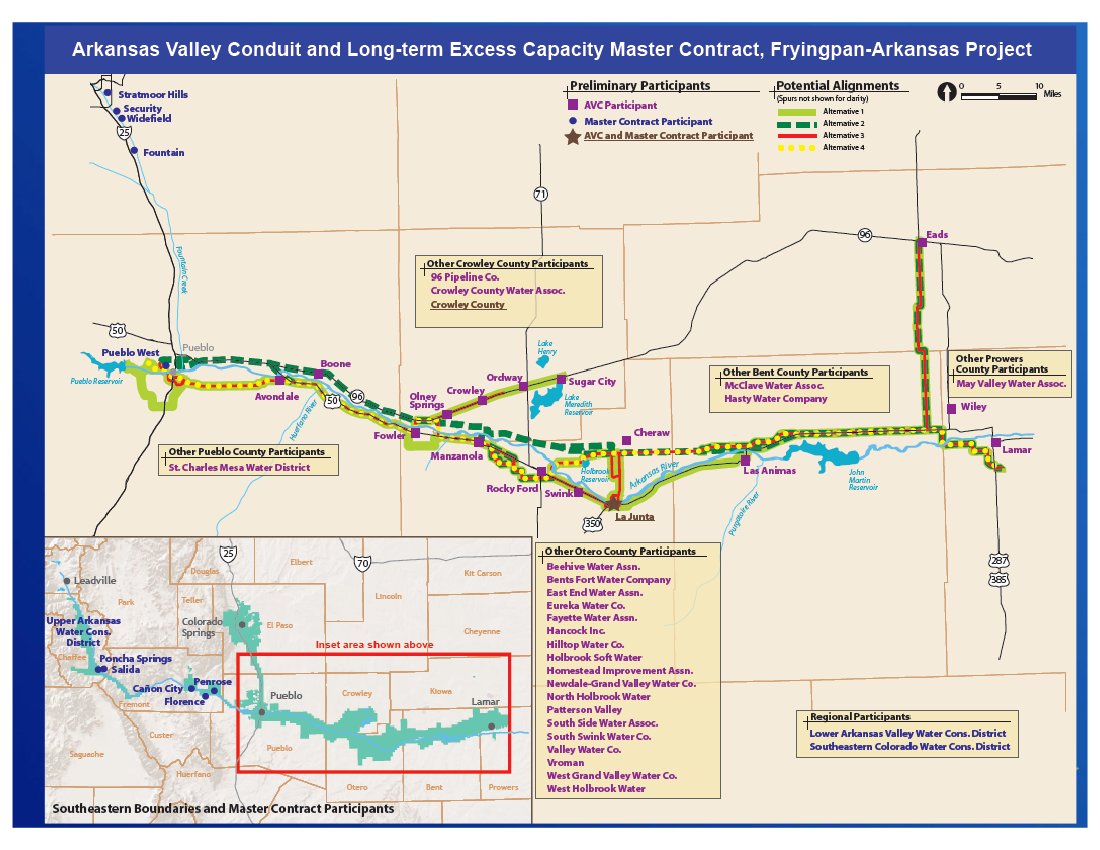
Arkansas Valley Conduit update: Cost estimates drop to $400 million

arkansasvalleyconduitproposed.jpg

From The Pueblo Chieftain (Chris Woodka):

As the Arkansas Valley Conduit moves closer to reality, there has been some “nervousness” among participants.

“We have been meeting with some (smaller) communities to answer questions,” said Jim Broderick, executive
director of the Southeastern Colorado Water Conservancy District Thursday. “We have new people coming into
the discussion.”

While the cost of the conduit is estimated at $500 million in a draft environmental impact statement by the Bureau
of Reclamation, nearly half of that represents contingency costs that reflect a low level of engineering, Broderick
said.

“We think these numbers will drop,” Broderick said.

The district’s own engineering is further along, and indicates costs will be in line with earlier estimates in the $300
million to $400 million range.

Public meetings on the conduit were conducted last month and produced about seven comments, mostly in favor
of the conduit. A final EIS should be released sometime next year. The next step is to review the cost­benefit
analysis. “We are putting time into it in order to make sure the right details are in it when benefits are calculated,”
Broderick said.

The project has been seriously discussed for the past decade and would not be built for another decade, if federal
funding is in place. In the meantime, water providers large and small are dealing with increased water quality
requirements, particularly for radionuclides and salinity.

Communities may be uncertain of the process and actions they need to take in the meantime, Broderick said.
More frequent updates of the conduit’s progress are planned to keep them informed, he added.

More Arkansas Valley Conduit coverage here and here.

Objectors have been active in water court helping to forge the Arkansas Valley Super Ditch proposed substitute water supply plan

arkbasinditchsystem.jpg

From The Pueblo Chieftain (Chris Woodka):

The conditions placed on a pilot program for the Arkansas Valley Super Ditch were much more restrictive than a water lease by Aurora from the High Line Canal in 2004­05.

Wednesday, the Lower Arkansas Valley Water Conservancy District asked, “Why?”

Lower Ark water attorney Peter Nichols reviewed key differences between the substitute water supply plans for the two water leases:

● Aurora proposed leasing 18,000 acre­feet over two years, while the Super Ditch plan was for just 250 acre­feet from the Catlin Canal to Security and Fountain for one year.

● The Super Ditch had a more extensive process to provide information and technical details to objectors. More conditions, engineering requirements and scrutiny were placed on the Super Ditch.

● Some farms were taken out of the Super Ditch plan, while unlimited participation was permitted for the High Line Canal lease.

“The point here is that it’s gotten more difficult. The standards haven’t changed, but there are many more details needed to prove there is no material injury,” Nichols said.

Even though there were more restrictions, several water users filed a complaint about the plan in water court.

State Engineer Dick Wolfe, who attended the meeting, said comparing the two plans amounted to “apples and oranges.”

“We’ve been doing the same type of plan for decades,” Wolfe said. “But there are more terms and conditions as time goes on.”

In the High Line Canal case, specific concerns raised by other water users were addressed. Each case is unique, Wolfe added.

Nichols said Super Ditch will continue to work with the state for temporary plans before filing a change case in water court, a similar process used by well associations prior to obtaining water decrees.

“We’re not giving up,” Nichols said. “We’ll be back next year, working to come up with a true alternative to buy­ and­dry . ”

Meanwhile, State Engineer Dick Wolfe told some at the meeting the he would not suspend the rules for augmentation. Here’s a report from Chris Woodka writing for The Pueblo Chieftain. Here’s an excerpt:

[Lamar farmer Dale Mauch] is among farmers trying to loosen up state water­replacement requirements by trying to prove that
irrigation ponds that feed sprinklers leak more than presumed by a state formula.

The state presumes 3 percent leakage, while farmers say it’s closer to 20 to 25 percent.

Wolfe replied that the state’s actions are bound by court­decreed rules that make it difficult to alter or suspend
any of the provisions.

“Dale, the state’s computer model doesn’t agree with you,” another farmer joked.

“I live in reality,” Mauch laughed.

Pueblo County farmer Tom Rusler, who farms on the Bessemer Ditch, asked if the accounting for the rules could
be done after the irrigation season, rather than in advance.

Wolfe said the rules require a plan prior to the irrigation season and can’t be altered without a change in the court
decree. Wolfe said the rules could be amended to reflect the results of the pond study. Additionally, the Lower Ark
district, which administers a group plan for water replacement under Rule 10 of the rules, can amend its report.

More water law coverage here.

More coverage from Chris Woodka writing for The Pueblo Chieftain. From the article:

A familiar face has joined the Lower Arkansas Valley Water Conservancy District as the director from Crowley County.

Jim Valliant, 76, was appointed to the board this month by Deborah Eyler, chief judge of Pueblo District Court. He lives in Olney Springs and replaces Pete Moore, who left the board in May when he moved to Nebraska.

“I’ve been in water conservation all my life,” Valliant said. “I came from an 8-inch rain area in Pecos, Texas. I’ve always encouraged people to do everything they can to save water.”

Valliant came to Crowley County in 1978, and was manager of the Foxley Cattle Co. He also managed farms for the Navajo Irrigation Project in New Mexico and worked with Anderson Seed from Lamar.

More Lower Arkansas Valley Water Conservancy District coverage here.

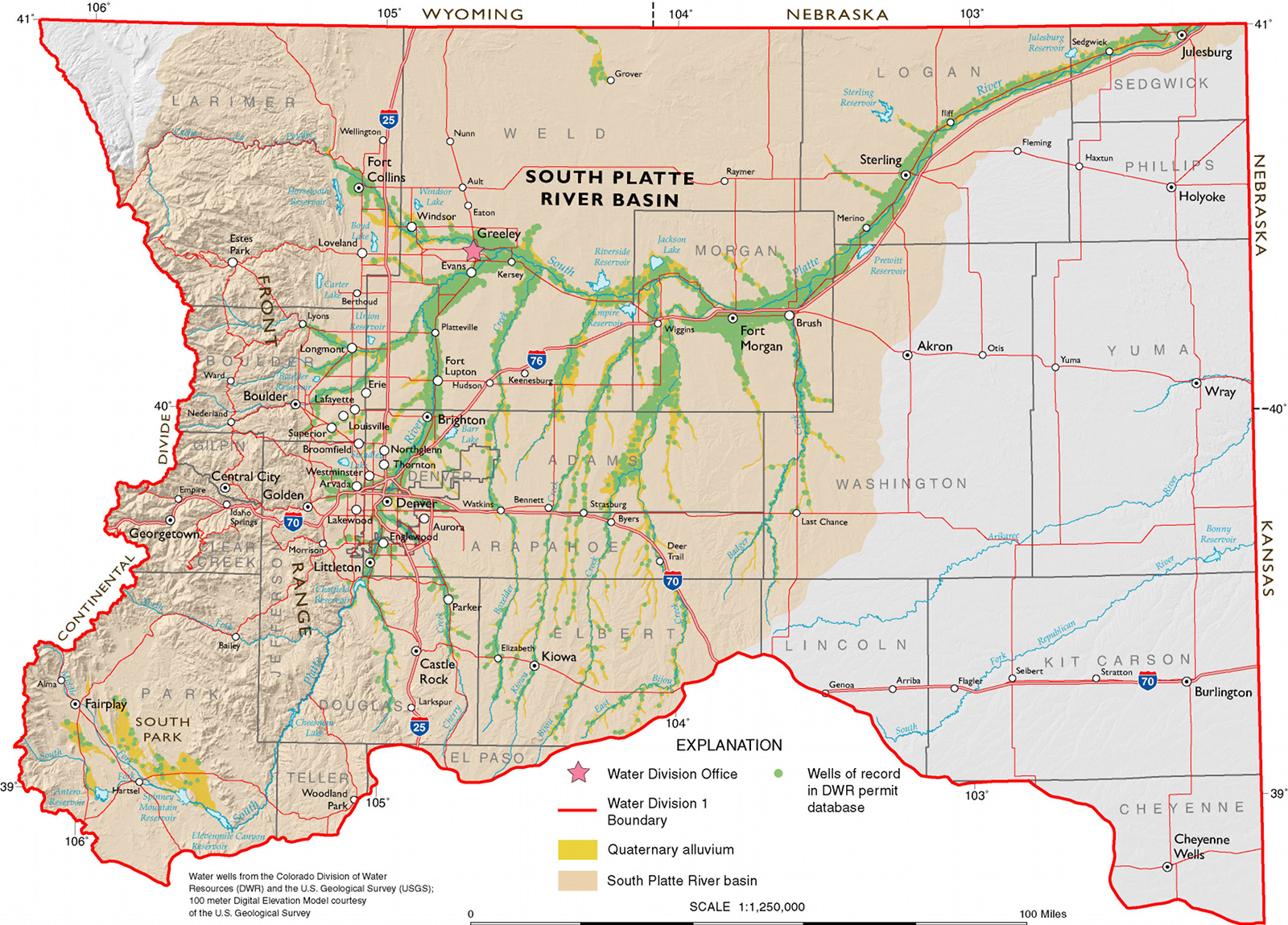
The South Metro Chamber of Commerce, et al., ask judge to reverse Sterling Ranch decision

southplatteriverbasincgs.jpg

From the Denver Business Journal (Dennis Huspeni):

In what’s called an amicus brief — which basically means the parties have no standing in the case, but they’ve asked 18th Judicial District Judge Paul King to reconsider his ruling — the chamber said the case and King’s ruling “raises issues of critical importance to the economic strength of the businesses operating in the State of Colorado.” They said his ruling would strip local governments of their ability to control development and landowners of the right to develop their land, and would have negative economic ramifications for entire state…

The chamber, Colorado Contractors Association, Associated General Contractors of Colorado, Northwest Douglas County Economic Development Corp. and Colorado Association of Realtors stated in the amicus brief they “respectfully urge this Court not to disturb the decision made by the Commission, but rather, allow the operations of the Commission, and hence, local governments in the State of Colorado, to provide certainty and economic reality to land use decisions, especially those of the nature of the Sterling Ranch PD proposal, which, in and of itself, brings great economic and social value to the community.”[…]

The brief said King’s ruling, if allowed to stand, “creates procedural and fiscal uncertainty about the finality of a local government’s decision-making process, has a chilling effect on the confidence of Colorado property owners to develop their properties, destroys the opportunity for major developers, and therefore harms the economic future of the State and its citizens.”

Requiring developers to prove availability of water for the entire life of the project, which could take 20 or 30 years, “will result in small-scale patchwork development and unplanned sprawl.”

More South Platte River Basin coverage here and here.

Oct. 18 marks 40 years for CWA; Metro Wastewater upgrades plant

metropolitanwastewaterbobhitetreatmentplantaerial1.jpg

Here’s the release from the Metropolitan Wastewater Reclamation District (Steve Frank):

Oct. 18 marks the 40th anniversary of the signing of the federal Clean Water Act (CWA). The CWA established the basic structure for regulating discharges of pollutants into the waters of the United States and regulating quality standards for surface waters.

The Metro Wastewater Reclamation District, which treats 130 million gallons of wastewater a day for metropolitan Denver, has been a major part locally of a revitalization of urban waterways that’s taken place since the CWA was enacted in 1972.

The Metro District was established in 1961 to provide secondary wastewater treatment for the metro Denver region. The District’s main treatment plant, the Robert W. Hite Treatment Facility at 6450 York Street, came on line in late 1966. It has undergone continual upgrades since then.

A $211 million upgrade project now underway at the Hite facility to remove ammonia and nitrates from the water Metro discharges to the South Platte River passed the 40-percent-complete stage at the end of September. Construction began in early 2011.

Construction documents show that 45,000 cubic yards of concrete have been placed to date for the South Secondary Improvements Project. This represents approximately 60 percent of the total concrete placement scheduled for the project. In addition, approximately 50 percent of the underground utility work has been completed.

“The project is within its approved budget and is also running approximately two weeks ahead of the early completion schedule,” said Director of Engineering Mitch Costanzo.

EPA Administrator Lisa Jackson said, “Today 92 percent of Americans have round-the-clock access to safe, clean drinking water that meets national health standards, and more than two-thirds of America’s assessed waterways meet water quality standards,” in a speech at the Water Environment Federation’s annual WEFTEC conference and exposition in New Orleans the first week in October.

“Urban waterways have gone from wastelands to centers of redevelopment and activity, and we have doubled the number of American waters that meet safety standards for swimming and fishing,” Jackson said during her presentation.

The predecessor of the CWA was the Federal Water Pollution Control Act, which was enacted in 1948.

More wastewater coverage here and here.

Oil and gas producers are banging the drum for water recycling

hydraulicfracturingrulisonhaliburtonap04152009.jpg

From the Northern Colorado Business Report (Steve Lynn):

At the moment, there’s no way to know exactly how much recycling actually takes place in Northern Colorado, though the issue could come into focus when the Colorado Oil and Gas Conservation Commission begins to analyze data it has gathered since June on the amount of water recycled in the state.

That’s expected to happen “in the coming months,” said Todd Hartman, spokesman for the Colorado Department of Natural Resources.

Already, however, “we know that industry is aggressively pursuing recycling opportunities for water, both on the Western Slope and the Front Range, and we’re supportive of that effort,” Hartman said.

There are key differences between drilling in Northern Colorado and the Western Slope to explain why water recycling has not yet gained a greater foothold here.

In Northern Colorado, wells require a gel-like fracturing fluid that makes water-recycling more difficult than on the Western Slope, said Ken Carlson, a CSU professor of environmental engineering who is working with oil and gas companies to study their water use. The fluid used in fracturing here also contains more salt than on the Western Slope, so treating the water here for reuse costs more.

Operators on the Western Slope also recycle more water because the wells that they can use to get rid of their used fluids are farther away and so it costs more to transport.

In Northern Colorado, meanwhile, operators can dispose of their water through nearby deep injection wells.

More oil and gas coverage here and here.

CWCB approves funding for projects in the Gunnison and Colorado River basins #coriver

coloradorivergjwik.jpg

From the Grand Junction Free Press (Hannah Holm):

COLORADO BASIN
• Grand Valley Riparian Restoration Collaborative Project: The Grand Junction-based Tamarisk Coalition is sponsoring this project, which seeks to comprehensively restore the Colorado River corridor in Mesa County. The project will replace invasive plant species with native vegetation in order to improve habitat for wildlife and fish species. These actions will also improve river access and recreational opportunities. The CWCB approved $250,000 in Water Supply Reserve Account funding for the project; total project costs are expected to total almost $430,000.

• Tenmile Creek Restoration Project: This project, sponsored by the Blue River Watershed Group, seeks to enhance floodplain connectivity, habitat quality, scenery, and wetlands function along Tenmile Creek, near the Copper Mountain Ski Area. This area has been impacted for decades by mining, timbering, ski area development, railroad and highway construction. The project will increase sinuosity and length in the stream channel, increase pool habitat and cover for fish, and increase the total area of vegetated wetlands. It will also create a vegetated buffer between the stream and State Highway 91, reducing stream sedimentation and flood damage to the highway. The CWCB approved $350,000 in Water Supply Reserve Account funds for the project, which is expected to cost a total of $620,000.

• Colorado River Restoration and Conservation Projects: This project, sponsored by the Eagle River Watershed Council, will create baseline information about the stretch of the Colorado River that flows through Eagle County, which has been little studied. The project will prioritize rehabilitation strategies and assess recreational impacts in order to guide recreation to the most suitable sites on the river. The CWCB approved $110,000 in WSRA funding for the $196,501 project.

• Crystal River Watershed – Assessment and Design of Restoration Projects: This project, sponsored by the Roaring Fork Conservancy, will develop a comprehensive restoration plan for the Coal Basin, Coal Creek road corridor, and the Coal Creek/Crystal River confluence area. This area is heavily impacted by historic coal mining. The restoration plan will include the design and prioritization of projects to improve the connection of the channel to the floodplain, restore floodplain function at the Coal Creek/Crystal River confluence area, improve overall riparian and instream habitat and reduce sediment and total iron delivery to the Crystal River from Coal Creek. WSRA funds approved for this project totaled $317,073; total project costs are expected to exceed $500,000.

GUNNISON BASIN
• Relief Ditch Diversion Modification Construction: Trout Unlimited is sponsoring this project, which will replace a pushup dam on the Gunnison River east of Delta with permanent diversion, equip the ditch with a modern head gate, and rehabilitate the eroded riverbanks at the diversion point. The project will reduce fish loss in the canal, reduce sedimentation from eroding banks, improve the management of the Relief Ditch, and restore impaired habitat. The CWCB approved $50,000 in Water Supply Reserve Account funds for this project. Total project costs are expected to exceed $900,000.

• Gunnison River System Assessment and Restoration Project: This project, sponsored by the City of Gunnison and Colorado Parks & Wildlife, will collect detailed data along a heavily used stretch of the Gunnison River near Gunnison and then develop and implement projects to improve the river channel’s function. Intended project benefits include improved fishery health, water quality, access to irrigation water and recreational user experiences. The project was approved for $220,000 in WSRA funds. The total project budget is $292,600.

More Colorado River Basin coverage here. More Gunnison River Basin coverage here.

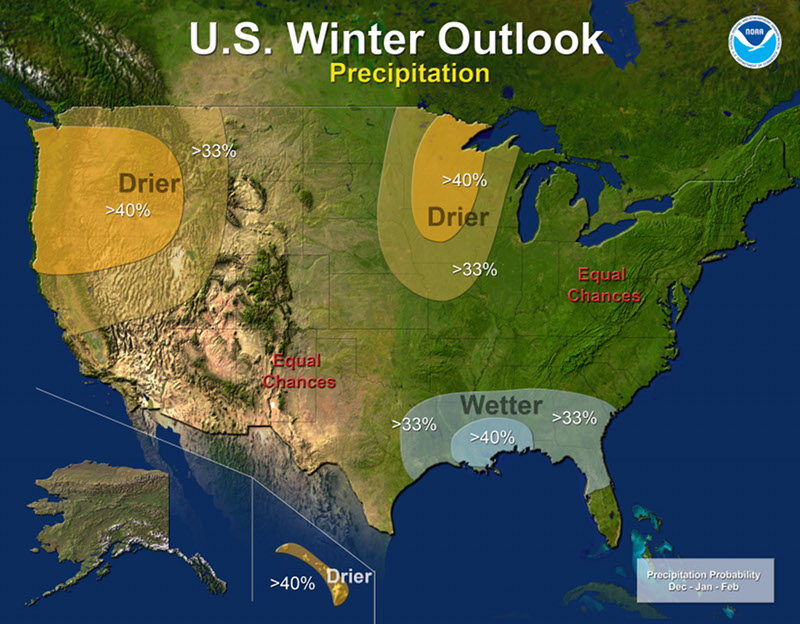
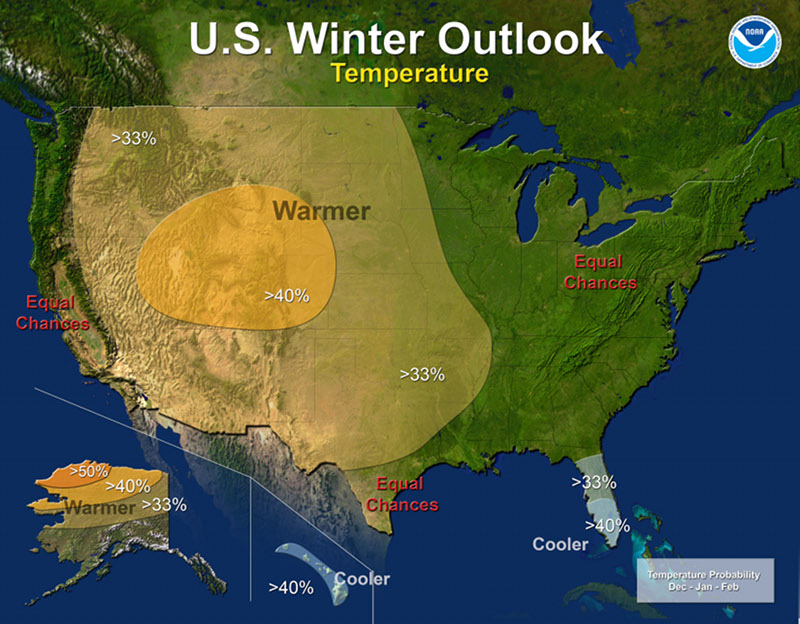
Forecast news: Elusive El Niño challenges NOAA’s 2012 U.S. Winter Outlook — NOAA #CODrought

usdroughtmonitor10162012.jpg

noaaoutlookmapprecip102012.jpg

noaaoutlookmaptemp102012.jpg

Click on the thumbnail graphics for the forecasted precipitation map, temperature map and the current U.S. Drought Monitor map. Here’s the winter outlook from the NOAA:

The western half of the continental U.S. and central and northern Alaska could be in for a warmer-than-average winter, while most of Florida might be colder-than-normal December through February, according to NOAA’s annual Winter Outlook announced today from the agency’s new Center for Weather and Climate Prediction in College Park, Md.

Forecasters with NOAA’s Climate Prediction Center say a wavering El Niño, expected to have developed by now, makes this year’s winter outlook less certain than previous years.

“This is one of the most challenging outlooks we’ve produced in recent years because El Niño decided not to show up as expected,” said Mike Halpert, deputy director of NOAA’s Climate Prediction Center. “In fact, it stalled out last month, leaving neutral conditions in place in the tropical Pacific.”

When El Niño is present, warmer ocean water in the equatorial Pacific shifts the patterns of tropical rainfall that in turn influence the strength and position of the jetstream and storms over the Pacific Ocean and United States. This climate pattern gives seasonal forecasters confidence in how the U.S. winter will unfold. An El Niño watch remains in effect because there’s still a window for it to emerge.

Other climate factors can influence winter weather across the country. Some of these factors, such as the North Atlantic Oscillation, a prominent climate pattern, are difficult to predict more than one to two weeks in advance. The NAO adds uncertainty to the winter outlook in the Northeast and Mid-Atlantic portions of the country.

Areas ravaged by extreme drought over the past year are unlikely to see much relief from drought conditions this winter [ed. emphasis mine].

In the 2012 U.S. Winter Outlook (December through February) odds favor:

– Warmer-than-average temperatures in much of Texas, northward through the Central and Northern Plains and westward across the Southwest, the Northern Rockies, and eastern Washington, Oregon and California, as well as the northern two-thirds of Alaska.
– Cooler-than-average temperatures in Hawaii and in most of Florida, excluding the panhandle.
– Drier-than-average conditions in Hawaii, the Pacific Northwest and Northern California, including Idaho, western Montana, and portions of Wyoming, Utah and most of Nevada.
– Drier-than-average conditions in the upper Midwest, including Minnesota, Wisconsin, Iowa and northern Missouri and eastern parts of North and South Dakota, Nebraska, Kansas, and western Illinois.
– Wetter-than-average conditions across the Gulf Coast states from the northern half of Florida to eastern Texas.

The rest of the country falls into the “equal chance” category, meaning these areas have an equal chance for above-, near-, or below-normal temperatures and/or precipitation.

This seasonal outlook does not project where and when snowstorms may hit or provide total seasonal snowfall accumulations. Snow forecasts are dependent upon the strength and track of winter storms, which are generally not predictable more than a week in advance [ed. emphasis mine].

From USA Today (Doyle Rice):

Almost every state west of the Mississippi is expected to be warmer than average, according to Mike Halpert, deputy director of the Climate Prediction Center in College Park, Md. The CPC is a branch of the National Oceanic and Atmospheric Administration.

The center’s forecast covers the months of December, January and February, which is known as meteorological winter.

The western warmth would continue the amazing heat that the nation has seen this year. So far, the U.S. is enduring its hottest year on record, based on weather records that go back to 1895, reports Deke Arndt, chief of climate monitoring of the National Climatic Data Center in Asheville, N.C. The year 2012 will almost certainly go down as the warmest in U.S. history, he says.

Halpert also says the Pacific Northwest and upper Midwest should see less rain and snow than average, which isn’t good news for those drought-plagued regions.

As of Thursday morning’s U.S. Drought Monitor, a federal website that tracks drought, 62% of the lower 48 states are currently in drought conditions, with the worst of the drought centered in the northern and western U.S…

“Climate prediction is still in its infancy,” reminds [Mike Halpert, deputy director of the Climate Prediction Center in College Park, Md.].

From Reuters:

The drought that ravaged the United States this year does not appear to be abating and may spread through the winter, government forecasters said on Thursday.

“The large majority of that drought we expect to persist,” said Mike Halpert, deputy director of the National Oceanic and Atmospheric Administration. “We even see drought expanding westward … into Montana, Idaho and part of Oregon and Washington.”

Clean Water Act 40th anniversary: ‘I actually remember the Cuyahoga River in Ohio catching on fire’ — Lynn Bartels

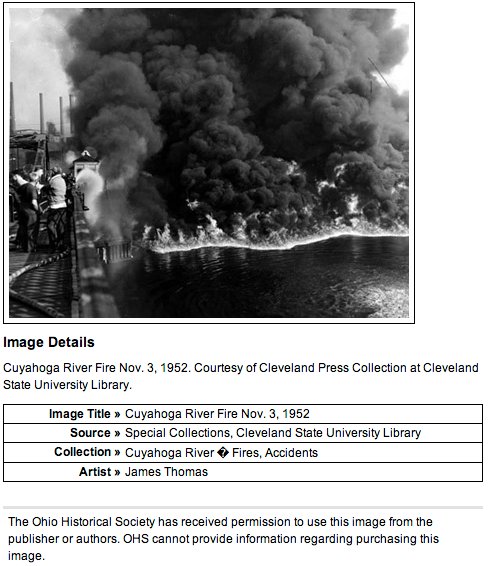
cuyahogariverfire1131952.jpg

Lynn Bartels (The Denver Post) is linking to a video about the Clean Water Act. Here’s an excerpt from her blog post:

No one’s ever accused me of being a tree-hugger but I watched from beginning to end this video on the Clean Water Act [Clean Water Act: Better at 40], which celebrates its 40th birthday this month.

I actually remember the Cuyahoga River in Ohio catching on fire.

Interestingly, President Nixon vetoed the Clean Water Act [ed. due to the Congress adding too much spending], but Congress overturned the veto by a stunning 10 to 1 vote.

More water pollution coverage here.
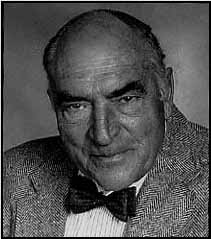
Luna Leopold — Pioneer of Water Science

Luna B. Leopold

Here’s a look back at the career of Luna B. Leopold from the United States Geological Service. They are running a series of articles to honor Earth Science Week, an effort to introduce students to careers in the geosciences.

Everyone interested in water issues should read Dr. Leopold’s book Water, Rivers and Creeks. He hits the subject from stem to stern.

Here’s an excerpt from the USGS article:

“Water is the most critical resource issue of our lifetime and our children’s lifetime. The health of our waters is the principal measure of how we live on the land.” –Luna B. Leopold, Former USGS Chief Hydrologist

Luna B. Leopold, son of famed conservationist Aldo Leopold, arrived at the USGS in 1950. For the next two decades, Leopold revolutionized hydrologic sciences within and outside the USGS. He is best known for his work in the field of geomorphology, the study of land features and the processes that create and change them. His work is often cited today by leading scientists in water research, both at the USGS and around the world.

Leopold had a lasting impact on the field of water science. He knew the broader importance of our water resources and that humans can have great impact on whether water is available, now and in the future. Our society depends on safe and reliable water supplies, as do the Earth’s diverse and valuable ecosystems. Today, our nation is faced with the challenge of balancing a finite freshwater supply between competing needs, such as agriculture, drinking water, energy production, and ecosystems.

Leopold recognized the fundamental value of science in making smart decisions about water resources and laid the groundwork for modern water science. During his tenure he transformed USGS water research into a professionally-recognized provider of water quality and availability information.

Here’s a link to an old Coyote Gulch post around the time that he passed on. Scroll down to read the post. Here’s the link to the March 5, 2006 Washington Post obituary — Luna B. Leopold, 90; USGS Hydrologist”.

Kerber Creek: ‘Aesthetically, the whole environment along the creek is so different’ — Brady and Jane Farrell

kerbercreek.jpg

Here’s the latest installment of the Valley Courier’s Colorado Water 2012 series (Aaron Monammadi). Here’s an excerpt:

The dedicated efforts of a few individuals can really make a difference, however, such as those involved in the Kerber Creek Restoration Project located in Saguache.

Brady and Jane Farrell, who have been on the project since the beginning and continue to be involved, share the following:

“Today, walking along our section of Kerber Creek is a completely different experience. The eroding banks have been reinforced with large rocks and stabilized by plantings. There are fish for the grand-kids to catch and release because the water is deeper. The aspens we planted along the creek are catching hold. The J hooks and weirs and other structures have created deep pockets for the fish to survive in, and the overall depth is increased as a result of re-channeling parts of the creek. Formerly by late summer the whole creek was so shallow you could walk across it without hardly getting your shoes wet, and there was little growth along the banks.

“Aesthetically, the whole environment along the creek is so different. A healthy creek is certainly much more attractive in every way. We love sitting by it or walking along it, enjoying the growing plants along the banks and cascading water along the creek that was formerly shallow, with banks falling into the water and little growth along the course of the stream. What a change has occurred over these past few years. And it will only get better in the coming years as the plantings mature and fish get bigger.”

The Kerber Creek Restoration Project is an award winning collaboration of 16 federal, state, and local agencies, non-profit groups and more than 20 local landowners dedicated to the restoration of the Kerber Creek watershed from historic mining impacts. From 2007 to the present, the Bonanza Stakeholders Group has raised over $2 million towards restoration efforts and contributed over 13,000 volunteer hours on the Restoration Project.

More Colorado Water 2012 coverage here.

CWCB: State of Colorado Receives Partners in Conservation Award

coloradoriverbasin.jpg

Here’s the release from the Colorado Water Conservation Board (Ted Kowalski):

The State of Colorado, as well as the other cooperating partners in the Colorado River Supply and Demand Basin Study (“Colorado River Basin Study” or “Basin Study”), were presented today with the prestigious “Partners in Conservation Award” by the Department of the Interior. This award was presented by Deputy Secretary David Hayes in recognition of the cooperation between these different entities on one of the most pressing natural resources issues in the Unites States–the future of the Colorado River basin.

The Colorado River Basin Study is the most comprehensive effort to date to quantify and address future supply and demand imbalances in the Colorado River Basin. The Basin Study evaluates the reliability of the water dependent resources, and also outlines potential options and strategies to meet or reduce imbalances that are consistent with the existing legal framework governing the use and operation of the Colorado River. To date, the Basin Study has published a number of interim reports and appendices, and the final report of the Basin Study is scheduled to be published by the end of November, 2012.

Jennifer Gimbel, Director of the Colorado Water Conservation Board, and Ted Kowalski, Chief of the Interstate, Federal and Water Information Section of the Colorado Water Conservation Board accepted the award on behalf of the State of Colorado. “The Basin Study reflects the cooperative spirit in which the Colorado River Basin States have worked since the adoption of the 2007 Interim Guidelines,” Gimbel said.“Colorado and the other Basin States, the tribes, the federal government, and the many diverse stakeholders must continue to work together in order to address the difficult water imbalances facing the southwestern United States in the next half century. It is clear that there are no silver bullets, but rather we must explore and develop multiple options and strategies in order to meet our projected future water supply/demand imbalance.”

More Colorado River Basin coverage here.

EPA: Check out their new website for information on the surface water in your area

watersnear80212epahowsmywaterway.jpg

Say hello to How’s My Waterway?. I entered my zip code and found that all the close surface water is polluted if they evaluated it. I knew there was a reason that my grandmother used to tell me as a kid, “Johnny don’t go in Clear Creek.”

More Environmental Protection Agency coverage here.

Drought news: Colorado Springs Utilities — Mandatory restrictions possible in 2013 #CODrought

From KRDO (Joe Dominguez):

The continuing drought is one concern but now utilities leaders are warning the Utilities Board and customers water use habits could also force the company to enforce restrictions for the first time since 2005. “The community’s water use is currently higher than expected,” someone tweeted from the Colorado Springs Utilities Twitter account during the regular board meeting Wednesday. “Mandatory restrictions possible in 2013.”

Yearly water usage was last measured by CSU in July. It found that 2,733.2 million gallons of water had been used by customers. In 2011 at the same time of year, water consumption was 2,509.1 million gallons.

From the Montrose Daily Press (Elaine Hale Jones):

As promised, irrigation water was shut off through the Gunnison Tunnel two weeks early on Monday by the Uncompahgre Valley Water Users Association, which manages the water. Early shut-off dates have not been uncommon throughout the long history of the irrigation project, according to association officials. “In 2002, water was shut down early due to drought conditions. It’s the same this year,” UVWUA manager Steve Fletcher said…

“Our main purpose in shutting the water off early is to conserve our stored water in Taylor Reservoir,” he said.
Located nearly 100 miles from Montrose in the northeastern end of Gunnison County, Taylor Reservoir was built to store spring run-off from the upper Gunnison River to be released and diverted through the Gunnison Tunnel late in the season when needed for maturing crops. Completed in 1937, the reservoir was a cooperative agreement between the Bureau of Reclamation and the Uncompahgre Valley Water Users Association as the second major phase of the Uncompahgre Project, first implemented with the completion of the Gunnison Tunnel in 1909. The project is unique among similar projects in that 100 percent of the first fill is for irrigation purposes only, and the first fill rights are strictly for Uncompahgre Valley irrigation. Taylor Reservoir holds 21.2 million acre-feet of water.

From the Mancos Times:

The Mancos Board of Trustees has established an exterior watering ban until further notice. There is not enough water flowing in the West Mancos River to legally get water through the head gate from the river to the water filtration facility. The town has #3 priority water right, which means river water cannot currently be diverted to the filtration facility.

This means that the town has to use its backup supply that is stored in Jackson Reservoir. Currently the reservoir is only at 14 percent of its capacity and there is no water coming into the reservoir from the river. Therefore, we must conserve water because we don’t know exactly when the reservoir will begin to get water from the river again. The watering ban will be lifted when this situation changes.

From Steamboat Today (Tom Ross):

The unofficial winner of the Routt County rain derby Tuesday night was the rain gauge located about eight miles west of Steamboat Springs, where a participant of Colorado State University’s volunteer weather-monitoring program recorded 0.34 inches of precipitation. Closer to Steamboat Springs, three other participants in CSU’s Community Collaborative Rain, Hail and Snow Network posted measurements of 0.23, 0.26 and 0.19 inches. A rain gauge in Clark collected 0.15 inches of precipitation, and another just outside Oak Creek totaled 0.23 inches.

Rio Grande River Basin: The State Engineer is cracking down on over-pumping

slvdischargerecharge.jpg

From the Valley Courier (Ruth Heide):

This week [State Engineer Dick Wolfe] issued a draft policy concerning pumping limits for large-capacity wells in the Rio Grande Basin, Division 3 Engineer Craig Cotten announced to those attending the Rio Grande Water Conservation District board meeting yesterday in Alamosa.

The draft policy involves pumping limits for wells, specifically nonexempt large capacity wells, which have been required to meter usage for a few years now. Some of these wells have exceeded the pumping limits in their permits or decrees, Cotten explained, so they may be required to curtail or shut down pumping next year.

“We have actually started ensuring those limitations are complied with,” Cotten said on Tuesday, “but this policy sets it more in stone how we are going to do that and what steps we are going to take to ensure the wells are pumping within their limitations.”

He said this was something that needed to be handled, and this policy will set limits in black and white “so there’s no question.”

He described the bases that will be used to determine if a well has exceeded its limits. Some wells have maximum annual production they cannot exceed in any one year, such as 200-300 acre feet. On that basis, the water office has already ordered some wells to shut down, Cotten said.

“We do know there have been several that have exceeded their maximum annual production, and we have issued orders on those,” Cotten said…

The “volumetric pumping limits of nonexempt wells in the Rio Grande Basin” draft policy refers to the extreme multi-year drought in the basin as one of the main reasons this policy is under consideration. It says the drought years have affected the recharge and storage in groundwater aquifers serving as the water supply for municipal, domestic, irrigation and other water users throughout the Valley. The policy states that during this summer alone, for example, water table elevations declined up to six feet in some areas, and the unconfined aquifer storage in the closed basin, which has been measured over a period of 30-plus years, decreased by about 166,000 acre feet.

More Rio Grande River Basin coverage here and here.

Forecast news: ‘Going back to 1905, we’ve never seen this [ENSO neutral after double-dip La Niña]’ Klaus Wolter #CODrought

klauswolterforecastoctober2december2012.jpg

From the Summit County Citizens Voice (Bob Berwyn):

The centerpiece of Tuesday’s webcast was a seasonal outlook from NOAA meteorologist Klaus Wolter, who offered some hope. Despite the fact that La Niña is fading, the overall combination of ocean temperatures and global circulation may bring at least normal moisture to the high country.

“What we have to play with … shows a slight preference for a little bit wetter conditions on the West Slope, but it’s not a strong signal,” said Wolter, who studies climate with the Earth Systems Research Laboratory in Boulder.

The combination of a weak El Niño, a cold phase of a large-scale Pacific oscillation known as the PDO, as well as atmospheric patterns in the Atlantic could combine push storms across the central Rockies, he said.

The El Niño Southern Oscillation is one of the best indicators for developing long-term precipitation outlooks, but it looks like the Pacific Ocean will be in a near-neutral state this winter, and perhaps slip back into a La Niña phase (cooler than average sea surface temps in the equatorial eastern Pacific) by next year.

Wolter said having a “neutral” year after a douple-dip La Niña is almost unprecedented. Almost always, after a two-year La Niña phase, the Pacific rebounds to at least a weak El Niño.

“Going back to 1905, we’ve never seen this,” Wolter said.

The last time the Pacific stayed in a La Niña to neutral phases for an extended time was in the late 1990s and early 2000s, culminating in the 2002 drought. In general, Wolter said some of Colorado’s historic long-term droughts have coincided with similar conditions.

“If you look at the big, long droughts … going back to 1910, they were all associated with conditions like we’re seeing; this is the big concern,” Wolter said, adding that he does expect at least a bit of a rebound from last winter’s epic low snowfall.

Four Corners River Health Workshop recap: ‘The Animas knits everything together’ — Ann Oliver

animasriverdurangorealestate.jpg

From The Durango Herald (Dale Rodebaugh):

Two hundred people involved in water-quality issues from Silverton to Northern New Mexico described projects, compared notes and asked questions of others Tuesday. The occasion was the Four Corners River Health Workshop sponsored by the New Mexico Environment Department in collaboration with the Animas Watershed Partnership and the San Juan Soil & Water Conservation District…

“There are 35 community water systems and 22 permitted dischargers, including 16 sewerages,” Oliver said. “It also provides room and board for 25 of the birds, frogs, fish and mammals identified by states as species of greatest conservation concern and supports at least 10 fishing and boating recreation businesses.

“The Animas knits everything together,” Oliver said.

Additional pressure on the river is the presence of nutrients, most commonly nitrogen and phosphorus, which in excess cause algae blooms that steal oxygen needed by other fish and aquatic life. Water-treatment plants and fertilizer from agriculture are major sources of nutrients, she said…

Peter Butler, chairman of the Colorado Water Quality Control Commission and a member of the Animas River Stakeholders Group, said new nutrient standards will affect Front Range dischargers long before smaller water-treatment plants such as Durango must upgrade equipment to meet standards.

More Animas River Watershed coverage here and here.

H.R. 6462: Water and Agriculture Technology Economic Revitalization Act of 2012

irrigationditchgreeleyhistoricalresources.jpg

Here’s the Govtrack link.

From The Greeley Tribune (Eric Brown):

In a farmer’s perfect world, the nearly 1,000 miles of irrigation ditches that sprawl across Weld County would be lined and sealed to prevent any water loss to ground seepage, and each agricultural water provider could expand its reservoirs or build new ones at will to capture every excess drop of snowmelt that trickles down from the mountains.

“In reality, though, the kind of money needed to do all of that just doesn’t exist,” said Russ Leffler, an Eaton ­area farmer who serves as president of the Larimer ­Weld Reservoir and Windsor Reservoir companies. Instead, Leffler and decision makers with other water suppliers are focused simply on upgrading and repairing existing infrastructure as a more economically feasible way to make their systems more efficient. Still, just keeping up with those expenses as needed is nearly impossible, they say.

Many of the hundreds of spillways, inlets and diversion structures along the region’s rivers and canals are approaching 100 years old, if they haven’t already reached the century mark, and the upgrades can easily reach millions of dollars on each project. That’s why many in Weld — a top ­10 agriculture producer nationally — say they’re relieved by the introduction of The Water and Agriculture Technology Economic Revitalization Act. That bill, if signed into law, would give mutual ditch companies more funds to pay for their much­ needed — and, in many cases, long­overdue — improvements.

As it stands, mutual ditch and irrigation companies must receive 85 percent of their income from shareholder investments to maintain their nonprofit status. However, as Leffler and others explained, reservoir and ditch companies have sources of revenue aside from the assessments paid by their shareholders. For example, Leffler said all seven of the reservoirs under his two companies’ systems have recreational leases with private companies, and that additional revenue has caused them to exceed their 85 percent threshold in recent years.

However, the bill — introduced by Rep. Cory Gardner, R ­Colo. — would allow those companies to receive that extra income and still maintain their nonprofit status, meaning that what dollars the Larimer ­Weld Reservoir and Windsor Reservoir companies and others have spent on taxes in recent years, due to surpassing the 85 percent threshold, would instead be kept in house and used for necessary improvements. “To make the most of our water, we need to be doing a lot of work to our systems,” Leffler said. “And anything that can help us get the dollars we need to do those repairs as soon as possible is a huge boost.

“At a time that we’re seeing huge growth in the region and water supplies are being stretched, we need to make sure we’re being as efficient as we can be … but we need money to do that.”

Just in recent years, the Larimer ­Weld Reservoir and Windsor Reservoir companies — two of several that operate in Weld County, and deliver water to about 70,000 acres of farmground — spent about $1.5 million on repairing one of its spillways and another $1.5 million on an inlet, and there’s much more to do, Leffler said. The companies are also looking to install better monitoring devices throughout their systems.

Leffler, along with Lynn Fagerberg, a fellow Eaton­area farmer, and other producers in the region, had met with Gardner in recent months, helping the congressman as he pieced together the legislation.

“We really hope this will go through,” Fagerberg said. “The lifespan on a lot of the infrastructure in this region is running out … and we need the dollars to make the improvements.” Gardner said he is confident the bill will pass.

“Right now we’re seeing a lot of bipartisan support for it,” he said. “Ideally we could get this passed this year — if not, hopefully next year.

“Irrigated agriculture is so huge to our area, and these ditch companies need this as soon as possible.”

The U.S. Joint Committee on Taxation estimates the legislation would take away about $31 million in tax revenue from the federal government between 2012 and 2021 — “definitely worth it,” as Gardner said, noting how important irrigated agriculture is to the economy and to the nation’s food security. To Leffler, Gardner’s bill represents more than just potentially leaving more dollars in the hands of mutual ditch companies to do needed upgrades. “It represents dedication to agriculture,” Leffler said Monday, watching his son — the fourth generation of the Leffler family to farm in Weld County — harvest sugar beets in a field near Eaton under a warm, late­morning sun. “That’s something you always like to see.

“We greatly appreciate Gardner’s efforts in this, and appreciate anyone else who backs it up.”

More H.R. 6462 coverage here.

Lower Arkansas Valley Water Conservancy District board meeting recap: Many eyes are on the spot market for water

typicalwaterwell.jpg

From The Pueblo Chieftain (Chris Woodka):

That was the theme of a far ­ranging meeting of the Lower Arkansas Valley Water Conservancy District Wednesday. About 40 people from well augmentation groups, ditches and other farm interests attended the meeting. State Engineer Dick Wolfe and John Stulp, water adviser to John Hickenlooper, also attended the meeting.

While the state officials were there to talk about the high level of scrutiny for a Super Ditch pilot program which failed to get off the ground this year, the discussion quickly changed to increased competition for water on the spot market, which is drying up as the drought deepens.

Scott Lorenz, manager of the Arkansas Groundwater Users Association, asked the Lower Ark board to adopt a resolution supporting cooperation and refraining from competing for the same sources of replacement water. The Lower Ark district provides replacement water for farmers under state surface irrigation rules.

“We’re asking the district to refrain from taking water from some farmers and giving it to others,” Lorenz said.

Lower Ark board members said the district’s goal is to help all farmers, and cited instances where the district has assisted well groups.

“The spot market may not even be there in the future,” said Lynden Gill, Lower Ark chairman. “We appreciate your efforts to bring these things to our attention.”

“Why don’t we take a step forward, and put on a positive attitude?” said Reeves Brown, a Pueblo County director.
The well groups first met with the Lower Ark board in February to address the issue, but no follow­up meetings have occurred. Recently, Lorenz publicly accused the district of trying to undercut its water sources, which the district denied.

From The Pueblo Chieftain (Chris Woodka):

A time­out from Arkansas Valley surface irrigation rules is unlikely, even though farmers say they’re paying for water they’re not even using.

At this week’s meeting of the Lower Arkansas Valley Water Conservancy District, Dale Mauch, a Lamar farmer on the Fort Lyon Canal, asked State Engineer Dick Wolfe if the 2010 surface irrigation rules could be suspended until a study of pond leakage is complete.

“Dick, we’d like to have the state help us, because sometimes it seems like you’re the enemy,” Mauch told Wolfe at one point.

Mauch explained that under 2010 surface irrigation rules, he was required to purchase replacement water to augment his pond­fed sprinklers, even though he hasn’t been able to irrigate since mid­June because of the drought.

Mauch is among farmers trying to loosen up state water­replacement requirements by trying to prove that irrigation ponds that feed sprinklers leak more than presumed by a state formula.

The state presumes 3 percent leakage, while farmers say it’s closer to 20 to 25 percent.

Wolfe replied that the state’s actions are bound by court­decreed rules that make it difficult to alter or suspend any of the provisions.

“Dale, the state’s computer model doesn’t agree with you,” another farmer joked. “I live in reality,” Mauch laughed.

Pueblo County farmer Tom Rusler, who farms on the Bessemer Ditch, asked if the accounting for the rules could be done after the irrigation season, rather than in advance.

Wolfe said the rules require a plan prior to the irrigation season and can’t be altered without a change in the court decree. Wolfe said the rules could be amended to reflect the results of the pond study. Additionally, the Lower Ark district, which administers a group plan for water replacement under Rule 10 of the rules, can amend its report.

More Arkansas River Basin coverage here.

Colorado Springs: Stormwater proposal = $12.8 million to protect Colorado Springs Utilities’ infrastructure

Earliest closing of Trail Ridge Road in RMNP in at least a decade #cowx

October 18 — Happy Birthday Clean Water Act

arkansasriverbasin.jpg

From The New York Times (Robert B. Sempla Jr.):

Thursday, Oct. 18, marks the 40th anniversary of the Clean Water Act, a critical turning point in the nation’s efforts to rescue its rivers, streams, lakes and wetlands from centuries of industrial, municipal and agricultural pollution. But what should be a moment of celebration is also a moment of apprehension: Republicans in the House have spent the last two years trying to undercut the law, and should they gain control of the White House and Congress in next month’s elections, they could well succeed.

These same Republicans are either ignorant of their political heritage or have no use for it. Richard Nixon, a savvy Republican who appreciated the raw force behind an environmental movement that had coalesced only two years before around Earth Day, was among those pushing hardest for the law. Nixon sent a clean water bill to Congress, then vetoed the final product on Oct. 17 after it had nearly doubled in size, forcing Congress to override the next day. But he did so on budgetary grounds, not because he objected to its substance. “The pollution of our rivers, lakes and streams degrades the quality of American life,” he said. “Cleaning up the nation’s waterways is a matter of urgent concern to me.”

More Clean Water Act coverage here.

2013 Colorado Legislation: Interim Water Resources Review Committee: Legislative Report

Lincoln Park/Cotter Mill superfund site update: Change in state molybdenum standards slated for February 2013

cottermillcontaminationconcerndenverpost10232011.jpg

From the Cañon City Daily Record (Rachel Alexander):

In February 2013, the size and shape of the molybdenum plume in Lincoln Park ground water will shrink because of changes in state standards.
Previously, the Colorado Water Quality Control Commission had set the standard at 35 micrograms of molybdenum per liter of water. Effective Feb. 1, 2013, that will change to 210 micrograms per liter of water. The federal Nuclear Regulatory Commission’s enforcement level is 100 micrograms per liter of water.

In addition to Colorado Standard, the Cotter Mill, which is the original source of the Lincoln Park plume, also must comply with NRC standard. The levels must be at least as restrictive as the state standards. Because the NRC level is now more restrictive than the state standards the Hazardous Materials and Waste Management Division of the Colorado Department of Public Health and the Environment will require Cotter to meet the 100 micrograms per liter of water level.

From The Pueblo Chieftain (Tracy Harmon):

A new cleanup standard for molybdenum levels in groundwater has drastically reduced the size of a cleanup area contaminated by the Cotter Corp. Uranium Mill.

The mill and a portion of the neighboring Lincoln Park community became a part of a federal Environmental Protection Agency Superfund cleanup site in 1984 after molybdenum and uranium contamination seeped from unlined tailings ponds into the groundwater.

As of Feb. 1, the state Water Quality Control Commission standard for cleanup of molybdenum in water will be 210 micrograms per liter, up from the previous standard of 35 micrograms per liter, according to a fact sheet issued by state health officials Tuesday.

Despite the change, Cotter will be required to clean up groundwater at any reading above 100 micrograms per liter because that standard is required by the Nuclear Regulatory Commission. A map included with the fact sheet shows two small plumes targeted for cleanup.

“This means that 16 wells previously included in the more conservative standard are now outside the plume boundary. Only six wells are inside the Lincoln Park plume,” according to the fact sheet.
“I object to this change in the moly standard for groundwater as I believe from studies I’ve read that it will have an adverse impact on health (of people) through bones, gout and arthritis when drinking well water at this level,” said Sharyn Cunningham, co­chair of Colorado Citizens Against Toxic Waste. “This will allow Cotter to avoid protective cleanup.”

The fact sheet indicates the most common negative health effect from consuming too much molybdenum for a long period of time is gout.

Wells that are located within the contamination area are not being used for human consumption. Instead residents have been hooked up to the city water supply.

“Groundwater contaminate levels in most areas have been decreasing even though there is no active groundwater cleanup action in place in the area,” according to the fact sheet.

More nuclear coverage here and here.

Weekly Climate, Water and Drought Assessment of the Upper Colorado River Basin #coriver

wyutcoprecipitation1007to132012.jpg

Here’s the link to the summaries from the Colorado Climate Center. Click on the thumbnail graphic for the precipitation summary including a water year 2012 map of the Upper Colorado River Basin.

More Colorado River Basin coverage here and here.

The Cherokee Metropolitan District scores a 600 acre-feet water lease from the Pueblo Board of Water Works

arkansasriverbasin.jpg

From The Pueblo Chieftain (Chris Woodka):

The Pueblo Board of Water Works Tuesday approved a two­year lease of water to the Cherokee Metropolitan District in Colorado Springs.

The district is located just north of the Colorado Springs airport and serves about 18,000 people, said Sean Chambers, general manager of the district.

“When we were formed, Colorado Springs did not think it would extend services,” Chambers said. “Now, we are an island within the city.”

The district formed in 1957, and went through a series of reorganizations, consolidations and expansions until 1995. It lost water court cases that have reduced its ability to pump from the Upper Black Squirrel Creek and Chico Creek aquifers.

The district will lease 600 acre­feet of water (almost 200 million gallons) yearly from Pueblo in 2013 and 2014 at a rate $366.25 per acre­foot or $219,750 per year. Any rate increases for Pueblo water would increase the payment by the same percentage. The amount is within Pueblo’s projected surplus, but in an emergency the delivery could be canceled “This is just a bridge for us,” Chambers said. “We would not be relying on short­term leases such as this for a water supply.”

Cherokee is drilling wells and building a pipeline in northern El Paso County to deliver 1,000 acre­feet annually to meet its long­term needs, Chambers said.

The district has implemented conservation measures, which include outdoor watering no more than three times per week, and sometimes has banned outdoor watering altogether.

Cherokee has an agreement with Colorado Springs to deliver water to its system. The water would be exchanged from Pueblo’s accounts into the Colorado Springs system at Twin Lakes for delivery, said Terry Book, executive director of the Pueblo water board.

More coverage from Chris Woodka writing for The Pueblo Chieftain:

The Pueblo Board of Water Works is investigating an idea to create wetlands banks at its Tennessee Creek Ranches property north of Leadville in Lake County.

The water board Tuesday approved a contract of up to $25,000 with Johnson Environmental Consulting to look at the concept of mitigating wetlands in order to offset impacts from projects elsewhere.

The idea is to replace wetland areas destroyed by activities such as highway projects or reservoir construction by creating permanent areas to “bank” wetlands, said Executive Director Terry Book.

“I like the intent,” said board member Tom Autobee, in making a motion to approve the contract.

The Pueblo Water Board has looked at building a reservoir on the Tennessee Creek site since 1950, but those plans hit a snag in the late 1990s when fens — ancient marshy areas — were located on the site.

More coverage from Chris Woodka writing for The Pueblo Chieftain. From the article:

Former ponds west of Pueblo once owned by Valco are now incorporated into Lake Pueblo State Park.
Keeping water in them has become the responsibility of the Pueblo Board of Water Works, and a pending water court case will allow more efficient use of old ditch rights to meet that need.

The water board acquired the Hamp-Bell Ditch water rights from Valco in 2004. The ditch diverted a relatively small amount of water, accruing more credits in the irrigation season than at other times of year.

To balance the credits year-round, the water board will apply for storage rights.

“Currently, the board replaces the nonirrigation season depletions from its other water supplies and the excess Hamp-Bell

Ditch water from the irrigation season often goes unused,” said Alan Ward, water resources manager, in a memo.
The complex historic use issues surrounding the ditch — which has 1870, 1878 and 1880 water rights — were settled in Valco’s 2003 court case, making the new case fairly straightforward, Ward added.

“We should get a net gain of water to store,” added Executive Director Terry Book.

The water board unanimously approved to enter a water court application to complete the plan.

More Arkansas River Basin coverage here and here.

State drought recovery workshop recap: ‘It’s time to get more storage for this basin [Arkansas]’ — Jim Broderick #CODrought

arkansasriverbasin.jpg

From The Pueblo Chieftain (Chris Woodka):

Mother Nature can be a harsh, but effective, teacher.

A panel at the state’s drought recovery workshop Monday at the Colorado State Fairgrounds said lessons from this year’s drought should include the need for more agricultural water storage and cooperative programs that share water resources for multiple uses.

Changes in how water is managed after the 2002 drought also were reviewed at a meeting designed to improve state, local and federal actions in future droughts.

“It’s time to get more storage for this basin. The time has come that agriculture deserves storage,” said Jim Broderick, executive director of the Southeastern Colorado Water Conservancy District. “This year’s bad, but next year could be worse, because municipalities won’t have water to share.” One of the worst years on record for precipitation followed one of the wettest in terms of water available to the Arkansas River basin from the Colorado River. But two years of drought have depleted the water farmers hold back to either start crops in a dry spring or finish them in a dry autumn, he said.

Cities, on the other hand, increased water in storage after the 2002 drought, and were even able to share some this year.

“In good times, we are able to deliver water to canals,” said Gerry Knapp, manager of Aurora’s operations in the Colorado and Arkansas River basins. “Long­term relationships need to be built.”

Aurora currently has agreements with the High Line and Holbrook canals, as well as the Lower Arkansas Valley Water Conservancy District. The city east of Denver began directly reusing flows through the Prairie Waters Project, a direct outcome of the 2002 drought.

From The Pueblo Chieftain (Chris Woodka):

Two­ thirds of the United States is suffering from the impacts of drought, and it’s anyone’s guess whether things will improve next year. So federal, state and local officials gathered Monday at the Colorado State Fairgrounds in Pueblo to plan for action should drought persist. “This is not just an agricultural event or a Colorado issue,” said Thomas Guevara, who heads the federal Economic Development Agency’s regional affairs office. “The federal government is taking an all ­hands on­ deck approach.”

At the regional drought recovery meeting Monday, those hands included representatives from a dozen federal agencies, state officials from several agencies, farm agency representatives, water district officials and county commissioners. More than 100 people attended the event, hosted by the Colorado Department of Agriculture.

“I don’t think there has even been a real coordinated effort like this in reference to drought,” Colorado Agriculture Commissioner John Salazar said. The daylong workshop was one of four — others are in Nebraska, Arkansas and Ohio — designed to share information about how states are responding to drought.

“The drought affects two thirds of the U.S., but it’s all local,” said Colleen Callahan, who is coordinating the workshops for the U.S. Department of Agriculture. “We have to work across state and federal lines. . . . We are more effective when we are flexible, rather than rigid.” Paul Wolyn, science operations officer for the National Oceanic and Atmospheric Administration, said

Southern Colorado has been in a two ­year drought that would be expected to occur only once every 50 years.

Forecasts through mid­ 2013 predict it will be warmer, with equal chance of precipitation.

“Drought could persist over much of the nation,” he said.

More Arkansas River Basin coverage here and here.

Denver: The Sierra Club is sponsoring a seminar about hydraulic fracturing October 24

cityparksunrise.jpg

Here’s the announcment from the Sierra Club — Rocky Mountain Chapter:

Where: Tavern Uptown, 538 E. 17th Avenue Parkway, Denver, CO 80203-1305
303.830.9210

When: Wednesday, October 24, 2012 6:00 p.m. to 8:00 p.m.

Speaker: Shane Davis A Brief Look at Fracking

Light Refreshments
Cash Bar

Please RSVP due to limited seating

RSVP: Kathleen Butler
butler18@comcast.net
303.506.3443

More oil and gas coverage here and here.

Conservation easements monkey business: Colorado state audit staff recommends wholesale fixes to program

saguachecreek.jpg

From The Denver Post (David Migoya):

In a 107-page report, Auditor Dianne Ray said legislative efforts to fix the program since abuses were uncovered in 2007 haven’t been enough to ensure millions of dollars in tax credits are actually valid.

The Department of Revenue administers the program, which is intended to compensate individuals who donate their land to protect it from future development, but the agency hasn’t been able to prevent additional abuses, the report noted.

The agency’s tax examiners “do not sufficiently document their reviews of conservation easement tax credit claims and uses,” the report says. “More changes need to be made to strengthen the administration (of the program) to ensure that tax credits being claimed and used by taxpayers are valid.”

Agency officials agreed with 12 recommendations for change, saying the bulk of them would be in place by July 2013.

More conservation easements coverage here and here.

Littleton: City staff is proposing sanitary sewer rate increases of 2.5 percent in 2013 and 3 percent each year 2014 through 2017

littleton.jpg

From the Littleton Independent (Jennifer Smith):

The Littleton/Englewood Wastewater Treatment Plant is subject to stricter nutrient removal standards as of 2022. In order to accomplish that, city staff says design and permitting for the project needs to begin in 2017, with construction set to begin in 2019.

Currently, customers within city limits pay $233.02 per year; those outside pay $212.21. Staff is proposing an increase of 2.5 percent in 2013 and 3 percent increases every year after that through 2017. That works out to about $6 more a month in 2013 for a single-family home in city limits, up to a total of about $262 a year in 2017.

The total cost of the project is estimated at $15 million, and Littleton splits that evenly with Englewood. However, adding on $5.75 million for required reserves, the city needs at least $13 million in the bank by the end of 2017.

“I can’t think of any other way to do it that’s responsible,” said Charlie Blosten, director of public works.

More wastewater coverage here and here.

South Platte River: CH2M Hill Fall Riversweep a Success — Countless cigarette butts collected

splattetrail1.jpg

Here’s the release from the Greenway Foundation (Cindy Shoemaker):

The Greenway Foundation’s 20th Annual CH2M HILL Fall RiverSweep was held on September 29th as part of National Public Land’s Day and thanks to the generous support of many sponsors, including CH2M HILL as our Title Sponsor, this year’s event has set a new standard for community engagement for the South Platte River Greenway!

Here are some highlights from the day:

Over 500 volunteers worked close to 33,000 work hours for Denver Parks and Recreation, totaling a savings for the City and County of Denver of $32,861.95!

Other accomplishments include:

• 7 tons of trash removed from our river banks and surrounding areas

• 74 gallons of paint used at various locations

• 39 cubic yards of debris collected

• 2,302 gallons of debris collected

• 77 yards of mulch spread

• 15 cubic yards of suckers removed

• Hedged 1,000 linear feet of shrubs

• Mowed 850 square feet of turf

• Countless cigarette butts collected

More South Platte River Basin coverage here and here.

Telluride and San Miguel County settle lawsuit over the proposed Piñon Ridge uranium mill

doloresrivercanyon.jpg

Update: From The Telluride Daily Planet (Katie Klingsporn):

The settlement includes provisions that town and county officials say address their utmost concerns about the mill’s potential impacts to air and water quality and the health of the region’s denizens. It sets out rules that Energy Fuels — the Canadian company proposing to build and operate the mill — would have to follow regarding trucking its ore, allows the town and county inspection rights of Energy Fuels’ facilities and will clear the way for a water monitoring system that gives the local governments the power to force Energy Fuels into corrective actions if findings dictate so.

“At least for the issues that were the most central to our concerns, which were water and air quality in eastern San Miguel County, we feel that we have addressed those concerns,” said Telluride Town Attorney Kevin Geiger. “We’re prepared to move out of the way and let the process proceed.”

The Telluride Town Council formally approved the signing of the agreement this week; the San Miguel County Board of Commissioners has authorized the signing, and plans to formally ratify it at its meeting on Wednesday.

Both the town and county are maintaining their party status in the upcoming court-ordered hearings over Piñon Ridge in Nucla, though officials say they don’t anticipate participating in a formal role.

Update: From the Summit County Citizens Voice (Bob Berwyn):

a judge has given three conservation groups formal standing for the hearings, which means that environmental advocates will be able to introduce evidence, testify and cross-examine witnesses.
The Piñon Ridge mill is proposed for the Paradox Valley, in southwestern Colorado near the Dolores River. The three groups — Rocky Mountain Wild, Colorado Environmental Coalition and the Center for Biological Diversity — will join the towns of Telluride, Ophir, and San Miguel County in voicing concerns about the proposed mill’s threats to air, water, wildlife and tourism…

The upcoming proceedings will give towns, counties, scientists, conservation groups and the public a chance to challenge the application and make sure that all public health, safety and environmental concerns are addressed.

Based on the promise of jobs, there is some support for the mill among residents of some of the hardscrabble towns in the region, but conservation groups and tourism-dependent communities are dead-set against the mill.

Along with health and environmental concerns, there are fundamental question about the economics of uranium mining, as the mill proposal is seen as a speculative play based on as-yet undeveloped uranium resources.
The battle over the mill is symbolic of the larger struggle in the region, as energy companies look to make every play they can, while conservation advocates strive to protect pristine lands.

From The Grand Junction Daily Sentinel (Gary Harmon):

The company planning to build a uranium mill near Naturita settled with Telluride and San Miguel County in a lawsuit aimed at halting construction of the mill.

“This gets us part of the way there,” Curtis Moore, spokesman for Energy Fuels, said of the agreement, which removes two of four plaintiffs in the case brought originally by the Sheep Mountain Alliance. The alliance is not involved in the settlement.

The agreement with Telluride and San Miguel County requires Energy Fuels to take several actions once the mill is built, ones that Moore said are intended to reassure residents of San Miguel County that they won’t be affected by the mill.

Among the issues included in the settlement:

■ Energy Fuels will participate in a monitoring program for the watershed above Telluride;

■ New standards and restrictions will be placed on trucks passing through San Miguel County, including requirements that trucks have the company name and are numbered so that authorities can be contacted if spills occur;

■ Town and county officials will be allowed to inspect the mill and mines that feed it so any spills can be traced;

■ Bonds will be increased from about $12 million to $15 million.

“This will give people the peace of mind that our studies and our plans will indeed not affect the watersheds,” Moore said.

The Telluride Town Council has approved the settlement and the San Miguel County Commission will vote on it next week…

The settlement doesn’t affect an administrative hearing set to begin next week in Nucla, in which an administrative-law judge will consider whether to reinstate the radioactive-materials-handling license issued by the Colorado Department of Public Health and Environment. A Denver District judge revoked the license this summer and ordered the administrative hearing.

More nuclear coverage here and here.

Steamboat Springs: Peabody to unveil their plans for the proposed Trout Creek Reservoir today

troutcreekreservoirpeabody.jpg

From Steamboat Today (Tom Ross):

Peabody contemplated in April that the reservoir capturing water from both Trout and Middle creeks would store about 11,720 acre-feet of water with a surface area of about 385 acres, according to a letter sent from a Glenwood Springs water engineer working on the project to Steamboat attorney Tom Sharp, who is involved in a statewide water supply study. In comparison, Stagecoach Reservoir near Oak Creek stores 36,460 acre-feet and has a surface area of 780 acres. Trout Creek flows out of the Flat Tops and into the Yampa River a few miles to the north.

The reservoir would be situated about 15 miles from Steamboat in the vicinity of both the Twentymile and developing Sage Creek coal mines between Routt County roads 179 and 33.

The letter revealed that Peabody had alerted the Federal Energy Regulatory Commission of its intent to file for a hydropower license. In addition, the letter anticipated that the water stored in the reservoir would be used to support residential development, recreation and fish habitat as well as Peabody’s mining operations in Northwest Colorado.

Jerry Nettleton, of Twentymile Coal Co. and Peabody Energy, is scheduled to address the commissioners about his company’s plans during a hearing at 9:55 a.m. Tuesday in the historic downtown courthouse.

More hydroelectric coverage here and here.

Cement Creek restoration update: Treatment plant = $6.5 million, Annual expenses = $910,000

cementcreekanimasrivermixingzoneusgs.jpg

From The Durango Herald (Mark Esper):

Sunnyside Gold Corp. last October offered to contribute up to $6.5 million to address water-quality issues in Cement Creek and the Animas River, including up to $5 million to operate “a cost-effective” treatment plant to process tainted water spewing from the mine portals above Silverton. But that $5 million for operations would keep the plant running only for about five years, according to the report by MWH Global, of Boise, Idaho.

However, Larry Perino, reclamation manager for Sunnyside Gold Corp., said the report “does not suggest that other less-expensive methodologies may not be feasible.” Perino said the purpose of the MWH Global report was not to suggest the ultimate determination of what may be the best alternative. “Rather, it is the goal of the report to set forth feasible alternatives against which other methodologies or alternatives may be measured.”[…]

The MWH Global report looked at five alternatives, with construction costs estimated at between $4.5 million and $6.5 million, and operating costs pegged at between $876,000 and $1.4 million.

MWH Global said that two of the alternatives stood out as “superior to the others” on a “nonfinancial screening criteria.” But it said one of those two alternatives has lower operating costs and thus “is financially superior.” The project is seen as a possible solution to heavy metals loading in Cement Creek from acidic mine drainage.

The problem is considered so serious that the Environmental Protection Agency found the site eligible for Superfund listing last year. But lacking community support, the EPA backed off its proposed listing in April and agreed to proceed with a collaborative process with the Animas River Stakeholders Group.

The four mine portals that are the focus of attention are the Mogul, Red & Bonita, Gold King No. 7 and the American Tunnel.

More water pollution coverage here.
COGCC water quality database now available to public

oilfieldtylertexas.jpg

Here’s the release from the Colorado Oil and Gas Conservation Commission (Todd Hartman):

Water quality information assembled by the Colorado Oil and Gas Conservation Commission is now available to the public through a new tool on the agency’s website, http://cogcc.state.co.us/

The database of water samples allows the public to view water quality for specific locations throughout Colorado and marks a significant milestone in the COGCC’s ongoing efforts to monitor, protect and quantify water quality as part of its regulatory oversight of oil and gas development in the state.

“We’re glad to have this data now available for Colorado citizens who seek more information about oil and gas development in their communities,” said COGCC director Matt Lepore. “We hope this data is helpful as we continue to work closely with local governments, industry and neighbors to balance production of important energy resource with protection of our precious water supplies.”
COGCC maintains one of the largest collections of water quality data in Colorado. The new public site is live with data received since January 1, 2011, consisting of samples from 450 wells or other locations, including springs. Additional sampling data from thousands of samples taken over many previous years will be added over the next several months.

In the near term, data obtained in recent months associated with the Colorado Oil and Gas Association’s voluntary groundwater monitoring program will be added. Historic sampling data received from several sources dating back many years will be migrated to the database by the end of 2012.

The water quality information in the database has been collected for a variety of purposes: in support of investigations, remediation projects, conditions of approval attached to specific permits, and voluntary and mandated sampling programs. When all of the available data is migrated to the database, and as new sampling data is collected and added, the COGCC database will be among the most comprehensive water quality databases in the nation.

To use the database, click on the link marked “Water Sampling Data Now Available” on the COGCC home page. From there, click on GIS Online link or on the “Go to Map” link associated with the “Water/Gas Sample Data.” After a map loads, you can zoom into an area using the

More oil and gas coverage here and here.

Freshwater Use by U.S. Power Plants: Electricity’s Thirst for a Precious Resource (2011) — Union of Concerned Scientists

coalfiredsteamturbinschematic.jpg

Here’s a guest commentary about the report, running in The Denver Post (Alice Madden/Peter C. Frumhoff). Here’s an excerpt:

Electricity generation from coal and nuclear plants requires water — a lot of water compared to other fuel sources — to cool the steam they produce to make electricity. In Colorado, coal plants consumed some 80,000 acre-feet of water for cooling in 2008. That’s enough water to supply the city of Boulder for four years, or Denver for four months.

Colorado’s water consumption rates in energy production were highlighted in a recent report of the Energy and Water in a Warming World Initiative, a research collaboration between the Union of Concerned Scientists and a team of more than a dozen national scientists, including local experts at the University of Colorado, National Renewable Energy Laboratory and Western Resource Advocates.

For most conventional coal plants, the bottom line is this: To keep the lights on, keep the water coming. It’s easy to ignore this dependence when there’s plenty of water. But in a water-constrained future, is heavy reliance on coal the best choice when we have smart water energy choices?

Although extracting natural gas via hydraulic fracturing is placing growing demands on water resources, an efficient natural gas plant consumes far less water than a coal plant. And some, like the Front Range plant in Colorado Springs, cool with air instead of water.

By contrast, wind and solar photovoltaics use virtually no water, making them smart energy choices for water-constrained states. Fortunately, Colorado has had impressive growth in both. That’s thanks in part to the Renewable Portfolio Standard law that requires investor-owned utilities Xcel Energy and Black Hills to produce at least 30 percent of the energy they generate from renewable sources by 2020, a goal both companies will meet easily. The remaining utilities, which provide about 40 percent of the state’s energy, must only meet a 10 percent RPS and rely heavily on coal.

Here’s the link to the report: Freshwater Use by U.S. Power Plants: Electricity’s Thirst for a Precious Resource (2011). Here’s the executive summary:

Across the country, water demand from power plants is combining with pressure from growing populations and other needs and straining water resources—especially during droughts and heat waves:

• The 2011 drought in Texas created tension among farmers, cities, and power plants across the state. At least one plant had to cut its output, and some plants had to pipe in water from new sources. The state power authority warned that several thousand megawatts of electrical capacity might go offline if the drought persists into 2012.

• As drought hit the Southeast in 2007, water providers from Atlanta to Raleigh urged residents to cut their water use. Power plants felt the heat as well. In North Carolina, customers faced blackouts as water woes forced Duke Energy to cut output at its G.G. Allen and Riverbend coal plants on the Catawba River. Meanwhile the utility was scrambling to keep the water intake system for its McGuire nuclear plant underwater. In Alabama, the Browns Ferry nuclear plant had to drastically cut its output (as it has in three of the last five years) to avoid exceeding the temperature limit on discharge water and killing fish in the Tennessee River.

• A 2006 heat wave forced nuclear plants in the Midwest to reduce their output when customers needed power most. At the Prairie Island plant in Minnesota, for example, the high temperature of the Mississippi River forced the plant to cut electricity generation by more than half.

• In the arid Southwest, power plants have been contributing to the depletion of aquifers, in some cases without even reporting their water use.

• On New York’s Hudson River, the cooling water intakes of the Indian Point nuclear plant kill millions of fish annually, including endangered shortnose sturgeon. This hazard to aquatic life now threatens the plant as well. Because operators have not built a new cooling system to protect fish, state regulators have not yet approved the licenses the operators need to keep the plant’s two reactors running past 2013 and 2015.

• Proposed power plants have also taken hits over water needs. Local concerns about water use have scuttled planned facilities in Arizona, Idaho, Virginia, and elsewhere. Developers of proposed water-cooled concentrating solar plants in California and Nevada have run into opposition, driving them toward dry cooling instead.
This report—the first on power plant water use and related water stress from the Energy and Water in a Warming World initiative—is the first systematic assessment of both the effects of power plant cooling on water resources across the United States and the quality of information available to help public- and private-sector decision makers make water-smart energy choices.

Our analysis starts by profiling the water use characteristics of virtually every electricity generator in the United States. Then, applying new analytical approaches, we conservatively estimate the water use of those generators in 2008, looking across the range of fuels, power plant technologies, and cooling systems. We then use those results to assess the stress that power plant water use placed on water systems across the country. We also compare our results with those reported by power plant operators to the U.S. Energy Information Administration (EIA) for 2008.

We examine both the withdrawal and consumptionof freshwater. Withdrawal is the total amount of water a power plant takes in from a source such as a river, lake, or aquifer, some of which is returned. Consumption is the amount lost to evaporation during the cooling process. Withdrawal is important for several reasons. Water intake systems can trap fish and other aquatic wildlife.

Water withdrawn for cooling but not consumed returns to the environment at a higher temperature, potentially harming fish and other wildlife. And when power plants tap groundwater for cooling, they can deplete aquifers critical for meeting many different needs. Consumption is important because it too reduces the amount of water available for other uses, including sustaining ecosystems.

While our analysis focuses on the effects of water use by power plants today, we also consider how conditions are likely to change in the future. In the short run, our choices for what kind of power plants we build can contribute to freshwater-supply stress (by consigning an imbalanced share of the available water to power plant use) and can affect water quality (by increasing water temperatures to levels that harm local ecosystems, for example). Over a longer time frame, those choices can fuel climate change, which in turn may also affect water quantity (through drought and other extreme weather events) and quality (by raising the temperature of lakes, streams, and rivers). Population growth and rising demand for water also promise to worsen water stress in many regions of the country already under stress from power plant use and other uses.

More coal coverage here and here.

‘Beautiful Autumn Day is shaping up for Colorado’ — NWS