Restoration: Contractors inspect Boston Mine erosion control project near Durango

perinspeak.jpg

From The Durango Herald (Dale Rodebaugh):

State Division of Reclamation, Mining and Safety officials on Thursday visited the site north of Twin Buttes off U.S. Highway 160 with seven potential bidders interested in restoring and revegetating 5 acres of steep hillside. The target is the Boston Mine, also known as Perin’s Peak No. 1, which operated from 1901 to 1926. The site produced more than 1 million tons of coal and left behind about 4,000 cubic yards of coal waste…

The mine is within the Perins Peak Wildlife Area, which comprises 12,000 acres of Colorado Parks and Wildlife and Bureau of Land Management holdings. The area is closed to the public Nov. 15 to July 15 as a winter haven for deer, elk, turkeys and snoozing black bears and in the spring for nesting peregrine falcons. The western half opens April 1 because no peregrines nest there…

Efforts to clean up the Boston Mine site, which at one time leaked 20 gallons a minute of toxic iron, copper, manganese and zinc into Lightner Creek, aren’t new. In 1992, grants from the Office of Surface Mining and the Bureau of Mines funded construction of wetland retention ponds to treat seepage and to assess the effectiveness of certain work.

“We stopped the leaks with the wetlands and by closing a collapsed spot that was allowing water to fill the mine workings and create seepage elsewhere,” Brown said. No seepage is seen today, she said.

The restoration will include closing a shaft, contouring a hillside, redirecting a ditch to carry runoff to one of the old retention ponds and seeding, mulching and applying 8 inches of compost and biochar – woody material reduced to charcoal through anaerobic processing – that retains a lot of water.

More restoration/reclamation coverage here.

How a Water District that Wasn’t Needed Had a Board that Wasn’t Legal & Tried to Take Half of a River for Technology that Doesn’t Exist

whiteriverwikimedia.jpg

Update: I added an article from the Grand Junction Daily Sentinel. Scroll down to the bottom.

Here’s the release from Western Resource Advocates (Jason Bane):

The Colorado Supreme Court heard oral arguments today [November 7] in a case that has significant implications for the entire State of Colorado. The Yellow Jacket Water Conservancy District (YJWCD) of Rio Blanco County is appealing a Water Court ruling that strips the district of massive amounts of water rights intended to be leased for oil shale production.

Today’s hearing comes just weeks after local residents filed a separate lawsuit alleging that the YJWCD is unlawfully taking budget action that has left the district hundreds of thousands of dollars in debt.

“This is an odd situation to say the least,” said Rob Harris, Staff Attorney for Western Resource Advocates. “We’re talking about a water district that isn’t needed, run by a board that wasn’t legal, trying to gather water rights equal to half of the White River—all to meet the theoretical demands of an oil shale technology that doesn’t exist.”

In 2009, the board of the YJWCD filed water court applications equal to almost half of the White River—with the expressed intent to lease that water for potential oil shale production. In 2011, Western Resource Advocates and a coalition of local residents, business owners, ranchers, and others (the Coalition) challenged the legality of these water rights applications. The YJWCD board voluntarily abandoned half of the contested water rights in the face of opposition, and the Coalition filed a legal challenge in regards to the other half.

“The timeline is clear, and so is the law in this case,” said Mike Sawyer, one of the attorneys representing the Coalition group. “The Yellow Jacket board didn’t have a valid board to approve new office supplies, let alone a water rights application.”

In July 2011, the Colorado Water Court stripped the YJWCD of the remaining contested water rights. Because only four of the nine seats on the YJWCD board were legally occupied in Sept. 2009, the board had no legal quorum when it filed for the contested water rights. After the Water Court denied a “Motion for Reconsideration” in Sept. 2011, the YJWCD filed an appeal to the Colorado Supreme Court.

The Colorado Supreme Court did not render a decision following today’s oral arguments, but is expected to issue a written opinion within the next several months.

On Oct. 18, two local residents and landowners filed a lawsuit against the YJWCD. Joe Livingston and Ted Edmonds are plaintiffs, which alleges (among other things) that the board has violated Colorado Budget Laws and TABOR requirements in running a debt that had reached ($142,257) by the end of 2011.

“I take great offense that the board isn’t following the law yet continues to spend my tax dollars to no end,” said Livingston, whose family has owned and operated Big Beaver Ranch near Meeker since 1941. “It’s absolutely ridiculous.”

ABOUT THE YELLOW JACKET WATER CONSERVANCY DISTRICT

The YJWCD was created in 1959 with the intent of acquiring water rights that could be leased for future oil and gas production. Most of the district’s income is from a Rio Blanco County mill levy. The YJWCD does not own or operate any water facilities—it exists solely for the purpose of acquiring water rights. Since its inception, the district has spent hundreds of thousands of taxpayer dollars trying to adjudicate water rights for the oil shale industry.

TIMELINE OF EVENTS

– Oct. 2008: Terms of office expire for four of the nine YJWCD board members.
– Sept. 2009: YJWCD submits diligence filings for certain water rights, despite the fact that only four of the nine YJWCD could authorize the filings (a fifth member of the board had resigned in Spring 2009).
– April 2011: Western Resource Advocates joins a local coalition to file a Motion for Summary Judgment, arguing that the YJWCD board did not have a legal quorum to approve a water rights application.
– July 2011: Colorado Water Court grants the Coalition’s “Motion for Summary Judgment,” and cancels the contested water rights application.
– July 2011: Yellow Jacket files “Motion for Reconsideration” with Water Court.
– Sept. 2011: Water Court denies “Motion for Reconsideration”
– March 2012: YJWCD submits appeal for hearing by Colorado Supreme Court
– Nov. 7, 2012: Colorado Supreme Court hears oral arguments from appeal.

More coverage from Bruce Finley writing for The Denver Post. Here’s an excerpt:

Colorado’s Supreme Court on Wednesday heard oral arguments by the Yellow Jacket Water Conservancy District, which is challenging a state water court’s decision rejecting its rights to 140,000 acre-feet of water from the river — water that otherwise would flow into the Green and Colorado rivers.

Yellow Jacket has proposed to build reservoirs east of Meeker to store the water and make it available to oil and gas companies. The district also is talking with towns and irrigators, Yellow Jacket attorney Sarah Klahn said after the hearing.

“There’s plenty of water in the White River,” Klahn said. “There ought to be an effort to keep water in this state, rather than letting it flow downstream to California.”

A coalition of residents whose taxes fund Yellow Jacket, a governmental district, opposes the project…

Justice Greg Hobbs questioned whether holdover status of board members could be a basis for forfeiting water property rights. Hobbs also asked why board members failed to fill positions…

The court is expected to issue a written decision in a couple months.

More coverage from Gary Harmon writing for The Grand Junction Daily Sentinel:

Colorado’s highest court is considering a challenge to the water rights held by a Meeker-area water conservancy district for eventual use in energy development.

Yellow Jacket Water Conservancy District is appealing a water court finding that canceled its right to about 140,000 acre-feet water in the upper White River Basin.

The trial court had agreed with Western Resource Advocates in a lawsuit that when Yellow Jacket filed an application to maintain its rights, the action was invalid because some members of the Yellow Jacket board of directors had yet to be reappointed.

Oral arguments were conducted on Wednesday in Denver.

The district appropriated the industrial rights in the 1960s with an eye to using them in the event oil shale development took off.

While there was always an understanding that the district, which collects $30,000 a year from property taxes, would partner with private industry to develop reservoirs.

No such arrangement, however, exists, Glenwood Springs water attorney Scott Grosscup said., adding that the district’s efforts are aimed at “establishing resources to protect the White River Basin when there is demand” for water by oil shale development.

While attorneys for the district said the suit amounted to an argument over a technicality, Western Resource Advocates attorney Rob Harris said there is more to it.

“We’re talking about a water district that isn’t needed, running a board that wasn’t legal trying to gather water rights equal to half of the White River,” Harris said, “all to meet the theoretical demands of an oil shale technology that doesn’t yet exist.”

Yellow Jacket’s attorney, Sarah Klahn, said Western Resource Advocates was “whipsawed” by precedent that allows Yellow Jacket to proceed with showing due diligence.

Companies not registered with the Secretary of State’s Office have been found to have filed valid reports with the water court, Klahn said.

“Where in Colorado water law does it say you have to have a fully appointed board as a precondition of a water- rights application?” Klahn said.

The problem of having board members sitting on the board past the end of their terms has been rectified with their reappointment by district court, Klahn said.

Appeals of water court rulings go directly to the state Supreme Court and no schedule for a ruling was set.

More water law coverage here and here.

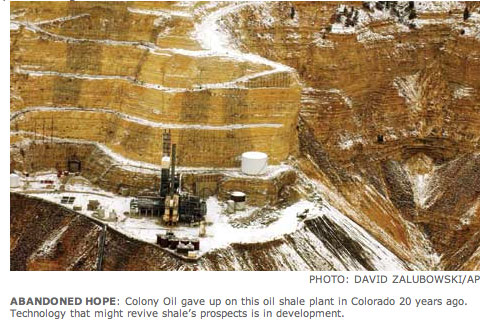
The 2012 Oil Shale and Tar Sands Final Programmatic Environmental Impact Statement is hot off the press

colonyoilshaleproject.jpg

Click here to download a copy.

From The Grand Junction Daily Sentinel (Dennis Webb):

The Bureau of Land Management today released a final proposal to go forward with sharp reductions in land to be made potentially available for oil shale development in Colorado, Wyoming and Utah.

However, the acreage reductions are somewhat less than what were laid out in a draft proposal earlier this year.

Under the proposal, about 677,000 acres would be open for application for leasing, compared to about 2 million acres under a 2008 decision under the Bush administration.

In Colorado, about 26,000 acres would be available. About 357,000 acres would be open for leasing in Utah and 293,000 acres in Wyoming.

The total acreage in the final proposal compares to about 462,000 acres that would have been made available in the draft proposal. The BLM said in a news release that the change reflects its correction of acreage identified in the draft study as lands with wilderness characteristics in Wyoming, re-evaluation of some lands designated as areas of critical environmental concern, and refinements to management of greater sage-grouse habitat to reflect information from state wildlife agencies.

However, Colorado’s acreage would continue to be a small fraction of the 360,000 acres made available in 2008.
The final plan also carries forward the draft proposal that only research, development and demonstration leases would be issued at first. Commercial leases would be issued only when a lessee satisfies conditions including those in the RD&D lease.

The final proposal also would result in about 130,000 acres being open for commercial tar sands leasing in Utah.
The agency reconsidered its 2008 decision as part of a lawsuit settlement with conservation groups. While some conservationists and others have said the agency needs to take a go-slow approach to commercial leasing given uncertainties about technologies and impacts, counties that are home to oil shale deposits have called on the agency to keep the 2008 land allocations.

U.S. Sen. Mark Udall, D-Colo., said in a statement that he welcomes the “measured steps” the Interior Department is taking to encourage oil shale research and development.

“With water being one of our most precious commodities in the West, I have concerns about the potential impacts of commercial oil shale development. Nonetheless, I look forward to seeing this technology explored further. … The Interior Department’s decision today ensures that we will not be out over the front of our skis with untested technology .”

Also today, the Colorado BLM said it signed RD&D leases with ExxonMobil Exploration Co. and Natural Soda Holdings, Inc.

The leases, which the agency had approved in August, are for technologies the two companies are planning to test to develop oil shale in place underground in Rio Blanco County. The leases take effect Dec. 1.

More oil shale coverage here and here.

Experimental Release from Glen Canyon Dam to Benefit Grand Canyon

glencanyondam030508.jpg

Update: Here’s the release from the U.S. Bureau of Reclamation (Blake Androff/Lisa Iams):

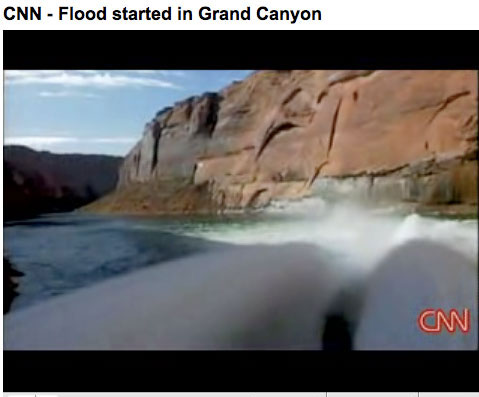
The U.S. Department of the Interior will trigger the first “high-flow experimental release” at Glen Canyon Dam since 2008 on Monday, November 19. The release is part of a new long-term protocol announced in May by Secretary of the Interior Ken Salazar to meet water and power needs, as well as to allow better conservation of sediment downstream, more targeted efforts to control non-native fish predation, and continued scientific experimentation, data collection, and monitoring to better address the important resources in the Colorado River below Glen Canyon Dam.

In cooperation with five Interior agencies, the upcoming release is designed to take full advantage of sediment deposited by Colorado River tributaries as a result of recent rainstorms and monsoons. Scientists have determined that the right conditions exist to conduct a high-flow release to benefit downstream resources, including camping beaches, sandbars, backwater habitats, riparian vegetation, and archeological sites.

The total maximum release from the dam will reach approximately 42,300 cubic-feet-per-second, consisting of 27,300 cfs of full powerplant capacity releases and a bypass release through the four river outlet tubes sending an additional 15,000 cfs of water out over the Colorado River in a spectacular visual display. The total duration of the high-flow release will be nearly five days including 24 hours at the peak release.

Click here for the current status for Lake Powell from the Bureau of Reclamation (Katrina Grantz):

Current Status
Releases from Glen Canyon Dam are currently averaging approximately 8,020 cfs with fluctuations for hydropower generation between approximately 7,000 cfs (nighttime) and 9,000 cfs (daytime). The releases in November are consistent with the Glen Canyon Operating Criteria (Federal Register, Volume 62, No. 41, March 3, 1997). The release volume for November is currently schedued as 600kaf, however, this volume may be adjusted in the event of a High Flow Experiment (see below) [ed emphasis mine].

This fall marks the first season under a multi-year High Flow Protocol announced earlier this year by Secretary Salazar. Under this Protocol, high flow releases are linked to sediment input and other resource conditions below Glen Canyon Dam. Preliminary sediment estimates appear favorable for a high flow experimental release to occur during the period of November 18 – 25, 2012 should sediment and other conditions warrant.

Reclamation’s planning activities for the high flow release are focusing on an anticipated date of November 19, 2012 for the bypass release to begin; however, no final decisions on the dates, duration or amount of the release have been made. Dam operations to ramp up to powerplant capacity prior to the bypass event would begin on November 18. During the High Flow Experiment, total releases from Glen Canyon Dam at full bypass may reach approximately 42,000 cfs. The total experiment, including ramping, could last anywhere from one and a half to six and a half days. November releases from Glen Canyon Dam prior to and after the high flow experiment would fluctuate between 5,000cfs and 8,000cfs. As more information on the potential high flow release becomes available, that information will be updated here. [ed. emphasis mine]

To view the most current reservoir elevation, content, inflow and release, click on: Lake Powell Data.

The unregulated inflow volume to Lake Powell in October was 189 thousand acre-feet (kaf) (37% of average). The release volume from Glen Canyon Dam in October was 498 kaf. The end of October elevation and storage of Lake Powell were 3619.5 feet (80.5 feet from full pool) and 13.71 maf (56.4% of full capacity). The reservoir elevation is now declining.

The water year unregulated inflow volume for 2012 was 4.91maf (45.3% of average), placing the 2012 as the third lowest on record since the closure of Glen Canyon Dam in 1963. In terms of reservoir elevation and storage, Lake Powell reached its peak for water year 2012 on June 3rd at 3636.9 ft (63.1 feet from full pool) and 15.64 maf (64.3% of capacity), respectively.

Releases for Water Year 2012 totaled 9.466 maf. Pursuant to the 2007 Interim Guidelines, Lake Powell operated under the Equalization Tier in 2012, releasing 9.463 maf, which is 8.233 maf plus 1.233 maf (the Equalization release volume from 2011 that could not be achieved by September 30, 2011). Throughout water year 2012, Reclamation adjusted operations of Glen Canyon Dam to release the appropriate annual volume during 2012 to achieve Equalization objectives as practicably as possible by September 30, 2012.

Current Dam Operations
The operating tier for 2013 is the Upper Elevation Balancing Tier, as establish in August 2012 and pursuant to the Interim Guidelines. However, if hydrologic conditions and projections become wetter, it is possible that beginning in April, the Equalization tier will govern the operations of Lake Powell for the remainder of the water year. Based on analysis of a range of inflow scenarios, the current probability of realizing an inflow volume that would trigger Equalization in 2013 is approximately 20 percent. As hydrologic conditions for Lake Powell and Lake Mead change throughout the year, Reclamation will adjust operations of Glen Canyon Dam to release the appropriate annual volume during 2013 to achieve the governing operating tier objectives as practicably as possible by September 30, 2013.

Releases from Glen Canyon Dam in November are currently averaging approximately 8,020 cfs with daily fluctuations between 7,000cfs and 9,000cfs and consistent with the Glen Canyon Operating Criteria (Federal Register, Volume 62, No. 41, March 3, 1997).

The anticipated release volume for November is 600 kaf with fluctuations for power generation throughout the day consistent with the Glen Canyon Operating Criteria (Federal Register, Volume 62, No. 41, March 3, 1997). However, the release volume may be adjusted in the event of a High Flow Experiment. This fall marks the first season of a multi-year High-Flow Protocol, under which high flow releases are linked to sediment input and other resource conditions below Glen Canyon Dam. Preliminary analysis appears favorable for a high flow experimental release to occur during the period of November 18 – 25, 2012. During the High Flow Experiment, total releases from Glen Canyon Dam at full bypass may reach approximately 42,000 cfs. The total experiment, including ramping, could last anywhere from one and a half to six and a half days. In the event of a high flow experiment, releases from Glen Canyon Dam prior to and after the high flow experiment are anticipated to fluctuate between 5,000cfs and 8,000cfs.

In December, the release volume will likely be about 800 kaf, with fluctuations throughout the day from about 8,250 cfs in the early morning to about 16,250 cfs in the early evening. In January, the release volume will likely be about 800 kaf with daily fluctuations for hydropower.

In addition to daily scheduled fluctuations for power generation, the instantaneous releases from Glen Canyon Dam may also fluctuate to provide 40 MW of system regulation. These instantaneous release adjustments stabilize the electrical generation and transmission system and translate to a range of about 1,100 cfs above or below the hourly scheduled release rate. Typically, fluctuations for system regulation are very short lived and balance out over the hour and do not have noticeable impacts on downstream river flow conditions.

Releases from Glen Canyon Dam can also fluctuate beyond scheduled fluctuations for power generation when called upon as a partner that shares reserve requirements within the electrical generator community (i.e. balancing area). To provide system reliability, all participating electricity generators within the balancing area maintain a specified level of generation capacity (i.e. reserves) that can be called upon when an unscheduled outage occurs. Glen Canyon Dam typically maintains 43 MW of reserves (approximately 1,100 cfs) for this purpose. Reserve calls can be maintained for a maximum of 2 hours after which time the generation rate should be returned to the original schedule. If reserves from Glen Canyon Dam are called upon, releases from the dam can exceed scheduled levels and can have a noticeable impact on the river downstream from Glen Canyon Dam. Calls for reserves are fairly infrequent and typically are for much less than 43 MW.

Current Inflow Forecasts and Model Projections
The hydrologic outlook forecast for water year 2013 projects that the most probable (median) unregulated inflow volume will be 7.60 maf (70% of average based on the period 1981-2010). Based on this hydrologic outlook, the October 24-Month study projects the annual release volume for water year 2013 will be 8.23 maf and the end of water year reservoir elevation and storage for Lake Powell will be 3608.52 (91.48 feet from full pool) and 12.582 maf (51.7% capacity), respectively.

If hydrologic conditions and projections become wetter, it is possible that beginning in April, the Equalization tier will govern the operations of Lake Powell for the remainder of the water year and the release volume for 2013 could be greater than 8.23 maf. Based on analysis of a range of inflow scenarios, the current probability of realizing an inflow volume that would trigger Equalization in 2013 is approximately 20 percent.

Upper Colorado River Basin Hydrology
Since water year 2005, the Upper Colorado River Basin has experienced significant year to year hydrologic variability. The unregulated inflow to Lake Powell, which is a good measure of hydrologic conditions in the Colorado River Basin, has averaged a water year volume of 10.22 maf (94% of average (period 1981-2010)) during the period from 2005 through 2012. The hydrologic variability during this period has been from a low water year unregulated inflow volume of 4.91 maf (45% of average) in water year 2012 to a high water year unregulated inflow volume of 15.97 maf (147% of average) in water year 2011. Based on observed inflows and current forecasts, water year 2013 unregulated inflow is expected to be 7.59 maf (70% of average).

Overall reservoir storage in the Colorado River Basin has increased by over 4 maf since the beginning of water year 2005 and this is an improvement over the persistent drought conditions during water years 2000 through 2004. From the beginning of water year 2005 to the beginning of water year 2013, the total reservoir storage in the Colorado River Basin increased from 29.8 maf (50% of capacity) to 33.9 maf (57 % of capacity). However, this period experienced increases and decreases in total Colorado Basin storage in response to wet and dry hydrology.

Thanks to Lake Powell Life for the heads up:

The Bureau of Reclamation will conduct a high flow experimental release of water from Lake Powell back into the Colorado River at Glen Canyon Dam mid-month, possibly between November 18th and November 25th. During the experiment, total releases from the dam at full bypass may reach 42-thousand Cubic Feet per Second. The experiment may last anywhere from a half-day to six-and-a-half days.

A BOR spokesperson says the high release flows mimic historical pre-dam spring floods and runoffs. The effects of the experimental high flow release on the downstream ecosystem of the Colorado River will be studied and analyzed. The Glen Canyon Dam Adaptive Management Program (AMP) was established in 1997 to provide for long-term research and monitoring of downstream resources. The scientific information obtained under the Adaptive Management Program is used as the basis for recommendations for dam operations and management actions.

More Colorado River Basin coverage here and here.

Piñon Ridge uranium mill hearing recap

pinonridgesite.jpg

From email from the Sheep Mountain Alliance (Hillary White):

After opening statements by all the parties kicked off the proceedings on Wed., Frank Filas, Environmental Project Manager for Energy Fuels took the stand and remained there through most of today. Mr. Filas’ testimony generally covered the entire length of the application submitted by Energy Fuels and set up the opportunity for SMA’s experts to point several deficiencies during the next few days. Matt Sandler for Rocky Mountain Wild conducted his cross examination today focused on wildlife impacts and NEPA and ESA adherence.

After Mr. Filas the focus turned to air quality impacts. Dr. Craig Little, a health physicist and radio ecologist who did the air dispersion modeling for Energy Fuels took the stand. It was a rather technical discussion and seemed to leave more questions than answers. Main questions surrounded the type of modeling used and if it could adequately address long distance impact determinations.

Next, Nancy Chick who works for the State in the Air Pollution Control Division (APCD) was called. As an aside, the APCD has been processing Energy Fuels air quality permit, a necessary part of the license for several years. The department has sent data and modeling back to Energy Fuels several times and analysis is ongoing but somewhat on hold according to the department. Ms. Chick testified to the data she has considered to date…

During the first 2 days there have been many strong comments helping SMA establish that record. We know the residents of the West End deserve good jobs and a healthy economy, but if they want a uranium mill to provide that for them we much know the cost of that mill not only to their communities but to the surrounding ones as well. Without the real costs and analysis of real impacts no one can make an informed decision.

More coverage from Gus Jarvis writing for The Telluride Watch. From the article:

Two days before the Colorado Department of Public Health and Environment began a new public hearing process over Energy Fuels, Inc.’s application for a radioactive materials license to build the proposed Piñon Ridge Uranium Mill, a group of residents who live near the Cotter Uranium Mill/superfund site in Cañon City sent a letter to Judge Richard Dana over concerns about the state’s ability to provide adequate over a new uranium mill.

The letter from the Colorado Citizens Against Toxic Waste group, a nonprofit organization, was sent to Dana on Monday. Dana is presiding over the hearing, which began in Nucla Wednesday evening.

The members of the group, who live near the Superfund site in Cañon City, stated in their letter that their concerns about the new Piñon Ridge mill stem from years of experience in dealing with CDPHE regulators on the Cotter Mill cleanup, which has been managed by the state since the late 1980s.

“Our biggest concern is that our state does not have the staff or the resources devoted to regulating a site like this, and that is where a lot of problems will come from,” the group’s co-chair Sharyn Cunningham said in a telephone interview Monday. “If the mill is built, and once they find contamination – and they will – our concern is whether or not the people living nearby will be protected by the state agencies.

“I do not believe they will be protected.”

More coverage from Heather Sackett writing for The Telluride Daily Planet. From the article:

About 25 audience members filtered into the wood-paneled room for the last hour of the hearing, which had been set aside for public comment. Placerville resident Dan Chancellor said his father’s home near Grand Junction had been built on a pile of mine tailings. At age 58, his father died of a type of lung cancer associated with radioactive materials, he said.

“Will you fail again to protect me and my family?” Chancellor asked. “There is no guarantee about jobs.”

But Ayngel Overson, a lifelong resident of Nucla, echoed a point of view held by many in the economically depressed West End. She said her grandfather was a uranium miner, and that the mill opening represents jobs in the rural area. She choked up as she described a community in decline and how graduating classes at Nucla High School have dwindled to around a dozen. She addressed her comments to those opposing the mill.

“For five years we have been waiting for jobs,” Overson told the crowd. “We can’t make it anymore … Right now, this is all they’ve got. Uranium doesn’t scare us. It’s something we’ve learned to live with. You are stopping people from surviving.”

But the aim of the four-day hearing, which continues through Monday, is not to argue the merits or dangers of the proposed mill. The purpose of the long-anticipated hearing, held at the Loyal Order of the Moose Lodge in Nucla, is for Toronto-based Energy Fuels, Inc. to supplement its application for a radioactive materials license and to give those with party status the opportunity to cross-examine the company’s representatives.

More nuclear coverage here and here.

Drought news: Fire danger still high in Northwestern Colorado #CODrought

pinewoodreservoirberthoudrecorder.jpg

From Steamboat Today:

Area fire departments put out a 40-acre wildfire near Sleeping Giant on Monday that began as an agriculture burn before getting out of control because of strong winds and dry vegetation. On Tuesday, South Routt firefighters extinguished a small wildfire that temporarily shut down Colorado Highway 131 between Phippsburg and Yampa.

Rifle: Voters approve additional sales tax to help finance new water treatment plant

riflegap.jpg

From The Rifle Citizen Telegram (Mike McKibbin):

By an overwhelming margin, Rifle voters said they wanted to share the cost of a new water treatment plant with shoppers and approved a 3/4 of a cent sales and use tax rate hike in Tuesday’s general election. Question 2A asked voters to approve the increase in exchange for lower future water rate hikes needed to build and operate a new $25 million water treatment plant…

The tax hike will take effect in January, raise an estimated $1.65 million a year, and increase the city’s sales and use tax rate from 3.5 cents to 4.25 cents…

The city borrowed $25.5 million from the Colorado Water and Power Development Authority to build the new plant. The loan comes from a special fund dedicated to water projects. The effective interest rate will be 1.86 percent, with $2 million loaned interest-free, resulting in what city officials called “an overall historic low loan rate.”

Repayment requirements of the loan led to sharply higher water rates in September, and more than doubled some customers’ water bills, payable in October. Money from the higher water rates will help pay for operations and associated costs of the new plant.

Miller said a few months into the new year, the city will look at how revenues are coming in from the tax hike, then very likely sharply reduce the September rate hikes, both base and tiered rates.

More Rifle coverage here.

Forecast news: ‘Heavy snow, strong winds, and plummeting temperatures will be the norm for much of the West’ — NWS #CODrought #COwx

usdroughtmonitor11062012.jpg

From the NWS:

A DEEP UPPER-LEVEL TROUGH WILL MOVE FROM THE WEST COAST TO THE ROCKIES BY SATURDAY. A QUASI-STATIONARY FRONT EXTENDS FROM THE UPPER GREAT LAKES SOUTHWESTWARD TO THE CENTRAL ROCKIES THEN SOUTH TO SOUTHERN CALIFORNIA. THE WESTERN PART OF THE BOUNDARY WILL MOVE EASTWARD TO WESTERN TEXAS AS THE UPPER-LEVEL TROUGH MOVES EASTWARD BY SATURDAY EVENING. THE SYSTEM WILL PRODUCE SNOW OVER NORTHERN/CENTRAL ROCKIES/GREAT BASIN AND SOME OF THE HIGHER ELEVATIONS ALONG THE WEST COAST ON FRIDAY. THE PRECIPITATION WILL WANE TO A FEW POCKETS OF SNOW OVER PARTS OF THE NORTHERN/CENTRAL ROCKIES AND THE GREAT BASIN ON SATURDAY. RAIN WILL ALSO DEVELOP OVER PARTS OF THE SOUTHWEST THROUGH SATURDAY MORNING.

From The Pueblo Chieftain (Matt Hildner):

The National Weather Service office in Pueblo issued a winter storm warning for elevations above 10,000 feet. Combined with wind gusts of up to 60 mph, the snowfall is expected to make conditions treacherous for drivers on U.S. 160 over Wolf Creek Pass and on Colorado 17 over Cumbres and La Manga passes…

South Fork is expected to see 1 to 2 inches of snow Saturday night, while the weekend storm could leave between 3.5 to 7 inches at Creede. The Sangre de Cristo Mountains are not expected to get the brunt of the storm. La Veta Pass will likely get no more than an inch of snow, according to weather service forecasts.

Longmont makes history as first city to ban hydraulic fracturing

marcellushydraulicfracturing.jpg

From NorthCentralPA.com:

Today [November 6, 2012] is a historic day for the city of Longmont, Colorado. Nearly 60 percent of Longmont voters approved an amendment to the city’s charter to prohibit hydraulic fracturing, more commonly known as fracking, and disposal of waste products connected with the process within city limits.

For more than six months Longmont and its citizens have been of threatened, bullied and out-spent by the oil and gas industry. Longmont’s victory over this highly industrialized and dangerous oil and gas extraction process signals to communities throughout the state and the nation that they can and will prevail over state officials who answer to the oil and gas industry rather than to their constituents.

According to Michael Bellmont, a member of Our Health, Our Future, Our Longmont (Our Longmont), “We have shown that Big Oil money does NOT always win and that our constitutionally guaranteed right to health, safety, and protection of property is NOT for sale. We proved that ordinary citizens with very little money but a lot of determination, intelligence, passion and boot leather can prevail.”

Over 100 volunteers worked in hot summer days to gather the necessary signatures to place the measure on the ballot. Over 8,200 signatures were submitted, well over the 5,700 required to move the measure to today’s ballot. Also, more than 200 citizens contributed the funds necessary to carry out the Yes on 300 campaign. The opposition raised over a half-million dollars to oppose Question 300. All of their funds came from the oil and gas industry and their trade associations. Not one Longmont resident contributed.

“The people of Longmont have made history: they have chosen to ban fracking,” said Sam Schabacker, a Longmont area native and Mountain West Regional Director for Food & Water Watch, the national consumer group who supported Our Longmont’s efforts. “Longmont residents were not frightened away or fooled by the oil and gas industry’s attempt to buy the election, to the tune of $500,000, through deceptive and threatening TV commercials, full-page newspaper advertisements and multiple mailers. Hopefully this citizen-led effort will inspire other communities to stand up and protect their health, safety and property against the risky practice of fracking as well.

Our Health, Our Future, Our Longmont, a group of concerned citizens from throughout Longmont, believes that Longmont has a right to protect the public health, safety, and welfare of our community. By protecting the health, safety, and welfare of our citizens, we will preserve our economic vitality, our home values, our water, parks, wildlife, lakes, trails, streams, open space, recreational areas and our quality of life for ourselves and future generations.

More oil and gas coverage here.

‘The water levels in the San Luis Valley aquifers are dropping, and have been dropping’ — Craig Cotten

slvdischargerecharge.jpg

Here’s the latest installment in the Valley Courier’s Colorado Water 2012 series, written by Craig Cotten. Here’s an excerpt:

The Rio Grande is in the fourth year of below average streamflows. Other parts of Colorado are also in a severe drought this year, with some areas having a more severe single year drought than the San Luis Valley. However, much of Colorado had very good precipitation and streamflow last year which filled their reservoirs and aquifers. In fact, some areas in the northern part of the state had one of their best years ever last year in terms of precipitation and streamflow, while this basin languished in the midst of a multi-year drought. Since the extreme drought year of 2002, there have only been three years of above normal flow on the Rio Grande and only two years on the Conejos River. Some smaller streams around the valley have fared even worse, with only one year of above normal flows in the last ten.

The water levels in the San Luis Valley aquifers are dropping, and have been dropping, over the last several years. This drop is in response to the lower than normal recharge into the aquifers from the area rivers, streams, and ditches. After seeing modest gains during the years of 2007 to 2009, the unconfined aquifer is once again dropping substantially.

According to the aquifer study conducted by Davis Engineering, the unconfined aquifer in the West Central part of the San Luis Valley has lost nearly 500,000 acre-feet of water during the last three years. There is not a formal, comprehensive study of the confined aquifer throughout the Valley, but this aquifer is also seeing significant declines in the amount of artesian pressure. While it is not known exactly how much water is in the aquifers, it is obvious that the San Luis Valley cannot continue this drastic drop in the aquifers without severe long-term consequences…

In order to address the problem of injury to surface water users and the decline in the aquifers due to well pumping, the State Engineer is in the process of developing Rules and Regulations concerning the withdrawal of groundwater in Division 3. The State Engineer is being assisted in the development of these rules by a 55 member advisory committee made up primarily of area water users.

While these rules are not completed yet, we do know generally what they will require. In general, the rules will require that large capacity wells in the San Luis Valley repay the injury that they are causing to senior water rights, which are generally ditch and canal rights. In addition, the rules will have a sustainability component which will require that well owners ensure that the underground aquifers are brought back to a sustainable level.

The repayment of injurious depletions and ensuring sustainability can be accomplished by a well owner in two ways. A well owner may choose to implement an individual augmentation plan in which that owner will cover his individual well or wells. Otherwise, a well owner may choose to join a subdistrict, which, in exchange for monetary payment, will provide the repayment of injurious depletions and the sustainability of the aquifers for that owner.

More Colorado Water 2012 coverage here.

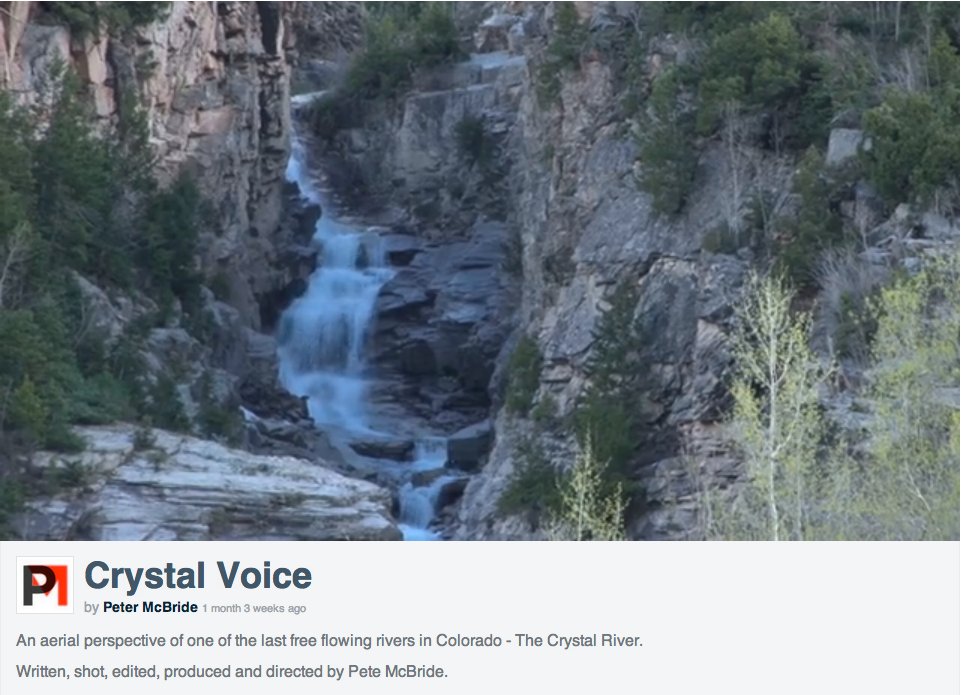
Restoration: Coal Basin mitigation project seeks to lessen the sediment load transported to the Crystal River

coalbasinusgs.jpg

biocharproduction.jpg

From the Grand Junction Free Press (Rose Ann Sullivan):

Earlier this year, Dr. Russ Walker, head of the Colorado Mesa University Department of Physical and Environmental Sciences, participated in a workshop that brought nearly 50 resource experts together to develop a strategy for carrying on critical restoration work in Coal Basin and in the downstream confluence area where Coal Creek meets the Crystal River near the town of Redstone, Colo. He presented the results of CMU’s evaluation of existing water quality data and made recommendations for future monitoring. The workshop and water quality assessment were funded by the Pitkin County Healthy Rivers and Streams Fund.

Participants in the Coal Basin & Crystal River Area Restoration Workshop immediately identified a series of data gaps that needed to be addressed in order to provide a sound foundation for the continued restoration effort. The lack of adequate baseline water quality data was among the significant issues. Fortunately, funding has just been obtained from the Colorado Water Conservation Board (CWCB) that allows collection and analysis of water quality data from Coal Creek and the Crystal River in order to provide the baseline data necessary to assess the effectiveness of this comprehensive, high-profile restoration effort.

Over $300,000 in Colorado Water Supply Reserve Account grant funding was recently awarded to the Roaring Fork Conservancy for “Crystal River Watershed – Assessment and Design of Restoration Projects.” Roaring Fork Conservancy and the U.S. Forest Service White River National Forest are coordinating the long-term restoration effort with the assistance of CMU and other stakeholders, including the U.S. Forest Service, U.S. Army Corps of Engineers, Colorado Department of Transportation, Pitkin County, Colorado Parks and Wildlife, private landowners, and the Crystal Valley Environmental Protection Association.

The CWCB funding will be used to conduct a series of assessments to identify the continued sources of sediment loading and the geomorphic processes that are degrading water quality and damaging instream and riparian habitat in the Coal Basin sub-watershed and contributing to sedimentation issues in the Crystal River. This information will be supplemented with new stream flow, sediment, water quality, macroinvertebrate and meteorological data, and used to prioritize and design a series of site- and process-specific restoration projects for the Crystal River Watershed — with emphasis on Coal Basin and the Coal Creek/Crystal River confluence area.

The funding will also help cover the costs of a decommissioned mining road reclamation pilot project already underway in Coal Basin. This pilot effort will assess the cost-effectiveness and utility of using biochar, coupled with drainage improvements, to reduce the toxicity of surface runoff, improve the water and nutrient-holding capacity of soils, and enhance the growth of native vegetation.

Dr. Walker and his CMU team will continue to work with the Roaring Fork Conservancy on water quality monitoring for parameters that reveal basic aspects of water quality, and those that are of the most concern. Over the next two years the restoration effort will be guided by both water quality data analysis and an assessment of trends over time – as specific restoration projects and programs are implemented in the watershed.

Follow the Coal Basin and Coal Creek/Crystal River confluence area restoration efforts on the Roaring Fork Conservancy’s website at http://www.roaringfork.org/coalbasin.

Here’s the link to the USGS webpage about aerial inspection of the basin earlier this year.

More restoration/reclamation coverage here.

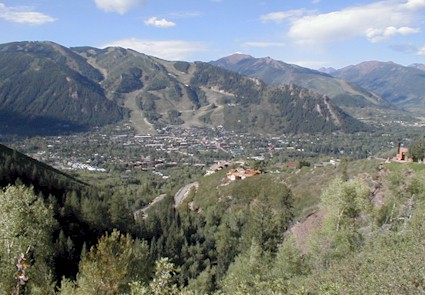
2012 Colorado November election: Aspen voters say no to proposed Castle Creek hydroelectric generation plant

aspen.jpg

From The Aspen Times (Andre Salvail):

By a mere 110 votes, Aspen voters rejected an advisory question designed to move the city’s controversial Castle Creek hydroelectric power project forward…

Tom and Maureen Hirsch, vocal opponents of the project and residents on the banks of Castle Creek, said they might have supported a city initiative that was more eclectic. A mix of micro hydroelectric projects with other types of renewable energy efforts such as wind and solar power would be more acceptable to the community, they said, but the city instead decided to focus all of its efforts on Castle and Maroon creeks…

Over the last two years, city officials and others supporting the project, including Mayor Mick Ireland, sought to turn the debate into one of environmental stewardship, saying the hydroplant on Castle Creek would eventually eliminate the city electric utility’s reliance on power generated by coal, a nonrenewable resource.

More hydroelectric coverage here and here.

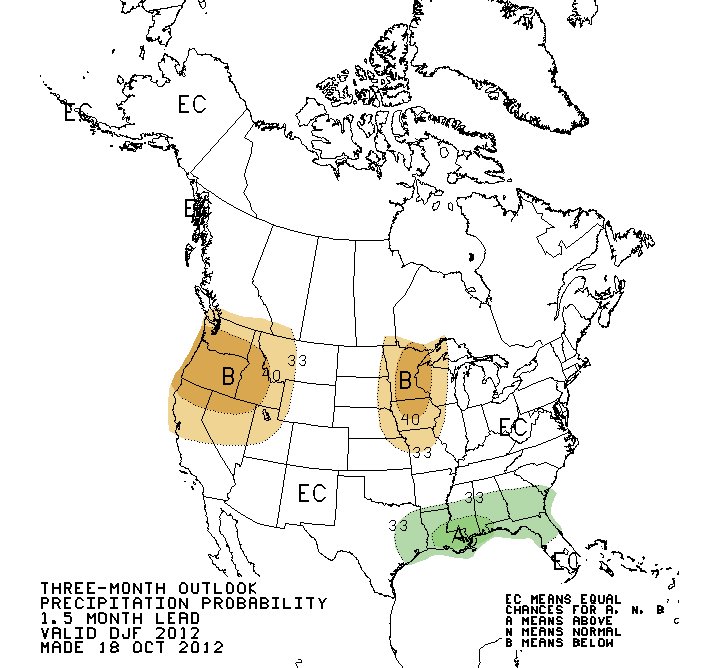
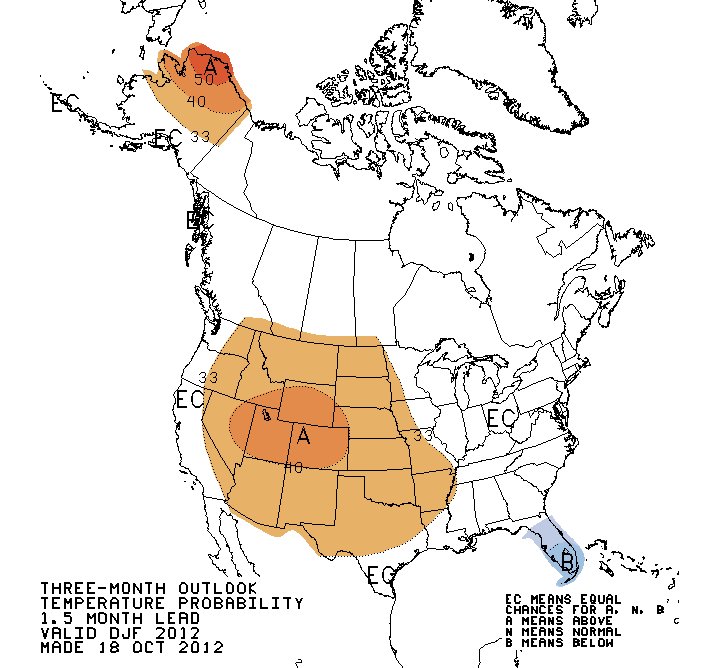
Forecast news: Rain and snow on the way for Colorado, warm with equal chances for above or below average precipitation over the next few months #CODrought

threemonthprecipitationcpc10182012.jpg

threemonthtemperaturecpc10182012.jpg

Click on the thumbnail graphics for the three month (Dec/Jan/Feb) precipitation and temperature forecast maps from the Climate Prediction Center.

From the Fort Collins Coloradoan:

Saturday’s forecast calls for rain and snow showers, turning to snow later in the evening. Snow showers could linger through Sunday morning.

From The Durango Herald (Dale Rodebaugh):

There is a chance of rain showers late Thursday. The chances increase Friday, with snow possible Friday night through Saturday as temperatures drop. “I wouldn’t be surprised if you got snow in (Durango), maybe 1 or 2 inches,” meteorologist Tom Renwick said. “It’s still a couple of days away, but snow isn’t out of the question.”

Mrs. Gulch is still harvesting broccoli, kale and lettuce from the vegetable garden.

Colorado State University Obtains $1.4 Million DOE Grant to Improve Water Management during Shale Oil and Gas Production

oilrigssharingaplatformfrontrangeschoolofminesalfredeustes.jpg

Here’s the release from Colorado State University (Emily Narvaes Wilmsen):

Ken Carlson, a civil engineering professor at Colorado State University, will work with Noble Energy Inc. on a new $1.4 million U.S. Department of Energy grant to optimize water management associated with Noble’s oil and gas production in the Denver-Julesburg Basin in Weld County.

The two-year project, awarded through DOE’s Research Partnership for Sustainable Energy in America, aims to assess and improve water acquisition, transportation and disposal.

Carlson and his partners will work to develop computer modeling and online training materials in partnership with industry. He expects that the project will also benefit communities by reducing truck traffic, air emissions and use of water resources. The study will develop tools that will assist industry in siting and designing water treatment plants that are an essential part of the drive to recycle oil and gas related wastewater.

“This is driven by efficiency and if the industry’s more efficient with water use, there’s less risk of environmental impact,” he said. “Another benefit of recycling is a reduction of stress on agriculture water and a reduced risk of regional water depletion.”

Carlson notes, “Optimizing management of water during drilling and hydraulic fracturing could mitigate other environmental impacts including ecological degradation due to excessive truck traffic and the associated dust and land disturbance.

“There are 19,000 active wells in Weld County and most produce some water. Do we have 100 water treatment plants? Do we have one? Is it better to use some water for reuse in industry and other for agriculture? The study will develop industry targeted geographic information system (GIS) based tools that can be used to assess the logistics of water use, transportation, reuse and disposal.”

“This is the kind of public-private partnership that we support in Weld County where we have to balance the economic benefits of industry with environmental impacts on our communities,” said Weld County Commissioner Barbara Kirkmeyer. “We look forward to the results of Dr. Carlson’s research.”

“Our corporate purpose is Energizing the World, Bettering People’s Lives,” said Ted Brown, Senior Vice President – Northern Region of Noble Energy. “As we continue to increase activity in the DJ Basin, we seek solutions to maximize efficiencies while minimizing impacts. Our ongoing partnership with CSU is key in achieving this goal, and living up to that corporate purpose.”

“Working together with environmental groups, industry leaders and scientists, Colorado State can act as an objective third-party to understand the complexities of the energy industry and communicate those complicated issues to the general public,” Carlson said. “We hope this collaboration will provide a unique opportunity to protect Colorado’s water resources while also enabling economic growth from the boom in oil and gas development in the region.”

Kirkmeyer is the chair and Carlson is the co-director of the Colorado Energy Water Consortium, a partnership in northern Colorado that includes government, industry, environmental groups, agricultural interests and CSU leaders working together to solve water issues associated with oil and gas drilling development including hydraulic fracturing.

Carlson is an expert on water management associated with oil and gas drilling and pollutants that can affect drinking water supplies. Also collaborating on the DOE study from CSU are Tom Bradley, an assistant professor of mechanical engineering who is an expert in systems management, and Kimberly Catton, a research scientist in civil engineering with extensive GIS experience.

More oil and gas coverage here and here.

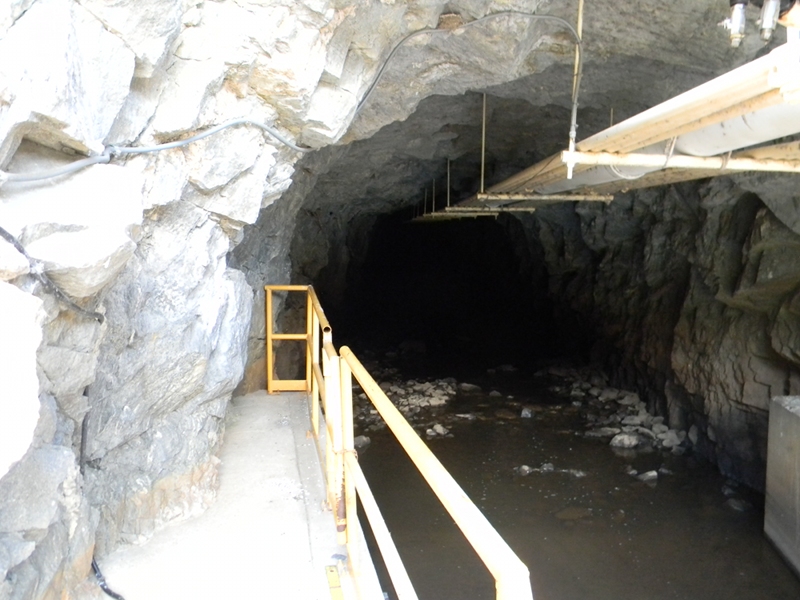
‘It costs 10 times more to clean out a reservoir than to build a new one’ — Jon Monson

miltonseamanreservoiroutlettunnel07252011.jpg

From the Fort Collins Coloradoan (Bobby Magill):

Experts from around the region painted an uncertain picture of the area’s water future Wednesday morning at Northern Water’s fall water user’s meeting in Greeley.

As ash and silt continue their relentless descent into the Poudre River during even tiny rainstorms, Fort Collins will have to spend much more money on water filtration and purification in the coming years and potentially treat drinking water with additional chemicals to ensure the muck stays away from your faucet, Fort Collins water production manager Lisa Voytko said. The silt washing into Seaman Reservoir from the Hewlett and High Park wildfire burn areas could be costly to Greeley, said Jon Monson, the city’s water and sewer director…

Voytko said she’s worried about spiking levels of total organic carbon in Poudre River water every time it rains. That’s because the carbon has to be removed with chlorine, a process that creates potentially toxic byproducts in drinking water that have to be removed at great expense. Polymers have to be used to remove the turbidity from the drinking water, and it’s expensive to dispose of the byproducts of that process, she said…

The summer’s wildfires have clogged Fort Collins’ water intake structures on the Poudre River with sediment and debris, reducing their intake capacity. The sediment washing off the burn areas is so extreme that the city had to flush out its intake structures four times in September. Normally, the city flushes them once a year. Then there’s a concern all the silt and muck in the Poudre River and Seaman Reservoir could cause major algae blooms, further degrading the water quality and treatment expense, Voytko said.

More water pollution coverage here.

Rocky Mountain famous Alto Cumulus Standing Lenticular cloud over the Continental Divide of Northern Colorado

Colorado Springs Utilities: SDS pipe installed under Fountain Valley Authority pipe

Denver Water warns about lead in water in older homes with outdated plumbing

romanleadpipesciencemuseumuk.jpg

Here’s the release from Denver Water (Stacy Chesney/Travis Thompson):

Denver Water wants to remind customers that if you live in an older home, you may have lead in your plumbing, which could affect the water coming out of your tap.

Every year, Denver Water collects more than 10,000 water samples, runs more than 50,000 water quality tests throughout its system, and mails a water quality report to customers to describe the overall quality of water from collection and storage to customers’ taps. Lead is not found in Denver’s source water (rivers and reservoirs), treated water or public water system.

In addition to testing throughout its public system, for the past 20 years Denver Water has conducted a testing program inside homes with lead plumbing. In the utility’s most recent testing, water samples from 60 homes were analyzed. Eight of those samples showed lead levels that were higher than the federal standard. All eight homes were built before 1920.

“The health and safety of all our customers is very important to us,” said Tom Roode, director of Operations & Maintenance for Denver Water. “We thoroughly test our water before and after treatment and as it flows through our pipes in the street, so we know lead is not present in the public water system. But, lead was used for years in paint, plumbing and other household products, and still exists in older homes and buildings. In our experience, the structures most likely to have lead plumbing issues were built in the mid-1950s or earlier.”

Customers who are concerned about their home plumbing should consider taking the following steps:

– Run your water to flush out lead. If it hasn’t been used for several hours, run the cold water tap until the temperature is noticeably colder. This flushes lead-containing water from the pipes.
– Always use cold water for drinking, cooking, and preparing baby formula.
– Do not boil water to remove lead. Boiling water will not reduce lead.
– Consider investing in a water filtration system. Filters must meet NSF Standard 53, and they range from pitchers that cost as little as $20 to under-sink systems for $100 or more. More information can be found at www.nsf.org or by calling 1-800-NSF-8010.
– Have your household water tested by a state-certified laboratory. You can find a list of reputable, certified labs at www.coloradostatelab.us.
– Identify and replace plumbing fixtures containing lead. Brass faucets, fittings and valves, including those advertised as “lead-free,” may leach lead into drinking water. Use only lead-certified contractors for plumbing work.
– Have a licensed electrician check your wiring. If grounding wires from your electrical system are attached to your pipes, corrosion may be greater. Check with a licensed electrician or your local electric code to determine if your wiring can be grounded elsewhere.

“Because there were eight homes with elevated levels of lead among our sample group, we are required by Federal regulations to let all customers know about the issue,” said Roode. “In addition to notifications about lead plumbing that we send to customers each year in our water quality report, we want to use this opportunity to raise awareness in the community and provide our customers with information to take appropriate steps.”

Denver Water customers will receive a brochure in the mail, which contains the required notice as well as educational information, by the end of November. The brochure and additional information are available on Denver Water’s website, http://www.denverwater.org/lead.

Additional information on lead can be found at www.epa.gov/lead, www.cdc.gov/nceh/lead and in this fact sheet.

More coverage from Bruce Finley writing for The Denver Post. Here’s an excerpt:

The lead concentrations measured in samples from 60 homes exceeded the federal drinking water standard of 15 parts per billion by as much as 3.8 times. The 13 percent of Denver homes that had high lead levels, up from 8 percent of homes in 2011, is the highest percentage logged in 12 years, according to Denver Water data provided to the Denver Post…

While sources of Denver water in the mountains traditionally have been safe, more than half of homes may have lead pipes — either inside the houses or connecting them to Denver Water mains. The lead can be disturbed if pipes are cut or corroding, which lets it leach into water that eventually flows from taps…

Denver Water teams tested household water between June and August. They collected water from 60 homes built between 1880 and 1989 that still have lead plumbing. Eight had lead in water exceeding the 15 ppb standard, which the EPA set as the lowest level that reasonably could be enforced. The tests showed concentrations of 17, 17, 18, 19, 23, 29, 31 and 57 ppb. These results came from homes built before 1920…

Denver Water officials say they don’t see this as a growing problem, despite data showing 13 percent of homes with lead plumbing are affected — the highest since 2000. They point out that calcium and other minerals occurring naturally in mountain source water can insulate lead pipes and prevent contact with water.

More Denver Water coverage here.

CU working on saving only Greenback cutthroat population from extinction

cutthroattrouthistoricranges.jpg

From The Pueblo Chieftain (Larry Lopez):

How much do Coloradans really know about their state fish?

Did you know, for example, that there are only an estimated 750 of them in the hundreds of miles of state waters.

In case you didn’t know, the greenback cutthroat trout was designated Colorado’s official state fish of Colorado in 1994, to recognize a true Colorado trout. Previously, the state fish was the rainbow trout — a fish that had been imported into Colorado in 1882.

Originally considered indigenous to many small streams and rivers throughout the Arkansas and South Platte river basins in Colorado, the greenback eventually wound up on the verge of extinction at the time of its designation, as loss of good habitat and the introduction of additional species of trout took a toll.

The recent release of a new research by scientists at the University of Colorado noted that the last surviving population of true greenbacks in Colorado is limited to Bear Creek, a tiny stream on the slope of Pikes Peak west of Colorado Springs.

“We’ve known for some time that the trout in Bear Creek were unique,” said Doug Krieger, a senior aquatic biologist for Colorado Parks and Wildlife Service.

“But we didn’t realize they were the only surviving greenback population,” Krieger added.

The findings of the CU researchers, Jessica Metcalf and Andrew Martin, were startling, said Theo Stein of the service’s Denver office.

“It opened the window of this fish that surprised a lot of people. We didn’t know we’re one stream away from extinction of the state fish,” Stein said.

The number of greenback living in the four­mile reach of Bear Creek was estimated from fish sampling completed in 2011. However, the actual number could vary as sampling in these type of headwater streams can be difficult.

The study also found that a previously undiscovered San Juan Basin cutthroat and the yellowfin cutthroat trout (which was originally found in the upper basin around Leadville) also are extinct.
It has meant a change in the service’s thinking on management of the greenback.

To complement the new research findings, the Greenback Cutthroat Trout Recovery Team has begun working with Colorado State University to reexamine the physical characteristics of Colorado cutthroats. When completed, scientists will compare results from physical examination with the genetic analysis in hopes of further clarifying the evolutionary relationships among native cutthroat trout.

In the meantime, Colorado Parks and Wildlife and the U.S. Fish and Wildlife Service have begun growing a broodstock of greenback in two hatcheries with hopes of transplanting a new population back to the wild by 2014. Krieger is optimistic about the future of greenback cutthroats and suggests that, “This fish was found in many streams before settlers came to Colorado, and we hope to expand greenbacks to more places so that people can enjoy this legacy once again.”

More endangered/threatened species coverage here.

The Colorado Water Innovation Cluster will host Innovation After Hours from 4-6 p.m. Thursday

fortcollins.jpg

From the Fort Collins Coloradoan:

The Colorado Water Innovation Cluster will host Innovation After Hours from 4-6 p.m. Thursday at the Rocky Mountain Innosphere, 320 E. Vine Drive, Fort Collins.

Carbo Analytics LLC, OptiEnz Sensors and Logimesh Technologies will present on Northern Colorado projects taking place.

To register for the event, visit http://bit.ly/InnovationAH.

‘I think they [developers] should guarantee 200 years worth of water’ — Paul Ransford

suburbs.jpg

From The Aspen Times (Paul Anderson):

The state is already challenged to provide enough water for current residents and also provide for new growth and development in Front Range cities. Urban planners are now beginning to look long term at water consumption by requiring developers to ensure water supplies a century or more into the future.

“I think they should guarantee 200 years worth of water,” says [Ken Ransford, a water expert with the Colorado Basin Roundtable], who believes that the availability of water is a critical issue if Colorado is to have a sustainable future. Ransford is looking that far ahead because of sobering tree ring studies that forecast a dry future.

The New York Times published a bold headline on August 12: “Hundred-Year Forecast: Drought.” The article describes how tree ring evidence in the American West reveals fluctuating patterns of rain and snowfall.

Since about 1980 the West has seen high moisture levels. According to tree rings, this is a spike that hasn’t been seen since the age of Christ 2000 years ago. The West has been enjoying a very wet 30 years, at least compared with historic droughts, but all that is sure to change if the tree rings speak the truth.

“How will we adapt to a rise in population and a drop of water levels?” asks Ransford. Not only have Westerners become habituated to having plenty of water, we have not looked very seriously at the eventuality of considerable shortfalls.

One solution is to dewater farms and ranches in favor of other, higher paying water users, like subdivisions in urban growth areas where developers are better able to afford high water prices than farmers and ranchers.

The implications are dire if water becomes extremely expensive and agriculture is unable to compete with other water customers. Food production will become more distant and more likely done by agribusiness.

Cool, clear water will become one of our most precious commodities, as it certainly has for some Missouri Heights homeowners. This most essential element of life will be channeled more and more into large population areas, dewatering our rivers and streams on the Western Slope.

Ransford advocates for water efficiency rather than dewatering traditional agriculture and riparian ecosystems, but political support and vision for that option is lacking. It will be up to the public, he says, to come up to speed on water issues and support the least disruptive solutions to reduced supplies in the future.

Perhaps we water users should all start singing “Cool, Clear Water” in a plaintive Western chorus.

More infrastructure coverage here.

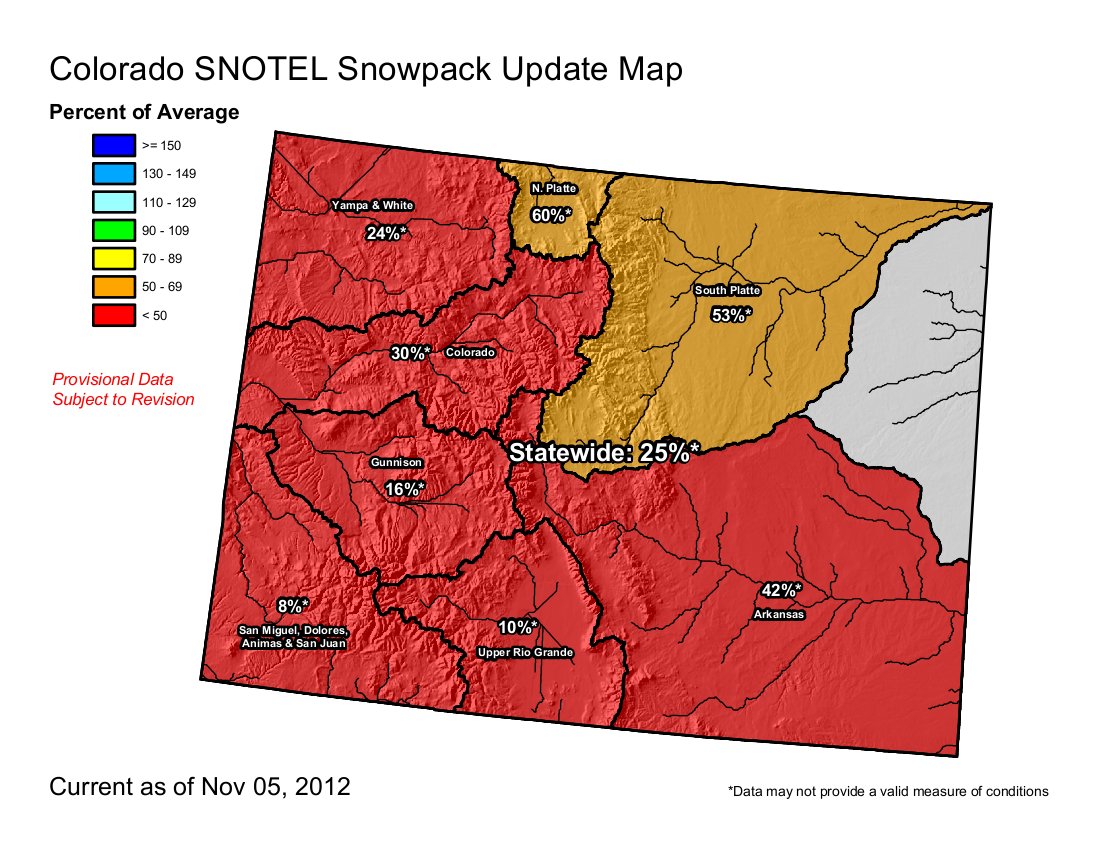
Snowpack news: Colorado off to a slow start for the water year #COSnowpack #CODrought

snowpackcolorado11052012.jpg

From the Summit County Citizens Voice (Bob Berwyn):

The Copper Mountain SNOTEL site was reporting 4 inches of snow a few weeks ago, but is now back to zero, for example, and numerous other SNOTEL sites are also reporting at zero. Exceptions are in the far north, where the Tower site is reporting 5 inches on the ground, and the Never Summer site, leading the state with 10 inches. Grizzly Peak is reporting 3 inches, while Fremont Pass is at 4 inches.

The snow drought is particularly pronounced in the Southwestern mountains, although that could change dramatically this weekend, with a storm expected to drop 12 to 18 inches of snow — and perhaps more across the most favored high elevations of the San Juans. The Silverton-based Center for Snow and Avalanche Studies reported only 1.26 inches of October precipitation at the high-elevation Senator Beck site, about 30 percent of the average amount for that location, going back to 2004…

Years with a weak El Niño or neutral Pacific Ocean conditions show a slight trend toward favoring the northern mountains with snow in mid-winter and the southern mountains in late winter and spring, according to Grand Junction-based National Weather Service meteorologist Joe Ramey, who offered a winter outlook at the annual Colorado Snow and Avalanche Workshop in Leadville.

Weekly Climate, Water and Drought Assessment of the Upper Colorado River Basin

wyutcoprecipitationoctober2012.jpg

Click here for the summaries from the Colorado Climate Center. Click on the thumbnail graphic for the precipitation summary.

More Colorado River Basin coverage here and here.

Voters approve the Central Colorado Water Conservancy District’s bond issue

irrigation.jpg

From The Greeley Tribune (Eric Brown):

Randy Ray was “pumped” after voters of the Central Colorado Water Conservancy District overwhelmingly approved a pair of water measures he says will “significantly” help farmers.

With votes cast by about 87 percent of Weld County’s eligible, active voters, 66.25 percent of those who live in Central’s boundaries had checked “yes” on Measure 4A. Measure 4A approves a $60 million bond issue to pay for three of Central’s endeavors. “This is so huge for us,” said Ray, executive director of Central.

Central, based in Greeley, is one of 15 water providers looking to take part in the proposed Chatfield Reservoir Reallocation Project, a $184 million undertaking that would provide an additional 2,849 acre­feet of water to some of Central’s users. Central Water officials also are considering the construction of gravel pits for an additional 8,000­9,000 acre­feet of storage, and buying 1,000 acre­feet of senior water rights with the bonds. Taxpayers within Central Water’s boundaries will now pay an additional $1.13 each month per $100,000 in property value for the next 25 years, Central officials estimate.

About 65 percent of Central voters approved Measure 4B, which allows Central’s Groundwater Management Sub­district to accept state and federal grant funding to construct projects.

Central’s district is mostly in Weld County, but its boundaries also stretch into Adams and Morgan counties. Central voters in Morgan County supported 4A by a 25­16 margin, and 4B by a 17­6 margin. Numbers for Adams County alone on the issues were not available as of press time.

More South Platte River Basin coverage here.

Fountain Creek: ‘The creek we used to play in is a filthy mess’ — Melissa Esquibel

fountaincreekmonsoonjuly2012.jpg

From The Pueblo Chieftain (Chris Woodka):

A stormwater structure for Colorado Springs and the surrounding communities has to be in place before Southern Delivery System goes online. That’s a must for a downstream water district, and a top priority for Colorado Springs.
Two members of the Lower Arkansas Valley Water Conservancy District board met Tuesday with two Colorado Springs City Council members to begin talks aimed at clearing the air on stormwater issues. The meeting was hosted by Pueblo County Commissioner Anthony Nunez; more meetings are expected.

“I’m cynical. I grew up a block from Fountain Creek,” said Melissa Esquibel, a member of the Lower Ark board. “The creek we used to play in is a filthy mess.”

“Waldo Canyon (Fire) has created a sense of urgency for you,” Nunez added. “We’ve had that sense of urgency for 100 years.”

Colorado Springs council members Merv Bennett and Brandy Williams sat at the other end of the table and said they are diligently working on a regional stormwater solution. Bennett said the collections of $15 million per year that would have occurred under the now­ defunct stormwater enterprise may not have been enough to fix Fountain Creek. He touted the $28 million for stormwater in next year’s Colorado Springs budget and asked for patience and trust.

“We’ll prove our trust by our behavior,” Bennett said.

Jay Winner, general manager of the Lower Ark district, emphasized that the district met with a different set of council members in 2005, only to start over on the same issues now. He said Colorado Springs will be a regional water provider through SDS, which makes it imperative that Colorado Springs takes the lead in controlling flows into Fountain Creek.

“We’ve set a lofty goal with the stormwater task force,” Williams said. “We have to establish what the region’s needs and expenditures are.”

More Fountain Creek coverage here and here.

Pueblo: The PBOWW is eyeing a water rate increase of 2.75% in their new budget

pueblo.jpg

From The Pueblo Chieftain (Chris Woodka):

While you were dumping all that water on the lawn last summer, you were keeping your water rates down. The Pueblo Board of Water Works got a detailed look at the proposed 2013 budget Tuesday, with no major surprises in the picture. A public hearing will be Nov. 20.

This year’s dry, hot weather meant a lower-than-expected increase in next year’s water rates — a 2.75 percent increase.
Why? Metered sales were projected to bring in $22 million, but all the extra watering meant an additional $800,000 in projected revenue. “Any time we have a situation where expenditures are lower or revenue higher, our customers get a benefit,” said Seth Clayton, director of administrative services and finance.

The water board also will see revenue of $7.6 million — in a $32.3 million budget — from water leases next year, including $5.2 million to power companies. While spot leases are not expected, the water board has several long-term contracts that provide additional revenues.

Expenditures are expected to be relatively flat, as opposed to this year’s steep hike in electric rates. Electricity purchases amount to about $3.4 million. A 1.49 percent salary increase is included, along with a 1.25 percent hike in health insurance and 5 percent drop in dental insurance.

An end to the drought could hurt next year’s revenues, which are based on consumption of 8.35 billion gallons for residential use. Outside lawn watering is the biggest variable for revenues, Clayton said. “Our customers are using their water wisely,” he said. “If we see a normal year, we will not see the consumption we have this year.”

More Pueblo Board of Water Works coverage here and here.

Gary Barber resigns as Two Rivers Water Company President and CEO

bessemerditghpueblochieftain.jpg

From The Pueblo Chieftain (Chris Woodka):

“Apparently as a result of the emphasis on farming and perceived diminution in responsibility, Gary Barber, the company’s president and chief operating officer, whose primary work experience and expertise lie in municipal water operations, without notice and unexpectedly notified the company on (Monday) via email of his resignation,” Two Rivers founder and CEO John McKowen said in a news release.

“No comment,” said Barber, adding that he will now be looking for other opportunities.

Barber chairs the Arkansas Basin Roundtable, a group that meets monthly on basin water issues. He previously represented El Paso County water interests and was the first executive director of the Fountain Creek Watershed Flood Control and Greenway District.

More Arkansas River Basin coverage here.

Colorado Water 2012 Book Club presentation: ‘Water Wranglers’ by George Sibley, November 20

waterwranglersgeorgesibley2012.jpg

Click here for all the inside skinny from the Water 2012 FaceBook page.

More Colorado River Basin coverage here and here.

Snowpack news: South Platte = 53% of avg, Upper Colorado = 30%, southwest basins = 8%, statewide = 25% #CODrought

snowpackcolorado11052012.jpg

Click on the thumbnail graphic for the statewide snowpack map from the Natural Resources Conservation Service.

This morning one of my colleagues at the office said, “It’s still early.” I love an optimist.

Vote!

Vote-now.jpg.jpg

Please remember to vote today — if you haven’t already voted early — put up with the delays, have your voice heard! Send me email if you want some coaching about the issues or candidates. 🙂

Englewood/Littleton: Wastewater treatment plant upgrades to cost $15 million

barrlake.jpg

From the Littleton Independent (Jennifer Smith):

Both city councils recently voted to raise customer fees starting in 2013 to cover the costs of construction, slated to begin in 2019.

There are two separate issues. First, the plant is subject to stricter nutrient-removal standards as of 2022; council members are quick to call them unfunded mandates from the state. In order to meet them, staff says design and permitting for the project needs to begin in 2017.

Second, a study showed the plant contributes about half of the phosphorous found in Barr Lake near Brighton and Milton Reservoir near Gilcrest, which causes algae blooms and other unpleasantness in the recreation areas. “The plant has a responsibility to downstream users,” Amy Conklin, coordinator for Barr Lake/Milton Reservoir Watershed Association, wrote on Oct. 28. “It matters how clean our effluent is because people downstream drink it.”

Centennial Water and Sanitation District, which serves Highlands Ranch and a small portion of unincorporated Douglas County, apparently is the reason for the other half. Its director, John Hendrick, urged Littleton and Englewood officials to work with him to get the standards relaxed. “We are going to take off the gloves, but we’re going to do it initially with a gentle, cooperative approach,” he said.

“This is a statewide issue, and we need some leadership down there at the Capitol to help us out.” Conklin agrees a collaborative approach is necessary, noting that half of Colorado residents live in the watershed.

“Gone are the simple days of environmental regulation,” she said. “But if Barr-Milton can pull it off, we may serve as a model of how to bring all sides of these expensive environmental solutions to the table and not to court.”

Plant manager Dennis Stowe said a statewide coalition against the regulations is currently inactive, reluctant to pursue expensive litigation. Gov. John Hickenlooper’s only input, said Stowe, has been to ask the Legislature to look more closely at the costs inflicted by the regulations. Engineer Sarah Reeves, a private consultant, said a potentially cost-reducing practice of nutrient trading — similar to cap and trade to regulate emissions — isn’t feasible, because there are no workable trading partners…

“When we get to discharging Perrier, is that going to be good enough?” asked Littleton Councilor Bruce Stahlman.

More wastewater coverage here and here.

CWCB: Next Water Availability Task Force Meeting November 20 #CODrought

sanmiguelhangingflumeaerialhangingflumeorg.jpg

From email from the Colorado Water Conservation Board (Ben Wade):

The next Water Availability Task Force meeting is on Tuesday, November 20 from 9:30a-11:30a.m. & will be held at the Colorado Parks & Wildlife Headquarters, 6060 Broadway, Denver in the Bighorn Room.

The agenda…will be posted at the CWCB website.

In the event you are unable to attend the meeting in person, but still wish to participate, please email Ben Wade by November 16 to get call in and web conference information. This will allow you to hear as well as see the presentations live.

NWS: A Cool October Across Eastern Colorado #CODrought

From the National Weather Service (Pueblo):

One storm system moving across the state at the beginning of October, along with another system moving across the area at the end of the month, brought some generally light precipitation (and the first measurable snowfall) to portions of south central and southeast Colorado. In addition, cold air associated with these systems helped temperatures to be generally cooler than normal across southeast Colorado in October, with at or above normal temperatures persisting across south central Colorado…

In Colorado Springs, the average monthly temperature in October was 49.3F. This is 0.1 degrees below average and marks only the second time this year in which the average monthly temperature was near or below normal (the other being February). Colorado Springs received 0.14 inches of precipitation through the month of October. This is 0.68 inches below average and makes October of 2012 the 20th driest on record; though well behind the trace of precipitation recorded in October of 1934. Colorado Springs also received its first measurable snowfall of the season in October, with 0.6 inches of snow recorded at the Colorado Springs Airport on the 25th.

In Pueblo, the average monthly temperature in October was 50.7F. This is 1.1 degrees below average and marks only the second time this year in which the average monthly temperature was near or below normal (the other being February). Pueblo received 0.29 inches of precipitation through the month of October, which is 0.43 inches below average. Pueblo also received its first measurable snowfall of the season in October, with 0.8 inches of snow recorded at the Pueblo Airport on the 25th and another 0.8 inches recorded through the early morning hours of the 26th.

In Alamosa, the average monthly temperature in October was 43.5F, which is 0.4 degrees above average. Alamosa received 0.37 inches of precipitation, which is 0.31 inches below average. Alamosa received only a trace of snow on the 26th of October.

Forecast news: Warm and dry this week, snow for Colorado on the weekend? #CODrought

From the Summit County Citizens Voice (Bob Berwyn):

…it’s too early to tell exactly where the snow will fall. For now, the forecast models are predicting that a vigorous cold front will cross Colorado Friday night into Saturday, bringing the best chance for snow. Until then, seasonable to warmer-than-average temperatures will prevail across the high country, with Tuesday and Wednesday likely to be the warmest days, with highs in the mid-50s, potentially flirting with record territory mid-week…

The pattern change will begin Wednesday as a Gulf of Alaska low pressure starts to move into the Great Basin. Ahead of the system, the flow will be from the Southwest, bringing the warm temperatures mid-week…

If the trough splits, as sometimes happens during El Niños, it’s possible that the bulk of the energy could pass to the north and south of the I-70 corridor.

From The Denver Post (Joey Bunch):

After Denver moves into striking range for record high temperatures at midweek, temperatures are expected to plummet to near freezing with a slight chance of snow next weekend, forecasters said Sunday…

Western Colorado’s weather will ride the same arc as Denver’s with warm, sunny days this week giving way to chilly temperatures and snow as a cold front approaches from the northwest…

The system could bring much-needed snow to the high country, as the state’s snowpack continues to lag behind for a second year in a row. Statewide snowpack Friday was just 55 percent of its 30-year average for this time of year, and jut 59 percent in the ski resort-heavy Colorado River basin.

Denver, however, received 5.5 inches of snow during October, which was 1.5 inches above the average of 4 inches. After March, November is Denver’s second-snowiest month, averaging 8.7 inches annually since 1981, according to the National Weather Service.

From The Grand Junction Daily Sentinel (Duffy Hayes):

If three months constitutes a cycle, in terms of the weather, then the data collected by area weather-watchers for October show the region wrapped up a dry and warm one over the past few months. The .29 inch of precipitation measured near Grand Junction Regional Airport in the month of October was well below the average of 1.06 inches for the month — a continuation from the previous two.

“The last three months, we’ve been about three-fourths of an inch below normal (in terms of monthly precipitation),” said Dan Cuevas, technician with the local office of the National Weather Service. Cuevas said that September’s precipitation count of .46 inch was a full .72 inch below that month’s average. Further, August was similarly dry, clocking in with just .16 inch of moisture — which was .79 inch short of average.

October’s average daily temperature was actually a bit lower than average — 52.8 degrees, versus the average 53 degrees — but the region is back to some warmer temperatures. “We’ve started off (November) with a warm, dry pattern,” Cuevas said. “We’re going to stay under the influence of high pressure through most of the week.” That includes Tuesday — Election Day — when many people will be headed to local polling places. The forecast looks beautiful, with mostly sunny skies and high temperatures expected in the mid- to upper-60s.

Cuevas said the trend might be short-lived, though. “We’re watching what looks like it could be a pretty good storm system coming in by the weekend — giving us some rain, possibly some snow at lower elevations, but certainly cooling things off,” he said.

From The Greeley Tribune:

An uneventful weather pattern is shaping up across northern Colorado for the next several days. Expect dry conditions and mild temperatures. This afternoon’s high will reach the low to mid 60s in the Greeley area. Sunshine will mix with passing clouds. Fair skies are in store for tonight as lows fall to the upper 30s.

Election Day weather will also be tranquil, causing no weather­related concerns in getting to the polls.

It will remain dry through Friday, when computer models are hinting at the next opportunity for some unsettled weather. This would be the next chance for some decent mountain snow to return to the forecast.

Aspen: Environmental community divided over propose Castle Creek hydroelectric generation plant

microhydroelectricplant.jpg

From The Aspen Times via The Denver Post:

Big names in the environmental movement are lined up on both sides of the issue. Connie Harvey, Charlie Hopton and Ken Neubecker are opposed to the proposed plant. Harvey was a founder of Wilderness Workshop. Hopton has been a member of environmental causes and organizations in Aspen for several decades. Neubecker has emerged as a leading voice in the Roaring Fork Valley on water issues.

Those lined up in support of the plant include Auden Schendler, Randy Udall and Paul Andersen. Schendler is executive director of sustainability for Aspen Skiing Co. Udall was the original director of the Community Office for Resource Efficiency and has emerged as a national expert on energy issues. Andersen is a respected environmental essayist and a columnist for The Aspen Times.

Voters in the city of Aspen will cast ballots Tuesday on Question 2C, an advisory question on the Castle Creek Hydroelectric Facility.

Hopton said he has rarely seen the upper Roaring Fork Valley’s environmental community torn apart over an issue like it is over the hydroelectric plant. He has friends on both sides of the issue and avoids discussing it with those backing the proposal. He hasn’t taken an active role in the campaign.

More hydroelectric coverage here and here.

CDPHE: Hearings for the proposed Piñon Ridge uranium mill on Wednesday

paradoxvalley.jpg

From The Telluride Daily Planet (Collin McRann):

The hearings are set to begin Wednesday morning and could run through Nov. 13. They will be held each day at the Moose Lodge in Nucla from 8:30 a.m. to 5:30 p.m. with public comment set to start at 4 p.m. The hearings are the result of a lawsuit filed against the state agency that issued the licence, and represent another chapter in the divisive issue of uranium development in the region…

Parties will be presenting verbal arguments for and against the mill’s license to Richard Dana, who is the appointed hearing officer on the issue. Dana has been chosen by the state to act as an independent party between the different interests involved with the Piñon Ridge uranium mill project. The hearing format will consist of arguments and cross-examination from lawyers representing different parties of interest, statements from industry specialists and other experts as well as a section for members of the public to make their points…

Following the hearings, Dana will submit his recommendations and findings on whether or not the Colorado Department of Public Health and Environment should issue the license. But the CDPHE will make the final decision on the license next spring with a final statement due by April 27.

More Piñon Ridge uranium mill coverage here. More nuclear coverage here and here.

October precipitation — 2012 no longer stands as the driest year on record for Greeley #CODrought

usdroughtmonitor10302012.jpg

From The Greeley Tribune (Eric Brown):

Don’t expect a parade in the streets from farmers, ranchers and water providers who’ve been battling drought all year, but 2012 no longer stands as the driest year on record for Greeley following a wet October. But it’s been plenty hot. Greeley received 1.35 inches of precipitation last month, 0.34 inches above the average for October and standing as the 12th­wettest October on record, according to figures provided by the Colorado Climate Center in Fort Collins.
Through the end of October, Greeley had received 7.47 inches of precipitation for the year, just more than half of the city’s average through the first 10 months of the year.

After standing as the driest year on record from the spring until the end of September, this year now stands as the second ­driest for Greeley, trailing only 1968. A portion of last month’s precipitation came from a couple rounds of snowstorms. Last month, Greeley received 2.1 inches of snow, falling short of the 2.8 inches the city receives on average in October and standing as the 16th­least snowy October on record. Agricultural producers and water providers are hoping the snowfall picks up its pace as the year rolls into winter.

With little rainfall in 2012, large amounts of water from reservoirs were used to grow crops and water lawns, and many of those reservoirs are now at historically low levels. Without snow this winter and spring to refill the reservoirs, irrigation supplies will be tight next growing season.

While October helped 2012 work its way out from the bottom of historic precipitation amounts in Greeley, it couldn’t do the same for the city’s record heat numbers. At the end of October, 2012 still stood as the hottest year on record for Greeley. The average mean temperature for the year was 59.0 degrees, nearly 3 degrees above the average.

A cold spell at the beginning of October this year kept last month from ranking high in heat historically. Last month, the average mean temperature was 51.5 degrees, only ranking as the 21st­ hottest October on record. The average high temperature last month was 66 degrees. Oct. 5 and 6 broke records for lowest high temperatures recorded on those days, 43 degrees and 38 degrees, respectively, breaking marks that temperatures recorded on those days, 43 degrees and 38 degrees, respectively, breaking marks that had been set in 1969 and 2000. On Oct. 7, the low for the day was 21 degrees, breaking that day’s previous record­low mark of 26 degrees, set in 1970.

Redstone: Wild & Scenic Rivers Educational Forum for the Crystal River November 14

crystalvoicepetemcbride.jpg

Click on the thumbnail graphic to view Pete McBride’s photo essay about the river.

From the Roaring Fork Conservancy:

Roaring Fork Conservancy, Pitkin County, American Rivers, and the Crystal Valley Environmental Protection Association will host a public educational forum to explore the process of a Wild and Scenic River designation for the Crystal River. The forum panel will include Kay Hopkins from the White River National Forest, Chuck Wanner, former Ft. Collins city councilman who played an integral role in the designation of the Cache la Poudre as Wild & Scenic, Mike Moody from the Native Fish Society in Oregon who has participated in the Wild and Scenic process on the Molalla River in Oregon, and David Moryc, Senior Director of River Protection at American Rivers. The public is encouraged to participate to learn more about the process of designation, ask questions, and be part of the community to evaluate the effectiveness and appropriateness of this possible designation for the Crystal River.

What: Wild and Scenic River Educational Forum for the Crystal River
When: Wednesday, November 14, 2012, 6:30-8:30pm Redstone Church, Redstone
Thursday, November 15, 2012, 6:30-8:30pm Third Street Center, Carbondale
Who: All community members, stakeholders, land owners, and business owners

Partners for this Educational Forum include Pitkin County, Roaring Fork Conservancy, Crystal Valley Environmental Protection Association, Town of Carbondale, White River National Forest, Avalanche Ranch, Wilderness Workshop, American Whitewater, Thompson Divide Coalition, Western Rivers Institute, Roaring Fork Audubon Society, American Rivers, Native Fish Society, and the Sierra Club.

Grand County and Northern Water are in negotiations for a 1041 permit for the Windy Gap Firming Project #CORiver

windygapreservoirnorthernwater.jpg

Here’s an analysis of last week’s meeting from Tonya Bina writing for the Sky-Hi Daily News. Click through and read the whole article. Here’s an excerpt:

Working through a list of 32 conditions for the permit, representatives from the Northern Colorado Water Conservancy District sat before commissioners in the boardroom of the Grand County Administration Building on Tuesday, along with Grand County’s water counsel, and hashed out wording of each of the conditions in search of agreements among stakeholders…

Aside from disagreements about three different monitoring plans mentioned in conditions of the permit, at least one other condition remains a sticking point — a condition involving the clarity of Grand Lake. The county has proposed a condition stating the permit for the Windy Gap Firming Project will not go into effect until a federal plan, on course to include a National Environmental Policy Act process, is in place — charting the way toward a solution of the Grand Lake clarity problem. Grand County Commissioner Gary Bumgarner put pressure on Northern representatives during Tuesday’s hearing about needed “assurances” that a solution will be realized for Colorado’s largest natural water body. Bumgarner advocated for language “that holds feet to the fire.”

But Northern representatives objected to the project’s 1041 permit being conditional upon a long federal process concerning Grand Lake’s clarity problem. Eric Wilkinson, general manager of the Northern Colorado Water Conservancy District, said it was a matter of “authority and responsibility.” The municipal subdistrict seeking to firm up rights to Windy Gap water “doesn’t have the authority to control the other entities involved in the clarity issue,” he said. “It puts them in a position of being responsible without the authority to do something.”[…]

Concerning another condition on the Windy Gap bypass, the county proposes the “bypass/bythrough study shall commence on or before issuance of this 2012 permit” and if the study deems it, construction of the bypass “shall proceed” with cooperation on financing it among the parties. A 2011 Colorado Parks and Wildlife report by Barry Nehring concluded that the Colorado River below Windy Gap has suffered due to the reservoir, and that creating a bypass would be a solution…

no party knows yet how much a bypass around the reservoir might cost or where the money would come from. The Subdistrict has agreed to provide $250,000 toward research of a bypass, which is expected to reduce high temperature events caused by the dam, reduce sedimentation deposition, restore river connectivity, and reduce the impacts of whirling disease. About $3 million in funds — $2 million by Northern and possibly $1 million by Denver Water if negotiations are successful — would be available to construct the bypass and the construction would take place immediately after the study finds that the bypass would be beneficial to the river. There is the possibility another $2 million could be found from Colorado Parks and Wildlife.

More Windy Gap coverage here and here.

Northern Water’s fall water users’ meeting — November 7

gladereservoirsitenorthernwater.jpg

Here’s the pitch:

Northern Water’s Fall Water Users’ Meeting will be held Wednesday, Nov. 7 at the University of Northern Colorado, University Center Ballroom, 2045 10th Avenue in Greeley starting at 8 a.m.

Go to the November Calendar page to register for meeting. The online registration deadline is Monday, Nov. 5. Business group registration is now available.

The meeting is a forum to discuss the current water situation and water-related issues. The 2012 meeting will include
updates on the current water year, the Northern Integrated Supply Project and the Windy Gap Firming Project. Other
presentations will be a video of Northern Water’s 75th Anniversary celebration and a discussion of the impact of wildfires on water supply. See the meeting agenda.

More coverage from the North Forty News:

Northern Water’s fall water users’ meeting on Nov. 7 will feature two panel discussions on Colorado wildfires’ impacts to water supplies. Panelists include Lisa Voytko, water production manager for City of Fort Collins, and Jon Monson, director of the water and sewer department for Greeley.

Northern Water hosts the meetings each spring and fall to discuss the seasonal water supply and other important water-related issues. The Nov. 7 meeting will include a review of the drought-ridden 2012 water year and updates on the Northern Integrated Supply and Windy Gap Firming projects.

Patty Limerick, Center of the American West director, is the keynote speaker over lunch, which is provided for pre-registrants. The meeting will be at UNC’s University Center Ballroom, 2045 10th Avenue in Greeley, and starts with check-in at 7:30 a.m. and speakers at 8 a.m.

Members of the public may register through Nov. 5 using the calendar link at http://www.northernwater.org or by leaving a voicemail at 970-622-2220. The voicemail should include attendees’ names and affiliations and whether they will be eating lunch.

Northern Water is a public agency created in 1937 to contract with the U.S. Bureau of Reclamation to build the Colorado-Big Thompson Project, which collects water on the West Slope and delivers it to the East Slope through a 13-mile tunnel that runs underneath Rocky Mountain National Park. Northern Water’s boundaries encompass portions of eight counties, about 640,000 irrigated acres and a population of about 850,000. For more information, visit www.northernwater.org.

More Northern Colorado Water Conservancy District coverage here.

Live Water Supply Briefing: 2012 Water Year Review and 2013 Look Ahead — Thursday November 8, Wednesday December 5

coloradoriverbasin.jpg

Click here for all the details.

More Colorado River Basin coverage here and here.

Colorado-Big Thompson Project fall operations update

coloradobigthompsonmap.jpg

From email from Reclamation (Kara Lamb):

It’s that time of year again: maintenance season for the Colorado-Big Thompson Project. If you are receiving this e-mail it is because our maintenance schedule will be affecting a reservoir or river flows in which you are interested. Because all of these operations tie together, it’s a lengthy e-mail, so please bear with me:

Monday, Nov. 5: We will stop diverting through the Adams Tunnel. This will temporarily slow the draw on Granby Reservoir because we will not be pumping up to Shadow Mt. Reservoir and the Tunnel. Releases from Granby to the Colorado River should remain at or above 20 cfs at the Y gage for the rest of the calendar year.

This same day, we will also stop moving water from Lake Estes through the Olympus Tunnel to the southern power arm of the C-BT so we can start some regular maintenance projects on that section.

Water that would normally hit those three power plants will instead be released from Olympus Dam to the Big Thompson River, bumping its flows up from around 40 cfs to 150 cfs. We will change the release from the dam in the early morning hours of Nov. 5 before 5:30 a.m.

The project water released to the Big T River will be recaptured at the Dille Diversion Dam in the narrows section of the canyon. The Dille redirects the water back on course to Horsetooth Reservoir via the Charles Hansen Feeder Canal.

With 150 cfs being released from Lake Estes and no water coming in, the water level elevation at Estes will start to drop a little over a foot a day for about a week.

Monday, Nov. 12: The water level at Lake Estes will hit an elevation of about 7460 feet by day’s end. We will hold it there until the second week of December.

While water through the tunnels is off and the Lake Estes water level is down, our maintenance work will be on. During this same time, the Estes Sanitation District will be performing sand removal from the western side of Lake Estes.

Water levels at Marys Lake will not be drawn down this year.

Nov. 13: Delivery of C-BT water from Olympus Dam to Dille Dam via the Big Thompson River will stop. Releases to the river will go back to around 40 cfs—the typical native flow of the Big Thompson River this time of year. We will start delivering C-BT water from Pinewood Reservoir.

Pinewood, downstream of Lake Estes and Olympus Dam on the C-BT’s southern power arm, will stay at a high water elevation through the first part of the maintenance work. With no water coming from the West Slope, it will take over the role of delivering project water when Lake Estes hits its 7460 foot water level elevation. Because Pinewood’s own water levels are currently high, residents near and visitors to Pinewood will likely not notice its water level start to decline until the last week or two of November. It will continue to drop until the first week of December.

Dec. 7-14: All annual maintenance projects scheduled for this fall on the C-BT start to wrap up. Diversions through the Adams Tunnel will resume, the water level elevation at Lake Estes will start to rise, and it will resume delivering water through Olympus Tunnel to the southern power arm. Pinewood’s water elevation will start to come back up.

Deliveries to Horsetooth Reservoir will experience a slowdown during the middle of the maintenance work, but continue through December. The reservoir will officially start to refill in mid-to-late December, as is its normal schedule.

More Colorado-Big Thompson Project coverage here.

Upper Colorado River Basin Water Conference November 8-9 #CORiver

coloradoriverbasincgs.jpg

From the Grand Junction Free Press (Hannah Holm):

The conference, organized by CMU’s Water Center, will bring together water experts, policy makers and stakeholders from Colorado, Utah, New Mexico, Wyoming and Nevada for presentations on how we can better understand and respond to drier conditions.

Conference-related events begin Wednesday evening Nov. 7 and continue through Friday afternoon Nov. 9. All events will be held upstairs in CMU’s University Center and can be registered and paid for separately — just go to www.coloradomesa.edu/watercenter for full details. If you pre-register by noon Monday, Nov. 5, you’ll get a free parking pass.

• Nov. 7, 7 p.m. — Reception/Film screening – $15: Things kick off on an entertaining note with a reception and viewing of the “Remains of a River” film from the Colorado College “State of the Rockies” program. The film is about boating from the headwaters of the Green River to the mucky remains of the Colorado River delta in Mexico and includes great river footage as well as funny and sharp commentary from the filmmaker/adventurers. Your $15 lets you view the film, meet the filmmakers and have two complimentary drinks.

• Nov. 8-9, beginning at 7:30 a.m. each day – conference panels plus networking breakfasts and lunches – $100: On Nov. 8, panels address the impacts of dust on snow and bark beetles; understanding and managing streamflows; agricultural efficiencies and water sharing; how to meet environmental water needs in cooperation with other uses; and household water conservation: how to do it, and its role in meeting future demands.

On Nov. 9, leaders of the U.S. Bureau of Reclamation’s Colorado River Basin Supply and Demand Study (due to be completed next month) will discuss the analysis and conclusions in the study, and a panel of stakeholders and experts will provide their reflections on how the study was conducted and what it means for managing water into the future — from Denver to Steamboat Springs to central Utah. The final panel will feature top water planners from Colorado, New Mexico and Utah discussing their states’ approaches to meeting future needs in the context of uncertain hydrology and obligations under interstate water compacts. Your $100 gets you into all the presentations as well as breakfast and lunch both days.

• Nov. 8, 7 p.m. – dinner with keynote address by John Stulp, special policy advisor to Gov. Hickenlooper on water – $25: Stulp, a farmer and rancher from Prowers County and former state Commissioner of Agriculture, also chairs Colorado’s Interbasin Compact Committee, which is seeking to work with stakeholders from each of the state’s river basins to develop a statewide water plan by 2016.

For more information on the conference and related events, check out www.coloradomesa.edu/watercenter or call the Water Center at 970-248-1968.

More Colorado River Basin coverage here and here.

Precipitation news: Below average numbers for Breckenridge in October #CODrought

slvdischargerecharge.jpg

From the Summit County Citizens Voice (Bob Berwyn):

At 0.5 inches, precipitation [ed. in Dillon] for the month was slightly less than half of average (1.06 inches, with measurable rain or snow on only six days. And despite the cool temps, the snow total for the month (3 inches) was also slightly less than have of average (7.7 inches)…

In Breckenridge, long-time weather observer Rick Bly tallied 8 inches of snow in October, just 63 percent of average (12.3 inches) — and that that’s not the best sign for the winter, based on past statistics. Snow and rain combined added up to just 0.72 inches of moisture, which is 57 percent of average. For Bly, October is the best indicator month for the rest of the season, and 70 percent of the time, a below-average October is followed by below-average snowfall for the winter.

Here’s the October Climate Summary from the National Weather Service.

San Luis Valley: Groundwater sub-district #1 trial concluded

slvdischargerecharge.jpg

From the Valley Courier (Ruth Heide):

A couple of points in the sub-district’s operating plan, which was implemented for the first time this year, were the focus of the two-day trial this week before Judge Swift. Most of the discussion revolved around the inclusion of augmentation plan wells in the sub-district’s 2012 operating plan and the use of Closed Basin Project water in the 2012 plan…

In his closing argument on Tuesday afternoon, RGWCD Attorney David Robbins said the district acknowledged it made two errors of omission in the 2012 Annual Operating Plan (ARP): 1) list of augmentation wells; and 2) map of those wells’ locations. Robbins said the un-augmented well depletions from those wells within the sub-district were identified and replaced, however. Robbins suggested the way to handle the compliance errors this year would be for the court to enjoin the sub-district in the future to ensure it complies with the required information.

Attorney Tim Buchanan, representing surface water users who filed objections in this case, said he believed the court should go a step further. He said a message must be sent that the court decrees must be complied with. “The 2012 plan did not comply with the plan as decreed by this court and as approved by the Supreme Court,” Buchanan said. “Therefore in my view we need to fashion a remedy that does not approve the plan but directs the plan be amended to reflect the augmentation wells were not properly included, that they should have been separately identified and they should be separately accounted for.”[…]

The other contested topic in this trial was the use of Closed Basin Project water to replace well depletions to streams this year.

In his closing argument attorney Bill Paddock, representing sub-district supporters, reminded the court the judge’s October 4 order resolved the question of legal suitability of Closed Basin Project water for use in the plan of management. The question argued during the trial was a factual question regarding whether the water was an appropriate source of replacement water for injurious depletions, he said. Paddock argued the project water was appropriate to replace depletions and said the state engineer agreed.

When [State Engineer Dick Wolfe] was on the stand on Tuesday, he said he and his staff, with advice from their legal counsel, determined the sources of replacement water in the sub-district’s 2012 ARP, including the Closed Basin Project water, were suitable. Wolfe said the water court’s May 2010 decree stated this possible source of replacement water was not prohibited. He testified the sub-district’s plan of water management approved by the water court and Supreme Court specifically referenced Closed Basin Project water as a replacement water source.

More SLV groundwater coverage here and here.

Latest map from the U.S. Drought Monitor shows continued widespread dryness west of the Mississippi #CODrought

usdroughtmonitor11012011.jpg

usdroughtmonitor10302012.jpg

Click on the thumbnail graphics for the latest map and the November 1, 2011 map from the U.S. Drought Monitor .

Quaggas in the pipes? — Lake Powell’s waters yield Quagga mussel DNA and veligers

lakepowell.jpg

Here’s the release from the National Park Service:

Recent monitoring samples from Lake Powell have revealed evidence of microscopic Quagga mussel larvae and the National Park Service (NPS) has accelerated laboratory and field efforts to identify the source, reported Glen Canyon National Recreation Area Superintendent Todd Brindle. Quagga mussel larvae and DNA were found in separate water samples collected near Antelope Point and Glen Canyon Dam. “We don’t know yet if there is a population trying to establish in the lake,” said Brindle. “The DNA can last after the organism is dead, so there is a possibility that it could have washed off boats that had been in other infested waters.”

NPS aquatic ecologist Mark Anderson provided additional details on the sampling results. “The bodies of four larval mussels were found in four different samples near the Glen Canyon Dam. The sampling process kills mussel larvae so it is not known if any of them were alive in the lake,” stated Anderson. “One of them had a broken shell, suggesting that it was dead when it was collected.”

Anderson explained that testing occurs using two separate methods: DNA and microscopy. The DNA method is more sensitive and potentially detects the presence earlier, but can be less accurate. Detection using microscopes is more accurate but requires an organism or piece of organism that is large enough to be visible in the microscope. Samples are taken using both methods at multiple sites around Lake Powell.

Superintendent Brindle remains hopeful that the monitoring results are not evidence of an established population of mussels. If it is an early detection, the mussels may not establish and grow into adults, said Brindle. “Scientists are not sure why but many western waters have shown similar findings and then never developed a noticeable population, such as at Lake Granby, Lake Pueblo, Electric Lake, Red Fleet, Navajo Lake, Grand, Shadow Mountain, Willow Creek, and even Lake Powell in 2007.”

In the meantime, monitoring and testing by the NPS will continue. “It is possible that these results will not be duplicated and a population of Quagga mussels is not developing,” said Anderson. In addition to the water sampling, NPS divers and underwater remote operated vessels will be used to search for adult mussels. “However, if test results continue to show positive for DNA or if there are adult mussels visible, it could indicate that a population is starting,” Anderson said.

If there is a population of mussels, Superintendent Brindle said he is committed to working with all agencies and partners to determine the extent of the population and investigate and implement strategies for control. Depending on the extent of an early population, removing, wrapping or burying the mussel colony might be effective in preventing additional reproduction.

“We will continue the boat inspections that are currently in place,” Anderson stated. “Prevention is still the most effective way to fight invasive species. Continue to clean, drain, and dry your boat and equipment after every use.”

More coverage from the Associated Press via The Columbus Republic. From the article:

The National Park Service said Thursday that samples taken near Glen Canyon Dam and Antelope Point show the presence of mussel larvae and DNA. Glen Canyon Recreation Area Superintendent Todd Brindle says it’s possible the larvae could have washed off boats that had been in mussel-infested waters. He says divers and remote-controlled vessels will be searching for adult mussels that would signal the startup of a population.

More Colorado River Basin coverage here and here.

Proposed budget for FY 2013-14 boosts funding for education, economic development and restores cuts for critical state services

Here’s the release from Governor Hickenlooper’s office (Eric Brown/Megan Castle):

Gov. John Hickenlooper today delivered the FY 2013-14 proposed budget to the Joint Budget Committee (JBC) that makes targeted increases and restores funding in many critical areas.

The proposed budget includes new and continuing resources for: protecting the last and the least in Colorado, restoring and even improving K-12 education funding, enhancing economic development efforts, investing in infrastructure and local communities, enhancing public safety, improving State government performance and saving for the future.

“Colorado’s economy is outperforming other states,” Hickenlooper said. “This gives us the ability to restore some cuts and modestly increase funding in critical areas of the state’s budget. But we still have a long way to go to fully recover from this recession.”

The FY 2013-14 proposed budget is $21.9 billion, of which $8.1 billion is from the General Fund. Relative to the FY 2012-13 appropriation, these amounts represent increases of $1.1 billion (5.4 percent) in total funds and 5 percent ($387 million) in the General Fund.

The rebound in revenue in the General Fund finally exceeds the pre-Great Recession peak this year (FY 2012-13). But when inflation and population growth are accounted for, expected revenue is still $1.1 billion, or 14.4 percent, below the FY 2007-08 level.

“When you have this big of an economic downturn, it takes time to dig your way out,” Hickenlooper said. “That is why we’ve been so focused on finding efficiencies, pursuing statewide efforts to streamline a wide range of processes and consolidating government functions wherever appropriate. At the same time we have taken bold steps to increase the State’s reserve fund to help protect against the inevitable next economic slowdown.”

The proposed budget for FY 2013-14 includes these major policy changes and initiatives:

PROTECTING THE LAST AND THE LEAST
The administration places a very high priority on protecting the most vulnerable in our state. Some requests from the Departments of Human Services and Health Care Policy and Financing include:

– $13.1 million Total Fund (TF) dollars — $6.5 million from the General Fund (GF) — to provide services to 809 additional people with developmental disabilities. This amount includes an increase of 576 funded waiver slots to eliminate the Children’s Extensive Services Waiver Program waiting list. Unfortunately, numerous other waiting lists exist for the developmentally disabled and other populations that are not fully eliminated in this request.
– $1.8 million TF ($1 million net GF) for early intervention services for children from birth to 2 years of age.
– A 1.5 percent provider rate increase for community providers including Colorado’s county departments of human services. This equates to $56.5 million total funds, $25.8 million GF. In addition, this will apply to providers of services in the Departments of Corrections and Public Safety.
– $5 million GF as a legislative set aside for the estimated costs of the recommendations of the Elder Abuse Task Force to increase protections for vulnerable seniors. These costs will fund a system of mandatory reporting of instances of exploitation or mistreatment of seniors.
– $2 million GF for programs funded by the Older Coloradans Act.

FUNDING FOR K-12 AND HIGHER EDUCATION
The recovery in revenue allows for increased funding for both K-12 and Higher Education:

– In K-12 Education, the budget includes an increase of $201.6 million in State ($189.1 million) and local funds ($12.5 million) for total program funding, which allows for $31.7 million above what the inflation and enrollment calculation over the current year would require. In this way, the “negative factor” will decline to 15.5 percent from 16.05 percent.
– With this increased funding, the administration proposes that Colorado’s school districts focus $23.9 million to enhance full day Kindergarten and pre-school opportunities and to improve teacher quality in hard to fill areas of the state.
– The state expects 8,592 new students in the K-12 system at an average cost of $6,659 compared with $6,474 in the current year ($185 per student more).
– In the State Education Fund, the budget targets an ending balance of $435.5 million at the end of FY 2013-14. It is essential that a meaningful balance remain in the SEF for stability and protection of education funding levels.
– In Higher Education, $30 million GF for operations at the Governing Boards, Local District Junior Colleges, and Area Vocational Schools; separately, the budget includes $5.3 million for need-based financial aid.
– The budget request includes $250,000 for higher education tuition assistance for National Guard members.

ENHANCING ECONOMIC DEVELOPMENT EFFORTS
To help sustain Colorado’s economic momentum, the budget sets aside money for several programs aimed at attracting and retaining job-creating employers. The plan also invests in efforts to ensure that people around the country look at Colorado as a great place to visit and work. Notable requests include:

– $3 million to bring the annual appropriation for the Strategic Fund in the Office of Economic Development and International Trade. This funding is expected to spur the recruitment of 1,230 new jobs to Colorado.
– $2 million additional GF for tourism promotion and the establishment of a unified branding platform for the State.
– $600,000 to retain existing jobs here in Colorado.
– An additional $1 million for the existing film incentive rebate and loan guarantee program.

INVESTING IN OUR INFRASTRUCTURE AND LOCAL COMMUNITIES
The vast array of assets owned by Colorado’s State and local governments require ongoing investments in maintenance and repair. Because much of the state’s revenue is one-time in nature, the budget request includes a dramatic increase in efforts to sustain and improve many of our most important assets. Meanwhile, some of Colorado’s most important government services are delivered locally with State support. The administration believes strongly that enhancing these partnerships is integral for the quality of life and economic vitality of the State. Requests in this area include:

– $102.8 million transfer to the Capital Construction Fund, including $15 million for local water projects to deal with new standards related to “nutrients” such as phosphorous and nitrogen in wastewater [ed. emphasis mine].
– $44.9 million GF for controlled maintenance of State buildings, including $25.4 million at institutions of Higher Education.
– $23.1 million to continue building up the balance in the Controlled Maintenance Trust Fund;
– $3.0 million in the Department of Local Affairs for a grant program to assist communities with diversifying their economic development portfolios.
– A multi-agency effort to repurpose the Fort Lyon correctional facility into a key component of a drug treatment and homelessness prevention program.
– $2.0 million to the Department of Local Affairs for affordable housing support. These funds will leverage the construction of 1,200 units, 800 of which will be affordable.

ENHANCING PUBLIC SAFETY AND ADDRESSING UNMET MENTAL HEALTH NEEDS
Public Safety is a shared priority and responsibility at all levels of government in Colorado. The budget request for FY 2013-14 reflects the continuing needs in the Departments of Corrections, Public Safety and Human Services. The request this year is unique because it includes a comprehensive request for improvements in mental health services:

– For expansions and improvements related to mental health issues, in the Departments of Health Care Policy and Financing and Human Services, $17.1 million GF comprised of: $10.3 million GF for expansions of the behavioral health crisis response system, $4.8 million GF for improving behavioral health community capacity, and $2.1 million General Fund for increasing access to civil beds for those defendants determined incompetent to proceed with their trials.
– In the Department of Corrections, the incarcerated population is expected to decline, but the number of parolees to increase. Thus, the request reflects an overall decline of 137 FTE at the Department, though the budget includes an additional 25.1 FTE and $2.1 million GF for the increase in parole.
– Also in DOC, the budget includes $2.1 million GF for an expansion of the Sex Offender Treatment Program, though the final recommendation is dependent on a forthcoming study.

IMPROVING STATE GOVERNMENT
The administration is focused on making State government more efficient, effective and elegant. The budget proposal continues this important work through investment in critical IT systems and other assets, an enhanced focus on across-the-board improvements in the processes that serve the customers and taxpayers of Colorado, and pursuing thoughtful personnel and compensation policies. Selected initiatives in this area include:

– The information technology system that supports the Medicaid program is called the Medicaid Management Information System (MMIS). The time has come to replace this antiquated system. With a 9 to 1 federal match, the budget includes $15.6 million TF and $1.4 million GF to begin the multi-year procurement of this replacement.
– $372,000 in the Department of Personnel and Administration to restore and protect critical legislative and other historical archives.
– In the Office of State Planning and Budgeting, just under $1 million to continue the implementation and expansion of Lean management and process improvement initiatives. To date, 2,100 employees have received training and departments have completed 55 projects, with more than 30 more expected by March 2013.
– After four fiscal years without a raise, it is time for State employees to receive a modest cost of living adjustment of 1.5 percent and to reward top performers from a pool of funds equivalent to 1.5 percent of payroll. In total, these items require $57.8 million TF and $27.4 million GF. These totals include funding for the Judicial and Legislative branches as well as the Departments of Law, Treasury and State.

The proposed budget also includes 5 percent general fund reserve starting in FY 2012-13. Some may call this a rainy day fund. The state’s current 4 percent reserve represents only two weeks of operating expenses in the event of a downturn. The last two recessions each caused roughly 16 percent reductions in General Fund revenue.

A reserve of 5 percent ($387.3 million) would represent 18 days of operating expenses and would help protect existing state expenditures and buffer the State against slower out-year growth and volatility outside of the State’s control.

The entire letter from the governor to the Joint Budget Committee about the FY 2013-14 proposed budget can be found online at http://1.usa.gov/SrHj32.

More 2013 Colorado legislation coverage here.

United Water and Sanitation and Ducks Unlimited are working on mitigation habitat projects in Weld and Morgan counties

wetlandspondgrass.jpg

From email from United Water and Sanitation (Robert Lembke):

…United Water has been working closely with Ducks Unlimited to develop the 50-acre Haren Wetland Recharge Project near the South Platte River in southern Weld County. The project will provide migration habitat for Canada geese and many other waterfowl species.

We are also working with Ducks Unlimited to provide duck habitat in conjunction with other recharge pond projects in the Kersey, Weldon and Ft. Morgan Colorado areas.

More restoration/reclamation coverage here.

The Winter 2012-2013 Outlook for Colorado is hot off the press from the Climate Prediction Center #CODrought

30dayprecipitationending10162012.jpg

Click here for the series of slides compiled by Mike Baker of the National Weather Service in Boulder. Here’s the summary:

– An elusive El Niño continues to challenge seasonal climate forecasters with NOAA’s Climate Prediction Center. Forecasters say a wavering El Niño, expected to have developed by now, makes this year’s winter outlook less certain than previous years. “This is one of the most challenging outlooks we’ve produced in recent years because El Niño decided not to show up as expected,” said Mike Halpert, deputy of NOAA’s Climate Prediction Center.

– When El Niño is present, warmer than normal ocean water in the equatorial Pacific Ocean shifts the patterns of tropical rainfall eastward that in turn influence the strength and position of the Pacific and Polar jet streams and storms over the eastern Pacific Ocean and United States. This climate pattern gives seasonal forecasters confidence in how the U.S. winter will unfold. For that reason, “an El Niño watch remains in effect because there’s still a window for it to emerge,” according to Deputy Director Halpert.

– Other climate factors can also influence winter weather across the country. Some of these factors, such as the North Atlantic Oscillation (NAO), the Pacific Decadal Oscillation (PDO), and Pacific Inter- Decadal Oscillation (IPO), are also prominent large scale climate patterns that influence our winter weather to varying degrees. The NAO, in particular, is difficult to predict more than one to two weeks in advance, and adds uncertainty to the winter outlook for the Northeast and Mid-Atlantic portions of the country.

According to Climate Prediction Center’s U.S. Winter Outlook, issued October 18, 2012, odds favor warmer-than-average temperatures and an “equal chance” for above-, near-, or below-average precipitation across Colorado during the November 2012 to January 2013 climate season. [ed. emphasis mine]

– This precipitation outlook does not project where and when snowstorms may hit or provide total seasonal snowfall accumulations. Snow forecasts are dependent upon the strength and track of winter storms, which are generally not predictable more than a week in advance.

– Based on climate records, storm track and jet stream composites, a high wind storm frequency study for the Boulder area, and seasonal climate and ENSO outlooks prepared by NOAA’s Climate Prediction Center and The International Research Institute for Climate and Society (IRI), the following weather conditions are more likely to occur in Colorado this winter season during weak El Niño and/or neutral ENSO conditions:

1. Above-average temperatures statewide, with odds favoring northwest and west central portions of the state
2. Slightly above-average precipitation for southern portions of Colorado where storm tracks tend to favor during El Niño events, even weak ones. Otherwise, near- to slightly below- average precipitation is anticipated for the remainder of Colorado. Nonetheless, precipitation-snowfall across Colorado should be greater overall this winter season, compared to the meager amounts observed last winter [ed emphasis mine].
3. There is a reasonable chance that Colorado will see more storms this winter season as compared to last winter, although these storms are not expected to as intense or as long-lasting as those more often observed during stronger ENSO episodes.
4. One explanation for these weaker, shorter-lived storms; storm tracks do not normally persist over any one part of the state for days at a time during weak to neutral conditions, such as northern Colorado during moderate to strong La Niñas and southern Colorado during moderate to strong El Niños.
5. Strong, potentially damaging downslope winds (known as Chinook and Bora) in the Boulder area, historically have occurred least often during weak El Niño winter seasons. Their odds of occurrence increase slightly during neutral ENSO conditions, and peak during La Niña and El Niño events of strong intensity.
6. Lastly, according to the U.S. Drought Outlook, issued October 18, 2012, those areas of the United States, including Colorado, that were severely impacted by extreme drought over the past year are unlikely to see much relief from drought conditions this winter [ed emphasis mine].

More coverage from Bob Berwyn writing for the Summit County Citizens Voice. From the article:

There’s a reasonable expectation that the state will see more storms than last winter, but forecasters don’t expect those storms to be as intense or long-­‐lasting as those commonly observed during stronger El Niño or La Niña episodes, as the storm track is expected to be inconsistent in what looks to be either a weak El Niño or even neutral Pacific ocean conditions.

What looked to be at least a moderate El Niño developing in June and July started to fade away again, with quick cooling evident across the equatorial Pacific Ocean — which isn’t necessarily a bad thing for western Colorado, which is sometimes left high and dry during El Niños. Some models are now showing an increasing probability of tilting back toward another La Niña next spring, with uncertain consequences, but the trend is a cause of concern, as some of Colorado most severe extended droughts have been associated with extended La Niña periods.