Snowpack news: No snowfall in sight for Colorado through the weekend #CODrought

snowpackcolorado11152012.jpg

From The Denver Post (Joey Bunch):

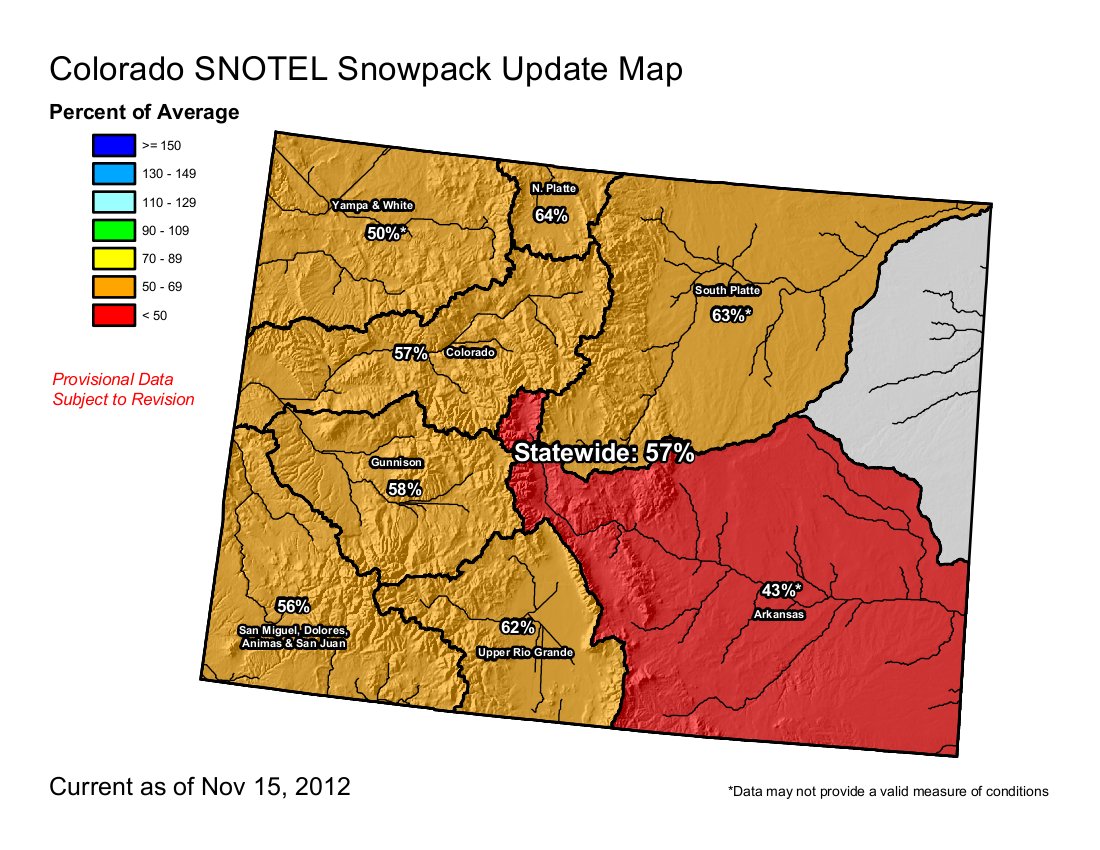
Most of the state should see sunny, warm weather this week. Precipitation was expected to cross the northern and central mountains Sunday night, with up to 3 inches of snow possible at higher locations, mostly above timberline, with light rain in the valleys, forecasters said. Durango, Aspen and Steamboat Springs are expected to see highs near 50 each day with no snow in the forecast through next weekend, according to the western Colorado forecast. That’s not good news for the state’s ski industry or others affected by Colorado’s ongoing severe drought. Statewide snowpack as of Thursday was 57 percent of the 30-year average for the date.

Farmers and conservationists both find something to like in Interior’s new oil shale leasing policy #CORiver

oilshaledepositscowyutblmostseis.jpg

From the Colorado News Connection (Kathleen Ryan) via the La Junta Tribune-Democrat:

Bill Midcap, renewable energy director with the Rocky Mountain Farmers Union, likes the new plan. He says it will help preserve one of Colorado’s most precious resources: water. “We all know that water has all the potential of running out of Colorado. We think it’s prudent that they ensure to the agricultural community how much water is going to be taken, before they move forward.”

The new policy says that public lands can only be leased if oil shale companies can show the economic and environmental viability of the technology used for research or development. The previous policy made nearly 2 million acres available without those restrictions; now, just under 700,000 acres of public land could be used. Twenty-six thousand of those acres are in Colorado. Supporters of increased oil shale research – including the oil and gas industries – worry that the amount of public lease land available is too small to offset economic costs and risks in development.

Ken Neubecker, director of the Western Rivers Institute, says the viability restriction is important, because energy companies often have water rights that trump those of agriculture or Colorado cities. Also, he warns, the current technology used to develop oil shale abroad is not practical in the arid Mountain West. “That is actually a pretty water-intensive operation, using two-and-a-half to four barrels of water for each barrel of oil. It’s a lot easier to do in Estonia and Latvia, but it’s not that easy to do here. Those are wet countries, and this is very dry country.”

Midcap says the new plan leaves him optimistic that the government will listen to the concerns of Coloradans and those across the West about the region’s natural resources. “Farmers and ranchers have a strong enough voice that I don’t think we’ll be pushed out. I think our voice is strong.”

More oil shale coverage here and here.

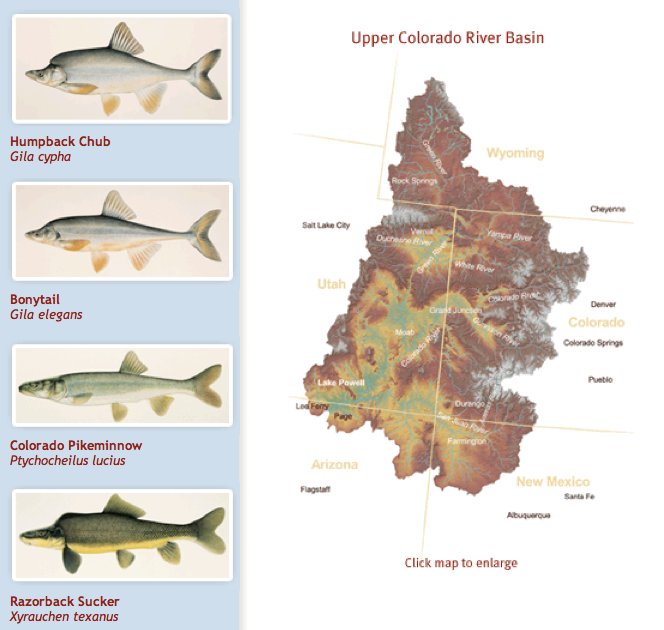
Four Colorado River fish show up on the Endangered Species Coalition’s top ten list #CORiver

ucefrp4speciesuppercoloradomap.jpg

Click here to download and/or read the report Water Woes: How dams, diversions, dirty water and droughts put America’s wildlife at risk from the Endangered Species Coalition. Here’s the introduction:

Water is as essential to us as the air we breathe. And water, in all its forms, may bring us a fundamental joy that is unmatched by other elements of nature. Whether it’s splashing in puddles, running through a sprinkler, diving into a swimming hole, whitewater rafting a powerful river, skiing down a majestic mountain, ice-skating on a local pond, or just listening to the rush of a waterfall, our collective childhood memories include many wonderful experiences of water.

While water blankets our planet, 97 percent of it is salty, and 2 percent is locked in snow and ice. Therefore, less than 1 percent is available as freshwater, stored in rivers, lakes, wetlands and aquifers. This freshwater is our lifeblood. We’ve settled along riverbanks, and used freshwater for our enjoyment, transportation, irrigation, fisheries, recreational tourism, energy production, and drinking water. In short, we’ve spread this indispensible resource thinly.

Though we have an unabashed love for water, we treat it with little respect. We use water as our dumping grounds—the pollution and runoff from our cities, industries and farms spills into our rivers and other freshwater sources. We’ve diverted, damned and drained our rivers, parching some of our greatest ones out of existence. Even the mighty Colorado River, though strong enough to carve out the Grand Canyon, has been no match for our intensive water consumption. Most years, it no longer reaches the sea. In fact, few of our rivers remain pristine.

And new man-made threats are bearing down on our freshwater resources. Climate change is expected to increase droughts. According to scientific models climate change combined with population growth will result in much of the United States experiencing issues with water scarcity by 2025. Meanwhile, as hydraulic fracturing (fracking) spreads, so does the potential for more dirty water. According to an Argonne National Laboratory report, our oil and gas wells produce at least nine billion liters of contaminated water per day.

For the country’s imperiled wildlife, these threats are severe. We’ve seen massive fish kills, closures of multi-million fisheries and even the extinctions of species in the wild. Fish no longer reach their spawning grounds, frogs suffer from chemicals seeping through their delicate skins, introduced plants choke native ones from their habitats, exotic aquatic species threaten native fish, and development threatens the stream-side homes of mammals and birds.

This report details the top ten water woes for endangered species. It describes how our water management—our dams, diversions, dirty water and droughts have imperiled America’s wildlife, birds, fish and plants. But this is also a report about hope—how those of us living with threatened and endangered species can take action to help.

Thanks to one of the strongest endangered species laws in the world, we continue to protect our natural heritage. And it is not too late to save our species; across the country, we can all do our part. Supporting the groups involved in this report and their work to protect wildlife, plants and habitats is important. Standing up for wildlife protections is essential. And at home, we can make a difference by eliminating any leaks in plumbing; by installing water-efficient toilets, showerheads, washing machines, and dishwashers; by planting native plants adapted to our local environment; by reducing or eliminating our lawns; and by installing rain barrels to capture storm water for watering the garden.

Join us in protecting our country’s incredible web of life.

Thanks to the Colorado News Connection (Kathleen Ryan) via the Ag Journal for the heads up. From the article:

Leda Huta, the executive director of the Endangered Species Coalition, explains why this report is so significant. “When we look at the country and what we’ve done to our fresh water resources, it’s frightening. Every animal has its role to play in the ecosystem.”

The report finds the bonytail chub is functionally extinct, while three other species – the Colorado pike minnow, the humpback chub and the razorback sucker – are all declining in population because of non-native invasions, declining water, and river pollution. Other creatures on the national list include salmon, antelope and mountain yellow-legged frogs.

Huta says the declining availability and quality of water comes at a time when the planet can expect to have less fresh water available because of global warming. “We will see more drought and water scarcities due to climate change that we’ve created and to having an increasing population, so those two together are going to have even greater impact on our fresh water.”

The report highlights things people can do to reduce their demand on fresh water, which makes up only 1 percent of the water on the planet. That includes landscaping with native plants, reducing the size of lawns, and using water-efficient appliances and toilets.

More endangered/threatened species coverage here and here.

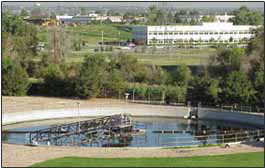
The Brighton City Council green lights new Metro Wastewater treatment plant

metrowastewater.jpg

From the Brighton Standard Blade (Crystal Nelson):

City Council voted unanimously Nov. 13 during a special meeting to approve on first reading a final plat and development agreement, as well as a condition of use agreement for the property. The final plat will create one large platted lot from the six existing non-platted parcels for the purpose of building the regional treatment facility on the 83-acre piece of property, located at the corner of US-85 and Weld County Road 2, according to Senior Planner Jason Bradford. He said it also includes additional right-of-way dedication for Baseline Road, a 22-foot-wide trail easement along the western and southern edges of the property, an easement for a city drainage channel in the southwest corner of the property and other easements for water meters, storm water and public infrastructure on the property…

A wastewater treatment plant is needed to support communities in the northern metropolitan region because existing facilities will soon reach capacity, according to the Metro Wastewater Reclamation District website. The Northern Treatment Plant will provide wastewater treatment for all or portions of the cities of Aurora, Brighton, Thornton, Denver and the South Adams County Water and Sanitation District.

“Construction will begin in December of this year. You probably won’t see too much activity this year,” said Northern Treatment Plant Project Delivery Manager Bill Brennan, adding the board will award a contract for construction in a week and that the plant is expected to become operational in 2016. According to Brennan, earthwork will take place from January through June, a berm will be constructed around Highway 85 in the spring, the administration building/visitors center will be constructed between July of 2013 and August of 2014, sidewalk and landscaping will be installed during 2015 and the facility is expected to open around June of 2016.

More wastewater coverage here.

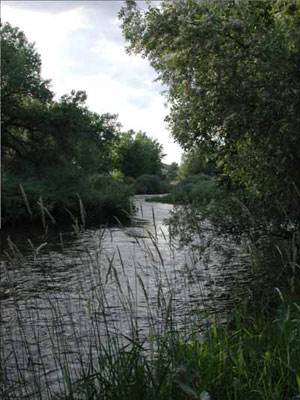
‘The Poudre Runs Through It’ report is hot off the press

cachelapoudre.jpg

From email from the Colorado Water Institute (Reagan Waskom/Mary Lou Smith):

Thanks again for participating last year in our successful look at the Poudre River and Northern Colorado’s water future. At the end of the series we promised to send you the final report from the public deliberation sessions that closed out the series. Well, here it is!

[Click here] to read the report, written by Martin Carcasson and Leah Sprain, CSU’s Center for Public Deliberation, who facilitated the public deliberation sessions.

More than 350 of you participated in The Poudre Runs Through It: Northern Colorado’s Water Future. Some attended all the sessions, including the educational programs and the public deliberation events.

At the close of the series we asked those in attendance to evaluate the series. Overwhelmingly, you rated it “very helpful” and said it provided unbiased coverage of the issues. Though last year’s participants have different opinions about topics such as water storage, conservation, agricultural water use, and growth, virtually all expressed interest in the health of the Poudre River.

Almost everyone said the series was a good start but that the community needs more information about our water challenges. We heard you, and we are today launching a central website as one way to meet this need—bringing together the myriad resources and activities related to the Poudre River.

Click this link to access the website: www.cwi.colostate.edu/thepoudrerunsthroughit/index.html Take a look, and then let us know what you would like for us to add to it. With your help we can keep it a dynamic resource for years to come.

And that’s not all. We have followed up the 2011 series with a Poudre Runs Through It Study/Action Work Group that will be meeting monthly through May, 2013. This work group is made up of 25 community leaders in agricultural, municipal, environmental, industrial, business, development, and recreational sectors. We are learning together about all aspects of the river and strategizing ways we can work together to “make the Poudre River the world’s best example of a ‘working river’—one that provides economic and social benefits by respecting private property rights—that’s also a healthy river.”

We envision convening a public session on the banks of the Poudre early in June where we will relate what the Study/Action Work Group accomplished and discuss their recommendations for moving forward. This will be the community’s opportunity to learn more about the Poudre and how we promote cooperation and leverage resources to respect and improve our crown jewel.

Stay tuned to the website for progress of the Study/Action Work Group and to find out about the June “roll out” on the banks of the Poudre! And share this email and the website link with others, please.

More Cache la Poudre Watershed coverage here.

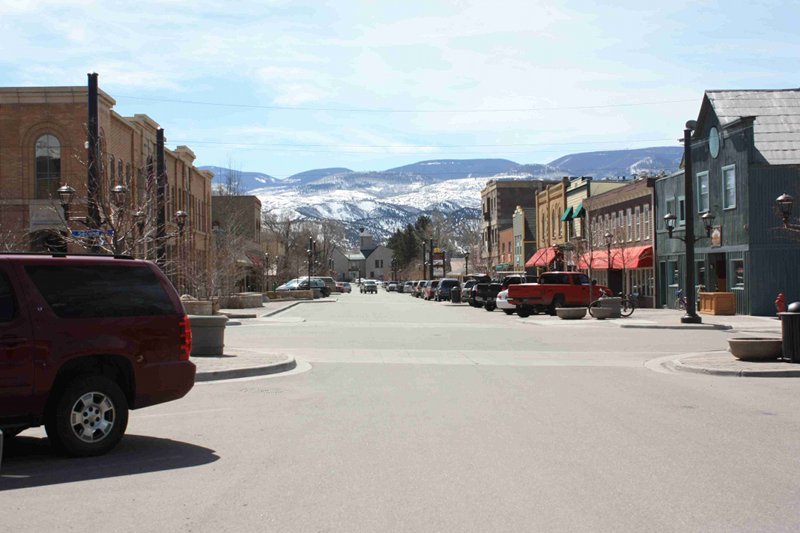
Eagle: The town board is moving on adding more water treatment capacity

eagle2010.jpg

From the Vail Daily (Pam Boyd):

As Eagle stands poised to grow with the new Eagle River Station and Haymeadow developments, the community now needs additional water-treatment capacity to meet potential demand. Tuesday night, the Eagle Town Board began to answer that demand by approving a special-use permit for a new lower basin water-treatment plant. The new plant will be built immediately east — or upstream — from the town’s wastewater-treatment plant located near the confluence of Brush Creek and the Eagle River. Preliminary estimates indicate it will cost around $16 million. The new plant will have an initial capacity of 2.5 million gallons per day and is designed for expansion of up to 5 million gallons per day. It will include two buildings — one covering 32,300 square feet and one covering 1,452 square feet…

During discussion of the plant proposal, Town Board member Joe Knabel asked about scheduling — specifically, the length of the planning period to get the facility up and operational. Eagle Town Engineer Tom Gosoirowski said in all likelihood, the plant is on at least a 30-month schedule to address permitting, financing and 20 months of construction.

Eagle Public Works Director Dusty Walls said that at present, during the summer, Eagle hits the 80 percent capacity mark for its water system, and that’s the point when the state wants towns to begin work on new treatment facilities. Mayor Yuri Kostick said that during the summer, town residents can use as much as 2.3 million gallons of water per day, but during the winter, the number is closer to 500,000.

More Eagle River Watershed coverage here and here.

Snowpack news: Jackson Gulch Reservoir at lowest level since 1996 #CODrought

snowpackcolorado11152012.jpg

From The Dolores Star:

Many are saying that this year is close to what happened in 2002, just 10 years ago. The amount of water that is received in this area is wholly dependent on the weather, said Mancos Water Conservancy District superintendent Gay Kennedy. Kennedy said this year’s dry conditions are due to the mild winter last year and little amount of moisture this last spring. This has caused the rivers, lakes and reservoirs in the area to be at a low level, the likes of which have not been seen for a while. Jackson Gulch reservoir hasn’t been this low since 1996 said Kennedy.

From The Fairplay Flume (Mike Potter):

The National Oceanic and Atmospheric Administration is predicting a warmer- and drier-than-average winter for 2012-2013 after the El Niño weather pattern didn’t develop as predicted. When El Niño is present, warm water in the Pacific Ocean causes a shift in tropical weather patterns, which in turn affects the jet stream over the United States. El Niño occurs when an area of warm water develops in the Pacific Ocean roughly every five years west of northern South America. Because it didn’t develop like it was expected to, NOAA’s National Weather Service modified its original weather judgment…

Bernie Meier, a meteorologist with the National Weather Service office in Boulder, said the recent weather activity has many people only guessing on what the winter will bring in precipitation. He said the national models show the chance that temperatures are going to be higher than normal, but that doesn’t mean it will happen. He said some recent models show an average winter in Colorado. “It’s not trending really dry or really wet,” he said. “My best guess would be middle of the road.”

From the Summit Daily News (Paige Blankenbuehler) via The Denver Post:

Local ski areas are beginning to see the implications of a drought year as Arapahoe Basin focuses on conservation in snowmaking efforts…The ski area diverts small amounts of water from the reservoir around the clock for snowmaking operations. Snowmaking crews blow snow 10 hours per day. Snowmaking operations are permitted by water rights, but the ski area is required to maintain a minimum bypass flow to ensure stream health.

Pagosa Springs: Fishery improvement project to take place over the next few weeks

pagosahotsprings.jpg

From the Pagosa Springs Sun:

The Town of Pagosa Springs would like to make residents and businesses at the east end of town aware of increased, construction-related traffic in the vicinity of the River Center.

Over the next several weeks, construction and hauling crews will be working behind the River Center performing various tasks associated with the town’s “Fishing is Fun” fish habitat and angler access project along the San Juan River corridor.

Work will include hauling dredged silt from the fishing ponds via dump truck to the sanitation lagoons on South 5th Street. Work will also include hauling river habitat enhancements (root wads, boulders, etc.) to the River Center

Construction activities will begin this week and continue intermittently until approximately mid-December. Work will be performed during the daytime work hours of 7 a.m.-5 p.m., Monday-Friday. Weekend work may be performed periodically, when necessary.

More San Juan River Basin coverage here.

Tuesday: U.S. and Mexico to sign agreement to allow storage of some of Mexico’s water, pilot program for Delta restoration #CORiver

coloradoriverbasin.jpg

From the Associated Press (Kevin Ritter) via The Durango Herald:

Government officials from the United States and Mexico have set a Tuesday date in San Diego to sign a landmark agreement to share Colorado River water during times of drought and surplus. A time and place for the announcement weren’t immediately made public. But International Boundary and Water Commission official Gustavo Ramirez on Friday confirmed the day and place. The commission’s U.S. section secretary, Sally Spener, said this week from El Paso, Texas, that there were still a number of reviews and approvals needed north and south of the border before the addendum to a 1944 U.S.-Mexico water treaty is signed.

On Thursday, the Southern Nevada Water Authority and Colorado River Commission of Nevada unanimously approved the pact, authority spokesman Scott Huntley said. The two entities, along with the Metropolitan Water District of Southern California and the Central Arizona Project, are among the largest of the 15 agencies and state officials in Arizona, California, Colorado, Nevada, New Mexico, Utah and Wyoming whose approvals are needed, along with representatives of Mexico and the U.S. Bureau of Reclamation. New Mexico’s Interstate Stream Commission unanimously approved the agreement Wednesday…

The agreement calls for letting Mexico store water in Lake Mead, and for a pilot program of water releases from the U.S. to replenish wetlands in the Colorado River delta south of the border. The water agencies in California, Arizona and Nevada would each buy water from Mexico over three years, and the agreement also clears the way for U.S. entities to invest in infrastructure improvements in Mexico in return for a share of the water such projects would save.

More Colorado River Basin coverage here and here.

Forecast news: Warm and dry

Coyote Gulch outage: Deadline tomorrow, I’ll see you on Monday

coyotegulchandedquillen10022010.jpg

I’m on deadline at Colorado Central Magazine. I’ll see you bright and early on Monday.

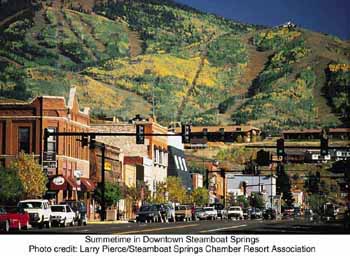
Yampa River: Steamboat Springs is using a GOCo grant west of town to improve the fishery and access

steamboatsprings.jpg

From Steamboat Today (Scott Franz):

Steamboat Springs Parks, Open Space and Recreational Services Department supervisor Craig Robinson said Wednesday that crews with Nordic Excavating and Ecological Resource Consultants have embarked on a month-long project that will install boulder clusters and shape channels in the river to improve its aquatic habitat and make it more habitable to fish and anglers alike.

“These improvements will benefit everybody,” Robinson said, noting that as a secondary benefit the project should improve recreational opportunities on the stretch of the river that has suffered from severe bank erosion…

In addition to the restoration project, the city has plans to add paved access and a parking lot to the piece of open space for use by anglers and kayakers.

Grant funding also will cover revegetation in the area.

In June, the city received a $2.4 million grant from GOCo to fund the river restoration project and also to help secure a conservation easement south of city limits…

Work on the Yampa also is supported by a $150,000 grant from the Bureau of Land Management through the America’s Great Outdoors program.

More Yampa River Basin coverage here and here.

The Middle Colorado River Watershed Partnership is hosting a public educational field tour on November 28

coloradoriverdebeque.jpg

From the Middle Colorado River Watershed Partnership:

The Leadership Committee will be meeting at the offices of the Garfield County School District R2-E, on Wednesday, November 28th, 2012, from 8:00 to 9:15 AM. The District offices are located at 339 Whitewater Avenue, Rifle, CO.

We welcome all of our Partners and members of the public to join us for an educational field tour on Wednesday, November 28th beginning at 9:30 AM and running until approximately 11:30 AM. Please RSVP by clicking here. Along with our host, Steve Anthony, Director of Garfield County’s Vegetation Management program, see first-hand the collaborative work on the part of a number of agencies and private landowners to promote tamarisk control within portions of our watershed. We will be looking at two projects currently underway along the mainstem of the Colorado River near Rifle: Lion’s Park and the Gypsum Ranch.

Tour Info Flyer.

Map of Tour Meeting Location.

USGS: Streams Show Signs of Degradation at Earliest Stages of Urban Development

denveraurariasketch1860frankleslieillustratednewspapernewyork12151860.jpg

It’s no surprise that people settle near surface water. Here’s the release from the United States Geological Service (James Coles/Kara Capelli):

The loss of sensitive species in streams begins to occur at the initial stages of urban development, according to a new study by the USGS. The study found that streams are more sensitive to development than previously understood.

“We tend not to think of waterways as fragile organisms, and yet that is exactly what the results of this scientific investigation appear to be telling us,” said USGS Director Marcia McNutt. “Streams are more than water, but rather communities of interdependent aquatic life, the most sensitive of which are easily disrupted by urbanization.”

Contaminants, habitat destruction, and increasing streamflow flashiness resulting from urban development can degrade stream ecosystems and cause degradation downstream with adverse effects on biological communities and on economically valuable resources, such as fisheries and tourism.

For example, by the time urban development had approached 20 percent in watersheds in the New England area, the aquatic invertebrate community had undergone a change in species composition of about 25 percent.

The study also found that the health of highly-degraded streams can be improved by implementing management actions that are designed to reduce specific stressors.

“Biological communities were not resistant to even low levels of urban development. In the study sensitive invertebrate species were being lost over the initial stages of development in relatively undisturbed watersheds,” said Dr. Gerard McMahon, lead scientist on the study. “Understanding how stream ecosystems are impacted by urban development can assist in the development of management actions to protect and rehabilitate urban stream ecosystems.”

Multiple streams in nine metropolitan areas across the continental U.S. were sampled to assess the effects of urban development on stream ecosystems. Study areas include Atlanta, Ga., Birmingham, Ala., Boston, Mass., Dallas, Texas, Denver, Colo., Milwaukee, Wis., Portland, Ore., Raleigh, N.C., and Salt Lake City, Utah.

The study also found that the effects of urbanization on the biological community vary geographically depending on the predominant land cover and the health of the community prior to urban development. In the study, the greatest loss of sensitive species occurred in Boston, Portland, Salt Lake City, Birmingham, Atlanta, and Raleigh metropolitan areas, where the predominant land cover was forested prior to urban development. The smallest loss of sensitive species occurred in Denver, Dallas, and Milwaukee metropolitan areas where land cover was primarily agriculture before urban development.

“The reason for this difference was not because biological communities in the Denver, Dallas, and Milwaukee areas are more resilient to stressors from urban development, but because the biological communities had already lost sensitive species to stressors from pre-urban agricultural land use activities,” said McMahon.

Although urban development creates multiple stressors, such as an increase in concentrations of insecticides, chlorides, and nutrients, that can degrade stream health—no single factor was universally important in explaining the effects of urban development on stream ecosystems. The USGS developed an innovative modeling tool to predict how different combinations of urban-related stressors affect stream health. This tool, initially developed for the New England area, can provide insights on how watershed management actions to improve one or more of these stressors may increase the likelihood of obtaining a desired biological condition.

The effects of urbanization on streams, including information about this and past studies, as well as graphics and maps, and videos can be online.

Results of this nationwide study and details about the effects of urbanization on the nine metropolitan areas can be found in a new USGS publication titled, “Effects of urban development on stream ecosystems in nine metropolitan study areas across the United States.”

Management strategies used throughout the U.S. to reduce the impacts of urban development on stream ecosystems are described in a new USGS report written in partnership with the Center for Watershed Protection in Maryland titled, “Strategies for Managing the Effects of Urban Development on Streams.”

This study was done by the USGS National Water-Quality Assessment Program, which conducts regional and national assessments of the nation’s water quality to provide an understanding of water-quality conditions, whether conditions are getting better or worse over time, and how natural features and human activities affect those conditions.

More USGS coverage here.

Colorado Aquifer Management: Groundwater and River Flow Connections conference November 28 and 29

groundwatermovementusgs.jpg

Click here for registration information. Here’s the pitch:

A conference to promote the concept and technology of recharging aquifers. For water supply authorities, engineers, groundwater consultants, regulators and potential end-users.

More groundwater coverage here.

Steamboat Springs is considering establishing a stormwater enterprise

detentionpond.jpg

From Steamboat Today (Scott Franz):

Interim City Manager Deb Hinsvark said [November 8] that the scope of the fee, or whether it will be assessed at all, will depend on the results of a $180,000 infrastructure study of Steamboat’s bridges, culverts and dams that is expected to be completed by the end of this year…

If a fee system is implemented, Steamboat would join several other growing Colorado municipalities that already charge residents a monthly bill to help pay for their own infrastructure upgrades. A March 2011 study conducted for the city of Greeley by AMEC engineering showed residents in 30 Front Range municipalities from Lakewood to Fort Collins typically were paying between $1.98 per month to $14.26 per month for stormwater infrastructure. Fort Collins represented the high end of the spectrum.

More infrastructure coverage here.

‘Why would a ski area sell off water rights?’ — U.S. District Judge William Martinez

powderhornskiarea.jpg

Oral arguments in the lawsuit brought by the National Ski Areas Association against new permit requirements from the U.S. Forest Service were heard on Thursday. Here’s a report from Jason Blevins writing for The Denver Post. From the article:

On Thursday, U.S. District Judge William Martinez entertained oral arguments from both sides in a case that could decide the fate of hundreds of millions of dollars worth of ski-area water rights. Citing 140 years of federal laws and court decisions, NSAA lawyer Zeke Williams argued the agency overstepped its authority with the new directive, which he called a “sea change in agency law.”

“The agency can point to no statute that authorizes it to condition use and occupancy permits on the permit holder assigning to the Forest Service property that is not federal property,” Williams said.

The Forest Service says it changed the law to prevent ski areas from selling water rights connected to federal land…

“Why would a ski area sell off water rights and leave itself with insufficient water to operate a ski area?” he said. “Then you are not a ski area anymore.”

Williams argued that the Forest Service rule was a “draconian and punitive solution to a hypothetical problem.”[…]

Williams on Thursday argued that the agency violated the Federal Administrative Procedural Act by not offering legal support for the rule and not soliciting public input on the new rule…

“In the history of this policy, it is very clear that we are not deviating from the overall history of the policy,” Samford said. “If you have a federal permit on federal land and you want water rights in service of that permit you need to claim them in the name of the United States.”

More coverage of the lawsuit here.

Ron Redd named as the new manager for the Parker Water and Sanitation District

parkerrhodeislandhotel1908bestofparker.jpg

From the Parker Chronicle (Chris Michlewicz):

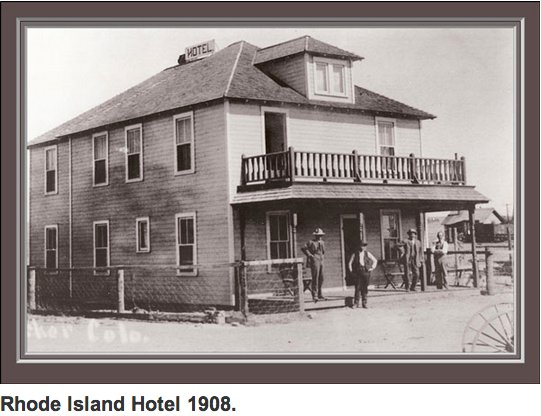
Ron Redd, the longtime utilities director for Castle Rock, was named during a meeting Nov. 15 as the replacement for Frank Jaeger, who has served as district manager for more than 30 years. Redd was present for many of the water district’s most recent notable accomplishments, including the opening of Rueter-Hess Reservoir and Dam. Redd was among the main players in Castle Rock’s agreement to purchase $40 million worth of water storage space in Rueter-Hess, making the town the PWSD’s largest partner on the expansion of the reservoir…

Wasserman pointed out that certain perks that have come with the district manager’s position in the past will no longer be in place, such as free gas. Jaeger drives a GMC Denali that’s owned by the district, one of the points of contention when the new board members were elected. Redd, who starts his job in early January, will get a $500-a-month auto allowance, along with his $150,500 annual salary.

Will Mr. Redd take over Mr. Jaeger’s duties with the Colorado Wyoming Cooperative Water Supply Project?.

More Parker coverage here and here.

‘Latinos…are concerned about preserving the ecosystems of the Colorado River’ — Nita Gonzales

coloradoriverbasinusgs.jpg

Here’s a guest commentary written by Nita Gonzales running in The Denver Post. Here’s an excerpt:

Stretching all the way to Mexico, the Colorado River also supports businesses and industries. It provides the water for more than 3 million acres of farmland, and it serves 36 million people, providing drinking water as well as recreational activities and jobs.

Even our Latino heritage and culture is tied to the river. Historically, Latinos in the Southwest developed a complex system of acequias (irrigation canals) that provided water to farms. Today, the acequia culture of southern Colorado continues as farmers use those canals to irrigate their crops, just as their ancestors have done for generations.

Latinos, like many others in the Southwest, are concerned about preserving the ecosystems of the Colorado River as we continue to rely daily upon its water in our schools, industries, and homes. A recent poll released by Nuestro Rio revealed that nearly 75 percent of Colorado Latinos believe that it is very important “that the government help protect our community’s rivers and lakes for family recreation and the overall well-being of the environment.” Eighty-four percent of Latino voters favor conservation, encouraging the government to prioritize efficiency when developing policies to address water shortages.

The Colorado River is integral to the economic and physical health of our state and region — and even the nation. The huge burden that the river bears — supplying water to the seven states in the Colorado River basin and Mexico — has taken a hefty toll. Storage of Colorado River water has decreased 40 percent over the last 13 years. Currently, people are using more water than what the river can provide. The Bureau of Reclamation of the U.S. Department of the Interior estimates that this imbalance will significantly grow in the years to come if nothing is done about it.

If no action is taken, plans to divert more water may push some reaches of the river to the brink of ecological collapse.

More Colorado River Basin coverage here and here.

Snowpack news: Monarch Ski Area postpones opening

snowpackcolorado11152012.jpg

From The Pueblo Chieftain (Tracy Harmon):

“Due to the unfortunate weather patterns we’ve been receiving, Monarch Mountain has had to make the tough decision to delay opening day,” said Greg Ralph, Monarch marketing manager. “At this time, Monarch’s opening day will be announced as soon as we have sufficient conditions to do so.

From Out There Colorado (R. Scott Rappold):

The ski area, which relies on natural powder, has received little snowfall this fall, like most of the Colorado high country. It’s the second year in a row the area, popular among Colorado Springs skiers, wasn’t able to open by Thanksgiving as planned.

Elsewhere in Colorado, ski areas have been able to open a handful of runs on man-made snow. Open areas include Arapahoe Basin, Loveland, Breckenridge, Keystone, Copper Mountain, Eldora, Winter Park, Wolf Creek and Vail.

Statewide snowpack is just 57 percent of average for mid-November, according to the Natural Resources Conservation Service.

NWS: Winter weather outlook for Southern Colorado

From the National Weather Service:

In general terms, there is a greater than 40 percent chance that the average temperature for the winter months of December 2012 through February 2013 will be above the 30 year climatological average, with equal chances of seeing above, below or near normal precipitation…

The data collected from observation sites across south central and southeast Colorado during previous ENSO neutral winters also indicate a wide range of distribution, especially in precipitation. Of particular interest is the data from the winters of 1961-62 and 1962-63, which had similar characteristics to the current state. In looking at this limited data set of 2 winter seasons, a possible trend of near normal precipitation may be gleaned across portions of south central Colorado, along with a possible trend of below normal precipitation across southeast Colorado.

So what will happen this winter? We will still see snow and cold temperatures; however the frequency of storms may be decreased, especially across southeastern Colorado. Time will tell. One thing that does seem certain is the likely persistence of drought conditions across Colorado.

Snowpack news: The storms last weekend push statewide snowpack to 57% of avg #CODrought

snowpackcolorado11152012.jpg

Click on the thumbnail graphic for the statewide snowpack map from the Natural Resources Conservation Service.

From the Summit County Citizens Voice (Bob Berwyn):

Statewide, the snowpack was at 57 percent of average, as of Nov. 15, with most West Slope basins between 50 and 60 percent of average. Even the North Platte drainage, which has seen some significant snows in the Never Summer Range, is only at 64 percent of average.

In Summit and Eagle counties, many streams are flowing at or below historic low levels, creating challenges for some ski areas that rely on direct stream diversions for snowmaking. Keystone, for example, has had to dial back its snow guns several times in the past week as the Snake River dropped to a flow of just six cubic feet per second, the minimum required under state regulations.

Earlier this week, automated gage readings posted online showed that the Snake flowed below that minimum for several hours. Last winter — during a wet year — Keystone’s snowmaking diversions caused the Snake River to drop below the required minimum stream flow between 15 and 20 times, according to officials with the Colorado Water Conservation Board.

From Steamboat Today (Matt Stensland):

The National Weather Service Climate Prediction Center is now calling for a winter unaffected by either the El Niño or La Niña weather patterns. That differs from earlier forecasts, when weather experts were expecting an El Niño winter, which typically doesn’t bring ideal snow conditions to Northwest Colorado. La Niña, which often creates more favorable storm tracks for Steamboat Springs, also won’t be a factor. Instead, with near-normal ocean temperatures, forecasters are predicting what they call ENSO-neutral conditions, and that typically results in varied snowfall in Colorado’s ski towns…

Looking at seven ENSO-neutral winters going back to the season of 1961-62, snowfall in the city of Steamboat Springs was above normal three seasons and below normal four seasons. The Steamboat Ski Area saw its second best season on record during a neutral winter in 1996-97, when 447.75 inches of snow fell. The ski area also saw its worst season on record during a neutral winter; that was in 1980-81, when just 133.25 inches of snow fell…

Phillips said a weak system coming off the west coast could possibly bring snow showers Friday. A second system also favoring northern Colorado will push into the area early next week.

Denver: COGCC regulations hearings recap — Tougher rules on the horizon?

cityparksunrise.jpg

From The Grand Junction Daily Sentinel (Dennis Webb):

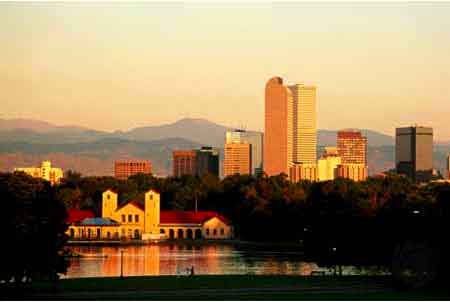
A state agency touted as a national leader in regulating the oil and gas industry on Wednesday began looking to toughen its rules even further, even as some residents and local governments contended its draft proposals don’t go far enough.

The Colorado Oil and Gas Conservation Commission held an all-day hearing in Denver to begin considering requiring groundwater testing before and after drilling, and stricter rules governing setbacks between well pads and homes, schools and other occupied buildings. The new proposals arguably would represent the most sweeping update of rules governing the industry since the commission approved a landmark regulatory overhaul in 2008. They would have even greater implications than the commission’s decision a year ago to adopt what the state called the nation’s most far-reaching requirements for public disclosure of constituents used in hydraulic fracturing. The setback proposal would include required mitigation measures including limits on noise and operating hours, emissions control devices, traffic plans and other measures for operations within certain distances of buildings.

The new rulemaking comes as concern is growing about drilling across the state, particularly near homes in more urban areas, and as more communities are seeking to impose drilling rules of their own. With the backing of Gov. John Hickenlooper, the oil and gas commission recently sued the city of Longmont, contending its rules conflict with areas of state authority. Last week, Longmont voters approved a ban on hydraulic fracturing. While it might be argued that that ban won’t withstand a challenge in court, that’s missing the larger point that such a ban probably could pass in most Front Range communities, said Elise Jones, who just stepped down as the executive director of the Colorado Environmental Coalition after being elected as a Boulder County commissioner.

“There’s a lot of concern out there and it’s very widespread,” she told the commission Wednesday.

“Citizens are going to continue to take these efforts into their own hands,” said Sam Schabacker, of the activist group Food & Water Watch. That’s particularly the case if the best the commission can do is establish a minimum 350-foot setback rule, he said. Energy companies currently can drill within 150 feet of homes in rural areas, and 350 feet in urban areas.

“There’s a consensus in many communities that (drilling) simply doesn’t belong that close to homes or schools,” said Mike Freeman, an attorney who helped lobby for revised oil and rules in 2008 and noted that setbacks were a big unresolved issue from that rewrite.

Mineral owners’ interests

The commission is considering a recommendation to allow drilling closer than 350 feet to homes only with the consent of surface owners and owners of occupied buildings within that distance. The mitigation measures would apply, and such measures also would apply as far as 1,200 feet away. Numerous Front Range residents expressed concerns to the commission about the prospect of drilling near homes. But Harry Thompson, a leader of Citizens Supporting Property Rights in Routt County, argued in favor of the current setback rules. He said increased setbacks could make it unprofitable for companies to reach oil and gas deposits, resulting in a waste of resources and denying mineral rights owners access to their property.

More oil and gas coverage here and here.

Drought news: Current inflow to Dillon Reservoir is at 90% of average #CODrought

usdroughtmonitor11132012.jpg

From the Summit County Citizens Voice (Bob Berwyn):

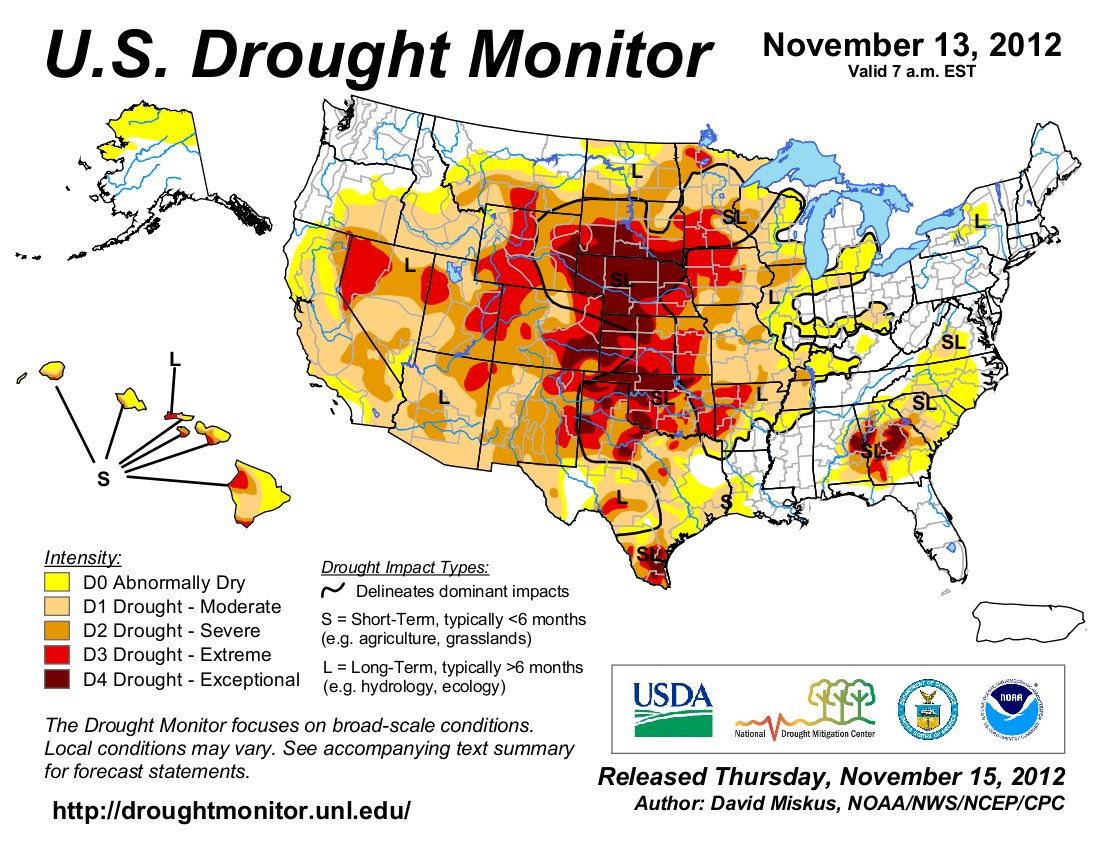
Currently, [Dillon Reservoir] is about 74 percent full, holding about 190,000 acre feet of water. Historically, it’s about 94 percent of capacity this time of year, according to Denver Water’s Bob Peters. In May 2011, the reservoir dropped to 72 percent of capacity just ahead that year’s runoff season. Before that, the last time it dropped to anywhere around this level for any sustained period of time was between May 2002 to April 2003, when it bottomed out at 48 percent, Peters said. Denver Water will continue to draw water throughout the winter, so the reservoir is likely to drop at least another 10 to 12 feet during the next few months.

Here’s and excerpt from the drought discussion provided by the U.S. Drought Monitor:

The West: A slow-moving Pacific storm system brought precipitation to most of the region, but the greatest weekly totals were found in the mountains. 1 to 3 inches of precipitation fell on the Cascades, Sierra Nevada, northern and central Rockies, Utah’s Wasatch and Uinta Ranges, and across east-central Arizona. With a generally stormy weather pattern affecting the Northwest since mid-October and the 2012-13 Water Year off to a good start (basin average precipitation between 100 and 150 percent of normal), some additional improvements were made along the D0 to D3 western and northern edges in Idaho and Montana. The most noticeable modifications were made across western and northern Montana as persistent precipitation the past 4 weeks has eliminated short- to medium-term deficiencies, and has instead produced surpluses at 30-, 60-, and 90-days. The central Sierra Nevada was also upgraded from D1 to D0 as 1 to 1.5 inches of precipitation bumped its basin average precipitation up to 82 percent of normal from 77 percent a week ago. In northern Utah, 2 to 3 inches of precipitation in the Wasatch and Uinta Mountains improved drought by 1-category as basin average precipitation increased 10 to 20 percentages from a week ago to above normal (101 to 112 percent), and snow water content jumped to 150 percent of normal. In the Southwest, 1.5 to 2.5 inches of precipitation in east-central Arizona and west-central New Mexico slightly eased back D2 in those areas. Some slight adjustments were made in central Colorado: D2 was expanded into eastern Eagle and Summit counties which has seen a poor start to the Water Year and missed out on the most recent storm; some improvement was made in northeastern Colorado as normal October precipitation has kept winter wheat conditions fair; and D2 was trimmed in Douglas and Elbert counties to better match conditions.

More Blue River Watershed coverage here and here.

‘The calamity we are facing is our potential inability to balance supply and demand in an orderly way’ — Hannah Holm #CORiver

uppercoloradoriverbasinstatesultimatum09011925denverpost.jpg

Here’s a recap of the Upper Colorado River Basin Water Conference hosted by the Water Center at Colorado Mesa University Nov. 8-9, from Hannah Holm running in the Grand Junction Free Press. Here’s an excerpt:

The heavy train [heading towards a cliff] is our collective use of Colorado River water, and the calamity we are facing is our potential inability to balance supply and demand in an orderly way. According to a nearly complete study on Colorado River Basin water supply and demand coordinated by the US Bureau of Reclamation, we’ve passed the point where use of the basin’s water resources exceeds the quantity provided by Mother Nature. The fact that the train wreck isn’t here yet is because of big reservoirs that store water from year to year. Climate change shows no sign of helping: The mean of all the models used in the bureau study indicates higher variability from year to year and a decline in average natural flows at Lee Ferry of 9% by 2060…

Top water officials from Colorado, Utah and New Mexico who spoke at the conference said that while we need to help the Lower Basin states solve their water problems, the solutions most definitely do not include eating into the Upper Basin’s share of the river. On that score, the Upper Basin officials were united. The Lower Basin train can wreck without us.

However, under the terms of the 1922 compact, if hydrology and increased use in the Upper Basin conspire to drop flows past Lee Ferry below 7.5 million acre feet in any 10-year period, we could be required to curtail uses until those flows are restored. This, a “compact call,” is the Upper Basin’s own train wreck scenario. It appears to be farther off than the Lower Basin’s train wreck, but it’s likely enough and close enough to be taken seriously…

Fortunately, the [Bureau of Reclamation’s] study, recent history and presentations by other conference participants do show encouraging signs that the principal players can work together to identify options. The bureau study itself is an example of cooperation among numerous stakeholders. It is subjecting numerous options for adding to supply and curtailing demand to rigorous analysis on their reliability, financial cost and environmental cost. The options include desalination, re-use, and importation of water from elsewhere. The seven basin states have also cooperated recently to coordinate reservoir operations between Lake Powell and Lake Mead, and a new proposed agreement with Mexico would allow for releases to recharge wetlands in Mexico. Work is also underway to figure out how to temporarily transfer water from farms to cities in times of drought, rather than permanently dry up farmland.
As the parties continue to work together, with input from the public, we may be able to curve the tracks so our various train cars skirt the edge of the cliff, instead of going over it. Or something like that. To find out more about the study, go to http://www.usbr.gov/lc/region/programs/crbstudy.html.

More Colorado River Basin coverage here and here.

The Southeastern Water Conservancy District board approves $18 million budget for 2013

coloradorivergranby.jpg

From The Pueblo Chieftain (Chris Woodka):

A move by Front Range water providers to protect fish in the Colorado River will add about $1 million to the Southeastern Colorado Water Conservancy District’s 2013 budget.

Finance manager Tina White walked the district’s board through the $18 million budget at a public hearing Thursday. The board will vote on adoption of the budget at its December meeting.

Southeastern is joining other water providers to buy the Red Top Ranch near Granby for water rights that will be used to protect endangered fish in the Colorado River. This year, it will cost the district $1.09 million. The district also will spend about $600,000 toward a plan to add hydroelectric generation at Pueblo Dam. Both are multiyear projects that involve other partners, and were financed through reserves.

The district expects to generate $16.2 million in revenues through its general fund and enterprise. The money comes from a 9.35­mill property tax over a nine­county area, enterprise fee collection and grants. Most of the money will go toward repaying federal contracts for the Fryingpan­Arkansas Project to the Bureau of Reclamation — $6.5 million to repay the agricultural share of the project and $5.3 million for the Fountain Valley Conduit (paid only in El Paso County). The municipalindustrial portion of the Fry­Ark Project was paid off first because it carried interest, while the agricultural share does not. About $42.4 million is still owed. The largest operating expenses in the budget are $2.2 million for human resource, personnel and overhead, and $1.2 million for outside services, studies or partnerships.

The budget also includes about $500,000 for continued work on the master lease contract, Arkansas Valley Conduit and outlet interconnection at Pueblo Dam.

More Southeastern Colorado Water Conservancy District coverage here.

The Colorado Foundation for Water Education 2012 Annual Report is hot off the press

cfwe2012annualreportcover.jpg

Here’s the link to the report.

More Colorado Foundation for Water Education coverage here and here.

Reclamation releases Supplemental Information Report to Windy Gap Firming EIS

windygapreservoirnorthernwater.jpg

Here’s the release from Reclamation (Kara Lamb):

The Bureau of Reclamation announces the availability of a Supplemental Information

Report and related errata to the Final Environmental Impact Statement, which analyzed impacts of the proposed Windy Gap Firming Project. Both the SIR and the errata are available at http://www.usbr.gov/gp/ecao.

“A SIR analyzes new information received after the completion of the Final EIS to determine if there are significant new circumstances or information relevant to environmental concerns on the proposed action or its impacts,” said Michael J. Ryan, Regional Director for Reclamation’s Great Plains Region.

An errata is a list of corrections to a publication.

After publication of the Final EIS in December 2011, Reclamation received new information regarding the Multiple Metric Index methodology for aquatic invertebrates in the Colorado River. Invertebrate values were updated and rerun based on this new information.

The findings in the SIR explain that the revised aquatic invertebrate values did not change the conclusions in the Final EIS.

More Windy Gap coverage here and here.

Colorado Water 2012: Rio Grande River — recreation opportunities abound in the basin

riogranderiverstateengineersoffice.jpg

Here’s the latest installment in the Valley Courier’s Colorado Water 2012 series, written by Heather Dutton. Here’s an excerpt:

Opportunities for fishing abound from the headwaters and high mountain tributaries, through the San Luis Valley to the state line. Backcountry fly-fishing in the high country offers fishermen beauty, seclusion, and a chance to cook the day’s catch on a fire in the wilderness (please be advised of fire bans!). People also enjoy boating and fishing in the many high mountain reservoirs in the basin, such as the Rio Grande Reservoir.

As the river drops from the mountains and settles onto the Valley floor, anglers enjoy the gold medal fishery between South Fork and Hanna Lane. Gold medal waters are defined by Colorado Parks and Wildlife as areas with 60 pounds of trout per acre and at lease twelve 14” or larger trout per acre.

More Colorado Water 2012 coverage here.

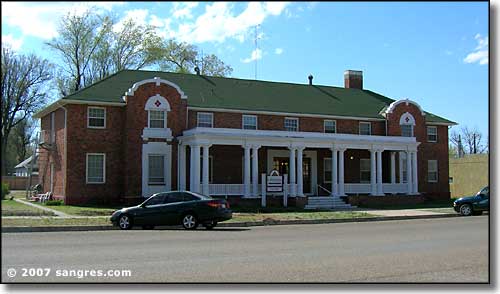
Swink may connect to La Junta water system

swink.jpg

From the Bent County Democrat (Bette McFarren):

City Attorney Phil Malouff approached the Utilities Board with the idea that Swink will soon be asking to connect with the La Junta Water Department. Director Joe Kelley requested that the Swink City Council submit a letter.

More Arkansas River Basin coverage here.

‘We know that groundwater is being protected in harmony with robust oil and gas operations’ — Tisha Schuller (COGA)

marcellushydraulicfracturing.jpg

Bobby Magill (Fort Collins Coloradoan) was in Denver for the Colorado Oil and Gas Conservation Commission setback and groundwater testing hearings yesterday. Here’s a report. Here’s an excerpt:

The state should require groundwater testing within a half mile of an oil well regardless of the presence of a water well, Carol Webb, city regulatory and government affairs manager, told the Colorado Oil and Gas Conservation Commission on Wednesday. Webb said Fort Collins wants the state to require groundwater be tested at least every several years after drilling to ensure public health and safety is protected.

Wednesday’s hearings addressed the proposed groundwater testing rules and updates to regulations that determine how far a well can be drilled from a home and a school. Those distances, called “setbacks,” are being revised to require a proposed minimum 350-foot distance between a new well and a building without a public hearing being held on the drilling proposal.

The COGCC receives more complaints from the public about groundwater contamination than about any other oil and gas-related issue, [Colorado chief oil regulator Matt Lepore] said. Most related groundwater contamination reported to the state involves production facilities, such as oil tanks and pits, he said. Oil and gas wells are responsible for relatively few cases of groundwater contamination, he said.

Environmentalists worry oil and gas hydraulic fracturing contaminates groundwater. The new rules would allow the industry to prove its claims that such drilling doesn’t impact groundwater, said James Milne, COGCC environmental manager…

Water well testing merely provides “peace of mind” and little more, [Weld County Attorney Bruce Barker] said, urging testing be done only for those who are concerned about contamination…

The Colorado Oil and Gas Association promoted its voluntary groundwater sampling program as an alternative to the mandatory one the state is proposing. “We know that groundwater is being protected in harmony with robust oil and gas operations,” said COGA CEO Tisha Schuller, adding that data show energy development is not harming the groundwater.

Mr. Magill live-tweeted the meeting at hash tag #cogcc

More coverage of yesterday’s hearing from Cathy Proctor writing for the Denver Business Journal. From the article:

…Shell Oil joined with the Environmental Defense Fund to jointly propose a statewide testing program, as an alternative to the COGCC’s proposal, that was acceptable to the major oil company and the environmental advocacy group.
The commission is expected to take up the testing issue at hearings scheduled for Dec. 10-11. The commission also will hold hearings at that time on what should be the appropriate setback distance between oil and gas wells and homes, schools and other buildings…

The COGCC’s proposal for a statewide water quality testing program includes taking two water-quality samples within a mile of a wellsite before a well is drilled, up to 18 months after it’s completed and within five years of the well’s completion. More tests would be required if the initial results turn up changes in water quality. Currently, the state requires water-quality tests be done in the San Juan Basin in southwestern Colorado, and in the Greater Wattenberg area in parts of Weld, Broomfield and Boulder counties. Wednesday, several representatives of local government suggested the state’s rule needed to be strengthened by adding testing more locations, and running more tests after the well is drilled. But representatives of Garfield and Weld counties, where companies have drilled thousands of wells, said their elected officials aren’t sure a statewide mandate is needed…

In a twist, Shell Oil, which is drilling in Routt County, joined with the Environmental Defense Fund (EDF), an advocacy group, to jointly propose an alternative to the commission. Typically, when it comes to oil and gas regulatory issues in Colorado, the two groups have negotiated behind the scenes and been on opposite sides of the table in public. Krista Johnson, Shell’s government affairs manager for the Rocky Mountain region, told the commissioners that Shell publicly joined with EDF because the company wants to follow similar approaches to environmental issues wherever it operates around the world. Shell already complies with water testing requirements in other states where the company operates, she said…

Dan Grossman, the regional director of the EDF’s Rocky Mountain region, said the joint proposal was negotiated with energy companies and offers an effective way to identify potential problems and mitigate them.

More coverage from Kristen Wyatt writing for The Denver Post. Here’s and excerpt:

The commission meeting was charged from the start after eight environmental activists seeking entry were wrongly told the hearing was closed to the public. They eventually were allowed in but not with their signs decrying fracking as dangerous to the public.

One of the testifiers was Jonnie Westerop, who handed commissioners photos of a playground with wells visible in the background. “Do you think the citizens are just going to sit back and say that’s fine? … What are we doing to our state? Beautiful Colorado?” she asked…

John Moser, who owns 100 oil and gas wells in northern Colorado, told commissioners that onerous regulations harm the entire state tax base. The Greeley well owner said after his testimony that Colorado must stick with its current regulatory scheme.

Commissioners asked few questions during the public testimony. They got a lengthy briefing on proposed new groundwater testing rules, which commission director Matt Lepore said would be the first in the nation to require groundwater sampling at all new drilling locations.
More oil and gas coverage here and here.

Green Mountain Reservoir operations update: 130 cfs in the Blue River below the dam

greenmountainreservoir.jpg

From email from Reclamation (Kara Lamb):

This morning [November 13], before noon, we cut back the release from Green Mountain Dam to the Lower Blue River. We are now releasing about 130 cfs.

We’re doing our best to balance inflows and outflows. Inflow to the reservoir via the Blue River has been declining over the past week, so that’s part of the reason for our change. But, we are also voluntarily participating in the Shoshone Outage Protocol–helping with Colorado River flows below the power plant just east of Glenwood Springs. So, with that in mind, we are matching our outflow to the inflow, plus 30 additional cfs.

More Green Mountain Reservoir coverage here.

18th Judicial District Judge Paul King affirms his ruling regarding Sterling Ranch

chatfieldstatepark.jpg

From the Denver Business Journal (Dennis Huspeni):

18th Judicial District Judge Paul King’s order on Friday states he followed the letter of a 2008 Colorado law when ruling the board “exceeded its authority” in approving Sterling Ranch’s development plan without requiring the company to prove an adequate water supply for the entire development. He denied the development company’s reconsideration request and denied the motion to remand the case back to Douglas County so it could make the water adequacy determination…

King ruled that the county Board of Commissioners had “exceeded its jurisdiction and abused its discretion” by approving Sterling Ranch’s water plan. His ruling stated Colorado law requires all developers to prove they have enough water to serve the entire development before any construction starts.

His Friday order stated pursuant to the 2008 law (Section 29-20-301), “our legislature has determined that securing an adequate supply of water for development can have a broad regional impact and it is imperative that local government be provided with reliable information concerning the adequacy of a proposed development’s water supply to aid local government in the exercise of its discretion.” He also restated his position that the law defines “adequate” as “a water supply sufficient for build-out of the proposed development in terms of quality, quantity, dependability and availability.”[…]

Sterling Ranch “confessed that they did not submit proof of a water supply to the Board during the lengthy approval process,” Friday’s order stated…

“I didn’t write the law. The judge didn’t write the law,” [Attorney Jim Kreutz] said. “Legislators chose to enact it, so opponents need to hire lobbyists and change the law I suppose.”

More coverage from the Associated Press via the San Antonio Express-News:

A Colorado River District official says a judge’s ruling on the proposed Sterling Ranch community in Douglas County could lead to new legislation. A judge this year reversed the county’s approval of a permit for the Sterling Ranch development, citing a state law that requires counties to first affirm that large new developments have an adequate water supply. County officials had argued they planned to incrementally evaluate Sterling Ranch’s water supply, as construction proceeded in phases.

According to the latest Colorado River District newsletter, district external affairs manager Chris Treese says he expects legislation next year addressing the ruling, though it’s too early to say what direction it could take.

More Sterling Ranch coverage here.

Precipitation news: Good moisture over the weekend for the White River and Yampa River basins #CODrought

yampariverbasin.jpg

From Steamboat Today (Tom Ross):

The snowy pattern that brought winter to the upper Yampa Valley from Friday to Sunday left more than an inch of moisture behind at 10 different snowpack-measuring sites in the mountains surrounding Steamboat Springs. Together, they feed the Yampa and White river drainages.

The Flat Tops mountains, in particular, received significant moisture. Crosho Lake, on the edge of the Flat Tops near Phippsburg, has a modest 7 inches of snow on the ground, but the 0.8 inches of water that snow contains represents 100 percent of average for the date…

Ripple Creek Pass, on the way from Phippsburg to Trappers Lake, has 13 inches of snow on the ground that contains 2.1 inches of water. That measurement is 66 percent of average.

Closer to Steamboat, the west side of Rabbit Ears Pass has 7 inches of snow on the ground, representing 1 inch of water, or about 36 percent of average for the date.

To the north of Steamboat, on the edge of the Mount Zirkel Wilderness Area, the Elk River snowpack measuring site at 8,700 feet contains 0.8 inches of moisture in the 6 inches of snow on the ground, representing 89 percent of average for the date.

‘We show on a local scale that there are significant changes in summer temperatures’ — Irina Mahlstein (CIRES)

desertcowskull.jpg

Here’s the release from Cires (Irina Mahlstein/Jane Palmer):

That summers “just aren’t what they used to be” no longer seems to be the wistful chant of the world weary looking back on their salad days: Analysis of 90 years of observational data has revealed that summer climates in regions across the globe are changing—mostly, but not always, warming—according to a new study led by a scientist from the Cooperative Institute for Research in Environmental Sciences (CIRES).

“It is the first time that we show on a local scale that there are significant changes in summer temperatures,” said lead author CIRES scientist Irina Mahlstein, who works in NOAA’s Earth System Research Laboratory. “This result shows us that we are experiencing a new summer climate regime in some regions.”

The technique, which reveals location-by-location temperature changes rather than global averages, could yield valuable insights into changes in ecosystems on a regional scale. As the methodology relies on detecting temperatures outside the expected norm, it is more relevant to understand changes to biota—the animal and plant life of a particular region—which scientists would expect to show sensitivity to changes that lie outside of normal variability.

“If the summers are actually significantly different from the way that they used to be, it could affect ecosystems,” Mahlstein said.

To identify potential temperature changes, the team used climate observations recorded from 1920 to 2010 from around the globe. The scientists termed the 30-year interval 1920 to 1949 the “base period,” and they compared each 30-year interval—in steps of 10 years later than the starting 1920 date—to the “base period.” The comparison involved statistical tests to determine whether the test interval differed from the base interval beyond what would be expected due to yearly temperature variability for that geographical area.

Their analysis found that some changes began to appear as early as the 1960s, and the observed changes were more prevalent in tropical areas. In these regions, temperatures vary little throughout the years, so the scientists could more easily detect any changes that did occur, Mahlstein said. They found significant summer temperature changes in 40 percent of tropical areas and 20 percent of higher-latitude areas. In the majority of cases, the researchers observed warming summer temperatures, but in some cases they observed cooling summer temperatures.

“This study has applied a new approach to the question: ‘Has the temperature changed in local areas?’” Mahlstein said. The study is in press in the journal Geophysical Research Letters.

The study’s findings are consistent with other approaches answering the same question, such as modeling and analysis of trends, Mahlstein said. But this technique uses observed data only to come to the same result. “Looking at the graphs of our results, you can visibly see how things are changing,” Mahlstein said.

In particular the scientists were able to look at the earlier time periods, note the temperature extremes, and observe that those values became more frequent in the later time periods. “You see how the extreme events of the past have become a normal event,” Mahlstein said.

The scientists used 90 years of data for their study—a little more than the average lifespan of a human being. So if inhabitants of those areas believe that summers have changed since they were younger, they can be confident it is not a figment of their imagination.

“We can actually say that these changes have happened in the lifetime of a person,” Mahlstein said.

Co-authors on the study were Gabriele Hegerl from the University of Edinburgh and Susan Solomon from Massachusetts Institute of Technology.

Thanks to Bob Berwyn (Summit County Citizens Voice) for the heads up. Here’s an excerpt from his article:

After crunching numbers from 90 years worth of observational data, scientists with the Boulder-based Cooperative Institute for Research in Environmental Sciences say they’ve shown that summer climates are, for the most part, warming.

More coverage from Brittany Anas writing for the Boulder Daily Camera.

More Climate Change coverage here.

Weekly Climate, Water and Drought Assessment of the Upper Colorado River Basin #CODrought #CORiver

wyutcoprecipitation1101thru11102012.jpg

Click here for the summaries from yesterday’s webinar from the Colorado Climate Center. Click on the thumbnail graphic for the precipitation summary for November, so far.

Meanwhile, Bruce Willoughby (The Denver Post), has inked a report on some of the ramifications for Lake Mead and Lake Powell after 7 months of drought in the Upper Colorado River Basin. Here’s an excerpt:

It’s no secret that precipitation in the Upper Colorado River Basin has been well below average this year, and the data from the seven drought months leading up to October offer continued cause for concern. Six of those months have seen significantly diminished precipitation in the basin, falling as low as 10 percent of average upstream of Grand Junction in June. Only July, at 160 percent upstream of Grand Junction and 130 percent above Utah’s Lake Powell, saw above-average precipitation. Four of those months saw precipitation 55 percent of average or less.

The ramifications aren’t limited to Colorado. Total inflow into Lake Powell in September was just 100,000 acre feet, 25 percent of average, and 104,000 acre feet in August.

“These are the two lowest months on record for inflow into Lake Powell. That tells you how dry things are,” CRD general manager Eric Kuhn said at the district’s October board meeting. “Even if we have a moderately dry winter, things will be pretty bad. If we have average precipitation in the next two years, Lake Mead levels will be approaching the first shortage trigger in 2014.”

The Colorado River Basin Study to be released later this month by the seven river basin states and U.S. Bureau of Reclamation predicts a potential shortfall of as much as 2 million acre-feet between water supply and water demand in the coming decades. That news has spurred a call for action.

“The question is, a call for what action?” Kuhn said.

More Colorado River Basin coverage here.

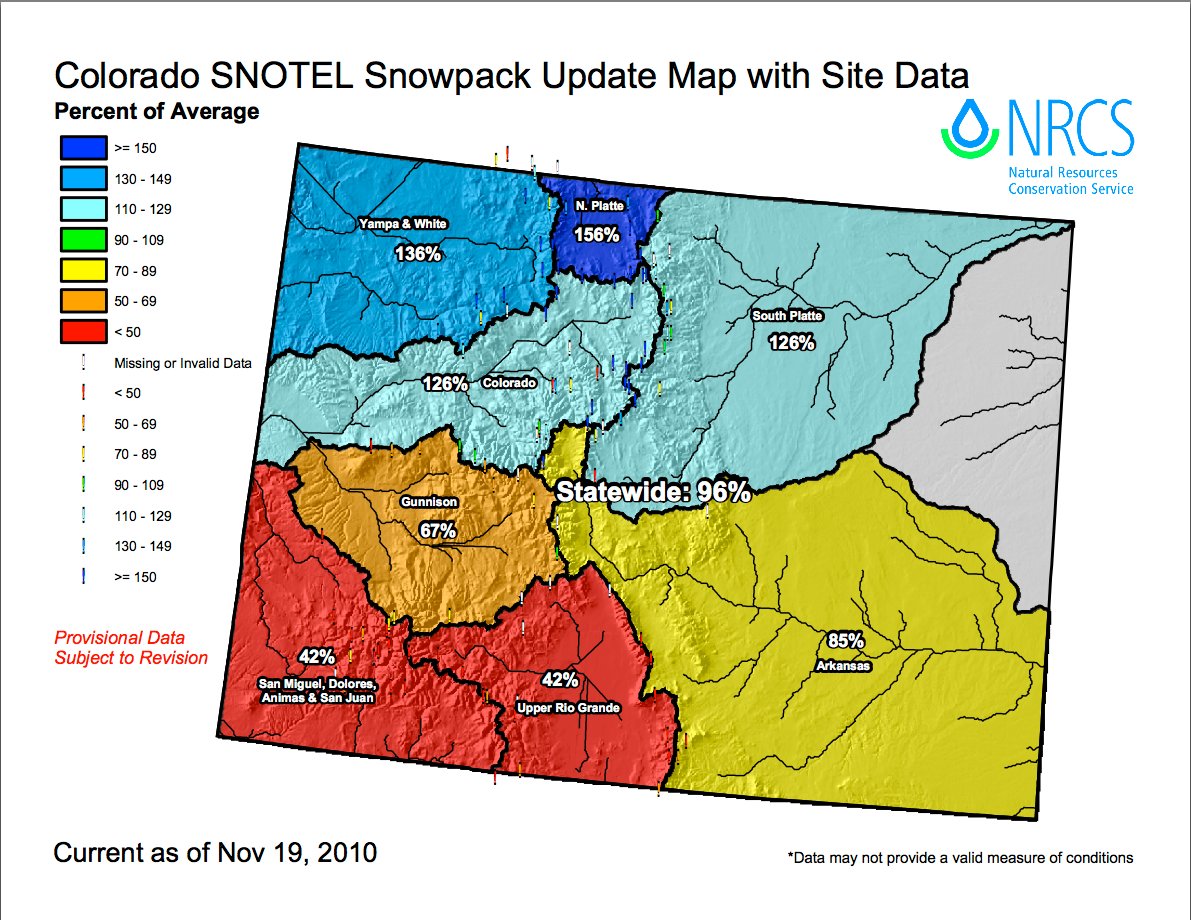
The snowpack news for Colorado is all bad — statewide = 21% of avg #CODrought

snowpackcolorado11192010.jpg

snowpackcolorado110820111.jpg

snowpackcolorado11082012.jpg

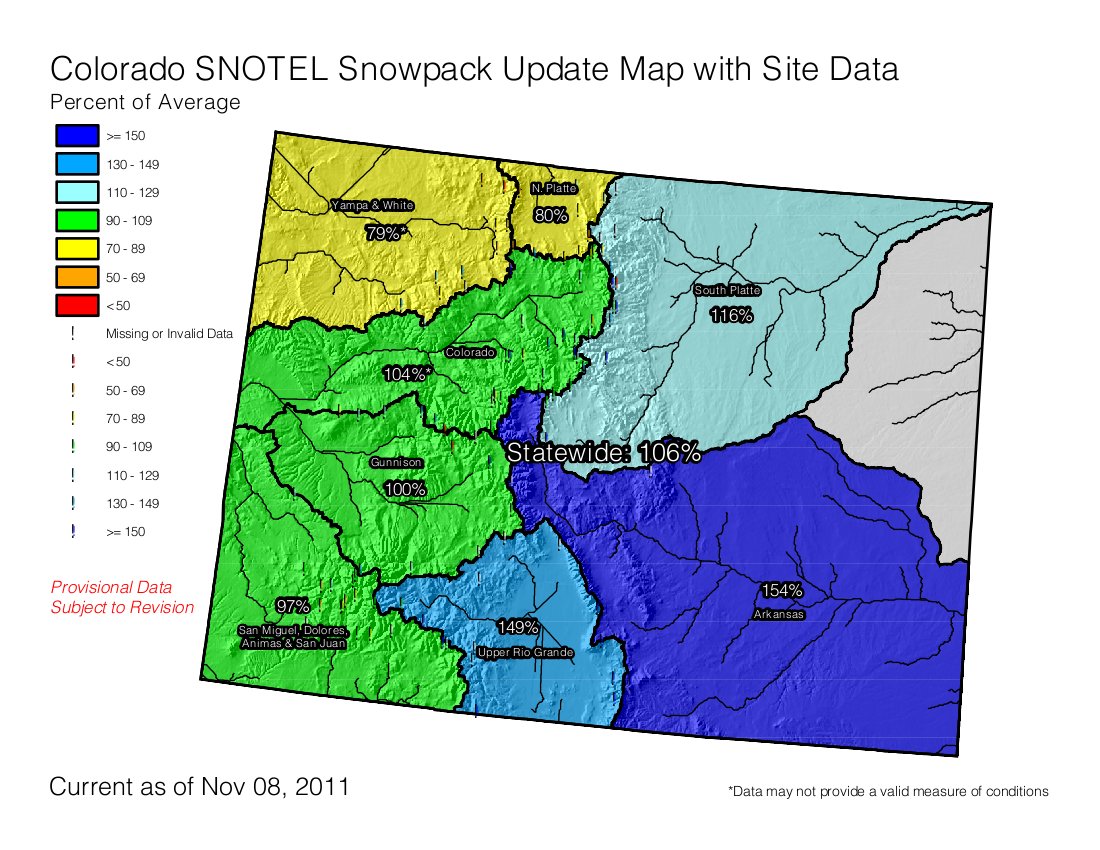
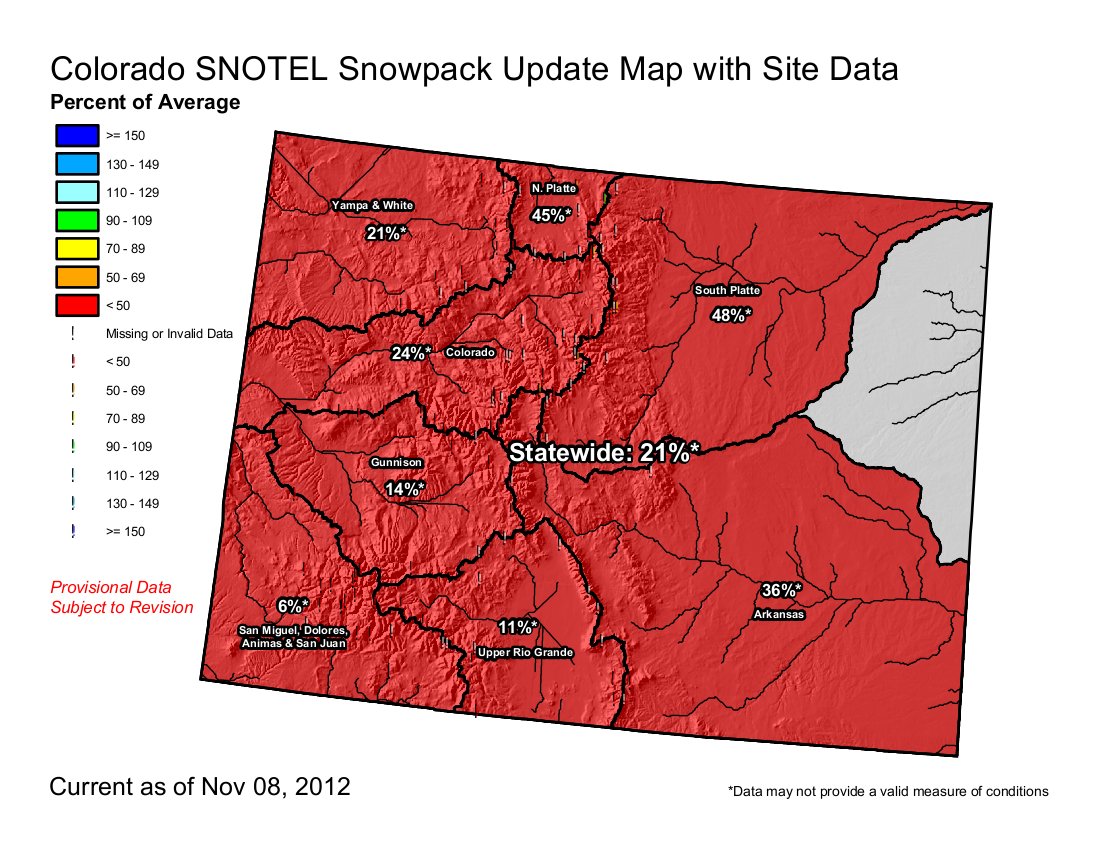
Click on the thumbnail for the current map from last Thursday, the map from November 8, 2011 and the map from November 19,2010, from the Natural Resources Conservation Service. Some areas of Colorado did OK with the weekend storm and that is not reflected in the current map.

November 12-18 is Get Smart About Antibiotics Week

Colorado-Big Thompson Project: Boulder queues up to spend $800,000 on proposed Carter Lake to Boulder Reservoir pipeline

boulderreservoir.jpg

From the Boulder Daily Camera (Joe Rubino):

After four years of planning, Northern Water — leading the project on behalf of Boulder, Left Hand Water District, Longs Peak Water District and the town of Frederick — is ready to begin acquiring the land needed along the pipeline’s proposed future alignment, the memo said.

Design and construction plans likely won’t come before the City Council until 2015 or later, but city staff members indicated that property values are expected to escalate 9 percent each year acquisition is delayed, adding up to $60,000 a year to Boulder’s $800,000 contribution.

“Right now, we are basically going to try to preserve our option for the future by moving ahead with right-of-way and easement acquisition,” said Bob Harberg, Boulder’s utilities planning and project management coordinator. “If … we decide to move forward with this project, we won’t have to contend with the difficulties of land acquisitions.”[…]

As needs have increased, Boulder and its partners in 2007 began looking at a new pipeline that would trace the path of the old pipeline before veering off and eventually delivering water to Boulder Reservoir, according to the staff memo. The new project does not grant participants the right to draw more water from the system than is already allowed…

The enclosed pipeline will provide water year-round — as opposed to seasonally, as is the case with the canal system — and will better protect the water from contamination, leading to more consistent drinking water quality, according to the staff memo.

More Colorado-Big Thompson Project coverage here.

Wiggins new water system still not online

wiggins.jpg

From The Fort Morgan Times (Dan Barker):

During a special meeting of the Wiggins Board of Trustees Wednesday, Public Works Director Jon Richardson said he talked with a representative of the U.S. Army Corps of Engineers about whether or not a proposal for putting the town’s pipeline through its flood levee was acceptable. He was told he would hear one way or another this week, but he had not heard yet, he told the board. He planned to call again at the end of the week.

Industrial Facilities Engineering — which is overseeing the water project — said it was still waiting on a company to figure out what it would cost Wiggins to adapt its new water treatment plant to blend water with its existing wells and its new water source, Richardson said. Blending is necessary, because the town does not have enough new water to fill its needs. Richardson said he expects to know how much it would cost next week.

More Wiggins coverage here and here.

Eagle County: Beavers are impacting Brush Creek mitigation ponds

beaverbwdrawing.jpg

From the Eagle Valley Enterprise via Vail Daily (Derek Franz):

The storm ponds are the main concern, however. They are a filtration system for water going back into Brush Creek from the Eagle Ranch development. By flowing from one pond to the next, pollutants such as fertilizers and petroleum are strained from the water before it goes into the creek.

“The beavers had raised the water level of the ponds a little more than a foot over the weekend,” Boyd said last week. “I noticed that some sticks and debris from the bottom of the pond were piled over the grate (where water drained from one pond to the next).” The beavers were damming the outlets of the last two ponds. The final pond is only separated from Brush Creek by a narrow berm.

“At that rate, it wouldn’t be long before the pond water washed out the berm and went straight into the creek,” Boyd said.

The final pond is very clean, but it wouldn’t be that way if the pond above it washed out, as well.

More restoration/reclamation coverage here.

Produced water from coalbed methane wells could be an adjunct to supplies according to oil company data

coalbedmethaneproductionearthjustice.jpg

From The Pueblo Chieftain (Chris Woodka):

Hundreds of coal­bed methane wells in Las Animas County could produce water that could be used for other purposes in the Arkansas River basin, a study shows. A two­year waterquality monitoring program is showing the “produced water” — water that must be removed from coal seams to extract natural gas — is within limits for harmful contaminants like dissolved solids, conductivity, chloride, sodium, boron and iron, Julie Vlier, of Tetra Tech told the Arkansas Basin Roundtable Wednesday.

“Based on the collection data of the last two years, the quality is quite good,” Vlier said. “Concentrations in the Raton
Basin are lower.” The water ­quality question is important to companies like Pioneer Natural Resources and XTO Energy, which otherwise would have to spend more to inject the water back into the ground. The companies funded the study, which began in 2010. Pioneer alone has about 2,300 gas wells in the Raton Basin, said Jerry Jacob, environmental advisor for the company.

If the water can continue to flow freely into tributaries leading into the Purgatoire River west of Trinidad, it could increase the yield of existing water rights or even improve Colorado’s position in the Arkansas River Compact. Vlier also said the water could help in drought planning or fire mitigation.

The energy companies have state permits that would allow the release of up to 14,000 acre­feet — or 4.5 billion gallons — of water annually. Not all of it would likely reach the Purgatoire River, but it could be used to enhance existing water supplies.

Not everyone on the roundtable agreed with the rosy assessment for produced water.

“They’re taking water out of the same formation as Petroglyph,” said Al Tucker, a member of the Majors Ranch Environmental Committee, who represents Huerfano County on the roundtable. Landowners in Huerfano County say their wells were adversely affected during Petroglyph’s operations, which ended in 2011. In addition to contamination of groundwater, the company may have taken water out of priority, Tucker said.

“There are always bad actors,” Vlier told him.

More oil and gas coverage here and here.

Piñon Ridge uranium mill hearing recap: Energy Fuels updates their expert witness list, public comment today

doloresrivercanyon.jpg

From email from the Sheep Mountain Alliance (Hillary White):

SMA experts Ann Maest and Connie Travers from Stratus Consulting and Dr. Thomas Powers, a socioeconomic expert, took the stand Friday. Instead of getting into the details of their solid and rather technical testimony, raising significant issues with the analysis done by both EF and the State, I’ll highlight the scramble to respond. After months of preparation and discovery by all parties to establish the grounds for this hearing, EF opted to only bring Frank Filas, their on and off environmental project manager as their expert. Now, based on the first few days of testimony, EF and the State have updated their expert list. They apparently see the need to address a growing number of unanswered questions.
Following Monday’s public comment session starting at 8:30am, the hearing will continue to Tuesday…

The purpose of this hearing is to establish a record – for Energy Fuels, a record of the completeness and adequacy of the application, and for SMA and opposing parties a record of an incomplete and scientifically and technically unsound application.

The more specific you can make you comments the better. Comment time is unlimited, but please remember that there may be many people who would like to say something and that Judge Dana has been listening to testimony eight hours a day for four days.

More nuclear coverage here and here.

Colorado River Basin: The U.S. and Mexico are close to a deal to store water in Lake Mead #CORiver

adams_boulder_dam_1942.jpg.jpg

From the Las Vegas Review-Journal (Henry Brean):

The landmark five-year agreement would allow Mexico to store some of its annual Colorado River allotment in Lake Mead for future use.

It also clears the way for the U.S. government and several municipal water agencies, including the Southern Nevada Water Authority, to invest in infrastructure improvements in Mexico in return for a share of the water such projects would save.

It even includes provisions for restoring the flow of the Colorado River to the Gulf of California, albeit on a reduced, experimental scale.

“It’s a package that brings huge benefits to Mexico and huge benefits to the states on the Colorado River,” water authority general manager Pat Mulroy said.

“I think it can be a real game-changer on the river. Facilities in the U.S. will be used to benefit our neighbors, and they will become full partners on the system.”

Mexico was not included in recent pacts that spelled out how the seven U.S. states on the Colorado River divide surpluses in wet years and share shortages in dry ones. The nation now will be subject to the same criteria as the states, allowing Mexico for the first time to access additional water when it’s available but reduce its deliveries when it’s not…

The international agreement would allow Mexico to leave as much as 1.5 million acre-feet of water in Lake Mead over five years. That’s a one-year supply of Colorado River water for a nation that currently has no way to store much of its river allocation, Mulroy said…

In exchange for its $2.5 million investment in Mexican infrastructure, the water authority would get a one-time share of 23,700 acre-feet from the savings Mexico expects to see by lining its irrigation canals and upgrading the way crops are irrigated.

More Colorado River Basin coverage here and here.

‘7 Best Water Apps’ — list and reviews from WaterCrunch

riverdatascreenshot.jpg

The River Data app will help me in my day job as a diverter. Here’s an excerpt from the article written by Robert Osborne:

I thought I would share an updated list of water related apps on my iPhone.

More infrastructure coverage here.

‘Makers of the film Chasing Ice braved 150 mph winds and 20 feet of snow for stunning images of melting glaciers’ — USA Today

chasingicephotographerusatoday102012.jpg

Here’s a look at filmaker James Balogset and his film Chasing Ice from USA Today. They’re running a nice video piece including interview questions with Balogset. Here’s an excerpt:

Photographer James Balogset out to film climate change by placing two dozen time-lapse cameras throughout the Arctic.The result, aside from frostbit fingers and a near helicopter crash, are stunning images of melting glaciers.

His footage is captured in “Chasing Ice,” a 75-minute documentary with scenes of a house being washed away by surging water — a timely visual given Superstorm Sandy’s recent rampage along the East Coast. The film opened Friday in New York City and will enter select U.S. theaters later this month.

Balog, once a skeptic of global warming, was surprised by what he and his crew found. “In the first few months, we were seeing tremendously mind-boggling change in some of the cameras,” he says. “Then as a few years went on, we all started to get the feeling of, God, this is such a powerful piece of history. We’ve got monumental change happening in front of our eyes.”

Here’s a report from USA Today about this wildfire season. I heard the other day that more acreage burned in Montana this year than in 1910. Here’s and excerpt:

For only the third time on record, the total number of acres burned due to wildfires across the country so far this year has topped 9 million, according to data from the National Interagency Fire Center. The area scorched, as of Friday – 9,101,461 acres – is roughly the size of the states of Massachusetts and Connecticut combined.

Since 1960, when we began keeping good records, surpassing 9 million acres burned has only happened three times: this year, 2006 and 2007,” reports Randy Eardley, spokesman for the National Interagency Fire Center in Boise.

With more than seven weeks of fall and winter weather left in the year, he says it’s unlikely that we’ll break the record set in 2006, when 9.8 million acres burned. (In 2007, 9.3 million acres were charred.)…

Some of the worst fires were in Colorado, which endured both its most and second-most destructive wildfires in state history in June, and in Oregon, which had its largest fire in state history in July, the National Climatic Data Center reports. The worst month nationally was August, when more than 3.6 million acres burned, the highest single month since 2000.

Structure losses are another measure of fire season severity, and for the 346 homeowners who lost their homes to Colorado Springs’ “Waldo Canyon” fire alone, 2012 is arguably the worst fire season ever, says Eardley.

More Climate Change coverage here.

‘The IBCC and the nine Basin Roundtables have embarked on a scenario planning and adaptive management process’ — John Stulp

palisadepeachorchard.jpg

The IBCC report to state legislators is hot off the press. You can download a copy from the Colorado Water Conservation Board website. Here’s Director Stulp’s introduction:

I am happy to report that 2012 has been a busy and productive year for the Interbasin Compact Process. In last year’s report, we highlighted the completion of SWSI 2010 and nine basin reports. Over the course of the last year, the IBCC and the nine Basin Roundtables have embarked on a scenario planning and adaptive management process.There is general agreement that to meet the State’s future municipal and industrial demands while protecting our agricultural, environmental and recreational values, there are no easy solutions and we need to pursue all types of projects and methods to meet these needs. Four major sources of water supply have been identified as solutions for meeting Colorado’s future water demands:

 Municipal and Industrial Conservation
 Agricultural Transfers
 New Supply Development
 Implementation of Water Providers’ Projects (IPPs)

To ensure grassroots input in developing statewide solutions, each roundtable was asked to develop one or more statewide portfolios (different combinations of strategies to address future M&I demands) using the portfolio and tradeoff tool. With nearly 40 portfolios developed by the Basin Roundtables, the IBCC recognizes that we must plan for a variety of possible futures and is now considering how the various portfolios perform under 5 different scenarios. Through the process with the Roundtables and the IBCC, I have been extremely impressed with the substantive conversations that have occurred within and amongst members of the Roundtables, IBCC and others. In March, the Basin Roundtable Summit was a tremendous success where over 300 participants shared ideas and perspectives on the process. Many Roundtables are currently having meaningful conversations with other roundtables on the topic of municipal water conservation and how this important “leg of the stool” can be used to help meet Colorado’s water supply Gap.

In the near future, we will begin working closely with the Basin Roundtables to begin the development of basin plans. This effort will continue to refine each basin’s consumptive and nonconsumptive needs, available water supplies, and develop in-basin projects and methods to meet their water supply gaps. Staff is currently working with the Basin Roundtables to encourage strategic implementation of projects through the use of funding sources such as the CWCB loan program, the WSRA program, and several CWCB grant programs for nonconsumptive projects.
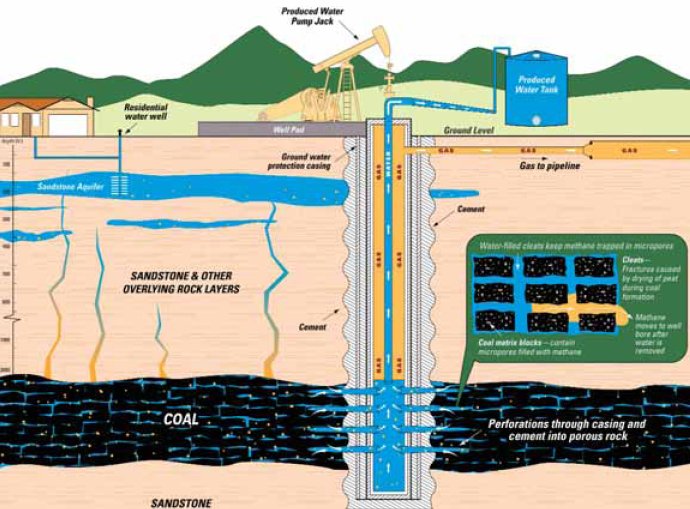
The CWCB is on a 6-year planning cycle for assessing Colorado’s long-term consumptive and nonconsumptive water needs with a scheduled update to SWSI in 2016. In addition, the Governor asked that a State Water Plan be developed based on scenario/portfolio work, SWSI, and the work associated with both short-term and long-term projects and methods. This effort will be a partnership between the CWCB, the IBCC, the Department of Natural Resources (DNR), the Basin Roundtables, and other stakeholders who come together as a state to collaboratively address Colorado’s water supply challenges. Key components of SWSI 2016 and the State Water Plan will include the following:

 Adoption and implementation of the SWSI 2010 recommendations work plan.
 Evaluation of the SWSI 2016 approach and methodology —including the methodology for future gap calculations —with the involvement of the CWCB, IBCC, and the Basin Roundtables
 Closing the existing consumptive and nonconsumptive water supply gaps through the implementation of both short-term and long-term projects and methods identified by the Basin Roundtables.

Another key component of SWSI 2016 and the State Water Plan will be a focus on how we can collaboratively address implementation elements that will be needed to address our future water supply needs and challenges. Using an adaptive management plan approach will allow for a flexible implementation plan that addresses future uncertainties. The scenario planning effort being led by the IBCC will be utilized to develop the adaptive management plan. The drought impacts we have seen across Colorado this year sends a strong message of how important strategic water planning is to protect our economy and citizens. This report summarizes the work and countless hours invested by staff and the citizens throughout the state that serve on the IBCC and Basin Roundtables.

watersupplyreserveaccountprojects2012.jpg

The CWCB has also released their Water Supply Reserve Account Annual Report. From the report:

Water Supply Reserve Account projects have been approved across the entire state [click on the thumbnail graphic for the map]. The WSRA Criteria and Guidelines split the Account into Basin and Statewide Funds. Each Basin Account has received $1,662,829 to date.

More IBCC — basin roundtables coverage here.

Photo of the week: Flurries along the Great Divide, double rainbow

Colorado-Big Thompson Project update: Adams Tunnel deliveries off November 5, to resume after maintenance period

firstwaterfromadamstunnel1947.jpg

From the Sky-Hi Daily News:

Maintenance season for the Colorado-Big Thompson Project begins this November, with water diversions through the Adams Tunnel stopped on Nov. 5, according to Kara Lamb, spokesperson for the Bureau of Reclamation.

“This will temporarily slow the draw on Granby Reservoir because we will not be pumping up to Shadow Mountain Reservoir and the tunnel,” Lamb wrote in an email to interested parties. “Releases from Granby to the Colorado River should remain at or above 20 cfs at the Y gauge for the rest of the calendar year.”

All annual maintenance projects scheduled for this fall on the C-BT Project on the eastern side of the Divide start to wrap up the week of Dec. 7 through Dec. 14. At that time, diversions through the Adams Tunnel are scheduled to resume.

More Colorado-Big Thompson Project coverage here.