Will the #ColoradoRiver 2007 Shortage Sharing Agreement come into play this season?

lowlakepowell2004.jpg

From jfleck at inkstain:

The latest monthly Colorado River water management report from the U.S. Bureau of Reclamation (pdf) takes a major step toward the river’s first ever shortage declaration. We’ll know more in a month, but the preliminary estimates now show drops in the level of Lake Powell by the end of this year could trigger provisions of a six year old shortage sharing agreement among the seven Colorado River Basin states that allow a reduction in releases in the 2013-14 water year from Powell, the reservoir spanning the Arizona-Utah border. That, in turn, would mean less water downstream for Lake Mead, which significantly increases the odds of reduced water availability for Arizona and Nevada in the 2015-16 time frame…

The key piece of institutional plumbing in the coming shortage discussions is the Colorado River Interim Guidelines for Lower Basin Shortages and Coordinated Operations for Lake Powell and Lake Mead, often called the “2007 shortage sharing agreement”. It’s Byzantine, with complex tables of “if Lake Powell’s got x water in it and Lake Mead’s got y water in it, do z” kinds of directives for managing the system. I can’t begin to give a full explanation of the details here, but it’s important to highlight a central feature: Everyone agreed to this. This is not a case of the federal government imposing a water management scheme on the states, or someone suing and persuading a judge to impose the rules. It was the product of negotiation, a collective recognition on the part of each state (and the federal government) that a deal that provided some certainty, even unpleasant certainty, was better than the previous uncertainty over what would happen in a shortage, and the downside risk of losing a legal fight at that point. This is the users of a common pool resource developing the institutional arrangements to collectively manage that resource.

More Colorado River Basin coverage here and here.

Restoration projects targeting riparian health and recreational opportunities planned for the Poudre River

fortcollins.jpg

From the Fort Collins Coloradoan (Kevin Duggan):

Fort Collins officials are planning a series of projects aimed at improving the river’s ecological health and recreational opportunities. Highly visible work is expected to be done at city-owned natural areas from the North Shields Ponds to Arapaho Bend near Interstate 25. Part of the work will involve reducing the height of river embankments that were built up over the years through gravel mining and building irrigation ditches to carry away the river’s water. The construction won’t be pretty, said John Stokes, the city’s director of natural resources. But in time, affected areas are expected to recover as plantings of native grasses, shrubs and trees take root…

Intertwined with the work at natural areas in the coming years will be several major construction projects, including building a channel to carry stormwater runoff from the area around West Vine Drive to the river. The Colorado Department of Transportation is planning to replace the bridge that carries Mulberry Street over the river — a project that is expected to begin this fall and last more than a year — and Larimer County is planning to replace the Shields Street Bridge in 2015…

Restoring and supporting the river’s ecology is a major thrust of projects planned at the city’s natural areas, Stokes said. But so is enhancing the recreational experiences of residents who bike, walk, fish, watch wildlife and float along the river. The popular Poudre River Trail will be redesigned and moved in places, including the former site of the Link-n-Greens golf course, where Woodward Inc. is planning to build its world headquarters. Woodward has donated 31 acres of the 101-acre site to the city for a natural area. The construction site is expected to be fenced off soon with grading work expected to begin in August, said Rick Bachand, environmental program manager for the Natural Areas Department…

Extensive embankment work also is planned at the Sterling Natural Area. Material heaped along the river decades ago will be used to fill in part of Sterling Pond, which is a former gravel pit, to create habitat The work is expected to begin this winter if permits can be obtained from regulatory entities including the U.S. Army Corps of Engineers and the Federal Emergency Management Agency, Stokes said…

At the same time, a massive concrete diversion built to supply the Josh Ames Ditch, which no longer carries irrigation water, will be removed or modified. The structure stretches across river; its drop of roughly 5 feet prevents fish and insects from moving upstream.

More Cache la Poudre River watershed coverage here and here.

Happy 30th birthday to the Colorado Lottery

confluenceparkdenver.jpg

From The Denver Post (Jason Blevins):

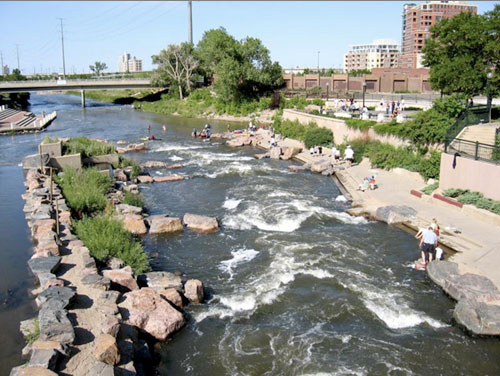
…the state’s lottery has distributed more than $2.4 billion to Colorado parks, recreation, open space, conservation and public-school construction. Almost $150 million has gone to the city and county of Denver, with a large chunk of that going to river restoration, parks and recreation along the city’s South Platte.

Thirty years ago, Colorado Lottery boosters hoped the program would generate $35 million for the state’s construction projects and parks. The first year saw $41 million in proceeds, and the lottery has defied economic turmoil ever since, posting a record $545.3 million in sales in fiscal 2012 and directing $123.2 million toward the state’s efforts to protect land, water and wildlife and promote outdoor recreation, especially for kids.

More conservation coverage here.

Seven Principles of Water-Wise Gardening #COdrought

logancountycourthousesterling.jpg

From the Sterling Journal-Advocate (Sara Waite):

[Brian Kailey] horticulturalist with the Logan County Extension Office spoke about the “Seven Principles of Water-Wise Gardening,” which uses water efficiently to create landscapes that are both attractive and use-appropriate…

Developing a water-wise garden requires:

• Planning and designing for water conservation, beauty and utility

• Improving the soil with organic matter so it will hold more water and minerals and allow for a deeper root system

• Creating practical turf and non-turf areas to match expectations with the actual use of the site

• Selecting plants appropriate for the climate and grouping them according to their water needs

• Watering efficiently with appropriate irrigation methods

• Mulching to reduce evaporation

• Maintaining plants with good horticultural practices

Kailey warned against “zero-scape,” which removes all or most vegetation and replaces it with rock, which then heats up the surrounding environment.

He said that grass offers benefits such as trapping dust and pollen, reducing noise and glare, cooling the surrounding environment and controlling soil erosion. However, there are places where grass may not be appropriate, such as under shade trees where it will not grow well.

He named several perennial plants that are drought tolerant and appropriate for the High Plains climate:

• Prairie coneflower

• Penstemon spp.

• Gaillardia

• California poppy

• Lilac (bush or trees)

• Sagebrush

• Rabbitbrush (“Chamisa”)

Kailey said 40 to 50 percent of water used for landscape irrigation is wasted because of poor design and maintenance and management. He said many systems were set up with little consideration of water conservation. Irrigation zones should reflect water demand, which is affected by exposure to sun, heat and wind. For example, the lawn on a southwest facing slope will typically require twice as much water as the lawn on the north side…

He recommended using drip irrigation for shrubs, flower beds, small fruits and vegetables to reduce water use by up to 50 percent.

More conservation coverage <a href="

CSU and CU are deploying researchers in Weld County to assess and monitor groundwater quality

denverjulesburgbasindrillpadoilandgasjournal.jpg

From The Greeley Tribune (Sharon Dunn):

Two teams of researchers will soon begin testing water throughout Weld County to determine what effects or changes, if any, come from oil and gas industry activities. In the end, there may be no question left as to the industry’s effects on water.

“I think people really are just concerned about their drinking water and, hopefully, will gain some confidence and reassurance by monitoring,” said Reagan Waskom, director of the Colorado Water Institute at CSU. “The message here is that there are several comprehensive efforts to determine whether or not we need to be worried about our drinking water.”

One team, from Colorado State University, working under a grant from the Department of Natural Resources, will begin live water monitoring stations throughout the county to detect changes over time. That could start later this month.

A second team working under a $12 million grant from the National Science Foundation, and headed up by the University of Colorado at Boulder, will start on Tuesday. That begins a five-year project that digs into the chemistry of Weld’s water, and how it changes over time based on geography, geology, proximity to oil and gas wells and a host of other factors. Researches also will be looking to see if there are pathways that lead volatile chemicals into water sources.

Both efforts are separate from Weld County’s voluntary water testing program in which residents concerned about their water can get free testing. About 150 tests so far have shown no contamination from Weld’s testing.

Oil and gas companies, too, are doing their own water testing.

Both teams are asking for volunteers. They need residents with domestic wells, livestock watering wells and irrigation ditches to consent to the testing and/or live monitoring, some over long periods of time. Wells that show signs of problems will be monitored the most.

“Our main research question is to make an assessment of water quality and understand where fluids are coming from, both waters and gases,” said Stephen Osborn, an assistant professor of geology at California State Polytechnic University Pomona, working on the NSF study. Osborn was part of a study two years ago in Pennsylvania that found a link between drilling and methane in water wells. He said he comes to Colorado with no preconceived notions about the water.

“It’s important for me to keep my objectivity,” Osborn said. “As a scientist, I’ve tried to keep out of the politics and stick with the science. We believe more science can really resolve a lot of issues. There needs to be more publicly available data generated by science, so these issues can be resolved a bit more effectively.”

The NSF grant is not all about water quality testing. Other parameters of the study will look at water quantity, recycling of water used in drilling, and natural gas infrastructure and air quality.

“We all create demand for natural gas so we have to accept some of the outcomes of its extraction,” said Professor Joe Ryan, of the University of Colorado at Boulder, the lead investigator on the NSF project, in a news release. “Our goal is to provide a framework for society to evaluate the trade-offs associated with the benefits and costs of natural gas development.”

CSU engineering professor Ken Carlson is heading up the CSU study, the Colorado Water Watch demonstration project, which is in addition to rules created recently by the Colorado Oil and Gas Conservation Commission requiring groundwater testing before and after a well is drilled.

Though all the parameters of the study are not yet finalized, it involves live monitoring of water quality to measure significant changes over time, but not necessarily as in-depth as other water studies looking for specific chemicals and isotopes.

“We aren’t reinventing the wheel,” Carlson said. “We’re taking a pretty good system with the COGCC rule, and attaching onto that a watching component. If there is a contamination event, we’re not going to tell people exactly what and how much, but we can say something has happened. Then a team from CSU initially will go out and do a more in-depth analysis.”

The study is not looking into drinking water, but rather, the health of an aquifer.

“If you do samples, you’re taking a snapshot in time,” Carlson said. “If it’s a short-lived event, you may not capture it. We want to see what the long-term trends are. Our premise is really to make people in the vicinity comfortable that someone is watching, that someone is there, ready to respond if there is a spike in the indicators.”

More oil and gas coverage here and here.