Will East Slope entities accelerate West Slope agricultural buy and dry? #ColoradoRiver

transmountaindiversionscoloradostateengineer2011.jpg

From the Glenwood Springs Post Independent (Hannah Holm):

Since all the major Colorado River diversions to the Eastern Slope cities are junior to the Colorado River Compact, there is concern that this would set off a rush to buy and dry senior Western Slope agricultural water rights to allow those diversions to continue.

So … East Slopers are afraid that failing to take enough Colorado River water east of the divide will lead to a massive dry-up of irrigated agriculture, and Western Slopers are afraid that taking too much will do the same.

Both sides are worried about how this conundrum will be dealt with in Colorado’s statewide water plan, so meetings are multiplying and memos are flying. “Basin Roundtables” of stakeholders on both sides are trying to figure out how to simultaneously strengthen their negotiating position and also find low-impact ways of accommodating each others needs.

Possibilities discussed include:

• Allowing new transfers of Western Slope water to the Front Range, but only when existing reservoirs are full.

• Building new reservoirs to hold Western Slope water that can benefit water users on both sides of the divide (that’s how past controversies of this type have been resolved).

• Ramping up urban conservation to the point where cities won’t need more water from either agriculture or Western Slope streams.

The route taken to resolve this sticky issue will have long-term impacts for the economies, environment and quality of life of communities all across the state. We should all be paying attention.

More transmountain/transbasin diversions coverage here and here.

‘Horizontal drilling technology is the biggest discovery since the splitting of the atom’ — John Harpole

denverjulesburgbasindrillpadoilandgasjournal.jpg

Here’s a recap of the recent Northern Colorado Energy Summit from Kay McDonald writing for the Big Picture Agriculture blog. Here’s an excerpt:

Today, natural gas costs about four times as much in Europe as here in the U.S., and even more in Japan. In the U.S., for an equivalent amount of BTUs, crude oil costs three to four times as much as natural gas, which is driving a switch to the use of CNG and LNG to power our transportation, especially the heavy fleets and rail. It has replaced coal to generate electricity in power plants, too, reducing emissions and making it possible to integrate green energies like wind and solar more easily.

Keynote Speaker John Harpole

Our first energy summit speaker was John Harpole, President of Mercator Energy LLC. Next, are a few of his key statements.

• “Horizontal drilling technology is the biggest discovery since the splitting of the atom,” he said. The technology allows us to drill down two miles and then horizontally two miles and hit the target the size of a refrigerator. This gives us the ability to tap into an estimated 1,073 trillion cubic feet of gas in shale (nearly half of this country’s traditional potential natural gas resources).

• All of the drillers want the wet liquids and need a way to “get rid” of dry natural gas.

• The new energy supplied from fracking reduces the likelihood of price spikes here in the U.S.

• “The demand curve responds to the supply curve.”

• The technology has changed the situation from one that is “no longer exploration, but manufacturing.” We now have a “gas factory.”

• China believes that they have three times the reserves we have and they will be going after those reserves through fracking, too.

Water Panel
Part of my reason for attending the summit was to hear what they had to say about water use here in Colorado, so I sat in on the water discussion panel.

Tom [Cech] of Metro State University in Denver, told us that one fracking well uses 3-5 million gallons of water, or about the same as 30 households use in one year. (A well can be fracked multiple times.) Because of the recent drought in Colorado, water shares have increased in price to $17,000 this year from $7,000 three years ago.

While the water panel spent much time telling us that the future trend will be reusing produced water from fracking, you only get 20 percent of water back in a shale frack. The representative of the company, High Sierra, told us that there are many patents out there for processes to reuse water, and do it economically. He told of a water reuse pilot project going on in Denver which is testing produced contaminated water from Pennsylvania, shipped to Denver by rail car.

All three of the panelists expressed concern over the fact that agriculture is always the source of water purchases from both the energy industry and urban growth, since the farmer cannot compete economically for the water. They acknowledged that this means less food security for everyone and that agricultural water needs to be protected, that this is a problem.

The entire discussion centered around water shortages, over-allocations, and increasing prices, especially when the future population growth along the front range of Colorado is taken into consideration. Additionally, in Northern Colorado we used to get our snow-melt water runoff in June, but now it happens in April or May.

More oil and gas coverage here and here.

Douglas County Water Resources Authority video: Washing the Car – Water Smart Tips – 10

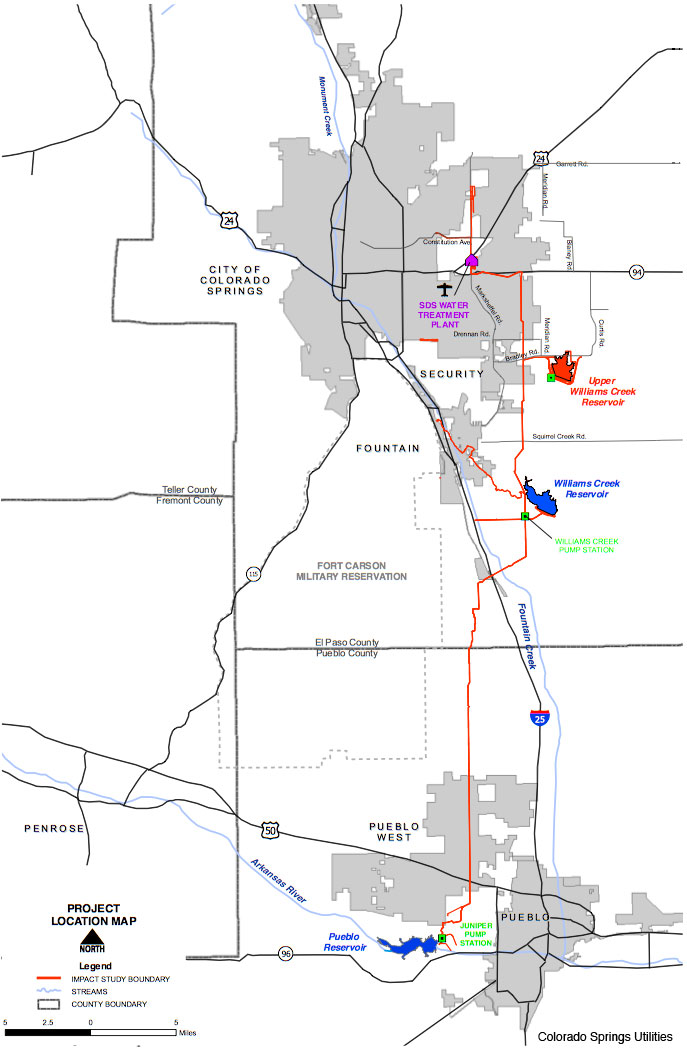
Fountain Creek: Mayor Bach takes position that Pueblo County’s 1041 permit is non-specific with respect to projects

sdspreferredalternative.jpg

From the Colorado Springs Independent (Pam Zubeck):

After Mayor Steve Bach and Council President Keith King sent a June 6 letter to Pueblo County misstating the facts about Colorado Springs Utilities’ permit to build the Southern Delivery System (“Storm brewing,” News, July 17), they corrected the record with a new letter sent July 19.

In the June 6 version, the city said a Stormwater Enterprise projects list was submitted “as part of” the 1041 construction permit process for the water pipeline from Pueblo Reservoir. There was no such project list or dollar figure submitted by the city as part of the 1041 permit itself, records show, meaning the city made no concrete pledges to spend a certain amount of money on stormwater or to do certain projects.

Rather, the permit, issued in April 2009, simply requires the city to ensure that Fountain Creek peak flows that result from new development served by the water pipeline are no greater than prior peak flows.

Although City Attorney Chris Melcher said in a statement to the Indy on July 15 that the June 6 letter “was accurate,” Bach and King wrote a new letter on July 19 “to clarify any potential misunderstanding of our letter of June 6, 2013.”

This letter also said that while there were “conversations” about stormwater projects, “it is clear that the 1041 Permit itself does not require or adopt any specific list of capital projects that must be implemented … [n]or does the 1041 Permit require a specific dollar amount to be allocated.”

The July 19 letter prompted Pueblo County Commissioner Sal Pace to tell the Pueblo Chieftain he was “furious” and “confused.”

More Southern Delivery System coverage here and here.

CWCB: Study for the Lower Ark shows that the average unlined farm pond leaks as much as 20%

farmponddryingup2011droughtoklahomanoaa.jpg

From The Pueblo Chieftain (Chris Woodka):

Most ponds used by farmers to feed sprinkler systems are losing more than 20 percent of the water stored in them because of leakage.

A preliminary written report was released this week detailing the findings of the study, being conducted by Agritech Consulting and Valley Ag Consulting for the Lower Arkansas Valley Water Conservancy District. The study is being conducted in hopes of altering a state formula that assumes only 3 percent loss. At a meeting earlier this month, the district reported that farmers in the study already are able to claim greater leakage, but officials held out little hope the assumptions of the state formula could be changed. The study found 13 of the 22 ponds in the study had leakage rates higher than 20 percent. Measurements were taken as water flowed into ponds and as it ran through sprinklers. Overall, seepage cost farmers 300 acre-feet of the 1,340 acre-feet that flowed into ponds. The state’s formula would have given them credit for just 40 acre-feet.

Gerald Knudsen of Agritech, who analyzed the results of the study, said drought may have been a factor in the data from the first year of the study. The study will continue next year that will help researchers evaluate the relationship between seepage and physical or environmental conditions. “This further review may be significant since the data collected to date represents drought conditions when there is a longer period of time between runs and more frequent use of the ponds may reduce the seepage rates,” the report stated.

The study is being funded by the Colorado Water Conservation Board.

The state uses pond leakage as one factor in its formula to evaluate consumptive use of surface irrigation improvements under 2010 rules designed to head off future disputes with Kansas. The Lower Ark district offers a group plan that helps farmers repay water the state says is owed to the river.

More coverage from Chris Woodka writing for The Pueblo Chieftain:

A study of leakage in ponds that feed field irrigation systems already is saving some farmers thousands of dollars in water cost.

But a state formula that assumes only 3 percent of the water leaks won’t be changed until the study results are final — and maybe not even then. The formula is used under Rule 10 of the state engineer’s 2010 consumptive use rules to prevent expansion of water rights under surface irrigation rules. The state pushed for the rules to avoid further challenges by Kansas of Arkansas River Compact violations.

Farmers have to pay for replacement water, so if they can show they are losing more than presumed, they spend less.

The Lower Arkansas Valley Water Conservancy District is funding the study by Gerry Knudsen of Agritech and Brian Lauritsen of Valley Ag Consulting to determine how much water leaks out of the ponds.

Seepage varies from 3-5 percent in some ponds to 44 percent at others, depending on how dry the ponds are when they first fill and the type of soil. A total of 26 ponds are in the study, located mostly on the Fort Lyon Canal, where most of the sprinklers are.

The ponds had 1,340 acre-feet of inflow, and lost 300 acre-feet, or 22 percent.

The results from individual ponds already are being used by the Colorado Division of Water Resources to calculate losses on specific farms, but have not altered the presumptive model.

The study, funded by a $60,000 grant from the Colorado Water Conservation Board that was obtained by the Lower Ark district, won’t be complete until 2014. Even then, it might not change the state’s outlook on pond leakage.

“My view is that the ponds will have to be measured forever,” said Jay Winner, manager of the Lower Ark district. “The ponds which have instrumentation will get the credit.”

Knudsen agreed, saying it’s similar to how GPS systems were incorporated into cultivation several years ago because the initial technology soon became essential rather than optional.

Lauritsen added that better meters are needed and must be properly calibrated to get the best results.

More Arkansas Valley consumptive use rules coverage here and here.