Gunnison: 38th annual Water Workshop recap — Statewide water plan on the radar for state legislators

westernstatecollegegunnisongreetingsfromus50.jpg

From The Colorado Statesman (Marianne Goodland):

Last week, the legislative Interim Water Resources Review Committee met in Gunnison to discuss how that plan is taking shape. The committee’s meeting was held during the 38th annual Water Workshop, a three-day meeting on water resources, held annually at Western State Colorado University in Gunnison. The 10-member water resources committee is chaired by Sen. Gail Schwartz, D-Snowmass Village, and includes legislators for whom water has been a long-standing passion, such as Rep. Jerry Sonnenberg, R-Sterling; 2014 gubernatorial candidate Sen. Greg Brophy, R-Wray; and Rep. Randy Fischer, D-Fort Collins.

For their first meeting in 2013, the committee looked at the governor’s executive order, water issues affecting the Gunnison River and agricultural water conservation measures…

In his May executive order, [Governor Hickenlooper] said the state “deserves a plan for its water future use that aligns the state’s many and varied water efforts and streamlines the regulatory processes.” As directed by the order, the CWCB will work with grassroots water groups, the IBCC and the Basin Roundtables to address critical issues raised in the order…

The interim committee discussed the plan with Mike King, executive director of the Department of Natural Resources, and former Commissioner of Agriculture John Stulp, now the governor’s water policy advisor.

The governor is “adamant” about a statewide water plan, King said. Reflecting the water workshop’s theme of “the new normal,” King said the new normal in water policy is that it will be a source of constant change, which may be uncomfortable since people are sometimes resistant to change. “If we don’t develop a vision for the future in water,” the agriculture “buy and dry” will accelerate at an unacceptable rate. He noted that 350,000 agricultural acres in the Front Range are already under contract for their water rights.

Even if the state were to stop future “buy and dry” purchases, Stulp said, “we’d still lose 20 percent of irrigated lands.” The plans developed by the IBCC and Basin Roundtables are being updated, he said, to address drought and flood issues and projected population increases. If preserving agriculture is a priority, the statewide plan needs to look at conservation and whether there are new supply waters available to the state…

While the executive order calls the CWCB, IBCC, roundtables and state agencies to work on the statewide plan, it leaves out one important stakeholder: the Colorado General Assembly. That did not go unnoticed by the interim committee.

“What are we to read into executive order, [with] not a single mention of state legislature” in the order, asked Fischer. “What is our role in the process?”

King was quick to allay those concerns. “It’s obvious we can’t do anything without you,” although it is not articulated in the order, he said. “Your role is however you define it. We will engage you individually and collectively, whatever you choose, and will come back with reports to the interim committee… This is an open invitation for you to participate, which can be more formalized.”[…]

Sonnenberg, who was unable to attend last week’s meeting, told The Colorado Statesman that storage has to be the highest priority for a statewide plan. He noted that in a two-year period, more than one million acre-feet of water in the South Platte left the state, over and above what is required by interstate compacts and decrees. “We have to keep Colorado water in Colorado,” he said. And the reason that water left the state? Farmers weren’t using it in wet years, and there was no place to store the excess. More storage would relieve pressure on the “buy and dry” movement, he added.

More 2014 Colorado legislation coverage here.
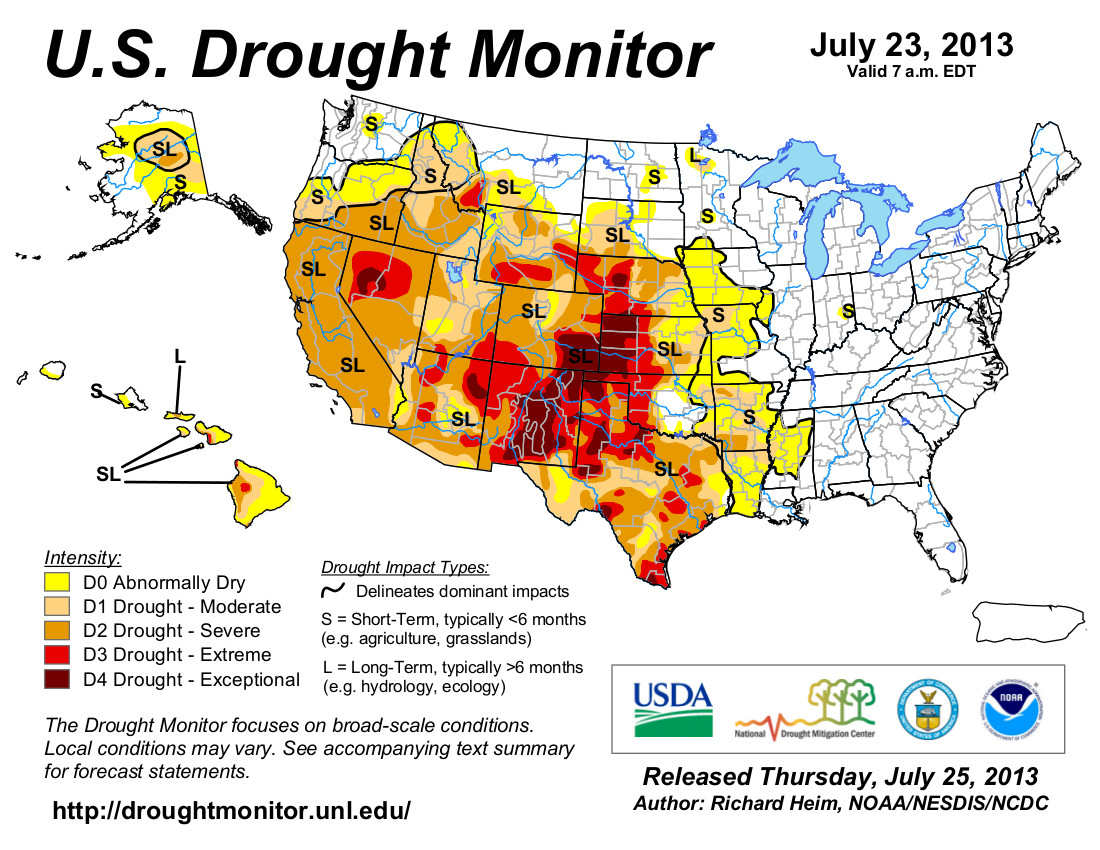
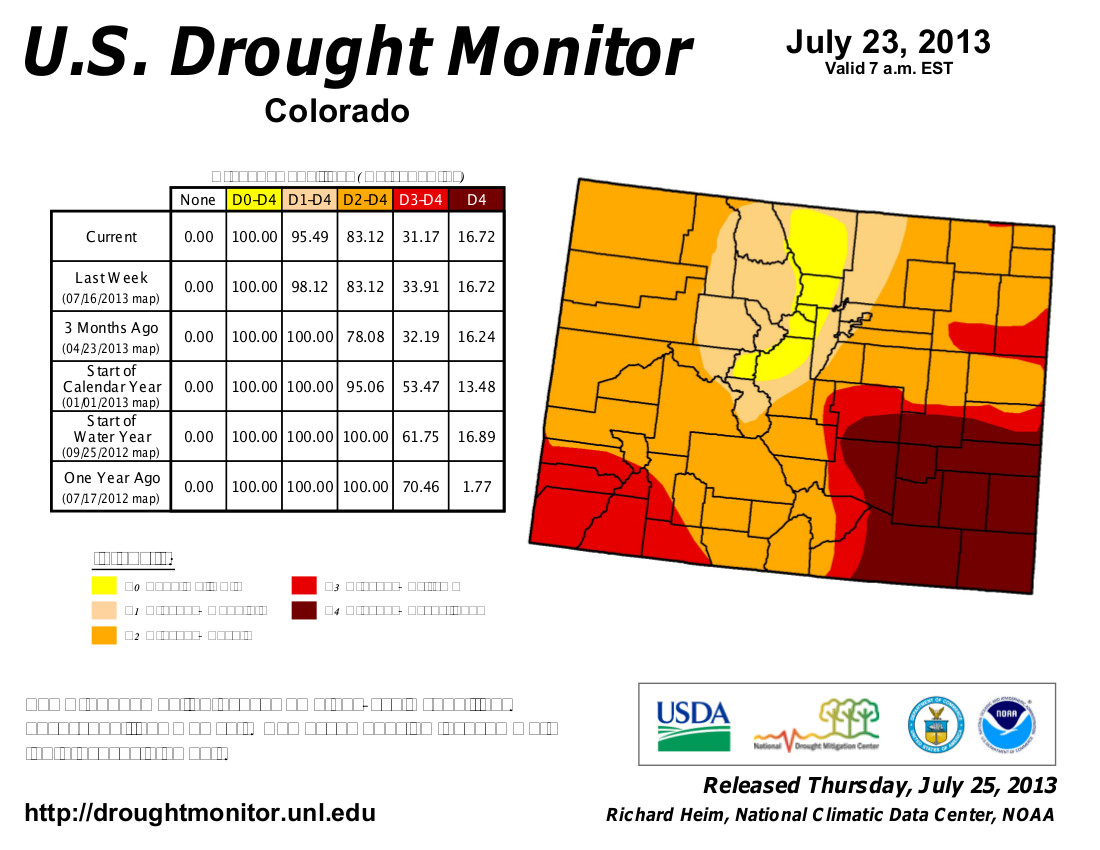
‘We’ve had plenty of similar droughts…recently the droughts have been hotter’ — Reagan Waskom #COdrought

usdroughtmonitor07232013.jpg

usdroughtmonitorcolorado07232013.jpg

From The Durango Herald (Dale Rodebaugh):

Scientists and water experts aren’t yet panicked, but a change in climate and drought in many areas of the United States, including Colorado, has focused their attention on future supply of and demand for water…

“No one is pushing the panic button yet,” said Reagan Waskom, director of the Colorado River Institute and a member of a federal advisory panel. “There is no crisis-driven decision required.”

Drought is perhaps the most evident sign in Southwest Colorado of something gone wrong. Scientists don’t know that global warming is a direct cause of drought, but it exacerbates the situation.

Waskom said drought is an old acquaintance in Colorado, where some counties have been in drought mode for more than four years. “We’ve had plenty of similar droughts – in modern times and in paleo times,” Waskom said. “The only difference is that recently the droughts have been hotter.”[…]

Southwest Colorado – where drought is rated extreme, the step below the exceptional category prevailing on the state’s eastern plains – gets some relief annually from monsoonal rain, traditionally in July and August. But spotty, hit-and-miss distribution favors some over others…

In the short term, the monsoons are expected to continue for a while, dumping above-average precipitation in the region, said Jeff Lukas, a senior research associate at Western Water Assessment at the University of Colorado. But only record precipitation in August and September would pull Southwest Colorado out of its extreme drought, Lukas said.

Lukas said the drought in Colorado isn’t necessarily linked to climate change. “Drought is fundamentally caused by below-average precipitation, but conditions are well within the bounds of historic climate variability,” Lukas said. “We don’t have to invoke climate change to explain low precipitation, but climate change can’t be completely excluded as a cause by influencing storm tracks, for example.”

It should be noted, however, that every “warm season” (April through August) since 2000 has been warmer than the long-term average, Lukas said. The trend is consistent with regional and global warming trends. Lukas said the April-September stretch in 2012 was the warmest summer in Western Colorado since 1895 by more than 1 degree Fahrenheit. “Overall, climate change very likely made the drought worse by raising temperatures during a very dry, but not record-dry period,” Lukas said…

Evidence is piling up that an increasing concentration of greenhouse gases (water vapor, carbon dioxide, methane and nitrous oxide) in the atmosphere is preventing heat from escaping, thus warming the Earth. Temperatures are on the rise. Globally, the average temperature for June just past tied June 2006 for the fifth-warmest since record keeping began in 1880, the National Oceanic and Atmospheric Administration said. Worldwide temperature increase is altering climate as evidenced by melting glaciers and polar ice, lingering drought (as in the Colorado plains), changing weather patterns, increasing ferocity of wildfires, dying coral reefs and the flight of animal species from uncomfortable habitats.

A linear relationship between climate change and any single phenomenon is hard to establish because of the multiple interlocking factors involved. A growing human population, shifting population centers and demand for natural resources add to volatility…

In its latest draft report, a federal advisory committee on climate assessment in the United States says the average temperature has risen 1½ degrees Fahrenheit since 1895, with more than 80 percent of the change occurring since 1980. The report of the broadly constituted federal panel the National Climate Assessment and Development Advisory Committee, or NCADAC, recommends no actions, no policies, but serves as a point of departure for meeting the challenges…

a report by The Durango Herald about snowfall during the 47 ski seasons at Purgatory ski area found that despite annual variations in the snowpack, the total season average snowfall, with a few exceptions, has occurred without tremendous fluctuation.

Nolan Doesken, the state climatologist at the Colorado Climate Center at Colorado State University, said it would be hard to say what is normal precipitation in Southwest Colorado. “There’s been incredible fluctuation,” Doesken said, citing the rain records for Durango and Silverton that go back more than 100 years.

The Coloradoan takes a look at 2013’s top environmental concerns through the eyes of five experts

overpopulation.jpg

Bobby Magill (Fort Collins Coloradoan) sat down with five experts from northern Colorado for an look at the top current environmental issues. Here’s an excerpt:

As the environmental challenges Northern Colorado faces in the coming years continue to mount, a look back at headlines of a half-decade ago shows how quickly the region’s environmental concerns have evolved.

Uranium mining, vehicle emissions testing, the bark beetle infestation, rules governing national forest roadless areas and the proposed Glade Reservoir all were among the top environmental issues of the day during the summers of 2008 and 2009.

Back then, controversy over the proposed Glade Reservoir was beginning to boil over, Larimer County residents were learning that emissions tests soon would be required for their vehicles and a company called Powertech was doubling the size of the area it wanted to use for a uranium mine east of Wellington.

The term “fracking” didn’t appear in the Coloradoan until the end of 2009. Oil and gas development in Northern Colorado wasn’t the subject of a news story until early 2010, when the Coloradoan reported that energy companies were likely to rush to Weld County after a well gushing “sweet crude” was drilled near Grover.

Today, Powertech’s uranium mining plans are on indefinite hold. Glade Reservoir is still in the environmental review process. Bark beetles have left millions of dead trees in their wake. Wildfires have ravaged the foothills. Emissions testing is a fact of life. The roadless issue is settled.

Fracking has become one of the region’s most controversial environmental and economic issues. And more attention than ever has turned to severe drought, extreme weather and climate change.

A water shortage in the Colorado River basin is becoming an urgent concern. Catastrophic wildfire is an annual reminder of ongoing drought. Farmers are fallowing their land because of uncertain water availability. The rapid expansion of the oil and gas industry throughout the region has had residents from Fort Collins to Colorado Springs worried about what that means for their air, water and quality of life.

In short, the region’s environmental challenges have changed quickly and dramatically in the past five years. The Coloradoan asked five experts, activists or policymakers what they think the most pressing of these issues are in the coming years and what can be done about them…

[Scott Denning] “Climate change is dramatically changing our forests,” he said. “What we have seen is the trees are dying out at the bottom of their range, and there aren’t lots and lots of seedlings replacing them. We may see deforestation of the foothills in our lifetime.”[…]

[Jenn Vervier] said the region’s most critical environmental issues are the health of the Poudre River watershed; the proximity of oil and gas development to homes, schools and the region’s water supply; over-allocation of the water in the Colorado River; climate change and exurban sprawl…

[Karen Weitkunat] “All other environmental problems have a direct connection to our water resource whether it is quality or quantity,” she said. “It has the most attainable solutions and greatest possibility for universal average citizen involvement since it impacts everyone and everyone shares in the desire for a positive outcome.”[…]

[Randy Fischer] said the list of concerning environmental challenges the region faces is long: Population growth, water quantity and quality, healthy rivers, fossil fuel development, deteriorating forest health, wildfire, climate change and air pollution.

“Readily available, evidence-based solutions exist for all of these concerns except for, perhaps, population growth, which is a driver for most of the environmental issues we face in Northern Colorado,” Fischer said. “Population projections by the state demographer predict that Colorado’s population could double by the year 2050…

[Gary Wockner] ranks population growth, climate change, fracking, destruction of rivers and unsupportive political leadership as the biggest environmental issues Northern Colorado currently faces.