
From The Durango Herald (Dale Rodebaugh):
Scientists and water experts aren’t yet panicked, but a change in climate and drought in many areas of the United States, including Colorado, has focused their attention on future supply of and demand for water…
“No one is pushing the panic button yet,” said Reagan Waskom, director of the Colorado River Institute and a member of a federal advisory panel. “There is no crisis-driven decision required.”
Drought is perhaps the most evident sign in Southwest Colorado of something gone wrong. Scientists don’t know that global warming is a direct cause of drought, but it exacerbates the situation.
Waskom said drought is an old acquaintance in Colorado, where some counties have been in drought mode for more than four years. “We’ve had plenty of similar droughts – in modern times and in paleo times,” Waskom said. “The only difference is that recently the droughts have been hotter.”[…]
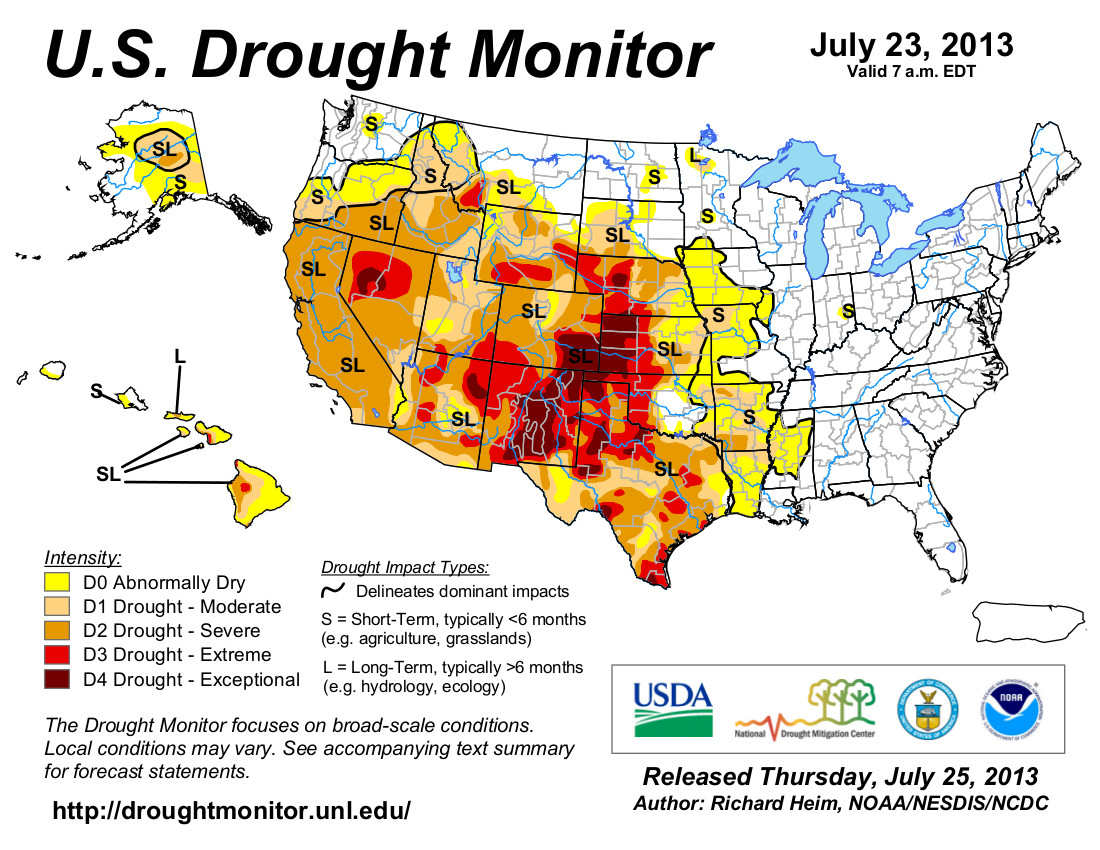
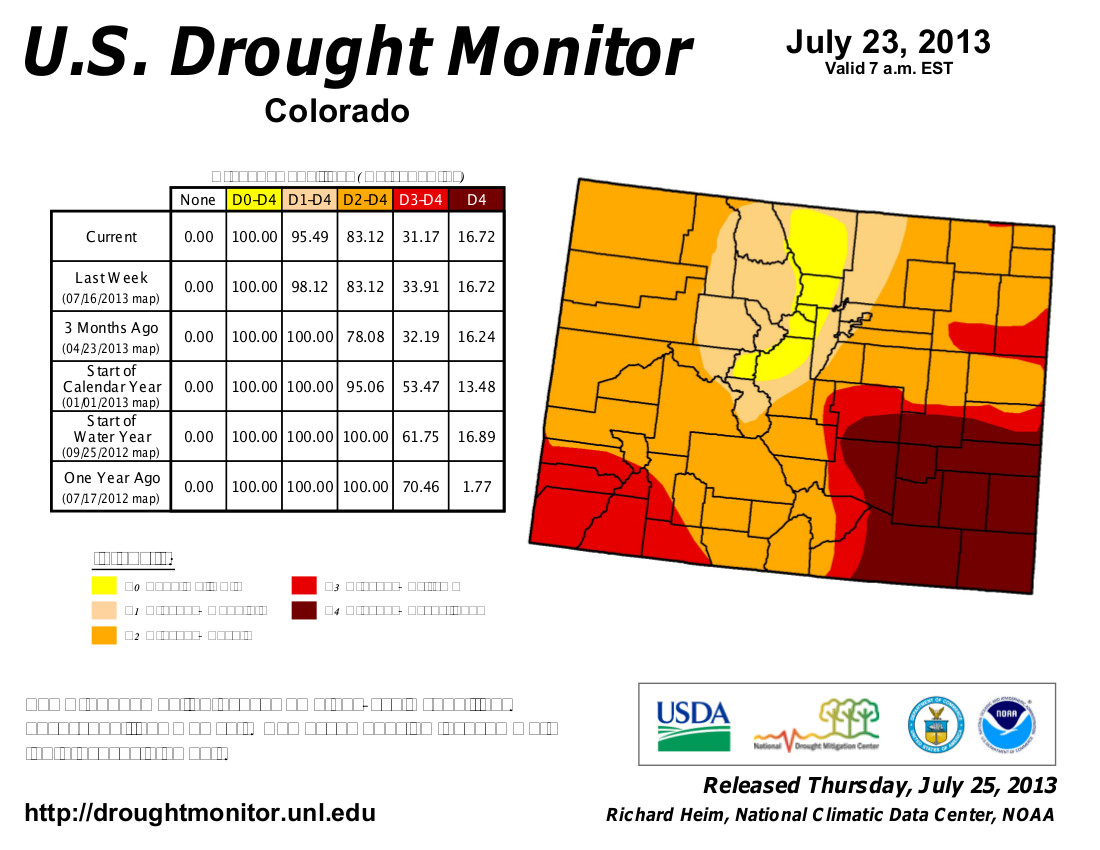
Southwest Colorado – where drought is rated extreme, the step below the exceptional category prevailing on the state’s eastern plains – gets some relief annually from monsoonal rain, traditionally in July and August. But spotty, hit-and-miss distribution favors some over others…
In the short term, the monsoons are expected to continue for a while, dumping above-average precipitation in the region, said Jeff Lukas, a senior research associate at Western Water Assessment at the University of Colorado. But only record precipitation in August and September would pull Southwest Colorado out of its extreme drought, Lukas said.
Lukas said the drought in Colorado isn’t necessarily linked to climate change. “Drought is fundamentally caused by below-average precipitation, but conditions are well within the bounds of historic climate variability,” Lukas said. “We don’t have to invoke climate change to explain low precipitation, but climate change can’t be completely excluded as a cause by influencing storm tracks, for example.”
It should be noted, however, that every “warm season” (April through August) since 2000 has been warmer than the long-term average, Lukas said. The trend is consistent with regional and global warming trends. Lukas said the April-September stretch in 2012 was the warmest summer in Western Colorado since 1895 by more than 1 degree Fahrenheit. “Overall, climate change very likely made the drought worse by raising temperatures during a very dry, but not record-dry period,” Lukas said…
Evidence is piling up that an increasing concentration of greenhouse gases (water vapor, carbon dioxide, methane and nitrous oxide) in the atmosphere is preventing heat from escaping, thus warming the Earth. Temperatures are on the rise. Globally, the average temperature for June just past tied June 2006 for the fifth-warmest since record keeping began in 1880, the National Oceanic and Atmospheric Administration said. Worldwide temperature increase is altering climate as evidenced by melting glaciers and polar ice, lingering drought (as in the Colorado plains), changing weather patterns, increasing ferocity of wildfires, dying coral reefs and the flight of animal species from uncomfortable habitats.
A linear relationship between climate change and any single phenomenon is hard to establish because of the multiple interlocking factors involved. A growing human population, shifting population centers and demand for natural resources add to volatility…
In its latest draft report, a federal advisory committee on climate assessment in the United States says the average temperature has risen 1½ degrees Fahrenheit since 1895, with more than 80 percent of the change occurring since 1980. The report of the broadly constituted federal panel the National Climate Assessment and Development Advisory Committee, or NCADAC, recommends no actions, no policies, but serves as a point of departure for meeting the challenges…
a report by The Durango Herald about snowfall during the 47 ski seasons at Purgatory ski area found that despite annual variations in the snowpack, the total season average snowfall, with a few exceptions, has occurred without tremendous fluctuation.
Nolan Doesken, the state climatologist at the Colorado Climate Center at Colorado State University, said it would be hard to say what is normal precipitation in Southwest Colorado. “There’s been incredible fluctuation,” Doesken said, citing the rain records for Durango and Silverton that go back more than 100 years.