The Colorado Springs Regional Business Alliance is hosting a business briefing about the #COWaterPlan on April 2

Colorado Water Plan website screen shot November 1, 2013

From The Colorado Springs Gazette:

In Colorado, water is as precious as a rare diamond, though much easier to get your hands on – at least for now.

The future may be another matter.

Frequent droughts, an increasing population and greater demand for water have elected officials, conservationists and the business community worried about the future of Colorado’s water supply.

The specter of future shortages prompted Gov. John Hickenlooper to issue an executive order last year to establish a statewide water plan, said Wayne Vanderschuere, general manager for water resources for Colorado Springs Utilities. The initiative involves people from various statewide water basins coming together to discuss how best to conserve, share, find, develop and expand the existing water supply, Vanderschuere said.

Against this backdrop, business and conservation groups are holding statewide meetings to hear what corporate executives and small-business owners have to say on the importance of water to their ventures, and to get their ideas on conservation and other steps that could be added to the governor’s plan.

“A reliable and sustainable water supply is critical for long-term economic viability,” said Joe Raso, president and chief executive officer of the Colorado Springs Regional Business Alliance, which is hosting an April 2 briefing for the business community on the governor’s water plan.

It’s not just having enough water for existing businesses, Raso said. Even a perception that the city and state might be struggling to maintain its water supply could crush business growth, he said. Water usage is a primary cost of business for major industries and accounts for at least a portion of all small business costs. The cost to provide sufficient water in the future could increase utility prices beyond the average business owner’s ability to pay, Raso said. Those costs also encourage larger businesses to move or locate elsewhere, he said.

“If you have a company that decides the state and Colorado Springs is too expensive for their processes, or if they are worried about the impact of their water usage on the community, then they will locate elsewhere,” he said.

Less water flowing in

Four things must happen with the state’s water supply to keep the commodity from becoming a burden to businesses, said Bryan Blakely, president of Accelerate Colorado, one of two organizations making the April 2 presentation in Colorado Springs.

“We are looking for efficiency, predictability, reliability and cost control,” said Blakely, whose organization pairs state businesses and local governments to work with Congress on issues related to the state’s economic development.

He said one of the primary ways the state could increase available water is construct additional systems that would capture and store more of the state’s snow and rain runoff. Capturing and storing more in years of abundant snow and rainfall would provide additional supplies in dry years, Blakely said.

“There is a lot of water flowing out of the state of Colorado that we have the rights to,” he said, “but we don’t have anywhere to store it.”

There is also a lot less water flowing into the state.

From 2001 through 2010, the Colorado River flow averaged 16 percent below the 20th century average, according to Environmental Entrepreneurs, “a national community of business leaders who promote sound environmental policy that builds economic prosperity,” according to its website, e2.org.

The group’s research, “Colorado Water Supply and Climate Change: A Business Perspective,” states that “from 1999 through 2005, Lake Powell, the Colorado River reservoir designed to ensure delivery of water to the lower basin, fell from 99 percent of capacity to 33 percent, a sharper decline than thought possible.”

Cooperation is key

Solving the state’s water problems will involve the implementation of several ideas. E2 has said the governor’s plan must include a goal of reducing per capita urban water use by 25 percent by 2025 and by 50 percent by 2050. It also wants the state to “require all water providers to adopt water rates that create incentives for water conservation” and expand water reuse programs.

Vanderschuere said finding a solution will require cooperation between governments, organizations and people.

And there will be challenges. Agricultural enterprises, including farms and ranches, account for about 86 percent of the state’s annual water usage annually. But Colorado law is written so that it’s unlikely the state or any municipality could reduce the amount of water used by agriculture, even in lean years.

Still, Vanderschuere said those in agriculture have been the most willing to help when it comes to droughts.

“At least once a week I get someone calling me trying to lease us their water rights,” he said. “And we have had leases from ag in the past and will do so in the future.”

If that’s the case, why worry?

“The problem is getting the water from the farms to the urban area,” Vanderschuere said.

Pumping, transporting, treating and distributing water from farms sometimes can be too costly for the amount of water received. Vanderschuere believes the state could develop ways to capture Colorado’s remaining allotment off the Colorado River, which also supplies water to Arizona, California and Nevada. He said Colorado has “a very specific allocation under the law of the river,” but right now the state is not using its full legal portion.

“What is important is recognizing on the statewide perspective that there is an increasing gap in the water supply and water demand,” he said, “and with the state population expected to double by 2050, that is not very far off in water time.”

While the population growth could be good for business in terms of having more customers, any real or perceived water shortage could stymie future business growth. Hence, the series of roundtables in each of Colorado’s eight major water basins to work on the governor’s initiative.

Vanderschuere said the statewide water meetings are important because it takes decades to create solutions to water problems. He used the term “water time” to describe the time it takes to plan, design, permit, construct and start the flow of water through a new project. For example, he said the Southern Delivery System will be completed in 2016, but the project was envisioned in the 1980s, planned in 1990s and permitted around 2010.

Contact Ned Hunter: 636-0275.

DETAILS

The Colorado Springs Regional Business Alliance is hosting Accelerate Colorado and the Colorado Competitive Council for a business briefing on Gov. Hickenlooper’s statewide water plan, “and to help finalize a new set of statewide business community water policy principles that address the business and economic development needs of Colorado,” according to the alliance’s website,

WHEN: 8-9:30 a.m. April 2

WHERE: Antlers Hilton, 4 S. Cascade Avenue

COST: Free

ETC: Register online at http://bit.ly/1dnvZi6. For more information, contact Shawn Dahlberg at 884-2832.

More Colorado Water Plan coverage here.
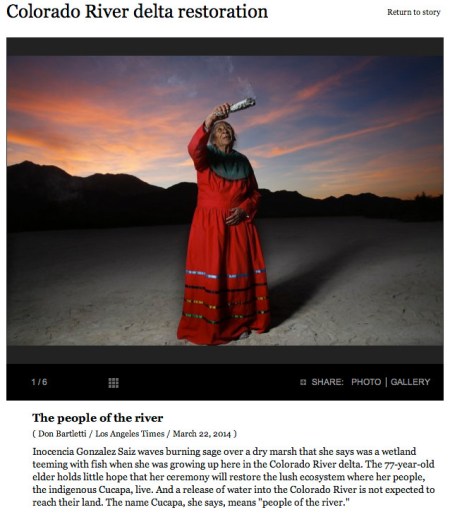
Restoration: #ColoradoRiver delta

Photo via the Los Angeles Times

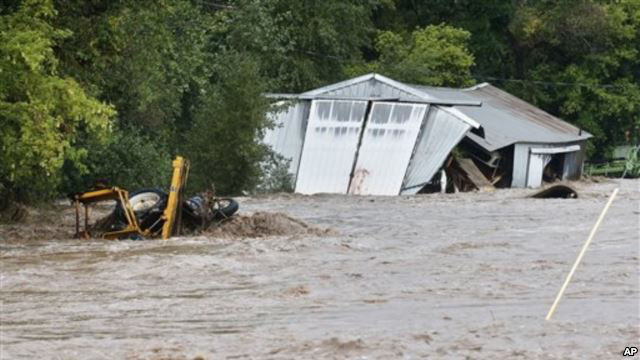
New Milliken and Evans floodplain rules too costly #COflood

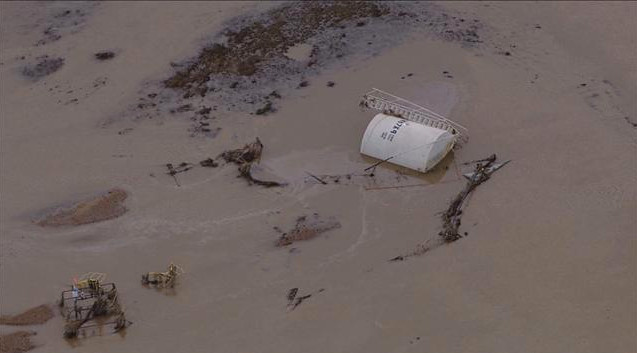
Evans Colorado September 2013 via TheDenverChannel.com

From The Greeley Tribune (Analisa Romano):

Although they may meet different fates in the end, the owners of flood-ravaged mobile home parks in Milliken and Evans face similar plights as they navigate new floodplain rules and regulations the park owners say make it impossible to continue doing business. Some suggest it’s an underhanded way to drive the parks out of their respective cities.

But local officials say it doesn’t make sense to build in an area that could again be flooded , and they are obligated to ensure homes and structures aren’t seriously damaged for the public’s health and safety.

In Milliken, town officials’ first priority was to house flood victims through the winter, said Jim Burack, Milliken town administrator and chief of police. The town allowed the two mobile home parks that sustained flood damage — Evergreen Mobile Home Park and Martin Family Trailer Park — to reopen immediately for that reason, he said.

Since then, Evergreen has continued redevelopment on the property, where 21 mobile homes were destroyed in the flood, said Jerrie Solomon, who owns the mobile home park with her husband. Per new floodplain standards implemented by Milliken, Solomon said they hired a geotechnical engineer, did a soil sample and installed backfill to raise the undamaged homes and bring in four new ones. But she said the park can’t keep up with the new rules.

“Every time we get one more thing done, they invent another set of rules and regulations,” Solomon said.

Burack said the town has been working cooperatively with both mobile home parks since the flood struck, and he said they have been transparent about all of the possible scenarios that could come out of redevelopment. Among other options, Burack said the town is looking into purchasing the damaged mobile home parks through a Federal Emergency Management Agency hazard mitigation grant, which would cover 75 percent of the cost of the parks at pre-flood prices.

Solomon said that isn’t welcome news, as she fears the purchase price would be too low. After paying for debris cleanup, down payments on the new homes and the cost to set them in the park, Solomon estimated she and her husband have invested more than $300,000 since the flood.

“If we had not gone in there and started work on that, Milliken would have the same kind of park as Evans,” Solomon said.

In Evans, city officials this week said they may seek to condemn Eastwood Village and Bella Vista mobile home parks to eliminate the health hazards posed by contaminated flood debris.

Keith Cowan, owner of Eastwood Village, filed a lawsuit against the city in February, saying the city’s new floodplain rules prevented him from reopening the park because it would be too costly to comply.

Perry Glantz, the attorney representing Cowan, said Cowan would need compensation not just for his property, but for the loss of his business, which together he said are worth several million dollars. Glantz said last week the whole situation places a financial burden solely on Cowan, which is unfair because his property — the land where the mobile homes sat — technically wasn’t destroyed in the flood.

In Milliken, much depends on a floodplain map the town board will consider Wednesday. The map, commissioned by the Colorado Water Conservation Board, is meant to provide a temporary resource for flood-ravaged communities as they attempt to redevelop, said Kevin Houck, chief of the Watershed and Flood Protection Section of the Colorado Water Conservation Board. After the flood, the Little Thompson and other rivers had erosion and, in some instances, changed course, meaning old floodplain maps may no longer be a trusty resource. Some communities were left with nothing to work with, he said.

Houck said Icon Engineering, a Centennial-based civil engineering firm, is using automated methods to at least provide communities with better data.

“What we are trading off here is quick information to localities at the expense of higher detail,” he said.

Milliken officials may adopt the floodplain temporarily because it could take years for the updated FEMA map to be approved, said Anne Best Johnson, Milliken’s community and economic development director. She said the town is currently working with a FEMA floodplain map crafted in 1978. But if the land where Evergreen Mobile Home Park sits is deemed unsuitable for homes, Solomon said she fears there will be little to no affordable housing left in Milliken.

Burack said the town is working on a housing needs assessment, which should be done in a few months. He said the town is working aggressively alongside the Milliken Housing Authority and Habitat for Humanity to find solutions.

Burack said he is also heartened by the announcement that more federal money will soon be available. The U.S. Department of Housing and Urban Development last week announced $199.3 million more to be added to the $62.8 million pot of money for flood-ravaged Colorado communities.

The money will be doled out by the state through a competitive application process, and Burack said he expects Milliken will fare well once those funds are available.

Historic water pulses through the Colorado River delta for revival starting today

This is a big day for the Colorado River delta.

The Pueblo Chieftain editorial staff comes out in support of H.R. 3189, ‘…important and reasonable bill’

Trail map for Powderhorn Ski Area via liftopia

From The Pueblo Chieftain:

THE U.S. House of Representatives has passed an important and reasonable bill that prohibits the transfer of private water rights to the federal government as a condition of permits it issues. But the bill’s future is in doubt, according to sponsor U.S. Rep. Scott Tipton, R-Colo., because a majority in the U.S. Senate and President Barack Obama appear opposed to the legislation.

The Water Rights Protection Act (HR3189) is designed to protect Colorado water rights from federal encroachment. The proposal was developed in response to U.S. Forest Service contracts with Colorado ski areas that require the transfer of water rights as a condition of permit approval.

Most ski areas in the state operate on federally owned land, which requires them to secure permits and pay an annual fee. To make snow, however, the ski areas must secure water leases or rights through the state.

Federal authorities claim the management of water resources used by ski areas is important so that rivers and lakes can be protected for their recreational and environmental value. Bill backers suggest that the federal government’s attempt to collect water rights is a serious threat to long-standing water law that puts states in charge of regulating their own available resources.

The concern about making water right transfers a condition of federal permits goes well beyond ski areas. Grazers and other agricultural producers who lease federal land are worried that the surrender of water rights might apply to them as well.

That’s why passage of HR3189 makes sense. Colorado water law has worked well for more than a century and we don’t need the federal government to get involved.

We urge our U.S. senators — Mark Udall, D-Colo., and Mike Bennet, D-Colo. — to jump on board and help guide the bill through the Senate. It will take a bit of work to educate congressional members from other parts of the country about the importance of state water laws and about the impact of having large tracts of federal land in your state.

But if given the opportunity to debate the matter on the floor of the Senate, we’re confident that a majority of those elected officials will recognize the need to approve this simple measure.

More water law coverage here.

NWS Boulder office: March 23rd is World Meteorological Day #COwx

From the World Meteorological Organization website:

World Meteorological Day 2014

Weather and climate: engaging youth

World Meteorological Day is celebrated every year on 23 March to commemorate the entry into force in 1950 of the convention that created the World Meteorological Organization. The day also highlights the huge contribution that National Meteorological and Hydrological Services make to the safety and well-being of society.

This year’s World Meteorological Day theme is “Weather and climate: engaging youth.” Today’s youth will benefit from the dramatic advances being made in our ability to understand and forecast the Earth’s weather and climate. At the same time, most of them will live into the second half of this century and experience the increasing impacts of global warming. WMO encourages young people to learn more about our weather and climate system and to contribute to action on climate change.

More education coverage here.

Flows in the Arkansas River above Lake Pueblo = 270 cfs, Reclamation realeasing water from Turquoise and Twin Lakes #ColoradoRiver

Pueblo dam spilling
Pueblo dam spilling

From The Pueblo Chieftain (Chris Woodka):

Flows in the Arkansas River below Pueblo Dam increased slightly with the end of winter water storage this week, but not significantly. The reason is that water continues to be released for the Pueblo flow management program and much of the winter water was stored in downstream reservoirs, including on the Colorado Canal, the Fort Lyon and in John Martin Reservoir.

“The movement of the agricultural water is a side benefit to the Arkansas River flows through Pueblo,” said Steve Witte, Water Division 2 engineer.

Winter water stored about 101,000 acrefeet this year, but only about 27,000 acre-feet were stored in Lake Pueblo. An acre-foot is 325,851 gallons.

Flows in the Arkansas River at Avondale were about 320 cubic feet per second this week, about the same as during the two weeks preceding the end of the winter water program. One cubic foot of water is about the same volume as a basketball.

Meanwhile, flows above Lake Pueblo in the Arkansas River have increased in recent weeks because the Bureau of Reclamation is making room in Turquoise and Twin Lakes for Fryingpan-Arkansas Project water. The March 1 forecast predicts about 73,000 acre-feet will be moved across the Continental Divide this year. But that can increase or decrease, depending on snowpack, said Roy Vaughan, Fry-Ark manager for the Bureau of Reclamation.

Repairs have been completed on the Mt. Elbert hydropower plant, allowing for full operation of Fry-Ark systems.

Releases from the upper reservoirs are adding about 270 cfs to the Arkansas River above Pueblo, which is running at twice the rate it was three weeks ago.

John Martin Reservoir back in the day nearly full

From The Pueblo Chieftain (Chris Woodka):

Flows into John Martin Reservoir have not been reduced by the winter water storage program on the Arkansas River, according to an analysis by the Colorado Division of Water Resources. The issue is of concern because of questions raised by Kansas during court cases against Colorado over the Arkansas River Compact. John Martin Reservoir, completed in 1948, regulates flows between the two states under the compact.

“We’ve never showed them evidence that they’ll buy into about the winter water program, but we keep trying,” division engineer Steve Witte told the Southeastern Colorado Water Conservancy District board Thursday.

The winter water storage program allows irrigation flows to be stored from Nov. 15 to March 15, and ended last week. This year, about 101,000 acre-feet were stored at various locations and will be divided among ditch companies east of Pueblo.

The analysis looked at diversions by ditches in Colorado from 1950-1975 and from 1976-2013. Winter water began as a voluntary program in 1976 and was later formalized in a water court decree.

“There hasn’t been any significant change as a result of winter water,” Witte said.

Diversions above John Martin totaled 72 percent to 77 percent in the 1950-1975 period, and were about 75 percent in the 1976-2013 period. Past analysis of the water levels in John Martin showed little difference in pre-winter water and post-winter water years. But those types of studies don’t explain changes because of operational changes or drought. The new study also looked at potential differences in wet, dry and average years, but found none, Witte said.

More Arkansas River Basin coverage here.

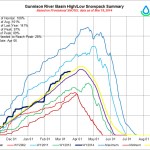
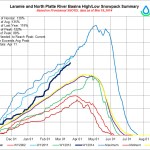
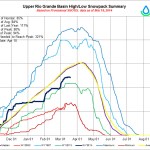
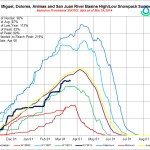
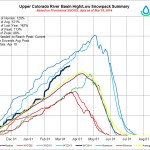
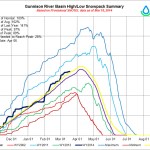
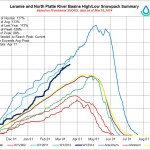
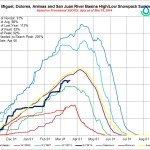
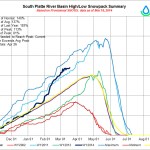
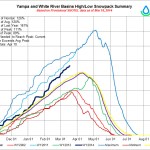
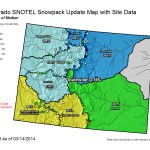
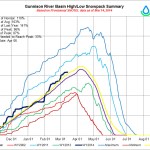
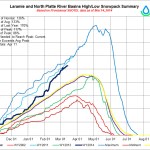
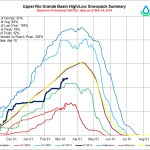
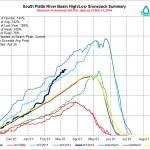
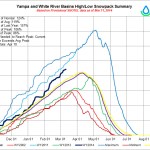
Snowpack news: Moderate runoff flooding possible in the Upper Colorado River and North Platte basins

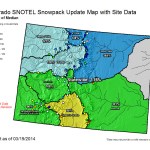
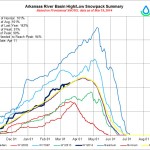
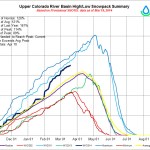
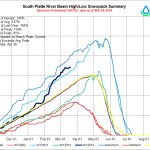
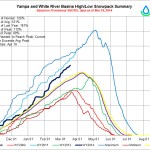
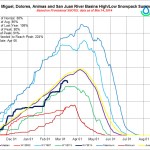
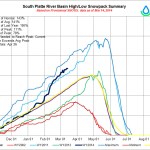
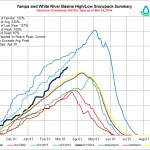
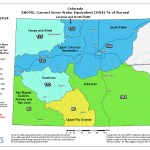
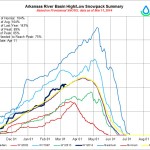
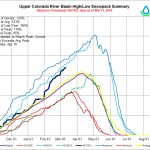
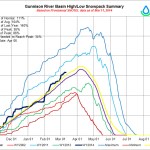
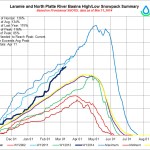
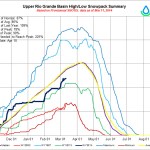
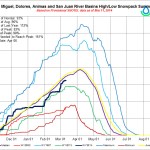
Click on a thumbnail graphic to view the gallery of snowpack conditions from the Natural Resources Conservation Service.

From 9News.com (Belen De Leon):

Meteorologists at the National Weather Service in Boulder have already issued a spring snowmelt flood potential outlook. Many of the places that were affected by the September 2013 floods could see minor flooding this spring.

In the South Platte Basin, the potential for minor flooding this spring is moderate to high. The risk is moderate in the headwaters of the Upper Colorado and North Platte Rivers.

A couple of factors that will contribute to this potential flooding is the snowpack. It’s already above average with near record snowpack at some locations near the divide. The early March percent of average mountain snowpack in the South Platte River basin this year is similar to the high snowpack in 2011…

How fast the snow melts and when, will also be very important. Ideally you want a gradual snowmelt, when the temperatures get in the mid and upper 50s in the mountains and still see freezing temperatures at night which will stall the snowmelt and slow it down. But if we have a very rapid warm up, temperatures in the 60s or warmer and no freezing at night, the snow can melt and runoff very quickly. That would deepen and increase the flow and the potential for minor flooding.

Runoff usually starts in early April. For more flood preparedness tips visit http://www.crh.noaa.gov/bou/?n=flood_wildfire_awareness_2014.

From Fox21News.com (Aisha Morales):

Spring is here and this is when we expect mandatory water restrictions, but that may not be the case this year for folks in Colorado Springs.

“Our resevoirs are about 10% higher than they were last year and so we’ve really benefited form the high mountain snow that we’ve received,” said Steve Berry, spokesperson for Colorado Springs Utilities.

Even though they don’t anticiptate any restrictions, CSU is recommending “involuntary restrictions” from it’s customers. Berry said, “What that means is we strongly encourage our customers to water no more than three days a week.”

Innovative Water Technologies of Rocky Ford is part of the #WorldWaterDay shindig today in Washington D.C.

worldwaterday2014logo

From The Pueblo Chieftain (Chris Woodka):

A company that makes water purification equipment for use in remote locations will sponsor an exhibit in Washington, D.C., today for World Water Day. Innovative Water Technologies of Rocky Ford was invited by the U.S. Department of State to attend the event, which highlights potential solutions to world water problems.

“We’ve been getting the word out for the last five or six years at trade shows, but this is really a big step forward,” said Jack Barker, president of the company.

The company makes the Sunspring, which combines membrane technology to remove particulates from water with solar power. A recently developed hybrid version also uses a small turbine to harness wind power to charge batteries. In addition to providing clean water, the Sunspring can be used to charge electronic devices where power is not available, Barker said.

More than 200 units have been manufactured at Rocky Ford since the company opened in 2008. Sunsprings are in use in a dozen countries, including during the Haiti earthquakes and last year’s typhoons in the Philippines.

During last year’s flooding in Northern Colorado, Sunsprings were employed to provide clean water when flows overwhelmed traditional treatment plants.

More water treatment coverage here.

Most Weld County water suppliers are ready to divert having repaired the damage from the September #COflood

New Saint Vrain River channel after the September 2013 floods -- photo via the Longmont Times-Call
New Saint Vrain River channel after the September 2013 floods — photo via the Longmont Times-Call

From The Greeley Tribune (Eric Brown):

The predictions made in recent months by water providers are holding true. Many are at different stages of recovery, but most ag water providers across northeast Colorado believe they’ll have needed irrigation-system repairs done in time for the rapidly approaching growing season, and be able to deliver water to farmers. However, some are still up against the clock, with work left to be done — particularly in Boulder County and in far west Weld County.

Following September’s historic flood, a number of representatives from irrigation ditches, reservoir companies and other water providers were reporting damage along their systems — ditches, dykes, gravel pits, canals, head gates and other diversion structures that needed repairs, or even to be rebuilt. Many of the large water providers near Greeley and Sterling and the surrounding areas, though, said around Jan. 1 that they were progressing well with their repairs. And many reported this past week they’re now done.

That’s good news for those massive ag-producing regions (Weld, Morgan and Logan counties, all of which experienced flood damage, represent three of the four largest ag-producing counties in the state).

Randy Ray, executive director for the Central Colorado Water Conservancy District in Greeley that saw $1.8 million in damage from the flood, and Brian Werner, spokesman for the Northern Colorado Water Conservancy District that oversees the largest water-supply project in the region (the Colorado-Big Thompson Project), each said this past week that their systems are ready to go. As did Jim Yahn, manager of the North Sterling Irrigation District, among many others.

Much of the repair work still taking place is along the St. Vrain River in Boulder County and in far west Weld County.

Sean Cronin — executive director of the St. Vrain and Left Hand Water Conservancy District in Longmont — explained that water providers farther upstream had more time to take precautionary measures before the floodwaters arrived, helping minimize some of the damage to their systems. He added that the floodwaters had more room to spread out once they made it to the plains, meaning they weren’t carrying the same intense pressure as they did in his neck of the woods, where the velocity wiped out much more infrastructure.

The St. Vrain and Left Hand Water Conservancy District encompasses about 80,000 acres. Cronin — who also serves as chairman for the South Platte Roundtable, a group of water experts from the region who meet throughout the year to address the region’s water issues — said the district endured about $20 million in damages. The district includes 94 irrigation ditches, 43 of which sustained damage. Of those 43 ditches that were damaged, Cronin explained this week:

» Four ditches are repaired.

» One is under construction and was projected to be repaired by March 1.

» 19 are under construction and are projected to be repaired by April 1.

» Five under construction and projected to be repaired by May 1.

» Three are under construction, though the projected completion dates were yet to be determined.

» 11 are not yet under construction.

Of the 11 not yet under construction:

» Three cited lack funding for the work needed.

» Three were still in discussions on designs.

» Two were waiting for repairs of another ditch to be done first.

» One was waiting for a FEMA project worksheet.

» One was listed as “not a priority.”

» One was still finding a contractor.

Cronin stressed that the Highland Ditch Company — which supplies about 40,000 acres, and is by far the biggest ditch in the St. Vrain and Left Hand Water Conservancy District — is ready to go for the growing season. The other 93 ditches are much smaller, supplying much fewer farm acres.

“There’s definitely a success story there,” Cronin said. “In the couple weeks after the flood, I wouldn’t have ever thought we’d be in as good of shape as we’re in now.”

Cronin said there will still be challenges for some farmers, certainly those where repairs are still taking place, or haven’t even started. Even for ditch repairs still in the works, those water providers might miss the peak of spring runoff, and could take in less water as a result.

“It’s shaping up to be a good water year, so hopefully those who aren’t done (with repairs) in the near future will still have water coming into their systems later in the year,” he said.

One of the major concerns initially was that the river changed locations in some spots, moving away from diversion structures. All sides have agreed to put the river back in its previous locations to help water providers, Cronin said, and those efforts are coming along well, although there’s still uncertainty regarding how the river will respond in those areas.

And even where work is nearing completion or is complete, there’s some uncertainty regarding payments of the repairs, and how much money they’ll see in reimbursements from FEMA, and how much might be coming out of shareholders’ pockets.

Cronin said one ditch in the St. Vrain and Left Hand Water Conservancy District has already increased its fees from $5 per water share to $200 per water share to pay for repairs, waiting to see how much FEMA kicks in.

“There’s still a lot we don’t know, and a lot that still needs to play out,” Cronin said. “But overall, I think we’re very happy to be in the position we’re in, compared to how things looked a few months ago.”

Scott Tipton takes the case for H.R. 3189 to the people

Trail map for Powderhorn Ski Area via liftopia

Here’s a guest commentary from US Representative Scott Tipton arguing the need for his bill, H.R. 3189, from The Denver Post:

Over the past decade, the federal government has attempted to take privately held water rights in Colorado and in other Western states, disregarding state water law that has been in effect for over a century.

Because of this, I introduced legislation to uphold long-held state water law and protect these rights from the federal government’s water grab. The Water Rights Protection Act, which passed the House with bipartisan support, prohibits the U.S. Departments of Agriculture and Interior from violating the 5th Amendment to the U.S. Constitution by taking private water rights without providing just compensation.

This legislation is supported by Colorado and national stakeholders, including the U.S. Chamber of Commerce, the National Ski Areas Association, American Farm Bureau, Colorado River Water Conservation District, and over 20 Colorado counties and water districts.

We’ve seen such diverse support because protecting our water rights isn’t a political issue. It’s a Colorado issue. Like these stakeholders, I believe Coloradans are better stewards of their water rights than Washington bureaucrats would ever be.

One of the recent federal efforts to take Colorado water involved the U.S. Forest Service. In 2011, the agency began to require ski areas to relinquish legally purchased and developed water rights — used to make snow — to the federal government as a condition for permits to operate on public lands. The administration claims the condition was necessary to ensure that water stayed with the land and rights weren’t improperly sold off.

While the administration insists this Forest Service permit condition was in the best interest of Coloradans, the devil was in the details, and it reeked of a massive federal water grab.

There was no language in the proposed Forest Service permit condition to guarantee that the agency could not divert water to other locations or direct water for another purpose altogether. Furthermore, Forest Service Chief Tom Tidwell testified in a congressional hearing that there hadn’t been any instances of private water rights on these lands being improperly sold off. There is, in effect, no basis for the administration’s concerns that these private water rights are being abused.

This raises significant questions about the administration’s true motives. Regardless of motives, by using the federal permit, lease, and land-management process to extort water rights from those who hold rights under long-held state law, the federal government is overreaching — violating private property rights and the U.S. Constitution.

Federal attempts to seize water rights aren’t limited to ski areas. The same tactics have been used by both the Bureau of Land Management and Forest Service to take water rights from family farms and ranches that rely on state-granted water for their cattle and crops. There are also circumstances in which water rights held by irrigation and sanitation districts and municipalities have been threatened by these uncompensated takings.

Colorado should be concerned about heavy-handed attempts by the government to gain control of private water rights. Because of the significant percentage of water that originates on National Forest System lands in Colorado, this issue could impact all users that have water rights passing through lands administered by the Departments of Interior and Agriculture. If adopted by other federal agencies, the scope of that impact could be even broader.

Those potentially impacted by this type of federal authority over water rights originating on public lands include cities, counties, water districts, conservation districts, owners of private residences, marinas and summer resorts, and other businesses such as ranching, mining or utilities.

The implications for Colorado are significant and severe, which is why I will continue to fight to keep control of Colorado’s water in the hands of Coloradans, regardless of President Obama’s veto threat.

‘The BLM plays in the same sandbox as every other’ [water rights owner] — Paul Tigan #COWaterPlan

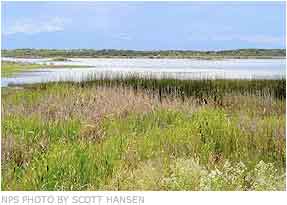
Blanca Wetlands via the National Park Service

From the Valley Courier (Paul Tigan):

This is the sixth article in the series from the Rio Grande Basin Roundtable, regarding the implementation of the Basin Water Plan. ing of the Bureau of Land Management, or BLM, what comes to mind? Is it livestock ranching? Oil and gas development ? Maybe it’s rock climbing at Penitente Canyon , or watching wildlife and birds at Blanca Wetlands. Perhaps it’s a trip to BLM lands every fall to sight in your rifle in the hopes of dropping a trophy bull on the opening morning of the first elk season.

“The mission of the BLM is to sustain the health, diversity, and productivity of the public lands for the use and enjoyment of present and future generations”. This mission is remarkably complex. As the San Luis Valley Field Office Manager likes to say “it’s not rocket science it’s more complicated.”

It requires the BLM to not only balance “multiple uses” in the present day, but also consider how the American people may need those resources far into an unknown future.

Here in the San Luis Valley, the BLM manages just over 500,000 acres of land according to this mission. Dozens of livestock ranching operations depend on the health of the BLM land; so too dozens of threatened, endangered, and special status wildlife and plant species. Some public lands have been set aside to be studied for future preservation, such as the San Luis Hills, while others have been designated for development as solar energy sites to serve future energy needs for the nation. And many uses share the same acre of public land like the new gravity-assisted mountain bike trail at Zapata Falls, but keep an eye out for the cattle on the same trail. And wear a helmet!

But like every other person or entity that manages land in the San Luis Valley, there is one resource in short supply for the BLM water. It may surprise some to learn that the BLM (and every other federal land management agency) is required by federal law to adhere to the state-managed water appropriation systems. When it comes to water management, the BLM plays in the same sandbox as every other farmer, rancher, city, and conservation district.

Many people might think of the BLM’s water needs as “non-consumptive ,” that is, resources need water but don’t “use” it the way a farm might use it. For some areas, this is true. People who enjoy float-boating on the Rio Grande depend on water to get from Las Sauces to the Lobatos Bridge, or further south into the Rio Grande Gorge. Similarly, aquatic species, such as trout, depend on certain water conditions at particular times of the year to breed and sustain their populations. People who enjoy fishing depend on the water as well. But the San Luis Valley Field Office also uses water, within the appropriation system, to support a diverse array of habitats and uses. The BLM holds dozens of water rights across the SLV for the benefit of livestock grazing operations. These rights generally stem from natural springs and utilize small infrastructure systems to make them useful. Perhaps more dramatically, the BLM also irrigates thousands of acres of land for the benefit of many plant and wildlife species. That management not only sustains those critical species habitats, but also leads to incredible recreation opportunities , such as wildlife viewing and waterfowl hunting.

It would be difficult to overstate the importance of the Blanca Wetlands, a habitat restoration effort that began in the 1960s and continues to this day. The BLM uses more than 40 wells and some water from the Closed Basin Project to wet and dry about 2000 acres of historic and restored wetland playa habitat. These acres support 13 threatened, endangered, and sensitive species and over 160 species of birds. The wetlands are also an important calving and fawning area for big game species. Blanca Wetlands maintains Colorado’s largest population of western snowy plover and supports a number of waterbird species of regional, national, and even hemispheric importance.

But the Blanca Wetlands isn’t just for the birds. One of the great joys of the BLM staff is watching the public engage these incredible resources just 20 minutes from Alamosa. Whether it is a kindergartener walking out into a playa barefoot to catch a fairy shrimp in a bucket, or a high school student receiving national recognition for her research, a living laboratory like the Blanca Wetlands connects people to the natural world in ways that no iPad app can.

But like every water user who pumps groundwater to stay in business, the BLM faces an uncertain future with augmentation requirements from the State of Colorado. The BLM is not currently a party to any of the subdistricts but has worked with the state to define its augmentation responsibilities for groundwater pumping and will meet those responsibilities. These habitats are too important to dry up. They serve not only the diversity and health of the public lands, but also the American people.

As the Rio Grande Basin goes through an era of unprecedented change, the BLM is committed to partnering with other water managers to ensure the Rio Grande Basin of the future enjoys the same broad array of natural resources that contribute to quality of life and a strong and diverse economy. The habitats and resources we manage will be as important 100 years from now as they are today, and water will continue to be the defining feature of these resources.

The BLM is and active partner in the Rio Grande Basin Water Plan, to become a part of the stakeholder process get involved in one of three ways: 1) attend the Rio Grande Basin Roundtable monthly meetings (held the second Tuesday of each month at the San Luis Valley Water Conservancy District office at 623 Fourth Street in Alamosa) or; 2) send comments directly to http://www.riograndewaterplan. com and; 3) attend any one of the BIP subcommittee meetings that can be found on the BIP website. The lead consultant and local liaison from DiNatale Water Consultants is Tom Spezze. Tom can be contacted at tom@ dinatalewater.com. To be considered, submit input to the Basin Roundtable by March 31.

More Colorado Water Plan coverage here.

Alamosa: Water infrastructure funding is in short supply

The water treatment process

From the Valley Courier (Ruth Heide):

Treating Alamosa’s water is becoming more expensive. With more rigid arsenic standards coming into play several years ago, the City of Alamosa was forced to build a water treatment plant. Recently, Alamosa Public Works Director Don Koskelin said arsenic standards might tighten up again, which could force the city to revamp its treatment system, resulting in an expensive adjustment.

This week Koskelin informed the Alamosa city council of another more immediate problem with the city’s water treatment plant, and the council authorized funding for a pilot treatment system. Koskelin said for six years the membranes that filter out the arsenic in the municipal drinking water supply provided excellent performance. Then all of a sudden in the last year the city started having problems with the membranes. The manufacturer recommended a more stringent cleaning schedule, which meant using more chemicals, which in turn meant more expense. Koskelin said the cost increase for the chemicals alone is nearly $290,000 a year.

Another option would be to replace the membranes, but that would cost threequarters of a million dollars or so. Koskelin said the life of the membrane system was supposed to be 15 years but it has only lasted about six years.

Another solution, which hopefully will be less expensive , will involve lowering the pH of the water, which should improve the filtering process and arsenic removal.

Koskelin recommended that the city enter into a pilot project to test this theory for three months with Clearlogx. He said the city has a threemonth permit from the Colorado Department of Public Health and Environment to test this system. If it works, the city could buy the system and 90 percent of the money the city paid during the three-month trial would count towards the purchase price. The total purchase price of the system is $175,000. The city will be leasing it for $4,500 a month.

“We need to do something,” Koskelin told the council.

He estimated the pay off on this system would be about two years, and the life of the system should be about 15 years.

Addressing the water treatment situation will result in a budget adjustment, Koskelin added, primarily from enterprise fund surpluses. Koskelin said this solution might also help the city meet stricter arsenic standards when/if they come down in the future.

“If it doesn’t drop lower than 2 parts per billion we should be able to meet those new standards,” he said. The current standard is 10 parts per billion, set by the Environmental Protection Agency. The Colorado Department of Health and Public Environment is considering a stricter standard, which Koskelin estimated at an earlier council meeting would likely not take effect for a couple of years, if the state moves forward with it.

More infrastructure coverage here.

Weekly Climate, Water and Drought Assessment of the Upper #ColoradoRiver Basin

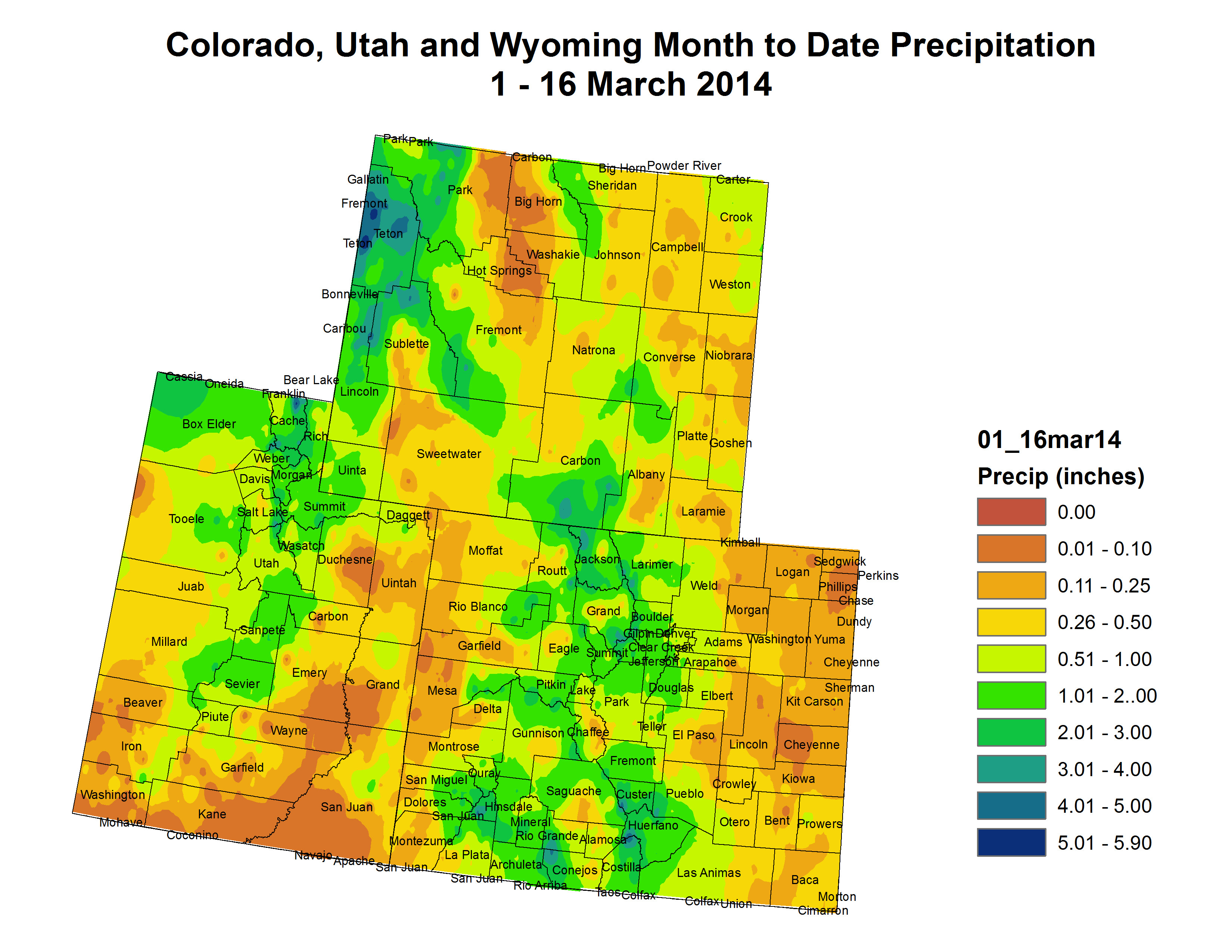
Upper Colorado River Basin month to date precipitation March 1-16, 2014 via the Colorado Climate Center

Click here to read the current assessment. Click here to go to the NIDIS website hosted by the Colorado Climate Center.

SB14-017 passes House 36-26 #COleg

NRCS: The spring issue of ‘SnowNews’ is hot off the presses

Drought news

US Drought monitor March 18, 2014

Click here to go to the US Drought Monitor website. Here’s an excerpt:

Summary

During the drought-monitoring period, precipitation was mainly confined to the drought-free areas of the eastern U.S, although localized drought relief was noted across south-central portions of the nation. Meanwhile, drought persisted or intensified across the west, where alarmingly low water-year precipitation and meager mountain snowpacks continued…

Central Plains

Warm, dry weather prevailed on the central Plains, intensifying drought while accelerating winter crops out of dormancy. The unseasonably warm conditions (weekly average temperatures up to 11°F above normal) rapidly increased crop-water demands, while strong, occasionally severe winds rapidly dried topsoils and caused blowing dust. Consequently, Extreme Drought (D3) was expanded from southeastern Colorado into western Kansas, while the drought-impact type was changed from “L” (Long-Term) to “SL” (Both Short- and Long-Term) to account for greening winter crops as well as blowing dust and increased fire danger…

Southern Plains and Texas

Intensifying drought across the southern Plains and western Texas contrasted with localized drought relief in eastern portions of the region. A developing late winter storm generated widespread rain from northeastern Texas into eastern Oklahoma, with totals topping 2 to 3 inches in the wettest locations. Consequently, some drought reduction was noted, particularly where rain was heaviest. On the back side of the storm, strong, gusty winds coupled with parched soils maintained or worsened drought from western Oklahoma into central and western Texas. Several large dust storms heightened the drought’s impacts, with notable increases in Extreme Drought (D3) and Exceptional Drought (D4) over the panhandles of Texas and Oklahoma. Soil moisture in these locales is virtually non-existent, with rainfall over the past 90 days locally less than 10 percent of normal…

Western U.S.

Unsettled conditions in the north contrasted with intensifying drought elsewhere. The benefits of the February and early-March precipitation rapidly diminished across California and the Southwest as unseasonable warmth and dryness increased water demands and depleted snowpacks.

In northern portions of the region, an influx of Pacific moisture generated rain and mountain snow from the Cascades into the northern Rockies. Precipitation totals were highly variable, with 2- to 5-inch totals (liquid equivalent) in the northern Cascades contrasting with amounts generally less than 1 inch over southern portions of the range. Most of the heavy precipitation fell outside of the region’s drought areas, with totals in southwestern Oregon averaging up to 2 inches below the weekly norm. Farther east, however, recent heavy snow eased Moderate Drought (D1) in southern Idaho and eliminated Abnormal Dryness (D0) in southeastern Wyoming and the northwestern tip of Nebraska.

Farther south, a disappointing water year continued, with warm, dry weather quickly negating the benefits of the precipitation from February and early March across California and the Great Basin. Most notably, Extreme Drought (D3) returned to coastal areas north of San Francisco as well as the Sierra Nevada; over the past two weeks, precipitation deficits in these areas have averaged two inches or more. Water-year (Since October 1, 2013) precipitation has averaged less than half of normal over most of California, and locally less than 30 percent of normal in the state’s D4 (Exceptional Drought) area. Severe Drought (D2) expanded across southern Nevada, where water-year precipitation has averaged 40 to 60 percent of normal.

In the Four Corners region, changes to this week’s drought depiction were confined to western portions of the region. Across western Arizona, Severe Drought (D2) expanded as water-year precipitation totals continued to drop well below half of normal (locally less than 30 percent of normal). In northern Arizona, precipitation over the past 90 days has averaged less than 25 percent of normal. Meanwhile, SNOTEL data from southwestern Utah indicated the Snow Water Equivalent (SWE) is currently in the 12th percentile or lower, with water-year precipitation totals averaging 25 to 40 percent of normal; this data was used to depict the newly-expanded D2 in the southwestern quarter of the state…

Looking Ahead

Little — if any — drought relief is expected from the Pacific Coast to the Great Plains, with precipitation during the upcoming monitoring period mostly confined to the Northeast and Gulf Coast. An area of low pressure will produce snow in northern New England on Thursday, while warmer conditions briefly develop in the storm’s wake from the middle Mississippi Valley to the central and southern Atlantic Coast. Toward week’s end, another disturbance will produce some additional snow across the nation’s northern tier. Over the weekend, cold air will surge into the Midwest and Northeast, while rain will develop across the South. Dry weather will persist, however, from California to the southern High Plains. In addition, unusually warm weather will continue to plague California. The NWS 6- to 10-day outlook for March 25-29 calls for below-normal temperatures from the Plains to the East Coast, while warmer-than-normal weather will prevail in the West. Meanwhile, near- to above-normal precipitation across the majority of the U.S. will contrast with drier-than-normal conditions from southern California to the southern High Plains.

Arkansas Valley Conduit: Seeking adequate appropriations from the feds

Arkansas Valley Conduit Comanche North route via Reclamation

From The Pueblo Chieftain (Chris Woodka):

Sponsors are working to increase funding for the Arkansas Valley Conduit in next year’s federal budget. The conduit recently received the green light to proceed from the Bureau of Reclamation, which released a record of decision on Feb. 27 for it, a master storage contract and an interconnect on Pueblo Dam. But the approval did not translate into funding when President Barack Obama released his budget one week later and included only $500,000 for the conduit.

“We were disappointed in the dollars,” said Jim Broderick, executive director of the Southeastern Colorado Water Conservancy District, sponsor of all three projects. He spoke at Thursday’s monthly board meeting.

The conduit has $3.1 million in funding this year, which includes $2.1 million that was not spent in past years. To keep it on pace for construction sometime in the next decade would require at least $7 million to $10 million, Broderick said. Last year Reclamation internally shifted $44 million for projects, but it’s too soon to tell how much could be available this year.

“There is a lot of activity, particularly because of the drought in California,” Broderick said. “We have to keep the pressure on.”

To do that, officials will again travel to Washington, D.C., to lobby Department of Interior and Bureau of Reclamation officials as well as Congress. Last week, Colorado Sens. Mark Udall and Michael Bennet, both Democrats, and Reps. Scott Tipton and Cory Gardner, Republicans, called for more funding to support the conduit.

“We have to realize this is the president’s budget. Congress sees it a different way,” said lobbyist Ray Kogovsek, a former congressman. “I would say we can certainly get more than $500,000.”

More Arkansas Valley Conduit coverage here.

#COflood relief money headed to where it is needed?

Flooding St. Vrain River September, 2013 via Voice of America

From the Longmont Times-Call (Scott Rochat):

So far, FEMA has obligated $3.4 million of flood money to rebuild Longmont. So far, Longmont has seen $143,000. Why? Because when you try to do that much with a handful of state officials, it only goes so far.

“In September, before the flood, we had three finance people,” said Micki Trost, a spokeswoman for the Colorado Division of Homeland Security and Emergency Management. “We staffed for our normal operations, our steady-state operations. We would not (normally) have the amount of requests coming through our finance office that we had following the flood.”

That’s changing. Not only has the division ramped up to six finance people and borrowed another three from its grant department, but last week, the state contracted with Deloitte — one of the “Big Four” accounting and audit firms — to provide another six. On Thursday, Longmont emergency manager Dan Eamon had his first meeting with a Deloitte representative. Eamon said he hoped that things were looking up from here.

“The biggest thing is that the state wasn’t ready for a $1 billion disaster,” he said. “It’s larger than we’ve ever experienced. … We’re all learning as we go.”

Why is Denver involved at all? Because of the way reimbursement works through the Federal Emergency Management Agency. It goes roughly like this:

• Cities and counties submit estimates for work that they consider to be FEMA-eligible. This gets a quick sign-off from the state.

• FEMA considers the request and decides how much to obligate. If an estimate is deemed to be eligible, FEMA can reimburse up to 75 percent of the project’s expense.

• At that point, the city or county has to submit a different set of paperwork to the state on the actual costs as the work gets done. This is reimbursement money, not an up-front grant, so the state has to verify that the work was done, who did it, and several other details before the money can be released.

So it’s FEMA’s dollars — but it’s the state who has to oversee and verify. And until recently, there just weren’t enough people to do that, Trost said.

World Resources Institute: World’s 18 Most Water-Stressed Rivers #ColoradoRiver

watertressbymostpopulousriverbasinsviaworldresourceinstitute

From the World Resources Institute (Andrew Maddocks/Paul Reig):

The world’s 100 most-populated river basins are indispensable resources for billions of people, companies, farms, and ecosystems. But many of these river basins are also increasingly at risk. As water demand from irrigated agriculture, industrialization, and domestic users explodes, major rivers on several continents are becoming so depleted that they sometimes fail to reach their ocean destinations. Add climate change, nutrient and chemical pollution, and physical alterations like dams and other infrastructure development to the mix and it’s clear that many communities rely on water resources that face an increasingly risky future.

WRI’s Aqueduct project recently evaluated, mapped, and scored stresses on water supplies in the 100 river basins with the highest populations, 100 largest river basins, and 180 nations. We found that 18 river basins— flowing through countries with a collective $US 27 trillion in GDP —face “extremely high” levels of baseline water stress. This means that more than 80 percent of the water naturally available to agricultural, domestic, and industrial users is withdrawn annually—leaving businesses, farms, and communities vulnerable to scarcity…

Decision-makers in many of world’s water-stressed basins have attempted to put management plans in place—with mixed results. The United States’ Colorado River is a prime example of a plan that, while well-intentioned, may ultimately be unsustainable. Starting in Colorado and running 1,400 miles to the Gulf of California, the Colorado River is the 14th most stressed among the world’s most populated river basins, and the sixth most stressed if ranked by size. More than 30 million people depend on it for water. The seven states receiving its water comprised 19 percent of the United States’ total GDP in 2010.

Because of its naturally arid setting—and due to its large and growing number of users and resulting high level of baseline water stress—the Colorado has become one of the most physically and legally managed rivers in the world. It is also under serious duress, exacerbated by a decades-long drought. This imbalance between supply and demand means that the river often runs dry before it reaches the Pacific Ocean—posing significant problems for wildlife, ecosystems, and communities that depend on it.

The Colorado River is an example of a basin where natural water stress is already severe. The complex web of infrastructure and governance structures around the river was, in a sense, created to ensure predictable, steady water supplies in a stressed region. On the other hand, that same development has driven increasing demands for limited supplies. Aqueduct’s country and river basin rankings deliberately do not include the effects of such extensive management, instead focusing on objective measures of underlying hydrological conditions. But the overall picture is clear: Even the most-established, iron-clad management systems start to crumble under increasing scarcity and stress…

What Is Water Stress?

Water stress is the ratio of total water withdrawals to available renewable supply in an area. In high-stress areas, 40 percent or more of the available supply is withdrawn every year. In extremely high-stress areas, that number goes up to 80 percent or higher. A higher percentage means more water users are competing for limited supplies. See the high and extremely high-stress areas highlighted in red and dark red on the maps.

More Colorado River Basin coverage here and here.

Work on the #COWaterPlan continues #ColoradoRiver

Colorado Water Plan website screen shot November 1, 2013

From the Glenwood Springs Post Independent (Hannah Holm):

Over the past month, readers of this column have learned about several aspects of the Colorado Water Plan Governor Hickenlooper wants drafted by the end of this year. Articles have focused on the efforts of the planning group for the Colorado River Basin (in Colorado) that seek to address needs for community water supplies, agriculture, and streamflows to support the environment and recreational uses.

Here are a few of the points highlighted the series:

• Many headwater communities lack sufficient reservoir storage to weather a prolonged or severe drought.

• Many farmers and ranchers already suffer from periodic water shortages, even as they fear that additional Western Slope agricultural water will be demanded for urban uses or meeting downstream obligations.

• The health of many streams have already been undermined by diversions, and there is concern that the problem could get worse as water demands continue to grow, with consequences for the recreational economy as well as the environment.

Reconciling these competing demands for water even within the Colorado River Basin is no simple task, and the fact that water-short farms and cities east of the Continental Divide continue to seek relief from the comparatively wet western side adds another layer of complexity.

Nonetheless, the water managers and stakeholders that make up the Colorado Basin Roundtable are forging ahead with assessing potential projects and methods to enhance the security of water supplies to meet all of the basin’s needs. A few of these potential projects and methods include:

• Developing small storage reservoirs in the Upper Basin that can release water to support both community needs and fish needs in times of prolonged drought.

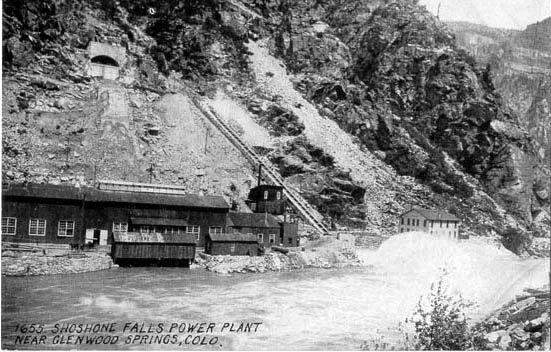
• Acquiring the Shoshone Power Plant in Glenwood Canyon, which holds a very senior water right that plays an important role in keeping water in the Colorado River to run through its hydropower turbines.

• Identifying land-use policies that could reduce the growth of urban water needs.

The Colorado Basin Roundtable is continuing to address these options at meetings every two weeks in Glenwood Springs and is seeking additional input from the public at town hall meetings held throughout the river basin.

To learn more and get details on upcoming meetings, go to http://www.coloradobip.sgm-inc.com.

From Steamboat Today (Ren Martyn):

The Yampa White Green Roundtable met last week in Craig to further discuss Northwest Colorado’s Basin Implementation Plan that in July will be sent to the Colorado Water Conservation Board to be implemented into the 2015 Colorado State Water Plan…

The imposing task is how to keep the water in our basin and plan for “wet water,” or water that is in the river system not just on paper.

When compared to other Colorado basins, our basin is relatively undeveloped and has limited water usage and storage. Other West Slope basins in close proximity to the thirsty Front Range metro areas with trans-mountain diversions that take West Slope water to the East Slope, have gone through water planning but their rivers lack a normal hydrologic cycle and are dry in comparison.

A quick look at Winter Park’s [Fraser] River will show the water planning did not achieve “wet water,” and millions of dollars now are being spent trying to convince the owner of the water rights, Denver Water Authority, to leave some water in the river.

Past water planning often relied on median flows for projected calculations, but if you lived here in 2011 and 2012, you understand the difficulty in relying on middle flow values.

In 2011, the Yampa River in Steamboat Springs total flow was 598,000 acre feet, but one year later, total flow was 178,000 acre feet. To add emphasis to this dramatic fluctuation, the lowest recorded flow was in 1977 at 122,000 acre feet. “Wet water” planning is no easy task.

The roundtable is a diverse group representing municipal, energy, industrial, recreational, environmental and agricultural interests. The group recognizes the sustainability of our river system and economic health are at risk and is working diligently to address the needs for existing uses, future growth and recreational and environmental values.

During the past month, the roundtable conducted five public meetings in Steamboat Springs, Craig, Meeker, Rangely and Browns Park. The public process has been a valuable component to the BIP process and additional local public meetings likely may be held as the Colorado State Plan is developed.

On March 6, more than 300 water leaders and members of the public from across the state gathered for the 2014 Statewide Basin Roundtable Summit in Golden. Gov. John Hickenlooper and former Gov. Bill Owens each gave a keynote address highlighting the important work of the basin roundtable process and the development of localized Basin Implementation Plans that will comprise a large portion of Colorado’s Water Plan.

As part of the process, the Yampa, White, Green Roundtable is examining years of consumptive and non-consumptive studies, and with public input, will finalize a Basin Implementation Plan that protects an equitable apportionment of the native floes and helps mitigate the risks of over-development of the region’s water resources.

The diverse interests represented on the roundtable agree that planning for “wet water” is a significant challenge but vital to the future sustainability of Northwest Colorado.

For additional information visit http://www.coloradowaterplan.com or attend the next Yampa, White, Green Roundtable meeting on April 16 in Craig.

More Colorado Water Plan coverage here.

Drought that’s swallowing the western US #COdrought

2014 McPhee Reservoir irrigation water allocation set

mcpheereservoiroverlook

From the Cortez Journal (Jim Mimiaga):

The Dolores Water Conservancy District, which operates McPhee Reservoir, forecasts full-service users will receive at least 15 inches per allocated acre of the 22 inches of a full contractual amount.

“It is an improvement from our last prediction of 11 inches,” said DWCD general manager Mike Preston. “But we will need additional snowpack in the next 6-10 weeks to fill the reservoir and deliver a full supply.”

Water officials emphasize that the 15 inches is the minimum amount expected to be delivered based on current snowpack levels measured at five different locations in the river basin.

According to a March 7 letter sent to irrigators, “If conditions completely dry out, the worst case works out to 70 percent or 15 inches per allocated acre.”

Late summer monsoon rains that recharged the soil is a major factor for the improved outlook.

Instead of soaking into the ground as it did in Spring 2013 due to a extremely dry 2012, snowmelt this year will reach the reservoir more.

“The improved soil moisture will prevent us from totally cratering like last year,” said Ken Curtis, a DWCD engineer.

Last year, full-service irrigators received just 25 percent of their total allocation, or about 6 inches of water per acre. Instead of three cuttings of alfalfa, most farmers harvested just one.

The latest water news is critical for farmers, who begin ordering fertilizer and seed now for the upcoming growing season. Calculations of how much to plow also depend on estimated water supplies.

“If we get a weather build up, it will just improve from the 15 inches,” Preston said…

If the high country received 4-6 inches of snow each week through April, managers predict the reservoir would reach its full irrigation supply.

On the down side, lower elevation snow is lower than normal. Also, because there is no carryover storage from last year’s dry conditions, McPhee reservoir will end very low and lack carry over storage for a third straight year.

More McPhee Reservoir coverage here.

Republican River Basin ‘State of the Basin’ symposium recap

republicanriversouthfork

From The Yuma Pioneer (Bill Boas):

“The aquifer is depleting rapidly…should we be concerned?” That was the label on several cases of half-filled bottles of drinking water served with lunch at the “State of the Basin Symposium” held this past Monday at the Wray High School Auditorium from 9 a.m. to 4 p.m.

The symposium was sponsored by the Conservation Committee of the Republican River Water Conservation District (RRWCD).

About 250 people packed the auditorium to hear prominent speakers from Colorado, Kansas, and Nebraska present a situation report on water issues affecting the Republican River Basin’s many thirsty users. When water is short, state lines become battlegrounds and the recent legal battle between Colorado, Kansas, and Nebraska points to a future that can’t be “business as usual” for Great Plains water users.

Principal speakers included; Congressman Cory Garner, who was rescheduled from 4 p.m. to 1p.m.; Colorado Supreme Court Justice and water law expert Gregory Hobbs; Dick Wolfe, Colorado State Engineer; Scott Steinbrecher, Colorado Assistant Attorney General; officials of water conservation districts in adjacent Kansas and Nebraska; and experts from academic and private water engineering firms.

With population growing, and water supplies fixed, aggressive water conservation practices surfaces as one humanly manageable variable in the complex climatic, hydraulic, legal, and distribution environment of the Republican River Basin.

More Republican River Basin coverage here.

The Rio Grande River Compact Commission meets today

Rio Grande and Pecos River basins

From the Associated Press via the Houston Chronicle:

The tension is expected to be thick Thursday as top water officials from New Mexico, Colorado and Texas gather for an annual meeting focused on management of the Rio Grande.

Texas and New Mexico are in the middle of a legal battle before the U.S. Supreme Court over groundwater pumping along the border. The federal government is weighing in, claiming that groundwater falls under its jurisdiction and should be considered part of the massive system of canals and dams that deliver water to farmers in southern New Mexico and Texas.

It could be years before the court makes a decision, but some experts say the case could set precedent when it comes to state rights in the drought-stricken West.

In the meantime, farmers in southern New Mexico who are deciding whether to plant crops or leave their fields fallow are on “pins and needles,” said Scott Verhines, New Mexico’s top water official.

“Certainly the litigation, the threat of litigation, the fear of what’s going to come out of all this is clouding everybody’s ability to work toward a solution,” he said. “I think very unfortunately that we find ourselves fighting and not solving.”

Verhines will be among those gathering for the Rio Grande Compact Commission meeting. The decades-old compact spells out how much river water the states must share.

More Rio Grande River Basin coverage here and here.

Southern Delivery System on track to be online in 2016

The new north outlet works at Pueblo Dam -- Photo/MWH Global
The new north outlet works at Pueblo Dam — Photo/MWH Global

From The Pueblo Chieftain (Chris Woodka):

he Southern Delivery System is on course to begin operating in 2016.

“It will be complete for testing purposes in 2015,” SDS Permit Manager Mark Pifher told the Lower Arkansas Conservancy District in an impromptu update Wednesday.

SDS is a 50-mile pipeline from Pueblo Dam to Colorado Springs. When completed, it will serve Colorado Springs, Fountain, Security and Pueblo West. Nearly all of the pipeline is in the ground, and construction has begun at three pumping stations, including one near Pueblo Dam, Pifher said. While all parts of SDS will be complete by next year, the system will require months of testing before it is put into use.

“When it’s finished, the water won’t be delivered,” Pifher said. “It won’t be pushing water to customers until 2016.”

The Lower Ark district has been in negotiations for years with Colorado Springs on the impacts of SDS, particularly increased flows on Fountain Creek. Pifher updated the Lower Ark board on the progress of stormwater meetings in Colorado Springs.

A committee of El Paso County citizens is working toward putting a stormwater enterprise proposal on the November ballot. Fees would be about the same as under the former enterprise, which Colorado Springs City Council abolished in 2009, Pifher said.

The Lower Ark board also got a review of the U.S. Geological Survey of dams on Fountain Creek from USGS Pueblo office chief David Mau. Noting the study was funded by Colorado Springs (under its 1041 agreement with Pueblo County), Pifher said an alternative for 10 side detention ponds south of Fountain held the most promise for reducing flood impacts on Pueblo. Pifher also downplayed the immediate impacts of SDS on Fountain Creek.

“When we turn it on, it will carry 5 million-10 million gallons per day,” Pifher said.

Over 50 years, that will increase flows up to 96 million gallons per day.

“It will take some time to grow into demand on that system,” Pifher said.

More Southern Delivery System coverage here and here.

Snowpack news: 2014 is shaping up to be a big runoff year for much of Colorado #COdrought

From The Denver Post (Scott Willoughby):

It’s a short walk through deep snow to what the federal government considers the headwaters of the Colorado River. Some years it’s deeper than others. Technically speaking, station 05K14 sitting at 11,300 feet atop the Berthoud Pass Summit and measures the snow that first feeds the Fraser River before eventually trickling into the Colorado. But from the Natural Resources Conservation Service’s perspective, this is the highest measurement point in the river basin still worth walking to every month. Some months more than others.

As the Colorado River basin edges closer to its typical early-April snowpack peak, last Friday’s manual measurements of snow depth and water content at the Berthoud Summit site offered ample insight into what we can expect of our state’s namesake river this spring. With the assistance of U.S. Sen. Michael Bennet and a group of water watchers that included the USDA’s Undersecretary for Natural Resources and Environment Robert Bonnie, NRCS scientists B.J. Shoup and Mage Hultstrand measured snow and water at the site at about 143 percent of the median for that date.

As a result, water managers have already begun making arrangements to accommodate an above-average runoff in the Colorado River. Similar scenarios have begun to play out elsewhere across the state.

“This week, we know we’ve got a very impressive snowpack here at the headwaters of the Colorado River. We’re at about 40 percent above normal for this time of year. We’re already above our average peak, so we know we’re going to have a good runoff,” said Chris Treese, external affairs manager for the Colorado River Water Conservation District. “So we look at these data and begin to manage. Already this week we’ve made some decisions about reservoir operations. Reservoirs have already begun releasing more water than they would typically at this time of year to make sure they have some space for this snow as it comes down.

“The goal of any reservoir operator is to fill without spilling, and that’s a lot more art than science, but this is the science part of that equation.”

From the practical perspective ranging beyond drought relief and flood control, Colorado fishermen would do well to take a page from the whitewater boating playbook and put some of that science to use. The NRCS Snow Survey and Water Supply Forecasting Program has been around since 1935, and the public data it produces (nrcs.usda.gov) serves as a sort of seasonal scouting report for all things water-related.

“This is a program that I really didn’t know much about until there was an attempt to cut the budget, and all of the sudden I knew a lot about it,” Sen. Bennet said after volunteering to collect a snow sample Friday. “I heard from people all over the state that relied on this data for so many years for so many different things.”

The NRCS snow survey data and resultant forecasts are generated in two different ways in Colorado, through 102 manually measured snow courses and 114 automated Snow Telemetry (SNOTEL) sites situated throughout the mountains. Both budget-threatened programs provide critical information to a Data Collection Office in Denver, offering historical record of snow and water throughout the West and current measurements used to forecast and prepare.

About 80 percent of Colorado’s water supply comes from mountain snowpack that accumulates from October to April. Led by the South Platte River Basin at 144 percent, statewide measurements as of Tuesday showed the snowpack at 115 percent of normal, despite only 85 percent of median in the Rio Grande River Basin.

“They’re not making any more water,” Bennet said. “We’re standing on a place right now where we’ve had a really good snowpack this year. Southwest Colorado, southeast Colorado, they’re still facing significant droughts, and our farmers and ranchers in those regions are going to need this data in order to be able to plan, so it’s an important deal. When you’ve got to make something as precious as our water go further, it’s important that we have as informed a view as we can.”

The same insight applies to all things outdoors in Colorado.

“We use water, especially on the Western Slope, in a variety of ways. It’s consumptive — the traditional ag and municipal — and it’s non-consumptive,” Treese said. “But they all add to the economic value of the river and our lives out here.”

Announcement: State and Division One Engineers forum, April 15

South Platte River Basin via Wikipedia

The State and Division One Engineers will be hosting a forum on Tuesday, April 15, 2014 at the Southwest Weld County Services Building (4209 Weld County Rd 24 ½, Longmont, CO 80504) from 8:30 am to 11:30 am. Water professionals, attorneys, engineers and the general public are invited to attend.

This forum will provide an opportunity to hear personnel from the State and Division offices talk about current issues regarding engineering practices for establishing historical consumptive use in change of water right cases, summary of consultation changes and participation with the Water Court, and new policy. The goal of this forum is to generate awareness among the water community and provide a discussion on issues, including a question and answer session with personnel from the State and Division offices.

Please plan to attend! Space is limited. Please RSVP by Wednesday, April 9th, via email to Linda.Korf@state.co.us or by calling Linda at (970) 352-8712 if you plan to attend.

More Colorado Division of Water coverage here.

Buena Vista: Colorado Parks and Wildlife grant serves redesign of Silver Bullet Rapid

Silver Bullet Rapid via the Chaffee County Times

From The Mountain Mail (Kim Marquis):

If a redesign of the Silver Bullet rapid on the Arkansas River near Buena Vista works as planned, both boaters and fishermen could benefit. The rapid, known as the Dam, Boat Chute and Silver Bullet in boating circles, had previously been a Class IV rapid at certain water levels, which prevented some boaters and kayakers from making the run. The rapid is south of town and due east of the Buena Vista Correctional Center.

Wilderness Aware owner Joe Greiner, a longtime commercial rafting outfitter, called the former rapid “spicy” for its steep drop and consistent waves downstream. The rapid caused some private boaters to skip the section, starting trips at Greiner’s river put-in at his property in Johnson Village, instead of using the Buena Vista River Park in town.

The redesign completed in February changes the rapid into three smaller drops instead of one, possibly reducing its rating to Class II or Class III, Arkansas Headwaters Recreation Area Park Manager Rob White said.

AHRA managed the $400,000 project, which was paid for by a grant from the Colorado Water Conservation Board and contributions from Colorado Parks and Wildlife, the Upper Arkansas Water Conservancy District, the Arkansas River Outfitters Association and individual river outfitters.

The new design adds a drop both upstream and downstream of the original rapid, making the overall experience more gradual, White said. Construction included a fish ladder built into the smaller drops so that trout can conceivably travel upstream to spawn. The former 8-foot drop was likely too high for fish to navigate, creating a barrier to their movement upstream.
The rapid is located within a 102-mile stretch that was designated Gold Medal trout waters by Colorado Parks and Wildlife in January.

The Silver Bullet is a 1970s-era dam built to divert water for agriculture. A boat chute allowing rafters passage was changed several times, and a portage added on the right side of the river to enhance the experience. The new project could help more boaters stay on the water, rather than choosing the portage.

While the level of technical difficulty for boaters might drop due to the changes, the nature of the rest of the run from Buena Vista south to Johnson Village will remain the same. The section includes Beaver Falls, which grows to a Class III rapid at certain water levels, as well as significant drops created by the town’s river play park.

“It’ll still be too scary for rank amateurs,” Greiner said of the river section. “There will be a certain segment choosing it that was not able to do the boat chute in the past, but that’s not going to be a large number of people.”

River runners doing an afternoon run typically choose Fisherman’s Bridge or Ruby Mountain, both near Nathrop, to end their trips. Commercial trips and private boaters on an all-day excursion get off the river past Browns Canyon.

Outfitters have traditionally run the section including the Silver Bullet, so Greiner said he did not anticipate changes in commercial use because of the redesigned rapid.

The project included broader changes at the dam, also called the Helena diversion structure. Work that began in November included a replacement of the ditch’s concrete head gate, a larger concrete canal and a new bypass gate.

Both White and Greiner cautioned boaters that the Silver Bullet’s new rating will be unknown until higher flows can be observed on the river this spring and summer…

River Ratings

These ratings are published by Colorado River Outfitters Association, in accordance with the International Scale of River Difficulty.

Class I: Fast-moving water with riffles and small waves. Few obstructions, all obvious and easily missed with little training. Risk to swimmers is slight.

Class II: Straightforward rapids with wide, clear channels that are evident without scouting. Occasional maneuvering may be required, but rocks and medium-sized waves are easily missed by trained paddlers.

Class III: Rapids with moderate, irregular waves that may be difficult to avoid. Complex maneuvers in fast current and good boat control in tight passages or around ledges are often required; large waves or strainers may be present but are easily avoided. Strong eddies and powerful current effects can be found, particularly on large-volume rivers. Scouting is advisable for inexperienced parties.

Class IV: Intense, powerful but predictable rapids requiring precise boat handling in turbulent water. Depending on the character of the river, it may feature large, unavoidable waves and holes or constricted passages demanding fast maneuvers under pressure. A fast, reliable eddy turn may be needed to initiate maneuvers, scout rapids or rest. Rapids may require “must” moves above dangerous hazards. Scouting may be necessary the first time down.

Class V: Extremely long, obstructed or very violent rapids that expose a paddler to added risk. Drops may contain large, unavoidable waves and holes or steep, congested chutes with complex, demanding routes. Rapids may continue for long distances between pools, demanding a high level of fitness. What eddies exist may be small, turbulent or difficult to reach. At the high end of the scale, several of these factors may be combined. Scouting is recommended but may be difficult.

Class VI: These runs have almost never been attempted and often exemplify the extremes of difficulty, unpredictability and danger. The consequences of errors are very severe and rescue may be impossible. For teams of experts only.

More whitewater coverage here.

Colorado Water Stewardship Project: March Webinar Ballot Initiatives 2014 — Water and Related Issues

Justian I first codifier of riparian rights

Click here for the details:

The CWSP is currently monitoring three proposed ballot initiatives which have the potential to significantly impact Colorado’s water allocation system. Join us March 25, at 12pm for this month’s webinar: Ballot Initiatives 2014- Water and Related Issues.

Doug Kemper of the Colorado Water Congress, Steve Leonhardt of Burns, Figa & Will P.C., and Floyd Ciruli of Ciruli Associates will present an overview of the recently proposed ballot initiatives related to a Public Trust Doctrine in Colorado, and will identify a few other proposed initiatives that may be of concern. They will provide understanding of the impact such initiatives might have and information on how you can take action to advance a sustainable water future for Colorado.

Register at: https://www1.gotomeeting.com/register/296202737

More public trust doctrine coverage here.

South Platte River: CH2M HILL Spring RiverSweep, April 26th

southplattecanoe

Click here to register. Click here for the pitch from The Greenway Foundation. Here’s an excerpt:

We will host the Spring RiverSweep and Ceremonial Groundbreaking on Saturday, April 26th 2014. This exciting day will bring volunteers of all ages from across the city to help improve our urban greenways and celebrate the $22 million in improvement projects to be completed along the South Platte River over the next two years. Learn more about the South Platte River Master Plan HERE.

More South Platte River Basin coverage here.

Notable Colorado floods #COflood

Plume of subtropical moisture streaming into Colorado September 2013 via Weather5280

From CBS Denver:

NOTABLE COLORADO FLOODS
June 3, 1921 – The city of Pueblo was devastated after a cloud burst west of town produced a major flash flood along the Arkansas River. Heavy rain north of town sent massive amounts of water rolling down Fountain Creek, which added insult to injury. The death toll was in the hundreds, with some estimates around 1,500. There was roughly 20 million dollars in damage. In some places, the water was 15 feet deep in the downtown area.

May 30-31, 1935 – Widespread slow-moving thunderstorms produced extensive flooding along Monument Creek in the Colorado Springs area. The water was estimated to be 32 feet deep near America the Beautiful Park. At least 18 people lost their lives. Record flooding also occurred along the Republican River of eastern Colorado with 6 people killed.
June 14-20, 1965 – Widespread flooding took place along the Arkansas River and South Platte River, claiming at least two dozen lives and causing millions of dollars in damage. The event changed the face of Denver as we know it and prompted huge upgrades to flood control, including the construction of Chatfield Dam.

July 31 – Aug. 1, 1976 – A catastrophic flash flood swept out of the mountains, through Big Thompson Canyon and onto the adjacent plains, killing at least 139 people and causing over 35 million dollars in damage.

July 28, 1997 – Six weeks of hot, dry weather gave way to a weather pattern that produced thunderstorms with torrential rains that unleashed a deadly flash flood in the city of Fort Collins.

April 29 – May 2, 1999 – Over a foot of rain created a major flood in southeast Colorado that impacted communities from Colorado Springs to La Junta.

Sept. 9-16, 2013 – A complex weather pattern produced torrential rain along the Front Range of Colorado, unleashing deadly flash floods in and near the foothills, which lead to a major river flood event for the South Platte River valley of northeast Colorado. Entire towns were cut off from the outside world for days, with many rescued by helicopter. Hundreds of miles of state highways were damaged or destroyed.

Arkansas Valley: Employing sprinklers or drip irrigation on the rise

Orr Manufacturing Vertical Impact Sprinkler circa 1928 via the Irrigation Museum

From The Pueblo Chieftain (Chris Woodka):

An increasing number of farms are being included in group plans that replace water in the Arkansas River under rules adopted by the state in 2010. The so-called Rule 10 plans set out guidelines for replacement of water to account for on-farm improvements like sprinklers or drip irrigation that use surface water.

“We expect to see more over time,” said Steve Witte, Water Division 2 engineer. “That’s the way farmers are wanting to go. It seems to be a more effective way of utilizing water.”

The rules are set up to avoid depletions to the river through increased consumptive use, both for downstream users in Colorado and to satisfy Kansas under the Arkansas River Compact.

This year, three Rule 10 plans covering 129 farms have been filed with the state, an increase from two plans covering 109 farms in 2013. The state Division of Water Resources has until May 1 to approve or deny the plans, based on verification of engineering.

About 2,200 acre-feet (an acre-foot is 325,851 gallons) of water is needed to replace depletions based on calculations by engineers using state models. Those calculations could be changed this year as a study of leakage from storage ponds is completed.

Two plans were filed by the Lower Arkansas Valley Water Conservancy District. One covers 80 farms on the Fort Lyon Canal. The other covers 45 farms on other canals from Pueblo to Prowers County. A third plan was filed by the Lower Arkansas Water Management Association for four farms owned by GP Irrigated Farms LLC in Prowers County.

The state is looking at well augmentation plans as well, under Rule 14 of the 1996 groundwater rules for the Arkansas Valley. The validity of those plans should be decided by the end of this month.

Well plans include the three large groundwater associations (LAWMA, Colorado Water Protective and Development Association and Arkansas Groundwater Users Association) and some smaller plans for prisons, golf courses, cities and conservancy districts.

More Arkansas River Basin coverage here and here.

Dams move water in time

Trinchera Irrigation Company is looking to rehab the dam at Mountain Home Reservoir

Mountain Home Reservoir via The Applegate Group

From the Valley Courier (Ruth Heide):

A project currently proposed by the Trinchera Irrigation Company would improve Mountain Home Reservoir for all those who enjoy it for recreation and depend on it for irrigation.

Constructed in 1908, the dam at Mountain Home in Costilla County is showing its age, according to Trinchera Ditch Superintendent Wayne Schwab who presented a preliminary request for $25,000 from the Rio Grande Roundtable local funding source to perform a feasibility study regarding dam improvements . The irrigation company and Colorado Parks & Wildlife are providing $12,000 in matching funds as well, Schwab said.

He explained that Mountain Home is a popular fishing and wildlife area, so Parks & Wildlife is interested in improving the reservoir. The 47 shareholders in the Trinchera Irrigation Company are also invested in improving the reservoir, which serves as the main water source for the Trinchera Creek drainage. Smith Reservoir is another water source, primarily for folks below the Trinchera drainage, Schwab explained to the Roundtable this week.

“Along with supplying irrigation water, the Smith and Mountain Home are State Wildlife Areas, and Mountain Home is a popular fishing area,” Schwab said.

There are three gates at the Mountain Home dam, but only one is currently in use, Schwab explained, with the other two not used for decades. The irrigation company’s hope is to put at least one of the other gates back into service. Schwab said the state engineer is strongly recommending the other two gates become operational again, and the irrigation company would like to contract a feasibility study to see how best to do that and improve the reservoir’s efficiency. If the dam was operating more efficiently, water storage levels could be maintained both for irrigators and for Parks & Wildlife to maintain a strong conservation pool for fishing.

Schwab said the feasibility study will involve underwater inspections of conduits, valves and valve gates. The engineer performing the study will then provide a few alternatives for improving the dam, which will help establish reliable reservoir elevation levels and water storage.

With a stronger conservation pool, Parks & Wildlife can keep fish in the reservoir . Schwab said Parks & Wildlife is looking at ways to improve the area around the reservoir and increase recreational benefits in Costilla County, which has very little public land compared to other counties in the San Luis Valley. Only 2 percent of the county is public land, he said, and the county is one of the poorest counties in the state, so anything that can help generate tourism and revenue would be helpful.

In addition to Parks & Wildlife, Trout Unlimited is involved in this project, Schwab said, and is interested in ways to improve fishing at the reservoir.

Schwab said the groups involved would like to see the project begun next summer . The Roundtable will likely vote on the funding request during its April meeting.

More Upper Rio Grande River Basin coverage here.

The Colorado Springs Regional Business Alliance, et al., will host a business briefing, April 2, on the #COWaterPlan

pikespeak

From The Colorado Springs Business Journal (Marija B. Vader):

The Colorado Springs Regional Business Alliance, Accelerate Colorado and the Colorado Competitive Council will host a business briefing on the governor’s statewide water plan.

The goal is to help finalize a new set of statewide business community water policy principles that address the business and economic development of Colorado.

The briefing takes place from 8-9:30 a.m. Wednesday, April 2, at the Antlers Hilton, 4 S. Cascade Ave. The briefing is free, but pre-registration is required. Breakfast buffet is free.

To register online, click on: http://web.coloradospringsbusinessalliance.com/events/Water-Policy-Briefing-to-the-Business-Community-1848/details. For information, call 884-2832.

More Colorado Water Plan coverage here.

Snowpack news (% of average): San Miguel/Dolores/Animas/San Juan drop below avg = 88% #COdrought

Click on a thumbnail to view a gallery of snowpack data from the Natural Resources Conservation Service.

From H2O Radio (Click through to read or listen to the program):

Melting snow flows into creeks and streams, and ultimately into drinking water for people living in the arid West. Since 1935, farmers and cities alike have relied on the U.S. Department of Agriculture’s Cooperative Snow Survey Program to predict runoff and know how much water to expect. Snow surveyors from Natural Resources Conservation Service and the other cooperating agencies collect data from thousands of snow survey sites several times each winter.

In 1977, NRCS began developing a network of automated radio telemetry data sites for collecting snow survey data, but some information is still collected manually involving long treks into remote areas, often in bad weather. We tagged along with some of these quiet heroes who, quite literally, go to great lengths to understand just how much water will come out of your tap.

Many eyes are on the Shoshone 1902, 1,250 cfs water right #ColoradoRiver

Shoshone Falls hydroelectric generation station via USGenWeb

From The Grand Junction Daily Sentinel (Dennis Webb):

Western Slope interests are beginning to speak with one voice about their interest in purchasing a historic Glenwood Canyon hydroelectric plant viewed by many as more valuable for its water rights than for its electricity. But there’s no indication for now that the Shoshone Generation Station is even for sale. And a purchase presumptively would involve a high price tag due to the considerable and highly senior water rights, meaning that a funding mechanism would need to be identified, not to mention a buying party.

“I’m sure if the plant was for sale something like that would be put together,” said Jim Pokrandt, spokesman for the Colorado River Water Conservation District in Glenwood Springs.

Controlling river

The 15-megawatt plant, owned by Xcel Energy, is tiny by hydroelectric facility standards. But its 1905 water right of 1,250 cubic feet per second wields a lot of power in the water world, ensuring the flow of that much water down the Colorado River at least as far as the Glenwood Springs area. If the right didn’t exist, it could open the door to further diversions of water to junior rights holders wanting it for municipal purposes on the Front Range.

“Shoshone’s really the controlling right on the river,” Pokrandt said.

The Shoshone flows are so important to Western Slope governments, irrigation districts and other entities that part of a recently finalized, wide-ranging agreement dozens of them struck with Denver Water formalizes a protocol for generally continuing flows required by the plant during plant outages. The deal also seeks to mimic those flows even if the plant no longer is operational. Under the deal, Denver Water also would support possible purchase of the plant by a Western Slope entity.

Meanwhile, a Colorado River Basin roundtable group currently is helping draw up a basin-wide plan to submit for consideration as part of development of a state water plan. Louis Meyer, a Glenwood Springs engineer who is doing public outreach around the basin as the group prepares its recommendations, said he’s hearing a unanimous consensus in support of buying the plant.

“I believe that will be one of the seminal things going forward in our plan,” he said.

Revenue stream

He said one of the things driving the concern is that while there may be a deal with Denver Water, other Front Range entities aren’t bound by it. Pokrandt, who chairs the roundtable group, said the fear is that an entity would buy the plant just to close it down and retire its water rights, enabling it to divert more water with junior rights.

He said it’s good to see the concept of buying the plant take root, but added, “it would be a very expensive proposition.”

Meyer agreed, but said that if the cost is spread among numerous counties, “it’s not very much at all.”

Pokrandt said the river district would be the logical entity to take the lead in a purchase.

“But we certainly couldn’t do it on the revenues that we have for our current operations. A revenue stream would have to be figured out,” he said.

“… The financial package would definitely have to be a West Slopewide discussion.”

He said there’s an increasing recognition on the Western Slope of the Shoshone rights’ value in keeping water in the river for environmental and recreational purposes, and ensuring its availability for municipal consumption, Grand Valley irrigation and other purposes downstream of the plant.

Electricity demand

The water rights are designated for electricity generation, which would mean the buyer would have to continue operating the old plant to keep the rights. Pokrandt said that wouldn’t be easy for the river district, but it already does things such as operate reservoirs.

But he was quick to point out about the Shoshone plant, “It’s not for sale, though.”

Xcel spokesman Mark Stutz said he can’t comment on whether the plant is for sale, due to general company policy about not speaking on acquisitions or sales of assets “unless there is some cause for doing it.”

He said people “shouldn’t read too much into that one way or the other.”

Even with its small size, the plant is a component for meeting electricity demand in the area, he said.

“It’s obviously a relatively modest facility but it still provides a big benefit to the company in supporting the grid in what’s obviously a more geographically challenging part of our service territory,” he said.

Xcel investment

Building transmission and generation is harder in the mountains, and Shoshone “remains a very important piece from the grid support standpoint,” he said.

Xcel spent $12 million repairing the plant after a penstock ruptured in 2007, putting it out of service.

“We will continue to operate that facility based on that investment,” he said.

Pokrandt said that in probably the best of all worlds, Xcel would continue to own and operate the plant.

He added, “I think Xcel also understands the politics of the situation and the preferred status quo of operating the plant under the current conditions.”

Stutz said the company understands the significance of the plant to entities in the region, and tries to be a good neighbor.

“We’ve always tried to work with any agreements made with other entities in terms of where that water goes,” he said.

More Colorado River Basin coverage here and here.

NRCS: CO U.S. Senator Bennet tours an NRCS snow measuring site

COGCC issues ‘Lessons Learned’ report for operations affected by September #COflood

Production fluids leak into surface water September 2013 -- Photo/The Denver Post
Production fluids leak into surface water September 2013 — Photo/The Denver Post

From the Denver Business Journal (Cathy Proctor):

…while images of tipped storage tanks and flooded well sites were part of the national media coverage of the storm and the aftermath, the amount of petroleum products spilled into the rushing waters was small compared to the raw sewage and chemicals from flooded wastewater treatment plants, homes, stores and other facilities, state officials said in the weeks following the flood.

Now, the COGCC, which oversees the state’s multi-billion dollar oil and gas industry, issued its staff report to focus on “Lessons Learned” from the flood. The report doesn’t suggest putting new laws in place, but does propose the COGCC consider adopting “best management” practices for oil and gas equipment located near Colorado’s streams and rivers.
Along with encouraging remote wells, the COGCC recommends boosting the construction requirements for wells located near streams and rivers and developing an emergency manual to help the the COGCC staff better respond in the early days of a future emergency.

From the Northern Colorado Business Report (Jerd Smith):

In the wake of last September’s floods, a new report from state oil and gas regulators recommends that oil companies maintain precise locations and inventories of wells and production equipment near waterways, that all new wells near waterways contain remote shut-in equipment, and that no open pits be allowed within a designated distance from the high-water mark of any given streams.

In the report, released Monday, staff of the Colorado Oil and Gas Conservation Commission said they would not recommend any new state laws to address flood damage in oil and gas fields, but that they would suggest changes to regulations governing how production and gathering facilities are sited and constructed.

The commission noted that more than 5,900 oil and gas wells are within 500 feet of a Colorado stream.

The Colorado Oil and Gas Association, however, said that the industry responded well to the emergency and that no further regulatory action was needed.

“The floods were a difficult and trying event for everyone, and we are proud at our ability to engage meaningfully in the response and recovery of our Colorado communities,” Tisha Schuller, president and chief executive of the association, said in a statement Monday afternoon. “The flood report reiterated facts supporting that Colorado’s oil and gas industry was extraordinarily well prepared, responded in real time, and is committed to Colorado’s recovery.

From the Associated Press via The Colorado Springs Gazette:

The suggestions from the commission’s staff include requiring that storage tanks be anchored with cables so they’re less likely to tip and spill and requiring all wells within a certain distance of waterways to be equipped with devices that allow operators to shut them down remotely.

The staff recommendations didn’t say what that distance should be.

The commission is expected to discuss the proposed rules at a meeting this spring.

The report described the flood damage to storage tanks and production equipment as “substantial and expensive” but gave no dollar amount. It also said oil and gas production has still not returned to pre-flood levels but again gave no figures.

More oil and gas coverage here and here.

SB14-017 morphs into study #COleg

Sprawl
Sprawl

From The Durango Herald (Joe Hanel):

The brainchild of Durango water engineer Steve Harris, Senate Bill 17 originally would have limited the size of lawns in new suburban developments. That idea proved highly controversial among home builders and local governments, so the sponsor, Sen. Ellen Roberts, R-Durango, rewrote it to remove the lawn mandate and instead call for a study of water conservation by the Legislature’s summer water committee.

Even so, the plan narrowly survived the House Agriculture. Livestock and Natural Resources Committee on Monday, passing on a 6-5 vote. Four Republicans and a suburban Democrat, Rep. Steve Lebsock of Thornton, voted against it…

Lobby groups for cities and home builders fought against the original bill but now support it. Kevin Bommer of the Colorado Municipal League took the opportunity to defend cities.

“There is a big misperception that municipalities aren’t doing anything – or perhaps aren’t doing enough – on municipal water conservation,” he said. “I think that could not be further from the truth.”[…]

The original idea to target lawns on newly built homes would not have helped because new homes tend to have small lawns, said Jeani Frickey of the Colorado Association of Home Builders.

“It’s not necessarily new construction where you are going to see those huge water savings. It’s existing housing stock,” Frickey said.

The bill now goes to the full House.

More 2014 Colorado Legislation coverage here.

Aspinall Unit update: 350 cfs in the Black Canyon #ColoradoRiver

Fog-filled Black Canyon of the Gunnison

From email from Reclamation (Erik Knight):

Flows in the Gunnison River have dropped to ~350 cfs today to accommodate the sonar mapping exercise at the Crystal Dam stilling basin.

Maintenance and testing of both power generators at Blue Mesa Dam will also start today – this is scheduled to be finished within 10 days. During this time there will be no power generation at Blue Mesa Dam. In order to minimize the amount of bypass water at Blue Mesa Dam, releases at Crystal Dam will remain at 300 cfs until the Blue Mesa power plant is back online. Therefore flows in the Gunnison River through the Black Canyon will continue to be around 350 cfs until further notice.

More Aspinall Unit coverage here.

Give water a hand and help stop water waste! @ThorntonWater #fixaleak

COGCC: A Staff Report to the Commissioners “Lessons Learned” in the Front Range #COFlood of September 2013

Flooded well site September 2013 -- Denver Post
Flooded well site September 2013 — Denver Post

Here’s the release from the Colorado Oil and Gas Conservation Commission (Todd Hartman):

The Colorado Oil and Gas Conservation Commission today released a comprehensive public report describing the lessons learned from the September 2013 flood. This 44-page report will support a Commission discussion in coming months as it decides whether to modify its regulations and policies that apply to Colorado’s oil and gas industry.

The flood along the Front Range and eastern plains of Colorado in September 2013 inundated many oil and gas facilities. Production equipment and oil and gas locations were damaged by rushing flood waters and debris. Colorado experienced spills of oil, condensate and produced water.

The report, Lessons Learned in the Front Range Flood of September 2013, describes the Commission’s investigation and conclusions following its flood response so far. The Commission has completed more than 3,400 individual inspections of oil and gas facilities affected by flood waters. It has discussed flood observations and lessons learned with the oil and gas industry, first responders, federal, state and local government agencies, conservation groups, and many other interested parties. On February 6, 2014, the Commission held a workshop in Denver to support a wide-ranging public discussion of these matters.

The report describes recommendations for changes to Colorado’s oil and gas program, and it also collects the flood response information gathered by the Commission. Recommendations include improved construction and protection of oil and gas facilities sited near Colorado’s streams. The report also includes recommendations for how the Commission can work better in a future emergency, emphasizing the importance of the Commission’s collection and dissemination of reliable oil and gas information in the very early days of an emergency.

The COGCC will schedule a hearing in the near future to discuss the report and take additional public comment.

The Colorado Oil and Gas Conservation Commission oversees the responsible development of oil and gas in Colorado and regulates the industry to protect public health, safety, welfare and the environment. The Commission oversees wells, tank batteries, and other oil and gas equipment located, in some cases, near streams throughout the state.

Click here to read the report. Here’s an excerpt:

The Colorado Oil and Gas Conservation Commission (“COGCC” or the “Commission”) estimates that more than 5,900 oil and gas wells lie within 500 feet of a Colorado waterway that is substantial enough to be named. When these streams flood, nearby oil and gas facilities are at risk of damage, spills, environmental injury and lost production.

COGCC continues its work in the state’s recovery from the September 2013 flood along the Front Range of Colorado. COGCC has completed more than 3400 firsthand inspections of the oil and gas facilities affected by the flood. It has discussed flood observations and recommendations in detail with industry, other federal and state agencies, first responders and local governments, conservation groups and many others. The agency participates fully in Governor Hickenlooper’s broad flood response efforts started when the extraordinary rains began to fall.

COGCC has learned from these experiences, and this report is built upon that information. Section III collects and describes flood observations by COGCC staff and others. These observations range from highlighting significantly varying levels of protection offered by different anchoring systems to the importance of releasing to the public accurate and comprehensive COGCC information in the early days of the flood. Section IV assembles suggestions to improve Colorado’s oil and gas program – suggestions gathered from many sources by COGCC since the flood. These suggestions also vary widely, from those who believe COGCC regulations worked well to protect against the flood and should be left as they are today to those who believe that additional construction and other regulations are called for statewide as a result of the flood experience.

From The Denver Post (Mark Jaffe):

The the state and the oil and gas industry need to do a better job of managing the 20,850 Colorado wells within 500 feet of rivers and streams, according to a report released Monday.

The Colorado Oil and Gas Conservation Commission report on lessons learned from the 2013 floods sought to identify the potential risks and suggest steps to be taken.

“The flood that struck the Front Range of Colorado in September 2013 was a major disaster and emergency,” the report said. “Damage to the oil and gas industry was significant.”

The oil and gas commission conducted more than 3,400 flood-related inspections and evaluations, and evaluated each of the 1,614 wells in the flood zone.

The inspections determined that wellheads generally fared well, but that tank batteries and other production equipment were toppled or dislodged by flood waters.

Flowing water, for example, eroded earthen foundations below tanks and equipment.

“Many oil and gas facilities located near flooded streams were damaged in the September 2013 flood,” the report said. “Oil, condensate and produced water spilled into the environment.”

About 48,250 gallons of oil and condensate spilled and more than 43,478 gallons of produced water also spilled, the report said.

Among the recommendations are that tanks and equipment be located as far from waterways as possible.

Secondary containment should be constructed with steel berms, which held up better in the flood, and lined with synthetic liner material bolted to the top of the steel berm.

Tanks should be constructed on compacted fill to reduce sub-grade failure and they should be should be ground-anchored, with engineered anchors and cabling.

The report also suggests regulatory changes including requiring each driller to have an inventory of all wells and production equipment in waterway areas.

Wells within the high-water mark of a waterway should be equipped with remote shut-in devices. These were very effective in closing wells during the flood, the report said.

More oil and gas coverage here and here.
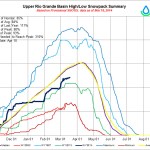
Snowpack news: Residents and officials are keeping a wary eye on the snowpack along the Front Range canyons #COdrought #COflood

From 9News.com (Matt Renoux):

“We have had a lot more snowfall than last winter – a harsher winter depending on the spring runoff. We could have a lot of water come in,” said [Gary Haines].

He’s trying to frame up the kind of spring Colorado rivers will have. Snow surveyors from the Natural Resources Conservation Service, local water managers and Sen. Michael Bennett made a point to check out a snow survey sight on Berthoud Pass for the same reasons.

“It’s important that we have an informed view,” said Bennett.

Putting on snowshoes and hiking into the powder, they watched as the snowpack in that area was measured, coming in at 77 inches. Then calculations were made to see exactly how much water is in the snow, which came out to be about 140 percent above average. That’s good news for central Colorado but down south snowpack levels are down as much as 90 percent. So the question many are asking is how much water will eventually come down to fill reservoirs around the state.

“We are standing on a place that’s had a really good snowpack this year – southwest Colorado, southeast Colorado. We are still facing significant droughts and farmers and ranchers are looking to this data,” said Bennett.

Overall water storage in Colorado reservoirs are below average but in some case’s reservoirs are being lowered to make room for more spring runoff.

Cache la Poudre River: Time-lapse footage of the removal of the Josh Ames Diversion Dam

The March 14 newsletter from the @WaterCenterCMU is hot off the presses #ColoradoRiver

Jonathan Waterman paddling the ooze in the Colorado River Delta via National Geographic

Click here to read the newsletter. Here’s an excerpt:

PULSE FLOW TO REWATER COLORADO DELTA
On March 23, the gates of the Morelos Dam will open to provide the first ever intentional release of water for the benefit of the environment in the Colorado River Delta. The pulse flow release, to be followed by smaller base flows, is the result of the “Minute 319” agreement between Mexico, the US, several non-governmental organizations, and the states that share the river.

President’s $1 Billion Reclamation Budget for FY 2015 Underscores Water & Power as Economic Drivers in the West

A high desert thunderstorm lights up the sky behind Glen Canyon Dam -- Photo USBR
A high desert thunderstorm lights up the sky behind Glen Canyon Dam — Photo USBR

Here’s the release from the Bureau of Reclamation (Dan DuBray):

President Obama’s fiscal year 2015 budget request released today identifies a total of $1 billion for the Bureau of Reclamation, continuing the President’s commitment to be prudent with taxpayer dollars while setting consistent spending priorities for Reclamation. As the nation’s largest wholesale water supplier and second-largest producer of hydroelectric power, Reclamation’s projects and programs are critical to driving and maintaining economic growth in the western states.

“This budget reflects not only the President’s vision of opportunity and growth but also his strong commitment to meet water delivery requirements in the West in the face of dry conditions and a changing climate,” said acting Commissioner Lowell Pimley. “With this request, we are reinforcing our commitment to promote efficient water deliveries and power generation, implement critical river and environmental restoration programs, continue our focus on water-related activities to support tribal nations, and stretch water supplies through recycling and conservation.”

The proposal for Reclamation’s Water and Related Resources account of $760.7 million includes $343.5 million for resource management and development activities. This funding provides for planning, construction, water conservation activities, management of Reclamation lands – including recreation – and actions to address the impacts of Reclamation projects on fish and wildlife. The request also emphasizes reliable water delivery and power generation by requesting $417.2 million to fund operation, maintenance, and rehabilitation activities at Reclamation facilities, including dam safety initiatives.

The budget emphasizes Reclamation’s core mission to address the water needs of a growing population in an environmentally responsible and cost-efficient manner and to assist states, tribes and local entities in solving water resource issues. It also emphasizes the operation and maintenance of Reclamation facilities in a safe, efficient, economic and reliable manner – ensuring systems and safety measures are in place to protect the public and Reclamation facilities.

Reclamation’s funding request addresses administration, departmental and bureau priorities, including opportunities to enhance America’s Great Outdoors through ecosystem restoration, renewable energy, water conservation through the WaterSMART Program, to strengthen tribal nations, and engage the next generation of Americans in resource-related issues.

WaterSMART Program – The FY 2015 budget for Reclamation proposes $52.1 million for the WaterSMART Program (Sustain and Manage America’s Resources for Tomorrow) to assist communities in stretching water supplies and improving water management. WaterSMART components include: WaterSMART Grants funded at $19 million; the Basin Studies Program funded at $3.9 million; the Title XVI Water Reclamation and Reuse Program funded at $21.5 million; the Water Conservation Field Service program funded at $4.5 million; the Cooperative Watershed Management program funded at $250,000; the new Drought Response program funded at $1.5 million; and the new Resilient Infrastructure program funded at $1.5 million.

Strengthening Tribal Nations – The FY 2015 Budget proposes $90 million for Indian Water Rights Settlements, in a new account of the same name to ensure continuity in the construction of four of the authorized projects and to highlight and enhance transparency in handling these funds. The budget includes $81 million for the ongoing Navajo-Gallup Water Supply Project (Title X of Public Law 111-11). The budget also includes $9 million to continue implementation of three settlements authorized in the Claims Resolution Act of 2010. These settlements will deliver clean water to the Taos Pueblo of New Mexico, the Pueblos of New Mexico named in the Aamodt case, and the Crow Tribe of Montana.

The budget request proposes to transition the Central Utah Project Completion Act Program into the Bureau of Reclamation as part of broader administration efforts to implement good government solutions, ensure consistent treatment of federal water projects, consolidate activities when possible and reduce duplication and overlap. The FY 2015 CUPCA budget is $7.3 million.

Specifics of the budget request include:

America’s Great Outdoors Initiative – Reclamation has a responsibility to focus on the protection and restoration of the aquatic and riparian environments affected by its operations. The America’s Great Outdoors Initiative includes $116 million for Reclamation river restoration projects. Highlights of Reclamation’s ecosystem restoration activities, many of which support Endangered Species Act recovery programs, include:

  • $118.6 million to operate, manage and improve California’s Central Valley Project. More than half of the funding provides for operation and maintenance of project facilities, including $16.4 million for the Replacements, Additions and Extraordinary Maintenance program – which is used for modernization, upgrade and refurbishment of facilities throughout the Central Valley. Within the CVP total, $11.9 million and an additional $2 million in the CVP Restoration Fund are for the Trinity River Restoration Program.
  • $28.3 million for the Lower Colorado River Operations Program, of which $16.2 million is for the Multi-Species Conservation Program to provide long-term ESA compliance for river operations.
  • $32 million for activities consistent with the settlement of Natural Resources Defense Council v. Rodgers as authorized by the San Joaquin River Restoration Settlement Act to restore and maintain fish populations, and avoid adverse water impacts.
  • $22.7 million for ESA recovery implementation programs, including $15.1 million to implement the Platte River Endangered Species Recovery Implementation Program and $5.1 million for the Upper Colorado River Endangered Fish Recovery Program.
  • $18 million for the Klamath Project, which supports studies and initiatives to improve water supplies to meet the competing demands of agricultural, tribal, wildlife refuge and environmental needs along with facilities operations and maintenance activities.
  • $37 million for California Bay-Delta Restoration. The account focuses on the health of the Bay-Delta ecosystem and improving water management and supplies. The budget will support the coequal goals of environmental restoration and improved water supply reliability under the following program activities: $1.7 million for a Renewed Federal State Partnership, $8 million for Smarter Water Supply and Use, and $27.4 million for Habitat Restoration. These program activities are based on the Interim Federal Action Plan for the California Bay-Delta issued December 22, 2009.
  • $57 million for the Central Valley Project Restoration Fund to continue funding a variety of activities to restore fish and wildlife habitat and populations within the CVP service area of California.
  • $22.7 million for the Middle Rio Grande Project, of which $7.9 million is targeted to support environmental activities developed through the Endangered Species Act Collaborative Program.
  • $17 million for the Columbia and Snake River Salmon Recovery Project for implementation of the biological opinions for the Federal Columbia River Power System.
  • Other Budget Highlights Include:

  • $34.1 million for rural water projects to undertake the design and construction of five projects and operation and maintenance of tribal features for two projects intended to deliver potable water supplies to specific rural communities and tribes located primarily in Montana, New Mexico, North Dakota and South Dakota.
  • A total of $11 million for the Yakima River Basin Water Enhancement Project, which will continue funding grants to implement conservation measures and monitor the effects of those measures on the river diversions.
  • $82.9 million for the Dam Safety Program to continue dam safety risk management and risk reduction activities throughout Reclamation’s inventory of dams. Corrective actions are planned to start or continue at a number of facilities. A major focus continues to be modifications at Folsom Dam in California.
  • $26.2 million for Reclamation’s ongoing site-security program that includes physical security upgrades at key facilities, guards and patrols, anti-terrorism program activities and security risk assessments.
  • The Bureau of Reclamation, throughout the 17 western states, is committed to helping meet the many water challenges of the West. A driving force behind bureau initiatives is resolution of water issues that will benefit future generations and providing leadership on the path to sustainable water supplies.

    More Bureau of Reclamation coverage here.