Here’s the release from the Natural Resources Conservation Service:
Producers in Colorado who are interested in implementing conservation practices to improve natural resources on their private agricultural land have until Friday, January 15, 2016, to submit applications for FY 2016 funding through the Natural Resources Conservation Service’s (NRCS) Environmental Quality Incentives Program (EQIP).
Eligible applications that are received after January 15 will be considered during a later time and will be processed throughout the fiscal year as needed.
EQIP is a voluntary incentives program that provides financial assistance for conservation systems such as animal waste management facilities, irrigation system efficiency improvements, fencing, and water supply development for improved grazing management, riparian protection, and wildlife habitat enhancement.
“EQIP places a priority on water quality, water conservation, and promotes soil health practices by offering financial and technical assistance to address these resource concerns on eligible agricultural land,” said Clint Evans, NRCS State Conservationist, Denver. “We encourage all landowners who are interested in this limited funding opportunity to apply now.”
Applications can be taken at all Colorado NRCS offices and USDA Service Centers. To locate an office near you, please click on this link: USDA Service Center. Applications MUST be received in your local Service Center by 4:00 p.m. on Friday, January 15, 2016.
NRCS continually strives to put conservation planning at the forefront of its programs and initiatives. Conservation plans provide landowners with a comprehensive inventory and assessment of their resources and an appropriate start to improving the quality of soil, water, air, plants, and wildlife on their land.
Conservation planning services can also be obtained through a Technical Service Provider (TSP) who will develop a Conservation Activity Plans (CAP) to identify conservation practices needed to address a specific natural resource need. Typically, these plans are specific to certain kinds of land use such as transitioning to organic operations, grazing land, or forest land. CAPs can also address a specific resource need such as a plan for management of nutrients. Although not required, producers who first develop a CAP for their land use may use this information in applying for future implementation contracts.
To find out more about financial and technical assistance available to help Colorado farmers and landowners improve and protect their land, visit the Colorado NRCS website.
THE CENTER FOR FOOD SAFETY (CFS) has issued a press release this morning [November 12, 2015] announcing support for a new ordinance introduced today in Costilla County, Colorado that would establish a “Center of Origin” GMO-Free Zone of Protection to preserve the county’s unique agricultural products and traditional farming systems. The ordinance is intended to protect the county’s traditional acequia (community irrigation ditch) farmers and their land race heirloom maize varieties that are unique to the Upper Rio Grande watershed. The GMO-Free Zone will help traditional and organic farmers avoid the serious risk of transgenic contamination from nearby genetically engineered (GE) crops, particularly GE corn.
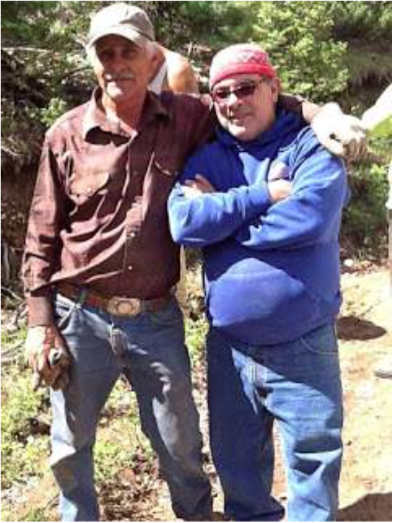
Delmer Vialpando and Devon G. Peña on La Sierra common lands, the 80,000-acre restored land grant of the Culebra acequia farmers. Photo by The Acequia Institute
“We have the oldest water rights in Colorado and the oldest heirloom seeds. We are working to make sure both are protected,” says Delmer Vialpando, a local farmer and President of the Sangre de Cristo Acequia Association, one of the local partners that developed the ordinance and supports passage.
Current estimates show that the short and longer term value of GMO-free native heirloom seed stocks developed by Culebra watershed acequia farmers will contribute an additional $3-5 million in annual economic, ecosystem, and amenity values to the local economy. As the GMO-free branding of local acequia crops develops and is further marketed these values are expected to increase significantly.
“Cultural and biological diversity are closely related and this is especially evident in the ‘Centers of Origin’ where indigenous farmers still develop varieties derived from uncontaminated parent lines of maize,” explains Dr. Devon G. Peña, a farmer and President of The Acequia Institute, a non-profit that operates a grassroots extension service and agroecology acequia farm on 181 acres in San Acacio, CO.
Local farmers in Costilla County are known for their adobe oven-roasted white flint corn (maíz de concho) which are called ‘chicos’ when prepared this way. Slow Food USA includes chicos in the Ark of Taste. Photo by Devon G. Peña
The acequia farmers of the Culebra watershed are celebrated as multi-generational seed savers and plant breeders. For over 170 years, they have developed unique land race varieties of maize, including maíz de concho (a native white flint corn) used to produce chicos del horno and pozol. The land race varieties of local corn are part of the North American “Center of Origin” for native populations of maize. These local center of origin varieties possess several unique and invaluable genetic characteristics including: adaptation to a very short growing season, adaptation to daily temperature extremes, and resistance to the desiccating effects of intense UV radiation at Costilla County’s high elevation.
Center for Food Safety has long supported local regulation and prohibition of GE crop cultivation in order to preserve the rights of non-GE farmers and has provided legal and scientific counsel for the Costilla County ordinance.
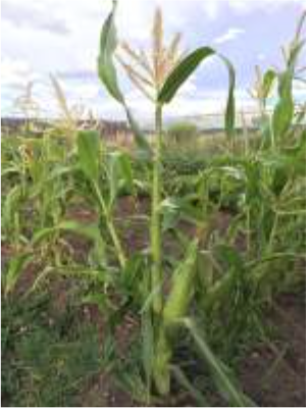
Maiz de concho growing at The Acequia Institute seed library patch, El Rito, CO. Photo by Devon G. Peña
“Traditional farmers’ rights and seed choice must be protected and that means preventing transgenic contamination of their crops. We fully support Costilla County farmers in their effort to protect their livelihoods and autonomy,” said Amy van Saun, attorney at Center for Food Safety.
Center for Food Safety previously worked with local residents and farmers to implement GE crop bans in several states, including two Oregon counties, one of which CFS defended in court. CFS also worked with the Oregon State Senate to ban GE canola in the Willamette Valley until 2019 in order to protect organic growers. GMO-free zones similar to the one proposed in Costilla include Jackson and Josephine Counties, OR, Santa Cruz County, CA, Trinity County, CA, Marin County, CA, Mendocino County, CA, Humboldt County, CA, San Juan County, WA, Maui County, HI, Hawaii County, HI, and numerous cities
This image was taken during the peak outflow from the Gold King Mine spill at 10:57 a.m. Aug. 5. The waste-rock dump can be seen eroding on the right. Federal investigators placed blame for the blowout squarely on engineering errors made by the Environmental Protection Agency’s-contracted company in a 132-page report released Thursday [October 22, 2015]
A 10-year cooperative agreement in which the Environmental Protection Agency provides $2.4 million for remedial efforts related to the Aug. 5 Gold King Mine spill received unanimous support from La Plata County Board commissioners on Tuesday.
EPA officials have until Feb. 1 to sign off on the agreement, which includes eight tasks for ensuring the future health and safety of the county’s residents and environment. Those include continued work with Wright Water Engineers, which has conducted for the county an analyses on the Animas River’s health, independent of the EPA.
Other initiatives include a real-time water-monitoring system to alert the county of changes in water quality, developing a response plan for future environmental incidents and hiring a contractor for community outreach – to explain pre- and post-spill data to the public.
The county has accomplished one of the tasks, which is to investigate the feasibility of a Superfund designation for the Silverton area.
County Manager Joe Kerby will serve as recovery manager and oversee, with other county staff, the implementation of the agreement.
A complete draft of the cooperative agreement can be found on the La Plata County website.
The $2.4 million, to be spent over 10 years as the plan is carried out, is an estimate, and it would be allocated as needed.
The EPA has reimbursed about $200,000 to the county for expenditures between Aug. 12 and Sept. 11.
Cement Creek aerial photo — Jonathan Thompson via Twitter
Commissioners unanimously agreed Tuesday to postpone until January a vote on an official statement of support of a Superfund designation for the Upper Cement Creek Basin.
“I’d like to continue this pending action from Silverton and San Juan County,” Commissioner Julie Westendorff said…
Silverton and San Juan County officials will meet again with the EPA and the Colorado Department of Public Health and Environment in early January.
A “get well soon” balloon floats in the contaminated waters of the Animas River flowing through Durango on Monday afternoon August 10, 2015 — photo The Durango Herald, Shane Benjamin
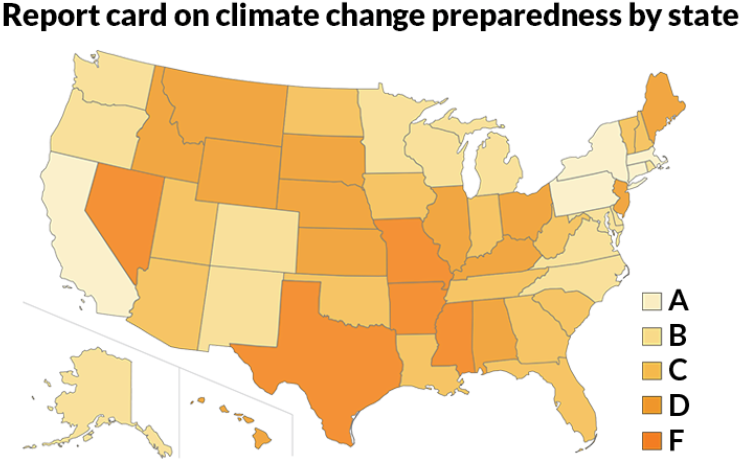
REPORT CARD Some states aren’t prepared for extreme events such as wildfires and droughts expected to result from climate change, a new survey suggests. Arkansas, Texas and Nevada were among those that scored a failing grade.
America’s Preparedness Report Card, released in November, rates U.S. states on factors such as extreme heat, summer droughts, wildfires and flooding. The letter grades are tabulated by comparing what precautionary steps a state has taken relative to the climate threats it is expected to face in the future. Getting a high ranking doesn’t mean states can slack off, though, climate scientist Rita Yu of Climate Central, which coproduced the report, explained December 15 at the American Geophysical Union’s fall meeting.
“An A doesn’t mean California is fully prepared for climate change and doesn’t need to do any more and can relax,” Yu said. “What it means is California is well ahead of other states … but there’s always room for improvement.”
California was the only state with a far-above-average level of preparedness for coastal flooding as sea levels rise. The top five states on the list are:
California
New York
Massachusetts
Pennsylvania
Connecticut
Arkansas earned itself a dunce cap, with three F grades and a D. The state has taken fewer actions to prepare for wildfires than any state studied despite having more than 1.3 million residents living in areas with an elevated wildfire risk.



![This image was taken during the peak outflow from the Gold King Mine spill at 10:57 a.m. Aug. 5. The waste-rock dump can be seen eroding on the right. Federal investigators placed blame for the blowout squarely on engineering errors made by the Environmental Protection Agency’s-contracted company in a 132-page report released Thursday [October 22, 2015]](https://coyotegulch.blog/wp-content/uploads/2015/10/goldkingminespill1057am08052015viaepa.png)