
Day: December 17, 2015
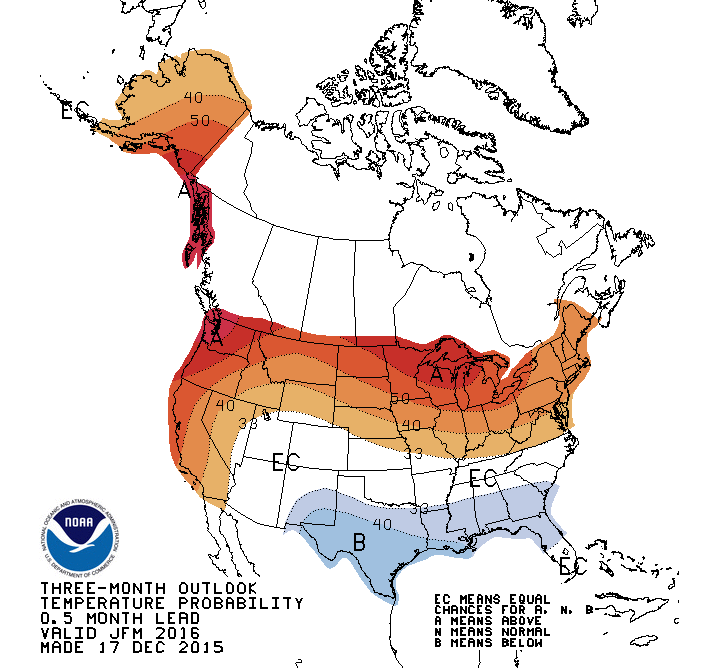
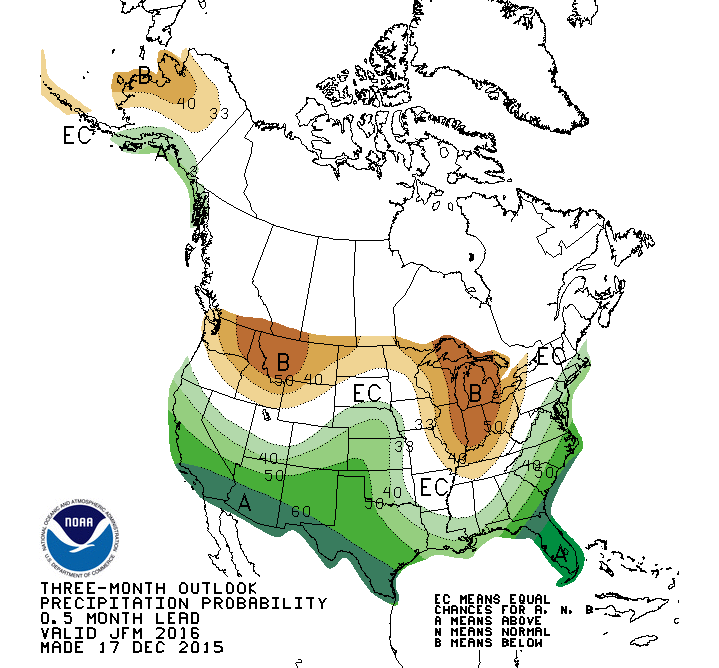
December 17, 2015 through March 31, 2016 precipitation and temperature outlooks from the Climate Prediction Center
#Drought news: Abnormal dryness (D0) removed in north central #Colorado

US Drought Monitor December 15, 2015

West Drought Monitor December 15, 2015

Colorado Drought Monitor December 15, 2015
Click here to go to the US Drought Monitor website. Here’s an excerpt:
California, the Pacific Northwest, and the Northern Rockies
Another stormy week was experienced across most of the region, leaving only the southeastern California desert and part of the San Joaquin Valley devoid of significant precipitation. The heaviest precipitation – more than one foot – affected part of the Washington Cascades, interior northwestern Washington, northwestern Oregon, southwestern Oregon, and northwestern California. Amounts exceeded 3 inches in other areas from the Cascades to the Pacific Coast, most of Humboldt and Mendocino Counties in California, the higher elevations in west-central Idaho, and parts of northeastern Idaho and adjacent Montana. The lightest amounts – between 0.5 and 1.5 inches – fell on the interiors of Washington and Oregon, southwestern Montana, and southern Idaho.
Temperatures averaged a few degrees above normal, so the precipitation did not build up snowpack as much as would be expected this time of year. Snowpack water content is generally above normal in central and eastern Oregon, northern Washington, and western Idaho, but remains considerably below normal along the Cascades, in northern Idaho, and across adjacent northwestern Montana.
Dryness and drought improved once again across large parts of the region as a result. Most of Washington, the western half of Oregon, and northwestern California all improved by 1 classification, as did parts of Idaho and a small section of northwestern Montana where precipitation has been heavier than in nearby areas…
The Great Basin, the Four Corners States, Wyoming, and Montana east of the Rockies
Generally light to moderate precipitation fell on the region, leaving dryness and drought almost entirely unchanged. The only adjustment was made in north-central Colorado, where 1 to locally 4 inches of precipitation brought an end to abnormal dryness for the time being…
The Mississippi Valley, Great Plains and High Plains
A broad swath of moderate to heavy precipitation was observed in part of the Plains from Iowa and eastern Nebraska southward through most of Kansas, the southeastern Plains, and the western side of the Mississippi Valley. Between 2 and 4 inches fell on these areas, with amounts closer to 6 inches measured in southeastern Oklahoma and northeastern Texas. Prior to this week, dryness only affected a few portions of this broad area…but where it did, conditions were significantly relieved. Abnormal dryness was removed from northeastern Iowa, southeastern Minnesota, and adjacent Wisconsin while the broad abnormally dry area across central and eastern Kansas was reduced to two relatively small areas in the central and east-central parts of the state (where moderate drought existed last week). Precipitation totals for the first half of December exceeded 4 inches in a broad area from southeastern Nebraska and Iowa southward through the southeastern Plains and Mississippi Valley, with amounts of 8 to locally 20 inches drenching eastern Oklahoma and surrounding areas.
In other parts of the region, light to moderate precipitation had little effect on the existing dryness and drought in the Dakotas and adjacent Minnesota, the northern and central High Plains, and a few spots in central and southern Texas, including the southern Big Bend region; however, moderate drought was improved to D0 in part of central North Dakota, and a few small areas of abnormal dryness popped up along the Rio Grande River in southern Texas…
Looking Ahead
During December 17 – 21, storminess should continue across the Pacific Northwest, northern California, most of Idaho, and adjacent parts of surrounding states. Precipitation totals in most of the area should be moderate, ranging from about an inch to a few inches, but areas from the Cascades to the West Coast will likely get soaked again. More than a foot could fall on parts of coastal Oregon. Farther east, light to moderate precipitation, with isolated amounts of up to 1.5 inches, are expected across the areas of dryness and drought in the East. From the Appalachians to the Rockies and in the Southwest, existing dry areas shouldn’t expect much relief, with only a few tenths of an inch at best anticipated. Temperatures are forecast to average several degrees above normal from the Plains to the East Coast, and near normal in most other locations.
The odds favor wet weather across almost the entire contiguous 48 states during the ensuing 5 days (December 22 – 26), with the highest likelihoods covering areas from the Mississippi Valley to the Appalachians in the East, and the central and northern Rockies, northern and central Intermountain West, and Oregon in the West. Very mild weather is possible across the eastern half of the country, but unusually cold weather is anticipated in Alaska.
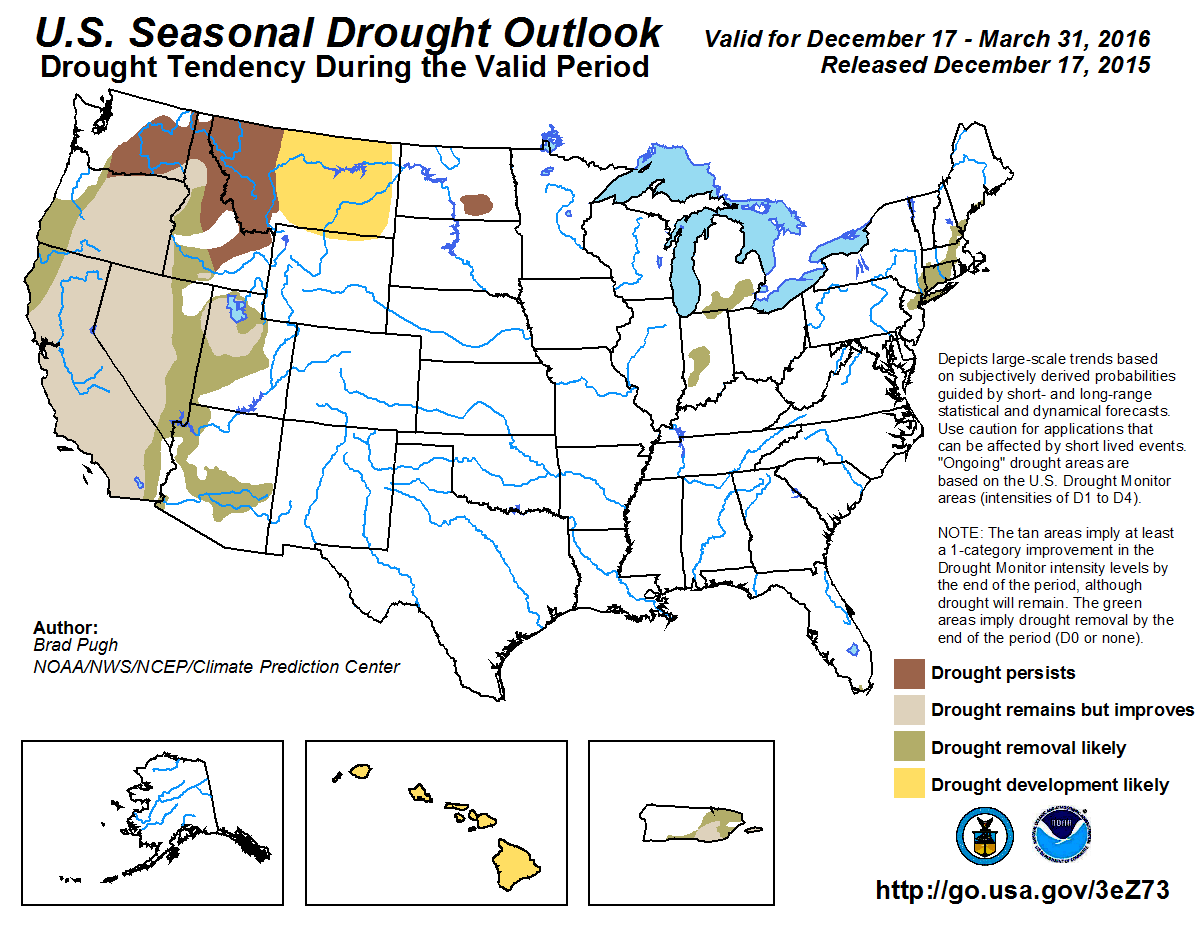
Here’s the Seasonal Drought Outlook released today from the Climate Prediction Center:
Denver Water selects new director of Planning
Here’s the release from Denver Water (Stacy Chesney):
Mike King, executive director of the Colorado Department of Natural Resources, has been selected as the new director of Planning for Denver Water.
King will oversee Denver Water’s long-range planning for treated and raw water supply systems, demand and supply management, water rights, environmental compliance, watershed management, and climate change preparations. He will be a member of the executive team, reporting to the chief executive officer and the Denver Board of Water Commissioners.
“We are very excited that Mike has accepted the position of director of Planning for Denver Water,” said Jim Lochhead, CEO. “Colorado remains a highly desirable place to live. Growth and the uncertainties of climate change will continue to challenge not only Denver Water but also the entire state. Mike’s knowledge of water, his statewide leadership on environmental issues and his proven strategic skills are a perfect combination for this position.”
As director of Planning, King will be responsible for helping guide Denver Water’s integrated resource planning (IRP) process. The IRP uses scenario analysis to inform Denver Water’s long-range capital replacement and expansion programs, including water collection, storage, treatment, distribution and recycling. The IRP further incorporates Denver Water’s commitment to conservation and water-use efficiency.
His responsibilities also will include ensuring Denver Water continues to operate in an environmentally sustainable manner. He will be responsible for policy and regulatory issues, including developing watershed management plans and addressing endangered species issues.
“I am very excited to join Denver Water at this time in the organization’s history,” said King. “Denver Water is a leader in resource management and is recognized as one of the most progressive water utilities in the nation. Denver Water’s mission to be a responsible steward of our natural resources aligns with my experience and skills, and perhaps most importantly with my core values. I will bring to Denver Water the same energy and commitment to public service that I have for the past 23 years to the State of Colorado.”
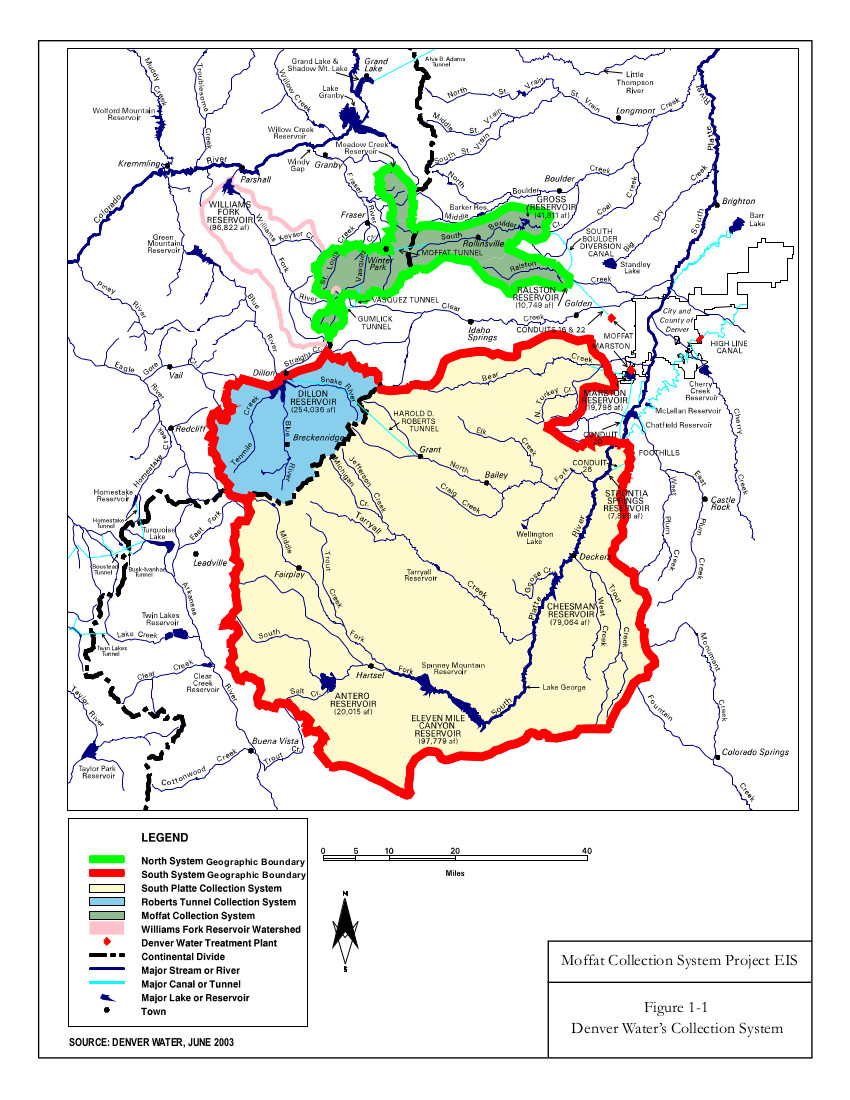
Photo gallery: Wildlife of the Sagebrush Sea — Wild Earth Guardians
Click here to view a gallery of photos from Wild Earth Guardians. From the website:
The sagebrush steppe basins of the Intermountain West and the shrub-steppe grasslands of the High Plains are home to an abundant diversity of wildlife.
In pockets of relatively pristine habitat, like Wyoming’s Red Desert, the diversity and abundance of sagebrush wildlife draws comparisons to the Serengeti in Africa.
But sagebrush habitats are shrinking in the West, threatened by livestock grazing, invasion of nonnative, extremely flammable cheatgrass, and subsequent unnaturally frequent wildfires.
On the Plains and in the Rocky Mountain basins, sagebrush habitats are defenseless against agricultural conversion and fossil fuel development. Very little of the Sagebrush Sea has been designated for any formal protections; safeguarding our most diverse and productive sagebrush ecosystems represents one of our generation’s most urgent conservation challenges.

Whiting Oil & Gas Corp sells saltwater disposal and fresh water transportation and storage system in Weld County for $75 million

From the Denver Business Journal (Ben Miller):
Whiting Oil & Gas Corp., a unit of Denver-based Whiting Petroleum Corp., has sold its Redtail saltwater disposal and fresh water transportation and storage system in Weld County for $75 million.
Whiting sold the system to BNN Water Solutions, a unit of Tallgrass Energy Partners of Leawood, Kansas.
The water system consists of 148,000-acre system consists of 62 miles of pipeline along with associated fresh water ponds and disposal wells.
From baby owls to erupting volcanoes, Interior releases the best pictures from its national parks in 2015
Click here to view the gallery of photos from the Department of Interior via The Daily Mail UK. Colorado made the list.

“I believe the extension of tax credits for solar and wind energy is a game changer” — Barbara Boxer
From USA Today (Bill Theobald) via the Fort Collins Coloradan:
The annual spending bill negotiated by congressional leaders is stuffed with millions in additional funding for Western needs — from fighting wildfires to fixing national parks and helping deal with the drought.
In addition, a companion bill would extend tax breaks for solar and wind power.
Both bills are expected to be approved by the House and Senate in the next few days.
The budget legislation would fund the government for the rest of the fiscal year that ends Sept. 30. It would reauthorize the popular Land and Water Conservation Fund for three years and appropriate $450 million for the fund to be spent through the Department of Interior and the Forest Service.
The fund has provided $17 billion through its 50-year lifetime to fund more than 40,000 local recreation projects and to buy about 5 million acres of public lands, mostly in the West…
Funding in the budget bill is $50 million more than President Obama requested, a 47 percent increase from last year. More than 50 percent of the money will go for local and state recreation projects.
Alan Rowsome of The Wilderness Society had said Congress would be snatching “defeat from the jaws of victory” if it failed to permanently reauthorize the fund and increase the amount that could be spent.
For wildfires, the legislation includes $4.2 billion for wildfire fighting and prevention programs within the Department of the Interior and the Forest Service. That’s $670 million more than last year and includes $1 billion in firefighting reserve funds.
This provision is sure to disappoint members of the House and Senate — mostly from the West — who have been pushing legislation to revise funding for fighting wildfires. Fighting the most severe fires, under these proposals, would be paid for like other natural disasters such as tornadoes and come from emergency funds.
That would eliminate the need during several recent severe fire seasons to transfer money into firefighting from other activities, including efforts to reduce the number and severity of fires. The bill includes $545 million for hazardous fuels reduction, an increase of $19 million from last year.
Other provisions of interest to the West in the budget legislation include:
National Park Service. The service gets $2.9 billion, up $237 million, including $94 million to reduce the massive maintenance backlog at the parks and to mark the service’s centennial anniversary in 2016. Drought relief. While no comprehensive drought package is included, $100 million is appropriated for the Bureau of Reclamation to address severe drought in the West. Tax breaks include five-year extensions of the production tax credit for wind energy and the investment tax credit for solar energy. Sen. Barbara Boxer of California said the ITC would create about 61,000 jobs in 2017 and retain another 80,000 solar jobs. The American Wind Energy Association estimated extending the PTC would add more than 100,000 jobs in four years in the wind industry.
“I believe the extension of tax credits for solar and wind energy is a game changer,” Boxer said.

Wind farm Logan County

Solar panels, such these at the Garfield County Airport near Rifle, Colo., need virtually no water, once they are manufactured. Photo/Allen Best
When trees die, water slows
From the University of Utah via (e) Science News:
Mountain pine beetle populations have exploded over the past decade due to warmer temperatures and drier summers, and these insects have infected and killed thousands of acres of western pine forests. Researchers have predicted that as trees died, streamflow would increase because fewer trees would take up water through their roots. A recent study by University of Utah geology and geophysics professor Paul Brooks and his colleagues in Arizona, Colorado and Idaho, found that if too many trees die, compensatory processes kick in and may actually reduce water availability. When large areas of trees die, the forest floor becomes sunnier, warmer and windier, which causes winter snow and summer rain to evaporate rather than slowly recharging groundwater.
The bad news is that the loss of so many trees may not help alleviate the long-term drought in the West as many have hoped. The good news is that researchers can use the new understanding of forest water cycle to manage healthier forests that are more resistant to drought but still supply water to agriculture and cities downstream.
This is the first empirical evaluation of streamflow response to widespread tree mortality from mountain pine beetles in more than 30 years and is the largest study of its kind, says Brooks.
Brooks presented this research at the American Geophysical Union’s annual meeting this week in San Francisco. The AGU annual meeting is the largest Earth and space science meeting in the world.

Water Tables to celebrate Historic 100, January 28

Here’s the release from Colorado State University (Christina Vessa):
Anne Castle, former Interior Department assistant secretary, will be present the keynote speech at the 2016 Water Tables fundraiser for the CSU Water Resources Archive. The event will take place from 5 to 9:30 p.m. on Thursday, Jan. 28, at the Hyatt Regency Denver Tech Center.
Castle was Assistant Secretary for Water and Science from 2009 to 2014. During that time, she oversaw water and science policy for Interior, and had responsibility for the U.S. Bureau of Reclamation and the U.S. Geological Survey.
She will be on hand to help celebrate the Water Resources Archive’s achievement of 100 collections. The theme of Water Tables 2016 is “The Historic One Hundred.”
This year, each table host will discuss one of the Archive’s collections. Some of the different collections include Friends of the Poudre Records, the Northern Colorado Flood Oral History Collection, the Tom Pitts Papers, and many more.
Registration is $160 per ticket, $75 of which is considered a charitable donation to the Water Resources Archive. Ticket cost includes reception, table discussions, keynote, dinner and dessert.
To make reservations, follow this link to the Colorado Water Congress website.
The CSU Water Resources Archive encompasses collections documenting the history and development of water resources in Colorado and the West. Subjects included in the Archive are engineering studies, law and legislation, water resources management, and endangered species, among others.
Questions? Find out more information about the Water Tables 2016 event.
The Land and Water Conservation Fund is back in business for 3 years
From WestSlopeNow.com (Mallory Pearson):
After weeks of debate, congress has decided to pass a three year re-authorization on the program dedicated to impacting state parks and outdoor recreation.
According to Colorado Parks and Wildlife, the state saw a total of 750,000 dollars in 2014.
“If you look at the state of Colorado, there have been many parks and many projects that have gone towards enhancing outdoor recreation in perpetuity,” says Mike Porras with Colorado Parks and Wildlife. “So, overall the state has benefited, it’s benefited all the citizens of the state.”
According to the Center For Western Priorities, the bill authorizing a permanent renewal for the Land and Water Conservation Fund now has 200 bipartisan cosponsors.

#AnimasRiver: Gold King talks launched, locals seek voice and EPA funding proof — The Denver Post
From The Denver Post (Bruce Finley):
“We want the end result, which is a cleaner Animas River,” San Juan County Commissioner Scott Fetchenhier said after a four-hour session.
On Wednesday, locals asked EPA officials whether they’d have an equal voice in Superfund decision-making. EPA officials told them they would be involved but, under federal law, the EPA would make decisions.
The officials assured locals funding would be available for a Superfund cleanup. The EPA already has spent about $15 million on emergency actions including set-up of a temporary water treatment system along Cement Creek to filter Gold King drainage laced with cadmium, arsenic, lead, zinc and other heavy metals.
Gov. John Hickenlooper would have to sign off and request a Superfund cleanup. It would start with a required remediation investigation then a feasibility study before cleanup — typically lasting a decade or longer.
The EPA and CDPHE canceled a Wednesday public meeting in Silverton because of snow Monday that diverted a flight, but they held two days of closed talks with town and county officials, including one trustee and commissioner.
Locals fear a Superfund designation without adequate funds.
“That wouldn’t get the Animas cleaned up,” said Fetchenhier, a geologist. “The whole goal is to get the Animas River better.”
Silverton and county officials say they’re reluctant to trust the EPA but see no better option with a promise of significant funds needed for a complicated fix.
Some of the toxic metals in Cement Creek, which flows into the Animas, occur naturally. But more than 480 gallons a minute of untreated drainage from the Red and Bonita, Mogul, Sunnyside and other inactive mines flows down through Silverton to the river.
The local proposals for efficient, practical cleanup range from putting a permanent water treatment plant at a place where it could catch more bad water, which likely would cost $20 million plus $1.5 million a year for operations in perpetuity, to the proposal by Durango Geophysical Operations to drain Sunnyside.
Sunnyside Gold, owned by the Kinross Corp. mining conglomerate, rejects the idea, adding that there is no risk of a similar blowout at Sunnyside.
“The state-approved, engineered and reinforced concrete bulkheads installed by Sunnyside Gold at the American Tunnel were designed by industry experts, reviewed, pressure-tested and approved by all relevant agencies, and are not comparable to the dirt and debris that temporarily blocked off the Gold King,” Sunnyside reclamation manager Larry Perino said. “Sunnyside Gold is not aware of any conceivable reason that the Sunnyside Mine should be drained.”
Sunnyside on Wednesday confirmed it is offering $10 million to improve water quality, in return for the EPA and state agencies “acknowledging Sunnyside has no further liabilities in the district.”
Draining Sunnyside would cost millions and entail removal of the bulkhead plugs, said Rhoades, the former commissioner who helped install those plugs in the mine after it closed in 1991.
Any pent-up water flowing between Sunnyside and the Gold King and Red and Bonita mines would have had to move through natural faults, because no tunnels connect the mines, Rhoades said.
CDPHE spokesman Warren Smith said talking about cleanup options is premature pending a decision on whether Silverton will request a Superfund designation and, after that, completion of a remediation investigation and feasibility study.
Silverton remains divided about Superfund and its drawn-out processes. Any designation would have to be narrow, covering only Gladstone and upper Cement Creek, commissioners said.


Cement Creek photo via the @USGS Twitter feed

Cement Creek remains lined with orange sediment after the Gold King Mine spill. The Environmental Protection Agency accidentally triggered the release of orange wastewater laced with heavy metals into Cement Creek on Aug. 5. The creek flows into the Animas River at Silverton, and eventually crosses into New Mexico and Utah

The confluence of Cement Creek, at right, and the Animas River, left, as seen September 2015 in Silverton, Colo. This is where the plume of contaminated water from the Gold King Mine entered the Animas River. (Jon Austria — The Daily Times)

Confluence of Cement Creek and the Animas River from the Coyote Gulch archives (11/21/2010)

Acid mind drainage Cement Creek watershed

Cement Creek aerial photo — Jonathan Thompson via Twitter

Bonita Mine acid mine drainage. Photo via the Animas River Stakeholders Group.
#COWaterPlan: “The knee-jerk reaction is that we can conserve our way out of this” — James Eklund

From the Boulder Daily Camera (Carol O’Meara):
On the surface, the Colorado Water Plan approved Nov. 19 by Gov. Hickenlooper is an ambitious road map for managing, conserving and protecting this vital resource.
But still waters run deep, and if you look closely, you’ll see the plan is designed to help Colorado face climate change, population boom, protect wildlife, keep agriculture vibrant and support economic growth.
All while preserving our quality of life.
“Our water picture has changed over the last 10 to 15 years; it’s no longer good enough to just have water law managing our water,” said James Eklund, director of the Colorado Water Conservation Board, which wrote the plan.
“We’ve had record fires, flooding and historic drought — the worst we’ve ever measured. We’re warmer by 2 degrees; our summers are going to be hotter and our growing season extended.”
[…]
“With water being recognized as a major factor for the state’s long-term growth, now comes the tough discussions and decisions needed to implement a state water plan that works and delivers the quality of life we all treasure,” said Kristen Fefes, a board member for GreenCO, which is an alliance of seven landscape-related associations.
Landscape water use accounts for 3 percent of state water, which might seem like a drop in the bucket. But a study commissioned by GreenCO suggests that homeowners reducing over-irrigation by 10-20 percent can save 86,500 acre-feet of water over 40 years.
“Because landscape water use is so visible, it is often the main target — and main solution — for saving water. But it’s not the only solution,” Fefes said. “There’s no silver bullet; it’s going to take work on a lot of fronts to conserve water. We believe that xeriscape and other sustainable landscape practices will continue to gain popularity with Colorado consumers. They’re already a business model for us.”
Education might be the biggest challenge and an area where Fefes hopes the state and local policy makers lean on the green industry.
“Landscape water use is complicated and how much to use depends on a variety of factors — soil, sun, slope,” Fefes said. “There’s no one answer to ‘how much water does landscape use?’ Industry members have technical knowledge to give customized answers to homeowners. We can be a big asset for state and local policy makers in education, outreach, and implementation.”
Eklund and Fefes agree that urban landscapes are integral to our quality of life and not expendable. Its value to mitigating heat islands and reducing pollutant runoff is just as important to sustainability as water conservation.
“The knee-jerk reaction is that we can conserve our way out of this, but we’re looking at all the tentacles into lives that could trip us up,” Eklund said. “The heat island effect could mean that a person keeps their air conditioning on. If a person stops watering their lawn and it dies, when it does rain we get all that dirt and pollutants washing off and into the wastewater system where we all pay money to treat it.”
Eklund adds: “We must create a conservation culture, use efficient irrigation, teach our kids that we live in a high desert and water is limited. People moving here need to know that, too, and not plan for the lush landscapes they might have had back east.”
The green industry is committed to being partners with the CWCB in closing the water gap, Fefes said. Find tips for how you can conserve by signing up for the ALCC Tip of the Week at http://lcc.com. Find the Colorado Water Plan at http://coloradowaterplan.com.