Denver: Steep hike in storm and sanitary rates

Storm drain and open channel improvements between the East Rail Line (38th & Blake Station) and the South Platte River (Globeville Landing Outfall), Stormwater detention/conveyance between the East Rail Line (38th & Blake Station) and Colorado Blvd, (Montclair Basin) Stormwater detention/ conveyance immediately east of Colorado Blvd. (Park Hill Basin).
Storm drain and open channel improvements between the East Rail Line (38th & Blake Station) and the South Platte River (Globeville Landing Outfall), Stormwater detention/conveyance between the East Rail Line (38th & Blake Station) and Colorado Blvd, (Montclair Basin)
Stormwater detention/ conveyance immediately east of Colorado Blvd. (Park Hill Basin).

From The Denver Post (Carlos Illescas):

Storm and sewer fees will pay for the Platte to Park Hill flood control plan and other projects in the city. On average, a homeowner will see increases in fees totaling $116 over the next five years. The Platte to Park Hill project could cost up to $298 million…

The measure passed on an 8-3 vote, with councilmen Kevin Flynn, Rafael Espinoza and Paul Kashmann voting against the measure. Councilwomen Robin Kniech and Debbie Ortega did not attend the meeting. A motion to postpone the vote until Aug. 29 failed…

Platte to Park Hill would reduce flooding in some parts of the Lower Montclair Basin by improving storm drainage in north and northeast Denver. A detention area would be created at City Park Golf Course. That has been the project’s most contentious issue. The golf course would have to be closed for about 16 months.

Platte to Park Hill would reduce flooding in some parts of the Lower Montclair Basin by improving storm drainage in north and northeast Denver. A detention area would be created at City Park Golf Course. That has been the project’s most contentious issue. The golf course would have to be closed for about 16 months…

Meanwhile, a lawsuit was announced Monday against Denver’s plan, claiming that a detention pond at the golf course goes against the city’s charter and zoning codes. It was filed by former Colorado Attorney General J.D. Macfarlane…

David Broadwell of the Denver City Attorney’s Office said he believes the city is in good standing on using the golf course for water detention.

From The North Denver Tribune:

For the last few years, the Colorado Department of Transportation (CDOT) has been hard at work to expand I-70 as it goes east-west across north Denver. Their plan is to not only increase the number of lanes from six to some fourteen (possibly more) but to dig out and build those fourteen lanes from Dahlia to Brighton Blvd some 40 feet below street level. This puts it about 22 feet below the Platte River where runoff water from Denver, flowing north, currently goes to meet the Platte River a short distance north of I-70.

And for CDOT to build this multi-lane Interstate below grade highway, it must have 100-year flood protection, meaning that such a huge rainstorm happens only once in 100 years. Practically no other section of Denver has this protection. The cost to do so is simply totally prohibitive.

This 100-year flood protection for I-70 is completely the responsibility of CDOT to do. CDOT can and, in fact, has developed its plan (called “Central 70”) to achieve the 100-year flood protection it must have.

Yet, strangely, the City and County of Denver entered into an Intergovernmental Agreement with CDOT (signed in 2015) wherein Denver took all responsibility to provide this 100-year flood protection for I-70 in return for some 53 million dollars to be paid by CDOT for taking over this flood protection. By the way, Denver must have it in place for CDOT by the 4th quarter of 2017. Thus, the reason for the sudden urgency of the City to get the Plan approved.

So to provide this 100 Year Flood protection to CDOT, Denver publicly announced, only late last fall, its “Platte to Park Hill: Storm Water Systems” Plan which continued to be modified as late as April 6, 2016. The cost of this project is now estimated to be some 200 million dollars, and may reach as high as 300 million dollars as the detailed plans are prepared and costs are estimated.

But an analysis of the Plan shows that practically all of this huge expenditure of millions of taxpayer dollars does not provide any flood protection to any of Park Hill; Nada and almost no flood protection to any other neighborhoods of Denver, some of which have been waiting years for the City to do the work needed to solve their ongoing flooding problems.

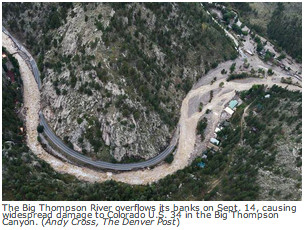
Construction will close US 34 from October 2016 to June 2017 — CDOT

The Big Thompson River September 14, 2013 via The Denver Post

From the Colorado Department of Transportation via The Estes Park Trail-Gazette:

The Colorado Department of Transportation announced today that beginning in late October and continuing through early June of 2017, travel on U.S. Highway 34 between Estes Park and Loveland will be limited to Big Thompson Canyon residents only seven days a week.

Permitted residents will be allowed access between the hours of 6 to 8:30 a.m. and 4 to 7 p.m.

The highway will remain open this summer to traffic in both directions, but when work begins in July, there will be short-duration lane closures for general construction activities and traffic stops for rock blasting work between Mile Points 77 and 81 (from just east of Drake to the Cedar Cove area). People driving through this area should plan for up to 20- to 30-minute delays throughout the summer.

This fall when travel is restricted to canyon residents, only drivers displaying the requisite vehicle permit will be allowed to follow pilot cars in either the eastbound or westbound direction between Drake and Cedar Cove. With the closure area being about 3 ½ miles long, canyon residents will encounter some delays as each pilot car completes its passage through the work zone and is ready to make the return trip in the opposite direction. This phase of work, which will focus on the east end of the canyon between mile markers 77 – 80, will start in October and continue through early June 2017.

“We took into consideration all the public comments received in several public meetings, emails and phone calls, conversations with emergency service provides, school bus drivers, city agencies and various other project partners, when we developed this traffic management plan for the first phase of work between Drake and Loveland,” said James Usher, U.S. 34 Big Thompson Canyon Project Director.

The only access to U.S. 34 from late October through June 2017 will be canyon residents, emergency services and people doing business in the canyon (i.e. waste haulers, propane companies, package delivery, etc.) through permits. In September, CDOT will distribute detailed information on how to obtain permits and how this process will work.

All others will need to use U.S. High 36 and Colorado Highway 66 to travel between Estes Park and Loveland.

“We realize that while this traffic control schedule accommodates most of the concerns we heard from the community, it won’t address every concern and cater to everyone’s personal schedule. In the interest of maintaining safe access to canyon residents and completing this first phase of rock blasting work as quickly as possible, it was determined that this was the best option available,” said Usher.

This traffic control schedule also enables most of the stringent travel restrictions to occur during the tourism “off season” to minimize the impact on area businesses. While there will be traffic impacts in subsequent summers that include sections of one-lane travel through the canyon, this summer there will only be short-term traffic stops when blasting work is done. Through travel will be maintained in the canyon this summer and all businesses will be open and accessible.

U.S. 34 Big Thompson Canyon was heavily damaged during the 2013 floods with many homes damaged and more than 100 air-lifted evacuations performed. The canyon and its residents also suffered from flooding in 1976. As a result of these two events, CDOT has been studying the hydraulic flow of the river in the canyon and its impact on the road and bridges along its path while looking for safety improvements and resiliency solutions to prevent/protect against future flood events.

CDOT Project Information

For updates to this project, the public may call (720) 263-1589 or visit http://www.codot.gov/projects/floodrelatedprojects/us-34-big-thompson-canyon-1. To sign up for “CDOT Alerts” on projects in your chosen area, visit CDOT’s website http://atwww.codot.gov and choose the envelope icon at the bottom of the page. Or, to see CDOT’s lane closure reports for projects statewide, visit http://www.codot.gov/travel/scheduled-lane-closures.html. Major CDOT project updates are also available via CoTrip.org, Twitter @coloradodot or Facebook.

2016 #coleg: Water in the just ended legislative session.

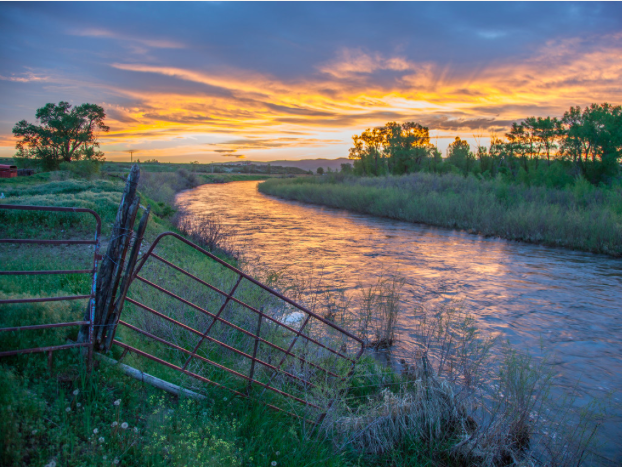
The Yampa River flows through the Carpenter Ranch. Photo courtesy of John Fielder from his new book, “Colorado’s Yampa River: Free Flowing & Wild from the Flat Tops to the Green.”

From The Colorado Independent (Marianne Goodland):

Authorizing the use of rain barrels wasn’t the only major water decision to come out of the 2016 legislative session, but no matter your views on the issue, it was clearly this session’s shiny new dime.

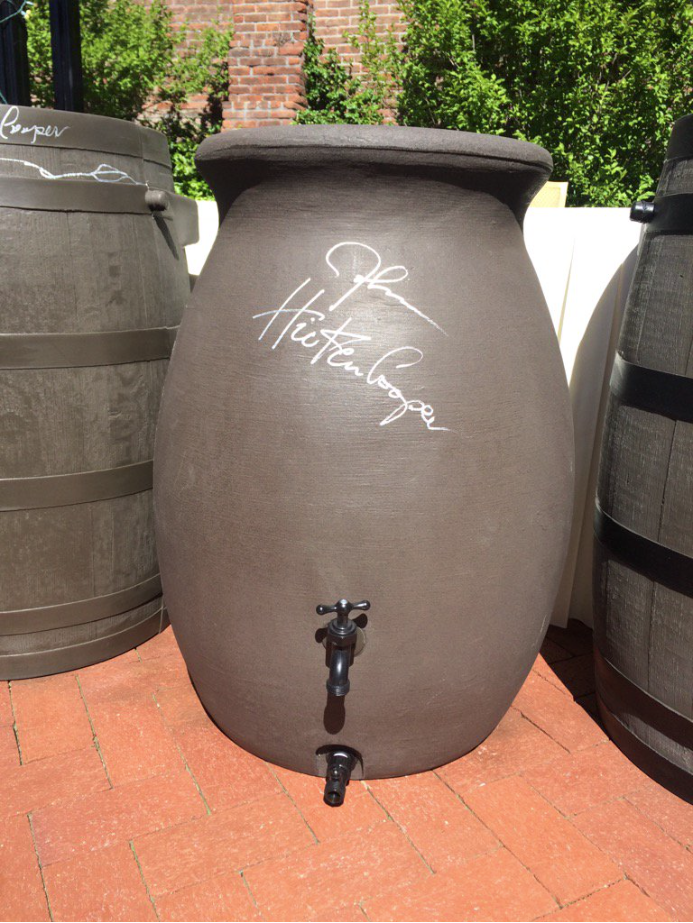
Gov. John Hickenlooper signed House Bill 16-1005 into law on May 12, the day after the session ended.

The new law allows most Colorado households to collect rain coming off of rooftops into two 55-gallon rain barrels. That water can only be applied to outdoor use, such as watering lawns and gardens.

Rain barrel use has actually been legal for some Coloradans since 2009, primarily for those who don’t have well access. But the ability for urban dwellers to collect rain has been a controversial issue, blocked primarily by rural lawmakers and their supporters who fear such use will interfere with the state’s prior appropriation doctrine. The implication is that rainwater, which drains into ground water basins along the Front Range, for example, belongs to those who hold first claim on water rights and who use that groundwater for irrigation purposes.

Conservation groups have argued that allowing municipal residents to collect rainwater will help educate them about the need to conserve water. Such education could even help with the implementation of Hickenlooper’s statewide water plan, which includes a lofty water conservation goal of 400,000 acre-feet.
City slickers can start collecting rainwater on August 10.

With the exception of the rain barrel bill, water issues took something of a back seat in 2016. The interim water resources review committee, which typically sponsors the year’s major water bills, had nothing for lawmakers to consider in 2016.

But that didn’t stop lawmakers from coming up with their own water ideas.

On Thursday, Hickenlooper signed HB 16- 1256, which tasks the Colorado Water Conservation Board with studying the South Platte River for possibilities on water storage.

The bill, sponsored by Rep. J. Paul Brown, a Republican from the southwestern town of Ignacio, tackles the issue of trying to hang onto millions of acre-feet of water that annually leaves Colorado via the South Platte and heads into Nebraska. Water experts have long noted that Colorado sends more water into Nebraska from the South Platte than is required by a nearly century-old water compact.

But why would a Western Slope lawmaker, whose district is the furthest away from the South Platte, take an interest in a South Platte reservoir? It’s all about protecting Western Slope water, Brown said.
Brown told this reporter that the state water plan envisions more water flowing from the Western Slope to the Eastern Plains. At the same time, Colorado River water, the main body of water on the Western Slope, is needed to boost Lake Powell water levels, which are currently at historic lows. That lake provides water to Arizona, Nevada, California — which is coming out of a record drought — and even Mexico, under water compacts. “We just don’t have the water” to send to the Eastern Plains, Brown said.
He also pointed out that most of the water that will fill an expanded Gross Reservoir in Boulder and Glade Reservoir in Larimer County comes from the Western Slope. “I support all of that, but I also believe we shouldn’t let the South Platte River water leave the state,” Brown said.

Water storage along the South Platte would solve this dilemma. The idea dates back at least 50 years, when a reservoir was proposed for The Narrows, an area along the South Platte near Fort Morgan. That idea was ultimately vetoed by President Jimmy Carter, and since then, some of the land intended for the project has been developed.

Sen. Jerry Sonnenberg of Sterling marshaled the storage bill through the Senate. “I think we will see out of this — no more talk, no more hypothetical — locations we can pursue. We have places that could be options, such as Pawnee Pass between Kersey and Wiggins, or The Narrows, which would be the big project. Small projects also could be necessary. But this study will set those locations.”

Added Sonnenberg, “All of this is part of the grand scheme to keep Colorado’s water in Colorado.”

Storage on the South Platte will also help protect endangered species and promote recreational use, Brown said. Coming up with the money for storage will be tough, he said, and it won’t happen overnight. It will take years of planning, but Brown is hoping that process can be speeded up — something another one of this year’s bills could help with.

On June 8, Hickenlooper signed a bill authorizing a position that would work on one of the biggest problems with new water storage projects: local, state and federal permitting. That new law, also carried by Sonnenberg, tasks a gubernatorial appointee with coordinating the permitting process.

Lawmakers did reject one proposal tied to the state water plan. That bill, HB 16-1313, would have asked local communities to incorporate water conservation and water management goals from the state water plan into their own master plans. It would have also asked cities and towns to require developers to incorporate some of those conservation and management goals into their development plans as a condition for approval.

The bill had bipartisan sponsorship throughout its trip through the House, including favorable votes from 10 mostly-rural Republican lawmakers and the entire Democratic caucus of 34. Rep. Jon Becker of Fort Morgan was among those 10 Republican lawmakers to vote in favor of it.

Environmental groups like Conservation Colorado and Trout Unlimited backed the bill, as did Northern Water and Adams County. But other county governments across the state opposed the bill and some lawmakers — even those who voted for it — said the measure was unnecessary and that county governments didn’t need the state’s permission. Republican sponsor Rep. Don Coram of Montrose acknowledged that some counties already do what’s included in the bill, but wanted the General Assembly to encourage more of it.

The measure met its match in the Senate, where it was assigned to the Senate’s “kill committee:” State, Veterans and Military Affairs. There, with Sonnenberg in opposition, it lost on a 3-2 vote.

The interim water resources review committee, of which Becker and Sonnenberg are both members, begins its summer schedule on June 20 with a tour of the Gunnison basin.

#ColoradoRiver #COWaterPlan: Making water conservation a reality #COriver

Colorado River in Eagle County via the Colorado River District

From the Middle Colorado Watershed Council (Dan Ben-Horin) via The Glenwood Springs Post Independent:

It may be difficult to think of water conservation now as we look out our windows at rivers and creeks swollen with spring runoff, but we need to remind ourselves of where we live. Here in the Colorado River Basin, we live with a constant threat of a looming drought.

As Eric Kuhn wrote in his May 12 article in the Grand Junction Daily Sentinel, “we cannot be fooled by talk of a continuing drought. Instead, we need to be diligent and prepared for the next drought.” Our current reality includes an increasing population and a decreasing water supply, and it is now time for us to realize how far conservation measures can improve our water use efficiency.

As part of the recently published Colorado Water Plan, one of the Colorado River Basin’s themes is to encourage a high level of conservation. Statewide, we have done a remarkable job of reducing water use, with per-capita use dropping by almost 20 percent over the past decade. Some municipalities have even cut water use by as much as 30 percent during this time period. Incredible work has been done thus far, and we can now build upon what we learned statewide.

Many entities in the state are now required to have a specific water conservation plan approved by the Colorado Water Conservation Board. Locally, the Roaring Fork Conservancy partnered with the Community Office for Resource Efficiency, Ruedi Water and Power Authority and local municipalities in the Roaring Fork Watershed to develop a water efficiency plan. The plan consists of water efficiency plans for Aspen, Snowmass Village, Basalt, Carbondale and Glenwood Springs, as well as a regional plan that applies the common elements of the five individual plans to the watershed.

Plans such as this outline actions steps for reaching conservation goals by identifying best practices such as landscape efficiencies, water loss management features and variable rate structures. A successful conservation strategy must look beyond past accomplishments and create a specific action plan to meet conservation goals.

The water saving benefits resulting from water efficiency projects are tremendous. Reductions in water demands allow providers to save money on annual operations and maintenance. Further reductions in municipal water use would provide increased longevity on facilities right here in our communities.

In addition to these water supply benefits, we can achieve other benefits, such as an improved environment. Reduced wastewater discharges through indoor water savings can improve water quality and aquatic habitat in our lakes, rivers and streams.

Conservation also acts as a management tool to buffer against drought. Water providers can store water in a drought reserve as a long-term water conservation effort, and use those reserves during periods of shortages. As Mr. Kuhn pointed out in his May 12 article, when we entered the drought period of 2000-04, both Lake Powell and Lake Mead were completely full. Having reserves allowed us to mitigate the potentially devastating consequences of those dry years. With those lakes currently sitting at approximately 40 percent of capacity, what would happen if we were to enter into a period of prolonged drought today?

We cannot allow ourselves to become shortsighted when water is plentiful. It is time to build upon the conservation measures and efficiency savings we have already achieved. By adopting a variety of strong, permanent tools, we can fulfill our ongoing obligation to conserve water resources. The reality of climate change is that hotter, drier weather will become the new normal in the West, so conservation of our precious resource should become the new normal as well. As we learn and adapt to living in this semi-arid climate, we can make conservation become the new water reality.

Dan Ben-Horin is a watershed specialist for the Middle Colorado Watershed Council, which works to evaluate, protect and enhance the health of the Middle Colorado River Watershed through the cooperative effort of watershed stakeholders. To learn more, go to http://www.midcowatershed.org.

Meanwhile here’s a report about conservation in the water sector in California from Joshua Emerson Smith writing in The Los Angeles Times:

…a new study finds that reductions in urban water use have saved significant amounts of electricity and reduced greenhouse gas emissions.

The analysis, published by UC Davis, capitalized on the unique circumstances created by California’s drought. It culled statistics that electric utilities and water districts statewide were required to submit because of Gov. Jerry Brown’s unprecedented order for residents and businesses to lower water consumption by an average of 25%.

During Brown’s initial emergency conservation program that stretched from June 2015 through February, energy savings from water conservation totaled 922,543 megawatt-hours — enough to power 135,000 homes for a year, according to the data project…

The electricity saved from less water consumption was substantial enough that during peak summer months last year, savings equaled the effect of all energy efficiency programs offered by major investor-owned utilities in the state combined — and at less than a third of the cost.

“We were quite surprised when we looked at the numbers,” said Frank Loge, director of the UC Davis Center for Water-Energy Efficiency, which produced the new analysis.

“I think people have known this intuitively for a couple of years, but our analysis highlighted it,” he added.

The findings come as environmental groups and water managers have sometimes differed on how much conservation is needed, especially as new supply sources — including desalination plants, expanded reservoirs and water recycling programs — come online.

Separate utilities board for #Colorado Springs?

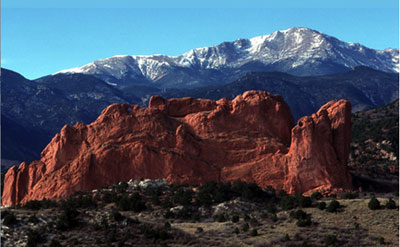
Pikes Peak with Garden of the Gods in the foreground

From The Colorado Springs Gazette (Billie Stanton Anleu):

When you pay that bill to Colorado Springs Utilities each month, you might not realize that Colorado Springs owns the four-utility organization, and it’s run by the City Council, which also functions as the Utilities Board.

Mayor John Suthers, Council President Merv Bennett and Colorado Springs Forward, a powerful nonprofit, want to see an appointed board take over governance of the $1 billion-a-year public entity.

Most City Council members don’t. They want either an elected board or no change at all. So Suthers and Colorado Springs Forward are pushing for a compromise – a hybrid board, with a majority of appointed members plus a few elected ones.

What’s the best model to govern Utilities? Through the City Council, as is done now, a different elected board, an appointed board or a combination of both? And if members will be appointed, who should appoint them?

Current Utilities Board members could recommend a switch to any of those new models, but they don’t decide whether a change actually gets made. That will be up to voters, the ratepayers themselves, who are expected to see a ballot proposal in April.

The hybrid board

This model is widely regarded as dysfunctional, and the Utilities Board voted unanimously May 25 to reject it as an option.

“The hybrid governance model is rare, for good reason,” said Jeff Tarbert, consulting facilitator for the Utilities Board’s governance review. “Any model that has the consequence of creating unintended factions or creates confusion concerning where a board’s ultimate fiduciary duty lies makes effective governance more difficult.”

Bennett said, “All the research we’ve done, in every instance, it (the hybrid model) created dysfunction. I could accept either (appointed or elected); I much prefer an appointed board.”

Board member Keith King said he sat on the Colorado League of Charter Schools’ hybrid board for 14 years and watched as fighting factions formed.

“In the end, it was a non-functioning board. A hybrid does not work well because people who are elected then are appointing people to the board. It makes for conflicts,” King said.

The league structure was changed four years ago. Now all its members are elected, King said.

Colorado Springs Forward leaders said in a statement to The Gazette they prefer the elected model: “While we see many advantages to the all-appointed option . we believe the hybrid of appointed and elected is the better alternative .”

The status quo

Some Utilities Board members believe they’re doing a fine job in that role even while serving on the City Council.

“If it ain’t broke, don’t fix it,” said City Council President Pro Tem Jill Gaebler.

“They say they want people who would focus exclusively on Utilities. Tell me who that is. Give me a name. Those who are qualified are probably CEOs of other companies, and I don’t think they’re going to have any more time than I do.”

That’s a reversal from Gaebler’s position six months ago, when she said serving Utilities and its committees took too much time. “I don’t think it’s fair to ask that much of a council that has a whole other role at $6,250 a year,” she said then.

Gaebler’s previous viewpoint resonates with some of her colleagues. As council members, they have their hands full working on marijuana regulatory reforms, a new strategic plan, a review of the City Code and myriad landslide, land swap, planning, rezoning and other issues.

The time crunch has become intense for a council facing contentious issues in a city of nearly a half million people while also supervising Utilities in the increasingly complex energy and water arena.

But Gaebler and others say they can oversee Utilities if they’re given better resources.

“The longer I look at it, the more I’m inclined to leave it with the City Council,” King said. “I’m not sure we’d be getting higher-qualified people running Utilities than what we’re already doing. If the council could have staff, the ability to do research, the ability to really govern . I think we would be able to govern it well.”

Board member Bill Murray pointed to a J.D. Powers study that ranked Utilities No. 2 in the West among mid-size utilities for customer satisfaction as proof that ratepayers have no issue with Utilities’ governance.

“In this particular case, the name of the game is control of the Utilities,” Murray said. “The mayor needs to control Utilities because he needs the money.”

But while some board members say they provide good accountability for Utilities, critics say City Council members lack scientific knowledge to run the enterprise effectively.

“This board – being elected and being politicians – they’re so easily swayed,” said Jacquie Ostrom, who served on Utilities’ Customer Advisory Group last year to help develop its Electric Integrated Resource Plan. “CSU works so hard to schmooze them and be their friend. We need to gain information and knowledge outside of CSU. . There’s just no way these politicians can bring the kind of expertise we need.”

“In the past,” said board member Don Knight, “we’ve had board members who won’t believe a single word the staff tells them, and we’ve had board members who will never question the board. Whether appointed or elected, we need a board that will know when you have to dig deep and question, when something doesn’t seem right on the surface or is an incomplete solution.”

Environmental activist John Crandall said competency is an issue, citing a previous City Council’s decision in 2011 to sign a $111.8 million contract for unproven coal-plant scrubber technology without putting the project out to bid.

“My emphasis is on competency,” said Crandall. “That’s what I want to see on the board, and we’ve never had that. It’s a hell of a job.”

Monument attorney Leslie Weise, a clean-air advocate, said City Council candidates aren’t asked about their qualifications to serve on the Utilities Board.

“It’s almost an afterthought that you have this extra duty to run a $1 billion business that’s highly technical, regulated and complex,” Weise said. “From what I’ve observed, it’s not functioning.”

Some ratepayers favor a governing board of experts in air quality, water quality, medical effects of air pollution and other specialties. That’s not the plan, though. Current members want a board of management experts, such as CEOs with business backgrounds.

The appointed board

A random check of municipal utilities about the size of the local department shows all have unpaid, appointed boards.

“I come from a nonprofit environment, where all our boards are appointed,” Bennett said. “Personally, I think we can get better talent through an appointed board.”

Said Suthers: “Utilities is getting more and more complex – the role of renewables, when to terminate coal-fired power. I would like to bring more expertise to the table. I would love to feel more comfortable with the Neumann Systems (scrubbers). You don’t get that kind of expertise in an elected board.”

Lincoln Electric System in Nebraska has nine board members representing the utility’s service area. The City Council can recommend nominees, who are chosen by the mayor and confirmed by the council.

The Knoxville (Tenn.) Utilities Board of seven commissioners nominates its own replacements, who then are appointed by the mayor and confirmed by the City Council. The board also appoints a president and CEO.

The public utility in Tacoma, Wash., has a five-member board appointed by the City Council.

The five-member board for the Orlando, Fla., utility consists of the mayor, three Orlando residents and one from unincorporated Orange County.

Orlando has a nominating board that vets candidates for appointments. When a seat opens, a few nominees are selected, and the sitting utilities board interviews them and chooses one.

And the five-member utility board for Chattanooga, Tenn., is appointed by the mayor and confirmed by the City Council.

But even if the Colorado Springs City Council appointed the Utilities Board, most current members don’t favor that model.

“I have not seen any appointments, whether by the mayor or fellow council members, that have not been approved for confirmation,” Knight said. “I don’t think we do a really good job of a complete vetting and getting the people’s input on it. The other concern I have, I’ve also seen nobody (appointed) ever get dismissed.

“If I buy stock in any company, and I don’t like what the board of directors is doing, I can sell my stock. I can’t do that as a CSU ratepayer. The ultimate accountability is to the ratepayers, and those are the voters. When you’re appointed, you’re also beholden to the person who appointed you.”

A new elected board

Like Knight, most other current Utilities Board members say if any change is made, it should be to a separate elected board.

Murray said he’d be willing to turn Utilities governance over to an elected board. “But that would be the only way I’d do it. . We’re very concerned about the appointment process because, historically, the mayor appoints, and you’ve never even seen who applied.”

Utilities Board Chairman Andres Pico, who initially balked at the idea of shedding board responsibilities, now says he’s willing to consider that change, but only to an elected board, which ratepayers overwhelmingly preferred in a recent survey by Utilities.

“With a company, the stockholders pick the board the majority of the time, and the board answers to the stockholders,” Pico said. “And that’s the same here: The citizens are the stockholders. I adamantly think an elected board is the way to go.”

Colorado Springs Forward, whose PAC endorses and donates money to candidates, said it can’t support an all-elected board because that would set up “a situation where election politics and special-interest agendas will dominate the election process, creating a highly politicized board.”

The Utilities Board expects to decide in July whether to recommend a change and, if so, what change or changes.

Whether appointed or elected, Bennett said, a change is needed. “We need a City Council who gives 100 percent attention to the city and a Utilities board who gives 100 percent attention to Utilities.”

“We’ve got a lot of capable people here in the city, and I think we can find the folks who can do the job,” said Councilman Larry Bagley, who is leaning in favor of an appointed board. “I don’t have any qualms about it being a separate board or different people doing it. I think it’ll work.”

#ColoradoRiver: CPW hopes public can understand its efforts at Elkhead Reservoir — Craig Daily Press #COriver

Elkhead Reservoir
Elkhead Reservoir

From The Craig Daily Press (Patrick Kelly):

The tournament is hosted by CPW, and it is offering over $6,000 in prizes, but the effort is part of the Upper Colorado River Endangered Fish Recovery program.

To prevent further federal involvement, the recovery program was formed in 1988 to provide endangered species act compliance and keep water development projects closer to the local level.

Three states — Colorado, Utah and Wyoming — along with a multitude of federal agencies and private organizations formed the recovery program to help improve fish populations of the endangered humpback chub, Colorado pikeminnow, razorback sucker and ponytail.

The program’s actions are dictated by the U.S. Fish and Wildlife Service, but it still provides an important buffer between state and federal government.

If the program fails and is dissolved, an individual who draws water from the Yampa River would have to justify their use and provide evidence that their use does not impact endangered fishes — a task the recovery program currently completes.

Sherman Hebein, CPW’s senior aquatic biologist for the northwest region, said his organization is hosting the tournament at Elkhead and offering serious prizes because it is important to engage the public in the effort to control non-natives.

Elkhead Reservoir is home to nonnative northern pike and smallmouth bass, making it a popular fishery for anglers from across Colorado.

But the same nonnatives that attract anglers to the reservoir eat the four fish the recovery program is trying to save.

“The objective of this tournament is to suppress these fish, smallmouth bass and northern pike, to reduce the impact of those fish on the Yampa River,” Hebein said.

Hebein said protecting these fish easily approaches philosophical debate but genetic diversity is an important thing to protect.

“A lot of people ask what’s so important about these four fish species… don’t they live somewhere else?” he said. “These fish don’t live anywhere else… These fish are the true natives of the Colorado River Basin… If we don’t recover them here, they won’t be anywhere else.”

Until humans have a better understanding of DNA and what makes us tick, it is crucial to preserve all iterations of life, Hebein said.

“Until we can figure that out, we really need to conserve the DNA of all these living organisms because we don’t know how to make it,” he said.

But some are still opposed to a tournament that would potentially reduce the fishery in Elkhead Reservoir.

Steve Smith, Craig local and longtime Elkhead angler, had a sign posted in protest of the tournament at the turn off to the launch ramp.

“This is one of the closest lakes that we can fish,” he said. “It’s been holding it’s own for crappie or pike or bluegill but now they want to eliminate or lower the number of smallmouth or pike.”

Despite their differences, Smith and CPW officials were able to interact with respect. Smith understands that CPW has objectives to complete and CPW officials understand Smith’s passion for his hometown fishery.

Hebein said CPW is not out to kill the fishery, like many locals believe.

“We’re here to turn this lake into a far better fishery but to do that we have to suppress the numbers of big predators,” he said.

Hebein and CPW spokesman Mike Porras both said that without their efforts, Endangered Species Act compliance would be out the window and federal intrusion into local affairs would be even greater.

“Every water user would be compelled to deal with a Section 7 consultation with the (U.S. Fish and Wildlife Service) on how their use of water would not impact the endangered fish,” he said. “That’s a lot of work and a lot of paperwork and that’s the reason behind why the recovery program has been such a valuable thing.”

Out of all the anglers interviewed by the Craig Daily Press on Saturday, only one was from Craig, and a gentleman from the Denver area joined him

The rest of the fishermen were from Grand Junction, Eagle or Rifle.

The tournament ends on June 19 with daily prizes for smallest, biggest and most fish caught. Catching a fish with a tag enters anglers into a raffle for big prizes, with the top prize being a new boat.

“The sooner that we can recover the endangered fish, the sooner we can have some more freedom,” said Hebein. “I’d like to encourage everyone to think about the recovery program and the value it has presented in everyone’s lives. How can we get together, recover the fish and move on from there?”

Upper Colorado River Endangered Fish Recovery Program

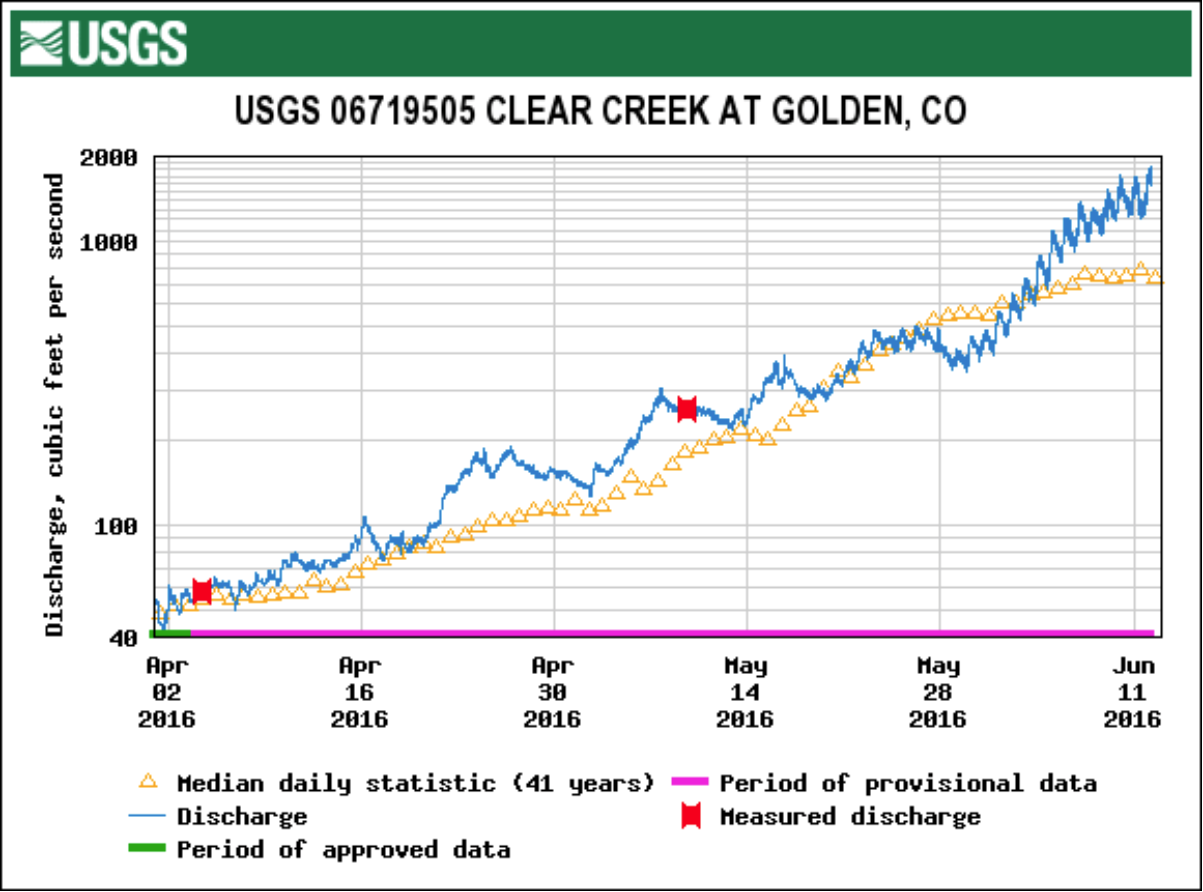
#Runoff #Snowpack news: Clear Creek closed to tubing, South Platte pretty much melted-out

Clear Creek at Golden gage April 1 through June 12, 2016.

From KWGN (Drew Engelbart):

Park Rangers were enforcing and informing visitors of the tubing and swimming restriction along Clear Creek on Saturday.

Jefferson County Sheriff’s Office announced the restriction on Thursday, citing dangerous conditions because of high water.

These temporary restrictions apply to Clear Creek in unincorporated Jefferson County, as well as those portions of Clear Creek within the City of Golden, including Vanover Park.

Colorado’s Own Channel 2 spotted two people with tubes ready to hop in the water were stopped short by onlookers who informed them tubing was restricted.

Water activities prohibited by the order include all single-chambered air inflated devices such as belly boats, inner tubes, and single chambered rafts, as well as “body-surfers” and swimming.

Kayaks, paddle boards, whitewater canoes and multi-chambered professionally guided rafts and river boards are exempt, but are encouraged to observe extreme caution due to the safety concerns surrounding swift moving water and floating debris.

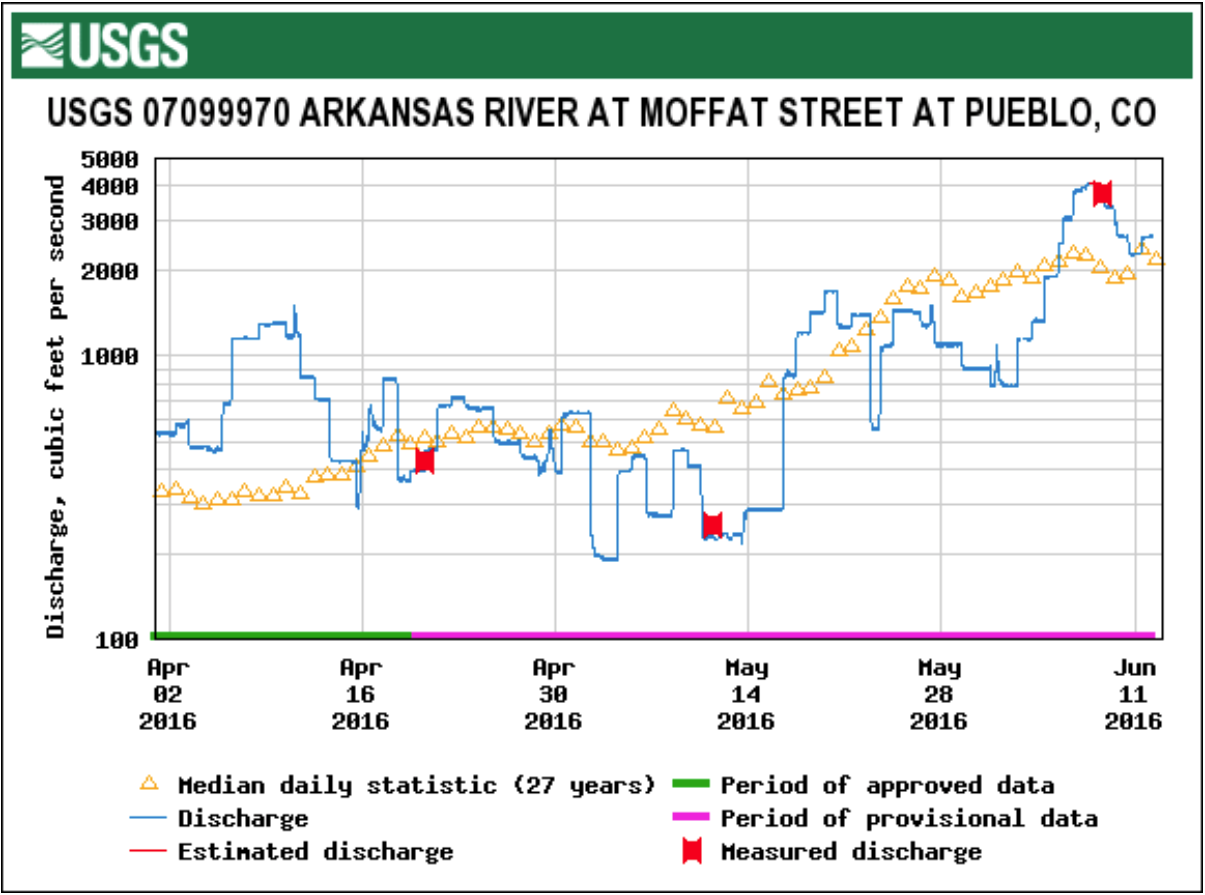
Arkansas River at Moffat Street Pueblo April 1 through June 12, 2016.

From The Pueblo Chieftain:

Authorities said the water of the Arkansas River where the rescue happened [ed. 3 young people rescued from the Arkansas River Tuesday, June 7] was flowing fairly fast. Earlier in the day, it was measured at 4,300 cubic feet per second — fast but not unusual during the annual spring runoff.

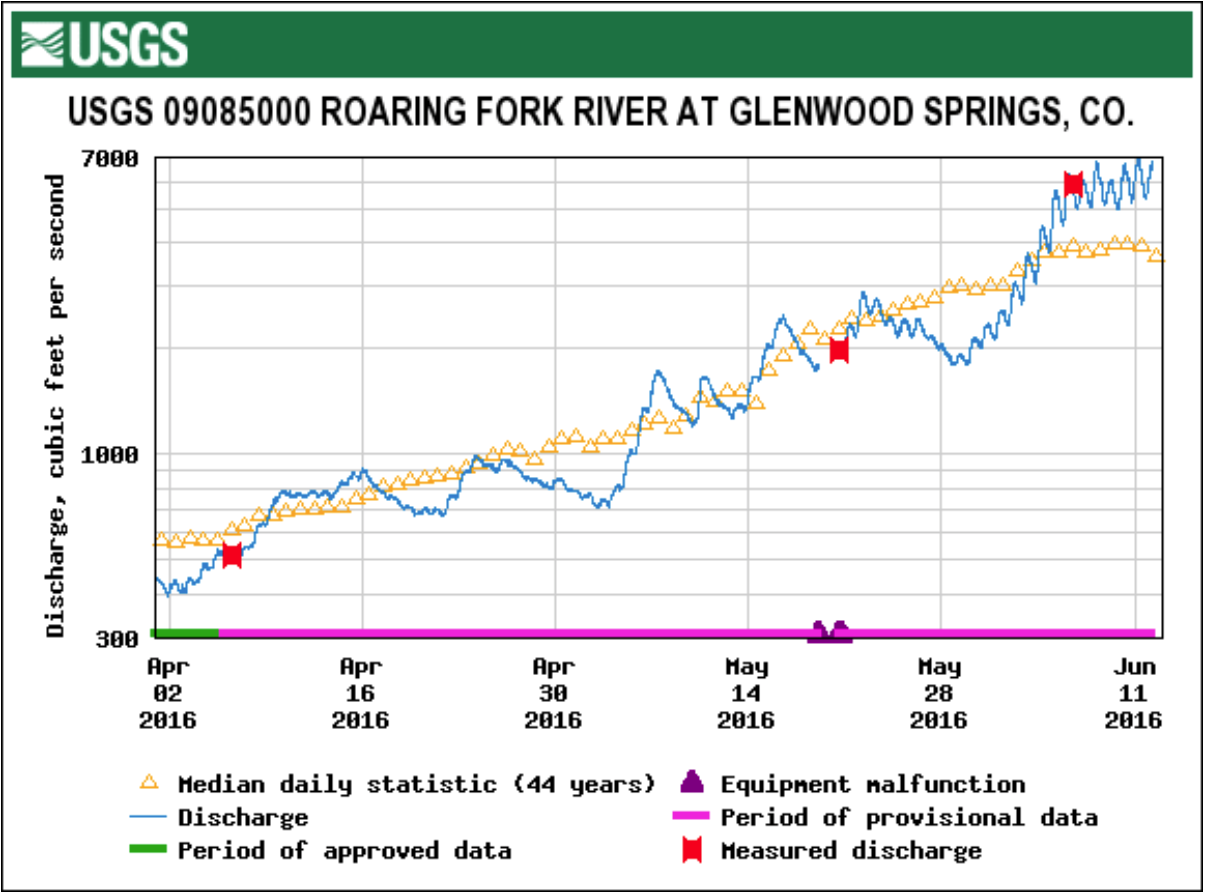
Roaring Fork River at Glenwood Springs gage April 1 through June 12, 2016.

From The Aspen Times (Erica Robbie):

Rapids on the Roaring Fork River are expected to peak this weekend, said Aspen Fire Department Chief Rick Balentine, citing information from the Colorado Basin River Forecast Center.

Balentine said the currents are “dangerously high” now and cautioned those on the water to wear some form of safety flotation device.

According to the Centers for Disease Control and Prevention, 88 percent of people who drown in boating accidents are not wearing a life vest, Balentine said.

He cited another Centers for Disease Control and Prevention stat noting alcohol is a factor in 70 percent of water-recreation accidents.

“These are pretty stark facts,” Balentine said. “If you see somebody about to do something stupid, say something…

On Thursday, the river flow hit around 1,640 cubic feet per second, Ingram said.

River officials often draw a parallel between one cubic feet per second and one basketball — meaning 1,640 cubic feet per second is the equivalent to about 1,640 basketballs rushing down a river at once.

Ingram expects the Slaughterhouse area, one of the faster, more thrilling sections of the river, to reach between 1,800 and 2,200 cfs this weekend.

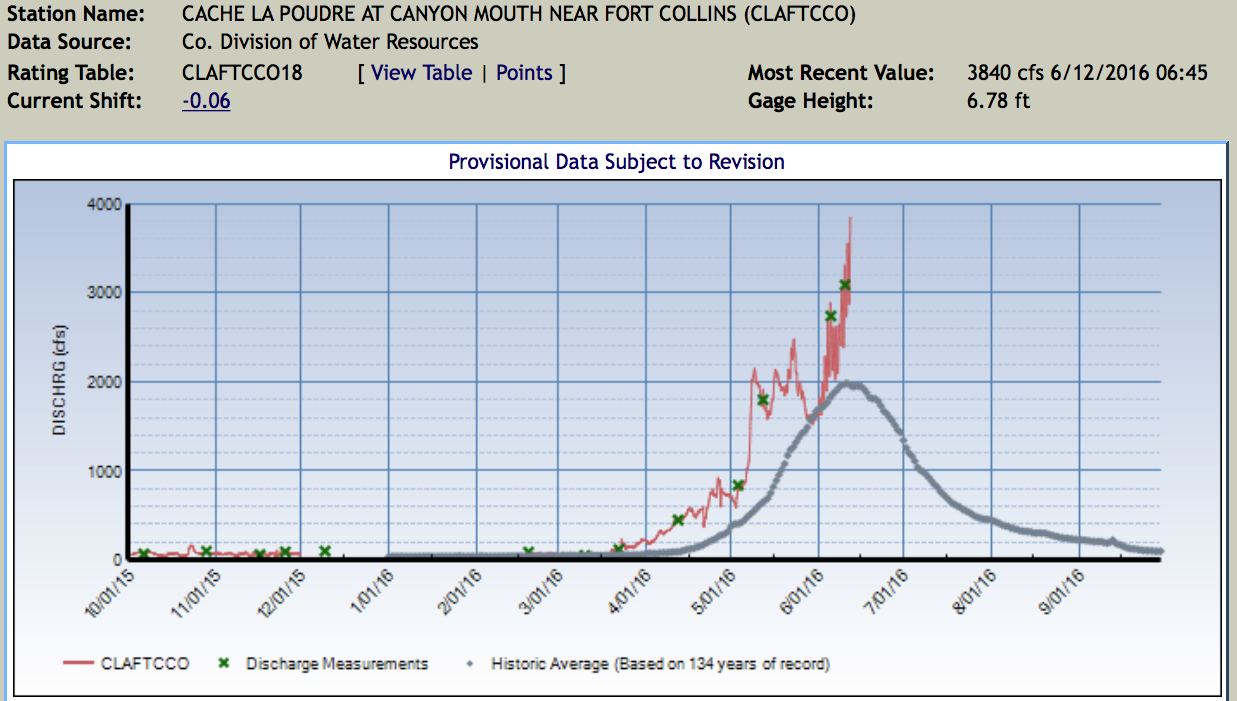
Cache la Poudre at Canyon Mouth water year 2016 through June 12, 2016.

From The Fort Collins Coloradoan (Jacy Marmaduke):

The National Weather Service in Denver extended a flood advisory for the Poudre in Larimer County and Weld County. The river isn’t projected to reach flood stage through early next week, but residents can expect minor flooding of low-lying areas along the river, according to the advisory.

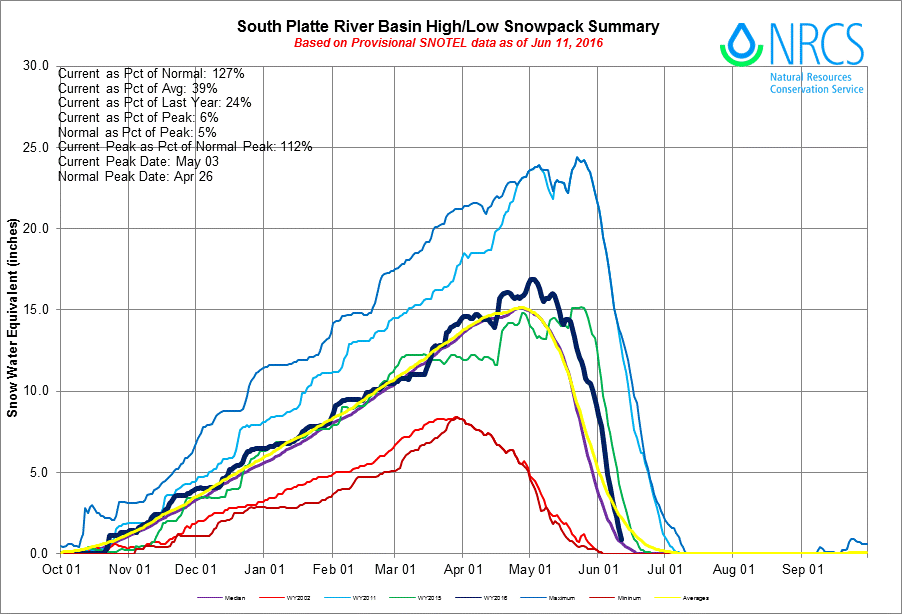
South Platte River Basin snowpack sat at 194 percent of its historical average on Friday morning and was even higher earlier this week thanks to remnants from spring snows. That’s significant for the Poudre, which is fed by mountain snowpack in addition to water from the Colorado-Big Thompson project.

As temperatures soar into the 90s this weekend, snowmelt will push the river to 6.7 feet at the canyon mouth by Sunday morning, the advisory said. Flood stage is 7.5 feet, and the river stood at 6.2 feet Friday morning.

At 6 feet, water covers the bike path and trail along the river in and near Fort Collins.

southplatteriverbasinhighlo06112016

From The Greeley Tribune (Katarina Velazquez):

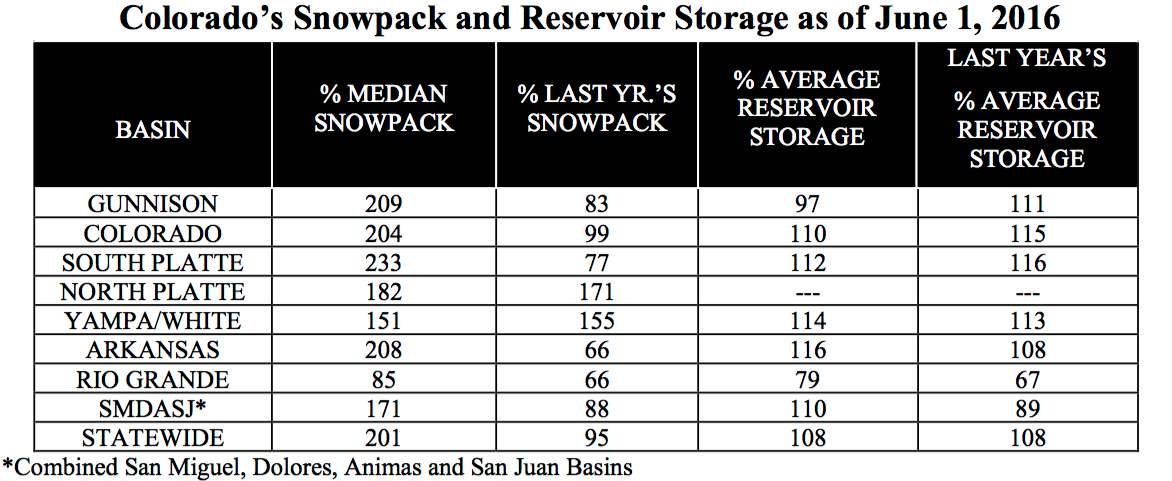
Colorado has twice as much snowpack than normal for this time of year, according to the latest snowpack report from the U.S. Department of Agriculture.

The cool, wet weather in May contributed to the exceptional water supply Colorado appears to have heading into the summer. According to the report, as of June 6, the state was at 201 percent of the average for snowpack, compared to last year’s 95 percent.

“This should be a good year waterwise for cities and for farmers; that’s the bottom line,” said Brian Werner of the Northern Colorado Water Conservancy District.

The fact that snow is still visible in the mountains at this time of year means the runoff should last longer than it usually does, which in turn means less water will be pulled from reservoir storage later in the year, he said.

And the snowpack is especially good in the northern Colorado area. The majority of remaining snowpack in Colorado exists in the northern mountains, especially in watersheds such as the South Platte and Upper Colorado, which are above 10,000 feet.

As of June 6, both river basins that feed into northern Colorado — the Upper Colorado River Basin and the South Platte River Basin — were above 200 percent of the median snowpack.

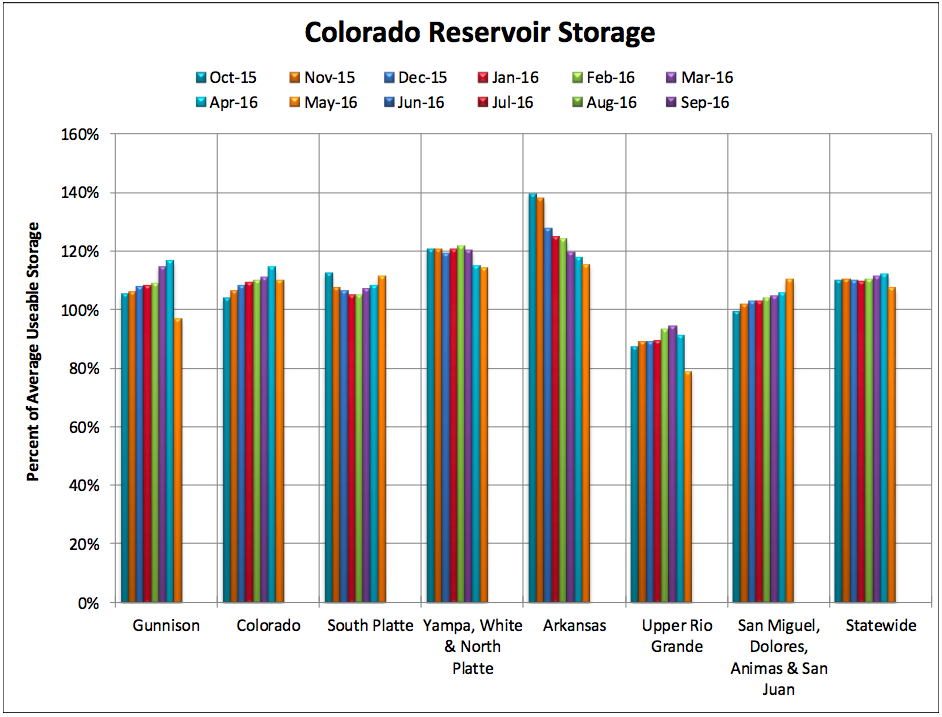
As for reservoir storage, the state is currently at 108 percent of average, according to the June 1 update from the Natural Resources Conservation Service. This is exactly where the state was last year, as well.

The Upper Colorado River Basin is at 110 percent of average for reservoir storage and the South Platte River Basin is at 112 percent of the average.

Werner said the Colorado-Big Thompson project is 20 percent above normal, which is promising at this point in the year. The Colorado-Big Thompson project is a series of reservoirs, pipelines, diversions and ditches that provides water to municipalities, farmers and other water users throughout northeastern Colorado.

Werner said going into summer, farmers and cities should be in good shape if nothing drastic occurs within the upcoming months.

“We shouldn’t have any major water worries this year,” he said.

Flows in upper Roaring Fork River could double with curtailed diversions

A little under 600 cfs of water flowing out of the east end of the Twin Lakes Tunnel on June 6, 2016. A similar amount of water could be heading west down Lincoln Creek and the Roaring Fork River next week if the Twin Lakes Reservoir and Canal Co. closes the tunnel due to constraints on its water rights.
A graph showing the level of diversions through the Twin Lakes Tunnel so far in June 2016. The 618 cfs flowing through the tunnel could be turned back into the river within a week.

ASPEN (Brent Gardner-Smith) – The Twin Lakes Reservoir and Canal Co. has alerted Pitkin County officials that it soon intends to stop diverting about 600 cubic feet per second of water through the Twin Lakes Tunnel near Independence Pass.

The non-diversion of water from the headwaters of the Roaring Fork River, which could begin by midweek and last up to three weeks, could double forecasted flows in the Stillwater section of the Fork just east of Aspen, depending on weather and runoff levels. That may inundate the popular North Star Nature Preserve.

“We may see a couple of weeks or more where we are not taking anything through the tunnel, and hopefully that doesn’t cause too much flooding on that side,” said Kevin Lusk, a senior engineer with Colorado Springs Utilities and the president of the board of the Twin Lakes Reservoir and Canal Co.

The Roaring Fork, as measured at Stillwater Drive east of Aspen on a federal gauge, was flowing in the 500-to-750 cubic-feet-per-second (cfs) range on Friday.

Also on Friday, there was 618 cfs of water being diverted east through the Twin Lakes Tunnel and under the Continental Divide, bound for Front Range cities and fields near Ordway, in the lower Arkansas River basin.

The North Star Nature Preserve, with the Roaring Fork River still mostly within its banks, on Saturday, June 11, 2016. The view could change if th Twin Lakes Reservoir and Canal Co. turns back the 600 cfs it is diverting through the Twin Lakes Tunnel.
The North Star Nature Preserve, with the Roaring Fork River still mostly within its banks, on Saturday, June 11, 2016. The view could change if the Twin Lakes Reservoir and Canal Co. turns back the 600 cfs it is diverting through the Twin Lakes Tunnel.

Doubling the flow?

If Twin Lakes does turn off the diversion tunnel by midweek as expected, the Fork could be flowing in the 1,100-to-1,200 cfs range, instead of the 500-to-550 cfs range, as forecasted by the Colorado River Basin Forecast Center.

The current forecast, which assumes the Twin Lakes diversions are in place as usual, shows the Roaring Fork at Stillwater reaching a seasonal peak flow of 755 cfs today. Flows are then forecast to drop to the 500-to-550 cfs range by Wednesday. (The river actually beat the forecast and reached 773 cfs on Friday).

This would be the second straight year that Twin Lakes has stopped its diversions from the Roaring Fork headwaters due to plenty of water in the Arkansas basin.

Last year, Twin Lakes was diverting 528 cfs when it suddenly closed the tunnel on June 4.

A couple of days later, it diverted about 200 cfs for a brief time to try to reduce flooding of an old cabin along the river, and then, out of options, it left the tunnel closed until July 20.

A graph showing the levels of diversion through the Twin Lakes Tunnel in May, June and July of 2015.

Last year’s non-diversion of water by Twin Lakes helped push the Roaring Fork at Stillwater to a peak flow of 1,680 cfs on June 18.

The only minor damage caused in Pitkin County by last year’s high water was to the little cabin. And to the delight of paddlers on the Stillwater section of river, the high water also formed “Lake Northstar” on the North Star Nature Preserve.

A cabin dating to the mid-1960s in the Stillwater section of the Roaring Fork River was flooded in June 2015, with standing water in the living room and in a nearby art studio.
A large portion of the meadow in the North Star nature preserve east of Aspen was flooded in June 2015, allowing boaters in the Stillwater section of the Roaring Fork River to expand their horizons.

Non-diversions rare

It’s rare for Twin Lakes to stop diverting water, but it has constraints in its water-right decrees that can, in wet years, force it to stop moving water from the West Slope.

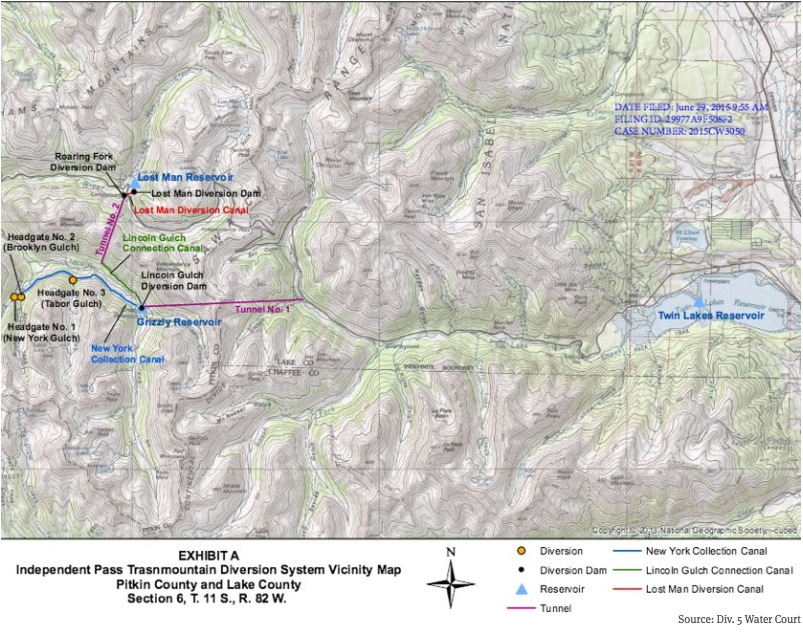
Twin Lakes operates what is formally known as the Independence Pass Transmountain Diversion System. It gathers water from the Roaring Fork River and from Lost Man, Grizzly, Lincoln, New York, Brooklyn and Tabor creeks, and delivers the water to Grizzly Reservoir.

From Grizzly Reservoir, the water is sent through the 4-mile-long Twin Lakes Tunnel, under the Divide, into Lake Creek and down to Twin Lakes Reservoir, on the east side of Independence Pass.

The Twin Lakes Reservoir and Canal Co. is controlled by various municipal shareholders in the company, with Colorado Springs owning 55 percent of the shares, Pueblo 23 percent, Pueblo West 12 percent, and Aurora 5 percent. There are also other minority shareholders still using the water from the system for agriculture.

One constraint in Twin Lakes’ water rights, which date to 1936, is tied to the Colorado Canal, which diverts water from the lower Arkansas River under a relatively junior water right.

If the demands of the Colorado Canal can be met with “native” water from the Arkansas, then Twin Lakes cannot divert water from the West Slope to fill the canal.

This year, there is a lot of water running down the Arkansas, and so the canal does not need supplemental water from the West Slope, at least not yet.

The east end of the Twin Lakes Tunnel on June 6, 2016. The four-mile long tunnel brings water from Grizzly Reservoir to Lake Creek, Twin Lakes Reservoir, and on to Front Range cities and fields.

Storage constraint

The other water-right constraint relates to how much water Twin Lakes can legally store in Twin Lakes Reservoir.

Once Twin Lakes, the company, has stored 54,452 acre-feet of water in Twin Lakes, the reservoir, the company has to stop diverting water from the Roaring Fork basin for storage.

Normally by the time Twin Lakes has reached its storage limit, the flow in the lower Arkansas has dropped and the Colorado Canal gets called out by senior diverters, so Twin Lakes can send supplemental water to the canal, allowing the Twin Lakes Tunnel to divert all summer.

But due to this year’s weather and snowpack, the constraints on Twin Lakes’ water rights have again come together, forcing the tunnel to be turned off as soon as the storage limit is reached, especially as the weather forecast suggests runoff into the Arkansas will remain high.

The Colorado Canal in March 2016.

Timing uncertain

If cool and wet weather were to materialize over the next few days, however, cit ould delay when Twin Lakes reaches its storage limit and has to stop diverting. It could be midweek, or it could be next week.

And how long the tunnel stays closed depends on a range of factors, Lusk said, including weather, flows into the Arkansas, and the operation of Twin Lakes Reservoir.

Valerie MacDonald, Pitkin County emergency manager, said officials with Twin Lakes have done a much better job this year than last year in communicating about the likelihood of a non-diversion.

She also said local public safety officials are prepared to respond to high water and that concerned property owners can find information about flood readiness on the Pitkin County website.

Editor’s note: Aspen Journalism, the Aspen Daily News, and Coyote Gulch, are collaborating on the coverage of rivers and water. The Daily News published this story on Saturday, June 11, 2016.

A map of the Independence Pass Transmountain Diversion System, as submitted to Div. 5 Water Court by Twin Lakes Reservoir and Canal Co.

Cambodia: Laser technology reveals cities concealed under the earth which would have made up the world’s largest empire in 12th century – The Guardian

Graphic via the Juan Chacon Free Software and Education Project here.

Here’s a report from Lara Dunston writing for The Guardian. Click through to read the whole article and for the video. Here’s an excerpt:

Archaeologists in Cambodia have found multiple, previously undocumented medieval cities not far from the ancient temple city of Angkor Wat, the Guardian can reveal, in groundbreaking discoveries that promise to upend key assumptions about south-east Asia’s history.

The Australian archaeologist Dr Damian Evans, whose findings will be published in the Journal of Archaeological Science on Monday, will announce that cutting-edge airborne laser scanning technology has revealed multiple cities between 900 and 1,400 years old beneath the tropical forest floor, some of which rival the size of Cambodia’s capital, Phnom Penh.

Some experts believe that the recently analysed data – captured in 2015 during the most extensive airborne study ever undertaken by an archaeological project, covering 734 sq miles (1,901 sq km) – shows that the colossal, densely populated cities would have constituted the largest empire on earth at the time of its peak in the 12th century…

The new cities were found by firing lasers to the ground from a helicopter to produce extremely detailed imagery of the Earth’s surface. Evans said the airborne laser scanners had also identified large numbers of mysterious geometric patterns formed from earthen embankments, which could have been gardens…

[David Kyle], “It’s impossible not to be excited. It facilitates a paradigm shift in our comprehension of the complexity, size and the questions we can address.”

While the 2012 survey identified a sprawling, highly urbanised landscape at Greater Angkor, including rather “spectacularly” in the “downtown” area of the temple-city of Angkor Wat, the 2015 project has revealed a similar pattern of equally intense urbanism at remote archaeological ruins, including pre- and post-Angkorian sites.

Video: deMISTify Water-Wise Landscaping — Thornton Water Conservation

#Runoff news: Streamflow up in Big Thompson

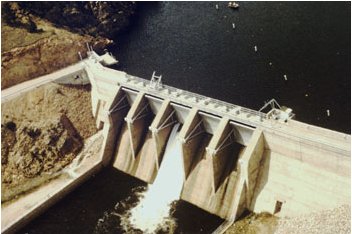
Olympus Dam photo via the US Bureau of Reclamation.

From The Estes Park Trail-Gazette (David Persons):

A storm over Estes Park on Thursday night has greatly increased the runoff along the Big Thompson River and Fall River and, as a result, has increased the flow into Lake Estes.

A U.S. Bureau of Reclamation official said early today that the increased flow is forcing the bureau, which owns and controls the flow of water out of Lake Estes, to increase the outflow at Olympus Dam back into the Big Thompson River.

“We were forced to increase releases early and higher than previously planned,” said Peter Soeth, the Public Affairs Specialist for the U.S. Bureau of Reclamation in Denver. “The releases are currently 450 cfs (cubic feet per second), and we might be going a little higher today in anticipation of what could be coming down from the mountains tonight.”

The local river runoff into Lake Estes, which has been slow this spring compared to last year, was averaging 350-490 cfs on Thursday. However, it started increasing overnight and peaked at 616 cfs around 1:30 a.m. today. The runoff inflow into the lake was at 505 cfs at 8:45 a.m. today.

In addition to the amount that the bureau is releasing through Olympus Dam, another 550 cfs is being diverted through Olympus Tunnel and is released back into the Big Thompson River at the mouth of the canyon at the power plant.

The total amount of water currently being released from Lake Estes — by way of the dam and tunnel — is approximately 1,000 cfs.

From The Brush News-Tribune (Jenni Grubbs):

While the South Platte River has gone down a bit in recent weeks, it is still running quite high and fast, according to the National Weather Service and Morgan County Office of Emergency Management.

#ElNiño #LaNiña news: The latest ENSO discussion is hot off the presses from the Climate Prediction Center

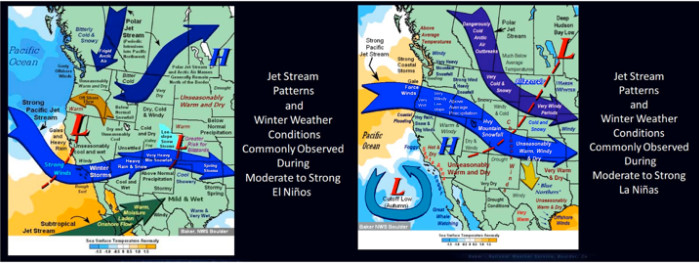
Jet Stream patterns El Nińo /La Nińa via NWS Boulder

Click here to read the discussion. Here’s an excerpt:

ENSO Alert System Status: Final El Niño Advisory / La Niña Watch

Synopsis: ENSO-neutral conditions are present and La Niña is favored to develop during the Northern Hemisphere summer 2016, with about a 75% chance of La Niña during the fall and winter 2016-17.

El Niño dissipated and ENSO-neutral conditions returned during over the past month, as indicated by the expansion of near-to-below average surface temperatures (SST) across the eastern equatorial Pacific Ocean. Other than the westernmost Niño-4 region, the Niño indices were near zero by the end of May. Below-average subsurface temperatures continued and extended to the surface across the eastern equatorial Pacific. For the first time in 2016, atmospheric anomalies over the tropical Pacific Ocean were also consistent with ENSO-neutral conditions. The traditional and equatorial Southern Oscillation indices were near zero, while the upper and lower-level winds were both near average across most of the tropical Pacific. Convection was also near-average over the central tropical Pacific and over most of Indonesia. Collectively, these atmospheric and oceanic anomalies reflect a transition from El Niño to ENSO-neutral conditions.

Many models favor La Niña (3-month average Niño-3.4 index less than or equal to -0.5°C) by the Northern Hemisphere fall. However, most dynamical models indicate La Niña onset as soon as the Northern Hemisphere summer, which is slightly favored by the forecaster consensus. In contrast, many statistical models favor a later onset time, with about half indicating the persistence of ENSO-neutral conditions through the winter. At this time, the forecasters are leaning toward a weak or borderline moderate La Niña if an event were to form. Overall, ENSO-neutral conditions are present and La Niña is favored to develop during the Northern Hemisphere summer 2016, with about a 75% chance of La Niña during the fall and winter 2016-17.

midmay2016plumeofmodelensopredictions

2016 #coleg: Colorado lawmakers deny climate change reality — Writers on the Range

Science Senator. It's called science.
Science Senator. It’s called science.

From the Wyoming Tribune-Eagle (Auden Schendler):

Let’s say you were a legislator in Colorado during this year’s session, and you needed some help making policy decisions on a topic that required scientific knowledge. What might you do?

Because you’re a booster of the state, you’d know that we have some of the finest academic and research institutions in the country. These include the University of Colorado, Colorado State University, the University of Denver, the National Renewable Energy Lab and the National Center for Atmospheric Research. So it would make sense to ask those groups what they think on a given subject before moving forward. That, after all, is how public policy-making ought to work: Get the facts, make the policy.

But the facts-first and policy-later approach is not how some Colorado leaders like to tackle at least one serious issue: climate change. During Colorado Senate debate about adopting targets for the state’s Climate Action Plan, Republican Sen. Kevin Lundberg testified that the science wasn’t “settled” yet. Sen. John Cooke, also a Republican, went further. Manmade climate change was a myth, he said, effectively putting our hard work on climate change on the same level as believing in unicorns and fairies. Neither man is one of the fringe elements of the Legislature; in fact, the leading force behind climate denial has been the Republican president of the Senate, Sen. Bill Cadman.

Yet their positions run counter to conclusions reached by every one of the state’s academic and research academies. Are these elected officials really discounting the work of our great state institutions?

There is absolutely no scientific case to be made for denying human impact on climate change. That means that the opinions of these legislators are just that – opinions based solely on hearsay or newspaper and talk-show statements by non-scientists who cite non-climatologists. If that’s how some policymakers approach this issue, how are they thinking about health care, economics, public safety, education or water quality? Is this the approach you’d take when fixing your car, having serious surgery or making health-care decisions for your child? [ed. emphasis mine]

Most lawmakers in the nation and around the world don’t act this irresponsibly. Science-based policymaking on climate issues has become a global phenomenon, now integrated into decision-making by almost 200 nations and in every area of our federal government.

In Miami, the science behind rising seas is one of daily concern. For water planners in California, drought science is nothing short of riveting, and in Alaska, where coastal communities built on permafrost are collapsing into the sea, science is meeting the budget in painful ways.

Lawmaking based on ideology is damaging in material ways. At the end of March, Colorado GOP legislators voted to defund the state Department of Health and Environment so that it can’t issue air-quality permits or perform inspections. Why? Because these elected officials oppose enforcement of the Environmental Protection Agency’s Clean Power Plan, the American response to climate change, which brought China and India to the table in Paris to try to broker a global deal.

But defunding an environmental agency won’t stop the Clean Power Plan; it merely hurts business. First, it does nothing to stop regulation, despite what some might think; it merely delays it. That means law-abiding businesses that need air permits to operate will simply have to wait, and then wait some more. Second, polluters breaking the law and violating the Clean Air Act at the expense of our kids’ health will no longer get caught and punished. (This is not a controversial issue: We all agreed that clean air was a good idea in the 1970s, and Americans overwhelmingly support the Clean Air Act.) Third, if Colorado refuses to do this work, the EPA will step in, so you’ll get out-of-state regulation anyway, exactly the opposite of the GOP’s goals for the state.

Why do legislators want to do this silly stuff? Because, according to Rep. Bob Rankin, Western Slope residents are “terrified” of the EPA Clean Power Plan. Give me a break: The state has mostly met the plan. Solar energy is thriving and producing tons of jobs. Aspen/Snowmass and Vail Resorts, responsible directly or indirectly for tens of thousands of jobs, both support the plan. Even the gas drillers at WPX Energy I met with last fall were diligently monitoring their own methane emissions and were hardly terrified.

Fact-based policy-making tends to work really well. It’s when we make decisions based on fantasy, sadly, that real people and real businesses suffer.

2016 #coleg: Could water funding sweeten a compromise on the hospital provider fee? — The #Colorado Independent

Colorado- Governor John Hickenlooper on Feb. 26, 2012. USDA Photo by Lance Cheung.

From The Colorado Independent (Marianne Goodland):

Gov. John Hickenlooper has added water to the list of needs that could be funded if the General Assembly reclassifies the state’s hospital provider fee.

Hospitals in Colorado pay a fee to the state, based on the number of overnight patient stays and outpatient visits. Those funds are matched with federal dollars and the money is used to pay for uninsured care and Medicaid expansion.

The fee currently counts as state revenue under the Taxpayer’s Bill of Rights. But Democrats, including Hickenlooper, would like to reclassify the fee as a state-owned business, or enterprise. That would remove the provider fee dollars from TABOR revenue limits, estimated in 2016-17 at $656.5 million.

The fee is among several types of state revenue that are pushing state spending to those TABOR revenue limits. Currently, any dollars that exceed the TABOR limit must be refunded to taxpayers, although those refunds haven’t been necessary for more than a decade. However, state economists believe that if the fee isn’t reclassified, refunds would be required, as soon as next year.

Democrats have tried unsuccessfully for two legislatives sessions to persuade Republicans, including the Senate Republican majority, to allow that reclassification. Senate President Bill Cadman of Colorado Springs drew a line in the sand before the 2016 session even started, releasing an opinion by legislative attorneys that said the reclassification would be unconstitutional.

Democrats countered with opinions from current Attorney General Cynthia Coffman, a Republican, and her predecessor, John Suthers, who both said the change would be legal.

Hickenlooper has been weighing the idea of a special session to revisit the hospital provider fee issue, which would bring lawmakers back to the Capitol, most likely in early July. If Hickenlooper vetoes a bill that would gradually allow the sale of full-strength beer and wine in grocery stores, that issue could end up on the special session agenda, too.

Hickenlooper has until tomorrow to make a call on the beer bill; by law, the governor must decide what to do with any bill passed by the General Assembly no later than 30 days after the session ends.

Part of the issue with the hospital provider fee is in what to do with the extra money. Speaker of the House Dickey Lee Hullinghorst, a Boulder Democrat, proposed a bill during the session that would use those dollars to fund transportation, education and higher education. According to a fiscal analysis, reclassifying the fee would allow the state to put $155.7 million into those funding priorities in 2016-17.

But now Hickenlooper is attempting to add water as a way to sweeten the deal for Senate Republicans. He told several lawmakers this morning that he has been talking to Cadman about adding water projects to the funding list, although he didn’t say exactly how the money would be used.

Hickenlooper’s offer hasn’t quite tipped Cadman from opposition to support. “I haven’t persuaded him yet. I keep looking for that key,” Hickenlooper said.

The governor made those comments prior to signing a bill to set up a study of the South Platte River between Julesburg and Greeley. That study would look at possible storage solutions to keep millions of acre-feet of water that leave Colorado every year, over and above the amount required by compacts between Colorado and Nebraska.

Arkansas Basin Roundtable executive committee meeting recap

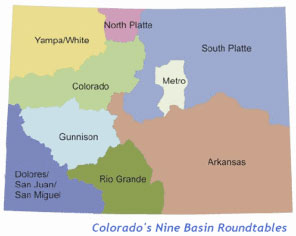
Basin roundtable boundaries

From The Pueblo Chieftain (Chris Woodka):

Water planners are looking at potentially leaner times for grants that fund projects, particularly for smaller water districts, towns or farms.

The funding crunch is coming because of an April opinion of the Colorado Supreme Court in BP America v. Colorado Department of Revenue, in which the oil giant prevailed in its arguments of which types of activities are exempt from mineral severance taxes. The impact could mean a repayment of up to $125 million and reduced future revenues.

Those taxes are the source of funding for Water Supply Reserve Account grants that are funded through the state’s basin roundtable process. Those grants are approved by the Colorado Water Conservation Board.

“Moving forward, revenues will be down 12.5 percent,” Brent Newman of the CWCB told the Arkansas Basin Roundtable executive committee Wednesday. “With the implementation of the Colorado Water Plan, we have to make sure grant programs meet standards.”

After last month’s meeting of the Interbasin Compact Committee, CWCB staff is preparing a new plan of action to fund water projects that does not rely on the up-and-down revenues of mineral severance taxes.

That pot of money is now split among local governments, the Department of Local Affairs and agencies within the Department of Natural Resources, including the CWCB. The problem is that when oil, gas and mining activity drops or prices decrease, so do tax revenues. The state Legislature raided the revenues to meet budget shortfalls during the 2008-09 recession, showing they are unreliable.

The court decision will decrease the size of the fund pool. Newman stressed that carry-over funds are still in place, although roundtables already are starting to rein in their requests. The Arkansas Basin Roundtable hopes to move as much as $500,000 in grants ahead this year.

The state water plan calls for adding $100 million funding annually for water projects beginning in 2020, and the IBCC and CWCB have kicked around ideas — such as a container tax for water and soft drinks or a statewide tap fee — to provide that money.

But in the short term, CWCB staff is proposing using its own banked funds to provide a stable source for water projects for the next five years. The proposal includes establishing a $50 million loan fund that would be repaid, $10 million annual funding to the WSRA, $5 million annually for watershed restoration and $10 million annually for grants.

“Not everybody agrees with me, but I think it’s going to be a lot more restrictive,” said Jay Winner, general manager of the Lower Arkansas Valley Water Conservancy District and a member of the IBCC. “Under the water plan, in every basin, the gaps can’t get any bigger, but it could mean the large municipalities will take ag out of production.”

Small communities could also be in trouble as funds tighten, said Jim Broderick, executive director of the Southeastern Water Conservancy District. Many of the participants in the Arkansas Valley Conduit project will depend on small grants to fund internal projects to connect to the new waterline when it is completed.

The plan is to put a funding system in place for 2017 through the water projects bill, but time is short, since the CWCB usually finalizes the list by November, and it meets just three times. The IBCC only has one meeting, in August, scheduled to discuss the idea, and typically has required months or years to work out differences among regions in the state.

“If we don’t have an agreement, this isn’t going to happen,” Winner said.

2016 #coleg: Gov. Hickenlooper signs HB16-1256 (South Platte Storage study)

South Platte River Basin via Wikipedia

From The Grand Junction Daily Sentinel (Charles Ashby):

Leave it to a Western Slope legislator to tell his colleagues on the Front Range just what they should do when it comes to finding more water for their thirsty cities.

While the South Platte River is miles away from Rep. J. Paul Brown’s southwest Colorado House district, it’s actually as close as the nearest Western Slope stream when it comes to statewide water management.

That’s why the Ignacio Republican introduced HB16-1256, which calls on the Colorado Water Conservation Board to study how much South Platte water has been allowed to flow into Nebraska over what the state’s water compact with the state requires.

Additionally, the bill, which Gov. John Hickenlooper signed into law on Thursday, calls on the board to identify potential sites to create more storage projects no matter how small they might be.

“It’s just important that we not waste water in Colorado anywhere,” Brown said. “I’ve been watching the South Platte for several years. Today, there is about 6,000 cubic feet per second that is flowing out of the state. This study will give us the information we need to go ahead and really get serious about water storage on the South Platte.”

The legislator said he got involved in the issue for obvious reasons: water is a matter of statewide concern and he’s tired of Front Range folks first looking to the Western Slope for more water when there’s still plenty in their own backyard.

He said the board shouldn’t have any troubles doing the study despite its short timetable — it’s due in March — because that state agency already has all the information it needs to complete it.

Brown said the study hadn’t been done previously because of too many competing interests in the South Platte River basin, and prior attempts at looking at more storage projects failed before they could begin.

“They just had their feet knocked out from under them so many times, they just kind of got discouraged, but I think it just took a sheepherder who’s just crazy enough to say we can do this and get the ball rolling,” he said. “When I first started out, they said it was impossible to do, but I just kept after them.”

Once Brown started to make strides in getting people to come to an agreement over doing the study, others quickly stood behind him, including Sen. Jerry Sonnenberg, R-Sterling, who shepherded the bill through the Senate.

Ultimately, it got through the House and Senate, including several committees in each, with only a single no vote.

“The number one concern is we’re going to be 400,000 acre-feet short on the Front Range for the growth they’re expecting,” Brown said. “We’re going to have to come up with that water, but you can’t conserve that much. We’ve got to come up with some alternatives.”

#Drought news: #NewMexico, #Arizona await #monsoon #ColoradoRiver #COriver

Click here to go to the US Drought Monitor website. Here’s an excerpt:

Summary

Heavy rainfall in parts of the Southeast brought relief to dry areas in the Mid-Atlantic States. Parts of eastern Tennessee, western Maryland, northwest Virginia, and West Virginia all saw a one category reduction of D0-D1 areas. Other parts of the eastern U.S. didn’t fare as well. Warmer than normal temperatures and seasonally low rainfall accumulations led to the expansion of D0 in parts of central Massachusetts and western New York, the introduction of moderate drought in southern parts of New Hampshire and Maine, and the persistence of D0-D1 conditions in other areas. In the West, temperatures were 6 to 15 degrees above normal, leading to the expansion of D0 across the Pacific Northwest. Other changes include the introduction of D2 in southern Arizona and along the South Dakota-Wyoming border…

The Plains

Texas was once again the recipient of heavy rains keeping the state drought-free. Missing out on the rains, west Texas saw some localized expansion of D0. Continued dryness has begun to stress crops near the tri-border area of South Dakota, Minnesota, and North Dakota resulting in a small pocket of D1 being introduced in the area. Likewise, the recent dryness has been affecting vegetation and raising fire concerns near the Black Hills resulting in the introduction of D2 and the expansion of D0 bleeding into northeast Wyoming, southeast Montana, and southwest North Dakota…

The West

The changes on this week’s map included a deterioration in conditions in the Pacific Northwest and southeastern Arizona and improvement in southern New Mexico. Record heat (up to 12 degrees above normal) in the Northwest has resulted in early snowmelt, low stream flows, and increased evaporation leading to a push of D0 across the remainder of Oregon, Washington and the Idaho Panhandle. Long-term drought remains in California, Nevada, Arizona and New Mexico as we move into the heat of summer. Southern Arizona has missed out on the winter and spring rain, deteriorating rangeland and leading to the introduction of D2 in the area. Recent rainfall (1-4 inches) in eastern New Mexico has improved D0 in the area. Southern New Mexico has also seen improved conditions and a trimming of D1. Potential for continued increases may be in store in the coming weeks with the start of the monsoon season…

Looking Ahead

Next week’s forecast (June 9-16) calls for hot and relatively dry conditions as a ridge moves across the Great Plains, Mississippi Valley, Ohio Valley, and Southeast. Significant rainfall accumulations are expected across the upper Midwest as thunderstorms move through the region. The National Weather Service 7-Day forecast also calls for dryness across much of California and northwestern Montana and accumulations of generally less than a half an inch across the lower elevations of the West. The Climate Prediction Center 6-10 day outlooks call for a continuation of above normal temperatures June 14-18 across the western two-thirds of the contiguous U.S. and Alaska and a relief to the recent warmth in the Pacific Northwest and New England. As for precipitation, the odds favor above-normal accumulations in Alaska, the Pacific Northwest, the Midwest, and the South while the Plains and Northeast are likely to be below normal.

North American Monsoon graphic via Hunter College.

Weekly Climate, Water and Drought Assessment of the Upper #ColoradoRiver Basin #COriver

Upper Colorado River Basin May 2016 precipitation as a percent of normal via the Colorado Climate Center.

Click here to read the current assessment. Click here to go to the NIDIS website hosted by the Colorado Climate Center.

San Luis Valley: Stanford researchers calculate groundwater levels from satellite data

Here’s the release from Stanford University (Ker Than):

A new computer algorithm developed at Stanford University is enabling scientists to use satellite data to determine groundwater levels across larger areas than ever before.

Researchers from Stanford’s School of Earth, Energy & Environmental Sciences have used satellite data and a new computer algorithm to gauge groundwater levels in Colorado’s San Luis Valley agricultural basin. (Image credit: Flickr)

The technique, detailed in the June issue of the journal Water Resources Research, could lead to better models of groundwater flow. “It could be especially useful in agricultural regions, where groundwater pumping is common and aquifer depletion is a concern,” said study coauthor Rosemary Knight, a professor of geophysics in the Stanford School of Earth, Energy & Environmental Sciences.

Knight and her colleagues recently applied the algorithm to determine groundwater levels across the entire agricultural basin of Colorado’s San Luis Valley. As a starting point, the algorithm uses data acquired using a satellite technology called Interferometric Synthetic Aperture Radar, or InSAR, to calculate changing groundwater levels in the San Luis Valley between 1992 and 2000.

InSAR satellites use electromagnetic waves to monitor tiny, centimeter-scale changes in the elevation of Earth’s surface. The program was initially developed in the 1980s by NASA to collect data on volcanoes, earthquakes and landslides, but Knight and her colleague Howard Zebker, a professor of geophysics and of electrical engineering at Stanford, have in recent years adapted the technology for groundwater monitoring.

The Stanford scientists, led by former postdoctoral scholar Jessica Reeves, had previously shown that changes in surface elevation could be correlated with fluctuations in groundwater levels. However, they were only able to do so for a relatively small area because they had to manually identify and analyze high-quality pixels in InSAR satellite images not covered by crops or other surface features that could obscure elevation measurements.

The new algorithm, developed by Jingyi “Ann” Chen, a Stanford postdoctoral researcher in Knight’s group, automates this previously time-consuming pixel selection process. “What we’ve demonstrated in this new study is a methodology that allows us to find high-quality InSAR pixels in many more locations throughout the San Luis Valley,” said Chen, who is first author of the new study.

Chen’s algorithm also goes a step further by filling in, or interpolating, groundwater levels in the spaces between pixels where high-quality InSAR data are not available. Interpolation is a form of averaging, but it requires high-quality InSAR data from places that are located near monitoring wells where groundwater levels are already known in order to calibrate the link between the InSAR data and groundwater levels. In the previous work led by Reeves, only three monitoring wells were “co-located” with high-quality InSAR pixels. Using the new algorithm, that number increased to 16.

As a result, the team was able to calculate surface deformations – and, by extension, groundwater levels – for the entire agricultural basin of the San Luis Valley, an area covering about 4,000 square meters – or about five times greater than the area for which groundwater levels were calculated in the prior study. What’s more, the team members were able to show how groundwater levels in the basin changed over time from 2007 to 2011 – the years when InSAR data that could be analyzed by the algorithm were available.

“Jessica showed that there was useful information in the InSAR-derived deformation, and Ann has made the technique for extracting that information reliable and practical,” Zebker said.

Having a continuous map of deformation in the San Luis Valley led to the team discovering that there is a delay between the time when groundwater is pumped out of an aquifer and when the ground sinks, or subsides, in response to the water removal. These time lags might be useful indicators of the geological properties of an aquifer, said Knight.

“In a sand aquifer, there is no time lag between when the water is pumped out and the ground surface deforms,” Knight said. “However, if clay is present, it will take much longer to deform in response to pumping, so there will be a detectable time lag.”

The next step, Zebker said, is to take the information about groundwater levels and aquifer characteristics extracted from InSAR satellites and incorporate it with data from other sources to develop improved models of groundwater flow.

“The goal is to take into account the full water budget,” Zebker said. “This means accounting for water recharge such as rainfall and for discharge sources such as evaporation and runoff.”

San Luis Valley Groundwater

Radar blind spot exposes Southwest Colorado to dangerous storms — The Durango Herald

Graphic credit Cliff Vancura via The Durango Herald and Rocky Mountain PBS.

From the Cortez Journal via The Durango Herald (Jim Mimiaga):

“We can’t forecast what we can’t see, whether it’s water supply or extreme weather,” said Joe Busto, a researcher with the Colorado Water Conservation District.

Weather conditions and forecasts for the region rely on radar installations in Grand Junction, Flagstaff and Albuquerque. None of the stations detect low-altitude, dangerous conditions in an area that reaches from Alamosa west to the Grand Canyon, and from Gallup north to Moab, said Jim Pringle, a meteorologist with the National Weather Service in Grand Junction.

“We would like to see a radar station in that area,” he said. “On the weather maps, you can see the gap in your area where radar does not hit.”

Over the past few years, several severe and damaging storms hit the Four Corners without warning. They include:

On Feb. 22 and 23, 2015, a winter storm hit San Juan County, Utah, with forecasts for 11-16 inches of snow. The storm dumped up to 3 feet of snow in the northeast Navajo Nation, leaving waist-high drifts in some areas. The Navajo tribe declared a state of emergency. Local roads became impassable and an estimated 350 families were snowed in. Multiple power outages were reported, and cellphone towers were inoperable. Schools in Bluff and Montezuma Creek were closed until March 2 and 3, respectively, and schools in Monument Valley were closed through early March.

In summer 2015 on Southern Ute land, a funnel cloud was reportedly witnessed by government officials, but faraway radar stations couldn’t detect it. Residents had no warning.
On Sept. 23, 2015, a severe hailstorm at Vallecito Reservoir caught residents by surprise. The storm produced hailstones up to 1.25 inches in diameter and killed a mallard duck.

On Dec. 23-24, 2015, more than a foot of snow fell during a blizzard that caused white-out conditions and closed U.S. Highway 491 from Cortez to Monticello for 17 hours. The storm caused a 19-car pileup and stranded motorists. The potential for significant snowfall was missed because weather radar couldn’t see the changing, low-altitude storm.

In radar blind spots, on-the-ground weather watchers such as meteorologist Jim Andrus of Cortez provide the eyes for the Weather Service’s real-time weather data.

“I’ve had several incidents where there were no radar echoes showing up on the weather channel, but it’s raining or snowing outside,” Andrus said.

The lanky, silver-haired apartment manager with a weather-science mission is constantly looking up, monitoring the skies where technology fails. For 19 years, he’s filed regular reports to the NWS using the internet at the Cortez Public Library.

His on-the-ground reports often fill gaps in forecasts. In summer 2014, Andrus alerted the service to a severe storm that approached Cortez from a blind spot near Ute Mountain. The storm had the potential for hail and high winds, and NWS issued a warning based on Andrus’ report from the ground…

Radar just one set of eyes

The National Weather Service relies on three levels of reporting to provide forecasts for Four Corners residents. If one falls short, the forecast does too.

Satellite images show cloud activity from above and are valuable because they show the reach and route of storms. Ground-based radar, such as a Doppler system, looks into a cloud to determine the potential for precipitation and the severity of storms.

Blind spots are caused in part by the curvature of the Earth. When straight-line radar beams reach Southwest Colorado from the closest station in Grand Junction, they’re too high to do much good.

“In Durango for example, the radar’s lowest angle is 23,500 feet, but the top of winter storm clouds is at 18,000 feet,” Pringle said. “We’re not seeing the whole picture.”

In Cortez, the radar’s lowest reach is at an altitude of 23,000 feet. At Bluff, Utah, it’s 27,000 feet, and at the Navajo Nation south of Bluff, it’s 29,000 feet. In Pagosa Springs, it’s even worse, an altitude of 39,000 feet.

Radar benefits water supply

Since 2009, the Colorado Water Conservation District has partnered with the National Oceanic and Atmospheric Administration to research the need for radar in Southwest Colorado for more accurate water supply forecasts in rivers and reservoirs.

The study placed a temporary Doppler radar at the San Luis Regional Airport in Alamosa during the 2014-15 winter and compared its water supply data with radar maps from the weather service’s faraway installations. “The forecast was four times more accurate,” said Busto, a water district researcher and an author of the study.

“We’re building a business case that the radar black hole is killing the water world because we’re not keeping track of how much water we have,” he said.

The temporary radar will return to the Alamosa airport next winter to continue the study.

“The benefits of better observations and forecasts are tremendous,” said Craig Cotten, a Division 3 engineer with the Colorado Division of Water Resources. “Our compact operations are based on stream flow forecasts. Inaccurate forecasts can cause unnecessary curtailment of ditches, over or under delivery of compact obligations and disruption of priority system.”

During a runoff period from the winter of 2013-14, for example, Grand Junction radar estimated 3,000 acre-feet of water for the southern San Juan Mountains, but the temporary radar in Alamosa showed 34,000 acre-feet of water supply.

Buston said local radar more accurately reads precipitation levels in low-altitude winter storms that tend to hug the mountains.

“In our part of the world, snowpack is our water bank, and people pay to lease shares, but when we are missing how much water there is, it’s like your banker not knowing how much is in your account,” Busto said.

For example, the study showed the 2013 water year forecast was 230,000 acre-feet, and the actual water supply was 344,000 acre-feet. The 2005 forecast was for 795,000 acre feet, but the actual water supply was 683,000 acre-feet.

Water forecasters say that by adding radar data to satellite images, Snotels and stream data in place now would improve local river runoff and reservoir forecasts.

What’s the cost?

In the water conservation board study, ideal locations for a permanent radar station were determined to be at regional airports in Alamosa, Durango and Montrose. Busto said the Cortez Municipal Airport is also a potential location for a Doppler radar station.

Depending on range capability, radar units cost between $2 million and $10 million, and are typically funded by state and federal governments. Portable units run about $500,000.

After the West Fork fires in 2013, a portable Doppler radar system was installed on Wolf Creek Pass to monitor flash flood conditions in the fire-damaged area.

Busto said it was effective in detecting storms capable of generating flash flood conditions, and warnings were issued. The same storms did not show up on radar systems in Grand Junction.

“Our mission is to protect lives and property, and the more resources we have to monitor weather, such as radar, then we can do that better,” Pringle said.

Busto pointed out that relying on satellite data to determine flash flood potential caused a “cry wolf” scenario for emergency managers. Every time satellite showed clouds in the area, erroneous warnings were sent out to residents, but nothing would happen.

Improved radar coverage would also improve airport operations, said Russ Machen, manager for Cortez Municipal Airport.

During winter storms, Machen relies on weather forecasts to plow the runways, and when the forecast is off, it can delay runway maintenance.

“The pilots would also appreciate more accurate regional radar to determine flight conditions,” he said.

#Runoff news: “As long as we stay hairy side up, no problem” — Jake Schalamon

Browns Canyon via BrownsCanyon.org

From The Colorado Springs Gazette (Seth Boster):

“As long as we stay hairy side up, no problem,” went [Jake Schalamon’s] rapid-fire narrative through a portion of river during which the bearded guide led the boat over a swift drop, then directed passengers to rock their raft vigorously in order to free it from a jutting rock.

“Peak season” looms over the Arkansas River Valley. The summer heat in coming weeks will melt the mountain snow, sending water rushing into the country’s top whitewater rafting destination and creating the fast, choppy waters that thrill-seekers crave. And judging by the above-average snowpack that remained firm through the cool spring, Stew Pappenfort predicts the Arkansas’ runoff will be especially strong.

“I think we’ll see high, if not very high, flows this year,” said the head ranger of the Arkansas Headwaters Recreation Area, which monitors a 152-mile stretch of the river between Leadville and Lake Pueblo State Park.

Pappenfort said last year’s peak season carried water flows above 6,000 cubic feet per second in some sections; Colorado Parks and Wildlife issues advisories for areas reading above 1,250 cfs. With such conditions pending, now is when Pappenfort offers advice to the public: Boaters should know the water they plan to take on and, most important, they should know themselves…

Traffic was up 3 percent on the Arkansas last year, according to a report released last month by the Colorado River Outfitters Association, and business owners along the river anticipate a similar increase this year…

Rafting in the state is rising with the waters – the 508,728 commercial user days logged in 2015 by the Colorado River Outfitters Association represents a 22 percent increase from only three years prior. The growth has brought $162 million to local economies in each of the past two years, according to CROA.

The growth also has brought more attention to rafting’s inherent risk. In 2014, a record-tying 14 people died boating Colorado’s rivers. Last year, that number was 13, above the state’s yearly average of 10 boating fatalities. Last month, the season had its first two deaths, the most recent being a 60-year-old woman who fell into the Arkansas rapids west of Cañon City. She was rafting with her husband and grandson.

Has the Lincoln Park/Cotter Mill groundwater reached Pueblo Reservoir?

Lincoln Park/Cotter Mill superfund site via the Environmental Protection Agency

From The Pueblo Chieftain (Anthony A. Mestas and Tracy Harmon):

Pueblo County Commissioner Liane “Buffie” McFadyen is calling for sediment testing along the Arkansas River and at the bottom of Lake Pueblo to see if there is possible contamination from the now-closed Cotter Corp. Uranium Mill in Fremont County.

McFadyen said Tuesday during a press conference that she is concerned about the impact the possible “growing uranium and molybdenum plumes could have on Pueblo County.”

However, state health officials say the concerns are unfounded. But McFadyen remains concerned.

“This has been going on for 40 years and we can see that the situation is not getting any better and it’s time for us downstream from Canon City to take a stand,” McFadyen said, referring to the ongoing battle over the Cotter Mill cleanup.

Jeri Fry, director of the Colorado Citizens Against Toxic Waste Inc., shared the history of the Cotter controversy and presented maps from a 1987-89 study sowing ground uranium and molybdenum plumes that stretch from the Cotter Superfund site toward the Arkansas River.

“It’s likely that the molybdenum and the uranium plumes have grown since then. We just want answers,” McFadyen said. “And if the Arkansas isn’t contaminated, then that’s a very positive finding . . . We don’t find what we don’t look for.”

However, the concerns are unfounded, according to Colorado Department of Public Health Public Information Officer Warren Smith and Cotter Corp. Mill Manager Steve Cohen. They agree that Arkansas River water is not impacted by contamination from the Cotter mill.

“The Arkansas River is sampled routinely and the results have been showing that the river water quality has not been impacted,” Smith said.

“We constantly collect samples and data every quarter and there is no evidence that Cotter has impacted the Arkansas River.”

Both state and federal health officials study the data and “nobody has ever found anything to suggest that,” said Cohen.

“I am personally disgusted that the Pueblo County commissioners would have a meeting about this and not invite us to speak on the topic,” Cohen said.

And Jennifer Opila, Colorado Department of Public Health site director, said:

“I understand that the sediment has not been sampled (since 2004), but without impact on the water quality, there is no information that would lead us to believe the sediment would be contaminated. There is no contamination of the Arkansas River near the Cotter site, so Pueblo Reservoir would not be impacted.”

“This issue and all other potential issues will be looked at as part of the remedial investigation as we work toward final cleanup,” she said.

McFadyen said she is aware of water testing, but is calling for sediment testing and if it is positive, “Cotter should pay to treat it.”

McFadyen said in 1986, the USGS suggested on behalf of the federal government that sediment and not only the water be tested in the Pueblo reservoir.

“With the plume growing toward the Arkansas River, it’s time. It’s time to take action,” McFadyen said.

She said the possible contamination also could affect Colorado Springs because of the Southern Delivery System, which pipes water from Lake Pueblo up to that community.

State health officials overseeing the Cotter Corp. mill have not felt the study of Minnequa and Pueblo reservoir water quality pertinent since 2004.

“A 2004 review of water quality of the (Minnequa and Pueblo) reservoirs as well as the Arkansas River and associated drainages concluded that they are not impacted by the mill contaminants,” Smith said.

Part of the reason that the downstream reservoirs have not been tested since 2004 is due to the absence of high levels of radium-226, thoium-230, molybdenum and nickel in bodies of water much closer to the mill.

“Sediment sampling in Sand Creek (just north of the mill site), the Arkansas River and the Fremont Ditch indicate that constituents of concern are similar to (natural) background data. These locations are closer to the mill than the Pueblo reservoir and the Minnequa Reservoir,” the state health review concluded.

While the legacy contamination is still present in Lincoln Park groundwater plume (though declining), remedial measures have been effective in preventing public exposure to the Lincoln Park plume. A 2008 water use survey concluded that only one Lincoln Park water well exceeded a drinking water standard for contamination.

The Agency for Toxic Substances and Disease Registry draft public health assessment in 2010, conducted at the request of Colorado Citizen’s Against Toxic Waste, found that Cotter contamination did not present a current threat to human health or the environment, according to state health documentation.

“We need to understand all of the materials and how they are moving through the groundwater and how after these 30-40 years they have reached the river and if they are moving on downstream,” Fry said.

“That is a terrible trick to play on our neighbors. When you see a barn burning, do you go tell the authorities or do you just turn your head? And I am telling the authorities. Let’s all band together and get this tested.”

More From KOAA.com (Lena Howland):

“This site is leaking into the neighboring community and it has contaminated the wells and it is a slow moving problem and because of that, people aren’t aware of it,” Fry said.

Fry is calling for more testing of water near the site and they’re looking for help from the community.

“Until we know where it is, we can’t realistically, effectively clean it up,” she said.

She fears the waste may have spread downstream through the Arkansas River and to the Pueblo Reservoir, which has caught the attention of Pueblo County Commissioner Buffie McFadyen.

“I do believe it’s time for Pueblo to get involved and work with the citizens of Fremont County to not only demand a remediation plan that’s realistic to cleanup the site, but also to demand testing along the Arkansas in the sediment and in Pueblo Reservoir,” she said.

McFadyen, now also demanding more testing of the sediment specifically.

And the possibility of tainted water is unsettling to some locals in Pueblo.

“This water comes from the same area, I imagine it passes through, so it’s picking up stuff definitely,” Patricia Hitchcock, a Pueblo resident said.

While others say, this isn’t anything to worry about just yet.

“I think there’s always a little bit of concern about stuff in the water, it wouldn’t keep me out unless it was really serious, but a little bit of concern. In 10 years, I haven’t gotten sick once from the water,” Daniel Rottinghaus, a Pueblo kayaker said.

Cotter officials tell News5 these claims of contamination in the Arkansas River are simply not true and that they routinely test the water and sediment.

From the Colorado Springs Independent (Pam Zubeck):

Tuesday morning, Colorado Citizens Against Toxic Waste gave a presentation to commissioners about their suspicions that the toxic substances have leaked into Pueblo Reservoir.

Why should we in Colorado Springs care? Because one source of water for Colorado Springs and Fountain is the Pueblo Reservoir, via the Fountain Valley Authority line and the Southern Delivery System pipeline.

Commissioner Liane “Buffie” McFadyen is, Pueblo County Commissioner is overseeing efforts to learn more about the situation.

Here’s a community newsletter about the issue.

And here’s a presentation made today by the citizen group.

#ColoradoRiver: Elkhead Reservoir, non-native predatory fish, endangered fish, sport-fishing #COriver

Upper Colorado River Endangered Fish Recovery Program

From The Craig Daily Press (Patrick Kelly):

…the Upper Colorado River Endangered Fish Recovery Program’s latest high-priority objective — reducing or eliminating nonnative predators from Elkhead Reservoir — has local fisherman in an uproar.

Elkhead Reservoir, which averages 130,000 people visiting during recreation days per year, is home to nonnative northern pike and smallmouth bass, making it a popular fishery for anglers from across Colorado.

But the same nonnatives that attract anglers to the reservoir are a threat to the four fish the recovery program is trying to save — the humpback chub, bonytail, Colorado pikeminnow and razorback sucker…

Upper Colorado River Endangered Fish Recover Program Director Tom Chart said right now, the program’s biggest obstacle is managing nonnative fish, which prey on endangered fish and prevent populations from thriving.

“The greatest threat that we are dealing with right now is these nonnative, predatory fish,” he said.

Chart said that after ramping up attempts to control nonnatives living in the river, it has been become increasingly clear that source populations must be dealt with.

Elkhead Reservoir
Elkhead Reservoir

“Elkhead, unfortunately, I understand is a prime fishing location for some of the locals out there, but the amount of escapement of smallmouth bass and northern pike (into the Yampa River) is just intolerable,” he said.

Longtime fisher and Craig resident Burt Clements said he understands that under federal law the fish need to be recovered, but he doesn’t think Elkhead is the problem and rather than eradicating nonnatives, other approaches should be the priority.

“Until they start a real stocking program in the upper Yampa with adult pike minnow, they probably will not recover them in the Yampa River,” he said.

In 2015, the program spent about $1 million on recovery projects in the Yampa River, according to recovery program deputy director Angela Kantola. Efforts did include shocking nonnative fish in the Yampa.

“That total certainly exceeds $1 million when support activities (outreach and program management) for Yampa Basin projects are included,” Kantola wrote in an email.

To address the root of the nonnative problem — Elkhead Reservoir — the recovery program is installing a net on the reservoir to help prevent spillage of predatory nonnatives into the Yampa where the endangered fish live and thrive.

The cost of installation, which is scheduled for this fall, is estimated at $1.2 million. The Colorado Water Conservation Board is contributing $500,000 and the rest of the funding comes from the U.S. Bureau of Reclamation on behalf of the recovery program.

The program also is recruiting civilians for assistance.

A nine-day fishing tournament offering prizes totaling about $6,000 is scheduled to recruit anglers for the purpose of purging the lake of pike and smallmouth.

The tournament begins Saturday and ends June 19. The boat ramp will be open from 6:30 a.m. to 9:30 p.m. but anglers are welcome to stay on the reservoir overnight. If a participant catches a tagged fish, they are entered in a drawing for the top prizes, including a brand-new boat.

Colorado Parks and Wildlife Senior Aquatic Biologist Sherman Hebein said the initial plan was to lower water levels in the lake and poison the fish population with rotenone. However, that approach turned out to be unpopular and unfeasible.

“What we decided was to actually get the public to assist us with our efforts through a tournament,” he said. “I’m prepared to give away prizes, significant prizes, to get the public involved in this project.”

Despite the hefty prizes, local fishermen are boycotting the tournament.

Craig resident Steve Smith said he has been fishing Elkhead Reservoir since it was opened and he can’t support a “kill tournament.”

“It’s like the WildEarth Guardians and the coal mines,” he said. “This is us going against the government.”

Smith said reducing the fishery at Elkhead would have a negative economic impact on Craig.

“Craig will lose some revenue because fisherman won’t come from all over,” he said. “The lake, as it was for the last few years, has been a destiny lake where people come to fish.”

Allen Hischke, another Craig local, expressed concerns about what he sees as intrusive and unnecessary and government involvement. His thoughts are that Elkhead should be left alone.

The recovery program’s nonnative fish coordinator Kevin McAbee said providing Section 7 compliance is where most of the general population should recognize the importance of the program.

“The success of our program is the Endangered Species Act compliance mechanism for all of these water development projects,” said McAbee. “If we didn’t work together to recover these fish then every time that water development wanted to take place anywhere in the Colorado River Basin, it was going to be a fairly contentious endangered species act consultation,”

Moffat County Commissioner John Kinkaid said he supports the local fishermen and hopes for a reasonable compromise ensuring a successful recovery and the preservation of Elkhead’s fishery.

Water restrictions still in effect in Sterling — The South Platte Sentinel

windmillpumpsterlingjulesberg062015bobberwyn

From The South Platte Sentinel (Delinda Korrey):

As a reminder to residents, mandatory outdoor water restrictions are as follows:

“If your street address is an odd number, you may water on Tuesday, Thursday and Saturday.

“If your street address is an even number, you may water on Wednesday, Friday and Sunday.

“On whatever watering day your neighborhood is designated, there are no restrictions on the time you may water.

“No one, however, is allowed to water on Mondays.

“Personal vehicles may be washed only on one’s watering day.

“Restaurants may serve water only upon request.

“Vehicle fleets and vehicles in auto dealerships may not be washed more than once a week.

“Golf courses utilizing City water shall not water roughs.

“Trees, shrubs, perennials, annuals and vegetable gardens may be watered by hand, soaker hose or trickler system any day. Hand watering means holding a hose in the hand or with a watering can. It does not allow sprinkling.

“A warning will be given for the first violation. The second violation will carry a penalty of $50, third violation $150 and all subsequent violations $250, and the possibility of having a flow restrictor installed on the water line.”

It’s not fair for you to break the law when your neighbor isn’t. It’s been said the best time to plant a tree is 20 years ago and the best time to conserve our water is before the well runs dry.

#Snowpack #Runoff news: May Precipitation and High Elevation Snowpack Offers Encouraging Late Spring Conditions — NRCS

Here’s the release from the Natural Resources Conservation Service (Brian Domokos):

May’s weather could not have suited Colorado’s water supply better. A steady pattern of cool wet weather systematically hit Colorado almost as if by plan, providing moisture to the watersheds that needed it most. The combined San Miguel, Dolores, Animas and San Juan basins fared the best this month receiving 154 percent of normal precipitation followed by the Rio Grande at 144 percent. The only watershed to miss the average precipitation mark ta the end May was the South Platte at 90 percent of normal precipitation. Even the Gunnison benefited at 123 percent of normal precipitation and with snowpack at 209 percent of normal, this basin is slightly better than the rest of Colorado.

wateryear2016precipitationnonexceedenceprojection06012016

“Remaining snowpack across the state is near 200 percent of normal and poised to provide adequate runoff into early summer” remarked Brian Domonkos, Colorado Snow Survey Supervisor. The majority of remnant snowpack in Colorado exists in the northern mountains, predominantly above 10,000 feet in watersheds such as the South Platte and Upper Colorado. As of Friday morning Tower SNOTEL still had greater than 6 feet of snow depth remaining, down from nearly 10 feet in mid-May. Although more sparsely distributed, snowpack in the southern mountains of Colorado, such as in the San Juan Mountains above 11,000 feet, is greater than normal for this time of year.

Reservoir storage is down this month due to decreases in the Gunnison and Upper Rio Grande. With reductions of 20 and 12 percent respectively, these two basins were the only two watersheds in the state to experience decreases greater than 10 percent. However, at the beginning of June statewide reservoir storage is currently at 108 percent of normal down from 112 percent on May 1st.

Streamflow forecasts for the remainder of the runoff season deviate from current snowpack values and range from 52 percent of average for Muddy Creek below Paonia Reservoir to 130 percent of average for the South Platte River below Cheesman Lake.

reservoirstoragesnowpacktable06012016nrcs

For more detailed information about individual Colorado watersheds or supporting water supply related information, refer to the Colorado Water Supply Outlook Report or go to the Colorado Snow Survey website at: http://www.nrcs.usda.gov/wps/portal/nrcs/main/co/snow/

Or contact Karl Wetlaufer, Colorado Snow Survey Assistant Supervisor at Karl.Wetlaufer@co.usda.gov or 720-544-2853.

More snowpack news from the Associated Press via TheDenverChannel.com:

A wet May boosted the snow across most of Colorado’s mountains, putting the state in good shape for the spring and summer runoff.

Water officials said Tuesday the snowpack in six of the state’s seven river basins is well above normal for this time of year. The deeper snows range from 150 percent of normal in the Yampa and White Basin in northwestern Colorado to 235 percent in the South Platte Basin in north-central Colorado.

The exception is southern Colorado’s Rio Grande Basin, which is 85 percent of normal.

Snowmelt flows into reservoirs and provides most of the state’s water. City officials and irrigators monitor the snowpack to predict how much water will be available through the dry summer months.

From The Aspen Daily News (Chad Abraham):

The Roaring Fork River was expected to peak at midnight Tuesday and continue its springtime surge for the next day or two, prompting warnings from officials about dangerous swift water…

“We’re at the point where the melt of the snowpack is creating very high and rough water,” said Jeff Lumsden, a Pitkin County Sheriff’s Office patrol director who responded to that tragedy. He urged the public to be cautious around rivers.

After a cold and wet spring that locked in the snowpack, temperatures in the past few days have stayed in the 80s, and approached 90 even in the upper valley, quickly melting a lot of high-country snow that feeds local rivers.

Basalt and Rural Fire Protection District personnel in the past week have responded to at least three calls involving rafts stuck in strainers on the Fork, said Fire Chief Scott Thompson on Monday, referring to the dangerous feature that often contributes to accidents and drowning.

On a particularly hairy stretch of the Fork, about a mile downriver from Hooks Bridge below Basalt, he said crews responded to two calls Sunday. One raft was able to self-rescue, but crews from Basalt and the Carbondale and Rural Fire Protection District helped dislodge the other.

In the latter call, the three people on the raft, which was being used for fishing, were brought aboard the strainer so the boat could be freed and their trip could continue, Thompson said. But two of the three on the boat were not wearing life jackets, something he called unfathomable.

The rivers are “awfully cold and awfully fast this time of year,” he said.

That stretch of the Fork was “almost occluded” because of downed cottonwoods and other debris piling up, Thompson said. Rafting company crews typically take chainsaws to big trees blocking rivers, but that area is not especially popular for recreational trips, leading to a buildup of strainers…

Eagle County authorities, too, alerted the public Tuesday about the potential danger of local rivers currently. A press release says that all 64 counties in Colorado have been identified as at risk for flooding and that “playing along the shore of fast-moving water is especially dangerous for children and pets, as they can easily slip on wet, muddy banks and be swept away by fast-flowing icy water.”

The press release from Eagle County and the Eagle River Fire Protection District offers this advice:

• Turn around, don’t drown. Avoid flooded areas or those with rapid water flow. Do not attempt to cross a flowing stream; it takes only 6 inches of fast-flowing water to sweep you off your feet.

• Never drive through floodwaters or on flooded roads. Flooded roads could have significant damage hidden by the floodwaters. If your vehicle stalls, leave it immediately and seek higher ground. Water only 2 feet deep can float away most automobiles.

• If flooding occurs, get to higher ground immediately. Stay away from flood-prone areas, including dips, low spots, valleys, ditches, washes, etc.

• Don’t allow children or pets to play near high water, storm drains, culverts or ditches. Hidden dangers could lie beneath the water, and even adults can easily be sucked under and drown in the strong currents near culverts.

• Do not camp or park your vehicle along streams and washes, particularly when threatening conditions exist.

• Be especially cautious at night when it is harder to recognize flood dangers.

From The Glenwood Springs Post Independent:

Colorado’s average snowpack across the state shot up to 201 percent of normal during May thanks to cold, wet weather, the U.S. Natural Resources Conservation Service reported Tuesday.

The statewide snowpack sat at about 95 percent of last year’s level as of June 1, the agency reported.

The Colorado River Basin, which includes the Roaring Fork River watershed, was at 204 percent of normal and 99 percent of last year’s snowpack as of June 1, according to the conservation service.

A lot of that snow will come melting down quickly in high temperatures. The Colorado Basin River Forecast Center’s forecast for the Roaring Fork River shows peak levels were predicted overnight Tuesday. Levels are expected to remain high until midnight Friday.

The Aspen Volunteer Fire Department conducted rescue training over the weekend and has another training session scheduled later this week.

Most of the snowpack in the northern part of the state exists above 10,000 feet in elevation, the conservation service reported. The remaining snow is above 11,000 feet in the southern part of the state.

Ruedi Reservoir was 79 percent full as of Tuesday, the U.S. Bureau of Reclamation reported. The agency’s website showed the inflow from the Upper Fryingpan River was at 980 cubic feet per second. The reclamation bureau issued a news released on Monday that said the releases from Ruedi dam would be ramped up to 700 cfs Tuesday. That level will be maintained “until further notice,” the agency said.

The high amount of water released from Ruedi also affects the Roaring Fork River below the confluence in Basalt.

From The Denver Post (Kieran Nicholson):

The combined San Miguel, Dolores, Animas and San Juan basins fared the best in May, receiving 154 percent of normal precipitation followed by the Rio Grande at 144 percent, according to a U.S. Department of Agriculture media release.

The South Platte watershed was the only slacker in the state, still, it was 90 percent of normal precipitation at the end of the month, according to the Natural Resources Conservation Service Colorado State Office.

The Gunnison wrapped up at 123 percent of normal precipitation, with a snowpack at 209 percent of normal, making it the state leader at the close of May…

Snowpack in the southern Colorado Rockies, such as the San Juan range, is greater than normal this time of year.

At the start of June, according to the release, statewide reservoir storage is currently at 108 percent of normal, down from 112 percent on May 1.

From The Longmont Times-Call (Karen Antonacci):

Longmont’s Ralph Price Reservoir above Button Rock Dam will completely fill up this week and residents may notice increased water flows in the St. Vrain River.

Longmont staff said that the Left Hand Creek channel has been restored post September 2013 flood and the St. Vrain channel has been repaired to the point it should be able to carry the heavy runoffs.

Ken Huson, Longmont’s water resources manager, said as the snow in the mountains melts, there will be a high flow of water coming down the North St. Vrain Creek and completely filling Ralph Price Reservoir and spilling into the spillway.

Huson said Tuesday afternoon, the flows were up to 356 cubic feet per second and will likely get up to 400 and 500 CFS through Longmont today.

“Usually the peak for snow melt in the St. Vrain Creek will be between June 7 and June 10,” Huson said. “This year, it’s a little bit later because the cooler weather in late May kept that snowpack up in the mountains. Really in the next one to two weeks, people will see a pretty good amount of stream flow coming through Longmont.”

Longmont spokeswoman Jennifer Loper said that this flow through the city is normal and seasonal.

Longmont pedestrians and cyclists might notice some of the greenway underpasses are flooded and closed, Loper said, adding that they’re working just as they’re designed.

“That’s what they’re created for,” Loper said. “In addition to allowing people to enjoy that space on lower-flow days, water also passes there in higher-flow days.”

[…]

The Boulder County Sheriff’s Office typically will ban tubing on the river and creeks in the summer when the water flow is too dangerous. That hasn’t happened yet, Huson said, but people should be cautious around the flowing water anyway.

“It’s certainly high enough where people should watch their kids around water and it’s best not to play in it,” Huson said.

Rivers web cameras and real-time flow data is available at http://longmontcolorado.gov/departments/departments-n-z/public-information/flood-information/status-and-monitoring.

2016 #coleg: #Colorado water catchment — The Mountain Ear

Governor Hickenlooper signed a rain barrel at the HB16-1005 bill signing ceremony. Photo via @jessica_goad and Twitter.

From The Mountain Ear (Janet Perry):

New legislation passed last month in Colorado will allow homeowners to catch water runoff from their rooftops via gutter downspouts flowing into one or two aboveground barrels with lids. The volume of the barrels must not exceed 110 gallons. That water must be used for outdoor irrigation on the property where it is collected. If not the homeowner, a renter must get approval from the owner. If multiple unit buildings, there can be no more than four units. The legislation, HB 16-05 will become law on August 10th of this year.

One of the bill’s House sponsors, CO Representative Daneya Esgar, told The Mountain-Ear, “This common sense bill, simply allows Coloradoans the ability to catch some rain that falls on their roof, and use it to water their gardens. This year we worked hard with the Colorado Farm Bureau, agricultural organizations and others who were nervous about the similar bill last year, to be sure this law would not infringe on anyone’s water rights.”

[…]

The State Engineer must report to the Legislature in 2019 about whether the allowance for this collection of rainwater has “caused any discernible injury to downstream water rights”. It was this language that allayed the concerns of Colorado farmers and helped pave the way for the bill’s passage in April.

Rebecca Martinez, Associate Director of Communications for the Colorado Farm Bureau, told The Mountain-Ear that the “Colorado Farm Bureau is supportive of HB16-1005 because of specific protections that have been added to the bill that haven’t been a part of previously proposed legislation. Last year, HB16-1005’s predecessor bill lacked adequate protection of individuals’ water rights. “Over the course of many discussions, we’ve made it clear that this bill must contain language protecting water right owners and it is imperative that this bill recognize the state’s prior appropriation doctrine,” president of Colorado Farm Bureau, Don Shawcroft, said. “As the language currently stands, the state’s water court system is fully considered and will allow the State Engineer to address injuries to other water rights should they occur in the future.”

Theresa Conley of Conservation Colorado told The Mountain-Ear, “This bill would help citizens better connect to their outdoor water use by seeing how much water they are using, how much water lawns or plants consume, and how much rain we receive. It also increases folks understanding of our prior appropriation system of water law in terms of why we have it and that it can be a flexible, adaptive water rights system that works.”

Conley further explained, “Colorado faces water challenges (drought, damaged rivers, water security), and an informed public is a necessity for any solution to those challenges. Allowing residential use of rain barrels will build a conservation ethic in the populace, foster a deeper connection to water in the state, and will not impact other water users.”

Residents of Nederland could especially reap the benefits of the bill’s aim at water conservation, as the incorporation of barrels for outdoor irrigation would offset the extremely high cost of water within the town.

Greeley leaders express concern about Weld County water pipeline regulations — The Greeley Tribune

pipeline

From The Greeley Tribune (Catharine Sweeney):

Greeley leaders are leery of the county’s proposed water rules.

The Board of Weld County Commissioners is working to regulate water pipeline construction. The board discussed the proposed rules during a meeting Monday morning, and a handful of Greeley officials expressed their concerns.

As they are written now, the proposed rules would make many organizations get a special permit before they start building. This permit requires a lengthy application process and two public hearings.

There are exemptions, though. One of them says municipal users don’t have to go through the process.

That’s not specific enough for Greeley leaders, said Mayor Tom Norton.

“The fact of the matter is there’s a lot of legal language in there that allows for attorneys to argue and debate,” he told the board.

Future commissioners might take advantage of the vague wording to fight the city’s water development, he said. So could water project opponents, like the ones northern Colorado saw during the public hearings for the Northern Integrated Supply Project, or NISP.

NISP aims to help cure the region’s water woes by diverting from the Cache la Poudre River via pipeline into two newly constructed reservoirs. Fifteen organizations, including towns and water districts in Weld, will benefit from the addition if it gets approved.

Most opponents are in Larimer, but the infrastructure would cut through both counties.

“I’d hate to see them use your own rules against you,” Norton said.

He proposes naming all organizations that are exempt by name.

“It seems to me it would be a lot more straightforward and simple to say, ‘city of Greeley is exempt,’ ” he said.

The county commissioners said they found the recommendation confusing. The current language excludes all Weld County municipalities, including Greeley, just not specifically by name.

“That’s exactly what this says,” said Commissioner Mike Freeman. “The way it’s currently written, you don’t have to get any kind of permit.”

Greeley leaders might be predisposed to getting nervous about water pipeline regulations after the snags they hit during the Bellvue project.

They’re working to build a 30-mile, 60-inch pipeline from the city’s water treatment plant in Bellvue, north of Fort Collins, down to Greeley. Residents near the pipe’s path have been fighting the project for years in various creative ways, including getting parts of the proposed site listed on historic registers.

Greeley got permission for the project before Larimer County adopted its water pipeline rules, and some say the rules were only adopted because of the Greeley project. Residents wanted Larimer to get Greeley to go through the new process, retrofitting the rules, in an attempt to block Greeley’s project.

“As commissioners are supposed to do, they responded to their constituents,” said Jon Monson, who was the water and sewer director at the time.

In the end, Greeley didn’t have to go through the process.

Situations with disgruntled residents like these have put the Bellvue pipeline project years behind. Originally, planners said it would be finished in 2013. It’s still under construction.

The Weld County commissioners didn’t seem on board with Mayor Norton’s idea.

They said the current exemption is already clear enough, and that exempting only Greeley by name wouldn’t be fair.

“I think the exemption he’s seeking is already there,” said Commissioner Sean Conway.

As for future county leaders, Commissioner Julie Cozad said they would have an arsenal of tools to interpret the law, not just the law’s language.

“If there’s ever a question on the intent, there’s always the public record to go back to,” she said.

The latest “The Current” newsletter is hot off the presses from the Eagle River Watershed Council

Eagle River Basin
Eagle River Basin

Click here to read the newsletter.

#Snowpack news: June 6, 2016 Basin High/Low graphs, the melt is on

The June 1, 2016 Water Supply Outlook Report is hot off the presses from the NRCS

borco0616cover

Click here to read the report. Here’s an excerpt:

Statewide Water Supply Conditions

Snowmelt in the mountains of Colorado is in full swing and now more than half of Colorado’s SNOTEL sites no longer retain snow. In April, statewide snowpack had peaked and it appeared runoff was on an early trajectory. Fortunately, premature runoff was slowed in all of Colorado’s basins by a cool wet May weather pattern with some considerable snowstorms. This increased snowpack at upper and middle mountain elevations and allowed some watersheds to reach greater snowpack peaks. Later peaks were achieved in basins such as the South Platte and Arkansas. May 2016 precipitation, while only half of last year’s accumulation, was integral to the preservation of snowpack of the tributaries that drain the San Juan Mountains. Future streamflow projections do vary across the state. In the Rio Grande and combined San Miguel, Dolores, Animas and San Juan basins forecasts are below average, while conversely, both the North and South Platte basins do have above normal forecasts. At the beginning of June, year to date precipitation, snowpack and reservoir storage are all above normal statewide and have Colorado poised for a positive start to summer runoff.

statewidesnowpack06012016

Snowpack

statewidesnowpackmap06012016

Favorable mountain weather conditions during the first half of May continued to delay snowmelt at many SNOTEL sites. As of June 1st, many high elevation sites, especially along the northern half of the Continental Divide, continue to maintain snowpacks that are greater than half of their total accumulation for the season. All of Colorado’s major river basins, except the Rio Grande, have an above normal basin-wide snowpack and the statewide snowpack is 201 percent of the median. Overall snowpack trends for winter 2016 were split between the northern and southern basins. All basins had developed above normal snowpacks by January 1st, which were substantial enough to prevent snowpack amounts from dropping too far below normal during an especially dry February. However, warm temperatures and dry conditions persisted in the southern river basins through March, which decreased the snowpack to below normal levels on April 1st in the Arkansas, Rio Grande, and combined San Miguel, Dolores, Animas, and San Juan River (SMDASJ) basins. Snowy conditions returned in April, boosting normals for the Arkansas and parts of the SMDASJ river basins, but the snowpack continued to deplete for all but the highest elevation SNOTEL sites in the Rio Grande River basin, bringing it to 85 percent of normal on June 1st. Additionally, basin-wide snowfall amounts in the Gunnison, Rio Grande, and SMDASJ failed to reach typical peak snowpack amounts. Alternatively in the northern regions of the state, abundant snowfall fell during March through much of May, which has kept snowpack levels above normal this spring in the South Platte, Colorado, and combined Yampa, White, North Platte River basins. These basins reached peak accumulations above normal and continue to hold the most snow in the state.

Precipitation

monthlyprecipitationsummarywy2016

Precipitation amounts varied widely across Colorado throughout the month of May but statewide ended up above normal, at 118 percent of average. Water year to date precipitation is slightly above normal as of June 1st, at 102 percent of average. The mountains of Southwest Colorado received the most May precipitation in the state relative to their normal amounts. The combined San Miguel, Dolores, Animas, and San Juan basins received 154 percent of average May precipitation and the Upper Rio Grande received 144 percent. The next highest precipitation amounts occurred in the Yampa, White, and North Platte basins of Northwest Colorado, which collectively received 135 percent of average May precipitation. The Gunnison and Arkansas basins received similar amounts of precipitation as they did in April, at 123 and 120 percent of average, respectively. The Colorado River basin received 107 percent of average May precipitation and the South Platte was the only basin below normal, at 90 percent. Across the basins water year to date precipitation varies but not widely compared to the most recent monthly values, with all major basins being near normal; ranging between 96 and 108 percent of average since October 1st. It is interesting to note that while May 2016 did have well above average precipitation across much of the state only one group of basins (Yampa, White, and North Platte) received much more than half of the precipitation that was received during the extremely wet May of 2015.

Reservoir Storage

reservoirstoragewy2016

Percent of average statewide reservoir storage dropped slightly from the beginning of May but is still above normal levels, at 108%. The Gunnison and the Upper Rio Grande are the only basins in the state that currently have below average reservoir storage. The Gunnison is only slightly below, at 97 percent, but the Upper Rio Grande was already the lowest in the state and dropped an additional 12 percent from last month and is now at 79 percent of average reservoir storage. On the opposite end of the spectrum, the Arkansas currently has the highest value in the state at 116 percent of average. This is followed closely by the Yampa basin that is currently at full capacity, which is 114 percent of its average for the beginning of June. Reservoirs of the South Platte basin are currently storing 112 percent of average and 92 percent of capacity, even with Antero Reservoir being very low due to construction being done on the dam. The Upper Colorado and combined San Miguel, Dolores, Animas, and San Juan basins are both storing 110 percent of their average volumes for this time of year. There is however a notable difference in their current storage as a percent of capacity, with the basins of Southwest Colorado being at 96 percent of reservoir capacity while reservoirs in the Colorado basin are storing 82 percent of capacity.

Streamflow

streamflowforecast06012016

Streamflow forecasts for the remainder of the runoff season continue to follow the same general trend that has persisted this winter since January: streamflows in the northern half of the state have a better outlook than those in the southern portion. Forecasts for the northern streams have largely creeped up or stayed the same each month, while forecasts for southern streams have mostly decreased since January. Due to a lingering snowpack and plentiful May precipitation, runoff volumes for streams in the South Platte, combined Yampa, White, and North Platte, and northern tributaries of the Colorado River basin are largely expected to exceed normal flows. Forecasts are highest for tributaries in the South Platte River basin, where all streams are predicted to have flows above normal, and most are expected to be greater than 110 percent above the average. Many streamflows in the Yampa, White, and North Platte basin are also forecast to be greater than 110 percent of average. The lowest streamflows are currently predicted for the Rio Grande and combined San Miguel, Dolores, Animas and San Juan River basins. The above average May precipitation slightly boosted streamflow forecasts for the April – July period, but this was not enough to make up for the lackluster snowpack experienced in much of these basins. There is a range of variability for streams in the southern basins, but most forecasts range from 60 to 85 percent of average. Forecasts for the Gunnison and Arkansas River basins are mostly predicted to be somewhat below normal, in the 75 to 100 percent of average range, with a few outliers exceeding normal runoff volumes.

#ClimateChange: New study shows a snowline creeping higher in the Rockies — Inside Climate News

A view on June 2, 2014,  from “Windy Point”, on Slumgullion Pass, looking west across the Lake Fork drainage at Uncompahgre Peak (14,309’) in the distance.  Snowcover was confined to terrain at or above treeline on these east and south aspects. Photo via the National Snow and Ice Data Center.
A view on June 2, 2014, from “Windy Point”, on Slumgullion Pass, looking west across the Lake Fork drainage at Uncompahgre Peak (14,309’) in the distance. Snowcover was confined to terrain at or above treeline on these east and south aspects. Photo via the National Snow and Ice Data Center.

From Inside Climate News (Bob Berwyn):

Low-elevation snowpack across the Rocky Mountains, the Sierra Nevada and the Cascades will disappear in the coming decades if global warming continues unabated, according to a new study. The changes will cause water shortages in the region and dry out forests and grasslands, the study’s authors say.

According to the research, the snow line—the altitude above which it snows, and below which it rains—will climb as much as 800 feet in the Colorado Rockies, and 1,400 feet in the Rockies of Idaho and Wyoming by 2100 if greenhouse gas emissions continue at the current rate. The snow line will rise by an average of 950 feet across six Western mountain regions by century’s end. The study, by a team of University of Utah scientists, was published online in the journal Geophysical Research Letters last month.

A shift of that magnitude means less spring runoff for millions of square miles of watersheds in the lower elevations of the West. The melting of the spring snowpack determines how much water feeds critical reservoirs in 11 Western states. That water helps sustain Phoenix, Los Angeles, Las Vegas and other cities, as well as farms and mountain ecosystems, through hot, dry summers.

Less spring snowpack means water managers will have to capture runoff earlier in the season, and dried up forests, brush and grasslands will increase early season wildfires. Western ski resorts will also be affected, because the snowline will rise above the base elevation of many of them, according to the study.

“We identified an elevation threshold above which precipitation is the main driver of springtime snowpack,” said University of Utah climate researcher Court Strong, who led the study. Right now, that line is at about 6,500 feet but it will rapidly march up the mountain during the coming decades if global warming continues unchecked, Strong said.

Along with melting Arctic ice and vanishing glaciers worldwide, declining snow cover is a powerful gauge of global warming impacts, researchers say.

“Snowpack is one of the most pure forms of a climate indicator,” said John Abatzoglou, a University of Idaho geography professor who studies climate impacts but was not involved in the study. “We can see our snowpack, we can see when it decreases, or moves up and down the mountain…It’s one the best independent measures when it comes to climate change.”

Climate change has already reduced snow cover in the Rockies by 20 percent since 1980, and pushed up the peak of spring runoff by as much as two weeks in parts of the Mountain West, recent studies have shown. All global climate models have projected steadily increasing temperatures, and some suggest a slight increase in precipitation for the region.

Gov. Hickenlooper Appoints Bob Randall as Executive Director of Dept. of Natural Resources

Bob Randall photo via the Colorado Department of Natural Resources..

Here’s the release from Governor Hickenlooper’s office:

Gov. John Hickenlooper today announced the appointment of Bob Randall as the executive director of the Colorado Department of Natural Resources. Randall has served as the interim director of the department since February 2016.

“Bob’s record of outstanding strategic decision making and his remarkable ability to work collaboratively with the diverse interests at DNR make him uniquely qualified for the job,” said Hickenlooper. “With 20 years of experience in the field, he has proven to be an exemplary and committed steward of Colorado’s natural resources. We look forward to continuing the good work.”

Prior to the interim director role, Randall served as the deputy executive director since 2010, and assumed the additional role of chief operations officer in 2014. Randall was responsible for advising the executive director on the development and execution of the Department’s policy, legislative, operational and communications initiatives and has played instrumental roles in numerous DNR projects, ranging from new regulatory standards at the Colorado Oil and Gas Conservation Commission to shaping Colorado’s approach to natural resource management on federal lands.

“I am honored and humbled by this opportunity, and am privileged to work alongside a remarkable staff of professionals throughout the entire Department, the people who are at the heart of our agency’s success,” Randall said. “I’m excited to carry on with the important work we do to manage and protect Colorado’s natural resources for people today and those who will depend upon the legacy we leave.”
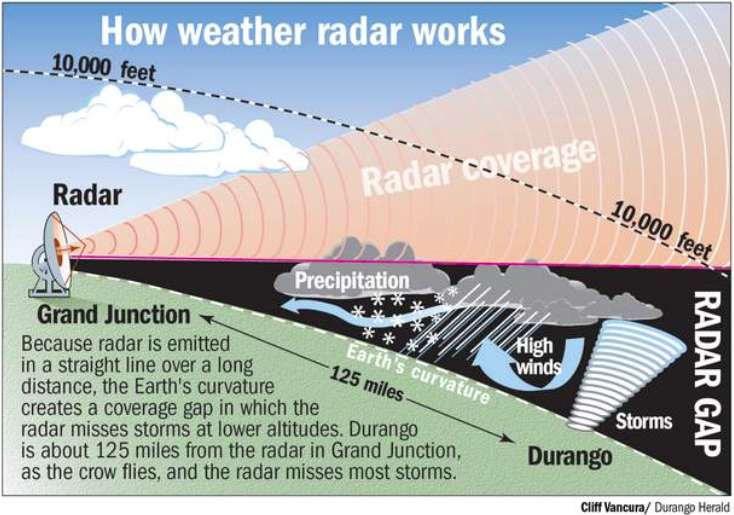
Prior to joining the state, Randall served as a staff attorney for Western Resource Advocates and for Trustees for Alaska.

He serves on multiple boards including the Colorado Mined Land Reclamation Board, Colorado Commission of Indian Affairs and the Natural Resources Damages Trustees Council.

Randall earned a bachelor’s degree from the University of Missouri and a Juris Doctor from Lewis & Clark, Northwestern School of Law.

The appointment is effective immediately.

From The Denver Business Journal (Cathy Proctor):

The department includes divisions that monitor Colorado’s mountains for avalanche danger, mining as well as oil and gas operations, parks and wildlife and the state’s water resources.

“Bob’s record of outstanding strategic decision making and his remarkable ability to work collaboratively with the diverse interests at DNR make him uniquely qualified for the job,” Hickenlooper said in his announcement.

“With 20 years of experience in the field, he [Randall] has proven to be an exemplary and committed steward of Colorado’s natural resources. We look forward to continuing the good work,” Hickenlooper said.

Randall has worked at the department since 2007, has been deputy executive director since 2010 and stepped into the lead role on an interim basis on February 1 after former director Mike King’s decision to take a job with Denver Water as that agency’s director of planning.

“I am honored and humbled by this opportunity, and am privileged to work alongside a remarkable staff of professionals throughout the entire department, the people who are at the heart of our agency’s success,” Randall said in the announcement.

“I’m excited to carry on with the important work we do to manage and protect Colorado’s natural resources for people today and those who will depend upon the legacy we leave,” Randall said.

Scientists at conference at San Juan College compare notes about #GoldKingMine spill, #AnimasRiver drainage

On April 7, the Environmental Protection Agency proposed adding the “Bonita Peak Mining District” to the National Priorities List, making it eligible for Superfund. Forty-eight mine portals and tailings piles are “under consideration” to be included. The Gold King Mine will almost certainly be on the final list, as will the nearby American Tunnel. The Mayflower Mill #4 tailings repository, just outside Silverton, is another likely candidate, given that it appears to be leaching large quantities of metals into the Animas River. What Superfund will entail for the area beyond that, and when the actual cleanup will begin, remains unclear. Eric Baker
On April 7, the Environmental Protection Agency proposed adding the “Bonita Peak Mining District” to the National Priorities List, making it eligible for Superfund. Forty-eight mine portals and tailings piles are “under consideration” to be included. The Gold King Mine will almost certainly be on the final list, as will the nearby American Tunnel. The Mayflower Mill #4 tailings repository, just outside Silverton, is another likely candidate, given that it appears to be leaching large quantities of metals into the Animas River. What Superfund will entail for the area beyond that, and when the actual cleanup will begin, remains unclear.
Eric Baker

From the NMSU News Service (Jane Moorman) via The Albuquerque Journal:

Nine months after mining sludge from the Gold King Mine turned the Animas and San Juan rivers yellow, scientists and researchers gathered here recently to share what they have learned so far regarding the contamination of the rivers from the spill in August 2015.

“Immediately during and after the Gold King Mine spill, different groups started monitoring the river water, shores and irrigation systems,” said Sam Fernald, director of the New Mexico Water Resources Research Institute at New Mexico State University.

“As they have gathered data, they realized there’s a lot of questions about the history of the watersheds, the natural state of the rivers, and the long-term impact. They immediately came up with all of these questions beyond the initial response,” Fernald said.

The conference last month at San Juan College was a time for 150 scientists from state and federal agencies, New Mexico universities, Native American tribes and numerous cities and counties to exchange information from their early stages of research.

While the spill sparked fear among those whose livelihood depends on the water, it has proven to be a once-in-a-lifetime opportunity for the scientists.

“This was a historic event,” said Kevin Lombard, a horticulturalist stationed at NMSU’s Agricultural Science Center at Farmington who is conducting two studies regarding the impact of the spill on the agricultural land. “We have the opportunity to record the impact of the contaminants that were in the mining sludge.”

Recording of the impact is proving to be a collaboration of researchers.

“We have a common goal of figuring out what the questions are and figuring out how to address them and how to get the information out to the public,” Fernald said.

Since the spill, the scientists have gathered data regarding river water quality before, during and after the spill; private wells accessing ground water; the impact of the water quality on the fish; and the impact of irrigated river water on the agricultural land.

The greatest challenge is the perception of health risks that the spill caused.

The early finding is that the levels of heavy metals being monitored are within federal standards. Only when rainwater increases the rivers’ water levels do the metal levels increase briefly from the riverbank contamination in Colorado.

Conference collaborators in the long-term monitoring include the state Environment Department, NMSU, UNM, New Mexico Tech, New Mexico Bureau of Geology and Mineral Resources, San Juan Soil and Water Conservation District, San Juan Watershed Group, San Juan County, the city of Aztec and the city of Farmington.

#Runoff news: Glenwood Canyon bike path closed

The Glenwood Canyon as seen from the Glenwood Canyon Bike and Hike Path. Photo via http://thewanderingchick.com.

From The Aspen Daily News:

Glenwood Canyon bike path closed due to high water
The Colorado Department of Transportation has begun its annual closure of the Glenwood Canyon bike path because of high water in the Colorado River.

The closure extends from Shoshone to the Hanging Lake rest area and from Siloam Springs to Bair Ranch, according to a CDOT statement.

“Cyclists and pedestrians can still access the path from Glenwood Springs to the Grizzly Creek rest area at this time,” the statement says. “Bair Ranch rest area to Hanging Lake rest area is currently open, but crews anticipate it will be flooded in the next few days as river flows are reporting to run around 11,000 cubic feet per second.”

During recent years with high water, sections of the bike path have been washed away completely, necessitating a large reconstruction effort.

From The Pueblo Chieftain (Chris Woodka):

The Arkansas River hit 4,000 cubic feet per second at Parkdale Monday — four times greater than one week ago — and was still rising. Advisories are in effect for the river through the Royal Gorge, Pine Creek and the Numbers. For rafting companies, that means shifting operations to other parts of the river that can be equally exciting.

Releases from Pueblo Dam have been ramped up in the last few days as well in order to match the flows coming in. On Monday, the level was increased to 4,200 cfs, and could be raised even more.

“We’ll have to look at Avondale and keep watching the flows upstream,” said Steve Witte, Water Division 2 engineer.

While the snowpack for the Upper Arkansas basin was ample because of May storms, there’s no way of knowing how fast it will melt.

Releases can be scaled back if the gauge at Avondale reaches 6,000 cfs. Flows from Fountain Creek, Chico Creek, Wild Horse Creek, the St. Charles River and other smaller tributaries must be accounted for and afternoon thunderstorms can quickly change the picture.

The high flows through Pueblo are a mixed blessing: Good for professionals, dangerous to amateurs.

“This weekend, we had hordes of people from Boulder, Denver and Grand Junction for river surfing,” said Bob Walker, who owns The Edge Ski, Paddle and Pack store. “When the waves come up, everybody comes in.”

It may look like fun, but those experts have whitewater-rated equipment and training, he said.

“The river is no place for inflatable toys. Kayakers can do well. River surfers stay in one place and can quickly get out of the main current so they don’t get swept down the river,” he said. “People may think they are good swimmers until they hit 55-degree water with a current.”

At least one person drowned in the Arkansas River last year, before it was closed to boating in Pueblo County during several weeks of prolonged high flows. In 2014, there were eight drownings.

It’s also a good time to get out on the lakes in a boat. Lake Pueblo and John Martin Reservoir water levels remain high, still swollen from last year’s rain and topped off by wet conditions so far this year.

From The Grand Junction Daily Sentinel:

Glenwood bike path closed for high water

High Colorado River water levels due to spring runoff have forced the partial closure of the bike path in Glenwood Canyon east of Glenwood Springs.

The Colorado Department of Transportation said Monday it has closed portions of the path from the Shoshone Interstate 70 exit to the Hanging Lake rest area and from Siloam Springs at the canyon’s east end to the Bair Ranch rest area.

Walkers and bikers can continue to travel on the path from Glenwood Springs to the Grizzly Creek rest area. It’s also still open from Bair Ranch to Hanging Lake, but that stretch is expected to be flooded and close in the coming days as the river continues to rise.

The latest information on the path’s status can be found by visiting http://www.cotrip.org and clicking on the Statewide Alert tab.

From Aspen Public Radio (Elise Thatcher):

Rivers in the area are expected to hit peak flows in the next few weeks and the Garfield County Sheriff’s Office is one of several agencies warning residents to be careful when recreating in the water.

The sheriff’s office said late last week that inexperienced rafters are a big concern, and the Colorado River can often be deceiving.

“Coming from the Shoshone water plant down through Grizzly Creek is probably one of the most treacherous areas we have,” explained sheriff’s office spokesman Walt Stowe. “There’s a lot of real fast water there [and] lots of large rocks in the river.”

Ritschard Dam rehab plans canceled — The Sky-Hi Daily News

Wolford Mountain Reservoir

From The Sky-Hi Daily News (Lance Maggart):

Ritschard Dam is settling but despite concerns plans for remediation have been halted, with local officials explaining a recent expert review of the dam’s structural viability left them feeling more confident about the long term prospects for the barrier.

Ritschard Dam is an earthen dam north of Kremmling. It was constructed in 1995 and since then officials from the Colorado River District have nervously watched as the structure slowly settled and shifted. While officials have been quick to point out the dam poses no safety risks, and has not been placed under operational restrictions, for the past several years ongoing research and discussions have revolved around what needs to be done to stop the settling process.

During a State of the River meeting held at Mountain Parks Electric in late May officials discussed the current state of the dam and new plans the Colorado River District has to monitor movement in the dam and conduct minor rehabilitation work.

THE RUB

John Currier, Chief Engineer for the Colorado River District, spoke to attendees at the State of the River meeting specifically about Ritschard Dam. “All embankment dams settle,” Currier said. “But designers anticipate how much a dam ‘should’ settle. This dam embankment is 140 feet high. It ought to settle about one foot.”

Currier went on to explain how, in 2009, the River District realized the dam had settled more than one foot by that point, reaching close to 1.5 feet of settlement as well as a slight bow in the center of the dam downstream. The dam continues to settle, at it’s highest points, at a rate of about one inch per year. The center of the dam has, thus far, bowed approximately eight inches downstream.

“We decided we ought to get to the bottom of this and find out why it settled more than anticipated,” Currier said.

Over the intervening years the Colorado River District spent close to $1.5 million on instrumentation and analysis of Ritschard Dam, as officials worked to develop a plan to rehab the structure. Officials discovered the additional settlement of Ritschard was caused by a lack of consolidation in both the upstream and downstream shelves, which hold the true core of the dam.

After officials from the River District determined a cause for the settlement of Ritschard they began considering fixes, which were estimated to cost in the $20 million range.

EXPERT ANALYSIS

“At that time we said, ‘let’s employ an expert peer review panel to kind of look over our shoulders, to look over our engineers shoulders and make sure we are doing the right thing’.” Currier said. “The experts came back and told us, ‘we are not sure you need to do anything’.”

Currier explained the team of experts, made up of former engineers from the Federal Bureau of Reclamation, told the River District that while they may not be happy with the continued settling of the dam the settlement alone doesn’t necessarily pose a significant risk. “They told us, ‘you understand the problem. What is the risk associated with the problem?” Currier said. “We started looking at it probabilistically as opposed to deterministically.”

Officials from the River District then began looking at probabilities, such as the probability of an overtopping flood on Ritschard and the likelihood of a full dam failure. An overtopping flood would require more than 80,000 cubic feet per second (cfs) of water flowing into Wolford Mountain Reservoir from the surrounding area, and even that amount of water would not necessarily overtop the dam, with the emergency spillway filling with excess water. Officials said the chance of such a scenario happening in any given year is roughly one chance in a million.

“The odds of having a dam failure, associated with ongoing movement of the dam; as a practical matter is essentially nonexistent,” Currier said. Currier went on to say that the River District now believes there is no technically demanding reason to conduct a full rehabilitation project on Ritschard.

MOVING FORWARD

The River District still has plans to restore the crest of the dam and bring it back to its original height. They will also continue to monitor Ritschard closely for continued settlement, which is expected. Currier said the River District will periodically reassess their position on Ritschard. “We will go back through a risk analysis process…maybe every five years or so.”

“The last chapter is yet to be written in this book,” Currier said. “But for the time being we have gone back to operating the reservoir full. The dam poses no real hazards to anyone.”

NRDC: 6 Ways You Can Help Keep Our Water Clean

COE-Trash-splash logo-toilet

From the Natural Resources Defense Council (Andrew Postman):

Simply by going about your daily routines—using cleaning products, walking the dog—you might be unknowingly contributing to the pollution of our already struggling waterways. Luckily, there are a few incredibly easy ways to reduce your impact.

1. Take a hard look at your outdoor surfaces.

Stormwater flows across hard materials, like concrete or asphalt, and into storm drains—bringing all the dirty stuff it picked up along the way. Stop these pollution streams on your own property by using gravel, paver stones, wood, or other porous materials whenever possible. If a hard surface is unavoidable (say, in the case of a driveway), dig a shallow trench along the border and add plants or gravel to catch the runoff before it travels too far.

2. Remember, your toilet is not a trash can.

Never flush nondegradable products, like baby wipes or plastic tampon applicators. They can throw a huge wrench into the sewage treatment process and wind up littering beaches and water. (Who wants to walk along a beach and step in their own garbage?) And never dump old pills in the toilet, either. Instead, bring them to a local pharmacy that has a take-back program.

3. And neither is your sink.

Don’t let paint, used oil, chemical cleaners, or other questionable household products go down the drain. These items contain toxic ingredients (think sodium hypochlorite, ammonia, formaldehyde) we don’t want in our water supply. To find out about hazardous-waste collection days and facilities, search by product on Earth911 or contact your local sanitation, public works, or environmental health department.

4. Pick up after Fido.

You’re not just being a good neighbor. Scooping up pet waste keeps that bacteria-laden crap (literally) from running into storm drains and water supplies. The most practical of the planet-friendly disposal methods is to tie it in a recycled-plastic pet-waste bag and throw it in the trash, but check your local ordinances.

5. Be a more careful car owner.

Good maintenance can reduce the leaking of oil, coolant, antifreeze, and other nasty liquids that are carried by rainwater down driveways or through parking lots and then seep into groundwater supplies. Go a step further by always choosing a car wash over hosing down your ride yourself. The pros are required to drain their wastewater into sewer systems, where the water is treated for all the bad stuff before being discharged. Many even recycle that water.

6. Dish the dirt(y water).

Without tattletales, polluters will just keep on keeping on. If you see suspect behavior in your community, get hooked up with a local environmental group that can help by contacting the Clean Water Network or Waterkeeper Alliance. When small organizations work with bigger ones (e.g., the U.S. Environmental Protection Agency, NRDC) to force industries to follow the rules, real change can happen. (And it feels pretty darn good.)

Hundreds of boaters raft Dolores for first time in four years — The Cortez Journal

From The Cortez Journal (Jim Mimiaga):

Over the weekend, hundreds of boaters took advantage of a three-day whitewater release on the Dolores River below McPhee dam, the first in four years.

Reservoir managers said Sunday, the minimum rafting flows will continue until at least Tuesday, June 7.

The weekend whitewater release was announced last week on short notice, and within hours, the boat ramps at Bradfield Bridge and Dove Creek Pumphouse began filling up local boaters and their brightly colored rafts, kayaks, canoes and dories…

Friday morning, a parade of boats disappeared into the sunny Ponderosa Gorge, the first leg of 97-mile stretch to Slick Rock that features rapids, camp spots, remote hiking and spectacular scenery.

Bears roamed the shorelines and campsites, and were startled by the sudden presence of humans. River otters swam among boaters, and desert big horn sheep looked on from above.

A new rock fall in the river at mile-marker 17.2 can be skirted river left.

Dolores River watershed

Loveland’s waterways are soaked in history — Loveland Reporter-Herald

Lake Loveland
Lake Loveland

Here’s a guest column from Olivia Lowe writing for the Loveland Reporter Herald. Here’s an excerpt:

For a few months now people, including my husband, have asked me to do a story about Loveland’s pioneer ditches.

They wanted to know how many, how old, how long and any other odd tidbits of information I could find. Once I started the research I was both fascinated and overwhelmed. At one point I decided to scrap the story because water is not only contentious, but it is complicated as well. I also came to the conclusion that volumes of books and essays have been written on the subject for a reason, because there is no way it can be covered in one 700-word column. And yet, here it is, a column about ditches. That said, I have pared it down to the bits I found most interesting.

There are currently nine ditches, three ditch exchanges, plus what are known as lateral and transfer ditches, pulling water out of the Big Thompson River in the Loveland area.

Start with the Handy Ditch, which is first in line but not first in priority. Its headgate is situated just south of Sylvan Dam. To the east and last in line is the Hillsborough Ditch at County Road 9 between East First Street and Colo. 402. Loveland’s seven other ditches lie in between…

Back in 1893 we had a grand total of three ditches. The Big Thompson Ditch was decreed in 1861, the Mariano, later named Home Supply, was next in May of 1863. One month later, Farmers Ditch was decreed. The Old Barnes Ditch came next in 1865. It was named after David Barnes, which is odd because Mr. Barnes and his wife Sarah did not homestead here until 1870. The Chubbuck Ditch, also known as the English Ditch and later named the Loveland & Greeley Ditch, was decreed in November 1865. This meandering waterway runs along First Street for a bit and then bends north up to Boyd Lake, where it leans to the east and heads toward Greeley…

If you do not plan on using your appropriated water right away, then you will need to dig a basin to hold it. Loveland’s first reservoir was dug in 1883. Today it goes by Donath Lake, but I have also heard it referred to as Dykeman Reservoir. Next was Mariano decreed in 1888. Later called Home Supply Reservoir and known to us all now as Boedecker Lake.

Lake Loveland is also a reservoir. The farmers decided that rather than allowing excess water to float away forever, they could hold some in reserve for the late-summer crops. Prior to its official decree in 1883 it was 145 acres of stagnant and shallow water; five feet of summer stink hemmed in by a sandstone ridge. Hayes Lake, as it was called, was determined to be the perfect fit for a reservoir. By enlarging Barnes Ditch for a distance of two miles from its head (about a mile west of Wilson Avenue and U.S. 34) to the lake, they could increase its capacity to 146 acres with a water depth of 46½ feet.

EPA: Home Drinking Water Filtration Fact Sheet

Photo via http://wholehousewatersystem.com

Click here to read the fact sheet. Here’s an excerpt:

Home Water Treatment Facts

Americans spend billions of dollars each year on home water treatment units.According to theWater Quality Association, more than four out of 10 Americans use a home water treatment unit.These units range from simple pitchers costing less than $20 to sophisticated reverse osmosis units costing hundreds of dollars.

Some people use a home water treatment unit to improve the taste of their tap water. Others treat their water because of health concerns.While EPA does not endorse specific units, the Agency does set and enforce national standards for the tap water provided by public water systems.

Drinking water can reasonably be expected to contain at least small amounts of some contaminants.As long as those contaminants are at levels no higher than EPA standards, the water is considered safe to drink for healthy people. People with severely weakened immune systems or other specific health conditions, or those concerned about specific contaminants present in local drinking water, may wish to further treat their water at home or purchase high quality bottled water.

Before purchasing a home water treatment unit, consider local water quality, cost and maintenance of the unit, product performance, and certifications to make sure that the unit will meet your needs.

#Runoff news: Bureau of Reclamation increases water releases at Lake Estes — Loveland Reporter-Herald

Olympus Dam photo via the US Bureau of Reclamation.

From the US Bureau of Reclamation (Peter Soeth) via the Loveland Reporter-Herald:

With the warmer weather and more snow melting, runoff is increasing, according to the Bureau of Reclamation.

In a press release Sunday, a Reclamation spokesman said the agency planned to increase releases from Olympus Dam in Estes Park on Sunday from 125 cubic feet per second to 175 cfs.

“Please be safe around the river,” spokesman Peter Soeth said.

The dam at Lake Estes is part of the Colorado-Big Thompson Project.

For updates on water releases from the dam, visit http://www.facebook.com/LakeEstesandOlyDam.

City of Rifle bans outdoor watering

Rifle Gap Reservoir via the Applegate Group

From The Grand Junction Daily Sentinel (Erin McIntyre):

Problems with the city of Rifle’s water treatment system have led officials to ban outdoor watering for at least the next few days.

The announcement came in the middle of the first heat wave of summer, with 90-degree highs forecast through Tuesday by the National Weather Service.

The city asked its 9,700 customers to curb their water use as much as possible, and prohibited any outdoor use of water, forcing businesses such as car washes to shut down until the problem is fixed.

Utilities Director Jim Miller said Rifle law enforcement officers were tasked with reminding residents not to water outdoors, temporarily policing water use.

Though residents with wells or irrigation water from ditches were not included in the ban, use of potable drinking water from the municipal system is prohibited until further notice. Residents were notified to stop watering outside with a reverse 911 phone call.

The problems started on June 1, when a supply line that provided water from the Colorado River to the main pump station broke. The 14-inch water line, which runs under railroad tracks and a state highway, had a major leak that was resolved by the following morning, Miller said.

But what transpired was a bigger problem — the initial leak put stress on the pump station that brings the water from the supply line to the Graham Mesa treatment plant, and all of the check valves broke, causing the malfunction.

Though the city has a second, smaller treatment plant and pump station on Beaver Creek, located on Taughenbaugh Mesa, its capacity provides only roughly 10 percent of what the system demands, Miller said.

Right now officials are trying to resolve the situation by hooking up a temporary pumping system to feed the Graham Mesa treatment plant.

Miller encouraged residents to conserve water indoors as well as refraining from watering outside.

“Everyone should curb their water use,” he said. “People need to take this seriously because it’s what delivers water to most of the city of Rifle.”

Residents will be notified when the watering restrictions have been lifted, on the city’s website (http://www.rifleco.org) and via reverse 911 phone calls, Miller said.