
Day: August 31, 2016
Labor Day the Denver Water way
#COWaterPlan: The 11th Annual Sustaining #Colorado Watersheds Conference is just around the corner!

Click here for all the inside skinny. From the website:
The 11th Annual
SUSTAINING COLORADO WATERSHEDS CONFERENCE
is just around the corner!
When: October 11–13, 2016Where: Westin Riverfront Resort, Avon, Colorado
This years 2nd plenary session is focused on
MOVING FROM PLAN INTO ACTION.
Plenary moderator Anne Castle, former Interior Department Assistant Secretary for Water and Science, now Senior Fellow with the Getches-Wilkinson Center for Natural Resources, Energy, and the Environment, will lead this discussion on implementation of the Colorado Water Plan. John Stulp, Governor’s Water Policy Advisor, will be participating in this panel along with industry experts Ted Kowalski, Peter Nichols, and Julio Iturreria. Topics include integrated land and water planning, alternative transfer methods and water banks, creative funding schemes and philanthropic roles in statewide water projects.
Our annual conference expands cooperation and collaboration throughout Colorado in natural resource conservation, protection, and enhancement by informing participants about new issues and innovative projects. In 2016, the conference will focus on what is needed to help ensure long-term sustainability for river health, public education, and organizational management.
To learn more and to register go to the Colorado Watershed Assembly Website.
Fountain Creek stormwater mitigation update
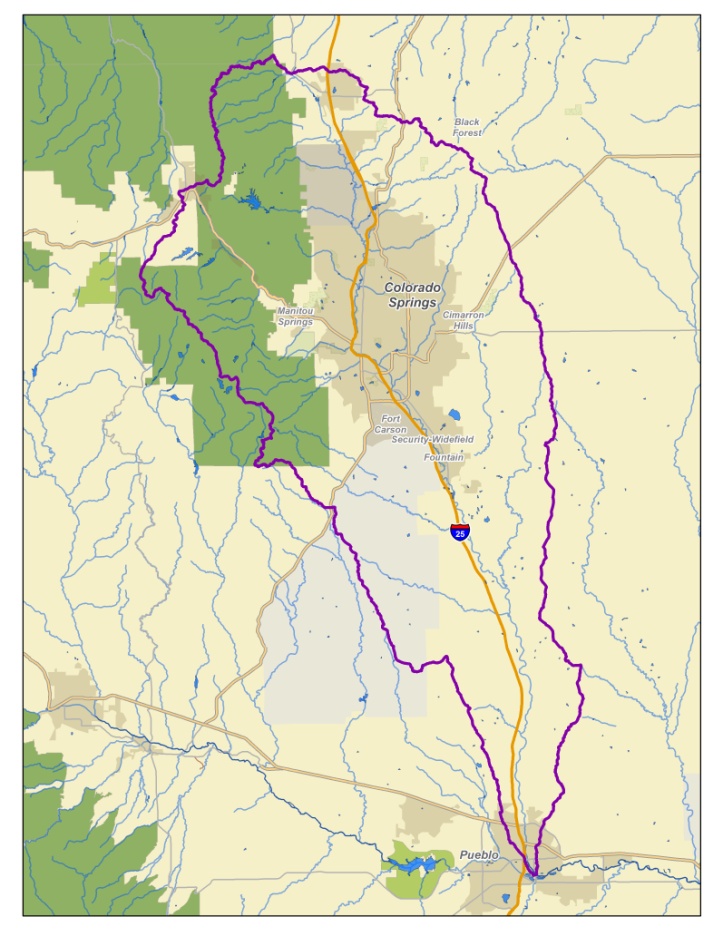
From The Colorado Springs Independent (Pam Zubeck):
While the [Fountain Creek Watershed Drainage, Flood Control and Greenway District] has limped along for seven years with more hopes than funding, now it’s flexing some muscle after an injection of $10 million from Colorado Springs Utilities. It was the first of five such payments through 2020 that are part of the city’s deal with Pueblo County for the city’s Southern Delivery System pipeline from Pueblo Reservoir, completed in April.
But so much needs to be done that the money quickly will be absorbed into a long list of projects, leaving the district, again, penniless.
“What we’re going to find out is that $50 million is much less than what we need for that project list,” says district executive director Larry Small, former Springs vice mayor.
The district has conducted a host of studies over the years and done a few projects, including sediment reduction near the confluence of Fountain Creek and the Arkansas River east of downtown Pueblo. Thus far, its projects have been largely funded through grants from such agencies as the Colorado Water Conservation Board.
Now, with the Utilities money, it wants to take on the herculean task of trying to reshape the creek.
First up is a bank restoration project along the Masciantonio Trust farm just south of the El Paso County-Pueblo County line where, over the years, the creek’s rushing waters have carved away a massive amount of land, leaving sand bars behind and sending tons of sediment down the creek every year.
“The creek has seriously eroded the bank there,” Small says. “It’s taken 12 acres of farm land.”
The project’s engineering study was launched in July, and a construction contract will be awarded next year, he says, with a budget of $2.5 million.
It’s unclear if the project actually will restore those 12 acres, because that would require a huge amount of fill material, Small says.
“We are looking at an option to restore the creek to the 1955 channel,” he says, “but we have to figure out how to deal with the hole that would leave behind the wall we would have to build.”
The problem, he adds, is that Young’s Hollow flows into the creek at that point and can carry a water flow of up to 6,000 cubic feet per second during heavy storms, so the creek has to be equipped to handle that volume.
“This is a challenge,” he says.
Two more projects for the farm also are planned, he says, noting, “That whole 4-mile stretch is seriously eroded.”
Another project will assess stability and sediment along the entire 51 miles of the creek from Colorado Springs to its confluence with the Arkansas.
“That’s going to generate a project list where we need to do bank restoration,” Small says. Started in May this year, the study will wind up in March and be followed by an evaluation of flood control alternatives, which includes a dam.
That study, also started in May, will address how much land would be required, how a dam would function, what property the district would need to acquire and what permitting processes would be necessary, among other things.
This month, the district began compiling a drainage criteria manual, which will enable the board to evaluate development that takes place within the district and recommend requirements to the jurisdictions at issue, such as city of Fountain, city of Colorado Springs, Pueblo County or El Paso County.
So as Small says, the district has quickly picked up the pace this year.
“As I told some people recently, on May 31, I had one project, and on June 1, I had five projects,” he says.
The biggest single project undertaken by the district so far is dredging the levees east of Pueblo at a total cost of $5.25 million. Funded with additional money from Springs Utilities, Pueblo County and Pueblo’s stormwater enterprise fund, the project will be overseen by the Fountain Creek district, which also will loan $1.25 million to Pueblo to be repaid in 2018, Small says.
The project will begin this year — the district hopes to let the contract this fall — and be finished next year, if all parties sign off on the plan, which is expected, he says. The dredging will start at 18th Street and extend to the creek’s confluence with the river. The job will include removing vegetation and two railroad piers that act as debris traps.
The source of money for projects when the $50 million from Springs Utilities runs out isn’t clear. Small says the board, in coming years, will start researching a ballot measure for a property tax to fund the district. Even after all the projects are built, money will be needed for maintenance, he says.
The district covers all of El Paso and Pueblo counties. One mill would generate roughly $6.85 million from El Paso County taxpayers and $1.6 million from Pueblo County taxpayers, for a total of about $8.5 million a year. (Assessed value of property in El Paso County totals $6.85 billion, and in Pueblo County, $1.66 billion.)
About $8 million a year is a lot for a district that’s never spent more than $480,000 in any single year so far and relied on grants from various agencies and member contributions from Green Mountain Falls, Palmer Lake, Manitou Springs, Fountain, Colorado Springs, Pueblo, El Paso County and Pueblo County.
Any infusion of cash, though, is subject to revenue limits imposed by the Taxpayer’s Bill of Rights, so in early 2015 the district created a companion agency, the Fountain Creek Watershed Water Activity Enterprise. The enterprise is exempt from TABOR revenue caps, Small says, as long as less than 10 percent of its funding comes from state and local grants. The $10 million annual payments for five years from Utilities are not considered grants, he says.
But the Utilities’ payments, while large, won’t fix all the creek’s problems, says Greg Lauer, Fountain city councilor and district board member.
“When you look at the substantial need for projects and maintenance, these numbers barely scratch the surface,” he says. Lauer predicts the board will begin discussing a tax measure next year, though it’s unlikely it would appear on the 2017 ballot.
For one thing, he notes, the board needs “legal clarification.” For example, would a tax measure approved by voters in El Paso County but not in Pueblo County result in the tax being applied only in El Paso County, or would it be considered defeated? Would a tax approved by a majority of voters, regardless of their place of residency, result in it being added to the tax rolls in both counties?
Regardless, Lauer says it’s hard to argue against ongoing funding when the board is reminded regularly by landowners along the creek about flood damage.
For now, though, the board is eager to get long-awaited projects underway with the money it has.
“We are so beyond excited,” Lauer says. “It’s been a long time coming.”
Weekly Climate, Water and #Drought Assessment of the Upper #ColoradoRiver Basin #COriver
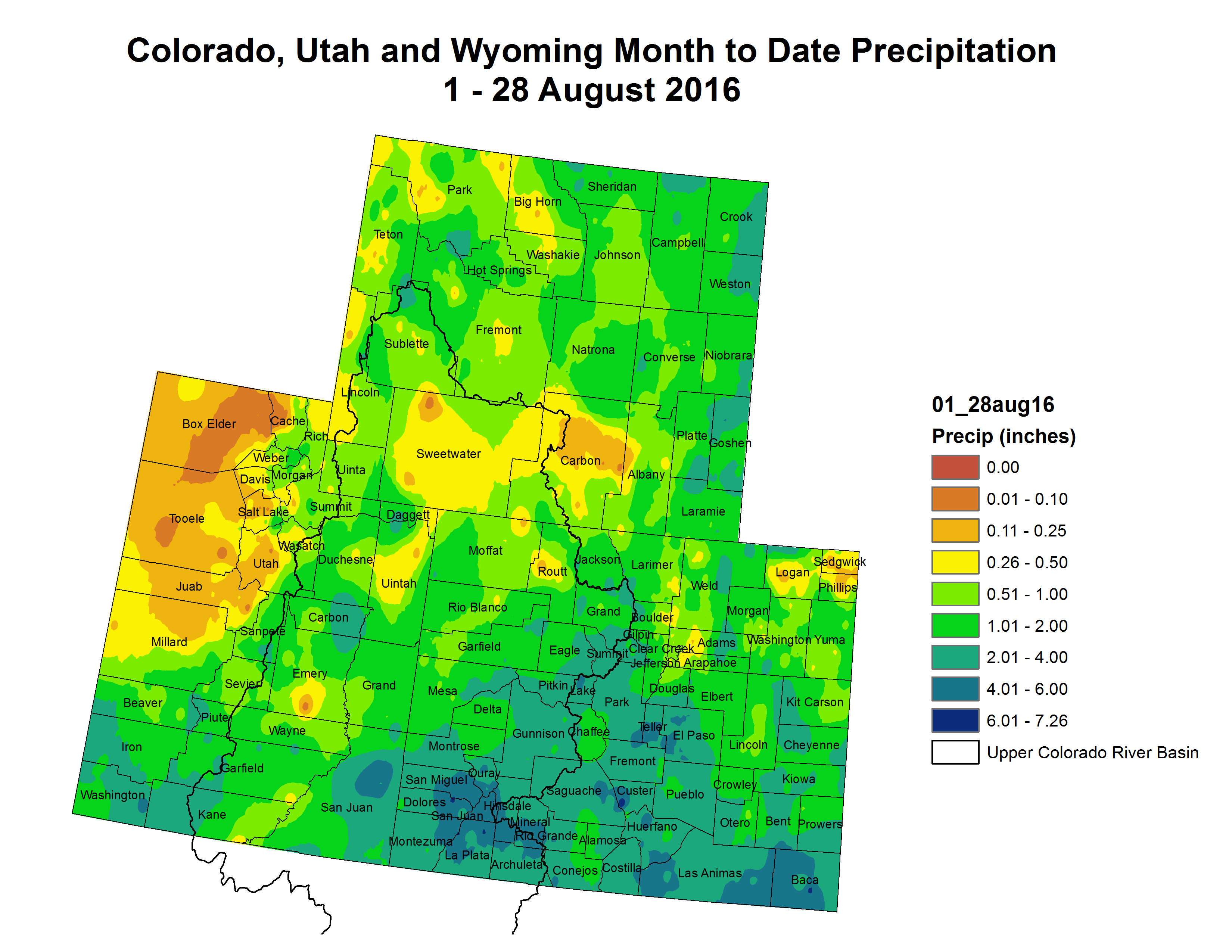
Click here to read the current assessment. Click here to go to the NIDIS website hosted by the Colorado Climate Center.
Colorado Water Congress’s 2016 Summer Conference recap
From The Colorado Independent (Marianne Goodland):
Coloradans are more concerned about water quality than about water supplies, and their awareness of the state’s looming water shortage has fallen sharply in the past three years.
Those findings are from a statewide survey on consumer attitudes about water by pollster Floyd Ciruli. The survey was commissioned by the Colorado Water Congress and the Colorado Water Conservation Board, and conducted in June with 712 respondents. Ciruli discussed the results with the General Assembly’s interim water resources review committee, which met at the Water Congress’s summer conference last week.
Ciruli compared Coloradans’ current viewpoints about water to the results of a 2013 survey. Given the state’s rampant growth and looming water shortage, the results didn’t look encouraging.
Coloradans are less concerned about whether the state will have an adequate water supply than they were three years ago. In 2013, 62 percent said they expected an eventual water shortage in the state. This year, only 53 percent shared that view. The percentage of Coloradans who think the state needs to store more water is also down from 59 percent three years ago to 50 percent this year.
The public’s diminished interest in adequate water supplies could not come at a worse time. After a two-year planning effort, Colorado water leaders are preparing for the state’s water future – a future with less water and more people. A 2010 estimate says the state will be short 326 billion gallons of water annually by the year 2050, when the state’s population is expected to nearly double from 5.4 million to 10.3 million residents. About 100,000 people are moving to Colorado every year.
Every conversation about water should start with conservation, Gov. John Hickenlooper likes to say. But what the survey shows about public interest indicates most people aren’t yet listening.
More than half of Coloradans surveyed believe their water suppliers are doing a good job encouraging water conservation, but there’s room for improvement, the survey found. More Coloradans believe that conservation alone will solve Colorado’s water shortage than three years ago, although it’s a small group – 14 percent this year compared to 10 percent in 2013.
Most Coloradans, however, believe it will take a combination of water storage and conservation to solve the shortage, although fewer believe that now than in 2013.The survey also gauged what people know about the Colorado Water Plan – the state’s first blueprint for water planning. The 540-page plan reports that Colorado will be short one-million acre-feet of water annually by 2050. It calls for conservation measures that would help close that gap by 400,000 acre-feet, a goal primarily tasked to water utilities and other water providers…
The state plan also calls for gleaning another 400,000 acre-feet in water storage, either by improving existing dams and reservoirs or building new ones. Several projects are already under way. They include an expansion of Gross Reservoir in Boulder County, which would triple its existing capacity of 41,000 acre-feet, and the Northern Integrated Supply Project, which would capture another 40,000 acre-feet of water that currently flows downstream to Nebraska, exceeding what’s required under a multi-state contract.
The state water plan was was ordered by Hickenlooper under an executive order in 2013, with a two-year window for completion. But the plan has been criticized for being less of a plan than a snapshot of where Colorado stood on water supplies last year, and more of a compendium of ideas than specific solutions to Colorado’s water woes in an era of growth, drought and climate change.
Some water experts claim that the plan, completed last November, is already gathering dust and isn’t moving fast enough.
Dennis Saffell, a real estate broker in Summit and Grand counties, penned an editorial in June that took the General Assembly to task for failing to address key recommendations in the plan, such as conservation and funding for healthy rivers.
“With so much at stake, it is essential that the plan be implemented to build on the momentum and interest generated during its development,” Saffell wrote. He was among the 30,000 Coloradans who submitted comments on the water plan during its two-year development. “The only difficulty now is lack of engagement — letting the plan just sit — and unfortunately that’s what is occurring,” he wrote.
The legislature did pass a bill this year to put $5 million annually into implementation of the plan, although the bill wasn’t specific about just what that $5 million would be spent on. That’s left to the Colorado Water Conservation Board, which developed the plan in conjunction with nine state-directed water groups that focus on a variety of water issue.
The Ciruli survey found that very few of those polled are aware of the state water plan. Of those who were, only 4 percent knew a lot about the plan. Another 15 percent said they’d heard of it. For the rest, the plan is a mystery.
Coloradans strongly support keeping the state’s water in Colorado, the survey found. Eighty-nine percent agreed that the state should hang onto all the water it’s legally entitled to. Most respondents also were supportive of improving water conservation and building more storage, so long as it doesn’t impact the environment.
Those surveyed also responded favorably to the idea of a ballot measure in 2018 that would fund small and large storage, reuse projects and conservation programs. Coloradans were most supportive of funding long-term planning, improving water conservation programs, enhancing river habitat and developing “new water supplies,” and somewhat less enthusiastic about building new water storage…
Ciruli countered that, for most people, storage is a commonly-understood term. It’s even used in polling for environmentally-oriented groups, he noted…
Western Slope residents are concerned that the Colorado is already diverting more water than it could supply. The issue is radically different for the South Platte, which has been sending a million acre-feet of water to Nebraska each year for some time.
Respondents ranked conservation, water quality and water pollution as the top three water issues facing the state. Ciruli said the pollution issue has received greater attention in the past year due to the Gold King Mine spill in the Animas River near Durango, as well as national attention to the lead contamination in the Flint, Michigan drinking water supply. Water storage dropped from being the second most important issue in 2013 to fourth in this year’s survey.
There was tremendous support for conservation and considerable support for reuse, Ciruli said, “but the lynchpin is that respondents favored the state making a commitment to infrastructure,” in this case, water infrastructure.
The public is conscious about water and concerned about it, Ciruli said, but they want local providers to do something about it. “There’s momentum, but the public would be ill-served and not happy if the plan just goes on the shelf” and doesn’t address the problems, such as storage or maintaining agriculture, for example.
“People are ready” for the state to move on with implementing the water plan, he said.