The health of our waters is the principal measure of how we live on the land — Luna Leopold
#ColoradoRiver Compact Commission in Santa Fe, November 24, 1922 — @USBR #COriver
On this day in 1922, Federal and State representatives met for the Colorado River Compact Commission in Santa Fe, New Mexico. Among the attendees were Arthur P. Davis, Director of Reclamation Service, and Herbert Hoover, who at the time, was the Secretary of Commerce. Photo taken November 24, 1922. USBR photo.
The compact was the fruit of several years of negotiations among the states. The seven states had previously formed the League of the Southwest in 1917 to promote development along the river. In 1921, Congress authorized the states to enter into a compact for allocation of the river resources. The agreement was approved by Congress in 1922, the same year it was signed. Colorado River Compact was signed by the delegates from the seven Colorado River Basin states: Wyoming, Colorado, Utah and New Mexico were designated Upper Basin states and California, Arizona and Nevada as the Lower Basin states. This compact determined that the water would be shared equally among the upper and lower basin states. Prior to the compact, the name of the river was standardized along its length. Previously the portion of the river upstream from its confluence with the Green River had been known locally as the “Grand River”. The change was opposed by many local residents in Utah and Colorado, and the new name was enforced locally by acts of the state legislatures in both states in the early 1920s. One of the major concerns both today and back in the 1920’s was the expanding population, and this increased the demand for water, particularly in California. In more recent years, mainly because of Las Vegas, Nevada has been looking for more use of the Colorado River.
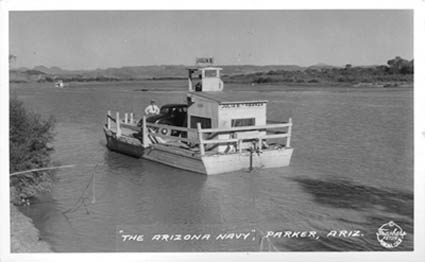
Arizona Navy photo via California State University
In 1934, Arizona, unhappy with California’s decision to dam and divert the river, called out the National Guard and even commissioned a two boat “navy.” The matter was eventually settled in court.
The agreement was controversial even at the time, however. Arizona, for example, was dissatisfied with the lower basin allotment and refused to ratify the agreement until 1944.[7] The specific allotments were disputed by Arizona until the United States Supreme Court upheld the amount in the 1963 decision in Arizona v. California. The agreement ended many years of dispute, clearing the way for the Central Arizona Project, authorized by Congress in 1968.
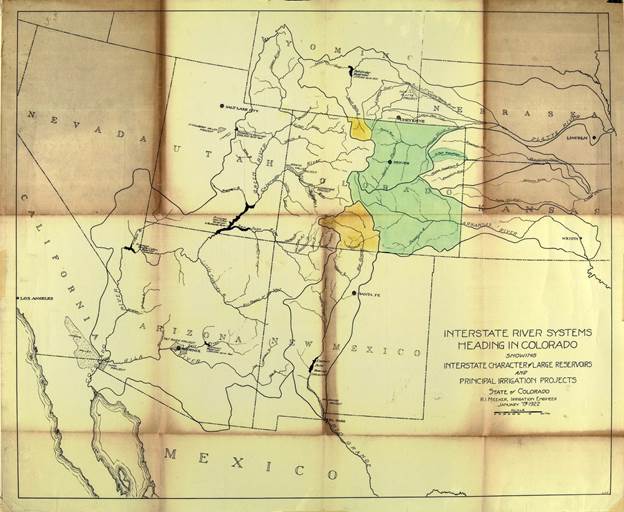
Delph Carpenter’s 1922 Colorado River Basin map with Lake Mead and Lake Powell