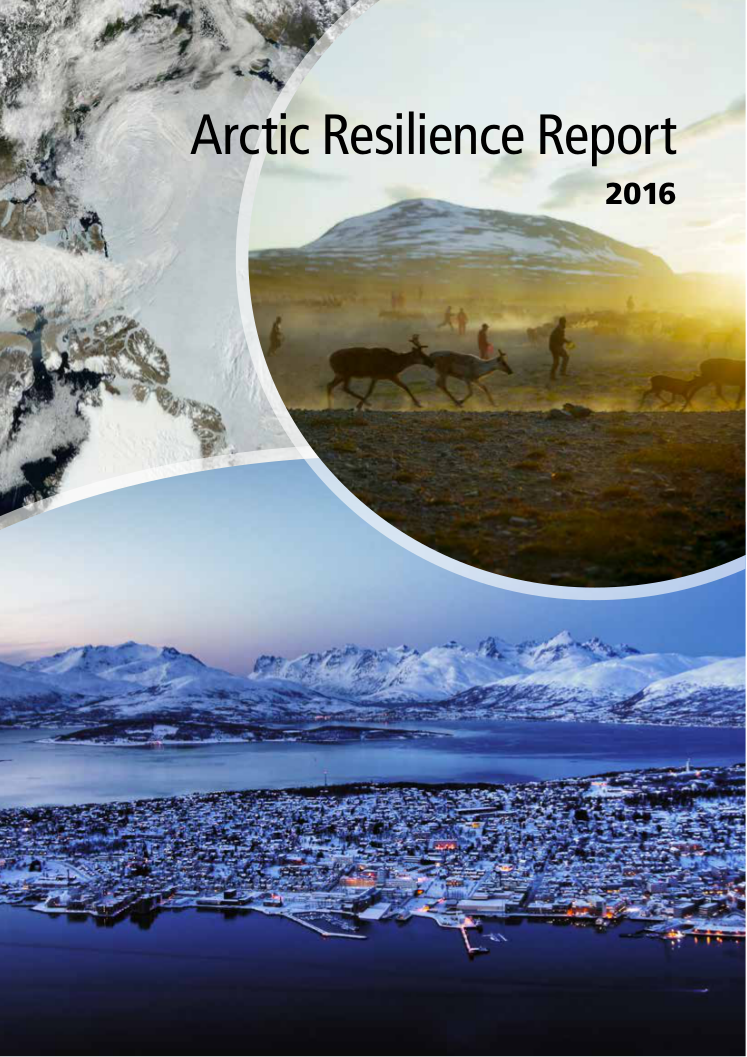
Click here to download the report. Here’s the forward:
Life in the Arctic has always been de ned by change and uncertainty. The seasons transform the landscape, the weather is unpredictable, and conditions can shift abruptly, sometimes dangerously. Yet the Arctic is now changing at an unprecedented pace, on multiple levels, in ways that fundamentally a affect both people and ecosystems.
This report is the culmination of a ve-year e ort to better understand the nature of Arctic change, including critical tipping points, as well as the factors that support resilience, and the kinds of choices that strengthen adaptive capacity. Because local changes are nested in larger-scale processes, it is especially important that interactions across scales are better understood.
Resilience features prominently in three major international agreements reached in 2015: the Sustainable Development Goals, the Paris Agreement on climate change, and the Sendai Framework for Disaster Risk Reduction. The Paris Agreement alone mentions resilience six times, recognizing that climate change impacts already in the pipeline will require both humans and nature to adapt.
The changes happening in the Arctic today are driven primarily by external factors. Climate change is the most pervasive and powerful driver of change, but many other environmental changes are taking place as well, alongside rapid social and economic developments. In some contexts, factors such as resource demand, transportation needs, migration, geopolitical changes and globalization are making the greatest impact on the Arctic. Indeed, many Arctic social-ecological systems face multiple stressors at once.
Slowing Arctic change and building resilience are thus crucial for the people and ecosystems of the Arctic – but the report also highlights the stakes for the world as a whole. Arctic social and biophysical systems are deeply intertwined with our planet’s social and biophysical systems, so rapid, dramatic and unexpected changes in this sensitive region are likely to be felt elsewhere. As we are often reminded, what happens in the Arctic doesn’t stay in the Arctic.
The Arctic Resilience Report is the final output of a process set in motion at the start of the Swedish Chairmanship of the Arctic Council (2011–2013). The project has been led by the Stockholm Environment Institute and the Stockholm Resilience Centre, in collaboration with the Resilience Alliance. It has been pursued in consultation with Arctic countries and Indigenous Peoples, and has included collaboration with several Arctic scientific organizations.
An integral part of the assessment is to identify policy and management options that may be needed for strengthening resilience, for adaptation, and for transformational change when this is necessary. We hope this work will inform, inspire and lay the groundwork for collaborative action.