
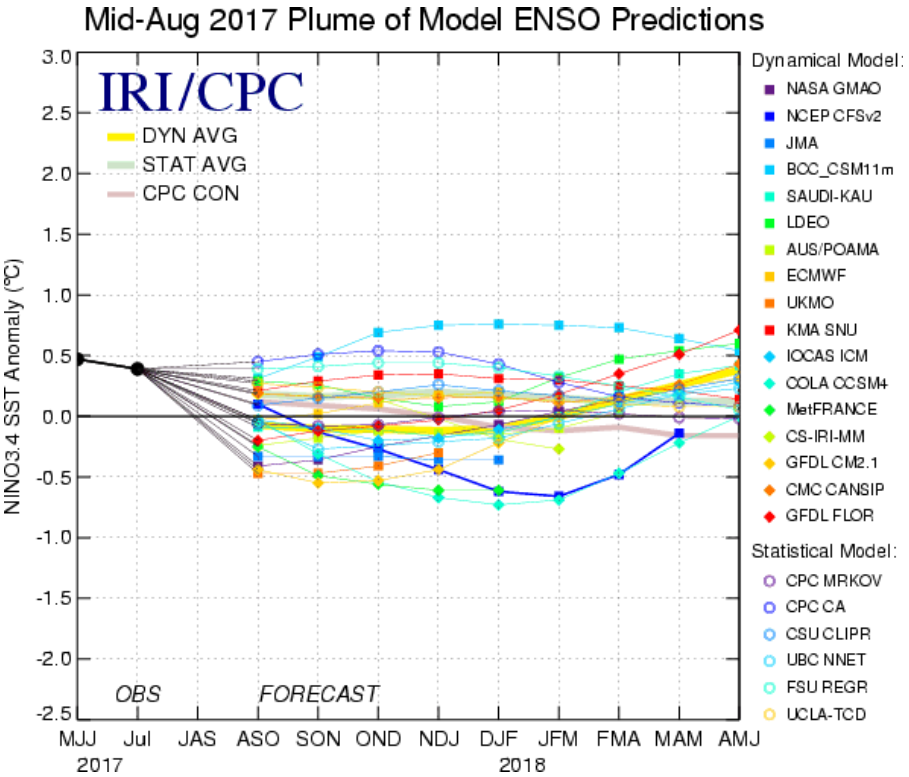
The latest #ENSO discussion is hot off the presses from the Climate Predication Center

Click here to read the discussion and to check out the graphics.

ENSO Alert System Status: La Niña Watch

Synopsis: There is an increasing chance (~55-60%) of La Niña during the Northern Hemisphere fall and winter 2017-18.

Over the last month, equatorial sea surface temperatures (SSTs) were near-to-below average across the central and eastern Pacific Ocean. ENSO-neutral conditions were apparent in the weekly fluctuation of Niño-3.4 SST index values between -0.1°C and -0.6°C. While temperature anomalies were variable at the surface, they became increasingly negative in the sub-surface ocean, due to the shoaling of the thermocline across the east-central and eastern Pacific. Though remaining mostly north of the equator, convection was suppressed over the western and central Pacific Ocean and slightly enhanced near Indonesia. The low-level trade winds were stronger than average over a small region of the far western tropical Pacific Ocean, and upper-level winds were anomalously easterly over a small area of the east-central Pacific. Overall, the ocean and atmosphere system remains consistent with ENSO-neutral.

A majority of the models in the IRI/CPC suite of Niño-3.4 predictions favor ENSO-neutral through the Northern Hemisphere 2017-18 winter. However, the most recent predictions from the NCEP Climate Forecast System (CFSv2) and the North American Multi-Model Ensemble (NMME) indicate the formation of La Niña as soon as the Northern Hemisphere fall 2017. Forecasters favor these predictions in part because of the recent cooling of surface and sub-surface temperature anomalies, and also because of the higher degree of forecast skill at this time of year. In summary, there is an increasing chance (~55-60%) of La Niña during the Northern Hemisphere fall and winter 2017-18 (click CPC/IRI consensus forecast for the chance of each outcome for each 3-month period).
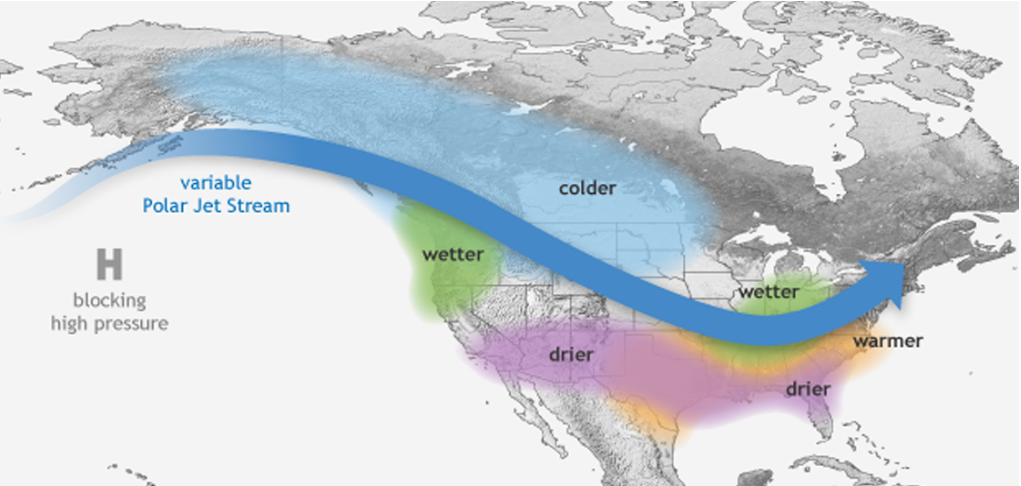
Typical La Nina weather patterns over North America via NOAA.

Young farmers in the Roaring Fork Valley

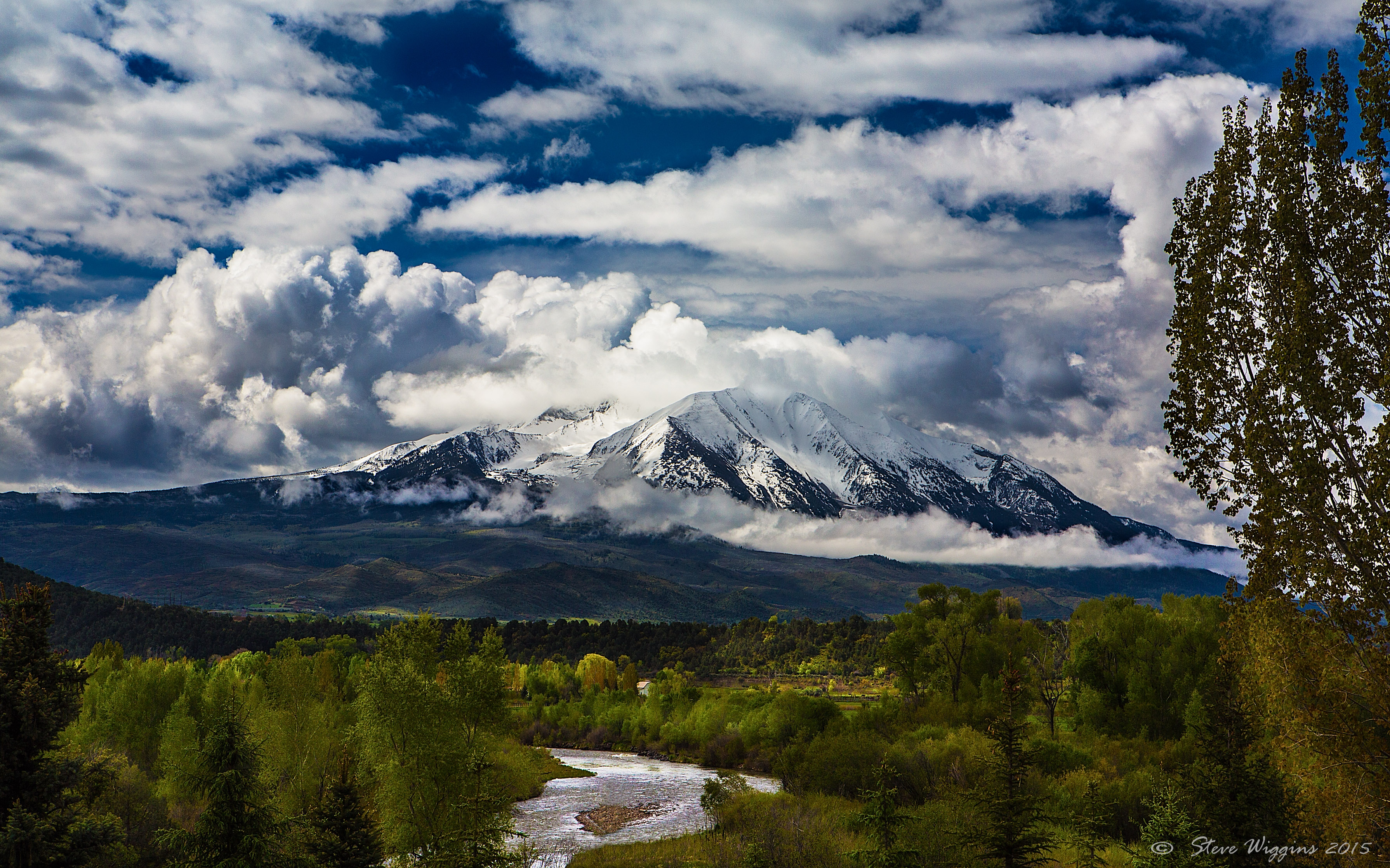
Spring at Mt Sopris Colorado. The Roaring Fork River is in the foreground and located just outside Carbondale CO.

From The Aspen Times (Scott Condon):

[The] biggest challenge [for Christian La Bar and Harper Kaufman] was rationing water. They have limited rights to a historic ditch that serves the property. They had to quit watering their potato and beet crops late this summer and hope for rain. It didn’t fall so their yield was probably stunted a bit, La Bar said.

La Bar and Kaufman achieved their goal of turning a profit in just their second year working 0.83 of an acre on the land owned by Mike and Allison Spayd…

The Saturday Market in Aspen has been a godsend for their Two Roots Farm. They have built a loyal following by offering greens and veggies different from what established farmers from the North Fork Valley in Paonia delivered. Aspen-area shoppers responded.

They also sell direct to restaurants and provide produce for Community Supported Agriculture (CSA) allotments, where customers pay in advance and receive bounty on a weekly or bi-weekly basis.

“People are excited to see new farmers, young farmers close to home,” La Bar said.

There’s been a mini-explosion of young entrepreneurs getting into agriculture in the Roaring Fork Valley. A documentary on their trials and travails, “How We Grow,” is being made by valley residents Tomas Zuccareno and Haley Thompson.

La Bar and Kaufman, both 26, worked as the agriculture managers at Aspen Center for Environmental Studies’ Rock Bottom Ranch, learning from ranch manager Jason Smith before heading out on their own.

Other aspiring farmers have taken advantage of the Pitkin County Open Space and Trails program’s interest in promoting sustainable agriculture and food self-sufficiency.

Cooper Means, 25, pitched a winning proposal for agricultural use of 10 acres of the 40-acre Lazy Glen Open Space parcel, acquired in 2015. Means’ Shining Mountains Farm LLC received a 10-year lease that started this year. He doesn’t have to pay for use of the land, but pays $600 per month for a small apartment attached to a barn on the site…

Means is focused on protein production — raising chickens and lambs on pastures. He’s also using two rooms in the barn to grow mushrooms. The demand for the mushrooms has exceeded his ability to supply them.

He said he knew he wanted to be a farmer since he was a 9-year-old student at Aspen Community School and did a mentorship at Sustainable Settings, an educational farm and ranch outside of Carbondale.

Groundwater testing perimeter around Rulison site reduced

From The Grand Junction Daily Sentinel (Dennis Webb):

The area subject to testing has been reduced from 25 square miles, encompassing a circular area extending three miles in all directions from what’s known as the Project Rulison blast site, to an oval area of just under 6.3 square miles, and ranging from 1.5 to two miles away from the site.

The revised plan also gets rid of a limit on the number of drilling rigs concurrently operating in the monitoring zone “because this has not been an administrative problem in recent years,” it says.

Project Rulison involved the explosion of a nuclear bomb more than 8,000 feet underground in the mountains south of Rulison in a federal/private experiment to try to boost natural gas production in the Williams Fork sandstone formation. The project succeeded in producing gas, but it was radioactive and was flared off as part of the experiment.

More recently, energy companies have extensively produced gas in the Williams Fork formation through the use of hydraulic fracturing to crack open the sandstone and foster gas flow.

The federal government restricts drilling deeper than 6,000 feet in a 40-acre area at the blast site. Currently there are no wells within a half-mile of Project Rulison, and any applications to drill that close would be subject to a Colorado Oil and Gas Conservation Commission hearing process.

The state also subjects companies to two levels of sampling and testing requirements for radioactivity when it comes to things such drilling cuttings, produced gas and produced water. One level has applied to wells within a mile of the blast site, and it continues to apply under the new plan.

The second level had applied to an arbitrary circular testing area having a three-mile radius, but the revised plan says it now applies to a smaller ellipse aligned with the pattern for fractures in the Williams Fork formation in the area of the blast site.

The plan also eliminates an environmental monitoring program for ground and surface water, stating that “there is no credible mechanism to transport Rulison-related activity to the surface except through natural gas production,” which the sampling plan already covers.

The plan says numerous monitoring studies conducted by federal agencies and oil and gas companies show that “no known release of radionuclides has occurred from Project Rulison,” except during natural gas flaring and production tests immediately following the blast.

The monitoring program is intended to protect workers, the public and the environment during oil and gas operations, the plan says.

Fountain Creek: @EPA and CDPHE lawsuit prep. to continue until April 2018

Fountain Creek

From The Pueblo Chieftain (Robert Boczkiewicz):

Senior U.S. District Judge Richard Matsch, who is presiding over the lawsuit, stated Thursday that pre-trial preparation will continue until April. Matsch, in a written order, said he will set a trial date after that.

In pre-trial work so far, Colorado Springs has turned over 1,275 boxes of documents to the EPA and the state environment department to examine for possible evidence. That is part of the legal process known as “discovery.”

Matsch earlier this year granted requests from the Board of Pueblo County Commissioners and the Lower Arkansas Valley Water Conservancy District to intervene in the case, on the side of the environmental agencies. Intervention allows the commissioners and the conservancy district to have a direct voice in the litigation in order to protect their interests.

The district encompasses Bent, Crowley, Otero, Prowers and Pueblo counties, where considerable produce is grown. District officials told Matsch they want to ensure the quality of the river water.

Colorado Springs has denied it is violating the laws. Mayor John Suthers has pointed to its commitment of money and manpower to improve its stormwater system.

The lawsuit seeks a court order requiring the city “to develop, implement and enforce” its storm management program, as required by permits issued by the environmental agencies.

@HighCountryNews: Judge tells BLM to redo plans for compensating for wildlife habitat that would be lost to massive groundwater project

Proposed pipeline from the Snake Valley to Las Vegas.

From The High Country News (Jodi Petersen):

In late August, a federal court ruled on a lawsuit filed by environmentalists, tribes and local governments over the BLM’s granting of a right-of-way for the 250-plus-mile pipeline. The judge said the agency had fulfilled its duties “for the most part,” but needed to provide better plans for mitigating wildlife habitat lost to pipeline construction. A separate lawsuit challenges the amount of groundwater involved; those hearings will be held later in September.

From The Las Vegas Review-Journal (Henry Brean):

Starting at 8:30 a.m. Monday, State Engineer Jason King is slated to hear two weeks of testimony for and against the controversial, multibillion-dollar project.

The hearing on 25 groundwater applications could decide how much the authority would be allowed to pump from Cave, Dry Lake and Delamar valleys in Lincoln County and Spring Valley in White Pine County.

Water authority spokesman Bronson Mack called it “a significant stage in the permitting process.”

Simeon Herskovits, attorney for some opponents of the project, put it another way: “I guess you could say everything is at stake,” he said.

Just don’t expect a ruling anytime soon.

“It will be months,” said Susan Joseph-Taylor, deputy administrator for the Nevada Division of Water Resources. “These things take a while to put together. They’re complicated.”

Welcoming the world to our watersheds – News on TAP

An international conference gave Denver Water a showcase for its commitment to healthy forests and watersheds.

Source: Welcoming the world to our watersheds – News on TAP