Central #Colorado cloud seeding update

Cloud-seeding graphic via Science Matters

From The Mountain Mail (Joe Stone):

Western Weather Consultants has applied for a permit to perform cloud seeding intended to increase snowfall in the Central Colorado mountains, including parts of Lake, Chaffee and Summit counties.

Sponsors of the application include the Colorado River Conservation District, the Front Range Water Council and the ski areas of Keystone, Breckenridge and Winter Park.

Western’s proposed weather modification program would use silver iodide crystals from ground-based “cloud nuclei generators” to seed clouds favorable for precipitation increases.

Information on the Colorado Water Conservation Board (CWCB) website indicates that precipitation from some clouds is limited by a shortage of “natural ice nuclei.” Silver iodide crystals seeded into the clouds become “artificial cloud nuclei.”

Ultimately, that enables clouds seeded with silver iodide “to grow larger, process more water vapor and yield more precipitation.”

The program goals, as stated in the legal notice, are to increase precipitation, snowpack and snow-water content “to benefit natural habitat, agriculture, municipal water, stock growers, recreational and tourism interests and the local economy.”

The American Meteorological Society and the World Meteorological Organization support the effectiveness of winter cloud-seeding projects, indicating that between 5 and 20 percent more snow is produced in target areas.

Data from Western’s operations show precipitation increases ranging from approximately 10 to 20 percent, and the company has operated cloud-seeding programs for more than 40 years in the San Juan and Central Colorado mountains.

During the 2011-12 season, Western’s data show increased snowfall from its cloud-seeding operations of 8 to 16 inches, resulting in an additional 55,253 acre-feet of water.

According to the CWCB, Western has previously held two sequential five-year permits for cloud seeding in this target area, which is generally above an elevation of 8,500 feet.

Western proposes to operate the cloud-seeding program from Nov. 1 through April 15 under another five-year CWCB permit.

According to Western and the CWCB, safeguards will limit weather modification operations based on daily monitoring of the snowpack’s snow-water equivalent, avalanche hazard levels and National Weather Service severe weather statements.

According to Western’s operational plan, “No seeding will be initiated during a period of ‘high potential hazard.’”

Complete details of the operations to be conducted are available by emailing westernweather@gmail.com…

Anyone unable to attend the public hearing can submit comments by email through Oct. 2 at joe.busto@state.co.us. Written comments may also be mailed by Oct. 2 to: Joe Busto, CWCB, 1313 Sherman St. No. 721, Denver, CO 80203.

All public comments will be considered for the record of decision.

For a copy of the map or application for this project, visit http://cwcb.state.co.us/water-management/water-projects-programs/Pages/PermitProgram.aspx.

DU Water Law Review: Ninth Circuit — Winters Rights do indeed apply to groundwater

Aqua Caliente Reservation in 1928. Photo credit Wikipedia.

Here’s an in-depth look at the decision from Gia Austin writing for the University of Denver Water Law Review. Click through and read the whole article. Here’s an excerpt:

The parties divided the litigation into three phases. With respect to Phase I, the only phase relevant for this case, the district court held that “the reserved rights doctrine applied to groundwater and that the United States reserved appurtenant groundwater when it established the Tribe’s reservation.” Subsequently, the district court certified its order for interlocutory appeal and the water agencies petitioned the Ninth Circuit Court of Appeals for permission to hear the appeal. The court, on de novo review, addressed the only issue on appeal: whether the Tribe had a federal reserved right to the groundwater underlying its reservation. In so doing, the court approached its analysis in three steps.

First, the court determined whether the United States impliedly reserved water when establishing the Agua Caliente Reservation. This question is two-pronged: (1) whether water is reserved if a reservation’s primary purpose anticipates water use; and (2) if so, whether the Agua Caliente Reservation’s primary purpose contemplated water use.

The court began its analysis by examining the Winters doctrine, and found that it established that “federal reserved water rights are directly applicable ‘to Indian reservations and other federal enclaves, encompassing water rights in navigable and nonnavigable streams.’” However, the Winters doctrine is limited to certain situations; it reserves water necessary to accomplish the purported means of the reservation and reserves water if it is appurtenant to the withdrawn land. Following that understanding, the court differentiated the parties’ and the district court’s application of the Winters doctrine that specifically addressed whether the Tribe’s reserved right extended to groundwater from the more overarching issue concerning whether the mere existence of a federal reserved right depended on the Agua Caliente Reservation maintaining an implicit right to use water.

The court then evaluated the first prong when addressing the Tribe’s implied reserved right to water. The court invoked United States v. New Mexico and reasoned, “the federal purpose for which land was reserved is the driving force behind the reserved rights doctrine.” Further, that the New Mexico Court patterned a consistent conclusion whenever the reserved water rights doctrine is raised—an insufficient water supply defeats the purposes of the reservation. Therefore, the court adopted New Mexico’s holding that water is reserved when the reservation’s primary purpose foresees water use. The court then evaluated the second prong, whether the Tribe’s primary purpose contemplated water use. To answer this question, the court synthesized the Executive Orders establishing the Agua Caliente Reservation and Supreme Court precedent to conclude that “the primary purpose underlying the establishment of the reservation was to create a home for the Tribe, and water was necessarily implicated in that purpose.” Therefore, the United States impliedly reserved water for the Tribe.

Second, the court addressed whether the Tribe’s implied reserved water right extended to the Agua Caliente Reservation’s underlying groundwater. The court reiterated the Winters doctrine requirements and determined that although the Tribe met the first requirement that the reservation’s purported means necessitated water use, the second requirement that unappropriated water must be appurtenant to the reservation remained. To find a resolution, the court reasoned that appurtenance is not limited to surface water and extrapolated from Supreme Court precedent that the United States can protect groundwater and, along that vein, impliedly reserved water may include appurtenant groundwater. Further, the court considered the Tribe’s reliance on groundwater when reasoning that the minimal surface water availability conditions the Tribe’s survival on groundwater access. From this line of reasoning, the court clarified that the Winters doctrine purported to provide sustainable livelihoods to Tribes inhabiting reservations in arid areas, like the Agua Caliente Reservation, and included access to both appurtenant surface water and groundwater. Therefore, the Tribe’s implied reserved water right included groundwater.

Third, the court addressed whether the above two holdings withstood the water agencies’ arguments that: (1) the Tribe received water pursuant to California’s correlative rights doctrine; (2) the Tribe did not need a federal reserved right to groundwater in light of its allotted surface water from the Whitewater River Decree; and (3) the Tribe never drilled for groundwater on its reservation. The court rejected each in turn. First, federal water rights, such as the implied federal reserved water right, preempt state water rights. Second, New Mexico did not inquire into the current necessity of water, it focused on whether the reservation’s inception purported such a necessity. Third, lacking historical access to groundwater on the reservation did not foreclose the Tribe’s current access to groundwater. Therefore, compounded with the federal primacy of reserved water rights, the Tribe’s implied federal water right to groundwater remained intact.

Accordingly, the court affirmed the district court holding that the United States impliedly reserved appurtenant groundwater when creating the Agua Caliente Reservation.

@wildearthguard: You are invited to help us launch the #RioGrande Waterkeeper!

Rio Grande River photo credit Wild Earth Guardians.

Click here for the inside skinny:

Please join WildEarth Guardians as we launch the Rio Grande Waterkeeper—our new partnership with Waterkeeper Alliance—to protect and restore the iconic Rio Grande.

Our special guest, Robert F. Kennedy, Jr., Senior Attorney and President of Waterkeeper Alliance, will join Guardians for an inspiring evening of education, advocacy, and fundraising to help save America’s Great River.

As challenges continue to mount against the Rio Grande, Guardians is excited to join Waterkeeper Alliance’s global movement of over 300 member organizations fighting to protect rivers around the world.

Come celebrate with us, meet the staff, and learn our vision for a healthy, thriving Rio Grande.

When: Monday, October 9, 2017, 6:00 P.M. to 9:00 P.M.

Where: Los Poblanos, 4803 Rio Grande Blvd NW, Los Ranchos de Albuquerque, NM 87107

How: Buy Tickets $10 Each

Working together, we can bridge the valleys now divided and restore and reconnect a basin-wide community that will navigate a sustainable path forward for this vital artery of life.

Boulder Dam dedication (September 30, 1935) anniversary

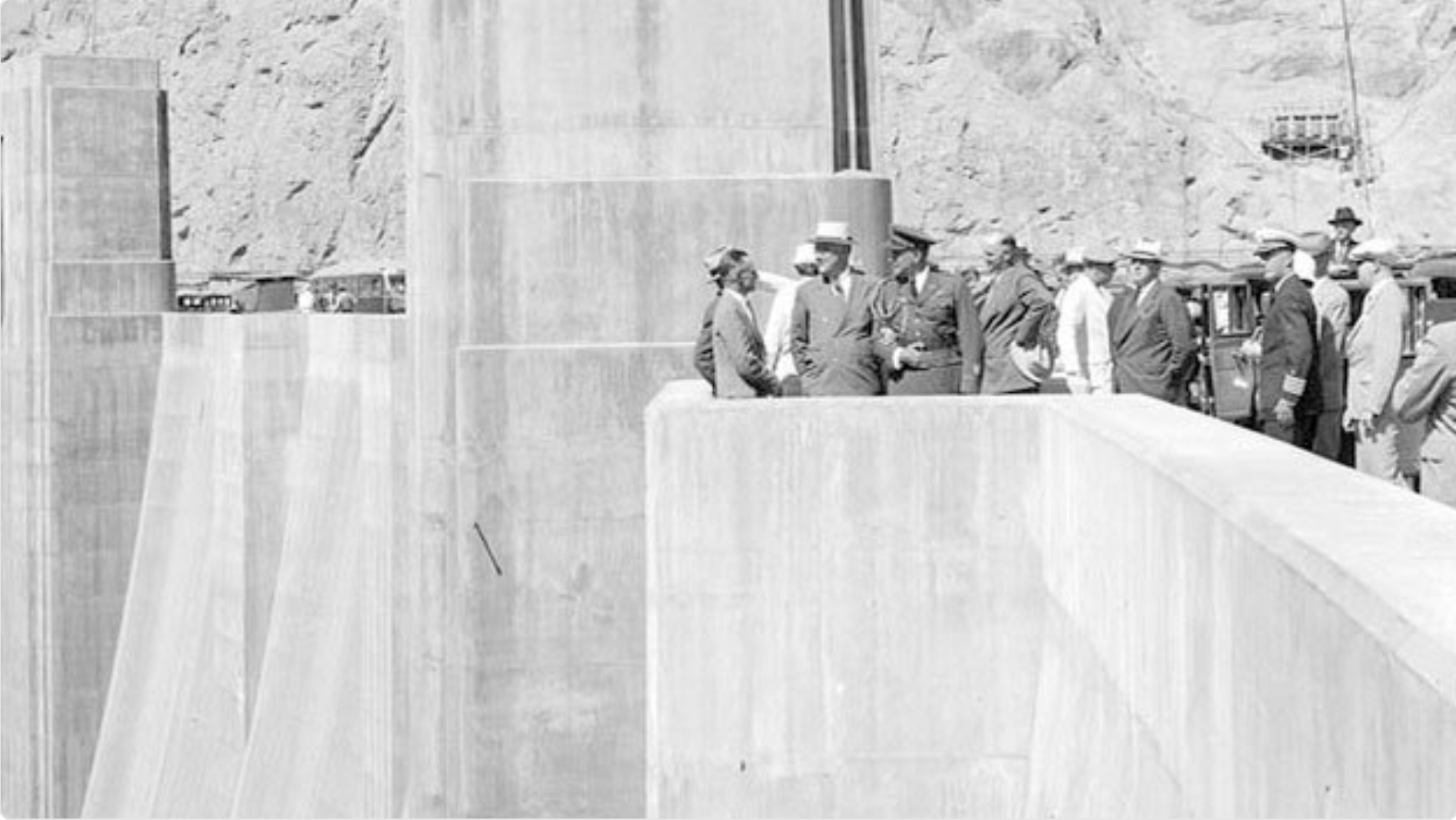
Hoover Dam dedication September 30, 1935. Photo credit U.S. Bureau of Reclamation via the Arizona Department of Water Resources.

Here are President Franklin D. Roosevelt’s remarks:

Senator Pittman, Secretary Ickes, Governors of the Colorado’s States, and you especially who have built Boulder Dam:
This morning I came, I saw and I was conquered, as everyone would be who sees for the first time this great feat of mankind.

Ten years ago the place where we are gathered was an unpeopled, forbidding desert. In the bottom of a gloomy canyon, whose precipitous walls rose to a height of more than a thousand feet, flowed a turbulent, dangerous river. The mountains on either side of the canyon were difficult of access with neither road nor trail, and their rocks were protected by neither trees nor grass from the blazing heat of the sun. The site of Boulder City was a cactus-covered waste. The transformation wrought here in these years is a twentieth-century marvel.

We are here to celebrate the completion of the greatest dam in the world, rising 726 feet above the bed-rock of the river and altering the geography of a whole region; we are here to see the creation of the largest artificial lake in the world—115 miles long, holding enough water, for example, to cover the State of Connecticut to a depth of ten feet; and we are here to see nearing completion a power house which will contain the largest generators and turbines yet installed in this country, machinery that can continuously supply nearly two million horsepower of electric energy.

All these dimensions are superlative. They represent and embody the accumulated engineering knowledge and experience of centuries; and when we behold them it is fitting that we pay tribute to the genius of their designers. We recognize also the energy, resourcefulness and zeal of the builders, who, under the greatest physical obstacles, have pushed this work forward to completion two years in advance of the contract requirements. But especially, we express our gratitude to the thousands of workers who gave brain and brawn to this great work of construction.

Beautiful and great as this structure is, it must also be considered in its relationship to the agricultural and industrial development and in its contribution to the health and comfort of the people of America who live in the Southwest.

To divert and distribute the waters of an arid region, so that there shall be security of rights and efficiency in service, is one of the greatest problems of law and of administration to be found in any Government. The farms, the cities, the people who live along the many thousands of miles of this river and its tributaries —all of them depend upon the conservation, the regulation, and the equitable division of its ever-changing water supply. What has been accomplished on the Colorado in working out such a scheme of distribution is inspiring to the whole country. Through the cooperation of the States whose people depend upon this river, and of the Federal Government which is concerned in the general welfare, there is being constructed’ a system of distributive works and of laws and practices which will insure to the millions of people who now dwell in this basin, and the millions of others who will come to dwell here in future generations, a just, safe and permanent system of water rights. In devising these policies and the means for putting them into practice the Bureau of Reclamation of the Federal Government has taken, and is destined to take in the future, a leading and helpful part. The Bureau has been the instrument which gave effect to the legislation introduced in Congress by Senator Hiram Johnson and Congressman Phil Swing.

We know that, as an unregulated river, the Colorado added little of value to the region this dam serves. When in flood the river was a threatening torrent. In the dry months of the year it shrank to a trickling stream. For a generation the people of Imperial Valley had lived in the shadow of disaster from this river which provided their livelihood, and which is the foundation of their hopes for themselves and their children. Every spring they awaited with dread the coming of a flood, and at the end of nearly every summer they feared a shortage of water would destroy their crops.

The gates of these great diversion tunnels were closed here at Boulder Dam last February. In June a great flood came down the river. It came roaring down the canyons of the Colorado, through Grand Canyon, Iceberg and Boulder Canyons, but it was caught and safely held behind Boulder Dam.

Last year a drought of unprecedented severity was visited upon the West. The watershed of this Colorado River did not escape. In July the canals of the Imperial Valley went dry. Crop losses in that Valley alone totaled $10,000,000 that summer. Had Boulder Dam been completed one year earlier, this loss would have been prevented, because the spring flood would have been stored to furnish a steady water supply for the long dry summer and fall.

Across the San Jacinto Mountains southwest of Boulder Dam, the cities of Southern California are constructing an aqueduct to cost $220,000,000, which they have raised, for the purpose of carrying the regulated waters of the Colorado River to the Pacific Coast 259 miles away.

Across the desert and mountains to the west and south run great electric transmission lines by which factory motors, street and household lights and irrigation pumps will be operated in Southern Arizona and California. Part of this power will be used in pumping the water through the aqueduct to supplement the domestic supplies of Los Angeles and surrounding cities.

Navigation of the river from Boulder Dam to the Grand Canyon has been made possible, a 115-mile stretch that has been traversed less than half a dozen times in history. An immense new park has been created for the enjoyment of all our people.

At what cost was this done? Boulder Dam and the power houses together cost a total of $108,000,000, all of which will be repaid with interest in fifty years under the contracts for sale of the power. Under these contracts, already completed, not only will the cost be repaid, but the way is opened for the provision of needed light and power to the consumer at reduced rates. In the expenditure of the price of Boulder Dam during the depression years work was provided for 4,000 men, most of them heads of families, and many thousands more were enabled to earn a livelihood through manufacture of materials and machinery.

And this picture is true on different scales in regard to the thousands of projects undertaken by the Federal Government, by the States and by the counties and municipalities in recent years. The .overwhelming majority of them are of definite and permanent usefulness.

Throughout our national history we have had a great program of public improvements, and in these past two years all that we have done has been to accelerate that program. We know, too, that the reason for this speeding up was the need of giving relief to several million men and women whose earning capacity had been destroyed by the complexities and lack of thought of the economic system of the past generation.

No sensible person is foolish enough to draw hard and fast classifications as to usefulness or need. Obviously, for instance, this great Boulder Dam warrants universal approval because it will prevent floods and flood damage, because it will irrigate thousands of acres of tillable land and because it will generate electricity to turn the wheels of many factories and illuminate countless homes. But can we say that a five-foot brushwood dam across the head waters of an arroyo, and costing only a millionth part of Boulder Dam, is an undesirable project or a waste of money? Can we say that the great brick high school, costing $2,000,000, is a useful expenditure but that a little wooden school house project, costing five or ten thousand dollars, is a wasteful extravagance? Is it fair to approve a huge city boulevard and, at the same time, disapprove the improvement of a muddy farm-to-market road?

While we do all of this, we give actual work to the unemployed and at the same time we add to the wealth and assets of the Nation. These efforts meet with the approval of the people of the Nation.

In a little over two years this great national work has accomplished much. We have helped mankind by the works themselves and, at the same time, we have created the necessary purchasing power to throw in the clutch to start the wheels of what we call private industry. Such expenditures on all of these works, great and small, flow out to many beneficiaries; they revive other and more remote industries and businesses. Money is put in circulation. Credit is expanded and the financial and industrial mechanism of America is stimulated to more and more activity. Labor makes wealth. The use of materials makes wealth. To employ workers and materials when private employment has failed is to translate into great national possessions the energy that otherwise would be wasted. Boulder Dam is a splendid symbol of that principle. The mighty waters of the Colorado were running unused to the sea. Today we translate them into a great national possession.

I might go further and suggest to you that use begets use. Such works as this serve as a means of making useful other national possessions. Vast deposits of precious metals are scattered within a short distance of where we stand today. They await the development of cheap power.

These great Government power projects will affect not only the development of agriculture and industry and mining in the sections that they serve, but they will also prove useful yardsticks to measure the cost of power throughout the United States. It is my belief that the Government should proceed to lay down the first yardstick from this great power plant in the form of a State power line, assisted in its financing by the Government, and tapping the wonderful natural resources of Southern Nevada. Doubtless the same policy of financial assistance to State authorities can be followed in the development of Nevada’s sister State, Arizona, on the other side of the River.

With it all, with work proceeding in every one of the more than three thousand counties m the United States, and of a vastly greater number of local divisions of Government, the actual credit of Government agencies is on a stronger and safer basis than at any time in the past six years. Many States have actually improved their financial position in the past two years. Municipal tax receipts are being paid when the taxes fall due, and tax arrearages are steadily declining.

It is a simple fact that Government spending is already beginning to show definite signs of its effect on consumer spending; that the putting of people to work by the Government has put other people to work through private employment, and that in two years and a half we have come to the point today where private industry must bear the principal responsibility of keeping the processes of greater employment moving forward with accelerated speed.

The people of the United States are proud of Boulder Dam. With the exception of the few who are narrow visioned, people everywhere on the Atlantic Seaboard, people in the Middle West and the Northwest, people in the South, must surely recognize that the national benefits which will be derived from the completion of this project will make themselves felt in every one of the forty-eight States. They know that poverty or distress in a community two thousand miles away may affect them, and equally that prosperity and higher standards of living across a whole continent will help them back home.

Today marks the official completion and dedication of Boulder Dam, the first of four great Government regional units. This is an engineering victory of the first order—another great achievement of American resourcefulness, American skill and determination.

That is why I have the right once more to congratulate you who have built Boulder Dam and on behalf of the Nation to say to you, “Well done.”

Citation: Franklin D. Roosevelt: “Address at the Dedication of Boulder Dam,” September 30, 1935. Online by Gerhard Peters and John T. Woolley, The American Presidency Project. http://www.presidency.ucsb.edu/ws/?pid=14952.

#ClimateChange: “We are stealing from other living things” — David Radcliff #ActOnClimate

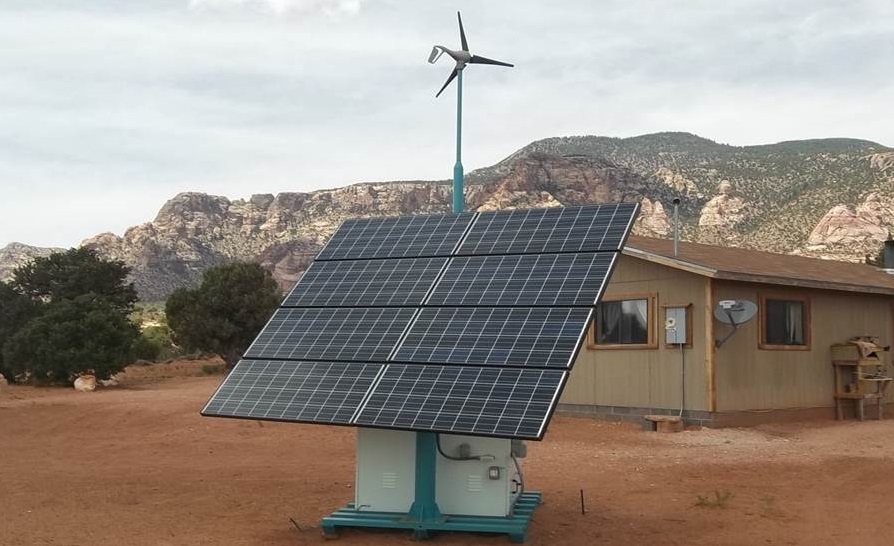
A residential solar hybrid unit. Photo from Navajo Tribal Utility Authority via Energy.gov.

Here’s a report about religious groups in Colorado and New Mexico working to abate the climate crisis from Sarah Tory writing for The High Country News. Click through and read the whole article. Here’s an excerpt:

Last year, [Pastor Jim Therrien] joined the Interfaith Power & Light campaign, “a religious response to global warming” composed of churches and faith communities across the U.S. Since 2001, the network had expanded its membership from 14 congregations in California to some 20,000 in over 40 states. The group provides resources to churches and other faith communities for cutting carbon emissions — helping install solar panels, for instance, and sharing sermons on the importance of addressing climate change.

Therrien says he is merely “following the Scripture.” In the process, however, he has joined a growing environmental movement that brings a religious dimension to the problem of climate change…

Here at his hardscrabble New Mexico parish, Therrien continues to practice what he preaches. On a hot day in July, he herded 28 visitors into the mission’s two white vans for a drive out onto the Navajo Nation. The group, mostly Easterners, ranged in age from 8 to over 60 and had traveled to the Lybrook mission as part of a weeklong fact-finding trip. Like Therrien, many were members of the Church of the Brethren, a Protestant denomination with a history of activism. More recently, their focus had shifted to environmental issues — especially climate change.

“It’s concerning that our government is pulling back from what we should be focusing on,” one of them, Jim Dodd, told me. Recently, the giant Larsen Ice Shelf had broken off from Antarctica, and Dodd was worried. “Villages already at sea level are going to get flooded,” he said.

Leading the group was David Radcliff, director of the New Community Project, a Vermont-based organization. “It’s a fairness issue for the rest of God’s creatures,” he told me. Radcliff has led “learning tours” around social and environmental justice issues for church groups, most recently, to the Ecuadorian Amazon.

Radcliff, a small, wiry man with an intense blue gaze, wore a white T-shirt with a very long slogan on the back. “Earth is a mess,” it said, and “God’s not amused.” If you aren’t satisfied, it added, “do something about it.”

For Radcliff, discussing the facts of climate change isn’t enough. That’s where religion comes in. “At a certain point, you have to talk about the consequences, and past that it becomes a conversation about morality,” he said. Take moose in the Northeast: They are dying from tick infestations exacerbated by a warming climate, caused by humans taking more from the Earth than they need, he said. “We are stealing from other living things.”

@CFWE Water: Innovating for Viability Land and Water Tour recap

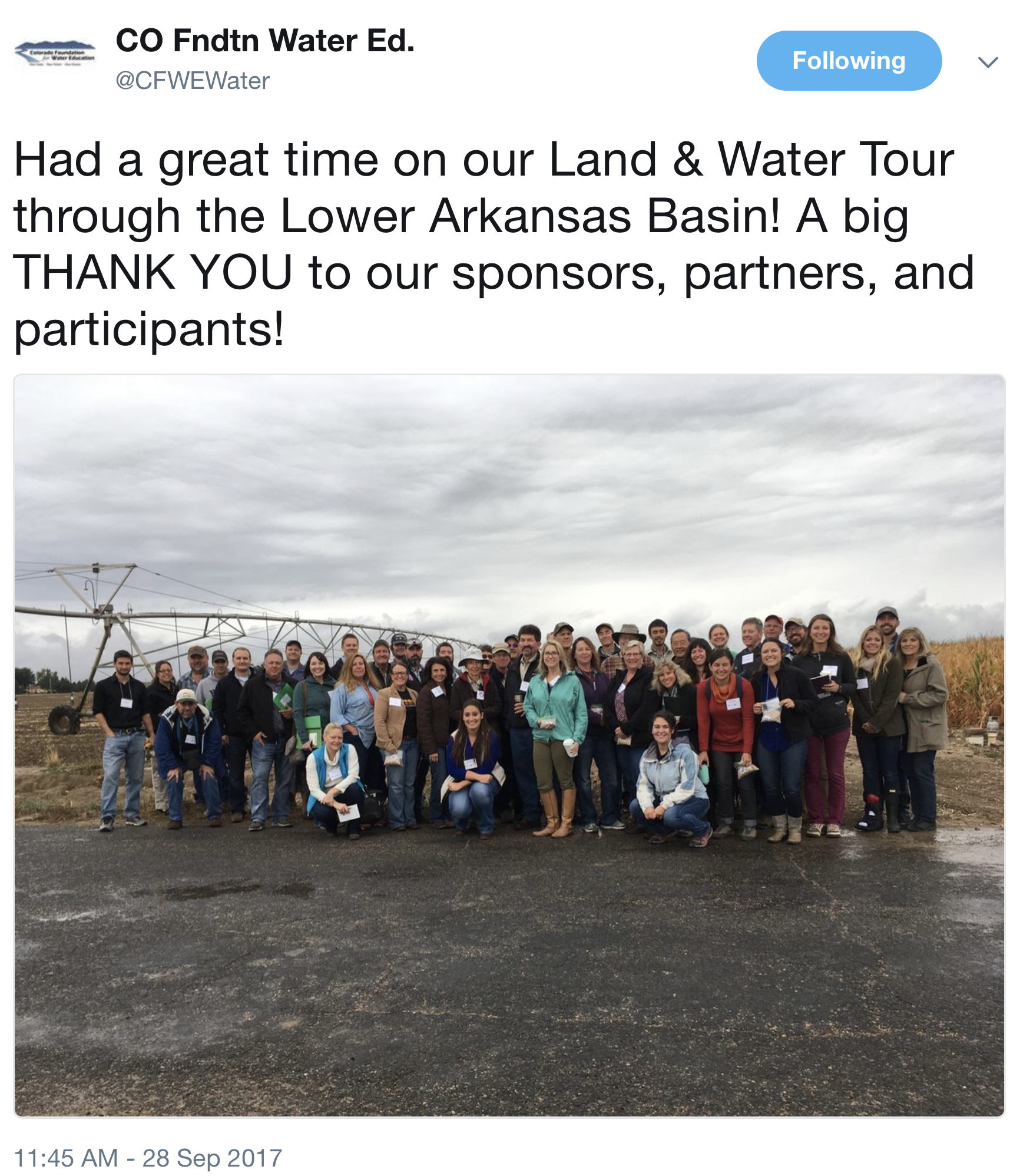
Here’s a recap of the Colorado Foundation for Water Education “Innovating for Viability Land and Water Tour” from KOAA.com (Caiti Blase):

The group included elected officials, community leaders, and interested citizens who toured different farms and a research center.

The goal was to come together and discuss current water resources for agriculture and what can be done to ensure there’s enough water for the future.

Michael Hirakata, co-owner of Hirakata Farms, said, “It all starts with water. Without water we can’t grow the food.”

That’s the message Hirakata wants everyone in Colorado to hear.

“This year there’s plenty of water. It’s trying to rain right now, but Mother Nature is not always the same and we’re going to need a lot of water to feed the population of Colorado.”

The population of the state only continues to grow.

Kate Greenberg of The National Young Farmers Coalition said, “As water gets tighter, as we have more pressure on our water, it’s really going to take a lot of collaboration and alliances.”

Hirakata and other farmers are already doing that and sharing their practices with tour groups like the one that met on Wednesday.

“We told them about sub-surface irrigation and the way we manage sub-surface irrigation,” said Hirakata.

“We call it drip-tape and we put it in the ground…and the water never sees the light of day so there’s less evaporation.”

It’s a water technique he’s been practicing for many years after being hit by droughts.

“We weren’t going to have much water, also the yields-we were seeing some of our neighbors try it and the yields were a little bit higher than what we were getting so we thought well, we need to adjust our farming practices also.”

Now, he wants other people to start doing the same and to continue to come up with new ways to conserve water.

Greenberg said, “We’re all connected whether we know it or not to farming through food that we eat and the water that we use, and I think folks here today recognize that they play a role in that landscape.”

#ColoradoRiver water is being exported to Asia in hay shipments #COriver

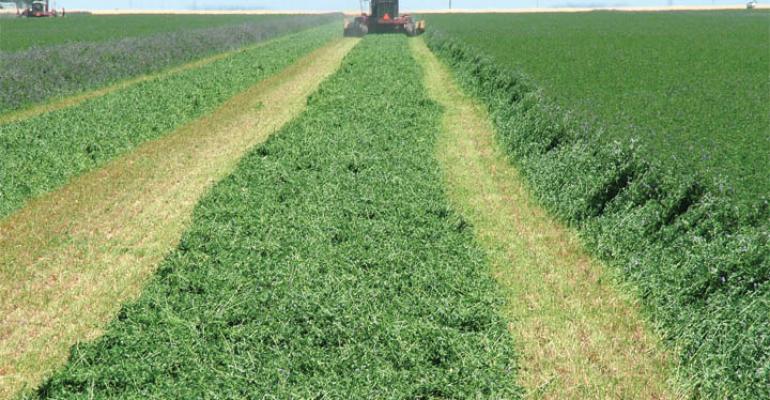
Alfalfa harvest via the Western Farm Press.

From The Palm Springs Desert Sun (Ian James):

Much of the hay is bound for the Port of Long Beach, where it’s loaded onto ships and dispatched across the Pacific — to Japan, China and Korea, and farther away to Saudi Arabia, the United Arab Emirates and other countries.

The hay export business is booming in the western U.S., and the trend shows no signs of letting up. The amount of hay exported annually from West Coast ports has more than doubled over the past two decades, much of it grown with water from the Colorado River. Farmers in the California desert are sending an increasing share of their crop overseas.

Growers say the reasons boil down to simple economics. The market for hay in Southern California has shrunk over the years as dairies have closed or moved elsewhere, while demand for dairy products has grown exponentially in other parts of the world.

And because the U.S. imports so many manufactured products from Asia, the large numbers of shipping containers left empty in the ports make the return shipping costs to Asia extraordinarily cheap. So cheap, in fact, that farmers say it costs less to ship hay to China than to haul the same load by truck to dairies 400 miles away in California’s San Joaquin Valley.

During the past few years, companies from Saudi Arabia and the United Arab Emirates have established farming operations on thousands of acres around Blythe in the Palo Verde Valley. They’re also growing hay to the south in the Imperial Valley and to the east in Arizona…

One of the newest arrivals in the Palo Verde Valley is Saudi Arabia’s Almarai Co., one of the world’s largest dairy companies, which owns 2,248 acres near Blythe through its subsidiary Fondomonte California LLC, according to the Palo Verde Irrigation District.

The company announced in January 2016 that it paid $31.8 million for 1,790 acres. Some of its fields run alongside the Colorado River.

The company grows hay for cows in its dairy in Saudi Arabia, where the monarchy has set a policy of growing less alfalfa, wheat and corn to reduce pumping of groundwater from the depleted aquifers of the Arabian Peninsula.

When it bought the land near Blythe last year, the company said in a statement that the deal was part of its efforts to “secure its supply of the highest quality alfalfa” and was in line with the Saudi government’s “direction towards conserving local resources.”

[…]

The company bought nearly 10,000 acres in Vicksburg, Arizona, in 2014, and also owns about 320 acres in the Imperial Valley, where it has erected barns and a hay-pressing facility.

Another company with a growing presence is Wilmington, California-based Al Dahra ACX, Inc., which is owned by Al Dahra Agriculture Co. of the United Arab Emirates. The company leases 4,700 acres in the Palo Verde Valley, owns about 2,600 acres in the Imperial Valley and grows hay on several thousand acres in Arizona.

Al Dahra sells hay in the U.S. as well as to countries across Asia and the Middle East. The hay is largely used as feed for cows, but in the Middle East it’s also used for other livestock such as goats and camels…

Rising U.S. hay exports represent one of many threads in the interconnected web of the global food trade, and the percentage of U.S.-grown hay that’s sold abroad remains small compared with other products such as wheat, almonds, rice and wine, which are heavily exported. In the case of almonds, the state’s top agricultural export, nearly 70 percent of the crop is exported.

Less than 6 percent of the alfalfa grown across the U.S. is exported, said Daniel Putnam, an agronomist and the University of California, Davis. Domestic dairies continue to buy the most hay, and California alone has about 1.5 million dairy cows, many of them in the Central Valley.

Across seven western states, though, a larger share of the hay crop is sold internationally. Government figures compiled by Putnam and fellow researchers William Matthews and Daniel Sumner show about 15 percent of alfalfa and more than 44 percent of other types of hay produced in the West have been exported in recent years.

The share exported from Southern California farms is significantly higher than the regional average, the researchers said, because the closeness of the port makes trucking costs relatively inexpensive.

A record 4.8 million metric tons of hay were exported in 2016 from West Coast ports, valued at $1.4 billion.

#Colorado congressional delegation sends quagga SOS to Zinke et al.

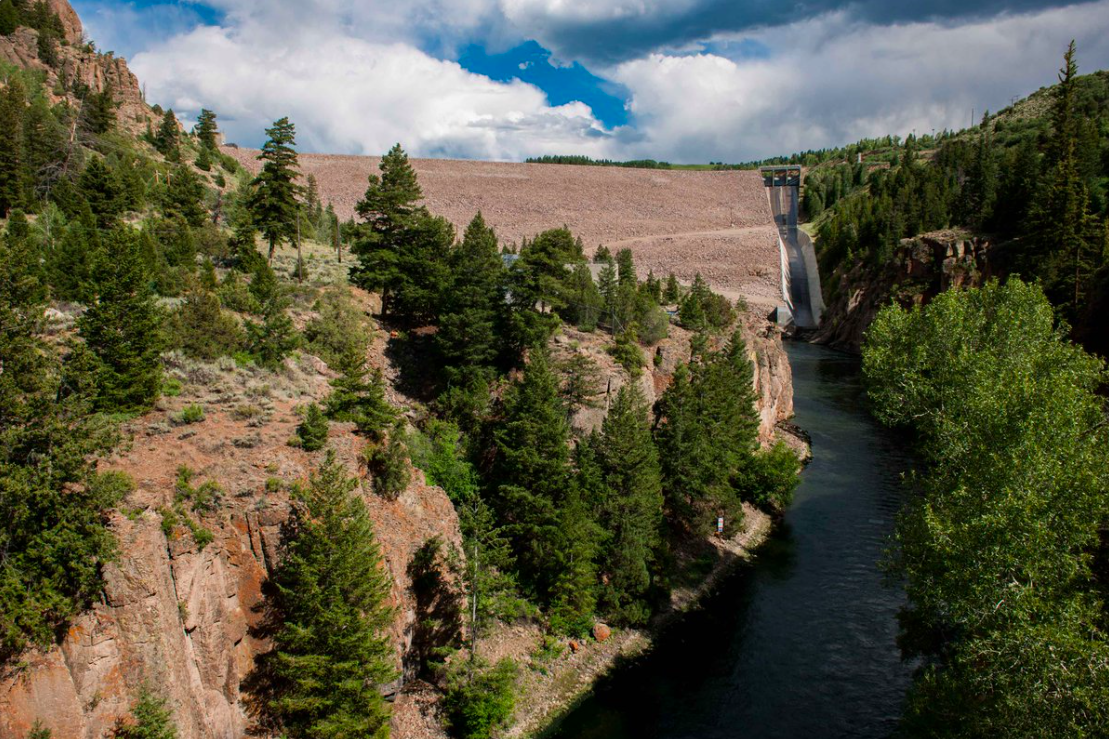
Green Mountain Reservoir via Reclamation.

From The Denver Post (Jesse Paul):

Nearly every member of Colorado’s congressional delegation has signed a letter to the Trump administration asking for help with the emerging crisis of tiny invasive mussel larvae found in Green Mountain Reservoir…

“We urge you to respond rapidly, deploy available resources and work with the state and local communities to prevent this initial detection from growing into a full infestation,” the delegation wrote to Interior Secretary Ryan Zinke. “A rapid response is critical during the window of opportunity immediately after the detection of invasive species.”

The letter, dated Thursday, was signed by Sens. Cory Gardner and Michael Bennet, as well as Reps. Diana DeGette, Scott Tipton, Doug Lamborn, Jared Polis, Ed Perlmutter and Mike Coffman.

Rep. Ken Buck, a Weld County Republican, did not sign the letter.

“As a headwater state that is currently free of adult invasive mussels, the detection of invasive mussel larva poses a tangible threat to our economy,” the letter said. “The Department of Interior has recognized the importance of preventing invasive mussel infestations in western headwater states, such as Montana where larva was identified in late 2016 and resources were deployed to the Columbia River Basin.”

Zinke is from Montana.

Colorado Parks and Wildlife spokesman Mike Porras said his agency has drawn more than 100 samples from Green Mountain Reservoir since the larvae were detected. “All of these samples have come back negative for all aquatic nuisance species including quagga mussels.”

[…]

Tiny mussel larvae, known as veligers, have been found in Colorado before. Lake Pueblo, for instance, tested positive for them in 2007, 2008, 2009 and 2011.

Biologists, however, have never found an adult zebra or quagga mussel in any Colorado lake or reservoir.

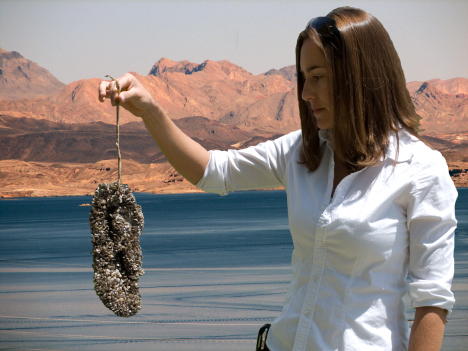
Lake Powell, which straddles Utah and Arizona, has been ravaged by a mussel infestation since veligers were detected in late 2012 and four adult mussels were found on a boat that had been pulled for service in March 2013.

Boats and other watercraft can quickly spread the invasive species. Colorado wildlife officials have said the veligers found in Green Mountain Reservoir likely hitched in on a boat that had been in water outside the state.

State lawmakers during the past legislative session cited the threat of invasive mussels as one reason why they voted down a proposal to allow sea planes on Colorado’s bodies of water, saying they could act as long-range vehicles for the species.

Quaggas on sandal at Lake Mead

How Colorado Can Address Climate Change — @ConservationCO @wradv

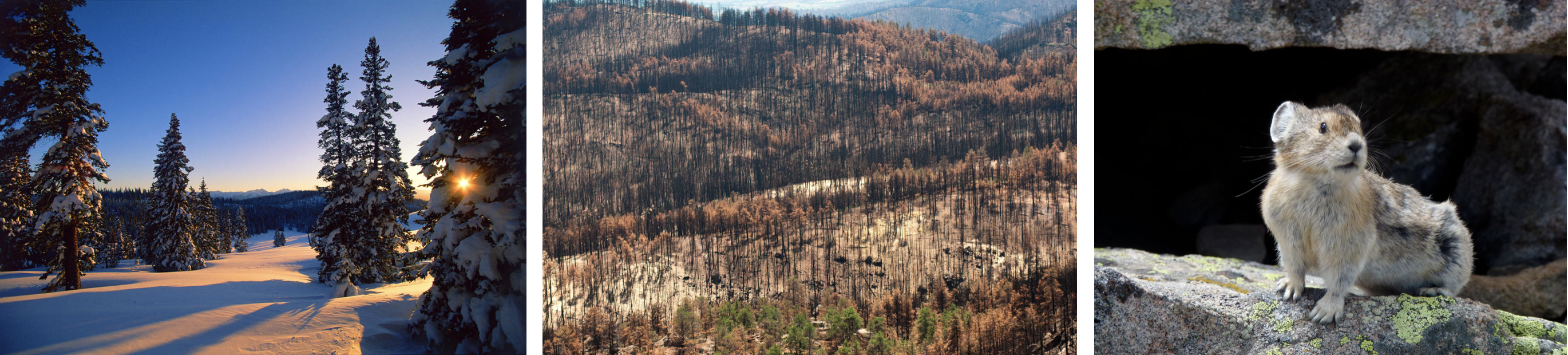
Some of the threats climate change poses to Colorado: shorter winters, forests killed by invasive pine beetles, and habitat loss for the Pika, which thrives in cold, high-altitude environments. Photo credit Conservation Colorado and Western Resource Advocates.

Click here to read the article. Here’s an excerpt:

Climate change is real, and it is already affecting those of us who live, work, and play in Colorado. The longer we wait to cut our carbon pollution, the direr the consequences will be for our state, economy, and communities.

It will take a coordinated effort to address the climate crisis. Unfortunately, President Trump recently pulled the U.S. out of the Paris Climate Agreement, which set an international goal to keep global warming below 2 degrees Celsius, the level scientists say is necessary to avoid the worst impacts of climate change.

In the wake of Trump’s decision, businesses, cities, universities, and states have committed to their own climate actions to reduce carbon pollution levels and avoid catastrophic impacts. Colorado Governor Hickenlooper has also issued an Executive Order to reduce pollution by 26% by 2025. For Colorado to achieve these goals, we need to do more, but the question remains: how?

Our new research lays out what Colorado needs to do to play our part in reducing emissions and reaching goals to prevent 1.5° – 2°C of warming. You can read the full report, “Colorado’s Climate Blueprint: Actions for Addressing Climate Change and Safeguarding Our Future,” or stick with us here for the highlights.

The bottom line is that Colorado’s elected officials and the current and future governors need to:

1. Adopt state-wide carbon pollution goals: we should reduce emissions economy-wide by 45% below 2005 levels by 2030 and 90% by 2050. Governor Hickenlooper’s executive order in July 2017 set a goal of a 26% reduction by 2025, but goals further into the future are needed.

2. Advance policies that drive carbon pollution reductions in key sectors: we must cut carbon pollution from Colorado’s largest sources, which includes power plants, transportation, and buildings.

3. Enact a market-based policy to reduce carbon pollution: this could be a carbon tax or a cap-and-trade program.

@MSUDenver: Center for Visual Art to Serve as a Hub for an Artist-led Response to the Water Crisis

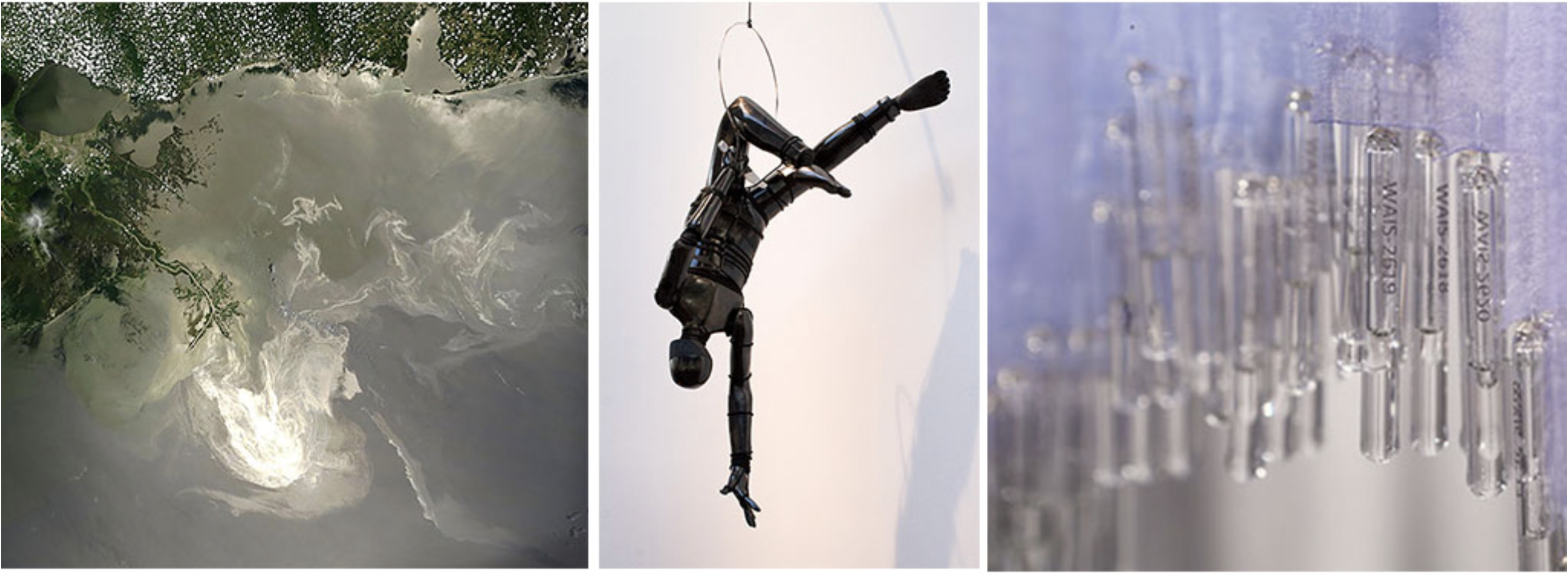
Images: Natascha Seideneck, Uncanny Territory, 2017; Cannupa Hanska Luger, We Have Agency VII, 2016; Anna McKee, WAIS Reliquary: 68,000 Years (detail), 2016, image by Joe Rudko.

Here’s the release from the Metropolitan State University of Denver Center for Visual Arts:

August 4 – October 21, 2017
DENVER, CO (July 6, 2017) – Metropolitan State University of Denver (MSU Denver) Center for Visual Art (CVA) announces an exhibition that examines the loaded issue of water and promotes stewardship, advocacy and activism through the work of contemporary artists, and in direct conversation with students, policy analysts and scientists. Organized by CVA and on view August 4 through October 21, 2017, Water Line: A Creative Exchange features 19 artists working in photography, mixed-media installation, video, ceramic and sculpture.

The exhibition will feature artists’ critical response to institutional and individual actions that contribute to the water crisis, as well as imaginative solutions, practical and not, for addressing the issue. The challenge presented to artists is to engage audiences in multi-channel dialogue about water, with the intent to make visitors think differently about solutions to this problem that affects everyone, and requires the efforts of all.

“Water is the center of concern and debate everywhere,” said Cecily Cullen, CVA Managing Director / Curator. “Through the lens of art, visitors will learn not only about the challenges we face, but what can be done both individually and collectively to manage and sustain our scarce water resources.”

The artists are responding to news and reports that not only global communities are facing, but also thinking about those closer to Colorado and surrounding areas. Shrinking glaciers in Rocky Mountain National Park that source the major rivers in Colorado affect us directly, while protestors battle with oil companies for the right to protect rivers in North Dakota, and students in Michigan and Oregon have been consuming contaminated water from drinking fountains at their schools. The crisis of access to clean, plentiful water has been waged worldwide for decades. It has become an immediate and localized crisis.

Artists

Each of the artists, collectives, musicians and content contributors has been selected for their individual voice and expression addressing water struggles in compelling, provocative and poetic measure. Each contributor examines our relationship with water and reflects upon society’s role in protecting the environmental legacy for future generations.

Anna McKee

Anna McKee is a visual artist living and working in Seattle. Her art is an exploration of memories that accumulate in the physical world – specifically where human history intersects a longer time span. McKee’s work, WAIS Reliquary, is a sculptural representation of 68,000 years of climate records taken from the West Antarctic Ice Sheet. The 22-foot long x 14.5-inch deep x 9-foot high sculpture consists of silk, glass, glacier water and wood. The work also includes a multi-channel soundscape by sound artist Steve Peters made from the sounds of the glass ampules used in the visual work, referencing the crystalline qualities of ice and the vertical representation of geological time implied by the drilled ice core.

Aurora Robson

Aurora Robson is a multi-media artist known predominantly for her work intercepting the waste stream. Her focus is on intercepting the plastic waste stream with the goal of shifting paradigms in human behavior. She states that humans are a self-destructive species in comparison to the other living creatures with whom we share this planet. The careless handling of plastic is threatening not only our food chain but the delicate eco-system that supports all life on earth. For the sake of circumvention, inspiration, and potentially our own salvation, Aurora makes work for the public that is as monumental in scale and lovingly crafted as possible, in order to illustrate both the urgency and sublime potential of this global problem.

Cannupa Hanska Luger

Born in North Dakota on the Standing Rock Reservation, Cannupa Hanska Luger comes from Mandan, Hidatsa, Arikara, Lakota, Austrian and Norwegian descent. Luger’s unique, ceramic­centric, but ultimately multidisciplinary work tells provocative stories of complex indigenous identities coming up against 21st-century imperatives, mediation, and destructivity. Luger creates socially conscious work that hybridizes his identity as an American Indian in tandem with global issues. Using his art as a catalyst, he invites the public to challenge expectations and misinterpretations imposed upon Indigenous peoples by historical and contemporary colonial social structures.

The Infamous Flapjack Affair and National Park Experience

The Infamous Flapjack Affair is an indie folk band that journeyed along the Colorado River for three weeks learning about the people and places that depend on the river system. Band members wrote original music and, in collaboration with National Park Service, created a documentary film titled Confluence. A multimedia installation of film and music will be exhibited.

Isabelle Hayeur

Montreal-based artist, Isabelle Hayeur is known for her photographs and her experimental videos. She has also realized several site-specific installations and public art commissions. Her work is situated within a critical approach to the environment, urban development and to social conditions. She is particularly interested in the feelings of alienation, uprooting and disenchantment.
 Hayeur’s photo and video series titled Desert Shores (Lost America) focuses on the transformation of a place and community of people with the flooding and later drying of the Salton Sea.

Matt Jenkins and Lynna Kaucheck (Food & Water Watch)

Matthew Jenkins is an assistant professor at MSU Denver with research interests in performance art, socially engaged art, internet art and land art/environmental art. He will contribute installation work addressing water in Flint, MI. For his work in Water Line, Jenkins collaborated with Lynna Kaucheck of Food & Water Watch to obtain Flint tap water from the home of water activist Melissa Mays.

Natascha Seideneck

Natascha Seideneck was born in Germany, grew up in England and now lives in Denver and has been an artist for more than 30 years. Seideneck has produced numerous site specific artworks often collaborating with artists, designers and architects. Seideneck is a visiting assistant professor at MSU Denver and a member of Tank Studios. Seideneck will contribute photographs, video and installation work reflecting on the impact of global warming on water stability. In her series, Uncanny Territory, we bear witness to the melting of otherworldly ice “planets.”

Nicholas Galanin and Merritt Johnson

Collaborating since 2014, Nicholas Galanin and Merritt Johnson combine the diverse and overlapping creative vocabulary of their individual practices to create an expanded and layered conversation. Their collaborative work brings together concept, material, technology, and culture to create multifaceted reflections of the world. Their work connects past, present and future, as an investment in vision – both in our ability to see and to be seen in relation to the land and to each other. Part of Winter Count Collective, Galanin and Johnson will also contribute work that they collaborated on together. Their short film and sculpture will address the Dakota Access Pipeline.

Tomiko Jones and Jonathan Marquis

Waterlines is made in response to the urgencies of water in the age of climate change. The photographs are from sites in California following the winter floods after years of drought, from the mountain snowmelt, to reservoir, to river, and to the sea, with the cyanotypes created on the transitional shore of the Pacific Coast. Waterlines is the first stage of a collaborative project with Tomiko Jones and Jonathan Marquis, beginning in June 2017.

Vibha Galhotra

Vibha Galhotra is a New Dehli-based conceptual artist whose large-scale sculptures address the shifting topography of the world under the impact of globalization and growth. She sees herself as being part of the restructuring of culture, society and geography – of New Delhi and the world. Responding to the rapid environmental changes and re-zoning of land, Galhotra embodies the dense urbanization and jungles of steel and concrete through intricately sewn metal ghungroo tapestries – fusing historical grandeur with shimmering veils of steel.

Winter Count Collective

Winter Count is a union of artists (Cannupa Hanska Luger, Merritt Johnson, Nicholas Galanin, Ginger Dunnill and Dylan McLaughlin) cultivating awareness, respect, honor and protection for land and water, for all the living things that have lived here, and for all the living things to come. The artists are from Brooklyn, NY, Santa Fe, NM and Sitka, AK. They will contribute video, film, photography and sculpture focused on the threat to water and land in Standing Rock, ND.

Events

All CVA events are free and open to the public.

Friday, August 4, 6-8
Opening reception during Art District on Santa Fe’s First Friday and summer block party
Thursday, September 14, 6pm
Artist talk with Anna McKee & Jim White, C.U. professor of geological sciences and environmental studies
Wednesday, September 20, 6pm
Art, Democracy and Water, artist talk with Matt Jenkins and Lynna Kaucheck of Food & Water Watch
Wednesday, October 4, 6pm
Uncanny Territory, artist talk with Natascha Seideneck

Exhibition Organization and Sponsorship

Water Line: A Creative Exchange is organized by Metropolitan State University of Denver Center for Visual Art. Collaborators include One World One Water Center for Urban Water Education and Stewardship, and Denver Botanic Gardens.

CVA Annual Sponsors are MSU Denver Student Affairs Board, Jan and Fred Mayer Fund, Marcia Gold Naiman Fund, Campbell Foundation Fund, Otten Johnson Robinson Neff Ragonetti PC and BBVA Compass Bank; and an Annual Partner is SpringHill Suites Downtown at MSU Denver.

The exhibition is curated by Cecily Cullen, Managing Director / Curator of CVA.

965 Gallery Concurrent Exhibition

As a complement to Water Line, the student organized 965 Gallery within CVA will show Propagate: A Backyard Revolution. The exhibition is a call to action to educate ourselves about healthful growing and eating, to stop eating food that is bad for us and our planet, and to be an example of a backyard revolutionist. Artists featured include Meredith Feniak, Eileen Roscina Richardson and Fil Merid.

About CVA

Center for Visual Art is the off-campus contemporary art center for Metropolitan State University of Denver. CVA provides a year-round schedule of exhibitions that have both local significance and international reach, education programming open to the community, and immersive and entrepreneurial workforce development for students in creative fields. The center is free and open to all. For more information, visit msudenver.edu/cva.

Hours:

Tuesday – Friday: 11am – 6pm
Saturday: 12pm – 5pm
Closed Sunday and Monday, and for installation between exhibitions

Location:

965 Santa Fe Drive, Denver, Colorado, 80204
303-294-5207

Contact

Gina Yrrizarry
Communications Manager
gyrrizar@msudenver.edu
303-294-5207 x120

Thornton Water Project update

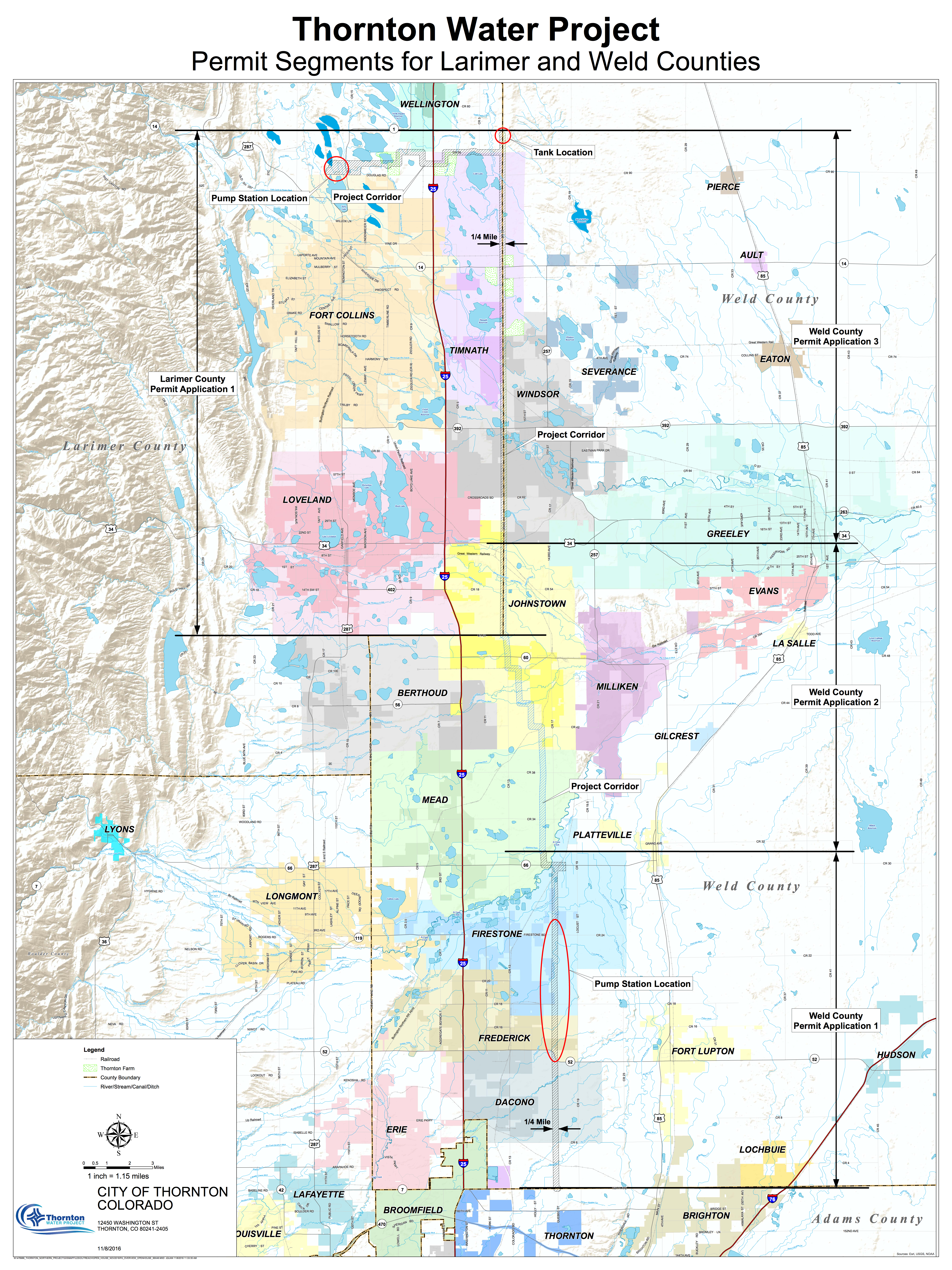
Map via ThorntonWaterProject.com.

From The Fort Collins Coloradoan (Kevin Duggan):

Longstanding plans to ship millions of gallons of Poudre River water to Thornton are about to flow through a series of regulatory and permitting hoops.

Thornton water officials have selected a preferred route for a 48-inch-diameter pipeline that would run from Water Supply and Storage Co. reservoirs north of Fort Collins to the east side of Interstate 25.

From there, the pipeline would follow Weld County Road 13 through Timnath, Windsor and other communities all the way to water treatment facilities in Thornton. The project requires permits from each governmental entity along the way as well as agreements with property owners.

Thornton has proposed placing the pipeline under Larimer County’s jurisdiction within the right of way of Douglas Road, which is also County Road 54. The pipeline would run from roughly Bayshore Road past Turnberry Road before heading north through Thornton-owned farmland and farther east.

Construction along the 70-mile pipeline route could begin in 2019. The project, currently estimated to cost $430 million, needs to be operational by 2025 to meet Thornton’s water supply needs, said Mark Kobeler, water project manager.

The proposed alignment through Larimer County came after reviewing numerous alternative routes, Kobeler said. The city and its consultants talked to county officials, property owners, residents and homeowners’ associations to get opinions on the best route…

Thornton expects to make a formal application to Larimer County for the project within a few weeks. Hearings before the county planning commission and the county commissioners likely will be scheduled in early 2018, said Rob Helmick, senior planner with Larimer County.

A separate site-review plan process will be used in considering the design and location of a pump station for the pipeline capable of moving 40 million gallons of water a day.

The facility likely would be placed between the Water Supply and Storage Co. reservoirs and Douglas Road. Details for the pump station have not been decided, Kobeler said, but it would be designed to blend into the surrounding area…

Thornton’s share of the Poudre is diverted near Bellvue. It moves along Water Supply and Storage Co. ditches to a set of reservoirs west of Colorado Highway 1 and north of Douglas Road.

#ColoradoRiver “Rights of Nature” lawsuit #COriver

Colorado River headwaters tributary in Rocky Mountain National Park photo via Greg Hobbs.

From the Boulder Weekly (Angela K. Evans):

A new lawsuit filed in U.S. District Court in Denver on Sept. 25 is asking a judge to treat the Colorado River as a person rather than property, therefore recognizing its right “to exist, flourish, regenerate, and naturally evolve.” It makes the argument that if corporations in the U.S. can be granted the same rights as people, shouldn’t rivers be allowed that status as well?

The Colorado River as an ecosystem is the plaintiff in the case, with members of Deep Green Resistance, an environmental activist group, listed as guardians or next friends, acting on the river’s behalf. And it sets the State of Colorado as the defendant, seeking to set precedence for future lawsuits that could hold the government responsible for certain actions, or inactions, that have caused the river harm.

“Normally in environmental law you have to show how some sort of action, be it state action or a corporate action, injures a human being,” says Denver attorney Jason Flores-Williams, who filed the case on the river’s behalf. “Even though we know at this point scientifically that injuries to the environment are injuries to human beings, the law hasn’t caught up to it yet.”

The suit is based on the rights of nature philosophy, a growing movement in environmental law that hopes to establish the inherent rights of the natural world to exist and flourish independent of human ownership or use. Although the idea has been around for decades, it has gained momentum in recent years as climate change and other human factors increasingly threaten entire ecosystems.

“There’s a growing understanding that environmental frameworks that exist today under environmental laws are not adequate to protect the environment,” says Mari Margil, with the Community Environmental Legal Defense Fund (CELDF), which is acting as legal advisor in the case. “They begin from the wrong place, the wrong premise, that nature is treated as right-less, as property, and therefore we can’t even protect its basic right to exist let alone to flourish.”

By authorizing the use of the natural environment, Margil says, existing environmental laws, such as the Clean Water Act, actually are “legalizing environmental harm.” Therefore, these laws are lacking in their attempt to actually protect and preserve the natural world, she argues.

The @OWOW_MSUDenver fall newsletter is hot off the presses

Photo credit Metropolitan State University of Denver.

Click here to read the newsletter. Here’s an excerpt:

Thank you to all that joined us for the Study Abroad Fair, Sustainability Fair, Fall Fest and the Student Water Field Conference in Keystone. We appreciate your interest in the OWOW Center and truly enjoy talking to others that have a passion about water.

Starting SPRING 2018, One World One Water Center will now offer an Water Studies Online Certificate!

What you get with the Water Studies Online Certificate:
* Flexible schedule – Control your own schedule with a self-paced format that’s 100% online
* One-on-one networking and advisement – Receive a personal advising session with an expert in the Colorado water industry
* Real-world applications – Develop a capstone project to directly apply what you’ve learned to real-world situations
For a list of courses and to register: click here.

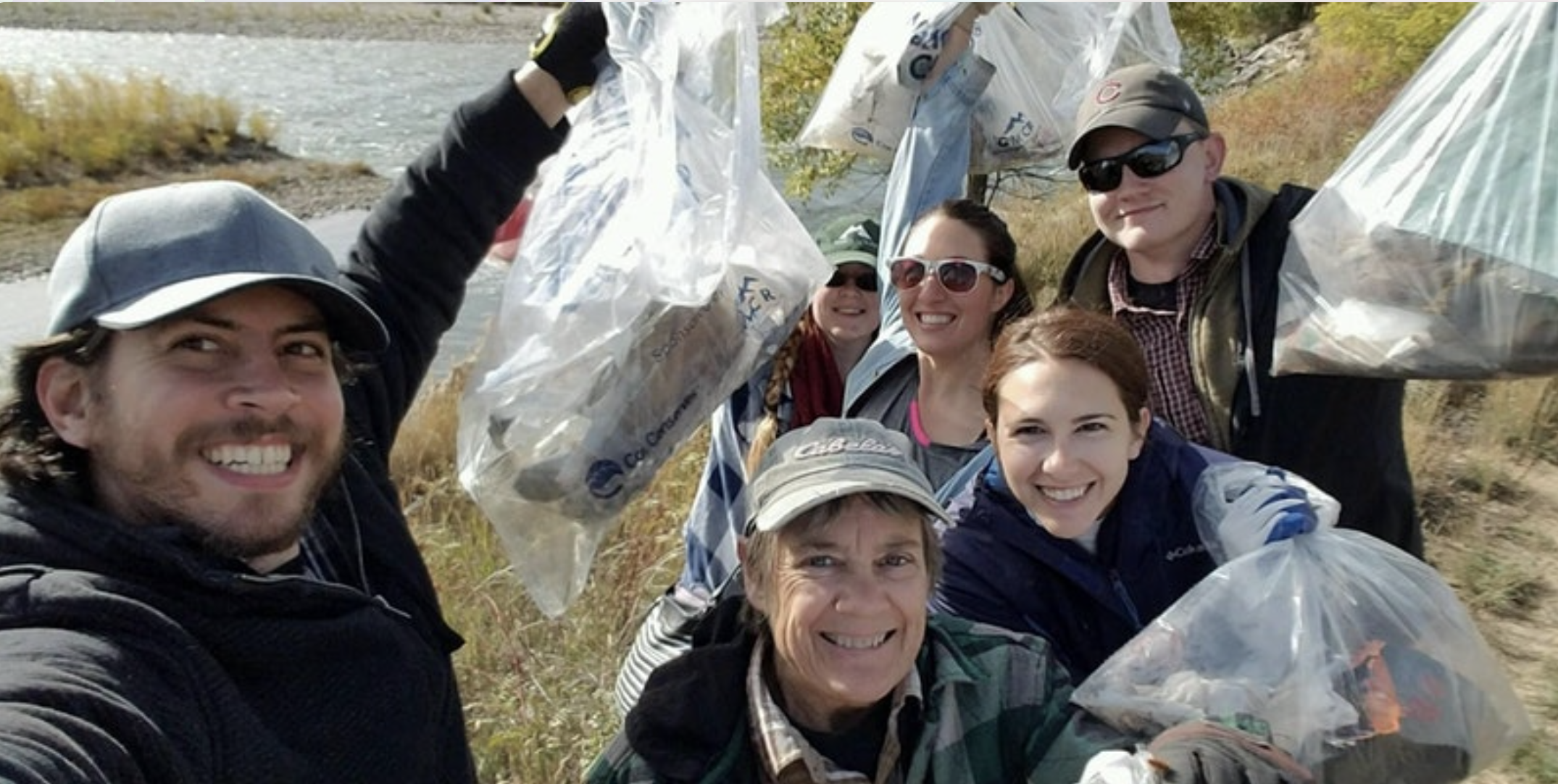
Alpine Bank Middle #ColoradoRiver Clean UP, October 7, 2017 #COriver

Photo credit: Middle Colorado River Watershed Council

Click here for all the inside skinny and to register.

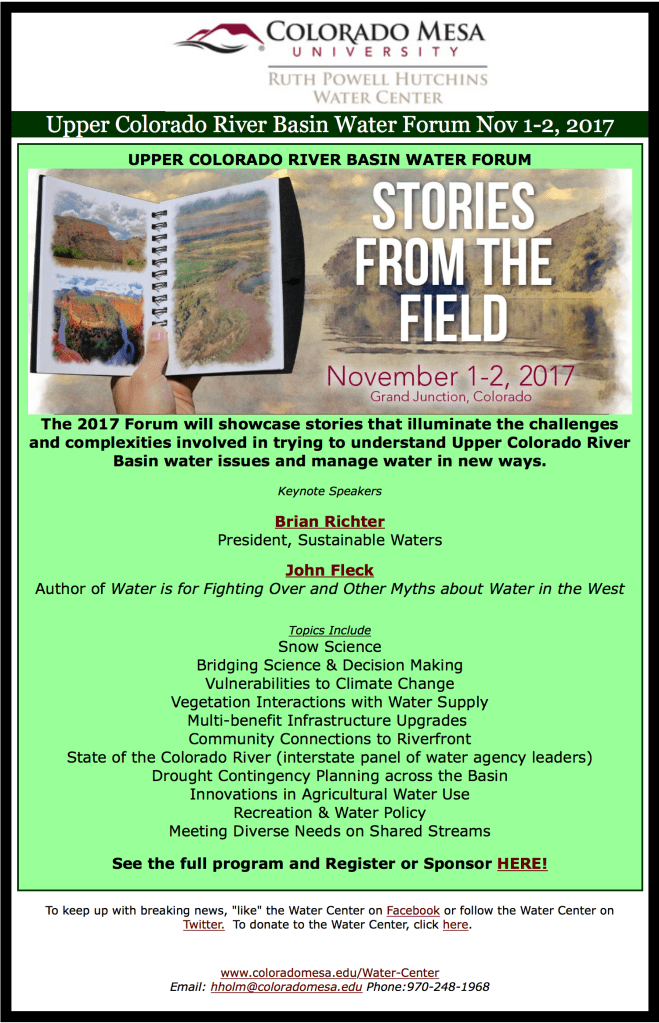
@WaterCenterCMU: Upper #ColoradoRiver Basin Water Forum Nov 1-2, 2017 #COriver

Click here for all the inside skinny and to register.

@ColoradoWater: #ColoradoRiver District annual seminar recap #COriver

Click here to go to the Colorado River District website for all the good stuff:

2017 Water Seminar
Themed “Points of No Return,” the 2017 seminar highlighted some of the toughest issues facing the Colorado River and the more than 40 million people who rely on its water. The seminar’s program featured presentations and panel discussions with a variety of water experts focusing on agriculture and irrigation issues, Upper and Lower Basin drought contingency planning, collaborative conservation efforts, and more.

The Colorado River District’s Annual Water Seminar was held on Friday, September 15th in Grand Junction, Colorado and was attended by record-breaking numbers.