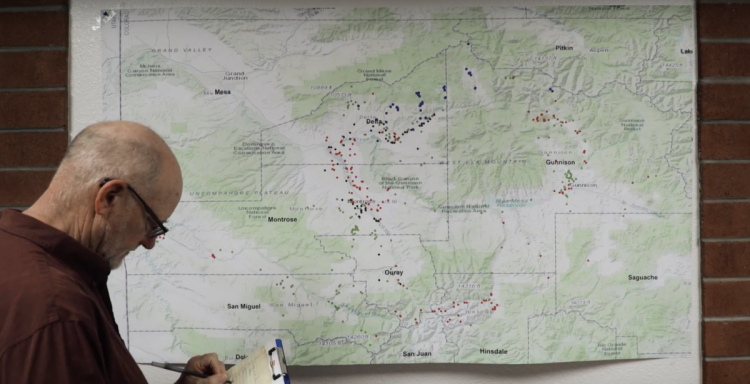
Ken Nordstrom, the environmental health director for the Delta County Health Department, looks at a physical version of the map. Photo credit: University of Colorado at Boulder
Prior to this study, there was no data on private drinking water quality in this six-county area, and the findings have proven to be relevant to many residents. Of the 457 wells analyzed in the survey, 11% have arsenic concentrations exceeding the Colorado primary drinking water standard maximum contaminant level. Additionally, 15% of the well water that was tested exceeded at least one primary drinking water contaminant standard from the state.
Residents can explore results through an interactive online map created by Holly Miller as part of her recently completed master’s degree in the Environmental Engineering Program at CU Boulder. The site shows locations for all the tested wells, provides links to request free testing kits and houses detailed water-quality information.
Samples for the survey came from volunteers in those communities. Miller’s work was done under Professor Joe Ryan, who said the database was an important step toward public awareness. That is because water quality is an important factor in overall health, but privately owned wells are unregulated and mostly untested for things like arsenic. Putting the survey results online gives residents, many of whom rely on well water, information about their home’s water quality and that of their neighbors so they can make informed health decisions.
Arsenic in groundwater can occur naturally, or it can come from human sources like agriculture, where it was used as a pesticide, or mining operations. Ingestion can have short-term effects, including nausea and fatigue, as well as long-term effects like skin thickening and discoloration. Ryan said that more testing was needed, but the source of the higher levels in this case was likely geologic. He added that better understanding of that aspect would be valuable when making decisions about new wells and development needs in those communities.
Ken Nordstrom, the environmental health director for the Delta County Health Department, said that without a healthy drinking water source, you cannot have a healthy community.
“CU Boulder has helped us develop this resource for individual homeowners to ensure that they have a healthy drinking water supply,” he said.
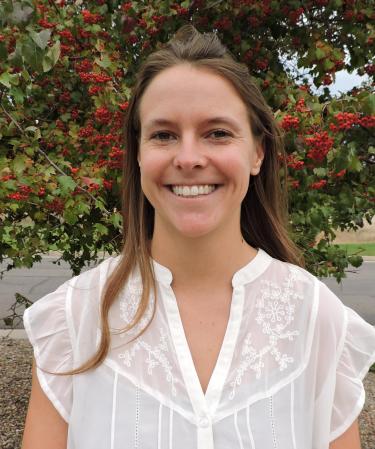
Holly Miller. Photo credit University of Colorado at Boulder
“Collaborating with Delta County has been a great asset for my professional career. I gained valuable research and outreach skills, which ultimately created the foundation for my current position where I work as the project manager for my program’s geographical information systems database used to map information about abandoned mine-land sites across the state,” she said.
The project is nearing completion, and sample kits have now been sent to approximately 1,000 volunteers. From that group, results have been returned to over 750 of them. Miller said the plan is to update the interactive map by the end of the year, and the Delta County Environmental Health Department staff is planning to survey residents in the counties to identify the impacts this project has had on helping private well owners keep their water safe.
Ryan said this type of work was just as important for students in his lab starting their careers as it is to the communities they are serving.
“This type of work is important because I can bring students into it – but it isn’t just having them take samples and analyzing them. It’s a good case where we are getting them into a mode where they are trying to find out the client’s problem and the best way to address it,” he said. “This kind of work provides extra opportunities for students and real benefits to communities we work with.”
This map shows estimates of how many private domestic well users in each county may be drinking water with high levels of arsenic. An estimated 2.1 million people throughout the U.S. may be drinking domestic well water high in arsenic
The Delta County Health Department (DCHD) paired up with the University of Colorado to study water quality in private wells. They said they got definitive data that shows not everyone can trust the water they are drinking.
DCHD oversees six counties: Delta, Gunnison, Hinsdale, Montrose, Ouray and San Miguel.
Approximately 36,000 people, or 60% of the population, in this area drink water from private wells that aren’t regulated because they’re privately owned, according to the department’s director, Ken Nordstrom.
Nordstrom said there are around 10,000 private drinking water wells in the six-county region his department oversees and that until this point there was no information readily available to the public about the quality of water in those wells…
So with the help of a Centers for Disease Control and Prevention (CDC) grant, the DCHD started taking a closer look at gathering data and CU Boulder joined in 2016.