Basin might become far drier than what managers have been planning for
Much has been said about a “new normal” in the Colorado River Basin. The phrase describes reduced flows in the 21st century as compared to those during much of the 20th century.
Authors of a new study contemplate something beyond, what they call a “new abnormal.”
The future, they say, might be far dryer than water managers have been planning for. This needs to change.
In the white paper, Kevin Wheeler and 11 others affiliated with the Utah State University-based Center for Colorado River Studies argue for the need for “wide-ranging and innovative thinking about how to sustainably manage the water supply, while simultaneously encouraging the negotiators of new agreements to consider their effects on ecosystems.”
In the 133-page report, they identified a wide variety of alternative management ideas, not simple tweaks but “significant modifications or entirely new approaches.” Some may consider these proposed approaches radical, they say, but the situation of the Colorado River Basin demands more than small, incremental changes.
“If the Millennium Drought, which has now persisted for more than two decades, has become the ‘new normal,’ or if the progressive decline of runoff resulting from climate change becomes even more apparent, major structural changes to water management in the basin will be urgently required,” the authors say in an executive summary.
They say they hope their research triggers further thinking and proposals.
Colorado will have to make do with what it has. This is despite projected population growth during the next three decades that will expand the current 5.8 million population by 3 million residents by mid-century. Think of another Aurora, Colorado Springs, and Pueblo every 10 years.
The era of massive new diversions from Colorado’s Western Slope ended decades ago. Relatively small—the key word is relatively—new diversions are planned: two in Grand County, where both Denver Water and Northern Colorado Water Conservancy District have projects using existing infrastructure. Aurora also wants to divert additional water from Eagle County.
This is from theBig Pivots, an e-magazine tracking the energy and water transitions in Colorado and beyond. Subscribe at http://bigpivots.com
Big, new diversions, such as from the Yampa River near Craig, face difficult and likely prohibitive economics, with the need to cross two or three mountain ranges to deliver water to the northern Front Range. Too, with warming very probably decreasing flows over coming decades, there’s uncertainty whether water will be available with any reliability, given Colorado’s commitments under compacts governing the Colorado River.
Between 85 and 90 percent of the Colorado River originates in snowmelt, mostly from Colorado but also Wyoming. A century ago there was plenty for the taking by all these states as well as the three lower-basin states, Arizona, Nevada, and California. Many, however, could see ahead to a time when there would not be plenty for all.
The Colorado River Compact drawn up by representatives of the seven states in 1922 assumed plentiful supplies of that time. The river delivered 17.7 million acre-feet from 1906 to 1930. They accordingly allotted 7.5 million acre-feet to Colorado and its neighboring headwater states and 7.5 million acre-feet to California and its neighbors, leaving water left over for delivery to Mexico.
At times, the river has delivered well enough. Keeping in mind that 90% of the flows come from the upper basin, the gauging station at Lees Ferry, at the top end of the Grand Canyon, the dividing point between upper and lower basins, has had an average annual natural flow of 14.8 million acre-feet between 1906 and 2018.
The drought since 2000 has bent down the numbers. From 2000 to 2018, the average estimated flows have been 12.4 million acre-feet. This is the Millennium Drought.
It could get worse—and it has been worse in the past. Tree rings indicate flows of 11.8 million acre-feet for the last quarter century of the 1500s. That’s natural.
Now come unnatural conditions, the influences of the greenhouse gas emissions that have been accumulating in the atmosphere. Climate change will make some places wetter, and some places drier. In the Colorado River Basin the evidence points strongly toward drier in the basin altogether.
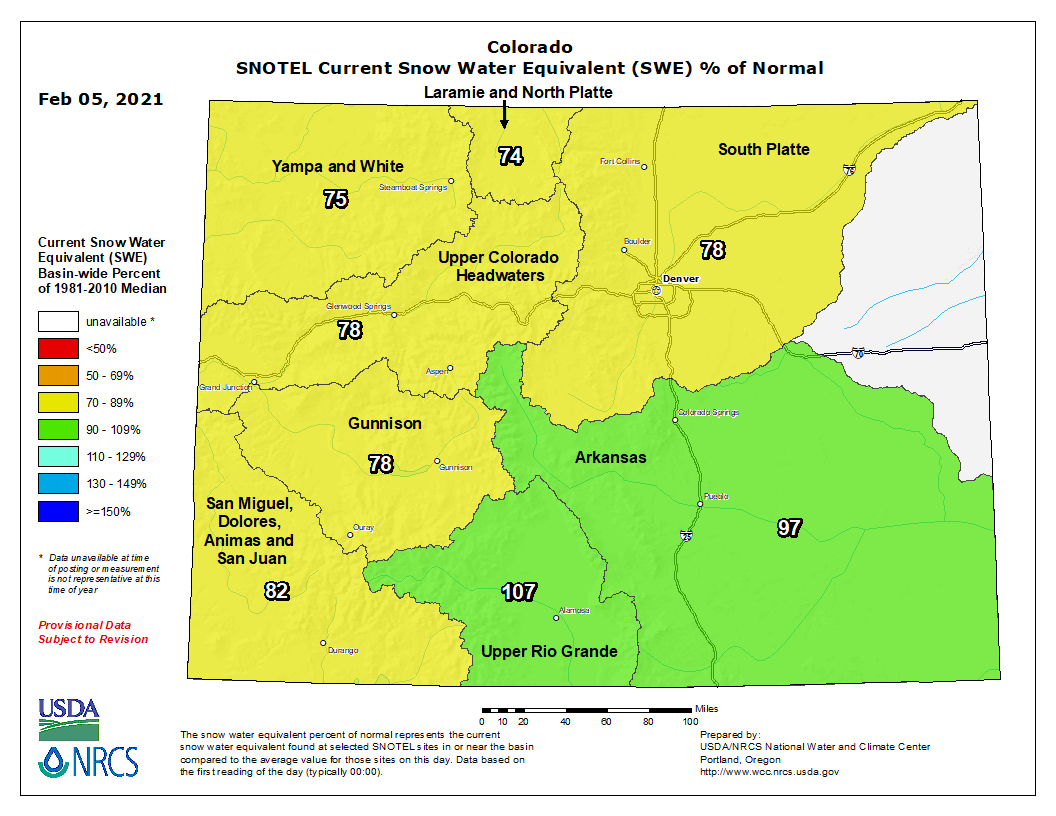
Colorado statewide snowpack basin-filled map February 5, 2021 via the NRCS.
Colorado State University’s Brad Udall and others have already documented a drying underway, the increased evaporation and transpiration caused by rising temperatures. Udall’s research has found roughly half of the Millennium Drought can be attributed to those rising temperatures. He calls it a “hot drought.”
As for future warming, the authors of the report used temperature projections from two pathways identified by the International Panel on Climate Change. They analyzed reductions of flows ranging from 3% to 10% for each degree Celsius of warming.
Where does all this take the 40 million of us who live in the Colorado River Basin or depend in part on imported water from the basin? The latter includes the nearly 5 million people along Colorado’s urbanized Front Range corridor and the nearly 24 million people of southern California.
“Probable climate change conditions” will cause flow declines of 6.5% for each degree of warming, the study says. With less water available, less must be used. “Aggressive commitments to water conservation by both the Upper and Lower Basins will become critical in the next 25 years” to avoid drawing down the reservoirs in the basin, most notably Mead and Powell, below 15 million acre-feet.
Colorado and other upper-basin states should not try to use more water beyond 4 million acre-feet , despite the compact apportionment of 7.5 million acre-feet. They aren’t. Total consumptive use flattened out beginning in 1988. As for lower-basin states, they need to reduce demand to 6 million acre-feet after already cinching their collective belt in the 21st century to get within the 7.5 million acre-feet and then, within the last five years 6.9 million acre-feet.
John Fleck, the author of one book about the Colorado River and the co-author of a second book and former water reporter for the Albuquerque Journal, wrote in his blog on inkstain.net that the report clearly calls for water managers to commit publicly to deeper reductions in water use.
He also credits the level of details in the report, “a credible incorporation of the best climate science into the current Colorado River Basin policy framework, with an analysis done using CRSS, the modeling tool the management community uses to think about the Colorado River. This report, in other words, is written by a team deeply fluent in the language of Colorado River management.”
The report was posted on the same day that I spoke with a resident in Colorado’s Summit County, who said that in 30 years she had never seen it so dry during mid-winter.
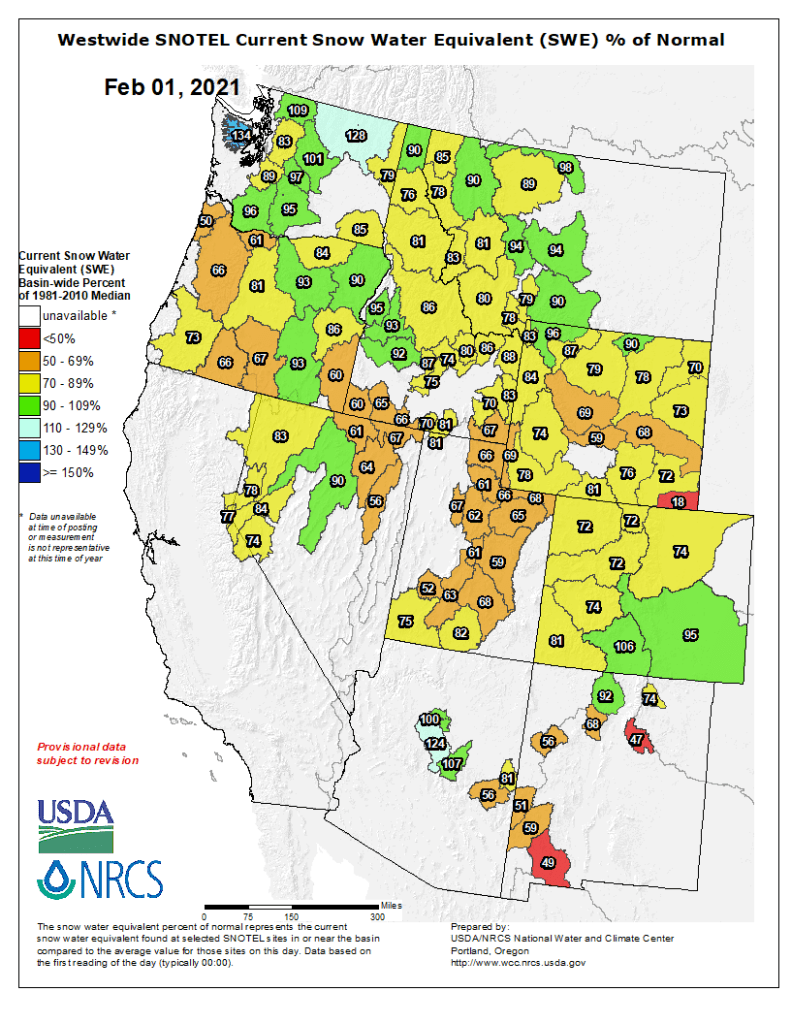
As of mid-January, the U.S. Bureau of Reclamation projected 5.72 million acre-feet flow into Lake Powell. That’s 53% of average.
This comes after a subpar runoff in 2020 followed by a hot and dry summer, with massive wildfires from August to November, and now a winter that is, like the children of Lake Wobegone, above average—for warmth, that is.
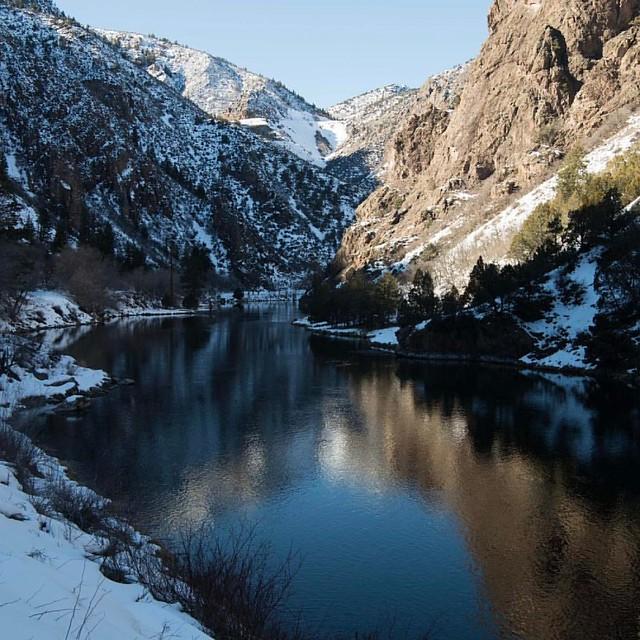
Gunnison River in Colorado. Source: Bureau of Reclamation via the Water Education Foundation
From the Colorado Water Conservation Board via The Delta County Independent:
During the Colorado Water Conservation Board (CWCB) meeting on Jan. 25, an update on the current and ongoing Demand Management Feasibility Investigation was presented, including reiteration of the state’s guiding principles and the first steps of potential framework concepts for what a program could look like.
“The Demand Management Investigation remains an open, collaborative process, as we continue conversations with the Interbasin Compact Committee, Tribal Nations, non-governmental organizations, and stakeholders across the state,” said CWCB Director Rebecca Mitchell. “The big question is, can we design a program that creates a net benefit for Colorado and protects Colorado water users?”
The Step II Work Plan, which was approved in November 2020, aims to use information developed throughout the course of work done pursuant to the previous 2019 Work Plan to analyze whether a Demand Management program would be achievable, worthwhile, and advisable for Colorado as a whole.
The guiding principles articulated at the board meeting include: Demand Management is not a foregone conclusion; The framework is not a program, but a point for discussion; Issues are explored in an open and collaborative manner including engagement with Tribal Nations; and a program would be run by the state for the benefit of the whole state and its water users.
As part of the Step II Work Plan, CWCB will develop strawman concepts based on a matrix of elements, which were identified by each of the eight workgroups last year.
At the board meeting, staff presented on elements for monitoring and verification; education and outreach; and environmental considerations areas. These were presented as examples, as staff develops content relating to the other subject areas.
While no large-scale pilot programs will be implemented at this time, CWCB will soon begin looking at opportunities to use existing programs and funding sources to conduct smaller-scale demonstration projects that might help with on-the-ground learning. CWCB will also work to incorporate existing and ongoing projects and information into the framework.
A CWCB workshop will be scheduled in the near future to provide the next update on the feasibility analysis. The date and time of this virtual event will be added to the CWCB calendar.