Fill ‘er up: #Colorado’s reservoirs hit 100% of normal for the first time in 3 years — Water Education Colorado

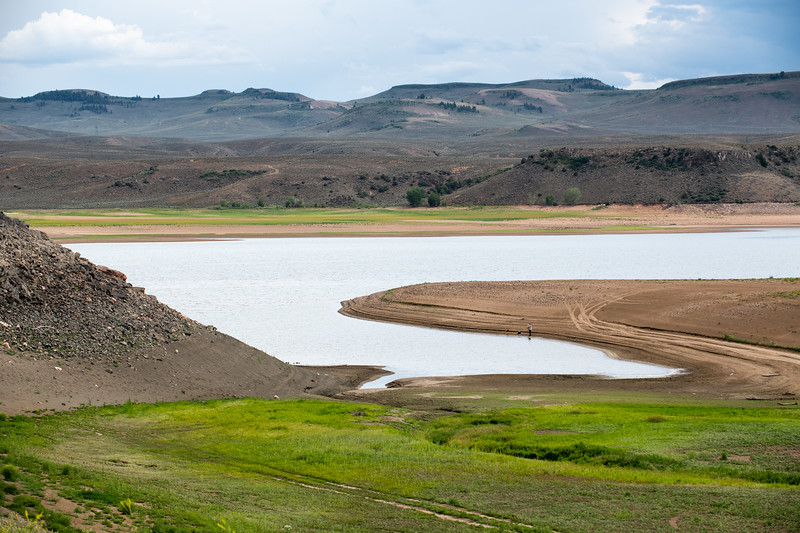
Blue Mesa Reservoir is the largest storage facility in Colorado in the Upper Colorado River system. Prolonged drought and downriver demand is shrinking the reservoir. Credit: Tom Wood, Water Desk

Click the link to read the article on the Water Education website (Jerd Smith):

Thanks to heavy winter snows and a rainy spring, Colorado’s system of water reservoirs hit 100% of normal this month, the fullest they’ve been in three years, according to the Natural Resources Conservation Service (NRCS).

Last year at this time, reservoirs were just 80% of normal.

“This is great news for reservoir storage,” said Karl Wetlaufer, assistant snow survey supervisor at the NRCS in Lakewood. Wetlaufer’s comments came Tuesday at a meeting of the state’s Water Availability Task Force, a multi-agency group that tracks snow and water supplies statewide and also monitors conditions for drought and flooding.

That “normal” statistic doesn’t mean full, but it does mean that the reservoirs have returned to health. At this time of year, that means the statewide system, which includes dozens of individual reservoirs, is 75% full, according to the NRCS.
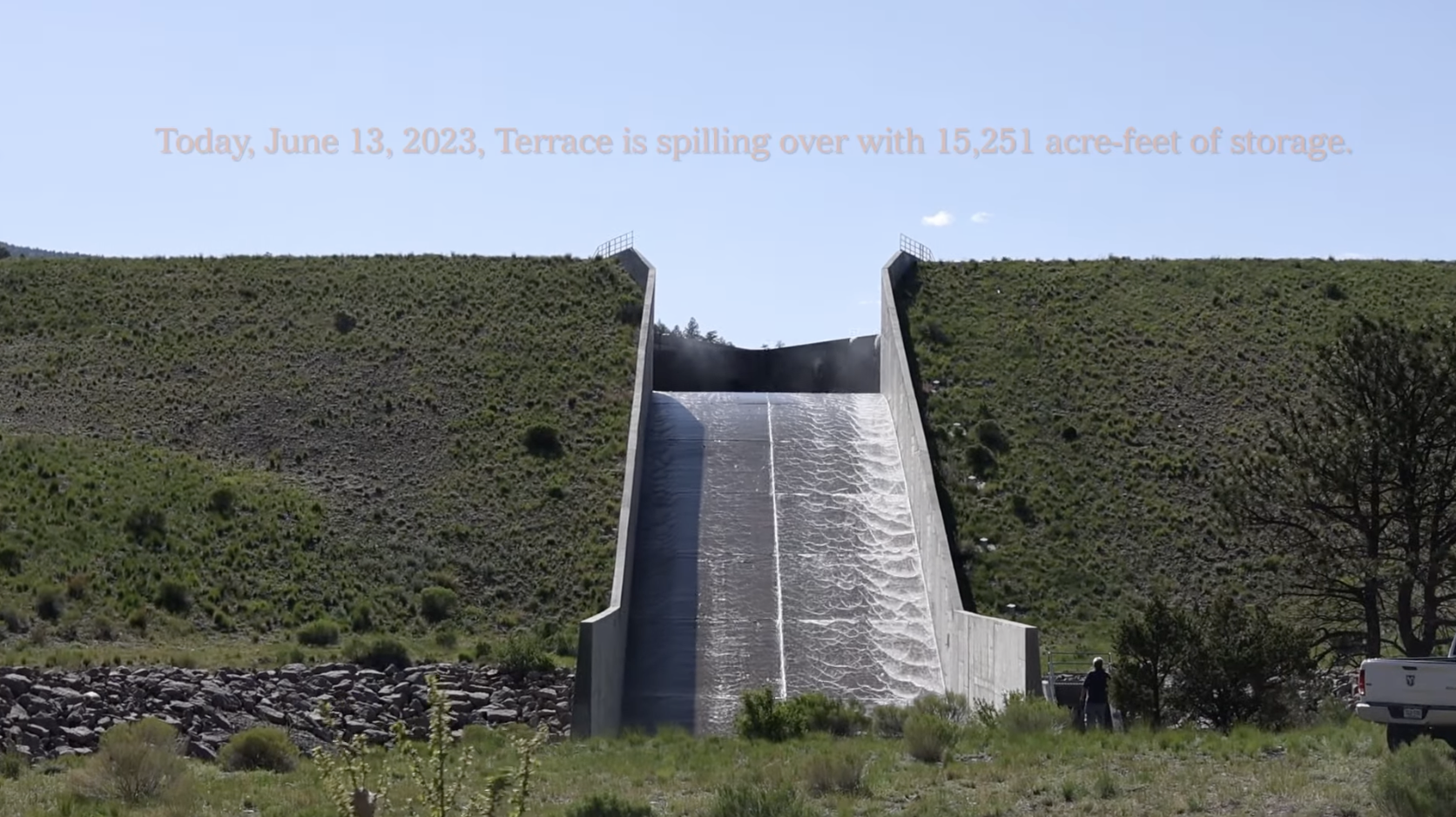
Terrace Reservoir on the Alamosa River is spilling for the first time in many years, June 2023. Photo credit: Alamosa Citizen

The Rio Grande Basin, which has struggled with below-average mountain snows and dwindling storage for years, has seen its reservoirs surge back to life this year, with stored supplies measuring 124% of normal. Last year its reservoirs stood at just 83% of normal.

In fact, in 2022 all the reservoirs across the state’s major basins were low, with the South Platte River Basin coming closest to health, registering 98% of normal.
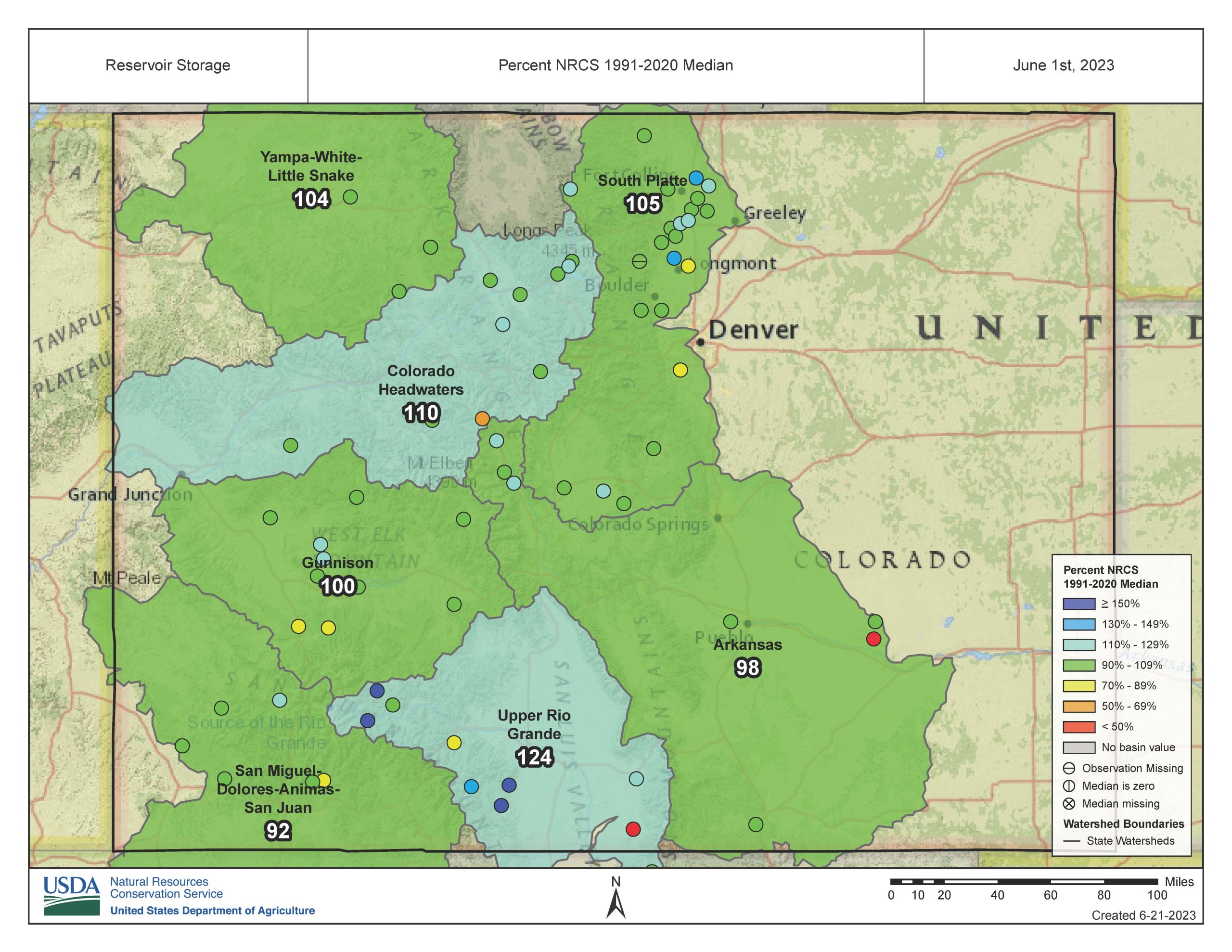
“It’s really encouraging to see almost all of our major (river) basins increase, so significantly,” Wetlaufer said.

Colorado is home to the headwaters of the seven-state Colorado River system and the vast majority of the drought-ridden region’s water supplies originate here. Thanks to the heavy winter snows and healthy runoff, Lake Powell and Lake Mead, the two largest reservoirs in the nation, are gaining as well.

“I usually feel like a broken record talking about drought,” said Assistant State Climatologist Becky Bolinger, who is a member of the task force. “But now I get to talk about a bunch of water.”

And all that water has largely pulled Colorado out of drought, with just a few small areas of the state, including parts of Summit County, as well as northeastern and southeastern Colorado, registering as abnormally dry, the least intense level of drought, according to the U.S. Drought Monitor.

Bolinger said the weather pattern known as El Niño has established itself and is likely to remain in place until next spring. During El Niño periods, usually lasting months though sometimes years, the Pacific Ocean’s surface temperatures are warmer than normal. Warm waters cause a shift in the Pacific jet stream, causing areas in the northern U.S. to become drier and warmer than usual, and the gulf and southeast to experience wetter conditions than usual.

For the past three years, La Niña has dominated Colorado’s weather cycle, bringing much drier conditions to Colorado’s southwestern region and heavy snows to its northern mountains.

That is likely to change this year as the El Niño pattern takes hold.

“Generally [El Niño] is good for our state, because it means more precipitation,” Bolinger said, but in the coming weeks, much warmer temperatures are predicted to arrive and the summer monsoon season is likely to weaken.

“Remember, we live in Colorado, it will dry out again,” Bolinger said. “We aren’t going to stay in this wet pattern forever. Enjoy it while it lasts.”

Jerd Smith is editor of Fresh Water News. She can be reached at 720-398-6474, via email at jerd@wateredco.org or @jerd_smith.

Navajo Reservoir operations update June 22, 2023 #SanJuanRiver #ColoradoRiver #COriver #aridification

The San Juan River, below Navajo Reservoir. Photo: Brent Gardner-Smith/Aspen Journalism

From email from Reclamation (Susan Novak Behery):

The Bureau of Reclamation is continuing the ramp-down from the 2023 Spring Peak Release.  The current release is 1,200 cfs.  The next release changes are shown in the table below.

DateDayTimeRelease (cfs)
6/23/2023Fri4:00 AM900
6/24/2023Sat4:00 AM700
6/25/2023Sunno change700
6/26/2023Mon4:00 AM500
6/27/2023Tueno change500

Areas in the immediate vicinity of the river channel may continue to be unstable and dangerous. Please use extra caution near the river channel and protect or remove any valuable property in these areas. 

Following ramp-down, summer releases will be made for the authorized purposes of the Navajo Unit, and to attempt to maintain a target base flow through the endangered fish critical habitat reach of the San Juan River (Farmington to Lake Powell).  The San Juan River Basin Recovery Implementation Program recommends a target base flow of between 500 cfs and 1,000 cfs through the critical habitat area.  The target base flow is calculated as the weekly average of gaged flows throughout the critical habitat area from Farmington to Lake Powell.  

For more information, please see the following resources below:  

Bureau of Reclamation:  

• Susan Behery, Hydrologic Engineer, Reclamation WCAO (sbehery@usbr.gov or 970-385-6560).   

• Navajo Dam website: https://www.usbr.gov/uc/water/crsp/cs/nvd.html  

• Navajo Dam Release Notices: https://www.usbr.gov/uc/wcao/water/rsvrs/notice/nav_rel.html  

• Colorado River Basin Facebook Page: https://www.facebook.com/coloradoriverbasin

U.S. Supreme Court rejects Navajo Nation’s #water rights trust claim: #Arizona v. Navajo Nation is the final federal Indian law case to be ruled on by the high court this term — Source #NM #ColoradoRiver #COriver #aridification

Navajo Nation. Image via Cronkite News.

Click the link to read the article on the Source NM website (Kolby KickingWoman):

The U.S. Supreme Court said the United States is not required “to take affirmative steps to secure water for the Tribe” because the Navajo Treaty of 1868 does not state that in a 5-4 vote in Arizona v. Navajo Nation.

The case was the third and final federal Indian law case this term.

Thursday’s decision reverses a ruling by the U.S. Court of Appeals for the 9th Circuit that the Navajo Nation. The tribe cannot proceed with a claim against the Department of the Interior to “develop a plan to meet the Navajo Nation’s water needs and manage the mainstream of the Colorado River in the Lower Basin.”

The court also ruled that the tribe cannot present a cognizable claim of breach of trust.

Justice Brett Kavanaugh wrote the opinion and was joined by Chief Justice John Roberts and Justices Clarence Thomas, Samuel Alito and Amy Coney Barrett.

“And it is not the Judiciary’s role to rewrite and update this 155-year-old treaty,” Kavanaugh wrote. “Rather, Congress and the President may enact—and often have enacted—laws to assist the citizens of the western United States, including the Navajos, with their water needs.

Kavanaugh went on to write that the United States has no similar duty with respect to land on the reservation and it would be “anomalous to conclude that the United States must take affirmative steps to secure water.”

“For example, under the treaty, the United States has no duty to farm the land, mine the minerals, or harvest the timber on the reservation—or, for that matter, to build roads and bridges on the reservation,” Kavanaugh writes. “Just as there is no such duty with respect to the land, there likewise is no such duty with respect to the water.”

The Navajo Nation argued that securing water rights to the Colorado River for the tribe fell under the federal government’s trust obligations that were being unfulfilled.

Critics immediately react to the decision saying it is a virtual theft of water from the Navajo Nation.

As he has done in the past, Justice Neil Gorsuch laid out the history of the tribe and the surrounding circumstances that led to this point in his dissenting opinion. He writes that it is known that the United States holds some of the tribe’s water rights in trust and the government owes the Navajo Nation “a duty to manage the water it holds for the Tribe in a legally responsible manner.”

In his concluding paragraphs, Gorsuch writes that the tribe has tried nearly everything and poses the question, “Where do the Navajo go from here?”

“The Navajo have waited patiently for someone, anyone, to help them, only to be told (repeatedly) that they have been standing in the wrong line and must try another. To this day, the United States has never denied that the Navajo may have water rights in the mainstream of the Colorado River (and perhaps elsewhere) that it holds in trust for the Tribe,” Gorsuch writes. “Instead, the government’s constant refrain is that the Navajo can have all they ask for; they just need to go somewhere else and do something else first.”

The court ruled in mid-June on the other two federal Indian law cases. The high court affirmed the Indian Child Welfare Act in a major win that was celebrated across Indian Country. The same day the ICWA opinion was released, the court also ruled on Lac du Flambeau Band of Lake Superior Chippewa Indians v. Coughlin.

In that ruling, the court stated that tribes cannot use sovereign immunity in Bankruptcy Court.

The court still has a number of cases to rule on before taking a summer break. The justices will return for the next term starting in October.

The opinion on Arizona v. Navajo Nation can be read here.

Moving #Water Around #Colorado is Fraught Project — The Buzz

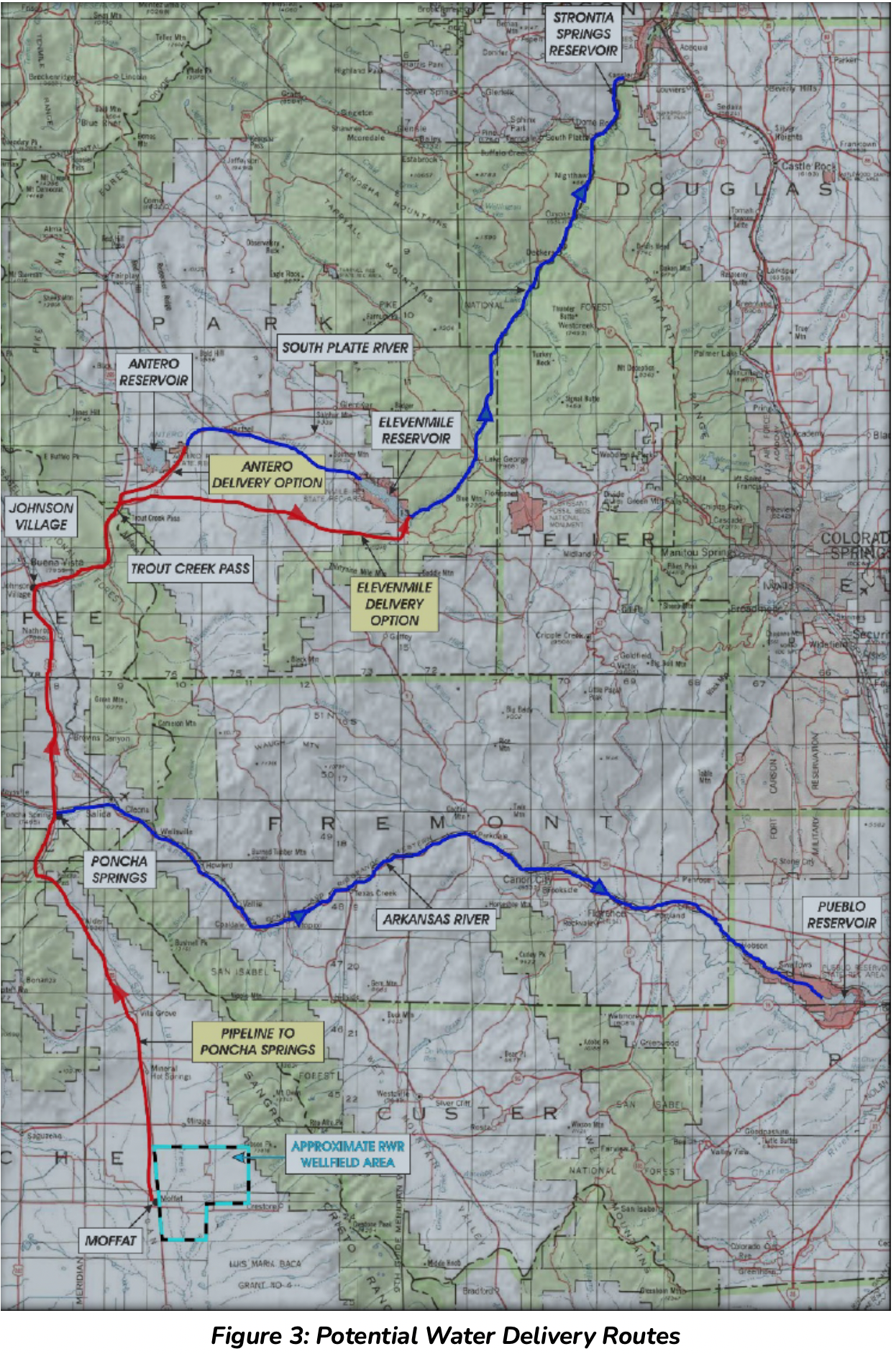
Potential Water Delivery Routes. Since this water will be exported from the San Luis Valley, the water will be fully reusable. In addition to being a renewable water supply, this is an important component of the RWR water supply and delivery plan. Reuse allows first-use water to be used to extinction, which means that this water, after first use, can be reused multiple times. Graphic credit: Renewable Water Resources

Click the link to read the article on The Buzz website (Floyd Ciruli):

Whether it’s Colorado River water to the Platte for the Front Range or the San Luis Valley aquifer to the Denver suburbs, the quest to move water from the source to the population in Colorado never ends.

Jerd Smith in Fresh Water News (6-7-23) describes the latest effort.

“Real estate developers interested in exporting water they own from San Luis Valley to fast-growing, water-short Douglas County have contributed thousands of dollars to candidates for the Parker Water & Sanitation District board, one of the largest water providers in the county.

“Such large contributions are unusual in low-profile water district board elections, where candidates often provide their own funding for their campaigns of a few hundred dollars, rather than thousands, according to Redd, Manager of Parker Water. “That’s a lot of money for a water board race,” Redd said.”

Renewable Water Resources, the investor group, continues to search for a local government to help on costs, but I said:

“Floyd Ciruli, a pollster and veteran observer of Colorado politics who has done extensive work in the past for Douglas County water providers, said the RWR initiative faces an uphill battle.

“‘They have resistance at both ends.’ Ciruli said, referring to opposition in the San Luis Valley and in the metro area. ‘It’s interesting that [RWR] is contributing to these boards. It’s a real long shot.'”

Source: Developers behind San Luis Valley water export proposal contribute thousands to Douglas County water district races: https://www.watereducationcolorado.org/fresh-water-news/developers- behind-san-luis-valley-water-export-proposal-contribute-thousands-to-douglas-county-water-board- races/

Colorado Announces  First Full-time #ColoradoRiver Commissioner – Rebecca Mitchell — #Colorado Department of Natural Resources #COriver #aridification

Colorado Water Conservation Board Executive Director and commissioner to the Upper Colorado River Commission Becky Mitchell, center, speaks on a panel with representatives of each of the seven basin states at the annual Colorado River Water Users Association conference in Las Vegas Thursday, December 15, 2023. The UCRC released additional details of a water conservation program this week. CREDIT: HEATHER SACKETT/ASPEN JOURNALISM

Click the link to read the release on the Colorado Department of Natural Resources website (Chris Arend):

Denver – The Colorado Department of Natural Resources announced today that Rebecca Mitchell will become the State of Colorado’s first full time Commissioner to the Upper Colorado River Commission. Mitchell will now navigate the deep challenges of the Colorado River in this upgraded position, supported by an interdisciplinary team within the Department of Natural Resources and support from the Colorado Attorney General’s Office. The team, established with funding in the FY 2023-24 budget passed by the General Assembly and signed by Governor Polis, will greatly enhance the state’s position in Colorado River interstate issues and upcoming negotiations on the operations of Lake Mead and Lake Powell. 

The next few years are going to be incredibly intense as we shift the way that the seven basin states cooperate and operate Lakes Powell and Mead,” said Becky Mitchell, the State of Colorado’s Commissioner to the Upper Colorado River Commission. “This expanded role will allow me to fully focus on Colorado’s needs at such a critical time and actually work towards long term sustainable solutions to managing the Colorado River. Climate change coupled with Lower Basin overuse have changed the dynamic on the Colorado River and we have no choice but to do things differently than we have before.”

Mitchell has served as the Director of the CWCB for six years and, for the last four, has been serving a dual role after accepting the Governor-appointed position of Colorado River Commissioner in 2019. This is the first time Colorado has had a full-time, state-employed Upper Colorado River Commissioner.

“Water is essential to our economy, impacts housing, and plays a pivotal role in our thriving outdoor recreation and agriculture industries. Rebecca’s leadership and experience have already improved management and negotiations on the Colorado River and we look forward to her continued efforts to protect our waterways and defend our water rights,” said Governor Polis. 

Mitchell serves as Colorado’s representative to the Upper Colorado River Commission (UCRC). The UCRC is an interstate water administrative agency established by the 1948 Upper Colorado River Basin Compact. The UCRC is the body through which the four Upper Division States coordinate on Colorado River matters.

“It’s been a pleasure to have worked with Becky for the last four years in her role as Colorado Water Conservation Board Director, ” said Dan Gibbs, Executive Director, Colorado Department of Natural Resources. “Becky rose through the ranks of the Department of Natural Resources and has changed the culture and statewide leadership on water issues at CWCB. Now, Becky can bring her expertise and passion as our State’s full time Commissioner with a well-supported team of interdisciplinary state staff from CWCB, our Executive Director’s Office, the Division of Water Resources, Attorney General’s Office and others to ensure her success.”

“This role will also allow me the time to get out on the ground more—to hear from folks from all areas across the state, to listen to the needs of all water partners,” said Mitchell. “This includes Tribal communities and leaders, as it’s critical to include these voices in the Colorado River conversation.”

And while Mitchell looks forward to her new role, she also looks back at her 14 years at the CWCB. “During these years I had the opportunity to really build the team and watch it come together, as well as oversee development of the Colorado Water Plan,” she said. Mitchell will have a continued partnership with the agency. Lauren Ris, who has served as Deputy Director of CWCB since 2017, will step in as Acting Director of the agency.

The Colorado River provides water for 40 million people and 30 Tribes spread over 7 states and 2 countries, so there’s a lot at stake,” Mitchell said. “We have the tools to solve this, we just need the collective resolve and determination to implement them in a thoughtful, collaborative way.”