The latest briefing (July 7, 2023) is hot off the presses from Western Water Assessment

Click the link to read the latest briefing from the Western Water Assessment website:

July 7, 2023 – CO, UT, WY

Heavy rainfall continued through June, breaking precipitation records in Colorado and Wyoming and completely removing drought from Colorado. June temperatures were below normal throughout most of the region, particularly in Colorado and Utah. Snowpack has melted out across the region, except for some high-elevation areas not captured by the SNOTEL network. Most streamflow gauges recorded normal to above normal flows throughout the region. Regional drought conditions continued to improve in June. El Niño conditions continued in June and are expected to persist and strengthen through winter.

June precipitation was above to much-above normal for most of the region. 200-400% of normal precipitation occurred in the majority of Wyoming, eastern Colorado, and pockets in southwestern and central Utah, with 400-800% of normal precipitation in Arapahoe and Elbert Counties in Colorado and Park, Hot Springs, and Fremont Counties in Wyoming. Record-wettest conditions occurred throughout much of the Front Range and eastern Colorado, and central and southeastern Wyoming. Areas of below normal precipitation occurred as well, particularly in the Great Salt Lake region, southeastern Utah, and southwestern Colorado.

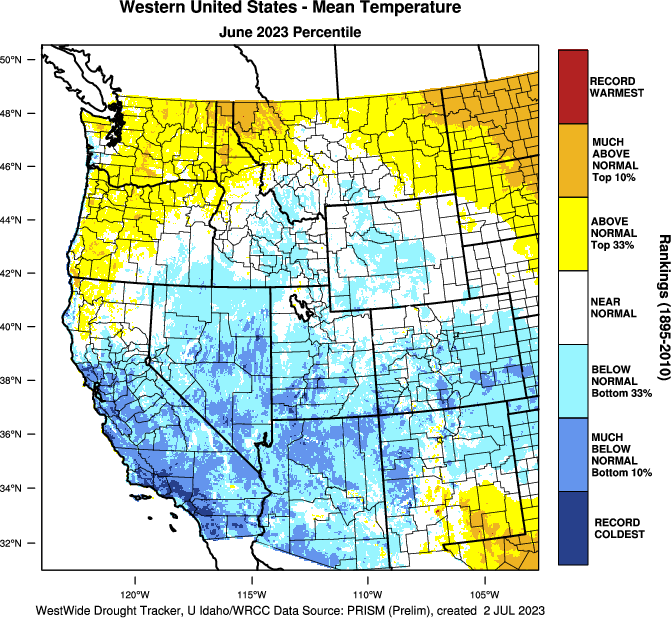
Regional temperatures were near normal to much-below normal. Temperatures of four to six degrees below normal were scattered throughout Utah and Colorado, with pockets of six to eight degrees below normal in Las Animas County in Colorado and Box Elder and Tooele Counties in Utah. In northeastern Wyoming, slightly above normal June temperatures were observed.

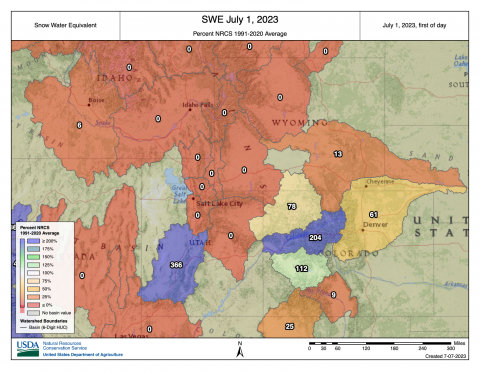
Snowpack has completely melted out at all SNOTEL sites across the region, except for the Gunnison, Colorado Headwaters, White-Yampa, and Escalante Desert-Sevier Lake Basins. As of July 5 and averaged across all the SNOTEL sites in the remaining basins in the region, snow melted out 12 days later in Utah and four days later in Colorado. In Wyoming, snow melted out four days earlier than average. Regionally, snow melted out five days later than average.
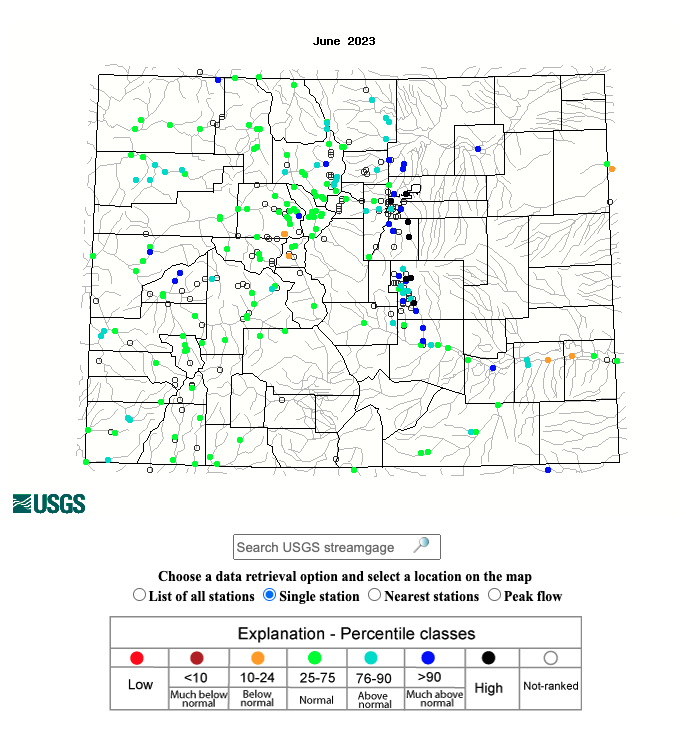
Regional streamflows were normal to much-above normal in June, with only a few sites recording below normal streamflows. Notably high streamflows, 96-98th percentile, were observed in the Provo River near Charleston, Utah, and many sites along the Front Range in Colorado, including Cherry Creek in Denver, Cottonwood Creek in Colorado Springs, and Jimmy Camp Creek in Fountain.
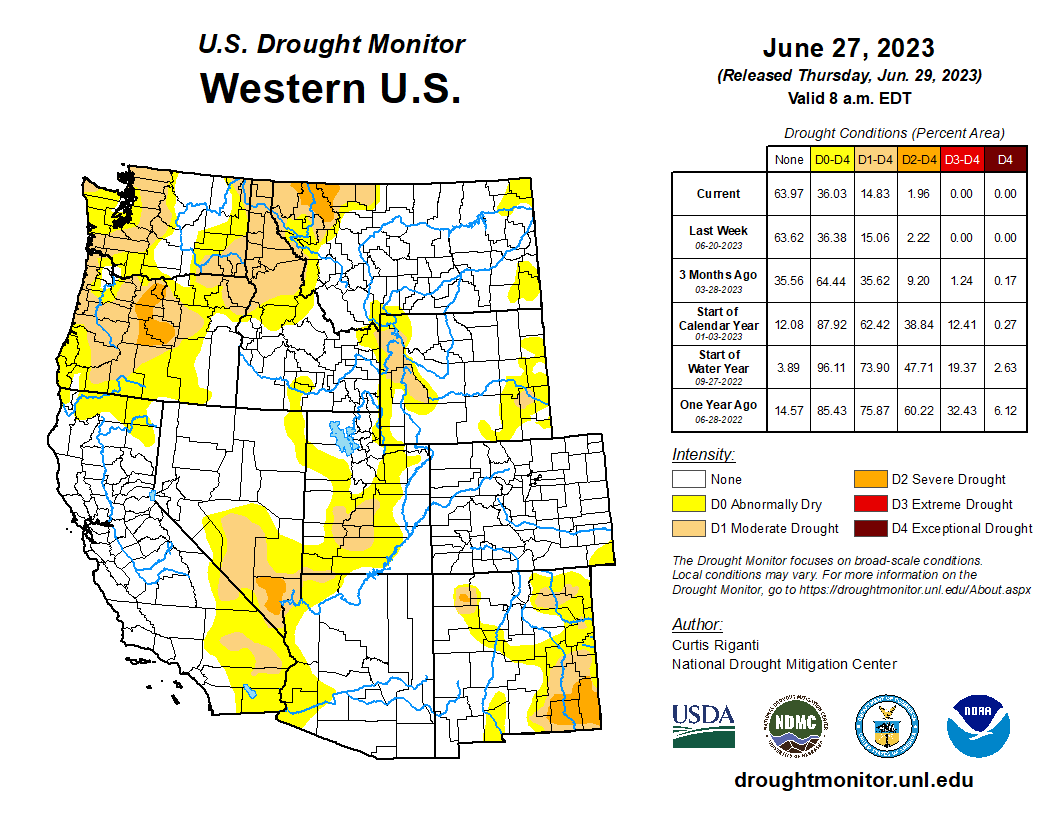
Regional drought conditions improved or did not change for all locations. As of June 27, drought covered 6% of the region, down from 14% at the end of May. Above normal precipitation throughout the majority of the region in June significantly improved drought conditions, particularly in Wyoming and Colorado. D2-D4 drought was removed from several counties in Wyoming, particularly Teton, Sublette, and Goshen Counties. On June 20, D1-D4 drought was removed in Colorado and as of June 27, the state continues to be drought-free.
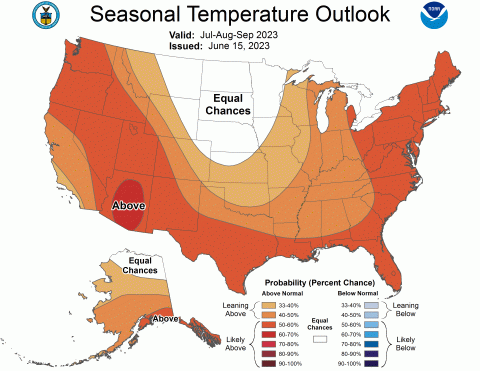
El Niño conditions continued to develop during June and are expected to strengthen into the winter. Pacific Ocean sea-surface temperatures were above normal in June, with anomalies of more than 1 degree Celsius. Mid-June ENSO forecasts indicate at least a 90% probability of El Niño conditions persisting July-November. NOAA monthly forecasts suggest an increased probability of above average July precipitation in eastern Wyoming and eastern Colorado, and below average precipitation in southern Utah. NOAA seasonal forecasts suggest an increased probability of above average precipitation in northern Wyoming and below average precipitation in southern Utah and southwestern Colorado. There is an increased probability of below average temperatures in the majority of Wyoming and northern Colorado during July, and an increased probability of above average seasonal temperatures during July-September throughout most of the region, particularly in Utah.

June significant weather event: Record-breaking rainfall in Colorado. A near-stationary, persistent ridge of high-pressure air east of Colorado, coupled with a continuous low-pressure system to the west and moisture from the Pacific Ocean and Gulf of Mexico, has caused significant precipitation in the state in June. Denver broke June’s record rainfall with 6.10”, significantly surpassing the old record of 4.96” set in 1882. Denver also experienced the 6th wettest month of all time since weather records began in 1872. 11.63” of rainfall was recorded at DIA between May and June, which is 7.53” above the combined average for the two months and around 75% of normal annual precipitation. A daily maximum record of 1.85” of rain fell on June 21, significantly surpassing the old record of 0.85” set in 1947. Over five inches of rain fell in Boulder for the second month in a row, making June the 4th wettest on record since 1897. According to the Colorado Climate Center, June 2023 ranks as the 4th wettest June on record for Colorado (Figure 1), and many pockets of eastern Colorado had the wettest month of all time out of 1,542 months on record (Figure 2).

The significance of 62.9 F in a rapidly #warming world — Ark Valley Voice #ActOnClimate

Yearly surface temperature compared to the 20th-century average from 1880–2022. Blue bars indicate cooler-than-average years; red bars show warmer-than-average years. NOAA Climate.gov graph, based on data from the National Centers for Environmental Information.

Click the link to read the article on the Ark Valley Voice website (Jan Wondra):

We Witness The Two Hottest Days on Earth this Week; Climate Change “Jet-Fueled” by El Niño

This week the planet passed a milestone that environmental experts hoped would never come. We had — officially — the second hottest followed by the hottest average temperatures recorded since humans began to walk the earth. While we living in the Rocky Mountains often boast of our lower temperatures and lower humidity, these averages affect every human being [ed. and all other species] on this [Earth].

On Monday, July 3, the average from thousands of measurement points all around the globe surpassed 62.3 degrees Fahrenheit. On Tuesday, July 4, it rose over 62.9 degrees Fahrenheit (17.18 degrees Celsius).

At the same time, according to the World Meteorological Organization, the oceans of the North Atlantic have risen more than nine degrees in temperature this year. Normally, the planet’s massive oceans act as heat absorbers for the atmosphere and the land masses. Climate experts are warning that the oceans are losing their ability to cool us down…

In the mid-May report by the World Meteorological Organization it projected that average global temperatures are expected to soar to record highs over the next five years; driven not just by climate change, but the El Niño climate pattern. The 1 .5  degrees Celsius of warming has long been considered the magic number we cannot cross without facing some of the most dire consequences of global warming. With the average temperature of the earth warmer this week than it has been in 125,000 years, it remains to be seen if we are ready to heed that warning.

It’s official: #Colorado saw a record number of tornadoes on the first day of summer — The #FortCollins Coloradoan

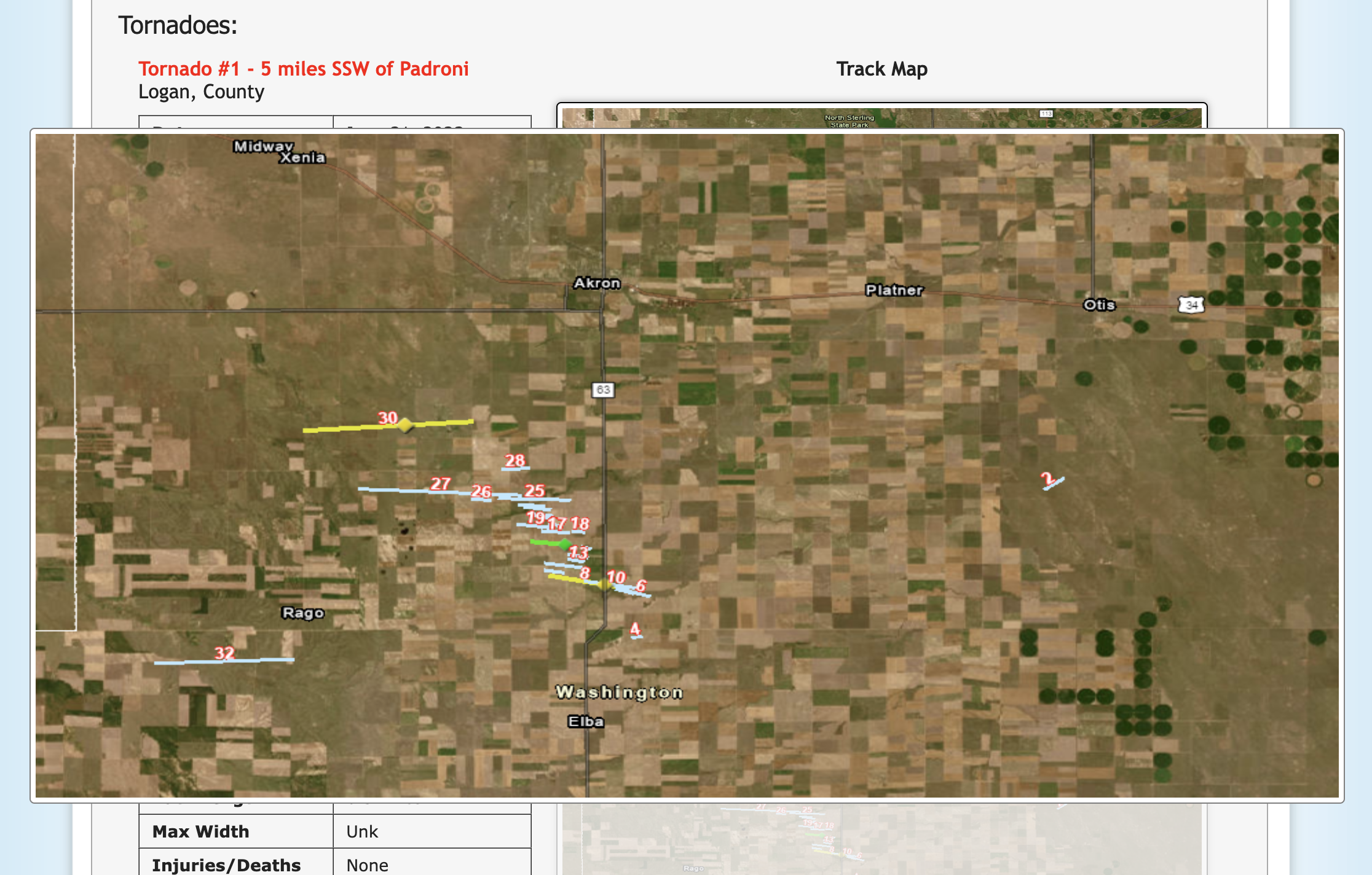
Screenshot of the NWS tornado tool July 8, 2023.

Click the link to read the article on the Fort Collins Coloradoan website (Miles Blumhardt). Here’s an excerpt:

The weather service in Boulder said Thursday it used videos, storm chasers and spotter reports to confirm the number, size and path of the tornadoes. The full report can be found here. One stationary supercell produced the vast majority of the 36 confirmed tornadoes over a four-hour period in roughly the same location, according to Paul Schlatter, weather service meteorologist in Boulder.

Of those 36 tornadoes:

  • 34 occurred in Washington County (Akron is the county seat)
  • Two occurred in Logan County (Sterling is the county seat)
  • Two reached EF2 strength, one reached EF1, and the rating of the rest of the tornadoes is unknown. The tornadoes were mostly weak.
  • Most lasted less than a minute and did little damage as they occurred over open areas.

The supercell produced two sets of double tornadoes, which is rare.

Jobs in #Brighton. But what about #Craig?: Transportation matters greatly for #solar and battery manufacturers. But what about #Colorado’s #coal towns, #Pueblo, #Craig and others? — @BigPivots #ActOnClimate

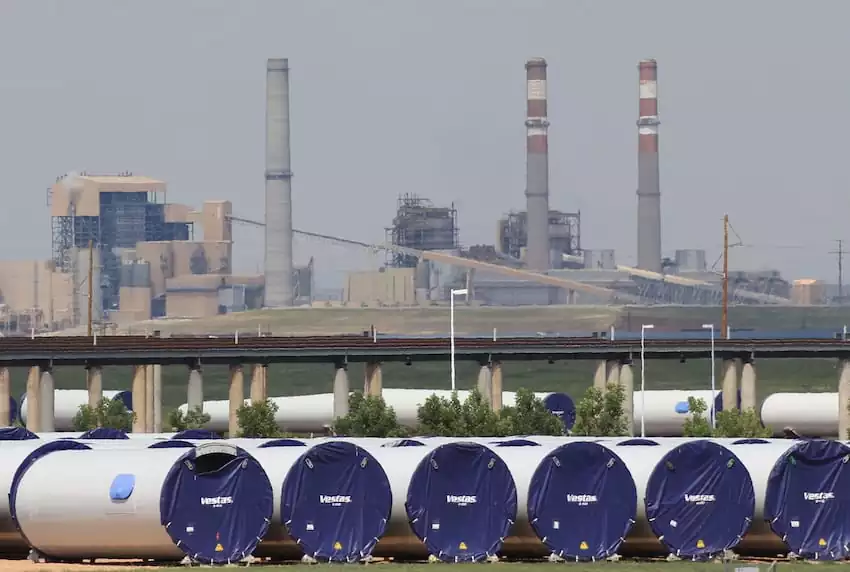
Vestas located a factory to produce wind turbines in Pueblo in 2010 and has added other renewable energy elements even as the coal-burning units have begun to retire. Photo credit: Allen Best

Click the link to read the article on the Big Pivots website (Allen Best):

Every transition produces winners and losers. U.S. fiscal policy shifted in the 1880s and the economy of Aspen cratered for decades. Some silver-mining towns never recovered. In the 1980s, newspapers were plentiful. Ink now stains far fewer printers and editorial wretches. Amazon thrives but Sears and Kmart, no more.\

How will Colorado’s coal-based towns transition as we quell emissions from energy production? Legislation of recent years seeks to deliver what lawmakers call a just transition, meaning that Pueblo, Craig and other coal-based communities will stay on their feet.

The newest round of job-producing investments in emission-free technologies, though, call into question how difficult that will be. Two new factories are to be created in Brighton, on metropolitan Denver’s northeastern fringe. The combined investment of $450 million will deliver more than 1,200 average- to better-paying jobs.

VSK Energy will manufacture solar photovoltaic panels and will employ more than 900 people. It is a direct result of incentives in the federal Inflation Reduction Act of 2022, which seeks to restore U.S. manufacturing of renewable energy components.\

The second factory will produce a new generation of energy-rich lithium-ion batteries. The company, Amprius Technology, says that a new anode, which will use silicon mined in Montana, will double the range of a Tesla, allowing it more than enough capacity to roam Colorado from corner to corner and the ability to juice up to 80% capacity in six minutes. The company also says the new batteries will deliver value to drones and aircraft. Sounds like a game-changer.

For a longer, more in-depth piece from which this was drawn, see Two big new-energy factories

Both companies cited proximity to Interstate 76 as a significant consideration in siting their factories. They also have proximity to I-25, I-70 and I-80 plus Denver International Airport. If of not immediate importance, they also have access to transcontinental rail lines.

Availability of a large, skilled workforce was also cited. The battery company also cited the proximity of the Colorado School of Mines and other universities. It will employ a half-dozen Ph.Ds. in the research facility associated with the factory.

Something more intangible was also in play. It was described as a “strong cultural fit” by Ashwini Agarwal, the leader of Vikram Solar, the parent company for the solar manufacturer. Supply chains matter, but Colorado’s initiative in accelerating the energy transition also matters.

Andrew Huie, the vice president of infrastructure for Amprius, said something similar. “Colorado and Gov. Polis are embracing clean energy, and batteries align with Colorado’s clean energy goals,” he told me. “There may be synergies.”

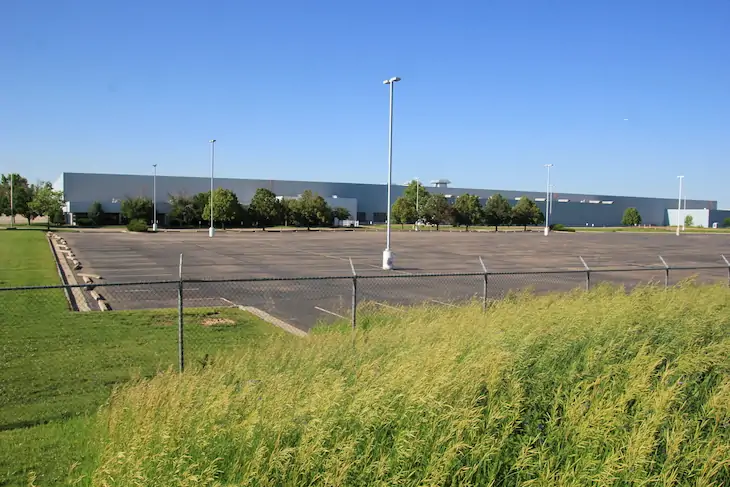
This warehouse ion Brighton, once the distribution center for Sears and Kmart and most recently as a storage location for Costco appliances, is to become home to a lithium-ion battery factory. Rezoning to light industrial will first be necessary. Photo/Allen Best

Other companies are also carving out futures in this new energy economy along the Front Range. The Denver Business Journal recently cited three companies from Denver to Fort Collins that hope to stake a future with new batteries. And Lightning eMotors manufactures electric vehicles in Loveland.

Brighton already has Vestas, which arrived in 2010 to manufacture nacelles, containing the gearboxes and drive trains for wind turbines. Vestas also built a factory in Pueblo, near the Comanche Generating Station.

CS Wind, now the owner of the Pueblo factory, this year began an expansion that will add 850 jobs. It cited Inflation Reduction Act provisions that encourage wind production.

Jeffrey Shaw, president of the Pueblo Economic Development Corporation, said he expects announcement of other renewable-sector projects in the Pueblo area and probably throughout the state during the next 12 to 18 months. “A lot of it has to do with the Inflation Reduction Act,” he said, and in particular the law’s buy-American provision.

Already, Pueblo County has been rapidly adding both solar and storage. But so far, the new tax base for Pueblo won’t balance that from Comanche. Xcel Energy, Comanche’s primary owner, has agreed to pay taxes until 2040.

Western Slope towns dependent on coal extraction and combustion are a harder sell. At Craig, there was hope on becoming a hydrogen hub, but Colorado has pinned its highest hope for federal funding on a project involving Rawhide, the coal but soon to become gas plant near Brush. Nuclear has its fans in Craig and beyond, and the Economist notes that the Biden administration is dangling billions in financial incentives nationally. That same magazine also concludes that unresolved problems cloud the future of this technology.

As for new factories, Craig is 90 miles from the nearest interstate, at the end of a railroad and five hours from DIA. It does have a workforce with skills, but so far, no new applications for those skills.

At Nucla and Naturita, which losy their small coal plant in 2019, the challenge is even greater.

Maybe Craig, Hayden, and the other towns will figure out new careers by working with the state and the utilities. But maybe not.