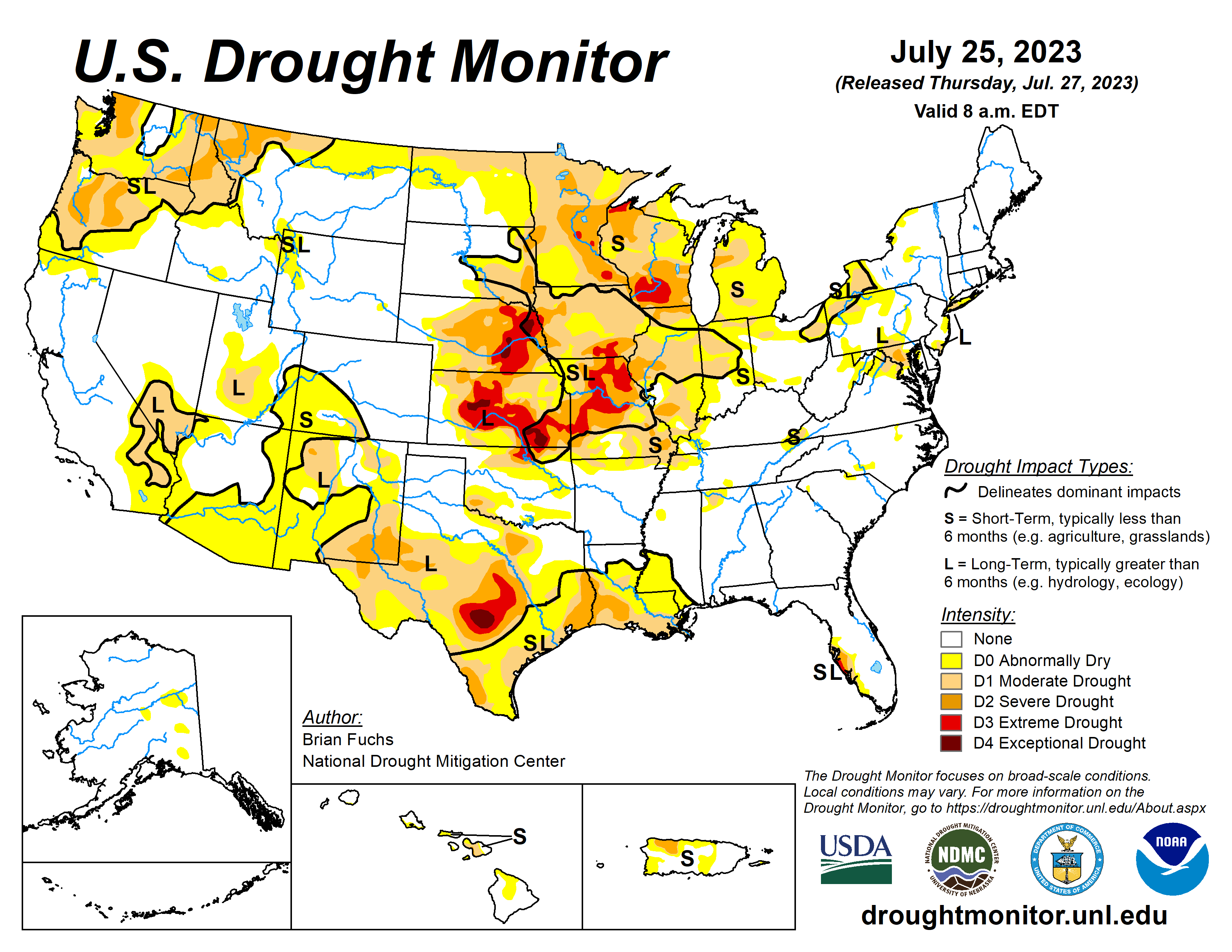
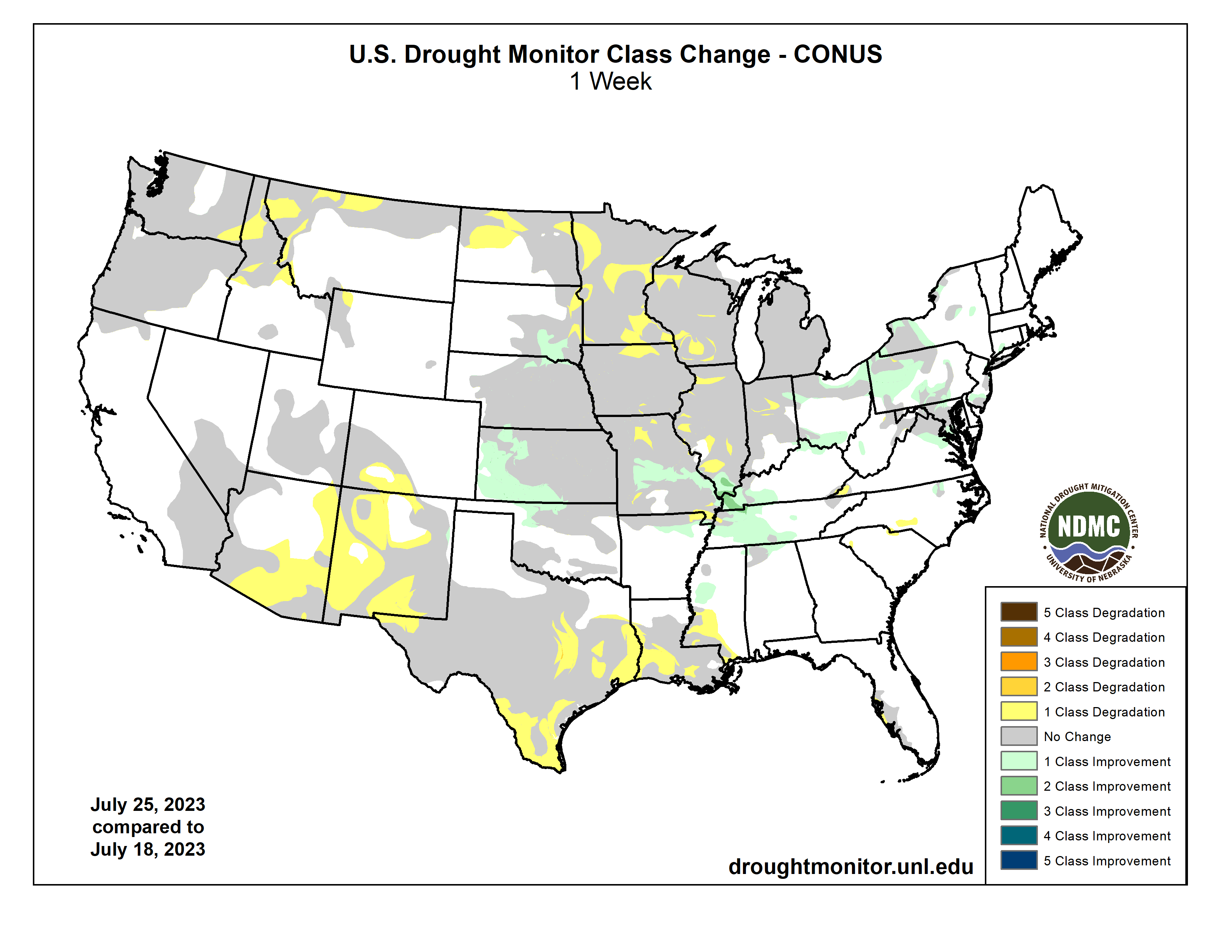
Areas of the High Plains, Central Plains, Midwest and South had the most active precipitation patterns over the last week. Record-setting rains were recorded over western Kentucky and the area had significant flooding. The monsoon season in the Southwest has remained quiet with record-setting heat dominating the region into the southern Plains. Temperatures were cooler than normal over most of the central Plains, Midwest and Mid-Atlantic with departures of 2-4 degrees below normal widespread. Temperatures in the West, Southwest, South and Southeast were warner than normal, with some departures in Arizona 8-10 degrees above normal for the week and most other areas at least 2-4 degrees above normal…
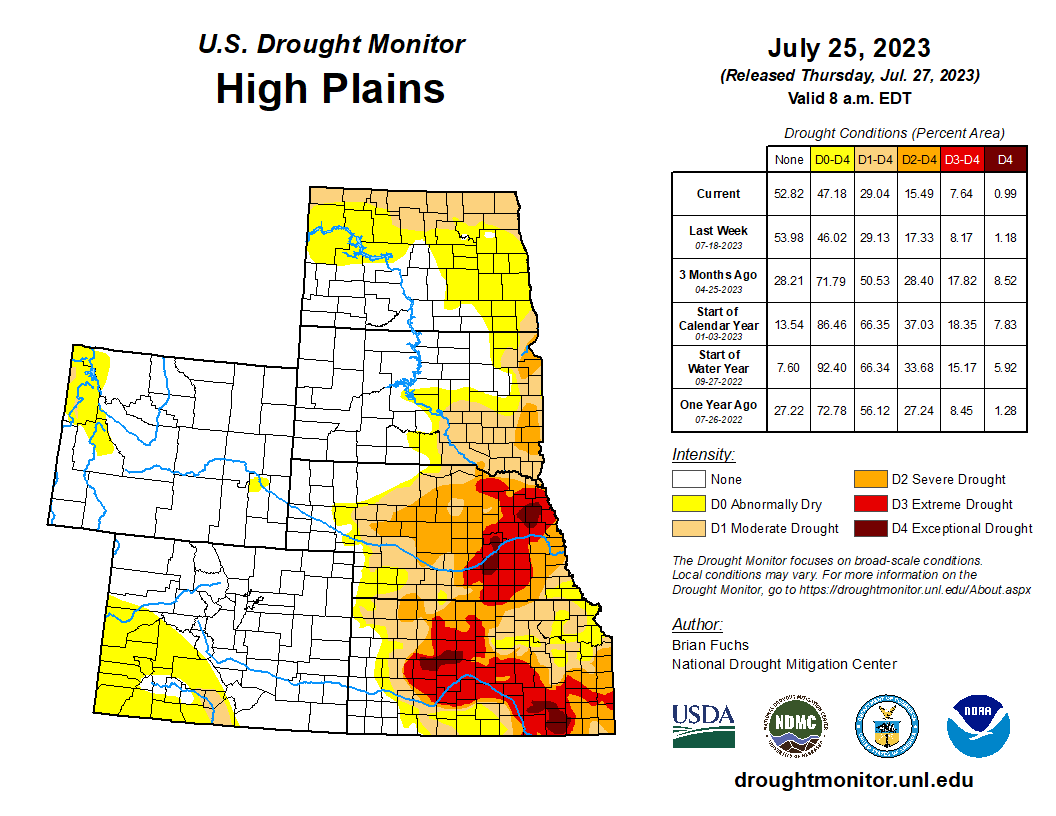
It was a mostly dry week across the region with the most significant rains falling over eastern Wyoming, western Nebraska, eastern Colorado and western Kansas, with some pockets of above-normal precipitation over southern South Dakota and eastern Nebraska as well. Temperatures were cooler than normal over much of the region with departures of 1-3 degrees below normal. Abnormally dry and moderate drought conditions were expanded in northern North Dakota and all of western Kansas saw a full categorical improvement this week. Improvements to severe and extreme drought were made over southeast South Dakota and into northern Nebraska. Severe drought was expanded in eastern South Dakota along the border with Minnesota…
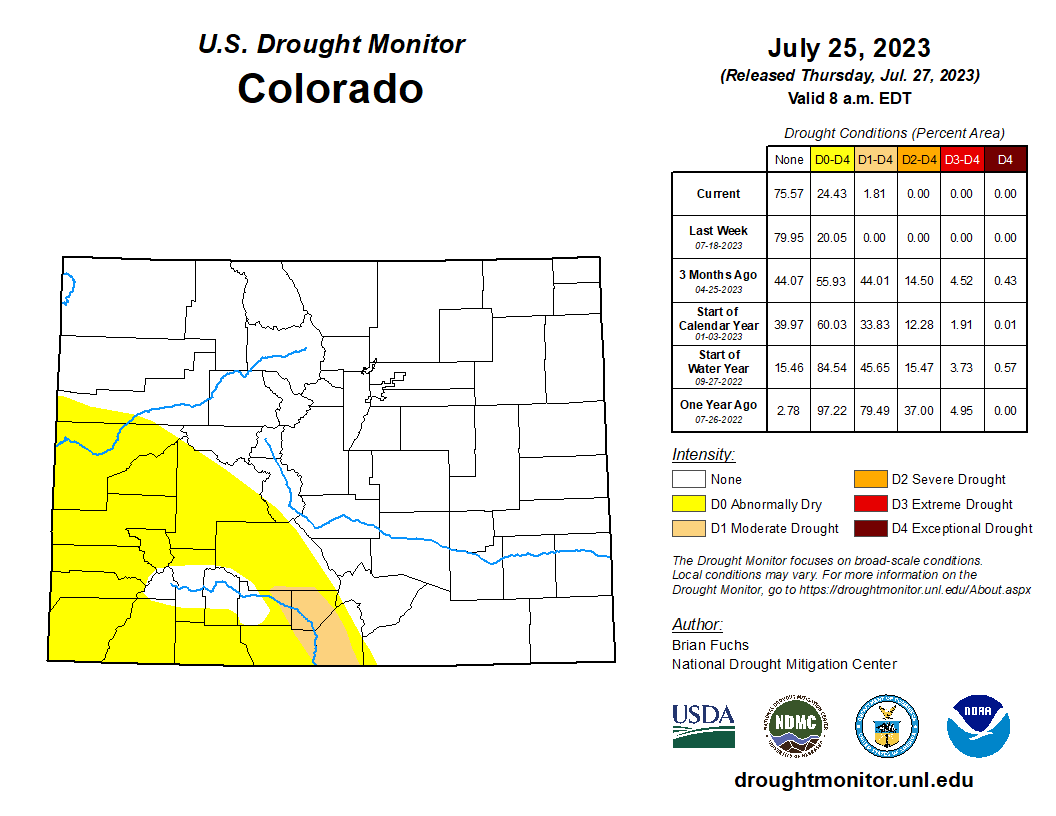
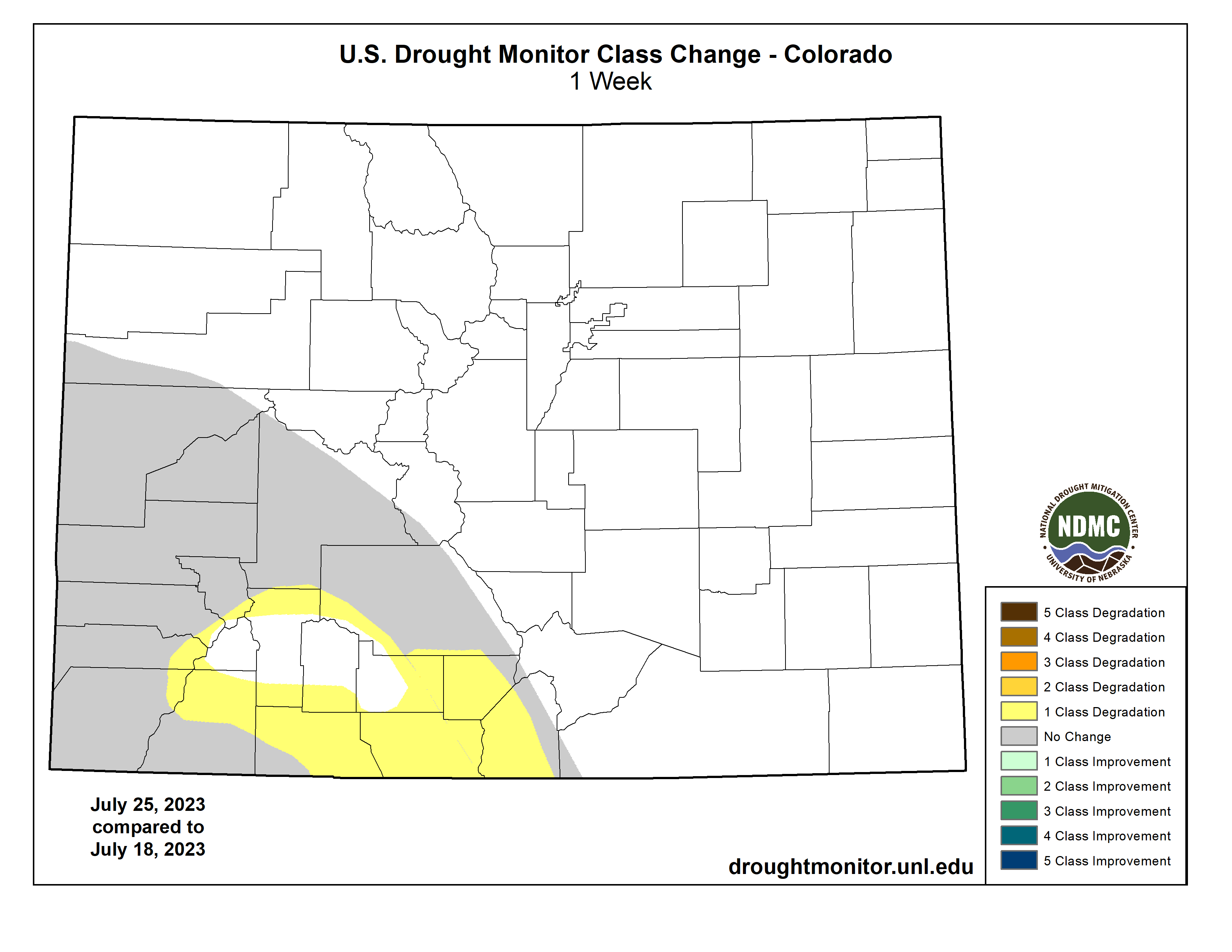
Colorado Drought Monitor one week change map ending July 25, 2023.
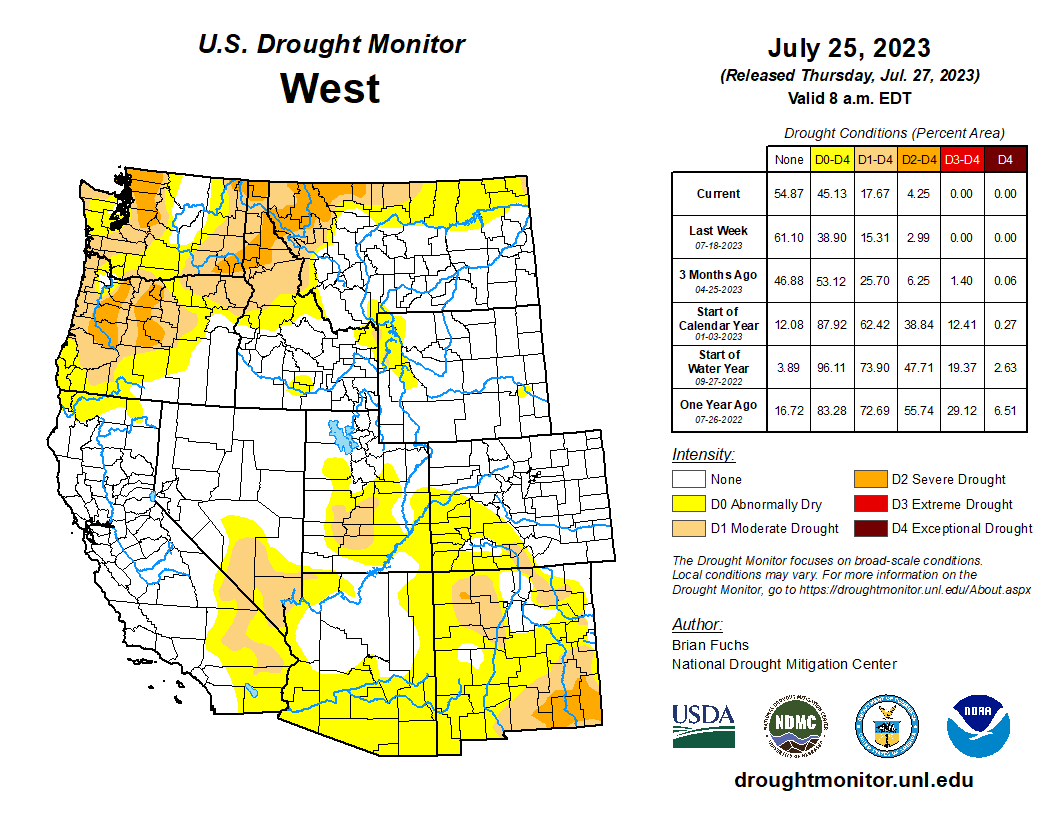
The ongoing heatwave was impacting much of the Southwest into southern California over the last several weeks. Temperatures in the region were well above normal for most areas and some departures in the Southwest were 8-10 degrees above normal this week. Areas of northern Utah and Nevada as well as portions of western Wyoming had above-normal rainfall this week. Moderate and severe drought were expanded in Idaho as well as the north and western portions of Montana. Abnormally dry conditions expanded over southern and southwest Colorado with moderate drought introduced this week in south central Colorado. A vast expansion of abnormally dry conditions was made in Arizona into western New Mexico, with moderate and severe drought expanding over southern New Mexico. Moderate drought also expanded over northern and northwest New Mexico…
Temperatures were cooler than normal throughout Oklahoma and most of Arkansas, but warmer than normal elsewhere with departures in west Texas 6-8 degrees above normal. Areas of northern Oklahoma and Arkansas recorded above-normal precipitation, but most other areas were dry with little to no rain this week. A new area of severe drought was added over east Texas into southern Louisiana. Moderate drought was expanded over east Texas and abnormally dry and moderate drought conditions expanded over south Texas with a new area of severe drought introduced. Severe and extreme drought expanded over central and eastern portions of Texas as well. Southern Mississippi had abnormally dry conditions expand this week related to short-term dryness…
Looking Ahead
Over the next 5-7 days, much of the West and the southern Plains into the South look to be quite dry. Some monsoonal moisture is anticipated over the Four Corners with light precipitation anticipated over the High Plains and Midwest. The wettest conditions are anticipated over the Great Lakes and into the Northeast as well as the Florida peninsula. Temperatures are anticipated to be above normal over the central and southern Plains and into the South. Cooler-than-normal temperatures are anticipated over the coastal areas of the West.
The 6–10 day outlooks show that there are above-normal chances of warmer-than-normal temperatures over the lower Mississippi Valley and most of the southern Plains into the Southeast as well as in the Pacific Northwest. There are also above-normal chances of cooler-than-normal temperatures over New England. The greatest likelihood of above-normal precipitation is over the Rocky Mountains and New England while the greatest likelihood of below-normal precipitation is in the Southeast.
US Drought Monitor one week change map ending July 25, 2023.
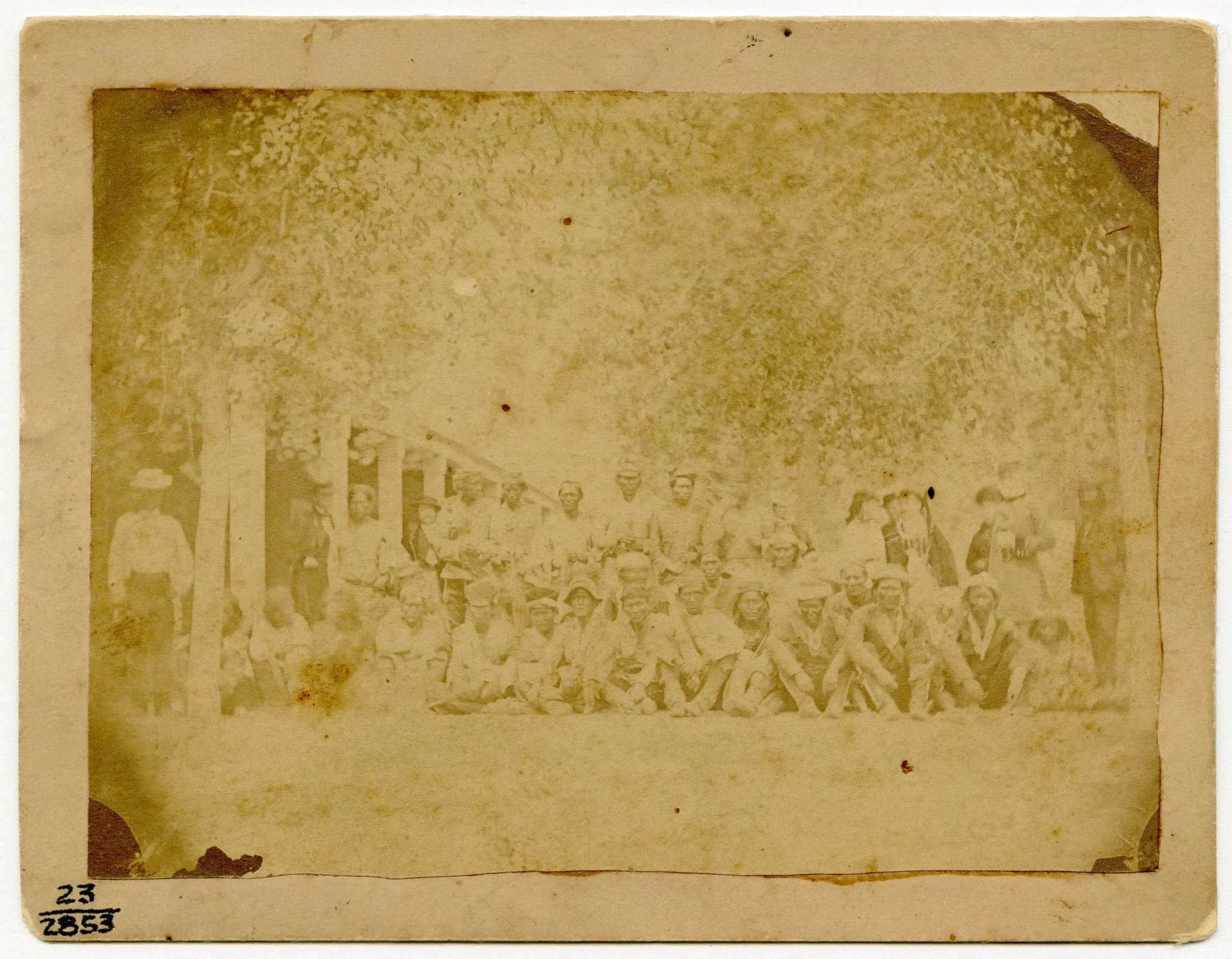
Navajo Treaty signers at Fort Sumner, June 1868. (General William Nicholson Grier Collection, National Museum of the American Indian Archive Center, Smithsonian Institution)
Click the link to read the article on the InkStain website (John Fleck):
A guest post by Friend of Inkstain Jason Robison, the Carl M. Williams Professor of Law & Social Responsibility at the University of Wyoming College of Law and chair of the Colorado River Research Group
By Jason Robison
A few weeks ago, on June 22, the U.S. Supreme Court (SCOTUS) handed down its much-awaited decision in Arizona v. Navajo Nation. Twenty years in the making, but with a far longer backstory, the decision’s significance stems, in no small part, from what SCOTUS did not do, including vis-à-vis tribes with water rights held in trust by the federal government that may be affected by negotiations over Colorado River management between now and 2026.
Water Injustice on the Navajo’s “Permanent Home”
Too much historical context surrounds Arizona v. Navajo Nation to recount. In the big picture, this context encompasses the Crusades of medieval Europe; the Age of Discovery (read: Discovery Doctrine); and successive colonization efforts of Spaniards, Mexicans, and Americans from 1540-present. I’ll highlight just a few pieces of the human and legal geography.
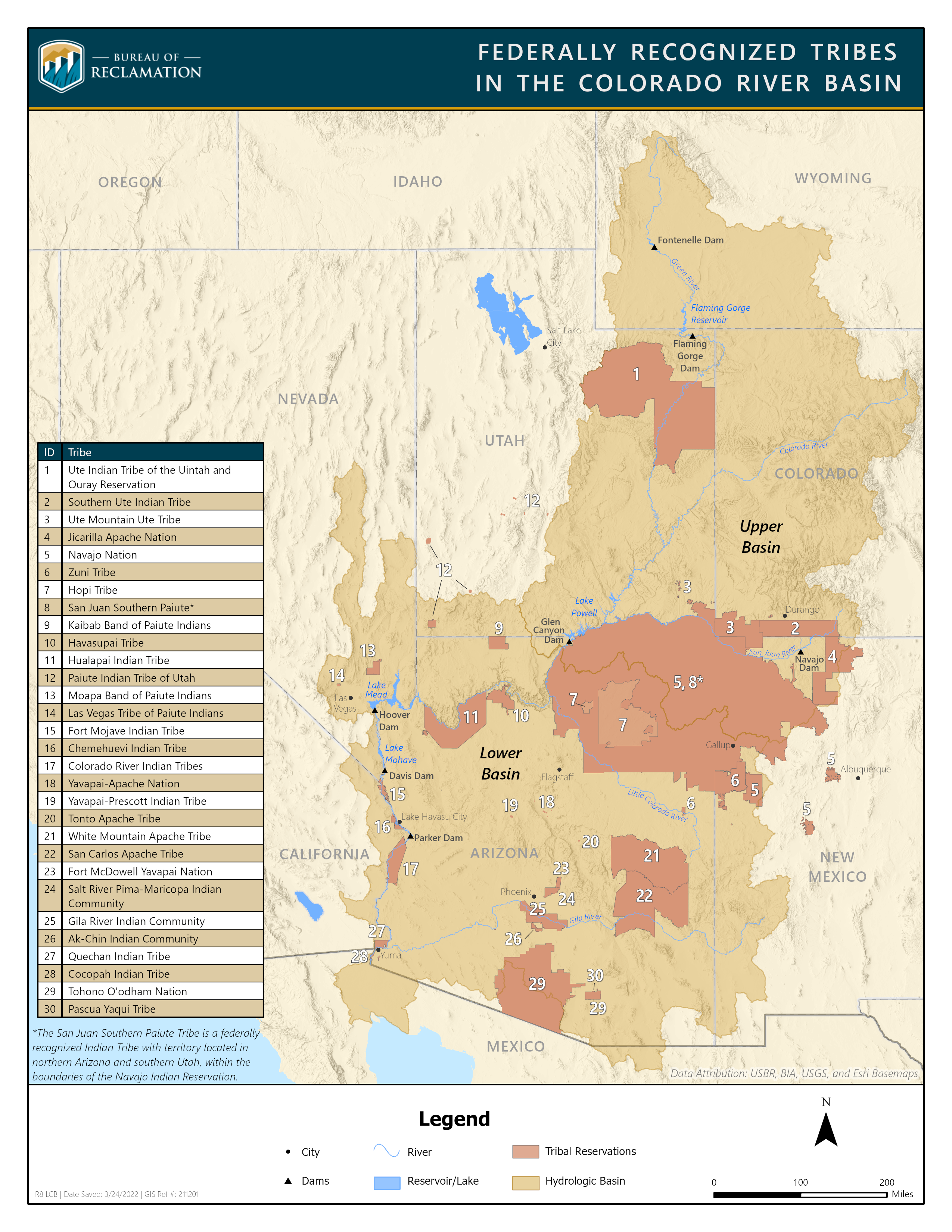
Native America in the Colorado River Basin. Credit: USBR
One of the Colorado River Basin’s most remarkable qualities is the rich presence of Native peoples. They have inhabited the basin, holding existential relationships with the river system, since time immemorial. At present, the Diné (Navajo) are one of 30 tribal sovereigns residing on 29 reservations across the basin, with the Navajo Reservation being the largest in the country: 27,413 square miles, slightly bigger than West Virginia. (Map to the right, here’s a bigger version.
An 1868 treaty established the Navajo Reservation, in a modest portion of the tribe’s vast traditional lands, designating it the Navajos’ “permanent home” and providing for farming and animal raising to take place there. An earlier 1849 treaty had called for the reservation’s eventual creation, as well as promised the Navajo would “forever remain” under the federal government’s “protection.” To be clear, though, the 1868 treaty enabled the Navajo to return to their “permanent home” only after enduring the tragic Long Walk, followed by the tribe’s inhumane internment at Bosque Redondo in eastern New Mexico, between 1864 and 1868—a shameful episode in U.S. history. The reservation later grew, in increments, to its current size.
The 1868 treaty raises a basic question: What’s needed on the dry Colorado Plateau for a tribe’s “permanent home” to be just that? Water is life. As recognized by the United Nations General Assembly, “the right to safe drinking water and sanitation [is] a human right that is essential for the full enjoyment of life and all human rights.” But you might not know it after spending time on the Navajo Reservation or reading the tribe’s complaint in the lawsuit.
“How did we get here, in this country, in the twenty-first century?” That pitch-perfect query, from the Navajo’s Supreme Court brief, captures the moral and emotional upshot of the water-access issues outlined in the tribe’s complaint (third amended complaint). In some parts of the reservation (i.e., the Coppermine region), “91% of Navajo households . . . lack access to water”; “[o]ver 30% of Navajo tribal members live without plumbing, and in some areas of the Navajo Reservation the percentage is much higher”; and while tribal members use “around 7 gallons of water per day for all of their household needs,” the U.S. average is 80-100 gallons. Water injustice of this sort is not unique among Colorado River Basin tribes.
From Surplus Guidelines to Cert Petitions
Arizona v. Navajo Nation aimed at this injustice. As with the broader context, the case’s procedural history is too lengthy to detail, but suffice it to say the litigation had run for roughly two decades before SCOTUS’s decision.
The Navajo Nation filed suit in 2003 against the Department of the Interior, Secretary of the Interior, Bureau of Reclamation, and Bureau of Indian Affairs. One claim was that these federal defendants had violated the National Environmental Policy Act (NEPA), another was that they had breached trust obligations to the tribe, while developing the 2001 surplus guidelines for the Lower Colorado River. Three basin states intervened as defendants—Arizona, Nevada, and Colorado—joined by major agricultural and municipal water agencies, including Central Arizona Water Conservation District, Imperial Irrigation District, Metropolitan Water District of Southern California, and Southern Nevada Water Authority.
Settlement negotiations spanned a decade but did not bear fruit. The case then moved through the lower federal courts from 2013-2022. In a nutshell, the U.S. District Court for the District of Arizona ruled against the Navajo in 2014, 2018, and 2019, and it was reversed by the Ninth Circuit Court of Appeals in 2017 and 2022. SCOTUS’s decision focused on the 2022 opinion from the Ninth Circuit. Contrary to the district court, it held the Navajo’s third amended complaint stated a viable breach of trust claim against the federal defendants—a claim extended in the complaint to Colorado River management decisions beyond the 2001 surplus guidelines, including the 2007 shortage guidelines and Minute 323 to the U.S.-Mexico Treaty.
The tribe was thoughtful and strategic about its request for relief. One piece was an assessment by the federal defendants of “the extent to which the Nation requires water from sources other than the Little Colorado River to enable its reservation in Arizona to serve as a permanent homeland.” Another piece was inseparable: “a plan to secure the needed water.” A final piece was for the federal defendants to manage the Colorado River “in a manner that does not interfere with the plan to secure the water needed by the Navajo,” including “mitigation measures to offset any adverse effects” of management actions. An intertwined assessment, plan, and water management regime—that was the Navajos’ request.
With the Ninth Circuit’s 2022 opinion, this relief moved one step closer to reality, and the case rose to the national level. SCOTUS agreed to review it—granted certiorari—following a petition from the federal defendants and another from the basin states and agricultural and municipal water agencies. One question presented was about SCOTUS’s decree in the epic Colorado River case of Arizona v. California: Did the Ninth Circuit’s opinion infringe on the decree’s jurisdictional provision? Another question addressed the breach of trust claim: “Can the Nation state a cognizable claim for breach of trust consistent with this Court’s holding in Jicarilla based solely on unquantified implied rights to water under the Winters Doctrine?”
Arizona v. Navajo Nation & What Lies Downstream
SCOTUS split 5-4. Justices Kavanaugh and Gorsuch wrote the majority and dissenting opinions, respectively, and Justice Thomas penned a concurrence that won’t be discussed further below. My angle in wading through the decision is to emphasize what the Court did not do, rather than what it did, in an admitted attempt to see silver linings of some of the “nots” for negotiations over Colorado River management during the next several years—specifically, ongoing processes for developing replacements for the 2007 shortage guidelines, Drought Contingency Plans, and Minute 323, all slated to expire in 2026.
Quick work can be made of the Arizona v. California decree question. SCOTUS did not answer it. In the last footnote on the last page of the majority opinion, the Justices described the question as going to the case’s merits, not jurisdiction, and declined to do more.
That’s because of how the Court came out on the breach of trust claim. By the narrowest margin, the Justices diverged, with the majority applying (mistakenly according to the dissent) an analytical framework from a 2011 case noted above, Jicarilla Apache, to reject the Navajo’s claim. Despite this loss for the tribe, three aspects—again, silver linings—of the Court’s holding are worth considering in relation to what lies “downstream” along the Colorado River.
“The 1868 treaty reserved necessary water to accomplish the purpose of the Navajo Reservation.”
First, SCOTUS did not dilute the Winters doctrine. “When the United States establishes a tribal reservation,” described the majority, “the reservation generally includes . . . the right to use needed water on the reservation, referred to as reserved water rights.” The dissent recited the doctrine in full; flagged how the extent of the Navajos’ Winters rights has never been assessed; and canvassed the tribe’s persistent efforts to have its Lower Colorado River rights quantified, both in and since Arizona v. California. All told, Winters remains intact. It underpins the five basin tribes’ reserved rights quantified in Arizona v. California. It has spurred 17 negotiated settlements quantifying other basin tribes’ water rights from 1978-2022. And it is a foundation for future settlements (or adjudications) to address unresolved water rights claims held by nearly a dozen basin tribes. Resolving those claims is a basinwide policy priority that should be pursued in parallel with negotiations over post-2026 Colorado River management. The Navajos’ unquantified water rights along the Lower Colorado River and the Little Colorado River cannot go unmentioned here. Nor can the majority’s description of Winters’s application: “The 1868 treaty reserved necessary water to accomplish the purpose of the Navajo Reservation.”
Second, SCOTUS did not call into question the existence of a general trust relationship between the federal government and tribes in the context of policymaking over the Colorado River, even though the decision reinforces the Court’s strict test for bringing breach of trust claims in litigation against the federal trustee. As the majority acknowledged, “this Court’s precedents have stated that the United States maintains a general trust relationship with Indian tribes, including the Navajos.” The opinion surveyed past water-related legislation and infrastructure investments intended to satisfy “the United States’ obligations under the 1868 treaty.” The federal defendants’ brief contained the same content. Likewise, in key NEPA documents—e.g., the 2023 draft supplemental environmental impact statement on near-term Colorado River operations—the Bureau of Reclamation has described basin tribes’ water rights as “Indian Trust Assets,” “held in trust by the federal government for the benefit of Native American Tribes or individuals.” So despite the majority’s holding on the breach of trust claim in this specific case (see below), the general trust relationship remains intact in the policymaking context, including negotiations over post-2026 Colorado River management. Basin tribes should have meaningful opportunities to engage in the negotiations—perhaps as part of a Sovereign Governance Team—and negotiators should consider with care quantified and unresolved tribal water rights while developing reservoir operating rules, conservation programs, etc.
Third, SCOTUS did not preclude the Navajo or other basin tribes from bringing future breach of trust claims against the federal trustee, stemming from Colorado River management. The majority described the Navajo’s claim in this specific (narrow) way: “In the Tribe’s view, the 1868 treaty imposed a duty on the United States to take affirmative steps to secure water for the Navajos.” (Emphasis added.) While the dissent provided an extensive, well-reasoned analysis that supported interpreting the treaty precisely this way, the majority was unwilling. Nonetheless, the pivotal thing for my purposes is a distinction emphasized by the majority several times: “The Navajos’ claim is not that the United States has interfered with their water access.” (Emphasis added.) The dissent elaborated in this way:
This distinction between affirmative steps versus non-interference is significant. What might a successful breach of trust claim rooted in federal interference with the Navajo’s (or other basin tribes’) water rights look like? As this question applies to negotiations over post-2026 Colorado River management, I won’t attempt to answer it now. But I’d be remiss not to flag it, as well as the distinction on which it’s based, among the notable aspects of SCOTUS’s decision.
My hope is the question doesn’t require an answer over the next few years of Colorado River governance. Winters remains a solid foundation for basin tribes’ quantified and as-yet unresolved water rights, and the general trust relationship applies to these water rights in policymaking processes. Despite its reinforcement (arguable misapplication) of the strict breach of trust analysis, Arizona v. Navajo Nation did not undo those bedrock principles. The dissent’s closing aspiration lies at their confluence: “some measure of justice will prevail in the end.”
Native land loss 1776 to 1930. Credit: Alvin Chang/Ranjani Chakraborty