Farmers face frozen jobs and heavier workloads under DOGE ‘efficiency’ budget — Christine Peterson — (High Country News)

Late-night seeding at Anna Jones-Crabtree’s farm near Havre, Montana. After making plans for the season ahead, she discovered that the federal government froze half of a $100,000 grant the farm was expecting.Courtesy of Anna Jones-Crabtree/Vilicus Farms

Click the link to read the article on the High Country News website (Christine Peterson):

April 16. 2025

Anna Jones-Crabtree and her husband spend sunup to sundown — plus hours of time before and after — nurturing 20 crops through tight margins on their dryland organic farm in Montana. Federal grants have long helped ease those tight margins, enabling farmers like Jones-Crabtree to survive and even thrive despite droughts and fires, market swings and crop failures. It’s the fruit of a philosophy that stewarding large tracts of land benefits not just a country with 340 million hungry bellies and a global food economy but also the clean air and water that people depend on as well as the land wildlife needs to survive. 

So she was taken aback when the U.S. government froze half of a $100,000 grant the farm had received to hire people for regenerative agriculture work. She had workers and a crop plan ready, but now it looked like the rest of that money would never be paid out. 

Other Department of Agriculture money still seemed to be coming through, but she was counting on that $50,000, just like thousands of other farmers and ranchers across the West have been counting on the billions promised through various programs from the U.S. Department of Agriculture. But now the Trump administration is trying to end many of these grants using a tool supposedly designed for efficiency that has also caused unpleasant side effects and cost thousands of American jobs.          

“We’re in a tight spot. Combine that with the markets right now,” she said, “and this is unprecedented. It’s a perfect storm.”

The damage done to farmers and ranchers by grants frozen or ended by the Department of Government Efficiency is compounded by the loss of local staff at the Natural Resources Conservation Service and Farm Services Administration (FSA) offices that have traditionally provided on-the-ground support for projects. In fact, the USDA announced Monday that it plans to cancel its grants for the Partnerships for Climate-Smart Commodities, though it may approve some of them if they meet the administration’s priorities.

More than 5,700 probationary employees at the USDA were fired in February, according to Mary Pletcher Rice, an Acting Deputy Assistant Secretary that oversees human resources at the agency. And while Rice testified that they were reinstated following a court order in March, many of the workers say that they’re still on administrative leave or have taken early retirement or buyouts, while others are anticipating further dramatic reductions in force. One FSA office in Montana where rancher Bill Milton lives, went from five staff to one. Other offices around the rural West shuttered completely. The changes are creating a “disturbing amount of uncertainty,” Milton said. The office helps Montana landowners identify grants and file critical paperwork so money funnels into on-the-ground projects. Without enough employees around, deadlines are missed, and farmers are left out to dry. 

Milton runs a 15,000-acre ranch in rural Musselshell County. He also works with community-based landowner groups seeking solutions to common problems — helping young ranchers access land as well as building sustainable ranches and solving watershed issues. Some groups in Montana have had grants of up to $4 million frozen. 

“The squeaky wheel gets the grease, so people are putting pressure on their congressmen to release signed grants,” he said. “But everyone has staff. And as soon as grants get frozen, they have cash-flow issues.”

He and other Western producers acknowledge that there are certainly ways to make the government more efficient. But there is nothing particularly efficient about withholding money needed for repairing fences, hiring agricultural workers or building drought resilience in farms across the Western U.S.

“You’re cutting things on the wrong end here,” said Traci Bruckner, chief policy officer for the Western Landowners Alliance. Federally supported local partnerships are, she said, “how you do conservation right — from the ground up.”

And the need is as great now as it’s ever been, said Robert Bonnie, former undersecretary of Agriculture for farm production and conservation under President Joe Biden. When Congress passed the Inflation Reduction Act, it committed nearly $20 billion to agriculture and forestry. While the branding dubbed it “climate smart agriculture,” most of the programs involved things that farmers, ranchers, and foresters had been doing for decades through the Farm Bill. 

“It’s soil health, improving grazing management, improved forest management to reduce nitrogen,” Bonnie said. “It’s reducing chances of catastrophic wildfires. And there’s a huge demand for it.”

Applications poured in from farmers, ranchers and working groups — so many, in fact, that within the first three years the federal government had committed all of the IRA money. But billions have yet to be paid. States like Utah are still owed $210 million between now and 2031, according to the University of Illinois’s Policy Design Lab. Washington is supposed to receive about $304 million, while Montana was set to see even more come through in the form of programs like the Environmental Quality Incentives and Conservation Stewardship programs.  

In addition to local grants to improve fencing or build pivots, those dollars were also headed to programs like the USDA Migratory Big Game Initiative, which has supported private-land restoration and paid for easements to keep such land intact for wildlife, including elk, deer and pronghorn. 

Federally supported local programs may have seemed like a given, but landowners haven’t always trusted the federal government to follow through on its promises, said Maggie Hanna, a Colorado Springs, Colorado, rancher and director of the Central Grasslands Roadmap Initiative, a 700-million-acre collaborative working on grasslands conservation. And that’s why she’s even more concerned. 

“To have a producer say, ‘I would like you, the federal government, to come to the table to be my partner’ is a big deal, and we’ve spent 40 years building that trust,” Hanna said. “And whether or not dollars come out of that scenario now, that trust feels deeply and dramatically eroded.”

She’s a farmer, though, and an eternal optimist. And so she wonders if perhaps pulling the rug out from under producers could ultimately help farmers and ranchers coalesce more and work together, teaching each other how to build fences or use rotational grazing. She doesn’t want to sound “Pollyanna-ish,” she said, but the possibility serves as a light for her in a West darkened by uncertainty.

Meanwhile, calves are being born and seeds being planted even as producers from New Mexico to Washington struggle with the fallout from the economic losses and uncertainty caused by Trump’s new tariffs.           

“There’s a lot of fear and a lot of stress. Ranching and farming are difficult even when farming is going well,” Milton said. “But the most important point I’m making to people and each other is don’t just wait and see what the hell will happen. Let’s let those who are in rural communities keep doing good, collaborative work. The last thing you want to do is shut that down.”

Small #Colorado towns cry foul as state seeks to clean up their #wastewater to protect rivers — Jerd Smith (Fresh Water News)

Wastewater Treatment Process

April 10, 2025

Dozens of small towns in Colorado have banded together to protest new wastewater treatment permits that are designed to protect state rivers and streams, saying they  contain new rules that are too costly to implement and they haven’t had time to make the necessary changes to comply.

The controversy comes as climate change and drought reduce stream flows and cause water temperatures to rise, and as population growth increases the amount of wastewater being discharged to Colorado’s rivers.

In response to the towns’ concerns, the water quality control division of the Colorado Department of Public Health and Environment has taken the unusual step of holding off on taking enforcement action against at least some of the towns that say they can’t comply with the new regulations. It issued notice of its decision March 24.

“Some smaller communities have faced real technical and financial challenges meeting these new requirements,” CDPHE spokesman John Michael said in an email. “In response, we issued a temporary enforcement discretion memo to give systems time to work through compliance barriers without immediate penalties.”

Now Colorado lawmakers who represent the Eastern Plains have drafted a bill designed to help small communities cope with the new regulatory requirements by extending the time they have to build or upgrade new plants and raise the money to pay for them.

The issue came to a head last month. Akron Town Manager Gillian Laycock, whose town is trying to comply with its new permit, invited dozens of communities facing the same issues to attend a special meeting. Representatives from 64 towns attended along with lawmakers, Laycock said.

But problems have been brewing for years. The water quality control division has been battling a large backlog in wastewater discharge permits, meaning small towns have been allowed to operate their plants under old rules as they waited for their new permits to arrive. Laycock said Akron had been waiting for its new permit for at least eight years.

“We knew something was coming,” she said, “but this has been a shock.”

In recent years, lawmakers have given the division more money to hire additional people so that the backlog can be reduced and more towns can come into compliance with the new standards.

But Sen. Barbara Kirkmeyer, a Republican from Brighton, and Sen. Byron Pelton, a Republican from Sterling, said they are frustrated that the more than $2 million spent to address the problem isn’t helping.

“I told the CDPHE if they continue down this road, the folks out in the rural areas are about ready to tell them to pound sand,” Pelton said. “That’s how stressful it’s been for these small municipalities. The regulations just keep coming at them.”

Under the federal Clean Water Act, entities that discharge fluids into streams, including wastewater treatment plants and factories, must get approval from state water quality regulators to ensure what they’re putting into the waterways does not harm them.

Towns and water districts can receive either a general permit, which has standard terms and conditions, or individual permits, which take much longer to process, are typically more expensive and are often used by large systems in cities such as Denver.

The general permits were finalized in 2022 to help small towns comply with the stricter regulations quickly and at less cost, said Michael, the CDPHE spokesperson. But many haven’t been issued because of the backlog.

Akron finally received its new permit last October, Laycock said. But the town was unprepared for the strict new limits on what and how much can be discharged, the tight timelines to comply and the costs.

Once the new permit was issued, Laycock said, its old permit expired almost immediately, leaving the town out of compliance with the new regulations, exposing them to potential legal issues and fines.

The regulatory shock is understandable, but could have been avoided, according to Meg Parish, an attorney for the Environmental Integrity Project, a nonprofit focused on enforcing air and water pollution regulations. She previously worked for the state’s water quality control division and helped develop the new general permit that is causing current concerns.

“Some of these towns have really old permits,” Parish said. They’ve been allowed to continue discharging under a special administrative permit. In the interim, strict new standards have taken effect.

But she said the new rules shouldn’t have come as a surprise to anyone.

She said the new general permit was finalized after months of public work sessions and outreach meetings.

“We invited every small discharger in the state to participate. All the terms are on the state’s website….it literally says ‘if your (wastewater discharge) flow is this much, this is what your limit is going to be. There is no mystery.”

But Adam Sommers, an environmental engineer who has several clients trying to obtain new permits, said the process is cumbersome and expensive.

“Each permitting activity has a 180-day review period and if changes are needed, the clock starts over,” he said in an email.

“This frequently adds years to the schedule,” Sommers said. “The estimates engineers create are time sensitive. If years have passed between when they prepare the budget and when the project is constructed, they face affordability issues.”

Sens. Kirkmeyer and Pelton are working on a bill that will be introduced shortly forcing the CDPHE to give the towns more time to comply and help them address the financial challenges of the new regulations. It will also set strict deadlines on the permitting process, according to the latest draft of the bill. Kirkmeyer said the CDPHE has been helping with the new legislation.

Kirkmeyer said she was taking the unusual step of running the bill through the Joint Budget Committee because it approves the budget for the water quality control division and she wanted to send a strong message to the regulators.

“I want them to know we are serious about this,” she said.

Looking ahead, as water quality continues to deteriorate, treatment standards will continue to tighten, Parish said.

“One of the key realities is that wastewater treatment plants need to upgrade their plants and do better, and pollute less,” Parish said.

Laycock, the Akron town manager, said she understands the urgency of the problem but she said the state’s approach needs work.

“We are agricultural people and we love our land, but how do we as a town afford to meet these requirements? I understand what they are trying to do. But this is not the way to do it.”

More by Jerd Smith

Can “toilet to tap” save the #ColoradoRiver?: Zombified uranium industry twitches; spring #runoff forecast looks grim — Jonathan P. Thompson (LandDesk.org)

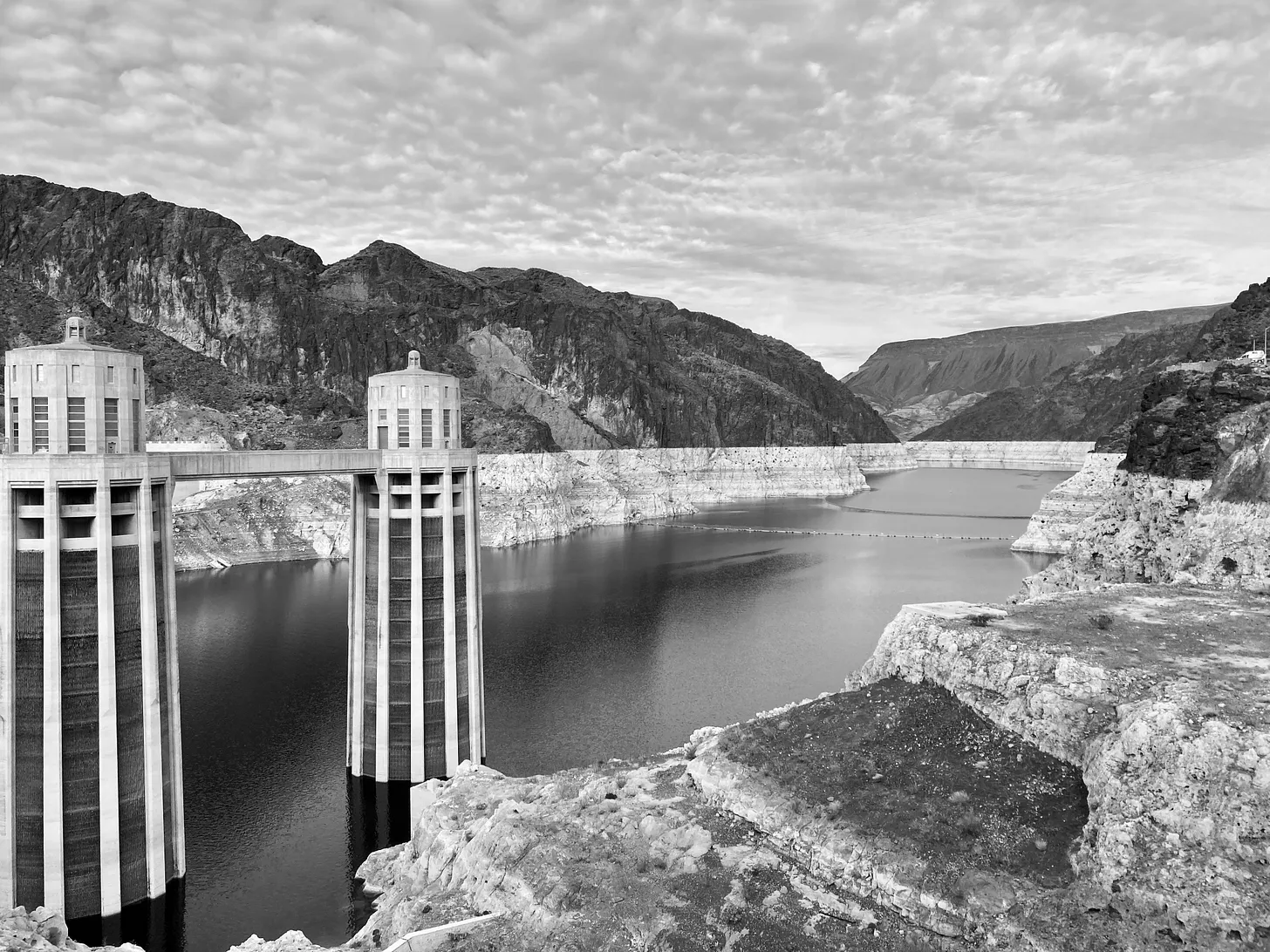
Lake Mead and the big “bathtub ring” as seen from next to Hoover Dam. Jonathan P. Thompson photo.

Click the link to read the article on The Land Desk website (Jonathan P. Thompson):

April 15, 2025

🥵 Aridification Watch 🐫

The 40 million or so people who rely on the Colorado River for drinking, bathing, irrigating, cooling data centers or power plants, or filling their swimming pools with have a problem. The amount of water being pulled out of the river for all of this stuff exceeds the amount of water that’s actually in the river — at least during most years in the last couple decades. And on the rare exception that supply exceeds demand, the surplus does little to dent the deficit, resulting in perennially low reservoir levels and chronically high water-manager stress levels.

Udall/Overpeck 4-panel Figure Colorado River temperature/precipitation/natural flows with trend. Lake Mead and Lake Powell storage. Updated through Water Year 2024. Credit: Brad Udall

There is exactly one way out of this mess: The collective users simply need to use less.

Yet while the solution may be simple, it’s not exactly easy to carry out. That’s in part because people keep moving to the region, increasing demand. Plus, as the climate warms, we need more water to keep the crops or the grass or ourselves from drying up, making cutting consumption difficult and even dangerous.

An even bigger obstacle to reducing use is the societal urge to try to solve problems by consuming more, building more, and doing more (see the rise of the “Abundance” movement among American liberals). Using less goes directly against that urge (see Trump’s recent executive order titled: Maintaining Acceptable Water Pressure in Showerheads). That inclination drives the slew of schemes to try to produce more water, whether its by building dams, throwing dynamite into the sky, seeding clouds, desalinating seawater, or draining the Great Lakes and piping the water across the nation and over mountains to water Palm Springs golf courses. While it’s true that dams have given folks a bit more time to find a solution, building more of them now — with the exception of stormwater capture basins — won’t do any good (since even existing reservoirs are far from full).

But there is one thing we can do more of to help us consume less: recycling. While the idea of recycling water inspires turn-off terms like “toilet to tap,” the practice is actually quite common in the Colorado River states. (And, really, if you live downstream from any other community, you are probably drinking the upstream towns’ recycled wastewater, though that isn’t counted as recycling, per se.)

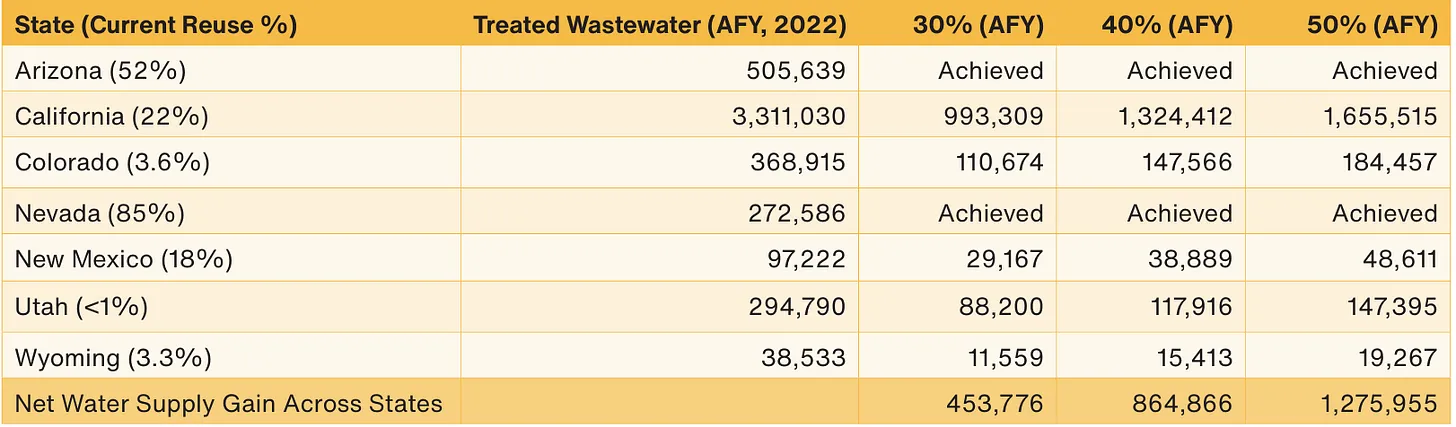
A new report out of UCLA’s Institute of the Environment & Sustainability gives the rundown on wastewater recycling in the Colorado River Basin, and reveals that Arizona and Nevada are way ahead of the Upper Basin when it comes to reusing water, yet still have room for improvement. And it finds that if all of the Colorado River states aside from Arizona and Nevada were to increase wastewater reuse by 50%, they would free up some 1.3 million acre-feet of water per year, which is about one-third of the way to the 4 million acre-feet of cuts deemed necessary.

Some states are on top of water recycling (way to go Arizona and Nevada!). Others not so much (we see you Colorado, Utah, and Wyoming). Source: “Can water reuse save the Colorado? An analysis of wastewater recycling in the Colorado River Basin states.” Authors: Noah Garrison, Lauren Stack, Jessica McKay, and Mark Gold Additional Research: Danielle Sonobe, Emily Tieu, Katherine Mathews, and Julia Wu”

To be clear, not all water recycling is “toilet to tap.” In fact, most is not. In Las Vegas, for example, treated effluent is used to irrigate golf courses, and it’s also returned back to Lake Mead, which is then credited against Nevada’s water allotment. And in Arizona, treated wastewater from the Phoenix-area is used for steam production and cooling at the Palo Verde nuclear plant (which evaporates a whopping 45,000 gallons of water per minute), and treated effluent is used to “recharge” groundwater aquifers (eventually ending up in taps).

While recycled water can be used to irrigate crops, you can’t really recycle irrigation water. That fact, in a way, is why Nevada is the leader in Colorado River water-recycling: Almost all of its allocation from the river goes to the Las Vegas metro area for public supply/domestic use, with virtually none of it going to irrigate crops. That means most of the water eventually goes into the sewer system, making it available for recycling. And that, in turn, makes it easier to slash water use in cities than on farms, further throwing off the balance between agricultural use and municipal use, and putting more pressure on farmers to either sell out or become more efficient, which has. Its own drawbacks.

Water recycling can have unintended side effects, too. While it’s nice that Palo Verde doesn’t rely on freshwater, the 72,000 acre-feet of recycled water it uses per year all evaporates — it is a zero water-discharge plant — meaning it does not soak into aquifers or otherwise benefit ecosystems, as it would if it were used to water parks or was discharged back into the Gila River. And, water treatment is highly energy-intensive, so the more water you want to recycle, the more power you’ll need.

Ultimately, using less water in the first place is going to be necessary. But recycling what we do use could help.


Senator Beck Basin on March 31. This is near Red Mountain Pass, one of the few SNOTEL sites in the San Juan Mountains that had a near normal snowpack on April 1. Andy Gleason photo.

⛈️ Wacky Weather Watch⚡️

In the days following my April 1 snowpack update, the snowpack updated itself, with a nice storm bolstering snow water equivalent levels by up to two inches in some places. But it was closely followed by an unusually warm spell, which erased all of the gains and then some. What that means is a relatively paltry spring runoff for many of the Upper Colorado River Basin streams, with water levels likely peaking earlier and at lower levels than in 2021. How much earlier and lower depends on how warm or cool (and dry or wet) the rest of the spring is, but at this point it’s safe to say it won’t be a big water year for irrigators or boaters.

I’m especially worried about the Upper San Juan River and the Rio Grande, both of which have their headwaters in the southeast San Juan Mountains, which are running close to empty, snow-wise. Yes, Wolf Creek got pounded by the April 6-9 storms, but it has also experienced some abnormally high average temperatures over the last several days — the average temperature in the Rio Grande Headwaters on April 12 was 45.5° F, compared to the median for that date of 32°. If that continues, what little snow is left will mostly be gone within weeks.

Meanwhile, the high temperature in Tucson and Phoenix, neither of which have received more than a hint of precipitation during the last eight months, exceeded 100° F on April 11, setting new daily records and further desiccating the soil.

It may seem a bit early, but I think it’s time to start predicting peak runoffs for Four Corners area rivers. I’ll start with the Animas, which I’m pessimistically predicting will peak on May 17 at 2,950 cubic-feet per-second, based on previous years’ snowpacks and peak runoffs. I say “pessimistic” because if I’m right, it would only be the fourth time this century that the Animas peaked below 3,000 cfs. Here’s hoping I’m wrong.


Waste rock from the Sunday Mine Complex near Slick Rock, Colorado. Jonathan P. Thompson photo.

⛏️ Mining Monitor ⛏️

Is the uranium mining renaissance upon us? I don’t think so. But the industry’s zombified carcass is beginning to twitch — figuratively speaking, of course. The stirrings include:

  • A couple of weeks ago, the Energy Information Administration crowed that U.S. uranium production last year was the highest in six years. That sounds huge, right? Really, it’s not: Production was virtually zero from 2019 to 2023, making last year’s total of 676,939 pounds look pretty good. But as recently as 2014 — which was not boom times, by any means — production was nearly 5 million pounds. The big 2024 producers were in-situ recovery operations in Wyoming and Texas, as well as Energy Fuels’ White Mesa Mill in southeastern Utah. It should be noted, however, that the White Mesa Mill’s production was not from the company’s mines, but from its “alternate feed program,” which is to say it extracted uranium from other folks’ waste streams.
  • Energy Fuels is now producing ore at its Pinyon Plain Mine near the Grand Canyon and hauling it by truck across the Navajo Nation to the White Mesa Mill. The company says it plans on beginning production and shipment at its La Sal and Pandora Mines as well. This represents the first conventional ore production in the U.S. in years.
  • Western Uranium & Vanadium says Energy Fuels has agreed to purchase up to 25,000 short tons of uranium ore from WU&V’s Sunday Mine complex near Slick Rock, Colorado, in the Uravan Uranium Belt. They plan to begin shipping later this year.

Meanwhile, there is plenty of noise around a potential nuclear renaissance, as tech giants look to promised advanced and small modular reactors to power their electricity-guzzling data centers. But there are no reactors yet. I tallied some of that talk for High Country News.


📸 Parting Shot 🎞️

McElmo Car. Jonathan P. Thompson photo-illustration.