The agreements propping up Lake Mead and Lake Powell expire in 2026, and negotiations for new agreements have stalled.
The Trump administration’s lack of clear direction and delay in appointing a Reclamation commissioner are exacerbating the crisis.
Arizona will face significant water cuts, potentially deeper than any previous shortages. It needs time to process them.
Many of us have seen this train wreck coming for years, the slow buildup of chronic overuse, coupled with a river that no longer produces as much water as it used to, that is draining Lake Mead and Lake Powell, the nation’s two largest water savings accounts. And if things don’t change soon, 40 million people who rely on this river are about to suddenly realize that decisionmakers squandered every dollar spent on buying time to fix this fundamental problem…The mismatch between supply and demand began emerging around 2000, and by 2007, the feds had created the first set of shortage guidelines, hoping those mandatory cuts would be enough to stave off crisis. But we now know that they weren’t nearly enough to reduce the drag on the lakes. Deeper cuts were made. Billions of dollars were set aside to pay people to temporarily not use water. And we’ve stabilized Lake Mead and Lake Powell, for now.
But those rules and agreements expire at the end of 2026…The Trump administration hasn’t said anything about those alternatives. And after dropping an executive order to nix a longstanding review process, it’s unclear how the feds will evaluate or collect public input, presuming that said alternatives are still on the table…It’s telling that while state negotiators continue to meet (and make no real progress), no one from the Bureau of Reclamation — the federal agency tasked with operating Lake Mead and Lake Powell — has attended those negotiation sessions since the Trump administration took office. In fact, Reclamation still doesn’t even have a commissioner. The administration has been dragging its feet on getting the leadership in place to finally break this logjam…Now is not the time to be hands-off. The Trump administration must prioritize naming a Reclamation director who can offer firm, clear and fair direction — and who isn’t afraid to bust a few heads if state negotiators refuse to budge.
Colorado River “Beginnings”. Photo: Brent Gardner-Smith/Aspen Journalism
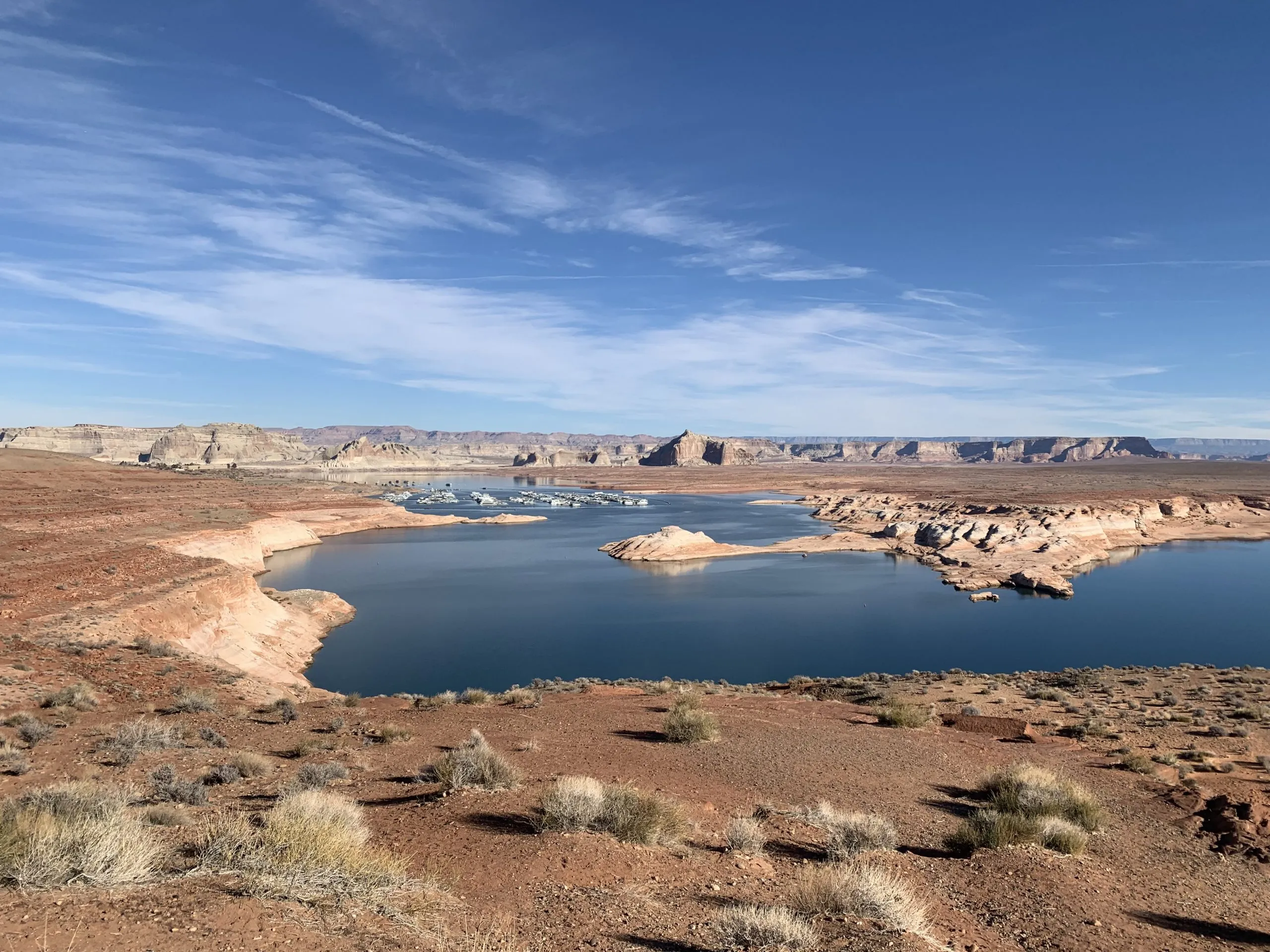
Lake Powell at Wahweap Marina as seen in December 2021. Dwindling streamflows and falling reservoir levels have made it more likely that what some experts call a Colorado River Compact “tripwire” will be hit in 2027. Credit: Heather Sackett/Aspen Journalism
When Colorado convened a working group on water speculation, its members shared stories of times in which they’d seen or thought they might have seen investment water speculation occurring — when water rights are purchased with a primary purpose of profiting from the future sale or lease of that water as demand drives up its price. On the list was the notion that buyers with no real interest in agriculture would buy agricultural land and water rights with the primary intention of enrolling in a program that pays water rights holders not to use that water.
The concern, essentially, was that programs that compensate farmers for fallowing fields like the Upper Colorado River Basin’s System Conservation Pilot Program, and nonprofits that fundraise to keep water in streams weren’t sufficiently guarded against abuse, particularly when it comes to an increasingly constrained Colorado River system.
“The impacts of drought and the risks that drought causes in the Colorado River Basin, just by way of example, attract money to the concept that money can be made from taking water out of production — conservation,” says Peter Fleming, general counsel for the Colorado River District.
“Where do you draw the line in that?” Fleming asks. “Which one is a good, socially recognized benefit that the state as a whole should support versus which one is bad because it encourages speculation in water resources, and it makes things more difficult for others, and it has adverse secondary impacts in the local economies when you take water out of production?”
A few guardrails exist to make real conservation efforts — those that serve the common good — clear. But questions remain on whether those protections can really stop investment water speculation before speculation occurs.
Little Cimarron Ranch, where a first-of-its-kind agreement allows water rights to go to irrigation in the spring and summer, and to instream flows to support river health in the summer and fall. Photo courtesy of Mirr Ranch Group
Streamflows for the Public Good
In 1973, Colorado lawmakers legally recognized instream flows, in which water is allocated to the river to maintain flows and habitat as a “beneficial use” in parallel with industries, cities and agriculture. That 1973 legislation tried to prevent speculators from prospectively appropriating instream flows and locking up the state’s water by taking measures like limiting who can operate instream flows to a single state agency, the Colorado Water Conservation Board.
“There is government oversight for specifically this reason — to prevent speculation,” says Josh Boissevain, staff attorney with the Colorado Water Trust, a nonprofit that works to secure water for streams. “Instream flow is a decreed use, so using that water for instream flow is not speculation at all, even though it’s left in the river.”
When water rights owners work with the water trust to use their water to restore flows, it takes a lot of paperwork and a close look at the web of other users affected. The process can be tedious and time-consuming, and the profits marginal.
“Nobody is doing that for the money,” Boissevain says. “They do it because they care.”
Some loopholes have been closed. For example, a 1994 change to Colorado’s water law prevents conditional water rights holders, who hold onto water rights for unbuilt projects or potential future uses, from transferring those rights to instream flows. That law blocks speculators from selling conditional water rights to the CWCB for a profit.
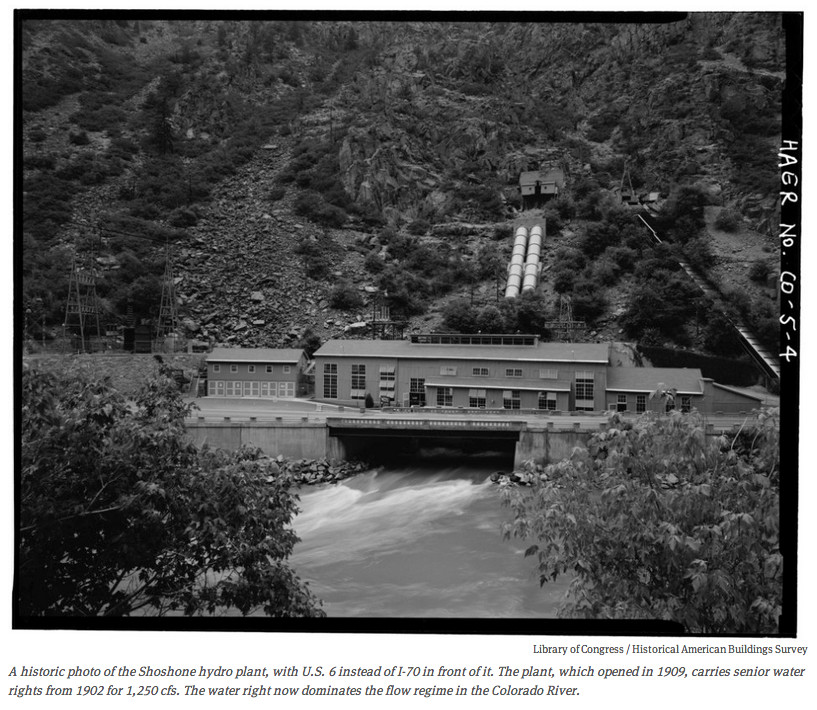
Shoshone Hydroelectric Plant back in the days before I-70 via Aspen Journalism
Having a perfected water right — one that is fully established and has been put to beneficial use — converted to instream flows is fine, Fleming says. The Colorado River District participates in those programs and is working to buy a water right currently used to generate 15 megawatts at Xcel Energy’s aging Shoshone hydroelectric power plant. The River District aims to convert that hydropower right to an instream flow right to ensure that this water continues to flow from the headwaters down through boating hotspots in Glenwood Canyon, regardless of the 115-year-old power plant’s future.
But Fleming, who worked on a 2021 report that reviewed Colorado’s legal sideboards on speculation, remains concerned that the lines are not clearly enough drawn between those recognizable benefits to the state and local economies, and the place where speculators could start counting on those efforts and “conserving” to make a profit. At a certain scale, the effects of taking water off farm fields could ripple out beyond bare fields to farm supply stores and gas stations, as well as the local job market in rural communities.
Perhaps the most frightening possibility that could result from profiteering is that water rights bought and steered from use in Colorado will somehow be sold to thirsty fields or towns in Arizona or Nevada. But even if both buyer and seller are willing, specific language in interstate compacts and existing law complicates the likelihood of selling water from one state to a buyer in a different state.
Meanwhile, conservation groups are also concerned about speculators cornering them out of the increasingly expensive water rights market, Boissevain says. To adapt to the current water market, the Colorado Water Trust is exploring a new acquisition model with Qualified Ventures, a consulting company based in Washington, D.C. Through this new approach, the water trust would buy land with water rights through financing from lenders. A conservation easement would protect the land as agricultural, and the tax rebate from that status would partially repay the loan. The water trust would reassess how to profitably farm that land while sharing the water rights between agriculture and environmental flows. Then the land could be sold, potentially at a reduced price, perhaps to a first-generation farmer.
“It’s another way to keep ag in production and keep water on the land,” Boissevain says. “It’s another step up in the competition against people that might try and buy [irrigated farms] for speculation or maybe even development.”
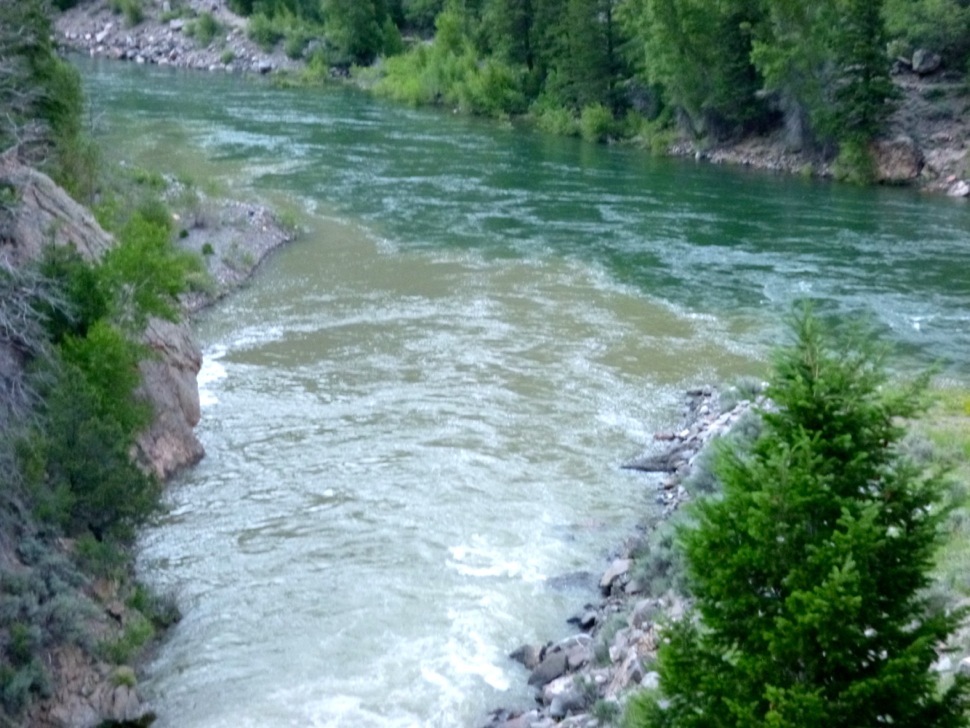
Confluence of the Cimmaron and Gunnison rivers. Photo: Brent Gardner-Smith/Aspen Journalism
The results might resemble a project on the Little Cimmaron River near Gunnison, where the Colorado Water Trust purchased 5.8 cubic feet per second of flow in the McKinley Ditch to return water to a river that was nearly dry in late summer months. The water trust partnered with a land trust to buy the water rights and land, put a conservation easement on the land, then sell the land and water rights to a private landowner. In a first-of-its-kind agreement, the water rights can go to irrigation in the spring and summer, and to the CWCB for instream flow in the late summer and fall when the river needs it most. In a very dry year, all of the water can be left in the stream protected, and in a wet year, all of it can be diverted for agriculture.
This map shows the 15-mile reach of the Colorado River near Grand Junction, home to four species of endangered fish. Map credit: CWCB
Environmental groups contend that for the environment to thrive, the entire river system needs this kind of adaptability, particularly as Colorado River Basin states renegotiate operations for Lake Powell and Lake Mead ahead of the current guidelines’ expiration in 2026.
“We want to see better, more realistic management of the Colorado River that accounts for climate change and … drastic shifts in hydrology,” says Matt Rice, Southwest regional director with American Rivers. “It’s all about creating, from our perspective, more flexibility in the system to avoid emergency action after emergency action because we’re collectively afraid to make hard decisions when we need to.”
With an eye on the prospect of a compact call or other crisis, WaterCard, a Colorado-based company, aims to leverage private market dynamics to promote water conservation in the Colorado River system. It also provides an avenue for companies and individuals to offset their water footprint.
It works like this: A person can buy a WaterCard, which gives them conservation credits linked to a quantifiable amount of water conserved on a Colorado farm or ranch. It’s like an offset. The WaterCard buyer also receives an NFT digital token as proof of purchase.
In the field, WaterCard funds are used to compensate farmers and ranchers who sign up for the program and voluntarily reduce water usage by fallowing fields for a season, decreasing irrigation, or transitioning to drought-resistant crops.
To demonstrate the concept, WaterCard founder James Eklund, who is also a working water attorney and rancher, is fallowing 66 acres of grass-alfalfa hay at his family ranch in western Colorado’s Plateau Valley. Introducing a market-based mechanism for water conservation in a headwaters state does not equate to speculation, Eklund says, because buyers are only purchasing credits tied to conserved water, not the underlying water rights themselves.
“This approach aligns fully with the anti-speculation doctrine, which I strongly support. That doctrine prohibits buying a water right, leaving it unused, and flipping it for profit — that’s speculation,” he says.
WaterCard’s model is designed to work within the Upper Colorado River Commission’s System Conservation Pilot Program (SCPP) and, Eklund hopes, eventually within a demand management framework. SCPP was designed to explore solutions to low flows in the Upper Colorado River Basin by granting funding to irrigators who voluntarily apply to conserve water for the season. If a demand management program is developed, conserved water could serve as a “savings account” in Lake Powell, helping Colorado meet future obligations to send water to downstream states under the Colorado River Compact.
By piggybacking off of the SCPP, WaterCard benefits from the SCPP’s efforts to verify conservation efforts. Therefore, producers enrolled in WaterCard must also have a project enrolled in the SCPP. WaterCard will simply boost the amount of funding those irrigators receive for conservation efforts, making SCPP participation more appealing. As of early 2025, however, it’s unclear whether the SCPP will continue. Eklund argues that this model allows private entities and individuals to play a meaningful role in preventing water crises, one $3.50 WaterCard — representing 500 gallons of water saved — at a time.
Farmers and ranchers who participate can diversify revenue sources while continuing to farm and ranch. Eklund contends that current SCPP payments are insufficient and rejects the notion that fair compensation would cause agricultural producers to abandon their livelihoods.
“That idea is insulting,” he says. However, if farmers and ranchers can derive a higher dollar value for conserved water through a market-based system, he says, that’s not speculation, that’s “market-based capitalism.”
Independent journalist Elizabeth Miller has written about environmental issues around the American West for publications including The Washington Post, Scientific American, Outside, Backpacker and The Drake.
Map of the Colorado River drainage basin, created using USGS data. By Shannon1 Creative Commons Attribution-Share Alike 4.0
Scientists are worried because they can’t fully explain the big jump, but they think it might mean that carbon absorption by forests, fields and wetlands is slowing down—a major problem for the world.
The latest anomaly in the climate system that can’t be fully explained by researchers is a record annual jump in the global mean concentration of carbon dioxide in the atmosphere measured in 2024.
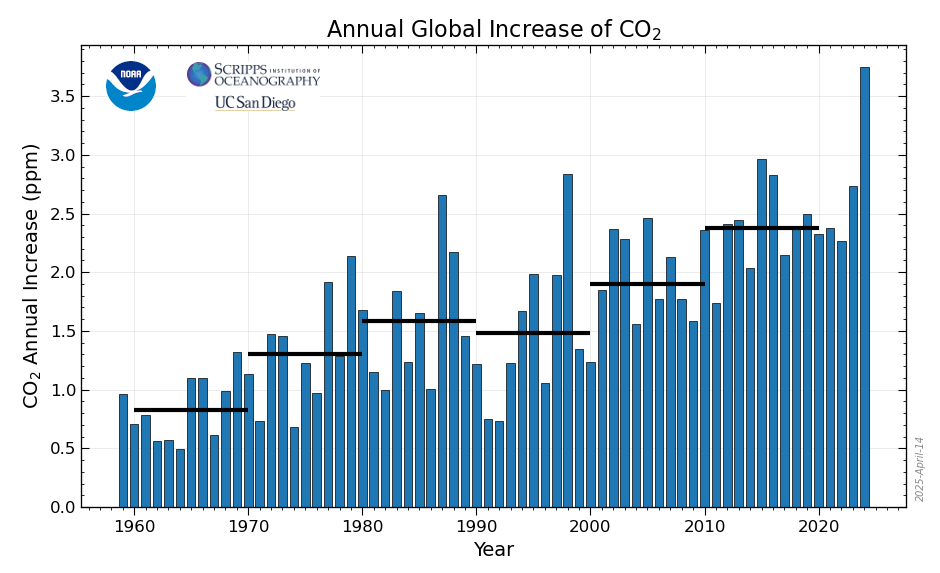
The concentration, measured in parts per million, has been increasing rapidly since human civilizations started burning coal and oil in the mid-1800s from the pre-industrial level of 280 ppm.
In recent decades, the increase has often been in annual increments of 1 to 2 ppm. But last year, the increase measured by the National Oceanic and Atmospheric Administration’s Global Monitoring Laboratory was 3.75 ppm, according to the lab’s early April update of atmospheric greenhouse gas concentrations.
That brings the annual mean global concentration close to 430 ppm, about 40 percent more than the pre-industrial level, and enough to heat the planet by about 2.7 degrees Fahrenheit (1.5 degrees Celsius). Climate researchers have noted that the continuing increase of global CO2 emissions means the world will probably not be able to reach the Paris Agreement target of limiting warming to 2.7 degrees Fahrenheit above the pre-industrial level.
“It’s definitely worrying to see such a large jump in 2024,” said Berkeley Earth climate researcher Zeke Hausfather. “While it’s not surprising to set new records given global emissions have yet to peak, and there are generally higher ppm increases in El Niño years, 2024 was still anomalous for just how large it was.”
El Niño refers to the warm phase of a tropical Pacific Ocean cycle that’s formally called the El Niño Southern Oscillation. During other recent El Niño phases, like in 1998 and 2016, the annual CO2 increase was about 3 ppm, Hausfather said.
“Because we know the magnitude of emissions and the ocean sink does not vary that much year to year, this has to reflect a weakening of the land sink,” he said, referring to the amount of carbon absorbed by terrestrial ecosystems like forests and wetlands. Those ecosystems did still take up some carbon last year, he noted, but the land sink was the weakest since 1998, when it touched zero, and 1987, when it was a net emitter of CO2.
Even if the growth rate slows again in 2025, he said, “the worry is that this year’s jump might include [non-El Niño] factors like temperature responses from soils and vegetation that might persist or intensify as the Earth warms.”
The unprecedented increase of atmospheric CO2 is just one of several red lights flashing on the climate dashboard.
This graph shows the annual mean growth rates of carbon dioxide, with decadal averages shown as horizontal lines across the bars. The largest spike shown in 2024, represents an annual increase of 3.75 parts per million of carbon dioxide in the air. It is the largest yearly increase since measurements started in the 1950s. Credit: NOAA
Others include the 2023-2024 spike of the global average surface temperature, which has also not been fully explained, and the fact that Earth’s average temperature has stayed above a 2.7 degree Fahrenheit temperature target set by the Paris Agreement for 20 of the last 21 months. Additionally, the combined sea ice extent in both polar regions has dropped to record or near-record lows the last few years, which means Earth is losing some of its biggest heat shields.
In recent years, NOAA publicized the annual updates to the global greenhouse gas index with press releases and explanatory articles on its website, and the agency was set to do the same this year, said Tom Di Liberto, a former NOAA public affairs specialist who was fired by the Trump administration in late February along with hundreds of other NOAA staffers.
“That article was written, and then it was taken down by the current political communications leader of NOAA because it would not make the administration happy,” he said. “NOAA is likely to still be doing the work internally, but it’s very unlikely you will see stuff coming out of NOAA like you had in the past.”
NOAA did not provide answers to Inside Climate News’ questions about this year’s increase.
Climate scientist Michael Mann, director of the Center for Science, Sustainability & the Media at the University of Pennsylvania, said the CO2 spike may reflect the post-COVID emissions bounce as economies restarted after lockdowns, but he said the general expectation is that emissions will start to plateau this year, largely driven by decarbonization by China and other countries.
“I’ve seen the claim made that decreased uptake by natural sinks and wildfire emissions might have played a role,” he said. “But my view is that this may be a misinterpretation of the fleeting impacts of extended, major El Niño events like 2023-2024.”
James Hansen, an adjunct professor at Columbia University’s Earth Institute and director of the Program on Climate Science, Awareness and Solutions, said the 2024 CO2 increase is not surprising, given continued record-high emissions from fossil fuels, as well as the record-warm oceans.
“Similar increases have occurred with lesser emissions, but stronger El Niños,” he said. “It’s not all gloom and doom. The airborne fraction of emissions has actually trended downward over the past several decades, so once we begin to reduce emissions, we should be able to get the growth rate of CO2 to decline.”
The discussion will focus on the Juchem Ditch and the Farmers Highline Canal and review how early settlers dug ditches by hand to support mining and agriculture. The event is free to the public and is scheduled for 10:30 a.m. to noon on May 17 at the Arvada Elks Lodge in Olde Town, at 5700 Yukon St. Panelists will include local historians Ed Rothschild, Tom Fletcher and Bob Krugmire. The event will be moderated by Arvada City Councilmember Sharon Davis. Arvada Historical Society President Judith Denham said the idea for the first History Speaks lecture — which will potentially be part of a larger series of talks — came when the organization was planning last year’s Cemetery Tour, which centered on the early pioneers who built the city’s ditches.
“We thought it would be a great idea to expand on this story and find a way to talk more about this crucial part of Arvada’s history,” Denham said. “I think people are going to really enjoy hearing about this large piece of Arvada’s history. It’s a panel and we’ve invited water experts and ditch company representatives to talk about how water influenced Arvada’s early history.
“They’re going to tell us the fascinating stories about how early settlers Wadsworth, Swadley and Jochem dug ditches with hand tools and mules so they could provide water for their farms,” Denham continued. “And add in the stories about the early conflicts over water usage and how that whole complicated system of water rights and water law started.”
Registration for the event can be completed at historyarvada.org. The Arvada Press and Colorado Community Media are partnering with the Arvada Historical Society for this project.
Farmers Highline Canal near the Tuck Ditch Headgate April 30, 2019. Day 30 of the #30daysofbiking challenge.
OAA scientist Chris Cox checks an Atmospheric Surface Flux Station, designed and built by PSL and CIRES to collect data that measures all aspects of the exchange of energy between land and atmosphere. By analyzing these measurements, researchers can gain insight into both local and regional weather and climate systems. This unit is sitting on top of two stacked picnic tables buried under the snow. Credit: Janet Intrieri, NOAA Physical Sciences Laboratory
Click the link to read the article on The Denver Post website (Elise Schmelzer). Here’s an excerpt:
April 25, 2025
Already, the two institutes — the Cooperative Institute for Research in Environmental Sciences at the University of Colorado Boulder and the Cooperative Institute for Research in the Atmosphere at Colorado State University — are preparing for potential layoffs should money held up in new federal approval processes not materialize in the coming weeks…Both institutes for decades have partnered with the federal National Oceanic and Atmospheric Administration, which provides the majority of the budget for both facilities. The federal agency’s weather prediction and air and ocean monitoring impact nearly every industry and provide critical severe weather tracking, including through the National Weather Service. Its work is advanced by research from a network of 16 cooperative institutes, like those in Fort Collins and Boulder.
A memo by the White House Office of Management and Budget for the 2026 fiscal year — which begins Oct. 1 — proposes reducing funding for NOAA by 27%, effectively eliminating the agency’s research arm and ending support for the cooperative institutes. The budget reductions are part of a wide-ranging effort by the Trump administration to slash the size of government. Project 2025 — a conservative think tank’s outline for Trump’s second presidency — called for the dismantling of NOAA and for its functions to be privatized. The policy document identified the agency as “one of the main drivers of the climate change alarm industry and, as such, (it) is harmful to future U.S. prosperity.” The White House plan prompted three of Colorado’s Democratic congressional leaders — Rep. Joe Neguse and Sens. John Hickenlooper and Michael Bennet — on Wednesday to send a letter to Commerce Secretary Howard Lutnick to urge him not to cut cooperative institutes’ funding.
“CIs are home to experienced researchers and long-standing data collection programs with major impacts on human societies, (and) moreover they are instrumental in training future generations of workers who continue to contribute to societal needs,” the letter states. “It is our fear that if sweeping cuts are made, the damage will be irreversible. Even short-term interruptions in their research could threaten the safety and economies of the communities that CIs serve across the nation.”
Congress would have to approve the White House’s plan for the next fiscal year, but cooperative institute leaders also worry about more immediate funding problems. The memo directs NOAA to align its spending through fiscal year 2025 with the priorities in the document. The administration could strangle funding to the cooperative institutes even before the 2026 budget is set, said Waleed Abdalati, the director of CIRES at CU Boulder. Already, institutes are struggling to get money previously approved for research projects.
Selling off federal public lands, once a fringe idea, is now gaining traction among Republicans in Congress, the courts and in the White House. President Donald Trump has proposed using the money from such sales to offset the cost of extending his 2017 tax cuts, which would massively increase the federal budget.
In March, the U.S. Senate narrowly voted down an amendment that would have banned selling public land to balance the federal budget. Around the same time, the House adopted new rules that, opponents say, quietly lowered the bar for disposing of such lands.
“Republicans’ plans to sell off our public lands to pay for tax handouts for their billionaire donors is an outrageous slap in the face to all of us,” New Mexico Sen. Martin Heinrich, D, who sponsored the amendment blocking those sales, told High Country News in a statement.
Under the revised rules, legislation authorizing the sale of land managed by agencies such as the U.S. Forest Service, Bureau of Land Management and National Park Service would no longer require assigning a dollar value to the property first — a change that would make it much easier for lawmakers to introduce and pass such bills without triggering fiscal scrutiny. All this comes at a time when recent mass layoffs have further destabilized the agencies tasked with managing public lands.
“The threats have never been higher,” said Land Tawney, executive director of American Hunters and Anglers, a nonpartisan network of public-lands advocates. “Politicians are saying things out loud about divesting our public lands with more vigor and publicly. The threats are real.”
Canyons surrounding the Owyhee River, Oregon, on BLM land. Bob Wick/BLM
But even as these ideas gain traction in the GOP, most Americans, regardless of their political belief remain largely united in their love for the nation’s public lands, especially in the Western U.S. This has forced some Republicans to break with the national party on the issue, setting the stage for what could become an unusual political alliance.
THE ATTACKS ON public lands began immediately after Trump took office in January. Staffing cuts implemented by the Department of Government Efficiency (DOGE) have disproportionately impacted land-management agencies. Critics say these staffing reductions are part of a deliberate strategy to undermine the agencies’ ability to manage their lands effectively, thereby paving the way for privatization.
“I’m really concerned about what I see as a deliberate effort to set federal land management agencies up to fail. Once they fail, it’s not such a stretch to say, ‘Well, someone else could do a better job,’” said Susan Brown, a lawyer at Silvix Resources, a nonprofit legal group that focuses on public lands and environmental governance. [ed. emphasis mine]
The Trump administration — working with Interior Secretary Doug Burgum and Housing and Urban Development Secretary Scott Turner — has launched a joint task force to identify “underutilized” federal lands suitable for residential development, arguing that selling off these acres could help solve the nationwide housing shortage.
Critics argue that this idea is simply an excuse to open the door to privatization, as well as being a poor solution to the housing crisis. A new report from the Center for American Progress found that in the 10 Western states with the most BLM-managed land, less than 1% of that land is located within 10 miles of a population center, and much of it is unlikely to be suitable for sale or development.
Colorado Republican Lauren Boebert of Colorado told HCN that she is trying to strike a balance on the issue. “I stand with the far majority of Coloradans who see and believe in the value of protecting our public lands,” she said in a statement provided by her office. At the same time, Boebert added that she rejected “the idea that these public lands must be completely locked up from reasonable economic development and responsible energy exploration.” Utah Sen. Mike Lee, chairman of the Energy and Natural Resources Committee, did not respond to HCN’s requests for comment.
Across the West, Democrats and conservation advocates have used the threat of public land transfers to galvanize support. Protests against potential sales have erupted in various state capitols, including Idaho and Colorado, as well as at Arches National Park. Meanwhile, major outdoor brands are trying to rally recreationists around the issue. Earlier this month, more than 70 businesses launched an initiative called Brands for Public Lands, headlined by Patagonia and Black Diamond. The group is helping people contact their congressional representatives and urge them to oppose public land sales.
“The overwhelming majority (of Americans) want to keep public lands in public hands. It’s where we hunt, fish, gather berries, mountain bike, hike, float and just go escape,” said Tawney. “It’s all of our backyards, and I have confidence that the people will stand united.”