Last week, one of the Land Desk’s more conservative readers cancelled his paid subscription. He wrote that he appreciated my passion for public lands, but was no longer interested in reading what he called a “tirade against Trump.”
This type of thing happens all the time in this business, and, unlike Elon Musk, I’m not looking for your pity. But I was a bit saddened, given that this person had been a paid subscriber since the Land Desk was launched, and because I really do appreciate having readers and commenters from across the political spectrum.
Besides, while I’m prone to a rant now and then, I do think “tirade” is taking it a little too far. Anyway, my point in telling y’all this is to let you know that writing about Trump’s shenanigans every dispatch is just about the last thing I want to be doing with my time. I’d much rather be delving into old maps, getting into the nuances of Western water, exploring the history of floods and droughts and wildfires, taking contrarian views on the housing crisis, or dissecting the contradictions of oil and gas markets. And I will continue to do all of that.
At the same time, it’s impossible for me to ignore the barrage of destruction, corruption, chaos, authoritarianism, and incompetence emanating from the White House. My passion for public lands — and for justice, truth, reason, morality, decency, intelligence, and kindness — demands that I document these egregious acts, and do my part to resist them, even if it is just by informing my readership about what’s happening.
I am not impartial, not by any means. I am partial to the planet and its survival, toward my fellow human beings, toward peace and justice and compassion and truth. [ed. emphasis mine] I am not, however, partisan: I will scrutinize Democrats and Republicans equally, fact-check the left and the right, and give credit where credit is due — even to Donald Trump.
***
Hopi tribal members cross Havasu Creek. Photo credit: From the Earth Studio
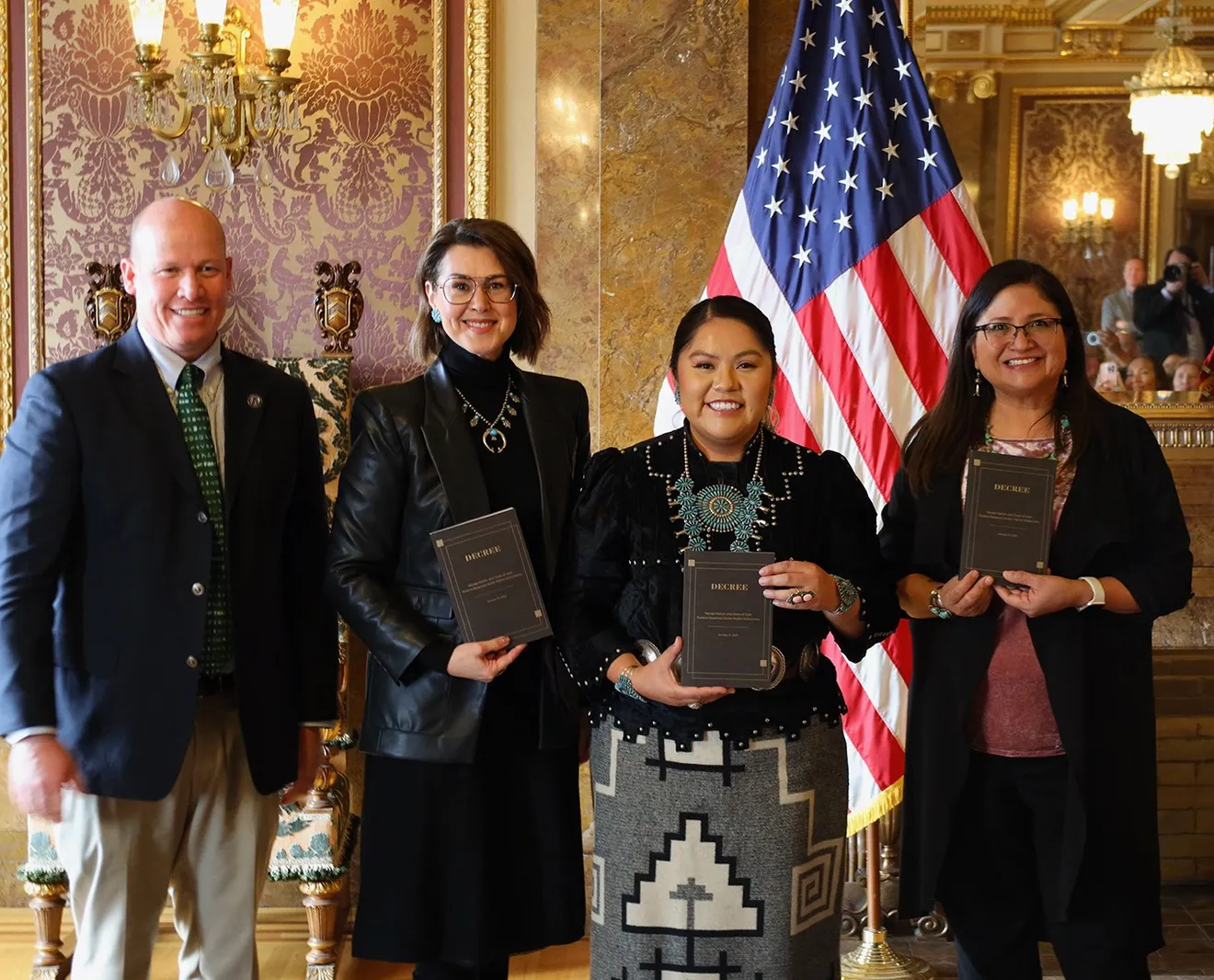
And on that note: The Trump administration appears to have unfrozen nearly $4.2 million in federal funding to help the Hopi Tribe build a solar-powered microgrid to run two remote wells and associated infrastructure that will provide water to Upper and Lower Moenkopi. The funding was approved by the Biden Energy Department, Trump froze it as part of a larger stop on Infrastructure and Inflation Reduction law money, but now it has been released. So good on you, Donny!
Though it may be inadvertent, Trump’s economic policies may ultimately benefit the environment in some ways. The haphazard, on-again, off-again tariffs, for example, along with the gutting of the federal government’s workforce, have sent the stock market into a tailspin. Meanwhile, the tariffs — along with reciprocal tariffs levied by the U.S.’s trading partners — will increase prices on most consumer goods. People will buy less, travel less, which will mean less pollution and environmental impacts.
***
And yet more kudos for Trump! Seriously. Despite all of his bluster, Trump has managed to really piss off oil and gas executives — the same ones that were throwing money at his campaign just a few months ago — and possibly dampen drilling on public lands.
See, the thing about tariffs is that they very well may raise the price you pay for gasoline (depending on where your local refinery gets its crude oil), but the economy-dampening part of tariffs actually brings down the price of oil, while also raising the cost of steel pipes and other supplies. That’s no bueno for petroleum companies, whose profit margins are directly proportional to the price of crude.
Many of these folks won’t criticize Trump in public, given his vindictive and authoritarian leanings, but give them the cover of anonymity, as a Dallas Federal Reserve survey did, and they go off on the White House’s herky-jerky non-policies. Here’s a sampling:
There was only one mention of regulations getting in the way of the oil business, and that wasn’t federal rules, but state ones:
Well, there you have it, folks.
***
Oh, and these oil companies might also be angry that the MAGAs are all buying Teslas — or at least pretending to — in order to “own the libs.” Which is pretty funny, given the amount of gibberish Trump devoted to dissing electric vehicles during his campaign rallies. Tesla also stands to benefit the most from Trump’s tariffs, another dig at the internal combustion fans.
***
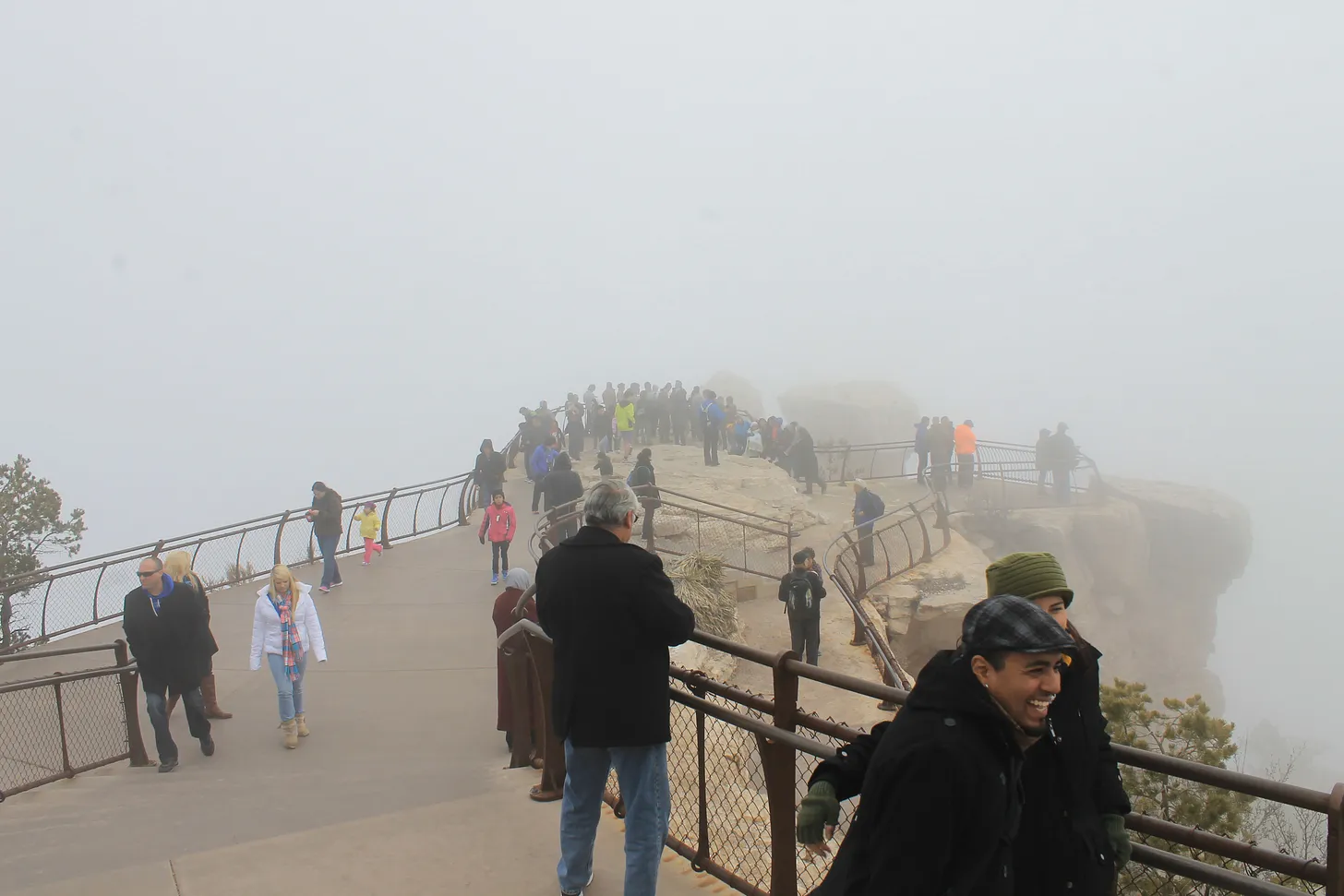
Maybe the national parks will be a bit less crowded this summer, as well, as international travel ebbs.
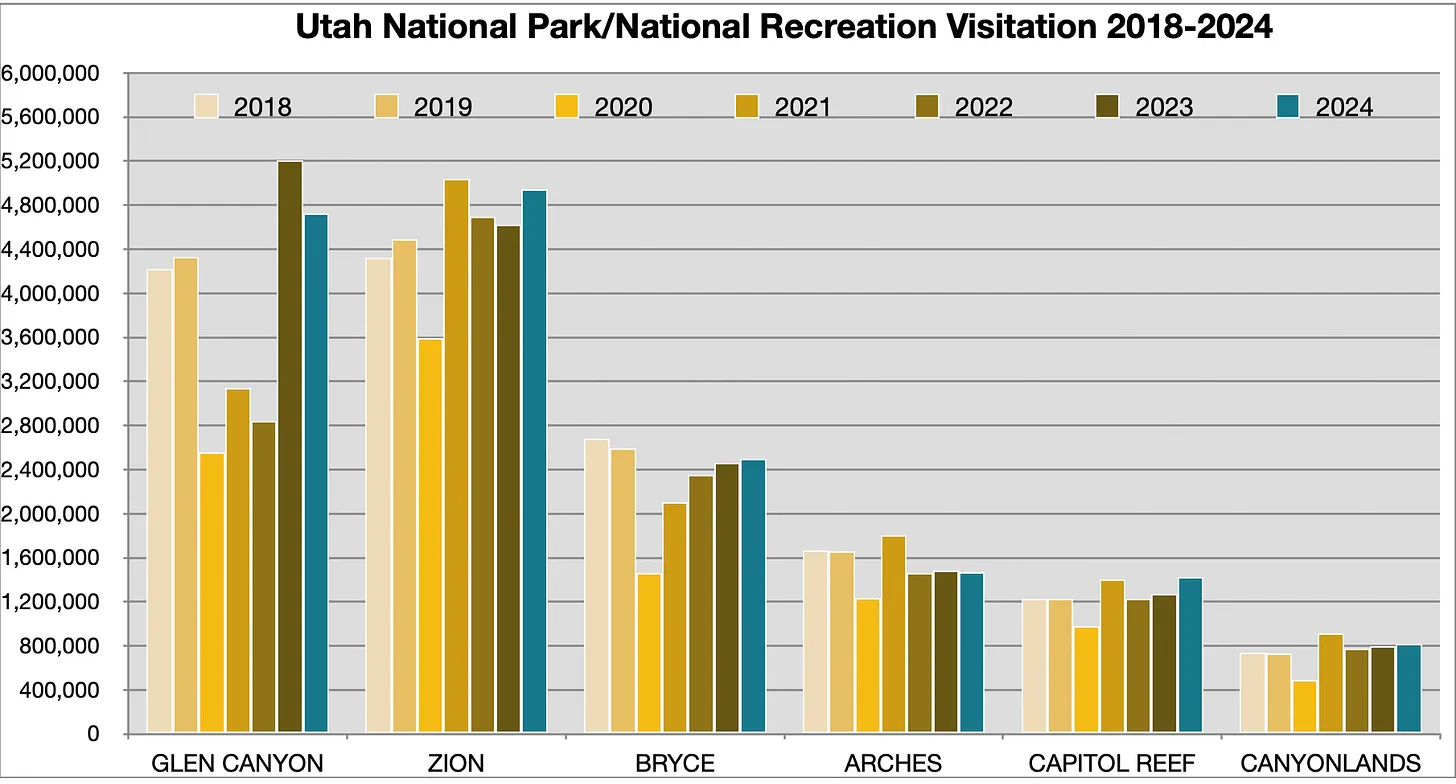
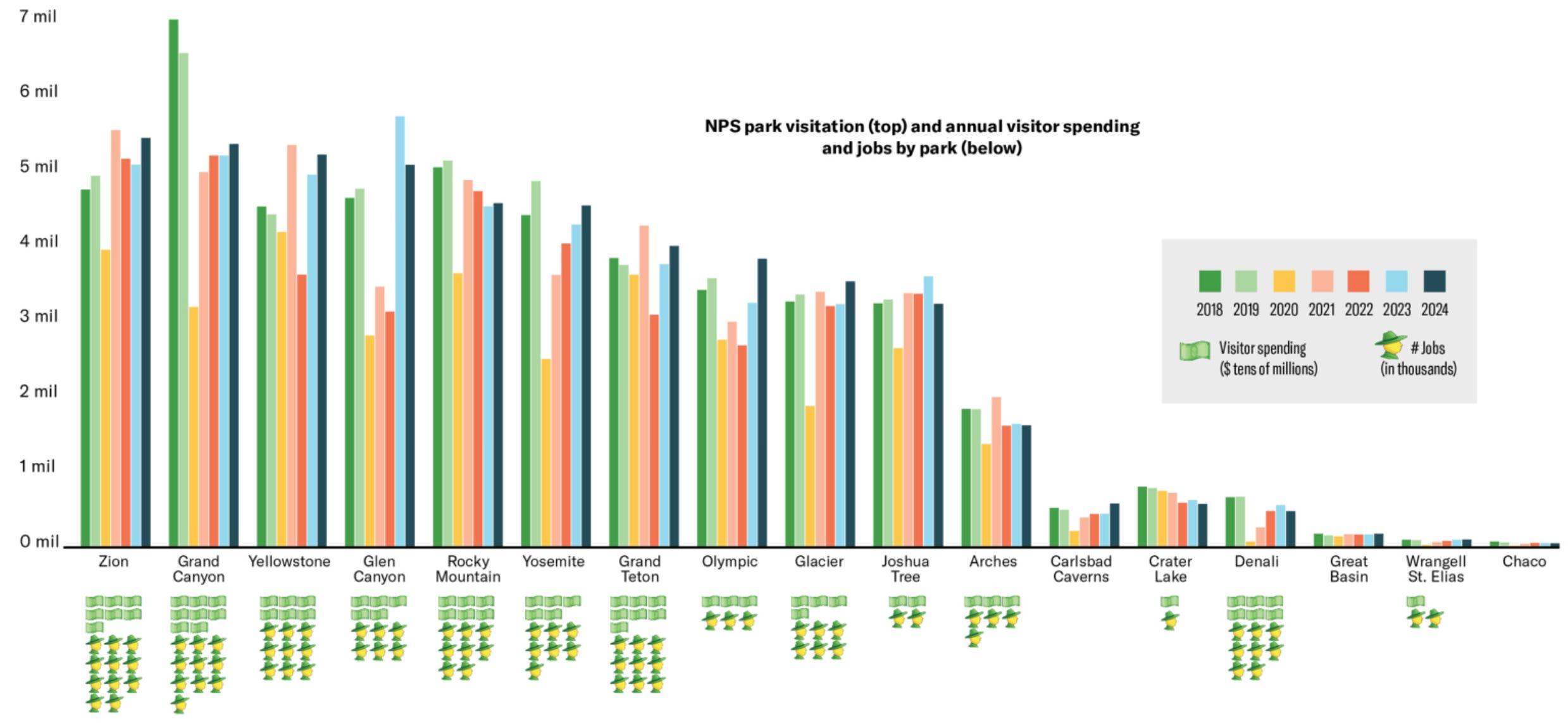
Anyone who’s traveled the Western national park service knows that they are popular with overseas visitors. On a single grocery run at the Page, Arizona, Safeway recently, I heard no fewer than three different languages spoken, in addition to Navajo and English, and that was in the off-season. In 2018 (the last year that data is available), more than 14 million international travelers visited U.S. national parks and monuments. About 14% of the Grand Canyon National Parks’ visitors were from overseas, with about 6% of Zion’s visitation from overseas.
Tourism Economics is predicting that international travel to the U.S. will be down significantly this year, thanks not only to the administration’s hostile economic moves, but also “polarizing Trump administration policies and rhetoric.” Also, there’s that thing where travelers have been detained at the border, even thrown in jail, simply for trying to get a visa. This decline undoubtedly will impact Western U.S. tourism and national park and monument visitation numbers. Not good for the tourism economy, but it might give the parks a much needed rest.
🥵 Aridification Watch 🐫
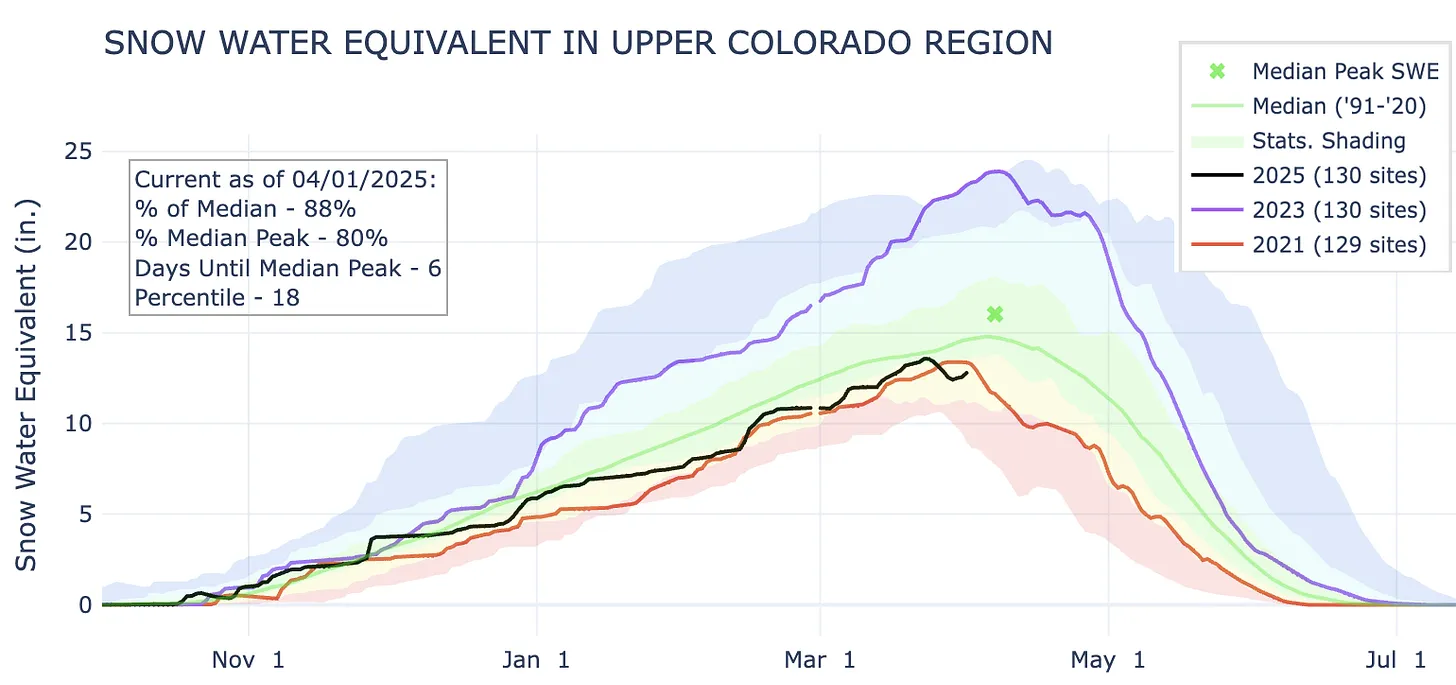
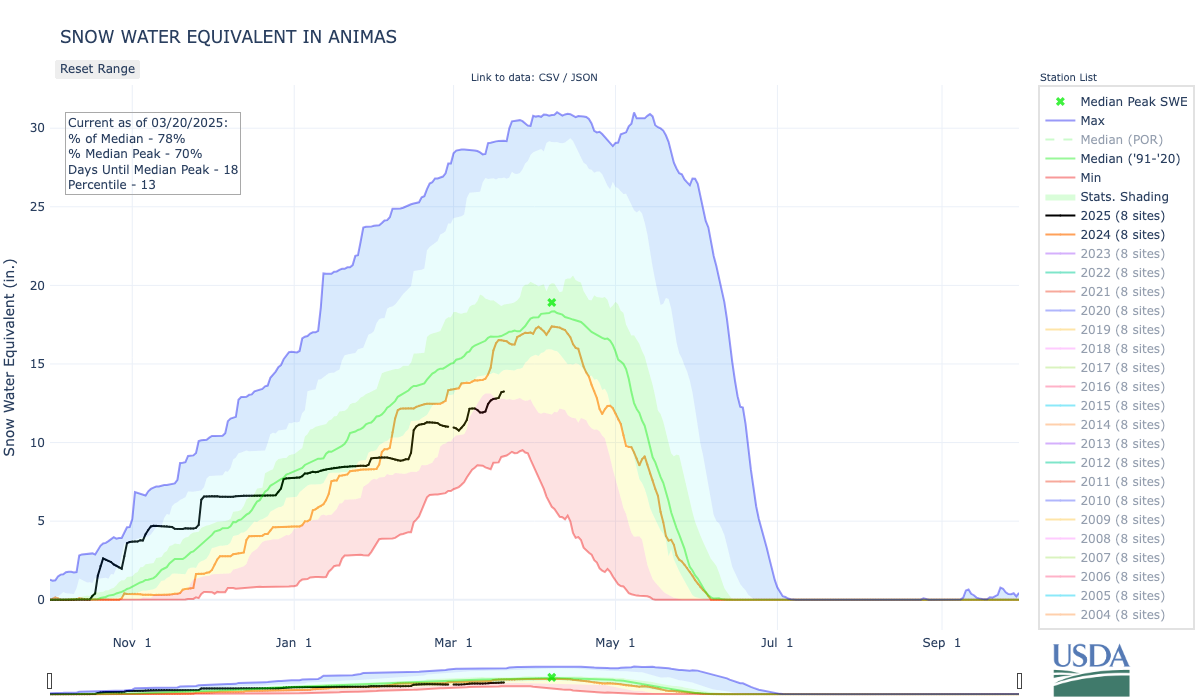
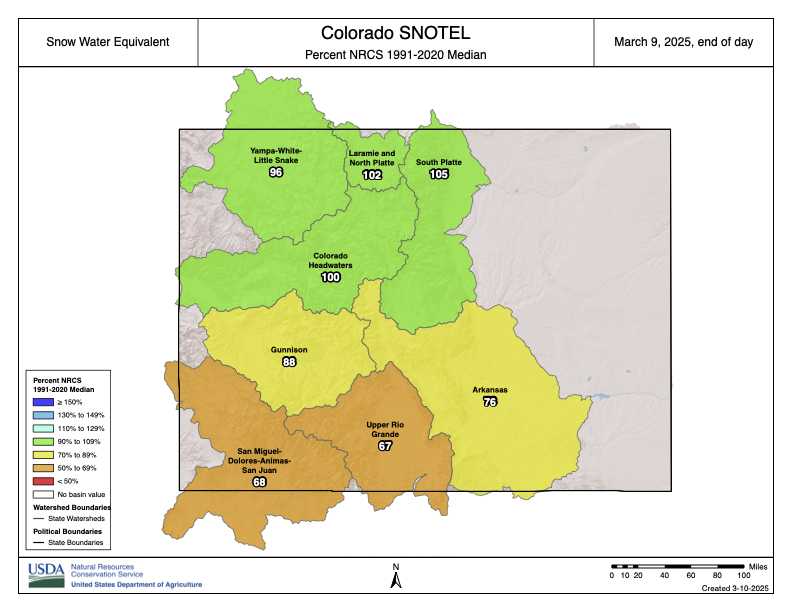
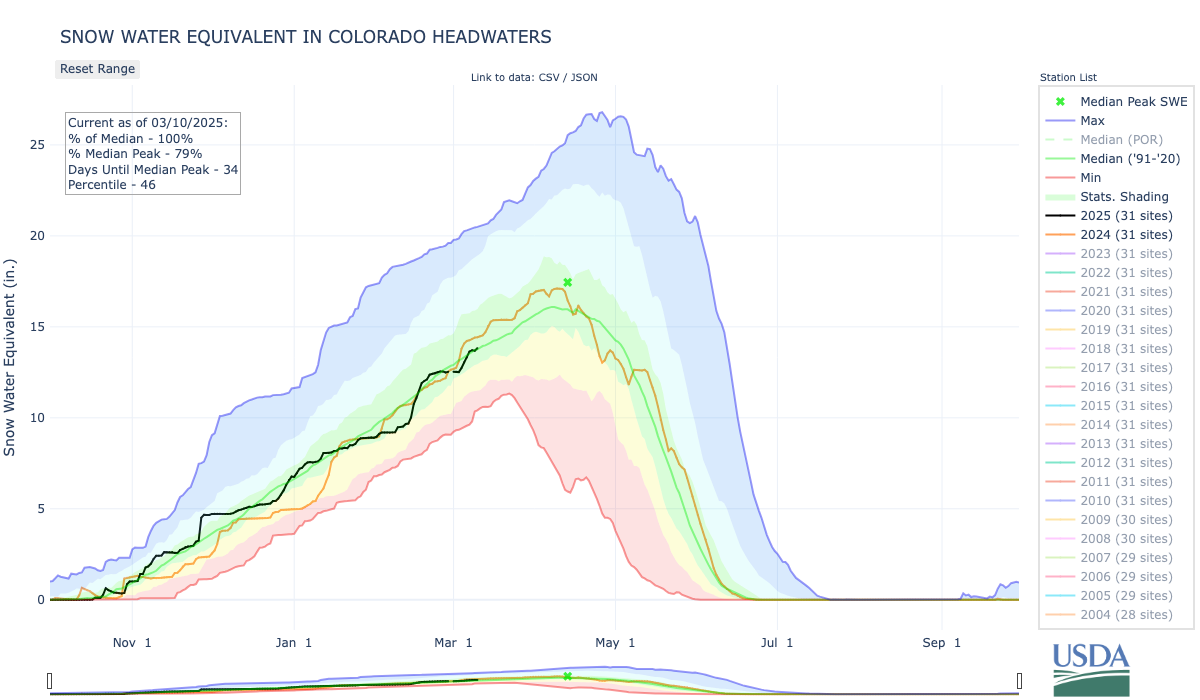
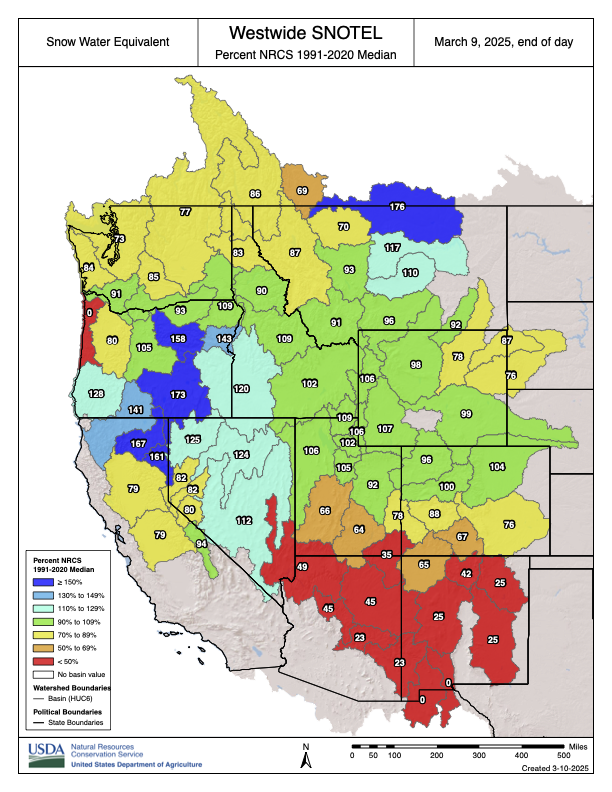
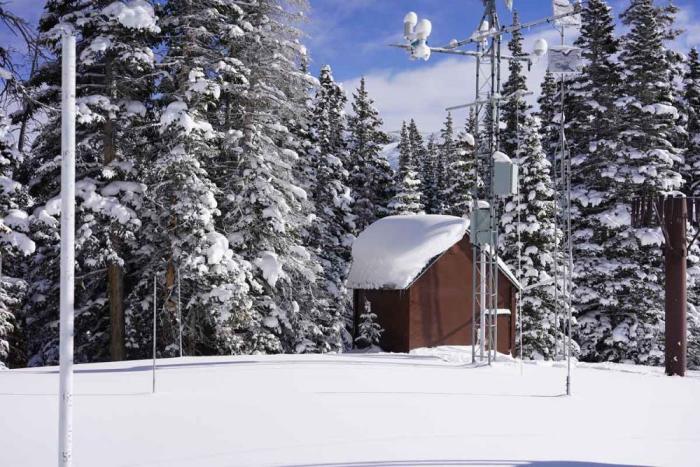
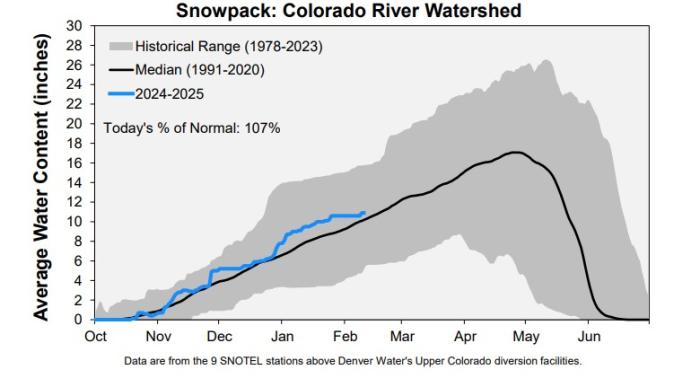
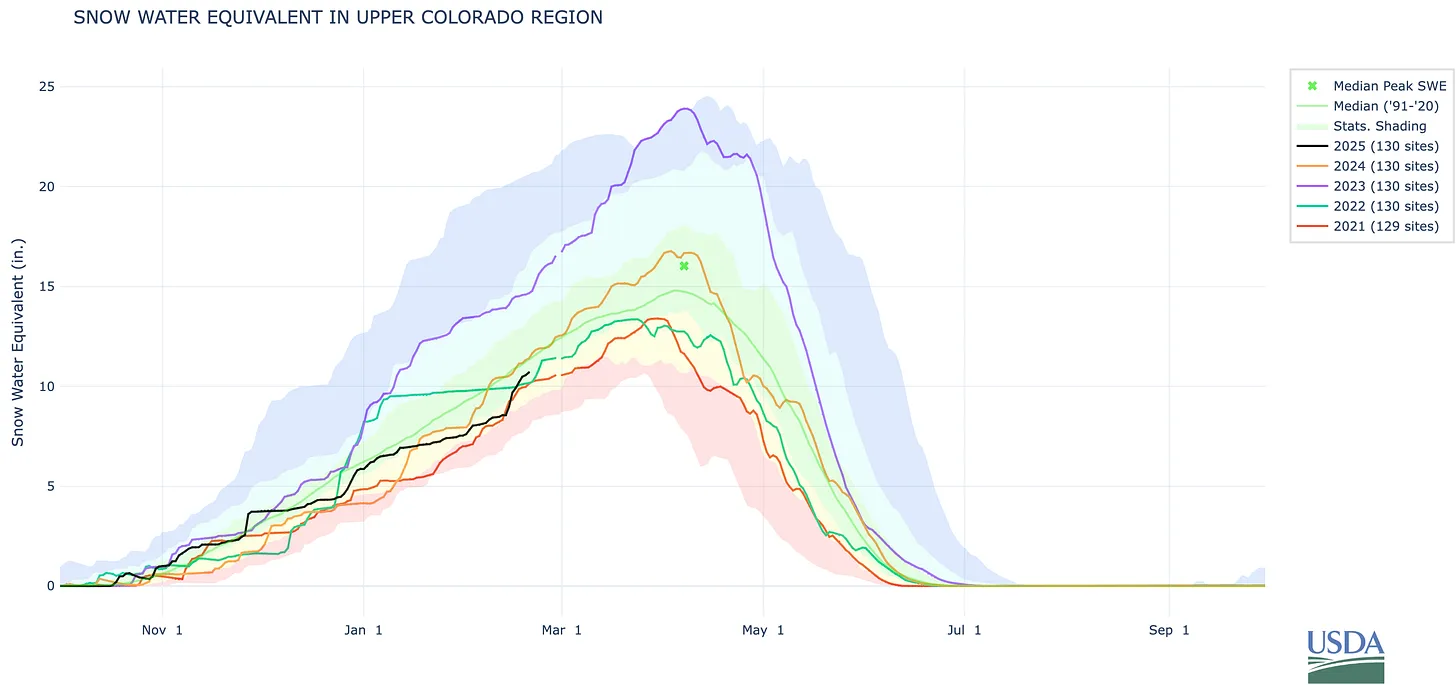
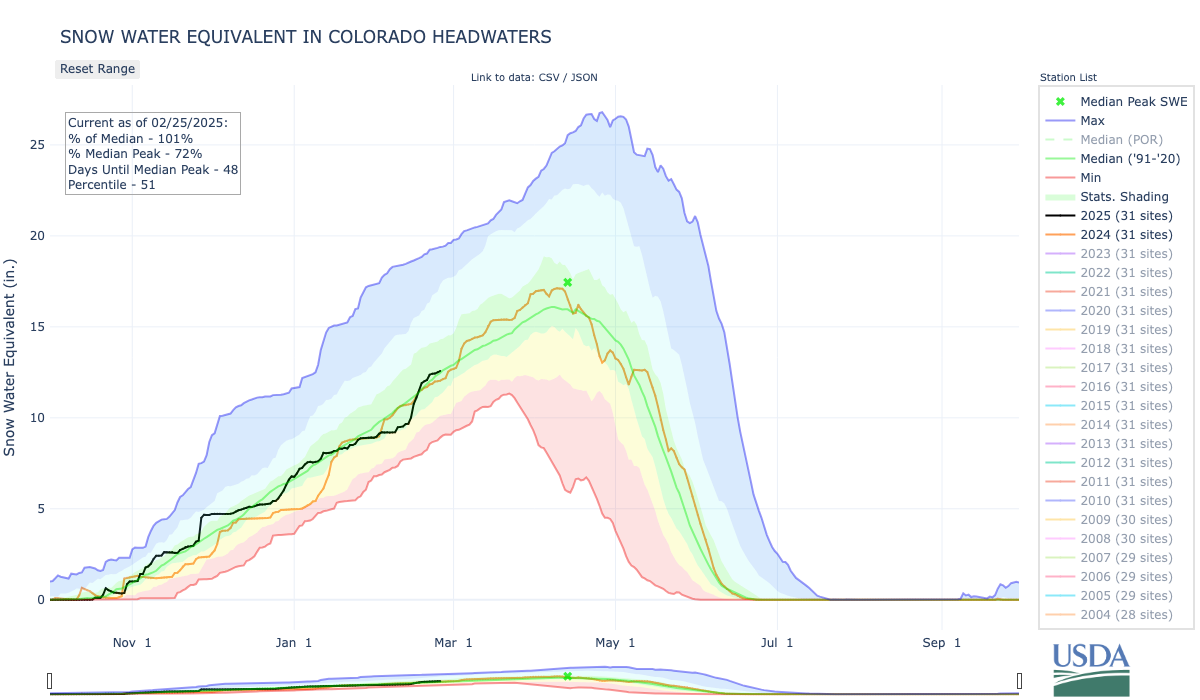
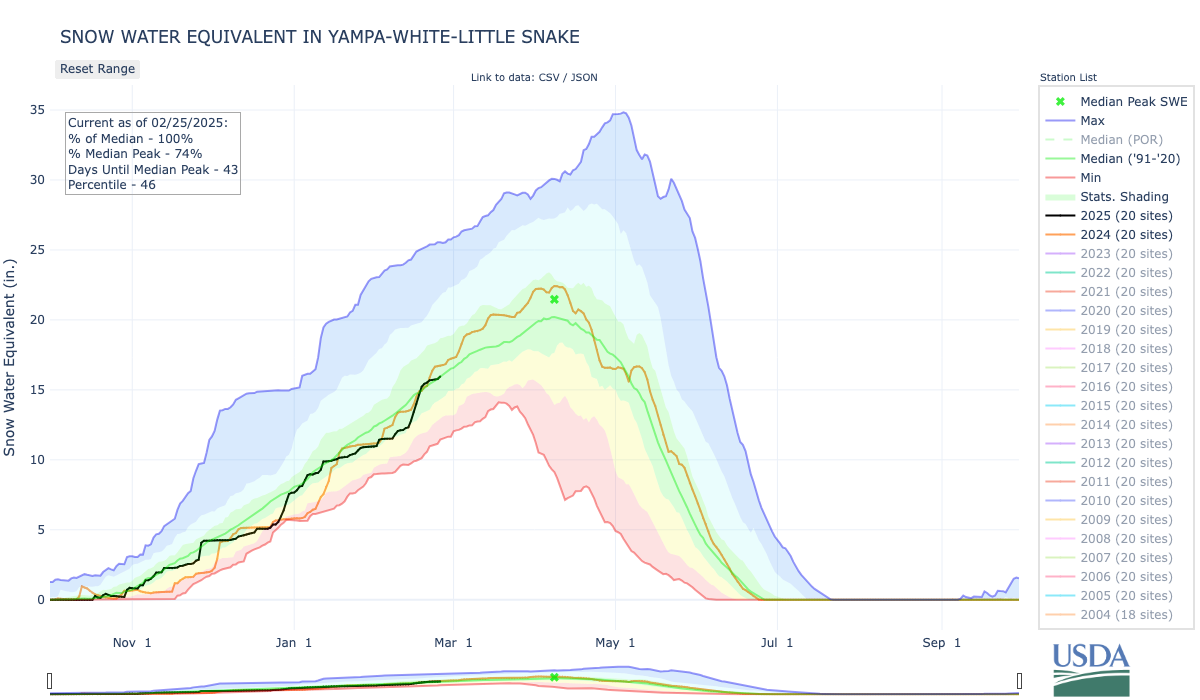
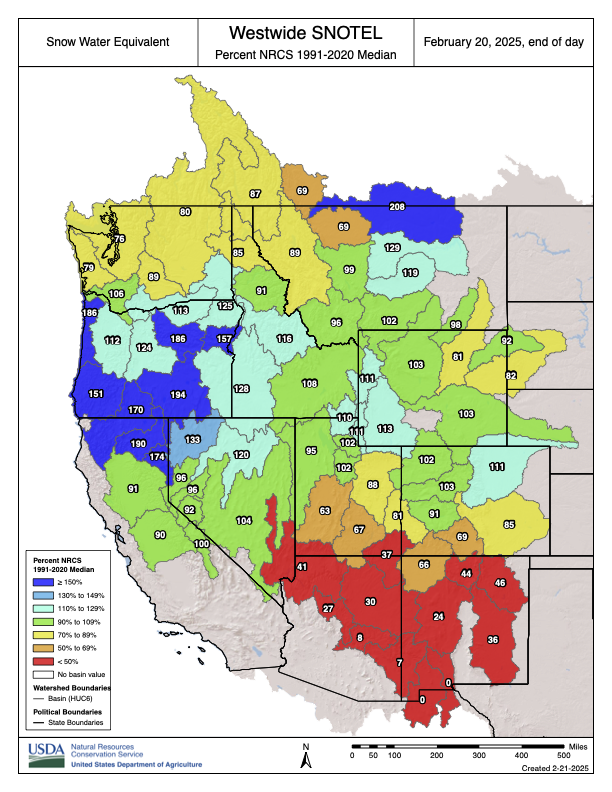
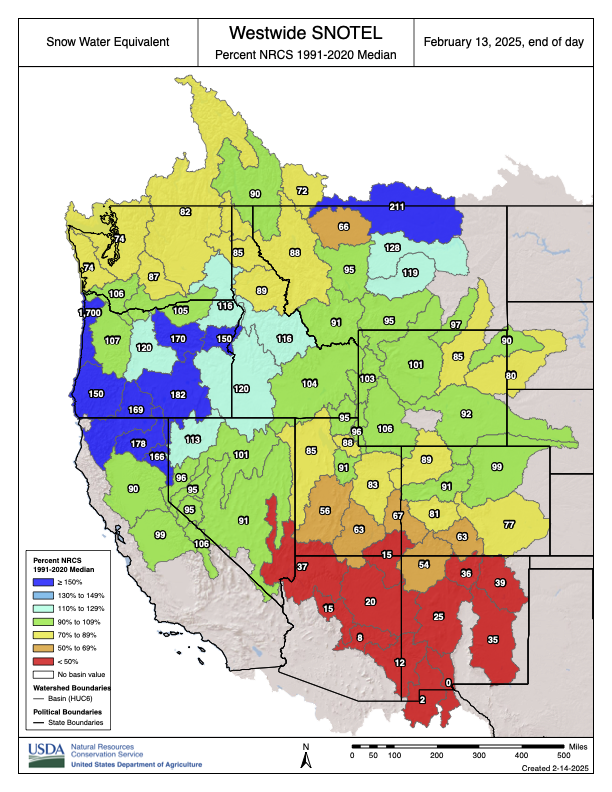
It’s first-of-the-month snowpack update time again, and this will likely be the last of the season barring some freak climatic shift over the next several weeks. Snowpack levels typically peak in mid-elevation areas in mid- to late-March, and in the high country in mid- to late-April, meaning we are now headed into spring runoff season.
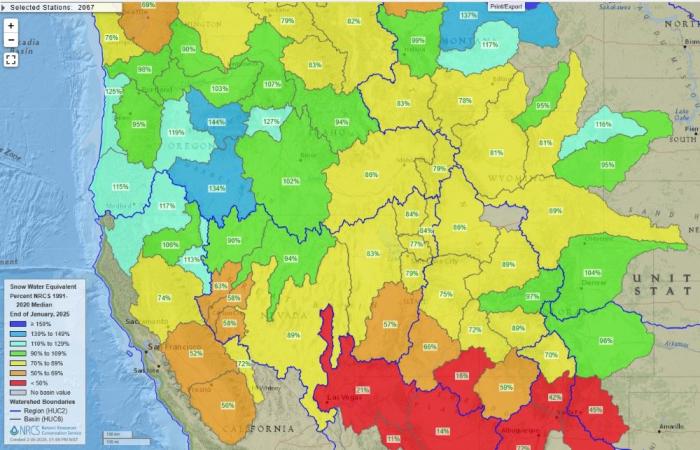
Generally speaking, it’s looking like runoff will be average to paltry, depending on which side of the snow-divide your watershed falls. It is a very jagged line, by the way, with places in the west and north having average to above average snowpack, while the southern-Interior West generally had a super dry winter. But even within those areas there are sort of outliers: The Grand Traverse ski race between Aspen and Crested Butte was canceled due to lack of snow for the first time in its 26-year history.
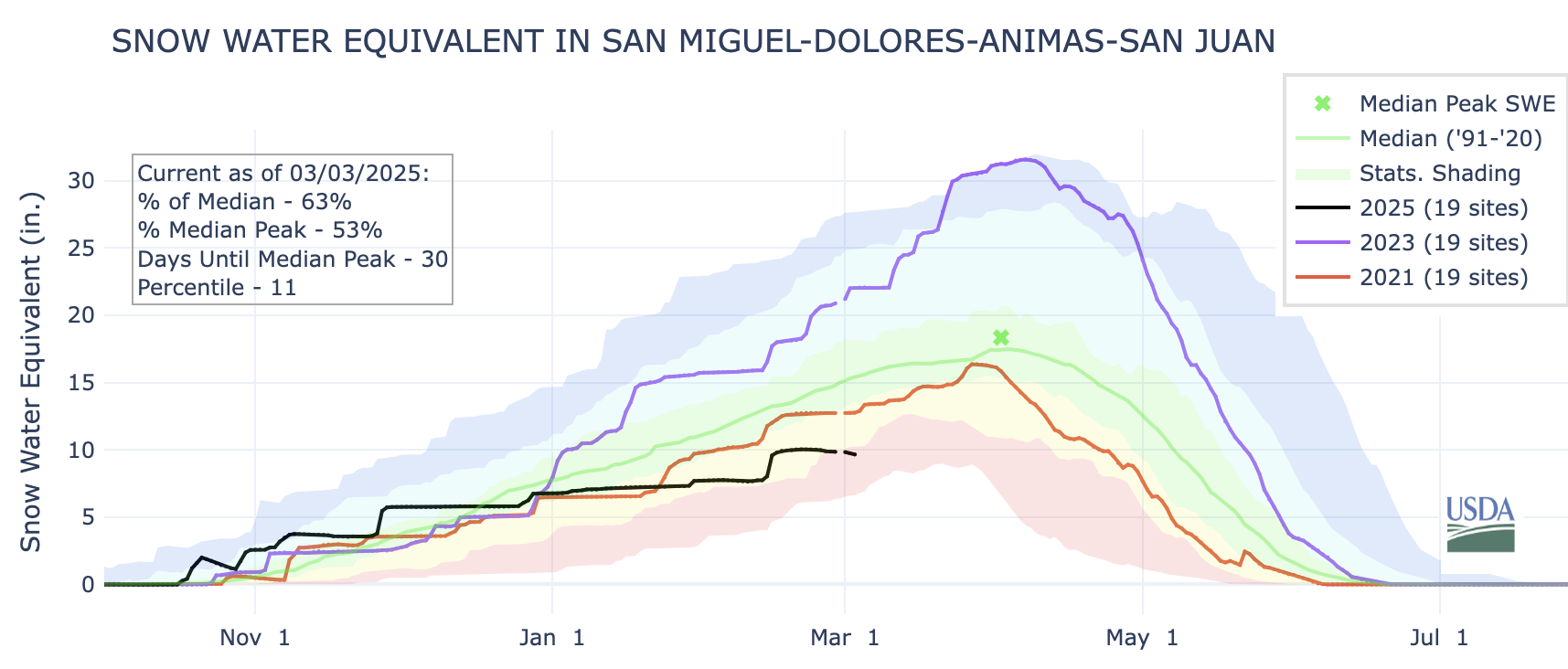
And there’s big variations over short distances. Red Mountain Pass is still just below median, for example, while the southern San Juan Mountains, just a few dozen miles away, are experiencing a severely dry winter.
Before I get to the graphics, however, a quick note. The snowpack and precipitation plots I run here come from the USDA’s Natural Resources Conservation Service. It’s just one of the valuable services they provide. I haven’t found any stats on whether DOGE has gone after NRCS’s staff, yet. But the DOGE website says it has or will cancel the leases for the following NRCS offices. Whether they and their staffs will simply go away, be absorbed into another facility, or what, isn’t disclosed.
Natural Resource Conservation Service offices slated for lease cancellations: Missoula, Montana; Wasilla and Fairbanks, Alaska; Logan, Utah; Gallup and Raton, New Mexico; Yuma, Arizona; Dayton, Puyallup, and Renton, Washington; Portland, Oregon; and Woodland, Yreka, Salinas, Oxnard, and Blythe, California.
Hopefully the staff of these offices and services they provide will endure.
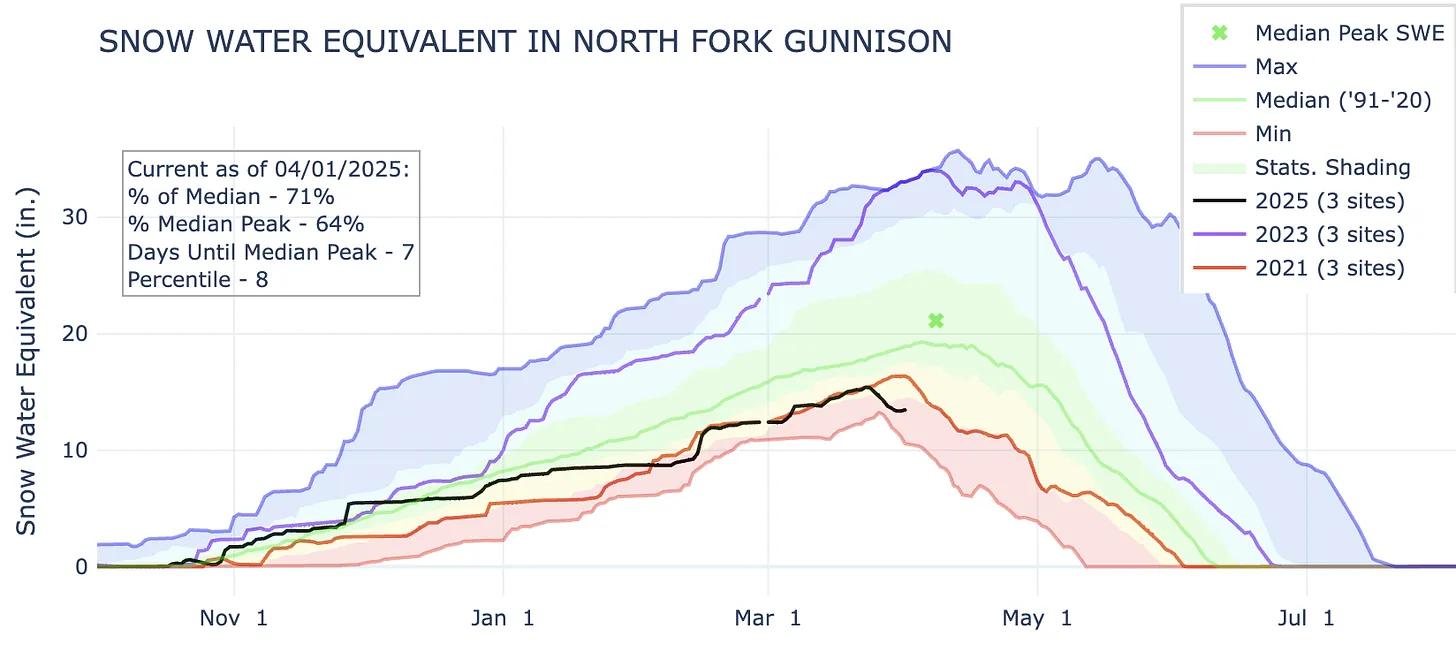
Now to the snowpack plots. I included the plots for 2021 and 2023 because those were the most recent big and crappy years for snowpack.
The watersheds that feed Lake Powell are not in terrible shape, sitting at 88% of the median just six days before the typical peak. However, levels are lower than they were in 2021 at this time, and 2021 was not a good year for the Colorado River. Source: NRCS.
The North Fork of the Gunnison has followed a snow accumulation pattern similar to the Upper Colorado River’s.
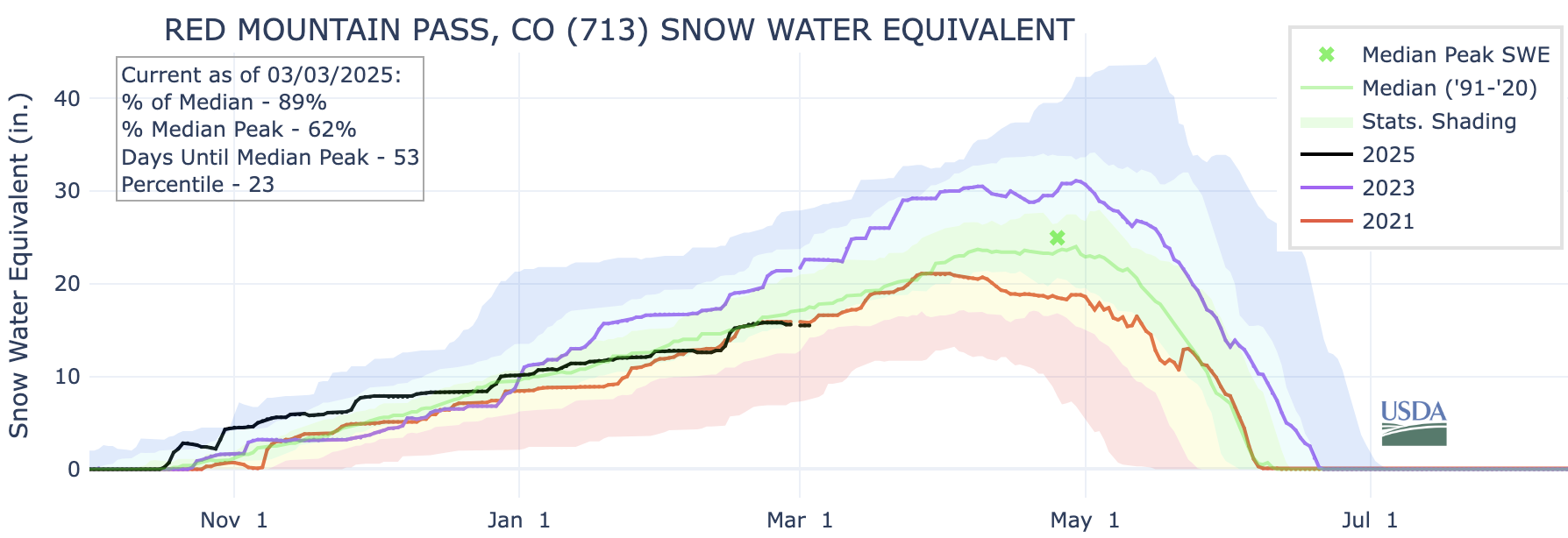
Red Mountain Pass is one of the few bright spots in the Four Corners region. Snow levels have tracked right around normal for most of the winter. Though it’s now down to 90% of median, there are potentially still over three weeks left in the snow accumulation season, meaning an above-average season is still possible; snow is forecast for much of this week there.
This SNOTEL site, in the San Francisco Peaks north of Flagstaff, is the comeback story of the year, rebounding from ultra-dry to average over the course of several weeks. It’s one of the only sites in Arizona that received measurable snow accumulation this season.
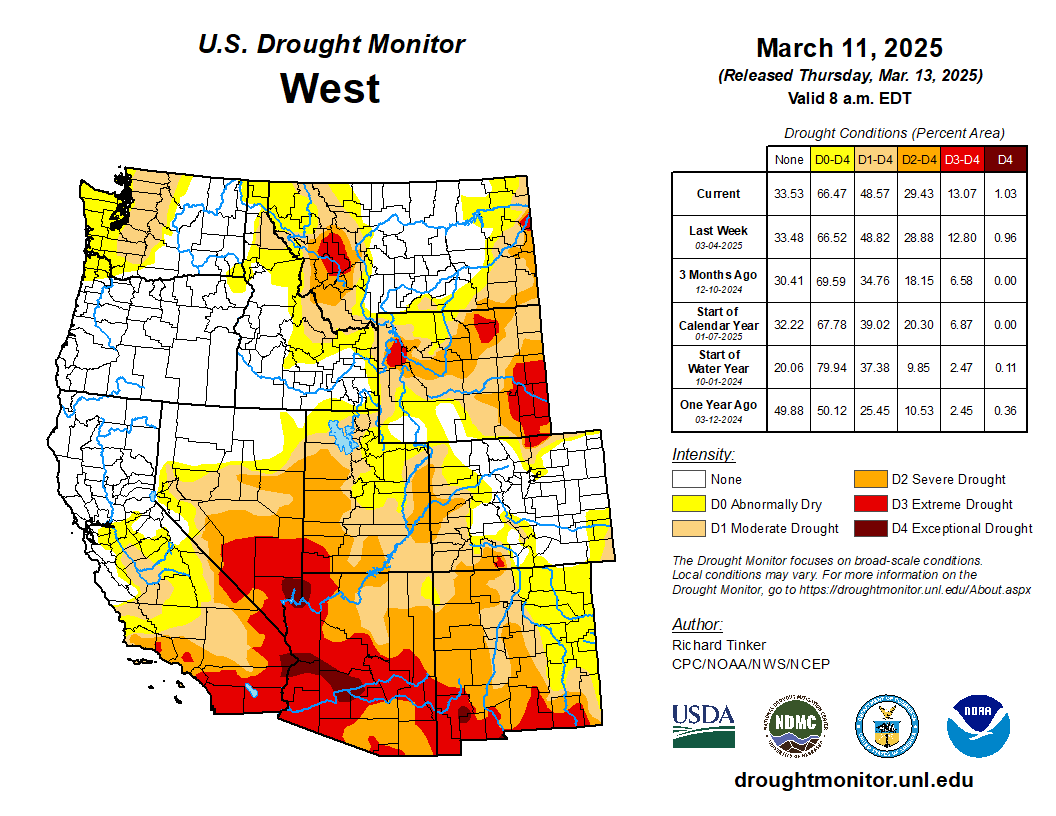
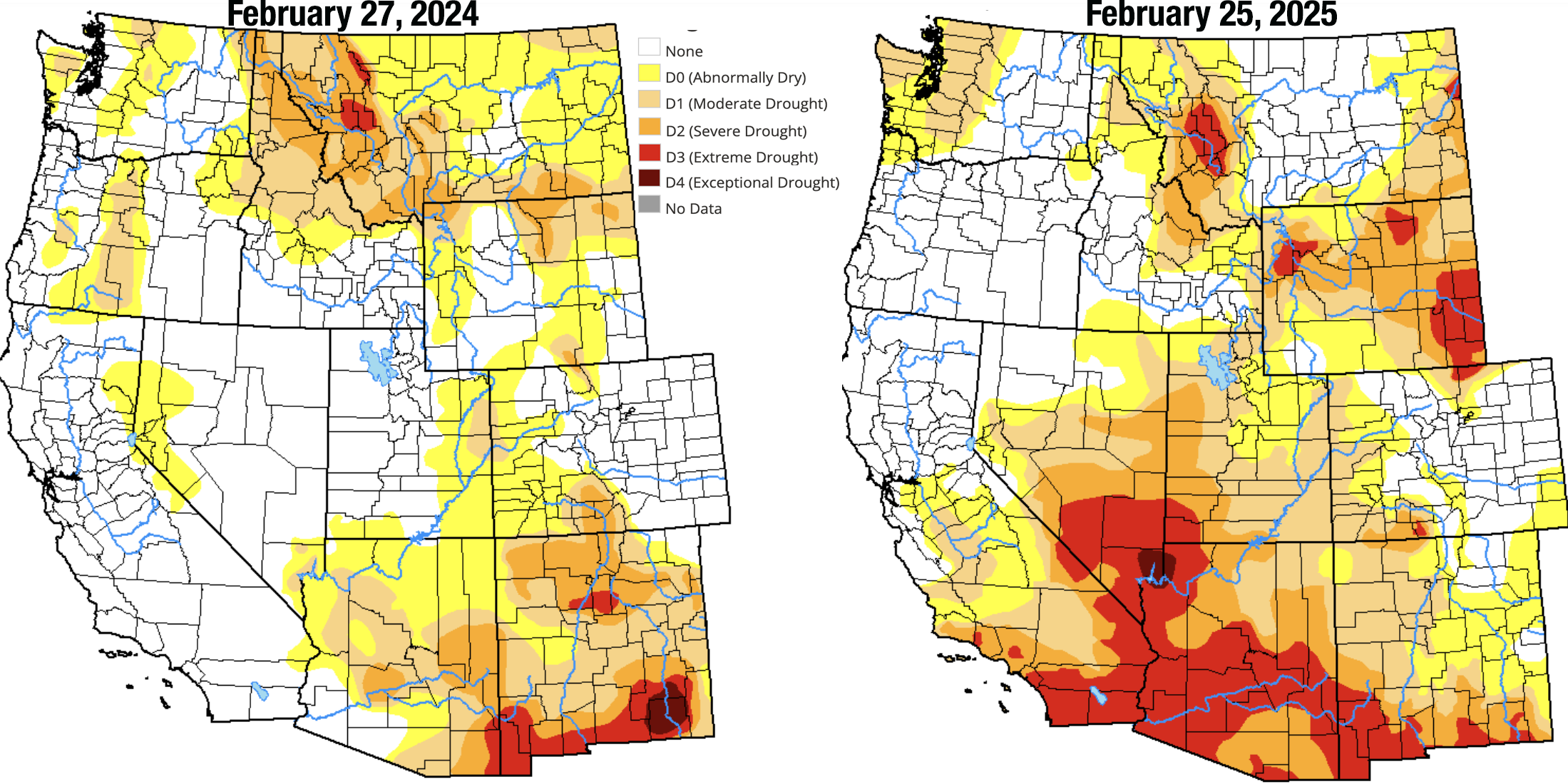
The drought has spread and intensified over the last year.
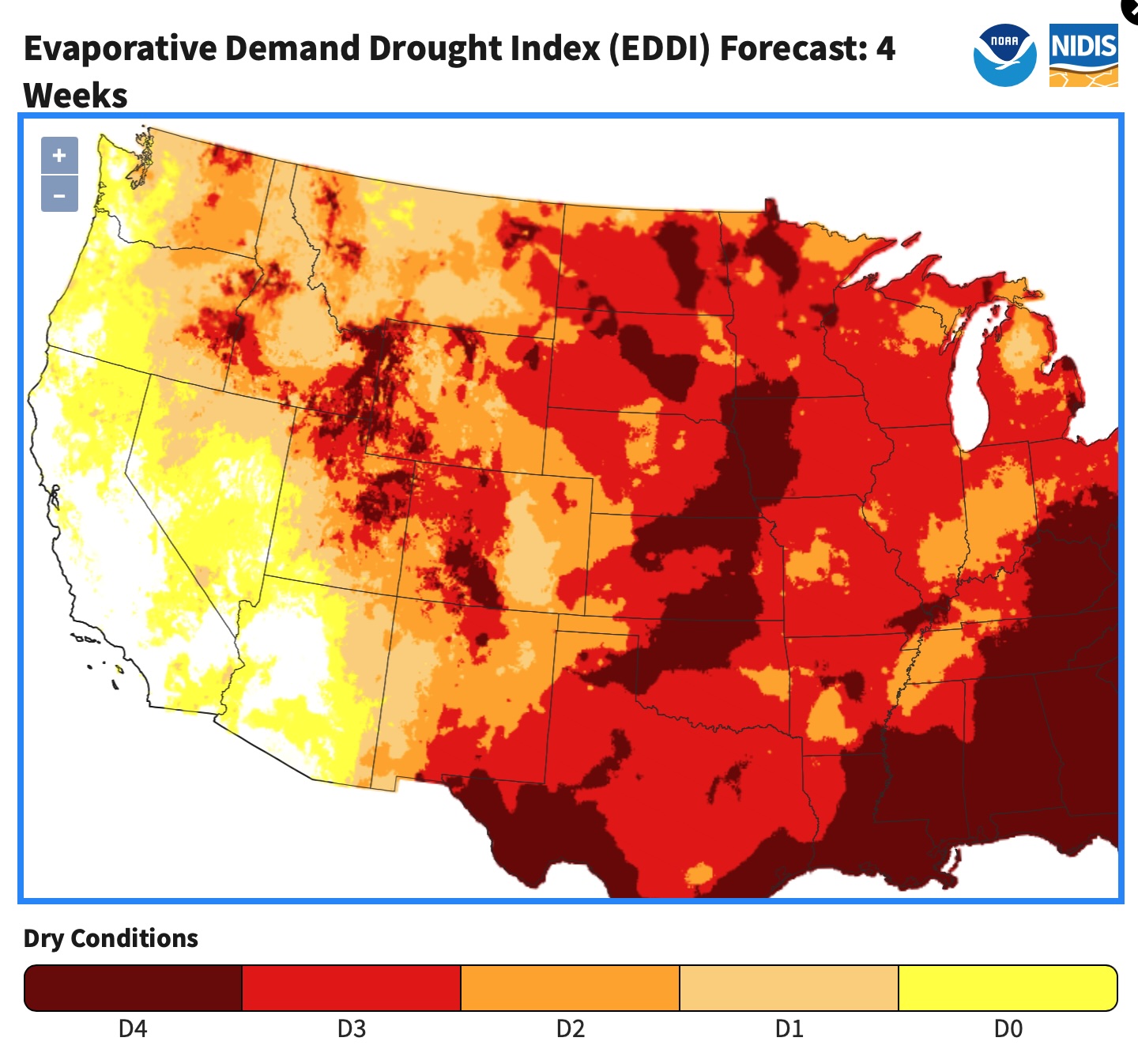
And it doesn’t look like it will get better anytime soon …
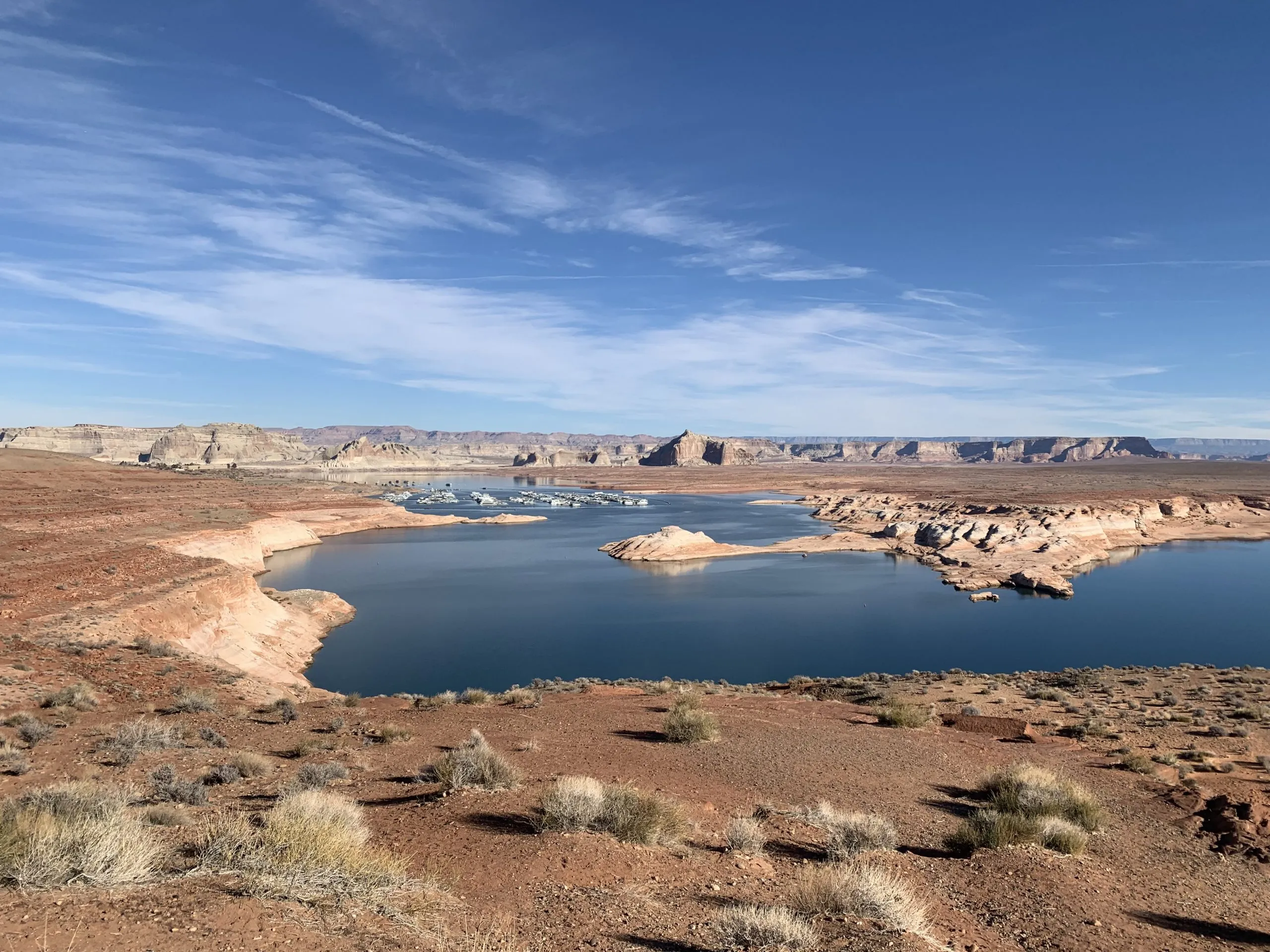
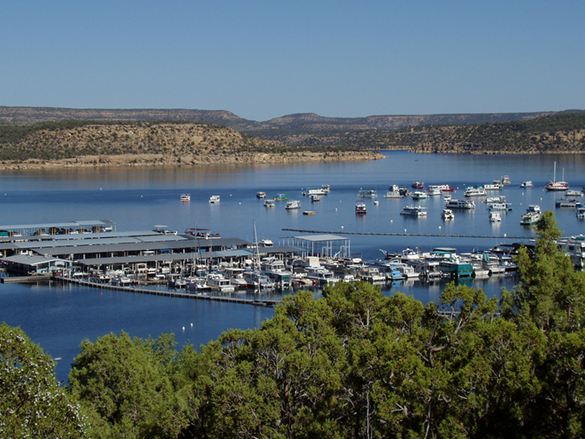
Lake Powell at Wahweap Marina as seen in December 2021. Dwindling streamflows and falling reservoir levels have made it more likely that what some experts call a Colorado River Compact “tripwire” will be hit in 2027. Credit: Heather Sackett/Aspen Journalism
Time is ticking for states that share the shrinking Colorado River to negotiate a new set of governing rules. One major sticking point, which has the potential to thrust the parties into a protracted legal battle, hinges on differing interpretations of a few sentences in a century-old agreement.
In a recent letter, the river’s Lower Basin states – California, Nevada and Arizona – asked federal officials to analyze the effects of a hypothetical legal concept known as a “compact call.”
The problem? The 1922 Colorado River Compact says nothing about a compact call. And although the phrase often looms like a threat over Colorado River discussions, there is no agreed-upon definition of the term, what would trigger a compact call nor how one would play out. In fact, the Upper Basin states – Colorado, New Mexico, Utah and Wyoming – don’t believe the laws governing the river even contemplate it.
The February letter comes as water managers from all seven Colorado River Basin states are in the midst of deciding how Lake Powell and Lake Mead will be operated and cuts will be shared after 2026 when the current guidelines expire. In March 2024, each basin submitted competing proposals to the U.S. Bureau of Reclamation. In January, federal officials with the outgoing Biden administration released their analysis of five different potential ways forward and did not include either basin’s proposal, but a “basin hybrid” that incorporated elements from both.
In essence, the Lower Basin states have identified a potential opening with the Trump administration, and asked new leaders at the Interior Department to adopt the Lower Basin’s view on some of the most contentious and disagreed-about parts of Colorado River management.
“I believe that under the law, the compact requires delivery of 7.5 million acre-feet of water on a 10-year rolling average, plus one-half of the Mexico Treaty obligation to the Lower Basin,” said Tom Buschatzke, director of Arizona’s Department of Water Resources. “So we want to see Reclamation, as our request indicated, incorporate that outcome into the modeling for any alternative to look at. That includes how reductions in the Upper Basin states might have to occur.”
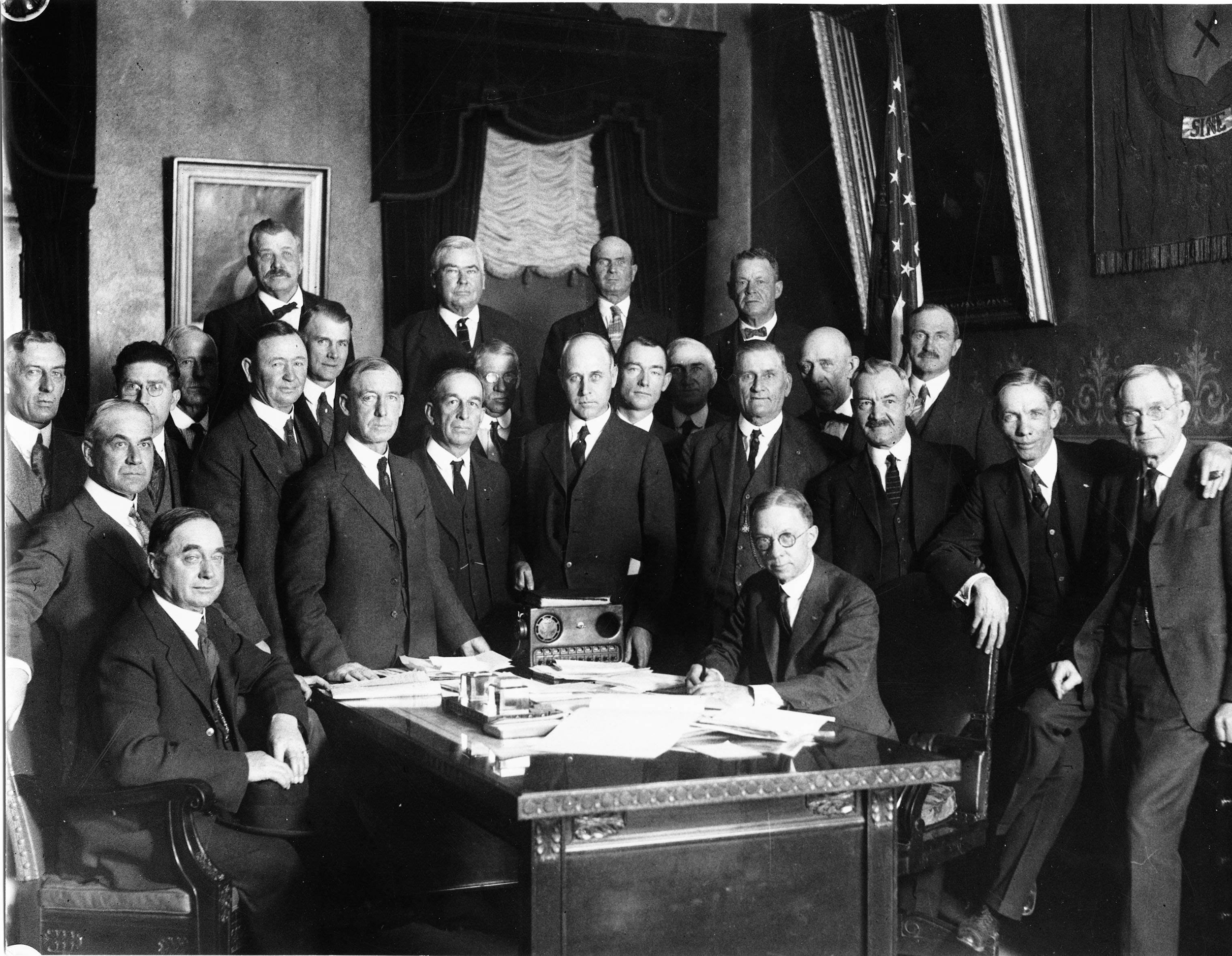
Members of the Colorado River Commission, in Santa Fe in 1922, after signing the Colorado River Compact. From left, W. S. Norviel (Arizona), Delph E. Carpenter (Colorado), Herbert Hoover (Secretary of Commerce and Chairman of Commission), R. E. Caldwell (Utah), Clarence C. Stetson (Executive Secretary of Commission), Stephen B. Davis, Jr. (New Mexico), Frank C. Emerson (Wyoming), W. F. McClure (California), and James G. Scrugham (Nevada)
CREDIT: COLORADO STATE UNIVERSITY WATER RESOURCES ARCHIVE via Aspen Journalism
Over a century ago, the compact split the river’s water evenly, with half (7.5 million acre-feet a year) going to the Upper Basin and half to the Lower Basin. Another 1.5 million acre-feet a year was later allocated to Mexico.
The crux of the dispute comes from how the Upper Basin states and the Lower Basin states each interpret a key phrase in the compact: “The States of the Upper Division will not cause the flow of the river at Lee Ferry to be depleted below an aggregate of 75,000,000 acre-feet for any period of ten consecutive years…”
To the Upper Basin states, “will not cause” means that their use won’t be the reason the Lower Basin doesn’t get its allocation. They see it as a “non-depletion” obligation.
According to Colorado officials, they’re not delivering water downstream, but rather they’re not causing the flows to be depleted.
“What this means is that if the flows were to drop below 75 million acre-feet over a ten-year period, there would be an inquiry into what caused that to occur,” Michael Elizabeth Sakas, Colorado River communications specialist with the Colorado Water Conservation Board said in a written response to questions from Aspen Journalism.
On the other hand, the Lower Basin states say they’re owed the water, with the Upper Basin states required to send the 75 million acre-feet over 10 years, plus half of the Mexico Treaty obligation (which works out to 82.5 million acre-feet every 10 years) downstream to the Lower Basin.
Compact “tripwire” threatens to complicate
Colorado River expert Eric Kuhn says that the latest report from the U.S. Bureau of Reclamation is a major caution sign for the basin. An anemic snowpack this past winter could be setting the basin on the road to a compact call (as defined by the Lower Basin). The most recent federal forecast predicts that in 2027, the 10-year cumulative flow at Lee Ferry could drop below 82.5 million acre-feet, a threshold Kuhn calls the first “tripwire” for a compact call.
“If flows were to go below 82.5 million, then that’s the first time, in theory, the lower division states could point to the Upper Basin and say, ‘You’re not complying with your compact obligations,’” Kuhn said. “This is not going to sneak up on us. I think most of the modeling shows that it’s almost inevitable we will drop below 82.5 in the next three or four years.”
But Upper Basin officials disagree. In their interpretation, this tripwire doesn’t exist. A compact call is a concept recognized only by the Lower Basin.
They also point out that calls for water apply to situations where there is a senior rights holder and a junior rights holder. Under the prior appropriation system, the oldest water rights get first use of the river, and senior rights can force junior rights to stop using water so seniors can get the full amount they are entitled to. But Upper Basin officials say there is no priority between the two basins; they are on equal standing. [ed. emphasis mine]
That may be true, but the three Lower Basin states are also home to the basin’s biggest water users and cities, with more political power than the sparsely populated Upper Basin states.
Navajo Bridge spans the Colorado River downstream from Lake Powell near Lee Ferry, the dividing line between the upper and lower basin. Some federal forecasts predict that in 2027, the flow at Lee Ferry could drop below a critical threshold that some experts call a “compact tripwire.”
River headed for “wildly uncharted territory”
So what would happen if and when the river shrinks enough to trigger the first compact tripwire?
In practice, a compact call could mean the Lower Basin states would sue the federal government to get them to send more water downstream from Lake Powell. (The U.S. Bureau of Reclamation is responsible for making releases from Lake Powell and Lake Mead.) The Lower Basin states could also demand that the Upper Basin states implement cuts to get more water into Lake Powell. But the Upper Basin states will almost certainly argue they are in compliance with the compact and don’t need to make cuts. The Supreme Court could then decide whether the Upper Basin states are in compliance with the compact.
“It’s wildly uncharted territory,” said Chuck Cullom, the executive director of the Upper Colorado River Commision. “It’s not a straightforward path to say: ‘We need you to release more water out of Glen Canyon Dam and curtail uses.’”
Udall/Overpeck 4-panel Figure Colorado River temperature/precipitation/natural flows with trend. Lake Mead and Lake Powell storage. Updated through Water Year 2024. Credit: Brad Udall
The Upper Basin’s argument hinges on what is causing the flows at Lee Ferry to drop. The four states say it’s not their fault, because they only use between 3.5 and 4.5 million acre-feet a year, far less than their allocation of 7.5 million acre-feet. The culprit, they say, is climate change, which according to scientists has contributed to a 20% decline in flows from the 20th century average. They have also shown that every 1 degree Celsius of warming results in a 9% reduction in flows.
With a fixed number for how the river is shared, and a slowly dwindling amount of water available, the Upper Basin has been bearing the brunt of the effects of climate change, a phenomenon that Kuhn calls the “Upper Basin squeeze.” But the climate change argument could open a can of worms.
“There are numerous other water compacts between states,” Kuhn said. “Are we reopening every one of those? It could mean that other states do not have to comply with their compact obligations.That would be a precedent decision that would affect every compact in the western United States.”
How would cuts work?
Water users on Colorado’s Western Slope are eager to know how cuts could play out and over the past few years they have asked state officials repeatedly for more clarity on this issue. One reason is because most of the big transmountain diversions that take water from the mountainous headwaters of the Colorado to Front Range cities date to after the 1922 compact, meaning they would likely be cut first. But as the population centers and economic engines of the state, it’s unlikely a plan to cut water use would include turning off the taps to Denver.
In a crisis situation where cuts are mandatory, the strict prior appropriation system would probably not hold.
“They’re going to have to make hard decisions, and they are going to primarily meet the human health and safety needs of people first,” Kuhn said. “It’s an open secret that the priority system works under normal conditions; it doesn’t work in emergencies.”
Western Slope water users also want to know the state’s plan for cuts, because some areas may be more at risk of forced cutbacks than others. The Yampa/White/Green River basin in the northwest corner of the state, for example, developed later than other places, with lots of more junior water rights. Would they be first on the chopping block?
“We believe that regardless of where things stand on the river, clarity can’t hurt water users,” said Peter Fleming, general counsel with the Colorado River Water Conservation District. “In the long run, clarity will help people to plan better.”
But state officials have been reluctant to provide clarity about how cuts could be implemented, saying now is not the time to plan for it and that the Upper Basin states have always been in compliance with the compact.
“Colorado is not at risk of any compact curtailment scenario in the near future,” Sakas said in a written response to Aspen Journalism. “For the last 20 years, the Upper Basin has been using half of what we are allowed to use under the 1922 Compact while our downstream neighbors use significantly more than their apportionment.”
Figuring out who would be the first to take cuts and tracking that water to the state line would not be an easy task, said Colorado River expert Jennifer Gimbel. Gimbel is the senior water policy scholar at the Colorado State University Water Center and is the former director of the Colorado Water Conservation Board.
“It would be a tremendous headache and a huge undertaking,” she said. “But I don’t know if that means we shouldn’t be doing it.”
The Colorado Division of Water Resources, in a first step, has been developing measurement rules and requiring measurement devices for water users across the Western Slope. According to state officials, the goal of this effort is to accurately measure diversions so that if necessary, Colorado sends downstream only the water that is required to maintain compact compliance and not a drop more.
From left, J.B. Hamby, chair of the Colorado River Board of California, Tom Buschatzke, Arizona Department of Water Resources; Becky Mitchell, Colorado representative to the Upper Colorado River Commission at the Colorado River Water Users Association Conference in 2023. Water managers from all seven Colorado River Basin states are in the midst of deciding how Lake Powell and Lake Mead will be operated and cuts will be shared after 2026Credit: Tom Yulsman/Water Desk, University of Colorado, Boulder
Trying to stay out of court
One thing most water managers agree on is that finding a seven-state consensus is better than the potentially protracted litigation possible under some kind of compact call scenario. Some are hoping for the best but preparing for the worst. The Arizona Department of Water Resources requested about $1 million last year for Colorado River litigation from the state budget. Buschatzke said the Upper Basin states might fare worse under a compact call than they would by adopting the Lower Basin proposal.
“Because there are a lot of moving parts, litigation — a compact call — is a possibility,” he said. “It’s not a possibility I want to see occur. But I’ll have to do what I have to do to protect the state of Arizona.”
If the states can come up with new guidelines that fairly share the river, the threat of a compact call, which has long hung over Colorado River management discussions, could evaporate like water from the surface of Lake Mead. Cullom said that in 2007 when the seven states implemented the soon-to-expire guidelines that are currently in place, they agreed that if the two basins made good on their commitments outlined in those guidelines, they would set aside the issue of compact compliance — at least until after 2026.
“If they can figure out a way to live within the means of the river in such a manner that both the Upper Basin and Lower Basin agree, hopefully addressing a compact call again won’t be needed because it’s been addressed,” Gimbel said.
This story was produced by Aspen Journalism, in partnership with The Water Desk at the University of Colorado’s Center for Environmental Journalism.
Map of the Colorado River drainage basin, created using USGS data. By Shannon1 Creative Commons Attribution-Share Alike 4.0
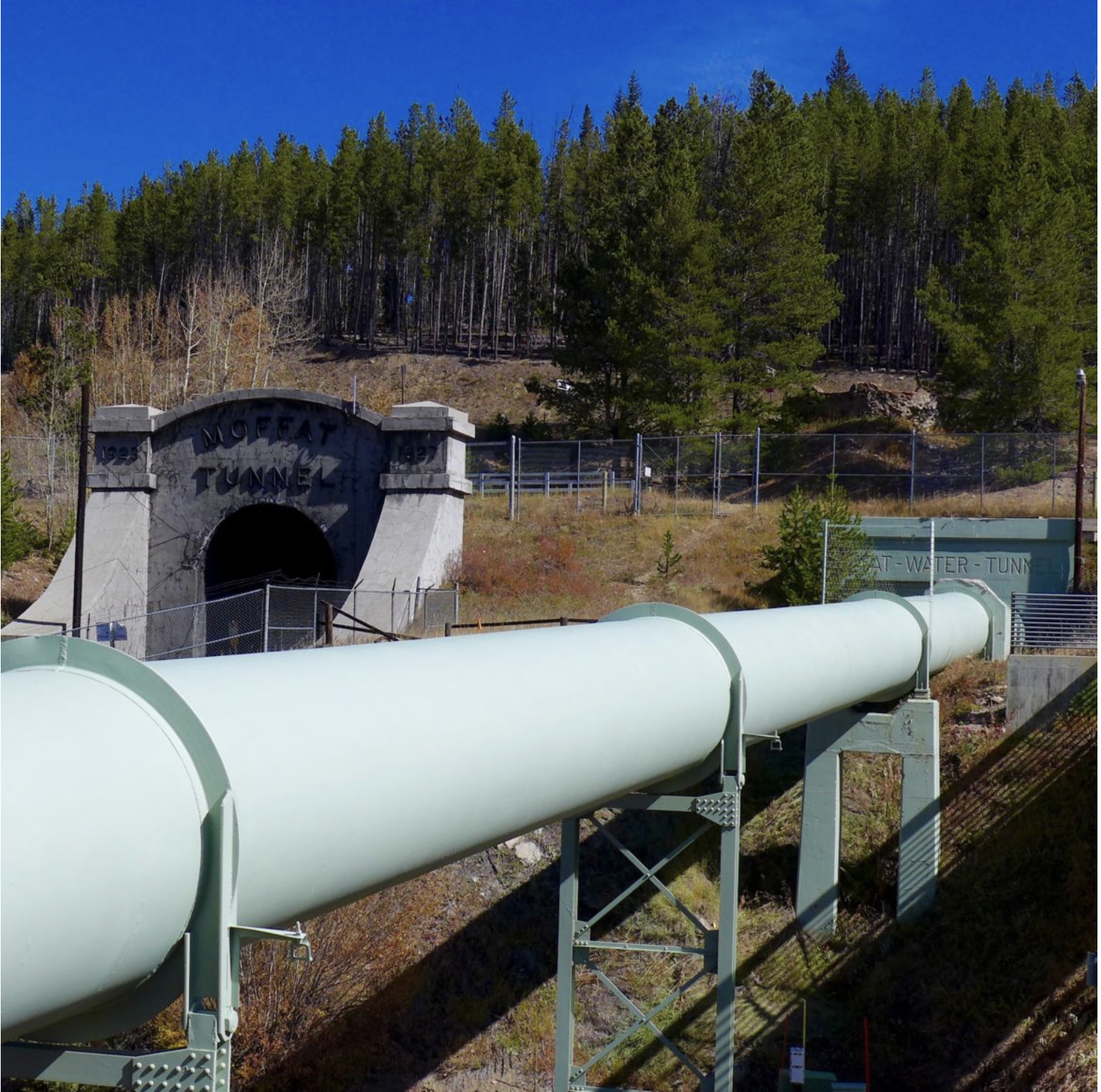
The pipeline, at the base of the Winter Park ski area, that moves water as part of the existing Moffat Collection System Project. The portal of the railroad tunnel is behind the pipeline, in this view. Photo credit: Brent Gardner-Smith/Aspen Journalism
According to Grand County Water Quality Manager Katherine Morris, polluted discharge from the Moffat Tunnel has adversely impacted the Fraser River. The Grand County water quality team recently wrote two letters to the Colorado Department of Public Health & Environment, outlining its concerns with violations by Union Pacific Railroad, which manages the tunnel. During a Grand County Board of Commissioners meeting March 11, 2025 Morris explained that polluted water from the tunnel enters the nearby Fraser River, which is a main tributary of the Colorado River. This ongoing problem began after the tunnel was completed, and Grand County government began advocating to fix the problem nearly two decades ago…
James Peak via ColoradoWildAreas.com
In the early 2000s, residents and governmental officials raised alarm about pollutants and increased turbidity (or clarity issues) in the Fraser River when water was discharged from the tunnel. The tunnel bores through James Peak. Groundwater from cracks in the mountain rock seeps into the tunnel, and that water needs a way out. Coal dust, heavy metals and other particulate matter can travel into the Fraser River through the runoff. At the time, a water treatment plant existed on the east portal of the tunnel but not on the west portal at Winter Park. People questioned why there was no treatment plant to protect Grand County, home to the headwaters of the Colorado River. Over the years, Union Pacific received fines and a cease-and-desist order. The railroad finally built a treatment plant in 2017, but issues have continued — even worsened in some cases, Morris said. A water centrifuge at the plant is designed to separate solids from the water, creating a sludge-like “centrifuge cake” that is put in a drum and disposed of in Utah. (This disposal has raised its own concerns.) The remaining water is discharged into the river.
When the flow of visitors in Steamboat Springs rises during heavy tourism times, so too does the waste, making management of the Steamboat Springs Wastewater Treatment Plant a challenging and often smelly job.
“It’s significantly harder to run a wastewater treatment plant in a resort town that sees a big influx of visitors than in a city where your population is static,” said Jon Snyder, the public works director for Steamboat Springs. “Consistent population makes a biological process easier to manage.”
The plant’s operational status averages 60% capacity, but utilization can range from 26% during “mud season” when Steamboat sees fewer people in town to a record high of 72% in January 2022, explained Gilbert Anderson, plant superintendent. The maximum 24-hour flow into the plant can fluctuate widely during the year; for example, the flow in 2024 peaked at 7.14 million gallons per day on April 5 and was the lowest at 1.87 million gallons per day on Oct. 16, Anderson reported. During specific atmospheric conditions such as on cold mornings with temperature inversions — especially during the busy holiday times of Christmas, New Year’s and Presidents’ Day — the waste smells may be most noticeable to nearby homeowners, Snyder said. The vintage 1980 plant maintains a six-step process inside buildings to try to contain as much odor as possible, Snyder said. Yet, residents say the wastewater smells can be noticed at homes downwind and in nearby neighborhoods
Grand opening of the Gunnison Tunnel in Colorado 1909. Photo credit USBR.
From email from Reclamation (Erik Knight):
March 17, 2025
Releases from the Aspinall Unit will be increased from 700 cfs to 1200 cfs Tuesday, March 18th. Releases are being increased to coincide with the start of diversions at the Gunnison Tunnel.
Flows in the lower Gunnison River are currently above the baseflow target of 1050 cfs. After this release change river flows are expected to remain above the baseflow target for the foreseeable future.
Pursuant to the Aspinall Unit Operations Record of Decision (ROD), the baseflow target in the lower Gunnison River, as measured at the Whitewater gage, is 1050 cfs for March through May.
Currently, Gunnison Tunnel diversions are 0 cfs and flows in the Gunnison River through the Black Canyon are around 650 cfs. After this release change Gunnison Tunnel diversions will be 450 cfs and flows in the Gunnison River through the Black Canyon will be around 700 cfs. Current flow information is obtained from provisional data that may undergo revision subsequent to review.
This scheduled release change is subject to changes in river flows and weather conditions. For questions or concerns regarding these operations contact:
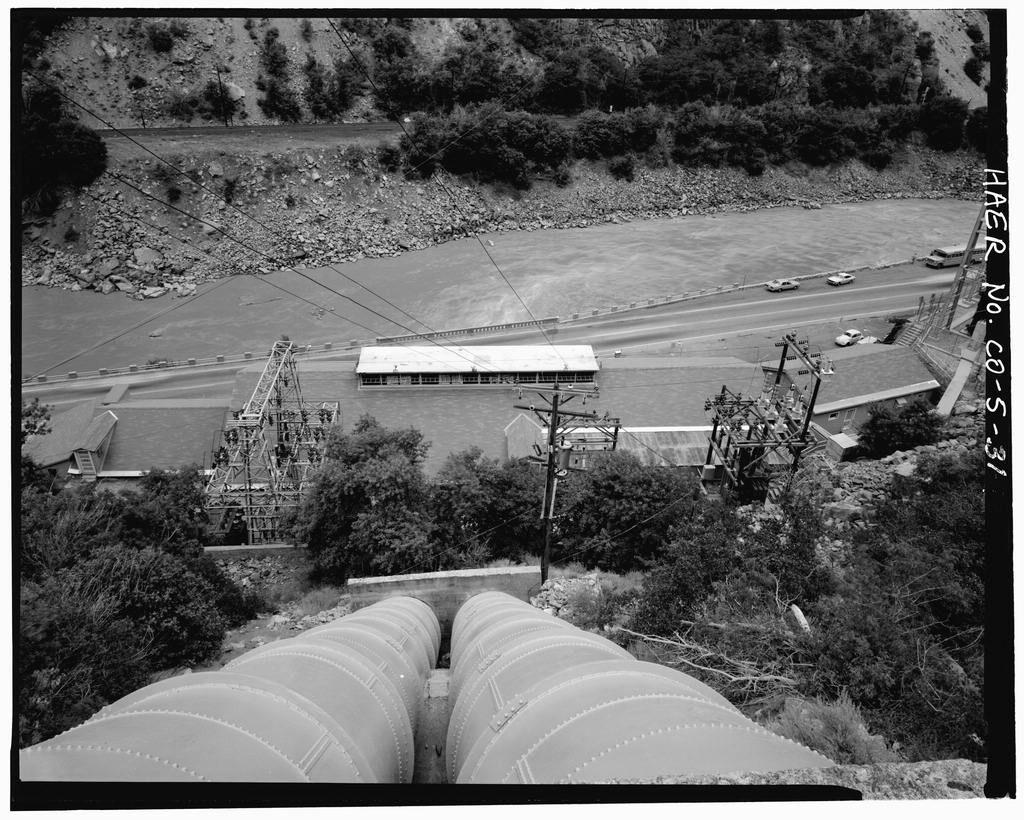
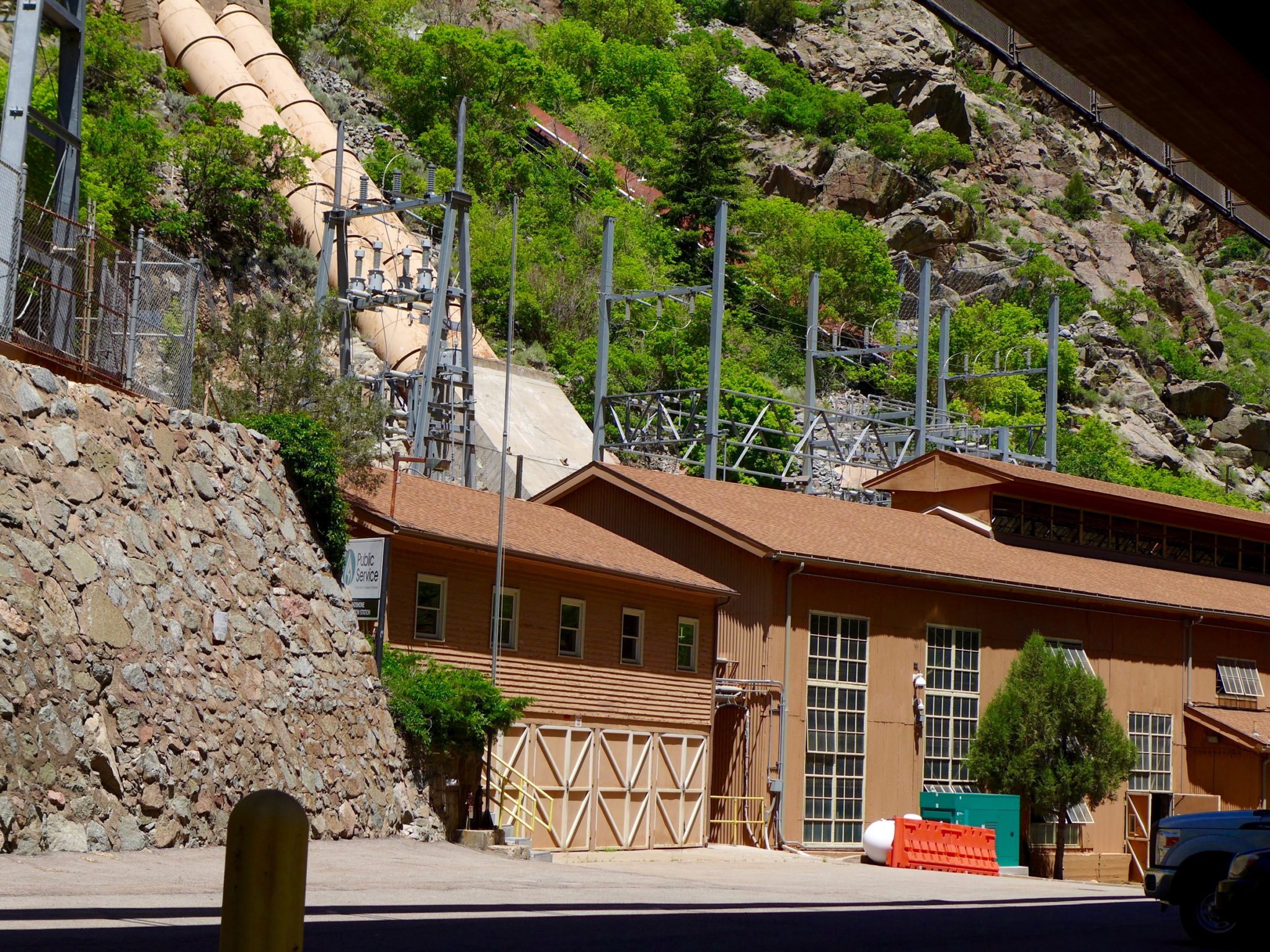
This historical photo shows the penstocks of the Shoshone power plant above the Colorado River. A coalition led by the Colorado River District is seeking to purchase the water rights associated with the plant. Credit: Library of Congress photo
Western Slope water leaders hope bipartisan support can thaw $40 million in frozen federal money aimed at securing some of the Colorado River’s oldest water rights. The Colorado River District is spearheading an effort to purchase senior rights from Xcel Energy used at the Shoshone hydroelectric plant in Glenwood Canyon. The water allocated by the rights passes through the facility and back into the river, making them “nonconsumptive” rights, but by purchasing them for $99 million Western Slope leaders hope to ensure that water can continue to flow downstream and avoid the possibility it could be rerouted to Front Range users. The effort to buy the rights raised more than $50 million between the state of Colorado, the River District and more than two dozen entities on the Western Slope. In January, the federal government announced $40 million worth of support to the project. Just days later, the Trump administration took over, and that money was put on hold.
“I think that has been frozen,” Republican Congressman Jeff Hurd, who represents Colorado’s 3rd Congressional District, said in response to a question about the grant during a tele-town hall event on March 11. “Just know that we are working hard behind the scenes to see what we can do to make sure that that funding is allocated and completed.”
Andy Mueller, general manager for the Colorado River District, said the group anticipated delays in the funding from the start on account of the changing administrations. But, because the group has been working on pooling the money in advance, they’re not being left high-and-dry by the funding freeze just yet.
“We’re one of the fortunate grantees, if you will, in that situation. I know there are a lot of grantees who were actually engaged in digging dirt and had hired staff in anticipation of grants,” Mueller said. He noted the deal is still pending a water court change case, giving the Shoshone purchase deal extra runway to haggle over the federal contribution.
A $110,000 state grant is enabling Colorado Mesa University’s Ruth Powell Hutchins Water Center to expand its education and outreach program, including through a spring speaker series co-organized with CMU’s Environmental Science program. The center received the money from the Colorado Water Conservation Board last fall for two years of programs. According to a news release, Freddy Witarsa, the program’s interim director, will use the funds to facilitate programs to prepare students to join the water workforce and provide a platform for Western Colorado stakeholders to address the region’s water challenges…The water center facilitates research, education, outreach and dialogue to address the water issues in the region. The center has been led in recent years by interim directors. Witarsa also is an assistant professor of environmental science and technology at CMU. In January, the Colorado River District awarded the center $300,000 to support its efforts to grow over the next three years, including by hiring an executive director. That grant is being matched by a $300,000 grant from CMU.
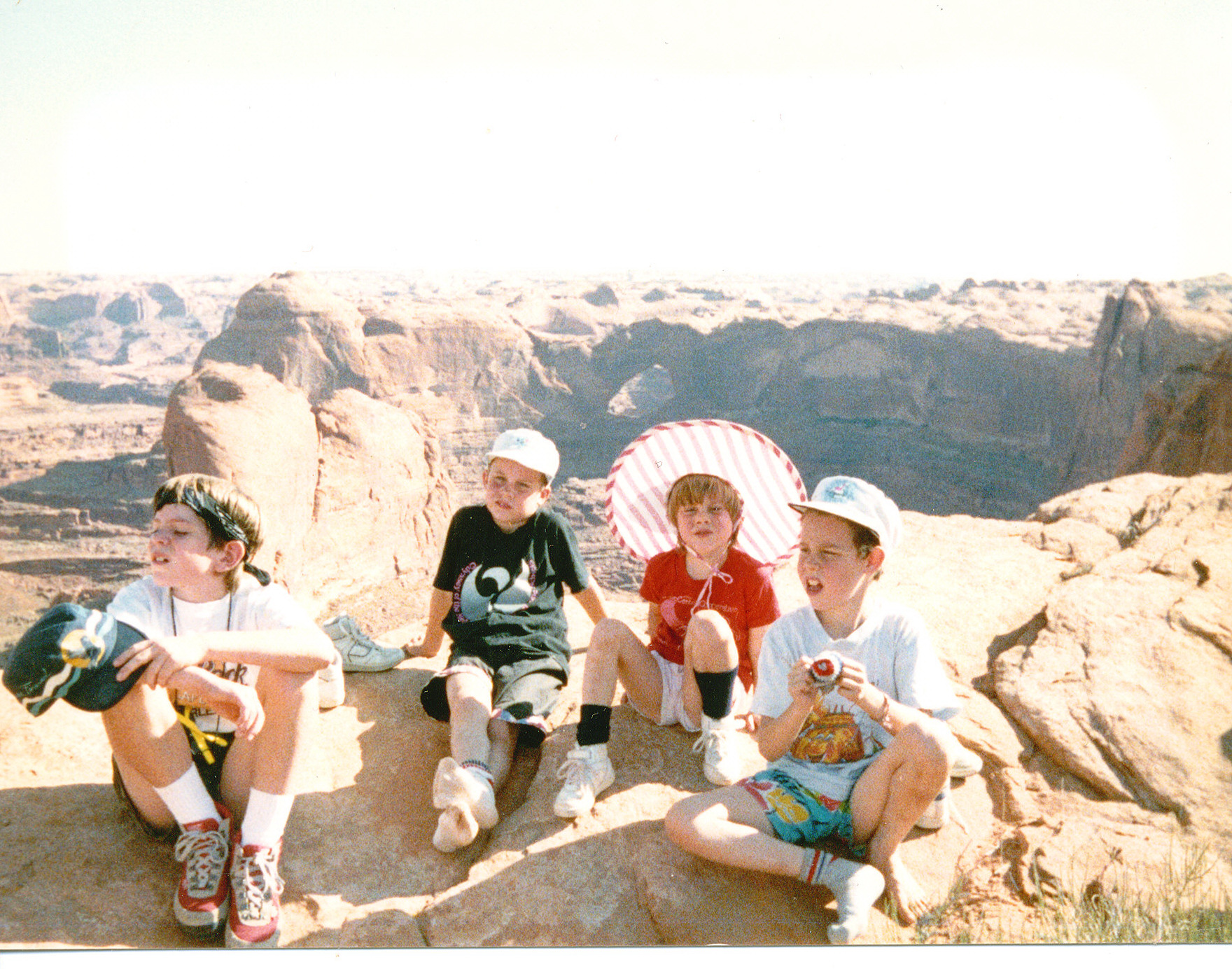
My friend Joe’s son and the Orr kids at the top of the Crack in the Wall trail to Coyote Gulch with Stevens Arch in the Background. Photo credit: Joe Ruffert
Kevin Fedarko was the keynote speaker at the symposium and he is as inspirational a speaker as you could ask for. It doesn’t hurt that the landscape that he spoke about is the Grand Canyon. He urged the attendees to, “Take your children out into these landscapes so that they can learn to love them.” He is advocating for the protection of the Grand Canyon in particular but really he is advocating for the protection all public lands.
Kevin Fedarko and Coyote Gulch at the Rio Grande State of the Basin Symposium hosted by the Salazar Rio Grande del Norte Center at Adams State University in Alamosa March 29, 2024.
What an inspirational talk from Kevin. I know what he is saying when he speaks about the time after dinner on the trail where the sunset lights up the canyon in different hues and where, he and Pete McBride, his partner on the Grand Canyon through hike, could hear the Colorado River hundreds of feet below them, continuing its work cutting and molding the rocks, because the silence in that landscape is so complete. He and I share the allure of the Colorado Plateau. Kevin was introduced to it through Collin Flectcher’s book The Man Who Walked Through Time, after he received a dog-eared copy from his father. They lived in Pittsburgh in a landscape that was industrialized but the book enabled Kevin to imagine places that were unspoiled.
My introduction to the Colorado Plateau came from an article in Outside magazine that included a panoramic photo of the Escalante River taken from the ledges above the river. Readers in the know can put 2 and 2 together from the name of this blog — Coyote Gulch — my homage to the canyons tributary to Glen Canyon and Lake Foul.
Stevens Arch viewed from Coyote Gulch. Photo via Joe Ruffert
Kevin’s keynote came at the end of the day on March 29th after a jam-packed schedule.
Early in the day Ken Salazar spoke about the future of the San Luis Valley saying, “Where is the sustainability of the valley going to come from.” Without agriculture this place would wither and die.” He is right, American Rivers and other organizations introduced a paper, The Economic Value of Water Resources in the San Luis Valley which was a response to yet another plan to export water out of the valley to the Front Range. (Currently on hold as Renewable Water Resources does not have a willing buyer. Thank you Colorado water law.)
Claire Sheridan informed attendees that their report sought to quantify all the economic benefits from each drop of water in the valley. “When you buy a bottle of water you know exactly what it costs. But what is the value of having the Sandhill cranes come here every year?”
Sandhill Cranes Dancing. Photo by: Arrow Myers courtesy Monte Vista Crane Festival
Russ Schumacher detailed the current state of the climate (snowpack at 63%) and folks from the Division of Water Resources expounded on the current state of aquifer recovery and obligations under the Rio Grande Compact.
The session about the Colorado Airborne Snow Measurement Program was fascinating. Nathan Coombs talked about the combination of SNOTEL, manual snow courses, Lidar, radar, and machine learning used to articulate a more complete picture of snowpack. “You can’t have enough tools in your toolbox,” he said.
Coombs detailed the difficulty of meeting the obligations under the Rio Grande Compact with insufficient knowledge of snowpack and therefore runoff volumes. Inaccurate information can lead to operational decisions that overestimate those volumes and then require severe curtailments in July and August just when farmers are finishing their crops. “When you make an error the correction is what kills you,” he said.
If you are going to learn about agriculture in the valley it is informative to understand the advances in soil health knowledge and the current state of adoption. That was the theme of the session “Building Healthy Soils”. John Rizza’s enthusiasm for the subject was obvious and had me thinking about what I can do for my city landscape.
Amber Pacheco described how the Rio Grande Basin Roundtable and other organizations reach out to as many folks in the valley as possible. Inclusivity is the engine driving collaboration.
Snowfall in March has helped decrease the likelihood of drought developing this spring in Colorado’s northwest mountains. However, a warm and dry spring could still change the tide heading into summer. The National Weather Service, a division of the National Oceanic and Atmospheric Administration, released its latest seasonal drought outlook on Thursday, March 20. It showed that drought conditions are unlikely to develop in most of northwest Colorado through June…Brad Pugh, a forecaster with the National Oceanic and Atmospheric Administration’s climate prediction center, said these outlooks predominantly take into account the current conditions, climatology temperature and precipitation outlooks over the next three months.
“In northwestern Colorado at this time of year, you know going into the springtime, mountain snowpack is a critical factor,” Pugh said.
As of March 18, much of northwest Colorado was in line with, or just above, normal snowpack. This has continued to improve in the state’s north-central mountains since January. According to OpenSnow, as of Monday the snow totals and percentage of normal on the season so far were as follows:
Winter Park – 315 inches (117%)
Copper Mountain Resort – 303 inches (113%)
Vail Mountain – 292 inches (101%)
Breckenridge Ski Resort – 284 inches (107%)
Steamboat Resort – 279 inches (108%)
Aspen Highlands — 267 inches (88%)
Loveland Ski Area – 261 inches (108%)
Snowmass – 243 inches (83%)
Keystone Resort – 239 inches (107%)
Beaver Creek – 227 inches (108%)
Arapahoe Basin Ski Area – 225 inches (112%)
Aspen Mountain – 210 inches (92%)
Ski Cooper – 206 inches (106%)
Buttermilk – 147 inches (89%)
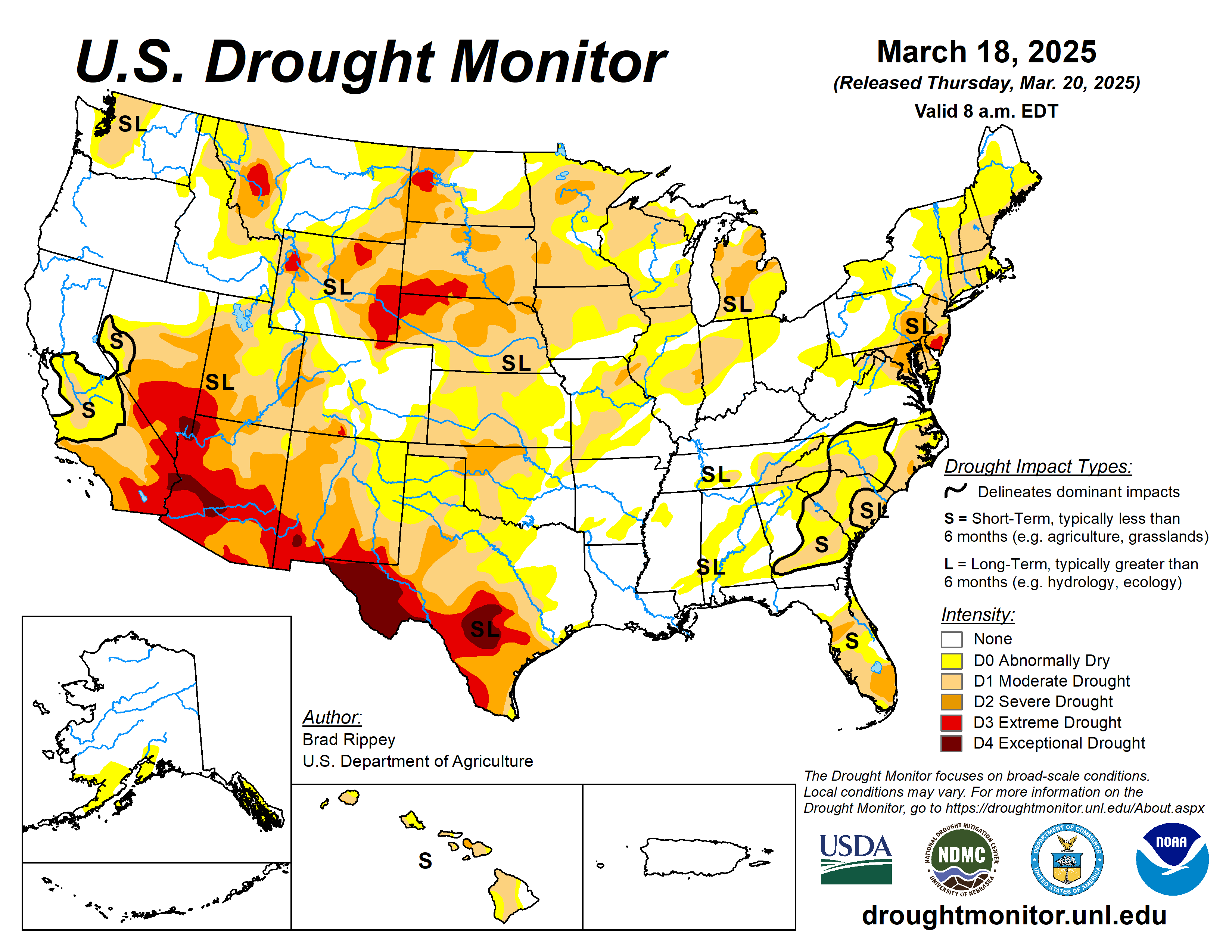
Colorado Drought Monitor map March 25, 2025.
The latest U.S. Drought Monitor for Colorado reported no drought in many of the northwest counties including Summit, Grand, Routt and Jackson counties as well as the eastern reaches of Eagle and Moffat counties. Heading west, the monitor shows abnormally dry conditions in Pitkin County and the eastern portions of Garfield and Rio Blanco counties. Conditions continue to get progressively drier the further west toward the border.
The embattled agency continues to disseminate crucial updates in a hostile political environment, while scientists warn that cutting climate intelligence is folly at a time of escalating climate extremes.
The National Oceanic and Atmospheric Administration, although battered by Trump administration attempts to impose massive staff and budget cuts on the agency, nevertheless continues to publish critical climate information, including some dire drought warnings in the spring outlook published March 20 by NOAA’s Climate Prediction Center.
About 40 percent of the contiguous 48 states are currently in some stage of drought or abnormally dry conditions, and those are expected to persist in the Rocky Mountains and the Southwest and Southern Plains, according to the March 20 bulletin.
In the past two weeks, water officials in the West warned that, despite near-average snowpack in some parts of the Colorado River’s mountain watershed, the river’s flows are expected to drop below normal, exacerbating tensions between water users in the region. In New Mexico, water experts said the Rio Grande is likely to dry up completely in Albuquerque as early as June. A 2024 study explained how global warming drives a cycle that leads to measured flows in Western rivers and streams being consistently lower than predictions based solely on snowpack measurements.
Other recent research suggests drought risks in North America have been widely underestimated by major climate reports, as rising global temperatures bake the moisture out of plants and out of the soil itself. Annual cycles of decreasing winter snow followed by extreme heat are pushing “a global transition to flash droughts under climate change,” a 2023 study concluded.
“Watch out,” said Dave Breshears. a University of Arizona climate and tree researcher and regents professor emeritus. “We have a triple whammy, with areas already in drought headed into more drought and associated with warmer than usual temperatures. Hotter droughts make wildfires more likely, more extreme and bigger.”
Breshears has co-authored research showing “what conditions cause lots of trees to die, and we know if hotter droughts continue for a longer period, we could have more die-off of trees and other plants,” he said. “This becomes a fuel source for future wildfires.”
NOAA needs more, not fewer, resources to adequately identify such rapidly intensifying climate threats that put people, food supplies and ecosystems at risk, he said.
“The large-scale coordinated data that our premier federal agencies bring together to create these products are so important to so many people on a day-to-day basis,” he said. “Many of them are not aware of the ultimate source of this information.” NOAA’s widespread coordination of data for important reports like the seasonal outlooks is “something we won’t be able to reproduce if they aren’t there for us,” he added.
Citing its aims to reduce costs and make government more efficient, the Trump administration tried to fire hundreds of NOAA employees in February. On March 13, a federal judge in Maryland issued a temporary restraining order, and the U.S. Department of Commerce then said it would reinstate employees—but put them on administrative leave pending further judicial review.
The continuing budget resolution passed by Congress March 14 reduces NOAA’s operations, research and facilities budget by 11 percent from the previous year, and according to congressional sources, it stripped away some of Congress’s budgetary oversight privileges. That could enable the Trump administration to zero out budgets for programs and offices within NOAA and use its ocean and climate budgets as a slush fund.
In the past week, the National Weather Service, a branch of NOAA, said it was cutting the number of weather balloon launches at several locations, which could compromise the agency’s ability to provide timely and accurate drought warnings, as well as forecasts for other dangerous extremes.
In early February, NOAA also removed the latest edition of a climate literacy guide from its website. The guide was designed specifically to help educate the public about climate science and efforts to halt global warming and adapt to its impacts. The 2024 edition of the guide included information about Indigenous knowledge related to climate and environmental justice, both topics that have been targeted for censorship by the Trump administration. But a copy of the guide was preserved and posted online by a designer involved in its conception.
“Purging the government of scientists, experts, and career civil servants and slashing fundamental programs will cost lives,” said Sen. Chris Van Hollen (D-MD) in a prepared statement. “The Trump Administration’s illegal actions to slash NOAA’s workforce indiscriminately and without cause will only hurt vital services that Americans depend on. My Democratic colleagues and I will keep fighting back in state and federal courts, in the halls of Congress, and the court of public opinion.”
Regarding NOAA’s spring outlook, University of Michigan climate scientist Jonathan Overpeck said, “It looks rough for the western half of the country, and especially the Southwest. It’s been really dry this winter, and with temperatures projected to be above normal, and precipitation below normal, it means that the megadrought that has gripped the region since 1999 will intensify.”
The outlook is bad news for Colorado River and Rio Grande flows, and for soil moisture and vegetation health across the region. Drying vegetation heightens concerns for another bad wildfire season in the Southwest, he added.
“This is what hot drought looks like and what climate change looks like,” he said. “It’s grim and will keep getting worse over years to come if we don’t halt the burning of fossil fuels.
Udall/Overpeck 4-panel Figure Colorado River temperature/precipitation/natural flows with trend. Lake Mead and Lake Powell storage. Updated through Water Year 2024. Credit: Brad Udall
Created by Imgur user Fejetlenfej , a geographer and GIS analyst with a ‘lifelong passion for beautiful maps.’ It highlights the massive expanse of river basins across the country – in particular, those which feed the Mississippi River, in pink.
In a historic and consequential move, the United States has officially denied Mexico’s request for a special water delivery from the Colorado River to Tijuana. The Bureau of Western Hemisphere Affairs, a U.S. Department of State division, addressed this matter on March 20, 2025, via their official social media channels. It marks the first time since the signing of the 1944 Water Treaty that such a request has been rejected — signaling deepening tensions over water management and compliance between the neighboring nations. The 1944 treaty, a longstanding bilateral agreement, regulates water distribution between the U.S. and Mexico between the Rio Grande and Colorado Rivers. According to the treaty, Mexico must deliver 1.75 million acre-feet of water to the U.S. over five-year cycles, averaging 350,000 acre-feet annually. However, by late 2024, Mexico had fallen over one million acre-feet behind its commitments. Officials attribute this shortfall to a combination of prolonged drought, increased agricultural demands, and aging infrastructure on the Mexican side of the border. The U.S. Department of State defended its decision by citing the severe impact that Mexico’s ongoing shortfalls have had on American agriculture — particularly in the Rio Grande Valley of Texas, where water scarcity is crippling the livelihoods of thousands of farmers. Crops such as citrus, cotton, and vegetables have suffered from reduced irrigation, leading to lower yields and economic instability in the region…
Tijuana, which sources approximately 90% of its water from the Colorado River, faces intensifying shortages. The city’s aging infrastructure, combined with the broader regional drought, means the denial of emergency water deliveries from the U.S. could further strain Baja California’s already fragile water supply systems. The water crisis is also reshaping the agricultural landscape in South Texas — most notably in Santa Rosa. The Rio Grande Valley Sugar Growers, Inc. (RGVSG), a cooperative of over 100 family-owned farms and the last remaining sugar mill in Texas, was forced to shut its doors after over five decades of operation. The closure followed a dramatic decline in sugarcane acreage, which dropped from 34,000 acres in early 2023 to just 10,000 by early 2024. Without reliable irrigation water — much of it linked to Mexico’s unmet deliveries — sugarcane farming became economically unsustainable.
In December 2023, the Colorado River District and Xcel Energy agreed on a deal for the district to buy Xcel’s historic water rights associated with the Shoshone hydroelectric power plant in Glenwood Canyon for $99 million. The Bureau of Reclamation was supposed to pitch in $40 million toward that purchase, but the money is stalled by the Trump administration’s pause on federal spending. Jeff Hurd, the 3rd Congressional District representative, penned a letter to Interior Department Secretary Doug Burgum urging the department to fully fund the Bureau of Reclamation’s $40 million award. Photo credit: Brent Gardner-Smith/Aspen Journalism
With the fate of a federal grant funding toward Shoshone Water Rights up in the air, western Colorado congressman Jeff Hurd is throwing his political weight behind the grant’s preservation…In January, the Biden Administration included $40 million through the Inflation Reduction Act to go toward the Colorado River District’s efforts to acquire the nearly $100 million Shoshone Water Rights from Xcel. However, Hurd said during a recent phone town hall that he believed the Trump administration had frozen the grant. The Grand Junction Republican representing Colorado’s 3rd Congressional District in the U.S. House penned a letter to Interior Department Secretary Doug Burgum on March 18 urging the department to fully fund the Bureau of Reclamation’s $40 million award.
“For more than a century, the senior water rights associated with the Shoshone Hydropower Plant in Glenwood Canyon have played a pivotal role in sustaining reliable flows in the Upper Colorado River,” Hurd wrote. “These flows are essential to the health and vitality of our region, enabling everything from high-value crop production and oil and gas production to recreational tourism and rural municipal water supplies.”
Hurd wrote about the project’s economic benefits, citing BBC Research and Consulting data that concluded that preserving Shoshone’s flows would provide a net present value of as much as $609 million.
“These benefits include stabilizing flows during periods of drought, supporting continued water development and power production through the Upper Colorado River Endangered Fish Recovery Program, and maintaining water quality that supports salt-sensitive crops and drinking water infrastructure,” Hurd wrote.
Udall/Overpeck 4-panel Figure Colorado River temperature/precipitation/natural flows with trend. Lake Mead and Lake Powell storage. Updated through Water Year 2024. Credit: Brad Udall
Click the link to read the article on the InkStain website (Eric Kuhn):
March 19, 2025
The Bureau of Reclamation released its March 24-Month study last Friday and just like last month, the forecast is for big trouble in the Colorado River Basin. Under the “Most Probable” scenario, the ten-year cumulative flow at Lee Ferry will drop below 82.5 million acre-feet (the “tripwire”) by the end of Water Year 2027. If this happens, the odds are high that the Lower Division states will trigger what they referred to in their February 13, 2025, letter to Secretary Burgum as a “compact call.” The nuance, however, is that the Colorado River Compact has no specific provision for a compact call. Under the compact, a call is just another word for interstate litigation.
Although the letter is now over a month old, it just recently received attention from two of the region’s most respected water reporters, Ian James of the Los Angeles Times, and Tony Davis of the Tucson Daily Star. In his piece, (link: Three states urge Trump administration to fix Colorado River dam – Los Angeles Times: ) James pointed out that in their letter, the Lower Division states used the term “compact call” 23 times. The term “river call” is commonly used in prior appropriation states that actively administer water rights. For example, the Shoshone Hydroelectric Power Plant, located on the Colorado River a few miles upriver from Glenwood Springs, has a senior water right for 1250 cfs with a priority date of 1902. When the flow at the plant’s diversion dam drops below 1250 cfs, its owner places a “call” on the river. Under Colorado law the Division Engineer, an employee of the Colorado State Engineer, then shuts off sufficient upstream junior uses to bring the flow back to 1250 cfs. A “Shoshone call” is almost an annual occurrence.
The Colorado River Compact places two specific flow obligations on the Upper Division states at Lee Ferry. Article III (d) requires these states to not cause the ten-year cumulative flow to be depleted below seventy-five million acre-feet. Additionally, under Article III (c), if there is not sufficient surplus water available, then each basin is responsible for one-half of the deficiency (the difference the annual treaty delivery and the available surplus water). Assuming there is no surplus water and the 1944 Treaty delivery to Mexico is 1.5 maf per year, the Upper Division states would have to deliver to Lee Ferry, an additional 750,000 af per year.
Thus, using the Shoshone analogy, the Lower Division states claim they have a 1922 Compact water right for up to 82.5 maf every ten years. Note, we say “up to” because in the last few years, pursuant to Minute 323, annual deliveries to Mexico have been slightly less than 1.5 maf. For many reasons, the Upper Division states do not agree that their 1922 Compact obligation is 82.5 maf every ten years, see: “On the Colorado River, there are no Simple Disputes,” (link: On the Colorado River, there are no Simple Disputes – jfleck at inkstain: ).
If (or more likely when) the ten-year flow at Lee Ferry were to drop below ~ 82.5 maf, and there is no consensus agreement among the basin states in place, it is clear that the Lower Division will then attempt to place a compact call on the Upper Division states (and perhaps legally challenge the Secretary’s operation of Lake Powell) to increase deliveries at Lee Ferry. Where the Shoshone Plant analogy breaks down is what happens once a call is placed. Colorado law directs the State Engineer/Division Engineer how to administer a Shoshone call, but intentionally, there is no equivalent of the Colorado State Engineer in the Colorado River Compact. The Colorado River Compact negotiators debated and rejected a compact commission with enforcement powers. Arizona’s Winfield Norviel suggested such a commission, but led by Colorado’s Delph Carpenter, it was rejected. Carpenter abhorred the idea of creating what he referred to as a “super agency.”
Except for Article V which provides for the Directors of the Reclamation Service and USGS to cooperate, on an ex-officio basis, with the basin State Engineers to collect and publish data on Colorado River flows and uses, the 1922 Compact provides no role for the federal government. The Secretary of the Interior is not even mentioned. Instead, the compact negotiators provided two mechanisms for resolving disputes and enforcing the provisions of the compact. Article VI is a dispute resolution provision which has never been used. The somewhat cumbersome provision provides that when a dispute arises, upon the request of one governor, the resolution process can be triggered. If this happens, each state governor then appoints a commissioner to formally negotiate a resolution with the other states. If the commissioners reach an agreement, it must be ratified by the affected state legislatures, most likely all seven. If a resolution is reached under Article VI, the compact does not require it to be approved by Congress.
The second mechanism is litigation. Article IX states: “Nothing in this compact shall be construed to limit or prevent any State from instituting or maintaining any action or proceeding, legal or equitable, for the protection of any right under this compact or the enforcement of any of its provisions.” Thus, if Lee Ferry ten-year flows drop below 82.5 maf, the compact vehicle to implement a “compact call” is for one or more of the Lower Division states to initiate litigation under Article IX and convince the U.S. Supreme Court, or its appointed Special Master, that the Upper Division states are not complying with the compact.
Assuming no agreement among the states to avoid compact litigation, a compact call scenario might occur as follows: The ten-year flow at Lee Ferry is forecast to drop below 82.5 maf tripwire (it might be a little less if corrected for actual deliveries to Mexico). The Lower Division then states demand that the Secretary increase releases from Lake Powell or, alternatively, the UCRC implement a curtailment to bring the flow up to 82.5 maf by the end of the water year. Via the UCRC, the Upper Division states respond that they are in full compliance with the 1922 Compact and insist that the Secretary not increase releases from Lake Powell. Lacking a consensus agreement among the states, the Secretary makes no change to the prescribed annual release forcing the Lower Division states to initiate litigation. Assuming the Supreme Court accepts the case, it would now be up to the court or its Special Master to decide if the Upper Division states are in compliance with the compact. If they are not, a remedy could be the imposition of a compact call by ordering the UCRC to implement a curtailment pursuant to the 1948 Upper Basin Compact. How long might litigation take? It could be decades, or the Lower Division states might succeed with a request for immediate relief. No one knows.
While the 1922 Compact does not give the Secretary of the Interior any special power or authority, under subsequent federal legislation and the 1963 decision in Arizona v. California the Secretary has considerable power and authority. For example, under Section 602 of the 1968 Colorado River Basin Project Act, Congress directed the Secretary to promulgate criteria for the coordinated long-range operation of the federal reservoirs. It also set priorities for the annual release of water from Lake Powell. The first priority is “releases to supply one-half the deficiency described in Article III (c) of the Colorado River Compact, if any such deficiency exists and is chargeable to the States of the Upper Division.”
The legislation, however, is silent on who or what entity decides if any such deficiency exists and is chargeable to the States of the Upper Division. According to Tony Davis (link: Arizona water officials, others blast feds for not protecting dam – Our Community Now), a spokesman for the Arizona Department of Water Resources suggested that the Secretary has this responsibility. But even if the Secretary does ultimately decide how much water must be released from Lake Powell to satisfy the obligation of the Upper Division states to Mexico under the 1922 Compact, if the Lower Division states believe the Upper Division states are violating the 1922 Compact, it could result in litigation. In fact, a decision by the Secretary to interpret the compact could be the trigger for litigation. After the Secretary signed the 1970 Long-range Operating Criteria which set a minimum objective release of 8.23 maf per year from Glen Canyon Dam, the Upper Division states seriously considered litigation. They decided against it because they concluded they could not show any actual injury. The impact of climate change on the flow of the river has now fundamentally changed that dynamic.
The Lower Division State’s letter was directed to Secretary Burgum, but it is a message to the entire basin. The March 24-Month study confirms what we already know. The basin has two basic choices: litigation or a basin-wide agreement implementing fundamental change. Let’s hope it’s the latter.
Map of the Colorado River drainage basin, created using USGS data. By Shannon1 Creative Commons Attribution-Share Alike 4.0
Click the link to read the article on the Utah State University website (Jack Schmidt, John Fleck, Kathryn Sorensen, Eric Kuhn, Katherine Tara):
March 21, 2025
In Short:
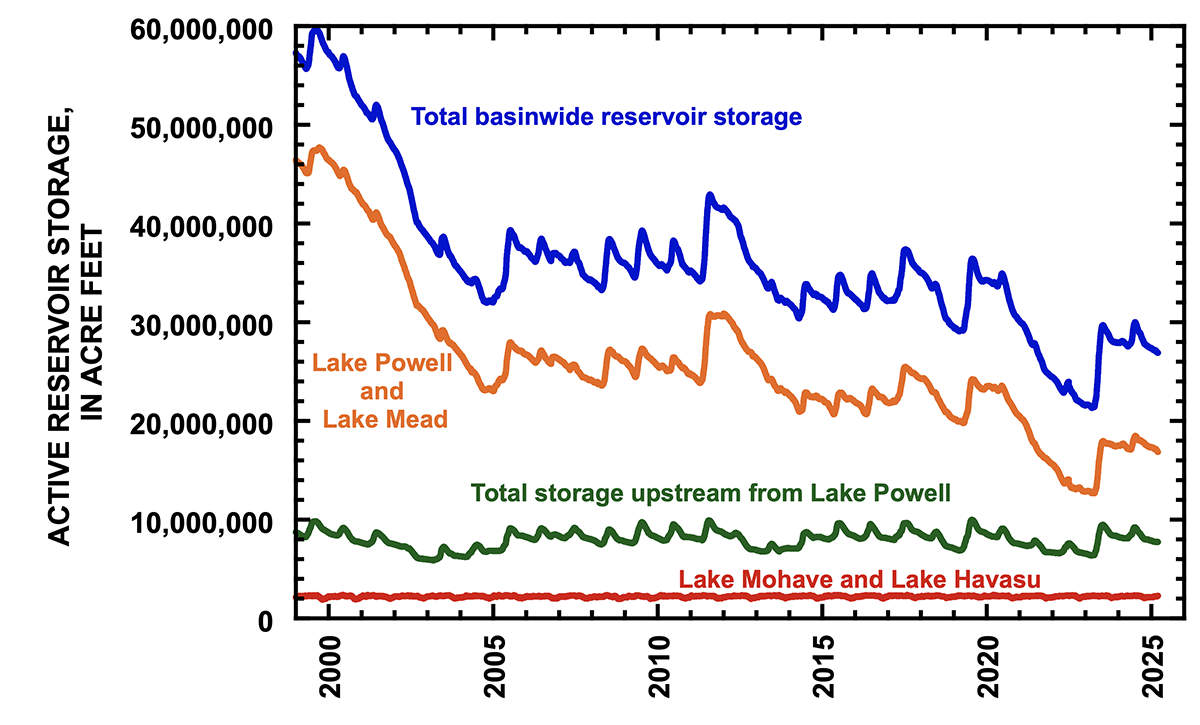
Since the onset of the Millenium Drought 25 years ago, water agencies in the Colorado River Basin have been challenged by the overwhelming, yet essential, tasks of balancing total water use with a reduced supply and recovering some of the reservoir storage lost since the last time the system was relatively full in summer 1999. By monitoring long-term changes in basin-wide reservoir storage, we can readily judge the success of these efforts.
In mid-March 2025, total storage in 46 reservoirs tracked by Reclamation was the third lowest in the 21st century for this time of year. The total amount of storage was the same as it was in late July 2021 when water managers described the situation as “serious” and declared a shortage in Lower Basin water supply. Between late July 2021 and mid-March 2023, water storage further plunged to an unprecedented low, but the exceptional runoff of 2023 provided modest recovery. However, basin storage in mid-March was 2.79 million acre feet, or 9%, less than the summer 2023 peak. In mid-March, 33% of the basin’s storage was in Lake Mead, 29% was in Lake Powell, 29% in 42 federal and non-federal reservoirs upstream from Lake Powell, and 9% in Lake Mohave and Lake Havasu. Water has been accumulating in Flaming Gorge Reservoir since early February and throughout the winter in a few smaller Upper Basin facilities but has been withdrawn from other large federal Upper Basin facilities and from Lake Powell. Lake Mead has been going down since late February. It is likely to be that total basin reservoir storage will decline until the beginning of the 2025 snowmelt runoff season and will only modestly recover, because inflow this year is forecast to be below average and less than in 2024.
System conservation and Assigned Water development by the Lower Division states and Mexico have prevented storage in Lake Mead from being even lower than what it is today. However, recent Reclamation projections indicate that consumptive use in the Lower Basin in 2025 will be larger than in 2024, suggesting that basin reservoir storage at this time next year will be even less than it is today. Projections of Upper Basin consumptive use are not available at this time. The continued decline and lack of recovery of water in reservoir storage conveys the clear message that our efforts to balance use with supply and to recover storage have not succeeded. The Colorado River water crisis endures.
In Detail:
On 15 March, active storage in 46 reservoirs in the Colorado River watershed that are tracked by Reclamation in the Bureau’s Hydrodatabase[1] was 26.9 million af (acre feet), the same amount as on 21 July 2021 (Fig. 1). That amount was the third lowest total basin storage on 15 March of any year of the 21st century[2] and is approximately 45% of the total stored in these reservoirs the last time the basin’s reservoirs were relatively full in late July 1999[3]. On 15 March, 33% of the basin’s storage was in Lake Mead, 29% in Lake Powell, 29% in 42 reservoirs upstream from Lake Powell, and 9% in Lake Mohave and Lake Havasu[4]. These data remind us of the challenge in providing a secure and reliable water supply to the Southwest, southern California, and northwestern Mexico.
Figure 1. Graph showing total reservoir storage in 46 reservoirs reported by Reclamation in its Hydrodatabase (blue line), as well as the contents of Lake Mead and Lake Powell (orange line), 42 reservoirs upstream from Lake Powell (green line), and in Lake Mohave and Lake Havasu (red line). Data are between 1 January 1999 and 15 March 2025. Total basin reservoir storage today is the same as in late July 2021. Credit: Center for Colorado River Studies
It is instructive to remember how today’s small amount of reservoir storage was viewed when it occurred in summer 2021. On 27 July 2021, The New York Times posted the headline, “Two of America’s largest reservoirs reach record lows amid lasting drought.” That story led with these words, “The water level in Lake Powell has dropped to the lowest level since the U.S. government started filling the enormous reservoir on the Colorado River in the 1960s — another sign of the ravages of the Western drought.”[5] In the article, Wayne Pullan, Reclamation’s Upper Colorado Basin Regional Director, said, “This is a serious situation,” and Brad Udall said, “I’m struggling to come up with words to describe what we’re seeing here.” In mid-August 2021, Interior formally announced a water shortage in Lake Mead, triggering cuts on water deliveries, especially to Arizona farmers.
But today, there is less discussion about whether this small amount of reservoir storage represents a crisis. In part that may be because the season of snowmelt is ahead of us rather than behind us, as was the case in late July 2021. We hope that inflow this coming spring will recover some storage, but, this winter’s snowpack is merely average[6], and the basin’s soils are very dry. The Bureau of Reclamation’s “most probable” forecast of unregulated inflow to Lake Powell in 2025 is only 6.77 million af[7], 70% of the 30-year average and less than in 2024. Additionally, there may be little sense of concern, because we survived these conditions between July 2021 and March 2023. In fact, total basin storage plunged to only 21.3 million af in mid-March 2023. Perhaps, we are distracted by the engineering, legal, and political intricacies of the negotiations concerning post-2026 consumptive use and the seeming dysfunction of those negotiations. Perhaps, we are resigned to low reservoir storage as the new normal. Perhaps, we are the frog in the pot of water whose temperature is gradually rising, and we do not realize the water is about to boil.
Although significant strides have been made to conserve water, further reductions in water use throughout the basin are necessary, should we experience a succession of very dry years such as occurred between 2002 and 2004 and between 2020 and 2022. The post-2026 negotiations primarily have focused on strategies to reduce basin consumptive uses to match the 21st century’s declining supply, but today’s small amount of storage reminds us that it is critically important to also develop policies to recover reservoir storage to ensure security and reliability of the system.
To date, it has been exceptionally hard to recover storage. Despite the Lower Colorado River Basin System Conservation and Efficiency Program, the Upper Basin System Conservation Pilot Program, the Drought Response Operations Plan, Assigned Water development programs and large expenditures to reduce consumptive use using the Inflation Reduction Act, the Basin’s water managers have made no progress in rebuilding storage except that provided by the unusually large inflows of 2023. Between mid-July 2023 and mid-April 2024 (immediately prior to the onset of spring snowmelt inflows), the basin’s reservoirs were only drawn down by 2.2 million af, the smallest drawdown of total basin storage of the last 15 years[8]. However, the winter 2023/2024 snowpack yielded below average inflow to Lake Powell, and the basin only gained 2.5 million af of storage (Fig. 2). As of 15 March, the 46 reservoirs of the basin have been drawn down by 3.1 million af since the peak storage of those reservoirs in mid-July 2024. During the remainder of March and part of April, reservoir drawdown will continue to deplete storage originally accumulated in 2023.
Figure 2. Graph showing reservoir storage in different parts of the Colorado River basin between 1 January 2021 and 15 March 2025, summarizing periods of increase and decrease in total storage. Lake Mead, Lake Powell, and the 42 reservoirs upstream from Lake Powell each store approximately 30% of basin’s total storage. Credit: Center for Colorado River Studies
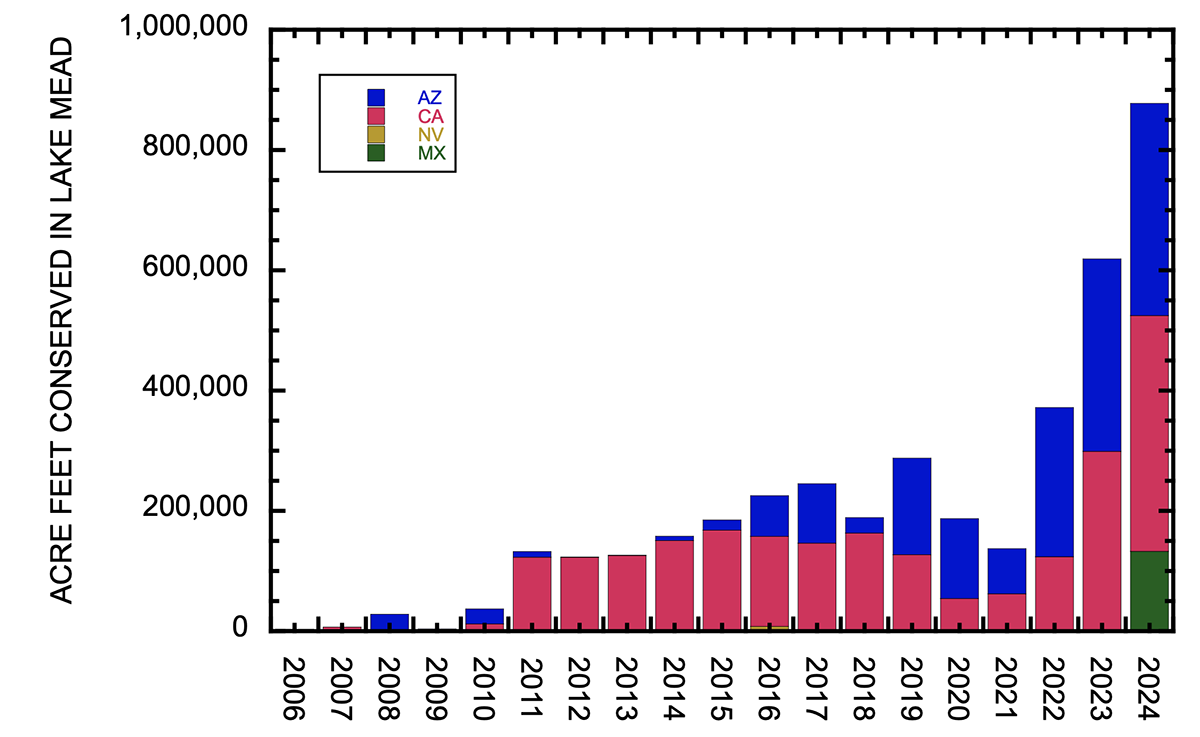
Low storage in Lake Mead persists despite 3.94 million af of water savings by the Lower Colorado River Basin System Conservation and Efficiency Program since 2006 (Fig. 3) and despite approximately 3.7 million af of Assigned Water development. Although additional savings are needed in 2025, the prospects of significant savings are not encouraging. Water users in the Lower Basin and Reclamation measure actual use and forecast trends in real time, and we anticipate 6.5 million af of main stem consumptive use by the three Lower Basin states. Commendably, this is less than the states’ nominal 7.5 million af/yr allocation under the Supreme Court defined allocation. Arizona is expected to take the largest share of those cuts, with projected main stem use of 2.1 million af, 74% of its nominal allocation. Nevada is projected to use 68% of its 300,000 af allocation, and California is projected to take 96% of its 4.4 million af allocation.[9] However, the Lower Basin’s projected 6.5 million af use is more than last year’s 6 million af of use. It is unclear the extent to which use in 2025 might fluctuate based on the available of federal funding to compensate water users for their conservation efforts, given the uncertainty enveloping federal policies under the new administration. We have no comparable set of numbers that allow evaluation of anticipated Upper Basin use and actual savings of wet water. [ed. emphasis mine]
Figure 3. Graph showing water conserved in Lake Mead resulting from the Lower Colorado River Basin System Conservation and Efficiency Program and conservation efforts in Mexico. Credit: Center for Colorado River Studies
Deficit spending is likely to continue between now and mid-April and will primarily be from Lake Mead and Lake Powell, because the total storage in the 42 reservoirs upstream from Lake Powell is no longer being depleted[10]. The basin-wide spatial pattern of reservoir operations in late winter and early spring 2025 has been storage of water in small upstream reservoirs and continued withdrawal of water from some CRSP facilities including Lake Powell, and recently from Lake Mead. Draw down continues at Granby (the primary storage facility of the trans-basin Colorado-Big Thompson Project), Blue Mesa, Navajo, Fontenelle, and several smaller reservoirs[11]. These Upper Basin depletions have been somewhat offset by small amounts of accumulation at other reservoirs[12]. Flaming Gorge Reservoir, the largest facility upstream from Lake Powell, was at its lowest at the very end of January and increased 41,100 af of storage in February and the first half of March. In contrast, the total contents of Lake Powell and Lake Mead continue to be drawn down. Lake Powell was at its highest on 1 January 2025, has lost 803,000 af of storage since that time, and will probably continue to decline for another month, based on projections by Reclamation[13]. Lake Mead increased in storage after 1 January, peaked in late February, and subsequently lost 74,000 af. Last year, storage in Lake Mead continued to be lost until early August, and the same pattern is likely this year. The total loss of storage in Lake Powell and Lake Mead between 1 January and 15 March was 476,000 af. The rate of loss from the Mead-Powell system for the next few weeks will be determined by the balance between inflows to Lake Powell and releases from Lake Mead.
[2] Total active storage in the same 46 reservoirs on 15 March 2025 was less than on the same date in 2022 (23.5 million af) and in 2023 (21.3 million af).
[3] On 21 July 1999, total active storage in the same 46 reservoirs was 59.5 million af.
[4] Lake Mead stored 9.01 million af, Lake Powell stored 7.85 million af, the 42 reservoirs upstream from Lake Powell stored 7.74 million af, and 2.30 million af were in Lake Mohave and Lake Havasu on 15 March.
[5] On 27 July 2021, active storage in Lake Powell was 7.90 million af, approximately the same as today.
[6] On 20 March 2025, snow water equivalent (SWE) in the Upper Colorado Region was 97% of median with 18 days remaining until the annual peak SWE typically occurs.
[8] This comparison is for the reservoir drawdown between the mid-summer peak and the following spring’s minimum storage prior to the next year’s runoff. The smallest draw down of total basin reservoir storage in the recent 15 years was between 13 July 2023 and 17 April 2024 (2.15 million af). The second smallest drawdown was 2.61 million af between 6 July 2014 and 4 May 2015. Drawdown was 2.56 million af between 4 August 2011 and 30 April 2012 and was 2.82 million af between 28 July 2019 and 29 April 2020.
[10] Maximum draw down of these Upper Basin reservoirs was 1.49 million af on 26 February 2025.
[11] Net drawdown exceeding 1,000 af between early January and mid-March occurred at Granby (69,600 af), Williams Fork (6,570 af), Dillon (4,520 af), Green Mountain (8,940 af), Ruedi (5,310 af), Taylor Park (1,790 af), Blue Mesa (17,200 af), Fontenelle (54,100 af), Upper Stillwater (1,230 af), and Navajo (28,400 af) Reservoirs.
[12] Reservoirs accumulating more than 1,000 af storage between January and mid-March were Willow Creek (1,300 af), Rifle Gap (2,600 af), Vega (1,400 af), Crawford (1,750 af), Big Sandy (1,670 af), Eden (1,150 af), Meeks Cabin (2,290 af), Red Fleet (1,030 af), Steinaker (2,910 af), Strawberry (7,050 maf), Starvation (15,200 af), Moon Lake (3,180 af), Scofield (4,950 af), and Vallecito (6,060 af) Reservoirs.
At the March 4 Grand County Board of Commissioners meeting, the Colorado River District shared good news: the dam’s settling was no longer cause for alarm. At the meeting, river district staff presented its 2024 Comprehensive Dam Safety Evaluation, which showed the likelihood of Ritschard Dam’s failure is “within industry-accepted tolerable risk guidelines.” This means that although there’s always a risk of failure for any dam, there is no need to rehabilitate or repair the dam. Andy Mueller, the river district’s general manager, told commissioners that the district has partnered with “experts from around the world” to complete the evaluation and is confident in its results…
A view of the upstream side of the dam that forms Wolford Reservoir, on Muddy Creek, a tributary of the Colorado River, above Kremmling. A recent dam safety evaluation found that the dam is at greater risk of cracking and internal erosion than previously thought.
CREDIT: BRENT GARDNER-SMITH / ASPEN JOURNALISM
The Ritschard Dam is owned and operated by the Colorado River District. D.H. Blattner and Sons of Minnesota constructed the 122-foot-tall dam between 1993 and 1995. It is composed of a clay core, covered by rockfill with a sand filter. According to the river district, the clay core provides a barrier that prevents water from passing through the dam. If the settling were to cause cracks in the core, water could enter and eventually lead to the dam’s failure if nothing was done. Since construction, the dam has shifted down 2.6 feet. The top of the dam has also moved sideways about 8 inches. This is possibly due to poor rockfill compaction. However, the district hasn’t pinned down an exact reason for the settling. Hunter Causey, the district’s director of asset management and chief engineer, told commissioners that he and other staff members “have been keeping a really close eye” on the dam. Contractors have added additional feet to the top of the dam because of the settling. After using monitoring devices to study the dam every day, the river district conducted comprehensive safety evaluations in 2016 and 2020. The 2020 evaluation found that risk had increased…the settling has abated in recent years, although it is expected to continue at a slower pace.
Talk Given to Business for Water Stewardship on March 10, 2025
In Colorado, we confront challenges as opportunities. As Wallace Stegner, the famed Western writer, once put it—it’s impossible to be pessimistic in the West; it’s the native land of hope. How we manage our water is a test of that ethos.
There are no two ways to put this: we face significant water scarcity challenges in Colorado and the West. That scarcity is driven, in part, by increasing demands as population booms. And it’s also driven by our changing climate, which is reducing snowpack, changing runoff patterns, increasing evaporation, and drying soils.
While we know that climate change significantly impacts Colorado’s water, its extent and exact impact is presently unknown. That uncertainty, coupled with the unpredictability in rainfall and snowpack, is destabilizing—making it difficult for farmers, ranchers, and even cities to know what to expect each year or how to plan for the future. Unfortunately, the variable weather patterns we are seeing are very likely to be our new normal, creating considerable pressure for us to create more adaptive and resilient systems for water management.
Increased uncertainty and unpredictability in water make planning more important than ever, with an imperative of developing new and innovative strategies for water management. It is no exaggeration to say that the future success of Colorado will depend, in considerable part, on our ability to adapt to scarcity and reduce the uncertainty and unpredictability that come with it. The best and most durable solutions will go beyond individual success and will collaborate with other interests to find win-win solutions.
I know this is important to Business for Water Stewardship, and I’m excited to talk with you about it today. I also want to speak about how our management of water must remain intertwined with respect for the rule of law, as the solutions we craft are only as good as the laws they are built upon and the institutions charged with implementing and upholding them.
I. Moving Toward a Resilient and Adaptive System of Water Management
Adapting to scarcity and creating more certainty will require us to develop innovative and collaborative strategies for water management. It will also require collective action. We cannot focus on individual successes and ignore the community in which these projects occur. I appreciate how you captured this point on your website:
We believe businesses have an opportunity—and a responsibility— to ensure that their operations and investments improve communities and ecosystems where they do business. And in water-stressed regions, that responsibility is deeply rooted in how we value, use, and protect water. That’s why we help businesses work collaboratively with community and policy stakeholders to advance solutions that ensure people, economies, and ecosystems have enough clean water to flourish.[1]
I couldn’t agree more. Each of us, whether as businesses or individuals, has a responsibility to ensure that, wherever we can, we work to improve communities and ecosystems where we live and work. Let me begin by focusing on a few projects that have done that. And I want to contrast those with projects that do not.
The Maybell Diversion Project is a wonderful example of a project that has multiple benefits. Updating and modernizing the Maybell Diversion Project improved efficiency for irrigation, increases resiliency to drought, and benefitted threatened and endangered species.[2]
Before the project was completed in 2024, irrigators from Maybell Irrigation District had to trudge two hours through steep, rugged sagebrush country to manually open and close the rusted and broken metal headgate.[3] It was an arduous, yet crucial task because Maybell is one of the largest irrigation diversions on the Yampa.[4]
The Nature Conservancy worked with numerous partners to help fund the $6.8M project. Funding partners include: the Bureau of Reclamation’s WaterSMART program; the National Fish and Wildlife Foundation; the Upper Colorado River Endangered Fish Recovery Program,[5] and the Colorado Water Conservation Board.[6]
Today, the opening and closing of the Maybell headgate can be controlled remotely and is determined by a combination of water user needs and available flows into the Maybell Ditch. The Maybell Irrigation District also coordinates with the Upper Colorado River Endangered Fish Recovery Program and the Division of Water Resources to guide water use in the Lower Yampa.[7]
As I said previously, this project promises mutual benefits. It allows continued irrigation of historical lands, which supports local farmers and the economy. At the same time, it also improves fish habitat and removes barriers to boat passage, supporting the environment and secondary economic benefits like river recreation.
In 2021, I spoke to the Colorado Water Congress about “The Imperative of Investing in Water Infrastructure.”[8] In that speech, I highlighted important water infrastructure projects around the state, including a plan to replace the aging Grand Valley Hydroelectric facility with a new more efficient plant capable of producing 1.5 times as much power. Like the Maybell Diversion Project, that plan brought multiple benefits. In addition to producing more clean electricity, their continued use of the water right will ensure that water flows into the 15-mile Reach, a critical stretch of river for four species of endangered fish. Many local irrigators will also benefit from increased diversions at an upstream diversion point supplying the plant.
In that speech, I also emphasized the importance of developing funding sources and investment opportunities in water infrastructure. I mentioned a few success stories, like Proposition DD, HB 21-1260, which provides $20 million in funding for implementation of the Colorado Water Plan, and HB 21-240, which provides $30 million for watershed restoration in response to wildfires, including funding for flood prevention and mitigation. But those are not enough. With continued growth on the horizon, our commitment to fund projects laid out in the Colorado Water Plan is imperative. That plan is the roadmap for investing in our future and fulfilling the Plan’s vision will take billions of dollars.
Photo credit: Rye Resurgence Project
B. Rye Resurgence Project
The Rye Resurgence Project in the San Luis Valley supports continued farming, while reducing water use, improving soil health, and helping the community flourish.
During this time of drought, it is critical that we find ways to use less water without sacrificing economic opportunities. This can help build resilience in the face of shrinking water supplies. Crops, like rye, can use far less water—up to 40%—than other similar crops like barley or oats.[9] This difference is huge in a region that is trying to conserve water in order to balance Rio Grande water use with supply. Data in 2024 shows the San Luis aquifer at its lowest recorded level in history.[10]
An important element of the Rye Resurgence Project is that it recognizes that switching to crops that require less water will only succeed if there is a market where farmers can sell those new crops at a profit. The project helps build a market for Colorado rye by investing significant effort and resources in marketing, branding materials, and personnel to develop relationships between the growers and the end users of rye such as brewers, distillers, millers, bakers, and consumers.[11] Building the market for San Luis Valley Resurgence Rye gives farmers an option to reduce their impact, earn a living wage, and support the local community. By keeping farmers farming, the future health of the community will be sustained.
II. Two Cautionary Tales to Avoid in the Future
The above two projects reflect effective strategies for managing water during this challenging time. There are, however, examples that have proven to be ineffective that are important to learn from. I will discuss two such cautionary case studies, highlighting some pitfalls of mismanaging water.
A. Alfalfa for Saudia Arabia
The growing of alfalfa in Arizona to ship to Saudi Arabia is perhaps the most glaring example of a project whose success comes at the expense of the community in which it occurs.[12] The short story of this project is that Saudi firms bought up 9 square miles of land in Arizona for irrigating and growing alfalfa grass.[13] The firms grew alfalfa in Arizona to export to Saudi Arabia and the United Arab Emirates because they had already drained their own aquifers.[14]
Alfalfa is an incredibly water-intensive crop. Growing it in a desert climate drastically impacts the surrounding communities. The Saudis were using the same amount of water to grow hay just for export as what a million people in the state use for water every year.[15] The Saudis invested a huge amount of water into the crop which they couldn’t grow at home because they don’t have the water. Essentially, this is exporting Arizona’s water.
By transporting the alfalfa overseas instead of selling it domestically, this also eliminated all future economic returns on that water. If that alfalfa stayed in Arizona, for example, it could have been sold to domestic cattle producers and benefited local communities and businesses. None of those domestic gains were achieved once the alfalfa left our shores.
Potential Water Delivery Routes. Since this water will be exported from the San Luis Valley, the water will be fully reusable. In addition to being a renewable water supply, this is an important component of the RWR water supply and delivery plan. Reuse allows first-use water to be used to extinction, which means that this water, after first use, can be reused multiple times. Graphic credit: Renewable Water Resources
B. Buy and Dry Schemes
In Colorado, we have seen before what is now labelled a “buy and dry” scheme. This scheme involves the sale of relatively all the water from a community, shipping it to a thirsty urban community and destroying a local agricultural economy. That is, in short, the tale of what happened in Crowley County.[16] As captured in Colorado’s Water Plan, it is an approach that we are committed to avoiding in the future.[17]
For an example of a buy and dry project now on the table, consider the case of the (improperly named) Renewable Water Resources. That project would buy out wells that are currently used to irrigate lands in the San Luis Valley and, rather than using that water for irrigation and farming, it would be piped to the front range for new suburban houses.[18] This has several direct and indirect negative economic impacts as well as cultural impacts on the San Luis Valley. This project makes one rural community suffer while a suburban community prospers.
In contrast to the Rye Resurgence Project, which invests in farmers to help them adapt to new markets, this project disregards farmers and eliminates the economic driver for their community. Proponents say the water is necessary to ensure other communities have enough water supply to secure their future. But we can’t let ourselves be tricked into believing that economic prosperity or managing our water resources is a zero-sum game.
Perkins County Canal Project Area. Credit: Nebraska Department of Natural Resources
C. Perkins County Canal
For another example of approaching our water management challenges as a zero-sum game, take the case of Nebraska’s proposed Perkins County Canal project. In a zero-sum game, there can be some winners, but at a high cost to others. In this case in particular, there will be many more losers and lots of wasted time and money. Rather than pursue such a costly path, we can find shared goals and interests and build solutions to help achieve those.
Under Nebraska’s plans, it will invest the time, money, and effort to build a canal to divert water in Colorado for use in Nebraska under the 1923 South Platte River Compact. If Nebraska does that, then Colorado water users will likely build countermeasures to offset impacts of the canal. Under this scenario, both Nebraska and Colorado would end up investing hundreds of millions of dollars, but almost all water users in each state would end up in a position that is no better than they were before Nebraska proposed the canal.
A better approach to the issue is one that recognizes that the agricultural economy and the communities it supports doesn’t observe state boundaries. The economy is regional. Farmers own land in both states. An individual farmer might buy supplies in Nebraska and farm in Colorado. And the reverse is likely true. Durable solutions need to benefit the region and not make the success contingent on the failure of the other. I will continue to do all I can to work towards such a solution.
See Article 7.
III. The Importance of the Rule of Law in Water Management
As we adapt to changing hydrology and look for flexible and collaborative solutions, it will also be important to stand firm on certain principles. Our success not only relies on our adaptability, but also on a solid foundation of laws that are consistently enforced with predictable results.
Colorado’s framework for managing water is based on state-level oversight and ultimate responsibility. This is bolstered by significant reliance on regional and local partnerships to facilitate solutions that are tailored to the water supply needs of local communities. The Colorado model prioritizes respect for and collaboration with regional bodies, such as water conservancy and conservation districts, with a norm of deferring to local expertise and solutions whenever possible. Nonetheless, the ultimate responsibility of managing Colorado’s water and ensuring compliance with compacts, laws, and regulations falls to the State. This is especially true when we talk about compliance with interstate water compacts.
Governor Clarence J. Morley signing Colorado River compact and South Platte River compact bills, Delph Carpenter standing center. Unidentified photographer. Date 1925. Print from Denver Post. From the CSU Water Archives
A. Interstate Compact Compliance
Compliance with Colorado’s nine interstate water compacts, two international treaties, and three equitable apportionment decrees is exclusively the responsibility of the State. This authority is established by the compact clause of the U.S Constitution that allows States, as sovereigns, to enter into agreements to apportion water between them to avoid conflicts over water.
Once ratified by Congress, interstate compacts become federal law. That does not mean, however, that the federal government controls state water resources. The power to control uses of water is an essential attribute of State sovereignty.[19] When states compact with each other to apportion the waters of interstate streams, those compacts also bind the federal government.[20] As we negotiate or litigate over our interstate compacts, I am dedicated to defending Colorado from federal overreach and protecting Colorado’s compact apportionments.
To the extent a state fails to comply with its interstate compact obligations, the State—and not individual water users, conservation or conservancy districts, or local governments—is held solely liable and responsible for complying or possibly paying damages out of the State’s General Fund.[21] In 2006, for example, the State was required to pay nearly $35 million in damages and legal costs to Kansas for violating the Arkansas River Compact.[22] When there is a challenge to State actions under the terms of these agreements, it is the State that is on the hook and local and regional entities are precluded from participating as parties to help defend the State in such litigation.[23] That is because interstate water disputes, reserved to the “original and exclusive jurisdiction” of the Supreme Court,[24] necessarily invoke States’ sovereignty, with each representing “the interests and rights of all of her people in a controversy with the other.”[25]
Elected officials in charge of managing Colorado’s water are accountable to taxpayers who, as noted above, will ultimately bear the cost of any failure to comply with interstate compacts. If the State manages water in a way in which constituents do not approve, they are able express their views directly to their elected officials or engage in the election process to have their voices heard. It is critical for the State to retain full authority to administer and distribute the waters of the State arising there to comply with interstate compacts as the sovereign with the exclusive authority to do so.
For a cautionary tale of how a state mismanaged its water consider what happened in Nebraska, when it faced an issue of how to manage its groundwater. In short, Nebraska delegated its regulatory authority over groundwater to local Natural Resource Districts instead of the state’s Department of Natural Resources.[26] Those local districts represented only the interests of their own water users, and they faced no direct liability for falling out of compact compliance. As a result, the districts failed to make the difficult policy and enforcement decisions necessary for Nebraska to comply with the compact, and Nebraska was forced to pay nearly $6 million in damages to Kansas after the U.S. Supreme Court found that Nebraska had violated the Republican River Compact.[27]
B. Developing Adaptable and Resilient Strategies for Colorado
Projects like the Maybell Diversion and Rye Resurgence are important to help individuals and communities adapt to variable water supplies. We will also need statewide strategies—and legal institutions—to allow those types of water users to occur while ensuring compliance with our interstate compact obligations. Together, we are well positioned to start a broader conversation on what adaptability and resilient strategies—and what legal tools—can help us achieve this critical goal.
Stakeholders have started to suggest different possible tools that can enable Colorado to better manage our water in an adaptive and resilient manner. One suggested strategy is to create a statewide conservation program that compensates people who forego use of their water rights, particularly at times of great demands on a particular system. The Rio Grande Conservation District is implementing such a system to protect its groundwater resources, for example.[28]
A second concept that some have suggested is to create a strategic reserve of water that Colorado could release to protect its water users from mandatory curtailments that might otherwise result from a shortage of water to downstream states. Under this model, the state would acquire and manage “slack capacity,” putting the state in position to navigate shortages and times when there is more demand for water than available.
Whatever strategies are ultimately developed, they are sure to be more successful if they can be built and tested before we need them. Given the pressures we are seeing on multiple fronts, the time to develop and test such ideas is now. As we know from lessons from other countries, the stakes are high and adopting an imperfect system can give rise to most unfortunate consequences.[29]
* * *
Our ability to adapt to the scarcity of water in Colorado and reduce uncertainty and unpredictability is critical to ensuring a promising future for our state. As I have explained, the best and most durable solutions will go beyond individual success and will collaborate with other interests to find win-win solutions like the Maybell Diversion and Rye Resurgence Projects. As we adapt to changing hydrology and look for flexible and collaborative solutions, it is also imperative to ground solutions in the rule of law and an admirable system. This is a formidable challenge, but one we can undoubtedly meet in the native land of hope.
[19] Tarrant Regional Water Dist. v. Herrmann, 569 U.S. 614, 631 (2013).
[20] Texas v. New Mexico, 602 U.S. 943, 962 (2024).
[21] Kansas v. Nebraska, 574 U.S. 445, 459 (2015) (finding local district boards bore no responsibility for complying with compact and assumed no share of the penalties Nebraska would pay for violations).
[22] Kansas v. Colorado, 533 U.S. 1, 20 (2001) (remanding the case to the Special Master for a determination of damages); Fifth and Final Report of Arthur L. Littleworth, Special Master, at 3, Kansas v. Colorado, No. 105 Orig., vol. II (Jan. 31, 2008).
[23] Texas v. New Mexico, 583 U.S. 913 (2017) (denying motions to intervene by local water districts in compact dispute between states).
[25] Wyoming v. Colorado, 286 U.S. 494, 508-09 (1932); New Jersey v. New York, 345 U.S. 369, 372 (1953); see also South Carolina v. North Carolina, 558 U.S. 256, 267 (1953) (“In its sovereign capacity, a State represents the interests of its citizens in an original action, the disposition of which binds the citizens.”); Nebraska v. Wyoming, 515 U.S. 1, 21 (1995) (“A State is presumed to speak in the best interests of [its] citizens. . . .”).
[26] Neb. Rev. Stat. Ann. § 46-702 (“The Legislature also finds that natural resources districts have the legal authority to regulate certain activities and, except as otherwise specifically provided by statute, as local entities are the preferred regulators of activities which may contribute to ground water depletion.”).
Westwide SNOTEL basin-filled map March 20, 2025 via the NRCS.
Click the link to read the article on The Denver Post website (Elise Schmelzer). Here’s an excerpt:
March 20, 2025
Snowpack across the entire Upper Colorado River Basin sits at 95% of median as the winter draws to a close, according to a report released this week by the Colorado Basin River Forecast Center. But only about 4.5 million acre-feet of water are expected to flow into Lake Powell as snow melts across the Upper Basin — 70% of the median amount recorded between 1991 and 2020. That means there is little hope that spring runoff into the crucial river that makes modern life possible across the Southwest will significantly raise water levels in the region’s two major reservoirs: Lake Powell and Lake Mead…
March 1, 2025 seasonal water supply forecast summary. Map | List
Below-normal runoff is becoming a norm that must be dealt with, Miller said. Research shows that warmer temperatures, drier soils that suck up water and more variable precipitation — all fueled by climate change — have significantly reduced runoff in the Colorado River Basin. Those are among factors that contribute to the discrepancy between normal snowpack and below-normal inflow to Lake Powell, Miller said.
“As a basin, we’re having to face the fact that there is more demand for water than the river can provide,” he said.
Udall/Overpeck 4-panel Figure Colorado River temperature/precipitation/natural flows with trend. Lake Mead and Lake Powell storage. Updated through Water Year 2024. Credit: Brad Udall
It just keeps getting weirder. Last week, the National Park Service finalized visitor numbers for 2024, finding that nearly 332 million people visited the nation’s national parks, monuments, recreation areas, and historic sites, a new record. Yet instead of trumpeting the burgeoning popularity of “America’s best idea,” the Trump administration urged NPS units and their employees to keep it quiet.
A March 5 communications guidance tells the staff that there will be “no external communications rollout for 2024 visitation data” and individual park units should not issue press releases or other “proactive communications, including social media posts.” They are also given a template to follow if any reporters ask questions.
I reckon this has something to do with the fact that even as visitor numbers — and their impacts — rise, the number of staff tasked with mitigating those impacts is decreasing. The service’s full-time equivalent staffing fell by 15% between 2010 and 2024, even as visitation numbers soared, and that was before DOGE’s mass-termination event, which reduced staffing by as much as another 5%.
The Utah parks the Land Desk regularly tracks did not record record numbers last year, though visitation was still high. Most parks hit all-time highs in 2019, then had a serious drop in 2020 (because the parks were closed during the first wave of COVID), before seeing a huge COVID bump in 2021. Since then things have mellowed out a bit, but Utah’s Mighty Five are still teeming with mighty crowds.
I reckon this has something to do with the fact that even as visitor numbers — and their impacts — rise, the number of staff tasked with mitigating those impacts is decreasing. The service’s full-time equivalent staffing fell by 15% between 2010 and 2024, even as visitation numbers soared, and that was before DOGE’s mass-termination event, which reduced staffing by as much as another 5%.
The Utah parks the Land Desk regularly tracks did not record record numbers last year, though visitation was still high. Most parks hit all-time highs in 2019, then had a serious drop in 2020 (because the parks were closed during the first wave of COVID), before seeing a huge COVID bump in 2021. Since then things have mellowed out a bit, but Utah’s Mighty Five are still teeming with mighty crowds.
Not that they’re going to listen to me, but I really think it’s time the Blue Ribbon Coalition acknowledged the impacts motorized vehicles have on the public lands and those who rely on them, and learn to compromise just a bit. Yes, the motorized vehicle lobby is once again suing the Bureau of Land Management over a travel plan, this time for the San Rafael Swell in Utah.
The BLM released its decision on the plan in December, following years of analysis and public input. The Environmental Impact Statement presented four alternatives, all of which favored motorized use over quiet recreation and environmental protection, albeit to differing degrees. In the end, the agency chose a plan that opened 1,355 miles of roads and trails to all motorized vehicles year-round, left 141 miles open with limits, and kept 665 miles of routes closed to OHVs.
It was a clear victory for the motorized crowd, and a disappointment to environmentalists. Southern Utah Wilderness Alliance attorney Laura Peterson criticized the BLM for once again prioritizing motorized recreation over natural and cultural resource protection, adding that the Swell should “be known for its spectacular views, cultural sites, and opportunities for solitude, not off-road vehicle damage.”
And yet, it was not SUWA that challenged the plan in court, but the Blue Ribbon Coalition, which filed a lawsuit this month spuriously claiming the plan represents a de facto wilderness expansion and denies access to historical sites and state land.
In fact, it doesn’t deny access to anything. Nor does it create a wilderness area or even a “buffer” zone around one. It merely prohibits motorized travel in a relatively small fraction of the planning area.
A little over a year ago I wrote about the BRC’s lawsuit challenging a similar compromise at the Labyrinth Canyon-Gemini Bridges area. The same thoughts apply to this latest move:
Headgate for the North Farmington Ditch. Jonathan P. Thompson photo.
The snowpack in the Colorado River watershed typically peaks in early April, and the big melt begins. That date’s coming up, and snowpacks in the Southwest are still lagging way behind normal, almost ensuring that stream runoff will also be below normal this spring, and that could mean a dire year for some irrigators.
Down in Farmington, New Mexico, for example, the Farmers Irrigation District is already expecting to face water restrictions this year, according to a TriCity Recordreport.
The district fills its ditches with Animas River water, where the watershed’s snowpack levels are at about 72% of normal for this date, and are even weaker than in 2021, when many ditches were shut down altogether. Officials indicated that ditches might be put on a two-days-on, two-days-off schedule. One of the main canals, the Farmer’s Ditch, also feeds Farmington Lake, which is the city’s water supply, so if the ditch gets less water, so will the reservoir, forcing Farmington to pump directly from the Animas River. That uses a lot of electricity and lowers the river’s water levels further, taking it away from downstream ditches.
Lake Nighthorse and Durango March 2016 photo via Greg Hobbs.
Officials also said they could boost streamflows by calling for a release of Farmington’s water from Lake Nighthorse, near Durango. This has only happened on rare occasions: A test release in 2021 saw about 11% of the water lost to seepage and evaporation before it even reached the Animas River, and another 5% lost on its way to Farmington.
***
Glen Canyon Dam’s river outlet tubes in their full glory during a high-flow event. Jonathan P. Thompson photo.
Meanwhile, things are getting even testier on the Colorado River, where the watersheds that feed Lake Powell also are recording a below normal snowpack. Representatives from the Lower Basin states (California, Arizona, and Nevada) sent what Great Basin Water Network called an “eye-opening” letter to Interior Secretary Doug Burgum. In it they bash the Biden administration’s proposed alternatives for operating Glen Canyon Dam, and asks Burgum to retract the plan and issue a new one that includes their proposals.
The back of Glen Canyon Dam circa 1964, not long after the reservoir had begun filling up. Here the water level is above dead pool, meaning water can be released via the river outlets, but it is below minimum power pool, so water cannot yet enter the penstocks to generate electricity. Bureau of Reclamation photo. Annotations: Jonathan P. Thompson
The big issue with the dam is that the river outlet tubes, which are below the penstocks (or the openings that send water through the hydropower-generating turbines) are structurally unsound, and therefore may not stand up to continuous use. This is a problem because if the lake level were to drop below the minimum power pool — or below the level at which water can be released via the penstocks — then it would leave only the river outlet tubes for downstream releases.
The Biden administration wanted to avoid this by doing everything possible to keep lake levels above the minimum power pool, including reducing downstream releases — even if it might violate the Colorado River Compact — so they can avoid having to rely on the lower river outlets. That means less water running into Lake Mead, which means less water for the Lower Basin states.
The Lower Basin wants the Bureau of Reclamation to try to maintain Lake Powell levels in other ways, such as reducing Upper Colorado River consumption or changing operations at upstream reservoirs, while also repairing the lower river outlets so they can be functional if needed. The letter’s authors state:
One can’t help feeling that the letter is seeking to play on the new administration’s animosity towards Biden in order to get the feds on the Lower Basin’s side of their long-running tussle with the Upper Basin.
You want the real deep dive into Glen Canyon Dam’s infrastructure problems? Then become a paid subscriber and break down the paywall on “The Challenge at Glen Canyon” and all of the rest of the Land Desk archives.
Challenge at Glen Canyon: What’s at stake in a shrinking Lake Powell — Jonathan P. Thompson:
This is just kinda cool and interesting: The San Juan Basin is well known for the fossil fuel extraction that happens there, but it’s also slightly less famous for the actual fossils uncovered from its shales and sandstones. The latest such find is a the most complete skeleton yet recovered of Mixodectes pungens, a large-for-its-time tree-climbing mammal that roamed these parts some 62 million years ago following the Cretaceous-Paleogene mass extinction.
Here in New Mexico, our growing season has lengthened since the 1970s, even as stream flows have decreased. Fire season starts earlier, lasts longer, and in some years, ignites the forests into record-breaking blazes, like the gargantuan Hermits Peak-Calf Canyon and Black fires in 2022.
If you look at the last century in New Mexico, stretches of higher temperatures have lengthened; heat waves are hotter and nights, consistently warmer.
Rising heat and expanding aridity harm ecosystems and wildlife and hotter days are dangerous for anyone outside, especially people without housing or access to cool spaces. Extreme heat even interacts with certain medications people need for their physical and mental health.
It should be no surprise that we’re facing another crackly-dry spring, summer, and fall. Fans watching the March 2 Oscars on Albuquerque TV saw flashing red-flag fire warnings. The next day, high winds and dust storms blasted the state; near Deming, a haboob of fast-moving dust shut down highways.
West Drought Monitor map March 11, 2025.
As of early March, 92 percent of New Mexico was experiencing drought, with almost 30 percent of the state in severe to extreme drought, according to the U.S. Drought Monitor.
Arizona is in even worse shape: 100 percent of the state is in drought, with 87 percent in severe to exceptional drought. And the interior West’s three-month outlook is for warm, dry conditions — especially in Arizona and New Mexico.
Here in New Mexico, the Middle Rio Grande Conservancy District—which supplies water for farms—is warning runoff season will be short and river flows, low. The district’s leaders are urging farmers to plan for extended periods between irrigation deliveries and say that without summertime monsoons, they will not meet everyone’s needs this year.
During the 1900s—including during the infamous 1950s drought and earlier in this century—armers could often still expect full water allocations in a dry year.
Now, when farmers don’t receive water—and the Rio Grande dries for long stretches—it’s not only because there isn’t enough snow melting off the mountains. It’s also because consistently dry soils suck up any moisture, making both forests and croplands thirstier.
Not only that, but decades of persistent drought and warming temperatures have desiccated reservoirs along the Rio Grande and its tributary, the Chama River.
On the Chama River, Heron Reservoir is 14 percent full; its neighbors, El Vado and Abiquiu, are at 14 percent and 51 percent respectively. Further down the watershed, on the Rio Grande in southern New Mexico, Elephant Butte Reservoir is only 13 percent full, and its neighbor, Caballo, nine percent full.
In New Mexico, some water users, including the irrigation district, rely on water piped from the Colorado River watershed into the Chama and then the Rio Grande. This year, most of that supplemental water won’t be there.
The view upstream on both watersheds is also troubling, especially in Arizona, New Mexico and southern Utah where the snowpack is “below to well-below median.” Last month, the Colorado River’s two largest reservoirs, Lake Powell and Lake Mead, were 34 percent full, the lowest they’d been in early February for the last 30 years of records.
I’m alarmed by many things happening right now, including the disappearance of climate data from federal websites and the gutting of federal workforces and budgets. We need wildland firefighters, scientists, and the staffers who kept our parks and public lands functioning.
But as a reporter who has covered climate change and its impacts in my state for more than two decades, I take the long view along with a local view.
We have known for decades that the planet is steadily warming and that the impacts of climate change would intensify. And we must resist focusing solely on the current chaos of the federal government. [ed. emphasis mine]
Laura Paskus. Photo credit: Writers on the Range
There’s never been a better time to become immersed in local politics or organizing, and to hold state and local leaders accountable for action on climate.
We can collaborate on local solutions and work together to better deal with the crises we face. Really, we have no choice.
Laura Paskus is a contributor to Writers on the Range, writersontherange.org, an independent nonprofit dedicated to spurring lively conversation about Western issues She is longtime reporter based in Albuquerque and the author of At the Precipice: New Mexico’s Changing Climate and Water Bodies.
The preliminary March 1 runoff forecast from Karl Wetlaufer, the federal government employee at the USDA’s Natural Resource Conservation Service who provides vital information to help us make informed water management decisions, is yikes:
As Wetlaufer noted in the email discussion he distributes each month to New Mexico water managers, it’s a bit tricky this year, because early precipitation last fall fell as rain, not snow. That helps the runoff by wetting soils in the high watersheds, but doesn’t show up in the snowpack numbers. So yes it’s bad, but not quite as bad as it appears if you only look at the snowpack.
The midpoint flow estimate for Otowi on the Rio Grande is 205,000 acre feet, 36 percent of the long term average. It could be higher or lower, depending on what happens in the next few months. But as Friend of Inkstain Rolf Schmidt-Petersen pointed out in the comments last month:
With that in mind, I give you the four-week Evaporative Drought Demand Index, which federal scientists at NOAA and the National Integrated Drought Information System provide to help us make good decisions about water management:
Ryan Bundy speaks at the 2014 Recapture rally to protest federal land management, which took place just days after armed insurrectionists threatened federal officers who had tried to detain Cliven Bundy’s cattle, which had long been grazing on public lands illegally. Karen Budd-Falen — reportedly appointed to be the number three at Interior — represented Bundy years before the standoff, but later condemned his response. Nevertheless, her writings and court cases provided an ideological underpinning for the Bundys and their fellow insurrectionists. Jonathan P. Thompson photo.
Interior Secretary Doug Burgum has given another indication of how he plans to oversee public lands with the reported appointment of Karen Budd-Falen, a Wyoming property rights lawyer and rancher, as associate deputy Interior secretary, the department’s third in command. This will be Budd-Falen’s third stint at Interior: She worked under James Watt, Ronald Reagan’s notorious Interior secretary, and served as deputy Interior solicitor for wildlife and parks under the first Trump administration. Budd-Falen revealed the appointment to Cowboy State Dailythis week, though the administration has yet to announce it.
Budd-Falen has spent much of her five-decade-long career fighting against federal oversight and environmental protections — she has been called an “architect of the modern Sagebrush Rebellion” — and is a private property rights extremist (except when they get in the way of public lands grazing).
In 2011, Budd-Falen divulged her core philosophy — and her distorted view of the U.S. Constitution — in a keynote speech to a meeting of Oregon and California county sheriffs, many of who adhered to the “constitutional sheriff” creed. She told them that “the foundation for every single right in this country, our freedom of speech, our freedom to vote, our freedom to petition, is all based on the right of ownership of private property.”
While this is obviously a messed up interpretation, it is an honest reflection of her worldview, and she has often stuck with it even if it meant going after extractive interests. In the 1990s, for example, Budd-Falen represented the legendary, stalwart Republican-turned-anti-oil-and-gas activist Tweeti Blancett in her attempt to get the Bureau of Land Management to clean up the mess its industry-friendly ways had facilitated on and around her northwest New Mexico ranch. And Budd-Falen’s law firm often worked with landowners to get the best possible deal from energy companies that developed their property.
But more often than not, Budd-Falen’s vision of private property rights extends beyond a landowner’s property lines and onto the public lands and resources — at the expense of the land itself, the wildlife that live there, and the people who rely upon it for other uses.
In a telling article in the Idaho Law Review in 1993, Budd-Falen and her husband, Frank Falen, argued that grazing livestock on public lands was actually a “private property right” protected by the Constitution. If you were to extend this flawed logic to oil and gas and other energy leases and unpatented mining claims, then corporations and individuals would have private property rights on hundreds of millions of acres of public lands. This may sound alarmist, but the fact is, the federal land management agencies often adhere to this belief. Once an oil and gas lease is issued, for example, a BLM field office is unlikely to deny a drilling permit for the lease, since doing so would be violating the company’s private property rights. Who needs public land transfers when this sort of de facto privatization is commonplace?
Many of Budd-Falen’s cases relied on a similar argument: That private property rights can apply to public resources. She defended Andrew VanDenBerg, for example, who bulldozed a road across the Whitehead Gulch Wilderness Study Area in Colorado’s San Juan Mountains to access his mining claim — just one of many times she wielded RS-2477, the 160-year-old statute, to try to keep roads across public lands open to motorized travel and bulldozers. She represented big landowners who felt that they had the right to kill more big game — a public resource — than the law allowed, because they owned more acreage.
Budd-Falen was instrumental in crafting a slew of ordinances for Catron County, New Mexico, declaring county authority over federally managed lands and, specifically, grazing allotments. While the ordinances and resolutions focused on land use, they also contained language influenced by the teachings of W. Cleon Skousen, an extreme right-wing author, Mormon theologian, and founder of the National Center for Constitutional Studies, née the Freeman Institute, known for its bestselling pocket-size versions of the US Constitution.
The ordinances were “about the legal authority of county governments and the legal rights of local citizens as regards the use of federal and state lands.” They were intended to preserve the “customs and culture” of the rural West, which apparently included livestock operations, mining, logging, and riding motorized vehicles across public lands. And the Catron County commissioners were ready to turn to violence and even civil war to stop, in the words of the ordinance, “federal and state agents” that “threaten the life, liberty, and happiness of the people of Catron County … and present danger to the land and livelihood of every man, woman, and child.” The National Federal Lands Conference, a Utah-based organization launched in the late 1980s by Sagebrush Rebel Bert Smith, a contemporary and philosophical collaborator of Skousen’s, peddled similar ordinances to other counties around the West.
Budd-Falen has been especially antagonistic toward the Endangered Species Act, often representing clients hoping to reduce the law’s scope or to water down its enforcement or applicability. In 2013, for instance, she filed an amicus brief in support of People for the Ethical Treatment of Property Owners’ claim that the ESA should not apply to Utah prairie dogs because the species’ range was confined to one state. The property owners lost and the U.S. Supreme Court declined to hear the case.
Occasionally Budd-Falen has veered away from defending property rights, however, if it means keeping cows on public lands. After Bill Clinton designated Grand Staircase-Escalante National Monument in 1996, the Grand Canyon Trust bought out grazing allotments in the monument from willing sellers with the intention of retiring the permits for good. It was a win-win situation, one that allowed ranchers to bring in a pile of cash and maybe retire or move operations to a more cattle-appropriate area, and it protected sensitive areas from the ravages of grazing.
Nevertheless, Kane and Garfield County commissioners didn’t like the deal, mostly because they didn’t like the monument. So they sued to block the permit retirements, in an attempt to undercut the transactions, and Budd-Falen stepped in to represent them. She said she was trying to ensure the survival of the “cowboy’s Western way of life,” apparently even if it was against the cowboys’ own wishes. “I think it’s important to keep ranchers on the land,” she told the Deseret News. She definitely will not do anything to reform public lands grazing during her tenure, but then that’s no different from any other administration so far, Republican or Democrat.
In the early 1990s Budd-Falen represented a number of southern Nevada ranchers —including Cliven Bundy — in their beef with the feds over grazing in endangered desert tortoise habitat. Budd-Falen was quick to condemn the Bundys’ armed insurrection against the federal government when BLM rangers tried to remove their cows from public lands, where they had been grazing illegally for years. And she also spoke out against the Bundy-led armed takeover of the Malheur National Wildlife Refuge.
Still, one can’t deny that her work and words — often hostile and aimed at environmentalists and federal land agencies — provide an intellectual underpinning for the Bundy worldview. She is an alumni of the Mountain West Legal Foundation, the breeding ground for the Sagebrush Rebellion and Wise Use movement that helped launch the careers of Watt and Gale Norton, the Interior secretary under W. Bush. And in 2007 Budd-Falen toldHigh Country News’s Ray Ring that her most important case was when she used RICO, and anti-racketeering law, to go after BLM agents who had cited her client for violating grazing regulations.
Her rhetoric outside the courtroom not only inflames, but also provides justification for those who may be inclined to take up arms against their purported oppressors. She has referred to federal land management agencies as “a dictatorship” wielding its “bureaucratic power … to take private property and private property rights.” She once made the spurious claim that “the federal government pays environmental groups to sue the federal government to stop your use of your property.”
Seems pretty crazy to put someone like that near the top of a federal land management agency, but then, that’s par for the course for Trump and company.
The tally at Interior now includes, in addition to Budd-Falen:
Deputy Interior Secretary Katharine McGregor, who served the same position during the final year of Trump’s first term, and was most recently the VP of Environmental Services at NextEra Energy in Florida.
⛏️Mining Monitor ⛏️
It appears that Trump’s executive orders are beginning to change the way regional public lands offices operate. Patrick Lohmann with Source NMreports, for example, that Cibola National Forest Service employees — at least the ones that weren’t fired by DOGE — were ordered to prioritize “mission critical” activities, including reviews of proposed uranium mines, to comply with Trump’s energy orders.
There are currently two proposed uranium mines on the forest, which includes Mount Taylor and surrounding areas near Grants, New Mexico. Energy Fuels — the owner of the Pinyon Plain uranium mine and the White Mesa uranium mill — is looking to develop the Roca Honda mine on about 183 acres. And Laramide Resources wants to build the La Jara Mesa mine. Both projects would be underground, not surface mines, and were originally proposed over a decade ago, but stalled out when uranium prices crashed. Now that prices have increased, the firms have expressed renewed interest.
The dots show abandoned uranium mining and milling sites.
The Grants and Mount Taylor area was ravaged by Cold War-era uranium mining and the wounds from the previous boom continue to fester. That include the remnants of Anaconda Minerals Company’s Jackpile-Paguate Mine on Laguna Pueblo land, which was once the world’s largest open-pit uranium mine, producing some 24 million tons of ore.
Miners were exposed to radioactive and toxic heavy metals daily, even spending their lunch breaks sitting on piles of uranium ore. Blasting sent tremors through the pueblo’s adobe homes, and a cloud of poisonous dust drifted into the village of Paguate, just 2,000 feet from the mine, coating fruit trees, gardens, corn, and meat that was set out to dry. A toxic plume continued to spread through groundwater aquifers, and the Rio Paguate, a Rio Grande tributary, remains contaminated more than a decade after the facility became a Superfund site, despite millions of dollars in cleanup work. Laguna residents and former mine workers still suffer lingering health problems — cancer, respiratory illnesses and kidney disease — from the mine and its pollution.
Now the feds are saying approving new uranium mines in the same area is “mission critical.”
***
In December, the Biden administration began the process of halting new mining claims and mineral leasing for the next 20 years on 165,000 acres in the upper Pecos River watershed west of Santa Fe, New Mexico. This included holding meetings to gather public input on the plan. But the BLM canceled the first such meeting, scheduled for late February, and has not announced a new date, sparking fears that the new administration may be withdrawing plans for a mineral withdrawal.
Rio Grande and Pecos River basins. Map credit: By Kmusser – Own work, Elevation data from SRTM, drainage basin from GTOPO [1], U.S. stream from the National Atlas [2], all other features from Vector Map., CC BY-SA 3.0, https://commons.wikimedia.org/w/index.php?curid=11218868
Included within the acreage are more than 200 active mining claims held by Comexico LLC, a subsidiary of Australia-based New World Resources. For the past several years, Comexico has been working its way through the permitting process to do exploratory drilling at what it calls its Tererro mining project. It has met with stiff resistance from locals and regional advocacy groups, partly because mining has a dark history in the Pecos River watershed. In 1991, a big spring runoff washed contaminated mine and mill waste from a long-defunct mine into the upper Pecos River, killing as many as 100,000 trout. That prompted a multi-year cleanup of various mining sites.
***
📸 Parting Shot 🎞️
And now for a special treat, or maybe torture, but either way it might help take your mind off the dismantling of Democracy for a few moments. It’s my blow-by-blow analysis of the 1978 movie Avalanche, starring Rock Hudson and Mia Farrow. Normally this would be behind a paywall, like all of the other Land Desk archives. But I’m opening up to everyone for a limited time only in honor of the snowslide-triggering storm that is pounding the San Juans as I write. Enjoy. And, while you’re at it, check out our interactive map of long-lost ski hills in southwest Colorado.
AVALANCHE: A blow-by-blow analysis of the 1978 disaster flick — Jonathan P. Thompson, February 9, 2022
March 7, 2025 — The Colorado State Engineer officially designated the White River Basin above the Taylor Draw Power Conduit at Taylor Draw Reservoir, in northwest Colorado, as over-appropriated. A stream system is considered over-appropriated when at some or all times of the year, there isn’t enough water available to satisfy all the water rights within the system. The change will be effective May 1, 2025.
Water rights owners in the White River, which is part of the Colorado River basin and flows through Division 6 (Yampa, White, Green, and North Platte River Basins), have expressed in multiple years that they were not receiving their decreed amount and requested that the Colorado Division of Water Resources (DWR) staff to curtail water usage, which is known as a “call.” In December 2022, there was a call on the White River upstream of Taylor Draw Power Conduit, and another in July 2023. These events led Erin Light, DWR Division 6 Engineer, along with her team, to evaluate the situation and formally recommend that the Colorado State Engineer and Director of the Colorado Division of Water Resources designate the basin as over-appropriated.
“Calls in the past few years have made it clear to me that the White River does not supply enough water to meet demands during part of the year, leading me to request this designation that will protect senior appropriators from future unreplaced well depletions,” said Light.
This designation means new, non-exempt well permits above the Taylor Draw Power Conduit will require an augmentation plan. An augmentation plan is a court-approved plan that would allow the water user to pump groundwater by replacing that water with an equivalent amount from another source.
“This designation is part of the unfortunate story we’re seeing play out across the Upper Colorado River Basin,” said Jason Ullmann, Colorado State Engineer and Director of the Colorado Division of Water Resources. “Extended drought and hotter temperatures, made worse by climate change, means there’s less water to go around. Even very senior water rights holders aren’t getting their full supply. Designating the White River as over-appropriated will help ensure senior water rights are protected and not harmed by additional groundwater pumping, which can impact surface water supplies.”
As the basin continues to develop, future water rights holders will develop water with an understanding that those rights will be administered in many or most years, depending on hydrology.
A link to the memo can be found here(opens in new window). The map below shows the newly designated areas as over-appropriated in yellow:
Mid-February’s weeklong series of storms that dropped 4-to-5 feet of snow in areas of Denver Water’s collection area could be termed a “Sweetheart Surprise,” followed by a dumping of “Presidents Day Powder” that just kept going.
“It was an impressive week of snow with a bullseye right on our collection area,” said Nathan Elder, Denver Water’s manager of water supply. “After a couple dry weeks to start out the year, it was nice to see stormy winter weather return to the mountains.”
Elder said mountain snowpack in the parts of the South Platte and Colorado River basins where Denver Water collects its water jumped significantly due to the storms.
From Feb. 14-21, snowpack in the Upper South Platte River Basin climbed from 84% of normal up to 108%. During the same time period in the Upper Colorado River Basin, the snowpack jumped from 105% of normal up to 120%.
Snow piles up along the banks of Tenmile Creek near Copper Mountain in Summit County on Feb. 19. The creek is one of the main tributaries of Denver Water’s Dillon Reservoir. Photo credit: Denver Water.
However you look at it, all the snow in the second half of February has been great news for our water supply. And there’s an interesting trend happening during the 2024-25 snow season in Colorado: The major storms keep hitting on the holidays.
The February storm cycle started just in time for Valentine’s Day, Feb. 14, continued dumping through Presidents Day, Feb. 17, and then another storm delivered a bonus round of snow Feb. 20-21.
The snow is good news for Denver Water, which relies on mountain snow to supply water to 1.5 million people in the metro area.
Just take a look at the snow totals from the weeklong series of storms that spanned Feb. 14-21, as reported by the ski resorts located in Denver Water’s collection area:
Arapahoe Basin: 43”
Breckenridge: 47”
Copper Mountain: 45”
Keystone: 47”
Winter Park: 62”
A snowboarder enjoys fresh powder at Winter Park in Grand County. The ski resort reported 62” of snow between Feb. 14-21. Photo credit: Winter Park Ski Resort.
It’s been a great winter so far at Winter Park and Copper Mountain, which have seen 257” and 255” of snow respectively as of Feb. 21, making them the two snowiest ski resorts in the state.
Snowpack is a measurement of the amount of water in the snow if it were to melt. In general, about 10 inches of snow melts down to around 1 inch of water here in Colorado.
Elder said what’s been interesting this year is that the majority of snow has fallen right around holidays starting after Halloween, then before Thanksgiving, between Christmas and New Years, and now between Valentine’s Day and Presidents Day.
“We can see the snowpack looks like steps on our charts around all these holidays,” Elder said. “With the recent storms, we saw basically an entire month’s worth of snow in seven days.”
Elder said that having the snowpack above 100% heading into March is a good sign for our water supply in the coming year.
The Fraser River at the bottom of Berthoud Pass is covered in snow. The river is part of the Colorado River Basin where Denver Water captures snow for its water supply. Photo credit: Denver Water.
“March and April are typically our snowiest months of the year in Colorado. Those two months usually provide about one-third of our annual snowpack. That’s because the snow that falls in those months has a higher water content than snow that falls in the beginning and middle of winter,” he said.
Denver Water’s total reservoir supply stands at 82% full as of Feb. 21, which is about average for this time of year. Remember that reservoir levels fall over the winter and then go back up in the spring when the snow melts.
As for what to expect for the rest of the ski season, maybe consider heading to the hills on St. Patrick’s Day or Easter, and who knows possibly even Mother’s Day in May!
Look at all of that snow … Psyche! This is just a wishful thinking shot, taken two years ago at the Durango Nordic Center. The center just closed for the season, citing a lack of snow. Jonathan P. Thompson photo.
Ever since Trump was elected, I’ve been anxiously waiting for the administration to announce that it would relocate the Bureau of Land Management’s headquarters to Grand Junction once again. After all, the chapter of Project 2025 penned by William Perry Pendley, Trump’s BLM acting director last time, advocates for the move. And so far, the administration has followed the far-right’s “playbook” to a T.
While Rep. Jeff Hurd, the Colorado Republican who represents most of western Colorado, has introduced legislation that would make the move, the administration has remained quiet on the issue. And last week, the Government Services Administration announced it planned to shutter about 2 million square feet of office space occupied by the Interior Department around the nation. (More details below).
This seems to throw a potential BLM move — which would require a new lease — into doubt.
I suppose a lot of you are sighing with relief at that news. Not me. I wasn’t going to rail against the move. In fact, though I know I’m at odds with a majority of my readers here, I was planning on arguing in favor of it — if done correctly.
This isn’t a new position for me: I did the same last time Trump was elected. And I stand by my previous position: If carried out in a thoughtful and well-intentioned manner, the benefits of basing the agency in the West offset the negatives, even in a place like Grand Junction. I’m not going to rehash all of my arguments, especially since they may be moot, but basically I argued:
The relocation would give local and regional advocacy groups who can’t afford to travel to D.C. more access to top agency officials;
It would allow agency leadership to live among the public lands they administer and to see, firsthand, the consequences of policies. It would make it more likely that they would, say, witness a wild horse and burro roundup; see the way a herd of cattle can decimate a swath of public land; see what a 200 MW solar installation looks like; or witness the impacts of oil and gas leases or land withdrawals;
It would bring up to 300 senior employees to Grand Junction, boosting the economy (and making it less reliant on extractive industries)
Admittedly, this stance came back and bit me in the butt last time I took it, when the transfer was badly, and intentionally, botched. Trump and his minions used the move as an underhanded way to eviscerate the agency and get rid of senior, knowledgeable staff. After promising to stock the Grand Junction office with about 300 senior employees, only about 30 ended up there. And the top brass weren’t even there full-time: They commuted back and forth to Washington, D.C.
Oh, and also, the agency ended up sharing an office building with Chevron, Laramie Resources, and the Colorado Oil & Gas Association, thereby realizing opponents’ worst fears: That basing the agency in western Colorado would give industry more access and influence over its senior staff. I also wrote about all of these failures here.
This time around, Trump doesn’t need to move BLM HQ to gut the agency or push out long-time staff, he’s got the oligarch-led DOGE to do that. Nor would the relocation open more access to the oil and gas industry, since they already have a direct portal via presumed BLM director Kathleen Sgamma, herself a petroleum lobbyist.
Instead of beefing up the federal presence in the West, however, the administration seems intent on withdrawing it. There’s all of the federal agency firings, of course, which are ongoing. And now the GSA terminating leases and, in an apparent spasm of spite, is also at least considering shutting down all or some of the electric vehicle chargers at federal facilities.
A sampling of offices that would close under the GSA’s plan:
National Parks Service offices or buildings in: Fairbanks, Alaska; Camp Verde, Flagstaff, and Phoenix, Arizona; Arcata and Ventura, California; Fort Collins, Colorado; Lapwai, Idaho; Mountainair and Grants, New Mexico; Salt Lake City, Moab, and Monticello, Utah; and Seattle, Washington.
Bureau of Indian Affairs offices or buildings in: Show Low, Fredonia, and Phoenix, Arizona; Redding, California; Towaoc, Colorado; Pablo and Poplar, Montana; Zuni, New Mexico; Elko, Nevada; and Toppenish, Washington.
U.S. Geological Survey offices or buildings in: Anchorage, Alaska; Boulder and Golden, Colorado; Bozeman, Montana; Klamath Falls and Corvallis, Oregon; Moab, Utah; Spokane, Washington; and Cheyenne, Wyoming.
U.S. Fish & Wildlife Service offices or buildings in: Tucson, Arizona; Arcata, California; Fort Collins, Littleton, and Grand Junction, Colorado; Bozeman and Great Falls, Montana; West Valley City, Utah; and Lander, Wyoming.
Bureau of Reclamation offices in: Durango, Colorado; Bend, Oregon; and Boise, Idaho.
Bureau of Minerals Management Service and Bureau of Trust Fund Administration offices in: Camarillo, California, and Farmington, New Mexico.
Bureau of Land Management offices in: Ukiah, California, and Baker City, Oregon.
As is often the case with the Trump administration, the plan appears to have been made in haste and without forethought, targeting facilities where the leases are up for renewal in coming months. It’s not clear what will happen to the employees that work in those spaces or whether the services they provide will continue or be terminated as well. But it will deliver another blow to the communities that will lose the offices, many of which have already seen federal employees get the axe.
***
Speaking of the economic impacts of federal lands and agencies, I did a piece for High Country News on outdoor recreation, mostly on public lands, and how it affects local and state economies. I argue that Page, Arizona, has weathered the closure of Navajo Generating Station better than expected because it already had a recreation-based economy in place. It also has a bunch of graphs on national parks visitation, visitor spending, and so forth, put together by Hannah Agosta and Marissa Garcia. Read it here.
Source: High Country News.
***
After I finished the above piece, I came across a cool dashboard showing economic impacts of each national forest. Go here and type in your forest to see how it’s contributing.
***
A group of national park rangers are working to tally up all of the firings of their colleagues, park by park. You can check out their spreadsheet and see that Arches NP lost three employees, Carlsbad Caverns lost 14, Chaco lost one, Death Valley lost six, Grand Canyon lost 10, Joshua Tree lost six, Lake Mead 13, Zion lost 11, and the list goes on. It could be a rough summer in a lot of these places.
***
🥵 Aridification Watch 🐫
It’s the beginning of the month, and time for another episode of the snowpack update. And, once again, it’s a mixed bag, depending on where you are. In Colorado, the line seems to be drawn around McClure Pass: Areas north of that have an average to above average snowpack, while most places south of there are below normal. The situation is downright dire down in Arizona and much of New Mexico.
March is usually the snowiest month in most of the West’s mountains, and another storm is on its way. There’s even a chance for rain down in severely parched Phoenix and Tucson, though forecasts aren’t calling for more than a trace. In 2023 the snow was abundant for most of the winter, but really started coming down after March 10, turning a good year into a blockbuster.
Still, the chances for a full snowpack recovery in the San Juan Mountains and southward are looking dimmer with each passing day. Spring snowfall is often accompanied by dust, which hastens melting. February was unusually warm, with monthly high-temperature records broken across the Southwest; a continuation of the trend would exacerbate drought in the lowlands and decimate the snowpack up high.
Grand Junction’s average maximum temperature in February was 55° F, nearly nine degrees warmer than the 1991-2020 normal. Phoenix recorded its hottest February on record, and the high reached 90° F on Feb. 24 (the earliest on record was on Feb. 17, 2016). Phoenix has received just .02” of precipitation since Aug. 22.
The watersheds feeding Lake Powell aren’t looking so hot, snowpack wise. In fact, they are on a par with 2021, the last really crappy year, when Lake Powell reached record low levels.
And the San Juan Mountains in southwestern Colorado are generally in poor shape. Folks hoping to run the Dolores can forget it. That said, notice how snowfall in 2023 — the big, big year for the region — really took off in mid-March.
Things are looking a bit better on the northern side of the San Juans — and they continue to improve as one continues to travel north.
And when you move southward, the snowpack deteriorates. Here’s Columbus Basin in the La Plata range. It’s only mildly better than 2021, which led to low spring runoff and a lot of irrigators going without water in their ditches.
The Colorado Basin River Forecast Center (CBRFC) geographic forecast area includes the Upper Colorado River Basin (UCRB), Lower Colorado River Basin (LCRB), and Eastern Great Basin (GB). Water Supply Forecasts
March 1 water supply forecasts across the CRB and GB are generally below to well below normal and summarized in the figure and table below. Snowpack, soil moisture, and future weather are the primary hydrologic conditions that impact the water supply outlook.
March 1, 2025 seasonal water supply forecast summary. Map | List
February Weather The beginning of February featured an atmospheric river regime, which funneled anomalously warm and moist Pacific air into the Rockies. This resulted in a stretch of heavy precipitation for the northern reaches of the GB and UCRB. Precipitation fell mostly as snow over the critical runoff areas, but given the oceanic origins of the air mass, snow levels became quite high (over 8,000 feet at times). Unfortunately, these atmospheric river events missed the Lower Basin and southern portions of the GB (Sevier) and UCRB (San Juan, Dolores) entirely.
After a relatively brief dry spell, active weather returned to the CBRFC area in the middle of the month. The low pressure system that moved in marked the first truly basin-wide precipitation event of the winter. A wet pattern continued over the northern parts of the GB and UCRB in the subsequent days, before drier weather consumed the region toward the end of the month.
Although accumulations from the large mid-month system were beneficial, totals in the LCRB and adjacent areas of the GB and UCRB were a far cry from what is needed to change the trajectory of this season. Numerous SNOTEL sites in AZ, NM, southern UT, and southwest CO observed their driest meteorological winter (December–February) on record. Overall, February presented above normal (>150% of average) precipitation for northern reaches of the GB and UCRB, with below normal precipitation elsewhere. See the figure and table below for details.
Snowpack Conditions UCRB March 1 snow water equivalent (SWE) conditions range between 55-115% of normal and are most favorable across northern areas including the Upper Green, White/Yampa, and Colorado River headwaters. SWE is below to well below normal elsewhere across the UCRB, with the least favorable conditions in the San Juan River Basin. March 1 observed SWE is below the 10th percentile and ranked in the driest 5 at several SNOTEL stations in the Duchesne, Gunnison, Dolores, and San Juan basins. UCRB March 1 snow covered area is around 52% of the 2001-2024 median, which is down from its winter-to date high of 85% on February 18.<superscript>1</superscript>
LCRB March 1 SWE conditions are at or near record low across southwest UT, central AZ, and west-central NM as a result of near record dry winter weather. GB March 1 SWE conditions range between 40-105% of normal and generally improve from south to north. SWE is near to slightly below normal across most of the GB, with the least favorable snowpack conditions in the Sevier River Basin, where March 1 SWE is generally below the 10th percentile and ranked in the driest five on record. UT snow covered area reached its season-to-date high on February 18 at 77% of normal, with March 1 snow covered area across UT at around 55% of the 2001-2024 median.<superscript>1</superscript> SWE conditions are summarized in the figure and table below.
Left: March 1, 2025 SWE – NRCS SNOTEL observed (squares) and CBRFC hydrologic model. Right: CBRFC hydrologic model SWE conditions summary
Soil Moisture CBRFC hydrologic model fall (antecedent) soil moisture conditions impact water supply forecasts and the efficiency of spring runoff. Basins with above average soil moisture conditions can be expected to experience more efficient runoff from rainfall or snowmelt while basins with below average soil moisture conditions can be expected to have lower runoff efficiency until soil moisture deficits are fulfilled. The timing and magnitude of spring runoff is impacted by snowpack conditions, spring weather, and soil moisture conditions.
A very dry June-October 2024 across southwest WY and UT resulted in soil moisture conditions that are below normal and worse compared to a year ago. NW CO soil moisture conditions are near to below normal and similar compared to a year ago. SW CO soil moisture conditions are closer to average and improved from a year ago due to a wetter than normal monsoon (mid-June through September). Monsoon precipitation was near/below normal across the LCRB, where soil moisture conditions are below average and similar compared to last year. CBRFC hydrologic model soil moisture conditions are shown in the figures below.
November 2024 CBRFC hydrologic model soil moisture conditions –
as a percent of the 1991-2020 average (left) and compared to November 2023 (right).
Upcoming Weather The outlook for the first half of March is quite promising. Multiple basin-wide precipitation events are possible, which is especially good news for the parched LCRB and nearby portions of the GB and UCRB. The 7-day precipitation forecast includes totals of 1–3 inches for the high elevations of the CBRFC area, while the CPC outlook shows wetter and cooler than normal conditions favored into the middle of the month. See the figures below for details.
7-day precipitation forecast for March 5–11, 2025.
Climate Prediction Center temperature and precipitation probability forecasts for March 13–19, 2025.
Map of the Colorado River drainage basin, created using USGS data. By Shannon1 Creative Commons Attribution-Share Alike 4.0
Click the link to read the editorial on the Las Vegas Sun website. Here’s an excerpt:
February 28, 2025
The Colorado River is drying up, and now, thanks to President Donald Trump’s unprecedented freeze on federal funding, efforts to save it are drying up too. On his first day back in office, Trump signed an executive order halting the disbursement of funds from the Inflation Reduction Act (IRA). Trump claimed the order was intended to attack far-left “Green New Deal” initiatives — an inexplicable claim given that almost no Green New Deal policies have ever been implemented at the federal level. In reality, the order gutted nearly all federal environmental initiatives and anything the president simply didn’t like or considered too “woke” — a term Trump has refused to define.
Among Trump’s victims was $4 billion earmarked to protect the flow of the Colorado River. Those funds were set aside to pay farmers to use less water, increase the efficiency of Western water usage and upgrade critical infrastructure and water capture technology. Now, with the West already parched by a historic megadrought, Trump’s freeze is making a dire situation even worse…The IRA funding was designed to prevent catastrophe. Much of the money was being used to pay farmers and Native American tribes to leave more water in the river, helping to stabilize reservoir levels while putting money in the pockets of rural Americans. In California’s Palo Verde Irrigation District alone, landowners received $40 million to cut back on water use. Without those funds, conservation efforts will grind to a halt. Farmers want to be part of the solution, but they can’t afford to reduce water use and thus reduce crop yield, or move to crops that aren’t as water intensive, without compensation. This freeze leaves them in limbo just as they plan for the next growing season.
The funding freeze also jeopardizes projects meant to support new water-sharing agreements. Arizona lawmakers spent the past 16 months securing $86 million in Bureau of Reclamation funding to build a recycled water plant in Tucson, Ariz., allowing the city to rely less on the Colorado River. But with federal funds in limbo, those plans, and others like them, may be dead in the water. According to Pima County Wastewater Reclamation, the Tucson project alone would have saved an estimated 56,000 acre-feet of Colorado River water over the next 10 years. That’s roughly equivalent to the combined annual water usage for 100,000 homes…Other projects that are now in jeopardy include local conservation projects designed to restore watershed habitat that helps store and filter water that flows to the river and to underground aquifers. These are projects that ensure clean and reliable long-term water supplies in the West…Here in Nevada, lawmakers have been working to retire overdrawn water rights, allowing groundwater to replenish — but those projects rely on federal funding. Similarly, in Arizona and California, farmers depend on federal funds to balance their water budgets. Without these programs, aquifers will continue to shrink, wells will go dry and agricultural output will decline even further. That means higher food prices nationwide and economic devastation for rural communities. If Trump refuses to be a president for all Americans, he should at least recognize that many of his own supporters are among those who stand to lose the most…
Beyond the immediate impact on water supplies, Trump’s funding freeze threatens delicate negotiations over the future of the Colorado River. The current Colorado River Compact expires in 2026. Seven states, 30 Native American tribes and representatives of both the U.S. and Mexican federal governments have spent years locked in tense negotiations over how to allocate the river’s dwindling supply.
Palisade Town Manager Janet Hawkinson points out the aerators in the town’s wastewater lagoons. The Town plans to pipe its wastewater to Clifton’s treatment plant and reclaim the nine-acre area as wetlands using a $3 million federal grant — funding which has now been paused by the Trump administration. Credit: HEATHER SACKETT/Aspen Journalism
In the Grand Valley south of Highway 50, Orchard Mesa Canal No. 1 winds through 18 miles of rural agricultural farmland and residential backyards.
In January, the Orchard Mesa Irrigation District was promised $10.5 million from the U.S. Bureau of Reclamation to pipe the open canal — which has crumbling chunks of concrete and rebar poking out along its sides — and install more-efficient valves instead of headgates. In addition to delivering water more easily to the 6,700 users in the district, a goal of the project is to improve the irrigation system’s efficiency so more water could be left for endangered fish in a critical 15-mile stretch of the Colorado River.
But the future of the project is uncertain because about $151 million in funding for projects aimed at conservation and drought resilience on the Western Slope has been frozen by the Trump administration.
“We are on hold ourselves because we don’t have the revenue to move forward,” said Jackie Fisher, manager of the Orchard Mesa Irrigation District.
On Jan. 17, during the final days of the Biden administration, the U.S. Bureau of Reclamation announced it had awarded $388 million in funding through the Inflation Reduction Act for projects throughout the Colorado River’s Upper Basin (Colorado, New Mexico, Utah and Wyoming). The money was allocated through what the bureau called “Bucket 2, Environmental Drought Mitigation,” or B2E, which is earmarked for projects that provide environmental benefits and address issues caused by drought.
But just three days later, the Trump administration issued an executive order, “Unleashing American Energy,” which said “all agencies shall immediately pause the disbursement of funds appropriated through the Inflation Reduction Act of 2022.”
Water managers say they are waiting on information from the bureau and have not heard anything about the status of funding since the Jan. 17 announcement. Most are operating under the assumption funding is still paused and, with it, their projects. The Trump administration has yet to appoint a new Bureau of Reclamation commissioner.
“Officially, from Reclamation we have not heard a thing,” said Steve Wolff, general manager of the Durango-based Southwestern Water Conservation District, which was awarded $26 million for drought mitigation. “We’re very happy we were successful, but now we are in a no-man’s land.”
Officials from the bureau did not respond to questions from Aspen Journalism about the status of the funding.
Seventeen of the 42 Upper Basin projects are in western Colorado and include things such as almost $3 million for dam removal and wetlands restoration at Fruita Reservoir; $1.9 million for studying the effectiveness of beaver dam analogs in the headwaters of the Roaring Fork River; and $4.6 million for drought resiliency on conserved lands. The funding pause also affects six tribal water projects in the Upper Basin, including $16 million for the Southern Ute Indian Tribe for drought mitigation on the Pine River.
Abby Burk, a senior manager with Audubon Rockies’ Western Rivers Program, said everyone awarded the funding is in limbo now. Burk is involved with two of the projects awarded B2E money in the Grand Valley: the Fruita Reservoir dam removal and restoration, and a project in Palisade that would convert wastewater lagoons into wetlands.
“We’ve got some great projects that are just hanging in the air waiting for a decision,” Burk said. “We in the environmental community are trying to support our project partners; we are just at a momentary loss. There’s just quite a bit of uncertainty.”
Manager of the Orchard Mesa Irrigation District Jackie Fisher points out the crumbling concrete in the lining of the district’s canal No. 1. OMID was awarded a $10.5 million federal grant for infrastructure upgrades, but that funding has been paused by the Trump administration. Credit: HEATHER SACKETT/Aspen Journalism
The uncertainty surrounding B2E funding comes at a crucial time for the Colorado River basin, which has been plagued by drought and dwindling streamflows due to climate change for more than the past two decades. Representatives from the seven Colorado River basin states (California, Arizona and Nevada, which comprise the Lower Basin) are in the midst of tense negotiations about how the nation’s two largest reservoirs — Lake Powell and Lake Mead — will be operated and how water-supply shortages will be shared in the future.
Some water managers said that without this once-in-a-lifetime federal funding they were promised, many of these projects probably won’t happen. Southwestern Water Conservation District was awarded the grant, but the district plans to distribute the money to smaller local entities for a variety of projects, including invasive plant control through the Mancos Conservation District; to the Ute Mountain Ute Tribe for erosion control and restoration; and to Mountain Studies Institute for restoration of fens.
“For these projects to happen, we absolutely need this funding,” Wolff said. “I certainly hope it does shake loose.”
The $10.5 million awarded to the Orchard Mesa Irrigation District would cover the entire cost of the canal piping project, and without federal money, the district would struggle to pay for it, Fisher said.
“We already run on a shoestring budget, so a $10.5 million project is nearly impossible,” Fisher said. “We’re pinching pennies all the way around.”
The Glenwood Springs-based Colorado River Water Conservation District is the recipient of the biggest B2E award in Colorado: $40 million toward the purchase of the Shoshone water rights. The River District is in the midst of a campaign to buy the water rights associated with Xcel Energy’s hydropower plant in Glenwood Canyon for $99 million. These water rights are some of the oldest nonconsumptive rights on the Western Slope and help keep water flowing to downstream ecosystems, cities, agricultural and recreational water users.
In a prepared statement, the River District’s general manager, Andy Mueller, struck a slightly more optimistic tone.
“While the timing of federal funding to secure the Shoshone water rights remains uncertain, the River District is encouraged by key appointments within the Department of the Interior,” Mueller said. “We are prepared to work closely with the next Bureau of Reclamation commissioner to advance this critical effort and other essential water projects that protect agriculture and the communities that rely on it — both in Colorado and across the basin.”
Chances are when you’ve watched your favorite weather person on the local news you may have seen them put up a map of Colorado that shows the statewide snowpack.
If you’re a curious person you may wonder: Why do they show the map? What is snowpack? And where do they get all that information?
We’re here to help answer these questions.
First off, snowpack is the amount of water stored in the snow that blankets the mountains across our state. It’s important to measure the snowpack because the snow is where Colorado gets about 80% of its water supply for household and agricultural uses.
So now to answer the final question: Where does information about the snowpack come from? The data comes from SNOTELs.
OK, so what’s a SNOTEL?
Well, SNOTEL is short for “snow telemetry.” Think of it as just a fancy way of describing an automated weather station in a remote location that beams information back to a database.
9News meteorologist Cory Reppenhagen talks about the statewide snowpack during an evening weathercast. Image credit: 9News.
“In Colorado, we have 117 SNOTEL sites, and there are over 900 sites across 13 western states,” said Brian Domonkos, a hydrologist with the U.S. Department of Agriculture’s Natural Resources Conservation Service. “These sites have been around since the late 1970s and provide critical information about the amount of water in the snowpack.”
SNOTELs use “snow pillows” to measure the water content.
Snow pillows are rubber bladders on the ground that are filled with water and ethanol (to prevent the water from freezing). The pillow then weighs the snow, like when you stand on a scale to get your weight.
This SNOTEL site is located on the top of Berthoud Pass in Grand County. The snow pillow is covered in snow in front of the shed. Photo credit: Denver Water.
The pressure on the pillow pushes an equal amount of the antifreeze liquid into a measurement tube, which converts the weight of the water contained in the snow into inches of water content. This measurement is the snowpack, which is technically called the Snow Water Equivalent, and also known as SWE.
A sensor reads the SWE from the tube and sends the data to the NRCS’s central database.
The same SNOTEL site at Berthoud Pass in the summer shows the gray snow pillows located in front of the shed. Photo credit: Natural Resources Conservation Service.
“Generally speaking, here in Colorado, 10 inches of snow melted down equals roughly about 1 inch of water,” Domonkos said. “The data is used to predict how much water will flow into rivers and streams when the snow melts in the spring.”
The information from the SNOTELs is used by farmers, ranchers, water utilities, environmental groups and recreationists. Communities also use the information to be aware of the potential for flooding during the spring runoff.
There are 16 SNOTELs in Denver Water’s collection area that are viewed daily by the utility’s water planning team.
“The SNOTEL network is the most important source of information we have to manage our water supply, and I honestly can’t image how we’d get by without them,” said Nathan Elder, Denver Water’s manager of water supply.
This chart uses SNOTEL data to determine the Snow Water Equivalent in the area of the Colorado River Basin where Denver Water collects its water. Note the left side that shows the inches of water content in the basin. Image credit: Denver Water.
This map shows the 16 SNOTEL sites located in areas where Denver Water collects water for 1.5 million people in the metro area. Image credit: Natural Resources Conservation Service.
Elder’s team uses the data to make informed decisions about reservoir management and whether any water restrictions for Denver Water customers may be needed in addition to the regular summer watering rules.
Denver Water also monitors 115 SNOTEL sites upstream of Lake Powell to keep an eye on conditions in the Upper Colorado River Basin. Denver Water collects half of its water supply from rivers and streams that feed into the Colorado River.
“We use the SNOTEL data to provide insight into potential water rights calls that may impact our operations,” Elder said. “The earlier we have information, the better decisions we can make with our water supply.”
Denver Water also relies on manual snowpack readings collected on snow courses and from data collected in the spring from an Airborne Snow Observatory. Learn about these methods in this TAP story.
This map shows snowpack information collected from SNOTEL sites in river basins across the western U.S. Image credit: National Resources Conservation Service.
Domonkos said the SNOTELs are also critical in monitoring long-term weather trends across the western U.S.
“When you’re watching the news, you’ll see the various river basins showing a certain percent of the normal amount of snowpack for that date,” Domonkos said. “We always like to see the snowpack in the 100% to 120% range so it’s not too high that could lead to flooding and not too low that could lead to water shortages.”
Along with measuring the snowpack, the SNOTEL sites also measure all other forms of precipitation like rain, hail and ice. They also measure air temperature, soil moisture and soil temperature.
Brian Domonkos checks out weather data at the Berthoud Pass SNOTEL site in Grand County. Photo credit: Denver Water.
“These sites are very important for not only day-to-day weather information, but also for comparing snowpack year to year so we can keep track of any emerging trends,” Domonkos said.
All of the information is available for free on the NRCS website, which has a variety of data from each SNOTEL site. The information can be found on the NRCS website.
Click the link to read the article on the AZCentral.com website (Arlyssa D. Becenti). Here’s an excerpt:
February 29.. 2025
Key Points
Navajo Nation officials met with Utah leaders to sign a final decree in their long-awaited Colorado River water settlement.
The Utah agreement will deliver clean running water to thousands of people in southeastern Utah, where many homes lack such basic services.
Arizona’s agreement with the Navajo Nation was sent last year to Congress, where it failed to receive a vote. Leaders are working to reintroduce it in the new Congress.
Navajo Nation Delegate Shaandiin Parrish said that after Utah signed the decree formalizing the Navajo Utah Water Rights Settlement — allocating 81,500 acre-feet of water per year to the Navajo Nation in Utah — work can begin on delivering clean running water to thousands of people who have long needed it…Navajo officials now turn their attention to Congress, where their Colorado River settlement with Arizona awaits action. The agreement was left behind last year.
Joel Ferry, executive director of the Utah Deparment of Natural Resources, Utah Lt. Gov. Deidre Henderson , Navajo Nation Delegate Shaandin Parrish and Navajo Chief Legislative Counsel Michelle Espino, after Utah and Navajo Nation signed a water agreement. Provided by the Navajo Nation Council
The Southeastern Colorado River General Adjudication, which affirmed the Navajo Nation’s water rights in Utah, began in 1988. Negotiations for the Navajo Utah Water Rights Settlement Act between the Navajo Nation and Utah started in 2003 and were finalized in 2015, two years after the Interior secretary appointed a federal negotiation team to join the discussions…In 2022, the Navajo Nation, Utah and the federal government officially signed the agreement, after which Utah moved forward with adjudication, ultimately leading to the issuance of the decree.
“The adjudication is a key component of the Utah-Navajo Nation Water Rights Settlement, which secures the Nation’s rights to both surface and groundwater from the Colorado River within Utah,” according to the Navajo Nation Council. “The settlement also includes significant funding provisions for water infrastructure development, the Navajo Water Development Trust Fund, and the Navajo Operation, Maintenance, and Replacement Trust Fund.”
[…]
Within the Navajo Utah Water Rights Settlement, $210.4 million was authorized for water infrastructure development:
$11.1 million for the Navajo Operation, Maintenance and Replacement Trust Fund
$1 million for implementing the act
$198.3 million for the Navajo Water Development Trust Fund
At its Feb. 13 meeting, the Pagosa Area Water and Sanitation District (PAWSD) Board of Directors approved increases in rates and other fees for 2025. The increases include a 3 percent increase on water rates and fill station charges and a 10 percent increase on wastewater rates, with wastewater availability of service and wastewater hauler charges rising by 30 percent.
The monthly service charge for water increased from $32.38 to $33.35 with the volume charge per 1,000 gallons growing from $5.81 to $5.98 for 2,001 to 8,000 gallons of usage, from $11.63 to $11.98 for 8,001 to 20,000 gallons of usage and from $14.60 to $15.04 for more than 20,001 gallons of usage. Water fill station charges per 1,000 gallons rose from $12.55 to $12.93, and water availability of service fees increased from $14.73 to $15.17.
Monthly service charges for wastewater increased from $42.64 per equivalent unit (EU) to $46.90 per EU while the short-term rental monthly service charge rose from $59.70 to $65.66. Wastewater availability of service fees increased from $16.25 to $21.13 per month, and wastewater hauler charges per 100 gallons of waste rose from $17.26 to $22.44. Water and wastewater capital investment fees also increased by 3 percent, taking the water capital investment fee from $8,958 to $9,227 and the wastewater capital investment fee from $15,697 to $16,168…Although not noted by Burns, the fee changes also include an increase of water equity buy-in fees from $4,323 to $4,706 and a decrease in wastewater equity buy-in fees from $3,425 to $3,372.
Congress ended a program that offered $8.3 million, mostly to ranchers, to conserve water in 2023. Wyoming wants it renewed.
Wyoming’s federal delegation has filed legislation to restore millions of dollars to pay state irrigators in the Colorado River Basin for conserving water.
Bills filed in the U.S. Senate and House would restore the System Conservation Pilot Program that Congress ended in December.The program contracted to pay $8.3 million in 2023 to 21 entities in Wyoming,
The conservation effort aims to supply more water to downstream states without harming Wyoming water users. Headwater upper-basin states of Wyoming, Colorado, Utah and New Mexico favor voluntary paid-for conservation over uncompensated reductions proposed by California, Nevada and Arizona.
The seven Colorado River Compact states propose competing programs to share dwindling flows in a river system that supports some 40 million people in the southwest and Mexico.
It’s uncertain whether the bills might enable the conservation program this year, according to members of the Upper Colorado River Commission who met Tuesday.
“With that uncertainty,” said Wyoming State Engineer Brandon Gebhart, “the four of us as [upper-basin] commissioners haven’t had sufficient time to figure out what a program would be.”
He made his remarks to fellow commissioners Becky Mitchell, Gene Shawcroft and Estevan Lopez representing Colorado, Utah and New Mexico respectively.
The federal representative on the commission, Anne Castle, resigned on Jan. 28 as requested by the Trump administration, according to her resignation letter obtained by journalist John Fleck. She stated she was worried that the administration’s policies are creating “a more disordered and chaotic Colorado River system.”
Bills moving
The pilot program contracted with 21 entities to conserve 15,571 acre feet of “consumptive use” in 2023, according to the latest report posted on the commission’s website published in June 2024. Eighteen of the contracts offered ranchers up to $611 an acre foot for water left in the stream.
(A report on the 2024 program has not been posted on the commission’s website, but could be available this summer if the previous publication schedule is followed.)
The four states and federal government had hoped to continue the program in 2025, but it expired in December when the U.S. House failed to reauthorize it.
“Last year, the Commission was hopeful that the SCPP would be reauthorized and could be used as a potential tool,” Mitchell, the chair of the Upper Colorado group said at the meeting. “However, that federal package that we saw [at] the end of last year did not include much in the way of natural resources legislation.”
Maps of ranch land along South Piney Creek show how low flows in 2022 resulted in curtailment of irrigation compared to the flush water year of 2023. The images were presented to the Upper Colorado River Basin Commission in February 2025. (Screengrab/UCRBC)
Although bills to resurrect the program have been filed, “the future of SCPP legislation remains unclear, as does federal funding,” she said. In 2023, the multi-state program administered by the Bureau of Reclamation received $125 million through the Biden administration’s Inflation Reduction Act.
The Colorado River Basin System Conservation Extension Act would extend the program through 2026, at which time stopgap rules governing drought allocations expire. U.S. Sen. John Hickenlooper, a Colorado Democrat, sponsored the Senate version with U.S. Sens. John Barrasso and Cynthia Lummis, Wyoming Republicans. U.S. Rep. Harriet Hageman, also a Republican, has offered a version in the U.S. House.
“Our bipartisan legislation extends these important programs to help address drought issues across our states.” Barrasso said in a statement. Lummis called the program “forward-thinking.”
Hageman said the pilot program to pay ranchers allows irrigators and water managers a chance to explore alternatives to “severe water regulation during droughts.”
Both bills have begun to advance in their respective chambers.
Yampa River Basin via Wikimedia.
Piney creeks, Little Snake River
The 2023 program saw significant contracts awarded in the Little Snake River drainage in Carbon County and also around Big Piney in Sublette County.
The largest single contract was for $2.6 million in the Little Snake. Irrigators along North, Middle and South Piney creeks collectively signed up for $3.4 million.
By the end of the 2023 summer, a consultant estimated the program conserved 8,477 acre feet of water or about 55% of the 15,507 acre-foot contracted goal for Wyoming, according to calculations made from the 2023 Upper Basin report.
In the Piney creeks area, the program saved about 55% of the stated goal, in the Little Snake about 42%.
“In all cases, the participant completed the required conservation activities,” the 2023 report states. “Variation in average estimated [conserved consumptive use] and actual [conserved consumptive use] is to be expected” due to annual variations in temperature and precipitation, the report said.
In theory, the water that ranchers — plus one municipal and one industrial entity — did not use would flow on to Lake Powell. That would help prevent lower basin states from demanding their share — allowed under laws, compacts and agreements — and forcing reductions in upper basin usage.
Myriad factors complicate that concept, however, including whether conserved water actually makes it to the reservoir, how and whether upper basin states are credited for conserved water, what toll evaporation takes and more.
Green River Basin
What’s not complicated is the impact of diminishing river flows to the economy of Wyoming’s Green River and Little Snake River basins and Cheyenne, which uses Colorado River Basin water diverted across the Continental Divide.
“Hydraulic shortages, the increased variability and the changed timing of the available water supply increases the uncertainty to all of our water-use sectors,” Gebhart told fellow commission. “If our farmers and ranchers are forced to reduce or eliminate the herd size because they don’t have the water to grow the food, it can take many years to recover and regrow these herds.”
There are larger implications, he said.
“These shortages also impact the fish, wildlife, wetlands, the riparian areas, and that has an impact on our tourism [and] recreation sectors,” Gephart said. “Not only do [lower flows] negatively impact our economy, but they impact our culture, and it impacts the relationships that have evolved and exist between all of our water use sectors. This can create conflict.”
Map of the Colorado River drainage basin, created using USGS data. By Shannon1 Creative Commons Attribution-Share Alike 4.0
Hoover Dam from the U.S.-93 bridge over the Colorado River December 3, 2024.
Click the link to read the article on the AZCentral website (Brandon Loomis):
February 27, 2025
Key Points
Congress and the Biden administration committed $4 billion to Western drought relief, including money for users who agree to leave water in Lake Mead.
The money is apparently caught in a freeze of federal funds ordered by President Donald Trump, though questions remain without a Reclamation commissioner.
Lawmakers and Arizona’s top water official fear that without the funding, the Colorado River could be pushed deeper into drought, leading to more cutbacks in Arizona.
Facing a dwindling supply that provoked emergency actions to keep the river flowing past Hoover Dam, Congress directed $4 billion to Western drought relief, most of it aimed at shoring up Colorado River water storage. The U.S. Bureau of Reclamation signed deals with irrigators, tribes and other rights holders to forgo deliveries and save 1.5 million acre-feet of water over three years through 2025, with some extensions beyond this year. A second round of funds, which members of Congress say is also frozen, is intended to make long-term efficiency improvements, such as lining canals to stop losses when water is delivered to farms. Without the water or the agreements, some officials fear the ongoing negotiations among the seven river states could fall apart…
Officials with the Bureau of Reclamation did not respond to requests for comment or to confirm the freeze or how long it is intended to last. The administration has frozen various congressionally appropriated funds as cost-cutting aide Elon Musk’s team searches for fraud and savings. The president has not yet appointed a commissioner for the Reclamation Bureau, which manages the dams on the Colorado…
Projections for likely reservoir storage by the end of next year put Mead dangerously close to 1,050 feet above sea level, or the trigger that would cause Arizona to lose another 80,000 acre-feet, Arizona Water Resources Director Tom Buschatzke said this week…Failure to save water with the contractual deals that Reclamation made for 2025 could tip the region into that next shortage tier, he said, because the projections already assume that the water will have been saved.
“I have advocated strongly to my Arizona (congressional) delegation — the entire delegation — that that money in both the upper and lower basins that was committed needs to be spent,” Buschatzke said. “Those projects are critical to stabilizing the system as we continue to work toward a post-2026 world.”
The Biden administration inked three-year deals with about two dozen water users, including the cities of Phoenix, Tucson, Scottsdale and others, at a rate of $400 per acre-foot. California’s Imperial Irrigation District got a sweeter deal, at $777 for a one-year contract in 2023, but also has among the river’s safest rights against reductions when reservoir levels fall. Most of the water users who signed on were in Arizona, though the biggest deal, a four-year pact to leave 351,000 acre-feet in Mead, was with the Metropolitan Water District of Southern California and Paloverde Irrigation District of California. Arizona’s largest deal was with the Gila River Indian Community, for 341,000 acre-feet, according to a chart provided by Stanton’s staff. The contracts in the Lower Basin states — those downstream of Glen Canyon Dam — totaled nearly $664 million…A second batch of federal conservation funds, also reportedly frozen, is intended to make lasting water savings by, for instance, putting $87 million toward an advanced water purification plant in Tucson that will enable 56,000 acre-feet to stay in Lake Mead over a decade. A $107 million investment in the Gila River Indian Community, south of Phoenix, is projected to save 73,000 acre-feet over 10 years.
Udall/Overpeck 4-panel Figure Colorado River temperature/precipitation/natural flows with trend. Lake Mead and Lake Powell storage. Updated through Water Year 2024. Credit: Brad Udall
A high desert thunderstorm lights up the sky behind Glen Canyon Dam — Photo USBR
Click the link to read the article on the KNAU website (Melissa Sevigny). Here’s an excerpt:
February 24, 2025
This week’s scheduled meeting of a group focused on the management of Glen Canyon Dam was canceled by the Trump administration. It’s one of many scientific conferences and federal meetings that have been canceled or indefinitely postponed. The U.S. Bureau of Reclamation says the meeting will be rescheduled to ensure new Department of the Interior and Reclamation leadership are “fully briefed” on the Glen Canyon Dam Adaptive Management Work Group. The group advises the Secretary of the Interior on how best to manage Glen Canyon Dam in keeping with the 1992 Grand Canyon Protection Act. Matt Rice of American Rivers says that involves balancing the needs of water and hydropower users with cultural, environmental, and recreational values.
“And this group is the forum to balance and make management decisions based on all those values, to protect those values. So massively important.”
[…]
The canceled meeting comes amid a funding freeze that has stalled Colorado River conservation projects and amid layoffs at the U.S. Geological Survey, National Park Service and other federal agencies.
There’s a lot going on in the Land Desk beat these days, making it difficult to keep up and to focus on any one element of the orders and job and funding cuts coming out of the White House. I suspect that’s partially by design: They’re trying to disorient the American public so we lose track of what they’re actually trying to do. Rest assured, I’m doing my best to keep an eye on all of it and to watch where the pieces land.
Oh, and y’all gave some wonderful responses to Tuesday’s thread on coping. If you haven’t already, go over there and read through them. And thank you all for participating.
I want to use today’s dispatch to catch up on a few things, briefly …
First, some good news: The storm that was expected to hit a big swath of the West delivered, bringing a fair amount of moisture to places that desperately needed it. The San Juan Mountains in southwestern Colorado were one of the biggest beneficiaries, with high-country SNOTEL stations gaining two to four inches of snow water equivalent (which amounts to a lot of snow). Red Mountain Pass’s snowpack was brought back up to normal for the date. Las Vegas, Nevada, which hadn’t seen measurable precipitation for more than 200 days, got a relative soaking (.57”). And the snowpack in the mountains above Flagstaff, where the snow situation has been especially grim this year, was also bolstered. Yet the snowpack remains below normal in the more southerly zones.
All of that new snow falling on top of old, rotten snow resulted in an unstable snowpack. That led to dozens of avalanches — many naturally triggered, others set off by skiers or snowmobilers — across the region, some of which buried people, one fatally. On Feb. 20, a backcountry skier and a snowboarder were on a feature called The Nose in the Mineral Creek drainage near Silverton, when they were caught in an avalanche. The skier was able to escape; the snowboarder, reportedly a 41-year-old woman from Crested Butte, was buried and did not survive. In February 2021, an avalanche on The Nose killed four caught four backcountry skiers, killing three of them.
🥵 Aridification Watch 🐫
In somewhat related news … At the end of each water year, I like to run this chart of the “natural flows” at Lees Ferry on the Colorado River below Glen Canyon Dam. Natural flow is a calculation of how much water would have passed that point had there been no upstream diversions (because of Glen Canyon Dam, the actual flows at Lees Ferry are highly regulated and vary only slightly from year to year). In other words, it’s a reflection of the hydrologic health of the Upper Colorado River Basin. I forgot to run this one the WY 2024 data was first released, so here you go.
It’s worth noting that this year’s snowpack in the Upper Colorado River watershed (second graph below) is slightly below where it was last year on this date. If that trend continues, you can expect the natural flow to also be lower than last year’s, which is a bit worrisome.
Source: Bureau of Reclamation.
🌵 Public Lands 🌲
Earlier this month, Interior Secretary Doug Burgum addressed the National Congress of American Indians. It was a bit of a rambling speech in which he said this, about public lands, which I thought was rather telling:
First of all, his notion that any public lands that aren’t designated as a national park or monument is “inhospitable or unoccupied” and is therefore lacking in value (aside from the commodities contained within) is a bunch of bunk. And yet it reveals how this guy sees the millions of acres of public land he is charged with overseeing. Also, the guy apparently hasn’t been paying attention, because for him to say that “our return on that investment right now is almost nothing” is a load of horseshit. Last year, natural resource extraction from federal lands generated more than $16 billion in revenue, mostly from oil and gas drilling and coal mining, and mostly from lands that Burgum considers “inhospitable.”
***
Former President Joe Biden received a lot of flack from some greens for failing to live up to his campaign promise of ending oil and gas drilling on federal lands. He was also saddled with a not-quite-accurate claim that his administration issued more drilling permits than the first Trump administration. But what often escaped notice, is that Biden leased out far less public land to drillers than any other administration in years. This didn’t slow drilling or oil and gas production one bit, showing that oil and gas companies lease land speculatively, with no intention of developing it, to bolster their reserves and assets.
Source: Bureau of Land Management.
***
⛏️Mining Monitor ⛏️
There is a lot of talk about a looming uranium mining renaissance on the Colorado Plateau, but the only significant ore production appears to be at Energy Fuels’ Pinyon Plain, née Canyon, Mine on traditional Havasupai land near Red Butte and within the Baaj Nwaavjo I’tah Kukveni-Ancestral Footprints of the Grand Canyon National Monument.
The mining has sparked controversy, since it could contaminate groundwater, among other impacts. And so has the transportation of the ore, via tarp-covered big rigs, across the Navajo Nation to the White Mesa uranium mill in San Juan County, Utah. When Energy Fuels sent its first trucks northward, across an accident-riddled route, it ran into a figurative roadblock, as the Navajo Nation and Arizona’s attorney general protested. The shipments were put on hold.
Earlier this month, the Navajo Nation and Energy Fuels entered into an ore transport agreement and the shipments resumed last week. But the fight to stop the trucks has not subsided. Advocacy groups, Diné citizens, and the Havasupai Tribe continue to push back, and have condemned Navajo Nation President Buu Nygren and the tribal council for a lack of transparency and failing to include other tribal nations in its negotiations.
“This is real for us,” the Havasupai Tribal Council wrote in a statement. “We live here. Our culture and traditions originate here and are knit together with who we are as individual tribal members and as a tribe. … Today there are two trucks, by month’s end it will be four trucks, each hauling 24 tons of this dangerous and highly toxic material. It is clear that EFRI has no regard for others and is simply acting in their own interest. … We will not give up. We owe that to our ancestors, our children, and the generations to come. We will fight on.”
🏠 Random Real Estate Room 🤑
Got an extra $15 million lying around? Then you can buy the iconic Bear Creek Falls outside of Telluride, along with about 33 acres across five patented mining claims. The current owners allow the public to access the land via a nice trail from town. Let’s hope whoever buys it does the same. This particular part of the drainage is riddled with big slide paths, so you wouldn’t expect anyone to develop it. But then …
🗺️ Messing with Maps 🧭
I don’t have much to say about this one, except that I really love these old site sketches of Puebloan structures. This one is by W.H. Holmes, from “Report on the Ancient Ruins of Southwestern Colorado, Examined During the Summers of 1875 and 1876.”
The deadline for the U.S. Department of Interior to determine the post-2026 future of Lake Powell and Lake Mead — and the entire Colorado River basin — is now six months away. As precarious negotiations continue between the Upper and Lower Basin stakeholders, the new presidential administration has also cast concerns on the future of the critical water system.
“Honestly, I’ve seen nothing out of the administration that suggests that they even know there is a Colorado River,” said Democratic Sen. Michael Bennet during a press call on Thursday, Feb. 13. “I had a daily conversation with somebody at least, probably three times a day, in my office with somebody on the Colorado River, and we’ve seen nothing so far.”
[…]
On Thursday, Feb. 20, Colorado water officials provided state lawmakers in the House Agriculture, Water and Natural Resources Committee with a high-level update on the negotiations, which will set the basin’s future operating regime…In November, the Bureau of Reclamation released a document with five management options for the river’s post-2026 future. [Becky] Mitchell said that the Upper Basin states submitted an alternative that offers a more sustainable supply-driven approach to management, rather than allowing downstream demand to dictate releases. These states have also agreed to consider conservation efforts and strategic releases, she said…While elements of the Upper Basin’s proposal — and what was proposed by Lower Basin states— have been incorporated into the Bureau of Reclamation’s alternatives, negotiations are attempting to strike a balance…
“I’m hopeful that the change in administration won’t cause a significant change in policy direction on Colorado River issues. It hasn’t in the past, and I’m hopeful that it won’t now,” [Anne] Castle said. “But I’m less optimistic about that than I was a month ago. I still think that’s the case, but now I’m not sure.”
Map of the Colorado River drainage basin, created using USGS data. By Shannon1 Creative Commons Attribution-Share Alike 4.0
The Colorado River District’s State of the River meetings are a spring tradition in Western Colorado, bringing communities together to discuss the most pressing water issues facing our region. These free public events provide valuable insights into river forecasts, local water projects, and key challenges impacting West Slope water users.
Eleven meetings are planned across the Western Slope; see the list below. These events offer an opportunity to hear directly from water experts and better understand the factors shaping the future of our rivers. A complimentary light dinner will be provided, and all events include a Q&A session to address your questions and concerns.
While each program is tailored to reflect local water priorities, key topics at all events will include:
River flow forecasts
Updates on the Colorado River system
Local water projects and priorities
Current challenges facing Western Colorado water users
Shoshone Water Rights Preservation Project updates
If there are specific local issues or projects you would like to see highlighted, please include that information in your registration.
Registration is required, but attendance and dinner are free. We encourage all community members—whether deeply involved in water issues or just beginning to engage—to join us and participate in this important conversation.
Secure your spot today and be part of shaping the future of water in Western Colorado.
Click each event below to register!
Agendas will be posted for each meeting once they are finalized.
A person looks out over the Colorado River near Page, Arizona on November 2, 2022. The seven states that use its water are caught in a standoff about how to share the shrinking supply. They say they want to avoid a court battle, but some states are quietly preparing for that outcome. Alex Hager/KUNC
Click the link to read the article on the KUNC website (Alex Hager):
February 19, 2025
This story is part of ongoing coverage of water in the West, produced by KUNC in Colorado and supported by the Walton Family Foundation. KUNC is solely responsible for its editorial coverage.
When it comes to the Colorado River, a court battle between the states that use its water is sometimes referred to as “the nuclear option.” But now, as those states are locked in disagreement about how to share its water, they are tiptoeing closer toward litigation.
State leaders insist they want to avoid a trip to the Supreme Court, but some are quietly preparing for that outcome.
The Colorado River supplies water to about 40 million people from Wyoming to Mexico. Climate change is shrinking its supplies. The cities and farms that use it are under pressure to rein in demand accordingly.
Water managers from the seven states that use the Colorado River are caught in a standoff about who exactly should use less water, and they appear to have made little progress ahead of a 2026 deadline for new rules about how to share.
In January, Arizona’s government made headlines when a proposed state budget included up to $3 million for litigation related to the Colorado River.
“It’s really a backstop in case we don’t come to a collaborative agreement,” said Tom Buschatzke, Arizona’s top water negotiator.
Buschatzke described the litigation fund as a contingency plan and said state leaders were focused on collaborating.
“I think each state honestly does not want to be in a courtroom rolling the dice regarding how a judge might rule,” he said.
Nevada’s John Entsminger, Arizona’s Tom Buschatzke, and California’s JB Hamby sit on a panel of state water leaders at the Colorado River Water Users Association annual conference in Las Vegas on December 5, 2024. State leaders say they want to avoid litigation, but they are quietly preparing for that outcome. Alex Hager/KUNC
For all of their differences, the two sides of the current Colorado River dispute seem to agree on one central issue: they want to keep their debate out of the Supreme Court. That appears to be the case in the Lower Basin states of Arizona, California and Nevada, as well as the states on the other side of the disagreement — the Upper Basin states of Colorado, Utah, Wyoming and New Mexico.
“We are the ones who should really shape the outcome here,” said Amy Haas, executive director of the Colorado River Authority of Utah. “We’re the experts. We’re the water managers. We understand the system. Why would we want to relinquish that control and that responsibility?”
She said Utah would prefer to spend its money on avoiding a court battle rather than preparing for one.
“I think it would be folly for us to pursue a litigated outcome here,” Haas said.
An overwhelming majority of Colorado River policymakers — including Arizona’s — say they’d prefer to work amongst themselves instead of getting the federal government involved. Why, then, would Arizona make a show of its proposed litigation fund?
Some onlookers say it’s a negotiation tactic.
“This is definitely a posturing issue,” said Gage Hart Zobell, a Utah-based water lawyer with the firm Dorsey & Whitney. “I think a lot of what we see is the Lower Basin is trying to make it very clear they are willing and open to litigate this issue because they think they have the higher hand.”
Buschatzke outright denied that the litigation fund was a form of posturing, but Hart Zobell said there’s a financial reality that suggests Arizona’s move is a form of saber-rattling.
“In the event litigation does go forward,” he said. “You don’t have to build a litigation fund to come up with $5 million. Any state budget can come up with $1 million, $2 million, $3 million to fight this.”
Hart Zobell pointed to a recent Supreme Court case that helps give some clues as to how the Colorado River debate might get settled if it heads there. The 2024 case “Texas v. New Mexico” brought tensions over another Southwestern river, the Rio Grande, to the high court. The case gave the federal government more leverage in talks about managing that river’s water.
“Under the new Supreme Court precedent, if we get into a lawsuit, they have a right to intervene,” Hart Zobell said. “Once they’re in, we’re not just having Upper and Lower Basin discussing. We’ve got a third party that we’ve got to settle with.”
So Arizona’s litigation fund, Hart Zobell said, it may be a way to remind other states of the consequences if they don’t come to an agreement amongst themselves.
“I think that looming specter is really going to push the states a lot more to finding some negotiated settlement,” he said. “Because if the federal government does intervene, I don’t think any state is going to get what it wants.”
Rows of alfalfa grow in Imperial Valley, California on June 20, 2023. Agriculture uses the majority of the river’s water, and is often at the center of conversations about how to bring down demand on the Colorado River. Alex Hager/KUNC
Arizona’s Buschatzke said that other states, such as New Mexico, Wyoming, and Colorado were also preparing money for Colorado River litigation.
KUNC reached out to each of the seven states that use the Colorado River. Arizona was the only one that indicated it had a specific pool of money for Colorado River work.
A spokeswoman for Colorado’s negotiating team pointed to a “long-standing litigation fund” that could be used for the Colorado River, and a division of the Colorado Attorney General’s office that has been focused specifically on the Colorado River since 2006.
New Mexico and Wyoming’s top water offices declined to comment for this story. The Upper Colorado River Commission, a group that brings together water leaders from Colorado, Utah, New Mexico and Wyoming said that it was not preparing a litigation fund.
Native America in the Colorado River Basin. Credit: USBR
The Colorado River basin is also home to 30 federally recognized Native American tribes. Although Indigenous people in the Southwest have been using Colorado River water longer than any other group in the region, they have largely been excluded from discussions about how the river is shared. Tribes that use the river control about a quarter of its flow, but most lack the money and infrastructure to use their full allotments.
Jay Weiner, water counsel for the Quechan Indian Tribe of the Fort Yuma Indian Reservation, said that is likely to add another layer to any legal battle over water.
“There is no version of this that you do not have tribes seeking to intervene in this litigation,” he said. “Or potentially seeking to bring their own claims as part of whatever food fight that the states end up in the Supreme Court over.”
Whether the states settle their differences amongst themselves or in court, they will be forced to reckon with a water supply that has been significantly reshaped by climate change. More than two decades of dry conditions have forced the states into tough conversations about using less water across the farms and cities of the arid West.
“It is very, very hard to ask people to agree to sign up to make hypothetical future sacrifices of bone-cutting magnitude,” Weiner said.
Some state leaders have indicated that the threat of litigation might actually help them make those sacrifices. At a 2023 conference about water law, Nevada’s top water negotiator John Entsminger said the “federal anvil” hanging over the basin states was key to finding agreement during other contentious water-sharing talks over the past two decades.
Map of the Colorado River drainage basin, created using USGS data. By Shannon1 Creative Commons Attribution-Share Alike 4.0
Click the link to read the article on the Sky-Hi News website (Ali Longwell). Here’s an excerpt:
February 23, 2025
The storms also put the water supply in the Colorado River headwaters basin near Kremmling just above the 30-year normal
At the Steamboat Resort, 40 snow inches fell at the mountain, bringing the resort’s snowpack to 110% of the 30-year median…At the Winter Park Resort, 46 snow inches fell at the mountain, bringing the resort’s snowpack to 114% of the 30-year median.
“The streamflow forecasts for the Colorado River Basin were not well before this storm. They were looking quite bad,” he said. “This storm will certainly help with the water supply forecast. But then now we’ll have another 10 days, maybe more, of dryness.”
Colorado River “Beginnings”. Photo: Brent Gardner-Smith/Aspen Journalism
NOTE: This is post 30,076 here on WordPress. Whew! I missed the turnover to 30,000 but here’s that post.
Click the link to read the article on the AZCentral.com website (Brandon Loomis). Here’s an excerpt:
February 19. 2025
Negotiators for the states haggling over future cuts to their use of Colorado River water say they’re committed to reaching consensus, though time and snow are running short. The seven states are effectively under a deadline to reach a deal by summer or face whatever water-use restrictions the federal government or courts may impose after the existing shortage guidelines expire next year. Meantime, a slow start to winter precipitation has dialed up the stakes, possibly leading to painful new cuts by the end of next year.
The Upper Colorado River Commission, representing Colorado, New Mexico, Utah and Wyoming, met virtually on Tuesday and heard projections from the U.S. Bureau of Reclamation suggesting that current trends indicate the natural flow into Lake Powell this year will be about 71% of the 30-year average, accounting for near-normal snowpack atop soils that were parched heading into winter. It’s not a great outlook for a reservoir that’s currently 35% full and that holds the key to providing water to the Lower Basin.
“It looks like hydrology is calling us to action,” Colorado’s river commissioner, Becky Mitchell, told colleagues…
Members of the Colorado River Commission, in Santa Fe in 1922, after signing the Colorado River Compact. From left, W. S. Norviel (Arizona), Delph E. Carpenter (Colorado), Herbert Hoover (Secretary of Commerce and Chairman of Commission), R. E. Caldwell (Utah), Clarence C. Stetson (Executive Secretary of Commission), Stephen B. Davis, Jr. (New Mexico), Frank C. Emerson (Wyoming), W. F. McClure (California), and James G. Scrugham (Nevada)
CREDIT: COLORADO STATE UNIVERSITY WATER RESOURCES ARCHIVE via Aspen Journalism
The rift flows out of a math problem that a previous generation of negotiators set up in 1922. The Colorado River Compact and a suite of subsequent deals tied to it envisioned a river spilling 16 million acre-feet of water in a typical year. The Lower Basin, below Lake Powell, would get 7.5 million acre-feet, and so would the Upper Basin, with some left over for Mexico. But the river today, after decades of drought and warming, sometimes provides only about 12 million acre-feet.
Upper Basin States vs. Lower Basin circa 1925 via CSU Water Resources Archives
February snowstorms brought some relief to parched landscapes in the Colorado River Basin, but the river’s reservoirs are less than half full heading into a spring runoff season that is expected to be lower than normal, according to a briefing this week at the Upper Colorado River Commission.
The dry conditions underline water concerns in the drought-strapped river basin and come as high-stakes negotiations over new, post-2026 operating rules continue. If similar conditions occurred under any of the options for the new operating rules, it would mean deep cuts for Lower Basin states, which include Arizona, California and Nevada, officials said during the commission’s meeting Feb. 18.
It was a “stark” report, said Rebecca Mitchell, Colorado’s representative on the commission and the state’s lead negotiator on Colorado River issues.
“We have to acknowledge that cuts [in water use] are probable, possible and likely,” she said. “I want to reiterate: We are committed to working with the Lower Basin states toward that seven-state consensus.”
The Colorado River’s system of reservoirs store water to ensure critical supplies reach 40 million people across seven states, 30 tribal nations, and parts of Mexico.
As of Monday, the water stored in all of the basin’s reservoirs was 42% of the total capacity, according to a presentation during the commission meeting when the latest reservoir conditions were discussed.
Lake Powell, an immense reservoir on the Utah-Arizona border, was 35% full. And Blue Mesa, a federal reservoir and the largest reservoir in Colorado, was 62% full.
Westwide SNOTEL basin-filled map February 20, 2025 via the NRCS.
The reservoir levels will rise once the mountain snowpack melts in the spring. But the spring runoff forecast is low for all of the federal reservoirs in the Upper Basin, which includes Colorado, New Mexico, Utah and Wyoming. The runoff into Lake Powell is forecast to be 67% of average for April through July.
These conditions can change as more snow falls on the region, but the two-week outlook shows a return to dry conditions, according to the commission presentation.
In Colorado, the February snowstorms also helped boost the snowpack to 94% of the 30-year norm. The state’s snowpack typically peaks in early April.
“The snow brought us some positivity. I still like to remind folks, when we see Lake Powell at 35% full, that means it’s 65% empty,” Mitchell said. “That’s troubling.”
If any of those alternatives governed water in the basin right now, then the three Lower Basin states would need to cut their use by 1.8 million to 2.8 million acre-feet based on the conditions in February, said Chuck Cullom, the commission’s executive director. In the worst possible scenarios, the cuts would deepen to between 2.1 million and 3.2 million acre-feet.
How such cuts would play out among the four Upper Basin states, like Colorado, is less clear. Some options include cutting use by 200,000 acre-feet.
Each of the basins has the legal right to use about 7.5 million acre-feet of water per year. One acre-foot roughly equals the annual water use of two to three homes.
The post-2026 operating plans are not final, and negotiators from the seven basin states are still at odds over how cuts should be made in the river’s worst years.
Graphic credit: The Colorado River water crisis its origin and future Jock Schmidt, Eric Kuhn, Charles Yackulic.
Lower Basin officials have said everyone needs to cut back in dry years, and voluntary conservation does not provide enough certainty.
Upper Basin officials say their states should not have to make mandatory water cuts but could do voluntary conservation. The Lower Basin is using more than its legal share and should cut its water use first, Upper Basin officials have said.
“The opportunities for conservation and other activities in the Upper Basin is limited by water supply,” Cullom said. “You can’t conserve water that isn’t available.”
“Everyone is suffering”
Upper Basin water users already experience water shortages every year — and this must be acknowledged in how the river is managed in the future, officials said during this week’s meeting.
According to the commission’s analysis, water users in the Upper Basin end up using about 1.3 million acre-feet less than their full supply each year, based on data from 1991 to 2023.
The full supply is the maximum amount of water used. Across all four states, this maximum use typically totals about 5.18 million acre-feet per year. The commission says shortages happen when water users must use less than their normal maximum supply.
The Upper Basin hasn’t developed its full 7.5 million-acre–foot share because of the uncertain water supply, officials said.
Scott Hummer, former water commissioner for District 58 in the Yampa River basin, checks out a recently installed Parshall flume on an irrigation ditch in this August 2020 photo. Compliance with measuring device requirements has been moving more slowly than state engineers would like. CREDIT: HEATHER SACKETT/ASPEN JOURNALISM
To cut water use, ditch riders tell water users to shut their headgates, which control how much water runs from one river, stream or ditch to another. Farmers get two cuttings of hay instead of three, which reduces their profits. Ranchers, facing higher hay prices or hay production challenges, might end up raising smaller cattle herds, impacting beef and dairy production, officials said.
The impacts keep going from there: People hire fewer ranch hands. Cities tighten their summer watering restrictions. Local recreation economies take a hit — as do ecosystems that are overstressed by higher temperatures and drought.
Tensions rise between community members who need water for different reasons and are trying to share an uncertain supply, said Commissioner Brandon Gebhart of Wyoming.
“And trying to do that without completely destroying one or the other,” he said. “Oftentimes, this means that everyone is suffering.”
Well, with the fate of constitution democracy in the courts where we know the mills grind slowly (as opposed to the grinders who break things quickly); and with the money frozen for farmers doing well by doing good in water conservation; and neither white smoke nor black smoke arising from the chimneys of the enclaves trying to envision the next decade or so for the Colorado River – I’ll take a break from my wonkish efforts to think outside the box, to remember a friend and mentor, and friend of the River, who thought outside the box often in the last half of the 20th century.
The cantankerous Colorado River water community recently lost a valued member, L. Richard Bratton, a water attorney in the Upper Gunnison River Basin from 1958 till his death January 28.
Dick Bratton’s scope of influence went beyond the Upper Gunnison mountain valleys, however; he was a creative thinker who never met anyone he could not talk to – or listen to, or work with. A born “connector,” he became an active player in events on the cusp of major changes in the development of water in the entire Upper Basin of the Colorado River.
Born in 1932 and raised in Salida, Dick Bratton came to Gunnison to attend Western State College, then went to the University of Colorado Law School. While at school in Gunnison, he had met Ed Dutcher, a somewhat legendary West Slope water attorney. Shortly after Bratton completed law school, Dutcher invited him to join his firm in 1958.
Aspinall Unit dams
Bratton joined Dutcher’s firm that year – and in 1959, the Colorado River Storage Project (CRSP) came to the Upper Gunnison River Valley in a big way, with Congressional approval of funding for CRSP’s Curencanti Project (Blue Mesa, Morrow Point and Crystal Dams, now renamed the Wayne Aspinall Unit), and he found himself plunged into all of the ongoing and emerging challenges faced by small communities with agrarian roots in an urbanizing and industrializing world.
The first challenge was Theodore Roosevelt’s conservation vision. The “Father of American Conservation” had a different view of conservation than most of us have today; to him and his philosopher sidekick Gifford Pinchot, conservation meant first the orderly development of resources otherwise wasted – like the Colorado River pouring itself into the sea in a two-month uncontrolled and mostly unused flood of snowmelt. And when it came to what should be developed and by and for whom, their rule was “the greatest good for the greatest number,” with “for the longest time” sometimes remembered, sometimes not.
In the Upper Gunnison, the Bureau of Reclamation had chosen the Curecanti Reservoir site not to benefit the small ranches and farms of the Upper Gunnison valleys, in accord with their original Rooseveltian mission. It was chosen because it was a great site for a major reservoir in a regional water development for four states that were paranoid over their obligation to make sure a set amount of water passed on to the three more populous states below the Colorado River canyons. The greatest good for the greatest number.
The Curecanti Reservoir as originally proposed, however, would have backed 2.5 million acre-feet (maf) of water almost up to the city limits of Gunnison, with the shallow end exposing major mudflats every summer as the reservoir was drawn down, and the prevailing westerlies would have turned Gunnison into a dust bowl. Bratton’s partner and mentor Ed Dutcher had invested much of his career into opposing this local sacrifice for the greatest good for the greatest number – not just standard NIMBYism; the community was fighting for its life, and also for the life of two small towns that would be inundated along with 30 miles of legendary fishing stream, 23 small river resorts, and 6,000 acres of ranchland.
After much noisy negotiation with the Bureau of Reclamation for Dutcher and his “Committee of 39,” the Bureau dropped the reservoir size to just under one million acre-feet, saving Gunnison from the dust inundation, but still losing the two smaller towns and their economic activities – and the great fishing.
Being sensitive to the cost the project was imposing on the ranchers and farmers that the Bureau was actually created to serve, however, an “Upper Gunnison River Project” with seveeral small reservoirs was included as a future participating project in the CRSP Act, to be paid for partially by the revenues from the hydroelectric plant on the three largest CRSP dams: Glen Canyon, Flaming Gorge and the Curecanti Unit.
So one of Bratton’s first jobs in Gunnison was helping talk the people of the valley into taxing themselves a little to create an Upper Gunnison River Water Conservancy District under state law, both to help the Bureau lobby for project funding in Washington, and to nudge and harass the Bureau into getting project planning and execution done. Creating the Conservancy was accomplished in an election in 1959, a busy year for Dutcher and Bratton.
In 1961 Dutcher was appointed to a judgeship, and Bratton took over the law firm. That same year, the Bureau opened an office in Gunnison, and began the preliminary work for the Curecanti Project – clearing the land of trees, relocating roads, and buying out all of the human occupants, an unpleasant and depressing process in the valley. The “greatest good for the greatest number” rule, applied in many areas other than conservation, has nothing in the formula for the “lesser numbers” – probably one source of our current urban-rural troubles.
As construction proceeded on the Curecanti dams, though, a “big pivot” in the way the entire nation perceived the American West was becoming unignorable. The Bureau of Reclamation had depended on the willingness of the American people to continue investing in the “reclaiming” of arid lands to create more of the iconic “family farms” and to otherwise further the development of raw resources to feed the people and industries of an increasingly urbanized and industrialized economy. But the increasingly urbanized, industrialized – and after the Second War, increasingly mobilized – American people were enjoying a rising standard of living that included more time for recreation – paid vacations! – and “their” western public lands were increasingly perceived not as a resource hinterland, but as a vacation paradise, to be kept as pure and pristine as possible with millions of people trampling through.
On Bratton’s home front, the Crested Butte Ski Resort also opened in 1961 upvalley, forcing the beginning of a transition in the Upper Gunnison’s self-perception as part of the mining, farming and ranching “working west,” as opposed to a service sector serving visitors to the great western playground. “Conservation” was swinging from the Rooseveltian orderly development of otherwise “wasted” resources toward conservation as careful guarding of the West’s resources, including preservation of its residual wild magnificence, Wallace Stegner’s “society to match its scenery.”
Bratton himself was the son of a “working west” family, with a couple generations before him in Colorado engaged in mining and mining-related economic activities. But like the political creator of the Colorado River Storage Project, West Slope Congressman Wayne Aspinall, Bratton could see where things were going, and worked to make the transition at home as non-disruptive as possible for the “Old West” yielding to the “New West.” (Aspinall’s CRSP Act included provisions for recreational facilities around the major dam sites – but also provisions for a number of “Old West” valley-scale projects that could not meet cost-benefit analyses on their own without assistance from hydropower revenues.)
The Taylor River, jewel of the Gunnison River basin. Photo: Brent Gardner-Smith/Aspen Journalism
The creative quality of Bratton’s work in that transition is probably best shown in the story of the resurrection of the Taylor River. The Taylor River collected runoff from some of the highest and snowiest peaks of the Continental Divide and came down to the Gunnison River through 25 miles of canyons – a beautiful mountain river with a reputation among “anglers” (don’t even say “bait”) as a world-class fishery, even in the early 20th century.
But in the 1930s, the Bureau put a dam at the head of the canyons to store late-season water for farmers in the Uncompaghre River valley, more than a hundred miles downriver at the receiving end of the Gunnison Tunnel, the Bureau’s first big transbasin water project. That project to make life better for distant farmers effectively killed the Taylor and its aquatic life as a river, reversing its natural wet and dry cycles and turning it into an irrigation canal that ran at the will of the Bureau. This was a great loss to the people of the Upper Gunnison, who knew that the best time for fishing was after work anyway. The loss of the Taylor was their first lesson in what the greater good for a greater number meant for the lesser number.
And the Curecanti Project was their second lesson, inundating another twenty-some miles of world-class fishery, along with two small towns and a fishing-resort community that made decent livings from the river. But the Upper Gunnison farmers and ranchers held out hope that, once the Curecanti Unit was in place to play its role in the larger world of Colorado River Basin policy and politics, the Bureau would at least fulfill its promise and begin work on the Upper Gunnison River Project to give them a little help with late-season water.
But just in the decade-and-a-half from the difficult passage of the CRSP Act in 1956 to the completion of the Curecanti Project, public support for expensive irrigation projects to develop western lands basically dried up, replaced by active opposition to anything disturbing the natural beauty and magnificence of The West. It became obvious to the Upper Gunnison Conservancy board and Bratton – attorney on retainer to the board for its first 40 years – that there would be no federal funds for an Upper Gunnison River Project.
But Bratton – a convener and collaborator who managed to maintain good working relationships even with opponents – started to play on the Bureau’s guilt at not being able to fulfill their promise to the people of the Upper Gunnison. He found a willing collaborator in Bob Jennings, a Bureau manager in the West Slope office. Together, they devised a plan whereby the Bureau would let the Uncompaghre Valley Water Users Association store their Taylor Reservoir water in the Blue Mesa Reservoir – at least a day closer to where the water would be used. Then the water could be moved from the Taylor Reservoir down to Blue Mesa from in a schedule more in tune with the natural flow of a river. Maybe the Bureau could not create small upstream reservoirs for the “Old West” agrarian economy, but it could facilitate the resurrection of a beautiful river for the “New West” economy taking shape (and Old West workers who liked to fish).
This was accomplished with a 1975 agreement among the Uncompahgre Valley farmers, the Colorado River Water Conservation District, the Upper Gunnison River Water Conservancy, and the Bureau. The Bureau would manage the “new” river, but with input from the other three parties – input that begins each spring with a meeting of an Upper Gunnison River “Local Users Group”: representatives from Taylor River irrigators, whitewater recreation businesses, Taylor Reservoir flatwater businesses, anglers, and riparian residents. This group sits down with projections for the summer runoff, and compile suggestions for the Bureau on the operation of the Taylor River that will meet all their needs more or less (and being sure to get the Uncompahgre farmers’ water down to Blue Mesa storage in a timely way). The Bureau and other parties can override their recommendations, but seldom need to. And the Taylor is a beautiful mountain river again – “unnatural” only in being democratically operated by all of its Old West and New West users.
Bratton did not stop there. He led the Upper Gunnison River Water Conservancy District through the process of filing for rights on a secondfill of the Taylor Reservoir. Taylor Park above the reservoir gathers on average half again the 110,000 af needed for the Uncompahgre users first fill. Any water collected in a second fill would be left in the river, for wildlife and other environmental benefits downriver – a right consistent with Colorado’s 1973 instream flow law, to sustain the aquatic and riparian environment “to a reasonable degree.” This water right, inconceivable before the 1970s and NEPA awarenesss, was granted in 1990 – just in time to help thwart a proposal for a transmountain diversion to the Front Range from the adjacent Union Park.
Even then, Bratton was not yet done playing on Bureau guilt for imposing the Curecanti Unit on the Upper Gunnison with no compensatory project for the local water users – even though the Upper Gunnison community generates a lot of economic activity from the Curecanti National Recreation Area around Blue Mesa Reservoir. Early in the 21st century, Bratton wanted to develop some ranchland he owned adjacent to the City of Gunnison, with a tributary of the Gunnison River running through it. This development was not received by local residents with any great enthusiasm.
But Bratton remembered a ‘handshake agreement’ with the Bureau from the Curecanti construction era, that the Bureau would replace the great sport fishery the reservoir would inundate with some good public access fishing streams elsewhere in the basin. So rather than developing a standard golf-course-rimmed-with-expensive-homes development, Bratton reminded the Bureau of its promise, and sold it the stream corridor through his land for public access, to be managed by Colorado Parks and Wildlife.
Bratton was also deeply committed to his alma mater, Western State College (now Western Colorado University). In 1975 – obviously a busy year in his life – he orchestrated the creation of the Western State College Foundation, with bequests from former Colorado Governor Dan Thornton and his wife Jessie, valley ranchers; the Foundation continues as an important support for program development at the University.
The following year, 1976, he collaborated with Western history professor Duane Vandenbusche on a water education course. The next year, 1977, that evolved into the “Western Water Workshop,” to which Bratton invited an incredible lineup of speakers, including – in the same room – longtime West Slope Congressman Wayne Aspinall, Denver Water’s longtime chief counsel and bitter West Slope adversary Glenn Saunders, Assistant Bureau of Reclamation Director Cliff Barrett, former Governor John Vanderhoof, and a number of other luminaries of the “water buffalo era.” Your author was privileged to sneak into those summer sessions – one of the most memorable of which was Bureau man Cliff Barrett trying to suss out the implications of President Carter’s recently released “hit list,” a list of water projects, including a number of CRSP projects, that did not meet a new cost-benefit analysis – essentially the official end of the era of federally-funded western water development.
The Western Water Workshop continued for forty years; a place where East Slope and West Slope, Old West and New West participants could gather for a couple days of off-the-record escape from the physical and cultural heat of the cities in the summer. I sserved as director of the Workshop for six year after the turn of the century until I retired from Western, and I found Dick Bratton to still be a great resource and idea person. At that time he had been appointed by President G. W. Bush to be the federal representative on the Upper Colorado River Commission. He once took pains to save my Water Workshop job when I had inadvertently offended one of the old “water buffalo” with a couple invitees to a session; Bratton reminded his old friend that the Workshop promised “the presentation of all reasonable points of view.”
The reader may feel this article is more a history lesson than the remembrance of a man. (A full obituary can be found in the Feburary 6 Gunnison Country Times – www.gunnisontimes.com) But it is my feeling that some people cannot be understood outside of the history they are part of, and Dick Bratton was such a person. Like his friend Wayne Aspinall, he tried to help Colorado’s West Slope (and the larger intermountain West) negotiate the difficult, inevitable, and ongoing transition from the “Old West working economy” to the “New West amenity economy.” His heart may have been more with the former, but he became at home with the latter because, basically, he was at home in the world, whatever it was, and enjoying working with whomever he encountered there. And he was a fisherman as well as the son of a miner.
Elk Creek Marina at Blue Mesa Reservoir on the Gunnison River was temporarily closed so the docks could be moved out into deeper water in 2021 after federal officials made emergency releases from the reservoir to prop up a declining Lake Powell. Upper Colorado River Basin officials are requesting monthly drought-monitoring meetings with the U.S. Bureau of Reclamation in hopes of avoiding future last-minute emergency releases. Credit: Heather Sackett/Aspen Journalism
Water managers are preparing for another potentially lackluster runoff this year in the Colorado River Basin.
At a meeting Tuesday, water managers from the Upper Colorado River Commission agreed to write a letter to the U.S. Bureau of Reclamation asking for a monthly meeting to monitor drought conditions. Officials from the four Upper Basin states (Colorado, New Mexico, Utah and Wyoming) are hoping to avoid a repeat of 2021 when emergency reservoir releases caught them off guard.
“We want to be as prepared as possible since hydrology has flipped pretty quickly in previous years,” said UCRC Executive Director Chuck Cullom. “We think it’s prudent to collectively review the forecast and the water supply so that we aren’t caught in the situation we were in in 2021.”
Pine River Marina at Navajo Reservoir. Photo credit: Reclamation
From July through October of that year, Reclamation made emergency releases from three Upper Basin reservoirs: 20,000 acre-feet from Navajo, on the San Juan River; 125,000 acre-feet from Flaming Gorge, on the Green River; and 36,000 acre-feet from Blue Mesa, on the Gunnison River. The goal was to boost water levels at Lake Powell, which had fallen to a critical elevation, and ensure that Glen Canyon Dam could still produce hydroelectric power.
View below Flaming Gorge Dam from the Green River, eastern Utah. Photo credit: USGS
Guidelines for Upper Basin reservoir releases are laid out in the Drought Response Operations Agreement, which was signed in 2019 by the Upper Basin states and the federal government. The three reservoirs are part of the Colorado River Storage Project, and the federal government can authorize emergency releases from them without permission from the states or local entities.
But Colorado water managers were not happy about the timing or lack of notice from the bureau when the emergency releases happened in 2021. Drawing down Blue Mesa, Colorado’s largest reservoir, during the height of the summer boating season forced marinas to close early for the year and was a blow to the state’s outdoor recreation economy.
“It’s February, and we are seeing hydrology that could potentially impact reservoir operations,” Cullom said. “Let’s plan for it rather than reacting over a weeklong period. We’re trying to preempt some of the concerns and criticisms of reservoir operations in 2021.”
Water year 2021 was historically bad, with an Upper Basin snowpack that was near normal at 93% of average but translated to only 36% of average runoff into Lake Powell, the second-worst runoff on record. One of the culprits was exceptionally thirsty soils, which soaked up snowmelt before runoff made it to streams, due to 2020’s hot and dry summer and fall.
Credit: Laurine Lassalle/Aspen Journalism
Officials said current conditions could be setting the basin up for another year like 2021. Alex Pivarnik, a supervisor with the bureau’s Upper Colorado Operations Office, presented the latest data to commissioners Tuesday.
“Coming into the winter, soil-moisture conditions were pretty much dry throughout most of the basin,” Pivarnik said. “And January was a really bad month for us in the basin. … Coming into February, it was kind of a make-or-break for us.”
February’s “most probable” modeling projection for spring runoff into Lake Powell is 67% of average. The February forecast for total Powell inflow for water year 2025 is 71% of average.
Those numbers, taking into account snowpack conditions up until Feb. 5, were down from January’s most probable runoff forecast, which put Lake Powell’s spring inflow at 81% of average and total Powell inflow for water year 2025 at 82% of average.
After a storm cycle that brought snow to mountain ranges throughout the Upper Basin over Presidents Day weekend, snowpack for the Upper Basin stood at 94% of median as of Wednesday. In 2021, Upper Basin-wide snowpack on Feb. 19 was 89%.
“While the snow brought us some positivity, I still like to remind folks when we see Lake Powell at 35% full, that means it’s 65% empty and that’s troubling,” said Becky Mitchell, Colorado’s representative to the UCRC. “I want to note that we’ve been slightly optimistic because of the snow, but it still does not look as good as we’d like.”
Mitchell acted as chair of Tuesday’s UCRC meeting after former chair and federal representative Anne Castle was asked to resign by Trump administration officials last month. A new federal representative to the UCRC has not yet been appointed.
Snowpack for the Upper Colorado River Basin, water years 2021 vs. 2025
This chart shows how much snowpack has been measured at various SNOTEL stations located in the Upper Colorado River Basin.
Snowpack for the Upper Colorado River Basin, water years 2021 vs. 2025 This chart shows how much snowpack has been measured at various SNOTEL stations located in the Upper Colorado River Basin. Chart: Laurine Lassalle – Aspen JournalismSource: SNOTEL Get the dataCreated with Datawrapper
This is a critical time for Colorado River management as the Upper Basin states are in talks with the Lower Basin states (California, Arizona, Nevada) about how the nation’s two largest reservoirs, Lake Powell and Lake Mead, will be operated and cuts will be shared after 2026 when the current guidelines expire. Overuse, drought and climate change have driven reservoir levels to their lowest points ever in recent years.
Cullom gave an overview of the timeline needed to implement a new plan for post-2026 operations. The seven basin states need to reach agreement on a plan by early summer; the bureau would issue a final environmental impact statement by the spring of 2026 and a record of decision by August 2026. New guidelines would take effect in water year 2027, which begins Oct. 1, 2026.
Negotiations with the Lower Basin states, which ground to a halt at the end of 2024, have resumed, and Upper Basin commissioners said they are hopeful that they will reach a consensus. Failure to do so would mean river management decisions would be imposed by the federal government, which is something that state representatives want to avoid.
“A consensus is the best option out there for everyone, and I’m hopeful that we’ll get there,” Mitchell said, adding that “the highest level of certainty that we will have as seven basin states is if we can determine our own future. … I want to reiterate that we are committed to work with the Lower Basin states toward that seven-state consensus.”
Udall/Overpeck 4-panel Figure Colorado River temperature/precipitation/natural flows with trend. Lake Mead and Lake Powell storage. Updated through Water Year 2024. Credit: Brad Udall
Three of Colorado’s top water experts hammered home the idea that Colorado’s water situation id precarious, at best, and almost always on the brink of crisis. The day-long Voices of Rural Colorado symposium in Denver was the setting for an hour-long discussion of Colorado water. Attendees heard from, and interacted with, Rebecca Mitchell, former executive director of the Colorado Water Conservation Board and now Colorado’s representative on the Upper Colorado River Commission; Zane Kessler, director of government relations for the Colorado River District; and Jim Yahn, Logan County Commissioner and manager of the North Sterling Irrigation District. One of the points that was repeatedly made during the discussion was that the Colorado River is Colorado’s River. Besides watering most of the Western Slope of Colorado, the river is tapped for more than a half-million acre feet of water to the Front Range and eastern plains. Nearly half of that, about 200,000 acre feet per year, is fed directly into the Big Thompson River at Estes Park, primarily for irrigation in the South Platte River Basin. The remaining 330,000 acre feet is diverted to cities on the Front Range like Denver, Colorado Springs and Pueblo. That water ends up in the South Platte and Arkansas River basins…
Yahn told the attendees that continued drought in the Colorado River Basin will have an impact on the South Platte Valley, which is why projects like the Chimney Hollow Reservoir, nearing completion next to Carter Lake west of Berthoud, are important…Mitchell said that the crisis on the Colorado is easily seen in the water levels of the two largest reservoirs on the river, Lake Mead on the Nevada-Arizona state line near Las Vegas, and Lake Powell, halfway between Salt Lake City and Phoenix on the Utah-Arizona state line.
…lackluster January precipitation led snowpack to decline in those states. Last month, snow levels above Lake Powell were 94% of average. As of Feb. 6, snowpack fell to 83% of normal above Lake Powell…At the start of January, hydrologists predicted that spring runoff into Lake Powell between April and July would be 81% of average. Forecasters now expect runoff into the second largest reservoir in the U.S. to be just 67% of normal…The Upper Basin’s snow season is 65% complete as of Feb. 1. But the next month could bring relief, forecasters said. Lake Powell water levels have rebounded more than 40 feet since hitting a record low in 2023. The reservoir currently sits at roughly 34% full, or 3,566 feet above sea level.
Westwide SNOTE basin-filled map February 13, 2025 via the NRCS.
Feb. 10, 2025- A newly announced conservation easement will protect more than 7,400 acres in the North Fork Valley from development.
Landowner Peter Slaugh worked with the Colorado West Land Trust to permanently protect Scenic Mesa Ranch, which is south of Hotchkiss and near the confluence of the North Fork of the Gunnison River and the mainstem of the Gunnison River.
“Thanks to the commitment of landowner Peter Slaugh, this remarkable landscape will remain protected forever — ensuring its rich wildlife habitat, agricultural legacy, and scenic beauty continue to benefit the community for generations to come,” the land trust said in a news release.
The ranch includes miles along the two rivers, borders the Gunnison Gorge National Conservation Area and helps connect lower-elevation public land with the West Elk wilderness.
“The property’s scale, high-quality habitat, and strategic location make this an incredibly important conservation achievement,” Rob Bleiberg, executive director of the land trust, said in the release. “We are grateful to partner with Peter Slaugh to protect this incredibly important piece of Western Colorado’s wildlife and agricultural heritage.”
The mesa and the ranch’s riparian areas and canyons are home to wildlife such as eagles, river otters, elk, mule deer, bighorn sheep, mountain lions and black bears. Scenic Mesa also supports livestock grazing, irrigated hay production and dryland pastures, and the conservation easement permanently secures senior water rights, ensuring the land’s continued agricultural productivity and preservation of open space, the land trust said.
Slaugh said in the release, “We live in a dry climate where water is key to promoting healthy habitats. We feel honored to act as stewards of this ranch with a rich history. While raising cattle, we are equally committed to managing the health and survival of wildlife and their habitats. It’s important to us that this land remains a wildlife preserve and avoids development.”
Slaugh and the land trust plan to partner on restoration projects to improve aquatic and upland habitats, including river restoration work with the Western Colorado Conservation Corps.
According to the land trust, the conservation easement preserves the beauty of a mesa visible from Colorado Highway 92 and surrounding public roads. The land also is adjacent to more than 13,000 acres of conserved land and near public lands, further enhancing its value as an ecological asset.
The nonprofit Colorado West Land Trust, based in Grand Junction, has conserved more than 144,000 acres in Delta, Gunnison, Mesa, Montrose, Ouray and San Miguel counties.
Cosmos in full-summertime bloom in the North Fork Valley in October 2024. Jonathan P. Thompson photo.
GLENWOOD SPRINGS, Colorado — The Colorado River District’s Board of Directors held its first quarterly meeting of the year on Jan. 21-22 and approved $480,000 in Community Funding Partnership grants to support water projects across the Western Slope. A highlight in this round of funding is a $300,000 grant to the Colorado Mesa University’s Ruth Powell Hutchins Water Center to support the Center’s growth over the next three years, including hiring an executive director and establishing a long-term growth strategy for the organization. The River District funding award will be matched by $ 300,000 from Colorado Mesa University.
The grant and partnership with CMU will strengthen the Water Center’s ability to serve as a West Slope hub for water policy and academic education, fostering leadership and innovation in water resource management. The funding will also support strategic planning and program expansion, positioning the West Slope as a central source of research, collaboration, and leadership in Colorado’s River.
“Supporting the CMU Water Center is an investment in the expertise and leadership needed to secure Western Colorado’s water future,” said Colorado River District General Manager Andy Mueller. “CMU has long been a trusted leader in West Slope education and data-informed research. This partnership empowers local knowledge and innovation and will create future generations of water leaders in the Colorado River.”
“At CMU, we take pride in being a voice for Western Colorado, and we see the Water Center as central to that mission,” said Colorado Mesa University President John Marshall. “With this investment from the Colorado River District—matched by CMU—we are establishing a strong, foundational hub for water research and policy rooted in Western Slope expertise, helping students and professionals drive solutions for our region’s water future.”
In addition to the CMU Water Center grant, the Board approved $180,000 in Community Funding Partnership grants for critical water projects across the Western Slope. An $80,000 grant will support the Terror Ditch Pipeline Project in Delta County, piping just over a mile of ditches to reduce water loss and mitigate infrastructure collapse risks, benefiting over 500 acres of agricultural land in the Gunnison Basin. Another $100,000 grant will fund the Upper Yampa Watershed and Stagecoach Reservoir Water Quality Model Project in Routt County, which will develop decision-making tools to address harmful algal blooms and improve water quality in the Upper Yampa River Basin.
The Community Funding Partnership, launched in 2021, is designed to support the development of multi-benefit water projects across Western Colorado. To date, the program has funded over 130 projects and leveraged nearly $100 million in funding for projects that benefit agriculture, infrastructure, healthy rivers, watershed health and water quality, and conservation and efficiency.
For more information on the Colorado River District’s Community Funding Partnership and how to apply for future funding opportunities, visit www.ColoradoRiverDistrict.org.
Questions about weed management and water plans along with critical public comment were enough to postpone a vote on a biodynamic farm and agritourism destination at a Garfield County Planning Commission meeting last week. The commission voted to continue the discussion and a vote for the planned unit development application for Nutrient Farm to a March 12 hearing, giving the applicant time to work with county staff to whittle down the initial 53 conditions of approval. Nutrient Holdings LLC got its first meeting in front of the commission on Jan. 29 after completing submission in 2023. They’re seeking a PUD zoning change for a 1,136-acre property in unincorporated Garfield County between Glenwood Springs and New Castle…Plans for the property include two farm areas (one for hay/livestock, one for fruits/vegetables/herbs), three residential areas, a residential/solar energy area, a recreational/entertainment area and a commercial/industrial area. About 608 acres of the property are slated for “private open space,” which would be closed to the public and undeveloped with a private trail…
Nutrient Farm plans to reactivate the Vulcan Ditch, which neighbors contend has not been active for decades and the landscape couldn’t handle. The applicant contends they have decreed rights to do so; the matter is in water court. Over two hours of public comment pushed the meeting past 10 p.m., without anyone speaking in explicit support of the proposal — though many said they supported the spirit of the application, which intends to divert water from Canyon Creek, a Colorado River tributary on the opposite side of the river and Interstate 70 from the Nutrient Farm property…
“The reuse of the long abandoned Vulcan Ditch threatens to ruin Canyon Creek and will … negatively affect the ranches and the wildlife and habitat that depend on a healthy Canyon Creek water flow,” said Michael Goscha, a Canyon Creek resident. “I’m disappointed that a proposed development focus on improving the environment has such a substantial fatal flaw.”
Fascinating and fetid, the Salton Sea in southern California lures me back, every year.
Driving south from Utah, I take bits of historic Highway 66 and then skirt Joshua Tree National Park to cruise through little known Box Canyon to Mecca, California. When the landscape opens up, I see the beautiful wreck of the Salton Sea, created by the collision of geology and bad luck.
Southern Pacific passenger train crosses to Salton Sea, August 1906. Photo via USBR.
The sea occupies a much smaller footprint of what used to be Lake Cahuilla, which disappeared in the late 1500s. Then, in a wild spring runoff in 1905, the Colorado River blew out a diversion dam and for three years, and the mighty Colorado drained into the Salton Sink. Agriculture runoff replenished the shallow lake over the following decades, though recently lined canals, courtesy of San Diego, in the Imperial Valley resulted in diminished flows. Its run as a bombing range ended in the 1970s.
If the lake were to completely dry up there would be a horror to behold. While at shrinking Lake Mead a few gangster cadavers showed up in the mud, the Salton Sea contains crashed planes and practice bombs, the targets simulations during the 1940s for the real atomic bombs dropped on Japan.
The lake is bracketed by opulent Palm Springs to the north and the arty squalor of Slab City to the south, home to about 150 full-time residents but temporary home to as many as 4,000 in the winter. In between there are hot springs RV resorts, date palm groves, geothermal energy plants and the town of Bombay Beach sitting atop the San Andreas fault.
Is the diminished sea worth saving? It’s too late to ask the question because, like the great Salt Lake, the cost of not saving it is likely higher than the rescue. Like many invasive species around the West, there is no easy way to get rid of it. Yet most of its fish are already dead and migrating birds have little to eat.
Dust is the issue, and most conservation programs attempt to mitigate dust.
The 1950s and 60s brought out the excesses of post-war revelers to the Salton Sea. You can see the salt-encrusted remains of former resorts and second homes of the Los Angeles fancy people. You can imagine the ghosts of boat races and cocktails.
Those folks even named the local wildlife refuge after swinging Sony Bono, but what came next was toxic salinity and decay as less water came in and the water that remained increased in salinity.
Still, the sea persists. Its salt-encrusted shores circle about 340 square miles of sea. A silo-full of conspiracy theories features the Salton Sea: The military may have accidently dropped a real bomb that did not explode, and the bomb might even be under the water along with hundreds of other dummy bombs and fallen planes. Bodies may still sit in the planes. We know for certain that Slab City is what’s left of a decommissioned military base built about 70 years ago.
Most of the people I meet around the lake seem happy. The place brings pleasure to pre-apocalyptic people like me and those creating outsider art on the actual beach near Bombay Beach. Thousands of Canadians migrate there each winter because the highest temperatures rarely top 80 degrees.
I look forward to my week at the hopefully named Fountain of Youth Spa RV Resort. I joke that I have been coming there since 1906 so it must be working.
It attracts so many Canadians that the resort hosts U.S. vs. Canada Games featuring geezer sports of pickleball, horseshoes, bocce and karaoke. Poutine and box wine flow freely, and people sometimes stay up into the double-digit hours of the evening.
Dennis Hinkamp. Photo credit: Writers on the Range
The Salton Sea will likely remain a curiosity and hiding place for the weird until some real monster beneath the sea emerges, which could be a rush to start mining lithium made by the sea.
On the other hand, the San Andreas fault might just swallow the whole thing in one glorious gulp. Meanwhile, it’s my refuge, my winter solace away from anxious headlines, and just strange enough to be hospitable.
Dennis Hinkamp is a contributor to Writers on the Range, writersontherange.org, the independent nonprofit dedicated to spurring lively conversation about the West. He writes in Utah.
Colorado River. For over 50 years, stakeholders throughout the Colorado River basin have worked to address challenges caused by salinity. Photo credit: Abby Burk via Audubon Rockies
Click the link to read the article on the Summit Daily website (Ali Longwell). Here’s an excerpt:
February 6, 2024
Since 1974, the seven Colorado River basin states — Arizona, California, Colorado, Nevada, New Mexico, Utah and Wyoming — have coordinated efforts to implement salinity control in the waterway as part of the Colorado River Basin Salinity Control Forum. The forum was created by the U.S. Congress, flowing funding through the Bureau of Reclamation to reduce the salt load in the river and research the issue…While salinity is naturally occurring, there are a few reasons that states and river stakeholders have long kept an eye on it.A baseline amount of salinity is OK. Too much salinity can have adverse effects on drinking water, water infrastructure and treatment, appliance wear, aquatic life, the productivity of certain agricultural crops (including wine grapes, peaches and other salt-sensitive products) and more. The U.S. Bureau of Reclamation estimates that salinity causes between $500 and $750 million annually in damages and could exceed $1.5 billion per year if future increases are not controlled…
Much of the Upper Basin geology — specifically Mancus and Mesa Verde shale formations — was created when it was covered by an inland sea, [David] Robbins added. Therefore, they contain salt deposits that through natural erosion and runoff, make their way to the rivers and downstream. In Colorado, natural salinity sources include the geothermal hot springs in Glenwood Springs; shale cliffs and evaporating salt deposits in the Eagle and Roaring Fork valleys; and the salt domes in Paradox Valley in Montrose County along the Dolores River. Human activity can also exacerbate challenges by accelerating the release of compounds from these natural geologic materials and increasing the salt load in the river and tributaries, according to the 2009 U.S. Geological Survey report. This includes activities like mining, farming, petroleum exploration and urban development. For example, with some agricultural irrigation practices, by adding more water to the soil that naturally contains salts, “increases the rate of dissolution above the natural signal,” [Dave] Kanzer said. The use of road salts — solid and liquid — to clear snow and ice can also lead to increased salt loads as the salt dissolves and makes its way into snowmelt and streams.
Click the link to read the article on the LandDesk.org website (Jonathan P. Thompson):
January 31, 2025
🌵 Public Lands 🌲
The Joe Lott-Fish Creek grazing allotment sprawls across nearly 78,000 acres of U.S. Forest Service land in western Utah. It contains a variety of ecosystems, ranging from arid juniper-piñon forests in the lower elevation sections that straddle I-70, to aspen and conifer glades, to 11,000-foot peaks, as well as several streams.
Until just over a decade ago, the primary grazing permittee was Missouri Flat LLC, which was allowed to run 744 cow-calf pairs on the land. Another rancher had a maximum herd of 40. The cattle were supported by 14 cattle ponds and troughs.
Sometime between 2013 and 2016, Missouri Flat’s permit was taken over by Pahvant Ensign Ranches. Over a period of about three years around the same time, the Fishlake National Forest upped the maximum number of cattle allowed to graze the allotment by 604, to a total of 1,388 cow-calf pairs, without notifying the public until 2021. The Forest Service said favorable conditions following the 2010 Twitchell Fire justified the increase, but they didn’t provide any scientific backing for the decision. Then, last April, the Forest Service approved a proposal to add 17 water troughs and 13 miles of new pipeline to the Pahvant Ensign allotment, granting the project a “categorical exclusion,” meaning it isn’t subjected to the usual environmental review.
“Functionally,” wrote Mary O’Brien, a botanist and longtime defender of public lands, ecosystems, and pollinators, “Joe Lott-Fish Creek Allotment is being transformed into a private ranch.”
O’Brien brought the story of the Joe Lott allotment to my attention several months ago. She wanted to show me, in part, that while environmentalists tend to focus on the Bureau of Land Management when pushing back on public lands livestock grazing, they shouldn’t forget that grazing is also widespread on Forest Service lands. And that the Forest Service is no better at managing it than the BLM.
I also find it to be a sort of snapshot of how public lands grazing — under any agency — has come to be the West’s untouchable sacred cow, something that neither Democrats nor Republicans dare to mess with or reform, no matter how obsolete the current regulations or how much harm is being done. I’m not just talking about the Biden or Trump administrations, either: This bipartisan inaction has been going on since the Taylor Grazing Act was passed in 1934.
When the white colonial-settlers invaded the Western U.S. in the 19th century, they brought along oodles of cattle and sheep. In some places, the settlers were even preceded by the giant herds of big-time cattle companies and their minders. A good portion of southeastern Utah, for example, was once blanketed by grass that reached an elk’s belly. But then the huge livestock operations, including New Mexico and Kansas Land and Cattle Company and the Carlisle outfit, brought in tens of thousands of head of sheep and cattle beginning in the 1870s. Before long the Hole-in-the-Rock Mormon settlers also got into the livestock business, pasturing their cows and sheep on Elk Ridge near the Bears Ears buttes.
By the 1890s, as many as 100,000 sheep and cattle were chomping their way across San Juan County, reducing large swaths of the formerly abundant grasslands to denuded, dusty, gullied, flash-flood-prone wastelands. Plus, the sheepmen and the cattlemen were constantly fighting over who got access to what portion of range, a conflict that had disastrous outcomes. At one point, allegedly out of spite, the Carlisle livestock concern turned out thousands of sheep on the upper branches of Montezuma Creek, Monticello’s source for drinking water. Bacteria from the sheep feces contaminated the water, leading to a typhoid outbreak in Monticello that killed eleven people.
This sort of free-for-all and its consequences was not unique to the region; it was being repeated all over the West. The destruction and chaos inspired the federal government to try to get a handle on things, and in 1891 Congress passed the Forest Reserve Act (which would later become the Forest Service), giving the president the authority to withdraw areas from the public domain where grazing and other activities would be regulated. In response to the typhoid outbreak, Monticello residents petitioned the feds to create a forest reserve in the La Sal and Abajo Mountains. This would become the Manti-La Sal National Forest.
That still left millions of acres in the virtually lawless public domain, where livestock operators continued to run cattle and sheep without restraint. Finally, in 1934 Congress passed the Taylor Grazing Act to “stop injury to the public grazing lands by preventing overgrazing and soil deterioration,” to impose order, and to stabilize the livestock industry. A new agency, the Grazing Service (which was merged with the General Land Office to become the BLM in 1946), would manage a permitting and fee system on about 140 million acres of land, mostly sagebrush country, in the arid West. The lands were divided into grazing districts, each of which had an advisory board mostly made up of ranchers within that district, thus giving it an element of home rule and easing concerns that the federal landlord was taking too much control.
Nearly 12 million animals were permitted to graze on Taylor Act land across the West that year, yielding just $1 million in revenue—meaning ranchers were paying, on average, just eight cents per year to fatten up each of their bovines or ungulates on taxpayer-owned grass. Seventy-five percent of the revenue went back to the states and grazing districts, where the advisory boards determined how it would be spent. Nearly all of the funds went to so-called range improvement projects, which ultimately benefitted the ranchers, such as killing predators and rodents and construction of stock trails and diversion dams.
Still, even though many ranchers were in denial regarding the true causes of the ruination of the range—they attributed it to drought—they were generally ambivalent towards the act because it imposed order on the chaos that resulted from competing uses of the public domain. But the good feelings would soon vanish as the cattlemen felt threatened by proposals to designate new national monuments on public lands, including on a 4.5-million-acre swath roughly following the Colorado River in southern Utah. Back then, after all, grazing was generally prohibited in national monuments and parks.
And in the mid-1940s, when the Bureau of Land Management endeavored to raise grazing fees, the National Wool Growers Association and the American National Livestock Association gathered in Salt Lake City and launched a revolt with the backing of Western lawmakers. They demanded not only that grazing fees be capped, and national monument and park designations be halted, but also that all of the lands governed by the Taylor Act be transferred to the states or privatized. It was an early version of the Sagebrush Rebellion that is now being repeated by Utah and Wyoming. In a 1947 Harpers column, Bernard DeVoto reminded his readers, “Cattlemen do not own the public range now; it belongs to you and me,” adding that because federal grazing fees were so much lower than those for private land, they amounted to a subsidy.
The land-grab legislation that grew out of this revolt died. And grazing fees were raised, jumping from the original five cents per animal-unit-month1 for cattle to eight cents. The revolt did halt the giant Utah national monument, however, and the BLM continued to bow to the demands of the livestock industry.
It looked like things might change in the 1970s, however, when Congress passed the Federal Lands Policy Management Act, or FLPMA, which required the BLM to manage public land for multiple uses, including recreation and conservation. And in 1977, then President Jimmy Carter named Cecil Andrus as Interior Secretary. Andrus came into office with a bang, noting in a 1977 speech: “The initials BLM no longer stand for Bureau of Livestock and Mining. The days when economic interests exercised control over decisions on the public domain are past. The public’s lands will be managed in the interest of all the people because they belong to all the people. For too long, much of the land where the deer and the antelope play has been managed primarily for livestock often to the detriment of wildlife.”
A sign on Cedar Mesa in Bears Ears National Monument illustrating the way one BLM field office sees livestock grazing. Photo courtesy of Rose Chilcoat.
And yet, public land grazing reform has been minimal, at best, in the ensuing five decades. The grazing fee, is only one small piece of the public lands grazing controversy, but it’s good proxy for the situation as a whole. In 1978, Congress established a formula for setting grazing fees, but also said they couldn’t drop below $1.35 per AUM (or $6.82 in 2024 dollars, if you were to adjust for inflation). While the fee climbed as high as $2.31 in 1981, it has remained at or near the minimum nearly every year since (in 2024 it was $1.35 once again). Nearly everyone agreed that the forage was worth far more than that, and the data made clear that fees would have to be substantially higher for the grazing program to pay for itself.
And yet, efforts to increase the fee and bring it in line with market rates have consistently flopped. The Clinton administration proposed upping the base charge to $3.96 per AUM (along with a host of other reforms). That sparked widespread outrage amongst ranchers and Western politicians, yet went nowhere. Obama wanted to tack an administrative charge on top of the regular fee. It never happened.
Early in its term, the Biden administration launched a review of and promised reforms to the public lands grazing program. For conservationists, this was an opportunity for the feds to re-implement environmental reviews before renewing lapsed grazing leases, to allow leases to be bought out and permanently retired, to use rangeland health to determine whether grazing can continue on a specific allotment, and to consider grazing’s impacts on climate change. While the administration made admirable moves to set aside public lands and regulate oil and gas drilling, it quietly smothered any effort to reform grazing.
Instead, the administration not only kept grazing fees at $1.35 during all four years, but it also included active grazing lands under its “30 by 30” program. And, in creating the management plans for Grand Staircase-Escalante and Bears Ears national monuments, it essentially leaves livestock grazing untouched. In fact, in the case of Bears Ears, the land may have had more protection from livestock before it became a monument. The same amount of land is available to grazing now, and the plan only makes vague prescriptions to manage grazing in a way that “ensures consistency with protection of monument objects.” It’s a good goal, but is totally subjective, and leaves plenty up to overworked monument managers and rangeland conservationists. That’s in spite of the fact that numerous studies have found that unfettered grazing not only damages soil, native plants, riparian areas, and wildlife habitat, but also takes a big toll on cultural and archaeological resources. If a national monument plan is not going to close all sensitive areas to grazing, it should at least set tangible, science-based minimum land health standards.
This same sort of willful ignorance of grazing’s impacts is repeated across BLM-managed national monuments, including Canyon of the Ancients in southwestern Colorado.
So why do politicians of all stripes bend over for these public lands ranchers? I suppose it could be that Big Beef is throwing around its financial and political heft and buying off policymakers in Washington D.C. Maybe. But I suspect the multi-administration inaction has more to do with culture and myth — the old Cowboy Myth, to be specific — and their leeriness of being seen as harming it.
There’s a widespread perception — which is partly accurate — that the folks grazing their cattle on public lands are small-time family farmers who are carrying on a multi-generational tradition and livelihood and producing the nation’s food — even though only about 2% of U.S. beef comes from public lands cows. They’re also sustaining a certain rural culture, i.e. cowboy culture.
Running cattle in Bears Ears National Monument, where grazing will go on largely as it did before the monument was established. Jonathan P. Thompson photo.
Keeping federal grazing fees low, and regulations lax, is therefore a sort of social or cultural subsidy — socialism, if you will. It’s not meant to support the livestock industry, per se, or even food production. Rather, it supports a certain culture. A 1947 amendment to the Taylor Grazing Act appears to codify this concept, directing fees to be set partly according “to the extent to which such [grazing] districts yield public benefits over and above those accruing to the users of the forage resources for livestock purposes.” If you try to raise the fees to match private or state fees, you’ll make ranching too expensive for family ranchers, and make it an exclusive domain for the wealthy and corporations. If you look to make the program pay for itself, you’re monetizing public lands at the expense of rural culture and communities. Or so the argument goes.
For an Obama or Biden, who are already portrayed as coastal elites, to do anything that might be construed as damaging or stifling that culture or livelihood — or devaluing those “public benefits” — does not make for good optics. They instead have used their political capital to (hesitantly) push back against Big Oil, while trying to get folks to forget about grazing.
I’m all for this type of socialism, especially when it’s supporting family farmers, and for pushing back against the notion that public lands programs have to pay for themselves2. I also support the idea of considering public benefits above and beyond the value of the forage or anything else on public lands. But if you do, you also have to consider the public costs of whatever that use is, whether it’s a new trail, an oil and gas well, or a grazing lease renewal. And grazing’s costs on the land and climate can be every bit as high as an oil well or a surge in recreational use.
The Joe Lott-Fish Creek story I opened this piece with also demonstrates that the beneficiaries of the public lands grazing socialism and subsidies aren’t always struggling families. The biggest leaseholder on that allotment, Pahvant Ensign Ranches, is owned by the Ensign Group, which is in turn owned by the Freed and Robinson families. The Ensign Group is a Utah-based investment firm, whose stated mission is to “build and manage a portfolio of primarily real estate-based businesses that are profitable, durable, environmentally sensitive, and of high reputation in their respective fields.”
So, yes, we, the taxpayers, are subsidizing family farmers and ranchers. But our taxes are also helping out the Robinson-Freed families. They are the nation’s 33rd largest landholder, according to the Land Report, and own 350,000 acres in Utah, Idaho, and elsewhere, run more than 10,000 head of cattle, and hold grazing permits on more than 1 million acres of private and public lands.
1 The amount of forage required to feed a cow and her calf for one month.
2 If Elon Musk’s DOGE initiative is honest — and I’m not saying it is — it will seemingly have no choice but to kill the public lands grazing program, since it spends far more money on rangeland improvements (for grazers’ sake) than it brings in from grazing fees.