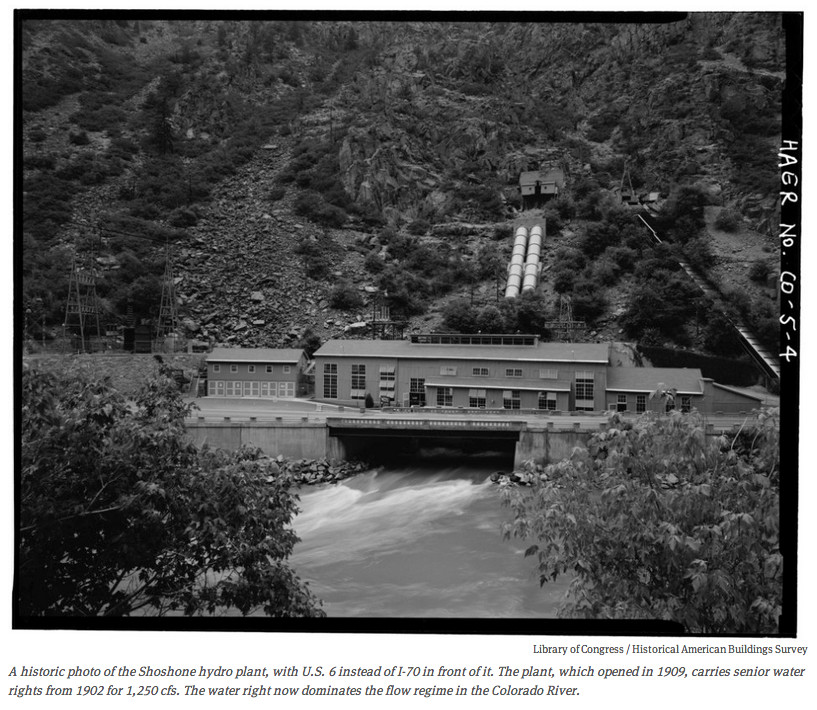
Coyote Gulch’s excellent EV adventure: #CRWUA2025 #ColoradoRiver #COriver #aridification

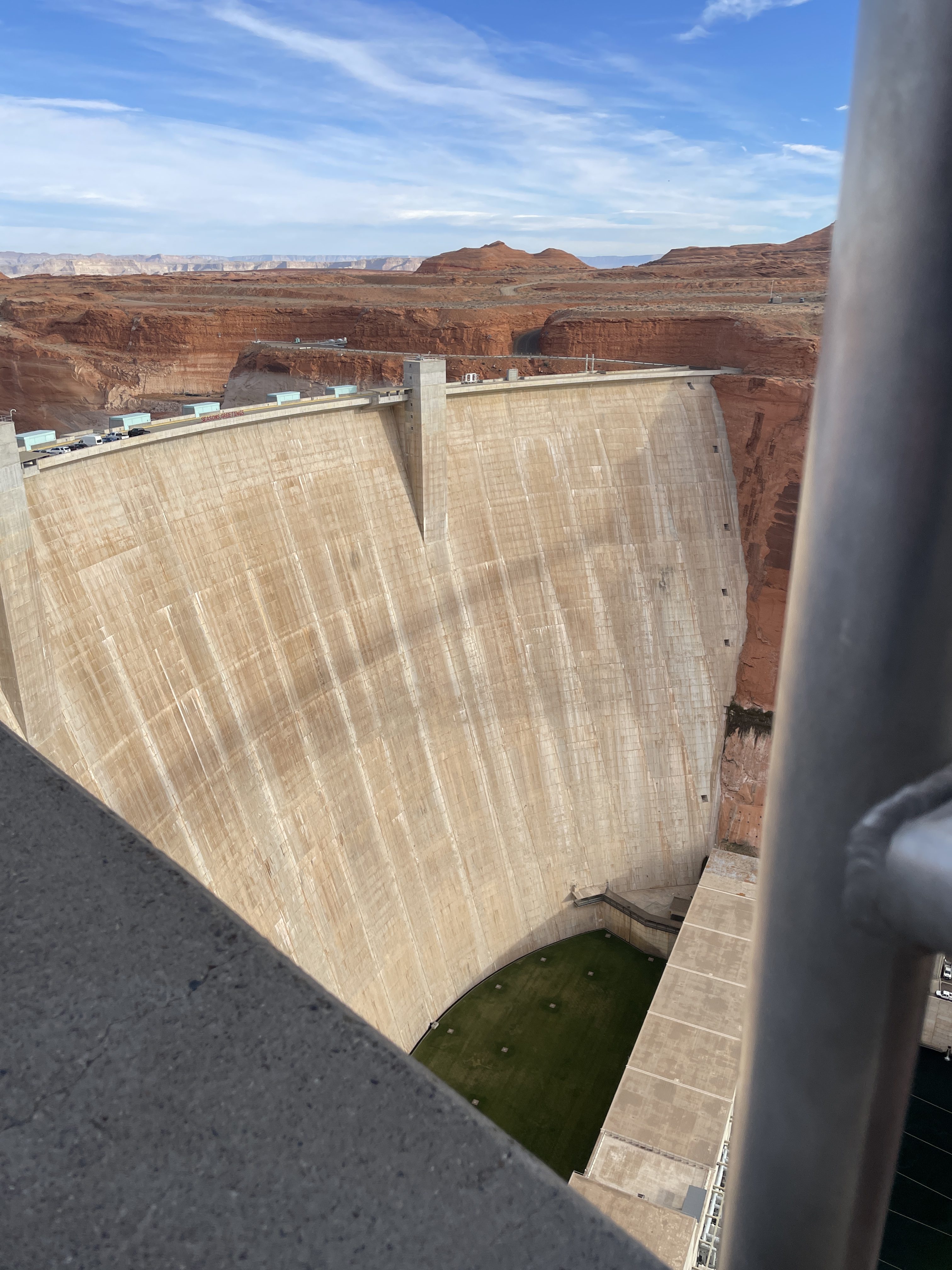
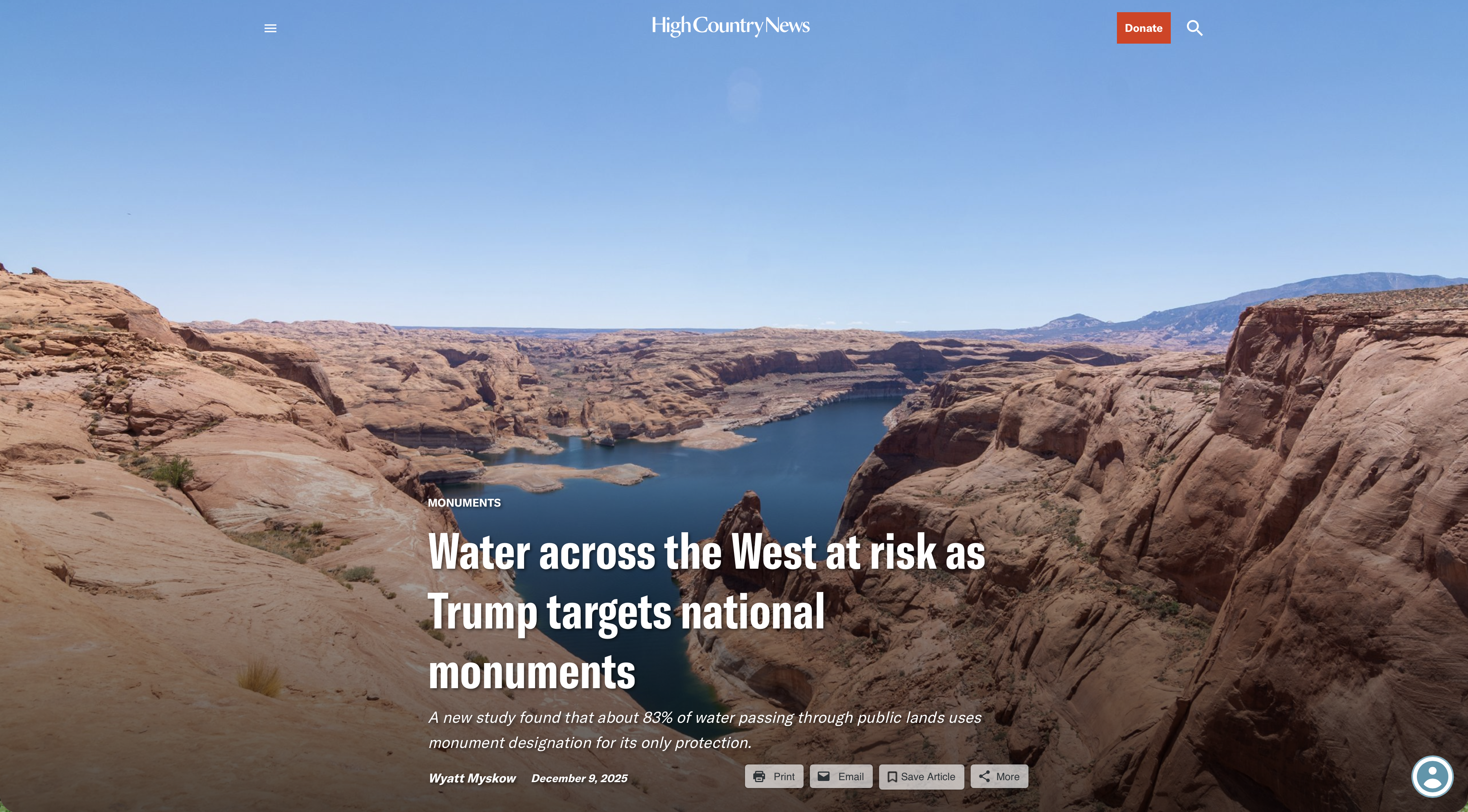
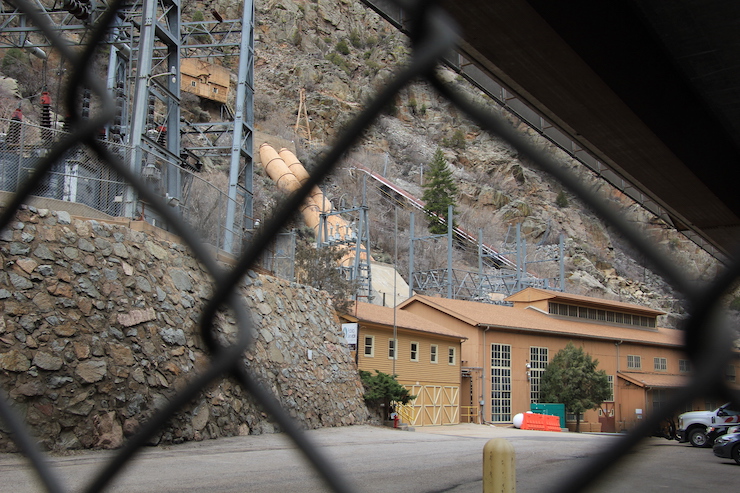
Glen Canyon Dam from the visitor center December 19, 2025.

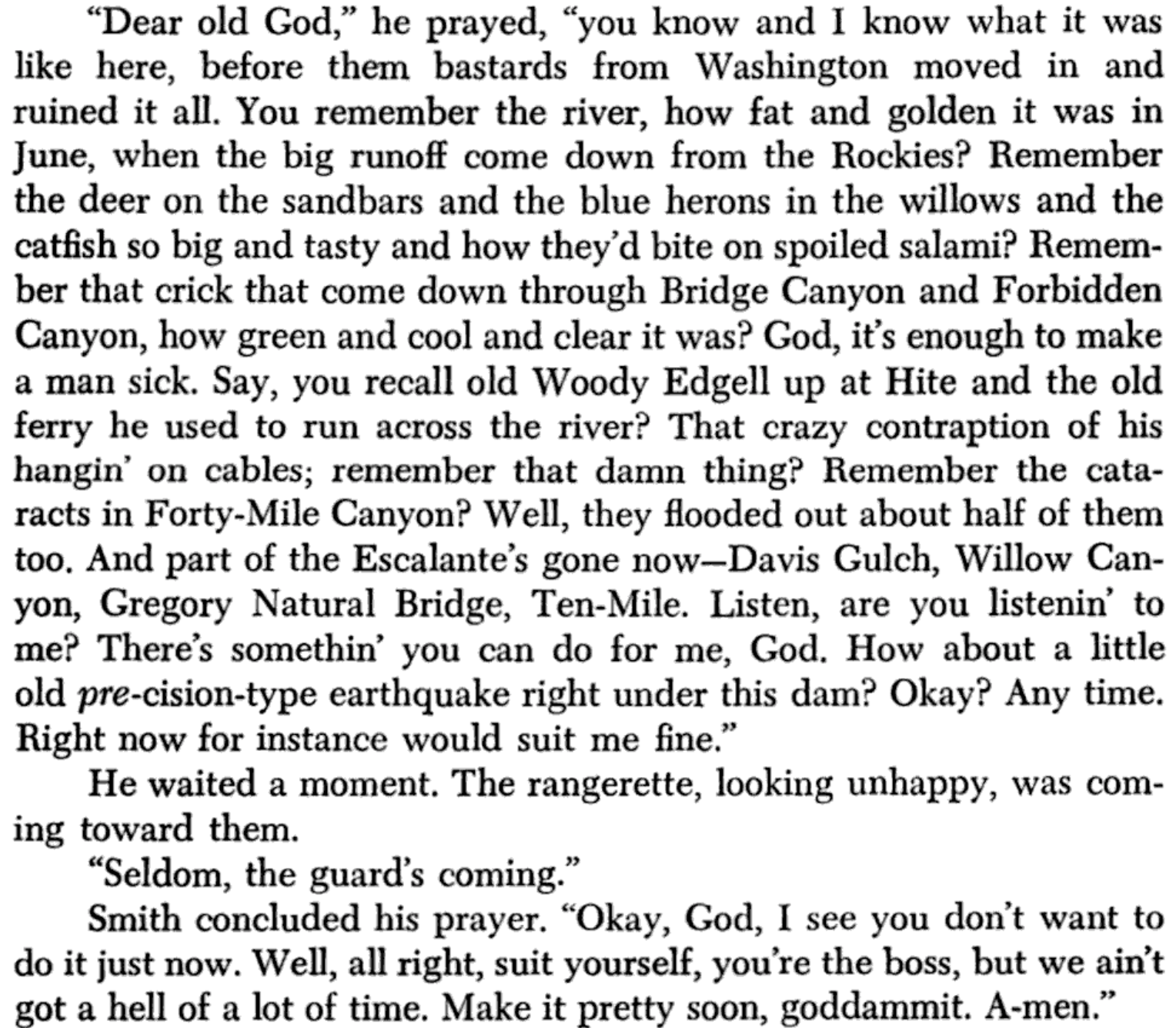
Update: I found a more complete rendering of Seldom Seen’s Prayer in the Coyote Gulch archives. Scroll to the bottom.

I’m on the road back to Denver. I decided to take a southerly route east from St. George through southern Utah and Northern Arizona to travel through country I had not seen before. A short drive from Kanab on Friday put me at Glen Canyon Dam. Although I am not religious I wanted to stop there and recite Seldom Seen’s Prayer from Edward Abbey’s “Monkey Wrench Gang” which I first read while walking down the Escalante River. My sisters and brothers that walk the tribs off Glen Canyon understand.

A bend in Glen Canyon of the Colorado River, Grand Canyon, c. 1898. By George Wharton James, 1858—1923 – http://digitallibrary.usc.edu/cdm/ref/collection/p15799coll65/id/17037, Public Domain, https://commons.wikimedia.org/w/index.php?curid=30894893

“Dear old God, you know and I know what it was like here, before them bastards from Washington moved in and ruined it all. You remember the river, how fat and golden it was in June, when the big runoff come down from the Rockies?… Listen, are you listenin’ to me? There’s somethin’ you can do for me, God. How about a little old pre-cision-type earthquake right under this dam? Okay? Any time. Right now for instance would suit me fine.” -Seldom Seen Smith (H/T Fisher Brewing Company)

My rented Model Y at Glen Canyon Dam December 19, 2025.

What a joy it is to drive the Model Y with self-driving. Self-driving was particularly useful in Las Vegas with all the traffic and unfamiliar (to me) roads. The integration of the Navigation system and the Tesla Charging Network takes quite a load off cross-country road trips. For the leg between St. George and Pagosa Springs I charged at St. George, Page, Kayenta, and Durango.

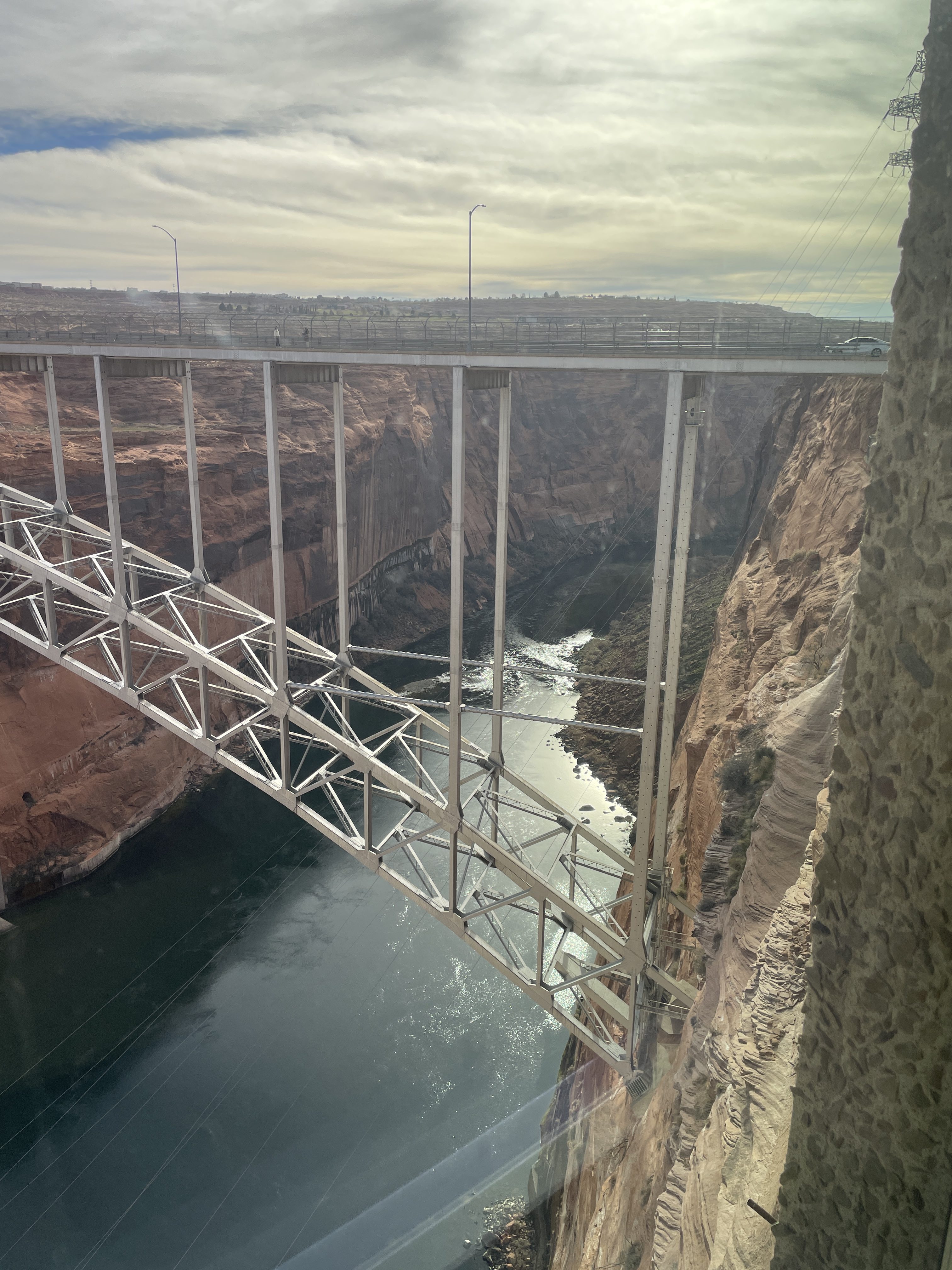
Glen Canyon downstream of the dam December 19, 2025.

I found a more complete rendering of Seldom Seen’s prayer in the Coyote Gulch archives.

Seldom Seen’s prayer at about Glen Canyon Dam from The Monkey Wrench Gang — Edward Abbey

Feds issue ‘sobering’ #ColoradoRiver outlook — #Aspen Daily News #COriver #aridification #CRWUA2025

Anne Castle, Jeff Kightlinger, Jim Lochhead at the 2025 CRWUA Conference. Photo credit: Water Mark (@OtayMark)

Click the link to read the article on the Aspen Daily News website (Austin Corona). Here’s an excerpt:

December 17, 2025

Federal officials have released a “sobering” forecast of 2026 water levels in the Colorado River, with expected flows plummeting from previous predictions. Precipitation later in the winter could turn those dire forecasts around, officials say, but the current outlook is grim for a river already flirting with crisis.  Officials published the new forecast on Monday, only a day before negotiators and stakeholders from the river’s basin states gathered in Las Vegas for a three-day conference. The federal government has given states until February to agree on a longer-term strategy for managing low river flows. The Colorado River’s flow in 2026 (specifically, the unregulated inflow to Lake Powell) could be 27% lower than normal, according to the most probable scenario in the December forecast, with worst-case scenarios predicting even lower flows. The projection has worsened estimates released in November (16% lower than normal in most probable scenarios).

“We all know Mother Nature is a trickster and can often confound our expectations. We certainly hope she intends to do that this year,” said Wayne Pullan, the Bureau of Reclamation’s regional director for the Upper Colorado River Basin, on Tuesday. “But December’s outlook is troubling.”

The bureau, which manages federal dams, will delay water releases at Lake Powell to conserve supplies in the reservoir during the dry winter months in 2026, Pullan said. Even with those efforts, however, the lake’s water levels could fall to critical levels in 2027 as another disappointing year hits the basin. A bad water year in 2026 would compound already poor conditions from 2025, when river flows have been less than half of normal. The new forecast increases the possibility that water levels in Lake Powell could drop below the intakes for hydropower turbines and that releases from the lake could fall below the annual average required to meet the requirements of the 1922 Colorado River Compact, which governs water allocation between the seven states that use the river. Without above-average flows in future years to bring averages back up, or an interstate deal on how to manage drought, those low releases could set the stage for a legal battle on the river.

The back of Glen Canyon Dam circa 1964, not long after the reservoir had begun filling up. Here the water level is above dead pool, meaning water can be released via the river outlets, but it is below minimum power pool, so water cannot yet enter the penstocks to generate electricity. Bureau of Reclamation photo. Annotations: Jonathan P. Thompson

Federal Water Tap: #ColoradoRiver states have been given less than two months to agree on how to share water cuts from the shrinking river — Brett Walton (circleofblue.org) #COriver #aridification #CRWUA2025

Click the link to read the article on the Circle of Blue website (Brett Walton):

December 22, 2025

The Rundown

  • Colorado River states have been given less than two months to agree on how to share water cuts from the shrinking river.
  • Homeland Security waives environmental laws to speed the construction of a border wall in parts of New Mexico.
  • A federal judge proclaims federal authority over the contentious Line 5 oil pipeline that crosses the Great Lakes.
  • U.S., Mexican governments sign Tijuana River sewage cleanup agreement.
  • The House passes a bill to change environmental reviews for infrastructure permitting.
  • USGS study finds lower water levels in Colorado’s Blue Mesa reservoir the cause of increased toxic algal blooms.

And lastly, a draft EIS for post-2026 Colorado River reservoir operations, when current rules expire, will be published in the coming weeks.

“Let me be clear, cooperation is better than litigation. Litigation consumes time, resources, and relationships. It also increases uncertainty and delays progress. The only certainty around litigation in the Colorado River basin is a bunch of water lawyers are going to be able to put their children and grandchildren through graduate school. There are much better ways to spend several hundred million dollars.” – Scott Cameron, acting commissioner of the Bureau of Reclamation, speaking at the Colorado River Water Users Association conference on December 17, 2025. Cameron encouraged the states to reach an agreement on water cuts and reservoir operating rules instead of suing each other.

By the Numbers

February 14: New Interior Department deadline for the seven Colorado River states to reach an agreement on water cuts and reservoir operations. If the states fail at that, Interior could assert its own authority. There could also be lawsuits. A short-term agreement might be necessary.

The deadline, according to Interior’s Andrea Travnicek, is for several reasons. It gives states time to pass legislation, if necessary. It provides time for consultation with Mexico and the basin’s tribes. And it allows for reservoir operating decisions in 2027 to be set this fall.

“Time is of the essence, and it is time to be able to adjust those stakes, to arrange so compromises can be made,” Travnicek said.

News Briefs

Line 5 Oil Pipeline Court Case
A U.S. district judge ruled that the federal government, not the state of Michigan, has authority over the contentious Line 5 oil pipeline that crosses the Great Lakes at the Straits of Mackinac.

Michigan’s top officials have attempted to shut down Enbridge Energy’s Line 5 since 2020 when Gov. Gretchen Witmer revoked the company’s easement.

In his ruling, Judge Robert Jonker determined that the federal Pipeline Safety Act gives the U.S. government the sole authority over Line 5’s continued operation, the Associated Press reports.

In context: Momentous Court Decisions Near for Line 5 Oil Pipeline

Tijuana River Sewage Pollution Cleanup
U.S. and Mexican representatives signed an agreement that will facilitate the cleanup of chronic sewage pollution in the Tijuana River, a shared waterway.

Line 5 Oil Pipeline Court Case
A U.S. district judge ruled that the federal government, not the state of Michigan, has authority over the contentious Line 5 oil pipeline that crosses the Great Lakes at the Straits of Mackinac.

Michigan’s top officials have attempted to shut down Enbridge Energy’s Line 5 since 2020 when Gov. Gretchen Witmer revoked the company’s easement.

In his ruling, Judge Robert Jonker determined that the federal Pipeline Safety Act gives the U.S. government the sole authority over Line 5’s continued operation, the Associated Press reports.

In context: Momentous Court Decisions Near for Line 5 Oil Pipeline

Tijuana River Sewage Pollution Cleanup
U.S. and Mexican representatives signed an agreement that will facilitate the cleanup of chronic sewage pollution in the Tijuana River, a shared waterway.

Called Minute 333, the agreement outlines actions and sets timelines. A joint work group will assess project engineering and feasibility studies. Mexico will build a wastewater treatment plant by December 2028 and a sediment control basin by winter 2026-27. The agreement also addresses monitoring, planning, and data sharing.

Permitting and Land Use Bills
House Republicans used the week before the holiday break to pass a bill that changes infrastructure permitting processes.

The SPEED Act, which passed with support from 11 Democrats, changes the National Environmental Policy Act and the environmental reviews it requires for major federal projects. It restricts reviews to immediate project impacts, sets timelines, and limits lawsuits.

“On net, these reforms are likely to make it easier to build energy infrastructure in the United States,” asserts the Bipartisan Policy Center.

Border Wall
Kristi Noem, the secretary of the Department of Homeland Security, is waiving environmental laws in order to speed the construction of a border wall in parts of New Mexico near El Paso, Texas.

The affected laws include the Clean Water Act, National Environmental Policy Act, Safe Drinking Water Act, Migratory Bird Conservation Act, and others.

Studies and Reports

Mississippi River Recap
The U.S. Army Corps of Engineers published a December state of the Mississippi River report, noting how drought conditions this year have influenced operations on the country’s largest river system.

The Corps authorized construction of an underwater dam that was completed in October in order to impede the upstream movement of salty water from the Gulf of Mexico.

Harmful Algal Blooms in Colorado Reservoir
Blue Mesa is the largest reservoir in Colorado and is part of the Colorado River basin water storage system.

The U.S. Geological Survey investigated why Blue Mesa has been experiencing toxic algal blooms in recent years. Its report concluded that warmer water temperatures enabled by lower water levels are the likely cause.

The affected laws include the Clean Water Act, National Environmental Policy Act, Safe Drinking Water Act, Migratory Bird Conservation Act, and others.

Studies and Reports

Mississippi River Recap
The U.S. Army Corps of Engineers published a December state of the Mississippi River report, noting how drought conditions this year have influenced operations on the country’s largest river system.

The Corps authorized construction of an underwater dam that was completed in October in order to impede the upstream movement of salty water from the Gulf of Mexico.

Harmful Algal Blooms in Colorado Reservoir
Blue Mesa is the largest reservoir in Colorado and is part of the Colorado River basin water storage system.

The U.S. Geological Survey investigated why Blue Mesa has been experiencing toxic algal blooms in recent years. Its report concluded that warmer water temperatures enabled by lower water levels are the likely cause.

Reducing nutrient inflows is unlikely to help, the researchers said. There are naturally occurring phosphorus inputs and the algae can fix nitrogen from the air.

The best solution might be keeping the reservoir high enough, the report says. That will not be easy in a drying and warming region with competing water demands.

On the Radar

Colorado River Draft EIS Coming Soon
In the coming weeks – in early January if not by the end of the year – the Bureau of Reclamation will publish a draft environmental impact statement for changes to how the big Colorado River reservoirs will be managed.

Reclamation began its environmental review about two and a half years ago. The agency had hoped to slot a seven-state consensus agreement into the document. But since there is no agreement, the document will instead describe a “broad range” of options, said Carly Jerla of Reclamation, who spoke at the Colorado River Water Users Association conference.

The draft will not select a preferred option, Jerla said. Instead that will come in the final version.

“We’ve set up a draft EIS that reflects a range of carefully crafted alternatives to enable the further innovation and the ability of the basin to come to a consensus agreement to be able to adopt in time for the 2027 operations,” Jerla said.

Federal Water Tap is a weekly digest spotting trends in U.S. government water policy. To get more water news, follow Circle of Blue on Twitter and sign up for our newsletter.

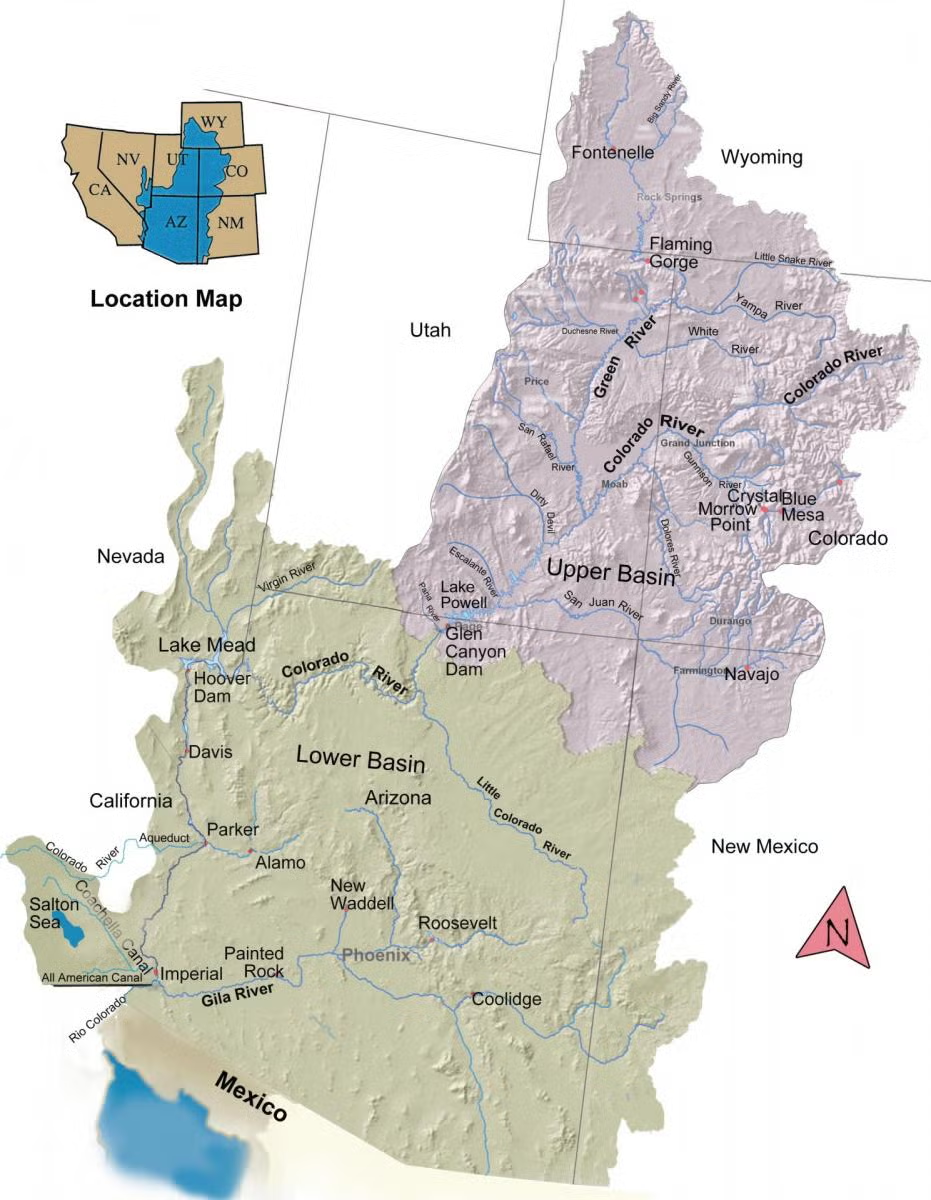
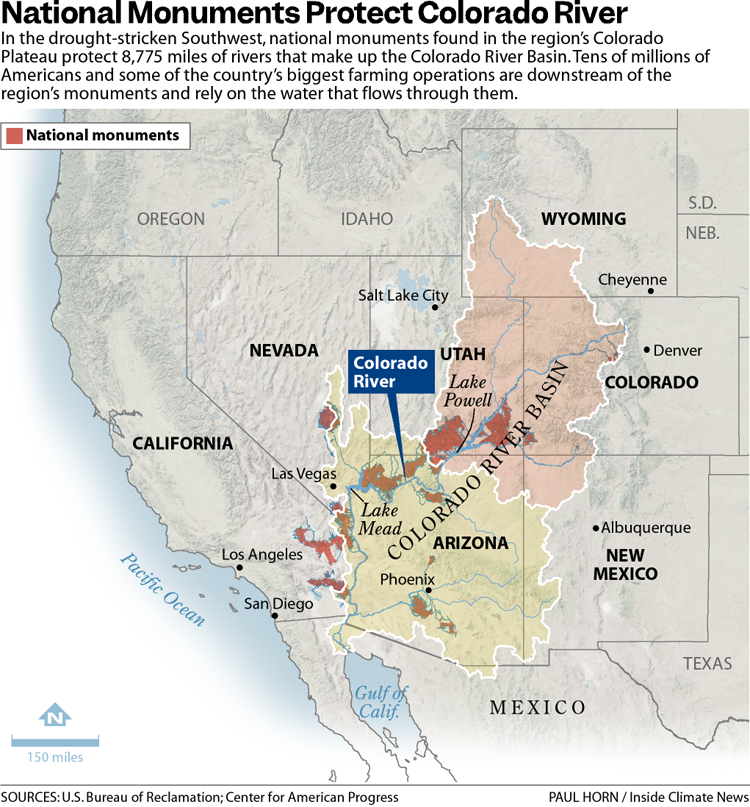
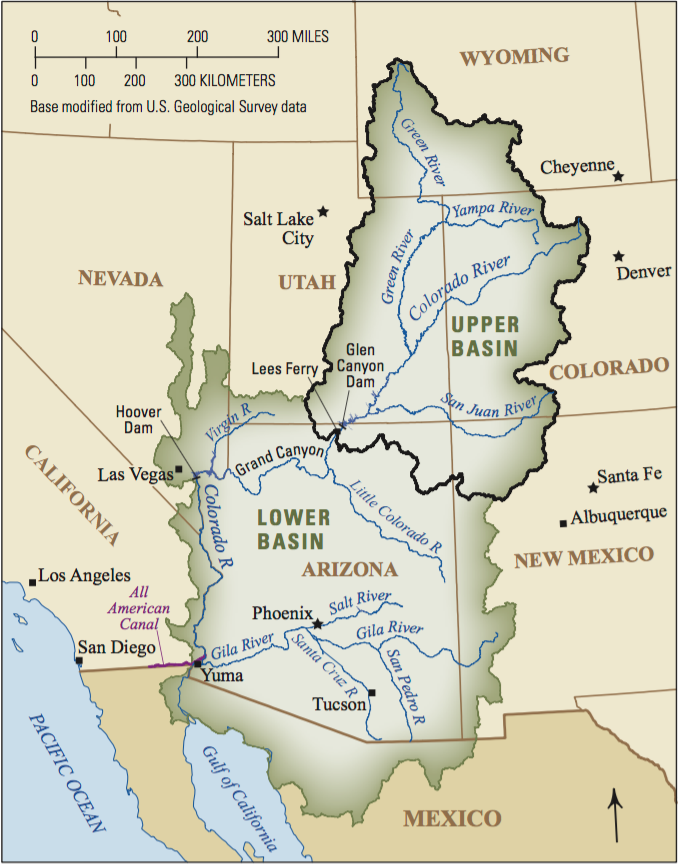
The Colorado River Basin spans seven U.S. states and part of Mexico. Lake Powell, upstream from the Grand Canyon, and Lake Mead, near Las Vegas, are the two principal reservoirs in the Colorado River water-supply system. (Bureau of Reclamation)

#ColoradoRiver water negotiators appear no closer to long-term agreement — The Associated Press #COriver #aridification #CRWUA2025

The Colorado River flows through Gore Canyon in Colorado. Photo: Mitch Tobin/The Water Desk

Click the link to read the article on the Associated Press website (Jessica Hill). Here’s an excerpt:

December 18, 2025

The seven states that rely on the Colorado River to supply farms and cities across the U.S. West appear no closer to reaching a consensus on a long-term plan for sharing the dwindling resource. The river’s future was the center of discussions this week at the annual Colorado River Water Users Association conference in Las Vegas, where water leaders from California, Nevada, Arizona, Colorado, New Mexico, Utah and Wyoming gathered alongside federal and tribal officials. It comes after the states blew past a November deadline for a new plan to deal with drought and water shortages after 2026, when current guidelines expire. The U.S. Bureau of Reclamation has set a new deadline of Feb. 14.  Nevada’s lead negotiator said it is unlikely the states will reach agreement that quickly. 

“As we sit here mid-December with a looming February deadline, I don’t see any clear path to a long-term deal, but I do see a path to the possibility of a shorter-term deal to keep us out of court,” John Entsminger of the Southern Nevada Water Authority told The Associated Press.

The Colorado River Basin spans seven U.S. states and part of Mexico. Lake Powell, upstream from the Grand Canyon, and Lake Mead, near Las Vegas, are the two principal reservoirs in the Colorado River water-supply system. (Bureau of Reclamation)

The federal government continues to refrain from coming up with its own solution — preferring the seven basin states reach consensus themselves. If they don’t, a federally imposed plan could leave parties unhappy and result in costly, lengthy litigation. Not only is this water fight between the upper and lower basins, individual municipalities, tribal nations and water agencies have their own stakes in this battle. California, which has the largest share of Colorado River water, has over 200 water agencies alone, each with their own customers.

“It’s a rabbit hole you can dive down in, and it is incredibly complex,” said Noah Garrison, a water researcher at the University of California, Los Angeles.

Lower Basin states pitched a reduction of 1.5 million acre-feet per year to cover a structural deficit that occurs when water evaporates or is absorbed into the ground as it flows downstream. An acre-foot is enough water to supply two to three households a year. But they want to see a similar contribution from the Upper Basin. The Upper Basin states, however, don’t think they should have to make additional cuts because they already don’t use their full share of the water and are legally obligated to send a certain amount of water downstream.

“Our water users feel that pain,” said Estevan López, New Mexico’s representative for the Upper Colorado River Commission.

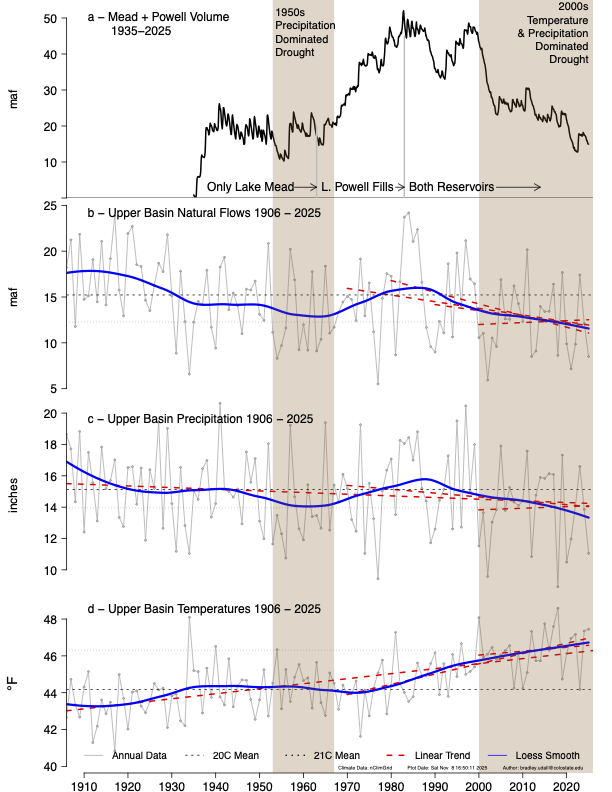
Udall/Overpeck 4-panel Figure Colorado River temperature/precipitation/natural flows with trend. Lake Mead and Lake Powell storage. Updated through Water Year 2025. Note the tiny points on the annual data so that you can flyspeck the individual years. Credit: Brad Udall

December water forecast a sobering backdrop to #ColoradoRiver conference: Feds lay out tools for dealing with falling reservoir levels — Heather Sackett (AspenJournlism.org) #COriver #aridification #CRWUA2025

Lake Powell is seen from the air in October 2022. The December 24-month study from the U.S. Bureau of Reclamation projects Powell could drop below the threshold needed to make hydropower in 2026. CREDIT: ALEXANDER HEILNER/THE WATER DESK

Click the link to read the article on the Aspen Journalism website (Heather Sackett):

December 18, 2025

Federal water officials addressed the increasingly grim river conditions and laid out their options for dealing with plummeting reservoir levels over the first two days of the largest annual gathering of water managers in the Colorado River Basin.

On Monday, the U.S. Bureau of Reclamation released its monthly report, which projects a two-year hydrology outlook for the operation of the nation’s two largest reservoirs: Lake Powell and Lake Mead. The report provided a sobering backdrop to the Colorado River Water Users Association conference at Caesar’s Palace in Las Vegas.

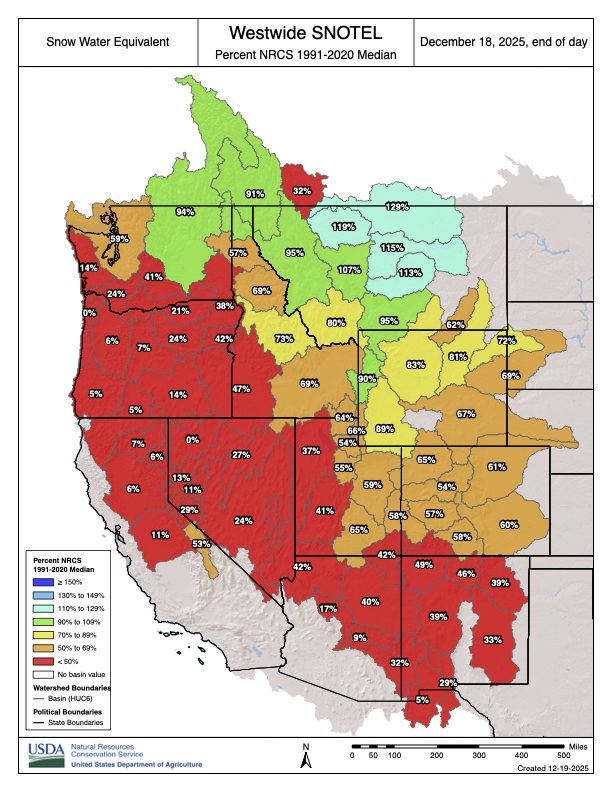
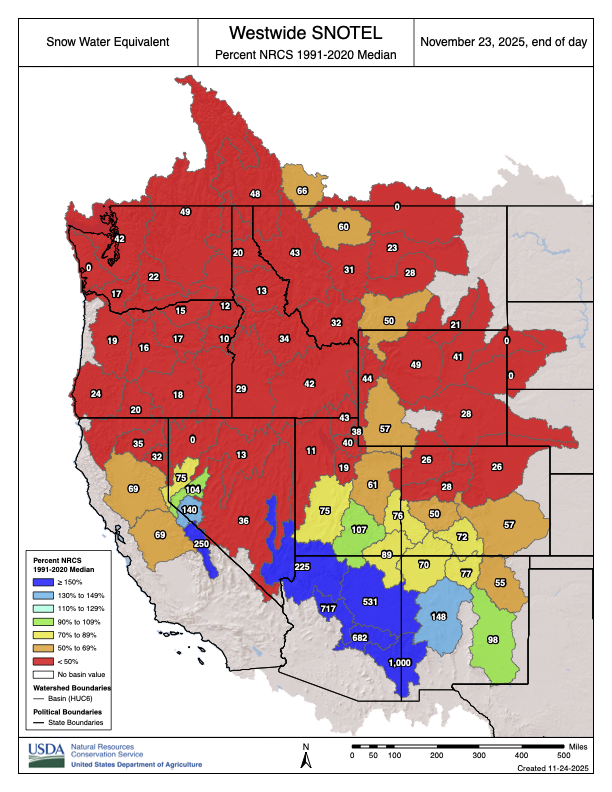
Westwide SNOTEL basin-filled map December 18, 2025. via the NRCS.

With the slow start to winter in the Upper Basin (Colorado, New Mexico, Utah and Wyoming), the report showed a drop in Lake Powell’s projected 2026 inflow of 1 million acre-feet since the November forecast. Under the “minimum” possible inflow, Lake Powell would fall below the surface-elevation level of 3,490 feet needed to generate hydropower by October 2026 and stay there until spring runoff briefly bumps up reservoir levels in summer 2027; but the water level would again dip below 3,490 in the fall of 2027. 

Under the “most probable” forecast, the reservoir’s level stays above minimum power pool, but falls below the target elevation of 3,525 until the 2027 runoff. (Reservoir levels below the target elevation trigger more drastic emergency actions.)  The reservoir is currently about 28% full, down from 37% at this time last year.

Wayne Pullan, regional director for the bureau’s Upper Basin, called the December projections troubling.

“That outlook is sobering for all of us,” Pullan said at Tuesday’s meeting of the Upper Colorado River Commission. 

Snowpack, which is lagging across the Upper Basin, hovered at around 61% of median Wednesday. Snowpack in the headwaters of the Colorado River was 53% of median.

The Colorado River basin has been locked in the grip of a megadrought since the turn of the century. Climate change and relentless demand have fueled shortages, pushed reservoirs to all-time lows and sent water managers scrambling. 

Pullan laid out four tools that the Bureau of Reclamation can use to respond to the projected low water levels to prevent the surface of Lake Powell at the Glen Canyon Dam from falling below 3,500 feet in elevation. 

This 2023 diagram shows the tubes through which Lake Powell’s fish can pass through to the section of the Colorado River that flows through the Grand Canyon. Credit: USGS and Reclamation 2023

The first tool is shifting some winter releases to the summer months when runoff into the reservoir will compensate for those releases. The second is releasing water from upstream reservoirs to boost Lake Powell. The third is reducing releases when water levels hit a certain trigger elevation. 

Representatives from the Upper Basin and Lower Basin (Arizona, California and Nevada), which share the river, have been in talks for two years — with long periods of being deadlocked in disagreement — about how to manage the river after the current guidelines expire at the end of 2026. The 2007 guidelines set annual Lake Powell and Lake Mead releases based on reservoir levels and did not go far enough to prevent them from being drawn down during consecutive dry years.

“We have learned that if we failed at all in these last 25 years, it might have been that our vision wasn’t sufficiently pessimistic,” Pullan said.

States’ representatives have said they are still committed to finding a consensus after they blew past a Nov. 11 deadline to come up with an outline of a plan. Federal officials have set a second deadline of Feb. 14 for the states to submit a detailed plan. 

While water managers across the basin wait for an agreement from the states, federal officials are moving ahead with the National Environmental Protection Act review process and crafting an environmental impact statement for future reservoir operations. Reclamation officials said that they plan to release a draft EIS around the end of the year and that the alternatives analyzed in the EIS will be broad enough that they would capture any seven-state agreement. The draft EIS will not choose a preferred alternative.

“Probably all of you have heard us say, ad nauseum, this emphasis on creating a broad range of alternatives,” Carly Jerla, a senior water resource program manager at the Bureau of Reclamation, said Wednesday. “We really went about this by taking input over the last almost two years from you all … to craft a broad range that really reflects the ideas on how to operate the system.”

Wayne Pullan, Reclamation’s Upper Colorado Basin Regional Director, speaks at the meeting of the Upper Colorado River Commission at the Colorado River Water Users Association Conference on Tuesday in Las Vegas. CREDIT: HEATHER SACKETT/ASPEN JOURNALISM

Not a routine water source

This isn’t the first time the basin has experienced dire straits. In 2021, as Lake Powell flirted with falling below minimum power pool, the Bureau of Reclamation made 181,000 acre-feet in emergency releases from three Upper Basin reservoirs — Flaming Gorge, Navajo and Blue Mesa — to protect critical Lake Powell elevations. 

These reservoirs are part of the Colorado River Storage Project, and their primary purpose is to control the flows of the Colorado River. But the unilateral action by the feds rubbed Upper Basin water managers the wrong way. The 36,000 acre-feet released from Blue Mesa cut short the boating season on Colorado’s largest reservoir, which is on the Gunnison River.

On Tuesday, Colorado’s representative, Becky Mitchell, said Upper Basin reservoirs are not a routine water source for the Lower Basin.

“I appreciate as we’re in critical and dire situations how we use our resources to protect our infrastructure, but we have to shift,” Mitchell said. “Our biggest resource is post-2026 and figuring out how do we do this in a way that doesn’t create those to be routine water sources.”

Udall/Overpeck 4-panel Figure Colorado River temperature/precipitation/natural flows with trend. Lake Mead and Lake Powell storage. Updated through Water Year 2025. Note the tiny points on the annual data so that you can flyspeck the individual years. Credit: Brad Udall

So far, the basin has avoided the worst outcomes by getting last-minute reprieves in the form of wet years in 2019 and 2023. But overall, Jerla said, the Colorado River can expect to see persistent dry years and challenging conditions in the future, and water managers will need more adaptive, flexible solutions. 

“(This is) really our last year together operating under the existing agreements, kind of stretching the flexibilities and the bounds and stability which those agreements provide,” she said.

The Colorado River Basin spans seven U.S. states and part of Mexico. Lake Powell, upstream from the Grand Canyon, and Lake Mead, near Las Vegas, are the two principal reservoirs in the Colorado River water-supply system. (Bureau of Reclamation)

A River That Millions Rely on for Water Is on the Brink. A Deal to Save It Isn’t — Wyatt Myskow, Blanca Begert, Jake Bolster (InsideClimateNews.org) #CRWUA2025 #ColoradoRiver #COriver #aridification

The Colorado River fills Glen Canyon, forming Lake Powell, the nation’s second-largest reservoir. The reservoir could drop to a new record low in 2026 if conditions remain dry in the Southwestern watershed. (Alexander Heilner/The Water Desk with aerial support from LightHawk)

Click the link to read the article on the Inside Climate News website (Wyatt Myskow, Blanca Begert, Jake Bolster):

December 19, 2025

At the Colorado River Water Users Association annual conference in Las Vegas, Colorado River Basin states remain at an impasse over how to cut their water use as Lake Mead and Lake Powell verge on record lows.

The Colorado River Basin is, quite literally, 50 feet away from collapse, and an agreement to save it is nowhere in sight. 

Water titans clashed at Caesars Palace in Las Vegas this week, where negotiators from each of the seven Colorado River Basin states outlined what they have done to protect the river—and pointed fingers at each other, demanding more. 

Udall/Overpeck 4-panel Figure Colorado River temperature/precipitation/natural flows with trend. Lake Mead and Lake Powell storage. Updated through Water Year 2025. Note the tiny points on the annual data so that you can flyspeck the individual years. Credit: Brad Udall

Talks over how to manage the river after 2026, when current drought mitigation guidelines expire, began two years ago. Federal deadlines have come and gone, and the stakes are higher than ever as climate change and overuse continue to push the river that 40 million people rely on to the edge. Still, the states are refusing to budge. 

“It’s now 2025, we’re here in a different hotel a couple years later and the same problems are on the table. In the last two years, we’ve been spinning our wheels,” said JB Hamby, California’s lead negotiator, at the annual Colorado River Water Users Association conference.“Time has been wasted, and like water, that’s a very precious resource.”

The back of Glen Canyon Dam circa 1964, not long after the reservoir had begun filling up. Here the water level is above dead pool, meaning water can be released via the river outlets, but it is below minimum power pool, so water cannot yet enter the penstocks to generate electricity. Bureau of Reclamation photo. Annotations: Jonathan P. Thompson

The Colorado River flows from Wyoming to Mexico, supplying water to seven U.S. states, two Mexican states and 30 tribes. But the bedrock law guiding its management, the 1922 Colorado River Compact, overestimated how much water the river could provide, leading to state allocations that promised more than was ultimately available. The nation’s two largest reservoirs, lakes Mead and Powell, which for decades have met the excess demand driven by overly optimistic allocations, are at the brink. Lake Mead is 33 percent full; Powell is just 28 percent full. If the latter’s water levels drop by an additional 50 feet, the water behind Glen Canyon Dam would be trapped, limiting deliveries to California, Arizona and Nevada, and preventing the dam from generating hydropower. 

The federal government’s data indicate that Lake Powell could drop to that level, known as “deadpool,” by the summer of 2027 if significant cuts aren’t made.

Yet, the states remain stuck on the same points that, for years, have prevented any of them from agreeing to reduce their long-term use enough to prevent the collapse of the Colorado River system.

The structural deficit refers to the consumption by Lower Basin states of more water than enters Lake Mead each year. The deficit, which includes losses from evaporation, is estimated at 1.2 million acre-feet a year. (Image: Central Arizona Project circa 2019)

In a proposal to the federal government from March 2024, Arizona, California and Nevada, the three states that make up the Lower Basin, which uses the greatest amount of the river’s water and has historically over-consumed its allotments, put annual cuts of 1.5 million acre feet of water on the table for a post-2026 agreement. [ed. This includes 1.2 MAF for the “Structural Deficit”. The Lower Basin has never been charged for shrink in Lake Mead and in the Colorado River mainstream. USBR said earlier in the Post-2026 guideline negotiations that the LB would have to be charged for shrink going forward.] They want to see any necessary reductions after that, which experts estimate could range from another 2 to 4 million acre-feet per year, divided among all seven states. One acre-foot of water is enough to supply somewhere between two and four households for a year.

The Upper Basin states of Colorado, New Mexico, Utah and Wyoming have proposed taking voluntary reductions. They argue they should not face mandatory cuts because the Upper Basin has never used the full amount of water it was allocated under the 1922 compact, which apportions 7.5 million acre-feet to each basin. Due to climate change and a lack of storage infrastructure, they say they’re already living with cuts while delivering the required water to the Lower Basin. 

In closing comments on Thursday, which provided a rare opportunity for the public to hear what have otherwise been behind-closed-doors conversations, negotiators expressed frustration, rehashing the same talking points they have used for years.

“As long as we keep polishing those arguments and repeating them to each other, we are going nowhere,” said John Entsminger, Southern Nevada Water Authority’s general manager, and that state’s negotiator. He added that at this point, the best he could envision was an interim five-year operating plan agreement, not the multi-decadal deal that would be necessary to bring certainty to the region. Even a short-term deal still requires resolving debates about what each state can commit to. 

The impasse heightens the risk that the federal government will have to step in to implement a plan to protect its infrastructure. Many fear that a failure to reach state consensus could lead to exorbitantly expensive litigation, delay needed action for years and cause uncertainty throughout the region.

The federal Bureau of Reclamation has told the basins to develop a plan by Feb. 14, 2026, after the states blew past a previous Nov. 11 deadline, so it can include their agreement in the federal government’s environmental analysis of a post-2026 plan to operate Lakes Mead and Powell and oversee their dam releases.

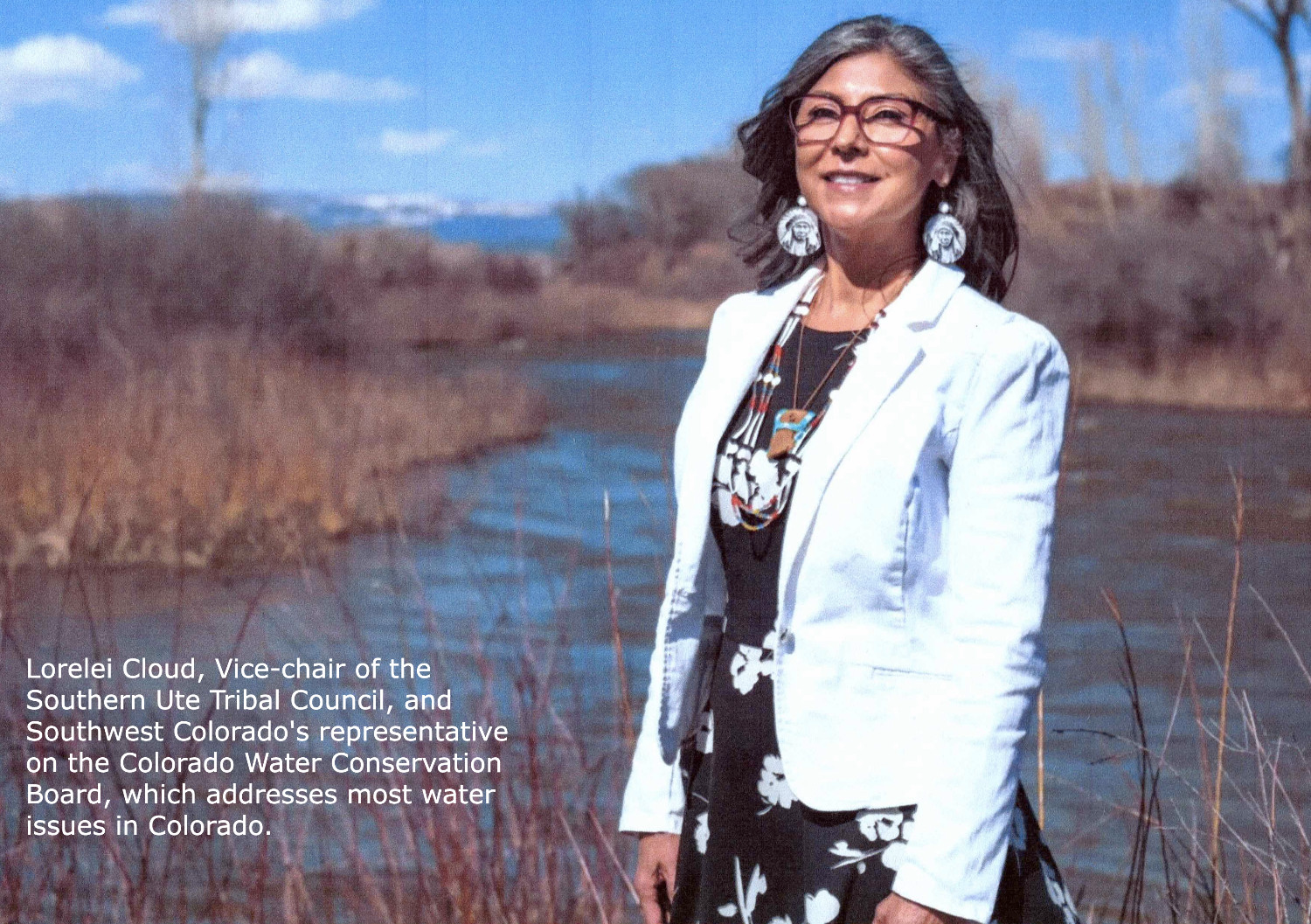
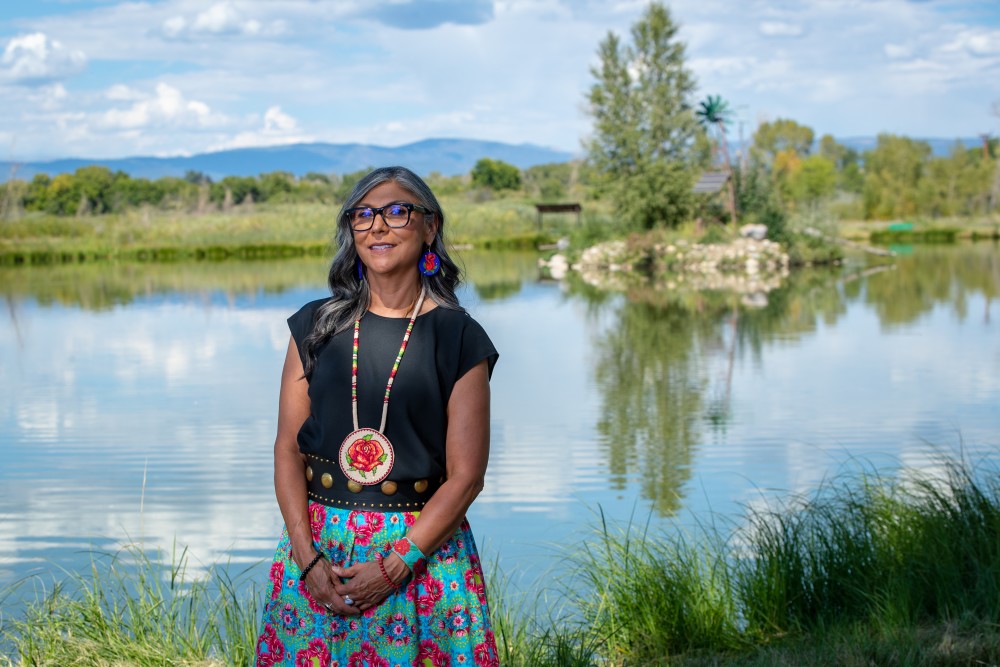
Lorelei Cloud, Vice-chair of the Southern Ute Tribal Council, and Southwest Colorado’s representative of the Colorado Water Conservation Board, which addresses most water issues in Colorado. Photo via Sibley’s Rivers

Lorelei Cloud, chair of the Colorado Water Conservation Board and co-founder of the Indigenous Women’s Leadership Network, cautioned against federal intervention. The federal government has fallen short of its trust responsibility to the tribes by failing to provide water, she said. 

”All the people on the ground really need to step up and provide a solution,” she said.

Bill Hasencamp, manager of Colorado River Resources for the Metropolitan Water District of Southern California, said that federal intervention would mean reverting to pre-2007 operating guidelines under which water allocations are determined annually. That would make it harder for Metropolitan, which serves 19 million people across Southern California, to plan for the future.

“We might invest in sources that we don’t need, but also we may have to restrict water deliveries from time to time, as we’ve done in the past,” said Hasencamp. “For us, that’s a fail.”

But Tom Buschatzke, the director of the Arizona Department of Water Resources and the state’s lead negotiator, told Inside Climate News that federal leadership could break the deadlock between the states, a move that Arizona Gov. Katie Hobbs has called for recently. 

Buschatzke feels that nothing the Upper Basin has proposed would withstand scrutiny from Arizona legislators, who would have to approve it. Visibly upset, he said the Upper Basin’s claim that they can’t take more cuts is “absurd” and is based on them not getting their “paper” water—a term used to refer to water that exists legally but has never been put to use or proven to currently be available. 

“They need mandatory conservation that results in more water being in Lake Powell that can be moved to Lake Mead,” he said.

From left, J.B. Hamby, chair of the Colorado River Board of California, Tom Buschatzke, Arizona Department of Water Resources; Becky Mitchell, Colorado representative to the Upper Colorado River Commission at #CRWUA2023. Hamby and Buschatzke acknowledged during this panel at the Colorado River Water Users Association annual conference that the lower basin must own the structural deficit, something the upper basin has been pushing for for years. CREDIT: TOM YULSMAN/WATER DESK, UNIVERSITY OF COLORADO, BOULDER

Upper Basin negotiators counter that it is not their responsibility to cut their use to accommodate Lower Basin users who have long overdrawn the system. “We cannot subsidize overuse,” said Becky Mitchell, Colorado’s negotiator.

Lower Basin water use since 1964. 2025 data provisional, based on USBR projections Oct. 29, 2015.

At one point, the Lower Basin used several million acre-feet more water per year than it was allocated, but it has since reduced its consumption and now uses less than it is legally entitled to. California, the river’s biggest user, touted drastic conservation measures that have reduced water use to its lowest levels since the 1940s, despite booming growth in the state. Lower Basin leaders argue, too, that the region’s biggest cities, farms and economic outputs from the river are within the three states.

Upper Basin officials argue they have the right to grow as the Lower Basin has, and it’s unfair for those four states to sacrifice their future.

Earlier this week, leaders in both basins saw a preview of the federal government’s draft environmental review, which included a range of options for managing Lake Powell and Lake Mead. Some in the Lower Basin expressed concern that the options relied too heavily on them making future cuts. Hamby, California’s negotiator, emphasized that if the basin states eventually reach an agreement, it will determine how the federal government manages the river.

“Ultimately, none of it should matter if we get to a seven-state consensus,” said Hamby, who is also a board member of Southern California’s Imperial Irrigation District, the river’s single-largest water user. “But as part of the [environmental review] process, what we look forward to seeing from California is an equally balanced risk across the basin that motivates people to develop a seven-state consensus.”

Brandon Gebhart, Wyoming’s state engineer and Colorado River negotiator, called the analysis “broad enough to accommodate any seven-state consensus agreement” in an email.

Andrea Travnicek, assistant secretary for water and science at the Interior Department, said the government expects to publish the environmental impact statement in the last week of December or first week of January. 

Despite the urgency, conference attendees weren’t surprised that negotiations remain stalled and no deal appeared imminent.

Cynthia Campbell, the director of policy innovation for the Arizona Water Innovation Institute at Arizona State University, said she expects one of two outcomes in the next 18 months, and perhaps both: the system will collapse or there will be litigation.

The public, she said, will then ask what happened, and leaders will have no good answers.

“I came with very low expectations, and they were met,” she said.

The Colorado River Basin spans seven U.S. states and part of Mexico. Lake Powell, upstream from the Grand Canyon, and Lake Mead, near Las Vegas, are the two principal reservoirs in the Colorado River water-supply system. (Bureau of Reclamation)

Feds close to releasing draft environmental review of #ColoradoRiver management options — Jennifer Solis (NevadaCurrent.com) #CRWUA2025 #COriver #aridification

Bureau of Reclamation’s Acting Commissioner Scott Cameron speaks at the annual Colorado River Water Users Association’s conference. (Photo: Jeniffer Solis/Nevada Current)

Click the link to read the article on the Nevada Current website (Jennifer Solis):

December 18, 2025

In the next few weeks, the public will get their first look at a critical document two and a half years in the making that will define how the Colorado River is managed for the next decade.

The Bureau of Reclamation – which manages water in the West under the Interior Department – is on track to release a draft environmental review by early January with a range of options to replace the river’s operating rules, which are set to expire at the end of 2026.

Several elements of the draft were shared during the annual Colorado River Water Users Association’s conference in Las Vegas at Caesars Palace Wednesday.

Negotiations between federal officials and the seven western states that rely on the Colorado River have largely remained behind closed doors since 2023, but any new operating rules will be required to go through a public environmental review process before a final decision can be made.

Interior Department Assistant Secretary for Water and Science, Andrea Travnicek, said the agency is committed to meeting the self-imposed January deadline in order to finalize new rules before the current ones expire.

“The Department of the Interior recognizes a shrinking timeline is in front of us in order to operate under a new potential agreement,” Travnicek said.

In an unusual move, federal water officials said the draft will not identify which set of operating guidelines the federal government would prefer, which is typically included in environmental reviews. 

“We will not be identifying a preferred alternative, but we anticipate the identification of that between the draft and the final,” said Bureau of Reclamation’s senior water resource program manager, Carly Jerla.

Instead, the draft environmental review will list a broad range of possible alternatives designed to enable states to continue working towards a seven-state consensus agreement on how to share the river’s shrinking water supply. 

“We want to continue to facilitate, but not dictate these operations. The goal here is to inform decision makers and encourage parties to adopt agreements that put consultation and negotiation first,” Jerla continued.

The Colorado River Basin spans seven U.S. states and part of Mexico. Lake Powell, upstream from the Grand Canyon, and Lake Mead, near Las Vegas, are the two principal reservoirs in the Colorado River water-supply system. (Bureau of Reclamation)

Lower Basin states — California, Arizona, and Nevada — and Upper Basin states — Colorado, Wyoming, Utah and New Mexico — have been at an impasse for months over how to manage the Colorado River’s shrinking water supplies.

Last month, the states missed a federally-imposed deadline to submit a preliminary seven-state consensus plan that could replace the river’s operating guidelines after days of intense closed-door negotiations.

States’ last chance to share a final consensus-based plan will be mid-February 2026 in order to reach a final agreement in the summer  with implementation of the new guidelines beginning in October 2026.

The Bureau of Reclamation’s Acting Commissioner Scott Cameron said he and other federal officials have intensified efforts to bring states to a consensus, flying out West every other week since early April to meet with the seven states’ river negotiators.

“There are a number of issues from decades past that some people are having some difficulty getting past,” Cameron said, adding that states must “be willing to set aside previous perceived inequities and unfairness.”

One of the biggest disagreements between the Upper and Lower Basin states is over which faction should have to cut back on their water use, and by how much.

Lower Basin states want all seven Colorado River states to share mandatory water cuts during dry years under the new guidelines. The Upper Basin, which is not subject to mandatory cuts under current guidelines, say they already use much less water than downstream states and should not face additional cuts. [ed. Also, the UB states face cuts every year from Mother Nature with the variability, but generally lower, snowpack each season.]

Despite states missing past deadlines, Cameron said he was “cautiously optimistic” states will reach a consensus deal by the February deadline.

“It’s not unusual in the negotiating process that tougher decisions get made the closer you get to the deadline. And frankly, there are tough decisions that have to be made,” Cameron said.

On Tuesday, California’s biggest water districts said they were willing to “set aside many of their legal positions” in order to reach a seven-state agreement.

The Bureau of Reclamation provided a broad overview of the components that will be included in draft’s range of options, including guidelines to reduce water deliveries from Lake Mead during shortages, coordinated reservoir operations for Lake Mead and Lake Powell, and storage and delivery mechanisms for conserved water.

Jerla, Reclamation’s senior water resource program manager, said the draft alternatives will include some components previously proposed by states.

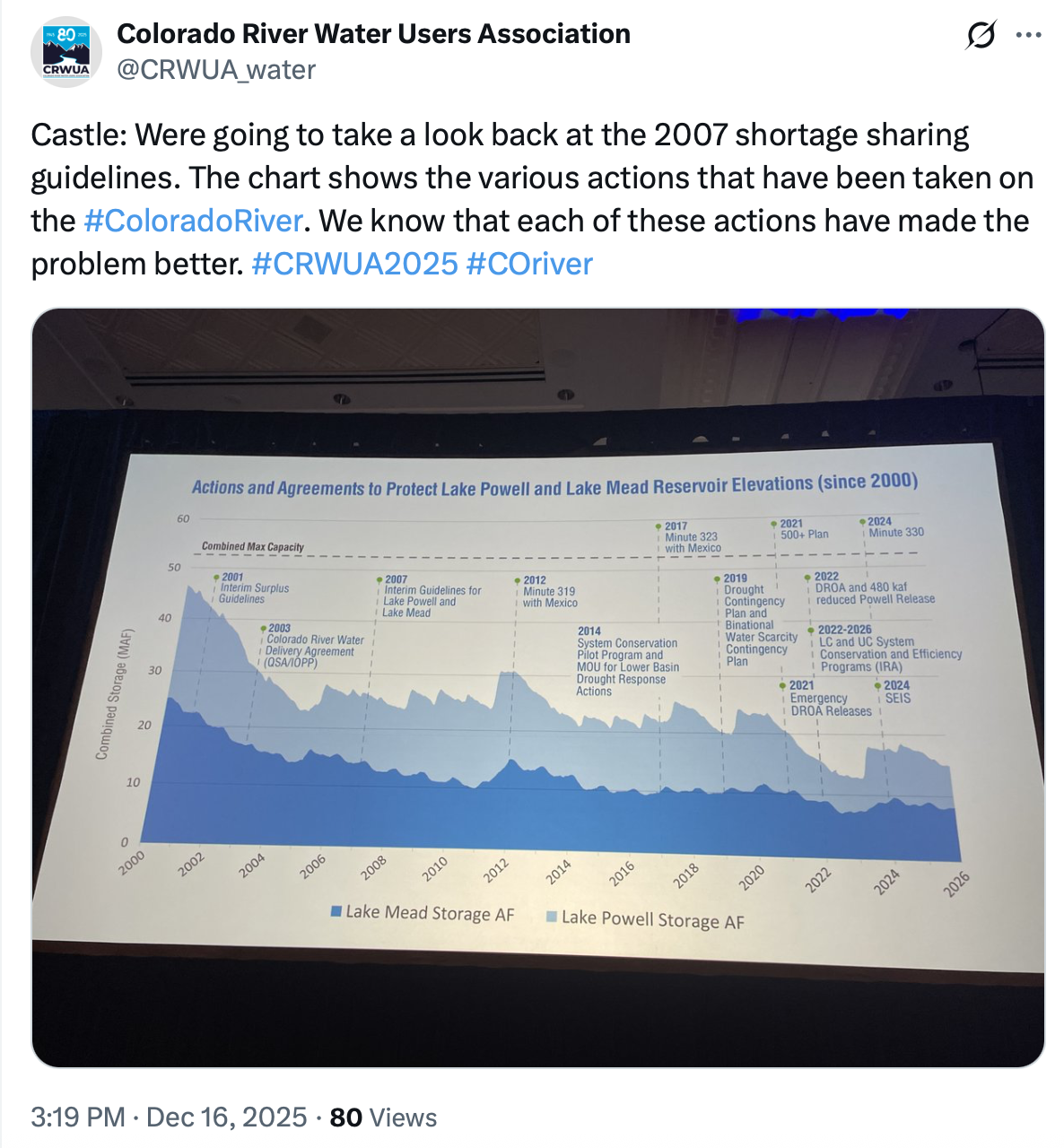
She said the agency has adopted a number of temporary operational agreements since 2008 to address changing conditions on the river. Those agreements have served as test runs for a long term agreement and emphasized the need for more flexibility when managing the river from year-to-year.

“We want to preserve ourselves the flexibility to come back to the table, to do reviews, to make consensus adjustments if needed,” Jerla said.

That flexibility to operations will likely be needed again this year due to a less-than-average upcoming snow season, that combined with a dry spring or early summer in 2026, could create conditions for another low runoff year.

“We’re monitoring the forecast, and we’re seeing not a great start to water year 2026. It’s still early in the year, but the way things are setting up it isn’t looking good,” Jerla said.

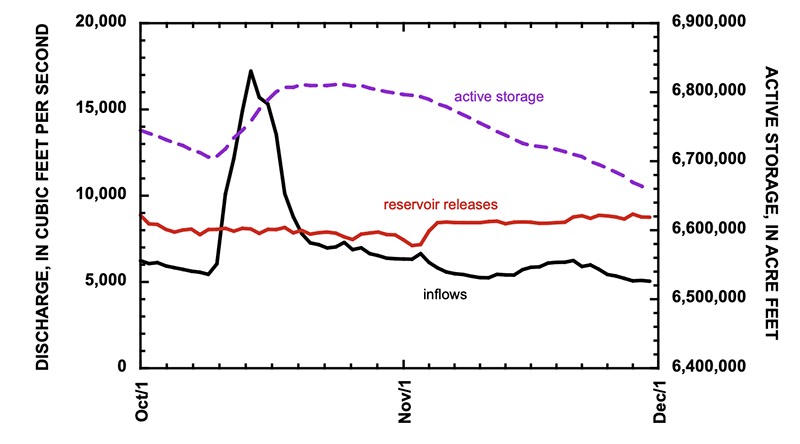
Figure 1. Graph showing active storage in Colorado River basin reservoirs between January 1, 2021, and November 30, 2025. Credit: Jack Schmidt/Center for Colorado River Studies

The two biggest reservoirs in the country, Lake Powell and Lake Mead, are currently at a fraction of their full capacity. Lake Mead is at 32% capacity, while Lake Powell is at 28%. 

Additionally, water inflow into the reservoirs in 2026 are projected to most likely be 75% of the average, according to the federal agency. The minimum probable inflow forecast for 2026 is 44% of average, indicating a potentially very dry year.

John Entsminger — Southern #Nevada Water Authority #CRWUA2025

#CRWUA2025 Day 3 #ColoradoRiver #COriver #aridification

Sunset December 18, 2025 near Colorado City, Arizona.

Click the link to view the conference posts on Twitter(X) (Click the “Latest” tab).

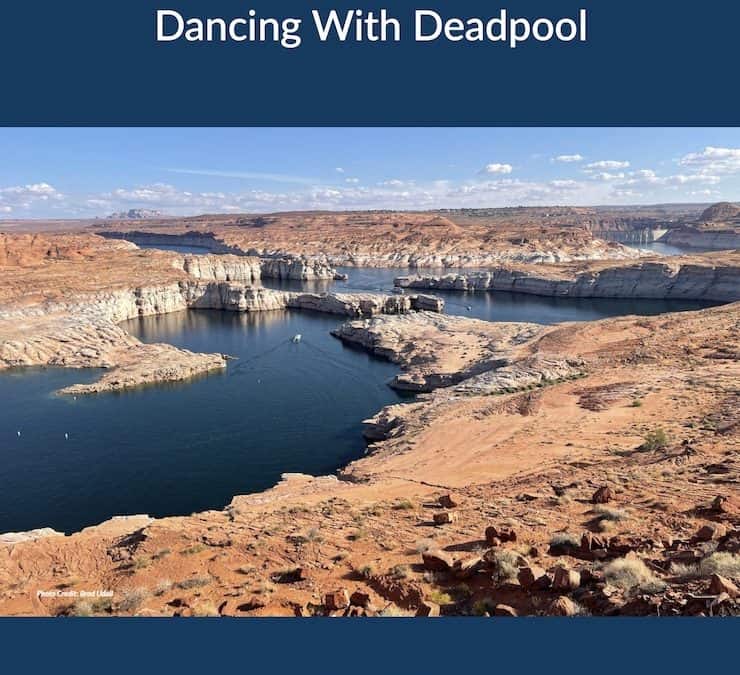
I apologize, I missed the first Session Friday, “Near-term analysis of Colorado River Basin Storage” with Eric Kuhn, Sarah Porter, and Jack Schmidt. Here’s the link to “Colorado River Insights 2025: Dancing with Deadpool“. Their contribution is in Chapter 1, “Colorado River Reservoir Storage – Where We Stand”.

#CRWUA2025 Day 2 #ColoradoRiver #COriver #aridification

Click the link to view my posts on Twitter(X).

#ColoradoRiver gathering kicks off with rhetoric, concerns over river’s future — Shannon Mullane (Fresh Water News) #CRWUA2025 #COriver #aridification

Las Vegas Strip, Dec. 14, 2021. Credit: Allen Best

Click the link to read the article on the Water Education Colorado website (Shannon Mullane):

December 17, 2025

LAS VEGAS — About [1,700] people from every corner of the Colorado River Basin flocked to the palm tree-lined Caesars Palace casino in Las Vegas this week thirsty for insights into the stalled negotiations over the future management of the river.

New insights, however, were sparse as of Tuesday morning.

The highly anticipated Colorado River Water Users Association conference is the largest river gathering of the year. It’s a meet up where federal and state officials like to make big announcements about the water supply for 40 million people, and when farmers, tribal nations, city water managers, industrial representatives and environmental groups can swap strategies in hallway chats.

The meetings started Tuesday morning before the conference officially kicked off. Officials from basin states, including Colorado, set the tone by digging into their oft-repeated rhetoric about the worrisome conditions in the basin, impacts in their own states and conservation efforts. Conference-goers pushed state leaders for more transparency and progress in the discussions over the river’s future.

The basin’s main reservoirs, lakes Mead and Powell, have fallen to historic lows despite pouring state and federal dollars into broad conservation efforts, said Commissioner Becky Mitchell, Colorado’s governor-appointed negotiator on Colorado River issues.

“We’re in a precarious time because none of that is enough,” Mitchell told hundreds of audience members during an Upper Colorado River Commission meeting Tuesday. “It has not been enough.”

Natural flows — which is a calculation of how much water would pass Lees Ferry without upstream human intervention — has trended downward since the mid-1980s. Even before that, however, the river rarely carried as much water as the drafters of the 1922 Colorado River Compact presumed it did. They based the Compact on a median flow of 20 million acre-feet. The 1906-2025 median flow has actually been just 14.3 MAF, while the most recent six-year average has been just over 10 MAF. Data source: Bureau of Reclamation via The Land Desk.

As the river’s water supply is strained by a 26-year drought and human demands, officials are trying to replace an expiring agreement from 2007, which manages how Mead and Powell capture water from upstream states and release it downstream for water users in Arizona, California, Nevada and Mexico.

The Department of the Interior is managing the effort, dubbed the post-2026 process, but deciding new rules is simpler said than done: Basin officials will have to address a changing climate and decide on painful water cuts going forward.

The Interior Department has given the seven basin states until Feb. 14 to reach a consensus. If they can agree, the feds will use the states’ proposal to manage the basin’s reservoirs. If not, the federal officials will decide what to do.

Udall/Overpeck 4-panel Figure Colorado River temperature/precipitation/natural flows with trend. Lake Mead and Lake Powell storage. Updated through Water Year 2025. Note the tiny points on the annual data so that you can flyspeck the individual years. Credit: Brad Udall

Officials from the Upper Basin states — Colorado, New Mexico, Utah and Wyoming — did not share examples of progress in the post-2026 negotiations. They said the basin’s water cycle, not its legal issues, are the main problem.

“It’s not political positions. It’s not legal interpretations,” Brandon Gebhart, Wyoming’s top negotiator, said. “It’s the hydrology of the entire basin.”

Native America in the Colorado River Basin. Credit: USBR

Others, including some of the 30 tribes in the basin, saw it differently. Some tribal representatives called for more transparency. Others said they couldn’t support a plan that is geared toward sending water to downstream states.

“Despite those that think hydrology is the problem, it’s not, and it can’t always be the scapegoat,” said Kirin Vicenti, water commissioner for the Jicarilla Apache Nation, located within New Mexico just south of the Colorado state line. “Our planning and policies must allow flexibility, and innovative and dynamic solutions.”

Portion of a Roman aqueduct Barcelona, Spain, May 2025.

A basin divided by a Rome-inspired wall

Relationships between upstream states and Lower Basin states — Arizona, California and Nevada — have been strained since the post-2026 effort kicked into gear in 2022 and 2023.

On the other side of the casino wall from the Upper Basin meeting, the Colorado River Board of California met Tuesday morning. Each audience could hear muffled clapping from the other room as the officials spoke to their constituents.

“We know one thing for sure, which is that we have a smaller river and that requires less use,” JB Hamby, chairman of the Colorado River board and California’s top negotiator, told the gathering.

He lauded California’s “massive” and expensive efforts to address the river’s shrinking supply while still growing the state’s economy and agriculture industry.

Lower Basin water use since 1964. 2025 data provisional, based on USBR projections Oct. 29, 2015.

California has cut its water use to 3.76 million acre-feet, the lowest it has been since 1949, state officials said. It has a proposed plan to conserve 440,000 acre-feet of river water per year.

One acre-foot roughly equals the annual water use of two to three households.

“We hear lots of applause lines from our friends next door, and we encourage them to take some examples from what California has been able to put together,” Hamby said. “We must all live with the resources we have, not the ones that we wish for.”

Crossing basin lines

While the states might be divided in water politics, conference attendees like Ken Curtis of Colorado moved between the rooms to hear each group’s discussion.

“We appear to be talking past each other,” said Curtis, the general manager of the Dolores Water Conservancy District in southwestern Colorado.

Some water managers from central Utah said they were already looking beyond the current negotiations to the next few decades. The basin’s challenges don’t end next fall — this is just a speed bump in a long future ahead, they said.

Others were waiting for updates from federal officials, scheduled for Wednesday. The Department of the Interior is set to release a highly anticipated look at different options for how to manage the basin around the end of the year.

Curtis said he is at the conference mainly to learn how other states were grappling with the tough water conditions and to get more insight into the negotiations beyond what’s in the media, he said.

“Squeezing it (water) out of the Upper Basin isn’t going to make enough water for the Lower Basin demands,” Curtis said. “And that may be a biased view, obviously, so I’m trying to get a little bit beyond my own biases.”

More by Shannon Mullane

September 21, 1923, 9:00 a.m. — Colorado River at Lees Ferry. From right bank on line with Klohr’s house and gage house. Old “Dugway” or inclined gage shows to left of gage house. Gage height 11.05′, discharge 27,000 cfs. Lens 16, time =1/25, camera supported. Photo by G.C. Stevens of the USGS. Source: 1921-1937 Surface Water Records File, Colorado R. @ Lees Ferry, Laguna Niguel Federal Records Center, Accession No. 57-78-0006, Box 2 of 2 , Location No. MB053635.
The Colorado River Basin spans seven U.S. states and part of Mexico. Lake Powell, upstream from the Grand Canyon, and Lake Mead, near Las Vegas, are the two principal reservoirs in the Colorado River water-supply system. (Bureau of Reclamation)

#CRWUA2025 Day 1 #ColoradoRiver #COriver #aridification

Click here to peruse my Tweets from day 1 of the Colorado River Water Users Association annual conference. (Click on the “Latest” tab.)

Principles for guiding #ColoradoRiver water negotiations — Brian McNeece (BigPivots.com) #COriver #aridification #CRWUA2025

Palm trees in the Imperial Valley 2017. Photo credit: Allen Best/Big Pivots

Click the link to read the article on the Big Pivots website (Brian McNeece):

December 15, 2025

Where Colorado and other Upper-Basin states need to retreat from trying to develop full compact allocation. But Lower Basin states need to acknowledge Mother Nature.

This was published on Dec. 13, 2025, in the Calexico Chronicle, a publication in California’s Imperial Valley. It is reposted here with permission, and we asked for that permission because we thought it was an interesting explanation from a close observer who was reared in an area that uses by far the most amount of water in the Colorado River Basin.

This week is the annual gathering of “water buffaloes” in Las Vegas. It’s the Colorado River Water Users Association convention. About 1,700 people will attend, but probably around 100 of them are the key people — the government regulators, tribal leaders, and the directors and managers of the contracting agencies that receive Colorado River water.

Anyone who is paying attention knows that we are in critical times on the river. Temporary agreements on how to distribute water during times of shortage are expiring. Negotiators have been talking for several years but haven’t been able to agree on anything concrete.

I’m just an observer, but I’ve been observing fairly closely. Within the limits on how much information I can get as an outsider, I’d like to propose some principles or guidelines that I think are important for the negotiation process.

A. When Hoover Dam was proposed, the main debate was over whether the federal government or private concerns would operate it. Because the federal option prevailed, water is delivered free to contractors. Colorado River water contractors do not pay the actual cost of water being delivered to them. It is subsidized by the U.S. government. As a public resource, Colorado River water should not be seen as a commodity.

B. The Lower Basin states of Arizona, California, and Nevada should accept that the Upper Basin states of Colorado, New Mexico, Utah, and Wyoming are at the mercy of Mother Nature for much of their annual water supply. While the 1922 Colorado River Compact allocates them 7.5 million acre-feet annually, in wet years, they have been able to use a maximum of 4.7 maf. During the long, ongoing drought, their annual use has been 3.5 maf. They shouldn’t have to make more cuts.

C. However, neither should the Upper Basin states be able to develop their full allocation. It should be capped at a feasible number, perhaps 4.2 maf. As compensation, Upper Basin agencies and farmers can invest available federal funds in projects to use water more efficiently and to reuse it so that they can develop more water.

D. Despite the drought, we know there will be some wet years. To compensate the Lower Basin states for taking all the cuts in dry years, the Upper Basin should release more water beyond the Compact commitments during wet years. This means that Lake Mead and Lower Basin reservoirs would benefit from wet years and Lake Powell would not. In short, the Lower Basin takes cuts in dry years; the Upper Basin takes cuts in wet years.

E. Evaporation losses (water for the angels) can be better managed by keeping more of the Lower Basin’s water in Upper Basin reservoirs instead of in Lake Mead, where the warmer weather means higher evaporation losses. New agreements should include provisions to move that water in the Lower Basin account down to Lake Mead quickly. Timing is of the essence.

H. In the Lower Basin states, shortages should be shared along the same lines as specified in the 2007 Interim Guidelines, with California being last to take cuts as Lake Mead water level drops.

I. On the home front, Imperial Irrigation District policy makers should make a long-term plan to re-set water rates in accord with original water district policy. Because the district is a public, non-profit utility, water rates were set so that farmers paid only the cost to deliver water. Farmers currently pay $20 per acre foot, but the actual cost of delivering water is $60 per acre foot. That subsidy of $60 million comes from the water transfer revenues.

J. The San Diego County Water Authority transfer revenues now pay farmers $430 per acre-foot of conserved water, mostly for drip or sprinkler systems. Akin to a grant program, this very successful program generated almost 200,000 acre-feet of conserved water last year. Like any grant program, it should be regularly audited for effectiveness.

K. Some of those transfer revenues should be invested in innovative cropping patterns, advanced technologies, and marketing to help the farming community adapt to a changing world. The Imperial Irrigation District should use its resources to help all farmers be more successful, not just a select group.

L. Currently, federal subsidies pay farmers not to use water via the Deficit Irrigation Program. We can lobby for those subsidies to continue, but we should plan for when they dry up. Any arrangement that rewards farmers but penalizes farm services such as seed, fertilizer, pesticide, land leveling, equipment, and other work should be avoided.

M. Though the Imperial Irrigation District has considerable funding from the district’s QSA water transfers, it may need to consider issuing general obligation bonds as it did in its foundational days for larger water efficiency projects such as more local storage or a water treatment plant to re-use ag drain water.

Much progress has been made in using water more efficiently, especially in the Lower Basin states, but there’s a lot more water to be saved, and I believe collectively that we can do it.

The Colorado River Basin spans seven U.S. states and part of Mexico. Lake Powell, upstream from the Grand Canyon, and Lake Mead, near Las Vegas, are the two principal reservoirs in the Colorado River water-supply system. (Bureau of Reclamation)
Native America in the Colorado River Basin. Credit: USBR

#California Commits to #Conservation, Collaboration in New #ColoradoRiver Framework — Colorado River Board of California #COriver #aridification #CRWUA2025

All American Canal Construction circa. 1938 via the Imperial Irrigation District

Click the link to read the release on the Colorado River Board of California website:

State leaders seek durable post-2026 plan and make significant contributions

December 16, 2025

Las Vegas – California’s water, tribal, and agricultural leaders today presented a comprehensive framework for a durable, basin-wide operating agreement for the Colorado River and highlighted the state’s proposal for conserving 440,000 acre-feet of river water per year.

At the annual Colorado River Water Users Association conference, California underscored the state’s leadership in conservation, collaboration, and long-term stewardship of shared water resources that inform its approach to post-2026 negotiations.

California takes a balanced approach, relying on contributions from the upper and lower basins to maintain a shared resource. California supports hydrology-based flexibility for river users, with all states contributing real water savings. Any viable framework would need to include transparent and verifiable accounting for conserved water, along with several other elements outlined in the California framework.

State leaders also noted that they are willing to set aside many of their legal positions to reach a deal, including releases from Lake Powell under the Colorado River Compact, distribution of Lower Basin shortages, and other provisions of the Law of the River, provided that there are equitable and sufficient water contributions from every state in the Basin and the country of Mexico.

Constructive California

“California is leading with constructive action,” said JB Hamby, chairman of the Colorado River Board of California. “We have reduced our water use to the lowest levels since the 1940s, invested billions to modernize our water systems and develop new supplies, partnered with tribes and agricultural communities, and committed to real water-use reductions that will stabilize the river. We are doing our part – and we invite every state to join us in this shared responsibility.”

Despite being home to 20 million Colorado River-reliant residents and a farming region that produces the majority of America’s winter vegetables, California’s use of Colorado River water is projected at 3.76 million acre-feet in 2025 – the lowest since 1949.

That achievement comes on top of historic reductions in water use over the past 20 years, led by collaborative conservation efforts. Urban Southern California cut imported water demand in half while adding almost 4 million residents. And farms reduced water use by more than 20% while sustaining more than $3 billion in annual output. Tribes also have made critical contributions, including nearly 40,000 acre-feet of conserved water by the Quechan Indian Tribe to directly support river system stability.

Going forward, California is prepared to reduce water use by 440,000 acre-feet per year – in addition to existing long-standing conservation efforts – as part of the Lower Basin’s proposal to conserve up to 1.5 million acre-feet per year, which would include participation by Mexico.  When conditions warrant, California is also committed to making additional reductions to address future shortages as part of a comprehensive basin-state plan.

The state’s history of conservation illustrates what can be accomplished through collaboration, and all Colorado River water users in California are preparing to contribute to these reductions – agricultural agencies, urban agencies, and tribes.

Framework for a Post-2026 Agreement

In addition to conservation contributions, California provided a framework of principles for the post-2026 river operating guidelines to advance a shared solution for the seven Basin States, the tribes and Mexico. More specifically, California outlined the following key components for a new framework:

  • Lake Powell releases – California supports a policy of hydrology-based, flexible water releases that protects both Lake Powell and Lake Mead. Flexibility must be paired with appropriate risk-sharing across basins, avoiding disproportionate impacts to any one region.
  • Upper Initial Units (Colorado River Storage Project Act) – Releases should be made when needed to reduce water supply and power risks to both basins.
  • Shared contributions – The Lower Basin’s proposed 1.5 million acre-feet per year contribution to address the structural deficit, including an equitable share from Mexico (subject to binational negotiations), is the first enforceable offer on the table. When hydrology demands more, participation by all seven Basin States is essential.
  • Interstate exchanges – Interstate exchanges need to be part of any long-term solution to encourage interstate investments in new water supply projects that may not be economically viable for just one state or agency.
  • Operational flexibility – Continued ability to store water in Lake Mead is vital to maintain operational flexibility. California supports continuation and expansion of water storage in Lake Mead as a long-term feature of river management and to encourage conservation. We also support Upper Basin pools for conservation, allowing similar benefits.
  • Phasing of a long-term agreement – California supports a long-term operating agreement with adaptive phases. Tools like water storage in Lake Mead and Lake Powell need to extend beyond any initial period due to significant investments required to store conserved water in the reservoirs.
  • Protections and federal support: Any agreement should be supported with federal funding and any necessary federal authorities, allow agriculture and urban areas to continue to thrive, protect tribal rights, and address the environment, including the environmentally sensitive Salton Sea.

“There are no easy choices left, but California has always done what is required to protect the river,” said Jessica Neuwerth, executive director of the Colorado River Board of California. “We have proven that conservation and growth can coexist. We have shown that reductions can be real, measurable, and durable. And we have demonstrated how states, tribes, cities, and farms can work together to build a sustainable future for the Colorado River.”

What California agencies are saying:

“The future of the Colorado River is vital to California – and our nation. As the fourth largest economy in the world, we rely on the Colorado River to support the water needs of millions of Californians and our agricultural community which feeds the rest of the nation. California is doing more with less, maintaining our economic growth while using less water in our urban and agricultural communities. We have cut our water use to its lowest levels in decades and are investing in diverse water supply infrastructure throughout California, doing our part to protect the Colorado River for generations to come. We look forward to continued discussions with our partners across the West to find the best path forward to keep the Colorado River healthy for all those who rely on it.” – Wade Crowfoot, Secretary, California Natural Resources

“Metropolitan’s story is one of collaboration, of finding common ground. We have forged partnerships across California and the Basin – with agriculture, urban agencies and tribes. And through that experience, we know that we can build a comprehensive Colorado River Agreement that includes all seven states and the country of Mexico. We must reach a consensus. That is the only option.” – Adán Ortega, Jr., Chair, Metropolitan Water District Board of Directors

“California’s leadership is grounded in results, and the Imperial Valley is proud to contribute to that record. Our growers have created one of the most efficient agricultural regions in the Basin—cutting use by over 20% while supporting a $3 billion farm economy that feeds America. Since 2003, IID has conserved more than nine million acre-feet, and with the Colorado River as our sole water supply, we remain firmly committed to constructive, collaborative solutions that protect America’s hardest-working river.” – Gina Dockstader, Chairwoman, Imperial Irrigation District

“The path to resiliency requires innovation, cooperation, and every Basin state’s commitment to conservation. The San Diego County Water Authority supports an approach that provides flexibility to adapt to changing climate conditions. That means developing a new framework that allows for interstate water transfers to move water where it’s most needed and incentivizes the development of new supplies for augmentation.” – CRB Vice Chair Jim Madaffer, San Diego County Water Authority

“Palo Verde Irrigation District is committed to maintaining a healthy, viable river system into the future. We at PVID have always gone above and beyond in supporting the river in times of need. Since 2023 our 95,000-acre valley, in collaboration with Metropolitan and the U.S. Bureau of Reclamation have committed over 351,000 acre-feet of verifiable wet water to support the river system and Lake Mead. It is important to our stakeholders in the Palo Verde Valley and all of California that Colorado River water continues to meet the needs of both rural and urban areas. We must find workable solutions that keep food on people’s plates and water running thru the faucets of homes.” – Brad Robinson, Board President, Palo Verde Irrigation District 

“California continues to lead in conservation and collaboration, setting the standard for innovation and sustainability. Together, we strive to ensure reliability for millions of people, tribes, and acres of farmland. For decades, CVWD has invested in conservation efficiency, alongside investments from growers. Additionally, we have saved more than 118,000 acre-feet of Colorado River water since 2022 — underscoring our shared commitment to long-term sustainability. CVWD remains dedicated to finding collaborative solutions to protect the river’s health and stability.” – Peter Nelson, Board Director, Coachella Valley Water District

“As stewards of the Colorado River since time immemorial, our Tribe is committed to protecting the river for the benefit of our people and all of the communities and ecosystems that rely on it. We believe partnerships and collaboration, such as our agreement with Metropolitan Water District and the Bureau of Reclamation to conserve over 50,000 acre-feet of our water in Lake Mead between 2023 and 2026, are essential to ensure that we have a truly living river.” – President Jonathan Koteen, Fort Yuma Quechan Indian Tribe

“Bard Water District remains committed to continued system conservation and responsible water management. While small in size, the District continues to make meaningful contributions to regional sustainability efforts on the Colorado River.” – Ray Face, Board President, Bard Water District

“LADWP is dedicated to delivering and managing a water supply that prioritizes resilience, high quality, and cost-effectiveness. These investments illustrate that achieving urban water resiliency is indeed feasible.” – Dave Pettijohn, Water Resources Director, Los Angeles Department of Water & Power

Map credit: AGU

“Dancing with Deadpool” on the #ColoradoRiver: Plus: Wolves run wild — at least until they get caught — Jonathan P. Thompson (LandDesk.org) #COriver #aridification

Water shooting out of Glen Canyon Dam’s river outlets — as opposed to the penstocks and hydroelectric turbines — in autumn 2025. The releases were part of the Cool Flow project that is intended to lower the temperature of the river downstream of the dam to protect native fish by disrupting non-native smallmouth bass spawning. The releases diminished hydroelectric output, forcing the Western Area Power Administration to spend over $25 million over two years to purchase replacement electricity on the open market. Jonathan P. Thompson photo.

Click the link to read the article on The Land Desk website (Jonathan P. Thompson):

December 16, 2025

🥵 Aridification Watch 🐫

A new report from the Colorado River Research Group, aptly named “Dancing with Deadpool,” paints a grim picture of the critical artery of the Southwest. Reservoir and groundwater levels are perilously low, the 25-year megadrought is likely to persist — perhaps for decades, and the collective users of the river have yet to develop a workable plan for cutting consumption and balancing demand with the river’s dwindling supply.

Amid all the darkness however, the report also delivers a few glimmers of hope, noting that mechanisms do exist to avert a full-blown crisis, and that humans do have the power to slow or halt human-cased global heating, which is one of the main drivers of reduced flows in the river.

Udall/Overpeck 4-panel Figure Colorado River temperature/precipitation/natural flows with trend. Lake Mead and Lake Powell storage. Updated through Water Year 2025. Note the tiny points on the annual data so that you can flyspeck the individual years. Credit: Brad Udall

Those reduced flows seem like a good place to start, since the Colorado River Basin is experiencing the very phenomenon that Jonathan Overpeck and Brad Udall write about in the second chapter, “Think Natural Flows Will Rebound in the Colorado River Basin? Think Again.”

Natural flows — which is a calculation of how much water would pass Lees Ferry without upstream human intervention — has trended downward since the mid-1980s. Even before that, however, the river rarely carried as much water as the drafters of the 1922 Colorado River Compact presumed it did. They based the Compact on a median flow of 20 million acre-feet. The 1906-2025 median flow has actually been just 14.3 MAF, while the most recent six-year average has been just over 10 MAF. Data source: Bureau of Reclamation.

The authors call the Southwest “megadrought country,” since tree rings and other sources show that severe, multi-decadal dry spells — like the one gripping the region currently — have occurred somewhat regularly over the last 2,000 years. The current drought, then, is likely a part of this natural climate variability.

But there’s a catch: The previous megadroughts most likely resulted from, primarily, a lack of precipitation. The current dry-spell is also due to lack of precipitation, but it is intensified by warming temperatures, which are the clear and direct result of climate change. They also find evidence that climate change may also be exacerbating the current climate deficit.

The takeaway is that even when we move through the current dry part of the cycle, the increasingly higher temperatures will offset some of the added precipitation and continue to diminish Colorado River flows. And, when the natural cycle comes back around to the drought side, it’s going to be even worse thanks to climate change.

Westwide SNOTEL basin-filled map December 16, 2025.

Water year 2026 is so far looking like an example of the former, with normal to above-normal precipitation accumulating, but as rain, not as snow, leaving much of the West with far below normal snowpack levels.

If the trend continues, it will not bode well for the Colorado River, according to the chapter written by Jack Schmidt, Anne Castle, John Fleck, Eric Kuhn, Kathryn Sorensen, and Katherine Tara. In an updated version of a paper they put out in September, they find that if water year 2026 (which we’re about 2.5 months into) is anything like water year 2025, Lake Powell is in trouble, and “low reservoir levels in summer 2026 will challenge water supply management, hydropower production, and environmental river management.”

The top water users on the Lower Colorado River Basin. Imperial Irrigation District in southern California once again tops the list. But it’s notable how much consumption they’ve cut since 2003; the IID is expected to use even less water in 2025. Nevada is broken out as a state here because of the way the accounting works. Nearly all of Nevada’s Colorado River allocation goes to Southern Nevada and the Las Vegas metro area. Data source: Bureau of Reclamation.

In order to avoid a full-blown crisis in the near-term, Colorado River users must significantly and quickly cut water consumption — independent of whatever agreement the states come up with for dividing the river’s dwindling waters after 2026.

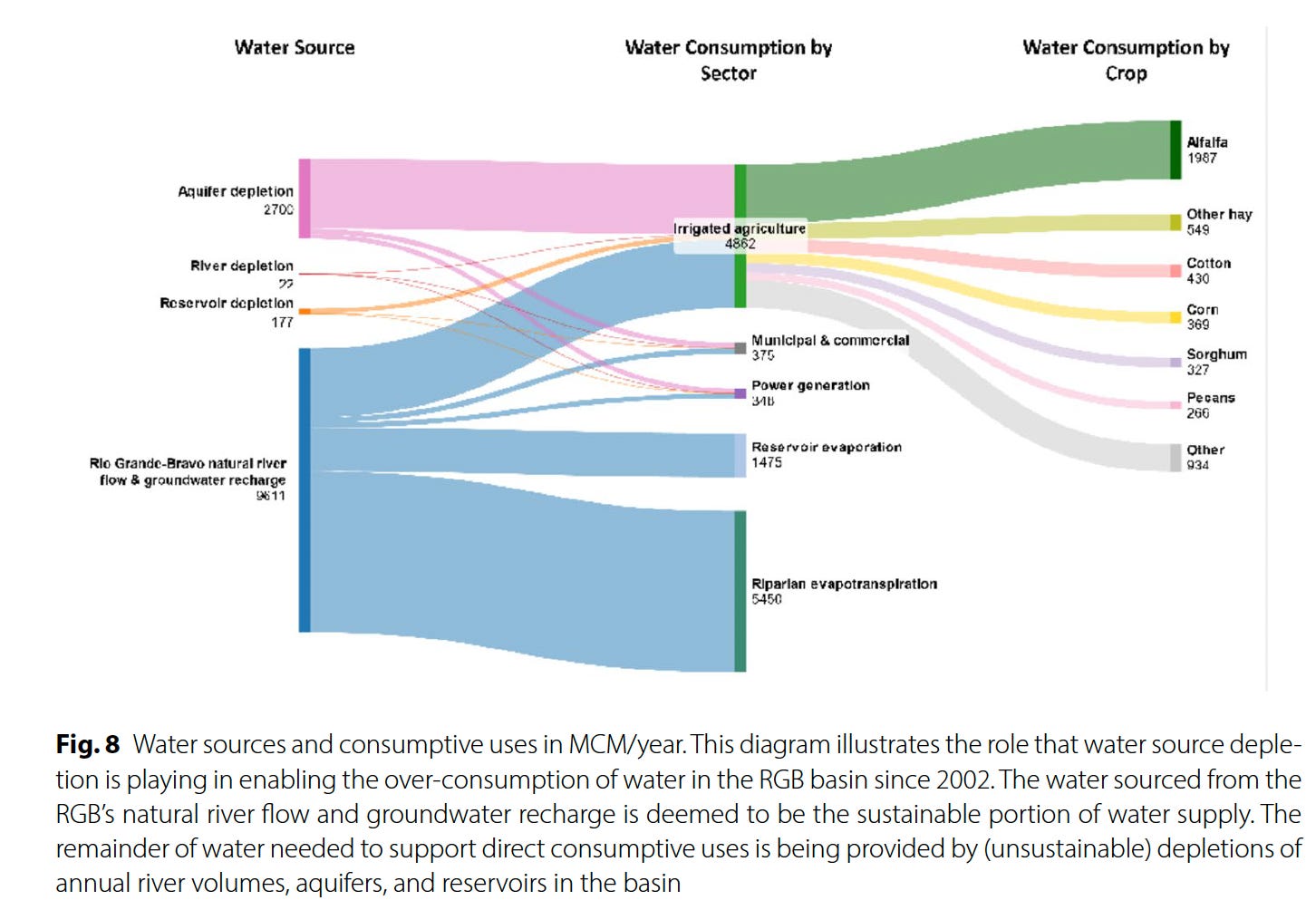
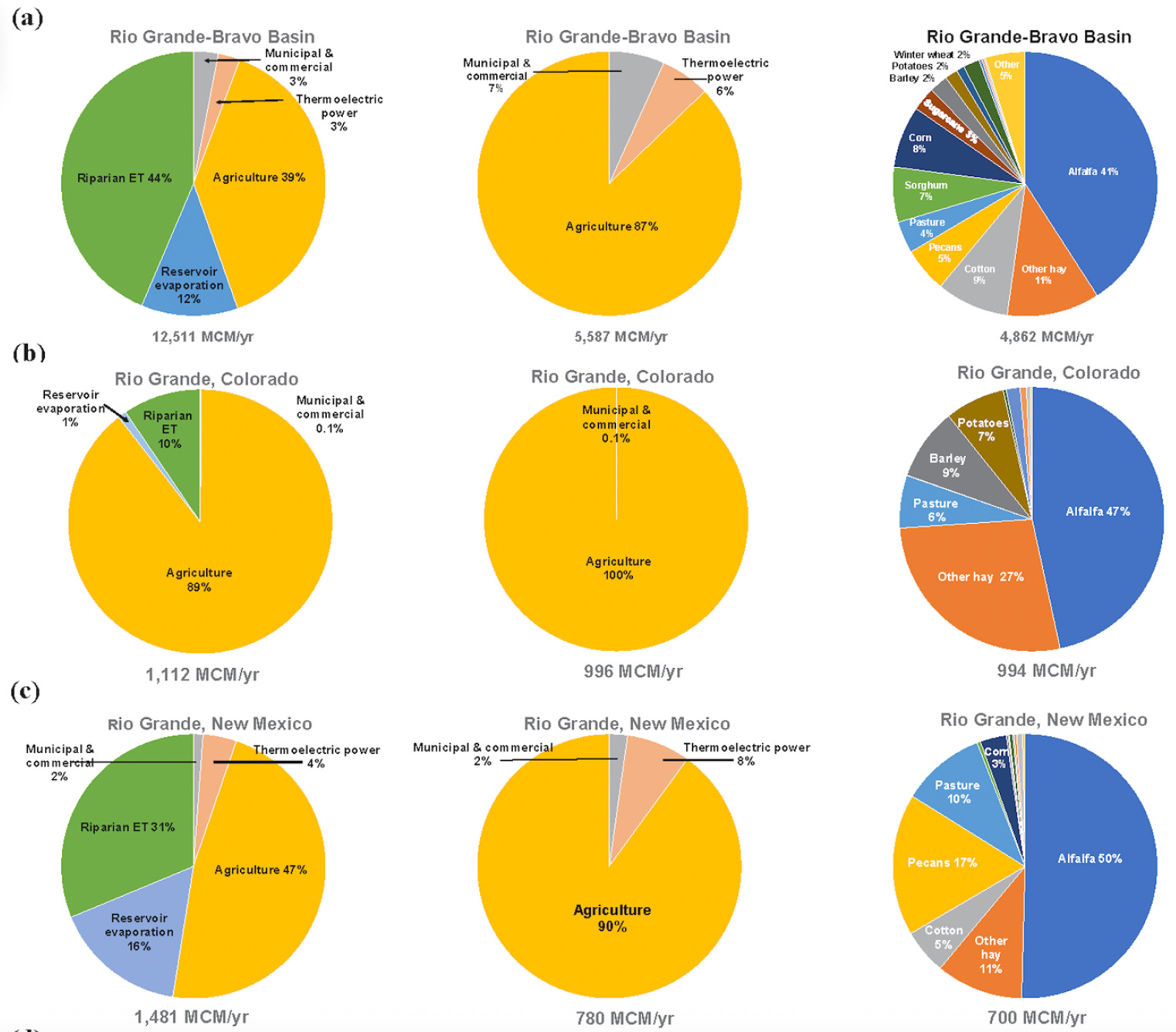
While there is a long-running debate over whether the Upper Basin or the Lower Basin will have to bear the brunt of those cuts, the math makes it indisputable that the agricultural sector in both basins will have to pare down its collective consumption. That’s because irrigated agriculture accounts for about 74% of all direct human consumptive use on the River, or about three times more than municipal, commercial, and industrial uses.

Chart showing how water from the Colorado River is used. Source: “New accounting reveals why the Colorado River no longer reaches the sea,” by Brian Richter et al.

That’s why, in recent years, the feds and states have paid farmers to stop irrigating some crops and fallow their fields. While this method has achieved meaningful cuts in overall water use in those areas, it is in most cases not sustainable because the deals are temporary, and because they rely on iffy federal funding. So, in another of the report’s chapters, Kathryn Sorensen and Sarah Porter offer a different proposal: The federal government should simply purchase land from willing sellers and stop irrigating it (or at least compensate landowners for agreeing to stop or curtail irrigation permanently).

They emphasize that this is not a “buy-and-dry” proposition, where a city buys out the water rights of farms to serve more development. That doesn’t actually save any water, since the city is still using it, and it wrecks farms and communities. Instead, this proposal would actually convert the farmland into public land, and put the water back into the river. This proposed program would target high-water-use, low economic-water-productivity land in situations where the water savings would benefit the environment and the land transfer would help local communities.

Even then, this would be disruptive, in that it would take land out of agriculture and potentially remove farms — and the farmers — from the community. There would also be the question of how to manage the freshly fallowed fields so that they don’t become weed-infested wastelands or sources of airborne, snow-melting dust.


Lamenting the McElmo effect and loss of irrigation-landscapes in an era of aridification — Jonathan P. Thompson


In the following chapter, a quartet of authors suggests a slightly softer approach, in which farmers adapt to dwindling water amounts by shifting crops or to reduce cattle herd sizes or approaches.

The report concludes with a call for a basin-wide approach to managing the Colorado River, and the creation of an entity that would address Colorado River issues in a more comprehensive, transparent, and inclusive way. The current approach, which arbitrarily cuts the watershed in half along an imaginary line, pitting one set of states against another while excluding sovereign tribal nations, and trying to operate within an outdated framework known as the Law of the River, is an opaque mess that has thus far resulted only in gridlock.

The authors propose, instead:

And, finally, a little smidgeon of hope from the report’s second chapter, although it’s hard to be hopeful about reversing climate change in times like these and with a presidential administration intent on burning more and more fossil fuels …


Western water: Where values, math, and the “Law of the River” collide, Part I — Jonathan P. Thompson


Remote camera image of a wolf pup taken during the summer of 2025. Source: Colorado Parks & Wildlife.

🦫 Wildlife Watch 🦅

The News: Colorado Parks and Wildlife last week thanked New Mexico wildlife officials for successfully capturing gray wolf 2403, a member of Colorado’s Copper Creek pack that had roamed over the state line. The wolf was re-released in Grand County, Colorado, where officials hope it will find a mate.

The Context: WTF!? Are these folks trying to bring an extirpated species back to a state similar to the one that existed before it was systematically slaughtered — i.e. the “natural” state — or are they running a zoo? 

The CPW said that the wolf’s capture was in compliance with an agreement with bordering states that is purportedly intended to “protect the genetic integrity of the Mexican wolf recovery program, while also establishing a gray wolf population in Colorado.”

I’m no wildlife biologist, but it sure does seem to me that if a gray wolf from Colorado heads to New Mexico in search of a mate, as is their instinctual tendency, then that’s a good thing. And trying to confine the wolves to artificial and arbitrary political boundaries is counterproductive.

“Historically, gray wolf populations in western North America were contiguously distributed from northern arctic regions well into Mesoamerica as far south as present day Mexico City” explained David Parsons, former Mexican Wolf Recovery Coordinator for the US Fish and Wildlife Service in a written statement. “The exchange of genes kept gray wolf populations both genetically and physically healthy, enhancing their ability to adapt and evolve to environmental changes.” He added that 2403’s walkabout, along with that of “Taylor,” the Mexican gray wolf that has defied attempts to constrain him to southern New Mexico by traveling into the Mt. Taylor region, were “simply retracing ancient pathways of wolf movements. Rather than being viewed as a problem, these movements should be encouraged and celebrated as successful milestones toward west-wide gray wolf recovery efforts.”

Amen to that. 

It’s clearly very tough to run a predator reintroduction program in the rural West, fraught as it is with political and cultural complications. And I respect and admire the folks that are running the project, and understand they are working within serious constraints. Still, there has to be a better way to let nature run its course.


Longread: On wolves, wildness, and hope in trying times — Jonathan P. Thompson


Map of the Colorado River drainage basin, created using USGS data. By Shannon1 Creative Commons Attribution-Share Alike 4.0

#CRWUA2025

Screenshot from Kestrel Kunz’s presentation at the CRWUA 2023 Annual Conference.

I’m in Las Vegas for the 2025 Colorado River Water Users Association annual conference! Follow along on the CRWUA Twitter (X) feed: https://x.com/CRWUA_water. Take a look back at our LinkedIn, blog, and Instagram posts from this year.

#Breckenridge and #Gypsum Join Effort to Secure Shoshone Water Rights — Lindsay DeFrates (#ColoradoRiver District) #COriver #aridification

Colorado River “Beginnings”. Photo: Brent Gardner-Smith/Aspen Journalism

December 15, 2025

The effort to permanently protect the historic Shoshone water rights gained additional momentum as two more west slope communities committed funding in their 2026 budgets toward the Colorado River District’s $99 million purchase agreement with Xcel Energy. The Town of Breckenridge has pledged $100,000, and the Town of Gypsum has committed $15,000, underscoring the importance of reliable Colorado River flows for communities from the headwaters to the state line and beyond.

By committing financial support for the Shoshone Water Rights Preservation Project, Breckenridge and Gypsum join a large and growing coalition of Western Slope partners working to safeguard flows that support local economies, healthy rivers, and long-term water security for Colorado.

Breckenridge circa 1913 via Breckenridge Resort

“The Shoshone water rights are a cornerstone of the Colorado River system and a critical part of protecting our quality of life in the high country,” said Breckenridge Mayor Kelly Owens. “Breckenridge is proud to stand with partners across the West Slope and headwaters region to keep water in the river, support our outdoor recreation economy, and protect this vital resource for generations to come.”

Town of Gypsum via Vail.net

“Look, in Gypsum we see it every single day, our local ranches, our jobs, our families all depend on the Eagle and the Colorado running strong and flowing,” said Gypsum Mayor Steve Carver.  “Backing Shoshone just makes sense. It gives us some certainty when water gets tight. We’re happy to jump in with everybody else and keep that water right here on the Western Slope.”

The Shoshone Water Rights Preservation Coalition, led by the Colorado River District, now includes 35 local governments, water entities, and regional partners across the Western Slope, as well as support from across the state. Together, these partners have committed over $37.3 million toward the $99 million purchase price, in addition to state and federal investments to protect a critical piece of Colorado’s water security.

“Communities across the West Slope continue to step up together in a powerful way,” said Andy Mueller, general manager of the Colorado River District. “Support from Breckenridge and Gypsum reflects a shared understanding that Shoshone is about more than one community or region. It’s about working together to keep the Colorado River and its tributaries flowing for the environment, agriculture, recreation and local communities across Colorado that rely on this water.”

Shoshone Hydroelectric Plant back in the days before I-70 via Aspen Journalism

The Shoshone hydroelectric plant, located in Glenwood Canyon, holds nonconsumptive senior water rights that date back to 1902. These rights are essential for supporting flows in the Colorado River, benefiting agriculture, recreation, rural economies, and water users across the West Slope and beyond.

In December 2023, the Colorado River District entered a purchase and sale agreement with Xcel Energy to acquire and permanently protect the water rights, with plans to negotiate an instream flow agreement with the Colorado Water Conservation Board. This agreement would safeguard future flows, regardless of the Shoshone plant’s operational status.

In January 2025, the Bureau of Reclamation awarded $40 million in federal funding through a program authorized by the Inflation Reduction Act. The River District continues to work with the Bureau and remains optimistic that the project’s broad support and clear public benefit will secure the necessary federal funds to complete this once-in-a-generation investment.

Learn more about the Shoshone Water Rights Preservation Project & Coalition at KeepShoshoneFlowing.org.

The Colorado River Water Conservation District spans 15 Western Slope counties. Colorado River District/Courtesy image

As states draw #ColoradoRiver water, what’s left for the river? — AZCentral.com #COriver #aridification

Aldo Leopold, Colorado River delta, Baja California, Mexico Credit: Courtesy Aldo Leopold Foundation and the University of Wisconsin-Madison Archives

Click the link to read the article on the AZCentral.com website (Brandon Loomis). Here’s an excerpt:

December 15, 2025

Key Points

  • Seven states and 30 tribes that depend on the Colorado River are looking for ways to share a shrinking resource, but environmental groups fear little will be left for the river itself.
  • A wetlands at the end of the river and a fishery at its midpoint show what can happen when water is managed to preserve nature’s needs.
  • Growing demand on the river and competing interests, including electric power providers, could force negotiators for the states to confront difficult decisions.

CIÉNEGA DE SANTA CLARA, Mexico — The rusty observation tower at the edge of this wastewater-fed marsh offers an osprey-eye view of two possible futures for the parched and overworked Colorado River. To one side, the marsh spreads across more than 20 square miles of pools and islands choked with cattails and phragmites, convoys of pelicans descending and splashing down for a rest on their journey south from the Great Salt Lake or other western waters. Dragonflies hover below, while a fish hawk circles above, scanning the open water between the reeds. This is a vision of a future in which partners across the Western United States and Mexico save enough water that they can spare some for nature, even if it means irrigating it with the salty dregs. On the tower’s other side, boundless flats of sand and cracked mud spread to the horizon across what was, prior to the river’s damming a century ago, one of Earth’s great green estuaries.

Colorado River Dry Delta, terminus of the Colorado River in the Sonoran Desert of Baja California and Sonora, Mexico, ending about 5 miles north of the Sea of Cortez (Gulf of California). Date: 12 January 2009. Source http://gallery.usgs.gov/photos/10_15_2010_rvm8Pdc55J_10_15_2010_0#.Ur0mcvfTnrd. Photographer: Pete McBride, U.S. Geological Survey

Jennifer Pitt leaned against a rail atop the tower and scanned that dusty horizon. A century ago, she said, the river had meandered so widely and soaked so much verdant ground there that the naturalist Aldo Leopold had written in “A Sand County Almanac” that “the river was nowhere and everywhere,” unable to “decide which of a hundred green lagoons offered the most pleasant and least speedy path to the Gulf (of California).”

Now the Grand River’s delta supports just a handful of green lagoons, all fed either by wastewater or by targeted environmental irrigation. Pitt leads the Audubon Society’s Colorado River program. She has toiled for decades alongside American and Mexican conservationists to rebuild slivers of living delta from what’s left of the water after dams, farm ditches and growing cities divert most of the great river along its 1,450-mile route from the Rocky Mountains toward its dry mouth on the Sea of Cortez near here. A century ago, the river would have wandered a soaked delta teeming with birds, jaguars and legendary biodiversity. Now, a wastewater marsh must do the ecological heavy lifting.

Jennifer Pitt and Brad Udall at the Getches-Wilkinson Center/Water and Tribes Initiative conference June 5, 2025. Photo credit: Allen Best/Big Pivots

“If we can’t prioritize taking care of a place like this, I fear for our ability to take care of ourselves,” Pitt said.

Udall/Overpeck 4-panel Figure Colorado River temperature/precipitation/natural flows with trend. Lake Mead and Lake Powell storage. Updated through Water Year 2025. Note the tiny points on the annual data so that you can flyspeck the individual years. Credit: Brad Udall

The next few months will be a turning point in efforts to preserve a measure of nature here and across the river’s length, as the seven U.S. states that split the bulk of the water struggle to reach a new deal among themselves that could also determine how much water is available to nurse a remnant of the river’s own environment. Federal officials have said Interior Secretary Doug Burgum is prepared to impose his own cuts if the states can’t reach their own deal, and have said they need a negotiated plan by late winter to avoid that outcome. More than two decades of “megadrought,” unprecedented in U.S. history, have left little wiggle room for year-to-year operations. Reservoirs that were near their 58.48 million-acre-foot capacity in 2000 began the 2026 water year on Oct. 1, with just 21.8 million acre-feet behind the dams. Each acre-foot contains about 326,000 gallons and is roughly enough to support three households for a year, though the bulk of the water flows to the region’s farms.

Jennifer Pitt, the National Audubon Society’s Colorado River program director, paddles a kayak through a restoration site. (Source: Jesus Salazar, Raise the River)

Coyote Gulch’s excellent EV adventure: #CRWUA2025

Coyote Gulch at Hoover Dam

I’m heading to Las Vegas this morning for the 2025 Colorado River Water Users Association annual conference. Follow along on the CRWUA Twitter Feed.

I am using Turo for my EV rental this trip. I was able to snag a Tesla Model Y. The combination of the Model Y, the Tesla charging network, and the integration with the Tesla navigation system can’t be beat for these EV road trips.

Dancing With Deadpool on the #ColoradoRiver: Edging closer to the Colorado River cliff — Allen Best (BigPivots.com) #COriver #aridification

Click the link to read the article on the Big Pivots website (Allen Best):

December 12, 2025

New ‘book’ explores the evolving thoughts about an increasingly dire situation

To put that into perspective, the Colorado River Compact assumed an average 16.5 million acre-feet at that site, Lees Ferry. The river this century has produced far less. Since 2020, the river flows have declined even more, to an average of 10.8.

September 21, 1923, 9:00 a.m. — Colorado River at Lees Ferry. From right bank on line with Klohr’s house and gage house. Old “Dugway” or inclined gage shows to left of gage house. Gage height 11.05′, discharge 27,000 cfs. Lens 16, time =1/25, camera supported. Photo by G.C. Stevens of the USGS. Source: 1921-1937 Surface Water Records File, Colorado R. @ Lees Ferry, Laguna Niguel Federal Records Center, Accession No. 57-78-0006, Box 2 of 2 , Location No. MB053635.

Might it get worse?

“Dancing With Deadpool,” a new product from the Colorado River Research Group, delivers the short answer.

“Another year or two of low inflows and we will completely blow through the cushions provided by reservoir storage,” says the document’s executive summary. The word “crisis” litters the 64-page production. It has eight chapters written by 22 authors from Colorado and three other Colorado River Basin states.

The Colorado River has fascinated journalists since at least the 1980s. Then, the river was still delivering water to Mexico’s Sea of Cortez but troubles were evident on the horizon. The river now, except for specially engineered releases from upstream dams, disappears entirely after crossing into Mexico.

Since 2022, the Colorado River had become a national story. Empty seats at the annual Colorado River Water Users Association conference in Las Vegas have disappeared, press credentials harder to secure.

The tension even in the last year has grown. The river runoff this year was only 55% of long-term average. The seven basin states remain at an impasse about solutions proportionate to the problem.

“We have now entered a new era: Dancing with Deadpool,” says the report.

Deadpool is the point at which reservoirs can release no water. In 2022, that moment seemed imminent as sandstone walls of Glen Canyon were exposed directly to sunlight after being submerged since shortly after Lake Powell began filling. Then a miracle winter arrived, water levels in the two big reservoirs, Powell and Mead, rose once again, the emergency receded.

Now the crisis is back — and looming larger.

You can scare yourself to death with what-ifs, but we may need something akin to a miracle to avoid full-blown crisis. We cannot have another winter and then runoff like 2002-2003. Or, as several authors point out, runoff like we had in 2025.

As it is, we need another miracle winter, something akin to what diehard Denver Broncos fans remember as “the drive” in a 1987 playoff game. John Elway led his football team 98 yards down the field in Cleveland to tie the game with 37 seconds left. They won in OT.

Brad Udall and Jonathan Overpeck warn against too much optimism. Mother Nature can be stingy. She has been in the past, with one drought period as long as 80 years during the last 2,000 years. Now, the evidence grows that our monkeying with Mother Nature has produced this drought.

Udall/Overpeck 4-panel Figure Colorado River temperature/precipitation/natural flows with trend. Lake Mead and Lake Powell storage. Updated through Water Year 2025. Note the tiny points on the annual data so that you can flyspeck the individual years. Credit: Brad Udall

In 2017, Udall and Overpeck issued the results of their study that showed that warming alone was responsible for roughly half of the reduced natural flows of the Colorado River, at that point 17%. They delivered a new phrase: “hot drought” as distinguished from “dry drought.” The warmer temperatures were robbing the Colorado River Basin of water.

Precipitation in the basin has also declined 7% in the 21st century, as compared to the 20th century. In their chapter, Udall from Colorado State and Overpeck now at the University of Michigan (but with a summer cabin in San Miguel County), cite two new studies that together provide evidence “suggesting” complicity of humans. Greenhouse gases explain the declined precipitation, too.

As science is never 100%, Udall and Overpeck use cautious language. The studies, they say, “strongly suggest we are in for extended dry periods in the Colorado headwaters in the decades ahead.”

If there is less water, then isn’t the solution simple? Use less!

Easy to say. And for the last 20 years, efforts have been made to nibble away at uses. Cities have been working to make less water-intensive urban landscapes popular. But the far larger story lies in agriculture.

In Colorado and the three upper basin states, for example, about 70% of all the Colorado River water (after trans-basin diversions for irrigation are accounted for) goes to agriculture. How can ag use less water?

Two of the chapters work on this. A trio of academics from Wyoming and one from Colorado take aim specifically at the upper basin states. “The relevant questions are not whether or when cuts will happen, but how deep will they go, how will they be distributed, and how well can the consequences be mitigated?” they ask.

The four upper-basin researchers argue that evidence already exists for success. With creativity and collaboration, they say, farmers and ranchers can sustain crop and livestock production even as water becomes scarce. They get into the details, talking about adjustments of cow-calf operation, for example, to reduce water-dependent needs.  They call for more research into limited irrigation, crop switching and other practices.

Two other academics, both from Arizona State, take a somewhat broader view, acknowledging the challenge.

“In a landscape of poor choices, in a failing river system in which all solutions are deeply unpopular to some or other powerful constituency, potentially harmful to one community or another or inordinately expensive and founded on unreliable funding, it is at least worth considering another option,” write Kathryn Sorensen and Sarah Porter.

They see cuts of up to 4 million acre-feet in the basin annually being necessary. Again, that’s about 25% of what those who created the Colorado River Compact expected would be annual flows for the seven basin states.

How to get there? They introduce a new concept, “economic water productivity,” a measure of the value of water. Instead of buy and dry programs, they see need for a federally financed effort to pivot uses through incentives to reduce water use on those agricultural lands.

Similar buy-down of high-volume irrigated agriculture is underway in two groundwater depletion areas in Colorado, the San Luis Valley and the Republican River Basin. Some federal money is providing help in the latter basin. They contend federal money will be needed, and lots of it, to pay for this big pivot in the Colorado River Basin. That, they say, would be fitting, because it was federal money that financed the infrastructure for this hydraulic empire.

GRACE TWS trend map. (a) The time series of nonseasonal GRACE/FO TWS (km3/year) over UCRB and LCRB for the period (4/2002–10/2024). (b) Spatial variation in TWS trends for the Colorado River Basin for the investigated period (mm/year) (c) Time series comparison of the change in storage ΔS/Δt derived from the water balance equation (Equation 1) and GRACE/FO. ΔS/Δt calculated from GRACE/FO TWS anomalies in km3. The light shading represents uncertainties.

As for groundwater, that part of the Colorado River story has been generally overlooked. A study released several months ago found that nearly two-thirds of storage — both surface and groundwater — lost from 2002 to 2024 in the Colorado River actually came from groundwater depletion, mostly in Arizona.

Whoa!

“Simply shifting unsustainable surface water uses to unsustainable groundwater uses does nothing to address the core mismatch of supplies and demands,” observes Doug Kenney, who directs the Western Water Policy Program at University of Colorado Law School.

Other contributors dissect the complexities of what would seem to be simple, common sense solutions. For example, Eric Kuhn, the former general manager of the Colorado River District, works through the concept of water sharing among the states based on a percentage basis. The Colorado River Compact divides water between the upper and lower basins, a mistake in retrospect although even in 1922, when it was adopted, there had been an argument for using a percentage.

Later, when the upper-basin sates adopted a compact among themselves, they did use a percentage basis.

Kuhn goes deep into the history, as he has done with book-writing (“Science be Dammed,” 2019, with John Fleck) to sort through the thinking of this idea over the last century. It came up again earlier this year as the seven basin states tried to figure out how to share the river given the changed realities. The states, however, could not agree on what percentages should be used for sharing. It may have been just too much of a transformational change for some states to accept, he says.

However, the idea may come back if the stalemate between the upper and lower basins of the Colorado River ends up in the federal courts. Or failing that, what exactly would federal intervention look like? That’s an impolite question, but one of those what-ifs that must be wondered about. (For the record, the water people I know seem to have high regard for people in the Department of Interior in charge of looking after the Colorado River).

The large story here is that the states, with enormous aid from the federal treasury, created the infrastructure and expectations of water that no longer exists and, as per the studies of scientists, will almost certainly not return within the lifetimes of any of us. What, then, should be the federal role in defining the future balance? Once again, might the dismantling of Glen Canyon Dam be such a wild idea after all?

Thoughts in this book will likely be part of the conversations next week in Las Vegas when representatives of the seven basin states gather, as they always do, at the Colorado River Water Uses Association conference. Might a hallway conversation lead to a breakthrough?

Like huge snowstorms in the Rockies and then cool temperatures during runoff, there might be miracles, but I wouldn’t count on it. This deadpool dance might end sooner than anybody actually likes.

Map of the Colorado River drainage basin, created using USGS data. By Shannon1 Creative Commons Attribution-Share Alike 4.0

The Erosion of the Colorado River “Safety Nets” is Alarming — Doug Kenney (#ColoradoRiver Research Group) #COriver #aridification

Graphic credit: Colorado River Research Group from the report “Dancing with Deadpool”

Click the link to access the report Dancing with Deadpool on the Getches-Wilkinson Center website (Doug Kenney1):

The rapid loss of storage in Lakes Mead and Powell is certainly deserving of the attention and angst it has generated and continues to generate, but it is the tip of larger trends altering the landscape of risk in the basin. The dismantling of many other “safety nets,” defined broadly, is happening at a pace far surpassing the already unprecedented declines in reservoir storage. Presumably that’s not an immediate problem if new post-2026 rules are able to recover and protect storage in Mead and Powell (and some of the other upstream facilities), but does anyone have that much faith in the power of new reservoir operating rules to combat the forces that have brought us to this point? What about when we have a 10 million acre-feet/year river?

GRACE TWS trend map. (a) The time series of nonseasonal GRACE/FO TWS (km3/year) over UCRB and LCRB for the period (4/2002–10/2024). (b) Spatial variation in TWS trends for the Colorado River Basin for the investigated period (mm/year) (c) Time series comparison of the change in storage ΔS/Δt derived from the water balance equation (Equation 1) and GRACE/FO. ΔS/Δt calculated from GRACE/FO TWS anomalies in km3. The light shading represents uncertainties.

From Groundwater to Governance

Perhaps the most obvious of those other diminishing safety nets is groundwater. Data on groundwater reserves throughout the basin is spotty at best. One approximation of a truly regional assessment comes from a creative use of satellite-based tools—namely NASA’s GRACE (Gravity Recovery and Climate Experiment) system that can detect tiny changes in gravitational forces associated with the fluctuating mass of aquifers losing (or gaining) storage. Those findings paint a truly disturbing picture. Despite the familiar (and troubling) images of bathtub rings emerging at Mead and Powell, researchers using GRACE data now estimate that, from 2002 to 2024, nearly two-thirds of storage—both surface and groundwater—lost in the Colorado River Basin actually came from groundwater depletions.2 Significant groundwater losses have occurred throughout the basin, but the problem is particularly acute in Arizona and is likely to accelerate as shortages in Central Arizona Project (CAP) deliveries are likely offset by groundwater pumping—an ironic outcome given that CAP was originally proposed as the solution to groundwater mining in the region. Simply shifting unsustainable surface water uses to unsustainable groundwater uses does nothing to address the core mismatch of supplies and demands.

A very different and multi-faceted trend undercutting the regional safety nets is happening within the federal government, where federal agencies, programs and science programs are being systematically dismantled under the guise of “efficiency.” It’s hard to understate the significance of these actions, as it is the federal government that, presumably, has the scope, mandate and resources to oversee the entirety of the River and the full diversity of its roles and values. Interior Department agencies in 2025, like much of the overall federal bureaucracy, have been tasked to achieve significant staffing reductions, and to eliminate (or significantly scale back) spending on key water conservation programs—including programs under the Inflation Reduction Act (IRA) and WaterSMART.3

Additionally, agencies across the federal landscape have mobilized to coerce and shut down climate-related science and scientists, despite the nearly universal acknowledgment among water managers of the central role of climate change in the unfolding crisis.4 Collectively these efforts constitute a systematic effort to discredit and hide the primary cause of the broken water budget, while sabotaging the most effective coping mechanisms available. As members of the research community, the Colorado River Research Group (CRRG)unfortunately has a front-row seat to this culling of the people and programs essential to long-term data collection and analysis. It defies logic, and is dangerous.

Unfortunately, hostility toward the people and programs essential to responding to the Colorado River crisis is not the full extent of federal obstruction. One largely unappreciated threat to the water budget resulting from federal policy shifts comes from efforts to “re-carbonize” (and accelerate) water-intensive energy generation, in part to meet the demands of AI, a particularly troubling trend given that the previous emphasis on renewable energy generation and enhanced energy conservation was one of the few positive trends working to repair the regional water budget.5 Attempts to weaken or dismantle bedrock environmental laws, such as NEPA and the Endangered Species Act, are an additional wildcard likely to inflict irreparable harm on already strained species and ecosystems.6

Given the turmoil at the federal level, it’s tempting to absolve the States for stubbornly clinging to a policy making system reliant on 7-state dealmaking, but that would ignore the reality that the governance of the river has been a problem for decades. A seemingly never-ending series of crisis-inspired negotiations, held in largely secretive forums without direct tribal involvement or tools for meaningful public or scientific engagement, is an uninspired way to manage and protect the economic, cultural and environmental heart of the American Southwest. The river is too big and too important to govern in such an ad hoc and primitive manner. [ed. emphasis mine]

That this approach mostly ”worked” to keep deliveries flowing for so long—except, of course, for the tribes and the environment—rested, in part, on the accepted norm that decisions would emerge collaboratively from the States and would not spill over to the federal courts. But even that governance safety net is eroding, as the States seem to be increasingly resigned—and almost “comfortable”—with the notion that the resolution of existing conflicts may not emerge from a negotiated 7-state agreement. For those parties and viewpoints that have historically been left out of the state-dominated processes and the resulting agreements, then maybe this prospect is welcome. But all would concede that would be a stunning outcome with ramifications that are difficult to predict.

Ever since the Arizona v. California experience, the use of litigation to resolve interstate (and/or interbasin) conflicts in the basin has been a third rail issue, and for very good reasons. As shown by the basin’s earlier foray into Supreme Court action, the process would undoubtedly be lengthy, expensive, and likely to create as many issues and questions as it resolves. It certainly wouldn’t reduce risk, as the states, and the water management community more broadly, would lose control over the process of managing the shared resource. In fact, judicial intervention might be the impetus to trigger yet another traditionally feared decision pathway to be invoked—a Congressional rewrite of river allocation and management—either before or after the litigation concludes. In this setting, the extreme disparity in political influence—as measured by the number of Congressional representatives—between the Upper and Lower Basin is an obvious concern, as is the realization that congressional involvement means the future of the Colorado now becomes a national issue and, potentially, a bargaining chip to be used in the political logrolling necessary to enact legislation in dozens of otherwise unrelated areas.

Screenshot from Kestrel Kunz’s presentation at the CRWUA 2023 Annual Conference.

Rowing in the Wrong Direction

Managing water in the arid and semi-arid West is often more about risk than water. From the seniority concept in prior appropriation to the sizing of infrastructure based on low probability events, the goal of water management is often to clearly define and then minimize the risks of running out. Given that, you’d think that the communities dependent upon Colorado River water would be more committed to protecting (and enhancing) the safety nets that are increasingly critical as storage in Lakes Mead and Powell—the basin’s primary risk management tools—increasingly flirt with deadpool. But at the basin scale, that’s typically not what I see. Sure, individual water managers serving major cities or districts have their own risk management plans focusing on everything from new infrastructure to market solutions, but that’s far from a comprehensive or integrated approach, and safety nets designed by and for the “established players” only deepen the inequities that increasingly divide the Colorado River community.

There’s a lot of work left to do in this basin, both prior and after the 2026 deadline. Viewing the problems through the lens of risk management is not a bad place to start. But if doing so, it’s also not a bad idea to remember that poor risk management often comes at expense of diminished equity—an indispensable element of an equitable apportionment. Numerous examples around the world remind us that water scarcity can be the impetus for joint problem-solving in a spirit of camaraderie and mutual support, or it can sharpen and refine alliances that further distance the powerful from the weak. In this regard, I’m inclined to think we are rowing in the wrong direction. ●


Footnotes

1 Director, Western Water Policy Program, Getches-Wilkinson Center, University of Colorado Law School; and Chair, Colorado River Research Group.

2 Abdelmohsen, K., Famiglietti, J. S., Ao, Y. Z., Mohajer, B., & Chandanpurkar, H. A. (2025). Declining freshwater availability in the Colorado River basin threatens sustainability of its critical groundwater supplies. Geophysical Research Letters, 52, e2025GL115593. https://doi.org/10.1029/2025GL115593.

3 Finding accurate data on federal workforce reductions is challenging; see Competing numbers emerge on federal workforce reductions. Between “incentivized retirements,” RIF (reduction in force) layoffs, recently resumed terminations of employees losing court-ordered protections, remaining planned cuts, and the ongoing hiring freeze, the total workforce of the Department of Interior could drop by over a third in 2025. The Interior Department is taking steps to implement layoffs – Government Executive. Similarly, data on efforts to reduce agency budgets is difficult to compile, particularly given the complex back and forth between the administration, Congress, and, increasingly, the courts. The President’s 2026 budget request cuts Reclamation’s budget approximately by a third (Fiscal-Year-2026-Discretionary-Budget-Request.pdf (see page 28 and Table 2); Briefly: Budget proposal defunds Western water conservation grants – Water Education Colorado). Overall, proposed cuts to the Department of Interior total over $5 billion, or 30.5% of the 2025 enacted budget (Table 2). To this point, that request has not been embraced by Congress.

4 For example, within NOAA, the administration’s 2026 budget request “terminates a variety of climate-dominated research, data, and grant programs,” and “cancels contracts for instruments designed for unnecessary climate measurements,” while also cutting National Science Foundation support of research “with dubious public value, like speculative impacts from extreme climate scenarios” (Fiscal-Year-2026-Discretionary-Budget-Request.pdf; see pages 24-25, and 38).

5 Data Center Energy and Water Use Trends Explained – Circle of Blue

6 Regulatory Tracker – Environmental and Energy Law Program

Colorado River “Beginnings”. Photo: Brent Gardner-Smith/Aspen Journalism

Historic Step Forward to Secure Environmental Flows in the #ColoradoRiver — Hannah Holm (AmericanRivers.com) #COriver #aridification

Colorado River, Colorado | Sinjin Eberle

Click the link to read the article on the American Rivers website (Hannah Holm):

December 11, 2025

On the evening of November 19, a packed conference room in the Denver West Marriott erupted in cheers when the Colorado Water Conservation Board approved one of the largest ever dedications of water for the environment in Colorado’s history. This new deal, if completed, will ensure that water currently running through the aging Shoshone Hydropower Plant on the Colorado River, deep in the heart of Glenwood Canyon, will keep flowing through the canyon when the plant eventually goes off-line. It’s not a sure thing yet – water court wrangling over the details and financial hurdles remain. But the Board’s action was a crucial step forward. 

Currently, when the plant is running full steam, 1,400 cubic feet/ second (think 1,400 basketballs full of water passing by every second) is diverted out of the river into a tunnel and then into massive pipes visible against the canyon walls, where the power of falling water spins turbines to generate electricity. The water is then returned back to the river. Under the new deal, when the plant stops operating (it is over 100 years old and vulnerable to rockfall), the water would instead stay in the river, vastly improving conditions for fish and the bugs they eat in the 2.4-mile reach between the diversion and the powerplant’s return flows. The dedication of the plant’s water rights to that stretch of river would bring benefits that ripple hundreds of miles up and downstream because of the crucial role these water rights play in controlling the river’s flow through Western Colorado.  

Shoshone Power Plant, Colorado | Hannah Holm

In Colorado, as in most of the West, older water rights take priority over newer ones when there’s not enough water to satisfy everyone’s claims.  On the Colorado River, the Shoshone Hydropower rights limit the amount of water that can be taken out of the river upstream by junior rights that divert water from the river’s headwaters through tunnels under the Continental Divide to cities and farms on the eastern side of the Rocky Mountains. The new deal to enable the Shoshone rights to be used for environmental flows would preserve those limitations on transmountain diversions in perpetuity.

Upstream from the power plant, near the ranching town of Kremmling, Colorado, the river carries less than half the water it would without the existing transmountain diversions. This stresses fish populations and the iconic cottonwood groves that line the river. The Shoshone rights downstream prevent these diversions from being even larger. Because the power plant returns all the water it uses to the river without consuming it, the water continues to provide benefits downstream from the plant to rafters, farms, cities and four species of endangered fish that exist only in the Colorado River Basin. Securing these flows for the future is particularly important as climate change continues to reduce the river’s flow, which has already declined by roughly 20% over the past two decades.  

The people cheering in the hearing room represented cities, towns, counties and irrigation districts from up and down the Colorado River. Their entities had pledged ratepayer and taxpayer dollars to help secure the rights in the complex transaction spearheaded by the Colorado River Water Conservation District. Environmental organizations, including American Rivers, Audubon, Trout Unlimited and Western Resource Advocates, were also parties to the hearing and supportive of the deal, but were vastly outnumbered.  

The Coloradans cheering in that room were there because their constituents’ livelihoods, clean drinking water and quality of life depend on a living Colorado River. American Rivers is proud to stand with them and will continue advocating for the completion of this historic water transaction.

Colorado River Basin, USBR May 2015

The Year in Water, 2025 – Power Shift — Brett Walton (circleofblue.org) #ColoradoRiver #COriver #aridification

Click the link to read the story map on the Circle of Blue website (Brett Walton). Here’s the Colorado River section:

December 9, 2025

The year is ending with the Colorado River at a critical juncture.

The big reservoirs Mead and Powell remain perilously low and the seven states that share the basin have been unable to agree on cuts that would reduce their reliance on the shrinking river.

Reservoir operating rules expire at the end of 2026. If no agreement is reached the federal government could step in, or the states could take their chances in court. It’s a risky move that no one in principle seems to want. Yet brinkmanship and entrenched positions have stymied compromise.

The basin’s Indian tribes, which collectively have rights to more than a quarter of its recent average annual flow, are adamant that their interests – and more broadly, the river itself – be protected. “Any progress made in the negotiations to date is merely rationing a reduced supply, not actively managing and augmenting it as a shared resource with strategies and tools that can benefit the entire basin,” the leaders of the Gila River Indian Community wrote on November 12.

The Colorado River Indian Tribes, whose riverside reservation includes lands in Arizona and California, voted in November to extend legal personhood to the river under tribal law.

Native America in the Colorado River Basin. Credit: USBR

Think Natural Flows Will Rebound in the #ColoradoRiver Basin? Think Again — Jonathan Overpeck and Bradley Udall #COriver #aridification

From the report Colorado River Insights, 2025: Dancing With Deadpool (Jonathan Overpeck and Bradley Udall):

  • Jonathan Overpeck is a climate scientist and Dean of the School for Environment and Sustainability at the University of Michigan; prior to moving to Michigan, he lived and worked in Colorado and Arizona for over 25 years.
  • Bradley Udall is a Senior Water and Climate Research Scientist/Scholar, Colorado Water Center, Colorado State University.

Basin status update

Back in 2017, we published a peer-reviewed research paper (Udall and Overpeck, 2017) asserting that climate warming was a principal cause of the then eighteen-year Colorado River drought, a drought that had already seen a 17% reduction in natural flows of the river. We expressed confidence that warming would continue to eat away at these flows until the warming (due to greenhouse gas emissions, high confidence) ceased and suggested that increases in precipitation would likely not be able to compensate for the long-term impact of rising temperatures. We used the term “Hot Drought” to distinguish this period from the “Dry Droughts in the 20th century. This important concept continues to be researched and confirmed (King et al, 2024, Zhuang et al, 2024). Now, eight years later, as the warming has continued unabated and may be accelerating (Hansen et al, 2025, Ripple et al., 2025), it has become clearer than ever that precipitation declines have also played an important role in causing the worst drought in at least 1200 years (Williams et al., 2022). More troubling, however, is new evidence that human caused climate change is not only driving a steady increase in temperature but is also the main culprit behind the precipitation declines as well.

This is clearly bad news, but there is a silver-lining. But first, let’s review where we are with respect to the unprecedented 21st century Colorado River drought, and the new evidence suggesting the situation is worse than we first thought.

Figure 1 Udall/Overpeck 4-panel Figure Colorado River temperature/precipitation/natural flows with trend. Lake Mead and Lake Powell storage. Updated through Water Year 2025. Note the tiny points on the annual data so that you can flyspeck the individual years. Credit: Brad Udall

Each year one of us updates a figure3 that was first published in our 2017 paper showing the status of the Colorado River drought and its climate drivers. We’ve included this figure here, updated through the September 30th end of the 2024-25 water year (Figure 1). The combined volume of water stored in Lakes Mead and Powell has continued its decline to less than 15 maf (million acre-feet), the 26-year average naturalized flow of the Colorado River at Lees Ferry is now 12.2 maf, well below the 16.5 maf mainstem apportionments assigned to the seven Colorado River Basin states and Mexico. Critically, the 6 years since 2020 have averaged 10.8 maf/year, the same as the then-unprecedented low flows during 2000-05 at the start of this record-setting drought.

Matching the long slow decline in naturalized flows over the last century has been a similar long slow decline in precipitation in the Upper Basin of the Colorado (Figure 1, Panel C). Superimposed on this long trend are two notable drought periods with lower-than-average precipitation: one in the 1950’s-60’s and now the on-going current drought, at 26-years and counting, a multidecadal “megadrought” and the longest drought in the Colorado River Basin instrumental record. Mirroring the century-long declines in precipitation and naturalized flows is a long-term warming trend that started to accelerate in the 1970’s and that is clearly linked to on-going global warming (Williams et al., 2020, Masson-Delmotte et al., 2021). Whereas the former drought of record, in the 1950’s and 60’s, was defined almost entirely by precipitation deficit (Figure 1, left gray shaded area), the current megadrought is being driven by a precipitation deficit compounded by relentless warming (Figure 1, right gray shaded area).

The impact of a warming climate

As we highlighted in earlier peer-reviewed papers (e.g., Vano et al., 2014, Udall and Overpeck, 2017), warming exacerbates drought in multiple ways. A warming atmosphere can hold progressively more water, and thus as the atmosphere warms it can evaporate more water. At the same time, a warmer atmosphere can cause soils and vegetation to lose more water to the atmosphere via evapotranspiration, especially as the warming atmosphere also causes the growing season in the Upper Basin of the Colorado to become longer (Das et al., 2011; Udall and Overpeck, 2017). Hot, dry springs in the basin bring on early melt and green-up (Hogan and Lundquist, 2024, Lin et al., 2022). Drier soils and vegetation thus mean less water that can eventually end up in the river, and incidentally also explains why the West I experiencing more wildfire (Abatzoglou and Williams, 2016). Atmospheric warming also leads to snow loss, a shorter snow-cover season, and an associated loss of solar radiation reflectivity – this drives further warming and yet more evapotranspiration (Milly and Dunne, 2020; Ban et al., 2023).

Large changes in groundwater supplies in both the Upper and Lower Colorado River Basins have been noted from soil moisture to deeper layers since 2002 (Abdelmohsen et al., 2025, Chandanpurkar et al., 2025). It is becoming increasingly clear that dry summer soils can persist into the fall and winter soaking up snowmelt the following spring thereby reducing runoff (Das et al., 2011, Lapides et al, 2022).

Precipitation declining

Estimates vary, but it appears that up to half of the observed roughly 20% reduction in Colorado flows are likely related to the steadily warming temperatures of the Colorado River headwaters region (Udall and Overpeck, 2017; Xiao et al., 2018; Milly and Dunne, 2020, Bass et al, 2023). Moreover, since 2017 it has become increasingly clear that the other major cause of the flow reductions is a sustained decrease in precipitation (Figure 1, Panel C). Until recently, the big question is whether the observed 7% post-1999 decrease in precipitation relative to the 20th century average was due primarily to natural multidecadal climate variability or human-caused climate change.  We now have good reasons to suspect the latter, and this translates to mostly bad news.

Megadrought country

It is now more clear than ever that the southwest United States, including the headwater regions of the Colorado River, is megadrought country. Tree-ring and other paleoclimatic sources reveal that multiple droughts lasting two or more decades took place over the last 2000 years (Meko et al, 2007; Gangopadhyay et al., 2022), and a good case has now been made for the current drought being among the most severe in at least 1200 years in large part because of the unprecedented amplifying effect of warming temperatures during the current sustained period of reduced precipitation (Williams et al., 2020; 2022).

However, there is another important lesson to be gleaned from the rich paleoclimatic record of pre-20th Century droughts and megadroughts. Given that global temperatures were likely significantly cooler prior to the last 50 years then they are now (PAGES 2k Consortium, 2019), it follows that themany long Upper Colorado Basin droughts that took place over the last 2000 years preceding the current drought were likely due much more to precipitation deficits alone. This means that we have good evidence that precipitation deficits exceeding those of the current on-going drought in both magnitude and duration are not rare, and that the current drought could see not just warmer temperatures in the future (a sure bet), but also even larger and longer precipitation deficits. It is thus critical that we consider what is presently causing the precipitation decline in the headwaters region of the Colorado River, and from that get a better sense of what’s most likely ahead. And for motivation, since we wrote our 2017 paper, new evidence has emerged that drought-dominated periods – likely driven mostly by precipitation declines for the reason noted above – as long as 80 years have occurred in the last 2000 years in the Upper Basin of the Colorado River (Gangopadhyay et al., 2022).

The cause of precipitation decline

Could we be in for an even longer period of reduced precipitation than the last quarter. century in the years to decades ahead? The answer depends on knowing the cause of the on-going precipitation decline, and there are two primary possibilities. The first is natural climate variability in the climate system, which can cause periods of lower precipitation to oscillate irregularly with periods of higher precipitation. Thus, if the recent period of low precipitation is due to natural climate variability, there could be periods of greater precipitation returning to the Colorado headwaters, although these wet periods would be increasingly unlikely to offset the drying impact of the steadily increasing temperatures. The second potential cause of on-going precipitation deficit is an anthropogenically-forced trend in precipitation decline due to increasing human emissions of greenhouse gases and reductions in Asian, mostly Chinese, aerosols to the atmosphere.5 Such an anthropogenic trend would likely portend continued low precipitation into the future, in synch with continued warming.

One well-known source of natural variability in precipitation in the Colorado River Basin is decadal and longer variation in the sea-surface temperature patterns of the North and tropical Pacific Ocean, giving rise to what is called the Pacific Decadal Oscillation (PDO). A peer-reviewed research paper just published (Klavans et al., 2025) reviews the scientific literature and notes that decadal and longer variability in the PDO has long been thought to have arisen from atmosphere-ocean interactions internal to the natural climate system and has in turn caused decadal and longer precipitation variability downstream over western North America. The PDO is strongly correlated with La Nina, and both are known to be associated with a dry Southwest US (Seager and Ting, 2017; Lehner et al., 2018; Hoerling et al., 2023, Seager et al., 2023). Klavans et al., 2025 also presents convincing new evidence that anthropogenic forcing in the form of human emissions of greenhouse gases and reductions in atmospheric aerosols is now the primary driver of the same elevated sea-surface temperatures and this forcing is thus the primary cause behind the precipitation decline that has been observed since the start of the on-going Colorado River megadrought. In other words, human-driven climate change has caused the PDO oscillation to lock into its negative dry phase and this situation is likely to persist into the future.

A second new paper (Todd et al., 2025) highlights that higher Northern Hemisphere temperatures from about 11,000 to 6,000 years ago, in this case due to well-understood changes in the Earth’s orbit, caused a negative PDO-like Pacific warming that in turn forced western U.S. precipitation to lock into a multi-millennia-long dry phase. This new research thus provides yet more confidence that the odds will favor lowered precipitation in the Colorado River headwaters for as long as human-caused warming persists. Both new research papers (Todd et al., 2025; Klavans et al., 2025) also note that state-of-the-art climate models underestimate the role of human-caused climate change in driving persistent drought in the region containing the headwaters of the Colorado River. Natural decadal and longer climate variability clearly caused the many droughts and megadroughts of the last 2000 years, but looking ahead today, it appears that human-caused climate change is likely to exert a stronger influence, and this will mean a higher likelihood of continued lower precipitation in the headwaters of the Colorado River into the future.

Photo Credit: Kathryn Sorensen

Conclusion: bad news, good news

To sum it up, since 2017 we now know quite a bit more about how climate change is altering the flows of the Colorado River. Whereas eight years ago we were able to confidently anticipate that human-caused atmospheric warming alone would continue to reduce flows in the river, we now have a better, though still emerging, understanding of how human emissions of greenhouse gases are likely to also cause a continued reduction in precipitation in the headwaters of the Colorado River. Whereas we have known since 2017 that additional future climate warming will cause continued and even larger flow reductions, two new carefully crafted studies strongly suggest we are in for extended dry periods in the Colorado headwaters in the decades ahead.

As we hinted earlier, is important to recognize that the news is not all bad, and there is indeed a silver-lining to our improved understanding of why the natural flows of the Colorado are declining, and what this means for the future. We can say with confidence that human-caused emissions of greenhouse gases are having an increasingly negative impact on the flows of the Colorado River, a river that serves over forty million people and region that has an annual economy in excess of $1.4 trillion (James et al., 2014). This climate change impact will continue to worsen, but because humans cause it, humans can halt it. This is good to know as we work to reduce the greenhouse gas emissions to the atmosphere that are causing the climate change. The Colorado River will benefit. 

Photo Credit: Kathryn Sorensen

Literature Cited

Abatzoglou, J. T., & Williams, A. P. (2016). Impact of anthropogenic climate change on wildfire across western US forests. Proceedings of the

National Academy of Sciences, 113(42), 11770–11775. https://doi.org/10.1073/pnas.1607171113

Abdelmohsen, K., Famiglietti, J. S., Ao, Y. Z., Mohajer, B., & Chandanpurkar, H. A. (2025). Declining Freshwater Availability in the Colorado River

Basin Threatens Sustainability of Its Critical Groundwater Supplies. Geophysical Research Letters, 52(10), e2025GL115593. https://doi.org/10.1029/2025GL115593

Ban, Z., Li, D., & Lettenmaier, D. P. (2023). The Increasing Role of Seasonal Rainfall in Western U.S. Summer Streamflow. Geophysical Research

Letters, 50(9), e2023GL102892. https://doi.org/10.1029/2023GL102892

Bass, B., Goldenson, N., Rahimi, S., & Hall, A. (2023). Aridification of Colorado River Basin’s Snowpack Regions Has Driven Water Losses Despite

Ameliorating Effects of Vegetation. Water Resources Research, 59(7), e2022WR033454. https://doi.org/10.1029/2022WR033454

Chandanpurkar, H. A., Famiglietti, J. S., Gopalan, K., Wiese, D. N., Wada, Y., Kakinuma, K., Reager, J. T., & Zhang, F. (2025). Unprecedented

continental drying, shrinking freshwater availability, and increasing land contributions to sea level rise. Science Advances, 11, eadx0298

Das, T., Pierce, D. W., Cayan, D. R., Vano, J. A., & Lettenmaier, D. P. (2011). The importance of warm season warming to western U.S. streamflow

changes: WARM SEASON WARMING STREAMFLOW CHANGES. Geophysical Research Letters, 38(23), https://doi.org/10.1029/2011GL049660

Gangopadhyay, S., Woodhouse, C. A., McCabe, G. J., Routson, C. C., & Meko, D. M. (2022). Tree Rings Reveal Unmatched 2nd Century Drought in

the Colorado River Basin. Geophysical Research Letters, 49(11), e2022GL098781. https://doi.org/10.1029/2022GL098781

Hansen, J. E., Kharecha, P., Sato, M., Tselioudis, G., Kelly, J., Bauer, S. E., Ruedy, R., Jeong, E., Jin, Q., Rignot, E., Velicogna, I., Schoeberl, M. R., Von

Schuckmann, K., Amponsem, J., Cao, J., Keskinen, A., Li, J., & Pokela, A. (2025). Global Warming Has Accelerated: Are the United Nations and the

Public Well-Informed? Environment: Science and Policy for Sustainable Development, 67(1), 6–44. https://doi.org/10.1080/00139157.2025.2434494

Hoerling, M., & Kumar, A. (2003). The Perfect Ocean for Drought. Science, 299(5607), 691–694. https://doi.org/10.1126/science.1079053

Hogan, D., & Lundquist, J. D. (2024). Recent Upper Colorado River Streamflow Declines Driven by Loss of Spring Precipitation. Geophysical

Research Letters, 51(16), e2024GL109826. https://doi.org/10.1029/2024GL109826

IPCC, 2021: Climate Change 2021: The Physical Science Basis. Contribution of Working Group I to the Sixth Assessment Report of the

Intergovernmental Panel on Climate Change [Masson-Delmotte, V., P. Zhai, A. Pirani, S.L. Connors, C. Péan, S. Berger, N. Caud, Y. Chen, L. Goldfarb,

M.I. Gomis, M. Huang, K. Leitzell, E. Lonnoy, J.B.R. Matthews, T.K. Maycock, T. Waterfield, O. Yelekçi, R. Yu, and B. Zhou (eds.)]. Cambridge

University Press, Cambridge, United Kingdom and New York, NY, USA, 2391 pp. doi:10.1017/9781009157896.

James, P. T., Evans, D. A., Madly, E., & Kelly, C. (2014). THE ECONOMIC IMPORTANCE OF THE COLORADO RIVER TO THE BASIN REGION. L.

William Seidman Research Institute, W. P. Carey School of Business, Arizona State University.

King, K. E., Cook, E. R., Anchukaitis, K. J., Cook, B. I., Smerdon, J. E., Seager, R., Harley, G. L., & Spei, B. (2024). Increasing prevalence of hot drought

across western North America since the 16th century. Science Advances, 10(4), eadj4289. https://doi.org/10.1126/sciadv.adj4289

Klavans, J. M., DiNezio, P. N., Clement, A. C., Deser, C., Shanahan, T. M., & Cane, M. A. (2025). Human emissions drive recent trends in North

Pacific climate variations. Nature, 644(8077), 684–692. https://doi.org/10.1038/s41586-025-09368-2

Lapides, D. A., Hahm, W. J., Rempe, D. M., Whiting, J., & Dralle, D. N. (2022). Causes of Missing Snowmelt Following Drought. Geophysical

Research Letters, 49(19), e2022GL100505. https://doi.org/10.1029/2022GL100505

Lehner, F., Deser, C., Simpson, I. R., & Terray, L. (2018). Attributing the U.S. Southwest’s Recent Shift Into Drier Conditions. Geophysical Research

Letters, 45(12), 6251–6261. https://doi.org/10.1029/2018GL078312

Lin, Y., Takano, Y., Gu, Y., Wang, J., Zhao, B., Liou, K., & Fu, R. (2022). Investigation of Springtime Cloud Influence on Regional Climate and Its

Implication in Runoff Decline in Upper Colorado River Basin. Earth and Space Science, 9(1), e2021EA002059. https://doi.org/10.1029/2021EA002059

Meko, D. M., Woodhouse, C. A., Baisan, C. A., Knight, T., Lukas, J. J., Hughes, M. K., & Salzer, M. W. (2007). Medieval drought in the upper Colorado

River Basin. Geophysical Research Letters, 34(10). https://doi.org/10.1029/2007GL029988

Milly, P. C. D., & Dunne, K. A. (2020). Colorado River flow dwindles as warming-driven loss of reflective snow energizes evaporation. Science,

367(6483), 1252–1255. https://doi.org/10.1126/science.aay9187

PAGES 2k Consortium, Neukom, R., Barboza, L. A., Erb, M. P., Shi, F., Emile-Geay, J., Evans, M. N., Franke, J., Kaufman, D. S., Lücke, L., Rehfeld,

K., Schurer, A., Zhu, F., Brönnimann, S., Hakim, G. J., Henley, B. J., Ljungqvist, F. C., McKay, N., Valler, V., & Von Gunten, L. (2019). Consistent

multidecadal variability in global temperature reconstructions and simulations over the Common Era. Nature Geoscience, 12(8), 643–649. https://doi.org/10.1038/s41561-019-0400-0

Ripple, W. J., Wolf, C., Gregg, J. W., Rockström, J., Mann, M. E., Oreskes, N., Lenton, T. M., Rahmstorf, S., Newsome, T. M., Xu, C., Svenning, J.-C.,

Pereira, C. C., Law, B. E., & Crowther, T. W. (2024). The 2024 state of the climate report: Perilous times on planet Earth. BioScience, 74(12),

812–824. https://doi.org/10.1093/biosci/biae087

Seager, R., & Ting, M. (2017). Decadal Drought Variability Over North America: Mechanisms and Predictability. Current Climate Change Reports,

3(2), 141–149. https://doi.org/10.1007/s40641-017-0062-1

Seager, R., Ting, M., Alexander, P., Liu, H., Nakamura, J., Li, C., & Newman, M. (2023). Ocean-forcing of cool season precipitation drives ongoing

and future decadal drought in southwestern North America. Npj Climate and Atmospheric Science, 6(1), 141. https://doi.org/10.1038/s41612-023-00461-9

Todd, V. L., Shanahan, T. M., DiNezio, P. N., Klavans, J. M., Fawcett, P. J., Anderson, R. S., Jiménez-Moreno, G., LeGrande, A. N., Pausata, F. S. R.,

Thompson, A. J., & Zhu, J. (2025). North Pacific ocean–atmosphere responses to Holocene and future warming drive Southwest US drought.

Nature Geoscience, 18(7), 646–652. https://doi.org/10.1038/s41561-025-01726-z

Udall, B., & Overpeck, J. (2017). The twenty-first century Colorado River hot drought and implications for the future. Water Resources Research,

53(3), 2404–2418. https://doi.org/10.1002/2016WR019638

Vano, J. A., Udall, B., Cayan, D. R., Overpeck, J. T., Brekke, L. D., Das, T., Hartmann, H. C., Hidalgo, H. G., Hoerling, M., McCabe, G. J., & others.

(2014). Understanding Uncertainties in Future Colorado River streamflow. Bulletin of the American Meteorological Society, 95(1), 59–78.

Williams, A. P., Cook, B. I., & Smerdon, J. E. (2022). Rapid intensification of the emerging southwestern North American megadrought in 2020–

2021. Nature Climate Change, 12(3), 232–234. https://doi.org/10.1038/s41558-022-01290-z

Williams, A. P., Cook, E. R., Smerdon, J. E., Cook, B. I., Abatzoglou, J. T., Bolles, K., Baek, S. H., Badger, A. M., & Livneh, B. (2020). Large contribution

from anthropogenic warming to an emerging North American megadrought. Science, 368(6488), 314–318. https://doi.org/10.1126/science.aaz9600

Xiao, M., Udall, B., & Lettenmaier, D. P. (2018). On the Causes of Declining Colorado River Streamflows. Water Resources Research, 54(9),

6739–6756. https://doi.org/10.1029/2018WR023153

Zhuang, Y., Fu, R., Lisonbee, J., Sheffield, A. M., Parker, B. A., & Deheza, G. (2024). Anthropogenic warming has ushered in an era of temperature-

dominated droughts in the western United States. Science Advances, 10(45), eadn9389. https://doi.org/10.1126/sciadv.adn9389


Footnotes

3 https://coloradoriverscience.org/Current_conditions#The_Colorado_River_.274-panel_plot.27

4 NOAA’s nClimGrid dataset indicates that over the Upper Colorado River Basin there has been a 7% annual precipitation reduction during 2000-26 compared to 1897-1999. This reduction is not evenly spread over the seasons, however; reductions in the fall (SON), winter (DJF), spring (MAM) and summer (JJA) are 3%, 0%, 11% and 12%, respectively. Fall and winter precipitation for snowpack has thus been close to normal while spring and summer has been much reduced.

5 Sulfate aerosols are emitted in large quantities when sulfur in fossil fuels is burned. These shiny particles can end up high in the atmosphere where they reduce anthropogenic warming by reflecting sunlight. But near the surface their sulfur-based precursors cause serious human health problems and thus many countries in the last few decades have tried and succeeded in reducing these emissions. China, notably, has made great strides in reducing these emissions but the unfortunate side effect is increased warming, especially in the Pacific Ocean downwind. It is believed that this aerosol cleanup (also underway in ocean shipping) is causing at least some of the accelerated global heating now underway including the additional heating in the northern Pacific contributing to precipitation reductions in the Southwest US.

Map credit: AGU

Report: Colorado River Insights, 2025: Dancing with Deadpool — #ColoradoRiver Reseach Group (Getches-Wilkinson Center) #COriver #aridification

Click the link to access the report on the Getches-Wilkinson Center website:

In a collection of essays and research summaries, eleven members of the Colorado River Research Group (with eight guest contributors) touch on issues as diverse as plummeting reservoir storage, climate change trends, risk management, agricultural water conservation, equity, and governance, all against the backdrop of the need to fashion post-2026 reservoir operating rules. 

Download the report here: 
Colorado River Insights, 2025:  Dancing with Deadpool

Contents

Chapter 1.  Colorado River Reservoir Storage – Where We Stand
Jack Schmidt, Anne Castle, John Fleck, Eric Kuhn, Kathryn Sorensen, and Katherine Tara

Chapter 2.  Think Natural Flows Will Rebound in the Colorado River Basin? Think Again. 
Jonathan Overpeck and Brad Udall

Chapter 3.  The Erosion of the Colorado River “Safety Nets” is Alarming
Doug Kenney

Chapter 4. Water Equity in the Colorado River Basin
Bonnie Colby and Zoey Reed-Spitzer

Chapter 5.  The Tale of Three Percentage-Based Apportionment Schemes
Eric Kuhn

Chapter 6. A Humbly Proffered Proposal to Aid the Colorado River System: Conservation Easements & Land Purchases
Kathryn Sorensen and Sarah Porter

Chapter 7.  Facing the Future: Can Agriculture Thrive in the Upper Basin with Less Water? 
Kristiana Hansen, Daniel Mooney, Mahdi Asgari, and Christopher Bastian

Chapter 8.  Towards a Basinwide Entity: Moving from Vision to Action
Matthew McKinney, Jason Robison, John Berggren, and Doug Kenney

Contributors

Colorado River Research Group (CRRG) Members

Bonnie Colby, Professor, University of Arizona.

John Fleck, Writer in Residence, Utton Transboundary Resources Center, University of New Mexico.

Kristiana Hansen, Professor, Department of Agricultural and Applied Economics, University of Wyoming.

Doug Kenney, Director, Western Water Policy Program, Getches-Wilkinson Center, University of Colorado Law School; and Chair, Colorado River Research Group.

Eric Kuhn, Retired General Manager, Colorado River Water Conservation District.

Matthew McKinney, Co-director, Water & Tribes Initiative; Senior Fellow, Center for Natural Resources & Environmental Policy, University of Montana; Fulbright Specialist 2025-2027.

Jonathan Overpeck, Dean, School for Environment and Sustainability, University of Michigan.

Jason Robison, Professor of Law and Co-Director, Gina Guy Center for Land & Water Law, University of Wyoming.

Jack Schmidt, Director, Center for Colorado River Studies, Utah State University, and former Chief, Grand Canyon Monitoring and Research Center.

Kathryn Sorensen, Kyl Center for Water Policy, Arizona State University; and former Director, Phoenix Water Services.

Brad Udall, Senior Water and Climate Research Scientist/Scholar, Colorado Water Center, Colorado State University.

Guest Contributors

Mahdi Asgari, Postdoctoral Scholar, Department of Agricultural and Applied Economics, University of Wyoming.

Christopher Bastian, Professor, Department of Agricultural and Applied Economics, University of Wyoming.

John Berggren, Regional Policy Manager, Western Resource Advocates.

Anne Castle, Senior Fellow, Getches-Wilkinson Center, University of Colorado Law School; former US Commissioner, Upper Colorado River Commission; and former Assistant Secretary for Water and Science, US Department of the Interior.

Daniel Mooney, Associate Professor of Agricultural and Resource Economics, Colorado State University.

Sarah Porter, Director, Kyl Center for Water Policy, Arizona State University.

Zoey Reed-Spitzer, Research Assistant, North Carolina State University (formerly University of Arizona).

Katherine Tara, Staff Attorney, Utton Transboundary Resources Center, University of New Mexico.


Here’s the preface:

Welcome to the Colorado River Research Group’s (CRRG) inaugural Colorado River Insights report. This publication marks a new (and still evolving) direction for the CRRG, transitioning away from the group-authored policy briefs of the past to more personal “Individual Submissions” that allow members to be more focused, direct and sometimes prescriptive than in the past efforts authored jointly and requiring unanimous consent. While each of the Individual Submissions (i.e., Chapters) that follows is unique in structure and tone and detail, each member was given the same charge: to speak directly about issues on the river where they have been directing much of their current focus, and where feasible, to identify a path forward on those issues. Given this approach, each Individual Submission is truly individual—or, in several cases, the product of small groups—and thus should not be attributed to the entire body, although in practice there is usually very little internal conflict on any of the major themes featured throughout these pages. One byproduct of this approach is that it shines a light on some of the CRRG’s most glaring holes in terms of disciplines and substantive expertise, helping to steer us to new potential members (and guest contributors) and, perhaps, new approaches. Unless or until that happens, we readily acknowledge that our collective snapshot of current and emerging basin issues is far from comprehensive. But how could it be? That’s an impossible standard for a river as vast in size, importance and complexity as the Colorado.

We are hopeful that this new approach can be helpful in better funneling the knowledge emerging from the research community into the hands of decision-makers, journalists, NGOs, water users, and other concerned parties in a more hands-on position to implement the changes needed to restore the economic and environmental sustainability of the River. Clearly, we are in an era screaming for new ideas and new approaches; the status quo isn’t working. — Doug Kenney, CRRG Chair

Map of the Colorado River drainage basin, created using USGS data. By Shannon1 Creative Commons Attribution-Share Alike 4.0

Water across the West at risk as President Trump targets national monuments: A new study found that about 83% of water passing through public lands uses monument designation for its only protection — Wyatt Myskow (High Country News)

RuggyBearLA Photography RuggyBearLA / via Flickr

Click the link to read the article on the High Country News website (Wyatt Myskow):

December 9, 2025

This story was originally published bInside Climate News and is republished here through a partnership with Climate Desk.

The 31 national monuments designated since the Clinton administration, which could be downsized as the Trump administration pushes to open more public lands to extractive industries, safeguard clean water for millions of Americans, according to a new analysis from the Center for American Progress.

Using geospatial data to quantify the miles of rivers and watersheds within the studied national monument boundaries, as well as the number of users who depend on that water, the report found that the water supplies for more than 13 million Americans are directly provided by watersheds within or downstream of these national monuments. About 83% of the water passing through these public lands has no other protection besides the monument designations, it found.

National monuments protect more than 21,000 miles of waterways across the U.S., nearly twice as much waterway mileage as the National Wild and Scenic Rivers System, the analysis also determined.

The report comes as the Trump administration weighs downsizing or revoking the designation of  some national monuments.

Corn Springs Chukwalla Mountains California. By Michael Dorausch from Venice, USA – Corn Springs CA, CC BY-SA 2.0, https://commons.wikimedia.org/w/index.php?curid=41004589
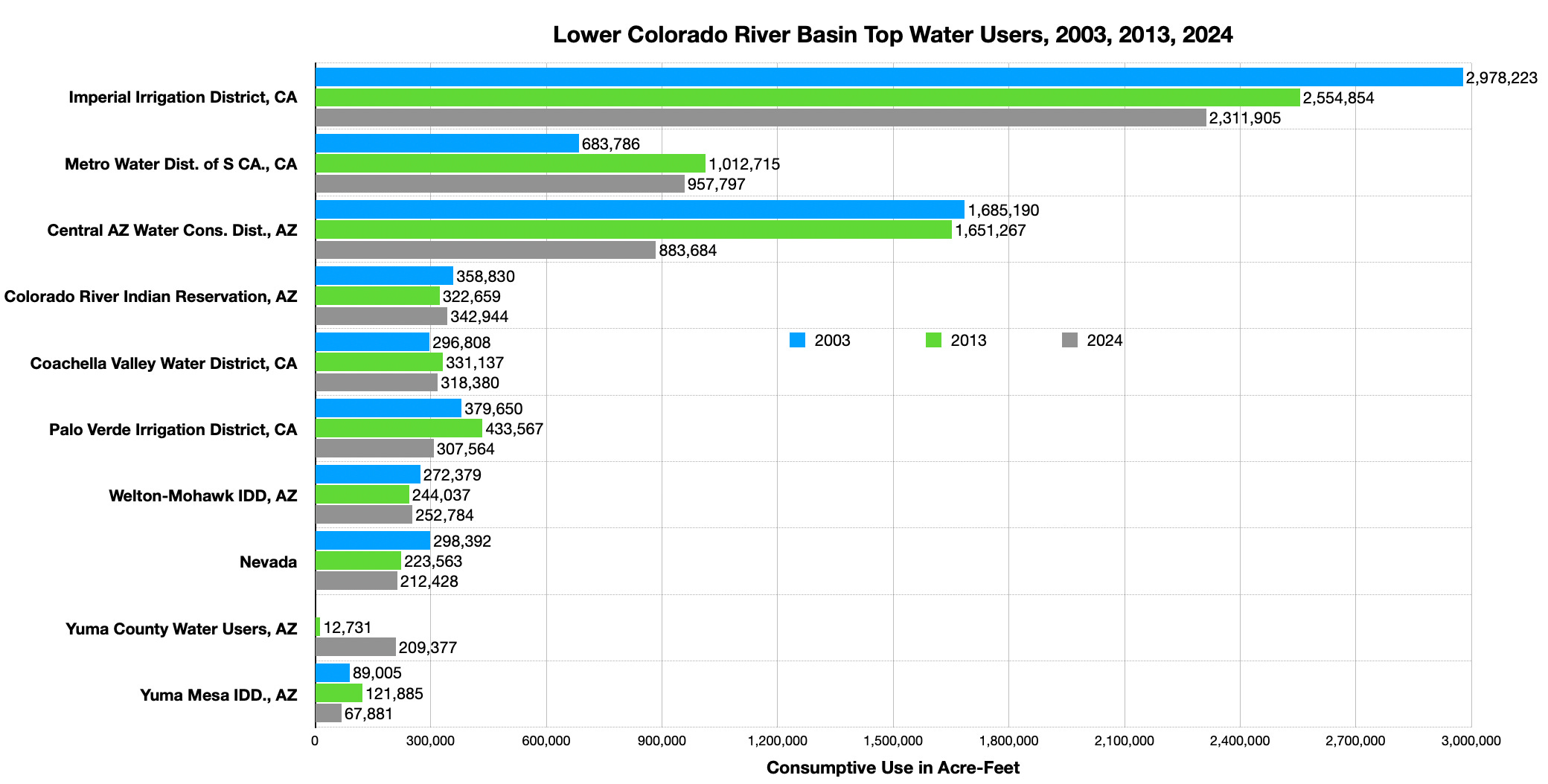
In March, the Trump administration announced it would eliminate California’s Chuckwalla and Sáttítla Highlands national monuments before removing language from a White House fact sheet announcing that decision. The following month, The Washington Post reported that the administration was considering downsizing or eliminating six national monuments, and in June, the U.S. Department of Justice issued an opinion that the president has the power to rescind national monument designations, backtracking on a decades-old determination on the matter.

Stone and evening light, Bears Ears National Monument, Utah. Jonathan P. Thompson photo.

During Trump’s last term, Bears Ears and Grand Staircase-Escalante national monuments, established by the Obama and Clinton administrations, respectively, were shrunk to fractions of their original sizes, but they were restored by President Joe Biden after he took office.

If national monuments are downsized or eliminated, the areas surrounding a waterway will lose protections from extractive industries, including oil and gas drilling, mining and grazing. Contamination from those industries could seep into streams and, in turn, rivers. Those industries also use water, sometimes vast amounts in arid regions, further reducing the supply that flows to nearby communities. (In certain cases, some mining and grazing are already permitted on national monument lands, but the activities are limited in scale and more regulated than they are outside the monuments.)

“Landscapes and waterways go hand in hand,” said Drew McConville, a senior fellow for conservation policy at the Center for American Progress and a co-author of the report. “The clean water depends on what comes into them from natural lands … Just protecting the wet stuff itself doesn’t guarantee that you’re keeping [water] clean and durable.”

The portion of historically marginalized communities living within the watersheds of the national monuments is greater than the average for watersheds nationally, it found. Twenty-three of the monuments studied are also found in regions expected to face water shortages due to climate change in the coming decades, making the arid regions downstream even drier.

Grand Staircase-Escalante National Monument, for example, protects 2,517 miles of waterways, according to the analysis, and nearly 90% of the watersheds within the monument are expected to see declines in their water levels. The monument straddles the Upper and Lower Colorado River Basins, with the Paria and Escalante rivers flowing within its boundaries and Lake Powell, the nation’s second-largest reservoir, just to its south. 

The monument is often thought of as a sparse, arid region, which it is, said Jackie Grant, the executive director of Grand Staircase Escalante Partners, a nonprofit focused on protecting the monument that has spent $11 million to protect the Escalante River watershed and all its tributaries. It remains vital to the Colorado River System, which millions of people in the Southwest rely on. Grand Staircase-Escalante helps slow water from the Paunsaugunt Plateau in Bryce Canyon National Park, much of which starts as snowpack in the park before melting and flowing downstream. 

“People don’t think of water when they think of Grand Staircase-Escalante National Monument,” Grant said. “So when we can bring this view of water and how important it is to the protection of the monument, it helps us put another building block in our case for supporting the monument, because not only is it important for the animals, the native plants, the geology and the paleontology, water plays a huge role in the monument, and the monument protects the water itself.”

The Antiquities Act of 1906 was signed into law by Theodore Roosevelt, for “… the protection of objects of historic and scientific interest” through the designation of national monuments by the President and Congress. National monuments are one of the types of specially-designated areas that make up the BLM’s National Conservation Lands. Some of the earliest national monuments included Devils Tower, the Grand Canyon, and Death Valley. They were initially protected by the War Department, then later by the National Park Service. More recently, the BLM and other Federal agencies have retained stewardship responsibilities for national monuments on public lands. In fact, the BLM manages more acres of national monuments in the continental U. S. than any other agency. This includes the largest land-based national monument, the Grand Staircase-Escalante National Monument in Utah featured here. National monuments under the BLM’s stewardship have yielded numerous scientific discoveries, ranging from fossils of previously unknown dinosaurs to new theories about prehistoric cultures. They provide places to view some of America’s darkest night skies, most unique wildlife, and treasured archaeological resources. In total, twenty BLM-managed national monuments, covering over five million acres, are found throughout the western U. S. and offer endless opportunities for discovery. Photos and description by Bob Wick, BLM.

Stretching across 1.87 million acres of public land, Grand Staircase-Escalante National Monument is one of the country’s most expansive national monuments, protecting scores of wildlife as well as archeological resources in southern Utah. But a nine-billion-ton coal deposit is buried in the center of the monument along with deposits of minerals, including uranium and nickel. The Trump administration has long touted boosting the country’s coal production, and has established a pro-mining agenda this year.

“It’d be very easy to contaminate either one of those rivers if mining were to take place in the center section of the monument,” Grant said. 

Margaret Walls, a senior fellow at Resources for the Future who has studied national monuments but was not part of this study, said national monuments are designated to protect cultural or historical landmarks, and it can be forgotten that they can also serve purposes like safeguarding water. Though she noted that even if monument protections are loosened, the areas remain federal lands, and their changes in status do not guarantee they will be developed. 

“We don’t protect waterways the way we do land,” Walls said, “we’re going to get those water benefits by protecting the land.”

Created by Imgur user Fejetlenfej , a geographer and GIS analyst with a ‘lifelong passion for beautiful maps.’ It highlights the massive expanse of river basins across the country – in particular, those which feed the Mississippi River, in pink.

The latest Intermountain West briefing is hot off the presses from Western Water Assessment

Click the link to read the briefing on the Western Water Assessment website:

December 8, 2025 – CO, UT, WY

A hot and dry November left the Intermountain West with much below average snowpack conditions. November temperatures were four degrees above average region-wide and much of Utah and Wyoming baked under mean temperatures that were six to ten degrees above average. High temperatures coupled with mostly below normal precipitation caused low snow water equivalent (SWE) and worsening drought conditions.

November precipitation was much below average for much of the region, especially in Wyoming, northern Colorado and northern Utah, which received less than half of normal precipitation. Much above average November precipitation was observed in southern Utah and eastern Colorado. Record dry Novembers were observed at thirteen locations in Wyoming, ten locations in Colorado and five locations in Utah. Despite dry November conditions, regional water year precipitation is near to above average except for eastern Colorado and southeastern Wyoming.

November was an extremely warm month, especially in western Wyoming, where monthly temperatures were more than eight degrees above average. The entire region observed November temperatures that were at least four degrees above average, with all of Utah, nearly all of Wyoming and western Colorado experiencing temperatures that exceeded six degrees above average. Record warm October conditions were observed in western Colorado, southwestern Wyoming and throughout Utah.

Record low SWE conditions exist at many locations in Colorado, Utah and Wyoming. A hot and dry November left most regional river basins with SWE conditions at less than 50% of average, with the least snow in the Six Creeks near Salt Lake City, where December 1st SWE is 22% of median. Slightly better SWE conditions exist in southern Colorado and southern Utah.

Regional drought coverage expanded slightly during November, increasing from 51% five weeks ago to 54% on December 2. Eastern Colorado and eastern Wyoming remain drought-free, but drought emerged along the northern Front Range and adjacent plains. Coverage of drought in Utah dropped below 100% for the first time in five months. Utah and Colorado were last free from drought six years ago, while the current drought in Wyoming began five years ago.

West Drought Monitor map December 2, 2025.

A NOAA La Niña Advisory is still in effect as eastern Pacific Ocean temperatures are below average. Weak La Niña conditions are expected to transition (60% probability) to neutral conditions by early 2026. The NOAA December Precipitation Outlook suggests above average precipitation for most of Wyoming. For the winter months (Dec-Feb), there is an increased probability for above average temperatures in Utah and southwestern Colorado. In Wyoming, there is an increased probability for above average precipitation and below average temperatures.

Record high temperatures drive record low snowpack. On December 1, record low SWE conditions were present at 52 regional Snotel sites in northern Colorado, northern Utah, and across Wyoming. Despite very low snowpack conditions, water year precipitation is above average for the region, except in northern Colorado. During early October, daily precipitation records were set in Utah and Colorado, including widespread flooding in southwest Colorado. Due to the tropical origin of those storms, nearly all precipitation fell as rain. Contrasting precipitation, water year temperatures are much above average with record high temperatures observed in parts of western Colorado, eastern Utah, and southwestern Wyoming. Consequently, the current snow drought is primarily the result of high temperatures rather than low precipitation. While October precipitation generally fell as rain in regional mountains, above average precipitation has increased soil moisture, which could help to bolster the efficiency of runoff in 2026.

Romancing the River: Why am I ‘Romancing’ It? — George Sibley (SibleysRivers.com) #ColoradoRiver #COriver #aridification

The Demilitarized Zone between the two Koreas – it’s not quite this bad between the two Colorado River Basins.

Click the link to read the article on the Sibley’s Rivers website (George Sibley:

December 2, 2025

Negotiations among the Magnificent Seven representing the seven states of the Colorado River region begin to resemble the ongoing negotiations between the military and diplomatic representatives for North and South Korea, where negotiations for something beyond an armistice have been going on for more than sixty years. Here, as there, the negotiations have reached a stalemate, and both sides are now engaged in an information war. Between the two Koreas, this war takes the form of everything from huge arrays of speakers blasting pop music across the demilitarized zone to smuggled USB drives with movies and TV shows. Here, it is mostly just propaganda bombs tossed over our ‘DMZ,’ the Grand Canyons, about each side’s virtue and the other side’s obstinacy, depending on their regional media’s love of conflict and tendency to support the home team. The missed November deadline has been seamlessly replaced – as we all suspected it would be – by a February deadline. But otherwise – nothing new on that front. We can just hope it doesn’t go on for another fortysome years.

So I’m going to take advantage of the stalemate to ask the reader to think about a bigger picture that may be more interesting. It stems from a comment from my partner Maryo, from whom I learn too much to dismiss anything she says. ‘Why are you “romancing the river”?’ she asked the other day. ‘Romance is such a cheapened concept today – bodice-ripping stories of ridiculous antagonistic love. You’re undermining the value of your work, calling it a “romance.”’

‘Well,’ I said – figuring that if she feels that way, maybe my readers raise the same question – ‘maybe one of the things a writer ought to try to do is restore the value of words and the concepts they once represented that have become devalued through misuse.’ Spoken like a true Don Quixote, another old man who took arms, sort of, against abuse of the concept of ‘romance.’

I do think that one of the things that ‘civilization’ does in civilizing us is to simplify things for us, including words whose complexity and depth embrace concepts, ideas and feelings that can be inconvenient to an orderly civilized society. A  ‘romance,’ from the medieval era on into the early 20th century, was a story of an adventure in pursuit of something mysterious, exciting, challenging, something beyond everyday life. That could be the pursuit of a love relationship that was life-changing (and maybe life-endangering) for its participants – Tristan and Isolde, Launcelot and Guinevere, Romeo and Juliet, Bonnie and Clyde.

But on a much larger scale, the romantic adventure can be establishing a relationship with anything outside of ourselves that intrigues or challenges us. The relationship can emerge with a place, a house, a horse, a car, a continent, a river, an idea, as well as another person, anything that intrigues us, wakes up our imagination – arational or prerational relationships that make the civilizing forces nervous. The relationship can run the quick dynamic spectrum from arational love to its flip side arational hate, through all the intermediary love-hate variations. It can also have a mythically selective or even creative attitude toward the gray-zone relationship between ‘truth’ and fact. Which leads those trying to develop an orderly civilization to dismiss anything (ad)venturing into the mythic as a lie. It just seems simpler that way.

The Powell survey on its second trip down the Colorado River, 1871. Photo credit: USGS

The first comprehensive study of the Colorado River region was uncivilized enough to state upfront its romantic origins: Frederick Dellenbaugh’s Romance of the Colorado River. Dellenbaugh’s book (available online for a pittance) delved as deeply as was possible at that time into both the First People prehistory in the region and the early history of the Euro-American invasion, from the Spanish trying to work their way up the river from its contentious confluence with the Gulf of California (‘Sea of Cortez’ to them) to the trappers imposing the first major Euro-American change on the river, stripping its tributaries of their beavers which increased the size and violence of the river’s annual spring-summer runoff of snowmelt. But the heart of the book is John Wesley Powell’s explorations to link the upper river and the lower river through its canyons.

Dellenbaugh, as a seventeen-year-old, accompanied Powell on his second Colorado River expedition, a ‘baptism under water’ (often literally) that shaped his ‘romantic’ vision. In his ‘Introduction,’ after observing that most of the great rivers that humans encountered in exploration and settlement gradually became like foster parents to those who settled along them, carrying goods for them and generally watering and growing their settlements, he says of the Colorado:

Dellenbaugh’s Romance was published in 1903. That same year, another great southwestern writer, Mary Hunter Austin came out with her Land of Little Rain, a fascinating collection of her explorations in the deserts of the lower Colorado River region. In that book she offered what might be a cautionary note about ‘romancing the river,’ in an observation about a small Arizona tributary of the Colorado River, ‘the fabled Hassayampa… of whose waters, if any drink, they can no more see fact as naked fact, but all radiant with the color of romance.’

I will now indulge my tendency to take a ‘tectonic’ look at history – looking for large chunks colliding or grating together or subducting under each other. I see the history of our engagement with the Colorado River dividing into three ‘tectonic romances’:  first, the Romance of Exploration, which is chronicled in a couple different ways by those two explorers, Dellenbaugh and Austin; their 1903 publications summarize that age and put a semi-colon at the end of the period, as it were.

Second, the Romance of Reclamation: 1903 also marks the year the U.S. Reclamation Service came into being, an organization created almost specifically for settling the Colorado River deserts. Civilized people on both sides of the question would deny that there was any ‘romance’ to reclamation, but one early Bureau engineer would publicly disagree, writing in 1918 about ‘the romance of reclamation’:

C.J. Blanchard of the U.S. Reclamation Service authored that steaming verdure. The Service at that time was under the U.S. Geological Survey, a scientific organization disciplined to the ‘look before you leap’ methods of science, discerning the reality of a situation and adapting to that; but the Reclamation Service, frustrated by the seasonal flood-to-trickle flows of the Colorado, thought that changing that reality (through storage and redistribution) was a more promising route than adapting to it, and so was on its way to becoming independent of the USGS when Blanchard wrote his ‘romance of irrigation’ for an educational journal called The Mentor(thanks, Dave Primus, for calling it to my attention).

Members of the Colorado River Commission, in Santa Fe in 1922, after signing the Colorado River Compact. From left, W. S. Norviel (Arizona), Delph E. Carpenter (Colorado), Herbert Hoover (Secretary of Commerce and Chairman of Commission), R. E. Caldwell (Utah), Clarence C. Stetson (Executive Secretary of Commission), Stephen B. Davis, Jr. (New Mexico), Frank C. Emerson (Wyoming), W. F. McClure (California), and James G. Scrugham (Nevada)
CREDIT: COLORADO STATE UNIVERSITY WATER RESOURCES ARCHIVE via Aspen Journalism

The best-known document of the Romance of Reclamation was of course the Colorado River Compact – a document in which the romance of reclamation overrode any relationship to ‘naked fact’ about the river and its flows, a situation that is now biting our collective ass. Yet an Arizona water maven said recently that any Bureau of Reclamation solution to the seven-state impasse would have to cleave closely to the Compact…. The history of the Romance of Reclamation has been written in the gaggle of Congressional acts, court decisions, treaties, regulations and directives that make up the ‘Law of the River’ (recitations of which never seem to include the 1908 Winters Doctrine allocating assumed water to federal reservations, including to the First Peoples).

The end of the Romance of Reclamation would be in the 1960s, pick your date: publication of Rachel Carson’s Silent Spring in 1962, passage of the Wilderness Act in 1964, passage of the Environmental Policy Act in 1969 – a decade in which the general American perception of the West underwent a sea change, from seeing it as a workplace for producing the resources to feed the American people and industries, to seeing it as a great natural playground to which America’s predominantly urban population could go to recharge, with a resulting desire to protect it from the very industrial consumption that supported the American ‘lifestyle.’.
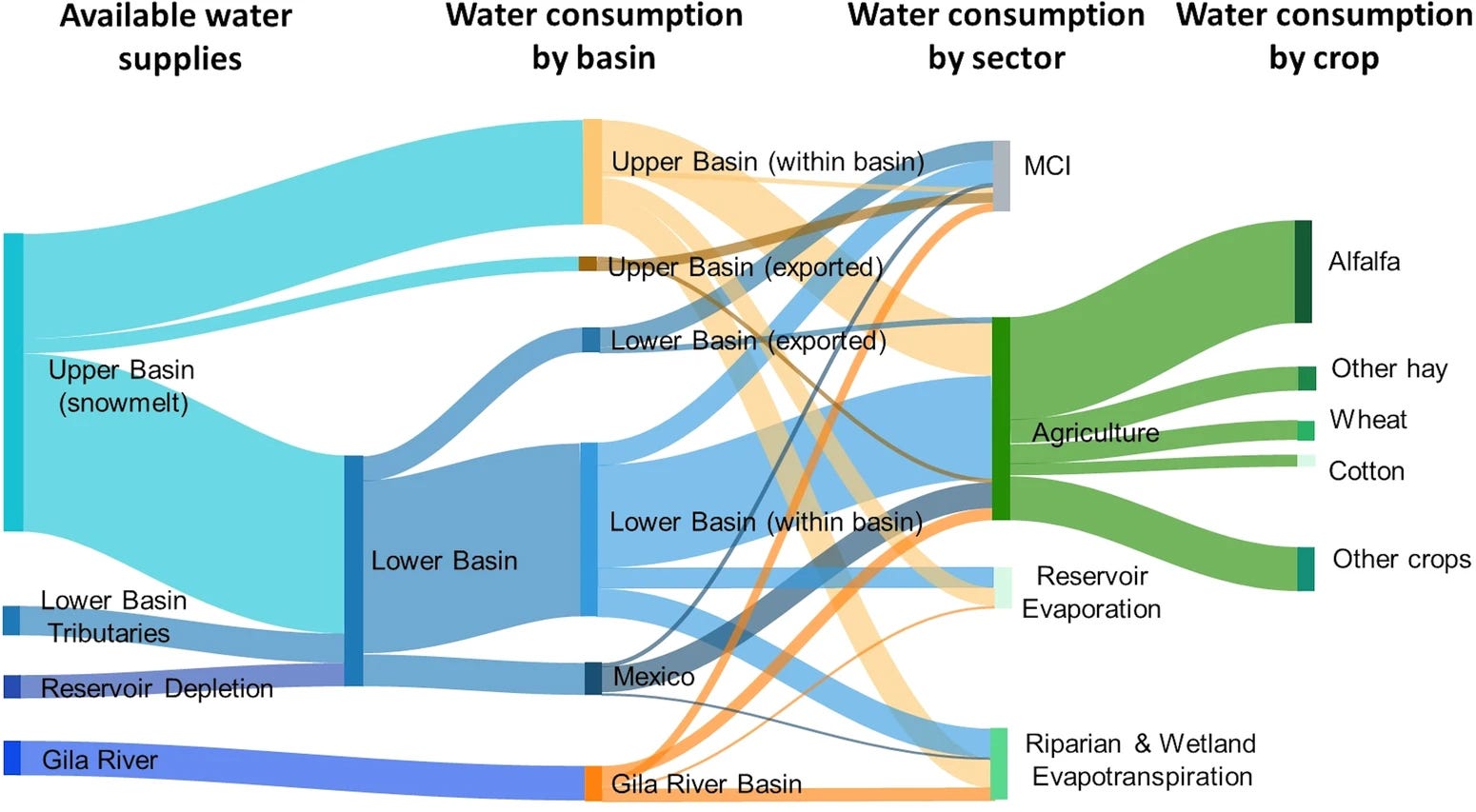
This was the dawn of the third romantic epoch in our relationship with the river (and the continent in general) – the Romance of Restoration and Revision, driven by a belief that we have sinned against capital-N Nature – with many naked facts as evidence – and can only expiate our sins by preserving what remains of the nonhuman environment, restoring what we can of the damage we’ve done, and revising our own systems for consuming nature (e.g., renewable energy).

Aesthetics are at the root of our romance with capital-N Nature, aesthetics best served by the (increasingly rare) opportunity to be alone with and ‘silent on a peak in Darien,’ as Keats put it. We have a large (and growing) number of excellent writer[s] who work to elaborate on that aesthetic – Ed Abbey first, Craig Childs, Heather Hansman, Kevin Fedarko, to name a few.

But the aesthetic yearning to ultimately ‘put it back the way it was’ does not extend to other equally naked facts, like the dependence of the outdoor recreation industries on the creation of big mountain-highway traffic jams pumping big quantities of carbon and nitrogen gases into the already overladen atmosphere, as we all load up our cars with expensive gear to go off to commune with Nature. Or the naked fact that maintaining civilization-as-we-know-it for 300 million people involves a lot of nonrewable extraction from Nature that it will be very difficult to move away from entirely – unless we figure out how to control our breeding.

Just as significant achievements were achieved under the Romance of Reclamation, so significant achievements have been achieved under the Romance of Restoration and Revision – the setting aside of millions of acres of still-sort-of-wild land, instream flow laws, increasingly responsible forest management, et cetera. But we are clearly still in the early transition – half a century later – to a more realistic romance with restoring and revising to a kinder gentler relationship with the nonhuman systems of nature. And right now, we  are experiencing a major counter-attack from the societal forces whose aesthetics still imagine a ‘working landscape’ of derricks, mines and other industrial-scale harvests, all suffused with the ‘smell of money,’ societal forces that believe the best of times were before we woke up to the increasingly fragile finitude of our planet under the burden of us. Let’s all go back and make America great again!

The back of Glen Canyon Dam circa 1964, not long after the reservoir had begun filling up. Here the water level is above dead pool, meaning water can be released via the river outlets, but it is below minimum power pool, so water cannot yet enter the penstocks to generate electricity. Bureau of Reclamation photo. Annotations: Jonathan P. Thompson

I cannot now imagine when and how this third epoch of our romance with the river will end. I think this aesthetic romance might peak with the ‘breaching’ of Glen Canyon Dam, an action that has taken on a somewhat mythic quality for today’s river romantics. I don’t think we will tear it down – let it stand as a monument to…something. But I suspect that even the Bureau of Reclamation is exploring some way of tunneling around it at river level, as we continue to flirt with the disaster of dead pool behind the dam. It will not be easy, due to the silt already piled up at the dam – but really, nothing is going to be easy anymore; that blessed civilization is now in the rear-view mirror.

I’m going to take advantage of the lull in the short-term news about the river’s management for maybe the next decade, to take a look at each of these three epochs of ‘romancing the river’ and their relationship to the ‘naked facts’ of the river – mostly see if there might be something there we’ve overlooked that might help us move forward in our ever-emerging relationship of this ‘First River of the Anthropocene.’ Onward and outward.

Map of the Colorado River drainage basin, created using USGS data. By Shannon1 Creative Commons Attribution-Share Alike 4.0

Federal money is still in President Trump’s limbo. Rural #Utah is antsy about its water projects — KUER

Price, Utah Main Street and historic theater. By Millman5429 – Own work, CC BY-SA 4.0, https://commons.wikimedia.org/w/index.php?curid=122348071

Click the link to read the article on the KUER website (David Condos). Here’s an excerpt:

December 3, 2025

Price Mayor Michael Kourianos drew an imaginary line in the air between two scrubby desert hills. His hand traced the path of a planned 100-foot dam for a new reservoir just north of the city in Carbon County. The project, which Kourianos described as vital to the area’s future, would provide irrigation to farmers and shore up the city’s water supply. It’s a big deal in a drought-prone area, and it could be built within five years, he said — if the federal funding that’s supposed to pay for it doesn’t disappear.

“I’m very much worried about that,” Kourianos said. “That could be at risk. That’s the unknown.”

To finish the project’s environmental impact study by next spring, he said the city and county had to scrape together about $215,000. That was after they were told there were no more federal funds to help with it due to the Trump administration’s recent cuts. The next step will be designing the reservoir, which he said is supposed to be paid for by the Natural Resources Conservation Service, part of the U.S. Department of Agriculture. The agency is set to pay 75% of construction costs, too. In all, the project will cost around $200 million. For a city of 8,216 people, that’s just not in the budget…

Price’s reservoir isn’t the only one threatened. In January, for example, the Biden administration awarded more than $70 million to 10 proposals in Utah and another $50 million to four on the Navajo Nation and Ute tribal land within the state’s watersheds. The projects range from improving wetland habitat for endangered fish to removing invasive plants, such as Russian olive trees, from riverbanks. It was part of a $388.3 million effort to improve drought resilience across the Colorado River Basin with money from the Inflation Reduction Act. Just a few days after the money was awarded, however, President Donald Trump took office and paused it. Several months later, recipients are still waiting…One of the impacted proposals is a collaboration between the Utah Division of Wildlife Resources and conservation organizations Trout Unlimited and The Nature Conservancy that would pay people to voluntarily leave water in the Price River rather than use it.

Utah Rivers map via Geology.com

State ramps up water measurement on Western Slope: Grant program will fund measuring devices as state anticipates compact administration, further scarcity — Heather Sackett (AspenJournalism.org)

This Parshall flume measures the water in the Alfalfa Ditch on Surface Creek near Cedaredge. The Colorado Division of Water Resources estimates there are 2,800 diversions of more than 1 cfs without measuring devices across the Western Slope. CREDIT: HEATHER SACKETT/ASPEN JOURNALISM

Click the link to read the article on the Aspen Journalism website (Heather Sackett):

December 5, 2025

The state of Colorado is ramping up an effort to measure water use on the Western Slope, developing rules and standards and rolling out a grant program to help water users pay for diversion measurement devices.

With input from water users, officials from the Colorado Division of Water Resources are creating technical guidance for each of the four major Western Slope river basins on how agricultural water users should measure the water they take from streams. The state is now doling out $7 million from the U.S. Bureau of Reclamation to eligible water users with faulty or missing devices to install structures such as flumes, weirs and pumps at their point of diversion. 

Map of the Gunnison River drainage basin in Colorado, USA. Made using public domain USGS data. By Shannon1 – Own work, CC BY-SA 4.0, https://commons.wikimedia.org/w/index.php?curid=69257550
Colorado River Basin in Colorado via the Colorado Geological Survey
Yampa River Basin via Wikimedia.
San Juan River Basin. Graphic credit Wikipedia.
Dolores River watershed
White River Basin. By Shannon1 – Own work, CC BY-SA 4.0, https://commons.wikimedia.org/w/index.php?curid=69281367
Green River Basin

Twenty-five percent of the funding is earmarked for each of the four river basins: Gunnison (Division 4); Colorado River mainstem (Division 5); Yampa-White-Green (Division 6); and San Juan-Dolores (Division 7). The first round of funding will go to Divisions 6 and 7, and applications close at the end of January. The goal is to have all the projects complete by 2029.

Measurement rules for Divisions 6 and 7 have been finalized and are in effect; rules for Division 4 are in the draft phase, and state officials are accepting comments until Dec. 19 on the draft rules in Division 5.

With thousands of diversions from small tributaries across rural, remote and mountainous areas, figuring out precisely how much water is used in Colorado has historically been challenging. According to state officials, there are about 2,800 diversions of more than 1 cubic foot per second from Western Slope rivers and streams that are not currently being measured. Historically, the state has required measuring devices on only diversions that have been involved in calls. When a downstream senior water rights holder is not getting the full amount of water they are entitled to, they can place a “call,” which forces junior upstream water users to cut back.

This Parshall flume measuring device is being installed on a ditch on Morrisania Mesa near Parachute. The state of Colorado has $7 million in federal funds to distribute to water users to install measuring devices on their diversions from waterways. CREDIT: HEATHER SACKETT/ASPEN JOURNALISM

Compact compliance

The push for more-accurate measurement comes at a time when there is increasing competition for dwindling water supplies, as well as growing pressure on the Colorado River’s Upper Basin states (Colorado, New Mexico, Utah and Wyoming) to conserve water. Whether through forced cuts under the terms of the 1922 Colorado River Compact or through a voluntary conservation program that pays water users to cut back, the state will almost certainly face future cuts to its water use.   

According to Jason Ullmann, who is the state engineer and director of the division of water resources, accurate and consistent water measurement is a prerequisite for making basinwide cuts related to the compact.

“While we’ve always been in compliance with the [1922 Colorado River] compact, we haven’t had to do a West Slope-wide administration,” Ullmann said. “We just don’t want to be in the position of having to do that on an emergency basis. We want to be proactive and provide people consistent and reliable standards for what we expect and work with them to get to a point where we do have that more accurate measurement network before that happens.”

Although the Colorado River Compact splits the river’s water evenly between the Upper Basin and the Lower Basin (California, Arizona and Nevada) with 7.5 million acre-feet each annually, the agreement says nothing about what happens when there’s not enough water to meet these allocations. A “compact call” is a theoretical legal concept, whose definition is hotly debated among water managers. 

One way it could play out is that the Upper Basin states would have to cut off some water users in order to send enough water downstream to meet their obligations to the Lower Basin. If that happens, Colorado would need a plan for who gets cut off first. Under the strict application water law known as prior appropriation, the oldest water rights get first use of rivers and junior water rights are the first to be cut. 

Michael Cohen, a senior fellow at the Pacific Institute, where he has written about the uncertainties of water use and measurement in the Upper Basin, said collecting better data will help water managers figure out where cuts should come from.

“Moving forward, it looks more and more likely that there’s going to be some kind of compact call,” Cohen said. “Then the state of Colorado, as well as the other Upper Basin states, need to figure out how they’re going to enforce that kind of call.”

This Parshall flume was installed in the Yampa River basin in 2020 and replaced the old rusty flume seen in the background. The state of Colorado is working toward creating measurement rules and installing measurement devices across the Western Slope. CREDIT: HEATHER SACKETT/ASPEN JOURNALISM

Managing scarcity

But compact compliance is not the only reason that water measurement is needed. Scientists have shown that climate change has contributed to a 20% decline in flows from the 20th century average, and that every 1 degree Celsius of warming results in a 9% reduction in flows. The combination of climate change and a historic drought means that rivers that had never before experienced shortages or calls have started experiencing them in recent years. In the past few years, the Yampa and White rivers, in the northwest corner of the state, have had first-ever calls and have been designated “over-appropriated,” meaning there’s more water demand than supply at certain times. 

“Even if you toss the compact situation out, it’s just the practical reality that we’re seeing less snowpack and we have more calls,” Ullmann said. “We’re just in need of improving that measurement accuracy because of the need for administration.”

John Cyran, an attorney who worked on developing the measurement rules for the South Platte River basin and is now a senior attorney with the Healthy Rivers department of Boulder-based environmental group Western Resource Advocates, uses the analogy of a pizza party with too-few pizzas where hungry partygoers are allowed only two slices each to illustrate how measurement is needed in times of scarcity. 

“Just like sharing a shrinking pizza or Thanksgiving pie, our water supply is declining,” Cyran said. “The pie is getting smaller. So it is increasingly important to make sure that people don’t take more than their share. But we can’t manage what we don’t measure.”

Tightening up water measurement across the Western Slope could also help Upper Basin water managers as they grapple with a future conservation program that pays water users to cut back and then stores that water in a pool in Lake Powell. A criticism of past pilot programs was that the saved water was not tracked to Lake Powell. Water users downstream of a conservation project could pick up the extra water, with no guarantee that any of it reached the reservoir. Measurement rules and devices could help ensure that this conserved water is “shepherded” to Lake Powell.

Measurement is the first step toward management of a scarce public resource, Cyran said.

“The first step is measuring how much water is being diverted,” Cyran said. “The next step is management – making sure that folks only divert their share and that water we conserve stays in the stream and is not diverted by another user.”

Colorado River Basin map via the Babbit Center for Land and Water Policy/Lincoln Institute of Land Policy

A weird water year so far: Abundant rain, sparse snow: Plus: National park shenanigans in #Utah — Jonathan P. Thompson (LandDesk.org) #snowpack

The drought situation has improved markedly in the Southwest since the end of the last water year, especially in the Four Corners area. Source: National Drought Monitor.

Click the link to read the article on The Land Desk website (Jonathan P. Thompson):

December 2, 2025

⛈️ Wacky Weather Watch⚡️

We are now two months into the water year — and a couple of days into meteorological winter — and so far both are pretty weird. On the one hand, much of the West is covered by one of the scantest snowpacks for early December in decades. On the other, it’s also been one of the wettest beginnings to the water year in recent memory.

Graph of 2026 water year snowpack levels for the Animas River watershed (which this year reflects that for most of western Colorado and the Upper Colorado River Basin), along with every year since 2000 that has started as sparsely or more so than this year. Note that the 2008 snowpack in the Animas was just as meagre in early December as it is this year. Then the snows came with a vengeance, leading to one of the biggest winters on record as well as a very healthy spring runoff that lasted well into July.
While snow levels are paltry, the weather gods have delivered plenty of precipitation to the region. While that has helped ease drought conditions, it is no substitute for a healthy snowpack.

Adding to the uncanniness has been the wave of generous storms that have dumped up to a foot of snow on Colorado ski areas and snarled traffic, leading to at least two multi-car pileups on I-70 and shutting down other arteries — yet still failing to bring snowpack levels to anywhere near “normal.”

It’s a big ol’ mixed bag, in other words. The big October deluges eased the drought in much of the region, but the warm temperatures and snow drought don’t bode well for next spring’s runoff. Meagre early winter snowpacks can make and have made dramatic comebacks (e.g. water year 2008 in southwestern Colorado), and another storm is moving into the region as I write this, yet the National Weather Service’s is predicting an abnormally warm and dry winter for much of the Southwest.


🌵 Public Lands 🌲

The Grand County commissioners’ “Access and Capacity Enhancement Alternative” plan aimed at increasing visitation at Arches National Park was just the tip of an iceberg, it seems. Yesterday (Dec. 1), Commissioner Brian Martinez presented the plan to a group of state and federal officials at a closed State of Utah and National Park Service Workshop in Salt Lake City.


Moab seeks bigger crowds? — Jonathan P. Thompson


The meeting’s purpose, according to the official agenda, is:

This may sound fairly innocuous (and maybe it is). But given some of the players, it may also be the latest volley in Utah’s long-running effort to seize control of public lands. The meeting was run by the Interior Department’s associate deputy secretary, Karen Budd-Falen, and Redge Johnson, who leads Utah’s Public Lands Policy Coordinating Office.

Budd-Falen built her legal career on fighting federal agencies, including the Interior Department, and was part of the Sagebrush Rebellion and the Wise Use movements that endeavored to turn federal land over to states and counties and to weaken regulations on the extractive industries. Johnson, meanwhile, was a driving force behind the state’s effort to take control of 18.5 million acres of Bureau of Land Management land in the state.


A Sagebrush Rebel returns to Interior — Jonathan P. Thompson

An anti-BLM sticker (referring, presumably, to the federal land agency, not the Black Lives Matter movement) at another Phil Lyman rally against “federal overreach” and motorized travel closures in southeastern Utah back in 2014. Photo credit: Jonathan P. Thompson/The Land Desk

It’s not clear what is meant when they say the meeting is aimed at achieving Trump’s agenda. As far as national parks go, the administration has been rather chaotic: Freezing hiring, laying off thousands of staff (only to rehire some of them), slashing budgets, and allowing visitors to run roughshod over the parks during the government shutdown.

It sure looks like they are trying to cause the parks to fail, which would give them an excuse to further privatize their functions. Private for-profit corporations already run the lodges, campgrounds, and other services inside many parks. That’s why, during the shutdown, concessionaire-run campgrounds within parks continued to operate, while all of the government-run functions, such as entrance-fee-collection, were shuttered. In this way a false contrast was created between the functional privately-run operations and the dysfunctional public ones; visitors during that time would be excused for preferring the former.

The timing of this meeting, purportedly to receive input from gateway communities, is kind of odd. I have to wonder whether the Interior Department consulted local elected officials before raising entry fees for foreign visitors to $100 at Zion and Bryce Canyon National Parks in Utah, along with Grand Canyon, Acadia, Everglades, Glacier, Grand Teton, Rocky Mountain, Sequoia & Kings Canyon, Yellowstone, and Yosemite National Parks.

The Southwest’s tourism industry is highly reliant on international visitors. Visitation from abroad is already down, thanks mostly to the Trump administration’s “America First” creed and its general hostility to the rest of the world. Singling out foreign travelers for these higher fees — even if only at the most popular parks — is likely to dampen visitation from abroad even more, which will ripple through Western economies.

Grand County’s bid to cram even more visitors into Arches National Park won’t be too effective if would be visitors don’t even make it to the United States …


🗺️ Messing with Maps 🧭

This is just another old map that caught my attention, in part because it’s a reminder of how extensive the railroad network was, even in the rugged parts of Colorado, back in the late 1800s and early 1900s. This one shows the Denver & Rio Grande rail lines in 1893.

Autumn Rains Delay Basin-wide Reservoir Depletion — Jack Schmidt (Center for #ColoradoRiver Studies) #COriver #aridification

Click the link to read the article on the Center for Colorado River Studies website (Jack Schmidt):

In Brief
Unusually wet conditions in the Basin in October and November 2025, combined with reduced releases from some reservoirs, led to a basin-wide increase in storage for the two-month period. The combined contents of Lake Powell and Lake Mead increased during the two months for only the second time since 2010, and storage in the San Juan River basin increased by 19%, especially in Vallecito and Navajo Reservoirs. These changes were a welcome respite from the relentless depletion of storage that has dominated the last few years. Nevertheless, the upcoming winter snow season is predicted to be below average, and total active storage in the Basin is less than a 2 year supply when compared with recent Basin-wide consumptive uses and losses.

Total precipitation (inches) from 9-15 October 2025 with gridded data from the PRISM Climate Group and observations from the Community Collaborative Rain, Hail, and Snow (CoCoRaHS) network. Credit: Russ Schumacher/Colorado Climate Center
The Details

The rains of October and November 2025 slowed depletion of the Colorado River’s reservoirs due to increases in stream flow and reduced reservoir releases in some places. Water levels rose in a few reservoirs, and autumn’s rains provided a small bit of flexibility for water managers at the beginning of what is likely to be a below-average winter snow season.

As of November 30, the Basin’s 46 reservoirs held 24.63 million af (acre feet) of active storage[1], of which 90% was in 12 federal reservoirs,[2] including 15.00 million af in Lake Powell and Lake Mead (hereafter, Powell+Mead) and 4.88 million af in 8 federal reservoirs upstream from Lake Powell (Fig.1). This amount of storage is similar to conditions in early 2022, a situation that was described at that time as a crisis. If we divide the total active storage in the Basin’s 46 reservoirs by the basin-wide total annual rate of consumptive use and loss that was 12.7 million af in 2024, the basin-wide reservoir water supply would sustain Basin-wide use for less than 2 years. We continue to live at the doorstep of crisis.

Figure 1. Graph showing active storage in Colorado River basin reservoirs between January 1, 2021, and November 30, 2025. Credit: Jack Schmidt/Center for Colorado River Studies

Basin-wide reservoir storage stabilized in October and November, because Powell+Mead storage stabilized and storage in the San Juan River basin increased. Total Inflow to Lake Powell exceeded releases for more than one week between October 11 and October 18, when Lake Powell increased by 105,000 af[3]  which is a 1.6% gain (Fig. 2). Approximately 40% of the total inflow came from the San Juan River, and the monthly October inflows were the largest since 2015. The gain in storage in Lake Powell during this weeklong period exceeded depletions during the rest of the month, and Lake Powell gained approximately 52,000 af during the month. Lake Powell lost 147,000 af in November.

Figure 2. Graph showing inflow and outflow from Lake Powell and active storage between October 1 and November 30, 2025. Total monthly flow at Lees Ferry, representing the total releases from Lake Powell, were 490,000 af in October and 501,000 af in November. Credit: Jack Schmidt/Center for Colorado River Studies

In contrast, the autumn rains did not significantly increase inflow to Lake Mead, because most of the inflows come from scheduled releases from Lake Powell. These reservoir releases were supplemented by 101,000 af of inflows downstream from Lees Ferry[4] and 8000 af from the Virgin River.[5] The most significant changes in Lake Mead occurred at the end of November when releases from Hoover Dam were significantly reduced (Fig. 3).

Figure 3. Graph showing inflow and outflow from Lake Mead and active storage between October 1 and November 30, 2025. Total monthly flow inflow of the Colorado River, representing the total releases from Lake Powell and inflows within Grand Canyon, were 574,000 af in October and 550,000 af in November. Reservoir releases from Hoover Dam were 485,000 af in October and 415,000 af in November. Withdrawals and return flows of the Southern Nevada Water Authority were not included in these data. Credit: Jack Schmidt/Center for Colorado River Studies

Together, total active storage in Powell+Mead increased by 63,000 af during October,[6] and decreased by only 38,000 af in November (Fig. 4).[7]  More significant than the gains, however, was that the the pace of reservoir depletion was significantly slowed. Storage in Powell+Mead increased by approximately 25,000 af in October and November, only the second time since 2010 that total storage in these two reservoirs increased during these two months.[8]

Figure 4. Graph showing active storage in Lake Powell, Lake Mead, and in Powell+Mead between January 1, 2023, and November 30, 2025. Credit: Jack Schmidt/Center for Colorado River Studies

Reservoir storage in the San Juan River basin increased more than in any other part of the Colorado River Basin. Five San Juan basin reservoirs increased by 197,000 af in October and November, mostly in Navajo and Vallecito Reservoirs.[9] Not much happened elsewhere, however. The 21 reservoirs of the upper Colorado River watershed lost 57,000 af during October and November, and 16 reservoirs in the Green River watershed lost 10,000 af during the same period.

  • [1] Active storage in 46 reservoirs are reported by Reclamation at https://www.usbr.gov/uc/water/hydrodata/reservoir_data/site_map.html.
  • [2] Taylor Park, Blue Mesa, Morrow Point, Crystal, Fontenelle, Flaming Gorge, Vallecito, Navajo, Lake Powell, Lake Mead, Lake Mohave, and Lake Havasu.
  • [3] Inflow to Lake Powell was computed as the sum of mean daily discharge of the Colorado River at Gypsum Canyon near Hite (gage 09328960), Dirty Devil River above Poison Springs near Hanksville (09333500), Escalante River near Escalante (09337500), and San Juan River near Bluff (09379500), as reported by the U.S. Geological Survey. Outflow from Lake Powell was computed as the mean daily discharge of the Colorado River at Lees Ferry (09380000), because stream flow is measured 15 miles downstream from the dam and includes ground-water seepage around the dam.  Lake Powell storage increased between October 10 and October 20, as reported by Reclamation.
  • [4] Inflows within Grand Canyon were calculated as the difference between measurements of the Colorado River at Lees Ferry (09380000), Colorado River above Diamond Creek near Peach Springs (09420000), and Diamond Creek nr Peach Springs (09404208).
  • [5] Virgin River below confluence Muddy River near Overton (09419530)
  • [6] Between October 1 and November 1, 2025, active storage in Lake Powell increased 52,000 af and 11,000 af in Lake Mead.
  • [7] Between November 1 and November 30, active storage in Lake Powell decreased by 147,000 af and increased by 109,000 af in Lake Mead.
  • [8] During the previous 15 years between 2010 and 2024, total storage in Powell+Mead increased by 36,000 af in 2011. During the other 14 years of that period, the median depletion of Powell+Mead was 436,000 af.
  • [9] Storage in Navajo Reservoir increased 126,000 af between October 9 and November 8 and increased by 114,000 af in October and November. Active storage in Vallecito Reservoir gained 68,000 af in October and November. At the end of November, Navajo Reservoir was 60% of its 1.65 million af capacity. Vallecito Reservoir was 77% of its 125,400 af capacity.
Map of the San Juan River, a tributary of the Colorado River, in Arizona, Colorado, New Mexico and Utah, USA. Made using USGS National Map data. By Shannon1 – Own work, CC BY-SA 4.0, https://commons.wikimedia.org/w/index.php?curid=47456307

Study: Something’s gotta give on the #RioGrande: #ClimateChange and overconsumption are drying up the Southwest’s “other” big river — Jonathan P. Thompson (LandDesk.org)

Sandhill cranes and some mallard ducks roost on a sandbar of the Rio Grande River at sunset on Jan. 22, 2025 in Albuquerque, New Mexico. Copyright Credit © WWF-US/Diana Cervantes.

Click the link to read the article on The Land Desk website (Jonathan P. Thompson):

November 21, 2025

🥵 Aridification Watch 🐫

The Colorado River and its woes tend to get all of the attention, but the Southwest’s “other” big river, the Rio Grande, is in even worse shape thanks to a combination of warming temperatures, drought, and overconsumption. That’s become starkly evident in recent years, as the river bed has tended to dry up earlier in the summer and in places where it previously had continued to carry at least some water. Now Brian Richter and his team of researchers have quantified the Rio Grande’s slow demise, and the conclusions they reach are both grim and urgent: Without immediate and substantial cuts in consumption, the river will continue to dry up — as will the farms and, ultimately, the cities that rely on it.

The Rio Grande’s problems are not new. Beginning in the late 1800s, diversions for irrigation in the San Luis Valley — which the river runs through after cascading down from its headwaters in the San Juan Mountains — sometimes left the riverbed “wholly dry,” wrote ichthyologist David Starr Jordan in 1889, “all the water being turned into these ditches. … In some valleys, as in the San Luis, in the dry season there is scarcely a drop of water in the riverbed that has not from one to ten times flowed over some field, while the beds of many considerable streams (Rio la Jara, Rio Alamosa, etc.) are filled with dry clay and dust.”


Rio Grande Streamflow Mystery: Solved? — Jonathan P. Thompson


San Luis Valley farmers gradually began irrigating with pumped groundwater, allowing them to rely less on the ditches (but causing its own problems), and the 1938 Rio Grande Compact forced them to leave more water in the river. While that kept the water flowing through northern and central New Mexico, the Rio Grande’s lower reaches still occasionally dried up.

Then, in the early 2000s, the megadrought — or perhaps permanent aridification — that still plagues the region settled in over the Southwest. [ed. emphasis mine] Snowpack levels in the river’s headwaters shrank, both due to diminishing precipitation and climate change-driven warmer temperatures, which led to runoff and streamflows 17% lower than the 20th century average, according to the new study. And yet, overall consumption has not decreased.

“In recent decades,” the authors write, “river drying has expanded to previously perennial stretches in New Mexico and the Big Bend region. Today, only 15% of the estimated natural flow of the river remains at Anzalduas, Mexico near the river’s delta at the Gulf of Mexico.” Reservoirs, the river’s savings accounts, have been severely drained to the point that they won’t be able to withstand another one or two dry winters. As farmers and other users have increasingly turned to groundwater pumping, aquifers have also been depleted. The situation is clearly unsustainable.

Something’s gotta give on the Rio Grande, and while we may be tempted to target Albuquerque’s sprawl, drying up all of the cities and power plants that rely on the river wouldn’t achieve the necessary cuts.

Source: “Overconsumption gravely threatens water security in the binational Rio Grande-Bravo basin” by Brian Richter et al.

It will come as little surprise to Western water watchers that agriculture is by far the largest water user on the Rio Grande — taking up 87% of direct human consumption — and that alfalfa and other hay crops gulp up the lion’s share, or 52%, of agriculture’s slice of the river pie. This isn’t necessarily because alfalfa and other hays are thirstier than other crops, but because they are so prevalent, covering about 433,000 acres over the entire basin, more than four times as much acreage as cotton.

Source: Overconsumption gravely threatens water security in the binational Rio Grande-Bravo basin

This kind of math means farmers are going to have to bear the brunt of the necessary consumption cuts — either voluntarily or otherwise. In fact, they already have: Between 2000 and 2019, according to the report, Colorado lost 18% of its Rio Grande Basin farmland, New Mexico lost 28%, and the Pecos River sub-basin lost 49% (resulting in a downward trend in agricultural water consumption). Some of this loss was likely incentivized through conservation programs that pay farmers to fallow their fields. But it was also due to financial struggles.

Yet even when farmers are paid a fair price to fallow their fields there can be nasty side effects. Noxious weeds can colonize the soil and spread to neighbors’ farms, it can dry out and mobilize dust that diminishes air quality and the mountain snowpack, and it leaves holes in the cultural fabric of an agriculture-dependent community. If a field’s going to be dried up, it should at least be covered with solar panels.


Think like a watershed: Interdisciplinary thinkers look to tackle dust-on-snow — Jonathan P. Thompson


Another possibility is to switch to crops that use less water. This isn’t easy: Farmers grow alfalfa in the desert because it’s actually quite drought tolerant, doesn’t need to be replanted every year, is less labor-intensive than other crops, is marketable and ships relatively easy, and can grow in all sorts of climates, from the chilly San Luis Valley to the scorching deserts of southern Arizona.


Alfalfaphobia? Jonathan P. Thompson


Still, it can be done, as a group of farmers in the San Luis Valley are demonstrating with the Rye Resurgence Project. This effort is not only growing the grain — which uses less water than alfalfa, is good for soil health, and makes good bread and whiskey — but it is also working to create a larger market for it. While it’s only a drop in the bucket, so to speak, this is the sort of effort that, replicated many times across the region, could help balance supply and demand on the river, without putting a bunch of farmers out of business.

Photo credit: The Rye Resurgence Project

***

Oh, and about that other river? You know, the Colorado? Representatives from the seven states failed to come up with a deal on how to manage the river by the Nov. 15 deadline. The feds had mercy on them, giving them until February to sort it all out. I’m not so optimistic, but we’ll see. Personally, I think the only way this will ever work out is if the Colorado River Compact — heck, the entire Law of the River — is scrapped, and the states and the whole process is started from scratch, this time with a much better understanding of exactly how much water is in the river, and with the tribal nations having seats at the table.


⛏️ Mining Monitor ⛏️

There are a bunch of wannabe uranium mining companies out there right now, locating claims and acquiring and selling claims and touting their exploratory drilling results. But there are only a small handful of firms that are actually doing anything resembling mining. One of them is the Canada-based Anfield, which just broke ground on its Velvet-Wood uranium mine in the Lisbon Valley, even without all of the necessary state permits. 

Now Anfield says it has applied for a Colorado permit to restart its long-idle JD-8uranium mine. The mine is on one of a cluster of Department of Energy leases overlooking the Paradox Valley from its southern slopes, and was previously owned and operated by Cotter Corporation. The mine has not produced ore since at least 2006. Anfield says it will process the ore at its Shootaring Mill near Ticaboo, Utah, which has yet to get Utah’s green light.


🏠 Random Real Estate Room 🤑

Look! Affordable housing near Moab! Sure, it’s a cave, but it’s only $99,000. Oh, what’s that? $998,000? They’re selling a cave for a million buckaroos? But of course they are. To be fair, it’s not just a cave. It’s several of them, plus a trailer. Crazy stuff.

📸 Parting Shot 🎞️

A work train in the Animas River gorge just below Silverton. Jonathan P. Thompson photo.
Rio Grande and Pecos River basins. Map credit: By Kmusser – Own work, Elevation data from SRTM, drainage basin from GTOPO [1], U.S. stream from the National Atlas [2], all other features from Vector Map., CC BY-SA 3.0, https://commons.wikimedia.org/w/index.php?curid=11218868

#Drought news: Water Year 2025 Recap for the Intermountain West: Drought Persists in the Western Intermountain West; Dry Winter More Likely Amid La Niña  — NOAA #ENSO

Click the link to read the article on the NOAA website:

November 20, 2025

Key Points

  • Start of Water Year 2026: Leading up to the start of Water Year (WY) 2026, drought conditions improved across the eastern Intermountain West, but drought expanded and intensified across western areas of the region. Storage for Lake Powell and Lake Mead reached a 30-year low for the date as of October 25, 2025.
  • Water Year 2025: Precipitation was lower than average in western portions of the region, and greater than average in eastern parts of Colorado, New Mexico, and Wyoming. Much of the Intermountain West experienced warmer-than-average temperatures.
  • Water Year 2025 ImpactsHot and dry conditions led to large fires in several states. Lack of precipitation, early snowmelt, and warm spring temperatures harmed crop production and forage in many areas.
  • La Niña Winter Ahead: La Niña conditions are present and favored to continue into early winter. La Niña typically brings warmer and drier winter conditions to the southern region of the Intermountain West. A transition to El Niño-Southern Oscillation (ENSO) neutral is favored for the January-March 2026 time frame. Neutral conditions mean neither El Niño or La Niña are influencing weather patterns. 

This update is based on data available as of Thursday, November 20, at 7 a.m. MT. We acknowledge that conditions are evolving.

Conditions at the Start of Water Year 2026 

  • The start of the new water year (beginning October 1, 2025) brought intense rainstorms and flooding in parts of Utah, Arizona, New Mexico, and Colorado. However, due to warmer-than-average temperatures, combined with lower-than-average precipitation across Water Year 2025, much of the region still remains in drought, according to the U.S. Drought Monitor.
  • At the start of Water Year 2026, drought conditions were split across the Continental Divide, with no drought in much of the eastern extent of the Intermountain West region. Over Water Year 2025, drought conditions persisted or intensified across western portions of Colorado, Wyoming, and New Mexico, as well as statewide across Arizona and Utah.
  • Flaming Gorge Reservoir started Water Year 2026 at near-average storage levels, but many other reservoirs remained below average, including Lake Mead, Lake Powell, and Elephant Butte Reservoir. Greater-than-average runoff is needed to increase reservoir levels next spring.
  • Moving into winter, soil moisture levels are better than they were in November 2024, with root zone soil moisture in headwater basins for the Upper Colorado River and the Rio Grande River experiencing a mix of wetter-than-average conditions at some locations and drier than-average conditions at others, according to both SPoRT-LIS modeled data and SNOTEL station data.
  • Storage is below average for most Bureau of Reclamation–managed reservoirs in the headwaters of the Upper Colorado River Basin. As of November 18, 2025, Lake Powell is at 44% of typical storage, the lowest observed level for this date in the last 30 years.
  • Storage is also below average for Elephant Butte Reservoir in the Rio Grande Basin, at 11% of average as of November 18, 2025.
  • With La Niña conditions anticipated to persist from December to February, snowpack is more likely to be lower than average during these months. However, all La Niñas differ, and there is uncertainty around how this season will play out. La Niña conditions are expected to weaken into El Niño-Southern Oscillation (ENSO) neutral conditions from January to March 2026.

Water Year 2025 Brings a Mix of Drought Degradation and Recovery 

52-week U.S. Drought Monitor Change Map, showing where drought improved (green and blue), remained the same (gray), and intensified (yellow and orange) from October 8, 2024 to October 7, 2025. Conditions were largely split across the western and eastern sides of the region, with 1- to 4-class degradations in the west and 1- to 2-class drought recovery in the east. Source: National Drought Mitigation Center.

November 2025 Reservoir Storage Levels

Lake Powell’s storage declined over Water Year 2025. While Lake Mead’s storage at the end of Water Year 2025 was similar to Water Year 2024, both years had low reservoir levels, with storage near only 50% of average. Source: U.S. Bureau of Reclamation, Interactive Reservoir Dashboard.

Intermountain West Water Year 2025 Summary

  • Water Year 2025 (October 1, 2024–September 30, 2025) brought varied drought conditions to the Intermountain West. Drought largely worsened west of the Continental Divide and improved to the east of the Continental Divide.
  • Drought intensified and spread in Utah, Arizona, and western portions of Colorado, Wyoming, and New Mexico. Over the summer, portions of western Colorado and the southern border of Arizona and New Mexico reached Exceptional Drought (D4), according to the U.S. Drought Monitor.
  • Above-average temperatures (+ 1-3 ºF) were widespread across the region in Water Year 2025, with some isolated areas being even hotter.
  • Water year precipitation for the region was variable, with a wet-dry split along the Continental Divide. The Southwest Monsoon season was slow to start this year, but precipitation ramped up at the end of August for Colorado, Arizona, and New Mexico. Utah had a weaker than usual summer rain season, and Salt Lake City experienced its fourth driest summer on record.
    • Utah: Total water year precipitation was below average across the entire state in 2025. The driest areas were in the south-central region of the state, and in Juab and Tooele Counties in Western Utah. Water Year 2025 was among the top five driest years on record for many portions of the state.
    • Arizona: Arizona received lower-than-average precipitation. Stations in some southeastern counties measured total water year precipitation among the lowest 10% on record, with some counties recording their 5th driest water year on record. August 2025 was the 16th driest August on record for the state. Yuma County was the only area with above-average precipitation, with the 9th wettest August on record for the county.
    • Colorado: Precipitation conditions were split between western and eastern Colorado. The western side of the state saw total water year precipitation between 50-90% of average. The eastern side of the state was unusually wet. Parts of Lincoln and Kit Carson Counties received over 130% of average precipitation.
    • New Mexico: Water year precipitation followed a diagonal split across the state. Temperatures were warmer than average for two-thirds of the state, and near average in counties to the northeast. The western and southern areas were drier than average (50-80% of average), and the eastern half of the state was wetter than average (100-150%). Hidalgo, Grant, and Catron Counties experienced the driest water year conditions in the state. Meanwhile, multiple counties on the eastern side of the state received 130-150% of average precipitation.
    • Wyoming: Total water year precipitation varied across Wyoming, ranging from 50-70% of average in parts of Sweetwater County to 120-130% of average in Converse County. Much of the state received 80-100% of average precipitation.
  • April 1, 2025 snow water equivalent (SWE) was 81-96% of average for many headwater basins in the Upper Colorado, but runoff efficiency was low and yielded below-average streamflows in many reaches. The Colorado Climate Center attributed low runoff efficiency to early snowmelt and below-average spring snowfall. April 1, 2025 snowpack was much lower than average for the headwaters of the Rio Grande basin, located in southern Colorado, with SWE at ~56% of average for the basin.
  • Dry conditions and high evaporative demand led to several large fires in the Intermountain West during the 2025 fire season, including the 145,000+-acre Dragon Bravo Fire in Arizona and 137,758-acre Lee Fire in Colorado (5th largest fire in Colorado history). 

Near- to Below-Average Precipitation West of the Continental Divide

Percent of average precipitation for Water Year 2025 (October 1, 2024–September 30, 2025), compared to historical conditions from 1991-2020. Tan and brown hues indicate below-average precipitation. Green hues indicate above-average precipitation. Gray and white hues indicate near-average precipitation. Parts of eastern Colorado and New Mexico received 110-150% of average precipitation during Water Year 2025, but the western two-thirds of the region and much of Wyoming received lower than average precipitation. Source: WestWide Drought Tracker, Western Regional Climate Center. Data from PRISM.

Departure from average water year average temperature (October 1, 2024–September 30, 2025) in degrees Fahrenheit, compared to historical conditions from 1991-2020. The majority of the Intermountain West experienced higher than average temperatures (red hues), with parts of Utah hitting 3-4 ºF above average. Source: WestWide Drought Tracker, Western Regional Climate Center. Data from PRISM.

Water Year 2025 Impacts

  • High evaporative demand, warmer-than-usual temperatures, lower-than-usual precipitation, and dry soils contributed to dry fuel conditions and large fires across many parts of the Intermountain West. Across the region, earlier snowmelt and warm temperatures led to longer-than-usual fire seasons.
  • Wildfire impacts across the Intermountain West varied by state during Water Year 2025. Arizona and Colorado experienced record-breaking fires, including the 145,000+ acre Dragon Bravo Fire in Grand Canyon National Park and 137,000 acre Lee Fire–Colorado’s 5th largest wildfire on record.  Meanwhile in Wyoming, the number of wildfire incidents increased, but acres burned decreased compared to Water Year 2024.
  • By April 2025, conditions were so dry in Utah that the governor declared a drought emergency.
  • Dry conditions, early snowmelt, and warm spring temperatures negatively impacted crop production in portions of all states across the Intermountain West. Poor forage conditions likewise harmed grazing in many areas, leading to curtailed grazing seasons or herd reductions. 

La Niña Outlook

  • As of November 17, 2025, La Niña conditions are present and expected to continue through December to February, with a transition to El Niño Southern Oscillation–neutral conditions likely from January to March.
  • Every La Niña is different. For the Southwestern U.S., La Niña is typically associated with a greater statistical likelihood of warmer, drier conditions during winter months.
  • Other variables also influence winter precipitation, and not all La Niñas are associated with below-average winter precipitation in the Intermountain West.

A Weak La Niña Is Here, ENSO-Neutral Forecast Early Next Year

 Official NOAA El Niño Southern Oscillation (ENSO) Outlook, showing the probability  (percent chance) of La Niña (blue), El Niño (red), or ENSO-neutral (gray) conditions for three-month periods over the next year. Taller bars indicate a greater likelihood of occurrence, shorter bars indicate a lower likelihood of occurrence. La Niña conditions are present as of October 2025, and the official outlook favors ENSO-neutral conditions beginning in January and lasting through the remainder of the water year. Source: National Weather Service Climate Predication Center.

Additional Resources by State


Elise Osenga
University of Colorado Boulder/Cooperative Institute for Research in Environmental Sciences (CIRES), NOAA/National Integrated Drought Information System (NIDIS)

Meredith Muth
NOAA National Integrated Drought Information System (NIDIS)

Erinanne Saffell
Arizona State Climate Office, Arizona State University

Dave Simeral
Desert Research Institute, Western Regional Climate Center

Jon Meyer
Utah Climate Center, Utah State University

Paul Miller
Colorado River Basin Forecast Center, National Weather Service

Special Thanks

This Drought Status Update was issued in partnership between the National Oceanic and Atmospheric Administration (NOAA)/National Integrated Drought Information System (NIDIS) and partners across the Intermountain West. NIDIS is an interagency program within the Climate Program Office, which is part of NOAA’s Office of Oceanic and Atmospheric Research.

No quick fix for #Aspen #drought conditions — The Aspen Daily News

West Drought Monitor map November 25, 2025.

Click the link to read the article on the Aspen Daily News website (Lucy Peterson). Here’s an excerpt:

November 18, 2025

The city of Aspen’s drought response committee is recommending the city maintain a stage 2 water shortage that was declared in August. Monsoonal moisture and cooler temperatures that came since Aspen City Council activated the stage 2 restrictions have helped drought conditions, but not changed them, according to an information memo sent to city council this week. As of Nov. 6, Aspen and Pitkin County remained in severe and extreme drought categories, according to the U.S. Drought Monitor.

“Pitkin County has experienced its second driest year to date (January — September 2025) in 131 years of record with a precipitation deficit of 6.84 inches from normal,” the memo states. 

Data collected from a National Weather Service station at the city’s water treatment facility recorded 1.52 inches of rain in August and 1.89 inches of rain in September. It brought the city’s precipitation deficit to 3.43 inches. Water demand typically decreases in Aspen during the winter when irrigation systems are turned off, but it is when streams are at their lowest point in the year, according to the memo. Councilman John Doyle, a staunch supporter of water conservation, said restrictions are especially important now as ski seasons get shorter and less snow falls…The stage 2 water shortage declaration came two months after the city declared a stage 1 water shortage with a goal to cut overall water consumption by 10% within city limits. Well below-average stream flows led the city to enact the second stage of water shortage, which represents severe drought conditions…The city relies primarily on streamflow from Castle and Maroon creeks for its water supply. It depends on consistent release of water from snowmelt. The city’s stage 2 water restrictions are mandatory. Watering of any lawn, garden, landscaped area, tree, shrub or other plant is prohibited from 9 a.m. to 6 p.m. Household watering schedules are also mandatory.

Map of the Roaring Fork River drainage basin in western Colorado, USA. Made using USGS data. By Shannon1 – Own work, CC BY-SA 4.0, https://commons.wikimedia.org/w/index.php?curid=69290878

Scientists study variability in snowfall, wetter #snowpack: #Climate models show #Colorado ski season shortening by 10 days — #SteamboatSprings Pilot & Today

University of Utah graduate student Joey Bail works to remove snow from the mid-mountain instruments operated by Storm Peak Laboratory in February 2025 at Steamboat Resort. The station measures dust on snow, which can increase snow melt rates.
Storm Peak Laboratory/Courtesy photo

Click the link to read the article on the Steamboat Pilot & Today website (Suzie Romig). Here’s an excerpt:

November 22, 2025

Changing snowpack trends in the West are bringing more variability to snow conditions and more moisture to the snowpack, threatening the future number of light and fluffy powder days. Increasing variability was the predominant message from a panel of snow experts during the presentation “Stories of a Changing Snowpack” hosted by nonprofit Yampatika on Nov. 13 in Steamboat. The panel, including representatives from the Storm Peak Laboratory and Airborne Snow Observatories, presented in-depth data and answered audience questions about how changing weather and climate conditions are affecting snowfall and snowpack impact to recreation and water supplies in northwest Colorado.

“We are seeing earlier snowmelts, heavier snow, more variability,” said Atmospheric Science Professor Gannet Hallar, Ph.D., who directs the Storm Peak Lab which sits atop the Steamboat Resort.

Hallar said across the Western states, scientists are confirming decreases in snow-water equivalent, according to measurements taken April 1, increasing spring temperatures and dust — factors that cause snow to melt. She explained the snowflake formation science behind how even small increases in winter temperatures can make a large difference in snow quality…Earlier spring runoff, hydrograph changes and increased variability of snowpack creates challenges for everything from sufficient river flows for endangered fish species to the timing of reservoir releases to agricultural irrigation, Burchenal said. Hallar said dust on snow measurements and understanding how dust on snow impacts melt timing is important because some scientists have documented that a large dust storm may lead to a 10- to 14-day earlier snow melt off…Allen and Hallar discussed the value of snowmaking additives such as Snomax, made from a protein derived from a naturally occurring microbe, used to provide nuclei for artificial snow making.

“This allows more significant volumes of snow to be produced at lower temperatures, with less water and energy.” according to the website for Snomax International. “This substantially increases the efficiency of the snow-making system, while at the same time delivering a consistent snow quality even during the most extreme temperature fluctuations.”

Westwide SNOTEL basin-filled map November 23, 2025.

#Colorado Basin River Forecast Center Water Year in Review, An Overview of Operational Changes, Improvements, and Investigations over the course of Water Year 2025 #ColoradoRiver #COriver #aridification

Click the link to read the report on the NOAA website. Here’s an excerpt:

1.2.2 Water Year 2025 Snowpack Accumulation and Water Supply Forecast Evolution

Early season snowpack accumulation through the first week of January throughout the Upper Colorado River Basin and Great Basin ranged from near to slightly above normal throughout much of central Colorado and the headwaters of the Green River Basin and much of far northwestern Utah. Snowpack accumulation values were below normal in the San Juan and Dolores River Basins. In the Lower Colorado River Basin, early season snowpack accumulation was essentially non-existent, with the highest snowpack amounts observed in the northern portion of the Virgin River Basin at 10% of average. Other areas were at, or very close to, 0% of normal (Figure 4).

Snowpack is a dominant driver of seasonal water supply forecasts. As a result of relatively near normal snowpack conditions throughout much of the Upper Colorado River Basin and Great Basin regions and generally dry soil moisture conditions, official January Forecasts ranged from near average throughout much of the wetter portions of Colorado to approximately 70% of average throughout much of Utah and the San Juan River Basin (Figure 5).

Generally dry conditions continued through February, with numerous NRCS SNOTEL stations located in the southern portion of the Upper Colorado River Basin and Great Basin regions their lowest precipitation accumulation on record for the December through February period. These record setting conditions corresponded with generally well below average water year precipitation values from October through February (Figure 6).

It is important to note that while some areas saw beneficial It is important to note that while some areas saw beneficial precipitation, particularly in the Green River Basin, warmer than normal temperatures at the end of January and into early February resulted in snowmelt at lower elevation zones (Figure 7).

These generally dry conditions resulted in below normal water supply forecasts throughout the CBRFC’s area of responsibility. Snowpack accumulation over the Colorado River Basin and Great Basin region typically peaks near April 1st. Snowpack conditions varied throughout the Colorado River and Great Basin regions, but were generally near to slightly above average in the northern portions of the Green and Yampa River Basins, and Colorado River headwaters. Drier conditions were apparent throughout much of the Gunnison and San Juan River Basins, as well as central and southern Utah. Lower Colorado River Basin snowpack conditions remained essentially at zero. Many NRCS SNOTEL locations indicated snow water equivalent (SWE) amounts that were near average (Figure 8).

However, while peak SWE values at NRCS SNOTEL locations generally located at higher elevations indicated near normal peak snowpack conditions, CBRFC modeled SWE at lower and middle elevation zones over major contributing areas showed below to well below normal SWE conditions (Figure 9).

As a result of generally below normal SWE conditions and dry soil moisture conditions, April official forecasts ranged from near normal in portions of the Colorado River Headwaters, to approximately 50% of normal in the Dolores and San Juan River Basin. The official April forecast for Lake Powell was 67% of normal.

Colorado River “Beginnings”. Photo: Brent Gardner-Smith/Aspen Journalism

The #ColoradoRiver is Not Going to Wait for Politics — John Berggren (WesternResourceAdvocates.org) #COriver #aridification

Photo credit: Lighthawk

Click the link to read the article on the Western Resource Advocates website (John Berggren):

November 21, 2025

The states that share the Colorado River have failed to agree on how to protect it, leaving 35 million people without a clear path forward. We still have a chance to protect the river – but we must act now. Our communities need a plan that responds to climate change, proactively prepares for water shortages, promotes conservation across the Basin, and protects river health.

  • One in 10 Americans depend on a healthy Colorado River. For the last two years, their future has been hotly debated behind closed doors.
  • The states that share the river have failed to agree on how to protect it, missing a critical deadline to provide a plan for managing the river – leaving our communities high and dry.
  • It’s time to put the river before politics. Our communities need results and a plan that saves water across the West.

One in 10 Americans, along with countless fish and wildlife, depend on a healthy Colorado River. For years, our future has been hotly debated by a handful of state officials behind closed doors. The river has faced escalating threats from climate change and unsustainable water demands. River flows are declining, and our two major reservoirs are less than one-third full. That is why it was so disappointing when officials finally emerged from two years of negotiations empty-handed.

The guidelines for managing the Colorado River expire in 2026, and the Bureau of Reclamation has been working with the Basin states, Tribes, and stakeholders on a new plan for the dry years ahead. Reclamation gave the states until Nov. 11 to outline their framework for the new guidelines with the details due Feb. 14.

Map of the Colorado River drainage basin, created using USGS data. By Shannon1 Creative Commons Attribution-Share Alike 4.0

What is the hold up? The Colorado River Basin states are divided into two camps — the Lower Basin (Arizona, California, and Nevada) and the Upper Basin (Colorado, New Mexico, Utah, and Wyoming). The two Basins are at odds over a variety of fundamental issues, including who should take water shortages, how much these should be, and whether shortages are mandatory or voluntary. The Lower Basin has agreed to take the majority of the shortages in most years, but there is significant disagreement over who bears responsibility for the remaining shortages. Both Basins argue that the other is responsible. The threat of interstate litigation over the river looms large. These court battles would take decades to resolve, cost millions of dollars, and plunge the region into a state of uncertainty — all while the river system continues to crash.

The states held numerous confidential meetings in an attempt to reach an agreement while communities throughout the West anxiously awaited the outcome. On Nov. 11, the states released a joint statement that offered a commitment to continue negotiating, but little else.

The Colorado River is not going to wait for process or politics. Drought and climate change are reshaping the West. The window to secure the river’s future is closing fast. 

Decision makers need to start making real progress. If we have another dry year like this one, water demands could exceed the river’s natural flow by 3.6 million acre-feet, which is enough water to sustain over 7 million families for an entire year. Such a shortfall could mean water levels in Lake Powell drop so low that Glen Canyon Dam can no longer produce hydropower and it raises serious concerns about whether the dam can safely operate at all.

This problem is too big for one state or sector to solve on its own. Everyone in the Basin must do more to save water and protect the river. Every drop matters.

Decision makers are trying to solve a complex problem with difficult trade-offs, but the challenges will only grow with each passing day.  We simply can’t do our best work if we wait until the last minute. A plan that is hastily put forward at the eleventh hour leaves little room for public input or creative solutions. Instead, it risks perpetuating a status quo that hasn’t been working for anyone.

We must allow time to incorporate input from the 30 Basin Tribes, many of whom have long been excluded from key negotiations and lack access to clean water. We also need to leave room to build in solutions that protect the health of the river that sustains the West.

The future of our region — from families in Denver to raft guides in Moab to communities on the Navajo Nation to farmers in Yuma — depend on a healthy river.

We need a plan for the dry years ahead, and we need it now. While state negotiations remain important, the Bureau of Reclamation cannot let the ongoing impasse stand in the way of meaningful solutions.  Reclamation must press on and work with Tribes and stakeholders across the West to develop robust and equitable guidelines that protect the river we all depend on.

At WRA we are continuing to advocate for policies that:

  • Base management decisions on the best available science, including how much water is actually flowing in the river
  • Expand water conservation efforts across the Basin and create flexible water storage accounts so that we can store water to protect river health and meet our needs in dry years
  • Ensure Tribes have meaningful opportunities to shape decisions on the river and can access their fair share of the river’s water
  • Invest in projects to maintain the river’s infrastructure, incentivize water conservation, build water security, and restore irreplaceable fish and wildlife habitat
  • Enable ongoing collaboration across the region
  • Adopt policies that prioritize the health of the river so that future generations can build a life in the West
Photo credit: Lighthawk

The next few months will determine the future of the river for years to come. By the end of this year, Reclamation is expected to publish a draft environmental impact statement analyzing alternatives for managing the river. This will be followed by a public comment period where you can make your voice heard. Reclamation’s final record of decision is expected late next summer.

We are up against hard deadlines enforced by the federal government and Mother Nature. The clock is ticking. We still have a chance to protect the river — but we must act now.

The #Colorado Water Conservation Board Approves Historic Agreement to Safeguard #ColoradoRiver Water Rights — Lindsay DeFrates (Colorado River District) #COriver #aridification

This historical photo shows the penstocks of the Shoshone power plant above the Colorado River. A coalition led by the Colorado River District is seeking to purchase the water rights associated with the plant. Credit: Library of Congress photo

Click the link to read the release on the Colorado River District website (Lindsay DeFrates):

The acceptance of the Shoshone water rights marks a landmark partnership between the State of Colorado and the western slope.

Today, Wednesday, November 19, the Colorado Water Conservation Board (CWCB) voted unanimously to accept the joint offer by the Colorado River District and Public Service Company of Colorado (PSCo) of a perpetual interest in the use of the Shoshone Water Rights for instream flow purposes.

Once confirmed by water court, this acquisition will create the largest environmental water right in the state’s history and permanently protect the historic flow of the Colorado River.

“The importance of today’s vote cannot be overstated as a legacy decision for Colorado water and the western slope. It secures an essential foundation for the health of the Colorado River and the communities it sustains,” said Andy Mueller, General Manager of the Colorado River District. “We continue to be impressed by, and thankful for, the broad coalition of voices that have come together in support of protecting the Shoshone Water Rights. Without them, we would not have been able to meet this historic milestone.”

Today, the CWCB demonstrated its deep commitment to Colorado’s water security by taking bold, permanent action to protect our namesake river. We are proud to stand with the State and with our many partners across the West Slope in securing these flows for the benefit of all Coloradans,” said Sen. Marc Catlin, president of the Colorado River District Board of Directors. “This agreement strengthens water security for hundreds of communities within our state and represents a proactive, durable solution for the 40 million people who rely on the Colorado River downstream. The Shoshone Water Rights Preservation Project keeps the river as whole as possible, keeping water in its natural basin and safeguarding this lifeline for generations to come.”

The board’s decision today was the final step in the instream flow acquisition process that began with the formal offer in May 2025. Following a contested hearing in September – requested by four Front Range water entities – the Colorado River District and PSCo granted the CWCB additional time to continue deliberations and fully consider the historic proposal and partnership at their November meeting.

35 entities filed for party status in support of the Shoshone Water Rights ISF proposal. These include West Slope towns and counties, water districts, as well as local and regional non-profits. Over 400 positive public comments were also submitted over the summer.

“Today’s decision by the CWCB is a tremendous step forward for the health of the Colorado River and the communities that rely on it,” said Senator Dylan Roberts. “The Shoshone Permanency effort reflects years of collaboration and a shared commitment to protecting our headwaters, and I’m grateful to all the partners who brought us to this point. There is still important work ahead, but this vote positions Colorado to take advantage of the years of effort and protects these flows for generations to come.”

“The Shoshone water rights are a lifeline for western Colorado,” said Mesa County Commissioner Bobbie Daniel. “Our farmers, ranchers, recreation enthusiasts, and energy producers depend on this water, and we are proud to see the CWCB support this project. These flows are the future of our families and communities, and now, more than ever, it is critical that we are doing everything we can to protect them.”

Xcel Energy provided the following statement: “Xcel Energy recognizes the significant collaboration and effort that brought us to today’s decision by the Colorado Water Conservation Board. We appreciate the engagement from all parties throughout this process and look forward to continuing the work ahead. This agreement represents an important step in ensuring reliable, clean energy for the communities we serve while supporting responsible stewardship of Colorado’s water resources.”

The CWCB also issued their own press release, which is available on their website here: https://cwcb.colorado.gov/category/news-articles

In December 2023, the Colorado River District and Public Service Company of Colorado (PSCo), a subsidiary of Xcel Energy, entered into a $99 million Purchase and Sale Agreement (PSA) to acquire the historic Shoshone Water Rights, senior (1902) and junior (1929) non-consumptive rights that stabilize flows on the upper Colorado River. The PSA is the product of decades of work by the statewide Shoshone Water Right Preservation Coalition.

To close the transaction, the PSA requires four conditions: execution of an Instream Flow Agreement with the CWCB (approved today), receipt of a water court decree approving the change of water rights, securing commitment of full project funding ($99 million), and approval from the Colorado Public Utilities Commission. So far, the Shoshone Water Rights Coalition has secured commitments of over $57 million from West Slope entities, the State of Colorado, and the Colorado River District’s Community Funding Partnership. The Bureau of Reclamation awarded the project $40 million through the Inflation Reduction Act Funds in January 2025 – those funds remain under review by the current administration.

Today’s CWCB decision fulfills that critical Instream Flow Agreement requirement, moving the project significantly closer to final completion and the permanent protection of the Shoshone flows.  The River District, PSCo, and the CWCB will be initiating the water court process to add instream flow use to the Shoshone water rights. The River District and its full coalition of supporters will also be turning their focus on fully securing the previously awarded federal funds.

Colorado River Basin in Colorado via the Colorado Geological Survey

The #Colorado Water Conservation Board votes yes on Shoshone: The #ColoradoRiver District will retain some control over management of powerful water rights — Heather Sackett (AspenJournalism.org) #COriver #arification

River District General Manager Andy Mueller speaks to the Colorado Water Conservation Board in front of a packed house Wednesday. The board voted unanimously to accept water rights tied to the Shoshone hydropower plant to benefit the environment. CREDIT: HEATHER SACKETT/ASPEN JOURNALISM

Click the link to read the article on the Aspen Journalism website (Heather Sackett):

November 20, 2025

In a historic move Wednesday evening, the state water board voted unanimously to accept water rights tied to the Shoshone hydropower plant, a major step toward securing those flows in perpetuity for the Western Slope.

The Colorado Water Conservation Board said the Shoshone water rights, which are some of the oldest and most powerful on the mainstem of the Colorado River, can be used to benefit the environment. 

“The Shoshone acquisition makes a lot of sense to me, and I’m very proud to be a part of the work that everybody’s put into it,” said Mike Camblin, who represents the Yampa, White and Green river basins on the CWCB. “I hope that our children and our grandchildren look back and realize we made the right decision on this.”

The Glenwood Springs-based Colorado River Water Conservation District plans to purchase the Shoshone water rights for $99 million from Xcel Energy, but the district first needed the approval of the CWCB, which is the only entity in the state allowed to hold instream-flow water rights to benefit the environment. Because the water is returned to the river after it runs through the hydroplant’s turbines, downstream cities, irrigators, recreators and the environment all benefit.

River District General Manager Andy Mueller called it a fantastic day in Colorado history. 

“I think that was the right decision for the Colorado River and the right decision for our whole state,” Mueller said. “I think the state for generations to come, centuries in the future will benefit from having that water in the Colorado River.”

Importantly, the instream-flow agreement approved by the board says that the Western Slope, along with the CWCB, will retain some control over exercising the rights. The River District and its constituents drew a hard line in the sand regarding this point and said they would walk away from the deal if they had to cede control solely to the CWCB.

Though not totally unprecedented, co-management is a departure from the norm, as the CWCB has never shared management of an instream-flow water right this large or this powerful with another entity. 

In attendance at Wednesday’s CWCB meeting in Golden were representatives of ditch companies, elected officials and water managers from across the River District’s 15-county area. Some of the attendees said during their public comments that if the River District didn’t retain some control over the water rights, they would pull their funding and withdraw their support from the Shoshone campaign. 

Mesa County Commissioner Bobbie Daniel said the joint-management proposal is a safeguard that ensures that Western Slope interests are not pushed aside. Mesa County has committed $1 million toward the purchase of the water rights.

“The Shoshone call is one of the great stabilizing forces on the river, a heartbeat that has kept our valley farms alive, our communities whole and our economy steady, even in lean years,” Daniel said. “If a joint management is not adopted, Mesa County will withdraw its support for this acquisition. It’s not out of anger or politics, but because anything less would fail the people that we serve.”

The Shoshone hydropower plant in Glenwood Canyon has some of the oldest and most powerful nonconsumptive water rights on the Colorado River. A broad coalition of Western Slope entities support the River District purchasing the rights. CREDIT: HEATHER SACKETT/ASPEN JOURNALISM

Blow to the Front Range

The CWCB’s decision was a blow to Front Range water providers, who objected to the River District’s having a say over how to manage the water rights, even though they supported the overall goal of protecting flows for the environment. Denver Water, Northern Water, Aurora Water and Colorado Springs Utilities argued that the CWCB has exclusive authority over the rights, according to state statute. 

Critically, because the Shoshone plant’s water rights — one that dates to 1902 for 1,250 cubic feet per second and another that dates to 1929 for 158 cfs — are senior to many other water users, they have the ability to command the flows of the Colorado River and its tributaries upstream all the way to the headwaters. This means that the owners of the rights can “call out” junior Front Range water providers with younger water rights that take water across the Continental Divide via transmountain diversions and force them to cut back. 

The fact that Front Range water providers take about 500,000 acre-feet annually from the headwaters of the Colorado River is a sore spot for many on the Western Slope, who feel the growth of Front Range cities has come at their expense. These transmountain diversions can leave Western Slope streams depleted. 

The Shoshone call pulls water west much of the time. But the Front Range parties wanted assurances that during extreme droughts or emergency situations, the call would be “relaxed,” allowing them to take more water to their cities’ millions of customers. 

Alex Davis, assistant general manager with Aurora Water, said the CWCB should retain the ability to relax the call as a “backstop” under extremely rare circumstances. 

“It is asking that in those emergency situations, the board has the ability to step in and say: We’re going to do what we think is best for the state of Colorado,” Davis said.

The agreement approved by the board lays out a collaborative process to consider a call relaxation, with a stakeholder panel of water managers from both sides of the divide. The specific wording of this agreement was hashed out during Wednesday’s meeting, with lawyers representing the CWCB and River District conferencing to tweak language and make edits.

Colorado Water Conservation Board member representing the Arkansas River basin Greg Felt, left, talks with River District General Manager Andy Mueller Wednesday after the board voted to accept the Shoshone water rights for instream flow purposes. The move represents a major step toward securing those rights in perpetuity for the Western Slope. CREDIT: HEATHER SACKETT/ASPEN JOURNALISM

The CWCB had been set to decide on the Shoshone rights at its meeting in September, but the River District granted an eleventh-hour 60-day extension so they could address issues raised by the board and try to negotiate a consensus with the Front Range parties. 

Despite all the detailed arguments laid out by the parties, thousands of pages of technical and legal documents, and hours of testimony and public comment over the September and November CWCB meetings, the board’s scope of decisionmaking remained narrow: Should the CWCB accept a perpetual interest in the Shoshone water rights and will these rights preserve the natural environment to a reasonable degree? 

In the end, the board decided yes, and also determined that it did, in fact, have the authority to allow the River District to co-manage the Shoshone water rights alongside it.

“I really think it’s pretty incredible that there’s no objection to the environmental aspects of this flow and the purpose of this water right for environmental purposes,” said CWCB Director Taylor Hawes, who represents the mainstem of the Colorado River where the Shoshone plant is located. “(The River District is) donating that water right. It seems like they should have a say. And while I realize this case is unique, I don’t see anything in the statute or the rules that prohibits us from doing this.”

But the fight to keep Shoshone flowing west is not over for the River District. The CWCB, River District and the water rights’ current owner, Xcel, now plan to file a joint application in water court to make the deal official by adding the instream-flow use to the water rights. 

The water court process will decide another contentious issue that is sure to again highlight disagreement between the Western Slope and Front Range as they compete for the state’s dwindling water resources: precisely how much water is associated with the water rights, a number based on the plant’s past use.

“I also very much understand the concerns of both sides of the divide in not wanting the other side to have a windfall,” Hawes said. “That has been kind of the heart of all of this. And I hope we can all trust that the water court’s process will give us a result where we don’t have to worry about that. Everyone’s concerns will be addressed in that process.”

View of Shoshone Hydroelectric Plant construction in Glenwood Canyon (Garfield County) Colorado; shows the Colorado River, the dam, sheds, a footbridge, and the workmen’s camp. Creator: McClure, Louis Charles, 1867-1957. Credit: Denver Public Library Digital Collections

The #Colorado Water Conservation Board says “yes” to $99M Western Slope plan for Shoshone Power Plant’s water rights — Shannon Mullane (Fresh Water News) #ColoradoRiver #COriver #aridification

Shoshone Falls hydroelectric generation station via USGenWeb

Click the link to read the article on the Water Education Colorado website (Shannon Mullane):

November 20, 2025

 In a momentous decision for the Western Slope, state water officials unanimously approved a controversial proposal to use two coveted Colorado River water rights to help the river itself.

Members of the Colorado Water Conservation Board voted to accept water rights tied to Shoshone Power Plant into its Instream Flow Program, which aims to keep water in streams to help the environment.

The decision Wednesday is a historic step forward in western Colorado’s yearslong effort to secure the $99 million rights permanently. But some Front Range water providers pushed back during the hearings, worried that the deal could hamper their ability to manage the water supply for millions of Colorado customers.

For the state, the two water rights will be a crown jewel in its five-decade environmental effort to help river ecosystems. It’s one of several steps in the agreement process, and it could take years before the river feels that environmental benefit.

“The Shoshone acquisition makes a lot of sense to me, and I’m very proud of the work that everybody’s put into it,” said Mike Camblin, who represents the Yampa and White river basins on the Colorado Water Conservation Board. “I hope that our children and our grandchildren look back at this and realize we made the right decision.”

Over 100 Colorado water professionals and community members gathered in Golden for a six-hour hearing about the environmental proposal, brought forward by the Colorado River District, which represents 15 counties on the Western Slope.

The small hydropower plant off Interstate 70 near Glenwood Springs has used Colorado River water to generate electricity for over a century. But the aging facility has a history of maintenance issues, and Western Slope water watchers have long worried about what happens to the rights if it were to shut down for good.

The Colorado River District wants to add the environmental use as part of a larger plan to maintain the “status quo” flow of water past the power plant, regardless of how long it remains in operation.

Western Slope communities, farms, ranches, endangered species programs and recreational industries have become dependent on those flows over the decades and broadly supported the district’s proposal.

From left, Hollie Velasquez Horvath, Kathy Chandler-Henry, and Andy Mueller, general manager of the River District, at the kickoff event Tuesday [December 19, 2023] for the Shoshone Water Right Preservation Campaign in Glenwood Springs. CREDIT: HEATHER SACKETT/ASPEN JOURNALISM

“I’m good. I’m much more relaxed now,” Andy Mueller, the district’s general manager, said after the vote Wednesday. “The reality is, we have set up our state, through this instream flow agreement, for success for centuries on the Colorado River.”

Some powerhouses in Colorado water support the general permanency effort but oppose parts of the agreement. Northern Water, Colorado Springs Utilities, Denver Water and Aurora Water said the proposal would give the Colorado River District too much sway in decisions that would impact them.

These water managers and providers are responsible for delivering reliable water to millions of people, businesses, farms and ranches across the Front Range. Any change to Shoshone’s water rights could have ripple effects that would affect over 10,000 upstream water rights, including some held by Front Range water groups.

The negotiations over the agreement continued throughout the meeting. Board members had about 24 hours to review a stack of documents marked with tweaked phrasing and proposed edits.

Both sides are concerned that the other could get a water windfall through the agreement, said Taylor Hawes, who represents the Colorado River on the board. Those concerns can be addressed in the next step of the process: Water Court.

“That has been the heart of all of this,” Hawes said. “I hope we can all trust that the water court’s process will give us a result where we don’t have to worry about that.”

Who will control the flow of water?

The Colorado Water Conservation Board was supposed to make its final ruling on the environmental use proposal in September. Then Public Service Company of Colorado, the Xcel subsidiary that owns the rights, and the Colorado River District filed an 11th-hour extension to delay until the meeting Wednesday.

That’s, in part, because they needed more time to address a central conflict in the agreement: Who makes the final decisions when managing the powerful rights?

Shoshone uses two rights to access the Colorado River: one for 1,250 cubic feet per second that dates back to 1905, and a right to 158 cubic feet per second that dates back to 1940.

They amount to a big chunk of water. Plus, these rights can be used year-round, and they supersede more recent, junior rights like several held by Front Range water providers.

Under the agreement, the water rights will be co-managed by the Colorado River District and the Colorado Water Conservation Board.

Western Slope parties were adamant about this. Several speakers said they would pull their funding, and there would be no agreement if the River District did not have a say in how the water rights would be used.

“If joint management is not adopted, Mesa County will withdraw its support for this acquisition,” Bobbie Daniel, Mesa County Commissioner, said. “It’s not out of anger or politics, but because anything less would fail the people that we serve.”

The Front Range groups said the state should make the final decision if Colorado River District staff and CWCB staff disagreed over how to manage the water rights. They argued the board has exclusive authority under state law.

Alex Davis with Aurora Water said her team was pushing for a “hammer” — an entity, preferably the state, that could force water providers on either side of the Continental Divide to come to the negotiating table or that could make the final decision, especially in times of crisis.

Aurora pulls about 25,000 acre-feet of water from the Western Slope, through mountain tunnels and into its water system each year, she said. (An acre-foot of water is about what two to three  households use in a year.) But when Shoshone is using its 1905 water right to its fullest, nearly all of Aurora’s transmountain diversions are turned down or turned off.

The city might want to ask Shoshone to use less water to provide some relief in an emergency. The agreement seems to give the Colorado River District a veto, Davis said.

“By the River District having that decision-making power, it may lead to less incentive on the West Slope side in those emergency situations,” Davis said in an interview with The Sun. “That’s what we were worried about.”

Colorado Water Conservation Board members decided to continue with the co-management approach, saying they were not giving up authority or working outside of state statute by doing so.

Mueller said the agreement is a win for the river and the entire state. It will protect endangered fish and a critical 15-mile stretch of habitat near Grand Junction. It includes exceptions that will protect cities during multi-year droughts and emergency situations, he said.

“The CWCB and the River District can act together for the best interest of the state,” Mueller said in an interview. “We’ll have to earn some trust in that realm over the years, but I’m quite convinced we can do it.”

About that $99 million bill…

The Colorado River District has entered into a $99 million agreement with Xcel Energy to buy the Shoshone water rights.

The state’s decision to accept Shoshone’s water rights into its environmental program met one of four key closing conditions of that purchase agreement, Amy Moyer, chief of strategy for the Colorado River District, said.

The deal still needs approval by Colorado’s Public Utilities Commission. It’ll be weighed in Water Court, where Western Slope and Front Range representatives will wade through another thorny issue: What has Shoshone’s “status quo” water use been over the last century?

The Colorado River District and its Western Slope supporters need to pay up. Although they’ve pulled together over half the asking price, they’re still waiting to hear about whether a request for federal funding will be approved.

If the deal passes those hurdles, then the resulting purchase and instream flow agreement will go on indefinitely. It will provide more predictability for water users across the state, and it will continue to factor into how Colorado communities grow, officials said Wednesday. “We’re making some very far-reaching decisions here,” Nathan Coombs, the board’s Rio Grande Basin representative, said. “I still think this is the right choice right now with the information we have.”

More by Shannon Mullane

Photo: 1950 “Public Service Dam” (Shoshone Dam) in Colorado River near Glenwood Springs Colorado.

The #Colorado Water Conservation Board Votes to Advance Shoshone Water Rights #ColoradoRiver #COriver #aridification

Shoshone Hydroelectric Plant back in the days before I-70 Library of Congress

Click the link to read the release on the Colorado Water Conservation Board website:

November 19, 2025, Golden, CO – This evening, the Colorado Water Conservation Board (CWCB) voted to approve the long-anticipated Shoshone water rights acquisition, to secure two water rights associated with the Shoshone Power Plant, including one of the state’s most significant Colorado River water rights, for permanent instream flow protection. The vote launches the next phase of the process, including water court, and begins the work of preserving and improving the 2.4-mile reach of the Colorado River between the Shoshone Power Plant Diversion Dam and Tunnel and the Shoshone Power Plant Discharge Outlets.

“Securing one of the state’s most significant Colorado River water rights for permanent instream flow protection is a momentous achievement,” said Lauren Ris, CWCB Director. “This outcome reflects a tremendous amount of work, from extensive technical analysis and stakeholder engagement to thorough regulatory review and legal preparation. This careful evaluation ensures our investment delivers long-term benefits for the river and for Coloradans.”

The agreement passed on a unanimous vote, with two directors recused. The decision follows the Colorado River District’s authorization of an extension from the September hearing to the November Board meeting, allowing additional time for review of the information presented and continued efforts to achieve a negotiated resolution of contested issues. 

“I want to thank all the people who have worked so hard to inform this decision for the Board and the diverse range of stakeholders who earnestly engaged,” said Dan Gibbs, Executive Director, Colorado Department of Natural Resources. “Acquiring the Shoshone water rights for instream flow use is a once-in-a-lifetime opportunity to preserve and improve the natural environment of the Colorado River. But I also want to stress that the state is committed to ensuring that the historical use of the water rights is maintained at the status quo and we are committed to participating in any process to settle and resolve these issues for all water users. I am confident in our ability as a state and as a water community to come together in a way that is beneficial to all.”

Over the last two months, the CWCB and the Colorado River District met with Front Range entities and other interested parties to work toward resolving the issues raised at the September hearing. The next step in the process is the filing of an application in water court, for approval of the change of water rights to include instream flow use in a way that will not cause injury to decreed water rights.

This milestone follows significant commitments from the Colorado River District, local partners, and the CWCB, including the State’s $20 million Projects Bill contribution, to secure the long-term future of the Shoshone water rights.

This map shows the 15-mile reach of the Colorado River near Grand Junction, home to four species of endangered fish. Map credit: CWCB

Muddied waters in Glenwood Canyon: Purchase of Shoshone hydroelectric water rights might get snagged by messy realities of state water law — Oliver Skelly (BigPivots.com) #ColoradoRiver #COriver #aridification

Shoshone Hydroelectric Plant. Photo/Allen Best

Click the link to read the article on the Big Pivots website (Oliver Skelly):

November 18, 2025

Colorado water transfers rarely come easily. State water law ensures that every last drop of water is accounted for, litigated, and litigated some more.

It is no surprise then that the attempted Shoshone purchase by the Colorado River Water Conservation District has snagged on a couple of thorny legal and policy issues. Whether those issues will prove fatal to the purchase will be taken up at a meeting tomorrow afternoon, Nov. 19, in Golden.

The Shoshone rights

The transferred water rights from Xcel Energy to the Glenwood Springs-based River District have huge implications. Xcel uses the water rights for hydroelectric production at the Shoshone plant in Glenwood Canyon. The hydro plant produces relatively little power. As in real estate, though, location matters entirely.

Xcel’s water rights of 1902 and 1929 are senior to most other water rights upstream of Glenwood Canyon. They are also high-volume water rights, at 1,250 and 158 cubic feet per second, respectively. Additionally, they are entirely non-consumptive, meaning that all water taken out of the river (to spin the turbines) soon returns to the river for downstream use. As such, they have tremendous power to influence flows along the entirety of the Colorado River through Colorado.

If Xcel were to cease making electricity there, junior users upstream could divert more water. Many of those users would be the state’s transmountain diversions, which extend from Rocky Mountain National Park to Independence Pass. They benefit farmers and now mostly cities from Fort Collins to Colorado Springs. Any water that is diverted to the Front Range, however, is water that does not flow westward.

Because of this, both the River District and the Front Range diverters have had their eyes on those water rights for decades. What happens at Shoshone matters greatly both on the Western Slope, where the river naturally flows, and on the Front Range, where some of the river is now diverted.

Will the River District get that water right? It plans to keep the senior, high-volume hydropower water rights but also add an environmental instream flow right to the original decree, a class of water right approved by state legislators in 1973.

The district has already inked a purchase-and-sale agreement with Xcel and has raised $57 million of the $99 million price. It has been promised an additional $40 million from the Bureau of Reclamation, although the Trump administration has now frozen that money.

The Colorado Water Conservation Board (CWCB), a state agency responsible for water policy and funding, plays several major roles. In addition to agreeing to contribute $20 million, the CWCB has the sole authority under state law to own instream flow rights. For this deal to work, the River District also needs the agency’s board approval. That approval would seem to be a given because of the board’s commitment of $20 million to the purchase. But there are complications. 

Not so simple

You are likely not shocked that Front Range water providers have not been thrilled with this pending transfer. In June, they asked the CWCB to hold a hearing to express their concerns.

At a September 19th meeting held on the campus of Fort Lewis College in Durango, the two primary parties testifying fell along predictable geographical lines: the Front Range (water providers) and the Western Slope (River District). CWCB staff also presented findings.

The question before the CWCB was a simple one: Does the acquisition “preserve the natural environment to a reasonable degree?” If the answer is yes, the water right is suitable as an instream flow right. By law, the board must consider 11 factors when making this determination. These factors are found in the instream flow law’s implementing regulations and range from whether this transfer will cause injury to other water users, the impact on interstate water compacts, and the cost of the transaction.

At the hearing, a host of messy realities surfaced. The first came after the CWCB staff presentation on the environmental importance of the 2.4-mile instream flow segment (i.e., whether the acquisition would in fact “preserve the natural environment to a reasonable degree”) in Glenwood Canyon.

The Front Range and Western Slope parties then trumpeted the many but competing public benefits afforded by the Shoshone rights: rafting in Glenwood Canyon, orchard irrigation at Palisade, hospitals in Aurora.

Public interest…in Colorado?

Nearly all other Western states have incorporated some form of public interest requirement during water transfers. Although a difficult term to pin down, public interest reviews involve the consideration of public goods, such as healthy rivers or recreational amenities. The presiding bodies, when evaluating transactions, must weigh the private interests against the broader public benefits (or lack thereof).

Colorado has no requirement. In 1995, the Colorado Supreme Court found the public interest theory conflicts with the prior appropriation doctrine. Without any legislative developments or a judicial about-face, that is that.

So, if we don’t have a public interest review, why the parade of testimony?

The most obvious answer is politics. When seeking approval (or denial) from an administrative body, it’s not a bad bet to show pretty pictures and tell compelling stories. But “politics” in this context can also be seen as a sub-in for those public interest principles.

The eighth factor governing the CWCB’s deliberations requires consideration of the “effect of the proposed acquisition on the maximum utilization of the waters of the state.” Maximum utilization and the public interest, although not direct parallels, both share a principle of the “greatest good.”

This backdoor introduction of the public interest gave listeners a glimpse of what the judicially disapproved principle might look like in Colorado water transfers.

Whose right is it, anyway?

That introduction at the hearing spurred perhaps the trickiest legal and policy issue of the day: Who has authority to enforce the instream flow agreement? That is, who can make the legal call instructing other water users to forgo their diversion so that the instream flow right gets its full water allocation. Is that a Western Slope political entity, the River District, or the statewide agency, the CWCB?

And if it is the CWCB, does it have authority to grant its enforcement power to the River District? While the law appears to say yes, the River District can be granted authority, there is enough ambiguity in the 1973 law to perhaps send this to Colorado Supreme Court.

The policy question, however, quickly returned parties to the realm of the public interest.

The Front Range parties, arguably the most averse to any sniff of public interest requirements, ironically now found themselves supporting the idea that the broader public benefits should be under consideration.

They contended that the CWCB should preserve its discretion to use and operate the instream-flow right. That, they said, would be sound public policy. Or if you will, “in the public interest.”

Meanwhile, the River District, as the purchasing party and longstanding practitioners of Colorado water law, understandably wants to get what they are paying for: full control over exercising their water rights. Retaining enforcement powers under the agreement was, in fact, “the one sword that the West Slope” was prepared to fall on.

Filings from both parties on Monday suggest that there is ongoing disagreement on this issue, meaning the CWCB will have a big decision to make.

The Colorado River flows through Glenwood Springs, paralleled by Interstate 70 and the Union Pacific tracks, at sunset in March 2024. Photo credit: Allen Best

Can’t you just compromise?

The next display of messiness came when it was time for the Board to apply the 11 factors.

To those listening, it was quickly apparent that such a contested hearing had not been before these board members before. Few of the directors seemed to understand how each factor was to be applied to the proposal in front of them. Although no fault of the board members, the misalignment between their understanding of their roles and the consequences of the decision to be made felt almost incommensurate.

That unpreparedness may have resulted in the Board’s parting directive to the parties to “compromise”: surely a favorable idea aimed at inspiring creative strategies and good faith negotiating.

But in the adversarial world of Colorado water law, what might result from this directive?

Such directives are common enough in water disputes. Recently, in the case of the Gross Reservoir expansion, a federal court, the 10th Circuit, told Denver Water and Save the Colorado to do the same.

In matters of purely Colorado domain, however, such directives are normally reserved as an outcome of the water court process. Ordering it before litigation seemed premature, perhaps even subversive.

The parties’ reactions were revealing here. The Front Range interests will certainly see it as a tally in their favor because it suggests the River District needs to move away from its hardline position. Perhaps their aversion to the public interest doctrine is not so set in stone, after all.

For the River District, it is hard not to imagine some frustration. This was a contracted-for acquisition under Colorado’s longstanding, private property water rights regime. But here, too, the water is muddy. Recall that the CWCB is providing 20% of the purchase price. What kind of leverage, tacit or otherwise, does that commitment provide?

Nov. 19th hearing

These are all difficult questions, and they are being asked amidst a backdrop of high stakes, interstate Colorado River negotiations. Answering them will be no easy feat, and as the filings on Monday indicate, those questions remain unanswered. Whether it is indeed a “compromise” at the CWCB meeting on Wednesday, Nov. 19, or back to the drawing board for the River District is anyone’s guess. But the uncomfortable positions and contortions on display at the contested hearing gave an insightful glimpse into the messy realities of today and stress tests of the future for Colorado water law.

Oliver Skelly is a 2025 graduate of the University of Colorado Law School, a former river guide, and follower of Western water happenings. He has worked at various law practices around Colorado and is now clerking for a judge on the Western Slope.

Colorado transmountain diversions via the State Engineer’s office

#Silverthorne to increase rates and fees related to water, stormwater management — The Summit Daily

Photo credit: Town of Silverthorne

Click the link to read the article on the Summit Daily website (Town of Silverthorne):

November 17, 2025

Starting Jan. 1, 2026, the metered water service rate for a normal rate building from $19.55 per equivalent residential unit per month to $22 per equivalent residential unit per month. 

Also effective Jan. 1 2026, the town will increase its water system development fees by $276 per equivalent residential unit. This will bring the one-time fee to connect new development to the town’s water from $9,200 to $9,476. 

“That’s really just to keep up with inflation,” Finance Director Laura Kennedy said. “Despite the fact that we are growing as a town, water usage really hasn’t grown as much as we’ve seen the number of units come on.”

Residential storm water management fee will also increase, taking the fee from $7.50 per month to $7.57 per month. The sewer opportunity fee — which is applicable to properties outside of town that receive sewer services from the town or will receive service because of a planned annexation — will increase in 2026 as well from $2,700 to $2,750. 

Shareholders sue Uncompahgre Valley Water Users Association — The #GrandJunction Daily Sentinel

This photo from the Uncompahgre Valley Water Users Association website shows some of its water infrastructure. The association is facing a lawsuit from some of its shareholders who say they aren’t getting a fair share of their irrigation water.

Click the link to read the article on the Grand Junction Daily Sentinel website (Dennis Webb). Here’s an excerpt:

November 14, 2025

Some shareholders have sued the Uncompahgre Valley Water Users Association, contending they aren’t receiving their fair share of irrigation water and their livelihoods are being harmed…The plaintiffs have been “deprived of consistent and proportional water deliveries during critical irrigation periods since 2022,” which is when new association management took over, the suit says. Over that period plaintiffs also have been deprived of water owed to them based on priority water rights, the suit says.

“These failures have occurred even in years with above-average snowpack and available water. Despite Plaintiffs’ repeated requests to the UVWUA to correct these deficiencies, Plaintiffs continued to receive disproportionate, inconsistent, and insufficient water deliveries during the 2025 irrigation season,” the suit says…The suit says the plaintiffs have experienced problems including weeks without delivery during planting and growing seasons. One plaintiff, Tom Gore, reported going 60 days last year without expected water deliveries. Another, Frank Gilmore, has been able to run only two irrigation pipes simultaneously instead of the normal five and has lost entire cuttings of hay. Delayed irrigation last year left a third of plaintiff Dan Varner’s newly reseeded 34-acre hayfield unproductive, requiring costly reseeding, the suit says. It says the impacts to shareholders have included things such as failed crop rotations, increased cattle feed costs, reduced soil health, and loss of profit from hay and sweet corn yields…

The plaintiffs are shareholders receiving water from the Ironstone Canal system, one of the project’s primary delivery systems. The suit says the association’s delivery practices have deprioritized the Ironstone system and intentionally favored the East Canal system instead. The suit says that last March, Pope admitted in a meeting that the association was intentionally and disproportionately routing water to the East Canal system before delivering to Ironstone System shareholders, contrary to historical practice. It says that in July, Pope also acknowledged that the delivery of 10 cubic feet per second of priority water rights had been mismanaged that irrigation season. Pope said that corrective action would be taken, but as of August, the association had failed to restore full delivery of that water, the suit says. The suit says the association also has failed to regularly maintain association ditches by burning or clearing debris.

Map of the Gunnison River drainage basin in Colorado, USA. Made using public domain USGS data. By Shannon1 – Own work, CC BY-SA 4.0, https://commons.wikimedia.org/w/index.php?curid=69257550

#Colorado’s #UncompahgreRiver project turns problems into opportunities — Hannah Holm (AmericanRivers.org)

Uncompahgre River, Colorado | Hannah Holm

Click the link to read the article on the American Rivers website (Hannah Holm):

November 12, 2025

The Uncompahgre River flows from Colorado’s San Juan mountains through the towns of Ouray and Ridgway and then into Ridgway Reservoir, which stores water for farms and households downstream. The river is beautiful, but also troubled; runoff from old mines carries heavy metals into the river, and it is pinched into an unnaturally straight and simple channel as it passes from mountain canyon headwaters into an agricultural valley.

As the river moves through the modified channel, it carves deeper into the valley floor and less frequently spills over its bank. As a result, the local water table has dropped, and riverside trees such as cottonwoods have died, impoverishing this important habitat. Water users on the Ward Ditch at the top of the valley were also struggling with broken-down infrastructure, making it difficult to access and manage water for irrigation. This confluence of challenges created a landscape of opportunity for the Uncompahgre Multi-Benefit Project, which addresses environmental problems along the river and water users’ needs, while also improving water quality and reducing flood risks downstream. 

Uncompahgre River, Colorado | Hannah Holm

The Project, managed by American Rivers, took an integrated approach to restoring a one-mile stretch of the river, which included replacing and stabilizing the Ward Ditch diversion, notching a historic berm to reconnect the river to its floodplain, and placing rock structures in the river that both protect against bank erosion and improve fish habitat. Meanwhile, ditch and field improvements make it easier to spread water across the land for agriculture and re-establish native vegetation.

Photo credit: American Rivers

In addition to the direct benefits this project delivers for on-site habitat and landowners, the enhanced ability of the river to spread out on its floodplain, both through the ditch diversion and natural processes, also provides downstream benefits. As the water slows and spreads across the floodplain during high flows, its destructive power to erode banks and damage infrastructure downstream is diminished. The same dynamics enable pollutants and sediment from upstream abandoned mines or potential wildfires to settle out before the river flows into the downstream reservoir.

Uncompahgre River, Colorado | Hannah Holm

With construction wrapping up in November 2025, the transformation of this stretch of river and its adjacent floodplain is nearly complete.  Fields of flowers and fresh willow plantings are replacing invasive species and dead cottonwoods, and new pools, sandbars, and riffles are providing instream habitat, complementing other organizations’ work to remediate old mines upstream. As a bonus, when the water level is right, the reach has become an inviting run for skilled whitewater boaters.

Map of the Gunnison River drainage basin in Colorado, USA. Made using public domain USGS data. By Shannon1 – Own work, CC BY-SA 4.0, https://commons.wikimedia.org/w/index.php?curid=69257550

Northern Water again delays filling Chimney Hollow Dam over uranium issues — Michael Booth (Fresh Water News)

Chimney Hollow Dam construction site. Photo credit: Northern Water

Click the link to read the article on the Water Education Colorado website (Michael Booth):

November 13, 2025

Northern Water will further delay an initial partial filling of its new Chimney Hollow Reservoir into next year to allow time for expanded groundwater tests in the area to make sure unexpected uranium leaching inside the planned pool would not migrate to other supplies.

After spending years permitting and constructing the dam west of Loveland, Northern Water was surprised in June that routine water quality tests ahead of the filling go-ahead found natural uranium leaching out of rocks exposed from a quarry used for dam fill. Initial water fill-up was then delayed for testing, to see how long the leaching might last, and how the uranium would be diluted when water diverted under the Continental Divide by the Colorado-Big Thompson system eventually fills Chimney Hollow.

Now Northern Water says it needs more time to test groundwater outside the reservoir to provide background levels of naturally occurring uranium, and determine whether a filled reservoir would “influence” nearby groundwater with uranium-tainted water. A Northern Water spokesperson used “influence” rather than “leaking” to describe what engineers would be watching.

“Influence or mixing of surface and groundwater can vary greatly, depending on many factors, scenarios and even locations,” spokesperson Amy Parks said. “Without adequate baseline data, we are not able to assess those future conditions, so this short delay allows us to do that work.”

Map from Northern Water via the Fort Collins Coloradan.

Similar-sized Carter Lake Reservoir is just over a ridge that makes up the east edge of Chimney Hollow.

“At this time, due to the existing bedrock, we do not think that migration of water from Chimney to Carter is likely. However, additional monitoring will help us ensure that can be detected in the future,” Parks said.

Filling of a small portion of the reservoir had been planned for this month, but now is “expected in early 2026,” according to the agency.

The 12 Northern Water members that bought into the project, including the cities of Broomfield and Loveland, are already paying for construction bonds through their rates. The delay in filling the reservoir is not expected to affect their finances, the utility said.

Members were not scheduled to receive Chimney Hollow water for years. “This doesn’t affect water deliveries or anything that project participants have been expecting, so it’s a good time” to widen testing protocols,  Parks said in an interview.

“It’s really just an abundance of caution and making sure we’re putting the health and safety of our public and neighbors into priority, and making sure we’re crossing our t’s and dotting our i’s before we take that step of adding water,” she said.

What mitigation is necessary remains unknown

Northern Water still does not know the scale of mitigation required to keep uranium in Chimney Hollow water at safe levels. The agency earlier this year said it believed uranium leaching would decrease over time as stored water stopped penetrating farther into the naturally occurring seams. Excavators have now capped some unused construction materials that will eventually be underwater with a clay layer that will prevent some leaching.

If uranium levels in the filled pool do not drop far enough, other mitigation measures could include a water treatment plant or system below the reservoir, Parks said. Northern Water does not yet have a cost estimate on how much the testing, delays or treatment will cost, until more testing is complete, she said.

Engineering and testing teams decided “it’s best to delay this for a few months to make sure that we have the groundwater samples from the reservoir, from around the reservoir, before that water goes in there,” Parks said. “We just want to make sure that any water that goes into the reservoir now doesn’t influence groundwater around it.”

Chimney Hollow was built to store 90,000 acre-feet of water for 11 northern Colorado communities and water agencies and the Platte River Power Authority. The project was meant to “firm” or store water rights Northern Water owns in the Windy Gap project near Granby, which collects and pumps Colorado River water into the Adams Tunnel for Front Range buyers. Windy Gap and Chimney Hollow allow the Front Range communities to take advantage of their water rights in wet years when Lake Granby is too full to contain their portion of the river. Northern Water has also suffered setbacks this year on its other major project, the proposed $2.7 billion twin-reservoir Northern Integrated Supply Project. Some members of NISP, a slightly different list than Chimney Hollow members, are warning they will pull out of the two-dam and pipeline construction plan after decades of permitting because costs have risen too high and delays raise uncertainty.

More by Michael Booth

#Colorado Parks and Wildlife continues increased zebra mussel sampling on the #ColoradoRiver with multi-agency effort

A Colorado Parks and Wildlife Aquatic Nuisance Species staff member looks for adult zebra mussels on a rock from the Colorado River on Oct. 29. That day, over 70 individuals from Parks and Wildlife and its partner agencies and groups searched Western Slope rivers for signs of zebra mussels. Colorado Parks and Wildlife/Courtesy Photo

Click the link to read the article on the Colorado Parks & Wildlife website (Rachael Gonzales):

November 13, 2025

GRAND JUNCTION, Colo. — On Oct. 29, over 70 people from multiple partner agencies and groups joined Colorado Parks and Wildlife (CPW) for a one-day sampling effort on the Colorado River. From the headwaters in Grand County to Westwater, Utah, volunteers from nine agencies spent the day floating the river in search of adult zebra mussels. 

Similar surveys were conducted on the Eagle and Roaring Fork rivers, as well as the tail end of the Gunnison River near the confluence of the Colorado River. 

The rivers were divided into smaller sections to simplify the identification of potential zebra mussel habitat and maximize the amount of surveying that could be done in each section. Stopping at points along the way, teams conducted shoreline surveys by inspecting rocks and other hard surfaces where zebra mussels may attach. 

Staff and volunteers sampled approximately 200 locations, covering over 200 miles between the four rivers. 

Through this sampling effort, CPW  confirmed a single adult zebra mussel in the Colorado River near Rifle. During surveys following the large-scale effort, CPW Aquatic Nuisance Species (ANS) staff discovered additional adult zebra mussels within Glenwood Canyon.

With these new findings, the Colorado River is now considered infested from the confluence of the Eagle River down to the Colorado-Utah border. 

“Although it is disappointing to have found additional zebra mussels in the Colorado River,”  said Robert Walters, CPW’s Invasive Species Program Manager, “this survey achieved its primary objective of gaining a more comprehensive understanding of the extent of the zebra mussel population in western Colorado.”

To date, no zebra mussels — adult or veliger — have been found in the Colorado River upstream of the confluence with the Eagle River.

Mudsnails next to a coin. Adult mudsnails are about the size of a grain of rice. Photo credit: City of Boulder

As a result of the one-day sampling effort, CPW also confirmed the presence of New Zealand mudsnails in the Roaring Fork River. While New Zealand mudsnails have previously been identified in the Colorado, Gunnison and Eagle rivers, this is the first time they have been detected in the Roaring Fork River.

“We could not have pulled off such a massive effort without our partners. These partnerships are instrumental in the continued protection of Colorado’s aquatic resources and infrastructure from invasive mussels,” said Walters.

CPW would like to thank the following agencies and groups who also participated in the one-day sampling effort, in addition to our federal partners at the U.S. Fish and Wildlife Service and Bureau of Reclamation:

  • City of Grand Junction
  • Eagle County
  • Mesa County
  • Orchard Mesa Irrigation District
  • Roaring Fork Conservancy
  • Utah Department of Natural Resources

“It’s not just our federal, state and local partners that play a role in understanding the extent of zebra mussels in the Valley, but also the general public,” Walters continued. “That is why we are continuing to ask for the public’s help.”

If you own a pond or lake that utilizes water from the Colorado River or Grand Junction area canal systems, CPW would like to sample your body of water. You can request sampling of your body of water by CPW staff at Invasive.Species@state.co.us.

In addition to privately owned ponds and lakes, CPW also encourages those who use water pulled from the Colorado River and find any evidence of mussels or clams to send photos to the above email for identification. It is extremely important to accurately report the location in these reports for follow-up surveying.

CPW will continue sampling through Thanksgiving, focusing on smaller ponds in the Grand Valley.

Prevent the spread: Be a Pain in the ANS
Simple actions like cleaning, draining and drying your motorized and hand-launched vessels — including paddleboards and kayaks — and angling gear after you leave the water can make a big difference to protect Colorado’s waters.

Learn more about how you can prevent the spread of aquatic nuisance species and tips to properly clean, drain and dry your boating and fishing gear by visiting our website. Tips for anglers and a map of CPW’s new gear and watercraft cleaning stations are available here.

Colorado Rivers. Credit: Geology.com

Ute traditions inform water #conservation in the Shining Mountains — The Sopris Sun

“As a people, we value water,” says Lorelei Cloud. “We know that water is sacred. We also know that water is alive. It has a spirit.” Photo Credit: Hans Hollenbeck

Click the link to read the article on The Sopris Sun website (Annalise Grueter). Here’s an excerpt:

November 12, 2025

“If we take care of that water, we know that water is going to take care of us,” stated Lorelei Cloud, who has spent a lifetime advocating for water conservation and access. Cloud, a former vice chairman of the Southern Ute tribe, was also the first tribal member on record to serve on the Colorado Water Conservation Board.  On Thursday, Nov. 6, The Arts Campus at Willits (TACAW) hosted Cloud and a fellow trustee of The Nature Conservancy (TNC) Colorado, Johnny Le Coq, for a presentation on their respective backgrounds and water conservation work. The event, sponsored by Roaring Fork Conservancy and TNC, was a special installment of the Brooksher Watershed Institute. Lawyer Ramsey Kropf, who has decades of experience in representing Indian water rights cases in the Colorado and Klamath River basins, emceed.

After some brief introductions, Cloud opened the evening by sharing the history of her people. The Roaring Fork Valley is part of ancestral Ute territories. Though the Utes, who referred to themselves as “Nuche,” or “the people,” and called their home the “Shining Mountains,” were seasonally nomadic before the arrival of colonial miners, Cloud shared that her people do not have a traditional migration story as some Indigenous peoples do. What the Nuche have is a creation story that ties them intrinsically to the soaring peaks and waterways of the Colorado Rocky Mountains.  Cloud explained that the seasonal nomadic moves of the Nuche were not considered to be migration but normal shifts, demonstrating respect and care for the ecosystems…

“We believe that we are one and the same with nature,” Cloud said, elaborating that other species and even elements like water are akin to souls.

Federal land and Indian reservations in Colorado

#Utah, 6 other states hopeful to secure new #ColoradoRiver deal after missing key deadline — The Deseret News #COriver #aridification

Rebecca Mitchell, John Entsminger, Estevan Lopez, Gene Shawcroft, JB Hamby, Tom Buschatzke at the Getches-Wilkinson Center/Water and Tribes Initiative Conference June 6, 2024. Photo credit: Rebecca Mitchell

Click the link to read the article on the Deseret News website (Carter Williams). Here’s an excerpt:

November 12, 2025

Utah and the six other Colorado River states reached a tentative agreement to continue working together on a plan to share the river’s water, but failed to secure a consensus plan ahead of an important Tuesday deadline. Utah, Arizona, California, Colorado, Nevada, New Mexico and Wyoming, all of which rely on the river for water, agreed to continue to meet until they have a “framework solution” by mid-February 2026, said Gene Shawcroft, chairman of the Colorado River Authority of Utah.

“We were able to have enough of a framework put together that the federal government agrees with us that the framework can be continued to be refined in order for us to have a deal by the middle of February,” he told reporters in a negotiations update briefing on Wednesday…

The basin states have had agreements in place on how Colorado River water has been allocated for over a century, and the post-2026 plan seeks to be the largest operational update since a 2007 plan to address how water is stored and pulled from Lake Powell and Lake Mead, the nation’s two largest reservoirs. Its users agree that prolonged drought and low reservoir conditions remain persistent challenges facing the river, but there’s still division on how to handle the discrepancy between water needs and what’s available in the system within one of the fastest-growing regions of the country. Lower Basin states have called for mandatory reductions during dry years. In a public letter to Interior Secretary Doug Burgum on Tuesday, Arizona Gov. Katie Hobbs and other Arizona leaders called it “alarming” that Upper Basin states, including Utah, “have repeatedly refused to implement any volume of binding, verifiable water supply reductions.”

[…]

Upper Basin states don’t believe those types of cuts are necessary because they use less water than Lower Basin states, largely because of how water rights are allocated, favoring senior rights holders like California, Shawcroft said. These are the types of arguments still holding up a long-term deal.

“The major sticking point is there’s a whole lot less water in the system than we anticipated, or there’s historically been,” he said. “The question is, how do you divide a pie that’s significantly smaller than it has been, when everyone’s used to getting that big piece of the pie?”

The Colorado River Compact divided the basin into an upper and lower half, with each having the right to develop and use 7.5 million acre-feet of river water annually. (Source: U.S. Geological Survey via The Water Education Foundation)