Cleanups and health care costs tied to the “forever chemicals” known as #PFAS could reach into the billions. Has DuPont found a way not to pay? — NBC News

From NBC News (Gretchen Morgenson):

…there’s a risk that [Robin Andrews] and other people with illnesses linked to the chemicals could end up with no compensation for their health problems. That’s because a major manufacturer, DuPont, recently unloaded its PFAS obligations to smaller companies that do not have the money to pay for them.

For decades, DuPont manufactured PFAS-type chemicals in a plant close to Andrews’ home in this tiny South Jersey town on marshy land near the Delaware River. Her grandfather and father both worked at the sprawling plant, known as the Chambers Works, which covers 1,400 acres of riverbank in the shadow of the bridge to Delaware.

In 2017, after she developed unexplained high liver enzymes, her well water tested positive for PFAS; she now runs it through a large filtration system in her basement and has it monitored every three months.

DuPont “could have been a great company and a very good thing for this area had they chosen to take care of people and to be responsible with the way they disposed of these toxins,” Andrews told NBC News. “But they weren’t. I believe it was an economic decision to put people at risk.”

Jeff Tittel, senior chapter director of the New Jersey Sierra Club, has watched DuPont’s moves with concern. “They are setting up other companies to take the fall on liabilities that won’t have enough money, so even if people win lawsuits, they will get nothing or very little,” he said.

PFAS are not regulated by the Environmental Protection Agency under the Safe Drinking Water Act and their side effects are still being understood by scientists and the public. In February, the EPA put out a proposal to regulate two of the most common PFAS chemicals found in drinking water and is asking for comment on how to monitor them.

On Wednesday, the EPA disclosed it “has multiple criminal investigations underway concerning PFAS-related pollution.” The agency did not identify the entities being investigated and it could not be determined if DuPont is one of them.

Daniel Turner, reputation and media relations manager for DuPont, said the company had not received an information request from the EPA related to a criminal investigation…

In 2015, as problems associated with PFAS were becoming clearer, DuPont began a series of complex transactions that transformed the company’s structure. As a result of the transactions, responsibility for environmental obligations associated with the chemicals shifted onto other entities.

The first shift by DuPont occurred in 2015, when it assigned the great majority of liabilities associated with PFAS to The Chemours Company, a new entity containing DuPont’s chemicals business that was spun off to its shareholders…

In a statement provided to NBC News, DuPont spokesman Turner denied that the Chemours spin-off was an attempt to evade environmental and legal liabilities associated with PFAS. “The reason for the spin-off,” Turner said, was that DuPont “was seeking to transform itself into a higher growth, higher value company” and “saw more growth opportunities in its other businesses.”

A second spin-off was Corteva Inc., in 2019, an agriculture science company that holds other legacy DuPont operations and some PFAS liabilities.

The third transaction occurred last June when so-called new DuPont was created. Formerly known as DowDupont, its businesses include electronics, transportation and construction. Because of the two other spin-offs, new DuPont is two steps removed from PFAS obligations…

Chemours, with primary responsibility for the estimated tens of billions of dollars in PFAS obligations, does not have anywhere near the money or assets to cover them. Chemours’ net worth — its assets minus liabilities — stood at just $695 million as of Dec. 31, 2019.

If Chemours becomes insolvent, Corteva Inc. will be responsible, corporate filings show. Corteva does not have the funds to cover tens of billions in estimated PFAS costs either. Turner declined to say whether PFAS responsibilities would ultimately revert to DuPont if Chemours and Corteva are unable to pay them. A lawyer for Chemours declined to comment.

Corporate spin-offs like DuPont’s that transfer liabilities associated with problematic businesses are becoming more common, analysts say, especially in the energy and chemical fields.

“You’re seeing it again and again,” said Clark Williams-Derry, an analyst with the Institute for Energy Economics and Financial Analysis. “Spinning off your legacy liabilities into a separate corporation and to some other responsible party appears to be part of the standard playbook in these industries.”

[…]

DuPont is not the only PFAS manufacturer under scrutiny. Another is 3M, headquartered in Minneapolis. Both companies stopped making PFAS over a decade ago. 3M is fighting the suits and says it is cooperating with government investigators.

DuPont and 3M both face lawsuits over problems allegedly linked to PFAS. But DuPont’s shift of its PFAS liabilities to Chemours has drawn its own raft of litigation. In a complaint filed last year against DuPont by Chemours, it contended that the 2015 deal was fraudulent. DuPont knew and intentionally hid the scope of the liabilities when it dumped them into Chemours, the company alleged.

In response, DuPont says Chemours executives were well aware of the PFAS problems at the time of the spin-off and could not have been duped. Next up is the judge’s ruling on oral arguments in the case…

Legal filings allege DuPont knew for decades that PFAS posed a threat to humans…

In early PFAS cases, lawyers for plaintiffs found internal, undisclosed DuPont documents showing toxicity in PFAS. While the company has acknowledged the findings in court filings, it argued that they were either inconclusive or applicable only to employees working with the chemicals, not to people drinking tap water near DuPont facilities.

The New Jersey lawsuit alleges that DuPont began to recognize toxicity in the most common PFAS chemical in the 1960s but did not tell the state or local communities about the problem.

DuPont has not answered the New Jersey complaint but in previous lawsuits, DuPont has denied that it hid PFAS risks. DuPont spokesman Turner declined to say how long DuPont knew about the toxicity of PFAS, but said the company has provided extensive information over the years to the EPA about potential harm related to the chemicals.

The New Jersey suit also says DuPont hid the results of a 1981 blood sampling study of pregnant employees who worked with the chemicals that found one-quarter had children with birth defects…

The potential that shareholders will take on undervalued liabilities is greater in spin-offs, merger experts say. That’s because the kind of in-depth due diligence that a third-party buyer would do to to determine possible liabilities is not typically done by new owners in a spin-off. Those owners are essentially trusting the parent company to be forthcoming about the obligations.

Had DuPont instead sold its legacy chemicals businesses to another company, the buyer would have dug into the obligations associated with its PFAS production prior to the purchase. Any resulting deal would take those potential liabilities into account, resulting in either a lower sale price, an insurance policy or a right by the buyer to recover costs from DuPont later.

Because DuPont’s existing shareholders took on the liabilities in the Chemours and Corteva spin-offs, that detailed assessment was not done. The Chemours lawsuit alleges that DuPont pursued the spin-off so it “could control the transaction structure and economics” after concluding that “no rational buyer” would accept the liabilities associated with PFAS.

DuPont spokesman Turner disputed this, saying that multiple firms submitted proposals to acquire Chemours before the spin-off. He declined to provide specifics about those companies, however, or their bids.

Back in 2015, when DuPont was preparing to spin off Chemours, the parent company made insufficient disclosures about the environmental liabilities to be shouldered by the new shareholders, the Securities and Exchange Commission found. The company had to provide more details, regulatory filings show.
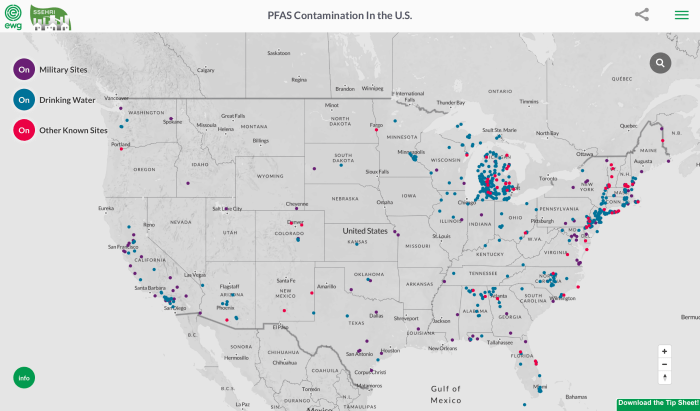
PFAS contamination in the U.S. via ewg.org. [Click the map to go to the website.]

@SenatorBennet Calls on @EPA to Deliver on Promises Made in #PFAS Action Plan

Widefield aquifer via the Colorado Water Institute.

Here’s the release from Senator Bennet’s office:

One Year After EPA Pledged to Act on PFAS Exposure, Key Parts of the Strategy Have Yet to Be Implemented

Today, Colorado U.S. Senator Michael Bennet joined a group of senators in a letter to Environmental Protection Agency (EPA) Administrator Andrew Wheeler requesting he provide an updated timeline for when the EPA will implement commitments made in the agency’s plan to combat exposure to per- and polyfluoroalkyl substances (PFAS). The EPA released its PFAS Action Plan one year ago today and has yet to implement many of the commitments outlined in the strategy. Bennet, who raised concerns about flaws in the EPA’s initial plan, is an author of the PFAS Action Plan of 2019 and has long worked to address contamination issues across Colorado.

“As you are aware, communities across the country are struggling to respond to the widespread issue of PFAS contamination. The human health risks from this class of chemicals, which include birth defects, various forms of cancer, and immune system dysfunction, are still being examined, and the uncertainty has caused great concern among our constituents,” wrote Bennet and the senators in the letter.

The lawmakers went on to underscore that the PFAS Action Plan alone is insufficient to address the full scope and urgency of the problems associated with PFAS exposure, which is why failure to take an initial step to implement this plan is particularly concerning. They also highlighted that the EPA committed to establish federal drinking water standards last year for perfluorooctanoic acid (PFOA) and perfluorooctanesulfonic acid (PFOS), two of the most prevalent PFAS chemicals, but have also failed to follow through on that pledge.

In their letter, the senators also addressed other parts of the plan that have not been prioritized, including important remediation efforts to help expedite cleanup of PFAS contamination under the EPA Superfund law.

“Yet, despite then-Administrator Scott Pruitt committing the EPA to designating these materials [PFOA and PFOS] as hazardous substances in May 2018, the EPA has not even sent a proposal to the Office of Management & Budget for interagency review, let alone published it for public comment,” wrote Bennet and his colleagues.

The senators closed their letter with a request that the EPA provide an update on the status of every commitment made in the PFAS Action Plan, as well as an update on the timeline for executing the priorities included in the strategy.

The text of the letter is available HERE.

Bennet has long worked to address the health effects, cleanup, and reimbursement issues associated with PFAS, chemicals used in firefighting foams that have contaminated drinking water sources near military bases across the country, including at Peterson Air Force Base (AFB) in Colorado Springs.

In 2017:

  • Bennet pushed for a nationwide study on the health effects of PFAS and for additional funding for remediation and clean up.
  • Bennet secured $10 million for the nationwide Centers for Disease Control and Prevention (CDC) study in the 2018 omnibus package.
  • Bennet secured an additional $44 million in funding for Air Force environmental restoration and remediation in the 2018 omnibus package. A significant amount of that funding was used for remediation around Peterson AFB in Colorado.
  • Bennet supported a provision in the Fiscal Year 2018 National Defense Authorization Act (NDAA) that required a plan on how the Department of Defense might reimburse state or municipal agencies that expended funds to provide alternative water supplies.
  • In 2018:

  • Bennet wrote to the CDC to ask that the nationwide study include communities in Colorado near Peterson AFB.
  • Bennet visited communities around Peterson AFB to receive an update on remediation efforts. There, Bennet also received an update on the challenges water districts are having receiving reimbursement for steps they took to clean up drinking water.
  • Bennet demanded the Trump Administration (CDC and the Agency for Toxic Substances and Disease Registry (ATSDR)) release the results of a study regarding what levels of certain chemicals are safe in drinking water. According to news reports at the time, the EPA had been working to block the release of results from a Department of Health and Human Services (HHS) study on the toxicity of certain PFAS.
  • Bennet passed an amendment to provide funding for the Department of Defense to reimburse state and municipal water authorities for actions they took to clean up and mitigate PFAS in drinking water. The amendment was included in the Department of Defense-Labor-Health and Human Services-Education Appropriations bill, which passed the Senate in 2018. The provision was not included in the final version of the bill that was signed into law.
  • Bennet wrote to the CDC/ATSDR to voice disappointment that the CDC will not include military and civilian firefighters in its investigations of the human health effects of PFAS contamination pursuant to Section 316 of the FY19 NDAA.
  • In 2019:

  • Bennet and his colleagues introduced the PFAS Action Plan of 2019, legislation that would mandate the EPA, within one year of enactment, declare PFAS as hazardous substances eligible for cleanup funds under the EPA Superfund law, and enable a requirement that polluters undertake or pay for remediation.
  • Bennet introduced an amendment to the NDAA to authorize the U.S. Air Force to reimburse local water districts, like those around Peterson AFB, for actions they took to treat and mitigate PFAS contamination.
  • Following Bennet’s 2018 letter calling on the CDC to include Colorado communities near Peterson AFB in the nationwide study on the health effects of PFAS, Bennet praised the agency’s decision to include these communities.
  • From The Colorado Springs Gazette (Michael Karlik):

    More than 12,000 El Paso County water users have been impacted by the chemical, which tainted the Widefield aquifer.

    In 2016 the EPA lowered its health advisory levels for the compounds, vastly expanding the number of southern El Paso County residents considered at risk for exposure. A subsequent study tied the contamination to the decades-long use of a firefighting foam at Peterson Air Force Base.

    Water districts in the towns of Security, Widefield and Fountain have either tied into uncontaminated water from Colorado Springs Utilities, or installed filtering systems to eliminate the chemicals.

    In the letter, the senators say they believe the agency has not acted quickly enough to make water safe…

    The lawmakers are asking for the EPA to prioritize the establishment of a maximum contamination level for drinking water and to allow cost-recovery for cleanup by labeling PFAS as hazardous substances.

    Senior Judge John L. Kane grants another delay in the #FountainCreek lawsuit (May 22, 2020)

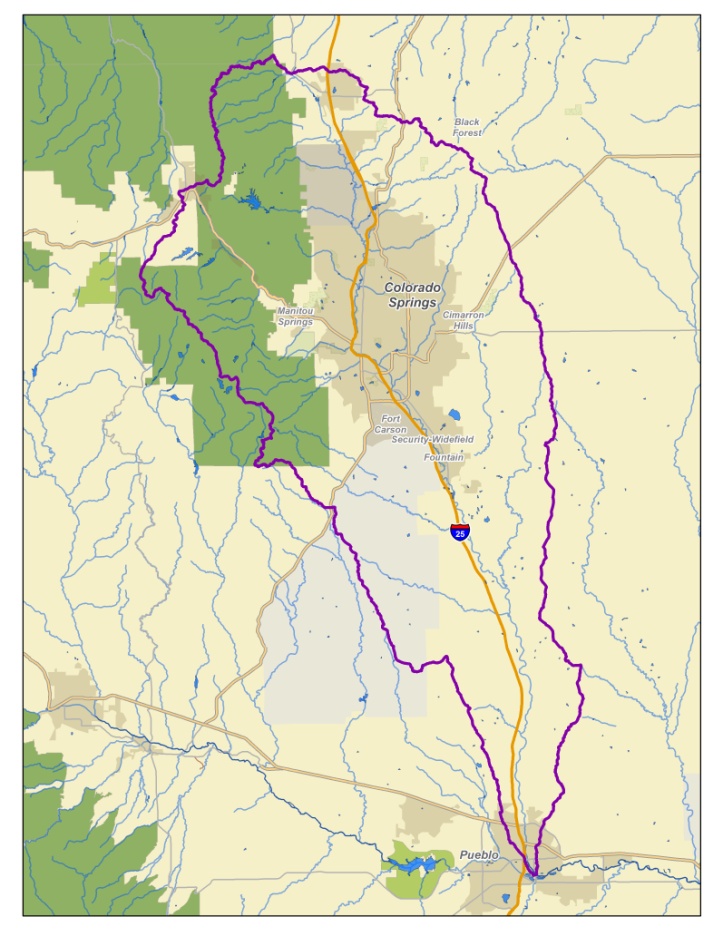
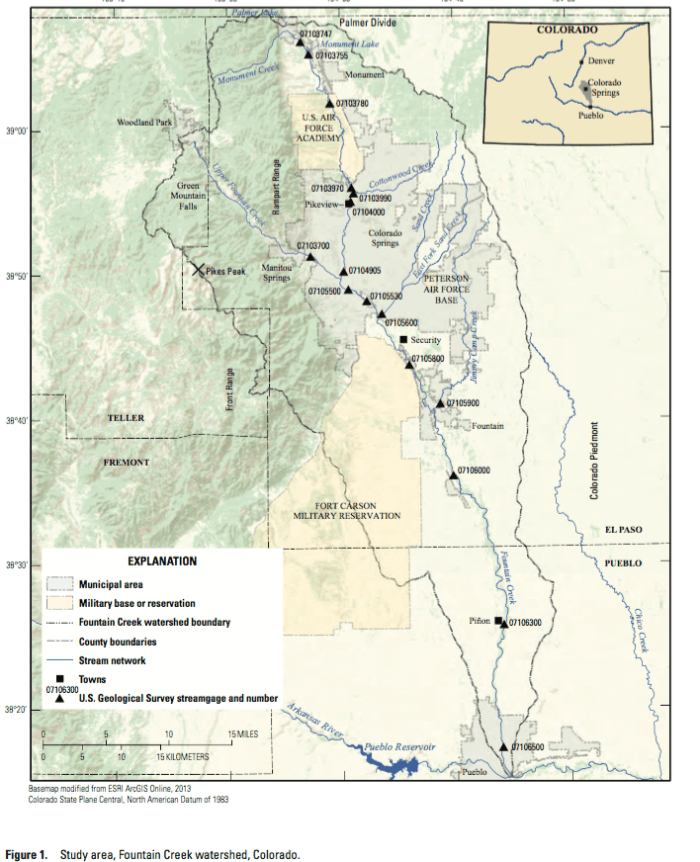
    The Fountain Creek Watershed is located along the central front range of Colorado. It is a 927-square mile watershed that drains south into the Arkansas River at Pueblo. The watershed is bordered by the Palmer Divide to the north, Pikes Peak to the west, and a minor divide 20 miles east of Colorado Springs. Map via the Fountain Creek Watershed Flood Control and Greenway District.

    From The Pueblo Chieftain (Robert Boczkiewicz):

    A new court document states that progress continues toward resolving an environmental lawsuit against Colorado Springs for degrading Fountain Creek.

    The document was filed last week in Denver at the U.S. District Court for Colorado, where the lawsuit is pending.

    “The parties have continued to make significant progress toward a settlement that encompasses an agreement for relief for all violations alleged,” the court filing states…

    After a trial last year, a judge decided Colorado Springs had violated its permit that regulates discharges of the city’s storm water sewer system into the creek. Remaining to be decided is what the city would do to remedy the violations.

    The new document states that since October, the five parties have been exchanging drafts of a proposed agreement on how to settle the dispute.

    “The parties have met monthly (since November and) continued to have monthly scheduled settlement meetings so that they can continue their progress toward (a settlement),” the document states.

    Last week, Senior Judge John L. Kane granted the parties’ request to keep the case on hold until May 22, so they can continue their work. Kane is presiding over the case.

    He emphasized, however, he would not keep the case on hold beyond May 22 based on the same grounds that the parties have been stating.

    ‘Our voices are not being heard’: #Colorado town a test case for #California #PFAS victims — The Los Angeles Times

    PFAS contamination in the U.S. via ewg.org

    From The Los Angeles Times (David S. Cloud):

    When Wendy Rash was diagnosed in 2005 with a thyroid disorder, chronic fatigue and other ailments, her doctor couldn’t explain her suddenly failing health.
    Soon, other family members became ill. Her brother-in-law contracted fatal kidney cancer. Her father-in-law developed esophageal cancer. Then her 32-year-old son began having severe kidney problems.

    It wasn’t until 2016 that scientists tested the tap water they had been drinking and found it was contaminated with man-made chemicals known as per-fluorinated compounds, part of a family of chemicals called PFAS. The chemicals were traced to firefighting foam from a nearby military airfield, one of hundreds of Pentagon bases nationwide that for decades may have contaminated drinking water used by tens of thousands of people.

    “We had no clue,” said Rash, 58.

    The role played by PFAS in the family’s illnesses is not known. Studies have shown a link between the chemicals and a range of health problems, including an elevated risk for some cancers, but they have not established a clear cause-and-effect relationship.

    Widefield aquifer via the Colorado Water Institute.

    Rash’s family history of illnesses is common in Fountain, a Colorado Springs suburb flanked by mountains and military bases. And the scientific uncertainty about how much risk residents face has only worsened the anxiety many feel, as Fountain and surrounding towns have become a center of the growing national furor over the possible health effects of ingesting PFAS.

    Congress is trying to expand regulation of the chemicals. Earlier this month, the House voted 247 to 159 in favor of a bill requiring the Environmental Protection Agency to designate PFAS as hazardous substances, which would free up funds for the cleanup at contaminated sites.

    But the Trump administration has threatened to veto the bill, saying in a Jan. 7 statement that such a move would force high compliance costs on businesses and states, and that the EPA, not Congress, should make the decision.

    2020 #COleg: HB20-1119, State Government Regulation Of Perfluoroalkyl And Polyfluoroalkyl Substances #PFAS

    PFAS contamination in the U.S. via ewg.org

    From The Colorado Independent (John Herrick):

    In response to proposed PFAS regulations, cities and water managers are raising concerns over their financial liability

    In the summer of 2018, Lucy Molina, a 45-year-old mother of two who lives in Commerce City near the Suncor oil refinery, said a city council member told her that her tap water was contaminated with toxic per- and polyfluoroalkyl chemicals, also known as PFAS. At the time, she said, she didn’t know what the chemicals were. It was just one more reason to not drink the water in the heavily industrial north Denver area…

    The city’s water utility, South Adams County Water and Sanitation District, put out a news release in July 2018 saying the water was safe to drink because the PFAS concentrations fell below the Environmental Protection Agency’s health advisory limit of 70 parts per trillion. One part per trillion is about equal to one grain of sugar in an Olympic-sized swimming pool.

    But in the wake of growing public concern over PFAS, a group of chemicals used in a range of products, including firefighting foam, non-stick cooking wear and Gore-Tex waterproof outdoor gear, Colorado’s health agency is questioning whether that concentration limit is in fact safe.

    “If I ask the state toxicologist and I ask experts in the field, they will never use terms like ‘safe’ with respect to PFAS,” said John Putnam, the director for environmental programs at the Department of Public Health and Environment. “Because we don’t really know, since there are limits to all these studies.”

    New research has linked exposure to PFAS to health issues including cancer and immune, reproductive, and hormonal dysfunction. But the EPA’s advisory level, which is not enforceable, hasn’t changed since 2016 and seems unlikely to be revised any time in the near future. The Trump administration’s EPA has been rolling back water protections. And Congress has failed to pass comprehensive PFAS regulations, in part because Republicans, including those in Colorado’s delegation, have concerns about how much it will cost cities and water managers to comply. Compliance could include more frequent testing of water supplies costing thousands of dollars per week and upgrades to water treatment facilities that could cost millions of dollars.

    That’s left Colorado in the unprecedented position of scrambling to set a drinking water standard — and then trying to enforce it. Putnam said this is a task the state doesn’t have the money or staff to handle yet. And any effort it takes to cut corners to hold polluters accountable or mandate cleanup could be challenged in court by cities, water managers and other groups concerned about their own financial liabilities…

    But some residents in Colorado are tired of waiting. Since 2016, the state has known the toxic, mostly non-biodegradable “forever chemicals” have been found in Colorado’s drinking water supplies above the federal advisory limit. The chemicals have been found in groundwater within fire districts in Boulder County and near Front Range military bases, airports and other industrial sites that use PFAS-laced foam to extinguish fires. The cities of Security, Widefield and Fountain, which share a watershed with military bases and the Colorado Springs Airport, are ground zero for PFAS contamination in Colorado. A well at the Peterson Air Force Base tested at 88,000 parts per trillion for a PFAS compound. El Paso County, home to the three cities and four military sites — Air Force Academy, Fort Carson Army Base, Peterson Air Force Base and the Schriever Air Force Base — was selected by the Agency for Toxic Substances and Disease Registry as the site to take blood samples from residents and study the health effects of PFAS. The chemicals are less likely to be found in high levels in water supplies in other areas of the state, but given the chemicals’ omnipresence in modern life, they’re likely found in nearly everyone’s blood

    In response to public demand and inaction at the federal level, Colorado’s health department is asking the state legislature for legal permission to write drinking water standards for PFAS and is working on separate rules that could hold water polluters accountable by setting a groundwater standard and new permit permit requirements for how much PFAS is allowed to be released into the water.

    A bipartisan bill, [HB20-1119, State Government Regulation Of Perfluoroalkyl And Polyfluoroalkyl Substances: Concerning the authority of the state government to regulate perfluoroalkyl and polyfluoroalkyl substances], would allow the state for the first time to set a hard limit on how much PFAS is allowed in drinking water supplies. Water managers also could be on the hook for testing their water supplies more frequently. Worried about the cost of compliance, water utilities will likely lobby to narrow the scope of the legislation to place limits on how often the state can require monitoring and how low a drinking water standard it can set…

    The bill also could require fire departments and facilities that use PFAS to inform the state how much they have stockpiled, and if used, require that the PFAS be captured and disposed of properly.

    Separate from the bill authorizing the Colorado Department of Public Health and Environment to write drinking water standards, the health department’s Water Quality Control Commission has been working on a new PFAS policy that would allow the state to regulate the chemicals through updated groundwater rules. The regulations could also set new conditions on water pollution permits.

    Denver is among the cities raising concerns about the proposed regulations. The city has fire departments that use PFAS chemicals and owns the Denver International Airport, which is required by Federal Aviation Administration to use PFAS in its firefighting foam for safety certifications, and it faces financial liability for any regulations adopted. In a written comment to the state’s PFAS Action Plan, a representative for Denver said the state could be legally liable if it moves too fast with PFAS regulations, citing Colorado’s Administrative Procedures Act.

    To set such standards under the state’s Administrative Procedures Act and other laws, the state will have to study health research, exposure potentials, and the cost-effectiveness of requiring utilities to meet such guidelines. That will take time and money, Putnam said. In many ways, Putnam said, Colorado’s law was written to slow the pace of regulation…

    In September, lawmakers approved $500,000 so that the Colorado Department of Public Health and Environment could subsidize drinking water testing and pay a third party to analyze the samples. As of Jan. 16, of the 891 water providers and private well owners the state notified, 132 have applied for funding to test their supplies. In the 2020-2021 state budget, the department is requesting $250,000 to hire two new toxicologists to help study PFAS exposure and another $500,000 to continue the drinking water testing program.

    It’s unclear whether lawmakers will approve the additional money…

    Some environmentalists and water utility managers say polluters should be paying the price for cleanup and monitoring. States like New York have sued companies like DuPont and 3M, which manufacture PFAS chemicals. Scott, of the South Adams County Water and Sanitation District, said the state should focus on identifying the source of the pollution “so the cost of having to do the treatment is not passed on to our customers.”

    Scott said PFAS contamination in his district could be coming from any number of industrial sources in the area. Suncor, an oil refinery located along Sand Creek, has acknowledged it has released PFAS into the water. The facility uses firefighting foam to put out petroleum-based fires…

    Commerce City resident [Lucy] Molina said people should at least be given more information about their water quality. She said many of the area’s residents, nearly half of whom are Latino, speak only Spanish. The latest water report is in English. And it doesn’t mention the cancer risks of PFAS exposure.

    #Colorado Fire Departments Are Switching To A New #PFAS Firefighting Foam, But Concerns Linger — Colorado Public Radio

    From Colorado Public Radio (Grace Hood):

    About 60 percent of Colorado fire departments report that they have firefighting foam with synthetic chemicals known as PFAS, according to a recent survey by the Colorado Department of Public Health and Environment…

    “We are highly cognizant of how dangerous PFAS can be in terms of the cancer-causing properties for our firefighters,” said Greg Pixley, a public information officer with Denver Fire Department “We are working every effort we can to reduce PFAS in our day-to-day operations.”

    […]

    An older generation of the firefighting foam containing PFAS has been retired from use in Colorado, and across military bases. Now, a newer version with a different chemical formula is available. Originally it was believed to not accumulate in the body, but research is emerging that shows potentially toxic health effects are concerns for many of the firefighters who use this product on the front lines…

    State health officials know PFAS chemicals are a problem. Conducting a survey is one part of the state’s plan to address the health risks. In addition to reporting PFAS foam supplies, health officials asked which fire departments had used PFAS firefighting foam in the past. About 19 departments reporting using the foam.

    However, it’s unclear what, if any, testing will happen across those departments that reported using the foam.

    The state government has made about $500,000 available with a priority for Colorado’s 890 drinking water districts for testing of PFAS chemicals. But fire departments will be at the back of the line behind drinking water districts to access to those funds, according to state health officials…

    According to the state survey, the largest caches of the new PFAS foam is held by Suncor, the Denver Fire Department, South Metro Fire Rescue and the Pueblo Fire Department.

    The departments that have large quantities of the new form on hand use it because they respond to fires at regional or municipal airports. The Federal Aviation Administration requires fire responders at some airports to have the PFAS foam on hand to ensure “the extinguishment of the fire for the successful evacuation of passengers and aircrew during an aircraft fire,” according to a statement from the FAA.

    “It was a compromise,” said Eric Hurst, a public information officer with South Metro Fire Rescue. “We essentially worked with Centennial Airport to find the safest environmentally friendly [firefighting foam] available and used that.”

    The FAA is under the gun to find a replacement by Oct. 4, 2021, at which time it can no longer require the use of PFAS foam.

    The agency is currently researching and evaluating replacement firefighting foams. Some airports like London-based Heathrow have switched to a fluorine-free foam that doesn’t have PFAS chemicals linked to health issues…

    “[DIA] along with other commercial airports and airport industry associations, continues to press the FAA for a firefighting alternative that would satisfy commercial travel safety responsibilities while reducing the potential for environmental impact,” said Emily Williams, a public information officer with Denver International Airport.

    State law does set some limits on how the new PFAS foam can be used. Legislation in 2019 prevents fire districts from using it to conduct training exercises. It is only to be used to fight fires.

    Photo via USAF Air Combat Command

    Scientists Fight Back Against Toxic ‘Forever’ Chemicals — Wired #PFAS

    From Wired (Michelle Cohen Merrill):

    Once a symbol of American ingenuity, PFAS were originally conceived as wonder chemicals that could resist stains, repel water, extinguish horrific oil-based fires, and keep eggs from sticking to the pan. Today, we know them as a Frankenstein-like invention, zombie chemicals that will not die.

    Chemists created thousands of such compounds by bonding carbon to fluorine in chemical chains, forging one of the strongest bonds ever discovered. Now they have been found across the planet—even in the blood of arctic foxes and polar bears. Public health studies found PFAS in the blood of about 95 percent of Americans. While the health impact of low levels of exposure is less clear, the chemicals are linked to liver, thyroid, and immune effects, cancer, and low birth weight. It will take billions of dollars—and yet more engineering prowess—to remove PFAS from drinking water and the environment. The task seems bleak, even as the US Department of Defense prepares to spend more than $2 billion on cleaning up PFAS on its bases. Firefighting training sites, airports, and industrial sites are also big contributors.

    On Friday, the US House of Representatives passed the PFAS Action Act, which would require the EPA to set drinking water limits for two PFAS (PFOA and PFOS) and to designate PFAS chemicals as hazardous substances under the Superfund cleanup program. Its path forward is uncertain. Even if the Senate passes the measure, the Trump administration has called its provisions “problematic and unreasonable” and threatened a veto.

    But here’s a shred of optimism: Some new technologies show promise in breaking those ultra-strong carbon-fluorine bonds, which means the compounds known as “forever” chemicals could be removed from at least some groundwater. “I have actually started to feel a little bit of hope,” says Chris Higgins, an environmental engineer at the Colorado School of Mines and a PFAS expert. “We’re getting some technologies that seem to be working.”

    The most promising approach involves an electrical reaction that looks like lightning striking water. Contaminated water goes through a plasma reactor, where argon gas pushes the PFAS compounds to the surface. Electrodes above and below the surface generate plasma—a highly reactive gas made up of positive ions and free electrons—that interacts with the PFAS and breaks the carbon-fluorine bonds.

    “Our goal is to completely destroy the compound and not just transfer it from one phase to another,” says Michelle Crimi, an environmental engineer at Clarkson University in Potsdam, New York, who works on emerging technology to remediate PFAS. The plasma reactor technique was developed by her colleagues Selma Mededovic, a chemical engineer, and Tom Holsen, an environmental engineer.

    Crimi is also using ultrasound waves to create cavities—essentially holes—in the water. When they collapse, they instigate physical and chemical reactions that break apart the PFAS chains. Other researchers are working on electrochemical techniques and even soil bacteria that may metabolize PFAS.

    PFAS contamination in the U.S. via ewg.org

    The January 2020 “Fountain Creek Chronicles” is hot off the presses

    Click here to read the newsletter from the Fountain Creek Watershed & Flood Control District. Here’s an excerpt:

    UCCS Values Relationship with Fountain Creek District
    Contributed by: Kimberly Reeves, UCCS

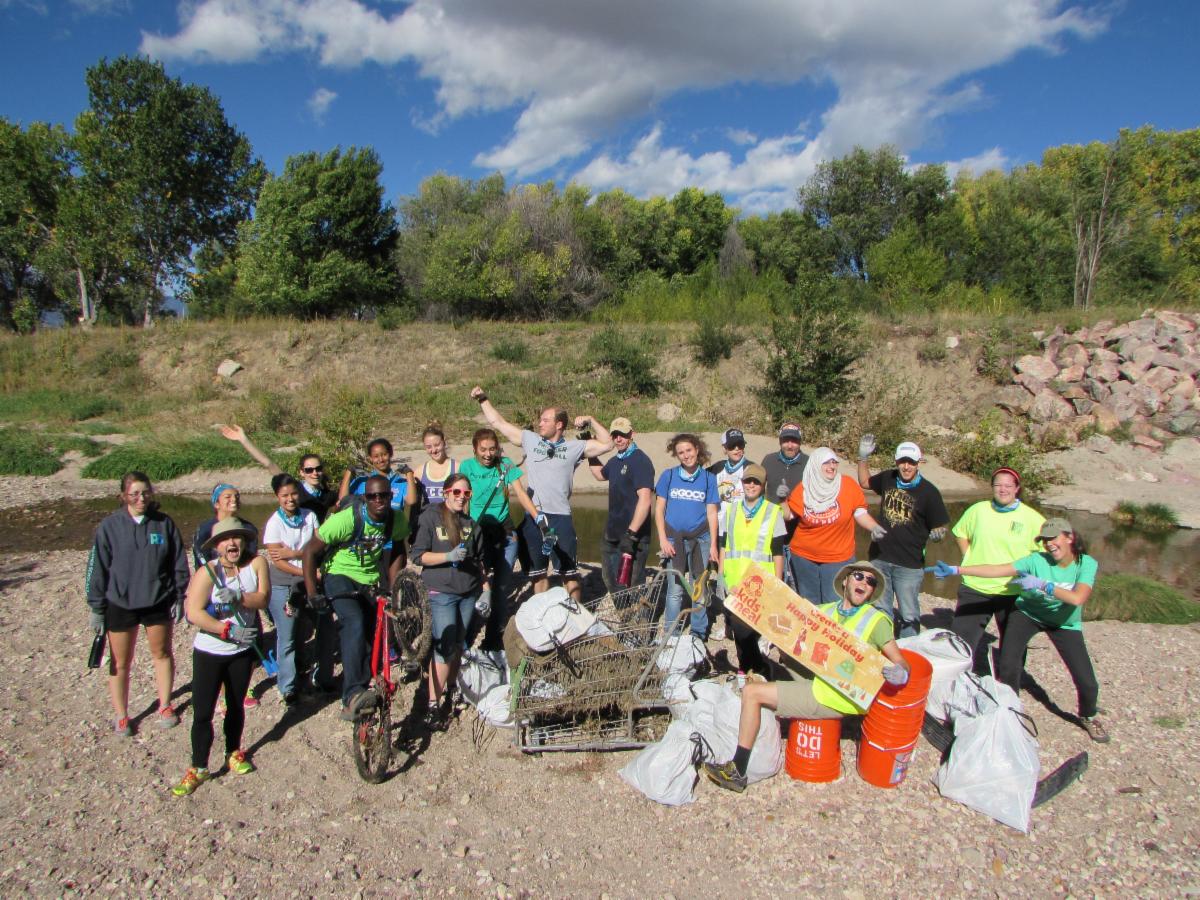
    More than 100 volunteers from the University of Colorado – Colorado Springs (UCCS) participated in Colorado Springs’ sixth annual Creek Week, working to clear the Templeton Gap Floodway of 40 bags of trash, one and a half grocery carts, and a bicycle wheel.

    The District’s Creek Week events raise awareness about the Fountain Creek watershed, by educating volunteers about Colorado’s waterways while clearing litter and debris from the 75-mile long Fountain Creek and 927 square-mile watershed that drains into the Arkansas River. UCCS’ Office of Sustainability has championed efforts to promote events on and around campus since the inaugural event in 2014.

    This collaborative effort of private companies, city and county organizations, and non-profits has broadened the reach for our campus community by using resources from all partners to ensure we are communicating the same message to our circles of influence. The connection for students to volunteer through opportunities that support our surrounding community allows them to strengthen their civic engagement and development as world citizens. Creek Week provides a platform to talk about the bigger picture of community members across our watershed from Palmer Lake to Pueblo, which is all supporting healthy waterways through volunteerism.

    The past two years, Creek Week has increased its efforts from volunteer clean-up events to involve citizen scientist opportunities, which engaged faculty from UCCS to incorporate these opportunities into their courses. This ability to use the surrounding ecosystem as a place to conduct research benefits our students in not only experiential learning, but also the City of Colorado Springs because our students are investing their time to strengthen our community.

    The UCCS community asks for Creek Week dates year-round. It has become a positive expectation that our universities invest in our broader community and provides opportunities to make an impact one clean-up at a time.

    The Fountain Creek Watershed is located along the central front range of Colorado. It is a 927-square mile watershed that drains south into the Arkansas River at Pueblo. The watershed is bordered by the Palmer Divide to the north, Pikes Peak to the west, and a minor divide 20 miles east of Colorado Springs. Map via the Fountain Creek Watershed Flood Control and Greenway District.

    El Paso County posts master plan survey online

    Colorado Springs circa 1910 via GhostDepot.com

    From El Paso County via The Colorado Springs Business Journal:

    El Paso County is asking business owners and residents to give input for its new master plan in an online survey.

    The survey covers similar ground to topics discussed at a visioning workshop held Dec. 11. Nearly 100 residents participated, and their input will be incorporated as the Planning Department finishes up the master plan development process.

    Those who were unable to attend the workshop can provide feedback that will be considered as the county continues to develop the master plan.

    The survey will be available through January at https://elpaso-hlplanning.hub.arcgis.com/pages/questionnaires.

    The county started developing the master plan early this year, in what’s expected to be a two-year process. The Planning Department expects to begin implementing the master plan at the end of 2020.

    The planning department, along with master plan consultant Houseal-Lavigne Associates, presented an Existing Conditions Report to the Board of County Commissioners at their meeting on Dec. 12.

    Comprised of public input and statistical analysis, the 70-page report is a summary of current conditions in the county and a snapshot of county life as it stands today.

    It covers a multitude of topics including zoning, development, transportation, water, military bases, recreation and tourism, community health and sustainability.

    According to the county, the report will be instrumental as it develops the Whole County Master Plan.

    “Finalizing the Existing Conditions Report is the first step toward understanding where the county is today, and it will serve as a bridge to the future,” Planning and Community Development Executive Director Craig Dossey said in a news release.

    “The report gives us a strong foundation of understanding pertaining to the good, the bad and the ugly in the county, and provides a solid starting point as we move forward.”

    The Planning Department urges citizens to review the report, which is available to the public on the Master Plan project website: https://elpaso.hlplanning.com/pages/documents.

    “At the very least, the report gives residents a good idea of all the moving parts that are going into the master plan process,” John Houseal, principal at Houseal-Lavigne, said in a news release. “You won’t find another document with such extensive content relating to the current state of El Paso County.”

    The list of military sites with suspected ‘forever chemicals’ contamination has grown — The Military Times #PFAS

    From The Military Times (Patricia Kime):

    The number of places where the U.S. military spilled or suspects it discharged perfluorinated compounds has grown, Pentagon officials said Wednesday, but they did not say where or how many sites are under investigation for possible contamination.

    The Department of Defense previously identified 401 sites on active and former military bases where the compounds — perfluorooctane sulfonate or perfluorooctanoic acid, also known as PFOS and PFOA — were released or a suspected discharge occurred.

    Assistant Secretary of Defense for Sustainment Robert McMahon said Wednesday that continued Department of Defense efforts to identify locations with potentially harmful levels of chemicals uncovered more sites, namely National Guard facilities.

    He said the department will name the sites when it has verified the number and locations.

    “As part of this process, we think there are probably more installations, and I’m not ready to tell you what that number is, but we found that we under-counted,” McMahon told reporters in a briefing at the Pentagon.

    The chemicals, which are used in firefighting foams to battle aircraft and ship fires and also found in household items such as non-stick cookware, stain repellents and food wrappers, have been linked to some types of cancer and birth defects.

    In July, Defense Secretary Mark Esper created a task force to determine the extent of the contamination and potential health risks to military personnel and families posed by the chemicals, which fall under a family of compounds known as per- and polyfluoroalkyl substances, or PFAS. The task force also is charged with finding alternatives to PFAS-free firefighting foams.

    The group is expected to release an interim report on its findings this month. Originally, the final report was due by January, but Esper shortened the timeline for completion from 180 days to 120, and now, McMahon said, the goal is to release an interim report that will be an “accurate picture of the multitude of things we are doing.” With McMahon retiring from the Department of Defense on Friday, it’s unknown whether there will be a final report.

    “I don’t know what will happen after 120 days, whether the task force continues to go or if it stands down. It’s irrelevant to me because the focus is on doing what’s right for our soldiers, sailors, airmen and Marines and their families and the communities. We are going to be just as aggressive,” McMahon said.

    The Department of Defense established a new website Tuesday that focuses on its work on PFAS and includes congressional reports and other DoD initiatives addressing the investigation and cleanup.

    Naval Research Lab Chemical Engineer Katherine Hinnant tests an experimental aqueous film-forming foam at the NRL in Washington, Sept. 23, 2019. NRL scientists are conducting research to support the Defense Department’s effort to replace firefighting foams containing fluorine. Photo credit: Department of Defense

    The move comes the week that a movie about PFAS, “Dark Waters,” premiers. The film tells the story of attorney Robert Bilott’s 20-year fight against DuPont, one of the manufacturers of PFAS chemicals. On Tuesday, the movie’s star, Mark Ruffalo, testified before Congress about the dangers of these chemicals.

    They are known as “forever chemicals” because they do not break down, and build up in blood and tissues if absorbed.

    “It’s time to regulate PFAS chemicals,” Ruffalo told members of the House Oversight and Reform Environment Subcommittee. “It’s time to end industrial releases of PFAS into the air and water, it’s time to end needless uses of PFAS in everyday products like food packaging, it’s time to finally filter PFAS out of drinking water and it’s time to clean up legacy PFAS contamination, especially at our military bases.”

    Also testifying at the hearing was Mark Favors, a former Army specialist whose extended family lives in Colorado Springs, Colorado, near Peterson Air Force Base, and who can count 16 cases of cancer in his family, including 10 deaths, five of which were from kidney cancer.

    Peterson Base

    Peterson is one of the locations where on-base and community water sources tested significantly above the EPA’s recommended PFAS or PFOA exposure limit of 70 parts per trillion.

    “Colorado Health Department investigators found that lung, bladder and kidney cancer rates are significantly higher than expected in the same areas of the PFAS water contamination, yet the state has never offered contaminated residents medical monitoring or PFAS blood level tests,” said Favors, who respresented the Fountain Valley (Colorado) Clean Water Coalition.

    Dozens of PFAS compounds are used in medical devices, pharmaceuticals and laboratory supplies. As such, Rep. James Comer, R-Ky., the subcommittee’s ranking member, said, caution should be taken when considering “sweeping action” against an entire class of substances.

    “We should be careful of taking actions that have the potential to affect vast swaths of the economy, including hospitals and other [industries] that use lifesaving products made from PFAS compounds,” Comer said during the hearing.

    Of the 401 sites named by the Defense Department as having a known or suspected discharge of PFAS, 36 on-base locations had contaminated drinking water and more than 90 had either off-base drinking water or groundwater contamination at levels above the Environmental Protection Agency’s accepted threshold.

    In cases where the Defense Department found drinking water supplies exceeding the 70 parts per trillion recommendation, the services supplied bottled water and in-home water filtration systems to ensure water quality.

    “In some places, we had very marginal levels, so part of this is ‘You don’t have to worry about it.’ But in some places, we have levels that are higher … and we’ve reacted to that,” McMahon said.

    Advocacy groups say that no amount of PFAS is safe; the Environmental Working Group, a Washington, D.C.-based non-profit that has been sounding the alarm on the problem, says that 1 part per trillion is the maximum safe level, based on independent studies.

    The EPA has released a draft proposing that the screening level of a contaminated site that would trigger further investigation of PFOS and PFOA should be 40 parts per trillion individually, and for remediation, 70 parts per trillion, combined, in groundwater.

    The DoD follows the EPA’s current recommendation of 70 parts per trillion.

    McMahon said this week that installation commanders can expect to receive letters instructing them to begin a dialogue, if they have not already done so, with their local communities on the DoD’s PFAS investigation, its findings and any clean up efforts within their communities, according to McMahon.

    “One of the things we haven’t done real well is our transparency and activity in getting the message out,” McMahon said. I want our installation commanders to go talk to the community.”

    The Environmental Working Group maintains a map as well as lists of the military installations and sites with known PFAS contamination. According to EWG, of the 100 most contaminated sites, 64 had groundwater contamination exceeding 100,000 parts per trillion. The highest known contamination was seen at the former England Air Force Base, near Alexandria, Louisiana, that measured 201.7 million parts per trillion of a PFAS chemical known as PFHxS.

    PFAS contamination in the U.S. via ewg.org

    The latest “Fountain Creek Chronicles” is hot off the presses

    Click here to read the newsletter. Here’s an excerpt:

    The Future of Fountain Creek: Frost Ranch Owner Takes the Long View

    Here in the Pikes Peak region, many of us play in the Fountain Creek Watershed, whether we’re aware of it or not. We might hike or ride our bikes along Fountain Creek and its tributaries. We might fish or paddle our kayak in the creeks or lakes. But most of us don’t work the land – and we rarely witness Fountain Creek’s tempestuous nature.

    Jay Frost. Photo credit: Frost Ranch

    But Jay Frost, third-generation owner of Frost Ranch south of Fountain, Colorado, has endured the creek’s unruly temperament for decades. “I’ve been watching the creek all my life,” he says. “We make a living here. We try to deal with its unpredictable nature.”

    Frost Ranch has deep roots in local ranching and farming traditions. The Frost family raises grass-fed and grass-finished lamb and beef in its irrigated meadows. They grow non-certified organic vegetables and grass/alfalfa hay in the irrigated parts of the farm. The Frost family takes pride in growing healthy, sustainable food. The lamb and beef are free of hormones, antibiotics, and corn; fields are never sprayed; and vegetable planting, irrigating, weeding, and harvesting are all done using holistic and traditional methods.

    Fountain Creek’s erosion and sedimentation issues are vexing. How does this impact Frost Ranch?

    Photo credit: Frost Ranch

    “The creek is flashy,” Jay says. “If there’s a little sniffle of rain in Colorado Springs, here comes the water! We can go from a base flow of 60 cubic feet per second (cfs) to 22,000 cfs. When the water calms down, all the sediment drops. The sediment load in Fountain Creek is crazy!”

    Simultaneously, the ranch is literally losing property from erosion. “We have a big cut bank – we refer to it as the Great Wall,” Jay notes. “It’s 60 feet deep and at least a quarter of a mile long. It’s sloughing off soil all the time.”

    Jay adds that floodwater can wash away fences and irrigation pipes, and sedimentation can damage irrigation infrastructure. The Frost family no longer grazes livestock near the creek due to the invasion of non-native plants. “Parts of the creek are choked with trees and exotic species like salt cedar [tamarisk] and Russian olive trees,” he says. “You can’t fence the dang thing. It’s just gnarly.”

    That’s why, nearly three decades ago, Jay helped to form a coalition to begin focusing on the Fountain Creek Watershed – and begin addressing its many issues regarding flooding, erosion, and sedimentation.

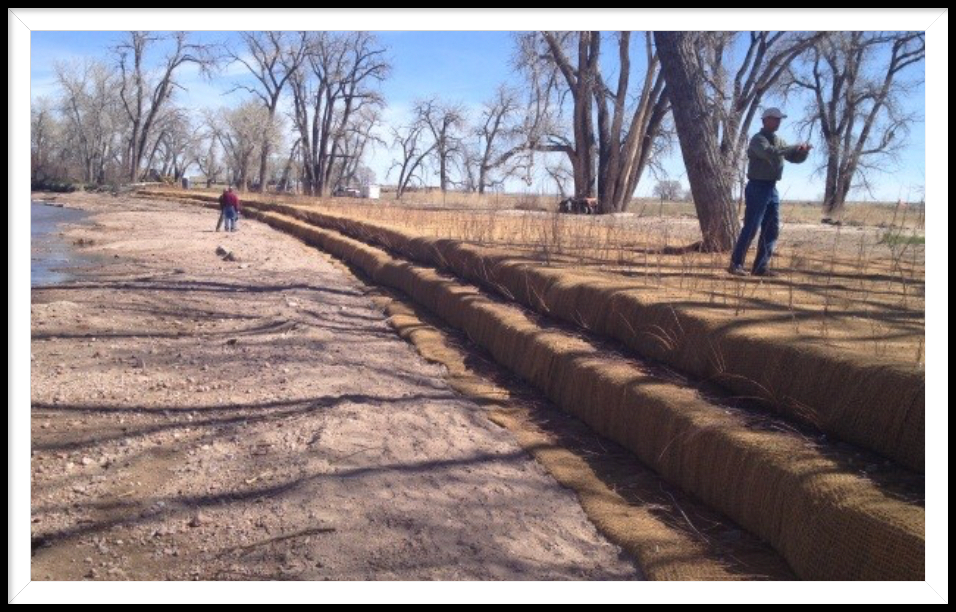
    This early initiative helped to pave the way for the formation of the Fountain Creek Watershed Flood Control & Greenway District. Soon after the District was formed, Frost Ranch collaborated with District engineers to address a serious erosion issue on the ranch. According to the Project Summary, the lack of vegetation along approximately 400 feet of the creek’s bank allowed soil to be readily removed during high-flow events, resulting in flood damage, bank erosion, and increased downstream sedimentation.

    Unfortunately, the repair project didn’t hold – a flooding incident washed it away. But Jay isn’t completely surprised, due to the turbulent nature of the creek. “Fountain Creek is normally a dribble, but it’s prone to flooding,” he says. “It can be wilder than hell when it’s really rolling.”

    A Comprehensive Solution is the Best Way Forward

    Bank stabilization Fountain Creek. Photo credit: Frost Ranch

    When it comes to Fountain Creek, Jay Frost takes the long view. “I believe we can find a comprehensive solution – a silver bullet – that will address the entire Fountain Creek Watershed,” he says. “A comprehensive solution – an absolutely engineered approach – is always better than just taking a stab at the issues, project by project.”

    This is one of the benefits of the Fountain Creek Watershed Flood Control and Greenway District, which is addressing the watershed comprehensively. In fact, since 2009, the District has planned and/or implemented more than a dozen construction projects to address critical erosion and sedimentation issues throughout the watershed. Various project aspects involve restoring the main channel, realigning the creek, stabilizing steep cut banks, revegetating, protecting wetlands, and restoring riparian habitat. At the end of the day, if Fountain Creek has less erosion, less sedimentation, better quality and accessible water, we all benefit.
    I n the conversation with Jay, it was noted that ranchers and farmers are on the front lines of water issues, fighting the good fight. “Yeah,” Jay replies, “but it’s so worth it.”

    Learn more about the Frost Ranch Stabilization Project: http://www.fountain-crk.org/completed-projects/frost-ranch-bank-stabilization-project/
    Learn more about Frost Ranch farm dinners, hunting club, and wedding packages: http://www.Frost-Livestock.com
    Brand image and photos courtesy of Frost Ranch.

    #Colorado Lawmakers Call For More Federal Money To Clean Up Chemical Contamination From #PFAS — Colorado Public Radio

    Widefield aquifer via the Colorado Water Institute.

    From Colorado Public Radio (Dan Boyce):

    Local environmental activists and state lawmakers gathered near Colorado Springs on Tuesday to call for more federal support in cleaning up toxic PFAS chemical contamination near some of the state’s military bases, most recently including the U.S. Air Force Academy.

    Firefighting foams used regularly on military bases for decades leached chemicals into local groundwater supplies. In 2016, the Environmental Protection Agency issued a health advisory warning of a connection between PFAS and certain types of cancer.

    The military has spent hundreds of millions of dollars on cleanup nationwide, including $50 million at Peterson Air Force Base alone.

    But speakers at the event organized by the nonprofit Environment Colorado said much more funding is still needed.

    Fountain Valley Clean Water Coalition founder Liz Rosenbaum urged Colorado’s congressional delegation to fight for more PFAS cleanup funds in next year’s National Defense Authorization Act (NDAA).

    “We have done everything that we can possibly do from the local level, from our city, the county and the state,” Rosenbaum said. “This is a national contamination because it has been done by the department of defense. So we have to look to Congress and our elected officials in D.C.”

    Republican Rep. Doug Lamborn sits on the conference committee which is working out differences between Senate and House versions of the NDAA. Lamborn’s office did not send a representative to the press conference.

    Republican state Sen. Dennis Hisey said he doesn’t think it matters where the money comes from, as long as Congressional leaders work to raise awareness of how much is left to do in cleaning up these so-called “forever chemicals.”

    Delinquent stormwater accounts might be headed for tax liens — The #ColoradoSprings Independent

    Colorado Springs with the Front Range in background. Photo credit Wikipedia.

    From The Colorado Springs Independent (Pam Zubeck):

    Those who’ve thumbed their noses at Colorado Springs’ bills for stormwater controls could see a tax lien slapped on their property within a month or so.

    The list headed for tax lien includes 110 non-residential tracts. No residential billings have yet exceeded the $200 threshold the city set for tax lien procedures.

    City stormwater manager Rich Mulledy says he expects several commercial accounts to be made current within weeks, voiding a need to certify tax liens on those…

    A tax lien means the bill will be attached to the annual property tax bill for payment to assure the city gets its money.

    Mulledy notes the number of delinquent accounts represents less than 1 percent of all billings.

    #PFAS study will look at health effects on El Paso County residents —

    PFAS contamination in the U.S. via ewg.org

    Here’s an in-depth look PFAS in El Paso County from Faith Miller that’s running in the Colorado Springs Independent. Click through and read the whole article. Here’s an excerpt:

    Researchers at the Colorado School of Public Health will study the health effects of toxic PFAS chemicals — found in firefighting foam used by the military — in residents of El Paso County, thanks to a $1 million federal grant.

    Colorado is just one of seven states named in a multisite study into the health effects of the chemicals. Nationally, the study will recruit “at least 2,000 children aged 4–17 years and 6,000 adults aged 18 years and older who were exposed to PFAS-contaminated drinking water,” according to a statement from the Agency for Toxic Substances and Disease Registry, which is funding the project along with the Centers for Disease Control and Prevention.

    The Colorado School of Public Health, at the University of Colorado Anschutz Medical Campus in Denver, plans to recruit 1,000 adults and 300 children for the study. Previous research has found that people who lived in the Fountain and Security-Widefield areas, near Peterson Air Force Base, prior to 2015 have higher-than-normal levels of PFAS chemicals in their blood.

    The research team will include experts from the Colorado School of Mines, Children’s Hospital Colorado, the Colorado Department of Public Health and Environment, and the University of Southern California, according to a statement from CU Anschutz.

    John Adgate, chair of the school’s Department of Environmental and Occupational Health and the co-principal investigator on the study, says it’s not yet clear which members of the PFAS chemical group will be looked at, but the list will likely include “PFHxS, PFOS and PFOA, as well as a bunch of others.”

    Most extensive research into PFAS chemicals has so far been focused on PFOS and PFOA, while health effects of other PFAS aren’t as well established.

    “The El Paso County site is interesting because [the contamination is] mostly from firefighting foams, which results in people having elevated blood levels of what’s known as PFHxS and PFOS,” Adgate explains.

    Adgate and his research team found last year that study participants who’d been exposed to the contamination had blood levels of PFHxS about 10 times as high as U.S. population reference levels. Levels of this chemical were also higher than those for residents in other communities exposed to PFAS.

    The latest “Fountain Creek Chronicles” newsletter is hot off the presses

    UCCS Clean the Stream Team at the 2015 Creek Week. Photo via the Fountain Creek Watershed, Flood Control and Greenway District.

    Click here to read the newsletter. Here’s an excerpt:

    Creek Week – YOU Can Make a Difference!
    QUICK – FUN AND EASY
    From September 28 – October 6
    1 – 2-hour commitment
    Anyone can participate – All Ages, Demographics

    What is approximately 40 times as heavy as a hippopotamus, is 180 times as heavy as a grand piano, and is 42 times as heavy as a car? The answer is the amount of trash, in tons, that volunteers have picked up during “Creek Week” since its inception in 2014.

    “Creek Week” began as a way to encourage citizens to help remove litter and debris from our land and waters, raise awareness of watershed health and to foster a sense of community, and has grown into an annual event. It provides an opportunity for communities to give back, to enjoy the parks and trails they are cleaning and to understand their place in the Fountain Creek Watershed.

    Concerned citizens from Palmer Lake, Monument, Colorado Springs, Woodland Park, Green Mountain Falls, Manitou Springs, Fountain, Pueblo and beyond will come together from September 28-October 6, to clean and protect the Fountain Creek Watershed.

    Participants include individuals and groups, from towns, cities, churches, and organizations. Last year nearly 3,000 volunteers removed 24 tons of litter from Palmer Lake to Pueblo and further. Volunteer participation has grown 350 percent over its 5-year history. Now it’s your turn to get involved. Complete the online form to facilitate a Crew, or click on Public Event Registration to join in on 40+ public cleanups at: at http://www.fountaincreekweek.com . For any “Creek Week” related questions, email the Steering Committee at creekweeksoco@gmail.com.

    Congressional #PFAS Task Force and others sign letter asking House and Senate negotiators to maintain provisions to respond to contamination

    PFAS contamination in the U.S. via ewg.org

    From the National Groundwater Association:

    A Congressional PFAS Task Force and other members of Congress signed a letter on September 3 asking congressional leadership finalizing the National Defense Authorization Act of 2019 to keep the House of Representative and Senate provisions addressing per- and polyfluoroalkyl substances (PFAS) contamination and cleanup. In total, a bipartisan group of 162 members of the House of Representatives signed the letter.

    As members of Congress return from the August recess, differences between the House and Senate versions of the National Defense Authorization Act, the defense spending authorization bill, will be negotiated this month.

    Circle of Blue reports the White House issued a veto threat in July against the House bill, which designates PFAS as hazardous substances under federal law and requires the military to discontinue the use of fluorine firefighting foams by 2025.

    Despite some differences, both bills set a timetable for the U.S. Environmental Protection Agency to establish a national drinking water standard for perfluorooctanoic acid (PFOA) and perfluorooctane sulfonate (PFOS).

    The September 3 letter notes that among the Senate and House provisions included in the Authorization Act are items relating to groundwater that would:

  • Require groundwater and drinking water quality monitoring for PFAS
  • Require reporting of industrial discharges of PFAS
  • Accelerate PFAS cleanups at military facilities through the use of cooperative agreements
  • Designate PFAS as “hazardous substances” under the Comprehensive Environmental Response, Compensation, and Liability Act, also known as the Superfund law
  • Require permits for PFAS discharges under the Clean Water Act
  • Require the EPA to set a sufficiently protective drinking water standard for PFAS compounds
  • Require the Department of Defense to treat and clean PFAS-contaminated water used for agricultural purposes.
  • Groundwater movement via the USGS

    #ColoradoSprings is exploring solutions to blue-green algae blooms

    Mechanism of operation of the SolarBee system. Graphic credit: Environmental Science & Engineering

    From The Colorado Springs Gazette (Liz Henderson):

    Warmer temperatures and higher nutrient levels in the water have led to more blue-green algae blooms, which are harmful to humans and potentially deadly to pets, said Erik Rodriguez a Health, Safety and Environmental specialist with the city. The daily temperature record in Colorado Springs has already been broken five times this year.

    While the city struggles to find a fix, other Colorado towns have used environmentally-friendly machinery that helps aerate the water. Better circulation gives algae less chance to accumulate.

    In the Green Ridge Glade Reservoir in Loveland, sit five SolarBee units — solar powered machines that float in the middle of the lake. They keep the water in the reservoir moving, disrupting the stagnant environment that blue-green algae likes, said SolarBee regional manager Dave Summerfield. Each unit costs about $40,000.

    Since the units were installed two years ago, the 150-acre drinking water reservoir has been free of algae.

    In the past, the popular method among water treatment agencies was to dump algicides such as copper sulfate into the water. But the solution wasn’t sustainable, said Summerfield.

    The bacteria would slowly adapt to the sulfate, forcing maintenance to use more and more of it, racking up costs and dangerous toxin levels…

    Rodriguez pointed out that several Colorado Springs lakes already have aeration features in them. Monument Valley Park ponds have a few aerators — devices that create small air bubbles to push the water around. Mary Kyer Park has a fountain in the middle that helps with circulation, he said.

    Cyanobacteria, which causes the blue-green algae, thrives off nutrients in the water, specifically nitrogen and phosphorous. Nitrogen and phosphorous get into water in runoff from agriculture, fossil fuels, fertilizers, yard and pet waste, even soaps and detergents. The city’s recent warm weather and heavy thunderstorms haven’t helped, Rodriguez said.

    New judge for Fountain Creek degradation case — The Pueblo Chieftain

    The Fountain Creek Watershed is located along the central front range of Colorado. It is a 927-square mile watershed that drains south into the Arkansas River at Pueblo. The watershed is bordered by the Palmer Divide to the north, Pikes Peak to the west, and a minor divide 20 miles east of Colorado Springs. Map via the Fountain Creek Watershed Flood Control and Greenway District.

    From The Pueblo Chieftain (Robert Boczkiewicz):

    A different judge is presiding over the 2½-year-old environmental lawsuit against Colorado Springs for degrading Fountain Creek.

    Senior Judge John L. Kane Jr. of the U.S. District Court for Colorado has replaced Senior Judge Richard P. Matsch, who died in May.

    “This is a very, very important case,” Kane said last week when he held his first proceeding, a status conference, on the case. He has been on the bench for 41 years.

    “Taking over a case (from another judge) is not very pleasant” because a lot of catching up is required, he told the attorneys. Thousands of pages of documents have been filed for the litigation.

    The federal and state environmental protection agencies filed the lawsuit in 2016, and were joined by the Pueblo County commissioners and the Lower Arkansas Valley Water Conservancy District…

    After a trial last year, Matsch decided Colorado Springs had violated its permit which regulates discharges of the city’s storm water sewer system into the creek.

    The next step would be another trial for Kane to determine what Colorado Springs must do to remedy the violations.

    However, The Pueblo Chieftain reported July 30 that all sides notified the judge that they have been meeting “regularly and intensively” all year to try to agree on terms to settle the dispute, instead of going to trial again.

    At their request, Kane put the case on hold until Nov. 22 to give them more time for that purpose.

    At last week’s court conference, a federal attorney told the judge that the violations “are ongoing.”

    Air Force completes #PFOS/#PFOA Site Inspection at the Academy, expanded inspection set to begin

    McDonnell Douglas F-15 Eagle, Air Force Academy, Colorado. By Greg Goebel – https://www.flickr.com/photos/37467370@N08/7303434226, CC BY-SA 2.0, https://commons.wikimedia.org/w/index.php?curid=22282943

    Here’s the release from the Air Force Academy:

    Air Force officials released the results of a 2018-2019 Site Inspection at the U.S. Air Force Academy that assessed the potential for Perfluorooctane sulfonate (PFOS) and Perfluorooctanoic acid (PFOA) presence in ground water, surface water, soil and sediment samples stemming from past firefighting activities.

    The Air Force Civil Engineer Center confirmed that groundwater samples from several areas on the Academy were found to be above the Environmental Protection Agency (EPA) Lifetime Health Advisory (LHA) levels of 70 parts per trillion for PFOS and PFOA.

    PFOS and PFOA are part of a family of synthetic fluorinated chemicals called per-and polyfluoroalkyl substances, used for many years in industrial and consumer products that resist heat, stains, grease and water, as well as in commercial industry and military firefighting foam.

    Colorado Springs Utilities supplies the drinking water to the Air Force Academy and has not detected these compounds at its water treatment facilities above the method reporting limit of 10 ppt, including its most recent voluntary sampling conducted in the 1st quarter 2019.

    However, because levels above the LHA were found in groundwater on the Academy, drinking water wells south of the base could be impacted.

    The Air Force will conduct an Expanded Site Inspection in the coming months to assess potential risk to private wells south of the Academy, primarily in the Woodmen Valley area

    “We share community concerns about the possible impacts past use of these chemicals may have on human drinking water sources,” said Col. Brian Hartless, 10th Air Base Wing commander. “We will work closely with AFCEC to protect human health and conduct a thorough inspection to ensure safe drinking water.”

    Where Air Force operations are found to have contributed to PFOS and PFOA levels in drinking water above the EPA LHA, the Air Force will take immediate action to ensure residents whose private drinking water wells are impacted have access to safe drinking water.

    The EPA established a LHA level of 70 parts per trillion for PFOS and PFOA in drinking water in 2016. The Air Force Academy is one of 203 installations the Air Force identified as a potential Aqueous Film Forming Foam (AFFF) release location.

    For more information on the Air Force response to PFOS/PFOA, please visit: https://www.afcec.af.mil/WhatWeDo/Environment/Perfluorinated-Compounds/

    From The Colorado Springs Gazette (Tom Roeder):

    Air Force Academy firefighter training a quarter century ago released a torrent of toxic perfluorinated chemicals that seeped into groundwater and flowed into Monument Creek, a 15,000-page Air Force report released Friday shows.

    A series of tests by Air Force researchers showed groundwater had 1,000 times the level of perfluorinated compounds considered safe by state and federal regulators. Records on the training that used firefighting foam loaded with the chemicals are spotty to non-existent at the academy, the report said, but hazy recollections of the training, which ran from the late 1980s to the early 1990s at the pit, less than 100 yards from the creek, led to the recent tests.

    Colorado’s health department on Friday recommended that anyone who uses groundwater south of the academy who hasn’t had their well tested should switch to bottled water. The same holds true for anyone whose wells exceed the EPA’s health advisory of 70 parts per trillion after testing.

    About 30 domestic or household wells exist within one mile downstream of the Air Force Academy, according to the Colorado Department of Public Health and Environment.

    The Air Force plans to go door-to-door in the affected area to determine if private wells are being used for drinking water, the agency said. In the process, the Air Force plans to take up to 125 drinking water samples from potentially affected private or municipal drinking water wells.

    “Our focus is on ensuring no one is drinking water above the EPA’s (advisory level),” the academy said in an email. “In the event any human drinking water sources (are) believed impacted … the Air Force will take immediate measures to provide bottled water or other alternative sources until more permanent mitigation can be installed.”

    Colorado Springs Utilities says the chemicals from the academy won’t impact drinking water in the city.

    The utility said its wells on and near the Air Force Academy have hardly — if ever — been used. The utility has traditionally relied solely on surface water to supply people on its system. The last time the utility used any wells in its system was around 2002 or 2003, during a significant drought, said Steve Berry, a utilities spokesman. That use was “very limited,” Berry said, though he was unsure whether wells near the academy were used at that time.

    From The Colorado Springs Gazette (Ellie Mulder, Jakob Rodgers):

    Plans are underway to begin testing drinking water wells south of the academy in the Woodmen Valley area after unsafe levels of the chemicals were found at four locations on base, the academy said Thursday.

    It was unclear Thursday evening how many people and wells could be impacted.

    The discovery of perfluorinated compounds at the academy opened a new front in the region’s battle against chemicals that have fouled an aquifer serving more than 64,000 people just 20 miles to the south, outside Peterson Air Force Base.

    And it threatened to push the price tag to remove the chemicals from drinking water here ever higher, beyond the $50 million spent by the Air Force…

    Air Force officials stressed that drinking water at the academy wasn’t affected — the base is supplied by Colorado Springs Utilities, which has not detected the chemicals in its water.

    Utilities customers south of the academy should not have detectible exposure to the chemicals, said Dave Padgett, the utility’s chief environmental officer.

    Unclear, however, is whether residents in that area are using private wells for drinking water and if the wells are contaminated.

    Lt. Col. Tracy Bunko, an academy spokeswoman, pledged relief for anyone affected.

    “Bottom line, we will do everything we can immediately to ensure people have safe drinking water,” including providing bottled water, Bunko said.

    Four sites on the academy were found to have chemical levels higher than an Environmental Protection Agency lifetime health advisory of 70 parts per trillion, said Michael Kucharek, another academy spokesman. He declined to name the location of those sites.

    An August 2018 Air Force report, however, suggested four possible test sites during such an inspection:

    • the academy’s fire training area;

    • a fire station and a spray test area;

    • an airfield spray test area;

    • the academy’s water treatment plant and nonpotable reservoir.

    Blue-green algae found at Pikeview Reservoir — @CSUtilities

    Cyanobacteria. By NASA – http://microbes.arc.nasa.gov/images/content/gallery/lightms/publication/unicells.jpg, Public Domain, https://commons.wikimedia.org/w/index.php?curid=5084332

    Here’s the release from Colorado Springs Utilities:

    There is an increasing occurrence of toxic blue-green algae in reservoirs across the United States this year, forcing the limitation of recreational access to the bodies of water for public safety.

    In a recent test at Pikeview Reservoir, a popular fishing lake in central Colorado Springs and part of our water system, the bacteria was identified.

    While the reservoir is still safe for fishing, as a precautionary meaure, humans and pets are prohibited from entering the water until further notice. Anglers are directed to thoroughly clean fish and discard guts.

    We have removed Pikeview as a source for drinking water until the reservoir is determined to be clear of the algae. There are no concerns about this affecting water supply for our community.

    Presumptive testing has indicated levels of less than 5 mcg/L.

    Sickness including nausea, vomiting, rash, irritated eyes, seizures and breathing problems could occur following exposure to the blue-green algae in the water. Anyone suspicious of exposure with onset of symptoms should contact their doctor or veterinarian. For questions regarding health impacts of exposure, contact the El Paso County Health Department or Colorado Department of Public Health and Environment.

    Warming temperatures have contributed to the growth of the bacteria.

    From The Colorado Springs Gazette (Liz Henderson):

    The popular fishing lake that lies just south of Garden of the Gods Road tested above acceptable limits for the bacteria the news release read. The water is still safe to fish in, but humans and pets are not allowed. Anglers are asked to clean the fish thoroughly and remove guts, according to the news release.

    The reservoir has been removed as a drinking water source, Utilities stated, however there are no concerns about the tainted water affecting the community.

    #ColoradoSprings closes Prospect Lake in Memorial Park due to positive blue-green algae testing — Colorado Springs Gazette

    From The Colorado Springs Gazette (Liz Henderson):

    Prospect Lake in Memorial Park has been closed indefinitely after a test found toxic blue-green algae in the water, Colorado Springs officials said Friday.

    A “precautionary water sample,” taken from the lake Friday morning by the Colorado Department of Public Health and Environment, tested positive for mycrocystin toxin, also known as blue-green algae.

    The lake’s swim beach was roped off and closure signs were posted. Fishing areas remain open, but anglers are encouraged to clean the fish and remove guts. Rentals are not available, and pets are not allowed.

    “Given today’s positive test for mycrocystin toxin, we have closed Prospect Lake for usage,” said Erik Rodriguez of the city’s Parks, Recreation and Cultural Services in a statement. “CDPHE will continue to test weekly until the bacteria clears up.”

    In the meantime, the city has banned swimming, bathing, paddleboarding, motorized and nonmotorized boats even with permits, tubing and water skiing.

    Prospect Lake in Memorial Park. By Beverly & Pack – Colorado Ballon Classic 2009, Labor Day Weekend, Prospect Lake in Memorial Park in Colorado Springs, CO. Uploaded by Tomer T, CC BY 2.0, https://commons.wikimedia.org/w/index.php?curid=19191608

    Fountain Creek lawsuit update: Court grants more time for settlement talks

    The Fountain Creek Watershed is located along the central front range of Colorado. It is a 927-square mile watershed that drains south into the Arkansas River at Pueblo. The watershed is bordered by the Palmer Divide to the north, Pikes Peak to the west, and a minor divide 20 miles east of Colorado Springs. Map via the Fountain Creek Watershed Flood Control and Greenway District.

    From The Pueblo Chieftain (Robert Boczkiewicz):

    Officials of Pueblo County and of the Lower Arkansas Valley are making significant progress to resolve a lawsuit against Colorado Springs for years of defiling Fountain Creek.

    “The parties have made significant progress toward settlement,” states a July 23 report obtained by The Pueblo Chieftain.

    The report was submitted to a judge in Denver of the U.S. District Court for Colorado, where the lawsuit is pending.

    The Chieftain reported in December that both sides of the dispute had begun meeting to discuss a potential resolution without further litigation.

    The new report and the one in December were signed by attorneys for the litigants: the county commissioners, the Lower Arkansas Water Conservancy District, the U.S. Environmental Protection Agency and the state Department of Public Health and Environment on one side, and the city of Colorado Springs on the other side…

    After a trial last year, the judge overseeing the case decided in November that the Colorado Springs violated its permit that regulates discharges into the creek from the city’s storm water sewer system.

    The next step would have been for another trial to determine what the city must do to remedy the violations.

    The commissioners, the water conservancy district, plus the federal and state environmental agencies stated in December they would ask a judge to order Colorado Springs to improve its storm water system, impose monetary penalties “and other appropriate remedies” if both sides could not agree on how to resolve the dispute.

    In last week’s report, all sides stated they “have been meeting regularly and intensively to reach settlement.”

    They asked the judge to put the case on hold in order to give them at least until Nov. 22 “to focus on settlement.”

    Senior Judge John L. Kane granted the request.

    #PFAS: Widefield aquifer cleanup update

    Widefield aquifer via the Colorado Water Institute.

    From Colorado Public Radio (Dan Boyce):

    The Environmental Protection Agency issued a health advisory in 2016 that warned of the connection between PFAS and certain types of cancer.

    After the advisory and the discovery of widespread groundwater and soil contamination near Peterson Airforce Base, the Pikes Peak Community Foundation shut down organic vegetable production at the Venetucci farm. They opted to instead raise lower-priced feedstock for horses.

    It’s one example of the financial burden this region still bears from the pollution, despite the $50 million the Air Force has spent on cleanup around Peterson.

    “There are 60,000 stories just like this and they’re happening at the kitchen sink in every Fountain, Widefield and Security home,” Clark said of the communities whose water was tainted by the foam.

    The foundation, as well as the nearby Security Water District, have sued the Air Force over the chemicals. District general manager Roy Heald said they had to find a new source of water for their customers, a complicated process which involved the construction of a mile-long pipeline to buy water from Colorado Springs. The cost of the pipeline and the first two years of water set the district back $6 million…

    In 2018, the Air Force stepped in to cover the district’s water costs until the construction of a new treatment facility was completed. The Air Force will also pay for the facility. Still, Heald said it’s unclear what the ongoing long-term costs will be for the district when it comes to the new facility. It will be needed as long as the contamination remains in the groundwater, which could essentially be forever…

    As of this June, $357 million has been spent on PFAS cleanup around 22 Air Force installations nationwide. It’s a lot of money that many who live near the sites say barely touches on the full problem…

    There’s disagreement even between government agencies about what concentration of PFAS is safe for humans. A division of the Centers for Disease Control and Prevention found that levels should be set seven to 10 times lower than the EPA’s health advisory.

    Genna Reed, the lead PFAS researcher for the Union of Concerned Scientists, has said the Department of Defense “misrepresented the scope of this issue in order to avoid having to pay.”

    The Air Force would not grant an interview for this story, but states on the PFAS website it established that “protecting human health is our priority.”

    Reed said the Department of Defense has limited which PFAS chemicals it tests for in groundwater and only releases data when the results are above the higher EPA threshold.

    “Community members who have been exposed to this chemical and were not told of its release are being the ones left with the burden of paying for this contamination and paying to find out how much is in their water and also to find out how much is in their blood,” Reed said.

    Rosenbaum said the full blood panel to test for PFAS chemicals costs about $700 — out of reach for many living near Peterson AFB.

    Rosenbaum has organized a local clean water coalition to go after grants to test residents’ blood and water. She’s frustrated they have to do that work themselves.

    “There’s absolutely no reason for our communities to go into debt over another water contamination that we didn’t cause,” she said.

    Fountain is about to turn dirt on new groundwater treatment facility using USAF dough

    PFAS contamination in the U.S. via ewg.org

    From KOAA.com (Tyler Dumas):

    A [new] groundwater treatment facility is going to be built just north of the existing one.

    The facility will be paid for by the Air Force and will be built by the Army Corps of Engineers. The project is part of the agreement reached to protect Fountain’s water from contamination from Peterson Air Force Base in 2016.

    Efforts to clean up Fountain Creek and leverage it for recreation are building in #ColoradoSprings

    From The Colorado Sun (Jesse Paul):

    A will, but not a way — quite yet

    While the interest in cleaning up Fountain Creek through downtown Colorado Springs is building, the coalitions and money needed to do it are lagging.

    Trout Unlimited, the nationwide organization known for advocating for water quality improvements to bolster recreation, has not been involved. The local chapter’s president, in an interview with The Colorado Sun, cast doubt on the possibility of a sustainable trout population in the stretch, but he said he would be interested in learning more.

    There are cleanups of the area around the stream, but any visitor can clearly see that they aren’t solving the problem.

    “We’re absolutely talking about it,” City Council President Richard Skorman said. “But, no, there’s not, like, $10 million in a fund today that’s involved in it.”

    State Sen. Owen Hill, the Republican lawmaker Peak ventured into the creek with, said he is working to build support among nongovernmental organizations to complete a cleanup. Hill declined to identify the groups because he’s still in the early stages of talks to get them aboard.

    “It is a little sketchy, but we aren’t going to change that without building the awareness,” Hill said, noting that he has returned many times to fish the creek. “When you look at our grandparents’ generation, they used to picnic down there and swim in the creek. And now we’re afraid to go down there without waterproof clothing on.”

    Colorado Springs’ City Council recently passed ordinances increasing fines for littering and prohibiting camping within 100 feet of a public stream to help improve water quality in Fountain Creek. The latter, which adds to the city’s existing camping ban, has drawn pushback from advocates who say transients are being unfairly blamed for a bigger problem.

    Skorman says homeless displacement is a concern of his, but that the city is working toward solutions. He said he envisions that one day the confluence of Monument and Fountain creeks downtown could be like Confluence Park in central Denver, where people swim, kayak and fish.

    “We’re probably a good 10 years behind other communities,” Skorman said. “I dream about this at night. It’s my big passion. And I think we’re going to do it here. I think we’re going to do something special.”

    As for Peak, he’s going to continue working to raise awareness of Fountain Creek’s potential.

    “This isn’t something that the current city council or government did, but it is something that they have to deal with,” Peak said. “What to do? That’s the million dollar question.”

    Report: Remediation Scenarios for Attenuating Peak Flows and Reducing Sediment Transport in Fountain Creek, Colorado, 2013

    Air Force diverted $66 million from other projects for #PFAS cleanup — #ColoradoSprings Independent

    PFAS contamination in the U.S. via ewg.org

    From The Colorado Springs Independent (Faith Miller):

    In March, the top Democrat on the Senate Environment and Public Works Committee asked the Department of Defense for details about funding diverted from other projects to pay for cleanup and testing for PFAS, a toxic group of man-made chemicals used in military firefighting foam.

    On June 5, the DoD responded to Sen. Tom Carper of Delaware by acknowledging that the Air Force had diverted $66.6 million from other projects to pay for PFAS-related efforts. The Army and Navy did not have to divert any funding, according to the DoD’s letter.

    Many of the projects put on hold involved cleaning up other pollution at former Air Force sites…

    The funding diverted from those and other projects paid for PFAS testing at 16 former Air Force installations, along with groundwater and drinking water treatment for communities around Wurtsmith, Pease Air National Guard Base in New Hampshire and March Air Reserve Base in California.

    “Congress needs to ensure that the Department of Defense has the resources needed to fully address its millions of dollars—perhaps billions of dollars—in liabilities related to the DOD-related PFAS contamination in our communities,” Sen. Carper said in a statement following the announcement. “Otherwise, the DOD will just keep robbing Peter to pay Paul by putting important projects on standby and stretching budgets to clean up PFAS contamination.”

    Lawmakers are looking to the National Defense Authorization Act of 2020, which funds the Department of Defense, to procure more funding for PFAS testing and cleanup.

    The bill already requires the DoD to phase out all firefighting foam that contains PFAS by 2023. While military installations including Peterson Air Force Base have switched to a version thought to be safer, and have stopped using the foam for training purposes, the military continues to use foam with “short-chain” PFAS chemicals, thought to be safer for public health and the environment.

    On June 13, Sen. Michael Bennet, D-Colorado, introduced an amendment to the Defense Authorization Act that would reimburse water districts (including those in Security-Widefield and Fountain) for treating and mitigating PFAS in drinking water.

    “In the wake of contamination, local water districts around Peterson Air Force Base took the initiative and covered the cleanup costs to ensure the safety of drinking water for residents,” Bennet said in a statement. “This amendment will ensure these districts receive the full reimbursement they deserve.”

    A separate amendment filed by a bipartisan group of senators would expand monitoring and testing of PFAS, and set a deadline for the Environmental Protection Agency to develop a drinking water standard for PFOA and PFAS, two types of PFAS chemicals once found in firefighting foam.

    2019 #COleg: Governor Polis signs HB19-1279 (Protect Public Health Firegfighter Safety Regulation #PFAS Polyfluoroalkyl Substances) and HB19-1264 (Conservation Easement Tax Credit Modifications)

    Widefield aquifer via the Colorado Water Institute.

    From The Colorado Springs Gazette (Marianne Goodland):

    At an Arvada fire station, Polis signed into law House Bill 1279, which bans certain kinds of foam used in firefighting training. Such foam contains so-called “forever chemicals” that have contaminated drinking water in El Paso County and elsewhere…

    The foam contaminated Fountain’s water supply, and it has since installed filters to deal with problem…

    HB 1279 bans Class B firefighting foams that contain “intentionally added” per- and polyfluoroalkyl substances, also known as PFAS. Such chemicals were used for decades at Peterson Air Force Base in Colorado Springs and have been found in the nearby Widefield aquifer, which serves Security, Widefield and Fountain.

    The foam was sprayed on the ground and used in a firefighting training area that was flushed into the Colorado Springs Utilities treatment system, which was ill-equipped to remove the chemicals. The effluent ended up in Fountain Creek, which feeds the Widefield aquifer.

    The Air Force since has replaced that foam with a new version that the military says is less toxic, though it still contains perfluorinated chemicals.

    Pond on the Garcia Ranch via Rio Grande Headwaters Land Trust

    In Salida, Polis signed House Bill 1264, which is intended to resolve some of the long-standing problems with the state’s conservation easement program.

    Landowners say the Colorado Department of Revenue revoked tax credits awarded to those who entered into conservation easements with land trusts, with more than 800 credits revoked from the 4,000 granted in the program’s first 15 years.

    HB 1264 is intended to make the program more transparent, with a warning to landowners that easements are in perpetuity. The bill also requires the Division of Conservation Easements, within the Department of Regulatory Agencies, to set up a committee to determine how to repay those tax credits.

    The committee is to hold its first hearing June 25, an addition to the bill made by Sen. Jerry Sonnenberg, R-Sterling.

    Legislative leaders in both parties are to appoint the committee members, and lawmakers say they intend to include representatives for those who have been denied tax credits as well as other program critics.

    From The Ark Valley Voice (Jan Wondra):

    Colorado Governor Jared Polis chose the banks of the Arkansas River in Salida as the ideal location to sign an unprecedented nine bills into law on Monday morning, June 3. The location underscored both the importance of these bills to Colorado’s rural and recreation economies, as well as highlighting Colorado’s growing preference for collaboration to get things done…

    SB19-221 – CO Water Conservation Board Construction Fund Project

    This bill sponsored by Donovan and Roberts, is focused on the funding of Colorado water conservation board projects, and assigns an appropriation to protect those projects…

    SB19-186 – Expand Agricultural Chemical Management Program Protect Surface Water

    Another bill sponsored by Donovan, Catlin, Coram and including Rep. Jeni Arndt, seeks to protect Colorado surface water from contamination by the expansion of agriculture chemical management plans.

    See where #PFAS pollution has been confirmed in the American West — @HighCountryNews

    The U.S. Air Force has been sued after confirmation of PFAS contamination at Lake Holloman, near the Holloman Air Force Base in New Mexico. Photo credit: J.M. Eddins Jr./U.S. Air Force

    From the High Country News (Paige Blankenbuehler):

    Polyfluoroalkyl chemicals exist in furniture, waterproof makeup and clothing, nonstick cookware, popcorn bags, the foam used to extinguish petroleum fires (which is different from the slurry used across the West to fight wildfires), and countless other items. Known collectively as PFAS, this class of chemicals contains more than 5,000 different compounds that are often called “forever chemicals” because they take so long to break down in the environment. PFAS chemicals are an omnipresent, if largely invisible, part of daily life.

    Yet numerous studies have linked exposure to them to cancer, thyroid disease, weakened childhood immunity and other health problems, according to the Centers for Disease Control and Prevention. A 2007 study published in the journal Environmental Health Perspectives estimated that PFAS are in the blood of 98% of Americans.

    Because the Environmental Protection Agency does not regulate PFAS chemicals, states are left not only to research and track them, but also to develop regulations to clean up already dangerous levels of pollution. And, according to recent data from the Social Science Environmental Health Research Institute at Northeastern University and the Environmental Working Group, the West isn’t doing a great job.

    Bill Walker, with the Environmental Working Group, a nonprofit environmental advocacy organization, says that, by and large, Western states are lagging far behind, not only in PFAS regulations, but also in monitoring. “The scope of this problem is growing — not because our exposure to PFAS chemicals is growing, but because we’re finally becoming aware of the persistence of these compounds in our lives,” said Walker. “Because there is so little action from the EPA on this, addressing this crisis falls to the states.”

    People can be exposed to PFAS chemicals through household cooking items, or simply by eating popcorn out of the bag after microwaving it. But the greatest source of concern involves military bases, fire departments and airports, where the chemicals are used for extinguishing petroleum fires. That leaves high levels of PFAS chemicals in close proximity to public drinking-water sources. According to recent data compiled by EWG and the Social Science Environmental Health Research Institute at Northeastern University, 610 areas in 43 states have confirmed PFAS contamination. The researchers estimate that the drinking water of approximately 19 million people is tainted.

    In the West, PFAS contamination has been confirmed in water supplies in Alaska, Arizona, California, Colorado, Idaho, New Mexico, Oregon, Utah, Washington and Wyoming. But only Colorado, California, Oregon and Washington regulate the chemicals, and among those, only California requires that public water systems monitor their levels.

    Most Western states are already facing the consequences of contamination: Municipal water managers are scrambling to address high PFAS levels in drinking water, even as communities experience their health impacts, such as higher rates of kidney and testicular cancers. Still, very few have passed laws that track or regulate dangerous PFAS levels. “Northeastern states are ahead of most other states in monitoring and tracking this contamination,” said Phil Brown, the project director of Northeastern University’s PFAS monitoring project. “But in reality, if you look for it, you’ll find it most everywhere.”

    Industry representatives say that while they support more oversight, a “one-size-fits-all” regulation for the class of chemicals goes too far. On May 22, the Senate Committee on Environment and Public works held a hearing to discuss appropriate legislation for addressing PFAS contamination. PFAS “play a central role in American life and not all are dangerous to public health,” said Kimberly Wise White, a toxicologist for the American Chemistry Council, an industry trade group that advocates for manufacturers of PFAS chemicals. “All PFAS are different; they have different hazard profiles. Some are not water-soluble, for example. It is not scientifically appropriate to regulate as one class.”

    Advocates for stronger regulations, however, say that the EPA isn’t doing nearly enough to monitor the problem. And many disagree with White’s suggestion that the chemicals should be regulated on an individual basis, which would allow manufacturers to continue to make money from potentially dangerous chemicals. “The EPA’s current guidelines do not include a commitment to set a drinking water standard, even for a subset of PFAS chemicals that even manufacturers agree are dangerous,” said Suzanne Novak, an attorney for Earthjustice, an environmental advocacy organization.

    Meanwhile, ever more Western communities are discovering troubling levels of PFAS in their water. Last month, the water district for the town of Security, Colorado, and the local Pikes Peak Community Foundation filed a $17 million lawsuit against the U.S. Department of Defense for PFAS contamination from Peterson Air Force Base, near Colorado Springs, Colorado. Shortly after that, the Centers for Disease Control identified the area as part of an upcoming study on the impacts of long-term exposure to high levels of PFAS in drinking water, with research due to begin this fall. New Mexico’s attorney general, too, has sued the U.S. Air Force after confirming PFAS contamination at Lake Holloman, on the westernmost edge of White Sands National Monument.

    “PFAS chemicals are one of the most complex groups of pollutants out there,” said Chris Higgins, a professor at the Colorado School of Mines, who is researching the effects of exposure in El Paso County. “Once they are in the groundwater, it’s really hard to stop the spread, and treating them is even more difficult.”

    Paige Blankenbuehler is an assistant editor for High Country News. Email her at paigeb@hcn.org.

    A trail of toxicity: the US military bases making people sick — The Guardian #PFAS

    Ventucci Farm pumpkin harvest back in the day. Photo credit: Facebook.com

    Here’s a report from Tom Dart that’s running in The Guardian. Click through and read the whole thing. Here’s an excerpt:

    In Colorado Springs, businesses are suing the military for perfluorinated compounds, which some are calling ‘Agent Orange 2.0’

    Over the last 80 years, much of the land surrounding Venetucci Farm was sold to the US army to establish the base now known as Fort Carson, and today it is hemmed in by highways. Still, with its 200 acres of fields, farmhouse and big red barn, it is a beloved institution in Colorado Springs. As the only community urban farm left in the sprawling city, it is a valuable resource, educating thousands of children about agriculture, sustainability and healthy eating and known above all for its annual pumpkin giveaways.

    The autumn pumpkin event has taken place for decades, and a local brewer still makes Venetucci Pumpkin Ale, but now the pumpkins are bought elsewhere. The produce is no longer available for public consumption because farming activities have stopped. In 2016, irrigation water was found to be contaminated with elevated levels of perfluorinated compounds (PFCs).

    The foundation that runs the farm has joined forces with a local water district to sue the US air force, alleging that toxic chemicals used in firefighting foam at a nearby base have tainted the water, perhaps for decades, prompting health worries and causing economic losses.

    Similar concerns have been raised about dozens of other bases across the country. But the problem is not limited to areas close to military installations.

    PFCs and related human-made chemicals, more generally known as per- and polyfluoroalkyl substances (PFAS), have been virtually unregulated since at least the 1950s. As well as at industrial sites, airports and bases, PFAS have long been used in household products thanks to their grease- and stain-resistant properties. They are everywhere: from fast-food packaging to carpets and furniture, water-repellent clothing and non-stick cookware such as Teflon.

    The extraordinary resilience that led to them being dubbed “forever chemicals” no longer seems such a boon. As more becomes known about their widespread presence in the environment and the potential health risks, activists are urging state and federal regulators take action to increase oversight and even ban PFAS outright.

    A 2007 study estimated that PFAS are in the blood of 98% of Americans, while last year an analysis by the not-for-profit Environmental Working Group found that more than 1,500 drinking water systems nationwide could be contaminated by PFAS, affecting as many as 110 million people.

    Facing $billions in costs for #PFAS cleanup the Pentagon is lobbying for reduced standards

    Widefield aquifer via the Colorado Water Institute.

    From The Colorado Springs Gazette (Jakob Rodgers):

    The Pentagon is reportedly lobbying for a more lenient standard for cleaning up toxic chemicals used for decades in firefighting foam that have been found in drinking water in southern El Paso County and around the country.

    Even if the Pentagon is successful, the Air Force appears unlikely to get off the hook for cleaning up the contaminated Widefield aquifer serving tens of thousands of residents south of Colorado Springs, state health officials said.

    The Defense Department’s push to revise safety standards comes as it faces billions of dollars in cleanup costs tied to its decades-long use of a firefighting foam laced with per- and polyfluoroalkyl substances. The chemicals, known as PFAS, are tied to cancer, liver disease and low infant birth weight.

    The lobbying appears aimed at influencing the Environmental Protection Agency’s groundwater cleanup standard — a level at which cleanup would be required of polluters.

    In a report to Congress, the Pentagon said an appropriate level is 380 parts per trillion, the New York Times reported. It’s at least five times what the EPA says could be harmful to people, and dozens of times higher than another federal agency says is toxic to people.

    At that level, the military could avoid paying to clean up many contaminated sites across the nation, said David Andrews, senior scientist for the Washington D.C.-based Environmental Working Group, an advocacy group.

    “Even if it’s the same number of sites, the amount of cleanup you’re doing at each site would be drastically reduced,” Andrews said. “The likely impact is that DoD is really trying to pass on the responsibilities and the cost for cleaning up this contamination. Which is dreadful.”

    In a statement, the Pentagon said it takes its cleanup responsibility “seriously.”

    “DOD is not seeking a different or weaker cleanup standard but wants the standard risk-based cleanup approach that is based on science and applies to everyone,” the statement said.

    Still, one of Delaware’s Democratic U.S. senators, Tom Carper, claimed in a letter to the EPA that the Defense Department is currently only cleaning up sites where groundwater readings exceed 400 parts per trillion, and only removing the chemicals to 70 ppt. The Pentagon was joined by NASA and the Small Business Administration in lobbying for more relaxed standards, the senator said.

    The Pentagon report only referenced two PFAS varieties — PFOA and PFOS — even though thousands of other varieties are known to exist. The report was issued last year, and reported Thursday by The New York Times, along with Carper’s letter.

    The Defense Department’s maneuvering is expected to have little impact on cleanup operations around Peterson Air Force Base, Colorado health officials say.

    State regulations would still force the Air Force to clean up the tainted Widefield aquifer to a more stringent standard that is in line with the EPA’s current health advisory, according to Kelly MacGregor, a Colorado Department of Health and Environment spokeswoman.

    The state’s Water Quality Control Commission voted unanimously in April to adopt a site-specific groundwater quality standard of 70 ppt for the same two chemicals — PFOA and PFOS — combined.

    Even without the state standard, the aquifer’s contamination downstream from the base is so bad that cleanup efforts around Peterson would likely go unaffected by the Pentagon’s lobbying.

    Seven wells drilled about three years ago in the Widefield aquifer showed PFOS at levels of 400 ppt or greater. One well drilled at the Colorado Springs Airport found the chemical at 1,600 ppt.

    Neither the state’s adopted groundwater standard, nor lobbying efforts in Washington, D.C., touch on the thousands of other types of chemicals, also called perfluorinated compounds.

    For communities affected by use of the foam, such as Security, Widefield and Fountain, that could be a significant problem, Andrews said.

    For example, another type of chemical called PFHxS is often associated with use of the firefighting foam. And no other type of perfluorinated compound was as common in drinking water samples taken from Security or Fountain wells as PFHxS, nor present at such high levels, according to EPA drinking water data.

    A couple of other chemicals were reported as frequently in wells serving Widefield. But again, none were as consistently high as PFHxS.

    It also has been found in the drinking water of dozens of other water districts across the country, EPA results show. The federal Agency for Toxic Substances and Disease Registry says it could cause liver damage and a decreased ability to respond to vaccines.

    Several other types of PFAS also have raised health concerns while being found in water systems across the country.

    “Really we’d like to see the EPA and the DoD focusing on reducing the total PFAS contamination … shifting into high gear and taking responsibility for cleaning up all of this contamination,” Andrews said.

    Judge Matsch pauses #ColoradoSprings #stormwater lawsuit until April 12, 2019

    Colorado Springs with the Front Range in background. Photo credit Wikipedia.

    From The Colorado Springs Gazette (Conrad Swanson):

    Colorado Springs and the four parties suing the city now have an extra month to either settle a longstanding lawsuit over federal stormwater permit violations or agree how to continue the case in court.

    U.S. District Judge Richard P. Matsch in December ordered the case paused until this month so the parties could find common ground. The lawsuit was to restart last week, but Matsch extended the break by more than a month.

    Now the parties have until April 12 to agree on next steps, or the case goes back to court.

    The request for a break in the case came from the plaintiffs — the U.S. Environmental Protection Agency, the Colorado Department of Public Health and Environment, Pueblo County and the Lower Arkansas Valley Water Conservancy District — after Matsch ruled that Colorado Springs violated federal stormwater regulations at three development sites.

    Security files suit against Air Force over water contamination –Pueblo Chieftain

    Photo via USAF Air Combat Command

    From the Pueblo Chieftain (Peter Roper):

    It’s been nearly three years since the U.S. Air Force acknowledged that toxic chemicals from Peterson Air Force Base contaminated groundwater under the city of Security, forcing it to stop using well water that served its 19,000 customers.

    This week, Security officials and the Pikes Peak Community Foundation answered with a federal lawsuit in Denver asking for nearly $19 million in damages from ongoing contamination.

    What’s causing it isn’t in doubt. A military firefighting foam that contains perfluorinated chemicals has been seeping into groundwater south of Peterson AFB since 1970 and has contaminated the underlying Widefield and Windmill Gulch aquifers.

    Air Force officials confirmed the contamination in an August 2016 study, and the Security Water District stopped using its 24 groundwater wells the following month. Then, it began buying water through the Southern Delivery System pipeline from Pueblo Reservoir.

    Despite the 2016 Air Force study, the lawsuit says the federal government rejected a claim for damages last year, forcing Security and the Pikes Peak foundation, a nonprofit charity, to sue for damages.

    The water district has itemized $15.5 million in losses and expenses related to finding a new water supply for the community.

    The foundation, which owns Venetucci Farms in El Paso County, is asking for $3.1 million in damages for losing access to water suitable for growing crops.

    The lawsuit gives a detailed account of how Air Force officials used the firefighting foam at Peterson AFB since 1970. It was used mostly in training, though the Air Force also sprayed contaminated water over the base’s golf course. It was also poured into the Colorado Springs city sewers…

    On Wednesday, representatives from the Defense Department testified before a House subcommittee about the extent of the problem. They said the foam’s chemicals have been found in more than 560 public and private water systems nationally.

    @SenatorBennet, @SenCoryGardner & Colleagues Introduce #PFAS Action Plan of 2019

    Widefield aquifer via the Colorado Water Institute.

    Here’s the release from Senator Bennet’s office:

    Bipartisan bill would designate PFAS chemicals as hazardous substances under our environmental protection laws

    U.S. Senators Michael Bennet (D-CO) and Cory Gardner (R-CO), with a bipartisan group of colleagues, today introduced legislation that would mandate the Environmental Protection Agency (EPA), within one year of enactment, declare per- and polyfluoroalkyl substances (PFAS) as hazardous substances eligible for cleanup funds under the EPA Superfund law, and also enable a requirement that polluters undertake or pay for remediation.

    “It is inexcusable that the Trump administration continues to delay action to address PFAS contamination across the country,” Bennet said. “This bipartisan bill will ensure contaminated sites are cleaned up and resources are available to communities in Colorado so they have access to safe drinking water. Passing this measure is one of many steps we must take to address this public health threat with the urgency it requires.”

    “This bipartisan legislation will allow EPA to pursue polluters responsible for PFAS contamination and provide the communities remediation options through Superfund,” Gardner said. “PFAS contamination is a serious issue facing our communities and we need to act quickly to address this challenge. I will continue working to make sure Coloradans have access to clean and safe drinking water.”

    In May 2018, former Environmental Protection Agency (EPA) Administrator Scott Pruitt announced that EPA would propose designating PFOA and PFOS, two specific PFAS chemicals, as “hazardous substances” through one of the available statutory mechanisms, including CERCLA Section 102. Nearly a year later, on February 14, 2019, EPA released its long-anticipated PFAS Action Plan. The plan included another commitment by EPA to make that designation for PFOA and PFOS, but did not identify the available statutory mechanism it would use, nor how long the designation process would take to complete.

    Clear and swift action from Congress to list PFAS as hazardous substances under CERCLA would advance the action already proposed by EPA, enabling the agency to protect human health and the environment in an expeditious manner.

    Bennet’s reaction to the EPA’s plan, and his record of two years of work to address PFAS in Colorado and across the country, is available HERE.

    In addition to Bennet and Gardner, original cosponsors include U.S. Senators Tom Carper (D-DE), Shelley Moore Capito (R-WV), Gary Peters (D-MI), Thom Tillis (R-NC), Debbie Stabenow (D-MI), Marco Rubio (R-FL), Jeff Merkley (D-OR), Jack Reed (D-RI), Lisa Murkowski (R-AL), Jeanne Shaheen (D-NH), Richard Burr (R-NC), and Joe Manchin (D-WV). U.S. Representative Debbie Dingell (D-Mich.) led the introduction of companion legislation in the House of Representatives earlier this Congress.

    The bill text is available HERE.

    From The Colorado Springs Gazette (Jakob Rodgers):

    The senators’ PFAS Action Plan for 2019 comes after the Environmental Protection Agency was criticized by environmental groups and affected residents for not going further in its plan for addressing the chemicals.

    The bipartisan legislation — Bennet is a Democrat, Gardner a Republican — mandates the EPA declare all perfluoroalkyl and polyfluoroalkyl substances, man-made compounds also known as PFAS, as “hazardous substances” within one year of the bill’s passage. The designation would clear the way for the EPA to use Superfund money to clean up contaminated sites, while opening the door for the government to sue polluters for cleanup costs.

    “It seems like a positive step,” said Meghan Hughes, a spokeswoman for the Colorado Department of Public Health and Environment. “It really could be a driver for PFAS groundwater investigations and contaminations (cleanups) across the state.”

    […]

    The legislation does not address any other aspect of the EPA’s oversight of those chemicals, such as whether the agency should regulate the chemicals in a similar fashion as lead, cyanide and mercury.

    Should it pass, it’s impact on southern El Paso County — where the drinking water of tens of thousands of Security, Widefield and Fountain residents was tainted — remained unclear Friday.

    The Air Force is in the midst of a yearslong process to address the chemicals that is similar to the federal Superfund program, due to the decadeslong use of a firefighting foam containing the toxic chemicals at Peterson Air Force Base that was detected in groundwater.

    The Air Force is still investigating the contamination — a process that was expected to take years. And any cleanup steps — such as removing the chemicals from the Widefield aquifer — have not been announced, nor has money been allocated for such cleanup efforts.

    In the meantime, water districts serving Security, Widefield and Fountain have spent millions of dollars installing treatment systems and piping in water from elsewhere to remove the chemicals from residents’ tap water to nondetectable levels.

    Two other communities in Colorado — in Boulder and Adams counties — also have discovered the chemicals in their drinking water. Both contamination sites were near fire departments that used the same toxic firefighting foam that was a mainstay at Peterson Air Force Base, according to the Colorado Department of Public Health and Environment.

    Toxic ‘Forever Chemicals’ in Drinking Water Leave Military Families Reeling — The New York Times #PFAS

    Photo via USAF Air Combat Command

    From The New York Times (Julie Turkewitz):

    When Army Staff Sgt. Samuel Fortune returned from Iraq, his body battered by war, he assumed he’d be safe.

    Then the people around him began to get sick. His neighbors, all living near five military bases, complained of tumors, thyroid problems and debilitating fatigue. Soon, the Colorado health department announced an unusually high number of kidney cancers in the region. Then Mr. Fortune’s wife fell ill.

    The military, it turned out, had been leaching toxic chemicals into the water for decades.

    Mr. Fortune felt “stabbed in the back,” he said. “We give our lives and our bodies for our country, and our government does not live up to their end of the deal.”

    That was 2016. Since then, the Defense Department has admitted that it allowed a firefighting foam to slip into at least 55 drinking water systems at military bases around the globe, sometimes for generations. This exposed tens of thousands of Americans, possibly many more, to per-and polyfluoroalkyl substances, a group of man-made chemicals known as PFAS that have been linked to cancers, immune suppression and other serious health problems.

    Though the presence of the chemicals has been known for years, an announcement last week from the Environmental Protection Agency for the first time promised regulatory action, a significant acknowledgment of the startling scope of the problem that drew outrage from veterans and others living in contaminated communities.

    Acting administrator Andrew Wheeler said that the agency would begin the process of potentially limiting the presence of two of the compounds in drinking water, calling this a “pivotal moment in the history of the agency.”

    The admission drew some praise, but many said that it was not enough and that millions of people would keep ingesting the substances while a regulatory process plods along. “It should have been called an inaction plan,” said Judith Enck, a former E.P.A. regional administrator appointed by President Barack Obama.

    While the military has used the chemicals extensively, it is far from the only entity to do so, and in recent years, companies like DuPont have come under fire for leaching PFAS into water systems.

    All told, 10 million people could be drinking water laced with high levels of PFAS, according to Patrick Breysse, a top official at the federal Centers for Disease Control. Mr. Breysse has called the presence of the chemicals “one of the most seminal public health challenges” of the coming decades.

    The residents of Fountain, a mountain-flanked suburb of Colorado Springs, were told of the contamination by local officials who had been required by the E.P.A. to test the water for the substances, a step toward possible regulation. Soon dozens of communities from New York to Washington State discovered their drinking water was also polluted with PFAS.

    Many people began demanding that state and military officials test their blood for the chemicals, hoping to learn the extent of their presence in their bodies.

    The military has started an expensive cleanup effort that has involved shifting entire municipalities to new water sources and assessing toxic plumes that continue to spread for miles.

    Maureen Sullivan, the military’s deputy assistant secretary for environment, said the government had moved “aggressively” to tackle the problem, assessing cleanup duties and looking for alternatives to the firefighting foam, a version of which the military still uses.

    “I’m proud of what the Department of Defense has done in the past two-plus years,” she said.

    But frustration persists. The military never alerted all of the people who drank polluted water, meaning some are still in the dark. When asked how many people were affected by contamination, Ms. Sullivan said she “couldn’t hazard a guess.”

    The Colorado Springs Gazette takes a look at the new @EPA #PFAS rule-making

    The Fountain Creek Watershed is located along the central front range of Colorado. It is a 927-square mile watershed that drains south into the Arkansas River at Pueblo. The watershed is bordered by the Palmer Divide to the north, Pikes Peak to the west, and a minor divide 20 miles east of Colorado Springs. Map via the Fountain Creek Watershed Flood Control and Greenway District.

    From The Colorado Springs Gazette (Jakob Rodgers):

    The Environmental Protection Agency on Thursday unveiled its long-awaited plan for tackling the toxic chemicals contaminating the Widefield aquifer, immediately coming under fire from environmental groups and some El Paso County residents for not going far enough.

    The agency said it would begin the yearslong process of setting a safe drinking water limit for two types of perfluoroalkyl and polyfluoroalkyl compounds by year’s end, while studying the toxicity of other varieties and taking steps to strengthen groundwater cleanup measures across the nation.

    Environmental groups across the nation and residents in southern El Paso County criticized the plan for not going far enough to protect them and millions of other Americans whose drinking water sources contain the man-made chemicals.

    The plan does nothing to hasten the implementation of a drinking water standard, and it largely ignores all but a couple of types of the chemicals — including those found most commonly in bloodstreams of Security, Widefield and Fountain residents.

    Doug Benevento, the EPA’s regional administrator, said the agency is doing all it can to address the toxic chemicals as quickly as legally possible.

    “We get it’s frustrating, because people want something done now,” Benevento said.

    “And what we are required to do though under the Safe Drinking Water Act is a scientific process — and there’s an economic portion of it too — that we’re required to go through before we make a final determination. And we’re in that process right now.”

    The substances, also known as PFAS, are man-made chemicals used for decades in a military firefighting foam, including at Peterson Air Force Base. They also were used in myriad nonstick household products, such as carpet cleaners, Teflon products and fast-food wrappers.

    Also called perfluorinated compounds, they have been linked to several health ailments, including cancer, liver disease and high cholesterol.

    Specifically, the EPA’s new 72-page plan calls for proposing a “national drinking water regulatory determination” later this year for the two best-known types of perfluorinated compounds, PFOA and PFOS.

    Such determinations are considered an opening step for regulating the chemicals and setting a maximum contaminant level — similar to what exists for such chemicals as lead, cyanide and mercury.

    Still, it could take three to five years before the chemicals are regulated, said Bob Benson, an EPA toxicologist.

    @EPA to limit manmade chemicals in drinking water #PFAS

    Widefield aquifer via the Colorado Water Institute.

    From Reuters:

    The U.S. Environmental Protection Agency will announce on Thursdays limits on how much toxic chemicals from cookware and carpeting are allowed in drinking water.

    The agency will announce a plan to control a group of chemicals known as PFAS that are linked to cancer, liver and thyroid damage, and other health and fetal effects. The substances, which include PFOA and PFOS, are found in non-stick cookware, stain-resistant carpeting and other manmade materials.

    Acting administrator Andrew Wheeler will make the announcement at 9 a.m. EST (1400 GMT)…

    An EPA statement about Thursday’s announcement did not mention a specific level for the substances.

    ABC News Live interviewed Wheeler on Wednesday and reported that drinking water systems around the country will be tested for the chemicals at lower levels than an earlier round of testing in 2012.

    Photo via USAF Air Combat Command

    This announcement will be good (but too late) news for the folks in this article by Faith Miller that’s running in the Colorado Springs Independent:

    For Steve Patterson, any decision the Environmental Protection Agency makes around whether to regulate toxic PFASs (per- and polyfluoroalkyl substances) in drinking water is too little, too late.

    That’s apparent when he counts off the family members who he believes have already fallen victim to the Air Force firefighting foam that leached into drinking water sources in Fountain, Security-Widefield and the Stratmoor neighborhood of southeast Colorado Springs for decades.

    At least 10 of Patterson’s family members and in-laws, including his father, sister, uncle, cousin and niece, have died from different kinds of cancer. A dozen or so more family members are battling cancer. And recently, his 14-year-old grandson required a kidney transplant.

    Not all of these people are related by blood, so it’s unlikely that the high occurrence of disease, predominantly kidney- and colon-related, is purely genetic. But Patterson’s family members share at least one deadly risk factor: They all spent years in an area contaminated by chemicals which, according to a recent report in Politico, the EPA doesn’t plan to limit in drinking water.

    “We have a huge family, and it’s 
only the ones out here [in Stratmoor, Fountain, Security-Widefield],” Patterson says. “Now the ones that live in town, they’re not having that problem. And so that’s how I know it has to be connected.”

    […]

    Evidence that drinking water in the Fountain and Security-Widefield areas was contaminated with the toxic chemicals began to emerge in 2015, and the affected water districts changed sources or added treatment systems to filter out the chemicals. The EPA issued a drinking water advisory limit of 70 parts per trillion (ppt) for PFASs in May 2016.

    But prior to those changes, some groundwater wells in the area had tested at PFAS levels several times that limit. And some of the approximately 65,000 residents had, like Patterson’s family, been exposed to the chemicals for many years.

    Patterson’s skeptical that the government will do anything to help longtime residents who’ve suffered still-unknown consequences from the PFAS chemicals that leached into their drinking water.

    “It’s not that we’re looking for money. We’re looking for like, who’s going to take care of me?” Patterson says. “I mean, what is it in my system … what is the government going to do to fix it and help us?”

    In December, initial results from a study by the Colorado School of Public Health and Colorado School of Mines showed that Security-Widefield and Fountain residents who had lived in the area for at least three years before 2015 had higher-than-normal levels of three PFAS chemicals in their blood.

    Study participants had blood levels of one toxic compound, PFHxS, that were about 10 times as high as U.S. population reference levels. They had about twice as much PFOS, another chemical in the PFAS group, as the general population. Previous studies have linked this chemical to thyroid hormone effects in humans.

    And levels of the chemical PFOA — which human studies have linked to cancer — were 40 to 70 percent higher than U.S. reference levels.

    As public awareness of widespread PFAS contamination grew (the Air Force has identified approximately 200 sites in the U.S. where the firefighting foam may have been released), anger spread among residents, who called for the Air Force to pay to fix the damage. The EPA drew ire, too, when Politico reported in May 2018 that it had sought to cover up a study by the Centers for Disease Control and Prevention that indicated safe levels of PFAS could be as low as 12 ppt.

    @SenCoryGardner supports @EPA’s decision not to regulate PFAS, “I think it’s very important that we get as much information as we can and then act appropriately”

    Widefield aquifer via the Colorado Water Institute.

    From Politico (Annie Snider and Anthony Adragna):

    [Gardner] told POLITICO he expected there would be a federal role in regulating the chemicals, but he wanted to see the results of a health study included in the fiscal 2018 National Defense Authorization Act.

    “I think it’s very important that we get as much information as we can and then act appropriately,” he said.

    Lower Ark board meeting recap

    Fountain Creek photo via the Fountain Creek Watershed Flood Control and Greenway District

    From The La Junta Tribune-Democrat (Bette McFarren):

    Peter Nichols, an attorney for the Lower Arkansas Valley Water Conservancy District, at the agency’s meeting Wednesday, updated the board on the long-standing controversy with Colorado Springs concerning water quality in Fountain Creek…

    A lawsuit filed by the Environmental Protection Agency in November 2017 alleges the City of Colorado Springs’ stormwater system degraded the creek on its way to Pueblo and, eventually, the Arkansas River. The Pueblo Board of County Commissioners and the LAVWCD were permitted to intervene in the case, on the side of the environmental agency.

    On Nov. 9, Senior Judge Richard P. Matsch ruled that Colorado Springs violated its permit that regulates stormwater discharges into Fountain Creek.

    Following Matsch’s decision, the parties asked the judge to put the litigation on hold for three months, to see if they could agree how to remedy the city’s violations. That request was granted.

    The post-trial settlement conferences were scheduled for Dec. 6, 2018; Jan. 10 (which was cancelled because of the federal government shutdown); Feb. 7, March 7, April 11 and May 9.

    #ColoradoSprings scores $4.6 million from FEMA for two high priority stormwater projects

    Douglas Creek, Colorado Springs. Photo credit: Pam Zubeck/Colorado Springs Independent

    Here’s the release from the City of Colorado Springs:

    Thanks to grant funding totaling $4.6 million awarded through FEMA to the State of Colorado, work will soon begin on two separate mitigation projects in Colorado Springs to restore a severely degraded drainage channel along Douglas Creek and Pine Creek.

    The first grant, for $2,612,325, will fund a bank stabilization project along a 1,100-foot stretch of Douglas Creek, just south of Garden of the Gods Road that is threatening I-25, Sinton Road, major utilities and surrounding business property. This area eroded during 2013 and 2015 flood events, continues to erode today and was identified as a finding in the 2013 EPA audit of the City’s MS4 permit.

    When complete, this stretch of Douglas Creek will be designed to withstand a 100-year flood event. It will function as a natural stream corridor, build resilience in future events by restoring floodplain function, and will help downstream communities by reducing sediment in the Fountain Creek watershed.

    The second grant, for $2,005,125, will fund restoration and stabilization along a 1,750 foot section of Pine Creek that has experienced signification erosion and bank failure since the 2013 flood. This project will use natural channel construction to reconnect with the natural floodplain and will utilize an upstream detention pond to be constructed separately by the City. The stabilization of this area will protect adjacent properties and significantly reduce a heavy sediment load currently impacting downstream areas.

    FEMA’s grant represents 75 percent of the total cost for the project; total cost is approximately $3,483,100 for Douglas Creek and approximately $2,673,500 for Pine Creek. The 25 percent match will come from the City.

    The 25 percent local grant match funding was made possible through a provision in the City’s Inter-Governmental Agreement with Pueblo that earmarks funds that can be leveraged toward grants for much larger projects.

    Federal funding is provided through FEMA’s Pre-Disaster Mitigation Grant Program, which is designed to assist states, U.S. territories, federally-recognized tribes, and local communities in implementing a sustained pre-disaster natural hazard mitigation program. The goal is to reduce overall risk to the population and structures from future hazard events, while also reducing reliance on federal funding in future disasters.

    From KRDO (Scott Harrison):

    City officials announced last week that the Federal Emergency Management Agency will provide a $4.6 million grant from a pre-disaster mitigation program, designed to reduce risk and spending from future disasters.

    FEMA is paying 75 percent of the cost of two projects to stabilize creek banks and stop erosion caused by flooding in 2013 and 2015.

    The city will use $2.6 million of the grant on a section of Douglas Creek, below Sinton Road and south of the interchange at Interstate 25 and Garden of the Gods Road.

    Erosion at that location is affecting two adjacent commercial properties, has already damaged some utility lines and could eventually undermine Sinton Road.

    The city will use the remaining grant on a similar project in Pine Creek, near the intersection of Briargate Parkway and Chapel Hills Drive.

    Homes line both sides of the creek but are closer on the north side, where some work has been done to improve drainage and reduce erosion.

    The Pine Creek project will include an upstream retention pond to prevent flash flooding and erosion by holding runoff during heavy storm events and gradually releasing it later.

    The actual cost of both projects is $6.1 million but the city is paying 25 percent to qualify for the 75 percent match from FEMA.

    Fountain Creek lawsuit negotiations update

    The Fountain Creek Watershed is located along the central front range of Colorado. It is a 927-square mile watershed that drains south into the Arkansas River at Pueblo. The watershed is bordered by the Palmer Divide to the north, Pikes Peak to the west, and a minor divide 20 miles east of Colorado Springs. Map via the Fountain Creek Watershed Flood Control and Greenway District.

    From The Pueblo Chieftain (Robert Boczkiewicz):

    Negotiations are underway between Pueblo County, a water conservancy district and environmental protection agencies on one side, and Colorado Springs on the other side, to resolve disputes of many years regarding that city’s defiling of Fountain Creek.

    The Pueblo Chieftain has obtained court documents stating that the parties in a two-year-old lawsuit are trying to reach an agreement to settle it, instead of pursuing it further in the U.S. District Court for Colorado.

    Both sides have met three times in recent weeks “to discuss potential resolution of the (lawsuit) without further litigation,” states a court document filed last week at the court in Denver. It was filed by Pueblo County commissioners, the Lower Arkansas Water Conservancy District, the U.S. Environmental Protection Agency and the state Department of Public Health and Environment.

    Those four entities sued Colorado Springs in 2016, claiming the city violated clean water laws by discharging excessive stormwater and pollutants into the creek, which flows through Pueblo County into the Arkansas River at Pueblo.

    After a trial, the judge overseeing the case decided on Nov. 9 in favor of the four entities that sued. Senior Judge Richard P. Matsch ruled Colorado Springs violated its permit that regulates stormwater discharges into Fountain Creek.

    The four entities in the court fight with Colorado Springs state in the new court document that the discussions so far “were productive.” They and the city asked the judge to put litigation on hold for three months, to see if they can agree how to remedy the city’s violations.

    Matsch on Thursday granted the request.

    Fountain Creek: “Every time [#ColoradoSprings] makes an offer, it is business as usual” — Jay Winner

    The Fountain Creek Watershed is located along the central front range of Colorado. It is a 927-square mile watershed that drains south into the Arkansas River at Pueblo. The watershed is bordered by the Palmer Divide to the north, Pikes Peak to the west, and a minor divide 20 miles east of Colorado Springs. Map via the Fountain Creek Watershed Flood Control and Greenway District.

    From The Colorado Springs Independent (Pam Zubeck):

    “Every time the Springs makes an offer, it is business as usual,” says Jay Winner, general manager of the Lower Arkansas Valley Water Conservancy District, a plaintiff in the case. “They say, ‘You have seen a list of what we plan on doing, and that’s enough.'”

    Officials with Pueblo County and the Colorado Department of Public Health and Environment (CDPHE), also plaintiffs along with the Environmental Protection Agency, say they want to settle, too.

    “I am totally convinced that every dollar we’ve spent on litigation is a dollar not going into projects,” Pueblo County Commissioner Terry Hart says.

    But Winner and Hart say they want an enforceable agreement to assure the city follows through, not a given considering Colorado Springs’ track record of shirking its drainage responsibilities.

    And while Suthers cites a 20-year, $460-million intergovernmental agreement (IGA) with Pueblo County and a new voter-approved stormwater fee as proof the city means business, a state official notes the city still defies the law.

    “Many of the violations that Judge Matsch found are ongoing violations of the Clean Water Act,” Patrick Pfaltzgraf, director of CDPHE’s Water Quality Control Division, says in a statement. He also warns that Matsch “has broad authority” to slam the city with court orders to force the city’s compliance with the Clean Water Act.

    At issue is a lawsuit in which regulators allege the city failed to force developers to install necessary drainage infrastructure, thereby allowing sediment and pollution to befoul Fountain Creek south to Pueblo and, via the Arkansas River, to points east and south.

    And while Suthers has promised to do better, plaintiffs note the current IGA specifically says the agreement doesn’t bind future city officials to fund it.

    “The biggest issue is no one trusts the Springs that they will follow through,” Winner says. “They dissolved the Stormwater Enterprise once. What will stop them from doing it again?”

    Indeed, the city’s shoddy and under-funded stormwater controls date back decades and include the flip-flop of adopting stormwater fees in 2007 (without a public vote) only to abolish them two years later after voters approved Issue 300 that barred payments between the city and its enterprises.

    Thereafter, the city’s spending on flood control dwindled to less than $2 million a year, and it continued to pollute streams and the Arkansas river.

    Then came two scathing audits by regulators in 2013 and 2015, during the tenure of then-Mayor Steve Bach, which resulted in little action. So in 2016, Pueblo County threatened to rescind Colorado Springs Utilities’ construction permit for the $825-million Southern Delivery System water pipeline from Pueblo Reservoir unless the city fixed its drainage problems.

    That led to the April 2016 IGA, in which the Springs agreed to construct 71 stormwater projects and improve maintenance. Despite that, the EPA and CDPHE sued in November 2016.

    A two-week trial in September addressed just three examples of developments within the city with inadequate stormwater controls, of the city’s hundreds of violations. Matsch found that the city defied its federal discharge permit by waiving water quality requirements in the northeast Indigo Ranch development; by failing to enforce its own rules against the developer of Star Ranch Filing 2, and by allowing installation of a misdesigned drainage basin at MorningStar at Bear Creek.

    In a statement issued after Matsch’s ruling, Suthers lamented the lawsuit’s cost — already more than $3.3 million — and blamed the plaintiffs. “[I]f the state and EPA insist on continuing to litigate every issue, we have no choice but to continue to do so,” he wrote, noting the city has taken “extraordinary steps” toward creating “the best stormwater program in the state.”

    But Winner says the city, not the plaintiffs, refuses to enter into a consent decree that would end the lawsuit.

    Although plaintiffs haven’t floated dollar figures in penalties or additional drainage requirements, Winner and Hart say they want a deal that’s enforced by an outsider to ensure the city adheres to its conditions.

    “Citizens would like that — to see they’re getting their dollar’s worth,” Winner says. “How can we be sure they’re going to spend that $460 million unless there’s some consent order? They [city officials] want to self-audit. What I want is a third-party audit, and I think Pueblo would see it the exact same way.”

    Says Hart, “I’m willing to talk about anything to resolve the case.” But, given the city’s past flip-flop on stormwater, he, too, wants more than a handshake.

    “What we worry about is making sure everything we enter into isn’t based purely on trust, but that it’s what we agreed to and it’s enforceable,” he says, adding, “Honestly, I don’t know if the city is ready, willing and able to settle.”

    He bases that thought on two things: First, Hart, an attorney, ran into Suthers, who’s also a lawyer, at the State Fair where the mayor expressed disappointment there’d been no settlement. Hart told him that Pueblo County wants to discuss it. He says nothing happened. Second, “There was conversation a week or so before the judge’s order came out about whether a settlement discussion might be appropriate,” he says, “and I have not heard back.”

    He adds, “I don’t think either community is benefited by constantly slugging it out in court.”

    Winner agrees and wonders why the city seems bent on letting the lawsuit move ahead to a trial of dozens of violations and a determination of sanctions.

    #ColoradoSprings stormwater project update

    Channel erosion Colorado Springs July 2012 via The Pueblo Chieftain

    From KRDO.com (Scott Harrison):

    Richard Mulledy, the city’s stormwater manager, said the city annually builds 65 projects at a cost of $12 million.

    “Five to 10 of those are major projects, maybe $500,000 or more,” he said.

    Among the projects this year, the city recently finished construction of a retaining wall on the north end of Centennial Boulevard.

    “It traps sediment that runs off from a steep hill after it rains,” he said. “Before, it would accumulate on the road and on the cul-de-sac of an adjacent neighborhood. Now it traps the sediment so that we can safely remove it. It saves us time and money. We identified this as a need five years ago.”

    Kris Gates has lived in the neighborhood for 20 years.

    “It’s been an issue ever since I moved in here,” she said. “No one told us about it. But the city came in, repaired the damaged curbs and sidewalks, and even part of our driveways. They repaved the cul-de-sac. It looks nice now. We’ll see if it passes the first test when it rains.”

    Among projects planned for next year are several retention basins, including one underground on two blocks of Vermijo Avenue downtown.

    The city began assessing a stormwater fee this summer to finance stormwater projects. Much of previous work was paid for with TABOR refunds, in which voters gave the city permission to keep excess tax revenue.

    The fee was pushed by [Mayor John Suthers] and approved by voters last fall.

    U.S. District Judge Richard Matsch wrote that he found “a pattern of the city tolerating delays in correcting the problems reported” — The Colorado Springs Gazette

    Fountain Creek flooding 1999 via the CWCB

    From The Colorado Springs Gazette (Conrad Swanson):

    U.S. District Judge Richard Matsch heard the case in early September in a trial that lasted for more than a week. He issued his findings Friday afternoon.

    Matsch ruled that the city violated its federal stormwater permit at Indigo Ranch North, a development at Stetson Ridge; Star Ranch, a luxury homes community on the city’s southwest side; and MorningStar at Bear Creek, a senior living center.

    Matsch, who has yet to rule on other allegations against the city, did not say whether the city will face penalties for the violations…

    In his ruling, Matsch wrote that city officials waived best stormwater management practices at Indigo Ranch North without sufficient justification. City officials also did not adequately oversee construction at the Star Ranch development to ensure compliance with stormwater requirements.

    The city was obligated under those stormwater rules to reduce the amount of pollutants discharged from sites, which can erode stream banks, degrade water quality and harm downstream communities.

    Stormwater from all three sites discharged into either Sand Creek or Fountain Creek farther downstream.

    Pueblo County and the Lower Arkansas District cited increased E. coli levels, erosion and flooding as a result of Colorado Springs’ failure to properly corral stormwater.

    City officials approved the design and installation of a detention basin at MorningStar that did not meet drainage requirements set in 2002, Matsch wrote. They also failed to ensure “adequate long-term operation and maintenance” of that basin…

    Matsch wrote that he found “a pattern of the city tolerating delays in correcting the problems reported.”

    Rural America’s Own Private Flint: Polluted Water Too Dangerous to Drink — The New York Times #vote

    Fertilizer applied to corn field. Photo credit: USDA

    From The New York Times (Jack Healey):

    Now, fears and frustration over water quality and contamination have become a potent election-year issue, burbling up in races from the fissured bedrock here in Wisconsin to chemical-tainted wells in New Hampshire to dwindling water reserves in Arizona. President Trump’s actions to loosen clean water rules have intensified a battle over regulations and environmental protections unfolding on the most intensely local level: in people’s own kitchen faucets.

    In Wisconsin and other Midwestern states where Republicans run the government, environmental groups say that politicians have cut budgets for environmental enforcement and inspections and weakened pollution rules. In Iowa, for example, the Republican-led Legislature dismissed a package of bills that would have blocked any new large-scale hog operations until the state cleaned up its nitrogen-laden rivers and streams.

    There are no precise water-quality surveys of the galaxy of private wells that serve 43 million people in the United States, but sampling by the United States Geological Survey has found contamination in about one of every five wells.

    Few water-quality rules regulate those wells, meaning there is no water company to call, no backup system to turn to, and often no simple way to cure the contamination. In Flint, lead-tainted water prompted a public health emergency that led to a criminal investigation.

    Homeowners say they are forced to choose between installing expensive filtration systems, spending thousands to dig deeper wells, ignoring the problem or moving.

    #ColoradoSprings Sand Creek stormwater project finished

    Heavy rains inundate Sand Creek. Photo via the City of Colorado Springs and the Colorado Springs Independent.

    From The Colorado Springs Independent (Pam Zubeck):

    The city announced completion of the project on Oct. 22, noting it’s one of 71 projects the city agreed to complete under a 20-year, $460-million agreement with Pueblo County. Since that deal, inked in 2016, the city has completed six projects, says city spokesperson Vanessa Zink via email.

    Check out the entire list here

    The work on Sand Creek took 10 months and spanned a half mile, the city said in a release. Crews filled and reshaped the creek, installed grouted boulder drop structures to step the creek down and rebuilt the natural habitat along the creek. “The project raised the bottom of Sand Creek and regraded the banks back to a stable slope to prevent erosion and provide flood protection for up to a 100-year storm event through the half-mile improved section that will ultimately improve water quality for downstream communities,” the release said.

    Funding for the project broke down this way: $3.9 million from a Federal Emergency Management Agency grant; $600,000 from the state and $1.5 million from the city.

    Class action lawsuit filed against PFAS chemical producers

    Photo via USAF Air Combat Command

    From The Intercept (Sharon Lerner):

    A class action lawsuit against 3M, DuPont, and Chemours was filed this week on behalf of everyone in the United States who has been exposed to PFAS chemicals. The suit was brought by Kevin Hardwick, an Ohio firefighter, but “seeks relief on behalf of a nationwide class of everyone in the United States who has a detectable level of PFAS chemicals in their blood.” Hardwick is represented by attorney Robert Bilott, who successfully sued DuPont on behalf of people in West Virginia and Ohio who had been exposed to PFOA from a plant in Parkersburg, West Virginia.

    In addition to 3M, DuPont, and its spinoff, Chemours, the suit names eight other companies that produce the toxic chemicals, which are used to make firefighting foam, nonstick cookware, waterproof clothing, and many other products. While much of the litigation around PFAS has focused on PFOA and PFOS, this suit targets the entire class of PFAS chemicals, including “the newer ‘replacement’ chemicals, such as GenX.”

    Rather than suing for cash penalties, the suit seeks to force the companies to create an independent panel of scientists “tasked with thoroughly studying and confirming the health effects that can be caused by contamination of human blood with multiple PFAS materials.” Such a panel would parallel the C8 Science Panel, which was created by the earlier class action litigation in West Virginia. That panel, overseen by epidemiologists approved by lawyers from both sides in the suit, found six diseases to be linked with PFOA exposure, including testicular cancer and kidney cancer.

    “With multiple PFAS chemicals now contaminating the blood of people all over this country, it should be possible to build upon and expand the C8 Science Panel model to encompass a comprehensive, nationwide investigation of the impact of multiple PFAS chemicals,” Bilott said in a press release.

    Critically, the settlement creating the C8 Science Panel stipulated that DuPont was unable to contest the links found by the C8 Science Panel in court, which helped lead to multiple verdicts in which the company was held liable. To date, DuPont has paid more than $1 billion in penalties as a result of the earlier PFOA litigation. The primary goal of the new lawsuit is the creation of a national study that would be similarly binding.

    “The hope is it would go a long way to resolving the PFAS crisis by providing scientific answers that everybody involved would commit to,” said Bilott in an interview. “Otherwise there’s the potential for endless litigation and fighting over the meaning of the science.”

    Fountain Creek “Creek Week” September 29 through October 7, 2018

    UCCS Clean the Stream Team at the 2015 Creek Week. Photo via the Fountain Creek Watershed, Flood Control and Greenway District.

    Click here for all the inside skinny and register:

    Make some memories and make a difference!
    3,000 Fountain Creek Watershed residents will come together from
    Saturday, Sept. 29th – Sunday, Oct. 7th
    from Monument to Pueblo,
    and everywhere in between to clean our watershed!

    View the list of events and clean-ups by clicking here.

    Palmer Lake trustees pass ordinance to restrict service area

    Palmer Lake via Wikipedia Commons

    From The Colorado Springs Gazette (Rachel Riley):

    The Palmer Lake Board of Trustees last week unanimously passed the ordinance, which requires that developers drill wells to serve properties outside the service area, Town Administrator Cathy Green said.

    However, developers may still build within the service area and connect to existing water mains, Green said.

    The town provides water to nearly 1,000 households and businesses. An engineering services company has found the municipal water supply can support about 80 more taps.

    In late July, the town implemented Stage 2 water restrictions — preventing residents from watering their lawns and washing their cars — due to a broken pump on one of its wells and abnormally low reservoir levels.

    But the town is finishing the installation of a new pump on the well, so the emergency restrictions will be lifted soon, Green said.

    Normal year-round restrictions, which require Palmer Lake residents to water their lawns only on certain days of the week, will remain in place, she said.

    @EPA plans to release PFAS management plan by the end of the year

    Widefield aquifer via the Colorado Water Institute.

    From The Nashua Telegraph (Ken Liebeskind):

    After completing its final PFAS Community Engagement event in Leavenworth, Kansas, on Sept. 5, the EPA plans to prepare its PFAS management plan and release it by the end of the year.

    The first community engagement event was in Exeter in June, with follow-ups in Horsham, Pennsylvania, Colorado Springs, Colorado, Fayetteville, North Carolina and an event for tribal representatives in Spokane, Washington.

    The EPA said, “The Community Engagement events and the input the agency has received from the docket for public comments have been incredibly informative and will be used, along with perspectives from the National Leadership Summit to develop a PFAS management plan for release later this year.

    […]

    While the EPA says one of its actions will be to evaluate the need for a MCL for PFAS that may change its current level of 70 parts per trillion that is a health advisory…

    Many environmental groups are calling for lower levels that have already been established by other states.

    Fountain Creek trial: @EPA, et al. v. Colorado Springs begins

    The confluence of Fountain Creek and the Arkansas River in Pueblo County — photo via the Colorado Springs Business Journal

    From The Pueblo Chieftain (Robert Boczkiewic):

    A trial began Wednesday to determine whether the city of Colorado Springs violated clean water laws by discharging pollutants and large-volume water flows from its storm water into Fountain Creek and other Arkansas River tributaries.

    The trial is for a 2016 lawsuit by federal and state.environmental agencies against Colorado Springs. The case is central to long-standing disputes that Pueblo County and the Lower Arkansas River Valley have with the city for defiling the creek and the river.

    The environmental agencies contend the city is responsible for creating a threat to public health because the stormwaters increase levels of E. coli, pesticides and other pollutants into the creek.

    The agencies also contend discharge of “extraordinary high levels of sediment impairs (the creek’s) ability to sustain aquatic life, damages downstream infrastructure and communities like Pueblo, worsen flood damage (and) impairs farmers’ ability to irrigate and obtain water to which they are legally entitled under Colorado law.”

    Senior Judge Richard P. Match of U.S. District Court in Denver is presiding over the trial that is expected to run at least 10 days.

    The Pueblo County Board of County Commissioners and the Lower Arkansas Water Conservancy District joined the U.S. Environmental Protection Agency and the Colorado Department of Health and Environment as plaintiffs by intervening in the case.

    The district is comprised of Pueblo, Otero, Crowley, Bent and Prowers counties.

    The lawsuit alleges that damage to the creek and river is caused because Colorado Springs’ stormwater system is inadequate, and for numerous years has violated clean water laws by exceeding discharge limits set in permits issued by the state for the system…

    An attorney for the city, Steven Perfrement, defended the city’s efforts to operate the system, and to control discharges of pollutants and the volume of water flows. “The city has adopted programs and enforces them.”