El Paso County: Hearing delayed on class-action suit over tainted water

Widefield aquifer via the Colorado Water Institute.

From The Colorado Springs Gazette (Tom Roeder):

A hearing to determine whether 7,000 southern El Paso County residents can act as a class to sue chemical manufacturers over tainted water in the Widefield aquifer has been delayed.

David McDivitt, whose firm is representing the plaintiffs, said it could be fall before the issue is decided. If the federal court allows a class-action suit, the plaintiffs could argue their case as a group, rather than suing the chemical companies one at a time…

The suit, which targets chemical giant 3M and other manufacturers of a firefighting foam used by the Air Force, claims the firms knew or should have known that the foam contained harmful perfluorinated compounds. The chemical companies have denied the allegations.

The Air Force, which used the foam at Peterson Air Force Base, is not named in the suit, even though studies have shown the chemicals sprayed at the base wound up in the aquifer. The federal government is largely immune from lawsuits over the actions of the military.

The lawsuit has survived initial efforts to have it dismissed but remains years from resolution.

Photo via USAF Air Combat Command

From The Colorado Springs Gazette (Tom Roeder/Jakob Rodgers):

The acronyms read like a helping of toxic alphabet soup: PFOA, PFOS, PFNA, PFHpA.

They number in the thousands — each representing a different compound with the same chemical foundation as those contaminating the aquifer beneath Security, Widefield and Fountain.

But as the number of those chemicals known to researchers grows, a central question about the federal government’s plans for protecting residents from those chemicals remains unresolved.

Will the EPA widen its approach and focus on the thousands of perfluorinated compounds as a group? Or will federal regulators continue addressing only one or two at a time — part of a lengthy process that experts and clean water advocates say could last for decades, if not longer?

At meetings last week in Colorado Springs, advocates gave the EPA an earful about the agency playing “whack-a-mole” with the chemical — chasing down each variation for its own set of regulations.

“The solution is to regulate perfluorinated compounds as a family to protect our families,” the Sierra Club’s Fran Silva-Blayney told EPA bosses at their Wednesday gathering in town.

Perfluorinated compounds entered the local lexicon in 2016, when testing revealed that drinking water for thousands of households in southern El Paso County exceeded an EPA health advisory for the chemicals due to contamination in the Widefield aquifer. Millions of other Americans were affected, too.

Testing later identified a likely source for the local contamination: firefighting foam used for decades at Peterson Air Force Base that spread into the aquifer after it was sprayed on the ground in training exercises.

Since then, two other communities in Colorado have discovered the compounds in their drinking water. One site, in western Boulder County, appears to have been fouled by the same toxic firefighting foam, according to the Colorado Department of Public Health and Environment.

Requests to approach all the perfluorinated chemicals as a group — and to regulate them with enforceable drinking water standards — were among the most prevalent voiced to the EPA regulators who visited Colorado Springs on Tuesday and Wednesday during the third stop of a nationwide listening tour.

They echoed similar requests made during the agency’s previous two stops in New Hampshire and Pennsylvania, said William Cibulas Jr., acting director of the Agency for Toxic Substances and Disease Registry’s division of toxicology and human health services…

For years, the EPA has chosen a narrower route — issuing a health advisory for the two best-known types of chemicals on that list, but withholding judgment on thousands of others. Both chemicals — perfluorooctane sulfonate, or PFOS, and perfluorooctanoic acid, or PFOA — were found in the Widefield aquifer.

In recent months, the EPA has doubled down on that course — voicing a desire to possibly stiffen regulations on those same two chemicals, while possibly developing baseline toxicity values for two others.

At a meeting Wednesday, residents and clean water advocates said that the agency can’t afford to continue addressing the chemicals one by one…

Jennifer McLain, the EPA’s deputy director of groundwater and drinking water, said the agency was trying to take a broad-based approach to oversight of the chemicals. Still, details aren’t expected until the agency’s release of a management plan for the toxic chemicals, which is due by the end of the year.

“It’s not possible to do everything chemical by chemical, but it is also important to study some of these important chemicals one by one,” McLain said. “It’s something that we see as being necessary for the future of our understating — is to have an understanding of how these chemicals behave in classes, as well as getting a deep understanding of some of the specific chemicals we’re finding in the environment.”

The number of such chemicals — also known as per- and polyfluoroalkyl substances, or PFAS — is unknown, said Christopher Higgins, a Colorado School of Mines chemist who has studied the chemicals. Some scientists have estimated as many as 3,000 or 5,000 exist.

They’re all man-made. But the vast number of products that they have been used in — and the complex chemistry used in making them — have complicated researchers’ efforts to make a final count.

And some of the chemicals change in the environment — often into versions federal officials say appear most threatening to human health…

The American Chemistry Council, which represents chemical manufacturers, opposes a group-based approach to regulation. The chemicals’ properties vary widely, along with their uses and benefits, said Jon Corley, a spokesman for the organization. He argued that not all such chemicals require “risk-based regulation,” and that lumping them together would ignore their vast differences.

“We don’t think that would be based on good science,” Corley said.

Still, some experts say anything less than addressing the chemicals as a group will only prolong the risks Americans face. At a time when thousands of other such chemicals are known to exist, the rationale for keeping a narrow focus is questionable at best, they say.

“They’re all chemically so much alike that you’d expect one to act like the other in a biological setting,” said Dr. Paul Brooks, a West Virginia physician who led the nation’s only large-scale study of a community whose water was contaminated by the chemicals.

@EPA PFAS “community engagement” hearing recap

Widefield aquifer via the Colorado Water Institute.

From TheDenverChannel.com (Lance Hernandez):

Residents who live in Fountain Valley southeast of Colorado Springs are asking the Environmental Protection Agency to regulate the perflourinated compounds which have contaminated their drinking water supplies.

The requests came during a two day “community engagement” event sponsored by the EPA.

“I think this is a big deal,” said Fran Silva-Blayney of the Sierra Club’s Fountain Creek Water Sentinels. “It’s a big deal in terms of bringing public awareness to the issue and in terms of the EPA recognizing that we need to take regulatory action.”

Silva-Blayney said the community wants the EPA to set “maximum contaminant levels.”

[…]

The contamination in the public water supplies of Fountain, Security and Widefield came from firefighting foam, which was used for decades at Peterson Air Force Base.

Health Impact

Several residents and former residents raised questions about the health impact of long-term exposure.

“My father died of kidney cancer last year,” said Mark Favors, a member of the Fountain Valley Clean Water Coalition.

Favors told Denver7 that he was born and raised in the valley, and then moved to New York eight years ago.

“My cousin was here yesterday,” he said. “His grandson, at 14 years of age, had to have a kidney replaced, a transplant last year.”

“We would really like to know, do we have hereditary cancers, or do we have environmental cancers?” said Liz Rosenbaum, who founded the Fountain Valley Clean Water Coalition.

“Summit was amazing”

Rosenbaum said she is encouraged by what’s going on.

“The community wants to be more actively involved,” she said, adding that it’s a way to stay informed.

“When you’re scared, you get angry,” she said, “and if you know what’s going on, you can develop solutions and ideas.”

State health officials say they don’t know yet how widespread the contamination problem is in Colorado.

So far, contamination has been found during tests of public wells in the Fountain Valley, Commerce City and at a fire station on Sugar Loaf Mountain in Boulder County.

“We’re in the initial stages of identifying potential sources in the state,” said Kristy Richardson, an environmental toxicologist with the Colorado Department of Public Health and Environment. “We’re looking at all those sources that have been used in industry and manufacturing.”

Advisory limit

The EPA’s advisory limit for Perfluorooctanesulfonic acids (PFOs) and PFAS is 70 parts per trillion.

Residents who attended the EPA’s meetings would like to make it a regulatory standard and much tougher than 70 ppt.

“We have a health advisory for two substances, in a family of 3,000… so we don’t know if we’re removing all of them,” Richardson said. “Residents are very concerned about getting them out (of the water) and making sure they’re not exposed to them anymore.”

From KRCC.org (Jake Brownell):

The Colorado Springs meeting was the third of four community forums scheduled across the country this summer, each hosted by the EPA, to collect feedback from people on the ground dealing with PFAS contamination.

“Understanding and addressing emerging contaminants such as PFAS is difficult, but critically important,” explained Doug Benevento, administrator of EPA Region 8, which includes Colorado and other western states. “The experiences and perspectives shared by state and local officials as well as community groups today, in addition to the numerous members of the public, will be invaluable as EPA develops a plan to manage PFAS.”

PFAS contamination is a growing concern among public health and water management professionals nationwide, with at least 40 states experiencing some form of contamination, according to the Environmental Working Group. The EPA says it has identified the issue as a high priority, and is in the process of developing new rules to regulate contamination levels in drinking water…

“We need regulatory infrastructure in order to, number one, compel investigation and clean up, but also to promote a more consistent approach to addressing PFAS nationwide,” Tracie White of the Colorado Department of Public Health and Environment told EPA officials Wednesday.

Her concern was echoed by members of the public and by those responsible for managing affected drinking water systems, who urged the EPA to establish a legally-binding Maximum Contaminant Level, or MCL, for the chemicals.

“Health advisories have the same connotations and effect as maximum contaminant levels, but none of the support that an MCL provides,” said Brandon Bernard, water manager for Widefield Water and Sanitation.

For their part, EPA officials didn’t say whether an MCL would be forthcoming, but said the agency is looking at a range of options to regulate the chemicals, including listing them as “Hazardous Substances” under the Comprehensive Environmental Response, Compensation, and Liability Act, otherwise known as Superfund. Jennifer McLain, deputy director of the agency’s Office of Groundwater and Drinking Water, said she couldn’t give a timeline for any future regulatory decisions, but stressed that the agency is “moving as quickly as possible.”

Over the course of the two day forum, residents of Security, Widefield, and Fountain also shared their experiences with contamination in the area. Liz Rosenbaum, who has lived in Security and Widefield for 15 years, spoke on behalf of the grassroots group, Fountain Valley Clean Water Coalition…

Many community members also said that they feel they’ve been left out of important discussions about the future of their drinking water, and haven’t been treated as stakeholders in the process.

Still, Rosenbaum said the community forum was a good first step, and that she was encouraged by the dialogue that took place. Going forward, she said she hopes the conversation can continue, so that the “community feels more connected in decision making processes” as the EPA and other agencies work to address the issue of PFAS contamination here in El Paso County and nationwide.

From The Colorado Springs Gazette (Jakob Rodgers):

Over and over, residents and clean water advocates implored the Environmental Protection Agency on Tuesday evening to set enforceable drinking water standards for the toxic chemicals contaminating their water — and at tighter levels than the agency currently deems acceptable.

Their pleas came during the EPA’s third stop in a nationwide tour meant to help its leaders create a management plan for the toxic chemicals, called perfluorinated compounds. It marked the first opportunity in more than two years for people affected by the toxic chemicals to sound off to the EPA on the contamination of their drinking water.

Many argued that the EPA’s response was past due.

His voice cracking, Mark Favors, 49, listed several family members who drank the water most of their lives and have since died, many from kidney cancer. He read the obituary of one, Shelton Lee King, a retired master sergeant who served in Vietnam and died in 2012 of kidney cancer…

The EPA’s current process for regulating chemicals does not call for instituting any new drinking water standards for perfluorinated compounds until 2021.

Jennifer McLain, the agency’s deputy director in charge of groundwater and drinking water, said the agency is trying to accelerate that process, though she gave no timeline for when that might happen.

“We are working as quickly as we can,” McLain said.

So far, the EPA has only committed to evaluate the need for an enforceable drinking water standard for the two best-known types of perfluorinated compounds: perfluorooctane sulfonate, or PFOS, and perfluorooctanoic acid, or PFOA.

The EPA also is seeking to propose that those two chemicals be classified as “hazardous substances,” easing the process for seeking Superfund cleanup funding. And it is seeking to develop groundwater cleanup recommendations for both chemicals.

In addition, the agency is working to set toxicity levels for two other types of perfluorinated compounds. Neither was included in a different agency’s recent list of possibly dangerous chemicals.

The EPA’s management plan is due out by the end of the year.

From Colorado Public Radio (Anne Marie Awad):

Water managers for the El Paso County communities of Security, Widefield, Stratmore Hills, and Fountain have been working to rid their drinking water systems of Perfluorinated Chemicals since 2016. The contamination, discovered that year, traces back to firefighting foam used at nearby Peterson Air Force Base.
“Fifty years from now, 100 years from now, the Widefield Aquifer will still be contaminated if we don’t figure out a way to clean it,” said Fran Silva-Blayney, chair of the Sierra Club Fountain Creek Water Sentinels. “Is remediation even possible?”

Silva-Blayney was one of a handful of community stakeholders invited to speak at a listening session organized by the Environmental Protection Agency. Her comments and others carried the same message: the EPA isn’t doing enough.

“We are past the point of evaluating, proposing and recommending,” Silva-Balyney said. “People’s lives have been compromised. It’s time to regulate, enforce and remediate.”

In a statement, EPA Regional Administrator Doug Benevento said the community listening session would “inform our path forward in addressing PFAS in communities here in Colorado Springs and across the country.” Regulations are under consideration that would create an enforceable drinking water standard for two of the most common PFCs — mainly PFOS and PFOA.

Right now, EPA has an advisory in place, which isn’t enforceable. Water districts in the area have chosen, voluntarily, to make sure drinking water has no more than 70 parts per trillion of the chemicals. The agency could also classify certain PFCs as hazardous, and they’re developing groundwater cleanup recommendations if contamination is found.

#ColoradoSprings stormwater fees start

Heavy rains inundate Sand Creek. Photo via the City of Colorado Springs and the Colorado Springs Independent.

From The Colorado Springs Independent (Pam Zubeck):

City stormwater fees, approved by voters in November 2017, will finally be billed this month. For most, the fees aren’t based on impact — or square footage of impermeable surface, such as rooftops or driveways, that lead to runoff. Instead, residential properties will pay a flat $5 a month, whether for a palatial estate or a tiny studio apartment, bringing in an estimated $7.9 million a year.

Nonresidential property owners, who are expected to pay around $8.2 million a year, will be billed $30 per developed acre per month. But properties that are 5 acres or less will pay the fee without any adjustment for impermeable surface, while those larger than 5 acres will be charged fees determined by the city’s stormwater manager based on impermeable surface.

Fountain to bring USAF supplied filters online in distribution system

Widefield aquifer via the Colorado Water Institute.

From KRDO.com (Scott Harrison):

Four filters supplied by the Air Force will allow Fountain residents this week to resume using groundwater that was found to be contaminated by firefighting chemicals more than two years ago.

Two filters were tested [June 18, 2018] and the other two are scheduled to be in operation next month.

The test had to be stopped, however, after the filtering system produced too much pressure, ruptured some seals and sprang a leak.
“We’ll try again (Tuesday),” said Curtis Mitchell, director of Fountain Utilities. “We only have one more set of seals, so we want to make sure we figure out what caused the problem before we risk rupturing the other seals.

Since the contamination from a firefighting foam at Peterson Air Force Base was discovered in the fall of 2015, the city stopped using water from its underground aquifer and began using surface water from the Pueblo Reservoir.
The filters cost around $700,000 to reduce the amount of the three most dangerous chemicals to well below levels deemed safe by the U.S. Environmental Protection Agency.

The filtering agent is a sandy, charcoal-like material that is inserted into the tanks.

But, according to research last year by the Colorado School of Mines, the same filters didn’t do well in reducing the levels of more than two dozen other chemicals.

“We know that customers will choose to use bottled water for drinking and cooking, as they have been,” Mitchell said. “But we want them to know we’ve tested the filtering system and the water is safe.”

City officials estimate that only 15 percent of the city’s water usage will come from the aquifer on peak days, and that groundwater is needed to supplement the surface water supply.

Many residents remain skeptical about the water quality, fearing that they’ve been exposed to the contamination for years.

From KOAA.com:

City leaders say the water is now safe to drink, with a new process called Granular Activated Carbon (GAC) which gets rid of any PFC’s found in the water.

‘We did laboratory testing a week ago,’ said Fountain Utilities Dir. Curtis Mitchell, ‘the results came back non-detect, so now we’re comfortable that we can provide safe drinking water in addition to the surface water that we use from pueblo reservoir to our customers.’

Still, a majority of the water will come from the Pueblo Reservoir.

Additionally, the city will test the water every week for the entire lifespan of the water facility.

More facilities are on the way, but Mitchell says that’s about 2 years out.

Fountain Creek: U.S. Sen. Bennet introduces amendment to Pentagon budget bill that would appropriate $9 million for PFC mitigation

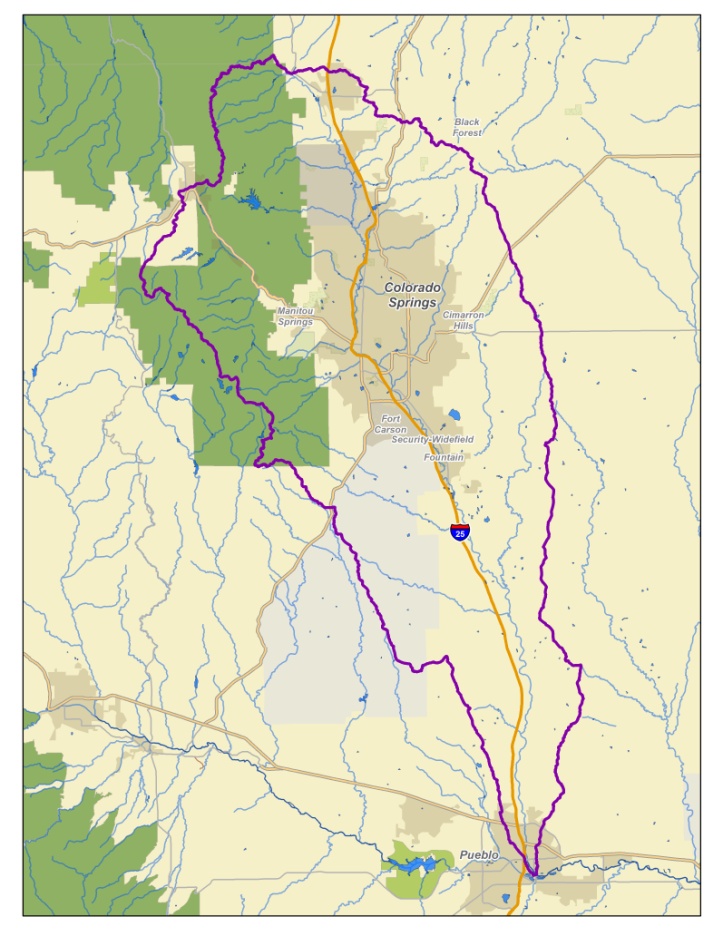
The Fountain Creek Watershed is located along the central front range of Colorado. It is a 927-square mile watershed that drains south into the Arkansas River at Pueblo. The watershed is bordered by the Palmer Divide to the north, Pikes Peak to the west, and a minor divide 20 miles east of Colorado Springs. Map via the Fountain Creek Watershed Flood Control and Greenway District.

From The Colorado Springs Gazette (Tom Roeder):

Bennet’s amendment would provide as much as $9 million to reimburse water utilities in Security, Widefield and Fountain for what they laid out in 2016 after learning their drinking water contained unsafe levels of perfluorinated chemicals from toxic firefighting foam released by Peterson Air Force Base.

“This builds on years of our work with the Air Force to address … contamination and is long overdue for the local water authorities who worked to provide safe drinking water to Colorado residents,” Bennet said in an email. “We’ll continue to push for its inclusion in the defense bill.”

Security Water and Sanitation District would get up to $6 million to pay for a pipeline it installed to pump clean Pueblo Reservoir water to its more than 19,000 customers.

“That’s something we have been working for and hoping for,” said district General Manager Roy Heald.

Southern El Paso County water districts began piling up bills in May 2016 after tests of water from the aquifer revealed contamination levels up to 30 times more than the maximum recommended by the U.S. Environmental Protection Agency.

Districts’ officials assumed the Air Force would pay to fight the contamination and were shocked when the military refused to pay the bill. The Pentagon concluded it couldn’t reimburse the districts without authorization from Congress.

That’s where Bennet’s amendment comes in. The brief measure piggybacks on a similar move to reimburse towns where water contamination came from National Guard bases and expands it to include active-duty posts including Peterson.

Bennet got support from Colorado Republican U.S. Sen. Cory Gardner, who signed on as a co-sponsor.

Heald said the senators have worked for months to figure out a fix for the utilities’ financial woes.

“They have both been here to talk to us directly about these issues,” he said.

But Heald isn’t counting the federal cash just yet. The provision for the money is a tiny part of the massive National Defense Authorization Act, a bill that sets spending across the military and includes hundreds of policy tweaks and changes.

With $716 billion at stake, lawmakers are expected to fight for weeks over every word the bill contains.

Bennet will need Senate approval, which seems likely with bipartisan support. But then he will have to fight with House lawmakers who signed off on their version of the defense bill, which doesn’t contain the water money.

Meanwhile U.S. Rep. Scott Tipton is pushing the EPA to keep their lawsuit active to get relief for Pueblo County from Fountain Creek stormwater. Here’s a report from Pam Zubeck writing for The Colorado Springs Independent. From the article:

U.S. Rep. Scott Tipton, R-Cortez, has joined plaintiffs in the EPA’s lawsuit against the city of Colorado Springs in urging EPA chief Scott Pruitt to stay the course in the Clean Water Act litigation…

Here’s Tipton’s letter, the latest salvo in the dispute:

Dear Administrator Pruitt,

I am writing in regard to the lawsuit the Environmental Protection Agency (EPA) and Colorado Public Department of Public Health an Environment (CDPHE) have filed against the City of Colorado Springs, Colorado. The lawsuit was filed on November 9, 2016, pursuant to Sections 309(b) and (d) of the Federal Water Pollution Control Act and the Colorado Water Quality Control Act.

The City of Colorado Springs’ failure to control stormwater has led to decades of discharge that is not in compliance with state and federal clean water laws. The stormwater has led to sediment buildup in Fountain Creek and created significant problems for downstream communities, especially for Pueblo, Colorado, which is in my Congressional District.

Recent reports that the EPA may re-enter negotiations with the City of Colorado Springs raise questions about the future of the lawsuit and the ability of the EPA to provide long-term certainty to downstream communities that their upstream neighbors are complying with clean water laws.

The long history of stormwater negotiations between Colorado Springs and downstream water users has not yielded positive, lasting results for communities like Pueblo. While I have been encouraged by the commitment demonstrated by Colorado Springs Mayor John Suthers to solve the long-standing problem, the lawsuit was filed by both the EPA and the CDPHE for a reason. It is imperative that the EPA work to permanently protect the water quality for communities downstream from Colorado Springs.

If you have any questions or wish to discuss this issue further, please do not hesitate to contact me.

Colorado Springs Mayor John Suthers has said he’d rather spend money on stormwater projects than litigation, but the city’s failure to fix its drainage system over the years has instilled distrust in downstream communities.

Voters approved a stormwater fee last fall that kicks in on July 1 but litigants in the lawsuit question if the $17 million a year for 20 years will be adequate to reduce flooding and mitigate sediment in Fountain Creek.

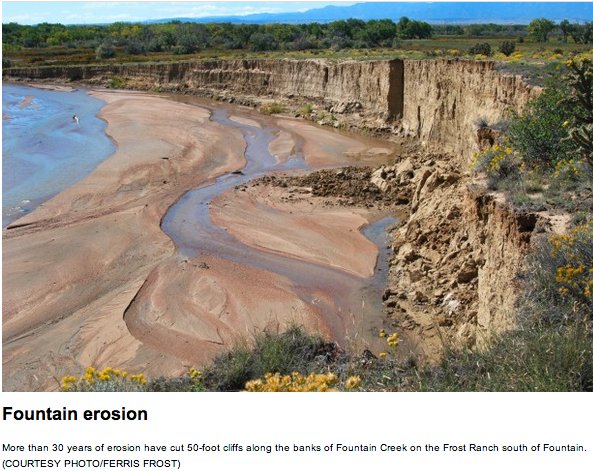
Fountain Creek erosion via The Pueblo Chieftain

CU Denver to begin testing blood of residents exposed in Widefield Aquifer PFCs pollution

Widefield aquifer via the Colorado Water Institute.

From The Denver Post (Bruce Finley):

…this week, a University of Colorado Denver public-health study funded by the National Institutes of Health will begin testing the blood of 200 residents, The Denver Post has learned.

No government agency has systematically investigated health impacts of the contamination. This area of southern El Paso County is among the most populated of more than 70 places where PFCs detected at levels up to hundreds of times higher than an EPA health advisory limit are spreading from military bases that used firefighting foam containing the chemicals.

Municipal firetrucks also carry the foam and PFCs are used in consumer products, including fast-food wrappers. They have emerged as one family in a widening array of synthetic chemicals detected in water that cannot be removed easily due to molecular structures…

Neither the Colorado Department of Public Health and the Environment nor the EPA has been monitoring PFC levels in the Fountain Creek watershed. Tests done more than a year ago showed contamination at levels far above the EPA health advisory limit.

CDPHE officials last week welcomed the EPA visit and said they’re pushing the Air Force to move faster into a planned 2019 “remedial investigation” phase that would include tracking the spread of PFCs in groundwater beyond the military base and airport.

The CU public health study will focus on people exposed to PFCs between 2012 and 2016, study leader John Adgate said. “We recruited more than 200 people from Security/Widefield/Fountain who will be coming to our temporary clinic for the blood draws.”

Air Force civil engineers last week provided their latest data to The Post from an “expanded site investigation” on Peterson Air Force Base and the adjacent Colorado Springs airport. They’ll drill 21 new wells to measure PFC contamination of groundwater.

The testing found PFCs at levels exceeding the EPA health limit contaminating 42 municipal water supply wells, which were shut down, with seven now back in use after the installation of treatment systems. (Fountain and Security stopped using wells for water supply, shifting to water diverted from the Arkansas River. Widefield bought and installed new water-cleaning systems to filter out contamination.)

Air Force officials said they have found 37 private wells with water containing elevated PFCs…

Meanwhile, Colorado Springs attorney Mike McDivitt, with colleagues in Denver and New York, has filed a second massive lawsuit in federal court, seeking funds from PFC manufacturers for medical monitoring. A federal judge is expected Aug. 2 to rule on whether an earlier lawsuit can proceed as a class action.

@EPA assures partners will take part in lawsuit settlement talks — The #ColoradoSprings Independent

Fountain Creek photo via the Fountain Creek Watershed Flood Control and Greenway District

From The Colorado Springs Independent (Pam Zubeck):

The latest chapter is a March 25 letter obtained by the Indy from the DOJ to the state Health Department and Colorado Attorney General’s Office. In it, DOJ Acting Assistant Attorney General Jeffrey Wood says the federal government will “welcome and anticipate the full involvement of the State and intervenors in any such discussions with the City.”

That contrasts with the EPA’s unilateral action to reopen settlement negotiations with the city recently — without consulting other plaintiffs — after a year-long settlement discussion failed last year. The lawsuit is set for trial in August.

#ColoradoSprings and @EPA negotiating stormwater lawsuit, other plaintiffs left out and state attorney fired — Colorado Springs Independent

Fountain Creek erosion via The Pueblo Chieftain

From the Colorado Springs Independent (Pam Zubeck):

The renewed negotiations come as U.S. District Judge Richard Matsch scheduled an August trial in the lawsuit on May 22, the day after the state’s lead attorney in the case was reportedly fired for a reason the Colorado Attorney General’s Office won’t discuss.

That lead attorney, Margaret “Meg” Parish, first assistant attorney general in the Natural Resources & Environment Section, wrote at least two scathing letters to the EPA and the Department of Justice (DOJ) in recent months, calling the EPA’s action “shocking and extraordinary” and expressing “deep concern and disappointment” that the agency unilaterally reopened settlement talks without consulting co-plaintiffs. Besides the Colorado Department of Public Health and Environment (CDPHE), those include Pueblo County and the Lower Arkansas Valley Water Conservancy District.

The move was particularly alarming, she noted, because the state and EPA signed an agreement not to communicate with the city without the presence of the other.

Some who couldn’t comment on the record due to confidentiality rules labeled the latest moves “pure politics” in an era when the EPA’s reputation is pivoting from protecting the environment to serving polluters…

EPA’s reopening of negotiations has sown suspicion among co-plaintiffs who already distrust the city due to sewage discharges, raging stormwater flows and sediment in Fountain Creek that befoul the creek, threaten levees and block irrigation headgates interfering with raising crops.

The possibility of a settlement was suggested to voters last fall when Mayor John Suthers campaigned for passage of stormwater fees, saying their adoption would help the city end the lawsuit, filed by the EPA and CDPHE in November 2016 after the city flunked compliance inspections in 2013 and 2015 for its MS4 permit (Municipal Separate Storm Sewer System). The lawsuit alleges ongoing violations of the Clean Water Act, saying the city failed to force developers to install proper storm drainage infrastructure, gave waivers to others and didn’t adequately inspect and monitor its waterways. The city spent only $1.6 million a year on those tasks from 2011 to 2014, a pittance considering the city’s drainage needs are estimated at $1 billion.

Approved by voters in November, the fees go into effect July 1 and replace general fund money used to satisfy an April 2016 deal the city made with Pueblo County to spend $460 million over 20 years on stormwater. The agreement grew from Pueblo County’s demands after the city adopted stormwater fees in 2007 and abolished them in 2009 and came as the city activated its $825-million water pipeline from Pueblo Reservoir.

EPA and City of Colorado Springs negotiating end to Clean Water Act lawsuit? — The #ColoradoSprings Independent

Colorado Springs with the Front Range in background. Photo credit Wikipedia.

From The Colorado Springs Independent (Pamela Zubeck):

Despite protests from fellow plaintiffs, the Environmental Protection Agency has agreed to revisit a possible settlement with the city Colorado Springs over alleged Clean Water Act violations caused by the city’s longterm neglect of stormwater management, according to documents obtained by the Independent.

The renewed negotiations come as U.S. District Judge Richard Matsch scheduled an August trial in the lawsuit on May 22, the day after the state’s lead attorney in the case was reportedly fired for a reason the Colorado Attorney General’s Office won’t discuss.

Margaret “Meg” Parish, first assistant attorney general in the Natural Resources & Environment Section, wrote several scathing letters to the EPA in recent months, calling the EPA’s action “shocking and extraordinary” and expressing “deep concern and disappointment” that the agency would unilaterally reopen settlement discussion without consulting co-plaintiffs. Besides the Colorado Department of Public Health and Environment (CDPHE), those include Pueblo County and the Lower Arkansas Valley Water Conservancy District.

The move was particularly alarming, she noted, because the state and EPA had signed an agreement in which both agreed not to communicate with the city without the presence of the other.

Some who couldn’t comment on the record due to confidentiality rules called the latest moves — reopening negotiations and the firing of Parish — as “pure politics” in an era when the EPA’s reputation is pivoting from protecting the environment to serving polluters.

EPA Administrator Scott Pruitt, who has long-standing and close ties to the oil and gas industry and is under investigation for multiple alleged ethics breaches, met with the Housing and Building Association of Colorado Springs in October when the HBA paid for his night’s stay at The Broadmoor.

A few months later, on March 19, the EPA wrote a letter to the city “as a follow up to the City’s recent request to re-initiate settlement negotiations.”

The EPA’s co-plaintiffs were given two days notice that the letter would be sent to the city’s legal counsel, reportedly fueling outrage among those partners. Pueblo County has harbored distrust of the city of Colorado Springs for decades regarding sewage discharges and raging stormwater flows in Fountain Creek, which befouls the creek and threatens levees at Pueblo where the creek joins with the Arkansas River. Farmers in the Lower Ark region have complained for years that sediment blocks their irrigation headgates interfering with raising crops.

Fountain Creek: Lower Ark and other agencies wonder if the @EPA will stay the course on lawsuit v. #ColoradoSprings

The Fountain Creek Watershed is located along the central front range of Colorado. It is a 927-square mile watershed that drains south into the Arkansas River at Pueblo. The watershed is bordered by the Palmer Divide to the north, Pikes Peak to the west, and a minor divide 20 miles east of Colorado Springs. Map via the Fountain Creek Watershed Flood Control and Greenway District.

From The Colorado Springs Independent (Pam Zubeck):

…in November 2016, the EPA and Colorado Department of Public Health and Environment sued, alleging violations of the Clean Water Act and the city’s Municipal Separate Storm Sewer System (MS4) permit to discharge into creeks, streams and rivers. As a federal judge looks to set a trial date this summer, the state and lawsuit intervenors, Pueblo County and the Rocky Ford-based Lower Arkansas Valley Water Conservancy District, urge the EPA in a March 26 letter to “re-commit” to the case, suggesting a dismissal or settlement might be in the works.

That would be a mistake, says Lower Ark executive director Jay Winner, because the city has broken promises in the past involving stormwater. “I started this in 2005 and we’ve had three or four deals, and something always goes south,” he says. “We’ve got to make sure we have good clean water, not just for now but for the future.”

The city’s struggle to fund stormwater dates to two failed ballot measures in 2001, and City Council’s adoption of fees in 2007 only to rescind them in 2009. In April 2016, the matter became a sticking point as the city prepared to activate the Southern Delivery System, a $825 million, 50-mile water pipeline from Pueblo Reservoir. Having issued a construction permit for it, Pueblo County demanded the city fix its storm system to relieve Fountain Creek flooding, or face revocation. In response, Mayor John Suthers and Council pledged $460 million over 20 years for city drainage work.

In November 2017, Suthers and Council proposed shifting that cost from the city’s general fund to fees. Voters approved, and the city begins collections in July. (See sidebar.)

By all indications, the city is working to comply with its MS4 permit. Its March 30 annual report for 2017 says the city:

  • Increased the number of drainage structures it maintained, from 53 in 2016 to 70, and for the first time, city workers walked every foot of the city’s 270 miles of creeks and channels to assess needs.
  • Boosted by 56 percent its reviews of drainage reports and construction and grading plans — to 1,590 last year. The city also rolled out new grading, erosion and sediment control permitting programs.
  • Launched Stormwater University, which instructs developers, engineers and consultants, as well as citizens, on MS4 mandates.
  • More than doubled the number of cleanup events along city waterways in 2017, to 88 from 37 in 2016, increasing public participation by 54 percent, to 6,014 people. Those volunteers removed 18 tons of trash. “We now have the capacity and people in place to run the programs,” says Jerry Cordova, who oversees the volunteer “trash mob” events, “so we can develop them and continue to grow.”
  • Beefed up development inspections, a key EPA lawsuit criticism. While no monetary penalties were imposed, the city stepped up enforcement, issuing 47 compliance actions last year compared to only 16 in 2016.
  • Inspections are more robust, says stormwater manager Rich Mulledy, because the city has more inspectors focused on drainage issues alone. “If you do a lot more inspections,” he says, “you’re going to catch more.” And the city did. It issued six stop-work orders last year, compared to only two in 2016, and 41 letters of noncompliance, the step that precedes a stop-work order — triple the 14 issued in 2016.

    Pockets of noncompliance, such as Wolf Ranch in the northeast, which gave rise to 23 percent of last year’s enforcement actions, stem from multiple adjacent job sites, Mulledy says. “We have a lot of different home builders and different contractors, and they’re all trying to play in the same sandbox, and they step on each other’s toes. You might have 100 pieces of equipment being used by 20 to 30 different companies.”

    Mulledy also warns against thinking that no monetary fines means no penalties. “Stop-work — that’s a very serious thing. That is a big deal,” he says. “They can’t work till it’s fixed.” Which is why stop-work orders span only a day or so, he says.

    The industry is aware of the heightened scrutiny, says Kevin Walker, spokesperson for the Housing & Building Association of Colorado Springs. That’s why the HBA instituted “Wet Wednesdays,” a series of tutorials about drainage rules for builders and developers.

    But it’s worth noting that builders applaud the Trump administration’s efforts to roll back clean-water and stormwater-runoff regulations. The HBA even funded EPA director Scott Pruitt’s “luxury hotel stay” at The Broadmoor in October 2017, according to Politico, which quoted HBA CEO Renee Zentz as saying it was “our chance to make sure the concerns of our industry are being listened to.”

    It’s not publicly known if the EPA’s lawsuit was discussed during Pruitt’s visit, but there’s been no filing that hints a negotiated settlement is imminent. Still, the March 26 letter from the state, Pueblo County and the Lower Ark says they “are now seriously concerned about whether the EPA continues to share our commitment to working together to protect Fountain Creek…”

    The CDPHE tells the Indy in an email the letter’s intent was to “reiterate the importance … of remedying the ongoing discharge of pollutants” into the Arkansas River watershed.

    But Lower Ark’s Jay Winner is more pointed: “I think there is a genuine distrust that the EPA may try to cut a deal,” he says. “We’re hoping that doesn’t happen. We’ve got to live with Fountain Creek for a very, very long time. Colorado Springs is doing a great job. Mayor Suthers is doing a great job. But we had a mayor before him [Steve Bach] that wasn’t doing a good job, and I don’t know if the mayor after John Suthers is going to do a good job.”

    More coverage of the Colorado Springs stormwater enterprise from Pam Zubeck writing for the Colorado Springs Independent:

    Starting July 2, billings for the city’s Stormwater Enterprise will be mailed to all Colorado Springs residents and property owners.

    The charges were authorized by voters last November under a 20-year plan that would raise roughly $20 million a year. The fee revenue will free up general fund money Mayor John Suthers and City Council had previously committed to its 20-year, $460-million deal with Pueblo County for projects to reduce erosion and flooding along Fountain Creek and other waterways. That general fund money, in turn, will be used for other purposes, such as hiring more cops.

    Since the November vote, the city has been working to set up billing procedures. Residential billings, including those for apartment dwellers, will be made by Colorado Springs Utilities, with one exception. Multi-family buildings that don’t have individual apartment water meters will be handled under nonresidential rates.

    City CFO Charae McDaniel says water service connections will trigger the stormwater fee for residential properties. Residential fee payers who don’t pay the $5 charge on their utility bills will be subject to disconnect under standard Utilities policies, which require payment within 14 days of the billing date. Utilities spokesman Steve Berry wouldn’t say how long Utilities provides service for overdue accounts, but it assesses a $20 fee for disconnection. Reconnection costs $30 during normal business hours and $40 after hours.

    If a residential customer refuses to pay the $5 fee, it rolls onto the next bill. If left unpaid for a period of time, accumulated fees could exceed the usage billings for water, sewer, electric and gas.

    “That couldn’t continue in perpetuity,” Berry says. “They [customers] will then eventually go into arrears, and they would be eligible for disconnection. There’s a point it becomes untenable for the customer, and they would be held responsible, just as in nonpayment of any service we offer.” But, Berry notes, Utilities gives customers “plenty of opportunity” to pay bills prior to disconnection.

    Nonresidential property owners of developed tracts up to 5 acres will be billed $30 per acre per month; if the land isn’t developed at all, no fee will be assessed. Owners of properties larger than 5 acres will be assessed $30 per acre per month on only those portions that are developed. Portions of those properties that remain in a natural state won’t be assessed a fee. Undeveloped land won’t pay any fee.

    There are currently 1,005 parcels that are over 5 acres that will be charged a fee, city spokesperson Jamie Fabos says. McDaniel says when properties are developed, based on monthly reports from the El Paso County Assessor’s Office, they’ll be added to the stormwater fee rolls.

    But Assessor Steve Schleiker says he changes a tract’s status only once a year, on Jan. 1, for tax purposes, and doesn’t generate a monthly report regarding development status; rather, those reports merely describe changes to property ownership.

    Asked about that, Fabos says, “Although we will be receiving monthly updates from the assessor’s office that show current ownership, acreage, and use, each property will be determined as developed or undeveloped by aerial investigation and through additional GIS technologies.” She adds that updates to parcel status will be made every six months — meaning new, nonresidential construction might not be assessed the fees until six months after they’re built.

    Nonresidential customers — which includes businesses, industry, churches, nonprofits and governments, including the city — won’t face disconnection of utility bills, because the city, not Utilities, will collect the fees. Nor will they be assessed late fees.

    “We will be going through collection processes if they become delinquent on the nonresidential side,” McDaniel says, meaning a collection agency could be used. If the fees become 150 days past due, she says, “We will process a lien on the property and record that with El Paso County to be added to property taxes.” That procedure carries a cost of 10 percent of the bill.

    Last fall, City Council President Richard Skorman said nonresidential billing information should be made public. Now, McDaniel says the City Attorney’s Office has said stormwater fees fall under the Colorado Open Records Act’s exemption for utility bills, so they’ll be kept confidential.

    That means citizens, or the media, can’t check how much various tracts are being assessed in stormwater fees.

    “It’s an issue I’d like to bring up,” Skorman says, “because I did make that promise, and I didn’t check with lawyers at the time, and I said, of course we would reveal it.”

    One possible alternative, he says, would be for Council to direct an appointed stormwater fee advisory committee to analyze and monitor fees assessed to assure they’re applied fairly. “That’s something that we definitely want to put in place,” he says.

    Moving forward, the fees can be raised by Council action, but only to satisfy a court order, comply with federal or state laws or permits, or fund the agreement with Pueblo County.

    Air Force working toward innovative groundwater cleanup solution

    The team responsible for the development of the enhanced contact electrical discharge plasma reactor, a novel method for degrading poly- and perfluoroalkyl substances (PFASs). Professors Selma Mededovic Thagard and Thomas Holsen with Nicholas Multari and Chase Nau-Hix (shaved head), pose in the CAMP lab, October 6, 2017.

    From Schriever Air Force Base (Shannon Carabajal):

    The Air Force is working closely with leading academic researchers to solve a global challenge: cleaning groundwater contaminated with Perfluorooctane Sulfonate and Perfluorooctanoic Acid, known as PFOS and PFOA.

    The Air Force Civil Engineer Center’s Broad Agency Announcement program began the charge toward finding better, faster and more sustainable solutions for cleaning groundwater contaminated with PFOS and PFOA in 2011. Since then, AFCEC has awarded more than $7 million in contracts for innovative technologies to better understand and remediate the two chemicals, said Monique Nixon, AFCEC BAA coordinator.

    PFOS and PFOA are two manmade chemicals found in many products around the world, including firefighting foam formerly used by the military and commercial airports to combat petroleum-based fires. The chemicals were also used widely in many water and stain-resistant products including nonstick cookware, stain-resistant fabric and carpet, and food packaging.

    “Most people have been exposed to (PFOS and PFOA),” according to the Environmental Protection Agency, and researchers are beginning to study long-term health effects. The EPA issued a provisional short-term health advisory for the chemicals in 2009, followed by a drinking water health advisory in 2016.

    Though EPA health advisories are non-enforceable and non-regulatory, AFCEC is aggressively identifying, responding to and preventing future drinking water contamination at Air Force bases around the country. As regulations and standards evolve, the team’s goals may eventually expand to include groundwater cleanup, a much bigger endeavor requiring a different approach.

    Currently, the Air Force primarily uses granular activated carbon filters to clean drinking water contaminated with the chemicals. Though the filters are very effective, there are drawbacks, said Cornell Long, team lead for AFCEC’s PFOS and PFOA response team.

    “Carbon filtration systems transfer (the compounds) from one medium – the water — to another — the carbon filter — so there is still the challenge of managing and disposing of the filter media. One of the Air Force’s goals is to find a technology that destroys PFOS and PFOA to the basic elements or at least to safe, simple compounds,” Long said.

    The BAA program seeks to identify that technology. Ongoing work includes a project by the Colorado School of Mines focused on using a high-pressure membrane filtration system in combination with a photochemical process designed to destroy the chemicals.

    Another project showing promise is new technology developed by researchers at Clarkson University which cleans contaminated water using an electrical discharge plasma. The process requires no chemical additions, produces no waste, and destroys and breaks PFOS and PFOA down into less toxic products that either remain in the water, or are released into the atmosphere as harmless gases, according to Selma Mededovic Thagard, an associate professor with Clarkson University’s Wallace H. Coulter School of Engineering.

    “Our system is ready to be scaled up; it’s nearly finished and it’s one of the most effective and efficient technologies available today for the treatment of PFOS and PFOA,” she said, adding that there’s still some work to be done before the technology can be introduced to the public.

    As projects continue advancing, the Air Force moves closer to identifying a permanent solution and the resulting technology could benefit many communities and organizations.

    When projects yield promising results, results are shared through presentations, trainings, manuscripts and websites. Additionally, through technology transfer efforts, program managers learn about the tools available and how they can be implemented.

    The BAA program funds research into sustainable environmental solutions. The competition is full and open, with no restrictions on the type or size of firms eligible for award. For more information, visit http://www.afcec.af.mil/Home/Environment/Technical-Support-Division/Environmental-Restoration-Technical-Support-Branch/BAA/.

    #Colorado Water Quality Control Division sets PFOA and PFOS standards

    Widefield aquifer via the Colorado Water Institute.

    From The Colorado Springs Independent (Pam Zubeck):

    The Water Quality Control Commission imposed standards for PFOS and PFOA, two types of perfluorinated chemicals (PFCs), the contaminants found in ground water as a result of Peterson Air Force Base using firefighting foam for years. The chemicals leached into the underground water supply, befouling wells and wreaking havoc on supplies in the Fountain Valley.

    The standard adopted by the commission is 70 parts per trillion for PFOS and PFOA, which was proposed by the Colorado Department of Public Health and Environment’s Hazardous Materials and Waste Water Management Division.

    “This will give regulators the authority they need to hold polluters accountable for cleaning up to that level,” the coalition said in a release. “It will also give them a much needed tool to better monitor discharge into the aquifer and prevent further … contamination of our drinking water.”

    The coalition also noted that it argued successfully against Colorado Springs Utilities’ bid to exclude its solids handling facility from the protected site. Biosolids have been identified as a possible source of PFOS contamination and Utilities’ facility lies within the alluvial aquifer targeted for protection.

    CDPHE seeks volunteers who were exposed to Widefield aquifer pollution

    Widefield aquifer via the Colorado Water Institute.

    From KOAA.com (Jessica Barreto):

    Investigators with the Colorado School of Public Health and the Colorado School of Mines are looking for volunteers who were exposed to tainted water in the Fountain, Security and Widefield area back in 2015…

    “The compounds are persistent so they are still in people’s bodies, likely if they were exposed,” said Dr. John Adgate, principal investigator at the Colorado School of Public Health.

    In order to know for sure, for their sake and the sake of those affected, researchers will need to look at blood samples.

    “It’s important for individuals because they’ll get to know what their body burden is, what their levels are,” Dr. Adgate added.

    Investigators will use those blood samples to see whether immune function, liver function and cholesterol levels changed because of the previous exposure to those chemicals.

    These blood samples, along with samples from private wells in Fountain and Security, will also help researchers figure out how long the contamination was occurring prior to 2015.

    Liz Rosenbaum, founder of the Fountain Valley Clean Water Coalition, says it’s important the community learn more about these possible health effects.

    “We need to be aware of what we’ve been exposed to, potential health effects later on in our lives so we can deal with it so it’s not a surprise,” she said.

    A $275,000 grant from the National Institute of Environmental Health Sciences is helping fund the study.

    Right now, researchers need more than 200 volunteers to sign up and they plan to follow up with 50 volunteers again the following year so see how these compounds are changing over time…

    Volunteers will also have to fill out a questionnaire and they’ll receive a gift card for participating.

    In order to qualify for this study you must meet the following criteria:

  • be 18 years old or older
  • live within the affected area for at least 3 years
  • be a non-smoker (tobacco and marijuana within the past 12 months)
  • cannot be pregnant
  • cannot have certain serious chronic diseases like cancer, diabetes or lupus
  • You can find out out how sign up for the study here.

    Prowers County Conservationist of the Year Award was presented to Hixson Farms

    From The Prowers Journal (Betty Civis):

    The Prowers County Conservation District held their annual meeting Wednesday, March 7th at the Elks Lodge in Lamar.

    Conservation Poster winners were announced and the posters were on display. The theme this year was “The Soil is Alive”.

    The Prowers County Conservationist of the Year Award was presented to Hixson Farms for their work in controlling land erosion from winds. The award was presented by Steve Shelton and he commented on the fact that all the conservation work that was done by the Hixsons was without government money.

    Michael Weber, Staff Engineer, for Lower Arkansas Valley Water Conservancy District, briefly talked about Fountain Creek and solutions for controlling flooding and the impact on the Arkansas River. He also explained the different accounts that have water stored in John Martin Dam and an additional account that is for future expansion. His third topic involved possible improvements to Adobe Creek including increased water retention.

    Water quality in the Arkansas River Basin from John Martin to the State Line was covered in a presentation by Blake Osborn, Water Resource Specialist from Colorado State University. The higher than average levels of Selenium, Uranium, Sulfates, Arsenic and Salt in the Arkansas River Basin are causing concern. Some of the concentration in the water occurs naturally from the underlying rock and soil and some is from the run-off of irrigation and rain water. Blake Osborn, Water Resource Specialist from Colorado State University is preparing a study and ideas to alleviate some of the problem.

    Fountain Creek: CSU-Pueblo scores additional $32,000 for water quality study

    The Fountain Creek Watershed is located along the central front range of Colorado. It is a 927-square mile watershed that drains south into the Arkansas River at Pueblo. The watershed is bordered by the Palmer Divide to the north, Pikes Peak to the west, and a minor divide 20 miles east of Colorado Springs. Map via the Fountain Creek Watershed Flood Control and Greenway District.

    From KRDO.com (Katie Spencer):

    But now, with an additional $32,000 in research funding from the county, researchers are hoping to find out exactly what lurks below the water’s surface.

    CSU-Pueblo staff and students have been collecting water samples, and they say there are large amounts of mercury and selenium in the water.

    “Mercury can be a problem. It has a whole syndrome, a whole set of symptoms if you see mercury levels getting too high,” [Scott] Herrmann said.

    County Commissioner Terry Hart said he just wants the Pueblo community to be able to enjoy the creek, as the people of Colorado Springs do.

    “Citizens are invited down to play in and around the creek and it’s a beautiful thing. We can’t do that in Pueblo County and we have not been able to do it because of our pollution concerns,” Hart said.

    He also wants to make sure the Pueblo commissioners and the city of Colorado Springs are keeping up their promises to clean up the creek.

    The researchers are also looking at the fish in Fountain Creek to determine what issues they are facing and if contaminants are being passed on to people who catch and eat them.

    Widefield aquifer: ColoradoSPH and @coschoolofmines score grant to study health effects of aqueous film-forming foams

    Photo via USAF Air Combat Command

    Here’s the release from the Colorado School of Public Health:

    ​Researchers at the Colorado School of Public Health at the University of Colorado Anschutz Medical Campus and Colorado School of Mines received a two-year grant to investigate contamination of the drinking water in the towns of Fountain, Security, and Widefield, Colorado. Residents of these towns were exposed to drinking water contaminated with pollutants originating from aqueous film-forming foams (AFFF) used in firefighting and training activities.

    By measuring biological markers of exposure and health indicators in a sample of approximately 200 people who consumed contaminated water, this study will provide communities and scientists with an improved understanding of the biopersistence and potential health impacts of AFFF-derived poly- and perfluoroalkyl substances (PFASs). PFASs are a class of chemicals widely used in industrial and commercial applications since the 1950s.

    In July, a nine-month U.S. Air Force study verified that firefighting foam used at Peterson Air Force Base contaminated ground water and soil with PFASs at levels more than 1,000 times an Environmental Protection Agency health advisory limit for similar chemicals.

    The grant is from the National Institute of Environmental Health Sciences, a program of the National Institutes of Health. This study is being funded because of the recent discovery of the source of contamination, which has impacted the water supplies of these communities for several years.

    “This research will contribute to our understanding of the factors driving this unique exposure and how it may affect long-term health,” said Dr. John Adgate, chair of ColoradoSPH’s Department of Environmental and Occupational Health and principal investigator of the study. “We will collect the first systematic data on blood levels of these persistent compounds in this PFAS-impacted community. While exposure to PFASs has been significantly reduced due to work by the Colorado Department of Public Health and Environment and the local water utilities, our hope is that by gathering data on blood levels shortly after people’s peak exposure we can provide better answers on related health effects and potential next steps.”

    Currently, little is known about the health effects of human exposure to PFASs in areas with drinking water contaminated by AFFF, and no systematic biomonitoring has been done in these communities.

    “Because we suspect that any health effects are likely related to peak blood levels, it is important to collect the blood data and health effect information as soon as we can,” Dr. Adgate said.

    Dr. Christopher Higgins, an associate professor of civil and environmental engineering at Mines and a co-investigator for the study, will be applying advanced analytical techniques to examine the potential that a much broader suite of PFASs is present in the impacted water supplies and possibly in people’s blood.

    “By using high resolution mass spectrometry to look at both water samples and a subset of human serum samples, we hope to improve our understanding of exactly which compounds bioaccumulate in humans and how long they stick around in the human body,” Higgins said. “We will also explore the links between drinking water exposure, PFAS blood levels, and the potentially related health effects.”

    Interventions to the water system like carbon filtration and alternative water supplies recommended by state and county health departments began in early 2016 soon after discovery of the contamination. As a result, exposures to these chemicals have been significantly curtailed. One of the research team’s challenges will be to work with the water utilities and health agencies to attempt to sample water from wells representative of what people were drinking before these interventions started. The study team hopes the additional water data will be useful to CDPHE and the water utilities that have been impacted by this contamination.

    The study will also include Anne Starling, PhD​​, assistant professor of epidemiology at ColoradoSPH and Katerina Kechris, PhD​, associate professor of biostatistics and informatics​ at ColoradoSPH.

    The Fountain Creek Watershed is located along the central front range of Colorado. It is a 927-square mile watershed that drains south into the Arkansas River at Pueblo. The watershed is bordered by the Palmer Divide to the north, Pikes Peak to the west, and a minor divide 20 miles east of Colorado Springs. Map via the Fountain Creek Watershed Flood Control and Greenway District.

    From the Associated Press (Dan Elliot) via The Denver Post:

    The University of Colorado and the Colorado School of Mines said the two-year study aims to determine how much of the chemicals residents absorbed, how quickly their bodies are shedding the contaminants and what the current levels are in the water.

    The chemicals are called perfluorinated compounds or PFCs. They have been linked to prostate, kidney and testicular cancer, along with other illnesses.

    Firefighting foam containing PFCs has been used at military installations nationwide. PFCs have also been used in non-stick cookware coatings and other applications.

    The Air Force announced in 2016 it would switch to some another type of foam believed to be safer.

    PFCs were found in well water in three utility systems serving about 69,000 people in the city of Fountain and an unincorporated community called Security-Widefield south of Colorado Springs. Levels exceeded the U.S. Environmental Protection Agency’s recommended limits.

    The utilities have switched to other water sources.

    The Air Force determined the chemicals came from firefighting foam used at nearby Peterson Air Force Base.

    The new study is designed to look at large-scale impacts of the chemicals, but individual subjects will at least learn what their contamination levels are and can talk to their health care providers about it, said John Adgate, the principal investigator…

    Although the study is planned for just two years, with sufficient funding it could be turned into longer-term project, he said.

    “There are no strong studies on the long-term health effects of these compounds,” Adgate said.

    The Colorado study is funded by an initial grant of about $247,000 from the National Institutes of Health.

    Petersen Air Force Basin Colorado Springs, Colorado. Photo credit: MilitaryBases.com.

    From The Colorado Springs Gazette (Tom Roeder):

    Approval for the study of residents in Fountain, Security and Widefield was announced Thursday by the Colorado School of Public Health at the University of Colorado Anschutz Medical Campus and the Colorado School of Mines. It will examine how perfluorinated compounds, a class of chemicals contained in the foam, have impacted the health of a small group of residents…

    Water providers have added filters and have switched to untainted sources since the contamination was revealed, but perfluorinated compounds are known to stay in the human body for decades after they’re consumed…

    The $275,000 local study comes after Congress approved a wider national effort as part of a military policy bill this month. The national study will help federal officials understand contamination reported near military bases around the nation that used the firefighting foam. Used to fight fuel fires, the chemical-laden foam was finally removed from Peterson Air Force base last year.

    The Air Force had been studying its toxic qualities since the Carter administration.

    Studies by the Air Force as far back as 1979 demonstrated the chemicals were harmful to laboratory animals, causing liver damage, cellular damage and low birth weight of offspring.

    The Army Corps of Engineers, considered the military’s leading environmental agency, told Fort Carson to stop using the foam in 1991 and in 1997 told soldiers to treat it as a hazardous material, calling it “harmful to the environment.”

    In 2000, the EPA called for a phaseout of the chemicals and later declared they were “likely to be carcinogenic to humans.”

    The Air Force plans more groundwater studies at Peterson Air Force Base next year as the Colorado Department of Health and Environment considers setting a groundwater limit for the chemical in the Widefield aquifer. The limit would be 70 parts per trillion – that’s a shot glass of the chemical in 107 million gallons of water.

    From KOAA.com:

    “What’s unknown here is what are the long term health consequences of exposure to these compounds and this study will begin to look at that,” Dr. John Adgate, principal investigator of the study at the Colorado School of Public Health said.

    After drinking water was tainted in the Security, Widefield and Fountain areas a year and a half ago which reports link to Peterson Air Force Base firefighting foam, many wondered if this could make them sick.

    “The things that we’re going to look at are some live enzyme tests and also some markers of immune function,” Dr. Adgate said…

    On Thursday, his research team announced they got the green light on funding for the two-year study.

    “I’m happy, I’m excited that we get to do the work, I know people are concerned,” he said. “It’s an opportunity to do something that’s important for public health in the state of Colorado and these folks in particular in Fountain, Security and Widefield.”

    He’s hoping to find out how persistent these compounds are in a group of 200 volunteers, all people from across the three affected areas.

    “Measure both their blood levels and collect some household water and look at the relationship between that and where they live, how long they’ve lived there and some markers of health effects,” he said.

    And regardless of the outcome of the study, he says the first order of business is making sure people are no longer being exposed.

    “Trying to offer them what we can in terms of interventions that assure that and answer other questions for example, can we grow vegetables with this?” he said.

    Researchers will start looking for that pool of 200 volunteers in the first half of 2018, focusing on long-term residents.

    They’re expecting to hold more public meetings to hear from the community before they move forward with signing up volunteers.</blockquote

    Widefield aquifer via the Colorado Water Institute.

    Widefield aquifer: Perfluorinated compounds shut down operations at Venetucci Farm

    Widefield aquifer via the Colorado Water Institute.

    From KRDO.com (Colleen Sikora):

    A majority of the Venetucci Farm revenue came from leasing wells on the property to Security Water Sanitation District.

    But that lease has ended, because of perfluorinated compounds have contaminated the water in Security-Widefield.

    “There’s a water remediation plan that needs to come together and we’ve decided we can be part of that solution because the wells to provide drinking water for those communities,” Sam Clark with Pikes Peak Community Foundation, which owns Venetucci Farms, said. “This is essentially kind of an agreement to row together over the next couple of years working on a solution… The consequence of that is we have to make some staff changes and change some of our operations in 2018 and until the remediation plan for the water is implemented.”

    […]

    “This farm is one of the many casualties of this water contamination,” [Susan] Gordon said.

    Lower Arkansas Water Conservancy District board meeting recap

    Fountain Creek erosion via The Pueblo Chieftain

    From The La Junta Tribune-Democrat (Bette McFarren):

    Mark Shea of Colorado Springs Public Works Department was early to the meeting with the Lower Arkansas Valley Water Conservancy District with the good news that Colorado Springs voters have approved funding of the Fountain Creek Flood Mitigation Project by approving Ballot Issue 2A. The project has not been funded for several years, but some of the projects have been funded through the general fund, explained Engineer Richard Mulledy. The project is now the subject of litigation between Colorado Springs and the LAVWCD, so Attorney Bart Mendenhall urged both sides not to get into the territory of the lawsuit in progress.

    Mulledy has been at the helm of the storm water project for two and a half years. Anthony Nunez, Director from Pueblo, asked Mulledy if the current 2A funding replaced the Enterprise Zone, which was originally designed to fund the project but voted out by the people of Colorado Springs. Mulledy said yes. The 2A mandate is intended only for capital projects associated with Fountain Creek Flood Mitigation, drainage maintenance over the 395 square miles of the Colorado Springs area, and the water quality program associated with it. Fees for litigation are not included…

    Winner brought up sedimentation as the major cause of the North La Junta flooding problem. “Thirteen feet of sediment under the North La Junta Bridge,” said Winner. “More like 15 feet,” said Bud Quick, whose volunteer earth-moving has protected North La Junta several times. Earlier Quick had declared the problem of flooding in North La Junta will never be solved until the river is dredged and sediment controlled in the Arkansas River.
    At the end of the meeting, Rose Ward thanked the LAVWCD for its help in flood mitigation for North La Junta, and at the present time for helping them establish a special district that will enable North La Junta Conservancy District to help itself.

    #ColoradoSprings in a scramble to get finance systems in place to collect #stormwater fees

    Channel erosion Colorado Springs July 2012 via The Pueblo Chieftain

    From The Colorado Springs Independent (Pam Zubeck):

    …the Colorado Springs Utilities Board, composed of City Council, must approve placing the monthly $5-per-household fee on residential utility bills, for which the city would pay the agency a one-time fee of $1.8 million and $200,000 a year, the Gazette reported.

    Approval of Utilities handling collections is expected, and Strand says it appears that customers who don’t pay the stormwater fee would risk losing all utility services.

    “We’re discussing this with Utilities [staff],” Strand says. “If someone doesn’t pay their bill, what’s likely to happen is their utilities will be turned off.”

    Fees of $30 per acre for non-residential developed parcels will be billed by the city, which must set up the mechanics to do that. Undeveloped properties will be assessed by the stormwater manager based on impervious surface. (Suthers has said the city will pay an annual bill of about $100,000 for its property, including park land.) Those, too, will be billed by the city.

    Strand says the consequence for nonpayment of non-residential billings is “likely” a lien placed on the property, which would require cooperation from El Paso County, the keeper of deed records. “The county commissioners I’ve talked to say they will cooperate,” he says.

    In 2011, when the city wanted to collect $765,000 still owed for stormwater fees implemented in 2007 but halted in 2009, county officials refused to add the fees to property tax bills or deeds. Those fees, however, were not approved by voters.

    Another complication is which properties, if any, will be deemed exempt from the stormwater fee. The measure approved on Nov. 7 entitles the city to bill nonprofits and churches, but what about federal agencies, such as post offices?

    Federal agencies didn’t pay the city’s stormwater fees imposed in 2007, citing sovereign immunity and claiming the fees were a tax and, thus, unconstitutional. But, thanks to a bill signed into law by President Obama on Jan. 4, 2011, which amended the Clean Water Act, the federal government will pay its fair share of local stormwater management services, according to the Association of State Floodplain Managers.

    Whether that bill applies to military installations is unclear. However, the association wrote in a newsletter that the law was envisioned as a way to resolve billing disputes with various federal agencies, including in Aurora where the city had billed Buckley Air Force Base $143,445 in outstanding stormwater fees as of May 2010.

    Although Strand initially said he thought Peterson Air Force Base, which overlaps into the city limits, could be exempted, when told of the 2011 amendment to the Clean Water Act, he was eager to learn more about it.

    “They use our resources, and we respond to help them with fire protection, although they have their own fire service,” he says. “I think they ought to be accountable under this current situation [ballot measure] we passed on Tuesday [Nov. 7].”

    “This is a fine example of the new relationship between Pueblo and Colorado Springs” — Terry Hart

    The Fountain Creek Watershed is located along the central front range of Colorado. It is a 927-square mile watershed that drains south into the Arkansas River at Pueblo. The watershed is bordered by the Palmer Divide to the north, Pikes Peak to the west, and a minor divide 20 miles east of Colorado Springs. Map via the Fountain Creek Watershed Flood Control and Greenway District.

    From The Pueblo Chieftain (Anthony A. Mestas):

    Pueblo County officials said Wednesday that they are excited about Colorado Springs voters approving a ballot measure securing $17 million in annual stormwater fees to be used exclusively for stormwater drainage and flood control projects.

    “This is a fine example of the new relationship between Pueblo and Colorado Springs. I think it’s wonderful to have two communities rolling up their sleeves to tackle problems the two communities share,” Pueblo County Commissioner Terry Hart said.

    The money coming from the new ballot measure will be used to fund projects, including the list of 71 projects identified in the intergovernmental agreement between Pueblo County and Colorado Springs regarding the permit for the Southern Delivery System. SDS is the large pipeline that transfers water from the Pueblo Dam to Colorado Springs…

    The IGA commits the Front Range city and its utilities department to pay $460 million for storm water infrastructure, maintenance and education programs over the next two decades.

    “As evidenced by the incredible progress that has been made in our stormwater program over the past two years, the city of Colorado Springs is committed to operating an outstanding stormwater program,” said Colorado Springs Mayor John Suthers.

    “Our commitment, and the commitment of our citizens, is evident in passage of Ballot 2A to provide a dedicated funding source for stormwater infrastructure, operations and maintenance.”

    Suthers said this commitment will continue as the city of Colorado Springs and Colorado Springs Utilities invest $460 million over the next two decades to stormwater operations that will improve the city’s ability to mitigate flooding and preserve water quality while meeting the requirements of its MS4 Permit.

    #ColoradoSprings: Is Issue 2A a springboard to outsized government spending?

    Colorado Springs with the Front Range in background. Photo credit Wikipedia.

    From The Colorado Springs Gazette (Conrad Swanson):

    While Mayor John Suthers touts stormwater fees as a route to financial stability for Colorado Springs, others see them as a symptom of the city’s insatiable appetite for cash.

    Some worry the city will inevitably raise the fees, which appear on El Paso County’s November ballot as Issue 2A.

    According to the ballot language, the city can raise the fees if ordered to do so by a judge, to come into compliance with state and federal laws or to abide by any intergovernmental agreements preceding June 1, 2016.

    A high-profile lawsuit filed against the city by state and federal governments or an intergovernmental agreement the city entered into with Pueblo County last year are the two most likely causes of future fee increases.

    Suthers argues that any increase from the agreement with Pueblo would be minimal and 2A is a proactive effort to mitigate high-dollar judgments against the city in the ongoing lawsuit.

    If passed, the fees would charge homeowners $5 a month and nonresidential property owners $30 per acre each month. The fees would last 20 years and are expected to raise as much as $18 million a year for the city’s stormwater obligations, which currently are met using the general fund.

    With a dedicated stormwater funding source in place, money freed in the general fund would be spent hiring new police officers and firefighters, Suthers said. If 2A passes, the city will be in good financial shape for the next two decades, he has said.

    But Councilmen Bill Murray and Don Knight, who oppose 2A, are dubious.

    Knight said the city’s wants will always be greater than the budget allows. The general fund has increased in recent years and the city can afford to continue paying for stormwater that way.

    And Murray said new police officers and firefighters serve a “Trojan horse” and open the door for fee increases.

    In April 2016, the city entered into a $460 million, 20-year agreement with Pueblo County to complete 71 stormwater projects. The city’s annual investments in those projects increase
    every five years and average $20 million a year over the life of the agreement. The investments currently sit at $17 million a year.

    If 2A passes and revenue hits the $18 million estimate in 2019, the first full year the fees will be in effect, the city can cover the $17 million investments. But in 2021 the city’s scheduled investments increase to $19 million a year, leaving a $1 million deficit.

    Suthers said he expects growth to help cover the increases, but money from the general fund can also help.

    Widefield Aquifer: USAF responds to Fountain City Council concerns

    Widefield aquifer via the Colorado Water Institute.

    From The Colorado Springs Gazette (Tom Roeder and Jakob Rodgers):

    Peterson Air Force Base bosses worked Tuesday to soothe the Fountain City Council’s frustrations over the base’s role in polluting drinking water for thousands of residents in southern El Paso County…

    “We have two objectives: One is to be as transparent as humanly possible,” Col. Eric Dorminey, vice commander of Peterson’s 21st Space Wing, told the council. “Two is to foster the partnership we have with the city of Fountain.”

    The Air Force wants the pollution cleaned up as badly as local residents do, Dorminey told the council.

    “We are committed to finding a means to mitigate these concerns,” he said.

    Fountain Mayor Gabriel Ortega said the council knows better than to shoot the messengers from Peterson.

    “While Peterson is where this potentially is coming from, they are not the ones who pull the strings,” Ortega said. “The leaders in Washington, D.C., are the ones we need to poke and prod.”

    Monday, local officials twisted arms in Washington to prod the Air Force into faster action on the issue.

    Officials from Fountain, Security and Widefield met with Air Force leaders at the Pentagon.

    Locals are frustrated that they’re left with a substantial bill to install filters or bring in other water sources to get perfluorinated compounds out of their drinking water.

    While the Air Force provided filters as part of an initial $4.3 million effort to provide clean water, the service didn’t come up with cash for buildings to house them, nor did it budget for pipelines to connect water users to other sources.

    Water districts and utilities in Security, Widefield and Fountain have paid $6 million in checks responding to the water crisis, and they expect that tap to hit $12.7 million by the end of 2018.

    The Air Force has said it won’t reimburse water districts for most of those expenses.

    U.S. Rep. Doug Lamborn, a Colorado Springs Republican who arranged the Pentagon confab, called the gathering productive…

    Lamborn said it remains unclear, though, whether the Air Force will pay up.

    The congressman said he’s frustrated by the military’s slow response to the contamination…

    The City Council meeting also comes a day after an open house held by the Colorado Department of Public Health and Environment on a proposed site-specific groundwater standard in central and southern El Paso County for the toxic chemicals.

    The standard would limit two well-known types of perfluorinated compounds in the area’s groundwater to 70 parts per trillion (ppt), or a shot glass of the chemical in 107 million gallons of water.

    It also would create the state’s first legally enforceable means to make polluters clean up contaminated areas. The likely boundaries extend across a wide swath of the county, including central and eastern Colorado Springs, Peterson Air Force Base and southern portions of Fort Carson.

    State officials plan to release their draft of the rules in December, and a hearing is slated for April 9.

    While Fountain now relies on clean water from Colorado Springs Utilities, the city could be forced to pull water from the aquifer in a drought.

    At the council meeting, leaders said they have been frustrated by the lack of communication from the Air Force. They had been asking to meet with Peterson bosses for months.

    Colorado College professor proposes to study Widefield aquifer pollution effects

    Widefield aquifer via the Colorado Water Institute.

    From KOAA.com (Lena Howland):

    Dr. John Adgate, the professor leading the potential study, told dozens of concerned homeowners at the meeting here on Thursday that he wants to know what the health effects are from the firefighting foam that’s said to have caused the widespread contamination across the area.

    He has submitted a fast track proposal seeking the funding for this study from the National Institutes of Health back in August and says he hopes to hear back within the next few months, with the goal of starting the study next summer.

    Adgate says he would be looking for a pool of 200 volunteers spread out from all three affected water districts.

    Their blood would each be tested once and 50 of them would be tested again the following year.

    This is to find out the levels of these compounds found in their blood and to see if these levels are going up and down over time.

    He says the compounds coming from the firefighting foam haven’t been studied enough to prove certain health effects, which is why he hopes his study will lead to more definitive answers.

    #ColoradoSprings: Mayor Suthers on the stump for stormwater ballot issue (2A)

    Colorado Springs with the Front Range in background. Photo credit Wikipedia.

    From the Colorado Springs Independent (Pam Zubeck):

    ..Mayor John Suthers is the chief spokesperson for the 2A campaign in radio ads that began airing Oct. 3.

    Rachel Beck, a Colorado Springs Chamber and EDC official who’s running the Invest COS campaign committee (aka the “vote yes” committee), reports the ads will continue until Election Day and that other strategies include flyers targeting likely voters and Google and Facebook digital ads. “It’s a pretty broad audience we’re communicating with,” Beck says.

    With just 54 percent of likely voters supporting the measure, according to a poll conducted in early August, Invest COS hopes to move the needle to put the measure comfortably over the top. “Our polling showed that people have a high level of understanding of the issue,” Beck says, adding the campaign is focusing on explaining “that this is the right solution, what the components are and what they can expect to get in return if they support the measure with their vote.”

    […]

    The measure, if approved, would require every household, including renters, to pay $5 a month on their water bill to fund stormwater; owners of nonresidential property would pay $30 per acre. Property owners of developed land larger than five acres would pay fees set by the city’s stormwater manager, based on the area of impervious surface on the land. The city itself would also pay the fee, which Suthers says in an interview would cost about $100,000 a year. The fees would be collected for 20 years.

    Two seasoned political activists are working separately against the measure. Laura Carno, a political strategist who ran the campaign of the city’s first strong mayor, Steve Bach, in 2011, has set up a new campaign committee called Springstaxpayers.com. She says she’s raised less than $10,000 and plans a radio and digital campaign, plus TV if more money comes in. “The message will be that the city of Colorado Springs has plenty of money,” Carno says. “They just need to prioritize it.”

    #ColoradoSprings: Ballot issue debate, October 17, 2017

    Heavy rains inundate Sand Creek. Photo via the City of Colorado Springs and the Colorado Springs Independent.

    From The Colorado Springs Independent (Pam Zubeck):

    Two key ballot measures will be debated on Oct. 17 at a public forum at the MCI/Verizon Building, located at 2424 Garden of the Gods Road. The forum will be held from 5:30 p.m. to 7 p.m.

    Mayor John Suthers will promote the city’s proposed stormwater fee. If 2A is approved, it would require every household to pay $5 a month on their water bill to fund stormwater projects, and owners of nonresidential property to pay $30 per acre per month. Property owners of developed land larger than five acres would pay fees set by the city’s stormwater manager, based on impervious surface.

    Taking the “vote no” position will be political strategist Laura Carno, who’s mounting an opposition effort.

    #ColoradoSprings sales tax revenue up, stormwater infrastructure could benefit

    Colorado Springs with the Front Range in background. Photo credit Wikipedia.

    From The Colorado Springs Gazette (J. Adrian Stanley ):

    The budget proposal assumes the stormwater fee measure on the Nov. 7 ballot will not pass, but Suthers is prepared to submit an amendment to City Council if it does.

    A big chunk of the anticipated increase in revenue is from sales tax collection increases. At times, the city has needed to refund sales tax collections that grew quickly, due to revenue growth limits set by the Taxpayer’s Bill of Rights. But this year, and in 2018, the city will be able to keep $6 million per year in revenue overage thanks to a measure approved by voters in April. That money is dedicated to stormwater projects. (The city is aggressively dealing with drainage issues, in part, because it’s being sued by the federal government for violation of the Clean Water Act.)

    #CDPHE is considering limits for PFCs

    Widefield aquifer via the Colorado Water Institute.

    From The Denver Post (Bruce Finley):

    Colorado health officials grappling with groundwater contamination from firefighting foam — containing a toxic chemical the federal government allows — have proposed to set a state limit to prevent more problems.

    A Colorado Department of Public Health and Environment limit for the perfluorinated chemicals (PFCs) also could give leverage in compelling cleanup by the Air Force, which has confirmed high levels of PFCs spreading from a military air base east of Colorado Springs. More than 65,000 residents who relied on the underground Widefield Aquifer as a water source have had to find alternative supplies or install new water-cleaning systems as a plume of PFCs contamination moves south through the Fountain Valley watershed.

    “We need to be able to have not just a carrot, but a stick,” CDPHE environmental toxicologist Kristy Richardson said last week, discussing the effort to set a state limit.

    The proposed maximum allowable level of 70 parts per trillion in groundwater — matching a health advisory level the Environmental Protection Agency declared in May 2016 for two types of PFCs — wouldn’t be finalized until April, Richardson said. A boundary has yet to be drawn for where the limit would apply.

    But such regulatory action could help state officials navigate a complex environmental problem. Other states have set PFC limits as scientists raise concerns about PFCs, which have been linked to health harm, including low birth weights and kidney and testicular cancers. Few public health studies have been done, even though people south of Colorado Springs apparently have ingested PFCs for years in public drinking water.

    An Air Force investigation confirmed contamination of groundwater by PFCs used in the aqueous film-forming foam that fire departments widely use to put out fuel fires, such as those caused by airplane crashes. PFCs also are found widely in consumer products, including stain-proof carpet, microwave popcorn bags and grease-resistant fast-food wrappers.

    The chemical properties that make make PFCs useful keep them from breaking down once spilled, especially in water. Scientists say people and wildlife worldwide have been exposed at low levels.

    At the Peterson Air Force Base, PFCs contamination of groundwater has been measured at levels up to 88,000 ppt with soil contamination levels as high as 240,000 ppt. And Richardson said PFC levels in groundwater south of Colorado Springs — communities including Security, Widefield, Fountain, Stratmoor Hills, Garden Valley and the Security Mobile Home Park — were measured at a median level of 120 ppt — well above the EPA health advisory limit.

    Richardson favored a broad area for the groundwater limit — “so that maybe we can begin to look at other sources. … My biggest concern is the extent” of the plume, she said.

    Fountain Creek: #Colorado Springs Nov. 7 stormwater ballot measure cost

    The Fountain Creek Watershed is located along the central front range of Colorado. It is a 927-square mile watershed that drains south into the Arkansas River at Pueblo. The watershed is bordered by the Palmer Divide to the north, Pikes Peak to the west, and a minor divide 20 miles east of Colorado Springs. Map via the Fountain Creek Watershed Flood Control and Greenway District.

    From The Colorado Springs Independent (Pam Zubeck):

    The city’s stormwater measure on the Nov. 7 ballot has stirred a lot of debate. Some don’t like the flat-fee concept — $5 per household, and $30 per acre for commercial land. Others say too many details remain unresolved.

    But one thing is beyond dispute: Colorado Springs’ stormwater system sucks, and it’s going to take many years and a lot of dough to fix it. Far from a sexy topic, stormwater drainage gets no respect, and the consequences of that came into full focus during a tag-along with Water Resources Engineering Division Manager Rich Mulledy on Aug. 31.

    To grasp the gravity of the problem, you have to get down in the weeds, literally, to see what’s going on along channels that border roads where tens of thousands of cars whiz by daily, their drivers unaware of possible catastrophes waiting to happen.
    Monument Creek

    Mulledy, a slim 38-year-old engineer and Colorado Springs native sporting a Chicago Cubs cap, leads the way on a short hike behind the Goose Gossage Youth Sports Complex on Mark Dabling Boulevard. “So if you’re playing ball out here,” he quips, “you wouldn’t know about it.”

    Beyond the outfield fences, he passes through trees before scampering down a steep embankment to a sandbar where Monument Creek gurgles its way along an embankment prone to sloughing, which sends sand, gravel and trash careening down the creek to its confluence with Fountain Creek, which, in turn, flows south to the Arkansas River east of Pueblo.

    Fountain Creek, Mulledy says, is unlike any other in the United States due to its wild fluctuations in flows, from 125 cubic feet per second during normal times to 25,000 cfs in heavy storms. “There’s no other creek that’s a sand bottom creek that sees that kind of flash,” Mulledy says. “It’s a tough creek.”

    Rushing runoff from Colorado Springs crumbles banks and sends hundreds of thousands of tons of sediment to Pueblo County, whose officials are none too pleased. There, sediment clogs levees and befouls the Arkansas River. After a 2014 regional ballot measure to fund drainage projects failed at the polls, Pueblo County officials threatened to rescind their construction permit for Colorado Springs’ Southern Delivery System (SDS) pipeline that delivers water from Pueblo Reservoir, unless the city dealt with stormwater. A deal approved by City Council in April 2016 enabled SDS’s activation in exchange for the city spending $460 million on drainage over the next 20 years. That spending eats into the general fund budget, which Mayor John Suthers says is needed to hire more cops and firefighters. Hence, the stormwater fee measure, which is intended to lift that burden.

    On this August day, Mulledy doesn’t have to point out damage from Monument Creek’s raging waters. A 20- to 25-foot dirt wall towers along the east side of the creek, where waters carve the banks and threaten to undermine the wall, triggering a collapse of a plateau above. That could bring a storage business crashing down.

    “The natural tendency of a stream is to move,” Mulledy explains. “Point [sand] bars move and push the water into the bank. It’s a built environment, so we built up next to it. Now, there’s nowhere for the river to move.”

    The city plans to install grouted boulders along a 350-foot stretch at the base of the wall, tying into bedrock. Then, the area will be backfilled with dirt to create a slope, which will be sown with seed to encourage vegetation. “Then it can hold itself, even in big storms,” he says.

    Sounds simple, but getting the right kind of heavy equipment into the creek area poses a challenge. “With road work, you can drive up, mill it and pave it,” Mulledy says. “Here, we have to create an access point. We have to bring material in, then we have to armor it for a 100-year [flood] event.” Moreover, the stream’s path itself will need to be moved west to allow workers to construct the project. Lastly, drop structures will be built to flatten the creek bed and retard the water’s flow.

    Cost: $750,000.

    After the project is completed in 2020, Mulledy says, the site should be inspected annually to assure it holds.

    North Douglas Creek

    As cars speed by on Interstate 25 just yards away, Mulledy hikes down a slope, through sunflowers and thistle, to the edge of North Douglas Creek where he warns visitors to stay away from the edge — a drop of 30 feet to the creek bed.

    Here, the creek has eroded soils so dramatically that part of a concrete box culvert has broken off and been carried about 20 yards downstream. Gas and water lines are exposed, along with a drainage pipe, which juts some 10 feet from the canyon wall, acting as a yardstick for how far the banks have been chipped away.

    “Colorado Springs Utilities is worried about that gas line and so are we,” Mulledy says.
    To the north is Johnson Storage and Moving, while on the south side lies a construction materials business. Both are threatened.

    “Johnson Storage is losing their lot,” Mulledy says, noting the embankment is chipping off several feet per year. Erosion is so bad, Sinton Road adjacent to the culvert could topple some day.

    One of the problems stems from development practices in the 1960s and ’70s that followed the then-conventional wisdom to simply move storm flows out of the city as fast as possible. Now, best management practices call for slowing down those flows using detention ponds and drop structures. “We have a better understanding than we used to,” Mulledy says.

    This segment of Douglas Creek is part of the city’s network of 270 miles of open channels and 500 miles of storm sewers — subject to inspection by federal regulators of the city’s municipal separate storm sewer system, or MS4, permit, issued through the Environmental Protection Agency.

    Violations of that permit and the Clean Water Act led the EPA and the state to sue the city last year. The case is pending and could take years to resolve as the city reconstitutes its program to address water quality and conveyance, compliance with plan review and site inspection for new developments, and maintenance of its entire system.

    This particular spot is so tenuous that Mulledy says crews visit it whenever heavy rains come. The fix, he says, will require installation of concrete walls along the bend in the creek to stop sloughing earth, structural fill and grouted rock. A crane will be employed to remove chunks of the concrete culvert.

    Cost: $3.5 million.

    Like many other projects, this undertaking will require the approval of federal flood plain managers and the Army Corps of Engineers. Work is slated for 2020.

    Pine Creek

    The most spectacular sight of the day comes at a canyon just north of the Margarita at Pine Creek restaurant, which sits dangerously close to a roughly 50-foot drop-off to Pine Creek below. Another on the city’s list of 71 projects included in the intergovernmental agreement with Pueblo, this site will require stacking boulders to create a wall at least 10 feet high, from the creek bed to the bottom of an exposed limestone shear. Below that limestone is a clay layer notoriously susceptible to erosion. Under that lies pure shale, easily crumbled, especially when the creek runs up to 10 feet deep during 10-year storms. “It’s a little stream,” Mulledy says, “until it rains.”

    The project was specifically identified by Pueblo County due to the large amounts of sediment washing into the creek and on to Pueblo via Fountain Creek. Pine Creek starts in Black Forest, winds through Falcon Estates and finally barrels through this canyon before it meets with Monument Creek about a quarter mile away. Power lines along the ridge top are mere feet from the canyon’s lip, and about 100 yards upstream, a bridge might be in danger eventually, Mulledy says.

    Like the others, this site will be challenging to access, driving the cost up, he adds.

    Cost: $2 million.

    The project will be designed next year, and construction is due to begin in 2019.
    Green Crest Channel

    Green Crest Channel almost claimed a couple of businesses and a portion of Austin Bluffs Parkway back in 2010 before the city shored up the dissolving embankment with a project completed in 2015.

    Mulledy worked on the solution to the problem while he was an engineer with Matrix Design Group, later joining the city in February 2016. By buttressing the banks and installing drop structures and grouted boulders, the stream is now healthy and lined with vegetation, such as willows, that appears historic but was placed there by Matrix as part of the project.

    Because the new features, including four drop structures, slow the stream’s flow in Templeton Gap, erosion is dramatically curtailed downstream.

    Cost: $2.8 million.

    Another project upstream from Green Crest will further secure the waterway. At Siferd Street in Park Vista, just east of Academy Boulevard, even a small rain creates monster flooding from an over-topped Templeton Gap waterway. Plans call for crews to raise the road by several feet, lower the creek, and install a box culvert and five drop structures downstream. Work begins in 2020.

    Cost: $3.75 million.

    Those projects just scratch the surface of problems that become evident when face-to-face with the city’s stream system. With the price tag in the high millions, Mulledy notes he wants to maximize those dollars. That’s why his staff works hand-in-glove with Utilities and the Parks Department to find opportunities to incorporate trails and recreation facilities where plausible.

    “Most of our projects are on green corridors,” he says, “so we look for opportunities for green spaces.”

    #Colorado Springs “vote yes” on stormwater ballot issue folks gearing up for campaign

    Heavy rains inundate Sand Creek. Photo via the City of Colorado Springs and the Colorado Springs Independent.

    From The Colorado Springs Independent (Pam Zubeck):

    The Nov. 6 election will be the fourth time voters have been asked to provide longterm funding for stormwater, the other failed attempts coming twice in 2001 and the regional effort in 2014 that went down 47 percent to 53 percent. (Voters in April did allow the city to keep up to $12 million in one-time excess revenue from 2016 and 2017 for stormwater.)

    But now, the city faces a lawsuit alleging violations of the Clean Water Act filed by the Environmental Protection Agency and state water quality regulators, stemming from the city’s neglect of its stormwater system and waivers the city gave to developers to sidestep building drainage facilities. Suthers says passage of a stormwater fee, which would raise $17 million a year from residents and property owners, would help the city avoid costly fines from the lawsuit, though some city councilors disagree.

    Most of the money to be raised by Invest in COS, the “vote yes” committee, will come from business people and construction contractors, says Rachel Beck, government affairs manager with the Colorado Springs Chamber and EDC. “They understand the link between reliable infrastructure and their ability to do business and economic health,” she says. The monthly stormwater fee for commercial property owners would be $30 an acre.

    Having hired consultant Clear Creek Strategies of Denver, the committee will use mailers, TV and radio, but so far doesn’t have a slogan for the measure, dubbed 2A on the ballot, Beck says.

    Suthers interprets a pre-campaign poll that showed the issue passing comfortably as the community seeing stormwater as a priority, he says. “It also indicates the public has confidence in the city’s leadership and hopefully that will result in greater support.”

    Laura Carno, a conservative political operative who lives in Monument and opposed the city’s 2C roads tax measure in 2015, might sit this one out, she says, adding she knows of no organized effort to defeat the fee.

    [Douglas Bruce], though, is putting together a “true grassroots organization,” though he himself cannot vote, because he remains on probation for a felony tax-evasion conviction that is under appeal.

    Bruce also plans to write a statement against the measure, though the city is not required to mail Taxpayer’s Bill of Rights notices to voters, since those are required only for tax hikes, not fee questions.

    Bruce says he’ll target the flat rate in his campaign, noting, “The idea that Suthers’s campaign donors who live in mansions in the Broadmoor [area] don’t have to pay any more than grandma in her trailer, that’s an abomination.”

    Notably, the city’s now-defunct stormwater fee charged fees based on impervious surface, meaning those that contributed most to the runoff problem, such as owners of large homes and businesses and parking lots, paid more. The city’s Stormwater Enterprise was shut down in 2011, after fees were suspended in late 2009 as a result of a ballot measure Bruce wrote that called for ending “the rain tax.”

    Fountain has received the second of two Air Force-supplied water filters

    Water infrastructure as sidewalk art

    From The Colorado Springs Gazette (Jakob Rodgers):

    The delivery Wednesday of the granular-activated carbon filters marked another milestone in the city’s efforts to avoid the fouled Widefield Aquifer, which is contaminated with chemicals linked to a Peterson Air Force Base firefighting foam…

    Fountain last used the aquifer in 2015, and residents have been asked to conserve water while the city relies solely on the Pueblo Reservoir.

    The city’s first Air Force-supplied filter will likely be operational in about four to six weeks, said Curtis Mitchell, Fountain’s utilities director.

    The filter delivered Wednesday likely won’t be turned on until spring 2018, because it won’t be needed during the fall and winter, when water usage dips, Mitchell said…

    So far, the Security, Widefield and Fountain water districts have spent more than $6 million to avoid perfluorinated compounds in the aquifer.

    From KOAA.com:

    The new treatment system, installed at Aga Park downtown, is said to be effective in removing the PFC’s from the water. Both new units, the other installed in June near the Fountain Library, are expected to be fully operational before next summer.

    “We’re very pleased to be making progress toward the ability to treat and use our groundwater,” said Curtis Mitchell, City of Fountain Utilities Director. “Our groundwater is a very important resource required to meet the water demands of our growing community.”

    The City of Fountain will work on design plans for a permanent groundwater treatment plant within the next few months.

    USAF does not plan to reimburse water suppliers for mitigation of Widefield aquifer pollution

    Widefield aquifer via the Colorado Water Institute.

    From the Associated Press via U.S. News & World Report:

    The Air Force doesn’t plan to reimburse three Colorado communities for the money spent responding to water contamination caused by toxic firefighting foam previously used at a military base, potentially leaving the towns with an $11 million tab…

    The Air Force has pledged $4.3 million in aid, and only $1.7 million of that amount will go to the water districts. Much of the rest is being spent on bottled water and filters. “We don’t back pay — we cannot reimburse,” said Cornell Long, a chemist with the Air Force Civil Engineer Center.

    An email sent to the newspaper from the engineer center in response to a request for clarification said, “The Air Force does not have the authority to reimburse communities for costs incurred in dealing with environmental contamination issues.”

    The military plans to continue studying the toxic chemicals in the foam and their effect on residents’ health until 2019. Air Force officials said last week they do not expect to carry out a remediation plan for the contaminated wells until next decade…

    An Air Force report released Tuesday said that other sources likely contributed to the aquifer’s contamination, though none has been identified.

    The delay has angered residents, and the cost is overwhelming the towns’ resources, which will lead to rate hikes in at least two of the three communities.

    “We really need financial help,” said Roy Heald, manager of the Security Water and Sanitation Districts. “We need to get going on those things before the 2020s.”

    Fountain plans to raise water rates by 5.3 percent this year, and Security plans to study a rate hike this fall. Widefield officials don’t expect to raise rates, though its long term solution — a new treatment plant for 10 affected water wells, could add $10 million to $12 million to their costs.

    Security is also planning to build a treatment plant. It is paying Colorado Springs Utilities for uncontaminated water in the meantime for $1 million a year.

    Fountain officials have budgeted $4.2 million in fixes through 2018.

    From The Colorado Springs Gazette (Tom Roeder):

    The defendants have moved to dismiss a sweeping lawsuit over chemicals polluting the Widefield Aquifer.

    The suit, brought last fall, alleges that chemical giant 3M and other firms that sold firefighting foam to the Air Force should have known that it contained dangerous perfluorinated compounds, now thought to be a health risk. Thousands of water users in Widefield, Fountain and Security were told to stop drinking water from the aquifer last year after testing determined it contained dangerous levels of the compounds.

    Attorneys for 3M, in a motion to dismiss the proposed class-action suit, argued that the firm didn’t know the foam was toxic when it was sold to the Air Force. The motion also argues that the Air Force, not 3M, used the foam, and polluted the environment.

    “3M’s action is too far removed from the claimed injury for the court to reasonably infer foreseeability,” attorneys for 3M wrote, “or any duty arising therefrom.”

    While the Air Force last week admitted that foam releases at Peterson Air Force Base since the 1970s might have allowed the chemical to seep into the aquifer, the military isn’t named in the lawsuit. Suing the military is nearly impossible because of sovereign immunity, a legal doctrine that blocks all but the rarest claims against the government.

    With the federal path blocked, lawyers representing plaintiffs in several lawsuits have targeted the chemical manufacturers with claims that the polluted wells stem from the sale of a dangerous product.

    The suits have been merged into a single megasuit at federal District Court in Denver. The plaintiffs are also asking that all property owners in the area be recognized as a class, allowing them to head to court as a group rather than requiring them to each sue.

    The plaintiffs claim that 3M and other manufacturers ignored warnings about perfluorinated compounds and kept selling the foam to the military, “and continued to do so long after they were aware of the health and environmental risks of their products.”

    The defendants say they didn’t know the foam was harmful at the time it was made.

    In arguments against 3M’s motion for dismissal, the plaintiffs claim that 3M stopped making the firefighting foam in 2002 due to toxicity concerns, but never recalled the product or warned users of the hazards the foam posed…

    A report released by the Air Force last week showed that the chemical was detected at 88,000 parts per trillion near the fire training area at Peterson Air Force Base, that’s 1,257 times higher than the EPA’s advisory level.

    Any resolution to the lawsuit could be a long way off.

    No timeline has been set for arguments on the motion to dismiss the case.

    Some studies that both sides could need to determine liability haven’t begun.

    The Air Force claims that studies tying the aquifer’s pollution to firefighting foam are incomplete and may not be finished until late 2018.

    The court in Denver this month waived filing deadlines in the lawsuit, slowing its progress ahead of a proposed late August hearing to set a schedule for the case.

    Widefield aquifer pollution mitigation update

    Widefield aquifer via the Colorado Water Institute.

    From The Colorado Springs Gazette (Tom Roeder and Jakob Rodgers):

    In a first-of-its-kind admission for the service, Air Force investigators confirmed that toxic firefighting foam chemicals used at Peterson Air Force Base had leached into the surrounding groundwater. To fix the problem, Air Force officials are proceeding under a process similar to the federal Superfund program – a yearslong procedure for cleaning up complex environmental contamination. No Superfund designation, however, has been made.

    The findings were outlined in a report unveiled [July 25, 2017] that examined dozens of soil and water tests over the last year at the east Colorado Springs base.

    Over and over, investigators for the report issued the same warning: “There is the potential for a complete groundwater pathway for human receptors.”

    At a news conference later Tuesday, Air Force Col. Todd Moore gave no apology but framed the report as an attempt to be transparent about what had transpired in decades of training with the foam. He vowed to cooperate with the community in finding a solution.

    “There’s still more to learn,” Moore said.

    A final determination about what needs to be done probably won’t come until the completion of another study, which won’t begin until 2019 and still needs congressional approval for funding, said Cornell Long, of the Air Force Civil Engineering Center in San Antonio.

    Federal remediation work will push into the next decade, he added, though some help may arrive before then.

    “There could be points where you take interim measures,” he said.

    Several local elected and water officials expressed disappointment Tuesday at the prospect of a years-long wait for help.

    Fountain Mayor Gabriel Ortega left a closed-door briefing with Air Force and other local officials “frustrated” that Peterson’s latest investigation didn’t appear to be all-encompassing.

    He said Air Force officials gave him no clear indication of when they would send the $4.3 million in aid promised last year. Nor did they say whether the service would offer more financial aid to communities burdened with the tainted water, he added.

    USAF identifies sources of groundwater contamination for Widefield aquifer

    Widefield aquifer via the Colorado Water Institute.

    From The Colorado Springs Gazette (Tom Roeder and Jakob Rodgers):

    The Air Force on Tuesday acknowledged potential guilt in fouling the drinking water of thousands of its neighbors but offered no apology and said work on a federal remediation plan likely would not begin until sometime in the 2020s.

    In a first-of-its-kind admission for the service, Air Force investigators confirmed that toxic firefighting foam chemicals used at Peterson Air Force Base had leached into the surrounding groundwater. To fix the problem, Air Force officials are proceeding under a process similar to the federal Superfund program – a yearslong procedure for cleaning up complex environmental contamination. No Superfund designation, however, has been made.

    The findings were outlined in a report unveiled Tuesday that examined dozens of soil and water tests over the last year at the east Colorado Springs base.

    Over and over, investigators for the report issued the same warning: “There is the potential for a complete groundwater pathway for human receptors.”

    At a news conference later Tuesday, Air Force Col. Todd Moore gave no apology but framed the report as an attempt to be transparent about what had transpired in decades of training with the foam. He vowed to cooperate with the community in finding a solution.

    “There’s still more to learn,” Moore said.

    A final determination about what needs to be done probably won’t come until the completion of another study, which won’t begin until 2019 and still needs congressional approval for funding, said Cornell Long, of the Air Force Civil Engineering Center in San Antonio.

    Federal remediation work will push into the next decade, he added, though some help may arrive before then.

    “There could be points where you take interim measures,” he said.

    Several local elected and water officials expressed disappointment Tuesday at the prospect of a years-long wait for help…

    A Gazette investigation last fall revealed a string of Air Force studies and other military research dating to the late 1970s that warned that the chemicals – known as perfluorinated compounds – were linked to ailments in laboratory animals including cancer, liver disease and low infant birth weight, a leading cause of infant mortality.

    Tuesday’s report detailed several sites where Peterson firefighters sprayed the toxic foam directly on the ground since the 1970s.

    The contamination appeared worst in the base’s current firefighting training pit, which had a plastic liner designed to guard against leaching.

    The cause: “Overspray” from firefighters, investigators said.

    The chemicals there measured at about 88,000 parts per trillion – several thousand times the Environmental Protection Agency’s lifetime health advisory of 70 parts per trillion.

    But the report gave only passing mention to a central path for such chemicals to reach the aquifer.

    Investigators admitted pumping contaminated waste into Colorado Springs sewers, but they downplayed that as a contributor to toxic drinking water.

    “The holding tank is occasionally drained into the sanitary sewer system, but such events are rare,” the report said, adding each release totaled 10,000 to 20,000 gallons of chemical-laden wastewater.

    That admission was in stark contrast to previous statements by Peterson officials.

    Last year, base leaders acknowledged pumping foam-tainted water from the lined fire pit, storing it in a nearby tank and dumping it about three times a year into Colorado Springs sewers.

    The years-long practice likely made it easy for the chemicals to flood the nearby Widefield Aquifer.

    That’s because the chemicals are not removed while passing through the Colorado Springs Utilities’ treatment plant. From there, the plant feeds into Fountain Creek – the aquifer’s primary water source.

    The last such publicly acknowledged wastewater release from the base happened last August, and Air Force officials said Tuesday they capped the route leading to the city’s sewer system.

    Colorado Springs Utilities has no records of ever authorizing the Air Force to release the chemical-laden wastewater into its sewer system, and its leaders have told Peterson officials not to do so, said Steve Berry, a Utilities spokesman.

    Berry said it is “possible” that Utilities permitted such releases years ago, when the science surrounding these chemicals was “incomplete or unknown.”

    The releases weren’t included in Tuesday’s study, because the investigation only planned to look at on-base contamination sites, Long said. Instead, the wastewater discharges will be in the follow-up investigation slated to begin in 2019.

    The latest report also failed to mention the toxic firefighting foam’s use inside a half-dozen hangars at Peterson.

    An earlier report said investigation wasn’t required for the hangars because the toxic foam was routed into city sewers.

    Ratepayers may be on hook

    The report comes more than a year into a water crisis that sent thousands of people rushing to buy bottled water in 2016 while their water districts spent millions of dollars to rid their drinking water of the chemicals.

    Local water officials since have turned to new water sources or have installed new treatment systems to remove the toxic chemicals from the Widefield Aquifer water. But some water district leaders have criticized the Air Force’s plodding response, and millions of dollars in help pledged by the Air Force has yet to arrive in the coffers of local water districts. Ratepayers also may be on the hook for many of those fixes, because remediation costs have far outpaced military aid.

    Many residents teed off on the Air Force at a community open house accompanying the report’s release Tuesday – deriding the years-long timeline for aid.

    From The Denver Post (Bruce Finley):

    Military engineers still aren’t sure how far and wide PFC pollution has spread

    Air Force officials pledged to conduct further investigations that, sometime after 2019, may include analysis of human health risks. This initial investigation focused on contamination at the base. The spread of contaminants to where tens of thousands of people live remains a mystery, the officials said.

    Colorado Department of Public Health and Environment leaders have said the state was waiting on the Air Force for information on how far and how fast PFCs have moved. El Paso County and CDPHE officials at a public meeting here Tuesday night said their agencies lack money to track the PFCs moving in groundwater at unknown concentrations south toward Pueblo…

    Security Water and Sanitation District manager Roy Heald said his agency spent $3.6 million on pipelines and purchases of alternative clean water supplies after municipal wells were contaminated but has yet to receive a promised $800,000 in reimbursements from the Air Force…

    Air Force engineers found PFC contamination of groundwater at the Peterson base east of Colorado Springs reached levels up to 88,000 parts per trillion, and that soil contamination reached as high as 240,000 ppt, based on testing of 23 water samples and 33 soil samples at seven sites on the base. They confirmed that the use of aqueous film-forming foam, or AFFF, which helps put out fuel fires, led to runoff of the PFCs into water tapped by tens of thousands of residents south of Colorado Springs but said they do not know to what extent it has spread or how long it will last.

    The Air Force investigation report — more than 600 pages — also blamed other unspecified sources of PFC contamination, reiterating the stance military officials have taken in the year since news organizations revealed that PFCs had contaminated municipal drinking water supplies.

    “PFCs are found widely in the environment today, and there are likely other contributors to the contamination,” the report summary says. “As we continue our work with the public water suppliers in the Fountain, Widefield and Security area, we will study remediation steps, as other potential contributors are investigated.”

    […]

    Air Force engineers in October began investigating to determine sources of the PFCs that state and local water tests had shown to be spreading from the base, including an area where firefighters trained. PFCs have been linked to health harm — low birth weights and kidney and testicular cancers — but public health epidemiological work in Colorado has not been done. A senior Pentagon official announced that the Air Force would spend $2 billion on PFC cleanups nationwide.

    From KRDO.com (Colleen Sikora):

    Some water samples collected for the study were more than 200 times the EPA’s standard of 70 parts per trillion.

    The base said it has taken steps to replace the foam with a synthetic foam and are working to top the spread of PFCs to other areas.

    “Making sure that the community is aware that within the bounds that we’ve been able to eliminate this contaminate, we’ve taken that action and then likewise as we learn more and move forward with that,” 21st Space Wing Commander Col. Todd R. Moore said.

    From the Associated Press via US News & World Report:

    Base leaders have previously acknowledged dumping wastewater contaminated with foam into Colorado Springs’ sewers three times a year, which likely made it easy for the chemicals to flow into the nearby Widefield Aquifer, a key source of water for the city of Fountain.

    But while the report acknowledged the releases, it downplayed that as a contributor to toxic drinking water.

    In May, state health officials said they had yet to find any other possible source of the contamination of the aquifer other than the foam, which airmen have used for firefighting training since the 1970s.

    On Tuesday, Air Force officials met privately with local officials, including key staffers of Colorado’s congressional delegation, El Paso County commissioners, city staffers, state and county environmental agency officials and representatives of Pikes Peak region water districts.

    Fountain Mayor Gabriel Ortega said he left the meeting frustrated that the investigation was not more all-encompassing…

    The mayor added that Air Force officials did not say when they would send the $4.3 million in aid promised last year, or if they would more fully reimburse communities burdened with treating the tainted water.

    A Gazette investigation last fall revealed a string of Air Force studies and other military research dating to the late 1970s warning of the foam’s danger. The chemicals have been linked to ailments including cancer, liver disease and low infant birth weight.

    Tuesday’s report comes more than a year into a water crisis that sent residents rushing to buy bottled water in 2016 while their water districts spent millions of dollars to rid their drinking water of the chemicals, known as perfluorinated compounds.

    Local water officials have since turned to new water sources or installed new treatment systems to remove the toxic chemicals from the Widefield Aquifer water.

    Photo via USAF Air Combat Command

    USAF delivers new carbon filter to Fountain

    Widefield aquifer via the Colorado Water Institute.

    From The Denver Post (Bruce Finley):

    U.S. Air Force contractors on Thursday delivered the first of two $400,000 carbon filters designed to strip away two perfluorinated chemicals contaminating city water supply wells…

    “We’re a public water system making sure we meet the regulations, even the health-advisory level. Our community — this is a priority for them. We’re going to deal with this,” Fountain utilities director Curtis Mitchell said, watching as a crane lowered two 19-foot-tall filtration tanks near a public library.

    “This is a huge step forward,” he said, “because it will give us access to some of our groundwater again.”

    But farmer Susan Gordon and other residents of the Fountain Creek watershed still are raising questions about the human-health impact of exposure through drinking water.

    Gordon for years drank contaminated water from domestic wells and recently received results from a workers comp blood test showing a PFC called PFHxS in her blood at more than 100 times normal level. Three family members and some people who work on the farm with her also had elevated perfluorinated chemicals in their blood.

    While she’s healthy now, “who knows what it could mean 10 years from now?” Gordon said. “Not just me, but lots of people living in these communities have been exposed.”

    […]

    Fountain shifted city supplies to surface water sources after contamination was detected last year at levels above the EPA limit of 70 parts per trillion. But nearly 80,000 people in Fountain, Security and Widefield, as well as other communities south of Colorado Springs, long have relied on groundwater as a primary source of drinking water.

    Water providers in Security have shifted to surface water delivered from a reservoir west of Pueblo along the Arkansas River, and those in Widefield and Stratmoor Hills have put in water-cleaning systems…

    It was unclear whether Fountain’s filters would remove PFHxS. Karl Kuching, business development for the Air Force contractor TIGG, said the filters have proved successful removing some of the PFHxS at a site in Washington state.

    Removing short-chain PFCs may require more frequent changing of the carbon, which is injected into the tops of tanks in a slurry and, when exhausted, drained out the bottoms, he said. Two tanks are used. When system operators detect a contaminant “breakthrough,” one tank still filters out contaminants while carbon in the first tank is replaced…

    Water restrictions last summer reduced water use so that surface water sources met most of the demand. The restrictions might be imposed again after Tuesday, Mitchell said, so untreated well water isn’t tapped.

    Waldo Canyon fire scar restoration update

    Waldo Canyon Fire

    From the Associated Press via the The Denver Post:

    The Forest Service picked this valley as a place to send heavy equipment and fight against the flooding that caused havoc below in the months after the fire. Five years later, the images of cars floating away in Manitou Springs remain unforgettable. Here in this sparse forest, water runs controlled thanks to those excavators, which stacked logs to form dams and sculpted the channel, filled with flow-slowing objects such as rocks and charred branches.

    And all along it, willows were planted with the design of further stabilizing the banks. Also, the willows could provide shade. Perhaps with cooler waters, plant and animal habitats will make a suitable home again…

    The hydrologist based in Colorado Springs calls this “a pilot site” — the beginning stage for a recovery tactic that could work at riparian areas across the scar. Along with the 2,000 willows planted last month in Waldo Canyon itself, thousands more seedlings could be spread in the barren landscape beyond.

    The site showcases other revegetation trends across the scar: the erosion-mitigating grasses that RMFI planted over wiped-out hillsides, accompanied by the Forest Service’s dump of mulch from a helicopter. And Shipstead expects other human action here: biocontrol by releasing bugs which crave the invasive weeds that took root after the fire.

    The group steps over the plant henchmen remaining — the spiky thistle and fuzzy mullien. They continue their willow count silently, nervously, it seems…

    Five years after the devastation, land managers maintain a hopeful narrative. The Forest Service calls the burn scar 70 percent revegetated — a figure that does not allude to the return of the previous conifer-covered state, but to a transformed one.

    The area is taking on a look it likely had centuries ago, says Pikes Peak District Ranger Oscar Martinez. Mother Nature has “reset the clock,” he says, by pulling up the aspens that long lay dormant beneath the now-destroyed pines and firs that dominated for generations in forest time. Also covering the slopes now are tangles of scrub oak; they, like aspens, were eager to make their presence known soon after the conifers departed…

    A fire of Waldo Canyon’s magnitude heats the ground to a point of hydrophobicity, where instead of water being absorbed, it is repelled. Further complicating the conifers’ return is the forest’s unique soil — “calling it a soil is kind of a generous term,” Martinez says. Conservationists call Pikes Peak granite “kitty litter,” for its pebbly, porous condition, which rain had no problem moving in the days after the burn, washing the sediment into the canyon and piling it up to heights of grown men.

    That phenomenon made portions of the Waldo trail disappear along its 7-mile loop. The Forest Service continues to take questions as to when the trail will reopen, and land managers say people should refine their questions, considering the trail no longer really exists. Realignment seems more than likely…

    Back at the recovery site, the willow count continues. Reflecting on the restoration here and at areas across the scar going forward, RMFI’s Peterson wonders about human’s role. “We can jump-start the process,” she says, “but nature is smarter and stronger. Nature will always find a way.”

    Fountain Creek: CDPHE has stopped testing of Widefield aquifer plume

    Widefield aquifer via the Colorado Water Institute.

    From The Denver Post (Bruce Finley):

    “Pueblo County has not been notified by the Colorado Department of Public Health and Environment (CDPHE), Environmental Protection Agency or the Air Force that they have stopped monitoring, testing or sampling groundwater to track the plume,” county commissioner Terry Hart said. “If they have indeed stopped, we would most definitely be interested in learning why they stopped.

    “Pueblo County is concerned about any and all groundwater contaminants. We are working aggressively to ensure that any waterway, but particularly Fountain Creek, is clean so they can be assets to our community instead of being a problem.”

    State tests for PFCs in drinking water have not been done since November 2016, Colorado Department of Public Health and Environment records show. And CDPHE hasn’t measured PFCs in groundwater since February, the records show.

    It’s unclear how far the PFCs contamination has moved in groundwater. Back in April 2016, groundwater samples taken south of Fountain, along Hanover Road north of Pueblo, showed PFC contamination higher than 100 parts per trillion — well above the federal EPA health advisory limit of 70 ppt.

    CDPHE officials on Thursday confirmed they stopped sampling water and told The Denver Post that’s because EPA funding that enabled the tests ran out. They could not say whether the agency is still monitoring other contaminated groundwater plumes, such as those spreading PCE from dry cleaning.

    “The Water Quality Control Division is not conducting any further PFC sampling. ​We expended the funds from the EPA to complete sampling,” CDPHE spokeswoman Jan Stapleman said.

    EPA officials in Denver said state water sampling stopped but that the U.S. Air Force still is monitoring PFCs contamination as part of a military investigation at Peterson Air Force Base. That base is strongly suspected as a source of PFCs, a family of chemicals found in aqueous film-forming foams that firefighters use to douse fuel fires.

    Fountain Creek: @EPA lawsuit costs mount for #Colorado Springs

    Colorado Springs with the Front Range in background. Photo credit Wikipedia.

    From The Colorado Springs Independent (Pam Zubeck):

    The city hired Ryley Carlock & Applewhite in February 2016 after the EPA and the other plaintiff, the Colorado Department of Public Health and Environment, delivered to the city a notice of intent to sue, Mayor John Suthers says in an email.

    Since the suit was filed, the case has cost taxpayers $431,890 from Nov. 10, 2016, through June 2, records show. That means the city has so far shelled out a total of $724,427 to the Denver law firm for the lawsuit, which alleges the city violated the federal Clean Water Act and Colorado Water Quality Control Act by failing to meet requirements of its stormwater discharge permit, known as an MS4.

    That legal bill isn’t even half of what legal bills could amount to, however.

    While the original engagement capped spending with the law firm at $200,000, it’s since been amended twice. After the initial limit was exceeded by August 2016, the agreement was changed to add another $200,000. It was again amended in December 2016 after it became clear that January’s billings would top the $400,000 limit.

    The new limit is $1.9 million.

    But the news isn’t all bad. Ryley Carlock & Applewhite, whose attorneys command rates up to $485 per hour, are discounting their fees to the city by 15 percent, according to city records. The firm’s top three lawyers listed on the city’s agreement are James Sanderson, Britt Clayton and Richard Kaufman. Sanderson lists his areas of expertise as environmental litigation, specifically dealing with the Clean Water Act. Clayton also has experience in environmental law, while Kaufman is a litigation and public policy expert.

    The lawsuit in question was actually filed seven months after Suthers and City Council approved an agreement with Pueblo County to deal with runoff. That mid-April 2016 deal requires the city to spend $460 million on storm drainage projects in the next 20 years in exchange for Pueblo County allowing the Southern Delivery System water pipeline to be activated. The city has a construction permit in Pueblo County for the pipeline containing strict guidelines for matters ranging from funding for Fountain Creek drainage projects to controlling noxious weeds.

    The city flipped the switch for SDS in late April 2016.

    Suthers recently told a reporter the city’s legal bills in the EPA case have averaged $100,000 a month. That’s not the case; billings so far average $45,277 a month. Asked about that, Suthers says his statement was based on the City Attorney Wynetta Massey’s estimated cost “when the case got rolling.”

    Suthers says Ryley Carlock & Applewhite has handled environmental matters for the city previously.

    Fountain Creek: #Colorado Springs budget calls for reestablishment of stormwater enterprise

    Fountain Creek photo via the Fountain Creek Watershed Flood Control and Greenway District

    From The Colorado Springs Gazette (Jakob Rodgers):

    Colorado Springs Mayor John Suthers pitched a sweeping vision Friday of bolstering the city’s short-staffed police force by 100 officers and modernizing its aging and increasingly-decrepit vehicle fleet.

    It hinges, however, on voters agreeing to resurrect the city’s controversial and defunct stormwater enterprise fee in November.

    Calling it “basic to our financial viability,” Suthers pitched the fee’s return during his annual summit with City Council – framing it as a means to restore several flagging or aging city services while offering Colorado Springs a powerful bargaining chip in battling a federal lawsuit over years of neglected stormwater needs.

    “We have a legal obligation (to fund stormwater projects),” Suthers said. “The question is whether we’re going to fund it at the expense of other things, or are we going to fund it separately.”

    Even if a fee is approved by voters in November, the outcome would not be legally binding. But, it would provide a political mandate for future Colorado Springs leaders and lawmakers to follow, Suthers said.

    From KRDO.com (Mike Carter):

    “Every other large city in America has a stormwater enterprise where they charge a fee to property owners and that money is what’s used for stormwater,” said Mayor Suthers.

    It’s a plan that was rejected by springs voters in 2009, but as the city continues its legal battle with the EPA and the state health department, city council members like Bill Murray say continuing to fund stormwater improvements through the city’s general fund simply won’t work.

    “It’s taken a big bite out of our general fund. And I’m sure that the citizens, once they’re given the opportunity, to understand it’s either the EPA or us, that they’ll select us because we actually have the solution and they don’t,” Murray said.

    The city pays $17 million a year out of its general fund for storm water obligations.

    “And that means we have less money available for police officers,” Suthers said. “We need as many as a hundred additional police officers probably over the next 5 to 10 years.”

    Suthers says snowplow equipment also comes out of the general fund, leaving the city strapped for cash in three crucial areas.

    The stormwater fee based under the previous stormwater enterprise was based in part on a percentage of total impervious area on a property—think sidewalks and driveways. But the city says that can change over time and what used to be a front law under one homeowner change to a concrete driveway under another.

    “And so you would have a residential, a tiered residential structure and it would be based on the size of the lot would equate to a specific monthly fee,” said Springs Public Works Director Travis Easton.

    Lower Ark pens letter to @EPA chief Pruitt in support of lawsuit

    The Fountain Creek Watershed is located along the central front range of Colorado. It is a 927-square mile watershed that drains south into the Arkansas River at Pueblo. The watershed is bordered by the Palmer Divide to the north, Pikes Peak to the west, and a minor divide 20 miles east of Colorado Springs. Map via the Fountain Creek Watershed Flood Control and Greenway District.

    From The Pueblo Chieftain (Jon Pompia):

    The lower district recently submitted a letter to EPA administrator Scott Pruitt, reminding him that far from “picking on” Colorado Springs — as Lamborn and Colorado Springs Mayor John Suthers contend — the “EPA is carrying out its statutory responsibility to enforce the Clean Water Act against a permittee that district has sought for nearly a decade to get to live up to its stormwater obligations.”

    The dispatch comes on the heels of letters sent by the Pueblo County commissioners to members of the state’s federal congressional delegation, urging the EPA to follow through on its suit, which was filed in conjunction with the state in U.S. District Court in November 2016.

    Signed by Lynden Gill, the lower district’s board chair, the letter goes on to highlight efforts, dating back to at least 2008, in getting Colorado Springs to comply with its stormwater permit. Those efforts extended to the lower district filing a notice of intent to file a citizen’s suit pursuant to the Clean Water Act in November 2014.

    The lower district, along with Pueblo County, became parties of interest along with the EPA and the state in the lawsuit charging Colorado Springs with illegally discharging pollutants into Fountain Creek and the Arkansas River.

    “In short,” the letter continues, “the lower district appreciates EPA’s enforcement action against the city, action the lower district had felt compelled to undertake on its own before EPA sued the city, and can now jointly pursue with EPA and the State of Colorado.”

    The letter concludes with a plea for EPA not to abandon the lower district but pursue enforcement of Colorado Springs’ stormwater violations.

    Jay Winner, general manager of the lower district, expressed hope the letter will serve its purpose…

    Winner said that while the EPA may choose to withdraw from the lawsuit, it cannot halt it.

    “That’s why Pueblo County, the lower district and the state intervened — because if they withdraw, we’re still in,” Winner said.

    Newly identified chemicals in fire-fighting foam pose filtration challenge

    Photo via USAF Air Combat Command

    From The Colorado Springs Gazette (Jakob Rodgers):

    An Air Force-supplied filter being given to Fountain to strain out toxic chemicals from drinking water appears susceptible to a host of newly discovered compounds, a new study shows.

    That type of device – called a granular activated carbon filter – wasn’t too effective at removing more than two dozen chemicals derived from a toxic firefighting foam used for decades at Peterson Air Force Base.

    That means cities relying on those kinds of filters – in this case, Fountain – must replace them more often if they choose to account for the growing list of perfluorinated chemicals, some of which have only been discovered in the last year, said Christopher Higgins, a Colorado School of Mines researcher and the study’s author.

    And that could mean higher costs for ratepayers.

    “The carbon filters will work – you just have to change them more frequently,” Higgins said.

    At issue is the danger posed by a military-grade firefighting foam that is suspected of fouling the Widefield aquifer – a key source of drinking water for the Security, Widefield and Fountain areas…

    None of the area’s three largest districts still use untreated water from the aquifer.

    But Higgins and other researchers across the nation have identified more than two dozen other similar chemicals derived from the firefighting foam – 13 of them in last six months.

    And granular activated carbon filters are quickly overwhelmed by those other chemicals, according to Higgins’ study published Tuesday in the journal Environmental Science & Technology.

    “This study basically is a way of confirming what we suspected,” Higgins said. “Which was that some of those compounds, if they get out into the environment, will likely come through carbon filters much more quickly than PFOA and PFOS do.”

    The danger posed to residents by these additional chemicals remains unclear, said Jamie DeWitt, a toxicologist at East Carolina University. They include similar chemicals to those touted by the Air Force as safe for replacing its decades-old toxic foam.

    “I think the first question anybody should ask is: ‘Are these truly safe for me to drink at these concentrations?’ ” DeWitt said. “And honestly, I don’t think anybody at this point can really answer that.”

    After-hours calls by The Gazette to Peterson and Air Force Civil Engineer Center spokespeople were not returned.

    Higgins’ study comes as Fountain leaders work to install two Air Force-supplied granular activated carbon filters this summer.

    The research hasn’t changed those plans, said Curtis Mitchell, Fountain’s utilities director.

    “We’ll certainly work with him (Higgins) on how long the filter run times will be, and just look at what his data is showing,” Mitchell said.

    Mitchell downplayed concerns about moving forward with installation, because the Air Force’s filters can be easily substituted for a different type of treatment system – such as ion-exchange devices.

    Widefield Water and Sanitation District recently became the first water district in the nation to use an ion-exchange system to treat water for perfluorinated compounds.

    A six-month pilot program showed promise over the winter, and recent test results on the system after it began servicing houses in May showed no trace of six types of perfluorinated compounds, said Brandon Bernard, the Widefield district’s general manager.

    “This stuff’s pretty effective,” Bernard said.

    Higgins, however stopped short of endorsing such devices. They have yet to undergo the same tests as those Higgins just finished on granular activated carbon filters.

    “I don’t know how well they work at removing all of these other chemicals,” he said.

    @RepDLamborn’s help with @EPA Fountain Creek lawsuit not welcome by all

    Fountain Creek erosion via The Pueblo Chieftain

    From The Pueblo Chieftain (Peter Roper):

    Pueblo County Commission Chairman Terry Hart said Lamborn has played no role in the years of negotiations between Colorado Springs and county officials over stormwater controls, adding: “He should stay the heck out of it.”

    Lamborn, from Colorado Springs, told a Denver newspaper last week that he’s spoken to new EPA Director Scott Pruitt twice about dropping the agency’s 2016 lawsuit that claims the city isn’t adequately monitoring Fountain Creek for contaminated stormwater runoff…

    Lamborn argues that recent agreements between Colorado Springs and Pueblo County calling for $460 million in stormwater improvements is proof the lawsuit is unnecessary.

    Hart countered that Lamborn is ignoring the importance of the lawsuit in forging a better relationship between Pueblo County and Colorado Springs Mayor John Suthers and that city’s council.

    Hart said Suthers’ support for spending $460 million over 20 years is a fragile commitment between Pueblo County and the current leadership in Colorado Springs.

    “The threat of that lawsuit was critically important in our reaching an intergovernmental agreement with Colorado Springs,” Hart said Tuesday. “We joined that lawsuit to protect our interests and right now, Colorado Springs is doing a good job of honoring its commitment. But the lawsuit would nail down the agreement to withstand the political winds that blow back and forth.”

    The Colorado Department of Public Health and Environment also is a party to the lawsuit, as is Pueblo County.

    State health officials confirmed Tuesday they joined the suit because of very real concerns that Colorado Springs continues to violate water quality standards.

    “We believe that these significant violations need to be corrected in order to protect the state’s water quality,” the department said in a statement.

    If Lamborn is hoping to use political clout to stop the lawsuit, Pueblo County officials are looking for help in the nation’s capital, too.

    Hart said the county sent letters of concern in April to Rep. Scott Tipton, R-Colo., and the state’s two senators, Democrat Michael Bennet and Republican Cory Gardner.

    Hart said the issue then was urging continued congressional support for EPA enforcement.

    Fountain voluntary watering restrictions start June 1, 2017

    Widefield aquifer via the Colorado Water Institute.

    From The Colorado Springs Gazette (Jakob Rodgers):

    Fountain leaders expect mandatory watering restrictions to be implemented later this summer, and they want residents to voluntarily begin conserving water Thursday.

    The announcement comes as Fountain continues grappling with the presence of toxic chemicals in the Widefield aquifer – a key source of water for the community…

    Fountain last pulled from the aquifer in October 2015 – a decision that dropped the city’s water capacity by about 20 percent. Since then, the city has relied more heavily on the Pueblo Reservoir and conserved water during hot summer months.

    The chemicals, called perfluorinated compounds, have been used for decades in a firefighting foam at nearby Peterson Air Force Base, and for years were flushed into Colorado Springs’ sewer system and Fountain Creek. They have been linked to a host of ailments, including certain cancers, low birth weight and high cholesterol.

    City officials have been working with Air Force officials to install granular-activated carbon filters on at least two wellheads. But that’s taken longer than expected, and multiple water district managers have lamented the Air Force’s response to the crisis.

    Fountain’s first filter won’t likely be ready for use until July, and the second not until August, Mitchell said. As a result, the city may not be able to meet water usage demands on the hottest of summer days, Mitchell said.

    City officials want residents to get in the habit of conserving water soon.

    On Thursday, voluntary watering restrictions begin in the city and continue through Sept. 30…

    Along with installing Air Force-supplied filters and asking residents to conserve water, city officials are upping their use of surface water from Pueblo and working with private contractors to design separate filters for other wellheads.

    Mitchell also is working with Colorado Springs Utilities to create redundancies in its water system.

    Stiffer penalties will accompany any mandatory watering restrictions implemented in Fountain. Residents will receive a warning for the first violation, a $50 fine for the second and a $100 fine for the third.

    Security Water and Sanitation Districts also instituted voluntary watering restrictions.

    The water district’s manager, Roy Heald, said he doesn’t expect to use the Widefield aquifer this year, because Security is paying a premium to Colorado Springs Utilities for more water from the Pueblo Reservoir.

    Will the @EPA reconsider the Fountain Creek lawsuit?…@RepDLamborn pow wows with @EPAScottPruitt

    The Fountain Creek Watershed is located along the central front range of Colorado. It is a 927-square mile watershed that drains south into the Arkansas River at Pueblo. The watershed is bordered by the Palmer Divide to the north, Pikes Peak to the west, and a minor divide 20 miles east of Colorado Springs. Map via the Fountain Creek Watershed Flood Control and Greenway District.

    From the Associated Press via the The Fort Collins Coloradoan:

    The Denver Post reports that Lamborn has spoken twice with EPA chief Scott Pruitt about the suit, which was filed in 2016 by the EPA and the Colorado Department of Public Health and Environment.

    Pueblo County joined the suit this year.

    Colorado Springs insists it is investing $460 million with other municipalities over the next two decades to address the problem…

    The EPA declined to comment.

    [Stormwater] in Colorado Springs flows into Fountain Creek and south to Pueblo, where it joins the Arkansas River. The Arkansas is heavily used by agriculture in southeast Colorado.

    The EPA and the Colorado Department of Public Health and Environment filed suit in 2016, alleging water quality violations.

    Lamborn said he’d like to get the Colorado state agency to abandon the suit. But Dr. Larry Wolk, the department’s executive director and chief medical officer, said the agency believes “these significant violations need to be corrected in order to protect the state’s water quality.”

    “It’s not just the EPA, but it’s also the state of Colorado that filed the lawsuit,” said Jane Ard-Smith, chair of the Sierra Club’s Pikes Peak chapter. “The EPA doesn’t go around suing willy-nilly. We’ve seen a history of [stormwater] violations, so I would hope that the congressman would see the value of enforcing clean water laws.”

    Fountain: Water restrictions update

    From KOAA.com (Lura Wilson):

    Summer’s almost here, and the city of Fountain is still without it’s backup groundwater supply.

    The Air Force has offered up two filtration units to the city, after the EPA found elevated levels of PFC’s–a man-made, cancer causing chemical–in water sources used by the Fountain community, among others.

    “When these filtration units come online, we’ll have access to some of our groundwater and be able to remove the PFC’s from it,” said Utilities Director Curtis Mitchell.

    But that could take several months to get the first unit up and running–meaning city water customers may have to cut back on water use, starting late June…

    The mandatory restrictions, which are part of a plan approved by city council this week, will look what they had in place last year.

    “It will limit use to two days a week for outdoor watering–and it depends on your even or odd address,” said Mitchell.

    Unlike last year, the city will be enforcing these mandatory restrictions this time around. The first violation is just a warning. The second will be a $50 fee, and the third will cost you $100…

    The city also recommends you start adjusting sprinkler times now, ideally between 7 p.m. and 10 a.m.

    #Colorado Springs turns dirt on first project under Ballot Issue 2

    Colorado Springs with the Front Range in background. Photo credit Wikipedia.

    From KRDO.com (Mekialaya White):

    City crews are officially starting work to repair stormwater drainage after Colorado Springs voters passed Ballot Issue 2 back in April.

    It comes with a price tag of $12 million dollars in excess revenue.

    “This multi phase project will address flooding in the hardest hit area in the Little Shooks Run neighborhood by making several improvements to the drainage system through the end of 2017,” Mayor John Suthers, with the city of Colorado Springs explained.

    The project will use $6 million this year and another $6 next year.

    “It’s just an example of how we can take needed dollars and fix issues that have been around for a long time.” said Water Resources Engineering Division Manager Rich Mulledy.

    The projects directly impact other parts of Southern Colorado. Pueblo county and city leaders have dealt with their share of storm water issues also, stemming from Fountain Creek.

    “A lot of erosion and occasionally a sewer spill,” said Steve Nawrocki, Pueblo City Council President has said.

    Fountain Creek district update: RFP on the way for first project

    Fountain Creek erosion via The Pueblo Chieftain

    From The Pueblo Chieftain (Tommy Purfield):

    As part of the 1041 permit for SDS, Colorado Springs is obligated to pay the Fountain Creek district $10 million per year through 2020, for a total of $50 million, which would pay for flood or erosion control measures along the creek that benefit Pueblo County. The district already has received $20 million for 2016 and 2017.

    “This is the first of what we hope are many projects utilizing the money from the land-use permit for SDS for the betterment of Fountain Creek,” said Pueblo County Commissioner Terry Hart, who represents the county on the Fountain Creek district. “The purpose is to do everything we can to limit the amount of flood waters, the amount of sedimentation and the amount of damage that flows south on Fountain Creek into Pueblo County.

    “The Masciantonio project is the first one where we’re literally taking knowledge that we’ve gained from past experiences and applying it. If it works successfully the way the engineers think it will, it could be a model that is used all along the creek and protect lands for generations to come. We’re very excited to get the first one going.”

    The district has a budget of $3 million for the project on the Masciantonio property to encompass all costs through completion.

    “The district’s goal is to stop the erosion, stop the loss of farmland, reduce downstream sedimentation and improve water quality,” said Larry Small, executive director of the Fountain Creek district.

    The project on the Masciantonio property includes constructing seven bendway weirs — or rock diversionary structures — along the west bank of the creek just downstream from the mouth of Young Hollow Tributary. The weirs are intended to redirect the flow of water as it comes into the bend, slow its velocity and help redeposit sediment behind the weirs.

    “As water flows over the weirs, water slows down and sediment drops out,” Small said. “It helps the creek bank build back up, weir-to-weir.”

    A “bench” will be constructed at the base and abutted against the bank to anchor the weirs, which will be 7-8 feet wide at the base and run 8 feet deep into the creek bed. The length of each weir varies, to maintain a fixed radius from the center of creek flows.

    “It’s a pretty prominent, stable structure,” Small said, “almost a pyramid structure.”

    Although Young Hollow is dry most of the year, strong storms can cause it to run as high as 6,000 cubic feet per second, which rushes into Fountain Creek with strong force just upstream from the location of the project. Small said the placement of the first two weirs in the series of seven are important to redirecting water as it comes out of Young Hollow.

    As the land above the creek slopes from west to east, a berm also will be constructed above the structure to prevent erosion from the back side of the bank.

    “Rains get pretty heavy down there and it doesn’t take a whole lot to start the damage again,” Small said.

    Small hopes to complete the competitive bid process and have a contract in place by June. Work could start in July, with the weir structures, and their required large rocks, accounting for the bulk of construction. Flow conditions on Fountain Creek will factor heavily into when work can be conducted and how long the project may take to complete.

    The last stage of the project will include revegetation along the bank with the planting of cottonwood and willow along and above the “bench,” which likely will take place next March. The roots will help anchor soils and rocks, providing another layer of protection against erosion.

    #Colorado Springs: Flood mitigation and restoration on Camp Creek

    Camp Creek channel via City of Colorado Springs

    From KOAA.com (Zach Thaxton):

    A group of around a half dozen southeastern Colorado water and wildlife leaders toured Phase One of a three-phase improvement project on flood-damaged Camp Creek in Garden of the Gods Wednesday. The tour was part of the two-day Arkansas Valley River Basin Water Forum, happening in Colorado Springs. The group observed part of the Camp Creek Stream Stabilization Project, which was completed last fall as Phase one of the Camp Creek Drainage Improvement Project.

    “They’re protecting the channel and providing storage for stormwater, so that will benefit the community down below,” said Gary Bostrom with the Southeast Colorado Water Conservancy District. The $1 million project is designed to channel floodwater coming out of Queens Canyon, ravaged during 2012’s Waldo Canyon Fire, through Garden of the Gods and into the Camp Creek channel along 31st Street in the Pleasant Valley neighborhood. Flooding in 2015 spread coarse sediment through the northern section of the park, destroying trails.

    Phase Two of the project is construction of an $8.5 million detention basin below The Navigators. “The detention facility is a huge part of holding back flows and making the lower reach much more safe,” said Richard Mulledy, Water Resources Engineering Division manager for the City of Colorado Springs. Construction on the basin is set to begin in late 2017 following the conclusion of monsoon season.

    Phase Three includes rebuilding of the 31st Street channel and making landscaping improvements and adding sidewalks and bicycle paths. View details of the entire project HERE.

    Pueblo County Commissioners urge EPA to continue Fountain Creek lawsuit

    Fountain Creek erosion via The Pueblo Chieftain

    From The Pueblo Chieftain (Anthony A. Mestas):

    In response to a call from Sen. Doug Lamborn for the Environmental Protection Agency to withdraw its federal lawsuit against the city of Colorado Springs, the Pueblo County commissioners have drafted a letter to lawmakers against that action.

    On Wednesday, the commissioners agreed to send the letter to members of their federal congressional delegation.

    “We felt that it was imperative that we draft this letter to both the House and the Senate to reiterate just how important this lawsuit is to Pueblo County in protecting our interests pertaining to water quality,” Commissioner Garrison Ortiz said.

    Commissioner Sal Pace said lobbyists already are asking new EPA leadership to pull back on Fountain Creek and to not push forward with the federal lawsuit.

    “There’s been some evidence that the EPA is going to heed the call of some of these political forces in El Paso County and Colorado Springs,” Pace said.

    “We think it’s critically important to the county that the EPA stays strong in this matter and stands alongside the state health department, Pueblo County and the Lower Arkansas Valley Water Conservancy District.”

    […]

    Ortiz said budget cuts to the EPA by President Donald Trump may affect the current lawsuit.

    “That certainly played into the decision-making process whether to join in the litigation in the first place or not,” Ortiz said.

    The proposed cuts especially to the EPA and some other agencies are certainly concerning . . . All that we are continuing to ask for is a seat at the table ensuring that our interests are continuing to be protected.”

    #Colorado Springs voters approve stormwater funding by a wide margin

    Colorado Springs with the Front Range in background. Photo credit Wikipedia.

    From The Colorado Springs Gazette (Jakob Rodgers):

    Colorado Springs voters’ reticence to fund stormwater projects ended Tuesday evening as all three ballot measures cruised to passage.

    Ballot Issue 2, which asked voters to set aside $12 million in excess revenue for stormwater projects, jumped to an early lead with 66 in preliminary unofficial results.

    Sixty-six percent of voters – 50,612 as of 9:05 p.m. – voted in favor of the measure, according to unofficial results.

    The move came as a relief to Travis Easton, the city’s public works director.

    “I’m pleased with that and we got more work to do now,” Easton said. “We’re ready to start those projects and anxious to get everything done.”

    Specifically, the measure sets aside $6 million this year and another $6 million next year to complete 26 projects, rather than rebate the money back to taxpayers.

    The vote marked another chapter in a years-long saga over funding flood control projects across the city…

    In April 2016, the city entered into a 20-year intergovernmental agreement that city leaders signed with Pueblo County in April 2016. The agreement called on Colorado Springs to spend $460 million in that time on stormwater projects – lest Pueblo County leaders put a halt to the city’s prized Southern Delivery Project…

    Mayor John Suthers…campaigned hard for the measure – stressing that using the extra money now would help the city meet funding requirements in the Pueblo deal during lean years.

    The city must spend roughly $17 million a year on stormwater to meet its agreement.

    Easton said Tuesday’s results showed that voters are more aware of stormwater issues facing the city, and they’re more trusting of city officials to deliver.

    #Colorado Springs: Mayor Suthers’ report card 2 years in

    Colorado Springs with the Front Range in background. Photo credit Wikipedia.
    Colorado Springs with the Front Range in background. Photo credit Wikipedia.

    From The Colorado Springs Independent (Pam Zubeck):

    Usually curt and to the point, Suthers on this day stretches what was scheduled as a 30-minute interview into a full hour. Perhaps he wants to bask in his achievements — persuading voters to approve a $250-million, five-year sales tax increase for roads; creating a $460-million, 20-year agreement with Pueblo County to fund the city’s drainage needs, and subduing a once-rocky relationship between Council and the mayor’s office.

    But Suthers is too pragmatic to rest on his laurels for long. While he talks in endearing terms about his hometown of Colorado Springs…

    What is your long game on flood control, and what role will City Council play?

    First of all, it’s more than flood control. Stormwater is both flood mitigation and water quality. The federal part of this case is all about water quality. The end game is to get a stormwater program that does right by the citizens of Colorado Springs and also meets all legal muster. And right now, the outstanding legal issue is with the federal and state government — the Environmental Protection Agency and the Colorado Department of Public Health and Environment.

    My goal is to hopefully reach a resolution with them and then assess whether there’s any more money involved than the intergovernmental agreement calls for. And then at some point, with the cooperation of Council, go to voters with a long-term solution to stormwater. Absent a dedicated revenue stream, that [$460 million for the agreement with Pueblo] is going to come from the general fund. That will put a lot of pressure on the general fund.

    So the long-term goal, hopefully with the assistance of Council, and I don’t know how we would pull it off without Council, is to go to the voters. That would provide a funding stream for stormwater and allow us to free up some general fund money for some other obligations I see coming down the pike.

    Notably, we, I think in the next five to 10 years, have to significantly increase the size of the police department, put more officers on the street…

    With Donald Trump in the White House, any chance there might be a settlement or dismissal of the [EPA and CDPHE lawsuit]?

    Haven’t heard that at all. We had the first court hearing last week. We recommended going to a third-party mediator, which we think that’s in our interest, and the federal government rejected that. We think we have a great case to show for all the alleged sins of the past. We’re moving forward, and I’ll stack our stormwater program and commitments up to any city in Colorado, but [the lawsuit] is going forward.