
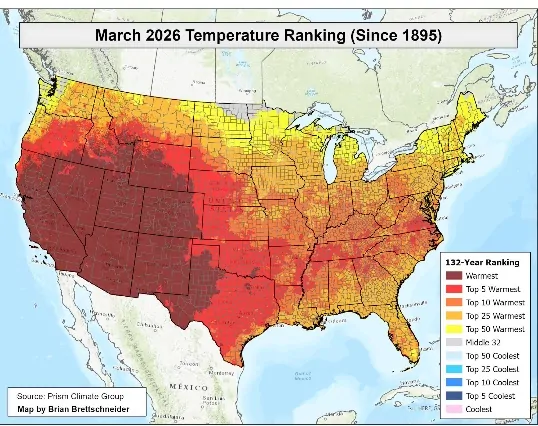
UPDATE: March brings spring flowers and an update from NCEI’s Monthly U.S. Temperature and Precipitation Analysis. 🥵 This was the warmest March on record for the contiguous U.S. Learn more. https://t.co/mlvPCKiXmn pic.twitter.com/uepJiBzOZY
— NOAA NCEI (@NOAANCEI) April 8, 2026
Category: Colorado Water
A record-hot March. Now comes an El Niño? — Allen Best (BigPivots.com) #ENSO #ElNiño
Click the link to read the article on the Big Pivots website (Allen Best):
April 8, 2026
Will inflows into Lake Powell will drop below those of 2002? You remember that year? A year of heat, drought and fire. An essay about changes and what precipitates them.
Just what we need in Colorado, an El Niño that could cause a hotter-than-average summer for the Western United States and other parts of the globe, continuing into 2027.
Risk of an El Ninõ has been rising, reported the Washington Post on Monday citing the work of a medium-range weather forecasting organization. This one could push global temperatures to record levels, particularly in 2027. “Real potential for the strongest El Ninõ event in 140 years,” wrote Paul Rondy, a professor of atmospheric science at the State University of New York at Albany.
This, explained the Post, could also yield milder winter temperatures in the United States.
We already know something about warm winters. November was the third warmest November on record in Colorado. December and February broke records, as Colorado state climatologist Russ Schumacher has reported.
Then came March and a records-busting string of days during the “heat dome.” Fort Collins went over 90, a threshold not achieved on average until June. These hottest and earliest thresholds were breached at locations across Colorado.
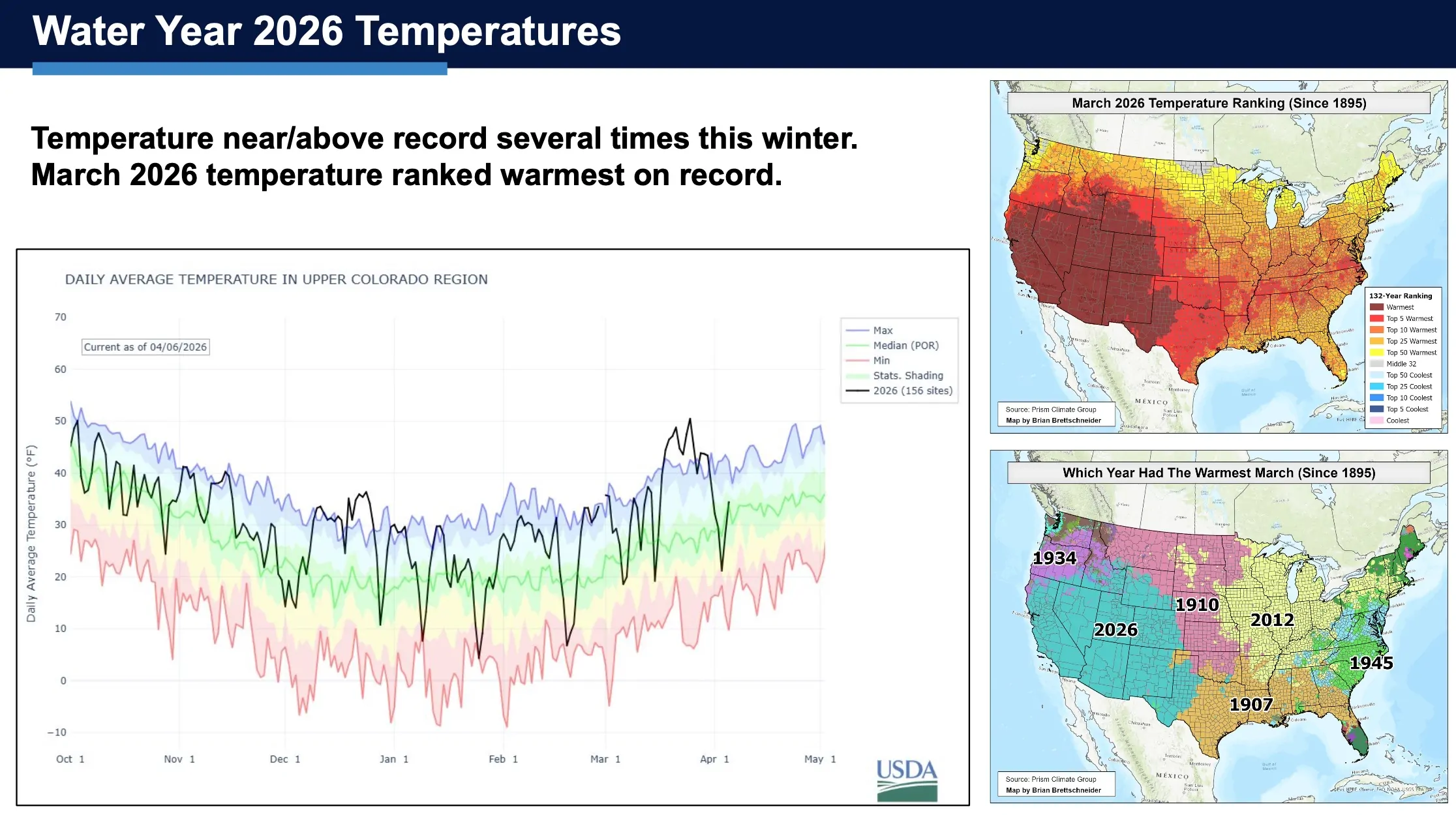
Across the Colorado River Basin, average daily temperatures during March were the warmest on record. This wreaked havoc on an already so-so or less snowpack.
“March was not … helpful,” consulting climate researcher Jeff Lukas observed drily in a LinkedIn post on Monday. “Record heat for the Upper Colorado River Basin and near-record-low precipitation in what should be one of the snowiest months. The basin-wide snowpack peaked at the earliest date and lowest level on record.”
In Colorado, the snowpack in the Eagle River drainage on April 1 was 21% of the 30-year average. The Roaring Fork River was 26%. On the Yampa it was 20%. On the San Juan, it was 17%. In all these cases and others, the snowpack had fallen by half or more compared to March 1.

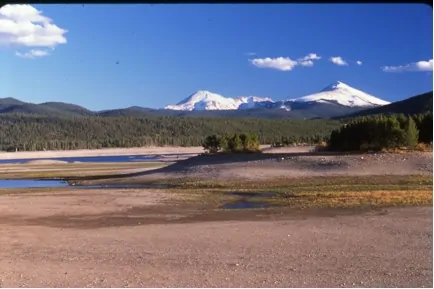
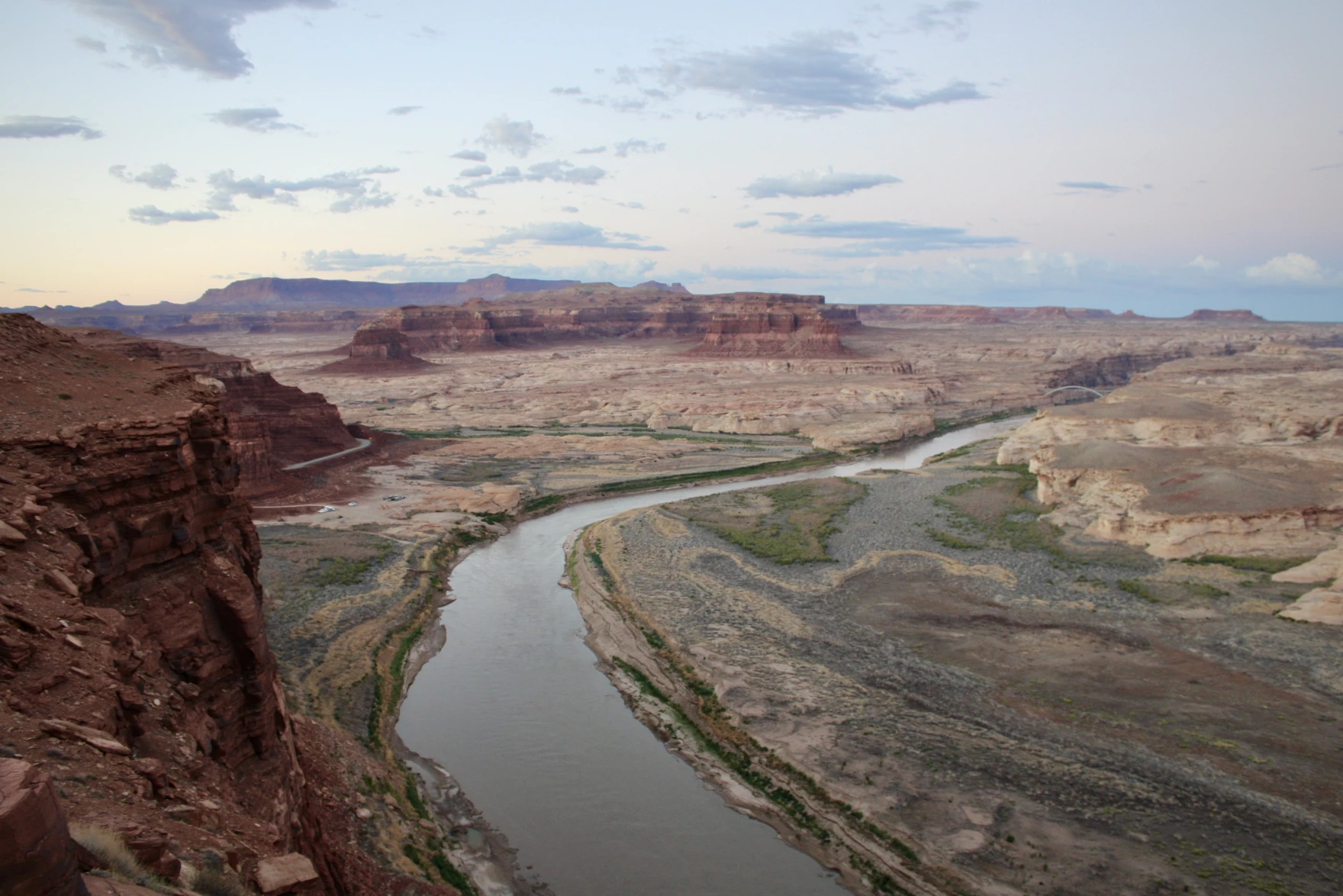
Lake Powell, already shrunken to 24% to 25% of capacity, will almost assuredly show even more shoreline. As of Tuesday the reservoir level was down almost 31 feet from a year ago. The Colorado River Basin Forecasting Center on Tuesday predicted 22% of average flows into Powell. Rain and snow could still help, but at least in the next 10 days, they are unlikely.
Two benchmarks, 1977 and 2002, exist for awful-flow years on the Colorado River since Glen Canyon Dam was completed in the 1960s. In 2002, flows into Powell were shockingly low, about 25% of average. The decline after two so-so years was remarkable. Powell, however, had been 94% full to start the century.
Margins have narrowed. Becky Bolinger, a climate researcher in Colorado, pointed out Monday on LinkedIn that the Colorado River Basin Forecast Center currently projects flows April-through-July flows will be a little greater than 2002. “I think it is entirely plausible that the actual volume for 2026 comes in as a new record low,” she wrote.
See the Colorado River Basin Forecast Center slide deck here.
What will the Bureau of Reclamation do? It operates the big dams on the Colorado River, including Glen Canyon. Average releases from Glen Canyon Dam since 2000 have been 8.29 million acre-feet.
One Colorado hydrologist, once again writing on LinkedIn, speculated that the Bureau will reduce the releases from Powell to 6 million acre-feet and conceivably even lower. That would leave Powell above the minimum level needed to produce power, if barely. Power production from 2000 to 2023 declined 17%.
The value of clean power is great. It is part of the portfolio of nearly all electrical cooperatives in the region, including those in Colorado, as well as municipal providers. The greater value, say utility executives, is the ability of the dam’s hydro unit to restart the Western grid, if necessary. This is called a black start. Such a need is unlikely but huge if it were to occur. The giant amounts of battery storage, however, have reduced that importance in the last few years.
Those reduced flows from Powell, however, would likely annoy Arizona and California. The Colorado River Compact of 1922 split the water in the river system between the lower-basin states and Colorado and other upper-basin states. It put a figure on the division: 7.5 million acre-feet. (And more must flow from the upper basin for Mexico and to account for evaporation). In 1922, they thought there was plenty left for Mexico and more yet to flow into the Pacific Ocean. Wisely, in 1948, the upper basin states, in their compact amongst themselves, instead used a percentage.
In question is what exactly the 1922 compact says is the obligation of upper basin states? Must they allow all the water in the Eagle, Yampa and other headwaters rivers be allowed to flow downstream to deliver 7.5 million acre-feet? What if that much water isn’t there?
Colorado River Basin states have notoriously been at an impasse about how to share the shrinking river. The position of Colorado — and other upper-basin states — was pithily captured in a statement by Becky Mitchell, Colorado’s chief negotiator, “We’ve been asked to solve a problem we didn’t create with water we don’t have,” she has said.
“It’s plain: the precarious situation facing the Basin today was fueled by overuse in the Lower Basin,” wrote Nick Peters, the chief system planning and projects officer for Colorado Springs Utilities, in an op-ed published during March in Colorado Politics.
Peters argued against a short-term deal in response to the exigency of this year’s dramatic declines.
In late March, I saw Mitchell at an event in Fort Collins celebrating the 60th anniversary of the Colorado Water Center. “I follow you to Lamar. I follow you to Grand Junction. I follow you to Silverthorne. I follow you here to get an interview,” I said jokingly.
“You can follow me tomorrow to Durango to the basin roundtable there if you want,” she answered with a smile.
We spoke about the Colorado River, but not on the record.
Two days later, I saw that she had traveled to southwest Colorado while I likely still slumbered. There, she delivered enough fire and brimstone to bring the attendees gathered at the roundtable in Ignacio to their feet in a standing ovation, according to the Durango Herald.
In Fort Collins, the Colorado Water Center dinner had been arranged around tables. I had signed up to be at Jennifer Gimbel’s table. As a director of the Colorado Water Conservation Board, she had once represented Colorado in the Colorado River affairs. She is now senior policy scholar at the Water Institute.
“It’s my understanding they were hoping to get a deal for 20 to 30 years. Now they’re looking at five years,” she told me. “They really need to just look at this year.”
I asked her whether the negotiations have been as transparent as they should be. Some have said they are not. We can hear the talking points of Becky Mitchell and other negotiators, but we have not heard about their strategies.
Gimbel pointed me to the frequent appearances of Mitchell at the basin roundtables and other water forum. She’s constantly on the road.
Also relevant, she observed, was a paper that had been published several days previously on The Conservation by Karen Schlatter, director of the Colorado Water Center, and Sharon Megdal, of the University of Arizona. The paper is titled “Why Colorado River negotiations stalled, and why they could resume with the possibility of agreement.”
Schlatter and Megdal traced the trajectory of prior agreements on the Colorado River, pointing to the role of federal leadership in forging agreement.
“In this round of negotiations, federal leadership has been lagging,” they write. ”The Department of the Interior has not made clear what the consequences might be for the states if they fail to agree. The U.S. Bureau of Reclamation has been without a permanent commissioner since President Donald Trump retook office in January 2025. And federal staff have only recently begun helping to facilitate the discussions.”
They also say this: “We believe that agreement between the seven states is still possible. It may be less effective to bring in a third-party facilitator at this stage in the negotiation process, though, because of the degraded trust, hardened positions and shortage of time.”
Earlier in the evening, a film had been shown that extolled the work of the water center. Colorado State University produced Elwood Mead, after whom the reservoir along the Arizona-Nevada border is named, and others. The current staff of the water center includes Brad Udall, who has deep roots at many levels in the Colorado River Basin
Udall said something that captivated me, in part because it improved upon my own thoughts. I had been toying with an essay that laid out how Colorado during the roughly first 130 years of its existence had been all about putting water to beneficial use. And the last roughly 35 years had been most prominently about reconciling its past with the new limits. I was thinking in part of groundwater mining but also the fact that there really is no water to be had on the surface. There’s less. We’ve hit the wall and it is moving.
In Udall’s thesis — which I learned from him later he has delivered in several slide shows — the history of the Colorado River Basin can be seen in three phases. The 19th century water law meets 20th century infrastructure now colliding with 21st century population and climate change.
And 2026 seems to be a seminal year in that journey. We already have had heat records tumbling left and right, with an El Nino likely to deliver more. We quite possibly will see a record for low inflow into Lake Powell, undercutting 2002.
I remember June 2002 quite well. On that month’s first Sunday I stood atop a mountain in Colorado and saw smoke from the Hayman Fire, which soon became the biggest fire in Colorado history (it’s now ranked 4th) as well as fire from the Coal Seam Fire near Glenwood Springs. More came later. It was a smoky summer in Colorado.
A few weeks ago, I heard former Gov. Bill Ritter and Bryan Hannegan, the CEO of Holy Cross Energy, fret about the risk of wildfire. The drought, said Ritter, “puts us in a very, very difficult and delicate position.”
State officials, meanwhile, are gearing up to address Front Range forests vulnerable to bark beetles. And at the Public Utilities Commission, Chairman Eric Blank has been openly worrying about whether Colorado will have enough electricity this summer to meet demand if we have unusually hot weather.
Changes mostly occur in increments, but there are times that changes take giant steps. “This year is going to teach us a lot,” said Nathan Coombs, manager of the Conejos Water Conservancy District in the San Luis Valley, when I saw him in Fort Collins. The district depends upon water storage in Platoro Reservoir, located in the San Juan Mountains. The normal inflow into the reservoir in late March, he said, was 12 to 15 cubic feet per second. “This morning, it was 195, because of the heat melting the snow.”
Two days later, at a forum in Alamosa, Coombs, a fourth-generation farmer, further explained the predicament. These earlier flows must be allowed to proceed downstream. Only later in the year will the reservoir be allowed to retain water. But will there be any?
Maybe we will get giant rain and snowstorms yet this spring. In the next 10 days, the forecast is for both wetter and warmer than normal. And, as Coombs and others pointed out, big rainstorms last October left the soil saturated.
October, of course, should bring snow, not rain, to higher elevations. We are living in different times, mostly warmer. Then there’s that elevated risk of an El Niño and a much, much warmer summer ahead of us and the winter beyond that.

#Arvada declares Stage 1 #drought, watering restrictions start April 15: City water customers to start following twice-a-week watering schedule

Click the link to read the article on the Arvada Press website (Rylee Dunn). Here’s an excerpt:
April 7, 2026
After one of the driest winters on record in Colorado, the City of Arvada has declared a Stage 1 drought and will begin implementing mandatory watering restrictions on April 15. Starting April 15, all Arvada water customers — including residents, businesses and city-managed properties — will have to start following a mandatory two-day per week watering schedule. Outdoor watering is prohibited from 10 a.m. to 6 p.m. Amy Willhite, Arvada’s Water Resources Administrator, said the watering restrictions will help Arvada preserve its water supply amid rising temperatures and historically low snowpack levels.
“Maintaining a reliable water supply is a public health and safety priority for the City of Arvada,” Willhite said. “Restricting outdoor watering ensures we can continue to have the supply needed for drinking, cooking, cleaning, and other essential needs this year and in the future.
“These conservation measures protect our water supply through the current drought, and unknown future conditions,” Willhite continued. “In a significant drought, it becomes the responsibility of our entire community to conserve water.”
The city’s goal with the restrictions is to reduce water use across the city by 20%. Once the restrictions take effect, single-family residential homes with even-numbered addresses will be permitted to water on Sundays and Thursdays. Homes with odd-numbered addresses will be allowed to water on Wednesdays and Saturdays. Apartment buildings and commercial buildings will be permitted to water on Tuesdays and Fridays unless otherwise instructed. Trees, shrubs, vegetable gardens, and flowers can be watered using a handheld hose or drip irrigation outside of 10 a.m. to 6 p.m.

#ColoradoRiver supply forecast melts after March heat wave — Scott Franz (KUNC.org) #COriver #aridification
Click the link to read the article on the KUNC website (Scott Franz):
April 8, 2026
This story is part of ongoing coverage of the Colorado River, produced by KUNC in Colorado and supported by the Walton Family Foundation. KUNC is solely responsible for its editorial coverage.
Last month’s record breaking heat across the Mountain West led to the worst snowpack on record in Colorado and Utah, along with a significantly downgraded forecast for the upcoming supply of Colorado River water.
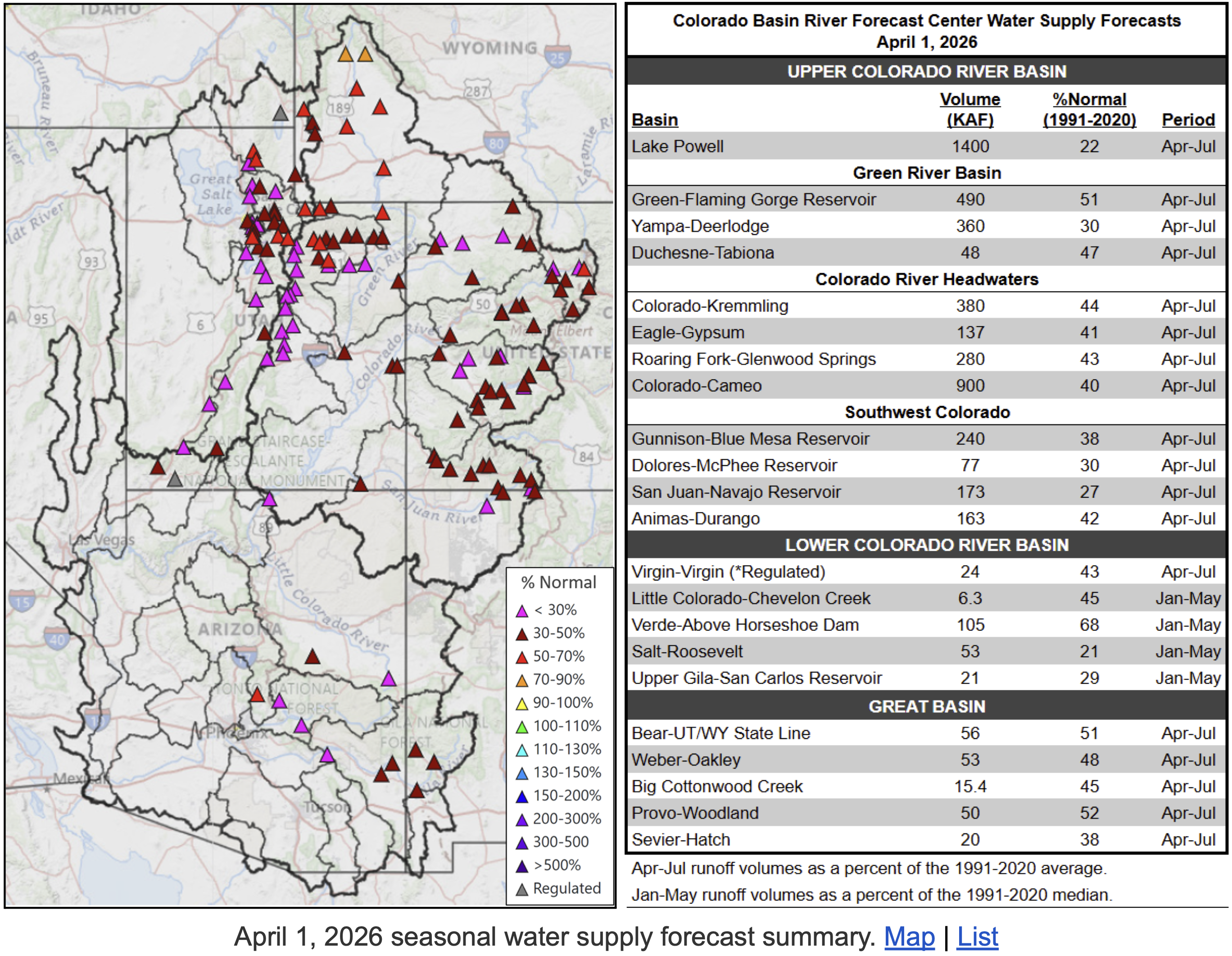
Cody Moser with the federal Colorado Basin River Forecast Center said in a monthly briefing Tuesday [April 7, 2026] that just 1.4 million acre feet of Colorado River water is expected to reach Lake Powell through July. That’s less than a quarter of what’s considered normal.
It’s also much lower than the 2.3 million acre feet Moser’s office projected a month ago, before the heat wave in the West melted away an already meager supply of snowpack.
“With record low snow pack, we have well below normal water supply forecasts,“ he said. “In many cases, our April through July (water) volume forecasts rank in the lowest five on record when compared to historical observations.”
The forecast for how much water will reach Flaming Gorge Reservoir also dropped more than 20% since the last monthly projection. Flows for the Yampa River are also projected to be near the record low.
Moser added it’s likely some rivers and streams in western Colorado have already reached their peak runoff for the year.
He said the water supply forecasts could improve if wet conditions arrive, or decline even further if the West remains dry.
The worsening river forecasts arrive as the seven states that use the waterway remain at an impasse this spring over how to share and conserve the water in the future.
Negotiators missed a February deadline to strike a deal but have said in recent weeks their talks are continuing with a focus on a potential short-term plan.
If states can’t reach a deal, the Interior Department is expected to identify its preferred option for how to manage Lake Powell and Lake Mead after the current operating guidelines expire this fall.
Interior Secretary Doug Burgum told Arizona radio station KTAR News this week that the worsening spring runoff conditions are going to “require everybody to dig in and take bigger cuts than they want, and we haven’t reached that spot yet.”

On Arches, timed-entry, and crowds — Jonathan P. Thompson (LandDesk.org)
Click the link to read the article on The Land Desk website (Jonathan P. Thompson):
April 7, 2026
🌵 Public Lands 🌲
Earlier this year, the Trump administration cancelled the timed-entry reservation system for Arches National Park. The move was inspired in part by complaints from some Moab and Grand County elected officials and business owners who claimed the system had hampered overall visitation to the area, thereby hurting businesses’ bottom lines and diminishing tax revenues.
A new analysis is throwing that reasoning into doubt. And it raises the question of whether visitation to Arches is fueling Moab’s tourism industry, or the community and its amenities are drawing folks to the national park, or something in between. But it also should spur a conversation on who or what a national park should be serving.
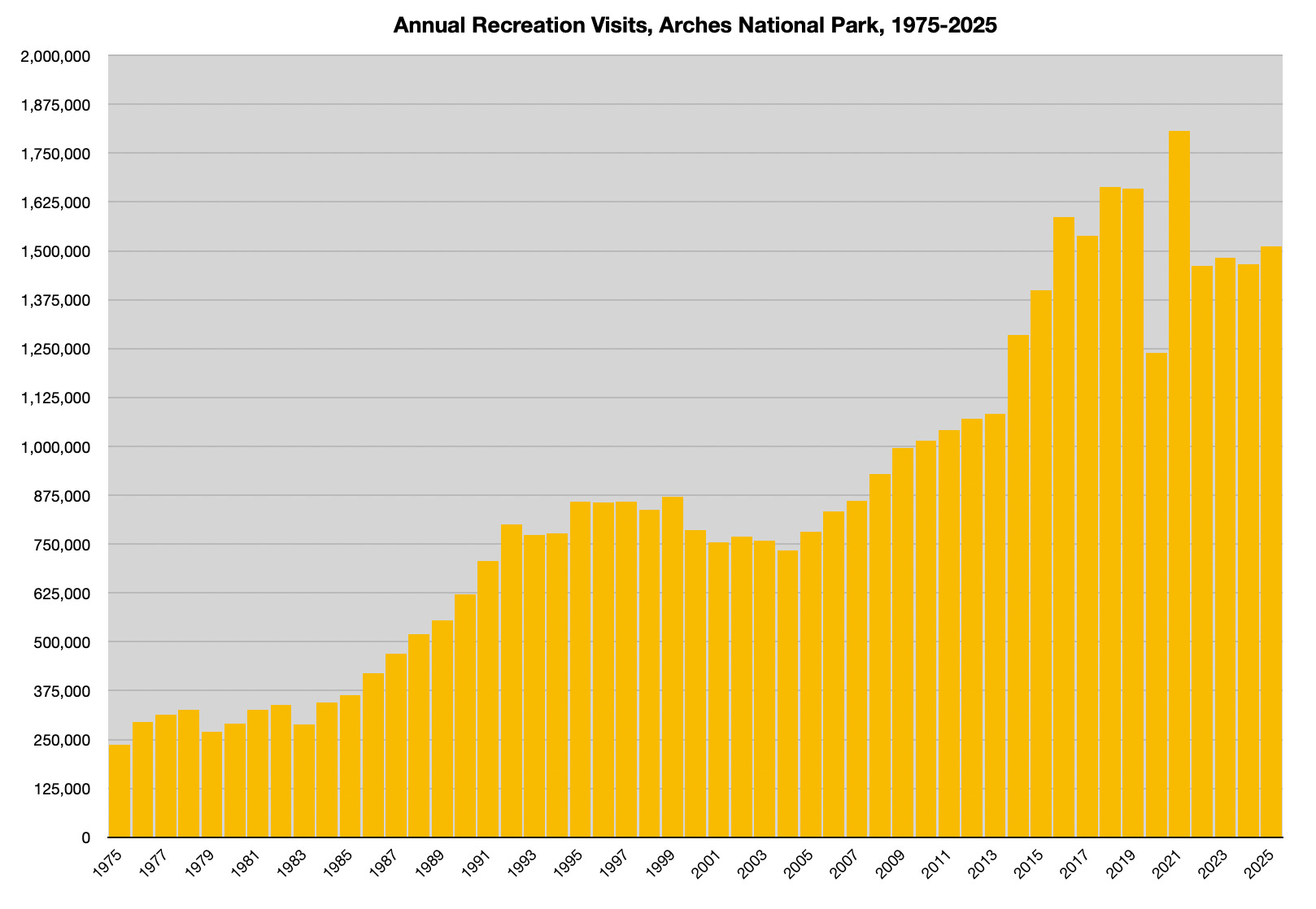
During the Cold War, when Moab was primarily a uranium mining and milling town, with a bit of sightseeing, jeep-riding, and river-floating tourism on the side, Arches National Park was relatively quiet, with an average annual visitation of about 250,000 between 1965 and 1986. Winters could be downright empty: During January 1979, the first year monthly counts were recorded, only 2,970 people — or less than 100 per day on average — entered the park.
Domestic uranium production peaked in 1980. In 1984, the massive Atlas uranium mill just down the road from the entrance to Arches National Park shut down, and the industry effectively perished, creating an economic vacuum into which outdoor recreation-oriented tourism could slide. The Groff brothers opened Rim Cyclery in 1983, began renting mountain bikes a year later, and hosted the first Canyonlands Fat Tire Festival and Moab Stage Race (for road bikes) in 1986. The latter included a race from Moab, into Arches National Park, and back, something that would not fly nowadays.
Arches annual visitation also exceeded the 400,000 mark for the first time that year and climbed swiftly thereafter. While it’s difficult to suss out the cause and effect here, it is pretty clear that Arches visitation did not drive Moab’s transformation into a mountain bike and outdoor recreation mecca. If anything, it was the other way around. Arches visitation plateaued in the early 2000s, but Moab and Grand County’s amenities and tourism related sectors — retail trade, real estate, and services — continued to add jobs and in-migration remained strong.
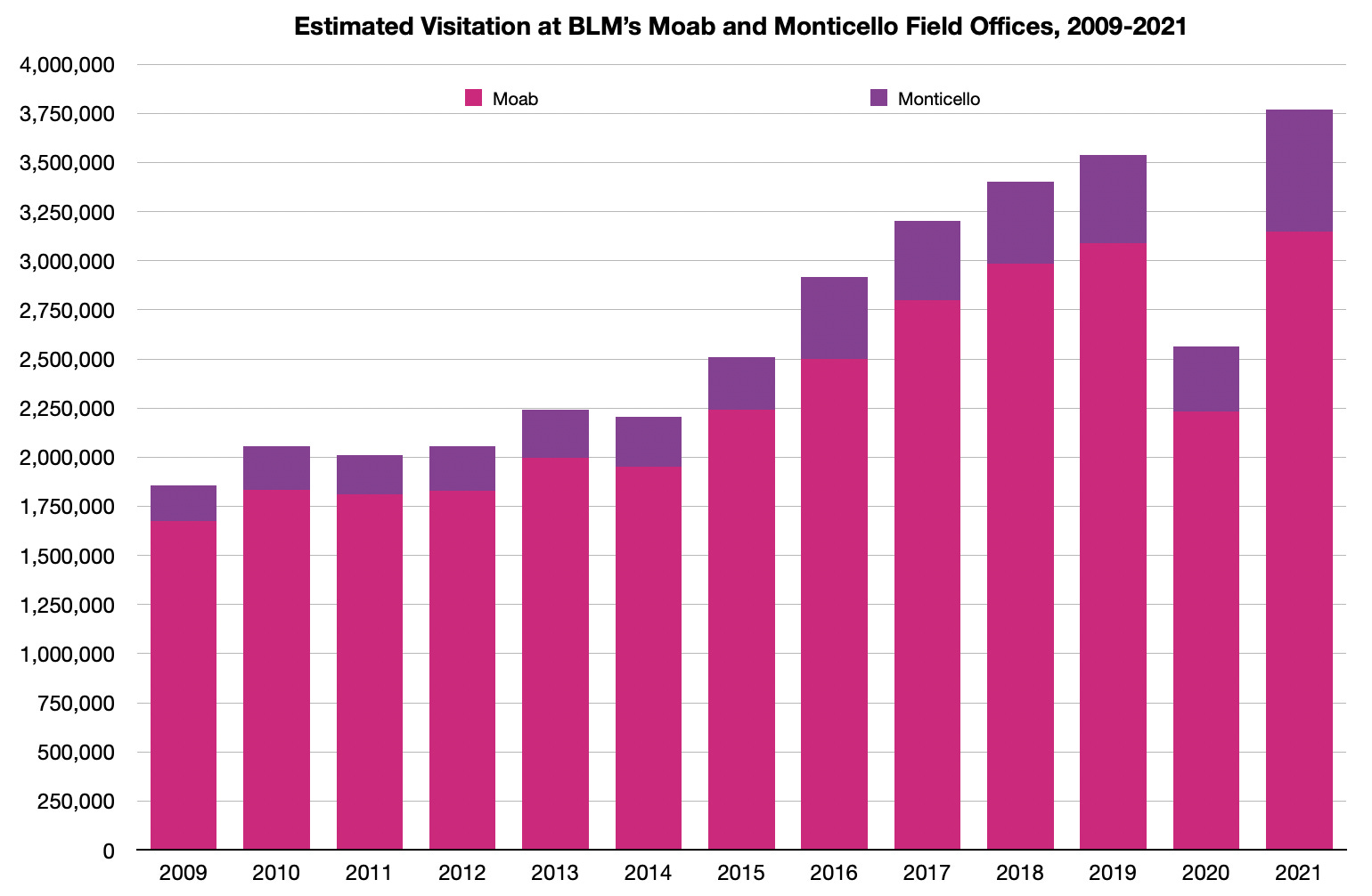
Arches visitation and Moab’s might as an amenities economy continued to mirror each other. Utah’s Mighty Five marketing campaign helped drive Arches visits from less than 1 million in 2009 to 1.7 million in 2018. This led to packed parking lots, trail traffic jams, interminable waits at the entrance gates as lines of cars spilled out onto the highway for a mile or more, and dozens of instances in which rangers had to turn visitors away because the park simply couldn’t handle any more.
In 2021, a post-Covid surge drove visitation up to 1.8 million, prompting park officials to finally pull the trigger on timed entry, an idea that had been floating around for years. Requiring visitors to reserve their spot would spread the crowds out, at least, while also giving them more predictability. It sucks to drive for hours or even fly across the world to see Delicate Arch, only to get turned away at the gate. The program was launched as a pilot in April 2022, and made permanent the following year. Arches visitation tumbled soon thereafter, dropping to 1.46 million in 2022 and 1.48 million in 2023.
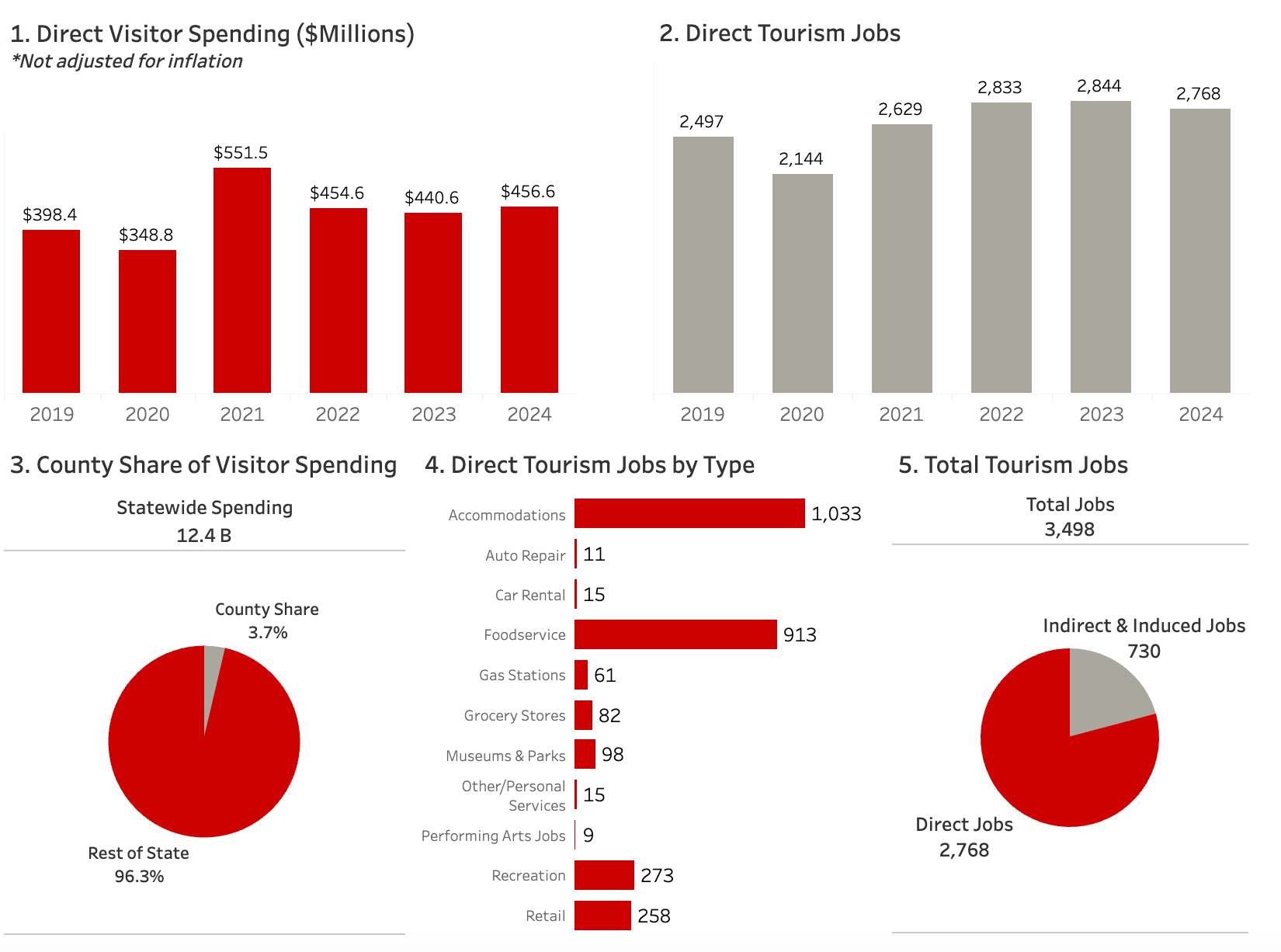
Last spring, Moab resident Matt Hancock presented an analysis to the Grand County commissioners purportedly showing that timed-entry led to the visitation decline, which resulted in a decrease in transient room tax collections. And that decline, he argued, was costing Moab about $45 million annually in direct visitor spending, which then rippled out into the community in the form of lost tax revenue and the services they fund.
Grand County Commissioner Brian Martinez then formulated an “Access and Capacity Enhancement Alternative” plan for managing Arches National Park. It favored expanding infrastructure and packing more crowds into the park, and slammed any sort of “demand restrictions” such as timed-entry, saying Grand County “considers its impact on visitation, the local economy, and the community to be unacceptable.”
Martinez presented the plan to a group of state and federal officials at a closed State of Utah and National Park Service Workshop in Salt Lake City aimed at exploring ways to give local officials more control over public lands. A few months later, reservation systems were nixed at Arches, Yosemite, Glacier, and Rocky Mountain National Parks.
Will this boost visitation and Moab’s economy? Possibly, but not likely, according to yet another look, this one by Moab resident Emily Campbell. She also finds a correlation between Arches visitor number declines and timed entry, but points out that the corresponding transient room tax decreases could be attributed to other factors, such as a shift in visitors’ lodging choices. They may be camping on public lands, for example, or staying in neighboring counties, where hotels and such tend to be less expensive.
Meanwhile, other sectors of the economy have thrived, with food services, retail, and construction taxable sales shooting up even as Arches visitation has lagged. Perhaps it’s a sign that Moab’s economy is diversifying slightly, if only from relying heavily on tourism to also depending on folks that actually live there, but earn their incomes from outside the county.
Rather than trying to build on this diversification, however, Grand County is continuing to throw resources at yet another study aimed at determining the economic impact of timed entry — regardless of the fact that the reservation system has been suspended, at least for now.
Of course, all of this skirts around the deeper and bigger issue: the purpose of national parks. Is it really to bolster gateway communities’ tourism industries and enrich local business owners? Or is it, as the National Park Service’s mission states, to preserve “unimpaired the natural and cultural resources and values of the National Park System for the enjoyment, education, and inspiration of this and future generations”?
That’s what parks officials should be thinking about, first and foremost. They should manage the park for the long-term benefit of the park and the resources there. Secondary to that is its effect on the visitors’ experience. Limiting the number of people traipsing around the park by whatever means will be better for the park (or at least not worse for it). And spreading out the crowds with a reservation system will not only make Arches more enjoyable to visit, but will also make it more predictable. That, in the long run, will be better for the park, for its visitors, and, yes, for the gateway communities, too.
Moab’s tourism industry might be wise to get outside the growth at all costs mindset as well. The place has been adding hotel rooms at an astounding rate, looking to capitalize on the Moab mystique. But there are limits to how much visitation can continue to increase without not only wrecking the surrounding public lands but also diminishing the experience and driving folks away. Who knows, the tourism industry could bust just as hard as uranium mining did 40 years ago.
Pondering Moab, the Old West vs. New West, and cows vs. condos — Jonathan P. Thompson
⛈️ Wacky Weather Watch⚡️
March certainly went out like a lion, though maybe not in the way that the saying is normally understood. It was hot. Damned hot. I’ll give a more thorough rundown on the heatwave and a final snowpack analysis in a later dispatch (after the next storm system moves through in hopes that it might improve the situation). But for now here’s a few stats from the heat wave.
204; 279: Number of monthly high-temperature records that were broken or tied in Arizona and Colorado, respectively, during the last two weeks of March.
102° F: Temperature at the Phoenix airport on March 18, setting a new monthly record and beating the earliest first 100-degree day by eight days.
105° F: The temperature in Phoenix on March 19, 20, and 21, breaking the March record yet again.
78.8° F: Average temperature in Phoenix for the month of March, 6.5° higher than the previous record high average temperature for the month.
109° F: Recorded temperature in Yuma, Arizona, on March 20.
78° F: Temperature in Del Norte, Colorado, on March 20, a new monthly record.
92° F: Temperature in Trinidad, Colorado, on March 21, smashing the previous monthly record high of 85° set … two days earlier.
🥵 Aridification Watch 🐫
The (new) water year of our discontent — Jonathan P. Thompson
📸 Parting Shot 🎞️
The Colorado River Crisis is Here — Jonathan P. Thompson
Interior secretary says ‘nobody will be happy’ with #ColoradoRiver decision — Tucson.com #COriver #aridification
Click the link to read the article on the Tuscon.com website (Tony Davis). Here’s an excerpt:
April 8, 2026
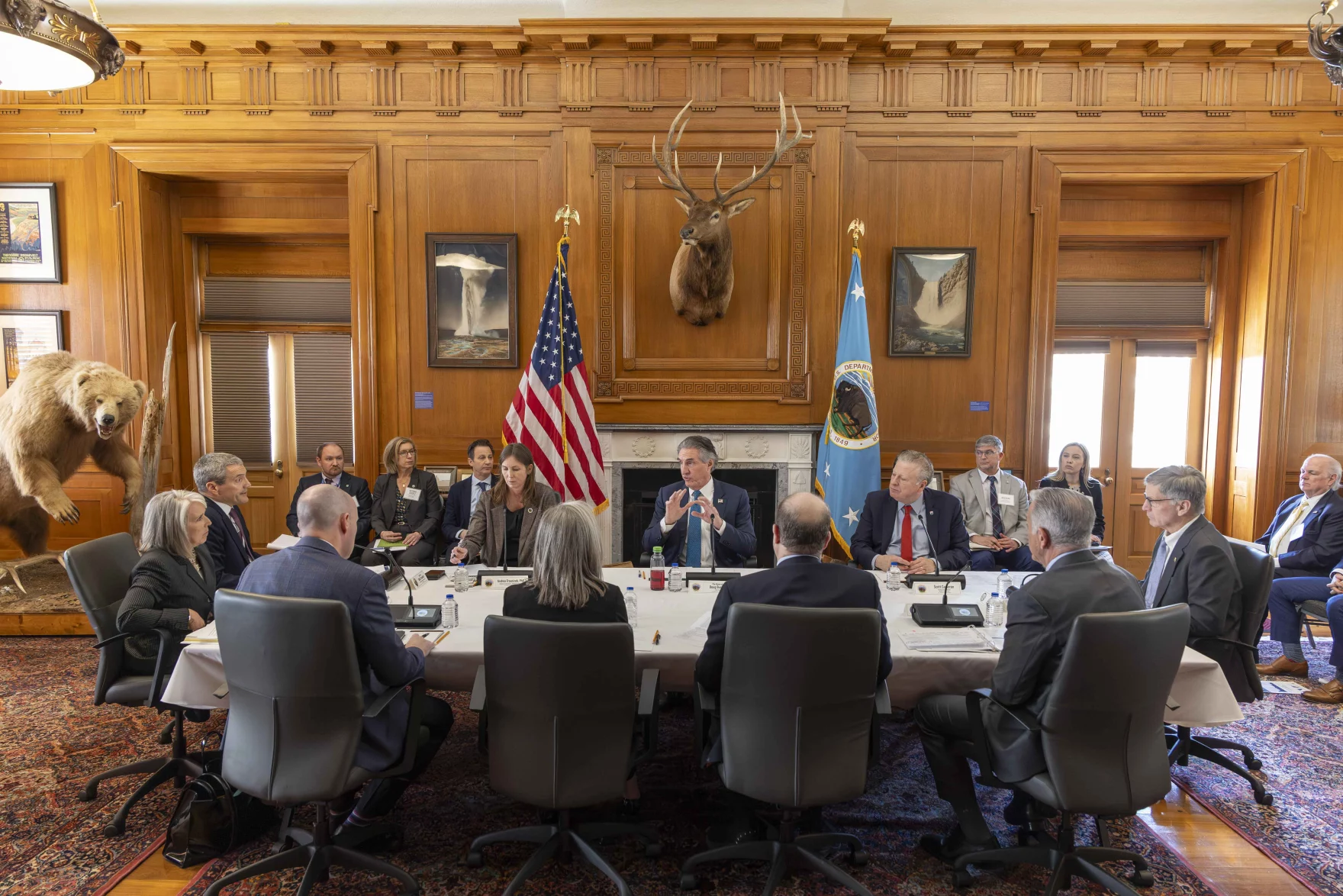
U.S. Interior Secretary Doug Burgum, pressed Monday to spell out how he’ll handle the Colorado River’s water crisis, wouldn’t get specific but said repeatedly that “nobody will be happy” with how his department will split a rapidly dwindling supply of river water among the seven states, including Arizona, that want a piece of it. Speaking at a roundtable in the Tucson area populated by a host of public lands industry leaders and University of Arizona President Suresh Garimella, Burgum pledged to hand down a decision this month on the first of two crucial, divisive issues his office is confronting regarding the river. That decision will be how much water the Interior Department’s Bureau of Reclamation will release from its upstream reservoirs in the four Upper Colorado River Basin states to head off a potential calamity in which Glen Canyon Dam, forming the boundary between the Upper and Lower Basins, would no longer receive enough water to continue generating electricity that serves customers in seven Western states.

The 100-Year Error: How Selective Science Drained the #ColoradoRiver — Bob Hembree (LakePowellChronicle.com) #COriver #aridification
Click the link to read the article on the Lake Powell Chronicle website (Bob Hembree):
April 1, 2026
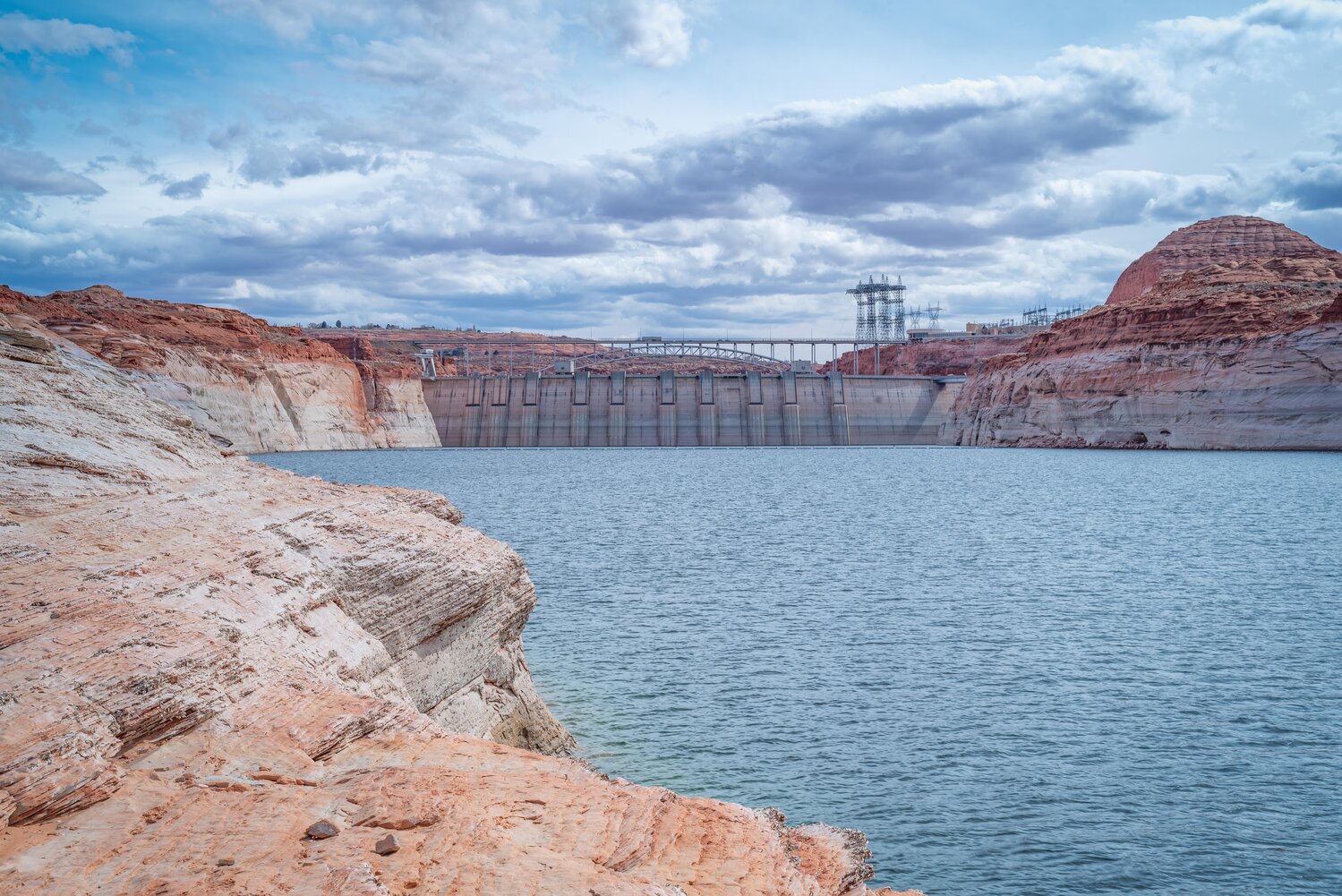
The white bathtub ring clinging to the sandstone walls of Glen Canyon is more than a marker of a receding lake; it is a physical manifestation of a century-old accounting error. For decades, the conventional story of the Colorado River’s decline has been framed as a tragic stroke of bad luck. The narrative, popularized in modern classics like Cadillac Desert, suggests that the framers of the 1922 Colorado River Compact simply did their best with a limited record of “eighteen years of streamflow measurement” taken during an unusually wet “binge.”
However, emerging historical research and systems analysis tell a more complicated and troubling story. In their definitive study, Science Be Dammed, authors Eric Kuhn and John Fleck argue that the crisis we face in 2026 was not an accident of nature but a predictable consequence of “selective science.” The decision-makers of 1922 were not victims of ignorance; they were sophisticated professionals who chose to ignore inconvenient data in favor of a political vision that required the river to be larger than it actually was.
The Inconvenient Hydrologist
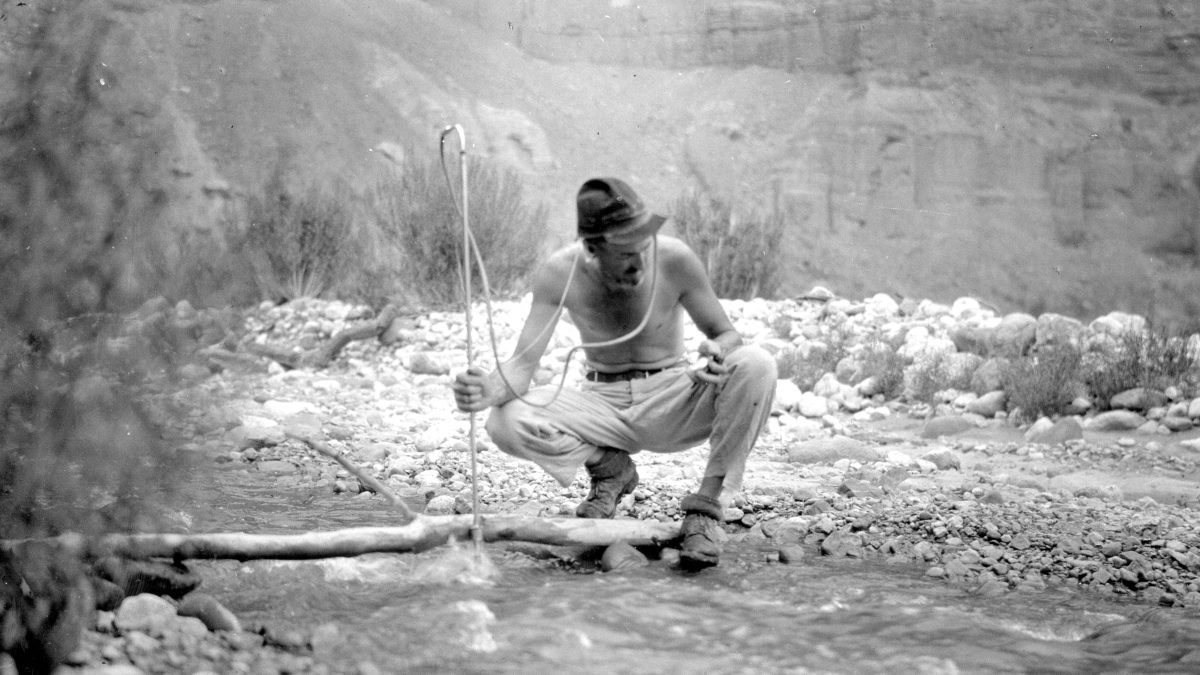
As the seven basin states gathered at Bishop’s Lodge in Santa Fe to carve up the river, they were joined by Eugene Clyde (E.C.) LaRue, a hydrologist for the U.S. Geological Survey. [Eric Kuhn responding to my X post, “Actually LaRue was never allowed to attend a Commission meeting. He asked, but Hoover said no.] LaRue presented the commissioners with a conclusion that threatened the very foundation of their negotiations. His data, which included early gauge records and historical flood markers, suggested that the river’s long-term average was approximately 15 million acre-feet (maf)
LaRue explicitly warned the commission that the period between 1905 and 1922 was a hydrological anomaly. Had the negotiators included the drier records from the late 1890s, the estimated annual flow would have dropped significantly. As Kuhn and Fleck note, the decision-makers had at their disposal a relatively thorough, almost modern picture of the river’s hydrology. They chose to ignore it because accepting LaRue’s science might have left them with a flow too low to reach the compromises necessary to develop the West.

Paper Water and the System Trap
By sidelining LaRue and enshrining a “paper water” figure of 16.4 million acre-feet into the Law of the River, the commissioners fell into a classic “system trap.” They created a legal stock of water rights that far exceeded the river’s physical flow. This inflated number was essential to the “reinforcing loop” of 20th-century growth. It provided the legal certainty needed to secure federal funding for massive infrastructure projects like the Hoover Dam and the Glen Canyon Dam.
This intentional overestimation created a massive “information delay.” For eighty years, the system appeared stable only because the Upper Basin states were slow to develop their shares, allowing their “unused” water to flow downstream. This masked the fundamental deficit, leading to a state of “overshoot” in which the regional economy came to depend on water that did not exist. Professor Rhett Larson describes the resulting legal framework as a system of “calling shotgun” that was excellent for settling a desert but is catastrophic for managing one in a time of scarcity.
The End of the Delay
Today, the “delay” has finally ended, and the “inconvenient science” of 1922 has become the undeniable reality of 2026. The river’s source is being further depleted by “aridification,” a process climate scientist Brad Udall describes as a “sponge above our head” that evaporates moisture before it can reach the streamflow. We are now witnessing the collision of a 100-year-old legal fiction with a 21st-century climate reality.
The current impasse between the Upper and Lower Basins is a symptom of “policy resistance,” where every actor is incentivized to protect their “paper” share even as the “wet” water disappears. As Professor Andrea Gerlak observes, if a system has 25 years to produce an agreement and fails, there is likely something fundamentally wrong with the system itself. Solving the crisis at Lake Powell will require more than engineering; it will require a paradigm shift that finally aligns our laws with the river’s actual physical limits.
March was…not helpful. NOAA #Colorado Basin River Forecast Centers’s April 1, 2026 (50% exceedance) forecast now has #LakePowell April-July inflows at 1400 KAF, 22% of average — Jeff Lukas (LukasClimate.com)
Winter never came to #Colorado. What does it mean for water supplies? — Lauren Lipuma and Yvaine Ye (CU #Boulder Today)
Click the link to read the article on the CU Boulder Today website (Lauren Lipuma and Yvaine Ye):
March 31. 2026
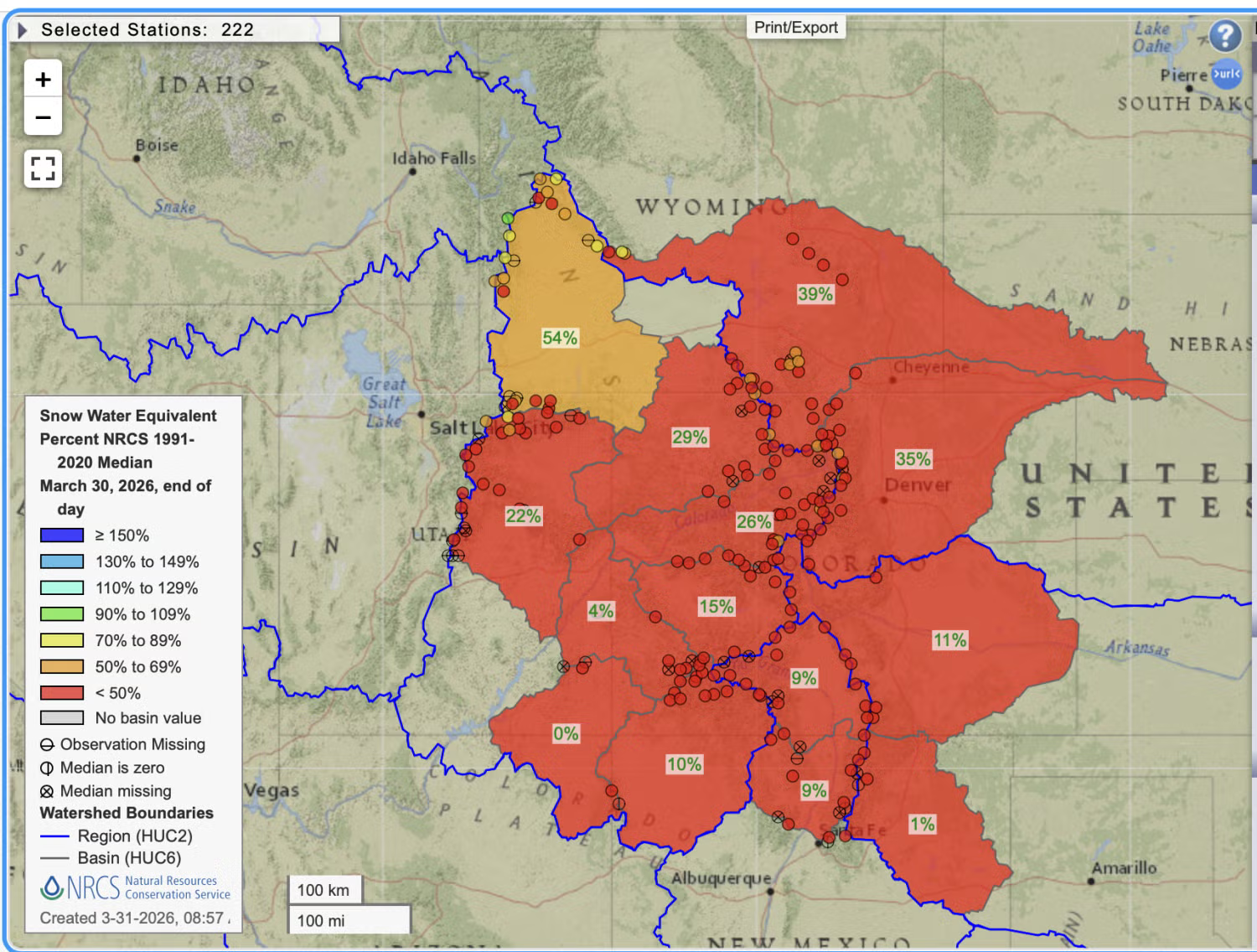
For the past weeks, temperatures in Colorado have surged 20 to 30 degrees above average for March, normally one of the state’s snowiest months.
That’s on top of an unusually warm and dry winter for the American Southwest, a region already grappling with long-term water shortages since around 2000. In Colorado, snowpack sits at about 40% of normal levels, among the lowest since comprehensive modern records began roughly four decades ago.
In parts of the southern Colorado River Basin, a 250,000-square-mile watershed spanning seven states in the southwest, snowpack has dropped to less than one-third of normal. The basin provides water for 40 million people and 5.5 million acres of farmland.
Snowpack acts like frozen water towers, said Ben Livneh, associate professor in the department of Civil, Environmental and Architectural Engineering. As temperatures rise and the Southwest enters its typically hot and dry spring and summer months, melting snow provides about 80% of the water used by downstream communities in the Colorado River Basin.
In response to the snow drought, Denver’s water authority recently declared a Stage 1 drought, the first drought alert the city has issued since the summer of 2013. Other Front Range cities are considering similar measures.
“In Colorado, our peak snowpack happens around mid-April, so there is still a chance that we could get more snow,” said Livneh, who’s also the director of the Western Water Assessment (WWA) at the Cooperative Institute for Research in Environmental Sciences (CIRES). According to the National Weather Service, a storm is bringing precipitation to Colorado this week, with the potential for a few inches of accumulation in the mountains. “But at this point, it does look like we have a long way to go to catch up.”
CU Boulder Today sat down with Livneh to talk about the impact of a snow drought on Colorado communities, whether drought is the new normal and what individuals can do.
How dry is it?
Colorado lies in a mountainous region far from the ocean, so our climate naturally varies a lot. As a result, it’s not uncommon to see big swings between wet years and dry years.
Right now, we are in a very dry period, and the numbers are pretty stark. There’s barely any snow on mountains in lower elevations, and some snowpack could melt early because of the warm weather. When we look ahead to the amount of water expected to flow into our reservoirs, which would be the water people actually get to use, the current forecasts fall among the lowest we’ve seen since the early 1980s when the detailed snow measurements began.
How does this year compare with previous drought years?
There were some years that were drier, like 1977 and 1981. But those years weren’t as warm as this year. Over the past 40 years, since we’ve had continuous observation data, 2002 and 2012 were also warm with low precipitation, but they weren’t as dry as this year.
We have a lot of systems in place that were specifically designed to handle individual bad years, like these big, impressive reservoirs. But we’ve been in a dry period for the past 25 years, and every dry year puts additional stress on our infrastructure.
What could be causing this snow drought?
We’re currently in the warmest 25-year period on record, and warming is one of the clearest signals of recent climatic changes. When it’s warmer, the atmosphere can hold more moisture.
At the same time, the climate in our region naturally swings between wetter and drier decades. It’s almost like a pendulum that shifts every 20 or 30 years.
What may be happening now is that those two things— climate change and natural fluctuations— are overlapping, creating something of a perfect storm for this year.
What is the WWA doing to help?
WWA is working to support decision makers to best manage their water, based on what is actually available, as well as what is forecasted in the Colorado River Basin.
Much of our regional economy relies on water, from the ski industry to food growers and power generators. The stress from drought is widespread.
Our region’s planning and treaties in the past were based on assumptions about historical conditions. Now we’re trying to figure out whether these dry conditions are a drought or perhaps closer to the long-term normal conditions.
We are also trying to get a better sense of what mountain communities are experiencing and what types of information they need, because many of them rely on the snowpack and snow melt as their primary reservoir for water.
Should people be worried about water shortages right now?
This is really a large-scale phenomenon, so if anything, I would encourage people to get curious about the science and what we can say about the current conditions. Indoor water use doesn’t consume very much, and cities are not really at risk of running out of water. But people should be mindful not to waste water outdoors. Pay attention to city rules for outdoor water use, like when you can turn on your sprinklers and water your lawn.
Other than that, I encourage people to go outside. This is certainly a big departure from what we think Colorado winters should be like, but it also offers opportunities for people to bike to work more often, or spend more time outdoors doing things they might not otherwise be able to do.
The next Aspinall Unit Coordination Meeting for the Aspinall Unit & #GunnisonRiver will be heldThursday, April 23rd, 2026 at 1:00 pm — Andrew Limbach (USBR)

From email from Reclamation (Andrew Limbach):
April 7, 2026
The next Aspinall Unit Coordination Meeting for the Aspinall Unit & Gunnison River will be heldThursday, April 23rd, 2026 at 1:00 pm.
This meeting will be held virtually via Microsoft Teams. There will not be an in-person meeting location for this meeting. The link to the Teams meeting is below.
Reclamation conducts Public Operations Meeting three times per year to gather input for determining upcoming operations for the Aspinall Unit & Gunnison River. The meeting agenda will include updates on current snowpack, forecasts for spring runoff conditions and spring peak operations, the weather outlook, and planned operations for the remainder of the year.
Contact Andrew Limbach (alimbach@usbr.gov or 970-248-0644) for more information regarding Aspinall operations or the Operation Group meeting.
Why scientists still use a milk scale and antique aluminum tubes to track Colorado’s record-low #snowpack — #Colorado Public Radio #runoff

Click the link to read the article on the Colorado Public Radio website (Sam Brasch). Here’s an excerpt:
The old-school art of snow tracking
Metal signs mark the survey site in a patch of forest above the cabin. Once the team arrived, Mike Ardison, a hydrologic technician for the Colorado Snow Survey, unloaded a green trundle off his back, then unwrapped it to reveal sections of a hollow, aluminum tube. It extends to roughly eight feet long once he fits the pieces together…To measure the snow levels, Domonkos and Ardison work their way along the snow course, dropping the tube at a series of set points along the path. A column of snow captured inside reveals the height, then the pair hang the tube from a spring-powered milk scale to clock the weight. Digital scales might be more accurate, but Ardison said their batteries wouldn’t last long in normal winter temperatures…
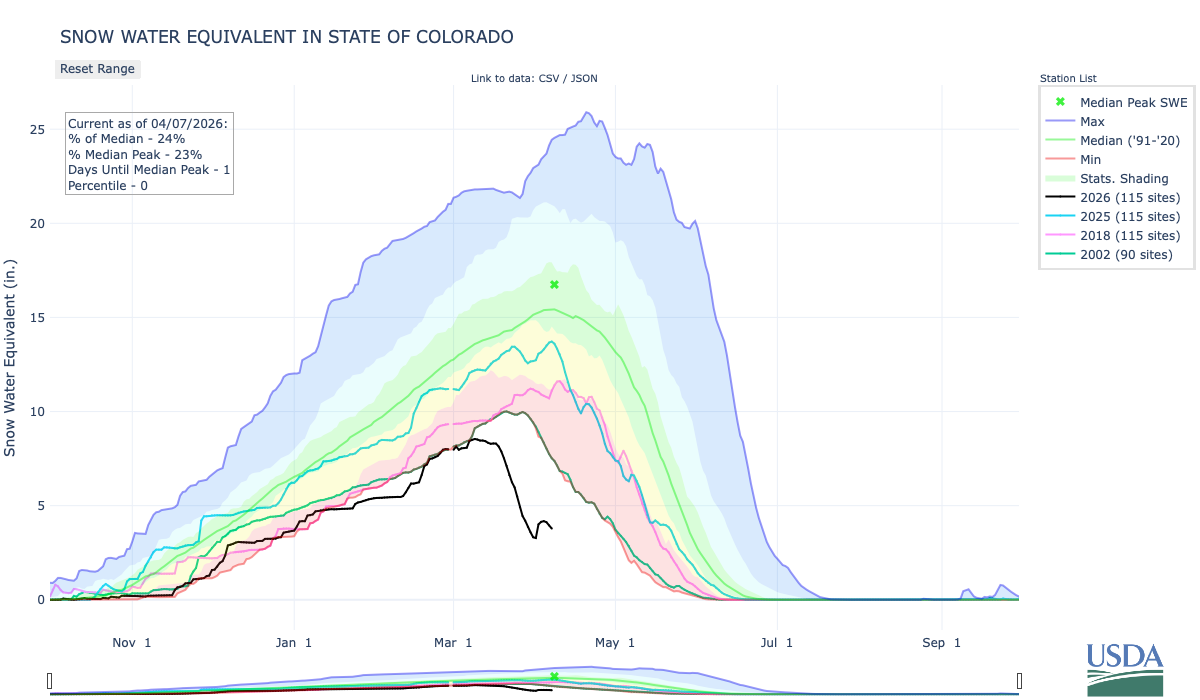
Crouched over a notebook, [Brian] Domonkos punched a calculator to arrive at a figure for the site. He let out a sigh when he arrived at the final number: 2.2 inches of snow-water equivalent, less than half the previous record low measured on the same date in 1977…Other measurements taken at snow courses around April 1 were just as alarming. Out of the 64 sites in Colorado with at least 50 years of data, 60 reported either record-low snow levels or tied the lowest on record…Those results confirm 2026 as the worst year for Colorado snowpack in recorded history, said Russ Schumacher, a professor of atmospheric science at Colorado State University and Colorado’s state climatologist. A lack of historical precedent means it’s harder to fully predict the impact of such low water levels. Schumacher, however, expects reservoir levels to rapidly decline in the summer and fall. Fire risk is harder to predict, but he said major wildfires usually appear in years when the snowpack is lower and melts early.
“We’re maybe in one of these liminal spaces where you can see what’s coming, but it’s not here yet,” Schumacher said. “And, yeah, that’s a challenging situation.”
#Colorado Basin River Forecast Center: Water Supply Discussion April 1, 2026
Click the link to read the discussion on the USBR website:
The Colorado Basin River Forecast Center (CBRFC) geographic forecast area includes the Upper Colorado River Basin (UCRB), Lower Colorado River Basin (LCRB), and Eastern Great Basin (GB).
Water Supply Forecasts
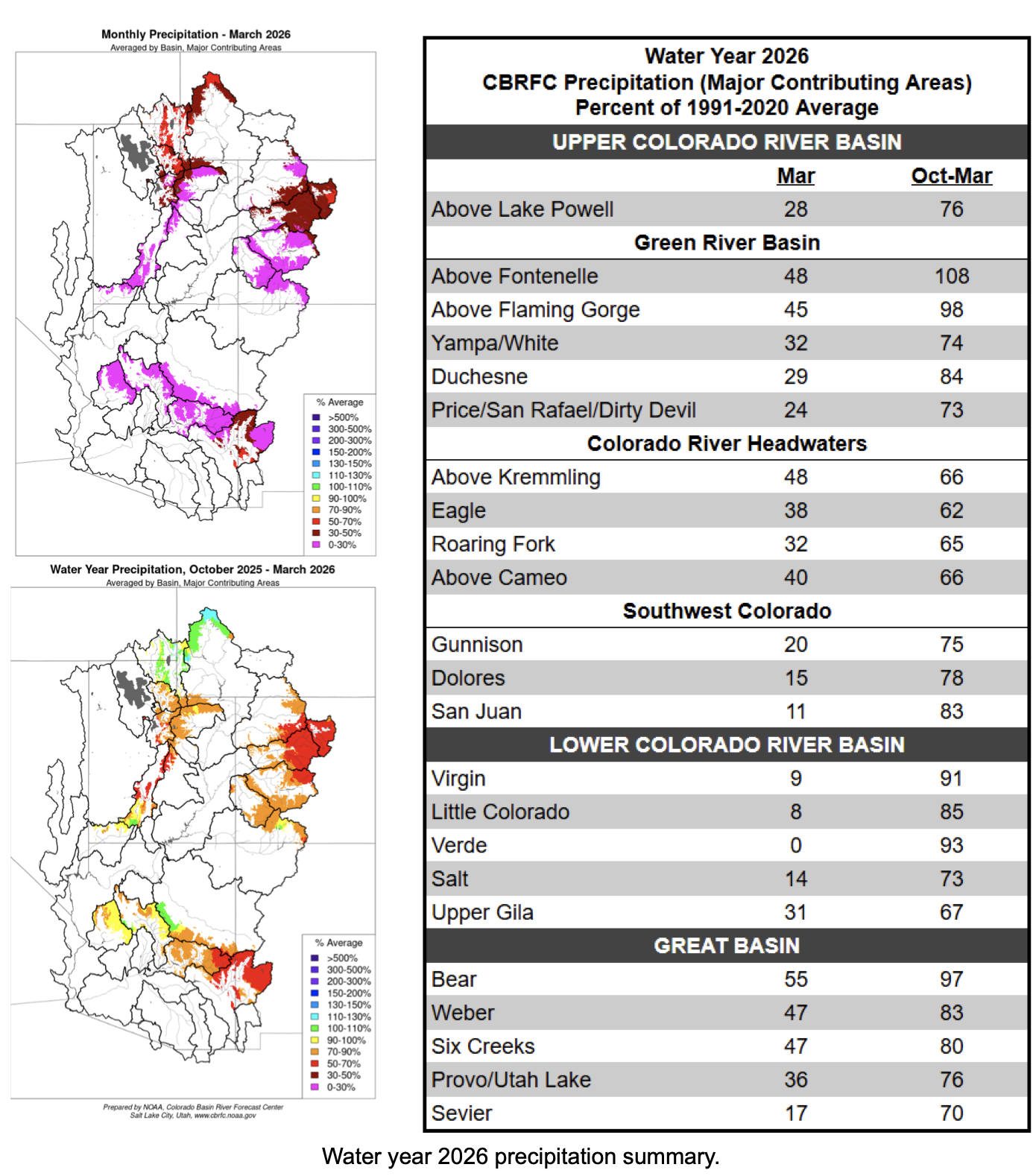
April 1 water supply forecasts are well below normal and summarized in the figure and table below. Snowpack and soil moisture are the primary hydrologic conditions that impact the water supply outlook, while future weather is the primary source of forecast uncertainty.
Water Year Weather
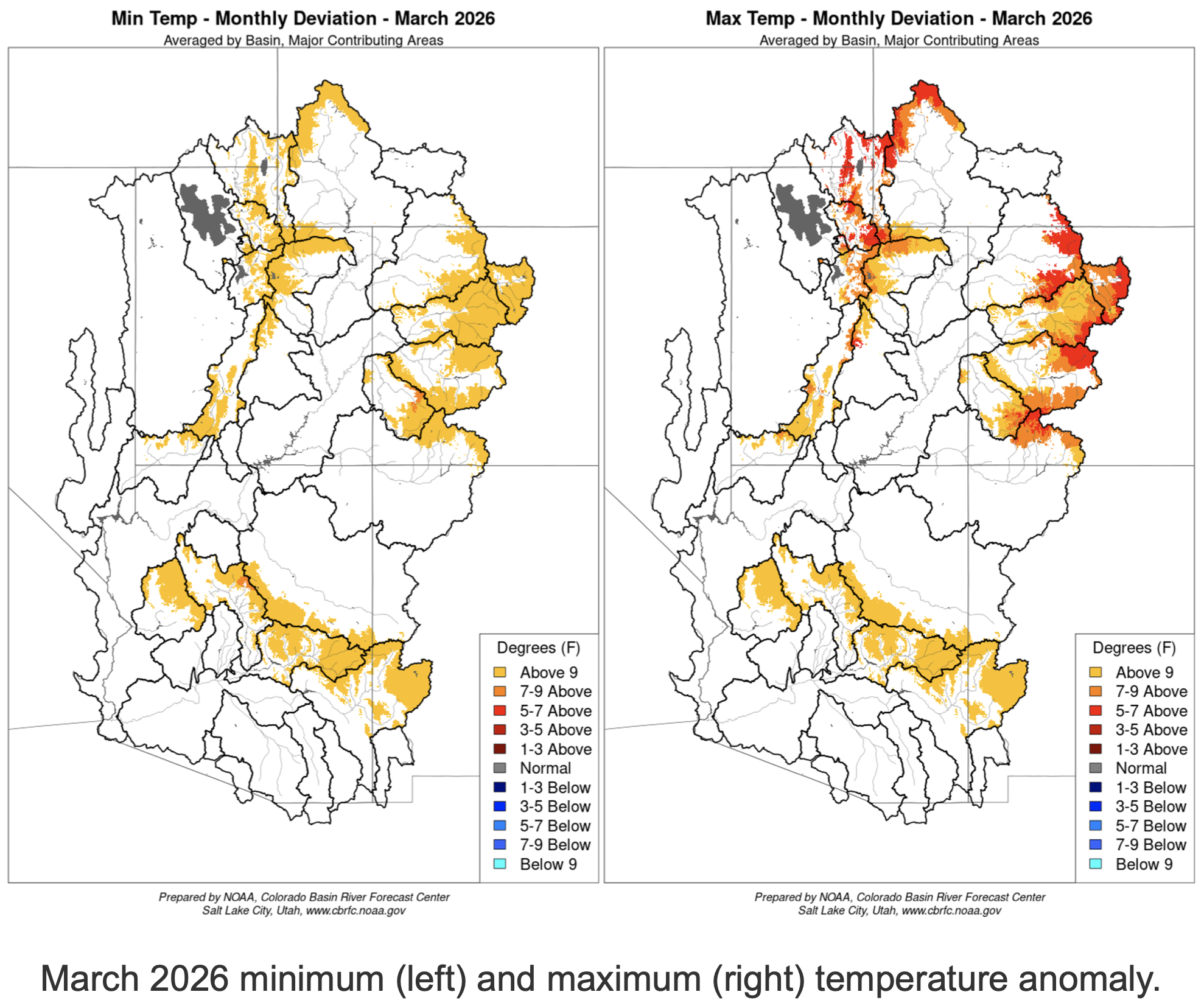
The 2025–26 meteorological winter (December–Februrary) was the warmest winter on record for vast swaths of the CBRFC area. In March, an extraordinarily anomalous high pressure system — of a strength that is more typical of July — impacted the Southwest. This ridge brought summertime temperatures at a time when most mountainous areas are usually still building a snowpack.
Across the region in mid-to-late March, temperature records were smashed for several days on end. In Flagstaff, AZ, 11 days reached or surpassed the previous March high temperature record of 73°. Shockingly, on two days the mercury climbed to 83° and 84° , significantly surpassing the April high temperature record of 80° . At 8,710 feet above sea level in Alta, UT, where March high temperatures average in the 30s, temperatures reached at least 60° on eight days. Nine days of at least 100° were observed in Phoenix, AZ, including the earliest 100° day on record. The depth and duration of this heat wave was unprecedented in the period of record. It will likely go down as one of the most extreme weather events to ever impact the CBRFC area.
The same ridge of high pressure that brought searing temperatures to the low elevations and snowmelt across high elevations also resulted in very dry air and no precipitation. Numerous SNOTEL sites across the CBRFC area observed their driest March on record.
The water year as a whole tells a different story. In October, several rounds of heavy rain tied to decaying tropical storms brought record flooding to portions of AZ, southern UT, and southwest CO — making it one of the wettest Octobers on record. Water year-to-date (October–March) precipitation is highly variable, ranging from well below normal across much of Colorado and Utah’s mountains, to near/above normal in the Upper Green River Basin and portions of the LCRB. The figures and table below summarize March temperatures and water year 2026 precipitation.
Snowpack Conditions
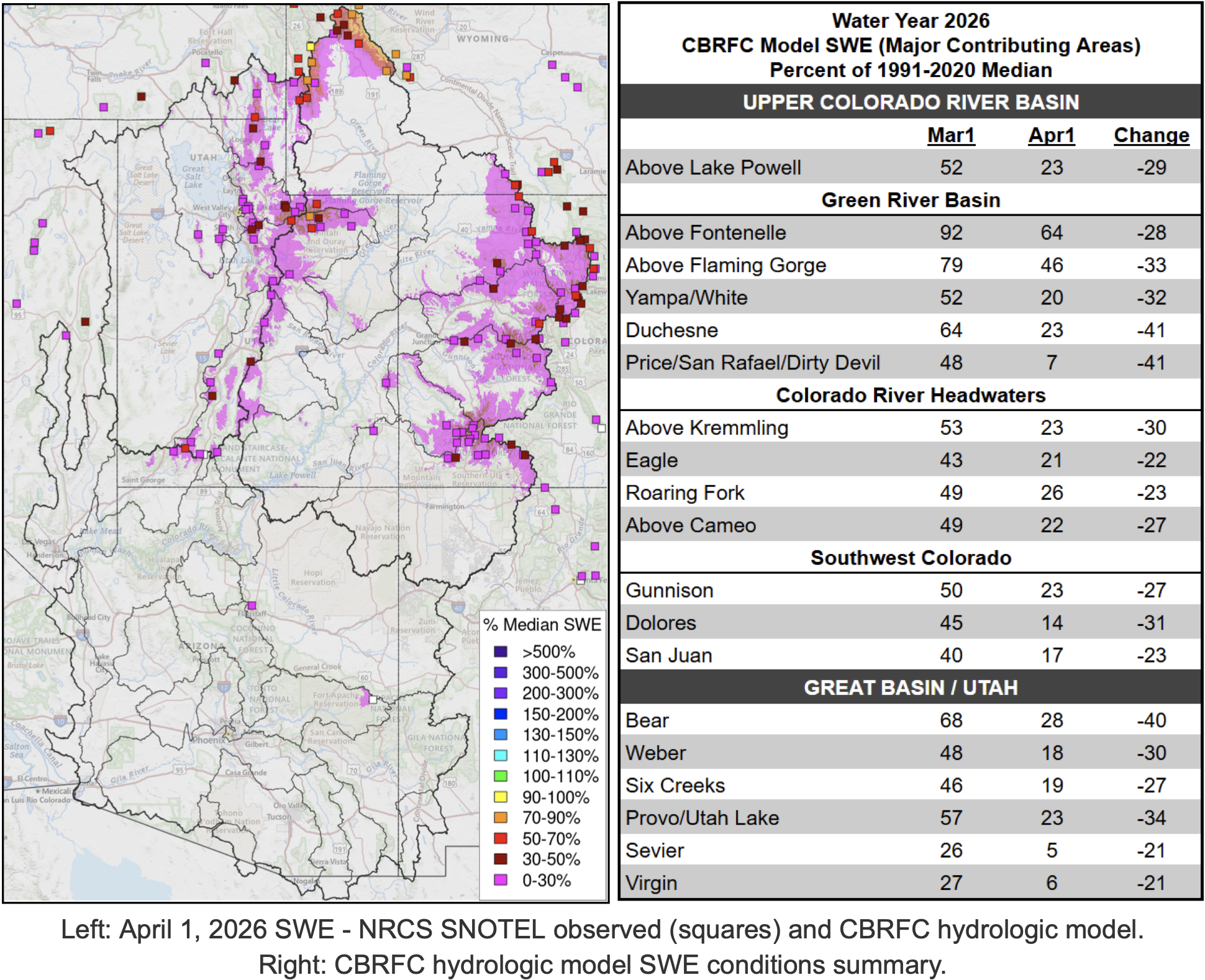
Snow water equivalent (SWE) has been tracking at or near record low much of the season. An extremely dry March and significant snowmelt during the last half of the month led to historically low April 1 snow water equivalent conditions across the region. An NRCS-Utah Snow Survey Special Report states that “at no time since systematic snowpack measurements began around 1930 has April 1 snowpack been this low in the state of Utah, and 2026 SWE is roughly five times lower than the previous record low”. A similar analysis performed by the Colorado Climate Center concluded that “this has been the worst year for Colorado snowpack in recorded history, and most locations have less than half of the previous record low”.
UCRB and GB April 1 snow covered area is 25-30% of the 2001-2025 median, which is also the lowest on record for early April dating back to 2001. 1 April 1 CBRFC model SWE conditions are generally less than 30% of normal across the UCRB and GB. SWE conditions are summarized in the figure and table below.
Soil Moisture
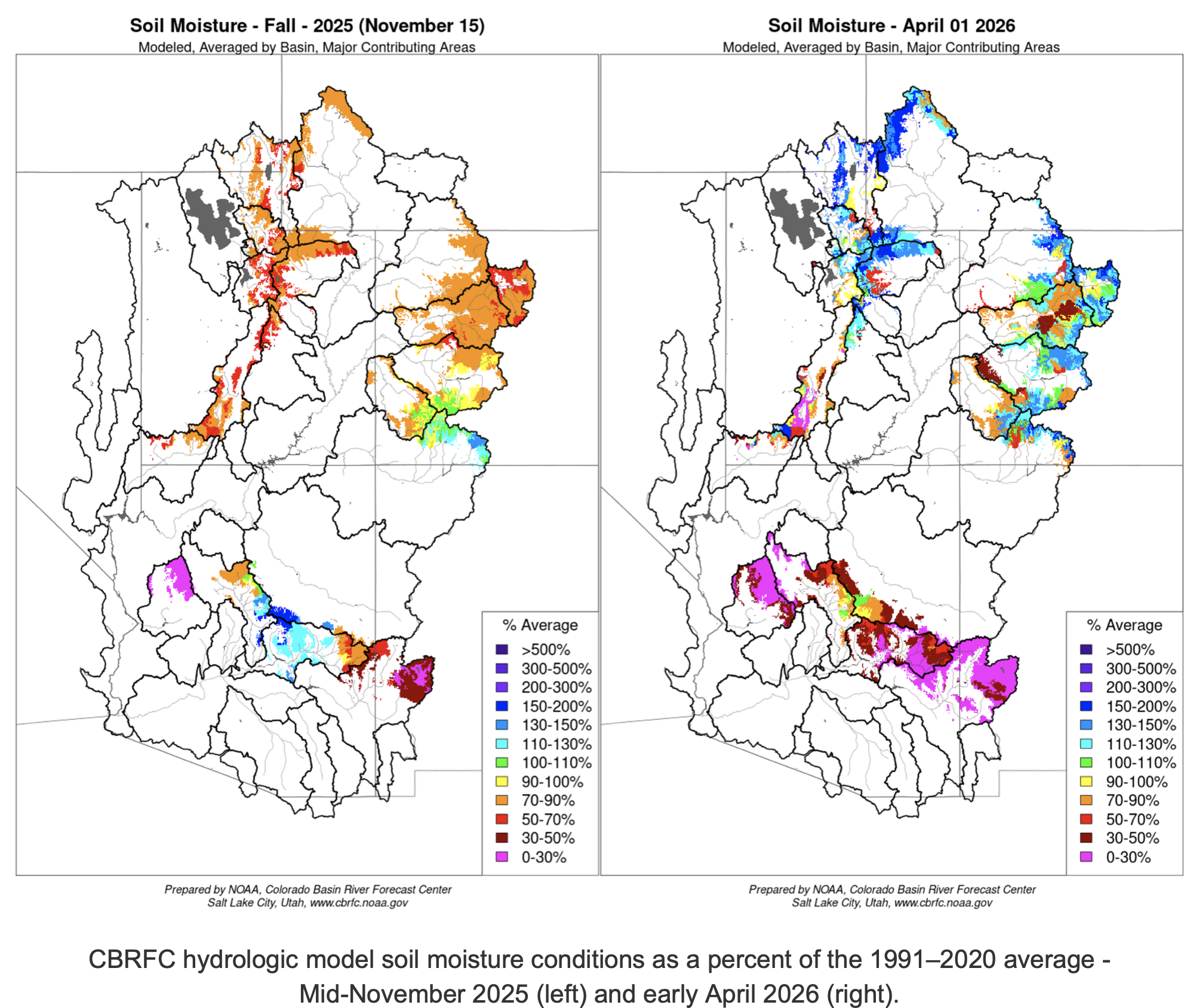
CBRFC hydrologic model soil moisture conditions impact water supply forecasts. Basins with above average soil moisture conditions can be expected to experience more efficient runoff from rainfall or snowmelt while basins with below average soil moisture conditions can be expected to have lower runoff efficiency until soil moisture deficits are fulfilled. The timing and magnitude of spring runoff is impacted by snowpack conditions, spring weather, and soil moisture conditions.
Mid-November 2025 soil moisture conditions were below normal across most areas as a result of warmer and drier than normal weather during the 2025 water year. Higher elevation soil moisture/baseflow conditions typically don’t change much during winter months as snow is accumulating. However, this has not been the case this winter. Model soil moisture conditions as a percent of average have improved across most basins as a result of snowmelt and precipitation falling as rain instead of snow. CBRFC hydrologic model soil moisture conditions are shown in the figures below.
Upcoming Weather
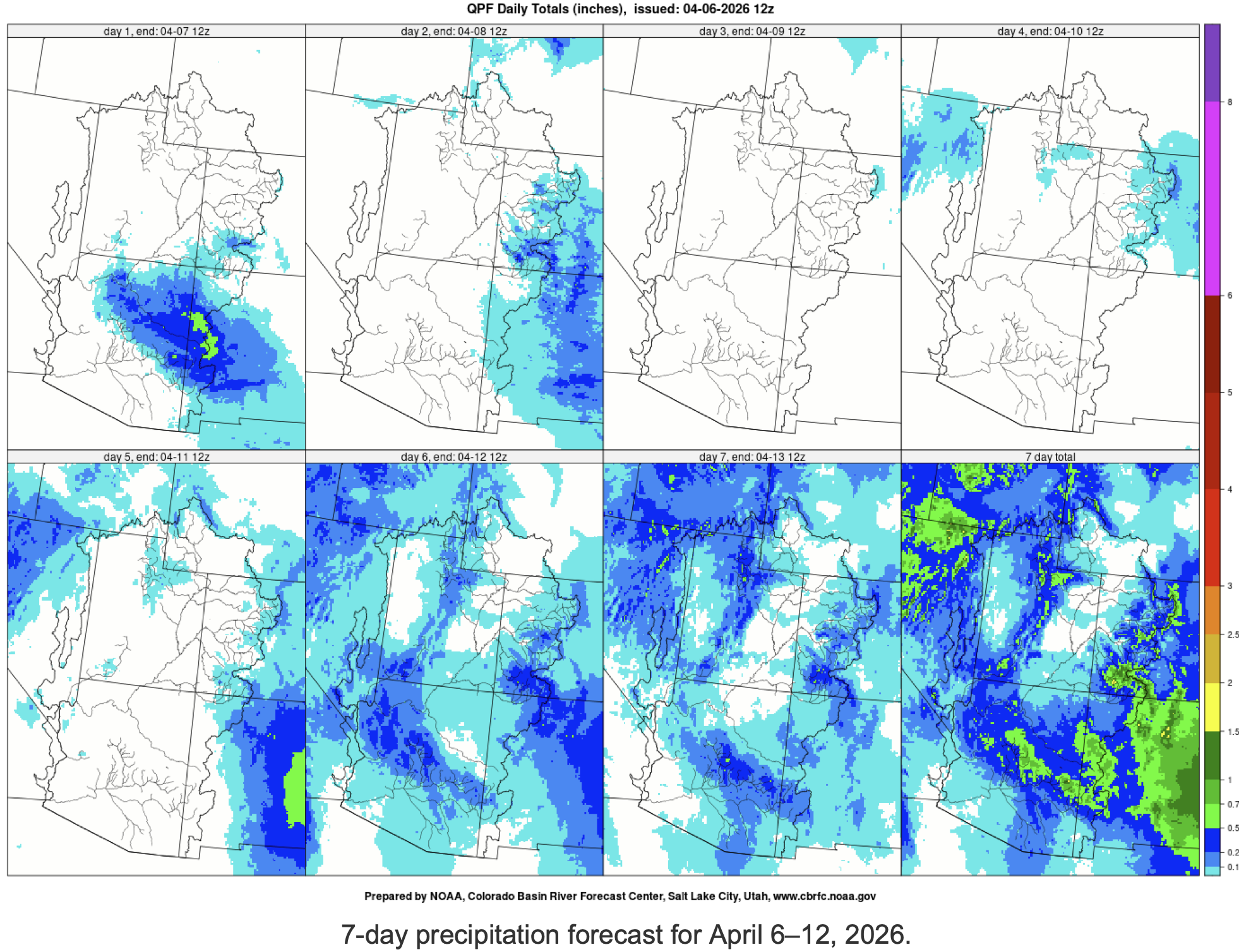
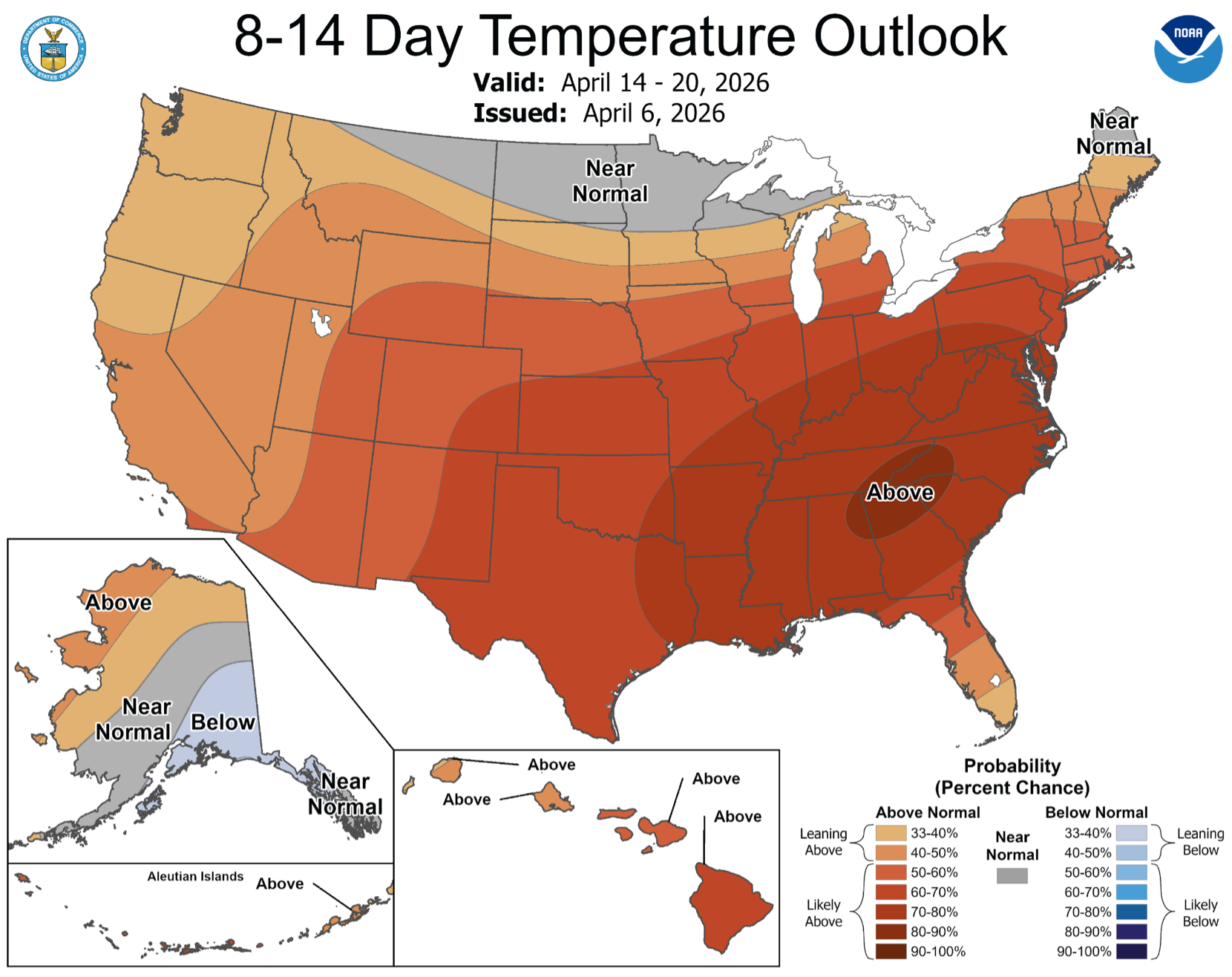
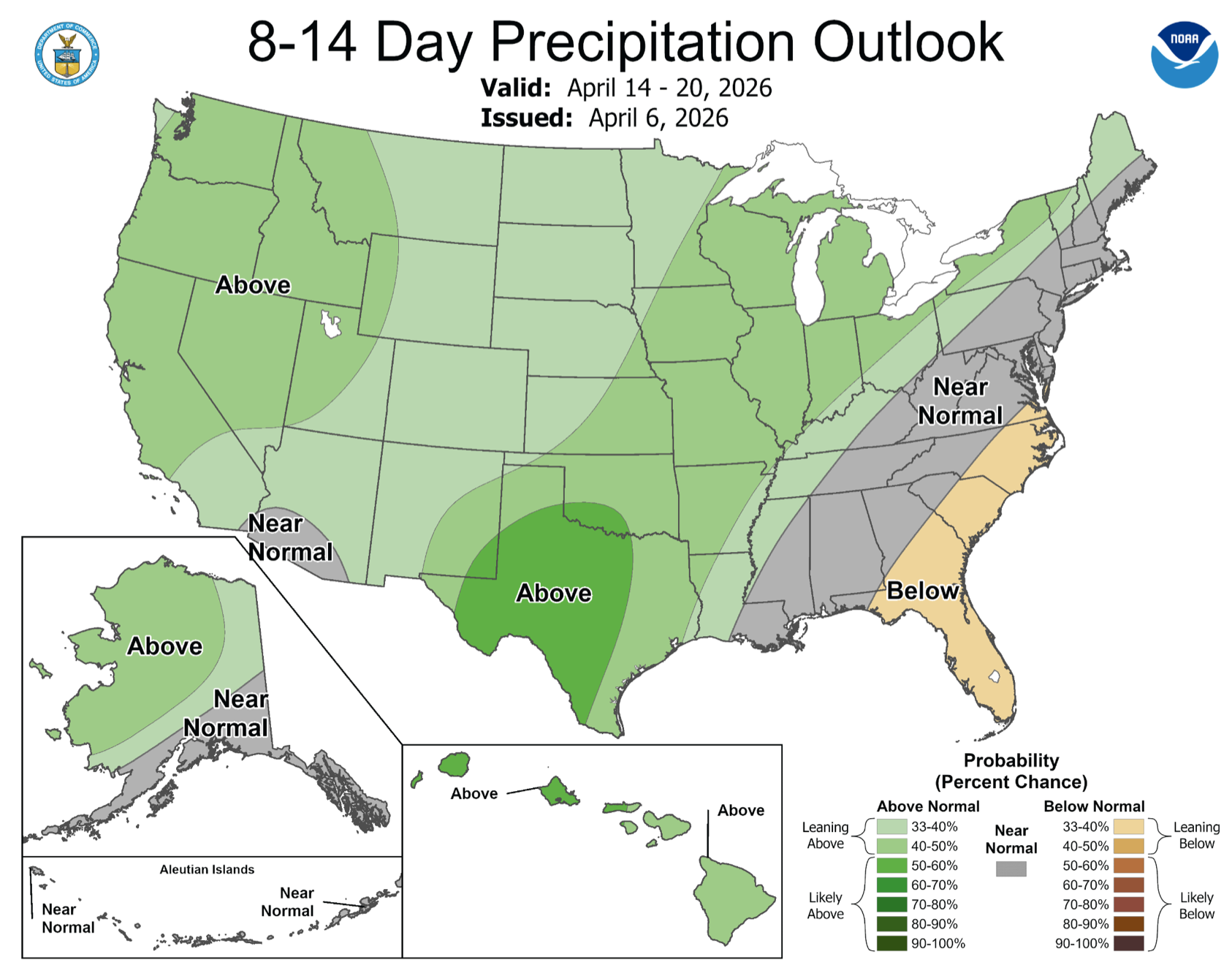
Mild and unsettled weather is expected over the CBRFC area into the middle of April, with a few chances for rain showers and very high elevation snowfall. Above average temperatures will dominate the period. The 7-day precipitation forecast and the Climate Prediction Center (CPC) 8–14 day temperature and precipitation outlooks are shown in the figures below.
A Drying #ColoradoRiver Threatens Imperial Valley’s Future: Declining flows and the warming climate imperil farms, green energy projects and the economy of one of #California’s poorest counties — Capitol & Main #COriver #aridification
April 2, 2026
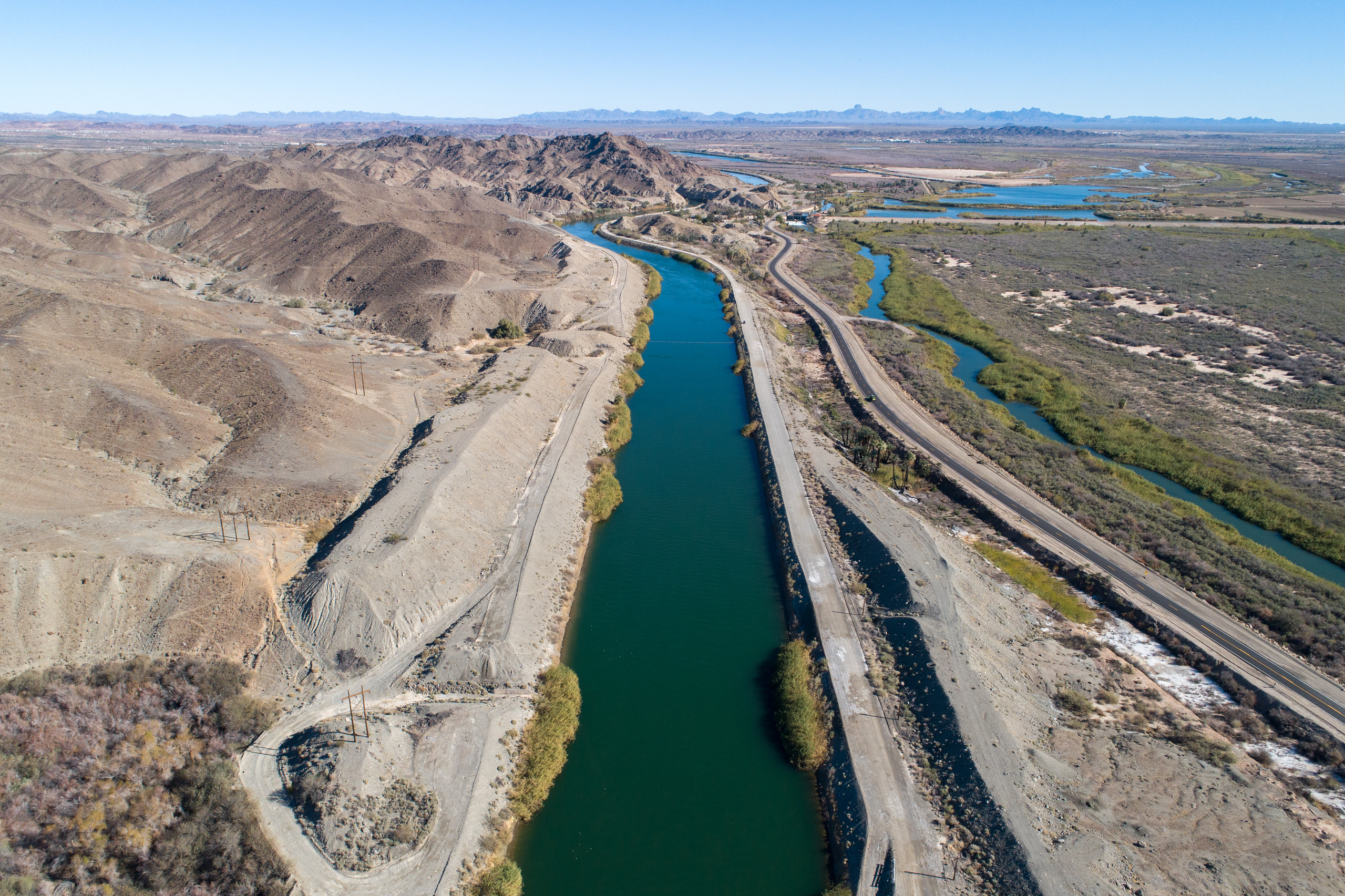
In the southeast corner of California, 300-foot-tall sand dunes rise from a sunbaked landscape dotted with ocotillo and creosote bushes. Summer temperatures here regularly exceed 110 degrees, and annual rainfall is comparable to that of the Sahara Desert. Despite its unforgiving terrain, more than 180,000 residents live in Imperial County, one of the country’s most productive agricultural regions and more recently a magnet for data center development and lithium extraction proposals. This has all been made possible by turn-of-the-20th century canals that carve up the region, supplying it with more than a million gallons of Colorado River water every minute.
“We’ve often called it the lifeblood of Imperial Valley,” said Robert Schettler, a spokesperson for Imperial Irrigation District, the area’s public utility, which manages the region’s over 3,000 miles of drains and canals. “If something were to happen to that river, we would all have to pack up and leave.”
Something is happening to the Colorado River. Over the past century, its average water supply has fallen by nearly a third due to prolonged drought and climate change. Experts predict that decline will continue, threatening cities, tribes and farms that depend on the river’s flow, from Wyoming, Utah, Colorado and New Mexico to Arizona, Nevada and Northern Mexico. Most of the Colorado River’s water starts as snowpack in the Rocky Mountains, but after the American West experienced the warmest winter ever recorded, snow levels are now at historic lows, prompting experts to warn that 2026 may be one of the river’s driest years yet.
That could spell disaster for Imperial County, whose harsh desert landscape of windblown sand and rugged burnt-orange mountains was transformed more than a century ago into productive, gridded farmland dotted with small cities such as Brawley, El Centro and Calexico…Imperial Valley’s agricultural industry consumes by far the largest share of water in the region, about 97% of the 3.1 million acre-feet managed by the Imperial Irrigation District every year…Those ambitious and largely successful conservation efforts have come at a cost. Much of the water used by farmers historically flowed into the nearby Salton Sea, but as farmers have reduced their water use, less runoff has reached the man-made lake, accelerating an existing environmental crisis Over the last three decades, the Salton Sea has shrunk by more than 60 square miles, exposing a dry lakebed laden with pesticides, particulate matter and heavy metals. Those contaminants are carried as dust through the air into nearby communities, contributing to a childhood asthma rate triple that of the national average. Now, farmers such as Brian Strahm, whose family has been growing crops in the area for four generations, are concerned they may have to decrease their water use further. That may prove difficult since farmers have already put in place many efficiency measures, Strahm said…Farmers say cuts could seriously harm the area’s already struggling economy. In addition to being the county with the highest percentage of Latinos in California, Imperial has among the highest unemployment rates of any county in the country, at nearly 19%. For those who do find work, the agricultural industry offers a lifeline, accounting for one out of every six jobs in the region.
Chaco protections in the crosshairs; Chaco comment period ends April 7; USFS Headquarters to Salt Lake City — Jonathan P. Thompson (LandDesk.org)
Click the link to read the article on The Land Desk website (Jonathan P. Thompson):
April 3, 2026
The News: The Trump administration is formally proposing to revoke the Biden-era ban on new oil and gas leases within the 10-mile buffer zone around Chaco Culture National Historical Park in northwestern New Mexico. The Bureau of Land Management is accepting public comments for just seven days, with the input period ending April 7.
The Context: When President Theodore Roosevelt wielded the brand new Antiquities Act in 1907 to create Chaco Canyon National Monument, he drew the boundaries around what is now known as “downtown Chaco,” a handful of structures including the 800-room Pueblo Bonito, constructed between the 9th and 12th centuries by ancestors of today’s Pueblo people.
That was merely the center of the Chacoan world, however, which extended over 100 miles outward into the Four Corners region. No one knows if this was a political empire, a religious or cultural society, or a school of architecture, but it is clear that the dozens of Chacoan outliers or “great houses,” along with thousands of smaller sites, shrines, and architectural features with unknown function, did not exist in isolation. They were part of a cultural tapestry woven into the natural landscape. The national monument, in other words, was vastly incomplete, which is especially concerning given that it lies in would become one of the nation’s most heavily drilled oil and gas fields.
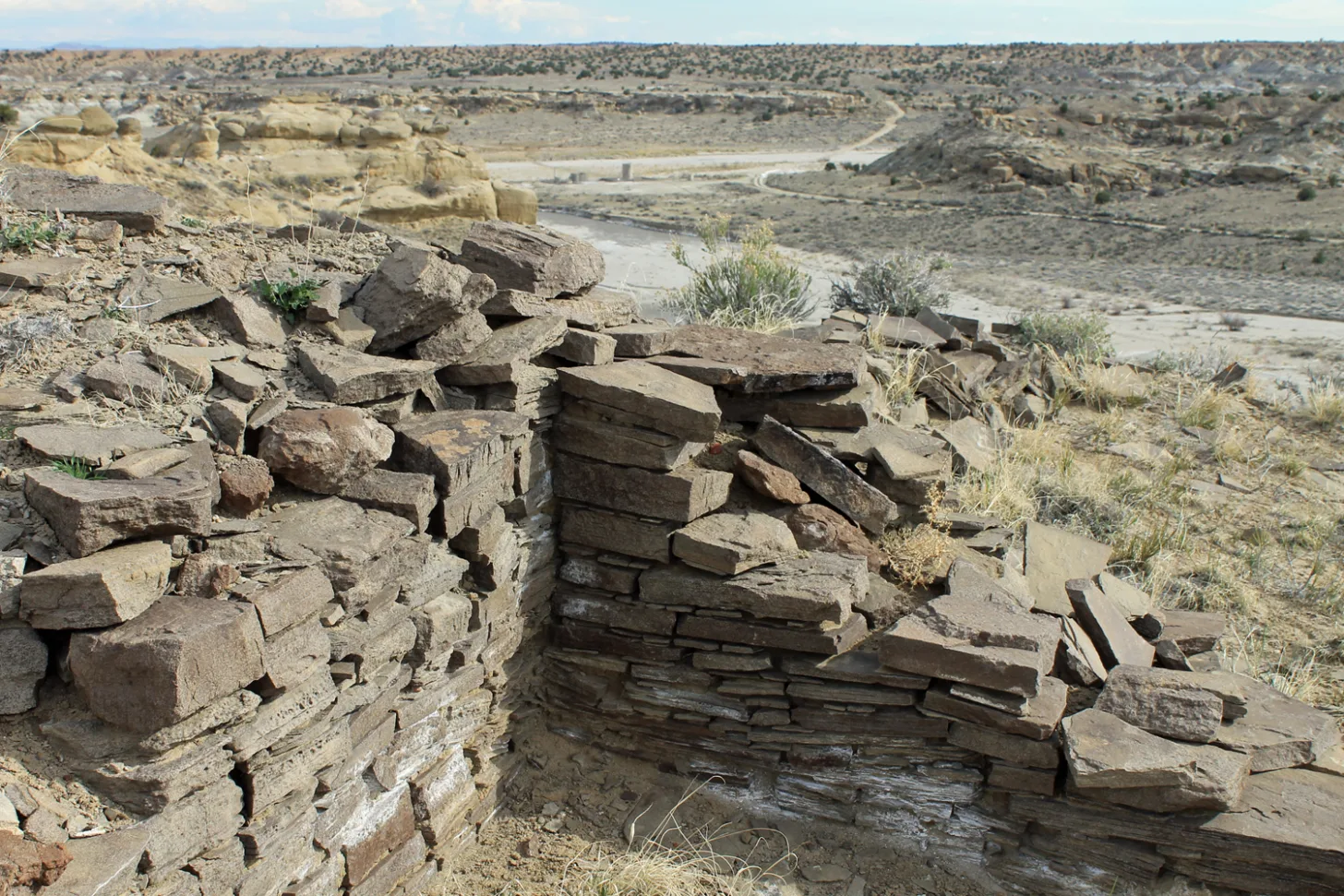
That’s not to say that Chacoan sites are devoid of protections. The park itself is off-limits to all oil and gas development. Pierre’s Site and several other outliers are part of the Chaco Culture Archaeological Protection Sites Program, and all sites on federal land are shielded by the Archaeological Resources Protection Act and Section 106 of the National Historic Preservation Act, which requires oil companies to conduct a cultural inventory of all land in the path of development. If the surveyors happen upon a “significant” site, the well pad or road or pipeline must be relocated, if possible, at least 50 to 100 feet away, a process known as “identify and avoid.” Tribes are supposed to be consulted in these cases, as well, though their concerns aren’t always considered.
But “identify and avoid” misses a great deal.
“Even though agencies try to mitigate the impact, it isn’t enough because you’ve literally destroyed the context in which those things exist,” Theresa Pasqual told me several years ago when I was writing about Indigenous resistance to drilling around Chaco. She is the former director of Acoma Pueblo’s Historic Preservation Office, and a descendant of the Pueblo people who occupied the Four Corners region for thousands of years. “Most of our pueblos are still transmitting their migration history through oral means. So when you have development that begins to impact many of these sites — that range in size from the grandeur of Chaco Canyon or Mesa Verde to very small unknown sites that still remain un-surveyed and unknown to the public — they are literally destroying the pages of the history book of the Pueblo people.”
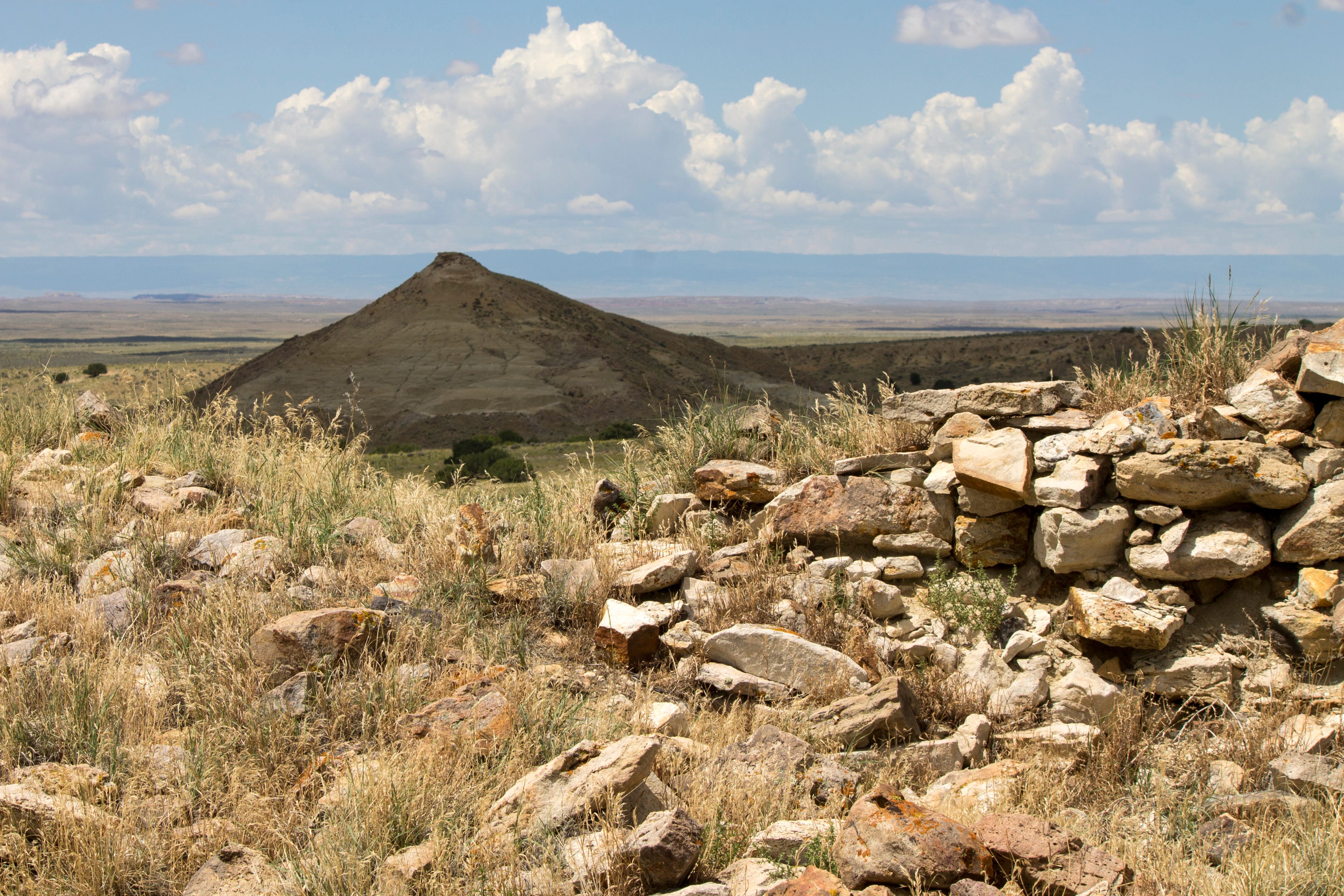
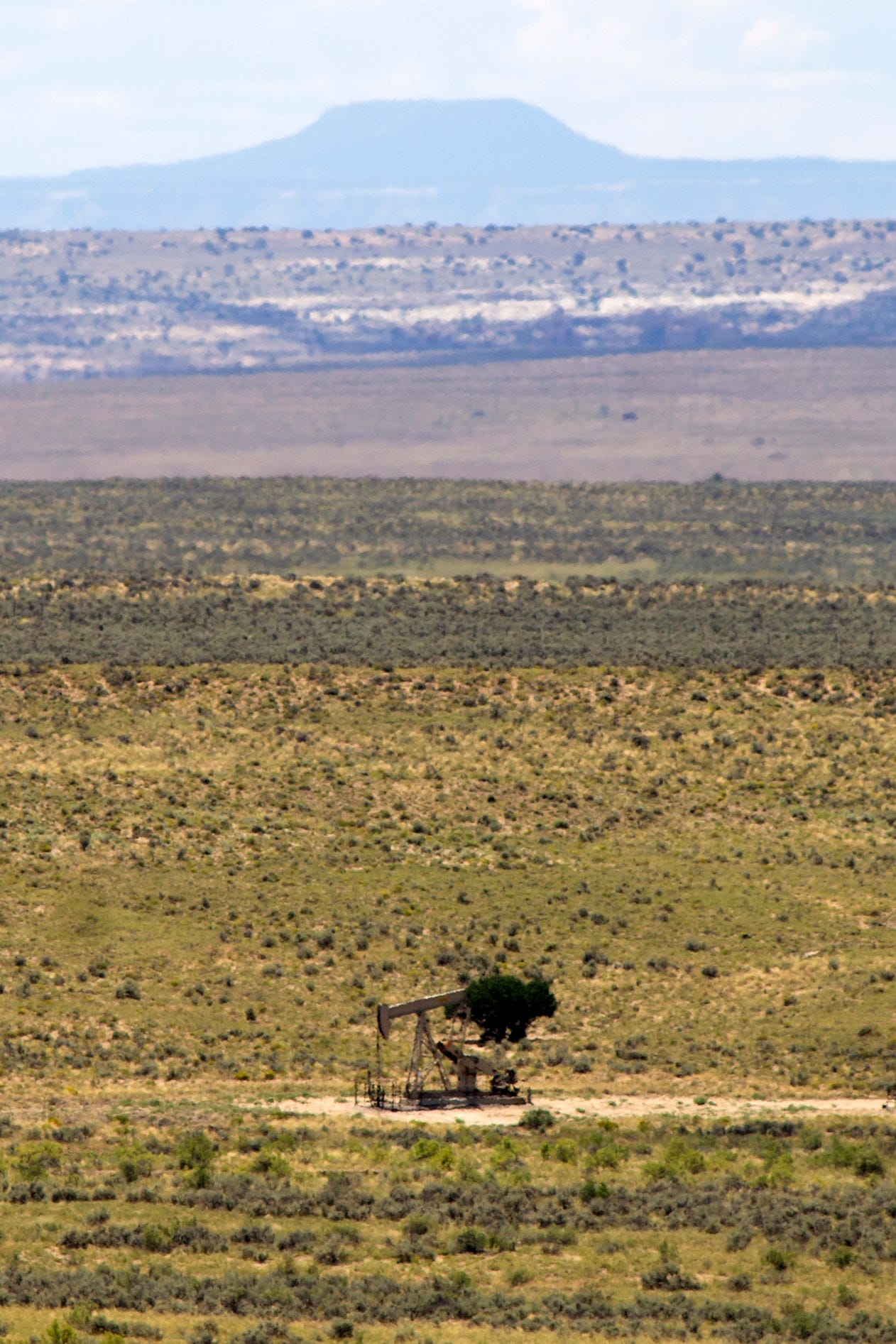
Pierre’s Site, a Chacoan great house about nine miles north of the park’s boundary, illustrates this concept. The site is made up of a collection of thick-walled stone structures built among and in harmony with distinctive shale and sandstone buttes and bluffs. That “page,” or the structures and their immediate surroundings, has been kept intact by the aforementioned protections. But a cluster of well pads, along with pumpjacks, tanks, and associated infrastructure sit less than a half-mile away, and they are visible — and their whir-pop-whir sounds audible — from the site. They not only affect the way one experiences Pierre’s, but also have surely erased some of the important context.
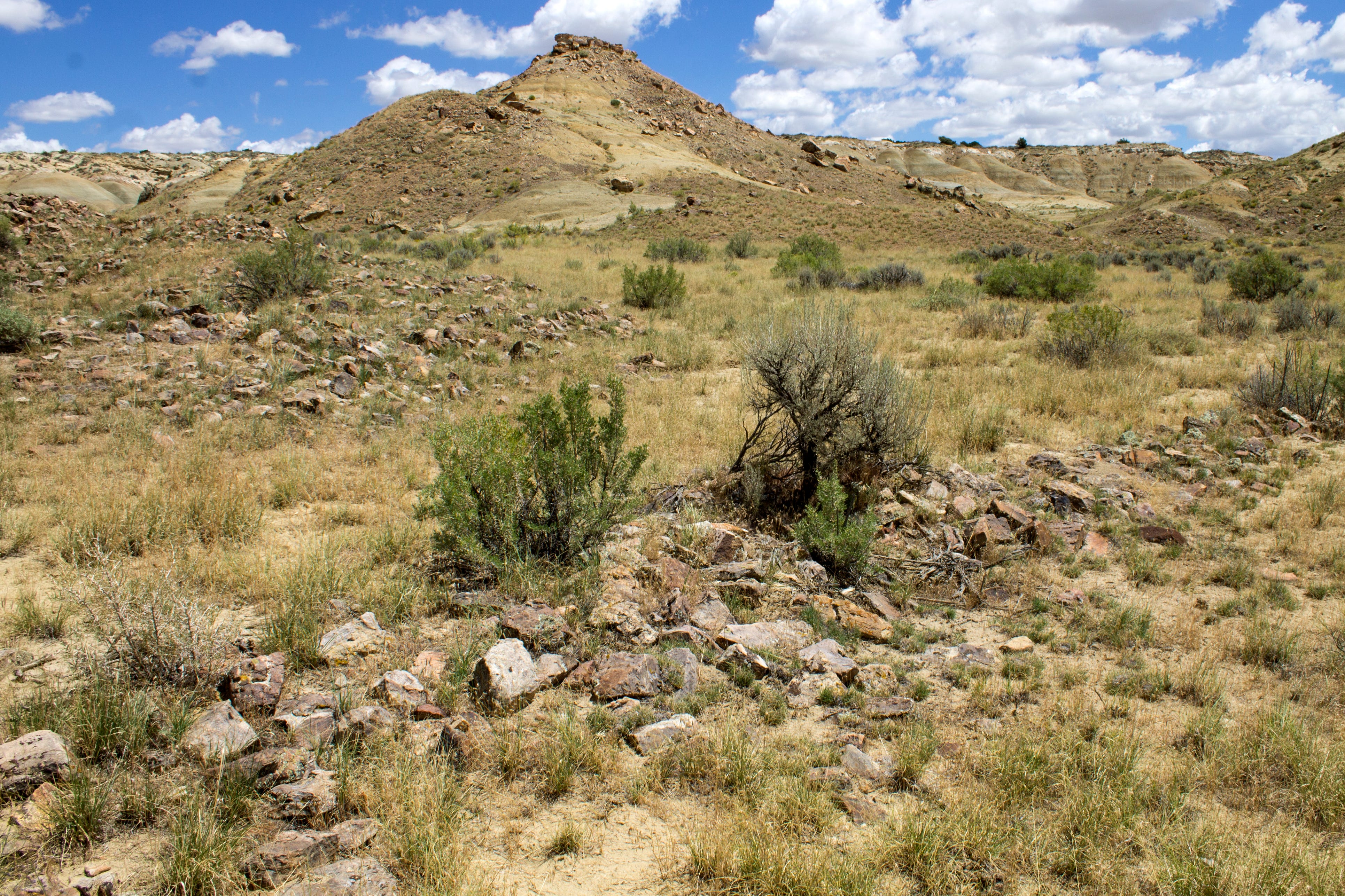
Pierre’s lies along the Great North Road—the most prominent and visible of several such “roads” in the region—an architectural feature that stretches directly north of Chaco Canyon for 30 miles or more. It may have been a symbolic path through time, connecting old worlds with new, or a reminder of the power Chaco-central wielded over its outliers, or a giant arrow pointing people to a holy place. Chaco scholar Paul Reed calls it “a landscape monument on a large scale.” Yet little effort has been made to protect it. Oil field roads and pipelines cross it in dozens of places, and workers have bulldozed well pads right on top of it, erasing the subtle signs that it was ever there. If something so significant can get plowed under, how many more subtle features—shrines, corn fields, plant-gathering sites, ceremonial areas, flint-knapping spots—have been destroyed indelibly?
It was with the greater context in mind that in 2023, after years of consideration, public meetings, and analysis, President Joe Biden signed Public Lands Order 7923, which withdrew about 336,000 acres of public land from oil and gas leasing for 20 years. Tribal nations with ties to the cultural landscape, environmental advocates, and archaeologists had sought the withdrawal to provide a buffer zone around the national historical park and to add a layer of protection to the associated sites within 10 miles of the park’s boundaries.
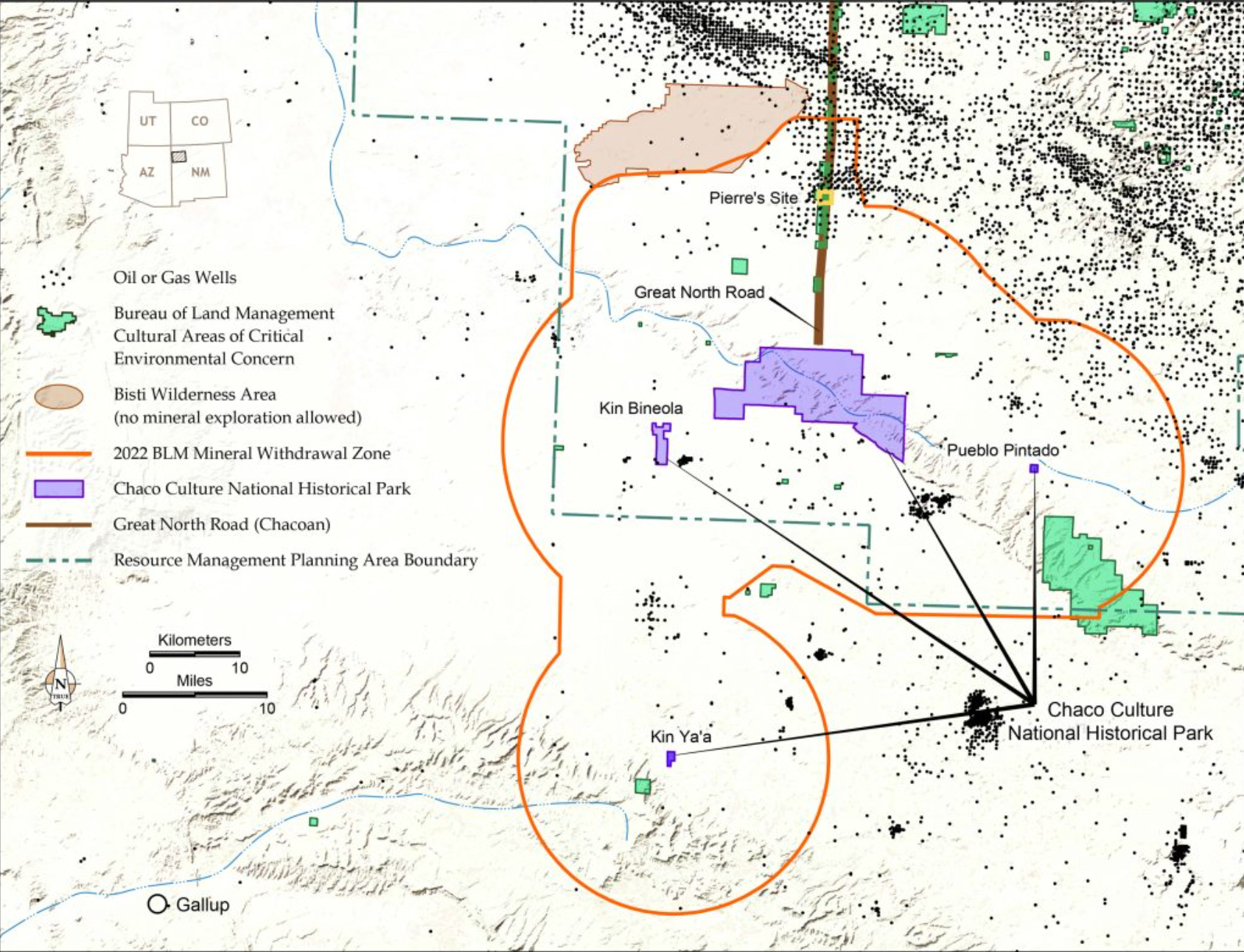
The withdrawal was incomplete, in that it still covered only a tiny slice of the greater Chaco landscape. Several significant outliers, along with about 20 miles of the Great North Road, remained unprotected. Chaco is also in the middle of what’s known as the Checkerboard, a hodgepodge of land ownership and jurisdictions, which complicates the withdrawal, since it only applies to BLM land. The Checkerboard lies within the Navajo Nation’s borders, but it is not reservation land, and it includes Bureau of Land Management land, state lands, private lands, and Indian allotments, which exist in a sort of limbo between private, tribal, and federal land.
The Navajo Nation initially supported the withdrawal, but when tribal leadership changed, so did its stance. In response to pressure from allotment owners within the buffer zone, who worried that their royalties from drilling would be threatened, the Buu Nygren administration turned against the buffer. While leasing is still allowed on those allotments within the withdrawal area, an oil and gas company is less likely to drill there because they can’t “pool” the allotment resources with those of neighboring federal parcels.
Project 2025, the right wing’s playbook for the Trump administration, directly called for the Chaco buffer zone’s elimination, and Interior Secretary Doug Burgum has been toying with the idea for the last year. Finally, on the last day of March, the administration opened a one-week public comment period, on the proposal to either revoke the buffer zone altogether, or to reduce it to a five-mile radius around the park, which would leave out Pierre’s and other significant sites.
The All Pueblo Council of Governors, Indigenous and environmental advocates, archaeology groups, and New Mexico’s congressional delegation all pushed back on the Trump administration’s move and called for the current buffer zone to be retained.
To give your two cents on the proposal, go to the BLM’s project page. [ed. emphasis mine]
***
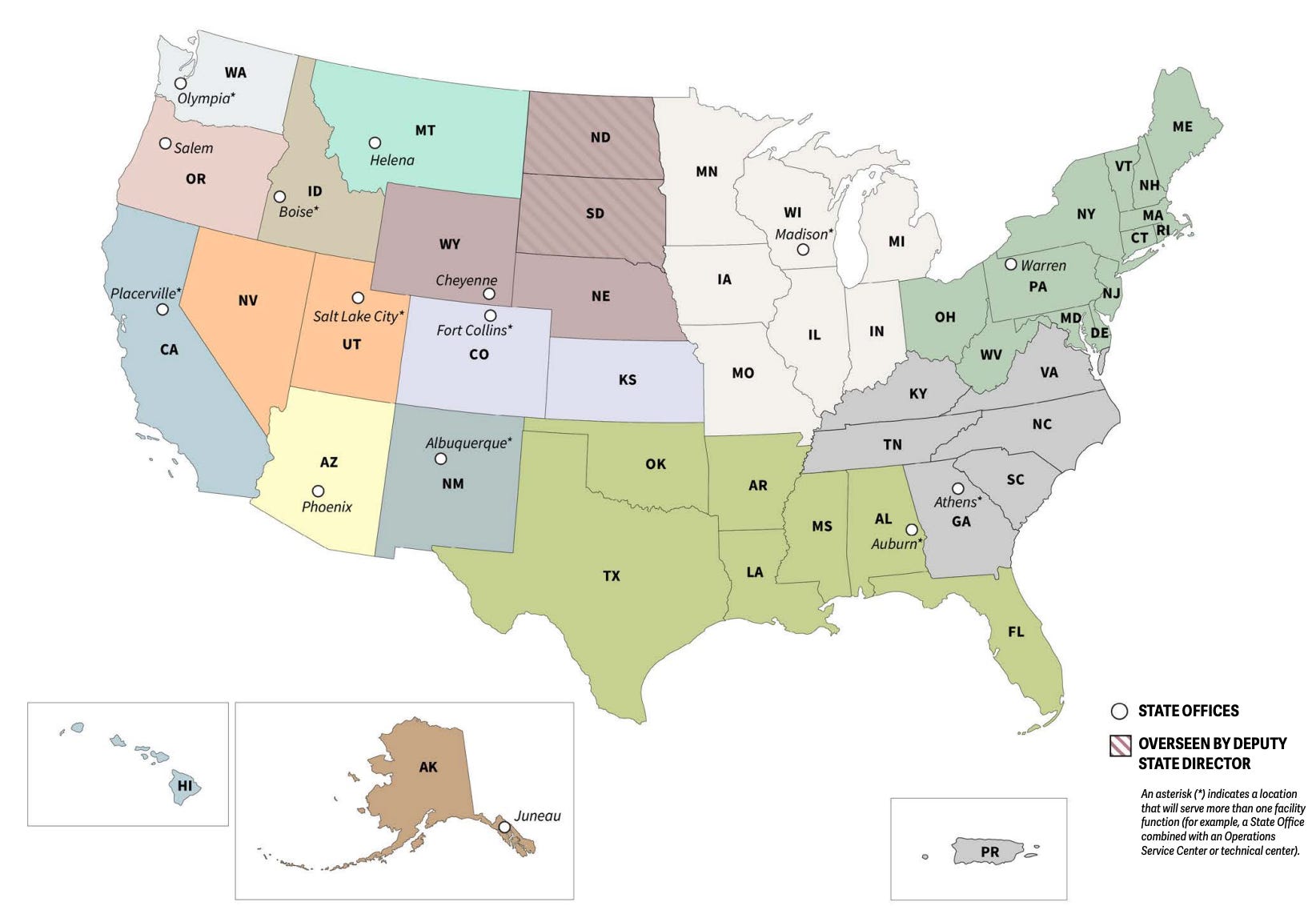
The Trump administration announced it will move the U.S. Forest Service headquarters from Washington, D.C., to Salt Lake City as part of a “sweeping restructuring of the agency to move leadership closer to the forests and communities it serves.” The shake-up includes:
- Moving about 260 employees from Washington HQ to Salt Lake City, and shuffling around another 2,600 staffers;
- Eliminating its region-based organizing structure and shifting it to one centered around 15 state-level offices. This will include shuttering regional offices, some of which will be retained for other purposes;
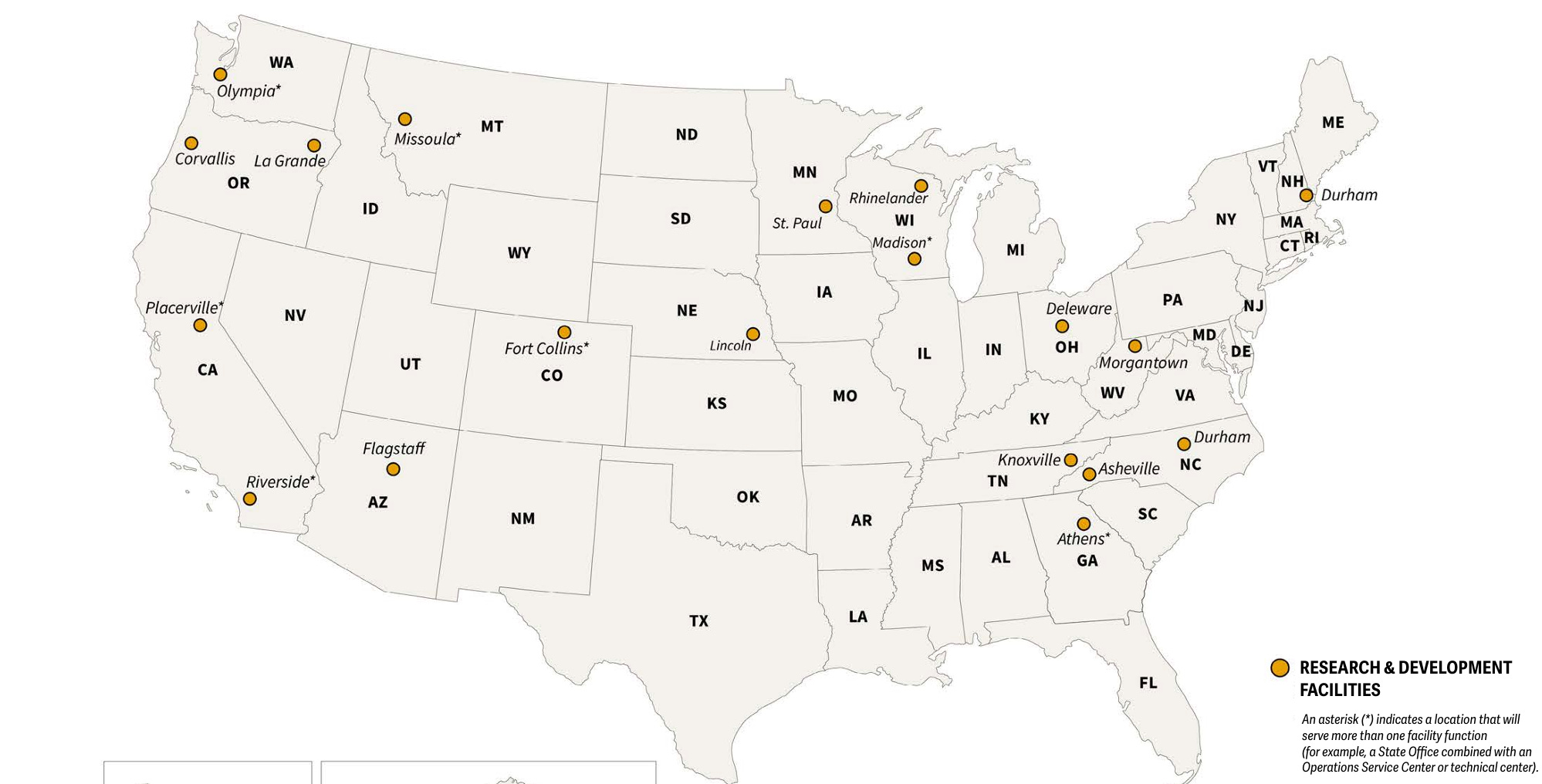
- Closing 57 research and development stations, while retaining 20, eight of which are in Western states;
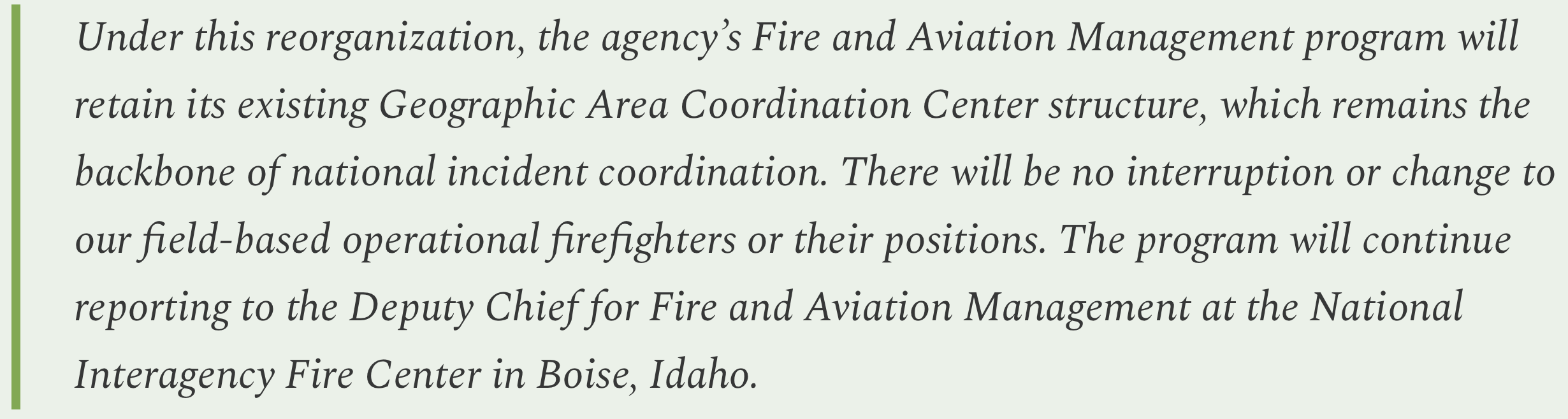
- As for firefighting, a Forest Service press release noted:
Administration officials say the overhaul is aimed at making the agency, which is a branch of the U.S. Agriculture Department, more nimble and efficient. Yet it has not provided an analysis of how such a vast restructuring would accomplish those goals, or how much money it would save. It comes about a year after the so-called “Department of Government Efficiency,” or DOGE, fired about 3,400 Forest Service employees, or more than 10% of the agency’s total workforce.
It’s all part of a larger departmental overhaul designed to “bring the USDA closer to its customers,” according to a USDA memorandum from last year. Customers? Do they mean the extractive industries? The American people? Or what? Either way, it seems like strange terminology for a government agency to be using.
In reality, as Christine Peterson reports in High Country News, the overhaul is doing little except sowing confusion and concern among agency staffers and observers.
As I’ve written here before, I don’t see moving public land agencies out of Washington to be an unmitigated disaster in and of itself. And contrary to some takes, it won’t automatically lead to wholesale clearcutting of the West’s forests. Forest Service and BLM higher-ups don’t need to be close to Capitol Hill or the White House to do their jobs, especially in the Zoom age. And it wouldn’t hurt to get the Forest Service Chief or the BLM Director out on the landscapes they oversee a bit more often, where perhaps they can see the consequences of projects or policies they may sign off on. Utah may be a questionable location, given the state’s leaders hostility toward public land management, but Salt Lake City is a fairly progressive place, and the likes of Sen. Mike Lee will have just as much access to agency leaders in D.C. as they would in SLC.
That said, if such a move is not done correctly, it can be disastrous. Take Trump’s first-term relocation of the Bureau of Land Management’s headquarters to Grand Junction, Colorado, in 2019. That led to a de facto agency housecleaning; many senior staffers chose to resign or move to other agencies rather than uproot their lives and families and move across the country, and only a handful of workers ended up in the Colorado office, which shared a building with oil and gas companies. A vast storehouse of institutional knowledge and expertise was lost, and virtually nothing was accomplished.
We’re likely to see the same sort of dynamic playing out with this move, even though SLC is larger, more cosmopolitan, and has a bigger airport than GJC. Plus, the USFS overhaul is far more than a mere HQ move. Shuttering nearly 60 research and development facilities, many of which are tied to universities or colleges, will have a major impact, even if their functions and staff are moved elsewhere. Ditto with the regional-to-state office shuffle (the point of which is what, exactly?).
And, this is all happening as the administration makes a push to return the Forest Service to its timber plantation era, which ran from the 1950s through the ’80s. During that time, logging companies harvested 10 billion to 12 billion board-feet per year from federal forests, while for the last 25 years, the annual number has hovered below 3 billion board-feet. Now, Trump, via his Immediate Expansion of American Timber Production order, plans to crank up the annual cut to 4 billion board-feet by 2028. How? By declaring an “emergency” that allows the agency and logging companies to bypass environmental laws. Never mind that the infrastructure and demand don’t necessarily exist to carry out this plan.
Rollins issued a memo last year declaring that the threat of wildfires, insects and disease, invasive species, overgrown forests, the growing number of homes in the wildland-urban interface, and more than a century of rigorous fire suppression have contributed to what is now “a full-blown wildfire and forest health crisis.” And she expanded the “emergency situation” acreage from 67 million acres under Biden, to almost 113 million acres, or 59% of all Forest Service lands, opening it up to streamlined forest “management,” aka timber operations.
🥵 Aridification Watch 🐫
I’m calling it: The Dolores River in Dolores reached peak spring runoff of 1,090 cubic feet per second on March 26. If this holds (and, yes, there is a chance that April showers will bring big May flows), then it will be the earliest peak on record by far. This is more an indication of how intense and unusual the end-of-March heat wave was than of how scant the snowpack was. It was the fourth lowest peak flow on record, behind 2002, 1977, and 2018.

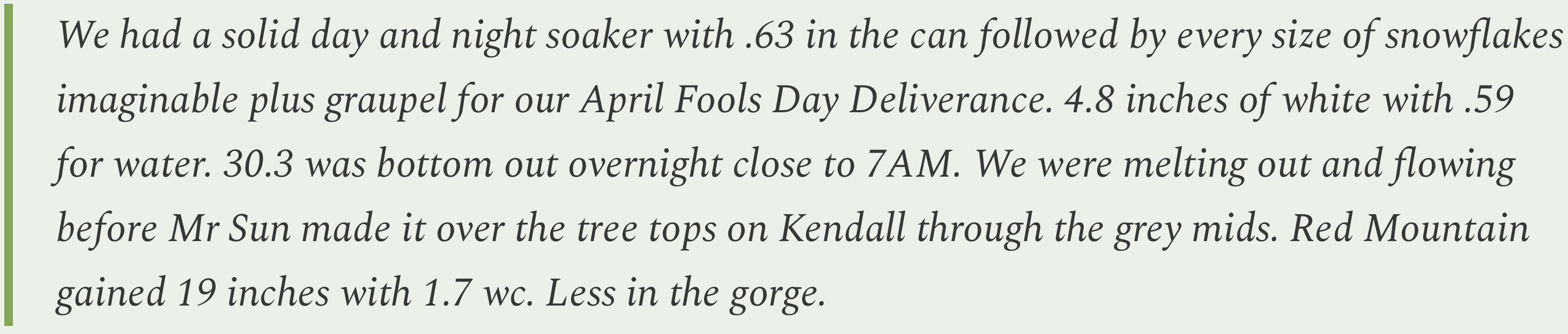
Silverton, Colorado’s weather watcher Fred Canfield reports on a welcome burst of moisture at the high country burg in early April, writing:
Parting Cheeseburger Query
Four years ago, I asked you kind readers (or at least the ones that were around back then), for your recommendations on the best independent bookstores and green chile cheeseburgers in the West so I could add them to the Land Desk Green Chile Atlas. I know, it’s kind of weird to combine the two, and I apologize to all vegan booksellers that this pairing may offend (but I will add that vegan burgers are included, too).
Now I figured I’d come back and not only remind you that the Atlas exists, but also ask for updates, new book or green chile-related finds. So fire away!
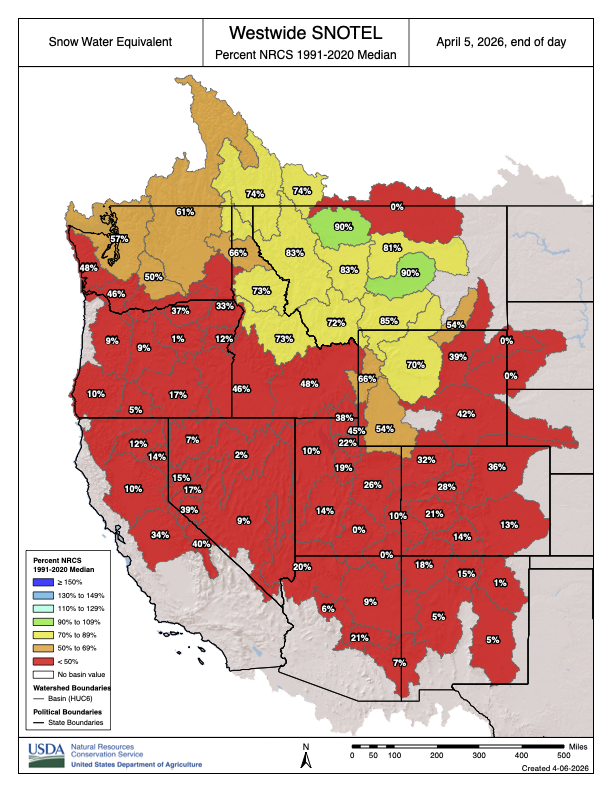
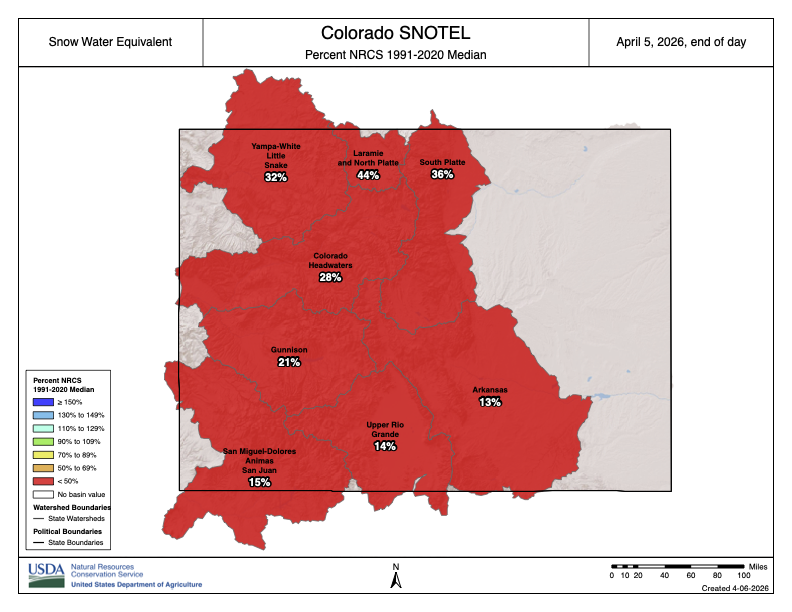
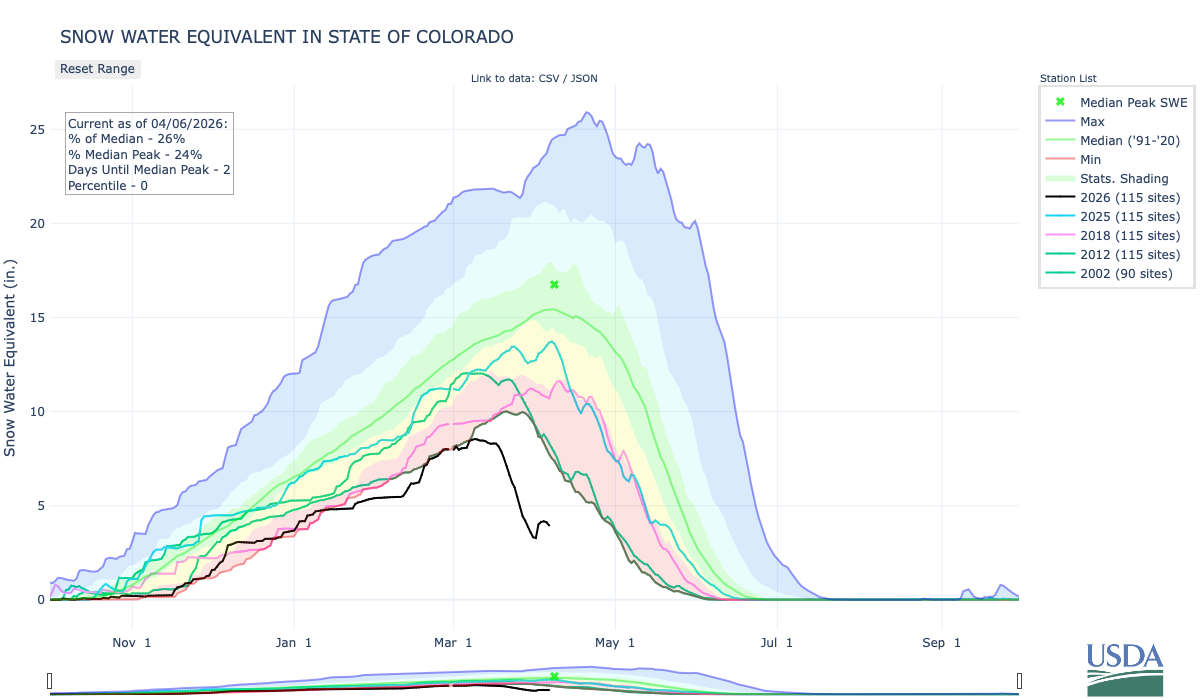
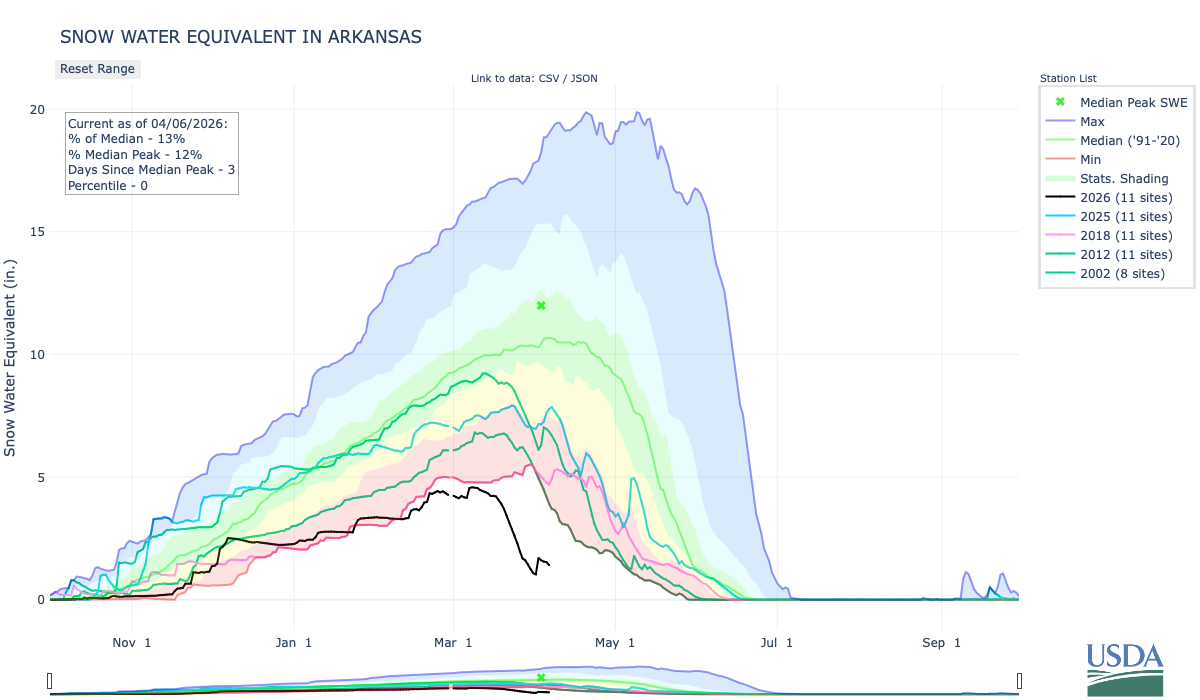
#Snowpack news April 6, 2026 #runoff
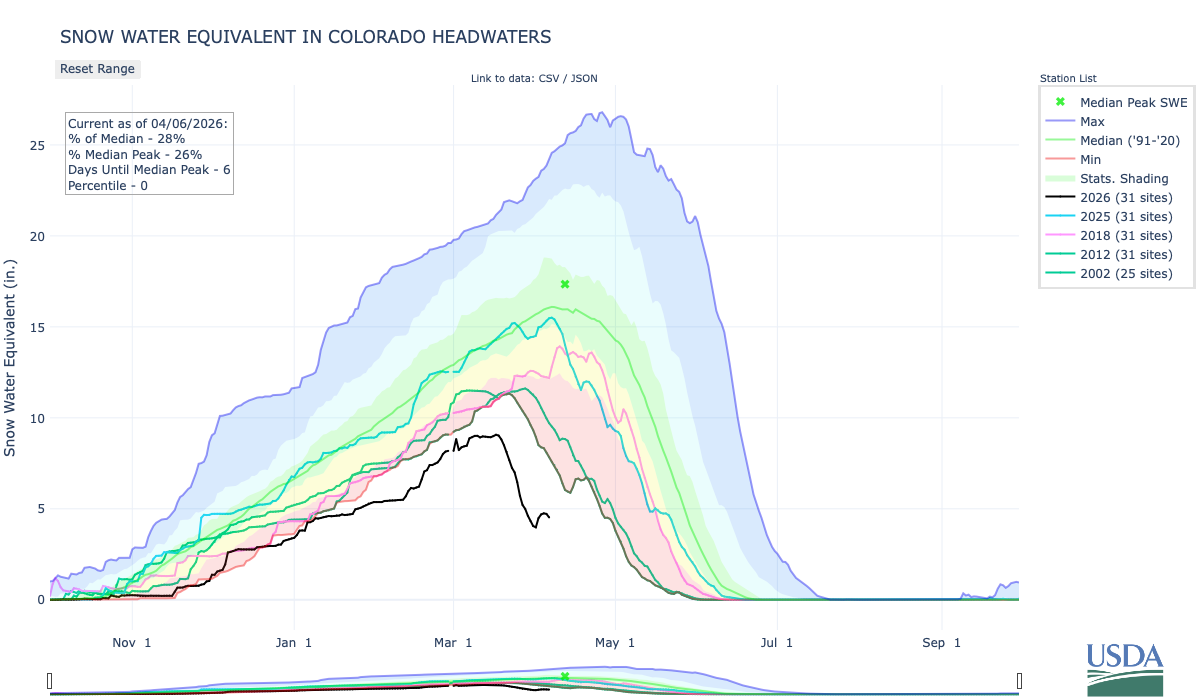
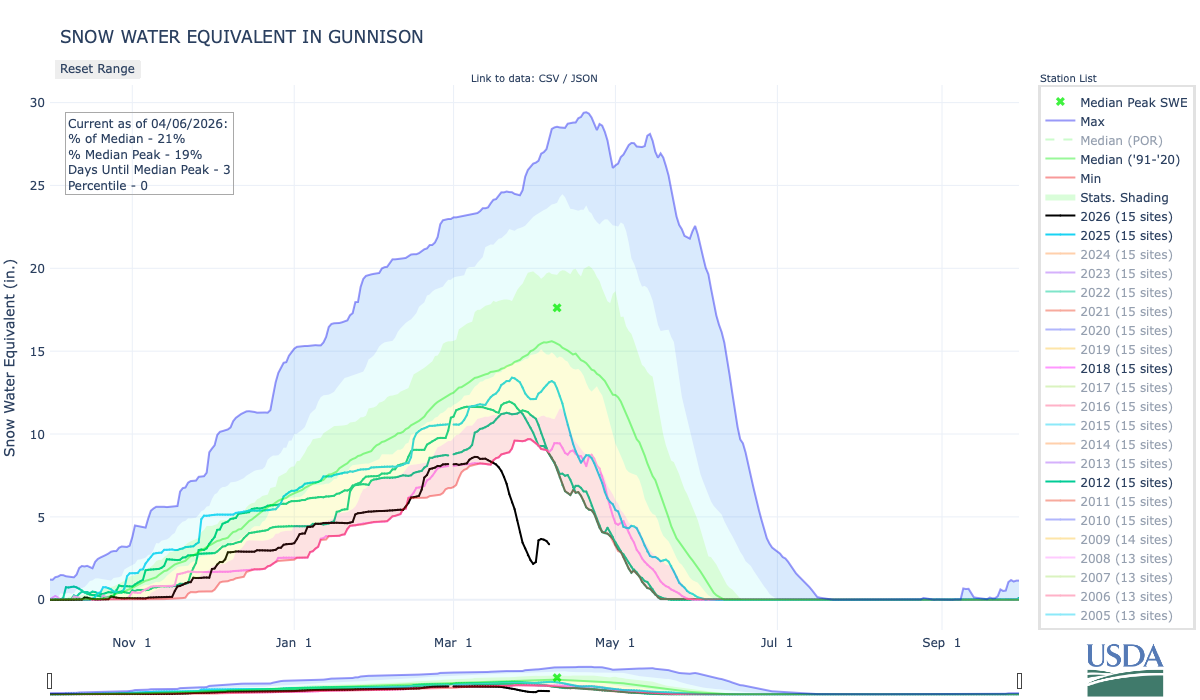
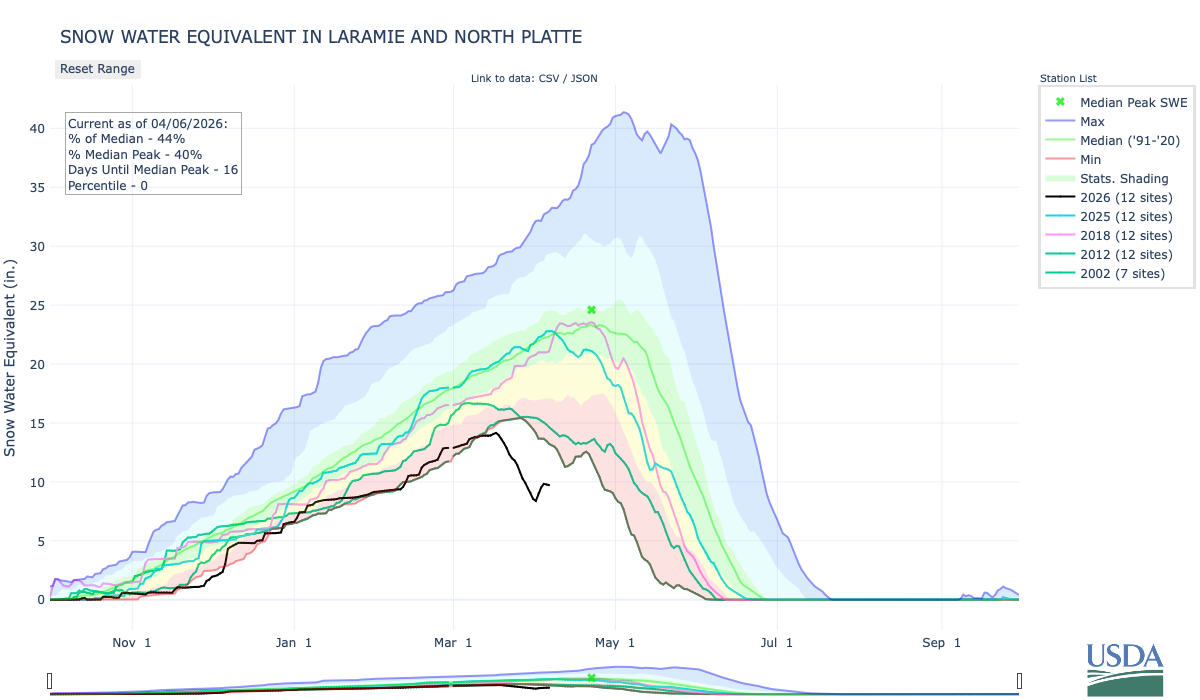

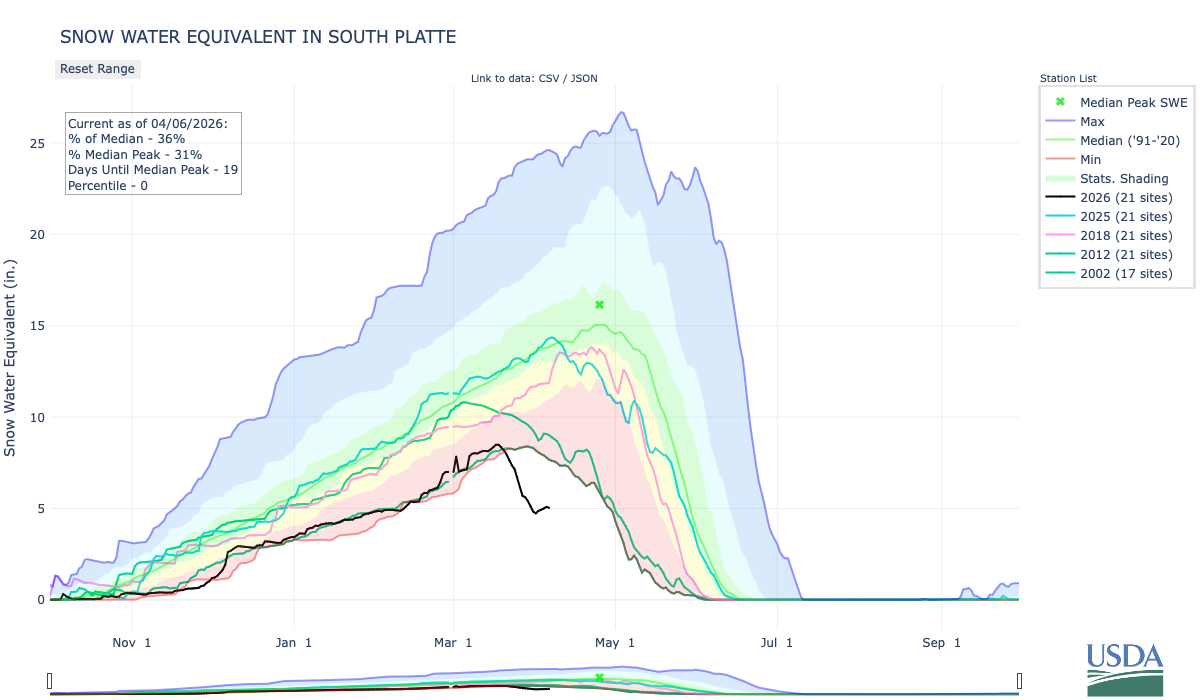
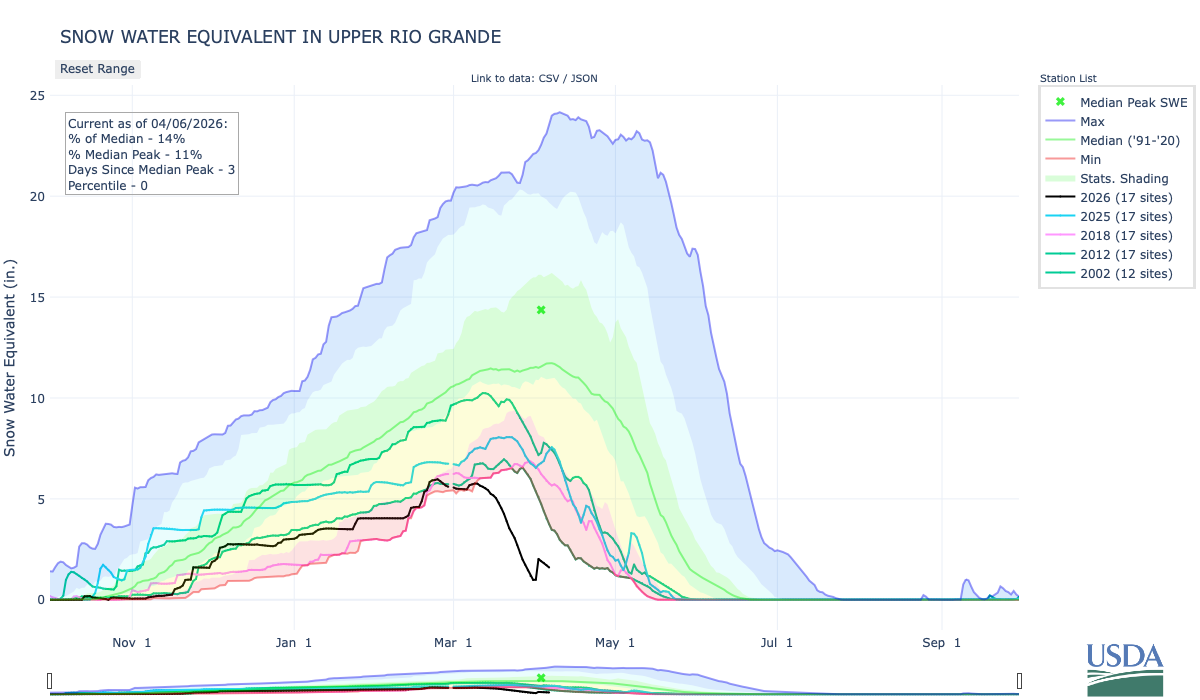
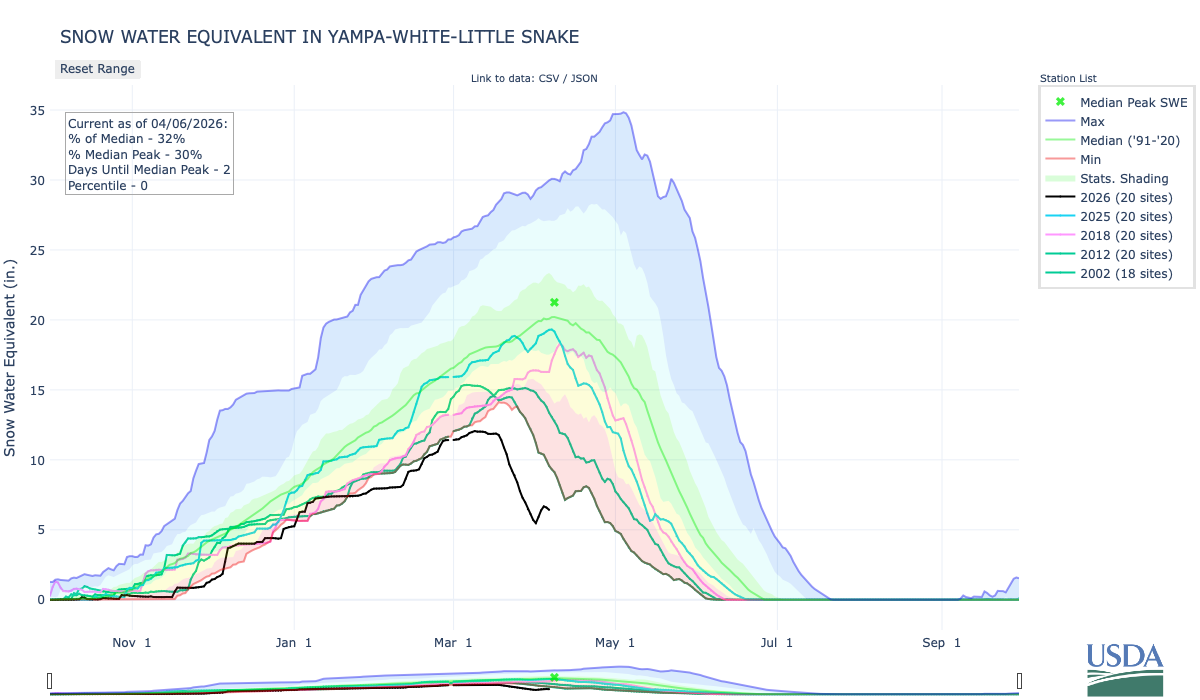
#Colorado Must Adapt Its Water Rules for a Hotter, Drier Future — David Leach #ColoradoRiver #COriver #aridification

April 5, 2026
by David Leach
Coloradans often hear that the Colorado River crisis is happening somewhere else. Headlines focus on Lake Mead, Lake Powell, and the Lower Basin, while Colorado is portrayed as a responsible headwaters state doing its part. Yet that narrative misses a deeper truth. The Colorado River crisis is not only about drought or downstream shortages. It is also about how the river is managed. In that sense, Colorado shares responsibility with every basin state.
Colorado’s water system is built on ‘prior appropriation’. The rule is simple: “first in time, first in right.” The earliest water users receive priority when supplies run low. This framework helped farmers, cities, and industries expand across the West during the nineteenth and twentieth centuries, creating stability in a region where water determines survival.
However, the system was designed for a different climate and a by-gone West. It also encouraged states and water users to claim more water than the river could supply, contributing to the overallocation of the Colorado River. Legal analyses of the Law of the River show that the basin was effectively overburdened by water claims decades before climate change began reducing flows.
Today, climate change is altering the river itself. Scientists estimate that warming temperatures have already reduced Colorado River flows by roughly 20 percent. Federal water managers warn that declines could continue as temperatures rise. In a river system that is already legally overcommitted, treating water rights as fixed privileges can deepen instability rather than prevent it.
Colorado sits at the center of this challenge. As the largest contributor of water in the Upper Basin, the state must balance many competing demands. Front Range cities continue to grow. Western Slope agriculture depends on reliable irrigation. Rivers and aquatic ecosystems are under stress. Yet much of Colorado’s water policy still assumes shortages are temporary and that legal priority alone will determine who receives water. That mindset often encourages defensive politics rather than shared problem-solving.
Conflicts between upstream and downstream states are often described as unavoidable. In reality, much of the tension stems from the priorities of management. Upper Basin states emphasize uncertainty about future river flows, while Lower Basin states focus on delivery obligations and infrastructure investments, according to recent reports on Colorado River governance. Each group is acting logically within the current system. The problem is that the system frequently rewards delay and legal conflict rather than cooperation, as researchers studying collaborative governance in the basin have found.
Colorado has an opportunity to change that pattern. One promising approach is collaborative adaptive management. This framework begins with a simple idea: uncertainty is normal in complex systems. Instead of assuming managers already know the right solution, adaptive management relies on monitoring conditions, learning from outcomes, and adjusting policies over time. With collaboration of states, tribes, farmers, cities, and environmental groups conflict can be reduced and management decisions can improve.
Some elements of this approach already exist in Colorado, including experimental reservoir operations and voluntary conservation programs. However, research on collaborative drought science planning in the Colorado River Basin shows that these efforts remain limited and politically fragile.
Equity must also be part of Colorado’s leadership. For decades, Tribal nations and many rural communities have carried the environmental costs of water development while urban growth captured much of the benefit, a pattern highlighted in research on environmental justice and Indigenous governance. Tribal nations, many of which hold some of the most senior water rights in the basin, remain underrepresented in major water decisions. Adaptive governance recognizes that whose knowledge it is that counts, matters. Incorporating Indigenous knowledge, local experience, and community-based monitoring can strengthen decisions and build trust in governance. Research shows that when affected communities help shape policies, those policies are more likely to be trusted, followed, and sustained over time.
Importantly, collaborative management does not mean abandoning Colorado water law or taking away private rights. Instead, it means updating water governance so users can share risk and adapt together as conditions change. The alternative – waiting for wetter years or relying on courts to resolve disputes – ignores both climate science and political reality. Climate projections from the Intergovernmental Panel on Climate Change indicate that the American Southwest will likely remain hotter and drier for decades. Planning for a return to twentieth-century river flows is increasingly unrealistic.
Critics argue that collaboration takes too long when the crisis is already severe. Colorado has already tried temporary agreements, emergency negotiations, and federal pressure. Those approaches have not produced lasting solutions. Short-term deals may stabilize reservoirs for a season, but they do little to address the deeper management problems driving the crisis. Without stronger cooperation, the basin risks repeating the same cycle of shortage and conflict.
Colorado has long prided itself on practical problem-solving and environmental leadership. The state now has an opportunity to apply those values to its most important river. Policymakers should strengthen collaborative water governance, ensure meaningful Tribal participation, and support conservation policies that reward flexibility rather than litigation.
Coloradans also have a role to play. Public participation in basin planning, engagement with watershed organizations, and pressure on elected officials can help shift water policy toward long-term climate adaptation rather than short-term crisis response.
The Colorado River begins in our mountains. Leadership today means recognizing that rules built for a wetter past may no longer work in a hotter future – and choosing cooperation before the river forces the decision for us.
Anderson, Patrick J., Jeanne E. Godaire, Daniel K. Jones, William J. Andrews, Alicia A. Torregrosa, Meghan T. Bell, JoAnn M. Holloway, et al. 2025. “Collaborative Drought Science Planning in the Colorado River Basin.” U.S. Geological Survey Open-File Report 2025-1041. https://doi.org/10.3133/ofr20251041.
Birnbaum, Simon. 2016. “Environmental Co-governance, Legitimacy, and the Quest for Compliance: When and Why Is Stakeholder Participation Desirable?”. Journal of Environmental Policy & Planning, 18, no. 3, 306–323.https://doi.org/10.1080/1523908X.2015.1077440
Ghaeminasab, Fateme. 2025. “The Legal Battle Over the Colorado River Compact: Revisiting Water Allocation Agreements.” Journal of Taxation and Regulatory Framework. https://lawjournals.celnet.in/index.php/jtrf/article/view/1735.
Hite, Kristen, Pervaze A. Sheikh, and Charles V. Stern. 2025. “Management of the Colorado River: Water Allocations, Drought, and the Federal Role”. Congressional Research Service Report R45546.https://www.congress.gov/crs-product/R45546.
Holling, C. S. 1978. Adaptive Environmental Assessment and Management. New York: Wiley.
IPCC. 2023. AR6 Synthesis Report. Intergovernmental Panel on Climate Change.https://www.ipcc.ch/report/ar6/syr/downloads/report/IPCC_AR6_SYR_FullVolume.pdf.
Kuhn, Eric. 2024. “The Risks and Potential Impacts of a Colorado River Compact Curtailment on Colorado River In-Basin and Transmountain Water Rights Within Colorado.” Colorado Environmental Law Journal, 35.https://scholar.law.colorado.edu/celj/vol35/iss2/4.
Macdonnell, Lawrence. 2020. “Tribal Water Rights in the Colorado River Basin”. Colorado River Research Group.https://www.researchgate.net/publication/339080311_Tribal_Water_Rights_in_the_Colorado_River_Basin.
Slosson, Mary. 2024. “Force Majeure and the Law of the Colorado River: The Confluence of Climate Change, Contracts, and the Constitution.” University of Colorado Law Review, 95.https://lawreview.colorado.edu/print/volume-95/force-majeure-and-the-law-of-the-colorado-river-the-confluence-of-climate-change-contracts-and-the-constitution/.
Sullivan, Abigail, Dave D. White, and Michael Hanemann. 2019. “Designing Collaborative Governance: Insights from the Drought Contingency Planning Process for the Lower Colorado River Basin.” Environmental Science & Policy, 91: 39-49. https://doi.org/10.1016/j.envsci.2018.10.011.
Udall, Bradley and Overpeck, Jonathan. 2017. “The twenty-first century Colorado River hot drought and implications for the future”. Water Resources Research, 53, no. 3.https://agupubs.onlinelibrary.wiley.com/doi/full/10.1002/2016WR019638.
U.S. Bureau of Reclamation. 2023. Colorado River Basin Water Supply and Demand Study.https://www.fws.gov/project/colorado-river-basin-water-study.
Williams, Byron K., Robert C. Szaro, and Carl D. Shapiro. 2009. Adaptive Management Technical Guide.https://www.doi.gov/sites/doi.gov/files/migrated/ppa/upload/TechGuide.pdf.
Whyte, Kyle P. 2018. “Settler Colonialism, Ecology, and Environmental Injustice”. Ecology and Society, 23, no. 2.https://www.researchgate.net/publication/327455189_Settler_Colonialism_Ecology_and_Environmental_Injustice.

David is a Colorado Certified Water Professional and environmental scientist dedicated to protecting aquatic systems through rigorous data analysis, public service, and responsible resource management. He holds a bachelors degree in Biology from Western Colorado University and will graduate soon from the University of Denver with a Masters Degree in Environmental Policy and Management.
“The Situation is Dire”– Becky Mitchell, #Colorado’s Upper #ColoradoRiver Commissioner #COriver #aridification
Click the link to read the article on Ken’s Substack (Ken Neubecker):
March 27, 2026
The February 14 deadline for the seven Colorado River Basin States to come up with an agreement on future management of the river is long gone, and still no agreement in sight. The deadline for submitting comments on the Bureau of Reclamations Draft Environmental Impact Statement (DEIS) is also past. Reclamation didn’t have a “preferred alternative”, which is not normal. They were hoping the States would have an agreement so that could become the preferred alternative. So they are left with their suite of six alternatives. All six are fraught with what Reclamation calls “decision making under deep uncertainty” (DMDU, they love acronyms).
That is an understatement.
No one seems to be very happy with any single proposed alternative. Some are calling for a new DEIS, or at least a Supplemental DEIS. This would only push any deadline further down the road. Reclamation is caught between a rock and a hard place.
The only real alternatives that they can implement without full approval by the States are No Action and the Basic Coordination Alternative. Both would be disastrous. They would simply be going back to how things were done prior to the 2007 Interim Guidelines and even earlier policies, none of which reflect the needs of the Colorado River we have today.
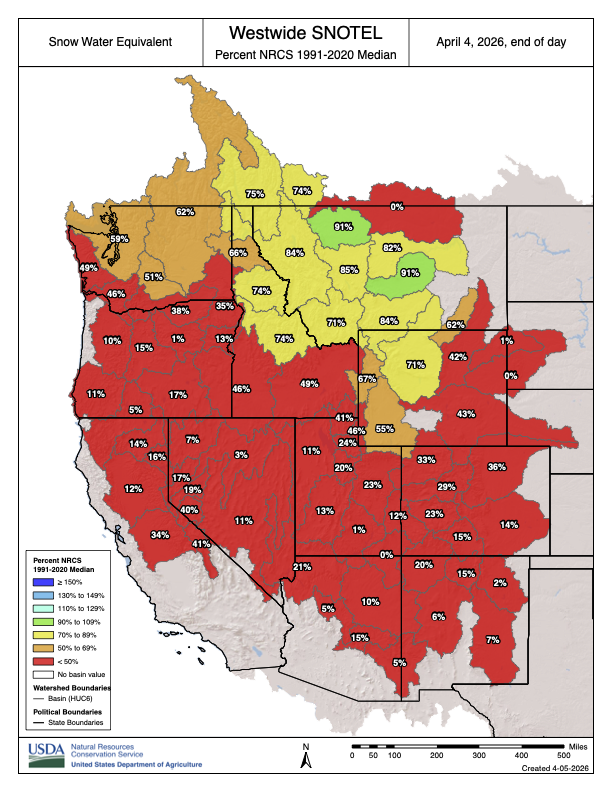
Adding to that is the very dry record low snowpack in the Rockies. This annual winter snowpack is the ultimate water storage reservoir for the entire basin, from Pinedale, Wyoming, to Yuma, Arizona. It is what puts water into the two great reservoirs, Lakes Powell and Mead, that the Lower Basin desert states of California, Arizona and Nevada depend on. It is the only real reservoir that the needs of the arid Upper Basin states, Colorado, Utah, New Mexico and Wyoming depend on. This year that snowpack reservoir is as low as it has ever been, even eclipsing the former record year of 2002 when all this mega-drought started. The recent heat dome setting up over the Four Corners area is melting and sublimating what little snowpack there is fast.
Lakes Powell and Mead are already at very low levels, and the 1.7 maf projected inflow from spring runoff is looking smaller every day. Reclamation predicts that the water level in Lake Powell will drop to a point where no hydropower can be generated, power pool, by as soon as late July or at least in December. That, in effect, could be dead pool, with very limited releases from the lower “river outlet” tunnels. In effect, the flows from Lake Powell will become run of the river, what comes in is what goes out. No more storage for expected water deliveries downstream except what they might risk in lowering Lake Mead even more.
Needless to say this has sparked a war of words between the Upper and Lower Basins, with the Lower Basin being particularly vitriolic. As the February 14 deadline passed, JB Hamby of California declared “The 1922 Colorado River Compact requires the Upper Basin to deliver an average of 8.25 million acre-feet (maf) annually to the Lower Basin and Mexico. That delivery obligation is fixed in law, even if the river produces less water.” Arizona has gone even further, declaring in TV ads that the water delivery is not only an obligation, but a “guarantee” for delivery.
Huh??? Fixed in law and a guarantee? The reality of the river disagrees. The requirements of the Compact are, yes, written in law. On paper. It is “paper water”, not real, or “wet” water. Colorado’s commissioner Becky Mitchell was more to the point, if less vitriolic, “We are being asked to solve a problem we didn’t create, with water we do not have.” At least someone understands the reality of the situation.
John Wesley Powell, the hero of the Colorado River was invited as the honored guest and keynote speaker at the second International Irrigation Congress, held in Los Angeles in 1893. He was held in high regard by the many boosters, speculators and people hoping to cash in with irrigated farms all across the Colorado River basin. After listening to what they were saying, Powell pocketed his prepared remarks and said,
“When all the rivers are used, when all the creeks in the ravines, when all the brooks, when all the springs are used, when all the canyon waters are taken up, when all the artesian waters are taken up, when all the wells are sunk or dug that can be dug in all this arid region, there is still not sufficient water to irrigate all this arid region.”
The delegates didn’t want to hear that. As they booed him off the stage he added,
“I tell you gentlemen that you are piling up a heritage of conflict and litigation over water rights for there is not sufficient water to supply the land.”
Powell was right, but the boosters didn’t listen. Many still aren’t listening. Agricultural dreams have faded and new dreams of housing developments and data centers are taking their place. The boosters, in both Basins, are still booing reality off the stage. Dreams continue to grow as the river continues to shrink.
I read of fears that the Upper Basin will take advantage of Lower Basin cuts by taking more themselves. Really? From where? That vast winter snowpack reservoir that is expected to “guarantee” so much water for the Lower Basin, to refill Powell and Mead, is the same shrinking reservoir that the Upper Basin depends on. Upper Basin diversions are being curtailed every year, not expanded. There isn’t enough water. The Upper Colorado River Commission’s “Amended 2016 Upper Division States Depletion Demand Schedule”, published in June 2022, was used in BOR’s modeling of Upper Basin demands, but the optimistic projections of that report have never born fruit. The report is a projection of potential future depletions from the Upper Colorado River, but they are just that, projections. And relatively modest ones at that. The report begins with a resolution of the Commission that states,
WHEREAS Depletion Demand Schedules issued by the Commission are not a prediction of future water use or depletions. The Depletion Demand Schedules are estimates that presume the continuation of the observed historically available supply and other demand drivers used for planning purposes and are useful for modeling purposes.
It is simply and estimate based on “observed historically available supply”. Observation and history have made some changes to any anticipated future depletions. The report cites 5.7 maf as the current historical use as of 2022, with potential for increased depletions up to 5.8 maf in 2020 and 6.6 maf by 2070. In reality the annual depletion has dropped to 4 maf or less. With continued aridification and dwindling snowpack Upper Basin depletions will likely stagnate, if not decline. That is just the reality.
Under Colorado law, and constitution, the right to divert water to a beneficial use “shall never be denied”. What that means, as I stated in the previous post, is that anyone can dig a ditch or throw a small pump into any stream and divert water. New applications for water rights are filed every month with the Water Courts, and their decrees will likely be granted. That is again, all on paper. The reality is they probably won’t get much if any water. When the river is flowing high in the spring it is a “free river”, meaning anyone can stick in their straw for a drink. But as soon as the first senior call is placed all that stops, and senior calls are happening earlier and earlier every year. And the local Water Commissioners, the ones who can shut down diversions, are getting busier.
The 1922 Compact has a fairly senior right on all streams and rivers in the Upper Basin. So far, the non-depletion requirement for flows averaging 75 maf over a ten year running average hasn’t been breached. Lake Powell will probably hit power pool or worse before then.
The difference between the demands, hopes, and fantasies of paper water and the hard reality of actual wet water are growing starker every winter and have been since the three giant reservoirs, Powell, Mead and the winter snowpack, have shrunk over the past 25 years. Nature doesn’t care much about paper, reports, lawyers or the dreams of boosters past and present. She always wins in the end.
And as Becky Mitchell, said, litigation won’t create any new water.
A correction/addition to my previous post about misunderstandings on the Colorado River
I need to make a correction on my previous post. The three large Upper Basin’s reservoirs, Flaming Gorge, Blue Mesa and Navajo do provide some water for Upper Basin use, especially Navajo, which provides water to the San Juan-Chama diversion to the Rio Grande basin and Albuquerque. It supplies on average 91 kaf of diverted water. It is expected that there will be no diversion this year. Navajo also provides water for Tribal use to the Navaho and Jicarilla Apachie. Downstream flows from Flaming Gorge, the largest of the three can provide smaller amounts for hay fields in Browns Park and the melons in Green River, but that’s pretty small too. Blue Mesa releases can benefit the Gunnison Tunnel diversions and Redlands downstream, but both are well senior to the Compact.
I knew better.
The main storage of the three reservoirs is still primarily as that Compact compliance savings account, and they will be called upon soon to bolster the levels of Lake Powell, where the inflow from runoff projection is dropping below 2 maf. If things keep going like this for another few weeks it will likely be lower.
Hot, Dry Weather Continues in #Colorado Mountains and Plains — Northern Water #snowpack #runoff
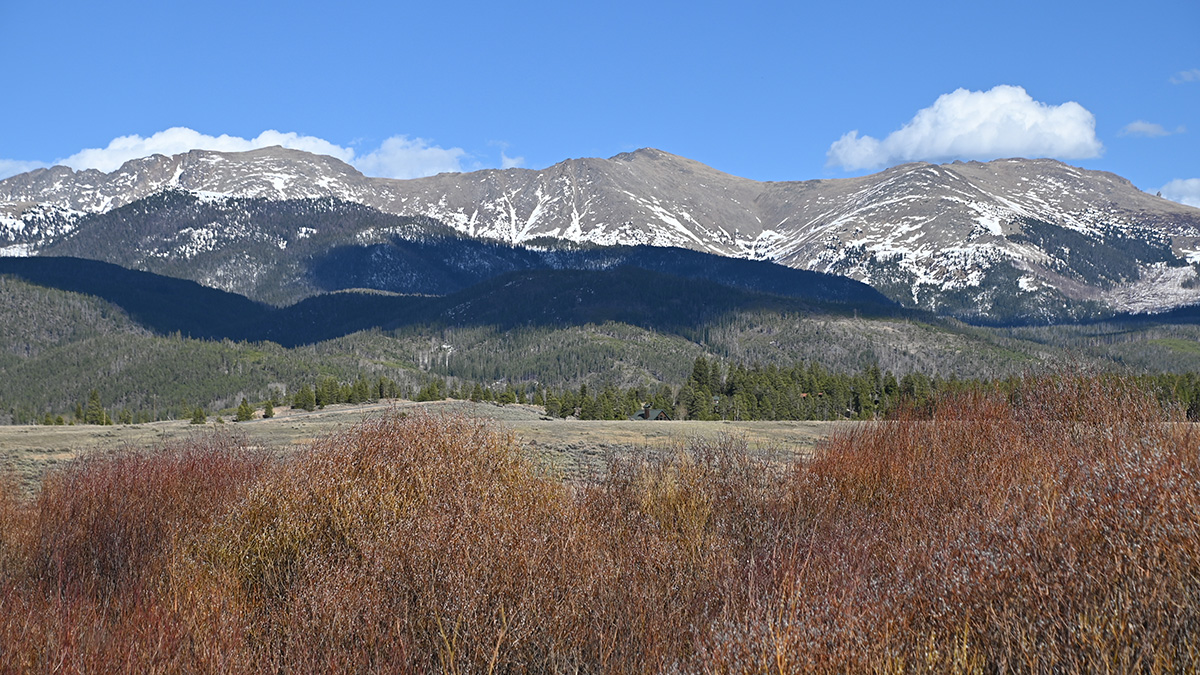
Click the link to read the release on the Northern Water website:
March 31, 2026
The record-breaking hot and dry winter and early spring has continued through March in Colorado’s mountains and plains. Snow gauges and weather stations throughout Northern Water’s collection and distribution areas have collected data showing the lack of precipitation in the region this year.
On April 9, the Northern Water Board of Directors will use the data collected this year and more to determine the annual quota for allottees of Colorado-Big Thompson Project water. Unlike many irrigation systems, the C-BT Project is designed to provide water to supplement the native supplies available in a given year, using water collected in previous seasons. If there is a bright spot this season, it’s that C-BT Project reserves are above their average levels over the life of the project for this time of year.
If you would like to provide comment on the quota send an email to quota@northernwater.org or offer a comment at the April 9 Board meeting.

Clear Creek Reservoir boat ramp remains closed, camping pauses for dam improvements — Dean Miller (Colorado Parks and Wildlife)
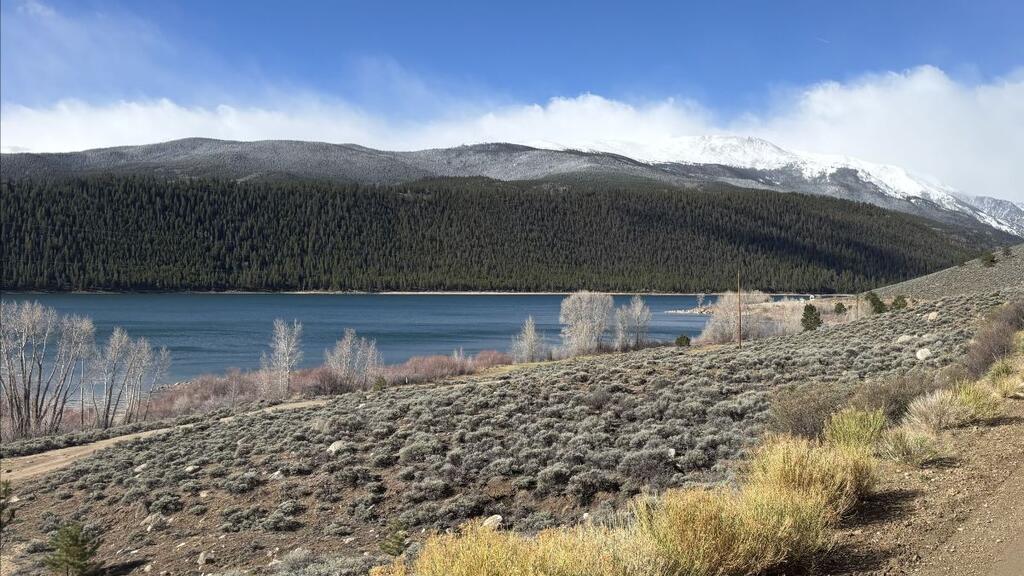
Click the link to read the release on the Colorado Parks and Wildlife website (Dean Miller):
April 3, 2026 GRANITE, Colo. – The Clear Creek Reservoir State Wildlife Area boat ramp remains closed through the 2026 season and the campground closes April 6 as dam improvements move forward. The reservoir remains open to anglers on shore and in hand-launched watercraft.Motorized boat launches are paused during the 2026 season as Pueblo Water lowers reservoir levels for work to take place. Colorado Parks and Wildlife is using the closure period to extend the boat ramp for improved low-water access and to complete campground maintenance and improvements.Heavy equipment is expected throughout the campground area, and with just one access road, the campground will close for public safety. Limited runoff and poor snowpack in the Upper Arkansas Basin also accelerated the repair timeline, prompting Pueblo Water to move forward with the project in 2026 rather than delay it. The boat ramp is anticipated to reopen for the full 2027 boating season.Hand-launched watercraft are permitted from shore but must comply with aquatic nuisance species requirements and cannot have motors of any kind. Anglers should expect changing shoreline conditions as reservoir levels drop for dam work. Mud and silt may make access difficult at times.“Clear Creek Reservoir is an important fishing destination in northern Chaffee County, and while dam improvements and low water conditions limit access this year, anglers still have opportunities to fish from shore or from hand-launched vessels,” said Zachary Baker, CPW assistant area wildlife manager. “The remaining water will continue to support the fishery and more than 20,000 tiger trout fingerlings were stocked there on Thursday.”Signs will alert visitors to the boat ramp closure and ramp access gates are locked. The Colorado Trail remains open west of the campground and a vault toilet remains open. The region offers additional boating, fishing and camping opportunities on nearby public lands.The wildlife area remains closed to non-hunting and non-fishing activities. Visitors ages 16 and older must have a valid hunting or fishing license or a State Wildlife Area pass.Pueblo Water owns Clear Creek Reservoir and the dam infrastructure, and CPW manages recreation and the campground through a lease.
###

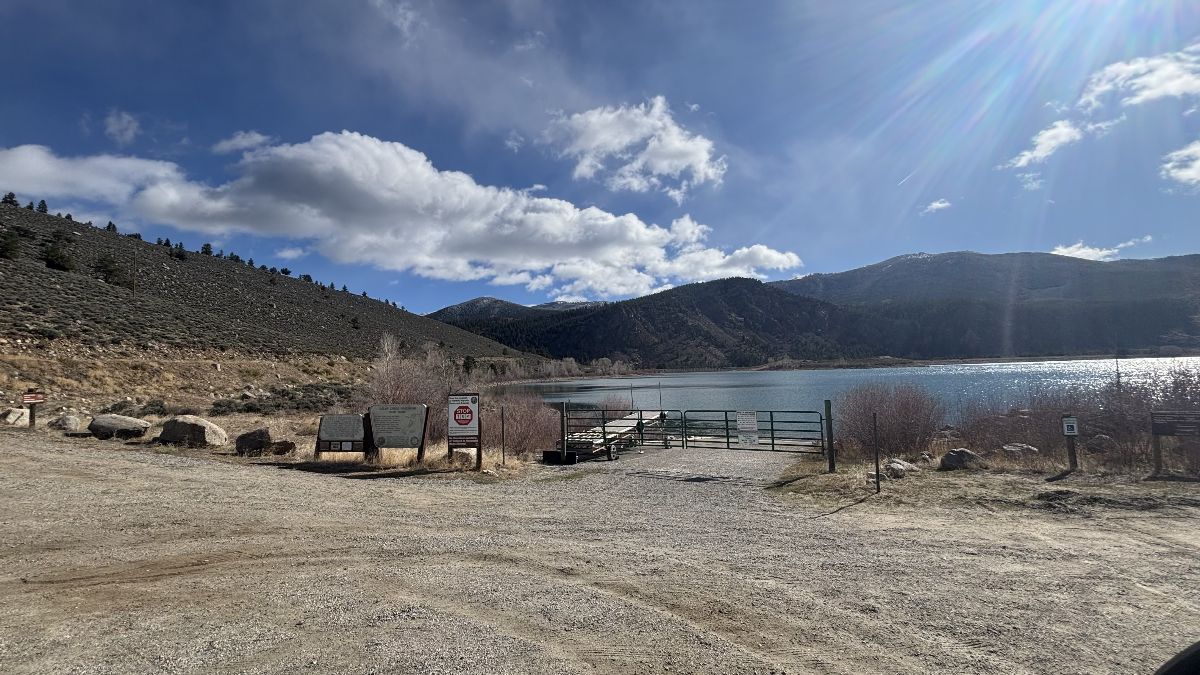
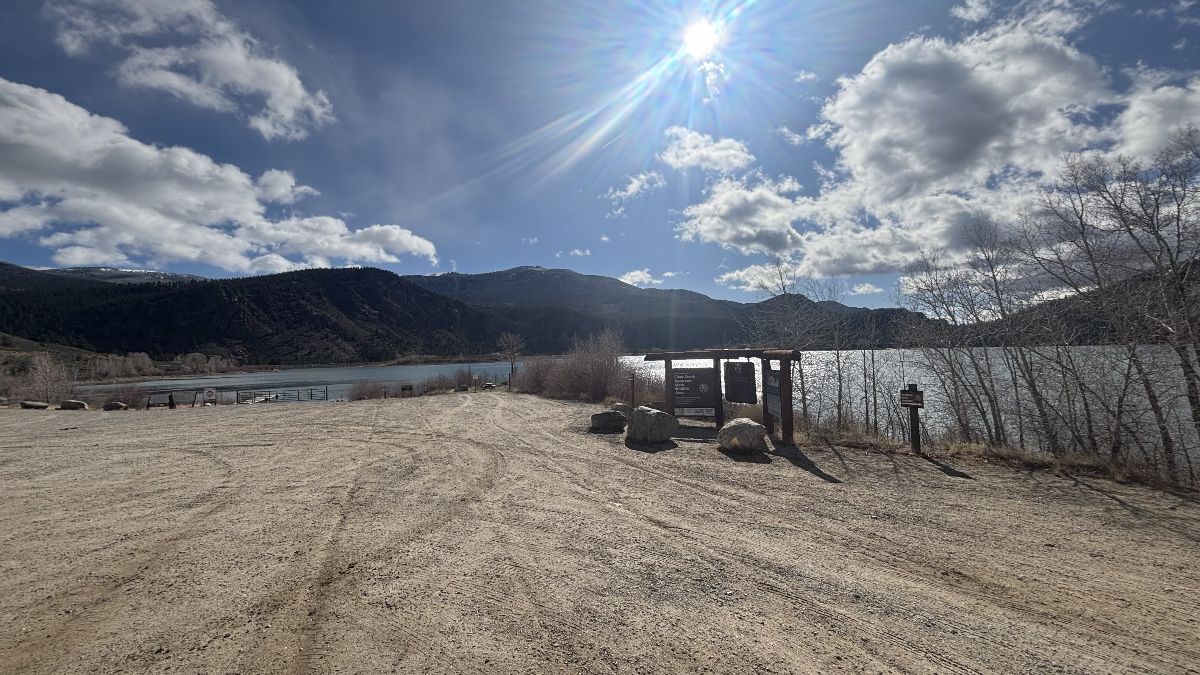
Governor Polis and Colorado Parks and Wildlife announce first investments from SB24-230 (Concerning support for statewide remediation services that positively impact the environment) for Wildlife and Land Protection Funds

Click the link to read the release on the Colorado Parks and Wildlife website (Ally Sullivan and Travis Duncan):
April 3, 2026
Today, Governor Polis and Colorado Parks and Wildlife (CPW) announced the first round of wildlife and habitat projects funded through Senate Bill 24-230, which created new production fees on oil and gas development to mitigate the adverse impacts of oil and gas operations on wildlife and habitats.
CPW’s initial allocation of SB24-230 revenue will fund seven wildlife and habitat initiatives designed to address the impacts of habitat fragmentation, climate change and ecosystem degradation.
“Colorado is known for our iconic outdoor spaces, recreation, and wildlife viewing. Greenhouse gas emissions have a direct impact on our environment and all who call Colorado home. By investing in protecting habitats for Colorado’s wildlife, we are decreasing our carbon footprint, protecting native species, and keeping Colorado beautiful for generations to come,” said Governor Polis.
“SB24-230 provides an important new tool to invest directly in the health of Colorado’s wildlife and habitat,” said CPW Director Laura Clellan. “These initial projects demonstrate how funding generated from oil and gas operations can help restore habitat, improve ecosystem resilience and support wildlife across the state.”
Senate Bill 24-230 established two fees on oil and gas production in Colorado. One fee is administered by the Clean Transit Enterprise, and the other by Colorado Parks and Wildlife to support wildlife and land remediation.
The legislation recognizes that oil and gas development is a significant source of greenhouse gas emissions and habitat degradation, and it directs new investments toward mitigating those impacts and strengthening wildlife and ecosystem resilience.
Under the law, the CPW Director is authorized to set production fees within statutory ranges based on quarterly oil and gas spot prices published by the Colorado Energy and Carbon Management Commission.
The initial CPW production fee was established in October 2025 and generated $5,477,765 in revenue from oil and gas production between July 1 and Sept. 30, 2025.
To put the new revenue to work immediately in order to mitigate the impacts of oil and gas operations, CPW’s Executive Management Team identified seven projects and programs for early investment during fiscal year 2026.
The first round of funding will support:
- Barr Lake State Park Habitat Enhancements ($1,500,000)
- Beaver Restoration Program Implementation – Initial Phase ($1,174,111)
- Operating Increase for Park Pollinator Gardens ($300,000)
- Operating Increase for Wildlife Movement Coordination ($100,000)
- Wildlife TRACKER Hosting and Maintenance ($125,000)
- Columbian Sharp-tailed Grouse Translocation ($85,000)
- Budget Increase for Water Acquisitions ($600,000)
Together, these projects provide remediation services, including habitat restoration, wildlife monitoring, species conservation and strategic land and water protection efforts across Colorado.
CPW will continue to work closely with industry partners, conservation organizations and local communities to ensure that funds generated through SB24-230 are invested in projects that deliver measurable remediation services that mitigate the impacts of oil and gas operations.
“As Coloradans, we all value the outdoors and the wildlife that makes our state so special. When responsible oil and natural gas production can help support these kinds of projects, protecting the wildlife and habitat we all care about, that’s a huge win for all of Colorado,” said Dan Haley, Executive Director, Coloradans for Responsible Energy Development.
“The science is clear that climate change is negatively impacting Colorado’s wildlife and the ecosystems on which they rely,” said Tarn Udall, senior attorney at Western Resource Advocates. “That’s why the state created the oil and gas production fee in 2024, requiring the industry to partially cover the cost of its emissions and impacts through habitat protection and restoration. It’s rewarding to see Colorado Parks and Wildlife put the first tranche of those dollars to good use, and the agency is just getting started.”
Additional projects funded through the program will be evaluated and announced as future revenue is collected.

The West’s unprecedented winter could fuel a summer of disaster — Tik Root (Grist.org)
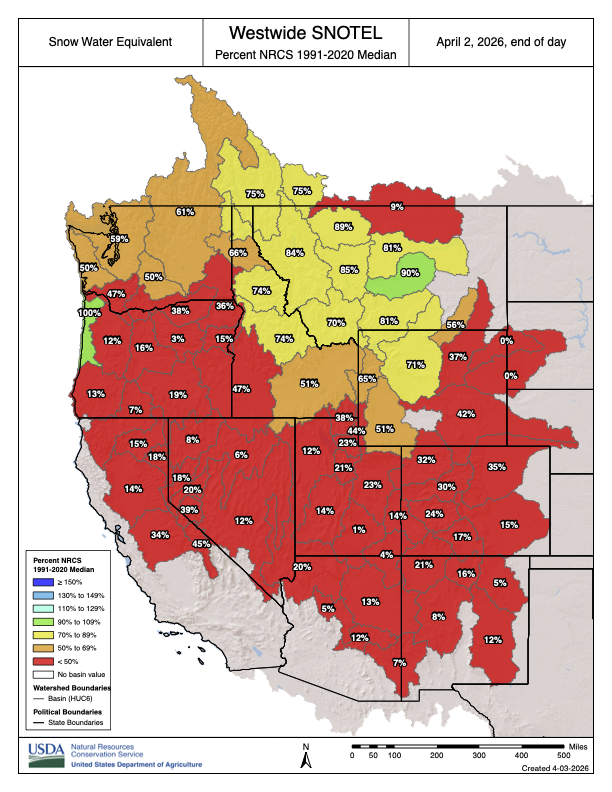
Click the link to read the article on the Grist website (Tik Root):
March 31, 2026
In Park City, Utah, skiers could find patches of grass poking through the slopes for much of the winter — a striking sign of a season that never really arrived. Now, after one of the warmest winters on record, much of the West is entering spring with snowpack at historic lows and an early heat wave that pushed temperatures into triple digits.
These woes could be straight out of a climate fiction novel. But the West’s no good, very bad winter was alarmingly real. And, experts say, a worrisome combination of low snowpack and a devastating heat wave could create a summer ripe for climate disasters. “There is no analog,” Marianne Cowherd, a climate scientist at Montana State University, said of what’s happening. “There isn’t a year in the historical record we can look to for information … This limits our ability to look to the past for insight.”
Much of that uncertainty stems from what’s happening to the region’s snowpack, a cornerstone of its water system. Snow accounts for 60 to 70 percent of the Northwest’s water supply and is especially critical to the ever-thirsty Colorado River Basin, which supplies seven states. But much of the region has experienced the warmest winter on record. That has meant a higher proportion of water arrived as rain, and the snow that did fall melted more quickly than usual. Snowpack is critically low, according to the federal Colorado River Basin Forecasting Center, which utilizes the federal government’s Snow Telemetry network of monitoring stations that go back half a century.
“The majority of them have record-low or near-record-low snowpack conditions,” said hydrologist Cody Moser at the center’s monthly briefing in early March. At that time, he said the upper Colorado River basin, which covers the watershed north of Lake Powell on the Colorado-Arizona border, had about 40 percent of normal snow cover. That has since dropped to 25 to 30 percent.
While winter precipitation has actually been fairly average, how that water falls is important, too. Snow acts as a natural water-storage mechanism that spreads the delivery of water out over weeks or even months as it melts. This helps keep rivers and reservoirs flush for longer. Without snow, the moisture can be fleeting. “Even when we’re getting precipitation, we’re not storing it,” Cowherd said. “A lot of it actually just ends up evaporating or flowing out to the ocean, so it’s not necessarily in a place where we can still access it.”
Cowherd will be watching the snowmelt closely. On one hand, the warmer temperatures are priming the snow to liquify more quickly than normal. But the solar angle — the sun’s maximum height — is lower now than it would be later in the spring, which could impede the melting trend. “I’m really interested to see how those balance,” she said, adding that the answer could be critical to the region’s water supply. “We don’t have the reservoir capacity behind human-built dams to hold the amount of water that we need.”
If snowpack problems weren’t enough, a mid-March heat wave also wreaked havoc in the West. A heat dome brought temperatures as much as 35 degrees above normal, according to the research group Climate Central. More than 1,500 daily records were set across 11 states. Several saw temperatures above 100 degrees Fahrenheit, and the U.S set a national March record of 112 in four cities.
An analysis by the World Weather Attribution Initiative found that this heat wave would have been “virtually impossible” without climate change. “The role of climate change is clear,” said Clair Barnes, a researcher at the Imperial College London’s Centre for Environmental Policy who was part of the team behind the report. She added that extreme temperatures this early in the year “tend to be more dangerous for people because your body is not yet acclimatized.”
While the heat broke in many places after about a week, the impacts could last through the summer. July-like temperatures and dwindling snowpack jeopardize the West’s fragile water supply. The U.S. Bureau of Reclamation’s forecast shows that levels in Lake Powell could dip below the minimum needed to generate power as early as August, and most probably by December. Some Colorado residents are already facing the earliest restrictions on water use ever seen.
“This winter was unusually warm and did not deliver the snow we need,” Alan Salazar, CEO of Denver Water, the state’s largest water provider, said in a statement last week. The utility declared a Stage 1 emergency, which called for a 20 percent cut in usage and mandatory restrictions on outdoor watering. “This drought is also a reminder of the impacts of climate change on our water supply,” he said.
Such conditions heighten the risk of wildfires. Excessive runoff and high heat foster early growth of vegetation that can fuel them, and unseasonably warm weather turns all that greenery to kindling. “Record heat over the previous weeks has put us into early ‘green up’ for the year,” August Isernhagen, a division chief in the Truckee Meadows Fire Protection District, told the University of Nevada, Reno. “This, coupled with many other human impacts on the landscape, has created potential for unprecedented conditions this fire season.”
If these risk trajectories pan out, the impacts could be catastrophic. Low water supplies could upend agricultural operations that feed people across the country. Wildfires could threaten lives, displace thousands, and cause billions of dollars in damage. Still, a lot could change over the next few months.
Barnes said an early heat wave doesn’t necessarily mean there will be more of them later in the year. The weather between heat events also matters, and could go in many directions. A looming El Nino climate pattern could, for example, help alleviate a potential drought. The snowpack problem could even rebound, too.
“We could have a huge snow storm tomorrow and it would be great,” Cowherd said. But based on the current weather forecasts, she cautioned, “I don’t think this is likely to happen.”
This article originally appeared in Grist at https://grist.org/climate/the-wests-unprecedented-winter-could-fuel-a-summer-of-disaster/.
Grist is a nonprofit, independent media organization dedicated to telling stories of climate solutions and a just future. Learn more at Grist.org
Simple strategies to save water at home: From faulty flappers to shorter showers, every drop counts during #drought — Jay Adams (DenverWater.org)
March 24, 2026
Colorado is in a severe drought, and simple indoor water conservation measures can lead to big savings when everyone pitches in.
Free and easy
- Turn the water off while brushing your teeth or washing your face.
- Limit showers to 5 minutes (or try to shorten them by 1-2 minutes).
- Only run your dishwasher and washing machine with a full load.
- Turn off the kitchen faucet when handwashing dishes.
“A drought is a great time to teach kids, or anyone, about the importance of conserving water,” said Greg Fisher, Denver Water’s manager of demand planning. “Simple lifestyle changes can become lifelong habits.”
Fixing leaks
Across the U.S., Americans waste about 1 trillion gallons of water every year through water leaks and spend about 10% of their water bill on wasted water, according to the EPA.
The biggest water waster in the home is the toilet. The EPA reports that an average leaking toilet can waste about 200 gallons of water every day.
Learn more about finding and fixing toilet leaks.
In addition to checking for toilet leaks, inspect all water sources in your home, including faucets, showers, water supply lines for dishwashers, washing machines, swamp coolers and ice machines.
Small leaks can add up over days and weeks. A small leak of 10 drops per minute can waste 300 gallons of water per year. Not only can these leaks add to your water bill, but they can also damage your home.
Find out how to do a self-audit of your home’s plumbing to help find and fix leaks.
Denver Water also encourages customers to review their monthly water bills. Unusually high water usage could indicate you have a leak.
Toilet rebates for low-flush toilets
Older toilets are another big water waster.
Some older toilets can use anywhere from 3.5 gallons to 7 gallons per flush, while newer toilets on the market use as little as 0.6 gallons per flush.
A family of four using 3.5 gallons per flush can use 26,000 gallons of water per year, compared to 11,000 with a newer, efficient model.
If you are interested in replacing an older toilet with a more efficient one, check out Denver Water’s toilet rebate program.

Replace old fixtures and appliances
While many water-saving fixes are free or relatively inexpensive to do, the EPA says the average family can save 13,000 gallons of water by updating older washing machines, dishwashers, showerheads, faucets, and aerators with more efficient models.
When buying new appliances and fixtures, purchase products that carry an Energy Star or WaterSense label, an indication that the product uses less energy or water compared to products that don’t carry those labels.

Mountain #snowpack should be peaking around now. This year, it’s almost gone — Russ Schumacher (#Colorado Climate Center) #runoff
Click the link to read the article on the Colorado Climate Center website (Russ Schumacher):
April 2, 2026
We’ve reached April 1, which is a key date in assessing where things stand with snow in the mountains, which then informs the likely water supply in streams and rivers later in the spring and summer. The peak in snowpack actually tends to arrive a bit later than April 1 at higher elevations and the northern part of the state, but April 1 is when manual snow course measurements have historically been made, so it serves as a useful point of long-term comparison. There’s no sugar-coating the data right now: after the record-smashing heat in March, the mountain snowpack is in historically bad shape for April 1.
First, a few updates on the March heat
As of our last blog post about the March heat wave, the statewide March temperature record had been tied, but not broken. It only took a couple more days for that to happen. The previous March record of 96°F from Holly in 1907 was broken with highs of 99°F at Burlington on the 25th and at Campo on the 26th. (Temperatures at Springfield and Walsh also exceeded the previous March record, reaching 98 and 97 respectively.)
Here’s one more way to look at how extreme and prolonged the heat was in March. This map shows that broad swaths of Colorado had more than 7 days with high temperatures warmer than any March temperature from 1951-2025. That’s right: a whole week’s worth of days that were warmer than any March day in the last 75 years. On the Eastern Plains, it was “only” 2-5 days warmer than previous March records. The one exception in this dataset is the highest elevations in the mountains. There’s not a lot of reliable temperature data up above treeline, so we’re not sure whether this is correct or not.
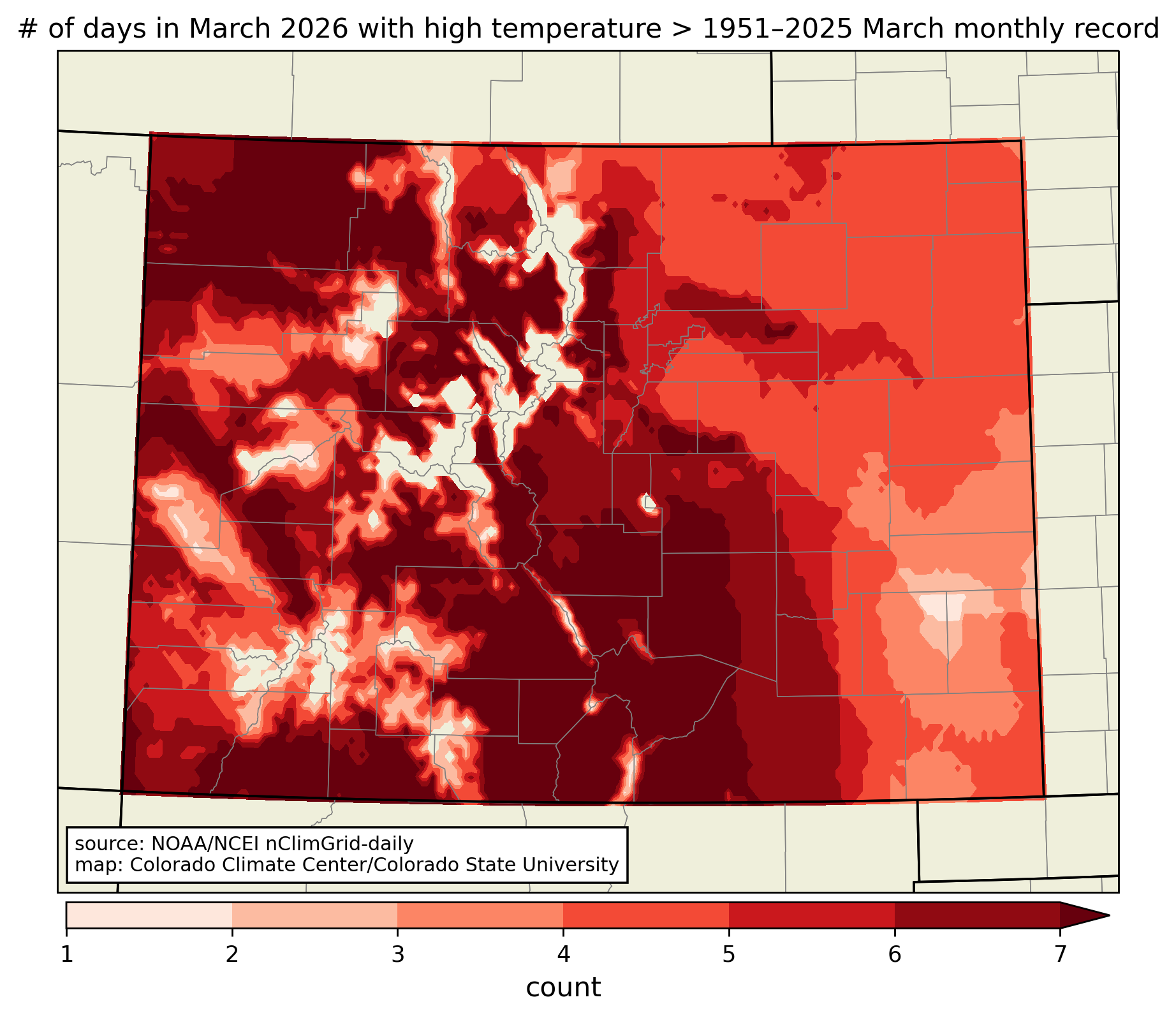
We’ll round up more of the records in our monthly summary that will go out next week. (If you’re subscribed to get these posts via email, you’ll get those summaries too. If you aren’t subscribed, the sign-up box is at the bottom of the page!) But there’s no question that this will go down as the warmest March on record for Colorado—around 3-4°F warmer than any other March in the last 132 years—once all the numbers are tallied.
We wish the snowpack numbers were an April fool’s joke
If you’ve read anything about the mountain snowpack this year, you might be sick of seeing this graph. But it’s worth another close look because of how incredible it is, and not in a good way.
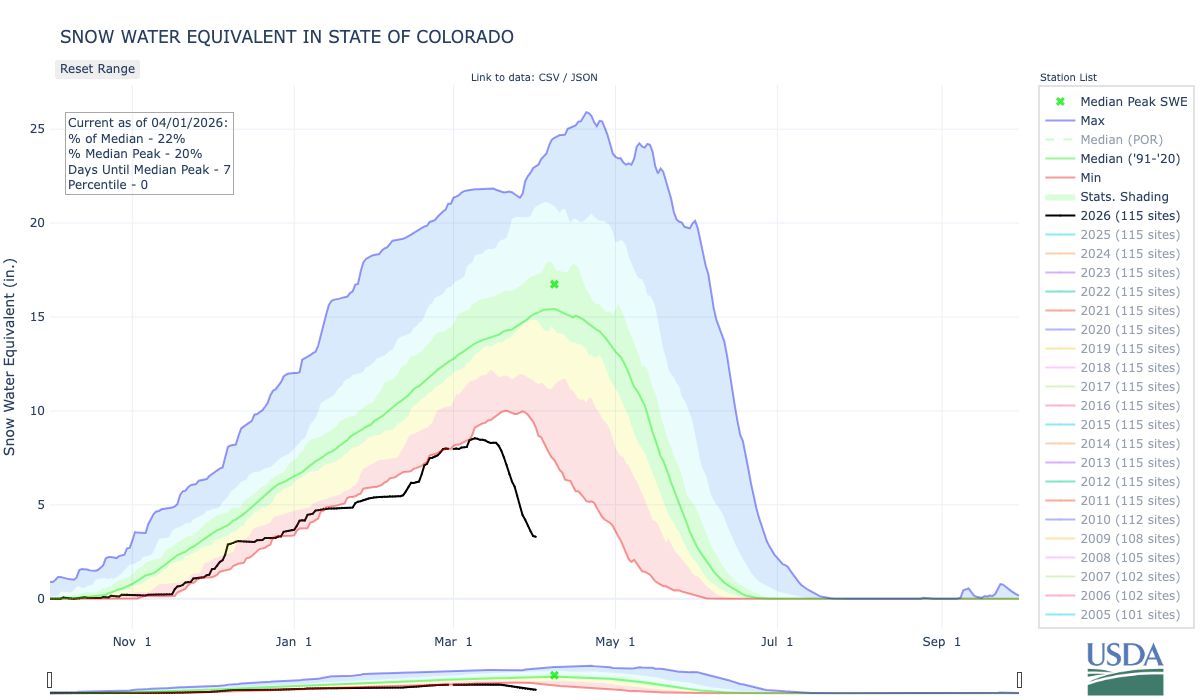
As of April 1, the snow water equivalent (the amount of liquid water stored in the snow) averaged across the 115 SNOTEL stations in Colorado was 3.3 inches, just 22% of the 30-year median. The previous low in the SNOTEL era (back to 1987) on April 1 was in 2012, which had 9.1″ on April 1. That means that we currently have less than 40% of the water in the snow than the previous lowest year.
Amid the record-shattering heat in the 2nd half of March, statewide snowpack declined by nearly 5 inches. Previously, the fastest decline in a 2-week period before April 1 was 2.3″ in 2012, one of the worst years for spring snowpack. Only two times has the SWE dropped by more than 5″ in two weeks before the end of April, in 1987 and 1989 which were both years with above-average peaks that started melting on the early side.
The peak SWE this year, again averaged across the SNOTEL stations in Colorado, was 8.55″ on March 9. That peak is just 51% of the median peak, nearly a month earlier than average, and is the lowest peak of the SNOTEL era.
As discussed in previous posts, the other key points of comparison for past snow droughts were 1977 and 1981, when SNOTEL stations either didn’t yet exist (1977) or were not as widely distributed as they are now (1981). In some of the southern mountain ranges, the peak SWE in early March this year may have been slightly higher than it was in those years. But in both of those years—like nearly every other year—the SWE increased substantially between March 1 and April 1. We know that’s not what happened this year. This year’s April 1 SWE was lower than those years almost everywhere in the state. It’s now safe to conclude that this has been the worst year for Colorado snowpack in recorded history.
Many of the April 1 snow course measurements are now in, and at 60 of the 64 sites with at least 50 years of data, the SWE in 2026 was the lowest or tied for the lowest on record.
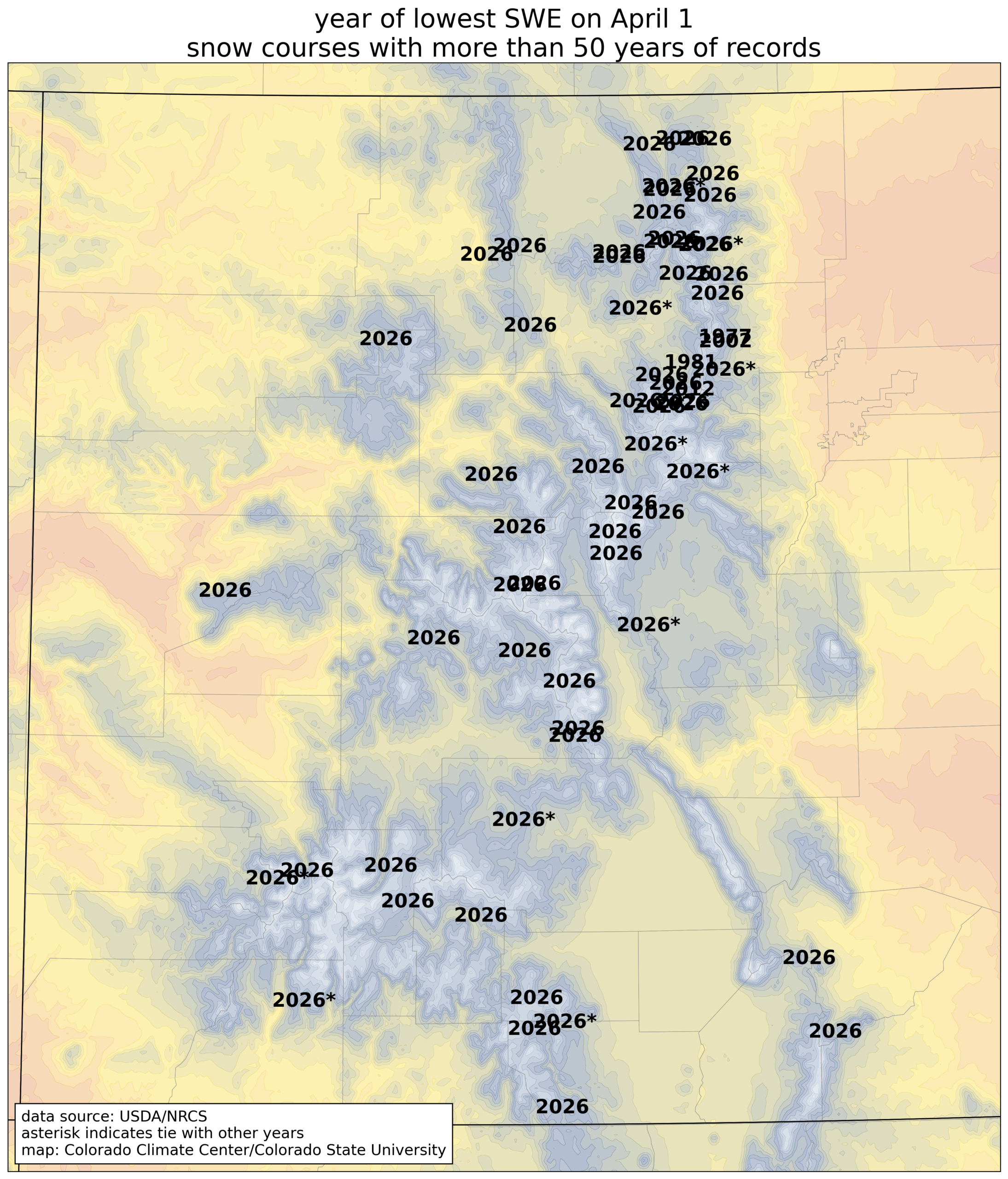
Perhaps more shocking is how much less SWE there was than in any previous years. The map below shows the percent of the previous record low at sites with more than 50 years of data. Most locations have less than half of the previous record low, and several locations that have never before had less than 5 or 6 inches of SWE on April 1 have no snow on the ground this year. Eighteen of the 64 snow course sites observed zero SWE this year and had never previously been snow-free on April 1st.
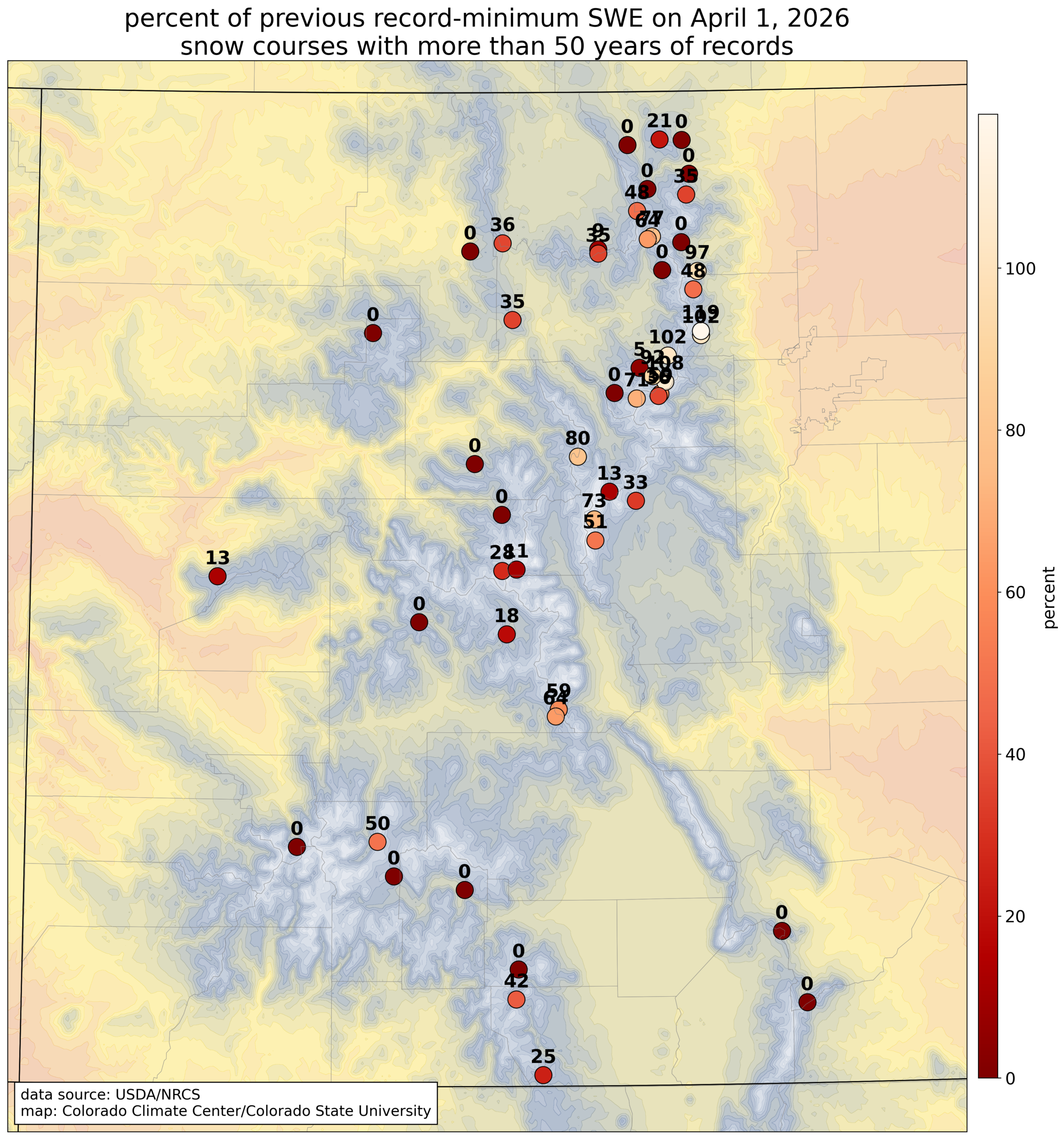
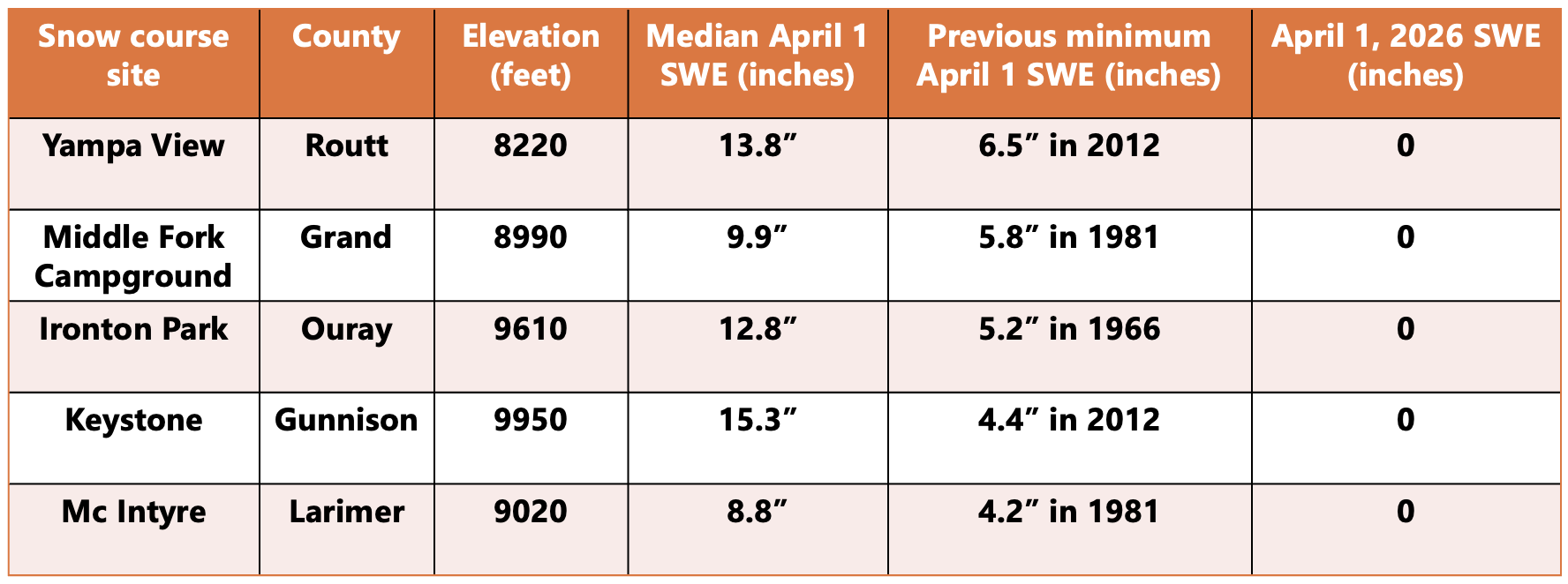
The long-term measurement site at the Rocky Mountain Biological Laboratory in Gothic estimated that the spring snowpack in parts of the Gunnison Basin was unprecedented, with a return period of hundreds of years. The Colorado Dust on Snow program (CODOS) has numerous photos of the poor snowpack on their blog.
Drought conditions and what to expect in April
Now, it’s important to remember that not all of the water that was in the snow earlier in the winter has disappeared (though some of it did, to sublimation). That water is going into the soils and the rivers now. The rivers will therefore also be peaking very early: rivers that typically have peak flow in late May or early June will likely peak sometime in April. This means extremely low flows in summer are likely, unless there’s an unusually wet late spring.
This week’s US Drought Monitor summarizes the effects of the recent conditions across Colorado. Almost the entire northwestern quarter of the state is now in D4 (exceptional) drought, going back to a dry spring and summer in 2025 and a terrible winter and early spring this year. The D4 coverage of 21.59% is the largest since February 2021.

The one bit of good news is that April has started off like April, rather than whatever the March-June hybrid was that we just went through. Widespread precipitation fell in western Colorado, with snow in the mountains and rain at lower elevations. Some locations in southwestern Colorado that had zero precipitation in March, received well over an inch of precipitation between Tuesday and Wednesday. (Note that the Drought Monitor map shown above only includes data through early Tuesday morning, so the recent storm is not reflected.) Some of the mountain SNOTEL sites that had gone snow-free at the end of March have snow on the ground again!
This storm didn’t come anywhere near alleviating the snowpack and water deficits that have arisen in the last few months. But any water from the sky is very welcome at this point! The outlook for the rest of the month does appear to be April-like as well: probably warmer than average, but with more active weather than March had. This should help to slow down the melting of the little snow that remains, and perhaps give some temporary increases in snowpack that at the very least keep the situation from degrading as quickly as it has been.
Even if Coloradans slash water use, their bills will likely rise due to new drought fees — Jerd Smith (Fresh Water News)
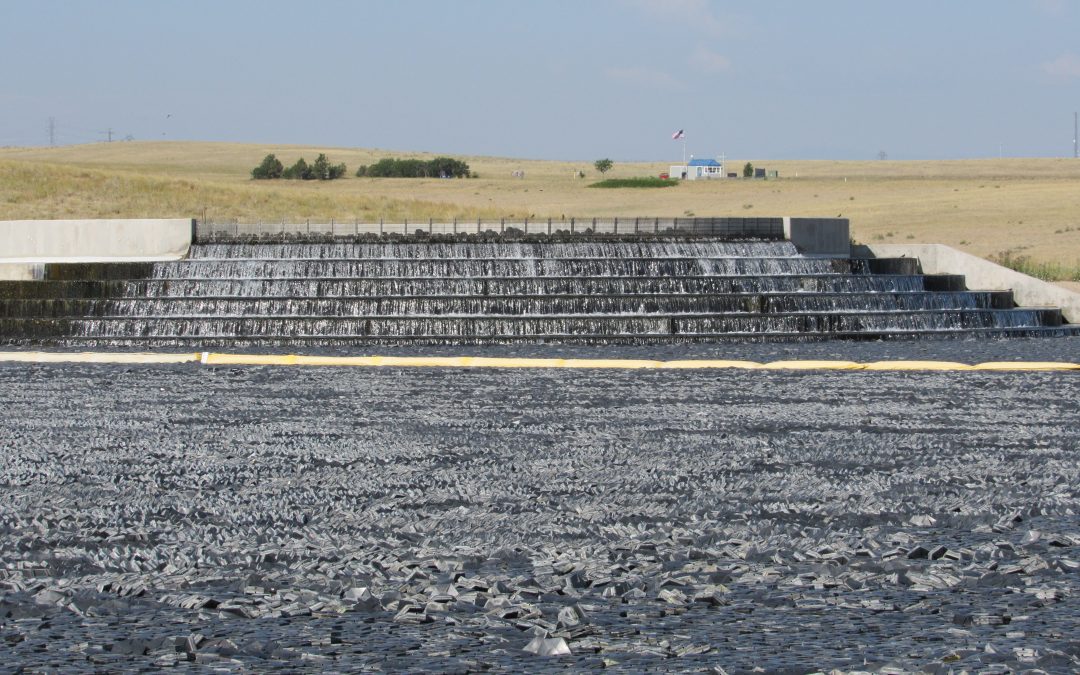
Click the link to read the article on the Water Education Colorado website (Jerd Smith):
April 2, 2026
Colorado homeowners and businesses are already planning for a brutally dry summer. They should also be planning for an expensive one, as Denver and other cities prepare to impose drought fees to encourage conservation and to buffer their budgets against millions of dollars in lost water sales as customers cut back.
Denver Water, which announced Stage 1 drought restrictions last week, said its preliminary estimates suggest $30 million to $70 million may be lost as a result of restrictions. It has annual revenue of $488.5 million. Denver Water is Colorado’s largest water utility, serving more than 1.5 million people in the city of Denver and across the southern and western suburbs.
The agency said its surcharges will be designed to penalize high-volume outdoor water use, while keeping the price for drinking, cooking and bathing water unchanged.
ts surcharge prices, if approved by the board this month, will vary depending on how homeowners and businesses use water indoors and outside. A low surcharge for a conservation-minded homeowner who doesn’t do much, if any, outdoor watering might be just $7 per bill, according to the agency, but the drought fee could rise to $76 a month on a residential bill where outdoor water use is high.
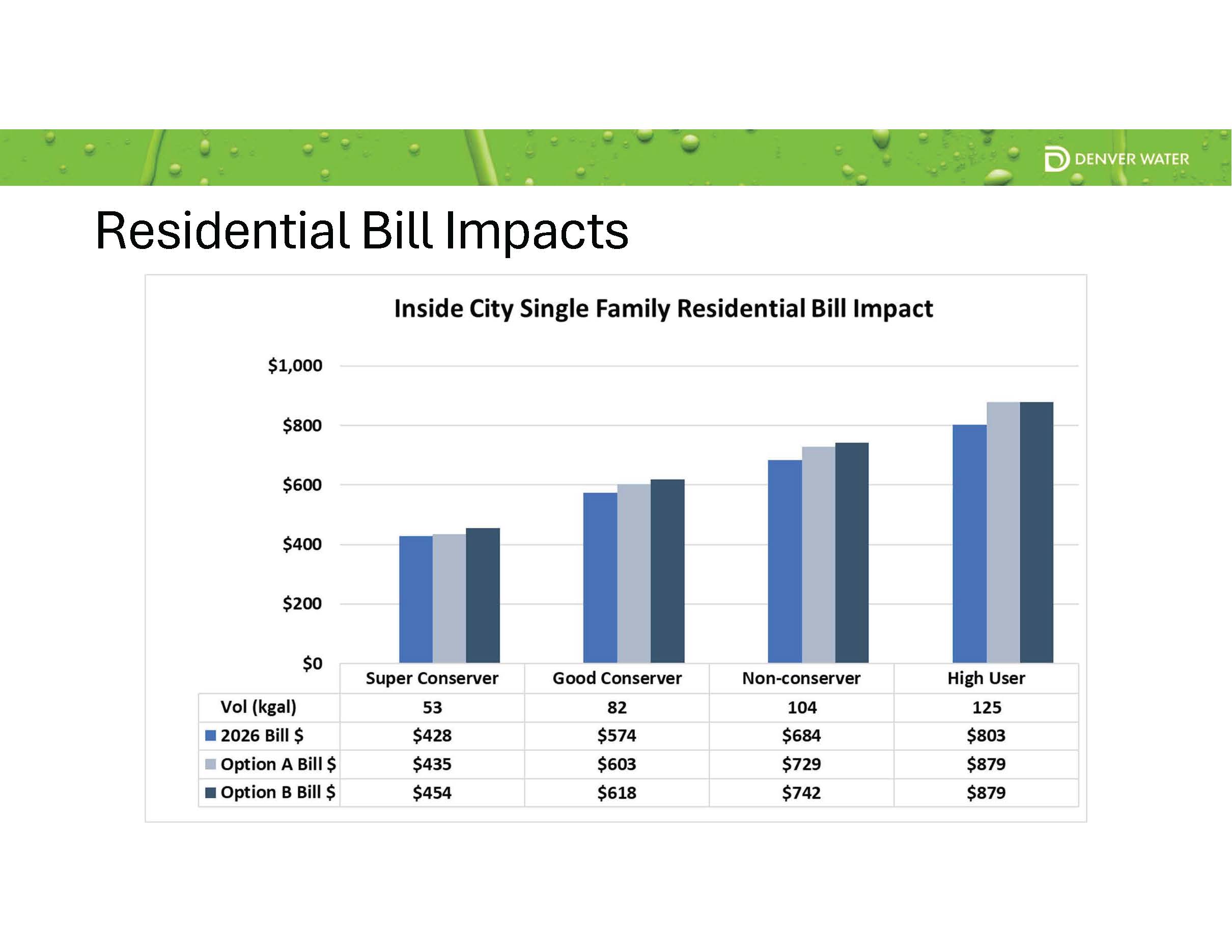
Denver Water spokesperson Todd Hartman said via email that the agency will use a portion of its cash reserves to offset the lower water sales and other costs associated with the drought. It has also taken steps to reduce other costs, such as leaving job vacancies open longer.
Colorado experienced record-low mountain snows this year and a scorching hot spring, which has the thin snowpack melting sooner than normal. Reservoir storage is stable for this year, at roughly 80% of average across the state. But heavy water use could drain those reservoirs too quickly, potentially causing major shortages next year if this winter is as dry as last winter’s was, officials have said.
To protect reservoir storage, cities want customers to reduce water use by 10% to 20%.
They’re hoping the surcharges will help them reach those goals.
Chris Goemans, a professor in the agricultural and resource economics department at Colorado State University, said the drought fees are an important tool in water conservation, and can have a lasting impact on water use if they go on for a long period of time.
For several years after the deep drought Colorado experienced in 2002, for instance, water providers saw a lingering “drought shadow” where users continued to tighten their spigots, even after the drought fees were removed, according to research by Goemans, and others.
“They can promote lasting change,” he said.
Not every city will use the fees. Colorado Springs has permanent three-day-per-week watering rules and does not plan to impose a surcharge, at least not this year, spokesperson Jennifer Jordan said. She said the city’s drought plan allows surcharges only when reservoir storage is below 1.5 years on April 1. Right now, the system has three years of storage available.
And Aurora has only used them once before, in 2023, but took them off almost immediately when big rains came, according to Aurora Water spokesperson Shonnie Cline.
Cline said the severity of this drought is forcing the city to gear up for unprecedented times.
“We always thought that 2002 was the worst possible year, but we are expecting something worse this year,” she said.
Castle Rock will impose surcharges, if its council approves them in the coming weeks, but it is taking a different approach because its customers live with a water system based on what are known as water budgets, according to Mark Marlowe, director of Castle Rock Water.
Its customers already are limited every year in how much water they can use during the lawn-watering season, an amount that is based on home and lot size. A small home with a small yard is allocated less water each year and typically has a smaller bill than a large home with a large yard, which is given more water and pays a larger bill.
This year, Castle Rock will reduce everyone’s water budget. If homeowners exceed those lower budgets, they will be hit with a higher fee than normal.
To help offset that and keep its conservation message top of mind, Castle Rock envisions drought surcharges of $6.91 per thousand gallons initially and rising to $10.31 if the drought deepens, Marlowe said.
Is there any good news here? Maybe. City officials said if customers cut back as much as they are being asked to, say 10% to 20%, their bills might not change at all because they are using less water.
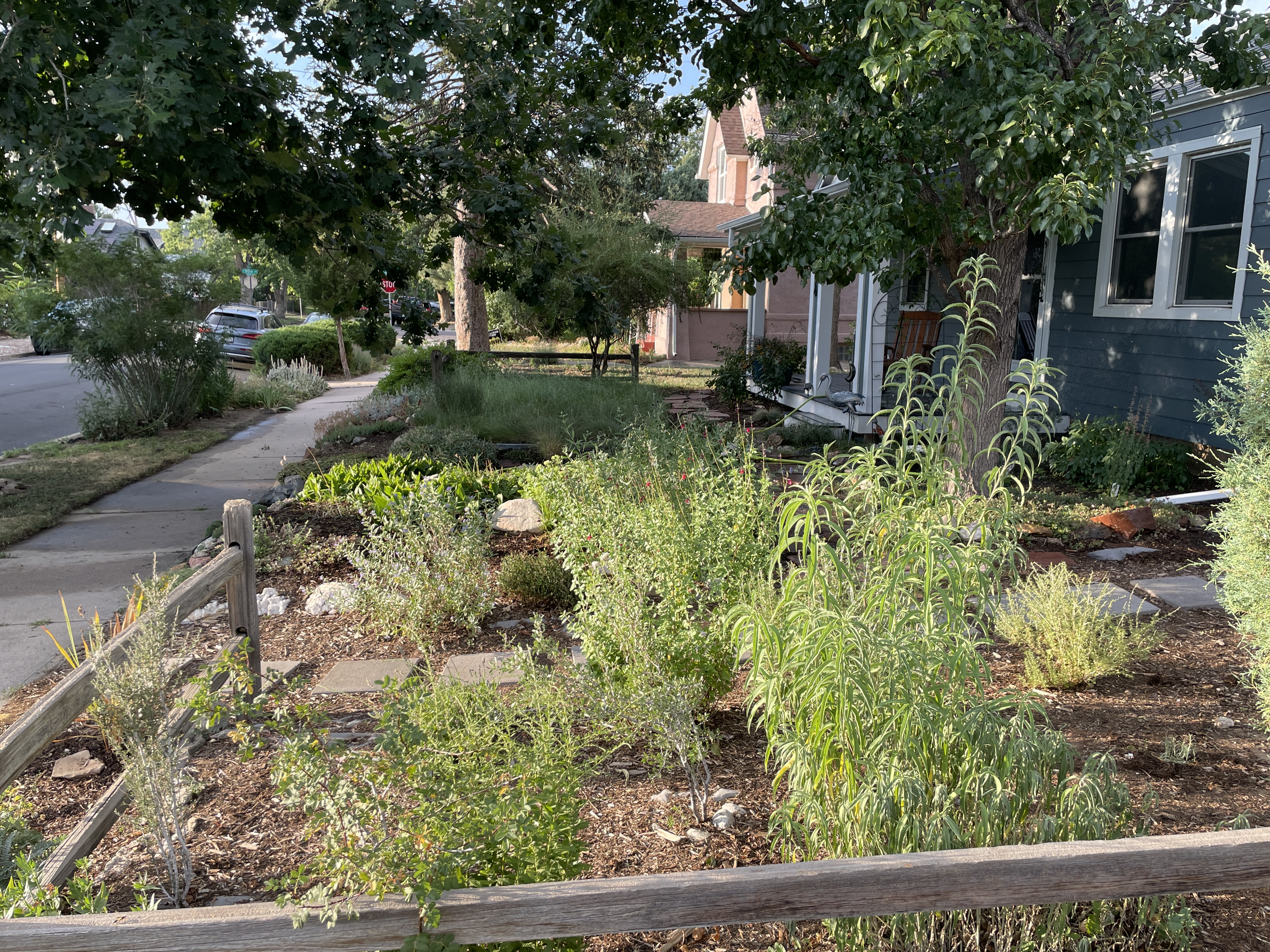
#Denver Water, Xcel enact plan to ease shortages: Shoshone call relaxation allows Front Range water provider to divert more until May 20 — Heather Sackett (AspenJournalism.org) #ColoradoRiver #COriver #aridification

Click the link to read the article on the Aspen Journalism website (Heather Sackett):
March 31, 2026
Facing an abysmal snowpack and spring runoff, the state’s largest Front Range water provider has enacted an agreement that lets it take more water from the Western Slope for a limited time.
On March 18, Denver Water put the Shoshone call reduction agreement into effect with water rights owner Xcel Energy, which allows Denver Water to divert more water from the headwaters of the Colorado River in an attempt to alleviate shortages. The agreement reduces the call at the Shoshone hydroelectric plant in Glenwood Canyon by half, from 1,408 cfs to 704 cfs.
The call reduction can only be implemented when two drought conditions are met: an April to July streamflow forecast for the Colorado River measured at the Kremmling stream gauge must be at 85% or less than average and the forecasted storage for the 10 largest Denver Water reservoirs for July 1 must be at or below 80% full.
The March water supply outlook from the National Resources Conservation Service for the Colorado headwaters from Kremmling to Glenwood Springs was 56% of normal. Experts expect conditions to have worsened when the April forecast comes out next week.
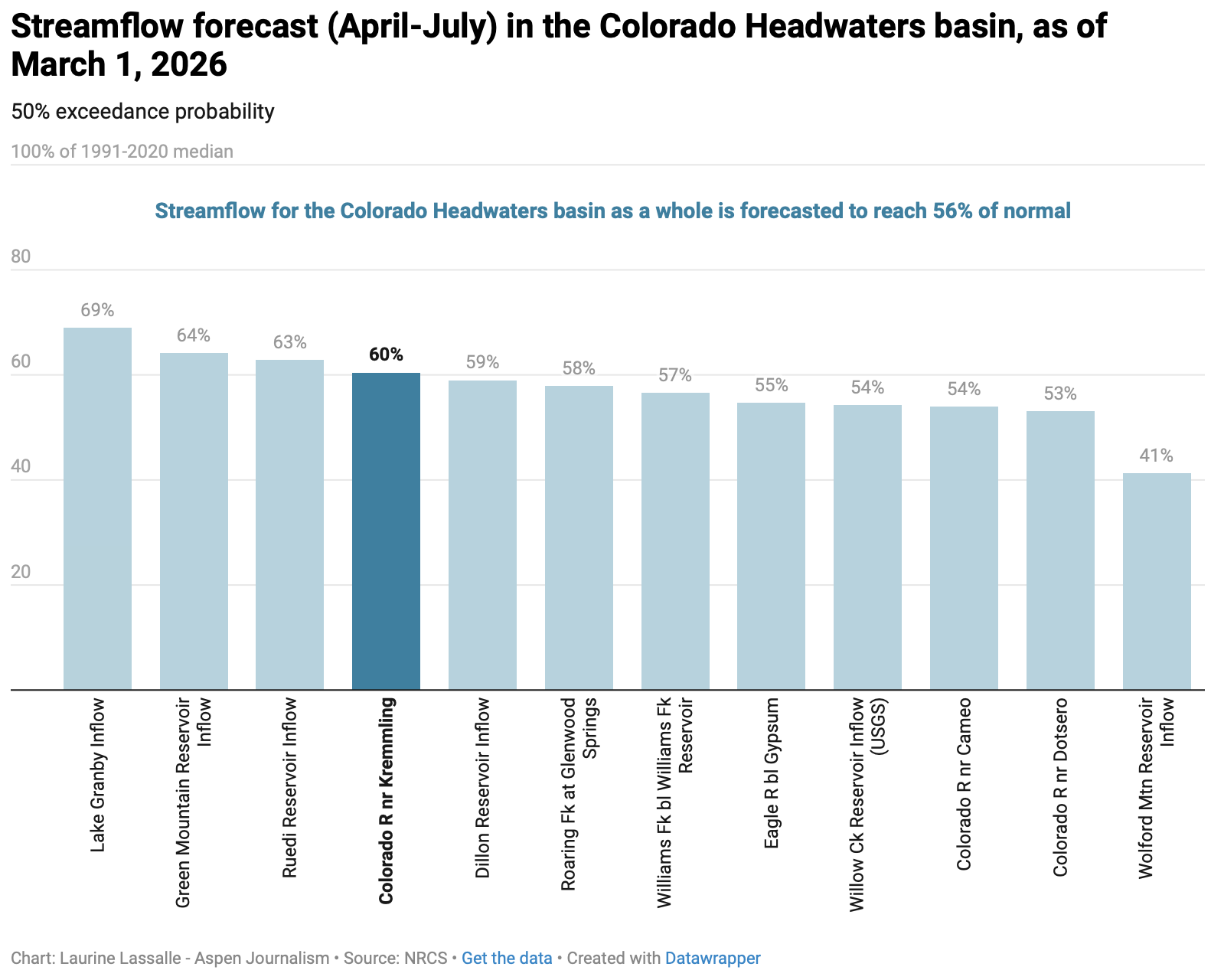
This winter is shaping up to be one of the worst on record and since water supplies depend on snowmelt, municipal water providers have been quick to implement cutbacks this spring. Last week, Denver Water declared a Stage 1 Drought and will impose two-day-a-week outdoor watering restrictions this summer.
“In the wake of the worst snowpack conditions in some 50 years of records at Denver Water, we began exercising the Shoshone Relaxation Agreement with Xcel Energy starting March 18,” Denver Water’s Media Relations Coordinator Todd Hartman said in an email. “We have taken this step only one other time under the 2007 agreement with Xcel (2013) and we don’t do so lightly.”
According to the agreement, Denver Water will be able to divert additional water until May 20.
The water provider, which serves about 1.5 million people on the Front Range, gets roughly 50% of its supply from the Colorado River basin and brings it across the Continental Divide through a highly engineered system of tunnels and reservoirs that facilitate the so-called transmountain diversions.
The Shoshone water rights, which date to 1902, are some of the largest and most powerful on the mainstem of the Colorado River in the state. They can command the river’s flows all the way to its headwaters, ensuring water keeps flowing downstream on the Western Slope.
When the plant’s turbines are spinning, it can “call” for its full water right, effectively forcing upstream water users with junior rights – like Denver Water – to cut back. And because the water is returned to the river after it runs through the plant’s turbines, Shoshone benefits downstream cities, irrigators, recreators and the environment on the Western Slope.
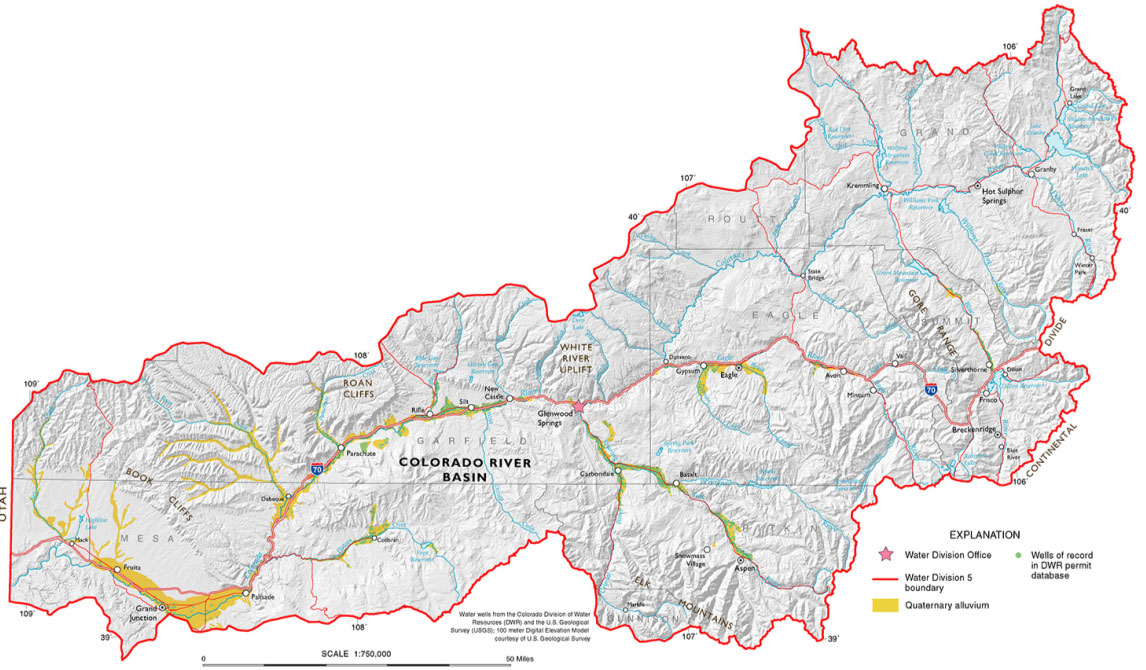
#Drought news April 2, 2026: Out West, widespread degradations were centered across the Intermountain West, including #Colorado, #Utah, and #Wyoming, and to a lesser extent across portions of #Arizona, #NewMexico, and #Nevada
Click on a thumbnail graphic to view a gallery of drought data from the US Drought Monitor website.
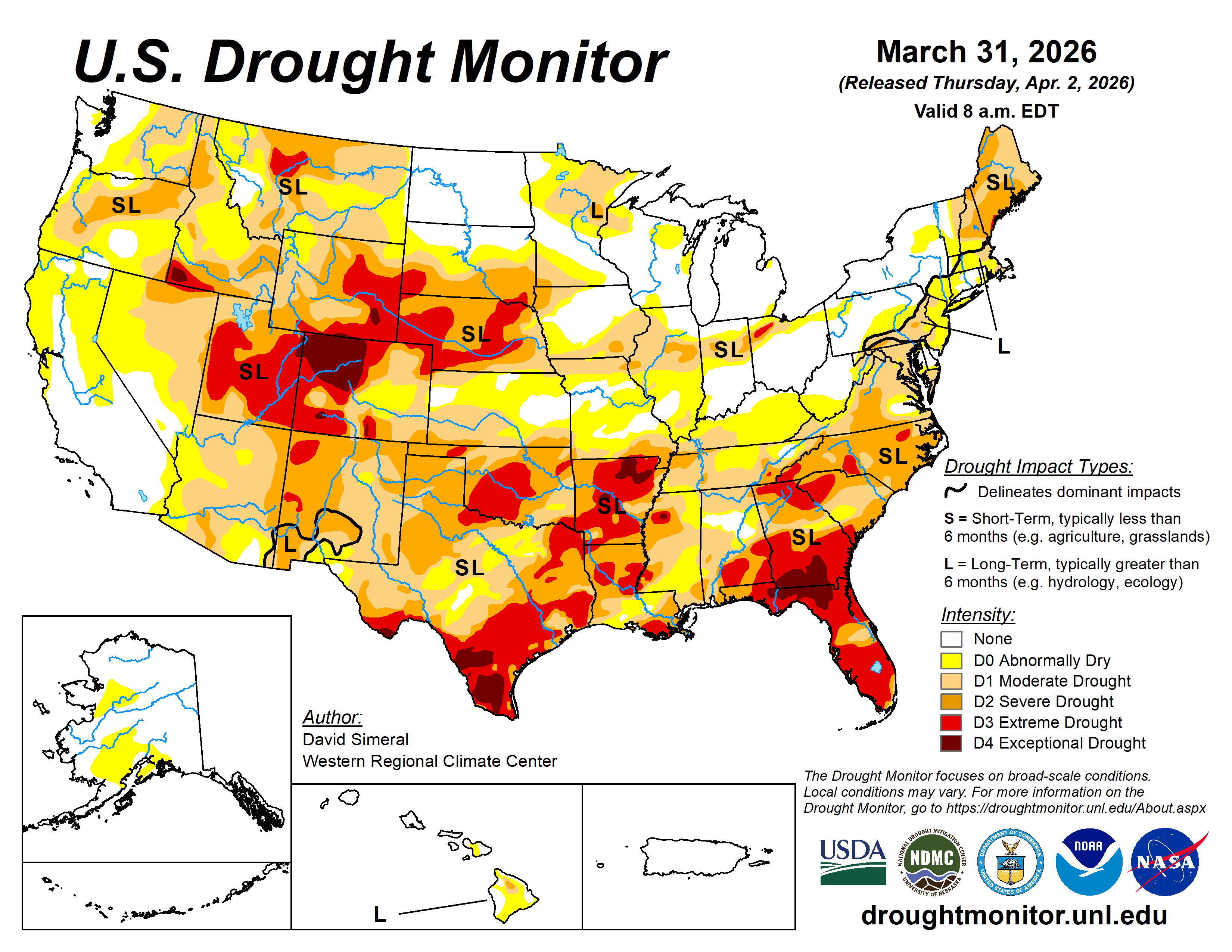
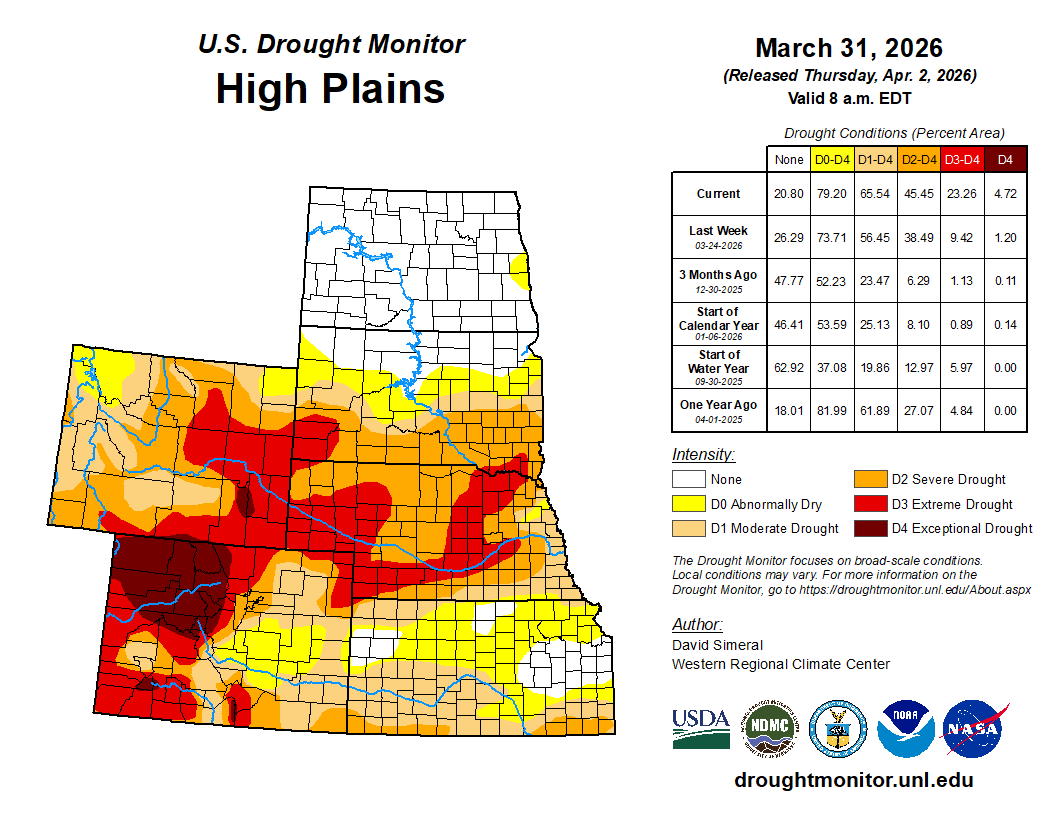
Click the link to go to the US Drought Monitor website. Here’s an excerpt:
This Week’s Drought Summary
This U.S. Drought Monitor (USDM) week saw extensive degradations across areas of the West, Plains, South, and Southeast. Out West, widespread degradations were centered across the Intermountain West, including Colorado, Utah, Idaho, and Wyoming, and to a lesser extent across portions of Arizona, New Mexico, Nevada, and Montana. Continued degradations are expected in the coming weeks and months due to anomalous heat and record-low snowpack levels. In the Plains, drought expanded and intensified from Oklahoma to South Dakota. In the South and Southeast, dry conditions persisted this week, adding to significant longer-term (9- to 12+ month) precipitation deficits (ranging from 8 to 20+ inches), with the most severe drought conditions centered over portions of Texas, Arkansas, Georgia, and Florida. In the Northeast and Midwest, light-to-moderate rainfall (1 to 3 inches) during the past week led to targeted improvements in Illinois, Indiana, Ohio, Pennsylvania, and New York.
At the end of March, mountain snowpack conditions remain well below normal for the time of year, with record to near-record low levels observed across all western states. Additionally, many Natural Resources Conservation Service (NRCS) SNOw TELemetry (SNOTEL) network monitoring stations are reporting very shallow snow depths or no snow on the ground. Region-level (2-digit HUC) snow water equivalent (SWE) values (percent of median) are as follows: Pacific Northwest 55%, Missouri 56%, Upper Colorado 24%, Great Basin 18%, Lower Colorado 14%, Rio Grande 8%, and Arkansas-White-Red 8%. In California, statewide snowpack is 18% of normal (April 1), with the Southern Sierra at 32%, Central Sierra at 21%, and Northern Sierra at 6%. Despite poor snowpack conditions, California’s reservoirs remain at or above historical averages for the date (March 31), with Lake Shasta and Lake Oroville at 113% and 123% of average, respectively. In the Southwest, the U.S. Bureau of Reclamation (March 29) reports critically low levels at Lake Powell (24% full; 41% of average for the date) and Lake Mead (33% full; 52% of average for the date), with the total Colorado River system at 36% of capacity (compared to 41% at the same time last year)…
High Plains
On this week’s map, widespread changes were made across the region in response to below-normal precipitation (time scales from 1 to 6 months), declining soil moisture, scattered low streamflows, elevated evapotranspiration rates, and associated anomalously warm temperatures—not only in recent weeks, but moving through the entire cool season. In South Dakota, record to near-record low streamflows have been observed during the last 120-day period as well as below-normal soil moisture levels observed at the South Dakota Mesonet monitoring stations. Additionally, the NDMC’s CMOR map shows numerous ag-related impact reports from the Black Hills region in southwestern South Dakota. For the week, the region was very dry with warmer-than-normal temperatures (3 to 15+ °F above normal) observed across much of the region, with the greatest anomalies observed in Nebraska and Kansas. Looking at climatological rankings for the past 90-day period (January 1 to April 1), several locations ranked among their warmest on record, including Grand Island, NE (warmest on record; +9 °F departure from normal); North Platte, NE (warmest on record; +10 °F); Rapid City, SD (warmest on record; +9 °F departure from normal); Goodland, KS (warmest on record; +11 °F departure from normal); and Dodge City, KS (warmest on record; +8 °F departure from normal)…
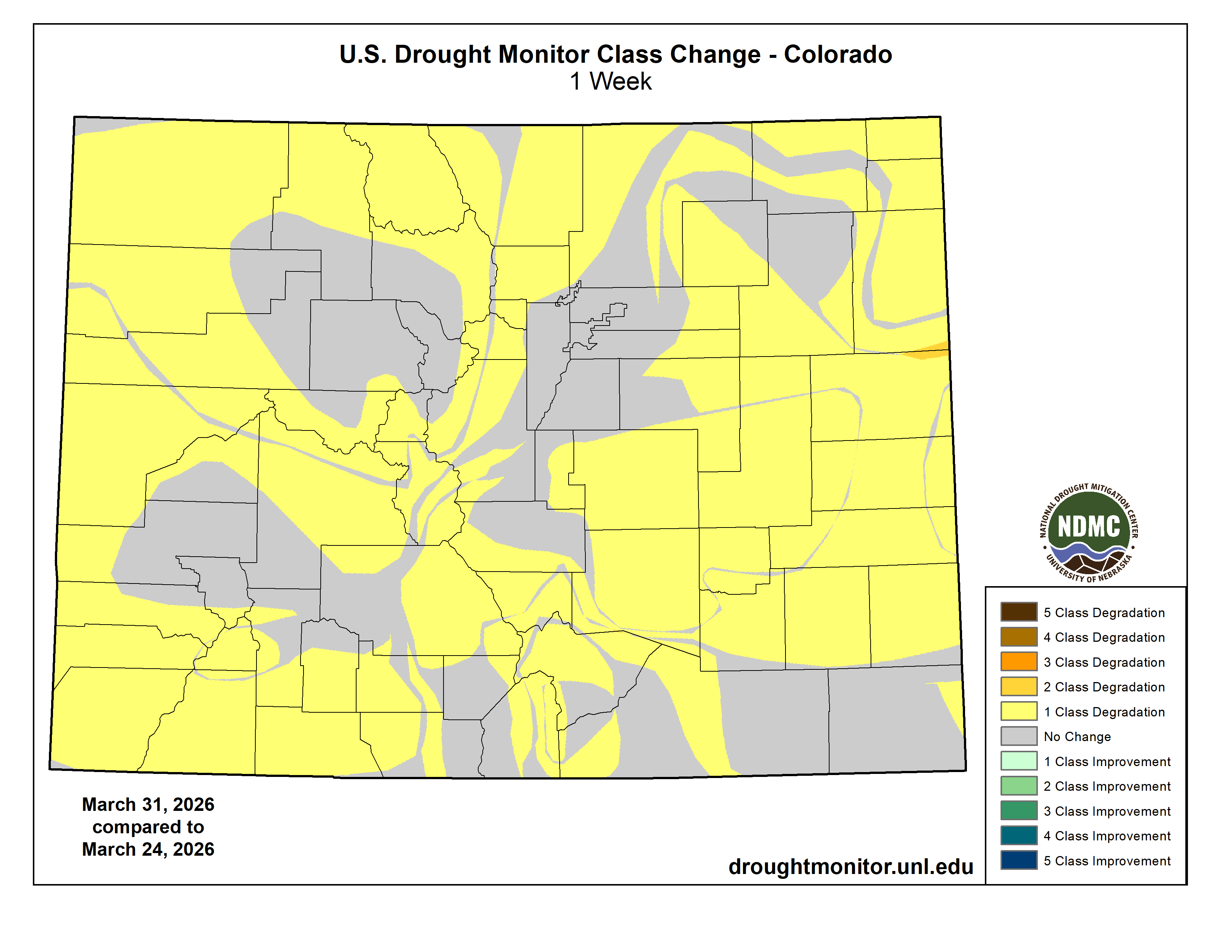
West
Conditions deteriorated significantly on the map this week in response to the combination of record to near-record heat and very poor snowpack conditions. The recent heat wave accelerated snowmelt across the region over the past few weeks, with many NRCS SNOTEL stations reporting little to no snow on the ground or unseasonably low levels. Peak runoff is occurring earlier than normal—or has already passed in some locations—raising concerns about reduced inflows into reservoirs moving through spring and into the summer months. In the Upper Colorado River Basin, Lake Powell is 25% full, while upstream reservoirs show mixed conditions, including Flaming Gorge (82% full), Blue Mesa (50%), and Navajo Lake (62%). In Rio Grande Basin in New Mexico, Elephant Butte is 12% full and Caballo Reservoir is 7% full. In Arizona, the Salt River Project reports the Salt River system at 56% full, the Verde system at 63%, and the combined system at 63% (compared to 70% last year)…
South
On this week’s map, widespread degradations were made in drought-affected areas of Texas, Oklahoma, Louisiana, and Arkansas, while isolated areas of Mississippi and Tennessee saw degradations. During the past 30-day period, the National Drought Mitigation Center’s Conditions Monitoring Observer Reports (CMOR) tool showed numerous impact reports across the region. For the week, dry conditions prevailed across the region. Looking at climatological rankings for the past 90-day period (December 31 to March 31), several locations ranked among their driest on record, including Austin, TX (4th driest; -5.53 inches), Brownsville, TX (driest on record; -3.38 inches), Oklahoma City, OK (driest on record; -3.61 inches), Monticello, AR (driest on record; -8.95 inches), and Jackson, MS (driest on record; -7.4 inches). In Texas, Water for Texas (April 1) reports statewide reservoirs at 73.5% full, with eastern reservoirs in good condition while many western and southern reservoirs remain below normal, including Falcon Reservoir (19% full). Average temperatures for the week were above normal across the region (3 to 15+ °F) with dry conditions prevailing…
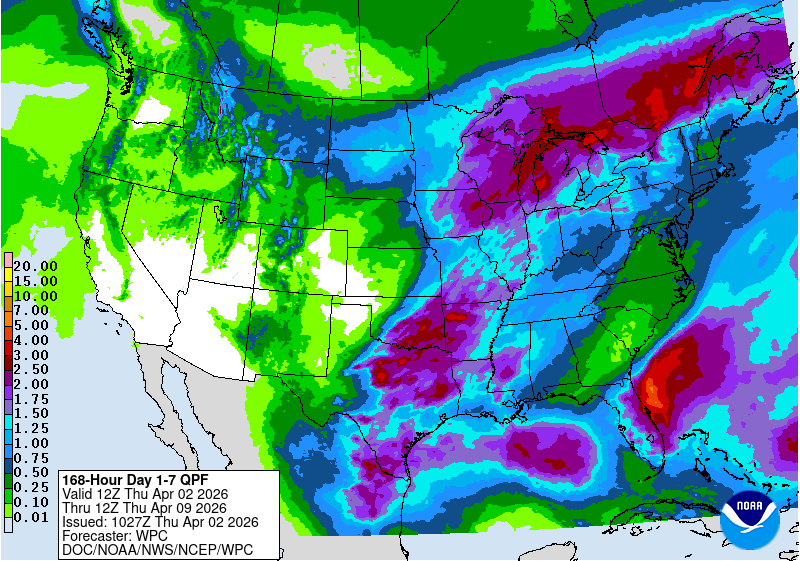
Looking Ahead
The NWS Weather Prediction Center 7-Day Quantitative Precipitation Forecast (QPF, liquid equivalent) calls for precipitation accumulations generally ranging from 2 to 4 inches across eastern portions of the Southern Plains, Midwest, and Northeast, with the heaviest totals along a corridor from eastern Texas through the Lower Mississippi Valley into portions of the Upper Mississippi Valley. In the Southeast and Mid-Atlantic, light-to-moderate liquid precipitation accumulations ranging from 0.5 to 2 inches are expected. Across the High Plains, light-to-moderate liquid precipitation accumulations ranging from 0.5 to 2 inches are expected, with the greatest totals across portions of the Dakotas. In the West, light-to-moderate liquid precipitation accumulations are expected across areas of the region, with the highest totals across portions of the Pacific Northwest, northern California, and southern Oregon. In the higher elevations, snow is expected across the Sierra Nevada, southern Cascades, northern Great Basin, and portions of the central and northern Rockies. Dry conditions are expected to prevail across much of the Southwest, including areas of southern California, southern Nevada, Arizona, and New Mexico.
The 6–10-day temperature outlook (valid April 7–11, 2026) calls for above-normal temperatures across much of the western U.S., Southern Plains, and areas of the South, with the highest probabilities centered over the California, Nevada, Utah, and Arizona. Below-normal temperatures are favored across the Northern Plains as well as the New England. Near-normal temperatures are expected across much of the eastern U.S., including the Mid-Atlantic and Southeast, as well as portions of Texas. In terms of precipitation, the 6–10-day outlook calls for above-normal precipitation across areas of the eastern half of the western U.S., Plains states, South, much of the Midwest, and Florida. Below-normal precipitation is favored across portions of the Mid-Atlantic and southern extent of New England. Near-normal precipitation is expected across areas outside of these regions, including portions of the western U.S. and Southeast.
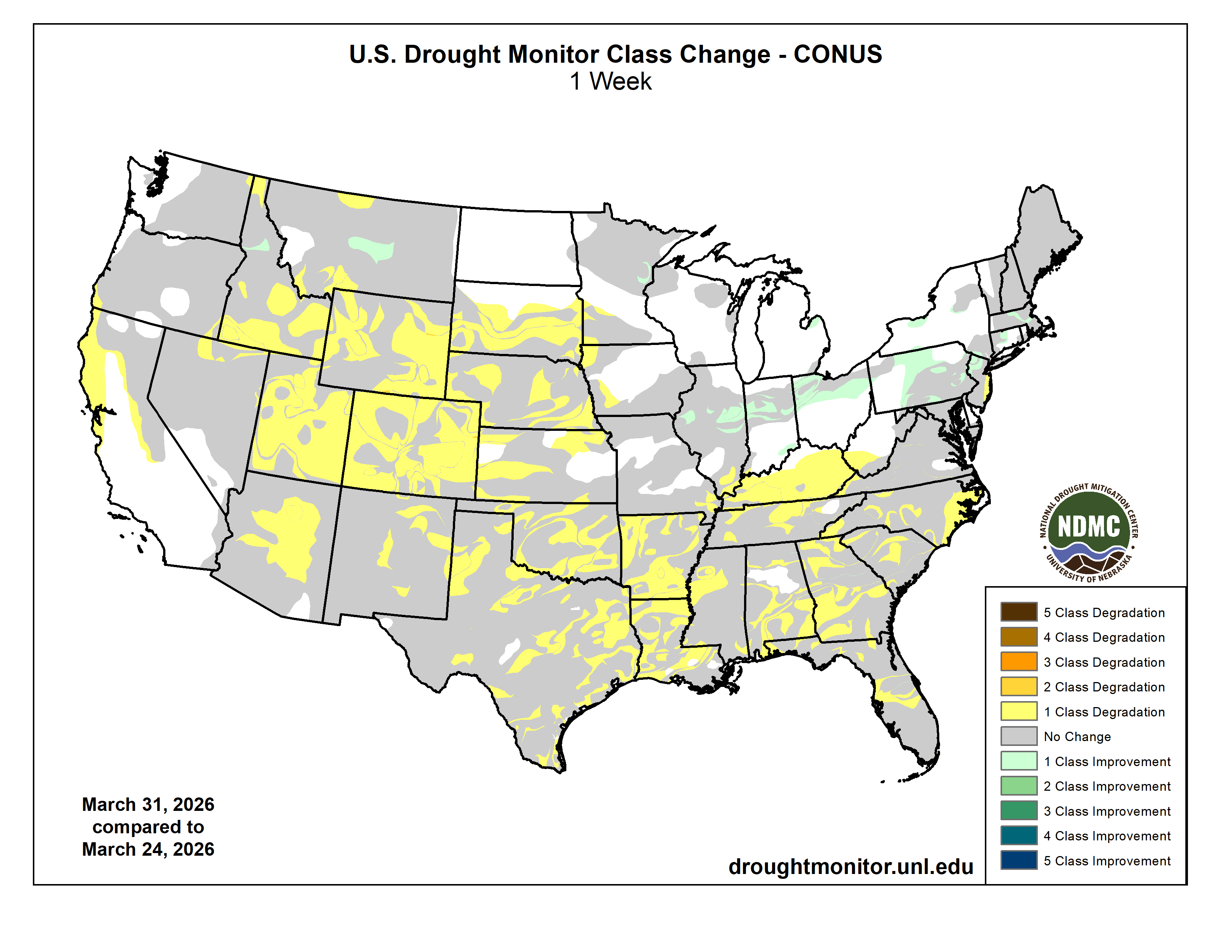
200- to-1,000-year Snow Anomaly Observed in #Colorado Mountains: New analysis by the Rocky Mountain Biological Laboratory reveals that the 2026 snow #drought is unprecedented in the recent historical record #snowpack #runoff #GunnisonRiver #ColoradoRiver #COriver #aridification
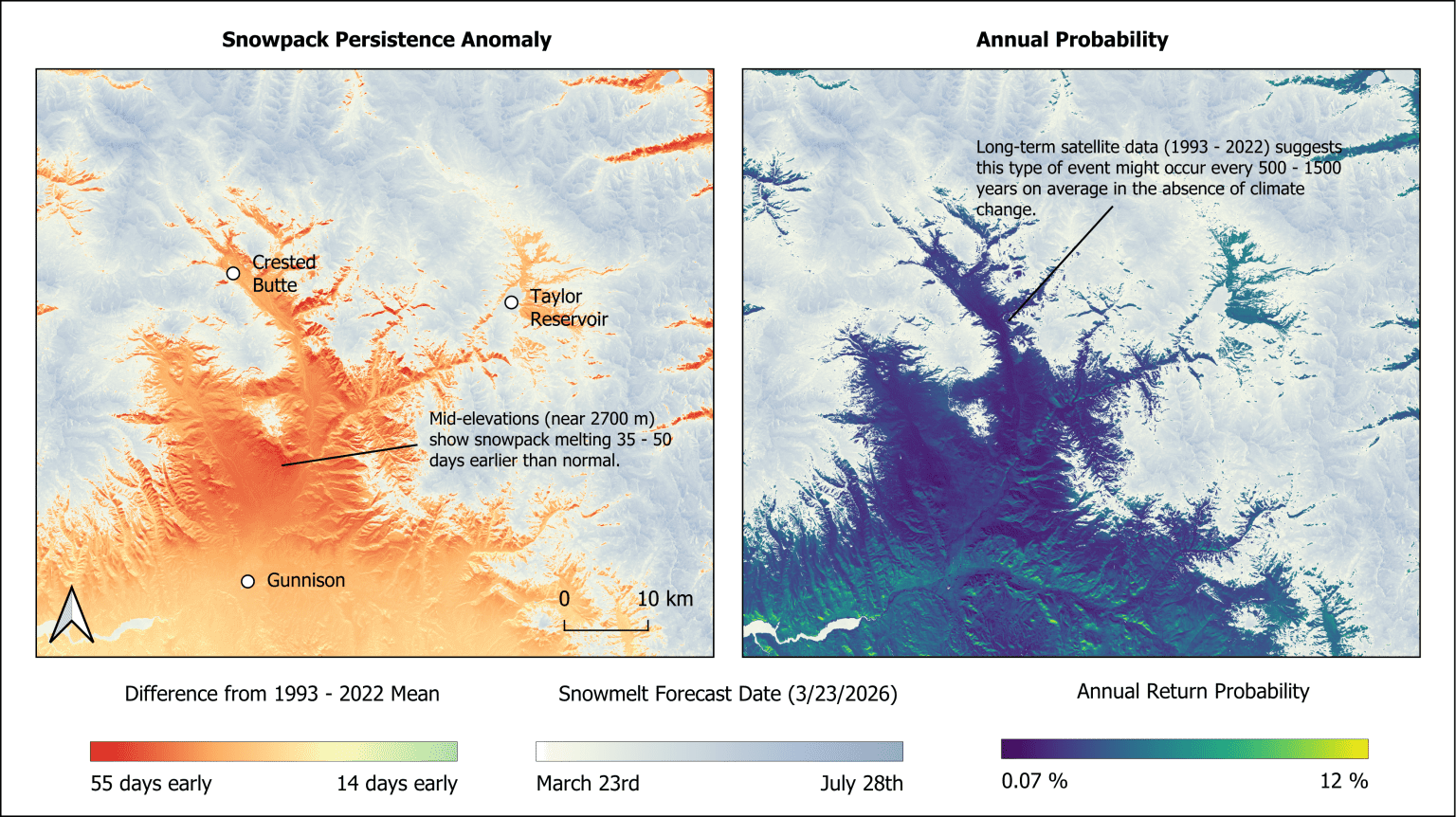
Click the link to read the article on the Rocky Mountain Biological Laboratory website:
GOTHIC, Colorado, April 1, 2026 — The Rocky Mountain Biological Laboratory (RMBL) reports that, as of late March, spring 2026 snowpack surrounding its Gothic, Colorado, campus was at its lowest level recorded in more than 50 years of observations. In the absence of recent climate change, these conditions likely would occur only once every 200 to 1,000 years.
This new analysis by RMBL Principal Research Scientist Ian Breckheimer, PhD, draws on long-term field datasets and 40 years of satellite imagery that track the seasonal disappearance of mountain snowpack — a vital water resource for the ecosystem and the primary source of water in the drought-stricken Colorado River.
According to Breckheimer’s findings, at most sites in the Gunnison Basin, the 2026 snowpack levels and timing of snowmelt are far outside the historic range of variability:
- Gunnison Valley slopes and lower elevations: a 1-in-60- to 300-year event
- Crested Butte valley bottoms: a 1-in-300- to 400-year event
- Mid-slopes of Flat Top Mountain and surrounding areas: a 1-in-500- to 1,000-year event
When accounting for recent climate change, which has caused snowpack to melt 3 to 5 days earlier each decade since 1993 at many sites, the likelihood of this year’s low snowpack level increases. However, it is still rare, with an estimated chance of occurring just once in 25 to 50 years. Moreover, at mid-elevations (between 8,000 and 9,000 feet), low snowfall and warm temperatures have combined to completely melt the current year’s snowpack 35 to 50 days earlier than the historical average. Although storms this week are bringing significant new snow to the higher peaks in the Gunnison Basin, sites where snowpack has already disappeared (most sites below 9,000 feet elevation) will receive mostly rain from this event.
“This is not the new normal,” says Breckheimer, “but it is exactly the kind of extreme event that will test how prepared our ecosystems and communities are for increasing variability.”
The research underscores the importance of long-term ecological observation. RMBL, which sits at an elevation of nearly 10,000 feet in Gothic, Colorado, hosts one of the most well-studied mountain ecosystems in the world, with decades of continuous data on snowpack, hydrology, and ecological response. These datasets make it possible to place current conditions into historical context and estimate how common they might be with and without recent observed climate change.
The implications extend beyond the Gunnison Valley. Snowpack dynamics directly influence water availability, wildfire risk, ecosystem health, and agricultural systems across the western United States. Understanding when and how these extremes occur is critical for forecasting and planning.
“This kind of insight is only possible because of long-term, place-based science,” says RMBL Executive Director Jeni Blacklock. “What we are seeing this year highlights both the value of these datasets and the urgency of continuing to invest in them.”
The findings were first presented during RMBL’s public Après Science talk series, which connects scientists and the public around emerging research in mountain ecosystems. A video of the talk, held on March 25, as well as supporting materials, will be released in the coming weeks. Sign up at rmbl.org/newsletter-sign-up to receive updates delivered via RMBL’s monthly e-newsletter.

About the Rocky Mountain Biological Laboratory
Founded in 1928, RMBL is among the oldest and most respected field stations in the United States. Located in Gothic, Colorado, RMBL supports more than 200 scientists and students each summer and hosts one of the most extensive collections of long-term ecological data in the world.Media notes:
- Media contact: Suzanne Ennis, RMBL communications manager. Email: suzanne@rmbl.org
- Additional slides and data visuals available upon request
- Video of presentation available soon
- Interviews available with Ian Breckheimer and RMBL leadership

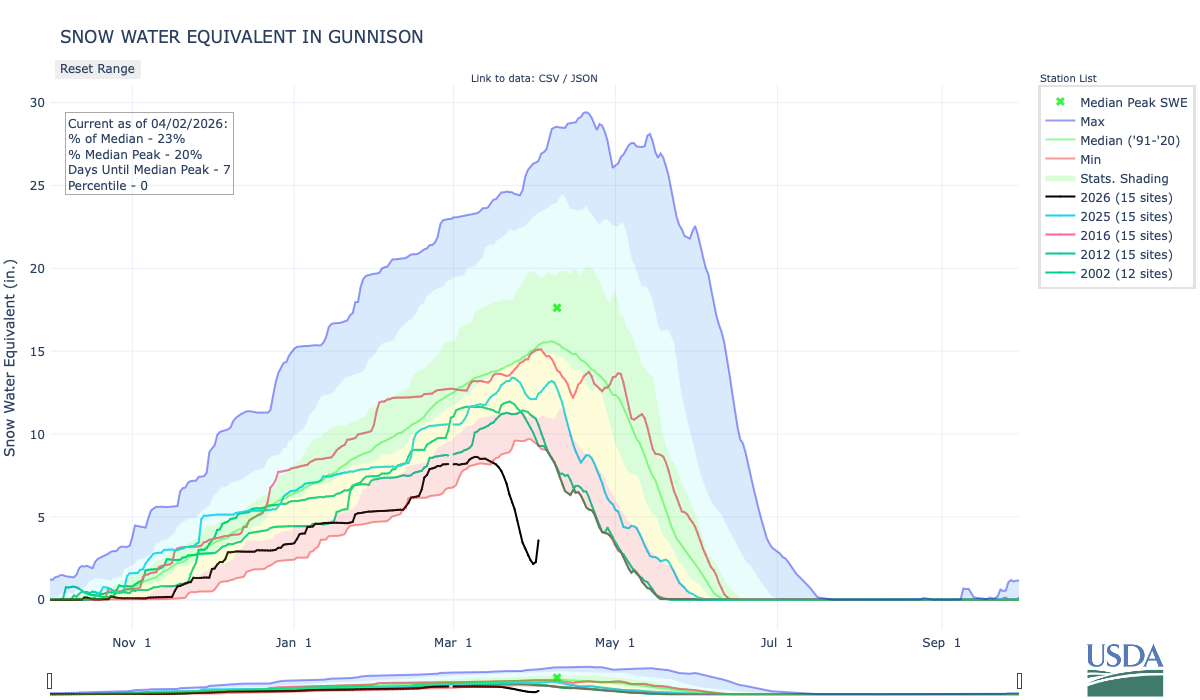
Uranium mining in the Chama Valley? Also: Public lands for affordable housing in Las Vegas; Images of the Big Fat Melt Off — Jonathan P. Thompson (LandDesk.org)
Click the link to read the article on The Land Desk website (Jonathan P. Thompson):
March 31, 2026
The so-called uranium mining renaissance mostly remains in the hype phase. There’s plenty of talk of acquisitions and exploratory drilling and purportedly spectacular finds, but — with a few exceptions — there’s very little action. Even existing mines that have been in “standby” mode for years, supposedly just waiting for market conditions to improve, still aren’t shipping any ore to the mill.
But that doesn’t dim the buzz any. Not only is it intensifying, but it’s spreading out geographically. Most of the drilling and speculative claim-staking is happening in the Lisbon Valley in southeastern Utah and surrounding areas, along with a handful of mining proposals in the Grants uranium belt in New Mexico. Now Gamma Resources is going a little further afield by collecting claims on U.S. Forest Service land in the Chama River watershed in northern New Mexico.
The Canadian firm’s 4,520-acre Mesa Arc Project lies about five miles south of the village of Canjilon. While this was never a uranium mining hot spot, the USGS mineral data system does include a uranium prospect here by the name of Horney Toad or Lucky Dog, though it doesn’t appear to have been a producer.
So far, the company has filed a notice of intent with the Carson National Forest proposing to drill 10 to 12 exploratory holes and construct drill pads and about 800 feet of new access road. But the forest has yet to formally launch the review process. Gamma also says it has hired SWCA Environmental Consultants to conduct an archaeological and cultural resources survey of the area.
Locals aren’t all that excited about the prospect of a uranium mine in their backyard. Source NM’s Patrick Lohmann reports that Moises Morales, a Rio Arriba County commissioner, Canjilon resident, and long-time land grant activist, is mobilizing opposition to the project.
It would behoove Gamma Resources to look into the history of the area to see what a formidable force they are up against. The Chama Valley is famous for its fierce resistance to outsiders trying to usurp their land — be it real estate developers, the federal government, or, I suppose, a mining company.
***
One company, Disa, is looking to produce uranium not by digging up ore, but by using something called high-pressure slurry ablation (HPSA) to extract the mineral from historic mine waste rock piles. Only it appears their attempts to get the novel technology off the ground is facing some hurdles.
In March, Aura Grit LLC filed an application with the BLM to use Disa’s HPSA process on the October pile, an abandoned mine located south of Gateway, Colorado, on a mesa above John Brown Canyon. But shortly after the agency began reviewing the proposal, Disa backed out, at least temporarily, and decided to make the technology’s debut at the smaller Mary Ann uranium mine waste pile in Montrose County. The plan of operations is not yet available.
The Nuclear Regulatory Commission’s environmental review of the Disa’s proposal to remediate abandoned mine dumps with HPSA describes the technology as involving …“… mobile units that use high-pressure water streams to remove source material from the mine waste, resulting in coarse material and fines concentrates. Disa expects that the coarse material would meet NRC requirements for release and would be reintegrated into the mine site soils. The fines concentrates would be transported to licensed low-level radioactive waste or uranium recovery facilities for disposal or recycling.”
Because the process is separating uranium and thorium fines from ore, it is considered a form of milling, not mining. And that’s an important distinction, because when you mill uranium ore, you leave behind mill tailings, which must be disposed of according to NRC and Environmental Protection Agency standards. Instead, the “coarse material,” as the waste is described, would be reintegrated into the mine site — even though it may contain radioactive and other harmful materials.
In its plan of operations for the October pile, Aura Grit said the process would require trucking in about 5,000 gallons of water per day (or 108,000 gallons per month) from a commercial well near Gateway.
If you’re looking to find these locations on a map, check out the Land Desk’s Mining Monitor Map, which is updated frequently.
Also, for an interactive map of all kinds of uranium prospects, mines, and mills,there’s Land Desk’s Uranium Mining in the Four Corners Country map derived from USGS data.

🌵 Public Lands 🌲
Over the last year or so, there have been some bad faith attempts — most orchestrated by Sen. Mike Lee, R-Utah — to take public lands out of the public hands and turn them over to developers. Amid all of the brouhaha over that, it can be easy to forget that a mechanism already exists for this sort of transfer, and it’s not always a terrible thing.
The Bureau of Land Management, for example, is looking to sell about 19 acres of land on the southern fringe of the Las Vegas metro area to the city of Henderson for affordable housing. The sale would occur under the Southern Nevada Public Land Management Act, which Congress passed in 1998 to allow the feds to dispose of isolated, hard-to-manage tracts within the urban area, and to acquire private inholdings. The idea was to give Las Vegas more room to grow, while also protecting more remote, environmentally sensitive lands by transferring them into the public’s hands.
The process makes a lot of sense in southern Nevada, generally speaking, because there are so many disparate chunks of BLM land scattered throughout the city’s streetscape. While they do provide a sort of open space, they also can exacerbate “leapfrog” sprawl and essentially end up being vast vacant lots sandwiched between housing developments. And every city, including greater Las Vegas, is gripped by an affordable housing shortage.
That said, I’m curious about the choice of this particular parcel, more from an urban planning perspective than a public-land-transfer one. This is not one of those tracts surrounded by suburbia, but lies on the suburban fringe. It’s not in an existing neighborhood or even all that close to one and is beyond the reach of the bus line. It’s across the street from Combat Zone Paintball and a huge RV sales center and just up the road from Dig This Vegas, a “heavy equipment playground.”
It seems like it will not only encourage more physical sprawl, but will also amplify the disconnection and lack of community that sprawl fosters. Kids would have to walk at least two miles, across a pedestrian-unfriendly landscape, to get to the nearest school. Workers will have a long walk to the bus, or traffic-heavy driving commutes. And the only local neighborhood will be the housing complex, itself.
My take is that this sale should go forward and Henderson should build a multi-family, affordable complex here. But in the future I would hope that they’d focus on parcels that are actually within the city’s existing footprint. Because the last thing southern Nevada needs is more sprawl.
For more information and directions for commenting go here.
🗺️ Messing with Maps 🧭
Last week I did the NASA Worldview satellite snowpack comparison, this time it’s Copernicus. The big difference is that you can zoom out more with Worldview, and zoom in for higher resolution looks with Copernicus. So here I went and found imagery from the San Juan Mountains in late February of this year, which is when snowpack levels peaked in the Animas River watershed, and another one from late March, following the big fat melt out.
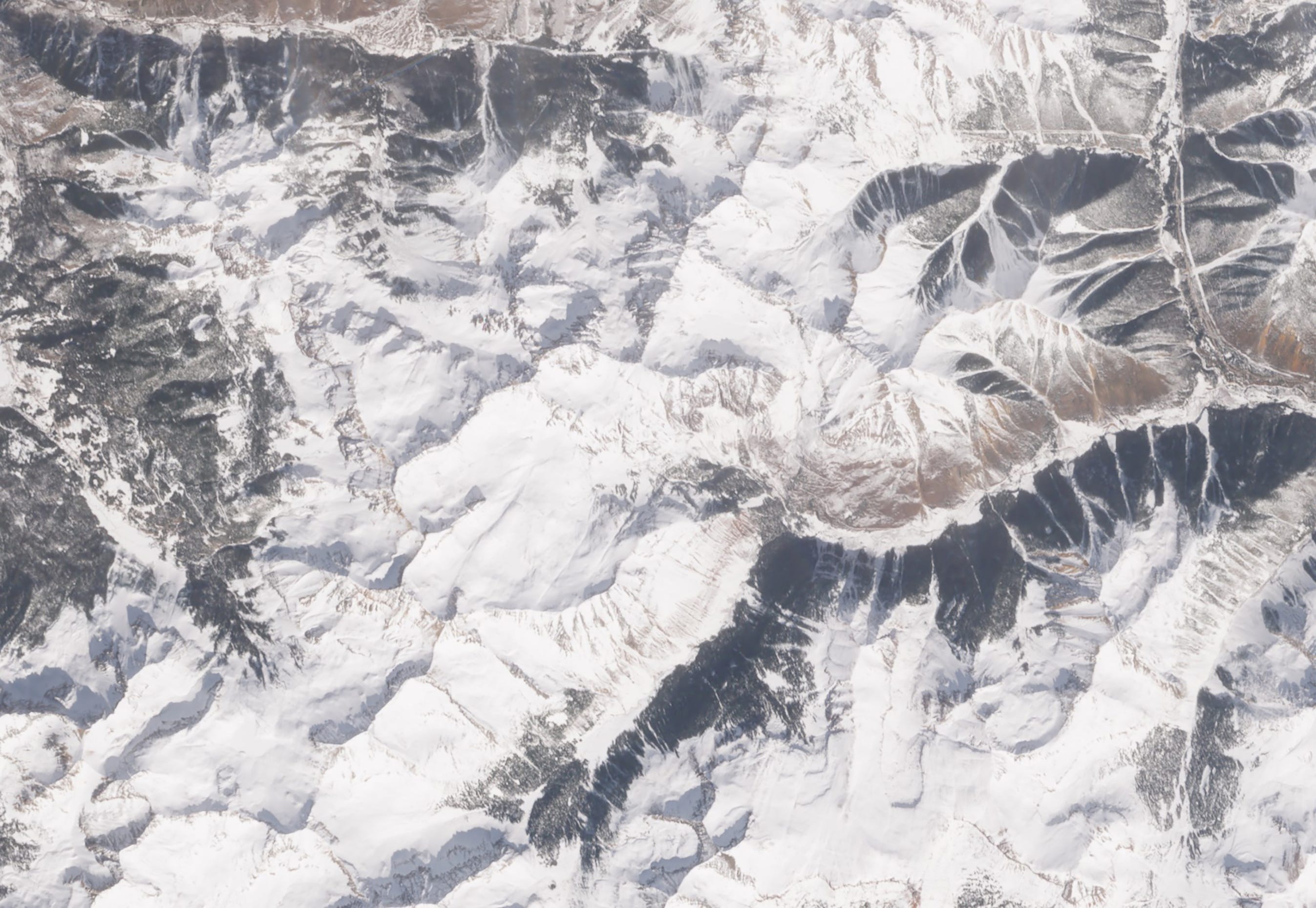
📸 Parting Shot 🎞️
And for another mind-blowing look at just how little snow there is, Land Desk reader and snow-guy Andy Gleason sent in some shots from Animas Forks, at 11,185 feet in elevation. That is some thin snow for late March. Heck, it’s thin snow for late May.
There is a little bit of good news, though. First off, take a close look at the satellite images above and the photos below. Notice that the snow is pretty white, and there’s not much visible dust. Usually the spring melt reveals layer after layer of dust on the snow’s surface, that then decreases the albedo — or reflectivity — and hastens the snow melt. There appears to be less dust this year, so far, meaning maybe what’s left of the snow won’t melt quite as fast.
Oh, and also: Even though the snowpack is ultra-thin, at least it’s not gone at these high altitudes, providing a base for the snow that this week’s forecasted storm should bring. There may still be some powder skiing to be had this season after all! (Scroll down for a weather forecast).
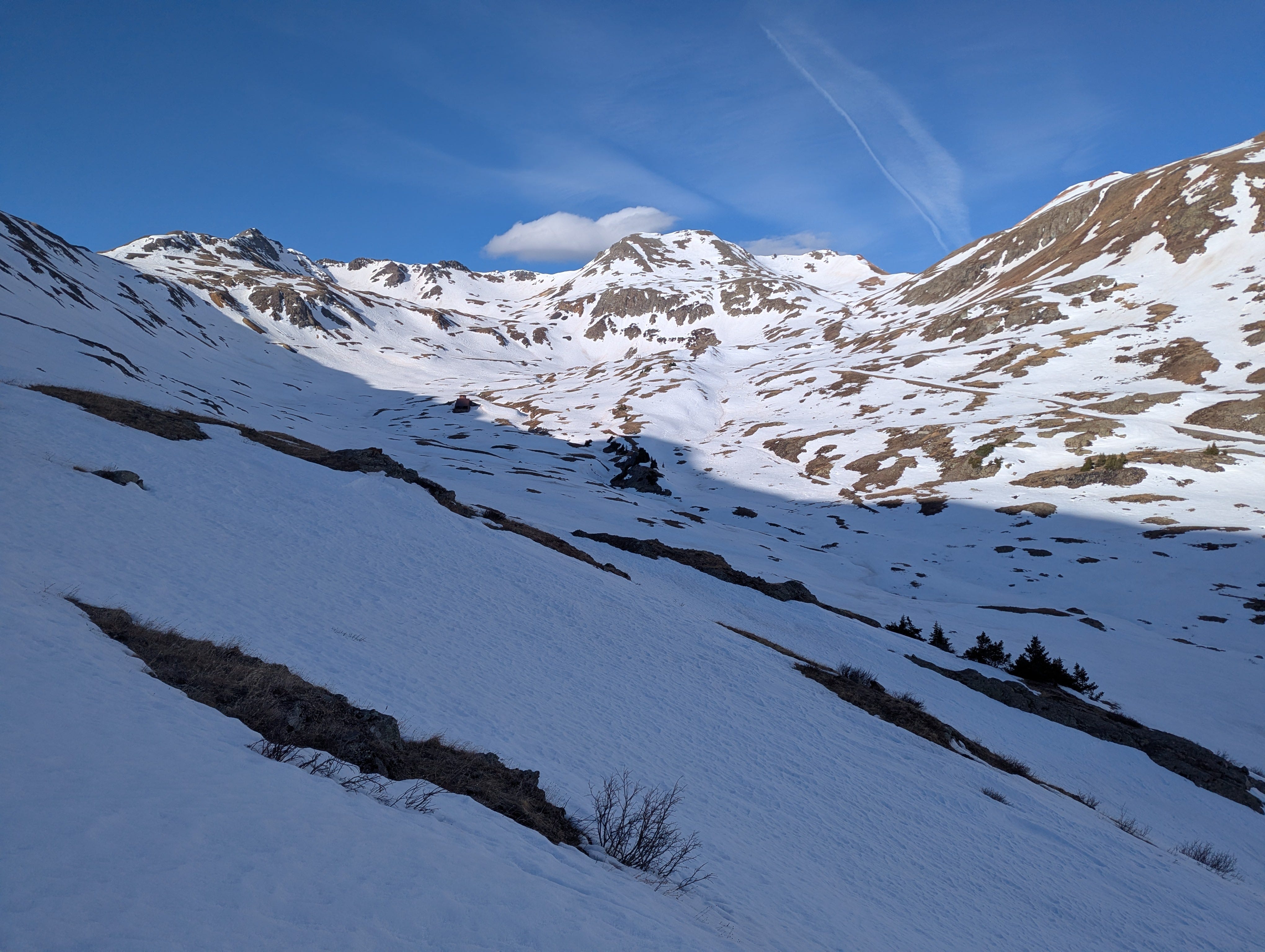
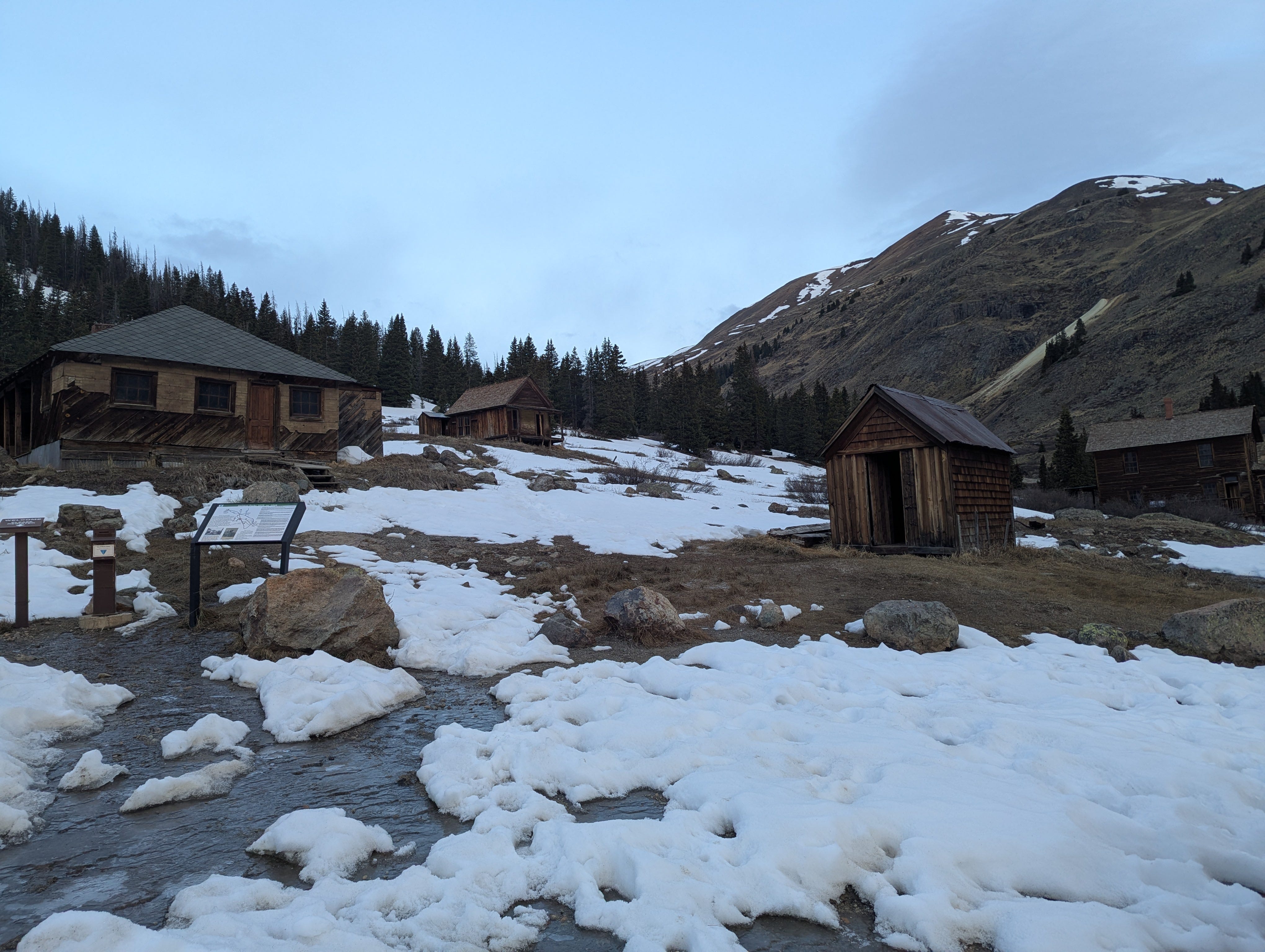
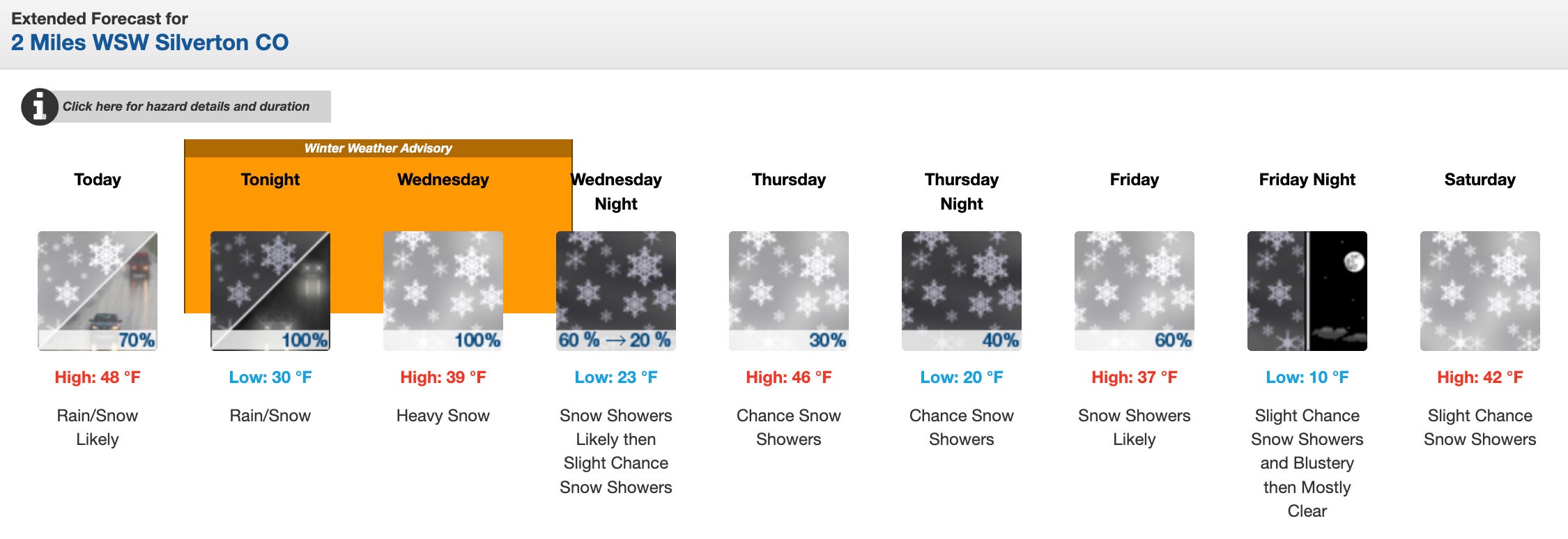
🚣🏽 Predict the Peak! 🌊
Don’t forget to submit your entry for the Predict the Peak spring runoff streamflow contest! The deadline for prize eligibility is April 3, so hurry up. Also, if you already submitted an entry, but you realized that your prediction might be thrown askew by this week’s snowy forecast? You have until April 3 to resubmit. Just keep in mind that only your most recent entry for each gauge will count.
Tell me about your yukigata and your runoff peak prediction! — Jonathan P. Thompson
As the West’s Scant #Snowpack Melts, Coloradans Brace for a Lean Water Year: Record-high spring temperatures are worrying skiers, ranchers and water managers — Annie MacKeigan (WaterDesk.org) #runoff
Click the link to read the article on The Water Desk website (Annie MacKeigan):
March 24, 2026
Call it the winter that wasn’t.
Throughout Colorado a record-warm and dry winter has come to a close. Attention now pivots to spring and the potential for additional snow to allay increasing drought concerns. Though, there appears to be little relief in sight.
The Denver-metro area went months without measurable snowfall this winter. The city’s daytime temperatures often surpassed 60 degrees. Hikers and trail runners rejoiced over the warm weather while grumbling skiers lamented their underused season passes.
In the state’s Rocky Mountains snow accumulation was sluggish, as warmer than normal temperatures led to midseason snowmelt, and caused more precipitation to fall as rain instead of snow. A persistent mid-March heatwave kicked off rapid snowmelt. Colorado’s snowpack, and in the broader Colorado River basin, set new record lows throughout winter. T-shirt weather wasn’t just confined to lower elevations either. The high country too experienced balmy days and nights.
The mild year has already led to lifestyle changes for Colorado residents, and threatens to do even more. Ski resorts are closing early, ranchers are worrying about the security of their irrigation supplies, and water managers are considering contingency plans if such conditions persist.
This year, powder days that rev the state’s ski economy were replaced with sunshine. Recreation is not the only industry under threat from rising temperatures and low snowpack. The state’s agricultural economy hinges on access to snowmelt.
Marsha and John “Doc” Daughenbaugh call the Rocking C Bar Ranch near Steamboat Springs home. Marsha is a third generation rancher in the area, and the couple have passed the business off to their two children. They still worry that if such dry conditions continue, it would “seriously affect our ability to keep going,” Marsha said.

A well-welcomed snow system worked its way through parts of the state in early March, providing the nearby Steamboat Ski Resort a self-reported 6 inches of new powder. But it quickly melted, and the Daughenbaughs were ankle deep in mud come midday.
Doc has long made a habit of measuring inches of snowpack in the ranch’s meadow each year on March 20, right around the spring equinox. Few of his recordings—which began in 1989—noted no snow.
The most sobering of Doc’s notations is also the most recent. During a visit in early March, the entry read, “all snow gone by Feb. 26.”

The noticeably scant snow is not the only observation the Daughenbaughs have made this year. Robins, geese and sandhill cranes had already returned to the family’s ranch by early March, not usually due back until the first week of spring.
Marsha, who has lived in Steamboat since 1953, recalled “three-wire winters,” when snow would build up to the third wire on the barbed-wire fences that surrounded their property. “They were really a common thing,” she said.
Their main concern is that any snowpack that does accumulate this spring will travel down the mountains fast, due to warm temperatures and limited reserves, which means less water availability sooner in the year for high country ranchers like themselves.
South of the Daughenbaughs, skiers and snowboarders in Summit County are seeing their seasons cut short.
At its summit, Arapahoe Basin is one of the county’s highest ski resorts in elevation. But instead of the high elevation benefitting the mountain, it has become somewhat of a disadvantage. According to Doug Petrick, a skier from Erie, Colo. who frequents Arapahoe Basin, the back side of the mountain was extremely icy because of its exposure to this year’s unseasonably high winds.
In addition to Arapahoe Basin, Petrick also skis at Breckenridge, Keystone, Vail, Copper and Winter Park. Petrick has recorded 30 days of skiing this season which is on par for seasons past. However, the difference in conditions this year has been noticeable.
“There has been a lot of exposure of rock and dirt. The snow is not enough to cover the mountain,” he said. “My skis have taken more of a beating due to the exposed rock and dirt.”
While Arapahoe Basin benefits from high elevation terrain, other Colorado resorts struggled to stay viable. Powderhorn in Mesa County, Sunlight in Garfield County, and Ski Cooper near Leadville all shuttered before their scheduled closing days this spring.
Because skiing is his favorite winter activity, Petrick is holding out hope for more snowfall and a better next season. “But if next year is the same or worse,” he posed, he may start to worry.
Petrick is not the only one holding out hope for the future. Colorado’s cities too look seasons ahead to ensure they have enough water to meet their needs. Matt Fater, senior director of infrastructure engineering for the City of Fort Collins’ water utility, is hopeful for more spring snow. Without it, the city may have to tap into existing water storage.
“We’re not in a crisis mode yet,” Fater said. “We’re watching it closely. We do have short term and long range plans when it comes to drought planning.”
The long range planning includes a policy that requires the city to be prepared for a 1-in-50 year drought. In the case of a severe drought, the city pulls water from different storage reserves that accumulate during particularly wet years. Fater reinforced the need for additional storage in the city, to “make sure we can meet the demand of our community.”
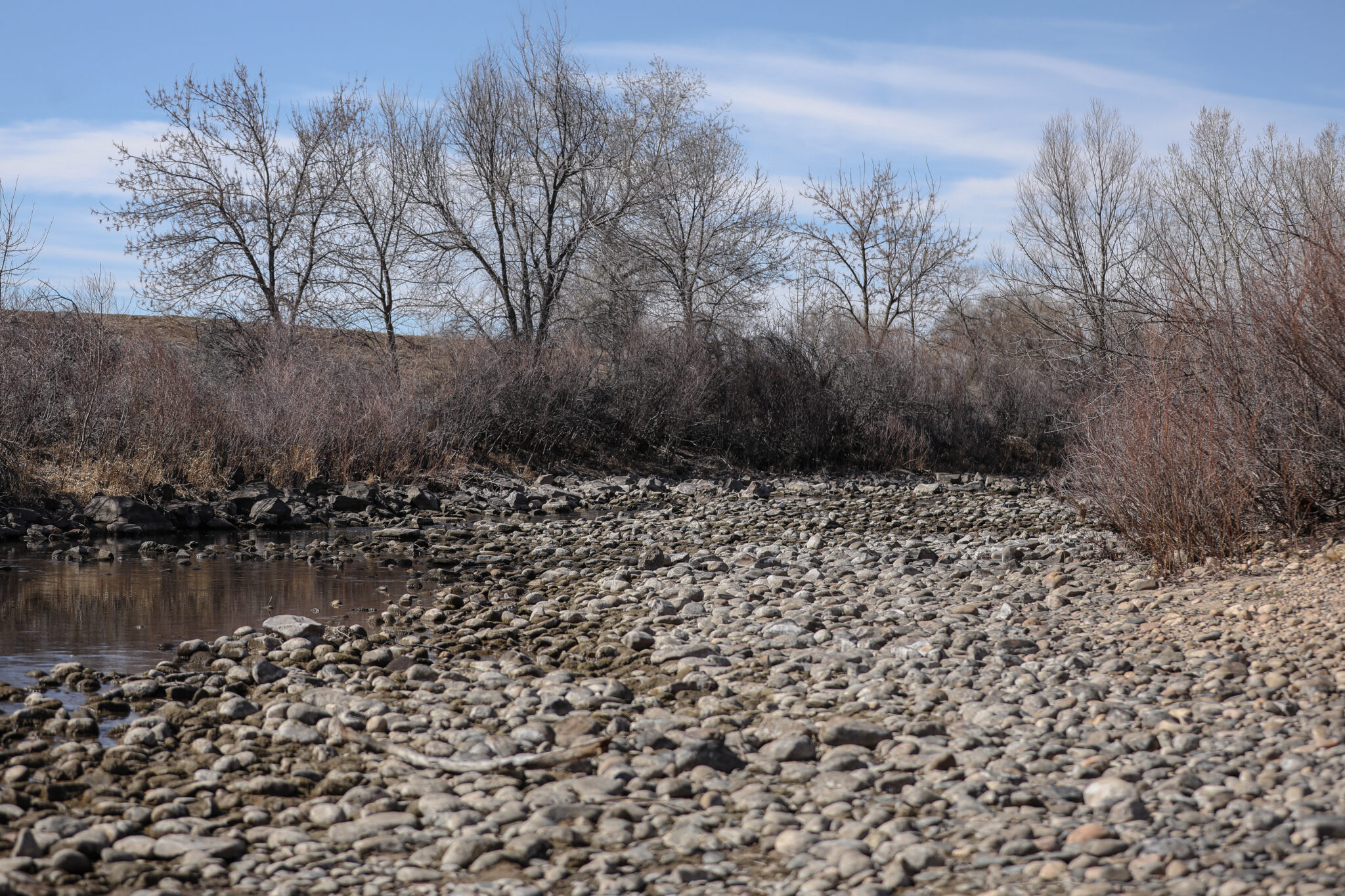
Other cities aren’t waiting. Denver Water has already let its customers know they’ll be restricted on their outdoor summer watering this year. In Erie, residents who flouted the town’s voluntary outdoor watering restrictions now face the potential of being cut off completely, according to CBS Colorado. And planning for the potentially hot and dry summer ahead has led Governor Jared Polis to activate a statewide drought task force too.
Snowpack in the high country acts as a battery for water availability, Fater said. Without enough snowpack to “recharge” those additional storage sites, a future drought could result in limited water availability and potential restrictions in the city.
Ranchers, skiers and water users throughout the state were hopeful that March would bring a miracle, and the snowpack deficit would decrease after a few big storms. But with a warm winter transitioning to an even warmer spring, the hopes of a few high-powered snowstorms are fading.
This story was produced and distributed by The Water Desk at the University of Colorado Boulder’s Center for Environmental Journalism.
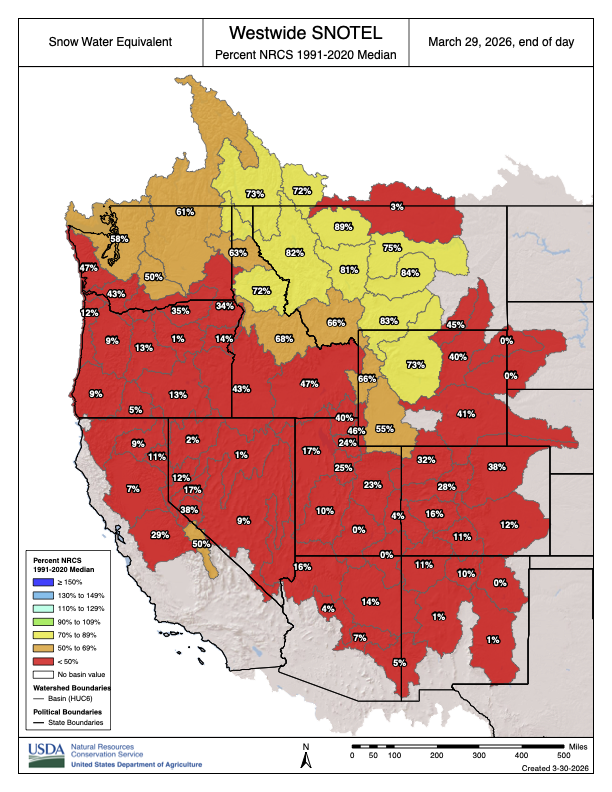
Rethinking How the #UnitedStates and #Mexico Share the #ColoradoRiver — Eric Kuhn, Anne Castle, Carlos de la Parra, John Fleck, Jack Schmidt, Kathryn Sorensen, Katherine Tara #COriver #aridification
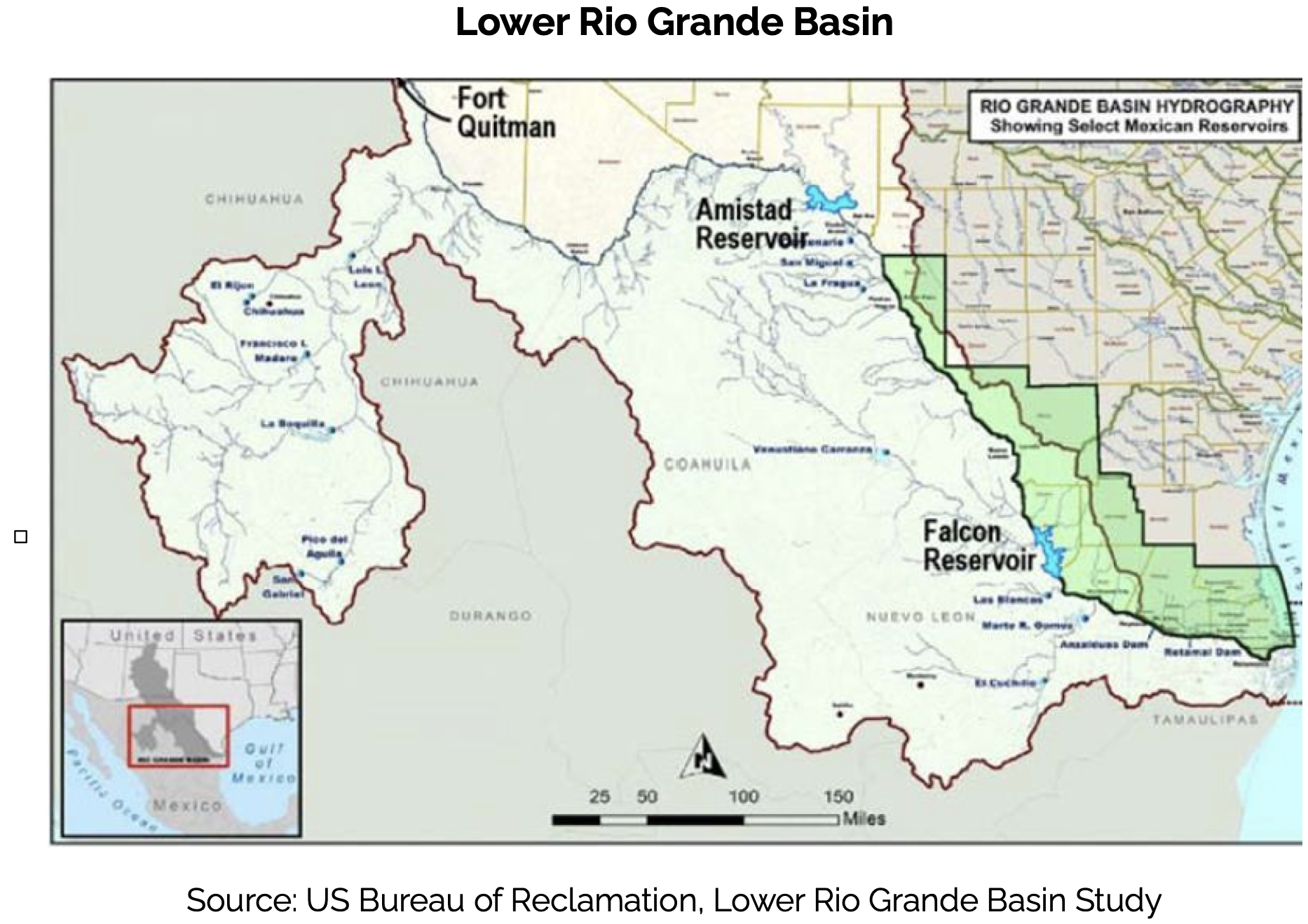
Click the link to read the paper on the Getches-Wilkinson Center website (Eric Kuhn, Anne Castle, Carlos de la Parra, John Fleck, Jack Schmidt, Kathryn Sorensen, Katherine Tara). Here’s the abstract:
March 26, 2026
Since 1945, the United States and Mexico have managed common interests on their two largest shared rivers systems, the Colorado and the Rio Bravo/Rio Grande, under the terms of the 1944 international treaty that was designed from the beginning with tools to adapt to changing hydrologic and societal conditions. A recent emergency agreement on the Rio Bravo/Rio Grande illustrates what is possible, and with old river management rules on the Colorado both within the United States and between the United States and Mexico about to expire, we are at a moment of opportunity for meaningful change. The core problem on the Colorado River, which we address in the analysis that follows, arose from decisions made in the first half of the 20th century to allocate fixed volumes of water. As usage patterns and hydrology change in the 21st century, fixed volumes no longer work. [ed. emphasis mine] A shift to a percentage-based split between the United States and Mexico on the Colorado River, based on the river’s actual natural flow, would provide a solid foundation for the two countries’ joint management of the Colorado in the decades to come.
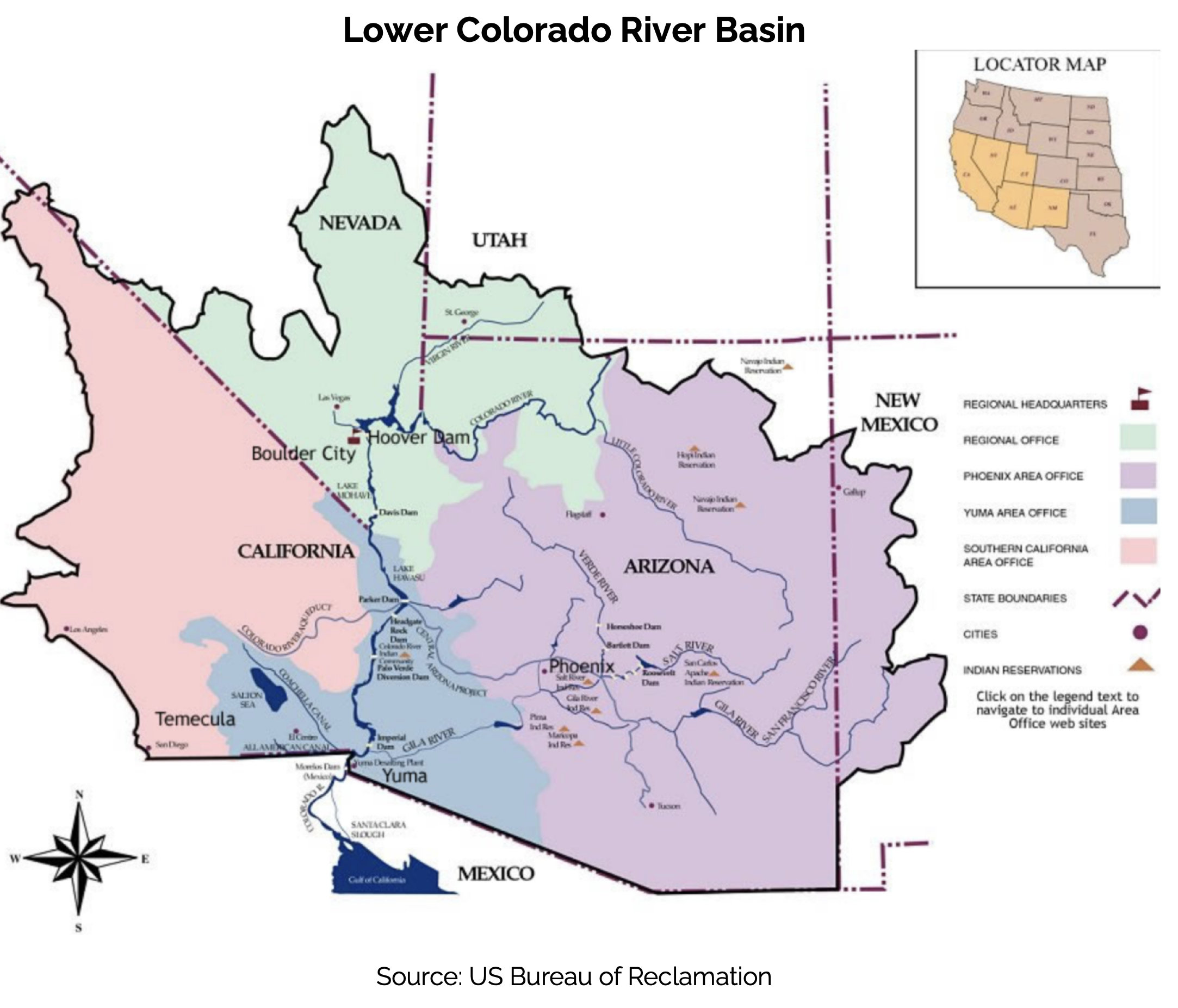
Research paper: Anastomosis and Low Flows Sustain Resilient Groundwater Dependent Riparian Floodplains in an Agricultural River Valley, New Mexico — Ellen Soles, Martha Cooper, Laurel Saito (Wiley Online Library) #GilaRiver
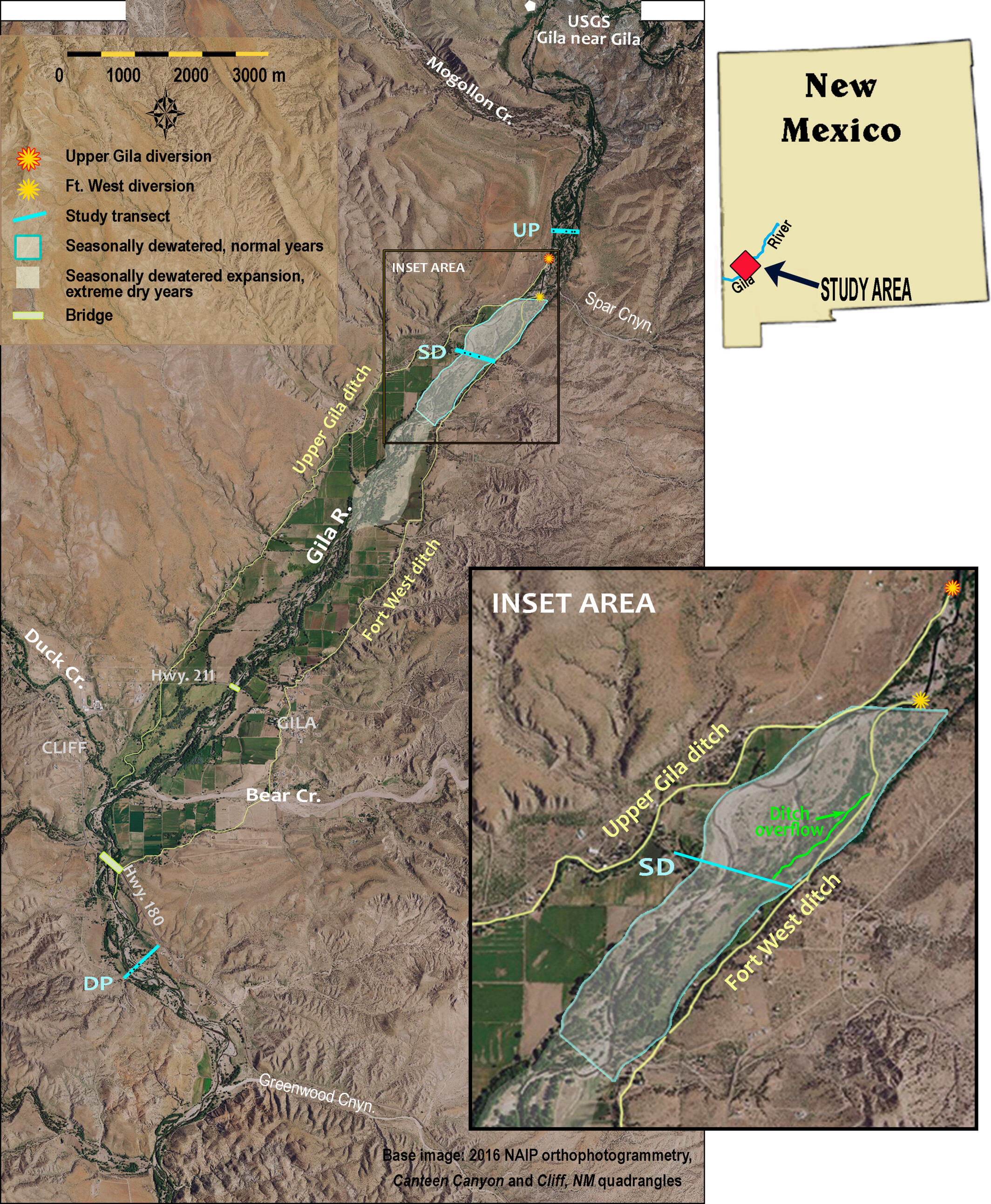
Click the link to access the research paper on the Wiley Online Library website (Ellen Soles, Martha Cooper, Laurel Saito). Here’s the abstract:
In arid regions with limited water supplies like the Colorado River basin of the southwestern United States, flow regimes and water availability are major controls on native riparian ecosystems resilience, persistence and function. In this paper, we share a case study that uses a long-term dataset of topographic, vegetation and groundwater data collected over water years 2011–2021 to demonstrate how secondary channels formed during high flow events enhance groundwater-dependent riparian ecosystem resilience, favouring native over non-native vegetation. In the Cliff-Gila Valley of southwestern New Mexico, channelization and levee construction between 1940 and 1980 profoundly altered the floodplain and channel of the Gila River, a Colorado River tributary. During subsequent large floods, river anastomosis (branching) left a network of secondary channels across the floodplain. Long-term data show that these channels improve vegetation access to groundwater, facilitating regeneration and expansion of diverse native groundwater-dependent vegetation. Data also show that even the lowest perennial flows (0.4–0.6 m3 s−1) sustain rates of groundwater recession favourable to successful native riparian seedling recruitment in the topographic lows created by secondary channels. Alluvial groundwater recedes more sharply in a reach seasonally dewatered by irrigation diversions, but seepage through diversion structures and unlined ditches maintains shallow groundwater levels. This case study demonstrates that even in arid regions, robust native groundwater-dependent riparian areas can co-exist with human water demands when large floods can move across broad floodplains and create topographic complexity. [ed. emphasis mine] The study also highlights the importance of long-term datasets for documenting ecosystem resilience to floods, drought and ongoing climate change.

Impact of #drought on rivers and Western #Colorado — KJCT #snowpack #runoff #ColoradoRiver #COriver #aridification
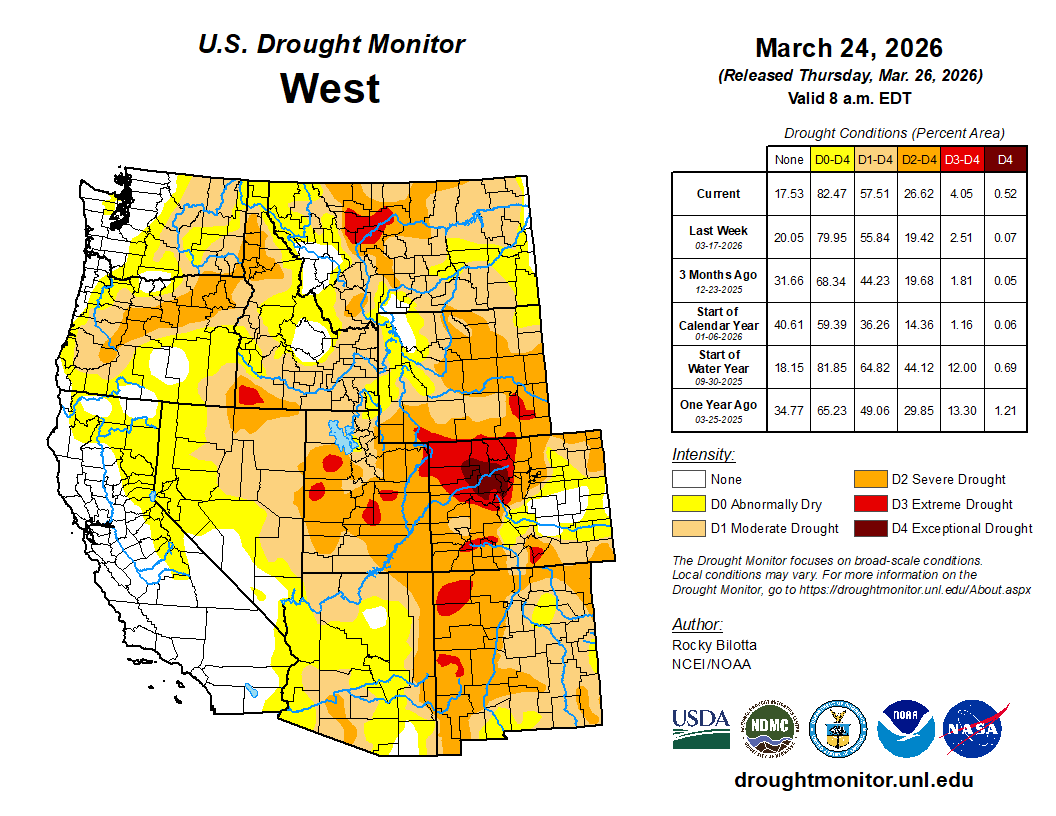
Click the link to read the article on the KJCT website (Matthew Kryger). Here’s an excerpt:
March 27, 2026
Warm and dry conditions in Western Colorado are speeding up runoff from an already below normal snowpack. And it is causing concern among communities. “There are smaller communities that have a single source of drinking water supply that are concerned about what their source is going to be producing as the summer goes on if the snow melts out too quickly,” said [Christina] Medved…Another concern is having enough water for irrigation.
“The green grass lawns, the big parks and fields, they take a lot of water to keep green. And so, we’ve already been hearing from communities that if they have to, they will stop watering those fields,” said Medved.
The dry season we have had also means concern for wildfire season. “If you have an early melt out and you’re able to dry out the landscape by June, June tends to be a drier month. And so that tends to be associated with some higher-than-normal fire danger,” said Goble.
What about this warm, wacky and very weird weather? Meteorologists say #Colorado’s record temperatures in March were “anomalous.” Will we shrug it off, like so much other evidence of #ClimateChange? — Allen Best (BigPivots.com) #snowpack #runoff
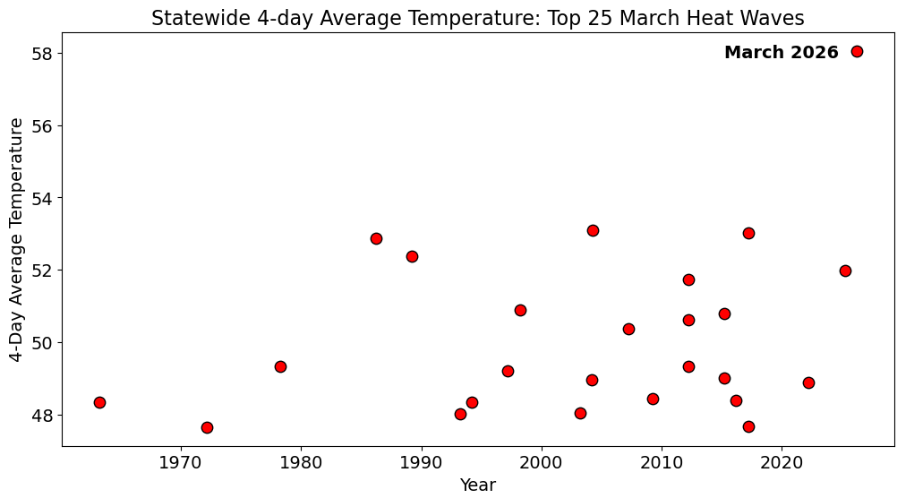
Click the link to read the article on the Big Pivots website (Allen Best):
March 30, 2026
It was weird, it was wacky. This string of summer days in Colorado that arrived around the first day of spring was extraordinary. Will it change us in some fundamental way?
It’s not like 9/11, the day we saw people jumping from the skyscrapers in New York City to escape an even more cruel death by fire. We knew instantly that the world was different and in a very big way.
But doesn’t this anomaly deserve more than a shrug of the shoulders? As summer arrived in the last days of winter, I heard several people say, “Well, enjoy this nice weather” as you passed through their doors. A well-intentioned pleasantry but detached from a vital truth. Nice weather for Arizona maybe, but this was Colorado.
Winter had altogether been very, very warm. November was the third warmest November on record across Colorado. December the warmest. February also broke records.
Then came March. Alamosa, a town at 7,543 feet in elevation in Colorado’s San Luis Valley, notched 11 record highs during March going into the last weekend. This included nine in a row from March 18-26. Of special note was the record high of 83 degrees recorded on March 21. It broke the old record by 7 degrees. It also was a higher temperature than has ever been recorded in Alamosa in April.
Crested Butte had a high temperature of 68, a full 10 degrees higher than the old record for that date.
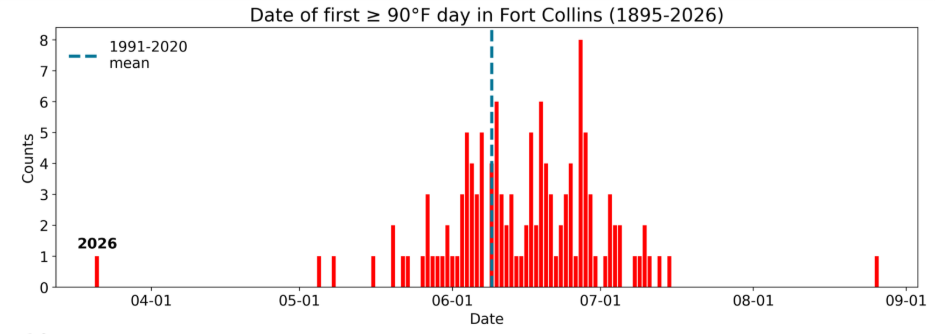
Fort Collins got to 91 degrees, also 10 degrees more than the old record for that date. It was the highest ever mark for March — but also higher than anything ever recorded in April, whose record remains 89 degrees. The average first day for 90 degrees in Fort Collins is June 15.
Allie Mazurek, of the Colorado Climate Center staff, posted a report on Thursday morning that defines in numbers what she calls an event “impossible to ignore.” Included in her presentation is the chart atop this essay that shows how anomalous this four-day streak of heat was compared to others in Colorado during March.
This heat was nearly uniform across Colorado. “There were far more stations in the state that broke all-time monthly high records for March than did not,” wrote Mazurek. “To see monthly records shattered by more than 5 degrees F across numerous stations is truly remarkable. The kind of heat that we saw last week across Colorado is more typical of June or even July.”
Remarkable about theheat in Colorado was not only its intensity but its longevity across four days (March 18-21). “Over that period, several locations set new monthly records every one of those days, with each day being warmer than the last.”
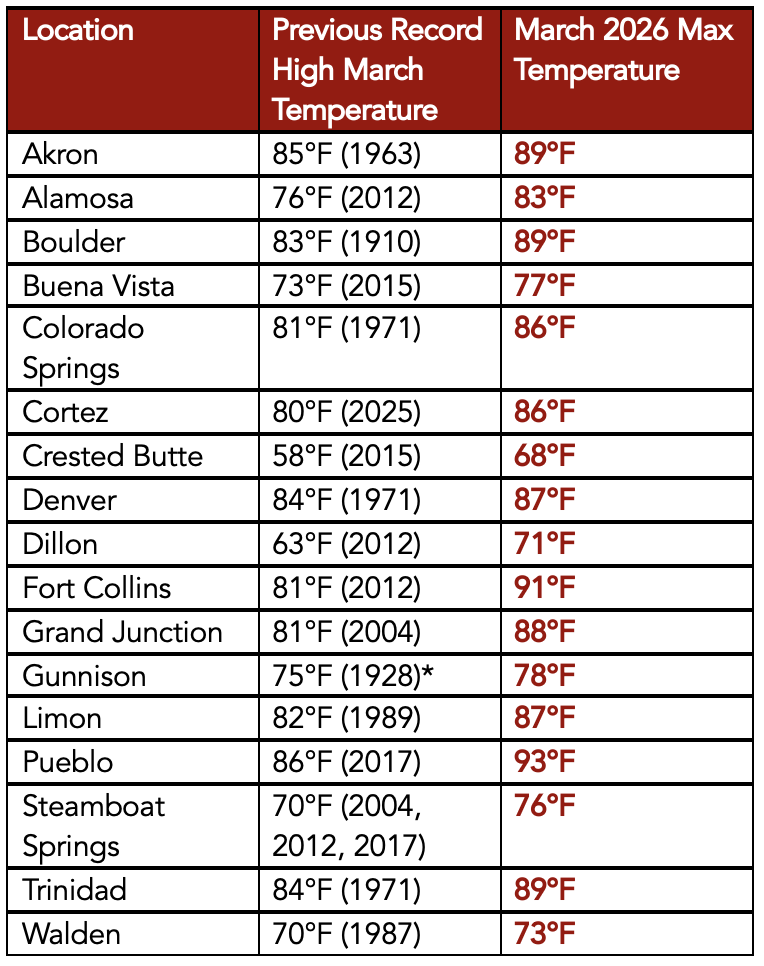
This heat comes at a particularly bad time. The thin snowpack was already melting. The deepest snowpack in Colorado’s mountains has traditionally occurred in early May, because of accumulations at higher elevations.
That assumes a normal of some sort — although it is questionable whether “normal” has any true meaning given how fast the climate is now changing. So take this for what it’s worth: the statewide snowpack this past week sat at 38% of the 1991-2020 median. And what must be noted here — as with the temperature records that were broken — is that we have had an exceptional increase of heat in Colorado in the last 25 years.
Notable in the lifetimes of baby boomers in Colorado were the winters of 1976-77 and 1980-81. This year’s meager runoff will almost certainly surpass those dry years. New is the heat.
High-pressure heat domes can be predicted but are notoriously challenging to forecast weeks or months in advance. They also remain rare, but the warming atmosphere makes them more likely.
“We do have high pressures every year across the West,” said Mark Wankowski, a meteorologist at the Pueblo office of the National Weather Service. “This one was extremely early.”
Writing from Colorado Springs last weekend in an essay in The Atlantic titled “There’s No Way the West Will Have a Normal Summer,” Rebecca Boyle explained that the heat wave was created by a “a bizarrely strong ridge of high pressure in Earth’s atmosphere.” This ridge suppressed cloud formation and brought in warmer air. “Such atmospheric ridges are more common in the summer, but this one would be unusually intense even for that season.
Kaitlyn Trudeau, a senior researcher at the science nonprofit Climate Central, told Boyle this was the strongest ridge ever observed in March. Climate Central has developed a prediction model that assesses how much a warming trend or record high can be attributed to human-caused climate change. According to this model, the western high temps were five times more likely because of elevated greenhouse gas emissions.
I feel rattled by this heat. You may remember the high-pressure cooker that broiled the Pacific Northwest in June 2021. Temperatures spiked to 116 degrees in Portland. People in apartments that were not air conditioned died from the heat. In Multnomah County, the location of Portland, 72 deaths were attributed to heat. Farther north, in British Columbia, the town of Lytton went up in flames after several days of intense heat, including a temperature that reached 121 degrees Fahrenheit.
After that heat, the Colorado Public Utilities Commission asked Xcel to assess how well it could respond to somewhat similar heat in Colorado. The company concluded it had the resources.
But this week, in the wake of the intense spring heat, the PUC commissioners were clearly worried, part of a growing concern about “resource adequacy.” Will Xcel be able to meet critical electrical needs if another heat dome arrives in Colorado this summer? The commissioners asked Xcel to return with strategies for reducing demand from big industrial customers if demand for cooling spikes.
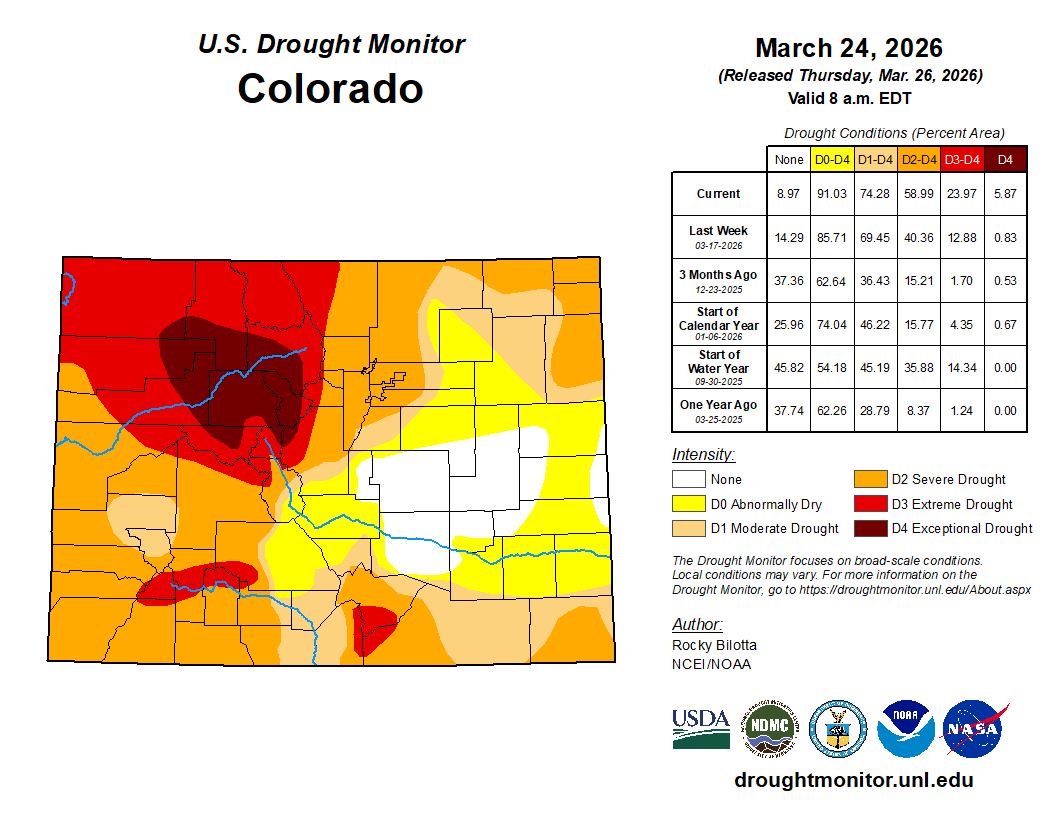
Curious about an on-the-ground perspective from this heat and sparse snow, I called Paul Bonnifield in Yampa. A drought map colors that part of northwest Colorado mahogany, beyond extreme drought and in the realm of “exceptional.” What did exceptional drought look like to him?
Yampa lies at the headwaters of the Yampa River, between the Gore Range and the Flattops. It has a bucolic setting, a place of hay meadows and grazing cattle. Lying upstream are a couple of reservoirs on the edge of the Flattops.
It’s not uncommon for snow to remain on the ground at Yampa, elevation, 7,900 feet, in late March. Not this year. “The ground is hard, just dry, dry, dry,” said Bonnifield.
Bonnifield grew up a few miles away at Phippsburg, a railroad town, and he worked on the railroad himself in addition to spending time teaching and writing at a college in Oklahoma. He’s now in his late 80s and can put this year’s anomalous heat and drought into perspective.
“We are in serious trouble,” he said. “I’ve never seen it like this before.”
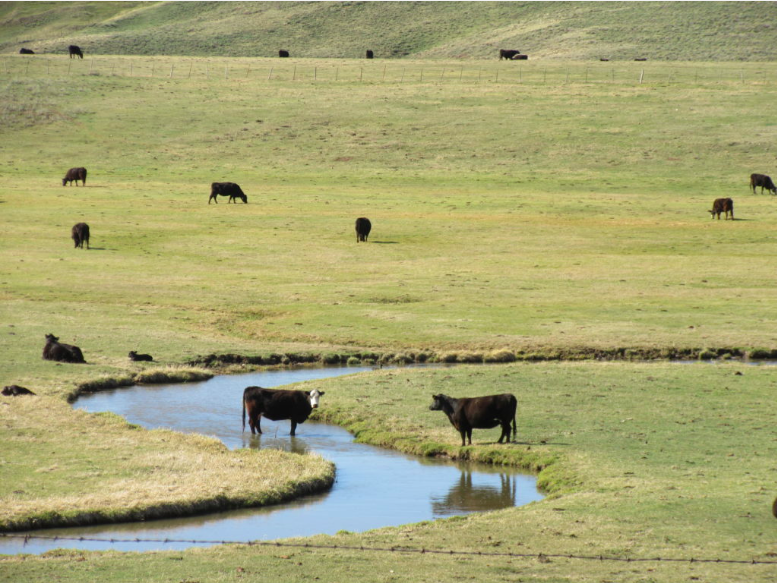
Unless a miracle arrives in the form of spring rain and snow, ranchers in Bonnifield’s area — called Egeria Park — will have to decide what to do with their cattle. There’s not enough water to grow grass. There will be wildfire smoke besotting the sky, dampening tourism. And as for river rafting downstream on the Yampa – not likely. Steamboat Spring has already imposed watering restrictions for lawns.
Denver Water this week adopted lawn-watering restrictions for its customers in Denver as well as those in surrounding jurisdictions. It has 1.5 million customers, directly and indirectly, in the metro area.
Nathan Elder, the utility’s manager of water supply, reported to board members on Wednesday that snowpack levels are at historic lows and melting earlier and more rapidly.
Denver Water diverts water from rivers and creeks on both sides of the Continental Divide. In Grand and Summit counties, at the headwaters of the Colorado River, the snowpack was 53% of normal and the lowest on record for the date, Elder said. The South Platte River has it even worse, just 40% of normal.
“These are really unprecedented snowpack conditions,” he said at the meeting on March 25. During the previous week — the week of the heat dome —Denver had lost 25% of its snowpack in the areas it collects water, he reported.
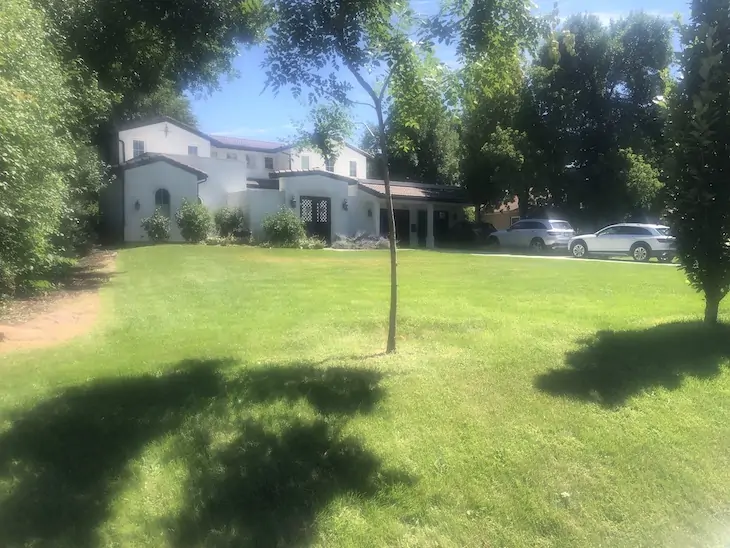
Can it get worse? Well, yes, it could. “It’s well documented that, in part, due to climate change, the runoff generated from a given snowpack has declined when compared to the past,” said Elder. “So we can expect even less water from this already low snowpack.”
Might a miracle arrive? After the drought and heat of 2002, metro Denver was stressed. Then, on St. Patrick’s Day 2003, three feet of snow fell. In the San Luis Valley, monster rainfall last fall swelled the Rio Grande, leaving water in the soil that will help even now as farmers begin preparing their fields for early plantings.
NOAA projects continued likelihood of above normal temperatures and below-normal precipitation across Colorado, including Denver’s collection area, during April.
Denver aims to reduce water use 20% by its customers in Denver and in outlying suburbs. It will permit lawn watering two days per week and then after 6 p.m. or before 10 a.m. It is also urging customers to refrain from watering their lawns until mid-May. That’s not an easy ask when it feels like June in March. In April, Denver Water’s board members will be asked to approve “drought pricing.”
Russ Schumacher, the state climatologist in Colorado, is called upon frequently to give programs to water organizations and others. This past week he gave a presentation to the Fort Collins Chapter of the Colorado Renewable Energy Society.
“Wildfire certainly is top of mind,” he said while showing a time-lapse video of a wildfire called High Park Fire that occurred west of Fort Collins in 2012.

Global warming is a simple proposition, he said.
“If you put a pot of water on your stove you’re not going to be able to predict all those individual bubbles or exactly when it’s going to start boiling,” he explained. “But you know that when you turn that heat on, the water’s going to get warmer and it’s going to continue to warm the more heat that you add. So the physics of climate change is actually rather similar in that regard.”
And, of course, adding greenhouse gases to the atmosphere traps heat, which heats the planet. “When you add heat to something, then it warms.”
Colorado has had outliers of heat before. The Dust Bowl during the mid-1930s was a time of heat and drought. More hot and dry arrived in the 1950s.
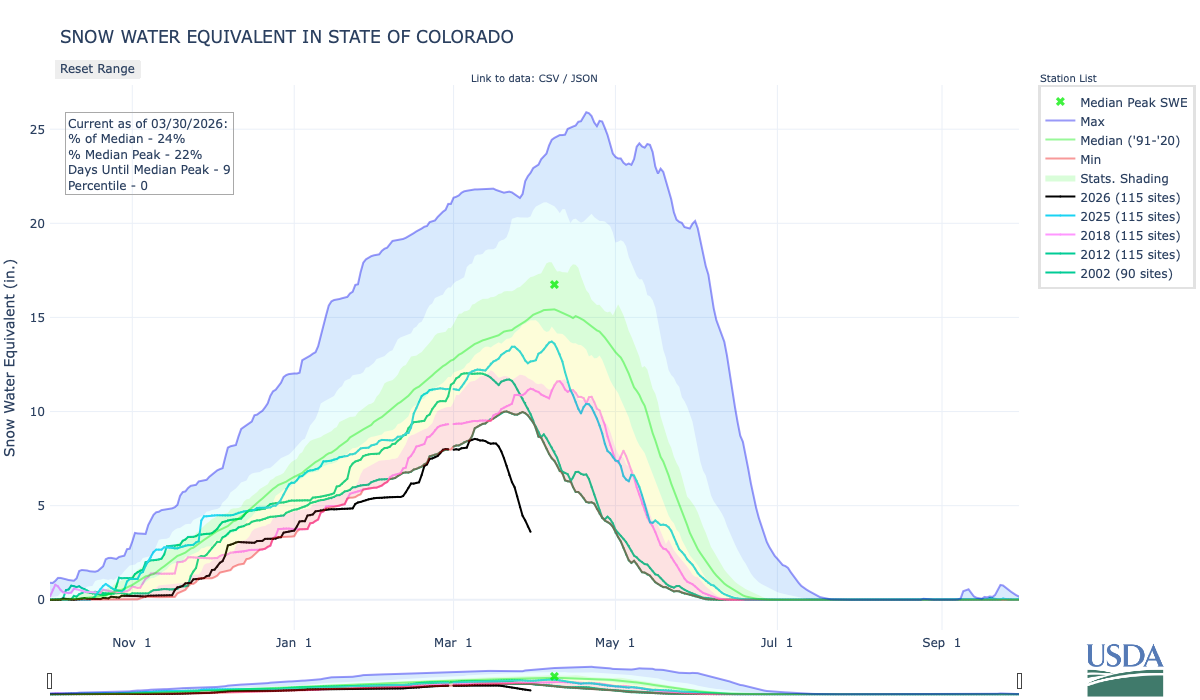
Dry has not changed. The hot has changed. What used to be an extremely hot year in Colorado is now a fairly average year or just slightly-above-average year, said Schumacher.
Citing NOAA data, Schumacher showed a sharp rise of almost 2.5 degrees Fahrenheit since 1980. The heat has been most acute in the summer and fall — although, obviously, recent months spoil that easy narrative.
With a moderate rate of emissions, we can expect another 2.5 to 3 degrees of warming by around 2050. That expectation comes with a disclaimer about uncertainty. It’s a best guess.
Precipitation has been more complicated than temperature in Colorado. As for the future, it remains a puzzle. Could be more, could be less. Either way, it will be impacted by temperatures.
“If it’s warmer, if it‘s windier, it’s less humid, the air is thirstier for water from the soils, crops, forests, reservoirs, wherever.” Schumacher said. “As it gets warmer, that evaporative demand goes up. The air is thirstier for water, and this has big implications for drought and water supply and water resources.”
Might warming occur more slowly? That’s possible, and a possibility tied strongly to whether global emissions of greenhouse gases can be abated. Given the current political climate in the United States, a key player in world politics, this low-emissions scenario looks highly unlikely. More likely are the heat domes.
Like the pot of water on the stove that Schumacher described, we’re certain to see more heat bubbles. Hard to tell where and when they will be, but there will be more of them. That leaves me distinctly uncomfortable. In Colorado I have felt 104 degrees. I cannot fathom the 118 degrees of Portland.

‘There is no good news’: Water users warned of dire irrigation season, the worst on record — The #Montrose Press #snowpack #runoff #UncompahgreRiver

Click the link to read the article on the Montrose Press website (Katharhynn Heidelberg). Here’s an excerpt:
March 28, 2026
With far less snowpack in the high country this year and an anemic runoff forecast, the Uncompahgre Valley is positioned for a terrible irrigation season. Water users association Manager Steve Pope did not mince words.
“This is the worst year on record so far for snowpack. Looking at the fact that it’s pushing 90 degrees outside in March, we aren’t going to be able to expect much of a runoff,” Pope said on Wednesday, one week before water deliveries begin on April 1, ” … There is no good news.”
The Uncompahgre Valley Water Users Association will only be delivering allocations to shareholders of 50% to start, and, if water models remain consistent, will cut delivery to 40%. No pump contracts can be filled this year, although there will be credits for next year for paid accounts. Shareholders who pump directly from an association canal or lateral must register pumps and install meters and regulating valves for the deliveries. As well, people are being asked to reconsider lawns and large-scale landscaping to conserve every drop possible for agriculture…
Runoff projections within the Uncompahgre Basin are worrying. The Colorado River Basin Forecast Center operates SNOTEL sites that measure snowpack and snow water equivalent, the amount of water the snow holds. Ideally, there would be robust snowpack and SWE, as well as weather conditions conducive to slower melt, leading to prolonged runoff. That isn’t the case this year…2026 is on track to turn out even worse than 2002, the leanest water year this century — but even 2002 was bookended with decent water years before and after…Pope said the Colorado River Basin Forecast Center is projecting a 50% chance of the local watershed seeing about 53,000 acre feet of runoff…The water users association can’t really rely on natural flow from the Uncompahgre River this year, Pope said, but he does anticipate enough to fill Ridgway Reservoir. Beyond that, however, “it’s not very promising.” Overall weather conditions compound the problem of so-so snowfall during the winter: it’s been warmer far up in the high country, too. Pope said that at the 12,200-foot elevation Swamp Angel study site maintained by the Silverton-based Center for Snow and Avalanche Studies, it’s only been getting down to a few degrees below freezing at night. (This site had a measured snow water equivalent of 13.4 inches as of March 15.)
“If it’s not freezing at night, there’s nothing to slow the runoff down. They said the dust isn’t as bad this year. That is somewhat of a silver lining. We haven’t had the wind, so the dust isn’t quite as bad,” said Pope. Dust accelerates snowmelt.

Spring runoff flows reaching levels usually seen a month later: Tighter water-conservation rules, recreational river closures looming for summer — #SteamboatSprings Pilot & Today #YampaRiver
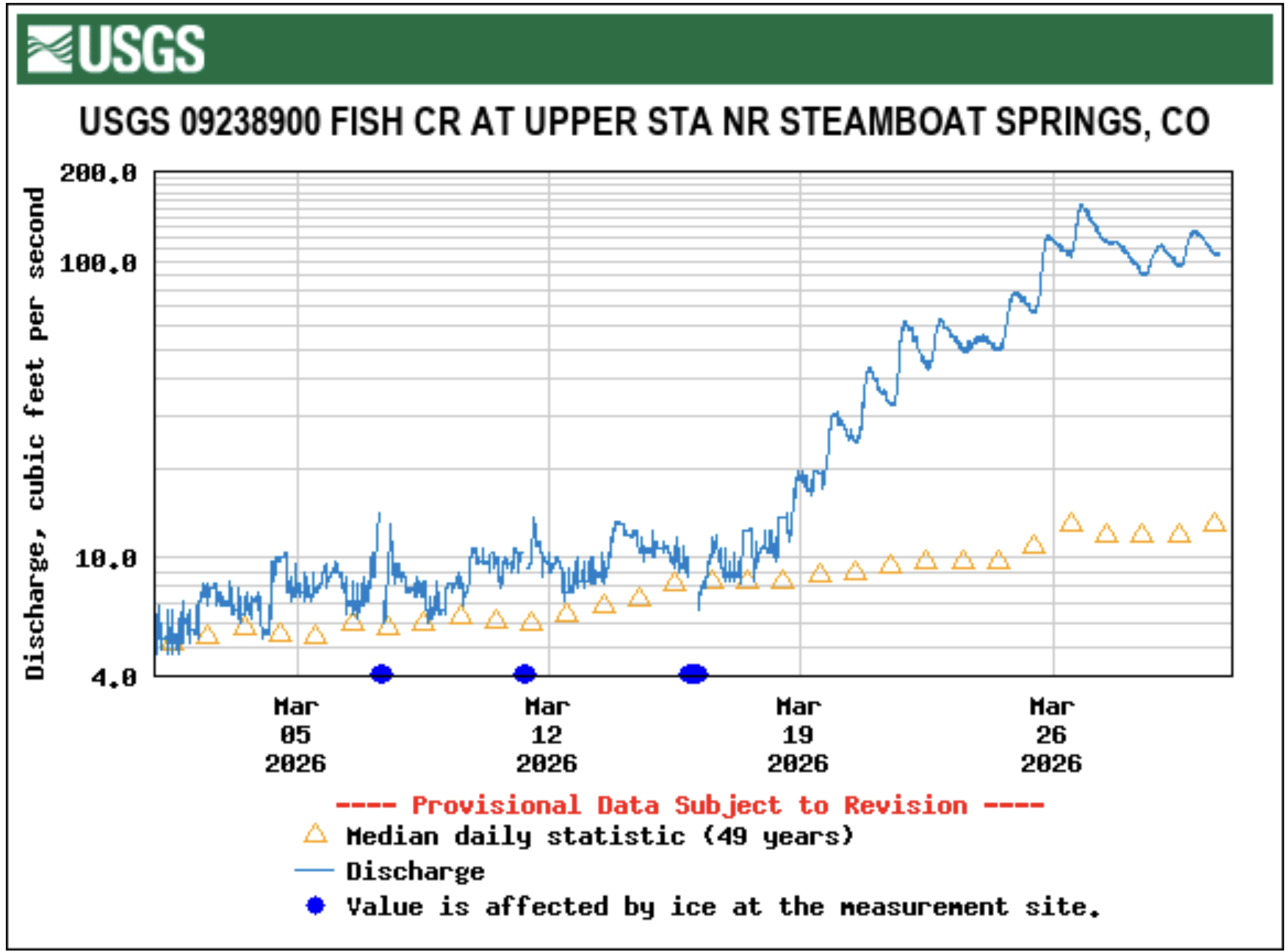
Click the link to read the article on the Steamboat Pilot & Today website (Suzie Romig). Here’s an excerpt:
March 26, 2026
With the quicker snowmelt and earlier drying out of pasturelands, runoff volumes in creeks are hitting levels now that usually occur a month later in the spring, leading area ranchers to activate irrigation ditches weeks earlier than usual. Runoff flowing down Fish Creek, the primary water source for the city of Steamboat Springs, is almost one month ahead of the historical average. At 9 p.m. March 21, the flow displayed by the U.S. Geological Survey gauge on Fish Creek near the Fish Creek Water Plant east of Steamboat Springs showed 62 cubic feet per second. That volumetric flow rate is usually seen on April 18, according to gauge records from 1966 to 2025…“Over the last two years, it’s definitely running sooner than average,” said Frank Alfone, general manager at Mount Werner Water and Sanitation District. “It just means the possibility of having to release from Fish Creek Reservoir earlier in the season because there is less water in the creek.” The water gauge on Fish Creek historically records a peak seasonal flow of 464 cfs on June 8, but this summer the peak will occur much sooner than average. For waterfall fans, that also means highly visited Fish Creek Falls figures to be at peak flow three to four weeks sooner than its average early June date, Alfone noted…Fish Creek Reservoir on Tuesday was sitting at 47% of fill capacity, a normal level for this time of year, and that percentage continues to increase, Alfone noted. As a major year-round water source for the community, Fish Creek Reservoir water managers do not want that level to drop below 30%, Alfone said.

#Snowpack news March 30, 2026: “There is no historical analog to this” — Brad Udall (#Colorado Water Center)
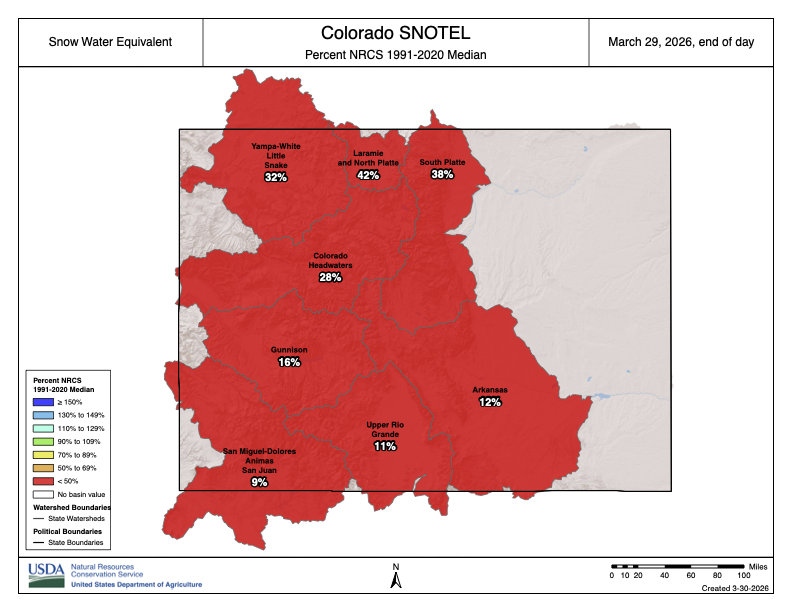
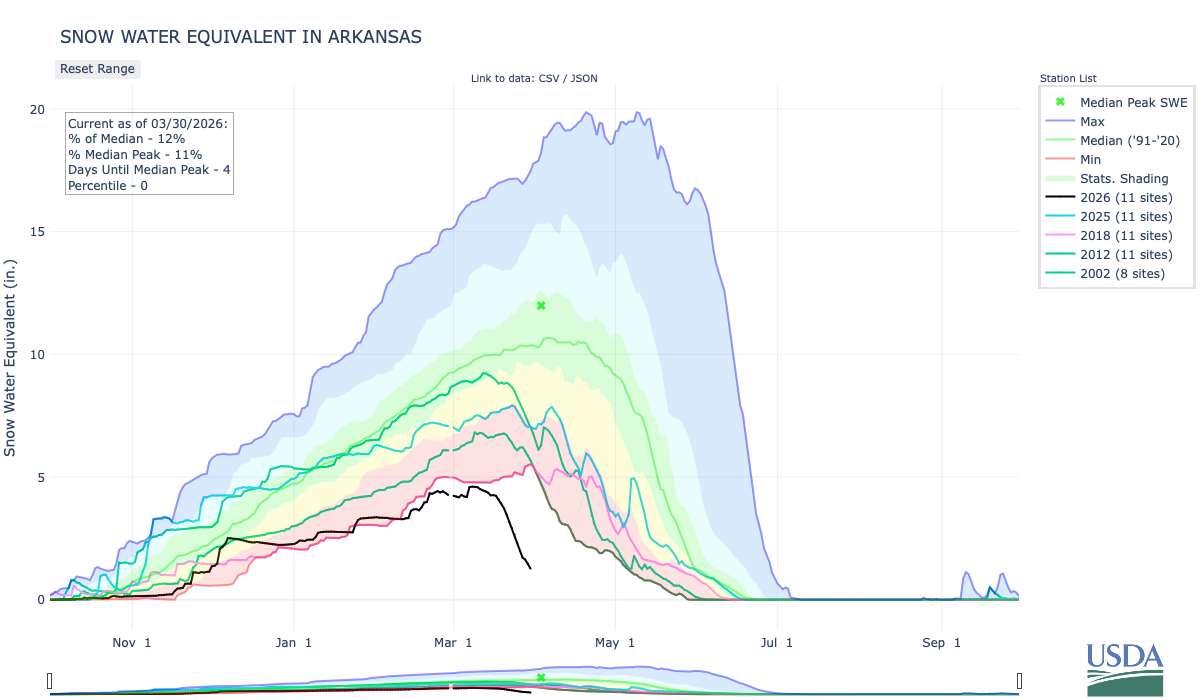

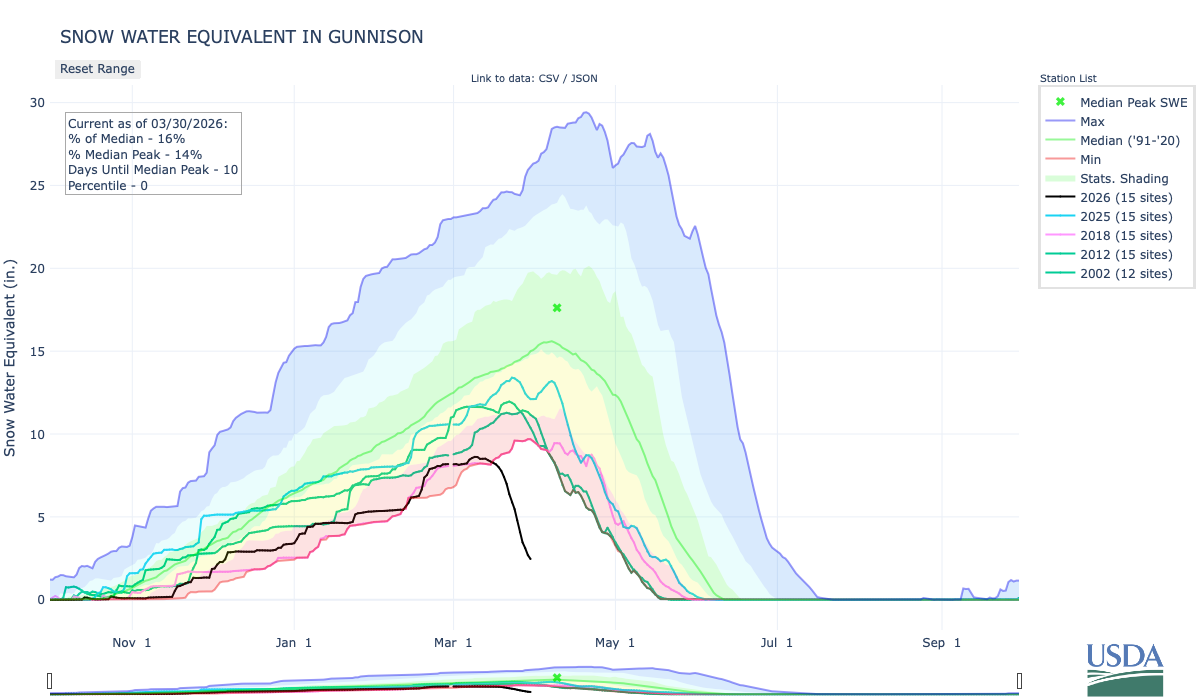
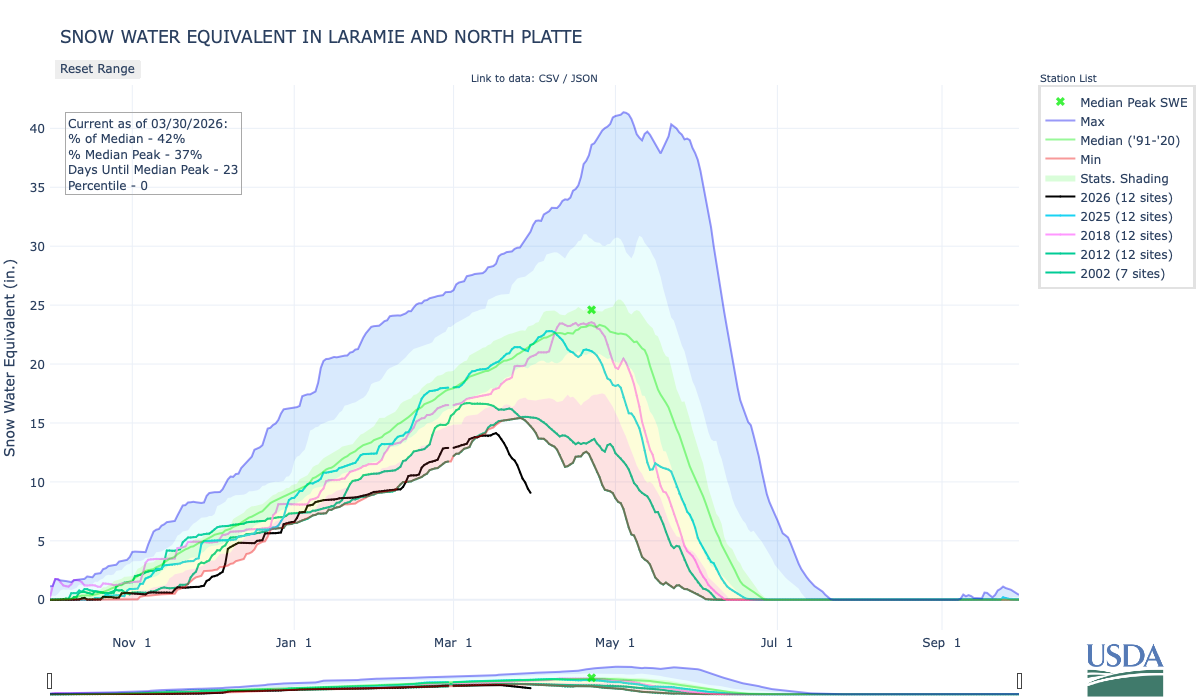
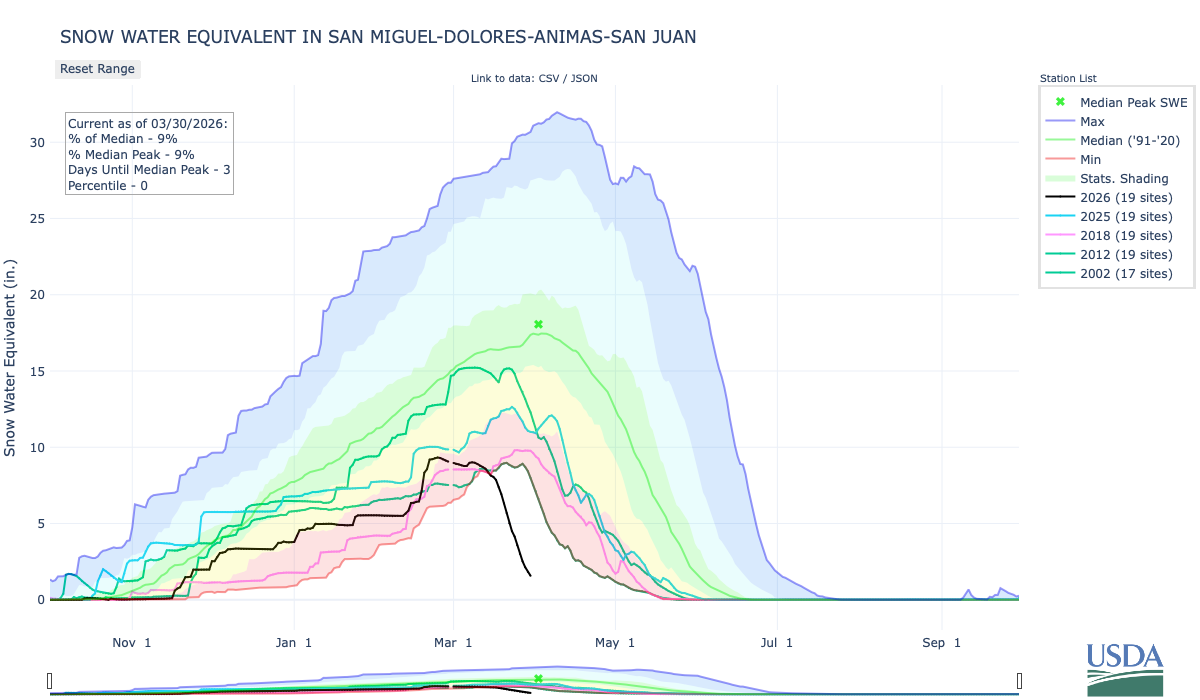
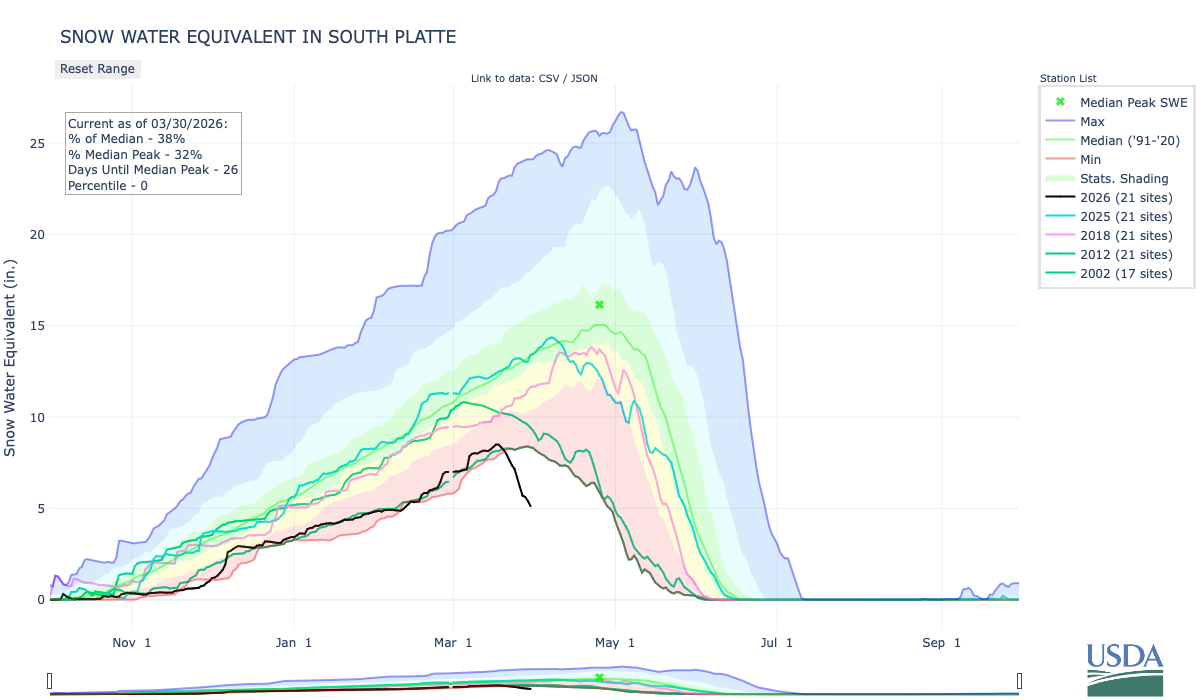
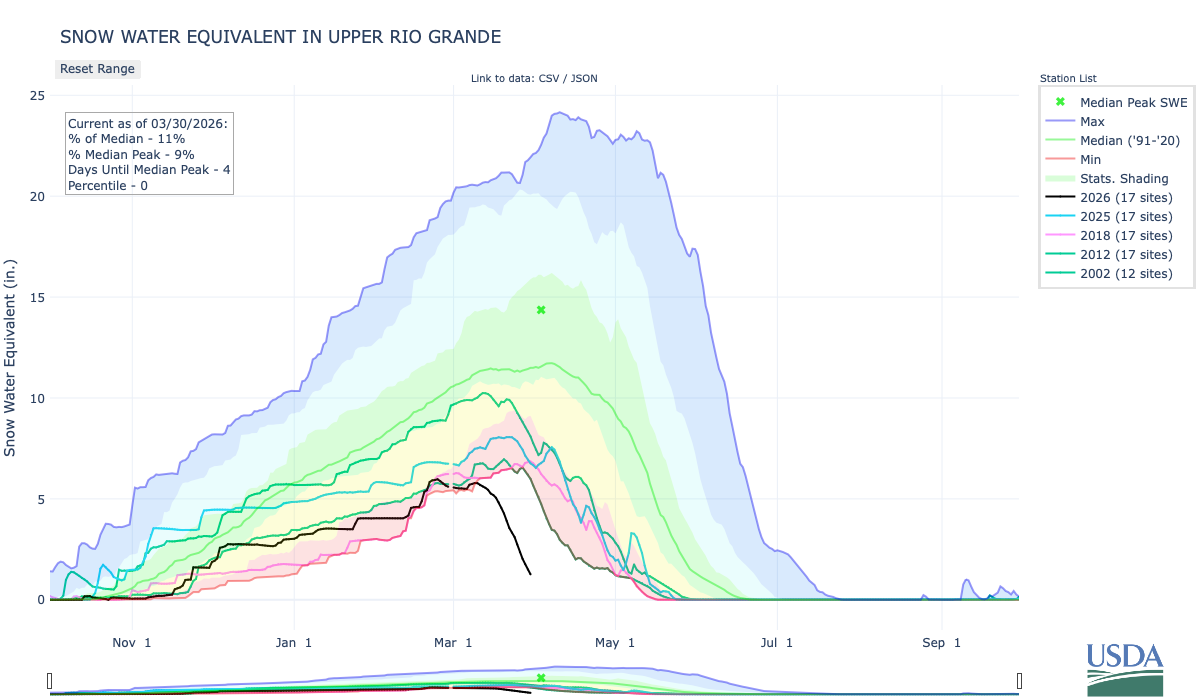
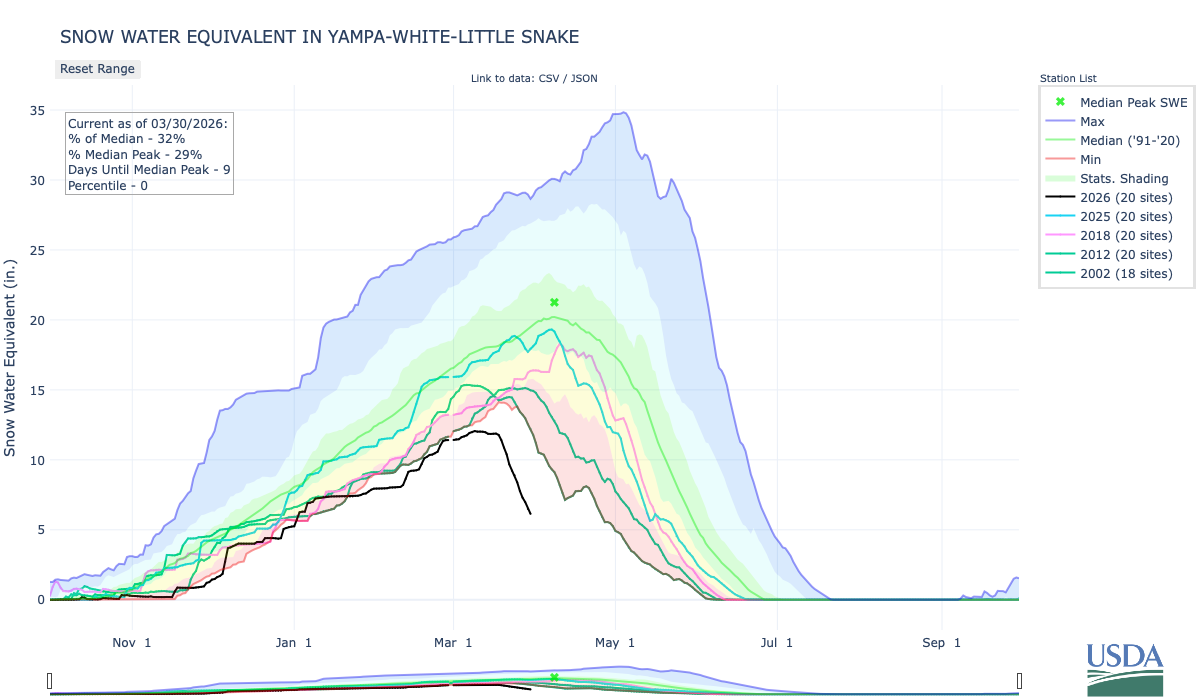
The water footprint of #Arizona’s copper mines: Agriculture guzzles more water, but mines are drying up springs and streams nonetheless — Jonathan P. Thompson (LandDesk.org)
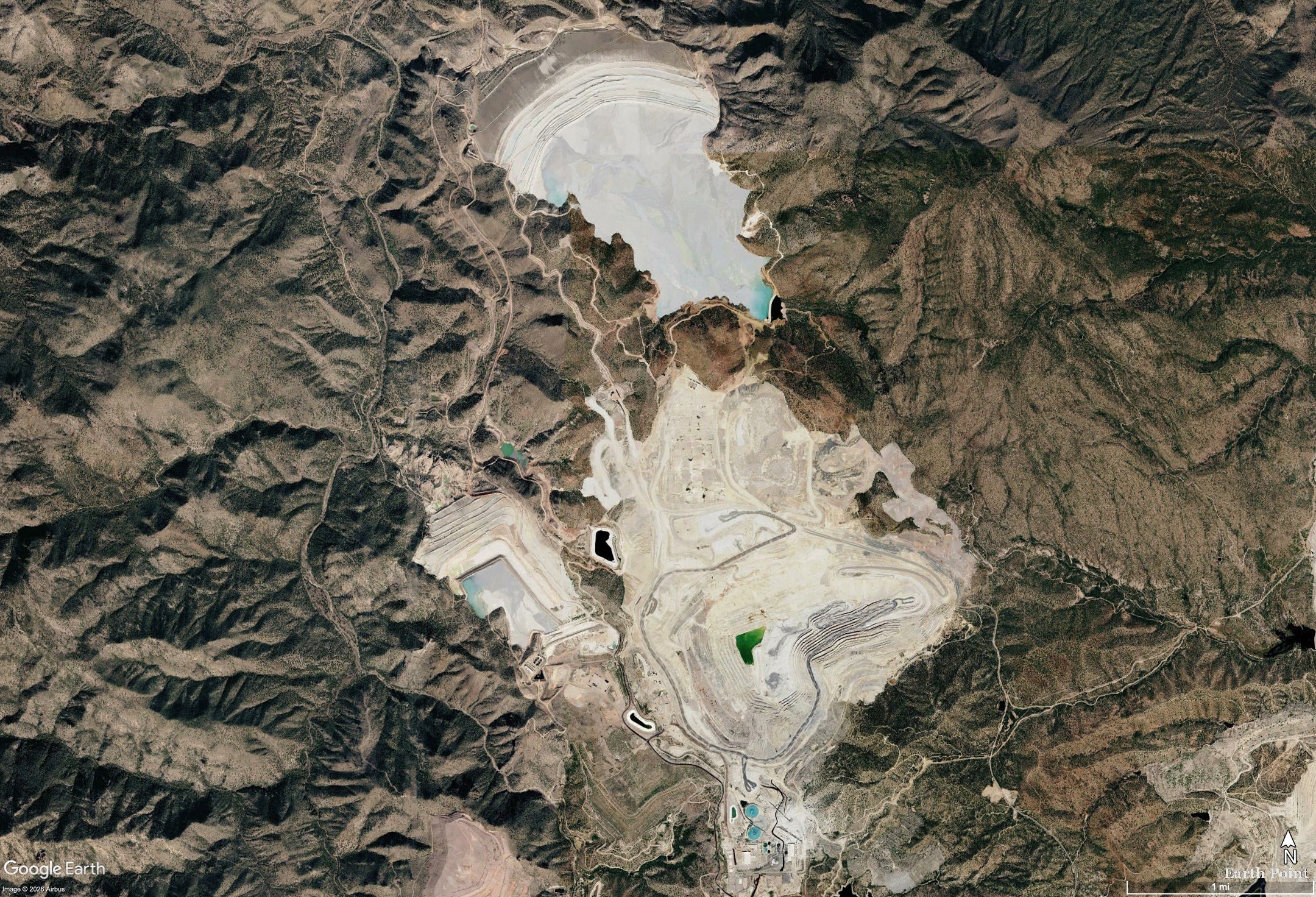
Click the link to read the article on The Land Desk website (Jonathan P. Thompson):
March 24, 2026
⛏️ Mining Monitor ⛏️
Pinto Creek used to run year-round. Bubbling up from springs and occasional snowmelt in the Pinal Mountains of central Arizona, it nourished a riparian ribbon of green through the rocky, arid landscape, shaded by sycamores, willows, and alders, until it empties into Theodore Roosevelt Reservoir. Gila topminnow, longfin dace, and roundtail chub plied its waters. Even during drought years it reliably delivered at least 1,000 acre-feet of water at its Magma Weir gauge, and in wet times as much as 39,000 acre-feet annually might flow along its bed.
Then, a little over a decade ago, something odd happened. The flow volume plummeted from 4,147 acre-feet in 2013 to just 482 acre-feet in 2014, and ever since the once year-round stream has run only intermittently and at similarly diminished levels. Towering trees along its banks have died and toppled, and the green swath has lost much of its color. It’s possible that long-term aridification simply caught up with the little stream, as 2013 was a dry year. But there’s a more likely culprit: In October 2013 Capstone Copper Corporation acquired the nearby Pinto Valley Mine, a massive, open pit copper and molybdenum operation that had just emerged from several years of dormancy, and resumed heavy groundwater pumping from its Peak Well field.
While correlation is not causation, the Tonto National Forest saw enough evidence of a link to ask the Arizona Department of Water Resources to put the brakes on the mine’s groundwater pumping. Failing to do so would harm the Forest Service’s instream Pinto Creek water right — along with the downstream riparian ecosystem it supports. The state did nothing and the Forest Service dropped the complaint and approved the mine’s expansion in 2021.
The Land Desk has often looked at mining’s effects on water quality.1 But the Pinto Valley case highlights the fact that mines can also affect water quantity — and vice versa, as water scarcity can limit mining operations. It warrants a closer look during these water-constrained times, when water consumption by everything from data centers to golf courses to alfalfa farms has attracted more scrutiny.
A mining operation goes through water in two ways. First, the mine itself, whether underground or open pit, can act like a well. Dig a hole into the earth, and groundwater will flow into it. While gravity can drain this flow in underground mines burrowed into the sides of mountains, the water must be pumped from open pit and underground shaft mines, a practice known as dewatering, which can take large amounts of water out of the aquifer. Capstone says it pumps about 400 gallons per minute from its pit.

This draws down groundwater wells and can dry up springs and diminish streamflows. Without dewatering, you end up with something like the Berkeley Pit, which is now a 50-billion-gallon, acidic and contaminated lake that’s about 900 feet deep. Because this water is usually contaminated by acid mine drainage, it often can’t be reused without some treatment, and dumping it into a stream or back into the aquifer is also problematic.
A mining operation also requires significant amounts of water for dust control, mineral processing, slurrying, and other uses. Capstone’s 2024 sustainability report says its Pinto Valley Mine withdrew a total of 8,932 acre-feet — or 2.9 billion gallons — of groundwater and surface water.
The company has not released its 2025 data yet, but in financial filings reported that the Pinto Valley Mine had to slash mine production and mill throughput by about 37% in 2025 due to “unplanned downtime driven by water constraints due to the drought conditions in central Arizona.” The company is trying to address this by reducing per-ton water usage by 20%, but that may not be enough given the extreme drought conditions spreading across the Southwest.
A central clearing house or database of mine water use in Arizona does not exist, but various sources can help paint a picture of how much water the mining industry in the state uses (I’ll look at other states in a future dispatch).
- Safford Mine Complex: Consumptive water use increased from 3,624 acre-feet per year to 6,099 af/yr following a 2020 expansion, according to the Arizona Department of Water Resources 2025 Safford supply and demand report. Municipal uses in the Safford Basin use about 6,000 acre-feet per year, while agriculture — primarily for cotton, pecans, pistachios, and alfalfa — consumes about 138,301 acre-feet annually.
- Freeport-McMoran reported to the AZDWR that in 2023 it withdrew 22,490 acre-feet of groundwater for its Sierrita Mine south of Tucson. The cost? $3.50 per acre-foot. That’s about one penny for 1,000 gallons of water.
- Freeport-McMoran’s Morenci Mine, one of the nation’s largest copper operations, uses about 14,000 acre-feet per year on average, according to the AZDWR. The mine imports much of its water from the Black River, a tributary to the Salt River, under a lease with the San Carlos Apache Tribe for a portion of its Central Arizona Project allocation.
- The following chart is from an Arizona Department of Mines & Mineral Resources report from 2010 by Dr. Madan M. Singh. It’s a nice, comprehensive look at how much water the state’s major mines used in the preceding years. Current use is likely about the same, except that now there are additional mines (the Pinto Valley Mine was not operational in 2010, which is why it’s missing).
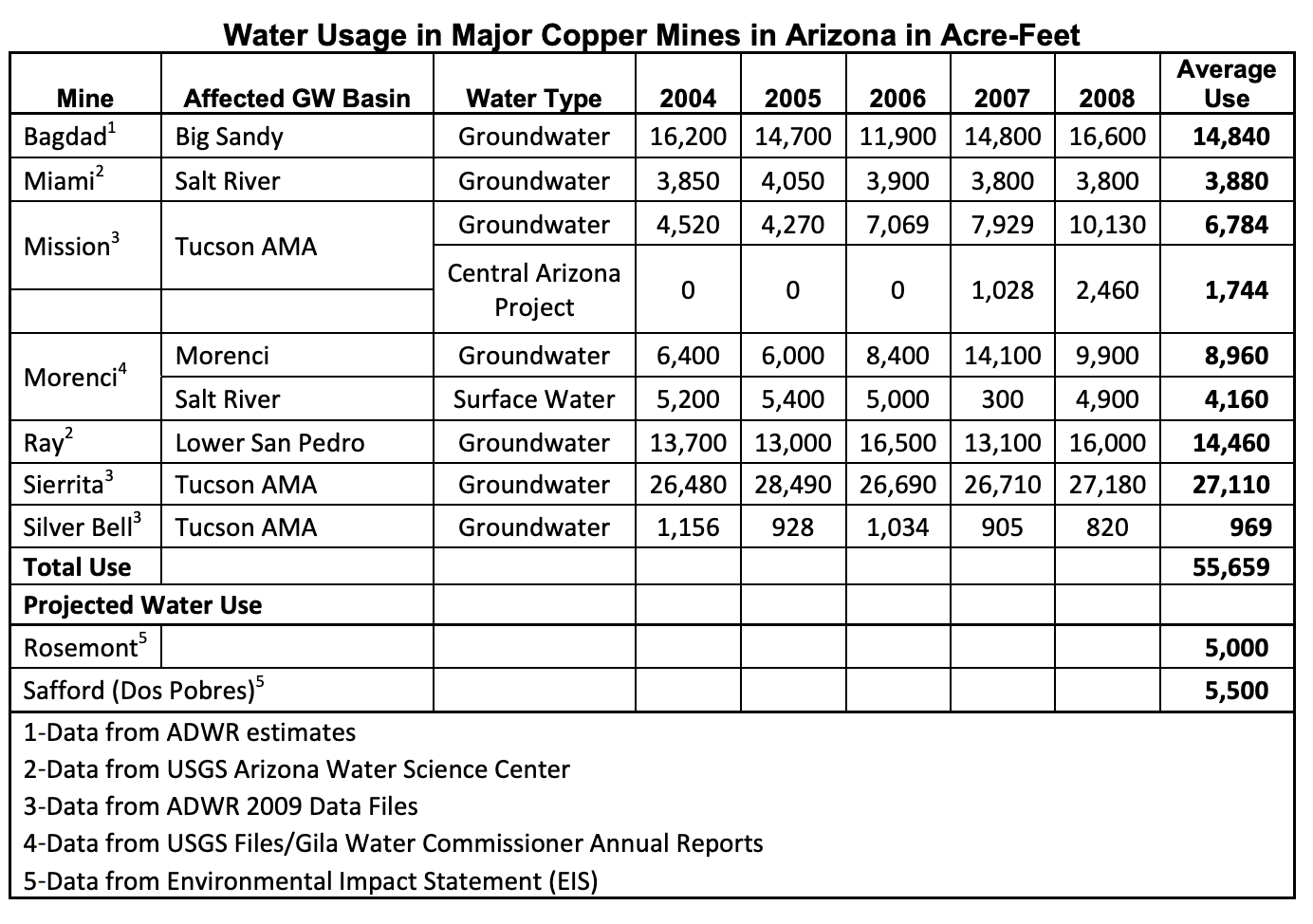
So, according to Singh’s report, Arizona’s largest mines used a total of 55,659 acre-feet per year during the 2000s. Add the Pinto Valley Mine (8,932 af) and Safford Mine (6,099 af) and you get about 70,600 acre-feet per year, or 23 billion gallons annually.
That’s a lot of water, but it pales in comparison to many other uses. Arizona alfalfa, alone, probably uses more than 1.5 million acre-feet (based on 6 af water/acre over 280,000 planted acres, according to the USDA). “Turf facilities” guzzled some 157,000 af in 2024, according to the AZDWR, while power generation used 86,053 acre-feet. TSMC’s north Phoenix chip manufacturing facility is projected initially to use about 19,000 acre-feet of water annually.
In other words, when Arizona’s water cops come looking for the big water users, the mines probably won’t be at the top of their list. Since most mines rely on groundwater, Colorado River water shortages may not affect them too much, at least in the near future.
Still, some mines, including ASARCO’s Mission Mine, do pull some water from the Central Arizona Project, which could be hit hard by the Colorado River crisis as early as next year. And, as the Pinto Valley Mine situation last year demonstrated, continued aridification and relentless pumping could lead to groundwater shortages at the mines, forcing them to reduce production even as they work to become more water-efficient.
Prospective mines could face serious challenges, as well. Resolution Copper estimates its contentious Oak Flat mine would use between 15,700 acre-feet and 20,000 acre-feet per year. Others, however, say this is too low; one study says it would likely be closer to 50,000 acre-feet annually, based on the per-ton water consumption for copper at other Arizona mines. Resolution has said it would rely at least partly on Central Arizona Project water, the security of which grows shakier with each passing year. It’s hard to imagine that there will be any water available for new users by the time that mine is up and running if current climatic trends continue.
That may be what Faraday Copper had in mind when it signed a letter of intent to acquire the San Manuel copper mine in southern Arizona. While Faraday said it would be reopening the long-shuttered operation and combining it with its proposed Copper Creek venture nearby, it may also be eying the substantial water rights BHP Copper holds for the San Manuel Mine. Those could come in handy if and when the Copper Creek facility is developed.
Regardless, however, one thing is clear: Any new mine is going to rob the springs, the streams, and the wildlife and communities that rely on them of at least some of their precious water. [ed. emphasis mine]
1 In 1993, when the Pinto Valley Mine was operated by Magma Copper, a large rain event “overwhelmed the mine’s water management capabilities,” causing the reservoir to overflow the tailings pile, tear out a levee, and carry hundreds of tons of tailings and millions of gallons of contaminated water into Pinto Creek. The creek was found to have low pH (high acidity) and high concentrations of cadmium, copper, lead, mercury, and zinc, resulting in significant fish die off, specifically of desert or Gila Mountain suckers.

Pagosa Country sees more record-breaking heat — The #PagosaSprings Sun #SanJuanRiver #ColoradoRiver #COriver #aridification
Click the link to read the article on the Pagosa Springs Sun website (Clayton Chaney). Here’s an excerpt:
March 26, 2026
It was warmer last week in Pagosa Country than any other time on record, as the area saw five consecutive days of record high temperatures set from March 18-22. According to forecasts posted by Shawn Prochazka with Pagosa Weather, a new record high for the month of March was set on Wednesday, March 18, at 74 degrees and again on Thursday, March 19, at 76 degrees. The previous record high for the month of March was set in 1907 and 1940 at 73 degrees. Record highs for the month continued on Friday, March 20, with temperatures reaching 79 degrees. The previous record for that date was 68 degrees, set in 1997. Prochazka also notes that record high temperatures were set on Saturday, March 21, at 77 degrees, and on Sunday, March 22, at 74 degrees…
Snowpack
According to data from the Natural Resource Conservation Services (NRCS), as of 11 a.m. on Wednesday, March 25, Wolf Creek Pass at 10,930 feet had a snow water equivalent of 12 inches, compared to that date’s median of 27.3 inches. That amount is 44 percent of that date’s median snow water equivalent. The San Miguel, Dolores, Animas and San Juan river basins as a whole are listed at 21 percent of its 30-year median snowpack. The Wolf Creek summit had the second highest current snow water equivalent in the San Miguel, Dolores, Animas and San Juan river basins, and the Upper Rio Grande basin, behind the Black Mesa site with 12.2 inches of snow water equivalent as of press time Wednesday…
Drought
According to the most recent map released by the U.S. Drought Monitor on Thursday, March 19, 100 percent of Archuleta County remains in moderate drought stage, with 22.04 percent of the county being in a severe drought stage. Areas that are in a severe drought stage lie along the eastern border of the county with Conejos County. Meanwhile, 12.88 percent of the state is in an extreme drought stage, and less than 1 percent of the state is in an exceptional drought stage. That includes portions of Pitkin, Eagle, Summit, Lake and Park counties…
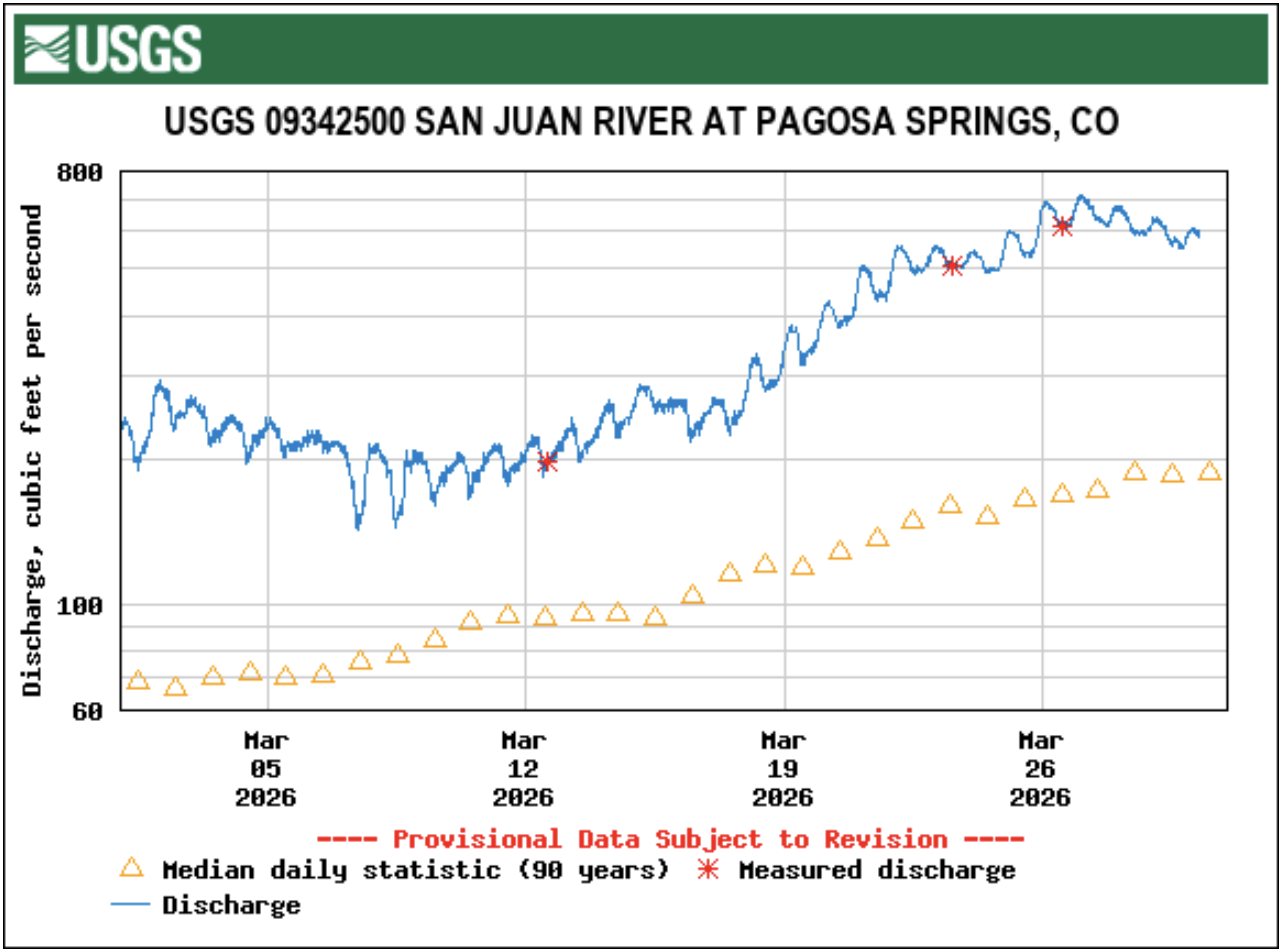
River flows
According to the U.S. Geological Survey (USGS), as of 11 a.m. on Wednesday, March 25, the San Juan River in downtown Pagosa Springs had a flow rate of 595 cubic feet per second (cfs). The record high flow for that date was recorded in 2004 at 860 cfs, while the record low was recorded in 1964 at 42 cfs. The median flow for that date is 165 cfs, and the mean flow is 239 cfs. The Piedra River near Arboles was flowing at a rate of 434 cfs as of 11 a.m Wednesday, March 24, according to the USGS. The median flow for that date is 339 cfs, and the mean flow is 457 cfs. The record high flow for that date was recorded in 1993 at 1,400 cfs, while the record low was recorded in 1964 at 45 cfs.
2026 Rio Grande State of the Basin Symposium recap #2026RioGrande #RioGrande
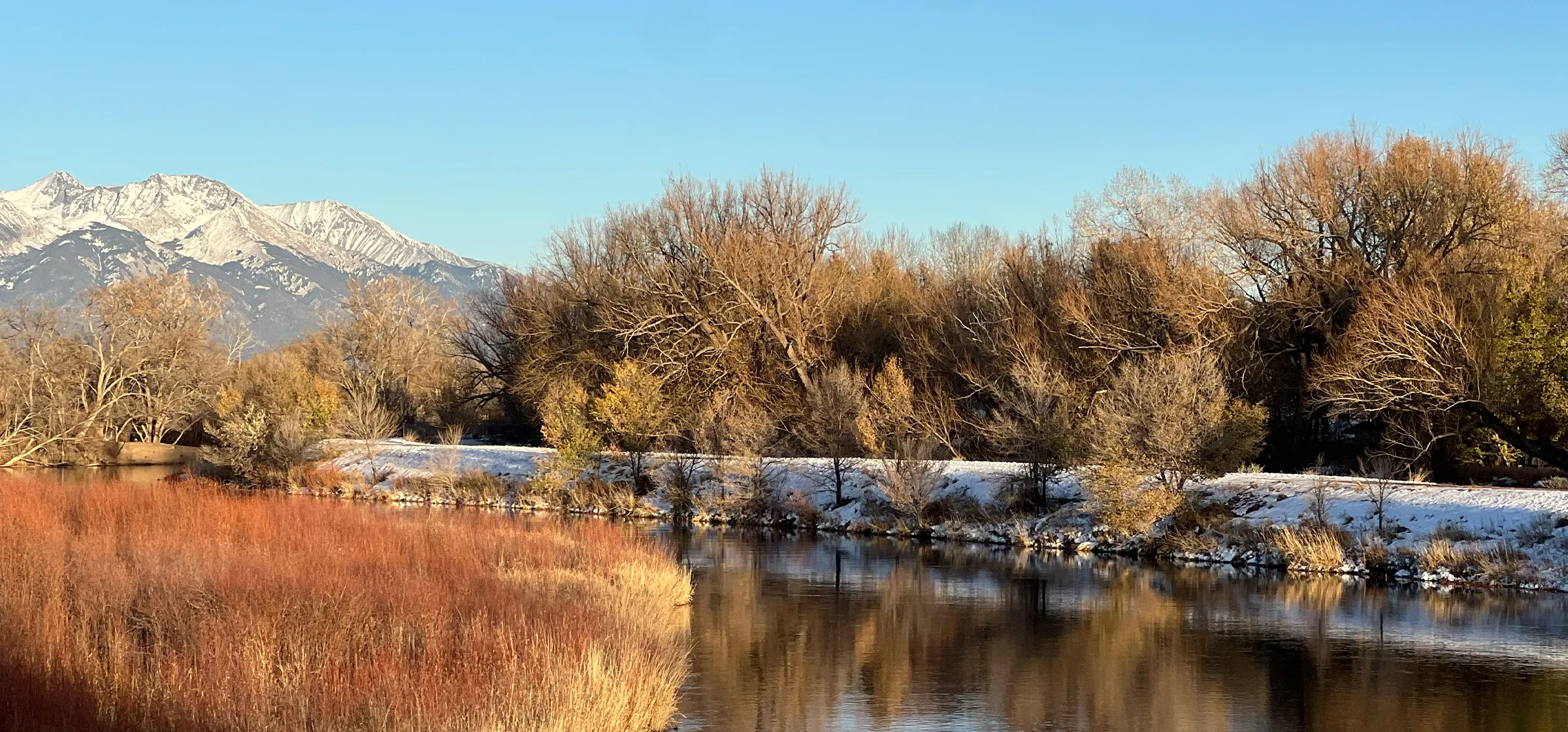
The theme this year was “Where Water Connects Us: Past Meets Present in the San Luis Valley”. Paul Formisano and the staff and volunteers from the Salazar Rio Grande del Norte Center delivered a varied, timely and interesting agenda!
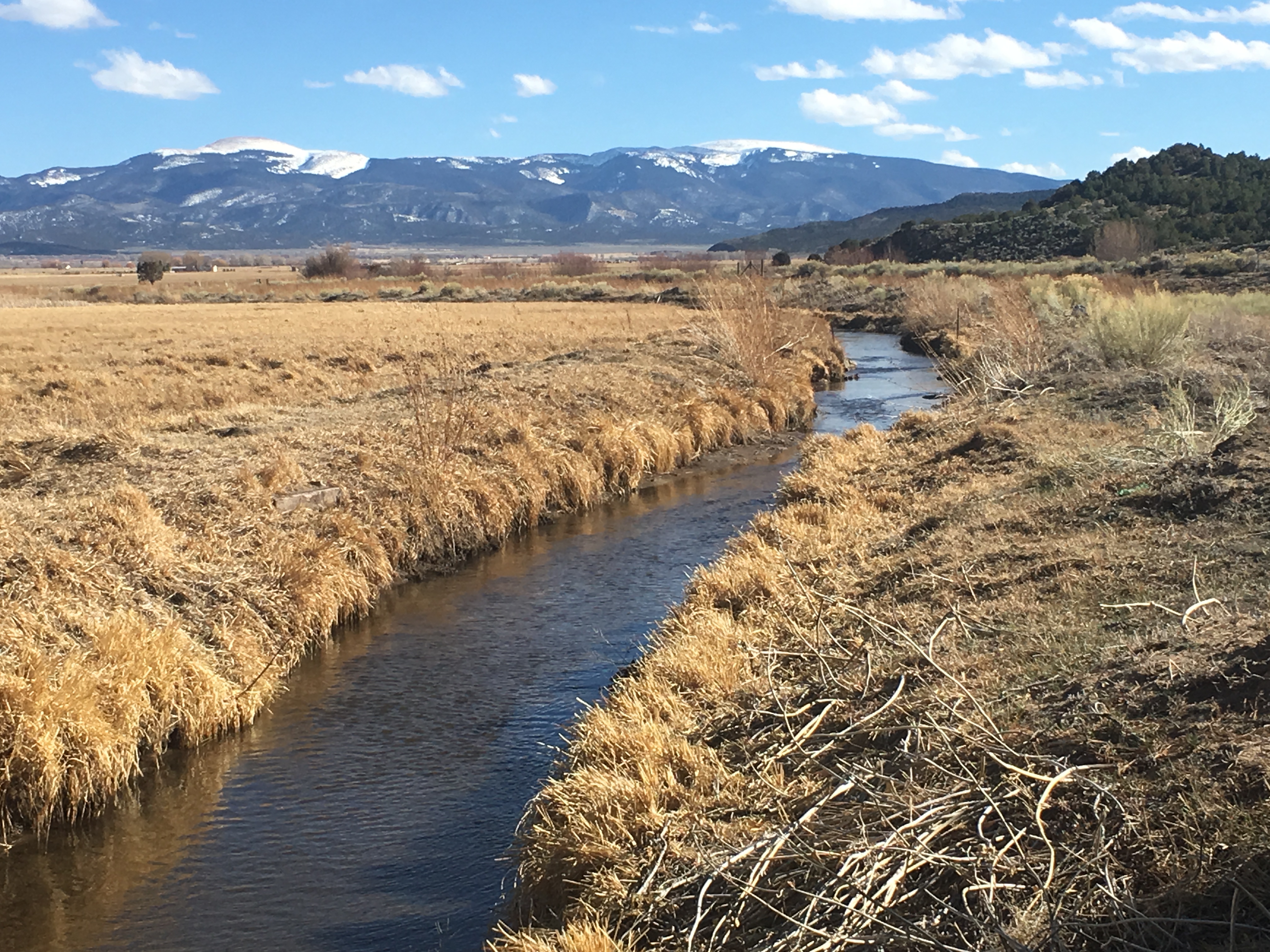
Ken Salazar set the stage for the sessions, reminding attendees that, “Early settlers knew the only way to bring prosperity to the valley was to do it collectively as the early acequias did.”
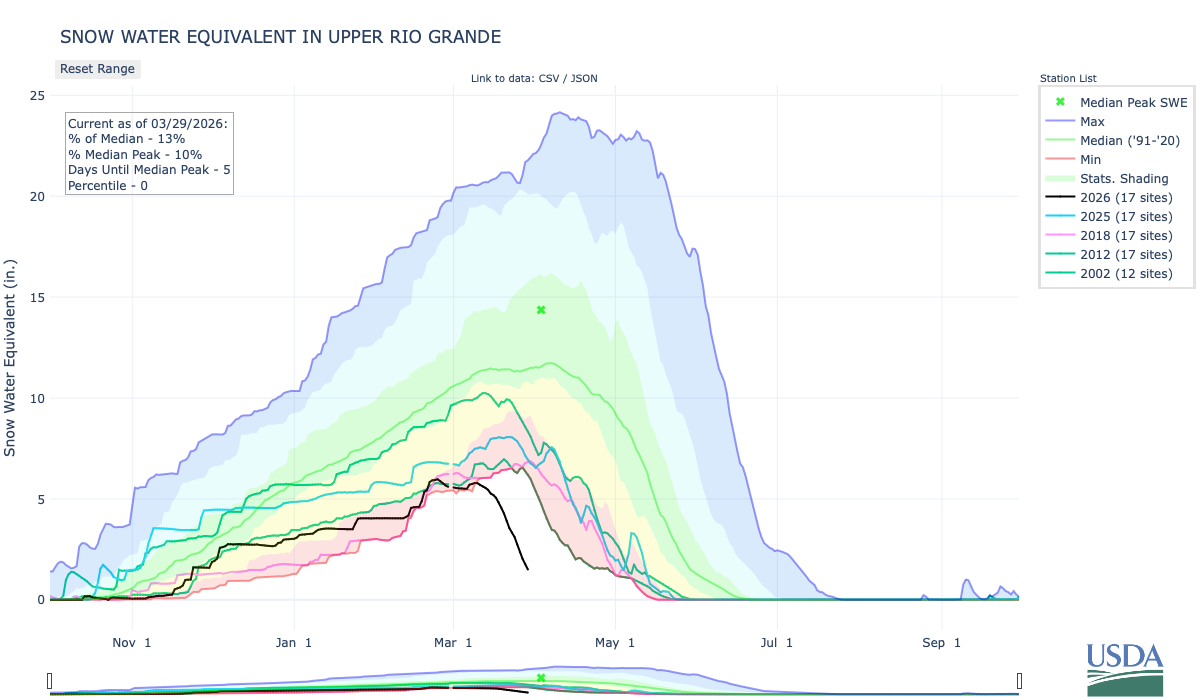
The first session was titled, “State of the Rio: The 2026 river outlook general basin and compact projections” and the general consensus from the speakers was, as Brad Udall recently said about the Upper Colorado River Basin, “There is no historical analog,” for these conditions. Snow drought is front and center in the San Luis Valley these days.

Precipitation in the basin started out the water year in great shape due to a big rain event in early October. Since then there have been modest accumulations but has flattened out since late February to date.
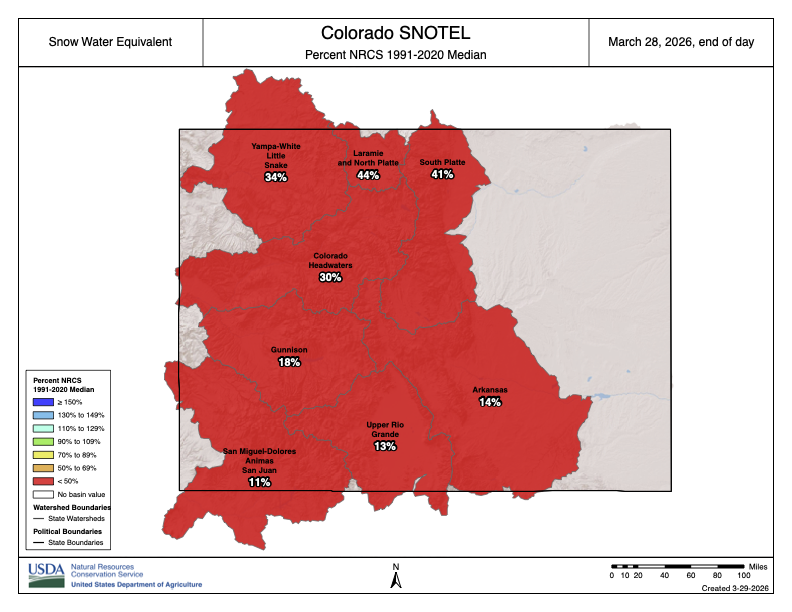
Division Engineer Craig Cotten started off his presentation with the basin-filled snowpack map for Colorado. He joked that, “The good news is, the Rio Grande is not the worst in the state.” It is not a good year as far as #snowpack and many SNOTEL locations are already melted-out.
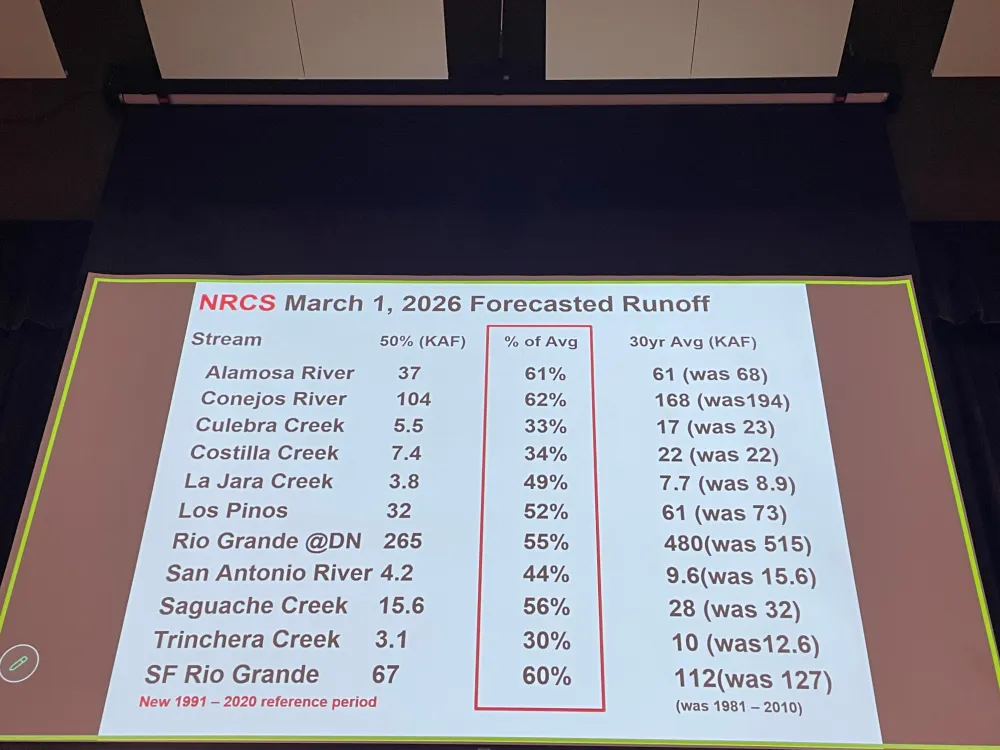
Projected streamflow is not looking good and the forecast will likely be worse when the April 1, 2026 numbers are released by the NRCS. However, streamflow right now is looking okay, there is a lot of water in the #RioGrande at this time for example. That means that the little snowpack in the basin is already coming off.
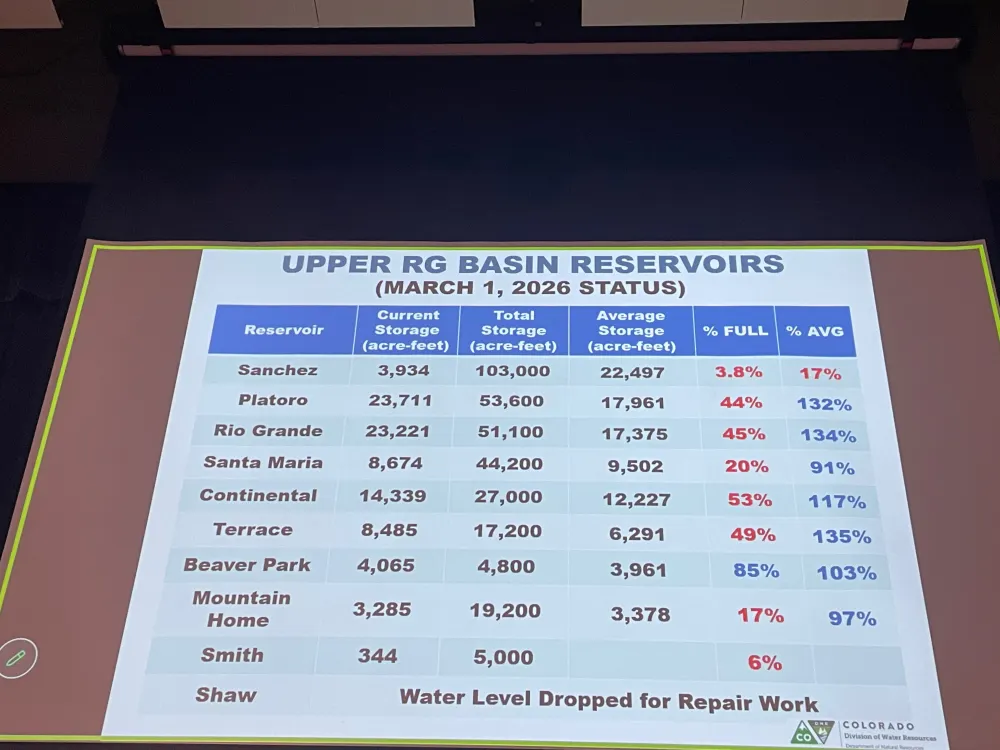
Reservoir storage is in good shape (as a percent of average) except Sanchez Reservoir which has been drawn down for maintenance and repairs.
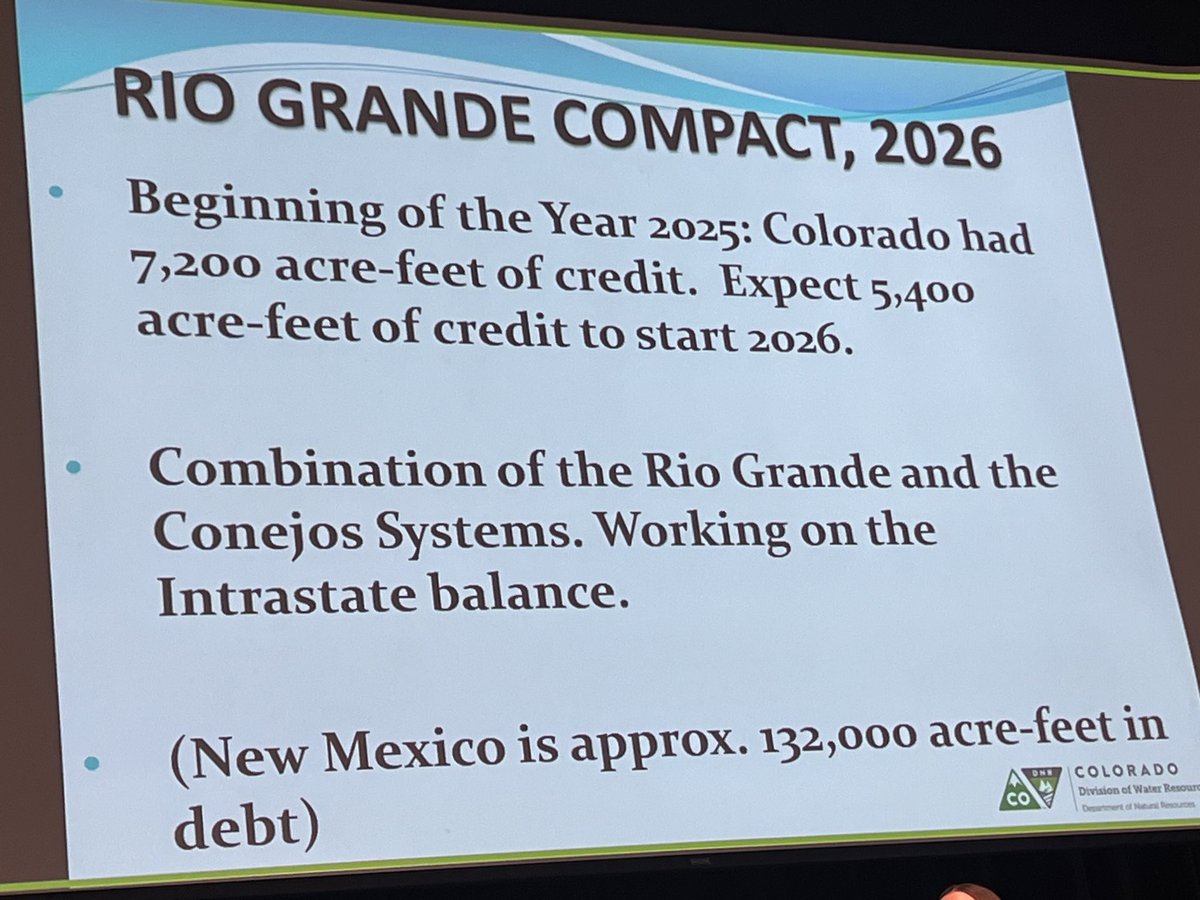
Colorado’s Rio Grande Compact compliance numbers heading into the scary diversion season are a positive. There is no debt owed to New Mexico and Texas. With the early onset to runoff season the State Engineer allowed irrigation to start on March 23, 2026. Current estimated streamflow for the Rio Grande at Del Norte (the compact USGS gage used for the river) is 305,000 acre-feet which carries a compact obligation of 76,000 acre-feet to New Mexico and Texas. For the Conejos River the estimated upper index annual flow is 165,000 acre-feet and the downstream obligation is 27,500 acre-feet. However, water levels are going to drop in the unconfined aquifer significantly this year due to low flows in the river. The situation in the aquifer is bad and it is going to get worse.
Cotten updated the attendees about the Rio Grande Compact lawsuit status. It is mostly a fight between Texas and New Mexico and the latest stipulated agreement has been approved by the Special Master. The U.S. Supreme Court is expected to approve the agreement.
Nathan Coombs, in keepting with the symposium theme said, “I believe we’re going to be alright this season we’re going to survive. People in the San Luis Valley are working together and we’re going to get through it.”
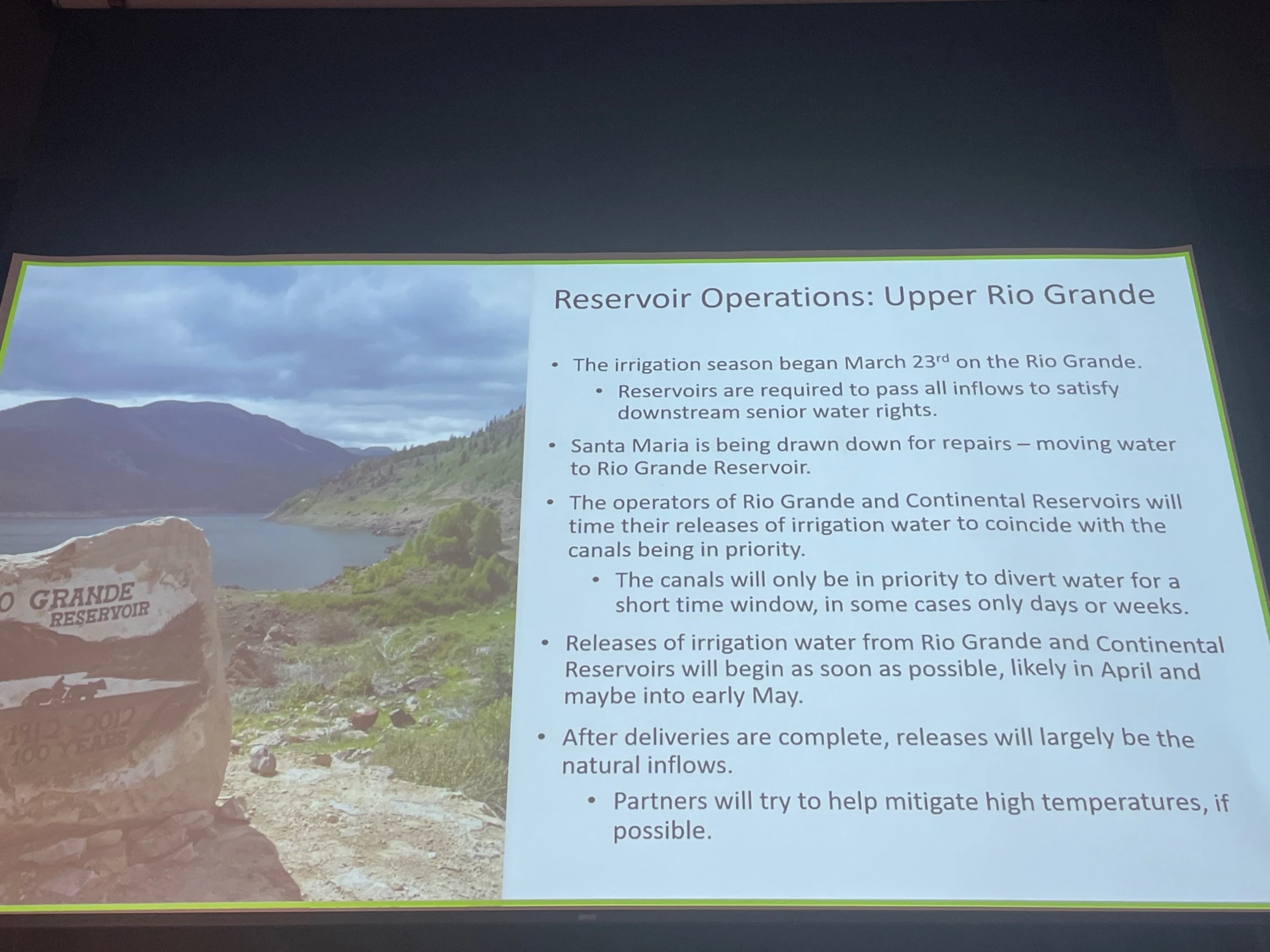
Heather Dutton gave an overview of reservoir operations for 2026. It is possible that all irrigation water will be released in April and May. She added, “If you’re going to fish the streams emphasize fishing in the morning and visit one of our valley breweries in the afternoon. It’s going to be tough year for all of us. Please keep the farmers in mind.”
Reclamation informed attendees about the current status of the Closed Basin Project. Project priorities are:
- Colorado’s compact deliveries
- Mitigation for construction and pumping
- Eliminate Colorado’s Rio Grande Compact deficit
- Other beneficial uses/irrigation
The session “Twenty years of subdistricts” illustrated how the well owners have been working together over the years to determine a solution to the declining unconfined aquifer. Because groundwater is not separate from surface water the lowered levels in the aquifer affect surface streamflow in the Rio Grande. Valley pumpers have formed several sub-districts fashioned around the different hydrology in areas of the aquifer and are retiring some wells and taking land out of production. Another strategy used has been o develop augmentation plans to offset pumping. All of the strategies involve fees to sub-district members. There is extensive coverage of the issue on Coyote Gulch if you are interested in taking a trip down memory lane.
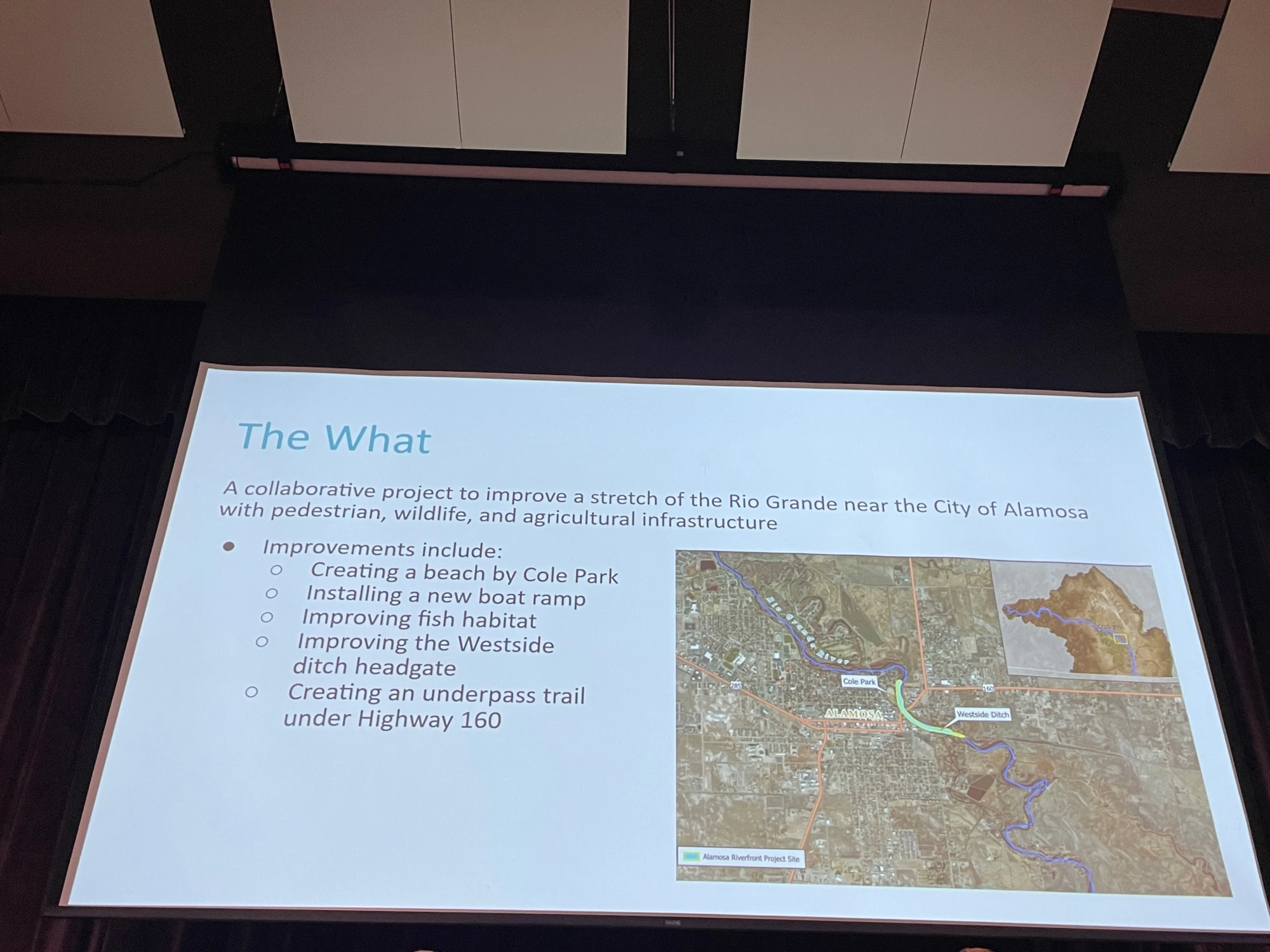
The session “Flowing together: Agriculture, rivers, and communities in partnership” was an overview of collaboration between the City of Alamosa, the West Side Ditch, and Rio Grande Headwaters Restoration Project on the river at the east side of Alamosa. It included a new headgate for the ditch company and will include a new levy orientation and access to the river from Cole Park. The speakers emphasized that it would not have happened without collaboration and the emphasis on creating a win for all stakeholders. For example, Bill Schoen credited the Rio Grande Headwaters Restoration Project for finding funding for the new headgate which is often a problem for mutual ditch companies. Daniel Boyes of the Restoration Project said that the new headgate helps fish and safety for boaters.

The final session before the keynote was “Perspectives on valley recreation” where access to public lands and the value of building a recreation economy to bolster valley opportunities were discussed. While 39% of Colorado’s agricultural output is from the valley economic activity is seasonal. The discussion centered around bringing tourism to the valley to improve the outlook for employment and economic growth.

The keynote speaker was Ben Golfarb and it was a real treat. I never tire of learning about “Nature’s Engineers” and the amazing effect this keystone species has on hydrology and habitat. Trapped extensively by fur traders to enable the fashion industry in the 19th century the species was nearly extirpated from the North American West. Along with a torrent of information and photographs, Goldfarb informed attendees that the native tribes did not participate in trapping because of their understanding of beaver’s role in the arid lands.

Reclamation needs 1.7 million acre-feet to save #LakePowell this year — The #Aspen Daily News
Click the link to read the article on The Aspen Daily News website (Austin Corona). Here’s an excerpt:
March 25, 2026
River managers need to conserve around 1.7 million acre-feet in Lake Powell to keep the reservoir from dropping below hydropower turbines this year, according to federal government projections. The Bureau of Reclamation, a federal agency that manages dams on the Colorado River, has estimated that reservoir levels could fall below required elevations for hydropower production before August as record-low snowpack turns into pitiful flows in streams and rivers.
“The situation is dire, the stakes have never been higher, and the reservoirs have never been drier,” Estevan Lopez, New Mexico’s negotiator on interstate Colorado River matters, said during a meeting of the Upper Colorado River Commission on Tuesday [March 24, 2026].

If water levels fall below required levels for hydropower production, dam managers will be forced to release water through bypass tubes, which are not designed for sustained, high-volume flows. With too much use, the bypasses could fail, turning the dam into a massive plug in the river and shutting off downstream flows. To keep Powell above those critical levels, federal officials can either fill it with water from upstream reservoirs, including some in Colorado, or they can reduce the water it drains from Powell and sends to the Lower Basin (California, Arizona and New Mexico). States are already expressing their views on how those operations should work. Upper Colorado River basin states, including Colorado, want the federal government to achieve the conservation requirement by reducing water releases to downstream states, at least in part. Upper Basin states say upstream reservoirs aren’t enough to save Powell without cuts to Lower Basin water deliveries. Draining the upstream reservoirs could also leave the system without backup supplies in the event of another dry year…The three primary reservoirs that could prop up Powell are Flaming Gorge in Wyoming, Navajo Reservoir in New Mexico, and Blue Mesa Reservoir near Gunnison, Colorado. Of the three, only Flaming Gorge is large enough to contribute the entire 1.7 million acre-feet on its own, and that would require draining the reservoir to halfway full. Blue Mesa and Navajo already stand at around halfway full, and the two reservoirs likely could not provide the water to save Lake Powell even if both were entirely drained.
#ColoradoRiver Remains in Crisis with Continued Uncertainty on Water Supply and Operations — Jennifer Pitt (Audubon.org) #COriver #aridification

Click the link to read the article on the Audubon website (Jennifer Pitt):
March 20, 2026
Audubon and partners cut through the conflict with a unique, basinwide perspective, championing the river’s health for the people and birds that rely on it.
The winter of 2025-2026 has not been kind to the Colorado River. Record-warm temperatures day after day across the mountains that feed the river have led to record-low snow levels. All indications are that spring snowmelt feeding the river will be scant.
That is a huge problem, because Colorado River reservoirs, which historically held vast water reserves, are already depleted, with Lake Powell at 25% and Lake Mead at 34% of capacity. This is bad news for people and birds relying on water from the Colorado River. The U.S. Bureau of Reclamation (Reclamation), the federal agency managing the dams, projects that Lake Powell’s water levels could fall low enough to threaten Glen Canyon Dam’s infrastructure, downstream water delivery, hydropower, and native wildlife in the Grand Canyon including the California Condor and the Western Yellow-billed Cuckoo, among others.
As this crisis plays out, Reclamation has the difficult job of re-tooling systemwide, long-term dam operations on the Colorado River (often referred to as the “Post-2026 Guidelines”). Existing rules, first set nearly two decades ago and tweaked repeatedly to keep up with the declining Colorado River (the result of a warmer and drier climate), expire at the end of this year. As anticipated under this timeline, Reclamation issued a Draft Environmental Impact Statement (Draft EIS) in late January which laid out potential alternatives for federal management and solicited comments from stakeholders. This Draft EIS embraced uncertainty as a central planning condition as they tested different approaches under a broad range of hydrologic conditions. For a long time, the expectation was that the seven U.S. states sharing the river (Arizona, California, Colorado, New Mexico, Nevada, Utah and Wyoming) would develop a consensus-based proposal for Reclamation, but that hasn’t happened and talk of litigation has increased.

Reclamation must now figure out next steps. The agency does have legal authorities, but those legal authorities were crafted long ago and do not necessarily spell out how to take meaningful action in this historic crisis. That threatens the water supply for more than 35 million people including the major cities of the American Southwest, Tribes, millions of acres of irrigated farms and ranches, as well as the Colorado River itself and every living thing that depends on its habitats, including hundreds of bird species like the Southwestern Willow Flycatcher, Yuma Ridgway’s Rail, and Summer Tanager.
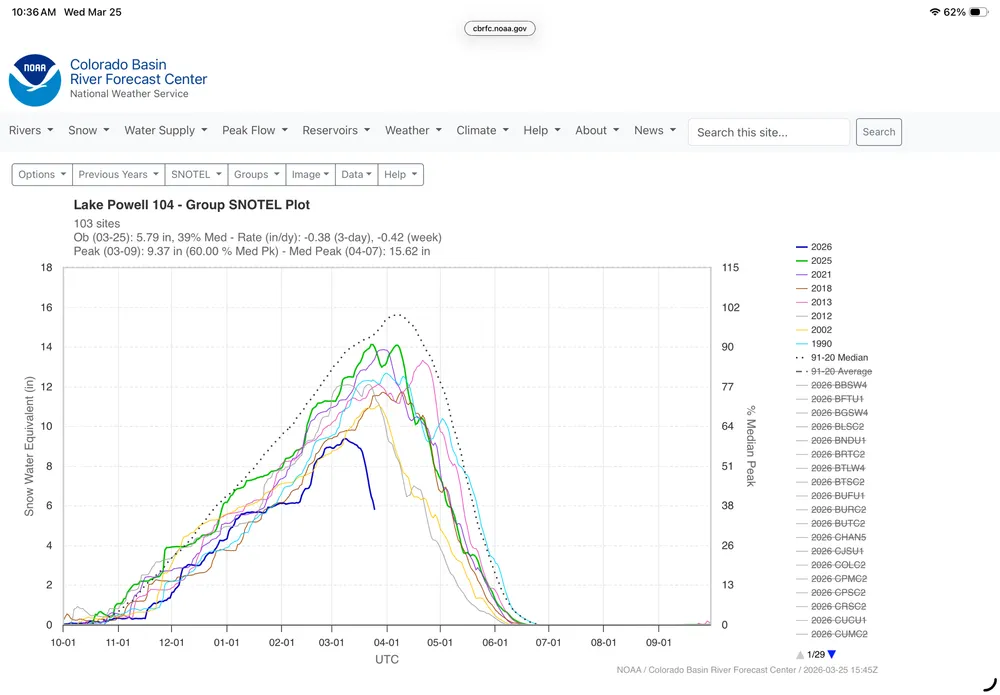
Audubon submitted formal comments in response to the Draft EIS, joining conservation partners to weigh in on what comes next for Reclamation’s consideration (read our comment letter here). Dozens of comments were submitted by the Colorado River Basin states, water users, and other stakeholders making their case with Reclamation that their water uses need to be protected at the expense of others. In its comments Audubon emphasized the need to stabilize the Colorado River system from its headwaters to its delta—a unique, basinwide perspective that urges Reclamation to manage risks for people and nature rather than deferring hard decisions until emergency conditions force action. Our comment letter focused on constructive engagement noting the Draft EIS’s strengths in its analytical foundation while identifying and describing targeted refinements that would help ensure the Final EIS fully informs decision-makers about risks and real-world consequences. Specifically, Audubon calls for:
- Clarity and predictability
- Flexible, adaptive tools for conserving, storing, and managing water
- Environmental stewardship embedded into operations
- Meaningful and voluntary Tribal participation
- Pathways for advancing in-basin mitigation and resilience-building opportunities
- Pathways for advancing binational cooperation with Mexico
Over the next few months, Reclamation still has an opportunity to persuade the Colorado River Basin states into consensus. Whether or not they are successful (and we hope they are), sometime this summer we expect Reclamation to issue a Final EIS that includes refinements to the Draft as well as an indication of their preferred alternative for Colorado River operations. In the meantime, it is urgent Reclamation also prepare for the water supply emergency that is unfolding in 2026.
For much of the last century, Reclamation was a leader in developing the southwestern United States by harnessing the Colorado River and delivering its water across the land. Today, Reclamation must lead in a new way, helping everyone and everything that depends on the Colorado River live with the river we have in a warmer, drier world.
DOWNLOADABLE RESOURCES
CoalitionComment ColoradoRiverDraft EIS.pdf
Coalition Technical Comment Letter Responsive to Colorado River Draft EIS
An unprecedented spring heat wave — Allie Mazurek (#Colorado Climate Center) #snowpack #runoff
Click the link to read the article on the Colorado Climate Center website (Allie Mazurek):
March 26, 2026
Last week’s heat wave was record-smashing, extraordinary, and impossible to ignore. Given that temperatures were more typical of what we’d expect in June, we’ll try not to judge you if you felt the need to turn on your A/C. 🙂
In this blog post, we’ll provide some climate context on last week’s mind-boggling temperatures and touch on the current drought and snowpack situation. And while we’ll focus on the heat from last week here, it’s worth noting that yesterday, March 25, featured yet another round of record-breaking temperatures across Colorado, including new March high temperature records in Denver (87°F) and Grand Junction (88°F).
Widespread, eye-popping warmth
For pretty much all of Colorado, last week brought the warmest March temperatures ever recorded. There were far more stations in the state that broke all-time monthly high records for March than did not. Here’s a look at the records that were set at some of our long-term climate sites:
From the [table] above, you’ll see that we didn’t just break previous monthly records by a small margin; new records were set by several degrees. It would be noteworthy to have new daily climate records were set by these kinds of margins, but to see monthly records shattered by more than 5°F across numerous stations is truly remarkable.
Another way of looking at this is by comparing the highest temperature observed this March (through the 22nd) to the highest temperature observed in all Marches from 1951—2025 in a gridded temperature dataset (in this case, NOAA’s nClimGrid). Nearly the entire state is red, meaning this March broke the previous record over this time period. (The main exception is at the highest elevations, where it was slightly warmer in March 1987.) Furthermore, most of the state saw temperatures at least 5°F higher than had previously been seen in March. The all-time March record for Colorado of 96°F at Holly in 1907 was not broken, but was tied at numerous locations including La Junta, Burlington, Campo, and Walsh.
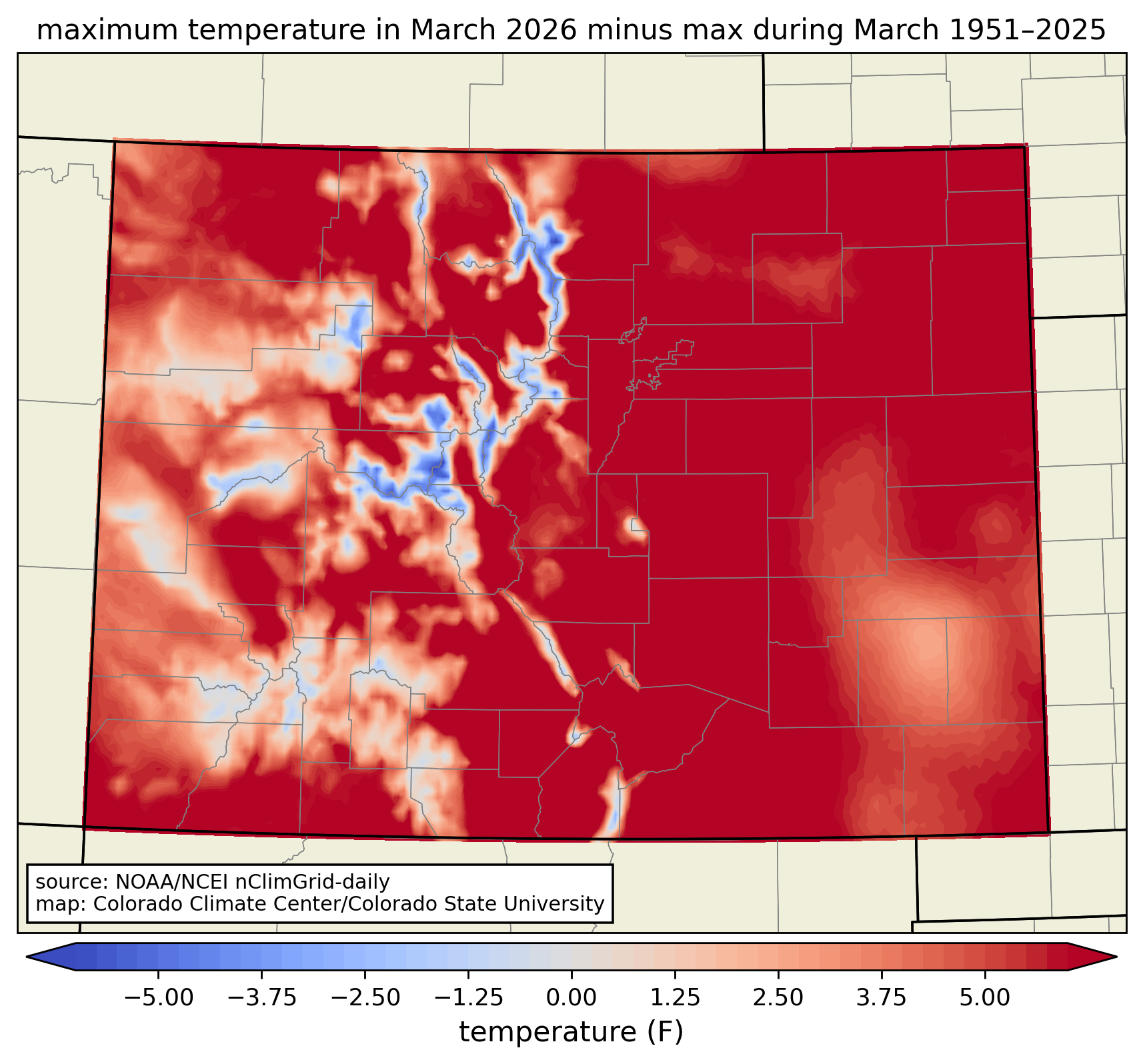
To put an even bigger exclamation point on these incredible records, there were several places in Colorado that not only set new all-time records for March, but they also saw warmer temperatures than their all-time records for April. This includes places like Alamosa (new March record of 83°F; current April record is 80°F) and Fort Collins (new March record of 91°F; current April record is 89°F). Comparing last week’s temperatures to records since 1951, you’ll notice that most of the Front Range Urban Corridor, San Luis Valley, and lower elevations in southeastern Colorado saw warmer temperatures than any March or April day in the past 70+ years:
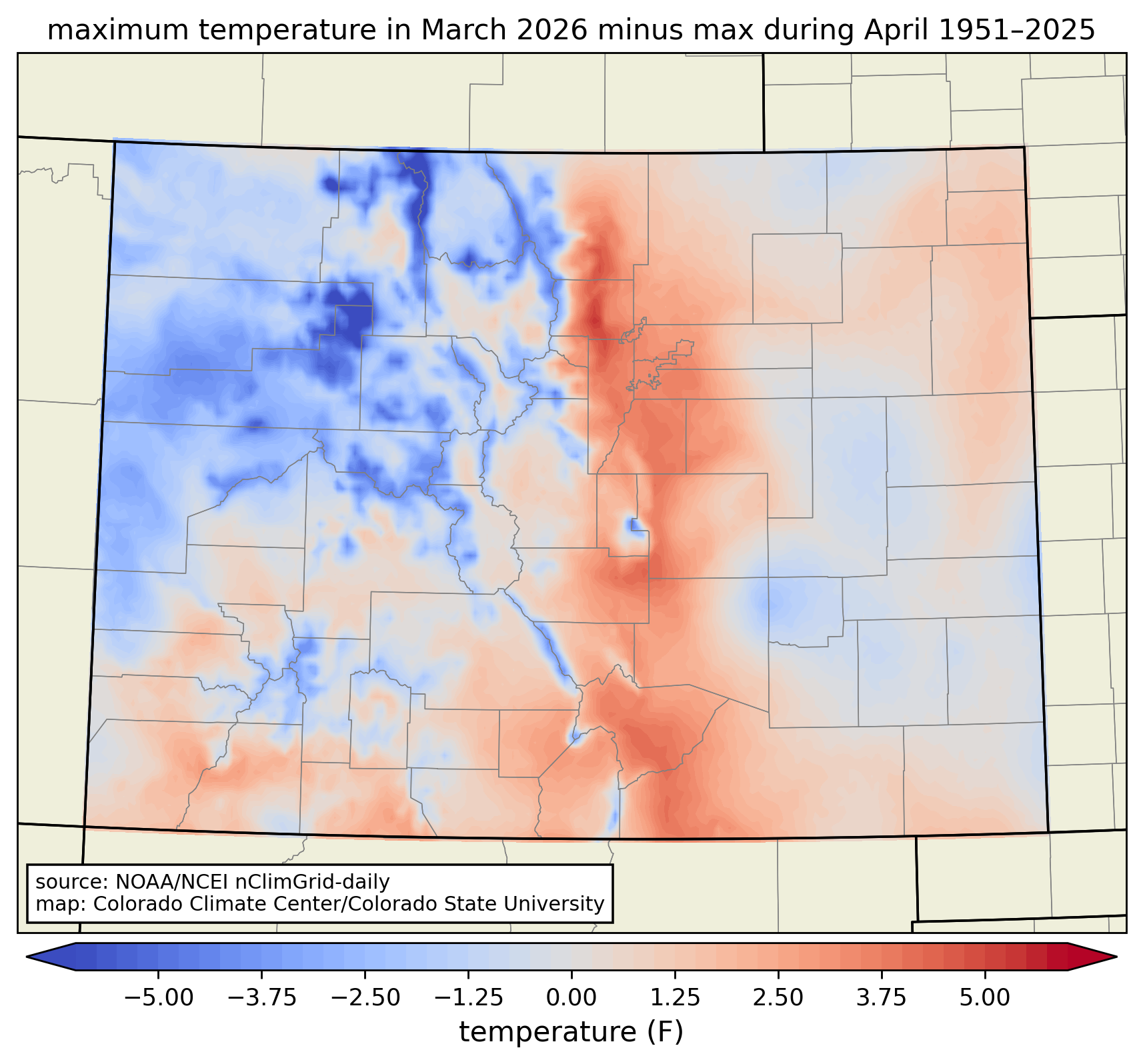
As you might expect, the kind of heat that we saw last week across Colorado is more typical of June or even July. In Fort Collins, the reading of 91°F on March 21 marked Fort Collins’s earliest 90°F or warmer day (the previous record was May 5, set back in 2000). On average, Fort Collins doesn’t see its first 90°F or warmer day until June 15:
Last week’s heat was not only remarkable in terms of intensity but also longevity. The most significant heat occurred across four days (March 18-21). Over that period, several locations set new monthly records every one of those days, with each day being warmer than the last. This was a common theme throughout much of the western US:
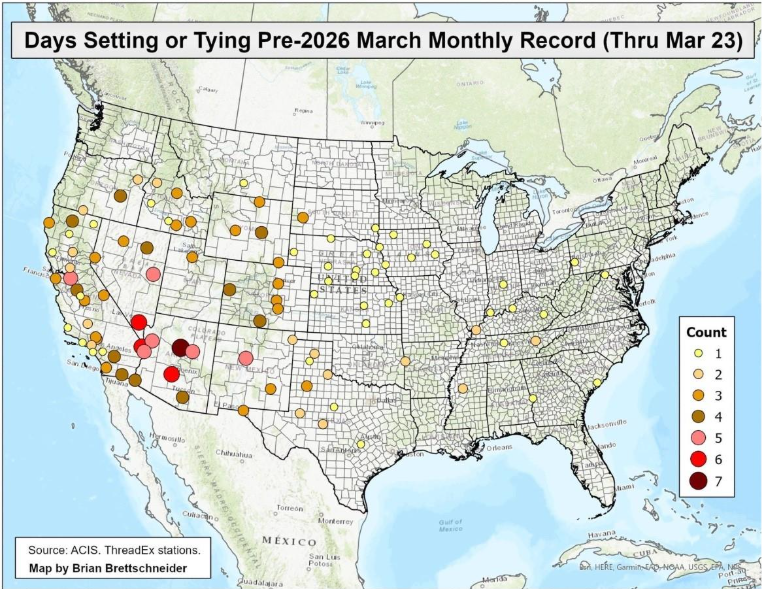
In Colorado, this long-lasting, remarkable heat was far beyond anything we’ve seen in March. Comparing last week’s heat to previous March “heat waves” (defined as days with the warmest 4-day averaged temperatures), it was a step far above the rest. Statewide averaged temperatures during March 18-21, 2026 period were nearly 5°F warmer than Colorado’s 2nd-warmest March heatwave (March 23-26, 2004):
Snowpack is rapidly declining
One of the most concerning consequences of last week’s is the impact to our snowpack. If you’ve been following along throughout the winter, then you’re well-aware that Colorado has been seeing its worst snowpack in at least 45 years. And the very warm conditions over the past week have exacerbated an already bad situation.
Looking at the statewide water-year-to-date snowpack in the SNOTEL network, it’s clear that snow water equivalent has taken a massive nosedive over the past week or so. On average, Colorado’s peak snowpack date is April 7, meaning that we should still be seeing snowpack accumulate in late March. Instead, averaged over the state, snow water equivalent has declined by over 2.5 inches in the last week. We typically don’t see snowpack melt this quickly until May, so to observe this trend so early in the season is highly concerning.
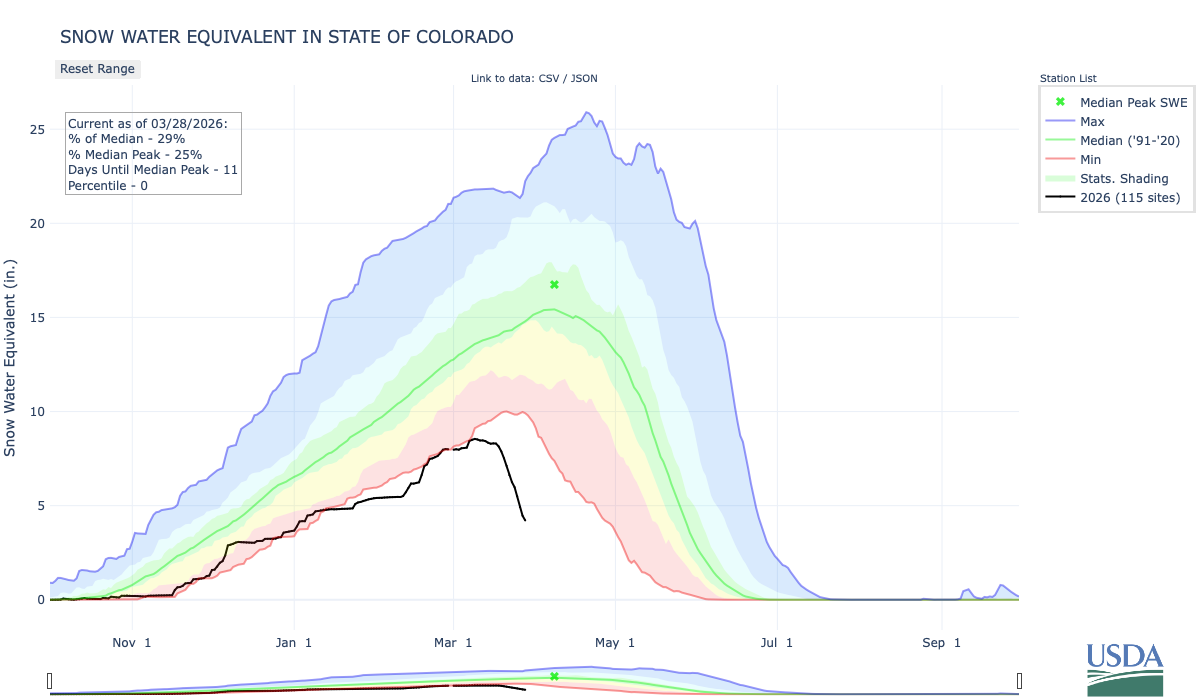
Statewide snowpack currently sits at [29%] of the 1991-2020 median. Given the current conditions and forecasts, it’s very possible that many locations have already seen their peak snowpack. Every major river basin in the state is running way-below average, with 71 of the 92 active SNOTEL stations reporting their lowest values on record:
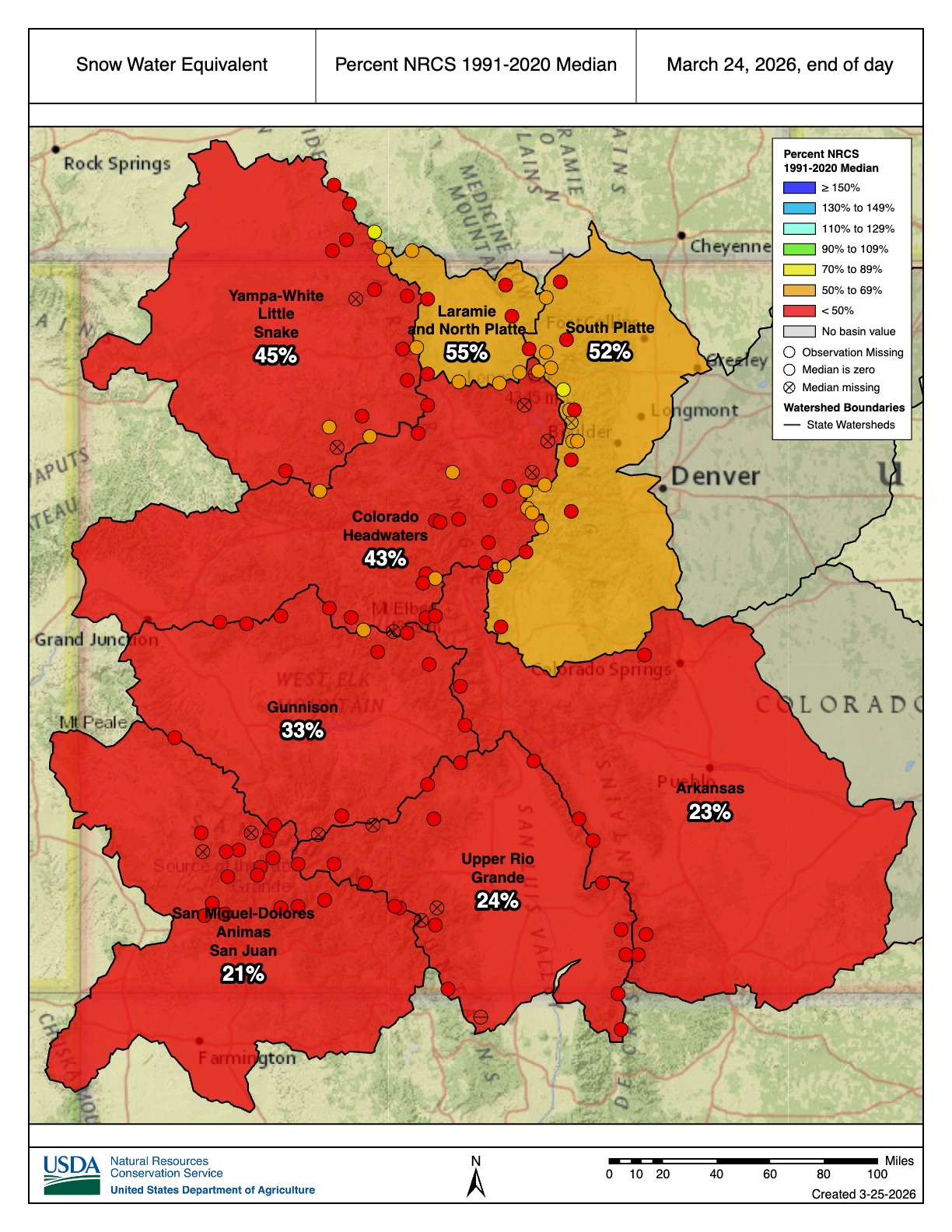
In a previous blog post, we discussed that a combination of SNOTEL data (dating back to the 1980s) and manual snow measurements (dating back to the 1930s) have been used to evaluate how this year’s snowpack stacks up against past winters. Throughout much of the winter, the story has been that this year’s snowpack is very bad, but it hasn’t been quite as bad as the winters of 1976-77 and 1980-81. However, with last week’s rapid early season melting, conditions have deteriorated further. We’ll wait for official confirmation from snow course data at the end of the month, but current data suggests that we’re now sitting at Colorado’s worst snowpack on record, surpassing the winters of 1976-77 and 1980-81.
Drought conditions are deteriorating
When discussing the drought landscape, all eyes have been on the major snow deficits in Colorado’s mountain areas, but that isn’t the only part of the state that’s been seeing worsening drought conditions. Most of Colorado’s lower elevations have also seen substantial precipitation deficits in recent months. As such, drought conditions throughout the state have worsened and expanded over the past few months.
Per the latest US Drought Monitor, approximately 91% of the state is experiencing at least abnormally dry conditions, and ~74% of Colorado is experiencing drought (D1 or worse). Those numbers have increased from 54% and 45%, respectively, since the start of the water year on October 1, 2025. The recent warmth brought particularly large changes to the drought monitor last week, as Colorado’s exceptional drought or worse area (D3 or higher) nearly doubled from ~13% last week to ~24% in the latest drought monitor.

Consequences from the low snowpack are growing
Impacts from this year’s low snowpack are increasing as governments agencies and industries that rely on it are beginning to respond and plan for additional effects. The expanding drought (in part due to the low snowpack) has prompted the Colorado Governor’s Office to activate the State Drought Task Force for the first time since 2020. Utility departments and water managers have begun to initiate drought response plans and implement water restrictions. And ski areas are planning to close earlier than expected due to poor conditions. Unfortunately, as we anticipate well-below average runoff this spring, impacts will likely expand further.
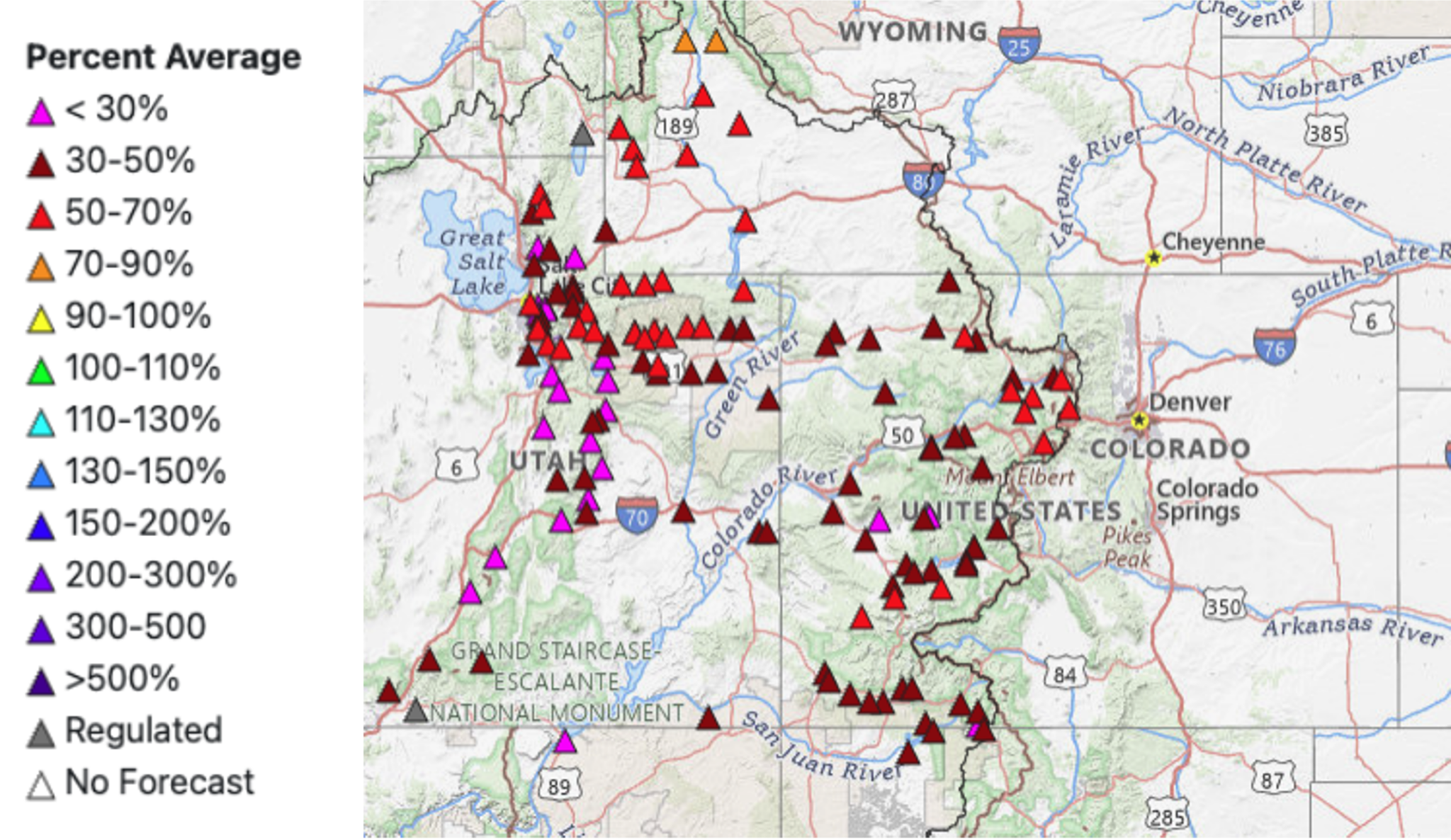
The one piece of potential good news that we’ll end this post with is a pattern shift is likely in early April, which is expected to bring precipitation chances to Colorado. While the moisture won’t be nearly enough to make up for the major deficits we’ve seen accumulate over the last several months, I think we can all agree that we’ll take anything we can get.
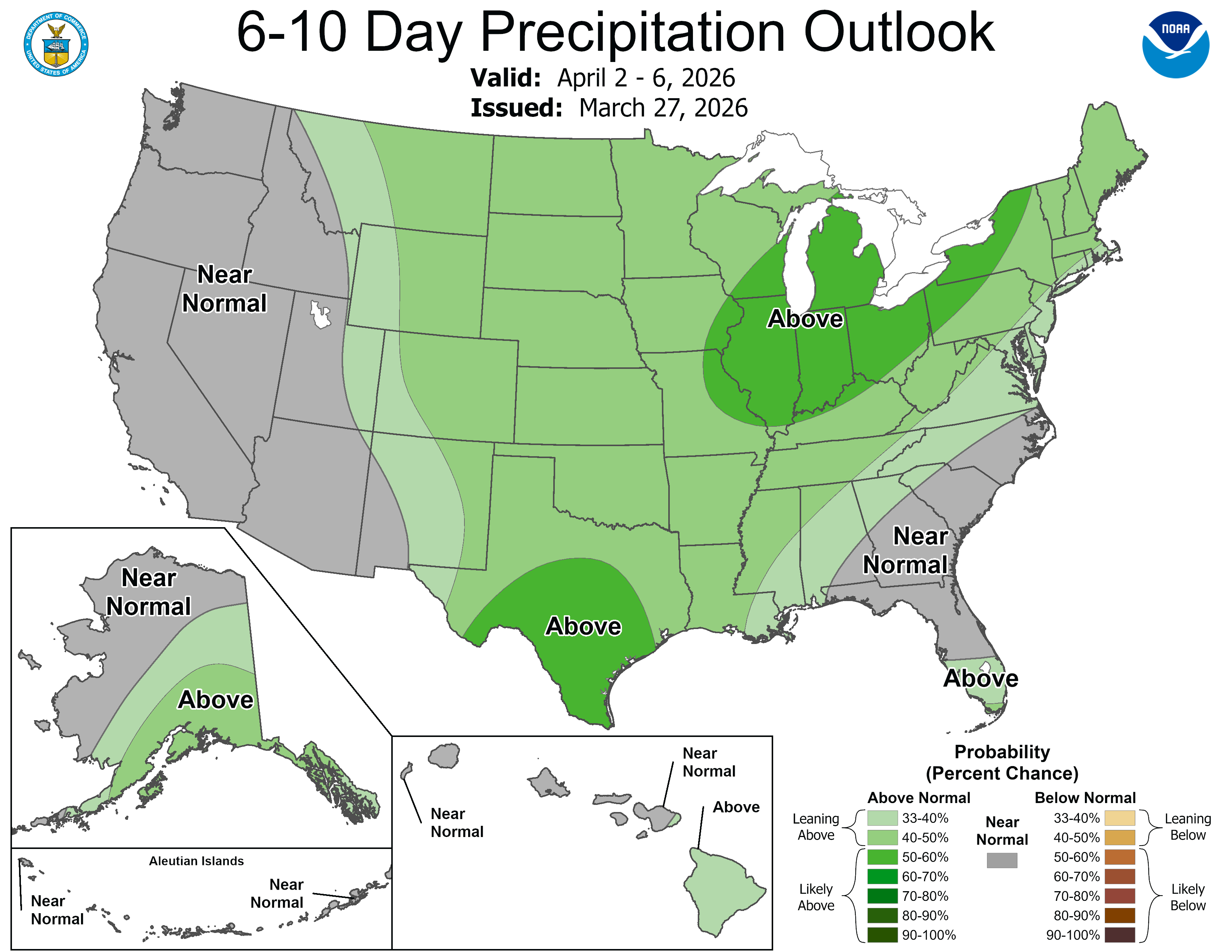
Coyote Gulch’s excellent EV adventure: #RioGrande State of the Basin Symposium March 28, 2026 — Salazar Rio Grande del Norte Center
I’m heading out to Alamosa today for the Rio Grande State of the Basin Symposium organized by the Salazar Rio Grande del Norte Center.
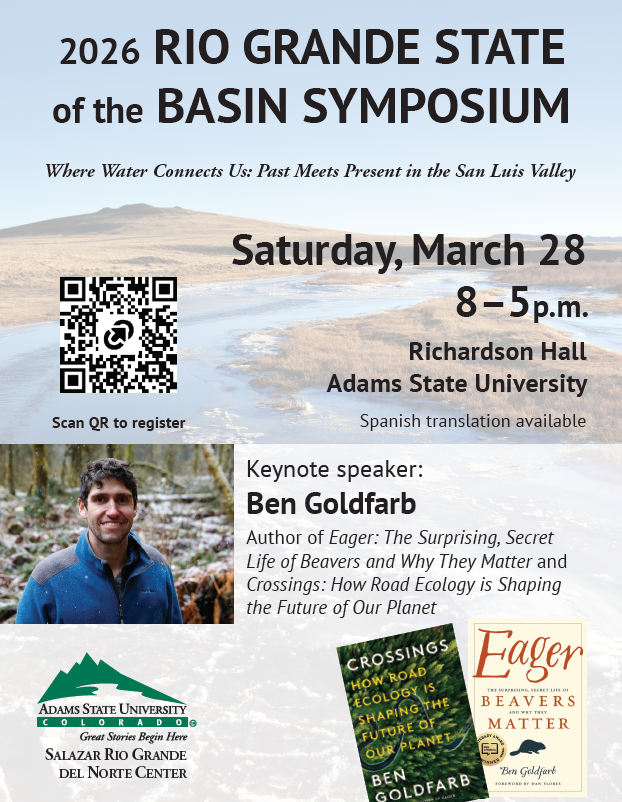
#Colorado’s early snowmelt is a preview of a hotter future: Expect a longer wildfire season and major headaches for state water managers — The #Durango Herald
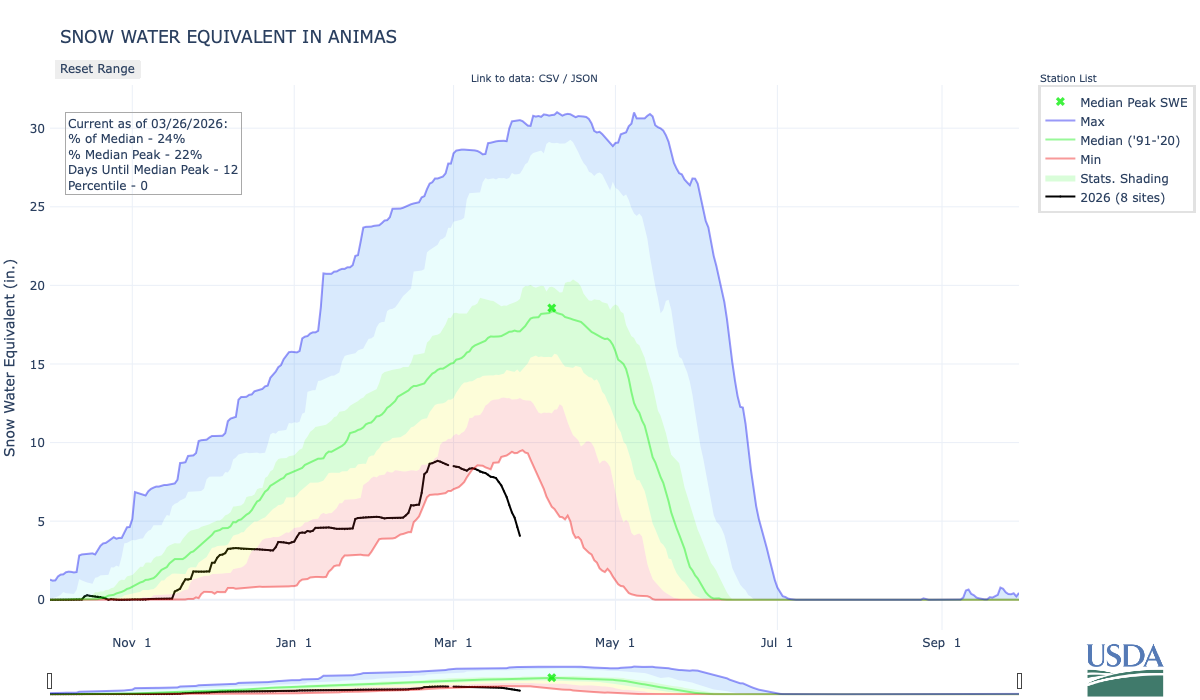
Click the link to read the article on The Durango Herald website (Sam Brasch). Here’s an excerpt:
An unprecedented heat wave over the past few days has shattered temperature records across Colorado – and may have forced the state’s record-low snowpack to peak weeks ahead of schedule. In a normal year, the state’s snowpack reaches its highest levels in early April, according to data collected by the U.S. Department of Agriculture. After that, the water stored as mountain snow steadily drains away, with most of it gone by late June or early July. Colorado hasn’t stuck to the script this year. Anyone who’s visited the state’s high country has seen the snowless mountainsides, left bare by a season of warm weather and low precipitation. As of mid-March, the state faced its worst snowpack in the 41-year history of the USDA snow monitoring program, known as SNOTEL. Forecasts don’t predict a significant spring snowstorm within the next few weeks, either. That means as ski slopes and alpine drifts melt into slush, snow levels may have already hit a high-water mark March 9, about a month early.
“That really sets you up poorly for the year to come in terms of water supply,” said Peter Goble, Colorado’s assistant state climatologist at the Colorado Climate Center. “You not only have less water, but you have to stretch it out longer than if the weather had stayed colder longer.”
The early melt also likely offers a preview of Colorado’s hotter future. A 2024 report from the Colorado Climate Center found spring snowpack has shrunk in the past 75 years, but scientists only have modest confidence that the trend will continue. It’s a far better bet that snowpack will peak earlier, creating new challenges for the state’s water managers and its ecosystems…Part of the challenge is when the snow melts sooner, less liquid water makes it into streams and rivers. The dynamic occurs because of the cooler conditions and shorter days in the early spring. When snowpack melts more slowly, it has more time to absorb into the soil and evaporate rather than reaching waterways…Early runoff also lengthens the dry season in the spring and summer, opening the window for wildfires. While vegetation growth, rainfall and other factors play a role in fire risk, early runoff primes mountain landscapes for blazes, Molotch said…The situation has set the table for strict water usage limits in the months ahead. Gov. Jared Polis has activated the Colorado Drought Task Force, shifting the state toward an official drought declaration. Denver Water is also set to implement watering restrictions because of low snowpack starting March 25.
#Drought news March 26, 2026: Exceptional drought (D4) expanded in northwest #Colorado, while extreme drought (D3) grew across Colorado, southern #Wyoming, and southern #Nebraska
Click on a thumbnail graphic to view a gallery of drought data from the US Drought Monitor website.
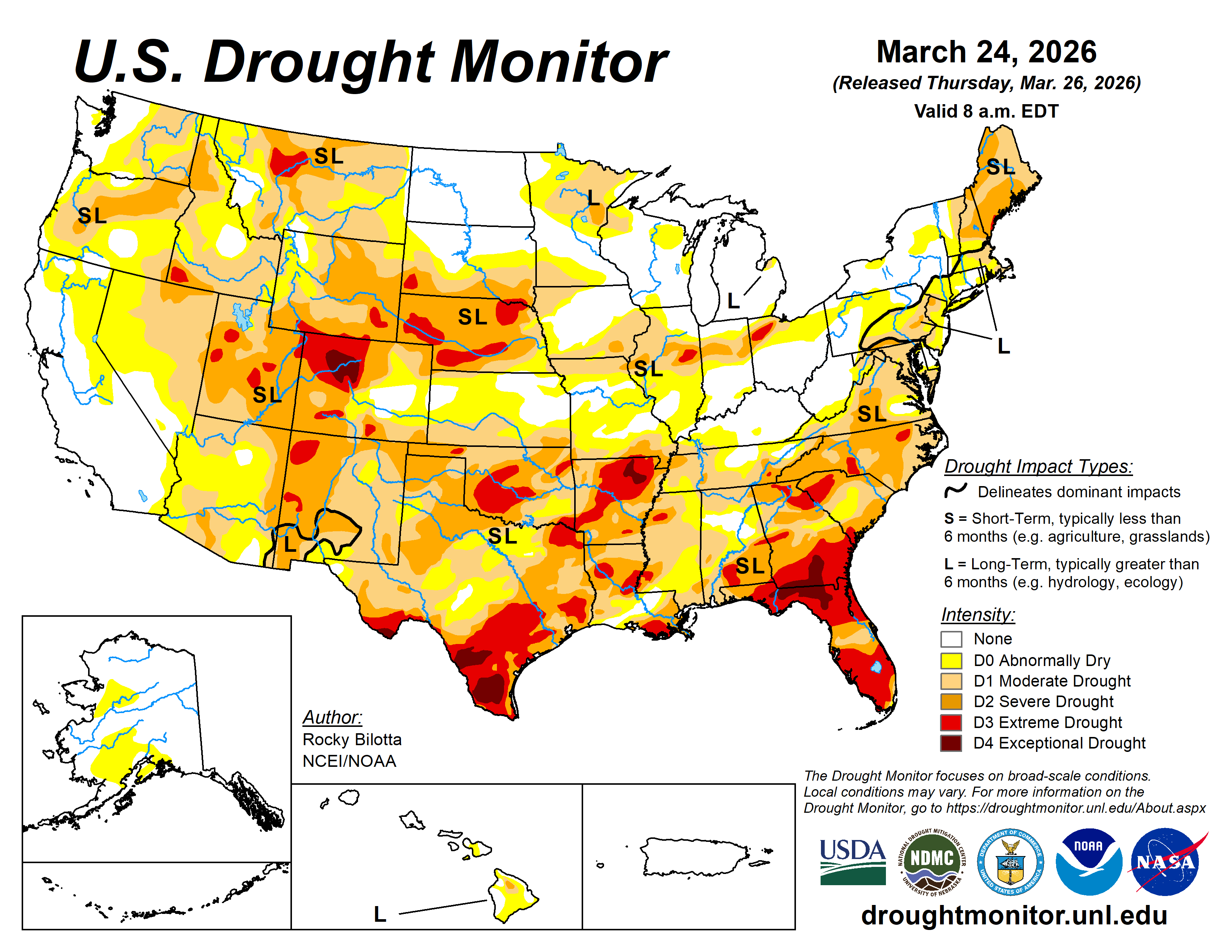
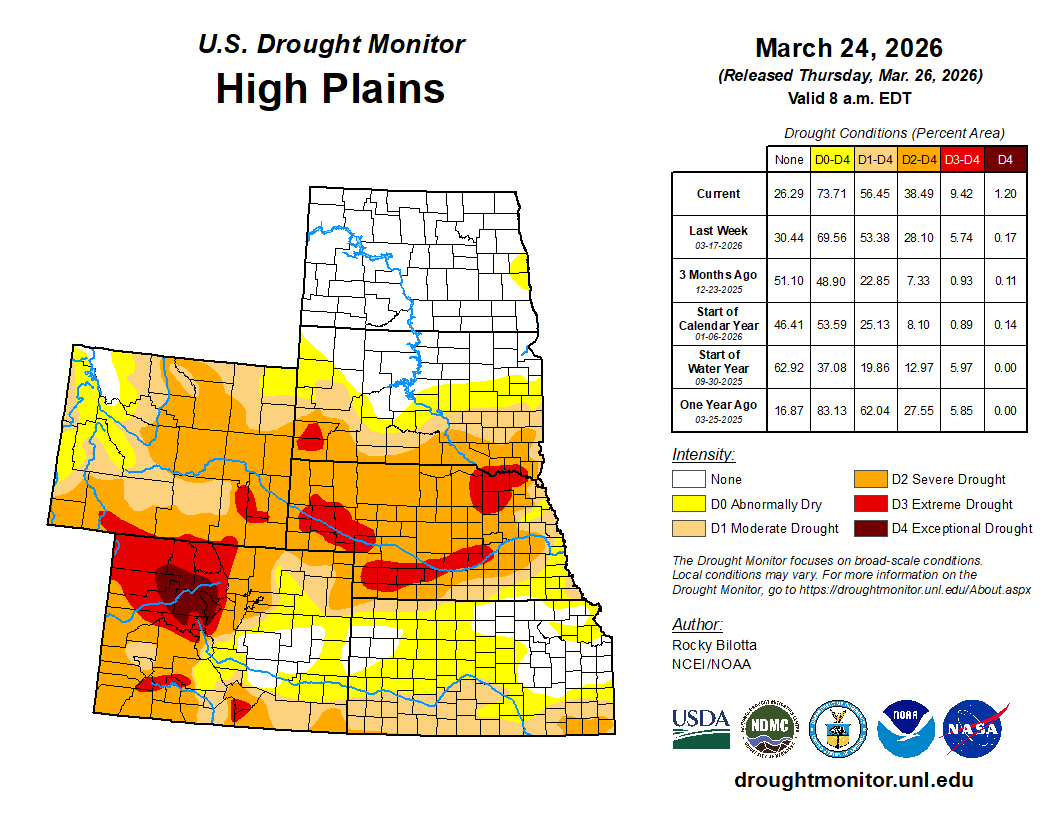
Click on the link to go to the US Drought Monitor websiste. Here’s an excerpt:
This Week’s Drought Summary
This week, extreme weather events across the United States painted a starkly contrasting picture of drought development and relief. In the West and Plains, a persistent heat dome drove temperatures 20 to 25 degrees above normal, shattering early-season records and significantly increasing evaporative demand. This intense heat, combined with high winds and pre-existing dryness, threatened to rapidly deplete topsoil moisture and fueled explosive, landscape-altering wildfires—most notably the historic Morrill Fire in Nebraska that consumed over 800,000 acres. Ultimately, the combination of soaring temperatures and below-normal precipitation resulted in the expansion of drought and abnormal dryness across portions of the West, Great Plains, and parts of the Southeast.
Conversely, other regions experienced abrupt and volatile moisture influxes that mitigated dry conditions but introduced localized to severe flooding. In the Pacific Northwest, an atmospheric river stalled over Washington, bringing heavy rain and significant snowmelt. Further east, a powerful winter storm delivered a massive precipitation boost in the form of a late-season blizzard, dropping over 50 inches of snow across parts of the Upper Midwest and Michigan’s Upper Peninsula. The most extreme precipitation of the week occurred over the Hawaiian Islands, where a stalled Kona low dumped unprecedented, historic rainfall, resulting in excessive flooding, widespread landslides, and infrastructure damage. Overall, above-normal precipitation resulted in improvements to drought and abnormal dryness across parts of the Midwest, Northeast, Hawaii, and Puerto Rico…
High Plains
Intense, unseasonable warmth gripped the High Plains, with temperatures soaring up to 25 degrees F above normal, peaking in parts of Wyoming and Colorado. Precipitation was nearly non-existent, particularly across the southern half of the region. This severe, persistent dryness, coupled with rapidly deteriorating drought indicators, forced widespread expansion and intensification of drought categories. Exceptional drought (D4) expanded in northwest Colorado, while extreme drought (D3) grew across Colorado, southern Wyoming, and southern Nebraska. Severe drought (D2) pushed further into central and northern Wyoming, western and southern Colorado, and advanced from Nebraska into South Dakota. Moderate drought (D1) and abnormal dryness (D0) also expanded broadly across Wyoming, Colorado, Nebraska, and Kansas. No drought improvements were made in the High Plains this week…
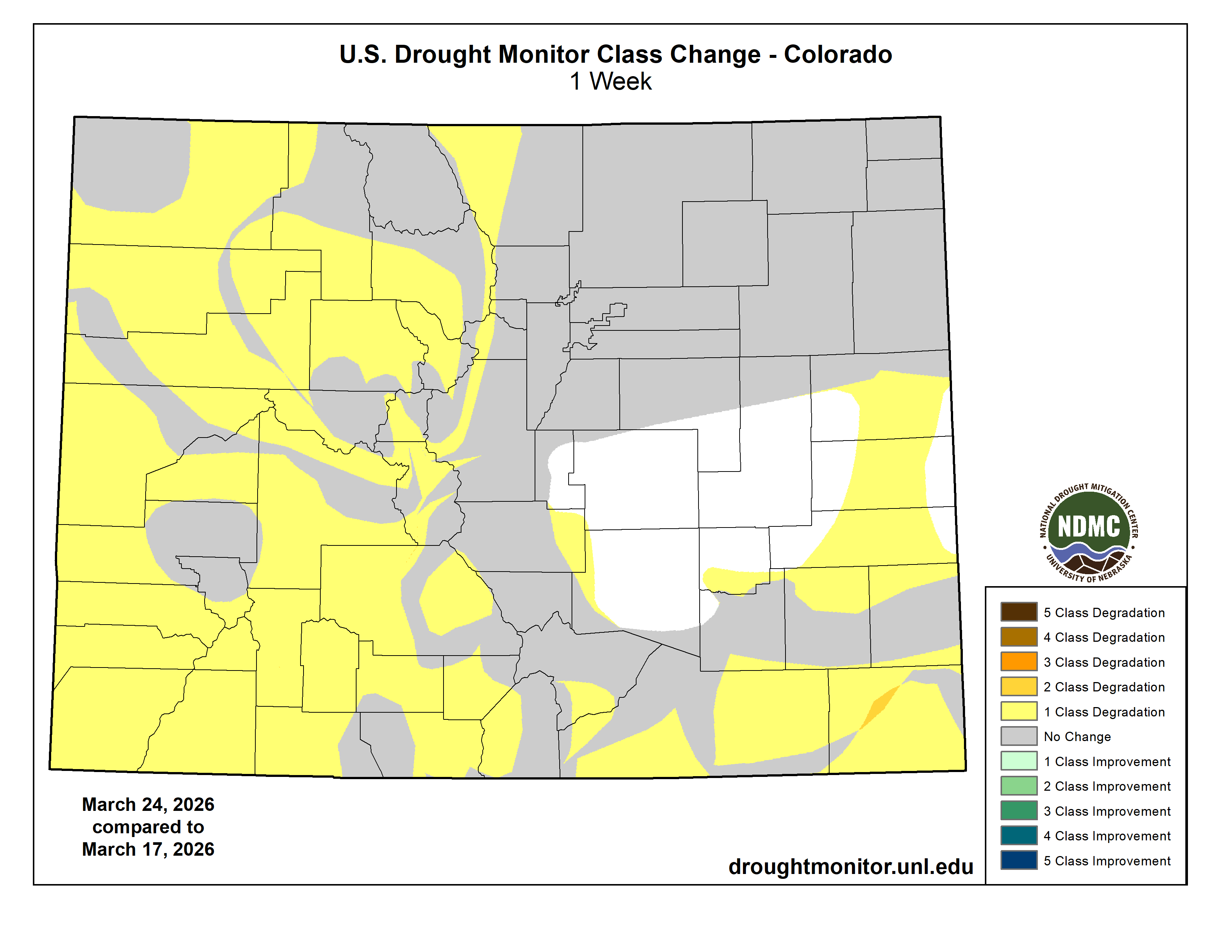
West
Anomalous warmth dominated the West, with nearly the much region seeing temperatures 15 to 25 degrees F above normal. Precipitation was largely absent, save for beneficial moisture in parts of Washington and Montana. This localized precipitation allowed for the reduction of severe drought (D2) in central Montana and abnormal dryness (D0) in western Washington. Elsewhere, the combination of soaring temperatures, lacking precipitation, and declining soil moisture and streamflow data resulted in broad drought degradation. Extreme drought (D3) expanded in southern Idaho, central and northeastern Utah, and northwest New Mexico. Severe drought (D2) increased in coverage across Oregon, southern Idaho, southern Montana, southern and eastern Utah, southern and eastern Arizona, and New Mexico. Finally, abnormal dryness (D0) expanded in eastern Oregon and central and southern California…
South
Hot and dry conditions dominated the South this week, driving widespread drought degradation. Temperatures soared 5 to 20 degrees F above normal across the vast majority of the region. This heat was coupled with persistent dryness, as month-to-date rainfall deficits grew to 1 to 3 inches below average (representing only 5% to 50% of normal). Deteriorating short- and long-term indicators justified the introduction and expansion of exceptional drought (D4) in southern Texas and northern Arkansas. Extreme drought (D3) was introduced in the Oklahoma Panhandle and expanded across central Oklahoma, northern Arkansas, southern Texas, and Louisiana. Additionally, severe drought (D2) worsened across parts of Oklahoma, Texas, Arkansas, Louisiana, and Tennessee, while moderate drought (D1) and abnormal dryness (D0) expanded in Texas, Mississippi, and southern Louisiana…
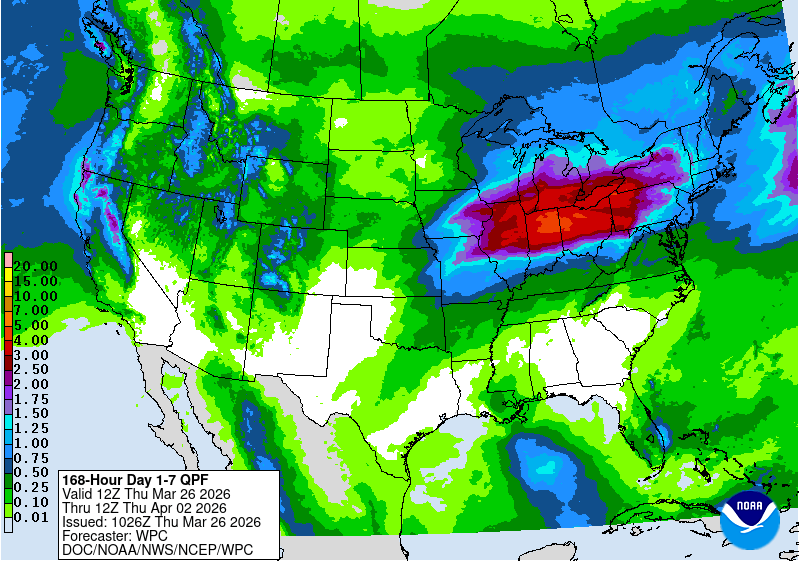
Looking Ahead
Over the next five days (March 24–28, 2026), the contiguous United States is forecast to experience another week of widespread, record-breaking warmth. A strong upper-level ridge will dominate the western and central U.S., pushing temperatures 20 to 40 degrees above average. This extreme heat, combined with dry conditions and gusty downsloping winds, will elevate fire weather risks across the High Plains on Tuesday and Wednesday. Meanwhile, a deepening low-pressure system will bring even stronger winds to the Northern Rockies. Concurrently, a potent mid-latitude cyclone will track from the Pacific Northwest toward the Canadian Maritimes. This system will initially drop moderate to heavy rain over the Northwest—potentially triggering isolated flooding—alongside high-elevation snow in the Olympics and Cascades. After weakening over the Central U.S., the system is expected to reinvigorate over the East by late next week, delivering a mix of rain to the south and snow to the north across the Great Lakes, Ohio Valley, and Northeast.
Further out, the Climate Prediction Center’s 6–10 day outlook (valid March 29–April 2, 2026) favors above-normal precipitation across much of the contiguous U.S. and Hawaii. Conversely, below-normal precipitation is favored for most of Alaska and along portions of the East Coast, stretching from southern New England to northern Florida. Probabilities for above-normal temperatures are increased across the vast majority of the lower 48 states and Hawaii, while below-normal temperatures are expected to persist across most of Alaska and much of the Northeast.
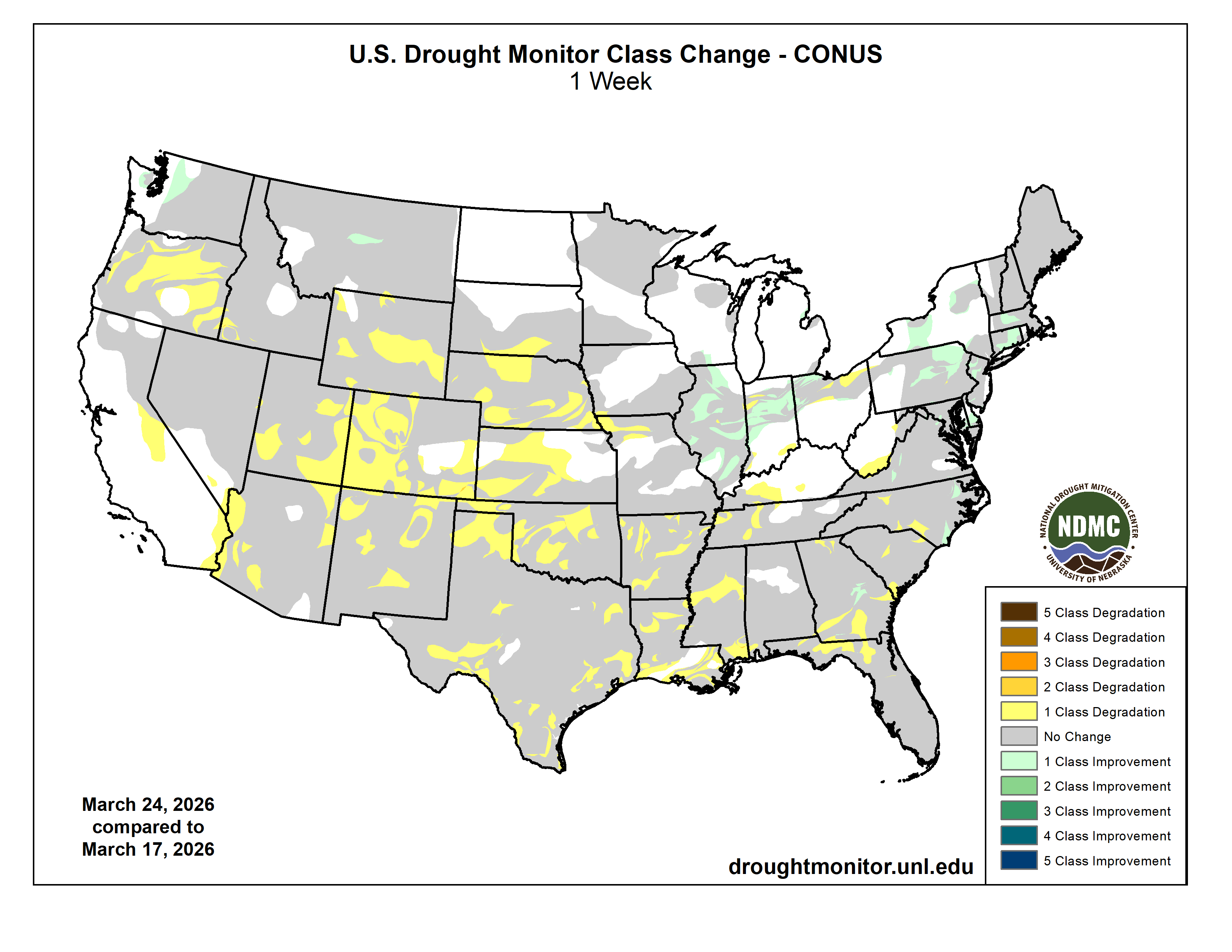
Grim outlook: #Colorado faces limited water supply after record-low #snowpack — Russ Schumacher (Colorado Climate Center) #runoff
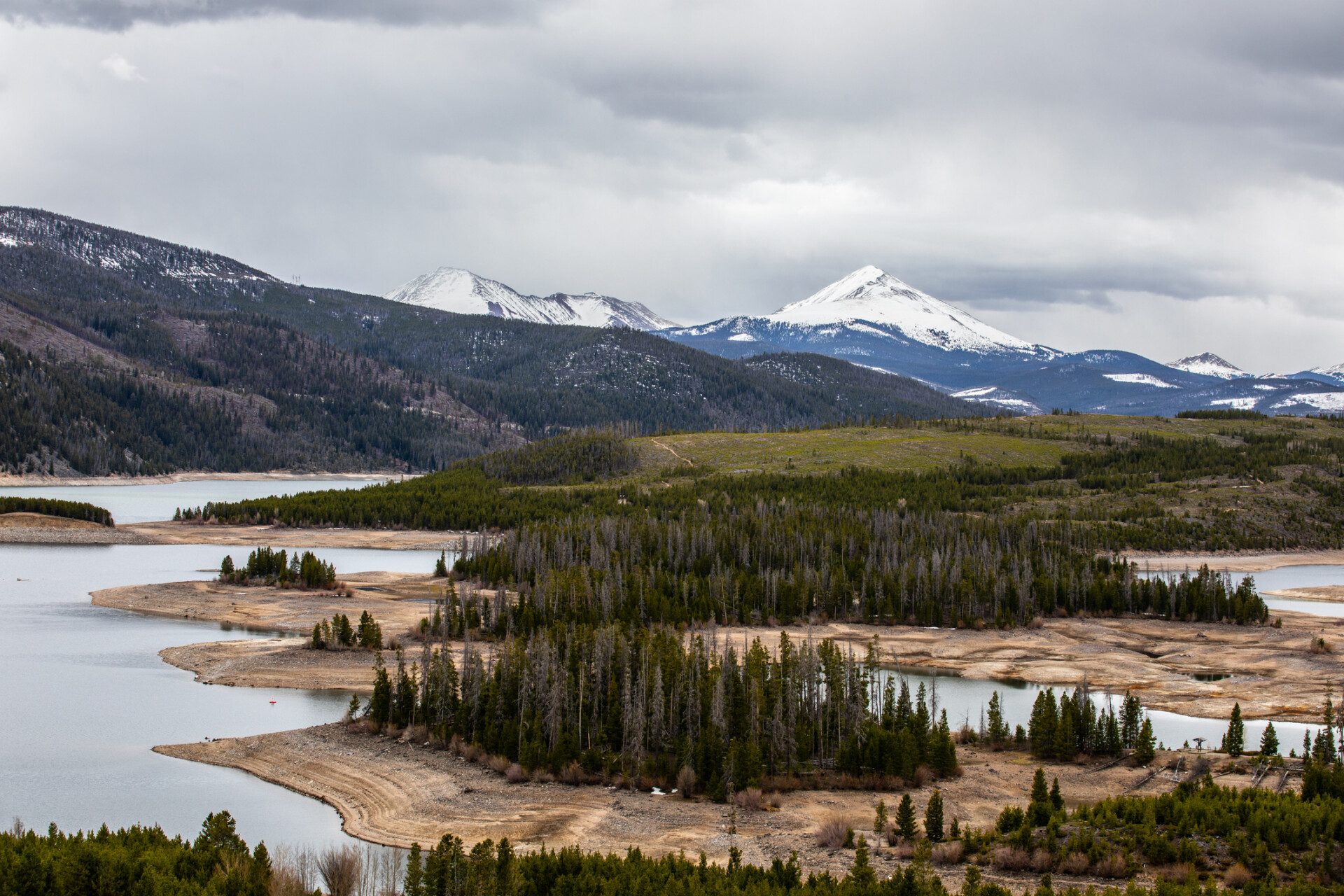
Click the link to read the article on the Colorado State University website (Russ Schumacher):
March 25, 2026
Each day during the winter and spring, one of the first things I look at is the U.S. Department of Agriculture’s website that shows the current status of the snowpack in Colorado’s mountains.
Maybe that sounds like the strange habit of a state climatologist, but I’m far from the only one. Why? Because the snow that falls in our state’s mountains will, when it melts in the spring and summer, become a large portion of the water supply for tens of millions of people.
Those people aren’t only here in Colorado, but are in other states, Tribal nations, and Mexico, drawing their water from the rivers that originate in Colorado. Mountain snow is essential for our winter recreation industry, for farms and ranches that grow our food, for drinking water, for ecosystem health, and much more.
It hasn’t been a pretty sight when I have opened that USDA website each morning this winter. In an average year, our mountains get a lot of snow: In places like the Park Range, the West Elk Mountains or the San Juans, a typical year brings hundreds of inches of snow, carrying more than 40 inches of liquid water. This year, we struggled to get half that. Now, after an unprecedented heat wave in March, the snow is already disappearing quickly.
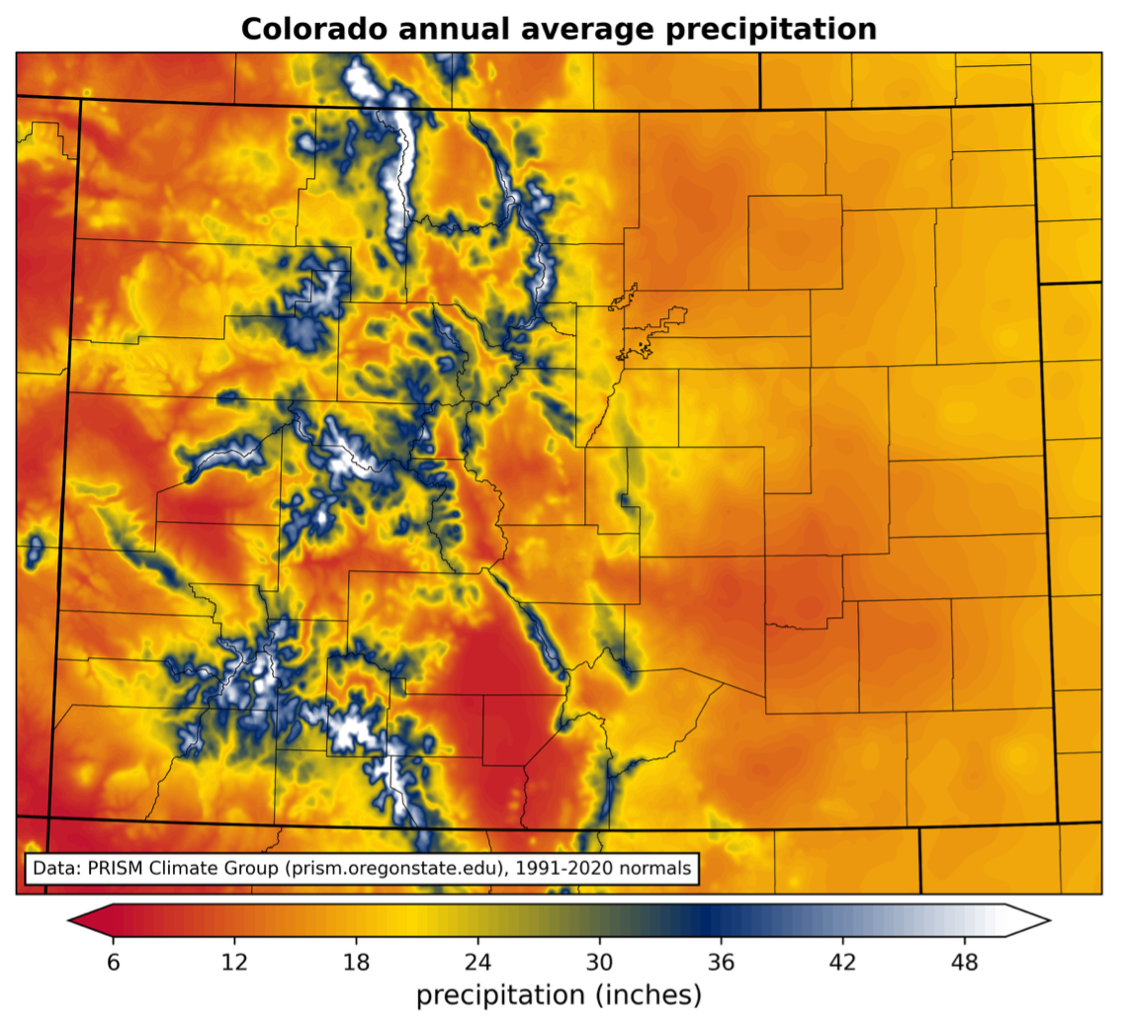
As of March 25, averaged across 115 stations in Colorado’s mountains, the snow water equivalent was just 38% of the 1991-2020 average. (The snow water equivalent is the amount of water stored in the snowpack.) This represents the lowest snowpack in more than 40 years – and possibly ever – in Colorado’s mountains. Conditions haven’t been any better along the Front Range and Eastern Plains, which have also lagged far behind the average amount of snowfall.
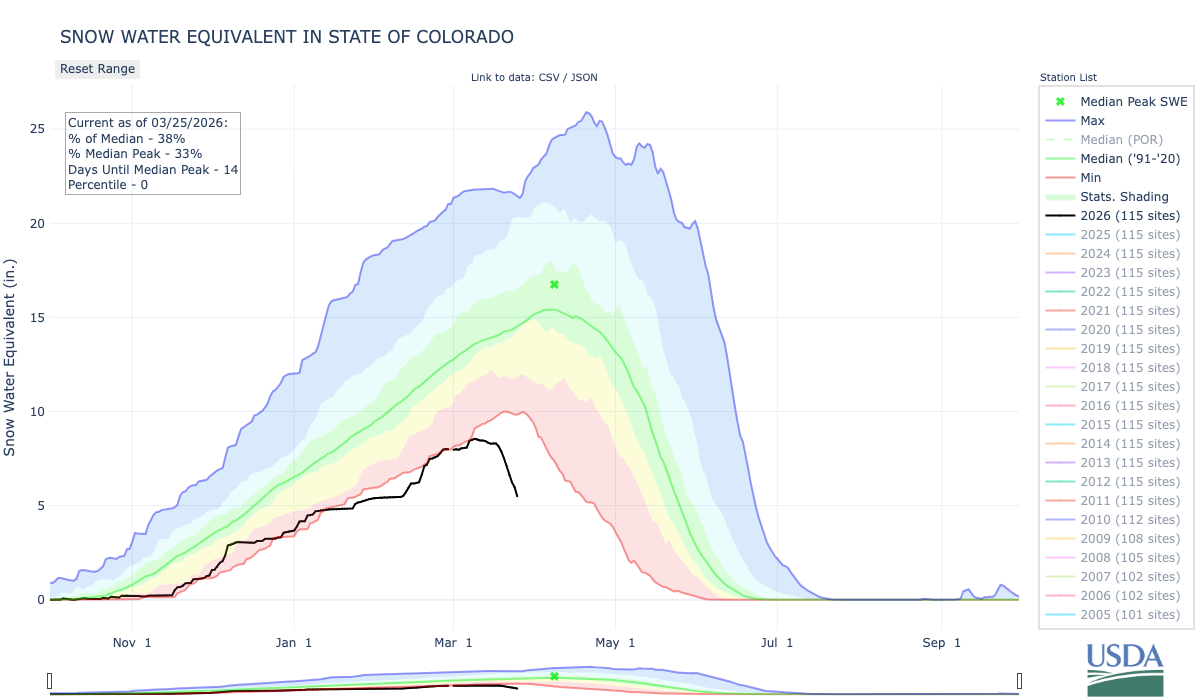
There have been other major snow droughts in the past, notably the winters of 1976-1977 and 1980-1981, that threatened the ski industry and resulted in record-low streamflow on some of Colorado’s rivers. But this snow season has been unrivaled in its warmth. The first five months of the water year – from October through February – were Colorado’s warmest on record by a large margin. And it’s almost certain that we are in the midst of the warmest March on record as well.
The warmth has been remarkably persistent, as relentless ridges of high pressure have prevented the usual snowstorms from moving into the state. The Fort Collins weather station at Colorado State University recorded an astonishing 43 days with a high temperature of 60°F or above during climatological winter (December through February). The previous record, from records dating back to the late 19th century, was 22. Starting March 18, Fort Collins had temperatures higher than had ever been observed in March, four days in a row. This was capped by a high of 91°F on March 21; there had never previously been a 90-degree day in Fort Collins before May.
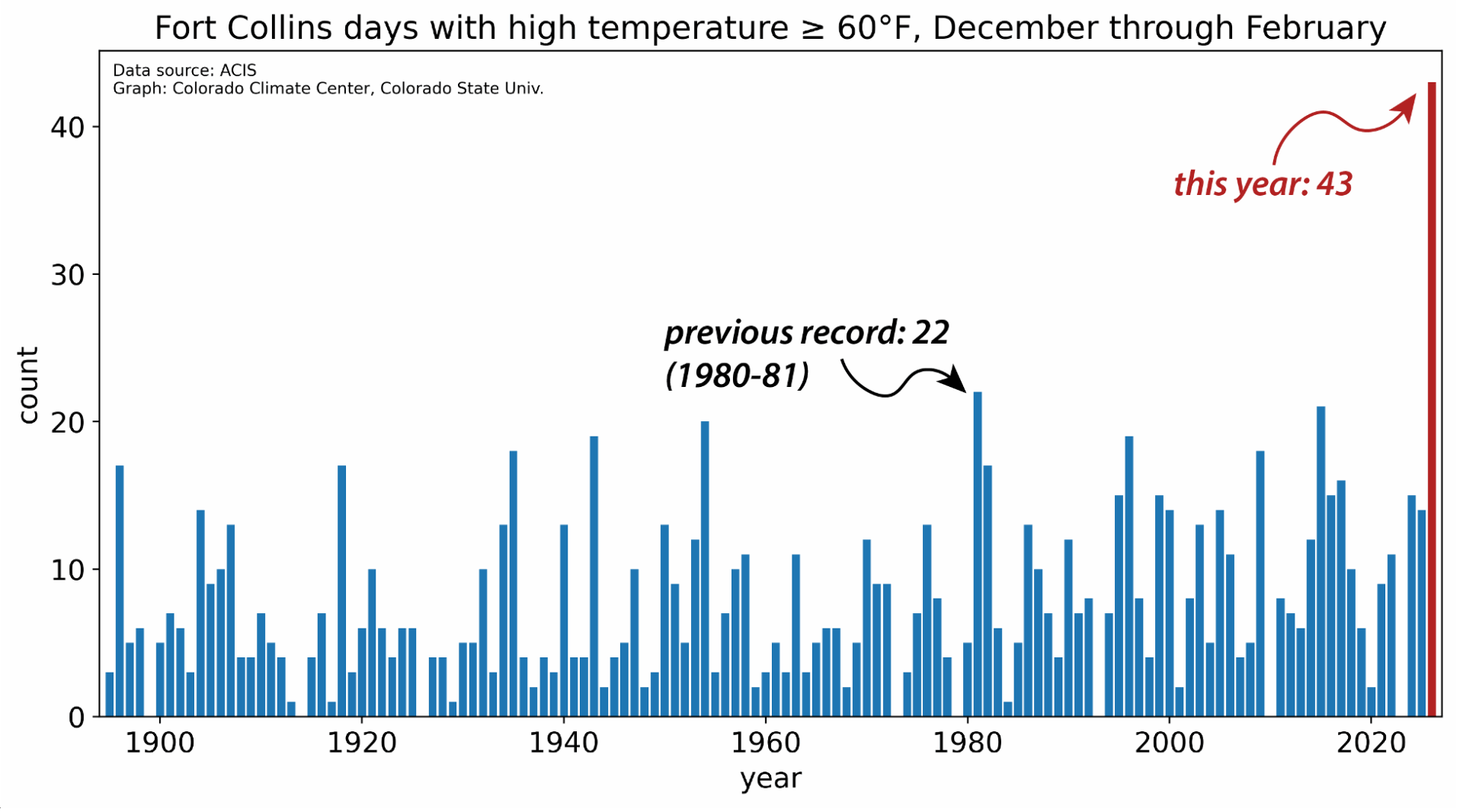
Records for March were smashed across the state and the western U.S., at both low and high elevations. One thing we do as state climatologists is put current conditions into historical context, as usually with some investigation, it’s possible to find a past analog to what we’re experiencing now. But the intense and prolonged heat has been unlike anything previously observed in March.
This, of course, is occurring in the context of a long-term trend toward warmer conditions, both globally and locally, largely attributable to increases in greenhouse gases. Per data from the National Oceanic and Atmospheric Administration, nine of the 11 warmest years in Colorado records have occurred since 2012, and Colorado has now warmed by 3°F since the 1890s. Droughts come and go, and they have always been a challenge in Colorado and the West. But warming is making them more likely and more intense. In other words, climate change is water change.
When above-average temperatures and precipitation deficits stack up over the course of months, we start to see drought conditions develop or worsen. The impacts of drought are wide-ranging and include economic and agricultural repercussions. Farmers and ranchers may face lower crop yields and higher costs of feeding livestock. A snow drought like this winter’s can reduce outdoor recreation opportunities and hurt the state’s tourism industry. Drought years also tend to be years with more and larger wildfires.
Drought impacts can be felt a long distance from where the precipitation deficits occur. For example, southeastern Colorado received decent precipitation this winter, but low snow in the mountains hundreds of miles away near Leadville means less water on the Arkansas River, an important source for farmers in southeastern Colorado.
As each winter progresses, even if the mountain snowpack isn’t looking great, we can always look ahead to March and April as the time when big storms are possible and the deficits can be made up. Unfortunately, this year has been just the opposite: Instead of much-needed snowstorms, we’re in an unprecedented March heat wave that is accelerating the melting of what little snow is there. The chances of getting back into the range of average have dwindled away, and if the weather pattern doesn’t turn around in April, we may be headed for uncharted territory for Colorado water.
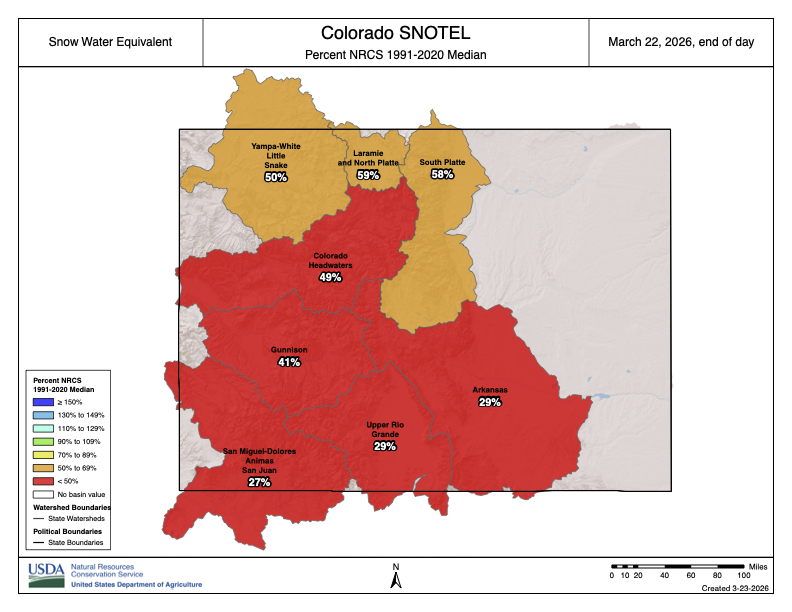
2026’s historic snow #drought brings worries about water, wildfires and the future in the West — Alejandro N. Flores (TheConversation.com) #snowpack #runoff #ColoradoRiver #COriver #aridification
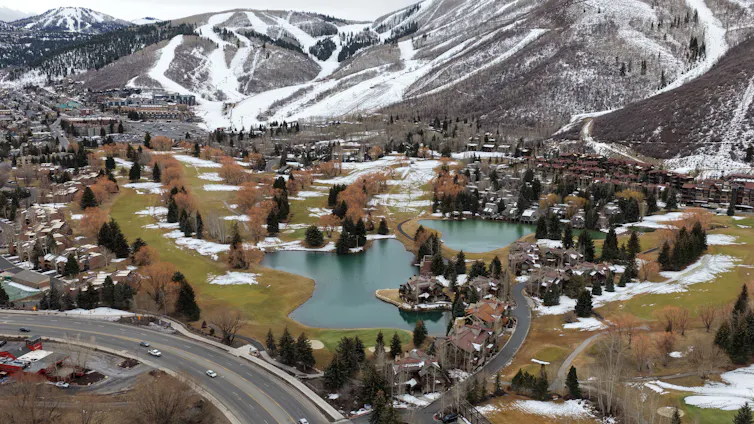
Alejandro N. Flores, Boise State University
Across much of the Western United States, winter 2026 was the year the snow never came. Many ski resorts got by with snowmaking but shut down their winter operations early. Fire officials and water supply managers are worried about summer.
Where I live in Boise, Idaho, temperatures hit the low 80s Fahrenheit (high-20s Celsius) in mid-March. The same heat dome sent temperatures soaring to 105 F (40 C) in Phoenix.
Ordinarily, water managers and hydrologists like me who study the Western U.S. expect the mountain snowpacks to be at their fullest around April 1. Snowpacks are natural reservoirs of water that farms and communities depend on through the hot, dry summer. Their snow water equivalent, meaning the amount of liquid water in the snowpack, is seen as a bellwether for water supplies.
But the 2026 water year has been anything but ordinary. In fact, its snow drought has few historical analogs.
Data from the U.S. Department of Agriculture’s Natural Resources Conservation Service shows that out of approximately 70 river basins across the Western U.S., only five are at or above the 1991-2020 median snow water equivalent for this time of year. Most of those are clustered around the Yellowstone region of western Wyoming and eastern Idaho.

By contrast, 11 basins have less than 25% of the 1991-2020 median, and more than half are below 50%. The headwaters of critically important rivers, including the Colorado, the Columbia and the Missouri, are peppered with basins that are far below historical averages.
Other important measures of snow water storage and ecosystem health, including which areas have snow cover in the Western U.S and how long it’s been there, also point toward snow reserves that are far below recent years.
How did we get here?
Just because the Western U.S. is in a snow drought doesn’t mean it isn’t getting precipitation. Temperatures have been high enough since the start of the water year in October that a lot of what normally would have fallen as snow fell as rain instead.
The West experienced a very warm December at all but the highest elevations, but strong storms also drenched large parts of the region. Washington state was swamped with rain that triggered flooding and melted the existing snowpack.

Temperatures in January were less extreme but still warmer than historical averages. However, precipitation in January was far below the 1991-2020 average throughout much of the region. February brought precipitation conditions closer to historical averages, but temperatures were much warmer than normal.
The Western U.S., therefore, got a triple whammy: Two of the three critical snow-accumulation months were too warm, and the third was too dry.
Water worries ahead
So what does this mean for water supplies and river flows?
A recent assessment of drought conditions from NOAA’s National Integrated Drought Information System suggests 2026 will be a tight year for water supplies.
Water managers in Wyoming and Washington are already signaling that some water rights holders – cities, irrigation districts, individual farms and industries can take limited amounts of water from rivers, canals and aquifers – can expect to receive less than their full allotment of water in 2026. It’s not unreasonable to expect other states to soon follow suit.
Throughout the Western U.S., water rights are administered according to the Doctrine of Prior Appropriation – those who hold the oldest legitimate claims to water from a river, reservoir or aquifer are entitled to receive their allotments first.
Junior water rights holders who may be at risk of receiving less than their full allotment of water likely have difficult decisions ahead related to the planting and management of their crops. The challenges are compounded by the likelihood of increases in fertilizer and transportation costs associated with the ongoing war in Iran.
In the Colorado River Basin, the U.S. Bureau of Reclamation’s most probable forecast indicates water levels in Lake Powell falling below the minimum power pool elevation in December 2026. That’s bad news for power supplies, because below that level, the Glen Canyon Dam can’t produce hydroelectric power. The dam contributes power for millions of customers across seven states.
What the snow drought means for fire season
Another big concern is whether the historic snow drought is setting up the West for a bad fire season. That’s still an open question.
Rain has meant moisture is available now for plants to grow, but the lack of snowpack that normally keeps meltwater flowing through summer raises concerns about whether those plants will dry out, leaving them ready to burn.
Fire is a historically important feature of the forest and rangeland ecosystems of the West, and these ecosystems are to some degree adapted to large swings in conditions from year to year and season to season.
Because precipitation across much of the West is close to historical averages, there is snow in some of the highest-elevation mountains. And at lower elevations, some of the precipitation that fell as rain likely remains in the soils.
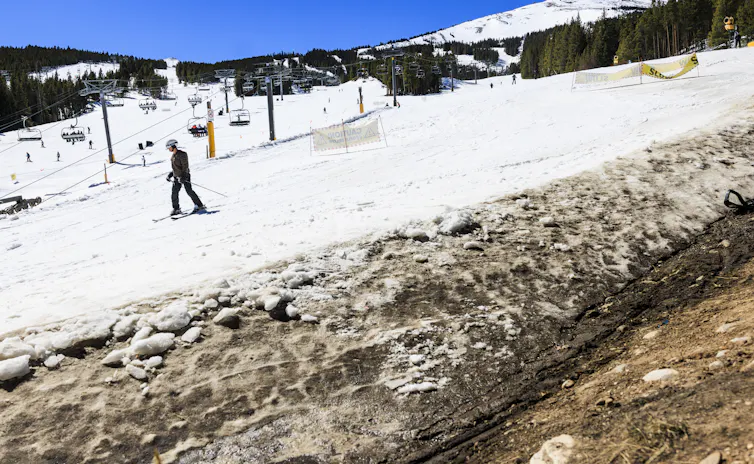
Weather conditions in the late spring and summer – how much rain falls and how hot and dry conditions become – will play critical roles in determining the shape forests and rangelands will be in for fire season.
What this winter suggests about the future
The record-low snowpack may be a harbinger of what a warmer future will look like in the region. Many researchers have investigated how climate change will influence snowpacks and water supply throughout the Western U.S., but questions and critical challenges remain.
Among them: In years like this, with near-normal precipitation but low snowpack, are there difficult-to-observe stores of water in the deeper subsurface that can help buffer against loss of snow for periods of time? That’s one of several questions my colleagues and I have been working on.
This year’s snow drought presents a timely, albeit high-stakes, stress test for the West. Everyone will be watching.
Alejandro N. Flores, Professor of Geoscience, Boise State University
This article is republished from The Conversation under a Creative Commons license. Read the original article.
This is a graph of #snowpack above #LakePowell using 104 snow measuring stations. It was 9 inches of water on March 7, now 6 inches. Other dry years shown.There is no historical analog to this — Brad Udall #ColoradoRiver #COriver #aridification
Inches now from 9 inches then. There is no historical analog.
Environmental Research Letter: #Snowpack decline kindles more severe fire in the western United States — Jared A. Balik, Jonathan D. Coop, and Sean A. Parks
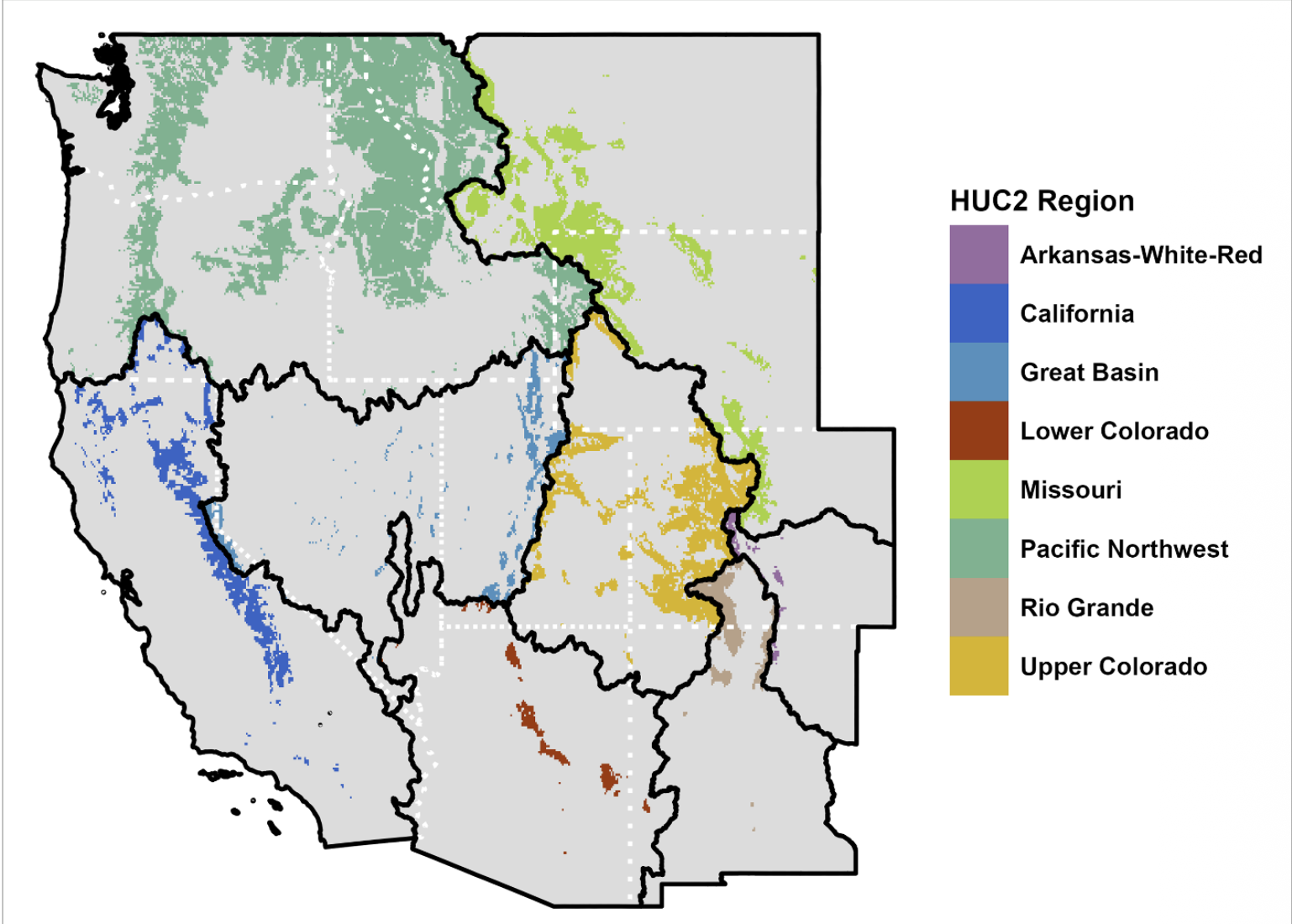
Click the link to access the research letter on the IOP Science website (Jared A. Balik, Jonathan D. Coop, and Sean A. Parks). Here’s the abstract:
Climate change is reducing winter snowpack and advancing spring snowmelt across the western United States, interacting with El Niño–Southern Oscillation (ENSO) teleconnections that drive spatially predictable interannual fluctuations that contribute to high- or low-snow winters. Early snowmelt extends the fire season, enhancing opportunities for ignition and increasing fuel dryness, both of which contribute to greater burned areas. However, relationships between snowpack on burn severity, a measure of forest loss and expected biogeochemical and hydrological impacts of fire, have not been examined. Here, using remotely sensed snow and fire data spanning 1985–2021, we examined how snowpack quantity and timing of spring snowmelt influence annual area burned and burn severity at the watershed scale. Early snowmelt was associated with earlier occurrences of fire ⩾400 ha and greater annual area burned, whereas low snowpack water content was associated with more severe burn outcomes including greater mean composite burn index (CBI) and larger proportions of high severity fire (CBI ⩾ 2.25). Thus, low-snow winters with early snowmelt may prime forested watersheds to dry, burn, and experience high severity fire. These outcomes are consistent with enhanced fuel dry-down: early snowmelt extends the dry-down window while low snowpack quantity portends greater fuel aridity during the dry period. Our findings also highlight how the ENSO interacts with directional warming: El Niño phases amplify trends of snowpack loss and increasing area burned severely in northwestern watersheds but dampen these trends in southwestern watersheds, while La Niña phases exert the opposite effect. Projected warming, potentially accompanied by greater ENSO variability and extremes, points toward a future of reduced snowpack, earlier snowmelt, and increased area burned at high severity in forests where snowpack historically buffered fire risk, with attendant losses in forest carbon storage and disrupted hydrological function of forested watersheds.
Navajo Dam Operations Meeting [Virtual] – April 21, 2026 1-3pm — Reclamation #SanJuanRiver #ColoradoRiver #COriver #aridification
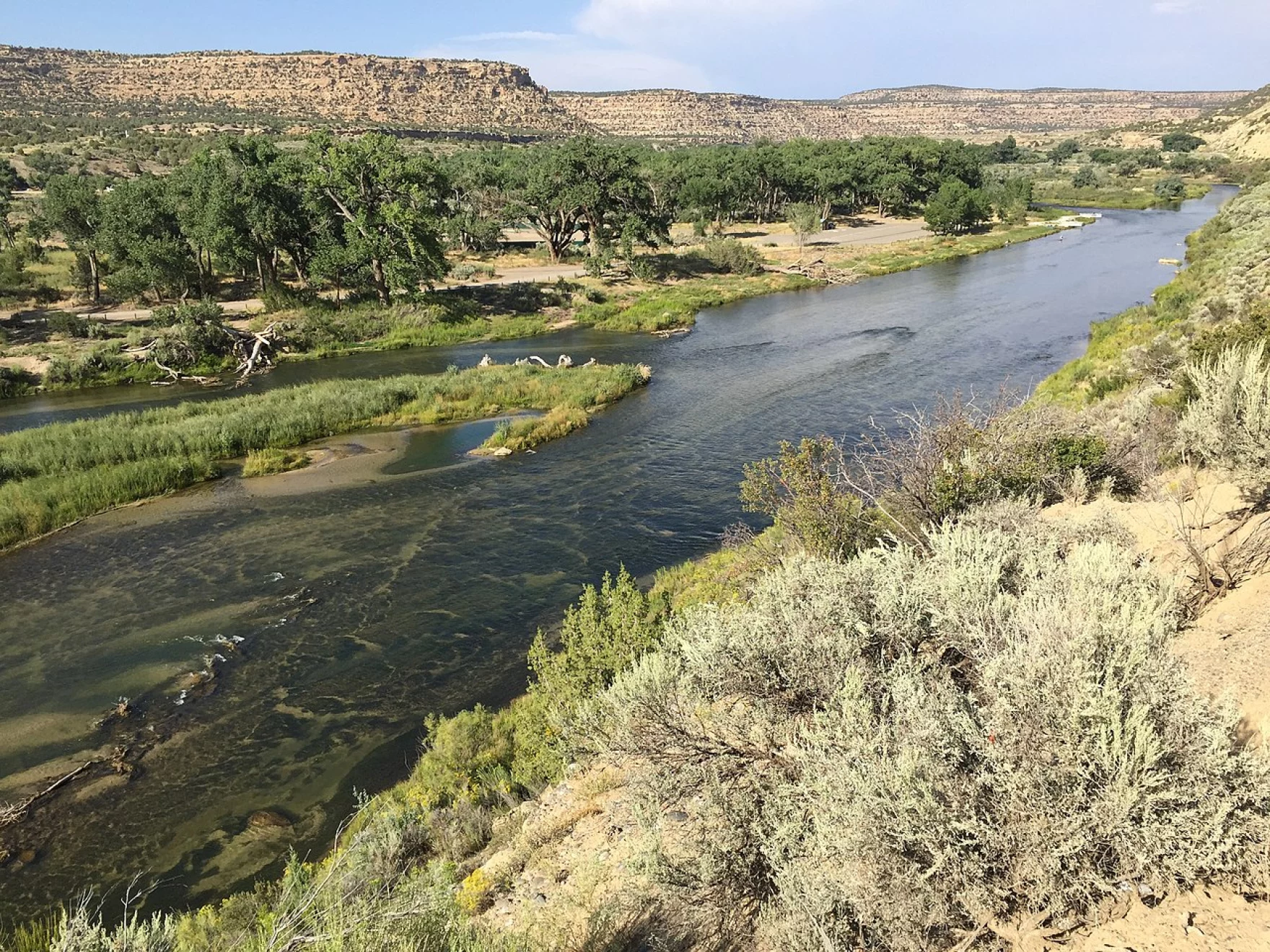
From email from Reclamation:
March 20, 2026
Reclamation conducts Public Operations Meetings three times per year to gather input for determining upcoming operations for Navajo Reservoir. Input from individuals, organizations, and agencies along with other factors such as weather, water rights, endangered species requirements, flood control, hydro power, recreation, fish and wildlife management, and reservoir levels, will be considered in the development of these reservoir operation plans. In addition, the meetings are used to coordinate activities and exchange information among agencies, water users, and other interested parties concerning the San Juan River and Navajo Reservoir. The next meeting will be held virtually on April 21st
Microsoft Teams
Meeting ID: 247 128 548 928 44
Passcode: Yn6ih2Q6
Dial in by phone
+1 202-640-1187,,923961898# United States, Washington
(833) 436-1163,,923961898# United States (Toll-free)
Phone conference ID: 923 961 898#
Join on a video conferencing device
Tenant key: teams@conferencing.doi.gov
Video ID: 114 427 248 3