Colorado Water 2012: A look at the basins of Southwestern Colorado

sanjuan.jpg

Here’s the latest installment of the Valley Courier’s Colorado Water 2012 series, written by Bruce Whitehead. Here’s an excerpt:

Southwestern Colorado’s rivers are unique in that many of the rivers and tributaries flow from north to south and are administered as independent river systems.

This is due to the fact that many, such as the Navajo, Blanco, Piedra, Pine, Florida, Animas, La Plata, and Mancos Rivers, are tributary to the San Juan River in New Mexico or just upstream of the state line. The Dolores River flows from north to south, but makes a “U-turn” near Cortez and heads back to the northwest and joins the Colorado River in Utah. The San Miguel River originates just above Telluride, and flows to the west where it joins the Dolores River just above the Colorado-Utah state line.

The southwest basin has many areas that are under strict water rights administration on a regular basis, but there is still water available for appropriation and development pursuant to Colorado’s Constitution and the Colorado River Compact. The region is also known for its beautiful scenery and recreation opportunities, which is the basis for the establishment of the Weminuche Wilderness area as well as nearly 150 reaches of streams with in-stream flow water rights. Over 50 natural lake levels are also protected by the state’s In-Stream Flow and Natural Lake Level Program.

Water leaders have been active for many years in the basin and recognized early on that in order to meet agricultural and municipal demands storage would need to be developed. The Southwestern Water Conservation District was formed in 1941, and has been responsible for the planning, development, and water rights acquisition for many of the federal projects in the region. Reservoirs such as McPhee (Dolores Project), Jackson Gulch (Mancos Project), Ridges Basin a.k.a Lake Nighthorse (Animas-La Plata Project), Lemon (Florida Project), and Vallecito (Pine River Project) provide for a supplemental supply of irrigation and municipal water in all but the driest of years. The delivery of these supplemental supplies assists with keeping flows in many critical reaches of river that historically had little or no flow late in the season due to limited supplies and water rights administration.

Southwest Colorado is also home to two Sovereign Nations and Indian Reservations that were established by treaty in 1868. Under federal law the Ute Mountain Ute Tribe and Southern Ute Indian Tribe were entitled to federal reserved water rights, which had the potential to create conflicts with Colorado water law and non-Indian water users in the basin. After nearly a decade of negotiations, a consent decree was entered with the water court that settled the tribal claims. The Tribal Settlement included some early dates of appropriation for the tribes, and a water supply from some of the federal storage projects including the Dolores, Animas-La Plata, Florida, and Pine River Projects. This landmark settlement is evidence that both tribal and non-Indian interests can be provided for with water storage and cooperative water management.

More Colorado Water 2012 coverage here.

San Juan Mountains: Acid rock drainage predated mining activity by millennia, mining made it worse

acidminedrainageuniversityofcolorado.jpg

From The Telluride Watch (Peter Shelton):

The report, titled “Natural Acid Rock Drainage Associated with Hydrothermally Altered Terrane in Colorado,” was recently given an award by the Geological Society of America as the best environmental publication of 2011. The report identifies a number of high-country streams in Colorado, including Red Mountain Creek, where surface water is acidic and has high concentrations of metals upstream of historic mining.

“Of course, the mining made it much, much worse,” commented Don Paulson, a former chemistry professor who is now curator of the Ouray County Historical Museum. Paulson has followed efforts to identify sources of stream pollution and the remedial measures undertaken to improve water quality in the Uncompahgre River and its tributaries.

There was a big push to clean up the water affected by mine waste (and the role it plays in the inability of high country waterways to support aquatic life) in the 1980s. At that time the Colorado Department of Health (now Colorado Department of Public Health and Environment) first sued under the Superfund Act, then negotiated with Idarado Mining and its parent company, Newmont Mining, substantial cleanups on both the Telluride and Ouray sides of the mountain. The Telluride side saw improvements to the water quality of the Upper San Miguel River. But the acid pH and the levels of zinc and other minerals in Red Mountain Creek has not changed significantly despite Idarado’s remediation in the area of the Treasury Tunnel.

More water pollution coverage here.

The CWCB and the Bureau of Reclamation are finished hammering out the Animas-La Plata purchase agreement

lakenighthorsedurangoherald.jpg

Here’s the release from the Colorado Water Conservation Board (Tim Feehan/Ted Kowalski/Todd Hartman):

This week the State of Colorado and the U.S. Bureau of Reclamation finalized a contract that allows the state to purchase of a portion of water from the Animas-La Plata (A-LP) Project in southwestern Colorado. This contract represents the completion of almost two years of intense negotiations, cooperation, and hard work on the part of Colorado Water Conservation Board staff and other stakeholders.

The Animas-La Plata Project was built to fulfill a water rights settlement between the federal government and two Indian tribes that live in southwestern Colorado: the Southern Ute Indian Tribe and the Ute Mountain Ute Tribe. But the project also has auxiliary benefits for other water users in the region as a much-needed municipal and industrial water source and reservoir for long-term storage in Lake Nighthorse. The state’s allocation of 10,460 acre-feet will go a long way toward securing a water supply for water users in the southwestern portion of the state.

In 2010, the General Assembly authorized the expenditure of up to $36 million towards the purchase of the State’s 10,460 acre-feet allocation of A-LP project water. This Bill appropriated the first $12 million installment, which was available on June 30, 2011. Subsequent legislation appropriated the remaining $24 million, which will be available July 1, 2012. After the contract was signed and executed, the State made its first payment of $12 million to the Bureau.

After July 1, 2012, the State will pay the final installment to the Bureau, retaining enough of the General Assembly’s appropriation for future operation and maintenance costs. The execution of the contract also grants membership to the State in the Animas-La Plata Operations, Maintenance and Replacement Association. Over the next few months, the State will work with other members of the Association to address issues such as engineering, modeling, water administration and protocol.

For more information or background on the Animas-La Plata project, visit http://www.usbr.gov/uc/progact/animas/ or the CWCB website at http://cwcb.state.co.us.

From the Associated Press via The Colorado Springs Gazette:

Colorado lawmakers had authorized paying $36 million for the state’s allocation of 10,460 acre-feet from the water storage and delivery project in southwest Colorado. Money for the final payment will be available after July 1. The contract announced by the state Wednesday makes Colorado part of a group that will operate and maintain the project.

More Animas-La Plata Project coverage here and here.

The Colorado Legislature intends to pony up $36 million for Animas-La Plata Project water

coloradocapitolfront.jpg

From the Associated Press (Catharine Tsai) via The Durango Herald:

Colorado’s Legislature has authorized paying $36 million to the U.S. Bureau of Reclamation for its share of 10,460 acre-feet of water, plus interest on construction costs. But the interest has been building, and the $36 million likely won’t cover everything Colorado owes.

The tribes had proposed that Colorado allow its share of water to revert back to the tribes, which weren’t assessed for construction. The tribes then would sell the water back to the state at what they say would be a much lower price than what the state would pay the bureau.

“When we heard what the state would spend to get water, our first thought was, ‘Why?’” said Peter Ortego, general counsel for the Ute Mountain Ute tribe. “We can make it cheaper for the state. Sure, it puts money in our coffers, but it keeps it in Colorado.”

However, after two years of talking with tribal representatives, the Colorado Water Conservation Board has directed its staff to move forward on contract talks with the Bureau of Reclamation, board director Jennifer Gimbel said.

Gimbel said the board took the tribes’ proposal “very seriously.” However, some board members questioned whether outside parties would challenge the proposal in court. Though legislators already have approved $36 million for project water, some board members also questioned how willing legislators would be in future years to spend on Animas-La Plata Project water.

More Animas-La Plata Project coverage here and here.

La Plata River: Long Hollow Reservoir will help with compact deliveries

laplatariver.jpg

From the Cortez Journal (J. Paul Brown):

A water storage project, on the La Plata drainage, that has been on the drawing board since 1945, the Long Hollow project, finally is about to become a reality. This is a project located in the mouth of the Long Hollow Drainage about 3 miles from the New Mexico state line. It will allow Colorado to store winter runoff and floodwater in the off irrigation season to be used to satisfy the New Mexico water right at critical times.

One of the big problems in managing the delivery of water to New Mexico under the compact is when there is very little water at Hesperus, all of it can be released and because of seepage and evaporation nothing is delivered to the state line. The idea of the Long Hollow project is to store water so that New Mexico’s portion can be delivered out of the dam and Colorado can use more water that is in the river. It is a great project, and it is too bad that it has taken 67 years to become a reality.

More La Plata River coverage here.

Animas-La Plata Project Repayment Negotiations Continue between Reclamation and Colorado

lakenighthorsedurangoherald.jpg

Here’s the release from the U.S. Bureau of Reclamation (Ryan Christianson):

The Bureau of Reclamation and the state of Colorado are continuing negotiations on a proposed repayment contract for the Animas-La Plata Project. The contract will provide the terms and conditions by which the state will repay the construction costs associated with all or a portion of its statutory allocation of project water. The third negotiation meeting is scheduled for Wednesday August 10, 2011, at 10:00 a.m. at Reclamation’s office, 835 E. 2nd Ave., Suite 300, Durango, Colo. 81301.

The contract to be negotiated will provide for storage and delivery of project water, identify the amount of project construction costs to be paid to the federal government by the state, and provide for operation and maintenance of the project.

All negotiations are open to the public as observers, and the public will have the opportunity to ask questions and offer comments pertaining to the contract during a thirty minute comment period following the negotiation session. The proposed contract and other pertinent documents will be available at the negotiation meeting, or can be obtained on our website under Current Focus or by contacting Brett Griffin of the Bureau of Reclamation, 835 East Second Avenue, Suite 300, Durango, Colorado, 81301, telephone (970) 385-6531.

More Animas-La Plata coverage here and here.

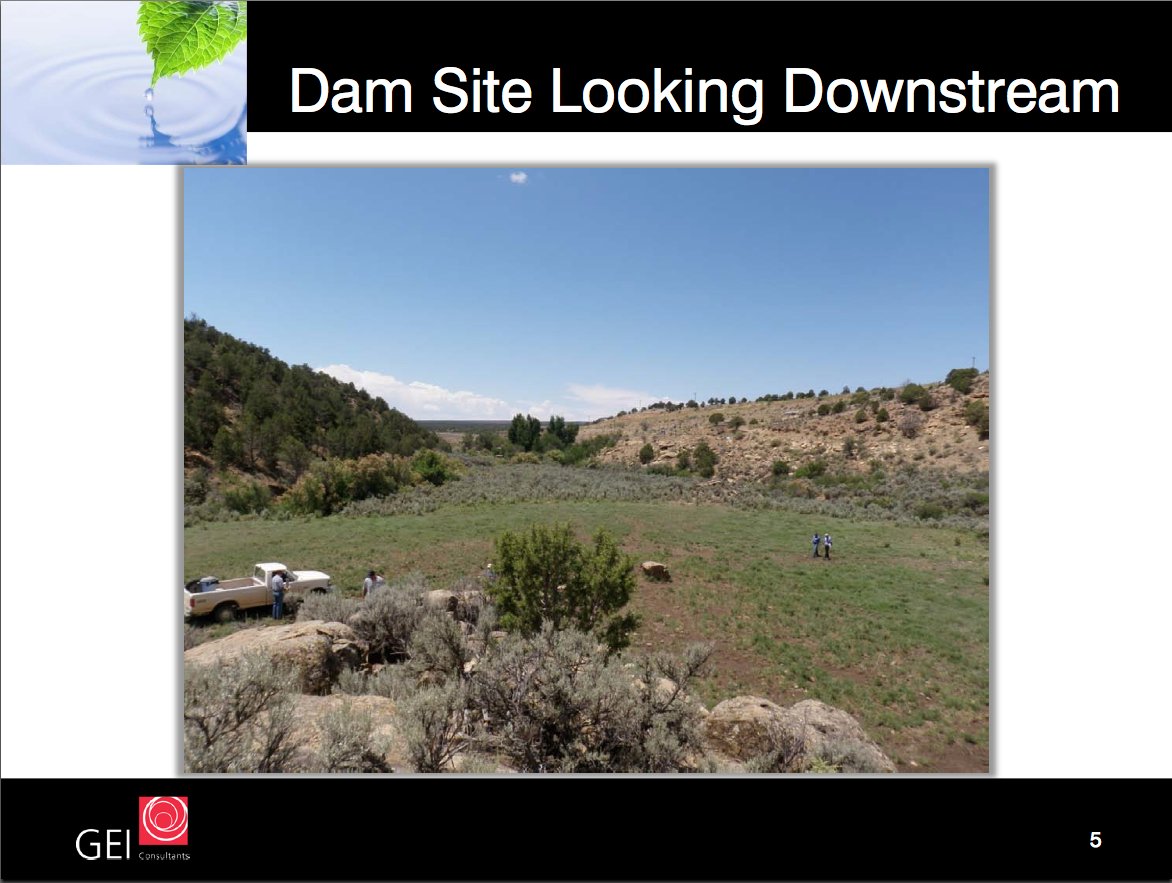
The La Plata Water Conservancy District to turn dirt for the long-proposed Longhollow Reservoir

longhollowreservoirsitelookingdownstreamlaplatacountygei.jpg

From The Durango Herald (Dale Rodebaugh):

The approval of an escrow agreement allows the La Plata Water Conservancy District to break ground on the Longhollow Reservoir. “It’s been 15 or 20 years,” Lee said Friday. “Things move slow, but we’re getting there.”

Groundbreaking could occur as early as next month, said Lee, president of the water district. The reservoir will be located just east of Colorado Highway 140 about five miles north of the New Mexico state line. It will store 5,400 acre-feet of water – 300 of them to help satisfy Colorado’s La Plata River obligation to New Mexico. The remainder is for irrigators in the arid southwest corner of La Plata County…

Longhollow Creek and drainage from Government Draw will fill the reservoir. The project will cost about $22.5 million.

More La Plata River coverage here.