#AnimasRiver: @EPA to use “adaptive management” strategy for Bonita Peak Superfund site

On April 7, 2016, the Environmental Protection Agency proposed adding the “Bonita Peak Mining District” to the National Priorities List, making it eligible for Superfund. Forty-eight mine portals and tailings piles are “under consideration” to be included. The Gold King Mine will almost certainly be on the final list, as will the nearby American Tunnel. The Mayflower Mill #4 tailings repository, just outside Silverton, is another likely candidate, given that it appears to be leaching large quantities of metals into the Animas River. What Superfund will entail for the area beyond that, and when the actual cleanup will begin, remains unclear.
Eric Baker

From The Durango Herald (Jonathan Romeo):

The Bonita Peak Mining District Superfund site, which includes 48 mining-related sites around Silverton, is one of six Superfunds nationwide to be part of the study, referred to as an “adaptive management” strategy.

“We are really excited about this for Bonita Peak,” said Christina Progess, Superfund remedial project manager.

In May 2017, then-EPA administrator Scott Pruitt formed a task force to think about ways to speed up Superfund cleanups, which in some cases can take decades to complete.

A month later, the task force recommended an “adaptive management” strategy that would improve and accelerate the process. Government agencies have used adaptive management since at least the 1970s, but the task force’s move made it formal for EPA.

Kate Garufi, an environmental engineer for EPA who is also chairwoman of the adaptive management task work force, said that some Superfund sites are large and complex, and it can take years to formulate a long-term cleanup plan.

“When you look at Superfund, it’s historically been very linear with a site investigation, evaluating alternatives, selecting a decision and implementing it, which can take a very long time,” she said.

Adaptive management, however, allows the EPA to target quicker projects year to year while a comprehensive solution is investigated, Garufi said.

“We’ll be able to take early actions and see those benefits while we continue to evaluate the entire basin,” she said.

The strategy made perfect sense for Bonita Peak, Progess said, which at 48 individual mining sites across the entire headwaters of the Animas River Basin is one of the larger and more complicated Superfund sites in the country.

As part of the adaptive management, Bonita Peak will be part of the 12-month study, which will set various goals and engage the local community.

“Because we are so early in the investigative process at Bonita Peak, adaptive management will help us set those goals and how to achieve them,” Progess said…

In June 2018, the EPA released a “quick action” plan for cleanup work at 26 mining sites over the next five years to be conducted while the agency comes up with a more long-term, comprehensive strategy to address mine pollution around Silverton.

The plan met resistance from local groups and individuals who say the plan fails to first quantify the benefits and goals that would result from the action plan, which would cost millions of dollars to clean up sites considered smaller contributors of pollution.

Thomas said the adaptive management will help refine that plan. She said a final decision, called an interim Record of Decision, could be issued within the next month or so.

On Wednesday, Thomas also addressed the concern that the partial government shutdown, which lasted 35 days, would cause the EPA to lose a summer season’s worth of work at Bonita Peak.

“Of course everyone here at EPA was dismayed about government shutdown, and it’s good to get back to work,” Thomas said. “Clearly there have been some impacts to the work we were all doing, but we’re doing our best to make sure we can take advantage of a full summer season.”
New @DenverWater rates start Feb. 1

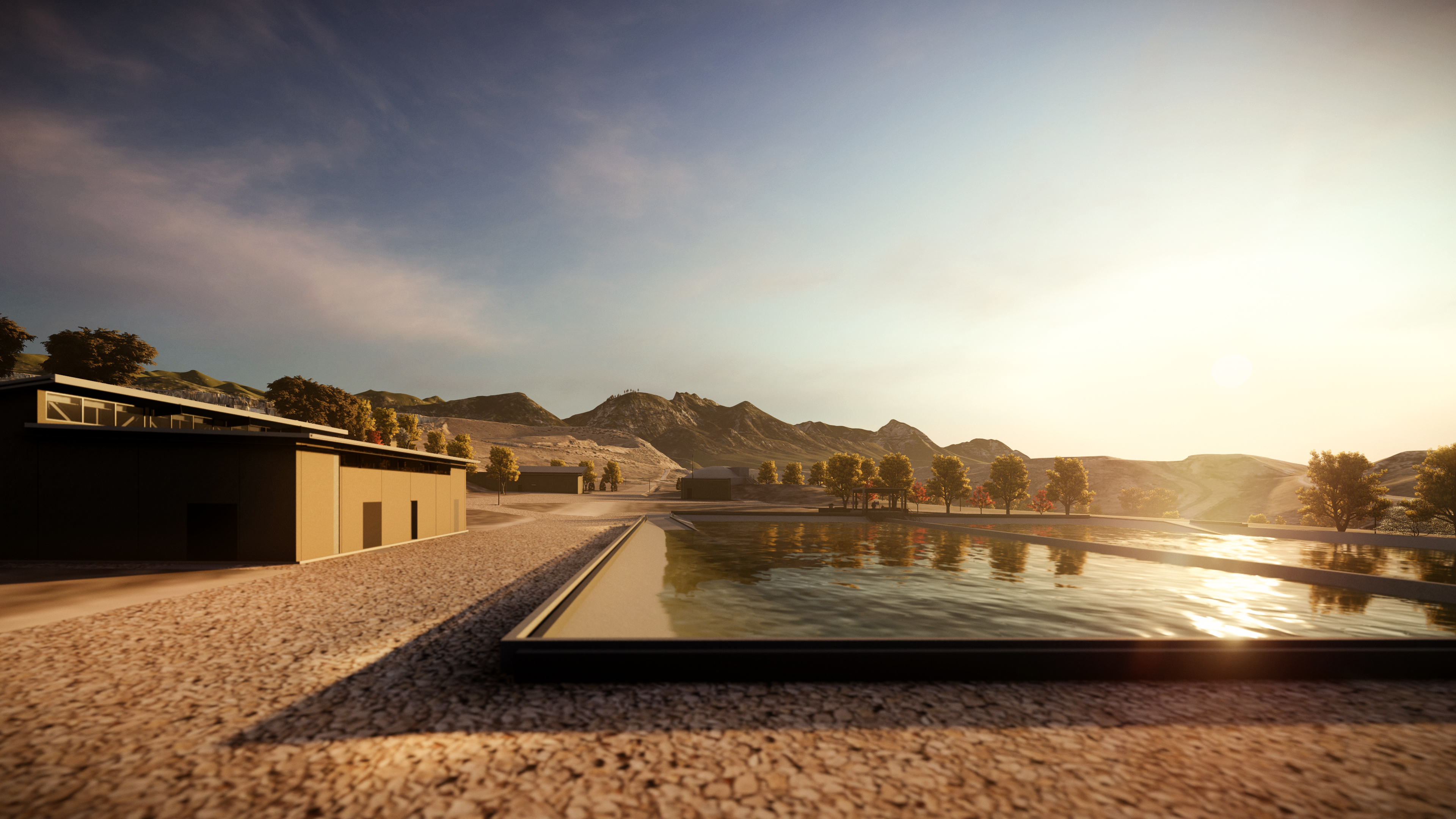
Northwater Treatment Plant — Denver Water is upgrading and modernizing the northern portion of its water system that was built in the 1930s. The utility is building a new water treatment plant, as seen in this rendering, installing a new pipeline, and redeveloping its Moffat Treatment Plant site. Photo credit: Denver Water

Here’s the release from Denver Water (Travis Thompson):

At its meeting today, the Denver Board of Water Commissioners adopted rate changes to fund essential upgrades and new projects to keep Denver Water’s system running smoothly. The new rates take effect Feb. 1, 2019, and monthly bills for most Denver residents will increase by 55 cents if they use water the same as they did in 2018.

“While the cost to maintain and upgrade the water system continues to increase, rapid development inside the city of Denver has brought in more fees from new taps sold, helping to minimize the 2019 rate increase for Denver customers,” said Jim Lochhead, Denver Water CEO/Manager. “The surrounding suburbs, however, had less development than in the past, reducing the amount collected from new tap fees, which means we’ll need to collect more revenue from suburban water rates in 2019.”

Suburban customers who receive water from one of Denver Water’s 65 distributors will see an additional monthly increase added to their volumetric charges. The Denver City Charter requires that suburban customers pay the full cost of service, plus an additional amount. Learn more about how this works: “Why Denver water costs more in the ‘burbs.”

If you live outside Denver and receive water from a distributor under contract with Denver Water, you can expect to see an annual increase between $23 and $41, which is between $1.90 and 3.40 a month (based on an annual use of 102,000 gallons of water).

Pat Fitzgerald, general manager of four Denver Water distributors including the Platte Canyon Water and Sanitation District and chairman of the suburban districts’ Technical Advisory Committee, which reviews Denver Water’s rates annually, provided this statement:

“The advisory committee supports the rate increase. The cost-of-service study used to determine the difference between inside city and outside city customers is fair and reasonable, and the committee had no objections to the results. The expenses are going up, but they’re all projects that are necessary to provide a reliable and safe source of water.”

The major multiyear projects that water rates fund include building a new, state-of-the-art water treatment plant, installing a new 8.5-mile water pipeline to replace a pipeline that was built in the 1930s, expanding Gross Reservoir to provide a more reliable future water supply, constructing a new water quality lab to ensure the highest water quality standards, investing more than $100 million to repair and replace water pipes, and more. There are 158 major projects identified in Denver Water’s five-year, $1.3 billion capital plan.

A customer’s bill is comprised of a fixed charge, which helps ensure Denver Water has more stable revenue to continue the necessary water system upgrades to ensure reliable water service, and a volume rate. The fixed monthly charge — which is tied to meter size — in 2019 is increasing by 55 cents for most residential customers both inside the city and out.

Denver Water’s rate structure includes a three-tiered charge for water use (called the volume rate). To keep water affordable, indoor water use — like for bathing, cooking and flushing toilets — is charged at the lowest rate. Essential indoor water use is determined by averaging the customer’s monthly water use on bills dated from January through March each year. This is called average winter consumption. Water use above the average winter consumption — typically for outdoor watering — is charged at a higher price.

Volume rates for Denver residents will remain the same, but will increase on suburban bills.

Denver Water operates and maintains more than 3,000 miles of pipe — enough to stretch from Los Angeles to New York — as well as 20 dams, 22 pump stations, 30 underground storage tanks, four treatment plants and more. The water provider’s collection system covers more than 4,000 square miles, and it operates facilities in 12 counties in Colorado.

Denver Water does not make a profit or receive tax dollars, and reinvests ratepayers’ money to maintain and upgrade the water system. The utility is funded by water rates, bond sales, cash reserves, hydropower sales and fees for new service (called System Development Charges).

Customers will see more information about 2019 rates in their bills and on Denver Water’s website over the next few months.

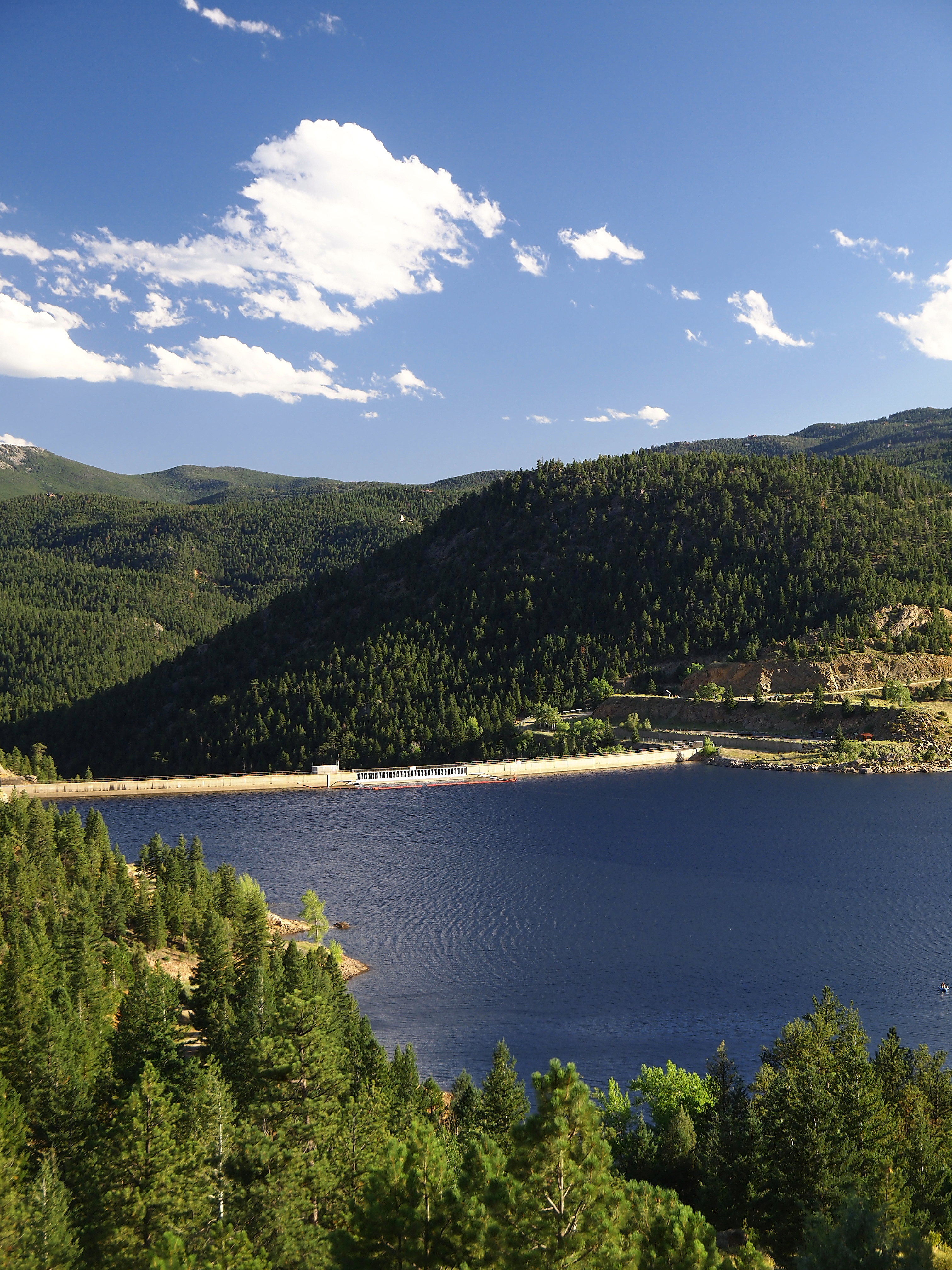
Gross Reservoir — The Gross Reservoir Expansion Project will raise the height of the existing dam by 131 feet, which will allow the capacity of the reservoir, pictured, to increase by 77,000 acre-feet. The additional water storage will help prevent future shortfalls during droughts and helps offset an imbalance in Denver Water’s collection system. With this project, Denver Water will provide water to current and future customers while providing environmental benefits to Colorado’s rivers and streams. Photo credit: Denver Water

@Denver Water, Aurora in dispute with state over lead treatment — @WaterEdCO

Roman lead pipe — Photo via the Science Museum

From Water Education Colorado (Jerd Smith):

Denver Water and three other organizations are seeking to overturn a state order that directs Denver to adopt a strict new treatment protocol preventing lead contamination in drinking water.

Denver is not in violation of the federal law that governs lead, but it has been required to monitor and test its system regularly since 2012 after lead was discovered in a small sample of water at some of its customers’ taps.

In March of this year, after Denver completed a series of required tests and studies, the Colorado Department of Public Health and Environment (CDPHE) ordered the utility to implement a treatment protocol that involves adding phosphates to its system. It has until March of 2020 to implement the new process.

Denver, which serves 1.4 million people in the metro area, has proposed instead using an approach that balances the PH levels in its treated water and expands a program replacing lead service lines in the city. Old lead service lines are a common source of lead in drinking water.

Treating lead and copper in water systems is a complex undertaking governed by the federal Lead and Copper Rule. In Denver, for instance, there is no lead in the water supply when it leaves the treatment plant. But it can leach into the supply via corrosion as water passes through lead delivery lines and pipes in older homes. Denver has 58,000 lead service lines in its system. Lead has continued to appear in samples it has taken at some customers’ taps, according to court filings, though not at levels that would constitute a violation of the federal law.

Eighty-six samples taken since 2013 have exceeded 15 micrograms per liter, including one tap sample which measured more than 400 micrograms per liter, according to court filings. The 15-microgram-per-liter benchmark is the level at which utilities must take action, including public education, corrosion studies, additional sampling and possible removal of lead service lines.

In response to the state’s order, the City of Aurora, the Metro Wastewater Reclamation District and the nonprofit Greenway Foundation, which works to protect the South Platte River, sued to overturn it, concerned that additional phosphates will hamper their ability to meet their own water treatment requirements while also hurting water quality in the South Platte. Denver joined the suit in May.

Because Denver Water services numerous other water providers in the metro area and participates in a major South Metro reuse project known as WISE, short for Water Infrastructure and Supply Efficiency, anything that changes the chemical profile of its water affects dozens of communities and the river itself.

Among the plaintiffs’ concerns is that phosphate levels in water that is discharged to the river have to be tightly controlled under provisions of the Clean Water Act. If phosphate levels in domestic water rise, wastewater treatment protocols would have to be changed, potentially costing hundreds of thousands of dollars, if not more, according to a report by the Denver-based, nonpartisan Water Research Foundation.

From an environmental perspective, any increased phosphate in the South Platte River would make fighting such things as algae blooms, which are fueled by nutrients including phosphorous, much more difficult and could make the river less habitable for fish.

But in its statement to the court, the CDPHE said the state’s first job is to protect the health of the thousands of children served by Denver Water in the metro area.

“The addition of orthophosphate will reduce lead at consumers’ taps by approximately 74 percent, as opposed to the cheaper treatment favored by plaintiffs [PH/Alkalinity], which will only reduce levels by less than 50 percent,” CDPHE said in court documents. “This is a significant and important public health difference, particularly because there is no safe level of lead in blood…Even at low levels, a child’s exposure to lead can be harmful.”

How much either treatment may eventually cost Denver Water and others isn’t clear yet, according to state health officials, because it will depend in part on how each process is implemented.

Denver, Aurora and Metro Wastewater declined to comment for this story, citing the pending lawsuit.

The Greenway Foundation did not respond to a request for comment.

In late July, all parties agreed to pause the legal proceedings while they examine water treatment issues as well as the environmental concerns raised by higher levels of phosphorous in Denver Water’s treated water supplies. If a settlement can’t be reached by Nov. 1, the lawsuit will proceed.

Jonathan Cuppett, a research manager at the Water Research Foundation, said other utilities across the country may be asked to re-evaluate their own corrosion control systems under a rewrite of the Lead and Copper Rule underway now at the U.S. Environmental Protection Agency.

The newly proposed federal rule is due out for review later this year or by mid-2019.

Cuppett said the changes may lean toward more phosphate-based treatment for lead contamination. In fact, the EPA issued a statement in March in support of the CDPHE’s order to Denver Water.

“Within the [Lead and Copper Rule] there are a variety of changes that may be made. Depending on what those changes are other utilities may have to evaluate their strategy again or more frequently. And if that is the case, we may see more of this issue where someone is pushing for phosphorous for control for public health, creating a conflict of interest with environmental concerns,” Cuppett said.

Colorado public health officials said they’re hopeful an agreement can be reached, but that they have few options under the federal Safe Water Drinking Act’s Lead and Copper Rule.

“The [Lead and Copper Rule] is a very prescriptive, strict rule,” said Megan Parish, an attorney and policy adviser to CDPHE. “It doesn’t give us a lot of discretion to consider things that Metro Wastewater would have liked us to consider.”

@USBR selects 16 projects to receive $3.5 million for desalination and water purification research

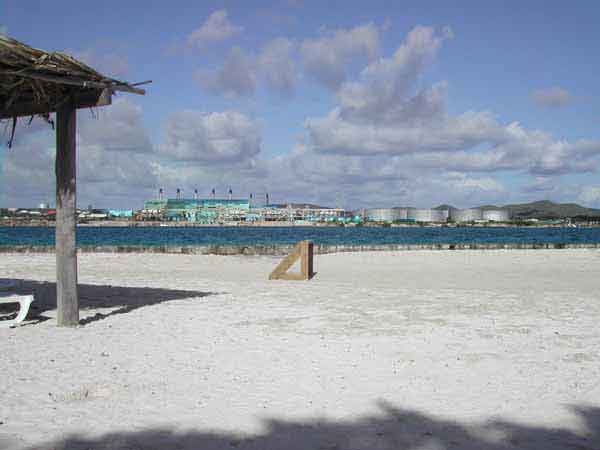
Desalination plant, Aruba

Here’s the release from the Bureau of Reclamation (Peter Soeth):

The projects will help develop innovative, cost-effective and efficient desalination technologies

Bureau of Reclamation Commissioner Brenda Burman announced that 16 entities will receive $3.5 million for laboratory and pilot-scale research projects as part of the Desalination and Water Purification Research Program. The DWPR Program works with Reclamation researchers and partners to develop more innovative, cost-effective and technologically efficient ways to desalinate water.

“Desalination is an increasingly important source of water for Western communities” Commissioner Burman said. “Investing in innovative technologies to make desalination more affordable and energy-efficient will help many communities across the United States.”

Nine laboratory projects and seven pilot-scale projects were selected for funding. A laboratory-scale study is typically a bench scale study involving small flow rates. They are used to determine the viability of a novel process, new materials, or process modifications. Research at this stage often involves a high degree of risk and uncertainty.

A pilot-scale project tests a novel process at a sufficiently large scale to determine the technical, practical, and economic viability of the process and are generally preceded by laboratory studies that demonstrate if that the technology works. The $3.5 million will be matched with $4.8 million in non-federal funding.

The nine laboratory projects are:

  • Argonne National Laboratory – Compressible foam supercapacitor electrodes for energy-efficient and low-cost desalination. $150,000
  • Colorado State University – Developing relationships between mineral scaling and membrane scaling and membrane surface chemistry to improve water recovery of inland brackish water desalination. $133,634
  • Fraunhofer USA, Inc – Plasma activated biochar for high-efficiency capacitive desalination. $72,173
  • New Mexico State University – Portable wind turbines for potable water through electrodialysis treatment. $150,000
  • Trussel Technologies, Inc. – Novel online surrogates to monitor reverse osmosis performance in reuse applications. $150,000
  • University of Arizona – Near zero-liquid discharge water reuse with a closed-circuit ozone-membrane distillation process. $146,361
  • University of California, Davis – Flow cytometric monitoring of waterborne pathogens to facilitate water treatment and direct potable water reuse. $149,178
  • University of Notre Dame – High performance biocatalytic membranes with cell surface display enzymes for improved concentrate management. $149,995
  • Vanderbilt University – Polyelectrolyte/Micelle multiplayer nanofiltration membranes with drastically enhanced performance. $150,000
  • The seven pilot-scale projects are:

  • Carollo Engineers, Inc – Pilot testing a two-stage, fixed bed biotreatment system for selenium removal. $279,246
  • Gradiant Osmotics, LLC – Counter flow RO – Innovative desalination technology for cost-effective concentrate management and reduced energy use. $400,000
  • Massachusetts Institute of Technology – Pilot testing dynamic optimized, photovoltaic-powered, time-variant electrodialysis reversal desalination system. $400,000
  • New Mexico Institute of Mining and Technology – Geothermal membrane distillation for large-scale use. $200,000
  • New Mexico State University – Assessment and implementation framework for transboundary brackish groundwater desalination in south-central New Mexico. $399,353
  • The City of Daytona Beach – Tracking the occurrence and removal of microbial and toxic hazards during potable reuse through online monitoring and advanced analytics. $400,000
  • University of California, Riverside – Innovative water reuse systems harnessing chloramine photochemistry for potable water reuse. $200,000
  • The DWPR program is supporting the Department of the Interior’s priorities, including: creating a conservation stewardship legacy second only to Teddy Roosevelt, utilizing our natural resources, and restoring trust with local communities, among others.

    To learn more about Reclamation’s Desalination and Water Purification Research Program and see complete descriptions of the research projects please visit http://www.usbr.gov/research/dwpr.

    Good chance for the North American #Monsoon to show up in coming weeks #ColoradoRiver #COriver #drought

    From The Grand Junction Daily Sentinel (Dennis Webb):

    Southwest Colorado and some of the higher elevations in the region have seen increased moisture recently that has allowed for lifting of fire restrictions, including by the Grand Mesa, Uncompahgre and Gunnison national forests, the Bureau of Land Management’s Montrose-based Uncompahgre Field Office, and Montrose County, all on Friday.

    But the picture has been different, as in drier, in the Grand Valley. Through Friday, Grand Junction was experiencing its driest July in a decade, with just 0.08 inches for the month, according to National Weather Service data. It hasn’t been drier since just 0.02 inches fell during all of July 2008.

    Charnick said that by this time in an average July Grand Junction has received about a half-inch of rain for the month.

    The summer monsoon season typically brings moisture up from the south into much of western Colorado. But Charnick said high pressure to the south “is sort of directing the monsoonal moisture more to our west.”

    A clockwise circulation forms around that high pressure, so what’s needed is for the high pressure to move a bit east so moisture from the south is brought up into the area, he said.

    Still, Charnick said the area isn’t necessarily running behind in getting monsoonal rains.

    “Usually August is a better month for that monsoonal moisture” in Grand Junction, Charnick said. “So while we are a little bit below average right now we’re still very early on in this whole monsoon pattern, so things can shift in the month of August.”

    He noted that average precipitation in August in Grand Junction is 0.95 inches, compared to 0.61 inches in July. The monsoon can extend into September.

    “Actually September is usually our wettest month of the year,” Charnick said, averaging 1.19 inches.

    Peter Goble, climatologist and drought specialist at Colorado State University’s Colorado Climate Center, said Grand Junction is heading into its wettest time of year. He said that’s all relative, given that a month with 1.19 inches of precipitation would be considered a dry month in a lot of places. Still, any time an area is heading into its wettest season climatologically, it brings hope of getting precipitation to reduce moisture deficits, Goble said.

    On the down side, Goble said if an area misses out on getting much moisture during what is supposed to be its wettest time of year, it can be stuck with a deficit for quite a while.

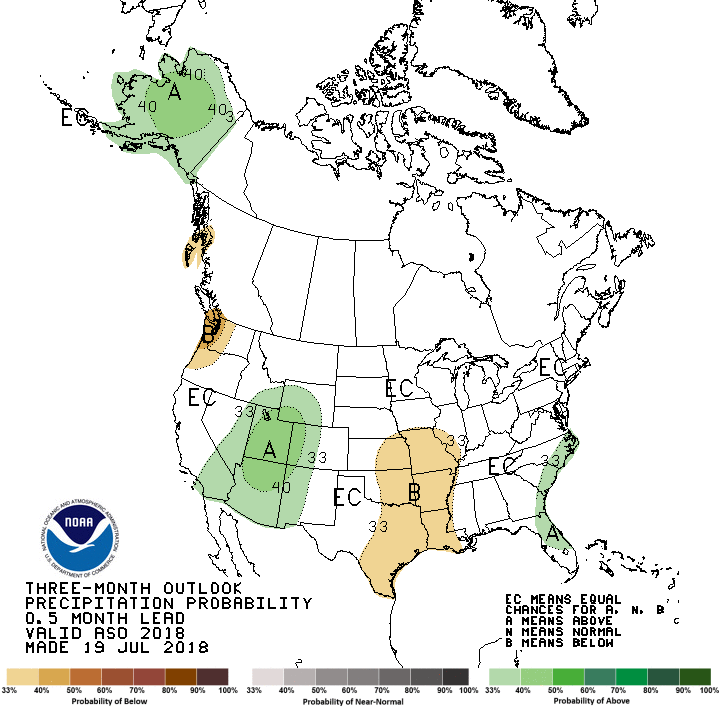
    Goble noted that the National Weather Service’s Climate Prediction Center is saying there’s an above-average chance of getting above-average precipitation over the next three months in western Colorado…

    He said the Grand Junction area’s monsoon season typically peaks later than for a lot of the state, in late August or early September, but it’s still a bit disconcerting that it hasn’t started yet.

    Essentially all of Mesa County is now in the extreme drought category — the second-worst category. Charnick said that reclassification occurred in early July.

    A tiny sliver of the far southern part of the county is in the exceptional category, which is the driest. Much of the Four Corners area also is in exceptional drought.

    Goble said the last time the entire county was in extreme drought was the summer of 2012. He said the county got out of the extreme drought category by the middle of the snow season in 2013.

    The county reached the exceptional drought category in the summer of 2002.

    Joe Burtard, spokesman for the Ute Water Conservancy District, one of the Grand Valley’s major water providers, said the current drought is one of the worst on record for his agency, one of four major episodes that also include the 2002 and 2012 droughts and one in 1977.

    “This year has been a really abnormal year for us in all aspects,” he said.

    He said it’s when the area moves into the extreme and exceptional drought categories that area water providers start seriously considering mandatory water restrictions, rather than the voluntary ones now in place.

    “We’re really waiting to see what these monsoon rains do for the valley,” he said.

    Ironically, though, those rains are expected to pose a challenge to local water providers rather than just simply benefits. The Lake Christine Fire near Basalt has charred more than 12,000 acres, and the rains are expected to bring flooding that will result in ash reaching local rivers, and ultimately the Colorado River.

    Burtard said that will affect the Clifton Water District, which gets water out of the river. As a result it will impact Ute Water, which would serve as a backup water source for Clifton Water as part of an agreement among local providers to help each other in emergency situations.

    That will further tax Ute Water, which already has been pulling from limited resources this summer, Burtard said.

    “It’s not a matter of if, it’s a matter of when, because when we get that monsoon rain that ash is coming our way,” he said.

    Ute Water also recently purchased water rights from the Ruedi Reservoir in the Fryingpan River Valley above Basalt to help in drought years and in planning for population growth in its service area. That water also could help in a situation such as a fire on Grand Mesa that could impact watersheds serving Ute Water.

    But for Ute Water to tap the Ruedi supply for any reason, the water would have to run through Basalt and down the Roaring Fork and Colorado rivers.

    @WaterEdCO “Fresh Water News’: Aurora’s recycled water plant running at full-tilt

    From Water Education Colorado (Jerd Smith):

    Aurora’s futuristic recycled water project — Prairie Waters— is running at full-tilt for the first time in its eight-year history, a move designed to make the city’s water supplies last longer in the face of severe drought conditions.

    “We’re pushing it as hard as we can,” said Greg Baker, a spokesman for Aurora Water.

    In February, as mountain snows failed to accumulate, Baker said the city began mobilizing to ramp up plant operations, knowing its reservoirs would likely not fill this summer. “We were very worried.”

    By April, Prairie Waters was running at full speed, generating 9.7 million gallons a day (MGD), up from 5.1 MGD last summer, a 90 percent increase in production.

    “We could possibly push it to 10 MGD,” said Ann Malinaro, a chemist and treatment specialist with Prairie Waters, “but we consider 9.7 MGD full capacity.”

    […]

    “Prairie Waters was huge, not just in terms of volume, but also because it’s really helped us advance as a state in accepting potable [drinkable] reused water,” Belanger said. “Historically, there has been a yuck factor. But Prairie Waters has helped folks understand how systems can be designed so they are safe and effective.” [Laura Belanger]

    Twenty-five Colorado cities, including Denver, Colorado Springs, Fort Collins and Louisville, operate recycled water facilities, according to the Colorado Department of Public Health and Environment, but that water is used primarily to water parks, golf courses and to help cool power plants, among other nonpotable, or non-drinkable, uses.

    But Aurora, faced with fast-growth and a shortage of water, realized more than a decade ago that reusing its existing supplies and treating them to drinking water standards was the only way to ensure it could provide enough water for its citizens.

    Completed in 2010, the Prairie Waters Project recaptures treated wastewater from the South Platte River and transports it back to Aurora through a series of underground wells and pipelines. As the water makes its 34-mile journey from a point near Brighton back to the metro area through subsurface sand and gravel formations, it undergoes several rounds of natural cleansing.

    Once it reaches the Prairie Waters treatment facility near Aurora Reservoir, it runs through a series of high-tech purification processes using carbon filters, UV light and chlorine, among other chemicals. Then, before it is delivered to homes, the reused water is mixed with the city’s other supplies, which derive from relatively clean mountain snowmelt that is carried down from the mountains.

    Water treatment operators are in high demand across #Colorado

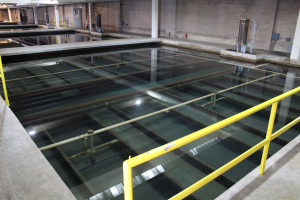
    Filter beds at a Denver Water treatment plant. Fluoride is added after filtration, prior to disinfection. Learn more about the treatment process: denverwater.org/WaterQuality/TreatmentProcess

    From KOAA.com (Caiti Blase):

    David Stanford, a water treatment operator in charge of Beulah’s water systems, says there’s a lot of opening in different parts of the state because older operators are retiring. However, between the years of training and sometimes small wages, replacing those people isn’t just a simple hire.

    Russell Chambers, an operator in training, said, “There’s a lot to learn. It’s a pretty challenging job if you like a challenge.”

    Chambers has been working at the water districts in Beulah for about four months and it’s just the beginning of his journey to get a Level B certification in order to become a qualified water treatment operator in the valley.

    Stanford said, “It does take a lot of learning, a lot of certification, a lot of on the job training.”

    The training can take several years.

    Stanford said, “You have to know and understand every facet of how to get the water here, get it through the plant, and get it to the customer.”

    Which is why it’s time to start training the next generation.

    “In the state of Colorado the operators from the 70’s and 80’s, that team is retiring for the most part so there’s a lot of openings in many, many places for training operators.”

    Stanford knows just how important this position is.

    “I’m responsible for the lives of nearly 600 people that live in this valley. On a daily basis it is my responsibility to deliver to them drinking water that is safe to drink.”

    Until Chambers is fully-certified, Stanford is “the guy that has to call the shots and is ultimately responsible for everything that happens with the water.”

    It’s why bringing in and training newcomers is an important facet for towns like Beulah.

    Eagle turns dirt on second water treatment plant

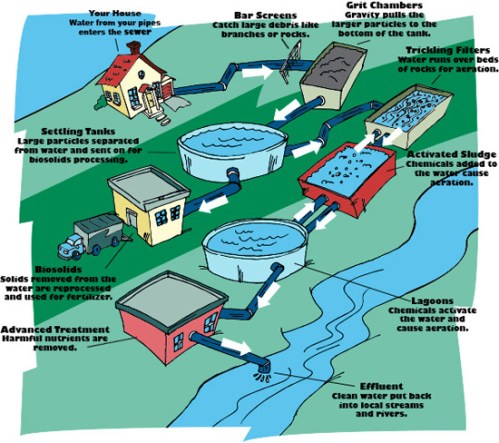
    The water treatment process

    From The Vail Daily (Randy Wyrick):

    A groundbreaking ceremony saw the first shovels of dirt turned Tuesday, July 10. Excavation should continue through the summer, and concrete should follow in the fall.

    Water is scheduled to begin flowing in the fall of 2020…

    The town’s current and only water treatment plant runs at 90 percent capacity during peak demand, and some days it’s higher, said Brandy Reitter, Eagle town manager. The new plant will generate as much as 2.5 million gallons of water per day and can be expanded to 5 million gallons per day. It should fulfill the town’s projected growth needs for the next 20 years.

    “The town must accommodate its existing users. We also want to accommodate new customers and growth. We cannot consider new development unless we have the water to serve,” Reitter said. “Now is the time. The demands have increased significantly and we cannot wait any longer.”

    This new water plant will be on the Eagle River. The current plant is on Brush Creek and is the town’s only source of water.

    The town has good water rights on the Eagle River, thanks to tireless work by former town manager Willy Powell, Reitter said.

    Bryon McGinnis, Eagle’s public works director, said the second water plant will help the town preserve those hard-won water rights…

    A second water plant is also a public safety issue, McGinnis said, pointing out the many wildfires burning around Western Colorado.

    The Lake Christine fire near Basalt hit that town’s watershed and strained its system. However, Basalt has a system of wells near the Roaring Fork River, and that second water source kept the water flowing, McGinnis said.

    The town of Eagle saved $10 million and used it as a down payment on the new plant.

    “Development has, for many years, paid its own way. The town has collected and saved fees to help pay for this,” Reitter said.

    The remaining cost will be covered by a low-interest, 20-year loan from a state revolving fund.

    Broomfield-based MWH Constructors will build the plant.

    #Drought news: The Town of Beulah’s water supply is in rough shape

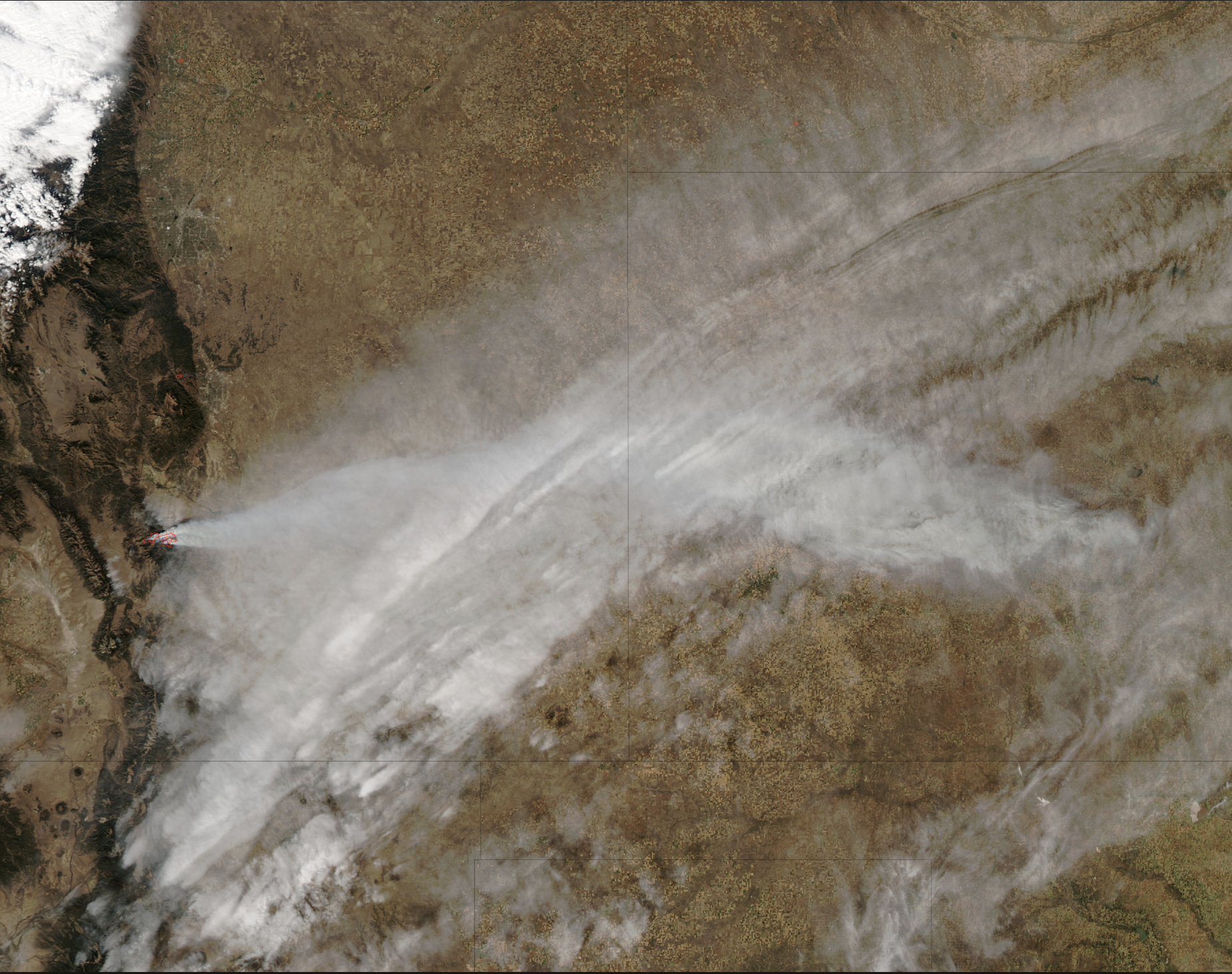
    This natural-color image was captured by NASA’s Aqua satellite with the Moderate Resolution Imaging Spectroradiometer, MODIS, instrument on October 17, 2016 at 19:50 UTC (1:50 pm MT). Actively burning areas, detected by MODIS’s thermal bands, are outlined in red. NASA image courtesy Jeff Schmaltz LANCE/EOSDIS MODIS Rapid Response Team, GSFC. Caption by Lynn Jenner with information from the Colorado Division of Homeland Security and Emergency Management. Image credit: NASA

    From KOAA.com (Caiti Blase):

    Extreme drought conditions, fire danger, and contaminated water in creeks: that’s the critical situation going on in the small town of Beulah.

    On Tuesday, News 5 spoke with residents on how these conditions are impacting them. Gary Kyte, chair of Pine Drive Water District wants people in Beulah to know that the water flowing into their homes is safe. It’s coming from water tanks that have already been treated. However, people are under a critical usage policy because of just how dry it is. The town did get some rain last week, but all it did was make things worse.

    Kyte said, “Evidently, that particular rain rained over the burn scar, the Junkins burn scar.”

    It’s been almost two years, but Beulah is still feeling the effects of the 2016 Junkins Fire. Last week’s rain caused debris and ash from the burn scar to flow into creeks.

    “We feel that it impacted our raw water intake.”

    What the town needs now is another good rain, but not on the burn scar.

    “It would flush or kind of scour out the creek bed and hopefully if it rains some more we could go back to treating water.”

    Kyte says between the contamination and the low water levels in the creeks doing treatment right now wouldn’t be worth it.

    “We’re entering into a critical drought state. We’re going to have to make water or we’re going to have to purchase water.”

    The town is trying to hold on as long as possible by restricting water to residents. Households supplied by the Pine Drive Water District are allowed to use 60 gallons of water a day. Those using the Beulah Water Works District are allowed 80 gallons a day…

    Kyte says he and the chair of the Beulah Water Works District have been speaking with Pueblo County’s emergency management staff. They are looking at various short and long-term options for assistance (such as hauling water) if conditions don’t improve.

    #AnimasRiver: Truck hauling sludge from the Cement Creek water treatment plant crashes and spills into Cement Creek

    From The Associated Press via The Colorado Springs Gazette:

    The driver wasn’t severely injured, but about 9 cubic yards of waste sludge spilled into the creek.

    The sludge is a byproduct of a U.S. Environmental Protection Agency treatment plant that is cleaning up water draining from the inactive Gold King mine. The EPA has said the sludge is not hazardous.

    Authorities say it doesn’t appear the truck spilled any fuel.

    Colorado’s North Clear Creek & Tuthill

    For 150 years, the North Clear Creek in Black Hawk, Colorado has been contaminated from historic mining. A new water treatment plant that came online in 2017 is removing 350lbs of heavy metals every day from the stream with the hopes of reestablishing a brown trout population. The facility uses Tuthill’s Blower Packages to aerate the water to remove the heavy metals more easily. Learn more about Tuthill’s products here: https://www.tuthillvacuumblower.com/i…

    The facility was built and run by the Colorado Department of Public Health and Environment and the Environmental Protection Agency. The Colorado Department of Transportation was integral to this project.

    Greeley: Bellvue Water Treatment Plant undergoes first major upgrade since 1947

    The water treatment process

    From The Greeley Tribune (Sara Knuth):

    These days, the historic plant is in the process of changing. Greeley is building a new water treatment plant on the same property to replace water filtration systems, marking the first major change to the facility since 1947. The $25 million project will centralize water filtration processes that currently are spread out between two buildings, and with further expansion one day could give the plant the capability to treat 40 million gallons of water per day. The initial phase of the project is expected to be completed by mid-2019.

    During the city’s annual summer water and sewer tour, a group of Greeley residents saw the past and into the future, learning about the extensive filtration, miles of pipeline that bring water from Bellvue to Greeley and the construction that will upgrade the system.

    “We’re kind of turning the page on what the treatment plant will look like between yesterday and into the future,” said Burt Knight, Greeley’s water and sewer director.

    CENTURY-OLD SYSTEM

    For Mohr, the Bellvue plant is fascinating. Between breaking down the technical process associated with treating water at the plant and showing residents decades-old filters during the tour, he stopped a few times to express his awe for the plant, first envisioned by Greeley leaders at the turn of the century, back when the city had a population of 5,000.

    In 1905, 97 percent of Greeley’s voters approved a ballot measure to build the plant at the mountain location — just west of Fort Collins — to bring the city water produced by Rocky Mountain snowmelt.

    “The one thing I’m overly impressed with is we’ve got over 30 miles of pipeline from this facility to Greeley, and we don’t use pumps to move water from there to there,” Mohr said.

    The 36-mile pipeline envisioned by Greeley water pioneer W.D. Farr brings water to the city’s storage facilities by gravity as it flows down from the mountains. Mohr said choosing Bellvue for the plant was a strategic part of the process.

    “W.D. Farr over 100 years ago worked together with a number of other very smart people and said, ‘If we’re going to serve water to the residents of Greeley, this is a great place to do it,’ ” he said. “And it is, for a number of reasons.”

    For one, Mohr said, Bellvue is still responsible for filtering most of Greeley’s water more than a century later. Though the Boyd Lake Water Treatment Plant in Loveland helps supplement the city’s production in the summer when residents use more water for lawns and plants, it runs only seasonally, leaving most of the work to Bellvue.

    And in 2017, water produced at the plant won the American Water Works Association’s award for best tasting water in the nation, beating 33 other regional winners. It also won the competition’s People’s Choice Award, making Greeley the first city to win both awards in the contest’s 13-year history.

    But even with the recognition and the plant’s long life, Mohr said Bellvue needs to be upgraded.

    Greeley City Manager Roy Otto said for the city, the job is fairly commonplace. It’s important for the water and sewer department to constantly expand and upgrade its facilities, he said, and the Bellvue project is just one of several projects the city is working on to accomplish that goal.

    At Bellvue, upgrades will replace equipment that has been in place for decades.

    With water filters that have been in operation since the late 1940s and early ’50s, Mohr said, Bellvue’s current buildings are going to be obsolete soon.

    “It’s been working very, very hard for a very long time,” he said, “and it’s kind of time for us to think about the future.”

    NEXT PHASE

    After the city won the American Water Works Association awards, Knight, the water and sewer director, said he called Bellvue’s Water Treatment Manager Andrew Kabot, jokingly, to suggest the city cancel the project because Greeley’s water was right where it needed to be.

    “He assured me that was a bad idea,” Knight said during the tour.

    The project, which broke ground in October, started after the water and sewer department found it would cost more to rehabilitate Bellvue’s vintage filters, placed there in 1948 and 1953, than it would to start from scratch to build a modern system. Mohr said the new technology will automate the filtration processes. City officials also plan to improve piping at the plant so water can enter the system more quickly.

    At the current plant, the city brings water in through the system between two different buildings to complete the water treatment process.

    Knight said when the new plant is completed those processes will be under the same roof. The city will maintain the plant’s old buildings, he said, and use them as gathering places for tour groups or meetings.

    Before construction started, Knight said, the city decided to award the project to Fort Collins-based Hydro Construction as part of a construction manager risk contract, a form of a design-build contract. That means city officials will make decisions with the company as construction progresses.

    “Our choice, predominantly, is investment in water treatment,” Knight said. “So we’ll have an attractive building, but it’s really about the equipment inside the building.”

    Milliken scores $900,000 for water treatment improvements

    Milliken Colorado. Photo credit: Jeffrey Beall – Own work, CC BY-SA 3.0,

    From The Greeley Tribune (Tyler Silvy):

    The state shut down Milliken’s water plant in May 2014 following at least a year of warnings regarding the high-salinity brine water — a product of the town’s drinking water treatment process — the town was discharging into the river.

    The town faced fines of up to $10,000 per day, which could have totaled in the millions of dollars, but the fine was reduced to $140,000.

    Milliken officials have since spent $400,000 on engineering studies, which helped officials come up with a new process for treating the leftover water. It’s the same process mining companies use, involving a variety of filters to treat the brine water.

    It’s a $2.9 million fix, and town officials announced Wednesday the town has received a $900,000 grant from the Department of Local Affairs.

    The results, for Milliken, won’t be felt until December at the earliest, and it will put an end to an expensive alternative the town has employed for the past four years…

    In the past, Milliken has treated about one-third of its residents’ drinking water, relying on Greeley and Central Weld County Water District for the rest.

    The past four years have seen Milliken’s reliance on Greeley and Central Weld increase to make up for the town’s inability to treat its own water, Wiest said.

    Wiest wasn’t sure how much more that setup cost Milliken, but he said the town has been paying more for water from the outside suppliers than it would have cost to treat its own.

    Down ‘The River Of Lost Souls’ With Jonathan Thompson — Colorado Public Radio

    From Colorado Public Radio (Nathan Heffel). Click through to listen to the interview:

    A new book puts the Gold King Mine spill within the long history of mining and pollution in Southwest Colorado.

    Jonathan Thompson will be at the Book Bar tonight. I wonder if Denver is a bit of a shock to his system even though he’s a sixth-generation Coloradan?

    I am so happy to finally get to finally meet Jonathan. His new book, River of Lost Souls, is an important read. Understanding the industrialization of our state over the years will help us chart a less destructive course.

    I loved the passages where Jonathan reminisces about spending time around the Four Corners and in the San Juans. He transports you to those times in your life spent next to the river or exploring what sights the land has to offer. He connects you to the Four Corners in a way that only a son of the San Juans could.

    Cement Creek aerial photo — Jonathan Thompson via Twitter

    #AnimasRiver: U.S. Court of Appeals D.C. Circuit says @EPA followed the rules for Bonita Peak Mining District Superfund designation

    From The Durango Herald (Jonathan Romeo):

    Judges say EPA followed rules when including mining sites in cleanup area

    The U.S. Court of Appeals D.C. Circuit issued the decision Tuesday to deny Sunnyside’s petition, which was filed by the mining company – a “potentially responsible party” in the Superfund cleanup – in December 2016.

    Sunnyside had argued that of the 48 mining sites in the upper Animas River watershed the EPA included in the “Bonita Peak Mining District Superfund” site, 29 had not been properly evaluated and should be removed.

    Sunnyside owns two of the 29 sites mentioned, including the Sunnyside Mine and the Mayflower tailings.

    “We have no objections to there being a Superfund listing,” Sunnyside spokesman Larry Perino previously said. “The petition is only challenging the unlawful listing of sites that were not assessed at all under the EPA’s own Hazard Ranking System.”

    Perino did not immediately respond to requests for comment Tuesday afternoon.

    However, the U.S. Court of Appeals D.C. Circuit decision says the EPA did act lawfully and within its own protocols in the Superfund process.

    In determining whether the mining district around Silverton qualified for a Superfund listing, the EPA scored 19 pollution sources under the agency’s Hazard Ranking System.

    Each of the sources received a high enough score that indicated pollution was bad enough to be eligible for a Superfund listing. As a result, EPA proposed the entire mining district, scored and unscored sources, should be listed.

    The Bonita Peak Mining District Superfund site was declared in September 2016.

    Months later, Sunnyside argued the EPA was wrong to create a Superfund site that had unscored sources, claiming the EPA must score each contributing source of contamination before adding it to the broader Bonita Peak site.

    But the court said text of the HRS process “alone is enough to refute this assertion,” which says a Superfund “may include multiple sources and may include the area between sources.”

    “The BPMD is a site (comprised) of the 19 scored sources and the areas ‘between’ them, as the HRS explicitly permits,” the court said. “Sunnyside’s mine falls into the category of an ‘area between sources’ and therefore did not need to be scored.”

    The court said: “Sunnyside’s real concern became apparent at oral argument. It claims its mine has been fully remediated and had no part in the present pollution of the site, but it may nevertheless be required to pay for some or all of the cleanup.”

    Sunnyside Gold is considered the largest “potentially responsible party” in the district – a term the EPA uses for entities it considers financially on the hook for cleanup.

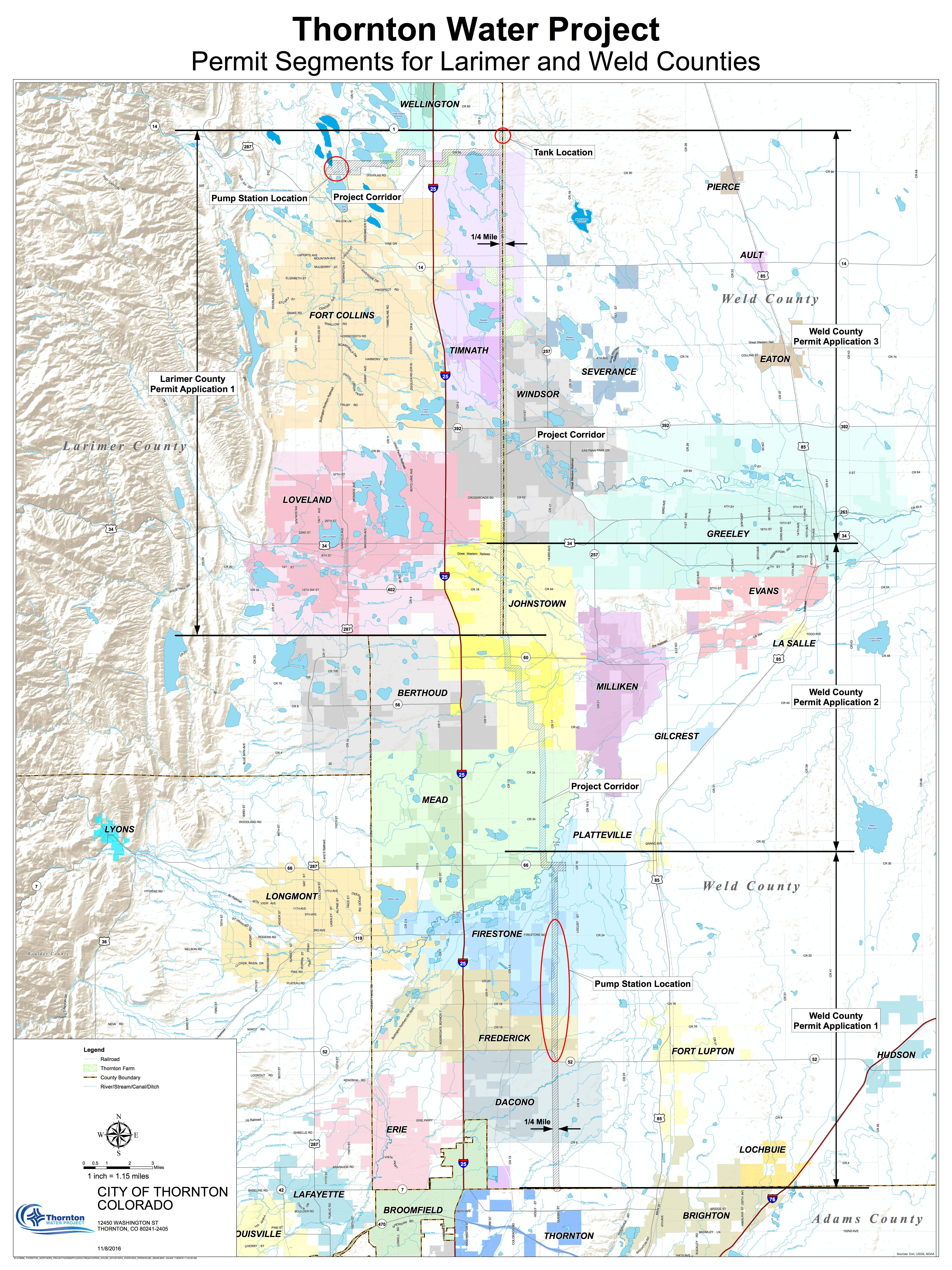
    Thornton Water Project update

    Map via ThorntonWaterProject.com.

    From The Fort Collins Coloradoan (Jacy Marmaduke):

    Water quality is a sticking point for Thornton, which faces challenges getting all its water to drinking quality standards. Much of the city’s water comes from the South Platte River and requires extensive treatment because it’s diverted downstream of many areas of runoff and pollution, [Emily] Hunt said.

    If Thornton drew the water from the Poudre near Windsor as suggested, the city would end up with water run downstream of three wastewater treatment plants and numerous runoff areas, [Mark] Koleber said.

    “Urban runoff, agricultural runoff, wastewater plants, industrial discharge — it’s just not what you do for a municipal drinking water supply,” he said.

    Especially considering Thornton bought the [rights to divert] because of its high quality, Hunt added.

    Westminster hopes to bring on a new water treatment plant by 2025

    Westminster

    From the Nortglenn-Thornton Sentinel (Scott Taylor):

    Westminster looking for spot for Semper successor

    City officials will begin looking around Westminster for a good place to put a new water treatment plant with the aim of having it ready for service by 2025.

    “This is the first phase of longer program and we’re calling this first phase Water 2025,”said Stephen Grooters said. “That’s designed to give us the quantity, quality and reliability goals we need to meet today’s population.

    “And as the city grows and as our other treatment facilities age, the city can gauge the cost and efficacy of adding a second phase plant — when to add it and how big to make it.”

    The new plant would provide backup service to the city’s two existing treatment plants, the Northwest plant and the Semper, and give the city time to consider options for replacing Semper some time in 2040.

    City Councilors voted Jan. 8 to set aside $609,749 to begin the multi-year Water 2025 process. That would pay for engineering and a city-wide site selection process. The potential sites should be at a lower elevation from Standley Lake but higher than most city storage tanks.

    Grooters said he hopes the city can find as many as 12 potential sites for a water treatment facility…

    The budget includes $150,000 for a public engagement process to get public opinion about the facility.

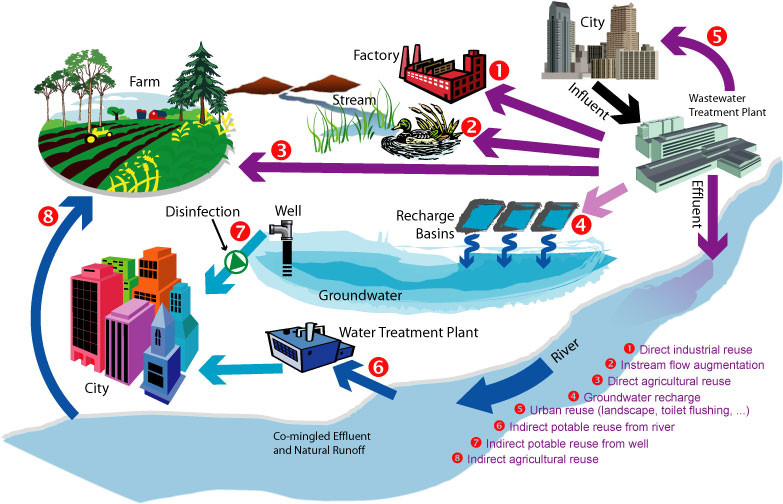
    #CA: Urban designers are incorporating #reuse into building design

    Water reuse via GlobalWarming.com.

    From Water Deeply (Tara Lohan):

    San Francisco is helping to grow adoption of onsite nonpotable water reuse systems by requiring them in large new buildings. Now there is interest in a statewide regulation to streamline permitting while ensuring health and safety.

    IN DOWNTOWN SAN Francisco, a mixed-use 800ft tower nearing completion at 181 Fremont St. features a water treatment system that will provide 5,000 gallons a day of recycled water captured from the building to be used for toilet flushing and irrigation. That will help save an estimated 1.3 million gallons of potable water a year.

    Just down the street, the recently expanded Moscone Conference Center has installed a system to collect and treat foundation drainage, otherwise known as “nuisance groundwater,” that will be used for toilet flushing and irrigation as well by the city’s Department of Public Works for street cleaning.

    Both buildings are among 82 proposed or completed projects in San Francisco that are using decentralized, onsite water-recycling systems to capture and reuse water that would otherwise flow down the drain or run off rooftops to city sewers or into the San Francisco Bay. The treated water that’s captured isn’t used for drinking, but for nonpotable purposes such as flushing toilets and urinals, irrigating landscapes, supplying cooling systems and even generating steam power. In commercial buildings, about 95 percent of water used is generally for nonpotable purposes. In multifamily residential buildings, it’s 50 percent.

    As interest in recycled water grows in California and across the United States, more building professionals are considering these decentralized systems. Up until now, a lack of health and safety regulations at the national and state levels has made the permitting process tricky and slow going. But bottom-up pressure may help create needed regulations…

    This process would be easier for communities if there were established health and safety standards from the state for onsite nonpotable reuse, but so far they’re lacking.

    “We think that from our perspective, if there is clear guidance and regulations that the state establishes, it would make it easier for communities that want to pursue local programs to oversee and manage decentralized water systems,” said Kyle Pickett, managing principal at Urban Fabrick.

    Those regulations could be on the way, but how long it will take is unclear…

    While there are no national or state regulations for onsite nonpotable reuse yet, there is a growing community of professionals sharing resources and expertise. SFPUC’s Kehoe chairs a National Blue Ribbon Commission for Onsite Nonpotable Water Systems, which recently produced a guidebook on water quality standards and management of onsite reuse systems. The commission was established by the U.S. Water Alliance, and it convenes more than 30 water and health professionals from across the country…

    Other efforts are underway, too. Urban Fabrick’s nonprofit arm, the William J. Worthen Foundation, will be releasing a practice guide on January 19 aimed at giving design professionals information about onsite reuse…

    “We don’t do nearly enough water recycling in California, honestly, it’s embarrassing how far behind we are compared to Australia, Israel and other places with very arid environments,” said Wiener. “We have a long-term structural water shortage and we need to modernize our water system and drag it out of the 1850s. Water recycling is a critical aspect of modernizing our water system.”

    Dolores River cleanup near Rico update

    St Louis Tunnel Ponds June 29, 2010 – view south towards Rico. Photo via the EPA.

    From The Denver Post (Bruce Finley):

    This re-engineering along headwaters of the Dolores River requires replanting wetlands with native grasses and laying in soil to mimic natural processes — an innovative approach that may be deployed more widely across the water-challenged West, where tens of thousands of toxic mines foul rivers and streams. So far, the experiment is working, removing fish-killing zinc, manganese linked to birth deformities and cancer-causing cadmium from muck flowing from the Argentine Mine complex uphill from Rico.

    “Mining is what brought communities to life at the turn of the 19th century, but now residents and visitors would like to see these scars restored as much as possible — especially focusing on water cleanup,” San Miguel County commissioner Hilary Cooper said from her perch in Telluride, 22 miles north of the mess. “For many of these areas, human intervention is required to initiate the cleanup. But planning, which ultimately allows native vegetation, restored natural floodplains and the engineering skills of beavers to assist with the cleanup is generally preferred when possible. In the end, we will find it is more effective.”

    […]

    Wildlife, including river otters, may be reviving in Rico because multiple factors favor environmental recovery.

    First, federal agencies enforced laws. The Environmental Protection Agency in 2011 issued an emergency order compelling action to stop contamination of Dolores headwaters after state regulators and mine owners failed to get a grip. Then, EPA officials swiftly identified and enlisted a private company legally responsible for the mess — something agency officials haven’t done at other sites, including the Gold King Superfund district, where a potentially responsible corporation is fighting the EPA in court.

    And the company, Atlantic Richfield — now owned by global energy giant BP — resolutely embarked on a cleanup, investing tens of millions of dollars. This compares with less than $5 million that the EPA has mustered for cleanup of the 48-site Gold King district above Silverton. For another Superfund disaster that the EPA declared in 2008 in Creede, federal funds have been so scarce that cleanup has barely begun.

    In 2012, Atlantic Richfield contractors at Rico faced rising water inside mine tunnels that threatened a ruinous blowout. The St. Louis Tunnel, within a few hundred yards of the Dolores River, had collapsed and was oozing as much as 1,300 gallons a minute of toxic muck. A lime water treatment plant installed to neutralize sulfuric acid in the flow, churning out thousands of cubic yards a year of waste solids, wasn’t working. (The acid, private contractors later determined, is mostly neutralized by natural calcium deposits inside the tunnel before the muck flows out.) Cleanup crews also had to deal with eroding, unlined tailings ponds where rain and melting snow leached toxic metals into the river…

    The innovative cleanup by Atlantic Richfield modernizes the standard approach of installing water treatment plants in the high country along with bulkhead plugs to try to control leaks. Contractors scooped out and lined the old ponds, planted grasses interspersed with stones and put in a sediment mix of manure, hay, alfalfa and woodchips — all aimed at filtering out toxic metals…

    This massive experiment now covers 55 acres, closed inside fences and berms, below the newly dammed St. Louis Tunnel. The toxic muck still flows at rates fluctuating from 700 to more than 1,000 gallons a minute but now is channeled through three black tubes that carry the muck through the engineered ponds and wetlands.

    In one pond, the toxic mine water seeps down vertically 2.5 feet through sediment, where chemical reactions help break out the manganese, zinc and cadmium. Native sedge and rush grasses are starting to grow atop that sediment layer. In other ponds, water is pushed through wetlands created using stones and grasses that grow naturally in the San Juan Mountain to filter out and chemically extract toxic metals.

    Once contractors figure out which method or combination works best, they say they’ll seek EPA approval and then fully install engineered wetlands, eventually removing fences and roads.

    Dolores River watershed

    @DenverWater estimates $600 million in costs to treat for molybdenum if temp standard is made permanent

    Climax Mine

    From The Denver Post (Bruce Finley):

    Chronic ingestion of molybdenum can cause diarrhea, stunted growth, infertility, low birth weights and gout

    Colorado health officials on Wednesday ignored state scientists and delayed for two years a decision on a mining giant’s push to weaken statewide limits on molybdenum pollution of streams, including a creek flowing into Dillon Reservoir, Denver’s drinking water supply.

    Denver Water contends that Climax Molybdenum’s campaign to jack up molybdenum pollution limits 43 times higher than at present could cost ratepayers up to $600 million for expansion of a water treatment plant. Trace amounts of molybdenum — below a health advisory level — already flow out of Denver taps.

    But Colorado Department of Public Health and Environment officials and federal Environmental Protection Agency officials on Wednesday rescheduled a Dec. 12 molybdenum rule hearing for November 2019.

    A CDPHE hearing officer said the delay will allow time for industry-financed studies to move through a peer-review process and for the Agency for Toxic Substances and Disease Registry to make decisions on molybdenum toxicity. A “temporary modification” that currently allows elevated molybdenum pollution from the Climax Mine was extended this year through 2018, and CDPHE officials at Wednesday’s meeting opened the possibility it could be extended again.

    CDPHE scientists opposed the delay. The scientists, Denver Water and a coalition of mountain towns have opposed the push by Climax to allow more molybdenum pollution of Tenmile Creek, which flows down from the Climax Mine above Leadville into Dillon Reservoir, where water flows out through a tunnel to Denver and the upper Colorado River Basin. CDPHE water-quality scientists have determined that molybdenum pollution at the proposed new limits would kill fish and could hurt people…

    Denver Water treatment plants cannot remove molybdenum, and expanding one plant to do that would cost from $480 million to $600 million, utility officials said in documents filed to the CDPHE.

    Those costs ultimately would hit ratepayers, the 1.4 million people who rely on Denver Water for their domestic water supply. The molybdenum pollution from Tenmile Creek that reaches Denver facilities today is “below the human health advisory levels,” Denver Water spokeswoman Stacy Chesney said.

    “We’d likely exceed the human health advisory standard if that (new limit) were to become the statewide water quality standard. … Currently, the concentrations in Tenmile Creek have not been at a high enough concentration that would result in an exceedance of the human health advisory level, so an extension of the ‘temporary modification’ for molybdenum is acceptable,” Chesney said.

    A subsidiary of the $46 billion mining giant Freeport-McMoRan, Climax Molybdenum runs the Climax Mine, which was closed for 25 years and reopened in 2012. This led to elevated molybdenum pollution at levels up to 2,500 ppb, 10 times higher than the current statewide limit. The “temporary modification” granted by CDPHE water commissioners, and extended this year, allows this elevated pollution through December 2018…

    EPA officials recently said a molybdenum pollution limit as high as 10,000 ppb could be sufficient. But EPA scientists previously have advised lower limits.

    “Denver Water’s current position is that the molybdenum limit should be based on scientific evidence. While Climax Molybdenum Company has presented scientific studies in support of its proposed standard, the studies fail to account for the effect high molybdenum concentrations will have on individuals with a copper deficiency,” Chesney said. “Because we do not know how high molybdenum concentrations will affect people with copper deficiencies, and EPA has not modified the Human Health Advisory for molybdenum to correspond with Climax’s proposed standard, the (state water quality control) commission should decline to increase the molybdenum standard to the level proposed by Climax.”

    A coalition of mountain towns also is fighting the proposed higher limits for molybdenum pollution of waterways.

    “Because of scientific uncertainty regarding the effects of varying molybdenum concentrations on human health, the commission should decline to make the changes that Climax Molybdenum Company has proposed in the statewide molybdenum standards,” Frisco attorney Jennifer DiLalla said. “The town’s primary goal is ensuring that any action the commission may take with respect to molydenum standards is protective of the health of those who live and work and play in Frisco.”

    PAWSD discusses 2018 preliminary budget

    From The Pagosa Sun (Chris Mannara):

    [The budget was] presented to the board of the Pagosa Area Water Sanitation District (PAWSD) on Sept. 21.

    The PAWSD budget includes four funds: a general, debt service, water enterprise and wastewater enterprise.

    In a follow-up phone call with The SUN, Business Services Manager Shellie Peterson explained some of the larger changes for each portion of the budget…

    Water enterprise fund

    There were also a few notable proposed changes to the water enterprise fund.

    “There are a lot of similarities to the water fund and the wastewater fund,” she said.

    Both are proprietary funds, she explained.

    “These are supposed to be run as you would a private business, meaning that the amount that you charge for service charges in all of your different revenues, ideally, should cover all of your related operating expenses and your capital expenditures and the debt service that’s involved with the enterprise funds,” she said.

    Peterson noted that PAWSD can transfer from the general fund up to 9.99 percent of a funds’ revenues.

    “So in doing that in a small way we’re subsidizing the enterprise funds with a little bit of tax dollars,” she said.

    Capital projects was also included on the water enterprise fund as having a projected negative 35 percent change for 2018.

    This projected change would move the capital projects budget from $428,211 in 2017 to $279,890 in 2018.

    According to the draft budget summary sheet, there is a distinct decrease in capital expenditures, but many of the decreases are off- set by “increases in major mainte- nance item expenditures.”

    “We’re projecting to spend less on capital next year,” she said.

    In an email to The SUN Peterson explained that the reason for spending less on capital is that some years present a bigger need for capital projects than others.

    “There really is not a ‘why’ to capital spending. Some years present the need for major new construction or processes more so than others,” Peterson wrote.

    Water loss was also listed as a larger maintenance item in the draft budget.

    “During the restructuring of the Colorado Water Conservation Board loan for the Dry Gulch prop- erty, a commitment was made to spend $125,000 per year on water line replacement or repairs to re- duce water loss,” she wrote.

    Peterson noted that the water line replacement or repairs are not capital expenditures.

    “They will not be capitalized and depreciated over a useful life,” she wrote.
    The next big capital project will be the installation of ultraviolet disinfection at the San Juan Water Treatment Plant.

    “That work is being engineered this year, dirt work, excavation will be started next year, and the UV project itself will be bid out in 2019,” she wrote.

    The ending fund balance for the water enterprise fund is projected to have a 12 percent increase.

    This would raise the balance up from $5,061,503 in 2017 to $5,666,128 in 2018.

    “That’s saying if everything went exactly according to this formula I would have just over $5 million at the end of 2017, in this fund, and then yet I’m projecting to have a 12 percent increase in that ending fund balance,” she explained.

    Why the fund balance is going to go up involves a few things, Pe- terson noted.

    “Part of the reason that the fund balance is going to go up is because my revenues are going to go up just a titch, but my expenses are going to go up too, just a little bit,” she said.

    Wastewater enterprise fund

    Peterson explained that the wastewater enterprise fund and the water enterprise fund work in the same way, but offer different services.

    “They operate identically other than the fact that they provide two completely different services,” Peterson said.

    The majority of revenue that the wastewater fund receives is from the minimum monthly ser- vice charge for wastewater, she explained.

    “The wastewater fund is less complicated because it’s a flat rate, everyone who is connected to Pagosa Area Water sewer is paying $32 per equivalent unit,” she said. The wastewater fund’s revenue is easier to determine because it doesn’t have a oating volumetric rate that the water enterprise fund has, Peterson noted.

    Two of the bigger proposed percentage changes within the wastewater enterprise fund were wastewater collection and capital projects.

    Wastewater revenue is projected to increase by 42 percent for 2018. The potential increase would move wastewater’s budget of $458,300 in 2017 to $652,935 in
    2018.

    “It means we are expecting our expenses to be higher in that department,” she said.

    Collection of wastewater in- volves everything that happens in the collection system, the pipes underground, to bringing the sewage to the sewer plant, Peterson explained.

    “We expect to go out to bid on $200,000 basis to have a commer- cial sewer line cleaning service come in,” she said.

    The company responsible for the line cleaning would spray the sewer lines clean, and install cameras and create tapes from the cameras, Peterson explained.

    With these tapes, PAWSD could see any potential problems within the sewer line, she explained.

    Right now PAWSD is using local firm, Pagosa Rooter, to clean its sewer lines.

    “They just aren’t able to televise for us, but we’ve been doing cleaning that way,” she said.

    The problem for PAWSD is that it is harder to have larger firms come to Pagosa Springs because they won’t mobilize for that small amount of work.

    “That’s the lion share of why that budget is going to increase,” Peterson said.

    Another reason for the increase for wastewater revenue is having lift station rehab at lift station 21 and lift station 7, Peterson ex- plained.

    Capital projects was again listed under this section of the budget.

    Capital projects is proposed to have a 59 percent decrease in the proposed budget, from $371,525 in 2017 to $153,320 in 2018.

    “In the capital department, we just have less being forecast, really where the big dollars are this year is more in the maintenance line,” Peterson said.

    Both the water and wastewater funds stay at close to the same level of total expenditures, but the weighting is changed for this year, she said.

    City of Greeley 2018 budget

    Greeley in 1870 via Denver Public Library http://photoswest.org/cgi-bin/imager?10009071+X-9071

    From The Greeley Tribune (Tyler Silvy):

    The council will officially vote on the $367 million budget Oct. 17…

    The city has a variety of construction projects on the horizon for 2018, but none are more costly than those projects related to water.

    Greeley’s portion of a new reservoir will cost $38.2 million, and the city will spend $44.4 million to renovate the Bellvue Water Treatment Plant near the mouth of the Poudre Canyon. Bellvue has been in operation one way or another for more than 100 years.

    Water-related projects often are paid for through municipal bonds, and the city’s water department is allowed to take on the debt without a vote of the residents because it is an enterprise fund and can charge more for services to pay down the debt.

    Eagle: Officials meet to discuss need, financing for new water treatment plant

    Eagle circa 2010

    From The Vail Daily (Pam Boyd):

    Interim Town Manager Tom Boni launched the discussion by noting the proposed Lower Basin Water Treatment Plant, which would be built upstream from the existing Eagle Wastewater Treatment Plant, is the town board’s top priority.

    “How do we supply reliable water to the town of Eagle now and into the future?” Boni said.

    Boni said discussions about the plan construction actually began 10 years ago, when the town realized it was approaching capacity at its existing 4.3 million-gallons-per-day water plant during the summer months when residents water their lawns and landscaping. Usage during the summer brings the plant operations to 80 percent of capacity.

    WHAT ABOUT CONSERVATION?

    Chris Lehrman, consulting engineer with SGM of Glenwood Springs, has been working with the town on the plant project. He noted the new facility has been planned so that it can expand to treat as much as 5 million gallons per day, but the initial operation would be at the 2.5 million-gallon-per-day level.

    “One of the comments we had seen over the past few months is, ‘Can we put off this new plant with conservation?'” Lehrman said.

    He said the short answer is no.

    Lehrman explained that Eagle already has engaged a number of conservation efforts, including improvements to its water-delivery system to prevent leaks and institution of summertime watering restrictions. But he said Eagle cannot solve its long-term water needs through conservation alone.

    While the capacity issue is one of the driving needs for the new plant, according to Lehrman, the town’s system also lacks redundancy — the ability to find alternate ways to deliver water in the event of a break in one part of the delivery system. Part of the new plant design would address that issue.

    As for the location of the plant, Eagle doesn’t have the water rights it would need to expand the existing water plan located up the Brush Creek Valley.

    @SenBennetCO, et al., introduce Hardrock Mining and Reclamation Act of 2017

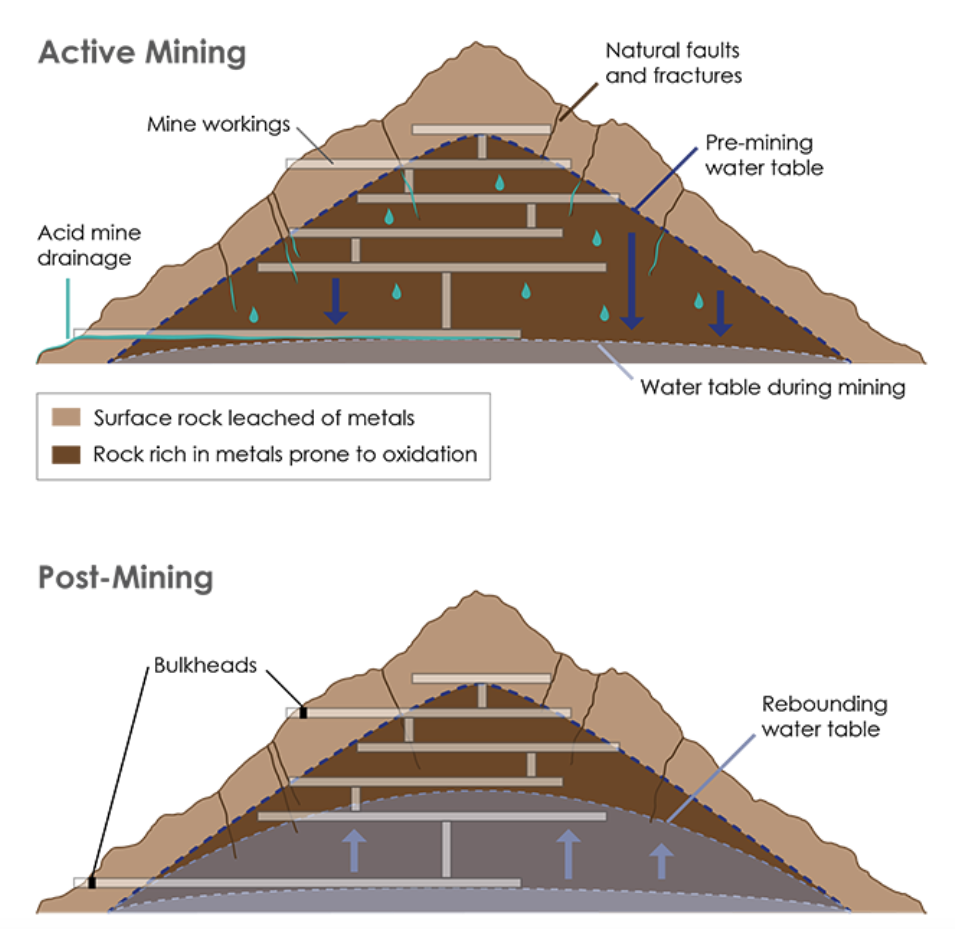
    During mining (top), the water table is often lowered to access ore, exposing the rock to oxygen and creating acid mine drainage. Sealing off a mine can return the water table to pre-mining levels (bottom), creating anoxic conditions inside the mine and preventing further acidification. Credit: K. Cantner, AGI.

    From The Durango Herald (Mia Rupani):

    Colorado Sen. Michael Bennet, along with Sens. Tom Udall, D-N.M., Martin Heinrich, D-N.M., Ron Wyden, D-Ore., and Edward Markey, D-Mass., introduced the Hardrock Mining and Reclamation Act of 2017 on Tuesday to update the nation’s antiquated hard-rock mining laws.

    The bill would reform the General Mining [Act] of 1872 that allows companies to extract minerals such as gold and silver on federal public lands without paying royalties, and while avoiding liability for any environmental damage.

    The proposed legislation would help pay for abandoned mine cleanup and prevent future disasters.

    Bennet referenced the 2015 Gold King Mine spill that sent an estimated 3 million gallons of heavy-metals laced mine wastewater into the Animas and San Juan rivers in a news release on Tuesday…

    If passed, the legislation would make seven primary changes to the General Mining Law of 1872:

  • Require hard-rock mining companies to pay an annual rental payment for claimed public land, similar to other users.
  • Set a royalty rate for new operations of 2 to 5 percent based on the gross income of new production on federal land.
  • Create a Hardrock Minerals Reclamation Fund for abandoned mine cleanup through an abandoned mine reclamation fee of 0.6 percent to 2 percent.
  • Give the secretary of the Interior the authority to grant royalty relief to mining operations based on economic factors.
  • Require an exploration permit and mining operations permit for noncasual mining operations on federal land.
  • Permit states, political subdivisions and Indian tribes to petition the secretary of the Interior to have lands withdrawn from mining.
  • Require an expedited review of areas that may be inappropriate for mining.
  • The bill is supported by leaders throughout Southwest Colorado, including La Plata County Commissioner Julie Westendorff, Durango City Councilor Dean Brookie, San Juan County Commissioner Pete McKay and Trout Unlimited’s Ty Churchwell.

    Little Thompson Water District wins AWWA #Colorado Section taste test

    Map via the Little Thompson Water District

    From The Greeley Tribune (Tyler Silvy):

    Sample No. 5, we’d find out later, was from Little Thompson, and it is this year’s winner, folks.

    Here’s how it went:

    Eight samples are set in front of you on numbered coasters. You’re given a sheet to rate each sample 1-10, with 10 being the best-tasting water on this earth and 1 being the opposite of that.

    Other than that, there wasn’t much in the way of instruction.

    So I briefly tasted each sample, starting at No. 8 and working my way down while making little marks along the way. Then I tasted the ones I marked poorly again, again working my way toward the ones that caught my attention in a good way.

    A final taste of my top three yielded a winner — at least in my book.

    But then there was a final round, then there was a tie, and each of those things caused more water to be consumed and so I can really see now why the folks running the competition recommended a pre-competition restroom break.

    Greeley, which won last year’s competition, didn’t enter this year’s competition. It didn’t have to. Consider it a first-round bye thanks to the city winning the national championship last year.

    Aurora came in second and Louisville took third. Little Thompson will go on to the national competition next, as Greeley attempts to defend its title.

    What’s really in your water? – News on TAP

    Startling social media stories often mislead and take data out of context. Here’s what you can do to stay informed.

    Source: What’s really in your water? – News on TAP

    Wellington water system taste and odor impacted by algae

    Graphic credit Encyclopedia Britannica.

    From The Fort Collins Coloradoan (Jacy Marmaduke):

    From the gravel road that borders the fenced North Poudre Reservoir No. 3, you can’t see the blue-green algae that is to blame for Wellington’s water woes.

    But if you poured yourself a glass from any faucet this summer, you probably tasted and smelled it. Your senses would’ve detected geosmin, the same compound that gives mud and rain-soaked streets that familiar earthy smell.

    In a perfect world, geosmin levels in the town water supply would hover no higher than about 20 parts per trillion parts of water, town administrator Ed Cannon said.

    As of early July, geosmin levels in North Poudre Reservoir No. 3 were about 15 times that. Summer heat invigorates the algae…

    The good news: As of Wednesday, geosmin levels were down to less than 2.5 parts per trillion in the town’s raw water thanks to a copper sulfate treatment on the reservoir, Cannon said.

    While the water tastes better than it did earlier this summer, history shows that the town has a long, expensive fight ahead of it.

    The algae problem isn’t unique to Wellington. Loveland’s Green Ridge Glade Reservoir became a veritable algae garden during last year’s steaming summer, making for earthy, pondlike water similar to what Wellington’s residents are experiencing this year.

    Loveland’s algae hasn’t gone away, but the city invested thousands of dollars in tools to beat it back, including hydrogen peroxide, four reservoir mixers and activated carbon compounds. If those tools aren’t enough, Loveland has a backup plan in the form of plentiful Big Thompson River water rights.

    Wellington’s backup plan is less airtight.

    Three algae-free wells supplement the reservoir water, but their output is limited. The town must draw even more water from the reservoir as its ranks swell and residents use more water on their lawns. That throws off the ratio of algae-free well water to algae-filled reservoir water and makes the stuff coming out of the tap smell and taste worse.

    The algae visits Reservoir No. 3 every summer, like an unwelcome house guest. Town officials say the guest was even more obnoxious this year because it started earlier and bloomed more fiercely.

    “To attack (the algae), we’re going to get extremely aggressive,” Cannon said during an interview at his office in Wellington’s town hall.

    In July, a gang of boats blasted the reservoir with copper sulfate to kill off the algae. They’ll probably have to make the rounds again this summer, Cannon said.

    The town hired additional workers for its water treatment plant and is adding another filtration process to increase the output of its Wilson Well facility, Wellington’s secondary water source. The $400,000 upgrade will supply the town with another 100,000 gallons of algae-free water each day once it comes online by this fall.

    Ashley MacDonald, one of Wellington’s six trustees, said Wellington needs to — and plans to — do two things to truly solve its water problem: Revamp the town water treatment plant and find new water sources…

    “I feel for them,” he said. “I’m dealing with the same issues. I don’t have an answer that’s going to please everybody, other than to make some assurances that we feel the investment we’re making in our water treatment plant will address that.”

    Cannon is referencing a plan to overhaul Wellington’s water treatment facility, which was built when the town was about two-thirds its current size. The upgrade will increase the plant’s capacity so it can treat water for as many as 16,000 residents. It will also make its filtration process more sophisticated so the water tastes better.

    That project is still in its design phase and will take at least 12 to 18 months to finish once Wellington’s trustees approve a game plan, Cannon said. Costs have not yet been projected.

    The other big goal to solve the problem is locking down higher-quality water sources for Wellington. The Board of Trustees hired Denver consulting firm Wright Water Engineers to help them evaluate options, including water from the City of Fort Collins, the East Larimer County Water District, the Poudre River and the Colorado-Big Thompson Project.

    The board will narrow down those options based on cost and efficiency in coming weeks, MacDonald said.

    Water treatment is important, but cities like Fort Collins have better-tasting water primarily because they store it in colder, deeper and higher-altitude reservoirs that are less vulnerable to algae attacks, according to Lisa Rosintoski, customer connections manager at Fort Collins Utilities…

    Wellington’s water doesn’t violate any water quality regulations, according to its most recent round of state tests in 2016. Those tests included tests for copper, lead, chlorine and uranium, among other compounds.

    A state test of raw water in North Poudre Reservoir No. 3 this summer came back absent of microcystin and cylindrospermospin, two compounds sometimes present in algae that are of public health concern.

    @AuroraWaterCO Prairie Waters Project wins national award

    From the U.S. Water Alliance website:

    At the US Water Alliance, we bring together public, private, and community leaders to advance One Water solutions—holistic and integrated water management strategies that improve economic, environmental, and community outcomes. While the challenges facing our water future are great, our capacity for innovation and problem-solving is even greater. There are inspiring examples across the country of sustainable and integrated water resource management. That is why we annually award the US Water Prize to organizations that are leading the way with creative One Water solutions…

    Aurora Water
    Prairie Waters

    Aurora, Colorado is facing the water supply problems of many cities and regions in the arid west—a changing climate alongside a growing population. To combat these issues and secure the area’s water stability, Aurora Water worked with regional partners to create the Prairie Waters system, a innovative system that recapturing and recycling water to provide drinking water and drought insurance for the region. Using a multi barrier treatment process that includes both naturally-existing systems and state-of-the-art purification systems, Prairie Waters provides an additional twelve million gallons of clean, safe and dependable water each day. The Prairie Water program will help meet Aurora’s complex water needs for decades to come and can be a model for other regions experiencing changes in their water supply needs.

    From KDVR.com (Sarah Schueler):

    Aurora’s Prairie Waters system has won the U.S. Water Prize from the U.S. Water Alliance.

    The system was given the honor for its environmentally friendly and sustainable approach to water development.

    The aware panel also said the Prairie Waters system can be a model for other regions experiencing changes in water supply needs.

    Accepting the award at a ceremony in New Orleans on Tuesday night was Marshall Brown, the director of Aurora Water.

    Sterling water wins First Runner Up from #Colorado Rural Water Association

    Reverse Osmosis Water Plant

    From The Sterling Journal-Advocate (Sara Waite):

    Association, an organization that provides training and resources for small Colorado communities.

    The city was one of seven entries in the organization’s water taste test and received first runner up.

    Tuesday night, Sterling Mayor Dan Torres officially presented the award to the employees at the water treatment plant. He noted that the recognition comes from an outside agency that is unbiased. “To me that means more than anything else,” he said.

    City Manager Don Saling also lauded the water division workers, saying the award “says something about the great quality of product that they produce.”

    He added that those who complain about the taste of Sterling’s water likely live in homes with old pipes that affect the water quality. “I think they (the employees) do a great job,” he said.

    @GreeleyWater wins 13th annual “Best of the Best” Tap Water Taste Test

    Cache la Poudre River

    From The Greeley Tribune (Tyler Silvy):

    Greeley ought to bottle this stuff.

    The water in your tap — the stuff you pay pennies per gallon for — just earned recognition as the best tasting water in the United States.

    This week, the American Water Works Association rated Greeley’s water the best tasting in the nation, as Greeley beat out 33 other regional winners. The city also became the first to win the national competition and People’s Choice Award at the organization’s annual conference in the 13-year history of the competition.

    Greeley also is the first Colorado municipality to win the award.

    And then there’s this: This was the first year Greeley has entered the contest.

    “I was hopeful,” Greeley Water and Sewer Director Burt Knight said. “But I never expected to win both awards.”

    Still, Knight said the awards didn’t tell him anything he didn’t already know.

    “What it does is it confirms the choice our forefathers made when they went up to the mouth of the Poudre and built the treatment plant and pipeline in 1907,” Knight said. “I know we have high-quality water. All we needed to do is get everybody else to agree.”

    Now that they have, Knight and others are pondering how, exactly, they’ll spike the football.

    “It’s something we’ll need to think about leveraging,” City Manager Roy Otto said, adding the city has used its extensive water portfolio to attract businesses in the past. “But quality is something we need to spend time communicating to people — not only to residents, but others who might be coming to Greeley, as well.”

    There are strict rules for the water competition. Greeley was sent special containers and coolers. Officials took water from one of the treatment plants and shipped it off to Philadelphia, where the annual convention was held.

    Once there, contest officials remove any labels to ensure a blind taste test for judges.

    To get there, Greeley had to win its regional competition last fall. And as a result of its national win this year, Greeley gets an automatic bid to the national competition next year.

    Will the city enter?

    “If you’re the Broncos, and you win the Super Bowl, you want to defend your title,” Knight said.

    But that’s for next year. For now, Greeley officials are happy celebrating the victory.

    Otto said he’s proud of the tradition and legacy of water in Greeley, saying the award is an affirmation of that.

    W.D. Farr

    “W.D. Farr has a big smile on his face in heaven right now,” Otto said, referencing the Greeley water pioneer.

    After Farr died, Greeley bottled some of the town’s water, labeling it “Greeley Gold.” Otto still has a bottle.

    “I would put Greeley’s water supply up against any bottled water across the country,” Otto said.

    From The Denver Post (Tom McGhee):

    Greeley, a city known for both agriculture and food processing businesses, can now boast it has the best tasting tap water in the United States and Canada.

    The Greeley Water and Sewer Department won the 13th annual “Best of the Best” Tap Water Taste Test conducted by the American Water Works Association. Montpelier, Ohio, took second place and Bloomington, Minn., had the third-best tasting tap water.

    Greeley represented the Rocky Mountain Section of the American Water Works Association in the contest held in Philadelphia, Pa. The Rocky Mountain group includes water companies from cities in Colorado, Wyoming and New Mexico, said Greg Baker, spokesman for the organization. It is the first time that any member of the Rocky Mountain association has won the contest, Baker said.

    The event, composed of regional winners from water-tasting competitions across North America, was held at American Water Works Association’s Annual Conference and Exposition in Philadelphia, Pennsylvania. Fifteen regions participated in the contest, including some in Canada and Puerto Rico.

    Cache la Poudre River watershed via the NRCS

    @CFWEwater — Barr Milton Urban Waters Tour

    This slideshow requires JavaScript.

    I rode along with the Barr Lake and Milton Reservoir Watershed Association and the Colorado Foundation for Water Education on their Urban Waters Tour of the South Platte River last Wednesday. These rides are educational and fun and well worth the time. It was great to meet some new folks from the water community. Thanks to Amy Conklin for organizing the ride.

    We started at Johnson Habitat Park where the Greenway Foundation has located their SPREE outdoor school. We learned about efforts to increase the volume of water in the river through the Chatfield Reallocation Project which will provide environmental flows through the City of Denver. Joe Shoemaker, Jr. explained the genesis of the Greenway Foundation and how the area we were in was one of Denver’s dumps during his youth. The educational effort was in full swing with young students plying the waters for macro-invertebrates and other life.

    A representative from Trout Unlimited conveyed his excitement about landing big carp from the river. He also told us that a fisherman recently pulled a 24 inch rainbow from the river just upstream from the park.

    Further downstream at Weir Gulch the focus was on widening the channel to more a more natural flood plain to help manage stormwater and improve river and riparian health. The South Platte through here, back in the day, was a braided, meandering stream with a flood plain that was sometimes as wide as a mile.

    A Denver Parks representative explained the big project at Confluence Park — the replacement of the original structures from the first project in the South Platte revitalization effort. Kudos to the contractor that stayed with the project as their profit dried up due to the discovery of coal tar on site. The Denver representative said that the company believed in the project and the benefits to the community.

    The last stop was at the site of Globeville Landing Park. There was a lot of construction going on to build an outfall for stormwater management. Denver is building their Platte to Park Hill Project to mitigate flooding caused by construction and development over the years.

    I highly recommend these tours. You’ll learn a lot, get a bike ride in, and meet some interesting folks. The South Platte River through Denver is a great ride. What a success story.

    @CFWEWater’s Southwest Basin Tour Next Week! Scholarship Opportunity and Optional Whitewater Rafting Add-On

    This slideshow requires JavaScript.

    Click here for the inside skinny and to register.

    From email from the Colorado Foundation for Water Education:

    The itinerary for this year’s annual river basin tour in Colorado’s Southwest is full of exciting site visits and informative speakers!

    We’ll be covering a wide range of local municipal, recreational, industrial, agricultural and ecological projects and priorities. This is an opportunity you don’t want to miss.

    But hurry, the tour is next week and there are just eight seats left, including one scholarship spot!

    Get on the bus for this year’s Southwest Basin Tour, hosted in Colorado’s beautiful San Juan mountains June 13-14. Share a unique educational experience with other tour participants, including the Colorado legislative Interim Water Resources Review Committee, and get an in-depth look at how the Southwest Basin Implementation Plan is being put into action in the San Miguel and Dolores watersheds. Review the draft agenda here, find some highlights below, and register now to reserve your spot.

    On Day 1, we’ll make exciting stops at sites along the lower San Miguel watershed and part of the Dolores, hearing from agency reps, nonprofits, and civic leaders about topics such as:

    • Blending a local ag and recreational economy, and balancing the needs of multiple users
    • Using instream flow appropriations as a tool to protect Wild and Scenic Outstandingly Remarkable Values plus alternative Wild and Scenic stakeholder processes
    • Native fish restoration and the Dolores River Dialogue
    • A local municipal raw water project
    • Other Southwest Basin Implementation plan priorities
    • Plus tour the Paradox Salinity Unit and Indian Ridge Farm

    On Day 2, we’ll concentrate on the upper San Miguel and explore topics including:

    • Ski industry concerns in the face of climate change and unpredictable snowpack
    • Regional cloud-seeding efforts to stimulate precipitation
    • Creative and collaborative municipal water management in conjunction with local mining and power supply
    • The evolution of watershed planning and incorporation of stream management plans
    • Plus tour the Valley Floor Project restoration site and view a special showing of the film that debuted at the Telluride Mountain Film Festival

    BONUS: Participants now have the option to add on an optional whitewater rafting trip at the end of the tour and will receive a 40% discount off of normal rates. Find out more here.

    *Interested in a scholarship? Email Jennie@yourwatercolorado.org to let us know what you do and why you need a scholarship to attend.

    Newly identified chemicals in fire-fighting foam pose filtration challenge

    Photo via USAF Air Combat Command

    From The Colorado Springs Gazette (Jakob Rodgers):

    An Air Force-supplied filter being given to Fountain to strain out toxic chemicals from drinking water appears susceptible to a host of newly discovered compounds, a new study shows.

    That type of device – called a granular activated carbon filter – wasn’t too effective at removing more than two dozen chemicals derived from a toxic firefighting foam used for decades at Peterson Air Force Base.

    That means cities relying on those kinds of filters – in this case, Fountain – must replace them more often if they choose to account for the growing list of perfluorinated chemicals, some of which have only been discovered in the last year, said Christopher Higgins, a Colorado School of Mines researcher and the study’s author.

    And that could mean higher costs for ratepayers.

    “The carbon filters will work – you just have to change them more frequently,” Higgins said.

    At issue is the danger posed by a military-grade firefighting foam that is suspected of fouling the Widefield aquifer – a key source of drinking water for the Security, Widefield and Fountain areas…

    None of the area’s three largest districts still use untreated water from the aquifer.

    But Higgins and other researchers across the nation have identified more than two dozen other similar chemicals derived from the firefighting foam – 13 of them in last six months.

    And granular activated carbon filters are quickly overwhelmed by those other chemicals, according to Higgins’ study published Tuesday in the journal Environmental Science & Technology.

    “This study basically is a way of confirming what we suspected,” Higgins said. “Which was that some of those compounds, if they get out into the environment, will likely come through carbon filters much more quickly than PFOA and PFOS do.”

    The danger posed to residents by these additional chemicals remains unclear, said Jamie DeWitt, a toxicologist at East Carolina University. They include similar chemicals to those touted by the Air Force as safe for replacing its decades-old toxic foam.

    “I think the first question anybody should ask is: ‘Are these truly safe for me to drink at these concentrations?’ ” DeWitt said. “And honestly, I don’t think anybody at this point can really answer that.”

    After-hours calls by The Gazette to Peterson and Air Force Civil Engineer Center spokespeople were not returned.

    Higgins’ study comes as Fountain leaders work to install two Air Force-supplied granular activated carbon filters this summer.

    The research hasn’t changed those plans, said Curtis Mitchell, Fountain’s utilities director.

    “We’ll certainly work with him (Higgins) on how long the filter run times will be, and just look at what his data is showing,” Mitchell said.

    Mitchell downplayed concerns about moving forward with installation, because the Air Force’s filters can be easily substituted for a different type of treatment system – such as ion-exchange devices.

    Widefield Water and Sanitation District recently became the first water district in the nation to use an ion-exchange system to treat water for perfluorinated compounds.

    A six-month pilot program showed promise over the winter, and recent test results on the system after it began servicing houses in May showed no trace of six types of perfluorinated compounds, said Brandon Bernard, the Widefield district’s general manager.

    “This stuff’s pretty effective,” Bernard said.

    Higgins, however stopped short of endorsing such devices. They have yet to undergo the same tests as those Higgins just finished on granular activated carbon filters.

    “I don’t know how well they work at removing all of these other chemicals,” he said.

    Fountain voluntary watering restrictions start June 1, 2017

    Widefield aquifer via the Colorado Water Institute.

    From The Colorado Springs Gazette (Jakob Rodgers):

    Fountain leaders expect mandatory watering restrictions to be implemented later this summer, and they want residents to voluntarily begin conserving water Thursday.

    The announcement comes as Fountain continues grappling with the presence of toxic chemicals in the Widefield aquifer – a key source of water for the community…

    Fountain last pulled from the aquifer in October 2015 – a decision that dropped the city’s water capacity by about 20 percent. Since then, the city has relied more heavily on the Pueblo Reservoir and conserved water during hot summer months.

    The chemicals, called perfluorinated compounds, have been used for decades in a firefighting foam at nearby Peterson Air Force Base, and for years were flushed into Colorado Springs’ sewer system and Fountain Creek. They have been linked to a host of ailments, including certain cancers, low birth weight and high cholesterol.

    City officials have been working with Air Force officials to install granular-activated carbon filters on at least two wellheads. But that’s taken longer than expected, and multiple water district managers have lamented the Air Force’s response to the crisis.

    Fountain’s first filter won’t likely be ready for use until July, and the second not until August, Mitchell said. As a result, the city may not be able to meet water usage demands on the hottest of summer days, Mitchell said.

    City officials want residents to get in the habit of conserving water soon.

    On Thursday, voluntary watering restrictions begin in the city and continue through Sept. 30…

    Along with installing Air Force-supplied filters and asking residents to conserve water, city officials are upping their use of surface water from Pueblo and working with private contractors to design separate filters for other wellheads.

    Mitchell also is working with Colorado Springs Utilities to create redundancies in its water system.

    Stiffer penalties will accompany any mandatory watering restrictions implemented in Fountain. Residents will receive a warning for the first violation, a $50 fine for the second and a $100 fine for the third.

    Security Water and Sanitation Districts also instituted voluntary watering restrictions.

    The water district’s manager, Roy Heald, said he doesn’t expect to use the Widefield aquifer this year, because Security is paying a premium to Colorado Springs Utilities for more water from the Pueblo Reservoir.

    Salida receives loan forgiveness from #Colorado

    Salida water park

    From The Mountain Mail (Brian McCabe):

    Salida will receive $666,069.72 in loan forgiveness for its $1,505,000 loan from the [Colorado Water Resources and Power Development Authority] for the city’s ultraviolet disinfection compliance project, City Administrator Guy Patterson announced in the Tuesday city council meeting.

    “The [CWRPDA] had a unique situation last year where a sizable amount of design and engineering grant money was not utilized,” Patterson wrote in a report to the council.

    “The fact that Salida was the first community to execute the loan in 2017 and the disadvantaged community status made us eligible for disbursement of the funds, along with several other communities.”

    “This is very fortunate for the community to be recognized like this and get the grants,” Mayor Jim LiVecchi said. “We were trying to do what we could to get this project paid for without having to raise water rates or spend taxpayer money.”

    LiVecchi said the city also received $755,000 in an Energy/Mineral Impact Assistance Fund grant from the Department of Local Affairs.

    Emails from The Mountain Mail to Patterson, Public Works Director David Lady and Finance Director Jana Loomey about the project went unanswered.

    The Mountain Mail asked city officials the following questions:

    •The loan from the [CWRPDA] was for $1,505,000, the loan forgiveness was $666,069.72, leaving the remaining loan amount at $838,903.28, which knocks off about 44 percent of the loan. How much of this loan has been paid off thus far? Also, there was another loan listed for $120,000. Does that mean the total cost of the UV project was $1,625,000, or was it more?

    •It was stated that because the loan was passed under an emergency measure to keep construction costs within a single fiscal year, the water and wastewater funds will lose their enterprise fund status for 2018. Does this still apply with the loan forgiveness taken into account?

    •Patterson said in his report to council that Salida’s “disadvantaged community status” made the city eligible for the disbursement of the funds “along with several other communities.” What is “disadvantaged community status” and how did Salida qualify? Also, do we know which other communities received funds?

    •What is the status of the UV project? Is it finished? If not, what is the basic timeline for completion?

    Deputy City Clerk Christian Samora said Wednesday the city will send out a press release in the next day or two.

    @GreeleyGov: Water & Sewer Annual Summer Tour, June 30, 2017


    Click here to register and read about the event:

    The Greeley Water & Sewer Board invites residents to this year’s facility tour to learn more about how water and sewer is treated, where the water comes from, and the various ways water is used. Residents will tour the Water Pollution Control Facility (WPCF) and Boyd Lake facilities and learn about system exchanges, points of diversion, and non-potable systems. A light breakfast and lunch will be provided.

    Those interested in attending should contact Ettie Arnold at 970-350-9812 before June 23. Space is limited.

    Get more information about Greeley’s Water System at http://www.greeleygov.com/water.

    Merino water treatment plant update

    Ashcraft & Brown Building, Merino, Colorado, as it appeared on a 1909 postcard. Image courtesy of Ken Wilson.

    From The Sterling Journal-Advocate (Jeff Rice):

    Merino’s water project is about 10 percent completed, but on schedule and running well so far. That’s the report Jim Wright delivered to the Merino Town Board Monday night during the board’s regular meeting. Wright is the on-site consultant who oversees the day-to-day work on the project.

    “It’s going very well and I’m very pleased,” he said.

    The town is installing a $2.3 million water treatment facility because of more stringent water quality standards being passed from the U.S. Environmental Protection Agency to the Colorado Department of Public Health and Environment. The three-phase project — installing a new water supply tank, building a new water treatment facility, and building evaporation ponds to treat the effluent from the reverse osmosis water treatment process – should be finished by mid-July.

    Wright told the board there would be no work done on Tuesday because the project is waiting for specialists to install a “hot tap” on the main water line to flush sediment from the system. That should be done Wednesday, he said.

    Grading for the pumping station will start soon, he said, and once the building to house the reverse osmosis system is built the project will proceed rapidly.

    Fort Collins craft brewers cooperating on water issues

    From The Fort Collins Coloradoan (Jacob Laxen):

    On Tuesday night, Brewater hosted a panel open to the public at New Belgium Brewing.

    “We all understand 100 percent how important water is to our product and our community,” said Horse & Dragon Brewing co-owner Carol Cochran.

    While Oregon and Washington both have state brewery watershed groups, Brewater is the only formal collection of craft brewers from the same city to collaborate on water conservation issues.

    Fort Collins craft brewers collectively use about two percent of town’s water. About half of what the craft breweries use is treated and returned to the Poudre River.

    “We feel we need to do our part,” said Katie Wallace, New Belgium’s assistant director of sustainability.

    Since Brewater was formed in 2013, equipment redesigns have saved 3 million gallons annually at Odell Brewing, 1 million gallons at New Belgium and 40,000 gallons at 1933 Brewing — which has since closed but has plans to reopen with a new concept under new owners.

    “My biggest advice is to challenge your equipment supplier,” said Odell engineer Matt Bailey. “Just because it is out there doesn’t mean it’s the best practice.”

    Water conservation tactics in Fort Collins range from New Belgium — the state’s largest craft brewer — having its own water treatment plant and converting some of its used water into electricity, to much smaller operations that do much more simple methods such as tracking beer loss.

    “The bigger breweries in town have been fantastic mentors,” Cochran said. “They set a great example.”

    And while the Fort Collins craft breweries may compete for sales and tap space, they work together on conserving water.

    “We would like to make beer in the future,” said Zach Wilson, the new owner of 1933 Brewing. “So it is really important to be involved now.”

    Durango: Fluoride dosing will continue after Tuesday’s vote

    Durango

    From The Durango Herald (Jonathan Romeo):

    Election totals showed about 1,735 people voted for an ordinance that would require the city to stop adding fluoride to its water system, far behind the some 3,094 voters who supported keeping the system in place.

    The issue was heatedly contested leading up to Tuesday’s election, with supporters and opponents of water fluoridation disagreeing with the health benefits of the program…

    This winter, a petition that called for the city of Durango to stop adding fluoride to its drinking water circulated around town, causing a vitriolic debate over the health benefits of the program.

    While advocates of community water fluoridation say it has immeasurable oral health benefits, particularly for low-income residents, opponents say the program is a form of forced medication, and called into question the impacts of consuming too much fluoride, as well as the source of the substance.

    Jim Forleo, a local chiropractor who was one of the most vocal anti-fluoride organizers, said the effort, which raised about $4,500 for the campaign, was over-run by big money interests. The pro-fluoride side raised nearly $22,500, mostly from Healthier Colorado, a Denver-based non-profit.

    Durango fluoride dosing vote update

    Lake Nighthorse and Durango March 2016 photo via Greg Hobbs.

    From The Durango Herald (Mary Shinn):

    Durango voters are being asked April 4 to decide whether to remove fluoride from the city’s drinking water. Most-recent campaign filings show the pro-fluoride campaign has outraised and outspent its rival committee.

    The campaign to preserve fluoride in the water, Healthy Kids Healthy Durango, collected $22,465 in cash and in-kind donations through March 16. The campaign spent $8,769.

    Clean Water Durango, the group fighting against water fluoridation, collected $1,045 in cash through March 16 from three people. The group disclosed spending $2,641 through March 16. Much of the spending – $2,462 – was part of an addendum that was not formally added to the donation total.

    Bob Lieb, who filed the report and donated to the campaign, said the anti-fluoride campaign plans to raise and spend a total of $5,000, mostly for signage, advertising and informational brochures. He said most of those donations are coming through the campaign’s website.

    Lieb said the campaign relies on volunteers, as opposed to the pro-fluoride side, which has hired people to advocate.

    “It’s a David and Goliath campaign, no doubt about it,” Lieb said. “And we’re the David. They’ve brought a lot of out-of-town money.”

    Most of the donations to the pro-flouride campaign came from Healthier Colorado, a Denver-based nonprofit that contributed $17,340 of in-kind support such as mailings, web marketing and other contributions. The campaign also collected $5,125 in cash donations from 30 individuals – including 11 dentists.

    Healthier Colorado is a nonpartisan, nonprofit organization that works to improve public health through public policy.

    Kate Stigberg, director of activism for Healthier Colorado, said an email from concerned residents in Durango, including oral health professionals, asked the group for help.

    The group has been supporting water fluoridation since January 2016 in partnership with Colorado Children’s Campaign, Delta Dental and the Colorado Dental Association.

    Across party lines, Western governors see a partner in Pruitt — @COindependent

    Colorado abandoned mines

    From The High Country News (Elizabeth Shogren) via The Colorado Independent:

    Just a few days in office, the new administrator of the Environmental Protection Agency hosted an early Sunday morning breakfast for 11 Western governors. Scott Pruitt told them face-to-face what he’s said repeatedly since he was nominated: Under his leadership, the EPA will defer to states much more than it has in the recent past.

    Pruitt made a similar vow to profoundly transform the agency the day before at the Conservative Political Action Conference (CPAC). “We’re going to once again pay attention to the states across this country,” Pruitt told a gathering of Republicans. “The future ain’t what it used to be at the EPA.”

    This message resonated with the Western governors, regardless of their political affiliations, according to several members of the governors’ staffs. Alaska Gov. Bill Walker, a Republican-turned-Independent whose state is 66 percent federal land, was “encouraged by (Pruitt’s) emphasis on state’s rights,” Grace Jang, Walker’s communications director, says.

    The Western governors’ unanimity is striking in an era of intense partisanship and reflects the commitment they have to work together through the Western Governors’ Association. The breakfast was an annual event of that group, a rare hub of bipartisanship and consensus building in a polarized nation. The governors are in the midst of a major effort to transform the relationship between the federal and state governments to give them more input into federal regulations.

    “The Republican governors were on the same page with their Democratic colleagues in telling Pruitt, we want it to be a partnership,” says John Swartout, senior policy advisor to Colorado Governor John Hickenlooper, a Democrat. “We haven’t been happy that the EPA hasn’t always treated us as a full partner. We can make progress together.”

    As they ate scrambled eggs, bacon, fried potatoes and donuts at a square table in EPA’s Washington, DC, headquarters, the governors one-by-one told Pruitt their priorities. Over the course of two hours, many mentioned their desire to have more sway over federal environmental regulations.

    Western governors have collaborated for about 100 years. Their desire to present a unified voice to Washington is driven in part because of the vast amount of federal land in the West, which means decisions made in Washington have acute impacts on their states’ economies. “It’s largely a function of being so distant from Washington and needing to amplify their distant voices,” said Jim Ogsbury, executive director of the group.

    In the Western Governors’ Association, the governors focus on shared objectives and pass joint resolutions. In December, for instance, they passed a resolution calling for a greater role in crafting federal regulations and in other decisions by the federal government. Other resolutions present their consensus positions on a wide range of issues, including endangered species, wildfire fire management, invasive species and abandoned mine cleanups.

    Western governors from both parties felt the Obama administration’s EPA failed to adequately consult the states as it crafted some important environmental regulations, such as the 2015 Clean Water Rule. (That rule was temporarily blocked in 2015, pending resolution of a court challenge brought by industry groups and 31 states.) “Had the EPA worked with us on the rule upfront it could have been a better rule,” Swartout says. EPA did address some comments the governors made about how the proposed rule impinged on state authority over water management, but not all of them.

    Just this week, President Donald Trump signed an executive order to launch a rollback of that rule and, until it’s rewritten, limit federal oversight to waterways that are navigable, leaving the rest to the states. Pruitt announced that he would rescind the Obama rule and write a new one that “restores the states’ important role in the regulation of water.”

    “We believe (Pruitt’s EPA) will partner with states in a way that’s meaningful; in a way that quite frankly the previous administration did not,” says Nephi Cole, Wyoming Gov. Matt Mead’s policy advisor policy.

    Many scholars caution that undoing that rule will be particularly detrimental in the arid West, where so many small streams and those that run only intermittently are crucially important for wildlife and water quality and quantity. States tend to be more responsive to local industries, because of the benefits they bring to the economy like jobs and tax revenue.

    But Cole argues that it’s a “false narrative” to suggest that giving states more control equates to allowing more pollution and less environmental protection. In another resolution adopted in December, Western governors assert that they want to be the ones to decide how to balance the needs of industry in their states and the requirements of the Clean Water Act.

    During the two-hour breakfast, Pruitt spent most of the time listening to governors. (Most years, the secretaries of Interior, Agriculture, Energy and other cabinet members important to Western states attend the breakfast, but as of Sunday, Pruitt was the only one of those who had been confirmed by the Senate.) Colorado Gov. John Hickenlooper urged Pruitt to personally engage in the Gold King Mine controversy. A 2015 blowout at the mine unleashed a surge of acid mine drainage down the Animas River. Pruitt committed to visiting Colorado and meeting with local and state officials, Swartout says.
    A big priority for some governors is that the EPA continues to negotiate settlements with companies responsible for creating toxic waste sites covered under Superfund.

    Oregon Gov. Kate Brown, a Democrat, urged Pruitt to move forward with the plan to clean up the Portland Harbor, a Superfund site, so the city can revitalize the waterfront and create jobs. She also stressed her state’s continued commitment to fighting climate change, according to her press secretary, Bryan Hockaday.

    Montana Gov. Steve Bullock, who heads the Western Governors’ Association, wants Pruitt to keep the pressure on to finally reach a settlement on the Superfund sites in and around Butte, Montana, where historic copper mining and smelting left behind the nation’s largest toxic waste site, according to his press secretary, Marissa Perry. After many years, negotiations between the EPA and Atlantic Richfield Corporation, owned by BP, have picked up steam. Bullock wants to make sure the momentum isn’t lost.

    While the Western governors break out of the hyper-partisanship that’s plagued other branches of government and see some opportunity to work with Pruitt, potential major budget cuts to the EPA may give Pruitt a lot less leeway to respond to state needs.

    This week, the White House sent agencies an outline of the president’s draft budget that reportedly would gut the EPA’s $8 billion budget, cutting by 30 percent the grants it sends to the states to implement air, water and toxic waste regulations. Pruitt told E&E News that he’s asking the White House to retain more funding for the states to improve air quality, clean up Superfund sites and improve aging water and wastewater infrastructure. Programs slated for zero funding include grants to clean up abandoned industrial sites and funding to bring safe drinking water and sewer systems to Native villages in Alaska, according to the Washington Post. More details on the budget are expected later this month. It’s not clear if the White House can win approval for its vision of a much smaller EPA.

    The proof of whether the governors and Pruitt will be able to work together will emerge in coming months, as the Trump administration pursues its agenda and rolls back existing rules. “We’re trying to work with him. We need to work with the federal government,” Swartout says. “It’s too early to know. We have to see how it all plays out. It’s just speculation at this point.”

    Correspondent Elizabeth Shogren writes HCN’s DC Dispatches from Washington. This story originally appeared in High Country News on March 3, 2017.

    #AnimasRiver: @EPA — Cement Creek, #GoldKingMine, summer project plan

    From The Durango Herald (Jonathan Romeo):

    At the Animas River Stakeholders Group meeting in Silverton on Thursday, Superfund site project manager Rebecca Thomas told the 20 or so attendees the EPA has laid out a work plan for the summer.

    Thomas said much of the work will be a continuation of last year’s activities, including collecting data and water samples, as well as looking at flow control structures at the Gold King Mine, the site of the EPA-triggered mine spill in August 2015.

    The EPA also will install a pressure gauge system to monitor the bulkhead at the Mogul Mine, adjacent to the Gold King, which are both significant contributors of heavy metals into Cement Creek, a tributary of the Animas River.

    The EPA wants to install a ground monitoring well between the inner and outermost bulkheads at the American Tunnel, the drain for the Sunnyside Mine workings. It’s suspected the American Tunnel’s water level has reached capacity and could be responsible for increased discharges out of adjacent mines, such as the Gold King.

    Thomas said crews will compile more data for the possible closure of the bulkhead at the Red & Bonita Mine, another contributor into Cement Creek. Specifically, EPA wants to better understand the water hydrology of the mine workings.

    As for the EPA’s interim water-treatment plant at Gladstone that treats discharges out of the Gold King Mine, Thomas said the agency is looking at about six sites to store the mine waste.

    “This is increasingly more important for us as we start to run out of room for sludge management (at Gladstone),” Thomas said.

    She said there may be more than one location for the mine waste, and that the agency hopes to have that finalized by May.

    Thomas added that the EPA is planning a few quick-action remediation projects at sites within the Superfund listing where there is an immediate benefit to the environment, water quality and managing adit discharges.

    She said 27 of the 48 sites qualify for early-action remediation, which could include fixing mine waste ponds, remediating waste rock dumps or redirecting clean surface water away from known polluted areas.

    “There’s no way we’re going to get all the work done, but the hope is to get some of the work done,” Thomas said.

    The Bureau of Land Management, Colorado Department of Public Health and Environment and the U.S. Forest Service – all working on the Superfund site – also listed a few projects they have planned for this year.

    Most notably, the BLM has permission to undergo a pilot project with Texas-based Green Age Technologies to test a new treatment on mine wastewater that many in the stakeholders group have said holds promise for low-cost water treatment.

    The BLM and Green Age will spend 21 days treating discharges out of the American Tunnel and Gold King Mine with a technology known as cavitation, which separates metal ions from water.

    The EPA had promised the town of Silverton before the community supported Superfund designation that the agency would embrace new technologies for mine-waste treatment.

    Otero Junior College: Water quality workshop recap

    The High Plains Aquifer provides 30 percent of the water used in the nation's irrigated agriculture. The aquifer runs under South Dakota, Wyoming, Nebraska, Colorado, Kansas, Oklahoma, New Mexico and Texas.
    The High Plains Aquifer provides 30 percent of the water used in the nation’s irrigated agriculture. The aquifer runs under South Dakota, Wyoming, Nebraska, Colorado, Kansas, Oklahoma, New Mexico and Texas.

    From The La Junta Tribune-Democrat (Bette McFarren):

    On Tuesday, farmers and ranchers from all over the area attended the Water Quality Workshop at Otero Junior College: Impacting Your Farm’s Bottom Line. They were informed by a series of three panels of speakers, plus introductory remarks by John Stulp, Director for the Interbasin Compact Committee and Water Adviser to Governor Hickenlooper.

    Stulp was happy to see organizations and communities working together to solve our common problems. “Water quality is everyone’s issue,” said Stulp. He is also pleased with technological advances in agriculture. “The center pivot sprinklers are a great invention, also the low pressure nozzles operated by computers that water according to humidity.” The new equipment enables the farmer to reduce the amount of fertilizer by 50 percent and get the same yield, contributing to better water quality. “Conferences like these bring out practical ideas,” said Stulp, a farmer and rancher from Prowers County who served as Colorado Commissioner of Agriculture from 2007 to 2011 and Prowers County Commissioner for 13 years.

    Moderator Carol Ekarius, CEO of Coalitions & Collaboratives Inc., a nonprofit dedicated to fostering on-the-ground efforts to address environmental challenges, introduced the first panel, “Lessons from the Field.” The presenters were Phillip H. Chavez, managing partner for Diamond ‘A’ Farms in Rocky Ford; Ryan Hemphill, progressive family farmer from near Hasty; Jerry Allen, Irrigation Water Management Specialist for Shavano Conservation District on the western slope; Joel Moffett, Resource Conservationist, Ecological Division Colorado National Resource Conservation Service…

    Hemphill manages the family farm. His main concern is the bottom line, and he has found good conservation practices not only save his back but produce a good return on investment. The family started improvements back in the seventies with concrete ditches, and their latest innovation is central pivot sprinklers operated by electrical motors. These sprinklers also have nozzles which descend to just above plant level and deliver water in a fine spray.

    Former ag teacher Jerry Allen, originally from Cheraw, described all the good things ground cover planted after the harvest of the main crop or concurrently with it can do: increase organic matter in the soil, increase plant diversity, provide winter food for livestock, keep the soil cool and workable, to name just a few. Planting turnips and radishes along with or after other crops has multiple benefits. These root vegetables bring protein up through the soil again, besides providing great fodder for cattle in the winter. Cattle love the leaves and leave the roots in the ground to do the rest of their job.

    NRCS’s Joel Moffett couldn’t agree with him more. “We’ve been farming the same way for 5,000 years, and all we’ve improved is our tools,” said Moffett. He thinks it’s high time we quit plowing up the fields, keep them as undisturbed as possible and planted with various types of plants, improving biodiversity and discouraging plant diseases and insect infestations, making fewer chemicals necessary in the production of food. Thereby we not only improve the soil but also the quality of the water percolating through it.

    Fluoride dosing is on the April ballot in Durango

    Lake Nighthorse and Durango March 2016 photo via Greg Hobbs.
    Lake Nighthorse and Durango March 2016 photo via Greg Hobbs.

    From The Durango Herald (Mary Shinn):

    The Durango City Council unanimously voted to place the question on the ballot following more than a year of heated meetings and debate. The council’s other option was to adopt an ordinance prohibiting fluoride, and none of the councilors seemed to support it.

    The question will ask voters whether they wish to prohibit the addition of fluoride or any chemical containing fluoride to city water…

    The city has released a series of documents on its website on the fluoride it adds to the water, City Manager Ron LeBlanc said.

    The city does not add pharmaceutical-grade fluoride to the water, he said…

    Residents can also review the results of tests done on the water before it’s treated and afterward, he said. The documents can be found at http://bit.ly/2loX6oj or by searching the “fluoride” on the city’s website.

    Breckenridge: “…without infrastructure, this community stops” — Tim Casey

    This beautiful pattern emerges in clouds when two different layers of air in the atmosphere are moving at different speeds.  Where the two layers meet, another 'sheer' layer is created that becomes unstable due to the changes in speed. Pictured are Kelvin-Helmholtz clouds recently seen over Colorado Read more: http://www.dailymail.co.uk/sciencetech/article-3301225/What-caused-strange-clouds-form-Colorado-Scientists-explain-weather-pattern-creates-ocean-sky.html#ixzz3qSbT51xB  Follow us: @MailOnline on Twitter | DailyMail on Facebook
    This beautiful pattern emerges in clouds when two different layers of air in the atmosphere are moving at different speeds. Where the two layers meet, another ‘sheer’ layer is created that becomes unstable due to the changes in speed. Pictured are Kelvin-Helmholtz clouds recently seen over Colorado
    Read more: http://www.dailymail.co.uk/sciencetech/article-3301225/What-caused-strange-clouds-form-Colorado-Scientists-explain-weather-pattern-creates-ocean-sky.html#ixzz3qSbT51xB
    Follow us: @MailOnline on Twitter | DailyMail on Facebook

    From the Summit Daily News (Kailyn Lamb):

    Brown & Caldwell, a construction consulting firm, reviewed the estimate the town received from Moltz Construction in 2016. The estimated cost of $53 million for the new water plant was a surprise to the council during their October budget retreat, causing them to table a final decision. Staff from Brown & Caldwell stated at the January council meeting that the Moltz estimate was thorough and only had slight variances from their own.

    “Without water, without sewer, without fire, police, etc., without infrastructure, this community stops. This is, I think, the fundamental purpose of government, is to provide this type of infrastructure,” said Tim Casey, a member of the town’s water task force.

    In order to pay for the plant, Breckenridge is working with the Colorado Water Resources and Power Development Authority. The organization is giving the town a 20-year loan with an estimated interest rate of less than 2 percent, said Brian Waldes, the director of finance for the town. Water rent for the town will continue to rise at the previously scheduled rate of 5 percent per year. Waldes said that the town is not anticipating any additional increases. The money from water rent funds will be used to pay the water plant loan.

    The plant, which will be located north of the town off of Highway 9, will have a restroom that is accessible from the recreation path located in the area. There will also be a station to fill water bottles.

    James Phelps, the interim director of public works, said that the delay in final approval from the council set back the construction timeline for the new plant. Right now the town is working on getting the required permits, a process that could take six months. Phelps said that preparation for the water plant should start around June. The plant will likely be finished in 2020…

    Planning for the new plant was largely about getting ahead of water demand for the town. Breckenridge’s current facility, the Gary Roberts Water Treatment Plant, was built in 1971. With only one source of water, the town is vulnerable to drought or other natural disasters. If the plant breaks down, the town would be without an alternative water source.

    “We’re discreet. In other words, we’re not hooked into any other town’s … water system,” Waldes said. “If our water system goes down for whatever reason, be it a natural disaster or mechanical failure, there’s no other water plant that can help us.”

    Phelps said that once the new water plant is complete, it will enable the town to shut down the Gary Roberts plant temporarily for repairs and general maintenance.

    As the demand for water grows with the population, Kim Dykstra, the director of communications for Breckenridge, said that water conservation is still one of the town’s main goals. Phelps added that the new plant could allow the town to expand its service areas to homes that have been getting water from wells, potentially taking dependency away from a water source that may eventually run dry.

    Casey also mentioned that because the plant takes water from a diversion of the Blue River, it leaves water in the river, which is another environmental benefit.

    The plant comes from years of planning from both the task force as well as the from the feasibility study. But the town was able to build the plant due to past council members obtaining water rights as far back as 1883, Phelps said. It helped to keep the town steps ahead.

    Fort Collins water facility wins prestigious award — Fort Collins Coloradoan

    The water treatment process
    The water treatment process

    From The Fort Collins Coloradoan (Jacy Marmaduke):

    Fort Collins Utilities’ water treatment facility recently won the American Water Works Association’s “Presidents Award,” which was given to 34 treatment plants in the nation.

    The award honors water treatment plants with high-level filter performance. The Fort Collins facility uses a meticulous treatment process to remove potential contaminants from source water, and the end product has consistently met federal safety requirements and won accolades for taste.

    “Receiving the Presidents Award status demonstrates the hard work and dedication of our employees and their commitment to provide great-tasting, high-quality drinking water to our community,” Water Production Manager Mark Kempton said in a city press release.

    For more information on local water, visit http://fcgov.com/water , email utilities@fcgov.com, call 970-221-6700 or V/TDD 711. To learn more about the Partnership for Safe Water, visit http://awwa.org/partnership.

    The January 2017 “Headwaters Pulse” is hot off the presses from @CFWEWater

    screen-shot-2017-01-13-at-11-45-30-am

    Click here to read the newsletter. Here’s an excerpt:

    Across the country, drinking water crises are making the news—from toxic algae to lead poisoning to a growing number of communities facing contamination from a class of manmade chemicals known as perfluorinated compounds or PFCs—raising concerns about whether the nation’s current drinking water regulations do enough to protect us.

    While there are clear rules pertaining to 93 federally regulated drinking water contaminants, there are no national drinking water standards for algal cyanotoxins, PFCs, or a host of other potentially harmful unregulated contaminants of emerging concern.

    Read this article and more in the recently-released issue of Headwaters magazine, where we explore the connection between public health and water, the regulations in place to keep us safe, and the question of whether those go far enough.