The Merino Town Board learned during its regular meeting Monday night that the Colorado Department of Public Health and Environment’s Hazardous Waste Group had some pretty stringent criteria for granting the town a permit to build and operate the “brine pits” needed for the new water treatment system. There was no way, the trustees said, they could afford what the state was proposing.
The reverse osmosis system Merino plans to use results in effluent containing all of the contaminants that have been filtered out of the water. That effluent is pumped into a series of ponds in rotating order. Once one pond is filled, the effluent is directed to another pond while the first pond evaporates out and the dried waste is removed and sent to a landfill. Because the dried waste is considered hazardous, Merino has to be able to remediate the pond site, should it ever be abandoned.
The CDPHE had proposed that the town set aside $10,000 a year for ten years to go toward that eventual reclamation. But even the $100,000 that would result was less than one-third of what Merino’s consulting firm, Rocky Mountain Water Solutions of Broomfield, estimated it would cost to remediate the abandoned brine ponds. Town officials said Monday night they had been told CDPHE thought that estimate was high, but didn’t indicate what they thought a more accurate number might be.
The funds to be set aside would have to come from revenue generated by the town’s water enterprise fund. Water rates were recently increased in anticipation of building the new water treatment facility. And town officials said they have no idea what it’s going to cost to run the new system; they have estimates based on other towns’ experiences, but conditions and estimates vary widely.
The problem is, regardless what the real number is, it’s doubtful Merino can afford it, and the town certainly couldn’t afford the $100,000 over ten years the state agency was suggesting.
Boyd Hanzon, Merino’s contact at RMWS, said Monday night that CDPHE was setting up a conference call for Tuesday morning to discuss the reclamation amount. Hanzon was told, if the state sticks to its $100,000 goal, all bets were off.
“We’d have to start over with engineering fees, consultant fees, the whole thing,” said Trustee Dan Wiebers. “Would they go for, say, $5,000 a year for ten years and then stop? Would they let us just run the things for a year or two until we know how much it’s going to cost?”
Hanzon said those all were questions the trustees needed to ask during the conference call.
“So, basically, the future of this project hinges on this one phone call,” Wiebers said.
“I think they’ll be pretty reasonable,” Hanzon said, “but it could be a very stressful call.”
By Tuesday afternoon, the stress levels has subsided markedly. Reached at his office, Hanzon said the CDPHE officials had tentatively agreed to an amount Merino’s trustees thought they could live with, but he wasn’t prepared to say what that amount is yet.
“I’ll be working on getting that finalized. We should know something in about a week,” he said.
Once this issue is settled, Hanzon said, Merino will be able to move ahead almost immediately in awarding contracts to begin building the system.
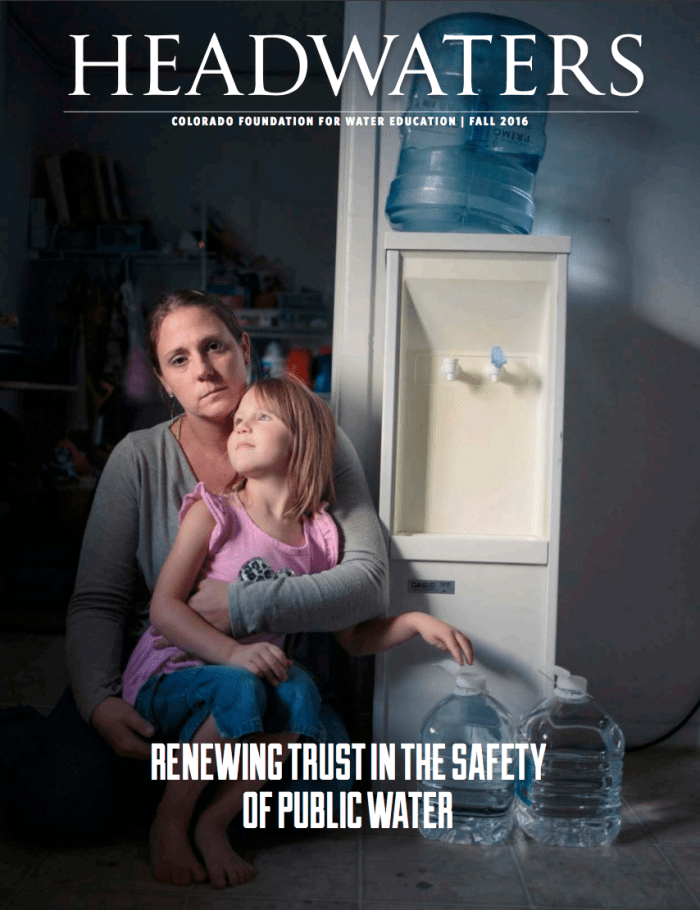
Click here to read the Fall issue of Headwaters Magazine from the Colorado Foundation for Water Education. Here’s their intro:
The Fall 2016 issue of Headwaters magazine looks at public health. The magazine introduces the law and policy governing safe drinking water, then takes a close look at how public health concerns related to as-yet-unregulated contaminants are monitored and evaluated. The issue also focuses on the unique public health challenges rural areas face, while exploring efforts to pursue increased water reuse, including from direct potable reuse systems, through initiatives related to technology and policy. The issue’s articles are set against the backdrop of public alarm raised about the safety of public water during recent high-profile events, including Flint’s lead crisis and PFC groundwater contamination near Colorado Springs. Flip through or download the issue here
Be sure to check Allen Best’s article about reuse, Water on Repeat. Here’s an excerpt:
Castle Rock and other water providers in Denver’s South Metro area understand the need to diversify their water supplies. One big piece of that puzzle is wa- ter reuse. You’ve heard of locovores, people who favor locally sourced food? This is similar. Call it locoagua. Rather than import water from distant sources, these water-strapped communities can reuse certain water supplies again and again, until they are exhausted. For many communities, it’s the lowest-cost alternative. Given proper treatment, it can be the highest-quality alternative, too.
Continued operations of the temporary water treatment plant north of Silverton received near unanimous support during a 30-day public comment period.
From Nov. 14 to Dec. 14, the Environmental Protection Agency accepted public comments on whether to continue operations at the plant that handles acidic discharges from the Gold King Mine.
The EPA previously announced it preferred that option while it continues to evaluate long-term options for the recently declared Bonita Peak Mining District Superfund site, which would address issues at 48 mining-related sites around Silverton.
The public comment period was part of a formal process to move the plant from “emergency removal action” funding to a “non-time critical removal action” funding, which is part of the Superfund process.
The agency received 12 submissions, mostly from government entities affected by the Aug. 5, 2015, Gold King Mine blowout, with only one resident weighing in.
The government entities in favor of continued operations included the Colorado Department of Public Health and Environment; the Colorado Attorney General’s Office; La Plata County; San Juan County; the town of Silverton; the Utah Department of Environmental Quality, and Congressman Scott Tipton.
Trout Unlimited, an environmental group, and Duranglers Flies and Supplies also voiced support for keeping the plant running.
While all the above-mentioned entities voiced support for continued operations, some suggested the EPA start treating discharges from adjacent mines, namely the Red & Bonita and Mogul mines, as well as the American Tunnel.
Others wrote that the EPA should secure a place to store the lime-heavy metal sludge byproduct of the treatment plant before committing to continued operation. The EPA has said it is searching for a long-term dump site…
A representative from Silverton Mountain Ski Area, which is about a mile and a half downstream from the water treatment plant, raised concerns about the treatment plant’s impact on ski operations.
The ski mountain’s chief operating officer, Tim Petrick, asked the EPA to consider installing better equipment for improved communications in the remote area, as well as perform dust suppression on County Road 110.
And a Castle Rock-based company called Jalema Technologies Ltd. that deals with mine wastewater treatment said the EPA could cut costs of operations “if a more studied plant design was implemented at the site.” The company then argued it had the technology to “produce higher quality discharge water for a cost similar to that shown for” the temporary plant, and offered its services.
One resident voiced support for the continuance of the plant, though the name was redacted.
Rebecca Thomas, EPA’s project manager for the Superfund site, said the agency will consider the comments and then make a decision through an “action memo.”
She expected the final decision to be issued in January.
During the budget retreat meeting on Oct. 25, the [Breckenridge Town Council] decided to postpone construction on what would be Breck’s second water plant, in favor of getting more information. Bids originally came in for the plant at around $30 million, but increased to $52 million for the official 2017 budget.
“Everybody was fairly shocked at the bid,” said the town’s mayor, Eric Mamula.
Breck’s town manager, Rick Holman, said that cost of construction has been going up continually year after year, which contributed to the increased cost for the project. Until the town gets the new breakdown in mid-January, Holman said the town is in “wait-and-see mode.” He added that it’s difficult to wait on construction projects because predicting costs can be a roll of the dice.
“When you’re spending that kind of money I think that a second opinion is a smart thing for the government to have,” Holman said.
While the water plant is something the town needs to continue providing for ever-increasing local population and tourist demand, Holman said that the town must find a balance between need and cost.
Mamula said that the council is at a standstill, since they can’t make any decisions on how to move forward until they’ve seen the new plan…
Should the town council decide to move forward with the plant after seeing the new plan in January, Holman said that the 2017 budget would have to be amended. The town is looking at ways to fund the plant, but Holman added that there could be a rise in water rates if the town decided to go ahead with construction.
The Gary Roberts Water Treatment Plant, the town’s current water source, does not have the space for expansion, Holman said. The town will still invest in repairing the 50-year-old plant.
Kim Dykstra, the director of communications for the town, said that the age of plant makes it more likely that it could break down.
The Gary Roberts plant was originally constructed in 1971 and receives its water from snow melt from above the Goose Pasture Tarn Reservoir that flows into the Blue River. After expansions in the late ’80s, the plant had the capacity to run 5 million gallons of water daily.
Dykstra said that the idea for a second water plant was first floated after the Hayman Fire in 2002…
A water task force was created in 2011, but it wasn’t until 2013 that the town did an official feasibility study to try to find the best way to address water use. Dykstra said that the town already possesses the water rights that would enable it to build a second plant because of progressive town council decisions that started as early as the 1950s.
The Gary Roberts plant services around 13,000 single-family-home equivalents in Breckenridge. The new plant would add availability for another 2,000, Dykstra said. While permanent residents are the biggest users of water in the town, she said that tourists make up for a big portion of usage as well. An increasing amount of tourists coming to the town, whether it’s for a day trip or longer, means more demand for water.
Dykstra stressed that part of the reason to add the plant now is to get ahead of water demand.
The feasibility study, released in early 2014, recommended that the second plant operate at 3 million gallons a day to meet the projected demand, with the water intake coming from the Blue River near Lake Dillon.
Breckenridge looked at five different properties for construction of the plant and ultimately decided on the McCain property located north of the town along Highway 9. Since it was land the town already owned, and it was close to an established pipeline, it meant fewer initial costs for taxpayers according to Dykstra.
After a decade of debate and two years of construction, the city is nearing the end of construction on the Rifle Regional Water Purification Facility.
The approximately $30 million water treatment plant, consisting of eight above-ground structures on an approximately 5 acre campus, will replace both the Graham Mesa plant and the Beaver Creek plant after it comes online.
As things stand, that will likely occur toward the end of the first quarter of 2017.
“All the support systems have to come on before water can begin to flow, so water will begin to flow, we hope, in January,” Jim Miller, Rifle’s utilities director, said after a tour of the grounds in mid-November. “It will still be several months after that before customers would notice anything.”
Ultimately what Rifle municipal water customers will notice starting this summer, according to Miller, is clearer water with significantly less iron and manganese, which will make it better tasting.
Aside from improved water, completion of the plant will largely close the door on Rifle’s largest capital project ever — a matter that garnered a great deal of attention, and at times scrutiny from community members, over the past 10 years and particularly in the past seven when initial plans were first hatched…
The city decided to switch from the “design-bid-build” approach, opting instead for a “construction manager-general contractor” method.
Later in 2014, the city selected Moltz Construction Inc. as its contractor — a decision that Miller says has been instrumental in progressing the project forward.
That change allowed for flexibility and cost saving measures that, excluding design and consultant fees for the redesigned project, are expected to total $30.5 million, according to Miller’s memo.
Walking through the facilities, Miller says there are a number of cost savings born out of the value engineering that was possible by switching to the construction manager-general contractor approach.
A tank, known as a clean-in-place tank, was initially going to be 6 feet taller, which would have raised the roof of the entire building it’s housed in another 6 feet. The team was able to get a shorter tank that was wider and had the same capacity — effectively keeping the building at the previous height and saving money.
Miller admits that the approach can be confusing at times for those not directly involved on the project, especially with all the numbers and variables involved.
“It may not be the most transparent thing, but it is efficient.”
Along the way, Miller has had to address arguments, such as those suggesting the Graham Mesa plant should have been upgraded, rather than building an entirely new facility from scratch.
The Graham Mesa plant is aging and incapable of meeting certain regulatory standards. Further, it simply does not have the space that would allow for upgrades while having a functional treatment plant — a major flaw in the Graham Mesa plant is the absence of redundancy in the systems.
“They don’t know what they’re talking about,” Miller said of those who argue that the city should have stuck with the Graham Mesa plant.
The new facility will fall just a little short of 8 MGD, much more than the 4 to 5 MGD at Graham Mesa and the ½ MGD at Beaver Creek. Ultimately the plant can be brought to 8 MGD, but some pieces were left out as a cost-saving measure.
Having that flexibility to keep up with population growth is another important feature of the new facility.
FromThe Glenwood Springs Post Independent (Pam Boyd):
…a new report prepared by the Colorado Rural Water Association for the town of Gypsum has reminded the community that wildfire impact is the top risk identified for its drinking water system.
Source water specialist Paul Hempel prepared the report for the town.
“People don’t ever think about water safety, really. Water just comes out of the tap,” said Hempel.
But water does come from somewhere, and ensuring the safety of their water sources is a prime concern for municipal providers. Source water assessment and protection came into existence in 1996 as a result of Congressional amendments to the Safe Drinking Water Act. The amendments required each state to develop a source water assessment and protection program. In Colorado, the Water Quality Control Division, an agency of the state Department of Public Health and Environment, assumed the responsibility for conducting the program.
The effort includes four parts:
• Delineating the source water assessment area for each of the drinking water sources.
• Conducting a contaminant source inventory to identify potential sources of contamination within each of the source water assessment areas.
• Conducting a susceptibility analysis to determine the potential susceptibility of each public drinking water source to the different sources of contamination.
• Reporting the results of the source water assessment to the public water systems and the general public.
GYPSUM’S THREATS
Gypsum obtains its drinking water from one intake on Mosher Spring and two intakes on Gypsum Creek. The town supplies drinking water to approximately 7,000 residents with 2,791 connections. The average daily demand on the system is 1.23 million gallons, and the average peak demand is 1.43 million gallons.
The Gypsum stakeholder group included representatives from the town, Eagle County, the U.S. Forest Service, the U.S. Bureau of Land Management, the Gypsum Fire Protection District, the Eagle River Watershed Council and several local landowners.
Through the process, Hempel assisted a steering committee as they categorized the potential course of contamination and issues of concern for the town’s water. The identification noted both the probability of impact from various sources as well as the level of risk they presented.
VERY HIGH AND CATASTROPHIC
The study revealed wildfire impact to the upper watershed, located on Forest Service property, was the greatest danger to Gypsum’s water supply. The risk level was categorized as “very high” and the impact to the system was classified as “catastrophic.”
“It is certainly Gypsum’s No. 1 concern” said Hempel.
But the community isn’t unique in this regard. Hempel noted many mountain communities that get water from surface sources identified similar risks and impacts. While it may be a cliche, it is still true that identifying the problem is the first step toward addressing it.
In Gypsum’s case, Hempel said the town needs to complete more soils and slope study for the area around its intakes to determine a defensible space. Defensible space is a familiar term for anyone who lives in wooded mountain areas, and it refers to a series of actions that can lessen the chances of wholesale property loss due to wildfire. These actions include everything from cutting back thick brush to laying down gravel or other material to limit fuels around a structure.
West Fork Fire June 20, 2013 photo the Pike Hot Shots Wildfire Today
The Widefield Water and Sanitation District became the last major water system to stop using well water from the tainted aquifer, according to the district’s water manager, Brandon Bernard.
As of Nov. 10, all of the district’s customers receive cleaner surface water from the Pueblo Reservoir.
“We’re looking forward to moving forward without having to worry about PFCs,” said Bernard, using an acronym for the toxic chemicals.
The announcement ends one chapter of a water crisis that sent thousands of residents scrambling for bottled water…
The contamination has spawned two class-action lawsuits against companies that manufactured the foam. The Air Force, which found the chemical harmful to laboratory animals as early as the 1970s, also is studying its role in the contamination by drilling several test wells around Peterson Air Force Base…
For months, local water officials raced to limit residents’ exposure to the chemicals, which remain unregulated by the EPA.
Fountain officials shut off their wells in fall 2015 – relying instead on cleaner water from the Pueblo Reservoir. But other water districts couldn’t meet customers’ demands this past summer without using contaminated well water.
Security Water and Sanitation Districts weaned itself from the aquifer in September.
Officials for all three water districts are optimistic that customers will no longer receive contaminated water from the aquifer, unless its cleansed of the toxic chemicals.
Officials in Security and Fountain have previously voiced plans to build treatment plants to filter the fouled water. Water rates there could rise to help finance those projects.
Widefield officials, however, are conducting two test projects to determine whether ion exchange or granular activated carbon filters best remove the chemicals, Bernard said.
Widefield’s test projects, which began in October, are expected to last six months, he said.
The district also is planning a $1 million project to install a pipe under Interstate 25 capable of bringing in more water from the Pueblo Reservoir. Widefield has several thousand acre feet of water stored at the Pueblo Reservoir, and officials there are no longer concerned about running out of water rights this year.
District leaders also plan to meet with Air Force officials on Thursday to coordinate how the military can help filter water. In July, the Air Force vowed to spend $4.3 million to supply bottled water and well water filters for the affected communities.
Unlike other water districts, Widefield is not planning to raise rates in 2017 to pay for the water projects, Bernard said. Rather, they will be paid for using reserve funding.
Customers are only likely to pay for operations costs once a treatment plant is built, he said.
“It’s nice just to not have to worry about our customers being concerned,” Bernard said. “And now we can just move forward with fixing the problem.”
The Environmental Protection Agency announced Monday it would prefer to continue operations at the temporary water-treatment plant that handles discharges out of the Gold King Mine while the agency continues to evaluate long-term options.
Before the EPA makes that decision final, a public comment period that began Monday will run to Dec. 14.
“As EPA understands more about the hydrology of the area, and how various sources of contamination are affecting water quality, the Agency will consider any number of options, including potential expansion of the IWTP, to address the contamination,” Chris Wardell, of U.S. EPA Region 8, said in a news release.
The second option considered in the report released Monday was to mothball the $1.5 million water-treatment plant, which was built two months after an EPA contracted crew on Aug. 5, 2015, breached the portal of the Gold King Mine, releasing 3 million gallons of mine waste down the Animas River.
The treatment plant’s high cost of operation, as well as the need to deal with the lime-heavy metal sludge by-product, led officials tasked with improving water quality in the Animas River watershed to find other options.
As of last week, the average flow rate into the treatment plant was 712 gallons per minute, and it costs about $16,000 per week to operate.
If EPA, after reviewing public comments, formally decides to continue operations, the agency will move the plant from “emergency removal action” funding to “Non-Time Critical Removal Action,” which falls under the proper Superfund process.
The 2017 General Fund budget is approximately $200,000 more than the current year’s amended budget, with the biggest difference being indirect project costs.
Areas of focus next year will be water and wastewater projects as the city continues to replace outdated water lines, update treatment plant technology, and develop better ways to store and treat water and wastewater.
Water and wastewater projects are covered through separate enterprise funds, which use taxes and service fees to raise capital.
“People don’t want to talk about pipes. It’s just not sexy,” Town Manager Greg Clifton said of the current pipe-replacement project. “But when water doesn’t come out of the faucet, our phones will ring.
“There’s so much work behind the scenes just to make sure water comes out of the faucet.”
For 2017, projected Water Fund revenues are $2.6 million, while projected expenditures are $3.5 million.
The town currently is replacing a 60-year-old pipe along East Colorado Avenue as part of a comprehensive project to revamp the infrastructure.
Plans to replace more pipes around town and the Bridal Veil Basin are in the works for next year, including repairs to pipes that carry water through the Lewis and Blue lakes areas.
“We’re chipping away on these things,” Clifton said. “(Colorado Avenue) was our worst pipe.”
Efforts to improve the water system have been ongoing for some time now, Clifton explained, including construction of the Pandora Water Treatment Plant in 2014.
The Mill Creek Water Treatment Plant is in need of equipment and holding tank updates, which are projected to be $278,500, according to city officials.
A new computer-monitored control panel will be installed to help regulate the lines, and one of the two holding tanks will be relined.
Telluride Public Works Director Paul Ruud explained that water lines need almost constant maintenance.
“I think we’re doing pretty good in that regard, but we do have some differed maintenance,” Ruud said.
Karen Guglielmone, environmental and engineering division manager for the town, explained during a recent budget workshop session that replacing pipes and fixing leaks in the Bridal Veil Basin and surrounding areas is difficult given the potentially treacherous location.
“It’s a hodgepodge of various pipe types. Much of it still has to be replaced,” Guglielmone said. “It’s very dangerous to get up there during avalanche season.”
The projected Wastewater Fund revenues for 2017 are just under $2.3 million, while projected expenditures are $2.8 million.
Treatments to remove chemicals from wastewater will be an area of focus in an effort to comply with new state regulations regarding wastewater care, Clifton said.
On April 7, 2016, the Environmental Protection Agency proposed adding the “Bonita Peak Mining District” to the National Priorities List, making it eligible for Superfund. Forty-eight mine portals and tailings piles are “under consideration” to be included. The Gold King Mine will almost certainly be on the final list, as will the nearby American Tunnel. The Mayflower Mill #4 tailings repository, just outside Silverton, is another likely candidate, given that it appears to be leaching large quantities of metals into the Animas River. What Superfund will entail for the area beyond that, and when the actual cleanup will begin, remains unclear. Eric Baker
Crews are debating whether to try to contain toxic mine drainage or funnel it out and clean it perpetually at huge expense
Colorado and federal authorities want to resolve the issue as soon as possible because today’s untreated flow into Animas headwaters — averaging 3,750 gallons a minute — may be hurting not only the environment but human health, officials said recently.
All it would take inside this abandoned Red and Bonita Mine tunnel is a turn of the blue screw on that bulkhead plug to stop hundreds of gallons of the [acid mine drainage] from leaking. But if the EPA crew does turn that screw, shutting a valve, the blockage could cause new toxic blowouts from other mountainside tunnels, veins, faults and fissures.
So, for now, the feds are letting Animas River mines drain, tolerating the massive toxic discharge that equates to more than a dozen Gold King disasters every week.
“We don’t want to discount the Gold King spill, but it is good to keep it in perspective,” said EPA project chief Rebecca Thomas, who’s managing cleanup at the now-stabilized Gold King Mine and 47 other mining sites above Silverton.
“Think about the millions of gallons draining each day. It’s something we should be paying attention to as a society – because of the impact on water quality,” Thomas said.
The environmental damage from contaminants such as zinc and aluminum (measured at levels up to tens of thousands of parts per billion) already has been documented: fish in Animas headwaters cannot reproduce. But questions remain about harm caused by lead in water at exceptionally elevated levels up to 1,800 parts per billion, cadmium at up to 200 ppb, arsenic at up to 1,800 ppb and other heavy metals.
The EPA this month intensified an investigation of possible effects on people at 15 U.S. Forest Service campgrounds, American Indians whose traditions take them to high valleys, and vehicle riders who churn dust along roads.
Lead contamination at the Kittimack Tailings, a popular 8-acre course for off-road riding, has been measured at 3,800 parts per million, which is 7.6 times higher than the federal health limit. EPA scientists, collecting water and dirt samples this month, planned to interview campground hosts, all-terrain vehicle tour guides and southern Ute tribe members — assessing possible exposures.
If people inhale or ingest contaminants around any of the 48 mine sites, cleanup at that site would be prioritized, EPA officials said.
The federal Superfund cleanup of toxic mines across 80 square miles in southwestern Colorado is shaping up as one of the EPA’s largest mining legacy projects, contingent on Congress and agency chiefs lining up funds. EPA restoration work here is expected to set the standard for dealing with a wide western problem involving tens of thousands of toxic mines contaminating streams and rivers, for which total cleanup costs have been estimated at more than $20 billion.
In the past, cleanup work at toxic mines in Colorado stalled because of technical difficulty, lack of will and scarce funds. No work has been done for years at the collapsing Nelson Tunnel above Creede, where millions of gallons of some of the West’s worst unchecked acid mine drainage contaminates headwaters of the Rio Grande River, despite a 2008 federal designation as a Superfund environmental disaster.
But EPA officials are pushing for this post-Gold King cleanup including 48 Animas sites, concentrated around Bonita Peak above Silverton, because an EPA-led team in August 2015 accidentally triggered a blowout — setting off a 3 million-gallon spill that turned the river mustard-yellow in three states and sent contaminants nearly as far as the Grand Canyon.
This month, EPA project leaders, bracing for winter snowfall that limits what they can do until summer, anticipated a mix of different solutions at the various sites — each unique with different conditions. They’re considering construction of water treatment plants, like the temporary plant set up to neutralize and filter drainage from the Gold King Mine.
That plant has cleaned 273 million gallons of water over the past year before discharging it into Cement Creek, one of three main headwaters creeks flowing into the Animas River. Meanwhile, six surrounding toxic mines along Cement Creek drain an untreated sulfuric acid flow measured at 1,476 gallons per minute to 7,590 gallons.
A water treatment plant can cost up to $100 million with annual operational costs as high as $1 million.
EPA officials said they’ll combine installation of water treatment systems with bulkhead plugs to hold acid muck inside mountains. And the feds also are exploring use of “bio-treatment” systems using plants and plastic devices to filter and remove contaminants.
The overall cleanup is expected to take years.
“Ideally, we would come up with a way to take care of the water that did not involve a lot of very expensive, in-perpetuity water treatment,” Thomas said.
There are questions dogging hydrologists and toxicologists as they embark on remediation studies.They want to know how mining tunnels, dozens of natural fissures and faults, and mineral veins are connected.
“That is a big puzzle piece,” Thomas said, because subsurface links will determine whether bulkhead plugs safely can be used to contain toxic muck without raising water tables and triggering new blowouts.
They want to know how much acid water is backed up in major tunnels, including the American Tunnel and the Terry Tunnel, and in the Sunnyside Mine. The Sunnyside was the largest mine in the area and the last to close in 1991. EPA officials said natural faults or fissures may connect acid water backed-up Sunnyside water in the American Tunnel, where bulkheads have been installed, with the Gold King Mine.
Canada-based Kinross Corp., which owns Sunnyside, is considered a potentially responsible party, along with Gold King owner Todd Hennis, liable for a share of cleanup costs.
And EPA officials say they are monitoring underground changes that may be affecting flows from at least 27 draining tunnels — called adits — that contribute to contamination of Animas headwaters. The state-backed installation of plugs over the past decade may have triggered the rising groundwater levels that documents show the EPA and state agencies have known about for years.
For example, orange sludge oozed from a grate at the Natalie Occidental Mine — one of the worst sources of untreated mine waste — north of the Silverton Mountain ski area.
EPA on-scene coordinator Joyel Dhieux inspected it this month, hiking beneath snow-dusted mountain peaks. The backed-up sludge obscured a culvert installed years ago by state mining regulators. A huge tailings heap, leaching contaminants into a creek, suggested significant underground tunnels.
“The sludge could create a blockage in the mine that could increase the risk of a blowout. … This will require thoughtful planning,” Dhieux said. “Kittimack could be easy. You go in and remove the mine tailings. This one, it could be a more complex solution because of the risk. … This is an ‘unknown unknown.’ I honestly don’t know what the mine works look like behind this grate.”
And then there’s the problem inside that Red and Bonita Mine tunnel where a bulkhead plug is installed but not closed. Dhieux and her crew determined the plug, installed in 2015, 15 feet thick and framed in steel, appears solid.
If the EPA closes the bulkhead, she and other EPA officials said, it will be done very slowly. They’re considering a partial closure, as a test, next summer. The plan is for dozens of researchers to fan out across green mountain valleys, while contractors inside the tunnel turn the screw, watching for sudden orange spurts.
I hear your concerns about the water quality and taste and odor issues we are experiencing in Loveland. My goal is to be as transparent as possible by sharing information about what is causing the taste and odor issues in Loveland and what Loveland Water and Power (LWP) is doing to resolve the problem.
Loveland has been abuzz for months about the unusually large, stubborn algae bloom at Green Ridge Glade Reservoir, one source of Loveland’s drinking water. Although this bloom is fierce, the drinking water in Loveland still meets federal regulatory requirements, plus even more-stringent state standards, for drinking water.
This algae bloom in particular is the largest we have ever seen. As a result of the 2013 flood, more nutrients have entered into runoff as it makes its way to our reservoir. The extreme heat and abundant sunshine we have had this summer developed into the perfect storm for an enormous algae bloom.
This bloom has revealed new algae species that reproduce more quickly and produce stronger geosmin, the compound that causes taste and odor issues. Additionally, the Big Thompson River is now afflicted with a significant level of the same algae. We cannot treat the free-flowing river water in the same way as we do the reservoir. And at this time, we are blending water from both the river and the reservoir at the Water Treatment Plant (WTP).
LWP water quality specialists are closely monitoring water quality by testing water samples at the Water Treatment Plant as well as at homes and businesses throughout the city on a daily basis. We are also treating the reservoir with a hydrogen peroxide-based algaecide that was developed as an environmentally safe alternative to copper-based algaecides. The only end-products of the treatment we use are oxygen and water. In addition, we are using a safe, absorbent activated-carbon compound inside the treatment plant to remove as much taste, odor and color from the water as possible.
Our technical staff continues to explore safe alternatives for treating algae blooms in the future while walking a thin line between the price tag of new technology and reasonable rates for our customers. Next week, LWP will begin a feasibility study to evaluate options for algae mitigation. The study will include permanent aeration or oxygenation system in the reservoir. We will also do a preliminary design of a larger system to store and dispense the activated carbon compound at the WTP. Unfortunately, those large capital costs are currently not budgeted.
While we would like to predict when the algae will die, it is important to note that algae is a living, unpredictable organism. Blooms usually end shortly after the first frost but we have no way to predict when that might be. We will continue to update our website http://www.cityofloveland/waterquality and Facebook page http://www.facebook.com/LovelandWaterandPower with timely information as we receive it.
The safety and quality of our drinking water is one of LWP’s most important goals. We recognize the vital role water plays in our daily lives. LWP takes water quality very seriously and will continue to produce safe, clean drinking water for our customers. We ask for your patience while we work to resolve this problem and find a way to prevent it in the future.
An algae bloom in Green Ridge Glade Reservoir, the worst Loveland’s Water and Power division has experienced, is to blame for the unsavory taste and odor plaguing the city’s water supply. The blue-green algae is harmless, health-wise, according to state lab test results.
While the minuscule taste-and-odor compound released by the algae makes the taste disgusting, a lucky 25 percent of residents think the water’s fine because they can’t taste or smell the compound.
Soon, the other 75 percent of the city will have better-tasting water. The first hard freeze will mean a slow die-off of the algae bloom, water treatment manager Scott Dickmeyer said. After that, the water’s taste and smell should return to normal within a week or two.
But Loveland will have to invest in some new mitigation methods to keep the algae at bay.
Green Ridge Glade has always been susceptible to algae growth because it’s deep and relatively still. It’s not a recreation hub like Horsetooth Reservoir, from which Fort Collins gets its water, and water doesn’t flow in and out of it at a rapid rate like at Horsetooth because Loveland is its sole user.
So as temperatures rise, the reservoir’s deeper, stiller water produces nutrients that promote the growth of anabaena, a type of algae common in water systems.
Loveland officials use a hydrogen peroxide-based product to kill the algae, but the issue has gotten worse since the 2013 Big Thompson floods because of the nutrient influx and the mysterious introduction of a new species of algae that’s harder to kill.
That’s why even though the algae issue is nothing new, many residents noticed it for the first time late this summer…
The city’s been using powder-activated carbon to remove the taste-and-odor compound from the water and funneling more Big Thompson River water into its treatment plant, but each method has drawbacks.
Powder-activated carbon removes only 50 to 60 percent of the compound because it’s not great at trapping such tiny particles. Loveland’s treated water contains about 20 to 40 parts of the compound per trillion parts of water…
“It’s a very, very small amount, but most people are very, very sensitive to it,” Dickmeyer said. “It only takes about 5 parts per trillion for our customers to start noticing it.”
And within the last few weeks, algae started cropping up in the Big Thompson River, so diluting the taste with another water source wasn’t an option.
Loveland Water and Power is considering adding oxygen to the reservoir to discourage algae growth. The division is also considering more aggressive treatment options that won’t “cost a fortune,” Dickmeyer said.
Hormones can get into the water by seeping out of of landfills, through human and livestock waste, and industry waste. A filter like Brita won’t get rid of hormones. An expensive reverse osmosis filtration system will, but Noestra is designed to be an affordable alternative — and well worth that price, considering the impact hormones can have on our health.
“Over time, we’ve found those hormonal balances really do add up and it does have a serious effect on your overall well-being,” co-creator Emma Jacobs said.
And if you need evidence that hormones are indeed messing with our natural balance, consider what the Noestra creators found when they tested water from the Boulder Creek.
“This is what usually scares people,” says Eversbusch. “You can measure the amount of hormone by semester. So in the fall and spring it’s pretty high, and when all the students leave in the summer it’s much lower.”
Nine municipalities from a three state region competed for the title of best drinking water based on taste, odor and appearance.
The judges at a taste test at the 2016 Rocky Mountain Section of the American Water Works (RMSAWWA) annual conference in Keystone deemed Greeley as the city with the best water in the region.
Nine municipalities from a three state region competed for the title of best drinking water based on taste, odor and appearance.
The winner of this competition will represent the RMSAWWA at the national “Best of the Best” taste test at the AWWA Conference in Philadelphia next June.
The EPA has stabilized the collapsing mouth of the Gold King Mine, cementing heaps of rock and sediment dug up during mining’s glory days, trying to prevent another blowout and pioneer a solution to the West’s continuing acid metals contamination of coveted water.
And as the feds push through this work, they face once-resistant Colorado communities that are increasingly keen on having a clean watershed.
The action this summer in the mine-scarred mountains above Silverton is raising expectations that, whatever final fix may be made at the Gold King, it will build momentum for dealing with toxic mines elsewhere.
That all depends on Congress lining up funding.
At the Gold King’s timberline portal, an EPA team sprayed gray cement across an area 50 feet high and 30 feet wide to secure entry. Initially, EPA workers crawled into the mine on hands and knees over planks put down to keep them from sinking into orange-hued acid metals muck. They installed cement blocks and a wooden dam to divert a 691 gallons-a-minute toxic discharge…
Then the EPA team welded steel frames 63 feet deep into a cleared 18 foot-wide tunnel. They buttressed the tunnel deeper, another 67 feet in, drilling in expanding screws, steel bolts and grates. They’re pumping that acid metals discharge through a partially buried pipeline that runs 4,000 feet to a temporary waste treatment plant.
At the plant, EPA contractors — mixing in a ton a day of lime to neutralize the 8.3 pH acid flow to 3.5 pH — recently sliced open bulging sacks filled with reddish-brown sludge. They spread 3,500 cubic yards of the sludge across a flat area to dry, trying to extend the plant’s capacity to clean Gold King muck.
Generators rattle. A canary-yellow air tube snakes out the mouth as workers in helmets with head lamps hike in.
Down in town, Silverton and San Juan County leaders’ recent about-face — from a tribe-like mistrust of the EPA toward eagerness to get cleanup done at the Gold King and 46 other sites — is becoming more adamant. Some locals say they see economic benefits if mining’s toxic hangover can be cured. And Silverton’s town manager is broadening his appeal to the nation’s most ambitious geologists to make this a hub for hydrology research…
Next, the EPA must officially designate a National Priority List disaster and find a Superfund or other way to cover cleanup costs — action that’s delayed until fall. Then in the Superfund process, the EPA would start studies to find the best way to fix each of the Animas sites.
At issue is whether final cleanup should rely on water plants, costing up $26 million each, to treat mine drainage perpetually, saddling future generations with huge bills — or aim for a more complicated “bulkhead” plug approach that could contain acid muck inside mountains, perhaps using pressure sensors to give early warning of blowouts…
But Silverton and San Juan County leaders last month said they’re mostly pleased with EPA progress at the mine, though federal muzzling of front-line crews and access restrictions have impeded close-up inspection.
Outstanding issues include locals seek assurances water treatment will continue until final cleanup is done; a demand for reimbursement of $90,000 they spent — “They did pay one tithing, and promised more,” Kuhlman said; and a desire to close off an ore heap used by motorcross riders along the Animas…
A solution based on plugging likely would be controversial. State-backed bulkheads installed near the Gold King Mine “are what started this whole problem,” Commissioner Kuhlman said, referring to the plugs in the American Tunnel of the Sunnyside Mine, which backed up mine muck and doubled discharges from mines in the area — setting up the Gold King blowout. A bulkhead installed in the adjacent Red and Bonita Mine hasn’t been closed.
The appeal is that holding water inside mountains means the acidic muck, which forms when natural water leaches minerals exposed by mining, does less harm.
Bulkheads, like this one at the Red and Bonita Mine, help stop mine water discharges and allow engineers to monitor the mine pool. Credit: EPA.
Gold King Mine circa 1899 via The Silverton Standard
Bonita Mine acid mine drainage. Photo via the Animas River Stakeholders Group.
Settling ponds used to precipitate iron oxide and other suspended materials at the Red and Bonita mine drainage near Gold King mine, shown Aug. 14, 2015. (Photo by Eric Vance/EPA)
The “Bonita Peak Mining District” superfund site. Map via the Environmental Protection Agency
Location map for abandoned mine near Silverton. The Silver Wing is in the upper right corner of the aerial.
Wastewater continued to stream out of the Gold King Mine on Tuesday [August 11, 2015] near Silverton, several days after a rush of 3 million gallons of it flooded Cement Creek and the Animas River. At the top of the photo is the mine’s opening, where an Environmental Protection Agency cleanup team was working with heavy machinery Aug. 5 and hit an earthen wall that had millions of gallons of water built up behind it
A “get well soon” balloon floats in the contaminated waters of the Animas River flowing through Durango on Monday afternoon August 10, 2015 — photo The Durango Herald, Shane Benjamin
Animas River at the New Mexico/Colorado State line August, 2015.
Animas River through Durango August 9, 2015, after the Gold King Mine spill. Photo credit Grace Hood
Confluence of Cement Creek and the Animas River from the Coyote Gulch archives (11/21/2010)
Silverton, Colo., lies an at elevation of 9,300 feet in San Juan County, and the Gold King Mine is more than 1,000 feet higher in the valley at the left side of the photo. Photo/Allen Best
Gold King mine treatment pond via Eric Vance/EPA and the Colorado Independent
The EPA’s wastewater treatment plant near Silverton, Colorado, on Thursday, Oct. 16, 2015 — photo via Grace Hood Colorado Public Radio
The Environmental Protection Agency’s temporary water-treatment facility at Gold King Mine, October 2015, via Steve Lewis/The Durango Herald.
A recent sunrise saw Joe Centeno, a maintenance plumber with Jefferson County schools, already busy at work at Arvada’s Peck Elementary, changing out water cutoffs, connector lines and fixtures in hopes of improving the water quality.
The district’s effort to test water outlets at all 158 schools for high lead levels found 10 elevated level sites at the 50-year-old school — a sink in the teachers’ lounge, three sinks in the kitchen and six classroom sinks, some of which had bubbler drinking attachments.
“This is the guinea pig,” Centeno said. “We’ll see if this works.”
His best guess as a plumber was that the repairs should fix the problem, based on the scattered lead readings, as opposed to schoolwide contamination that would have required more extensive and expensive replumbing.
This fall, Red Rocks Community College makes Colorado history by offering a bachelor of applied science degree in water quality management technology.
Red Rocks is the first community college in the state to offer a BAS degree, the result oftwo years of work by college faculty.
“The accreditation to offer a BAS will expand the learning opportunities for the students,” said Chelsea Campbell, faculty lead of the Water Quality program, in an email interview. “This accreditation gives us the ability to offer more hands-on training for students and help them become better prepared for a career in the water industry.”
The water quality management technology program focuses on applications, regulations and technologies of water, and has been around since the 1970s, Campbell said. The campus’ water quality building contains a hard, wet lab for the two water and wastewater analytical classes, and an outdoor distribution lab. The outdoor distribution lab is a live lab where students are able to experience all of the elements seen within the distribution system. The curriculum is directed in a specific way to increase likelihood of employment in the industry.
“The BAS allows us to be pioneers in creating educational pathways that perhaps have not yet existed in this industry,” said Linda F. Comeaux, vice president of instructional services at the college. “Our students will get, what I believe, is the best learning experience, the elevated/upper division knowledge and hands-on, applicable experience to go right into the workforce and secure in-demand jobs.”
[…]
“I am most looking forward to the growth of opportunities for students, especially since the water industry has very few degrees that are specific to water,” Campbell wrote. “Most degrees are focused around the environment or more generic sciences. This degree provides students courses that match their specific interests. Employers can now hire graduates that match their specific needs and the graduates can get the degree they really want.”
As with most programs at Red Rocks, Water Quality is designed to be affordable and flexible — classes are offered in a variety of modalities including online, traditional classroom and hybrid.
“We already have Ph.D. and qualified faculty on staff that will be able to teach some of these upper division courses,” Comeaux wrote. “I am looking forward to the faculty having the opportunity to utilize additional parts of their spectrum of knowledge and do what they do best — give our students exceptional experiences.”
In membrane distillation water is transferred though a hydrophobic membrane by difference in vapor pressure. The driving force of this process is temperature difference. The difference in vapour pressure allows water in gas form to pass the membrane pores while water molecules are rejected by the hydrophobic membranes. Graphic via BlueTec.
From email from Reclamation (Peter Soeth):
Bureau of Reclamation Commissioner Estevan López today announced $2.93 million in funding for water treatment technologies research. This funding is being provided through the Desalination and Water Purification Research Program for the development of new water treatment technologies and Title XVI Water Reclamation and Reuse Program for research into the deployment of new technologies that supports the expansion of water technologies in new locations.
“In a number of Western river basins, Reclamation and its partners are seeing demands for water exceed traditional supplies,” Commissioner López said. “Funding research into new water treatment technologies will expand the number of water supply resource options.”
The Desalination and Water Purification Research Program will provide $1.78 million for nine lab-scale and three pilot-scale projects. This program supports the development of new advanced water treatment technologies. Up to $150,000 will be provided for research and laboratory studies that must be completed within a year and up to $200,000 per year for pilot-scale projects that must be completed within two years.
For example, the Colorado School of Mines in Golden, Colorado, will receive $143,869 to study approaches to increase technical feasibility of using membrane distillation for desalinating high-concentration brines, brackish waters, produced waters and seawater. [ed. emphasis mine]
The Title XVI Water Reclamation and Reuse Research Program will provide $1.15 million to help fund nine projects in the Western United States. This program helps communities address water supply challenges by providing much-needed funding for research to establish or expand water reuse markets, improve or expand existing water reuse facilities, and streamline the implementation of clean water technology at new facilities.
For example, the City of San Angelo, Texas, will use $300,000 of federal funding and $1,094,849 of non-federal funding to perform pilot-scale testing to assess existing water treatment technologies for a direct potable reuse project. The proposed research will evaluate approaches to maximize water recovery, verify the performance of advanced water treatment processes, and assess the viability of reverse osmosis concentrate disposal using deep injection wells at an inland location.
The Durango City Council decided Tuesday fluoride will remain in the city’s drinking water.
Public health arguments that fluoridated water helps protect those with limited access to dental care seemed to sway councilors…
The question deadlocked the city’s Utilities Commission, so that advisory board did not have a united position to present, but the commission’s chairman, John Ballew, and San Juan Basin Health Department Executive Director Liane Jollon both spoke in favor of fluoride…
The Utilities Commission has been exploring fluoridation in drinking water since fall. The board heard presentations from residents who want to see fluoridation ended and from health officials who tout widespread fluoridation as a public health victory.
In an online petition that has received about 2,000 signatures, Callie Loudenber is asking local and state officials to pay for bottled water and filters for El Paso County residents whose water she calls “dangerous.”
[…]
After reading about the issue Friday, Loudenber ran an online search on how to create a petition. She was directed to change.org.
She began sharing the petition on her personal social media, and it soon took off.
Although she is asking for short-term solutions, including free bottled water, she also is advocating for a long-term solution “that doesn’t increase these residents bills to pay for a problem they didn’t create and have been living with for years,” according to the petition.
She emphasizes that someone doesn’t have to live in the Security area to be concerned about the issue of contaminated water.
“I want it in people’s minds. I want people to be talking about it, thinking about it – not just in Colorado,” she said. “This could happen anywhere, and it’s something we need to take seriously.”
She’s a stay-at-home mother who lives in Colorado Springs, but she has already witnessed the effect the situation is having on her family members who live in Security Water District’s Zone 1. Her aunt, for example, has asked family not to visit because “she doesn’t feel comfortable” about it, Loudenber said.
In addition to creating the petition, she has reached out to businesses and organizations, including Care and Share Food Bank for Southern Colorado, which will hold a bottled water distribution for affected residents from 10 a.m. to noon Friday at St. Dominic’s Catholic Church, 5354 U.S. Highway 85.
Loudenber said she plans to volunteer at the distribution.
Shannon Brice, Care and Share’s marketing and communications director, said the organization wants to make sure residents don’t have to cut into their food budgets to buy bottled water.
“We’re well aware of the need for people to have healthy food and nourishment for their bodies,” Brice said. “We wanted to make sure we were part of the solution.”
Danielle Oller, spokeswoman for El Paso County Public Health, said a community meeting is planned for 6 p.m. July 7 to provide “clear information to residents to address the concerns that they’re having. Information about the location will be released shortly.
The county will also test private wells for free, Oller said. For more information, call El Paso County Public Health at 575-8602.
On the petition’s page, Loudenber shares links to articles and places to go for further information. Many include examples of how other states have dealt with similar issues.
“I’m really careful to make sure I stay away from anything that looks like it might be relayed to a conspiracy theory, because I don’t want to invalidate what we’re doing,” she said.
Usually a water treatment plant just sits off to the side of a city, pumping along with little notice unless something goes wrong.
But more than 300 people gathered Friday at the Edward W. Bailey treatment plant on Colorado Springs’ east side to dedicate the Southern Delivery System.
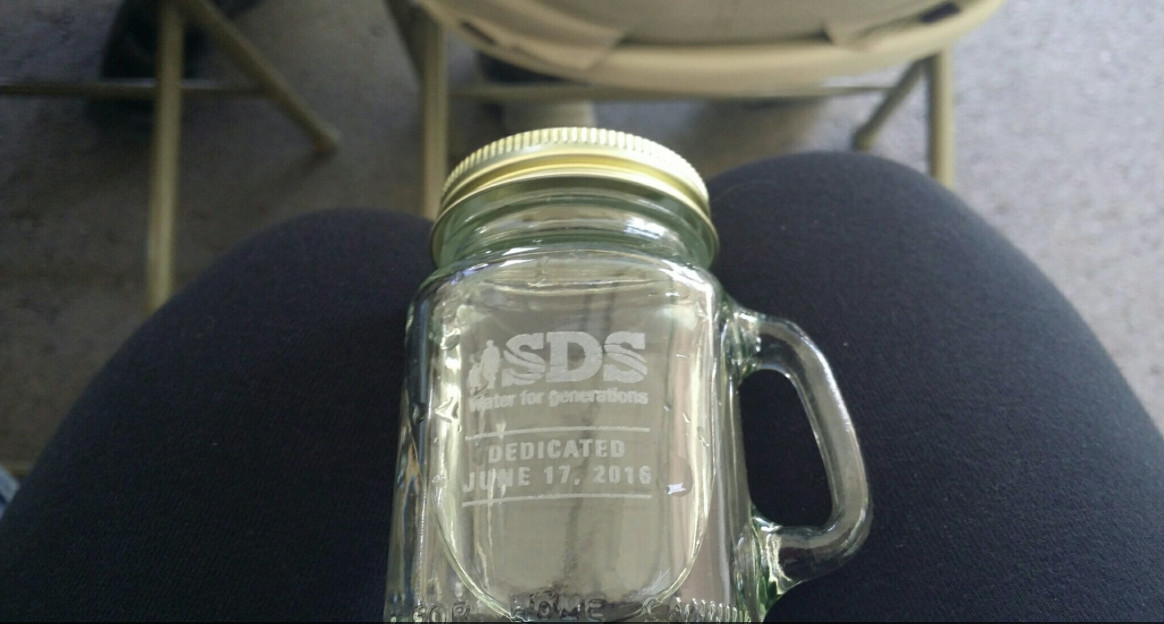
A choir belted out “God Bless America” with its inspiration, Pikes Peak, as a backdrop. People who had worked on the project over its more than 20-year history reconnected. At the end, there was a grand toast with — what else? — a jigger of water from keepsake mini-jugs.
“The history of Colorado Springs is a history of bold and ambitious water projects,” Mayor John Suthers told the crowd. “Without those bold and ambitious water projects, Colorado Springs would be a city of only 20,000 or 30,000.”
Instead it has grown to 450,000, and with SDS makes it possible for the city to get bigger.
That made most of the people at the ceremony happy. Suthers and others praised the regional benefits of SDS, urging cooperation in areas such as economic development and transportation.
“Water has been our community’s greatest challenge and its greatest resource,” said Jerry Forte, CEO of Colorado Springs Utilities. “Nothing happens without water.”
Forte detailed the history of the $825 million water pipeline from Pueblo Dam to Colorado Springs, explaining that planning dates back to 1996, when the idea crystallized in the Colorado Springs Water Plan. It was one of four alternatives in the document, but the only one that made it to the finish line.
It was a tortured run, however, filled with disputes in Lake, Chaffee, Fremont, Pueblo and Crowley counties. Forte nodded at the entanglements only briefly.
“There were lots of opportunity to build character and relationships,” he deadpanned as the crowd started chuckling.
Instead, he concentrated on the accomplishments that led to SDS, recognizing former officials such as Lionel Rivera, who was mayor of Colorado Springs when a deal was made in 2004 on Arkansas River flows through Pueblo. Seated next to Rivera was Randy Thurston, who pushed his fellow members on Pueblo City Council to approve the agreement. He enumerated the benefits of SDS to Colorado Springs’ partners Fountain, Security and Pueblo West.
Forte also lamented that SDS required 470 permits, which was a good set-up line for Sen. Cory Gardner, R-Colo., who joked: “How many of you thought SDS stood for Still Doing Studies.”
On a serious note, Gardner praised the collaboration it took to build SDS, saying more projects like it are needed, citing their importance in Colorado’s Water Plan.
“If we do not invest in water projects, Colorado will see a shortfall of 500,000 acre-feet per year,” Gardner said. “That’s five times the supply of Colorado Springs.”
While the event maintained a festive spirit, some from Pueblo County who attended were more low-key in their assessment of SDS.
“Technologically, it’s an amazing accomplishment,” said Bill Alt, whose property on Fountain Creek is being destroyed because of increased flows from the north. “I’m not sure all the cooperation they were talking about is there. I’d have to say the stormwater agreement probably benefit everyone.”
Jane Rhodes, who also owns land on Fountain Creek, said there are still challenges ahead in dealing with Fountain Creek flooding.
“The first of the $50 million payments will come, and one of those projects is on my land,” Rhodes said. “I’m glad SDS is done so the projects can get started.”
Fifty million gallons: it’s the amount of water that will be flowing through a new water system every day.
It’s called the Southern Delivery System, or SDS. It is the largest water system built in the western U.S. so far in the 21st century.
The planning for it began 20 years ago. After nearly a billion dollars and more than 470 permits later, it’s now a reality in Colorado Springs.
“In the whole western United States, water is probably the most precious commodity that we have and all of us need to do what we can to steward water,” Colorado Springs Utilities CEO Jerry Forte said.
That is where the system comes in – it is designed to treat water efficiently, as more and more people move to southern Colorado.
“This is all the piping that goes put to the finished water tank to be delivered to the customer,” said Operations Superintendent Chad Sell. “One of the most state of the art facilities in Colorado.”
The system serves more than a half million people in Colorado Springs, parts of Pueblo and the communities of Fountain and Security. Within 50 years, though, 900,000 people are expected to get their water from SDS.
“I think the long-term vision that put this in place means we’re good for the next 50 years,” said Colorado Springs Utilities Board Chair Andy Pico. “We have water. Water in the West is critical.”
Even as they celebrate the opening of the SDS as it stands now, they’re already planning for a second phase that will eventually expand it to handle more water for more people.
Colorado Springs officials say the SDS project did not receive any state or federal dollars. The 830-million dollar project, which also came in more than $100 million under budget, is being funded through bonds and will be paid for by its water customers of today and the next 30 years.
After more than 20 years of planning and construction, Colorado Springs Utilities dedicated the historic Southern Delivery System water project at the Edward W. Bailey water treatment plant Friday morning.
On April 28, history flowed out of this historic Southern Delivery System for the first time.
It took decades of planning and six years of construction and Friday morning the hard work was recognized.
“I’ve been involved in this project for 14-plus years. To see it complete with excellence and all the people who contributed. I was overwhelmed,” said Jerry Forte, CEO of Colorado Springs Utilities…
“It’s amazing for Colorado Springs and our partners. It means water for the future. We call Southern Delivery ‘water for generations’ and what that means is our children and grandchildren will be able to have water in Colorado Springs for 50, 60-plus years from now,” said Forte.
The water is pumped out of the Pueblo Reservoir and makes its way through 50 miles of pipeline going through three pump stations and ending at Colorado Springs…
It took more than 470 permits to finalize the project.
SDS Facts
The Water Treatment Plant has approximately 200 miles of electrical wires and cables, enough to stretch from the Water Treatment Plant site nearly to the International Space Station or the Pueblo Reservoir four times.
The Water Treatment Plant used enough rebar to fill 54, 50-foot rail cars or a train half-a-mile
If the concrete masonry blocks used in construction of the Water Treatment Plant were stacked, they would be four-and-a-half times taller than Pikes Peak.
The raw water tank at the Water Treatment Plant has a capacity of 10 million gallons, enough to fill 200,000 bathtubs.
5,401 truckloads of pipe to SDS projects
Net tons of steel used for pipe furnished was 37,810.
From the Colorado Springs Independent (Pam Zubeck):
Some 400 to 500 people gathered at the Edward W. Bailey Water Treatment Plant, 977 N. Marksheffel Road, Friday morning to dedicate the Southern Delivery System pipeline project.
The project, 20 years in the making,d represents the service, safety, commitment and excellence brought to bear by hundreds, even thousands, of people, said Colorado Springs Utilities CEO Jerry Forte.
He noted that the project adds another noteworthy item to Colorado Springs’ water history, which began in the late 1800s when city founder Gen. William Jackson Palmer built the El Paso County Canal from Fountain Creek on what is now 33rd Street, Forte said.
SDS, he noted, will provide water for generations to come.
SDS first appeared in the city’s water master plan in 1996 and was geared to supply water to the 20,000-acre Banning Lewis Ranch, which had been annexed into the city in 1988. Only a fraction of that property is built out, but SDS now is viewed as a crucial component of the city’s existing system to ensure redundancy. Most of the city’s water comes from transmountain systems built in the 1950s and 1980s. SDS brings water from Pueblo Reservoir.
Although Rep. Doug Lamborn heralded the project for not requiring federal money, the Pueblo Dam and reservoir project was part of the Frying Pan-Arkansas project built in the 1960s and 1970s by the Department of the Interior’s Bureau of Reclamation, along with a special district that collected property tax money in the region. SDS, obviously, wouldn’t have been possible without that reservoir on the Arkansas River.
City Council President Merv Bennett demonstrated the span of time needed to plan and build SDS by noting 11 Councils have played key roles in the project. He recognized El Paso County Commissioner Sallie Clark, a former Council member, who he said laid the groundwork for relationships with Pueblo officials; former Mayor Lionel Rivera, who oversaw the project as both mayor and a Council member; Randy Thurston, former Pueblo City Council member; former Vice Mayor Larry Small, who now runs the Fountain Creek Watershed Flood Control and Greenway District, which grew from SDS negotiations; and Margaret Radford, former Council member who now works for an SDS contractor, MWH Global.
CSU Chair Andy Pico boasted that the project was originally envisioned to cause water rates to increase by 121 percent, but it has required increases to rates of only 52 percent. The $825 million project came in $160 million under budget.
Mayor John Suthers also spoke. His role might have been one of the most pivotal, because he sorted out a mess created by his predecessor, Steve Bach, in terms of the city’s stormwater situation, which had become a nearly insurmountable barrier to the project.
First, Suthers had to deal with federal and state clean-water regulators who have accused the city of failing to comply with the Clean Water Act for years before Suthers took office in June 2015. Those negotiations are ongoing. Second, Suthers had to find a quick solution to stormwater improvements to satisfy Pueblo County commissioners, who threatened to reopen the city’s SDS construction permit. (Bach opposed a ballot measure in 2014 that would have funded stormwater work.)
Suthers finessed a deal in which the city agreed to spend $460 million in the next 20 years to upgrade and maintain the city’s drainage facilities. Pueblo officials accepted the deal, clearing the way for water to begin flowing through the SDS pipeline in late April, as scheduled. (Bach was invited to, but did not attend, Friday’s SDS dedication.)
Suthers said the city would have remained a tourist town of 20,000 but for its water resources. “Our future is bright, and we are poised for continued success,” he said.
In a surprise development, U.S. Sen. Cory Gardner, R-Colo., showed up and lauded the city for the project. “It can’t be said enough how important water infrastructure is to the state of Colorado,” he said. “It’s our past. It’s our present, and it’s our future. It’s my hope this [project] can be replicated throughout Colorado, because water will continue to drive our success.”
Others who spoke included CSU’s Chief Water Officer Dan Higgins, and the project director since 2007, attorney John Fredell, who became the face of SDS in the past decade through contracting, negotiations with neighbors, legal wrangling and interviews with the media. About 470 permits were required for the project.
As Forte said, “We never would have reached this point today without one person,” that being Fredell.
When Fredell stepped to the dais, he received a standing ovation from a crowd that included elected officials, contractors, project partners, officials from surrounding towns and Pueblo, Utilities employees and citizens.
Fredell, in turn, thanked Forte for his “trust and vision and leading every step of the way.”
After the speeches, the crowd was invited to open gift boxes at each chair which contained a commemorative coin and a little glass of SDS water, used to toast the project.
All that was left at the end of 75 minutes of speeches was to have a sip of SDS water. Photo via the Colorado Springs Independent.
To take a trip back in time through the Coyote Gulch history of the Southern Delivery Click here and click here.
Click here to read the fact sheet. Here’s an excerpt:
Home Water Treatment Facts
Americans spend billions of dollars each year on home water treatment units.According to theWater Quality Association, more than four out of 10 Americans use a home water treatment unit.These units range from simple pitchers costing less than $20 to sophisticated reverse osmosis units costing hundreds of dollars.
Some people use a home water treatment unit to improve the taste of their tap water. Others treat their water because of health concerns.While EPA does not endorse specific units, the Agency does set and enforce national standards for the tap water provided by public water systems.
Drinking water can reasonably be expected to contain at least small amounts of some contaminants.As long as those contaminants are at levels no higher than EPA standards, the water is considered safe to drink for healthy people. People with severely weakened immune systems or other specific health conditions, or those concerned about specific contaminants present in local drinking water, may wish to further treat their water at home or purchase high quality bottled water.
Before purchasing a home water treatment unit, consider local water quality, cost and maintenance of the unit, product performance, and certifications to make sure that the unit will meet your needs.
FromThe Grand Junction Daily Sentinel (Erin McIntyre):
Problems with the city of Rifle’s water treatment system have led officials to ban outdoor watering for at least the next few days.
The announcement came in the middle of the first heat wave of summer, with 90-degree highs forecast through Tuesday by the National Weather Service.
The city asked its 9,700 customers to curb their water use as much as possible, and prohibited any outdoor use of water, forcing businesses such as car washes to shut down until the problem is fixed.
Utilities Director Jim Miller said Rifle law enforcement officers were tasked with reminding residents not to water outdoors, temporarily policing water use.
Though residents with wells or irrigation water from ditches were not included in the ban, use of potable drinking water from the municipal system is prohibited until further notice. Residents were notified to stop watering outside with a reverse 911 phone call.
The problems started on June 1, when a supply line that provided water from the Colorado River to the main pump station broke. The 14-inch water line, which runs under railroad tracks and a state highway, had a major leak that was resolved by the following morning, Miller said.
But what transpired was a bigger problem — the initial leak put stress on the pump station that brings the water from the supply line to the Graham Mesa treatment plant, and all of the check valves broke, causing the malfunction.
Though the city has a second, smaller treatment plant and pump station on Beaver Creek, located on Taughenbaugh Mesa, its capacity provides only roughly 10 percent of what the system demands, Miller said.
Right now officials are trying to resolve the situation by hooking up a temporary pumping system to feed the Graham Mesa treatment plant.
Miller encouraged residents to conserve water indoors as well as refraining from watering outside.
“Everyone should curb their water use,” he said. “People need to take this seriously because it’s what delivers water to most of the city of Rifle.”
Residents will be notified when the watering restrictions have been lifted, on the city’s website (http://www.rifleco.org) and via reverse 911 phone calls, Miller said.
About a year after tests revealed elevated levels of lead in the town of Berthoud’s drinking water, another round of tests revealed similar results.
The town issued a notice to residents Wednesday that five of 40 samples recently tested for elevated lead levels. Town representatives did not immediately respond to a Coloradoan request for more information about the test results.
Berthoud’s drinking water system has struggled to meet the regulatory standard for lead in drinking water since at least 2014, records obtained by the Coloradoan show. In 2014, the water system had levels double the federal standard of 15 parts of lead per billion parts of water.
In 2015, another round of tests yielded the same result. The town’s water system serves about 5,400 people.
The 15 parts per billion value is a regulatory standard, not a public health standard. [ed. emphasis mine] Lead exposure can cause serious damage to the brain and kidneys and is especially dangerous for infants, young children and pregnant women…
Berthoud is far from the only Colorado community to struggle with elevated lead levels in its drinking water. Nineteen of Colorado’s 64 counties yielded at least one drinking water test result with 15 ppb or more of lead between 2012 and 2015. The water systems that met or exceeded the action level for lead during that time period serve about 295,000 people, or 5.5 percent of the state’s population.
Berthoud’s elevated lead levels likely originated from lead in plumbing fixtures, according to a town press release. Town leaders are working with the Colorado Department of Public Health and Environment to develop a corrosion control treatment program to implement soon, the release said.
The town is also updating its material survey to ensure that drinking water samples are being taken at the sites with the highest risk — namely, homes built between 1982 and 1986, when plumbing often contained lead. The town is sending letters to about 260 homes that fit that criterion to see if they’d be interested in becoming part of the drinking water sampling pool.
Per state regulations, Berthoud must collect 40 drinking water samples every six months and submit them for testing.
Brass faucets, fittings and valves advertised as “lead-free” can contain up to 8 percent lead, the press release cautioned, advising Berthoud residents to opt for fixtures certified by the National Sanitation Foundation instead.
Get the lead out
The release from the town of Berthoud offers advice for residents worried about lead in their drinking water:
1. Run your water to flush out lead. If it hasn’t been used for several hours, run the cold water tap until the temperature is noticeably colder.
2. Always use cold water for drinking, cooking and preparing baby formula. Never cook with or drink water from the hot water tap and don’t use it to make baby formula.
3. Boiling water won’t reduce lead.
4. Periodically remove and clean the faucet’s strainer or aerator. While it’s removed, run the water to remove debris.
5. Consider investing in a home water treatment device or alternative water source. When purchasing a water treatment device, make sure it is certified under Standard 53 by NSF International to remove lead. Contact NSF at 1-800-NSF-8010, or visit the Water Quality Association’s website at http://www.wqa.org.
6. Identify and replace plumbing fixtures containing lead. Brass faucets, fittings and valves, including those advertised as “lead- free,” may leach lead into drinking water. The NSF website at http://www.nsf.org has more information on lead-containing plumbing fixtures. You should use only lead-certified contractors.
7. Have a licensed electrician check your wiring. If grounding wires from the electrical system are attached to your pipes, corrosion may be greater. Check with a licensed electrician or your local electric code to determine if your wiring can be grounded elsewhere. Don’t try to change the wiring yourself because improper grounding can cause electrical shock and fire hazards.
8. Parents should consult with a medical professional for advice about whether to have their child’s blood tested for lead.
Residents who want to be included in the town’s list of sampling sites can contact its water department at 970-532-2393. If your home isn’t a high-risk site but you would like to test your water, the town suggests these nearby labs:
Granby’s long awaited water treatment plant broke ground this week. Officials from the Town, the Colorado Department of Local Affairs (DOLA), the Colorado Department of Public Health and Environment (CDPHE) and representatives of the various organizations that helped bring the project to fruition were on hand early Tuesday afternoon for the formal ground breaking ceremony…
Plans to develop the new Granby Water Treatment Plant were sparked in 2013 when tests on water wells in the SSA, south of the Fraser River, indicated that one of the three wells the Town uses to supply water for the SSA was being contaminated by ground water. The well in question was shut off at that time and Granby began reviewing options for upgrading the Town’s SSA water supply. Options included drilling new wells and building a treatment plant.
“In the end they (the Board of Trustees) determined the best choice for the immediate and long term for the water needs of the entire South Service Area would be to build a treatment facility,” said Granby Town Manager Wally Baird.
The rough price tag for the new plant is $6 million. Granby has received a $2 million grant from DOLA to apply to the project and an additional $1 million from the SilverCreek Water and Sanitation District, which is served by the SSA. The Town is also putting in $1.5 million. The $1.5 million the Town is applying to the project is derived from funds Granby received from the Granby/SilverCreek Water and Wastewater Authority after the authority was dissolved last year.
The Town is borrowing the remainder of the $6 million price tag, roughly $1.5 million, in the form of a direct loan. Baird explained the loan is analogous to a letter of credit and allows the Town to pay back only those funds which are spent on the project.
Freeport-McMoRan, the company that operates the Henderson Mill and Mine Complex in Grand and Clear Creek Counties, also provided the Town of Granby with a $20,000 grant that was used to mobilize contractors early on during the project and get construction moving forward.
Velocity Constructors is overseeing the project. The new water treatment plant will be contained within a single building, roughly 13,000 square feet, that will hold the treatment facility, offices for the SSA water operators and a garage area for equipment storage.
Baird said workmen began unloading foundation forms this week at the job site and he expects concrete pouring to begin relatively soon, after fears of late spring freezes subside. Along with the physical construction of the treatment plant’s building workers will also be required to install pipelines from the SSA’s three wells to the plant and connect the entire system to outflow pipes that distribute water to the surrounding area.
After construction is complete the well that was previously shut off due to contamination from ground water will be brought back online and its water will be filtered through the treatment plant. Officials expect the new water treatment plant to have a lifespan of 50 years or more.
The Town’s water users in the SSA can expect to see a slight uptick in their water bills. Baird estimated residents of the SSA would see an increase of about $52 in fees over the course of the entire year, which goes to helping pay back the loan used to complete the project. The rate changes will only apply to the SSA and not the North Service Area (NSA), north of the Fraser River.
The new plant will utilize a semi-permeable membrane to treat the well water that goes through the plant. The filter, which functions vaguely similar to a reverse osmosis system, utilizes the semi-permeable membrane to remove almost everything from the water besides water molecules.
From the Eagle River Water & Sanitation District (Click through for the agenda):
Eagle River Water & Sanitation District, in partnership with the Colorado River District and the Eagle River Watershed Council, is hosting the Eagle River Valley State of the River community meeting, Monday, May 16, at Colorado Mountain College in Edwards.
All members of the public are invited to hear about issues that affect Gore Creek, the Eagle River, the Colorado River, Western Colorado’s changing climate, local water supply, and streamflow and runoff projections. A reception with food and soft drinks will be held at 5:15 p.m., with presentations scheduled to begin at 6 p.m.
For more information, contact Diane Johnson, Communications and Public Affairs Manager, at 970-477-5457.
Anticipated growth has been largely responsible for Erie’s debt, the highest among the east Boulder County communities, which also include Lafayette, Louisville and Superior.
In a series of decisions made by former trustees in an effort to grow the population, the town accumulated roughly $100 million in bonded debt between 2004 and 2010.
The bulk of that debt is sunk into water and wastewater infrastructure and treatment facilities, taken on in installments over the past 11 years, a period that also has seen Erie leaders repeatedly commit to residential development.
Now, the town is trying to cut down on that margin.
During Tuesday’s Board of Trustees meeting, council members approved an ordinance authorizing the issuance and sale of the town’s wastewater enterprise revenue refunding bonds in the approximate amount of $17.8 million.
Erie is refunding certain Wastewater Revenue Bonds, issued to finance the construction of the North Water Reclamation Facility in order to reduce the interest costs of its revenue bonds.
The refinancing is projected to save the town roughly $1.9 million in interest costs over the life of the bonds, a savings of approximately 6 percent. Furthermore, annual debt service savings are projected to range from $119,000 to $226,000…
The majority of debt in the town of about 22,000 is related to water and wastewater projects needed to accommodate a projected build-out population of 65,526 by 2055, according to the town’s 2005 Comprehensive Plan.
“Town boards embarked on a program to plan for, then encourage, then accommodate all that growth,” Krieger said last year. “Our specific challenge now is to manage our resources and services and retire our debt, which we’re doing. Second, we need to diversify our revenue base.”
The town might be growing at a slower pace than anticipated by previous officials, but Erie’s population still jumped 79 percent from 2000 to 2014, according to the U.S. Census Bureau.
In anticipation of the population boom, Erie acquired about $76.4 million in debt for water-related bonds — about 78 percent of the town’s total debt.
Despite concerns early on about Erie’s debt, officials have said the town’s finances were strong following the trustees’ review of the 2016 budget proposal…
“The fact is that the town is rather effectively servicing our debt and three times in the last year Moody’s and S&P increased our credit rating,” [Diehl] said. “They’ve done so in recognition of our efforts to manage our finances and as an indication that the town’s financial outlook is strong.”
About 47,000 Colorado Springs Utilities customers are being notified that a water quality standard has been exceeded at the Fountain Valley Authority’s water treatment plant.
Those customers get a blend of water from Utilities and the FVA, but the exceedance of Total Organic Carbon does not pose a health threat, Utilities advises.
Leaves, sticks, dirt and other substances washed into the Pueblo Reservoir, where the FVA gets its water, during heavy rains over the past two years.
The excessive levels of TOC occurred temporarily in the first quarter of 2016, Utilities reports. Although the TOC exceeded standards, it “does not pose an immediate health risk and is not an emergency,” Utilities said in a news release.
A standard is set for TOC because it can lead to formation of disinfection byproducts, which can have adverse health effects. Those byproducts include trihalomethanes and haloacetic acids.
Both byproducts are below drinking water standards and thus pose no health risks, Utilities reports.
The FVA also supplies water to Security, Widefield, Stratmoor Hills and Fountain through their water districts, which are responsible for alerting their customers.
If you are concerned about lead in your water, you may wish to have your water tested. When your water has been sitting for several hours, you can minimize the potential for lead exposure by flushing your tap for 30 seconds to 2 minutes before using water for drinking or cooking.
Additional information on lead in drinking water, testing methods, and steps you can take to minimize exposure is available from the Safe Drinking Water Hotline at 800.426.4791 or at http://www.epa.gov/safewater/lead.
The water that Estes Park residents drink is among the cleanest, highest quality water in the state, according to town officials.
Recent testing seems to confirm that.
That’s comforting to know since a regional newspaper story last Sunday – citing test results of high levels of lead found in drinking water at four sites in the Estes Valley – had many people around town wondering what might be coming out of their tap.
“We’re very proud to remind the community that the town works around-the-clock to provide high-quality water to our customers,” said Estes Park Town Administrator Frank Lancaster. “We continually surpass strict federal and state standards to provide the very best drinking water possible.”
[…]
So what’s being done to ensure that the town’s drinking water is clean and rid of contaminants like lead?
According to Estes Park Public Information Officer Kate Rusch and Estes Park Laboratory and Water Quality Supervisor Diana Beehler, the town, as a water utility, is required by federal law to have a corrosion control program to minimize lead in drinking water and is required to do annual testing.
The corrosion control program began in the late 1980s and involves adding a chemical which coats pipes and plumbing fixtures to prevent water from corroding the metals. This program includes on-going monitoring of the treatment chemicals, the distribution system and households in our community to ensure that the corrosion control is effective.
The most recent annual testing of town drinking water occurred in 2015. The town sampled 23 homes that were built between 1982 and 1986. Homes were tested, instead of businesses, because lead poisoning is a chronic condition that occurs over long periods of time, and most people are drinking water from their homes daily.
Federal requirements mandate that the town reports the value at the 90th percentile, which was 2.3 parts per billion (ppb) of lead. The highest value in all the homes tested in 2015 was 6.5 ppb, Rusch and Beehler said. On the other hand, 14 of the 23 homes sampled were below the detection limit of 1 ppb.
The federal action level for lead is 15 ppb.
The local samples were taken after the water sat undisturbed in the plumbing for at least six hours to give the water an opportunity to react — allowing a “worst case” scenario for our testing, they said.
So, how safe are the town’s current and older water lines and pipes?
“The town’s main distribution lines are made of ductile iron, cast iron and galvanized steel, which are not a concern when it comes to lead,” Rusch and Beehler said. “The town has no lead main lines and is unaware of any lead service lines on private property. In addition, our corrosion control program is designed to coat the pipes and lead solder to reduce the amount of lead, anywhere in the system that is able to leach into the water.”
If concerned about the possibility of lead in drinking water, homeowners or business owners can test and mitigate the concerns themselves, Rusch and Beehler say.
A licensed plumber can inspect fixtures to determine if any lead sources are present, and a state-approved laboratory can test private water services to determine if lead is present in the water. When the levels are 15 ppb or higher, the EPA recommends taking precautions like flushing the tap for 15-20 seconds, using only cold water for drinking and cooking, and considering purchasing bottled water or a water filter. Flushing the tap is the easiest and most cost effective way to reduce lead if the customer is concerned.
While the town’s water and water system is closely monitored for quality, even the four sites cited by the Fort Collins Coloradoan in its Sunday story — the YMCA of the Rockies, Covenant Heights Camp and Retreat, Prospect Mountain Water Company, and Ravencrest Chalet — have each taken measures to ensure the quality of their drinking water is up to the levels required by state and federal agencies.
According to documents that the Coloradoan was able to obtain, each of those sites had test results that equaled or exceeded the federal action level of 15ppb in recent years.
Wwater samples tested at the YMCA of the Rockies, 2515 Tunnel Road, were found to have exceeded 15ppb four times since 2012, the Coloradoan reported. Those tests involved 10-60 samples taken around the property. The Coloradoan also reported that at least one sample each year since 2012 has tested at or above 15ppb.
YMCA of the Rockies collects water from the Wind River Stream diversion, not the Town of Estes Park. It then disinfects the water, and distributes it to guests and staff.
Martha Sortland, the Communications Director at the YMCA of the Rockies, told the Coloradoan that she believed the elevated levels of lead in drinking water were caused by water left in pipes too long.
When contacted on Wednesday, Sortland told the Trail-Gazette that providing safe drinking water for guests was a high priority, one that the business takes seriously. She added that a lot of time and money is invested in the operation of the water system to ensure water quality.
“The Colorado Department of Public Health and Environment provides regulations for safe drinking water,” Sortland said. “Our water falls within those regulations and always has.
“We are committed to adhering to Colorado state water regulations and we will continue to do so unequivocally.
“We have five full-time certified water treatment operators on staff at Estes Park Center, and we have partnered with the experts at JVA Consulting, an independent, third party contractor with expert credentials and experience in water quality management.”
The Coloradoan also reported that lead in drinking water at the Covenant Heights Camp and Retreat, 7400 Colorado Highway 7, tested 117ppb and 143 ppb in 2015, the highest levels of lead in Colorado drinking water recorded since at least 2012.
The high lead levels were attributed to lead soldering in staff cabins. Retreat officials told the Coloradoan that they quickly relocated staffers who had been in the cabins and have retrofitted the water pipes with PEX plastic piping.
Prospect Mountain Water Company (PMWC), also mentioned in the Coloradoan story, is a private community water system that serves about 124 residents.
The company has struggled for years and is now in bankruptcy. It has had lead levels in its drinking water that ranged from 91 ppb (in 2012) to 28 ppb (in 2014) to 15 ppb (in 2015).
Lead pipes and lead soldering are being blamed for the high lead levels.
The water company recently signed a temporary intergovernmental agreement (IGA) with the Town of Estes Park to provide water and run the water system until a new company can be contracted.
Rusch and Beehler said upgrades to the PMWC water system are being planned. They include distribution lines, water tanks and water pumps. The cost of these upgrades will be absorbed by fees paid by the PMWC customers.
In addition, Rusch and Beehler point out that PMWC lead tests have vastly improved since the Town of Estes Park began providing treated water including corrosion control.
Ravencrest Chalet, a bible school located 501 Pole Hill Road, had a high lead test of 16 ppb in 2013. However, that dropped to 4ppb in 2015.
Officials at Ravencrest could not be reached for comment to explain what measures they took to lower their lead level.
When it comes to dissolved lead, residents in the West are lucky because a large majority of the region’s housing stock and infrastructure – interior piping, water mains and service lines – are newer and less likely to contain components that can leach lead into water.
Copper water lines that were installed in a house before the early 1980s might have been connected using lead-based solder (after about 1981, we switched to a tin/antimony solder formulation). Even so, that’s likely not a big worry. Many municipal water suppliers inject chemicals, such as sodium carbonate, that attach to the inside of pipes and form a barrier to isolate lead solder intrusion. Plus, even the purest water contains some microscopic organic contaminates that, over time, build up a thin layer of slime that also coats the inside of the piping.
One easy way to “get the lead out” is to run your cold water full force for a minute or two when you get up in the morning (or anytime the system has been still for six or more hours). That will flush stale water from the pipes and ensure that fresh product from the street main is available for drinking. If you’re the conserving type, you can collect it and use it on houseplants. Also, check the screens in the faucet aerators and remove any metal particles they have caught.
Water companies are required to monitor their supplies for excessive lead and other contaminates. But if you’re concerned that the water running through old pipes is not safe, get it tested; the local health department can help. The EPA considers any concentration above 15 parts per billion as an action level, requiring mitigation or avoidance. If your level is too high, it would be advisable to have a plumber replace suspected piping in your home plus the water service line.
You also can filter the water. A simple $200 reverse osmosis system under your kitchen sink can remove about 95 percent of the lead contaminates. Can you shower and bathe if the lead concentration is high? Yes. Lead is not absorbed through the skin.
Lead comparable to levels in Flint, Michigan, has contaminated drinking water sources in a place you might least expect: the picturesque mountains near Estes Park, known for its spectacular views of Rocky Mountain National Park.
Documents show four locations clustered near Estes Park since 2012 have met or exceeded the Environmental Protection Agency’s action level for lead in drinking water.
The results catapulted Larimer County to a tie for the most sites in the state with drinking water test results of 15 or more parts of lead per billion parts of water between 2012 and 2015. Clear Creek County, west of Denver along Interstate 70, also had four sites with lead contamination during that period.
Fort Collins tested well below federal lead standards.
The Estes Park sites are:
YMCA of the Rockies, which sees thousands of guests annually and has flirted with the action level for lead since at least 2012.
Covenant Heights Camp and Retreat, which in 2015 saw lead levels in two staff cabins comparable to the highest levels documented in Flint.
Prospect Mountain Water Company, which supplies water to about 120 Estes Park residents and as recently as 2014 displayed an average lead about equal to Flint.
Ravencrest Chalet, a bible school and retreat that just exceeded the action level for lead in 2013.
Officials with the town of Estes Park water system, which supplies water to Prospect Mountain Water Company and Ravencrest Chalet but operates independently from all four sites, said Estes Park water sources aren’t to blame for the lead contamination. The Estes Park water system tested 2 parts per billion for lead in 2015, and none of its 23 samples exceeded the EPA’s action level of 15 ppb.
“They have their own distribution systems,” Estes Park water distribution supervisor Cliff Tedder said of the contaminated sites. “Whatever they’re doing isn’t working.”
‘Fully compliant’
YMCA of the Rockies, located just southwest of Estes Park, supplies drinking water to more than 3,700 guests and staffers. It is the largest water system in Estes Park that has seen elevated lead levels. YMCA collects water from the Wind River Stream diversion, disinfects it and distributes it to guests and staff independently of Estes Park’s water system. YMCA uses a corrosion control system, spokeswoman Martha Sortland said.
YMCA’s lead levels tested from 10 to 60 water samples around the property, has been 15 ppb four times since 2012. Every year since at least 2012, at least one drinking water sample from the property has tested at or above 15 ppb.
Sortland said at least one of the samples that contained lead higher than the EPA’s action level came from a guest cabin. But YMCA didn’t take action because “we were, and are, fully compliant with Colorado drinking water regulations,” Sortland said.
She’s right.
A water system’s 90th percentile lead value, which means 90 percent of test sites will have levels below the threshold, has to be more than, not equal to, 15 ppb to trigger action such as mandatory treatment plans and public water quality warnings. But the facility’s water contained more than seven times the amount of lead present in Town of Estes Park water.
FromUSA Today (Trevor Hughes) via the Fort Collins Coloradan:
[Firestone] officials repeatedly notified all water customers of the high levels and distributed information explaining how to reduce the risk. But the town, about 30 miles north of Denver, has taken no direct action to help residents replace the aging faucets and fixtures blamed for leaching lead into their drinking water.
The town’s testing found lead contamination only in homes built before 1986…
The town’s water provider installed a system in the fall to inject a phosphate coating agent into the water to help reduce the corrosive effect that leaches lead from plumbing. That’s the solution required by state regulators, who say Firestone is making progress in bringing down lead levels.
“It is our hope that this additive to our water supply will continue to reduce the lead levels inside these older homes,” Mayor Paul Sorensen said in a prepared statement.
Like many fast-growing towns on Colorado’s Front Range, Firestone is a small, old-town area surrounded with new suburbs. The town has a few blocks of old homes amidst nearly 3,500 newer ones.
In Firestone’s case, testing never has found lead in the municipal water supply or in any of the newer homes. That means the bulk of the town’s 12,000 residents face almost no risk.
This is the oldest known photo of Louisville. In this beautiful image you are looking west on Spruce Steet from Main Street and can see the Flatirons in the hazy distance. This photo provides an amazing feel of how wide open the spaces were between the new cities on the front range. Photo via DowntownLouisville.com.
Seeing a significant need for infrastructure repair, the Louisville City Council on Tuesday approved a 13 percent water utility rate increase for 2017, with city ratepayers projected to see their bills rise much higher over the next five years.
The average Louisville ratepayer currently forks over $63 combined for water, wastewater and stormwater services, and the newly approved schedule will see that figure bumped up to $71 on May 1, through the end of 2017. Unofficial projections from the city suggest the average could be in the range of $93 by 2021. And 10 years from now, citizens may be paying twice what they pay now.
According to staff from the city’s Public Works Department, the extra money will fund improvements at the Louisville wastewater treatment plant that bring the city to compliance with mandatory federal and state standards. The rate increases will also provide revenue that staff believes is needed to properly operate and maintain city utility systems.
Though the City Council unanimously approved the hike, several lamented the rising cost burden on citizens.
“We’re at the point now where we have to make significant reinvestment,” Mayor Pro Tem Jeff Lipton said. “But we’re looking at raising rates another 48 percent over five years. Some people can afford it, some people are going to be challenged by it, but we’ve always got to keep this in mind. … We’re continuing to increase the cost of living here in a variety of ways.
After many years of struggling to provide enough clean water for the town’s growing population, Larino reported Feb. 24 that Wiggins now has more than enough for several years to come — even taking into account the two new housing developments that will begin construction this year.
Much of the water system’s success can be attributed to improved filtration methods, new wells the town has added over the last few years and some recent water deals with the Front Range. But although the water system is in better shape today than it has been in years, Larino said there’s still room for improvement.
“A lot of people don’t recognize, I think, over the last couple of years, how (the water system) has changed and diversified,” he said.
Wiggins gets most of its water from three wells that pull from the Kiowa Bijou basin, and two more recently dug wells that pull from the South Platte River.
The town also owns permits for two more Kiowa Bijou wells that have not yet been drilled. These wells are augmented by a 112-acre recharge pond facility north of town, shares in Weldon Valley ditch water and a recently approved lease agreement with the city of Castle Rock for augmentation water over the next three years.
The town also has two more recharge ponds and a few more Weldon Valley shares pending court approval.
Larino also pointed out that, thanks to an improved cleaning and filtration system, Wiggins’ water is well below the state limit for nitrates and other chemical content.
The water’s quality, particularly its nitrates level, has been a problem for the town in the past, but Larino said those days are over.
In 2015, the town pumped about 182 acre feet of water out of the 256 available acre feet. Thanks to the new water agreements, Larino said they will be able to pump up to 737 acre feet in 2016 and for the next two years.
“We have a lot of water,” he said. “Three times the town, basically.”
Eldorado Springs, Colorado, has won the top prize for U.S. tap water at an international tasting contest.
The judges gave out two gold medals for Best Municipal Water on Saturday at the 26th annual Berkeley Springs International Water Tasting in West Virginia. They awarded the top prize among U.S. entries to Eldorado Springs, while Clearbrook, British Columbia, won first place for best in the world.
The award for best purified water went to Bar H2O of Richmond, Michigan.
An entry from Karditsa, Greece, Theoni Natural Mineral Water, won the top prize for bottled water, while the best sparkling water was awarded to Tesanjski Kiseljak of Tesanj, Bosnia.
Ten judges tasted and selected from among dozens of waters from 18 states, seven Canadian provinces and five foreign nations.
From the Fort Collins Coloradoan (Jacy Marmaduke):
In light of the Flint water crisis and national concern on the safety of drinking water, the Coloradoan submitted a public records request to the Water Quality Control Division of the state’s Department of Public Health and Environment earlier this month.
The request asked for three data points:
1. Water test results for lead submitted to the state by public water systems in 2013-2015;
2. A list of public water systems out of compliance with drinking water standards;
3. The number of lead service lines in the state classified by the lowest level of geography available – whether by city, zip code or water system.
The Water Quality Control Division responded to the Coloradoan’s request on Tuesday. A list of public water systems out of compliance was included in the response.
The first request was fulfilled for free because it will take less than an hour to collect the data. After the first hour of work on a request, state agencies are free to charge requestors up to $30 an hour to fulfill requests.
For the third request, the state is asking for $61,200, equivalent to 2,040 hours of staff and attorney time the state estimates will be needed to compile the data.
The Department of Public Health and Environment charges $30 an hour for all staff time associated with locating and producing records for those who request them, in accordance with Colorado open records law.
Officials at the Association of State Drinking Water Administrators indicate that if a water system has a lead action level in exceedance, then the water system “must submit the detailed inventory system.” Colorado has had water systems with lead action level exceedances.
The state reports drinking water systems in Colorado don’t have to submit to the state the number of lead service lines within the system. Instead, they must identify their sample locations and indicate whether the sample was supplied by a lead service line or if the sample location contains lead pipes or copper pipes with lead solder.
The Water Quality Control Division is prohibited from releasing the addresses of public utility users, so staff would have to retract all individual homeowner addresses from the sample location data, according to the division’s response to the records request.
That process, along with research, retrieval, review and production of the records, would take more than 2,000 hours – or nearly a year of working weeks if a single staff member carried out the work.
The Coloradoan is seeking to collect the state data as part of a national project in conjunction with the USA TODAY Network on drinking water safety across the U.S.
FromThe Colorado Springs Gazette (Ryan Maye Handy):
Residents in Security-Widefield who have private wells near Fountain Creek should check their water for excess chemicals, federal officials said Monday.
The perfluorinated compounds are commonly found in surface protection products for carpets, but should not be in the local drinking water. The chemicals were found during water quality tests done in January.
They don’t fall under water quality regulations, but they are on the Environmental Protection Agency’s list of things to monitor and keep out of a water supply. Since the amounts of chemicals are trace, the water supply meets the health standards for drinking water, although the effects of consuming the chemicals are largely unknown.
“The EPA has set health advisory limits,” said Brandon Bernard, the water department manager for the Widefield Water and Sanitation District. “The amounts that were detected in our aquifer were well below that. We are talking about (less than) one part per billion, which is like a teaspoon in an Olympic-sized swimming pool.”
The EPA, with the help of the El Paso County Public Health and its state-level counterpart, the Department of Public Health and Environment, must determine where the chemicals are coming from and how they got into the aquifer. Until that mystery is solved, it’s unlikely that officials will be able to stop the flow of chemicals, said Tom Gonzales, the deputy director of the county’s health department…
The chemicals came from the Widefield aquifer, which parallels Fountain Creek and is the source for nearly half of the Widefield district’s water. The district has nine wells that pump blended aquifer water, which is mixed with water from Pueblo Reservoir before it goes to local homes.
At least six of those wells showed low concentrations of the perfluorinated compounds, but no levels in other tests. Since the results have varied, more tests will be done, Bernard said.
“There isn’t enough data at this point, really, to get a good idea of what’s going on,” he said.
The state and EPA are putting together a plan to test groundwater and trace the chemicals back to their source. Meanwhile, since county labs can’t test for the chemicals, residents in certain areas who get water from private wells are being asked to get their water tested. The area of concern runs along Fountain Creek from Interstate 25 to the Colorado Springs Airport, between East Fountain Boulevard to the city limits of Fountain. It includes the Widefield water district, which serves 25,000 customers, and water sources in Fountain and Security.
Since the discovery of the chemicals, Widefield has not shut down its water supply, Bernard said. Treatment systems can remove the perfluorinated compounds , and residents who use water from private wells can buy treatment equipment at local home improvement stores, officials said.
Officials are edging closer to recommending a Superfund listing in the wake of the Gold King Mine spill after closed-door meetings Friday.
Gov. John Hickenlooper met with officials from Durango, Silverton and San Juan County late Friday afternoon. After the meeting, the governor said it appears stakeholders are on board to pursue the designation.
“These communities have made it clear that a Superfund designation is the most viable path to address pollution in the affected area and protect our public health and environment,” Hickenlooper said. “We’re all working around the clock to ensure that remaining points of negotiation are resolved in time for the March Federal Register listing in order to move this process forward.”
The governor has until Feb. 29 to meet a deadline extension to propose a new Superfund site in San Juan County.
Local officials are also hopeful that they are getting close to offering a formal opinion on the Superfund designation, which would culminate in a vote by Silverton and San Juan County elected officials. The communities delayed a vote in late January.
There are some outstanding issues to work out, including securing assurances that impacts to the town would be mitigated and ensuring a seat at the table for local governments. But San Juan County Administrator William Tookey believes the area has gone through a bit of an evolution on the subject.
“There’s been a perception that because we haven’t gone out and requested Superfund that we were somewhat anti-clean water, which we haven’t been,” Tookey said, underscoring that the local governments simply wanted assurances. “We recognized that … if in fact a treatment plant is a solution, the resources weren’t there without a Superfund site.”
[…]
Also Friday, the EPA met separately with tribal, state and local government officials for several hours to update them on the spill and plans for monitoring the affected waters.
La Plata County Commissioner Julie Westendorff, who represented the county at the meeting, said it was the first time that all stakeholders got together in one room since the spill, including representatives from Colorado, Utah and New Mexico.
Even though the meeting concerned public safety, including discussing next steps for a water monitoring plan, the agency opted to close the meeting, citing a legal opinion.
“We reviewed potentially applicable laws and did not find anything. The Sunshine Act does not, by its terms, apply,” an agency spokesperson told The Durango Herald in an email when asked why the meeting was not open to the public.
At the Friday meeting, EPA researchers released a preliminary analysis of water quality to describe the release, transport and final destination of the acid mine drainage. Results must be peer reviewed by an external panel during the week of Feb. 22. The report is expected to be completed by mid-March.
“We estimate that, by the time the plume reached the lower Animas River, the metal load in the plume was roughly equivalent to one day’s worth of high spring runoff,” the preliminary report states.
Researchers say “hot spots” of metal contaminants in the lower Animas and San Juan – unrelated to the spill – may warrant further investigation.
“It may not be possible to isolate the specific effects of the GKM event from the ongoing cumulative effect of multiple sources of metals from past or future runoff,” the preliminary report states.
In September, the EPA released a draft monitoring plan to evaluate pre- and post-event conditions. Sampling activities include water and sediment quality and biological and fish analyses in Cement Creek and the Animas. Cement Creek is a tributary of the Animas.
The EPA plans to collect the data for one year to review results.
Westendorff, however, said outstanding concerns remain with how the monitoring plan will take into account spring runoff, which could begin in as few as six weeks.
“My takeaway is there isn’t a plan now,” Westendorff said. “I hope they can get something worked out because people downstream are getting restless.”
The EPA says it is working on a long-term, robust strategy.
The EPA spokesperson, in emailed responses to questions, added: “Attendees also assessed tribal, state and local interest in collaborative approaches to monitoring water quality and solicit ideas for structuring a water quality monitor program across the watershed going forward.”
Environmental experts say spring runoff not a concern for dredging up sediment laced with metals from Gold King Mine spill
“When you have more spring runoff, you have a lot more turbulence, so sediments can get remobilized,” said Peter Butler, a coordinator of the Animas River Stakeholders Group.
“However, usually the lowest metal concentrations we see throughout the year are during spring runoff, and that’s because you have so much dilution. So I’m not really expecting an issue.”
Scott Roberts, an aquatic biologist with Mountain Studies Institute, said water samples from the Animas during storms in October show little sign of increased metal concentrations.
“I think most people were concerned with the sediment not only deposited around the river margin, but also at the bottom of the channel,” he said. “But it’s amazing how much it seems to already have washed off with the few storms we’ve had. You don’t see a lot of evidence left.”
The Environmental Protection Agency’s temporary water treatment plant can handle 900 to 1,200 gallons per minute. Currently, the facility treats only discharges from the Gold King Mine, which averages 525 gallons per minute.
Mine discharges usually increase in the spring because of more ground water movement but are diluted in the runoff.
“But we may be dealing with a whole different ground now,” Butler said. “Nobody really knows what the flows are going to be like. That’s why the EPA oversized the treatment there, so they have the capacity to handle it.”
[…]
In the meantime, state health officials are developing a notification stakeholder group to address how best to notify local governments and agencies if a spill occurs.
Health officials added a second monitoring station on Cement Creek above the confluence with the Animas River. The department is coordinating with federal agencies on a long-term monitoring plan for the entire watershed.
“We’re very lucky the disaster did not have a long tail,” Gov. John Hickenlooper told The Durango Herald. “The consequences aren’t as dire as many of us first thought.”
Still, state water experts say they don’t have a full picture of the impact the spring runoff might have.
“I don’t know, and that’s a problem for me,” said Patrick Pfaltzgraff, director of the Colorado Water Quality Control Division. “I want to have some certainty, and where I don’t have certainty as a water quality professional, I want to have some process in place to respond to that.”
Cement Creek photo via the @USGS Twitter feed
Cement Creek remains lined with orange sediment after the Gold King Mine spill. The Environmental Protection Agency accidentally triggered the release of orange wastewater laced with heavy metals into Cement Creek on Aug. 5. The creek flows into the Animas River at Silverton, and eventually crosses into New Mexico and Utah
The EPA’s wastewater treatment plant near Silverton, Colorado, on Thursday, Oct. 16, 2015 — photo via Grace Hood Colorado Public Radio
The Environmental Protection Agency’s temporary water-treatment facility at Gold King Mine, October 2015, via Steve Lewis/The Durango Herald.
The confluence of Cement Creek, at right, and the Animas River, left, as seen September 2015 in Silverton, Colo. This is where the plume of contaminated water from the Gold King Mine entered the Animas River. (Jon Austria — The Daily Times)
Cement Creek aerial photo — Jonathan Thompson via Twitter
Acid mind drainage Cement Creek watershed
Cement Creek August 8, 2015 — Bruce Finley via Twitter
Confluence of Cement Creek and the Animas River from the Coyote Gulch archives (11/21/2010)
Broomfield City Council gave the green light for the wastewater treatment facility to seek proposals for expansion to their laboratory and administrative office space.
Councilmembers unanimously passed six consent agenda items Tuesday night without discussion…
The Environmental Services Division in Public Works provides laboratory services to the Water and Wastewater Treatment facilities. The laboratories share staff, space and equipment between the two facilities to comply with all water and wastewater regulations in an efficient and cost effective manner.
“The laboratory at the water treatment facility, constructed in 1997, is adequately seized for the staff and work load,” a memo reads. “The laboratory at the wastewater treatment facility, constructed in 1987, has not been expanded to keep up with the additional staff and work lead increase over the last 28 years.”
The lab was built with work space for two staff member, and does not support the five employees and equipment added since 1987.
Burns & McDonnell, a Denver-based engineering firm, was retained in late 2014 to complete a study for the facility, east of Lowell Boulevard on West 124th Avenue, and determined the existing space was about half of the size that is typical for the staffing and testing performed at the facility.
Construction costs are estimated between $3.7 million to $3.8 million, according to a city memo. That amount is included in the 2016 budget.
The Town of Erie is accepting bids for the design and construction of the Water Plant Solids Handling Equipment Project at the town’s water treatment facility.
The project includes moving the plant’s powdered-activated carbon system and providing carbon storage. The town also plans to explore options for pretreating water to reduce unwanted tastes and odors.
Here’s the release from the Colorado Department of Health and Environment (Meghan Trubee):
Thirty-two drinking water and wastewater systems in small communities throughout Colorado will receive a total of $9.4 million to fund planning, design or construction of public water systems or treatment works necessary for the protection of public health and water quality.
Governmental agencies, nonprofit public water systems and counties representing unincorporated areas with fewer than 5,000 people were eligible to apply for grants up to $850,000. Funding was provided by the state Legislature under Senate Bill 09-165 and SB14-025.
In the event a recipient cannot accept the grant in whole or part, available funds will be distributed per the small communities grant program rules. This list is subject to change based on contract negotiations.
Three Pueblo communities are among 32 entities receiving $9.4 million in state grants for planning, design or construction of water projects.
The Colorado Department of Health and Public Environment announced the funding this week. It is available to small towns or water systems serving fewer than 5,000 people.
Boone, located east of Pueblo, will receive $850,000, which will be used to upgrade its water system.
The town is looking for an alternative source, because its wells suffer from water quality issues, said Mayor Robert Ferriter.
Rye, located southwest of Pueblo, will get $440,000 for its water system. The town has been improving its water system since 2009, when it was under a boil order.
The Avondale Water and Sanitation District will get $596,057 to make sewer improvements.
“We were happy to get it,” said Bert Potestio, president of the district. The grant will be matched by local funds and used to lift water to treatment lagoons. “We plan to start work as soon as possible.”
Several other area water and sanitation providers also are tabbed to receive funds. They include: Pritchett, $185,000; Manassa, $15,000; La Veta, $850,000; Manzanola, $253,328; Baca Grande Water and Sanitation, $88,300; Costilla County (Garcia Water), $99,816; Sheridan Lake Water Co., $609,568; Patterson Valley Water Co., $150,500; Fowler, $304,355; and Bristol Water and Sanitation, $94,500.
From the Colorado Springs Independent (Pam Zebeck):
It won’t be long before the new Edward W. Bailey Water Treatment cranks up to filter water coming from Pueblo Reservoir through the Southern Delivery System pipeline…
…a few weeks ago, we got the royal tour of the water treatment facility on Marksheffel Road from two operators — Chad Sell and Jay Hardison — who are as excited as little kids who just got new bicycles for Christmas. They’re happy because a redesign of the project placed most treatment processes under one roof, making it not only more efficient but much more convenient to be monitored by Colorado Springs Utilities staff.
SDS project manager John Fredell explains how Utilities got a good deal from bidders: “What we said is, ‘We want to see your value engineering ideas right up front.’ One said, ‘We can shrink this way down, put it all under the same roof and still deliver the same quantity and same quality of water, and we can do this with four miles less piping.’ Four miles!”
[…]
There’s nothing extraordinary really about the Bailey treatment plant, named for a former long-time Utilities water division employee. The plant uses a traditional processes of flocculation, sedimentation and ozone to filter water and deal with any taste and odor problems.
But there are certain design features that take the operators into account. For one thing, the plant can be controlled off-site by an operator using a mobile device. Also, access to the pipes below the various stages of treatment are readily accessible for maintenance and repairs. And, the plant will require only six employees on duty at any given time. It has a 10-million-gallon holding tank.
The plant is built so that it can be easily expanded from 50 million gallons a day to 100 million gallons, Hardison notes. “Here’s a pad for a future generator,” he says. “We can add another generator and go to 100, like for our great grandkids.”
While the whole system could become operational within just a few months, for now, operators are running it through the rinse cycle to be sure all is in working order. “So we’re currently testing all the processes out,” Hardison says. “We’re stopping and starting the plant, trying to get it fine-tuned. Plants run really well when they’re run all the time, continuously. If you stop and start, they’re not very good. We’re almost to the point where we will run it continuously.”
He adds that one thing operators will learn during the testing is the “bookends of the low end and high end” of what the plant is capable of.
Southern Delivery System map via Colorado Springs Utilities
The Security Water and Sanitation District met with the community tonight to address concerns over chemicals that have been detected in the local water supply.
A recent study from the EPA revealed that water in Security, Widefield, and Fountain has traces of PFA, a dangerous chemical.
Although the cities have some of the highest levels, city officials said the levels are still too low to be considered dangerous.
The EPA says the chemical can be removed from water at treatment plants or with activated carbon filters.
All three water districts stress that customers should not be worried about the effect this has on water quality in the area, and said their water is safe to drink.
The EPA is planning to meet with water officials in Security next week to discuss solutions.
From the Colorado Springs Business Journal (John Hazlehurst):
Known as perfluoroalkyls, or PFAs, research suggests the chemicals are potent carcinogens and endocrine disrupters at levels far below the Environmental Protection Agency’s provisional exposure limits for drinking water.
And no one seems to know where the contaminants are coming from — or even that they were there in the first place. The city of Fountain’s 2015 Drinking Water Quality Report doesn’t mention PFAs or any other “unregulated reportable contaminant.”
Ron Woolsey, who heads Fountain’s Water Department, was unaware of any PFA contamination of the city’s water supply or of the EPA test results. It’s not clear if the EPA reported these results to the three affected systems.
“We get about 70 percent of our water from the Frying Pan/Arkansas project, via Pueblo Reservoir,” he said. “The remaining 30 percent comes from wells in Fountain and wells on the Venetucci Farm that we share with Security and Widefield. When [CSU’s] SDS [Southern Delivery System] comes on line, we’ll get 100 percent of our water from Pueblo Reservoir.”
CSBJ provided Woolsey with links to source documents uncovered for this story.
“Thanks for that information,” he said. “You’re sort of the canary in the coal mine for us. We’re going to investigate further, talk to [Colorado Department of Public Health and Environment] and figure out what the next step will be. Those [PFA substances] sound pretty alarming.”
Both Colorado Springs and Pueblo use Fry-Ark water, and no PFAs were detected in their water systems.
It could be that water from Fountain Valley wells or surface water sources are contaminated by either landfills or residue from industrial processes, but no one is really sure.
Upper Black Squirrell Creek Designated Groundwater Basin
FromThe Colorado Springs Gazette (Ryan Maye Handy):
For years, the Cherokee Metropolitan District has failed to meet one of its water quality standards, and the eastern El Paso County water district has proposed a change in state regulations to make it easier to meet that requirement.
The proposal has started an unorthodox process with the state’s Water Quality Control Commission to allow the district to have a higher level of dissolved solids – like salt – in its water. The change would only affect wells in the district, but the proposal has raised concerns from well-owners about the health of the system’s aquifer and prompted three stakeholder meetings before a rulemaking hearing in August.
The Upper Black Squirrel Creek aquifer has already been degraded by the number of wells that tap into it, well owners argue. Wells in the Cherokee district pull from an aquifer that is recharged with treated wastewater – water that, under a new requirement, would have more dissolved solids. If Cherokee fails to change regulations for its so-called “total dissolved solids” levels, it will have to spend tens of millions of dollars to meet current state requirements – a cost that will be borne by the district’s ratepayers.
The problems date back to 2010, when a new waste water treatment facility was completed without machines to treat water for total dissolved solids, known as TDS. At a Tuesday stakeholder meeting, the first in a series, Cherokee’s General Manager Sean Chambers described the consequences of this to a group of around 30 people.
“So whatever comes in the waste water plant in terms of total dissolved solids comes out the other end,” Chambers said. “Thus, we have a $30 million waste water plant that does not treat a lick of TDS.”
The district’s drinking water quality more than complies with state requirements for dissolved solids levels, but the levels in waste water pose problems. The water district typically measures 600 mg per liter of dissolved solids in its treated waste water, well over the state requirement of 400 mg per liter, said Chambers. Ever since the district opened its new facility in 2010, it has never been compliant with state standards for dissolved solids. By changing the level allowed in its water, the district hopes to save $10 million on costs over the next 20 years while it tries to become compliant.
On Tuesday, the district emphasized that dissolved solids in its water do not pose a public health risk, but only affect the water’s taste. Most water districts around the country adhere to the federal standard of 500 mg per liter of dissolved solids, except for Texas, which has its threshold set at 1,000 mg per liter, said Andrew Ross, with the state’s water control commission.
While the water district is aiming for compliance, well owners fear that more dissolved solids will continue to degrade the quality of the aquifer, said Jerod Farmer, a well owner who attended Tuesday’s meeting. Officials with the water quality control commission acknowledge that a higher presence of those solids in water can impact the aquifer’s quality.
Unlike surface water, which is regulated for quality at the federal level, groundwater quality is regulated on a state-by-state basis. Colorado’s groundwater regulations have remained relatively unchanged since the 1980s, when two regulatory structures were set up- one for statewide regulation, and another to grant individual exceptions to the state’s rules.
The Cherokee district is unique in Colorado – it has the largest facility in the state that dumps its waste water back into the groundwater. Its request to change the dissolved solids requirements in its waste water is equally unusual – the water quality commission rarely handles regulatory changes proposed by an outside agency, representatives said on Friday.
The public will get two more chances to learn about the proposed changes at stakeholder meetings on Feb. 11, time and location to be determined, and March 10 from 1 p.m. to 4 p.m., location to be determined. Both will help the commission gather as much public opinion and information as possible before the August hearing, said Lisa Carlson, who facilitated Tuesday’s meeting.
“The hope is that, when you get to the hearing, you will all be well educated and understand what the issues are in the process,” Carlson told the audience.
For more than 50 years, the federal government has recommended adding fluoride to drinking water because it can prevent teeth demineralization.
The local effort to eliminate fluoride from drinking water has been lead by Jim Forleo, a chiropractor who said too much fluoride can have negative effects such as joint pain.
“They are giving us a drug without our consent,” he said.
However, the panel argued fluoridation helps strengthen teeth and lower the average number of cavities in adults and children.
“This is one of the most cost-effective prevention strategies you can develop,” said Dr. Larry Wolk, Colorado Department of Public Health and Environment’s executive director and chief medical officer.
Community water fluoridation is a primary attack against cavities, and it promotes healthy teeth development, especially among children in poorer communities who have limited access to dental care, he said.
While many factors including diet contribute to cavities, the recommended level of fluoride in drinking water helps lower acidity in the mouth.
“It’s constantly bathing the teeth to counteract that demineralization,” said James Sutherland.
In the meeting, fluoride opponents, countered that while a certain amount of fluoride may be safe, shouldn’t the weight and medical condition of the person help determine the appropriate dose.
“At what point do we know what the dosage is?”asked Jane Burnier.
In April, the U.S. Department of Health and Human Services recommended lowering the dosage of fluoride because so many people are exposed to it in toothpaste and mouthwash.
The Utilities Commission will talk about how to structure the decision-making process in February. It could make a recommendation as early as March, Chairman John Ballew said. But the commission is not on a set timetable.
Once a recommendation is made, Durango City Council will have the final say because fluoridation is not required by any government agency.
Whiting Oil & Gas Corp., a unit of Denver-based Whiting Petroleum Corp., has sold its Redtail saltwater disposal and fresh water transportation and storage system in Weld County for $75 million.
Whiting sold the system to BNN Water Solutions, a unit of Tallgrass Energy Partners of Leawood, Kansas.
The water system consists of 148,000-acre system consists of 62 miles of pipeline along with associated fresh water ponds and disposal wells.
Here’s the release from the US Bureau of Reclamation (Peter Soeth):
As part of an ongoing effort to further technological advances related to imbalances between water supply and demand, the Bureau of Reclamation announced today it will seek proposals for research, laboratory studies and pilot-scale projects that target increasing the usable supply of water in the United States as part of its Desalination and Water Purification Research Program. Today’s announcement occurred as private sector and governmental representatives attended a White House Roundtable on Water Innovation being led by Secretary of the Interior Sally Jewell and other senior Administration officials. Participants at the roundtable are discussing how to plan, efficiently use and develop new clean water supplies to ensure our nation’s resilience to water supply shortages.
Reclamation will provide up to $150,000 for the research and laboratory studies. Between five and 15 projects are expected to receive funding. Studies must be completed within one year. All applicants are required to have a minimum of a 50 percent non-federal cost-share except for institutions of higher learning. Institutions of higher learning are encouraged to have some cost-share.
For pilot-scale projects, Reclamation will provide up to $200,000 per year, per project. The pilot-scale projects must be completed within two years. Between one and five projects are expected to receive funding. All applicants must provide at least 50 percent non-federal cost-share.
Individuals, higher education institutions, commercial or industrial organizations, private and public entities (including state and local), non-profit organizations, and Indian Tribal Governments are all eligible to apply for these funding opportunities.
The Desalination and Water Purification Research Program is helping Reclamation and its partners confront widening imbalances between supply and demand in basins throughout the Western United States through testing and development of new advanced water treatment technologies.
The DWPR Program focuses on three main goals: (1) augment the supply of usable water in the United States; (2) understand the environmental impacts of desalination and develop approaches to minimize these impacts relative to other water supply alternatives; (3) develop approaches to lower the financial costs of desalination so that it is an attractive option relative to other alternatives in locations where traditional sources of water are inadequate.
The funding opportunity announcements are available at http://www.grants.gov. For research and laboratory studies, search for announcement number R16-FOA-DO-009. For pilot scale studies, R16-FOA-DO-010. Phase one applications are due by 4 p.m. MST on Feb. 8, 2016. The phase two deadline is 4 p.m. MDT on April 27, 2016.