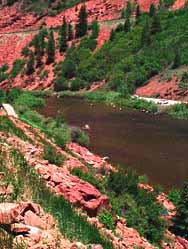
Rio Grande River basin: Revised runoff numbers trigger 22% and 46% curtailments on the Rio Grande and Conejos rivers repectively

conejosriver.jpg

From The Pueblo Chieftain (Matt Hildner):

The adjustment, which came in part because of a high-elevation snowpack that eluded runoff forecasts, means irrigation ditches on the Rio Grande and Conejos rivers will face increased curtailments. Between now and October, the state will have to send 24,000 acre-feet downstream on the Rio Grande and another 17,000 acre-feet will have to come from the Conejos, Division Engineer Craig Cotten said Tuesday. Irrigation ditches on the Rio Grande will face a 22 percent curtailment, a 16 percent increase from June 1. Ditches on the Conejos will have a 46 percent curtailment, up from 13 percent June 1.

This year differed from the prior two runoff seasons when stream flows fell sharply after peak runoff occurred. “It started dropping at about the time that we anticipated it dropping but it didn’t drop nearly as fast,” Cotten said…

While this year’s runoff remained below average, water managers were expecting even less water in the stream system and a smaller compact requirement. State water officials typically base their runoff on a number of factors, including the 10 snow gauges the Natural Resources Conservation Service has set up in the mountains above the Conejos and Rio Grande. This year’s snowpack included heavy pockets at elevations above those gauges, Cotten said.

More Rio Grande River basin coverage here.

Lower Arkansas Valley Water Conservancy District board meeting recap: The board approves dropping challenges to Aurora’s 2007 deal for excess capacity storage in Lake Pueblo

puebloreservoir.jpg

From The Pueblo Chieftain (Chris Woodka):

A new agreement that removes Aurora’s connection with federal legislation that would look at enlarging Lake Pueblo was approved Wednesday by the Lower Arkansas Valley Water Conservancy District. The Aurora City Council would have to approve the agreement to put it into place. The agreement would end any further attempts by the Lower Ark district to challenge Aurora’s 2007 contract with the Bureau of Reclamation. the district sued Reclamation in federal court shortly after the contract was awarded…

Under the new agreement with the Lower Ark district, Aurora would support federal legislation to enlarge Turquoise Lake and Lake Pueblo without its previous insistence on including provisions that allow Aurora to use Fry-Ark facilities. The new agreement also would require Aurora to support using its payments on the contract to help fund the Arkansas Valley Conduit.

More Lower Arkansas Valley Water Conservancy District coverage here.

Colorado Blueprint: A bottom-up approach to economic development

sanmiguelriver.jpg

Here’s the link to the full report from the Colorado Office of Economic Development and International Trade. The user interface is very clumsy. Here’s the executive summary:

Colorado Blueprint: A bottom-up approach to economic development

Since Jan. 11, 2011, the Hickenlooper Administration has engaged more than 5,000 Coloradans from all 64 counties in developing a comprehensive and collaborative approach to economic development. A state team composed of representatives of a dozen state agencies and statewide organizations traveled more than 6,000 miles to gather input from every corner, valley and plain that makes up Colorado.

Every county put together a summary expressing the needs, priorities, vision, strengths and weaknesses of its local economy. These county summaries were rolled up into 14 regional statements. Based on the county and regional input, we identified the following six focus areas to promote economic development in Colorado:

I. Create a Business-Friendly Environment

o Coloradans deserve a government that is responsive to their concerns and priorities, is frugal with their tax dollars and promotes economic development. That means knowing when to regulate, how to regulate, and when to get out of the way. This is one of the important roles of government. To this end, the Hickenlooper Administration is focused on the Three E’s of good government: efficiency, effectiveness and elegance.

II. Recruit, Grow and Retain Businesses

o Colorado is a great place to do business. Through more targeted marketing of the state, as well as increased coordination within the economic development community, Colorado is poised for economic growth. It is also important to build on existing successes, such as the Sustainable Main Streets pilot program championed by the Department of Local Affairs, as we work to ensure economic vitality in communities and on main streets in every corner of Colorado.

III. Increase Access to Capital

o Every county and region expressed the need for capital formation and increased access to capital, whether that takes the form of debt financing, equity investment or access to grants – and often all three. The state is expanding current venture and angel capital programs, while also designing a new cash collateral program to support businesses trying to get operating loans.

IV. Create and Market a Stronger Colorado Brand

o Colorado is one of the best states to live in or visit, being a premier place to work, play, explore and conduct business. Together, people across Colorado can define a vision for how we preserve and enhance the Colorado Advantage. A common brand and vision for all of Colorado will provide a strong foundation for increasing Colorado’s market share in overnight visitors, relocating companies and direct investment—both on a nationally and globally.

V. Educate and Train the Workforce of the Future

o One of Colorado’s key economic drivers—and selling points to potential business–is a highly-educated population and world-class institutions of higher education. To maintain and grow this globally competitive workforce, we need a strong and coordinated education system, including workforce, that leverages the boot-strapping “can-do” attitude of all Coloradans.

VI. Cultivate Innovation and Technology

o There is a strong spirit of innovation found around Colorado, with bright and adventurous people making discoveries and working to make new ideas thrive. Most regions of the state require improved communications technologies, including broadband, as a foundation of economic development and innovation.

This is not a comprehensive collection of all-encompassing end-goals for all of Colorado, but rather a first set of achievable objectives to undertake together. It is a working document, which means plans and partner names may change as we work to ensure that the benefits balance or outweigh the costs of implementing an initiative. We need public engagement and analysis, especially on the actions undertaken to “move the needle” in these six focus areas. We want to continue to update and adapt this Blueprint through sustained conversations about what Colorado’s economy should look like in the future. Together we can achieve measurable progress on our initiatives, and build the momentum needed to drive economic recovery.

We are committed to collaboration. We will return to every region four times in the next three years (every nine months) to evaluate and celebrate measurable progress on state, regional and county work plans. As we hit targets, we will desire new goals for the upcoming nine months. Through these feedback loops, state and local leaders will maintain open lines of communication and become better partners in supporting entrepreneurship and job creation across Colorado.

Special Note: During the “bottom-up” process, we captured thousands of valuable inputs and comments across a wide range of topics. A significant number of these comments and priorities will live at a local or regional level, where they can gain maturity and momentum and possibly be elevated to the Blueprint at a later date.

More coverage from the Northern Colorado Business Report. From the article:

The Weld-Larimer goal statement included similar business-related focus areas as the statewide plan but also included a goal to “develop, preserve and enhance water storage and delivery options in the region.”

That goal was later objected to by the Fort Collins city council, which wrote a letter to the governor’s office expressing the city’s nonsupport for the goal based on its reservations about the proposed Northern Integrated Supply Project that would include Glade Reservoir.

The NISP project, proposed by Berthoud-based Northern Water, is currently under review by the U.S. Army Corps of Engineers.

The Colorado Blueprint will continue to be updated over time and Hickenlooper administration officials said they intend to re-evaluate the plan every nine months to measure progress on its goals.

More coverage from Patrick Malone writing for The Pueblo Chieftain. From the article:

“There are 100 different things people say they need,” Hickenlooper said. “We’ve distilled it down to six things. We can’t do 100 things. Six things we can do.” He said the “Colorado Blueprint” sets a course for the state’s economic recovery by focusing on the most pressing economic development challenges identified by Colorado residents…

The plan was culled from dozens of public meetings throughout the state that began in January. Each of the state’s 64 counties offered a plan, which gelled into 14 regional plans. Some county and regional plans targeted specific job-creation numbers and reductions in joblessness, a level of specificity that does not appear in the state plan.

“I think what you’re asking us for is to pull a number out of a hat,” Hickenlooper said. The governor said finite goals such as those reflected in some county and regional plans would have doomed the state plan to constantly shoot at a moving target. “The economy is so complex,” Hickenlooper said. “If you look back over the last four years at every economic prediction that the top economists have used it’s probably about half as reliable as the seven-day weather forecast.”[…]

The backdrop for Hickenlooper’s speech was the site of TAXI and Freight, a revitalized business park that has undergone a metamorphosis in the past two years from a taxicab and trucking yard into the cradle of Colorado’s creative class. Office fronts are glass garage doors more commonly found at radiator shops. Inside them, employees in their 20s and 30s toil in T-shirts and shorts. Bicycles, ping-pong tables and foosball tables adorn the offices and provide pastimes during breaks. Building angles are sharp with vivid trim and paint just weathered enough to make the park contemporary chic. Businesses at the park may look like recreation centers to the untrained eye, but they produce highly advanced microchips, manufacture research microscopes, offer intricate Web design and sell fine art…

“One of the things that surprised me in rural Colorado — both in mountain towns and on the Eastern Plains — was that innovation and technology are part of their everyday language and their everyday life,” Hickenlooper said. “Until you’ve spent a day with a dryland farmer in Southeast Colorado and see how innovative they have to be to make a profit out of very difficult landscape, you haven’t seen anything about innovation.”

More coverage from Patrick Malone writing for The Pueblo Chieftain. From the article:

“The local communities, as they push through their own recoveries, are still going to be focused on their own objectives as they stated in their own local summaries,” [Dwayne Romero, executive director of the Governor’s Office of Information and Technology] said. For Pueblo County. those objectives are increasing primary jobs with an emphasis on manufacturing, increasing the flow of tourism dollars, supporting existing industries and small businesses to expand, promoting Pueblo as a regional health care destination, developing a leadership counsel to enhance the agriculture economy and expanding offerings at Colorado State University-Pueblo and Pueblo Community College to produce graduates whose skills appeal to innovative employers that might want to relocate to Pueblo…

The lawmakers [Sal Pace/Keith Swerdfeger] also agree that expanded graduate, engineering and hospitality offerings at CSU-Pueblo and forging a dual-credit relationship between the university and the community college are longer-term goals, but vital parts of the city’s economic future.

Protecting water throughout the Arkansas Valley will be imperative if Pueblo County is to attain its goal of promoting agriculture, Swerdfeger said.

Colorado Farm Bureau mid-summer meeting: Water committee chair urges the state to fight the United Nations’ Agenda 21 Wildlands Project

longspeak.jpg

From The Greeley Tribune (Eric Brown):

After discussing various issues Monday afternoon and into Tuesday morning, representatives of the organization’s wildlife and environment, water, specialty agriculture, crops and animal agriculture committees each outlined the county, state and federal policies that sit atop their watch lists.

Giving the water committee’s final report, John Stroh of Walsenburg in Huerfano County – the committee’s chairperson – said he wanted legislators to address special water districts, fight against the United Nations’ Agenda 21 Wildlands Project plans that could prevent diverting snowmelt in certain areas of Colorado’s mountains for usable water, and look into giving the Colorado Division of Water Resources more flexibility.

Stroh further explained that the privately owned special water districts “seem unregulated” and don’t give users a voice in what happens with the water.

“There just apparently isn’t much oversight. It seems like a good business plan,” Stroh said with sarcastic laugh. “Maybe I’ll do the same thing.”

Stroh said the United Nations’ Agenda 21 Wildlands Project would turn portions of Colorado’s mountain areas into an “uninhabited wilderness area.”

“If that were to happen, which means we would lose access to that water, that could really affect our ability to farm,” he said. “We’re really quite concerned about it.”

Regarding the Colorado Department of Water Resources, Stroh said the office’s lack of flexibility is the reason Colorado is sending its water surplus to neighboring states that are getting more than their allotted amount.

“You have the South Platte River, where we now have over-watered aquifers full and flooding basements, and yet there are still wells shut off and can’t be pumped,” Stroh said. “It’s the prime example of where more flexibility for our state’s engineer could do us a lot of good.”

More Colorado water coverage here.

Arapahoe County appoints 5 to Arapahoe County Water and Wastewater Authority

acwwaserviceboundary.jpg

From the Arapahoe County Board of County Commissioners via the Centennial Citizen:

The Arapahoe County Board of County Commissioners recently appointed five citizens to serve on the newly-expanded Arapahoe County Water and Wastewater Authority Board of Directors.

ACWWA is a water and wastewater authority responsible for the day-to-day operation of providing water and sanitary sewer services to its customers in a roughly eight-square mile area located in central Arapahoe County and a small portion of northern Douglas and Elbert counties.
Serving in their capacity as the Board of Directors for the Arapahoe County Water and Wastewater Public Improvement District, the Commissioners expanded the ACWWA Board of Directors to nine members from its current seven-member board.

The Commissioners appointed the following citizens to serve on the ACWWA Board for staggered, one-to three-year terms:

– Mikkel R. Anderson, an executive with the International Risk Group.

– Steven H. Davis, developer/investor with Community Builders Inc.

– Linda Lehrer, president of Sierra Consulting, who served on the ACWWA Board from 2007– 2009.

– Geri G. Santos-Rach, a Medical Billing Analyst for IMED, who previously worked for the Colorado Public Utilities Commission until she retired in 2009.

– Dr. Phyllis R. Thomas, Utility Application Specialist with Phyllis Thomas Consulting.

In April, the commissioners requested applications from citizens interested in serving on the ACWWA Board of Directors. The County received 16 applications and the Commissioners conducted interviews with seven candidates before making its appointment.

“We want to thank all the citizens who took the time to apply for these positions and for their interest in helping to shape their community,” said Commissioner Rod Bockenfeld, who serves as Board Chairman.

“The citizens we appointed today bring a good balance of expertise and knowledge to the ACWWA Board of Directors.”

For more information about the Arapahoe County Water and Wastewater Authority, visit their web site at http://www.arapahoewater.org.

Colorado Supremes uphold the Water Court Division One ruling in the FRICO case

burlingtonfricohenrylyndp.jpg

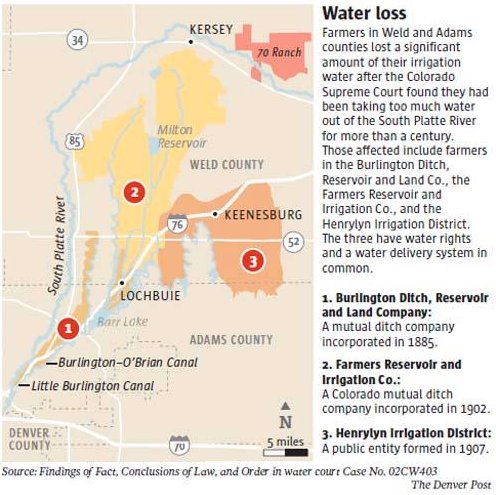
There’s always a back story or two in any big water court case. Here’s a report from Karen Crummy and Eric Gorski writing for The Denver Post. From the article:

It’s going to be hard to plan for the future,” said Len Pettinger, 76, who farms 500 acres near Brighton. “We’re already living day to day. I guess now we starve to death.”

A Denver Post investigation into the union of two public water districts and shareholders in the Farmers Reservoir and Irrigation Co. and two related systems found that those who held the farmers’ fate in their hands took significant risks, appeared to gain personally and professionally from the arrangement, and failed to accept an out-of-court settlement that could have saved the farmers, some of whom will lose half their water.

More South Platte River basin coverage here.

CWCB: July 2011 Drought Update

precipitationcojuly1to112011

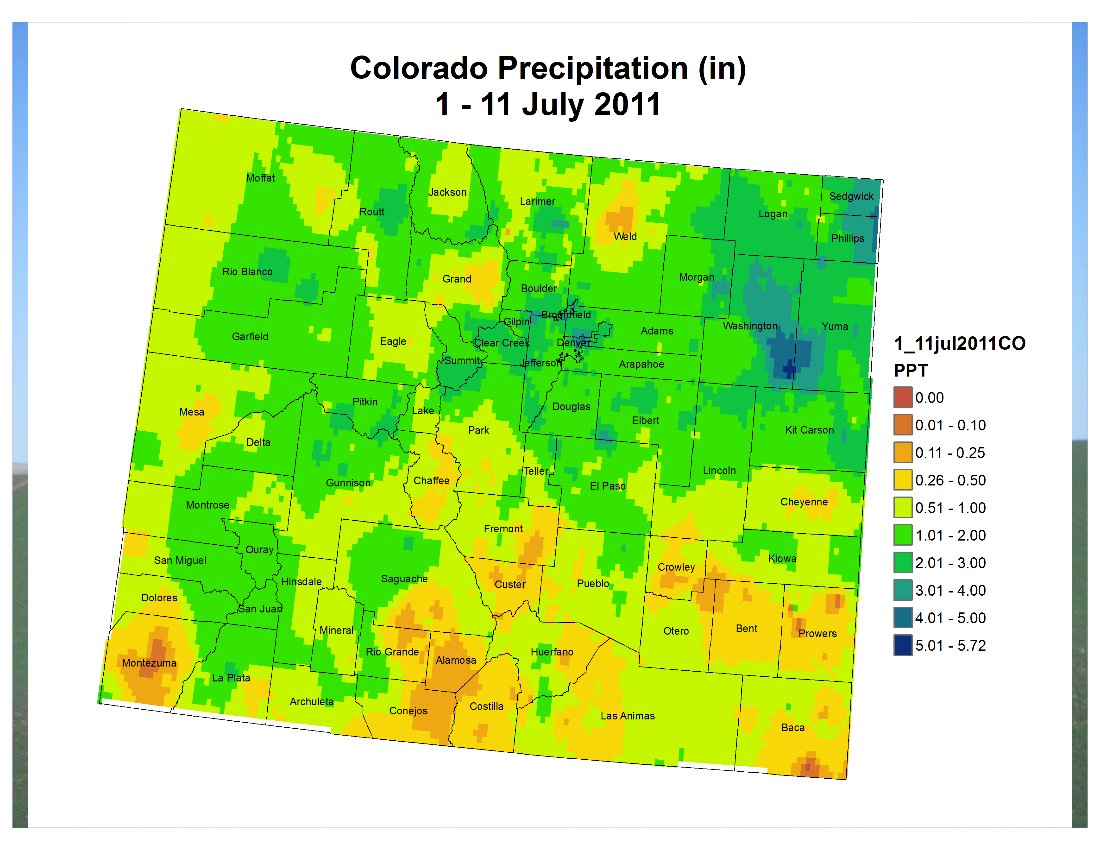
Click here to download the presentations from last week’s meeting. Click on the thumbnail graphic to the right for a map of Colorado precipitation for July 1-11, 2011 from the historians at the Colorado Climate Center.

From email from the Colorado Water Conservation Board (Ben Wade):

The next scheduled meeting for the Water Availability Task Force is August 17, 2011 at the Colorado Division of Wildlife Headquarters, 6060 Broadway, Denver, CO.

Wastewater: Colorado Springs Utilities is using a UV array to disinfect effluent prior to releases into Fountain Creek

uvdisinfection.jpg

From The Colorado Springs Gazette (John Schroyer)

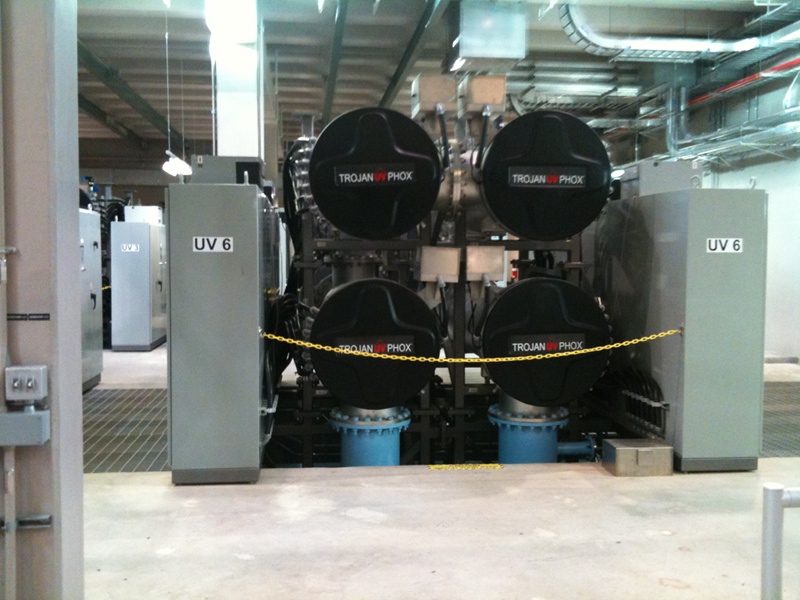
[Colorado Springs Utilities] had been using UV to help purify wastewater at its J.D. Phillips treatment plant, on the north side of Colorado Springs, since the plant was built in 2007. And the 540-bulb UV purification system there has been working “extremely well,” said plant superintendent William Hoyt.

So Utilities took the next step and built an even bigger UV array in its Las Vegas Street plant, almost twice the size of the one at the Phillips plant. The new 972-bulb system at the plant near Interstate 25 and South Nevada Avenue took a year to construct. The system began operating on Jan. 5, and since then, UV lights have treated an average of 30 million gallons of Colorado Springs wastewater per day, all of which leaves the plant cleaner than ever before. “What we’re putting into the creek, it has less bacteria in it than the creek does,” said Dean Cohrs, the plant’s interim operations supervisor. Specifically, the UV system kills far more E. coli, as per the new regulations, than chemicals ever did…

One of the biggest benefits of the UV purification process for both plants is that it’s astonishingly simple. Water flows into one of three channels at the end of the treatment process, churns in chambers illuminated by five-foot-long ultraviolet lightbulbs, and after a few seconds, is pumped out…

…the enterprise spent just under $13 million for the new UV array, which officials say is well worth the cost because it’s quicker, more environmentally friendly, and safer for employees.

More wastewater coverage here.

Reclamation is taking bids for four ponds to serve the Upper Colorado River Endangered Fish Recovery Program

ucefrp4speciesuppercoloradomap.jpg

From NBC11News.com (Cecile Juliette):

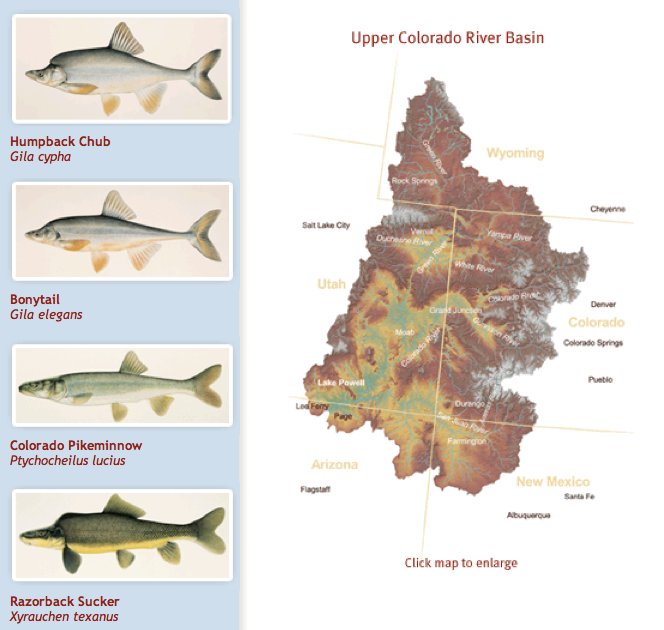
Sheer, who works for the U.S. Fish & Wildlife Service, says by Federal Law, the organization is required to protect and recover endangered species. Through the recovery program, biologists are trying to build ponds to aid the recovery of these fish. They are raised from hatchlins at the hatchery, then once they reach a certain size, they will be moved to the ponds at Horsethief Canyon, where their health and numbers will be monitored. Scheer says many of these fish are found only through the river system of Colorado, and serve many environmental roles. He says the health of these fish reflects the health of the river. Fish Culturist Mike Gross says his relatives have told stories about the Pikeminnow and Razorback. He says his uncle would go down to the river and pitchfork large Pikeminnows, then feed them to his pigs. They were also a staple for hungry families.

He says the Upper Colorado Recovery Program, and the 24 Road Hatchery have already had success. “Since this facility came online, we have stocked well over a quarter million Razorback Suckers into the Colorado Riverand it’s tributaries.”

Brent Uilenberg with the U.S. Bureau of Reclamation says, “The goal is to have the 4 Colorado River fish species that are listed as endangered under the Endangered Species Act de-listed by 2023.” The contract to build the ponds at Horsethief Canyon is open to bidders. It was first offered to HUD contractors, then open to all bidders. The hatchery is operated by the U.S. Fish & Wildlife Service and runs on nearly 100 percent recycled water provided by Ute Water.

More endangered species coverage here and here.

Rio Grande Roundtable meeting recap: Flaming Gorge pipeline could take the pressure off the San Luis Valley

riograndebasin.jpg

From the Valley Courier (Ruth Heide):

…the Flaming Gorge proposal and others like it that would bring water into Colorado from other areas could significantly affect the San Luis Valley because the Valley would not be such a target for water export schemes if other sources could be found.

Valley water expert Steve Vandiver recently reported to the water group, the Rio Grande Roundtable, that a task force is looking into the Flaming Gorge proposal as a future water source for Colorado…

He said this would be a fairly aggressive, expensive project, which is one of two or three projects that would bring outside water to the Front Range. The Flaming Gorge project has been estimated at $2-4 billion for construction, possibly through a private/public venture. The customers of such an expensive venture would have to be municipalities who could afford the water, Vandiver said. He said he understood the estimated output from the Flaming Gorge could be 175,000-300,000 acre feet of water annually…

Vandiver said it is important for the Valley water users to have “a place at the table” in discussions about future water sources such as the Flaming Gorge proposal to prevent ag land here from becoming a target for water acquisition, as it has on the Front Range. If one of these proposals [CWCB new supply concepts] such as the Flaming Gorge does not pan out, the “easy pickings” for water acquisition will be agricultural land with water rights, Vandiver said. “There’s a bigger picture this roundtable needs to be involved in and needs to consider,” Vandiver said. “Think about what our role in that could and should be.”[…]

He said IBCC statewide funds will help pay for the Flaming Gorge task force, but he and Smith believe it might be a good move for the Rio Grande Basin roundtable to put in some money from its account as well. Smith will talk to the roundtable group in August about funding somewhere in the range of $5,000 from the basin to help with the task force.

More Flaming Gorge Task Force coverage here.

Aspinall Unit update: 2,800 cfs in the Gunnison River through Black Canyon and the Gunnison Gorge

aspinallunitdescription.jpg

From email from Reclamation (Erik Knight):

After 2 weeks of steady inflow to the Aspinall Unit the forecast has finally come true – inflows to the Unit actually decreased over this past weekend. Blue Mesa Reservoir has filled to within 0.2 feet of full but the decrease in the side inflows has caused the elevation in Crystal Reservoir to drop significantly. Therefore releases at Crystal Reservoir will be decreased by a total of 600 cfs over the next 3 days. Flows will decrease 200 cfs a day, starting today, July 18th, and ending on Wednesday, July 20th. This should bring flows in the Gunnison River through the Black Canyon down to 2800 cfs by early Wednesday.

More Aspinall Unit coverage here.

Green Mountain Reservoir operations update: 2,550 cfs in the Blue River below the dam

greenmountainreservoir.jpg

From email from Reclamation (Kara Lamb):

The releases out of Green Mountain dam to the lower Blue River will be lowered to 2,550 CFS after 4 PM today [July 18].

More Colorado-Big Thompson Project coverage here.

Runoff news: Horsetooth Reservoir is almost full

horsetoothreservoir.jpg

From the Fort Collins Coloradoan (Bobby Magill):

“Everybody’s just jazzed,” said Glen Werth, owner of Inlet Bay Marina on Horsetooth Reservoir. “The water levels are fabulous. Our rental business is fantastic. We have a lot of big boats, big groups.”

Brimming with water, Horsetooth Reservoir is expected to completely fill this week for the first time since 2004. “We do think Horsetooth is going to continue to rise,” said U.S. Bureau of Reclamation spokeswoman Kara Lamb. “We’re going to get pretty close to full.”

On Friday, Horsetooth Reservoir’s surface elevation was 5,425.25 feet above sea level, lower than its peak in 2010, when it hit 5,427 feet, said Brian Werner, spokesman for the Northern Colorado Water Conservation District. Horsetooth Reservoir’s full pool level is 5,430 feet. “By the end of next week, we will have Horsetooth full,” Werner said Friday.

The reservoirs are full here mostly because of the long, sustained runoff season from an abnormally large snowpack in the mountains. Werner said Northern Water’s forecasters say this year’s robust runoff is a “once-in-a-lifetime” event. “We’re smiling,” Werner said. “This is almost an ideal runoff year. We talk about this all the time and it never happens.” The runoff from the mountain snowmelt is expected to extend into August, which is nearly unheard of, he said.
Recent rains mean irrigators haven’t had to take water from the reservoir, allowing it to continue to rise. The Bureau of Reclamation has stopped taking water deliveries from the Colorado River through the Adams Tunnel, Lamb said.

More Colorado-Big Thompson Project coverage here.

From the Glenwood Springs Post Independent (Janice Kurbjin):

A sustained high water season on rivers in and around Summit County is coming to a close, and that means less juggling for local outfitters. “It was a challenge, for sure,” Arkansas Valley Adventures owner Duke Bradford said. AVA, like other companies, transferred trips based on flows to put ages and abilities on appropriate stretches. Someone who booked a Brown’s Canyon trip in the Arkansas River Valley may have gotten short notice that they’d now be running the more consistent Blue River, though it still ran quickly, about an hour north in Silverthorne…

“If you came to run whitewater, it’ll go down as one of the best whitewater seasons ever,” Bradford said, explaining that cooler temperatures helped sustain what many thought would be a sharp, severe spike in flows. Then, when the snowpack expired, rain and downstream water calls came. The high water lasted about six weeks…,/p>

Performance Tours and AVA have been back on the Numbers and Royal Gorge for about five days. And other trips are mostly back to normal minimum ages, with the exception of a still-high Clear Creek.

Energy policy — hydroelectric: Flaming Gorge pipeline hydroelectric generation project environmental review terminated by the U.S. Army Corps of Engineers last Thursday

http://coyotegulch.blog/wp-content/uploads/2009/04/flaminggorgepipelinemillion.jpg

From the Fort Collins Coloradoan (Bobby Magill):

The U.S. Army Corps of Engineers said its environmental review of entrepreneur Aaron Million’s 550-mile water pipeline project was dead in the water before Million could terminate the study himself. Million said Friday he terminated the environmental review of his Regional Watershed Supply Project, but the Army Corps on Thursday canceled the $3 million review itself after Million re-purposed the project, said Rena Brand, the Army Corps’ regulatory official overseeing the review.

How much of the Army Corps’ work was wasted is unknown, Brand said. “It is unclear how information we’ve gathered and analyzed would be used,” she said…

Brand said Million did not respond “in an appropriate manner” by his July 5 deadline, despite telling the Coloradoan in June that he planned to do so. “We had a phone call from one of his team members the day before the deadline asking for more time,” Brand said. The Corps specifically asked Million to let them know by the deadline how he intended to resume the EIS, he said…

Million said Monday his team asked for several more days in order to finalize the permit application with FERC…

“I think the Corps recognized that this is a project that is not ripe for primetime,” said Stacy Tellinghuisen, a water policy analyst for pipeline critic Western Resource Advocates in Boulder. “FERC hopefully will see the same.”

From the Associated Press via The Pueblo Chieftain:

The Army Corps had canceled the $3 million review itself on Thursday after Million changed the project’s purpose, Rena Brand, the Army Corps’ official overseeing the review, told The Fort Collins Coloradoan. The Corps spent two years on the Million-financed Environmental Impact Study of the 550-mile pipeline, which would take about 250,000 acre-feet of water annually from the Green River at Flaming Gorge Reservoir, pump it over the Continental Divide and deliver it via Fort Collins to Colorado’s Front Range…

Million had asked the Army Corps in April to suspend the environmental review for 60 days to give him time to decide the project’s future. Brand said Million did not respond ‘‘in an appropriate manner’’ by his July 5 deadline. “We had a phone call from one of his team members the day before the deadline asking for more time,” Brand said. Without a response, Brand said, the Army Corps told Million on Thursday it had terminated the study because the project’s purpose is “uncertain.”

More Flaming Gorge pipeline coverage here and here.

Coyote Gulch named to the Top 25 Water Conservation Blogs

water flow meter

I’ve been blushing since I received the email yesterday. It’s great to be recognized for my work. Thanks. Here’s the link to Coyote Gulch’s conservation RSS feed and the link to the conservation category as well.

From email from Seametrics (Charles Sipe):

I wanted to let you know that Coyote Gulch was named to The Top 25 Water Conservation Blogs at http://www.seametrics.com/blog/top-water-conservation-blogs/ based on your great water conservation content and recommendations from other water conservation blogs.

We are Seametrics, a water flow measurement company that helps farmers, water utilities departments, and manufacturers to reduce water consumption. Water conservation is an important part of our company mission.

More conservation coverage here.

Runoff news: Horsetooth Reservoir to fill for the first time since 2004

A picture named horsetoothreservoir.jpg

From the Fort Collins Coloradoan (Bobby Magill):

“We do think Horsetooth is going to continue to rise,” said U.S. Bureau of Reclamation spokeswoman Kara Lamb. “We’re going to get pretty close to full.” With the sustained runoff season this year because of the mountains’ uncommonly tremendous snowpack and a steady march of rainstorms across the mountains recently, the Bureau of Reclamation has stopped taking water deliveries from the Colorado River through the Adams Tunnel, she said Thursday.

The snowmelt and rain have allowed junior water rights for the Colorado-Big Thompson Project east of the Continental Divide to come into priority, allowing local reservoirs to fill…,/p>

Farmers who have rights to Horsetooth Reservoir water haven’t been taking much of it because recent rainfall has prevented them from needing it, she said…

Carter Lake near Loveland already filled once this year, but the Bureau of Reclamation drew it down and now it’s starting to fill again, she said.

From the Valley Courier (Ruth Heide):

Meeting with members of the Valley-wide water group, the Rio Grande Roundtable, on Tuesday, Colorado Division of Water Resources Division 3 Engineer Craig Cotten described the unexpected turn of events on the river. “It’s kind of a strange situation. It’s kind of a strange year,” Cotten said.

For the last several years the Valley’s rivers that satisfy the Rio Grande Compact have peaked earlier than usual, so this year when the snowpack registered below normal, less water was expected, Cotten explained. “We thought we weren’t going to have that much water. Here it comes now,” Cotten said. He said just in the last 24 hours (before the Tuesday meeting) rains had bumped up the rivers in the Valley…

One of the places his office had to “go from here” was to increase the annual forecasted flow on both the Rio Grande and Conejos River systems, which means more water must now be delivered downstream during the irrigation season to meet Rio Grande Compact obligations. And that means higher curtailments on ditch diversions for irrigators. The annual forecasted flow for the Rio Grande at Del Norte is now 535,000 acre feet, of which the state will owe 138,900 acre feet, or 22 percent, to downstream states, according to Cotten…

To reach Colorado’s new obligation to downstream states through the Rio Grande Compact, 22 percent of the flows during the rest of the irrigation season will have to be sent downriver. “So we have got a 22 percent curtailment on the Rio Grande right now,” he said.

The curtailment on the Conejos River system is even higher. The forecasted annual flows on the Conejos increased to an estimated 254,000 acre feet, of which 72,000 acre feet would be required downstream to meet the Rio Grande Compact. That equates to a 40-percent curtailment, Cotten said…

Cotten said the gauging station on Sangre de Cristo Creek by Fort Garland is registering significantly lower than average flows – “still very significantly below average.” The gauging station on Saguache Creek is also reflecting “significantly lower than average” flows. “We haven’t gotten anywhere close to our average on Saguache Creek,” Cotten said.

From The Pueblo Chieftain:

Flow levels on the Arkansas River are beginning to decline within the Arkansas Headwaters Recreation Area and advisories have been lifted for two sections of river, The Numbers and the Royal Gorge. An advisory remains for Pine Creek. Flows below Buena Vista were at 2,600 cubic feet per second Friday and dropping after several weeks of high runoff.

Energy policy — hydroelectric: Wagon Wheel Ranch above Creede flips the switch on their shiny new 310 kw generation plant

A picture named hydroelectricdam.jpg

From The Pueblo Chieftain (Matt Hildner):

The $1.3 million project at the Humphreys family’s Wagon Wheel Ranch will supply electricity to the grid through the San Luis Valley Rural Electric Cooperative and, state leaders hope, spur more development of small-scale hydropower. Project leader and family member Ruth Brown oversaw the project and thanked a long list of government officials, engineers, contractors and family members during a ceremony at the ranch, which sits roughly 12 miles south of town…

[Project leader and family member Ruth Brown] said picking up the larger project became possible when state lawmakers passed a renewable energy standard in 2006. Because of that bill, the Tri-State Generation and Transmission Association can claim renewable energy credits when the ranch’s power comes on the grid. She also was aided by a $300,000 grant from the U.S. Department of Agriculture…

[Gary Boring, who supervised the construction for Moltz Constructors of Cody, Wyo] said one of the biggest challenges for his company, which works on dams and hydropower projects throughout the West, was developing the siphon that draws water from the reservoir’s surface then sends it down a 650-foot penstock to the generator. “This really hasn’t been done before,” Boring said. “That’s been one of the big challenges on the job is keeping that siphon going and keeping air out of the penstock.”

Despite heavy winters in the area, Boring said a bubbler system would keep the intake from icing over. He said the only limitations on the project would come in the form of a poor water year.

More hydroelectric coverage here and here.

Aurora: Homestake Reservoir will be closed to the public and drained this fall for three year maintenance project

A picture named homestakereservoir2010aurorawater.jpg

Here’s the release from Aurora Water (Greg Baker):

The Homestake Dam and Reservoir in Eagle and Pitkin Counties, Colorado, will be undergoing scheduled maintenance in 2012 and 2013 that will impact recreational users of the facilities. The work involves regular, but necessary maintenance to help safeguard a valuable resource and ensure its viability for years to come. Homestake Reservoir, completed in 1968, is operated jointly by Colorado Springs Utilities and Aurora Water under the Homestake Water Project. To ensure the public’s safety during construction activity, access to the reservoir and the dam will be restricted during this maintenance period.

“We understand that this area is a popular recreational amenity, and we ask for your patience and understanding as we work as expeditiously as possible,” stated Greg Baker, spokesperson for the Homestake Project. “The construction season in the mountains is short, so we will make every attempt to be efficient with our time.”

Starting in September 2011, admittance to Homestake Reservoir will be closed below the East Fork Trailhead, just prior to the dam access road on Homestake Road. The top five feet of the dam crest will be removed to accommodate the large equipment needed for this project. Upon completion of the maintenance work in late 2013, the dam crest will be restored to its original height.

The bridge on Homestake Road immediately beyond the turnoff from Highway 24 will be replaced between October and December 2011. A temporary bridge will be in place to accommodate local traffic. Traffic will be directed to this detour, so it is recommended that visitors watch for traffic signs and be alert.

In 2012, the reservoir will be drained to accommodate repairs to the gate and intake structure for the Homestake Tunnel, which carries the water from Homestake to Turquoise Lake in Lake County. Natural flows to Homestake Creek will be maintained during this time. The U.S. Forest Service, in cooperation with a variety of partner groups, will be performing restoration and enhancement work, including fish habitat improvement, hazard tree removal, and campsite rehabilitation along Homestake Creek downstream from the reservoir.

From 2012 to 2013, milling and paving will occur on the dam’s asphalt face. Asphalt faced dams, while common in Europe, are unique in the U.S. Since the facing was first installed in 1968, it is almost 45 years of age and is due for a replacement.

Water collection in the reservoir will begin again in April 2013, though how long it will take to refill Homestake will depend on snowpack and runoff conditions. Restoration work around the dam should be completed in 2014, with full public access being restored by spring of that year.

Both Colorado Springs Utilities and Aurora Water will carefully monitor their other water sources to ensure that adequate supplies are available to meet customer demand. Aurora Water will maximize its storage in the Arkansas and South Platte basins, as well as utilize its recently completed Prairie Waters system. Colorado Springs Utilities does not anticipate impacts to its ability to deliver water to customers during the construction phase. During construction, and as needed, Colorado Springs Utilities will bring its share of Homestake Reservoir storage through the Homestake Tunnel to East Slope storage facilities.

Updates and notices on the Homestake Dam and Reservoir maintenance and repair project will be posted on websites of both Aurora Water (https://www.auroragov.org/Homestake) or Colorado Springs Utilities (CSU.org).

More coverage from the Aurora Sentinel (Sara Castellanos):

The reservoir will be drained for repairs to the gate and intake structure for the Homestake Tunnel, which carries the water from the reservoir to Turquoise Lake in Lake County. Contractors will replace the asphalt facing on the dam, which is 45 years old. “Homestake has an asphalt faced dam which is unusual here but very common in Europe,” Baker said. “It makes it a little more difficult to find qualified contractors for.” While this work is done, the U.S. Forest Service will work on fish habitat improvements, removal of hazardous trees and campsite rehabilitation in the area…

The total cost of construction of the renovations is $35.5 million, with Aurora paying $17.5 million over four years and Colorado Springs paying the second half. Money to fund the project will come out of Aurora Water’s operating budget…

While Homestake is offline, the city will continue collecting water from Prairie Waters, the drought-hardening project that came online last year. “Now that we have Prairie Waters online, it’s about the equivalent of what we take out of Homestake,” Baker said.

More Homestake Reservoir coverage here and here.

Boulder: The city has embarked on an $8.1 million 18 month project for wastewater treatment plant imprvovements

A picture named wastewatertreatmentprocess.jpg

From the Boulder Daily Camera (Heath Urie):

The project, which is now underway, will upgrade several critical components of the plant at 75th Street and Jay Road that turns the city’s raw sewage into water that’s clean enough to discharge into Boulder Creek. The work will include three separate projects.

One will convert the facility to use an ultra-violet sterilizer instead of chlorine gas. “The gas chlorine system is the single greatest danger at the wastewater treatment plant,” said Douglas Sullivan, the city’s utilities project manager…

Sullivan said upgrading the system to no longer rely on the chemical is the department’s “No. 1 priority.” The total cost of the new system is about $3.5 million…

A second project will upgrade the headworks at the plant. Headworks carry all of the raw sewage into the plant. The headworks contain screening devices that remove large debris from the sewage, and system that remove grit and rags. Those systems are now about 30 years old, and need to be replaced…

The third project will upgrade two large, cylindrical tanks that act as the stomachs of the wastewater plant. Known as the digester tanks, the devices heat and mix sewage to create solid waste “cake” that is sent to agricultural lands in east Adams County. The $1.6 million of upgrades will install a new mixing system that will help meet federal safety standards.

More wastewater coverage here.

Drought news: Federal disaster dough available throughout southeastern Colorado

A picture named usdrouthtmonitor07122011

From the La Junta Tribune-Democrat:

“I’m grateful the USDA is making assistance available to more affected Colorado farmers and ranchers,” [Colorado Senator Mark Udall] said. “This will help our agricultural producers offset some of the heavy losses they’ve experienced because of the drought and spring freezes.”

Counties designated agricultural disaster areas due to drought this year: Bent, Chaffee, Custer, Fremont, Huerfano, Kiowa, Las Animas, Prowers and Pueblo counties, including surrounding Alamosa, Baca, Cheyenne, Costilla, Crowley, El Paso, Gunnison, Lake, Lincoln, Otero, Park, Pitkin, Saguache and Teller counties.

Because of their proximity to and possible losses due to primary drought designations in New Mexico, Archuleta, Baca, Conejos, Costilla and Las Animas counties also became eligible for drought-related assistance.

Additional resources were made available to counties affected by the spring freezes that occurred April 28 through May 1: Fremont County was designated as a primary county, but eligibility extends to the surrounding counties of Chaffee, Custer, El Paso, Park, Pueblo, Saguache and Teller.

From The Pueblo Chieftain (Patrick Malone):

“Drought impacts are resulting in the loss of native grass, mixed forage, cool season grasses and alfalfa throughout the San Luis Valley in south-central Colorado,” Hickenlooper wrote in the letter. “Losses are greatest to cool season grasses reaching 75 percent. The availability of surface water has resulted in many producers having to abandon alfalfa irrigation completely.”

A second letter sought disaster assistance for Delta, Montrose and Mesa counties on the Western Slope, where fruit producers were stung by a freeze in late April and early May. Some producers there suffered losses of 95 percent of their apples and other fruits.

Brighton: City council raises water rates

A picture named fountainpavementdrawing.jpg

From the Brighton Standard Blade (Kevin Denke):

City council members gave their unanimous, albeit begrudging, initial approval July 5 to an ordinance that will increase fixed water rates as well as consumptive water user rates. Under the proposed changes, the fixed water charge would change from $6.36 to $7.86 a month, the sewer charge would go from $2.15 a month to $5.40 a month. A new $1.75 storm drainage charge would also be added. In regards to water consumption rates, a water user would see an increase from $3.78 per 1,000 gallons of water to $3.93 per 1,000 gallons of water and an increase from $3.77 per 1,000 gallons to $3.92 per 1,000 in the sewer utility charge…

City utilities director Jim Landeck took city councilors on a visual tour of the city’s aging infrastructure that prompted the proposed increases. He said much of the water and sewer pipelines in the older area of Brighton have more than began to show their age, bursting at a moment’s notice and leaving residents without water during emergency repairs. Landeck pegged some pipes as close to 100 years old. “These pipelines that have been in the ground now for almost 100 years are showing considerable signs of corrosion,” Landeck said…

The proposed increases, which the city says are the first substantial water and sewer rate increases in 13 years, brought concern from city council members including Ward 2 councilman Rex Bell. He said he worried about the impact it would have on residents of his ward but he worried more about the long-term effect of doing nothing…

The ordinance is scheduled for final consideration at the July 19 city council meeting with the fixed rate changes to take place after Aug. 1. Water consumption rates would take effect Oct. 1.

More infrastructure coverage here.

Flaming Gorge pipeline hydroelectric generation project update: Aaron Million switches federal agencies and anticipates cutting the environmental review time from 7 years to 2.5

A picture named flaminggorgepipelinemillion.jpg

From the Fort Collins Coloradoan (Bobby Magill):

Fort Collins entrepreneur Aaron Million said Friday he is terminating the U.S. Army Corps of Engineers’ environmental re-view of the Regional Watershed Supply Project and transferring that review to another federal agency that regulates hydro-power projects. The agency switch could reduce the environmental review and permitting time for the project from more than seven years to about two and a half years, he said…

Million envisions the pipeline generating more than 1,000 megawatts of hydroelectric power as it tumbles from Laramie to Fort Collins – the primary reason the federal agency conducting the environmental review of the project had to be switched, Million said. He said he plans to submit a permit application for the pipeline to the Federal Energy Regulatory Commission, or FERC, next week and officially terminate the Army Corps’ review of the project at the same time…

FERC spokeswoman Celeste Miller said Friday she did not know what conversations Million has had with the agency about the feasibility of FERC reviewing the pipeline proposal. She said she does not know if it is possible for FERC to complete its environmental review of the pipeline in two and a half years. “There is no way to know at this point,” she said. “We have nothing before us. We have nothing to look at.”

More coverage from Chris Woodka writing for The Pueblo Chieftain. From the article:

“We’ll be able to move a lot of the work from the Corps study over. The project and analysis will remain the same,” Million said. “The time line will shorten dramatically.” The Corps process would have taken at least five more years, even though the study began in 2008. Million said he expects the FERC process for his proposal to be done in a short time because of the groundwork that already has been done.

Million is following a model chosen by Utah in 2008 for a $1 billion pipeline from Lake Powell to serve water users in that state. Utah applied through the FERC to address the hydropower aspects of its pipeline, but concerns of other federal agencies are addressed through the process. The entire process is expected to be completed in 2012, according to the Utah Division of Water Resources website. Million’s proposed pipeline would generate about 70 megawatts of power in-line, and has the potential for 500 to 1,000 megawatts of pump-back storage generation, he said…

Million’s project faced opposition under the Corps proposal from some counties in Wyoming and regional environmental groups. They plan to oppose a FERC proposal, as well.

From email from Western Resource Advocates (Peter Roessmann):

Aaron Million, proponent of the Regional Watershed Supply Project, or “Million Project” has announced that he will switch permitting agencies from the Army Corps of Engineers to the Federal Energy Regulatory Commission (FERC), in hopes of expediting the permitting process. The FERC environmental review, however, should be just as rigorous as the Corps’ review – this is essential for protecting all stakeholders’ interests in Colorado, Wyoming, and Utah.

Western Resource Advocates has the following statements:

– “The FERC environmental review is not just switching horses in mid-stream, it starts the NEPA process over again. Stakeholders in Wyoming, Utah, and Colorado deserve the opportunity to weigh in on the “new” form of the project. We expect whatever agency takes a close look at the proposal will reveal Million’s empty promise that the project could generate hydroelectric power—it will be net power user.”

– “Today, the Million project is no closer to delivering water to Coloradoans than it was two years ago. It’s time for water providers to focus on real solutions that can meet Colorado’s future water needs. This is yet another example of why the proposal is not-ready-for-prime-time, and why Colorado should not establish a “task force” to pursue a similar project.”

– “Million is now taking FERC on the same snipe hunt he’s led the Corps on for two years. Coloradoans should be outraged at this wasteful use of limited resources.”

From the Summit County Citizens Voice:

Million has been touting the pipeline for many years , but it’s not clear if the project is viable financially, or if it could deliver as much water as promised. Several regional and state groups have taken early looks at the proposal, but as yet, nobody has stepped forth to fully claim and embrace the long-distance pipeline. In making the switch, Million may be aiming at presenting the pipeline as an energy project, but conservation advocates pointed up that, even with a hydropower component, the pipeline would use more energy than it produces.

More Flaming Gorge pipeline coverage here and here.

Wiggins: The town has attracted interest from 26 contractors for the upgrade to the finished water supply system

A picture named membranetrain.jpg

From The Fort Morgan Times (Dan Barker):

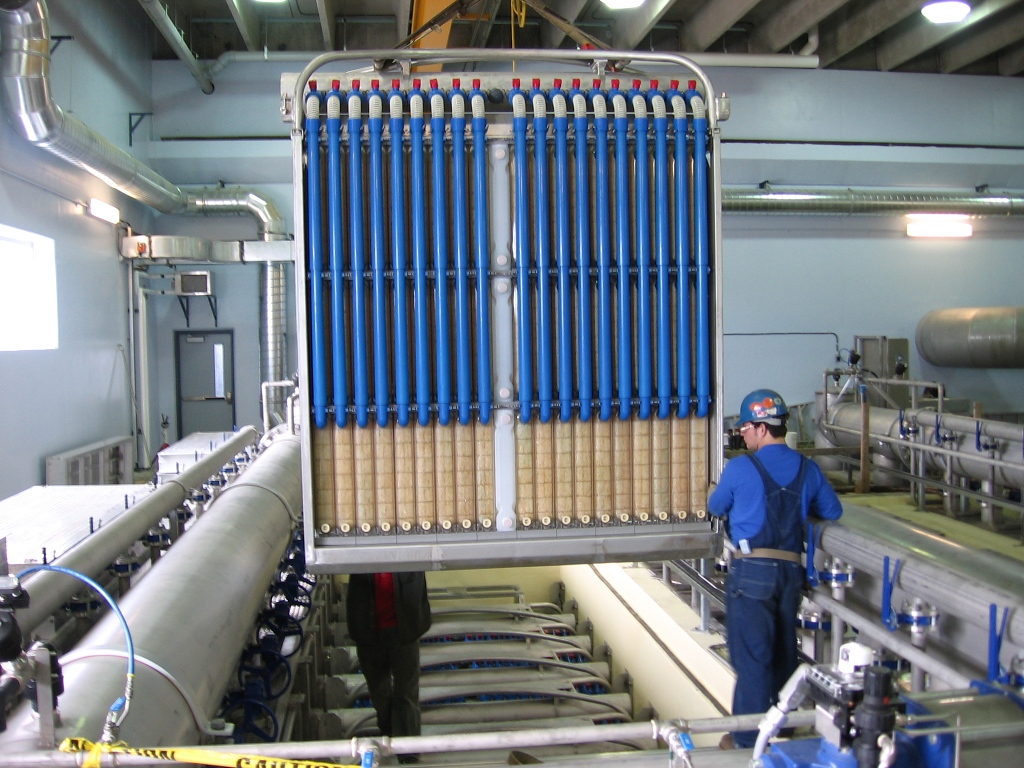
…26 contractors came to town Wednesday to attend a pre-bid meeting and find out specifications, Tim Holbrook of Industrial Facilities Engineering, which is overseeing the project, told the Wiggins Town Council that night. Plans for the project were finally approved by the USDA and other agencies, and the project can begin construction, he said. The construction will have four components and contractors can bid on one, more or all of them, Holbrook said. Those include a new membrane treatment system, a 7.3 mile pipeline, two 20-acre augmentation ponds and two new water supply wells…

Contractors can ask questions until July 22, and bids are due Aug. 3 at 1 p.m. Holbrook said he expects even more contractors to bid before the period is over…

Meanwhile, work continues on changing the water rights the town owns from agricultural use to municipal use. A first step is to obtain approval of the change from the Weldon Valley Ditch Co., of which the water rights is a part, and that is underway, Holbrook said. Wiggins must also receive approval from the Colorado State Engineer`s Office, and that is expected in the next few months, he said. That will allow the town to start pumping water when construction is done, even if there are still water court proceedings.

More Wiggins coverage here and here.

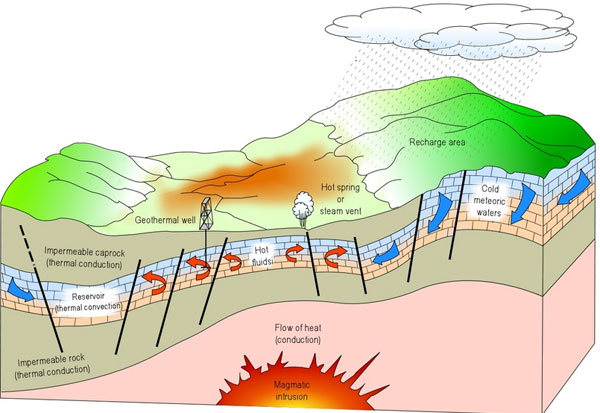
Energy policy — geothermal: Aspen to drill test bore to assess geothermal potential

A picture named geothermalenergy.jpg

From The Aspen Times (Andre Salvali):

Lauren McDonell, environmental initiatives program manager for the city of Aspen, explained the plan to four [Aspen’s Open Space and Trails Board] members before their vote and said that geothermal energy could be another way for the community to reduce its carbon footprint. “If we’re sitting on top of a clean, renewable, carbon-free source of energy, I think we have a responsibility to explore it,” she said. “It could help us decrease our dependence on fossil fuels, and help us address climate change in Aspen. So it’s kind of an exciting opportunity.”[…]

The city likely will start the test well in late September, drilling up to 1,000 feet below the surface of the parking lot. If answers can be obtained at a shallower depth, the city won’t need to drill any deeper, she said. The nearby Roaring Fork River won’t be affected, McDonell said. The parking lot is located within the Prockter Open Space, which is why permission from the city’s Open Space and Trails Board was needed. The test site is simply that, McDonell said, explaining that it’s unlikely to be used as a production area should the city move forward with a geothermal energy project. However, it could be used for future monitoring and tests…

The project is expected to take 30 to 45 days, McDonell said. Noise from the test site will be kept at or below 55 decibels, the limit stipulated in a city ordinance based on the time of day and area of town…

According to a city news release, the test site lies just west of old silver mine workings. The project won’t disturb any heavy metal deposits in the area. “We wanted to pick a site that is city-owned and as close to old mine workings as possible without being in them,” consultant John Kaufman said in a prepared statement. “We are looking to find out the temperature of the water, the water chemistry, like if it is hard water or alkaline and we hope not to find heavy metals in the water,” he said, adding that historical evidence suggests Aspen miners more than a century ago encountered hot water as they worked.

More coverage from Andrew Travers writing for the Aspen Daily News. From the article:

The board voted 4-0 for the drilling project, following a brief presentation by Lauren McDonnell of the city’s Canary Initiative, which is spearheading the initiative…

Board member Charlie Eckart asked how many truckloads of dirt and rocks would be produced from drilling. Just one every three to four days during drilling, McDonnell said. All the board members encouraged her to continue communicating proactively with neighbors about noise and other impacts from the test.

The city held a neighborhood meeting on Monday seeking feedback on the geothermal project from adjacent homeowners. Twelve neighbors attended that meeting. None attended Thursday’s meeting to oppose or support the project…

McDonnell will now begin searching for a drilling company to do the work. The contract for drilling will be subject to City Council approval later this summer. Drilling is scheduled to take place in mid- to late-September, McDonnell told the open space board. The parking lot will be closed up to 45 days during drilling and the subsequent testing of the hole…

Based on a 2008 geothermal feasibility study, the temperature of local underground water ranges in temperature from 90 to 140 degrees. To heat or cool buildings with geothermal energy, 100-degree water is required. To generate electricity, the city would need water of at least 220 degrees.

More coverage from Andrew Travers writing for the Aspen Daily News. From the article:

The potential of tapping local renewable energy sources like geothermal has drawn support from the city’s Canary Initiative, which aims to reduce local greenhouse gas emissions by 80 percent before 2050. Geothermal energy taps the consistent temperatures below ground to heat or cool interiors above ground. “We’re excited that if we find the geothermal potential we’re talking about, it could be enough for heating and cooling buildings in Aspen with a local clean energy source,” said Lauren McDonnell, director of the Canary program…

If the Prockter test site is successful, McDonnell said, the city would drill a second test well on another public site before actually tapping any geothermal energy…

The city’s hopes for geothermal resources are based largely on historical accounts from 19th century silver miners in Aspen. “The miners encountered very hot, uncomfortable conditions in the mines here,” Kaufman said. That anecdotal evidence led the city to conduct a feasibility study for local geothermal in 2008, which found the temperature of underground water in Aspen ranged from 90 to 140 degrees. Drilling for geothermal, however, will avoid the vast network of mining tunnels below Aspen, Kaufman said, because they are not structurally sound.

More geothermal coverage here and here.

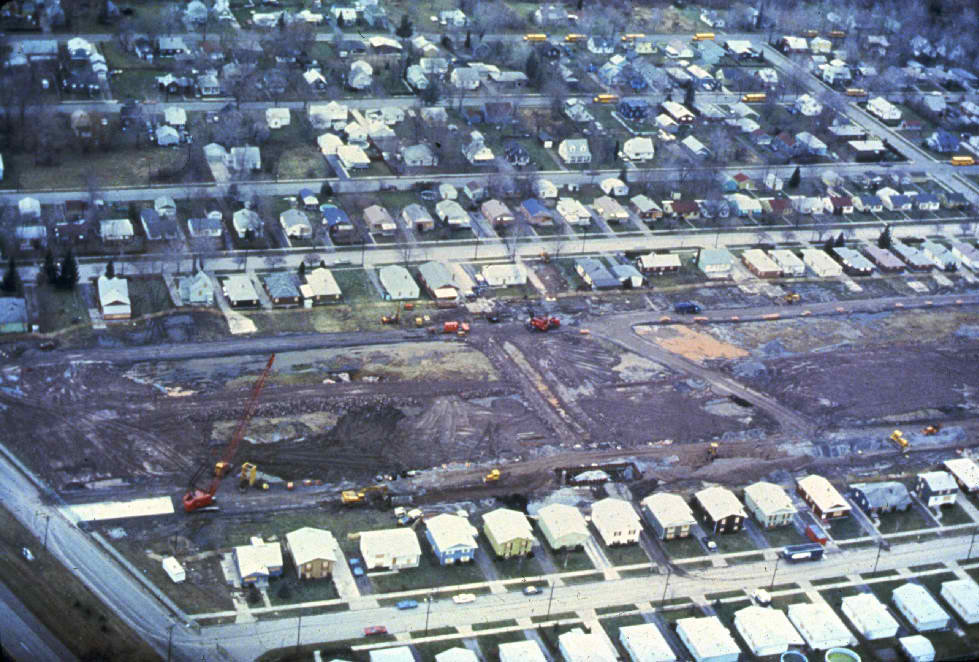
The Clean Water Cooperative Federalism Act of 2011: Colorado Republican U.S. Representatives march in lockstep with their party (and a handful of Democrats) in an attempt to gut the Clean Water Act

A picture named lovecanalcleanupepa.jpg

From the Colorado Independent (David O. Williams):

U.S. Rep. Cory Gardner, R-Colo., and the rest of Colorado’s majority Republican congressional delegation are all wet for voting along with the GOP-controlled House to pass the Clean Water Cooperative Federalism Act by a margin of 239-184 on Wednesday, according to the bill’s many outraged opponents.

“Rep. Gardner has once again made an extremist vote that increases profits for polluters at the expense of the public’s health and the environment” said Gary Wockner of Fort Collins-based Clean Water Action. “Rep. Gardner says he supports jobs, but he’s only voting to support corporate polluters’ profits.”

“It is time for the EPA to give Congress some straight answers about the consequences its regulations have on jobs and the economy, without knowing that information how can we judge whether a regulation is necessary or harmful?” Gardner said in a recent release…

All three Democratic members of Colorado’s congressional delegation voted against the bill, but Gardner joined fellow Colorado Republican House members Doug Lamborn, Mike Coffman and Scott Tipton in bucking the Obama administration, which earlier in the week promised a veto in the unlikely event the bill makes it out of the Senate.

More coverage from EarthJustice.org (Liz Judge). From the article:

The House passed this legislation 239-184, despite a vow from the White House promising a veto if the bill makes it through the Senate. This legislation is the most offensive in a fresh spate of clean water attacks waged by the majority of the 112th House. The bill undoes the basis of the Clean Water Act, the 40-year-old cornerstone of all drinkable, swimmable and fishable waters in this country. Without this landmark law, and the system it set up for federal oversight of waters across all states, we wouldn’t have the clean waters that we have today. HR 2018 removes federal oversight and leaves the fate of our waters, which flow between states and know no state boundaries, up to states.

More H.R. 2018 coverage here.

NIDIS Weekly Climate, Water and Drought Assessment Summary of the Upper Colorado River Basin

A picture named wyutcoprecipitationjulymtd07142011

Here are this week’s notes from the Colorado Climate Center.

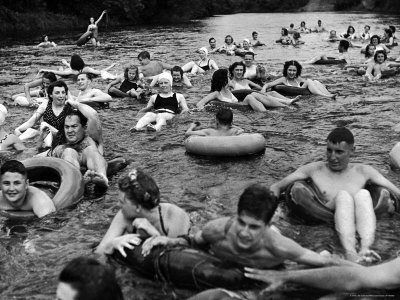
Runoff news: Late snowmelt, high water and monsoon moisture are impacting demand for water toy rentals

A picture named innertubingnz.jpg

From Fox31.com (Shaul Turner):

Dangerous water levels have forced the closure of Boulder Creek to tubers, and for Boulder-based Whitewater Tube Company that means a lack of demand for tube and kayak rentals…

“Business drops about 80-percent during dangerous weather, but the extra rainfall means a prolonged season,” says Eric Bader with Boulder Outdoor Center. BOC partners with Whitewater Tube Company to plan rafting and tubing trips.

Colorado River Basin: Peter McBride (The Colorado River: Flowing Through Conflict) is interviewed by NPR’s Michelle Norris

A picture named coloradoriverbasin.jpg

Yesterday as I was trying to navigate the streets south of Denver during our daily thunderstorm dousing I had a chance to listed to Michelle Norris’ interview with Peter McBride. They talked about the river, its current state, and attitudes about using the river’s available water while protecting some of its wildness and natural historical value. Here’s the link to the NPR story with the audio. Here’s the transcript Here’s an excerpt:

“This estuary [ed. the Colorado River estuary] used to be one of the largest desert estuaries in North America,” McBride says. “It ran to the sea for 6 million years, and the river basically stopped in the late ’90s. It used to be 3,000 square miles with lush forests and jaguars and deer. And having walked it … it’s nothing but a cracked, parched arid landscape.”

How did this happen? As McBride puts it, too many straws in the water: Near Mexico, the river basically produces the entire lettuce crop for the United States in the months of November and December, and all of the nation’s carrots in January and February. “So whether you love the river and fish it and float it, or you’ve never been to it and you live on the East Coast, you actually eat Colorado River water,” McBride continues.

When I got home I made sure to raise a glass of Denver Water water and toast the headwaters.

More Colorado River basin coverage here.

Fryingpan-Arkansas Project update: 500 cfs in the Fryingpan River through Basalt

A picture named fryingpan.jpg

From email from Reclamation (Kara Lamb):

Just a quick note: We reduced releases from Ruedi Dam to the Fryingpan River by 150 cfs today. Tomorrow, Friday, we will do the same. As a result, by Friday evening, there should be less than 500 cfs flowing through Basalt.

More Fryingpan-Arkansas Project coverage here.

Aspinall Unit update: Erik Knight — ‘The bottomless well of snowmelt and precipitation continues to hold inflows into Blue Mesa Reservoir above all predictions’

A picture named crystaldamspill052009

Click on the thumbnail graphic to the right for a screenshot of the Crystal Dam Spill in 2009.

From email from Reclamation (Erik Knight):

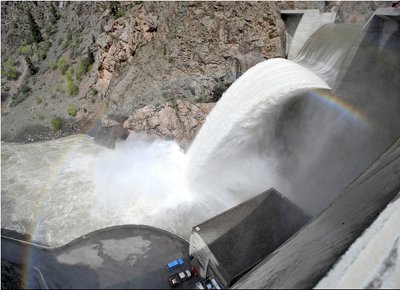
While this may appear to be an accidental resend of yesterday’s notice, it is in fact another notice of a release increase for the Aspinall Unit. The bottomless well of snowmelt and precipitation continues to hold inflows into Blue Mesa Reservoir above all predictions. Maybe one day inflows will actually decrease but it certainly wasn’t yesterday. Therefore releases from Crystal Dam will be increased by a total of 400 cfs over the next 2 days. This increase will be done in 200 cfs increments, one this afternoon, Thursday, July 14th, and one early Friday morning, July 15th. Flows in the Gunnison River through the Black Canyon are expected to increase from 2950 cfs to around 3350 cfs by Friday, July 15th. This change will put Crystal Dam at full powerplant and bypass releases. Any further increases will mostly likely result in a spill at Crystal Dam. This is not expected to occur but there is a possibility if inflows continue at their current level.

More Aspinall Unit coverage here.

Colorado-Big Thompson Project update: Releases from Lake Granby to increase

A picture named granbyspill06222011

From email from Reclamation (Kara Lamb):

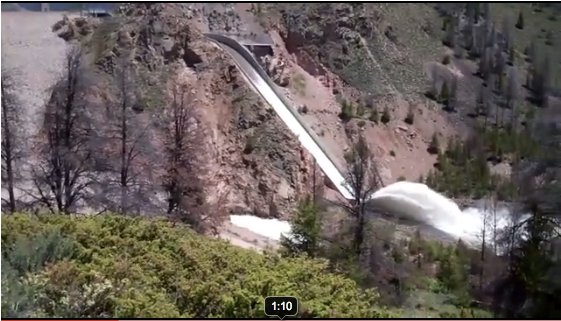
Recent rain storms and the tail end of snow melt run-off continue to produce high inflows into Lake Granby. As a result, we and Northern Water have been increasing releases from Granby Dam to the Colorado over the last few days. Today, releases are going up again, by about 300 cfs. We will soon be releasing upwards of 2200 cfs. The reservoir is just about full with only two and a half feet to go. Rain on the East Slope has reduced the need for diversions from the West Slope. As a result, more water must be released at the dam.

From email from Reclamation (Kara Lamb):

Just a quick heads up: late last night/early this morning, releases from Olympus Dam were scaled back by about 100 cfs. We are now releasing around 575 cfs from the dam to the lower Big Thompson River. Even though we have had some higher inflows from the recent storms, we are still capturing priority water (east slope run-off) in the C-BT project and using it to generate hydro-power and top off Horsetooth and Carter reservoirs. As a result, we have cut back diversions from the West Slope through the Adams Tunnel. With the tunnel low and the east slope water being taken through the system, we are able to reduce releases to the canyon a little bit.

More Colorado-Big Thompson Project coverage here.

New water system for Silt Mesa could cost rate payers $26 million

A picture named fountainpavementdrawing.jpg

From the Glenwood Springs Post Independent (John Colson):

Fewer than 40 percent of property owners in the Silt Mesa area are interested in hooking up to a proposed $26 million domestic water distribution system in their neighborhood, according to a consulting engineer. The primary reason for the lack of interest is likely to be money, said Dan Cokley, of the Schmueser Gordon Meyer engineering firm…

Silt Mesa is an expanse of meadows and hills north of Silt and south of the Grand Hogback. Most residents currently use wells for their household water, although about 5 percent must haul water. The area is not served by the Silt municipal water systems, and the conservancy district is working to figure out a way to get reliable water service to roughly 800 properties. County officials agreed to help pay for the feasibility study in partnership with the district, which currently provides irrigation water to the Silt Mesa area within the district’s boundaries. The study is projected to cost between $75,000 and $90,000, and the county has contributed $50,000 toward the effort, with the proviso that the BOCC be kept up to date on the study’s progress. The proposed system would draw from nearby Harvey Gap Reservoir to feed a water treatment and delivery system estimated to cost $26 million.

The water district was formed in 1957 to conserve and develop water resources within its boundaries. It operates Rifle Gap and Harvey Gap reservoirs, with related pipelines and other facilities, primarily to deliver irrigation water to farms and ranches.

More infrastructure coverage here.

Lake Pueblo: Monitoring finds mussels persist in Pueblo Reservoir

A picture named zebraquaggamussels.jpg

Here’s the release from the Colorado Department of Wildlife (Randy Hampton):

Recent testing has confirmed the ongoing presence of quagga mussel veligers at the reservoir at Lake Pueblo State Park. Although no fully developed mussels have been found at the reservoir, the presence of veligers, the microscopic offspring of adult mussels, does indicate that mussel reproduction is occurring.

Testing originally found a zebra mussel veliger in Pueblo Reservoir in 2007. Monitoring also detected both quagga and zebra veligers in 2008 and 2009. No veligers were found in 2010. The most recent quagga mussel veliger was collected during routine sampling in May and was confirmed by microscopy and DNA testing conducted by the U.S. Bureau of Reclamation. The results were reported to Colorado Parks and Wildlife biologists on July 6.

Colorado’s early detection program is designed to find juvenile, free-floating, veligers in the water before adult populations become apparent. Reservoirs in other states have shown that it may take many years for an invasive mussel population to establish a large reproducing adult colony. Lake Cheney in Kansas had a positive veliger detection followed by several years of negative results, before the population size was large enough to appear on the shorelines.

“Our annual monitoring program confirms that the invasive mussels are persistent in Lake Pueblo,” said Elizabeth Brown, invasive species coordinator for Colorado Parks and Wildlife. “Through the mandatory boat inspection program, we will continue to stress that boaters clean and fully drain their boats before leaving Lake Pueblo State Park to help limit the spread of these invaders.”

Like all of the popular boating waters in the state, Lake Pueblo State Park has a thorough inspection process for boats that enter the reservoir. Because of the presence of quagga and zebra mussel veligers at Lake Pueblo State Park, boat owners are also required to have their boats inspected and possibly decontaminated on exit from Pueblo Reservoir.

All boats that have launched on any Colorado lake or reservoir where mussels have been detected, including Lake Pueblo, are required to pass an inspection before launching at a new location. In addition, out-of-state boats and resident boats that go out-of-state and return to Colorado must pass a state-certified inspection for aquatic nuisance species prior to launching in any Colorado lake, reservoir or waterway.

“Mandatory boat inspections have proved successful in other states at stopping the spread of invasive mussels,” said Gene Seagle, invasive species coordinator for Colorado Parks and Wildlife. “We want to ensure that boats coming from other states are being inspected prior to launching anywhere in Colorado. It’s also extremely important that containment efforts continue on the reservoirs where mussels have already been detected.”

Inspection facilities also check trailered watercraft at 27 other state parks and 84 other locations outside of the state parks system. Boaters can also get boats pre-inspected and green sealed at Parks and Wildlife offices in Denver at 6060 Broadway, Grand Junction at 711 Independent and in Hot Sulphur Springs at 346 Grand County Road 362. Hours and days of operation at inspection stations vary so boaters should check times and dates in advance at http://wildlife.state.co.us/Fishing/MandatoryBoatInspections.htm or by visiting an individual state park page at www.parks.state.co.us.

In addition to the state’s inspection and decontamination program, Colorado Parks and Wildlife will continue its effort to educate boaters to stop the spread of aquatic nuisance species in the state. A series of short, easy to understand videos on how boaters can prepare for inspections is available at http://www.parks.co.state.us under the “Boating” tab. Boat owners can find more information about preventing the spread of aquatic nuisance species at http://wildlife.state.co.us/WildlifeSpecies/Profiles/InvasiveSpecies/WatercraftCleaning.htm.

“Educating boaters about mussels and how to inspect their own vessels is an important part of our effort to prevent the further spread,” said Brad Henley, Park Manager at Lake Pueblo State Park. “We greatly appreciate the continued support and cooperation of the boating public.”

Quagga and zebra mussels are non-native species introduced to the Great Lakes in the 1970’s, probably through the ballast water from an eastern European port where the mussels are native. In the last 23 years, the mussels have spread from the Great Lakes to the Gulf of Mexico and into the western United States, damaging beaches, aquatic life, municipal water systems and hydroelectric facilities. There is currently no known way to rid a water of the mussels without significant environmental damage, so prevention is the best alternative. The fingernail-sized mussels attach to anchor lines and boat hulls and their microscopic veliger young can be transported in any water transported on a boat or in a bait bucket.

Aquatic nuisance species, such as zebra and quagga mussels, rusty crayfish, New Zealand mud snails and numerous invasive water plants and weeds can create a number of ecological and economic problems due to their rapid reproduction. Because invasive mussels attach to hard surfaces like concrete and pipes, they can clog pipelines at reservoirs and lakes, boat engines, fish ladders, hydropower turbines and municipal water delivery systems.

More coverage from Chris Woodka writing for The Pueblo Chieftain. From the article:

Veligers, the larval form of the clamlike creatures, were confirmed last week after microscopic and DNA testing by the Bureau of Reclamation from routine sampling of the reservoir in May. No fully developed mussels have been found, but the presence of offspring suggests they are breeding in the reservoir or upstream…

The mussels are most commonly spread from one lake to another when boats are not properly cleaned. They can live for weeks outside a water body in the wet areas of a boat. Colorado began a statewide response to zebra and quagga mussels in 2008 by stepping up boat inspections and educating boaters about the need to inspect clean and dry boats when moving them from one lake to another. Boat washes for suspect craft also were installed at several lakes, including Lake Pueblo…

The mussels damage beaches, water-supply pipes, hydroelectric generation equipment and aquatic ecosystems. Once a population becomes established, there is no known way to eradicate it, so prevention is seen as the most effective way to contain the threat.

More invasive species coverage here and here.

Runoff/precipitation news: The Twin Lakes and Boustead tunnels are still running nearly at capacity

A picture named twinlakesdiversionsystem.jpg

From The Pueblo Chieftain (Chris Woodka):

Reclamation operates the Fryingpan-Arkansas Project, which so far has brought over 78,300 acre-feet, about 150 percent of average. May 1 projections were that 94,200 acre-feet will be brought over, and that is still on course because the Boustead Tunnel continues to run near full capacity. The Twin Lakes tunnel, the Arkansas Valley’s other major transmountain diversion, also is running nearly full, which is unusual for mid-July…

In fact, Pueblo, Colorado Springs and Aurora’s accounts in Twin Lakes are full, so they are running water to Lake Pueblo, where they have excess-capacity accounts. Aurora also is storing water in Holbrook Lake under a contract with the Holbrook Canal.

Despite heavy demand for agricultural water this spring, Lake Pueblo water levels began increasing slightly this week. “We have plenty of space in Pueblo Reservoir,” said Alan Ward, water resources administrator for the Pueblo Board of Water Works.

The Pueblo water board has about 47,000 acre-feet of water in storage at four reservoirs, and its water rights still are producing more. That’s not a record, but is getting close to the 52,000 acre-feet in storage in June 2010…

Arkansas River flows at Parkdale, west of the Royal Gorge, began increasing Friday and stayed around 4,000 cubic feet per second until Wednesday, when they dropped slightly. About 550 cfs is attributable to the municipal transfers from Twin Lakes to Lake Pueblo, with the rest of the high levels caused by steady afternoon rains in the mountains and continued snowmelt.

From The Denver Post (Joey Bunch):

Sirens blared and Boulder residents were ordered away from [Boulder] creek as a 4-foot surge of water rolled into town Wednesday night, part of another wild weather night in Colorado. The Front Range, from Pueblo to Wyoming, roiled amid thunderstorms, lightning, hail and flooding for the second night in a row — and the eighth straight day of heavy rain. Most parts of the metro region have recorded at least three times their normal rainfall for this point in July…

Storms produced another 2 inches of rain in parts of Elbert County late Wednesday afternoon, not far from where nearly 5 inches caused “the worst flooding in a decade” Tuesday night…

The city’s official weather monitor at Denver International Airport has recorded 2.12 inches of July rain through Tuesday. The average at this point in the month is 0.80 inches, according to weather records. Some parts of the city have seen more than 5 inches, according to individual rain gauges. Denver has received 11.83 inches so far this year. The normal amount for this point is 8.89 inches.

If you live in the Metro Denver area and you think it’s been wet click here for a screenshot of the 21-Day rainfall map from the Urban Drainage and Flood Control District. The closest station to Gulch Manor reads 4.57 inches in the last 21 days.

From the Loveland Reporter-Herald (Pamela Dickman):

The Bureau of Reclamation reservoir [Carter Lake] west of Berthoud is completely full, and officials expect Horsetooth Reservoir west of Fort Collins to be full within 10 days — conditions not seen for at least seven years. “There’s a whole generation of boaters that haven’t seen Carter Lake this full and definitely not this full this long,” said Dan Rieves, visitor services manager for the Larimer County Department of Natural Resources…

Most of the water is from the Western Slope and carried to Larimer County through a system of pipes, tunnels and the Big Thompson River. This year, though, heavy snowpack and rain have lessened the amount of water pulled from the Western Slope because more runoff is available, said Dana Strongin, spokeswoman for Northern Water, the water conservancy district based in Berthoud…

Horsetooth is not as full as Carter, but it was reported at 93 percent full Wednesday. The reservoir rose 10 feet in 30 days and should be full within another 10, officials said.

Conservation: Douglas County Water and the CWCB team up to install water efficient sprinklers

A picture named watersprinkler.jpg

From 9News.com (Lori Obert):

Nearly 700 homeowners in Douglas County signed up for a free sprinkler upgrade. They are water-efficient sprinkler heads that distribute less water over a longer period of time. That means less runoff which is a waste. And the roots get what they need.

Nine college students were hired to supervise crews of 36 high school students who were trained to do the retrofits as summer jobs…

A grant from the Colorado Water Conservation board paid for the sprinkler upgrades. Douglas County Water says the rotary nozzles are 30 percent more efficient than the old sprinkler heads. The hope is for this program to spread to other communities in Colorado.

More conservation coverage here.

Drought news: Governor Hickenlooper requests more dough from the feds

A picture named usdroughtmonitor07052011

Here’s the release from Governor Hickenlooper’s office (Eric Brown):

Gov. John Hickenlooper sent letters this week to U.S. Agriculture Secretary Tom Vilsack requesting disaster assistance for eight additional counties.

One letter sought drought assistance for Alamosa, Conejos, Costilla, Rio Grande and Saguache counties.

“Drought impacts are resulting in the loss of native grass, mixed forage, cool season grasses and alfalfa throughout the San Luis Valley in south-central Colorado,” the governor’s letter said. “Losses are greatest to cool season grasses reaching 75 percent. The availability of surface water has resulted in many producers having to abandon alfalfa irrigation completely.”

A second letter sought disaster assistance for three Western Slope counties.

“Freezing temperatures struck the fruit growing areas in Delta, Mesa and Montrose counties beginning the last week of April and continuing through the first week in May 2011,” the governor’s letter said. “As a result, producers of apples and stone fruits in the counties suffered production losses as high as 95 percent.”

The declarations, if approved, would allow farmers and ranchers to apply for emergency loans if they are unable to obtain credit elsewhere.

Here’s the link to the U.S. Drought Monitor for Colorado in case you’d like greater detail for what’s happening here.

Aspinall Unit update: Flows in the Gunnison River through the Black Canyon should be around 2,950 cfs by Thursday

A picture named aspinallunit.jpg

From email from Reclamation (Erik Knight):

Our pattern of good fortune continues. Late season snowmelt in combination with the early season monsoon rains has kept inflows from receding as previously (and continuously predicted). Blue Mesa Reservoir continues to rise at 0.5 feet per day and is now at an elevation of 7518.35 feet. While inflows are expected to recede in the next few days as the monsoon rains take a brief hiatus, the current rate of fill would have Blue Mesa Reservoir spilling within 3 days. Therefore in keeping with the theme of always receiving more inflow than expected, releases from Crystal Dam will be increased by a total of 400 cfs over the next 2 days. This increase will be done in 200 cfs increments, one on Wednesday, July 13th in the early evening, and one early Thursday morning, July 14th. This should preserve the safety of any potential visitors to the canyon and provide all aquatic creatures with sufficient time to become reacquainted with these higher flows. Flows in the Gunnison River through the Black Canyon are expected to increase from 2550 cfs to around 2950 cfs by Thursday, July 14th.

More Aspinall Unit coverage here.

Colorado WaterWise workshop: Assessing the Energy and Greenhouse Gas Implications of Water Management Decisions

A picture named uvpretreatmentbinneyplant11172010

Here’s the announcement from the Colorado Water Wise website:

Water management decisions can have significant energy impacts. Multiple factors will influence the energy intensity of the water sector in the future. Climate change will affect water supply, quality, and demand for water, potentially creating a need for new water supply options. Population growth, changing water use patterns, new technologies, and pricing policies will all affect water demand. Stricter water quality requirements and emerging contaminants may require more energy-intensive treatment technologies. Yet, rising energy prices and concerns about greenhouse gas emissions are forcing water agencies to seek new ways to better manage their system’s energy use, such as integrat-ing water reuse. The Pacific Institute, with funding from the WateReuse Research Foundation, the California Energy Commission, and the Canadian Mortgage and Housing Corporation, are developing an easy to use analytical tool that can be applied by water agencies, municipalities, and decision-makers to evaluate the energy and greenhouse gas implications of water management decisions. This model will be demonstrated at the workshop. Input will be solicited from workshop participants before the tool is finalized. The Alliance for Water Efficiency is also a partner in this project.

Colorado-Big Thompson Project update: 3,300 cfs in the Blue River below Green Mountain Reservoir

A picture named coloradobigthompsonmap.jpg

From email from Reclamation (Kara Lamb):

Currently, we are releasing about 3300 cfs from the dam to the Lower Blue. The reservoir is about half an inch from completely full.

From email from Reclamation (Kara Lamb):

Just a quick note to say that both Horsetooth and Carter Lake reservoirs are pretty darn full…this is the highest the water elevation has been at Horsetooth since 2004. Currently, it’s at a water level elevation of 5421–and still rising!

From email from Reclamation (Kara Lamb):

As you’ve probably noticed, releases from Olympus Dam to the Big Thompson Canyon have not changed much over the last week. We wound up dropping just less than 100 cfs since my last note.. We are currently releasing about 730 cfs. The forecasted rain storms in the mountains could bring some changes. If we see a rain run-off inflow peak into Lake Estes that is substantial, we could increase releases from Olympus Dam. However, right now we are planning to keep the 730 cfs release in place.

More Colorado-Big Thompson Project coverage here.

Fryingpan-Arkansas Project update: Annual Ruedi operations meeting tonight in Basalt

A picture named fryingpanarkansasproject.jpg

From email from Reclamation (Kara Lamb):

[Monday] and [Tuesday] saw some reductions from the release out of Ruedi Dam. We should be releasing closer to around 800 cfs, now.

Also, just a quick reminder that we will be at the Basalt Town Hall tomorrow evening for our annual Ruedi operations public meeting. We’ll give an overview of run-off this year and the Fish and Wildlife Service will provide a forecast for what they are expecting to call from the reservoir during late summer and early fall.

More Fryingpan-Arkansas Project coverage here.

Precipitation news: The Denver Metro area gets another dousing from the North American Monsoon

A picture named 1dayrainurbandrainage07132011

Click on the thumbnail graphic to the right for a screenshot of the 1-Day rain totals from the Urban Drainage and Flood Control District.

Here’s a report from TheDenverChannel.com (Wayne Harrison). From the article:

The monsoon moisture moved from the southwest to northeast across the metro area, pounding the downtown area starting just after 9 p.m.

From The Denver Post (Joey Bunch):

Areas north and southeast of the metro area had tornado and flood warnings through the evening, accompanied by 4 inches of rain, according to the National Weather Service. Northwestern Elbert County saw its “most severe flooding in at least a decade,” the National Weather Service said, relaying information from a trained weather spotter who reported more than 5 inches of rain southwest of Agate.

Here’s a screenshot of the 24 hour map from the Community Collaborative Rain, Hail & Snow Network. Here’s the link to the ThorntonWeather.com weblog with reports and current weather for Thornton and Denver Metro. Here’s the link to the National Weather Service website. Enter your zip code for current information and the forecast for your area.

From KDVR.com:

“The storms should not be as widespread (as Tuesday),” says meteorologist Jennifer Broome. “Even an inch of rain could cause some street flooding since the ground is saturated.”

“The Mountains can expect drier conditions today with only a slight chance for afternoon t-storms,” says meteorologist Chris Tomer. “Our weather pattern continues to dry out through Saturday. The Monsoon eases.”

Fromthe Montrose Daily Press (Katharhynn Heidelberg):

Montrose can blame its recent soaking on the early arrival of “monsoonal” sub-tropical moisture, the National Weather Service says. Measurements at Montrose Regional Airport show the area approached the 1-inch mark in precipitation for the period from July 5-10, with 0.91 inches overall, said Jim Pringle, a meteorologist with the weather service’s Grand Junction office…

The moisture is flowing up from Mexico, Central America and the eastern Pacific, and though it could clear out later in the week, it’s expected to again slide westward in the middle of next week.

From the Summit Daily News:

As of Monday, Denver Water was releasing 1,890 cubic feet per second of water from the Dillon Reservoir to prevent overflow, according to Bob Steger, manager of raw water supply for Denver Water. The release is planned to stay at that rate for the time being. Steger said the inflow into the reservoir has been dropping slowly, but is still high. The July 8, 9 and 10 inflows were 2,516, 2,416 and 2,357 cfs respectively, which is 1.39 feet below spillway. If the inflow stays the same, Steger said the reservoir will begin spilling in roughly five days…

This morning’s [July 12] reservoir elevation was 9015.82 feet, which is 1.18 feet below the spillway lip and 0.21 feet higher than yesterday morning. Yesterday’s inflow was 2224 cfs, down from 2357 cfs on Sunday. Yesterday’s outflow was about 1890 cfs.

From The Greeley Tribune (Eric Brown):

A lack of rain and snow in the fall and extending through the spring left agriculture producers sweating it out for the first seven months after they had planted their winter wheat. But because the rain eventually came in May, “just in the nick of time,” local farmers are now rejoicing over the average crop that’s expected to be harvested starting this week. “Compared to what we were looking at, the crop we have now is really amazing,” Keith DeVoe, general manager at the Roggen Farmers Elevator, said. “It’s kind of a miracle.”

Energy policy — oil and gas: Are Colorado fines too low in water pollution instances?

A picture named derrick.jpg

From Real Vail (David O. Williams):

Leslie Robinson, a Rifle resident and member of the Grand Valley Citizen Alliance, says she is concerned the fines are far too low and don’t meaningfully punish oil and gas operators for polluting local waters. Specifically, she is dismayed at COGCC agreements reached on June 23 with Berry Petroleum ($173,000) and Marathon Oil ($143,350) for hydraulic fracturing fluid and other drilling fluid spills into Garden Gulch on the Roan Plateau beginning in 2007. “Marathon paid a fine of only about a dime per gallon for draining over 1 million gallons of chemically contaminated drilling and fracking flow-back waste into local creeks and the Colorado River near Parachute,” said Robinson, a former journalist who first covered the Garden Gulch cases in early 2008. “The COGCC didn’t inflict any pain — except for a couple of days of bad PR. Really, what’s a hundred thousand dollars or two to this behemoth industry? That’s the cost of a Christmas party.”

More oil and gas coverage here and here.

Cool photo of the week so far: Long Draw Reservoir spilling in 2010

A picture named longdrawreservoirspill2010

We love a good reservoir spilling photo here at Coyote Gulch. Here’s a picture of Long Draw Reservoir spilling in 2010. Click on the thumbnail graphic to the right for a larger view.

Energy policy — hydroelectric: Aspen’s Maroon Creek micro-hydroelectric plant generates 2.7 percent of the city’s supply on average

A picture named microhydroelectricplant.jpg

From the Aspen Daily News (Curtis Wackerle):

Total capital costs on the plant, from the original construction through today, including the Deane buyout, equal $1.33 million, according to the city. Combined with operating costs of $182,500 since 1994, that brings total Maroon Creek plant expenses to $1.51 million…

Since the new turbine was installed and the necessary repairs completed, Maroon Creek hydro has supplied an average of 2.7 percent of the city electric utility’s power. Numerous factors, including natural streamflow and maintenance issues, determine how much power the plant can generate on an annual basis, but the number has reached as high as 2.27 million kwh in 2007 and as low as 1.1 million kwh in 2010…

The city transfers the electricity to the Holy Cross Energy grid, and is given a credit for the power on its monthly bill from the Nebraska utility — the Municipal Energy Agency of Nebraska (MEAN). Over the life of the plant, the price the city has paid for MEAN power averages out at 3.8 cents per kwh, which brings the value of the Maroon Creek energy transfer at $990,000 since 1994. The price of MEAN power — and thus the city’s reimbursement rate for its hydropower — continues to rise and currently averages about 5.5 cents per kwh, Overeynder said. The city also saves money from the power it generates by not being charged “wheeling” and “facilities” fees. Wheeling refers to the cost of transferring MEAN power from Nebraska, and the Maroon Creek plant has saved $107,136 in those fees over the 16 years since good records have been kept…

When the plant was originally proposed, environmental concerns about streamflow were raised, just as they have been with the current Castle Creek plan. The city ended up amending its original proposal for the Maroon Creek plant, which would have left a minimum of 8 cfs in the creek, upping the minimum streamflow to 14 cfs.

More hydroelectric coverage here

and here.

Dacono: New water conservation plan available for public comment

A picture named watersprinkler.jpg

From the Carbon Valley Farmer & Miner (Emily Dougherty):

A draft of the new conservation plan is available for public comment at City Hall and on the city’s website, www.ci.dacono.co.us. The idea of the plan is to conserve as much water as possible today and set up a system for smart water use in the future. While Dacono’s population is 4,200 people, the plan predicts the city to grow significantly, with a final build out of 56,000 people…

The plan details Dacono’s water system, past and future water use, planned capital improvement projects and the water conservation planning process used in accordance with Colorado Water Conservation Board’s Water Conservation Plan guidelines and policies. According to Clear Water Solution’s research, in 2010, Dacono water customers used approximately 158 million gallons, or 483 acre-feet of water. By 2021, which is the end of the planning horizon for the conservation plan, it is projected that Dacono will need to provide approximately 209 million gallons of water…

To compliment these efforts, the plan includes a list of conservation measures and programs, such as water-efficient fixtures and appliances, including toilets and clothes washers, low-water use landscapes, drought resistant vegetation, water-efficient industrial and commercial water use processes, water reuse systems, and incentives to implement conservation techniques, including rebates to customers. Residents are encouraged to review the water conservation plan, online or at City Hall…

Comments should be sent to the city of Dacono, 512 Cherry St., attention: Kelly Stroh, finance manager. The document is open for public comment through Aug. 14.

More conservation coverage here.

North American Monsoon news: All of Colorado is under a flash flood watch or setting up for minor flooding

A picture named cwcbflooddss07122011

Click on the thumbnail graphic to the right for a screenshot of the Colorado Flood Threat Bulletin this morning at around 5:30 a.m. from the Colorado Water Conservation Board Flood DSS. Here’s a report from The Durango Herald (Dale Rodebaugh). From the article:

The current flash-flood watch, which covers all of western Colorado and eastern Utah, says 1 to 2 inches of rain per hour can be expected. The annual monsoon season, the regular late-day showers that douse the area, began with precipitation during the Fourth of July weekend…

“Six inches of fast-moving water can knock most adults off their feet,” Pringle said. “One foot of water can float 1,500 pounds, which means that 2 feet of water can lift most vehicles – big trucks excluded.” The vast majority of people who have died in flash foods across the country in recent years have been in a vehicle, [Jim Pringle a National Weather Service forecaster] said.

Fountain Creek: Crews are installing a sediment collector in the creek just upstream of the confluence with the Arkansas River

A picture named sedimentcollector.jpg

From The Pueblo Chieftain (Chris Woodka):

The collector, which is sort of like a giant vacuum cleaner, was to be installed Monday, but one of two track hoes being used to move the collector into place broke down. Work should be completed today. A crowd of people, mostly city employees or contractors on the $835,000 project, came and went throughout the day. It was like watching kids with big toys playing in a sandbox as the equipment scooped out a hole to fit specifications for the collector.

The sediment collector is a 30-foot-long, 24,000-pound piece of machinery that has a variable speed motor capable of pumping up to 480 gallons of slurry per minute. It will be installed near the out-of-service railroad bridge just upstream from the Arkansas River confluence. The variable speed motor inside the collector will operate at speeds in sync with information provided over a satellite relay from the Fountain Creek stream gauge at the north end of Pueblo. The machine connects to two pipelines, one which suctions out the muddy sediment and another which injects water so that sand doesn’t plug up the machine. The high-capacity design represents a substantial boost in capability from other units made by [Streamside Systems]…

The project is needed to restore the capacity of Pueblo’s levee system, which was constructed in the 1980s to prevent the sort of costly flooding seen in the 1965 flood, said Dennis Maroney, a stormwater consultant…

In the event of a major flood, the unit would not be lost — Fountain Creek has swallowed railroad cars and bridges in the past. The collector will be anchored to the banks by cables that are designed to keep it from washing out, being swept away or being covered in mud, Tucker said…

In the event of a major flood, the unit would not be lost — Fountain Creek has swallowed railroad cars and bridges in the past. The collector will be anchored to the banks by cables that are designed to keep it from washing out, being swept away or being covered in mud, Tucker said…

The collector should be up and running within a couple of weeks.

More Fountain Creek coverage here and here.

Runoff news: Denver Water releases from Dillon Reservoir to push the Blue River over its banks in Silverthorne

A picture named morninggloryspillwaydillonreservoir.jpg

From the Summit Daily News (Caddie Nath):

In the wake of a week of thunderstorms, Denver Water is preparing to release enough water from Dillon Reservoir downstream today to overflow the banks of the Blue River in Silverthorne.

“With all the rain we’ve been having it’s causing some extra problems,” assistant county manager Thad Noll said. “It also causes snow to melt faster. That’s the double whammy of rain.”

Denver Water has kept reservoir levels low all season, anticipating high runoff levels after record snowfall last winter, but heavy rain this week has increased inflows to the lake, raising water levels and leaving Denver Water and Silverthorne with a tough choice: release slightly more water than the Blue River can handle now and buy some time keeping the reservoir levels as low as possible, or keep controlling the outflow from the lake and be faced with a lot more water coming downstream when the reservoir finally fills.

The Blue River, downstream from the dam, can officially handle about 1,800 cubic feet of water per second (cfs). But current inflows to the reservoir are exceeding 2,400 cfs and once the reservoir fills completely, that is exactly how much water will have to be released downstream.

From Steamboat Today (Matt Stensland):

The Elk River just west of Steamboat peaked for the season at 5 a.m. June 7, when it reached a gauge height of 8.14 feet at the Routt County Road 42 bridge. The water was moving at 8,250 cubic feet per second, breaking the all-time record 6,970 cfs set June 8, 2010. It was a 100-year flooding event.

Aurora: Storage in good shape, Prairie Waters to run all year

A picture named prairiewaterstreatment.jpg

From the Aurora Sentinel (Sara Castellanos):

“Aurora’s water supply is in excellent shape this year,” said Greg Baker, spokesman for Aurora Water. “The heavy snows have helped us quite a bit, and we’ll have sufficient water supply throughout 2011.”

Baker says he doesn’t anticipate any changes in water restrictions this year. Aurora’s water supply across its 12 reservoirs is about 88 percent of capacity this summer, compared with 95 percent during summer 2010. Homestake Reservoir, at more than 10,000 feet, is still generating water run-off from the snowpack levels. The Prairie Waters Project will also be online all year, Baker said.
“We’re running that all year long to test it for warranty purposes,” he said. “We’re going to run it this year as though it were a drought scenario so we can test all the components and make sure we get our money’s worth.”

More infrastructure coverage here.