New Colorado Geological Survey study identifies geology as culprit for poor water quality in some headwaters streams

acidminedrainagepennsylvaniaminesummitcountycitizensvoice.jpg

From the Summit County Citizens Voice (Bob Berwyn):

Frequently, acid rock drainage from natural sources and mine sites combine to cause severe downstream water quality problems. In these situations it is important to distinguish the natural, or background, water quality so that realistic clean- up goals for water quality can be set.

Peru Creek and the Snake River are a perfect example of this combination. The abandoned Pennsylvania Mine is thought to contribute a significant amount of acid mine drainage to water that is already tainted. As a result, the water downstream is toxic to trout and other aquatic organisms. Various agencies and groups have been wrestling with cleanup scenarios for decades.

The research explains that rocks in parts of Colorado’s mineral belt were altered by intensely hot water circulating in the earth’s crust, often associated with volcanic activity during Colorado’s geologic past.
These hydrothermal alteration changed the composition of the rocks by dissolving some minerals and depositing others.

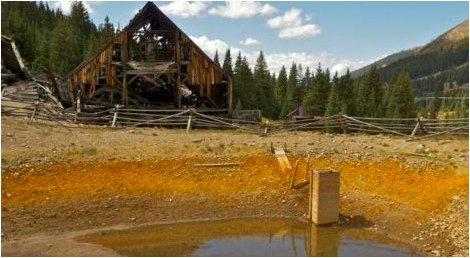
In the affected areas, the process deposited metal-sulfide minerals, commonly pyrite (fool’s gold), in the rocks. When these rocks are exposed at the surface, they interact with oxygen and the iron sulfide “rusts” to form iron oxide minerals, creating striking yellow, orange, and red colors — similar to the oxidation of metal in an old rusty car.

Acid rock drainage occurs when the sulfur that is displaced by the oxygen combines with water to form weak sulfuric acid. The acidic water then dissolves minerals from the bedrock, often adding significant amounts of dissolved metals to these headwater streams. Natural acid rock drainage has been active in Colorado for thousands, possibly millions of years.

More water pollution coverage here.

Lower Dolores Boating Advocates will hold a public discussion of boating issues and possible changes below McPhee on November 30

snaggletoothrdoloresriver.jpg

From the Cortez Journal:

Everyone who rafts, kayaks and canoes on the lower Dolores River is invited to a presentation by Nathan Fey from American Whitewater at 7 p.m. Wednesday, Nov. 30, at the Dolores River Brewery, 100 S. Fourth St. Fey will lead a discussion about the ongoing negotiations with water managers about releases from McPhee dam. All whitewater boating enthusiasts are encouraged to attend to learn more about possible changes for the Dolores River. The event is sponsored by the Lower Dolores Boating Advocates. For more information, contact Jay Loschert at 799-1475.

More whitewater coverage here.

Cloud-seeding: Gunnison County, Mt. Crested Butte, CWCB and the Upper Gunnison River Water Conservancy District ink a deal with North American Weather Consultants for the 2011-2012 season

cloudseedingexplained.jpg

From The Crested Butte News (Alissa Johnson):

In spite of early concerns that funding for cloud seeding might dry up, Gunnison County entered into an operational agreement with North American Weather Consultants for the 2011-2012 winter season on November 15. With the total bill projected at $95,000, a 3.26 percent increase over last year, the Upper Gunnison River Water Conservancy District came through with a $26,500 contribution. The county will contribute $10,000 and Mt. Crested Butte budgeted $3,000. The Colorado Water Conservation Board will cover $47,500 in matching funds, and the remaining moneys will be collected from a variety of local contributors.

More cloud-seeding coverage here and here.

IPCC — Special Report on Managing the Risks of Extreme Events and Disasters to Advance Climate Change Adaptation (SREX)

cherrycreekflood08031933castlewooddamfailure.jpg

Here’s summary from the IPCC. Here’s a list of the specific findings from the fact sheet for the report:

Specific findings of the report

Two metrics are used to communicate the degree of certainty in key findings: qualitative confidence in the validity of a finding based on evaluation of the underlying scientific evidence and agreement; and quantified measures of uncertainty expressed as probabilities. Terms such as “robust evidence,” “medium confidence,” “likely,” or “very likely” have specific meanings that are discussed in the final section of this document.

Changing extreme events

—Observations since 1950 show changes in some extreme events, particularly daily temperature extremes, and heat waves.

—It is likely that the frequency of heavy precipitation will increase in the 21st century over many regions.

—It is virtually certain that increases in the frequency of warm daily temperature extremes and decreases in cold extremes will occur throughout the 21st century on a global scale. It is very likely—90 per cent to 100 per cent probability—that heat waves will increase in length, frequency, and/or intensity over most land areas.

—It is likely that the average maximum wind speed of tropical cyclones (also known as typhoons or hurricanes) will increase throughout the coming century, although possibly not in every ocean basin. However it is also likely—in other words there is a 66 per cent to 100 per cent probability—that overall there will be either a decrease or essentially no change in the number of tropical cyclones.

—There is evidence, providing a basis for medium confidence, that droughts will intensify over the coming century in southern Europe and the Mediterranean region, central Europe, central North America, Central America and Mexico, northeast Brazil, and southern Africa. Confidence is limited because of definitional issues regarding how to classify and measure a drought, a lack of observational data, and the inability of models to include all the factors that influence droughts.

—It is very likely that average sea level rise will contribute to upward trends in extreme sea levels in extreme coastal high water levels.

—Projected precipitation and temperature changes imply changes in floods, although overall there is low confidence at the global scale regarding climate-driven changes in magnitude or frequency of river- related flooding, due to limited evidence and because the causes of regional changes are complex.

Trends in disaster losses

—Economic losses from weather- and climate-related disasters vary from year to year and place to place, but overall have increased (high confidence).

—Total economic losses from natural disasters are higher in developed countries (high confidence).

—Economic losses expressed as a proportion of Gross Domestic Product (GDP) are higher in developing countries (high confidence).

—Deaths from natural disasters occur much more in developing countries (high confidence). From 1970 to 2008 for example, more than 95% of deaths from natural disasters were in developing countries.

—Economic losses from weather- and climate-related disasters have been heavily influenced by increasing exposure of people and economic assets (high confidence).

Managing the risk

—An iterative process involving monitoring, research, evaluation, learning, and innovation can reduce disaster risk in the context of climate extremes (robust evidence, high agreement).

—Many measures for managing current and future risks have additional benefits, such as improving peoples’ livelihoods, conserving biodiversity, and improving human well-being (medium evidence, high agreement).

—Many measures, when implemented effectively, make sense under a range of future climates (medium evidence, high agreement). These “low regrets” measures include systems that warn people of impending disasters; changes in land use planning; sustainable land management; ecosystem management; improvements in health surveillance, water supplies, and drainage systems; development and enforcement of building codes; and better education and awareness.

—Effective risk management generally involves a portfolio of actions, from improving infrastructure to building individual and institutional capacity, in order to reduce risk and respond to disasters (high confidence).

—Post-disaster recovery and reconstruction provide an opportunity for reducing the risks posed by future weather- and climate-related disasters (robust evidence, high agreement). However, short-term measures to protect people from immediate risks can increase future risks, such as improvements in levees encouraging further development in flood plains (medium evidence, high agreement).

—Risk management works best when tailored to local circumstances. Combining local knowledge with additional scientific and technical expertise helps communities reduce their risk and adapt to climate change (robust evidence, high agreement).

—Actions ranging from incremental improvements in governance and technology to more transformational changes are essential for reducing risk from climate extremes (robust evidence, high agreement).

More climate change coverage here and here.

Illinois utility SCADA system cracked, pump shut down by intruders

cyberattackmaximumpc.jpg

From Reuters via FoxNews.com:

The Nov. 8 incident was described in a one-page report from the Illinois Statewide Terrorism and Intelligence Center, according to Joe Weiss, a prominent expert on protecting infrastructure from cyber attacks. State police investigators believe the hackers broke into the water utility’s network by using credentials stolen from an undisclosed U.S. company that produces software to control industrial systems, said Weiss, who read excerpts from the report to Reuters over the phone. “An information technology services and computer repair company checked the computer logs of the system and determined the computer had been hacked into from a computer located in Russia,” Weiss said, quoting the report.

The Denver Post takes an in-depth look at hydraulic fracturing in Colorado

anadarkohydraulicfracturingapril2011.jpg

Here’s an in-depth look at hydraulic fracturing from Mark Jaffe writing for The Denver Post. Click through and read the whole thing. Here’s and excerpt:

It took Anadarko’s contractor, Superior Well Services, about a week to haul in the water, sand, chemicals and equipment for the frack, which would take just one day. As it began, Jon Anderson, a senior completions technologist, sat before 10 computer screens in a trailer on the site. The readouts showed details on things such as slurry rates, downhole pressure and wellhead pressure, and chemical mixing. The first test was to pump in plain water at a pressure higher than would be used in the frack to check the well’s integrity…

Environmental and community groups raised concerns about its safety, the toxicity of ingredients in fracking fluid and its impact on air and water. That has led to a push for better data, disclosure and controls on fracking by state and federal agencies, including:

• An Environmental Protection Agency study looking at the impact of fracking on drinking water resources, from the acquisition of the water to the disposal of frack fluids.
A preliminary report is slated for next year and a final report in 2014.

• An EPA-proposed rule, expected to be adopted next year, limiting air pollution from oil and gas operations, including fracking.

• A Department of Interior-proposed rule for regulating fracking on public lands.

• A Colorado Oil and Gas Conservation Commission proposal requiring drillers to file the ingredients of their frack fluids in a database with public access. A public hearing on the rule is scheduled for Dec. 5.

• A joint industry-state program in Colorado to test residential water wells before and after fracking. Companies responsible for 90 percent of the wells drilled this year are participating.

More hydraulic fracturing coverage from Anthony A. Mestas writing for The Pueblo Chieftain. From the article:

Grass roots and environmental groups in the Spanish Peaks area contend fracking — technically, hydraulic fracturing — leads to contaminated water and, possibly, earthquakes. State and federal regulators along with energy companies dismiss the claims. Fracking poses no threat to ground water and does not cause earthquakes, they say…

In the Raton Basin, which stretches from Southern Colorado to Northern New Mexico, fracking occurs in coal beds to release the natural gas coal-bed methane. Water, nitrogen, sand and several additives are pumped under pressure into the coal beds to create fractures used to free the gas…

The average depth of the wells is 1,300 feet, or less than a quarter mile, a much shallower depth than shale gas wells that can extend more than 1 mile below the surface. At that depth, the wells — and fracking zones — also operate far below the depth of most of the area’s water wells, which generally are less than 200 feet down…

To guard against contamination of the region’s water, companies such as Pioneer follow a number of safety steps, as directed by the Environmental Protection Agency and state energy regulators. Among them:

– The drill casing at the surface is surrounded by cement to prevent leaks or spills. Tests are run to confirm that the cement is solid and adequately surrounds the casing.
Water wells in the drill area are tested before and after the drilling operation.
– The “flow back” water from the well is directed to a tank or lined pit for at least 30 to 60 days and then returned to the ground in deep injection wells that extend down 4,000 to 7,000 feet.
– The chemical additives used in the fracking mix are minimal and considered safe.

Additives make up less than 1 percent of Pioneer’s fracking mix. The chemicals are the same found in products such as ice cream, salad dressing, household cleaners and dish washing soap, the firm says. The bulk of the mix is water (55 percent), nitrogen (35 percent) and sand (9.9 percent.)

The Environmental Protection Energy released this report, PAVILLION AREA GROUNDWATER INVESTIGATION Pavillion, Fremont County, Wyoming on August 30, 2011. It shows contamination of groundwater in the area from hydraulic fracturing. Here’s the introduction:

This Analytical Results Report (ARR) for the Expanded Site Inspection (ESI) at the Pavillion Area Groundwater (GW) Investigation site (Comprehensive Environmental Response, Compensation, and Liability Information System [CERCLIS] ID# WYN000802735) in Fremont County, Wyoming, has been prepared to satisfy the requirements of Technical Direction Document (TDD) No. 0901-01 issued to URS Operating Services, Inc. (UOS) under the U.S. Environmental Protection Agency (EPA) Region 8 Superfund Technical Assessment and Response Team 3 (START 3) Contract No. EP-W-05-050. This report has been prepared in accordance with the EPA “Guidance for Performing Site Inspections under CERCLA,” Interim Final, September 1992, and the “Region 8 Supplement to Guidance for Performing Site Inspections under CERCLA” (EPA 1992; EPA 1993). Field activities were conducted from January 18 to January 22, 2010, in Pavillion, Wyoming. Field activities followed the Site Inspection (SI) format during the ESI, applicable UOS Technical Standard Operating Procedures (TSOPs), and the Generic Quality Assurance Project Plan (QAPP) (UOS 2005b; UOS 2005a). This ARR is intended to be used in conjunction with the Field Sampling Plan (FSP) (UOS 2010).
Contamination from chemicals of concern in the Pavillion area was originally alleged by local residents when visual and odor parameters for several domestic wells changed. Visual changes included yellow color, increased turbidity, oil sheen, and inclusion of small gas bubbles. A hydrocarbon odor was also reported. Prior screening, sampling, and analyses conducted previous to EPA’s investigation indicated chemicals of concern in domestic wells with unknown risks to health and unknown sources. A previous SI performed by EPA narrowed the area of concern to an area in and around 11 wells that possessed detections of methane; volatile petroleum hydrocarbons (VPH), tentatively identified semivolatile organic compounds (SVOCs) and volatile organic compounds (VOCs); nitrate; arsenic; phthalates; and caprolactam. These wells are located in Sections 2, 10, 11, 12, 13, 15, 17, 21, and 27 of T. 3N., R. 2 E. and Section 7 of T. 3 N., R. 3 E. See Section 3.3.2 for a summary of previous work.

Meanwhile, Pitkin County is petitioning the Colorado Oil and Gas Conservation Commission for full disclosure of the materials used for hydraulic fracturing. Here’s a report from Andrew Travers writing for the Aspen Daily News. From the article:

The commissioners, in a letter drafted this week to the Colorado Oil and Gas Commission, are calling for that body to adopt stricter disclosure guidelines than what is currently being considered. “We obviously have fracking activities ready to occur in our county,” County Commission Chair Rachel Richards said Tuesday.

The gas commission is considering adopting a rule that would require companies to disclose the chemical contents of fracking fluid, but allow them to withhold contents they deemed “trade secrets.”

“There are some large loopholes in that rule-making approach,” Richards said, concerned companies could abuse the “trade secret” exemption.

The county leaders bristled at the notion that gas companies could shield their chemical formulas. They stressed potential threats to public health in their letter and discussions of the issue this week. “Unless you are pumping Coca-Cola into the ground, we want to know what is in this thing,” said County Commissioner Michael Owsley.

More oil and gas coverage here and here.

Two Fountain Creek meetings coming up, dam study progress — November 30, flood control and water rights — December 7

fountaincreek1999floodcwcb.jpg

From The Pueblo Chieftain (Chris Woodka):

Progress on a study of dams on Fountain Creek will be presented at 10 a.m. Nov. 30 at the Pikes Peak Area Council of Governments, 15 S. Seventh St., in Colorado Springs. The study is funded in part by $300,000 from the city of Colorado Springs as a condition of its 1041 land use permit from Pueblo County for the Southern Delivery System. It is sponsored by the Fountain Creek Watershed Flood Control and Greenway District. The U.S. Geological Survey will look at the hydrological impact of dams at various points along Fountain Creek to measure the impact they would have on flows at various levels…

A second forum is scheduled at 1 p.m. Dec. 7 at Fountain City Hall. It will look at how water rights could be affected by flood control projects on Fountain Creek. The Fountain Creek district’s citizen advisory group and technical advisory committee will attend. Panelists include Kevin Rein, deputy state engineer; Mark Shea, attorney for Colorado Springs Utilities; Carol Baker, Fountain Creek specialist for Colorado Springs Utilities; Larry Small, executive director of the Fountain Creek district; Dan Henrichs, superintendent of the High Line Canal; Alan Hamel, executive director of the Pueblo Board of Water Works and a member of the Colorado Water Conservation Board; and Gary Barber, who has worked with Fountain Creek communities on water issues and served at the Fountain Creek district’s first executive director.

The panel will be moderated by Chris Woodka, an editor who reports on water issues for The Pueblo Chieftain.

More Fountain Creek coverage here and here.

Say hello to ImagesAtChieftain.com

imagesatchieftain.jpg

Say hello to the Chieftain’s online photo gallery. I’ve spent far too much time this morning clicking around. They’re using blogging software so they publish an RSS feed for their posts.

They have a great image of Pikes Peak from the Arkansas River valley that I’m hoping to buy.

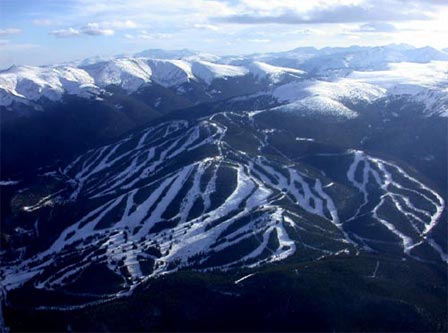
New USFS ski area permit requirements are designed to keep water rights with the land at ski areas

winterpark.jpg

From the Summit County Citizens Voice (Bob Berwyn):

At issue is a water-rights clause in the standard ski area permit that specifies who owns the water flowing down from public national forest system lands both within and outside ski area boundaries. The current language has been in place since 2004 and the ski industry says it’s been working well. Under the 2004 clause, ski areas exercise almost absolute control over all water rights associated with ski area operations — to the point that a resort could potentially sell at least some of the water rights, potentially leaving a future ski area permittee high and dry…

The agency is seeking to sustain resorts operating under permit for the long-term by ensuring that the water rights stay with the ski area even if there is a change in ownership or some other unforeseen circumstance, according to Jim Bedwell, director of the agency’s recreation and heritage resources programs. Bedwell said the agency recognizes that the value of ski areas is tied at least in part to the associated water rights. “If there’s a change of ownership, the buyers will know they have continued ownership of the water rights, They can’t be parted out,” he said.

More water law coverage here.

2012 Colorado legislation: State Representative Marsha Looper plans to introduce legislation to more accurately account for oil and gas exploration and production water needs

marcellushydraulicfracturing.jpg

From The Pueblo Chieftain (Chris Woodka):

The amount of water required per oil well can vary from 1 million to 8 million gallons, depending on where the well is. That’s a one-time use over the life of the well. In a vertical well, fracking may occur only once. In a horizontal well, it can be done up to 40 times. “The most we’ve seen in Colorado is a dozen,” Kerr said.

Of more concern are the chemicals used in fracking, which can affect water quality. About half of the drillers voluntarily provide the state with information about which chemicals are being used. Next month, the commission will have rule-making hearings that include a requirement to divulge the chemicals used.

The state already requires concrete casing of oil wells to a depth of 50 feet below the deepest aquifer. The Niobrara is 8,000 feet under the Denver Basin. Water wells in the area are 500 to 2,000 feet deep. State rules also require isolating the fracking zones to prevent migration of chemicals into water supplies.

State Rep. Marsha Looper, R-Calhan, plans to introduce legislation that would require a more complete state accounting of the water needs of oil and gas drilling in the state.

More 2012 Colorado legislation coverage here.

New Colorado Geological Survey study identifies geology as culprit for poor water quality in some headwaters streams

naturalacidrockdrainagebulletin54coloradogeologicalsurvey.jpg

From the Associated Press (Catharine Tsai) via The Denver Post:

In southern Colorado, the headwater areas included the Silverton and Lake City areas, the Platoro-Summitville area, the East Trout area in Mineral County, the Kite Lake area in Hinsdale County, and the Rico and La Plata mountains. They also included the Ruby Range area encompassing Mount Emmons by Crested Butte, the Grizzly Peak area south of Aspen and Leadville, the Red Amphitheatre area near the Climax mine, Twelvemile Creek and the Montezuma stock area. The Rabbit Ears and Never Summer range areas in northern Colorado also were included.

More coverage from Chris Woodka writing for The Pueblo Chieftain. From the article:

Researchers found rocks in these areas were altered by intensely hot water during the volcanic activity during Colorado’s geologic past. Some minerals were dissolved, while metal-sulfide minerals like pyrite (fool’s gold) were deposited. When the rocks were exposed at the surface, they interacted with oxygen to form iron oxide minerals, like a rusted car. The striking yellow, orange and red colors that can inspire awe also contribute to acid rock drainage, and the process has continued for millions of years.

By determining the natural processes, the state hopes to be able to determine background water quality to differentiate between natural effects and man-caused disturbances such as mining, said Matt Sares. “This study does not determine a cause for acid drainage in every case,” Sares said. “It identifies areas where you might not want to put in a mine or develop a domestic water supply.”[…]

“While there is increased potential, the study did not always find pollution in areas with these formations,” Sares said.

More coverage from Dale Rodebaugh writing for The Durango Herald. From the article:

Acid rock drainage occurs when sulfur displaced by oxygen combines with water to produce weak sulfuric acid. The acidic water then dissolves minerals from the bedrock and often adds significant amounts of dissolved metals to streams. The geologists who did the research collected 101 water samples in the 11 headwaters areas. The project lasted four years. Funding for the study came from the Colorado Geological Survey through severance taxes derived from the production of gas, oil, coal and metallic metals.

More water pollution coverage here.

Coyote Gulch outage: I’ll see you on Saturday

johnnellcoyotegulch.jpg

I’m on deadline at Colorado Central Magazine. I’ll see you Saturday morning.

Colorado Springs Utilities will book significant revenue from their supply deal with the Cherokee Metropolitan District

coloradodesignatedgroundwaterbasins.jpg

From The Colorado Springs Gazette (John Schroyer):

Utilities has been working on a deal with The Cherokee Water District, on the eastern edge of Colorado Springs, under which Utilities will deliver a minimum of 500 acre-feet of water per year. That could net up to $738,000 for the city next year, and as much as $900,000 in 2013. And the deal, as they say, is nearly sealed.

Cherokee relies mainly on groundwater [ed. Upper Black Squirrel designated groundwater basin], but as time goes on that source has been dwindling. In the past, Utilities has provided water to Cherokee on an emergency basis, but last April, the City Council gave Utilities the go-ahead to write up a contract that would grant Cherokee reliable water delivery.

On Wednesday, Utilities Water Services Division General Manager Wayne Vanderschuere presented the contract to the board. Under its terms, Cherokee has to pay Utilities at least $2.4 million next year for a minimum of 500 acre-feet of water service, with a cap of 1,000 acre-feet for $4.4 million. The price, which Vanderschuere said is expensive, is 9.32 cents per cubic foot. That price, however, can be reduced for Cherokee if it finds alternate sources for water, instead of buying directly from Utilities. Cherokee still would have to pay for delivery (i.e. use of Utilities’ piping system), but Utilities could save more water for its residential customers. The city’s share of the $2.4 million minimum is $400,529, and the maximum is $738,833. In 2013, the minimum would drop to $299,186, but the maximum would increase to $907,710.

Board President Scott Hente practically clapped his hands in delight. “It’s a win for all of us,” Hente said happily. “There are all kinds of things we could do with that money. We worked out a great deal.”

More Cherokee Metropolitan District coverage here and here.

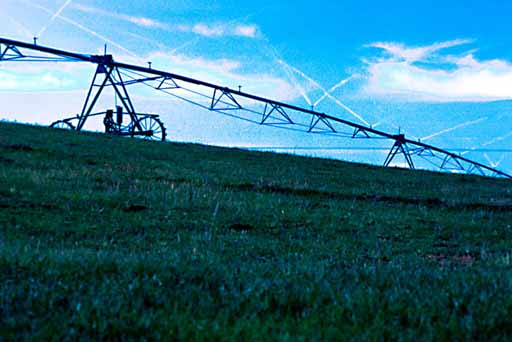
CWCB: The goal of a grant approved Wednesday is to, ‘develop a consistent way to measure crop consumptive use,’ for ag water lease-fallowing change cases

irrigation.jpg

From The Pueblo Chieftain (Chris Woodka):

The $279,000 study would develop a consistent way to measure crop consumptive use that can be transferred if the water is sold through lease programs such as the Arkansas Valley Super Ditch. Colorado Springs Utilities, Pueblo Board of Water Works and the Lower Arkansas, Upper Arkansas and Southeastern Colorado water conservancy districts will contribute $157,500 toward the study. They received an additional $121,500 from the Colorado Water Conservation Board, which approved a grant in Berthoud Wednesday. “The purpose of this project is not to transfer water via temporary leases, but make possible the water transfer by constraining costs, protecting other water rights from potential injury, maintaining agricultural economies and preserving the institutionalized and long recognized water court process,” said Todd Doherty of the CWCB staff…

The water groups want to develop a commonly accepted model that would look at how much water historically has been used to grow crops in the major agricultural areas of the Lower Arkansas Valley and how much flows off fields to be returned to the Arkansas River. Traditionally, those determinations have been made on a case-by-case basis in water court…

“The reason our district is involved in looking at these temporary transfers is because they could have deleterious effects on other water rights,” [Terry Scanga of the Upper Arkansas Valley Water Conservancy District] told the board. “This would provide a common platform so that transferrable use of water could be preserved. We’re looking at potential impacts, and that could reduce the costs of both objectors and applicants in water court.”

Click through and read the whole article, including the handy glossary of terms dealing with ag water transfers.

More Arkansas River basin coverage here.

The Niobrara shale play, horizontal drilling and new hydraulic fracturing technology spurs frenzied oil and gas mineral right leasing activity up and down the Front Range and points south

oilgaspermittingactivity2010cogccchieftain.jpg

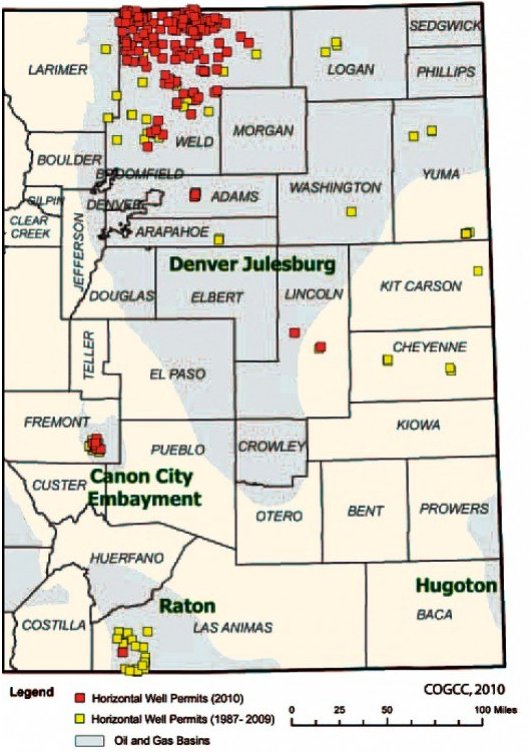
Here’s a report about leasing activity in the Lower Arkansas River basin from Anthony A. Mestas writing for The Pueblo Chieftain. Click on the thumbnail graphic to the right for the Chieftains’s rendering of 2010 permitting activity from the Colorado Oil and Gas Conservation Commission. Click through and read the whole article. Here’s an excerpt:

The courthouses in Bent, Prowers and Kiowa counties have been inundated the past few months with land firms researching mineral rights and offering leases to landowners for unnamed oil companies, officials in the three Lower Arkansas Valley counties confirmed Wednesday. “There probably are 20 to 25 land men here every single day,” Bent County Clerk and Recorder Patti Nickell said. “They are researching the land so that they can offer leases to the landowners.”

Officials in all three counties said they are unaware of any type of proposed oil drilling operations in the area and do not know which oil companies are behind the research effort…

Nickell said a steady stream of land men began arriving in Bent County in June. “It has increased, increased, increased. These are land people who work for oil companies,” Nickell said…

“We are certainly willing to cooperate with the oil and gas exploration and any permitting that would be necessary in Prowers County. We see that as a resource that would help the county financially as well as employ people and give a stimulus to the local economy,” [Prowers County Commissioner Gene Millbrand] said.

More coverage from Peter Strescino writing for The Pueblo Chieftain. From the article:

Vince Matthews, state geologist and executive director of the state Geological Survey, said while Pueblo County sits on the Niobrara Formation, it is too shallow here. A perfect example of this is at Lake Pueblo, where the formation’s layers are totally exposed. “To be productive, it’s got to be about a mile deep,” he said. “In Pueblo, it’s too close to the surface and even eroded away.”

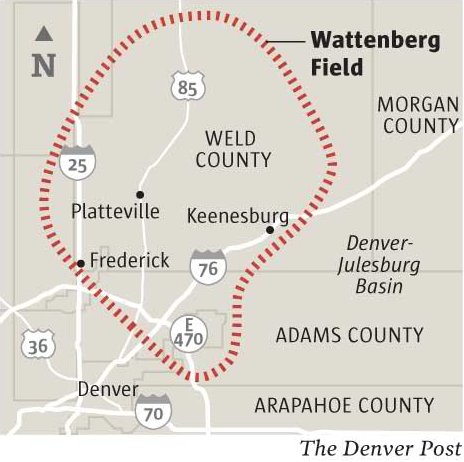
While Pueblo probably will never be considered a production site, Prijatel agreed there will be considerable economic expansion around the Wattenberg Field exploration. “Wherever something happens, that’s where people go,” he said. “Look at North Dakota. There’s a boom, there’s a need for housing, there’s jobs. Even motel workers will be making $20 an hour because of the demand. “People are spending a lot of money.”

More oil and gas coverage here and here.

U.S. Representative Scott Tipton takes time at a U.S. House Subcommittee on National Parks, Forests and Public Lands to bang the drum against water rights ‘taking’ by the USFS

breckenridgevailresorts.jpg

From The Durango Herald (Rocío González):

Last month, Tipton, R-Cortez, expressed his concern about a requirement that would make private water holders sign their water rights over to the U.S. government as a condition for permits for uses such as ski areas or grazing. The congressman wrote Secretary of Agriculture Tom Vilsack requesting that the agency stop interfering in such matters.

While questioning Glenn Porzak, a representative for the National Ski Areas Association, Tipton inquired about compensation for those who would have to sign their water rights away. According to Porzak, it would be “zero.”

This new requirement would be tied to a series of changes including special-use permits and a proposed planning rule that the Department of Agriculture – namely, the Forest Service – has been working on for years. However, the USDA already is enforcing the permit requirement despite the fact that it has yet to be officially implemented.

“I think you underscored a very important point during your comments, saying that all water owners should be concerned,” Tipton told Porzak. “In the 3rd Congressional District, throughout the state of Colorado, water is what we absolutely need, particularly for the grazing.”[…]

When witnesses for the federal agency were asked why it needed the water rights, they answered it is a matter of “control.”

New Colorado Geological Survey study identifies geology as culprit for poor water quality in some headwaters streams

naturalacidrockdrainagebulletin54coloradogeologicalsurvey.jpg

Here’s the release from the Colorado Geological Survey (Matt Sares):

Is high, pristine mountain water always clean and pure? Can streams unaffected by human activities and livestock influences be unfit for human consumption, or fish? A new study by the Colorado Geological Survey (CGS) has some surprising answers. The study examines specific areas in Colorado that have naturally poor, surface-water quality due to the area’s geology.

The report, titled “Natural Acid Rock Drainage Associated with Hydrothermally Altered Terrane in Colorado,” identifies a number of streams in eleven different headwater areas of Colorado where surface water is acidic and has high concentrations of metals upstream of any significant human impacts.

Rocks in these areas were altered by intensely hot water circulating in the earth’s crust, often associated with volcanic activity during Colorado’s geologic past. The “hydrothermal alteration” of the rocks changed their composition by dissolving some minerals and depositing others. In the affected areas, the hydrothermal-alteration process deposited metal-sulfide minerals, commonly pyrite (fool’s gold), in the rocks.

When these rocks are exposed at the surface, they interact with oxygen and the iron sulfide “rusts” to form iron oxide minerals, creating striking yellow, orange, and red colors – similar to the oxidation of metal in an old rusty car. “Acid rock drainage” occurs when the sulfur that is displaced by the oxygen combines with water to form weak sulfuric acid. The acidic water then dissolves minerals from the bedrock, often adding significant amounts of dissolved metals to these headwater streams. Natural acid rock drainage has been active in Colorado for thousands, possibly millions of years.

More coverage from the Associated Press (Catharine Tsai) via The Columbus Republic. From the article:

The agency launched the study after working with the U.S. Forest Service to identify Environmental problems related to abandoned mines. Former Colorado Geological Survey Deputy Director Matt Sares says that during that work, researchers found that water upstream of mine sites wasn’t always as pristine as researchers thought it would be.

The Colorado Geological Survey’s new study identifies streams in 11 headwater areas where surface water is acidic and has high concentrations of metals even upstream of any significant human impacts.

More water pollution coverage here.

Drought news: Recent moisture helps obviate the drought in the San Luis Valley

usdroughtmonitor11162011.jpg

From The Pueblo Chieftain (Matt Hildner):

Much of the valley floor was downgraded from extreme to severe drought conditions following October rain and snow. But that precipitation was not enough to completely alleviate the dry conditions from last fall and winter, the National Weather Service said in a report issued last week…

The agency said precipitation last month was at or below average in much of South-Central and Southeastern Colorado with the exception of higher terrain and the extreme Eastern Plains, which saw above-average precipitation. The [National Weather Service’s] station in Alamosa recorded 0.48 inches of moisture — 0.19 inches below the October average.

Click on the thumbnail graphic above and to the right for the most recent U.S. Drought Monitor map.

CWCB: The Two Rivers Water Company is applying for a $1.18 million loan to renovate Orlando Reservoir

huerfanoriver1.jpg

From The Pueblo Chieftain (Chris Woodka):

The Two Rivers Water Co. has applied for the loan through the Colorado Water Conservation Board, which will vote on the proposal at a meeting today in Berthoud. The money would be used to repair Orlando Reservoir, located 10 miles northeast of Walsenburg…

Two Rivers purchased the Orlando Reservoir earlier this year, along with additional farmland in Huerfano County. The repairs at Orlando Reservoir are part of a new business model that would allow more efficient use of water resources, according to a CWCB staff memo.

More Arkansas River basin coverage here.

New Report Finds Power Plants Stressing Water Supplies: First Systematic National Look at Power Plant Impacts on Water and Data Quality

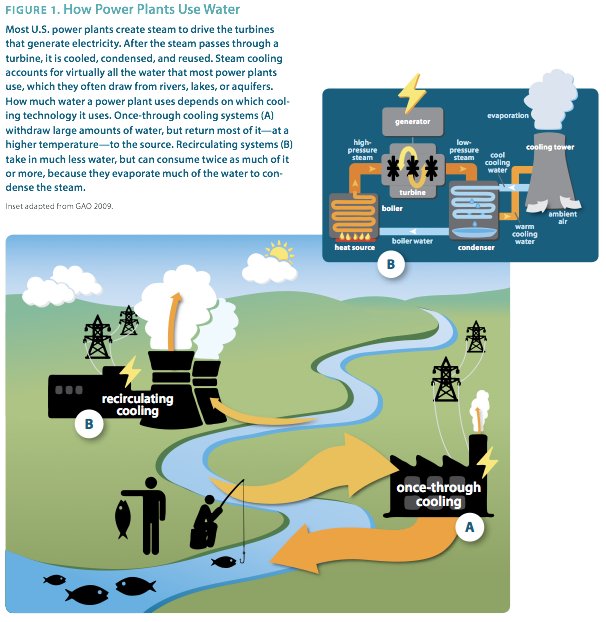
howpowerplantsusewaterwesternresourceadvocatesunionconcernedscientists.jpg

Here’s the link to the report from Western Resource Advocates and the Union of Concerned Scientists. From the executive summary:

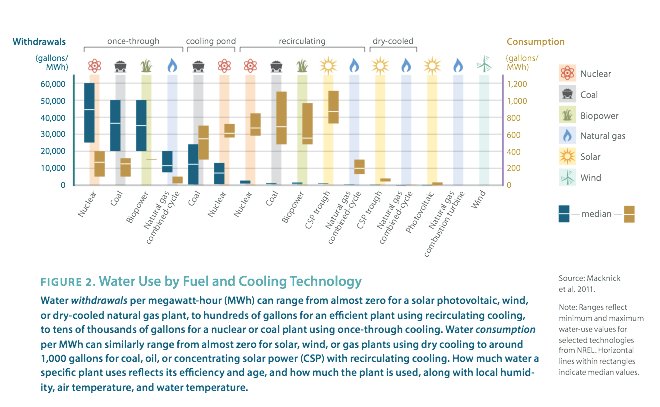
Take the average amount of water flowing over Niagara Falls in a minute. Now triple it. That’s almost how much water power plants in the United States take in for cooling each minute, on average.

In 2005, the nation’s thermoelectric power plants— which boil water to create steam, which in turn drives turbines to produce electricity—withdrew as much wa- ter as farms did, and more than four times as much as all U.S. residents. That means lighting rooms, powering computers and TVs, and running appliances requires more water, on average, than the total amount we use in our homes—washing dishes and clothes, showering, flushing toilets, and watering lawns and gardens.

This tremendous volume of water has to come from somewhere. Across the country, water demand from power plants is combining with pressure from growing populations and other needs and straining water resources—especially during droughts and heat waves.

waterusebyfuelandcoolingtechnology.jpg

Here’s the joint release from Western Resource Advocates (Jason Bane) and the Union of Concerned Scientists:

Power plants are stressing freshwater resources around the country, according to a new report by the Energy and Water in a Warming World Initiative, a three-year research collaboration between the Union of Concerned Scientists (UCS) and a team of more than a dozen scientists. The report, “Freshwater Use by U.S. Power Plants: Electricity’s Thirst for a Precious Resource,” is the first systematic assessment of how power-plant cooling affects freshwater resources across the United States and of the quality of the data available on power plant water usage.

“Our research found that power plants can be very important in terms of the pressure put on the freshwater resources we depend on—rivers, streams, lakes, and aquifers—even in unexpected places,” said lead researcher Kristen Averyt, who is deputy director of the Western Water Assessment at the University of Colorado Boulder.

The UCS-organized analysis looked at different aspects of the implications of power plant water use related to the supply and demand of freshwater and to water quality issues, particularly water temperature.

“Some of the watersheds our analysis identified – in places like Texas – should come as no surprise,” said Averyt. “But unlike in arid regions, where many power plants have already minimized their water use, we found indicators of potential problems in seemingly water-rich regions like the Southeast. Here our analysis uncovered some surprises, such as the Seneca River in South Carolina and the Upper Dan in North Carolina.

“It’s important for the public to know that because many power plants depend so heavily on water, there’s a real risk that they’ll have to cut back electricity production at times when they can’t get enough cooling water,” noted Averyt. “Just ask power companies in Texas.” The record-breaking 2011 Texas drought has put so much pressure on the water supply that operators have warned that if it continues into next year, power cuts on the scale of thousands of megawatts are possible.

To gauge water-supply stress, the analysis examined the balance of local water supply and demand in each major watershed or “sub-basin” in the United States, then factored in the amount of water that power plants are using. The analysis then focused on areas where power plant demands were the largest contributor to water body stress based on the methodology.

Because of the need for good information to perform these types of analyses, the study also assessed the U.S. Department of Energy’s reporting system used to track power plant water usage. The analysis looked at what power plants reported as their water usage in 2008 – the most recent data then available.

“Uncovering power plants’ water use was not an easy task because the data reported by plant operators and compiled by the U.S. Energy Information Administration—the most comprehensive set of information on power plant water use and cooling technologies—was full of holes and errors,” said John Rogers, the report’s co-author and senior analyst at UCS. “We had to piece together a lot of information to get a better handle on how much water power plants were really using.

“If we had used the Department of Energy data, we would have gotten a different picture of water stress from what we see in our results,” added Rogers. “Where our analysis found water-supply stress to be driven mainly by power plants, several did not show up when we used the available data from the Energy Department.”

The report also showed that power plants are stressing water bodies by discharging water at temperatures harmful to fish and other wildlife. In 2008, 350 power plants across the country reported discharging water at temperatures of over 90 degrees Fahrenheit and some at temperatures over 110 degrees, according to the report.

“It’s unsafe for people to sit in a Jacuzzi at 105 degrees, let alone live in it,” said Rob Jackson, director of the Center on Global Environmental Change at the Nicholas School of the Environment at Duke University and a member of the report’s scientific advisory committee. “Fish and other species can’t climb out of the hot tub.”

In recent years, a number of power plants have had to cut back power production because they were unable to stay within water temperature discharge limits, according to the report. “If we start saving water today, we’ll avoid blackouts and water shortages tomorrow,” said Jackson.

Without water-smart energy choices, energy-water collisions may worsen as the population and the corresponding demand for energy and freshwater supplies grows, and as the climate changes. Water-smart technologies include wind and solar photovoltaics, which use essentially no water, and produce no carbon emissions, according to the report.

“Every time we build a power plant, we’re making decisions that last for decades,” said Peter Frumhoff, director of science and policy at UCS and head of the scientific advisory committee for the report. “By investing in power plants that are efficient, use low-water cooling and produce little or no carbon emissions, utilities and plant owners can help protect the water resources our kids and grandkids will depend on, and public utility commissions can encourage or require them to do so, especially where research indicates that power plants place water resources at risk.”

The leading national experts on this report and its Scientific Advisory Committee also included scientists from the National Renewable Energy Laboratory, Vanderbilt University, the University of Texas, Tufts University, and the University of Arizona.

More energy policy coverage here.

USDA: Locally grown food forecast to generate $7 billion in 2012

nellieslastharvest10262010.jpg

From the Associated Press via The Washington Post:

A new U.S. Department of Agriculture report says sales of “local foods,” whether sold direct to consumers at farmers markets or through intermediaries such as grocers or restaurants, amounted to $4.8 billion in 2008. That’s a number several times greater than earlier estimates, and the department predicts locally grown foods will generate $7 billion in sales this year.

While there’s plenty of evidence local food sales have been growing, it has been hard to say by how much because governments, companies, consumers and food markets disagree on what qualifies as local. The USDA report included sales to intermediaries, such as local grocers and restaurants, as well as directly to consumers through farmers markets, roadside stands and the like.

It found that farm sales to people like Anderson have just about doubled in the past two decades, from about $650 million, adjusted for inflation, in the early 1990s to about $1.2 billion these days. The much bigger, $4.8 billion figure came when sales to local restaurants, retailers and regional food distributors were added in.

Anadarko announces expectations for Niobrara shale play: Results from eleven wells fuel 160 well drilling program for 2012

niobrarashale.jpg

From The Wall Street Journal (Russell Gold):

Echoing industry concerns, Mr. Hackett said he is worried that anti-drilling sentiment could prevent the projected expansion. The energy industry’s use of hydraulic fracturing, in particular, has prompted concerns about pollution; the federal government and several states are studying whether new regulations on water use and air emissions are needed…

Anadarko on Monday said that results from 11 recent wells in the Wattenberg field have given it confidence that it can drill between 1,200 and 2,700 wells in northeast Colorado. It plans to drill about 160 wells next year. Based on its early results, it expects its wells will ultimately yield between 500 million and 1.5 billion barrels of oil, natural gas liquids, and natural gas. Finding a billion barrel field is extremely rare. Only a handful of billion barrel fields have ever been found in the U.S…

Recently, companies such as Anadarko and Carrizo Oil & Gas Inc. and Noble Energy Inc. have been applying horizontal wells and hydraulic fracturing in the Wattenberg, breathing new life into the field and leading to a reappraisal of its future oil and gas potential. Anadarko says it expects its production from the region to grow at a compound annual rate of 20% between 2010 and 2012. It produced about 72,400 barrels of oil equivalents there in the last quarter.

The company also said it plans to evaluate whether new technologies can be used to extend the discovery farther north into Wyoming where recent drilling results are more hit-and-miss. Some well results have been quite good, but others have not found enough oil or gas to be considered commercial successes.

Here’s a release from Governor Hickenlooper (Eric Brown/Megan Castle):

Gov. John Hickenlooper released this statement today after Anadarko Petroleum Corp. announced it plans to add more than 1,200 drilling locations in the Wattenberg field in northeastern Colorado:

“Anadarko’s announcement today shows once again that Colorado is a leader in the energy sector of our country’s economy. We are thrilled to see the company plan a significant investment in Colorado. This expected growth will create jobs and make more revenues available to local communities. We look forward to supporting Anadarko, its workforce of 1,000 people already here and the thousands of contractors it hires throughout the state.

“We also continue to work proactively to maintain the highest safety and environmental standards for oil and gas companies in Colorado, while also cutting permit times and making it easier and more predictable to develop natural gas and oil here. Anadarko’s future expansion in Colorado, on top of our effort last week to launch a multi-state initiative aimed at developing natural gas-fueled vehicles, is further evidence that Colorado is at the center of energy development in this country.”

wattenburgfieldoilplay.jpg

More coverage from Mark Jaffe writing for The Denver Post. From the article:

“This is going to have huge implications for the economy of Colorado,” said Pete Stark, vice president for industry relations at IHS, a Denver-based consulting firm. A reserve that size could generate 150,000 barrels a day and, assuming oil is $80 a barrel, provide more than $4 billion in annual revenues, Stark estimated. The total value of goods and services produced in the state in 2010 was $235.15 billion…

Anadarko’s wells had initial production averages of 800 barrels a day — with the best well producing 1,100 barrels a day. The wells were drilled in the Niobrara formation, which is more than 6,000 feet deep and runs from El Paso County to the Wyoming border…

Anadarko said it also found oil in the neighboring Codell formation…

The Anadarko estimate is just for the 100-square-mile Wattenberg Field, which includes Weld County and small parts of Adams, Broomfield, Boulder and Larimer counties. Anadarko is also doing exploratory drilling in Arapahoe County, and Chesapeake Energy has filed plans to drill in Elbert and Douglas counties. Ultra Petroleum is set to drill exploration wells in El Paso County.

More coverage from David O. Williams writing for the Colorado Independent. From the article:

Groups like Clean Water Action have been actively campaigning ahead of a new boom in the Niobrara formation, which stretches from Denver to Wyoming along the densely populated Front Range of Colorado. An official for the group on Monday called Anadarko’s announcement a “mixed bag” of economic benefit and potential pollution.

CWA’s biggest concern? Hydrayulic fracturing, or fracking, which injects millions of gallons of water mixed with sand and undisclosed chemicals under high pressure into natural gas and oil wells to break up tight geological formations and free up more oil and gas.

“What does fracking bring to communities where wells are drilled?” Clean Water Action asks on its website. “Fracking brings wells 200 feet away from the backyards and parks where our children play. It brings water and air pollution from wells and open chemical pits, wastewater laced with toxins, and soot from hundreds of construction vehicles. Fracking brings new gas and income to the communities, but at what cost?”[…]

There has been a growing debate over local control versus state authority versus federal oversight of the oil and gas industry. Cory Gardner, the Republican congressman who represents Colorado’s 4th Congressional District, including Weld County, has consistently tried to strip away the authority of the U.S. Environmental Protection Agency (EPA) since being elected last year. Anadarko has contributed to Gardner’s election campaigns.

More coverage from the Financial Times (Ed Crooks):

High quality global journalism requires investment. Please share this article with others using the link below, do not cut & paste the article. See our Ts&Cs and Copyright Policy for more detail. Email ftsales.support@ft.com to buy additional rights. http://www.ft.com/cms/s/0/cc4055bc-0f17-11e1-b585-00144feabdc0.html#ixzz1dnnG2FXq

Chuck Meloy, the company’s senior vice-president for worldwide operations, said the discovery was “located right in the heart of one of our existing core areas”. Anadarko and its predecessor companies have been operating in that part of Colorado for more than 30 years but until now had used only vertical wells. This year, it began using horizontal wells, which bend and extend laterally away from the rig. Coupled with hydraulic fracturing – pumping water, sand and chemicals into the well at high pressure to crack the source rock – horizontal drilling is enabling production at commercially viable rates from oil and gas reserves that were previously uneconomic…

High quality global journalism requires investment. Please share this article with others using the link below, do not cut & paste the article. See our Ts&Cs and Copyright Policy for more detail. Email ftsales.support@ft.com to buy additional rights. http://www.ft.com/cms/s/0/cc4055bc-0f17-11e1-b585-00144feabdc0.html#ixzz1dnnObQLd

Mr Meloy said Anadarko expected the field “to quickly become a self-funding, significant cash flow generator.” With US crude prices at about $98 per barrel and gas prices at less than $3.50 per million British thermal units – less than a quarter of the price of oil for the same energy content – liquids production is much more commercially attractive.

More coverage from Cathy Proctor writing for The Denver Business Journal. From the article:

“We’re very excited by what we see in the horizontal activity that we’ve had to date,” said John Christiansen, a spokesman for Anadarko (NYSE: APC), in an interview…

“Everything you could possibly want in a play — this has it. It’s great news for us and for Colorado because it’s going to generate a lot of activity and investment for a number of years,” Christiansen said.

More oil and gas coverage here and here.

Restoration: Park County is awaiting word from Great Outdoors Colorado on $3.57 million grant

parkcountystreamimprovementlocationsfairplayflume112011.jpg

From The Fairplay Flume (Mike Potter):

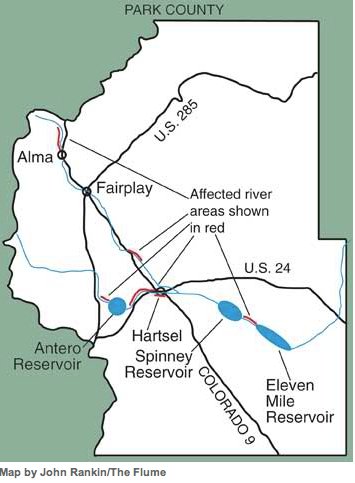
Tom Eisenman, director of Park County Planning and Zoning and also Park County Environmental Health, said the county submitted a concept paper in October to GOCO outlining its plans for a project that would target 11 miles of rivers to provide better access, environmental restoration, and improving habitat for wildlife. According to its website, GOCO has allocated $14 million to $18 million in funds for the River Corridors Initiative. GOCO is funded by 50 percent of the proceeds from the Colorado lottery. Eisenman said the county should know within the first two weeks of December if it will be asked to submit a grant proposal…

Eisenman and others worked on a six-page concept paper that was submitted to GOCO on Oct. 14. According to the concept paper, the county proposes “increasing fishing and other recreation activities by restoring natural fish and wildlife habitat and by improving access with an expanded trail system that includes ‘river walks’ and educational opportunities.”

The concept paper calls for work to be done on the South Fork of the South Platte River from Antero Reservoir to one mile upstream, where overgrazing has damaged the riparian areas. Riparian areas are the interfaces between land and a river or stream. It also calls for work to be done on the South Fork of the South Platte River from one half mile below Antero Reservoir and continuing through Hartsel. Work in that stretch would include restoration of riparian and wetland habitat, and the creation of a river walk near Hartsel. Work is also proposed for a stretch of the South Fork of the South Platte upstream from Park County Road 59 and downstream of U.S. 24 below Hartsel. Work would also be completed on the Middle Fork of the South Platte River, upstream from Tomahawk State Wildlife Area to the boundary of the Buffalo Peaks Ranch. Work is also proposed for the South Platte River from Spinney Mountain Reservoir to Eleven Mile Reservoir, also known as the “Dream Stream.” Work on that stretch of the river would focus on restoring riparian conditions and channel stability. A river walk is also planned for the Middle Fork of the South Platte River from the Fairplay Beach downstream to U.S. 285. According to the concept paper, the town of Fairplay is negotiating with private landowners to gain public access from the Fairplay Beach downstream. In addition to the river walk, restoration would be conducted to repair damage done by mining. The plan also calls for work to be done on the Middle Fork of the South Platte River from Columbia Reservoir north of Alma to the town.

More South Platte River basin coverage here.

Wiggins: The town council moves the proposed water project forward

drillingawaterwell.jpg

From The Fort Morgan Times (Jenni Grubbs):

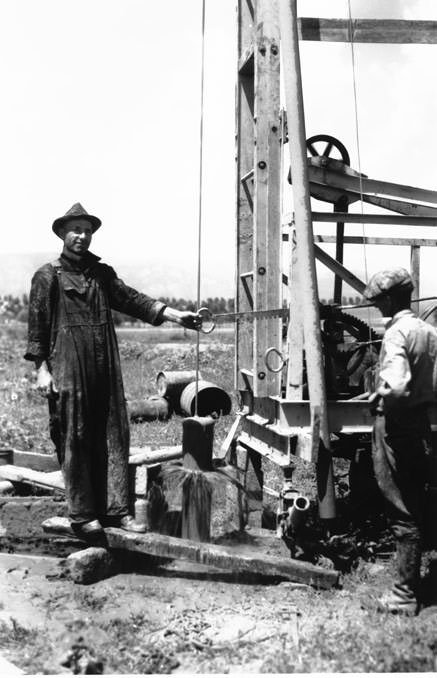
Tim Holbrook, operations manager for Industrial Facilities Engineering, Inc. and lead engineer on the water project, updated the council on how the project was progressing. “The USDA requirements are now met to the point we can have a pre-construction meeting,” Holbrook said. “Then, the start of construction can begin.” The pre-construction meeting will be held at 2 p.m. Wednesday, Nov. 16, with representatives from the town, IFE, the U.S. Department of Agriculture and approved contractors. It’s possible the ground-breaking on the project could be done that day, as well, according to Town Administrator Bill Rogers.

The town’s loan closing with the USDA is expected to be completed by mail around Nov. 23, according to Town Attorney Sam Light.

Holbrook said it will take at least eight months to build the water project. During that time, IFE resident inspector Mike Miller will be on site constantly, which was something required by the USDA…

The council took two votes related to the water project. The first approved a revised resolution reaffirming the town’s issuance of water revenue bonds for a little more than $3.3 million…

The second vote approved the amended budget for the water project. The change in the budget came from the town contribution rising from $121,000 to $351,002. But that was money the town has already spent on the project, Light said, not new money being approved. The council also approved awarding bids to four contractors for different parts of the water project construction. The bid awards would have to be followed up with contracts, but those contracts can’t be formalized until the loan has closed and the town has the money to pay out to the companies, according to Light…

The council awarded a bid for supply wells and pumps construction to Layne Construction Co. A bid for augmentation ponds construction was awarded to Connell Resources, Inc. Velocity Constructors, Inc. received the bid award for construction of the water treatment building. And the council awarded a bid for water pipeline construction to Reynolds, Inc.

More Wiggins coverage here and here.

U.S. Representative Scott Tipton says that proposed USFS permit conditions will result in an unlawful taking of property (water) rights

sanjuan.jpg

From The Pueblo Chieftain (Chris Woodka):

Tipton said the requirement could affect water rights held by ski areas and ranchers, in particular. “Water rights established under state law are property rights for purposes of the Fifth Amendment to the U.S. Constitution. Congress has not delegated to the Forest Service the authority to require permittees to transfer ownership of water rights to the United States as a permit condition,” Tipton wrote in a letter to Agriculture Secretary Tom Vilsack…

Tipton says the forest service does not have the authority to use permitting conditions to obtain federal ownership of water rights without just compensation and said the permit condition amounts to unlawfully taking property that violates Colorado water law.

More coverage from Reid Wright writing for The Durango Herald. From the article:

“Because of the significant percentage of water that originates on national forest system lands in the West, such a change in policy would pose a threat to the current system of state allocation and administration of water rights,” Tipton wrote. “Our concern was that our ranchers need some of those water rights for watering holes and grazing,” Tipton said in a telephone interview, adding that secured water rights also are necessary for ski areas and recreation. Tipton said he was particularly concerned about the requirement in regard to water sources that originate off permit areas as well as water rights that predate the existence of the U.S. Forest Service.

Steve Segin, a public information officer for the Forest Service, said the requirement is designed to keep the water resource tied to the intended area so it cannot be sold and piped off to other areas. “It’s designed to protect the resource, not to take it away from anybody,” he said…

The issue is scheduled to be discussed by the House Subcommittee on National Parks, Forests and Public Lands at 10 a.m. Tuesday.

More water law coverage here.

Fountain Creek: The federal appeals court in Denver refuses to grant a rehearing for Pueblo DA’s lawsuit over Springs’ sewage spills

fountaincreekthrucoloradospringsfromdippity.jpg

From The Pueblo Chieftain (Robert Boczkiewicz):

In a petition for rehearing, Thiebaut’s attorneys listed several reasons why he thought the decision was wrong. Judges of the Denver-based appeals court were not persuaded and last week denied the petition. In accord with their standard practice, they gave no reason in their three-sentence order. Thiebaut wanted to have October’s decision overturned on rehearing so he could revive a 2005 lawsuit he filed against Colorado Springs. It alleged the city violated the Clean Water Act numerous times from at least 1998 by discharging raw sewage, nonpotable water and excessive chlorine into the creek.

More Fountain Creek coverage here and here.

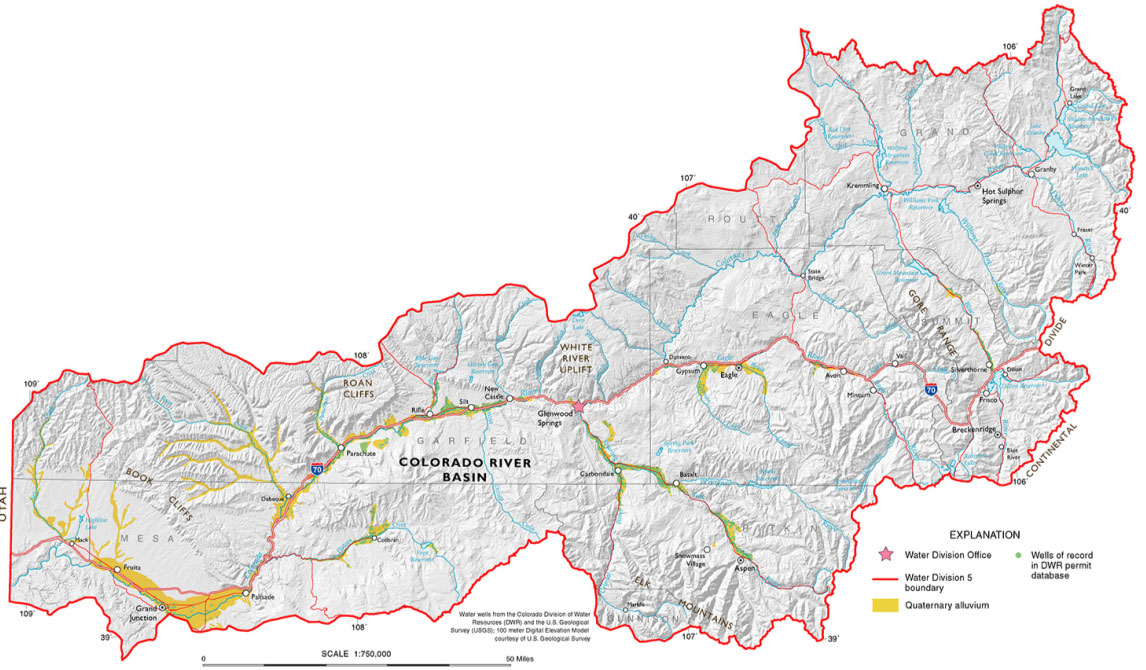
CWCB: Colorado River Water Availability Study mapping tool should be ready at the end of December

coloradoriverbasincgs.jpg

From email from the Colorado Water Conservation Board (Ray Alvarado):

The CWCB has been demonstrating a prototype of presenting StateMod modeling results as part of CRWAS…The final version will be available, along with all data results at the end of December.

Here’s a report about the prototype demonstration at last week’s Arkansas Basin Roundtable meeting, from Chris Woodka writing for The Pueblo Chieftain. From the article:

The interactive map also lets users know what kinds of data are available at any of 2,200 points throughout the watershed, said Ray Alvarado, of the CWCB staff. He demonstrated a model for the Arkansas Basin Roundtable last week. “Using the historical data, it can give you scenarios out to 2040 or 2070,” he said.

The information is important to water users in the Arkansas River basin who rely on imports of water from across the Continental Divide. Each year, about 130,000 acre-feet of water is imported to supplement municipal and agricultural supplies in the Arkansas River basin…

The model allows predicted changes in climate to be applied to historic river operations for similar years to understand how much water might be available, Alvarado said. The problem is that the climate models show a wide range of results, particularly as precipitation levels increase. While most of the climate models agree that temperatures will rise and snowpack will decrease over the next 50 years, they are uncertain about the additional amount of precipitation from rainfall and how a longer growing season would affect natural water consumption.

“I see this as working with the portfolio tool,” Alvarado said, referring to the Interbasin Compact Committee’s attempt to understand how supply projects, conservation and alternative agricultural transfers can work together to meet urban water needs.

More Colorado River basin coverage here.

IEA: ‘Without a bold change of policy direction, the world will lock itself into an insecure, inefficient and high-carbon energy system’

coalfiredpowerplant.jpg

More from the release:

…”Growth, prosperity and rising population will inevitably push up energy needs over the coming decades. But we cannot continue to rely on insecure and environmentally unsustainable uses of energy,” said IEA Executive Director Maria van der Hoeven. “Governments need to introduce stronger measures to drive investment in efficient and low-carbon technologies. The Fukushima nuclear accident, the turmoil in parts of the Middle East and North Africa and a sharp rebound in energy demand in 2010 which pushed CO2 emissions to a record high, highlight the urgency and the scale of the challenge.”

In the WEO’s central New Policies Scenario, which assumes that recent government commitments are implemented in a cautious manner, primary energy demand increases by one-third between 2010 and 2035, with 90% of the growth in non-OECD economies. China consolidates its position as the world’s largest energy consumer: it consumes nearly 70% more energy than the United States by 2035, even though, by then, per capita demand in China is still less than half the level in the United States. The share of fossil fuels in global primary energy consumption falls from around 81% today to 75% in 2035. Renewables increase from 13% of the mix today to 18% in 2035; the growth in renewables is underpinned by subsidies that rise from $64 billion in 2010 to $250 billion in 2035, support that in some cases cannot be taken for granted in this age of fiscal austerity. By contrast, subsidies for fossil fuels amounted to $409 billion in 2010.

More coverage from James Herron writing for The Wall Street Journal. From the article:

To prevent long-term average global temperatures rising more than two degrees Celsius (3.6 degrees Fahrenheit) above preindustrial levels—seen as the maximum possible increase without serious climate disruption—immediate, drastic changes to energy and industrial policies are needed, the IEA said in its World Energy Outlook.

Such a shift looks unlikely given current global economic problems and the move away from low-carbon nuclear power in some countries after the recent nuclear disaster in Japan, the IEA said. Promises to invest to curb carbon dioxide emissions have in many cases failed to acquire legislative urgency.

Meanwhile, Science Daily reports that 99.5% of conservation scientists that participated in a recent survey are concerned about the imminent massive decrease of species biodiversity on the horizon. From the article:

“As with climate change the large level of investment needed if loss of biodiversity is to be stopped will result in an increase of public and political scrutiny of conservation science,” said study author Dr. Murray Rudd from the Environment Department at the University of York. “That makes it important to show how much scientific consensus there is for both the problems and possible solutions.”

583 individuals who had published papers in 19 international journals took part in Dr Rudd’s survey via email. The survey sought to gather opinions on the expected geographic scope of declining biological diversity before posing 16 questions to rank levels of agreement with statements that explored authors’ values, priorities, and geographic affiliation and their support of potential management actions.

“The survey posed the key questions facing conservation science: why people care, how priorities should be set, where our efforts should be concentrated and what action we can take. Scientists were also asked about a range of potentially controversial statements about conservation strategies to gauge shifting opinions,” he said.

The results revealed that 99.5 per cent of responders felt that a serious loss of biological diversity is either ‘likely’, ‘very likely’, or ‘virtually certain’. Agreement that loss is ‘very likely’ or ‘virtually certain’ ranged from 72.8 per cent of authors based in Western Europe to 90.9% for those in Southeast Asia.

Tropical coral ecosystems were perceived as the most seriously affected by loss of biological diversity with 88.0 per cent of respondents who were familiar with that ecosystem type gauging that a serious loss is ‘very likely’ or ‘virtually certain’.

More climate change coverage here and here.

The Greenway Foundation scores $1.7 million from the Natural Resource Trustees of Colorado

southplattecanoe.jpg

Here’s the release from the Greenway Foundation:

The Natural Resource Trustees of Colorado recently announced that they have awarded $1.7 million in natural resource damage funds to The Greenway Foundation on behalf of the Overland Park Neighborhood Association to help restore water quality, habitat and riparian areas along a two-mile stretch of the South Platte River in south Denver.

The planned improvements will result in a vastly improved riparian and wildlife ecosystem corridor along this section of Denver’s South Platte River as well as create new boat launch sites, fishing platforms, nature trails, and enhanced access points to the River.

The award of the funds will be contingent on The Greenway Foundation procuring matching funds for its projects at Grant Frontier Park, Pasquinel’s Landing and Overland Park. The construction of the various improvements, planned in conjunction with Denver Parks and Recreation and Urban Drainage and Flood Control District, is expected to be initiated in 2013.

“The Greenway Foundation is honored to be the recipient of these funds,” said Jeff Shoemaker, Executive Director of The Greenway Foundation. “We are excited to move forward with the efforts to obtain the needed matching funds. This is just one of several collaborative efforts between the Foundation and the City of Denver to fund and construct the recommendations within this section of the River Vision Implementation Plan.”

“This really shows the strength and commitment of our dynamic community,” said Councilman Chris Nevitt, District 7. “The Overland neighbors tirelessly pursued this opportunity and the entire area will benefit from their efforts. The South Platte River Greenway serves as a recreational highway in our backyard, leading to miles of trails and parks in all directions. This funding will go a long way in continuing to make the Southern Platte Valley THE place to live, play and work.”

“One of the features that makes this project so attractive is the way it connects with a larger and still-expanding network of greenway and riparian trail corridors along the South Platte River and its tributaries,” said Mike King, executive director of the Colorado Department of Natural Resources. “This endeavor further leverages the great work of The Greenway Foundation and others over many years in linking Coloradans to the natural beauty right outside our doors.”

Colorado received $1.5 million when it settled its natural resource damages case against the Shattuck Chemical Company in 2002. Since that time, the money has earned nearly $200,000 in interest, bringing the total amount available for restoring natural resources near the Shattuck site to $1.7 million.

The Colorado Natural Resource Trustees are the Attorney General, the executive director of the Colorado Department of Public Health and Environment, and the executive director of the Colorado Department of Natural Resources or their designees. The trustees are responsible for litigation of the state’s natural resource damages claims under the Comprehensive Environmental Response, Compensation, and Liability Act (CERCLA or the Superfund law) and administering funds received from such litigation.

Cheyenne: The Rocky Mountain Farmers Union Annual Convention, November 18-19

cheyennewyoming1868fromlegendsofamerica.jpg

From email from the RMFU (Mick McAllister):

This year, the RMFU Annual Convention will be at Cheyenne Little America. The convention opens at 8 a.m. on Friday, November 18, and continues through Saturday afternoon when election results will be announced.

This year’s convention program features keynote speaker Bill Patrie, an internationally recognized leader on cooperative development, who will speak Friday morning on the convention theme, The Power of Cooperation. In keeping with the theme and in recognition of the approaching International Year of Cooperatives ~ 2012, RMFU will present its first Cooperative Achievement Award to James B. Dean, distinguished attorney and advocate for cooperative businesses.

Friday afternoon panels will address forming state Health CO-OPS in accordance with the Affordable HealthCare Act, producer strategies for direct marketing of local foods, conservation challenges in estate transition planning, and the successes and plans of the RMFU Foundation, home of the Cooperative Development Center, the Renewable Energy Center and the RMFU Education Center.

All events are open to registrants and the press.

Urban residents do not want future water supplies to be taken from agriculture, according to CSU study

longspeak.jpg

From The Greeley Tribune (Eric Brown) via Windsor Now!:

Referring to a study conducted by students and peers last year, [James Pritchett an] associate professor of agriculture and economics at Colorado State University told the crowd that taking water from farmers is the last thing residents of the Western United States want to do in efforts to secure their water futures. That survey was based on responses from 6,250 individuals with varying backgrounds and living across 12 states. During his “Irrigated Agriculture in the South Platte Valley in 2050” presentation Thursday at Randy’s All-American Grill, Pritchett said buying water from farmers finished far behind other water security alternatives, like constructing pipelines, requiring in-home conservation, limiting growth of cities, building reservoirs and reusing water in private homes and on private lawns and public landscapes. Municipalities have frequently bought agriculture land for water rights in efforts to meet their future needs, as Pritchett mentioned during his presentation…

That same study showed that people were also willing to also pay an extra monthly fee to fund efforts that would help keep water in agriculture, with respondents saying, on average, they’d pay $16 more per month for that cause. “I think that myself, and probably many others, always believed that people in cities were saying ‘go out and get more water for us and we don’t care how you get it,’ ” said Weld County Farmers Union president Ray Peterson. “It was good to hear that people are actually thinking about where their water is coming from.”

More South Platte River basin coverage here.

The Rocky Mountain Farmers Union is hosting a discussion of oil, gas, and water issues November 15 in Elizabeth

marcellushydraulicfracturing.jpg

From email from the RMFU:

The Elbert/Lincoln Farmers Union and FUSA Insurance agents Teri Coulter, Kyle Bradley, and Ian Kean invite interested public to participate in a discussion of the effect of oil and gas development on water rights and quality.

The gathering will be on Tuesday, November 15, at the Creekside Community Church, 36100 County Road 13 in Elizabeth. The meeting is scheduled for 6:30-8:30 p.m. Special guests will be Colorado Representative Marsha Looper and Jill and Jim Duvall, coordinators of the Elbert Oil and Gas Interest Group.

The meeting is open to the public.

More oil and gas coverage here and here.

2012 Colorado legislation: The State Legislature’s Water Resources Review Committee approved five bills and one resolution for committee sponsorship during the 2012 legislative session

crystalcreekreservoir.jpg

From the Colorado Water Congress’ current newsletter:

he Water Resources Review Committee approved five bills and one resolution for committee sponsorship during the 2012 legislative session. Bills are identified by letter until formal introduction after the session is convened January 11.

Bill A eliminates the requirement for drinking water treatment facilities to obtain a certificate of designation from local government as a solid waste site.

Bill B exempts water taken up by plants from calculation as part of a hardrock mine’s augmentation requirement.

Bill C extends until 2015 the requirement for replacement of stream depletion due to pumping from the Dawson aquifer and replacement for pumping from Denver basin aquifer only if necessary to compensate for depletions causing injury.

Bill D consolidates various funds within the Water Resources Division to provide for flexibility and efficiency in administration.

Bill E eliminates the three year waiting period to obtain replacement of a lost share certificates in mutual ditch company and allows a lienholder of a share certificate to request replacement.

Resolution A calls upon the legislature to avoid diverting severance tax revenues intended for water infrastructure to balance the state budget and to instead use the money for its statutorily intended purpose.

For a copy of the Interim Committee Bills click here.

Proposed bills on requirements for low-flow toilets, graywater re-use, and medication disposal failed to receive sufficient committee votes for interim committee sponsorship; however it is likely that those bills may be introduced by individual legislators once the session convenes.

More 2012 Colorado legislation coverage here.

The Woodmoor Water and Sanitation District October 17 board meeting — lots of questions about the JV Ranch purchase

denveraquifer.jpg

Here’s the link to the Q&A session at the meeting. Here’s an excerpt:

Why did the Board decide on revenue bonds instead of voter-approved general obligation bonds?

Through several meetings with the JV Ranch sellers, the District and the Sellers negotiated the terms and conditions of the contract. Throughout that process the District determined that the Sellers would not enter into a contract with Woodmoor if the sale was contingent on a general obligation bond vote. Ultimately, the Board has the authority to issue revenue bonds and set rates to repay those bonds. The Board, when presented the merits and value of the JV Ranch, decided to proceed with revenue bonds in order to finalize the purchase of this unique asset for the District.

What is the timeline and current cost estimates for delivery of the JV Ranch water?

Phase I of Woodmoor’s Renewable Water Plan is to acquire the renewable water asset. Until the District is ready to embark upon construction of the delivery infrastructure, the JV Ranch will continue to operate as a cattle ranch. It is critical for Woodmoor to own and control its renewable water rights, and acquiring senior renewable water rights has always been the Board and staff’s first priority.
After the District closes on the JV Ranch water rights and completes the necessary water court processes, the water rights will be available for the District to use. The District will continue to refine all available options for the infrastructure portion of its Renewable Water Plan. These options include pump stations, pipeline and water-treatment facilities. This infrastructure can be viewed as Phase II of our plan.

The District staff anticipates updates to the Long Range Planning documents in 2012 that will continue to explore and evaluate all options and alternatives available for delivering the JV Ranch water to our customers. Some of the alternatives to be evaluated will include continued discussions with neighboring water districts and entities including Colorado Springs Utilities (CSU) to share in the cost of water delivery, storage, and treatment facilities or the potential to utilize CSU infrastructure for water delivery instead of Woodmoor constructing the necessary infrastructure on its own.

Cost estimates for water delivery have ranged from $30 million to over $100 million. At this point, it would be premature to assign any further cost estimates to Phase II. Every option that is evaluated during current and future planning processes will have specific costs, benefits, and drawbacks. The Woodmoor staff will perform the same level of diligence for this planning as it did on the JV Ranch water rights to ensure that District customers are provided with the most cost effective and reliable option for its renewable water infrastructure. Current estimates for when Phase II would be needed indicate sometime between the years 2020 and 2030.

What happens if the water court does not approve the transfer of water from agricultural use to municipal use?

Changes of water rights have been denied by the water courts only if the applicant does not have actual end users for the water or if the water rights proposed to be changed have not been historically used for their decreed purposes. The District has end users for the water – its customers – and the District’s due diligence has confirmed that the JV Ranch water rights have historically been used for their decreed agricultural purposes. In addition, the historical use of the majority of the JV Ranch water rights has already been quantified in previous water court proceedings. Under these circumstances, it is not likely that the water court would completely disapprove the transfer of the water rights from agricultural use to municipal use. However, if that were to occur, the District would take the steps needed to remedy any deficiencies noted by the water court and then file another application to change the water rights.

What is the reliability and quality of the water from JV Ranch?

The JV Ranch water is diverted from Fountain Creek, south of Colorado Springs. The District and its water quality consultants have reviewed the water quality along Fountain Creek and have determined that treatment technology is available to treat this water to meet all State and Federal drinking water regulations.

More Denver Basin aquifer system coverage here and here.

The Larimer County Agricultural Advisory Board unanimously supports findings on the Northern Integrated Supply Project (NISP)

nisp2.jpg

From a release from the Northern Colorado Water Conservancy District (Brian Werner):

The Agricultural Advisory Board to the Larimer Board of County Commissioners has reported that the Northern Integrated Supply Project will not dry up farms in Northern Colorado as represented in the Save the Poudre’s “Farm Facts” report. The AAB’s general conclusion was that NISP will help slow down the rapid and accelerated dry up of farms throughout Northern Colorado.

In an October 26 memo to the Board of County Commissioners (see link to memo in Reporter-Herald story), the AAB said, “It’s better for agriculture for future municipal and domestic water supplies to come from the combination of conserved water and from new stored supplies (such as NISP) derived from available undeveloped water rather than from additional agricultural dry-up. Population growth will occur with or without NISP. Water conservation alone will not provide adequate future water supplies.”

The County Commissioners thanked the AAB for their input and study of NISP and it’s agricultural related impacts. As reported in the Loveland Reporter-Herald, Commissioner Steve Johnson said to the three board members who attended the elected board’s meeting, “You guys are the ones that are experts. You are the ones dealing with this every day. It’s not just debate. It’s your livelihood.”[…]

The AAB memo disputes the Save the Poudre claim that free river opportunities will be greatly diminished if NISP is built. “Currently, this undeveloped water is leaving Colorado without being beneficially used within the state … water for NISP will not be diverted unless and until all water rights senior to NISP have been fully satisfied,” the AAB report said. The report added “Glade will not curtail in any way the rights or the abilities of ditch companies to fully utilize their senior ditch water rights…”

Save the Poudre’s “Farm Facts” were also disputed by Alamosa rancher and Colorado Farm Bureau President Don Shawcroft last April. In a press release Shawcroft said, “Save the Poudre does not speak for Colorado agriculture, an industry forthright and vocal in its support for NISP. Colorado farmers and ranchers support the NISP project. If we support the development of a water project, you can bet it will help keep irrigated farmers on the land.”

More Northern Integrated Supply Project coverage here and here.

‘Source to Fontenelle’ is the title of Will and Zak’s first video chronicling their journey from ‘Source to Sea’

willstauffernorriszakpodmoreuppergreenriverwyoctober2011.jpg

Update: I just realized that I didn’t include the link to the video in yesterday’s post.

“For some reason we’re starting this in October,” (Will or Zak) says, standing down valley from the headwaters of the Green River. The video shows some of the country and critters they’ve passed by in the first leg to Fontenelle Reservoir.

You can follow Will and Zak down the river on their blog source to sea down the colorado river: following the river from wyoming to mexico.

Their journey is in conjunction with Colorado College’s State of the Rockies Project. The theme this year is The Colorado River Basin: Agenda for Use, Restoration, and Sustainability for the Next Generation. Student and faculty research revolves around the entire basin, environmental assessment, climate change, water law and interstate compacts, supply, distribution and historical Native American claims.

The next Speakers Series get-together is December 5 where Beth Conover will moderate a panel of environmental experts — working throughout the Colorado River Basin — in a discussion of Environmental Perspectives and Actions.

Here’s the link to a short video of October’s event featuring Justice Gregory Hobbs and University of Wyoming professor Larry MacDonnell.

More Colorado River basin coverage here.

WaterSMART Title XVI Water Reclamation and Reuse Program Construction Grant Funding Opportunity Now Available

prairiewaterstreatment.jpg

Here’s the release from the U.S. Bureau of Reclamation (Peter Soeth):

A Title XVI Water Reclamation and Reuse Program grant funding opportunity is now available through WaterSMART. The Bureau of Reclamation is seeking sponsors of congressionally authorized Title XVI projects to request cost-shared funding for the planning, design or construction of those projects. The funding opportunity announcement is available at http://www.grants.gov using funding opportunity number R12SF80050.
In response to feedback received, Reclamation has updated the application process to ask project sponsors to describe the benefits of the entire authorized project and to communicate funding needs for the next two years.

Through the Title XVI Water Reclamation and Reuse Program, a water reuse project reclaims and reuses municipal, industrial, domestic or agricultural wastewater and naturally impaired ground or surface waters. Reclaimed water can be used for a variety of purposes, such as environmental restoration, fish and wildlife, groundwater recharge, municipal, domestic, industrial, agricultural, power generation or recreation. Water reuse is an essential tool in stretching the limited water supplies.

In 2011, Reclamation funded 12 projects for $20.1 million through the Title XVI Program.

The WaterSMART Program focuses on improving water conservation, sustainability and helping water resource managers make sound decisions about water use. It identifies strategies to ensure that this and future generations will have sufficient supplies of clean water for drinking, economic activities, recreation and ecosystem health. The program also identifies adaptive measures to address climate change and its impact on future water demands.

Proposals must be submitted as indicated on http://www.grants.gov by January 17, 2012, 4:00 p.m. Mountain Standard Time. It is anticipated that awards will be made this spring.

More reuse coverage here.

A collection of starlings is called a murmuration

murmurationireland2011.jpg

This video posted to Vimeo by Sophie Windsor Clive has gone viral across the Internet. It captures a murmuration — a collection of starlings in flight. Click through and watch it.

The Culebra Range Community Coalition, et al., are working on a protection plan for the Purgatoire River watershed

purgatoireriver.jpg

From The Trinidad Times (Steve Block):

The Culebra Range Community Coalition brought together Colorado Watershed Assembly officials and representatives of environmental engineering consulting firm Tetra Tech at Trinidad State Junior College. Tom Perry, executive director of the coalition, said the group hopes to deepen stakeholders’ involvement in protecting the watershed. In a [November 4] phone call, Perry talked about working more closely with the members of Trout Unlimited, the Purgatoire River Watershed Coalition, the Trinidad Community Foundation and other local partners to make the watershed as healthy as possible…

Some key findings from the initial monitoring season showed water quality protects the Purgatoire River for such beneficial uses as agricultural irrigation, livestock and wildlife watering. Clean water also benefits aquatic life and municipal water systems.

Monthly data is collected at 27 sites along the Purgatoire and its tributaries upstream of Trinidad Lake. Streamflow and water quality data are communicated in near real-time using satellite telemetry from nine of the sites’ monitors and can be viewed at purgatoirewatershed.org, a potential resource to better understand surface water quality influence for ranchers, farmers and recreation industry employees.

More Purgatoire River watershed coverage here and here.

La Niña conditions strengthen across the east-central equatorial Pacific Ocean, but the models favor a weak-to-moderate strength La Niña during the Northern Hemisphere winter

sstanomaliesenso11021011.jpg

Here’s the latest discussion from the Climate Prediction Center. Click through for the cool graphics. Here’s an excerpt:

A majority of the models now predict La Niña to continue through the Northern Hemisphere winter (Fig. 6) and then gradually weaken after peaking during the November – January period. The models are roughly split between those that predict La Niña to remain weak (3-month average in the Nino-3.4 region less than -0.9°C) and those that predict a stronger episode. Over the last half-century, La Niña events that were preceded by ENSO-neutral conditions during the Northern Hemisphere summer (May-August) were less likely to attain strong amplitude (less than –1.5°C) the following winter. This observation, in combination with the model forecasts, favors a weak-to-moderate strength La Niña during the Northern Hemisphere winter.

During November 2011-January 2012, there is an increased chance of above-average temperatures across the south-central U.S. with the odds favoring below-average temperatures over the north-central U.S. Also, above-average precipitation is favored across the northern tier of states, excluding New England, and drier-than-average conditions are more probable across the southern tier of the U.S. (see 3-month seasonal outlook released on 20 October 2011).

Meanwhile it’s was warmer than normal in October across most of the U.S., according to Bob Berwyn writing for the Summit County Citizens Voice. From the article:

Eighteen states reported monthly temperatures readings above their long-term averages, while 11 states reported readings below the monthly average. In the Pacific Northwest , in the central and southern plains, and parts of the Midwest reported near average temperatures for October. Most of the states with below average readings were in the Southeast, which was the coolest region for the month, according to the monthly report from the National Climatic Data Center.

For the August-October period, readings across the U.S. were well above the historic average, ranking as the 10th warmest such period on record, especially across the West, where 10 states reported near-record readings…

As of Nov. 1, about 9 percent of the country was categorized as being in exceptional drought, with some improvement across the southern plains, which recorded near-normal precipitation for the month.

‘Forest to Faucet’ partnership may serve as a funding model for watershed restoration

haymanburnarea.jpg

Here’s an interview with Harris Sherman from Catharine Tsai writing for the Associated Press via The Denver Post. From the article:

The Forest Service in past years has persuaded Vail Resorts Inc. and other companies, along with Denver Water and other utilities, to commit dollars and employees to restore watersheds that provide much of Colorado’s drinking water. “As state governments and the national government have budgetary problems, we have to be much more focused on how we spend our money,” said U.S. Agriculture Undersecretary Harris Sherman. “We have to reach out and develop new partnerships and foster collaboration.”[…]

The agency has reached out to the recreation industry and private companies to contribute. Vail Resorts Inc. and MillerCoors have had employees work on restoration projects. More than 20 ski areas have asked customers to pay a lift-ticket surcharge that benefits the National Forest Foundation, the congressionally created nonprofit partner of the Forest Service. In an era of tight budgets, Sherman said, the Forest Service also is talking with utilities and insurance companies, which have an interest in preventing devastating wildfires that could damage power lines or homes.

Sherman’s comments came the same day the Forest Service launched interactive “Forests to Faucets” maps [ed. Microsoft only technology] that show important water resources nationwide, how they overlap with forests, and threats to those resources from development, fire, disease and pests like bark beetles. The idea is to provide data for cities to prioritize spending on water resources.

Find the time today to thank a veteran for their service

vietnammemorial.jpg

And while you’re at it, think about what you can do to get the congress to take care of these men and women properly when they finally get to come home.

Yesterday’s jobs vote in the Senate (94-1) may help.

The Dolores Water Conservancy district reaches the half-century mark November 20

mcpheereservoiroverlook.jpg

Here’s a report from Shannon Livick writing for the Cortez Journal. Click through for the photos of construction of the tunnel that brings water from the Dolores River watershed into Montezuma and Dolores counties in the San Juan basin. Here’s an excerpt:

The Dolores Water Conservancy District will host a 50th anniversary of the formation of the district and the 25th anniversary of water deliveries to farms and towns from McPhee Reservoir at the Dolores Community Center with a barbecue dinner at noon, followed by a brief recognition ceremony.

The star of the show will be McPhee Reservoir, a project that some say was more than 100 years in the making. “They have been talking about the McPhee dam site since the 1900s,” said Mike Preston, general manager of the Dolores Water Conservancy District. It has been said that the McPhee Reservoir site was seen as so ideal for a reservoir that President Teddy Roosevelt chose the site for the dam in 1906 during a hunting trip here.

“The Dolores Water Conservancy District was formed to try to get the dam built,” Preston said. The project was authorized in 1968 and the project began in 1977, after voters in Montezuma and Dolores counties within the Dolores Water Conservancy District approved a repayment contract by a unheard of 95 percent favorable vote. The McPhee Dam project cost an estimated $403 million…

The project doubled the amount of irrigated acreage in the area and gives the towns a 100-year supply of water. “This water project is something most communities would die for,” Preston said.

Since the water started to be delivered 25 years ago, the number of irrigated acres in Montezuma and Dolores counties has gone up from 35,000 irrigated acres to 70,000, some of those as far away as south of Towaoc…

The $403 million project also saw the construction of the $11.6 million Dolores tunnel that was dug underneath the landscape for more than one mile. It also saw the construction of pumping plants, numerous canals and two major recreation areas named McPhee and House Creek. It also saw the flooding of the old lumber town, McPhee, and countless archaeology sites, bringing in archaeologists from around the world who excavated the areas. Those artifacts are housed in the Anasazi Heritage Center, also built as part of this project.

More coverage from Reid Wright writing for the Cortez Journal. From the article:

According to information from the Dolores Water Conservancy District, an average of 351,000 acre feet of water flows into the McPhee Reservoir annually. Not including spring spillover, an average of 31,798 acre feet of water is released down the Lower Dolores River.

With a storage capacity of 381,000 acre feet of water, the project essentially doubled the amount of irrigated land in the area and extended the irrigation season for most farmers by nearly three months to mid October — allowing farmers to produce substantially more.

With current crop values, Mike Preston, DWCD general manager, estimates Dolores Project lands will generate $20 million in income for the area this year.

More coverage from Kimberly Benedict writing for the Cortez Journal. From the article:

Beyond the obvious recreation benefits of the reservoir, the Dolores Project also provided recreation opportunities through the creation of Joe Rowell Park in Dolores and enhanced flows on the Lower Dolores River, below the McPhee dam.

“The other thing that McPhee provided, is a means of managing the flows below the reservoir,” said Dolores Water Conservation District General Manager Mike Preston. “Usually we were in drought early and the flows would trail off. But now, those flows are managed to provide rafting flows in and around Memorial Day and so on. It gave us the ability to manage recreation opportunities in regards to recreational boating.”

The flows from the reservoir into the Lower Dolores also provide additional fishing opportunities, particularly for those interested in fly fishing.

Additionally, the presence of the reservoir has benefited wildlife. Three native fish species call the Lower Dolores home, including the flannelmouth sucker, the bluehead sucker and the roundtail chub. All three benefit from the managed flows from the reservoir, according to a report from the Lower Dolores Working Group. And according to the bureau of reclamation’s website, land acquired and managed for wildlife conservation has provided habitat for a variety of wildlife species.

More coverage from Kimberly Benedict writing for the Cortez Journal. From the article:

“The Anasazi Heritage Center was built by the (U.S.) Bureau of Reclamation as a repository for the artifacts gathered during the DAP,” said center Manager Marietta Eaton. “The Heritage Center is here because of the DAP, and that in and of itself is full of ramifications for the area.”

The Heritage Center’s creation was a unique aspect of the Dolores Archaeological Program. Most archaeological programs see collected artifacts shipped to larger repositories, often far from the actual sites. The creation of a local repository allowed the local community to retain a sense of ownership of their history.

“The fact that the Bureau of Reclamation saw the importance of a local repository is significant,” said Tracy Murphy, assistant curator at the center. “With the presence of the center, the artifacts and research are here for the people of this area.”

More coverage from Dale Shrull writing for the Cortez Journal. From the article:

Finding a good water storage solution for Montezuma County was discussed as far back as the 1880s. Today, looking at the massive McPhee Reservoir, it’s impossible to comprehend a lack of water. But [John Porter] remembers. The 78-year-old Lewis native spent 23 years as the Dolores Water Conservancy general manager, retiring in 2002. “Everyone was looking for more water but there was never enough,” he says. “Every time there was a drought, all people would talk about was we need a dependable supply of water…

Even though a dam on the Dolores was thought to be the solution, Porter wasn’t surprised it took so long to complete. “Anything you do with water, it takes time. There’s regular time and there’s water time. Water time goes very slow,” he says…

As early as 1884, plans were made and projects developed to take water from the Dolores, Porter explains. A tunnel was bored and canals were used to get water to the south, while the Great Cut Dike and canals were developed to flow water to the west. And they sucked the river nearly dry. “Back then, the Dolores River was basically a dry river during the summer,” Porter says. To store water in the early days, three small reservoirs were dug: Groundhog, Totten and Narraguinnep…

Remnants of old wooden flumes, which were used to transport water around the region, can still be spotted around the area. Most of the Montezuma Valley Irrigation Company canal system are still used today, Porter says…

Porter says he thinks the water rights of the Ute Mountain tribe helped save the project. The tribe needed water and made the argument that future development was dependent on water from the Dolores Project.

More McPhee Reservoir coverage here and here.

After a five year review the EPA has approved the remediation plan for the Standard Mine superfund site

faultveinstandardminegunnisoncounty.jpg

From The Crested Butte News (Alissa Johnson):

The two-phase plan would control the flow of water through the mine to reduce contamination, and if needed, use passive water treatment to further treat runoff.

The record of decision, signed in September, has the support of the local nonprofit Standard Mine Technical Advisory Group but still needs to be selected for federal funding. It could take until 2013 before the plan is implemented, complementing remediation work already done from 2007 through 2009.

The Standard Mine, which is about five miles west of Crested Butte and drains into Elk Creek, was added to the National Priority List in 2005 because of elevated levels of metals in the soil and the creek. Elk Creek flows into Coal Creek, which is the site of the municipal water intake for Crested Butte.

“We were really fortunate that when the EPA first came in 2006, they had the funding to do some surface cleanup first,” said Anthony Poponi, executive director of Coal Creek Watershed Coalition and grant administrator for the advisory group. That work included building a repository for mine tailings that included waste rock and tailings rich in pyrite, a metal that creates acid mine drainage when exposed to air. After removing waste rock and tailings from Elk Creek, the EPA also reconfigured the creek.

“The miners had produced a creek channel around and through the mill site, which was not the natural orientation, so once we took the tailings out, we dropped the creek back to its natural alignment,” explained EPA superfund project manager Christina Progess. That alignment includes small wetlands and riparian areas and has led to a measureable reduction in metals in Coal Creek and Elk Creek…

“There are three connected mine levels,” said Poponi, “and the EPA knew water coming in at the highest level was in pretty good condition and by the time it came out at level 1 [at the bottom] it was really bad, so they did some investigations and what they came up with was the proposed plan.” The first phase of the remediation plan proposes filling the entrance at level 3, toward the top of the mine, with a flowable fill and foam. That fill, a concrete mixture, would seal off the entrance to the mine so that clean water could be prevented from entering mine workings and would reduce the amount of water coming out of level 1…

A flowthrough bulkhead would be installed at level 1 to control the water flowing out of the bottom of the mine. The bulkhead would allow for what Progess calls the “metered release” of water from the mine…

Residents interested in learning more about the plan are invited to attend an EPA-hosted community meeting on November 30, at 1 p.m. in Town Hall.

More Standard Mine coverage here and here.

West Elk Mine environmental impact statement affirmed by U.S. District Court

westelkminecoloradodivisionofmineralsandgeology.jpg

From the Delta County Independent:

The lawsuit, filed over a 2008 decision, alleged that the Forest Service failed to analyze alternatives that would mitigate the effects of methane, a greenhouse gas that is released from the mine into the atmosphere to meet Mine Safety Health Administration requirements. WildEarth Guardians claimed that the Forest Service analysis, as required by the National Environmental Policy Act (NEPA), for flaring of methane and capture of methane was insufficient. The plaintiffs also challenged the agency’s evaluation of the effects of methane on global warming.

After a thorough review of the documents associated with this case and hearing the arguments of the parties, the judge found that the Forest Service had satisfied its legal obligations under NEPA in analyzing the environmental effects of this project.

Forest supervisor Charlie Richmond stated, “We are always pleased when a federal judge rules in our favor, especially on such an important case that helps to preserve the economic future of the area.

More coal coverage here.

The EPA green-lights the tailings pond at the proposed Piñon Ridge uranium mill in the Dolores River watershed

doloresrivercanyon.jpg

From The Durango Telegraph (Missy Votel/Tracy Chamberlin):

The Environmental Protection Agency has issued a conditional permit for a tailings pond at the proposed Piñon Ridge uranium mill in Paradox Valley. The approval comes on the heels of a federal court ruling that ordered environmental impact statements for uranium mines throughout the West. The conditional approval requires Vancouver-based Energy Fuels Inc. to submit a comprehensive ground and surface water-monitoring plan, subject to additional EPA review and approval.

Area environmental groups, which oppose the mill, expressed doubt over whether Energy Fuels’ plans will pass muster. “Our concern with the 40-acre tailings impoundment and 30-acre evaporation pond at the Piñon Ridge Mill continues to be a great risk to the Dolores River and ground water in Paradox Valley,” said Hilary White, executive director of Sheep Mountain Alliance. “Energy Fuels still has not submitted final, detailed construction plans for the tailings ponds to any agency and hasn’t demonstrated that they can prevent leaks and radioactive, toxic chemical and heavy metal contamination of the watershed.”[…]

The EPA’s approval came a week after a federal judge ordered an environmental impact statement on many of the leased mines expected to supply Piñon Ridge. Energy Fuels must still obtain air emissions and groundwater permits from the Colorado Department of Public Health and Environment.

More nuclear coverage here and here.

The Environmental Protection Agency has released an outline of planned review of hydraulic fracturing

marcellushydraulicfracturing.jpg

From the Associated Press (Michael Rubinkam) via The Durango Herald:

Investigators will try to determine the impact of large-scale water withdrawals, above-ground spills of drilling fluids and the fracturing process itself on water quality and quantity in Colorado and other states where tens of thousands of wells have been drilled in recent years…

The industry has long contended that fracking is safe, but environmentalists and some residents who live near drilling sites say it has poisoned groundwater. The EPA study, mandated by Congress last year, is the agency’s first look at the impact of fracking in shale deposits. EPA will examine drilling sites in Colorado, Pennsylvania, Louisiana, North Dakota and Texas. The earliest results will be available in 2012…

“The industry has taken the lead in working with state regulators to constantly improve operations, industry practices and guidelines as well as improve communications with local communities,” said Stephanie Meadows, a senior policy adviser at the American Petroleum Institute…

The new EPA study will look at the entire water life cycle of hydraulic fracturing in shale deposits, beginning with the industry’s withdrawal of huge volumes of water from rivers and streams and ending with the treatment and disposal of the tainted wastewater that comes back out of the wells after fracking. Researchers will also study well design and the impact of surface spills of fracking fluids on groundwater.

The EPA has taken steps recently to boost federal regulation of fracking, announcing it will develop national standards for the disposal of the briny, chemical-laced wastewater and proposing for the first time to control air pollution at oil and gas wells, particularly where fracking is used.

More oil and gas coverage here and here.

Cotter Corp hopes to sell uranium that is being collected from groundwater sump pumps at the Schwartzwalder Mine

schwartzwalderminelocationmap.jpg

From The Denver Post (Bruce Finley):

The uranium west of Denver “is not as concentrated as yellowcake” but “is considered source material for licensing purposes,” Cotter vice president John Hamrick said, estimating the value at around $50 a pound. Cotter would like to sell the uranium, Hamrick said. He said the uranium poses little risk. For anybody trying to obtain uranium illegally, “there would be easier low- hanging fruit than us,” he said.

The uranium was collected from tainted groundwater by 10 sump pumps Cotter installed along Ralston Creek, below the mine. The uranium and other captured contaminants are removed before water is pumped into the creek, which flows into a Denver drinking-water-supply reservoir for 1.3 million metro residents.

In an Oct. 11 letter to the Colorado Department of Natural Resources, Cotter officials said 1,440 pounds of uranium had been removed as of Sept. 16 and was stored at the mine. They also disclosed “elevated concentrations of uranium in alluvial groundwater near the Old Emergency Discharge Pond” near the mine.

State mining regulators ordered Cotter to pump out and treat contaminated water in the mine shaft. Cotter challenged the state orders, and Denver District Court Judge Robert Hyatt recently ruled in favor of the state. Cotter officials now contend they can clean Ralston Creek simply by relying on their newly expanded pumping system. “Cotter has utilized intensive monitoring efforts and data evaluations to aggressively develop and implement measures to expand capture/treatment of alluvial groundwater in order to improve water quality in Ralston Creek as soon as possible,” the company’s letter said. The sump system has been effective, “significantly increasing capture and generally reducing levels in the creek.”

The system relies on an ion-exchange process using resin beads that the uranium gloms onto to remove it from water. Cotter switches out the loaded resin beads and uses the tanks the resin arrives in to store extracted uranium.

More nuclear coverage here and here

The Pueblo Board of Water Works drops proposed 2012 water rate increase to 3.5% due to a reduction in anticipated electrical costs

waterfromtap.jpg

From The Pueblo Chieftain (Chris Woodka):

Even though there still are a lot of floating pieces in the puzzle, the water board directed staff to prepare a budget that would increase rates 3.5 percent, rather than the 5 percent anticipated last month. As recently as September, the water board had looked at an 8 to 9 percent increase, but made internal budget adjustments to hold the rates lower. A public hearing on the budget and rate hikes will be at 2 p.m. Nov. 22 at the water board’s offices, 319 W. Fourth St.

“This has been a challenging year not only because of the economy, but because of the Black Hills Energy increases,” Executive Director Alan Hamel told the board at a workshop Thursday. “We’ve been an intervenor in several Black Hills rate increases.”

To save costs, the water board teamed up with the Fountain Valley Authority and city of Pueblo to intervene in rate cases.

“We want dependable electric service,” Hamel said. “We are trying to spread the impact over more years, so we don’t get more rate shock.”

More Pueblo Board of Water Works coverage here.

Colorado Water Trust: Heavy lifting is complete at the CCC Ditch Project Site

cccditchprojectsitesanmiguelrivercoloradowatertrust.jpg

Here’s the announcement from the Colorado Water Trust:

From inception to coalition building to planning to fundraising to materials harvest to construction, this project has been over ten years in the making. This project could not have occurred without the cooperation, patience, and stick-to-it-iveness of myriad stakeholders.

FlyWater, inc., our contractor for the project, worked in the San Miguel River through the month of October to recreate and reconnect the river bed. The last piece of heavy equipment rolled out of the river last week as the major construction phase came to a close. The San Miguel River now runs over the CCC diversion dam and down through the constructed “modified Newbury riffle,” re-wetting approximately 1500 feet of riverbed.

The stretch of river below the CCC diversion dam has been dry during periods of low river flow—when river flows were at or below 150 cfs—for the forty years since the CCC diversion dam was built. In mid- and late-summer, for example, the entire flow of the river would be diverted by the CCC diversion dam through the CCC Ditch. River water in excess of the decreed water rights would be returned to the riverbed 1500 feet downstream of the ditch headgate. This arrangement de-watered only 1500 feet of riverbed, but it completely severed the river ecosystem, preventing fish passage through that dry stretch. Now, fish populations are expected to thrive in their restored riparian ecosystem.

And best of all, this physical solution not only benefits the riparian ecosystem, fish populations, and recreationists, but it also does so without compromising a single drop of water that has historically been delivered to water users under the CCC Ditch. As this project comes to a close and the stakeholders celebrate their shared successes, we are delighted by the fact that everyone, fish included, can win when smart water projects are brought to fruition.

Check out pictures from CWT’s October 21st site visit.

More coverage from the Norwood Post (Ellen Metrick):

The stretch of river below the CCC diversion dam has been dry during periods of low river flow — when river flows were at or below 150 cubic feet per second (cfs) — for the 40 years since the CCC diversion dam was built. In mid- and late-summer, the entire flow of the river has been diverted by the diversion dam through the CCC Ditch.

Any water diverted that exceeded the decreed water rights would be returned to the riverbed 1500 feet downstream of the ditch headgate, an arrangement which completely severed the river ecosystem, preventing water and fish passage in that 1500 feet of river.

FlyWater, inc. — the contractor for the project — worked in the San Miguel River through the month of October to re-create and reconnect the river bed. The last piece of heavy equipment rolled out of the river last week as the major construction phase came to a close.

More San Miguel watershed coverage here and here.