The Bureau of Reclamation commits $413,000 for a study of the Republican River Basin

republicanriverbasinbydistrict.jpg

Here’s and excerpt from the release from the Bureau of Reclamation (Adam Fetcher/Dan DuBray):

Secretary of the Interior Ken Salazar announced today that Interior’s Bureau of Reclamation is providing $2.4 million in funding for comprehensive water studies in California, Colorado, Kansas, Nebraska, New Mexico and Oklahoma…

Republican River Basin Study (Colorado, Kansas and Nebraska) Federal Funding: $413,000; Non-Federal Funding: $435,000

The Republican River flows from its headwaters in Colorado into northwest Kansas, through southern Nebraska and back into north-central Kansas. It drains approximately 23,300 square miles of these three states and supplies water for municipalities, industries, surface and ground water irrigation, recreation and wildlife. The basin is subject to an interstate compact that was ratified in 1943. The three states have proposed a collaborative basin study that will cover the entire basin down to the Clay Center stream-gauging station in northeast Kansas. The study will identify mitigation and adaptation strategies that address the impacts of climate change on water resources in the basin.

Thanks to the Lincoln Journal Star for the heads up.

More coverage from Chris Woodka writing for The Pueblo Chieftain. From the article:

In recent years, irrigation in the Colorado portion of the basin has been curtailed to meet conditions of the 1943 Republican River interstate compact. Among other measures, Bonny Reservoir north of Burlington had to be drained to provide water to downstream states. The study will identify mitigation and adaptation strategies that address the impacts of climate change on water resources in the basin.

More Republican River basin coverage here and here.

NRCS Announces Sign-up Period for Wetlands Reserve Program Deadline for Applications is March 30, 2012

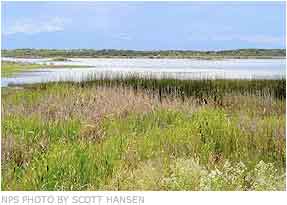
wetlandssouthplatte.jpg

Here’s the release from the Natural Resources Conservation Service (Katherine Burse-Johnson):

The United States Department of Agriculture Natural Resources Conservation Service (NRCS) recently announced that Friday, March 30, 2012 will be the deadline to submit applications to be considered for fiscal year 2012 funding for the Wetlands Reserve Program (WRP).

“Wetlands support diverse populations of wildlife and plants,” said Phyllis Ann Philipps, NRCS State Conservationist, Colorado. “WRP offers landowners an opportunity to establish long-term conservation and wildlife practices and protection.”

Though conservation plans are not required in order to participate in any of the NRCS programs, it is strongly suggested that landowners develop one because, in doing so, it will provide them with an inventory and assessment of their resources and a right start to the enhancement and improvement of the quality of their soil, water, air, plants, and wildlife.

Landowners who participate in WRP voluntarily limit future use of the land but retain private ownership. The program offers landowners three enrollment options: Permanent or 30-year easements, or a restoration cost-share agreement.

For more information about WRP, visit our website at www.co.nrcs.usda.gov.

More Conservation coverage here.

Ogallala Aquifer, Lesser Prairie Chicken, Sage Grouse Initiatives Target Local Resource Concerns NRCS seeks applications for financial, technical assistance

lesserprairiechickenhowstuffworks.jpg

Here’s the release from the Natural Resources Conservation Service (Katherine Burse-Johnson):

The U.S. Department of Agriculture’s (USDA) Natural Resources Conservation Service (NRCS) in Colorado recently announced that funding is available to help farmers and ranchers implement conservation practices, as part of the Ogallala Aquifer, Lesser Prairie Chicken, and Sage Grouse initiatives. These initiatives target efforts to address local resource concerns for important Colorado wildlife species, and water quality and quantity.

NRCS accepts applications on an ongoing basis. There will be two funding cycles in 2012. The first funding cycle will be March 30, 2012 and the second will be June 1.

“The Ogallala Aquifer, Lesser Prairie Chicken, and Sage Grouse initiatives are a few of several landscape conservation initiatives that maximize our conservation efforts to address some of Colorado’s most pressing natural resource challenges,” said Phyllis Ann Philipps, State Conservationist, NRCS, Colorado.

NRCS’ landscape conservation initiatives use a systems approach that focuses technical and financial assistance to implement a suite of conservation practices to address specific resource concerns. Through the Lesser Prairie Chicken and Sage Grouse initiatives, farmers and ranchers are incorporating conservation practices to improve healthy plant and animal communities by implementing practices such as prescribed grazing systems, fence marking, range plantings, brush/pinon-juniper management, and cross fencing into their agricultural operations. The Ogallala Aquifer Initiative will allow producers to install conservation practices that directly benefit water quality and water quantity issues.

Conservation assistance is available to producers through several 2008 Farm Bill conservation programs, such as the Environmental Quality Incentives Program (EQIP).

Producers interested in becoming a part of the Ogallala Aquifer, Lesser Prairie Chicken, or Sage Grouse initiative, or any other NRCS programs and services, should contact their local USDA Service Center, or visit www.co.nrcs.usda.gov for more information.

Thanks to The Holyoke Enterprise for the heads up.

More Ogallala Aquifer coverage here.

CWCB: Water Availability Task Force meets today

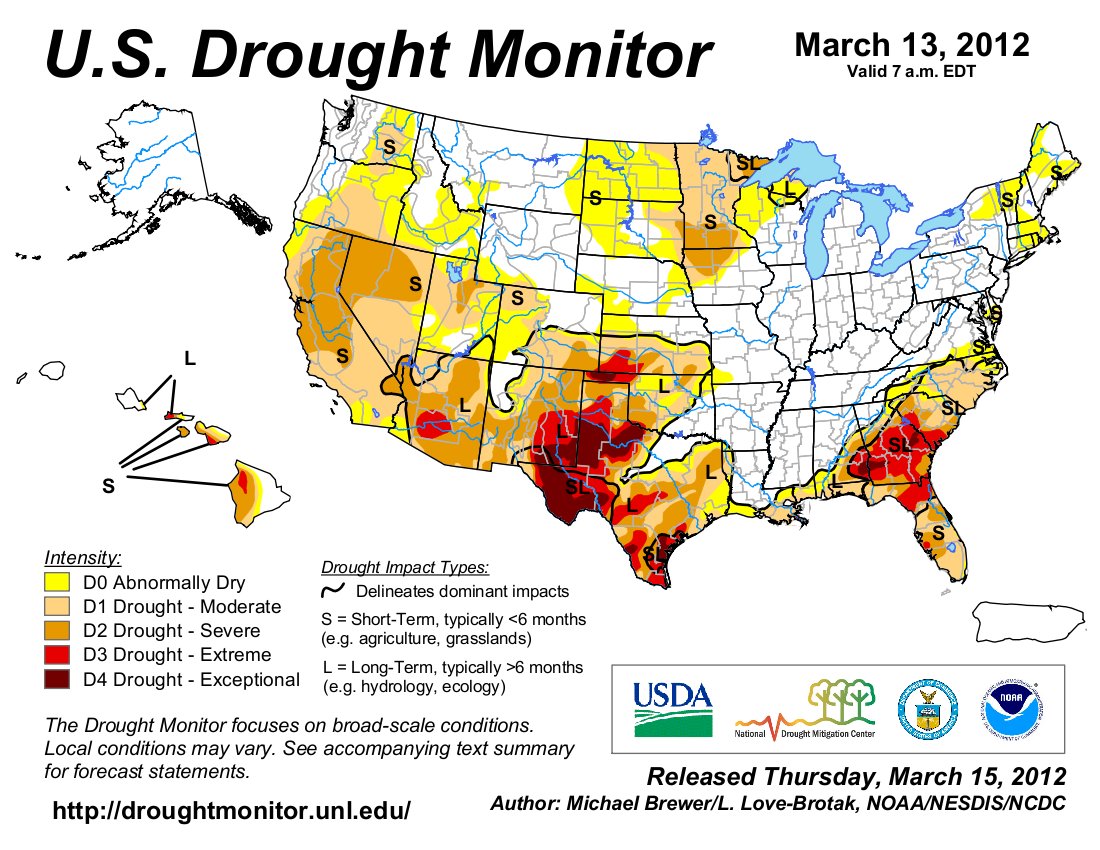
usdroughtmonitor03132012

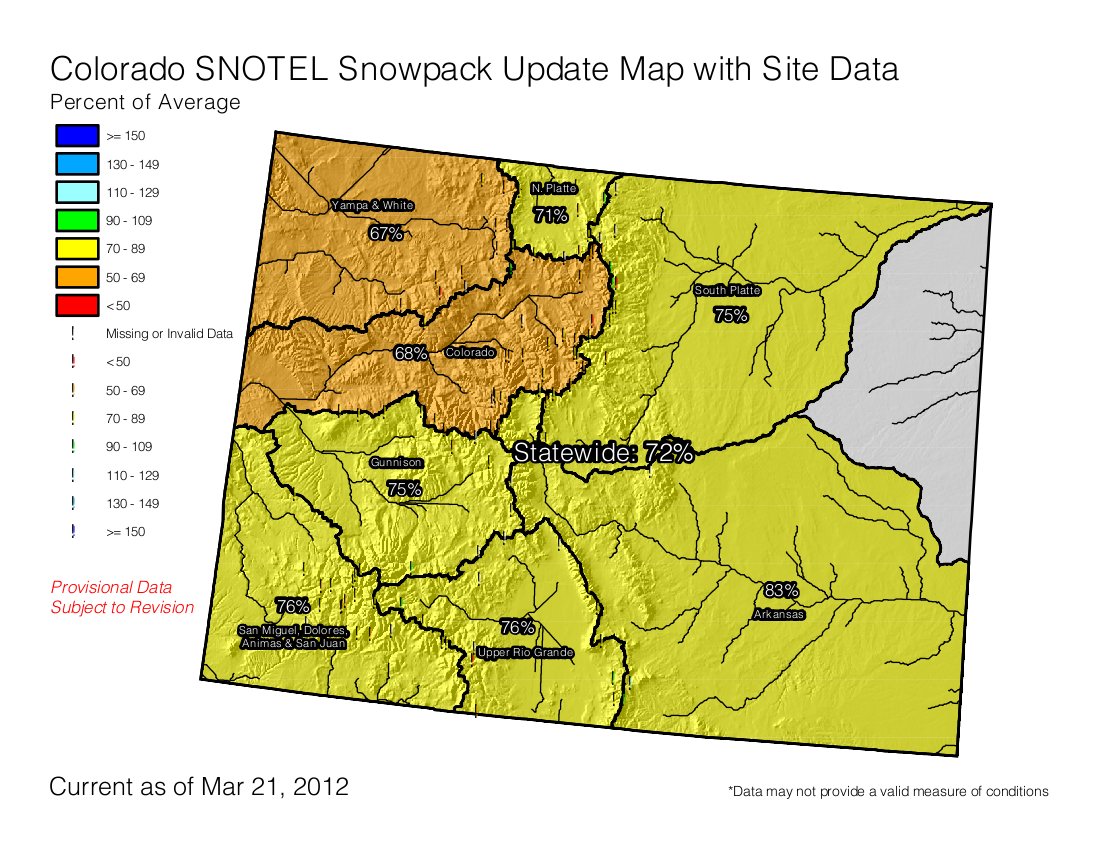
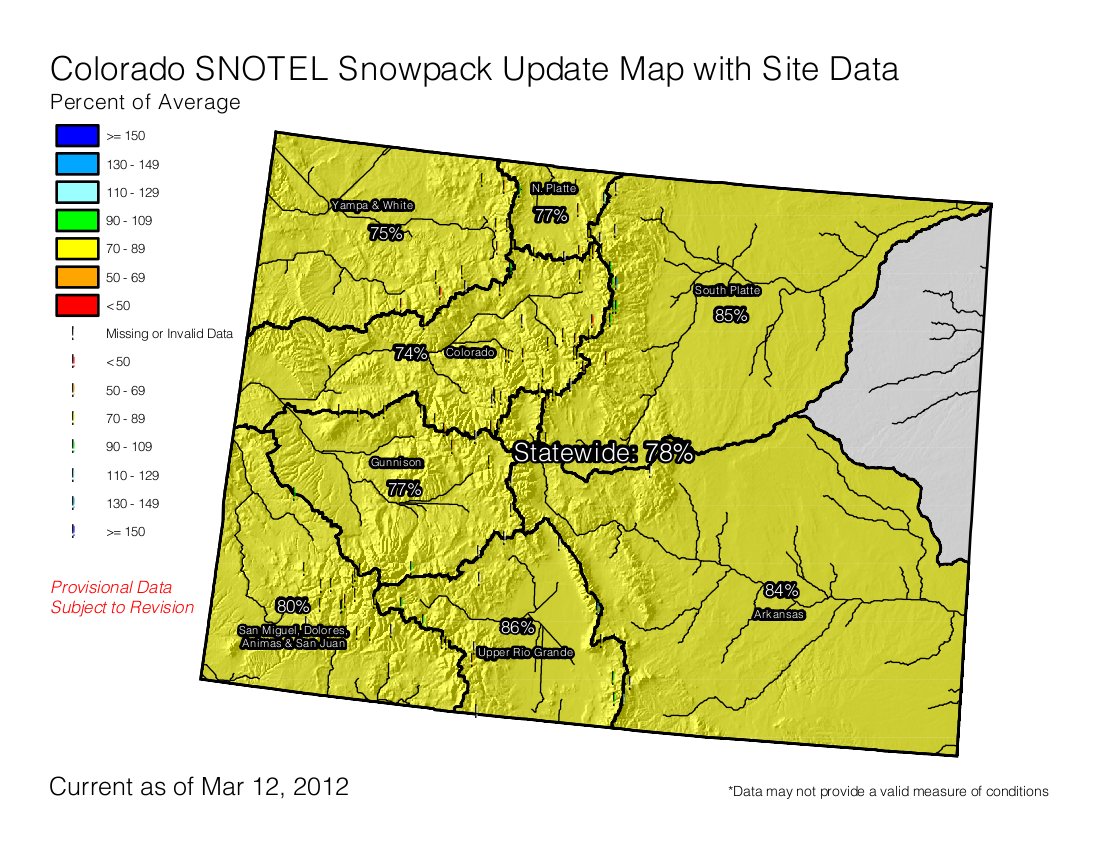
snowpackcolorado03212012

The CWCB Water Availability Task Force is meeting today. I don’t expect to see a dry eye in the place when Mage Skordahl from the Natural Resources Conservation Service gives her snowpack and precipitation report.

I’ll be live-Tweeting the meeting: @coyotegulch hash tag #cwcbwatf.

Celebrate World Water Day 2012 today: Be thankful that Colorado is at the top of the hill

worldwaterday2012

Colorado is the “Mother of Rivers” according to Justice Hobbs’ book of poetry. It’s true, the Colorado, Platte, Arkansas and Rio Grande rise here. Today be thankful that we have a good supply replenished each year by the snowpack and that our water problems here in Colorado come down to moving water from agriculture, removing water from the environment and elimintating bluegrass (someday).

Today is World Water Day. I’m always struck by the statistics around child mortality around the world from waterborne disease.

Take some time today to learn how you can help.

125,000 acre-feet stored by the Arkansas Valley irrigators winter storage program– 88% of 20 year average

puebloreservoir.jpg

From The Pueblo Chieftain (Chris Woodka):

The program, established by a court decree in 1990, allows ditch companies to store water from Nov. 15-March 15 each year for use later in the season.

Irrigation season began for the ditches in the Lower Arkansas Valley last week, and water is diverted by ditches according to a seniority system determined by water court. A little more than 125,000 acre-feet of water was stored this year, about 88 percent of the 20-year average, said Steve Witte, Water Division 2 engineer. The total is about 4,000 acre-feet greater than 2010-11.

The two-year period, coinciding with drought conditions across Southeastern Colorado, is one of the driest on record since winter storage began as a voluntary program in 1975. The only drier time since the program has been fully operated among 11 canal companies came in the 2002-05 period during a series of drought years.

About one-third of the water, 42,000 acre-feet is stored in Lake Pueblo. Unlike the past few years, there is little danger of any water in storage accounts being spilled during spring runoff. Water is also stored in John Martin Reservoir and in reservoirs owned by several canal companies. Participants in the winter water program are the Bessemer, Highline, Oxford, Catlin, Las Animas Consolidated, Riverside, West Pueblo, Colorado, Holbrook, Fort Lyon and Amity ditch systems.

The release of water into the Arkansas River has increased flows through Pueblo at Moffat Street to about 150 cubic feet per second from 60 cfs a week ago, according the U.S. Geological Survey stream gage.

More Arkansas River basin coverage here.

DOI to Present Summary of Public Input on a Long-Term Plan for Glen Canyon Dam Operations March 27

glencanyondamconst.jpg

Here’s the release from the Bureau of Reclamation (Barry Wirth/Maureen Oltrogge):

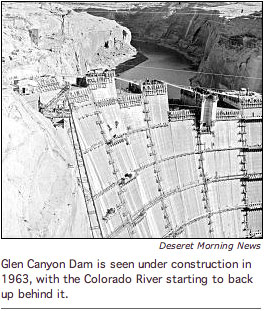
The public is invited to participate in web-based presentations, to be held on March 27 that will summarize public comments on the scope of the Long-Term Experimental and Management Plan Environmental Impact Statement for Glen Canyon Dam operations.

Two web-based meetings will be held that day from 1 to 3 p.m. MDT and again from 6 to 8 p.m. MDT. Instructions on how to join those meetings will be provided at http://ltempeis.anl.gov. Bureau of Reclamation and National Park Service staff will present an overview of the public scoping report and answer questions.

More information on these meetings and other project news will be announced through social media Reclamation, the NPS Intermountain Region, and the Grand Canyon Twitter feeds [#gcltemp] and Facebook pages) and on the project website.

The LTEMP could determine changes in water release patterns from Glen Canyon Dam and also define a framework for continued experimentation leading to an improved knowledge base and protection of resources. Dam operations and related actions being considered have the potential to affect hydroelectricity production, beaches for river recreation, native fish and other aspects of the Colorado River ecosystem including plants, animals, and archeological sites in Grand Canyon National Park and Glen Canyon National Recreation Area.

Possible changes to dam operations and other actions proposed by the Department of the Interior will be evaluated as alternatives in the LTEMP EIS being prepared by Reclamation and the NPS. The EIS will document and evaluate the impacts of the alternatives.

The plan will ensure that releases from the dam and other actions being considered meet the goals of protecting the resources of the Grand Canyon and Glen Canyon while continuing to supply water and power for communities, agriculture and industry.

In a series of public scoping meetings held in November 2011, Reclamation and the NPS provided the public with information about the LTEMP EIS, opportunities to meet with technical experts and ask questions. Public comments were received up to the close of the scoping period on January 31, 2012. Reclamation and the NPS reviewed and evaluated the comments received and developed a “scoping report” which is now available on the LTEMP EIS website.

More Colorado River basin coverage here.

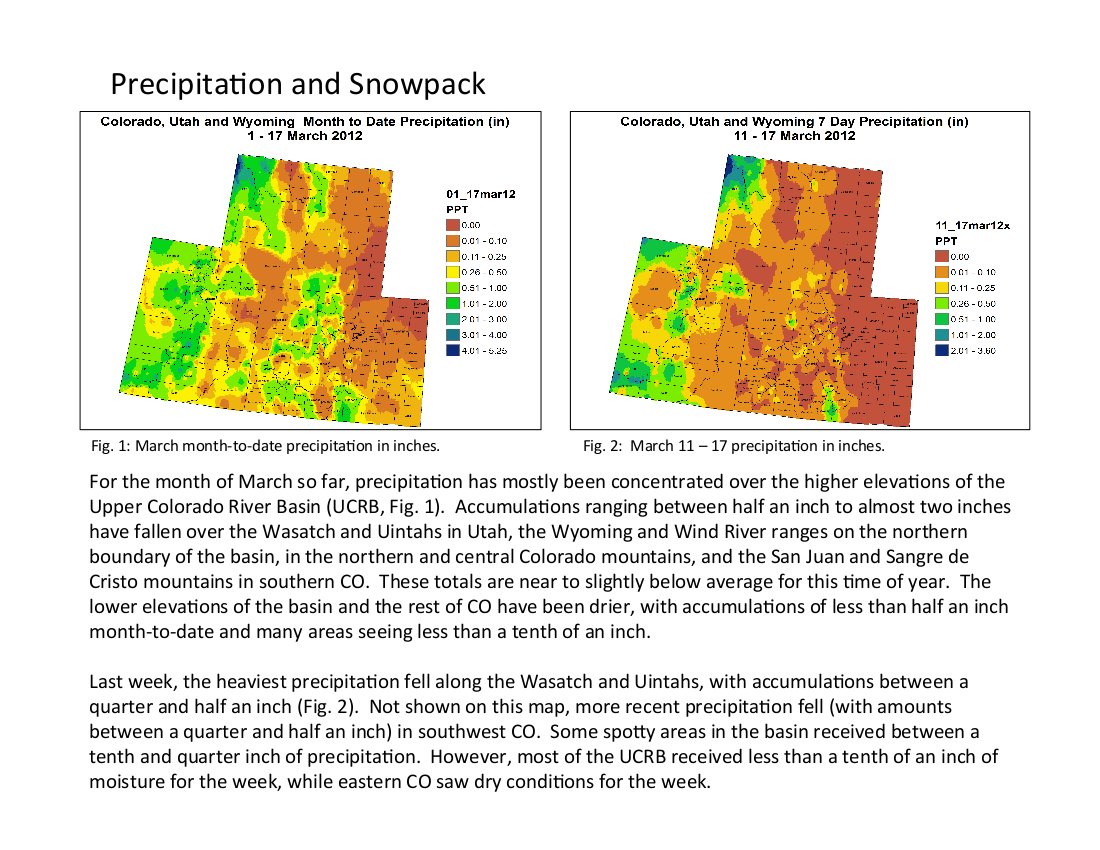
NIDIS Weekly Climate, Water and Drought Assessment Summary of the Upper Colorado River Basin

utwycoprecipitationmarch1to172012ccc.jpg

Here are the presentations from the Colorado Climate Center. Click on the thumbnail graphic to the right for the precipitation summary.

Colorado Water 2012: Water conservancy districts and water conservation districts explained

coloradowater2012

Here’s the current installment of their Colorado Water 2012 series from The Valley Courier (Mike Gibson). Click through and read the whole article. Here’s an excerpt:

Water Conservation Districts determine policies, own water rights and other real property, coordinate local engineering and legal studies, and assist in the development of water resource projects. They may levy ad valorem taxes for the expenses of the organization…

In contrast, Water Conservancy Districts are formed at the request of communities and are local instrumentalities of state government. They are organized under procedures in state district courts and remain under their jurisdiction. These are formed in conformance with the Water Conservancy Act of 1937 and Colorado State Statutes 37-45-10 and have the powers of a public or municipal corporation.

More Colorado Water 2012 coverage here.

Snowpack news: Areas of the San Juan mountains receive good snowfall from the storm Sunday and Monday, lower elevations not so much

snowpackcolorado03192012

From The Pueblo Chieftain:

Wolf Creek Ski Area reported 17 inches of snow from the storm system, which hit the San Juan Mountains on Sunday and lingered in the San Luis Valley through Tuesday morning. The storm left little snow on the SLV floor. Weather spotters recorded 0.8 inches of snow just south of Great Sand Dunes National Park and 1 inch in the foothills east of Fort Garland, while 0.5 inches fell east of Monte Vista.

From the Fort Collins Coloradoan (Bobby Magill):

Monday’s snowstorm was expected to dump no more than 2 to 4 inches of snow at the highest elevations of western Larimer County, said Mark Heuer, a meteorologist with DayWeather in Cheyenne, Wyo. But the brunt of the storm tracked south, blanketing the San Juan Mountains in southwestern Colorado with up to 18 inches of snow, he said…

As of Monday morning, every river basin in Colorado had a snowpack at least 20 percent below average. Locally, the South Platte Basin, which includes Poudre Canyon and the Poudre River, had a snowpack 26 percent below average. On March 1, the region’s snowpack was only 12 percent below average, according to U.S. Natural Resources Conservation Service data.

The prescription for a good runoff this year is average or cooler-than-average temperatures with three major upslope snowstorms between March 1 and June 1, Colorado State climatologist Nolan Doesken said. “We’re definitely off to a bad start,” Doesken said…

Currently, NRCS data show water content of the snow above 10,000 feet is above average in only a handful of snowpack monitoring stations throughout the South Platte River Basin, with most below 10,000 feet hovering at about 50 percent of average or less.

From the Summit County Citizens Voice (Bob Berwyn):

Both Telluride and Wolf Creek did well with the southerly flow, picking up about a foot of snow, while Silverton reported 14 inches. Crested Butte and Vail reported 5 inches, with three inches around Aspen.

Perhaps more significantly, the storm brought another significant deposition of desert dust to at least some parts of the high country. According to early reports, dust was reported in the Summit County zone by backcountry observers, said Colorado Avalanche Information Center forecaster Scott Toepfer. Based on the wind direction, the Sawatch Range may have also seen a dust event. It’s not clear yet whether the San Juans also saw a dust event, Toepfer said, adding the observations are still trickling in. The storm was the fifth dust event of the season, according to the Silverton-based Center for Snow and Avalanche Studies, where researchers have been conducting ground-breaking research on how the dust layers affect everything from avalanche danger to high alpine tundra ecosystems.

Waterton Canyon three-week closure: Contractor removing 75-ton dredge and other machinery

watertoncanyontroutsflyfishing.jpg

Here’s the release from Denver Water (Stacy Chesney):

Waterton Canyon will be closed for three weeks beginning at 7 p.m. on Sunday, April 1, for a Denver Water contractor to remove its 75-ton dredge and other equipment from Strontia Springs Reservoir. The canyon will reopen Monday, April 23, at 7 a.m.

Waterton Canyon reopened March 1, 2012, after being closed since August 2010 for a contractor to dredge Strontia Springs Reservoir. This three-week closure was announced earlier this year, and is the final phase in demobilizing the project, which was needed in the aftermath of the Buffalo Creek and Hayman fires.

“We are glad to see people enjoying the canyon since it reopened earlier this month,” said Doug Raitt, construction project manager for Denver Water. “The recent warm weather melted the ice on the reservoir quickly, so the contractor needs to remove its machinery soon. In the interest of public safety, we have to close the canyon while the work to demobilize this complex project is completed. Unfortunately, we can’t open the canyon during this three-week process. We ask for the public’s patience and understanding as this project wraps up.”

While the canyon was closed, Denver Water made improvements to the popular recreation area. “We wanted to make subtle changes, so we didn’t drastically alter the look and feel that people love about Waterton,” said Neil Sperandeo, recreation manager for Denver Water. “Recreationists will notice new mini-shelters to get out of the sun or rain, more parking spots, and improved signs with information about wildlife and the canyon.”

For questions related to recreation, email recreation@denverwater.org.

More Denver Water coverage here and here.

Nature Conservancy Speaker to Headline Colorado State University Water Café Series Thursday and Friday

fortcollinsflood07281997

Here’s the release from Colorado State University (Emily Narvaes Wilmsen):

Colorado State University will host a special two-part Water Café series in conjunction with Hydrology Days on Thursday and Friday, starting with a discussion with a leader of The Nature Conservancy’s Global Freshwater Team.

Water Café is an interdisciplinary, interactive series designed to examine critical water issues and the University’s roles in their solutions.

The event on Thursday, March 22 will feature Richter discussing the importance of ecologically sustainable water management. His lecture, titled “Meeting the Global Challenges of Water Scarcity,” will be at 5 p.m. in the Lory Student Center North Ballroom.

As co-leader of the Nature Conservancy’s Global Freshwater Team, Richter leads a staff of hydrologists, aquatic ecologists, policy specialists, educators and communicators that support conservation projects across the Americas, Asia and the Pacific region.

The second event in the Water Café series will consist of Richter and a CSU panel discussing water sustainability in the 21st century and how we can integrate and build cross-campus research and education in water sustainability.

The panel will be Friday, March 23 at 10 a.m. in the Cherokee Park Room in the Lory Student Center. CSU participants on the panel include:

• LeRoy Poff, Biology department
• Kurt Fausch, Fish, Wildlife, and Conservation Biology department
• Brian Bledsoe, Civil and Environmental Engineering department
• Gene Kelly, Soil and Crop Sciences department

More education coverage here.

Arkansas Valley Super Ditch: Proponents tout the project as a way to meet increased demand for basin supplies

arkbasinditchsystem.jpg

Terry Scanga, General Manager of the Upper Arkansas Valley Water Conservancy District is calling the water court filing for the Super Ditch the Mother of all Change Cases. And so it may be. Re-quantification is the name of the game nowadays whenever an entity gets in water court. Objectors hammer applicants on consumptive use calculations, historical use, the reservoir one-fill rule, etc. The Super Ditch plods on however. Here’s a report from Chris Woodka writing for The Pueblo Chieftain:

While the program was set up as a way to allow farmers to retain water rights while selling water through lease programs, it could become a way to meet increasing demands within the basin. The boards of the Super Ditch and Lower Arkansas Valley Water Conservancy District met jointly for the first time Tuesday to brainstorm how water needs throughout the valley could be met through Super Ditch…

The key is to develop enough flexibility in how the water is used to make what is now agricultural water more valuable in the future. A hint of that is seen in the Lower Ark’s exchange application in water court, which lists 85 points of exchange [ed. emphasis mine]. A report accompanying the application explains the needs of augmentation water for sprinklers or wells, as well as a new supply for the Arkansas Valley Conduit that will require more than 50,000 acre-feet annually in the next 50 years…

While the Lower Ark’s goal is to keep water in the valley, those in the Super Ditch are looking to maximize the value of water. Some believe both can be accomplished. “The Super Ditch is about the gap in the Arkansas basin,” said Lower Ark General Manager Jay Winner. “The goal is to make the water so valuable that nobody wants to sell.”

Here’s a report about the Super Ditch pilot project substitute water supply filing from Chris Woodka writing for The Pueblo Chieftain. From the article:

The pilot program would lease 500 acre-feet of water to Fountain, Widefield and Security this year. A substitute water supply plan has been filed with the state engineer’s office, and a comment period will continue through April 9. The price will be $500 per acre-foot…

Opponents have put the program under a microscope, engineer Heath Kuntz told the boards.“We had 20 requests for specific information,” Kuntz said. “One engineer asked for less complicated accounting, and another wanted simpler accounting. They spent an hour arguing about it.”

At one point, he was asked to justify every cell on a spreadsheet. There were more than 10 million cells. The Super Ditch sponsored a meeting in Rocky Ford in January to explain the application to potential opponents. There have been several technical meetings since then to hash out details. Among the chief objections are that the Lower Ark should file a change of use case before seeking a substitute water supply plan for the program. The water for the pilot program would come from nine farms on the Catlin Canal.

More Arkansas Valley Super Ditch coverage here and here.

Cotter closing their mill near Cañon City depends on state and federal coordination of superfund designation, radioactive materials license and the court consent decree

cottermillcontaminationconcerndenverpost10232011

From the Cañon City Daily Record (Rachel Alexander):

There must be a termination of the radioactive materials license, the court must close out the consent decree for the remedial action plan and the site must be deleted from the National Priorities — Superfund — List…

[Steve Tarlton, radiation program manager of the hazardous materials and waste management division of CDPHE] said there are four general things that need to be taken care of: the facility; the impoundments; the contaminated soil and the contaminated water…

The department is developing a “roadmap” of what the termination process with look like beginning with a determination of what is known and where the holes are. Tarlton said that characterization would become a public document. The next step will be to define possible remedies and their feasibility, with additional public comment. Then comes the choice of remedies, which includes more public input. Finally, the chosen remedies will be implemented…

The cleanup process for the Superfund site will include the groundwater contamination in the Lincoln Park neighborhood. Tarlton said the contamination in the groundwater there includes molybdenum and uranium, “not in very high levels but above drinking water standards.”[…]

Once the work is done, the impoundment sites will be turned over to the Department of Energy for long-term care.

More Lincoln Park/Cotter Mill coverage here and here.

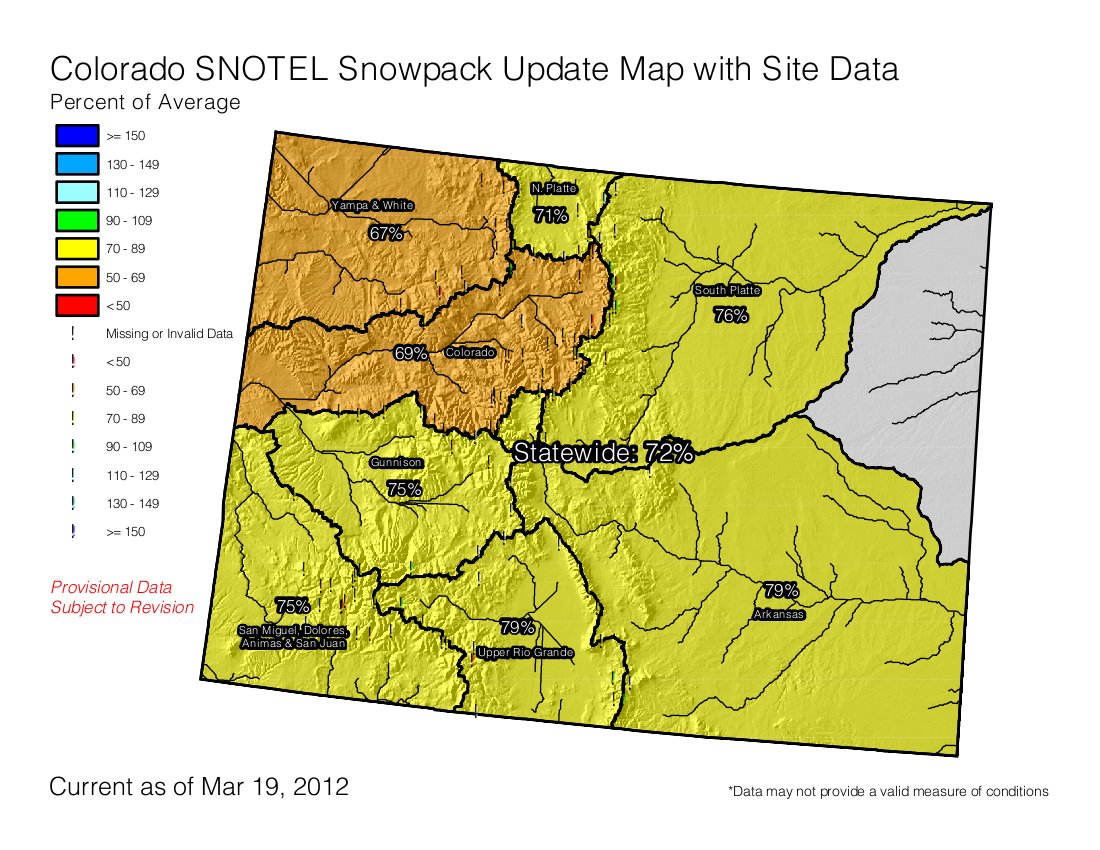
Snowpack news: Statewide snowpack drops to 72% of the thirty year average, Upper Colorado = 69%, South Platte = 76%

snowpackcolorado03192012

It’s not shaping up to be a good year for diverters. We’ve had it easy the past three water years in the South Platte basin and storage is still very good. With all the warm and windy weather folks are starting to talk about the possible sublimation of the snowpack. Click on the thumbnail graphic to the right for the latest snowpack map from the Natural Resources Conservation Service.

From the Loveland Reporter-Herald (Pamela Dickman):

The amount of water in the snow, as of Monday, is 70 percent of average in the Upper Colorado basin and 73 percent of average in the South Platte basin — the two basins that affect Northern Colorado.

From the Boulder Daily Camera (Laura Snider):

On the eastern side of the Continental Divide, where Boulder draws the majority of its water, conditions are slightly better. In the South Platte River Basin, which encompasses Boulder County, the snowpack total is at 79 percent, and in the much smaller Boulder Creek Basin, the snowpack is 104 percent of average. Most towns in Boulder County, including Boulder, draw some of their water from the South Platte River Basin and pump some of their water across the Continental Divide from the headwaters of the Colorado River, where the snowpack is 71 percent of normal…

At the end of March 2002, the snowpack in the Colorado River Basin was 68 percent of average for that time of year, and the snowpack in the South Platte River Basin was just 52 percent of average. The snowpack in the Boulder Creek Basin was 50 percent.

From the Cortez Journal (Reid Wright):

Water officials are optimistic that McPhee Reservoir will fill this spring, possibly offering the chance for a water release for rafters and ecological efforts on the Lower Dolores River. As of last week, measurements of high altitude snow in the basin feeding the reservoir indicated snow levels at 84 percent of average. “The reservoir will fill this year,” said Mike Preston, general manager of the Dolores Water Conservancy District. “I’m feeling pretty confident about that. But it’s a question of what we’re going to have in the way of rafting flows. If we stay in this 84-85 percent realm, we could have a pretty decent spill.”[…]

“What was a little spooky about this year, in the early season we weren’t getting much snow,” Preston said. Snowpack lingered at dismal levels below 50 percent of average until storms in February brought snow levels back up to near-average…

Combined with 141,000 acre feet already stored in the reservoir, the snow melt forecast adds up to a full reservoir in the spring.

“We’re sitting 16,000 acre feet higher than we were this time last year,” Preston said. “So our reservoir is really in good shape.” McPhee Reservoir provides drinking and irrigation water for much of Montezuma and Dolores counties…

While Preston emphasized it is not set in stone, the current forecast indicates a spill worthy of 10 days of whitewater boating that fluctuates between 900 and 2,000 cubic feet per second. “Right now, we’d like to do 2,000 cfs over Memorial Day,” he said. “The nice thing about 2,000, is it’s a brisk raft trip. Quite a few people can fit on the river when it’s flowing like that. And it’s pretty comfortable. It covers up the big rocks and makes for smooth sailing.”[…]

More up-to-date information is expected to be provided at a McPhee Reservoir and Dolores Project operation meeting, currently set for 7 p.m. March 21 at the Dolores Community Center. Topics of discussion will focus on anticipated water releases to the lower Dolores River and an overview of the Dolores Project.

Wiggins: Full speed ahead for new treatment plant, pipeline and augmentation ponds

pipeline.jpg

From The Fort Morgan Times (Dan Barker):

The augmentation ponds the project requires are basically done, although a water flow monitoring system needs to be installed and the rest of the land should be seeded to prevent weeds, said Tim Holbrook of Industrial Facilities Engineering, the company directing the project, during Wednesday’s monthly meeting of the Wiggins Board of Trustees. Footings are in place for the water treatment plant building, which will sit over the wells which are already drilled. Work is being done on walls and a water tank, and equipment for the treatment is expected in two to three months, he said…

Another part of the augmentation plan is to buy a structure from the Orphan Wells of Wiggins which will allow the town to send water to the river to offset depletion of groundwater by the new town wells…

Board members also approved an extension on the closing date for buying nine more shares of water rights from Tom and Donna Deganhart and gave Mayor Mike Bates authority to OK another extension if needed. Board members also approved a funding ordinance, which was necessary for buying the shares, said Wiggins Town Attorney Melinda Culley. Buying the shares is contingent on the approval of the Weldon Valley Ditch Co…

The town needs monitoring wells to determine how much the augmentation ponds impact their area’s groundwater levels. At least one neighbor has complained that he feared that the ponds might hurt his crops and buildings if the water level rises too high, Rogers said. It is important to get that done before the ponds begin to fill, said Public Works Director Jon Richardson. Monitoring wells could go in during the next week, Rogers said, and water could begin flowing in the Weldon Valley ditches very soon.

More Wiggins coverage here and here.

Colorado-Big Thompson Project update: Northern’s sale of pool water nets $644,142, reservoir combined storage = 75% of capacity

coloradobigthompsonmap.jpg

From the Loveland Reporter-Herald (Pamela Dickman):

The regional water provider, which distributes all Colorado-Big Thompson Water, sold 25,000 acre-feet of water — roughly enough for 50,000 urban households — on Friday because reservoir levels were high enough. The sealed bids brought in $644,142 for the cities and districts that had excess water beyond what they can carry over. The price paid for the water differs among bidders, but the weighted average is $25.77 per acre-foot with the lowest bid at $11.13 per acre-foot and the highest $40…

Even with the sale, there will be plenty of water stored to handle farmers’, cities’ and districts’ needs this spring and summer, said Brian Werner, spokesman for Northern Water.

“We’ve got a good savings account going with storage,” he said.

All the reservoirs that store Colorado Big-Thompson water, including Carter Lake and Horsetooth Reservoir, are sitting at a combined 75 percent of capacity, which is 125 percent of the average amount of water in storage, according to Werner.

More Colorado-Big Thompson coverage here.

Snowpack news: The hot and dry start to March is taking a toll on snowpack statewide

snowpackogive03162012

From the Summit County Citizens Voice (Bob Berwyn):

With average spring precipitation, the [Dillon Reservoir] should fill in June, but it’s unlikely there will be enough water to sustain a lengthy rafting season in the Lower Blue, according to Denver Water, which late last week released a detailed outlook for Dillon Reservoir operations…

Under a dry scenario, Denver Water expects the reservoir to reach a maximum elevation of about 9,015 feet in June, then drop rather quickly, by about six feet in July and another seven feet by the end of September.

Even under the dry scenario, water levels would remain high enough for reservoir operations through most of the summer.

With above-normal precipitation through May, the reservoir is projected to fill in June and stay close to maximum capacity through the summer. The provisional outlook is subject to change, depending on developing conditions. For example, a hot and dry summer on the Front Range could result in a quicker draw-down, while a wet monsoon season could reduce the demand for water.

In a message on its website, Denver Water indicated that reservoir storage is above normal for this time of year. But storage is only one indicator of drought and “reservoir levels can drop quickly when we don’t get much snow and rain,” the water provider wrote.

Chris Woodka (The Pueblo Chieftain): ‘Your sources have to be good, and you don’t burn them’

chriswoodka.jpg

I’ve known Chris Woodka for a few years now — since I’ve been linking and excerpting his work from The Pueblo Chieftain — and I count him as a friend and mentor. He has taught me much over the years by just reading his stuff. Here’s a profile from Matt Jenkins writing for the High Country News. You have to subscribe to read the whole thing. Here’s the lede:

In 2004, Pueblo Chieftain publisher Bob Rawlings, assisted by his daughter, Jane, was running full-throated editorials against water transfers and occasionally making news himself. The not-exactly-impartial coverage of the controversy bothered Chris Woodka, then a managing editor. So he asked to be assigned to the water beat. “I said, ‘OK: I’m going to do it objectively. I’m going to do it as a reporter,’ ” Woodka explains. ” ‘And Bob and Jane, you’re just going to be news sources.’ ” Today, Woodka, 57, is Colorado’s sole remaining full-time water reporter. He has worked hard to separate himself from the Chieftain’s editorial slant, and has built a reputation for his fair coverage of an extremely complicated and contentious subject. “You kind of make your own luck,” Woodka says. “Your sources have to be good, and you don’t burn them.”

Click here and here for articles written by Woodka quoted on Coyote Gulch.

Parker: Rueter-Hess Reservoir celebration this week

rueter-hessplans.jpg

Parker and other South Metro communities will celebrate the opening of the largest Front Range reservoir since Aurora Reservoir this week. Here’s a report from Chris Woodka writing for The Pueblo Chieftain. From the article:

Parker Water and Sanitation has completed Rueter-Hess Reservoir, a 72,000 acre-foot storage facility that will store water for Parker and surrounding communities in the South Denver area. “The project is a significant accomplishment for Parker Water and Sanitation District, its customers and the entire south metropolitan area. Congratulations is due all around,” said Frank Jaeger, manager of the district…

Rueter-Hess has been in the planning stages for 25 years and under construction for the last eight. It cost $165 million to build, including $56 million from Castle Rock, Castle Pines North and Stonegate, which like Parker are located in Douglas County…

The other Douglas County communities joined the project in 2008, expanding the capacity of Rueter-Hess by 56,000 acre-feet. The reservoir still must undergo state safety inspections before it can begin storing water. It will collect water flows from wet years for use during summer months and dry years. It is the largest Front Range reservoir to open since Aurora Reservoir with a capacity of 36,150 acre-feet, began filling in 1990.

More Rueter-Hess Reservoir coverage here and here.

San Luis Valley: Fallowing of acreage irrigated by pumping to start this season, reduction of 5,000 acre-feet is the target

slvdischargerecharge.jpg

The Rio Grande Water Conservation District has been working diligently for several years to set up groundwater subdistricts to reduce pumping from the aquifer underlying the valley. The hope was to avoid having the State Engineer’s office come in a shut down wells as has happened in the South Platte and Republican River basins. The effort in the Valley has led to the creation of groundwater Subdistrict No. 1 which will start operations this season with a goal (set by the State Engineer’s office) of a 5,000 acre-foot reduction. Here’s a report from Matt Hildner writing for The Pueblo Chieftain Click through and read the whole article. Here’s an excerpt:

The unconfined aquifer, or shallower of the valley’s two major groundwater bodies, is recharged every spring when irrigation canals pull water from the Rio Grande River to fields in the district where it percolates down. Farmers pump it back up later in the growing season. But drought and largely unregulated use have seen the aquifer drop by 740,000 acre-feet, down to its lowest level since water managers began monitoring it in 1976. The subdistrict aims to reverse that trend by retiring up to 40,000 acres of farm ground over the next decade, a move they hope would return between 340,000 and 540,000 acre feet to the aquifer.

While the subdistrict doesn’t expect to finalize all of ifs fallowing contracts until April 1, up to 10,000 acres could be pulled from production this growing season, said Steve Vandiver, manager of the subdistrict’s parent organization, the Rio Grande Water Conservation District. “That will probably be 20,000 acre feet we’re not pumping,” he said. “That’s a big start.”[…]

The subdistrict’s other main task will be to replace the injury pumping of wells causes to surface water users. The valley’s aquifers and streams are connected to varying degrees depending on where one is in the area. And for more than four decades the valley’s surface users have had to bear the burden of the state’s compliance with the Rio Grande Compact as irrigation ditches were curtailed so water could be sent downstream. Groundwater wells faced no such burden. But that will change this season. State computer modeling has determined that the subdistrict will have to return 5,000 acre-feet to the river to make up for the injuries caused to surface water owners. While the subdistrict will have to formally submit its replacement plan to the Office of the State Engineer next month, Vandiver said the subdistrict could have between 6,500 acre-feet and 7,000 acre-feet at its disposal. Most of that water is stored in reservoirs on the Rio Grande upstream of the subdistrict.

More San Luis Valley groundwater coverage here and here.

Coyote Gulch outage: I’m on deadline at Colorado Central Magazine, see you Monday

coyotegulchandedquillen10022010

I’m on deadline at Colorado Central Magazine. I’ll see you Monday morning bright and early.

Flaming Gorge Pipeline: The ‘Green with Envy’ tour hits Fort Collins March 22, Durango April 7

greenwithenvytrailerscreenshottroutunlimited.jpg

From Westword (Alan Prendergast):

Million’s plan, the subject of a 2009 feature by Joel Warner, calls for moving 81 billion gallons of water annually from the reservoir to municipalities in Colorado, including several in Douglas County. The costly project has hit a few snags, including a recent refusal by the Federal Energy Regulatory Commission to grant a preliminary permit. But the river’s defenders are keeping the pressure on with their own education campaign.

“The fight is far from over,” the promoters of the film claim in a press release. “Aaron Million, the wealthy entrepreneur behind the project, has already announced he will resubmit a stronger proposal in the near future.”

Green With Envy plays in Fort Collins on March 22 and in Durango on April 7. For more information, check out the It’s Our Dam Water website.

More Flaming Gorge pipeline coverage here and here.

Piñon Ridge Mill: CDPHE officials ‘failed to subject themselves to the exacting scrutiny’ — Travis Stills

pinonridgesite.jpg

From The Denver Post (Bruce Finley):

“We’re not challenging the license itself. We’re questioning the process under which they issued it. We’re just asking them to explain to us how they’re going to hold a public hearing and make sure that in any future licensing actions they will hold hearings,” Nuclear Regulatory Commission spokesman David McIntyre said. “That’s all we’re asking. Not much.”

The NRC officials restaked their position after digesting a five-page letter from Colorado Department of Public Health and Environment director Chris Urbina that accuses the NRC of interjecting itself inappropriately into a legal battle between the state agency and project opponents. “For a federal agency to come along at this late date to muddy the waters is an outrage to all the community members, stakeholders and others who took the time to participate in the public process regarding the radioactive materials license,” Urbina said in a prepared statement after sending the letter to NRC deputy directors in Washington, D.C.

The dispute arose after NRC officials conducted an inquiry and substantiated a complaint from the Telluride-based Sheep Mountain Alliance alleging CDPHE failed to hold formal public hearings on its decision to grant the license to Energy Fuels Resources last year…

“Invalidating the offending license and sending it back for the agency to hold formal hearings, as opposed to three-minute comment sessions, is the proper course” because CDPHE officials “failed to subject themselves to the exacting scrutiny” that federal law requires, attorney Travis Stills said…

“I’m not sure what else the NRC would have us do,” Energy Fuels attorney Curtis Moore said. “The process was extremely open and transparent. Most members of the public were happy to see the license issued.

More Piñon Ridge Mill coverage here. More nuclear coverage here and here.

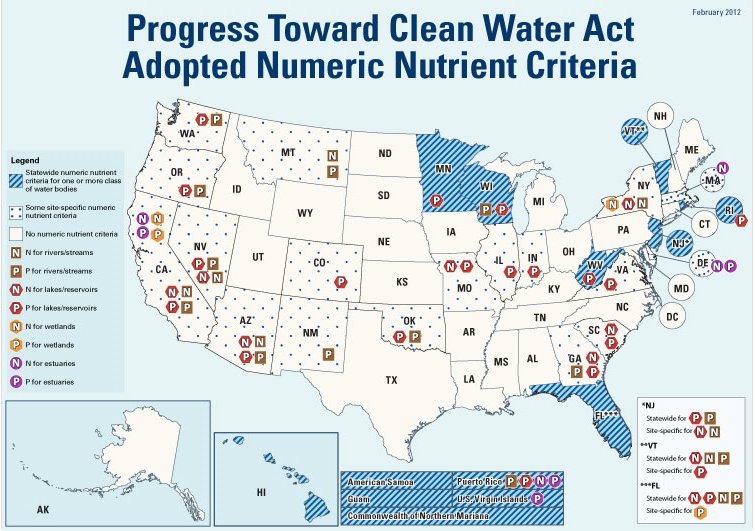
Colorado adopts new standards for phosphorus and nitrogen in wastewater treatment plant releases ahead of anticipated EPA rules

progresstowardcwaadoptednumericnutrientcriteriaepa.jpg

From NBCNews11.com (Andie Adams):

The Colorado Water Quality Control Commission has given preliminary approval to regulations that would limit the amount of nitrogen and phosphorus in bodies of water statewide.

“When you get too many nutrients in a water body, then it can make algae bloom more, then when that dies, it robs the stream of oxygen. So you can have problems for fish and aquatic organisms,” said Hannah Holm, coordinator of CMU’s Water Center…

“Some people are making the argument that it’s not clear that nutrients are really a major environmental and water quality problem here in the Grand Valley,” said [Hannah Holm, coordinator of CMU’s Water Center].

But water director Jennifer Bock with the High country citizen’s alliance said for this area, the regulations would be preventative. “We’ve seen bad algae on the Front Range and we want to protect the west slope so this is just a good first step to get ahead of the problem,” said Bock.

The rules are broken down into two sets. The first would require large wastewater treatment plants, like Grand Junction’s Persigo plant, to control their nitrogen and phosphorus levels. “Those guys will be affected in the next couple of years. Their permits will come up and they’ll work with the state to see what they need to do to come in with compliance,” said Bock.

The second set would require that all bodies of water comply with the nutrient amounts by 2024. That includes drainage authorities and districts. “We have to monitor this and make sure the quality is what these regulations require it’s going to cost a lot of money to do that,” said Kevin Williams, manager for the Grand Valley Drainage District.

He said he is worried that these regulations will become an unfunded mandate. “A benefit analysis that was done is that right now in this first phase, this is going to encumber the people of the state of Colorado almost $2.5 billion, and it’s unfunded. In other words, the state isn’t helping us out,” Williams.

From The Grand Junction Daily Sentinel (Charles Ashby) via Google Groups:

After nearly three days of public testimony and several more hours of deliberation, the nine-member commission gave its initial approval late Wednesday of more than 600 pages of new regulations that are designed to limit how much nitrogen and phosphorus can be in the state’s rivers and streams.

The final regulations will be reviewed again in May, with the new regulations going into effect June 30, said Steve Gunderson, executive director of the Colorado Water Quality Control Division. “The commission gave preliminary approval to much of the water control division’s final proposal regarding nutrients management,” Gunderson said. “The only major substantive difference is relaxation of the total inorganic limitation for existing facilities from 10 milligrams a liter to 15 milligrams.”

He said the new rules will impact only the largest wastewater treatment plants in the state, which account for 10 percent of all plants. Those 44 plants include the Persigo Wastewater Treatment Plant in Grand Junction. Wastewater treatment plant officials statewide, who opposed the new regulations, said it could cost them up to $2 billion in new equipment, saying those costs will be borne by ratepayers. Persigo officials estimated their new costs at upwards to $24 million.

Gunderson, who calls high nutrient levels one of the biggest water-quality challenges facing the nation, said the limits are designed to protect the state’s waterways from too much algae. High algae levels can create oxygen-dead zones that can kill plants and aquatic life.

More wastewater coverage here and here.

Flaming Gorge pipeline: The ‘Green with Envy’ tour releases new trailer, you have to attend a tour session to see the whole film

greenwithenvytrailerscreenshottroutunlimited.jpg

Here’s the link to the Green with Envy webpage. Here’s the link to the trailer.

Here’s the current schedule:

Laramie, Wyoming
Monday, March 19, 7 p.m.
University of Wyoming
Education Auditorium
1000 E. University Ave.

Cheyenne, Wyoming
Tuesday, March 20, 7 p.m.
Cheyenne Depot Museum
121 W. 15th St.

Casper, Wyoming
Wednesday, March 21, 7 p.m.
Izaac Walton Building
4205 Fort Caspar Rd.

Fort Collins, Colorado
Thursday, March 22, 6 p.m.
Avogadros Number
605 South Mason St.

Park City, Utah
Thursday, April 5, 7 p.m.
Hotel Park City
2001 Park Ave.

Durango, Colorado
Saturday, April 7, 7 p.m.
Durango Art Center
802 E. 2nd Ave.

More Flaming Gorge Pipeline coverage here and here.

Congratulations to Loren Otto the Colorado BLM volunteer of the year

kerbercreekproject.jpg

Here’s the release from the U.S. Bureau of Land Management (Denise Adamic):

The Bureau of Land Management honored Loren Otto with the 2011 Volunteer of the Year Award on Wednesday.

This award recognizes individual volunteers or volunteer organizations for their outstanding contributions to public lands management throughout the year.

“Volunteers are some of our greatest resources,” said BLM Colorado State Director Helen Hankins. “We are truly grateful for their time and commitment to managing the natural landscapes we enjoy in Colorado.”

Otto devoted more than 350 hours to the San Luis Valley Field Office including time spent on the Kerber Creek Restoration Project. During the past two years, Otto’s primary focus has been setting up and monitoring nearly 20 rain gauges throughout the San Luis Valley. The information the BLM gathers from these rain gauges is a valuable tool in evaluating range condition, monitoring stream health, and assessing locations for revegetation efforts. In addition to the many hours he dedicated to monitoring, Otto worked in the Kerber Creek drainage area plotting locations of a series of historic photos and taking new photos of the same areas to help depict the progress of this monumental restoration project.

“Loren is an outstanding volunteer,” said Andrew Archuleta, BLM San Luis Valley Field Manager. “He has a great attitude and is continuously looking for ways to contribute to the management of public lands in the Valley.”

The Kerber Creek Watershed is located in the northern San Juan Mountains, northwest of Villa Grove. The watershed has been significantly degraded from historic mining activity. Several miles of stream bank have been devoid of vegetation due to the metal concentrations in the soil, and much of Kerber Creek has been devoid of aquatic life.

Thanks to Otto and dozens of other volunteers, the Kerber Creek Restoration Project received the BLM Hardrock Mineral Environmental Award in 2010 and several other local and national awards.

More restoration/reclamation coverage here.

Colorado River basin: Watershed Movie trailer

uppercoloradoriverbasinstatesultimatum09011925denverpost.jpg

The film (still in production) Watershed Movie formerly known as The River Red has posted a new trailer on their Facebook page here. They’ve finished recording the narration (by Robert Redford) and are well on their way to a release date.

The film hopes to raise awareness for the effort to restore the Colorado River Delta. The Colorado River has not reached the Sea of Cortez since the late 1990s and there is a movement to reverse that.

More Colorado River basin coverage here.

Aspinall Unit update: Deliveries through the Gunnison Tunnel to start on Monday, spring has sprung

gunnisontunnelnps.jpg

From email from Reclamation (Dan Crabtree):

For those that work in an office all day and haven’t noticed, it has become quite warm outside. It appears spring has arrived and with that, it is time for the Gunnison Tunnel to start diverting water. The Uncompahgre Valley Water Users Association (UVWUA) plans to start tunnel diversions on Monday, March 19th. Initially diversions will start at 200 cfs. At this same time the UVWUA will need to complete some repair work on the apron of the diversion dam. This will require flows in the Gunnison River be reduced to approximately 400 cfs so that no water is spilling over the diversion dam. Work on the dam apron will be completed by the end of Tuesday, March 20th. At this time, Crystal Dam will increase releases by 100 cfs while the Gunnison Tunnel continues diverting 200 cfs. The resulting flow in the Gunnison River through the Black Canyon will be around 500 cfs.

Gunnison Tunnel diversions may increase later in the week of the 19th and releases at Crystal will be increased accordingly to maintain the 500 cfs flow in the Gunnison River.

Under the current forecast, Reclamation plans to operate the Aspinall Unit to allow the Black Canyon of the Gunnison one day peak flow target of approximately 2,200 cfs to be met; the timing of which is unknown at this time.

As a reminder, the April Aspinall Operations Meeting will be held in Reclamation’s Western Colorado Area Office, Grand Junction location, on April 26th beginning at 1:00 p.m.

Please contact Dan Crabtree or Erik Knight at the Bureau of Reclamation with questions regarding this operation.

More Aspinall Unit coverage here.

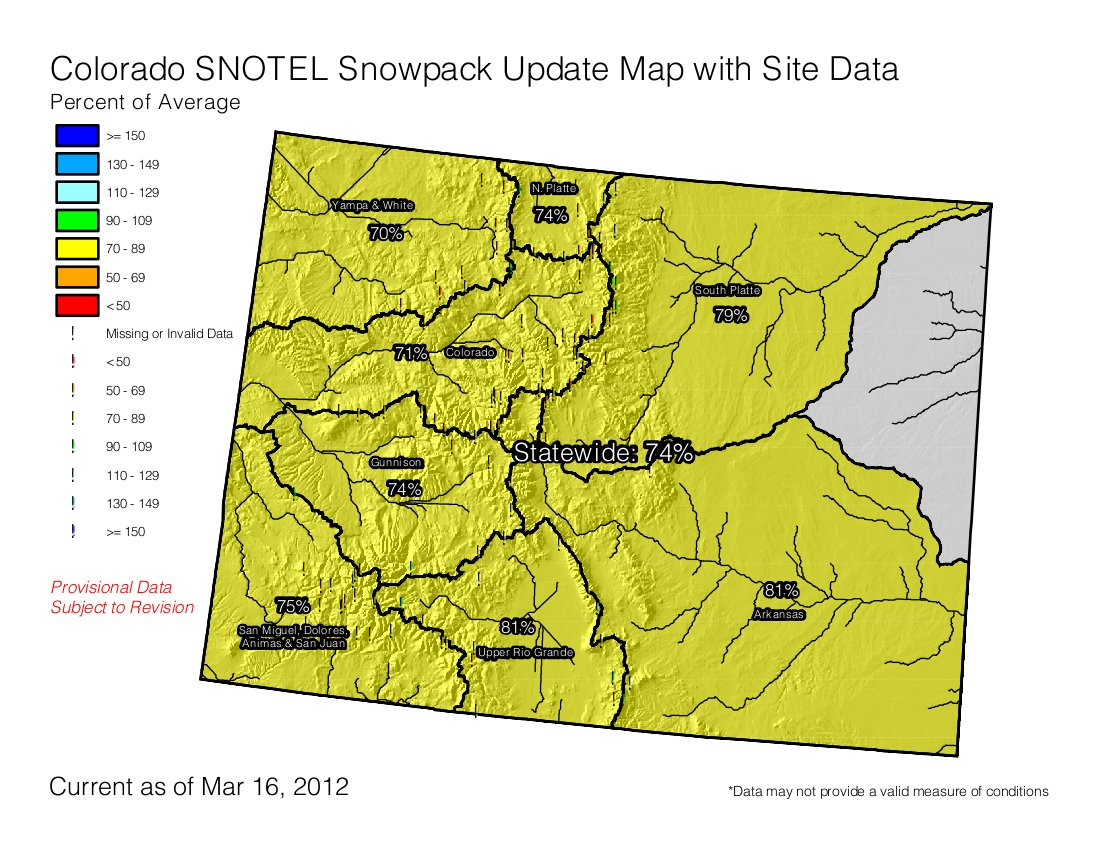
Snowpack news: Statewide snowpack down to 74% of average, South Platte = 79%, Upper Colorado = 71%

snowpackcolorado03162012

Click on the thumbnail graphic to the right for the current snowpack map from the Natural Resources Conservation Service.

From the Fort Collins Coloradoan (Bobby Magill):

…an average year on the Poudre may seem like a dream for optimists because the mid-March mountain snowpack is far below average – 81 percent of average across the South Platte Basin as of Wednesday morning, according to U.S. Natural Resources Conservation Service data. Temperatures have been high and the skies have been blue in the mountains – all elements that have conspired to shave 10 inches off the snowpack in the mountains of Northern Colorado and southern Wyoming over the last several days, said meteorologist Mike Weiland, who specializes in hydrology at the National Weather Service in Cheyenne, Wyo…

Northern Colorado’s strongest snowstorms often come in March and April, said Boulder NWS meteorologist Bernie Meier, but this year could be different, especially over the next couple of weeks. Warm, dry weather both at high and low elevations are expected to hang around through Sunday, he said, with a possible chance for snow in the mountains early next week. “Most of the models now keep that system to the south and move it off to the east,” Meier said. “After that, it looks like another dry pattern through the later part of next week.”[…]

The spring runoff forecast for the Poudre and other rivers in Northern Colorado isn’t much better. The NWS’ March 6 water supply outlook for April through September calls for stream flows to be well below average all across the region. The Poudre’s flow is expected to be 13 percent below average for that period, with the Big Thompson expected to run 19 percent below average. The North Platte through North Park is expected to run 45 percent below average. That’s not all: “The forecast is for above-normal temperatures and below-normal precipitation in general,” Weiland said. “The chances of building up snowpack aren’t as good as one would hope.”

Recall election in the works for the Cherokee Metropolitan District

waterfromtap.jpg

From KRDO.com:

The recall process began at the end of 2011 and petitions were approved on Feb. 14, 2012. Cherokee Water customers will vote on May 22nd to recall President Dave Hammers and Directors Bill Beahan and Jan Cederberg. Cederberg said the three protested the recall petitions in front of El Paso County Clerk and Recorder, Wayne Williams. She said many voters were not told about the recall when asked to sign the petition. “We have witnesses that were told if they signed, their water rates wouldn’t go up,” she said.

Steve Hasbrouck, current water board member and member of the citizens group, said the recall petition was deemed sufficient with ample signatures above the 300 signature threshold and was certified by Waybe Williams, the court appointed DEO and Clerk and Recorder for El Paso County on March 12, 2012. He said all protests by Hammers, Cederberg and Beahan were deemed irrelevant by Williams, so the recall moved forward.

The group behind the recall blames the three board members for the district having less water and higher rates. “The charges against us include secret meetings, bonding issues and getting rid of previous management, which isn’t true,” said Cederberg…

Cederberg blames the district’s financial and water situation on the former board members who were recalled in 2010 and said it’s the same people trying to recall her now. “People need to look at all the facts. Look at the people in the concerned citizens group, they’re former board members. They are the reason we’re in this mess,” she said.

More coverage from the Colorado Springs Independent (Pam Zubeck):

Once again, there’s trouble on the east side of Colorado Springs, with voters submitting sufficient numbers of signatures to hold a recall election for three Cherokee Metropolitan District board members: Jan Cederberg, David Hammers and William E. Beahan…

The election is set for May 22, despite protests by those being recalled.

More Cherokee Metropolitan District coverage here and here.

Don’t suck the Colorado River dry billboard part of grassroots campaign to protect the Upper Colorado River

dontsuckthecoloradoriverdry.jpg

Here’s the release from Colorado Trout Unlimited (Randy Schofield):

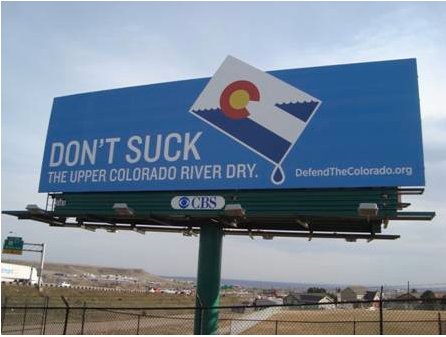
A coalition of river advocates has unveiled a billboard on I-70 that highlights the threat to the upper Colorado River from massive water diversions to the Front Range—diversions that are sucking the life out of the upper Colorado and degrading irreplaceable mountain areas where many Coloradans love to fish, hunt, and recreate.

The billboard is part of a larger grassroots campaign that is rallying Coloradans to help protect this popular western slope recreation destination.

The billboard, in the foothills of Golden near the 470 exit, shows a state flag image being drained of water and warns, “Don’t Suck the Upper Colorado River Dry.” The message will reach an estimated 180,000 people each day who travel this major east-west corridor.

“Coloradans need to know that the health of the upper Colorado and Fraser rivers is jeopardized by these water diversions,” said Sinjin Eberle, president of Colorado Trout Unlimited. “We’re asking our state leaders to step up and finish the job of protecting these special places.”

For years, large-scale water diversions to Denver and the Front Range have severely depleted and at times nearly sucked dry entire stretches of the upper Colorado River and its tributaries, including the Fraser River. The low flows and higher temperatures have caused dramatic declines in fish and other benchmarks of aquatic health. Low flows have also contributed to the spread of smothering silt and choking algae.

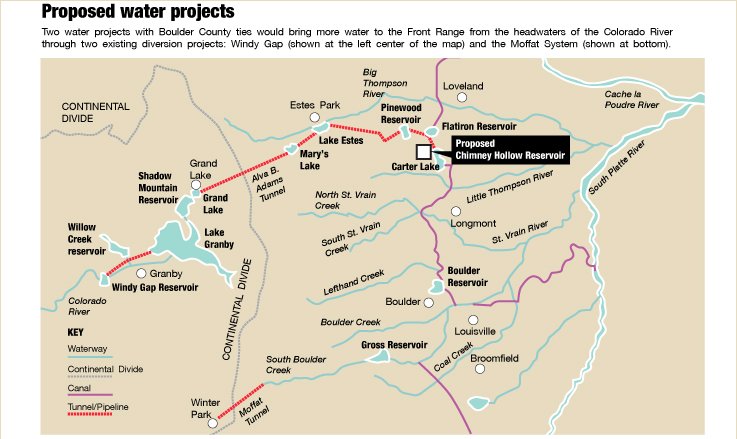
River advocates warn that the proposed expansions of the Moffat Tunnel and Windy Gap diversion projects could push the upper Colorado ecosystem to the brink of collapse unless environmental mitigation plans for the projects contain stronger flow protections for the rivers. Those proposals are currently in the final stages of permitting and under review by federal regulators.

The billboard is aimed at the tens of thousands of Front Range residents who travel up I-70 each week to hike, ski, fish, raft and play on the West Slope. Outdoor recreation is a $10 billion a year business in the state, supporting 107,000 jobs and generating nearly $500 million in state tax revenues. Many towns in the Fraser and upper Colorado River valleys depend heavily on outdoor tourism for their economic health.

“It’s important that Front Range residents understand the seriousness of these diversion impacts and show their support for healthy rivers,” said Drew Peternell, director of Trout Unlimited’s Colorado Water Project. “We can meet our water needs while preserving our rivers, but that will only happen with stronger protections for the Upper Colorado.”

Gov. Hickenlooper and other state leaders have a responsibility to protect these rivers and the state recreation economy that depends on them, said Peternell.
A 2011 state study that showed stronger measures were needed to keep the upper Colorado system healthy. Moreover, in a recent letter citing that study, the EPA called for a “more robust monitoring and mitigation plan” for the Windy Gap proposal.

The groups are calling on state and federal officials to support stronger protection measures for the upper Colorado, including higher spring flushing flows and a monitoring plan for the river.

“We’re asking Gov. Hickenlooper to speak up for the Colorado River,” said Peternell. “He has an opportunity to be a hero for the river.”

In response to the campaign, thousands of Coloradans have raised their voices for river protection. The Defend the Colorado website features a “Voices of the River” gallery profiling Fraser Valley residents and visitors who speak eloquently about their concern for the river. Moreover, thousands of Coloradans and more than 400 businesses have signed petitions asking state leaders to protect the rivers and state tourism.

“These are special places,” said Jon Kahn, owner of Confluence Kayaks in Denver. “Many Coloradans live here because of our state’s magnificent rivers and recreation opportunities. That quality of life is at risk unless our leaders act.”

To learn more about diversion impacts on the river and how you can raise your voice to help, go to www.defendthecolorado.org

More coverage from Bob Berwyn writing for the Summit County Citizens Voice. From the article:

From all the feel-good language about a global solution and Front Range-West Slope collaboration, you’d never know that there’s a bitter war being waged over what’s left of the Colorado River. A coalition of river advocates hopes to cast a spotlight on the fight with a new billboard going up along I-70, where mountain-bound travelers will see the bold message, “Don’t Suck the Upper Colorado River Dry.”[…]

At issue is a pair of planned new diversions, based on existing water rights, by Denver Water and the Northern Colorado Water Conservancy District that would further deplete the Colorado River’s native flows.

Northern’s Windy Gap firming project would divert water through the Colorado-Big Thompson system to a proposed new reservoir on the northern Front Range, southwest of Loveland.

Denver Water’s Moffat Collection System Project would produce 18,000 acre-feet of new supply by expanding Gross Reservoir, near Boulder.

Both projects are under review, and Colorado has developed mitigation plans that address at least some of the potential impacts. The state’s water establishment claims the mitigation plans will not only protect the Colorado River from new impacts, but actually improve existing conditions. Environmental advocates are skeptical, and are asking for additional specific mitigation and monitoring, and recently got some backing from the EPA, which pointed out weaknesses in the proposed mitigation plans…

River advocates warn that the proposed expansions of the Moffat Tunnel and Windy Gap diversion projects could push the upper Colorado ecosystem to the brink of collapse unless environmental mitigation plans for the projects contain stronger flow protections for the rivers. Those proposals are currently in the final stages of permitting and under review by federal regulators.

More Colorado River basin coverage here.

Save the Poudre: Poudre Waterkeeper, et al., request new comment period for the Windy Gap Firming Project

windygapmoffatfirmingboulderviewpoint.jpg

Here’s the release from Save the Poudre: Poudre Waterkeeper (Gary Wockner):

Save the Poudre: Poudre Waterkeeper (STP) [ed. link not safe to open at work] has contacted the U.S. Army Corps of Engineers to request that federal agency open up a new public comment period for the Windy Gap Firming Project (WGFP) Final Environmental Impact Statement (FEIS). Citing regulations in the Clean Water Act, STP believes that the FEIS omits important information, contains significant new information, and thus additional public scrutiny is both warranted and essential. Save the Poudre also asked the Corps to “supplement” the FEIS and conduct additional scientific analyses.

Save the Poudre’s letter to the Corps is here (link to letter).

“This extremely controversial project could have significant impacts to the Poudre River, and the Final Environmental Impact Statement contains significant new information,” said Gary Wockner of Save the Poudre. “We request that the Corps open up a new public comment period – we believe it is essential and in the public’s interest to increase the public’s scrutiny of this project.”

Last month, the U.S. Environmental Protection Agency (EPA) commented on the WGFP FEIS, pointing out errors and highlighting missing scientific information and inconsistent conclusions. In its letter to the Corps, Save the Poudre requested that the Corps address EPA’s concerns. Further, Save the Poudre requested that the Corps address the concerns that EPA stated in its original comment letter on the Draft EIS in 2008 which still have not been addressed in the FEIS over 3 years later.

Save the Poudre also requested that the Corps address the issue of water used for fracking. Recent news reports reveal that several WGFP cities are selling what they call “excess” water for fracking, and one WGFP city, Greeley, which is also in the Poudre River basin, made $1.6 million selling water for drilling and fracking in 2011. In the 1,472 pages of the WGFP FEIS, water for drilling and fracking is not discussed.

“Should we be draining the Colorado River so that sprawling Front Range cities can make millions of dollars selling water for fracking?” asked Gary Wockner. “At a minimum, the FEIS for WGFP needs to address and analyze this new industrial use of water – fracking – in its ‘Purpose and Need’ section of the document.”

In order for the project to move forward, federal law mandates that the U.S. Army Corps of Engineers issue a Clean Water Act section 404 permit for the project — that permit requires the Corps to ensure that there is no alternative to WGFP that would cause less damage to Colorado’s rivers and wetlands. The Corps is also a cooperating agency that assisted the Bureau of Reclamation in the preparation of the FEIS.

More coverage from the Summit County Citizens Voice (Bob Berwyn):

Community activists along the northern Front Range say they want the U.S. Army Corps of Engineers to start a comment period for the Northern Colorado Water Conservancy District’s Windy Gap firming project, based on what they say are omissions, and significant new information on potential impacts to the Colorado River…

The main feature of the project is the proposed new 90,000-acre-foot Chimney Hollow Reservoir that would be located southwest of Loveland and just west of Carter Lake…

The Corps of Engineers is a cooperating agency — with the U.S. Bureau of Reclamation — on the Windy Gap project. The project requires a Clean Water Act wetlands fill and discharge permit, so that’s why Save The Poudre is asking the Corps for a public comment period. Last month, the EPA’s formal comments on the project also pointed out errors and ommissions and highlighted missing scientific information and inconsistent conclusions.

More Windy Gap coverage here and here.

Arkansas Basin Roundtable green lights funding request for Mt. Pisgah Reservoir outlet works rehabilitation

wrightsreservoirmtpisgahreservoir.jpg

From The Pueblo Chieftain (Chris Woodka):

The reservoir, built in 1907, was purchased in 1927 by the Catlin Canal Co., which irrigates farms near Rocky Ford. Also known as Wright’s Reservoir, it is used by water districts in the Canon City area, the town of Rocky Ford and Colorado Parks and Wildlife. “A state engineer’s inspection last year found the 80-year-old outlet works is decrepit and can’t be trusted,” said Allen Frantz, a Catlin Canal board member. “If we don’t do something about the problems with the reservoir, the state will restrict how much water we can store.”[…]

In other action, the roundtable approved a grant request of $35,000 for continued study of groundwater in the Upper Black Squirrel Creek basin in El Paso County. So far, about $200,000 has been committed to the study, which could lead to groundwater storage in an area of high growth and new exploration that could lead to oil and gas drilling.

More IBCC — basin roundtables coverage here.

Colorado Water 2012: Justice Greg Hobbs — ‘Love the water well, because it’s everything’

justicegreghobbs2012cowatercongannualconvention.jpg

From The Pueblo Chieftain (Chris Woodka):

“Water law is much more than a code in a courtroom,” Colorado Supreme Court Justice Gregory Hobbs said Wednesday. “It’s how people and communities adopt their customs around our most precious resource.”

More than 150 years ago, Congress and courts decided water would not be tied to streamside use and could be moved away from rivers. Agriculture was the primary reason. There are inherent dangers in changing the use of water from the farms that have grown from those principles, said Hobbs, whose son Dan farms in Pueblo County. “If you dry up the land, you get not only noxious weeds, but a noxious economy,” he said.

Hobbs spoke to students and community members as part of a Colorado State University-Pueblo series of lectures as part of Colorado Water 2012…

His topics were wide-ranging, however, giving the audience a taste of how state water law developed as Colorado was settled. He talked about recent Supreme Court decisions — Hobbs writes the water opinions — and made a careful disclaimer that he could not speak about current cases the court may hear.

Still, he had opinions about how the state should approach water law in general. “We need a flexible water law. We need a stable water law. If you want to sell your water, it’s quantified,” Hobbs said. The tendency of cities to want to “monopolize” the resource has to be balanced against the actual need and reasonable projections of growth, he said…

He talked about his experience as a young lawyer in the attorney general’s office defending the state against John Huston’s attempt to claim all of the state’s nontributary groundwater. That case resulted in major legislative changes about how groundwater is defined and opened the way for underground storage. As a justice, he and his colleagues upheld Pueblo District Court Chief Judge Dennis Maes’ ruling that High Plains A&M made speculative claims when it tried to change its shares on the Fort Lyon Canal to broader uses in 2004. The court also limited the reach of Pagosa Springs in two cases within the past five years.

More Colorado Water 2012 coverage here.

Flaming Gorge pipeline: ‘Green with Envy’ tour’s first stop was in Jackson, Wyoming

jacksonwy.jpg

From the Wyoming Business Report (Mark Wilcox):

Yesterday, a group formed to defend the Green River and Flaming Gorge from a proposed pipeline that would siphon roughly 81 billion gallons of water to Colorado’s Front Range held the first stop of a region-wide educational tour here at the Wort Hotel. The “Green with Envy” roadshow, which included presentations and a short film, will have six more stops in Colorado, Utah and Wyoming.

Presenter Walt Gasson, Trout Unlimited’s endorsed business director, briefly invoked Dr. Seuss’s Lorax in his impassioned plea to save the Green River. “This is not a problem for people in Colorado or Thneedville who just want to wash their car or water their lawn,” Gasson said. Instead, he said it is Wyoming and its $118 million local outdoor economy that will suffer the consequences of exporting 250,000 acre-feet of water annually. Of that water, 85,000 acre-feet would come from the Green River above Flaming Gorge while the rest would come from the reservoir itself.

Talking of Aaron Million, the entrepreneur who still hopes to build the pipeline despite one failed permitting attempt through the Federal Energy Regulatory Commission (FERC), Gasson said Wyoming gets the shallow end of the pool. “He gets the goldmine; we get the shed,” he said.

Here’s the rest of the tour schedule:

Laramie, Wyoming
Monday, March 19, 7 p.m.
University of Wyoming
Education Auditorium
1000 E. University Ave.

Cheyenne, Wyoming
Tuesday, March 20, 7 p.m.
Cheyenne Depot Museum
121 W. 15th St.

Casper, Wyoming
Wednesday, March 21, 7 p.m.
Izaac Walton Building
4205 Fort Caspar Rd.

Fort Collins, Colorado
Thursday, March 22, 6 p.m.
Avogadros Number
605 South Mason St.

Park City, Utah
Thursday, April 5, 7 p.m.
Hotel Park City
2001 Park Ave.

Durango, Colorado
Saturday, April 7, 7 p.m.
Durango Art Center
802 E. 2nd Ave.

More Flaming Gorge Pipeline coverage here and here.

Alamosa: BLM to hear public comments on Blanca Wetlands enlargement

blancawetlands.jpg

From the Associated Press via The Denver Post:

The Blanca Wetlands area in southern Colorado got the designation [Area of critical environmental concern], partly for its playa and marsh habitats containing large populations of water birds, amphibians, macroinvertebrates and 13 threatened, endangered or sensitive species. The BLM plans to hear from the public Wednesday in Alamosa as it seeks input to guide an environmental analysis of potentially enlarging the Blanca Wetlands area of critical environmental concern.

More conservation coverage here.

2012 Colorado November election: A recent U.S. Supreme Court decision in a Montana case could affect initiatives 3 and 45

justianifirstdodifierofriparianrights.jpg

From The Mountain Mail (Joe Stone):

Ken Baker, consultant for the Upper Arkansas Water Conservancy District, called the ruling “one of the most important water cases ever heard in the Supreme Court” during the district board meeting Thursday. Baker said the unanimous ruling involves the definition of “navigable waters,” which determines ownership of the streambeds and riverbeds of U.S. waterways. When a state joins the United States, Baker explained, it obtains title to land underneath water that is “navigable.” Baker said the ruling emphasizes “navigability in fact,” a definition based on waterway commerce at the time of statehood, criteria that, for example, classify the Arkansas River as non-navigable. The ruling overturned a decision by the Supreme Court of Montana, whose justices cited the present-day ability of recreational boats to navigate the sections of river in question.

Baker said the State of Montana also argued that denying the state title to the riverbeds would undermine the public trust doctrine, an argument the justices dismissed.
As a result, Baker said the ruling “would support rendering the (‘public trust’) referendum unconstitutional if it were to pass.”

More 2012 Colorado November election coverage here.

Aspen: The city is lowering the levels of fluoride dosing to match new federal standards

calciumfluoride.jpg

From the Aspen Daily News (Curtis Wackerle):

Effective immediately, the city will adapt the amount of fluoride it adds to the water supply to new federal standards recommending levels be set at 0.7 parts per million. The chemical is added to drinking water because of its ability to stem cavities in children, but is controversial because it is also a toxin with adverse health effects in high enough doses…

The official action by council comes after years of debate on the issue. Removing fluoride from public water supplies has become a cause for some, and officials within the city’s water department have become concerned over the years about adding the substance.

“We have the best water in the world,” said water treatment supervisor Charles Bailey, a 20-year veteran of the water department. “We cringe when we load” the fluoride bags into the water supply, he said, noting the chemical’s industrial Chinese origin. There are no domestically available sources of fluoride additive, he said…

The plan approved instructs the water department to “create a more extensive testing protocol” on fluoride levels, and report back annually to council on fluoride. C.J. Oliver, the city’s director of the environmental health department, wrote in a memo on the issue that the government must rely on “peer-reviewed” studies in deciding which way to go. While too much fluoride has been shown to degrade tooth enamel and lead to more bone fractures, the jury is still out on whether the levels of fluoride in Aspen’s water are truly dangerous, the memo says. Other claims, including concerns that fluoride causes cancer and lowers IQ levels, are unsubstantiated at this time, Oliver wrote.

More water treatment coverage here.

Colorado Coalition for the Homeless housing in Thornton gets water-saving makeover during EPA’s ‘Fix a Leak’ Week

leakingcopperpipe.jpg

Here’s the release from the Environmental Protection Agency:

Today the U.S. Environmental Protection Agency joined Delta Faucet Co., and Bell Plumbing & Heating to provide Renaissance 88 Apartments, a Colorado Coalition for the Homeless apartment building in Thornton, Colo. with a water-saving makeover. The retrofits and leak repairs taken at the apartment complex will save 560,000 gallons of water per year, enough to fill fifty backyard swimming pools.

Over the period of a week, Bell Plumbing & Heating will replace inefficient water fixtures in 180 apartment units at the Colorado Coalition for the Homeless facility with EPA WaterSense-labeled products provided by Delta Faucet Company. These products include faucet aerators and showerheads.

Today’s event is part of a nationwide effort to raise awareness of the importance of water conservation and EPA’s WaterSense program during Fix a Leak Week. EPA is joining Delta Faucet Company –the WaterSense 2011 Manufacturer Partner of the Year- GreenPlumbers USA, the United Way, Ronald McDonald House, and various local water utilities and governments, to fix leaks in more than 1,000 low-income households and community facilities in nine cities across the country including Thornton, Colo.

“Across the country, household leaks add up to more than 1 trillion gallons of water annually. The amount we’re losing could supply Los Angeles, Chicago and Miami for a full year,” said EPA Administrator Lisa P. Jackson. “We’re not just losing water, we’re also losing the money our communities put into keeping our water clean and healthy. That’s why Fix a Leak Week is so important, and why we encourage everyone to take a few simple steps that can add up to have a significant positive impact.”

WaterSense, a partnership program sponsored by EPA, seeks to protect the future of our nation’s water supply by offering people a simple way to use less water with water-efficient products, new homes, and services. Since the program’s inception in 2006, WaterSense has helped consumers save 125 billion gallons of water and more than $2 billion in water and energy bills. Consumers can find WaterSense-labeled products at thousands of retail locations across the country.

For more information about finding and fixing leaks: http://www.epa.gov/watersense/fixaleak

For more information on WaterSense or to find a retailer in your area that carries WaterSense-labeled products: http://www.epa.gov/watersense

More conservation coverage here.

Colorado’s Section 303(d) list of impaired waters and monitoring and evaluation list is hot off the press

sanmiguelriver1109

Click here to find out if your favorite stream is on the list, and why. Here’s the link to the EPA’s Clean Water Act Section 303 webpage.

NIDIS Weekly Climate, Water and Drought Assessment Summary of the Upper Colorado River Basin

utwycoprecipitationmarch1thu102012

Click on the thumbnail graphic to the right for the precipitation summary from yesterday’s webinar. Here’s the link to the presentations from the Colorado Climate Center (Noah Newman).

The next meeting of the Rio Grande Compact Commission is March 21 in Austin, TX

riograndebasin100thmeridianorg.jpg

From the Valley Courier (Ruth Heide):

[Colorado Division of Water Recourses Division III Division Engineer Craig Cotten] explained that this year’s annual compact meeting would likely be more contentious than others in recent history, mainly because of the dispute between New Mexico and the Bureau of Reclamation.

The bureau operates Elephant Butte and Caballo Reservoirs, the main storage reservoirs for Rio Grande Compact water. New Mexico claimed that the bureau last year released from the Elephant Butte Reservoir about 30,000 acre feet of credit water belonging to New Mexico and Colorado, which it did not have a right to release…

New Mexico sued the Bureau of Reclamation, and that case is pending in U.S. District Court. Cotten said as far as he knew, the state of New Mexico is not asking for a monetary settlement but is seeking a decision “to say that the Bureau of Reclamation does not have unilateral authority to make those changes and some other issues the State of New Mexico has been fighting the bureau on that are part of that whole litigation. It’s a big issue.”

Colorado water authorities agree with New Mexico but are trying to stay out of the litigation, according to Cotten, primarily because Colorado has such a small portion of credit water in compact storage, compared to New Mexico. Colorado has about 2,600 acre feet of credit water, like liquid cash in the bank. New Mexico, on the other hand, has almost 100,000 acre feet of credit water stored in Elephant Butte…

Cotten added that the water levels in the Elephant Butte and Caballo Reservoirs are very low right now, sitting at about 394,000 acre feet, of which only about 266,000 acre feet is useable water, unencumbered for use downstream. Less than 400,000 acre feet total reservoir storage is very low, especially considering the storage capacity in those reservoirs is about 2.2 million acre feet, Cotten explained…

Ditches have not started running yet, and are not scheduled to begin diversions until after the first of April. Cotten indicated the greater amount of water that could run downriver now, the lesser amounts would have to be curtailed later on. At this point he is estimating a 15-percent curtailment on the Rio Grande and 20 percent on the Conejos River system at the beginning of the irrigation season, but he said “those curtailments are very fluid” and dependent on what happens in the next few weeks.

More Rio Grande River basin coverage here.

Colorado Water 2012: Jay Winner — ‘Acquiring irrigation water is the easiest, most efficient and lowest cost way for growing Front Range municipalities to obtain additional water supplies’

arkbasinditchsystem.jpg

Here’s the latest installment of the Valley Courier’s Colorado Water 2012 series. Today, Jay Winner, General Manager, Lower Arkansas Valley Water Conservancy District, discusses rotational fallowing. In particular he explains the Arkansas Valley Super Ditch project being spearheaded by the Lower Ark district. Here’s an excerpt:

In 2002, residents of the Lower Valley voted two to one to create the Lower Arkansas Valley Water Conservancy District (“Lower District”) to protect the Valley’s water resources, and with them, their social and economic future.

While the Lower District has aggressively fought additional agricultural to municipal transfers, it has just as steadfastly worked to develop an alternative that will meet inexorable municipal demands while protecting and enhancing the value of remaining irrigation water.

LEASING. Water leasing, pioneered during California’s 1990s drought, emerged as the most promising answer for several reasons.

First, leasing would not require current irrigators to sell their water to realize its current value, preserving the long-term ownership of the water in the Valley.

Second, most irrigated land would remain in production every year.

Third, water leasing would create a “new crop,” one with a predictable cash flow that irrigators could use for on-farm improvements, debt reduction, equipment upgrades and the like.

Fourth, cities could obtain the water supplies they need – an irrigated field is functionally equivalent to a reservoir that can be tapped (dried up) when needed for municipal uses…

Shareholders of the Rocky Ford High Line Canal, Oxford Farmers Ditch, Otero Canal, Catlin Canal, Holbrook Canal, and the Fort Lyon Canal (later joined by the Bessemer Ditch) met in Rocky Ford on May 7, 2008. They incorporated the Lower Arkansas Valley Super Ditch Company, a Colorado for-profit corporation managed by a Board of Directors elected by Valley irrigators. The Super Ditch negotiates on behalf of irrigators to make water available to other water users through long-term leases, interruptible water supply agreements, and water banking.

Meanwhile, Aurora is assuring the Arkansas Basin that their new contract with water bottler Niagara Bottling will be for single-use, non-transbasin water. Here’s a report from Chris Woodka writing for The Pueblo Chieftain. From the article:

“It’s an industrial use in the city of Aurora,” said Greg Baker, spokesman for Aurora Water. He said there are few other industrial users in the Denver suburban community.

Aurora gets about one-quarter of its supply from purchases of water rights it has made in the Arkansas River basin, one-quarter from the Colorado River and half from the South Platte.

“This is single-use water, so the paper accounting for it will be from the South Platte,” Baker said.

Return flows from water brought in from either the Arkansas or Colorado basins can be reused, and Aurora built the $650 million Prairie Waters Project to directly recapture those flows.

A bottled water plant would use all of the water, however, so Aurora will credit supplies to its Platte River water resources.

More Colorado Water 2012 coverage here.

Snowpack news: Statewide snowpack at 80% of average, San Miguel/Dolores/Animas/San Juan = 80%

snowpackcolorado03122012

Click on the thumbnail graphic to the right for the current snowpack map from the Natural Resources Conservation Service.

The Nuclear Regulatory Commission tells the proponents of the proposed Piñon Ridge uranium mill to start over, CDPHE process failure

pinonridgesite.jpg

From the Summit County Citizens Voice (Bob Berwyn):

The finding by the Nuclear Regulatory Commission could force Energy Fuels to start the application process from scratch.

“How we read it is, it’s back to square one. There are some pretty clear requirements in this process,” said Travis Stills, with Durango-based Energy & Conservation Law. The Colorado Department of Public Health and Environment opened itself up to scrutiny by failing to meet those public hearing requirements, Stills said.

“They need to let the public come in and raise the questions, put the technical claims in the application to the test,” he said. “It’s their burden, not just as a legal matter, but as a practical matter, to show they can do it safely, to where it won’t impact water quality,” he said, adding that there are multiple concerns about environmental impacts that have not been closely looked at.

“The air quality impacts have been repeatedly glossed over, and they never did do any serious analysis of what it could mean for deer and elk in the area,” Stills said. “The CDPHE just kind of brushed away the public concerns,” he said, adding that the CDPHE’s Radioactive Materials Licensing Department has a questionable history of managing radioactive sites. All the documents relating to the proposed Piñon Ridge mill are online at this state website.

In its March 6 letter to attorney Jeff Parsons, the NRC said, “The NRC has substantiated your concern that the CDPHE did not provide an opportunity for a public hearing or notice for public comment on the Piñon Ridge Uranium Mill proposed license … the NRC staff does not believe that the licensing of the Piñon Ridge Uranium Mill provided the public with an opportunity for comment or an opportunity for a public hearing (as required by federal law).”

The letter goes on to say that the CDPHE has agreed to modify its regulations to clarify public hearing requirements and “will work with Energy Fuels to provide an opportunity for a public hearing regarding the issuance of the new license” for the mill.

More coverage from Gus Jarvis writing for The Telluride Watch. From the article:

Telluride Town Attorney Kevin Geiger told members of the Telluride Town Council on Tuesday that the concerns of the town and opponents of the mill appear to be “substantiated” by the federal government.

“They are very concerned about the public hearing components and made a finding that the Colorado Department of Public Health and Environment did not follow the proper procedures under federal law,” Geiger said.

Geiger cautioned members of council on further speculating on what the decision means but said it could lead to the reopening of a public hearing. The Town of Telluride along with Ophir and the Telluride-based environmental group Sheep Mountain Alliance have challenged the licensing of the uranium mill, with the legal services of Public Justice, a national public interest law firm. The litigation challenges the state’s licensing of the Piñon Ridge Uranium Mill, which was granted in January 2011. According to Geiger and Public Justice, possible impacts were given little or no consideration by the state in its review process. 
Colorado is an “Agreement State” under the Federal Atomic Energy Act, which gives the state ultimate authority to license and approve radioactive projects. The NRC decision apparently concludes that the state did not follow federal guidelines.

“We have said all along that the state needed to conduct public hearings, they did not,” Sheep Mountain Alliance Executive Director Hilary White said on Tuesday. “They needed to conduct a transparent application process, they did not. They piecemealed all off the things necessary to make an approval and that approval was based on a flawed process.

“The NRC gives the authority to the state to process applications under the Atomic Energy Act,” she continued. “Colorado is an agreement state but it still has to follow the law and they didn’t.”


More coverage from Katharhynn Heidelberg writing for the Montrose Daily Press. From the article:

What this actually means for the mill Energy Fuels hopes to build in the Paradox Valley depends upon whom you ask. Sheep Mountain Alliance’s attorneys say the NRC clearly found the state’s review process was flawed, while Energy Fuels contends the letter has little bearing because the NRC delegated its authority over uranium mills to the state.

Complicating the matter: The state Department of Public Health and Environment says it has not received the March 6 letter, which was directed to the complaining party, Jeffrey C. Parsons. Parsons is an attorney with the Western Mining Action Project, and represents Sheep Mountain Alliance.

More Piñon Ridge mill coverage here. More nuclear coverage here and here.

Restoration: The Kerber Creek cleanup scores an additional $50,000

kerbercreek.jpg

From the Summit County Citizens Voice (Bob Berwyn):

Saguache County, got a big boost this month with $50,000 grant from the Commission for Environmental Cooperation that will help with the next phase of improving water quality in a stream that’s long been tainted by acid mine drainage. Historic mine tailings have washed down through Kerber Creek and are contributing metals and acid drainage into the waterway. The groups involved in the exemplary cleanup effort have already treated about 62 acres, mostly by phytostabilization — using limestone and compost to create habitat for metals-tolerant native plants along the creek. The grant will help pay for more restoration work, and will also help pay for a VISTA staffer to serve as an onsite coordinator for the cleanup project, said Trout Unlimited’s Elizabeth Russell…

Aquatic life in Kerber Creek has already benefited from the cleanup. Sampling in the 1980s showed there were no fish in the creek. By 2008 and 2009, brook trout and long- nose dace are self-sustaining in Kerber Creek. The end goal is to closely match the nearest similar natural stream community.

More restoration/reclamation coverage here.

Proposed new nutrient standards hearings recap: Opposition claims that the costs outweigh benefits

bluegreenalgaebloom.jpg

From KJCT8.com (Shannon Ballard):

The State Water Quality Division says nutrients impact water nationally, but it’s a problem that can be fixed in Colorado. Still, adding new regulations can be costly for treatment plants and their customers. The Colorado Water Quality Control Commission is considering two new rules, both aimed at requiring treatment plants to lower nitrate and phosphorus levels…

Ute Water says these types of proposals are nothing new. The plant is already regulated under The Safe Drinking Act and says there are pros and cons to adding stricter regulations. “A pro to this is that where there are impacts from nutrients they’ll hopefully mitigate those impacts,” Dave Payne with Ute Water Conservancy District said. “However, the opposition to this regulation is that the standards, the numeric standards, they’re looking to implement don’t necessarily have a direct cause and effect to any given water body.”

More wastewater coverage here and here.

Rio Grande Roundtable meeting recap: Rio Grande compact requirements will likely prevent an increase in the pool at Platoro Reservoir

platororeservoir.jpg

From The Pueblo Chieftain (Matt Hildner):

Although compact requirements are a moving target throughout the year, Division 3 Water Engineer Craig Cotten said the amount of water moved past the state line in winter and early spring can limit curtailments on local irrigation ditches. “They really depend on how much water we get through the wintertime, especially in March,” he told a meeting of the Rio Grande Basin Roundtable Tuesday. “Our flows are going up so we’re getting a lot more through.”[…]

Irrigation ditches along the Rio Grande would face a 15 percent curtailment on all flows as of now. The state’s obligations under the compact, which governs the use of the Rio Grande between Colorado, New Mexico and Texas, vary according to streamflow…

The Conejos River, which runs through the southwestern corner of the San Luis Valley and shares in the state’s compact requirements, is expected to produce 265,000 acre-feet this year. The state must send 85,000 acre-feet downstream. Irrigation ditches there currently face a 20 percent requirement.

Water users in the Conejos Water Conservancy District will likely not have the luxury of increasing storage at Platoro Reservoir, a 59,000 acre-foot reservoir that sits at the river’s headwaters in the San Juan Mountains. Platoro can only increase its storage when there is 400,000 acre feet or more of usable water in Caballo and Elephant Butte reservoirs in New Mexico.

More IBCC — basin roundtables coverage here.

EPA launches new website about nutrient pollution

progresstowardcwaadoptednumericnutrientcriteriaepa.jpg

Here’s the link to the shiny new EPA website about nutrient pollution.

Thanks to the Colorado Environmental Coalition Twitter Feed (@coenviroco) for the heads up.

More water pollution coverage here.