Sand Creek: Suncor Energy hopes to volatize benzene into the atmosphere to reduce levels in the creek and the South Platte River

sandcreeksprayingapril2012denverpost.jpg

From The Denver Post (Bruce Finley):

This poses a regulatory dilemma: Is it worse to release benzene into the air or into the water? Colorado Department of Public Health and Environment regulators haven’t decided. “It’s an important balancing act,” spokesman Warren Smith said. “We want to protect both as best we can.”

The latest test data show benzene concentrations in the South Platte River remain more than 30 times higher than the federal drinking-water standard of 5 parts per billion. In an attempt to reduce those levels, a diesel-powered pump pulls 500 gallons a minute out of Sand Creek and returns it to the stream in an aerial arc. The action is designed to free the benzene from the water before it lands back in the stream…

The fountain aeration — a temporary fix — is part of Suncor’s overall cleanup efforts following the discovery in November of an underground plume of hydrocarbon material from the refinery oozing into the water from creek banks.

Suncor recently completed two underground walls designed to intercept toxic material spreading from the refinery. Sump pumps and vacuum systems near the walls are designed to remove liquid hydrocarbons and toxic vapors from contaminated soil. A Suncor environmental contractor’s map, released by CDPHE, shows an underground plume of benzene and other contaminants spreading under the adjacent Metro Wastewater Treatment Plant and nearly reaching the South Platte directly upriver from the confluence with Sand Creek. This plume also is spreading under the open space greenway bicycle corridor toward Interstate 270. Four monitoring wells — a fifth is planned — may help monitor the eastern edge of the plume. Benzene concentrations are low and decreasing at far edges of the plume but reach as high as 10,000 parts per billion (ppb) at the center. Suncor crews have completed a 1,000-foot wall on Metro Wastewater property to shield Sand Creek. They built a 2,100-foot wall at the western edge of Suncor’s property.

More oil and gas coverage here and here.

The Republican River compliance pipeline is slightly below budget

republicanriverbasinbydistrict.jpg

From The Yuma Pioneer (Tony Rayl):

Currently, the whole project, including the purchase of more than 50 wells, is on track to be completed for $67.4 million. The RRWCD is recouping a total of $1.6 million in lease payments, putting the net cost at $65.722 million. Willard noted that GEI Consultants estimated in November 2007 that the total cost would fall between $61.3 million and $71.3 million…

Willard noted that the RRWCD’s goal is compact compliance and to protect agricultural production within the basin. He said his opinion is the district should be careful about taking any more land out of production; to keep this in mind when making future decisions.

More Republican River basin coverage here and here.

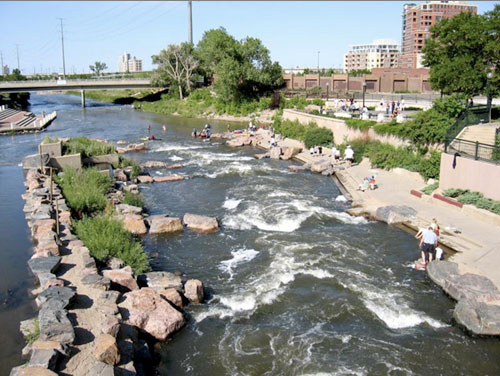
Denver: The city scores $350,000 from the EPA for restoration work along the South Platte River corridor

confluenceparkdenver.jpg

As a bicyclist I just want them to get rid of the goat heads [puncturevine] along the bike path. Here’s a report about the grant from Bruce Finley writing for The Denver Post. From the article:

The Environmental Protection Agency grant prioritized Denver as one of seven U.S. cities committed to revitalizing urban waterways. These projects “will increase access to a clean and healthy South Platte River,” EPA assistant administrator Nancy Stoner said Thursday. The EPA aims “to extend the vitality that we see along Lower Downtown’s riverfront to neighborhoods that still struggle with economic and environmental challenges,” Stoner said.

Denver officials are to use $262,500 for restoration work — improving the meandering characteristics of river, reducing erosion and stormwater runoff, filtering pollution through vegetation — near the Sun Valley neighborhood west of the river between Sports Authority Field at Mile High and West Sixth Avenue. Officials also will accelerate recreation-oriented improvements at the Johnson Habitat Park area along Interstate 25 and Santa Fe Drive…

“When you have a healthy park system, it adds to the economic vitality and quality of life in adjacent neighborhoods,” foundation director Jeff Shoemaker said.”The South Platte is Denver’s greatest natural resource.”

More South Platte River basin coverage here and here.

Fraser: Part of the Fraser River may be designated as the ‘Eisenhower Memorial Reach’

Eisenhower fishing “little boy falls” in 1955 in Maine.

Back when I was a kid I remember folks talking about how much President Eisenhower loved fishing the Fraser River. We thought it was cool that he came to Colorado once in a while. His wife Mamie spent part of her time growing up in Denver and Colorado Springs. Here’s a report about the proposed “Eisenhower Memorial Reach” from Tonya Bina writing for the Sky-Hi Daily News. From the article:

State Rep. Randy Baumgardner (R-Cowdrey), is sponsering the bill that could authorize the Colorado Department of Transportation to accept and expend gifts, grants, donations and federal funds for sign placement on US Highway 40 in downtown Fraser, directing motorists to the river’s newly designated “point of interest.”[…]

The effort to designate the Fraser River’s two-mile stretch from the bridge-crossing at Rendezvous Road to the bridge-crossing at County Road 8 was spearheaded by the Grand County chapter of Trout Unlimited. TU plans to pay for additional signage to direct visitors to the Eisenhower statue along the river and to talk about the river designation, according to chapter president Kirk Klancke of Fraser. The designation, Klancke said, “is to draw attention to the fact that the Fraser River is a pristine environment, pristine enough to have drawn the leader of the free world back in the ’50s.”

Naming this reach of the Fraser after 34th president Dwight David Eisenhower makes a “historical and political statement,” Klancke said. River advocates hope the resolution highlights “what’s being sacrificed for the sake of municipal water supplies,” he said…

According to a draft of the resolution, Eisenhower first made his way to Byers Peak Ranch in the Fraser Valley as late as 1952 and returned each year until his heart attack in 1955. Eisenhower enjoyed fishing in the Fraser River and its tributary St. Louis Creek, which he referred to as his “home water” when visiting Colorado.

More Fraser River coverage here and here.

The National Weather Service is recruiting volunteer weather spotters

lightning.jpg

From the Summit County Citizens Voice (Bob Berwyn):

If, for example, you look at the latest updated table of seasonal snowfall totals for the year-to-date compiled by the Boulder office, you’ll find statistics from Nederland and Niwot, Broomfield, St, Mary’s Glacier and Evergreen, but not a single reading from Summit or Eagle County. Spotter reports are especially important in the mountains because the Doppler radar system has a hard time making accurate readings in the rugged topography of the Rockies.

So instead of complaining about how wrong the Denver-based TV forecasts are, consider becoming a volunteer for the spotter program. “We always need more help in data-sparse regions. Summit county is fairly void of spotters except maybe a half dozen. I haven’t had anybody who wanted to do this. You will see other void counties in the mountains, like Jackson and Grand counties,” said Scott Entrekin, who coordinates the program. Volunteers don’t need specialized equipment, but do have to attend one of the spotter training classes, several of which are scheduled around the Front Range during the next few months.

From the National Weather Service:

Colorado All-Season Spotter Team

Weather reports from spotters will help save lives and property during the years to come. The volunteer spotter team is an essential part of the warning decision process of the National Weather Service. Ground truth reports from spotters are used in conjunction with Doppler radar, satellite, and other sources to determine the need for weather warnings and advisories.

We are continuously recruiting spotters living in Northeast Colorado, and across the Northern mountains, Front Range Foothills, and high mountain valleys. If you are a weather enthusiast and enjoy measuring rain and snowfall, or you find yourself drooling at the bit for severe weather, this team is for YOU! Folks living in mountain locations such as Jackson, Grand, Summit, Larimer, and Park counties are especially needed!

Typical reports you would provide include; snowfall, snow depth, freezing rain, dense fog, high winds, and road conditions. Examples of summertime weather reporting would include information on tornadoes, hail, heavy rainfall and flooding. A dedicated, toll free number is available to call the National Weather Service in Boulder, 24 hours a day, 7 days a week. Reporting can also be done on your computer via the Denver/Boulder Home page to submit weather reports.

You can be involved in the Spotter Team! Here’s what’s involved:

– To become a member of the team you must attend one of the severe weather/spotter training classes which are offered in the Spring and early Summer. We will usually start posting training sites and times in late January and February with the link. http://www.crh.noaa.gov/bou/?n=spot_training
– You must be at least 18 years old to participate in the program. However, we do encourage children and youth to help adults, while learning the science of meteorology.
– Once you have been trained, you will receive your own spotter number and information sheets on how to report.
– We recommend refresher training every 2 years once you have been initially trained.
-Supplemental Skywarn training is available through COMET at https://www.meted.ucar.edu/training_course.php?id=23
-No Special equipment is needed!
-For current members, updated information and changes on the program can be found on our web page, via the “news of the day” at http://www.crh.noaa.gov/news/display_cmsstory.php?wfo=bou&storyid=63779&source=0

Pagosa Springs: The Geothermal Greenhouse Partnership scores $25,000 for greenhouse project

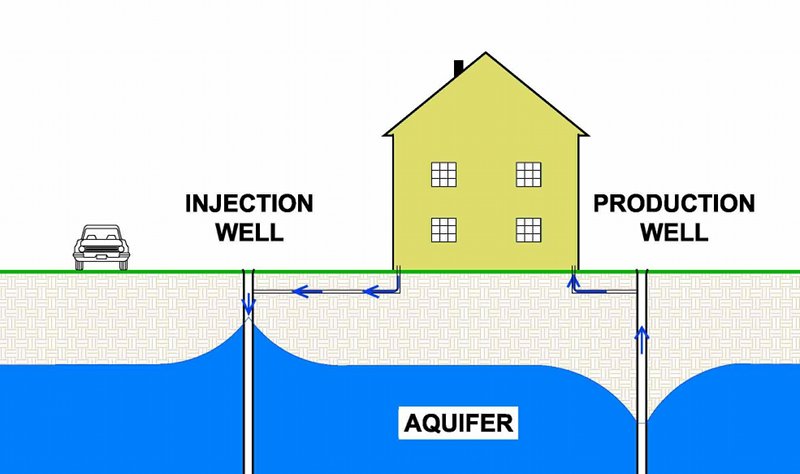
geothermalopenloop.jpg

From the Pagosa Daily Post (Elaine Feeney Wood):

The Geothermal Greenhouse Partnership (GGP) was recently awarded a $25,000 grant from the Laura Jane Musser Fund to contribute to the implementation of the greenhouse initiative in Centennial Park. The Musser Foundation encourages the collaborative and participatory efforts among citizens in rural communities to strengthen their towns in civic areas including economic development, arts and humanities, public space improvement and education…

The GGP aims to:
1) create a center for lifelong education as well as for advanced study in agriculture and renewable technology;
2) provide a test site for the commercialization of year-round organic crops at high altitude using renewable energy;
3) provide affordable, organic, locally grown food for people and businesses; and
4) provide year-round community gardens.

The greenhouse domes will be built in Centennial Park on the banks of the San Juan River. This park will invite locals and visitors alike to pause, enjoy the natural setting, pursue environmental education, experience sustainable agriculture, and appreciate renewable energy technologies.

More geothermal coverage here and here.

Energy Fuels Corp announces a merger with Denison Mines Corp: Will they build the proposed Piñon Ridge Mill now?

pinonridgesite.jpg

From The Durango Herald (Joe Hanel):

The merger with Denison Mines Corp. also gives Energy Fuels an operating uranium mill in Utah and raises the prospect that it might not build the Montrose County mill. Denver-based Energy Fuels wants to build the Piñon Ridge uranium mill in the Paradox Valley, outside the town of Naturita. It would be the first new uranium mill in the United States in 30 years.

Colorado’s health department approved Energy Fuels’ permit to build the Piñon Ridge mill, but opponents have sued to stop it. The company has spent $11 million on getting the mill permitted and is committed to securing approval to build it, Energy Fuels CEO Steve Antony said on a Tuesday conference call. But whether Piñon Ridge actually gets built is another question altogether. “We intend to complete the defense of the license, and at that time, depending on market conditions, any kind of decisions to go forward with actual construction will most likely be market-driven and based on market opportunity,” Antony said…

Denison runs the country’s only operating uranium mill, the White Mesa mill near Blanding, Utah. The merger gives Energy Fuels access to a mill right away, instead of waiting for the regulatory and legal process to be settled with Piñon Ridge, Moore said. Denison milled only ore from its own mines at the White Mesa mill, so Energy Fuels did not have a place to process uranium from the mines it owns before the merger…

Energy Fuels plans to acquire Denison in a stock deal worth about $107 million based on Monday’s share price. The deal is set to close June 30, Moore said. Denison shareholders, led by Korea Electric Power Corp., will own about two-thirds of Energy Fuels stock once the deal is completed. Denison lost $71 million last year as the uranium market plunged after the power plant meltdown in Fukushima, Japan…

Earlier this month, Energy Fuels completed its merger with Titan Uranium, which nearly tripled the Denver company’s uranium reserves. The purchase of Titan gave Energy Fuels the “critical mass” it needed to acquire Denison, Moore said.

More coverage from Katie Klingsporn writing for The Telluride Daily Planet. From the article:

The merger would mean that Energy Fuels would acquire the White Mesa Mill in Blanding, Utah — the only conventional uranium mill currently operating in the U.S. — as well as four working uranium mines in the area. The working mines include the Beaver Shaft and Pandora mines near La Sal, Utah, as well as the Daneros Mill west of Blanding and a mill in northern Arizona. Denison’s assets also include 11 mines in the Colorado Plateau region that are not currently producing uranium, according to Energy Fuels. Denison Mines Corp. is a uranium and vanadium producer with projects in the U.S., Mongolia, Canada and Zambia…

“This transaction is transformational for Energy Fuels and reshapes the landscape of the uranium sector within the U.S.,” [Steve Antony, President and CEO of Energy Fuels] said, adding that the move will combine the asset of the only operating uranium mill in the U.S., White Mesa, with a significant resource base that can feed it. “The result is an unmatched production growth profile and the opportunity for both Energy Fuels and Denison shareholders to benefit from the clear operational synergies that result from this transaction,” he said. “I look forward to working with Denison’s U.S. team to maximize the benefits of this important combination.”[…]

Moore said the transaction is largely unrelated to the proposed Piñon Ridge Mill, and said Energy Fuels will continue to defend the licensing process in court and pursue the project…

Moore added that the deal will allow Energy Fuels to evaluate opening two of its mines, the Energy Queen and Whirlwind, in order to accelerate the economic development Energy Fuels wants to get started in the region. According to Denison Mines’ website, the White Mesa Mill, which is located six miles south of Blanding, is licensed to process of average of 2,000 tons of ore per day. In full operation, the mill employs approximately 150 people…

Energy Fuels also recently acquired Titan Uranium Inc., which includes the Sheep Mountain Project in the Crooks Gap District of Wyoming. Energy Fuels announced an updated Preliminary Feasibility Study for Sheep Mountain on March 1.

More nuclear coverage here and here.

Nolan Doesken (Colorado State Climatologist) was down in the San Luis Valley last week talking climate and weather

nolandoesken1.jpg

From The Pueblo Chieftain (Matt Hildner):

While the valley’s weather may be different than other parts of the state, it’s driven by many of the same factors. High elevation, latitude, a landlocked location in the middle of the continent and the surrounding mountain topography are drivers. It’s the last factor that plays the biggest role that ensures Alamosa receives an average of roughly 7 inches of precipitation a year, which is less than the Front Range and even Phoenix. Storm systems lose much of their muster once they make it past the San Juan and Sangre de Cristo mountain ranges. “Descending air is drying air,” he said. “You are on the short end of the stick.”

Salida: The city is putting voluntary watering restrictions in place for the summer

watersprinkler.jpg

Here’s the release from the City of Salida (Lonnie Oversole):

Water restrictions for the 2012 irrigation season will again be on a voluntary basis. Citizens are encouraged to follow the same restrictions that had been in place in past years, which includes even/odd day watering and no watering between 10:00 a.m. and 4:00 p.m. Should you choose not to follow voluntary water restrictions, there will be no enforcement or penalty.

Keep in mind if you water during the heat of the day, you will loose 50% of the water you apply to evaporation, which is the reasoning behind not watering between 10:00 a.m. and 4:00 p.m. The even/odd day system has half the city watering on one day and the other half on the next day. This provides better water pressure for all customers and fire fighting personnel.

The Colorado Foundation for Water Education’s 10th Annual President’s Award Reception was a swell party

lewisentzcfwepresidentsawardreception04202012.jpg

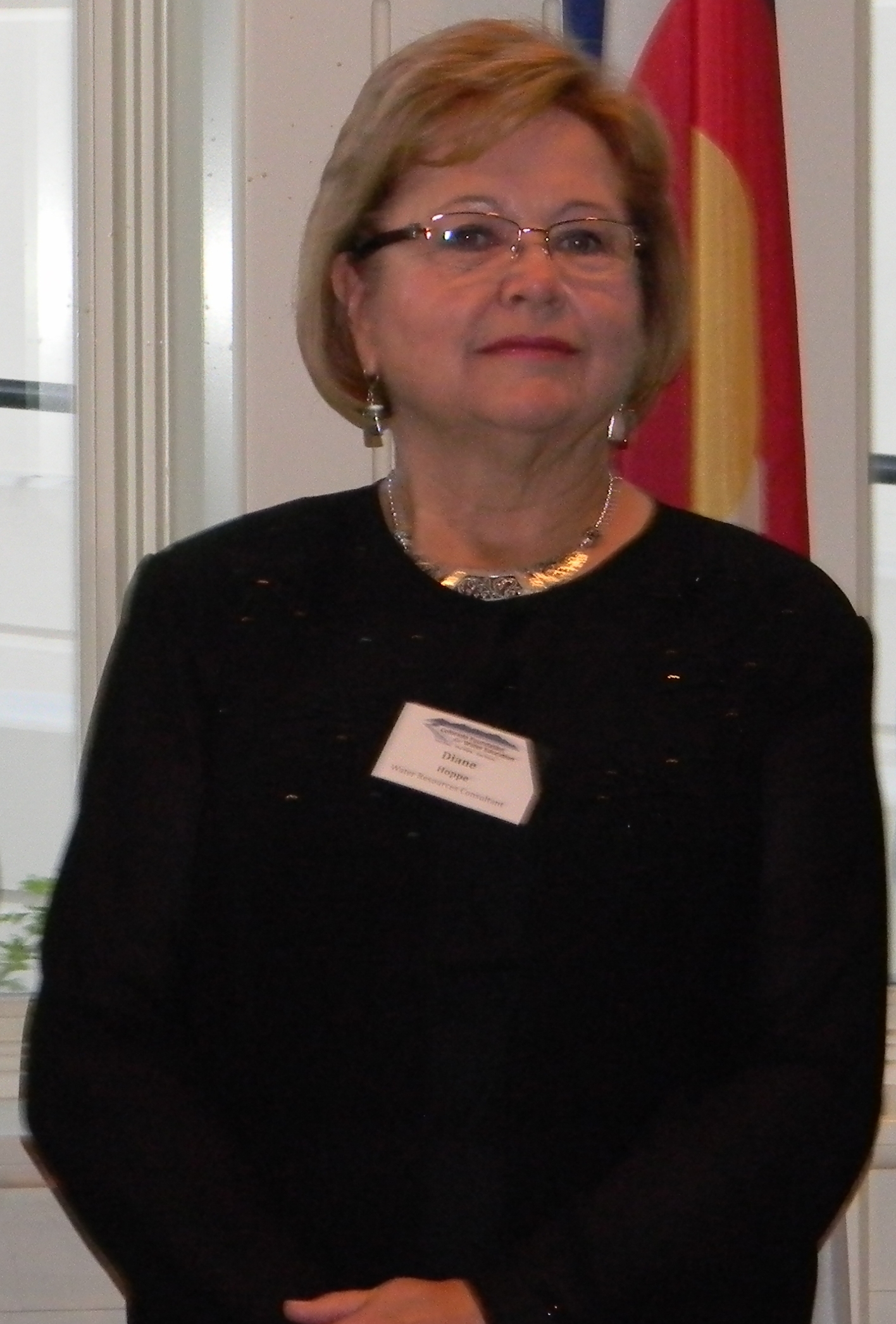
dianehoppecfwepresidentsawardreception04202012.jpg

Members of the water community in Colorado Water gathered yesterday evening to celebrate the tenth anniversary of the Colorado Foundation for Water Education and thank the legislators — Diane Hoppe and Lewis Entz — for pushing the bill through the Assembly.

The reception gives folks a chance to mingle, talk water of course, and poke a little fun at each other. Denver cooperated with a soft summer-like evening in April.

I never imagined that I would be standing here,” said Former State Representative Diane Hoppe after accepting the President’s Award for lifetime achievement in water education.

“We got the bill pretty expediently through the house,” she said, describing the legislation that set up the Foundation. However, in the Senate, Sara Duncan drafted an amendment that added a continuous appropriation to the bill. That amendment garnered a stormy welcome by some back at the House. Grinning just a bit, Hoppe said, “When we picked the people for the conference committee we knew we’d probably win.”

That launched the Foundation on it’s objective non-advocacy road.

“I can’t believe an honor like this,” said Former State Senator Lewis Entz.

“We had to have a little fun in the Senate,” he said. He told us of an instance where he brought in a fellow San Luis Valley resident, an alligator, to see the senate chambers. “The Senate President went berserk.”

He sponsored legislation, SB04-222, that authorized the creation of groundwater sub-districts in the San Luis Valley. “People in the valley just wanted to determine their own destiny,” said Entz. Legislating, “is the work of the people.”

“I’ll just keep going,” he added.

In his introduction for Diane Hoppe, Justice Greg Hobbs (filling in for an ill Rita Crumpton), said, “You had a way in the legislature of leading well,” conveying the message that, “we’ll listen to you and everybody else.”

Hobbs said that Lew Entz was, “the man that made it safe for a young lawyer to appear in the capital in a bolo tie.”

The venue for the shindig was the Carriage House at the Governor’s Residence in downtown Denver.

Former Commissioner of Agriculture Don Ament told me that he used to attend cabinet meetings at the Carriage House facility when Governor Owens was in charge. The acoustics were very poor and the sun would shine in the eyes of members on his side of the table. “We couldn’t hear and we couldn’t see,” he said. I wondered if Referendum A — which has the distinction of losing every Colorado county in 2003 — was cooked up there?

Senator Udall keynoted the evening.

“I’m an eternal optimist,” he said. “This is a good time to look ahead…Our most important resource, water, will unite us.”

“Diane and Lew are true and faithful public servants,” said Udall.

Emmett Jordan was also honored for his work designing and doing the layout for the Citizens Guides.

“The best thing is the way [they are] illustrated and laid out,” said Greg Hobbs.

It was a swell party.

Rio Grande River basin: Groundwater Sub-district No. 1 fallowed acreage at 9,100 acres for this season

slvdischargerecharge.jpg

From the Valley Courier (Ruth Heide):

Rio Grande Water Conservation District Manager Steve Vandiver told the water board during their meeting in Alamosa on Tuesday that some of the irrigators who were going to fallow their land in the first sub-district area this year opted to go with prevented planting instead because it would pay them more than the sub-district.

Vandiver said the sub-district ended up with about 9,100 acres under contract for fallowing this year.

“It was higher than that, and as insurance programs kicked in for prevented planting, people started withdrawing their contracts,” Vandiver told the board. “A number of people withdrew their offers to fallow.”

Farmers could receive $500-600 per acre under prevented planting, while the sub-district was only paying $200-300 per acre, Vandiver explained.

He said at least 18,000 acres would be fallowed to some extent under the prevented planting program, and although that would not entail 100 percent dry up, “there’s a considerable amount of ground that’s going to have a lot less growing on it this year than it has before.”

More San Luis Valley groundwater coverage here and here.

AWRA Colorado Section Annual Symposium, ‘Beyond our Borders: Water Lessons Learned from Outside Colorado,’ Friday April 27

mcpheereservoiroverlook.jpg

Click here for information about the event. here to go directly to the registration page.

From the AWRA Colorado Section website:

Beyond Our Borders: Water Lessons Learned from Outside Colorado
Friday, April 27th, 2012
Mt. Vernon Country Club

This year’s symposium will feature discussions on water lessons learned from outside of the state, and how those lessons can assist us with water issues within Colorado.

We are pleased to announce that Denver Mayor, Michael Hancock, will be our keynote speaker and Dick Wolfe, Colorado State Engineer, will be our luncheon speaker.

Agenda available here: Symposium Agenda

Symposium Program available here: Symposium Program

Register here: Symposium Registration

To raise money for the Scholarship Fund, we are holding our third annual silent auction at the symposium. If you would like to donate an item for the auction, please contact Val Flory at val.flory@lrewater.com.

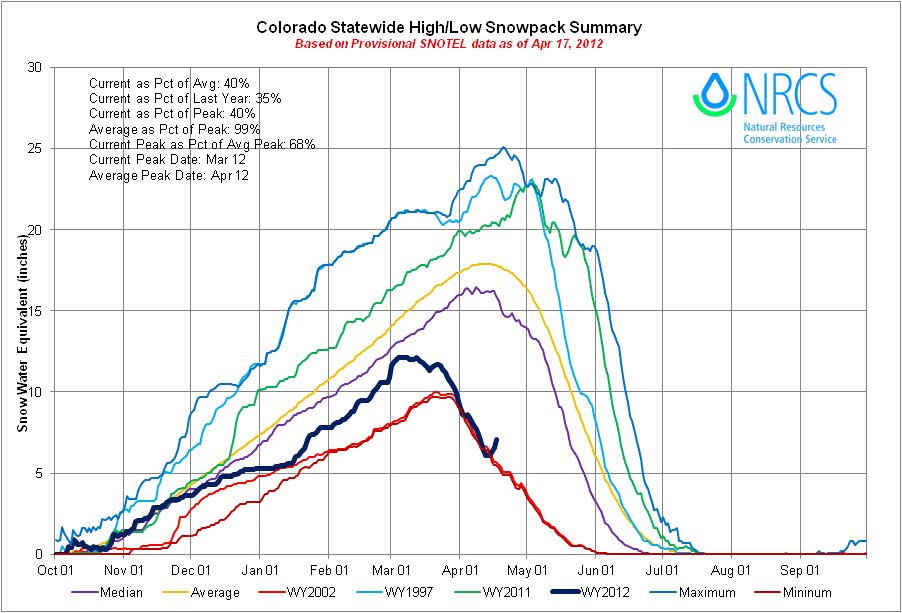
Snowpack/runoff/drought news: ‘It’s going to be a tough year, but our storage is up’ — Alan Ward (Pueblo Board of Water Works)

snowpackcolorado04182012.jpg

statewidehighlow04182012.jpg

From The Pueblo Chieftain (Chris Woodka):

“It’s going to be a tough year, but our storage is up,” said Alan Ward, water resources manager for the Pueblo Board of Water Works at Tuesday’s monthly meeting…

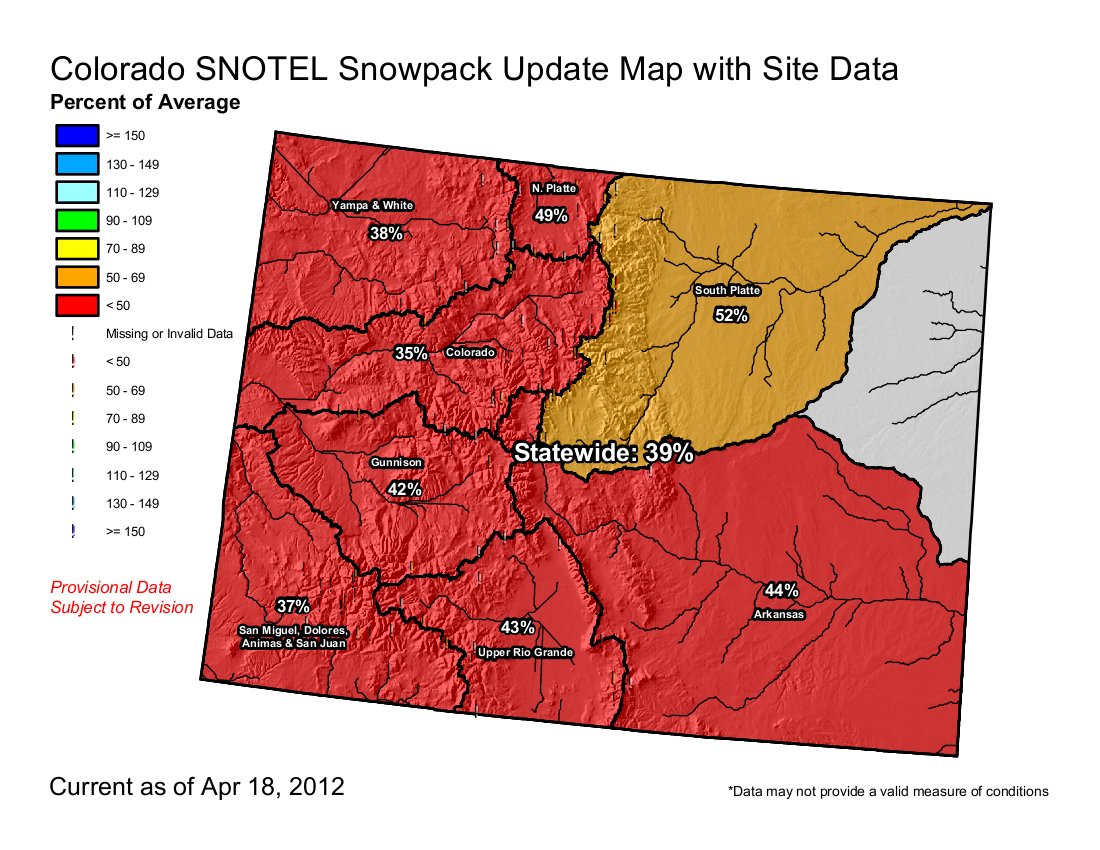
Snowpack in the Arkansas River basin is at 44 percent of normal, and has been melting since late March. The normal peak date is April 13. Things are worse in the Colorado River basin, which provides supplemental water for the Arkansas River, where snow levels have dropped to 37 percent. Normal peak is April 14, but was reached about three weeks ago. Pueblo has opened the Wurtz and Ewing ditches, which bring water across the Continental Divide. There also was recent heavy snowfall in the Busk-Ivanhoe collection area, which brings water through a tunnel…

In Pueblo, precipitation through mid-April is about 1.5 inches, about 65 percent of average.

From The Pueblo Chieftain (Chris Woodka):

This year, snowpack in the Colorado River basin, which supplies the Fry-Ark water, is at its lowest point in 45 years, melting off a month ahead of average and quickly reaching problematic limits on the amount that can be moved. “Storage is what’s saving us,” Executive Director Jim Broderick told the Southeastern Colorado Water Conservancy District board Thursday. “If they wouldn’t have taken the clue in 2002, the cities would be in trouble today.” After the drought of 2002, the cities increased their levels of storage. Lake Pueblo is nearly full because cities are storing Fry-Ark water and water from other sources. The cities also have filled up accounts in Twin Lakes, Turquoise and municipal reservoirs to the point where they are not anticipating further water restrictions this summer.

But the Southeastern district’s operating principles give priority to domestic uses and after the 2002 drought, the district began discussing what sort of “trigger” would cut off agricultural allocations. The district never agreed on what the trigger should be, instead relying on a group of indicators including snowpack, municipal storage, drought designation, soil moisture and water availability forecasts…

he lack of water from the Fry-Ark Project has a domino effect because it will affect return flows, and to some extent water supply plans that rely on its contribution. Other diversions, like Twin Lakes or Pueblo’s transmountain ditches, also are expecting lower yields.

From The Pueblo Chieftain (Chris Woodka):

The Lower Arkansas Valley Water Conservancy District voted Wednesday to charge farmers under the [augmentation] plan $75 per acre-foot to cover the cost of water to the district…

The district supplies water to make up for consumptive use depletions caused by sprinklers fed from surface ponds under Rule 10 of the state engineer’s consumptive use rules. The rules measure depletions under a formula and are designed to prevent depletions to Kansas.

From the Valley Courier (Ruth Heide):

[Colorado Division of Water Resources Division 3 Engineer Craig Cotten] said one of the few hopeful signs in the water world right now is the National Weather Service’s new three-month precipitation outlook for May, June and July. Where the last forecast showed the basin (the San Luis Valley) in a below-average precipitation area of the U.S., the new forecast puts this area in an average or equal chance of precipitation this summer.

In another bit of good news, Cotten’s office has been able to decrease curtailments of irrigators in the Conejos River system where flows the first part of April substantially boosted deliveries to downstream states to help satisfy Rio Grande Compact requirements. Irrigators on the Conejos waited until April 7 to turn on their ditches and initially were under a 6-percent curtailment. However, due to the deliveries made prior to April 7, Cotten said he was able to reduce curtailments to 4 percent on Tuesday. From April 1-15, 5,800 acre feet was sent downriver from the Conejos River system to meet compact obligations, leaving only 6,500 acre feet to be delivered between now and the end of the irrigation season. Cotten said the projected annual index on the Conejos is 215,000 acre feet, with 54,000 acre feet or 25 percent obligated for compact purposes. As much as possible of that is sent downriver during the winter months to lessen the curtailment during the irrigation season.

The April 1 forecast on the Rio Grande calls for a projected annual index flow of 465,000 acre feet, of which 116,500 acre feet or 25 percent must be sent downriver for the compact. Cotten said about 32,500 acre feet will need to be delivered downstream during the remainder of the irrigation system…

The Upper Rio Grande Basin as of yesterday stood at 47 percent of average, and Beartown, one of the major SNOTEL sites for the Rio Grande was 30 percent of average. Slumgullion, which is not in the basin but is close enough to assist with basin averages, showed the highest snowpack at 80 percent of average on Tuesday.

Wiggins secures a Morgan County special use permit for the new water treatment plant

watertreatment.jpg

From The Fort Morgan Times (Dan Barker):

The site on which the plant will be built is zoned agricultural, but such a use for the land is permitted with a special use permit, said Jody Meyer of the planning and zoning department as she recommended approval. This treatment plant is one of the parts of the project which will bring a new water supply to the town of Wiggins. Its wells have been running dry and the water quality has become progressively worse, said Tim Holbrook of Industrial Facilities Engineering, the company overseeing the project…

The water treatment facility, which includes a reverse osmosis system, will be built over the new wells situated on Highway 144 near Highway 34. Other components of the project are a 7.3-mile pipeline which will bring the water from the wells to the existing town water tank. Another water tank will sit at the plant and two 19-acre augmentation ponds have been completed near Goodrich.

More Wiggins coverage here and here.

Silverton: The San Juan Hardrock Mining and Water Quality Conference is scheduled for April 26-27

silverton.jpg

From The Durango Herald (Dale Rodebaugh):

Environmentalists, government officials, academics and industry representatives are scheduled to address the San Juan Hardrock Mining and Water Quality Conference on April 26-27 at the Kendall Mountain Recreation Center. Strong sponsorship by a variety of entities allows the conference to be offered free, said Chris Peltz of the Mountain Studies Institute, the event coordinator. “The conference has been in the planning for months and months,” Peltz said Tuesday. “The purpose is to increase the understanding of issues affecting mining and water issues.”

The focus of the presentations April 26 will be the upper Animas River where toxic drainage from abandoned mines has compromised water quality, Peltz said…

Speakers will dominate the first day of the conference this year. Visits to the historic Mayflower Mill and the former mining community of Gladstone are scheduled April 27.

Among the speakers April 26 will be: Loretta Pineda, director of the Colorado Division of Mining, Safety and Reclamation; Larry Perino from the Sunnyside Gold Corp.; Mike Holmes, an Environmental Protection Agency expert on mine remediation and Superfund projects; Peter Butler from the Animas River Stakeholders Group and chairman of the state Water Quality Control Commission; John Ridley from Colorado State University; and Doug Yager from the U.S. Geological Survey.

More Animas River coverage here and here.

Green Mountain Reservoir operations update: 60 cfs in the Blue River below the dam

greenmountainreservoir.jpg

From email from Reclamation (Kara Lamb):

We have a couple of changes up at Green Mountain Dam.

First, yesterday, April 18, we closed the road across the dam. We are in the process of replacing the bridge at the top of the dam. It is being brought up to current Department of Transportation codes. This section of the road will be closed through mid-May.

It is important to note that , despite the road closure, local business in Heeney are still open and can be reached by driving around the reservoir the other way (coming from the south). This is also the only way to access the road that drops down alongside Green Mountain Dam for fishing and kayaking access in the lower Blue River.

Second, we scaled releases from the dam to the Lower Blue back by about 15 cfs today. Some demands for water dropped off slightly, resulting in a lower release rate. We are now releasing about 60 cfs from Green Mountain Dam to the Lower Blue.

Your Colorado Water Blog: Nutrient pollution will be the hot topic at the Animas Watershed Partnership meeting on Monday

animasrivertubing.jpg

Here’s a new blog post about Monday’s meeting, from the San Juan Watershed Group running on Your Colorado Water Blog. From the post:

By the time the Animas reaches the New Mexico border, its water is already out of compliance with New Mexico water quality standards for total phosphorus, E. coli bacteria, sediment, and turbidity. When it reaches Aztec, impairment for nutrients and indicators of eutrophication are added to the mix. The New Mexico Environment Department added a whopping seven water quality impairments on New Mexico stretches of the Animas to its 2012 303(d) list of impaired waters .

While this might tempt some groups to point a finger of blame upstream, the Animas Watershed Partnership (AWP) is taking a different approach. The AWP started as an offshoot of the Farmington, New Mexico based San Juan Watershed Group, and was formed to specifically address the problems of nutrient pollution in the Animas across state and tribal boundaries. The AWP steering committee is comprised of both government and citizen members from three jurisdictions – Colorado, the Southern Ute Indian Tribe and New Mexico – and it alternates its meetings between Durango, Ignacio and Farmington in order to give equal voice to the concerns of all stakeholders.

More Colorado Water 2012 coverage here.

Oil and gas task force makes recommendations related to state and local regulatory jurisdiction

derrick.jpg

Here’s the release from Governor Hickenlooper’s office (Eric Brown):

A task force created by Gov. John Hickenlooper to clarify and better coordinate the regulatory jurisdiction between state and local government has finished its work and made recommendations in a letter to the governor and General Assembly.

“The Task Force does not make recommendations for new laws, but instead recommends a collaborative process through which issues can be resolved without litigation or new legislation,” the task force letter says. “The Task Force determined that whether there is sufficient reason to amend (Colorado Oil and Gas Conservation Commission) rules on substantive issues listed in the Executive Order, such as those impacting landowners, should be resolved on an issue-by-issue basis through a robust stakeholder process.”

Hickenlooper created the task force by Executive Order on Feb. 29, 2012. The group was asked to deliver a report no later than today to the governor, Speaker of the Colorado House of Representatives and President of the Colorado Senate.

“The task force has provided a roadmap for how best to deal with issues of local control,” Hickenlooper said. “We very much appreciate the task force members’ time and commitment to finding collaborative solutions.”

The task force recommended:

• Encouraging local governments to designate a Local Government Designee (LGD) and to participate in the COGCC’s LGD program. Encourage LGDs to communicate industry proposals and issues with local elected officials and the public as soon as possible. However, if there is no LGD, then the municipal or county clerk may be the contact for a local jurisdiction. Providing strong encouragement to oil and gas operators to engage local government officials and the public as early in the COGCC permitting process as possible to solicit input. Initial outreach to the LGDs should occur before the application for permit to drill is filed with the COGCC. Issues to be addressed will vary on site-by-site basis.
• Informing LGDs of opportunity to request additional 10 days to review permits and to request assistance from Colorado Department of Public Health and Environment (CDPHE). COGCC shall inform LGDs if formal consultation with CDPHE or CPW is to occur on a drilling permit application.
• Taking actions to ensure that the two new LGD liaisons at COGCC will be effective in working with local governments, oil and gas operators, and the public.
• Providing for a mutual understanding of oil and gas industry and local government practices by facilitating distribution of accurate information. Local governments, oil and gas operators, and COGCC should collaborate to, for example, identify the potential development impacts, duration of drilling operations, and proposed mitigation to protect public health, safety, welfare and the environment.
• Formalizing and promote opportunities for technical training of LGDs and other training/briefings for the general public. This should include annual training for new LGDs and periodic work sessions for LGDs or local government entities, based on need.
• Providing general education presentations in community forums, covering the entire state periodically.
• Local governments and operators should consider using an Memorandum of Understanding (MOU) and/or Intergovernmental Agreement (IGA), as appropriate, to address issues of local concern (e.g. standard conditions of approval, public outreach, etc.).
• Promoting opportunity for COGCC staff to obtain information regarding local government process and requirements, as appropriate. Local governments are encouraged to notify COGCC early in the process of developing local regulations.

The Task Force convened on March 9 and met once per week through April 12, in addition to two additional subcommittee working sessions. At the meetings, the Task Force was briefed on the COGCC’s Local Government Designee program, the COGCC inspection program, and received an overview of COGCC’s permitting process and regulatory timelines. Members learned about the legal underpinnings for Memorandums of Understanding (MOU) and Intergovernmental Agreements (IGA) between the state and local jurisdictions with regard to inspection authority. The Task Force also heard policy perspectives from Gunnison County, a local jurisdiction that recently entered into an MOU and has a pending IGA with the State, as well as from LGDs in jurisdictions where oil and gas activity has long been established.

Finally, the Task Force received more than 1,600 public comments.

All meetings of the Task Force were publicly noticed and streamed on the internet. All documents considered or generated by the Task Force were posted on a dedicated web page and available for the public to download and review.

“The Task Force discussed jurisdictional issues regarding substantive regulations but determined that drawing bright lines between state and local jurisdictional authority was neither realistic nor productive,” the task force letter says. “A more constructive approach will result from collaboration and coordination as outlined above. Through these processes, and the protocols that give them structure, questions around jurisdictional regulatory schemes will most effectively be resolved.”

The task force members were: Mike King, Chair, Executive Director of the Colorado Department of Natural Resources; Diana Allen, Member, Lakewood City Council (on behalf of Colorado Municipal League); Brian Bagley, Attorney, Longmont (on behalf of Colorado Senate President); Reeves Brown, Executive Director, Colorado Department of Local Affairs; Stan Dempsey, President, Colorado Petroleum Association; Barbara Green, Attorney, Denver (on behalf of Colorado Conservation Voters); Jack Hilbert, Commissioner, Douglas County Board of County Commissioners (on behalf of Colorado Counties Inc.); Tommy Holton, Mayor, Fort Lupton and Colorado Oil and Gas Conservation Commissioner; Tisha Conoly Schuller, Chief Executive Officer, Colorado Oil and Gas Association; Casey Shpall, Deputy Attorney General; Andy Spielman, Attorney, Denver and Colorado Oil and Gas Conservation Commissioner; and Ken Wonstolen, Attorney, Denver (on behalf of Colorado House of Representatives Speaker).

More coverage from the Denver Business Journal. From the article:

In the final report, the panel did not call for new laws or changes to old ones to clarify how energy operations should be regulated in the state, but rather recommended “a collaborative process through which issues can be resolved without litigation or new legislation.”

Hickenlooper, in accepting the recommendations, said the task force “has provided a roadmap for how best to deal with issues of local control.” His statement did not indicate whether he agrees with the recommendations.

State leaders and the energy industry have been debating what role local governments should have in regulating oil and gas operations in Colorado.

Traditionally, the state regulates what happens at or under well sites, including drilling and hydraulic fracturing, using rules overseen by the Colorado Oil and Gas Conservation Commission (COGCC). And cities and counties generally set land-use rules focused on off-site impacts of drilling, such as noise, dust and traffic.

More coverage from Kristen Wyatt writing for the Associated Press via The Denver Post. From the article:

“A more constructive approach will result from collaboration and coordination,” the task force of energy companies, local governments and environmental activists concluded. The task force was set up about a month and a half ago after several rival bills regarding energy zoning failed in the state Legislature.

More oil and gas coverage here and here.

‘How close to no-growth edicts are we in places like southeast-metro Denver and other locales?’ — Bart Taylor (ColoradoBiz)

spainsunflower.jpg

Here’s an in-depth look at business’ role in the world of water supplies, from Bart Taylor writing for Colorado Biz. From the article:

When real-estate reawakens, as it will, water will replace finance as a significant barrier to growth in Colorado, Nevada, and Arizona, and other locales in the West. No-growth is real-estate’s ‘nuclear option’. How close to no-growth edicts are we in places like southeast-metro Denver and other locales? Don’t believe water can impact development? Developers of Sterling Ranch, or the Canyons, both in Douglas County, may disagree.

On the western slope in Colorado, and in communities along the River throughout the Basin, business that relies on steady, regular flows for their livelihood are attuned to the major fight developing over the future of the River. New alliances are forming to join the battle, like Protect the Flows, a coalition of business and environmental interests in western Colorado. They generally oppose new appropriations from the River, though Upper Basin interests may be entitled to more. Who’s right? Business, or, well, business that needs the water?

What impact can new corporate sustainability initiatives have on reducing demand and extending current supply? Should water replace energy conservation as the compelling ‘green’ initiative for business? If so, how?

Without a sustainable water plan – one that business supports – can the West promote its otherwise brilliant future? Or will industry rule out Colorado and the West and locate elsewhere?

Longmont: City council approves drafting an ordinance for oil and gas regulations for a May 8 vote

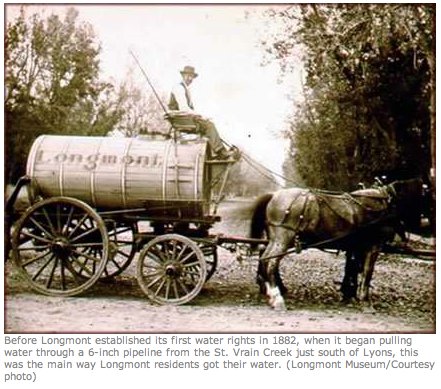
waterhaulerearlylongmont.jpg

From the Longmont Times-Call (Scott Rochat):

…Tuesday night [the council] voted 6-1 to have its draft oil and gas regulations prepared for an ordinance. The regulations ban drilling from residential zones but don’t go quite as far in restricting companies as earlier rules did…

The rules stepped back from areas that the city feared might be pre-empted by the state. For example, disposal facilities would be limited to heavy industrial zones instead of banned outright, while closed-loop systems for disposal (a commonly-used alternative to open waste pits) would be recommended instead of required. The one holdout was Councilwoman Sarah Levison, who said the city should make a bigger push. She gave the example of setbacks, where the state currently requires a 150 foot separation between wells and occupied buildings, or 350 feet in urban areas…

she also suggested that the city ban disposal facilities from inside an urban renewal area. Heavy industrial zones are common in the Southwest Urban Renewal Authority, she said, where the city is committed to removing blight. Levison’s proposal will be studied by city staff, but has not yet been added to the regulations.

The regulations set up both minimum and recommended standards. Companies wanting faster approval for their drilling permits can get it by adopting all the recommended standards. As one example, the minimum standards follow the state’s setback rules but the recommended standards set a 750 foot distance from occupied buildings.

Currently, no oil and gas permits are being accepted by the city until after June 16, when a moratorium expires.

The discussion came on the same day that Boulder County extended its own moratorium to Feb. 4. The county moratorium does not bind the city…

An online copy of the draft regulations may be found at ci.longmont.co.us/city_council/agendas/2012/documents/041712_5B.pdf

Meanwhile, here’s a recap of the inaugural Niobrara Shale Conference being held in Denver, from Jason Shueh writing for The Greeley Tribune. From the article:

In the open panel discussion with attendees and mineral rights owners — many from Weld and Douglas counties — Cristy Koeneke, vice president of the National Association of Royalty Owners, said to be careful before signing anything when oil and gas companies come requesting a lease and offering a signing bonus. “What the companies do, what land men do, is they waive the bonus money at the mineral owner and say ‘Here, look at this hand and don’t watch this one,’ ” Koeneke said…

Koeneke was joined on the panel by association board member Michelle Smith and Niobrara News owners Joél and John Lambe — all mineral rights property owners.

“One of the things we would really like to see is better education between the mineral rights owners and oil and gas companies,” Smith said. Smith encouraged mineral rights owners to organize themselves with better networks of communication and in areas where there is a high amount of oil and gas production, like Weld, to hold monthly town hall meetings with land spokesmen from the oil and gas companies. “This would allow the mineral rights owners the ability to meet with the companies face to face so they have the opportunity to discuss issues that are of concern to them,” Smith said.

Also, Commerce City is still working on their proposed regulations. Here’s a report from Monte Whaley writing for The Denver Post. From the article:

Oil and gas companies would be barred from drilling at or near Rocky Mountain Arsenal National Wildlife Refuge or Barr Lake State Park, under proposed restrictions being considered by city officials.

Other limits on oil and gas extraction would call for increased setbacks for drilling rigs, noise mitigation requirements, limits on hours of operation and a water quality monitoring program. The proposals are part of a package of restrictions the city is mulling in an effort to lighten the impact of hydraulic fracturing in the community, said city spokeswoman Michelle Halstead…

The City Council Monday night once again held off on voting on a six-month ban on oil and gas drilling in the city to give staff members time to finish their work.

More coverage from the Denver Business Journal. From the article:

Commerce City will host two public meetings in May to gather public input on changes to the land use code. The open-house meetings will be held at the Recreation Center on May 15 and Second Creek Elementary School on May 16.

More oil and gas coverage here and here.

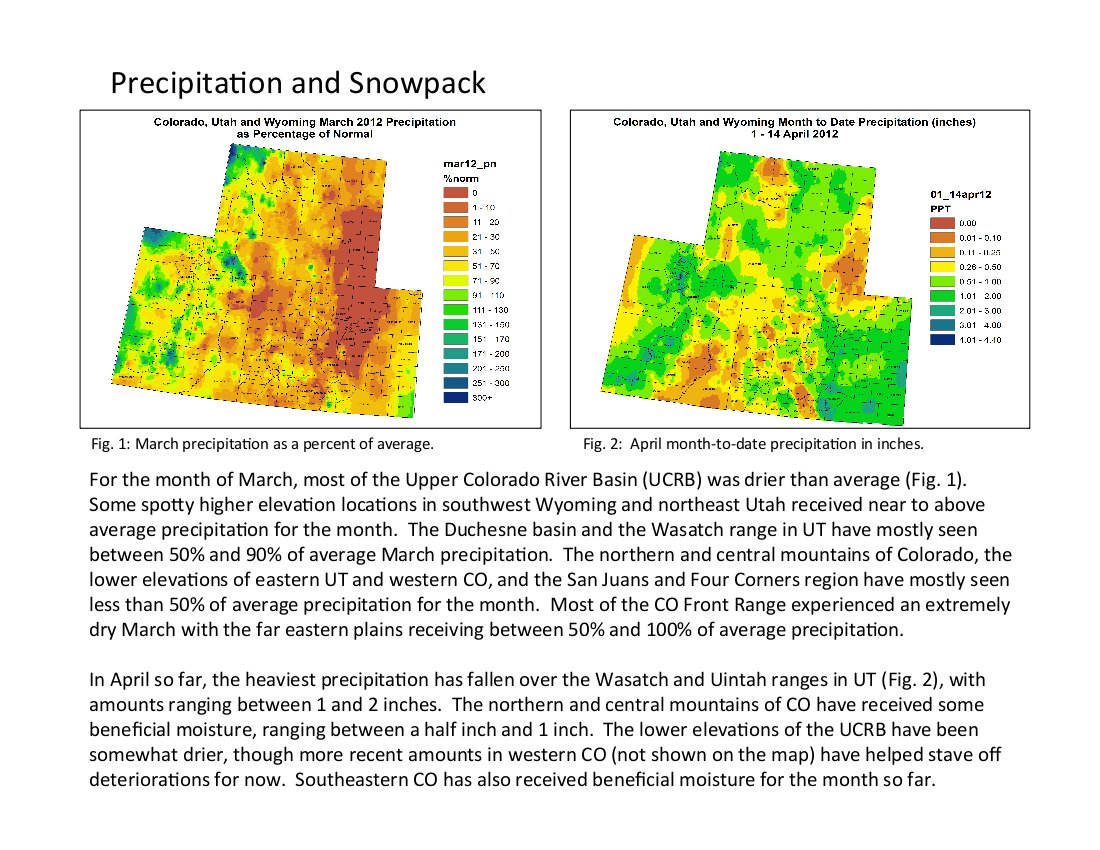
NIDIS Weekly Climate, Water and Drought Assessment Summary of the Upper Colorado River Basin

wyutcoprecipitationmarch2012ccc.jpg

Click on the thumbnail graphic to the right for the precipitation summary for March and April, so far. Here’s the link to the webinar summaries.

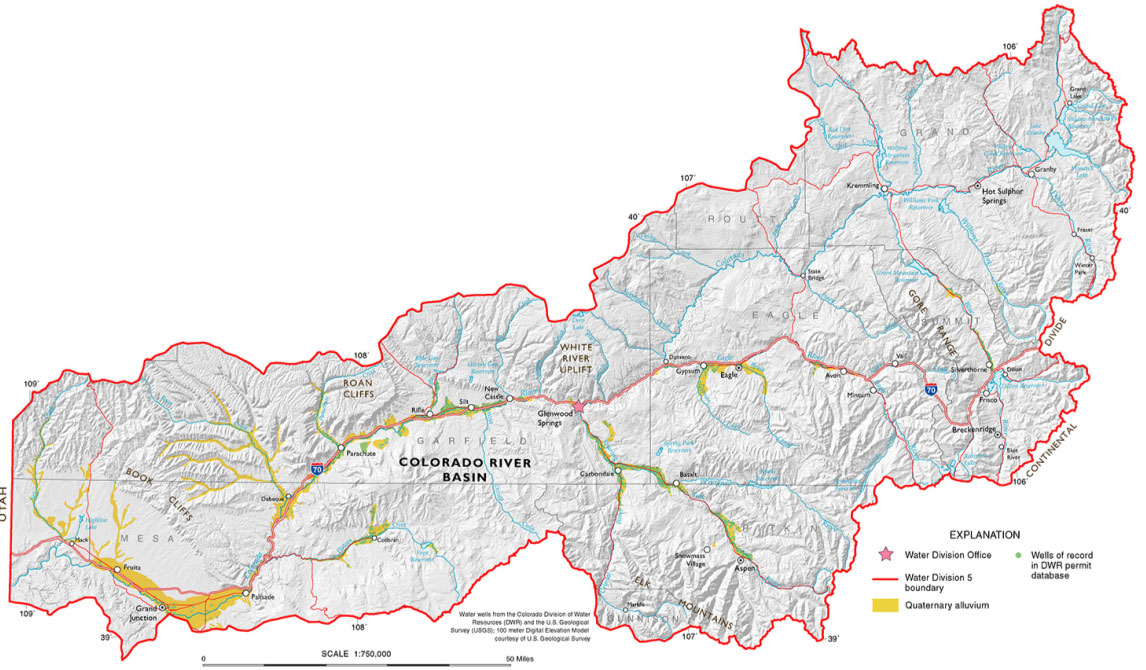
Summit County ‘State of the River’ meeting scheduled for May 8

coloradoriverbasincgs.jpg

From the Colorado Division of Water Resources via the Summit Daily News:

Jointly sponsored by the Colorado River District and the Blue River Watershed Group, the evening begins with water administration and project updates for the BLue River Basin, followed by a discussion of current snowpack and runoff predictions.

Bob Steger from Denver Water and Ron Thomasson from the Bureau of Reclamation will report on Dillon and Green Mountain Reservoir operations and how those operations will affect water-based recreation opportunities.

Summit County manager Gary Martinez will provide an update on the Colorado River Cooperative Agreement, while George Sibley commemorates the 75th anniversary of the Colorado River District with an historical perspective of the District, as well as Summit County’s water struggles and achievements over the years.

Scott Hummer, now the project manager for the Colorado Water TRust, will discuss the organization and its mission to protect and restore streamflows throughout Colorado.

The Blue River Watershed Group will highlight developments with collaborative restoration efforts. It will also be a chance to shake hands with Summit County’s new water commissioner, Troy Wineland.

More Blue River watershed coverage here and here.

2012 Colorado November election: Initiatives 3 and 45 clear the single subject requirement for the ballot

justianifirstdodifierofriparianrights.jpg

From the Summit County Citizens Voice (Bob Berwyn):

One of the ballot measures would apply the public trust doctrine to water in Colorado, declaring that unappropriated water in natural streams is public property, dedicated to the use of the people of the state. The public trust ballot measure would also clarify once and for all the public’s right to access streams and rivers. The second measure would put limits on diversions to protect the public’s interest in water, potentially prohibiting diversions “that would irreparably harm the public ownership interest in water.”

Upon review, the Colorado Supreme Court decided that the two measures are “single subject” measures sufficient to be placed on the 2012 General election ballot. Backers of the measures now must gather the required number of certifiied signatures to get the measures on the November ballot.

The public trust doctrine is rooted in ancient Roman law established by Emperor Justinian, essentially declaring that the waters of the state are a public resource. Most frequently, it’s been applied to ensure access to beaches, but also extends to other natural resources. This principle became the law in England under the Magna Carta and later part of common law in in the U.S. The legal principle was later subverted in dry western states, as private users came to dominate the allocation and distribution of water…

The public trust doctrine proposed for Colorado would boldly challenge existing water law by declaring that “The public’s estate in water in Colorado has a legal authority superior to rules and terms of property and contract law.”

More 2012 Colorado November election coverage here.

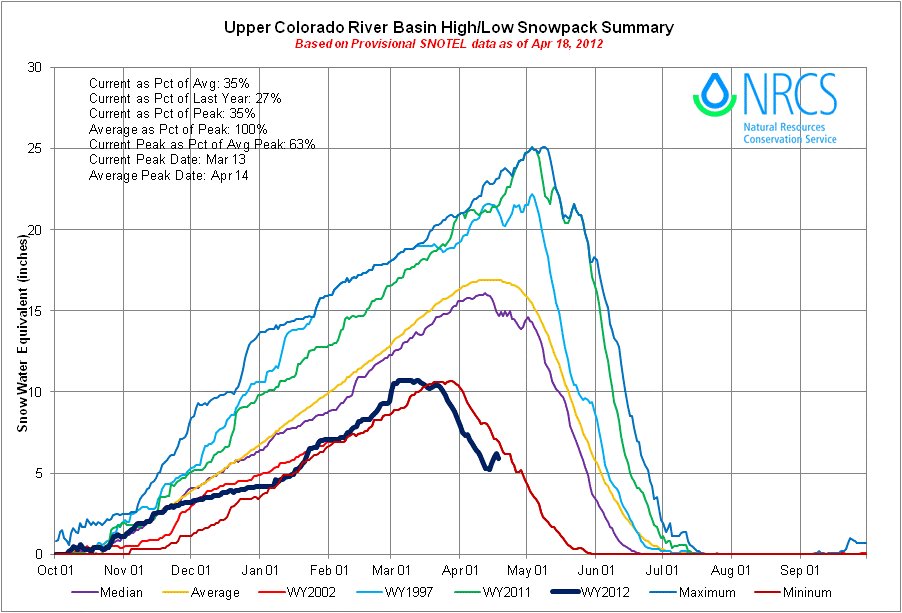
Water Availability Task Force meeting recap: The weather could get cooler and wetter over the summer

snowpackcolorado04182012.jpg

basinhighlowcoloradoriver04182012.jpg

From the Vail Daily (Scott N. Miller):

Snowpack across the state, which fills rivers and reservoirs, is remarkably low, thanks to unusually warm and dry conditions in March. The entire state is dry, but the Colorado River Basin has its lowest snowpack recorded in the last 45 years. A presentation [ed. at the CWCB’s Water Availability Task Force] by State Climatologist Nolan Doeskin showed that while Eagle County’s average temperatures in March weren’t as higher as those seen in Denver, they were still four to six degrees higher than normal. That was enough to start snowpack melting about a month before it usually peaks…

Klaus Wolter, of the Boulder-based National Oceanic and Atmospheric Administration said the models so far show the prospect of a cooler, drier late spring and early summer. The current “La Nina” weather pattern — fueled by cooler-than-normal water in the Pacific Ocean near the equator — has seen alternating wet and dry months, Wolter said, meaning May could be dry…

But the models also show more moisture coming in July, August and September, especially if an “El Nino” pattern — warmer-than-normal water in the equatorial Pacific — develops. Wolter put the odds of that happening at perhaps 40 percent…

While a cooler, wetter summer might help take some pressure off local water systems, it won’t put an appreciable amount of water back into the streams. That means there’s a real chance that outdoor watering will be restricted.

I live tweeted the meeting hash code #cwcbwatf.

Southern Delivery System: Did Colorado Springs violate their federal permit when they abolished their stormwater enterprise?

fountaincreek.jpg

From The Pueblo Chieftain (Chris Woodka):

A district formed to protect water in the Lower Arkansas Valley instructed its water attorney to investigate whether Colorado Springs violated a federal permit when it abolished its stormwater enterprise. “This is irresponsible behavior by Colorado Springs. They owe the rest of the area a service,” said Melissa Esquibel, who represents Pueblo County on the Lower Arkansas Valley Water Conservancy District board. “It’s unconscionable.”[…]

The board approved Esquibel’s motion to have Peter Nichols investigate whether Colorado Springs is in violation of a record of decision by the federal Bureau of Reclamation for SDS. The federal permit makes the assumption that Colorado Springs would have a certain level of funding annually under the former enterprise. Instead, Colorado Springs has spent about $1.2 million annually since voters instructed City Council to disband it in 2009. Stormwater funding is listed at $1.9 million this year, according to a budget comparison of Front Range cities distributed at the meeting. Colorado Springs spends $4.63 per capita on stormwater funding, less than 10 percent of the Front Range average. Pueblo is at half the average, at $25.81 per capita…

Last month, Colorado Springs Attorney Chris Melcher said Colorado Springs is obligated to spend $13 million-$15 million annually for stormwater improvements. At a Fountain Creek meeting last month, Councilwoman Brandy Williams said the council is working on a plan of how to come up with the money.

More Southern Delivery System coverage here and here.

Colorado Water 2012: Acequia culture dates back a thousand years

sanluispeoplesditch.jpg

Here’s the next installment of the Valley Courier’s Colorado Water 2012 series written by Lauren Krizansky. Click through and read the whole thing. Here’s an excerpt:

During the eighth century, the Moors brought the acequia – an Arabic word pronounced a-TH-equia – system to Spain under Hakam II’s reign. When the Spanish conquered South America centuries later, they introduced the system in similar landscapes eventually as far north as the American Southwest. In the late 1500s, the Spanish explorers found the northern New Mexico Pueblo Indians had independently developed a similar ditch irrigation system, which they improved with their horses and advanced tools.

Gravity and velocity pull the water through the land and are the two main system elements. Acequias move water through the crop fields and usually continue to flow back into larger bodies of water. The success of the system depends on the community and, if possible, the leadership of an acequia manager known as an acequiero in Spain or a mayordomo in the southwest. The ditches must be cleaned in the spring to remove eroded soil and organic materials and water must be delegated through land use, land size and water availability. Constant maintenance and surveillance is a necessity during peak irrigation months.

Acequias do not only preserve history, they preserve the land that, in turn, preserves the people. If the acequia is still a primarily earthen system, it seeps water back into the ground and follows the land’s natural contours. Since acequia maintenance requires hands, not machines, the community must work together to sustain the irrigation channels.

The ancient irrigation practice, however, is struggling to survive for many reasons in the Valley and abroad. Drought makes the systems obsolete and technology replaces manual labors. The children raised on the waters are interested in other things because reporting time spent as a mayordomo on a resume does not open gates in the modern world. In spite of the challenges, there are local efforts to give the modern world an opportunity to conserve an international history.

More Colorado Water 2012 coverage here.

Snowpack/runoff news: Three Grand County lakes set records for ice breakup this year

basinhighlowcoloradoriver04182012.jpg

snowpackcolorado04182012.jpg

From the Sky-Hi Daily News (Jack Bakken):

Ice break-up on Lake Granby happened on Thursday, April 12, and Farr Pumping Plant officials say they could see no ice between the Plant and Granby Dam on April 10, the earliest dates shown in the plant’s records. The last remnants of ice were on Arapaho Bay at the east end of the lake until last Thursday morning. Most of the lake was free of ice by Monday afternoon, April 9. The ice-off date this year broke the standing record set in 2004, when the lake ice was gone by April 14.

Shadow Mountain Reservoir’s ice-off date was April 10 this year, breaking its April 12, 2004 record. And on Grand Lake, this year the official date for ice off was on April 13, which is four days earlier than the record-setting date in 2004.

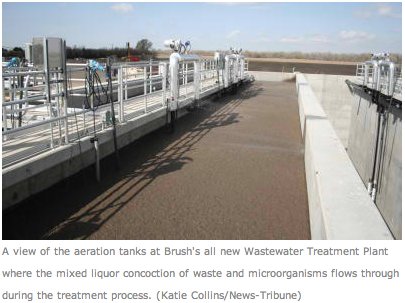
Brush: New wastewater treatment plant online

brushwastewaterplan042012.jpg

From the Brush News Tribune (Katie Collins):

The project also is one of the most ambitious that the city has seen in years and as of exactly 10:20 a.m. on April 12, Brush’s newest state-of-the-art wastewater treatment plant is up and running, ready for all the dirtiest business that Brush can dish its way.

On hand to get the facility rolling were Brush Mayor Dan Scalise who, along with City Administrator Monty Torres and Wastewater Manger and City of Brush Director of Utilities Dale Colerick, opened the plant in official fashion that morning as Scalise ceremoniously turned the valve to allow wastewater to flow into the facility.
As of the opening ceremony, just 50 percent of the newest portion of the plant is seeing use as a few more processes are in need of completion, including the building of one more settling tank, completion of the UV filtering system, as well as additional fencing, seeding, grating and solids handling assembly…

On March 12, 2012, in fact, the Colorado Water Quality Control Commission opened hearings on proposed water quality standards for nutrient concentrations in the state’s rivers and lakes as well as limits on anyone who discharges into those waters. Limits were adopted and will be implemented over the next 10 years and the City of Brush’s newest plant was designed specifically to utilize new technologies in order to remove nutrients such as phosphorous and nitrates from the City’s discharge to the South Platte River.

More wastewater coverage here and here.

Conservation: Best billboard of the month so far?

useonlywhatyouneeddenverwaterapril2012.jpg

Click on the thumbnail graphic to the right to go to the Denver Water FaceBook page to see the photo.

Flaming Gorge pipeline: The Garfield County Commissioners go on record opposing the project

greenwithenvytrailerscreenshottroutunlimited.jpg

From the Glenwood Springs Post Independent (John Stroud):

…the decision to oppose the proposed 560-mile-long Flaming Gorge pipeline was not a unanimous one. The Garfield Board of County Commissioners voted 2-1 Monday to take the position against the controversial project. Commissioner Tom Jankovsky said that, although philosophically opposed to Front Range water diversions, it’s too early in the process for the county to be taking a position on the controversial project…

But Commissioners Mike Samson and John Martin disagreed.

Samson has been pushing for the county to take a stance against the project, as other Western Slope governments, water users and conservation groups have done. “We can’t continue to give West Slope water to Eastern Slope entities,” Samson said. “Enough is enough.

“I’m looking down the road to our future needs,” he said. “Western Colorado will grow and expand, and we will need that water. And once it’s over there, there’s no way to get it back.”[…]

Garfield County’s resolution opposing the project questions the costs for the project, as well as the potential threats to the western Colorado and other downstream water users on the west side of the Continental Divide. “The Flaming Gorge pipeline is not feasible without subsidies, with some estimates suggesting that the project would need as much as $370 million in state or federal subsidies,” the resolution states.

“Garfield County urges Colorado water leaders and policymakers to devote the state’s attention and financial resources on water projects and programs that are cost-effective and that do not pit one region of the state against the others,” it concludes.

More Flaming Gorge pipeline coverage here and here.

Southern Delivery System: Colorado Springs Utilities plans to file appeal of Judge Victor Reyes’ decision about water quality permit

arkansasfountainconverge.jpg

From The Colorado Springs Gazette (Daniel Chaćon):

While the Colorado Department of Public Health and Environment evaluates its next move, Colorado Springs Utilities said Tuesday it plans to appeal the ruling. “Construction is proceeding,” SDS spokeswoman Janet Rummel said…

The court ruling came after a request for a judicial review from Pueblo District Attorney Bill Thiebaut and the Rocky Mountain Environmental Labor Coalition. Thiebaut argued that SDS will lead to potentially damaging water flows back to Pueblo, worsening “the existing flooding and contamination in Fountain Creek and the Arkansas River.” Thiebaut has a long history of opposing SDS, and during the permitting process, the labor coalition tried unsuccessfully to get Utilities to promise to use union labor for the construction of SDS…

Rummel said the 401 certification was meant to assure the U.S. Army Corps of Engineers that the SDS project would follow all applicable state water quality regulations and procedures. The certification was a condition of the 404 permit issued by the Army Corps of Engineers for SDS. That permit is required under the U.S. Clean Water Act because the project will have permanent and temporary impacts on jurisdictional wetlands.

Thiebaut told the Pueblo Chieftain newspaper this week that Utilities doesn’t have a valid permit for SDS. “In order for the SDS system to proceed, the owners need to obtain one from the state,” Thiebaut told the newspaper. “Approval of a new 401 certification will require a comment period and opportunity for appeal. In the alternative, the defendants can appeal to a higher court. We are prepared either way.”[…]

Rummel said the judge’s ruling means that if the appeal is unsuccessful, the state may be required to do additional water quality evaluation. “That may result in additional mitigation for the project. That is what we believe the worst case scenario to be,” she said.

More coverage from John Hazelhurst writing for the Colorado Springs Independent. From the article:

…thanks to SDS, we’ll have more water than we’ll ever need. Our future is assured: Our urban forest won’t die, we can keep our lawns green, and sustain ourselves indefinitely … right?

Not quite. Even with some surprising decreases to cost projections, SDS will still run about $1.6 billion total, and has already affected our water rates. To help mitigate costs, Utilities would like to make “temporary” deals with users outside the city.

That’s nuts. Doing so will just enable sprawl, further hollow out our tax base, and put us at risk in the years to come. Temporary deals have a way of becoming permanent. It’s best not to make such deals, and use the water to fuel our infill growth.

More coverage from Pam Zubeck writing for the Colorado Springs Independent. From the article:

Instead of a 120 percent increase [ed. in Colorado Springs water rates] between 2011 and 2017, the hike could be less than half that under a new rate forecast being drafted. The change stems in part from the recession creating more competition among contractors — thus, lower construction costs. But the biggest reason is lower interest rates, which could save $700 million from previous estimates. While officials won’t release new projections until the May 16 Utilities Board meeting, chief financial officer Bill Cherrier says, “What I can tell you is, we probably lopped off several years of rate increases. That would be four years of 12 percent increases, instead of six or seven. Even the ones we need, we believe, will be less than 12 percent. Once we get up to a certain level of rates, we’re likely to see virtually no water increases for quite some time.”[…]

Cherrier says the city will issue more debt for SDS in August, and in 2013 and 2014 to finish Phase 1 funding for the pipeline, construction of three pump stations and a water treatment plant, which continues even as the city spars with opponents over a water quality permit.

In 2010, City Council raised rates by 12 percent for 2011 and 2012. Under the initial plan, the typical residential customer’s average monthly bill would have leaped by 120 percent, from $37 in 2010 to $82 in 2017. If the last three years of 12 percent rate hikes aren’t imposed, the typical increase would be 57 percent, to $58.

More Southern Delivery System coverage here and here.

Occupy Your Mind of Pueblo will host a free showing of ‘Blue Gold’ Monday

bluegoldposter.jpg

From The Pueblo Chieftain:

Occupy Your Mind of Pueblo will host a free showing of “Blue Gold” scheduled at 6 p.m. Monday at the Pueblo West Library, 298 S. Joe Martinez Blvd. The movie documents people worldwide fighting for their basic right to water, from protests at local grade schools to court battles and outright revolutions. The film also examines the future of the world’s water supply.

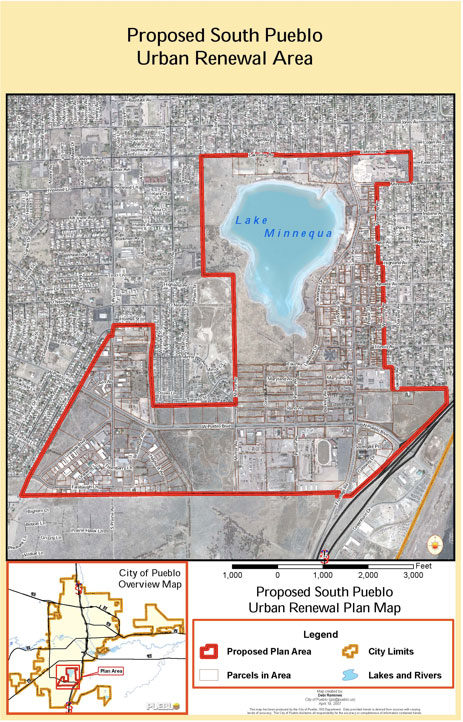
The Pueblo Board of Water Works approves plan to share costs with the City of Pueblo to provide looking water for Lake Minnequa

lakeminnequa.jpg

From The Pueblo Chieftain (Chris Woodka):

“This is definitely a way to make it an amenity and not a liability,” said Tom Autobee, a water board member who made a motion to pursue the plan. It passed 5-0. The 3.7-mile pipeline would connect the St. Charles reservoirs with Lake Minnequa in order to keep fresh water flowing into Minnequa. It would be gravity-fed and would cost about $1 million in materials. The project could start as soon as this summer. Right now, Lake Minnequa fills only with stormwater. Drought for the past two years has created low levels in the lake that have killed fish and created odors for the Bessemer neighborhoods surrounding the lake.

The Lower Arkansas Valley Water Conservancy District has agreed to flow some of its water through Lake Minnequa and the water board would provide some additional water to account for evaporation or for flow-through, under a separate agreement…

The city would repay the water board through stormwater fees over three years, through a reduction in the amount remitted by the water board. The water board collects stormwater fees for the city on its monthly bills.

More Pueblo Board of Water Works coverage here and here.

R.I.P. Laurence ‘Campy’ Campton

fibarkospreypacks.jpg

From The Mountain Mail (Arlene Shovald):

“Dad had goals,” his son Chuck said. “He wanted to make it to the anniversary and Mom’s birthday. Her birthday was April 12 and we lost him April 13. He considered anything past the anniversary to be a bonus day. He was a blessing and a patriot.”

The Camptons were married March 28, 1937.

He was a veteran of World War II, and during the Battle of the Bulge he was taken prisoner of war in Germany and spent 91 days in confinement. He weighed about 90 pounds when he was released on their eighth wedding anniversary, March 28, 1945.

In the early years he was active with FIBArk, both as an organizer and a competitor. He won the down-river race in 1959 and shared his passion for the down-river event with son Chuck, who raced in the 1960s, and his grandson Christen, who raced in 2007. In 2011 Campy was named to the FIBArk Hall of Fame.

More Arkansas River basin coverage here.

Commerce City delays vote on six month moratorium for oil and gas activities inside the city limits

derrick.jpg

From the Denver Business Journal:

Commerce City has delayed voting on a proposed six-month moratorium on oil and gas activities in the city until July 16.

Meanwhile, the council, which met Monday, asked the city staff to work on completing proposed land use code changes regulating energy development, a city statement said.

More oil and gas coverage here and here.

Denver Water is keeping an eye on the Lower North Fork fire area potential runoff into Strontia Reservoir

strontiaspringsdam.jpg

From the High Timber Times (Gabrielle Porter):

Strontia Springs Reservoir, at the mouth of Waterton Canyon, is also just downstream from the area affected by the Lower North Fork Fire, and crews from the company went to the burn site April 5 to start examining streams’ water quality, said spokesman Joe Sloan. The crews are looking for ash and sediment from the more recent fire; ash can cause a bad taste or smell in drinking water. “Today’s the first day we’ve been allowed up onto the Denver Water property,” Sloan said April 5. “We always have a team of folks from our water labs … monitoring.”[…]

Sloan said he didn’t know how soon crews would know about any possible contamination.

More Denver Water coverage here and here.

Loveland: Annual waterway cleanup Saturday

lakeloveland.jpg

From the Loveland Reporter-Herald (Jessica Benes):

Volunteers will clean up areas of the Big Thompson River, Dry Creek, Big Barnes Ditch and many more ditches…

Last year, 381 volunteers removed about 93 cubic yards of trash and debris. The stormwater division counts on about 400 volunteers and hopes to reach that number this week, which is when a lot of volunteers sign up.

As part of the stormwater permit through the Colorado Department of Public Health and Environment, the division creates a number of programs like the waterway cleanup to provide for public participation and education.

More Big Thompson River watershed coverage here.

Snowpack news: Today’s Statewide High/Low graph from the NRCS shows an uptick from the recent weather system

basinhighlowstatewide04172012.jpg

snowpackcolorado04172012.jpg

From The Greeley Tribune (Eric Brown):

If the region doesn’t see significant moisture, 2012 could be remembered as the year that northeastern Colorado broke — by a long shot — any record-low precipitation numbers posted during the Dust Bowl and other years when drought has plagued the region.

As of Monday, 2012’s precipitation figures through April in Fort Collins were far below any recorded of the Dust Bowl years (Greeley’s precipitation data only dates back to the late 1960s, so there are no numbers from the 1930s available for comparison. Fort Collins is the closest city in which 1930s numbers are available).

This year’s numbers so far are also much worse than those recorded during the historic drought year of 2002, according to statistics provided by the Colorado Climate Center in Fort Collins.

At the current rate of moisture, 2012 looks to have less than 4 inches of precipitation by the end of the year in northeastern Colorado, which is less than half of what was recorded in 1934 and 1936 — the two driest years of the Dust Bowl — and in 2002.

Of course, there’s still plenty of time to rebound from the historically dry year the region has endured.

Interior Announces First Navajo-Gallup Water Supply Project Construction Contract

sanjuan.jpg

Here’s the release from the U.S. Bureau of Reclamtion (Adam Fetcher/Pat Page)

Secretary of the Interior Ken Salazar announced that the Bureau of Reclamation today has awarded a $10.75 million construction contract for the Navajo-Gallup Water Supply Project, setting the stage for construction to begin on the major water infrastructure project this summer. When completed, the project will provide a long-term, sustainable water supply to meet the critical needs of more than 43 Navajo chapters; the city of Gallup, New Mexico; and the Teepee Junction area of the Jicarilla Apache Nation.
Once construction is underway, it is possible that the first water delivery to Navajo communities – where more than 40 percent of Navajo Nation households rely on hauling water to meet their daily need – could occur in two to three years.

“This construction contract award marks a major milestone for this high-priority infrastructure project as we work to implement the historic water rights settlement that will deliver clean drinking water to hundreds of thousands of people and offer certainty to water users across the west,” said Salazar. “In the short term, this project is expected to create hundreds of high-paying construction jobs; in the long-term, the permanent water supply will vastly improve the quality of life and offer greater economic security for the Navajo Nation.”

The project, one of 14 high-priority infrastructure projects identified by the Obama Administration to be expedited through the permitting and environmental review process, will include approximately 280 miles of pipeline, several pumping plants, and two water treatment plants.

Today’s contract, awarded to McMillen, LLC of Boise, Idaho, is for Reach 12A of the project which will consist of placing approximately four miles of 42-inch diameter water supply pipeline and appurtenant facilities located about eight miles north of Gallup in McKinley County. Construction of future reaches will be performed by four entities. Reclamation will construct a portion of the future reaches under its own authorities, and other portions will be constructed by the city of Gallup, Navajo Nation, and Indian Health Service under their own authorities in accordance with financial assistance agreements with Reclamation.

It is estimated that 400-450 jobs will be created on the multiple contracts to be awarded within the first year; increasing to an estimated 600-650 jobs at the peak of construction.

“Our steady progress over the past year has positioned us to break ground on this important project as early as this summer,” said Reclamation Commissioner Michael L. Connor. “Given the strong need for clean water supplies, we will continue to work with our partners to ensure that the project moves forward in an efficient and transparent way.” Project participants include the Navajo Nation, Jicarilla Apache Nation and the city of Gallup, in conjunction with the state of New Mexico, Bureau of Indian Affairs and the Indian Health Service. Reclamation has continued to work closely with the project participants to complete the many requisite pre-construction activities since Secretary Salazar signed the Navajo Nation San Juan River Basin Water Rights Settlement agreement in December 2010.

Repayment contracts have been executed with the city of Gallup and the Jicarilla Apache Nation providing the terms and conditions by which those entities will repay their allocable portions of the project construction costs. Additionally, a cost-share agreement with the state of New Mexico was executed for the state’s share of the project’s construction costs.

Public Law 111-11, which authorized the project, requires construction of all features to be completed by Dec. 31, 2024. In order to meet the legislated deadline, construction of project reaches will occur simultaneously with priority on construction of initial facilities to convey water to areas within the Navajo Nation that have immediate needs. Those demands will be met in the short-term by delivery from existing groundwater wells.

The completed project will provide 37,376 acre-feet of water annually from the San Juan River Basin to more than 43 Navajo chapters, including Fort Defiance service area in Arizona, the city of Gallup and the Teepee Junction area of the Jicarilla Apache Nation. These areas rely on rapidly depleting groundwater of poor quality that is inadequate to meet current and future demands. The project will provide an adequate supply of water to support a future population of approximately 250,000 people by the year 2040.

Reclamation continues to cooperatively work with project participants and federal action agencies to identify areas where permitting and approval processes can be streamlined to facilitate project construction. The current status of the project is publicly available through the Federal Infrastructure Projects Dashboard web site designed to enhance efficiency, accountability, and transparency of the federal permitting and review process for all 14 high-priority infrastructure projects.

More San Juan River basin coverage here and here.

Grand Junction: Colorado Mesa University to host ‘How low will they go?’ public meeting May 2

historicdowntowngrandjunction.jpg

Here’s the announcement from Colorado Mesa University:

How could this year’s slim snowpack affect Mesa County water users?

Bureau of Reclamation 75 Years of Defending West Slope Water: History of the Colorado River District George Sibley

Statewide Water Planning: Facing Possible Shortages Eric Kuhn, Colorado River District

Local Perspectives: Larry Clever, Ute Water; Petrika Peters, Colorado Environmental Coalition; Mel Rettig, Rettig Farms.

More Colorado River basin coverage here.

2012 Colorado November election: Initiatives 3 and 45 clear the single subject requirement for the ballot

oligarchyditchsweepingtimescall.jpg

From the Associated Press via The Coshocton Tribune:

The Colorado Supreme Court has approved the titles for two proposals that critics say would change the way Colorado has handled water rights since 1876. The court announced Monday that each proposal properly asks voters to consider only one issue.

Proponents want to amend the constitution to highlight a clause that spells out that unappropriated water in natural streams is public property. A related proposal would spell out in the constitution that water rights can be constricted to prohibit uses that would harm the public’s ownership in the water.
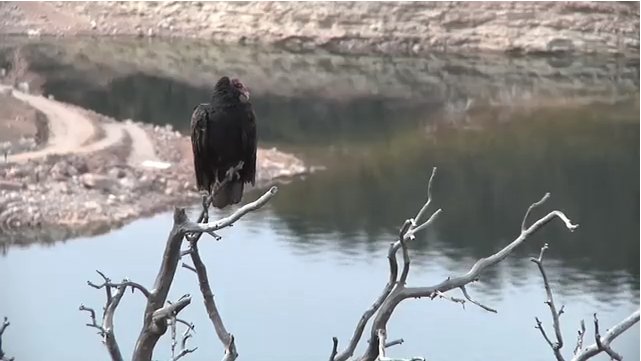
Update: Doug Kemper, Executive Director of the Colorado Water Congress, sent along the Colorado Supreme Court rulings attached to email:

Initiative 3
Initiative 45

From Kemper’s email:

The Court held that Initiative #3 and its Title contain a single subject because they relate to “the public’s rights in the waters of natural streams.” According to the Court, the other subsections are necessarily and properly connected to subsection (2) because they explain the proposed doctrine’s relationship to existing contract, property, and appropriative rights and provide how the new regime will be enacted and enforced. The Court also found that the Titles clearly expressed the initiative’s single subject.

In his dissent, Justice Hobbs agreed with us that Initiative #3 has at least three separate subjects: (1) subordinating existing water rights to a newly created dominant water estate; (2) subjecting the lands of the banks of streams to a newly created navigation servitude for commerce and public use; and (3) creating a new property right of access by the public to any natural stream in Colorado. Because of this, he would have overturned the Title Board’s action in setting the titles.

Similarly, the Supreme Court held that Initiative #45 contains a single subject, concluding that “public control of waters” is one subject and all of the initiative’s provisions properly and necessarily relate to that subject. The Court also held that the Titles fairly and clearly expressed the subject of Initiative #45, because a “yes” vote will expand public control of the state’s water while a “no” vote will reject the proposal’s revisions to the existing constitutional framework.

Again, Justice Hobbs rejected the majority’s opinion and agreed with us that Initiative #45 will enact at least three multiple discrete subjects. He found that it will subordinate existing water rights in Colorado created over the past 150 years to the newly-created public’s dominant estate in water; allow non-tributary groundwater to be appropriated by anyone without consent of the overlying landowner; and impose riparian water law on the State of Colorado and on water rights that have already been appropriated. Justice Hobbs would also have overturned the Title Board’s decision on Initiative #45 because it, too, contained multiple subjects.

We will be discussing our next steps related to the proposed ballot initiatives in the next few days. Please remember that, to our knowledge, no signatures have been collected as yet for either initiative. So today’s rulings do not mean that the initiatives will be on the ballot. Additional information related to the ballot initiatives will be forthcoming.

More coverage from Eric Brown writing for The Greeley Tribune. From the article:

On Monday, the court approved titles to Initiatives 3 and 45. Those proposed pieces of legislation collectively seek to apply the public trust doctrine to Colorado water rights through a constitutional change, and would override the state’s current prior-appropriation system — law that states those who own older water rights have a higher priority in using them. Additionally, more than 130 years of case law that have helped define how water is used in Colorado would be thrown out the window if the initiatives are eventually voted into law, opponents say.
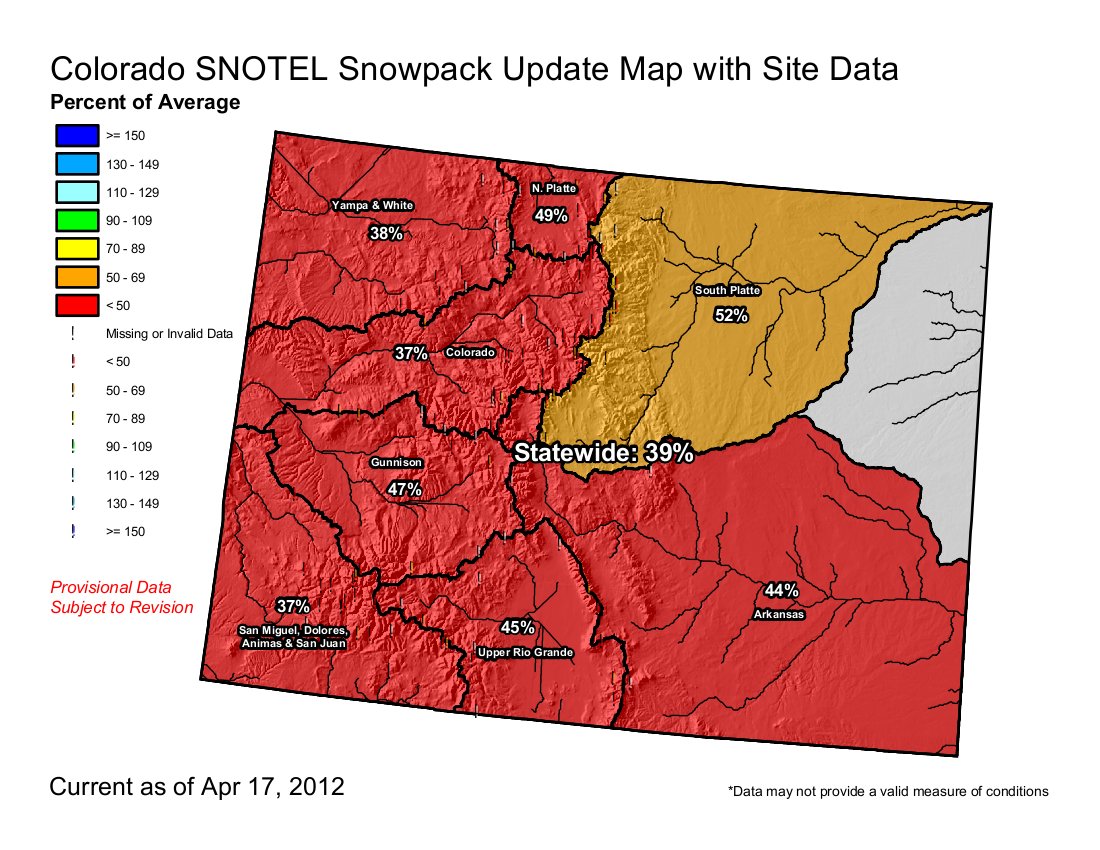
The Supreme Court said in its decision this week the proposals properly ask voters to consider only one issue. That’s been one source of debate in recent months regarding the proposals.

In a strong dissent, Justice Gregory J. Hobbs Jr. said: “Masquerading as a measure to protect the public’s control of water, it would prevent farmers, cities, families and businesses from making beneficial use of water rights that have vested in them over the past 150 years under Colorado’s statutes and Constitution.

Hobbs, one of the nation’s leading authorities on water law, added: “It would deprive Colorado of its interstate allocation of waters of the Platte, Arkansas, Rio Grande and Colorado Rivers by imposing a predominantly non-consumptive water regimen upon the State and its water users, resulting in the free flow of waters across our boundaries for the use of others, devastating Colorado’s economy and way of life.”

With the Supreme Court’s approval Monday, the initiatives could be on the ballot in November, if sponsors can get enough petition signatures.

Update: From The Pueblo Chieftain (Chris Woodka):

The ruling means the sponsors of the initiative may collect signatures to place the titles on the ballot. They must collect 86,000 signatures by July…

The initiatives are sponsored by Richard Hamilton of Fairplay and his Littleton attorney, Phil Doe. They seek to apply the public trust doctrine to Colorado water rights. Initiative 3 concerns “public rights in the waters of natural streams,” while Initiative 45 concerns “public control of waters.”[…]

Initiative 3 ignores the potential for the state to assume control of land alongside streams if a public right of use is applied, and ignores how common law measures have been interpreted in other states. Initiative 45 would subordinate water rights adjudicated in Colorado over the past 150 years, Hobbs wrote in the dissent. Passing the initiatives could create a “super water right” for environmental and recreation purposes, he said.

More 2012 Colorado November election coverage here.

The Pueblo Board of Water Works is still actively trying to score shares on the Bessemer Ditch

measuringwithweir.jpg

From The Pueblo Chieftain (Chris Woodka):

Since 2009, the Pueblo water board has spent $59 million to purchase 5,541 shares, roughly 28 percent, of the Bessemer Ditch. The water board bought farms in 2010-11, but needed funds to pay for electric rate hikes in 2012. The board also wanted to hold the line on water rates “We still have an interest in purchasing shares and I’m sure there is interest in selling,” Hamel said. “But we did not budget any money to buy shares this year.”

The water board anticipates spending another $1 million for a change case in Division 2 Water Court, which most likely would be filed in 2013. The change would allow water to be moved from the ditch into the city’s water system. Contracts for the sales allow the water to remain in use on farms for the next 20 years. The change case will cover only those farms purchased by the water board, and will not apply to other water users along the ditch, Hamel said.

More Arkansas River basin coverage here.

Southern Delivery System: Colorado Springs Utilities plans to file appeal of Judge Victor Reyes’ decision about water quality permit

southerndeliverysystemconstructioncelebration08192011.jpg

From The Pueblo Chieftain (Chris Woodka):

“We do plan to appeal the ruling,” said Janet Rummel, a spokeswoman for Utilities. “We will need to consult with the state on the timing, but anticipate it will be filed as soon as is practical.”

The city also would have the option of following Reyes’ order and seeking another set of guidelines from the Colorado Water Quality Control Division, presumably with another hearing before the commission. The state is evaluating which course to take…

Pueblo District Attorney Bill Thiebaut said SDS does not have a valid permit, but needs one for the project to continue. “In order for the SDS system to proceed, the owners need to obtain one from the state,” Thiebaut said. “Approval of a new 401 certification will require a comment period and opportunity for appeal. In the alternative, the defendants can appeal to a higher court…

Reyes ruled that the adaptive management plan Colorado Springs, the state and other agencies have agreed to is not a reasonable safeguard against contamination of Fountain Creek.

More Southern Delivery System coverage here and here.

Snowpack news: Statewide snowpack at 40% of average, South Platte = 52%, San Miguel/Dolores/Animas/San Juan = 37%

snowpackcolorado04162012.jpg

statewidehighlowsnowpack04162012.jpg

From Accuweather (Jillian MacMath):

According to the Natural Resources Conservation Service (NRCS), the current snowpack is only 52 percent of average after suffering from a particularly dry March. Conditions have not been this poor since the drought of 2002, according to the Colorado Water Supply Outlook report. As of April 1, the water basin supply was at an above-average level, 108 percent of what it usually is this time of year. While the basins are resting at sufficient levels for the time being, they will not be replenished by the melting snowpack as they usually are, which could lead to shortages later on in the year…

“Snowpack is an integral component of assessing water supply availability in Colorado. However, it is not the only variable that water supply planners consider,” [Eric Hecox, Section Chief of Water Supply Planning in Denver] said. “Low snowpack itself is not necessarily a cause for concern. Statewide, our reservoirs are mostly full and this will help offset this year’s low snowpack.”

From The Mountain Mail (Joe Stone):

[Jord] Gertson, a hydrology consultant with SourceWater Consulting, said Arkansas Basin snowpack is at 52 percent of average. He provided Natural Resources Conservation Service water and snowpack data that show the basin is in better shape than it was at the same time during the 2002 drought. Nonetheless, Gertson said current data show cause for concern, especially in the upper Colorado River Basin, where snowpack is only 34 percent of average, based on readings dating back to 1971. For example, Gertson said the Vail Mountain snowpack telemetry, or SNOTEL, station should be reporting approximately 24 inches of snow-water equivalent for early April, but the station currently reports none. In the Upper Arkansas Basin, Gertson said the district’s Boss Lake gauging station reported a high temperature in March of 55 degrees. He said this is “quite warm” for March, given Boss Lake’s elevation of 10,860 feet above sea level. Additionally, Gertson provided stream flow data showing an early onset of spring runoff. He also said he observed runoff in the Leadville area occurring five to six weeks earlier than usual.

State of the Rockies Project: Whither climate variability in the Colorado River basin?

coloradoriverbasin.jpg

From The Pueblo Chieftain (Chris Woodka):

Climate variability was one of the areas student researchers at Colorado College included in this year’s “State of the Rockies” report card, unveiled last week. The students recommended legal changes and management options that maintain the sustainability of the river.

It’s important to the Arkansas River basin because more than half of the water supply for its largest cities, Colorado Springs and Pueblo, comes from the Colorado River. Some of the water for farms is also imported, and the additional water has improved recreation opportunities in the Arkansas River basin. Without imports from the Fryingpan-Arkansas Project, Twin Lakes and other transmountain diversions, the cities would further dip into the water supplies used for agriculture and recreation that sustain the rest of the Arkansas Valley. “Generally arid climate makes the Colorado River basin particularly susceptible to climate variability,” the Colorado College report states.

The wide swing in water availability has little to do with the well-publicized — sometimes disputed — warnings of global warming in the 21st century. Instead, knowledge of past conditions is tied to a growing body of scientific evidence found in tree-ring studies. Trees add more growth when times are wet, and are an accurate indicator of drought…

In recent talks, Colorado Supreme Court Justice Greg Hobbs said those who drafted the Colorado Compact realized the variability of flows in the river and tried to account for the difference in wet and dry years. “This idea that we don’t have to build new reservoirs — forgive me — doesn’t hold water,” Hobbs said…

“I’ve often wondered what the Anasazi thought when they packed up and left,” said John Stulp, water policy adviser for Gov. John Hickenlooper, at a water conference earlier this year. “If I could go back and tell the chief that Colorado would have a population of 5 million people in 2012 that would double in 50 years, what would he think? Yet today, we have the same water resources as Mother Nature chooses to drop on us.”

More Colorado River basin coverage here.

Snowpack news: The weekend storm will help with the wildfire outlook, five to 10 inches of new snow on the ground in the northern and central mountains

highlowstatewide04132012.jpg

Click on the thumbnail graphic to the right for Friday’s statewide high/low snow water equivalent graph from the Natural Resources Conservation Service. Note that the statewide snowpack is tracking very closely to 2002 with a slight positive jog since the start of April. The weekend snowfall is not represented.

From The Denver Post (Tom McGhee):

A Pacific storm that began Saturday night dumped 5 to 10 inches in the northern and central mountain areas and was expected to leave another inch or so before ending after midnight Sunday…

There was scarcely any precipitation in March, and it was the Front Range’s driest March in 124 years of records, according to the Colorado Climate Center…

Snowpack conditions around the upper Colorado River basin were well below normal as a result of lower-than-average seasonal accumulations and earlier snowmelt than normal, according to an April 10 report on conditions by the Climate Center.

From the Examiner (Regan Dickinson):

So, by the time this is completely over, probably tomorrow morning, those three-day totals may end up somewhere in the 12-inch to 18-inch range.

From the Vail Daily (Lauren Glendenning):

Skier visit numbers through Jan. 2, compared with the same time period in 2010-11, showed a 15.3 percent drop across Vail Resorts’ six mountain resorts in Colorado and Lake Tahoe. At the time, CEO Rob Katz called the weather up until that point in the season “very unusual.” “For the first time in 30 years, a lack of snow has not allowed us to open the Back Bowls in Vail as of Jan. 6 2012, and for the first time since the late 1800s, it did not snow at all in Tahoe in December,” Katz said in a statement…

The snowpack in the Colorado River Basin, Eagle County’s river basin, started February at 69 percent of average and finished off the month at about 75 percent of average. The percentage is the snow-water equivalent, or the amount of water in the snowpack, so it doesn’t necessarily reflect snow depth.

Bob Berwyn has chronicled Colorado snowfall over the years at the Summit County Citizens Voice.

Roaring Fork Conservancy’s 14th Annual Fryingpan River Cleanup day April 28

roaringfork.jpg

From The Aspen Times:

The Roaring Fork Conservancy’s 14th Annual Fryingpan River Cleanup day will be Saturday, April 28. Volunteers of all ages are welcome. The event will kick off with a free breakfast at 8:30 a.m. at Lions Park in the heart of Basalt. Participants should wear warm layers, gloves, long pants and a hat. They must supply their own sunscreen.

Prizes will be awarded for the garbage pulled from the river and the land along it. The categories are Best of Trash, Most Toxic, Most Useful and Most Unusual.

Visit www.roaringfork.org/cleanup for more information.

More Roaring Fork River watershed coverage here and here.

An area on Upper Williams Creek, owned mostly by T-Cross Ranches, is a popular location for a terminal storage reservoir

From the Colorado Springs Independent (Pam Zubeck):

The Norris family, owners of T-Cross ranches, wants to create a water district and build a reservoir on Upper Williams Creek, the same general location eyed by Springs Utilities, the Pueblo Chieftain reported last week.

The family filed an application with El Paso County for Marlboro Metropolitan Water District. (Steve Norris’ father, Bob, portrayed the Marlboro Man in TV ads.) Steve Norris told the Chieftain that the reservoir would hold nearly 30,000 acre feet of water. The Norrises and the State Land Board own the property, located southeast of the Springs.

Norris couldn’t be reached, but from the sound of things, he believes his project would be used by Springs Utilities or another project that needs water storage. He told the Chieftain, “There has been lots of interest throughout the region for creating a regional storage reservoir.”

The reservoir site Norris chose would not require relocation of Bradley Road, as contemplated by SDS, the Chieftain reported, so Norris said his plan might save the city money. Norris and his friend, Aaron Million, who is planning a pipeline from Flaming Gorge Reservoir and the Green River in Wyoming, also envision the site as terminal storage.

But Utilities spokeswoman Janet Rummel says the Norris reservoir location “appears to conflict” with the city’s site planned as Phase 2 of the SDS project. SDS, an $880 million pipeline from Pueblo Reservoir to the Springs’ east side, will deliver water in 2016 and is causing water rates to rise sharply.

More Flaming Gorge pipeline coverage here and here. More Southern Delivery System coverage here and here.

‘The Water Leaders Program is an amazing opportunity for water professionals from any number of diverse backgrounds’ — Greg Johnson

boydlakelongspeak.jpg

From Your Water Colorado Blog:

“The Water Leaders Program is an amazing opportunity for water professionals from any number of diverse backgrounds to learn leadership skills, gain professional knowledge, and network with peers in an open and educational environment,” said Greg Johnson, a recent Water Leader graduate and employee of the Colorado Water Conservation Board.

Water Leaders is open to mid-level professionals in Colorado who are interested in water resources and career development. All Water Leaders exhibit leadership potential within their own organizations, as well as interest in seeking leadership roles on public boards and commissions. Throughout the course, Water Leaders focus on personal and professional growth —eventually graduating with a better understanding of their strengths, skills and challenges.

“The experience allowed me to reflect upon and appreciate my unique qualities. It gave me the confidence and tools to practice those strengths within the workplace and beyond. I recommend Water Leaders to anyone who is curious about themselves and others,” said Kristin Maharg, manager of the Water Leaders program at CFWE.

More Colorado Foundation for Water Education coverage here and here.

Basalt: New hydroelectric plant complete

peltonwheel.jpg

From The Aspen Times (Scott Condon):

The town government teamed with Holy Cross Energy to build a facility that takes advantage of water being piped down from Basalt Mountain to the town’s treatment plant to produce power.

“All we did was plumb this in line,” said Bentley Henderson, Basalt’s public works director, while showing the new turbine and generator used to produce power.

The system will generate roughly 300,000 kilowatt-hours annually, Henderson said. That will power between 30 and 40 houses and reduce greenhouse-gas production by an estimated 500,000 pounds annually, he said.

Councilman Pete McBride, who is nearing the end of a four-year term and isn’t seeking re-election, said he considers the micro-hydroelectric plant one of the town’s biggest accomplishments during his tenure. The project was a partnership that was completed through a creative approach. It produces clean energy from a water source without affecting any streamflow, which he said is important to him.

More hydroelectric coverage here and here.