“We have to protect the water we have, as well as provide water for endangered species,” said Alan Hamel, executive director of the Pueblo Board of Water Works and a member of the Colorado Water Conservation Board. “Oil shale development would involve intensive use of water, particularly for use in power generation.” Last month, the Pueblo water board and other members of the Front Range Water Council weighed in on the Bureau of Reclamation’s environmental impact statement for oil shale and tar sands…
The Front Range Water Council includes the major organizations that import water from the Colorado River: Denver Water, the Northern and Southeastern Colorado water conservancy districts, Aurora Water, Colorado Springs Utilities, Twin Lakes Reservoir and Canal Co. and the Pueblo water board. Collectively, they provide water to 4 million people, 82 percent of the population in Colorado.
More Front Range Water Council coverage here and here.
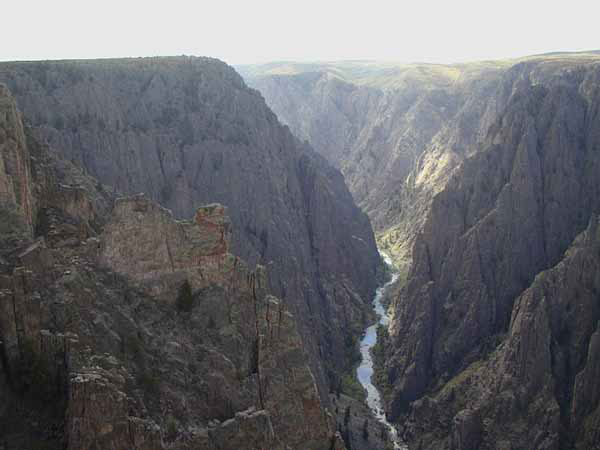
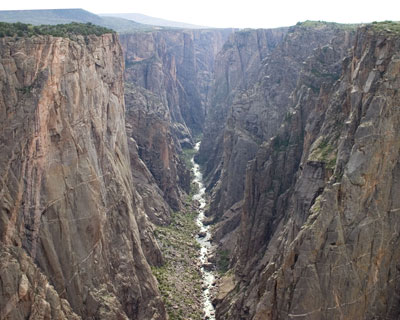
Warm and windy conditions have continued to contribute to declining flows in the lower Gunnison River. Model forecasts show river flows at the Whitewater gage dropping around 100 cfs over this weekend, and this accounts for the 100 cfs increase from the Aspinall Unit yesterday afternoon. Therefore flows in the Gunnison River through the Black Canyon will be increasing to 600 cfs late this afternoon, Thursday, June 7th.
Current forecasts suggest this will be enough water to keep the Whitewater gage above the 900 cfs target described in the Aspinall Unit Operations Record of Decision (ROD) through the end of next week. River flows are projected to continue their decline however, so additional releases may be necessary to maintain flows in the lower Gunnison River as dry conditions continue.
From the Summit County Citizens Voice (Bob Berwyn):
The Colorado River Water Conservation District, the Eagle River Water and Sanitation District, the Ute Water Conservancy District, the Eagle Park Reservoir Company and the Clinton Ditch and Reservoir Company have joined in the lawsuit with an amicus brief that was accepted by the U.S. District Court of Colorado a few days ago, according the Colorado River District attorney Peter Fleming. The Amicus Brief doesn’t raise new issues, but reinforces the legal points already made by the National Ski Areas Association in its original and amended complaints and serves to make the court aware that the disposition of the case will stakeholders other than the ski industry, Fleming said. “If the Forest Service is allowed to extract these concessions from the ski industry, then potentially the federal government will seek to demand the same or similar constraints from municipal and other water users as most of the headwaters and water sources in the western states arise on federal lands,” the amicus brief states.
At issue is are changes the Forest Service made to the standard permits under which scores of ski resorts in the West run their businesses on publicly owned National Forest lands.
More National Ski Areas Associations coverage here. More water law coverage here.
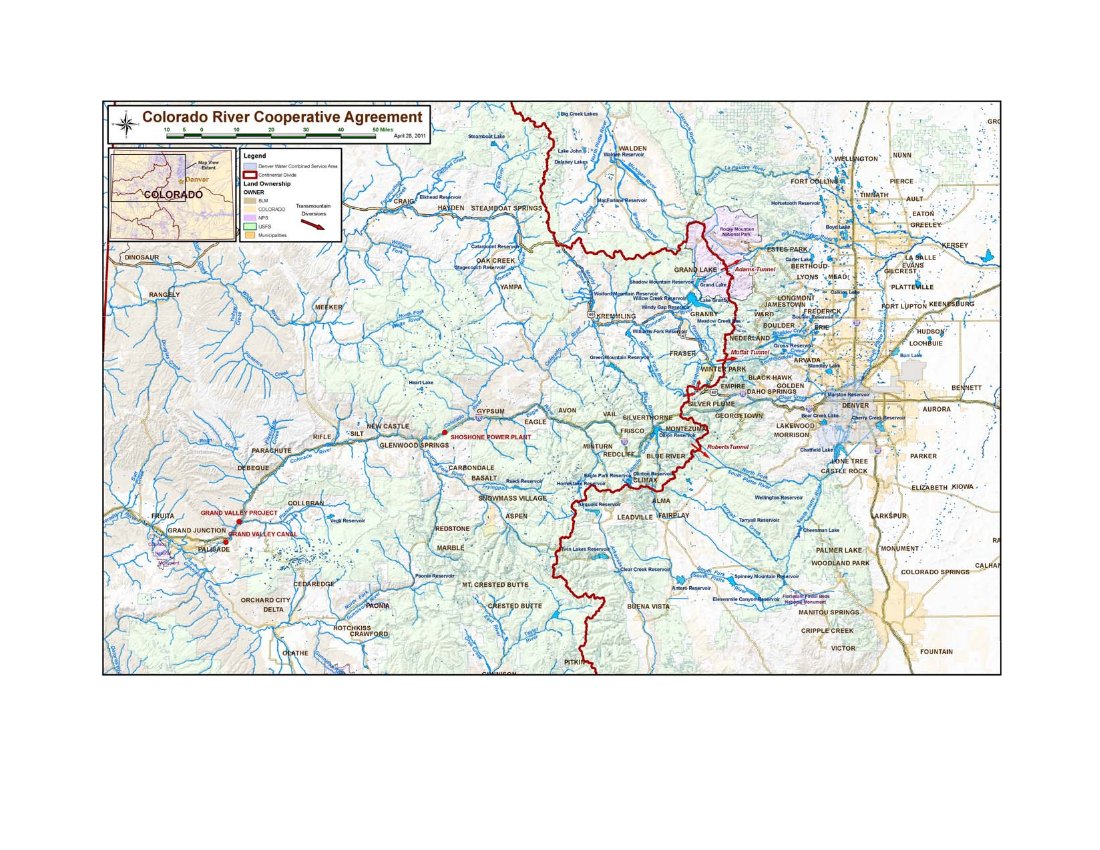
Glenwood Springs City Council voted 5-1 at its Thursday meeting to sign the Colorado River Cooperative Agreement. The vote came more than a month after the proposal was first presented for council’s consideration.
“It’s unheard of that so many entities are willing to talk about what works for everyone,” Councilman Stephen Bershenyi said, in favor of signing onto the agreement.
Added Mayor Matt Steckler, “It’s not perfect, but this is something we have been working on for over a year. I don’t see what not signing it is going to do.”
Councilman Dave Sturges dissented, saying he supports the efforts to reach an agreement on the use of Colorado River water. But he felt the agreement fell short in some areas and that the public had not had an adequate opportunity to weigh in.[ed. True, the agreement was hammered out under Non-Disclosure agreements amongst the parties.] “We’re not under the gun to act on this,” Sturges said. “There are still some questions, and I think the public ought to assist us in how we view those questions.”
More Colorado River Cooperative Agreement coverage here.
At the request of Colorado State Parks and Arkansas River Outfitters Association, Chaffee County commissioners unanimously agreed to delay placement of a call for water under its boating park water rights until the day before FIBArk. The decision was made at a special meeting May 18.
Because of low snowpack and runoff, the Bureau of Reclamation, in consultation with the Southeastern Water Conservancy District, has been exchanging water from Pueblo Reservoir back to Twin Lakes and Turquoise reservoirs. The increased storage will allow for greater releases of water later in the summer under the Voluntary Flow Management Program that will also benefit boating parks.
The 64th annual New Belgium Brewing-sponsored FIBArk event should draw more than 25,000 people to downtown Salida to witness the races, hear music, eat exotic foods and shop among the arts and craft booths. Events will kick off Thursday with a pancake breakfast, Pine Creek Boater X competition, a raft sprint and raft rodeo.
The festival will again offer some cutting-edge Stand Up Paddling events which sort of meld surfing with paddling. The sport has exploded in popularity in recent years because it gives veteran river rats a way to rediscover the adventure in calmer sections of river. A demonstration of the sport is slated for 5 p.m. Thursday at the Salida Whitewater Park.
This year a Triple Crown challenge will allow athletes to vie for the king or queen title by entering all three stand-up paddling events, including the 1 p.m. Friday freestyle during which contestants can express their creative side and wow the crowd; the 1:30 p.m. June 16 cross event which matches four paddlers in a short sprint race; and the 10:30 a.m. June 17 10-mile downriver endurance race.
Also on tap during the weekend will be freestyle, slalom, rafting competitions and more. Those who aren’t boaters can enjoy the carnival, a 10 a.m. June 16 parade, daily live music performances, foot races, bicycle races and even the 9:30 a.m. June 17 Chain-Drain disc golf tournament to be held in Poncha Springs.
One of the highlights of the weekend is the 5:30 p.m. June 16 hooligan race which brings together a bunch of silly homemade boats and their adventurous crews aiming to be the first across the finish line.
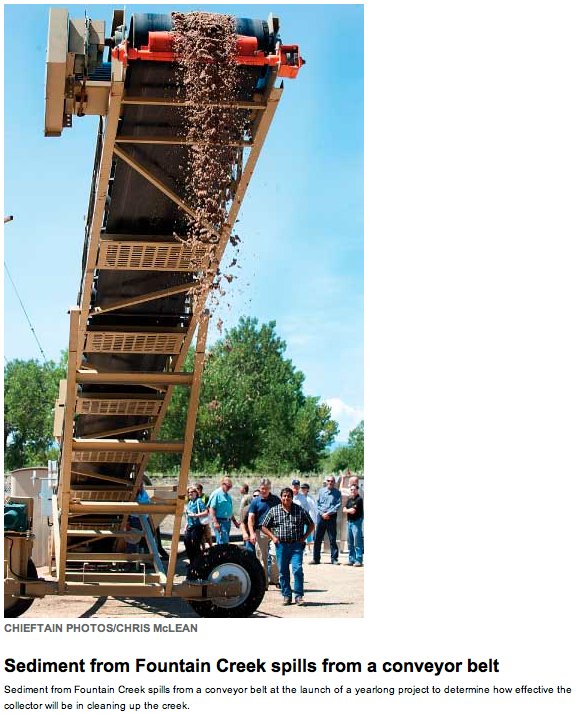
A mining screw was depositing a steady slurry of about 10 gallons of material per second onto a conveyor belt that stacked sand and gravel into a large pile. The sediment is pumped from the stream through pipes in an effort to clean the channel near the confluence with the Arkansas River. The project also will demonstrate the impact of sediment removal on water quality.
The snowpack in the Colorado River basin, which includes the Roaring Fork River and its tributaries, has dropped down to 1 percent of average as of June 1, according to a news release from the National Resources Conservation Service. As of the beginning of the month, snowpack levels all across Colorado have dipped into the single digits as a percentage of average and as a percentage of last year. The statewide percentage was just 2 percent of average, with many basins reporting no measurable snow…
The weather patterns that began in March and April—warm temperatures and below average precipitation—continued throughout the month of May. The snowpack across the state is now almost completely melted out. As of June 6, the Gunnison, Colorado, Arkansas, Upper Rio Grande, and combined San Miguel, Dolores, Animas and San Juan river basins were all reporting no snow, which is unusual for some of the high-country areas. The only SNOTEL site in the state with noteworthy snow remaining is the TOWER site in the Yampa River basin, which is reporting 2.8 inches of snow—just 7 percent of average.
“The mountains just did not receive the spring storms needed to boost this season’s snowpack,” said Philipps. “Our SNOTEL sites recorded below average precipitation in March, April and May throughout the state.” These conditions have contributed to the snowmelt runoff in most basins in Colorado being about a month earlier than normal this year, and streamflow volumes are forecast to be their lowest since 2002.
Meanwhile, the ditches above Fort Collins are sweeping the river today. Here’s a report from the Summit County Citizens Voice (Bob Berwyn):
A dry winter followed by a record early snowmelt and months of above normal temperatures have all of Colorado in drought conditions, and the Poudre River Basin wasn’t even the hardest hit, after early winter brought significant snows to the northern Front Range. The problem for the Poudre through Fort Collins is that there are no minimum instream flows to protect the environmental and recreational values of the river, according to Gary Wockner, director of Save The Poudre: Poudre Waterkeeper.
From the Summit County Citizens Voice (Bob Berwyn):
The March to May spring season (5 degrees above average), and the year-to-date are both the warmest on record [ed. for the U.S.]. Taken readings from thousands of stations across the country, many adjusted to account for the influence of nearby urbanization, the temperatures are averaged to get a picture of long-term climate trends.
The warm May temperatures also contributed to the warmest-ever spring season (March – May) on record for the U.S., at 5.2 degrees above the 1901 – 2000 average and 2 degrees warmed than the previous record, set way back in 1910. At this pace, 2012 is likely to become the warmest year on record. Only Washington and Oregon reported below average temps for the month, while Idaho, Montana and Wyoming reported near-average readings. Exceptionally warm readings were reported from the Northeast across the Midwest, into the central and southern plains and as far west as Colorado, which reported its seventh-warmest May.
The spring season (March – May) as a whole marked the largest departure from seasonal norms for any such period in recorded U.S. climate history.
Here’s the release from the U.S. Army Corps of Engineers:
The Corps of Engineers, Omaha District (Corps) is pleased to announce the release of the Draft Chatfield Reservoir Storage Reallocation Feasibility Report /Environmental Impact Statement (FR/EIS) on June 8, 2012.
The U.S. Army Corps of Engineers proposes to reallocate 20,600 acre-feet of storage from the exclusive flood control pool to the conservation pool at Chatfield Reservoir. Chatfield Reservoir is well placed to help meet this objective for the following reasons: the reservoir provides a relatively immediate opportunity to increase water supply storage without the development of significant amounts of new infrastructure; it lies directly on the South Platte River (efficient capture of runoff); and it provides an opportunity to gain additional use of an existing federal resource.
The FR/EIS has been prepared by the Corps under the authority of Section 808 of the Water Resources Development act of 1986, in sponsorship with the Colorado Water Conservation Board (CWCB). The study provides a comprehensive evaluation and comparison of water supply alternatives and their associated impacts and benefits. Based on the analysis presented in the FR/EIS, the Corps recommends reallocating 20,600 acre-feet of storage from the exclusive flood control pool to the conservation pool at Chatfield Reservoir for purposes of M&I water supply. Implementation of the tentatively recommended plan would reallocate storage from the flood control pool to the conservation pool, effectively raising the top of the conservation pool by 12 feet. This reallocation of storage would help meet part of the growing demand for water in the Denver Metro by using existing federal infrastructure, and lessen the dependence on non-tributary ground water.
The tentatively recommended plan meets all federal National Economic Development goals by providing average year yield of 8,539 acre-feet at less cost than other alternatives for water supply. The plan also balances environmental and recreational needs by requiring mitigation to offset impacts to terrestrial based effects (wetland and riparian habitats, including Preble’s jumping mouse critical habitat), and modification of recreational facilities affected by increasing the top of the conservation pool. The reallocation of flood storage to water supply storage would primarily result in greater and more frequent reservoir pool fluctuations at Chatfield Reservoir, but the impact on downstream flood frequency is negligible.
A massive draft environmental impact statement sets out the engineers’ proposals for mitigating impact and opens a public comment period…
The proposed mitigation is designed to compensate for the loss of a cottonwood-studded shoreline and stretches of free-flowing river within Chatfield State Park. Other work would offset lost habitat for the Preble’s meadow jumping mouse, a federally-protected endangered species, and replace park facilities, including a boating marina. The U.S. Army Corps of Engineers project would flood about 587 acres of 5,400-acre Chatfield State Park, with water levels rising by up to 12 feet. More than 1.6 million people visit the park each year, spending about $9.5 million.
Metro Denver communities dependent on water from underground aquifers and agricultural producers favor the re-allocation of the reservoir storage – a way to meet growing demands for water while using existing federal infrastructure. Gov. John Hickenlooper and state water-supply planners have supported this $100 million Chatfield Reservoir Reallocation Project. Some conservationists are also supportive because it may be less harmful than other possible water supply projects…
The federal engineers’ tentatively recommended plan would provide an average annual yield of 8,539 acre-feet of water at less cost than other alternatives for water supply.
A coalition of more than 100 Weld County farmers and agribusiness people — along with several Weld County commissioners and some of the area’s state lawmakers — met for a Wednesday morning rally at Glen Fritzler’s LaSalle-area farm at 20861 County Road to make their case for an emergency drought disaster declaration from the governor, who wasn’t present. Hickenlooper could issue an executive order to allow them to pump water to their fields from underground supplies, those farmers argued, for up to 30 days, with the possibility of renewing that permission by issuing subsequent orders for additional 30-day pumping permission periods, if they continue to be needed. The farmers, along with Weld County officials and members of the area’s legislative delegation, said they expect to present Hickenlooper and his staff with their plea for a disaster-emergency executive order during a more formal meeting in Denver, possibly as early as next week…
In many past drought years since the 1930s, farmers in the South Platte basin, all the from Weld County to the Sterling and Julesberg area, were able to tap into the underground water aquifer to supplement inadequate surface stream flows.
The state’s courts, however, found that that longstanding practice violated Colorado water law, because the farmers hadn’t been augmenting the well water with supplies they’d bought or leased from other sources, in order to ensure that the area’s rivers and streams were getting the equivalent of groundwater believed to be seeping naturally into those surface waterways. Local water users questioned the science behind that water-law decision, but the courts ordered that hundreds of wells be shut down completely and that pumping be curtailed from hundreds more.
On Wednesday, Fritzler was one of several people who questioned the rationale behind that 6-year-old court order. “Our wells have been curtailed for six years now,” he said, but even without the pumping, “the river has never run so low.”
More coverage from Lance Hernandez writing for TheDenverChannel.com. From the article:
“If we don’t get rain in 10 days, irrigated agriculture in this area will be over for the year,” said longtime farmer Gene Kammerzell. “Farmers will then have to decide which crops to sacrifice.”[…]
Weld County commissioners said they hope it doesn’t come to that. The commissioners plan to meet Monday to formally declare a drought disaster. “We’re going to pass an emergency declaration and send it on to the governor,” said commission Chairman Sean Conway. “We’ll ask him to declare one too.”
“We’ll also ask him to convene the drought task force,” said Commissioner Barbara Kirkmeyer…
Jim Yahn, who manages both North Sterling and Prewitt Reservoirs in Logan County, told 7NEWS that pumping ground water effects return flows. “When you pump, there’s an effect,” Yahn said. “It may not be today. It may not be tomorrow, but there will be an effect.”[…]
The governor’s water policy advisor, John Stulp, said the threshold for a disaster declaration is typically a 30 percent (crop) loss in a designated area. He said it doesn’t appear that there’s been that big of a crop loss yet.
The farmers said they want the governor to take action before they suffer that loss. “We want to close the barn doors before the horses get out,” Conway said.
More South Platte River basin coverage here and here.
While the storm [Wednesday], centered over Colorado Springs for three hours, did little to impact Pueblo County, it caused internal problems. At a news conference Thursday, [Colorado Springs] Mayor Steve Bach said $7 million in city funds would be transferred to stormwater needs. About 40 people had to be rescued. Some comments from frustrated citizens on the Internet early Thursday, chided the City Council for dropping the stormwater enterprise in 2009…
“There has to be a steady stream of revenue,” said [Jay Winner, general manager of the Lower Arkansas Valley Water Conservancy District], who worked to convince Colorado Springs to adopt the stormwater enterprise in 2005. “I don’t see how $7 million does anything to address the $500 million in capital needs that have been identified.”[…]
State Rep. Sal Pace, DPueblo, agreed, saying the enterprise was providing $12 million-$15 million a year before the City Council eliminated it. Pace is drafting a letter to Colorado Springs demanding action on the stormwater question…
Pace said Colorado Springs voters are seeing the problems that resulted from the 2009 passage of Issue 300, which was interpreted by City Council as a mandate to repeal what tax-crusader Doug Bruce called a “rain tax.”[…]
County Commissioner Jeff Chostner, who chairs the Fountain Creek Watershed Flood Control and Greenway District board, said Colorado Springs has to address its stormwater problems immediately.
More coverage from Chris Woodka writing for The Pueblo Chieftain. From the article:
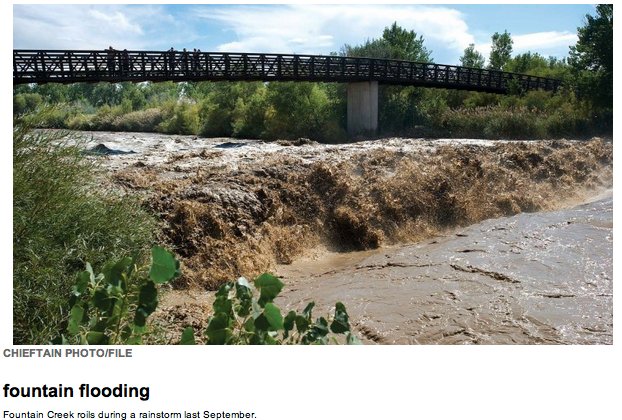
A rainstorm parked itself over [Colorado Springs] for about three hours Wednesday, dropping up to 4 inches of rain. Areas to the north and south of the city received less rain, anywhere from 0.5-2 inches. About 40 people and one dog had to be rescued from high water that collected in Colorado Springs, according to news reports. Mayor Steve Bach called it a “100-year flood,” but it wasn’t even close. It was about a 10-year event on Fountain Creek at Security, and the threat diminished as water traveled downstream, according to the U.S. Geological Survey.
While Pueblo braced for possible flooding, the effects were fairly minor by the time the water traveled 40 miles down the Fountain Creek channel. “It did not take away the hot tub that the flood last September deposited in my pasture, so I am very disappointed,” quipped Bill Alt, whose home is on Fountain Creek just north of Pueblo. “On the upside, it irrigated the pasture, which was good since we’ve had no moisture this year.”
More coverage from Daniel Chaćon writing for The Colorado Springs Gazette. From the article:
Pueblo County is threatening to suspend a permit for the Southern Delivery System water pipeline unless Colorado Springs spends more money on stormwater improvements next year. A condition of the so-called 1041 permit requires Colorado Springs to have an adequate stormwater management plan, Pueblo County Attorney Dan Kogovsek said Thursday…
Pueblo County is “very concerned” that Colorado Springs’ capital improvements to prevent stormwater damage have fallen by the wayside since the demise of the Stormwater Enterprise more than two years ago, Kogovsek said. When the enterprise was in operation, the city was spending about $13.3 million annually on maintenance, capital improvement projects and required permits. This year, the city budgeted $3.3 million for maintenance and permits but nothing for capital improvements. Kogovsek said the county will keep a close eye on the city’s 2013 budget to see how much Colorado Springs plans to spend on stormwater…
Mayor Steve Bach, who marked his first year in office Thursday, has sounded the alarm about the city’s stormwater needs. As part of his funding solution, he wants the City Council to direct Utilities to come up with $12 million to $15 million from its existing budget and rate base. “Why should Colorado Springs Utilities be involved in this? In my view, because Utilities will be bringing Southern Delivery System water here from down at the Pueblo Dam and the Arkansas River,” Bach said during a news conference Thursday in the wake of Wednesday’s storm. “Utilities will thereby be, frankly, exacerbating our stormwater challenges because after that water is used locally — whether it’s domestic consumption or irrigation or other purposes – it will be returned. It’s called return flow and that water will be additive to Fountain Creek flow going back down south. At least that’s a pragmatic reason that I see that Utilities should partner with us,” he said.
From the Colorado Springs Utilities twitter feed (@CSUtilities) yesterday:
Unmanaged storm flows outside of Colorado Springs city limits can jeopardize investments made within the city.
And:
We believe stormwater flows must be managed regionally, to fully protect our community’s investments.
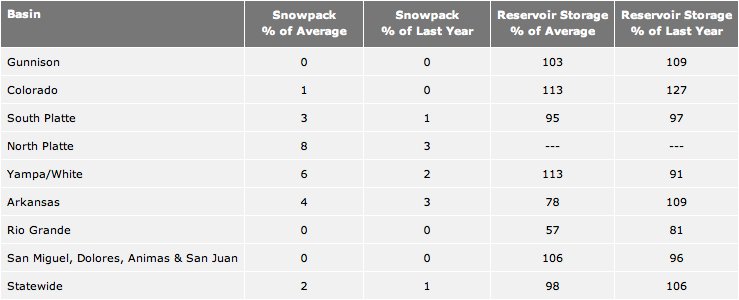
Direct irrigators are likely caught in a double whammy for the summer. The runoff came off early before they needed the water, and the calls on the streams will likely be very senior for the summer, leaving many short when it’s time to finish off the their crops. Click on the thumbnail graphic for the table that accompanied the release. Here’s the June news release from the Natural Resources Conservation Service (Mage Skordahl):
Weather patterns that began in March and April continued throughout the month of May; warm temperatures and below average precipitation persisted at SNOTEL sites across the state during the month. Phyllis Ann Philipps, State Conservationist with the Natural Resources Conservation Service (NRCS) stated, “Recent data confirms that the statewide snowpack reached maximum accumulation on March 7, 35 days ahead of the average peak date and that it has disappeared approximately a month early as well.” The June 1 snowpack report shows that the statewide percentage was just 2 percent of average with many basins reporting no measurable snow.
The latest data from SNOTEL sites in Colorado reveal that the snowpack across the state is almost completely melted out. As of June 6 the Gunnison, Colorado, Arkansas, Upper Rio Grande, and combined San Miguel, Dolores, Animas and San Juan river basins were all reporting no snow. The only SNOTEL site in the state with noteworthy snow remaining is the TOWER site in the Yampa river basin which is reporting 2.8 inches of SWE at just 7 percent of average. “The mountains just did not receive the spring storms needed to boost this season’s snowpack. Our SNOTEL sites recorded below average precipitation in March, April and May throughout the state “, said Philipps.
The timing of snowmelt runoff in most basins in Colorado has been about a month earlier than normal this year and streamflow volumes are forecast to be their lowest since 2002. For the remainder of the forecast season (June – July) it is expected that on average streams across the state will flow at around 30 percent of average. In some basins, such as the Yampa and White rivers, June to July forecasts are much lower with current forecasts ranging from 9 to 22 percent of average.
The best news for water availability in Colorado this spring and summer is within the statistics for reservoir storage. As of June 1, storage statewide had decreased from last month but was near average at 98 percent of average and 61 percent of capacity. The storage volumes in all the major basins remain above or near average except for in the Arkansas and Upper Rio Grande river basins where storage has dropped to 78 and 57 percent of average respectively. This stored water should provide some reprieve from potential shortages this summer statewide but water users in all basins and especially in the Arkansas and Upper Rio Grande should be prepared for late season shortages.
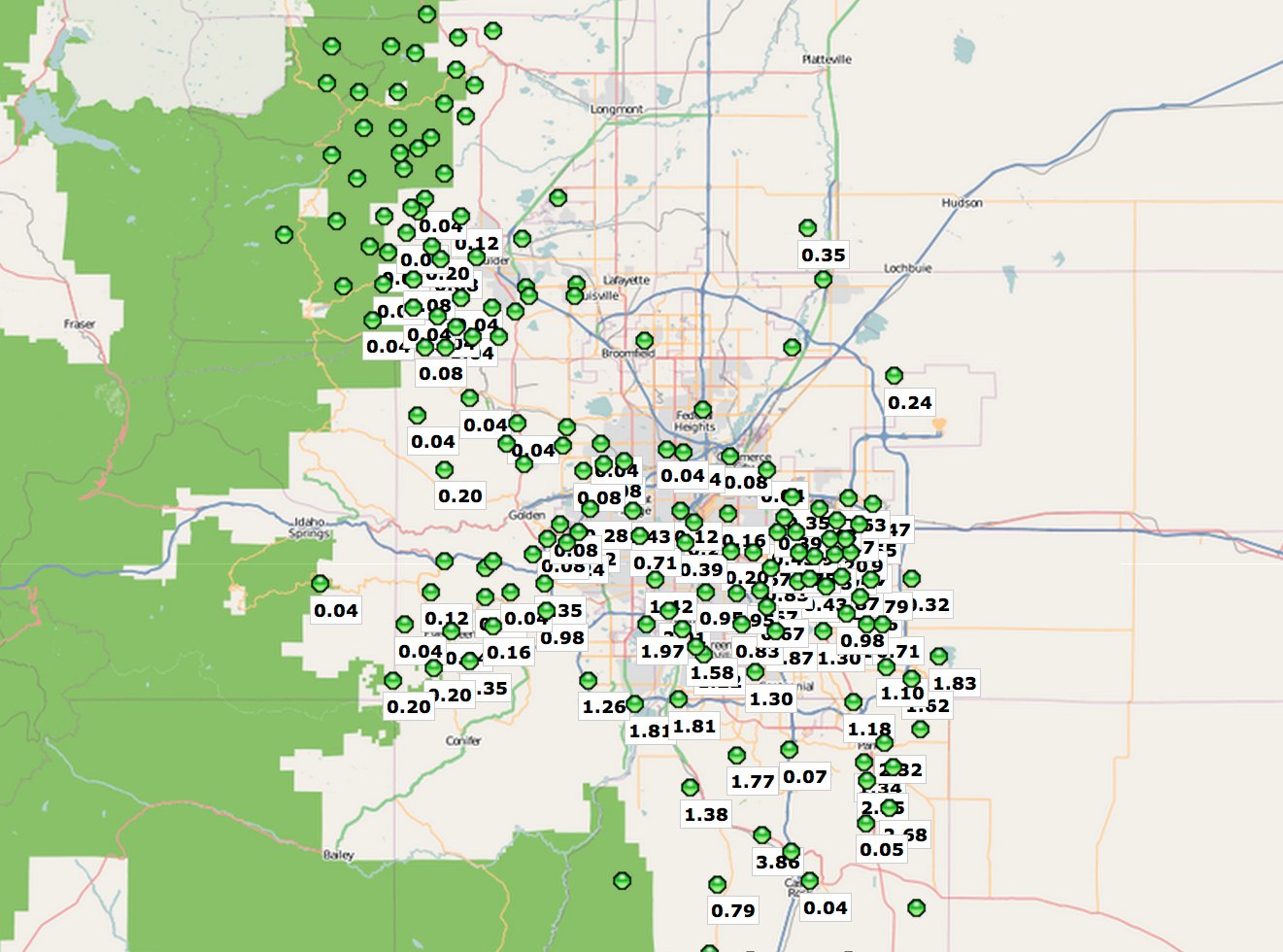
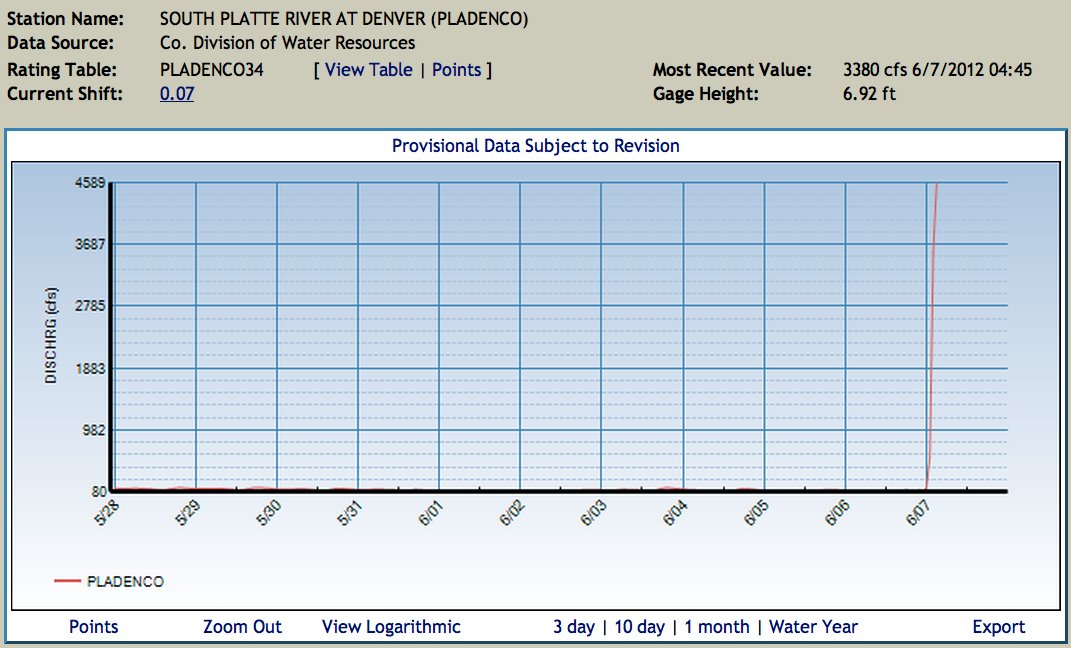
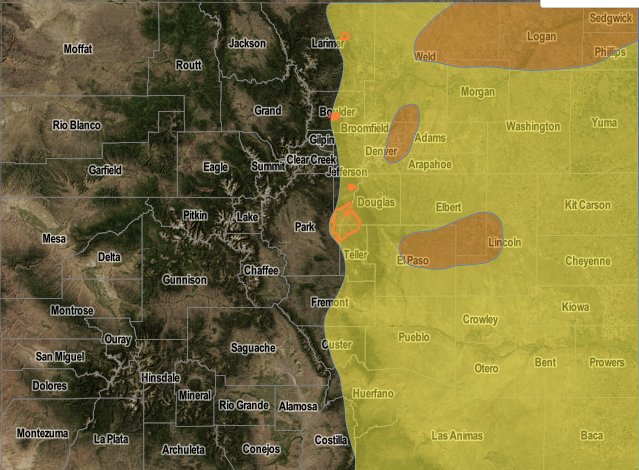
Tornadoes, flash floods, lightning strikes and downpours were all present in the band of storms that moved across the Denver Metro Area and points south and east yesterday afternoon and evening. When storms are slow moving, as they were yesterday, precipitation totals can be impressive while overwhelming stormwater facilities. Click on the thumbnail graphics for a screen shot of the 24 hour map from the Urban Drainage and Flood Control District and the hydrograph from the South Platte River at Denver stream gage from the Colorado Division of Water Resources website. The hydrograph is the very picture of a flash flood.
Colorado Springs was pounded with hail, some as large as 1 1/2-inches in diameter, and rain that caused streets to flood and trapped motorists in standing water that, in some cases, came up to car windows, the National Weather Service said…Parts of Las Animas County received an inch of rain and hail nearly an inch in diameter with wind gusts as high as 60 mph, the NWS said.
National Weather Service meteorologist Jim Kalina said a small tornado was spotted just north of Denver International Airport about 5 p.m. Wednesday. The agency received a report of another tornado in the northeastern Colorado community of Grover about 6:40 p.m. that ripped out a small tree and threw it about 20 feet.
Severe-weather meteorologist Reed Timmer, who starred on the reality-TV show “Storm Chasers,” was in the Parker area in his vehicle, called the Dominator. He reported on his Facebook page about 8:20 p.m. that he was encountering hail accumulations of more than 6 inches…Flooding crippled the east side of Colorado Springs, leaving drivers stranded in deep water, The Gazette said.
The National Weather Service confirmed six tornadoes touched down in Colorado Wednesday evening. The first tornado was just after 5 p.m. and was spotted off Pena Boulevard near Denver International Airport. There were no reports of damage or injuries in connection with that storm. The second tornado was around 6:30 p.m. in Weld County. The National Weather Service says that tornado ripped out a tree. At 7:30 p.m., a tornado was spotted in Kiowa. Just 10 minutes later, another tornado touched down about 14 miles northeast of Elizabeth. Just a few moments later, two tornadoes touched down 14 miles south of Bennet. No injuries or damage are reported in association with the four later tornadoes.
Jeffrey Falkenstein and his wife Jennifer were faced with bailing water out of their home at the Sierra Pointe Condominiums on Parkmoor Village Drive near Palmer Park. Jeff said a rush of water and hail came through his front window and flooded his living room. Other rooms in the home received similar water damage.
Justice Greg Hobbs sent this tribute over in email earlier today:
Hurrah for Quillen!
This incomparable
Curmudgeon Wit gloried in the
great First Amendment.
Reprinted, with permission.
Ed Quillen was a columnist for many years with The Denver Post. They are planning a tribute by publishing excerpts from Ed’s columns from past years. Here is an excerpt from their obituary:
Columnist Ed Quillen, who listed one of his major talents as “complaining” and who used his sharp pen and wit to poke fun at politicians and to chronicle the foibles of life in the Rocky Mountain State, died Sunday of a heart attack at his home in Salida.
Edward Kenneth Quillen III’s widow, Martha, said he was at one of his favorite pastimes — sitting in an easy chair and reading a history book — when his heart stopped. Paramedics were not able to revive him. He was 61 and had just tidied up his office in anticipation of writing his next column. His last column ran in The Denver Post the day he died…
Conservatives called his work everything from outhouse material to slander. Liberals delighted in his skewering of conservative establishment types and his exposing of the inanities that are part and parcel of politics…
“He had no idea how many people liked what he did,” [Martha] said…
His fictional foil in many columns was Ananias Ziegler, “media relations coordinator for the Committee That Really Runs America.” Ziegler would spout whatever canned comments were coming from politicians that week, and Quillen would shut him down with his sharp-eyed observations.
“Colorado has lost one of its most thoughtful and colorful characters,” said Curtis Hubbard, editorial page editor. “For decades, Ed’s humor and keen eye shed light for Denver Post readers on topics ranging from our current politics to the state’s rich history. Our deepest condolences go out to his family and friends.”
He was a lifelong Coloradan, historian, folklorist and political activist. His website (www.edquillen.com) contains 2,751 columns, blog postings and essays starting in 1984, when he wrote his first story for The Denver Post in Empire Magazine.
We will be running excerpts from some of his more memorable columns in our Sunday Perspective section.
In a former life I was an IT manager for a large Front Range city that diverts water from both the Fraser River and the Blue River to the Front Range so my ears really perked up when Ed described his GNU/Linux tech setup in a column. Here’s are Ed’s own words describing his website:
Bytehead technical trivia
This site is hosted by Quicksilver Interactive Media, a fine company owned by my son-in-law, Brad Goettemoeller.
The files were converted to HTML with a variety of home-rolled SNOBOL4 programs running under 64-bit SuSE Linux. My thanks to Phil Budne who ported the obscure but simple and potent SNOBOL4 programming language to a variety of platforms, including GNU/Linux. And to my friend and neighbor Mark Emmer who taught me SNOBOL4. He ported it, and its faster cousin SPITBOL, to MS-DOS, and he’s working on a Linux port for SPITBOL.
This site is plain and simple, and should work well with most common browsers. I have tested it with Firefox, Opera, and Lynx. So far as I know, it does not deposit any cookies on your system, nor does it collect any personal information.
Over the years, I’ve used a variety of computers for my daily work. I began with an Osborne I in 1984 that ran CP/M. I progressed through a variety of PCs running MS-DOS, and in 2002 switched to GNU/Linux. In the CP/M and DOS days, I wrote with WordStar; nowadays I use Jstar, a version of JOE (Joe’s Own Editor, and thank you Joseph Allen) configured to work like good old WordStar. My fingers are comfortable with its commands.
In case you’re curious, I generally type on a Logitech Elite keyboard, as it stands up pretty well to office grime and abuse. The same holds for the Logitech M-8T96 mouse beside it.
In June of 2010, I moved into a new computer; as usual, it’s one I built myself. It’s got an AMD 64-bit quad-core CPU and 8 gigabytes of DDR3, so it’s fast. It’s also almost silent, which was a pleasant surprise. I ran into a few assembly problems, and I thank my friend and neighbor Ernie Hatfield for his kind assistance.
The new hardware also included a 500-gb hard disk and a “green” video card that has no fan, along with an upgrade from Open SuSE 10.0 to 11.1. On the road, I use a Lenovo/IBM Thinkpad T43 which can boot either Windows XP Pro or Linux.
Columns were originally to a special Denver Post telephone number always answered by a modem; these days, they just go by email. On rare occasions, I’ve faxed columns to Denver, and once I even hand-delivered one.
It comes hard to praise the phone company, but in all these years, there’s never been a problem in getting my work over the 150 miles from Salida to Denver. That speaks well of the reliability of the service provided by Qwest and its corporate ancestors.
For a year or two, we got broadband internet from the local cable monopoly, Bresnan. The service was fast and fine as we upgraded from dial-up. As Martha put it, the difference was like getting indoor plumbing after using a hand pump in the yard. In both cases, you can get water when you need it, but turning the faucet is so much faster and easier. We switched to Qwest DSL because it was cheaper, but in September of 2011, we switched again and now get internet, telephone and elevision from our cable company, Optimum. So far, it’s been reliable, fast and affordable.
The first article that I saw about Ed’s passing on Monday was written by Michael Roberts for Westword. Here’s an excerpt:
Quillen outlined his history at the Post in this 2006 column. As he wrote:
If it’s true that time flies when you’re having fun, then I’ve sure been enjoying myself for the past 20 years. It was on Jan. 3, 1986 that my first regular column appeared on these pages, and it sure doesn’t seem that a fifth of a century has passed since then.
How did that come about? If you read certain right-thinking blogs, I was a virtuous Colorado boy who made the mistake of walking through the woods one night when I met a fellow who told me I could call him Mr. Scratch. He made me an offer. After I signed in blood, I became part of the Biased Liberal Main Stream Media.
The piece notes that Quillen wrote for a series of newspapers he edited, including the Middle Park Times in Kremmling (1974-77), the Summit County Journal in Breckenridge (1977-78) and the Mountain Mail in Salida (1978-83). At that point, he began freelancing, with the Post publishing a submission from him in 1984. Toward the end of the next year, Quillen proposed a regular schedule to then-editorial page editor Chuck Green, who took him up on the pitch. Beginning in 1988, Quillen’s takes appeared twice weekly in the Post.
Things began to change as times got tougher for print journalism. Quillen’s website points out that “in August of 2011, the Denver Post decided to save money by cutting me from six columns a month to four,” and he definitely didn’t see this change as a relief. He followed this note by making a plea for more freelance work. (He also wrote for the High Country News, among other publications.)
Additionally, Quillen kept up an active Facebook presence, with his most recent post on Saturday discussing the John Edwards mistrial…
…the opinionated Salida wordsmith stood apart from so many of his contemporaries. He was one of a kind, and he’ll be missed.
Flows in the Gunnison River through the Black Canyon will be increasing to 500 cfs tomorrow, Wednesday, June 6th , in response to decreasing flows in the lower Gunnison River. Pursuant to the Aspinall Unit Operations Record of Decision (ROD), the flow target in the lower Gunnison River, as measured at the Whitewater gage, is 900 cfs for June and July. Flows are forecasted to drop below this level by the end of the week without additional releases from the Aspinall Unit. Therefore releases from Crystal Dam will be increased by 100 cfs late afternoon on Wednesday, June 6th.
Check out this blog post from the Your Colorado Water Blog. From the post:
These Initiatives, introduced by Phil Doe of Littleton and Richard Hamilton of Fairplay, aim to amend the state constitution in a way that would dramatically change water management in Colorado.
Here’s another article written by Jason Mumm that is running on the Stepwise Utility Advisors website. Here’s an excerpt:
The supporters of the public trust initiatives believe the 100+ year -old system of prior appropriation has worked against the public’s interests. The proposed initiatives would replace the existing process with one that would enable the state to determine what uses of water are in the beneficial public good, and which ones are not. The doctrine would appear to apply to all such uses, whether water rights were adjudicated in the past already, or not. In other words, the amendments, if approved, would cause all existing water rights in the state to immediately fall under a new review guided by the public trust doctrine. The Colorado Water Congress, opposes the initiatives for this reason.
No doubt that reviewing all of the state’s existing water rights and potentially reallocating them could be extremely chaotic, especially in a state where water resources are scarce. The current legal structure is a major expense in an of itself. The direct legal costs are astounding, but if one considers the amount of time and resources consumed from all parties, the cost is even higher. The public trust doctrine is used in other states and in the examples that we’ve seen, it tends to work reasonably well and appears to require far fewer resources of our municipal utility clients. What you find in those states that use some kind of public trust doctrine is an approach to water utility management much more focused on the facilities (e.g. treatment, pipes, etc.) than on acquiring and maintaining water rights for the source of supply. It’s a focus toward infrastructure and service, rather than natural resource management.
There are elements of a public trust approach that we like, but the proposed initiatives are fatally flawed because they fail to provide a means to equitably transition from one structure to another. Colorado’s legal system evolved from water scarcity. Within that structure is a very competitive market that is constantly determining the value of water rights and thus informing decisions of how water is used.
Thanks for posting the link in the comments, Mr. Mumm.
More 2012 Colorado November Election coverage here.
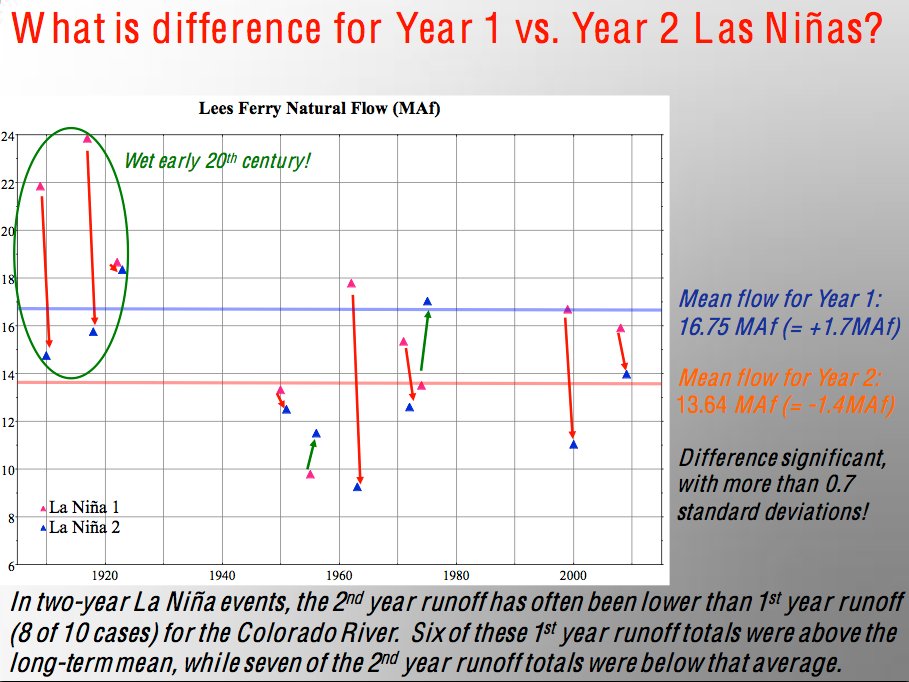
Click on the thumbnail graphics for Klaus Wolter’s graphical depiction of second-year La Niña natural streamflow at Lees Ferry in Arizona and a Summit Daily News photo of Dillon Reservoir in 2002. Klaus’ chart will need an update after this record breaking year. Let’s hope that Dillon Reservoir won’t get as low.
Here’s a column from John Hazlehurst writing for the Colorado Springs Indpendent. Here’s an excerpt:
Droughts are the new normal in much of the West. The effects of global warming are being felt in higher temperatures, smaller snowpacks, diminished runoff and reduced stream flows. We have fire — we don’t have rain. Ten years ago, it was possible to dismiss the most pessimistic predictions of climate scientists as theoretical scare-mongering, but no longer.
Reality conforms to those predictions, with one exception: It’s happening a lot sooner than predicted. Nine of the past 13 years have produced below-average flows in the Colorado River, and that pattern will likely persist and deepen. Last year’s bounteous snowpack filled reservoirs, but such events may become as rare as basin-wide droughts once were.
Colorado Springs gets 70 percent of its water from the Colorado River. Prolonged drought may mean permanent, severe water rationing, even with the Southern Delivery System online. Local water managers may make soothing pronouncements about water, saying the city has two years of consumption in storage, but on April 15 (the date of maximum readings), snowpack in the upper Colorado River Basin was 21 percent of normal. On June 1, it was 8.5 percent of normal. Those are the lowest levels ever recorded, rivaled only by those of 2002.
Summit County water districts are preparing early for possible drought conditions this summer, implementing voluntary water restrictions, while the Summit Board of County Commissioners considers implementing a stage-one fire ban…The ban would apply only to unincorporated parts of Summit County, but Gibbs said the U.S. Forest Service is also considering a stage-one ban for the entire White River National Forest and it wouldn’t be unusual for the towns to follow suit…
Meanwhile, as dry conditions persist and the last of Summit County’s snowpack disappears, the Town of Frisco and the East Dillon Water District already have voluntary water restrictions in place. “We entered the year in our aquifer with higher than normal levels,” East Dillon Water District administrator Bob Polich said. “But they have dropped rapidly.”[…]
“In our case, we’re purely talking speculation because we’re in the peak of our aquifers right now,” Polich said. “We have to monitor when it gets to the end of July and August. There’re so many factors that are going to be involved (including) whether monsoonal flows come in July.”[…]
The Snake River water district is currently not under any kind of water restriction, although the policies are in place to implement restrictions if it becomes necessary. Water for the Snake River district is drawn from an alluvium and connected to a system of wells. Water levels have remained high enough to avoid restrictions…
Most of Summit County saw less than an inch of precipitation through the first three weeks of May, and some parts received less than half an inch. Recent drought maps put the better part of the county in the “severe” drought category, the third highest of six categories, according to data from the Colorado Water Conservation Board.
Glen Fritzler, who runs the popular and nationally known Fritzler Corn Maze will be hosting a meeting of farmers and local officials this Thursday to discuss the concerns of rising groundwater and government restrictions on its usage to water their crops in the midst of an historic drought. The meeting will be held at the Fritzler farm located at 20861 CR 33 in LaSalle this Thursday, June 7 at 10:00 a.m. Organizers are encouraging anyone affected by the issue to attend the meeting. Weld County Commissioner Sean Conway, Rep. Randy Fischer, D-Fort Collins, and Sen. Scott Renfroe, R-Eaton are expected to attend, along with water experts and local producers and residents…
Many farmers in the area are facing the real possibility they could lose their crops this year due to a lack of available water from the South Platte following a lower than average snowpack last year. Some fields remain dry and farmers are having difficulty getting their crops to sprout to due to the water shortage…
Fritzler said what is so maddening is while the crops are suffering from a lack of water, the solution is literally right beneath their feet. In the years following the shutdown of the wells, the groundwater has since risen to where basements are now being flooded, septic systems are overflowing and there is a real danger to fields being destroyed because of high salt content. The volume of water discharged into the artificial recharge systems in the South Platte basin has since increased, reaching over 350,000 acre feet in 2009. Fritzler said over the past two years he has spent over $50,000 in basement repairs because of the water damage. When he noticed several of the leach fields on houses he owns on his farm were beginning to overflow, he contacted Northern Colorado Geotech, which conducts soil and percolation testing. Doug Leafgren, president of the organization sent Fritzler a letter advising him they had been observing higher groundwater levels during their subsurface investigations in the county over the past 4 or 5 years.
While the farmers have been trying to get relief for years, their efforts have often been stymied by the large such as Boulder and Denver who often have high paid lawyers at taxpayer expense [ed. in Denver the lawyers are paid by Denver Water ratepayers] who have vigorously fought any attempt to even study the issue. “These lawyers are paid for by the taxpayer and we as farmers are fighting them by having to pay out of our own pocket for our legal expenses. There is no way we can compete with that,” Hoshiko said.
The Colorado Statesman (Peter Marcus) is running an article about the initiatives. So far the proponents have little organization or money to get on the ballot according to the article. Here’s an excerpt:
Hamilton says Colorado law is already explicit in that the public owns the water in the state, and not the state itself. The goal of the initiatives is to amend that law to adopt a public trust doctrine in legislative, executive and judicial affairs to protect the ownership interests of the people. “You may use that water… but when you return that back to the public streams, you can’t load it up with crap, or burden it with chemistries, or ruin its temperature,” said Hamilton, who has raised concerns over uranium and other elements from mining activities ending up in Colorado streams…
“Who will watch the watchers themselves?” he asked. “This would force accountability on state government… If they crap in the water, the people of the State of Colorado have a right to say, ‘We’re going to curtail and minimize your use until you clean your act up.’”
Hamilton and proponents have begun collecting signatures to place the initiatives on the November ballot. Proponents must submit 86,105 valid signatures to the secretary of state by Aug. 6 in order to qualify for the ballot. The petition format was only approved on May 14, so proponents have only just begun collecting signatures and developing a plan.
Proponents have registered an issue committee, Protect Colorado Water, to advance their efforts. The registered agent is river conservationist Phil Doe, who is representing the initiatives along with Hamilton. So far, the issue committee has only filed a $100 contribution from Be the Change — USA, described as a Lakewood-based grassroots political organization dedicated to promoting progressive issues…
“It subjects every water right that we have in the state to being reconsidered, or curtailed, or denied entirely based on a determination of what’s in the public’s good,” said Doug Kemper, executive director of the Colorado Water Congress, which is opposing the initiatives along with the Colorado Water Conservation Board — part of the Department of Natural Resources — and the Colorado River Water Conservation District.
Opponents point out that water frequently does not naturally exist in Colorado, and therefore government must step in to divert sufficient quantities to sustain human settlement and enterprise in Colorado. Critics say the state’s current appropriation system is “fair” and “orderly,” proving to be “flexible” and “successful.”
“The adoption of either of these initiatives would result in takings of private and public water rights that Coloradans rely on for beneficial uses for health and human safety as well as economic benefit,” states a resolution adopted by the board of the Colorado River Water Conservation District.
The Colorado Water Conservation Board has raised separate concerns about impacting more than 150 years of court opinions and legislation governing water rights. Kemper shares those concerns. “If you go down that path, then you turn 150 years of water law on its head, you just turn it upside down,” he said.
More coverage from Heather Hansen writing on the Red Lodge Clearing House blog. From the post:
…two motivated Coloradans have made news recently with controversial proposals to amend the state constitution, in a way that would dramatically change water management in the state. Phil Doe of Littleton and Richard Hamilton of Fairplay have introduced Public Trust Initiatives #3 and #45…
The first measure would apply the common-law doctrine of “public trust” to water rights, and make “public ownership of such water legally superior to water rights, contracts, and property law.” Initiative 3 would also grant unrestricted public access to natural streams and their banks.
The second measure proposes to amend Article XVI, Section 6 of the state constitution, which talks about the diversion of un-appropriated waters of natural streams. Initiative 45 seeks to limit, and possibly prohibit, stream diversions that would “irreparably harm the public ownership interest in water.”
Proponents of the initiatives insist that we’re at a crossroads in water control in this state, and that preparation for the future demands of, for example, climate change and fracking, require that a stand be taken for public governance of our most valuable natural resource. Opponents counter that the initiatives are a slash-and-burn assault on consumptive uses, such as agriculture, and that they would invalidate prior, vested waters rights, which have been in place since Colorado became a state.
I tend to agree with the latter if only because the initiatives aim to drain the baby with the bathwater but, what’s spot on about them, and what’s wrong with water allocation in Colorado compared to every other Western state, is that the public interest is not well represented in water law here, and it needs to be improved…
Water is our deliverance in the West, but it can also imprisons us, and establishing a new give-and-take that considers the public foremost will not be easy. But it is possible.
From email from the Colorado Water Congress (Doug Kemper):
The proponents of the Public Trust Doctrine Initiatives #3 and #45 are in the process of collecting signatures to get the initiatives on the November ballot. They have created a website (http://protectcoloradowater.org/), formed a campaign committee, and are soliciting funds and volunteers to support the effort.
We will have a workshop on the initiatives on June 18 from 1:30 to 4:30 at the offices of the Tri-State Generation and Transmission Association in Westminster. Please see the [this flyer] for details.
You are invited to attend the workshop. Seating will be limited and attendees must register in advance for the workshop. To register to attend in person, click on the following link: Attend In Person
More 2012 Colorado November Election coverage here.
You will also have an option of attending the meeting via GoToWebinar. To register for the Webinar, click on the following link: Attend via Webinar
In a rare departure from tradition, there will be no charge for the workshop!
I met Ed Quillen via email in 2007 when he asked me if I’d be interested in writing a column about water issues for Colorado Central Magazine. I was jazzed that he would consider me as a freelancer. I had read his columns in The Denver Post for years and admired his analysis of current events and insight into Colorado’s history. It seems now that he never failed to make me laugh, often out loud, as I read his stuff.
I never asked him how he came to the decision to reach out to me, I always assumed that he had stumbled on Coyote Gulch while searching for water news on the Internet. I remember asking him in email, after I had told him that I’d love to be part of his magazine, “Is this a paying gig?”
Ed replied, “Colorado Central pays a nickel a word, often late.”
I finally met Ed in person at a Colorado Central potluck in October of 2010. I recognized him of course and said, “Hi, I’m John Orr.”
Ed stated, matter-of-factly, “The water guy.” That label meant more to me that he’ll ever know. As the Indian Summer afternoon wound down in the Quillen back yard I realized that most people there genuinely liked Ed and all were proud to be his friend. A few talked about what a pillar of the community he was.
At last year’s potluck I complimented him on his writing style and the use of humor to make a point. He told me, “I can’t sit down and tell you how I do it, it just comes.”
If there is a heaven I believe that Ed is probably rattling around in the mountains there driving an old Volkswagen bus just as he and Martha did in Colorado early in their marriage.
Download or read a copy from here. Here’s a preview:
In early May, Senators Mark Udall and Michael Bennet announced a resolution recognizing 2012 as the “Year of Water” in Colorado. This resolution from the U.S. Senate helps recognize water as a precious resource in Colorado. In addition to the “Year of Water” resolution from the Senate, Colorado’s Governor Hickenlooper and communities all over the state made their own proclamations earlier this year. “Year of Water” videos, resolutions, and declarations are available on the Water 2012 website.
Here’s the release from the Sand County Foundation:
Sand County Foundation, in partnership with the Colorado Cattlemen’s Association, the Colorado Cattlemen’s Agricultural Land Trust, Encana Oil & Gas (USA) Inc. and Peabody Energy, is proud to name the Wineinger-Davis Ranch as the recipient of the 2012 Leopold Conservation Award in Colorado.
“The Davis family views conservation as a lifestyle, going the extra mile to educate those on and off of their ranch about the importance of sustainable agriculture,” said Dr. Brent Haglund, Sand County Foundation President. “Russell, Tricia and their family are true representatives of a land ethic and their commitment to sharing their story through a remarkable amount of agricultural education and outreach is exceptional and important.”
Russell and Tricia Davis’ Wineinger-Davis Ranch was established in 1938. It currently consists of over 12,000 acres and is located in Lincoln and Crowley Counties. The ranch successfully integrates not only the needs of a successful and productive beef operation, but also the habitat needs of a suite of shortgrass prairie wildlife species. Among other conservation achievements, in 2004, Russell and Tricia placed perpetual conservation easements on the ranch through the Colorado Division of Wildlife’s Colorado Species Conservation partnership program. This easement protects 12,245 acres of intact native shortgrass prairie and riparian ecosystems. This agreement focuses on proper livestock grazing to benefit all short grass prairie and plains riparian wildlife species.
The $10,000 Leopold Conservation Award will be presented to the Davis family on June 12 at the Colorado Cattlemen’s Association’s Annual Convention in Loveland.
The Leopold Conservation Award in Colorado is sponsored by Encana Oil & Gas (USA) Inc., the Lynde and Harry Bradley Foundation, Peabody Energy, the Natural Resources Conservation Service (NRCS) and Farm Credit.
Thanks to the La Junta Tribune-Democrat for the heads up.
Through a statewide program called Colorado Water 2012, the Cortez Public Library, in partnership with the Colorado Foundation for Water Education, The Colorado State Library, the Dolores Water Conservancy District and the Cortez Water Plant are offering this educational opportunity to learn about state and local water. At 10:00 AM on June 28th, there will be a presentation by Mike Preston, of the Dolores Water
Conservancy District and Don Magnuson of Montezuma Valley Irrigation at the overlook at the end of the McPhee campground. Last, on the same day at 1:00 PM, there will be a tour of the Cortez Water Plant, hosted by Bruce Smart. Maps and directions are available at the Library.
Here’s the release from Colorado State University (Kayla Green):
With most of the state of Colorado experiencing drought, Colorado State University Extension agents and specialists are available to provide information about maintaining lawns and gardens.
“This year, the mountains didn’t get their normal precipitation,” said Andrea Cummins, CSU extension agent for Douglas County. “The mountain snow melted earlier and faster than normal due to warmer weather conditions, so we are going into the summer with dryer than normal conditions in the lower elevations. Plants under drought stress will often have more insects, develop dieback where the top stems of trees and shrubs don’t leaf out, and show premature fall color.”
Extension agents suggest Coloradans take special care this season to protect and maintain lawns, gardens, plants and trees and offer tips to help them thrive in drought conditions.
Efficient watering
Water lawn and planting beds according to their needs. Check soil moisture before watering. Insert a 6-inch screwdriver into the soil; if it can be easily inserted, you don’t need to water.
Water at night. Water at night between 6 p.m. and 10 a.m., but not during the heat of the day or when the wind is blowing.
Look for footprints. Water when footprints or mower tracks become easily visible on the turf or when large areas of the lawn take on a bluish-gray color.
Check your sprinkler system. Check to see how long each zone is scheduled to run and adjust the timer. A shaded zone will require less water than a hot, sunny area, and cooler seasons require less water than hot summer months.
Grass
Aerate. Aeration is an important part of lawn maintenance because it relieves soil compaction and allows better water, air and fertilizer penetration. The result is less water run-off and better plant health. Aerate in the spring and fall under moderate moisture conditions for best results.
Mow efficiently. Set your mower at the highest level possible and make sure the blade is sharp. Leave your lawn clippings on the turf and use a mulching mower to recycle moisture and nutrients back into the yard.
Brown spots? Respond to brown spots by hand watering.
Fertilize. Consider applying iron fertilizers moderately. Fertilize in summer with a slow-release fertilizer and in fall at the rate suggested on the product label.
Flowers
Know flower tolerance. Select and plant flowers by their specific water and sunlight needs. Many low water-using flowers are available.
Improve the soil. Prepare your flowerbeds by mixing in soil amendments like peat moss, compost or other organic material for maximum water efficiency and growth.
Newly planted flowers. Check and water flowers daily for a short time during the first two weeks after planting to help them get established, and then gradually reduce water. To determine if the flowers need water, insert a 6-inch screwdriver into the soil; if it can be easily inserted, you don’t need to water.
Mulch. Apply mulch to reduce evaporation, retain moisture in the soil and control weeds.
Trees
Established trees. Roots extend out from the tree three to five times the height of the tree. Soaking the tree next to the trunk is not adequate. Normal, general landscape irrigation provides water for the established areas.
Newly planted trees. Apply a 3- to 4-inch layer of mulch at a minimum of 2 feet wide around the trunk. Keep mulch 2 inches away from the trunk. Check moisture in the root ball weekly and water to maintain adequate moisture.
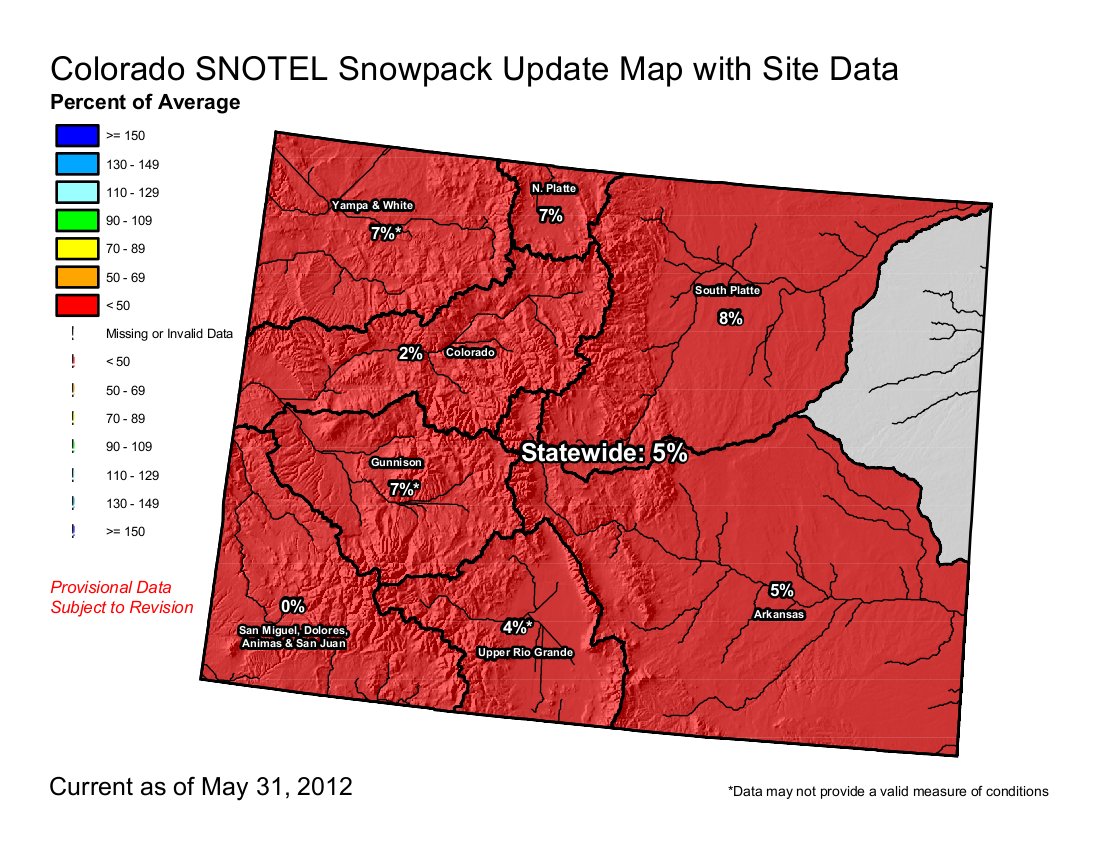
Click on the thumbnail graphics to the for the March 1, 2012 through June 2, 2012 hydrograph for the Colorado at the Utah state line, the current U.S. Drought Monitor map and the statewide snowpack map from May 31, 2012. Streamflow at the Utah border is well below average and much below water year 2011 near record flows were roaring through Cataract Canyon on the way to Lake Powell.
From email from the Eagle River Water and Sanitation District:
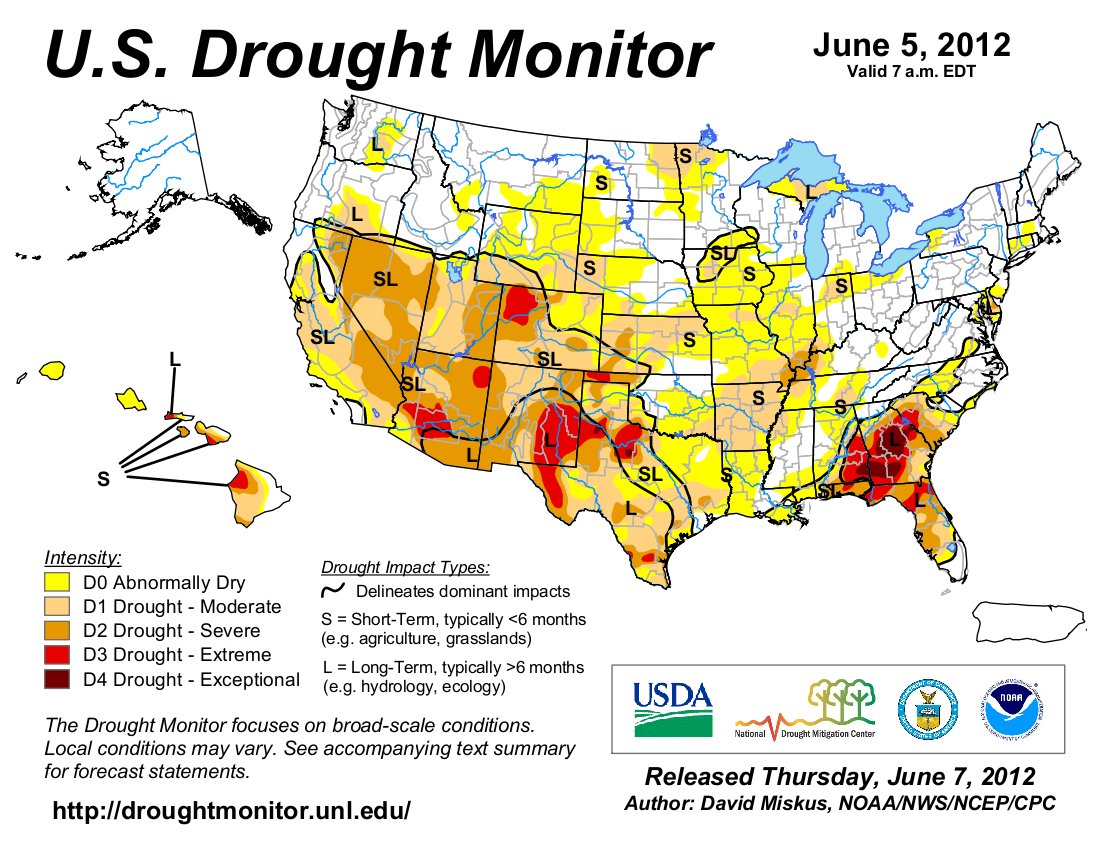
The U.S. Drought Monitor expanded the area in northwest Colorado that is designated as being in extreme drought, growing 3 percent in the last week to cover about ten percent of the state. The May 29 map, released Thursday, shows 100 percent of Colorado is experiencing some level of drought condition.
The extreme drought area abuts Eagle County and includes most of Garfield, Rio Blanco, and Routt counties as well as portions of Moffat, Pitkin, and Mesa counties. Drought intensity in Eagle County is D2, severe, and D3, extreme – just on the western boundary – on a scale of D0 to D4.
The U.S. Drought Monitor is one of several drought monitoring tools produced by the National Drought Mitigation Center that helps people assess drought severity and impacts. Another tool is the Vegetation Drought Response Index that depicts vegetation stress across the contiguous United States. The vegetation condition in Eagle County is described as pre-drought, moderate drought, and severe drought.
Water available for local vegetation could be limited this year. At Wednesday’s Eagle River Valley State of the River meeting, Mage Hultstrand of the Natural Resources Conservation Service said the snow water equivalent for the Eagle River basin on May 30 was just three percent of the historical average. Hultstrand also noted the Vail Mountain SNOTEL (snow telemetry) site melted out completely on April 7, nearly eleven weeks earlier than normal, and said streamflows for the Eagle River below Gypsum are forecasted to be at 43 percent of average.
With our community water supply largely dependent upon adequate flows in local streams and rivers, Eagle River Water and Sanitation District encourages its customers to take action to lessen the impact of drought.
Protect the investment made in landscaping by following best practices that encourage a deep root system, which helps plants get through dry spells. Should drought conditions persist, water available for irrigation and other outdoor uses may be less than normal, or unavailable, this year. Currently, normal year-round Water Use Regulations are in effect. For more information go to http://www.erwsd.org or call ERWSD Customer Service at 970-477-5451.
From the Summit County Citizens Voice (Bob Berwyn):
Eagle and Summit and Grand counties are designated as being in a severe drought, with streamflows forecast to be well below normal across the region. The latest update from the U.S. Drought monitor shows all of Colorado now experiencing some level of drought, with Eagle County, for example, experiencing pre-drought, moderate drought and severe drought conditions, depending on the exact location…
Lake Powell, the key reservoir on the Colorado River system, is at 79 percent of average and only about two-thirds full. Daily inflows are well below average for this time of year. [ed. At last week’s NIDIS webinar a participant said that inflows to Lake Powell in May 2011 were a million acre-feet, this year 54,000 acre-feet.] For the next week, dry conditions are expected to continue under a strong ridge of high pressure, with precipitation confined to the highest terrain of Colorado. There’s a chance of significant precipitation at the western edge of the Upper Colorado River Basin during the coming week, as a Pacific trough approaches the region.
A weekly report updated by the U.S. Department of Agriculture on Thursday indicates extreme drought conditions continue to expand in Northwest Colorado. “And they’re expected to get worse,” said Joe Ramey, a meteorologist with the National Weather Service in Grand Junction. “We have just been spiraling into more and more severe drought, and that has not changed this week.”
The Drought Monitor shows that nearly all of Northwest Colorado is experiencing at least a severe drought, and much of the area is seeing extreme drought conditions. Ramey said the Drought Monitor is based mostly on past precipitation as well as soil moisture levels…
According to Steamboat Springs weather observer Art Judson, 0.68 inches of precipitation fell in May compared to an average of 2.08 inches.
The City of Loveland is partnering with the Center for ReSource Conservation to offer free sprinkler audits to Loveland residential water customers. Slow the Flow is a free sprinkler inspection program designed to optimize sprinkler operations and be efficient with outdoor water use. This free pilot program enables Loveland customers to have their automatic, underground sprinkler systems inspected by trained water auditors who inspect for performance and efficiency. After the inspection, residents will receive a customized watering schedule and tips for easy do-it-yourself sprinkler maintenance. Inspections are available June 1 through Aug. 31 while supplies last.
Boulder received just 3.01 inches of precipitation over the three-month period, meteorologist Matt Kelsch said, making it the driest spring — as he defines the season for weather purposes — since the city began keeping records in 1894. The average amount of precipitation Boulder receives in March, April and May is 7.85 inches, Kelsch said. Snowpack levels statewide are about 5 percent of average for this time of year, according to the Natural Resources Conservation Service. “It was a dismally dry spring,” Kelsch said…
Klaus Wolter, a climatologist for the National Oceanic and Atmospheric Administration in Boulder, called this spring “miserable” but noted it could have been worse. February was the snowiest in Boulder’s records, according to Kelsch, and May’s weather conditions were not particularly far off averages for the month. As recently as early May, Wolter said he was optimistic that an El Nino pattern would form, bringing more moisture to Colorado in the coming fall. Now, he said, he is concerned Colorado may be facing a third straight La Nina year, though he is at least a few months away from being able to say if that outcome is likely. “My concern is not so much with the summer,” Wolter said. “If we were to go back into a third-year La Nina … that would be a big worry. That’s how we got into a big drought in the early 2000s.”
Even before the Pledge of Allegiance was recited by the approximately 60 people in attendance at the Parker Water and Sanitation District meeting May 31, chairwoman Darcy Beard announced that the board would be retaining Jaeger indefinitely to ensure a smooth transition to new leadership.
Just two weeks ago, Jaeger said he believed his days as district manager were numbered. Three new board members were elected May 8 after running on a platform that promised a change in spending habits, transparency and planning. At the five-member board’s first meeting May 17, they stripped management of their ability to sign checks, but stopped short of discontinuing Jaeger’s contract for fear of losing the person with the most intimate knowledge of district operations and plans. The tone early on at the May 31 meeting was conciliatory as Beard cited Jaeger’s “dedication and vision” for making the district one of the more respected water providers in the state. Beard also apologized because she was told that Jaeger “felt my criticism was directed to him personally” during comments she made at the May 17 meeting.
Jaeger, who has been at the helm of the PWSD for 31 years, wrote a letter to the board that expressed his willingness to pass on his knowledge during an “orderly and well-thought-out” transition period. Jaeger said he wants to schedule a full-day learning session to catch the new board members up to speed on reasons behind water planning policies and update them on growing concerns about the cost of treating wastewater.
From the Christian Science Monitor (Pete Spotts) via Alaska Dispatch:
Over the past two hurricane seasons, La Niña has held sway – characterized by cooler than normal sea-surface temperatures in the eastern tropical Pacific and warmer than normal temperatures in the western tropical Pacific. These conditions flip-flop under El Niño. Each phase of this cycle alters wind patterns in ways that inhibit tropical-cyclone formation in the Atlantic during an El Niño and favor cyclone formation during a La Niña.
La Niña fizzled in April, leaving current conditions in a neutral phase some forecasters whimsically refer to as La Nada. Some models are forecasting the development of a weak El Niño between July and August, but for now it’s unclear whether it would last much beyond that.
Indeed, the season’s two early storms in May, Alberto and Beryl, highlight the influence wind conditions have. Both strengthened to tropical-storm levels over warm Gulf Stream waters off the coasts of Florida and the Carolinas. But they did so because the system of cloudiness they grew from traveled into a gap between two high-altitude rivers of air flowing west to east – the polar and subtropical jet streams, Dr. Masters explains on his Weather Underground blog.
The agency’s 2012 stocking schedule calls for the addition of 260,500 fish to Ruedi Reservoir east of Basalt, but most are of the “sub-catchable” variety — they’re only a few inches long. The Ruedi total includes 11,000 3-inch rainbows that were scheduled for stocking in April; 200,000 2-inch kokanee salmon to be stocked this month, 28,000 5-inch lake trout to be added to the reservoir throughout the summer and 31,500 10-inch rainbows, also to be stocked in batches through early August. The lake at Chapman Campground in the upper Fryingpan Valley will see the introduction of 1,500 10-inch trout over the course of the summer, according to the schedule. “The 10-inch fish is our typical stocker,” said Mike Porras, Parks and Wildlife spokesman. “We stock them in areas where fishing is a little more popular.” It’s the expectation that those fish will be kept when they’re caught.
In addition to the 10-inchers are the unexpected lunkers — brood fish that have been reared in state hatcheries specifically for egg production rather than introduction into lakes and streams. They’re typically big fish, and some will be culled from hatchery populations and added to popular fishing waters. Maroon Lake near Aspen, for example, has been the occasional repository of brood fish in past seasons. This year’s schedule calls for putting only 2-inch cutthroats (25,000 of them) in the lake, but that doesn’t mean some brood fish won’t find their way there.
The agency’s stocking strategy, however, is about more than emptying a tank of hungry trout into the water for eager anglers to take back out. “It’s much more complex than, we want people to catch fish and enjoy them,” Porras said.
In addition to the plans for Ruedi and Maroon Lake, roughly 100,000 fish are scheduled to be stocked in other high-mountain lakes and streams this summer, in quantities that range from 100 fish to 1,000 or several thousand.
“When we have a plan that is this complicated, we need to have the opportunity for a full hearing of the issues,” said Richard Mehren, attorney for the Lower Arkansas Water Management Association. “It’s about the standard of review. It’s an uphill battle to convince the court that there has been injury. We’re concerned that the manner in which this was done has opened the door for larger transfers.”
LAWMA joined the Amity Mutual Irrigating Co., District 26 Irrigating Canals and Tri-State Generation & Transmission last month in filing a complaint with Division 2 Water Judge Larry Schwartz over State Engineer Dick Wolfe’s approval of a pilot program for a relatively small amount of water.
More Arkansas Valley Super Ditch coverage here and here.
From the Glenwood Springs Post Independent (John Colson):
O’Meara, who has been Carbondale’s utility director for five years, is working with outside consultants, the federal government and other entities and agencies to investigate the potential for drawing hydroelectric power from South Nettle Creek. Nettle Creek, fed by a spring that rises on the lower northwestern slopes of Mount Sopris, has been the town’s main source of drinking water for more than 100 years. The town also has well fields along the Crystal and Roaring Fork rivers that supplement Nettle Creek if the creek’s flows drop below a certain level, or if demand rises beyond the creek’s capacity.
The idea of generating hydroelectric power from Nettle Creek has been discussed for decades, O’Meara said, but this is the closest the town has gotten to making it happen.“There’s a whole bunch of players,” O’Meara said, including the Community Office of Resource Efficiency (CORE), CLEER (Clean Energy Economy for the Region), and the Federal Energy Regulatory Commission (FERC)…
“The payback on it is long-term,” he said, “as it is for all hydro projects. Green energy is very expensive. It’s as simple as that.”
…according to an SGM report, the allowed uses for Carbondale’s Nettle Creek water right do not currently include hydroelectric generation. Instead, the town’s water rights are decreed as being for municipal purposes, such as water service to homes, for treatment of sewage and for fire protection. It may be necessary to go through the state’s water courts to add power production to that water decree as an allowed use, the SGM report stated.
In the rural Colorado we all love, it is often difficult to make a living. Many of us know ranchers and farmers whose spouses work “regular” jobs to keep the family afloat in the agricultural life style. Even when we work “regular” jobs, our pay is well below Front Range rates. So how do we make a rural economy work? Diversify. The more veins feeding the aorta, the quicker it fills. On the Western Slope, few of us want to make it rich, but we sure would like our children to be able to return after college and make a go of it.
Recreational rafting does not drive the economy, but is another feeder vein. The Taylor River accounts for two-thirds of the boating user days in the Gunnison Basin. The $4 million in economic activity this generates helps fill restaurants and rental houses and keeps energetic ski area workers employed off season. In the Colorado Basin, including the Blue, Eagle and Roaring Fork rivers, direct spending totals over $12 million, generating a total of over $31 million in economic activity. Of that, boating on the Blue River contributed over $750,000 in direct spending and nearly $2 million in economic impact. These numbers from the Colorado River Outfitters Association 2001 report do not include economic activity generated from fishing, pleasure boating on reservoirs or “private boaters,” who like the sport enough to purchase the gear to raft, kayak or canoe rivers on their own. They are not confined to the commercially run sections of rivers.
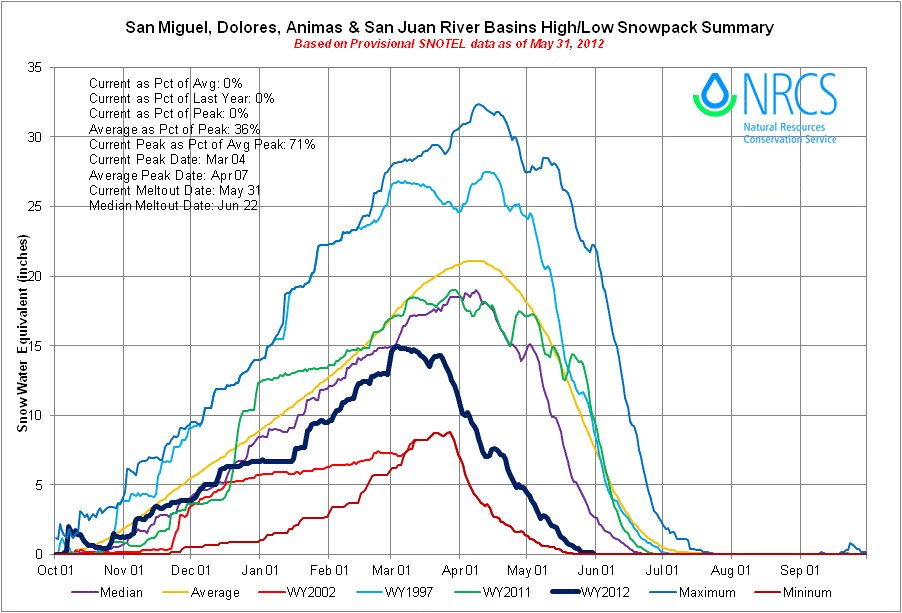
Click on the thumbnail graphics for the current U.S. Drought Monitor map, the Basin High/Low graph for the San Miguel/Dolores/Animas and San Juan basins and the current statewide snowpack map. Snowpack across Colorado is in single digits. All of the state is in one stage of drought or another except parts of the South Platte basin which are merely abnormally dry.
From the Associated Press via the Fort Collins Coloradoan:
The U.S. Drought Monitor says severe drought conditions covered about a quarter of Colorado at the end of May, encompassing nearly every place north and west of Salida. A pocket of that area is even worse, with severe drought conditions.
The rest of the state is either abnormally dry or in a moderate drought. The Drought Monitor says a severe drought means crop or pasture losses are possible and water shortages are common. An extreme drought means major crop and pasture losses are possible and water shortages could become widespread.
The National Weather Service predicts June temperatures will be above normal and rainfall will be below normal statewide…
The Poudre River, seeing some of its most dismal spring flows ever recorded, was running at 569 cubic feet per second on Friday at the gauge at the mouth of Poudre Canyon. The average flow for the date is about 2,000 cubic feet per second.
March through May was the driest spring on record in Boulder, with 3.01 inches of moisture. The average is 7.85 inches…Boulder Creek was flowing at a rate of 100 cubic feet per second Thursday. The creek’s average flow this time of year is 400 to 500 cubic feet per second.
From the Colorado River Water Conservancy District website:
Mon., June 4, Gunnison County State of the Rivers, Student Center Ballroom at Western Colorado State University, Gunnison: 10 a.m., tour of the Aspinall Unit Reservoirs; 4 p.m. Gunnison Basin Roundtable Meeting: 6:30 p.m. Public Reception; 7 p.m. Snowpack and Streamflow levels and predictions for the summer; 7:20 p.m. Aspinall Operations Update; 7:40 p.m. a History of Construction at the Aspinall Unit; 8:15 p.m. the 75 Year History of the Colorado River District with author George Sibley.
From the Loveland Reporter-Herald (Pamela Dickman):
A hydroelectric plant is now up and running at Carter Lake west of Loveland and pumping energy into the Poudre Valley Rural Electric Association grid Dignitaries from Northern Water, which built the plant, the REA, Tri State Generation and even the United States Department of Interior on Thursday dedicated the Robert V. Trout Hydropower Plant not far from the south shore of the lake…
Already, the Colorado-Big Thompson Water that funnels through the Adams Tunnel from the Western Slope to Northern Colorado feed six Bureau of Reclamation hydroelectric power plants and has fed 37 billion kilowatt hours of electric energy into the grid. The new plant, owned and operated by Northern Water, will add 2.6 megawatts of power, or enough to feed 1,000 homes…
The water district named the plant after Trout, a lawyer who has represented the water district for 35 years and whose innovative and tireless efforts helped bring the hydroelectric plant to life.
Here’s the release from the Northern Colorado Water Conservancy District (Brian Werner):
Northern Water dedicated their first hydropower plant today at Carter Lake southwest of Loveland. About 100 people attended the ceremony, which featured Anne Castle, assistant secretary for water and science for the U.S. Department of the Interior, and speakers from several organizations involved in the project.
The project, which started generating power in mid-May, harnesses pressure created by existing releases from the outlet tower at the south end of Carter Lake, a Colorado-Big Thompson Project reservoir. The facility includes two 1,300-kilowatt turbines and connections to the Carter Lake outlet and the St. Vrain Supply Canal. It is expected to produce 7 to 10 million kilowatt-hours of clean energy a year – enough to power about 1,000 homes – sold by the Poudre Valley Rural Electric Association.
“Although the industry classifies this hydro project as small, it’s a really big step for Northern Water. We’re taking energy in the form of pressure that was already there and turning it into marketable power that expands Poudre Valley REA’s green energy portfolio,” said Carl Brouwer, project manager for Northern Water.
Northern Water’s Board of Directors approved a resolution earlier this month to name the facility the Robert V. Trout Hydropower Plant after attorney Bob Trout, Northern Water legal counsel for more than 35 years. Just as he was for countless other initiatives, Trout was instrumental in the development of the hydro project.
The $6 million project received a $2 million low-interest loan through the Colorado Water Resources and Power Development Authority, and Northern Water’s new hydropower enterprise fund is managing a loan for the rest. The project’s projected revenue, which will repay construction costs and cover future upgrades, is about $600,000 a year.
The case is one of the first major decisions facing newly appointed Division 2 Water Judge Larry Schwartz. “We think the state engineer has exceeded his statutory authority,” said Richard Mehren, attorney for the Lower Arkansas Water Management Association. LAWMA, along with the Amity Mutual Ditch Co., District 67 canals and TriState Generation and Transmission Co., filed the complaint last week in water court. It asks Schwartz to require the Super Ditch to file in water court in order to operate its pilot program…
The lawyers who filed the complaint say the Super Ditch transfer program have effects that would persist longer than five years — the return of groundwater to the Arkansas River. Mehren pointed out that the Super Ditch engineering shows this and LAWMA had to account for its own lagging return flows in a court case. Super Ditch engineers say recharge ponds would be put in place to account for the timing of return flows, and Wolfe agreed to the engineering design under a lengthy list of conditions. Several farms were eliminated from the plan because they could not meet recharge requirements, and in fact the pilot project’s scope was cut in half for that reason. Opponents also say the one-year pilot program sets a precedent, giving them little time to respond to claims made from one year to the next. They also point out the program could be renewed annually for another four years.
“We have an interest in keeping the water we think we have,” said Colin Thompson, a farmer on the Amity. “We’re out real money when we can’t irrigate, and we believe the burden of proof should be on the Super Ditch.” “LAWMA gets hurt in two ways,” said Don Higbee, manager of the well owners’ group. “We’re very cautious that our water rights won’t be depleted, but we also must make up flows at the state line.”