Western Resource Advocates Releases First Detailed Study on Water Requirements for Hydraulic Fracturing

hydraulicfracturingwaterislostwaterwrs.jpg

From The Denver Post (Bruce Finley):

The analysis, presented Wednesday by the Boulder-based consultancy Western Resource Advocates, determined that the amount of water pumped into the ground for drilling wells and for hydraulic fracturing to coax out oil and gas is between 22,100 and 39,500 acre-feet each year. That’s enough for up to 296,100 people — or to meet most needs in Douglas County. “We’re already having trouble meeting our demands. Especially in a dry year like this, if this water is going to go into oil and gas wells, there’s going to be a loser,” said engineer Laura Belanger, author of the study. “Where’s this water going to come from? Municipalities? Agriculture? Are we going to have to make new diversions from rivers on the Western Slope?”

State regulators have estimated that fracking requires 13,900 to 16,100 acre-feet a year. State officials and industry advocates compare this with total water consumed in Colorado and emphasize it is less than 1 percent — due to the huge amount used to produce food. But drilling’s share is growing rapidly and now exceeds water diverted for ski area snowmaking.

More coverage from Kirk Siegler writing for KUNC. From the article:

For perspective, according to the group, 20-40 thousand acre feet is similar to the amount of water consumed in a year in a city the size of Fort Collins.

“In dry years like this one, and overtime as our populations grow, fracking water use will compete with municipal use,” said Laura Belanger, the report’s author.

Some cities in booming Weld County have been leasing their excess water to fracking companies; a move that’s generated hundreds of thousands in revenue in some areas.

More oil and gas coverage here and here.

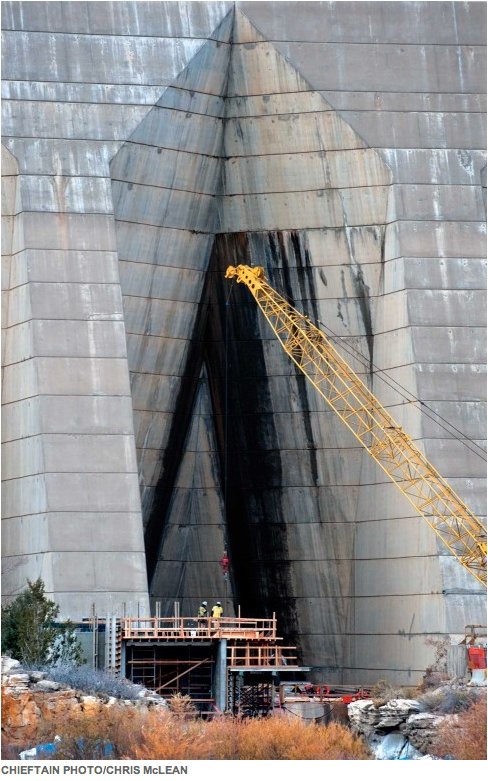
Southern Delivery System: Reclamation is testing the newly constructed North Outlet Works at Pueblo Dam

southerndeliverysystemnorthoutletworksconstructionpueblodampueblochieftain.jpg

From The Pueblo Chieftain (Chris Woodka):

Flows ranging from 5-1,100 cubic feet per second will be released from the new outlet works during the tests. It’s the first time the outlet has been used since construction.

The Arkansas River has been fed by releases from flood gates in the central portion of the dam during construction. River flows have been in the 400 cfs range below the dam recently.

The first test occurred Wednesday afternoon, and more tests are planned Friday and Tuesday, said spokeswoman Kara Lamb.

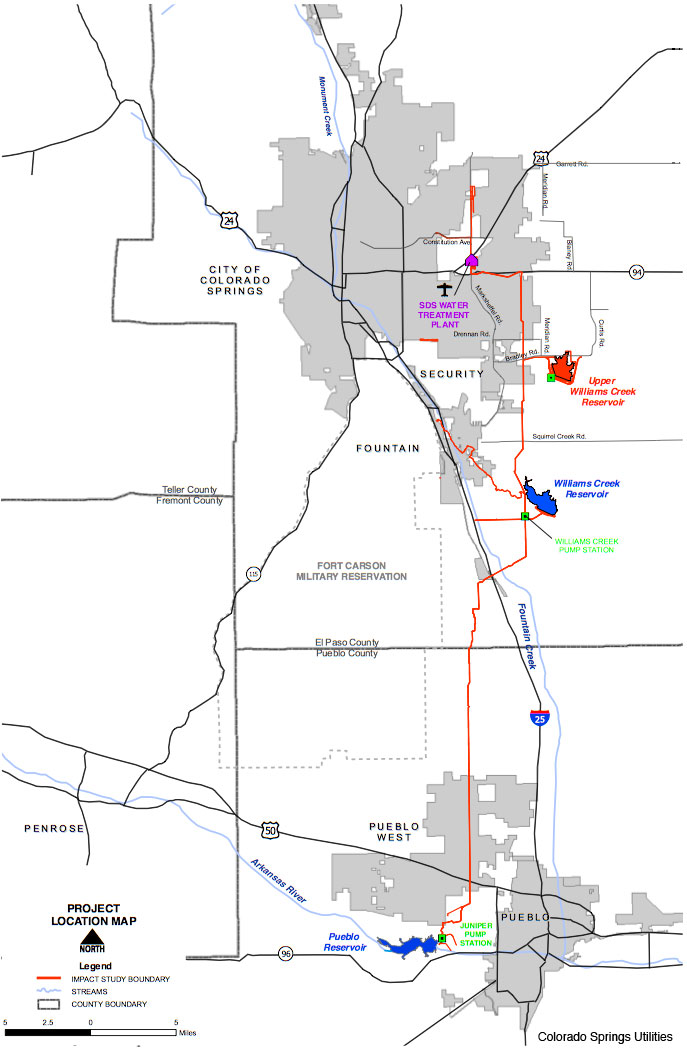
The Y-shaped outlet is being constructed by Colorado Springs Utilities as part of the Southern Delivery System. It will connect to a 90-inch diameter pipeline leading to a Pueblo West tap and the Juniper Pump Station, which will be constructed near the dam. The other pipeline will serve as the river outlet.

More Southern Delivery System coverage here and here.

Vail: The current Colorado drought to be discussed on tonight’s ‘Community Focus’ radio program on KZYR #CODrought

coloradoriverneardotsero03012012to06202012.jpg

From email from the Eagle River Water and Sanitation District (Diane Johnson):

Drought conditions and water supply are the topics for tonight’s “Community Focus” show on local radio station KZYR, 97.7 FM the Zephyr.

Eagle River Water and Sanitation District General Manager Linn Brooks and board Chairman Rick Sackbauer will join Community Focus host Rohn Robbins to discuss current drought conditions and what the community can do to mitigate local impacts.

The Zephyr’s Community Focus is an hour-long talk program that airs at 7 p.m. on Wednesdays.

Brooks and Sackbauer will discuss potential drought impacts, how the public water system has prepared for drought conditions, collaborative efforts to mitigate impacts, and actions community members can take.

The district’s water use priorities are public health and safety (normal indoor water use and maintaining storage for fire protection); local economic benefits associated with streamflows, recreation, and tourism; and long-term system reliability.

Drought intensity in Eagle County is “extreme” according to the U.S. Drought Monitor and all of Colorado is experiencing some level of drought condition. Drought conditions reflect this winter’s record low snowpack, including the driest March on record in Colorado, the warmest March through May on record, and windy conditions. Current streamflows are correspondingly low; Eagle County waterways are flowing at about 20 to 30 percent of historical averages.

Community Focus is also aired live on Eagle County’s ecotv18, channel 18 on local cable systems, and streamed live at http://www.ecotv18.com and will be archived on KZYR’s website at http://www.kzyr.com.

For more information, contact Communications and Public Affairs Manager Diane Johnson at 970-477-5457.

Western Resource Advocates Releases First Detailed Study on Water Requirements for Hydraulic Fracturing

hydraulicfracturingwaterislostwaterwrs.jpg

Click here to go to the WRA website to download your copy of the report. Here’s the release from Western Resource Advocates (Jason Bane):

Western Resource Advocates (WRA) today released a new report on the amount of water needed for hydraulic fracturing in Colorado, providing the most comprehensive numbers available on the subject. In Fracking Our Future: Measuring Water and Community Impacts from Hydraulic Fracturing, researchers examined available data on water and fracking using Colorado as an example, and found that fracking requires enough water to otherwise serve the residential needs of the entire population of some of the state’s largest cities.

“It’s clear that we need to take a step back and make sure we aren’t over-allocating our most important natural resource one frack job at a time,” said Laura Belanger, Water Resources & Environmental Engineer with Western Resource Advocates and the lead author of the report. “While we need natural gas to transition to a cleaner energy future, we must have water to survive.”

Based on figures compiled from government and private industry sources, Fracking Our Future calculates that the amount of water used annually for hydraulic fracturing in Colorado (22,100 to 39,500 acre feet) is enough to meet the yearly residential needs of up to 296,100 people—more than the population of cities such as Cincinnati, Ohio; Buffalo, New York; or Orlando, Florida.

“It is a travesty that in a water-starved state like Colorado, we are using so much water for oil and gas drilling,” said Longmont resident Barbara Fernandez, who retired in 2011 after 24 years with the Colorado Public Utilities Commission and has grown increasingly concerned about fracking near residential areas.

The report notes that it is particularly important to properly manage the amount of water used for hydraulic fracturing because fracked water is 100% consumptive. Whereas 90-95% of indoor residential water returns (from uses such as showers and washing machines) eventually makes its way back into streams, frack water contains potentially harmful chemicals that must be disposed of in underground wells or pits.

From the Boulder Daily Camera (John Aguilar):

Water use by the oil and gas industry has come under greater scrutiny of late as the number of wells drilled in and near cities and towns in the state has exploded, prompting several municipalities to enact moratoria on new drilling activity. In 2010, there were more than 43,000 active wells in the state.

Reliance on hydraulic fracturing, or fracking, at those well sites has put even more strain on the water supply. Fracking involves injecting a water-sand-chemical mixture deep into the ground to force out pockets of natural gas trapped in tight rock formations.

The Colorado Oil and Gas Association, the industry trade group, says fracking a typical vertical well requires up to 1 million gallons of water, while a horizontal well can require up to 5 million gallons. A spokeswoman for the group didn’t immediately respond to a request for comment on the report this morning.

More oil and gas coverage here and here.

NIDIS Weekly Climate, Water and Drought Assessment Summary of the Upper Colorado River Basin

wycoutprecipitation0601to06192012.jpg

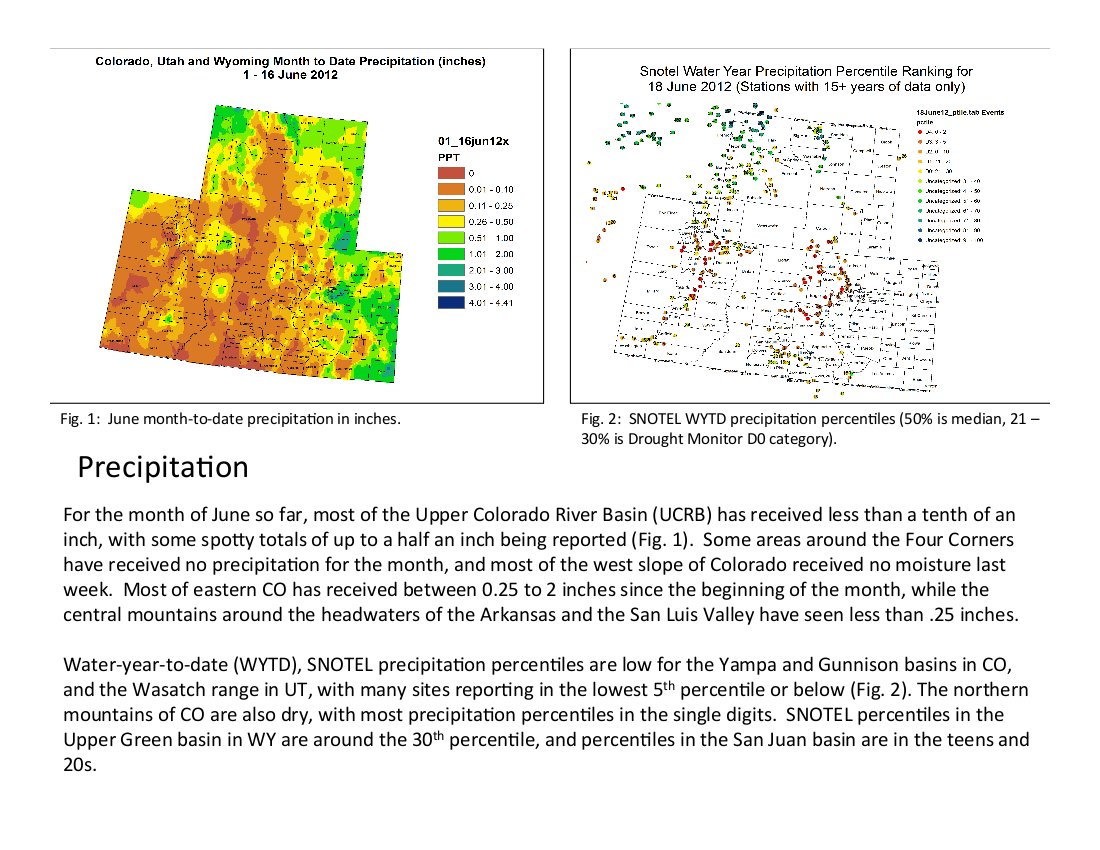
Click here to download a copy of the summaries from yesterday’s webinar. Click on the thumbnail graphic to the right for the precipitation summary.

Colorado Water 2012: ‘Anyone in the basin will say that North Park remains a quiet and unique place’ — Caitlin Coleman

northplatteriver.jpg

Here’s the latest installment of the Valley Courier’s Colorado Water 2012 series. Caitlin Coleman takes us on a tour of the North Platte River Basin. Here’s an excerpt:

The North Platte Basin—a 2,050 square-mile area that encompasses all of Jackson County and a portion of Larimer County—is nestled up against the Continental Divide in north central Colorado between the Front Range, Routt County and the Wyoming border. About 65 percent of Jackson County is public land, managed by state and federal agencies; still there is plenty of room for the basin’s small population of about 1,400 people.

Anyone in the basin will say that North Park remains a quiet and unique place. Bearing the headwaters of the North Platte River and connected by this artery to Wyoming and Nebraska, the North Platte Basin is somewhat insulated from the booming population and water worries of the rest of Colorado. Geography, lack of major development and a U.S. Supreme Court Decree governing water development have protected the basin…

The basin’s first water rights were adjudicated in 1892. Until then, there were no water districts, no water commissioners, and no official water appropriations in the North Platte Basin, but that doesn’t mean there weren’t water diversions and development. Rather, the basin slowly developed throughout the 1880s, according to former water commissioner and historian Eric Wagner.

The water adjudication system began as a response to droughts in 1891, when people faced with stressed water resources wanted legal recognition of their water diversions. In the North Platte Basin, this precious water is used mostly for flood irrigation—watering meadows to produce a crop of high mountain hay, which sustains cattle locally or is trucked outside the basin and sold as a commodity, such as horse or cattle feed. That’s the way it’s been for years. Ditches wind across the basin, transporting water from rivers, streams and reservoirs to nourish agricultural land.

More Colorado Water 2012 coverage here.

South Platte Basin: Governor Hickenlooper does not allow pumpers to turn on wells in the alluvial aquifer without augmentation water, cites lack of authority

southplattealluvialaquifer.jpg

From the Associated Press via The Columbus Republic:

The state’s courts have ruled that farmers who take water from underground wells must replace what they take, so that there’s enough water left for holders of senior water rights. That’s been difficult in dry conditions.

Weld County commissioners this month issued a disaster declaration due to drought conditions and asked Hickenlooper to issue an executive order easing restrictions on pumping. Attorneys with the state attorney general’s office said in an informal memo Monday that Hickenlooper doesn’t have that authority. They said Hickenlooper can suspend state laws and rules but not judicial orders, judgments or decrees. They also said an order like one Weld County is seeking could create conflicts with Colorado water law.

From the Longmont Times-Call (John Fryar/Scott Rochat):

[Weld County Commissioner Sean Conway] said Hickenlooper produced a legal memorandum from the Colorado Attorney General’s Office saying the governor didn’t have the power to permit the resumption of pumping from the aquifer below farmland in the South Platte River Basin. “We’re disappointed,” said Conway, the chairman of Weld’s Board of County Commissioners.

Based on legal research by Weld County Attorney Bruce Barker, Conway said the commissioners “respectfully disagree” with the memo that deputy attorney general Casey Shpall and first assistant attorney general John Cyran sent to James Eklund, Hickenlooper’s deputy legal counsel.

Hickenlooper and his water adviser, former Colorado Agriculture Commissioner John Stulp, delivered the bad news in person to the Weld commissioners Tuesday morning. The commissioners met with the governor and his staff in Denver on Thursday and participated in a telephone conference call with members of Hickenlooper’s staff last Friday. Hickenlooper said in a Tuesday afternoon statement, “Even if we could legally pump groundwater to use for irrigation and reduce water in basements, that water belongs to someone else downstream.”

More South Platte River basin coverage here.

Southern Delivery System: State Representative Sal Pace calls on Colorado Springs Utilities to halt construction

sdspreferredalternative.jpg

From The Pueblo Chieftain (Chris Woodka):

Pace sent a letter to Colorado Springs Mayor Steve Bach Monday calling for a halt to the $986 million SDS, now under construction…

“According to your own environmental documents, the SDS will increase Fountain Creek flows by 40 percent,” Pace wrote in the letter. “That increase will now take place without the protections in place that your city promised when you submitted the project to the Bureau of Reclamation for environmental review.”

As part of its 1041 land-use permit with Pueblo County, Colorado Springs agreed to meet requirements in a record of decision by the Bureau of Reclamation, which included a fully funded stormwater enterprise. “Temporarily stopping the project is the least that your city can do to guarantee the protections downstream communities morally and legally deserve,” Pace wrote.

More Southern Delivery System coverage here and here.

Drought news: Combination of high temperatures and lack of precipitation is taking its toll on crops

usdroughtmonitor06122012.jpg

From the Fort Collins Coloradoan (Bobby Magill):

“The continued hot, dry conditions are wreaking havoc on agriculture on the Eastern Plains,” said Wendy Ryan, a researcher with the Colorado Climate Center at Colorado State University. “Many people have very poor range conditions out there. We’ve gotten reports of people that are getting water who will irrigate for 30 hours and it makes it 300 feet down the field.”[…]

Currently, most of Larimer County is considered to be under both severe and extreme drought conditions, depending on the area. Extreme drought conditions are spreading throughout northwestern Colorado, where the mountain snow has completely melted off the slopes and very little precipitation has fallen in recent months…

The Poudre River’s flow through Fort Collins is in the third percentile at a time when it should be near its peak spring runoff flow. “It means 97 percent of other years were (seeing) a higher flow than right now,” Ryan said.

On Tuesday, the Poudre was running through the Fort Collins gauging station at 79 cubic feet per second, or cfs. The average flow for June 19 is 979 cfs, and a year ago the river was running through the city around 2,500 cfs, according to U.S. Geological Survey data.

From The Pueblo Chieftain (Chris Woodka):

Low water levels are creating odor problems for residents near Lake Minnequa. The good news is that the city of Pueblo, Pueblo Board of Water Works and Evraz Rocky Mountain Steel are working on a long-term solution. The bad news is that the water level of the lake continues to fall during the drought. Residents, particularly on the west side of the lake, have been complaining about the odor for several weeks. “As more shoreline is exposed, the smell probably comes from vegetation rotting,” said Scott Hobson, assistant city manager for community investment. “I don’t know of a quick fix for the odor issue.”

Low levels are affecting other water supplies around the lake. “People who live nearby say the water levels in wells are the lowest they’ve seen in more than 30 years,” Hobson said. The only source of water for the lake at the current time is stormwater, and even a fairly intense storm like the one last week doesn’t do much to fill the lake. Last year, there were two large fish die-offs at the lake that created a brief, intense smell.

From KJCT.com via the Aurora Sentinel:

Ranchers in western Colorado are selling off cattle to avoid losing them to a severe drought. Livestock auctioneer Bill Martin of Loma says his auction barn usually sees between 200 and 400 cows a week, but this year the numbers have sometimes nearly quadrupled.

Larimer County, et al., score $5 million from Great Outdoors Colorado

cachelapoudre.jpg

From the Loveland Reporter-Herald:

Larimer County and its partner cities of Fort Collins, Greeley, Windsor and Timnath will receive $5,098,150 for the Poudre River Corridor and Regional Trail Initiative, according to a press release from Kerri Rollins, Open Lands Program manager for Larimer County.

The grant will move the partners closer to completing their decades-long goal of “a regional swath of open spaces and connected trails along the river corridor,” the release said.

The money will fund the purchase of almost 1,000 acres of land along the Poudre and the construction of a trail overpass over Interstate 25 near Harmony Road in Timnath.

With the completion of the lottery-funded work, less than five miles of trail construction will remain in the 45-mile corridor from Bellvue northwest of Fort Collins to Island Grove Regional Park in Greeley, according to the release.

Here’s a list of GOCo grants for Southern Colorado from Chris Woodka writing for The Pueblo Chieftain:

Seven Southern Colorado projects were awarded $1.6 million by the Great Outdoors Colorado board Tuesday. A total of $37.3 million went to 42 projects throughout Colorado this grant cycle. Money comes from state lottery proceeds.

Mendenhall Ranch open space, Nature Conservancy, Otero County, $310,500.

Pritchett basketball court, Baca County, $28,215.

McClave Park improvements, Bent County, $161,377.

Conejos River Ranch open space, Rio Grande Headwaters Land Trust, Conejos County, $420,000.

Los Caminos Farm open space, Colorado Open Lands, Costilla County, $420,500.

Lookout Mountain Park land acquisition, Del Norte, Rio Grande County, $132,350.

Ski-Hi Park Pavilion, Rio Grande County, $179,990…

A package of four projects along Fountain Creek won $2.52 million in state funds Tuesday. The Great Outdoors Colorado board awarded the money as part of its highly competitive River Corridor Initiative. Eight projects were awarded $24 million this year under the initiative. Pueblo, Colorado Springs, Fountain and El Paso County applied jointly for the funds, in a show of regional cooperation. The Fountain Creek Watershed Flood Control and Greenway District joined as well, because the projects also are included in various Fountain Creek improvement plans the district supports.

More restoration/reclamation coverage here.

IBCC: Next Flaming Gorge Task Force meeting Friday in Colorado Springs

flaminggorgepipelineearthjustice.jpg

From email from Peak Facilitation Group (Heather Bergman):

…please find the agenda for Friday’s meeting of the Basin Roundtable Project Exploration Committee: Flaming Gorge. The meeting will be held from 10 am to 3 pm at the Pikes Peak Regional Council of Governments offices in Colorado Springs (15 S. 7th St..).

More Flaming Gorge Task Force coverage here.

Crawford: Public Works and the Colorado Rural Water Association are working on the town’s source water protection plan

crawfordnewspaperbuilding.jpg

From the Delta County Independent (Kathy Browning):

Colorado Rural Water Association is a nonprofit that provides technical assistance and operator training. The Town of Crawford is an association member. Balch and Mihelich will write an application for a $5,000 grant from the information provided by Bair. Balch said funding comes from Colorado Department of Public Health and Environment for each public water system to develop and implement a source water protection plan. There is a one-for-one match on the grant. The town’s share can be covered by in-kind donations after grant approval. The principle behind a protection plan is that it’s less expensive to protect source water than having to remove contaminants. Source water protection programs educate citizens on where their water comes from and how important it is to protect it…

The plan will have two phases. The first will provide an assessment report and a susceptibility rating for Crawford’s water source. The rating right now is good.

More Gunnison River basin coverage here.

USGS: Effects of Urban Stormwater-Management Strategies on Stream-Water Quantity and Quality

detentionpond.jpg

Here’s the release from the United States Geological Survey (J.V. Loperfido/D.M. Hogan):

Urbanization results in elevated stormwater runoff, greater and more intense streamflow, and increased delivery of pollutants to local streams and downstream aquatic systems such as the Chesapeake Bay. Stormwater Best Management Practices (BMPs) are used to mitigate these effects of urban land use by retaining large volumes of stormwater runoff (water quantity) and removing pollutants in the runoff (water quality). Current USGS research aims to understand how the spatial pattern and connectivity of stormwater BMPs affect water quantity and water quality in urban areas.

More stormwater coverage here.

US Forest Service celebrates 75 years of national grasslands, National Grasslands Week June 17-23

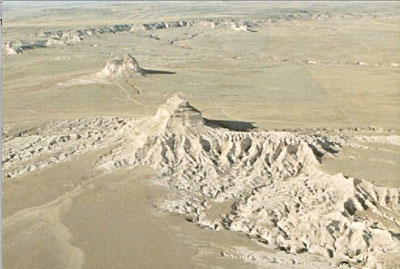
pawneebuttes.jpg

Here’s the release from the U.S. Forest Service:

The U.S. Forest Service will celebrate National Grasslands Week from June 17-23, showcasing the beauty, history and economic value of these national treasures on the 75th anniversary of the legislation that established them.

America’s 20 national grasslands, spanning 12 states and 4 million acres, were created through the Bankhead-Jones Farm Tenant Act of 1937, authorizing the federal government to acquire damaged lands for rehabilitation. Thirteen of these national grasslands reside in the Great Plains, where the ravages of the Dust Bowl left the soil bare of vegetation for years. Today, the benefits grasslands provide are valued in the billions of dollars.

“Our national grasslands remain beautiful examples of successful restoration programs,” said U.S. Forest Service Chief Tom Tidwell. “These lands are once again rich habitats brimming with native wildlife, grasses and wildflowers. They are also economic engines, generating jobs and bolstering rural American communities.”

The national grasslands offer a wealth of recreation and education opportunities for more than 1 million annual visitors. The grasslands feature some of the world’s best bird-watching experiences as well as camping, hiking, biking, fishing, hunting, horseback riding, target shooting, off-highway vehicle riding, picnicking and learning activities. Scenic drives offer unique geological features, wildlife and stellar locations for stargazing.

History buffs can visit old cemeteries and homesteads and take guided tours of Native American petroglyphs. They can also share in the experience of early settlers and their trek on the Santa Fe Trail.

“It took decades to restore the national grasslands from the barren landscapes of the Dust Bowl, to the rich prairie habitats we see today,” said Tidwell. “Every American should experience these unique grasslands that are so much a part of our rich natural heritage.”

The national grasslands provide tremendous benefits including pollination of native and agricultural plants estimated at $6 billion annually. Livestock grazing and energy ventures including oil, gas, coal and wind also contribute to the economic benefits provided by these lands. They help prevent drought and floods, maintain biodiversity, generate and preserve soils, contribute to climate stability and protect watersheds, streams and river channels.

These lands were managed by the USDA’s Soil and Conservation Service, now the Natural Resources Conservation Service, until 1960 when they were transferred to the U.S. Forest Service and designated as national grasslands.

The mission of the U.S. Forest Service is to sustain the health, diversity, and productivity of the nation’s forests and grasslands to meet the needs of present and future generations. Recreational activities on our lands contribute $14.5 billion annually to the U.S. economy. The agency manages 193 million acres of public land, provides assistance to state and private landowners, and maintains the largest forestry research organization in the world.

More restoration/reclamation coverage here.

Runoff/drought news: Endangered fish program is short of water to operate some infrastructure this season

fishladderpricestubbsdamcoloradoriver.jpg

From the Summit County Citizens Voice (Bob Berwyn):

… in key tributaries like the Yampa, and the fish could take another hit because there won’t be enough water during parts of the summer to operate fish passages that enable species like the Colorado pikeminnow to reach spawning areas.

Biologists said suspending operation of the fish passages this summer will have a short-term impact on the endangered fish, but are more concerned about long-term impacts if the drought lasts another year.
The endangered species evolved over millennia to survive extreme high and extreme low flows, but human activities have hit hard at the low end of the range, resulting in conditions that can’t sustain populations without help — like the fish ladders. Overall, recovery program leaders say they’ll manage the little bit water they do have based on experience from the drought in the early 2000s. “We’ve been there before,” program director Tom Chart said in a previous interview, explaining that this year’s low flows will likely result in a temporary setback for recovery efforts, especially in tributaries like the Yampa River…

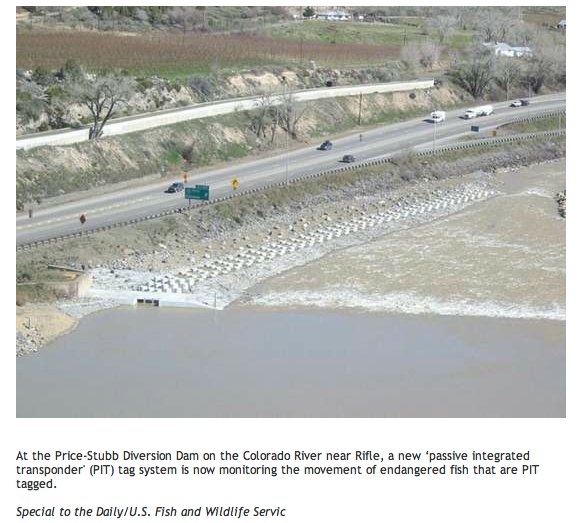
In a release, the U.S. Fish and Wildlife Service specifically identified the Grand Valley Irrigation Company Fish Passage, Grand Valley Project Fish Passage, and the Price-Stubb Fish Passage, all in western Colorado. The passages were built as part of the recovery program to give the fish access to important habitat extending from Lake Powell to Rifle on the Colorado River and from Grand Junction to Delta on the Gunnison River.

On the Colorado River, agricultural irrigators in the Grand Valley are operating fish screens on their canals when conditions permit. The screens serve a dual purpose of preventing fish from entering canals and benefiting canal operations by reducing debris loads in the canals. “We have a history of cooperation with the Recovery Program that helps our water users and the endangered fish,” said Richard Proctor, manager of the Grand Valley Water Users Association.

The Recovery Program is also coordinating with the Redlands Water and Power Company on operating procedures for the Redlands Fish Passage and Screen, located on the Gunnison River. The Recovery Program is working to minimize impacts to water deliveries to Redlands irrigators while continuing to operate the fish passage and fish screen, as conditions allow.

From Steamboat Today (Scott Franz):

“It’s a brutal year, and I don’t have anything good to say other than it is what it is,” [Pete Van De Carr] the owner of Backdoor Sports said Sunday as the river behind him ran at 111 cubic feet per second, well below its average flow of 1,810 cfs for June 17. According to a National Weather Service forecast, the Yampa River could slow to 85 cfs in Steamboat Springs as early as Wednesday. Once the river falls below that threshold, it essentially closes to recreation to protect wildlife and the river’s habitat.

More endangered/threatened species coverage here.

The Front Range Water Council has its eyes on water requirements for oil shale exploration and production

shellfreezewalloilshale.jpg

Water supply planning requires forecasting demand decades into the future. The Front Range Water Council is wary of water requirements for oil shale — the “Next Big Thing” for over a hundred years now — since many of the water rights that oil companies have purchased are senior to most of the large transmountain diversion projects. Here’s a report from the Colorado News Service (Kathleen Ryan) via The Fowler Tribune. From the article:

Jim Lochhead, president of the group and CEO of Denver Water, says half of the Denver water supply comes from the Colorado River, and he’s worried that oil shale production could overtax the river’s resources. “We’re concerned that the BLM and the United States not go too far too fast in their leasing program, before really understanding and quantifying these impacts on the river.”[…]

According to a report from Western Resource Advocates, oil and gas companies hold some rights to Colorado River water which predate the rights held by cities for drinking water. The BLM is expected to have a new plan in place by the end of the year.

More oil shale coverage here and here.

Colorado Water 2012: ‘Wetlands, including wet meadows and marshes…are vital to birds’ — SeEtta Moss (Audubon Society)

whoopingcranes.jpg

Here’s the latest installment in The Pueblo Chieftain’s Colorado Water 2012 series, written by SeEtta Moss. Here’s an excerpt:

In many locations, the amount of water needed to support specified bird species can be quantified. But it is necessary to conduct a site-specific study that is targeted to either high-priority bird species or those that are representative of a guild of birds. Fortunately, birds consume very little of the water and most of the water needed for them is for evaporative or transit loss. Some species of birds, primarily those that migrate into or through Colorado, could avoid those parts of Colorado if there is insufficient water to meet their needs. That would have impacts on both the resident and non-resident bird watchers and would likely result in significant economic impacts to those areas of the state where the birds and bird watchers are absent.

The economic impact of bird watching in Colorado is significant. The 2006 report of the U.S. Fish and Wildlife Service National Survey of Fishing, Hunting and Wildlife Associated Recreation estimated there were 737,000 bird watchers (only those watching wildlife away from home). Bird watchers spent well over $250 million in Colorado on trip-related expenses during 2006.

More Colorado Water 2012 coverage here.

Denver District Court rules that the CDPHE must hold an administrative hearing for the proposed Piñon Ridge Mill

pinonridgesite.jpg

From The Telluride Daily Planet (Collin McRann):

The ruling from Judge John N. McMullen dismissed 10 of the environmental, health and safety claims brought against the Colorado Department of Public Heath and Environment concerning the issuance of the materials license. It did, however, determine that the CDPHE failed to offer the opportunity to the public to request a public hearing before it issued the environmental report and draft license for the project to Canadian company Energy Fuels, Inc. The ruling mandates that that such hearing take place.

The claims were first filed in Denver’s district court in February 2011 by Telluride-based Sheep Mountain Alliance; the Towns of Telluride and Ophir later joined the suit. Opponents challenged the CDPHE’s decision to issue the license on the basis that it violated certain federal Atomic Energy Act rules by not allowing required vetting opportunities by the public, among other things.

Energy Fuels and the CDPHE, meanwhile, countered that they performed a rigorous and exhaustive review process, went through all the steps required of them and included the public.

The case has been in court for months now, with final responses filed late this winter.

“It’s not 100 percent of what we wanted, but it’s 95 percent of what we wanted,” said Curtis Moore, director of communications and legal affairs for Energy Fuels. “So we’ll keep moving forward.”

Though nothing has been scheduled, the hearing must be held by the CDPHE within 75 days of July 5. During the hearings, both sides will be given time to present their arguments and even cross examine each other.

As of late this week, SMA project coordinator Jennifer Thurston said the group’s lawyers were reviewing the 20-page court ruling. However, she said the SMA is looking forward to the hearings.

More nuclear coverage here and here.

2012 Colorado November Election: ‘Protect Colorado Water’ event Wednesday to kick off signature gathering for Initiatives 3 and 45

justianifirstdodifierofriparianrights.jpg

From the Examiner (Caryl Buckstein):

The event, known as “Protect Colorado Water,” is being launched by Be the Change, a grassroots political group with an environmental arm. The initiatives were written by Phil Doe, Be the Change environmental director, and Richard Hamilton, a long-time state environmental and conservation lobbyist.The website for Protect Colorado Water identifies Doe as a former environmental compliance officer for the U.S. Bureau of Reclamation…

Hamilton told the Colorado Statesman that state law already is explicit that the public owns water in the state. The initiatives would add teeth the citizens’ ability to demand enforcement. Initiative 3 would create the Colorado Public Trust Doctrine. It would make the water of streams public property and instruct the state to protect the public’s rights. Also, it would make the public’s rights superior to contracts or property law.

More 2012 Colorado November Election coverage here.

FIBArk results: ‘Demon Pride’ takes home the Hooligan Race trophy, Best-In-Show — ‘Chinese Takeout’

fibark2012twomancanoeslalom.jpg

Click here for race results from The Pueblo Chieftain.

More coverage from Tracy Harmon writing for The Pueblo Chieftain. From the article:

Isaac Schmidt of Arizona was all smiles as he sported a pink helmet and paddled his Andy Warhol-inspired “God Bless America” canoe with alternating pink and turquoise stripes. Dave Curran, 54, of Fruita gave a nod to the race’s “Oldest and Boldest” theme by wearing a 1973 helmet and an equally antique French-made life vest as he paddled a 1975 version of a kayak…

The river was running at 400 cubic feet per second Saturday, when it is usually flowing at about 2,000 cfs this time of year.

More Whitewater coverage here.

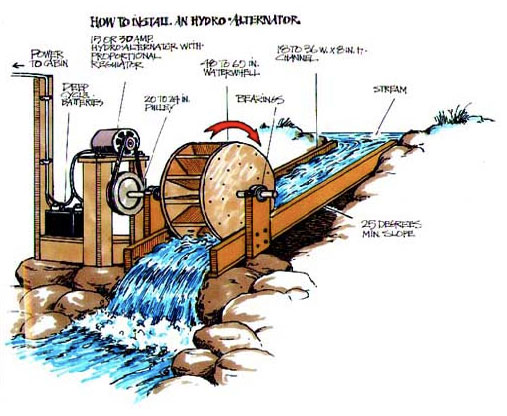
Energy and Commerce sub-committee approves the Hydropower Regulatory Efficiency Act of 2012

microhydroelectricplant.jpg

From The Telluride Watch (Samantha Wright):

On June 7, the Energy and Power Subcommittee of the House Energy and Commerce Committee approved the [H.R. 5892, the Hydropower Regulatory Efficiency Act of 2012] on a voice vote with no objections and no amendments…

The Hydropower Regulatory Efficiency Act of 2012, or HR 3680, would among other things eliminate Federal Energy Regulatory Commission involvement for non-controversial small (under 5 MW) conduit projects following a 45-day FERC public noticing period. A conduit project is one that is built on existing infrastructure, such as a pipeline, ditch or canal. The potential for conduit projects is particularly vast in the mountains of southwestern Colorado.

“Every small town in the mountains has got a pipeline for their water supply that goes up the hill,” [Kurt Johnson, resident of the Colorado Small Hydro Association and Principal at Telluride Energy] pointed out. “Not having to get a FERC permit [to put a small hydro-electric generating plant on such existing infrastructure] would be a massive boost,” he said.

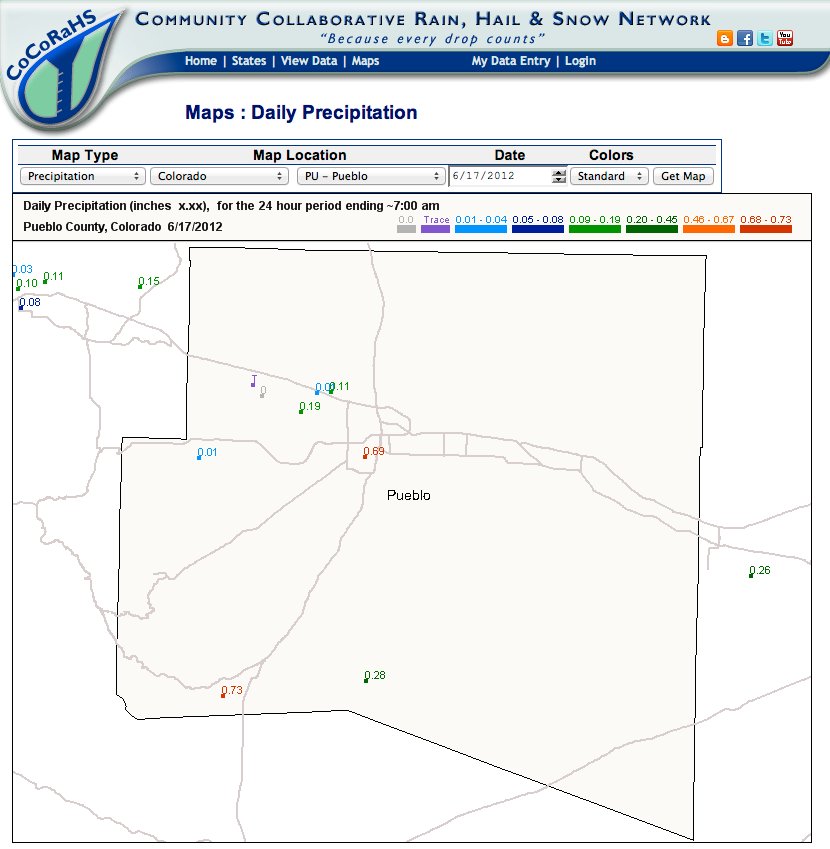
Precipitation news: Pueblo gets soaked

cocorahspueblocounty06172012.jpg

Click on the thumbnail graphic for the Community Collaborative Rain, Hail and Snow Network map for Pueblo County as of this morning. Here’s a report from The Pueblo Chieftain. From the article:

Parts of Pueblo received between .40 and .60 inches of rain during the 4:50 p.m. storm. The Sunset Park area, however, recorded .96 inches of rain. Some areas didn’t get as much rain, however, like the National Weather Service headquarters by Pueblo Memorial Airport, which received only .06 inches…

Severe weather tore through Springfield for a brief period Saturday evening. Two confirmed tornadoes touched down around 7:10 p.m. according to the National Weather Service. One of the tornadoes was located north of Springfield and the other was north of the town of Pritchett. “The twisters were fairly weak and very short-lived,” said Harold Self, Baca County emergency management director.

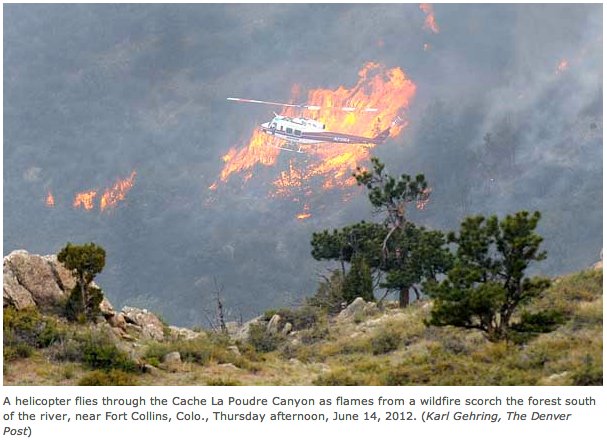
High Park Fire: ‘We need greater resolution in real time’ — Sher Schranz

highparkfiredenverpost06142012.jpg

From The Denver Post (Electa Draper):

“It’s been difficult to predict the behavior of the High Park Fire,” [Sher Schranz, research coordinator with Colorado State University’s Cooperative Institute for Research in the Atmosphere] said. “It jumped over the (Poudre) river and the road. That was unexpected early on. This fire has sometimes baffled incident managers.”

The behavior of winds in the complex terrain and conditions of the High Park fire has also at times stumped researchers by not conforming to their models, Schranz said. Numerical weather prediction models — forecasting wind speed, direction, temperature, humidity and visibility for fire managers — have greatly improved in the last 10 years, she said, but they still aren’t good enough. “We need greater resolution in real time,” she, referring to the institute and other collaborators at the NOAA Earth System Research Lab in Boulder. “We need more detailed observations of the atmosphere from the ground up to several thousand feet.”

Fires are fought on the ground a few feet at a time, she said, so knowing what’s generally expected over a few square miles isn’t adequate.

Colorado-Big Thompson Project operations update: Pinewood Reservoir water level to rise over the weekend

pinewoodreservoirberthoudrecorder.jpg

From email from Reclamation (Kara Lamb):

We have recently completed some regular maintenance on the east slope of the C-BT. This means that Pinewood Reservoir water levels will once again be on the rise.

Pinewood is expected to start rising late tonight, June 15. By Saturday morning, the reservoir should be only a few feet down from full.

We are also planning to restart the pump up to Carter Lake tomorrow. While this will not bump up the reservoir water elevation level, it will help keep it static, possibly through the weekend. Carter Lake is just over 70% full with a water level elevation of 5729 feet.

Horsetooth Reservoir will continue to see the slow draw down that has been going on throughout June. This is very typical for this time of year. Currently, the reservoir elevation is at 5415 feet. Interestingly, this is one foot higher than Horsetooth’s annual average water elevation line for the beginning of the summer season.

Lake Estes is also looking good for the weekend. Operations at the reservoir and Olympus Dam continue as normal.

For recreation information, please visit Larimer County Division of Natural Resources and the Estes Valley Recreation and Park District.

More Colorado-Big Thompson Project coverage here.

Runoff news: Colorado River streamflow at Glenwood Canyon less than 20% of average

coloradoriverneardotsero06162012.jpg

From the Summit County Citizens Voice (Bob Berwyn):

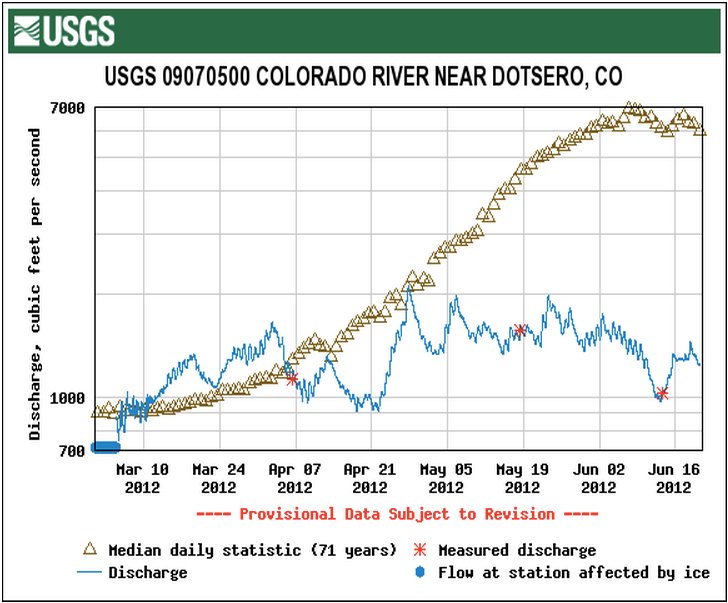
Average Colorado River flows through Glenwood Canyon this time of year are about 6,000 cfs, but this year, the river has been flowing at less than 20 percent of that, at about 1,100 cfs.

Looking to raise stream flows, the Colorado River District, Denver Water and the Bureau of Reclamation are cooperating under the Shoshone outage protocol, which helps sustain flows along the Colorado River mainstem with water from Wolford Mountain Reservoir, Williams Fork Reservoir and Green Mountain Reservoir — even when Xcel’s Shoshone power plant isn’t exercising a senior water right that historically keeps at least some water in the river during dry seasons and years.

“This makes a real difference in the river,” said Colorado River District general manager Eric Kuhn. “Since we started, you can see … that the temperature of the water has come down 4 degrees.

Releases from the three reservoirs of about 450 cfs should help sustain flows through Glenwood Canyon at about 1,100 cfs at least through this weekend and early next week. The 1.100 cfs flow rate is a benchmark for commercial rafting outfitters on the river, and the releases will also help farmers in the Grand Valley, Pokrandt said.

Here’s a release the Eagle River Water and Sanition District (Diane Johnson):

Drought worsens locally: “Extreme” drought area expands to include Eagle County

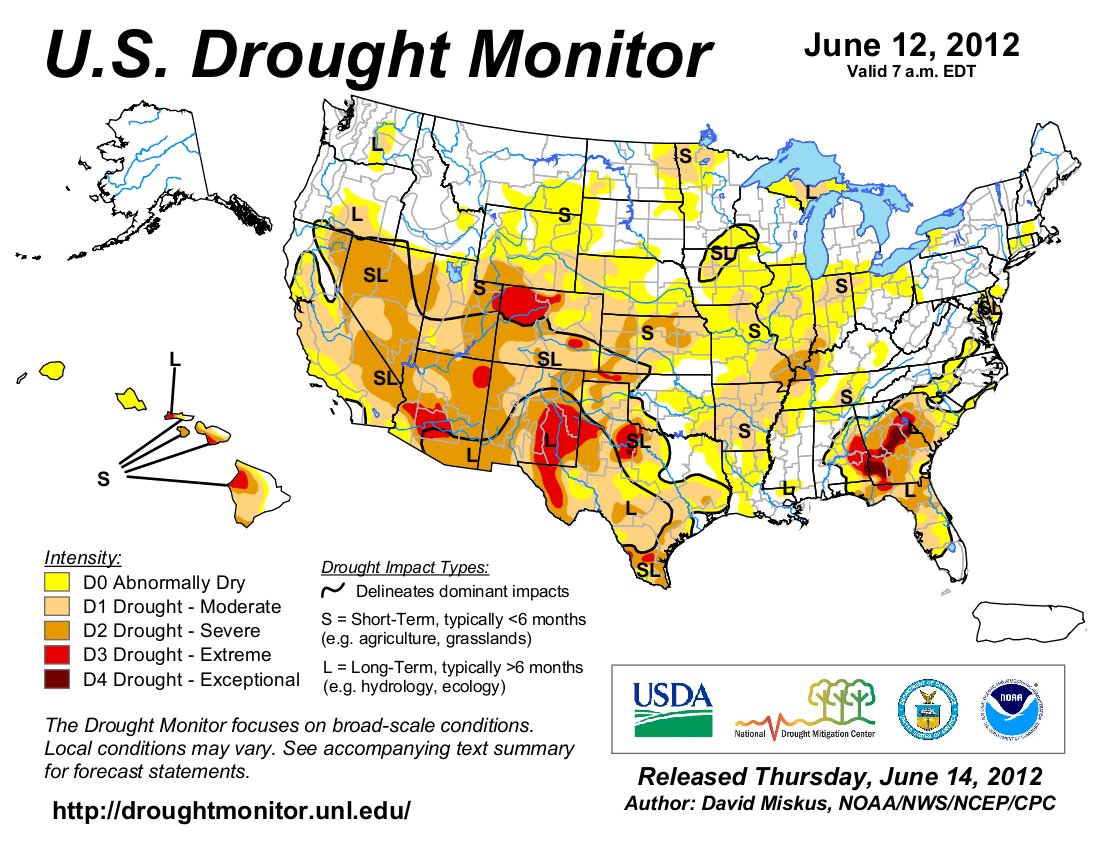
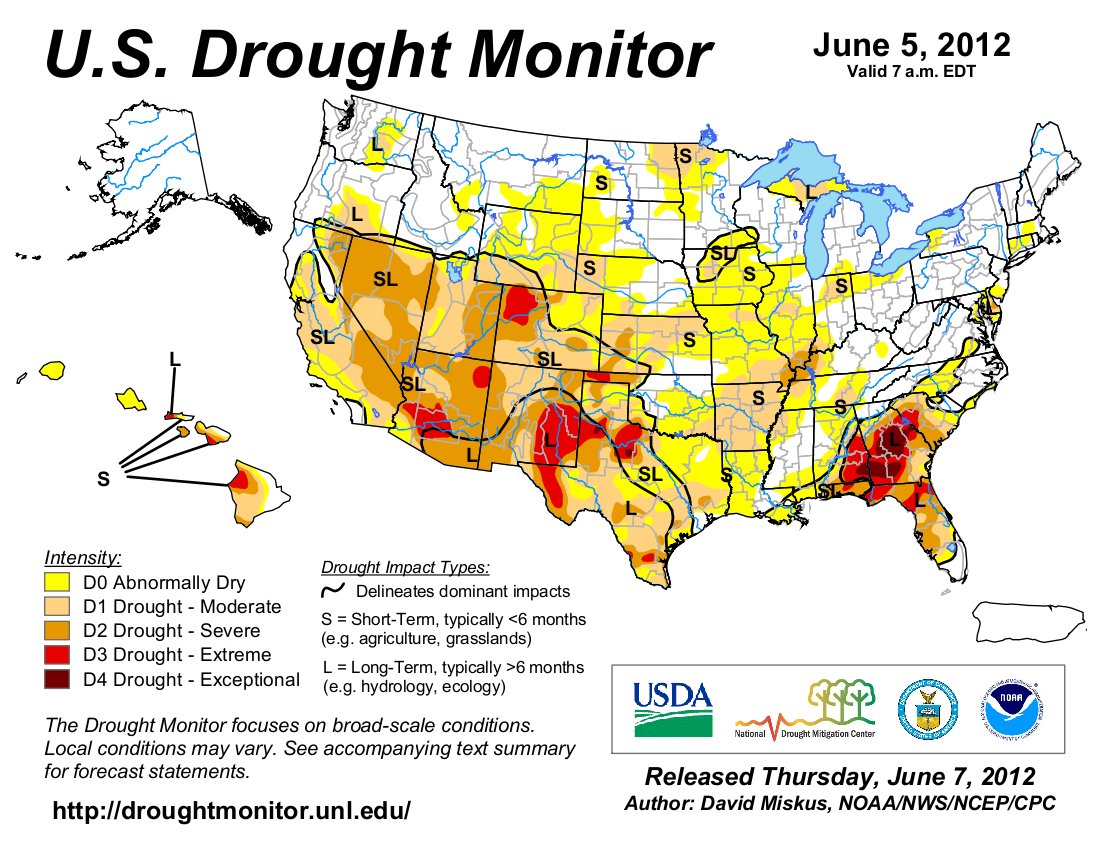
Northwest Colorado continues to fall deeper into drought with extreme conditions now widespread. Eagle County drought intensity was elevated to “extreme” by the U.S. Drought Monitor, joining Garfield, Rio Blanco, Moffat, Routt, and parts of Grand, Jackson, Larimer, Summit, Pitkin, and Mesa counties.

Drought intensity throughout Colorado is worsening. The June 12 map, released Thursday, shows 20 percent of the state is designated as being in an extreme drought, 9 percent more than last week. Extreme drought is classified as “D3” on the drought intensity scale of D0 to D4.

All of Colorado continues to experience some level of drought and the areas least affected are shrinking. Last week, 24 percent of the state was designated as D0, “abnormally dry,” which dropped to 9 percent this week.

Drought conditions reflect this winter’s record low snowpack, including the driest March on record in Colorado, the warmest March through May on record, and windy conditions. Streamflows have been correspondingly low. Eagle County waterways are flowing at about 30 percent of historical averages and peak runoff was early and hardly noticeable in some streams.

Our community water supply is largely dependent upon adequate flows in local streams and rivers. Eagle River Water and Sanitation District encourages community members to lessen the impact of drought by efficiently using water, especially in outdoor areas.

Should drought conditions persist, water available for irrigation and other outdoor uses may be less than normal, or unavailable, this year. Currently, normal year-round Water Use Regulations apply, which allow outdoor water use up to three days per week, before 10 am or after 4 pm.

For more information go to www.erwsd.org

More Colorado River basin coverage here.

Via Hayseed: ‘Ed never liked that old VW beetle — it was cold and slow’

edquillensbackyardsalida.jpg

A while back in a post about Ed Quillen’s passing I wrote, “If there is a heaven I believe that Ed is probably rattling around in the mountains there driving an old Volkswagen bus just as he and Martha did in Colorado early in their marriage.”

It turns out I’m wrong about Ed’s choice of vehicles. He was a pickup truck man. Here’s a tribute to Ed from Hayseed, promoted from the Coyote Gulch comments:

FWIW, Ed never liked that old VW beetle — it was cold and slow. Its virtues were that it was cheap to operate and easy to repair. And, for a two-wheel-drive vehicle, it was good in the snow.

But Ed was always a pick-up guy, given his druthers. When his Blazer died a few years ago he looked for a Toyota Tacoma pick-up, but found they were too expensive, so settled for a Ford Ranger with a small crew cab and a canopy. He said it was the nicest vehicle he ever owned.

I first met Ed at UNC (CSC at the time) in Greeley, where he was a 17-year-old freshman and the first (perhaps still the only) National Merit Scholar to attend what he called “Podunk on the Poudre.” We raised journalistic hell together on campus publications in those days of ’60s campus ferment, and stayed in touch ever since, via correspondence (significantly enabled by the Internet) and irregular visits, in spite of the 1200 miles between us.

His family has lost it’s patriarch, his readers have lost a unique journalist, historian and philosopher, and I have lost a dear friend. We all, in our own way, were enriched by his presence and are poorer for his passing.

Chaffee County officials are trying to get increased flows for the FIBArk festival this weekend

fibarkposterjune14to172012.jpg

From The Mountain Mail (Joe Stone):

Kara Lamb, U.S. Bureau of Reclamation regional public information officer, said the bureau had not to planned to supplement river flows during FIBArk. The Bureau of Reclamation manages the Frying Pan-Arkansas Project, which diverts West Slope water into the Arkansas Basin and stores it in reservoirs like Turquoise Lake and Twin Lakes Reservoir. The bureau also administers the Voluntary Flow Management Program, and Lamb said the program does not take effect until July 1. She said other entities with water in storage are not likely to release any because of the drought and lack of runoff from winter snowpack…

Chaffee County Commissioner Dennis Giese told The Mountain Mail that local officials have been in contact with municipal water providers in Colorado Springs, Aurora and Pueblo West, all of which have water stored upstream.
Giese said officials received no firm commitments but that the municipal water providers “have always been cooperative.”

More Arkansas River basin coverage here.

The Rio Grande Roundtable approves Sanchez Ditch and Reservoir Company request for funding for gate rehab project

sanchezreservoir.jpg

From the Valley Courier (Ruth Heide):

The Sanchez Ditch and Reservoir Company has a $2 million plan to replace the deteriorating concrete gate tower that is currently only accessible by cable car across the reservoir. This week the Rio Grande Roundtable, a Valley-wide water group meeting in Alamosa, unanimously approved requests for about half of the cost from local basin and statewide water accounts. The requests for $55,000 from the local basin and $859,400 from the statewide account will now go to the Colorado Water Conservation Board this fall for approval. The ditch company is also taking out a $1.1 million loan.

Design work would then be completed next year with actual construction in the fall of 2014 and projected completion in March 2015.

Project Coordinator Nicole Langley told the roundtable members during their meeting on Tuesday that this structural project is the second phase of a Sanchez Reservoir upgrade. The first phase, which the roundtable also helped fund, assisted the ditch company in determining what was the best route to go in addressing problems with the existing 100-year-old gate tower, which is used to distribute water to farmland in the San Luis area…

The tower will be demolished above approximately 8335 feet elevation by making saw cuts, setting explosive charges and laying it over in the reservoir, Robinson explained. Two new gates will be installed on a slab over what is left of the tower, so instead of eight gates, two will be used to control water distribution.

More IBCC — basin roundtables coverage here.

Drought/runoff/snowpack news: Farmers are already facing tough decisions about their operations in a water-short year

usdroughtmonitor06122012.jpg

Here’s a guest column written sheep man Doug Ramsey that’s running in The Durango Herald. He describes the operational decisions he is facing in a water-short year. Here’s and excerpt:

Our irrigation water was turned off May 22 as the La Plata River continued to shrink to a trickle, and I am forced to cut the hay now as it begins to show signs of stress because of lack of moisture. Our irrigation water comes from the tiny La Plata River that is currently running at about 30 cubic feet per minute – about one-fourth of what it would normally be flowing at this time or year…

The hard choices will be whether to try and raise the lambs by feeding hay until I can provide them to my customers, or sell them at the sale barn for a loss and save my hay and pasture for the ewes. In 2002 when we produced no hay, we ended up feeding purchased hay for most of 18 months to get our sheep through all of 2002 until the spring of 2003. As I look around Southwest Colorado, I see this drought having some major effects on agriculture. The rangeland already needs moisture, and any hope that we have a good monsoon season will not be realized for at least another month or longer.

Meanwhile, Governor Hickenlooper has issued an executive order banning fireworks in Colorado. Here’s the release:

Gov. John Hickenlooper today signed an Executive Order that bans open burning and private use of fireworks throughout Colorado because of very dry conditions and high fire danger.

The ban does not apply to campfires in constructed, permanent fire pits or fire grates within developed camp and picnic grounds or recreation sites; liquid-fueled or gas-fueled stoves; fireplaces contained within buildings; charcoal grills at private residences; or specific prescribed or controlled burns for agricultural or irrigation purposes.

Commercial, professional and municipal fireworks displays are allowed when written approval has been granted by the sheriff of the county in which the fireworks display is to occur.

“We can’t completely eliminate the threat of wildfire because there’s no way to control Mother Nature,” Hickenlooper said. “But we can take steps to reduce the risks of more wildfires starting. This ban is a necessary step to help protect people, property and the beautiful state we live in.”

Most Colorado counties have already adopted fire bans. At least 44 of the state’s 64 counties are now listed with “high,” “very high” or “extreme” wildfire danger. The wildfire danger and individual restrictions for every Colorado county can be found at http://www.colorado.gov.

The governor’s Executive Order is not intended to supersede more comprehensive or inclusive open burning restrictions that have been or may be established by Colorado counties, municipalities and/or other political subdivisions of the state. Where permitted by law, counties and other local governments may ban any or all of the open burning exemptions listed in the order when local officials determine that a more restrictive ban is appropriate and warranted given fire danger conditions in their localities.

The Executive Order will stay in effect until it is amended or rescinded. The full text of the order can be found here.

From the Cortez Journal (Paige Blankenbuehler):

County commissioners voted unanimously on Monday for a recommendation from Cortez Fire Protection District chief Jeff Vandevoorde to institute a fire ban for Montezuma County.

The commissioners put the following limitations into effect:

No open burns will be permitted within Montezuma County, including designated fire pits at legal campgrounds, Montezuma County deputy emergency manager Paul Hollar said. Covered barbecue and charcoal grills or pits are permitted.

Outdoor fireplaces with screens or covers are also permitted, Hollar said.

Fireworks are explicitly banned, but the formal Cortez July 4 firework show is still scheduled under a controlled environment at this time, Hollar said.

From the Vail Daily:

Due to the combination of unusually high temperatures, dry conditions and light winter snowpack there is an increased risk for wildfires throughout Colorado. According to the National Weather Service, the drought in the state of Colorado is going to persist and intensify as the summer moves forward. As a result, Eagle County has implemented “Stage I” fire restrictions that will take effect at 12:01 a.m., Friday. The ban prohibits all open burning for private lands in unincorporated Eagle County and within the town of Red Cliff.

From the Valley Courier (Ruth Heide):

“Our snowpack is gone,” [Water Division III Engineer Craig Cotten] told members of the Valley-wide water group, the Rio Grande Roundtable, on Tuesday afternoon. “We didn’t get anywhere close to average.” The run-off was a month earlier, he said, “and then it headed down. We were out of snow about a month earlier than usual.”

Cotten shared the latest Natural Resources Conservation Services (NRCS) forecasts for the Rio Grande and Conejos Rivers, which are up a bit from last month’s forecasts but still anticipating a below-average year on both river systems. The new NRCS annual forecast for June for the Rio Grande is 415,000 acre feet, which is 64 percent of the long-term average. Last month the NRCS forecast was 380,000 acre feet. Of that amount, 102,200 acre feet must be sent downstream to meet Rio Grande Compact obligations. Cotten said that means deliveries of 5 percent right now, but his office is only curtailing the ditches 2 percent because the other 3 percent is coming through in the way of return flows.

No ditches on the Conejos River system are currently being curtailed, Cotten said, because “we can meet our obligation under the compact for the Conejos system just with what we have already delivered and what we will deliver during the wintertime.” The new NRCS forecast for the Conejos River system, which includes the Conejos, San Antonio and Los Pinos Rivers, is 200,000 acre feet, up a bit from last month’s forecasted 180,000 acre feet. That is still only 60 percent of the long-term average for that river system, Cotten explained. Of that amount, 45,000 acre feet must be delivered downstream for compact purposes, but that should be no problem, given what has been delivered already and what will be sent downstream later this year, Cotten said.

Animas River Workgroup to meet at the La Plata County Fairgrounds June 18

animasrivertubing.jpg

From The Durango Telegraph (Tracy Chamberlin):

The Animas Workgroup, one of five that make up the River Protection Workgroup, is ultimately tasked with putting together a list of recommendations for the future protection of the Upper Animas Basin. Since the area they’re concerned with is centered in Silverton, the group usually meets at the Kendall Mountain Recreation Center. However, the group is bringing its ideas south to Durango this week because it’s both a major population center and not everyone who has a stake in the future of the Upper Animas and its tributaries can make the trip north…

The Animas group is diverse, and many interests are represented, but that doesn’t mean additional input isn’t welcome. [Marsha Porter-Norton, facilitator for the River Protection Workgroup] said anyone is welcome to join in, and residents planning to attend Monday night’s meeting will get a chance to be brought up to speed and find out how they can get involved in the process. They’ll hear about how the River Protection Workgroup operates and the progress made by the group, which has been working together since June of last year. The first thing the group did since forming was take a good look at the focus area, finding out who used it, what protections it enjoyed. Members even went on tours of the area. Then they identified the river’s values: what makes each segment of the Animas River Basin special and is worth protecting in the future. For example, some of the values for the segment north of Baker’s Bridge up to Silverton include boating, geology, recreation, scenery and the Durango Silverton Narrow Gauge Railroad. “The train is a very significant value,” Porter-Norton said.

Meeting details:

What: Informational Meeting with the Animas River Workgroup
When: Mon., June 18, 6-8:30 p.m.
Where: La Plata County Fairgrounds, Pine and Florida Rooms
For info.: ocs.fortlewis.edu/riverprotection

More Animas River coverage here and here.

Judge John N. McMullen tells the CDPHE that it’s time for a do-over on the radioactive license for the proposed Piñon Ridge Mill

doloresrivercanyon.jpg

The Sheep Mountain Alliance (@sheepmtn) sent out this tweet yesterday morning:

Victory for @sheepmtn in our lawsuit to stop the Piñon Ridge #Uranium Mill

They were kind enough to link to the judge’s order on Scribd. Here’s an excerpt:

The Court, having found unlawful CDPHE’s action in issuing the License, sets aside that action, invalidates the License, and remands the case for further proceedings consistent with this Order

From the Montrose Daily Press:

The CDPHE has been ordered to convene a hearing within 75 days of July 5, and to notice that hearing. “This hearing will be a substitute for the Feb. 17, 2010 public meeting,” the ruling says. The CDPHE must remake its licensing decision by following statutory procedures. The body has 270 days from July 5 to approve or deny Energy Fuels’ application. Until such decision is made “Energy Fuels Resources may not proceed with any activity on the site formerly permitted by the license.”

The company, can, however, take reasonable action to protect the public and the environment, and to prevent economic waste as long as doing so does not endanger the public or environment. Such actions have to be taken under the supervision of the CDPHE.

From the Summit County Citizens Voice (Bob Berwyn):

Judge John N. McMullen ruled June 13 that the Colorado Department of Public Health and Environment erred by issuing the license to Energy Fuels without public hearings required under the regulatory process.
Pinon Ridge would be the first new rock-crushing uranium mill to be built in the U.S. in 25 years. Communities in the area said they were concerned that lapses in state’s approval process prevented a thorough evaluation of potential and water quality impacts. “We asked for an opportunity to have meaningful public participation and we got it,” said attorney Richard Webster, who represented the towns of Telluride and Ophir in the lawsuit.

Another concern for the towns was the issue of bonding against potential future cleanup costs, as well as the spread of pollution from radioactive dust, Webster said, adding that the lawsuit focused on the regulatory process rather than those substantive issues.

Federal nuclear regulators appeared to agree with the local challenges. In a March 6 letter to environmental attorney Jeff Parsons, the Nuclear Regulatory Commission also said that the state didn’t fully meet legal requirements for public involvement.

From the Denver Business Journal (Neil Westergaard):

Denver District Court Judge John McMullen on Wednesday invalidated the mill’s license, citing the Colorado Department of Public Health and Environment for not following state and federal rules guaranteeing public input into the licensing process. McMullen, however, upheld the department in all of the other claims brought in the case by Public Justice, a Washington, D.C.-based public interest law firm, that acted on behalf of the towns of Telluride and Ophir…

The health department reserved comment, but in a statement, noted that the court ruled in the department’s favor in 10 of the 11 issues before it in the case. “The court ruled against the department only on the 11th claim, based upon a conflict in the Colorado Radiation Control Act and state radiation regulations,” the department said in its statement. “In doing so, the court rejected all arguments about how to reconcile the conflict and instead fashioned its own remedy. The court also rejected the plaintiff’s claim, raised for the first time in the plaintiff’s opening brief, that the department’s administrative record filed with the court was defective…

Energy Fuels said last year that it expects to spend $140 million reopening the uranium mill. The mill would employ about 85 people. Another 200 would work at the company’s two uranium mines in Colorado and Utah, which already have been permitted.

More nuclear coverage here and here.

Colorado River Cooperative Agreement: Parties to the agreement flip the switch on the Shoshone Outage Protocol

shoshoneglenwoodcanyon.jpg

Here’s the release from the Colorado River District (Jim Pokrandt):

In this year of historically low runoff, the Colorado River District, Denver Water and the Bureau of Reclamation are cooperating to add flows to the Colorado River through the Shoshone Outage Protocol for the benefit of fish, rafting and crop irrigation along the entire stretch of the mainstem from Parshall in Grand County to Grand Junction in Mesa County.

The extra water is the result of the Shoshone Outage Protocol, a part of the Colorado River Cooperative Agreement that was hammered out over the last six years by 42 West Slope entities and Denver Water.

The three reservoir operators are increasing river flows by about 450 cubic feet a second (cfs) through releases from Wolford Mountain Reservoir, Williams Fork Reservoir and Green Mountain Reservoir, respectively. Through the weekend and early next week, flows in Glenwood Canyon should hover around 1,100 cfs, to improve rafting and to aid farmers and ranchers in the Grand Valley, helping to boost flows that are too low. The 71-year average of flows for this time of the year in Glenwood Canyon is more than 6,000 cfs.

Additionally, the flows are helping to lower water temperature levels in the river along the Pumphouse area of the river in Grand County to help trout survive.

“This makes a real difference in the river,” said Colorado River District General Manager Eric Kuhn. “Since we started, you can see by the gage that the temperature of the water has come down 4 degrees Fahrenheit.”

The Protocol is designed to add water to the Colorado River when the Shoshone Hydro Plant in Glenwood Canyon is down for maintenance and not using its senior water right, which normally would have the river flowing at about 1,250 cfs through the canyon, absent the usual runoff flows. The Protocol is taking place even though all the parties have yet to sign the agreement.

“This is a good example of how the Colorado River Cooperative Agreement can work when everybody is pitching in to help the river in a time of need,” said Lurline Underbrink Curran, the Grand County Manager.

Said Jim Lochhead, CEO/Manager of Denver Water, “This is exactly why we all came together to sign the Colorado River Cooperative Agreement – to provide benefit to the Colorado River. Denver Water is proud to be part of an effort that fulfills our goal to operate our system in a way that benefits the environment.”

Currently, the Shoshone Hydro Plant is operating at about half capacity, which requires about 700 cfs of water. Xcel Energy is unable to run Shoshone at full capacity while it works on repairs to the tunnel that runs about two miles from the Hanging Lakes power plant dam to the power plant itself. The work could last until early September.

A call on the river, such as the Shoshone 1,250 cfs water right, forces junior water rights holders to replace diverted water from reservoir storage or to stop diverting, thus boosting flows as they decline with the natural drop of the runoff throughout the summer.

From the Associated Press via The Columbus Republic:

The Colorado River District, Denver Water and the U.S. Bureau of Reclamation are increasing river flows by about 450 cubic feet a second through releases from the Wolford Mountain, Williams Fork and Green Mountain reservoirs. That should boost flows in Glenwood Canyon to around 1,100 cfs through early next week. The river district says the 71-year average of flows for this time of the year in Glenwood Canyon is more than 6,000 cfs. The extra flows will help reduce water temperatures in Grand County to help trout survive.

More Colorado River Cooperative Agreement coverage here.

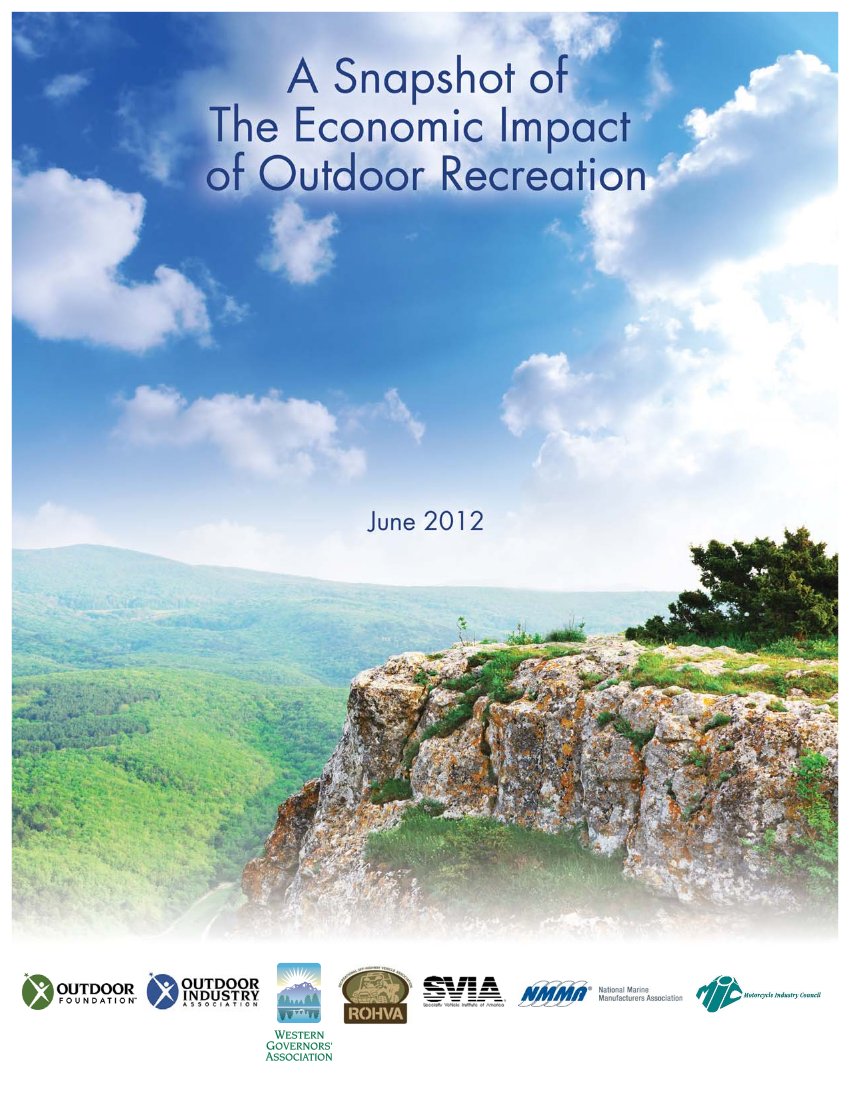
Western Governors’ Association: Outdoor recreation in western states = $255.6 billion

wganapshotconomicmpact.jpg

Here’s the release from the Western Governors’ Association website (Chris McKinnon/I Ling Thompson/Kathy Van Kleeck/Thom Dammrich)

The Western Governors’ Association (WGA) and a coalition of outdoor industry groups today released a joint study documenting the continued growth and importance of outdoor recreation to the economies of the Western states and the nation. The recreation economy was the topic of discussion at the opening session of WGA’s Annual Meeting being held here.

“The numbers are better than expected,” said Gov. Chris Gregoire (Wash.), WGA’s Chair. “We knew that outdoor recreation was a growth sector and that it creates jobs, but this study documents just how important it is to our national and Western economies.”

Joining the Governors to discuss ways state and local governments can work with industry to grow the outdoor recreation economy were: Michael Caldwell, Mayor of Ogden, Utah; Sally Jewell, President and CEO of REI; Bennett Morgan, President and COO of Polaris Industries, Inc.; and Dusty McCoy, Chairman and CEO of the Brunswick Corporation.

“WGA will continue working with our industry partners to release state-by-state data later this year on the economic impact of outdoor recreation,” said Gov. Gary Herbert (Utah), WGA Vice Chair. “With this information states can consider policy that will help to create more businesses, jobs and income related to outdoor recreation.”

Outdoor recreation is an overlooked economic giant. With $646 billion in national sales and services in 2011, recreation dollars are nearly double the size of pharmaceuticals ($331 billion) and motor vehicles/parts ($340 billion). As another comparison, it powers the economy in a manner comparable to the financial services and insurance industry ($780 billion) and outpatient health care ($767 billion). The full report can be found on the WGA Web site at www.westgov.org/reports.

This study marks the first time both the motorized and non-motorized sectors of the outdoor recreation industry have worked together to document the total size of the outdoor recreation economy. The study, commissioned by the WGA, was conducted by Southwick and Associates. Southwick surveyed households on actual expenditures on outdoor recreation then, based upon that data and modeling, generated the jobs, taxes, payroll and total economic impact.

The Outdoor Industry Association, Outdoor Foundation, Motorcycle Industry Council, Recreational Off-Highway Vehicle Association, Specialty Vehicle Institute of America and National Marine Manufacturers Association contributed funding for the study.

From the report:

Western States — Tax Revenue
Spending on outdoor recreation generates significant tax revenues for local and state governments. In westernstates in 2011 it generated an estimated:

$15.41 billion in Federal tax receipts
$15.38 billion in state and local tax receipts

Drought/runoff news: Consumption up despite appeals from water suppliers to conserve, monsoon on the way?

watersprinkler.jpg

From The Pueblo Chieftain (Chris Woodka):

Since 2002, which was a dry year like this one, Puebloans have cut back per capita water use 17 percent, mostly through better watering habits and more efficient lawn irrigation systems. But with warmer temperatures this year and nearly the same amount of rainfall, Pueblo water use during May was the highest since 2008. The average water customer used 13,700 gallons per month, compared with 14,100 gallons per month in 2008. “In 2006, it was 15,000 gallons, but typically, it’s in the 12,000 to 12,500 gallon range,” Clayton said. Outside watering accounts for 55 percent of water use in Pueblo, he said.

Consumption for the year is up as well, since many people have been watering their lawns since March. So far, the water board has pumped 3 billion gallons in 2012, a little more than last year and well above the average of 2.6 billion to 2.9 billion gallons.

From The Telluride Daily Planet (Collin McRann):

The NRCS is predicting stream flows for western Colorado to be around or less than 25 percent of average for the rest of June. “In most areas peak [stream] flows were around a month early,” Assistant Snow Survey Supervisor at the NRCS, Mage Skordahl said. “Going into the remainder of our stream forecast from April to July, things are well below normal. That means that we’re expected to see [streams and rivers] returning to base flow or minimum flow much earlier than normal.”

According to U.S. Geological Survey information, the San Miguel River near Nucla was flowing around 147 cubic feet per second Tuesday. The average flow for this time of year is around 677 cfs. The lowest recording was 60 cfs in 2002; the highest was 1,520 cfs, recorded in 1995…

Over past few years, most areas in Colorado have had closer to average snowpack levels, which has made the current situation less severe than it was in 2002. Ground water levels are closer to normal, but could be reduced if the dry conditions persist over the next couple of years. “If the soil’s wet then you are going to get surface flow,” Skordahl said. “Any year when you have low snowpack you’re not going to recharge your groundwater as much as a high snowpack year, but how much that system is [affected] by snowpack depends because it’s a slower system than the streams and snowpacks. So really it’s when you have multiple years of below average snowpack that you have to worry about your ground water recharge.”

From the Sky-Hi Daily News (Tonya Bina) via Steamboat Today:

Commissioners approved a fire ban for unincorporated Grand County on Tuesday. Although commercial professional fireworks displays are allowed, the sale and use of personal fireworks is prohibited by the ban, according to the decision made in Hot Sulphur Springs. Use of charcoal grills or gas outdoor grills on private property such as home decks still is allowed under the ban, but use of charcoal grills on public property is prohibited. And use of fire pits of any kind on private property is not allowed — such as chimineas, wrought iron fire pits and backyard fire pits. However, the fire ban does not restrict use of fire rings and pits at supervised, developed and “established” campgrounds in Grand County, commercial and public. Burning of fence rows, irrigation ditches, fields, wildlands, trash and debris is prohibited.
northamericanmonsoonmap.jpg

From Steamboat Today (Tom Ross):

Local weather observer Art Judson reported this week that the monthly rainfall total stands at one-tenth of an inch, and the National Weather Service in Grand Junction confirmed Wednesday that there’s nothing significant on the way. The polar jet stream will dip toward Northwest Colorado this weekend, meteorologist Travis Booth said, but “there doesn’t appear to be any significant moisture on the way.” The National Integrated Drought Information system still has most of Routt County under an extreme drought with pockets of milder severe drought in North Routt and the far southeastern corner of the county…

This week, the drought monitor indicates soil in Routt County has been exceptionally dry through the first half of June, but at least in terms of streamflows, the area is better off than most despite the fact that the Yampa in downtown Steamboat was flowing at 141 cubic feet per second at midafternoon Wednesday compared with the average for the date of 2,070 cfs. The record low for June 13 was 120 cfs recorded in 1934…

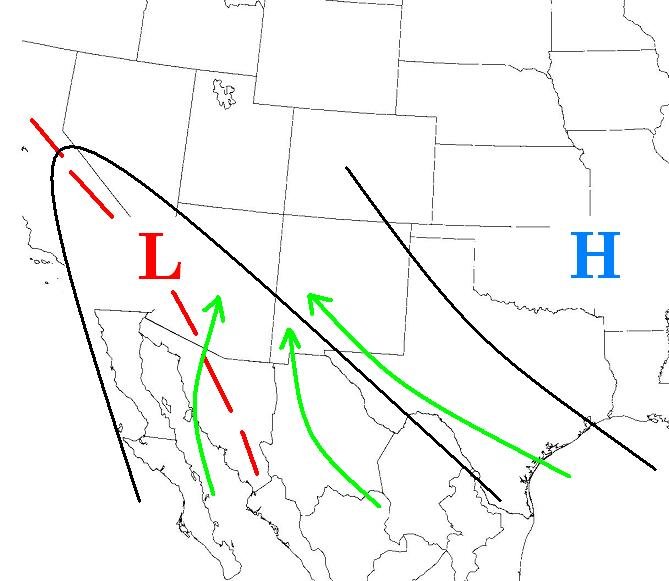
“The models are hedging toward a high-pressure system setting up over the Texas Panhandle” that could allow the annual summer monsoon flow to reach Colorado in July.

From the Craig Daily Press (Joe Moylan):

The Moffat County Commissioners approved, 2-0, Resolution 2012-72 on Tuesday establishing a fire ban in unincorporated portions of Moffat County. The ban takes effect immediately. Among the activities prohibited include the burning of trash, fence rows, debris and vegetation; lighting a camp fire or charcoal grill outside of developed recreation areas featuring permanent fire pits with grates; smoking outside in non-designated areas; operating a chainsaw without a U.S. Department of Agriculture-approved spark arresting device; welding or using an open-flamed torch that is not clear of flammable materials for at least 10 feet on all sides; using explosives requiring fuses or blasting caps; and the discharge of any fireworks.

From The Greeley Tribune (Eric Brown) via Windsor Now!:

Standing as the hottest year on record so far for the Greeley area, the heat has forced winter wheat to mature much faster than normal. Therefore, it will force farmers to get out the combines well ahead of schedule. While it’s been hot this year, it’s also been dry — the driest year on record for much of the region, in fact. That means, while wheat heads popped out early this year, other aspects of the plant’s growth were stunted, and some of the area’s wheat fields won’t be producing the above-average yields farmers saw last year or the record-breaking yields they hauled to local elevators in 2010. In addition to the dry times, Thursday night’s hail storms wiped out thousands of acres across northeastern Colorado. Because of all of those factors — the early harvest, minimal precipitation and hail damage in isolated areas — Bosley said yields this year in northeastern Colorado will probably be all over the place. Some fields will produce average yields — 30 to 40 bushels per acre — while some fields will produce yields as low as 15 bushels per acre and some will produce 45 bushels per acre, he said. Some fields might not even be harvested, he added. Moisture was so low in some parts of northern Weld County, that some wheat only grew about 6 to 8 inches tall — some of which is so short it might not be able to be combined.

From the Fort Collins Coloradoan (Bobby Magill):

The reason the High Park Fire has spread so quickly is complicated, however, said Chad Hoffman, assistant professor of fire science at Colorado State University. “What’s really important to remember is that fire behavior and how it burns is always determined by a factor of the topography, the fuels and the weather,” he said. “Right now, when we look at the High Park Fire, it’s been windy, we have dry conditions and we have a lot of bark beetle mortality up there. To say it’s one or the other is really tricky because all those things kind of interact to determine what’s going to happen.”[…]

Research that Rocky Mountain National Park relies on for its forest management strongly suggests that beetle-killed trees play a small role in the spread of wildfire.

From the Cañon City Daily Record (Rachel Alexander):

The Fremont County Commissioners conducted a public hearing Tuesday regarding a new ordinance covering restrictions on open fires and open burning in the unincorporated area of Fremont County. The ordinance is a rewrite of the fire restriction ordinance already in place in the county. It adjusts the stage 1, 2 and 3 restrictions to be more in line with other local agencies, including the Bureau of Land Management.

From the Associated Press via The Colorado Springs Gazette:

For the first time in 15 years, the Boulder Fire Department Wildland Division is sending out fire patrols to find extreme fire conditions in an effort to prevent serious wildfires…Officials in Greeley say they also have been preparing for disasters like the one in northern Colorado that is blamed for one death and damage to more than 100 structures.

From email from the U.S. Forest Service (Barbar Timock):

Beginning immediately, Stage 1 fire and smoking restrictions are in place on public lands managed by the U.S. Forest Service (USFS), Pike and San Isabel National Forests located in Chaffee, Clear Creek, Custer, Douglas, El Paso, Fremont, Huerfano, Jefferson, Lake, Las Animas, Park, Pueblo, Saguache, and Teller Counties, Colorado. Restrictions will remain in effect until they are rescinded.

Here’s a release from Colorado Parks and Wildlife:

Colorado Parks and Wildlife announced Wednesday that county fire bans and restrictions will be strictly enforced in state parks and wildlife areas because the fire danger is extremely high across the state.

All fires, including those in pits and grills, have been banned in 14 counties due to dry conditions and the risk of wildfires. Fire restrictions are in place in many other counties. The agency reminds all park visitors and sportsmen that county bans and restrictions apply to the state parks and wildlife areas in those counties.

“Colorado Parks and Wildlife will enforce the county fire bans and other restrictions. We urge visitors to parks and wildlife area take every precaution possible to prevent new fires from starting,” said Rick Cables, Colorado Parks and Wildlife Director.

From the La Junta Tribune-Democrat (Bette McFarren):

The [Board of Utility Commissioners] recommend that citizens not water their lawns between the hours of 10 a.m. and 6 p.m. During these hours, much water is lost to evaporation. La Junta received an allocation of 150 acre- feet of water from the Fry-Ark Project this year. “That’s not quite enough to cover our evaporation losses for the year,” said Kelley. “I project that this will leave 1900 acre-feet at the end of this pumping year. Another winter of low snowpack would require the implementation of water restriction next year. Customers are advised not to waste water.”

From the Salida Citizen:

Chaffee County Sheriff Pete Palmer announced today that Stage I fire restrictions will be in effect as of Thursday, June 14. No open fires are allowed, with the following exceptions:

1) Campfires, warming fires and charcoal fires within a permanent constructed fire grate in a developed public campground or picnic ground or permanent constructed fire grate or fire ring in a commercial campground or on private property.

2) LP gas or liquid fueled stoves and appliances which allow the operator to turn the flame on and off.

3) Fireplaces within enclosed buildings which are equipped with adequate spark arresting screens on the flue.

4) Charcoal grill fires at private residences.

These restrictions are due to high winds, low relative humidity, and very dry conditions. They will remain in effect until further notice.

From the Boulder Daily Camera (Scott Rochat):

The Weld County commissioners declared a disaster emergency Monday because of the drought. The commissioners are asking Gov. John Hickenlooper to order water from normally restricted South Platte irrigation wells for 30 days to give the county the water it needs.

Commissioners said that too little snow in January and too little rain this spring led to the emergency. County Chairman Sean Conway said the county has between seven and 21 days to get more water, or else risk losing this year’s crops…

Since March, precipitation levels in the county have been, at best, 70 percent of normal, and some areas have been below 50 percent, according to the High Plains Regional Climate Center…

Conway said if Hickenlooper can turn the wells on for 30 days, the county should be able to make it to the “monsoonal” rains in August. “This is just a temporary solution to just get us through this hot, dry summer,” Conway said.

Colorado Water 2012: Surface water and the formation of the Great Sand Dunes

greatsanddunesfromspace.jpg

Here’s the latest installment of the Valley Courier’s Colorado Water 2012 series. Andrew Valdez explains some of the geology — along with the role of surface water — in the formation of the Great Sand Dunes. Here’s and excerpt:

Streams play an important role in the delivery of sand to the sand deposits. The sand of the Great Sand Dunes originates in the surrounding San Juan and Sangre de Cristo Mountains. The weathering process, aided by water, breaks rock down into boulders and smaller fragments that can be transported by water into the San Luis Valley. Saguache and San Luis Creeks and their tributaries collect water in their mountain basins and flow into the valley bringing sediment with them. Coarser material, such as boulders and cobbles, are deposited in alluvial fans at the mountain front as stream flow slows down.

Beyond that, and into the San Luis Valley, the low energy streams continue to transport sand and finer material. Once the streams reach a playa lake/pond, the sand is deposited in a delta and silt and finer material settle in the open water of the lake. Wave action can redistribute the sand forming a beach deposit.

Playa lakes/ponds are temporary features that begin to dry, and then disappear as water input drops below water loss. Once dry, the former beach deposits are exposed to the wind, and can be transported by the wind. Small playas often have crescent-shaped sand ridges on their downwind side that are known as lunettes.

The dominant wind direction on the valley floor is from the southwest, therefore dunes formed from the beach deposits will migrate to the northeast toward the Sangre de Cristo Mountains. Currently some of these dunes migrate an average of 35 feet per year. As they approach the passes of the Sangre de Cristo Mountains, the wind patterns change from unimodal or dominant in one direction, to bimodal, or dominant in two directions. In this case, the bimodal directions are from the southwest and northeast. In this bimodal zone, dune behavior changes and the dunes stop migrating and begin to grow vertically. Along the mountain front, away from the passes, the winds remain unimodal and sand ramps form as dunes migrate up the slope.

More Colorado Water 2012 coverage here.

Green Mountain Reservoir operations update: 150 CFS in the Blue River below the dam #CODrought

greenmountainreservoir.jpg

From email from Reclamation (Kara Lamb):

We have begun our weekly coordination calls for reservoir operations across the upper Colorado River basin. Flows in the Colorado River are rapidly declining, as most of you know. As a result, we are upping releases from Green Mountain to the Lower Blue today in two phases. By late this afternoon, we’ll be releasing 150 cfs.

The road across the dam has also reopened as the bridge work is nearly complete.

For more information on Green Mountain Reservoir and the Colorado-Big Thompson Project, please visit our webpage.

More Green Mountain Reservoir coverage here and here.

Colorado-Big Thompson Project operations update: Inspection and maintenance work complete, releases dropping from Olympus Dam

olympusdam.jpg

From email from Reclamation (Kara Lamb):

As we continue to make adjustments to the Colorado-Big Thompson project system, there have been some changes to the release from Olympus Dam to the Big Thompson River. Late last night, we dropped the release from 325 cfs to roughly 250 cfs. Tonight, shortly after midnight, we will drop it again to around 125 cfs. The reason for the drop in release amounts is primarily because we have completed the inspections and related maintenance work scheduled for this week.

More Colorado-Big Thompson Project coverage here.

Rocky Mountain National Park: The Park Service intends to repair Lily Lake Dam

lilylakermnp.jpg

From the Fort Collins Coloradoan (Kevin Duggan):

Park superintendent Vaughan Baker said a contractual requirement that the park retain the water rights assigned to the lake and maintain the dam forced the decision to repair the aging structure rather than remove it. “It turns out we are legally obligated to keep it,” Baker said in an interview Tuesday.

The decision is tentative based on the outcome of final consultations with the U.S. Fish and Wildlife Service, Baker said. The lake is stocked with greenback cutthroat trout, which is a native but threatened species. Repairing the dam is expected to cost more than $800,000. Construction is expected to begin in the fall…
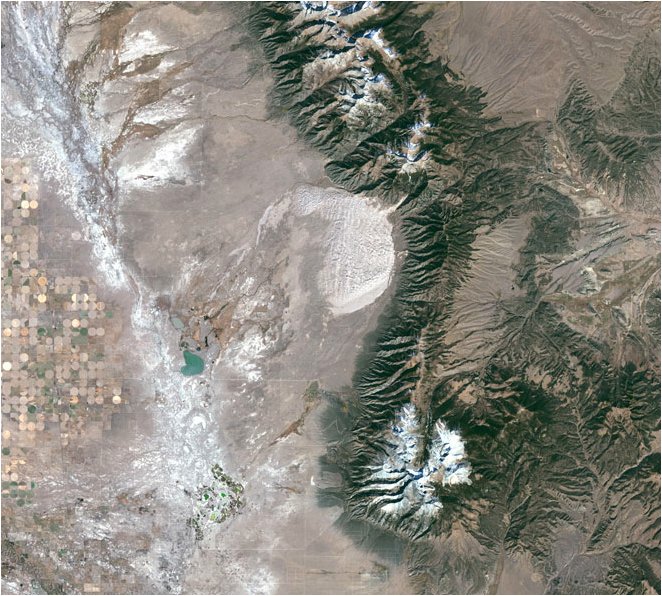
Lily Lake was a natural lake before a dam was built on its eastern edge in 1915. The dam raised the lake’s water level about 4 feet, increased its surface area from 14 acres to 17 and increased its capacity from about 39 acre feet of water to 75. The lake was added to the park in 1991 after it was acquired and saved from development by the Conservation Fund in 1989. The park acquired water rights for the lake about 10 years ago. An agreement with the Estes Valley Land Trust requires the park to retain the water rights and maintain the dam in perpetuity, Baker said.

More Rocky Mountain National Park coverage here and here.

Aspinall Unit operations update: 700 CFS in Black Canyon

aspinallunitdescription.jpg

From email from Reclamation (Erik Knight):

Tributary contributions to the Gunnison River have continued to decline and it appears the last gasps of snowmelt have reached the rivers. Once again, the gage at Whitewater is forecast to drop below 900 cfs before this weekend. Therefore flows in the Gunnison River through the Black Canyon have been increased to 700 cfs as of late this morning, Wednesday, June 13th.

Current forecasts suggest this will be enough water to keep the Whitewater gage above the 900 cfs target described in the Aspinall Unit Operations Record of Decision (ROD) for a period that is hopefully longer than one week. River flows are projected to taper off more slowly as we exit the runoff period and enter into summertime baseflows.

More Aspinall Unit coverage here.

NIDIS Weekly Climate, Water and Drought Assessment Summary of the Upper Colorado River Basin #CODrought

wyutcoprecipitationjune1to92012.jpg

Here is the link to the webinar summaries from the Colorado Climate Center. Click on the thumbnail graphic for the precipitation summary.

Drought/runoff news: The June 1, 2012 Basin Outlook Report is hot off the press

nrcssnowpackreservoirstorage06012012.jpg

Here’s the link to the June 1, 2012 Basin Outlook Report from the Natural Resources Conservation Service (Mage Skordahl). Here are the summaries (It ain’t pretty):

Summary

The 2012 water year is definitely one that will be remembered for quite some time. Coming on the heels of one of the wettest and snowiest years in recent memory it began with great expectations and with well above average precipitation in October and significant early season snow storms across the state. Unfortunately hopes were thwarted by a very dry December which left our first snow surveys of the year measuring a below average snowpack. From that point, with the exception of some decent snow accumulation in February, the weather managed to conjure up some painful memories of the 2002 drought. In the end this season saw the lowest statewide snowpack accumulation since 2002 and in some basins, this year became the new minimum on record. This spring the entire state has experienced persistent warm and dry weather patterns contributing to dry soils and the early melt of an already anemic snowpack. The only part of the equation separating this year from conditions in 2002 is reservoir storage. Across the state storage volumes remain very close to average thanks to the abundant snowfall and runoff from the 2011 winter.

Snowpack

May ended up being another dry and warm month across Colorado. The continuation of this abnormally warm weather caused the snowpack to continue to melt out at a nearly uninterrupted pace. By June 1, the snowpack was nearly nonexistent in all of Colorado’s major basins with only 4 out of the 92 SNOTEL sites used in this report, measuring any snow. The statewide snowpack as of June 1 was a negligible 2 percent of average, and 1 percent of last year’s report on this date. Basin by basin only the Colorado, South Platte, Arkansas and combined Yampa, White and North Platte basins had any snow remaining and only at the higher elevations in the basins. Most SNOTEL sites were completely melted out about a month earlier than normal. The warm weather this spring in combination with dry winds and dry soils really decimated what little snowpack we had received. These conditions also result in a fair amount of sublimation which will likely have an impact on streamflow volumes.

Precipitation

Precipitation at Colorado’s SNOTEL sites was well below average this May. Six out of the last seven months have recorded below average precipitation across the state. Statewide totals for May were just 42 percent of average which dropped the water year to date precipitation to 71 percent of average and 59 percent of last year’s totals. The combined San Miguel, Dolores, Animas and San Juan basin received precipitation that was only 14 percent of average for the month and the Gunnison basin was also very dry at just 23 percent of average. The South Platte basin fared somewhat better with monthly totals at 62 percent of average. Water year totals range from a high of 85 percent of average in the Upper Rio Grande basin to 66 percent of average in the Colorado basin.

Reservoir Storage

Reservoir storage in the state is slightly below average. In an average year the state’s reservoirs store 3786 kilo acre feet (KAF) of water at this time of year. This year storage levels are at 3716 KAF, which equates to 98 percent of average. Since May 1 storage volumes statewide have declined by 24 KAF. Typically storage volumes increase during May but water managers filled their reservoirs early due to low streamflow predictions and demand has likely increased with above normal temperatures. As of June 1 the Arkansas and Upper Rio Grande reported the lowest storage volumes in the state at 78 and 57 percent of average respectively. All other major basins in the state are reporting near or above average storage. The Gunnison River basin’s reservoirs are storing 823 KAF which is 103 percent of average. The Upper Colorado basin is storing 905 KAF which is 113 percent of average. The South Platte basin is storing 930 KAF which is 95 percent of average. The combine San Miguel, Animas, Dolores and San Juan basins are storing 526 KAF which is 106 percent of average. And the Yampa basin is storing 34 KAF in Stagecoach reservoir which is 113 percent of average; Yamcolo reservoir was not included in this report due to a broken gauge.

Streamflow

Another dry month in May brought additional decreases to the streamflow forecasts across western Colorado. As a general rule, forecasts for the western basins range from about 25 to 50 percent of average. In the Upper Rio Grande, Arkansas, and South Platte basins seasonal predictions improved by a couple of percentage points for most forecasts due to higher than expected observed flows so far this spring. These basins can expect volumes of 20 to 60 percent of average. The lowest forecasts, as a percent of average, are in the headwaters of the Gunnison River, where the forecasted flow for the Tomichi Creek tributary is just 7 percent of average. The state’s best outlook, while still quite dismal, is for the Upper Rio Grande basin as a whole. Streams in this basin are expected to run at 40 to 60 percent of average from April to September. In summary, across the state, early snowmelt has translated to earlier than normal peak flows, which will likely be followed by an earlier than normal return to base flows in mid-summer.

From 9News.com (Robert Garrison):

This year’s light snow pack has prompted north metro water suppliers to ask residents to conserve. Cities from Arvada to Broomfield and Thornton, as well as South Adams County, are suggesting homeowners to water their lawns no more than two times a week. If there is extreme heat, they suggest watering your lawn three times a week–and if it rains even less. Do not water between 10 a.m. and 6 p.m. And know your water use so you can track it.

From The Denver Post (Kirk Mitchell):

“It’s very conducive to large wildfires spreading,” Skordahl said. “You are talking about drought conditions across the state. The soil is dry. The vegetation is dry. Precipitation is below normal and its windy.”
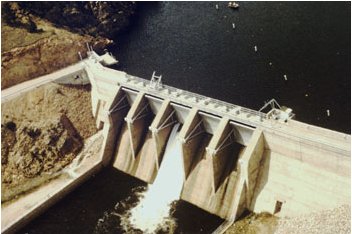
According to the June 1 Colorado Basin Outlook report released today, the snowpack in Colorado is 2 percent of average for the date, and 1 percent of the snowpack measured on June 1, 2011. Because of abnormally high snowpacks last year, reservoirs are not yet in trouble, still measuring at about 98 percent of average, she said. Still, water managers across the state are concerned that water demand from farms and municipalities will quickly drop reservoir levels across the state, she said.
Only four of 92 snowpack measuring spots across Colorado had any measurable amounts of snow at all and then only in the higher elevations, according to the June snowpack report. But Skordahl said its been so hot and dry the last several months that she was surprised there was measurable snow at any of the locations…
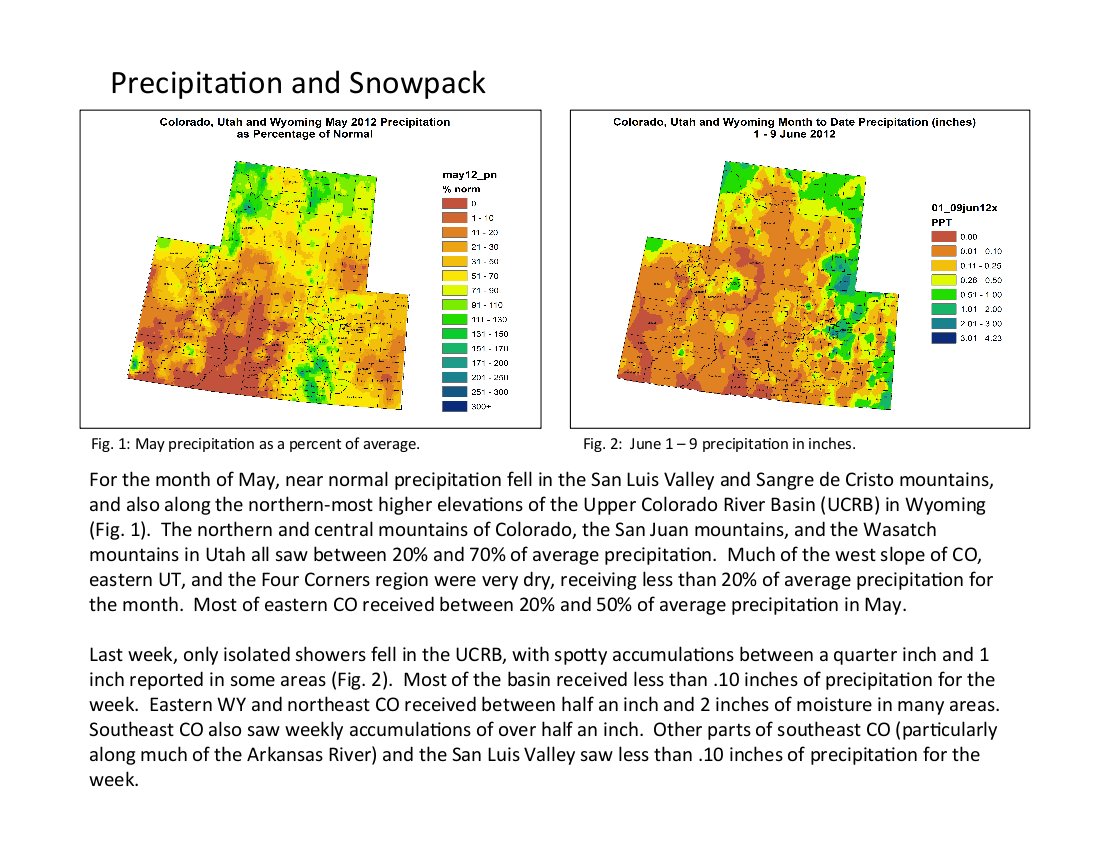
“A wet summer could turn things around,” she said.

The Weld County Commissioners — after declaring a drought emergency on Monday — are asking for a powwow with Governor Hickenlooper over pumping groundwater along the South Platte River alluvial aquifer. Here’s a report from Jack Minor writing for the Greeley Gazette. From the article:

On June 11, 2012, the Commissioners unanimously passed a resolution declaring a disaster emergency for Weld County and asked Governor Hickenlooper to order the pumping of some of the 8,400 restricted irrigation wells for 30 days to provide relief from emergency conditions. “This is a situation that requires immediate attention,” said Commissioner Chairman Sean Conway. “If water isn’t made available to the farmers in Weld County within the next couple of weeks, crops will fail and the economic impact will be felt throughout the state.”[…]

In the request for a meeting, the letter notes that the action is necessary to avoid the current disaster from getting worse to the county, which is the state’s largest agricultural county, producing over $1.4 billion to the state economy. As the Gazette previously reported, area farmers have testified on multiple occasions that the situation is desperate…

“We are like the tsunami warning system. You may not hear it coming, but we farmers are sounding the warning to you,” he said. “The good news is this disaster, which is both natural and man-made with the turning off of the wells can be avoided and it won’t cost the taxpayers one dime. All we have to do is flip a switch.”

The next CWCB Water Availability Task Force meeting is next Wednesday. I plan to live-tweet the meeting.

From the Associated Press via the The Denver Post:

The town of Frisco is asking residents to voluntarily conserve water.
The town is preparing for possible drought conditions following a dry winter and spring with below-average snowpack. Town officials said Monday they are asking people to voluntarily limit how much they water their lawns and plants.

Greeley: Confluence Institute — Water Training for Teachers, July 31 to August 3

cachelapoudre.jpg

Here’s the announcement from the City of Greeley:

The Confluence Institute continues in its 3rd year with a new focus of study. This year we’ll concentrate on water in our urban settings.

The 4 day workshop for K-12 teachers will give you tools and resources to teach all aspects of water in a way that will complement the new state standards. The course can be applied for re-certification requirements. Two Continuing Education Credits will be available through Adams State College. Classroom materials and the Project Wet Activity Guide will be provided. Most important, it’s 4 days of fun! Highlights of this year’s conference include a water use tour, a canoe trip and the Graduation BBQ.

The workshop, your meals, and materials will be provided at no cost to you.

Space is limited to 30 teachers. Reservations are being accepted now. Look in your school emails, or contact Kathy Parker at 970-330-4540.

The workshop is sponsored by the Central Colorado Water Conservancy District, the West Greeley Conservation District, the Poudre Learning Center and the City of Greeley Water Conservation and Stormwater Programs.

Use this registration form to sign up: http://greeleygov.com/Water/Documents/Confluence%202012%20flyer.pdf

More education coverage here.

The High Park Fire is affecting municipal operations on the Cache la Poudre River

highparkfiremaplarimercounty06112012small.jpg

Click on the thumbnail graphic for this morning’s fire map from Larimer County. The file is quite large so it will take a while to download. Here’s a report from Brett Walton writing for Circle of Blue. From the article:

The nearby cities of Greeley and Fort Collins have closed their water intakes on the Poudre River, said Brian Werner, a public information officer with the Northern Colorado Water Conservancy District, which provides water to 850,000 people from a Bureau of Reclamation project. The cities are now drawing exclusively from the Bureau’s Horsetooth Reservoir. Lisa Voytko, water production manager for Fort Collins, told Circle of Blue that the fire has knocked out power at the utility’s Poudre River intake. “Because we can’t monitor water quality at the source,” Voytko said, “we switched to the reservoir.”

Werner told Circle of Blue that the High Park fire is by far the largest and most extensive ever in the district’s service area. “There will be impacts,” Werner said. “If you get a hard rain on these steep slopes, it’s going to bring all that gunk into your system.”

From The Greeley Tribune (Dan England):

The Bellvue filter plant, which treats Greeley’s water supply, including the water you put in your coffee this morning, was in the mandatory evacuation zone from the High Park Fire. City workers, however, remained at the plant because of a considerable defense zone, which includes the concrete Hansen canal holding water and cornfields that were being soaked from sprinklers Sunday, not to mention a large chunk of open space, with only a couple of trees, around the plant. If the fire did somehow beat those barriers, it would essentially resemble a grass fire. Just for some additional comfort, the Greeley Fire Department sent a tanker and some firefighters to man it to keep watch over the plant, said Roy Otto, Greeley’s city manager.

So the problem isn’t the fire, it’s what it’s leaving behind. Actually, it’s both fires. May’s Hewlett Gulch fire is already causing issues. The runoff from Thursday’s heavy rains mixed with the remnants from that blaze, soiled the Poudre River beyond what Bellvue could treat, forcing the city to draw from its backup supply, the Hansen, which draws water from Horsetooth Reservoir.

But now Horsetooth could be soiled by runoff from heavy rains mixing with soot from the High Park fire, as well. If it does rain hard enough to cause both water supplies to fill with sludge, it’s possible the city would have to shut down the Bellvue plant and draw its water from the plant at Boyd Lake. The city typically only uses Boyd Lake in the summer months, when the demand for water is at its highest, said Jon Monson, director of water and sewer for the city of Greeley.

If the city does have to shut down Bellvue, Greeley residents would face tighter restrictions on water use. But Monson doesn’t believe it will come to that, as it would take a significant storm to force those problems. And even if some ash and soot finds its way into Horsetooth, the city draws water off the bottom, meaning the only drawback would be a smoky taste to Greeley’s drinking water.

Mitigation from both fires will be expensive regardless of what happens, Monson said, as the city plans to dump straw by helicopter to care for 400 acres blackened by the Hewlett Gulch blaze until the natural grasses can re-establish to help filter the dirty wash that runs into the river. That straw costs more than $1,000 an acre. Now the city may have to do a lot more to treat whatever the High Park fire scorches, and High Park is already much larger than Hewlett. The city is supposed to get 75 percent of its costs reimbursed from the federal government, Monson said.

Arkansas River basin: ‘At its most basic level, well augmentation replaces…depletions in stream flow’ — Scott Lorenz

groundwatermovementusgs.jpg

From The Pueblo Chieftain (Scott Lorenz):

Formed in 1995, [Arkansas Ground Users Association] is dedicated to keeping agriculture viable and vibrant in the Arkansas Basin. AGUA and other groups fulfill a key role in the Arkansas Basin by helping to meet the water needs of agriculture through their well-augmentation services.

Since the majority of well pumping in the Arkansas Basin is performed under relatively junior water rights, decreases in streamflow must be replaced to prevent negative impacts to senior water rights holders.

At its most basic level, well augmentation replaces these depletions in stream flow caused by our members’ pumping. Well augmentation provides a legal, cost-effective solution that allows farmers to continue using water when it otherwise would not be available to them. Well augmentation adds efficiency and flexibility to a river system already feeling the pressure of overuse. Water for well augmentation comes from a variety of sources: surface water removed from low-production farms and converted for augmentation use, water from the Fryingpan-Arkansas Project, and the one that I find most interesting, water leased from cities to put back on the farm. That’s right, in a basin that is struggling with the concept of how or even if water should be removed from the farm for municipal use, we are swimming the other way.

We take excess water from local cities and deliver it to our members through our augmentation plans. This cycle of water from city to farm manifests itself literally in the fruits and vegetables sold at roadside stands and farmers markets throughout the area.

More groundwater coverage here.

‘While the impacts to recreation in Chatfield State Park will be significant, they can be mitigated’ — Amy Conklin (Barr-Milton Watershed Association)

chatfieldreservoirreallocationprojectalternatives.jpg

From the Highlands Ranch News-Herald (Jennifer Smith):

The U.S. Army Corps of Engineers released a draft of the Chatfield Reservoir Storage Reallocation Feasibility Report/Environmental Impact Statement on June 8. In an effort to help meet the growing demand for water in the metro area, the study recommends reallocating 20,600 acre-feet of water from flood control to usable storage. This would raise the water in the recreation area by 12 feet, flooding some of the park and requiring reconfiguration of the marina and other amenities.

“The Chatfield Reallocation project has been intensively worked on for about 20 years,” said [Amy Conklin of the Barr-Milton Watershed Association]. “It is one of the few water projects in Colorado to gain support from agricultural, municipal, environmental and recreational stakeholders. While the impacts to recreation in Chatfield State Park will be significant, they can be mitigated. The impacts to the environment will likely be a net positive because of the increase in in-stream flows.”

Conklin notes the state will need the equivalent of four more Lake Dillons to meet its water needs by 2050. “Chatfield Dam is already there, and the lake has the storage capacity,” she said. “It is a water project that makes good sense.”

The Corps of Engineers says the proposal will regulate the flow of water from the reservoir into the river. Skot Latona, manager of South Platte Park, said such efforts could benefit the river habitat, depending on when water is stored and how it’s released.

More South Platte River basin coverage here and here.

Colorado-Big Thompson Project update: 365 CFS in the Big Thompson River below Olympus Dam

coloradobigthompsonprojecteastslopesystemncwcd.jpg

From email from Reclamation (Kara Lamb):

Just an update on Colorado-Big Thompson Project operations for the Big Thompson River and Pinewood Reservoir:

Tonight, June 11, after midnight, we will bump releases from Olympus Dam on Lake Estes up to 365 cubic feet per second. The increase will be made in several steps of 100 cfs each. As a result, by Tuesday morning, June 12, flows in the river at the top of the canyon should be around 365 cfs. We have had some downstream demands come on and folks need their C-BT water.

Meanwhile, we will also be closing the tunnel that takes water from Lake Estes into the southern power arm of the C-BT project. They will be conducting an inspection. With the tunnel down, Pinewood Reservoir will not have inflow. It will drop, probably about 10 or 12 feet, to a water level elevation around 6565 by Friday morning. It is currently at an elevation of about 6577–three feet from full.

Work should wrap up and the water level start rising again by the weekend.

More Colorado-Big Thompson coverage here.

Drought/runoff news: Basins show ‘unremarkable blip…six to 10 weeks earlier than average’ — Troy Wineland

snowpackcolorado06082012.jpg

usdroughtmonitor06052012.jpg

Here’s the first of the the Summit Daily News’ Drought Watch series, written by Troy Wineland, Water Commissioner for Division 5, District 36 [Blue River]. Here’s an excerpt:

Snowpack in the Blue River Basin peaked at about 85 percent of average on March 1. Since then, high winds and warmer temperatures (literally) vaporized an already deficient snowpack to 9 percent of average as of May 15. Less snow and warmer temperatures translate to earlier and severely diminished spring runoff. Basins that reach their prime in June or July achieved an unremarkable “blip” six to 10 weeks earlier than average. At present, all the principal water courses within the county are flowing less than 33 percent of average (several are less than 20 percent) with a few of the streams already breaking record low flows…

Due to drought conditions in the Blue River watershed, water providers in Summit County are implementing increased levels of water conservation. Please go to your water provider’s website to see how these changes will affect you. For additional water conservation tips visit: www.blueriverwatershed.org.

Meanwhile, wish firefighters luck in containing the High Park Fire. Here’s a report from the Fort Collins Coloradoan (Sarah Jane Kyle). Here’s an excerpt:

As of Sunday evening, the High Park Fire exceeded 20,000 acres, fueled by windy, dry conditions that have left crews with “no hope for containment,” according to County Sheriff Justin Smith. A more specific size is expected this morning after aircraft use infrared cameras to measure the full extent of the fire burning 15 miles northwest of Fort Collins…Smith said the blaze is quickly becoming his worst nightmare, spreading “in every possible direction” as an already smoke-darkened Sunday night drew into its late hours. “This is simultaneously burning through every area we’ve been individually concerned about for the past two decades,” he said. “The best thing we have now is prayer for a change in weather.”

From the Montrose Daily Press (Katharhynn Heidelberg):

On Friday, the snowpack at the Natural Resource Conservation Service’s SNOWTEL site on Red Mountain Pass was 0 percent of average. The average for the day is about 8 inches of snow water equivalent.

While local reservoirs are storing water as intended, it’s uncertain whether Ridgway Reservoir will bump up the last 7 feet it needs to fill. The Uncompahgre Valley Water Users Association expects to place another call on the Uncompahgre River, after having lifted a call earlier this year. The association is also asking its urban yard and canal/lateral pump users to share the pain by cutting back use.

And, to the surprise of few, Montrose County is in severe drought, according to the U.S. Drought Monitor’s June 5 data.

Whitewater Stand-Up Paddling Championship recap: ‘We just wanted to make a cool course’ — Paul Tefft

glenwoodwave.jpg

From the Glenwood Springs Post Independent (Dave Shively):

At Sunday’s conclusion to the championship — part of the fourth annual Rocky Mountain Surf Festival hosted at the park — Tefft had a far different concern. That is, how to give the 30-some stand-up paddlers who turned out for this year’s festival a surf event when the flow numbers were much closer to 2,600 cfs. Instead of the scheduled SUP-surf event, organizers opted for a “circleSUP” contest, where paddlers in three divisions (men’s, women’s and kids) were broken up into smaller groups of five paddlers or less for a short, sprint course routed around an upstream buoy, then through the park’s wave with two more turns in an S-shape after the wave. “It was like yesterday’s SUPcross race, but it was a better course,” said racer Mike Tavares. “There’s more turns and it’s more technical.”[…]

In the most exciting heat of the day, the women’s final, local Glenwood Springs paddler Brittany Parker — one of the few, if not only, locals participating in the weekend’s three events — made a run to pass river-SUP competition stalwarts Jenny MacArthur and Nikki Gregg, winners of Saturday’s SUPcross and downriver events, respectively. After some board jostling and contact, Parker fell behind. After judges adjusted the times according to the contact, Parker finished in second place behind Gregg. The 22-year-old, who instructs SUP lessons for the Glenwood Adventure Co., also took third place in Saturday’s SUPcross. Aspen’s Clark Tefft, 13, won the circleSUP kids division. And on the men’s side, Dan Gavere beat out Tavares again, repeating the result of Saturday’s heated SUPcross final.

More Whitewater coverage here.

Drought/runoff news: Most diverters will get far less water than average this water year

measuringwithweir.jpg

From The Pueblo Chieftain (Chris Woodka):

Projections by the U.S. Department of Agriculture show many canals will have only about one-third of the average run of water…

The Catlin is looking at only about 30 percent of its average deliveries, according to USDA projections based on May weather conditions. By early May, the snowpack in the Arkansas Valley had plummeted to 12 percent of average as what little was left of it began melting off early…

Water rights are administered by the state according to when diversions were first put to beneficial use. That means inequities between canals. For instance, the Catlin has 1875, 1884 and 1887 water rights that come into priority as river levels rise. The largest volume of water is delivered from the 1884 right, which is in priority now. “With the conditions we have this year, the Catlin’s 1884 right will be on the bubble much of the time,” Tyner said.

Other canals may fare better or worse, depending on their own water rights, the amount of water in storage and location on the river. For instance, the Bessemer Ditch, which has several senior rights prior to 1870, and a large junior 1887 right. Still, deliveries are expected to be at about 60 percent. The Buffalo Canal, located near Granada, has an 1885 decree — one of the oldest rights below John Martin Reservoir. It is expected to receive a nearly average amount of water this year. For the rest of the canals, the numbers drop.

From the Summit Daily News (Diane Johnson/Hannah Holm):

The U.S. Drought Monitor classifies drought intensity on a scale of D0 to D4. Most of Garfield and Rio Blanco counties were recently elevated to D3, becoming the only region in Colorado currently categorized as extreme. The covered area comprises 9.89 percent of the state.

Governor Hickenlooper expanded the activation of Colorado’s Drought Mitigation and Response Plan on May 21 to include the Yampa/White, Colorado, and Gunnison River basins. Phase 2 of the State plan was activated over a year ago due to deteriorating drought conditions in the Arkansas and Rio Grande River basins and it remains active for those portions of Colorado. Activation of the plan involves convening high level agency officials into a Drought Task Force charged with identifying drought impacts and “expeditious and effective” remedial actions.

According to the latest drought update from Colorado’s Water Availability Task Force, April 2012 was the fourth warmest on record in Colorado. March 2012 was the third warmest for Colorado and tied 1966 for the driest on record. Records date back to 1895. The last two months temperatures have been five degrees above average for most of Colorado. This winter’s warmer and drier than normal weather resulted in record low snowpack, which has been melting earlier than normal, leaving streamflow forecasts well below average.

Data from the Natural Resources Conservation Service (NRCS) showed the Colorado River basin had its lowest May 1 snowpack on record (45 year record) at 21 percent of average for that date; by June 5, provisional data showed it was down to 2 percent. The Gunnison River basin snowpack was just 18 percent of average for the date on May 1, with many monitoring sites already snow-free; by June 5, provisional data showed that it was down to 5 percent. With most of the snowpack already gone, streamflows are unlikely to improve. In May, the NRCS expected most of the state’s streams to produce only 20-40 percent of average volumes, with northern Colorado streamflow volumes expected to be 15-30 percent of average.