Parachute Creek spill: Aerators set up to volatilize benzene in creek water #ColoradoRiver

parachutecreekspillmarch2013

From The Denver Post (Bruce Finley):

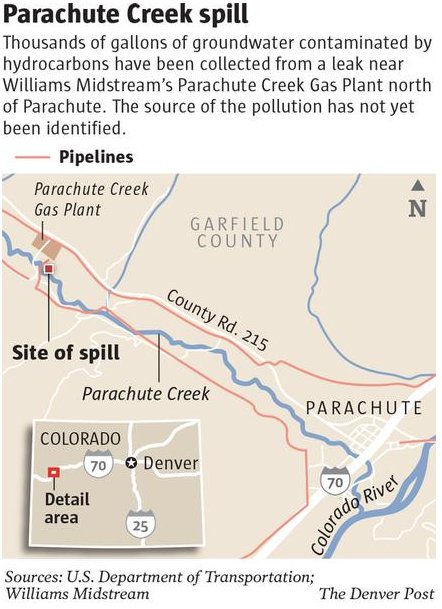
Aerators have been set up on Parachute Creek to remove cancer-causing benzene, detected downstream from a hydrocarbons spill in western Colorado. Williams energy company crews also expanded their pumping of hydrocarbons from trenches dug along the creek to try to prevent seepage of super-concentrated benzene in groundwater into the creek.

Test results released Monday showed benzene in surface water at levels around 3 parts per billion, said Kirby Wynn, Garfield County’s liaison to the oil and gas industry…

The benzene detected last week, at 2.7 ppb, was below the federal drinking water standard of 5 ppb. The limit for benzene in Parachute Creek is 5,300 ppb, set by Colorado’s Water Quality Control Commission at a level deemed protective of aquatic life because the creek isn’t designated as a drinking water supply…

Absorbent booms have been laid across the creek, including near the headgate for Parachute’s reservoir, town administrator Bob Knight said. Farmers and ranchers near Parachute use the reservoir water for irrigating crops. They rely on springs and other sources for drinking water, Knight said. Knight said he’s keeping headgates closed and that he’d prefer not to have benzene or diesel at any level in town water. “I’d like to keep the people assured that the water going into the reservoir is the same quality it has always been. That’s our goal.”[…]

Western Colorado residents, meanwhile, were pressing lawmakers to treat the spill from Williams’ gas plant, built by the creek and slated for expansion, as a warning. “There’s inadequate safety regulation to protect public health and the environment,” Grand Valley Citizens Alliance president Leslie Robinson said. “With all the drilling along the Colorado River, we know anything could happen. There should be increased setbacks from waterways and residential areas.”

More oil and gas coverage here and here.

South Platte Basin: The lack of augmentation water sources will keep some farmland out of production this year

southplattealluvialaquifer.jpg

From The Greeley Tribune (Eric Brown):

Weld County is still home to potato festivals and dotted with spuds-growing artifacts, but the local tater industry has little to contribute anymore to the area’s vast legacy. A shell of what it once was, Weld’s potato acreage took another hit this year as the last large-scale grower of the crop — Strohauer Farms in LaSalle — plans to raise half of its potatoes outside of the state, citing water issues as the reason for doing so. The Potato Day Festival for about 25 years has been a staple of autumn activities in Greeley — a community where the potato is credited as being the first commercially viable crop locally grown. But since 1987, Weld County has gone from growing 3,855 acres of potatoes on 66 farms to what’s expected to be about 550 acres this year, grown by just two farmers.

Harry Strohauer — owner of Strohauer Farms, which grows nearly all of the remaining potatoes in Weld County — and others point the finger at water issues to explain why spuds production has decreased so sharply. Strohauer said he’d rather keep his crops growing near LaSalle — the only place his family has farmed since coming here in the 1940s — than in New Mexico, where he’ll plant 500 of his 1,000 total potato acres this year. The climate along the northern Front Range and his soil close to home are ideal for growing the crop, and Weld’s proximity to large markets (the Denver metro area) and the infrastructure (Interstate 25, U.S. 34 and U.S. 85) add to the local benefits. “But the truth is, with how we manage things in this state, we just don’t have a reliable source of water anymore,” said Strohauer, who’s an executive committee member for the National Potato Council and has spearheaded Strohauer Farms since he was 16 years old, following his father’s death.

As the region’s population has grown, so have the overall demands for water.

The tightening of water supplies and the uncertainty of the resource in dry years has become too much for some farmers, including potato growers, who stress that potatoes are an “unforgiving” crop if not fully irrigated — especially if you’re trying to meet the standards of King Soopers, Whole Foods and others, as Strohauer is.

But making life particularly difficult now, Strohauer says, is the inability to pump groundwater wells. In the mid-2000s, augmentation requirements were made more stringent in Colorado. Augmentation water is required to make up for depletions to the aquifer. Over time, pumping water out of the aquifer depletes surface flows in the basin needed by senior, surface water users.

Prior to the state’s rule changes in the mid-2000s, farmers were only augmenting for about 10 percent of the water they pumped out of the ground, according to some estimations. During the severe drought of 2002, surface flows were meager and some senior surface water users said well-pumpers were taking too much out of the aquifer and not putting enough back in. In the end, the state’s augmentation requirements were changed, and owners of certain groundwater wells — wells considered “tributary” to stream flows — now have to augment as much as 100 percent for the water they pump out of the ground. Strohauer said now, with those changes in place, it would cost tens of millions of dollars to own enough augmentation water and take other measures needed to get all of his wells pumping again at full capacity. Like Strohauer, many other area farmers haven’t been able to get their wells fully pumping again, or at all in some cases.

Strohauer said he isn’t exaggerating when he claims it’s easier to haul his farm equipment and fly to and from his new farmground in New Mexico than it is to grow potatoes near his Weld County home and deal with some of the water rules in Colorado. In New Mexico, Strohauer has no augmentation requirements. He can pump as much water out of the ground as needed without having to make up for his depletions. But he doesn’t at all believe that’s the best way to manage groundwater either, he added. “I’m not against augmentation, by any means,” stresses Strohauer, who, in addition to his groundwater wells, owns senior surface water rights. In many years, though, that surface water isn’t enough to fully irrigate his potato acres, and the groundwater wells are needed to provide immediate, supplemental relief in dry times. “I agree that we need to be augmenting more than we once were. But I think things have swung way too far the other way.”

Like others in the LaSalle and Gilcrest area, Strohauer has seen his basement flood from high groundwater levels in recent years. High groundwater has also flooded fields, causing some crops — including some of Strohauer’s potatoes — to rot. Strohauer and others believe the high groundwater levels have been caused by “overaugmenting” the aquifer since Colorado changed its rules in the mid-2000s, while others believe it stems from the wet years of 2010 and 2011, among other issues.

Complaints of high groundwater levels and the inability to pump wells led to a legislative push last year for a comprehensive study of groundwater activity in the South Platte River basin — a study that’s under way now by the Colorado Water Institute and is expected to be complete by the end of the year.

“Maybe this study will show us something new,” said John Stulp, Gov. John Hickenlooper’s adviser on water, noting that other efforts — including similar groundwater studies and water-cooperative pilot projects — are under way in Colorado. “There’s no doubt ag across the state faces water challenges. We live in a semi-arid region.

“We need to get to a point where we’re making the most beneficial use of what limited water we have, and we’re going a lot of different routes to get there.” Until that happens, Strohauer is considering planting more acres elsewhere, he said.

Water issues have affected other farmers in Weld County.

Sakata Farms in Brighton, which grows crops across southern Weld County, has reduced its acreage from 4,000 to 2,500 in the past four years, and brought commercial broccoli growing to an end in Colorado when it stopped production of that crop a couple years ago. Bob Sakata, owner of Sakata Farms, has said water uncertainty is the main reason for cutting back on production.

“You just hate to see this happen, but we have to grow somewhere,” said Strohauer, explaining that it’s taken him years to develop his contracts to sell potatoes to large grocers, and those contracts could come to an end if he falls short on production just one year. “We want to stay to here. I don’t want to see potato acres keep disappearing in Weld County. But it’s getting harder to stay here.”

More from the Tribune:

Jim Ehrlich, executive director of the Colorado Potato Administrative Council in Monte Vista, said shortages have had a major impact on growers in the San Luis Valley in southern Colorado, where more than 90 percent of the state’s potatoes are grown. Since the Colorado drought of 2002, the southern part of the state has had little relief, and because of that, restrictions on groundwater-pumping have been put in place and potato acreage has decreased significantly.

In 2002, Colorado altogether was planting about 77,800 acres of potatoes, but is only expected to plant about 53,000 acres this year, largely due to tight water supplies in the San Luis Valley, Ehrlich said. The state’s potato production from 2002 to 2011 steadily dropped from about 3 billion pounds to 2.3 billion pounds — about a 25 percent decrease.

More South Platte River Basin coverage here and here.

American Rivers names the Colorado River most endangered for 2013 #ColoradoRiver

adams_boulder_dam_1942.jpg

From The Grand Junction Daily Sentinel (Dennis Webb):

Without the Colorado River, there would be no Mesa Park Vineyards in Palisade. The 10-acre operation is totally reliant on the river’s water, Brooke Webb of the family-owned operation said Wednesday. That’s part of the reason Webb joined in a news conference by American Rivers announcing that the Colorado River has been named the conservation group’s most endangered river for 2013. Without the river, there would be no Palisade peaches, no area wine-making, she said. It likewise is responsible for 15 percent of the nation’s crops and $26 billion a year in recreation, she said. “We want to preserve our way of life and for the river to be there for future generations,” said Webb, also part of the National Young Farmers Coalition.

The river, a lifeline to millions, also is sapped by such high demand. American Rivers said in a news release that the Colorado River tops its list for this year due to “outdated water management that is inadequate to respond to the pressures of over-allocation and persistent drought.” The group said a recent U.S. Bureau of Reclamation study showed there isn’t enough water in the river to meet the river basin’s current water demands, much less support future increased demands. It said the river is threatened by the possibility of diversions of 300,000 additional acre-feet of water to the Front Range, and a possible 10 to 30 percent reduction in the river’s flow by 2050 due to climate change.

Coconino County, Ariz., Supervisor Liz Archuleta said the white-stained sandstone bathtub ring of Lake Powell, which currently has a water level 102 feet below capacity, “serves as a clear reminder of the overuse of the Colorado River.”

The river provides drinking water to 36 million people from Denver to Los Angeles.

“Today the river is so dammed, drained and diverted that it dries up to a trickle before reaching the sea,” American Rivers president Bob Irvin said. “Now is the time to put the Colorado River on the path to recovery.” The organization says one way to do that is to adequately fund “21st-century” water management practices that optimize existing infrastructure and emphasize efficiency and conservation.

Jim Lochhead, manager and chief executive officer of Denver Water, said he thinks American Rivers overstates the problem involving the river and doesn’t “really add to the conversation, frankly.”

“The situation is not as bleak as portrayed by this announcement,” he said. He said he thinks the group overemphasizes the worst-case scenarios on climate change and isn’t realistic about the amount of Front Range water diversions that might actually occur. Denver Water spent roughly a decade seeking permits for a 15,000-acre diversion and has nearly reached a deal with Western Slope entities under which any further diversions only would occur in partnership with the Western Slope, he noted. But he said obviously there are issues involving the river, including California’s overuse of water from it over the last two decades. “I think that the states and the Department of Interior are clearly working together to address those issues in an incremental way,” he said.

Eric Kuhn, general manager of the Colorado River Water Conservation District, based in Glenwood Springs, said he hadn’t had a chance to look at the report. But he added, “Anything that brings more attention to the (Bureau of Reclamation) basin study is very positive.” He said looking at possible future water shortages can lead to overstating the problem today, but he added that for the river to not reach the sea now already is a problem.

That said, Kuhn takes issue with the idea that the river suffers from antiquated management. Colorado water law has a long history but isn’t necessarily antiquated, and the river’s management also involves six other states grouped in upper and lower basins, and Mexico, he said. He said American Rivers probably has underestimated the importance of agreements in recent years that address matters such as water levels in Lake Powell and Lake Mead, and the river situation in Mexico. Such agreements aren’t easy to reach, he said. “The kind of progress that’s been made is maybe incremental but it’s significant,” Kuhn said.

The Colorado River has made American Rivers’ annual list of the 10 most endangered rivers six times, and was named the most endangered three of those times. In coming up with its annual list, the group considers factors such as whether a river faces a serious threat. Last year, the Green River was ranked second due to proposals to pipe water from it to the Front Range, and the Crystal River south of Carbondale was ranked eighth because of a river district reservoir proposal there.

More Colorado River Basin coverage here and here.

Citizens Lincoln Park/Cotter Mill Citizen Advisory Group gets update on de-commissioning roadmap

cottermillcontaminationconcerndenverpost10232011

From the Cañon City Daily Record (Rachel Alexander):

The road map integrates the paths of the various authorities that cover different parts of the site, said Jennifer Opila, radioactive materials unit leader with the Colorado Department of Public Health and Environment. The documents cover the requirements for 1988 Consent Decree/Remedial Action Plan (CD/RAP), Cotter’s operating license and the Comprehensive Environment Response, Compensation and Liability Act (CERCLA or Superfund).

The document originally was published in July 2012, prior to the “pause” that is in effect at the site. CDPHE and the Environmental Protection Agency accepted public comments on the document at that time and released the current version at the end of March.

“This is the road map in its final stage at this time,” Opila said. “For now, we are not planning on taking formal comments on this version of the road map.”

However, she said the document is fluid and subject to change as the process moves forward, so the agencies will be accepting informal comments over time.

More Lincoln Park/Cotter Mill superfund site coverage here and here.

The NSAA offers a fresh start in negotiations with the USFS over water rights ownership

powderhornskiarea.jpg

From the Summit County Citizens Voice (Bob Berwyn):

“Our new approach assumes that all previous water clauses are no longer in effect, null and void, and unenforceable. It would result in a consistent water policy across the board going forward,” said NSAA policy director Geraldine Link. The ski industry comments came as the Forest Service held a series of hearings around the West in the early stages of developing a new water rights clause that eventually will become part of agency permits for businesses operating on public lands…

For the ski industry, its partially a financial issue. Resorts have spent millions of dollars developing and perfecting water rights under state law, and to the NSAA, any permit language requiring a transfer of those rights is unacceptable and illegal.
A required transfer would impair the value of the resorts’ investments and could hinder their ability to finance capital improvements, the NSAA wrote.

From The Grand Junction Daily Sentinel (Gary Harmon):

The U.S. Forest Service will pay $125,000 to the National Ski Area Association for its attorney fees in a case the association brought to stop the agency from demanding new water rights. U.S. District Judge William Martinez approved an agreement between the agency and association after the ski areas sought $163,000 in attorney fees for the case, according to court papers.

The agreement to pay attorney fees drew a scathing response from U.S. Rep. Scott Tipton, R-Colo., who said that $125,000 is “a lot of money, especially when it’s at taxpayer expense and at a time when the Forest Service should be dedicating as many resources as possible to addressing the hazardous conditions of our forests to prevent wildfire.”

The ski areas sought attorney’s fees under a federal law that requires the Forest Service to pay attorney’s fees if a judge “concludes the Forest Service’s position was not substantially justified,” Geraldine Link, the attorney for the National Ski Area Association, said in an email.

The association filed suit last year after the Forest Service required the new ownership at Powderhorn Mountain Resort to surrender new water rights to the agency in exchange for a permit to operate the ski area on national forest lands.

Although the agreement includes a provision in which the Forest Service admits no allegations, Link said the deal makes it clear “that taxpayer dollars are being used in defense of an unlawful federal water grab.”

Martinez rejected the ski-area water rights directive after finding that the Forest Service had failed to meet public-participation requirements in drafting it.

If the Forest Service moves forward on the directive, “the costs will be even greater to the businesses, farmers, ranchers and communities that rely on these water rights for their livelihoods,” Tipton said.

The Forest Service conducted the first of several focus-group open houses nationwide on Tuesday in Denver. Officials anticipate publishing a draft directive later this year in the Federal Register, then conducting a public-comment process before adopting a new directive.

Concern about the consequences of such a policy extends beyond the ski industry. “We’re very concerned about the implications of such a clause targeted to one industry because if it’s successful and because it’s outside Colorado water law, could the U.S. government demand similar rights of agriculture, municipal water users, anyone who develops a water right that originates on public land?” said Bonnie Petersen, executive director of Club 20, a Western Slope advocacy organization.

More water law coverage here.

Forecast news: Moderate snow for the northern mountains, red flag warning southwest #COdrought #COwx

From the National Weather Service Grand Junction office:

A low pressure system and associated cold front will slowly sag southward across the region today through Tuesday morning. This storm system will bring periods of showers and isolated thunderstorms to the northern Colorado mountains/valleys, with a minimal chance of showers elsewhere. Moderate snow amounts are expected for the northern CO mountains with winter weather advisories in effect. Across far southwest Colorado, a Red Flag Warning is in effect this afternoon/evening due to expected low relative humidity, gusty winds and dry fuels. It will be much cooler on Tuesday behind the cold front, with showers diminishing in the afternoon. A gradual warm up begins Wednesday with above seasonal temperatures by Friday, it will also generally be dry the latter part of the week aside from a few mountain showers.

From the National Weather Service Pueblo office:

A new weather system is expected to enter the Rocky Mountain region Monday…pushing a surface cold front southward through Colorado by evening. Timing of the front should allow temperatures to warm to Sunday’s readings or higher…before cooler air starts to spill through the area late in the day. Rain and snow showers are possible most of the day over the mountains…while the region’s lower elevations will likely see precipitation delayed until the frontal passage in the afternoon and evening.

From the CoCoRaHS blog:

Deep snow cover over Canada has maintained the supply of cold air this spring and there is still 30 cm (12 inches) or more on the ground across the Prairie provinces. A persistent upper level trough pattern over over the central U.S. has deflected the storm track farther south this spring and allowed the cold air to spill farther south than normal.

In the past two days more than 600 record lows and 560 record low maximum temperatures have been recorded from the Dakotas to the southern tip of Texas…

Is there light at the end of the tunnel? There’s a light, but it might be another freight train, at least in the short term. An upper level system is moving into the Pacific Northwest today and will drop into the central Rockies by Tuesday. The surface low will organize in the Central Plains and bring another round of snow to an area from Wyoming and Colorado to Minnesota. Another surge of cold air will follow this system.

From the National Weather Service Pueblo office:

A cold front will move through the eastern plains of Colorado this evening and bring much colder air to the region. Expect any rain showers to quickly change to snow. Blowing snow can be expected as winds will be very gusty behind the front. Temperatures, after being near 70 degrees in many areas, will fall to the low to mid 20’s tonight.

From the Fort Collins Coloradoan:

The National Weather Service is calling for rain early in the day Monday followed by snow showers after noon. Daytime accumulation is expected to be minimal as winds gust up to 25 miles per hour. Weather service forecasters predict a 70 percent chance of precipitation. Overnight Monday, the snow is expected to continue with calmer winds and a forecast low of 20 degrees. The weather service predicts one to three inches of snow overnight. The chance of precipitation is forecast at 80 percent.

Snowpack/drought news: Dust events in April expected to affect runoff #COdrought #COwx

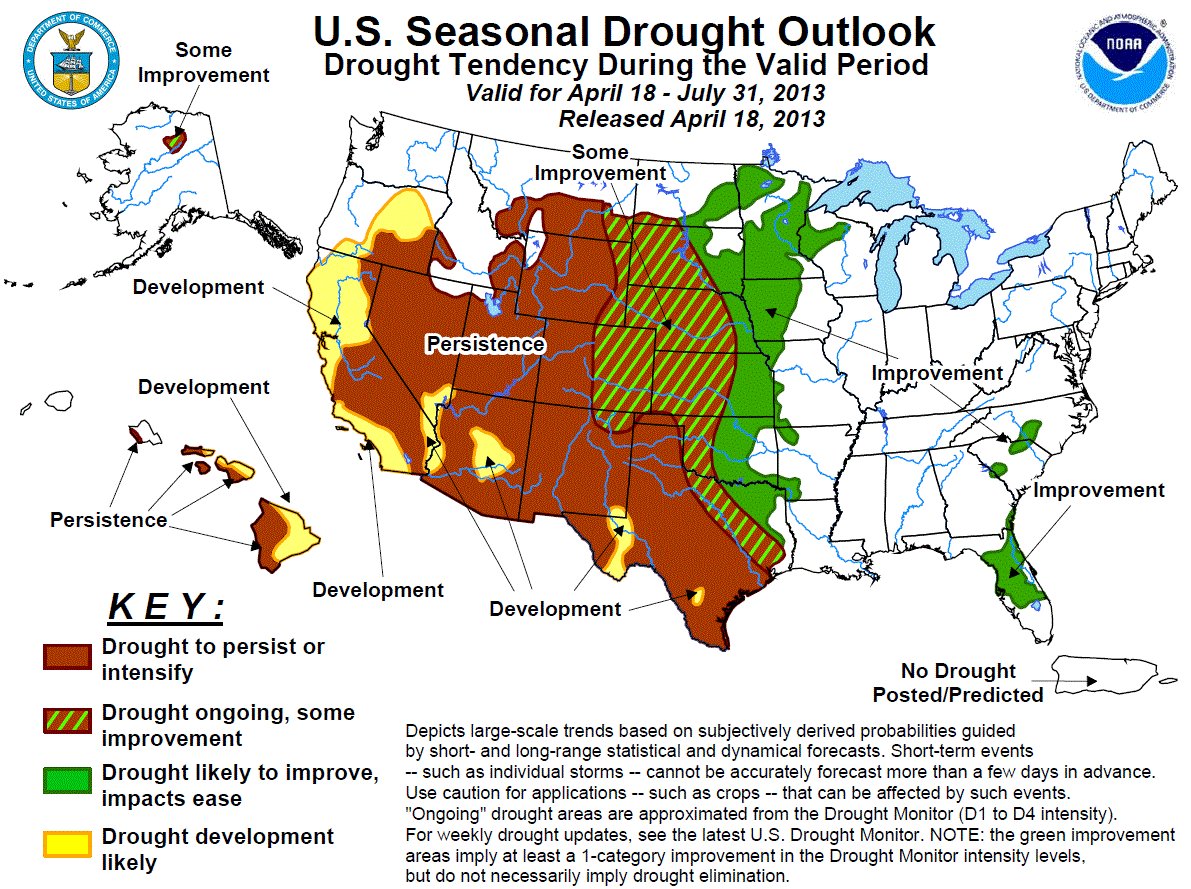
seasonaldroughtoutlookapril18tojuly312013cpc

usdroughtmonitor04162013

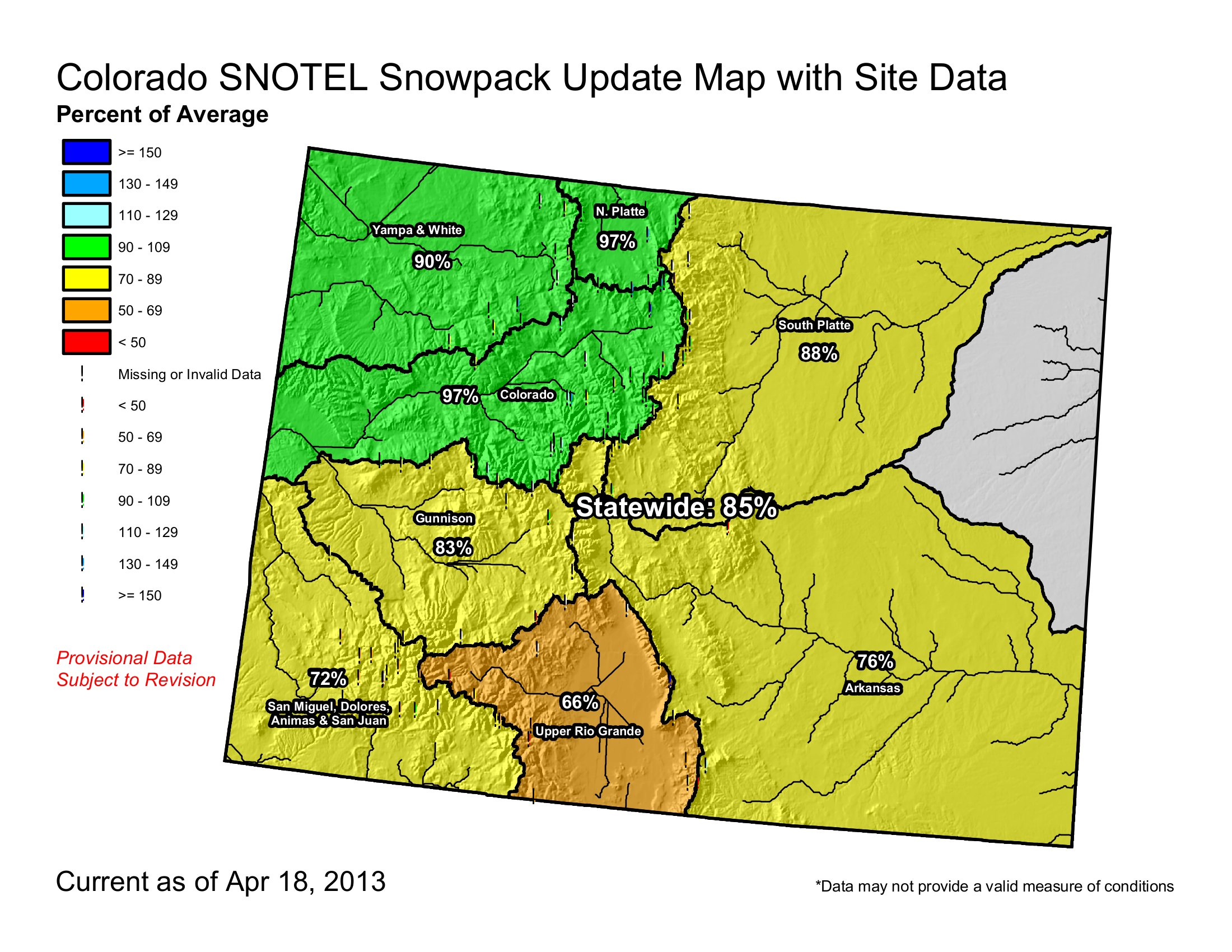
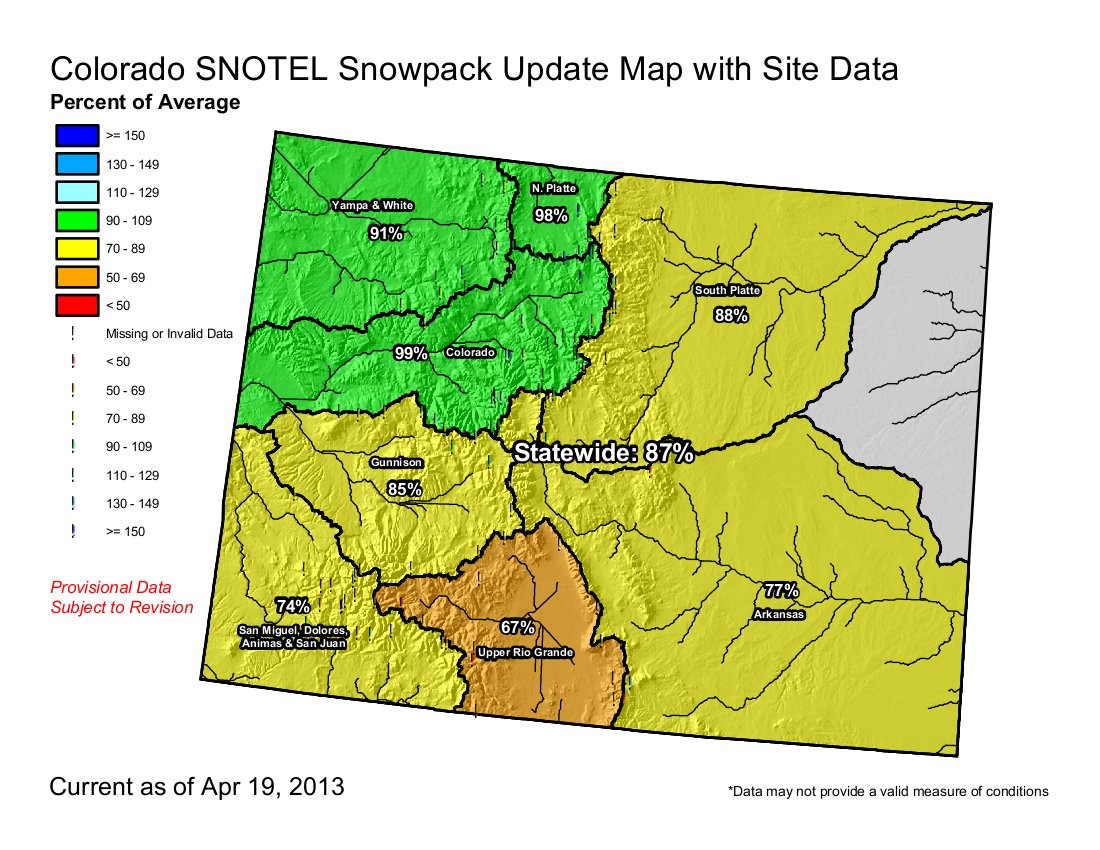
snowpackcolorado04192013

From the Associated Press via The Pueblo Chieftain:

Dust blown in from the Southwest settled on snow over many of Colorado’s mountains during last week’s storm and will eventually affect how fast the snowpack melts and possibly how much water the state can hold onto. Researchers say the dust kicked up from Arizona, New Mexico and Utah by southwesterly winds fell in Steamboat Springs, Summit County, Vail, Aspen and the San Juan mountains. Dust also was scattered in the snow that fell along the Front Range but it’s likely that dust could have been carried by southeasterly winds from other areas too, including parched Southeastern Colorado, the San Luis Valley and the Arkansas River Basin, state climatologist Nolan Doesken said.

Jeffrey Deems, a research scientist for NOAA in Boulder, said dust on top of snow can absorb up to twice as much sunlight as clean snow, speeding up melting. He compares the effect to wearing a dark T-shirt on a sunny day.

This week’s dust storm was the second widespread one in Colorado’s mountains this season. Another storm on April 8 left a thick layer of dust in the state’s snowpack, which has now been boosted to 79 percent of the peak average thanks to this week’s storm. ‘‘It’s kind of a mixed blessing now,’’ Deems said of the new, dusty snow.

More snow is in the forecast but whenever the dust layers from this week and earlier this month are eventually exposed, there will be a significant speed up in the melting of the snow at that time, said Chris Landry of the Center for Snow and Avalanche Studies in Silverton. The center is studying the impact of dust on snow for water providers across the state and periodically checks sites at mountain passes across the High Country for dust. If clean snow keeps falling the impact will be delayed, Landry said, helping farmers without storage who don’t need irrigation water just yet and rafting companies hoping to attract customers to big flows later in the season.

From The Colorado Springs Gazette (Barbara Cotter):

Colorado Springs Utilities expects to take a $17 million bath because of watering restrictions this year, but it has no plans to push for a rate hike to make up for the budget shortfall.

“Our approach is to look internally,” Utilities spokesperson Patrice Lehermeier said Thursday. “We’re already running a pretty tight shop, but we’re looking at maybe cutting other programs. So it’s a little bit of robbing Peter to pay Paul, internally, at least, while we look at where to make further reductions in other programs.”

With the Pikes Peak region facing a persistent, severe drought, the Colorado Springs City Council approved Utilities’ request for two-day-a-week landscape watering restrictions beginning April 1, with the goal of saving 5.8 billion gallons water through Oct. 1, compared with same six-month period last year.

But when customers use less water, their bills drop, and Utilities gets less money. From 2002 to 2005, when watering restrictions were in place, Utilities lost $24.4 million. Rates did go up, though Lehermeier said the increases were tied to projects and other items not related to the restrictions.

Benzene detected in Parachute Creek #ColoradoRiver

parachutecreekspillmarch2013

From KDVR.com:

For the second straight day, the cancer-causing chemical benzene has been detected in Parachute Creek, a tributary of the Colorado River, downstream from a hydrocarbon leak at a Williams Gas facility that was first detected more than a month ago.
Sampling of the creek on Friday detected benzene at 2.7 parts per billion, similar to Thursday’s detection of benzene at 2.8 parts per billion — the first time benzene, which has been found in much higher and hazardous concentrations in groundwater just feet from the creek, has been detected in surface water.

The state drinking water standard for benzene is 5 ppb. While the current samples are just trace amounts below that standard, the groundwater contamination levels were 3600 times the standard last month. “Sampling at three more points downstream of those detections did not detect benzene,” said Todd Hartman with the Colorado Dept. of Natural Resources, in an email to reporters Friday. “Sampling back upstream, above the initial benzene detection, also did not reveal contamination.”

Samples for benzene taken at the point where the town of Parachute diverts water for its irrigation supply 2.7 miles downstream of the gas facility continued to show no detection of benzene.

From The Grand Junction Daily Sentinel (Dennis Webb):

Benzene has been found in Parachute Creek for the first time since testing began in response to a natural gas liquids leak north of Parachute. Williams and the state Department of Natural Resources said in news releases that the carcinogen was found Thursday at multiple locations, but in amounts below Environmental Protection Agency safe drinking water standards of 5 parts per billion.

Williams said an initial result came back Thursday showing a detection of 2.8 parts per billion. The state said another detection at the same location was 2.7 ppb. Williams said the initial detection was about 1,200 feet downstream from where a pressure gauge on a natural gas liquids line leaked thousands of gallons. The state said the point was about 1,800 feet downstream. No benzene has been found upstream of the leak site.

In response to the detections, Williams did real-time sampling farther downstream Thursday and tests showed benzene at 1.5 ppb 680 feet from the first detection point, and 1.1 ppb 1,900 feet from the first point. Samples taken Thursday where Parachute diverts water for its irrigation supply showed no benzene. Williams said benzene floats on water, dissolves only slightly in it and evaporates quickly from the surface.

Williams is installing aeration, or air-sparging, technology to remove benzene near the initial detection point and 1,900 feet farther downstream. It also has added an additional boom below the initial detection point.

Parachute’s diversion site is 2.7 miles downstream of Williams’ gas plant.

High benzene levels have been found in groundwater on either side of the creek, but benzene hadn’t previously been detected in the creek despite frequent testing. Authorities have said that’s because the groundwater below the creek apparently flows away from it. But the state said the situation appears to be different at the initial point of benzene detection in the creek, with groundwater flowing toward the stream. That point is the farthest downgradient from the valve site where benzene has been detected in groundwater, and the groundwater detection there was 440 ppb Monday, prompting surface water sampling nearby the next day, the state said.

Part of Williams’ response is building a 200-foot-long groundwater interception trench adjacent to the creek at that point, , the state said.

Williams said that it is continuing twice-daily sampling at Parachute’s diversion point. “As a precautionary measure, the city of Parachute’s irrigation gate on Parachute Creek will remain closed until additional data is collected,” it said.

From The Grand Junction Daily Sentinel (Dennis Webb):

The discovery of benzene in Parachute Creek this week is causing heightened anxiety about the possible ramifications of the natural gas liquids leak in that watershed.

“It is of great concern to see it in the creek,” said Kirby Wynn, oil and gas liaison for Garfield County. He said the county is hoping to organize a public meeting in the Parachute area as early as next week and to have investigating agencies along with Williams, the company that has said it is responsible for the leak, provide updates and answer questions.

Williams and the state Department of Natural Resources on Thursday reported the first detection of benzene in the creek since monitoring began last month. The benzene levels were within the Environmental Protection Agency standard for safe drinking water. Groundwater monitoring wells on each side of the creek have shown much higher benzene levels.

Williams says the leak is the result of a faulty pressure gauge on a valve set for a liquids pipeline from its natural gas plant up the creek valley. It discovered the faulty gauge and removed it Jan. 3 but thought that less than 25 gallons had leaked. It now estimates that some 10,000 gallons entered the soil and groundwater, of which about 6,000 gallons has been recovered.

The town of Parachute’s diversion point for its irrigation supply is about 2.7 miles downstream of the valve area.

Judith Hayward, a former Parachute town trustee, previously has expressed concern about the safety of using the irrigation water for gardening once the watering season begins. She said Friday she also worries that some town residents may not be fully informed about the continuing developments involving the leak. “It seems like every other day or so there’s a new finding. I just have so many questions as to what a community can really do to protect themselves,” she said.

A benzene measurement Friday at the point where the substance was first detected in the creek earlier this week 1,800 feet downstream of the valve set was 2.7 parts per billion. That’s little changed from an earlier reading of 2.8 ppb. A sampling site 680 feet downstream of the point of initial detection showed benzene at 1.5 ppb Friday, and one farther downstream read 1.2 ppb. Sampling sites even farther downstream, including at the town diversion point, show no benzene.

Williams spokeswoman Donna Gray said the detections in the creek are “well below the regulatory standard, the allowable standard.” The EPA drinking water standard for benzene, a carcinogen, is 5 ppb.

Steve Gunderson, director of the state Water Quality Control Division of the Colorado Department of Public Health and Environment, said in a prepared statement Friday, “Although the benzene levels in the creek are below state drinking water standards, their presence reinforces the need to assure that the cleanup of this spill is done as expeditiously as possible.”

CDPHE is meeting regularly with the Colorado Oil and Gas Conservation Commission and EPA “to discuss the cleanup and the appropriate measures to be taken,” he said.

Williams and regulators on Friday finalized plans that workers will begin implementing over the weekend to address benzene in the creek, including air-sparging systems that remove benzene through aeration.

Samples upstream of the valve area continue to show no sign of benzene that would indicate a possible source separate from the natural gas liquids leak.

Bob Arrington is a retired engineer in Battlement Mesa who pointed to the pressure gauge as the likely source of the large volume of contamination first found in March, even when Williams still thought the gauge had leaked only a small amount. He also predicted benzene ultimately would show up in the creek where it did, at a gradient pinch point where groundwater was more likely to flow into the creek rather than away from it. He said Friday that even benzene below EPA standards can cause some cancer cases. He thinks Williams should begin doing groundwater monitoring where the creek enters the Colorado River and work its way upstream, as a precautionary measure.

Gray said Williams already has tested groundwater downstream to the point where it is getting readings of no benzene in the groundwater.

Given the extent of the groundwater contamination that has been discovered, Arrington also challenges Williams’ contention that about 80 percent of what it calculates escaped from the gauge, or about 40,000 gallons, vaporized into the atmosphere rather than reaching the ground. He thinks a lot less may have vaporized because of the cold weather at the time of the leak. “I think when you have something like that you have to look at it from the worst possible case and do your planning accordingly,” he said.

Gray said the estimate of the percentage that vaporized and evaporated comes from a standard industry model created using EPA guidance.

Meanwhile, Hayward is concerned about Williams’ plans to build another natural gas liquids line that will go under the creek in the same corridor that holds the existing line that had the leaky gauge. “The fact that these pipelines are going under our creek … who let that happen?” she asked.

More oil and gas coverage here and here.

Lawsuit over Red River Compact and Oklahoma water law could impact river compacts across the U.S.

redrivercompactareamap.jpg

From NPR (Joe Wertz):

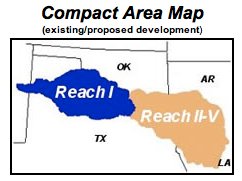
The [U.S. Supreme Court] will hear oral arguments [Tuesday] in the case of Tarrant Regional Water District v. Herrmann, et al. The case pits Oklahoma against Texas over rights to water from the river that forms part of the border between them. Depending on how the court decides, it could impact interstate water-sharing agreements across the country…

The future looks bright for this part of Texas, but it also looks dry. Drought has hit Texas particularly hard over the past couple of years. Water officials say the north Texas region’s growth is outpacing the water supply nearby.

“All of the locations — watershed locations — close by have been tapped for us,” says Linda Christie, government relations director for the Tarrant Regional Water District. The district is the water authority for an 11-county stretch of north Texas that includes Ft.Worth. “So now we’re going to have to go 200, 300 miles. And most of it would be water that is being pumped uphill.”

The Red River, less than 75 miles from Fort Worth, seems like an ideal solution to the Tarrant Water District’s problem. Fed by the Rocky Mountain snow pack, the river runs southeast on its way to the Gulf of Mexico.

Texas and Oklahoma already have a formal agreement on how to share water from the Red River. In 1980, Congress ratified the Red River Compact, giving the two states — along with Arkansas and Louisiana — an equitable apportionment of water from the river and its tributaries.

But what’s “equitable” is arguable. And that’s what the Supreme Court case is all about.

The Red River lies entirely within the state of Oklahoma. Texas argues that it can’t get its share of the Red River watershed from the Texas side of the river, so it needs to reach across the river into southeastern Oklahoma to get it…

Texas has tried to buy Oklahoma water from the state, its cities and towns, and its Native American tribes. But Oklahoma lawmakers have blocked those efforts with a string of laws restricting out-of-state water exports.

The view in Texas is that Oklahoma isn’t even using its full allocation of Red River water. Oklahomans respond that Texas hasn’t gotten serious enough about conservation.

In 2007 — citing the compact — the Tarrant District sought permission from Oklahoma regulators to tap the Kiamichi River, a Red River tributary located entirely within Oklahoma. Oklahoma said no, arguing that the compact does not supersede the state’s own authority over a water resource within its borders. The dispute has been in court ever since.

The lower courts have agreed with Oklahoma so far. But Christie says the Tarrant Water District is encouraged by the Supreme Court’s decision to hear the case. And the Obama administration has sided with Texas, too. In a friend-of-the-court brief, the U.S. solicitor general worried about the impact to North Texas’ population growth, and argued that the 10th Circuit Court of Appeals improperly assumed Oklahoma’s laws preempt the Red River Compact’s authority.

State and local policymakers and water authorities throughout the country are closely watching the outcome of the case, says Stephen Draper, a water expert who helped write guidelines for interstate water sharing for the American Society of Civil Engineers. Here’s why: The Red River Compact contains a lot of the same boilerplate language used in other state-to-state water sharing agreements.

If Oklahoma’s protectionist water laws are upheld, Draper says other states could be inspired to pass similar laws of their own.

More water law coverage here.

Coyote Gulch outage: I’m on deadline at Colorado Central magazine, I’ll see you on Monday

stevensarchfromcoyotegulch19951

I’m on deadline at Colorado Central Magazine. I’ll see you on Monday morning.

Forecast news: Widespread scattered showers possible over the mountains and I-25 today, storm on the way Sunday #COdrought #COwx

From the National Weather Service Pueblo office:

An upper level disturbance will push across the state this afternoon. This system will bring isolated to scattered rain and snow showers across the mountains and Interstate 25 corridor. The best chances for precipitation will be over the central mountains where moderate snow accumulations are expected. Persons planning travel through this area should stay abreast of the latest advisories for this area and visit our web page at http://www.weather.gov/pub. Area temperatures will continue a warming trend today, with highs in the mid 50s to mid 60s expected over the eastern plains, with 40s and 50s over the high country.

From the National Weather Service Grand Junction office:

A disturbance in northwest flow will push across the region today, bringing mountain snow and a good chance of rain/snow showers for the northern/central valleys. Southern valleys may see a few showers but the northern 2/3rds of the forecast area will be favored for precipitation. Snow levels will generally range from 5500-6500 feet, with the highest amounts across the northern mountains where 4-8 inches will fall. Precipitation will diminish this evening, with fairly pleasant conditions on Sunday. Another storm system will bring unsettled conditions to mainly the northern mountains/valleys Sunday night into early Tuesday, with fair conditions elsewhere.

Snowpack/drought news: Colorado River snowpack = 99% of avg (highest %), Rio Grande = 67% (lowest %) #COdrought

seasonaldroughtoutlookapril18tojuly312013cpc

usdroughtmonitor04162013

snowpackcolorado04192013

From the Associated Press via ABC15.com:

Dust blown in from the Southwest settled on snow over many of Colorado’s mountains during this week’s storm and will eventually affect how fast the snowpack melts and possibly how much water the state can hold onto. Researchers say the dust kicked up from Arizona, New Mexico and Utah by southwesterly winds fell in Steamboat Springs, Summit County, Vail, Aspen and the San Juan mountains. Dust was also scattered in the snow that fell along the Front Range but it’s likely that dust could have been carried by southeasterly winds from other areas too, including parched southeastern Colorado, the San Luis Valley and the Arkansas River Basin, state climatologist Nolan Doesken said.

Jeffrey Deems, a research scientist for NOAA in Boulder, said dust on top of snow can absorb up to twice as much sunlight as clean snow, speeding up melting. He compares the effect to wearing a dark T-shirt on sunny day.

This week’s dust storm was the second widespread one in Colorado’s mountains this season. Another storm on April 8th left a thick layer of dust in the state’s snowpack, which has now been boosted to 79 percent of the peak average thanks to this week’s storm. “It’s kind of a mixed blessing now,” Deems said of the new, dusty snow.

More snow is in the forecast but whenever the dust layers from this week and earlier this month are eventually exposed, there will be a significant speed up in the melting of the snow at that time, said Chris Landry of the Center for Snow and Avalanche Studies in Silverton.

Here’s an article about the April 8 dust storm written by Chase Olivarius-Mcallister for the The Durango Herald. Here’s an excerpt:

Monday’s gusts rained red mud from Arizona and New Mexico dust onto Durango, making the sky an ominous shade of mottled pink and reducing visibility. Wind speeds were as high as 30 mph at the airport, and anyone in a car should drive at prudent speeds, Aleksa said. Drivers traversing mountain roads, where winds were fiercest, should take particular care, he said.

Click here for a Modis satellite photo of a dust storm out of northeast Arizona moving toward four corners, and the San Juans.

From the Windsor Beacon (Sam Noblett):

“At least now we have enough to get it started rather than germinating by irrigation,” said Harold Stromberger, who operates his farm in Windsor near Colorado Highway 392 and Weld County Road 21. Still, Stromberger has had to adjust his practices to plan for the reduced water allocation by switching to a few barley crops, which are more resistant to drought than his normal corn crops. He made the choice to switch to barley instead of allowing his land to sit idle. He planted the barley in mid-March and hopes to plant corn crops this weekend, depending on weather.

“You do a lot of hoping in agriculture,” said Stromberger. “Hoping for storms like this and rain.”

From the Boulder Daily Camera (John Aguilar):

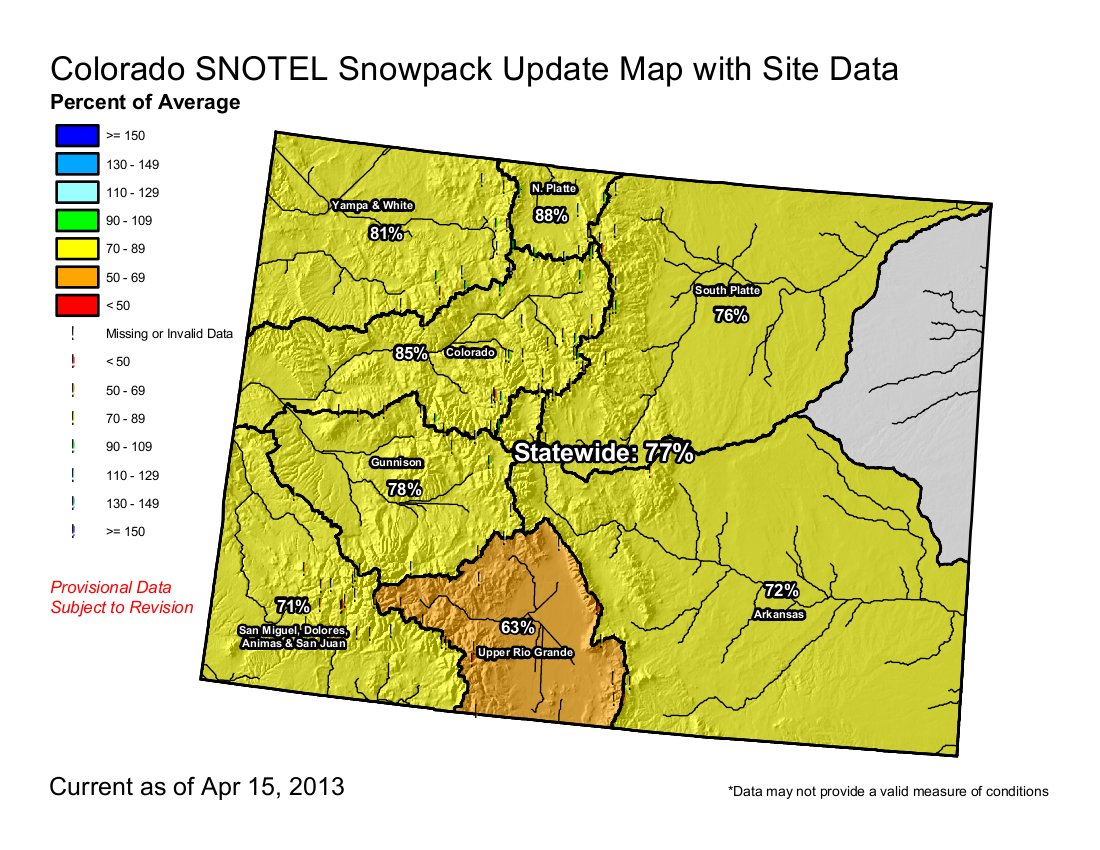
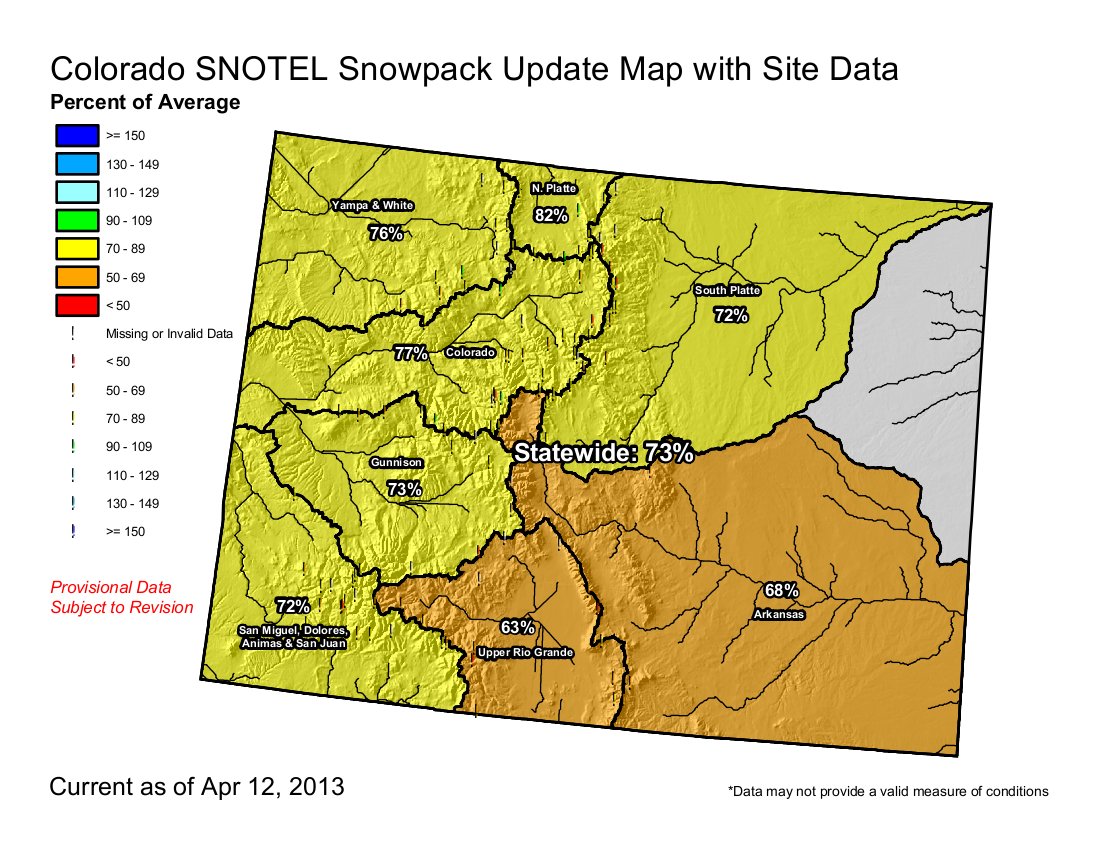
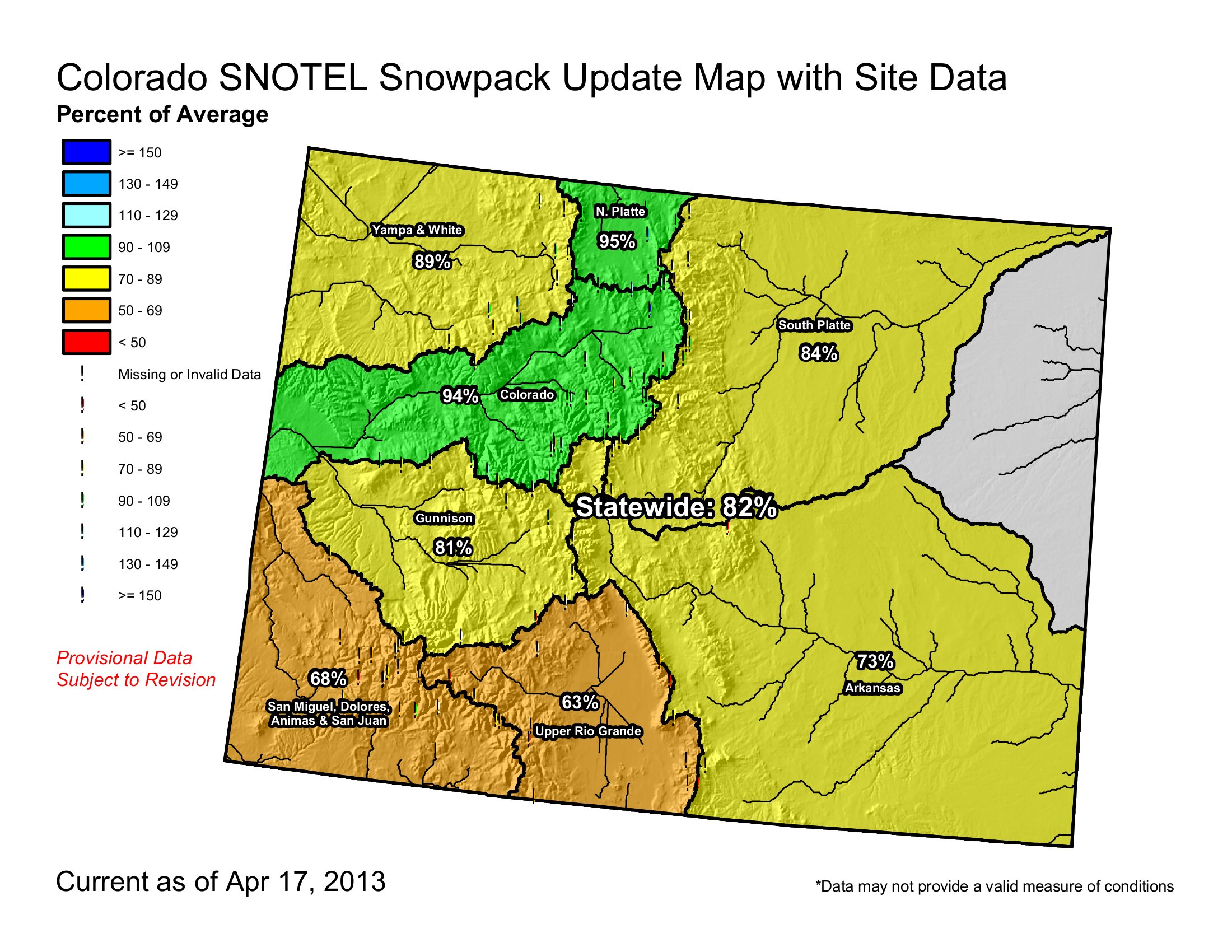
“Things were looking pretty dire here,” Mage Hultstrand, assistant snow survey supervisor for the Natural Resources Conservation Service, said Wednesday. “These are the first storms that have given the snowpack a real boost.” And a significant boost, at that. On April 8, the snowpack level in the South Platte River watershed was 70 percent of normal for that date. On Wednesday, it was measured at 83 percent of normal. Statewide, the snowpack was at 67 percent of normal 10 days ago, and on Wednesday it hit 83 percent of normal, Hultstrand said.

As of Wednesday evening, Boulder had received 34.9 inches of April snow. The record for the month is 44 inches, set in 1957. This month’s snowfall follows nearly 23 inches in March…

“We’re playing catch-up with our snowpack, and we’re also playing catch-up with our reservoir storage,” Hultstrand said. “Things can dry up really fast around here.”

So far, Broomfield and cities and towns in Boulder County are holding their ground with water restrictions. Louisville, which imposed the strictest limits in the county earlier this month — with a mandatory twice-a-week outdoor watering schedule starting May 1 — doesn’t plan to back off its restrictions for now.

“Things are looking better, and all this moisture means that no one needs to do any irrigating until at least early or perhaps even mid-May,” City Manager Malcolm Fleming wrote in an email. “However, the snow pack is still down and it will take more than this to fill the reservoirs that are very low.”

Lafayette Public Works Director Doug Short said officials aren’t going to consider easing Lafayette’s restrictions, which limit outdoor watering to between 6 p.m. and 10 a.m., until they see the state’s May 1 snowpack and runoff projections. That means the paddleboat and canoe program at Waneka Lake remains dry-docked for now.

Jody Jacobson, spokeswoman for the Boulder Public Works Department, said the city is also awaiting next month’s hydrological data before making a final decision on whether to impose water restrictions…

According to data from the Natural Resources Conservation Service, the snowpack in the Boulder Creek watershed on April 1 was at 69 percent of normal for that date, while the levels in the St. Vrain and Big Thompson watersheds were 55 percent and 59 percent of normal, respectively. The service wasn’t able to provide updated numbers for mid-April.

Like much of Boulder County, Broomfield partly relies on supplies from the Colorado Big Thompson project, which transports water from the west side of the Continental Divide to the Front Range. Broomfield Public Works Director David Allen said Wednesday that he plans to recommend to the City Council next week that it stick with a voluntary twice-a-week watering schedule across the city.

Here’s a report about the second dust storm of the month on April 16 from Shane Benjamin writing for The Durango Herald. Here’s an excerpt:

The dust storm was the result of a low-pressure system centered over Utah and Nevada that contributed to a strong southwest flow over this part of the state, said Joe Ramey, forecaster with the National Weather Service in Grand Junction. The dirt was rising out of New Mexico, he said. Some residents said they could feel and taste the grit in their teeth. “Even up here in Grand Junction our skies are hazy with dust,” he said…

A dust storm April 8, combined with light rain, coated cars and dirtied windows in the Durango area. Some of the dirt gets deposited on the snowpack in the San Juan Mountains, which turns the snow a dark color and increases the rate of the melt…

The average snowpack as of Tuesday in Southwest Colorado was 71 percent of normal, he said – second lowest in the state. The lowest was in the Rio Grande basin, east of Wolf Creek Pass. The average snowpack across the state was 77 percent, he said.

From The Wet Mountain Tribune (Nora Drenner):

Watering restrictions have been imposed on Round Mountain Water and Sanitation District bulk water users. Such action took place at the RMW board of directors meeting held April 11.

RMW manager Tracey Garcia said the district was forced to enact the restrictions due to drought and the less than average snowpack. Primarily affected by the restrictions are the Custer County Road and Bridge Department that uses the water for road grading, Custer County School for its ball fields, and the towns of Silver Cliff and Westcliffe for its municipal parks. The restrictions limit the amount of water bulk users can purchase and use by one-third to one-half.

Not affected, said Garcia, are those residential users who rely on bulk water for cisterns, as well as other residential customers. She also noted that RMW hopes to only limit the watering restrictions to large bulk users, however, she encourages all customers to conserve. “The district is hoping to only limit those users and not pass along the restrictions to residential users,” said Garcia…

“Green lawns, unfortunately, should not be anyone’s priority this year,” said Garcia. “Instead, only water newly planted trees as necessary. “

Garcia said Round Mountain Water and Sanitation District currently has 355 acre feet of storage in the Lake DeWeese reservoir, however, the current total of water in the storage vessel is around 115 acre feet. Additionally, RMW secured an additional 75 acre feet of water last year through the Pueblo Board of Water Works, however, it is unknown if that source of water will be available again this year.

From The Grand Junction Daily Sentinel (Mike Wiggins):

The biggest snowstorm of the season Wednesday layered the Grand Valley with a thick, wet blanket of flakes that triggered accidents across the region, the closure of the school in De Beque and anxiety among peach farmers whose trees have already flowered.

The storm dumped as much as 7 inches of snow in some areas of the valley and more in the higher elevations, according to the National Weather Service. Officially, 4.6 inches accumulated at Grand Junction Regional Airport between Tuesday night and Wednesday morning. The 3.8 inches of snow that fell Wednesday made it the third-snowiest April day on record in Grand Junction and accounted for the most snow on a single day this season, coming in just ahead of the 3.6 inches that fell in the city on Dec. 19, 2012, according to the National Weather Service…

The owners of Red Barn Farm & Gardens, 3419 U.S. Highway 6, posted on their Facebook page that the forecast was not looking promising for their fruit. “The apricots are all gone, cherries in the valley will be slim pickings, if any, and peaches are heading out very quickly with this snow and cold temperatures. Pray for a warm weather change and some tasty fruit this summer! I hope you all love pears, tomatoes, and the regular garden veggies, because that’s about all we might have!” the post said.

From The Greeley Tribune (Eric Brown):

Double-digit jumps in snowpack figures this month have left Randy Schwalm and other local farmers using a facial expression seldom seen in the ag world during recent months. “We’re actually smiling today,” said Schwalm, a Windsor-area crop grower.

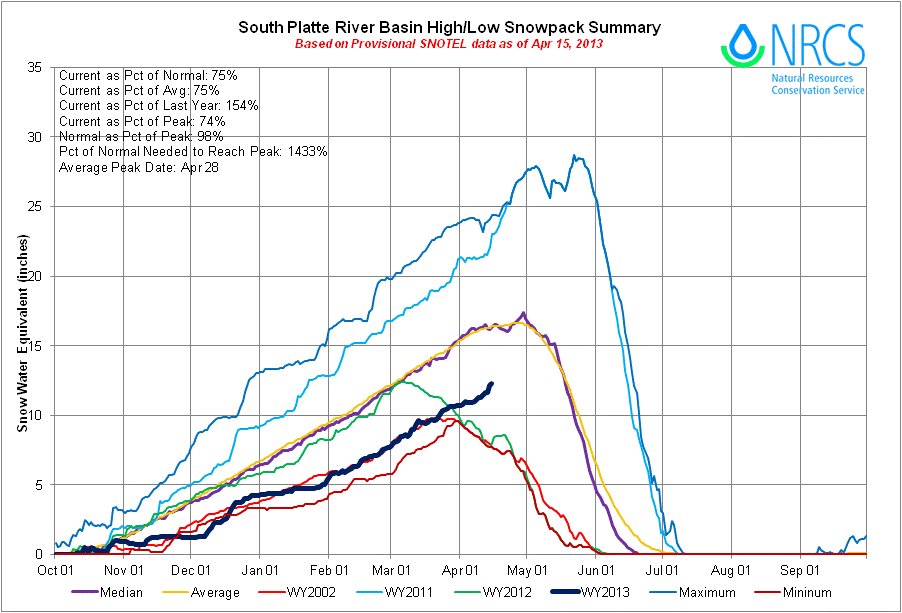
Snowpack in the South Platte River basin had hovered around 65-70 percent of average through the end of March, but, as of Wednesday, had jumped up to 85 percent of average, thanks to recent snowstorms.

Snowpack is needed to provide runoff that fills the region’s reservoirs, rivers and irrigation ditches.

Snowpack in the Colorado River basin, from which the northern Front Range also diverts much of its water, saw snowpack increase from 74 percent of average on April 1 all the way up to 95 percent of average on Wednesday.

Along with the snowpack upswings, there’s been plenty of moisture in Weld County. The National Weather Service said 4-5 inches had fallen on areas along the Larimer-Weld County line on Wednesday. The Greeley area didn’t receive nearly that much snow Wednesday, but had gotten plenty in recent days. As of Tuesday, the city had received 43 percent more precipitation than normal in 2013, and area farmers are elated.

Schwalm said the recent moisture means farmers won’t have to irrigate immediately after planting their crops during the upcoming weeks. While the local moisture will save a round of irrigation, the additional snowpack in the mountains, too, will help extend the irrigating season. “Those seeds in the shed are starting to look a lot better,” Schwalm said.

Brian Werner, a spokesman for the Northern Colorado Water Conservancy District in Berthoud, said the sharp increase in snowpack recently doesn’t mean the Northern Water board of directors will increase its water quota for the Colorado-Big Thompson Project, which is the largest water supplier in the region. The Northern Water board of directors set a below-average quota of 60 percent earlier this month, based on low snowpack at the time and low reservoir levels. The board sets a quota each April to determine how much water can be released from the C-BT’s system, and how much water needs to remain in its 12 reservoirs. Werner said the board will take another look at its quota during its meeting in May, and consider increasing it. “There’s no guarantee, though” Werner said of the board increasing the quota based on recent snowpack increases. “The recent snow has been a big boost, but our reservoirs are awfully low. We need to get those filled back up.”

From The Mountain Mail (Joe Stone):

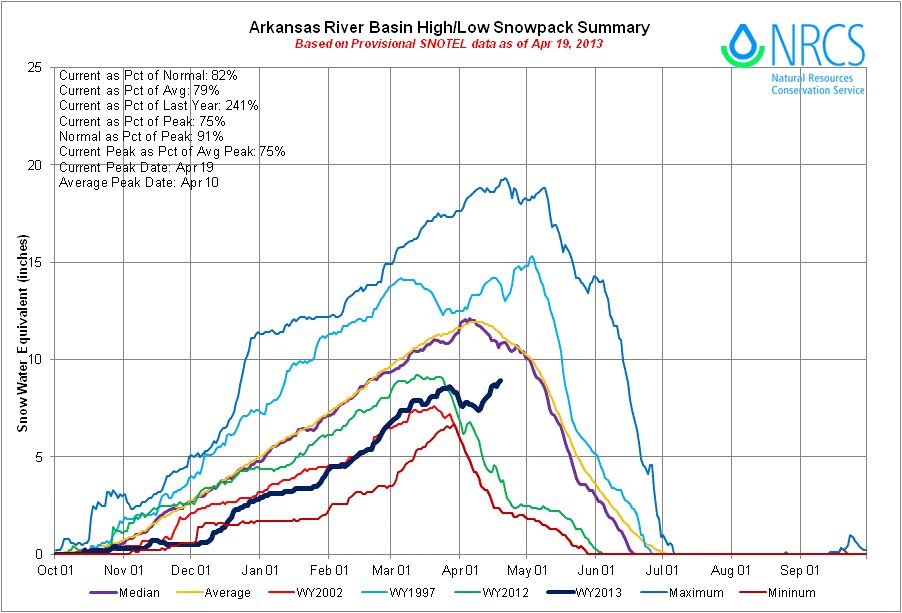
Natural Resources Conservation Service snowpack telemetry data for Thursday indicate the Arkansas River basin snowpack stands at 76 percent of average. However, SNOTel data from upper basin sites indicate significant snowpack gains during April. Fremont Pass snowpack reached 68 inches Thursday, up from 49 inches April 2. The Brumley SNOTel site southwest of Leadville shows a snow depth of 35 inches Thursday, compared to 26 inches April 2.

Late-season snowstorms also increase the possibility of a successful flow program for the multi-agency Voluntary Flow Management Program, White said. The program maintains minimum flows for the fishery throughout the year and provides enhanced flows for rafting and kayaking from July 1 through mid-August.

2013 Colorado legislation: HB13-1130, sans the thirty year term, passes the Senate Ag committee #COleg

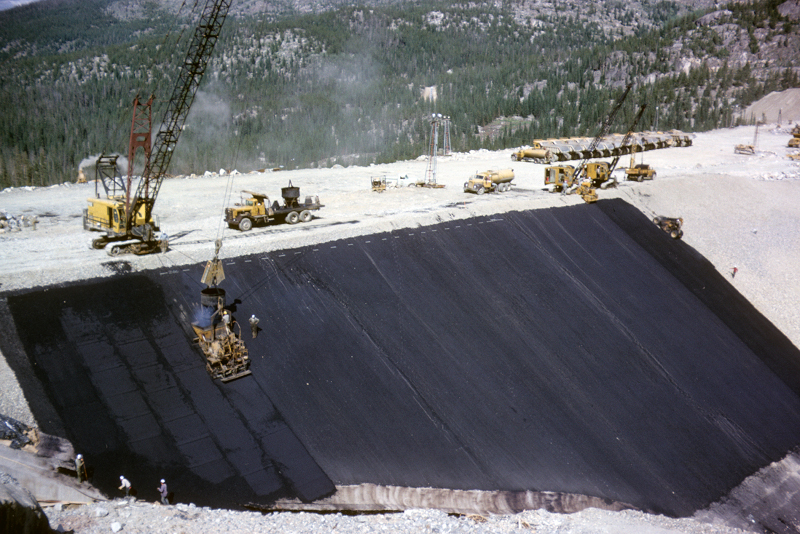
homestakedamfacingcirca1965aurorawater.jpg

From The Pueblo Chieftain (Chris Woodka):

A watered-down version of a controversial bill that would expand state authority to approve water leases is making its way through the Legislature. The legislation, HB1130, was approved this week by the Senate agriculture committee. It would alter the state’s interruptible water supply statute. The statute now allows temporary transfers of water from farms to cities with approval from the state engineer for three years in a 10-year period.

Aurora, supported by farmers on the High Line Canal, is backing the legislation. Aurora leased water from the High Line Canal in 2004-05. Numerous water interests, particularly in the South Platte basin, opposed the original legislation as an end-run around water court. Originally, the bill allowed the state Division of Water Resources to approve water transfers for up to 30 years without going to water court.

The legislation, as amended by the ag committee, now limits renewal to just one 10-year period, and only in the Lower Arkansas Valley (water districts 14, 17 and 67 in water division 2). Aurora argued for two renewal periods in order to give cities more certainty of supply.

The bill also strengthens water court appeals and state engineer notification procedures, while giving opponents 126 days, rather than 30, to respond to notifications.

The bill also prohibits transfer of water across the Continental Divide, at the request of Sen. Gail Schwartz, D-Snowmass Village, who chairs the Senate ag committee. It does not prohibit transfers from the Rio Grande or Arkansas River basins using interruptible supply.

The bill was sent to the Senate floor on Wednesday, and could be approved by the Senate as soon as Monday. The House would then have to reconsider the legislation, since substantial changes were made.

More 2013 Colorado legislation coverage here.

Arkansas River: Late season snowfall expected to give rafting revenue a shot in the arm #COdrought

arkansasriverbasinhilow04192013

Click on the thumbnail graphic to see the big spike in late season snow water equivalent in the Arkansas River Basin. Whitewater sports are a big business along the Arkansas River mainstem above Lake Pueblo so the snowfall translates to economic activity this summer.

Here’s a release from Colorado Parks and Wildlife:

A steady stream of March and April snowstorms in the high country have managers at Colorado Parks and Wildlife’s Arkansas Headwaters Recreation Area (AHRA) anticipating a good run-off this spring and steady flows for rafting throughout the summer.

“The snowpack in the Upper Arkansas River Basin is much better this year than at the same time last year,” said Rob White, AHRA Park Manager. “We are looking forward to a great spring and summer season for whitewater boating.”

White said that as of April 18, the snow levels in the upper Arkansas basin are more than double what they were at this time last year. “Last year we received very little if any precipitation in March and April, while this year we have been more fortunate. The mountains that surround the Arkansas River Valley are continuing to receive snow,” he said.

The Arkansas River is the most commercially rafted river in the United States and an abundant supply of whitewater and gorgeous scenery are just two of the reasons why the river is so popular. “Browns Canyon and the Royal Gorge provide two of the most spectacular stretches of scenery and whitewater that you can find. Also, with the spring snowpack increasing every day, we are very excited about this year’s whitewater season,” said White.

Not only will there be a good spring run-off, but the late season snowstorms also increase the possibility of a successful flow program for the multi-agency Voluntary Flow Management Program (VFMP). The VFMP maintains minimum flows for the fishery throughout the year and provides enhanced flows for rafting and kayaking from July 1 through mid-August.

“In a year like this, we potentially have the best of both worlds; the fishery on the Arkansas River is the best it’s been in years due to low flows last season, while the late season addition to the snowpack promises to provide an abundance of whitewater,” said White.

The AHRA is managed through a cooperative effort between the Bureau of Land Management and Colorado Parks and Wildlife. In addition to AHRA, Colorado Parks and Wildlife manages 42 other state parks, more than 300 state wildlife areas, all of Colorado’s wildlife and a variety of outdoor recreation.

Here’s a report from Tracy Harmon writing for The Pueblo Chieftain:

Rafters are rejoicing at the late winter snowstorms that are bringing more water to the Arkansas River for rafting and kayaking this summer. The steady stream of snowstorms in the high country have extended through March and April, boosting snowpack totals to double what they were this time last year, said Rob White, Arkansas Headwaters Recreation Area park manager.

There is more than twice as much snow as at the same time last year, White said. “The spring snowstorms that the Arkansas River Valley have been receiving are of tremendous benefit to the agricultural, municipal and recreational communities,” he said. “We are looking forward to a great spring and summer season for whitewater boating.”

The Arkansas River is the most commercially rafted river in the United States, so an abundant supply of whitewater is just what rafters have been hoping for. That’s because not only will there be a good spring runoff, but the late season snowstorms also increase the possibility of a successful flow program through mid-August.
Last year, rafting outfitters experienced a nearly 19 percent dive in visitor numbers, making it the worst year since droughtand fire-stricken 2002. Arkansas River rafting customers went from 208,329 in 2011 to 169,486 in 2012, resulting in a nearly 16 percent drop in economic impact to the region.

Last summer, the rafting industry brought in $20.5 million in direct expenditures to the Arkansas River corridor and a total economic impact of $52.5 million when factors such as meals, lodging and gasoline are considered.

More whitewater coverage here and here.

Northern Water plan in conjunction with NISP could restore streamflow in a section of the Cache la Poudre

fortcollins.jpg

From the Northern Colorado Business Report (Steve Lynn):

Northern is discussing raising flows in the stretch that runs from the mouth of Poudre Canyon to an area near Gateway Park. The river normally runs at a trickle in that section, but Northern Water says it could increase flows 30 to 40 cubic feet per second from June to September. That would amount to10,000 to 20,000 acre feet running through the five-mile section…

Northern Water is exploring the possibility as part of its $490 million Northern Integrated Supply Project (NISP)…

As part of the reservoir project, Northern Water has proposed that the irrigation company leave the water in the stream through the five-mile stretch and allow Northern to divert it farther down and pump it back up to the proposed Glade Reservoir, where it would be stored for the irrigation company’s use.

Under this scenario, Northern Water would receive credit from the Corps of Engineers for adding water to the river as it draws from the river during spring runoff to fill Glade.

However, the irrigation company believes it would lose out on credit from the Corps of Engineers if Northern Water moved the diversion downstream. It wants credit for its Halligan-Seaman Water Management Project, which involves expanding Fort Collins’ Halligan Reservoir and Greeley’s Milton Seaman Reservoir.

Northern Water and North Poudre Irrigation Co. value those credits because they give the water companies standing to remove water from other places of the river at various times for storage in reservoirs.

“We’re not going to give up potential mitigation credits on our project,” said Steve Smith, operations manager for the irrigation company. “They actually would be in competition with ours.”

Both the irrigation company and Northern Water said they intend to keep negotiating to see if mutually acceptable terms can be reached.

More Cache la Poudre River Watershed coverage here and here.

Colorado River ‘Most Endangered,’ but not lost — Hannah Holm #ColoradoRiver

coloradoriverbasin2012doiviatheaspentimes.jpg

Here’s a look at the current state of the Colorado River from Hannah Holm writing for the Grand Junction Free Press. Click through and read the whole article. Here’s an excerpt:

This week brought a mix of gloom and sunshine to the water picture for the Colorado River Basin.

Gloom came in the form of a report by the conservation group American Rivers, which declared the Colorado to be the “Most Endangered River in America.” The report highlights the fact that the river no longer meets the sea, as well as information from last fall’s Colorado River Basin Water Supply and Demand Study by the U.S. Bureau of Reclamation, which showed that the river is already over-tapped, and imbalances between supply and demand are likely to get worse in the future.

The figurative sunshine came, first of all, in the form of literal gloom: The skies darkened, and rain began to fall, then snow, and more snow (even in Grand Junction), and a slight uptick in the snowpack trend-line turned into a real spike, bringing snowpack levels in Colorado’s part of the Colorado River Basin up above 90% of the average for this time of year, and double what it was at this time in 2012.

Of course, 90% is still below average, but considering that one month ago the snowpack was just barely catching up to where it was at the beginning of last year’s historic drought, this counts as very good news. It means our wildfire danger will be lower, more crops can grow, and water managers won’t pull out quite so many hairs. Mandatory water restrictions are less likely (here anyway — Denver’s are still on), and rafting may be more fun.

More Colorado River Basin coverage here and here.

Drought/snowpack news: Dust accompanying the recent storm may hasten melt out #COdrought

seasonaldroughtoutlookapril18tojuly312013cpc

usdroughtmonitor04162013

snowpackcolorado04182013

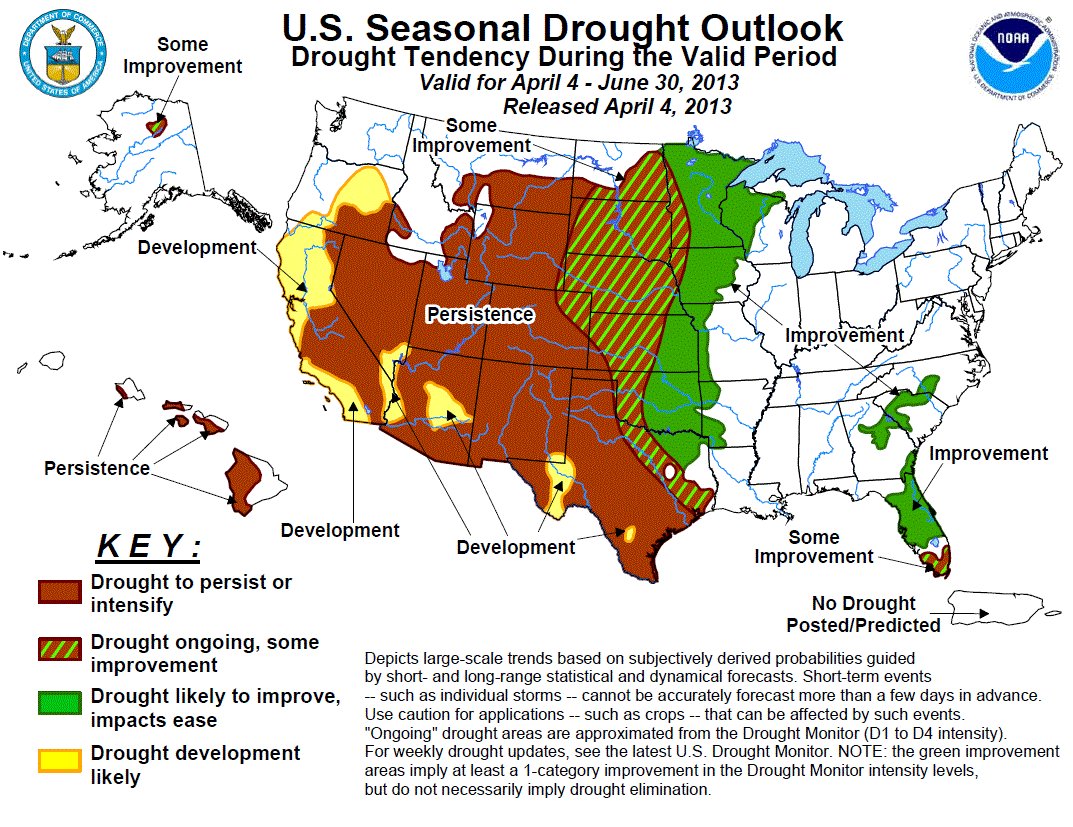
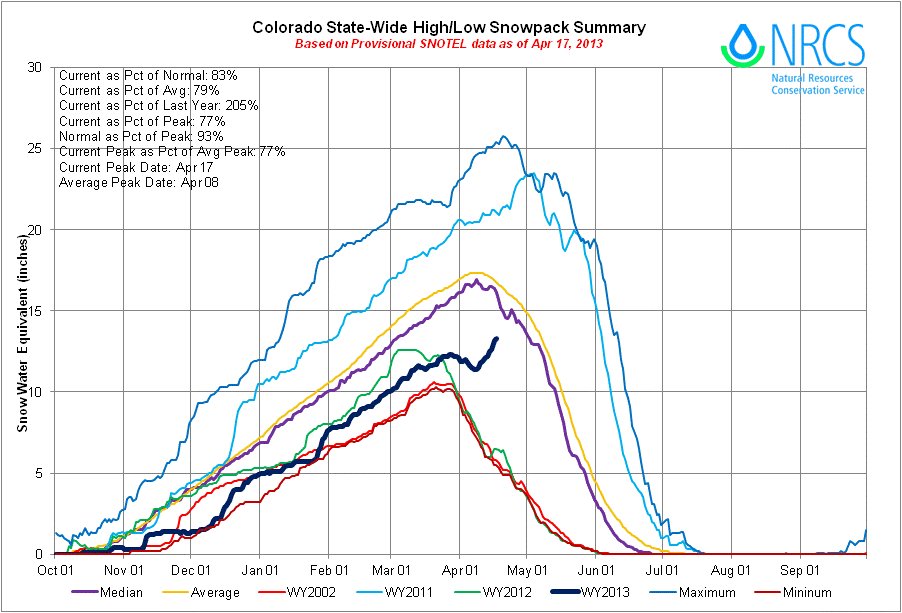
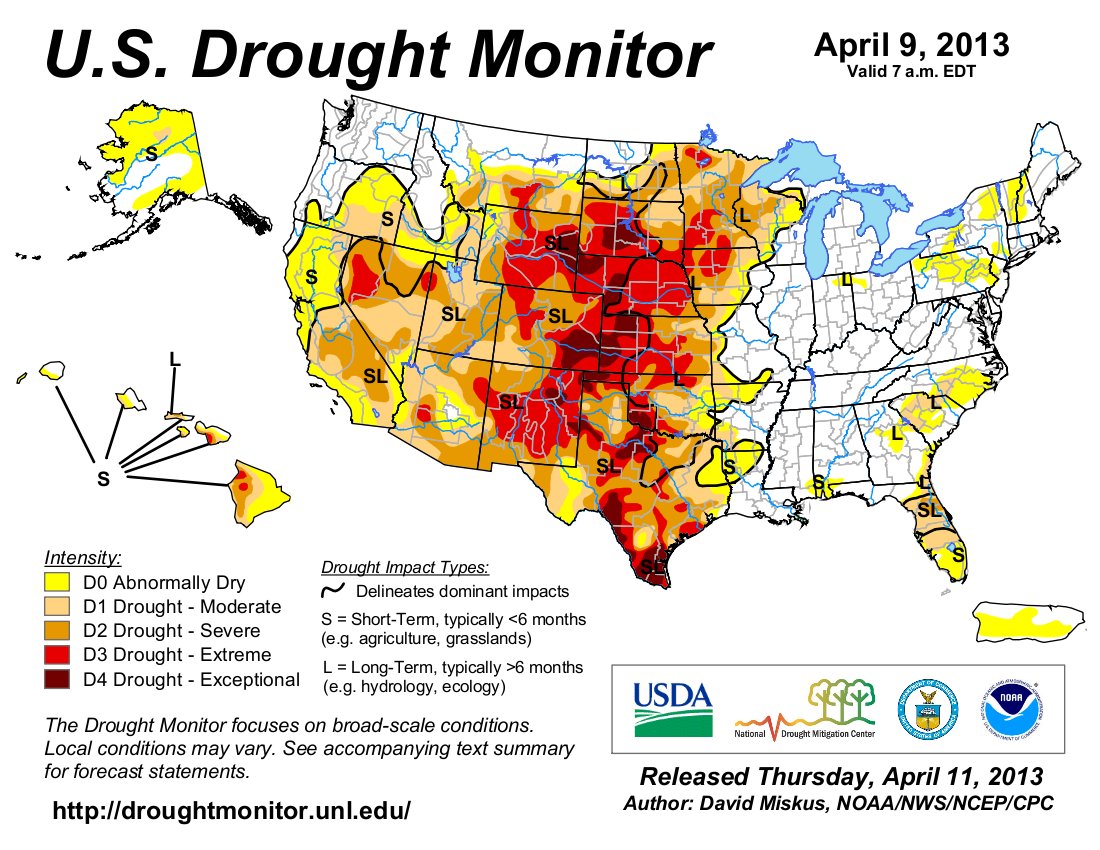
Click on the thumbnail graphics for the current snowpack map from the NRCS, the current U.S. Drought Monitor map and the current drought forecast map from the Climate Prediction Center.

From The Denver Post (Jason Blevins):

Little specks of Arizona, New Mexico and Utah rode in on the potentially record-setting 61-hour storm and promise to hasten snowmelt. And then, below that fresh layer of sun-absorbing, snow-melting dust is an uncommonly dense layer from an April 8 dust storm — the sixth of the season, or “D6” — that will send the snowmelt down in surging torrents, drowning hope for a sustained release deep into summer. “None of the dust events we had last year were comparable to the April 8 event we had this year,” said Chris Landry, executive director of the Center for Snow and Avalanche Studies in Silverton, who has studied dust events and the impact on snowpack in southern Colorado for the last decade…

Water managers across Colorado, many of whom fund Landry’s research, lament the late-season dirt. That dark layer covering even the deepest snowpack prevents the slow and steady runoff that keeps rivers rolling and reservoirs replenished. Instead, the runoff comes down at once, forcing precious water that could irrigate fields in July and float rafts in August to run through the state months early. “Snowpack above 9,000 feet is our biggest water storage, and our best reservoir, and we want to keep water in that reservoir as long as possible,” said Jim Pokrandt with the Colorado River Water Conservation District. “The worse these dust layers are, you get the snow (disappearing) quicker and that affects late-season base flows in streams. The effects are felt from high elevation down to where we use the water for irrigation.”

From The Pueblo Chieftain (Chris Woodka):

Agricultural irrigators who use wells are likely to pump only one-fourth as much water as last year in the Arkansas Valley, and officials are worried about drought conditions even as snow piles up in the mountains. The three largest well associations in the valley anticipate pumping 30,000 acre-feet of water this year, down from 110,000 acrefeet in 2012, according to augmentation plans submitted to the Colorado Department of Water Resources.

Already austere pumping plans by the big well groups were cut back further by Water Division 2 Engineer Steve Witte, after it was determined they still owed water to the Arkansas River from 2012 pumping.

But even smaller wells are having trouble finding replacement water.

Analysis of last year’s plans showed that 30 of the 590 well augmentation plans in the Arkansas River basin failed to provide sufficient replacement water. “We’re looking at plans that don’t have replacement water and will have to take some sort of action,” Witte told the Southeastern Colorado Water Conservancy District board Thursday. “Many plans rely on the Fryingpan-Arkansas Project allocation.”

The well groups rely on Fry-Ark return flows — water imported into the basin that can be reused until it’s gone — for replacement water. The problem is that there is less water available because of extremely low imports last year. The Fort Lyon Canal is looking at its first right of refusal on those return flows, which means it could purchase the water, meaning less would be available for well pumpers.

More from the Chieftain:

Last year, the Fryingpan-Arkansas Project yielded 13,400 acre-feet of water, the second-lowest year on record.

● This year, the Fry-Ark Project could produce more water, but it’s too soon to get hopes up. The April 1 projection by the Bureau of Reclamation was 24,700 acre-feet, but the amount available for allocation would be reduced because of evaporation and transit loss.

● Several feet of snow, with several inches of moisture content, have been added since then. Snowpack in the Upper Colorado River basin is now at 97 percent of average, while in the Upper Arkansas, it has climbed about 80 percent. But the averages are beginning to get skewed because melt-off begins in mid-April in most years. At a few sites, moisture content is above average.

● While the snowpack is climbing, three years of drought have reduced soil moisture levels and water storage. Storage this year is 47 percent of average in Turquoise Lake, 80 percent in Twin Lakes and 88 percent in Lake Pueblo. Transit losses and evaporation rates increase as stream and lake levels drop.

● Complicating the picture are minimum streamflow requirements for the Fryingpan River and at diversion sites for the Fry-Ark Project. Water can’t be brought over through the Boustead Tunnel unless those needs are met.

● The Boustead Tunnel has a limited capacity. If the snow begins to melt too fast, some of the water that could have been imported might be left on the other side. Because water freezes, the flow is inconsistent as well.

● The Southeastern Colorado Water Conservancy District makes allocations in May based on Reclamation’s final May 1 forecast. Any water brought over can be reused until it’s gone, but competition for that water is increasing.

From Science Daily:

The area of the contiguous United States in moderate drought or worse fell below 50 percent for the first time since June 19, 2012, according to the latest edition of the U.S. Drought Monitor released Thursday. Heavy precipitation across the Plains and the upper Midwest continued to ease drought. The area of the lower 48 states in moderate drought or worse declined to 47.82 percent, from 50.82 percent a week ago. “We’ve been on a steady but slow recovery path from drought since the peak in September 2012,” said Mark Svoboda, University of Nebraska-Lincoln climatologist and a founding author of the Monitor. “We’ve seen a much more active weather pattern lately across the midsection of the country, which has been eroding the intensity of drought as we head into spring. This is exactly what we needed.”

From KRDO (Rachel Plath):

Spring storms have brought plenty of snow to the region, and the recent snows have prompted several ski resorts to extend their seasons. Colorado Springs Utilities said the snow is badly needed, but said it would not be enough to overcome the current drought. “This feels really good today. It’s nice to see the snow but it’s just not making a huge dent in our overall system,” said Patrice Lehermeier, CSU spokesperson.

The additional snowfall has increased statewide snowpack to 82 percent of average, up 10 percent from last month, but it is still below average…

Lehermeier said the benefit to the colder temperatures and the snow is that during the month of March and April, Colorado Springs residents have not needed to water their lawns. She said this has already saved 500 million gallons of water.

From Reuters via the Hartford Courant:

Last week’s storms brought more than 2 inches of precipitation to parts of the central Plains and western Corn Belt, the report said. But it was dry from west Texas to eastern Colorado into western Kansas and southwestern Nebraska. Big improvements were noted in the Dakotas and minor easing in Kansas, Wyoming and Colorado. But Nebraska, the most drought-stricken state and a key producer of corn and livestock, saw little improvement in the week. The entire state remains under severe to exceptional drought. The western Corn Belt, another area of concern given depleted soil moisture, also improved in the past week, especially Minnesota and Iowa. In Minnesota, just 21 percent of the state was in severe to extreme drought, down from 67 percent the week before.

From the Chaffee County Times:

A steady stream of March and April snowstorms in the high country have managers at Colorado Parks and Wildlife’s Arkansas Headwaters Recreation Area (AHRA) anticipating a good run-off this spring and steady flows for rafting throughout the summer. “The snowpack in the Upper Arkansas River Basin is much better this year than at the same time last year,” said Rob White, AHRA Park Manager. “We are looking forward to a great spring and summer season for whitewater boating.”

White said that as of April 18, the snow levels in the upper Arkansas basin are more than double what they were at this time last year. “Last year we received very little if any precipitation in March and April, while this year we have been more fortunate. The mountains that surround the Arkansas River Valley are continuing to receive snow,” he said.

Click here for the snowfall totals from this week’s storm for northern Colorado from the National Weather Service Boulder office.

From the Loveland Reporter-Herald (Tom Hacker):

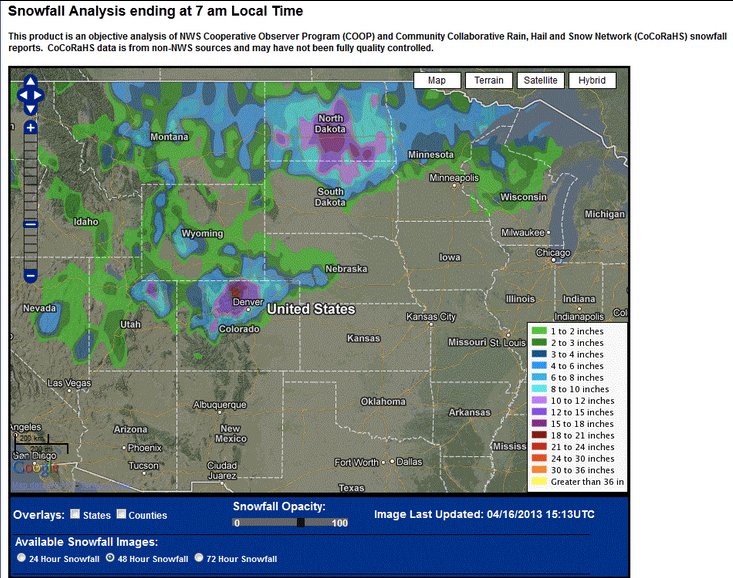
Loveland’s total snowfall from a three-day storm that moved in Monday was a hair over 19 inches. That figure shows in data collected from home-based stations of the Colorado Collaborative Rain, Hail and Snow Network…

This month is on track to compete as the coolest and wettest April in local weather history, with low temperatures setting daily records on several occasions during the first half of the month. For the first 17 days of April, Knoetgen’s station has recorded 20.7 inches of snow and 2.54 inches of total moisture. Normal numbers for the entire month are 3.8 inches of snow, and 2.16 inches of moisture.

From the Wyoming Tribune-Eagle (James Chilton):

Cheyenne relies primarily on mountain snowpack for its municipal water as spring snowmelt helps to recharge the city’s five reservoirs. And while those reservoirs were in decent shape prior to the storm n at about 72.4 percent capacity n the new mountain snowpack should ensure they are all at or near 100 percent in time for summer, officials say…

According to Al Dutcher, a climatologist with High Plains Regional Climate Center in Nebraska, they are not out of the woods yet. He said that while the snows have contributed much-needed moisture to the topsoil in Wyoming, it isn’t enough to reach some of the deeper soil that crops need to grow best. “If we can break this cold weather and get seeds in the ground over the next few weeks, we’ve got enough moisture to at least get the crops established,” Dutcher said. “We just don’t have any deep subsoil profile moisture. So if we do get crops established, how aggressive will their rooting system grow into this soil?”[…]

According to the U.S. Department of Agriculture’s Drought Monitor website, this week is the first time in more than seven months that no part of the state is in “exceptional” drought. That is the worst of four categories that the site monitors. And only about 40 percent of the state is in “extreme” drought, compared to 64 percent on Jan. 1.

NSAA vs. USFS: ‘There is a fundamental difference of opinion that will be hard to overcome’ — Jim Pena

powderhornskiarea.jpg

From The Denver Post (Jason Blevins):

The Forest Service on this week launched the first of several public meetings and forums as it outlines a contentious push to secure water rights used by ski areas on public land. “There is a fundamental difference of opinion that will be hard to overcome,” said Jim Pena, the Forest Service’s acting deputy chief, acknowledging ski area opposition to the agency plan to revamp permits with new regulations addressing the ownership of water rights.

The public meeting on Tuesday was sparsely attended at the Forest Service headquarters in Lakewood. Ski area officials huddled together while leading agency officials — the landlords of 122 U.S. ski areas, including 22 in Colorado — stood ready to answer questions that didn’t come.

It’s a complex issue, as is any that deals with Colorado’s byzantine water right laws. And probably not something that stirs the public. But for ski areas, the Forest Service push to secure water rights owned by resorts operating on public land is a critical issue.

The National Ski Areas Association, which successfully sued to overturn early versions of the water clause, met with the agency before the public hearing and offered two options that would deflect the Forest Service need to take ownership of water rights used on public land. (That invite-only forum is one of several the agency is holding with resort communities, ranchers, conservation groups and other stakeholders as it scripts the new ski area permit water clause.)

The association’s options would require ski areas to prove sufficient water is available for every new project and any ski area sale would include options to sell ski-operation water rights to the buyer, the local community or the Forest Service. “We are excited about having ideas and offering something new,” said the association’s public policy director Geraldine Link, who led the industry’s lawsuit to overturn the water clause. “We are staying let’s start over. We think there is a way to address Forest Service concerns without the seizure of assets.”[…]

Pena said federal ownership may not be the only answer, hence the public meetings. The agency owns roughly 21 percent of the country’s ski area water rights, shares ownership of 4 percent and the remaining 75 percent is owned by ski area operators. Regulations that require water rights remain connected to public lands would prevent ski area operators from selling water rights as a commodity that eventually may be worth more than skiing.
“Without long-term assurances for water, we feel we could be the public’s interest at risk,” he said. “The whole idea of sustainability is about preserving resources for future generations. We are seeing more of the ski industry being managed by corporate interests. They are no longer mom-and-pop operations. We have to be prepared for people making different business decisions than what is best for the public.”[…]

Davey Pitcher, the owner of southern Colorado’s Wolf Creek ski area, allowed the Forest Service to share ownership of his water rights when he renewed his permit in 2000.
“We don’t see a problem with,” Pitcher said, noting how the agency allows intensive ski infrastructure on public land, like trails and chairlifts, so it makes sense for the Forest Service to want to protect the water needed for skiing. “We see it as a reasonable request.”

More water law coverage here.

Lincoln Park/Cotter Mill superfund de-commissioning could take 10-15 years

cottermillcontaminationconcerndenverpost10232011

From The Pueblo Chieftain (Tracy Harmon):

Members of a Community Advisory Group took their first look at a road map defining the course of action for decommissioning of the Cotter Corp. Uranium Mill Thursday. The now defunct mill and a portion of the neighboring Lincoln Park community have been a Superfund site since 1988 due to uranium and molybdenum contamination in groundwater and soils.

Jennifer Opila, a state health department radioactive materials unit leader, told the group that the road map will likely be updated and changed as the decommissioning goes forward. Basically it outlines what cleanup has been done and what plans are already in place. “We will need to update the plans to make sure they meet the needs as we go forward and the community will be involved,” Opila said. “Some information has been developed but in almost every case, we think more info needs to be gathered as we develop a remedial investigation.”

The very next step is uncertain, she said. “We are in new territory with a new team for both the state and the EPA so a lot of things we still are trying to figure out,” Opila said. “We might start with Operable Unit 1 (the Lincoln Park community) or what makes sense — maybe it is the mill site itself or all the units at the same time.” As the cleanup plan progresses, “We will start to compare potential different remedies to see if each meets all the nine criteria and is protective of human health and environment,” said Peggy Linn, EPA community involvement coordinator. “I hate to say it but we might look at the cost a little bit. We will discuss the findings all along the way with the group,” Linn said.

Once a proposed remedy or cleanup plan is selected, the public will again have a chance to comment. A remedial design will be followed by the remedial action plan during which, “We start actually building it,” Linn said. Even after the cleanup is complete, health authorities will continue five-year reviews to, “Check to see that everything is working,” Linn said. Decommissioning could take 10 to 15 years.

More Lincoln Park/Cotter Mill superfund site coverage here and here.

Arkansas Valley Conduit funding at risk

arkansasvalleyconduitproposed

From The Pueblo Chieftain (Chris Woodka):

The funding pipeline for the Arkansas Valley Conduit has sprung a leak. Federal funding pressures could reduce conduit funding to one-third of its current levels and far less than Southeastern Colorado Water Conservancy District officials had hoped for in next year’s budget. “The conduit is not the only project affected. There are projects under construction that got cut,” Southeastern lobbyist Christine Arbogast told the board Thursday. “Delays cost money, so it’s going to make it more difficult as we move forward.”

The district discussed a figure of $14 million to begin design and construction of the conduit in 2014. However, the budget President Barack Obama submitted to Congress last week included only $1 million for the conduit. The Bureau of Reclamation is on pace to complete an environmental impact statement for the conduit by the end of this year. But several other water projects already being built saw cuts of 75 percent or more in the president’s budget.

If Congress adopts another continuing resolution, rather than a budget, the conduit might retain its current level of funding, $3 million, in 2014, said Executive Director Jim Broderick. Otherwise, the district appears to be out of options to increase funding. “It’s clear the game is different than it used to be,” Broderick said, recounting last week’s visit to Washington, D.C. “This doesn’t stop the project, but it will move at a different pace.”

A federal law in 2009 provided a way to repay the federal government for conduit costs through storage contract payments to Reclamation for use of the Fryingpan-Arkansas Project. But payments would not start until after the project is completed.

The conduit could cost up to $500 million to build and would deliver fresh drinking water from Pueblo Dam to 50,000 people in 40 communities along the Arkansas River. “We’re concerned about the drop in funding, but we’re still in the pre-construction phase,” Broderick said.

More Arkansas Valley Conduit coverage here and here.

Colorado River Named Most Endangered in United States #ColoradoRiver

uppercoloradoriverbasinstatesultimatum09011925denverpost

Here’s a release from Western Resource Advocates (Jason Bane):

The Colorado River is the most endangered river in the United States, according to the 2013 list of America’s Most Endangered Rivers® released today by the nonprofit group American Rivers. Western Resource Advocates, a conservation organization that works throughout the entire Colorado River Basin, issued the following comments in response to the new listing:

“We all have our own dreams and visions for the future of the West,” said Bart Miller, Water Program Director at Western Resource Advocates. “But this is one subject where there can be no disagreement: If we don’t protect the Colorado River, we don’t have a future. It’s really that simple – an endangered Colorado River is a danger to us all.”

The Colorado River provides drinking water for more than 36 million people in seven states. The river is also critical to our regional and national food supply, providing irrigation for 4 million acres of farmland.

“We are using water in the West at a rate that is simply unsustainable,” said Drew Beckwith, Water Policy Manager at Western Resource Advocates. “The good news is that we can solve this problem if we act quickly. If we implement aggressive conservation, reuse, and efficiency programs for both municipal and agricultural users, we can protect the Colorado River and its many species, while at the same time exceeding projected water demand through 2060.”

The population in the West is expected to rise by 50% in the next 50 years; at the same time, Colorado River flows are projected to decline by 10% or more. Not only would this decline impact food and water availability, but it would be a huge blow to a growing recreation economy responsible for more than $26 billion in annual revenue for the Colorado River Basin states.

Western Resource Advocates has long advocated that water conservation and reuse should be the backbone of any plan for meeting future water demands in the Colorado River Basin. This is particularly critical in the face of climate change scenarios that experts agree will lead to increased frequency and severity of drought.

More Colorado River Basin coverage here and here.

American Rivers Designates the Colorado River the Nation’s ‘Most Endangered’. Explore Diverse Perspectives on CFWE Tours!

These tours sound like a hoot. I’m wondering if there will be a stop at the Grand River Ditch, a favorite of mine?

Drought/snowpack news: Reclamation and Army Corps of Engineers Plan for Continued Drought #COdrought #NMdrought

seasonaldroughtoutlookcpc04042013

usdroughtmonitor04162013

snowpackcolorado04182013

Click on the thumbnail graphics for the current statewide snowpack map, current U.S. Drought Monitor map and the most recent drought forecast from the CPC.

From the Bureau of Reclamation (Mary Perea Carlson):

The Bureau of Reclamation’s Albuquerque Area Office and U.S. Army Corps of Engineers today released their Annual Operating Plan for the Middle Rio Grande.
As we head into our third consecutive year of severe drought, Reclamation is focused on working closely with all partners to operate to meet both water user needs and flow targets under the 2003 Biological Opinion for the Rio Grande silvery minnow.

In a dry year, the biological opinion requires Reclamation to keep the river wet to Isleta Diversion Dam. Below that diversion dam and in the San Acacia reach, the river can be dried in a controlled manner after June 15. The current model projection for demand to meet flow requirements is somewhere between 65,000 and 80,000 acre-feet, however that forecast assumes minimal monsoons.

The April forecast data released by the Natural Resources Conservation Service shows snowpack volumes throughout northern New Mexico are approximately 45 percent of average. The inflow at El Vado Reservoir is expected to be about 80,000 acre-feet of water or about 36 percent of average. The inflow at Heron Reservoir is expected to be about 45,000 acre-feet or about 55 percent of average.

Reclamation is currently negotiating additional water leases and expects to have approximately 40,000 to 50,000 acre-feet of water to supplement river flows. Reclamation is working closely with the Army Corps of Engineers, Albuquerque Bernalillo County Water Utility Authority, Middle Rio Grande Conservancy District, New Mexico Interstate Stream Commission and other stakeholders to optimize the use of supplemental water. Reclamation will again be working with the Albuquerque Bernalillo County Water Utility Authority to move water from El Vado Reservoir to Abiquiu on the weekends to allow for rafting flows on the Rio Chama.

One weather system this week = flooding rains, heavy snow, severe thunderstorms, and tornadoes in the Rockies and Midwest

cocorahsprecipending041820138am.jpg

From the CoCoRaHS blog:

This has been an interesting week for spring weather from the Rockies through the Midwest. In the last 24 hours there have been flooding rains, heavy snow, severe thunderstorms, and tornadoes, all related to the same weather system

Much of Colorado got more snow in the past 24 hours, with as much as 15 inches in south-central Colorado near Pueblo. Snow also accumulated 2 to 3 inches in western South Dakota and 2 to 4 inches in northern Minnesota. Snow also occurred in Nebraska and northwestern Kansas.

Forecast news: Isolated showers possible in the mountains, cold air to settle in #COwx #COdrought

From the National Weather Service Grand Junction office:

We’ll get off to a cold start to the day with snow showers lingering along the continental divide throughout the day. The arctic airmass left in the wake of yesterday’s storm will keeps highs well below normal this afternoon, despite plenty of sunshine for much of the region. Overnight lows are expected to dip below freezing again tonight threatening tender vegetation and budding fruit trees. Temperatures will begin to warm Friday reaching near normal values this weekend. However…a pair of spring storms will impact the area Friday afternoon through Saturday night and another Sunday afternoon through Monday night bringing additional snow to the Colorado mountains…especially in the north.

From the National Weather Service Pueblo office:

Lingering snow showers and cloud cover will gradually decrease through the morning, though the mountains will continue to see isolated to scattered snow showers throughout the day. Additional accumulations of an inch or two will be possible over the mountains. Gusty north winds will continue across the area this morning, though will gradually decrease through the afternoon. Temperatures today will remain well below normal, topping out in the 30s and 40s across the lower elevations with 20s and 30s across the mountains.

From the National Weather Service Grand Junction office:

Cold air spreading was across eastern Utah and western Colorado tonight. Low temperatures in the teens and 20s across the valleys tonight prompted a freeze warning for the Grand Valley, the Delta, Montrose and North Fork areas, and the lower valleys of southeast Utah including Moab. The heaviest snow from the most recent storm has shifted to the east, but scattered light snow will continue near the Continental Divide until morning.

Snowpack news: Good late season numbers north, runoff underway south #COdrought

statewidebasinhilow04172013

snowpackcolorado04172013

Click on the thumbnail graphics for the statewide snowpack map along with the statewide Basin High/Low graph for yesterday. It’s been a long time since there was any green (average) on the statewide snowpack map. Back on February 12, 2013 the combined San Juan, Animas, Dolores and San Miguel snowpack showed up green, narrowly, at 91% of average. Yesterday, the Upper Colorado River and the North Platte River basins turned green due to the recent snowfall. Keep in mind that the Upper Colorado River Basin is often melting out by now so it is gaining against a declining average. In any case it increased 2-3 inches of SWE this month so far and that is good news.

From The Pueblo Chieftain (Chris Woodka):

… a steadily increasing snowpack…is approaching nearly normal levels at a few sites in the mountains. Statewide, snowpack was about 82 percent of normal Wednesday, 73 percent in the Arkansas River basin, but 94 percent in the Upper Colorado basin, which provides supplemental water to Arkansas River users. However, snowpack in the Purgatoire River basin, which helps farmers below John Martin Dam, is far below average.

Reservoir levels are well below 2012, and at 2003 levels for Turquoise and Twin Lakes. Lake Pueblo is at 88 percent of normal, better than it was in 2003, after drought had tapped out water supplies.

From the Loveland Reporter-Herald (Tom Hacker):

Five straight days of stormy mountain weather have pushed a once-dismal snowpack much closer to normal. High mountain snows that feed the Big Thompson and Poudre rivers were at 70 percent of normal levels April 8, but on Wednesday they had reached 86 percent of the average for the date. It’s a big jump, and at just the right time. “The good news is that this comes when we’re not watering and we’re not irrigating,” said Mage Skordahl, snow survey supervisor for the Natural Resources Conservation Service in Denver…

Just a week ago, municipal water providers and farmers heard gloomy predictions for the summer ahead from Northern Water, the agency that manages the water supply from the Colorado Big-Thompson Project. And board members of the agency on Friday said Northern Water would distribute just 60 percent of the annual water shares to users. That was before the snow began falling. The forecast for the northern Front Range calls for more mountain snow in the week ahead. “This is a good month, no question about it,” Northern Water spokesman Brian Werner said Wednesday. “It plays hell with my golf game, but I’m willing to forgo golf if it means we’ll have more water.”[…]

…a [SNOTEL site snow] pillow that transmits data from Bear Lake in Rocky Mountain National Park on April 1 counted 10.3 inches of “snow water equivalent” — the conservation service’s most-watched measure. On Wednesday, it hit 14 inches, moving toward the 30-year median April peak of 18.6 inches. “From the point of view of the municipalities, we’re still below normal,” Skordahl said. “We depleted our reservoir storage so much last year that there’s still some concern. But if this keeps up, there’s a chance we could reach our normal peak. It’s great news that these storms have finally arrived.”

2013 Colorado legislation: HB13-144 (Authorize Graywater Use) passes state Senate Ag committee #COleg

graywatersystem.jpg

From the Northern Colorado Business Report (Steve Lynn):

The bill, sponsored by Rep. Randy Fischer, D-Fort Collins and Sen. Gail Schwartz, D-Snowmass Village, now heads to the Senate Appropriations Committee. Lawmakers there will consider a $110,000 appropriation to fund development of gray water standards by the state Department of Public Health and Environment.

The measure passed the House Appropriations Committee unanimously earlier this month. “It’s looking pretty positive, I think, in terms of its possibility” of passing the Senate Appropriations Committee, Fischer said. “There’s no opposition to it that I’m aware of.”

Colorado water law allows just one use of water before it goes down the drain, through a wastewater treatment plant and back into the river for others to use. Gray water systems “actually aren’t legal right now,” Fischer said. He pointed out that the University of Colorado at Boulder cannot use a gray water system it installed in a newer residence hall because of state health regulations. “The most important thing the bill does is direct the Colorado Water Quality Control Commission to promulgate minimum statewide standards for gray water systems,” he said.

The bill also lets cities and towns decide whether to approve gray water systems, he said.

More 2013 Colorado legisation coverage here.

Lower Ark board meeting recap: ‘Wells provided a one-year hedge against drought’ — Steve Witte

arkansasriverbasin.jpg

From The Pueblo Chieftain (Chris Woodka):

Wells in the Arkansas Valley protected the agriculture economy in 2012, but reduced pumping levels this year are likely to hurt farming if weather conditions don’t improve. “Wells provided a one-year hedge against drought,” Water Division 2 Engineer Steve Witte told the Lower Arkansas Valley Water Conservancy District board Wednesday. “To quote Dale Mauch (a Lamar-area farmer quoted in The Pueblo Chieftain last summer): ‘If you’ve got a well, you’ve got a crop.’ ” This year, the situation is worse for farmers who rely on wells. Because of in-state shortfalls, pumping levels have been curtailed for most farmers. Unless farmers use their own surface rights to augment wells, pumping levels will be at only 10 to 30 percent of normal, with many farmers forced to shut off the pumps completely.

Last year, farmers pumped about 110,000 acrefeet of water (36 billion gallons), which was roughly three-fourths of the historical average prior to restrictions. The farm economy suffered much more, however, because of other factors.

During the drought of 2011-12, soil moisture plummeted, a trend that has continued since 2000. There also was less water available to surface ditches in both years.

Another problem for farmers will be increased transit loss as water from storage is released to headgates downstream. Normal loss from Pueblo Dam to the Rocky Ford area would be about 12 percent, but with river levels lower, it increases to 50 percent, Witte said.

One ray of hope offered at the meeting is a steadily increasing snowpack that is approaching nearly normal levels at a few sites in the mountains. Statewide, snowpack was about 82 percent of normal Wednesday, 73 percent in the Arkansas River basin, but 94 percent in the Upper Colorado basin, which provides supplemental water to Arkansas River users.

However, snowpack in the Purgatoire River basin, which helps farmers below John Martin Dam, is far below average.

Reservoir levels are well below 2012, and at 2003 levels for Turquoise and Twin Lakes. Lake Pueblo is at 88 percent of normal, better than it was in 2003, after drought had tapped out water supplies.

From The Pueblo Chieftain (Chris Woodka):

A water quality study spawned 10 years ago is focusing on finding causes for sedimentation and loading of harmful elements like selenium and uranium into the Arkansas River. “The real desire is to assist resource managers to find the source of a problem and attack it there, rather than put an ineffective plan in place,” said David Mau, head of the U.S. Geological Survey Pueblo office. He spoke at Wednesday’s meeting of the Lower Arkansas Valley Water Conservancy District.

The study began through a 2003 agreement among Aurora, the Southeastern Colorado Water Conservancy District and the Upper Arkansas Water Conservancy District.

The water resources group also includes Colorado Springs Utilities, the Pueblo Board of Water Works and the Lower Ark district. Aurora provided the initial funding.

The purpose of the study was to establish a water quality baseline before large projects like the Preferred Storage Options Plan, Southern Delivery System and Arkansas Valley Conduit went online. The USGS cataloged existing data on the river.

A 2009-11 study looked at two threatened reaches of the Arkansas River: from Canon City to Lake Pueblo, and from Lake Pueblo to La Junta. Loading of solids and uranium were found in both reaches, while heavy loading of selenium from Fountain Creek was prevalent downstream.

Mau said studies will continue to pinpoint sources of the pollution to help minimize the impact on water quality as projects continue.

More Arkansas River Basin coverage here and here.

Weekly Climate, Water and Drought Assessment of the Upper Colorado River Region #COdrought #ColoradoRiver

wyutcoprecipitationthruapril15

Click on the thumbnail graphic for the precipitation summary. Click here for all the summaries.

Forecast news: Rain and snow possible across eastern Colorado, heavy snow possible in the mountains #COdrought #COwx

From the National Weather Service Pueblo office:

A low pressure system will push across Colorado on Wednesday, dragging a cold front through the region during the afternoon and early evening hours. Moisture will increase across the area behind this front, with scattered to numerous rain and snow showers developing across eastern Colorado. Gusty winds could bring white out conditions to some locations, making travel hazardous especially across the mountains and northern El Paso county late Wednesday. Persons planning travel across the state should remain weather alert and visit our web site at http://www.weather.gov/pub for the latest updates on any watches, advisories or warnings across eastern Colorado.

From the National Weather Service Grand Junction office:

A wintry storm system will continue to sweep slowly eastward across the region today…lingering into the evening hours. Cold air associated with this system had brought snow to the lowest valleys early this morning and will continue to generate snow over much of the region through the day. A number of winter weather highlights are in place across eastern Utah and western Colorado today and this evening. Details are available at weather.gov/gjt. Temperatures will sink to near record values across the region tonight with a hard freeze expected in the lower valleys threatening tender vegetation and fruit trees. Temperatures will moderate going into the weekend, however a pair of weaker storms will impact the area Friday night through Saturday night and again Sunday night through Tuesday.

Drought/snowpack news: No watering restrictions for Pueblo #COdrought

seasonaldroughtoutlookcpc04042013

usdroughtmonitor04092013

snowpackcolorado04152013

From The Pueblo Chieftain (Chris Woodka):

Pueblo is swimming against the tide in the current drought. No outdoor watering restrictions are planned because demand is decreased and snowpack improving to the point where the Pueblo Board of Water Works does not see its water rights being curtailed this year.

Many large water providers already have limited outdoor watering to 2 days per week. Pueblo continues to resist the trend. “Other Front Range cities rely on imported water, but our direct flow rights provide 90 percent of the water we use,” Executive Director Terry Book told the board Tuesday. Pueblo has transmountain water rights that could supply about half of its total water supply, but most of that usually is either stored or leased.

Demand is expected to increase as Pueblo grows. The demand for water on a typical winter day is about 11 million gallons, but it increases to more than 50 million gallons when the thermometer hits 100 degrees.

Water resources administrator Alan Ward and finance manager Seth Clayton expect the board will have enough water to cover that normal usage for several reasons:

● For the past 10 years, it has tripled its goal for water in storage to 45,000 acre-feet. Last year, about one-third of the water was pumped from June to October, and the board expects to recover some of that loss this year, improving storage to 32,000 acre-feet by this time next year, Ward said.

● Last year, the board leased 13,000 acre-feet of water to farmers. Those leases were discontinued this year, he added.

● Customer demand is 7 percent lower than at this time last year because of cooler weather, Clayton said.

● Pueblo will request its 10 percent share of Fryingpan-Arkansas Project water this year. In most years, it has declined that water.

Snowstorms during the last week have improved snowpack in the mountains, and could mean a later runoff. In fact, the water board had been clearing its ditches that bring water from the Colorado River basin over the Continental Divide in anticipation of an early runoff such as 2012 before the latest round of storms, Ward said.

The water board is looking at a revised drought response plan that would be triggered if reservoir levels dip below certain triggers. It includes four stages designed to cut demand in order to manage the water supply.

Imposing restrictions now could mean unnecessary rate hikes in future years, Book added…

DROUGHT SCORECARD

Some indicators of what the ongoing drought means for the Pueblo area:

– Arkansas River levels are at near record lows for this time of year because of a dry winter and interrupted melt-off.

– Statewide snowpack remains low, at 77 percent of normal. However, it appears to be growing after storms this week. More may be on the way. Snowpack provides most of the water supply in Colorado.

– Precipitation since Jan. 1 has amounted to only 0.94 inches in Pueblo, less than half of the normal, 2.14 inches. It is below 2012, which was the second driest year since records began in the 1890s.

– Long-term weather forecasts by the National Weather Service are calling for above-average temperatures and below-normal precipitation through the summer months.

Click here for western Colorado and eastern Utah snowfall totals for yesterday from the National Weather Service Grand Junction office.

snowfallmapending04162013am

From the Fort Collins Coloradoan (Trevor Hughes):

The spring snowstorm that dropped more than 14 inches of snow on Fort Collins is officially the largest snowstorm this winter. The Colorado Climate Center at CSU confirmed this storm’s record of 14.9 inches at the university’s central campus. Higher elevation areas got significantly more snow, including 27 inches near Estes Park. Until this storm, the previous biggest storm of the year was March 23, when 6.7 inches fell…

“As nice as this is, and as much as this is helping with the drought, it’s not totally brought us out of the woods yet. But we’re in much better shape than we were last year,” said Noah Newman, a climate center research associate.

From the Canyon Courier (Sandy Barnes):

Residents in the Lookout Mountain Water District can anticipate dwindling water supplies in the coming months — a scenario created by extended drought conditions and low-priority rights. At the end of 2012, the reservoir on Squaw Pass Road was only 67 percent of capacity with 174 acre-feet of water, according to water district information. The 500 residents connected to the district system typically use 200 acre-feet of water a year collectively. “It’s a pretty sustained problem for us,” said Christina Shea, LMWD administrator. “This year is worse.”

In an effort to conserve the supply, the district is enacting surcharges for use over the standard amount, said Shea. The surcharges will begin with the May billing period and will continue through September. “We are desperate,” said Shea. “We are trying to help our customers understand.”

Shea said the upcoming charges will be added to water usage greater than 2,500 gallons a month per household. In a 60-day billing cycle, if a residence is over the 5,000-gallon limit, then surcharges are added to the standard fee of $42. Those who use greater amounts of water are subject to extra fees ranging from $1 to $200 per 1,000 gallons, depending on the total overage.

Adding to the problem of the ongoing drought, which has affected many area water supplies, is that the Lookout Mountain district has low priority water rights, said Shea. The water the district uses originally belonged to the city of Golden, she said. When Golden no longer needed this source of water, the Lookout Mountain Water District formed and acquired this supply, which has water rights dating from 1903. Whenever surrounding communities such as Arvada need water, they call the rights from the Lookout Mountain district, affecting its supply. Adding to this dilemma is that the state has become stricter in enforcing water priority usage, said Shea.

Because of this situation, the Lookout Mountain district will have to rely on its stored water in the coming months. The Beaver Brook watershed, which is the source of the Lookout Mountain water, is small in comparison to the one in Bear Creek that serves Evergreen, Shea noted. To get the message across to district residents about water shortages, they are penalized for using excessive amounts, Shea said. “I feel like our board has been very proactive,” she remarked. “It’s a severe situation.”

From the Loveland Reporter-Herald (Tom Hacker):

When Rocky Mountain National Park rangers plowed their way to the snowbound Bear Lake area Tuesday, they measured 29 inches of snow that had piled up there since the weekend. Fourteen inches of new snow had fallen since the last 15-inch measurement was taken Monday morning at the Bear Lake center at an elevation of 9,475 feet, park spokeswoman Kyle Patterson said.

On the west side of the Continental Divide in the park, another 10 to 12 inches had fallen at the Colorado River Trailhead, bringing the total there to about 22 inches.

From Denver Water:

As of today, we would need 4 feet of snow in our mountain watersheds to get to a normal snowpack; however, even with a normal snowpack our reservoirs still would not completely fill this year. But, every little drop helps. Droughts are unpredictable. We don’t know what is in store for us next winter, or even the winter after that. We’ll continue to manage our supply and demand in case these drought conditions carry over into the next few years. So, even if the next couple of weeks bring us to our average snowpack levels, we still expect to have the Stage 2 mandatory drought restrictions in place to save as much water as possible this summer.

From The Denver Post (Joey Bunch):

The snow season saved its best for last this year, boosting snowpack in the reservoir-rich Colorado River basin from a woeful 72 percent of average on Feb. 2 to a promising 93 percent Tuesday. From Saturday to Tuesday alone, the percentage against the 30-year average jumped by 7 percentage points. “It’s not done yet,” state climatologist Nolan Doesken said Tuesday afternoon. “What we got yesterday and last night was just sort of a precusor to a big system that should arrive in the mountains Wednesday.”

Areas that saw more than 2 feet of very wet snow Sunday and Monday could pick up as much as 18 more inches Wednesday, he said. “It’s made a super strong comeback in the last four days,” Doesken said of the state’s snow supply, which provides most of the water Colorado needs for household use, irrigation and recreation all year long…

Mage Hultstrand, assistant snow survey supervisor for the Natural Resources Conservation Service in Lakewood, said the high percentage of normal is a bit misleading but in a good way. Colorado’s snowpack typically begins to melt on April 10, but a week later this year, the snowpack is still mounting, so the percent of average looks higher measured against past numbers that typically are shrinking this time of year…

Denver Water’s 10 reservoirs haven’t been full since July 2011, so there is a lot of ground to make up for last year, said Bob Steger, the utility’s manager of raw water supply.

Douglas County Water Resource Authority video: Replace a toilet — Water Smart Tips #COdrought

From email from the Douglas County Water Resource Authority:

Did you know the biggest water waster in your house can be your toilet!?!

Sometimes all you need to do is replace the leaky flapper, but sometimes it might be a good idea to replace your old toilet with a more water efficient model.

Our new two-minute “replace a toilet” video takes the mystery out of exactly how to do that. Save water, save money. It’s easy!

The Colorado River tops American Rivers’ most endangered rivers list for 2013 #ColoradoRiver

coloradoriverbasin2012doiviatheaspentimes

From American Rivers’ River Blog (Amy Souers Kober):

Today, American Rivers and our partners at Nuestro Rio, Protect the Flows, Save the Colorado and the National Young Farmers Coalition are calling on Congress to give cities and farmers across the basin the tools they need to build a future that includes healthy rivers and reliable, sustainable water supplies. We are asking Congress to fund the Bureau of Reclamation’s WaterSmart and Title XVI Water Reclamation and Reuse programs. These programs help stakeholders optimize existing water infrastructure, maximize available water supplies, and provide healthy river flows for communities and ecosystems.

While over-allocation of water is most pronounced on the Colorado River, it’s a problem we’re seeing on rivers nationwide. In fact, the top four rivers in America’s Most Endangered Rivers of 2013 suffer from outdated water management. What’s clear for all of these rivers is that we all need to be part of the solution. It’s time to work together to ensure clean water supplies and healthy rivers for our children and grandchildren.

Click here for a map showing the 10 rivers on this year’s list.

From AZCentral.com (Brandon Loomis):

The Colorado, the lifeblood of the Southwest, is at a crucial moment in its history, American Rivers says, and Congress and the states that tap its waters must plan for better use — and re-use — of its water to meet a growing need. “The current trends are not sustainable,” said Matt Niemerski, western water-policy director for American Rivers…

American Rivers has published “America’s Most Endangered Rivers” every year since 1986, and the Colorado has made the 10-river cut seven times. It has topped the list twice before, most recently in 2010. The group reorders the list annually to draw attention to particular rivers when a related policy decision is looming. This year, the group wants Congress to boost a WaterSmart program that is slated to get about $30 million next fiscal year for grants to water-conservation programs, Niemerski said. Such grants could help water providers build desalination or other treatment plants, or plan for smarter management. “We need to start this work now,” he said…

Arizona is entitled to 2.8 million acre-feet of Colorado River water a year, and 1.5 million of it flows through the Central Arizona Project canal from the state’s western edge to Phoenix, Tucson and points in between.

A CAP official was puzzled by the group’s choice to elevate the river’s threat status based on a government report that actually could signal the start of better regional water planning. “We all recognize (the Reclamation report) as a call to action,” said Chuck Cullom, CAP’s Colorado River program manager. He also mentioned a new agreement with Mexico allowing for storage of some of that country’s allocation in Lake Mead to ease shortages in drought years. “We’ve taken aggressive steps in the past year to protect and enhance the river,” Cullom said.

From The Denver Post (Bruce Finley):

The advocacy group American Rivers on Wednesday will declare the Colorado River “the No. 1 most endangered” in the nation.
Federal authorities warn that even if courts step in to reallocate shrinking river flows, 40 million people who rely on the Colorado still would face problems…

“We can only solve this problem by working together,” Anne Castle, the U.S. Department of the Interior assistant secretary for water and science, said at a University of Denver law school forum. Negotiating competing uses on an over-subscribed river “is not without pain, not without litigation,” Castle said. However, a judicial decision “doesn’t solve these problems.”

American Rivers ranked the Colorado River most endangered due to worsening water deficits…

…people are, indeed, draining the river. Front Range cities divert about 500,000 acre-feet a year from the basin to sustain 80 percent of today’s population. More diversions are planned here and in Utah. For example, Denver Water, which supplies 1.3 million metro residents, is pushing to divert 18,000 acre-feet from upper Colorado River tributaries. “But we’re not looking at developing additional water resources on the Western Slope after the Moffat project,” utility planning director David Little said, calling American Rivers’ 300,000 acre-feet estimate “overblown.”[…]

…Colorado and the upper states face a dilemma, said Eric Kuhn, manager of the Colorado River Water Conservation District, which represents 15 Western Slope counties. Are they still obligated to deliver 7.5 million acre-feet a year to lower states?
“Some of the Front Range folks take the view that Colorado is entitled to more water, and that the Lower Basin is using some of our water,” Kuhn said. “But how do you develop more water on a river that is already overused?”

If you are in Salida this evening check out the film Watershed:

More Colorado River Basin coverage here and here.

Colorado Water Trust leasing program hopes to shore up streamflow in the Yampa River again this season #COdrought

yampariverbasin

From Steamboat Today (Matt Stensland):

Last year, the nonprofit organization aimed at keeping waterways flowing leased 4,000 acre feet of water for the Yampa River. That translated into increasing flows by about 26 cubic feet per second for a large part of the summer…

Colorado Water Trust attorney Zach Smith said the spring weather and snowpack amounts will dictate how much water can be leased for the Yampa this year. The bigger the snowpack, the less the group can lease. On Monday, the snowpack in the Yampa/ White River basin was 81 percent of average.

Last year, 4,000 acre feet of water was leased from the Upper Yampa Water Conservancy District, which owns Stagecoach Reservoir. The Colorado Water Trust paid about $140,000, or $35 per acre foot of water…

The Colorado Water Trust is reaching out to water right owners who might be interested in leasing their water this year. Smith will be in Steamboat from 4 to 6 p.m. Thursday in Library Hall at Bud Werner Memorial Library to explain how the Request for Water 2013 water leasing program works. He will discuss the legal authority and technical underpinnings of the program. He also will talk about how the various forms work, what a water user can expect if he or she offers water for lease, how the water valuation process works and approximate timelines.

More instream flow coverage here.

USGS: Piceance Basin Water-Quality Reports Now Available #ColoradoRiver

Click here to read the release.

CoCoRaHS blog: The never ending winter #COdrought #COwx

snowfallmapending04162013am

From CoCoRaHS:

…winter has kept an icy grip on an area from the Rockies through the Northern Plains to the upper Midwest. Late last week snow and ice fell from Nebraska to Wisconsin, and over the last few days more than a foot of snow has piled up in parts of Colorado and the Dakotas…

The snow in Colorado yesterday was produced by another low moving across the Great Basin. This setup is ideal for snow along the Front Range. Easterly flow resulting from the low to the west and strong high pressure to the northeast forces the air to rise as it encounters the Rockies, condensing the moisture and producing precipitation…

These storms often produce lots and lots of snow, and this system was no exception. A foot of snow and more fell across the Fort Collins, Co area, home to CoCoRaHS headquarters…

Snow in the Denver area ranged from around 4 inches east of the city to 12 to 24 inches in the higher terrain west of Denver, with 24.5 inches of snow reported by a CoCoRaHS observer in Golden…

And it isn’t over yet. The system that brought the snow to Colorado will be lifting out to the northeast, and winter storm warnings are in effect for portions of Wyoming, Nebraska, and South Dakota. Winter weather advisories are in effect for parts of Montana, Wyoming, Colorado, Utah, and Nevada.

Western Resource Advocates video: The Water/Energy Nexus #COdrought

From Western Resource Advocates:

Ever wondered about the connection between energy and water? Or thought about how drought might impact electricity? Stacy Tellinghuisen, Senior Energy/Water Policy Analyst at Western Resource Advocates, explains how these two seemingly different issues are more connected than you might think.

Using the 2011 drought in Texas as an example, Tellinghusien explains how the connection between energy and water becomes even more apparent during times of drought. Recent droughts have had unexpected — and unprecedented — impacts on the energy sector, impacting both electricity demands and power plants’ ability to meet them.

More energy policy coverage here and here.

Forecast news: Isolated mountain showers ahead of next storm, red flag warning for San Luis Valley #CODrought #COwx

From the National Weather Service Pueblo office:

Expect a mix of clouds and sun over southeastern Colorado today. The mountains will have a chance for an isolated rain or snow shower throughout the day, while the valleys and plains will remain windy and dry. Temperatures will be 10 to 20 degrees cooler than yesterday in most locations. Fire danger will remain high in the San Luis Valley. Wind driven snow, approaching blizzard conditions, is possible Wednesday night. Beginning across the Pike’s Peak area, the snow will move southeast through the eastern plains. Models still disagree on the timing and strength of this system.

From the National Weather Service Grand Junction office:

A moist Pacific storm system will continue to bring widespread snow across northwest Colorado today. Occasional moderate to heavy snow will occur across northwest Colorado. Valley areas will have snow, or a mix this morning, but precipitation is expected to change over to rain this afternoon. For the southern areas, considerably drier but more windy with gusts to 50 mph across the Four Corners region this afternoon. Rain and snow will stay confined to the La Sal, Abajo, and San Juan mountains. Precipitation will be on the increase tonight with snow levels lowering to the valley floors by morning. The storm will continue through Wednesday.

Snowpack/drought news: Upper Colorado River snowpack = 85% of avg, South Platte = 76% statewide = 77% #CODrought

snowpackcolorado04152013

uppercoloradoriverbasinhighlow04152013

southplattebasinhighlow04152013

Click on the thumbnail graphics for the South Platte Basin High/Low and Upper Colorado River Basin High/Low graphs along with the statewide snowpack map from the Natural Resources Conservation Service.

Click here to view snowfall totals from the National Weather Service Boulder office.

2013 Colorado legislation: HB13-144 (Authorize Graywater Use) to get a hearing Wednesday in state Senate committee #COLeg

graywatersystem

From The Denver Post (Lynn Bartels):</p

Graywater is wastewater in a building that comes from showers, hand-washing sinks and washing machines. It does not come from toilets, urinals or kitchen sinks. Colorado is the only western state that doesn’t allow treated graywater to be used for flushing toilets, landscaping and such, but a proposal scheduled to be heard Wednesday in a Senate committee would change that.

House Bill 1044, by [Senator Gail] Schwartz, D-Snowmass Village, and Rep. Randy Fischer, D-Fort Collins, legalizes the use of graywater, calls for the development of regulations to protect the public health and gives cities and counties the discretion to offer graywater permits to single- or multi-family dwellings.

Bill supporters say a household with four people could save 58,000 gallons a year if it had a graywater filtration system installed.

The House unanimously passed the measure, which will be heard Wednesday by the Senate Agriculture, Natural Resources and Energy Committee. Sen. Greg Brophy, R-Wray, who sits on the committee, said he’s excited to hear the bill. “As long as we can protect the downstream users’ historical rights, there is nothing wrong with this idea,” he said. “A lot of money and energy goes into cleaning up water to bring it to drinking water standards, merely to put it on lawns and flush toilets, and we don’t need to do that.”

Schwartz also addressed that point, saying a number of Colorado’s wastewater treatment facilities are aging and need to be updated. She said the use of graywater would mean less input into those plants.

Fischer said he got the idea for carrying the bill from two Colorado State University professors who have been working on graywater issues. They have a graywater disinfectant vat set up in one of the residence halls and have been testing the system.

More 2013 Colorado legislation coverage here.

2013 Colorado legislation: Governor Hickenlooper signs SB13-074 #COleg

smithsditchwashingtonparkdenver

From The Pueblo Chieftain (Chris Woodka):

Gov. John Hickenlooper signed legislation, Senate Bill 74, to correct a glitch in Colorado water law that threatened the value of senior water rights, specifically pre-1937 decrees.

Sponsored by state Sen. Mary Hodge, D-Brighton, and state Rep. Jerry Sonnenberg, R-Sterling, the new law is designed to mitigate the impact of two recent Colorado Supreme Court decisions, which require senior ditch companies to prove that the farmers who initiated the rights in the 1860s intended to irrigate all the lands and ditches irrigated today.

“If farmers couldn’t find sufficient evidence demonstrating the intent of the original appropriator, the water court reduced the number of acres that could be served by the rights, even though the ditches had been irrigating the acreages for over 100 years,” said Andy Jones, a water lawyer representing the Legacy Ditch Association. “Colorado farmers, especially those in the South Platte River Basin, faced the prospect of having a substantial percentage of their net worth wiped out.”

SB74 restores certainty for Colorado farmers by saying that if a decree was granted prior to 1937 and is silent on permissible acreage, then all acreage [irrigated by the water right] within 50 years of the decree is lawful.

More 2013 Colorado legislation coverage here.

Drought/snowpack news: The NIDIS National Drought Early Warning Outlook is hot off the press #CODrought

seasonaldroughtoutlookcpc04042013

usdroughtmonitor04092013

snowpackcolorado04122013

Click here to read the outlook nationally or by region.

From the Trinidad Times (Steve Block):

The water situation in the Purgatoire River Valley looks pretty grim at the moment. The Trinidad area remains in the grip of a persistent drought, currently rated as D4, meaning exceptional drought conditions.

About 21 percent of Colorado is experiencing D4 drought conditions, including most of the Eastern Plains, according to State Climatologist Nolan Doesken.

Doesken said D4 conditions work the greatest economic hardship on crop production and cattle sales in southeastern Colorado.

“Exceptional drought, D4, is equal to the kind of situation you’d only see once in any 50-year time period,” Doesken said. “This is not unlike the extreme conditions that eastern Colorado had in the early and mid-1950s and back in the 1930s.”

Doesken said that in mid-March 89 percent of the state was in severe or worse drought conditions. Drought conditions continue to spread throughout the West, as statistics from the U.S. Drought Monitor showed that about 2.94 percent of the western U.S. is experiencing D4 conditions as of April 2, up from about 0.94 percent at the same time in 2012. Colorado’s Eastern plains and eastern Wyoming showed the greatest prevalence of D4 conditions, according to the drought monitor.

Drought conditions are expected to persist at least throughout the end of June, according to data released on April 4 from the National Weather Service’s Climate Prediction Center.

From the Summit County Citizen’s Voice (Bob Berwyn):

Last summer’s crippling Great Plains drought can’t definitively be linked with global warming, according to a team of federal scientists from various agencies. In a new report issued this week, the researchers said the drought was probably caused by a confluence of natural climate variations that might only come together in a similar constellation once a century.

Cyclical variations in ocean temperatures — especially the combination of a cooler-than-average Pacific Ocean and a warm phase of the North Atlantic Multidecadal Oscillation may have nudged the region toward drought conditions, but those factors tend to be more of a factor in suppressing winter precipitation.

And background global warming may increase the chances of high temperatures to begin with, but the research team couldn’t find a direct link between the drought and global warming — in fact, the region hit hardest by the drought has been a kind of global warming “hole” in the past few decades, said lead author Dr. Marty Hoerling, a researcher with the National Oceanic and Atmospheric Administration.

“The dominant control in this region is the amount of precipitation. When it’s dry, the ground gets really hot … This is one of those events that comes along once every couple hundreds of years,” Hoerling said, adding that the lack of El Niño conditions in the past 10 years may have been another small factor.

Salida: New wastewater treatment plant in production

salidacolorado

From The Mountain Mail (Casey Kelly):

Though improvements to the new Salida Wastewater Treatment Facility will not be fully completed for another couple of months, the city has begun treating wastewater at the new plant. The new facility began treating city water in November, and since then the city has been working to finish remaining improvements at the facility, Wastewater Plant Manager Randy Sack said Friday. Remaining improvements at the facility, which Sack said should be completed in the next “couple months,” include work on landscaping, the driveway, curb and gutter, phone and data lines, and painting.

Moltz Construction has been working on the new facility for the past 13 months, Sack said. “It’s working really nice,” he said. “It’s a little bigger. It’s doing a great job with the things we need it to do.”

Sack also said the new plant is all computerized, which allows easier monitoring of its operations. The previous plant was no longer meeting regulations for wastewater plants, City Administrator Dara MacDonald said. The plant was out of compliance with regard to levels of ammonia and biochemical oxygen demands, which Sack said “measure the organic strength of the wastewater.”

Sack said once the final improvements are made to the facility, the city plans to host an open house to invite the public to tour the new facility.

Sidebar on financials

The total cost of the Wastewater Treatment Facility upgrade project is $17.6 million. The project is being financed through a $12.1 million loan from the U.S. Department of Agriculture, a $1.35 million Department of Local Affair grant (with matching funds from the city) and a $2.6 million USDA loan the city received in 2009. The city will make its first payment on the $12.1 million loan in fall. The term of the loan is 40 years with an interest rate of 2.5 percent. At the time financing was originally approved, the interest rate was set at either 3.25 percent or the rate in effect at the time of the loan’s closing, whichever was lower. When the loan closed in February, the city secured the lower 2.5 percent interest rate. The city is required to make a minimum payment of $480,405 each year, but can make higher payments to lower the amount of total interest paid over the life of the loan. If the city makes only the minimum payments, it will pay $7.1 million in interest over the life of the loan.City Finance Director Jan Schmidt suggested at a February city council meeting that the city make payments that assumed the previous higher interest rate, which would have the city paying off the loan 8 months earlier and paying less money in interest.

City Administrator Dara MacDonald said when the city adjusted sewer rates, it was done in anticipation of the facility upgrade and the debt service that would come along with it. MacDonald said revenue from the city’s sewer enterprise fund is projected to cover the cost of the annual payments, along with the plant’s operation and annual maintenance costs.

Total 2012 revenues for the sewer fund came in at $1,444,641, and total expenditures, which included capital outlay costs for the facility’s construction this year, came in at $8,978,716. Excluding the one-time capital outlay costs this year, the sewer fund had $748,933 in expenditures, which would have resulted in net revenues of $695,708, enough to exceed the cost of the minimum annual loan payment.

More wastewater coverage here and here.

Forecast news: Wide ranging snowfall expected today as wet Pacific storm moves in #COwx #COdrought

From the National Weather Service Grand Junction office:

A moist Pacific storm system will spread widespread snow across northwest Colorado today and tonight. Occasional moderate to heavy snow will occur across northwest Colorado. Valley areas will have snow this morning, but is expected to change over to rain this afternoon. For the southern areas, considerably but more windy with gusts to 35-40 mph. Rain and snow will stay confined to the La Sal, Abajo, and San Juan mountains. This storm will continue through Wednesday, but a period of drier weather is expected during the day on Tuesday, but precipitation will be on the increase Tuesday evening with snow levels lowering to the valley floors.

From the National Weather Service Pueblo office:

Overnight, an upper trough will move into the area with strong westerly flow aloft remaining over the forecast area. Increasing moisture ahead of this system will bring snow to the Continental Divide through morning. Expect widespread cloud cover tomorrow with some light precipitation possible over the eastern mountains, adjacent Plains and the Palmer Divide. For the remainder of tonight..look for winds to gradually diminish and temperatures to fall to near freezing.

From the National Weather Service Pueblo office:

Snow showers are expected in and around the Leadville area through 6am Tuesday. Otherwise, clouds and some sun are expected elsewhere with breezy conditions and above average temperatures expected. Temperatures will be in the upper 60’s to near 70 across the I-25 corridor and eastern plains. The San Luis Valley can expect upper 50’s, while the mountains can expect 20’s and 30’s.

Parachute Creek spill: The town of Parachute is watching the clean up and asking questions #ColoradoRiver

roandrillingoilgaswesternresourceadvocates

From The Grand Junction Daily Sentinel (Dennis Webb):

Besides being concerned about possible tainted irrigation water, some Parachute residents are worried about the town’s tainted reputation in light of a natural gas liquids leak near Parachute Creek. Town Council member and former Mayor Roy McClung said the message needs to get out that “Parachute is not a toxic waste dump” as a result of a leak that is drawing national attention. McClung’s comments came during a meeting late last week, as Williams met with the Town Council to talk about its response to the leak and its efforts to protect the town’s irrigation water supply.

Williams recently said it has determined that the leak resulted from a faulty pressure gauge on a pipeline valve set. The gauge began leaking Dec. 20 and it wasn’t discovered and the leak wasn’t stopped until Jan. 3, when a worker went to inspect a valve that had closed down. The company initially believed the leak was less than 25 gallons. But in March it discovered widespread contamination. It now estimates that about 6,000 gallons of hydrocarbons have been recovered and about 4,000 gallons remain in soil and groundwater. The faulty gauge was on a valve set for a pipeline that leaves Williams’ gas processing plant and carries a mixture of propane, butane and other natural gas liquids to tanks on the other side of Parachute Creek. Williams believes that about 80 percent of the liquids that leaked vaporized once they escaped the pressurized line, but that heavier hydrocarbons seeped into the ground.

The Colorado Oil and Gas Conservation Commission says the pressure gauge may be the source of all the contamination, but an investigation continues.

Groundwater monitoring has found high benzene levels near the creek, including on the creek side opposite from the valve set, but it hasn’t been found in the creek water.

Surface water testing

The irrigation season is about to begin, and the town diverts water from the creek into a reservoir that’s used by residents and on town properties. Williams has been working to try to keep the creek water clean and has a plan in place to shut down the reservoir intake should contamination be detected upstream.

Judith Hayward is a Parachute resident who enjoys gardening. This year I’m going to be concerned unless I am assured somehow with testing that this water is not going to give me problems in my garden,” she told trustees and Williams officials.

Dave Keylor, vice president and general manager in the Piceance Basin for Williams, said the company has nine surface water testing points in the creek and six absorbency booms in place. It also visually inspects the creek each half hour and has installed about 90 groundwater monitors as part of its response.

The reservoir diversion point is about two miles downstream from the leak site. The town has given Williams the ability to control the diversion point because of the proximity of Williams workers to it and the company’s continuing monitoring of the water. “We feel confident that at this time, that you can turn your water into the irrigation ditch at the diversion point,” he told town officials Thursday.

The state Department of Natural Resources on Friday reported that diesel-range organics were detected in the creek at the diversion point, but also noted that recent creek tests in the contamination area didn’t detect the organics. Some intermittent diesel-range organics also have been detected upstream from the leak site and may be a result of things such as stormwater runoff from roads. The state also noted that there are several industrial sites between the leak area and the diversion point.

Parachute also has a second, unused reservoir that it is working on using for extra storage to temporarily meet irrigation needs should the creek show contamination. Keylor said contaminated water also could be diverted into that reservoir.

Inaccurate reports

Meanwhile, McClung said he worries about how all the media coverage of the leak will affect the town. “Nobody remembers the good stuff but they remember the bad stuff,” he said, citing environmental disasters in places such as Love Canal and Three-Mile Island. “… I’m afraid that we’re going to start building that kind of reputation in this valley.”

McClung said he has been called from as far away as North Carolina, from people with questions including whether the town will blow up. Town Administrator Bob Knight said he’s taken media calls from as far away as New York. McClung said he overheard at a local restaurant that a family that had been ready to move to Parachute changed their minds because of the leak. “That kills me to see families that don’t want to move here because of this,” he said.

Keylor and town officials said one challenge is inaccurate information reported in the media. Williams has created a website, http://www.answersforparachute.com, to provide information on the incident. Keylor said Williams community and corporate communications representatives also could help work with the town on public relations. Keylor said it’s also going to take “a lot of transparency and a lot of honesty” by Williams in terms of being upfront about the mess he said the company has made and what it is doing to determine the extent of the contamination and clean it up. “We feel our reputation has taken a hit here,” Keylor said, acknowledging that so have the reputations of stakeholders. “We take that personally.”

“It will take some time to rebuild our reputation but we’ll do it, we’re going to get this cleaned up, we’re going to be here for the long haul.”

Benzene questions

Williams’ efforts continue to focus in part on fully delineating the extent of contamination. Keylor said investigators believe they have done that on three sides, but not yet to the southeast of the valve set. The creek also heads southeast from the valve area before briefly angling south. As of Friday, benzene contamination had been determined to extend as far as 1,400 feet from the valve site. The presence of benzene on both sides of the creek has puzzled investigators, who believe that groundwater directly beneath the creek flows away from it, which has helped to keep benzene out of the surface water. “We’ve not yet determined the reason for that,” Keylor said of the benzene found across the creek from the leak site. “There are a couple of hypotheses but we have not nailed down why that is.”

He said lab tests show that hydrocarbons in the immediate vicinity of the valve site are the same as what flows through the natural gas liquids line. But officials are awaiting test results to determine whether the more distant hydrocarbons also match the pipeline’s contents.

Meanwhile, Williams continues to hear criticism that it should have notified more parties after discovering in March it had a significant situation on its hands. David Blair, chief of the Grand Valley Fire Protection District, said when concerns about possible waterway contamination arise, one of the first places the public will call is the fire department. “But we didn’t have a clue” what was going on, he said.

Keylor said Williams mistakenly assumed that regulatory agencies it had contacted would spread the word to other parties, but now realizes it had a responsibility to do so.

Kirby Winn, Garfield County’s oil and gas liaison, said he takes some blame for the poor early communication. He said while he was notified, he failed to pass the information on to the county’s emergency manager, who would have then let the fire department know.

From The Denver Post:

State environmental overseers on Friday said diesel range organics detected in Parachute Creek near a hydrocarbon spill has reached gates to a town drinking water reservoir. The gates have been closed since the spill by Williams energy company’s gas processing plant was reported last month.

The results of water test taken on April 6 and 7 showed diesel range organics at 0.71 and 0.49 parts per million. Diesel range organics at a slightly higher of 0.73 ppm had been found on the creek upstream of the suspected source of the spill.

More oil and gas coverage here and here.

USFS to hold a series of public meetings after NSAA lawsuit victory last December

powderhornskiarea

From The Grand Junction Daily Sentinel (Dennis Webb):

The U.S. Forest Service is turning to focus groups to help it deal with a water-rights directive that landed the agency a slapdown in federal court. Forest Service officials are to conduct focus-group discussions Tuesday about the clause, which they hope to publish in August and then begin the process of collecting public comment in preparation for adoption by February.

The process being undertaken is “bizarre beyond belief,” said Glenn Porzak, a Colorado water lawyer who represents the National Ski Area Association, which took the Forest Service to court last year to stop enforcement of the directive. “I’ve never seen anything like this.”

It’s not a new approach, Forest Service spokeswoman Tiffany Holloway said. “Listening group sessions are just one of the ways that we engage the public in our decision-making,” she said.

The Forest Service was rebuffed by federal court in Denver when it demanded that the new ownership of Powderhorn Mountain Resort turn over new water rights in order to obtain a lease to operate the ski area in the Grand Mesa National Forest.

Powderhorn was the first resort in the nation to be subject to the directive. The court later found that the Forest Service had fallen short of public-involvement requirements in implementing the directive. Ski resorts, environmental organizations, community organizations and representatives of natural-resource industries are invited, each to their own listening session, the Forest Service said.

Ski areas are to be represented at a meeting Tuesday in Denver. Other meetings are scheduled in Salt Lake City; Lake Tahoe, Nev.; and Washington, D.C. “The sessions will focus primarily on the principal rationale underlying the ski area water rights clause: ensuring that sufficient water remains available to support ski areas and dependent communities,” Leslie A. Weldon, deputy chief of the National Forest system, wrote to participants. Officials have said the policy is needed to prevent ski areas from selling water rights to other users should they have more value than for snowmaking.

Since the policy was invoked with Powderhorn, municipal water providers, grazers and other industries and organizations that use federal lands have been told they could be subject to the same requirements. “We’re disappointed we haven’t been invited to participate” in the listening session, said Mark Hermundstad, the Grand Junction water attorney who represents the Ute Water Conservancy District. Ute Water filed an amicus brief in the Powderhorn case that “raised serious issues about how the Forest Service rules could be applied,” but won’t be allowed to direct them to the Forest Service listening process, Hermundstad said.

The Forest Service has “kind of awakened a sleeping dog” by extending the policy beyond ski areas, Porzak said. Municipalities and other users “are now focused on this issue,” he said. While the sessions are open to the public, “The intent is to have people of like interests/expertise to be able to have conversations with people of similar interests,” Holloway said. “We will not turn people away from any meeting but will ask that they allow the invitees to have a free conversation.”

U.S. Rep. Scott Tipton, R-Colo., whose 3rd Congressional District includes several ski areas, grazers, municipal water suppliers and others, said he was disappointed the Forest Service was conducting meetings far from where the effects of the policy will be most heavily felt. “When are they going to talk to the people who stand to be affected by this effort to trample all over state water law?” Tipton said via a spokesman.

More NSAA coverage here.

Water reuse in oil and gas operations is an expensive undertaking

oilgasevaporationpond

From The Denver Post (Bruce Finley):

While Colorado’s drilling boom produces record amounts of gas and oil, the multiplying wells also are bringing up far greater quantities of a salty, toxic liquid waste — 15 billion gallons a year. If cleaned properly, all that liquid could become safe water to restore rivers, irrigate food crops and sustain communities in an era of drought and declining water supplies. Or at least it could be reused by oil and gas companies to reduce their draw of fresh water from farmers and cities. “You could use that water for anything,” said Steve Gunderson, water quality control director for the Colorado Department of Public Health and Environment. “We’ve got to do our best to make sure we protect our environment. In a state like Colorado, water is our future.”

But Colorado leaders have no policy for reusing oil and gas industry waste. More than half is injected untreated into super-deep wells — filling rocky voids from which oil and gas was extracted. Other waste is dumped in shallow pits, stored in evaporative ponds or discharged after partial treatment under state permits into waterways. Technology exists to clean liquid waste right up to drinking water standards, but it’s expensive, about three times as costly as buying fresh water for drilling and fracking, which runs about 17 cents a barrel, and burying waste untreated for about 70 cents per barrel…

Some companies, such as Encana, treat liquid waste to the point at which it can be reused for fracking more wells. They remove fracking gel and microbes, yet the liquid stays too toxic and salty to irrigate crops. Modern treatment methods — used in Wyoming and other states where geology does not allow safe burial — purify liquid waste so that water can be put back in rivers. This restores aquatic life and eventually helps fill drinking-water reservoirs…

High Sierra’s water-treatment plants near Front Range drilling fields use a combination of mechanical skimming, chemical reaction, reverse-osmosis filtering and biological treatment to transform truckloads of toxic black muck to crystal-clear water…

The Colorado Oil and Gas Conservation Commission, charged with both promoting and regulating the oil and gas industry, has issued 3,191 permits letting companies dispose of liquid waste in evaporative ponds, shallow pits and 300 super-deep injection wells. Disposal in pits and ponds can lead to toxic emissions and contamination of groundwater. Hundreds of the pits in eastern Colorado are unlined, pre-dating rules implemented in 2009. Even under those rules, operators can seek variances that let them avoid installing liners. And companies operating in Washington, Yuma, Logan and Morgan counties have until May 1 before new pits must be lined.

The liquid waste comes from drilling boreholes at oil and gas wells. First, drillers inject about 300,000 gallons of fresh water. Then frackers inject 1 million to 5 million more gallons, mixed with sand and fracking fluids, to loosen oil and gas in shale rock. This all blends with briny underground pools that are often saltier than seawater and laced with metals…

Spills can be devastating — as seen along Colorado’s once-pristine Spring Creek, a tributary of the North Platte River in a wildlife-rich area near Walden, west of Fort Collins. For more than a decade, Englewood-based Lone Pine Gas has been allowed to discharge hundreds of thousands of gallons of what is supposed to be treated liquid waste into the creek under a CDPHE permit. State permits specify the levels of various metals, oil and grease, salts and chemicals that must be removed before discharging waste into surface waterways. But discharges by Lone Pine have degraded Spring Creek to the point that, according to a recent EPA emergency response assessment, aquatic life is impaired. Last April and August, EPA crews found oil-contaminated soil heaped in open, unlined piles and cattle drinking oily water from waste ponds. Lone Pine spilled oil into the creek in 2006 and in 2011 — material that blackened and poisoned creek beds, according to state and federal records. As recently as 2010, CDPHE officials renewed Lone Pine’s discharge permit without review, records show. Now state water-quality officials are suing the company and say they will toughen enforcement under a compliance plan backed by court order…

Today in Colorado, 51 percent of the 326 million to 398 million barrels a year of the oil and gas industry’s liquid waste is injected deep underground, state officials said in responses to Denver Post queries. Another 12 percent is discharged into creeks and rivers — about 1.6 billion gallons a year — under 23 CDPHE permits…

Most fracking now is done using recycled produced water, he said…

Industry leaders “are doing pilot projects right now that are protected by non-disclosure agreements” and investing in filtration technology, Ludlam said. “There’s a lot going on behind the scenes.”

More oil and gas coverage here and here.

Significant snowfall expected for the northwest mountains as a new storm moves in tonight #COwx #COdrought

From the National Weather Service Grand Junction office:

As one weather system departs the region this morning, another storm system arrives late tonight. This storm system has the potential to produce significant snow over the Colorado northwestern mountains from midnight tonight through Wednesday. Heavy wet snow is possible with accumulations of 15 to 25 inches with upwards to 30 inches. Elsewhere, mountain snow with valley rain showers are expected on Monday (except mostly dry far south). Very windy conditions will develop on Tuesday with intermittent showers. Much colder conditions are forecast on Wednesday with mountain snow showers likely.

Drought/snowpack news: Many eyes are on the current drought #COdrought #COwx

seasonaldroughtoutlookcpc04042013

usdroughtmonitor04092013

snowpackcolorado04122013

From The Pueblo Chieftain (Chris Woodka):

The Pueblo Board of Water Works will discuss two drought-related issues Tuesday at its monthly board meeting. Former City Councilman Ray Aguilera will talk to the board about his concerns for Lake Minnequa. “We’re paying more in stormwater fees for the pipeline into Lake Minnequa,” Aguilera said. “Can’t we find a way to get more water into it?” Aguilera pushed for creation of a city park, using state lottery funds to help develop it.

The water board is constructing a $1 million pipeline into the lake from St. Charles reservoirs at Stem Beach. The city is repaying the water board through stormwater fees. However, the agreement among the city, the water board and the Lower Arkansas Valley Water Conservancy District does not require the water board to fill the lake. Water from the Lower Ark is supposed to pass through the lake, but during the drought of the past three years, the lake level has dropped below the discharge pipe that returns water to the Arkansas River.

The water board will also look at its drought policy on Tuesday. A proposal for a new policy would look at achieving targeted water use by up to 50 percent by limiting outdoor watering. Four stages are outlined in the new plan. They range from encouraging wise use, but not limiting outdoor water use; two-day weekly watering that saves 15 percent; one-day weekly watering that saves 30 percent; and no outdoor watering that saves 50 percent. So far, there are no restrictions on Pueblo watering.

Snowpack is at about two-thirds of average in the Arkansas River and Colorado River basins, which supply Pueblo’s water. Streamflows for the year are estimated to be about half of average, which should keep Pueblo’s senior water rights in priority. However, the water board could look at restrictions if, as in 2002, more senior ditch rights call out Pueblo’s rights.

From the National Weather Service Grand Junction office:

THE FOLLOWING ARE PRELIMINARY SNOW REPORTS, AS ESTIMATED BASED ON READINGS FROM REMOTE INSTRUMENTATION SCATTERED THROUGH THE MOUNTAINS OF EASTERN UTAH AND WESTERN COLORADO. THE SNOW FELL DURING THE 24 HOURS ENDING AT 5 AM SUNDAY MORNING.

IN WESTERN COLORADO,
THE NORTHERN MOUNTAINS, 6 TO 12 INCHES.
THE CENTRAL MOUNTAINS, 6 TO 12INCHES
THE SOUTHERN MOUNTAINS, 2 TO 6 INCHES.

IN EASTERN UTAH,
THE NORTHERN MOUNTAINS, 2 TO 5 INCHES.
THE CENTRAL MOUNTAINS, 2 TO 5 INCHES.
THE SOUTHERN MOUNTAINS, UP TO 2 INCHES.

From the Summit County Citizens Voice (Bob Berwyn):

Mother Nature saved her best for late in the season, as a mid-April storm dropped more than 12 inches of snow across the Colorado mountains, as well as some beneficial rain along the Front Range.

The potent storm blew in on the nose of the jet stream, with a strong and moist northwest flow blasting through the mountains Saturday night. Many areas reported their biggest single-storm snow totals for the entire season, including downtown Frisco, where 7 inches piled up overnight.

Severe Weather Awareness Week For Colorado 4-14-13 to 4-20-13 #COwx

cherrycreekflood08031933castlewooddamfailure.jpg

Click here to read the proclamation from Governor Hickenlooper:

Here’s the release from the National Weather Service Grand Junction Office:

The National Weather Service wants everyone to be part of a Weather-Ready Nation. (http://www.nws.noaa.gov/com/weatherreadynation/)

Colorado is an annual host for tornadoes…flash floods…hail…killer lightning…and wind damage. Are you “weather ready”…do you know how to stay safe when severe weather threatens? Governor Hickenlooper has proclaimed this week…April 14th to April 20th as Colorado Severe Weather Awareness Week. Now is the time to learn more about severe weather in Colorado and develop severe weather preparedness plans.

Each year for the past 20 years there have been an average of 50 tornadoes in Colorado…3 people killed by lightning…and another 13 injured by lightning.

The National Weather Service offices which cover Colorado will issue a series of public information statements during the week covering the following topics…

…on Sunday…………Introduction
…on Monday………Watches and Warnings
…on Tuesday……..Tornadoes and Tornado Safety
…on Wednesday….Flood and Flash Flood Safety
…on Thursday…….Downburst Wind and Hail
…on Friday…………Lightning and Lightning Safety
…on Saturday………Severe Weather Awareness Week in Review

Warnings are issued by the National Weather Service for a variety of thunderstorm hazards. Make sure you have a way to receive warnings. If you live in a community with a siren…understand the protocol for sounding those sirens. If you have a relatively new cell phone you will receive tornado and flash flood warnings on your phone if you are in the area of the warning. NOAA All Hazards Weather Radios are a great resource for monitoring the weather and receiving warnings…and they can be found at most hardware or electronics stores.

Safety information…watches…warnings…forecasts…past weather and much more information is available at your local National Weather Service web sites…

WWW.WEATHER.GOV/BOU NWS DENVER
WWW.WEATHER.GOV/PUB NWS PUEBLO
WWW.WEATHER.GOV/GLD NWS GOODLAND
WWW.WEATHER.GOV/GJT NWS GRAND JUNCTION