
Take the time to watch the video. Will and Zak do a great job telling the story of the Colorado River Basin in these times. Join them in navigating Lake Powell on a solar raft.
Day: June 5, 2013
Mini Vans, Karaoke, Parrots, and Water Quality
Note: This post was written by Nona Shipman from the One World, One Water Center at Metropolitan State University. She is Coyote Gulch’s first ever guest blogger. Giver her a read and welcome her in the comments. — John Orr
Mini Vans, Karaoke, Parrots, and Water Quality
A person could do a lot with $12,000. They could pay off student loans or buy a slightly used 2010 mini van. They could purchase one first class round trip flight from Washington, DC to Narita Airport in Tokyo and have a bit left over for sight-seeing and karaoke. For $12,000 a person could even buy a rare Hyacinth Macaw Parrot, the largest of the parrot species. In early May 2013, the City of Golden decided to donate $12,000 in the form of two American Sigma Model 700s for water quality sampling to the One World One Water Center at Metropolitan State University of Denver. In turn, the OWOW Center passed the equipment on to Dr. Jason Janke in the Earth and Atmospheric Sciences Department.
This is big news for the OWOW Center and the EAS Department. Never before have MSU Denver students had access to equipment of this sampling scale. Currently students conduct studies on water outflows from glaciers and permafrost in the Rocky Mountain National Park but must visit their sites frequently to collect samples. The new equipment can be installed on site and programmed to collect water samples at a chosen interval and will run off of a battery. “This will allow students to sample at an increased density without having to return to the field multiple times,” said Dr. Janke. As part of the water curriculum required for students in the EAS Dept, the two models will initially be installed for sampling in Cherry Creek or another student based project in the Denver urban area in the Fall of 2013.
Recently, the OWOW Water Studies Minor was approved by the Board of Trustees at MSU Denver and is believed to be the very first entirely interdisciplinary water minor established at a university in the US. Currently Dr. Janke’s Department and a handful of other water loving educators teach the core courses required for the OWOW Water Studies Minor. The OWOW Center is very excited about the new development and happily looks forward to being able to provide MSU Denver students with more educational water opportunities in the form of classes, events, field trips, and equipment. Follow The One World One Water Center on Facebook for updates on their journey to bring water education to MSU Denver students and visit www.msud.edu/owow for more information on the new Water Studies Minor.
Denver Water’s bypass flows enhance the Fraser River fishery #ColoradoRiver #COdrought
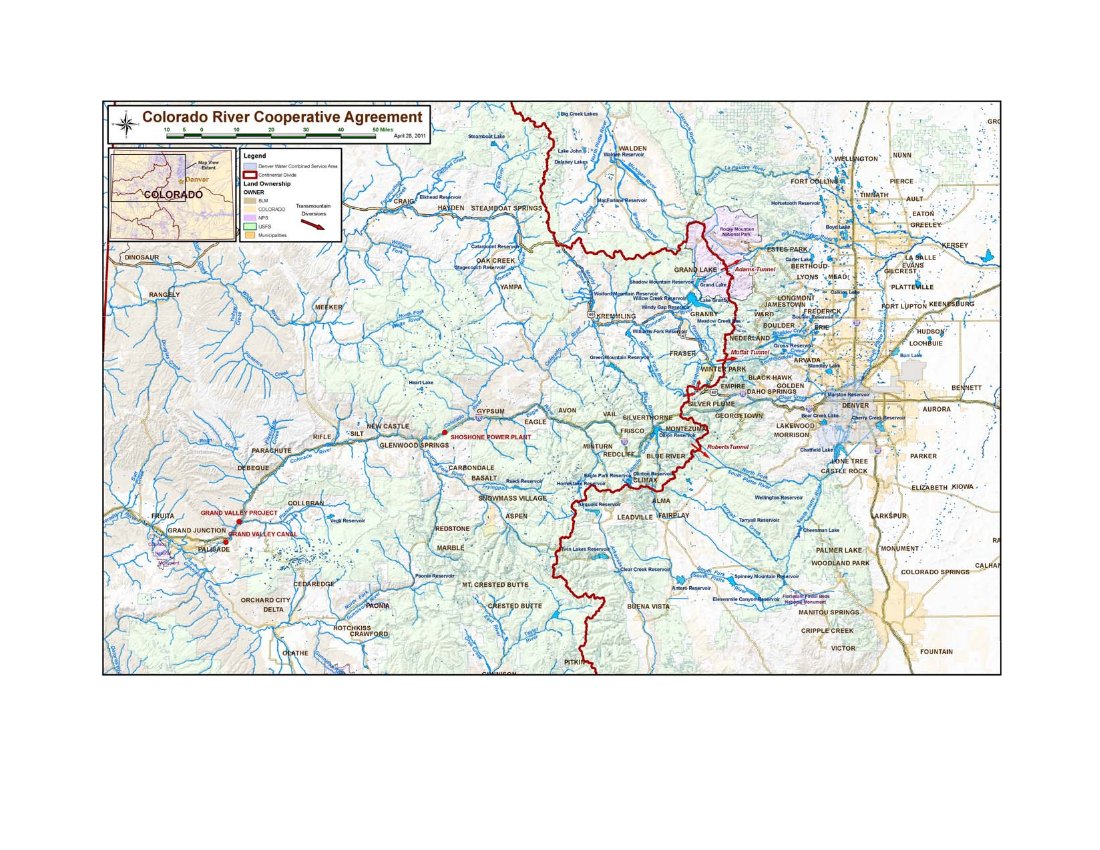
Here’s an opinion piece running in the Sky-Hi Daily News written by the Grand County Commissioners. They take on the execution of the Colorado River Cooperative Agreement. Here’s an excerpt:
As your Commissioners, we believe it is important to let you know the status of the agreement and how the agreement is already benefitting the county.
In the Colorado River Cooperative Agreement, Denver Water commits to providing environmental enhancements to address existing flow and temperature concerns throughout Grand County. It is important to note that the enhancements contained in the Cooperative Agreement are not a substitute for mitigation for the Gross Reservoir Enlargement Project (Moffat Project), as the agreement clearly states. Grand County continues to advocate in the federal permitting process for complete mitigation for all impacts caused by the Moffat Project.
The Colorado River Cooperative Agreement has not yet been signed by all parties, awaiting federal agency sign-off on allied agreements. Final signatures and full execution is expected this summer. However, even though the Cooperative Agreement has not been fully executed and the Moffat Project is not yet permitted, let alone built, Denver Water voluntarily implemented fundamental and critical components of the agreement last year and again this spring providing more water for county streams than would have been present without the agreement.
Denver Water contacted Grand County officials to determine how to maximize benefit to Grand County of bypassed water. In short, instead of the historical practice of significantly reducing the bypass flows at its diversion points during droughts, Denver Water is bypassing water for the benefit of the environment and Grand County water users. This benefit amounted to about 1,500 acre-feet of water that Denver Water gave back to the Fraser River when they legally could have diverted it to Denver in 2012. According to the municipal water and wastewater providers in the Fraser Valley, this additional water made a huge benefit last year to stream flow and stream temperatures, as well as operations of water and wastewater facilities.
Again this year, Denver Water instituted drought restrictions in April, which meant they had the right to reduce the flows in the Fraser River. Despite grave concerns about their water supply — overall reservoir storage was below 2002 levels and early projections showed reservoirs may not fill this season — Denver Water contacted us to discuss the bypass flows and the best way to work with Grand County to maximize water available for the county in 2013.
This example of cooperation and communication is what was envisioned when Grand County entered into the Colorado River Cooperative Agreement with Denver Water. The relationship forged through this agreement is bearing fruit for Grand County even though the agreement is not officially in place.
More Colorado River Cooperative Agreement coverage here.
Drought Restrictions Depend on Water Storage and Portfolios
Colorado River Basin: How will a water short West keep agriculture in business? #ColoradoRiver

From the Summit County Citizens Voice (Bob Berwyn):
When it comes to water, cities have always been easy targets for environmental groups looking to make a point about conservation and growth. But in reality, agricultural stakeholders bring far more chips to the table. By some estimates, agriculture uses about 75 percent of the Colorado River’s allocated water, while municipal uses account for about 15 percent. Just California’s Imperial Valley, where most of the country’s winter produce is grown, uses about 3 million acre feet of water annually. Any solution to the projected 3.2 million acre-foot water gap in the Colorado River Basin will require buy-in from farmers and ranchers in the region…
The big question that often remains unspoken is how much water will be transferred from agriculture to other uses, needed to sustain continued population growth in the West, as well as environmental needs for ecosystems and endangered fish, as well as recreational flows (rafting and fishing) that help sustain a fast-growing sector in the region…
“We need to change the way we view water rights to allow partial transfers … Right now, the the incentives are for agriculture to use as much water as they can,” [Mark] Squillace said, adding that there’s no incentive to switch to crops that require less water. Adjusting the system so that a farmer who has been growing alfalfa for 10 years could grow barley or soy beans (requiring less water) and market the “extra” water could yield significant water savings, he explained. Another option could be to create incentives that would benefit farmers if they decide to fallow 20 percent of their fields each year, he said. “But right now, there’s no incentive for any farmer to do this … One of the things that frustrates me about this is, the focus seems to be with what the scientists, what the engineers are trying to do to save water.
But water laws are a significant barrier — you’ve got to fix the law,” he said. “There’s not not enough recognition of the legal and policy changes that are needed,” he said. “Politically, you’re not going to solve this problem on the backs of the farmers. The best option might be to make it voluntary for farmers to redefine water rights.”
San Luis Valley: Louis Bacon announces a 21,000 acre conservation easement in the southern Sangre de Cristos
From The Pueblo Chieftain (Matt Hildner):
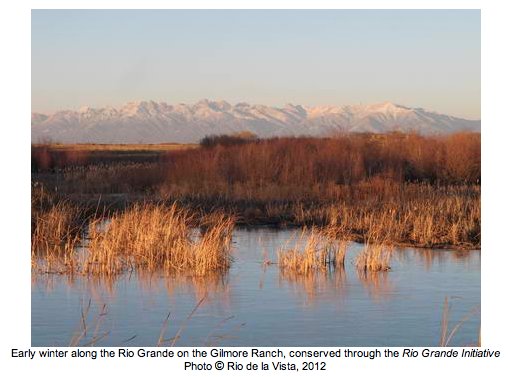
One of Southern Colorado’s largest landowners announced Tuesday that he’s putting 21,000 acres into a perpetual conservation easement. Louis Bacon, who has owned the Tercio Ranch since 1996, struck an agreement to put it under easement with Colorado Open Lands, which has held easements on 11 other properties in the southern Sangre de Cristo Mountains.
Bacon, a billionaire hedge fund manager, put almost all of his Blanca and Trinchera ranches in neighboring Costilla County under easement last year, moves that protected more than 166,000 acres.
As with those easements, Bacon pointed to the need to protect wildlife habitat in the southern Sangres, which, with the exception of a part of San Isabel National Forest, sits in private hands. “We are grateful to Louis Bacon as today’s announcement fills a critical gap between privately and publicly connected lands in this landscape of unparalleled beauty,” Dan Pike, president of Colorado Open Lands, said in a statement.
Bacon also has worked to conserve lands in New York, North Carolina and the Bahamas.
More coverage from Cathy Proctor writing for the Denver Business Journal. Here’s an excerpt:
On Tuesday, Bacon announced he’d reached an agreement with Colorado Open Lands to put 21,000 acres of the Tercio Ranch, about 36 miles southwest of Trinidad, into a perpetual conservation easement. The Tercio Ranch is owned by the Red River Ranch Holdings LLC and Tercio Ranch Holdings LLC — both of which are owned by Louis Bacon.
In September 2012, Bacon donated 77,000 acres of his 81,400-acre Trinchera Ranch to the U.S. Fish and Wildlife Service for a conservation easement to promote wildlife habitat. The Trinchera Ranch had been the site of a proposed power line backed by Xcel Energy Inc. and Westminster’s Tri-State Generation and Transmission Association.
The latest agreement, involving the Tercia Ranch, creates nearly 800,000 acres of public and privately owned conservation lands stretching from southern Colorado to northern New Mexico.