
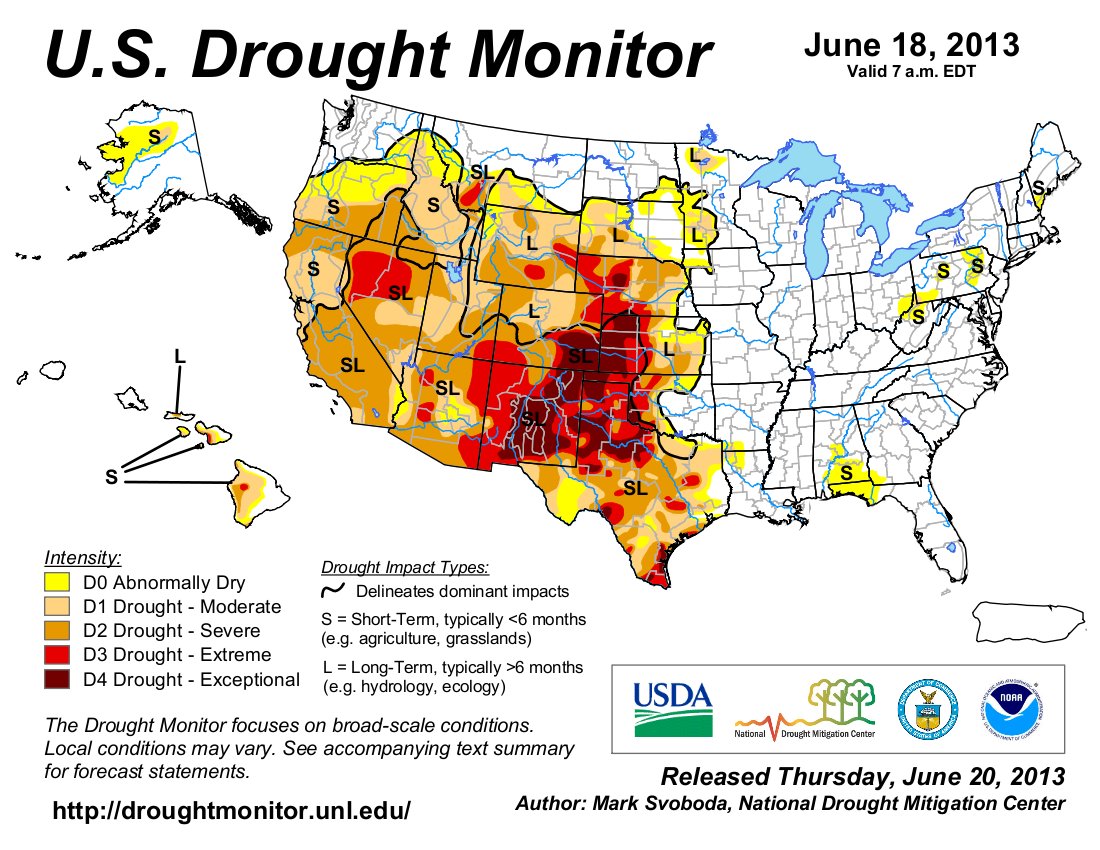
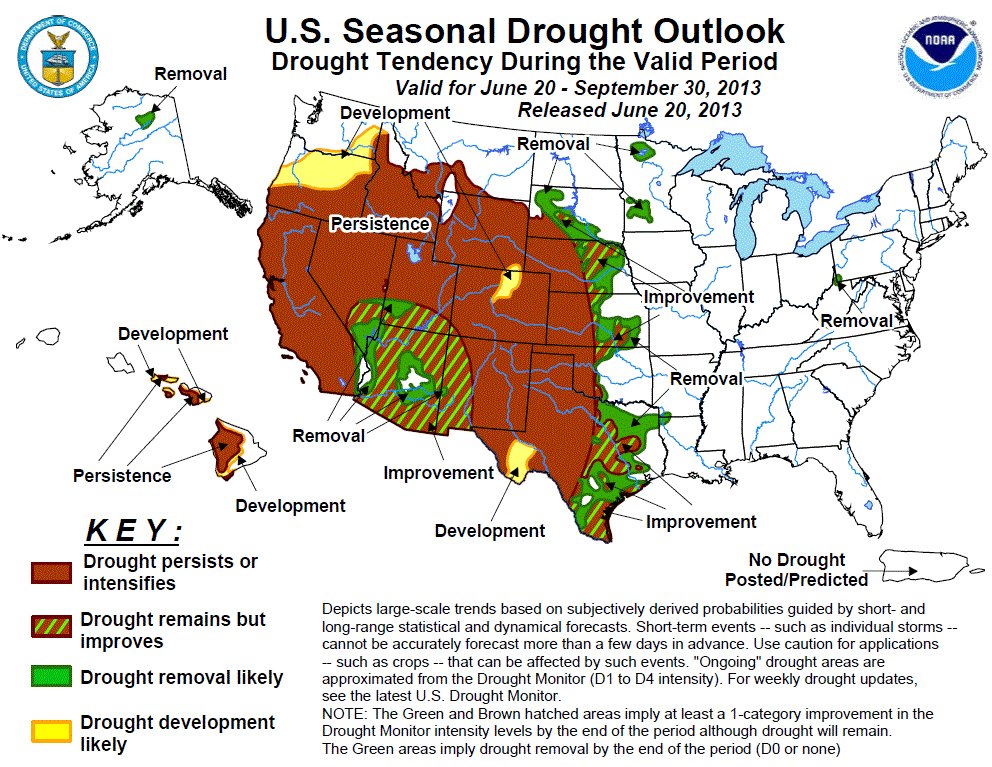
Drought news: Colorado is still drought country #COdrought

usdroughtmonitor06182013

seasonaldroughtoutlookcpcjune20toseptember302013

Click on the thumbnail graphics for the current US Drought Monitor map and the current drought forecast from the Climate Prediction Center.

Sadly, wildfire is directly associated with drought. From Circle of Blue (Brett Walton):

Santa Fe’s water department is one of several urban utilities – including those in Colorado Springs, Denver, and Flagstaff, Arizona – that are putting ratepayer dollars to work in the forests. The U.S. Forest Service, for its part, helps the utilities with the technical aspects of forest restoration and some of the physical work while using most of the money in its budget to focus on other high-risk forests in the state…

Recent forest fires, including the High Park fire outside of Fort Collins, Colorado last year, have water utilities on edge. Yet the most destructive blaze for drinking water infrastructure happened more than a decade ago near Denver.

The 2002 Hayman fire, still the largest in Colorado’s history, burned 55,800 hectares (138,000 acres) southwest of the city. Subsequent rainstorms swamped Strontia Springs reservoir with enough sediment – 765,000 cubic meters – to fill Denver’s basketball arena five times. Combined with the damage from a 1996 fire in the same area, Denver Water, the public utility, spent $US 26 million dredging and restoring two of its reservoirs.

In 2010, Denver Water entered into a five-year partnership with the U.S. Forest Service with the goal of reducing the risk of catastrophic fire. The two agencies will each spend $US 16.5 million on forest restoration, with Denver’s share coming from ratepayers.

This type of investment is called a payment for ecosystem services, a financial model that protects the natural processes that benefit people. Forests filter water, and their soil helps to slow down the surge of runoff after a storm, calming potential floods. Fires eliminate these benefits for some time. Erosion, poor water quality and higher flood risks persist long after the flames have been snuffed out.

Earth Economics, a research group, has charted at least 17 instances in the U.S. in which money from city or utility budgets is being put toward watershed management, most in areas other than wildfire risk.

Spending money on fire prevention is tricky, said Rowan Schmidt, an analyst at Earth Economics, because there is no rule of thumb for how much investment in a watershed will pay off.

Here’s a video about sustaining your lawn during drought, from Colorado Springs Utilities:

From the Colorado Springs Independent (Pam Zubeck):

After imposing watering restrictions in April, it appears the public is doing its part to hold water usage down. Of course, there are higher charges for water if you exceed certain levels of usage, so that discourages over-watering.

Click through for the usage graph from Colorado Springs Utilities.

From the Summit County Citizens Voice (Bob Berwyn):

Western Colorado and eastern Utah have warmed in the last century, and it appears that precipitation in the region has also increased, according to a new analysis of historic climate data compiled by Grand Junction-based National Weather Service forecaster Joe Ramey.

General long-term trends include cooling from the 1940s through the 1960s, towards warmer and wetter conditions since the 1970s, on par with many other parts of the country and the world.

Specifically, maximum temperatures have risen 0.4 degrees Fahrenheit and minimum temperatures have risen 1.1 degrees Fahrenheit during during the study period going back to 1911, when several towns and cities in the region started to maintain detailed climate data.

According to an abstract of Ramey’s study, posted on the Grand Junction NWS website, there are eleven sites within eastern Utah and western Colorado that have mostly unbroken climate records back to 1911. In eastern Utah these sites include Vernal, Moab, Blanding, and Bluff. Western Colorado sites are Steamboat Springs, Grand Junction, Crested Butte, Gunnison, Montrose, Telluride, and Silverton. This study is an analysis of the trends in those data.

Greeley: The health effects of hydraulic fracturing will be the topic for a forum on June 25

marcellushydraulicfracturing

From The Greeley Tribune (Sarah Moe):

The health effects of hydraulic fracturing will be discussed in Greeley on June 25. Speaking will be Rep. Joann Ginal, D-Fort Collins, who serves on the House Health Environment Committee; Wes Wilson, a former geological engineer and water resources manager; and Phil Doe, an expert on agricultural water issues.

The experts were invited to speak because members of several grassroots groups — Weld Air and Water, Weld 350, Frack Files and Plains Alliance — want to educate the public about a process they think is moving too fast, said spokeswoman Hollis Berendt. She said some people in the community are concerned about the recent increase in fracking operations, noting that more than 100 people came to a Greeley City Council meeting when fracking was discussed — though most only listened. “We’re going at this too fast; we’re not using good judgment,” Berendt said.

She said the lure of fast money has distracted people from how little is known about the health and environmental risks posed by fracking. But many professors and experts have studied oil and gas development without choosing sides when it comes to fracking, countered Doug Flanders, director of policy and external affairs for the Colorado Oil & Gas Association, in a statement to The Tribune.

Green energy development has slowed, Berendt said, and increasing the use of fracking could cause “catastrophic climate change.” However, she said the focus of the Greeley forum will be the health risk of fracking — not the environmental impact.

Berendt accused the oil and gas industry of trying to make information about fracking vague and unavailable, and said even oil and gas workers don’t know all of the chemicals and risks associated with fracking.

Flanders said COGA is listening to the concerns of the public when it comes to fracking. “COGA acknowledges the concerns, risks and benefits associated with all forms of energy development. We value the conversations we have with concerned communities every day,” Flanders said. Flanders added that he thinks most Coloradans want to work with the oil and gas industry, and that the talk among most citizens is a calm and rational dialogue.

Health ailments can’t yet be proven to be linked to oil and gas because the list of chemicals used in hydraulic fracturing was only recently released, Berendt said, but she thinks it’s more than coincidence when people who work at and live around fracking sites are afflicted with ailments such as worsening asthma and other breathing issues.

Because other Colorado cities have passed fracking bans, Berendt said, “People in Greeley are going to be guinea pigs, because we are continuing to do it.”

Flanders said fracking in the state is a complex matter, and that practical concerns shouldn’t be ignored when enacting bans. “… Banning a product we all use every minute of our lives is both short sighted and damaging to the Colorado way of life,” Flanders said.

State officials said regulations are constantly evolving to make oil and gas operations safer. The oil and gas industry is highly regulated to make sure it is safe, said Todd Hartman, communications director for the Colorado Department of Natural Resources. He said the department is always alert for new information that could shape regulations, and that the oil and gas industry has operated safely and successfully in Colorado for more than a hundred years. “All the while, industry technology and regulatory requirements designed to reduce environmental and health impacts continue to advance,” Hartman said.

Ginal, a biologist with a doctorate in endocrinology, will recap the bill she presented last session, HB 1275. The bill, which died in committee, asked for a study to identify health aspects of oil and gas activity.

Wilson has a bachelor’s of science degree in geological engineering and a master’s of science degree in water resources administration. He was in the U.S. Army Corps of Engineers and worked for the Environmental Protection Agency in Denver until his retirement in 2010.

Doe is environmental issues director for Be the Change, a progressive grassroots political organization. He was formerly head of the policy office overseeing federal water subsidies to irrigated agriculture with the U.S. Department of the Interior. He was also a whistleblower against attempts by the agriculture industry to thwart congressional controls on agricultural water subsidies who appeared on “60 Minutes.” He has published a number of articles on water issues, including a recent EcoWatch article discussing fracking in Colorado.

More oil and gas coverage here and here.

Happy 100th birthday activated sludge

wastewatertreatmentprocess

From the (Water Environment Federation (Jeanette Brown):

One hundred years ago this year, H. W. Clark and S. De M. Gage from the Lawrence Experiment Station in Massachusetts reported results of studies on the purification of sewage using aeration in the 45th Annual Report to the State Board of Health of Massachusetts. They found that if you aerated sewage, you achieved a clarified sewage and a reduction of Total Kjeldahl Nitrogen. A year later, 1914, a team of British researchers, Edward Ardern and W.T. Lockett, added the concept of recycling sludge, patented the process, and published a paper which first used the term “Activated Sludge.” As we reflect on these past hundred years, we can truly realize the power of these discoveries.

While a few plants adopted the activated sludge process early on, its value was not recognized for many years. In fact, the activated sludge process was not implemented in many cities throughout the United States until after the Clean Water Act in 1972. Over the years, we have modified the process, improved upon it, made it more efficient, and used it to remove nitrogen and phosphorous as well as carbon. Moreover, we have come to understand the process on a microbial level, its complexity and power. I am still overwhelmed when I visit a treatment plant and see the quality of effluent that this amazing process can achieve.

More wastewater coverage here and here.

The Rocky Mountain Field Institute is looking at options to protect Colorado’s last population of Greenback cutthroats

cutthroattrouthistoricranges

From The Pueblo Chieftain (Chris Woodka):

Can the state’s last remaining native fish survive the human impacts on their stream?

The Rocky Mountain Field Institute wants a $100,000 state grant to improve the habitat of Bear Creek, west of Colorado Springs. The creek is home to the only remaining population of greenback cutthroat trout in Colorado. The trout were discovered last year through genetic testing by the University of Colorado. Bear Creek also is a popular recreation site, and roads, hikers, cyclists and other outdoor activities. “It’s the only native greenback population in the state,” explained Doug Krieger, aquatic biologist for Parks and Wildlife, at last week’s Arkansas Basin Roundtable meeting. “We want to protect this mother lode of fish.”

The roundtable approved the grant, which now goes to the Colorado Water Conservation Board.

The trout live in a 4-mile stretch of Bear Creek. They apparently were stocked there in the 1800s, because the species actually is native to the South Platte River basin. Native species of greenback cutthroat trout in the state’s three other river basins are believed to be extinct or genetically altered by contact with other species. The state last year moved 64 of the fish to fisheries to breed more stock, Krieger added.

The grant money would stabilize a draw that is responsible for loading most of the sediment into Bear Creek, restore a portion of the stream and develop a plan to take steps to reduce sediment loading from High Drive, which runs adjacent to the creek.

Several recreational groups are cooperating in the project.

More endangered/threatened species coverage here.

Arkansas River Basin: Colorado Parks and Wildlife hopes to build a 3,000 acre-foot reservoir off the Excelsior Ditch

arkbasinditchsystem

From The Pueblo Chieftain (Chris Woodka):

Another reservoir plan for the Excelsior Ditch east of Pueblo surfaced Wednesday. Colorado Parks and Wildlife wants to build a small reservoir and wetlands area on the Stonewall Springs site, located south of U.S. 50 near the Pueblo Chemical Depot. “The project would provide 1,800 acres open to public access, either as a park or a wildlife area,” Dan Prenzlow, CPW regional manager, told the Lower Arkansas Valley Water Conservancy District Wednesday.

The state initially would develop a 3,000 acre-foot reservoir on property it is trying to acquire from Stonewall Springs LLC, an El Paso County development group represented by Mark Morley. Because the state is in negotiations with Stonewall, no cost for the project was given.

The first reservoir is one of five that potentially could be developed on the Stonewall Springs property. Two other reservoir sites on the Southwest Farms property along the Excelsior Ditch are slated for development by Two Rivers Water & Farming Co., controlled by John McKowen, a Denver entrepreneur. The purpose of both projects would be essentially the same. They are trying to attract other municipal or agricultural water users who need storage in exchange for water. Two Rivers wants to charge a fee in water for storage and use it to augment irrigation wells.

Prenzlow said other state agencies such as the Colorado Water Conservation Board and Great Outdoors Colorado could be partners, as well as the recovery of yield municipal group and well augmentation groups.

Two Rivers has made an offer of $3.5 million to the Arkansas Groundwater Users Association to buy its 53 percent share of the Excelsior Ditch. Stonewall Springs owns the other 47 percent of the ditch.

More Arkansas River Basin coverage here and here.

Lamar: The city is lining up financing for a $2 million pipeline replacement project

romanleadpipesciencemuseumuk

From The Pueblo Chieftain (Chris Woodka):

Lamar’s looking to get its pipes cleaned. But the city of 7,800 needs some state assistance to get the job done. The Arkansas Basin Roundtable last week sent a request for a $200,000 state grant to the Colorado Water Conservation Board. The money will assist in a $2 million project that would be funded with a $985,000 grant from the Department of Local Affairs, and a $785,000 CWCB loan. Lamar water customers would pay an additional $1.07 per month if all of the state funds are approved.

The money is needed because of heavy corrosion and leakage in the pipes that bring water from wells to the city. Water from two separate well fields is high in dissolved solids, and must be blended in order to use it. “If they clean the pipes, they burst,” said Gary Berngard, an executive for Honeywell Building Solutions, the consultant on the project.

The project also will upgrade parts of the water system in anticipation of completion of the Arkansas Valley Conduit, which is several years down the road.

The replacement of the pipes will recover between 378-662 acre-feet of water per year that now are being lost. It also would free up water from other sources for other uses, including industrial and agriculture. “This affects half of the population of Prowers County,” Commissioner Henry Schnabel told the roundtable in supporting the project.

More infrastructure coverage here.