
I get dinner out with family to celebrate the day. Happy Father’s Day to all you fathers.
Thanks Hellchild, Goober and Beaver. You make me proud.

I get dinner out with family to celebrate the day. Happy Father’s Day to all you fathers.
Thanks Hellchild, Goober and Beaver. You make me proud.

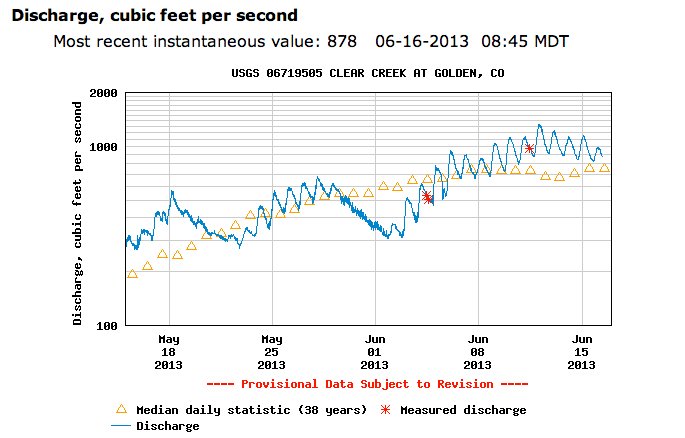
Standley Lake is the supply bucket for Westminster and Northglenn. Thornton also has storage in the reservoir. Staff from all three cities were breathing easier last week after the reservoir reached 95.5 feet and was declared operationally full by the dam tender. Clear Creek streamflow looks to have peaked on June 12 (click on the thumbnail for the hydrograph from the middle of May to today).
From the Summit County Citizens Voice (Bob Berwyn):
After a big weather turnaround in April and May, Dillon Reservoir is well on its way to filling, with the water level reaching an elevation of just about 9,008 on June 13, just nine feet below capacity. The last time the water level was this high was July 26, 2012. “We think it’s likely we’ll fill or at least get within a few feet of full elevation,” Denver Water spokesperson Stacy Chesney said.
Peak inflow into the reservoir was June 10, with the mainstem of the Blue River and the rest of the basin tributaries combining to deliver 1,754 cubic feet of water per second. The inflow hovered around that level early in the week, and started to drop a little bit by Thursday and Friday as the snowpack at higher elevations dwindled. By June 14, most of the automated SNOTEL sites had melted out, making it more difficult to assess how much runoff is still to come…
Chesney said Denver Water projects releasing between 50 and 100 cfs down the Lower Blue the next few months and will also divert water through the Roberts Tunnel to the South Platte, currently flowing at a rate of about 150 cfs.
Overall, Denver Water’s storage in the South Platte system is nearing capacity. Antero Reservoir just two feet below full and Eleven Mile Reservoir is at capacity, holding more than 98,000 acre feet. On the West Slope, Williams Fork Reservoir, Denver Water’s other big bucket, is about five feet below full, holding 89,000 acre feet, with a capacity of 97,000 acre feet.
Green Mountain Reservoir, administered by the U.S. Bureau of Reclamation, has also bounced back from what looked like it was going to be a woeful summer. As of mid-June, Green Mountain was about 76 percent full and still rising, according to BuRec spokesperson Kara Lamb.
From The Denver Post (Ally Marotti):
Northern Water officials aren’t waiting for the the [Big Meadows Fire] to be out to develop a protection plan. “It’s obviously a concern,” Northern Water spokesman Brian Werner said. “We’ve been talking for a couple years now about our watershed — what happens if and when it goes up in smoke. We’re gonna have some impact when the rains come.”
Northern Water partially supplies water to 860,000 people in 33 northern Colorado towns and cities. The company brings water to the Front Range from the Western Slope, and Grand Lake — 5-miles south of the fire — is the main reservoir.
Werner and his colleagues are worried all the debris from the fire will be washed into the lake when the summer rains come. “It’s anyone’s guess when that’ll happen,” Werner said. “It will happen.”
The sludge cannot be prevented from washing into the lake, Werner said. Northern Water has stepped monitoring, putting out extra sensors to keep track of the debris. The utility also is talking about preventative measures, such as anchoring debris booms in the lake to catch some of the sludge if the debris hits hard. But Werner said the fire, which was considered 30 percent contained as of Friday morning, isn’t as bad as it could be. Most likely, any debris washed into the lake will dissipate, settle on the bottom, and won’t harm the water supply.
From The Denver Post (Kieran Nicholson):
Twelve Colorado counties qualify for federal disaster relief because of drought conditions. Colorado Gov. John Hickenlooper was notified this week by U.S. Secretary of Agriculture Tom Vilsack about the designation, according to a Governor’s Office media release…
The primary counties are Dolores, Hinsdale, La Plata, Montezuma, Ouray and San Miguel. The contiguous counties are Archuleta, Gunnison, Mineral, Montrose, Saguache and San Juan.
The federal disaster relief includes Farm Service Agency (FSA) emergency loans. Farmers in eligible counties have eight months from the date of the declaration to apply for emergency loan assistance. FSA will consider each emergency loan application on its own merits, taking into account the extent of production losses, security available and repayment ability, the release said.
From The Pueblo Chieftain (Matt Hildner):
The U.S. Department of Agriculture has declared two San Luis Valley counties as natural disaster areas due to damages and losses caused by drought. Agricultural producers in Mineral and Saguache counties will now be eligible to apply for low interest emergency loans from USDA’s Farm Service Agency. Farmers have eight months from the date of the declaration to apply for loans to help cover part of their actual losses.
The declaration, issued Tuesday by the agency, also named 10 other counties in Southwestern Colorado. This year all but three Colorado counties, including Rio Grande County in the valley, have received the designation.
From the Albuquerque Journal (John Fleck):
Flows on the river are measured in cubic feet per second (cfs), an arcane but commonly used water flow metric on U.S. rivers. Normally at this time of June, the Rio Grande at Albuquerque’s Central Avenue Bridge is flowing at a bit more than 2,000 cfs. As I’m writing this, the river’s flowing at 527 cubic feet per second. But it will soon begin dropping significantly. Because of the drought, there is very little natural flow in the river. Most, if not all, of the river’s flow currently is water being released from storage behind dams on the Rio Chama. Without that, water managers say the river would be nearly dry by now in Albuquerque.
Since 2003, rules adopted by the U.S. Fish and Wildlife Service to protect the endangered Rio Grande silvery minnow required water managers to maintain a flow of 100 cfs at the USGS Central Avenue streamflow measurement gauge. But with supplies of supplemental storage water nearly exhausted, the river’s managers, with the concurrence of the FWS, have agreed to let the river drop to 50 to 60 cfs this summer.
The last time the river dropped below 100 cfs was late September and early October of 1989. The last time the river essentially went dry completely at Central was September of 1981.
From the CoCoRaHS blog:
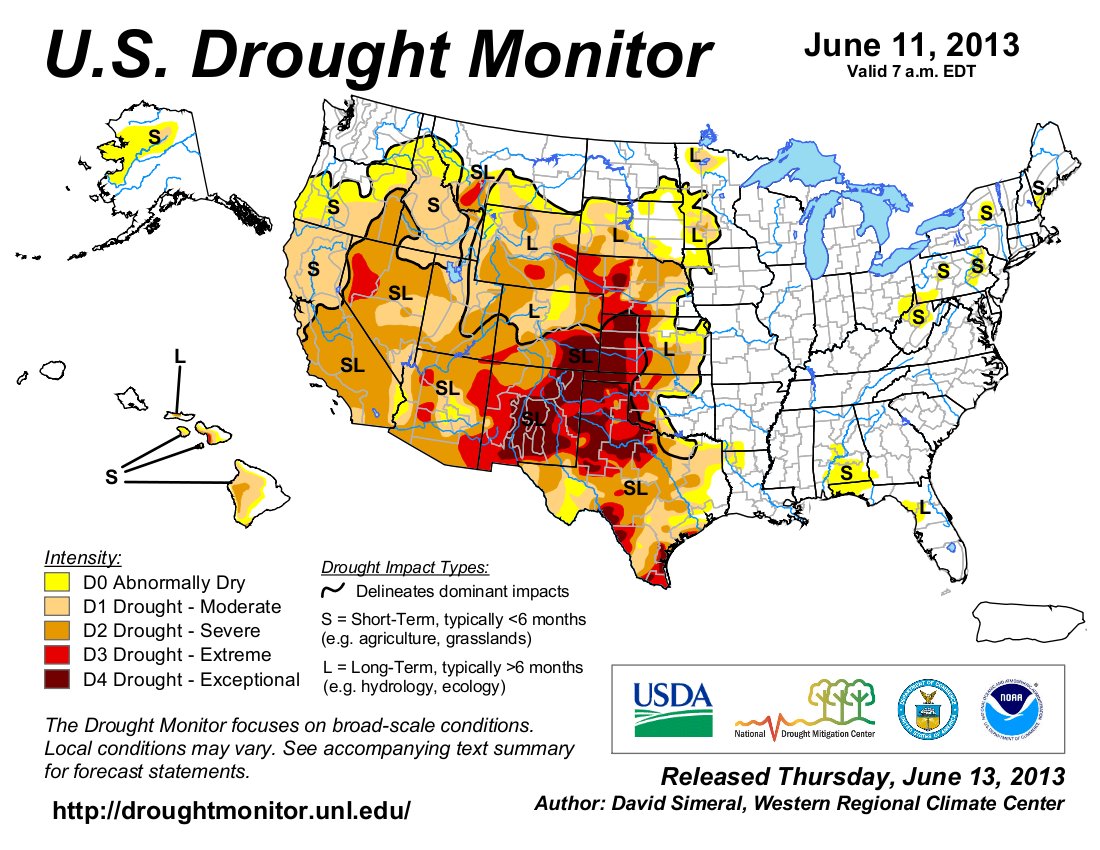
New Mexico has become ground zero of the drought that has been in progress over the western U.S. the past two years. A little over 82 percent of the state is in Extreme to Exceptional Drought according to the latest U.S. Drought Monitor. That’s the highest percentage of any state currently affected. Conditions have significantly worsened over the last three months. At the start of the calendar year about 32 percent of the state was in Extreme to Exceptional Drought, and by March it was up to 50 percent.
CoCoRaHS observers have been documenting the drought impacts, and some of the descriptions sound like they could have come from the Dust Bowl. Here are two excerpts.
Santa Fe County
We are noticing that wild animals, birds and mammals, are increasingly desperate for water and therefore losing some of their instinctive fear of humans and other predators. The combination of severe drought and smoke from two wildfires nearby is making some mammals panic at times and come toward us rather than flee us when we are outside.Luna County
Because we’ve had so little moisture fall from the sky and we’ve had daily winds from 20 to 65/70 mph at least 80% of the population is suffering from “allergies” we didn’t know we ever had! No one around here has a “lawn” of grass…instead we all measure just how deep the sand is now…the folks with the least amount of sand are considered lucky because they have less dusting/sand clean up to do on the inside of their homes. We’ve been told by a local farmer that he is now having to pay $20.00 for a bale of hay so he is going to have to sell all of his live stock next week – he can’t afford to feed them any longer. And, we’ve heard that the local rancher spent over $100,000.00 in the last nine months trying to keep his cattle heavy enough to get them to market. We know that we haven’t seen any of his cattle in our immediate area in the last 4 or 5 months…which means his heard head count is way down. Would you like us to start measuring the sand in our rain gauge rather than waiting for some moisture to land in it?
From jfleck at inkstain:
There was a round of press coverage last month (including from me) when Mike Connor, head of the U.S. Bureau of Reclamation, told reporters that internal Bureau modeling suggested as much as a one-in-three chance that Lake Mead would drop so low by 2016 that the federal government would make the first ever formal shortage declaration on the Colorado River.
New data out yesterday suggests that may have been too optimistic. The latest operational report from the Bureau now suggests a good chance of hitting the shortage trigger by mid-2015. Arizona and Nevada take the hit, and it’s a small hit initially, but it grows as Mead drops further. The latest monthly modeling report (the Bureau’s much-read 24-Month Study) now suggests Lake Mead’s surface elevation could drop to 1,075 feet above sea level – the level at which a formal shortage declaration is required – as early as June 2015. As I understand the rules, this would likely mean a reduction in water deliveries (initially, a small reduction) beginning in the fall of 2015.
Actually, it doesn’t exactly say we’ll be under 1075 in June 2015. The 24th month of the study (remember the name – it’s a 24-Month Study) is May 2015, at which point the Bureau figures Lake Mead’s elevation will sit at 1,075.28 feet above sea level. That’s 3 inches – the wake of a slow boat – above the drought trigger.
From The Durango Herald (Dale Rodebaugh):
The three-month outlook appears dry and hot. The federal government on Wednesday declared six counties, including La Plata, as primary natural disaster areas because of ongoing severe drought conditions. A couple of events that don’t bode well are happening, said Mark Svoboda. The drought has definitely shifted to the West, Svoboda said, referring to his office’s color-coded map that shows Southwest Colorado in red (extreme drought) but not the purple of exceptional drought that is choking Colorado’s plains counties. Southeast Colorado is in the third year of drought. Six months ago, the map showed a lot of the east in red, Svoboda said…
A map produced by the Climate Prediction Center, an arm of the National Oceanic and Atmospheric Administration, shows all of Colorado, New Mexico, Arizona, Utah, Nevada, California and Wyoming and parts of Texas, Kansas, Idaho and Oregon as areas where drought can continue or intensify…
The possibility of a summer with continuing drought and its effect on water supply hasn’t caused Durango city officials to panic, spokeswoman Sherri Dugdale said Wednesday. The level of water in Terminal Reservoir, which stores the city’s water supply, is at stage 1, which requires no action, Dugdale said.
Hey monsoon fans – we're starting to see the precursors coming up the Sierra Madre from southern Mexico: http://t.co/SHl9m5Zfyl #nmwx
— jfleck (@jfleck) June 16, 2013
Click here to read the newsletter.

Here’s the release from the Bureau of Reclamation (Kara Lamb):
The Bureau of Reclamation is accepting public comment on a draft Environmental Assessment that analyzes site specific effects of proposed contracts for water out of Ruedi Reservoir as well as an administrative amendment of existing contracts.
Written comments will be accepted until close of business, Mon., July 1. To obtain a copy of the Draft EA, please visit: http://www.usbr.gov/gp/nepa/sopa.html#ecao.
Ruedi Reservoir is part of the federal Fryingpan-Arkansas Project. The reservoir helps compensate Colorado’s West Slope for project diversions made further upstream in the Fryingpan River Basin and also provides storage for West Slope use. Reclamation began marketing Ruedi water to the West Slope in 1982. In 2012, Reclamation received requests from 17 West Slope entities for the remaining 19,585.5 acre-feet of available contract water in the marketable pool.
Reclamation is preparing an Environmental Assessment in compliance with the National Environmental Policy Act on site specific effects of the proposed 17 West Slope contracts along with the administrative action of amending 31 existing Ruedi Round I and II contracts to remove the expiration date and confirm their status as perpetual repayment contracts. Comments received will help Reclamation identify issues relevant to the proposed contracts and elements of the environment that could be affected.
Please send written comments via regular mail, fax or e-mail to:
Bureau of Reclamation
Attn: Lucy Maldonado
11056 W. County Rd 18E
Loveland, CO 80537
Fax: 970-663-3212
lmaldonado@usbr.gov
More Fryingpan-Arkansas Project coverage here.

From the Associated Press via The Denver Post:
Justice Sonia Sotomayor’s opinion for the court made plain that the justices did not find this a close case. “We hold that Tarrant’s claims lack merit,” Sotomayor said.
The case arose from a federal lawsuit the district filed in 2007 against the Oklahoma Water Resources Board and the Oklahoma Water Conservation Storage Commission that challenged the state’s water laws and sought a court order to prevent the board from enforcing them. Lower courts ruled for Oklahoma, including the Denver-based 10th U.S. Circuit Court of Appeals. It found that the Red River Compact protects Oklahoma’s water statutes from the legal challenge.
Legislation adopted by the Oklahoma Legislature in 2009 said no out-of-state water permit can prevent Oklahoma from meeting its obligations under compacts with other states. It also requires the Water Resources Board to consider in-state water shortages or needs when considering applications for out-of-state water sales.
The Obama administration backed the Texas district at the Supreme Court, saying Oklahoma may not categorically prohibit Texas water users from obtaining water in Oklahoma. But the administration took no position on whether the Texans ultimately should get the water they are seeking in this case.
More coverage from the Fort Worth Star-Telegram:
The ruling holds implications for a large swath of North Texas because TRWD serves an 11-county area that includes the cities of Fort Worth, Arlington and Mansfield and gets thirstier as its population continues to grow rapidly.
Sotomayor noted that the population of Dallas-Fort Worth increased 23 percent from 2000 to 2010 (from 5.1 million to 6.4 million). “This growth has strained regional water supplies, and north Texas’ need for water has been exacerbated in recent years by a long and costly drought,” she wrote. TRWD has estimated that its clients will need an additional 400,000 acre-feet of water per year by 2060, which makes increasing the supply imperative…
…for more than six years, the water district also has been trying to tap up to 130 billion gallons from a Red River tributary through a decades-old agreement.
Texas, Oklahoma, Arkansas and Louisiana signed the Red River Compact in 1978, and Congress’ approval in 1980 made it federal law. But since 2007, TRWD and Oklahoma have been fighting in court over whether the pact allows states or their agencies to cross borders to get their share of water. Oklahoma said no because its state laws block any transfer past the river. The water district argued that the compact’s silence on cross-border movement allowed it to buy the water and that the Oklahoma laws unconstitutionally interfered with interstate commerce. The U.S. solicitor general sided with TRWD’s view that it could get water north of the river to secure its equal share, but the justices weren’t persuaded.
“States rarely relinquish their sovereign powers, so when they do we would expect a clear indication of such devolution, not inscrutable silence,” Sotomayor wrote. “Adopting Tarrant’s reading would necessarily entail assuming that Oklahoma and three other states silently surrendered substantial control over the water within their borders when they agreed to the Compact. … we find this unlikely to have been the intent of the Compact’s signatories.”
Sotomayor, though an East Coaster through and through, showed some appreciation for the long-running southern rivalry. “The Red River has lent its name to a valley, a Civil War campaign, and a famed college football rivalry between the Longhorns of Texas and the Sooners of Oklahoma,” she wrote. “But college pride has not been the only source of controversy between Texas and Oklahoma regarding the Red River. The River has been the cause of numerous historical conflicts between the two States, leading to a mobilization of their militias at one time, and the declaration of martial law along a stretch of the River by Oklahoma Governor ‘Alfalfa Bill’ Murray at another.”[…]
Water is essential. But getting enough to where it’s wanted won’t ever be simple.
More Tarrant v. Herrmann coverage here.

From The Pueblo Chieftain (Chris Woodka):
James Eklund, senior deputy legal counsel for Gov. John Hickenlooper and a former assistant state attorney general, has been selected as the new director of the Colorado Water Conservation Board. Eklund was selected by the CWCB’s governing board and Mike King, executive director of the Colorado Department of Natural Resources this week. He will lead the state’s water policy and planning efforts, including the development of a statewide water plan as outlined in a recent executive order by Hickenlooper. He replaces Jennifer Gimbel. “James is the right leader at the right time to take on this critical project,” said King. “He brings experience, purpose and a clear-sighted approach that’s vital as Colorado addresses the ever-tougher challenges of natural resource protection and water allocation in an ever-growing state.”
While serving as senior deputy legal counsel to Hickenlooper, Eklund was deeply engaged in key legislative and legal matters, often pertaining to water and natural resources including state water rights, the reorganization of state wildfire responsibilities and groundwater concerns in the South Platte River Basin.
More coverage from the Northern Colorado Business Report:
Gimbel, whose last day at the water board was Monday, said in an email that she took a job as counselor to the assistant secretary for water and science at the U.S. Department of Interior. She will advise Assistant Secretary Anne Castle on water issues in the West.
State Department of Natural Resources Mike King told Gimbel that Hickenlooper “wanted his own person in that job.” Gimbel started as director during former Gov. Bill Ritter’s administration and had served as director for five years. She reapplied for the job when Hickenlooper took office and served in the position as an “at will” employee, meaning the governor could replace her at any time.
“I’d been told I was doing a great job by the governor’s office,” she said. “It was a shock.”
Gimbel made a variety of accomplishments despite cuts to the state’s water fund during her tenure. In Northern Colorado, she advanced the Windy Gap Firming Project by freeing up $2 million in state money for infrastructure. The project by the Northern Colorado Water Conservancy District proposes to build Chimney Hollow Reservoir west of Carter Lake near Loveland…
While at the attorney general’s office from 2006 to 2010, Eklund provided legal expertise on water policy and planning issues. He represented the water board, Colorado Department of Natural Resources, and the State Engineer’s Office in compact negotiations with other western states, the federal government and Mexico. He provided counsel on the Endangered Species Act and water quality laws and worked in several roles to protect state interests on the Colorado River.
The water board was created 75 years ago to provide policy direction on water issues. Governed by a 15-member board, the agency’s responsibilities range from protecting Colorado’s streams and lakes to water conservation, flood mitigation, watershed protection, stream restoration, drought planning, water supply planning and water project financing. The water board also works to protect the state’s water apportionments in collaboration with other western states and federal agencies.
Here’s the release from the Department of Natural Resources (Todd Hartman):
James Eklund, senior deputy legal counsel for the Governor and a former assistant state attorney general, has been selected as the new director of the Colorado Water Conservation Board.
Eklund, selected by the CWCB’s governing board and the executive director of the Colorado Department of Natural Resources, will lead the state’s water policy and planning efforts, including the development of a statewide water plan as outlined in a recent Executive Order from Governor John Hickenlooper.
“James is the right leader at the right time to take on this critical project,” said Mike King, executive director of the Colorado Department of Natural Resources. “He brings experience, purpose and a clear-sighted approach that’s vital as Colorado addresses the ever-tougher challenges of natural resource protection and water allocation in an ever-growing state.”
While serving as senior deputy legal counsel to Governor Hickenlooper, Eklund was deeply engaged in key legislative and legal matters, often pertaining to water and natural resources including state water rights, the reorganization of state wildfire responsibilities and groundwater concerns in the South Platte River Basin.
While at the Attorney General’s office from 2006 to 2010, Eklund provided legal expertise on many issues central to water policy and planning in Colorado. He represented the Colorado Department of Natural Resources, CWCB and the State Engineer’s Office in compact negotiations with other western states, the federal government and Mexico. He provided counsel related to compliance with the Endangered Species Act and water quality laws, and worked in several roles to protect state interests on the Colorado River.
“The Board is excited to have such a capable leader as James. His resolve will be crucial as we take the next step on completion of a statewide water plan,” said Alan Hamel, Colorado
Water Conservation Board chairman. “James’ lifelong connection with Colorado’s rich and often intricate water culture will serve him well as he guides us forward.”
Eklund is a fifth-generation Coloradan from the Western Slope. “I look forward to working with water leaders statewide to solve our significant water challenges,” Eklund said. “We are positioned to do so as a direct result of outstanding work by CWCB staff and former director Jennifer Gimbel.”
The Colorado Water Conservation Board was created 75 years ago to provide policy direction on water issues. Governed by a 15-member board, the agency’s responsibilities range from protecting Colorado’s streams and lakes to water conservation, flood mitigation, watershed protection, stream restoration, drought planning, water supply planning and water project financing. The CWCB also works to protect the state’s water apportionments in collaboration with other western states and federal agencies.
More CWCB coverage here.

From The Pueblo Chieftain (Chris Woodka):
A vote among shareholders of the Arkansas Groundwater Users Association on whether to approve the sale of its Excelsior Ditch shares has been postponed.
Two Rivers Water and Farming Co. wants to purchase the Excelsior shares for $3.5 million, making the water and use of the ditch available to AGUA. Two Rivers plans to build reservoirs on the Southwest Farms site and lease space to cities in exchange for water to apply to fields it owns on Bessemer Ditch. It needs the ditch to ensure the water can reach the reservoirs.
AGUA owns about 53 percent of the ditch. The remainder of shares belong to Stonewall Springs LLC. At shareholder meetings this week, AGUA members were uncomfortable with the details of a contract approved by its board in May. Two Rivers also requested more time to work out some of the missing pieces. So, a shareholder meeting to approve or reject the contract scheduled for Tuesday has been cancelled.
“It could be up to four months until all the details are worked out,” said Scott Lorenz, AGUA manager. “We’re going to take it slowly.” Under the agreement, Two Rivers planned to lease water from the ditch back to AGUA shareholders at $1 per year over a 10-year period, give the ditch group 10 percent of storage space up to 2,500 acre-feet, provide a portion of “toll” water to AGUA and allow AGUA to use the ditch for its recharge ponds. Two Rivers also would pay $3.5 million, paying off a state loan of $1.5 million that AGUA obtained when it purchased the ditch.
AGUA provides augmentation for well water for about 250 farms on the Arkansas River and Fountain Creek.
Two Rivers has purchased farm ground and other reservoir sites in Huerfano and Pueblo counties, with the goal of raising high-dollar vegetable crops.