Drought news: Eagle River streamflow expected to be below average #COdrought

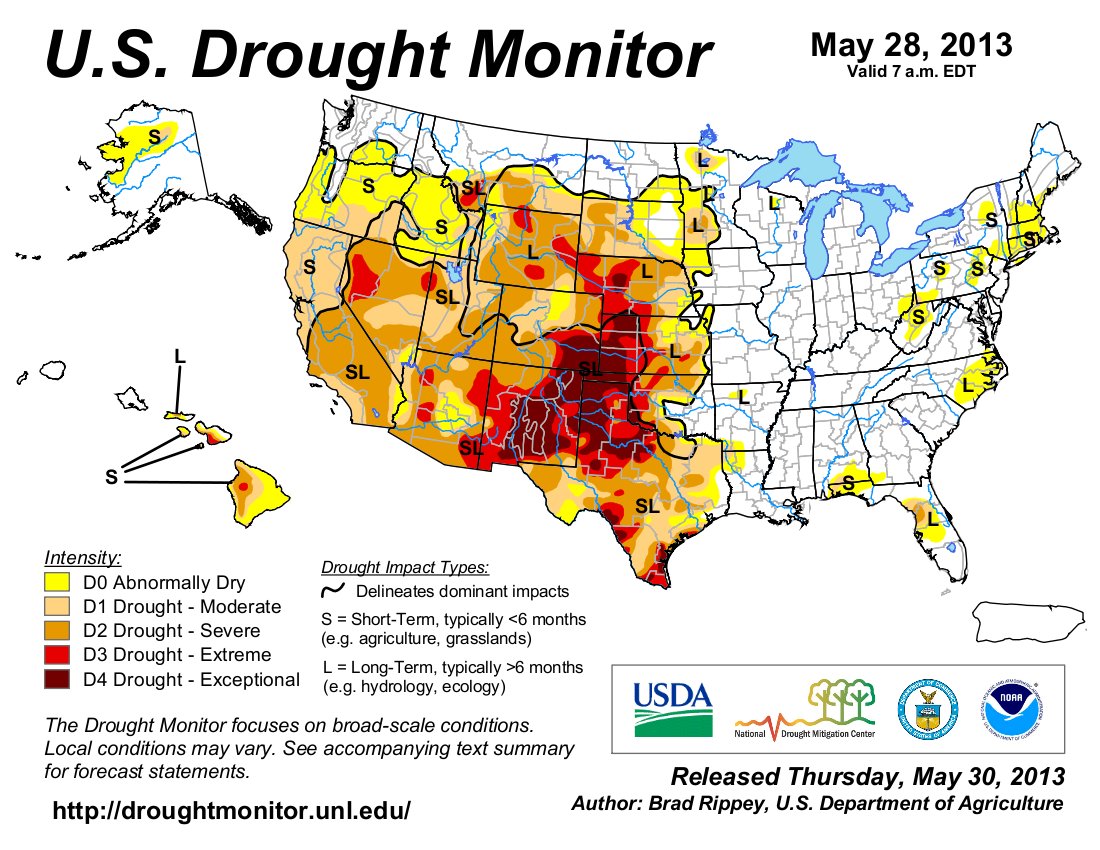
usdroughtmonitor05302013

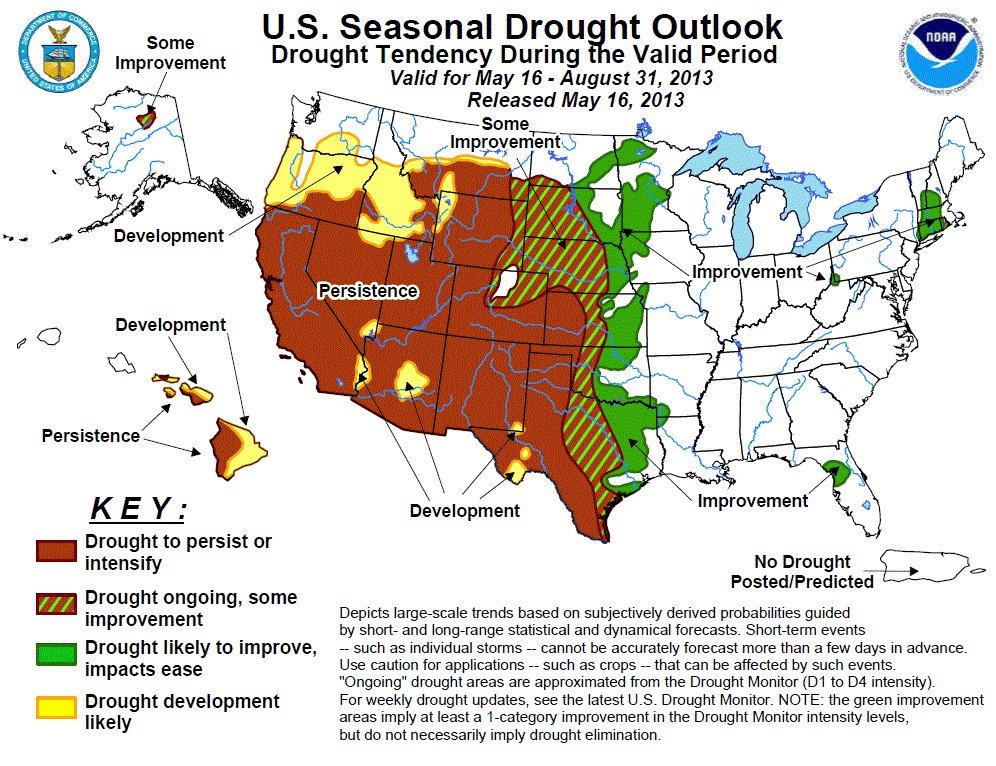
seasonaldroughtoutlookcpc0516to08312013

From the Vail Daily News (Scott N. Miller):

At a “State of the River” meeting Wednesday at Colorado Mountain College in Edwards, assistant state climatologist Wendy Ryan gave a full house in the college’s lecture hall an overview of past and current streamflows, with some predictions thrown in for the rest of the season…

While Eagle River Water and Sanitation District general manager Linn Brooks said streamflows are expected to be “OK” moving into this summer, Ryan said those flows will remain below historic averages through the rest of this year.

In the Eagle River basin, Ryan said snowpack peaked a couple of weeks later than usual this year — in late April — at about 88 percent of its historic averages. The snow is now coming off fairly quickly, though.

That’s important because the valley depends on streamflow for most of its water supply. While a snow measurement site atop Fremont Pass still has good supply, Ryan said the snow is nearly melted off at the measurement site on Vail Mountain…

Ryan said climate forecasts for the rest of this year indicate the drought will either linger or intensify. The good news, though, is that drought cycles don’t linger for extended periods.

In her presentation, Brooks said the Eagle River is subject to “extreme” variations from year to year. Brooks added that last year’s drought, when local water managers developed “water emergency” plans before summer rains brought badly-needed relief, taught both water officials and users some important lessons.

Aurora History Museum presentation: ‘Irrigating Aurora – The Importance of Water to Settling the West’ June 15

highlinecanaldenver.jpg

Here’s the release from the City of Aurora:

Water played a significant role in the settling of Colorado. Farming and water go hand in hand and have been important to each other throughout Colorado’s history. The Aurora History Museum wants to show you just how water has shaped the state where we live.

Come to DeLaney Farm, 170 S. Chambers, on Saturday, June 15, starting at 10 a.m., and enjoy a walking tour around this historic site. Learn about how Aurora’s food supply has used water in the past and how it will continue to use water in the future.

The tour is free and open to the public, for ages 8 and up. Bring drinking water, a hat, light jacket, sunscreen, sturdy walking shoes and your curiosity.

For more information, call Jim Bertolini, Historic Preservation Coordinator at 303-739-6661.

More Aurora coverage here and here.

Restoration: Pennsylvania Mine cleanup to start in earnest beginning this month

pennsylvaniamineperucreekcotu.jpg

From the Summit Daily News (Breeana Laughlin):

Pennsylvania Mine bleeds heavy metals, or acid mine drainage, into Peru Creek and the Snake River. The Snake flows into Dillon Reservoir — a major water source for the Front Range.

The mine operated from 1879 through the early 1900s. Like many mines in the area, it sits in a pristine alpine valley. Today the Peru Creek valley, eight miles to the east of Keystone, serves as a year-round destination for recreation.

The mine is one of the largest contributors of human-caused heavy metal in the Snake River Watershed. Contaminants include aluminum, cadmium, copper, iron, lead, manganese and zinc. Exposure to these metals can cause irreversible and lifelong health problems in humans and wildlife.

This summer, the EPA will prep infrastructure to allow heavy equipment into the mine site in hopes of cutting off pollution sources. Meanwhile, the Colorado Division of Reclamation and Mining Safety will continue underground investigations to pinpoint where the toxic metals are originating and decipher which techniques should be used to best clean up the site…

EPA on-scene coordinator Paul Peronard expects the mine cleanup project to take place over three years, and cost about $3 million. Progress will be made in “finite, bite-size chunks,” he said…

Workers drilled holes into the ground and used a borehole camera to inspect the inside of the mine. The state-of-the-art technology was combined with maps from the 1920s to create a blueprint of the mine site…

Stakeholders then came up with a portal rehabilitation project. They dug and cut their way into the mine and installed very large culverts into two mine portals. The work required climbing through “hobbit holes” and dealing with 2 feet of muck, but it allowed researchers to get data about the amount of flow and level of contaminants coming through the F and C portals of the mine — where the bulk of the cleanup work will be done. The water found was “pretty nasty stuff.” The substance was a rusty orange color ­— very similar to the hue of the excavators on site. Geologists and engineers used dye to track water flows, created settlement ponds and revegetated disturbed areas…

In June, workers will prepare the mine site and stabilize the portals so more detailed underground investigations can be made. Geological engineer Graves’ plan is to install inner and outer bulkheads at the mine. The problem workers have with sealing waterways is a lack of rock and other landmass on top of the mine to contain underground water pressure, he said…

In addition to installing bulkheads in 2014 and 2015, stakeholders plan to cap waste and tailing piles in place with topsoil and vegetation to prevent erosion and contaminants from leaching. Any significant surface water pathways discovered during the underground investigations will also be sealed.

From the Summit County Citizens Voice (Bob Berwyn):

Nearly a century after miners finished digging millions of dollars worth of silver, lead and zinc out of the Pennsylvania Mine, heavy machinery will once again rumble through the high alpine Peru Creek Valley. But instead of burrowing deep into the ground to find precious metals, the workers this time will be trying to clean up the big mess left behind when the mine was abandoned. For decades, water coursing through the mine shafts has been dissolving minerals, resulting in acid mine drainage that pollutes Peru Creek and the Snake River. Concentrations of some metals, especially zinc, are high enough to kill trout…

The cleanup is a partnership between the U.S. Environmental Protection Agency, the Colorado Division of Reclamation Mining and Safety, the U.S. Forest Service, the Colorado Department of Public Health and Environment, and Summit County. For more information about the project please visit: http://www.snakerivertaskforce.org.

More Snake River Watershed coverage here and here.

Runoff news: 10,000 acre-feet of water available for the Voluntary Flow Management Program this summer

raftingarkriver.jpg

From The Mountain Mail:

Spring fishing has been “spectacular,” and “stellar flows for whitewater boating” are expected well into summer, Arkansas Headwaters Recreation Area Park Manager Rob White said May 23. “Thanks to late spring snowstorms, the Bureau of Reclamation and the Southeastern Colorado Water Conservancy District informed AHRA they will have 10,000 acre-feet of water available for the Voluntary Flow Management Program this summer,” White said. “This ensures the Upper Arkansas River good flows for rafting, kayaking and fishing.”

The Voluntary Flow Management Program is a cooperative program crafted in the 1990s with help from Trout Unlimited and the Arkansas River Outfitters Association. The program provides water management guidelines that provide for whitewater flows in the Arkansas River for recreation users in the summer months. It also protects and enhances the fishery by establishing minimum flow guidelines throughout the rest of the year, White said.

White advised rafting enthusiasts planning a whitewater trip on the Arkansas to use a trained, experienced guide. The Arkansas River Outfitters Association has information to help select a whitewater boating company, he said. For more information on AHRA, visit parks.state.co.us/Parks/ArkansasHeadwaters.

Colorado River Basin: Moab tailings cleanup tally = 6 million tons so far #ColoradoRiver

moabtailingscleanupsite.jpg

From The Grand Junction Daily Sentinel (Gary Harmon):

The cleanup of 16 million tons of uranium mill tailings on the Colorado River near Moab is approaching the 6-million-ton mark. Officials are pegging that milestone to occur about June 17, said Don Metzler, who manages the project for the U.S. Department of Energy.

Work on the cleanup of the Cold War-era pile on the west bank of the Colorado River north of Moab resumed this spring after a three-month curtailment tied to the lack of federal funding, during which 27 people were laid off. All returned to their jobs, Metzler said.

Project managers used the downtime to improve the containers that are filled at the pile and taken by rail 30 miles north to Crescent Junction, where the tailings are being deposited in a cell at the base of the Bookcliffs. Employees who remained on the job installed permanent rubberized liners in the containers, a job that required 65 steps per container, Metzler said. The linings cost $1.5 million, but they’ll easily last for the life of the project, Metzler said, eliminating expenditures of $400,000 a year for temporary liners that fell short of expectations. Tailings would frequently stick to the containers and would still be in the containers on the return trip from Crescent Junction and “I’d have to pay to ship it the second time,” Metzler said. Now the project has “zero carryback,” Metzler said. “It’s actually going to save a lot of money over the life of the project. This one was just so perfect in every regard.”

Tailing shipments began in 2009 and the cleanup is scheduled to be complete by 2025. The disposal cell is designed to blend in with the surrounding sandstone. “We think that when it’s all done it’s going to blend in so well that you’re not going to notice anything,” Metzler said.

More Moab uranium tailings coverage here and here.

Colorado River Basin: Reclamation’s ‘Next Steps’ conference recap #ColoradoRiver

coloradoriverbasin2012doiviatheaspentimes.jpg

From The Grand Junction Daily Sentinel (Dennis Webb):

The federal government is focusing on working with states to make the most efficient use of existing water supplies as a first effort to head off a projected future gap between supply and demand in the Colorado River watershed.

Department of Interior and Bureau of Reclamation officials met in San Diego this week with parties from the seven basin states to talk about the next steps following release of a Reclamation-led study in December. It projected an annual shortfall of 3.2 million acre-feet a year by 2060 unless corrective actions are taken. The government is now forming working groups to look at municipal/industrial and agricultural uses, and also at the need to ensure healthy river flows for environmental and recreational needs.

Terry Fulp, director of the Bureau of Reclamation’s Lower Colorado Region, said one goal is to better understand what effort to conserve water by users is occurring now, and what additional opportunities can be pursued in the future. These could cover everything from efficiencies in use, to reuse, to “banking” that allows agricultural water to be temporarily put to urban uses without the water rights being transferred. He said the healthy rivers work group will look at what is needed in terms of data and modeling in order to pursue opportunities to ensure adequate flows in certain reaches of the Colorado and tributaries at various times of year.

The recently completed study also identified various means of augmenting the supply of water in the basin, such as transbasin pipelines and desalination of ocean water. But Fulp said those can be large-infrastructure investments with high environmental costs as well, and the Bureau of Reclamation decided it should focus on “more low-hanging fruit” involving measures such as conservation.

Molly Mugglestone, co-director of Protect the Flows, a coalition of businesses, said in a statement that through approaches including conservation, reuse and improved agricultural efficiency, “we can meet the water needs of the Southwest, while protecting a healthy, flowing river and all the jobs that depend on it.”

In a joint news release, several major municipal water suppliers in basin states vowed to build on the conservation measures they already have undertaken. Denver Water chief executive officer and manager Jim Lochhead noted that agriculture rather than municipalities uses most of the river’s water, and that a warmer, drier climate is the biggest driver in the projected future imbalance. But he added, “We have already made great strides in water efficiency, and our work will continue.”

From the Associated Press via The Denver Post:

Water managers from seven states, Indian tribes and conservation groups are pledging to find ways to wring more from every drop of water in the drought-stricken Colorado River.
Officials ended a Tuesday meeting in San Diego promising an update by the end of the year on the work of panels representing municipal, agricultural, environmental and tribal interests.

More Colorado River Basin coverage here and here.

Colorado Water Congress Public Trust Special Project Fundraiser Alert

justianifirstdodifierofriparianrights.jpg

From email from the Colorado Water Congress (Doug Kemper):

After failing to collect enough signatures to place Public Trust initiatives in front of Colorado voters in 2012, the sponsors announced that they are redoubling their efforts to bring the issue to Colorado voters as early as 2014. “We will stay at this until we win,” their leadership stated.

The Colorado Water Congress has strongly opposed the Public Trust Doctrine becoming law for the last two decades. It is critical that we act now to prepare for the next round in the Public Trust battle. Failure to prepare will certainly leave us in a precarious position.

The Water Congress Board established a new Public Trust Special Project to fervently challenge upcoming ballot initiatives and, as importantly, to engage our water community in positive public communication about Colorado’s water future. Our two-year budget is $325,000.

The first phase of fund raising is the reason I am contacting you now. Please review the attached Public Trust Special Project overview, which provides a description of the issue, our position, and the very high stakes at hand. It also details the specific activities that your special fund contribution will support.

Time is of the essence. For public entities, this appeal is your only opportunity to financially contribute toward action on upcoming Public Trust initiatives. If they become certified for the ballot, your activities are severely restricted by law. Because the Water Congress receives a portion of its funding from public entities, we face the same restrictions

We hope that you will consider this issue a priority. If you wish to contribute to this project (in any amount), please click here. Thank you for your consideration.

From The Pueblo Chieftain (Chris Woodka):

It’s kind of like watching thunderheads build over mountain ranges.

Colorado Water Congress is seeking to raise $325,000 to fight off the next attempt to apply the public trust doctrine to Colorado water law. The group took the lead role in 2012 to battle an initiative by Richard Hamilton of Fairplay that it claimed would have created legal turmoil over water rights. “We think this issue may be in front of us for some time,” said Doug Kemper, executive director of the CWC. “As the state is trying to develop a state water plan, this cuts the legs out from under it.”

For his part, Hamilton said he plans to launch a campaign to place ballot questions “exactly the same” as he attempted to place on the 2012 ballot.

In 2012, the ballot titles were challenged by the CWC, a process that cut four months off the six-month period to collect signatures, Hamilton said. In July, having collected only about 35,000 signatures of 86,000 needed to put the issues on the ballot, Hamilton withdrew the questions.

“The use of the public’s water is for the public’s good,” Hamilton said, saying Colorado’s constitution clearly says the state’s water is owned by the public. “It’s interesting that the state’s water interests try to block the initiative and refuse to have a full, open discussion with the public.”

Hamilton, a longtime lobbyist for water issues, has worked to place water issues on the ballot for the past 25 years. His concerns are rooted in the state’s priorities of placing development ahead of environmental and recreation concerns. “The water transfers that have happened in this state have benefitted real estate developers in Denver, Aurora, Colorado Springs and at times Pueblo,” Hamilton said.

The Water Congress is concerned about protecting water rights that have been in place for as long as 150 years, property rights associated with stream access and costly water quality legal battles, Kemper said. The fundraising effort will provide money for legal fights, surveying public opinion, tracking ballot issues and distributing information, Kemper said. “As a water community, we need to be organized,” he said. “Once a campaign begins, deadlines can be extremely short and time is limited.”

More 2014 Colorado November election coverage here.